


Product Monograph - Gum Paroex
ACTIONS, CLINICAL PHARMACOLOGY:
GUM Paroex Oral Rinse (0.12% Chlorhexidine Gluconate) provides antimicrobial activity during oral rinsing which is maintained between rinsings. Microbiologic sampling of plaque has shown a general reduction of both aerobic and anaerobic bacterial counts ranging from 54-97% through six months’ clinical use. Rinsing with chlorhexidine gluconate inhibits the buildup and maturation of plaque by reducing certain microbes regarded as gingival pathogens, thereby reducing gingivitis1,4,5. Chlorhexidine gluconate provided antimicrobial activity during rinsing and for several hours thereafter.
No significant changes in bacterial sensitivity, overgrowth of potentially opportunistic organisms or other adverse changes in the oral microbial flora were observed following the use of chlorhexidine gluconate for six months. Three months after chlorhexidine gluconate use was discontinued, the number of bacteria in plaque had returned to pre-treatment levels and sensitivity of plaque bacteria to chlorhexidine gluconate remained unchanged.
Studies conducted with human subjects and animals demonstrate that any ingested chlorhexidine gluconate is poorly absorbed from the gastrointestinal tract. Excretion of chlorhexidine gluconate occurred primarily through the feces (approximately 90%). Less than 1% of the chlorhexidine gluconate ingested by these subjects was excreted in the urine.
INDICATIONS AND CLINICAL USE:
GUM Paroex (0.12% chlorhexidine gluconate) is indicated for use as part of a professional program for the treatment of moderate to severe gingivitis, and for management of associated gingival bleeding and inflammation between dental visits. For patients having coexisting gingivitis and periodontitis, see PRECAUTIONS.
CONTRAINDICATIONS
GUM Paroex (0.12% chlorhexidine gluconate) should not be used by persons who are known to be hypersensitive to chlorhexidine gluconate or other formula ingredients.
WARNINGS:
USE IN PREGNANCY:
Reproduction and fertility studies with chlorhexidine gluconate have been conducted. No evidence of impaired fertility was observed in male and female rats at doses up to 100 mg/kg/day, and no evidence of harm to the fetus was observed in rats and rabbits at doses up to 300 mg/kg/day and 40 mg/kg/day, respectively. These doses are approximately 100, 300, and 40 times that which would result from a person ingesting 30 mL (2 doses) of 0.12% chlorhexidine gluconate per day. Since controlled studies in pregnant women have not been conducted, the benefits of use of the drug in pregnant women should be weighed against possible risk to the fetus.
BREASTFEEDING MOTHERS:
It is not known whether this drug is excreted in human milk. In parturition and lactation studies with rats, no evidence of impaired parturition or of toxic effects to suckling pups was observed when chlorhexidine gluconate was administered to dams at doses that were over 100 times greater than the dose which would result if a person ingested the entire recommended dose of 0.12% chlorhexidine gluconate on a daily basis.
USE IN CHILDREN:
Since the safety and efficacy of chlorhexidine gluconate in children has not yet been fully established, the benefits of its use should be weighed against the possible risks.
PRECAUTIONS:
- 1. For patients having coexisting gingivitis and periodontitis, the absence of gingival inflammation following treatment with 0.12% chlorhexidine gluconate may not be indicative of the absence of underlying periodontitis. Appropriate treatment of periodontitis is therefore indicated.
- 2. Chlorhexidine gluconate may cause staining of oral surfaces such as the film on tooth surfaces, restorations, and the dorsum of the tongue. Stain will be more pronounced in patients who have heavier accumulations of un-removed plaque. Stain resulting from use of chlorhexidine gluconate does not adversely affect the health of gingivae or other oral tissue. Stain can be removed from most tooth surfaces by conventional professional prophylactic techniques. Additional time may be required to complete the prophylaxis. Discretion should be used when treating patients with exposed root surfaces or anterior facial restorations with rough surfaces or margins. If natural stains cannot be removed from these surfaces by a dental prophylaxis, patients should be excluded from GUM Paroex treatment if the risk of permanent discolouration is unacceptable. Stains in these areas may be difficult to remove by dental prophylaxis and on rare occasions may necessitate replacement of these restorations.
- 3. A few patients may experience an alteration in taste perception while undergoing treatment with GUM Paroex. Most of these patients accommodate to this effect with continued use of chlorhexidine gluconate. Rare instances of permanent taste alteration following chlorhexidine gluconate use have been reported via post-marketing product surveillance.
- 4. For maximum effectiveness the patient should avoid rinsing their mouth (with water or other mouthwashes), brushing their teeth, eating or drinking for about 30 minutes after using chlorhexidine gluconate.
ADVERSE REACTIONS:
No serious systemic reactions associated with use of 0.12% chlorhexidine gluconate were observed in clinical testing. However, some adverse reactions have been reported in studies with chlorhexidine gluconate containing mouth rinses. The most common side effects associated with chlorhexidine gluconate oral rinse are (1) an increase in staining of oral surfaces, (2) an increase in supragingival tartar (3) an alteration in taste perception to which most patients accommodate (see PRECAUTIONS).
Epithelial irritation and superficial desquamation of the oral mucosa have been noted in studies of children using 0.12% chlorhexidine gluconate which were reversible upon discontinuation.
There have been rare cases of parotid gland swelling and inflammation of the salivary glands, in patients using chlorhexidine gluconate. Oral irritation and local allergy-type symptoms have been spontaneously reported as side effects associated with use of chlorhexidine gluconate rinse.
The following oral mucosal side effects were reported during placebo-controlled adult clinical trials: apthous ulcer, grossly obvious gingivitis, trauma, ulcerations, erythma, desquamation, coated tongue, keratinization, geographic tongue, mucocele, and short frenum. Each occurred at a frequency of less than 1.0%.
Among postmarketing reports, the most frequently reported oral mucosal symptoms associated with chlorhexidine gluconate are stomatitis, gingivitis, glossitis, ulcer, dry mouth, hypesthesia, glossal edema, and parestesia.
REPORTING SUSPECTED SIDE EFFECTS
You can report any suspected adverse reactions associated with the use of health products to the Canada Vigilance Program by one of the following 3 ways:
--------------------------------------------------------------------------
- Report online at www.healthcanada.gc.ca/medeffect
- Call toll-free at 1-866-234-2345
Complete a Canada Vigilance Reporting Form and:
- Fax toll-free to 1-866-678-6789, or
Mail to: Canada Vigilance Program
Health Canada
Postal Locator 0701E
Ottawa, Ontario
K1A 0K9
Postage and the adverse reaction reporting guidelines are available on the MedEffect™ Canada Web site at www.healthcanada.gc.ca/medeffect.
NOTE: Should you require information related to the management of side effects, contact your health professional. The Canada Vigilance Program does not provide medical advice.
SYMPTOMS AND TREATMENT OF OVERDOSAGE:
Ingestion of 30 or 60 mL of GUM Paroex (0.12% chlorhexidine gluconate) by a small child (10 kg or less body weight) might result in gastric distress, including nausea. Medical attention should be sought if more than 120 mL of GUM Paroex is ingested by a small child.
For management of a suspected drug overdose, contact your regional Poison Control Centre.
DOSAGE AND ADMINISTRATION:
GUM Paroex (0.12% chlorhexidine gluconate) therapy should be initiated directly following a dental prophylaxis. Patients using GUM Paroex should be reevaluated and given a thorough prophylaxis at intervals no longer than six months; they should be referred for periodontal consultation as necessary. Recommended use is twice daily oral rinsing for 30 seconds, morning and evening after tooth brushing. Usual dosage is 15 mL (marked in dosage cup or tablespoon) of undiluted GUM Paroex. GUM Paroex is not intended for ingestion and should be expectorated after rinsing. Rinsing the mouth (with water or other mouthwashes), brushing teeth, or eating or drinking should be avoided for about 30 minutes after using GUM Paroex.
The suggested initial course of therapy is 3 months, at which time patients should be recalled for evaluation. At the time of the recall visit, the dental professional should:
- Evaluate progress, remove any stain, and reinforce proper home care techniques.
- If gingival inflammation and bleeding is controlled, discontinue GUM Paroex therapy and recall the patient in three months to assess gingival health.
- If gingival inflammation and bleeding persist, continue GUM Paroex therapy for an additional 3 months and schedule a three-month recall for evaluation.
- Evaluate for evidence of epithelial irritation, desquamation and parotisis.
The following generally accepted grading scheme may be of use in evaluating the severity of gingivitis.
Loe and Silness
GINGIVAL INDEX (GI)
| Grade | Description |
| 1 | Normal gingival, no inflammation, no discolouration, no bleeding |
| 2 | Mild inflammation, slight colour change, mild alteration of gingival surface. No bleeding. |
| 3 | Moderate inflammation, erythema, swelling, bleeding on probing or when pressure applied. |
| 4 | Severe inflammation, severe erythema and swelling, tendency toward spontaneous haemorrhage, some ulceration. |
An occasional missed dose can be ignored if the patient is generally compliant with the prescribed regimen.
PHARMACEUTICAL INFORMATION
DRUG SUBSTANCE
Proper Name:
Clorhexidine gluconate (U.S.A.N.)
Chemical Name:
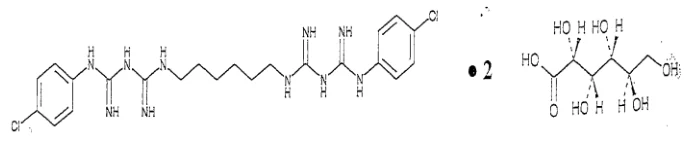
1,1’-hexamethylene bis [5- (p-chlorophenyl) biguanide] di-D-gluconate
Molecular Formula:
C22H30Cl2N10 ∙ 2C6H12O7
Structure:
Molecular Weight:
897.76 g/mol
Description:
Chlorhexidine gluconate has basic character and exists in the di-cationic form at physiologic pH. The two protonic positive charges become somewhat localized on the bi-guanide portion of the molecule. Both pKa’s are reported6 as 10.78 ± 0.06. The gluconate salt is soluble in excess of 70% (w/v) in water at 20°C.
At 19-21% w/v chlorhexidine gluconate solution is colourless to pale yellow-coloured (United States Pharmacopoeia).
COMPOSITION
GUM Paroex contains 0.12% chlorhexidine gluconate in a base containing water, propylene glycol, glycerin, polyoxyl 40 hydrogenated castor oil, mint flavour, potassium acesulfame, Allura Red and Acid Fuchsin D, sodium hydroxide or hydrochloric acid (added as necessary to adjust pH).
STABILITY AND STORAGE
Store at controlled room temperature (25ºC with excursions permitted between 15ºC to 30ºC).
INCOMPATIBILITIES
GUM Paroex is not to be mixed/diluted with any other product.
SPECIAL INSTRUCTIONS
None.
AVAILABILITY OF DOSAGE FORM:
GUM Paroex oral rinse (0.12% chlorhexidine gluconate) is supplied as a pink liquid in a:
- 118 mL amber plastic bottle with child-resistant closure
- 473 mL amber plastic bottle with child-resistant closure and dosage cup.
Store at controlled room temperature (25ºC with excursions permitted between 15ºC to 30ºC).
INFORMATION FOR THE CONSUMER
(Proposed patient insert or bottle label)
“WHAT TO EXPECT WHEN USING GUM PAROEX”
Your dentist has prescribed GUM Paroex Oral Rinse to treat your gingivitis – to help reduce the redness and swelling of your gums, and also to help you control any gum bleeding. Use GUM Paroex regularly, as directed by your dentist, in addition to daily brushing and flossing. Do not swallow GUM Paroex.
GUM Paroex may cause some tooth discolouration or increases in tartar (calculus) formation, particularly in areas where plaque is more difficult to remove with normal brushing alone. It is important to do a thorough job of cleaning your teeth and to see your dentist at least every six months, or more frequently if your dentist advises.
- Both stain and tartar can be removed by your dentist or hygienist. GUM Paroex may cause permanent discolouration of some front-tooth fillings. To minimize discolouration, you should brush and floss daily, emphasizing areas which begin to discolour. In some cases discolouration may be permanent.
- GUM Paroex should not be used by persons who have a sensitivity to chlorhexidine gluconate.
- GUM Paroex may taste bitter to some patients and may affect the taste of foods and beverages. This will become less noticeable in most cases with continued use of GUM Paroex. To avoid taste interference, rinse with GUM Paroex after meals. Do not rinse with water or other mouth rinses immediately after rinsing with GUM Paroex.
- For maximum effectiveness avoid rinsing your mouth, brushing your teeth, eating or drinking for about 30 minutes after using GUM Paroex.
If you have any questions or comments about GUM Paroex contact your dentist or pharmacist.
PHARMACOLOGY:
HUMAN CLINICAL TRIALS:
The efficacy of 0.12% chlorhexidine gluconate in the treatment and prevention of gingivitis has been supported in three pivotal clinical trials and in several supporting studies. The pivotal clinical studies are summarized in the following chart:
The results of these studies support that chlorhexidine gluconate is effective in reducing both plaque accumulation and the incidence and severity of gingivitis, as well as reducing the number of bleeding sites.
MICROBIOLOGY:
In Vitro:
MICROBIOLOGY:
MICROBIOLOGY:
In Vitro:
Because of its nonspecific mechanism of action, chlorhexidine has a wide range of anti-microbial activity against both Gram-positive and Gram-negative bacteria. An in-vitro study of the microbicidal effect of 0.12% chlorhexidine gluconate oral rinse following a 30 second exposure resulted in greater than a 99.9% reduction in the following micro-organisms: Actinomyces viscosus, Candida albicans, Staphylococcus aureaus, Streptococcus mutans, Streptococcus sanguis, Fusobacterium nucleatum, Neisseria sicca, Pseudomonas aeruginosa, Veillonella parvula.
| Study Location | Study Duration | No. Patients | Age | Sex | Usage Regimen | Reduction in* | |||||||
| Plaque Index Scores | Gingival Inflammation Index Scores | Bleeding Sites | |||||||||||
| San Antonio TX. | 3 Mon. | 597 | 18-60 | M&F | According to pkg. instructions 15mL bid | 36.1% | 27.8-45.8% | 48.4% | |||||
| Northfield, NJ | 6 Mon. | 430 | 18-60 | 60.9% | 33.5-45.4% | 41.6-52.2% | |||||||
| London, ON | 2 Yr. | 456 | 18-72 | 34.6-56.4% | 39.6% | 50.3% | |||||||
*Results shown are those obtained for the final examination at completion of test product use. The data are expressed as covariance adjusted % reduction vs. placebo; a range is reported when there were duplicate examiners. All reductions were significantly different from placebo (p<0.05; nonparametric Wilcoxon pair test)
In Vivo
To determine the efficacy of chlorhexidine gluconate in vivo, various bacteria in the microbial flora of plaque were assayed in subjects who had used either chlorhexidine gluconate or a placebo. During six months’ chlorhexidine gluconate use,2,3 subjects showed reductions in total load/tooth, streptococci and actinomyces ranging from 54% to 97%. Neisseria and fusobacteria were not detected in over half of the subjects assayed. No changes in numbers of yeast-like organisms and Gram-negative enterics were observed. There were no adverse changes in the oral microbial flora. Three months following cessation of treatment, the reductions observed during mouth rinsing were no longer evident, indicating no “carryover” effect. The results were interpreted as indicating that the use of chlorhexidine gluconate was associated only with a decrease in the number of microbes in plaque and no change in bacterial sensitivity. Another study was conducted to investigate whether changes occurred in resistance to chlorhexidine which might limit efficacy of the mouth rinse, and if such changes occurred, whether they dissipated or disappeared after cessation of use of the mouth rinse. Minimum Inhibitory Concentrations (MIC’s) for chlorhexidine were determined on isolates of streptococci and actinomyces obtained from patients during six months’ use of the mouth rinse and three months after cessation of use of the mouth rinse. Changes in bacterial sensitivity due to exposure to chlorhexidine were slight, sporadic and had returned to pre-treatment values three months after product usage was discontinued.
These results support that chlorhexidine gluconate usage does not result in significant changes in plaque bacterial resistance and does not cause significant changes in the plaque flora.
Pharmacodynamics
Two clinical studies examined dose-response relationships and confirmed earlier animal studies. One short term study demonstrated equal efficacy, as measured by plaque reduction, for 0.10% and 0.20% chlorhexidine gluconate solutions while a 0.05% chlorhexidine gluconate solution was less effective. In a three month study, anti-gingivitis efficacy was equal for 0.12% and 0.20% chlorhexidine gluconate mouth rinses. However, tooth and tongue discolouration increases with chlorhexidine concentration in both studies.
Therefore, the chlorhexidine gluconate concentration was set at 0.12% to optimize efficacy while minimizing side effects.
The effect of duration and frequency of rinsing on plaque formation and tooth and tongue discolouration was examined in another 88 day study. The data demonstrated that shortened, more frequent rinsing (i.e. 2 x 30 sec.) provided optimal efficacy as compared to longer, less frequent rinsing (i.e. 1 x 60 sec.).
Pharmacokinetics
- 1. Oral Retention/Desorption
Approximately 30% of the chlorhexidine present in the mouth rinse is retained in the oral cavity after rinsing. The amount retained was directly related to drug concentration, with an average of 6.3 and 2.7 mg (mean) of chlorhexidine being retained orally after a single use of a mouth rinse containing 0.12% and 0.06% chlorhexidine gluconate, respectively. The release rate of chlorhexidine from oral surfaces was similar for both treatments. Based on morning/evening rinses, previous exposure to a chlorhexidine -containing mouth rinse was observed to have little effect on subsequent retention of chlorhexidine.
- 2. Ingestion/Absorption/Excretion
GUM Paroex (0.12% chlorhexidine gluconate) is to be used topically as an oral rinse, not to be ingested. Studies were conducted to study its metabolic pathway in the event of oral ingestion.
Human studies using radiological markers indicated that chlorhexidine gluconate is poorly absorbed from the gastrointestinal tract. This is in agreement with the findings from animal studies. Among five normal male volunteers, GI transit time was 31 to 53 hours as indicated by radio-opaque markers. The primary route for the excretion of chlorhexidine was through the feces (approximately 90%). The mean peak plasma level of chlorhexidine was 0.206 μg/g, reached 30 minutes after ingestion of a 300 mg dose of the drug. Chlorhexidine was not detectable in plasma 12 hours after ingestion. Urine samples contained 0.5 to 1% of the 14C chlorhexidine gluconate administered to the study subjects.
TOXICOLOGY:
- Acute Toxicity Studies
The oral LD50 of chlorhexidine gluconate was estimated as 1.476 g/kg in rats and 0.1122 g/kg in rabbits. The oral LD50 of the mouth rinse formulation was estimated at > 20 g/kg in rats.
- Chronic and Subchronic Toxicity Studies
The only consistently observed finding in eight subchronic and chronic toxicity studies was the accumulation of foamy macrophages in the mesenteric lymph nodes of rats. Representative samples of these lesions were evaluated by two independent pathologists. They concluded that the lesions did not represent a significant toxic effect. This conclusion is supported by the following facts: 1) The macrophages do not contain bacteria, indicating that a significant change in the intestinal flora has not occurred. 2) The reaction is not associated with increased morbidity or mortality. 3) The reaction does not become progressively more severe with continued exposure to chlorhexidine. 4) The reaction is reversible after administration of chlorhexidine is discontinued.
Reproduction and Teratology
No adverse reproductive or teratologic effects on rats or rabbits were observed in studies with the mouth rinse formulation.
The effect of chlorhexidine gluconate on various aspects of reproductive processes has been evaluated using both the rat and rabbit as a model. An apparent embryotoxic effect was observed in rabbits that received a daily 40 mg/kg dose of chlorhexidine by gavage and in rats that ingested a 300 mg/kg dose of chlorhexidine from their diet each day. These doses are about 140 and 1040 times, respectively, the estimated daily ingestion from chlorhexidine gluconate with the recommended dose.
Carcinogenicity
No evidence of carcinogenicity was reported in two rat studies in which chlorhexidine was administered in their drinking water. The studies were two years in duration and delivered chlorhexidine at dose levels of up to 200 mg/kg/day.
Mutagenicity
No evidence of mutagenicity was observed when chlorhexidine gluconate was evaluated by the dominant lethal assay in mice and micronucleus assay in hamsters. Mutagenicity studies, using bacterial cell system, with or without metabolic activation, produced contradictory results, which are unexpected with drugs having antibacterial activity. While Suessmuth et al. (1979) and Ackerman-Schmidt et al. (1982) obtained positive results, Evans et al. (1978) and Sakagami et al. (1988) found no evidence of genotoxicity for chlorhexidine. The clinical significance of these results is unclear.
Immediate Hypersensitivity
A variety of regimens were used in an attempt to induce and elicit immediate hypersensitivity to chlorhexidine gluconate in guinea pigs, rabbits, rats and man. No evidence of immediate hypersensitivity was observed in any of the tests.
Other Studies
The emetic dose, irritation potential, and sensitization potential have also been determined for 0.12% chlorhexidine gluconate. Chlorhexidine gluconate has an emetic ED50 of approximately 13.4 mL/kg (tested in dogs using the oral route of administration), is only slightly irritating to the eye (tested in rabbits), and was not irritating to the oral mucosa (tested in dogs). In addition, the mouth rinse does not induce delayed contact sensitization.
REFERENCES
- 1. Grossman, E.; Reiter, G.; Sturzenberger, O.P.; De la Rosa, M.; Dickinson, T.D.; Ferretti, G.A.; Ludlam, G.E.; Meckel, A.H.: “Six-month study of the effects of a chlorhexidine mouth rinse on gingivitis in adults.” J. Periodont. Res. 1986; 21 (Suppl. 16): 33-43.
- 2. Briner, W.W.; Grossman, E.; Buckner, R.Y.; Rebitski, G.F.; Sox, T.E.; Setser, R.E.; Ebert, M.L.: “Effect of chlorhexidine gluconate mouthrinse on plaque bacteria.” J. Periodont. Res. 1986; 21 (Suppl. 16): 44-52.
- 3. Briner, W.W.; Grossman, E.; Buckner, R.Y.; Rebitski, G.F.; Sox, T.E.; Setser, R.E.; Ebert, M.L.: “Assessment of susceptibility of plaque bacteria to chlorhexidine after six months’ oral use.” J. Periodont. Res. 1986; 21 (Suppl. 16): 53-59.
- 4. Loe, H.; Rindom-Schiott, C.; Glavind, L.; Karring, T.: “Two years’ oral use of chlorhexidine in man: I. General design and clinical effects.” J. Periodont. Res. 1976: 11: 135-144.
- 5. Rindom Schiott, C.; Briner, W.W.; Loe, H.: “Two Years Oral Use of Chlorhexidine In Man. II. The effect on the Salivary Bacterial Flora.” J. Periodont. Res. 1976: 11: 145- 152.
- 6. Warner, V.D.; Lunch, D.M.; Kim, K.H.; Grunewald, G.L.: “Quantitative Structure – Activity Relationships for Biguanides, Carbamimidates and Bisbiguanides as Inhibitors of Streptococcus Mutans.” J. Med. Chem.. 22: Issue 4, 1978, 359-66
- 7. Suessmuth, R.; Lingens, F.; Ackermann, B.: “Mutagenic effect of 1,1’-Hexamethylene-Bis ((5-p-Chlorophenyl)- Biguanide).” Chem-Biol. Interact.: 28 (2-3) 1979, 249-258
- 8. Achermann-Schmidt, B.; Suessmuth, R; Lingens F.: “Effects of 1,1’-Hexamethylene-Bis ((5-p-Chlorophenyl)- Biguanide) on the genome and on the synthesis of nucleic acid and proteins in the bacterial cells.” Chem-Biol. Interact.; Vol. 40, Iss. 1, 1982. 85-96.
- 9. Evans, R.T.; Baker, P.J.; Coburn, R.A.; Genco, R.J.; Paigen, B.J.:” Evaluation of chlorhexidine, Tribromsalan and a limited series of alkyl bis biguanides in an in-vitro mutagenicity assay.” J. Dent. Res.; 1978, 57:290
- 10. Product Monograph for PERIDEX® ORAL RINSE (chlorhexidine gluconate 0.12%), 3M Canada Company Date of Preparation: December 12, 2007.