


Product Monograph - Gamastan
SUMMARY PRODUCT INFORMATION
| Table 1 – Product Information Summary | |||||
| Route of Administration | Dosage Form, Strength | Clinically Relevant Nonmedicinal Ingredients | |||
| intramuscular injection | injectable solution, 15-18% protein | For a complete listing see DOSAGE FORMS, COMPOSITION AND PACKAGING section. | |||
DESCRIPTION
GamaSTAN® is a sterile solution of immunoglobulin for intramuscular administration; it contains no preservative. GamaSTAN® is prepared from pools of human plasma collected from healthy donors by a combination of cold ethanol fractionation , caprylate precipitation and filtration, caprylate incubation, anion-exchange chromatography and nanofiltration. GamaSTAN® is formulated as a 15-18% protein solution at a pH of 4.1 to 4.8 in 0.16 to 0.26 M glycine. It is a clear to slightly opalescent liquid which can range from colorless to pale yellow or light brown.
INDICATIONS AND CLINICAL USE
Passive immunization should be considered when vaccines for active immunization are not available, or in situations when vaccine has not been used prior to exposure to the infective agent or is contraindicated (1). GamaSTAN® is indicated in the following situations.
Hepatitis A
GamaSTAN is indicated for prophylaxis following exposure to hepatitis A. The prophylactic value of GamaSTAN® is greatest when given before or soon after exposure to hepatitis A. GamaSTAN® is not indicated in persons with clinical manifestations of hepatitis A or in those exposed more than 2 weeks previously.
Measles (Rubeola)
GamaSTAN® is indicated to prevent or modify measles in a susceptible person exposed fewer than 6 days previously (2). A susceptible person is one who has not been vaccinated and has not had measles previously. GamaSTAN® may be especially indicated for susceptible household contacts of measles patients, particularly contacts under 1 year of age, for whom the risk of complications is highest (2). GamaSTAN® and measles vaccine should not be given at the same time (2). If a child is older than 12 months and has received GamaSTAN®, he should be given measles vaccine about 5 months later when the measles antibody titer will have disappeared, provided there are no contraindications to the vaccine (1).
If a susceptible child exposed to measles is immunocompromised, GamaSTAN® should be given immediately (3). GamaSTAN® may also be considered for severely immunocompromised individuals exposed to measles regardless of immunization status. Children who are immunocompromised should not receive measles vaccine or any other live viral vaccine (4).
Varicella
GamaSTAN is indicated to modify varicella. Passive immunization against varicella in immunosuppressed patients is best accomplished by use of Varicella-Zoster Immunoglobulin (Human) [VZIG]. If VZIG is unavailable, GamaSTAN®, promptly given, may also modify varicella (5).
Rubella
GamaSTAN is indicated to modify rubella in exposed women who will not consider a therapeutic abortion. Some studies suggest that the use of GamaSTAN® in exposed, susceptible women can lessen the likelihood of infection and fetal damage; therefore, GamaSTAN® may benefit those women who will not consider a therapeutic abortion (3). Do not give GamaSTAN® for routine prophylaxis of rubella in early pregnancy to an unexposed woman.
CONTRAINDICATIONS
- GamaSTAN® should not be given to patients who are hypersensitive to this drug or to any ingredient in the formulation or component of the container. For a complete listing, see the DOSAGE FORMS, COMPOSITION AND PACKAGING section.
- GamaSTAN® should not be given to persons with isolated immunoglobulin A (IgA) deficiency. Such persons have the potential for developing antibodies to IgA and could have anaphylactic reactions to subsequent administration of blood products that contain IgA (7).
- GamaSTAN® should not be administered to patients who have severe thrombocytopenia or any coagulation disorder that would contraindicate intramuscular injections.
WARNINGS AND PRECAUTIONS
Serious Warnings and Precautions
|
|
General
GamaSTAN® should not be administered intravenously or subcutaneously because of the potential for serious reactions. Injections should be made intramuscularly, and care should be taken to draw back on the plunger of the syringe before injection in order to be certain that the needle is not in a blood vessel.
Although systemic reactions to intramuscularly administered immunoglobulin preparations are rare, epinephrine should be available for treatment of acute allergic symptoms.
GamaSTAN® is made from human plasma and may carry a risk of transmitting infectious agents, e.g. such as viruses, the variant Creutzfeldt-Jakob disease (vCJD) agent, and, theoretically, the Creutzfeldt-Jakob disease (CJD) agent, despite steps designed to reduce this risk. GamaSTAN is purified from human plasma obtained from healthy donors. When medicinal biological products are administered, infectious diseases due to transmission of pathogens cannot be totally excluded. However, in the case of products prepared from human plasma, the risk of transmission of pathogens is reduced by: (1) epidemiological controls on the donor population and selection of individual donors by a medical interview; (2) screening of individual donations and plasma pools for viral infection markers; and (3) manufacturing procedures with demonstrated capacity to inactivate/remove pathogens.
ALL infections thought by a physician possibly to have been transmitted by this product should be reported by the physician or other healthcare provider to Grifols Canada Ltd. [1-866-482-5226].
The physician should discuss the risks and benefits of this product with the patient, before prescribing or administering to the patient.
Thromboembolic events
There is clinical evidence of an association between the administration of all immunoglobulins and thromboembolic events such as myocardial infarction, stroke, pulmonary embolism and deep vein thrombosis.
Since thrombosis may occur in the absence of known risk factors, caution should be exercised in prescribing and administering immunoglobulins. The drug product should be administered at the minimum concentration available and at the minimum rate of infusion practicable. Patients should be adequately hydrated before administration.
Baseline assessment of blood viscosity should be considered in patients at risk for hyperviscosity, including those with cryoglobulins, fasting chylomicronemia / markedly high triacylglycerols (triglycerides), or monoclonal gammopathies. Patients at risk of hyperviscosity should be monitored for signs and symptoms of thrombosis and blood viscosity assessed.
Risk factors for thromboembolic adverse events include: obesity, advanced age, hypertension, diabetes mellitus, history of vascular disease or thrombotic episodes, acquired or inherited thrombophilic disorders, prolonged periods of immobilisation, severely hypovolemic patients, diseases which increase blood viscosity, hypercoagulable conditions, use of estrogens, indwelling central vascular catheters, and cardiovascular risk factors.
Hypersensitivity Reactions
Patients with known hypersensitivity to immunoglobulin preparations are at greater risk of developing severe hypersensitivity and anaphylactic reactions. Administer GamaSTAN® cautiously to patients with a history of prior systemic allergic reactions following the administration of human immunoglobulin preparations. Have epinephrine available immediately to treat any acute severe hypersensitivity reactions.
Skin tests should not be done. In most human beings the intradermal injection of concentrated gamma globulin solution with its buffers causes a localized area of inflammation which can be misinterpreted as a positive allergic reaction. In actuality, this does not represent an allergy; rather, it is localized tissue irritation of a chemical nature. Misinterpretation of the results of such tests can lead the physician to withhold badly needed human immunoglobulin from a patient who is not actually allergic to this material.
Special Populations
Pregnant Women
There is no experience of exposure in pregnancy during clinical trials. Animal reproduction studies have not been conducted with GamaSTAN®. It is also not known whether GamaSTAN® can cause fetal harm when administered to a pregnant woman or can affect reproduction capacity. GamaSTAN® should be given to a pregnant woman only if clearly needed.
Nursing Women
Because of the potential for unknown effects from GamaSTAN® in infants being nursed by mothers taking GamaSTAN®, a decision should be made to either discontinue nursing or discontinue the administration of GamaSTAN®, taking into account the importance of GamaSTAN® therapy to the mother and the possible risk to the infant.
Pediatrics (<18 years of age)
The safety and effectiveness of GamaSTAN® in the pediatric population have not been established.
Geriatric Use
Safety and effectiveness in the geriatric population have not been established.
Monitoring and Laboratory Tests
None required.
ADVERSE REACTIONS
Adverse Drug Reaction Overview
The following adverse reactions have been identified during post-approval use of GamaSTAN®. Because these reactions are reported voluntarily from a population of uncertain size, it is not always possible to reliably estimate their frequency or establish a causal relationship to drug exposure.
Local pain and tenderness at the injection site, urticaria, and angioedema may occur. Among patients treated with GamaSTAN®, cases of allergic/hypersensitivity reactions including anaphylaxis have been reported. Anaphylactic reactions, although rare, have been reported following the injection of human immunoglobulin preparations. Anaphylaxis is more likely to occur if GamaSTAN® is given intravenously; therefore, GamaSTAN® must be administered only intramuscularly.
The following have been identified as the most frequently reported post-marketing adverse reactions:
| Table 2 –Post-Marketing Experience | |
|---|---|
| General disorders and administration site conditions | Injection site reaction*, fatigue, pyrexia |
| Immune system disorders | |
| Anaphylactic reaction**, hypersensitivity** | |
| Nervous system disorders | Headache |
| Gastrointestinal disorders | Nausea |
* These reactions have been manifested by pain, inflammation, and hemorrhage
** These reactions have been manifested by rash, flushing, angioedema, urticaria and dyspnea
DRUG INTERACTIONS
Drug-Drug Interactions
| Table 3 – Established or Potential Drug-drug Interactions | |||||||
|---|---|---|---|---|---|---|---|
| Proper Name | Ref | Effect | Clinical Comment | ||||
| Live viral vaccines | T | Antibodies in the globulin preparation may interfere with the response to live viral vaccines such as measles, mumps, polio and rubella (1). | Use of such vaccines should be deferred until approximately 5-6 months after GamaSTAN® administration (1). | ||||
| Legend: T=Theoretical | |||||||
Drug-Food Interactions
No interactions are known.
Drug-Herb Interactions
No interactions are known.
Drug-Laboratory Interactions
No interactions are known.
DOSAGE AND ADMINISTRATION
Dosing Considerations
For intramuscular injection only. Do not give intravenously or subcutaneously.
Recommended Dose and Dosage Adjustment
Hepatitis A
GamaSTAN® in a dose of 0.1 mL/kg is recommended for household and institutional hepatitis A case contacts.
The following doses of GamaSTAN® are recommended for persons who plan to travel in areas where hepatitis A is common (8).
| Length of Stay | Dose Volume |
| Up to 1 month | 0.1 mL/kg |
Up to 2 months 2 months or longer | 0.2 mL/kg Repeat dose of 0.2 mL/kg every 2 months |
Measles (Rubeola)
GamaSTAN® should be given in a dose of 0.25 mL/kg to prevent or modify measles in a susceptible person exposed fewer than 6 days previously (1,2). A susceptible child who is exposed to measles and who is immunocompromised should receive a dose of 0.5 mL/kg (maximum dose, 15 mL) of GamaSTAN® immediately (3). The dosage of Immunoglobulin (Human) for exposed individuals who have underlying malignant disease should be 0.5 mL/kg or 15 mL maximum (1).
Varicella
If Varicella-Zoster Immunoglobulin (Human) is unavailable, GamaSTAN® at a dose of 0.6 to 1.2 mL/kg, promptly given, may also modify varicella (5).
Rubella
Some studies suggest that the use of GamaSTAN® in exposed, susceptible women can lessen the likelihood of infection and fetal damage; therefore, GamaSTAN® at a dose of 0.55 mL/kg may benefit those women who will not consider a therapeutic abortion (3).
Administration
GamaSTAN® is administered intramuscularly (see WARNINGS AND PRECAUTIONS: General), preferably in the anterolateral aspects of the upper thigh and the deltoid muscle of the upper arm. The gluteal region should not be used routinely as an injection site because of the risk of injury to the sciatic nerve. Doses over 10 mL should be divided and injected into several muscle sites to reduce local pain and discomfort. An individual decision as to which muscle is injected must be made for each patient based on the volume of material to be administered. If the gluteal region is used when very large volumes are to be injected or multiple doses are necessary, the central region MUST be avoided; only the upper, outer quadrant should be used (9).
If Hepatitis A Vaccine is recommended along with GamaSTAN®, administer simultaneously but at separate anatomical sites.
Parenteral drug products should be inspected visually for particulate matter and discoloration prior to administration, whenever solution and container permit. GamaSTAN® is a clear or slightly opalescent, and colorless or pale yellow or light brown solution.
A number of factors beyond our control could reduce the efficacy of this product or even result in an ill effect following its use. These include improper storage and handling of the product after it leaves our hands, diagnosis, dosage, method of administration, and biological differences in individual patients. Because of these factors, it is important that this product be stored properly and that the directions be followed carefully during use
Reconstitution
Not required.
OVERDOSAGE
Although no data are available, clinical experience with other immunoglobulin preparations suggests that the only manifestations would be pain and tenderness at the injection site.
ACTION AND CLINICAL PHARMACOLOGY
Mechanism of Action
Passive immunization with GamaSTAN® modifies hepatitis A, and prevents or modifies measles. GamaSTAN® is not standardized with respect to antibody titers against hepatitis B surface antigen (HBsAg) and should not be used for prophylaxis of viral hepatitis type B. Prophylactic treatment to prevent hepatitis B can best be accomplished with use of Hepatitis B Immunoglobulin (Human), often in combination with Hepatitis B Vaccine (8). GamaSTAN® is unlikely to be of benefit for post-exposure management of hepatitis C (1).
GamaSTAN® may be of benefit in women who have been exposed to rubella in the first trimester of pregnancy and who will not consider a therapeutic abortion (3). GamaSTAN® may also be considered for use in immunocompromised patients for passive immunization against varicella if Varicella-Zoster Immunoglobulin (Human) is not available (5).
GamaSTAN® is not indicated for routine prophylaxis or treatment of rubella, poliomyelitis, mumps, or varicella. It is not indicated for allergy or asthma in patients who have normal levels of immunoglobulin (3).
Pharmacodynamics
See Mechanism of Action.
Pharmacokinetics
In a clinical study of 12 healthy human subjects receiving a 20 IU/kg intramuscular dose of HyperRAB® 300 (Rabies Immunoglobulin (Human)), detectable passive rabies neutralizing antibody was present by the second day and persisted through the 21 day follow-up evaluation period. HyperRAB® 300 is manufactured via the same process, using the same controls as GamaSTAN®, except that the starting material (plasma) has a higher titer of one specific antibody (rabies virus antibody). The figure below shows the mean levels of rabies virus antibodies in IU/mL across the 21 day evaluation period and indicates that the titer remains stable during this period.
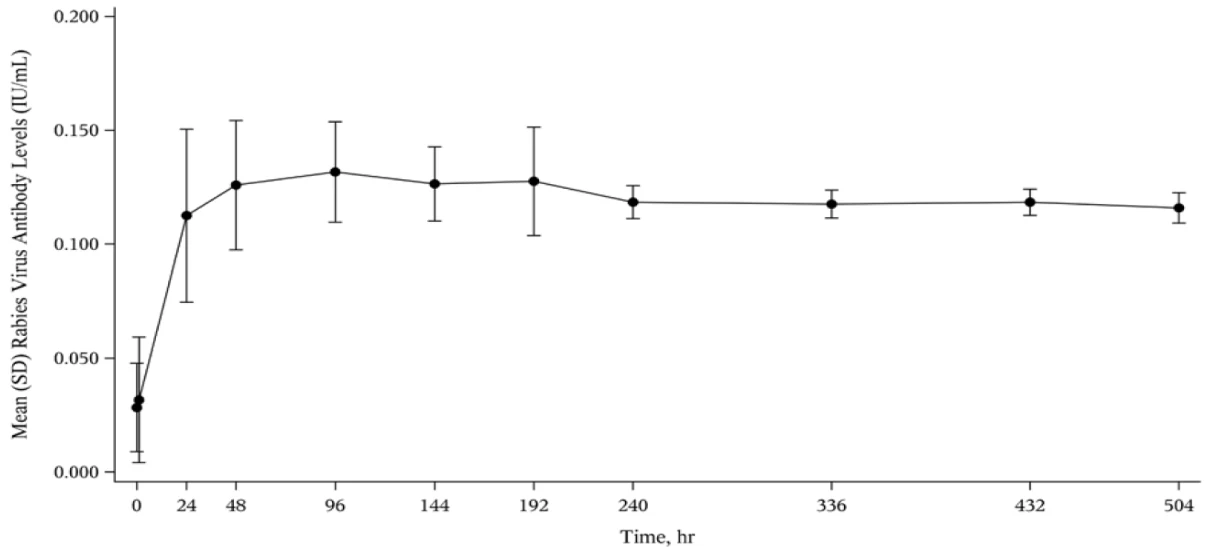
Figure: Mean (Standard Deviation) Rabies Virus Antibody Levels (IU/mL) versus Time following a Single 20 IU/kg Dose of HyperRAB® 300 by Intramuscular Injection
Duration of Effect
Peak levels of immunoglobulin G are obtained approximately 2 days after intramuscular injection of GamaSTAN® (10). The half-life of IgG in the circulation of individuals with normal IgG levels is 23 days (11).
STORAGE AND STABILITY
Store at 2-8°C. Do not freeze. Do not use after expiration date. The vials are single use. Once entered, discard any unused contents.
DOSAGE FORMS, COMPOSITION AND PACKAGING
GamaSTAN® contains 15-18% immunoglobulin (human) as active ingredient. It also contains 0.16 to 0.26 M glycine, USP.
GamaSTAN® may be supplied in 2 mL and 10 mL single use vials.
PART II: SCIENTIFIC INFORMATION
PHARMACEUTICAL INFORMATION
Drug Substance
| Proper name: | GamaSTAN® |
| Chemical name: | Immunoglobulin (Human) |
Product Characteristics
GamaSTAN® is formulated as a 15-18% protein solution at a pH of 4.1 to 4.8 in 0.16 to 0.26 M glycine. It contains no preservative.
Pathogen Safety Measures
When medicinal biological products are administered, infectious diseases due to transmission of pathogens cannot be totally excluded. However, in the case of products prepared from human plasma, the risk of transmission of pathogens is reduced by epidemiological surveillance of the donor population and selection of individual donors by medical interview; testing of individual donations and plasma pools; and the presence in the manufacturing processes of steps with demonstrated capacity to inactivate/remove pathogens.
In the manufacturing process of GamaSTAN®, there are several steps with the capacity for viral inactivation or removal. The main steps of the manufacturing process that contribute to the virus clearance capacity are as follows:
- Caprylate precipitation/depth filtration
- Caprylate incubation
- Depth filtration
- Column chromatography
- Nanofiltration
- Low pH final container incubation
To provide additional assurance of the pathogen safety of the final product, the capacity of the GamaSTAN® manufacturing process to remove and/or inactivate viruses has been demonstrated by laboratory spiking studies on a scaled down process model using a wide range of viruses with diverse physicochemical properties.
The combination of all of the above mentioned measures provides the final product with a high margin of safety from the potential risk of transmission of infectious viruses.
The caprylate/chromatography manufacturing process was also investigated for its capacity to decrease the infectivity of an experimental agent of transmissible spongiform encephalopathy (TSE), considered as a model for the variant Creutzfeldt-Jakob disease (vCJD), and Creutzfeldt-Jakob disease (CJD) agents. These studies provide reasonable assurance that low levels of vCJD/CJD agent infectivity, if present in the starting material, would be removed by the caprylate/chromatography manufacturing process.
CLINICAL TRIALS
Though formal safety and efficacy trials have not been conducted with GamaSTAN®, the clinical effectiveness of Immunoglobulin (Human) in a number of clinical situations is well established. Please refer to the most recent edition of the Canadian Immunization Guide for information regarding efficacy and safety in various indications.
DETAILED PHARMACOLOGY
Animal Pharmacology
The effect of solvent-detergent treatment on the pharmacokinetic properties of Immunoglobulin (Human) was studied in rabbits and rhesus monkeys. No significant differences were observed between products with or without solvent-detergent treatment with respect to time to maximal plasma concentration (tmax), maximum plasma concentration (Cmax), half-life (t½) and area under the plasma concentration curve (AUC).
Human Pharmacology
See Product Monograph PART I: ACTION AND CLINICAL PHARMACOLOGY.
TOXICOLOGY
Acute Toxicity
Acute and subacute toxicity of solvent-detergent Immunoglobulin (Human) was assessed in rats and rabbits. The intramuscular LD50 of the solvent-detergent treated product for rats and rabbits was > 2.4 mL (396 mg/kg). These values indicate a large margin of safety when compared to the clinical dose of 0.133 mL (21.9 mg)/kg.
Repeated Dose Toxicity
Repeated administration to rats and rabbits at dosages approximately nine-fold greater than those administered in the clinic did not produce any clinically relevant toxicity.
Reproductive Toxicology
Animal reproduction studies have not been conducted with GamaSTAN®.
REFERENCES
- 1. NACI. Canadian Immunization Guide (current version): National Advisory Committee on Immunization. Accessed on-line Jan 2018.
- 2. CDC. Measles, mumps, and rubella - vaccine use and strategies for elimination of measles, rubella, and congenital rubella syndrome and control of mumps: recommendations of the Advisory Committee on Immunization Practices (ACIP). MMWR 1998;47(RR-8):1-58.
- 3. AAP. Passive immunization. In: Pickering LK, editor. Red Book: 2003 Report of the Committee on Infectious Diseases. 26th ed. Elk Grove Village, IL: American Academy of Pediatrics; 2003. pp. 53-66.
- 4. Bruton OC. Agammaglobulinemia. Pediatrics 1952;9(6):722-8.
- 5. Gershon AA, Piomelli S, Karpatkin M, Smithwick E, Steinberg S. Antibody to varicella-zoster virus after passive immunization against chickenpox. J Clin Microbiol 1978;8(6):733-5.
- 6. CDC. Use of vaccines and immune globulins in persons with altered immunocompetence: recommendations of the Advisory Committee on Immunization Practices (ACIP). MMWR 1993;42(RR-4):1-18.
- 7. Fudenberg HH. Sensitization to immunoglobulins and hazards of gamma globulin therapy. In: Merler E, editor. Immunoglobulins: biological aspects and clinical uses. Washington, DC: Nat Acad Sci; 1970. pp. 211-20.
- 8. CDC. Protection against viral hepatitis: recommendations of the Immunization Practices Advisory Committee (ACIP). MMWR 1990;39(RR-2):1-26.
- 9. CDC. General recommendations on immunization: recommendations of the Advisory Committee on Immunization Practices (ACIP) and the American Academy of Family Physician (AAFP). MMWR 2002;51(RR-2):1-36.
- 10. Smith GN, Griffiths B, Mollison D, Mollison PL. Uptake of IgG after intramuscular and subcutaneous injection. Lancet 1972;1(7762):1208-12.
- 11. Waldman TA, Strober W, Blaese RM. Variations in the metabolism of immunoglobulins measured by turnover rates. Immunoglobulins: biological aspects and clinical uses 1970:33-51.