


Product Monograph - Hyperrho
1 INDICATIONS
HyperRHO® (Rho(D) Immunoglobulin [Human]) is indicated for:
Pregnancy:
Postpartum
The prevention of Rh immunization in an Rho(D) negative mother not already sensitized to the Rho(D) factor after delivery of an infant who is Rho(D) positive or unknown.
Antepartum
The prevention of Rh immunization in the Rho(D) negative pregnant woman if the father of the infant is either Rho(D) positive or unknown.
Pregnancy - Other Obstetric Conditions:
The prevention of Rh immunization in all non-immunized Rho(D) negative women following spontaneous or induced abortion, ruptured tubal pregnancy, amniocentesis or abdominal trauma, unless the blood group of the fetus or the father is known to be Rho(D) negative. If the fetal blood group cannot be determined, one must assume that it is Rho(D) positive, and HyperRHO® should be administered to the mother.
Prevention of Rh immunization in non-immunized Rho(D) negative mothers/women prevents the development of the hemolytic disease of the newborn.
Transfusion:
HyperRHO® may be used to prevent isoimmunization in Rho(D) negative individuals who have been transfused with Rho(D) positive red blood cells or blood components containing red blood cells.
For Timing of administration, see 4.0 Dosage and Administration, 4.1 Dosing Considerations, 4.2 Recommended Dose and Adjustment.
1.1 Pediatrics
Safety and effectiveness in the pediatric population have not been established.
HyperRHO® should not be administered to neonates.
1.2 Geriatrics
Safety and effectiveness in the geriatric population have not been established.
2 CONTRAINDICATIONS
HyperRHO® is contraindicated in:
- patients who are hypersensitive to human immunoglobulin preparations or to any ingredient in the formulation or component of the container. For a complete listing, see the DOSAGE FORMS, STRENGTHS, COMPOSITION AND PACKAGING section.
3 SERIOUS WARNINGS AND PRECAUTIONS BOX
Serious Warnings and Precautions
- For intramuscular injection only. Do not give intravenously (see WARNINGS AND PRECAUTIONS: General).
- Products made from human plasma may contain infectious agents such as viruses (see WARNINGS AND PRECAUTIONS: General).
- Do not administer to neonates (see WARNINGS AND PRECAUTIONS: Special Populations: Pediatrics).
4 DOSAGE AND ADMINISTRATION
4.1 Dosing Considerations
For intramuscular injection only.
Do not give intravenously.
Do not administer to neonates.
4.2 Recommended Dose and Dosage Adjustment
HyperRHO® should be used at the doses noted below for each specific situation, to prevent Rh immunization in Rho(D)-negative individuals.
Table 1: Recommended Doses by Indication
| Indication | Timing of Administration | Dose |
|---|---|---|
| Pregnancy (postpartum) | Within 72 hours of delivery1 | 1500 IU2 |
| Pregnancy (antenatal) | 28 weeks gestation | 1500 IU |
| Following Threatened Abortion | any stage of gestation with continuation of pregnancy | 1500 IU2 |
| Following Miscarriage, Abortion, or Termination of Ectopic Pregnancy | at or beyond 13 weeks’ gestation | 1500 IU2 |
| prior to 13 weeks’ gestation | 250 IU | |
| Following Amniocentesis | at 15 to 18 weeks’ gestation or during the 2nd trimester | 1500 IU2, 3 |
| 2nd dose, preferably within 72 hrs of delivery (if infant is Rh positive or unknown) | 1500 IU4 | |
| Following Abdominal Trauma during Pregnancy | During 2nd or 3rd trimester | 1500 IU2,3 |
| 2nd dose, preferably within 72 hrs of delivery (if infant is Rh positive or unknown) | 1500 IU4 | |
| Transfusion of Rho(D) positive red cells to a Rho(D) negative recipient | As soon as possible, within 72 hrs after incompatible transfusion | Calculated5 |
1 Preferred timing, though a lesser degree of protection is still afforded if Rh antibody is administered beyond the 72-hour period
2 One 1500 IU syringe is sufficient if the volume of red blood cells that has entered the circulation is 15 mL or less. When a large (greater than 30 mL of whole blood or 15 mL red blood cells) fetomaternal hemorrhage is suspected, a fetal red cell count by an approved laboratory technique (e.g., modified Kleihauer-Betke acid elution stain technique) should be performed to determine the dosage of immunoglobulin required. The red blood cell volume of the calculated fetomaternal hemorrhage is divided by 15 mL to obtain the number of 1500 IU syringes for administration. If more than 15 mL of red cells is suspected or if the dose calculation results in a fraction, administer the next higher whole number of vials or syringes (e.g., if 1.4, give 2 syringes).
3 If initial dose is required to be administered at 13 to 18 weeks’ gestation, another 1500 IU dose should be given at 26 to 28 weeks pregnancy. To maintain protection throughout pregnancy, the level of passively acquired anti-Rho(D) should not be allowed to fall below the level required to prevent an immune response to Rh positive red cells. The half-life of IgG is 23 to 26 days.
4 Second dose may be withheld if delivery occurs within 3 weeks after the last dose, unless there is a fetomaternal hemorrhage in excess of 15 mL of red blood cells.
5 The volume of Rh positive whole blood administered is multiplied by the hematocrit of the donor unit giving the volume of red blood cells transfused. The volume of red blood cells is divided by 15 mL which provides the number of 1500 IU syringes to be administered. If the dose calculated results in a fraction, the next higher whole number of syringes should be administered (e.g., if 1.4, give 2 syringes).
4.4 Administration
Parenteral drug products should be inspected visually for particulate matter and discoloration prior to administration, whenever solution and container permit.
HyperRHO® is administered intramuscularly, preferably in the anterolateral aspects of the upper thigh and the deltoid muscle of the upper arm. The gluteal region should not be used routinely as an injection site because of the risk of injury to the sciatic nerve. If the gluteal region is used, the central region MUST be avoided; only the upper, outer quadrant should be used.
HyperRHO® is supplied as a pre-filled syringe comprised of a syringe barrel with plunger, a needle with a needle cap (shield), and a plastic needle guard. Please follow instructions below for proper use of pre-filled syringe and Needle Guard.
Directions for administration of pre-filled syringe:
- 1. Remove the pre-filled syringe from the package. Lift pre-filled syringe by barrel, not by plunger. The plastic needle guard must be kept in its original position until after administration and should only be pulled down over the needle for disposal of the used syringe.
- 2. Twist the plunger rod clockwise until the threads are seated. Do not use if the pre-filled syringe is prematurely engaged.
- 3. With the rubber needle shield secured on the pre-filled syringe tip, push the plunger rod forward a few millimeters to break any friction seal between the stopper and the glass syringe barrel.
- 4. Remove the needle shield and expel air bubbles (Do not remove the needle shield to prepare the product for administration until immediately prior to the anticipated injection time).
- 5. Proceed with hypodermic needle puncture.
- 6. Aspirate prior to injection to confirm that the needle is not in a vein or artery.
- 7. Inject the medication.
Directions for disposal of pre-filled syringe after administration:
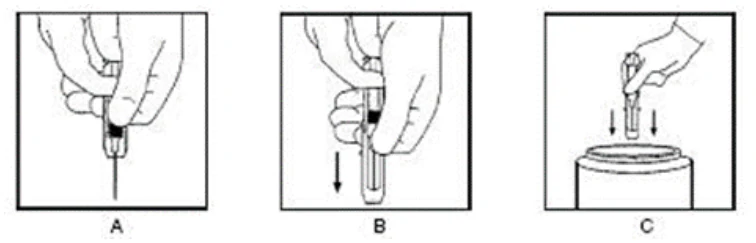
- 1. Keeping your hands away from the needle, grasp the needle guard and slide it forward towards the uncovered needle until the plastic guard completely covers the needle and clicks into place. If audible click is not heard, guard may not be completed activated. (See Diagrams A and B)
- 2. Place entire syringe with needle guard activated into an approved sharps container for proper disposal. (See Diagram C)
Single Syringe Dose
Inject entire contents of the syringe into the selected muscle.
Multiple Syringe Dose
- 1. Calculate the number of syringes of HyperRHO® to be given (see DOSAGE AND ADMINISTRATION: Recommended Dose and Dosage Adjustment).
- 2. The total volume of HyperRHO® can be given in divided doses at different sites at one time or the total dose may be divided and injected at intervals, provided the total dosage is given within 72 hours of the fetomaternal hemorrhage or transfusion.
Using sterile technique, inject the entire contents of each calculated number of syringes into the selected muscle of the patient.
5 OVERDOSAGE
Although no data are available, clinical experience with other immunoglobulin preparations suggests that the only manifestations would be pain and tenderness at the injection site.
For management of a suspected drug overdose, contact your regional poison control centre.
6 DOSAGE FORMS, STRENGTHS, COMPOSITION AND PACKAGING
To help ensure the traceability of biologic products, including biosimilars, health professionals should recognise the importance of recording both the brand name and the non-proprietary (active ingredient) name as well as other product-specific identifiers such as the Drug Identification Number (DIN) and the batch/lot number of the product supplied.
Table 2 – Dosage Forms, Strengths, Composition and Packaging
HyperRHO® is available in single-use pre-filled syringes with an attached needle guard for your protection and convenience. Please follow instructions above for proper use of pre-filled syringe and needle guard.
HyperRHO® pre-filled syringes contain either ≥250 IU or ≥1500 IU, and the sterile solution appears clear or opalescent, and colorless or pale yellow or light brown. HyperRHO® contains no preservative and is latex-free.
Description
HyperRHO® is prepared from pools of human plasma collected from healthy donors by a combination of cold ethanol fractionation, caprylate precipitation and filtration, caprylate incubation, anion exchange chromatography, nanofiltration and low pH incubation.
HyperRHO® is formulated as a 15-18% protein solution at a pH of 4.1 to 4.8 in 0.16 to 0.26 M glycine. The potency is equal to or greater than either 250 IU or 1500 IU, depending on the labelled format. Each 1500 IU single dose syringe contains sufficient anti-Rho(D) to effectively suppress the immunizing potential of 15 mL of Rho(D) positive red blood cells.
7 WARNINGS AND PRECAUTIONS
Please see the Serious Warnings and Precautions Box at the beginning of Part I: Health Professional Information.
General
HyperRHO® is made from human plasma. Products made from human plasma may contain infectious agents, such as viruses, that can cause disease. The risk that such products will transmit an infectious agent has been reduced by screening plasma donors for prior exposure to certain viruses, by testing for the presence of certain current virus infections, and by inactivating and/or removing certain viruses. Despite these measures, such products can still potentially transmit disease. There is also the possibility that unknown infectious agents may be present in such products. Individuals who receive infusions of blood or plasma products may develop signs and/or symptoms of some viral infections, particularly hepatitis C. ALL infections thought by a physician possibly to have been transmitted by this product should be reported by the physician or other healthcare provider to Grifols Canada Ltd. [1-866-482-5226].
The physician should discuss the risks and benefits of this product with the patient, before prescribing or administering to the patient.
HyperRHO® should not be administered intravenously because of the potential for serious reactions. It should be only injected intramuscularly.
As with all preparations administered by the intramuscular route, bleeding complications may
| Route of Administration | Dosage Form / Strength/Composition | Non-medicinal Ingredients |
| Intramuscular injection | Injectable solution; 15-18% protein, containing not less than the labelled potency of either 250 or 1500 International Units (IU) | glycine |
be encountered in patients with thrombocytopenia or other bleeding disorders.
Hypersensitivity Reactions
HyperRHO® should be given with caution to patients with a history of prior systemic allergic reactions following the administration of human immunoglobulin preparations.
The attending physician who wishes to administer Rho(D) Immunoglobulin (Human) to persons with isolated immunoglobulin A (IgA) deficiency must weigh the benefits of immunization against the potential risks of hypersensitivity reactions. Such persons have increased potential for developing antibodies to IgA and could have anaphylactic reactions to subsequent administration of blood products that contain IgA.
Although systemic reactions to human immunoglobulin preparations are rare, epinephrine should be available for treatment of acute anaphylactic reactions.
Monitoring and Laboratory Tests
A large fetomaternal hemorrhage late in pregnancy or following delivery may cause a weak mixed field positive Du test result. If there is any doubt about the mother’s Rh type, she should be given Rho(D) Immunoglobulin (Human). A screening test to detect fetal red blood cells may be helpful in such cases.
If more than 15 mL of D-positive fetal red blood cells are present in the mother’s circulation, more than a single 1500 IU dose of HyperRHO® is required. Failure to recognize this may result in the administration of an inadequate dose.
7.1 Special Populations
7.1.1 Pregnant Women
Animal reproduction studies have not been conducted with HyperRHO®. There is no evidence that clinical use of Rho(D) immunoglobulin (Human) in the prevention of Rh immunization in pregnant women has resulted in fetal harm.
7.1.2 Breast-feeding
It is unknown if HyperRHO® is excreted in human milk. Precaution should be exercised because many drugs can be excreted in human milk.
7.1.3 Pediatrics
Safety and effectiveness in the pediatric population have not been established.
HyperRHO® should not be administered to neonates.
7.1.4 Geriatrics
Safety and effectiveness in the geriatric population have not been established.
8 ADVERSE REACTIONS
8.1 Adverse Reaction Overview
Reactions to Rho(D) Immunoglobulin (Human) are infrequent in Rho(D) negative individuals and consist primarily of slight soreness at the site of injection and slight temperature elevation.
While sensitization to repeated injections of human immunoglobulin is extremely rare, it has occurred.
Elevated bilirubin levels have been reported in some individuals receiving multiple doses of Rho(D) Immunoglobulin (Human) following mismatched transfusions. This is believed to be due to a relatively rapid rate of foreign red cell destruction.
8.5 Post-Market Adverse Reactions
The following adverse reactions have been identified during post-approval use with HyperRHO® made using the previous solvent/detergent manufacturing process (HyperRHO S/D Full Dose). Because these reactions are reported voluntarily from a population of uncertain size, it is not always possible to reliably estimate their frequency or establish a causal relationship to drug exposure:
- Chest pain, chest tightness, headache, shortness of breath, throat swelling
- Generalized edema, dyspnea, exanthema, generalized pruritis
9 DRUG INTERACTIONS
9.4 Drug-Drug Interactions
Table 3 - Established or Potential Drug-Drug Interactions
| Proper name | Source of Evidence | Effect | Clinical comment |
| Live viral vaccines | T | Other antibodies in the preparation may interfere with the response to live viral vaccines such as measles, mumps, polio and rubella. | Immunization with live vaccines should not be given within 3 months after HyperRHO® administration. |
Legend: T = Theoretical
9.5 Drug-Food Interactions
No interactions are known
9.6 Drug-Herb Interactions
No interactions are known
9.7 Drug-Laboratory Test Interactions
Babies born of women given Rho(D) Immunoglobulin (Human) antepartum may have a weakly positive direct antiglobulin test at birth.
Passively acquired anti-Rho(D) may be detected in maternal serum if antibody screening tests are performed subsequent to antepartum or postpartum administration of Rho(D) Immunoglobulin (Human).
10 CLINICAL PHARMACOLOGY
10.1 Mechanism of Action
HyperRHO® is used to prevent isoimmunization in the Rho(D) negative individual exposed to Rho(D) positive blood as a result of a fetomaternal hemorrhage occurring during a delivery of an Rho(D) positive infant, abortion (either spontaneous or induced), or following amniocentesis or abdominal trauma. Similarly, immunization resulting in the production of anti-Rho(D) following transfusion of Rh positive red cells to an Rho(D) negative recipient may be prevented by administering Rho(D) Immunoglobulin (Human).
Rh hemolytic disease of the newborn is the result of the active immunization of an Rho(D) negative mother by Rho(D) positive red cells entering the maternal circulation during a previous delivery, abortion, amniocentesis, abdominal trauma, or as a result of red cell transfusion. HyperRHO® acts by suppressing the immune response of Rho(D) negative individuals to Rho(D) positive red blood cells. The mechanism of action of HyperRHO® is not fully understood.
10.2 Pharmacodynamics
The administration of Rho(D) Immunoglobulin (Human) within 72 hours of a full-term delivery of an Rho(D) positive infant by an Rho(D) negative mother reduces the incidence of Rh isoimmunization from 12%-13% to 1%-2%.
The 1%-2% treatment failures are probably due to isoimmunization occurring during the latter part of pregnancy or following delivery. Bowman and Pollock have reported that the incidence of isoimmunization can be further reduced from approximately 1.6% to less than 0.1% by administering Rho(D) Immunoglobulin (Human) in two doses, one antenatal at 28 weeks’ gestation and another following delivery.
10.3 Pharmacokinetics
In a clinical study of 12 healthy human subjects receiving a 20 IU/kg intramuscular dose of HyperRAB® (Rabies Immunoglobulin [Human]), detectable passive rabies neutralizing antibody was present by the second day and persisted through the 21-day follow-up evaluation period. HyperRAB® is manufactured via the same process, using the same controls as HyperRHO®, except that the starting material (plasma) has a higher titer of rabies antibody, versus Rho(D) antibody. The figure below shows the mean levels of rabies virus antibodies in IU/mL across the 21-day evaluation period and indicates that the titer remains stable during this period.
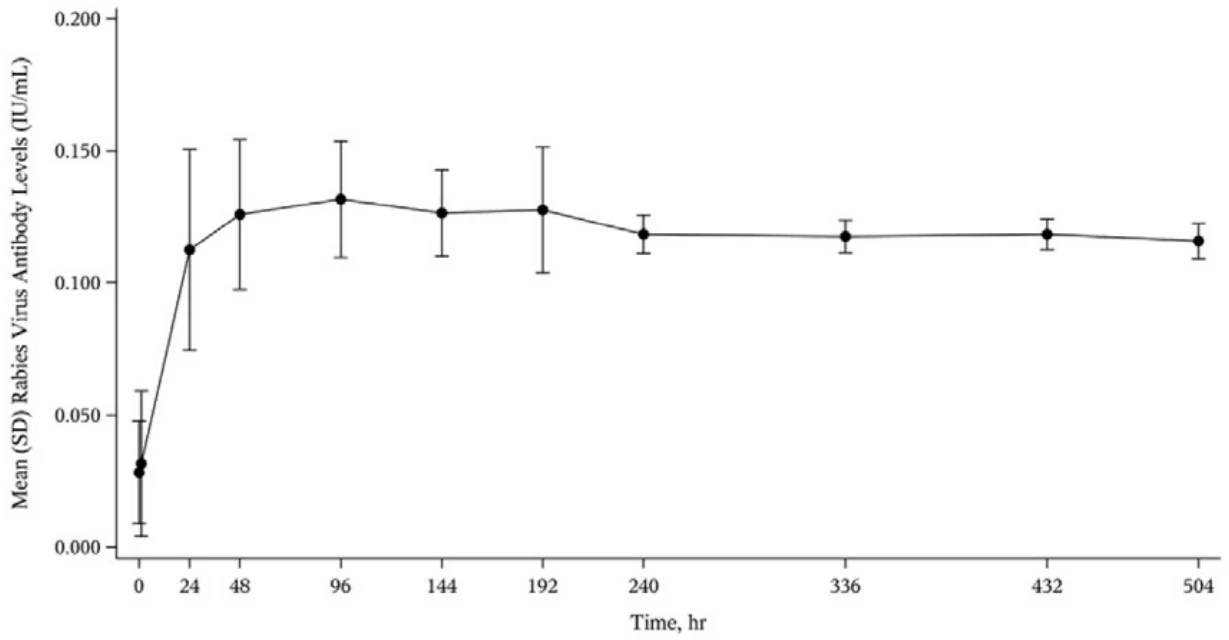
Peak blood levels of IgG are obtained approximately 2 days after intramuscular injection. The half-life of IgG in the circulation of individuals with normal IgG levels is approximately 23 days.
11 STORAGE, STABILITY AND DISPOSAL
Store at 2-8°C. Do not freeze. Solution that has been frozen should not be used. Do not use beyond expiration date.
12 SPECIAL HANDLING INSTRUCTIONS
Not Applicable
PART II: SCIENTIFIC INFORMATION
13 PHARMACEUTICAL INFORMATION
Drug Substance
Proper name: HyperRHO®
Common name: Rho(D) Immunoglobulin (Human)
Product Characteristics:
HyperRHO® is a clear or slightly opalescent, and colorless or pale yellow or light brown sterile solution of human Rho(D) immunoglobulin for intramuscular administration. HyperRHO® contains no preservative. HyperRHO® is prepared from pools of human plasma collected from healthy donors who have high levels of anti-D, by a combination of cold ethanol fractionation, caprylate precipitation and filtration, caprylate incubation, anion-exchange chromatography, nanofiltration and low pH incubation. HyperRHO® consists of 15 to 18% protein at pH 4.1 to 4.8 in 0.16 to 0.26 M glycine. The product potency is expressed in international units by comparison to the World Health Organization (WHO) standard. The labelled potency of each syringe is either 250 or 1500 International Unit (IU). In the past, a 1500 IU dose of Rho(D) Immunoglobulin [Human] has traditionally been referred to as “300 µg” dose. Potency and dosing recommendations are now expressed in IU by comparison to the WHO anti-D standard. The conversion of “µg” to “IU” is 1 µg = 5 IU (i.e. 300 µg = 1500 IU).
Viral Inactivation
When medicinal biological products are administered, infectious diseases due to transmission of pathogens cannot be totally excluded. However, in the case of products prepared from human plasma, the risk of transmission of pathogens is reduced by epidemiological surveillance of the donor population and selection of individual donors by medical interview; testing of individual donations and plasma pools; and the presence in the manufacturing processes of steps with demonstrated capacity to inactivate/remove pathogens.
In the manufacturing process of HyperRHO®, there are several steps with the capacity for viral inactivation or removal. The main steps of the manufacturing process that contribute to the virus clearance capacity are as follows:
- Caprylate precipitation/depth filtration
- Caprylate incubation
- Depth filtration
- Column chromatography
- Nanofiltration
- Low pH final container incubation
To provide additional assurance of the pathogen safety of the final product, the capacity of the HyperRHO® manufacturing process to remove and/or inactivate viruses has been demonstrated by laboratory spiking studies on a scaled down process model using a wide range of viruses with diverse physicochemical properties.
The combination of all of the above-mentioned measures provides the final product with a high margin of safety from the potential risk of transmission of infectious viruses.
The caprylate/chromatography manufacturing process was also investigated for its capacity to decrease the infectivity of an experimental agent of transmissible spongiform encephalopathy
(TSE), considered as a model for the variant Creutzfeldt-Jakob disease (vCJD), and Creutzfeldt-Jakob disease (CJD) agents. These studies provide reasonable assurance that low levels of vCJD/CJD agent infectivity, if present in the starting material, would be removed by the caprylate/chromatography manufacturing process.
14 CLINICAL TRIALS
Though formal safety and efficacy trials have not been conducted with HyperRHO®, the clinical effectiveness of Rho(D) Immunoglobulin (Human) is well established.
15 MICROBIOLOGY
No microbiological information is required for this drug product.
16 NON-CLINICAL TOXICOLOGY
Acute Toxicology: Acute and subacute toxicity of solvent/detergent-treated human immunoglobulin was assessed in rats and rabbits. The intramuscular LD50 of the solvent-detergent treated product for rats and rabbits was >2.4 mL (396 mg/kg). These values indicate a large margin of safety when compared to the clinical dose of 0.133 mL (21.9 mg)/kg.
Repeated Dose Toxicology: Repeated administration of solvent/detergent-treated human immunoglobulin to rats and rabbits at dosages approximately nine-fold greater than those administered in the clinic did not produce any clinically relevant toxicity.
Reproductive Toxicology: Animal reproduction studies have not been conducted with HyperRHO®.