


Product Monograph - Hydralax
SUMMARY PRODUCT INFORMATION
Route of Administration | Dosage Form / Strength | Clinically Relevant Nonmedicinal Ingredients |
|---|---|---|
| Oral | Powder for oral solution | None. For a complete listing see Dosage Forms, Composition and Packaging section. |
INDICATIONS AND CLINICAL USE
Adults:
HydraLax (Polyethylene Glycol 3350 Powder for Oral Solution) is indicated for:
- Relieves occasional constipation
- Softens stool
HydraLax is indicated as a laxative for the treatment of occasional constipation. (See DOSAGE AND ADMINISTRATION).
CONTRAINDICATIONS
HydraLax is contraindicated in patients with:
- Known or suspected bowel obstruction, and
- Known allergies to polyethylene glycol.
WARNINGS AND PRECAUTIONS
General
Patients with symptoms suggestive of bowel obstruction, appendicitis or inflamed bowels (fever, nausea, vomiting, abdominal pain or distention) should consult a doctor to rule out these conditions before initiating HydraLax therapy.
Overuse or extended use of any laxative may cause dependence for bowel function.
Do not take any type of laxative for more than one (1) week (7 Days), unless recommended by a physician.
A laxative should not be taken within two (2) hours of another medicine because the desired effect of the other medicine may be reduced.
Patients presenting with complaints of constipation should have a thorough medical history and physical examination to detect associated metabolic, endocrine and neurogenic conditions, and medications. A diagnostic evaluation should include a structural examination of the colon. Patients should be educated about good defecatory and eating habits (such as high fiber diets) and lifestyle changes (adequate dietary fiber and fluid intake, regular exercise) which may produce more regular bowel habits.
HydraLax should be administered after being dissolved in approximately 250 ml of liquid (water, juice, soda, coffee, or tea).
Special Populations
Pregnant Women: Animal reproductive studies have not been performed with Polyethylene Glycol 3350. It is also not known whether Polyethylene Glycol 3350 can cause fetal harm when administered to a pregnant woman, or can affect reproductive capacity. The use of HydraLax should be avoided in women who are pregnant unless clearly needed and directed by a physician.
Nursing Women: It is unknown if HydraLax is excreted in human milk. Because many drugs are excreted in human milk, precaution should be exercised. The use of HydraLax should be avoided in nursing women unless clearly needed and directed by a physician.
Pediatrics (<18 years of age): Safety and effectiveness of HydraLax in pediatric patients has not been established.
Geriatrics (> 65 years of age): There is no evidence for special considerations when HydraLax is administered to elderly patients. If diarrhea occurs, HydraLax should be discontinued.
Monitoring and Laboratory Tests
Lab tests were not performed/reported in study 2.
No clinically significant effects (1, 3, 5, 6, 7) on laboratory tests have been demonstrated.
ADVERSE REACTIONS
Adverse Drug Reaction Overview
Occasionally, HydraLax may cause nausea, abdominal bloating, cramping, diarrhea and/or gas. High doses may produce diarrhea and excessive stool frequency, particularly in elderly nursing home patients.
On rare occasions, hives and skin rashes have been reported which are suggestive of an allergic reaction. Patients taking other medications containing polyethylene glycol have occasionally developed urticaria suggestive of an allergic reaction.
DRUG INTERACTIONS
No specific drug interactions have been demonstrated.
A laxative should not be taken within two (2) hours of taking another medicine because the desired effect of the other medicine may be reduced.
DOSAGE AND ADMINISTRATION
Recommended Dose and Dosage Adjustment
ADULTS (18 years and older):
The usual dose is 17 grams (about one (1) heaping tablespoon or one single-dose sachet) of HydraLax powder per day (or as directed by physician) to be stirred in a cup (250 ml) of water, juice, soda, coffee, or tea until completely dissolved.
This product should be used for one week or less or as directed by a physician. Treatment for two to four days (48 to 96 hours) may be required to produce a bowel movement.
Each bottle of HydraLax is supplied with a dosing cap marked to contain 17 grams of laxative powder when filled to the indicated line. HydraLax is also available in single-dose sachets of 17 grams each. Two to four (4) days (48 to 96 hours) may be required to produce a bowel movement.
Special Patient Populations:
Treatment of Pregnant or Nursing Women
HydraLax should only be administered to a pregnant or nursing woman on the advice of a physician. (See WARNINGS AND PRECAUTIONS).
Elderly Patients
No dose adjustment is recommended for elderly patients solely on the basis of their age (See WARNINGS AND PRECAUTIONS).
Pediatrics
HydraLax is not indicated for use in children under 18 years of age unless recommended by a physician (See WARNINGS AND PRECAUTIONS).
OVERDOSAGE
There have been no reports of accidental over dosage. In the event of over dosage, diarrhea would be the expected major event. If an overdose of drug occurred without concomitant ingestion of fluid, dehydration due to diarrhea may result. In the event of overdose, medication should be terminated and free water administered.
ACTION AND CLINICAL PHARMACOLOGY
Mechanism of Action
Pharmacology:
Polyethylene Glycol 3350 is an osmotic agent which causes water to be retained with the stool.
Essentially, complete recovery of Polyethylene Glycol 3350 was shown in normal subjects without constipation. Attempts at recovery of Polyethylene Glycol 3350 in constipated patients resulted in incomplete and highly variable recovery.
An in vitro study showed indirectly that Polyethylene Glycol 3350 was not fermented into hydrogen or methane by the colonic microflora in human feces Polyethylene Glycol 3350 appears to have no effect on the active absorption or secretion of glucose or electrolytes. There is no evidence of tachyphylaxis.
Special Populations and Conditions
Geriatrics: There is no evidence for special considerations when HydraLax is administered to elderly patients. In geriatric nursing home patients, a higher incidence of diarrhea occurred at the recommended 17-gram dose.
STORAGE AND STABILITY
Store at room temperature (15°C to 30°C).
SPECIAL HANDLING INSTRUCTIONS
None.
DOSAGE FORMS, COMPOSITION AND PACKAGING
HydraLax is available in powdered form, for oral administration after complete dissolution in water, juice, soda, coffee, or tea. HydraLax is available in the following formats: Bottles (119 g – 7 doses, 238 g – 14 doses, 510 g – 30 doses, 850g – 50 doses and 1020 g – 60 doses) and single-dose sachets of 17 g (Available in packs of 10, 24 & 100 sachets).
The dosing cap provided with each bottle is marked with a measuring line and should be used to measure a single daily dose of HydraLax (17 grams, or about 1 heaping tablespoon).
Composition of Product
Polyethylene Glycol 3350
PART II: SCIENTIFIC INFORMATION
PHARMACEUTICAL INFORMATION Drug Substance
Proper Name: Polyethylene Glycol 3350
Chemical Name: Poly(oxy-1,2-ethanediyl), -hydro- -hydroxy-
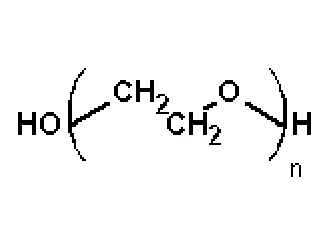
Molecular Formula: HO(C2H4O)nH
(n represents the average number of oxyethylene groups)
Molecular Mass: Average molecular weight of 3350 (The actual molecular weight is not less than 90.0 percent and not greater than 110.0 percent of the nominal value)
Structural Formula:
Physical Form: A white powder for reconstitution
Solubility: Below 55°C it is a free flowing white powder freely soluble in water.
CLINICAL TRIALS
In a study (DiPalma et al. 2006), 311 patients with 3 bowel movements or less per week received Polyethylene Glycol 3350 (17g) dissolved in 8oz of fluid, once daily, for 12-months. One hundred and eighty-four subjects completed the study. Primary efficacy was measured by analyzing subjects self-reported Global Efficacy Assessment (GEA), completed after each follow-up visit. 80-88% of enrolled patients reported themselves as ‘completely relieved’ and investigators deemed them successfully treated. Mild gastrointestinal complaints resulted from treatment. These complaints are consistent with the use of any laxative, such as diarrhea, loose stool, flatulence and nausea. No significant changes in blood chemistry was observed.
In a second study (McGraw, 2016), 203 subjects with constipation for less than 7 days were randomized to Polyethylene Glycol 3350 (17g) or placebo (maltodextrin) groups, receiving one dose daily for 7 days. The primary efficacy variable measured self-reported complete resolution of straining and hard/lumpy stools. 36.7% subjects in the PEG 3350 group reported complete resolution of symptoms compared to 24.5% in the placebo group. Investigator did not observe significant differences in adverse events between the two groups.
In a third study (McGraw, 2016 Clinical and Experimental Gastroenterology), 65 patients aged 18-75 years old with functional constipation were randomized to Polyethylene Glycol 3350 (17g) or aqueous solution placebo. Investigator measured oral and esophageal mucosa inflammation as the primary efficacy variable. Subjects in the PEG 3350 group demonstrated few abnormalities in esophageal mucosa than in the placebo group after treatment. Non-significant differences were observed in treatment-emergent adverse events between the PEG 3350 and placebo groups (48.4% vs 55.9% respectively).
In a fourth study (Chaussade et al, 2003), 266 subjects with 3 bowel movements or less per week were randomized into four (4) treatment groups: 5.9g PEG 3350, 11.8g PEG 3350, 10g PEG 4000 and 20g PEG 4000. Primary efficacy end-point measured frequency of stools at weeks 2 and 4. Significant increases in stool frequency were observed in all four treatments groups when compared to baseline — however, no difference observed between groups. PEG 3350 (5.9g) and PEG 4000 (10g) resulted in less liquid stool consistency compared to maximum dose groups.
In a fifth study (DiPalma et al, 2007), 306 patients with 3 bowel movements or less per week were randomized to 17 grams of Polyethylene Glycol 3350 or placebo for 6 months. Successful treatment according to the primary efficacy variable was seen in 52.0% of PEG and 11% of placebo subjects (p < 0.001). Similar efficacy was seen in a subgroup of 75 elderly subjects. According to the primary efficacy definition (based on individual treatment weeks), 61% of PEG treatment weeks versus 22% of the placebo weeks were successful (p < 0.001). There were no significant differences in laboratory findings of adverse events, except for the gastrointestinal category where diarrhea, flatulence, and nausea were the most frequent with PEG although they were not individually statistically significant compared to placebo. Similar results were observed when analyzed for differences due to gender, race or age. PEG laxative is safe and effective for use in patients with chronic constipation for 6 months.
In a sixth study (DiPalma et al, 2002), 24 adult patients aged > 19 years with a history of constipation were randomized to 3 dose levels of Polyethylene Glycol 3350 (51, 68 and 85 g) or placebo for a 24 hour period. Over a 72 hr period, subjects rated bowel movements, completeness of evacuation and satisfaction. There were no significant differences in laboratory changes or adverse experiences recorded between groups. A 68 g dose of PEG laxative seems to provide safe and effective relief in constipated adults within a 24 hour period.
In a seventh study (DiPalma et al), 151 patients with less than 3 bowel movements per week were randomized to Polyethylene Glycol 3350, 17 grams, or placebo for 14 days. An increase in bowel movement frequency was observed in the treatment group during the first week of treatment. Polyethylene Glycol 3350 was statistically superior to placebo during the first and second week of treatment. No clinically significant changes in blood chemistry, CBC, or urinalysis were observed. PEG laxative is safe and effective in the short term for the treatment of constipation.
TOXICOLOGY Acute Toxicity:
The oral LD50 is >50 gm/Kg in mice, rats and rabbits.
Carcinogenesis, Mutagenesis, Impairment of Fertility:
Long term carcinogenicity studies, genetic toxicity studies and reproductive toxicity studies in animals have not been performed with Polyethylene Glycol 3350.
REFERENCES
- 1. Di Palma, J.A., et al. An open-label study of chronic polyethylene glycol laxative use in chronic constipation. Alimentary Pharmacology & Therapeutics. 25(6). 2006. 703–708.
- 2. McGraw, T. Polyethylene glycol 3350 in occasional constipation: A one-week, randomized, placebo-controlled, double-blind trial. World Journal of Gastrointestinal Pharmacology and Therapeutics. 7(2). 2016. 274-282.
- 3. McGraw, T. Safety of polyethylene glycol 3350 solution in chronic constipation: randomized, placebo‐controlled trial. Clinical and Experimental Gastroenterology. 9. 2016. 173-180.
- 4. Chaussade, S. and Minić, M. Comparison of efficacy and safety of two doses of two different polyethylene glycol-based laxatives in the treatment of constipation. Alimentary Pharmacology & Therapeutics. 17(1). 2003. 165–172.
- 5. DiPalma, J.A., et al. A Randomized, Multicenter, Placebo-Controlled Trial of Polyethylene Glycol Laxative for Chronic Treatment of Chronic Constipation. American Journal of Gastroenterology. 102(7). 2007. 1436–1441.
- 6. DiPalma, J.A., et al. Overnight Efficacy of Polyethylene Glycol Laxative. American Journal of Gastroenterology. 97(7). 2002. 1776 –1779.
- 7. DiPalma, J.A., et al. A Randomized, Placebo-Controlled, Multicenter Study of the Safety and Efficacy of a New Polyethylene Glycol Laxative. American Journal of Gastroenterology. 2000. 95(2). 446-450.