


Product Monograph - Hyperhep B
1 INDICATIONS
HyperHEP B® (Hepatitis B Immunoglobulin [Human]) is indicated as an adjunct therapy along with hepatitis B vaccine (HepB vaccine) for post-exposure prophylaxis in the following situations, unless it is known, by testing within the 24 previous months or can be established within 48 hours that the patient has levels of pre-existing antibodies to hepatitis B virus surface antigen at greater than or equal to 10 IU/L:
- Acute exposure to blood containing hepatitis B virus surface antigen (HBsAg)
- Perinatal exposure of infants born to HBsAg-positive mothers
- Sexual exposure to, or needle sharing with an HBsAg-positive person
- Household exposure to persons with acute hepatitis B virus (HBV) infection [text]
1.1 Pediatrics
Safety and effectiveness in the pediatric population have not been established, with the exception of neonates and infants up to 12 months of age (see DOSAGE AND ADMINISTRATION).
1.2 Geriatrics
Safety and effectiveness in geriatric population have not been established.
2 CONTRAINDICATIONS
HyperHEP B® (Hepatitis B immunoglobulin [Human]) is contraindicated in:
- patients who are hypersensitive to theimmunoglobulin or to any ingredient in the formulation or component of the container. For a complete listing, see DOSAGE FORMS, COMPOSITION AND PACKAGING.
- HyperHEP B® should not be administered to patients who have severe thrombocytopenia or any coagulation disorder that would contraindicate intramuscular injections.
- IgA deficient patients with antibodies against IgA and a history of hypersensitivity.
3 SERIOUS WARNINGS AND PRECAUTIONS BOX
Serious Warnings and Precautions
|
|
4 DOSAGE AND ADMINISTRATION
4.1 Dosing Considerations
For intramuscular injection only.
Do not give intravenously.
Hepatitis B Immunoglobulin (Human) may be administered at the same time (but at a different site), or up to 1 month preceding hepatitis B vaccination without impairing the active immune response from hepatitis B vaccination.
4.2 Recommended Dose and Dosage Adjustment
Acute Exposure to Blood Containing HBsAg
Table 1 summarizes prophylaxis for percutaneous (needle-stick or bite), ocular, or mucous-membrane exposure to blood according to the source of exposure and vaccination status of the exposed person. For greatest effectiveness, passive prophylaxis with Hepatitis B Immunoglobulin (Human) should be given as soon as possible after exposure (its value beyond 7 days of exposure is unclear). As soon as possible and within 48 hours of exposure, for adults, an injection of 0.06 mL/kg of body weight should be administered intramuscularly (see WARNINGS AND PRECAUTIONS: General). Treatment with Hepatitis B Immunoglobulin (Human) is more effective if combined with a hepatitis B vaccine regimen given immediately but at a different site. Consult hepatitis B vaccine package insert for dosage information regarding that product. There is no established dosage for children.
| Table 1 – Course of Action Following Percutaneous (“Needlestick”) or Mucosal Exposure to Hepatitis B Virus | ||||
| Exposed Person | Sourcea | |||
| Vaccination Status | Anti-HBs Level | HBsAg Positive | Unknown Status | |
| High Risk | Low Risk | |||
| Vaccinated | ≥10 IU/L documented within the previous 2 years | no action necessary | no action necessary | no action necessary |
| ≥10 IU/L documented more than 2 years ago | assess anti-HBs level; if ≥10 IU/L, no action; if <10 IU/L, give single booster of vaccine | assess anti-HBs level; if ≥10 IU/L, no action; if <10 IU/L, give single booster of vaccine | no action necessary | |
| known non-responder (anti-HBs level <10 IU/L after vaccination) | HBIGb,c,d | HBIGb,c,d | no action necessaryd |
| level unknown and unable to be determined within 48 hours | HBIGc + single booster of vaccine | single booster of vaccine ± HBIGc | no action necessary |
| Un-vaccinated | |||
| ≥10 IU/L | no action necessary | no action necessary | no action necessary |
| level unknown at 48 hours or <10 IU/L | HBIGc + full vaccine course | full vaccine course ± HBIGc | full vaccine course |
| |||
Prophylaxis of Infants Born to HBsAg and HBeAg Positive Mothers
Efficacy of prophylactic Hepatitis B Immunoglobulin (Human) in infants at risk depends on administering Hepatitis B Immunoglobulin (Human) on the day of birth. It is therefore vital that HBsAg-positive mothers be identified before delivery.
Hepatitis B Immunoglobulin (Human) (0.5 mL) should be administered intramuscularly (IM) to the newborn infant after physiologic stabilization of the infant and preferably within 12 hours of birth. Hepatitis B Immunoglobulin (Human) efficacy decreases markedly if treatment is delayed beyond 48 hours. Hepatitis B vaccine should be administered as per the package insert of the manufacturer. Hepatitis B vaccine should be administered, starting the regimen within 7 days of birth, and may be given concurrently with Hepatitis B Immunoglobulin (Human), but at a different site. If administration of the first dose of hepatitis B vaccine is delayed for as long as 3 months, then a 0.5 mL dose of Hepatitis B Immunoglobulin (Human) should be repeated at 3 months. If hepatitis B vaccine is refused, the 0.5 mL dose of Hepatitis B Immunoglobulin (Human) should be repeated at 3 and 6 months. Hepatitis B Immunoglobulin (Human) administered at birth should not interfere with oral polio and diphtheria-tetanus-pertussis vaccines administered at 2 months of age.
Sexual Exposure to an HBsAg-positive Person
All susceptible persons whose sex partners have acute hepatitis B infection should receive a single dose of Hepatitis B Immunoglobulin (Human) (0.06 mL/kg) and should begin the hepatitis B vaccine series if prophylaxis can be started within 14 days of the last sexual contact or if sexual contact with the infected person will continue (see Table 2 below). Administering the vaccine with Hepatitis B Immunoglobulin (Human) may improve the efficacy of post-exposure treatment. The vaccine has the added advantage of conferring long-lasting protection.
Table 2 – Recommendations for Post-exposure Prophylaxis for Sexual Exposure to Hepatitis B | ||||
|---|---|---|---|---|
| HBIGa | Vaccine | |||
| Dose | Recommended timing | Dose | Recommended timing | |
| 0.06 mL/kg IMb | Single dose within 14 days of last sexual contact | See package insert of that product for dosage and administration | First dose at time of HBIGa treatmentc | |
| ||||
Household Exposure to Persons with Acute HBV Infection
Prophylactic treatment with a 0.5 mL dose of Hepatitis B Immunoglobulin (Human) and hepatitis B vaccine is indicated for infants 12 months of age who have been exposed to a primary care-giver who has acute hepatitis B. Prophylaxis for other household contacts of persons with acute HBV infection is not indicated unless they have had identifiable blood exposure to the index patient, such as by sharing toothbrushes or razors. Such exposures should be treated like sexual exposures. If the index patient becomes an HBV carrier, all household contacts should receive hepatitis B vaccine.
4.4 Administration
Parenteral drug products should be inspected visually for particulate matter and discoloration prior to administration, whenever solution and container permit. They should not be used if particulate matter and/or discoloration are present. Do not use after expiration date. The pre-filled syringes and vials are single use. Once entered, discard any unused contents immediately into biohazardous waste.
Injections should be made intramuscularly, and care should be taken to draw back on the plunger of the syringe before injection in order to be certain that the needle is not in a blood vessel. Intramuscular injections are preferably administered in the anterolateral aspects of the upper thigh and the deltoid muscle of the upper arm. The gluteal region should not be used routinely as an injection site because of the risk of injury to the sciatic nerve. An individual decision as to which muscle is injected must be made for each patient based on the volume of material to be administered. If the gluteal region is used when very large volumes are to be injected or multiple doses are necessary, the central region MUST be avoided; only the upper, outer quadrant should be used.
HyperHEP B® is supplied in vials or as pre-filled syringes comprised of a syringe barrel with plunger, a needle with a needle cap (shield), and a plastic UltraSafe® needle guard. Please follow instructions below for proper use of pre-filled syringe and UltraSafe® Needle Guard.
Directions for administration of pre-filled syringe:
- 1. Remove the prefilled syringe from the package. Lift pre-filled syringe by barrel, not by plunger. The plastic UltraSafe® needle guard must be kept in its original position until after administration, and should only be pulled down over the needle for disposal of the used syringe.
- 2. Twist the plunger rod clockwise until the threads are seated. Do not use if the pre-filled syringe is prematurely engaged.
- 3. With the rubber needle shield secured on the pre-filled syringe tip, push the plunger rod forward a few millimeters to break any friction seal between the stopper and the glass syringe barrel.
- 4. Remove the needle shield and expel air bubbles (Do not remove the needle shield to prepare the product for administration until immediately prior to the anticipated injection time).
- 5. Proceed with hypodermic needle puncture.
- 6. Aspirate prior to injection to confirm that the needle is not in a vein or artery.
- 7. Inject the medication.
Directions for disposal of pre-filled syringe after administration:
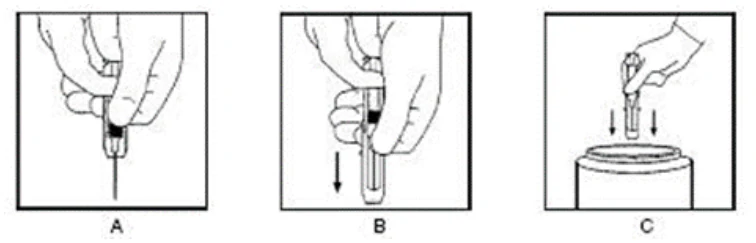
- 1. Keeping your hands away from the needle, grasp the Ultrasafe® needle guard and slide it forward towards the uncovered needle until the plastic guard completely covers the needle and clicks into place. If audible click is not heard, guard may not be completed activated. The needle guard is not meant to be removed from the device, or unlocked after being pulled down. (See Diagrams A and B)
- 2. Place entire syringe with its Ultrasafe® needle guard activated into an approved sharps container for proper disposal. (See Diagram C)
5 OVERDOSAGE
Although no data are available, clinical experience with other immunoglobulin preparations suggests that the only manifestations would be pain and tenderness at the injection site.
| For management of a suspected drug overdose, contact your regional poison control |
| centre. |
6 DOSAGE FORMS, STRENGTHS, COMPOSITION AND PACKAGING
To help ensure the traceability of biologic products, including biosimilars, health professionals should recognise the importance of recording both the brand name and the non-proprietary (active ingredient) name as well as other product-specific identifiers such as the Drug Identification Number (DIN) and the batch/lot number of the product supplied.
Table 3 – Dosage Forms, Strengths, Composition and Packaging
Description
HyperHEP B® (Hepatitis B Immunoglobulin [Human]) is a clear or slightly opalescent, and colorless or pale yellow or light brown sterile solution of human hepatitis B immunoglobulin for intramuscular administration; it contains no preservative and is supplied in a 0.5 mL neonatal single dose disposable pre-filled syringe with attached needle, a 1 mL single dose disposable pre-filled syringe with attached needle, a 1 mL single use vial, and a 5 mL single use vial.
HyperHEP B® is prepared from pools of human plasma collected from healthy donors by a combination of cold ethanol fractionation caprylate precipitation and filtration, caprylate incubation, anion-exchange chromatography, nanofiltration and low pH incubation. HyperHEP B® consists of 15-18% protein solution at a pH of 4.1 – 4.8 in 0.16 – 0.26 M glycine. The product contains antibody to anti-HBs equivalent to or exceeding the potency of anti-HBs in a U.S. reference hepatitis B immunoglobulin (Center for Biologics Evaluation and Research, FDA). The U.S. reference has been tested against the World Health Organization standard Hepatitis B Immunoglobulin and found to be equal to 220 international units (IU) per mL.
7 WARNINGS AND PRECAUTIONS
Please see the Serious Warnings and Precautions Box at the beginning of Part I: Health Professional Information.
General
HyperHEP B® (Hepatitis B Immunoglobulin [Human]) is made from human plasma and may carry a risk of transmitting infectious agents, e.g. such as viruses, the variant Creutzfeldt-Jakob disease (vCJD) agent, and, theoretically, the Creutzfeldt-Jakob disease (CJD) agent, despite
| Route of Administration | Dosage Form / Strength/Composition | Non-medicinal Ingredients |
| Intramuscular Injection | Injectable solution; 15-18% protein containing ≥ 220 International Units (IU) per mL | glycine |
steps designed to reduce this risk. HyperHEP B® is purified from human plasma obtained from healthy donors. When medicinal biological products are administered, infectious diseases due to transmission of pathogens cannot be totally excluded. However, in the case of products prepared from human plasma, the risk of transmission of pathogens is reduced by: (1) epidemiological controls on the donor population and selection of individual donors by a medical interview; (2) screening of individual donations and plasma pools for viral infection markers; and (3) manufacturing procedures with demonstrated capacity to inactivate/remove pathogens.
ALL infections thought by a physician possibly to have been transmitted by this product should be reported by the physician or other healthcare provider to Grifols Canada Ltd. [1-866-482-5226].
The physician should discuss the risks and benefits of this product with the patient, before prescribing or administering to the patient.
Hematologic
In patients who have severe thrombocytopenia or any coagulation disorder that would contraindicate intramuscular injections, HyperHEP B® should be given only if the expected benefits outweigh the risks.
Hypersensitivity Reactions
HyperHEP B® should be given with caution to patients with a history of prior systemic allergic reactions following the administration of human immunoglobulin preparations. Although systemic reactions to intramuscular immunoglobulin preparations are rare, epinephrine should be available for treatment of acute anaphylactic reactions.
Systemic Reactions
Inject intramuscularly only. HyperHEP B® should not be administered intravenously because of the potential for serious reactions (e.g. Renal Dysfunction/Failure, Hemolysis, Transfusion-Related Acute Lung Injury [TRALI]). Do not inject into a blood vessel.
7.1 Special Populations
7.1.1 Pregnant Women
There are no data with HyperHEP B® use in pregnant women to inform a drug-associated risk. Animal reproduction studies have not been conducted with HyperHEP B®. It is also not known whether HyperHEP B® can cause fetal harm when administered to a pregnant woman or can affect reproduction capacity. HyperHEP B® should be given to a pregnant woman only if clearly needed.
7.1.2 Breast-feeding
There is no information regarding the presence of HyperHEP B® in human milk, the effect on the breastfed infant, or the effects on milk production. The developmental and health benefits of breastfeeding should be considered along with the mother’s clinical need for HyperHEP B® and any potential adverse effects on the breastfed infant from HyperHEP B® or from the underlying maternal condition.
7.1.3 Pediatrics
With the exception of neonates and infants up to 12 months of age, safety and effectiveness in the pediatric population have not been established.
7.1.4 Geriatrics
Safety and effectiveness in geriatric population have not been established.
8 ADVERSE REACTIONS
8.1 Adverse Reaction Overview
Local pain and tenderness at the injection site, urticaria and angioedema may occur. In the course of routine injections of large numbers of persons with immunoglobulin there have been a few isolated occurrences of angioneurotic edema, nephrotic syndrome, and anaphylactic shock after injection
8.5 Post-Market Adverse Reactions
The following adverse reactions have been identified during post-approval use with HyperHEP B® (Hepatitis B Immunoglobulin [Human]) made using the previous manufacturing process, (HyperHEP B® S/D). Because these reactions are reported voluntarily from a population of uncertain size, it is not always possible to reliably estimate their frequency or establish a causal relationship to drug exposure.
Anaphylactic reactions, although rare, have been reported following the injection of human immunoglobulin preparations.
The following have been identified as the most frequently reported post-marketing adverse reactions.
| General disorders and administration site conditions: | Injection site reaction*, fatigue, pyrexia |
| Immune system disorders | Anaphylactic reaction**, hypersensitivity** |
| Nervous system disorders | Headache |
| Gastrointestinal disorders | Nausea |
- * These reactions have been manifested by pain, inflammation, and hemorrhage
** These reactions have been manifested by rash, flushing, angioedema, urticaria and dyspnea
9 DRUG INTERACTIONS
9.4 Drug-Drug Interactions
Table 4 - Established or Potential Drug-Drug Interactions
| Name | Source of Evidence | Effect | Clinical comment |
| Live viral vaccines | CT/T | Although administration of Hepatitis B Immunoglobulin (Human) did not interfere with measles vaccination it is not known whether Hepatitis B Immunoglobulin (Human) may interfere with other live virus vaccines. | Immunization with live vaccines, other than measles vaccination, should not be given within 3 months after HyperHEP B® administration. |
Legend: C = Case Study; CT = Clinical Trial; T = Theoretical
Hepatitis B vaccine may be administered at the same time as HyperHEP B®, but at a different injection site, without interfering with the immune response.
No interactions with other products are known.
10 CLINICAL PHARMACOLOGY
10.1 Mechanism of Action
The anti-HBs antibody in HyperHEP B® (Hepatitis B Immunoglobulin [Human]) is a passive immunizing agent to neutralize hepatitis B virus to prevent disease.
10.2 Pharmacodynamics
HyperHEP B® provides passive immunization for individuals exposed to the hepatitis B virus (HBV) as evidenced by a reduction in the attack rate of hepatitis B following its use.
Cases of type B hepatitis are rarely seen following exposure to HBV in persons with pre-existing anti-HBs. No confirmed instance of transmission of hepatitis B has been associated with this product.
10.3 Pharmacokinetics
In a clinical study of 12 healthy human subjects receiving a 20 IU/kg intramuscular dose of HyperRAB® (Rabies Immunoglobulin [Human]), detectable passive rabies neutralizing antibody was present by the second day and persisted through the 21 day follow-up evaluation period. HyperRAB® is manufactured via the same process, using the same controls as HyperHEP B®, except that the starting material (plasma) has a higher titer of rabies antibody, versus hepatitis B antibody. The figure below shows the mean levels of rabies virus antibodies in IU/mL across the 21 day evaluation period and indicates that the titer remains stable during this period.
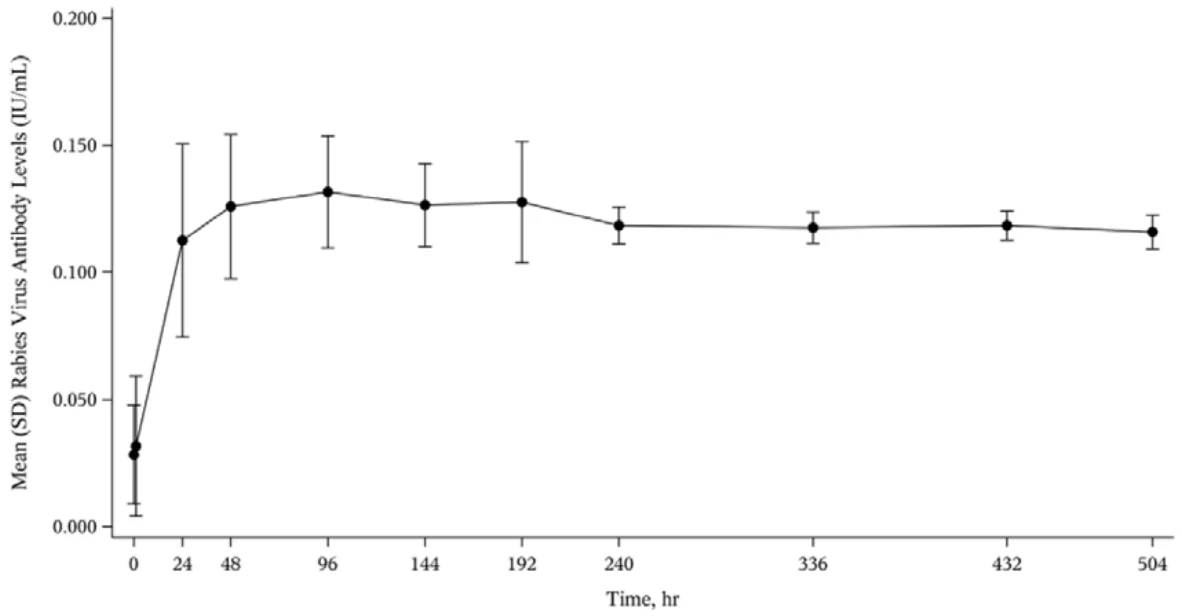
Figure: Mean (Standard Deviation) Rabies Virus Antibody Levels (IU/mL) versus Time following a Single 20 IU/kg Dose of HyperRAB® by Intramuscular Injection
Duration of Effect
The administration of the usual recommended dose of this immunoglobulin generally results in a detectable level of circulating anti-HBs which persists for approximately 2 months or longer. Table 5 presents the highest antibody (IgG) serum levels were seen in subjects studied.
| Table 5 – Antibody (IgG) Serum Levels | ||||
|---|---|---|---|---|
| Day | % of Subjects | |||
| 3 | 38.9% | |||
| 7 | 41.7% | |||
| 14 | 11.1% | |||
| 21 | 8.3% | |||
Mean values for half-life were between 17.5 and 25 days, with the shortest being 5.9 days and the longest 35 days.
11 STORAGE, STABILITY AND DISPOSAL
HyperHEP B® (Hepatitis B Immunoglobulin [Human]) should be stored at 2-8°C. Do not freeze. Do not use after expiration date. The pre-filled syringes and vials are single use. Once entered, discard any unused contents.
12 SPECIAL HANDLING INSTRUCTIONS
Not Applicable.
PART II: SCIENTIFIC INFORMATION
13 PHARMACEUTICAL INFORMATION
Drug Substance
Proper name: HyperHEP B®
Common name: Hepatitis B Immunoglobulin (Human)
Product Characteristics:
HyperHEP B® is a clear or slightly opalescent, and colorless or pale yellow or light brown sterile solution of human hepatitis B immunoglobulin for intramuscular administration. HyperHEP B® contains no preservative. HyperHEP B® is prepared from pools of human plasma collected from healthy donors (hyperimmunized with hepatitis B vaccine) by a combination of cold ethanol fractionation, caprylate precipitation and filtration, caprylate incubation, anion-exchange chromatography, nanofiltration and low pH incubation. HyperHEP B® consists of 15 to 18% protein at pH 4.1 to 4.8 in 0.16 to 0.26 M glycine. The product contains antibody to hepatitis B equivalent to or exceeding the potency of anti-Hepatitis B in a U.S. reference hepatitis B immunoglobulin (U.S. FDA, Center for Biologics Evaluation and Research). The U.S. reference has been tested against the World Health Organization standard Hepatitis B Immunoglobulin and found to be equal to 220 international units (IU) per mL.
Viral Inactivation
When medicinal biological products are administered, infectious diseases due to transmission of pathogens cannot be totally excluded. However, in the case of products prepared from human plasma, the risk of transmission of pathogens is reduced by epidemiological surveillance of the donor population and selection of individual donors by medical interview; testing of individual donations and plasma pools; and the presence in the manufacturing processes of steps with demonstrated capacity to inactivate/remove pathogens.
In the manufacturing process of HyperHEP B®, there are several steps with the capacity for viral inactivation or removal. The main steps of the manufacturing process that contribute to the virus clearance capacity are as follows:
- Caprylate precipitation/depth filtration
- Caprylate incubation
- Depth filtration
- Column chromatography
- Nanofiltration
- Low pH final container incubation
To provide additional assurance of the pathogen safety of the final product, the capacity of the HyperHEP B® manufacturing process to remove and/or inactivate viruses has been demonstrated by laboratory spiking studies on a scaled down process model using a wide range of viruses with diverse physicochemical properties.
The combination of all of the above mentioned measures provides the final product with a high margin of safety from the potential risk of transmission of infectious viruses.
The caprylate/chromatography manufacturing process was also investigated for its capacity to decrease the infectivity of an experimental agent of transmissible spongiform encephalopathy (TSE), considered as a model for the variant Creutzfeldt-Jakob disease (vCJD), and Creutzfeldt-Jakob disease (CJD) agents. These studies provide reasonable assurance that low levels of vCJD/CJD agent infectivity, if present in the starting material, would be removed by the caprylate/chromatography manufacturing process.
14 CLINICAL TRIALS
Though formal safety and efficacy trials have not been conducted with HyperHEP B®, the clinical effectiveness of Hepatitis B Immunoglobulin (Human) in a number of clinical situations is well established. Please refer to the most recent edition of the Canadian Immunization Guide for information regarding efficacy and safety in various indications.
15 MICROBIOLOGY
No microbiological information is required for this drug product.
16 NON-CLINICAL TOXICOLOGY
Not Applicable.