


Product Monograph - Jamp Imipramine
RECENT MAJOR LABEL CHANGES
N/A
TABLE OF CONTENTS
Sections or subsections that are not applicable at the time of authorization are not listed. RECENT MAJOR LABEL CHANGES ............................................................................................. 2
TABLE OF CONTENTS ............................................................................................................... 2
PART I: HEALTH PROFESSIONAL INFORMATION ....................................................................... 4
- 1
INDICATIONS................................................................................................................ 4
- 1.1 Pediatrics ............................................................................................................ 4
- 1.2 Geriatrics ............................................................................................................ 4
- 2 CONTRAINDICATIONS................................................................................................... 4
- 3. SERIOUS WARNINGS AND PRECAUTIONS BOX.............................................................. 4
- 4
DOSAGE AND ADMINISTRATION .................................................................................. 5
- 4.1 Dosage Considerations ........................................................................................ 5
- 4.2 Recommended Dose and Dosage Adjustment ..................................................... 5
- 4.4 Administration .................................................................................................... 6
- 4.5 Missed Dose ....................................................................................................... 6
- 5 OVERDOSAGE............................................................................................................... 6
- 6 DOSAGE FORMS, STRENGTHS, COMPOSITION AND PACKAGING .................................. 8
- 7
WARNINGS AND PRECAUTIONS ................................................................................... 8
- 7.1 Special Populations.......................................................................................... 10
- 7.1.1 Pregnant Women ......................................................................................... 10
- 7.1.2 Breast-feeding ............................................................................................. 10
- 7.1.3 Pediatrics ..................................................................................................... 10
- 7.1.4 Geriatrics ..................................................................................................... 10
- 8
ADVERSE REACTIONS ................................................................................................. 10
- 8.1 Adverse Reaction Overview............................................................................... 10
8.5 Post-Market Adverse Reactions......................................................................... 11
- 9
DRUG INTERACTIONS ................................................................................................. 11
- 9.1 Serious Drug Interactions ................................................................................... 11
- 9.3 Drug-Behavioural Interactions............................................................................ 11
- 9.4 Drug-Drug Interactions ...................................................................................... 11
- 9.5 Drug-Food Interactions ...................................................................................... 13
- 9.6 Drug-Herb Interactions ...................................................................................... 13
- 9.7 Drug-Laboratory Test Interactions ...................................................................... 13
- 10
CLINICAL PHARMACOLOGY......................................................................................... 13
- 10.1 Mechanism of Action ......................................................................................... 13
- 10.3 Pharmacokinetics .............................................................................................. 14
- 11 STORAGE, STABILITY AND DISPOSAL .......................................................................... 14
- 12 SPECIAL HANDLING INSTRUCTIONS ............................................................................ 15
PART II: SCIENTIFIC INFORMATION ........................................................................................ 16
- 13 PHARMACEUTICAL INFORMATION ............................................................................. 16
- 14
CLINICAL TRIALS ......................................................................................................... 16
14.3 Comparative bioavailability studies………………………………………………………………….17
- 15 MICROBIOLOGY ......................................................................................................... 16
- 16 NON-CLINICAL TOXICOLOGY....................................................................................... 16
- 17 SUPPORTING PRODUCT MONOGRAPHS……………………………………………………………..…….19
PATIENT MEDICATION INFORMATION ................................................................................... 20
PART I: HEALTH PROFESSIONAL INFORMATION
1 INDICATIONS
JAMP Imipramine (Imipramine Hydrochloride Tablets) is indicated for:
- The relief of symptoms of depressive illness.
1.1 Pediatrics
Pediatrics (<18 years of age): No data are available to Health Canada; therefore, Health Canada has not authorized an indication for pediatric use.
1.2 Geriatrics
Geriatrics (≥65 years of age): Evidence from clinical studies and experience suggests that use in the geriatric population is associated with differences in safety or effectiveness. See 4.2 Recommended Dose and Dosage Adjustment and 7.1.4 Geriatrics.
2 CONTRAINDICATIONS
JAMP Imipramine (imipramine hydrochloride) is contraindicated in:
- Patients who are hypersensitive to imipramine hydrochloride or to any ingredient in the formulation, including any non-medicinal ingredient, or component of the container. For a complete listing, see 6 DOSAGE FORMS, STRENGTHS, COMPOSITION AND PACKAGING.
- Patients with known or suspected hypersensitivity to tricyclic antidepressants (TCA) belonging to the dibenzazepine group.
- Conjunction with, or within 14 days before or after treatment with monoamine oxidase inhibitors (MAOIs), as it may result in hyperpyretic crises, severe convulsive seizures, and death. See 9.1 Serious Drug Interactions and 9.4 Drug-Drug Interactions.
- During the acute recovery phase following a myocardial infarction and in the presence of acute congestive heart failure. See 7 WARNINGS AND PRECAUTIONS, Cardiovascular.
- Patients with narrow angle glaucoma, as the condition may be aggravated due to the atropine-like effects of the drug. See 7 WARNINGS AND PRECAUTIONS, Ophthalmologic, Angle-Closure Glaucoma.
- SERIOUS WARNINGS AND PRECAUTIONS BOX
4 DOSAGE AND ADMINISTRATION
4.1 Dosage Considerations
Cardiovascular
Patients with circulatory liability or with cardiovascular disease should receive JAMP Imipramine in low dosage and under careful observation and only when a clear indication for the drug has been established. See 7 WARNINGS AND PRECAUTIONS, Cardiovascular.
Renal
Exercise extreme caution when JAMP Imipramine is used in patients with urinary retention, particularly in the presence of prostatic enlargement. See 7 WARNINGS AND PRECAUTIONS, Renal.
Pregnant women
JAMP Imipramine should not be used during the first trimester of pregnancy. See 7.1.1 Pregnant Women.
Breast-feeding
The use of JAMP Imipramine should be avoided during breast-feeding. See 7.1.2 Breast-feeding.
Elderly Patients
Elderly patients should receive JAMP Imipramine in low dosage and under careful observation and only when a clear indication for JAMP Imipramine has been established. See 7.1.4 Geriatrics.
Important interactions
When JAMP Imipramine is substituted for a MAOI, at least 14 days should elapse between the treatments. Administration of JAMP Imipramine should then be started cautiously and
Serious Warnings and Precautions
Increased risk of self-harm, harm to others, suicidal thinking and behavior with antidepressant use. Closely monitor all antidepressant-treated patients for clinical worsening and for emergence of agitation-type and/or suicidal thoughts and behaviors (see 7 WARNINGS AND PRECAUTIONS, Psychiatric).
increased gradually. See 9.1 Serious Drug Interactions, 9.4 Drug-Drug Interactions.
4.2 Recommended Dose and Dosage Adjustment
Initial dose
Adult patients: The recommended initial dosage is 25 mg three times/day. This should be increased gradually as required and tolerated, up to 150 mg/day. Dosage over 200 mg/day is not recommended for outpatients. Severely ill or hospitalized patients may require up to 300 mg/day.
Elderly patients: The recommended initial dosage is 30 to 40 mg/day. Increase the dose by 10 mg/day to a maximum of 100 mg/day. See 1.2 Geriatrics; 7.1.4 Geriatrics.
Pediatric patients (<18 years of age): Health Canada has not authorized an indication for pediatric use.
Maintenance
In suitable subjects, the maintenance dose may be administered in a single dose before bedtime. It does not have as much sedative effect as amitriptyline which may be used at bedtime for this effect.
4.4 Administration
JAMP Imipramine tablets should be swallowed whole with water.
4.5 Missed Dose
If the patient misses a dose, instruct the patient to take the dose as soon as they remember. If it is almost time for the next dose, inform the patient to skip the missed dose and continue the regular dosing schedule.
5 OVERDOSAGE
Deaths by deliberate or accidental overdosage have occurred with this class of drugs. Children have been reported to be more sensitive than adults to an acute overdosage of imipramine. An acute overdose in infants or young children must be considered serious and potentially fatal.
Since the propensity for suicide is high in depressed patients, a suicide attempt by other means may occur during the recovery phase. The possibility of simultaneous ingestion of other drugs should also be considered.
Symptoms: High doses may cause temporary confusion, disturbed concentration, transient visual hallucinations, agitation, hyperactive reflexes, muscle rigidity, vomiting, or hyperpyrexia, in addition to anything listed under Adverse Effects. Based on imipramine's known pharmacologic actions, overdosage may cause drowsiness, hypothermia, tachycardia, and other arrhythmic abnormalities such as bundle branch block, ECG evidence of impaired conduction and congestive heart failure. Other manifestations may be dilated pupils, convulsions, severe hypotension, stupor, and coma. All patients suspected of an overdose should be admitted to a hospital as soon as possible.
Treatment: No specific antidote is available, and treatment is essentially symptomatic and supportive. Cardiac arrhythmias and CNS involvement pose the greatest threat with tricyclic antidepressant overdosage and may occur suddenly even when initial symptoms appear to be mild. Therefore, patients who may have ingested an overdose of imipramine, particularly children, should be hospitalized and kept under close surveillance.
Activated charcoal may be administered to reduce absorption of the drug.
An adequate airway should be established in comatose patients and assisted ventilation instituted, if necessary, but respiratory stimulants should not be used. Hyperpyrexia should be controlled by external measures, such as ice packs and cooling sponge baths. Acidosis may be treated by cautious administration of sodium bicarbonate. Adequate renal function should be maintained.
External stimulation should be minimized to reduce the tendency to convulsions. If convulsions occur, anticonvulsants (preferably i.v. diazepam) should be administered. Barbiturates may intensify respiratory depression, particularly in children, and aggravate hypotension and coma. Paraldehyde may be used in some children to counteract muscular hypertonus and convulsions with less likelihood of causing respiratory depression. If the patient fails to respond rapidly to anticonvulsants, artificial ventilation should be instituted. Prompt control of convulsions is essential since they aggravate hypoxia and acidosis and may thereby precipitate cardiac arrhythmias and arrest.
ECG monitoring in an intensive care unit is recommended in all patients, particularly in the presence of ECG abnormalities, and should be maintained for several days after the cardiac rhythm has returned to normal. A patient who has ingested a toxic overdose of a tricyclic antidepressant may remain medically and psychiatrically unstable for several days due to sustained excessive drug levels. Unexpected cardiac deaths have occurred up to 6 days after overdosage with other antidepressants. The QRS interval of the electrocardiogram appears to be a reliable correlate of the severity of overdosage. If the QRS interval exceeds 100 milliseconds any time during the first 24 hours after dosage, cardiac function should be continuously monitored for 5 to 6 days.
Life-threatening cardiac arrhythmias may respond to lidocaine. Quinidine, procainamide and disopyramide generally should be avoided in the management of conduction abnormalities and cardiac arrhythmias since these agents may further depress myocardial conduction and contractility. Because of its effect on cardiac conduction, digitalis should be used only, with caution. If rapid digitalization is required for the treatment of congestive heart failure, special care should be exercised in using the drug.
Shock should be treated with supportive measures such as intravenous fluids, plasma expanders and oxygen. The use of corticosteroids in treating shock is controversial and may be contraindicated in tricyclic antidepressant overdose. Hypotension usually responds to elevation of the foot of the bed. Pressor agents, such as norepinephrine (but not epinephrine), are rarely indicated and should be given only after careful consideration and under continuous monitoring.
Since it has been reported that physostigmine may cause severe bradycardia, asystole and seizures, its use is not recommended in cases of overdosage with JAMP Imipramine .
Peritoneal and hemodialysis are of no value because of low plasma concentrations of the drug. Most of the administered dose is distributed in tissue and not in plasma. When aggressive medical management is inadequate, hemoperfusion, but not hemodialysis, has shown some good results.
6 DOSAGE FORMS, STRENGTHS, COMPOSITION AND PACKAGING
Table 1 – Dosage Forms, Strengths, Composition and Packaging
| Route of Administration | Dosage Form / Strength/Composition | Non-medicinal Ingredients |
|---|---|---|
| Oral | Tablet 10 mg ,25 mg, 50 mg and 75 mg of imipramine hydrochloride | Colloidal silicon Dioxide, Dicalcium phosphate anhydrous, FD&C Yellow No. 6 Aluminum Lake, Hypromellose, Iron oxide black, Iron oxide red, Lactose anhydrous, Magnesium stearate, Polyethylene glycol, Povidone, Talc, Titanium Dioxide |
JAMP Imipramine 10 mg: Each brown, round, biconvex, film-coated tablet debossed with "10" on one side and plain on other side contains 10 mg of imipramine hydrochloride.
JAMP Imipramine 25 mg: Each brown, round, biconvex, film-coated tablet debossed with "25" on one side and plain on other side contains 25 mg of imipramine hydrochloride.
JAMP Imipramine 50 mg: Each brown, round, biconvex, film-coated tablet debossed with "50" on one side and plain on other side contains 50 mg of imipramine hydrochloride.
JAMP Imipramine 75 mg: Each brown, round, biconvex, film-coated tablet debossed with "75" with scoreline on one side and plain on other side contains 75 mg of imipramine hydrochloride.
JAMP Imipramine Available in bottles of 100 tablets.
For management of a suspected drug overdose, contact your regional poison control centre.
7 WARNINGS AND PRECAUTIONS
Please see 3 SERIOUS WARNINGS AND PRECAUTIONS BOX.
Cardiovascular
JAMP Imipramine is contraindicated in the acute recovery period following myocardial infarction and in the presence of acute congestive heart failure. See 2 CONTRAINDICATIONS.
Exercise extreme caution when JAMP Imipramine is given to patients with coronary thrombosis, angina pectoris, disorders of cardiac rate or rhythm or conduction.
Patients with circulatory liability or with cardiovascular disease should receive JAMP Imipramine in low dosage and under careful observation and only when a clear indication for JAMP Imipramine has been established. A few instances of unexpected death have occurred in patients with cardiovascular disorders.
Hematologic
Leukocyte and differential counts should be performed in any patient who develops fever and sore throat during therapy; the drug should be discontinued if there is evidence of pathologic neutrophil depression.
Neurologic
Serotonin toxicity / Serotonin syndrome
Serotonin toxicity, also known as serotonin syndrome, is a potentially life-threatening condition and has been reported with tricyclic antidepressants, including imipramine hydrochloride tablets. Serotonin toxicity is characterized by neuromuscular excitation, autonomic stimulation (e.g., tachycardia, flushing) and altered mental state (e.g., anxiety, agitation, hypomania). In accordance with the Hunter Criteria, serotonin toxicity diagnosis is likely when, in the presence of at least one serotonergic agent, one of the following is observed:
- Spontaneous clonus
- Inducible clonus or ocular clonus with agitation or diaphoresis
- Tremor and hyperreflexia
- Hypertonia and body temperature >38°C and ocular clonus or inducible clonus
If concomitant treatment with JAMP Imipramine and other serotonergic agents is clinically warranted, careful observation of the patient is advised, particularly during treatment initiation and dose increases. See 2 CONTRAINDICATIONS, 4 DOSAGE AND ADMINISTRATION, and 9 DRUG INTERACTIONS. If serotonin toxicity is suspected, discontinuation of the serotonergic agents should be considered.
Ophthalmologic
Angle-Closure Glaucoma
As with other antidepressants, JAMP Imipramine can cause mydriasis, which may trigger an angle- closure attack in a patient with anatomically narrow ocular angles. Health professionals should inform patients to seek immediate medical assistance if they experience eye pain, changes in vision or swelling or redness in or around the eye. Exercise extreme caution when imipramine is used in patients with glaucoma.
Psychiatric
JAMP Imipramine should be used cautiously in hyperactive or agitated patients, in epileptic patients, or ambulatory, seriously depressed patients with suicidal tendencies.
The possibility of suicide in depressed patients remains during treatment and until significant remission occurs, this type of patient should not have access to large quantities of the drug.
Renal
Exercise extreme caution when imipramine is used in patients with urinary retention, particularly in the presence of prostatic enlargement.
7.1 Special Populations
7.1.1 Pregnant Women
JAMP Imipramine should not be used during the first trimester of pregnancy.
7.1.2 Breast-feeding
The use of JAMP Imipramine should be avoided during breast-feeding.
7.1.3 Pediatrics
Pediatrics (<18 years of age): Health Canada has not authorized an indication for pediatric use.
7.1.4 Geriatrics
Geriatrics (≥65 years of age): Elderly patients should receive JAMP Imipramine in low dosage and under careful observation and only when a clear indication for JAMP Imipramine has been established. See 4.2 Recommended Dose and Dosage Adjustment.
8 ADVERSE REACTIONS
8.1 Adverse Reaction Overview
Although the listing which follows includes a few adverse reactions which have not been reported with this specific drug, the pharmacological similarities among the tricyclic antidepressant drugs require that each of the reactions be considered when JAMP Imipramine is administered.
Blood and lymphatic system disorders: bone marrow depression including agranulocytosis; eosinophilia; purpura; thrombocytopenia.
Cardiac disorders: tachycardia, palpitation, myocardial infarction, arrhythmias, heart block.
Endocrine disorders: gynecomastia in the male.
Eye disorders: blurred vision, disturbances of accommodation, mydriasis.
Gastrointestinal disorders: dry mouth, and rarely, associated sublingual adenitis, constipation, paralytic ileus, nausea and vomiting, epigastric distress, diarrhea, peculiar taste, stomatitis, abdominal cramps, black tongue, parotid swelling.
General disorders and administration site conditions: edema (general or of face and tongue), drug fever, weakness, fatigue, headache.
Hepatobiliary disorders: jaundice (simulating obstructive), altered liver function.
Immune system disorders: cross-sensitivity with desipramine.
Injury, poisoning and procedural complications: falls.
Investigations: alterations in EEG patterns, elevation or depression of blood sugar levels, weight gain or loss.
Metabolism and nutrition disorders: anorexia.
Nervous system disorders: numbness, tingling, paresthesia of extremities; incoordination, ataxia, tremors; peripheral neuropathy; extrapyramidal symptoms; seizures, drowsiness, dizziness, tinnitus.
Psychiatric disorders: confusional states (especially in the elderly) with hallucinations, disorientation, delusions, anxiety, restlessness, agitation; insomnia and nightmares; hypomania; exacerbation of psychosis.
Renal and urinary disorders: urinary retention, delayed micturition, dilation of the urinary tract, urinary frequency.
Reproductive system and breast disorders: breast enlargement and galactorrhea in the female; increased or decreased libido, impotence; testicular swelling.
Skin and subcutaneous tissue disorders: skin rash, petechiae, urticaria, itching, photosensitivity (avoid excessive exposure to sunlight), perspiration, flushing.
Vascular disorders: hypotension, hypertension, stroke.
Withdrawal symptoms: though not indicative of addiction, abrupt cessation of treatment after prolonged therapy may produce nausea, headache and malaise.
8.5 Post-Market Adverse Reactions
Information is not available.
9 DRUG INTERACTIONS
9.1 Serious Drug Interactions
Serious Drug Interactions
|
|---|
9.3 Drug-Behavioural Interactions
Patients should be warned that, while taking JAMP Imipramine their responses to alcoholic beverages may be exaggerated.
9.4 Drug-Drug Interactions
The drugs listed in this table are based on either drug interaction case reports or studies, or potential interactions due to the expected magnitude and seriousness of the interaction (i.e., those identified as contraindicated).
Table 2 - Established or Potential Drug-Drug Interactions
| Proper/Common name | Source of Evidence | Effect | Clinical comment |
|---|---|---|---|
| Antihypertensives | T | ↓ anti- hypertensives effect | Since imipramine may diminish or abolish the antihypertensive effect of adrenergic neuron inhibitors, such as guanethidine, patients requiring concomitant treatment for hypertension should be given antihypertensives of a different type. |
| Cimetidine | T | ↑ imipramine | Caution should be exercised if imipramine is administered together with cimetidine since cimetidine has been shown to inhibit the metabolism of several tricyclic antidepressants and clinically significant increases in plasma levels of imipramine may occur. |
| CNS depressants or anticholinergic agents | T | ↑ CNS depressants or anticholinergic agents | Patients should be warned that, while taking imipramine their responses to other CNS depressants or anticholinergic agents may be exaggerated. |
| Methylphenidate | T | ↑ activity and plasma concentrations of tricyclic antidepressants |
| Proper/Common name | Source of Evidence | Effect | Clinical comment |
|---|---|---|---|
| Monoamine Oxidase inhibitors (MAOIs) | T | Hyperpyretic crises, severe convulsive seizures and death may occur. The potentiation of adverse effects can be serious, or even fatal. | The concomitant use of JAMP Imipramine with MAOI is contraindicated. See 2 CONTRAINDICATIONS and 7 WARNINGS AND PRECAUTIONS, Neurologic. When JAMP Imipramine is substituted for a MAOI, at least 14 days should elapse between the treatments. Administration of JAMP Imipramine should then be started cautiously and increased gradually. |
| Norepinephrine or epinephrine | T | ↑ cardiovascular effects of norepinephrine or epinephrine |
Legend: T = Theoretical
9.5 Drug-Food Interactions
Interactions with food have not been established.
9.6 Drug-Herb Interactions
Interactions with herbal products have not been established.
9.7 Drug-Laboratory Test Interactions
Interactions with laboratory tests have not been established.
10 CLINICAL PHARMACOLOGY
10.1 Mechanism of Action
The mechanism of antidepressant action of imipramine is not clear although it has been shown to block the reuptake of various neurotransmitters at the neuronal membrane. As a result, the actions of norepinephrine and serotonin may be potentiated. Imipramine has strong anticholinergic actions as well. Imipramine is not an MAO inhibitor.
10.3 Pharmacokinetics
Absorption:
Imipramine is absorbed after oral administration with peak plasma levels occurring within 1 hour to 2 hours.
Distribution:
The half-life of imipramine ranges from 8 hours to 16 hours.
Metabolism:
Imipramine is extensively metabolised by the liver. One metabolite, desipramine, is active. Imipramine undergoes first-pass metabolism in the liver when administered orally.
Enterohepatic circulation and secretion of the drugs and their metabolites into gastric juice may occur.
Elimination
The metabolites are excreted primarily by the kidney.
Special Populations and Conditions
- Pediatrics: The data on which the indication was originally authorized is not available.
- Geriatrics: The data on which the indication was originally authorized is not available.
- Sex: The data on which the indication was originally authorized is not available.
- Pregnancy and Breast-feeding: The data on which the indication was originally authorized is not available.
- Genetic Polymorphism: The data on which the indication was originally authorized is not available.
- Ethnic Origin: The data on which the indication was originally authorized is not available.
- Hepatic Insufficiency: The data on which the indication was originally authorized is not available.
- Renal Insufficiency: The data on which the indication was originally authorized is not available.
- Obesity: The data on which the indication was originally authorized is not available.
11 STORAGE, STABILITY AND DISPOSAL
Store at controlled room temperature (15°C-30°C). Keep out of reach and sight of children.
JAMP Imipramine should never be disposed of in household trash. Disposal via a pharmacy take back program is recommended.
12 SPECIAL HANDLING INSTRUCTIONS
None.
PART II: SCIENTIFIC INFORMATION
13 PHARMACEUTICAL INFORMATION
Drug Substance
Proper name: imipramine hydrochloride.
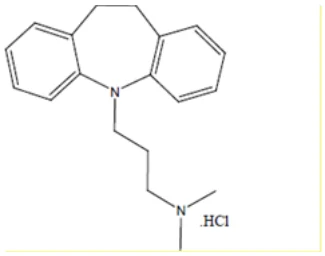
Chemical name: a) 5H-Dibenz[b,f]azepine-5-propanamine,10,11- dihydro-N,N-dimethyl monohydrochloride
- b) 5-3-(Dimethylamino) propyl-10,11-dihydro-
5H-dibenz[b,f]-azepine monohydrochloride c)N-(γ-dimethylaminopropyl)Iminodibenzyl Hydrochloride
Molecular formula and molecular mass: C19H25ClN2 and 316.87 g/mol Structural formula:
Physicochemical properties:
Description : White to off-white, odorless or practically odorless crystalline powder.
Solubility : Freely soluble in water and in alcohol. Insoluble in ether and in benzene.
Stability : Stable, air sensitive, hygroscopic material.
14 CLINICAL TRIALS
14.3 Comparative bioavailability studies
A double blind, randomized, two-treatment, two-sequence, two-period, crossover, single-dose, oral comparative bioavailability study of PrJAMP Imipramine 75 mg tablets (JAMP Pharma Corporation) and PrIMIPRAMINE 75 mg tablets (AA Pharma Inc.) was conducted in normal, healthy, adult, male, human subjects under fasting conditions. A summary of the comparative bioavailability data from the 39 subjects included in the statistical analysis is presented in the following table:
SUMMARY TABLE OF THE COMPARATIVE BIOAVAILABILITY DATA
Imipramine (1 x 75 mg) Geometric Mean Arithmetic Mean (CV%) | ||||
|---|---|---|---|---|
| Parameter | Test1 | Reference2 | % Ratio of Geometric Means | 90% Confidence Interval |
AUCT (ng·hr/mL) | 1200.68 1408.79 (65.31) | 1174.43 1321.02 (54.41) | 102.2 | 96.8-107.9 |
AUCI (ng·hr/mL) | 1347.10 1620.25 (71.23) | 1342.11 1559.56 (61.94) | 100.4 | 95.1- 105.9 |
Cmax (ng/mL) | 64.59 72.61 (50.64) | 64.04 69.18 (42.67) | 100.9 | 93.7-108.6 |
Tmax3 (h) | 2.67 (1.00-6.00) | 3.00 (1.00-8.00) | ||
T½ 4 (h) | 23.60 (25.72) | 25.83 (30.53) | ||
1 PrJAMP Imipramine (imipramine hydrochloride) tablets, 75 mg (JAMP Pharma Corporation).
2 IMIPRAMINE (imipramine hydrochloride) tablets, 75 mg (AA Pharma Inc.)
3 Expressed as median (range) only
4 Expressed as the arithmetic mean (CV %) only
15 MICROBIOLOGY
No microbiological information is required for this drug product.
16 NON-CLINICAL TOXICOLOGY
No long-term animal studies have been performed to evaluate carcinogenic or mutagenic potential or whether imipramine hydrochloride affects fertility in males or females.
17 SUPPORTING PRODUCT MONOGRAPHS
- 1. IMIPRAMINE (Tablets 10 mg, 25 mg, 50 mg and 75 mg), submission control 270511, Product Monograph, AA PHARMA INC. (MAY 23, 2023).