


Product Monograph - Kavigale
Recent Major Label Changes
| 7 Warnings and Precautions, Cardiovascular | 2026-04 |
|---|
Table of Contents
Certain sections or subsections that are not applicable at the time of the preparation of the most recent authorized product monograph are not listed.
Recent Major Label Changes ................................................................................................... 2
Table of Contents ...................................................................................................................... 2
Part 1: Healthcare Professional Information ........................................................................... 4
- 1.
Indications .......................................................................................................................... 4
1.1. Pediatrics ................................................................................................................ 4
1.2. Geriatrics ................................................................................................................ 4
- 2. Contraindications .............................................................................................................. 4
- 4.
Dosage and Administration............................................................................................... 4
4.2. Recommended Dose and Dosage Adjustment ....................................................... 4
4.3. Reconstitution ......................................................................................................... 5
4.4. Administration ......................................................................................................... 5
4.5. Missed Dose ........................................................................................................... 6
- 5. Overdose ............................................................................................................................ 7
- 6. Dosage Forms, Strengths, Composition and Packaging ................................................ 7
- 7.
Warnings and Precautions ................................................................................................ 7
Cardiovascular .................................................................................................................... 7
Driving and Operating Machinery ........................................................................................ 8
Hematologic ........................................................................................................................ 8
Immune .............................................................................................................................. 8
Reproductive Health ........................................................................................................... 8
Sensitivity/Resistance ......................................................................................................... 8
7.1. Special Populations ................................................................................................ 9
7.1.1. Pregnancy ....................................................................................................... 9
7.1.2. Breastfeeding .................................................................................................. 9
7.1.3. Pediatrics ........................................................................................................ 9
7.1.4. Geriatrics ........................................................................................................ 9
- 8.
Adverse Reactions ............................................................................................................ 9
8.1. Adverse Reaction Overview .................................................................................... 9
8.2. Clinical Trial Adverse Reactions ............................................................................11
8.2.1. Clinical Trial Adverse Reactions – Pediatrics .................................................13
- 9.
Drug Interactions ............................................................................................................. 13
9.2. Drug Interactions Overview ....................................................................................13
9.3. Drug-Behaviour Interactions ..................................................................................13
9.4. Drug-Drug Interactions ...........................................................................................13
9.5. Drug-Food Interactions ..........................................................................................13
9.6. Drug-Herb Interactions ...........................................................................................13
9.7. Drug-Laboratory Test Interactions .........................................................................13
- 10.
Clinical Pharmacology .................................................................................................... 13
10.1. Mechanism of Action .............................................................................................13
10.2. Pharmacodynamics ...............................................................................................14
10.3. Pharmacokinetics ..................................................................................................14
10.4. Immunogenicity......................................................................................................16
- 11. Storage, Stability, and Disposal ...................................................................................... 16
Part 2: Scientific Information ................................................................................................. 17
- 13. Pharmaceutical Information ............................................................................................ 17
- 14.
Clinical Trials ................................................................................................................... 17
14.1. Clinical Trials by Indication ....................................................................................17
Pre-exposure Prophylaxis of Coronavirus Disease 2019 (COVID-19) ................................17
- 15. Microbiology .................................................................................................................... 20
- 16. Non-Clinical Toxicology .................................................................................................. 23
Patient Medication Information .............................................................................................. 24
Part 1: Healthcare Professional Information
1. Indications
KAVIGALE (sipavibart injection) is indicated for the pre-exposure prophylaxis of coronavirus disease 2019 (COVID-19) in adults and adolescents aged 12 years and older weighing at least 40 kg and:
- who are immunocompromised due to a medical condition or receipt of immunosuppressive medications or treatments or
- for whom COVID-19 vaccination is not recommended
Circulating SARS-CoV-2 viral variants may be associated with resistance to monoclonal antibodies. Healthcare professionals should routinely review the Antiviral Resistance information in 15 Microbiology, in conjunction with literature and local guidelines, for details regarding specific variants and resistance, which may be updated regularly.
1.1. Pediatrics
Pediatrics (<18 years of age): There are limited safety and no pharmacokinetic data available for pediatric patients <18 years old. The safety profile in the fifteen pediatric participants >12 years of age weighing at least 40 kg studied was similar to the safety profile in adults (see 7.1.3 Pediatrics).
1.2. Geriatrics
Geriatrics (≥65 years of age): There were no clinically meaningful differences in serum exposures to sipavibart based on age (see 10.3 Pharmacokinetics). No dose adjustment is required (see 4.2 Recommended Dose and Dosage Adjustment).
2. Contraindications
KAVIGALE is contraindicated in patients with a history of severe hypersensitivity reactions, including anaphylaxis, to this drug or any ingredient in the formulation, including any non-medicinal ingredient, or component of the container. For a complete listing, see 6 Dosage Forms, Strengths, Composition and Packaging.
4. Dosage and Administration
4.2. Recommended Dose and Dosage Adjustment
The recommended dosage in adults and adolescents aged 12 years and older weighing at least 40 kg is 300 mg of KAVIGALE administered as an intramuscular (IM) injection or intravenous (IV) infusion. For individuals who require repeat dosing for ongoing prevention of COVID-19, subsequent doses of 300 mg of KAVIGALE should be administered as an intramuscular injection or intravenous infusion once every 6 months until no longer required.
Pediatrics (<18 years of age): No dose adjustment was required in the fifteen adolescents studied that were aged 12 years and older (who weighed ≥40 kg) in the pivotal study (see 10.3 Pharmacokinetics). The safety, efficacy and pharmacokinetics of KAVIGALE in children aged <12 years have not been established.
Geriatrics (≥65 years of age): No dose adjustment is required (see 10.3 Pharmacokinetics).
Renal Impairment: No dose adjustment is required (see 10.3 Pharmacokinetics).
Hepatic Impairment: No dose adjustment is required (see 10.3 Pharmacokinetics).
4.3. Reconstitution
Parenteral Products:
Intravenous use
KAVIGALE may be administered diluted in a 50 mL or 100 mL infusion bag over approximately 20 minutes, or undiluted using a syringe pump over at least 6 minutes.
For detailed instructions on the preparation and administration of KAVIGALE, see 4.4 Administration.
For storage, stability, and disposal instructions, see 11 Storage, Stability, and Disposal.
4.4. Administration
For intramuscular injection or intravenous infusion.
KAVIGALE must be administered by a healthcare professional.
KAVIGALE may be administered via an intramuscular injection or via intravenous infusion using an infusion pump or a syringe pump. The Solution for injection/Solution for infusion must be prepared and administered by a healthcare professional, using aseptic technique as follows:
Intramuscular injection
Intramuscular injection of KAVIGALE should be made preferably in the anterolateral aspect of the thigh.
- 1. Remove KAVIGALE vial from refrigerated storage.
- 2. Inspect the vial visually for particulate matter and discolouration. KAVIGALE is a clear to opalescent, colourless to slightly yellow solution. Discard the vial if the solution is cloudy, discoloured or visible particles are observed. Do not shake the vial.
- 3. Withdraw 2 mL sipavibart into a syringe. For storage conditions of the prepared syringe, see 11 Storage, Stability, and Disposal.
- 4. Administer the intramuscular injection, preferably in the anterolateral thigh.
- 5. Discard any unused portion left in the vial.
- 6. Individuals should be monitored after administration according to local medical practice.
Intravenous infusion– infusion bag or syringe pump
Preparation of solution
- 1. Remove KAVIGALE vial from refrigerated storage.
- 2. Visually inspect the medicinal product for particulate matter and discolouration prior to administration. KAVIGALE is a clear to opalescent, colourless to slightly yellow solution. Discard the vial if the solution is cloudy, discoloured or visible particles are observed. Do not shake the vial.
- 3. Withdraw 2 mL from the vial and prepare an admixture for infusion by transferring into a 50 ml or 100 ml infusion bag containing sodium chloride (saline) 9 mg/ml (0.9%) solution for injection, or dextrose 50 mg/ml (5%) Solution for injection or administer using a syringe pump (see below).
- 4. Do not freeze or shake the solution. For storage conditions of the prepared syringe or prepared infusion bag, see 11 Storage, Stability, and Disposal.
- 5. Discard any unused portion left in the vial.
Administration – infusion bag
- 1. Do not co-administer other medicinal products through the same infusion line.
- 2. Administer the infusion solution intravenously via infusion pump or gravity over approximately 20 minutes through an intravenous line containing a sterile, low-protein binding 0.2 or 0.22 micron in-line filter.
- 3. Once the infusion is complete, flush the tubing with sufficient sodium chloride (saline) 9 mg/mL (0.9%) Solution for injection or 50 mg/mL (5%) dextrose injection to ensure delivery of the required dose.
- 4. Individuals should be monitored after administration according to local medical practice.
Administration – syringe pump
- 1. Administer 2 mL of KAVIGALE (300 mg) as an undiluted intravenous infusion using a syringe pump over at least 6 minutes.
- 2. It is recommended to use administration set components of the lowest volume possible to ensure sufficient dose delivery prior to flushing.
- 3. After the entire contents of the syringe have been administered, flush the administration set with a sufficient volume of sodium chloride (saline) 9 mg/ml (0.9%) Solution for injection or 50 mg/mL (5%) dextrose injection to ensure that the full dose has been administered.
- 4. Individuals should be monitored after administration according to local medical practice.
If signs and symptoms of an infusion-related reaction occur, interrupt, slow or stop the infusion and administer appropriate medicinal products and/or supportive therapy (see 7 Warnings and Precautions).
4.5. Missed Dose
If a dose is missed or the patient is unable to keep an appointment for one of the injections, the missed dose should be administered as soon as possible.
5. Overdose
There is no specific treatment for overdose with KAVIGALE. Treatment of overdose should consist of general supportive measures, including monitoring of vital signs and observation of the clinical status of the patient.
In clinical trials, sipavibart doses up to 1200 mg have been administered intravenously without dose-limiting toxicity.
| For the most recent information in the management of a suspected drug overdose, contact your regional poison control centre or Health Canada’s toll-free number, 1-844 POISON-X (1-844-764-7669). |
|---|
6. Dosage Forms, Strengths, Composition and Packaging
To help ensure the traceability of biologic products, healthcare professionals should record both the brand name and the non-proprietary (active ingredient) name as well as other product-specific identifiers such as the Drug Identification Number (DIN) and the batch/lot number of the product supplied.
Table 1 – Dosage Forms, Strengths, and Composition
KAVIGALE is supplied as a single-dose vial. KAVIGALE is preservative-free. Each carton of KAVIGALE contains one vial of 300 mg sipavibart in 2 mL (150 mg/mL).
KAVIGALE is supplied as a Solution for injection/Solution for infusion in a clear glass vial closed by a chlorobutyl elastomeric stopper sealed with a light green aluminium flip-off top.
7. Warnings and Precautions
Cardiovascular
Cardiovascular and thromboembolic events:
In the SUPERNOVA Parent Study Main Cohort, through to the primary analysis, there were 27 (1.6%), 7 (0.6%), and 6 (1.1%) participants with adjudicated cardiovascular events (included acute myocardial infarction) or thromboembolic events (included deep vein thrombosis) in the KAVIGALE, tixagevimab/cilgavimab and placebo groups, respectively. These findings were consistent at the final data cut-off, which demonstrated a similar pattern of higher cardiac and thromboembolic events in the KAVIGALE arm when compared to the placebo arm. At the final data cut-off, 3.8% of participants in the KAVIGALE arm experienced cardiac or thromboembolic adverse events as compared to 2.9% in the comparator (tixagevimab/cilgavimab) arm and 3.0% in the placebo arm 181 days after the first dose. A total of 2.7% of participants in the KAVIGALE
| Route of Administration | Dosage Form / Strength/Composition | Non-medicinal Ingredients |
Intramuscular use Intravenous use | Solution for injection/Solution for infusion. 300 mg sipavibart /150 mg/mL | L-Histidine L-Histidine hydrochloride monohydrate L-Arginine hydrochloride Polysorbate 80 Water for Injection |
arm experienced cardiac or thromboembolic adverse events as compared to 2.6% in the comparator (tixagevimab/cilgavimab) arm and 1.5% in the placebo arm 181 days after the second dose. Of note, all participants in the comparator arm who had received a first dose of tixagevimab/cilgavimab had received a second dose of placebo. The majority of participants who experienced these events had one or more cardiovascular risk factors and/or a prior medical history of cardiovascular disease that could explain the occurrence of such events. A causal relationship between KAVIGALE and these events has not been established.
KAVIGALE should be administered only if the expected therapeutic benefit is thought to outweigh any possible risk. Also, patients should be instructed to seek medical advice immediately if signs or symptoms related to cardiovascular disease such as chest pain, dyspnea, malaise, feeling lightheaded or faint occur after administration of KAVIGALE.
Driving and Operating Machinery
KAVIGALE is expected to have no or negligible influence on the ability to drive and use machines.
Hematologic
Clinically significant bleeding disorders
As with any other intramuscular injections, KAVIGALE should be given with caution to patients with thrombocytopenia or any coagulation disorder.
Immune
Hypersensitivity including anaphylaxis
Serious hypersensitivity reactions, including anaphylaxis, have not been observed with KAVIGALE in clinical trials, but have been observed with other human immunoglobulin G1 (IgG1) monoclonal antibodies. If signs and symptoms of a clinically significant hypersensitivity reaction or anaphylaxis occur, immediately discontinue administration, and initiate appropriate medicinal products and/or supportive therapy.
Reproductive Health
Fertility
There are no data on the effects of sipavibart on human fertility (see 7.1.1 Pregnancy).
Sensitivity/Resistance
Infusion-related reactions
Infusion-related reactions (IRRs) were observed in clinical trials with intravenous administration of sipavibart and were mild to moderate in severity (see 8.1 Adverse Reaction Overview). If an IRR occurs, consider interrupting, slowing or stopping the infusion, and initiate appropriate medicinal products and/or supportive therapy.
Risk of breakthrough infection due to SARS-CoV-2 viral variants not neutralized by sipavibart
Certain SARS-CoV-2 viral variants may not be neutralized by monoclonal antibodies such as sipavibart. KAVIGALE may not be effective at preventing COVID-19 caused by these SARS-CoV-2 viral variants. The in-vitro neutralization activity of sipavibart against SARS-CoV-2 viral variants is shown in Table 5 (see 15 Microbiology).
Patients who receive KAVIGALE should be informed of the potential for breakthrough infections to occur. If signs or symptoms of COVID-19 occur (the most common symptoms include fever, chills, sore throat, cough, tiredness and new loss of taste or smell; the most serious symptoms include difficulty breathing or shortness of breath, loss of speech or mobility, or confusion and chest pain), advise individuals to promptly seek medical attention.
7.1. Special Populations
7.1.1. Pregnancy
There are insufficient data from the use of sipavibart in pregnant women.
Non-clinical reproductive toxicity studies have not been performed with sipavibart. In a tissue cross reactivity study with sipavibart, no binding was detected to human fetal tissue or reproductive tissues (e.g., placenta).
Human IgG1 antibodies are known to cross the placenta barrier, therefore sipavibart has the potential to be transferred from the mother to the developing fetus. It is unknown whether the potential placental transfer of sipavibart provides any treatment benefit or risk to the developing fetus.
KAVIGALE should only be used during pregnancy if the potential benefit outweighs the potential risk for the mother and the fetus.
7.1.2. Breastfeeding
It is not known whether sipavibart is excreted in human milk, but maternal IgG is known to be present in human milk. Exposure to the breast-fed child cannot be excluded.
The developmental and health benefits of breastfeeding should be considered along with the mother’s clinical need for KAVIGALE and any potential adverse effects on the breastfed child from KAVIGALE or from the underlying maternal condition.
7.1.3. Pediatrics
There are limited safety and no pharmacokinetic data available for pediatric patients <18 years old. The safety profile in the fifteen pediatric participants >12 years of age studied was similar to the safety profile in adults. The recommended dosing regimen is expected to result in comparable serum exposures of sipavibart in adolescents 12 years of age or older who weigh at least 40 kg as observed in adults. KAVIGALE is not authorized for use in pediatrics under 12 years of age or weighing less than 40 kg. See 10.2 Pharmacodynamics and 10.3 Pharmacokinetics.
7.1.4. Geriatrics
There were no clinically meaningful differences in serum exposures to sipavibart based on age when comparing older adults ≥65 years of age and younger adults 18 to <65 years of age. See 10.2 Pharmacodynamics and 10.3 Pharmacokinetics.
8. Adverse Reactions
8.1. Adverse Reaction Overview
Overall, 2061 participants (1691 via intramuscular injection and 370 via intravenous administration) have been exposed to sipavibart in clinical trials.
In the Phase III SUPERNOVA Parent Study, Main Cohort, 1671 immunocompromised adult and adolescent participants ≥12 years of age and weighing at least 40 kg were exposed to an initial dose of sipavibart 300 mg administered by intramuscular injection and 1485 were exposed to two doses (see 10.2 Pharmacodynamics). The median duration of safety follow-up was 267.0 days across all 3 groups (sipavibart and comparator groups).
In the Phase II SUPERNOVA Sub-study, a randomized, open-label study, 310 participants ≥18 years of age and weighing at least 40 kg, who were either immunocompromised or immunocompetent with all degrees of SARS-CoV-2 infection risk, were exposed to a single dose of sipavibart 1200 mg via intravenous infusion. The median duration of safety follow up was 30.0 days in the sipavibart group and 37.5 days in the tixagevimab/cilgavimab group.
The Phase I Little DIPPER study (n=80), a double-blind, placebo-controlled study, enrolled 80 healthy adults 18-55 years of age with a minimum weight of 45 kg. Participants received KAVIGALE 300 mg (n=10) or 600 mg (n=10) by intramuscular injection, or 300 mg (n=10), 600 mg (n=10), or 1200 mg (n=40) by intravenous infusion. The safety profile of KAVIGALE observed in this study was consistent with the safety profile in other trials of KAVIGALE. The median duration of safety follow-up was 356.0 days in both the sipavibart and placebo groups.
In the SUPERNOVA Parent Study Main Cohort, adverse events were reported in a total of 49.9% of participants receiving sipavibart and 51.5% of participants in the comparator group (53.3% in tixagevimab/cilgavimab group and 48.1% in placebo group) up to Day 91 from first dose administration. At the primary analysis data cut-off, of the participants with at least one adverse event, the majority were grade 2 (25.7% across all 3 groups) and grade 1 (17.2% in the sipavibart group, 19.3% in the tixagevimab/cilgavimab group and 15.7% in the placebo group) intensity. The most frequently reported adverse event was COVID-19 (5.8% in the sipavibart group, 7.1% in the tixagevimab/cilgavimab group and 11.1% in the placebo group) and cough (5.3% in the sipavibart group, 6.8% in the tixagevimab/cilgavimab group and 3.6% in the placebo group). At the final data cut-off analysis, overall adverse event rates were lower after the second dose across all treatment groups and adverse event categories. Approximately 50% of participants experienced at least one adverse event within 90 days of the first dose and 40% of participants within 90 days after second dose (Day 271). Most adverse events were mild to moderate, and grade 3 events occurred at similar frequencies across groups. The most common adverse events across all treatment groups were COVID-19, cough, headache and fatigue.
Serious adverse events (SAEs) were reported in 12.2% of participants in the sipavibart group, 13.3% in the tixagevimab/cilgavimab group and 9.8% in the placebo group up to the data cut-off from first dose administration. Of the participants with at least one SAE, the majority were grade 3 in intensity. At the final data cut-off analysis, SAEs from first to second study dose and from second dose to 181 days after dose, were reported at similar rates for all groups. SAEs from first dose to end of study were reported in 18.9%, 20.1%, and 18.8% of participants in the sipavibart, tixagevimab/cilgavimab, or placebo groups, respectively.
Cardiac and thromboembolic AESIs were reported in 1.6% of participants in the sipavibart group, 0.6% in the tixagevimab/cilgavimab group and 1.1% in the placebo group up to the data cut-off from first dose administration. At the final data cut-off analysis, cardiovascular and thromboembolic AESIs were reported in 3.8% of participants in the sipavibart group, 2.9% in the tixagevimab/cilgavimab group and 3.0% in the placebo group 181 days after the first dose. A total of 2.7% of participants in the KAVIGALE arm experienced cardiac or thromboembolic AESIs as compared to 2.6% in the comparator (tixagevimab/cilgavimab) arm and 1.5% in the placebo arm 181 days after the second dose. Of note, all participants in the comparator arm who had received a first dose of tixagevimab/cilgavimab had received a second dose of placebo. See 7 Warnings and Precautions, Cardiovascular.
There were no participants who experienced serious hypersensitivity including anaphylaxis in the sipavibart group. One (0.1%) participant each in the tixagevimab/cilgavimab and placebo groups had experienced serious hypersensitivity including anaphylaxis event.
There were 5 (0.3%) participants with AEs leading to discontinuation in the sipavibart group and 10 (0.6%) participants in the comparator group (0.6% in the tixagevimab/cilgavimab and 0.5% in the placebo groups) through to primary analysis data cut-off. At the final data analysis, similar discontinuation rates were seen across all groups, and most discontinuations occurred between the first and second dose.
In the SUPERNOVA Sub-study, at the primary analysis data cut-off, adverse events were reported in a total of 25.8% of participants receiving sipavibart and 20.9% of participants in the tixagevimab/cilgavimab group through Day 29. Of the participants with at least one adverse event, the majority were grade 2 or 1 in intensity. The most frequently reported adverse events were infusion related reaction (1.9% in the sipavibart group) and diarrhea (1.9% in the sipavibart group and 0.6% in the tixagevimab/cilgavimab group). At the final analysis data cut-off, adverse event rates were similar to those seen at the primary analysis.
Serious adverse events were reported in 2.9% of participants in the sipavibart group and 5.1% in the tixagevimab/cilgavimab group up to the data cut-off from first dose administration. At the final analysis data cut-off, serious adverse events were reported in 4.8% of participants in the sipavibart group and 7.1% in the tixagevimab/cilgavimab group through Day 451. Majority of the events were grade 3 in intensity. No grade 4 or 5 events were seen in the sipavibart group. There were no related SAEs reported through Day 451.
There were no AESIs associated with serious hypersensitivity reactions including anaphylaxis, or cardiovascular and thromboembolic events.
There were 2 (0.6%) participants with AEs leading to discontinuation in the sipavibart group through Day 29.
In Little DIPPER, adverse events were reported in a total of 28.8% participants in the sipavibart group and 6.3% in the placebo group through Day 91 from first dose. No SAEs, cardiovascular and thromboembolic events or serious hypersensitivity including anaphylaxis events were reported. There was one participant in sipavibart group with AE leading to discontinuation.
8.2. Clinical Trial Adverse Reactions
Clinical trials are conducted under very specific conditions. Therefore, the frequencies of adverse reactions observed in the clinical trials may not reflect frequencies observed in clinical practice and should not be compared to frequencies reported in clinical trials of another drug.
Table 2 presents the adverse reactions identified in the primary analysis from the Phase II and Phase III clinical trials.
Table 2 – Adverse reactions (Pooled SUPERNOVA Parent Study Main Cohort and SUPERNOVA Sub-study, Safety Analysis Sets) – Primary Analysis
| System organ class/preferred term | KAVIGALE 300 mg IM (N = 1671) | Comparator (tixagevimab/ cilgavimab 300 mg IM or placebo) (N = 1663) | |||||
| Intramuscular administration | |||||||
| Immune system disorders | |||||||
| Hypersensitivitya | 0.8% | 0.2% | |||||
| General disorders and administration site conditions | |||||||
| Injection site reactionb | 4.1% | 4.1% | |||||
| Intravenous administration | |||||||
| KAVIGALE 1200 mg IV (N = 310) | Comparator (tixagevimab/ cilgavimab 300 mg IM) (N = 158) | ||||||
| General disorders and administration site conditions | |||||||
| Infusion site reactionc | 1.9% | N/A | |||||
| Injury, poisoning and procedural complications | |||||||
| Infusion related reaction | 1.9% | N/A | |||||
a Including the Preferred Terms pruritus, erythema, hypersensitivity, urticaria, dermatitis allergic, and drug eruption.
b Including the Preferred Terms injection site pain, injection site bruising, injection site erythema, injection site hemorrhage, injection site swelling, injection site hematoma, injection site pruritus, injection site paresthesia, injection site reaction, injection site rash, injection site discolouration, and injection site warmth.
c Including the Preferred Terms infusion site bruising, infusion site pain, infusion site pruritus, infusion site erythema, infusion site extravasation, and infusion site swelling.
Hypersensitivity reactions occurred within 14 days post-dose, were mild to moderate in severity, and most resolved within a few days. None of the hypersensitivity reactions were serious. Injection site reactions occurred within 7 days post-dose, were mild in severity, and most resolved within a few days. Infusion site reactions occurred within 7 days post-dose, were mild to moderate in severity, and resolved within a few days. Infusion related reactions occurred during or on the same day of infusion, were mild in severity, and resolved within a few days.
Based on the final analysis data cut-offs for the SUPERNOVA Parent Study Main cohort, the overall incidence of hypersensitivity and injection site reactions was 1.9% and 5.6%, respectively, in the sipavibart group. Additional preferred terms reported included rash and hypotension under hypersensitivity and injection site discomfort and injection site inflammation under injection site reactions.
Based on the final analysis data cut-off for the SUPERNOVA Sub-study, symptoms of infusion related reactions included nausea, arthralgia, headache, pyrexia, chills, dyspepsia, pain, and hypotension.
Repeat dosing
In the SUPERNOVA Parent Study, Main Cohort, 1485 participants who had received an initial dose of 300 mg sipavibart received a second dose of 300 mg sipavibart 6 months after administration of the initial dose. The overall safety profile for participants who received a second sipavibart dose remained similar when compared to the initial dose.
8.2.1. Clinical Trial Adverse Reactions – Pediatrics
There are limited safety data available for pediatric patients <18 years old. The safety profile in the fifteen pediatric participants ≥12 years of age studied was similar to the safety profile in adults.
9. Drug Interactions
9.2. Drug Interactions Overview
No interaction studies have been conducted with KAVIGALE.
Sipavibart is not expected to be renally excreted or metabolized by cytochrome P450 enzymes (see 10.3 Pharmacokinetics). Therefore, interactions with concomitant medications that are renally excreted or that are substrates, inducers, or inhibitors of cytochrome P450 enzymes are unlikely.
9.3. Drug-Behaviour Interactions
The interaction of KAVIGALE with individual behavioural risks (e.g. cigarette smoking, cannabis use, and/or alcohol consumption) has not been studied.
9.4. Drug-Drug Interactions
In the absence of compatibility studies, KAVIGALE should not be mixed with other medicinal products.
9.5. Drug-Food Interactions
Interactions with food have not been established.
9.6. Drug-Herb Interactions
Interactions with herbal products have not been established.
9.7. Drug-Laboratory Test Interactions
Interactions with laboratory tests have not been established.
10. Clinical Pharmacology
10.1. Mechanism of Action
Sipavibart is a recombinant human IgG1 monoclonal antibody that provides passive immunization by binding the spike protein receptor binding domain (RBD). Sipavibart is long-acting, with amino acid substitutions to extend antibody half-life (YTE) and to reduce antibody effector function and potential risk of antibody-dependent enhancement of disease (TM). Sipavibart binds to the spike protein RBD of SARS-CoV-2 (BA.2) with equilibrium dissociation constant of KD = 20.95 pM, blocking RBD binding to the human ACE2 receptor. This results in a blockade of virus entry and effective neutralization of the SARS-CoV-2 virus.
10.2. Pharmacodynamics
See 15 Microbiology.
Following a single intramuscular dose of 300 mg sipavibart in the SUPERNOVA Parent Study, Main Cohort, nAb geometric mean titres (GMT) at Days 29, 91, and 181 were higher in the sipavibart group against all tested variants versus placebo.
10.3. Pharmacokinetics
Following a single dose, sipavibart demonstrated approximately dose proportional increase in serum exposure as doses increased in the range of 300 mg to 600 mg for intramuscular administration or 300 mg to 1200 mg for intravenous infusion. There are no pharmacokinetic data available for pediatric participants <18 years of age. Simulations based on the population pharmacokinetic (popPK) model were conducted which estimated that the exposure to adolescents 12 to 17 years of age was approximately 25% higher than in adults ≥18 years of age. Simulations of a 3 month (Q3M) dosing regimen were performed based on the popPK model demonstrating that the extent of exposure (area under the curve - AUC) with 300 mg IM or IV Q3M of sipavibart resulted in a lower exposure than the highest-dose exposure (1200 mg IV single dose) observed in a clinical trial setting.
Absorption:
Following a single 300 mg intramuscular dose of sipavibart in the anterolateral thigh and the gluteal region, the geometric mean (geometric coefficient of variation (CV%)) of the maximum serum concentration (Cmax) of sipavibart was 48.0 (25.2%) μg/mL and 25.4 (51.7%) μg/mL, respectively. The corresponding median time (range) to Cmax was 7.5 (3.9, 53) and 52.0 (4.9, 86) days.
Based on population pharmacokinetics (PK) analysis, the estimated absolute bioavailability of sipavibart following intramuscular dose administration in the anterolateral thigh and gluteal region is 80.7% and 62.0%, respectively.
Following the first dose and the second dose of 300 mg sipavibart administered intramuscularly in the anterolateral thigh, the geometric mean serum sipavibart concentrations (CV%) at one-month post-dose were 29.8 (36.2%) μg/mL and 30.8 (54.3%) μg/mL, respectively. Doses were administered 6 months apart.
Following a single infusion of 300 mg and 1200 mg sipavibart (infusion rate: 50 mg/min), the geometric mean (CV%) serum concentration of sipavibart at 20 minutes post infusion was 101.6 (7.6%) μg/mL and 452.1 (25.8%) μg/mL, respectively.
Distribution:
The geometric mean (CV%) apparent volume of distribution for sipavibart was 6.3 (19.4%) L and 7.8 (15.7%) L following a single 300 mg intramuscular administration in the anterolateral thigh and gluteal region, respectively.
Based on population PK analysis, the estimated central and peripheral volume of distribution (relative standard error, RSE%) for sipavibart was 4.6 (1.3%) L and 0.4 (19.6%) L, respectively, following intravenous administration.
Metabolism:
Sipavibart is expected to be degraded into small peptides and component amino acids via catabolic pathways in the same manner as endogenous IgG antibodies.
Elimination:
The geometric mean (CV%) clearance of sipavibart was 0.053 (43.1%) L/day and 0.063 (47.0%) L/day following 300 mg intramuscular administration in the anterolateral thigh and gluteal region, respectively. The estimated mean terminal elimination half-life (SD) of sipavibart was 87.3 (26.5) days and 91.0 (27.3) days following a single 300 mg intramuscular dose in the anterolateral thigh and gluteal region, respectively.
Based on population PK analysis, the estimated clearance (RSE%) of sipavibart following intravenous administration was 0.044 (0.9%) L/day.
Special populations and conditions
- Pediatrics (12 years of age and older weighing at least 40 kg): There are no pharmacokinetic data available for pediatric participants <18 years old. Simulations based on the population pharmacokinetic model were conducted to estimate the exposure to adolescents 12 years of age and older. The recommended dosing regimen is expected to result in comparable serum exposures of sipavibart in adolescents aged 12 years or older who weigh at least 40 kg as observed in adults, since adults with similar body weight have been included in the clinical studies with sipavibart (Little DIPPER, SUPERNOVA, and SUPERNOVA Substudy).
- Geriatrics: Exposure to sipavibart in older adults ≥65 years of age (n=217) was comparable to that in younger adults 18 to <65 years of age (n=323).
Hepatic Insufficiency: No specific studies have been conducted to examine the effects of hepatic impairment on the PK of sipavibart.
Sipavibart is expected to be catabolized by multiple tissues through proteolytic degradation into amino acids and recycling into other proteins, therefore hepatic impairment is not expected to affect the PK of sipavibart.
Renal Insufficiency: No specific studies have been conducted to examine the effects of renal impairment on the PK of sipavibart.
Sipavibart with a molecular weight (MW) of approximately 148 kDa is not expected to be excreted intact in the urine as monoclonal antibodies with MW >69 kDa do not undergo renal excretion. Renal impairment is not expected to significantly affect the exposure of sipavibart. Similarly, dialysis is not expected to impact the PK.
- Other: No apparent difference in serum sipavibart exposures was observed in individuals with (n=591) or without (n=390) immunocompromised conditions following the same dose and route of administration. There were no clinically meaningful differences in serum exposures to sipavibart based on sex, age, race, or ethnicity.
10.4. Immunogenicity
Among participants who received sipavibart, 4.8% (29/604) were anti-drug antibody (ADA)-positive at any time and 0.8% (5/604) were treatment-emergent-ADA-positive. The low rate of ADA positive participants does not allow for complete assessment of the impact of ADA on the PK and safety of sipavibart.
- 11. Storage, Stability, and Disposal
Storage of vials
Store in a refrigerator (2°C to 8°C).
Do not freeze. Do not shake.
Keep the vial in the original carton to protect from light.
Storage of prepared syringes and prepared infusion bags
The Solution for injection/Solution for infusion is preservative-free and therefore, the prepared syringe or prepared infusion bag should be administered immediately. If immediate administration is not possible, and the syringe or infusion bag needs to be stored, the total time from vial puncture to administration should not exceed:
- 24 hours in a refrigerator at 2ºC to 8ºC and
- 4 hours at room temperature up to 25ºC
Any unused medicinal product or waste material should be disposed of in accordance with local requirements.
Part 2: Scientific Information
13. Pharmaceutical Information
Drug Substance
Non-proprietary name of the drug substance: sipavibart
Molecular formula and molecular mass: molecular mass of 148 kDA
Physicochemical properties: Clear to opalescent, colourless to slightly yellow, pH 6.0 solution.
Product Characteristics
Sipavibart is produced in Chinese hamster ovary (CHO) cells by recombinant DNA technology.
14. Clinical Trials
14.1. Clinical Trials by Indication
Pre-exposure Prophylaxis of Coronavirus Disease 2019 (COVID-19)
Table 3 – Summary of patient demographics for clinical trials: SUPERNOVA for pre-exposure prophylaxis of COVID-19
| Study # | Study design | Dosage, route of administration and duration | Study subjects (n) | Age (Range) | Sex |
| D7000C00001 (SUPERNOVA) | Phase III, randomized (1:1), double-blind, comparator-controlled clinical trial studying KAVIGALE for the pre-exposure prophylaxis of COVID-19 in immunocompro mised adults and adolescents ≥12 years of age. | Single dose of KAVIGALE 300 mg via intramuscular injection or comparator (tixagevimab/ cilgavimab or placebo). Participants received a second dose of KAVIGALE 300 mg or placebo 6 months after the initial dose. | KAVIGALE: 1669 tixagevimab /cilgavimab or placebo: 1666 | 12-92 years | Male: 43.2% Female: 56.8% |
The SUPERNOVA Parent Study, Main Cohort, included immunocompromised adults and adolescents ≥12 years of age weighing at least 40 kg. The study excluded participants who received COVID-19 vaccine or with a history of laboratory-confirmed or rapid-test confirmed SARS-CoV-2 infection within 3 months prior to the first visit.
The baseline demographics were balanced across the KAVIGALE and comparator treatment arms. The median age was 60 years (36.3% 65 years of age or older; 15 participants were 12 years to less than 18 years of age), 56.8% of participants were female, 74.1% were White, 6.5% were Asian, 12.1% were Black/African American, and 21.5% were Hispanic/Latino. All participants had at least one immunocompromising clinical condition, including but not limited to:
- 74.3% Taking immunosuppressive medication
- 15.3% Hematologic malignancy
- 15.1% Moderate/severe secondary immunodeficiencies (predominantly hemodialysis)
- 14.2% Solid organ transplant
- 13.3% Within 1 year of receiving B-cell depleting therapies
- 3.4% Solid tumour cancer and on treatment
- 2.0% Hematopoietic stem-cell transplantation
- 1.6% Moderate/severe primary immunodeficiencies
- 1.1% Advanced or untreated HIV infection
- 0.3% Received chimeric antigen receptor T-cell therapy
Study Results
The study included dual primary efficacy endpoints, comparing the efficacy of KAVIGALE to tixagevimab/cilgavimab or placebo in the prevention of symptomatic COVID-19 (1) caused by SARS-CoV-2 variants prevalent during the course of the study up to 181 days post last dose confirmed by RT-PCR and (2) attributable to matched variants (variants that do not contain the F456L mutation based on viral sequencing data and are expected to be susceptible to sipavibart) up to 181 days post last dose confirmed by RT-PCR. For each of the dual primary endpoints, a superiority test was performed to compare the relative risk of symptomatic COVID-19 between treatment arms. The median follow-up time post second dose was 61 days. Please see results in Table 4. For Kaplan-Meier time to event analysis for the primary end point analysis, please refer to Figure 1.
The variants evaluated prior to and during the conduct of the SUPERNOVA study using the in vitro pseudovirus neutralization assay were XBB.1.5, XBB.1.5.10 (XBB.1.5 + F456L), BA.2.86, JN.1, and JN.1.11.1/JN.1.16 (JN.1 + F456L).
KAVIGALE does not retain in vitro neutralizing activity against Omicron variants containing the F456L mutation (such as KP.2 and KP.3).
Table 4 – Relative risk reduction of symptomatic COVID-19
| N | Number of events, n (%) | Relative risk reduction, % (CI) | p-value | |
|---|---|---|---|---|
| Overall primary efficacy endpoint | 34.9% (97.5% CI: 15.0, 50.1) | p<0.001 | ||
| KAVIGALE | 1649 | 122 (7.4 %) | ||
| Comparatora | 1631 | 178 (10.9 %) | ||
| Matched variant primary efficacy endpoint | 42.9% (95% CI: 19.9, 59.3) | p=0.001 | ||
| KAVIGALE | 1649 | 54 (3.3 %) | ||
| Comparatora | 1631 | 90 (5.5 %) | ||
CI = Confidence Interval, N = number of participants in the analysis.
a Comparator was either tixagevimab/cilgavimab 600 mg or placebo.
KAVIGALE does not retain in vitro neutralizing activity against Omicron variants containing the F456L mutation (such as KP.2 and KP.3)
Figure 1 – Kaplan-Meier: Time to first symptomatic COVID-19 cases up to day 361 caused by SARS-CoV-2 variants prevalent during the course of the study up to 181 days post last dose and by matched variants
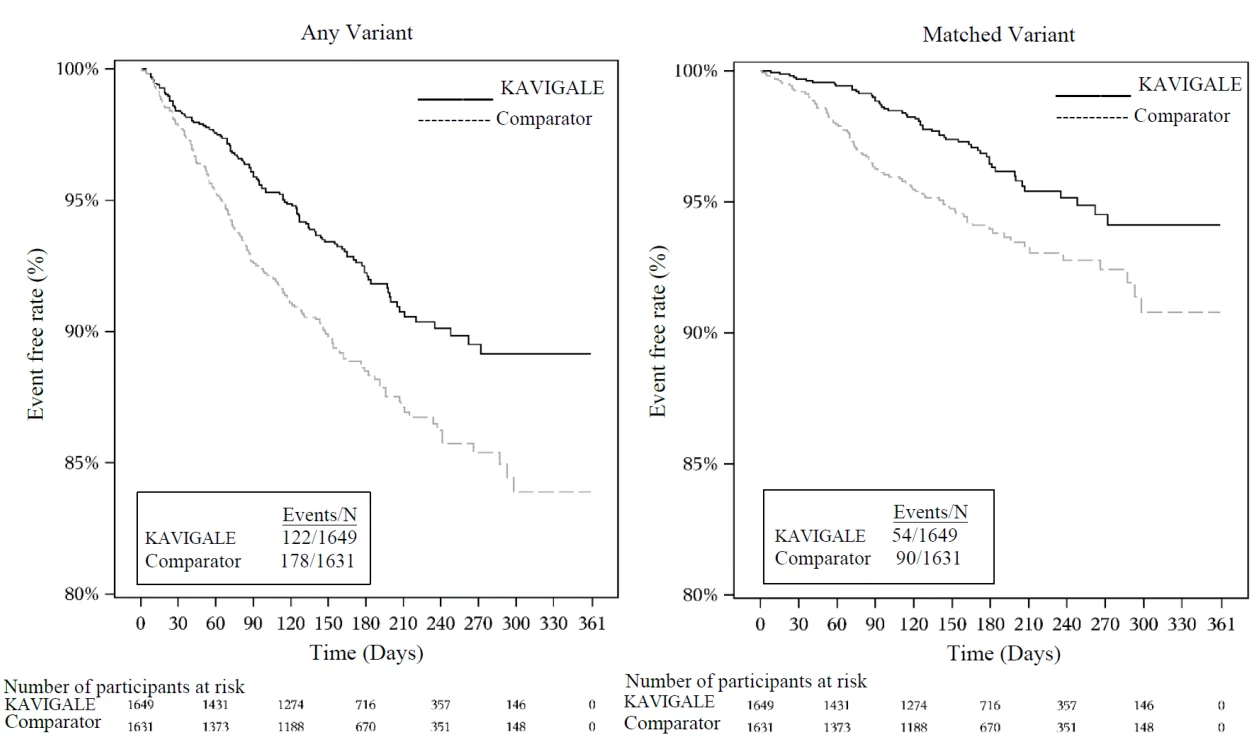
Efficacy was consistent across pre-defined subgroups including immunocompromised condition, age, sex, race, ethnicity, BMI, ECG interpretation, and for participants who had previously taken a COVID-19 vaccine (within 6 months of randomization) and/or tixagevimab/cilgavimab (within 12 months of randomization).
15. Microbiology
Viral variants are a potential risk for treatment failure of monoclonal antibodies used for the prevention or treatment of coronavirus disease 2019 (COVID-19) caused by the severe acute respiratory syndrome coronavirus 2 (SARS-CoV-2). The marketing authorization for this product is based on the review of clinical or neutralization data supporting efficacy against the variants of concern listed in Table 5. In the absence of data against other variants, the efficacy of the product for these other variants cannot be confirmed.
Antiviral activity
In a SARS-CoV-2 pseudovirus neutralization assay, sipavibart had antiviral activity through direct neutralization. Sipavibart showed reduced or no antibody-dependent cell-mediated cytotoxicity (ADCC), antibody-dependent cellular phagocytosis (ADCP), or antibody-dependent natural killer cell activation (ADNKA) in cell culture studies. Sipavibart did not mediate antibody-dependent complement deposition (ADCD) activity with guinea pig complement proteins.
Antibody dependent enhancement (ADE) of infection
The potential of sipavibart to mediate antibody-dependent viral entry was assessed in FcγRII-expressing Raji cells co-incubated with recombinant virus pseudotyped with SARS-CoV-2 spike protein, with antibody concentrations at a range of 3125 ng/mL to 12.8 fg/mL. Sipavibart did not mediate entry of pseudovirus into these cells.
Antiviral resistance
Evaluation of neutralization susceptibility of variants identified through global surveillance and in participants who received sipavibart is ongoing.
Sipavibart neutralizes many circulating SARS-CoV-2 variants in pseudovirus neutralization assays, however it does not retain in vitro neutralization activity against XBB subvariants harbouring an F456L mutation (such as KP.2 and KP.3).
Neutralization activity of sipavibart against pseudovirus SARS-CoV-2 variants are shown in Table 5.
Table 5 – Sipavibart pseudovirus neutralization data against SARS-CoV-2 variants
| Lineage with spike protein substitutions | Characteristic RBD substitutions tested | Fold reduction in susceptibilitya | IC50 (ng/mL) | |
|---|---|---|---|---|
| Lineage with spike protein substitutions | Characteristic RBD substitutions tested | Fold reduction in susceptibilitya | IC50 (ng/mL) | |
| Lineage with spike protein substitutions | Characteristic RBD substitutions tested | Fold reduction in susceptibilitya | IC50 (ng/mL) | |
| Pango lineage | WHO label | Pseudovirusb | ||
| Pango lineage | WHO label | Pseudovirusb | ||
| Pango lineage | WHO label | Pseudovirusb | ||
| BA.2 | Omicron BA.2 | T19I:del24-26:A27S:G142D:V213G: G339D:S371F:S373P:S375F:T376A: D405N:R408S:K417N:N440K:S477N: T478K:E484A:Q493R:Q498R:N501Y: Y505H:D614G:H655Y:N679K:P681H: N764K:D796Y:Q954H:N969K | 0.8 | 10.7 |
| BA.4/5 | Omicron BA.4/5 | T19I:del24-26:A27S:del69-70:G142D: V213G:G339D:S371F:S373P:S375F: T376A:D405N:R408S:K417N:N440K: L452R:S477N:T478K:E484A:F486V: Q498R:N501Y:Y505H:D614G:H655Y :N679K:P681H:N764K:D796Y:Q954H :N969K | 0.4 | 4.7 |
| BQ.1 | Omicron BQ.1 | T19I:del24-26:A27S:del69-70:G142D: V213G:G339D:S371F:S373P:S375F: T376A:D405N:R408S:K417N:N440K: K444T:L452R:N460K:S477N:T478K: E484A:F486V:Q498R:N501Y:Y505H: D614G:H655Y:N679K:P681H:N764K: D796Y:Q954H:N969K | 0.9 | 11.6 |
| BQ.1.1 | Omicron BQ.1.1 | T19I:del24-26:A27S:del69-70:G142D: V213G:G339D:R346T:S371F:S373P: S375F:T376A:D405N:R408S:K417N: N440K:K444T:L452R:N460K:S477N: T478K:E484A:F486V:Q498R:N501Y: Y505H:D614G:H655Y:N679K:P681H: N764K:D796Y:Q954H:N969K | 0.7 | 9.2 |
| XBB | Omicron XBB | T19I:del24-26:A27S:V83A:G142D: Y144-:H146Q:Q183E:V213E:G339H: R346T:L368I:S371F:S373P:S375F: T376A:D405N:R408S:K417N:N440K: V445P:G446S:N460K:S477N:T478K: E484A:F486S:F490S:Q498R:N501Y: Y505H:D614G:H655Y:N679K:P681H: N764K:D796Y:Q954H:N969K | 0.3 | 3.8 |
| XBB.1 | Omicron XBB.1 | T19I:del24-26:A27S:V83A:G142D: Y144-:H146Q:Q183E:V213E:G252V: G339H:R346T:L368I:S371F:S373P: S375F:T376A:D405N:R408S:K417N: N440K:V445P:G446S:N460K:S477N: T478K:E484A:F486S:F490S:Q498R: N501Y:Y505H:D614G:H655Y:N679K: P681H:N764K:D796Y:Q954H:N969K | 0.3 | 3.6 |
| XBB.1.5/XBB.1.9 | Omicron XBB.1.5/ XBB.1.9 | T19I:L24S:del25-27:V83A:G142D: del144:H146Q:Q183E:V213E:G252V: G339H:R346T:L368I:S371F:S373P: S375F:T376A:D405N:R408S:K417N: N440K:V445P:G446S:N460K:S477N: T478K:E484A:S486P:F490S:Q498R: N501Y:Y505H:D614G:H655Y:N679K: P681H:N764K:D796Y:Q954H:N969K | 0.4 | 5.8 |
| XBB.1.16 | Omicron XBB.1.16 | T19I:del24-26:A27S:V83A:G142D: Y144-:H146Q:E180V:Q183E:V213E: G252V:G339H:R346T:L368I:S371F: S373P:S375F:T376A:D405N:R408S: K417N:N440K:V445P:G446S:N460K: S477N:T478R,E484A:F486P:F490S: Q498R:N501Y:Y505H:D614G:H655Y :N679K:P681H:N764K:D796Y:Q954H :N969 | 0.1 | 1.3 |
| XBB.2.3 | Omicron XBB.2.3 | T19I:L24-:P25-:P26-:A27S:V83A: G142D:Y144-:H146Q:Q183E:V213E: D253G:G339H:R346T:L368I:S371F: S373P:S375F:T376A:D405N:R408S: K417N:N440K:V445P:G446S:N460K: S477N:T478K:E484A:F486P:F490S: Q498R:N501Y:Y505H:P521S:D614G :H655Y:N679K:P681H:N764K:D796Y :Q954H:N969K | 0.3 | 3.4 |
| XBB.1.5.10/EG.5 | Omicron XBB.1.5.10/ EG.5 | XBB.1.5 + F456L | >50-fold | >1000c |
| EG.5.1 | Omicron EG.5.1 | XBB.1.5 + Q52H + F456L | >50-fold | >1000c |
| BA.2.86d | Omicron BA.2.86 | T19I:R21T:L24-:P25-:P26-:A27S: S50L:H69-:V70-:V127F:G142D:Y144-: F157S:R158G:N211-:L212I:V213G: L216F:H245N:A264D:I332V:G339H: K356T:S371F:S373P:S375F:T376A: R403K:D405N:R408S:K417N:N440K: V445H:G446S:N450D:L452W:N460K : S477N:T478K:N481K:V483-:E484K: F486P:Q498R:N501Y:Y505H:E554K: A570V:D614G:P621S:H655Y:I670V: N679K:P681R:N764K:D796Y:S939F: Q954H:N969K:P1143L | 0.3 | 3.8 |
| JN.1 | Omicron JN.1 | T19I:R21T:L24-:P25-:P26-:A27S: S50L:H69-:V70-:V127F:G142D:Y144-: F157S: R158G:N211-:L212I: V213G: L216F:H245N:A264D:I332V:G339H: K356T:S371F:S373P:S375F:T376A: R403K:D405N:R408S:K417N:N440K: V445H:G446S:N450D:L452W:L455S: N460K:S477N:T478K:N481K:V483-: E484K:F486P:Q498R:N501Y:Y505H: E554K:A570V:D614G:P621S:H655Y: I670V: N679K:P681R:N764K:D796Y: S939F:Q954H:N969K:P1143L | 6.2 | 83.1 |
KP.2, KP.3, LB.1, KP.3.1.1 | Multiple | Defining mutation: F456L | >50-foldc | >1000c,e |
| BA.3.2f | Omicron BA.3 | G339Y:A348P:K356T:S371F:S373P: S375F:R403K:D405N:R408S:K417N: A435S:N440R:V445A:G446D:L452W :N460K:S477N:T478N:E484K:G496S :Q498R:N501Y:K529N | 6.9 | 93.2 |
- a Range of reduced in vitro potency across multiple sets of co-occurring substitutions and/or testing labs using research-grade assays; mean fold change in half maximal inhibitory concentration (IC50) of monoclonal antibody required for a 50% reduction in infection compared to ancestral reference strain.
- b Pseudoviruses expressing the entire SARS-CoV-2 spike variant protein and individual characteristic spike substitutions.
- c Sipavibart unlikely to be active against this variant.
- d BA.2.86 includes BA.2.86, BA.2.86.1, JN.2, and JN.3, which have the same SARS-CoV-2 spike protein sequence.
- e Presumed IC50 based on presence of F456L mutation in the variant.
- f BA.3.2 includes a family of variants which have the same SARS-CoV-2 spike protein sequence.
[see Module 2.4 Nonclinical Overview - addendum Neutralizing Activity of Sipavibart Against SARS-CoV- 2 BA.3.2* Variant Family, Table 1 Antiviral Activity of AZD3152 Against SARS-CoV-2 Variants Using a
Pseudotyped Virus Assay]
16. Non-Clinical Toxicology
General Toxicology:
Non-clinical data revealed no special hazards for humans based on studies of tissue binding and a repeat dose toxicity study in cynomolgus monkeys including assessment of safety pharmacology and local tolerance.
In a repeat dose toxicity study in cynomolgus monkeys, administration of 150 mg/kg of sipavibart in combination with 150 mg/kg of cilgavimab via intravenous infusion or intramuscular injection once weekly for 3 weeks, had no adverse effects.
In tissue cross reactivity studies using human adult and fetal tissues no binding was detected.
Genotoxicity: studies have not been conducted
Carcinogenicity: studies have not been conducted.
Reproductive and developmental toxicology: studies have not been conducted.