


Patient Medication Information: uses, side effects, how to take - Kineret
What is KINERET® used for?
KINERET® is used to help reduce the signs and symptoms of rheumatoid arthritis and slow damage to bone and joints. KINERET® inhibits of the progression of structural damage by reducing erosions and cartilage degradation in patients with active rheumatoid arthritis despite treatment with stable doses of methotrexate (MTX). Rheumatoid arthritis causes swelling in the lining of joints (e.g. hand, knee, and wrist joints) and, in some cases, may affect internal organs. Rheumatoid arthritis can last many years, and can ultimately cause damage to cartilage, bone, tendons, and ligaments in joints throughout the body.
KINERET® is also used to treat a form of a condition called Cryopyrin-Associated Periodic Syndromes (CAPS) that is called Neonatal-Onset Multisystem Inflammatory Disease (NOMID). NOMID is sometimes also called Chronic Infantile Neurological, Cutaneous, Articular Syndrome (CINCA).
KINERET® treats the signs and symptoms of inflammation associated with NOMID, such as rash, joint pain, fever and headache.
How does KINERET® work?
KINERET® is a laboratory copy of a protein that is naturally produced in our bodies. This protein is called interleukin-1 (in-ter-lew-kin) receptor antagonist or IL-1ra. IL-1ra is a cytokine inhibitor (a type of protein that blocks cytokines). Cytokines are another type of protein that are normally made in the
Serious Warnings and Precautions
Serious Infections. Patients taking KINERET® have a greater risk of developing a serious infection. If you have an infection, tell your healthcare provider before you start taking KINERET®. If you get an infection that does not go away while taking KINERET®, tell your healthcare provider right away.
If you are using ENBREL® or other tumour necrosis factor blocking agents (i.e. Humira or Remicade) together with KINERET® you could also be at greater risk for getting a serious infection.
- Allergic reactions. Allergic reactions may occur in patients taking KINERET®. If you get a rash over your whole body, shortness of breath, wheezing, low blood pressure, racing pulse, extreme sweating, hives, or swelling of mouth or eyes after your KINERET® injection, contact your doctor or the nearest hospital immediately. These symptoms may mean that you are allergic to KINERET®. Severe cases of this type of allergy may be dangerous and should be closely monitored by a doctor or emergency medical personnel.
human body. Cytokines coordinate the communication between different cells and help control cell activity.
In Rheumatoid Arthritis and in NOMID, your body produces too much of a cytokine called interleukin-1 (IL-1). Too much IL-1 leads to inflammation and causes disease symptoms. Normally, your body produces IL-1ra to block the harmful effects of IL-1. KINERET® works in the same way as your natural IL-1 blocking protein (IL-1ra).
Only you and your doctor can determine if KINERET® is working for you. The time it takes to see improvement in symptoms varies from person to person. In clinical studies in RA, some patients saw their arthritis symptoms improve in about 4 weeks after starting KINERET®. In clinical studies in NOMID, a clinical response was seen within 10 days after starting KINERET® treatment.
What are the ingredients in KINERET®?
Medicinal ingredients: anakinra.
Non-medicinal ingredients: anhydrous citric acid, disodium EDTA dihydrate, polysorbate 80, sodium chloride (salt), water.
KINERET® comes in the following dosage forms:
KINERET® comes in single-use, preservative-free graduated prefilled syringes containing 100 mg/0.67 mL (150 mg/mL) in a package of 7 syringes.
Do not use KINERET® if:
- you are allergic to proteins made from bacteria called E. coli. Ask your healthcare provider if you are not sure.
- you are allergic to anakinra or any of the ingredients in KINERET® (see the complete list of ingredients in KINERET®, above).
To help avoid side effects and ensure proper use, talk to your healthcare professional before you take KINERET®. Talk about any health conditions or problems you may have, including if you:
- think you have an infection or are being treated for infection.
- get a lot of infections or have infections that keep coming back.
- have signs of infection such as fever, chills, or have any open sores on your body.
- have asthma. Patients with asthma may have a higher risk of getting an infection if they take KINERET®. Asthmatic symptoms, such as airway inflammation, must be controlled before starting KINERET® therapy.
- take other medicines that affect your immune system.
- have kidney problems.
- are scheduled to receive any vaccines. You may get an infection if you receive a live vaccine while you use KINERET®. You should not receive live vaccines while you use KINERET®.
are pregnant or plan to become pregnant. It is not known if KINERET® will harm your unborn baby.
- are breastfeeding or plan to breastfeed. It is not known if KINERET® passes into your breastmilk.
Other warnings you should know about:
- BEFORE starting KINERET®, your doctor should test you for tuberculosis (TB). Your doctor should also check you for symptoms of TB and any other type of infection before, during and after your treatment with KINERET®.
- Liver problems. Contact your doctor if you experience signs of liver disorders such as yellow skin and eyes, nausea, loss of appetite, dark-coloured urine and light-coloured stools.
- Malignancies. For patients with rheumatoid arthritis, the risk of developing cancer for patients taking KINERET® appears to be the same as that for patients not taking KINERET®. RA patients, particularly those with highly active RA, may be at higher risk for lymphoma (a type of cancer). In clinical trials, RA patients treated with KINERET® had an incidence of lymphoma higher than that expected in the general population. The role of KINERET® in the development of cancer is not known.
- Blood Problems. KINERET® may cause you to have a lower number of certain white blood cells called neutrophils. Neutrophils are important in fighting infections. Having a low number of neutrophils (neutropenia) can increase the risk of getting a serious infection. You should have a blood test before starting treatment with KINERET® and then every 3 months, for up to one year after starting KINERET® treatment.
Tell your healthcare professional about all the medicines you take, including any drugs, vitamins, minerals, natural supplements or alternative medicines.
It is important that you tell your doctor about any other medicines (for example, high blood pressure medicine or blood thinners) you are taking for other conditions before you start taking KINERET®.
The following may interact with KINERET®:
Taking KINERET® with ENBREL® or other tumour necrosis factor blocking agents (i.e. Humira or Remicade) is not recommended because this may increase your risk of getting a serious infection.
When you start taking KINERET® the chronic inflammation in your body will decrease. This could mean that the doses of some other medicines, e.g. warfarin (a blood thinner), have to be adjusted.
How to take KINERET®?
KINERET® is given as an injection under your skin (subcutaneous). Your doctor will tell you how much you should take, and how often you need to take it. Whether you are giving yourself or your child the daily injections or having someone else give them to you, you must take KINERET® exactly as your doctor tells you in order to get the most benefit from the medication.
KINERET® is packaged in graduated prefilled syringes (small disposable tubes attached to needles). The syringes are for single use only. Any unused portion of a prefilled syringe must be discarded. Make sure the solution in the prefilled syringe is clear and colourless. You may notice small white particles in the solution. These particles are formed from KINERET® and this is acceptable. However, do not inject the solution if it is cloudy or discoloured, or contains large or coloured particles.
Do not shake the KINERET® prefilled syringe. If the prefilled syringe has been shaken vigorously the solution may be frothy or have bubbles at the top. The effectiveness of KINERET® will not be altered by shaking, but you may not be able to deliver the required amount of medication from the syringe. If the solution is frothy, let the prefilled syringe sit undisturbed for a few minutes to decrease the amount of froth or bubbles.
The expiry date for each KINERET® product is stamped on the pack and on the syringe label. Do not use KINERET® after the last day of the month and the year shown.
Instructions for preparing and giving an injection of KINERET®
What do I need to know if I am giving myself or my child KINERET® injections?
IMPORTANT: To help avoid contamination and possible infection due to injection, follow these instructions exactly.
This section contains information on how to give yourself or your child an injection under the skin (subcutaneous). It is also very important to put the used prefilled syringe and needle in a puncture-proof container (see Disposal section). If you are unsure about giving yourself or your child the injections, or have any questions, talk to your doctor or nurse.
STEP 1: Preparing for the injection
- 1. Find a comfortable, well-lit, clean, working place or surface. You should inject KINERET® at the same time each day.
- 2. Remove a prefilled syringe of KINERET® from the refrigerator. Do not shake the prefilled syringe. Allow 30 minutes for the medication to reach room temperature (Note: KINERET® can be left out at room temperature for up to 12 hours).
- 3. Check the expiration date on the KINERET® prefilled syringe to be sure that the drug has not expired. You find the expiration date (Exp.) printed on the left hand side on the syringe label.
- 4. Make sure the solution in the prefilled syringe is clear and colourless. You may notice small white particles in the solution. These particles are formed from KINERET® and this is acceptable. However, do not inject the solution if it is cloudy or discoloured, or contains large or coloured particles.
- 5.
Assemble the supplies you will need for your injection: For KINERET® prefilled syringes you will need: prefilled syringe of KINERET®, alcohol swabs, gauze or tissue, and a puncture-proof disposal container. Note: Do not remove the needle cover from the prefilled syringe until you or your caregiver is ready to give the injection.
- 6. Wash your hands thoroughly with soap and water before preparing to inject the medication.
STEP 2: Preparing the correct dose of KINERET®
Make sure you know what KINERET® dose your doctor has prescribed.
- Preparing a 100 mg dose of KINERET®:
- Hold the syringe barrel and carefully pull the needle cover straight off without twisting. See Figure A. Take care not to touch the needle or push the plunger. Put the needle cover into the disposal container.
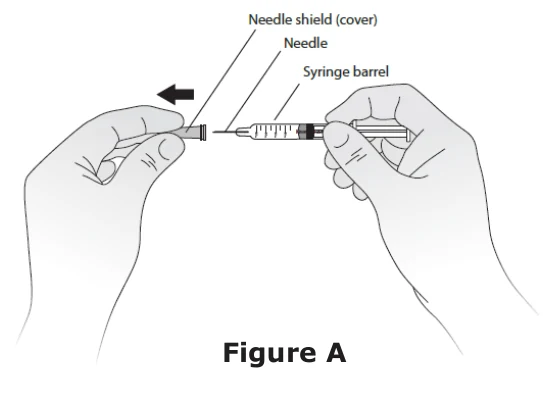
Figure A
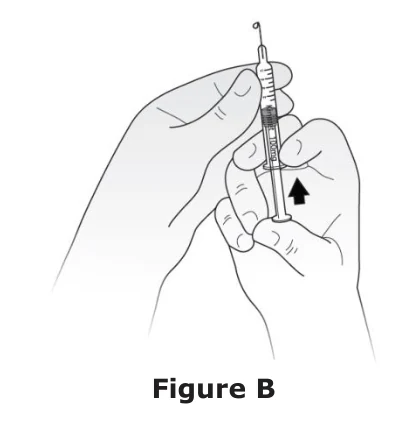
Figure B
- 2. You may notice a small air bubble in the prefilled syringe. You do not have to remove the air bubble before injecting. Injecting the solution with the air bubble is harmless.
- 3. Carefully place the barrel of the syringe on the table until you are ready to inject. Do not let the needle touch the table. Do not recap the needle.
- 4. You can now continue to Step 3: Selecting and preparing the injection site.
- • Preparing a dose of KINERET® less than 100 mg:
- 1. Hold the syringe barrel and carefully pull the needle cover straight off without twisting. See Figure A. Take care not to touch the needle or push the plunger. Put the needle cover into the disposal container.
- 2. Hold the syringe in one hand with the needle pointing straight upwards. See Figure B. Put your thumb on the plunger rod and push slowly until you see a tiny liquid drop at the tip of the needle.
- 3. Turn the syringe so that the needle is now pointing downwards. Place a sterile gauze or tissue on a flat surface and hold the syringe above it with the needle pointing towards the gauze or tissue. See Figure C. Make sure the needle does not touch the gauze or tissue.
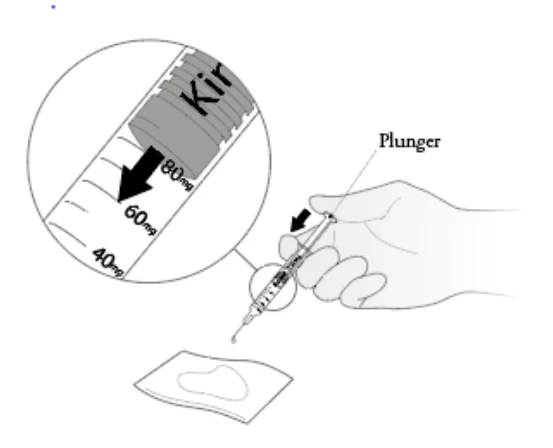
Figure C
- 4. Put your thumb on the plunger rod and push slowly until you can see that the top of the plunger has reached the correct number (scale mark) for your KINERET® dose. (Your doctor will have told you what dose you need to use.) The liquid that was pushed out of the needle will be absorbed by the gauze or tissue. See Figure C.
- 5. If you are not able to select the correct dose of KINERET®, throw away the syringe and use a new one.
- 6. Carefully place the barrel of the syringe on the table until you are ready to inject. Do not let the needle touch the table. Do not recap the needle.
Step 3: Selecting and preparing the injection site
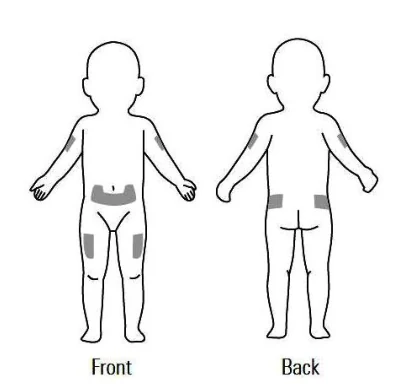
- 1. Determine the site for injection. See Figure D. Alternate the injection site each time you inject KINERET®, as directed by your doctor, to avoid soreness at any one site. If KINERET® is injected repeatedly at the same place, there is a risk of a lump (amyloid deposit) forming under the skin. Rotate the injection site to avoid this.
Recommended injection sites for adults and children are:
a. Back of the upper arms (if someone is giving you the injection)
b. Abdomen, except for the navel and waist (belt line)
c. Upper thighs
d. Upper outer areas of the buttocks
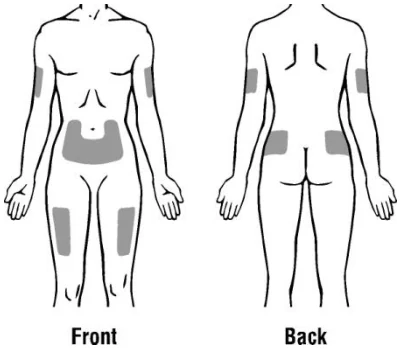
- 2. Clean the injection site with an alcohol swab. Use circular motions from the inside to the outside in a spiral motion. Let the area dry.
STEP 4: Injecting KINERET®
- 1. Hold the syringe in the hand that you will use to inject yourself or your child. Do not allow the needle to touch anything. Use the other hand to pinch a fold of skin between your thumb and forefinger at the previously prepared injection site.
- 2.
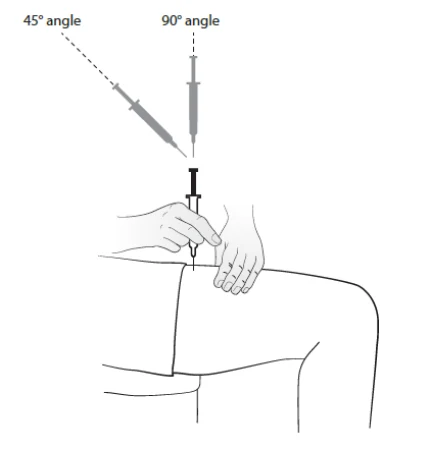
Hold the syringe the way you would hold a pencil and insert the needle either straight up and down (at a 90-degree angle) or at a slight angle (45 degrees) to the skin. See Figure E.
Adult
Child
Figure D
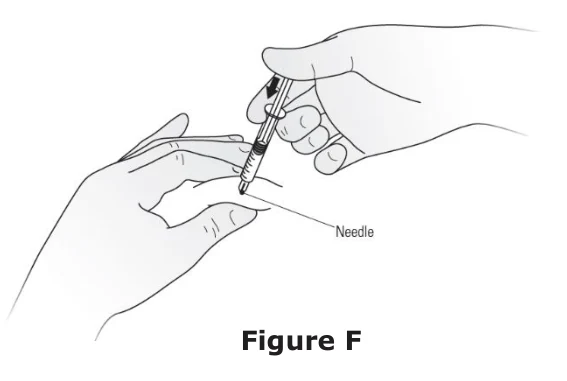
- 3. After the needle is inserted into the skin‚ slowly push the plunger all the way down to inject KINERET®. See Figure F.
- 4. After injecting the liquid, remove the needle and let go of the skin.
- 5. Place a gauze or tissue over the injection site and press for several seconds.
- 6. Dispose of the syringe as instructed (see Disposal section). Note: Only use each syringe for one injection. Do not reuse a syringe as this can cause infection.
Occasionally, a local reaction may develop at the injection site. If you notice a lump, swelling, redness, bruising, or itching that doesn’t go away, contact your doctor.
Disposal
Dispose of syringes, needles and supplies as directed by your doctor, or by following these simple steps:
- 1.
Place all used needles, needle covers, and syringes in a hard plastic container, or a metal container with a plastic lid. Do not attempt to disassemble the syringe or replace the needle cover. Do not use glass or clear plastic containers, or any container that will be recycled or returned to a store. Always store the container out of the reach of children, and properly label the container to indicate its contents.
Figure E
Figure F
a. If a metal container (such as a coffee can with a plastic lid) is used, cut a small hole in the plastic lid and tape the lid onto the metal container.
b. If a hard plastic container with a screw-on cap is used, always screw the cap on tightly after each use.
- 2. Throw away wet gauze or tissue with your syringe and clean the table surface with a fresh alcohol swab.
- 3. When the container is full, tape around the cap or lid and dispose of the container according to your doctor’s or healthcare provider’s instructions.
- 4. Check with your doctor, nurse, or pharmacist for other suggestions for disposal. There may be special provincial and local laws that they will discuss with you.
Important Notes
If your doctor allows you to self-administer KINERET® at home, please note the following:
- 1. Always follow your doctor’s instructions concerning the dosage and administration of KINERET®. Do not change the dose or administration of KINERET® without consulting with your doctor.
- 2. You may not have to use all of the liquid medicine in the prefilled syringe. Your doctor or nurse will show you how to find the correct dose of KINERET® for you or your child.
- 3. Your doctor will tell you what to do if you miss a dose of KINERET®.
- 4. If you develop a fever or symptoms of infection, contact your doctor.
- 5. Consult your doctor if you notice anything unusual about your condition after taking KINERET®.
- 6. For further information about injecting KINERET®, please contact your doctor or nurse.
Overdose:
If you think you, or a person you are caring for, have taken too much KINERET®, contact a healthcare professional, hospital emergency department, or regional poison control centre immediately, even if there are no symptoms.
Missed Dose:
If you miss your dose by more than a few hours, take the missed dose as soon as possible and contact your doctor or nurse. Do not take double the dose the next day.
What are possible side effects from using KINERET®?
These are not all the possible side effects you may have when taking KINERET®. If you experience any side effects not listed here, tell your healthcare professional.
KINERET® is generally well tolerated, the most common side effects were:
- Reactions at the site where KINERET® was injected. These reactions include redness, swelling, bruising, or itching and/or stinging. Most injection site reactions are mild and last about 2 to 4 weeks. If you are having problems with your injection sites, call your healthcare provider.
- Other common side effects that occurred during clinical trials were worsening of arthritis symptoms (if you already have RA), upper respiratory infection, headache, nausea and vomiting, diarrhea, sinus infection, flu-like symptoms, sore throat or runny nose, fever, joint pain and stomach pain.
KINERET® may cause thrombocytopenia (low level of blood platelets).
KINERET® may cause increased total blood cholesterol levels.
| Serious side effects and what to do about them | |||
|---|---|---|---|
| Symptom / effect | Talk to your healthcare professional | Stop taking drug and get immediate medical help | |
| Only if severe | In all cases | ||
| COMMON | |||
| Serious infections - fever, sweats or chills, severe weakness or tiredness, shortness of breath, cough, red or swollen skin blisters, diarrhea or stomach pain | X | X | |
| RARE, but exact frequency is not known | |||
| Severe allergic reactions - swelling of your face, lips, mouth or tongue, trouble breathing, wheezing, severe itching, skin rash, redness or swelling outside of the injection area, dizziness or fainting, fast heartbeat or pounding in your chest, sweating | X | X | |
| UNKNOWN | |||
| Injection site amyloid deposit – lump forming under the skin | X | ||
| Drug reaction with eosinophilia and systemic symptoms (DRESS) – atypical, widespread rash, which may occur in conjunction with high body temperature and enlarged lymph nodes | X | X | |
If you have a troublesome symptom or side effect that is not listed here or becomes bad enough to interfere with your daily activities, tell your healthcare professional.
Reporting Side Effects
You can report any suspected side effects associated with the use of health products to Health Canada by:
- Visiting the Web page on Adverse Reaction Reporting (https://www.canada.ca/en/health-canada/services/drugs-health-products/medeffect-canada.html) for information on how to report online, by mail or by fax; or
- Calling toll-free at 1-866-234-2345.
NOTE: Contact your health professional if you need information about how to manage your side effects. The Canada Vigilance Program does not provide medical advice.
Storage:
KINERET® should be kept in the refrigerator (between 2° to 8°C). KINERET® can be left out at room temperature for up to 12 hours. If you think that KINERET® has been frozen or left in direct sunlight, contact your doctor, nurse, or pharmacist before you use it. When travelling, keep KINERET® in a cool area out of the sun and avoid extreme temperature changes. Return medication to refrigeration conditions as soon as possible.
As with all medications, keep KINERET® out of sight and reach of children.
If you want more information about KINERET®:
- Talk to your healthcare professional
- Find the full product monograph that is prepared for healthcare professionals and includes this Patient Medication Information by visiting the Health Canada website: (https://www.canada.ca/en/health-canada/services/drugs-health-products/drug-products/drug-product-database.html) or the Sponsor’s website (www.sobi.ca). Should you have questions or concerns call the sponsor at 1-866-204-3546.
Manufactured by:
Swedish Orphan Biovitrum AB (publ)
SE-112 76
Stockholm, Sweden
Imported and distributed by:
C.R.I.
3455 North Service Road, Unit #400
Burlington, ON
L7N 3G2, Canada