


Product Monograph - Nasacort
ACTIONS AND CLINICAL PHARMACOLOGY
Triamcinolone acetonide is a potent anti-inflammatory steroid with strong topical and weak systemic activity. Triamcinolone acetonide is a more potent derivative of triamcinolone. Although triamcinolone itself is approximately one to two times as potent as prednisone in animal models of inflammation, triamcinolone acetonide is approximately 8 times more potent than prednisone.
When administered intranasally in therapeutic doses, it has a direct anti-inflammatory action on the nasal mucosa, the mechanism of which is not yet completely defined. The minute amount absorbed in therapeutic doses has not been shown to exert any apparent clinical systemic effects.
Corticosteroids are very effective. However, when allergic symptoms are very severe, local treatment with recommended doses (microgram) of any available topical corticosteroid are not as effective as treatment with larger doses (milligram) of oral or parenteral formulations. Corticosteroids do not have an immediate effect on allergic signs and symptoms. An improvement of symptoms may be seen as early as the first day after initiation of treatment and full benefit may be expected in 3 to 4 days. However, symptomatic relief may not occur in some patients for as long as two weeks. NASACORT® should not be continued beyond three weeks in the absence of significant symptomatic improvement.
Pharmacokinetics
Based upon intravenous dosing of triamcinolone acetonide phosphate ester, the half-life of triamcinolone acetonide was reported to be 88 minutes. The volume of distribution (Vd) reported was 99.5 L (SD ± 27.5) and clearance was 45.2 L/ hour (SD ± 9.1) for triamcinolone acetonide. The plasma half-life of corticosteroids does not correlate well with the biologic half-life.
When a single 800 mcg dose of NASACORT® was administered intranasally to normal healthy subjects, the mean maximum plasma concentration was 0.196 ng/mL and was observed on average at 3.8 hours postdosing. The terminal elimination half-life was 4.1 hours.
INDICATIONS AND CLINICAL USE
NASACORT® (CFC-free) (triamcinolone acetonide) nasal inhaler is indicated for the topical treatment of the symptoms of perennial and seasonal allergic rhinitis unresponsive to conventional treatment.
CONTRAINDICATIONS
Hypersensitivity to any of the ingredients of NASACORT® (CFC-free) (triamcinolone acetonide) nasal inhaler (see AVAILABILITY), and in patients with active or quiescent tuberculosis, or untreated fungal, bacterial and viral infection, or ocular herpes simplex.
WARNINGS
In patients previously on prolonged periods or high doses of systemic steroids, the replacement with a topical corticosteroid can be accompanied by symptoms of withdrawal, e.g. joint and/or muscular pain, lassitude, and depression; in severe cases, adrenal insufficiency may occur, necessitating the temporary resumption of systemic steroid therapy. These patients should be carefully monitored for acute adrenal insufficiency in response to stress. Careful attention must be given to patients with asthma or other clinical conditions in whom a rapid decrease in systemic steroids may cause a severe exacerbation of their symptoms.
The use of NASACORT® (CFC-free) (triamcinolone acetonide) nasal inhaler with alternate day systemic prednisone could increase the likelihood of hypothalamic-pituitary-adrenal (HPA) suppression compared to a therapeutic dose of either one alone. Therefore, NASACORT® should be used with caution in patients already receiving alternate-day prednisone treatment for any disease.
Patients who are on immunosuppressant drugs are more susceptible to infections than healthy individuals. Chickenpox and measles, for example, can have a more serious or even fatal course in children or adults on immunosuppressant doses of corticosteroids. In such children, or in adults who have not had these diseases, particular care should be taken to avoid exposure. If exposed, therapy with varicella zoster immune globulin (VZIG) or pooled intravenous immunoglobulin (IVIG), as appropriate, may be indicated. If chickenpox develops, treatment with antiviral agents may be considered.
Pregnancy: See PRECAUTIONS.
PRECAUTIONS
- 1) The replacement of a systemic steroid with NASACORT® (CFC-free) (triamcinolone acetonide) nasal inhaler has to be gradual and carefully supervised by the physician (see WARNINGS). The guidelines under "DOSAGE AND ADMINISTRATION" should be followed in all such cases.
- 2) During long-term therapy pituitary-adrenal function and hematological status should be assessed.
- 3) Patients should be informed that relief of some symptoms may occur within the first day of treatment but full benefit of NASACORT® may not be achieved until 3 to 4 days of regular daily treatment have been completed. However, symptomatic relief may not occur in some patients for as long as two weeks after starting treatment. NASACORT® should not be continued beyond three weeks in absence of significant symptomatic improvement.
- 4) Treatment with NASACORT® should not be stopped abruptly but tapered off gradually.
- 5)
Corticosteroids may mask some signs of infection and new infections may appear.
A decreased resistance to localized infections has been observed during corticosteroid therapy; this may require treatment with appropriate therapy or stopping the administration of NASACORT®. If localized fungal infection of the nose or pharynx develops such as with Candida albicans, discontinue NASACORT® treatment. Persistence of nasopharyngeal irritation may be an indication for discontinuing NASACORT®.
- 6) Glaucoma and osteoporosis are possible adverse effects associated with a long term use of large doses of corticosteroids. The possibility of atrophic rhinitis and/or pharyngeal candidiasis should be kept in mind.
- 7) There is an enhanced effect of corticosteroids on patients with hypothyroidism and in those with cirrhosis. Acetylsalicylic acid should be used cautiously in conjunction with corticosteroids in hypothrombinemia.
- 8) Because of the inhibitory effect of corticosteroids on wound healing, in patients who have had recent nasal surgery or trauma, a nasal corticosteroid should be used with caution until healing has occurred.
- 9) As with other nasally inhaled corticosteroids, nasal septal perforations have been reported in rare instances. Cases of nasal septum perforation among pediatric patients using Nasacort® (CFC formulation) have been reported in rare instances. It is important to use the inhaler correctly to minimize the potential for nasal septum perforation (i.e., pointing it slightly towards outside nostril wall). See INSTRUCTIONS FOR USE.
- 10) Following the use of intranasal aerosolized corticosteroids, instances of increased intraocular pressure have been reported in rare instances.
- 11) Patients should be advised to inform subsequent physicians of prior use of corticosteroids.
- 12) Until greater clinical experience has been gained, the continuous, long-term treatment of children under age 4 is not recommended.
- 13)
Pregnancy:
The safety of NASACORT®in pregnancy has not been established. If used, the expected benefits should be weighed against the potential hazard to the fetus, particularly during the first trimester of pregnancy.
Like other glucocorticosteroids, triamcinolone acetonide is teratogenic to rodents and non-human primates (see under TOXICOLOGY). The relevance of these findings to humans has not yet been established. Infants born of mothers who have received substantial doses of glucocorticosteroids during pregnancy should be carefully observed for hypoadrenalism.
- 14)
Lactation:
Glucocorticosteroids are excreted in human milk. It is not known whether triamcinolone acetonide would be secreted in human milk, but it is suspected to be likely. The use of NASACORT® in nursing mothers, requires that the possible benefits of the drug be weighed against the potential hazards to the infant. 15) Children:
NASACORT® is not presently recommended for children younger than 4 years of age due to limited clinical data in this age group. Oral corticosteroids have been shown to cause growth suppression in children and teenagers, particularly with higher doses over extended periods. If a child or teenager on any corticosteroids appears to have growth suppression, the possibility that they are particularly sensitive to this effect of steroids should be considered.
- 16)
To ensure the proper dosage and administration of the drug, the patient should be instructed by a physician or other health professional in the use of NASACORT®
(see Patient Instructions).
ADVERSE REACTIONS
A total of 1200 patients were enrolled in placebo-controlled and open-label clinical studies of NASACORT® (CFC-free) . In the controlled trial described below, 333 patients were treated with NASACORT® for an average of 15 days (range 1-19 days). Of the 396 patients enrolled in open label studies, 75% received treatment for greater than six months. No changes in mucous membranes were noted from physical and visual examinations during these trials.
The most commonly reported adverse reactions included those involving mucous membranes of the nose and throat. The three most prevalent adverse reactions considered to be at least possibly drug-related were rhinitis (3.0%), headache (1.8%) and epistaxis (1.5%).
The incidence of specific nasopharyngeal-related adverse reactions considered drug related is summarized as follows:
ADVERSE EVENTS
| Placebo (N=111) | Nasacort® 25 mcg (N=113) Nasacort® 200 mcg (N=107) Nasacort® 800 mcg (N=113) | Nasacort® Total (N=333) | |
| Naso-Pharyngeal AEs | 13 (11.7%) | 18 (15.9%) 20 (18.7%) 21 (18.6%) | 5.9 (17.7%) |
Dry Mucous Membrane Epistaxis Nasal Irritation Naso-Sinus Congestion Sneezing Throat Discomfort | 0 ( 0.0%) 1 ( 0.9%) 4 ( 3.6%) 0 ( 0.0%) 8 ( 7.2%) 1 ( 0.9%) | 0 ( 0.0%) 1 ( 0.9%) 0 ( 0.0%) 1 ( 0.9%) 2 ( 1.9%) 2 ( 1.8%) 9 ( 8.0%) 8 ( 7.5%) 7 ( 6.2%) 1 ( 0.9%) 0 ( 0.0%) 1 ( 0.9%) 13 (11.5%) 15 (14.0%) 18 (15.9%) 0 ( 0.0%) 0 ( 0.0%) 0 ( 0.0%) | 1 ( 0.3%) 5 ( 1.5%) 24 ( 7.2%) 2 ( 0.6%) 46 (13.8%) 0 ( 0.0%) |
Nasal adverse events do not usually interfere with treatment and in the controlled and open-label studies only 2% of patients receiving recommended doses discontinued due to nasal adverse effects.
The following table summarizes the adverse events (% of patients) present in at least 5% of patients in the double-blind and open label phase studies.
| ADVERSE EVENTS | Double-blind | Open Label |
Placebo (N=111) Nasacort® 200 mcg (N=107) Nasacort® 800 mcg (N=113) | Nasacort® 800 mcg (N=396) | |
| Headache | 8.1% 10.3% 6.2% | 6.8% |
| Rhinitis | 1.8% 4.7% 3.5% | 11.6% |
| Epistaxis | 1.8% 1.9% 1.8% | 19.4% |
In the event of accidental overdose, an increased potential for these adverse experiences may be expected, but systemic adverse experiences are unlikely (see OVERDOSAGE section).
Hypersensitivity reactions including skin rash and edema of the face or tongue have been reported with other intranasal corticosteroids.
When patients are transferred to NASACORT® from a systemic steroid, allergic conditions such as asthma or eczema may be unmasked (see WARNINGS).
Cases of nasal septum perforation among pediatric users have been reported in post-marketing surveillance of Nasacort® (CFC formulation) (See PRECAUTIONS).
SYMPTOMS AND TREATMENT OF OVERDOSAGE
Like any other nasally administered corticosteroid, acute overdosing is unlikely in view of the total amount of active ingredient present. In the event that the entire contents of the bottle were administered all at once, via either oral or nasal application, clinically significant systemic adverse events would most likely not result. The patient may experience some gastrointestinal upset.
However when used chronically in excessive doses or in conjunction with other corticosteroid formulations, systemic corticosteroid effects such as hypercorticism and adrenal suppression may appear. If such changes occur, the dosage of NASACORT®
(CFC-free) (triamcinolone acetonide) nasal inhaler should be discontinued slowly consistent with accepted procedures for discontinuation of chronic steroid therapy. (see Administration)
The restoration of hypothalamic-pituitary axis may be slow; during periods of pronounced physical stress (i.e. severe infections, trauma, surgery) a supplement with systemic steroids may be advisable.
DOSAGE AND ADMINISTRATION
See WARNINGS.
Careful attention must be given to patients previously treated for prolonged periods with systemic corticosteroids when transferred to NASACORT® (CFC-free). Initially, NASACORT®and the systemic corticosteroid must be given concomitantly, while the dose of the latter is gradually decreased. The usual rate of withdrawal of the systemic steroid is the equivalent of 2.5 mg of prednisone every four days if the patient is under close supervision. If continuous supervision is not feasible, the withdrawal of the systemic steroid should be slower, approximately 2.5 mg of prednisone (or equivalent) every ten days. If withdrawal symptoms appear, the previous dose of the systemic steroid should be resumed for a week before further decrease is attempted.
The therapeutic effects of corticosteroids, unlike those of decongestants, are not immediate. Since the effect of NASACORT® depends on its regular use, patients must be instructed to take the nasal inhalations at regular intervals and not as with other nasal sprays, as they feel necessary.
In the presence of excessive nasal mucus secretion or edema of the nasal mucosa, the drug may fail to reach the site of action. In such cases it is advisable to use a nasal vasoconstrictor for two to three days prior to NASACORT® therapy. Patients should be instructed on the correct method of use, which is to blow the nose, then insert the nozzle firmly into the nostril, compress the opposite nostril and actuate the spray while inspiring through the nose, with the mouth closed.
An improvement of symptoms usually becomes apparent within a few days after the start of therapy. However symptomatic relief may not occur in some patients for as long as two weeks. NASACORT®should not be continued beyond three weeks in the absence of significant symptomatic improvement. Treatment with NASACORT® should not be stopped abruptly but tapered off gradually.
When possible, treatment of seasonal rhinitis should be started before the exposure of allergens.
Adults and children 12 years of age and older:
The recommended starting dose of NASACORT® (triamcinolone acetonide) nasal inhaler is 400 mcg per day given as two sprays (100 mcg/spray) in each nostril once a day. If needed, the dose may be increased to 800 mcg per day (100 mcg/spray) either as once a day dosage or divided up to four times a day , i.e., twice a day (two sprays/nostril), or four times a day (one spray/nostril).
After the desired effects are obtained, patients may be maintained on a dose of one spray (100 mcg) in each nostril once a day (total daily dose: 200 mcg per day).
Children 4 through 11 years of age:
The recommended starting dose of NASACORT® is 200 mcg per day given as one spray (100 mcg/spray) in each nostril once a day. Patients who do not achieve maximum symptom control may benefit from a dose of 400 mcg given as two sprays (100 mcg/spray) in each nostril once a day. Once symptoms are controlled, patients can be maintained on 200 mcg (one spray in each nostril) once daily.
NASACORT® is not recommended for children below 4 years of age since adequate numbers of patients have not been studied in this age group.
PHARMACEUTICAL INFORMATION
(i) Drug Substance
Proper Name: Triamcinolone acetonide
Chemical Name: Pregna-1,4-diene-3,20-dione, 9-fluoro-11,21-dihydroxy-
16,-17- [(1-methyethylidene) bis(oxy)] -,(11$,16")-
Structural Formula: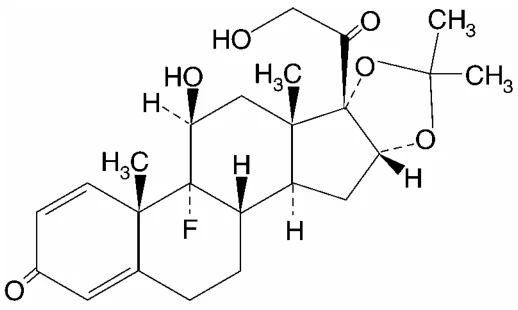
Molecular Formula: C24H31FO6
Molecular Weight: 434.49
Physical Form: white crystalline powder
Solubility: sparingly soluble in methanol, acetone, ethyl acetone
Melting Point: 292 - 294 /C
(ii) Composition
NASACORT® (CFC-free) is an unscented, taste-free metered-dose aerosol unit containing a microcrystalline suspension of triamcinolone acetonide in tetrafluoroethane (HFA-134a) and dehydrated alcohol USP 0.7% w/w. Each actuation releases approximately 100 mcg triamcinolone of which approximately 55 mcg are delivered from the nasal actuator to the patient (estimated from in vitro testing) after an initial priming of 3 actuations. The canister will remain primed for 3 days. If the product is not used for more than 3 days, then it should be reprimed with 3 actuations. Each canister contains 15 mg triamcinolone acetonide.
(iii) Stability and Storage Recommendations
Store at controlled room temperature (15 - 30/C).
Caution: Container may explode if heated. Contents under pressure. Do not place in hot water or near radiators, stoves or other sources of heat. When empty do not puncture or incinerate containers or store at temperature over 50°C.
AVAILABILITY OF DOSAGE FORMS
Each NASACORT® (CFC-free) (triamcinolone acetonide) canister contains sufficient amount for either 100 actuations. The canister should not be used after 100 actuations, since the amount delivered thereafter per actuation may not be consistent. In the Information for Patients, patients are provided with a check-off form to track usage.
The NASACORT® canister and accompanying nasal actuator are designed to be used together. The NASACORT® canister should not be used with other nasal actuators and the supplied nasal actuator should not be used with other products’ canisters. NASACORT® is supplied with a white plastic nasal actuator and patient instructions.