


Product Monograph - Omnaris HFA
SUMMARY PRODUCT INFORMATION
Route of Administration | Dosage Form / Strength | Nonmedicinal Ingredients |
| Nasal | Aerosol/50 mcg (ex-valve) | propellant HFA-134a (norflurane) and ethanol |
INDICATIONS AND CLINICAL USE
OMNARIS® HFA (ciclesonide nasal aerosol) is indicated for:
- the treatment of seasonal allergic rhinitis (SAR), including hayfever, and perennial allergic rhinitis (PAR) in adults and adolescents 12 years of age and older.
Geriatrics (>65 years of age):
OMNARIS® HFA has not been studied in sufficient numbers of subjects older than 65 years of age to determine whether they responded differently from younger subjects. Based on available data, no dose adjustment in geriatric patients is warranted.
Pediatrics (<12 years of age):
OMNARIS® HFA is not presently approved for use in patients younger than 12 years of age. No data are available.
CONTRAINDICATIONS
- OMNARIS® HFA (ciclesonide nasal aerosol) is contraindicated in patients with a hypersensitivity to any of the ingredients. For a complete listing see DOSAGE FORMS, COMPOSITION AND PACKAGING section of the Product Monograph.
- OMNARIS® HFA should be used with caution, if at all, in patients with active or quiescent tuberculosis infections of the respiratory tract.
WARNINGS AND PRECAUTIONS
Ear/Nose/Throat
Because of the inhibitory effect of corticosteroids on wound healing, patients who have experienced recent nasal septal ulcers, nasal surgery, or nasal trauma should not use a nasal corticosteroid until healing has occurred.
Immune
Patients who are on drugs that suppress the immune system are more susceptible to infections than healthy individuals. Chickenpox and measles, for example, can have a more serious or even fatal course in children or adults on corticosteroids. In children or adults who have not had these diseases, particular care should be taken to avoid exposure. How the dose, route, and duration of corticosteroid administration affect the risk of developing a disseminated
infection is not known. The contribution of the underlying disease and/or prior corticosteroid treatment to the risk is also not known. If exposed to chickenpox, prophylaxis with varicella zoster immune globulin (VZIG) may be indicated. If exposed to measles, prophylaxis with pooled intramuscular immunoglobulin (IG) may be indicated. If chickenpox develops, treatment with antiviral agents may be considered.
Infection
In clinical studies with corticosteroids administered intranasally, the development of localized infections of the nose and pharynx with Candida albicans have been reported only rarely.
When such an infection develops, it may require treatment with appropriate local therapy and discontinuation of treatment with the intranasal steroid. Therefore, patients using intranasal corticosteroids over several months or longer should be examined periodically for evidence of Candida infection or other signs of adverse effects on the nasal mucosa.
OMNARIS® HFA (ciclesonide nasal aerosol) should be used with caution, if at all, in patients with untreated local or systemic fungal or bacterial infections; systemic viral or parasitic infections; or ocular herpes simplex because of the potential for worsening of these infections.
Ophthalmologic
Nasal and inhaled corticosteroids may result in the development of glaucoma and/or cataracts. Therefore, close monitoring is warranted in patients with a change in vision or with a history of increased ocular pressure, glaucoma or cataracts.
Systemic Effects
Rarely, immediate hypersensitivity reactions or contact dermatitis may occur after the administration of intranasal corticosteroids. Rare instances of wheezing, nasal septum perforation and epistaxis have been reported following the intranasal application of corticosteroids. Avoid spraying OMNARIS® HFA directly onto the nasal septum.
Hypothalamic-Pituitary-Adrenal Axis Effect: Although systemic effects have been minimal with recommended doses of OMNARIS® HFA, any such effect is likely to be dose dependent. Therefore, larger than recommended doses of OMNARIS® HFA should be avoided. When used at excessive doses, systemic corticosteroid effects such as hypercorticism and adrenal suppression may occur. If such changes occur, the dosage of OMNARIS® HFA should be discontinued slowly, consistent with accepted procedures for discontinuing oral corticosteroid therapy.
Physicians should closely follow the growth of children and adolescents taking corticosteroids by any route, and weigh the benefits of corticosteroid therapy against the possibility of growth suppression if growth appears slowed.
Systemic Steroid Replacement by a Topical Steroid
The replacement of a systemic corticosteroid with a topical corticosteroid can be accompanied by signs of adrenal insufficiency. In addition, some patients may experience symptoms of corticosteroid withdrawal, e.g., joint and/or muscular pain, lassitude, and depression. Patients previously treated for prolonged periods with systemic corticosteroids and transferred to topical corticosteroids should be carefully monitored for acute adrenal insufficiency in response to stress. In those patients who have asthma or other clinical conditions requiring
long-term systemic corticosteroid treatment, rapid decreases in systemic corticosteroid dosages may cause a severe exacerbation of their symptoms.
Special Populations
Pregnant Women: There are no adequate and well-controlled studies with OMNARIS® HFA in pregnant women. As with other corticosteroids, OMNARIS® HFA should only be used during pregnancy when the potential benefit to the mother justifies the potential risk to the mother, fetus or infant. Infants born to mothers who received corticosteroids during pregnancy should be observed carefully for hypoadrenalism. The extent of exposure in pregnancy during clinical trials is very limited with individual cases only.
Nursing Women: It is unknown if ciclesonide is excreted in human milk. As with other corticosteroids, OMNARIS® HFA should only be used in nursing women when the potential benefit to the mother justifies the potential risk to the mother and/or infant.
Pediatrics (< 12 years of age): OMNARIS® HFA is not presently approved for use in patients younger than 12 years of age. No data are available in children younger than 12 years of age.
Geriatrics (>65 years of age): OMNARIS® HFA has not been studied in sufficient numbers of subjects age 65 and over to determine whether they responded differently from younger subjects. However, greater sensitivity of some older individuals cannot be ruled out. Based on available data, no dose adjustment of OMNARIS® HFA in geriatric patients is warranted.
Monitoring and Laboratory Tests
As with any long-term treatment, patients using OMNARIS® HFA over several months or longer should be examined periodically for possible changes in the nasal mucosa.
ADVERSE REACTIONS
Adverse Drug Reaction Overview
Systemic and local corticosteroids use may result in the following:
- Epistaxis, ulcerations, nasal septum perforations, Candida albicans infection, impaired wound healing (see WARNINGS AND PRECAUTIONS)
- Cataracts and glaucoma (see WARNINGS AND PRECAUTIONS)
- Immunosuppression (see WARNINGS AND PRECAUTIONS)
Hypothalamic-pituitary-adrenal (HPA) axis effects, including growth reduction (see
WARNINGS AND PRECAUTIONS)
Clinical Trial Adverse Drug Reactions
Because clinical trials are conducted under very specific conditions the adverse reaction rates observed in the clinical trials may not reflect the rates observed in practice and should not be compared to the rates in the clinical trials of another drug. Adverse drug reaction information from clinical trials is useful for identifying drug-related adverse events and for approximating rates.
Data from controlled clinical trials in patients 12 years and older with OMNARIS® HFA
(ciclesonide nasal aerosol) given in the dose range of 100 mcg to 400 mcg ex-valve per day were used to determine the frequency of Adverse Events (AEs).
Three of the clinical trials were 2 to 6 weeks in duration and one trial was 26 weeks in duration with an additional 26-week open-label extension. Short-term data (2 to 6 weeks) included 3001 patients with seasonal and perennial allergic rhinitis, of these, 884 received OMNARIS® HFA 100 mcg once daily and 892 received placebo.
Headache, epistaxis and instillation site discomfort were the most common AEs observed between 2 to 6 weeks. In the majority of cases adverse reactions were mild and did not require discontinuation of treatment withOMNARIS® HFA. Nasal septum perforation was reported in one patient with SAR treated with OMNARIS® HFA 100 mcg.
Table 1 lists the common adverse events (≥ 1%) that occurred more frequently in patients treated with OMNARIS® HFA than in patients treated with placebo in the controlled clinical trials 2 to 6 weeks in duration (including the first 6 weeks of the 26 week trial in patients with PAR).
Table 1 - Common Adverse Events (≥ 1%) in Controlled Clinical Trials 2 to 6-weeks in Duration in Patients 12 Years of Age and Older with Seasonal or Perennial Allergic Rhinitis
| Placebo N= 892 n (%) | OMNARIS® HFA 100 mcg (N=884) n (%) | |
| General disorders & administrative site conditions | ||
| Instillation site discomfort | 4 (0.4) | 16 (1.8) |
| Infections and Infestations | ||
| Upper respiratory tract infection | 7 (0.8) | 15 (1.7) |
| Urinary tract infection | 9 (1.0) | 12 (1.4) |
| Bronchitis | 3 (0.3) | 9 (1.0) |
| Nervous system disorders | ||
| Headache | 11 (1.2) | 27 (3.1) |
| Respiratory, thoracic & mediastinal disorders | ||
| Epistaxis1 | 24 (2.7) | 26 (2.9) |
| Nasal discomfort | 12 (1.3) | 13 (1.5) |
| Oropharyngeal pain | 8 (0.9) | 11 (1.2) |
| Nasal septum disorder | 6 (0.7) | 9 (1.0) |
N = number of subjects in treatment
% =percentage based on N.
Studies included M1-602, 060-622, 060-633 (first six weeks), and 060-634 1Epistaxis included blood-tinged mucus.
For the 6-month double-blind study, the overall rate was similar between active treatment (60.4%) and placebo (63.5%). However, the overall rate of potentially related AEs was higher with active treatment than placebo (20.2% and 25.5% of subjects in the placebo and treatment group, respectively). The most common AEs were upper respiratory tract infection, epistaxis and headache. Table 2 lists the common adverse events (≥ 1%) that occurred more frequently in patients treated with OMNARIS® HFA than in patients treated with placebo during the 6-month clinical trial.
Table 2 - Common Adverse Events ≥1% in Controlled Clinical Trials 6-month in Duration in Patients 12 Years of Age and Older with Perennial Allergic Rhinitis: Study 060-633
| Placebo (N=307) n (%) | OMNARIS® HFA 100 mcg (N=298) n (%) | |
| Gastrointestinal Disorders | ||
| Nausea | 2 (0.7) | 9 (3.0) |
| Toothache | 5 (1.6) | 5 (1.7) |
General Disorders and Administration Site Conditions | ||
| Instillation site discomfort | 0 (0.0) | 10 (3.4) |
| Pyrexia | 3 (1.0) | 4 (1.3) |
| Infections & infestations | ||
| Upper respiratory tract infection | 29 (9.4) | 43 (14.4) |
| Viral upper respiratory tract infection | 7(2.3) | 15 (5.0) |
| Urinary tract infection | 9 (2.9) | 13 (4.4) |
| Bronchitis | 6 (2.0) | 7 (2.3) |
| Pharyngitis streptococcal | 5 (1.6) | 7 (2.3) |
| Influenza | 3 (1.0) | 6 (2.0) |
| Vulvovaginal mycotic infection* | 0 (0.0) | 3 (1.5) |
| Pneumonia | 2 (0.7) | 3 (1.0) |
| Acute sinusitis | 1 (0.3) | 3 (1.0) |
| Injury, Poisoning and procedural complications | ||
| Muscle strain | 2 (0.7) | 6 (2.0) |
| Procedural pain | 3 (1.0) | 5 (1.7) |
| Musculoskeletal and Connective Tissue Disorders | ||
| Muscle spasms | 0 (0.0) | 3 (1.0) |
| Nervous system disorders | ||
| Headache | 14 (4.6 ) | 21(7.0) |
| Tension headache | 1 (0.3) | 3 (1.0) |
| Reproductive System and Breast Disorders | ||
| Benign prostatic hyperplasia* | 0 (0.0) | 1 (1.0) |
| Ovarian Cyst* | 1( 0.5) | 2 (1.0) |
| Respiratory, thoracic & mediastinal disorders | ||
| Epistaxis1 | 24 (7.8) | 34 (11.4) |
| Oropharyngeal pain | 10 (3.3) | 12 (4.0) |
| Cough | 8 (2.6) | 9 (3.0) |
| Nasal discomfort | 2 (0.7) | 8 (2.7) |
| Nasal mucosal disorder | 2 (0.7) | 7 (2.3) |
| Nasal septum disorder | 3 (1.0) | 5 (1.7) |
| Nasal dryness | 0 (0.0) | 3 (1.0) |
| Skin and Subcutaneous Tissue Disorders | ||
| Rash | 0 (0.0) | 3 (1.0) |
N = number of subjects in treatment group;
% = percentage based on N.
1Epistaxis included blood-tinged mucus.
* Indicates a gender-specific adverse event, where percentages are based on the number of subjects in the appropriate gender and treatment group, otherwise percentages are based on the total number of ITT subjects reported in each treatment group.
The AE profile was similar for subjects treated with OMNARIS® HFA for up to 52-weeks in the long-term safety pool.
Less Common Adverse Drug Reactions in Clinical Trials 2-6 weeks in Duration (≥0.1% to <1%)*
Immune system disorders: hypersensitivity (0.1%)
Gastrointestinal: nausea (0.9%), gastroenteritis (0.5%)
Respiratory, Thoracic and Mediastinal disorders: nasal dryness (0.6%), nasal mucosal disorder (0.9%), sneezing (0.3%)
*considered potentially related (defined as those AEs rated by the investigator as being unlikely, possible, probable, or definite, or those AEs in which the relation to study drug assessment is missing).
Special Populations
The incidence of adverse events did not differ appreciably based on age, gender or race.
DRUG INTERACTIONS
Overview
In vitro data indicate that cytochrome P450 3A4 is the major enzyme involved in the metabolism of the active metabolite of ciclesonide (M1) in man.
Based on in vitro studies in human liver microsomes, the active metabolite M1 did not significantly inhibit or induce the metabolism of other drugs. Based on in vitro human hepatocyte studies, ciclesonide and M1 had no significant effect on the induction of major cytochrome P450 isozymes. In vitro studies also demonstrated that the plasma protein binding of ciclesonide M1 was not affected by warfarin or salicylic acid, indicating that protein binding-based drug interactions are unlikely.
The serum levels of ciclesonide and its active metabolite M1, are negligible following administration of ciclesonide nasal aerosol. Therefore, the potential for clinically relevant drug-drug interactions is very low. However, co-administration with potent inhibitors of the cytochrome P450 3A4 system (e.g. protease inhibitors for the treatment of HIV infections such as ritonavir or nelfinavir) should be considered with caution because there might be an increase in systemic drug levels of the active metabolite M1.
Drug-Drug Interactions
A drug interaction study with orally inhaled ciclesonide and oral erythromycin, a substrate and weak inhibitor of cytochrome P450 3A4, had no relevant effect on the pharmacokinetics of either M1 or erythromycin. In a drug interaction study at steady state with orally inhaled ciclesonide and oral ketoconazole, a potent cytochrome P450 3A4 inhibitor, the exposure of the active metabolite M1 increased approximately 3.5-fold, while levels of ciclesonide
remained unchanged. Due to the low systemic exposure of intranasal ciclesonide relative to orally inhaled ciclesonide, clinically relevant drug interactions with OMNARIS® HFA
(ciclesonide nasal aerosol), except with very potent inhibitors of the cytochrome P450 3A4 system, are not expected.
Drug-Food Interactions
Interactions with food have not been established. Drug-food interactions are unlikely for intranasal corticosteroids.
Drug-Herb Interactions
Interactions with herbal products have not been established.
Drug-Laboratory Interactions
Interactions with laboratory tests have not been established. Drug-laboratory interactions are unlikely for intranasal corticosteroids.
DOSAGE AND ADMINISTRATION
Dosing Considerations
The therapeutic effects of corticosteroids, unlike those of decongestants, are not immediate. Since the effect of OMNARIS® HFA (ciclesonide nasal aerosol) depends on its regular use, patients should be instructed to use OMNARIS® HFA at regular intervals.
Recommended Dose and Dosage Adjustment
Adults and Adolescents (12 Years of Age and Older). The recommended dose of OMNARIS® HFA is 1 actuation (50 mcg ex-valve) per nostril once daily. The total daily dosage is 100 mcg ex-valve. The maximum total daily dose should not exceed 1 spray in each nostril (100 mcg/day).
Missed Dose
It is very important that OMNARIS® HFA is used regularly. If a dose is missed, the next dose should be taken when it is due and patients should not exceed the prescribed daily dosage.
Administration
OMNARIS® HFA is to be administered by intranasal route only. Prior to initial use, OMNARIS® HFA must be primed by actuating three times. If OMNARIS® HFA is not used for seven consecutive days it should be primed by actuating three times. If OMNARIS® HFA is dropped, the canister and actuator may become separated. If this happens, reassemble OMNARIS® HFA and test spray once into the air before using.
The actuator and canister should be discarded after reaching zero in the indicator window since the amount of ciclesonide delivered per spray thereafter may be substantially less than the labeled dose. An illustrated patient’s instructions for proper use accompanies each package of OMNARIS® HFA. It is recommended that the applicator be cleaned weekly with a dry tissue or cloth.
Do not spray in eyes. Avoid spraying OMNARIS® HFA directly onto the nasal septum.
OVERDOSE
Chronic overdosage may result in signs or symptoms of hypercorticism (see WARNINGS AND PRECAUTIONS). There are no data on the effects of acute or chronic overdosage with OMNARIS® HFA nasal aerosol.
Acute overdose with the intranasal aerosol dosage form is unlikely since one 60 count canister of OMNARIS® HFA 50 mcg contains approximately 5 mg of ciclesonide.
Considering the low systemic availability of ciclesonide administered intranasally or orally, systemic effects following an overdose are unlikely.
For management of a suspected drug overdose, contact your regional Poison Control Centre.
ACTION AND CLINICAL PHARMACOLOGY
Mechanism of Action
Ciclesonide is a pro-drug with a low glucocorticoid receptor affinity and is pharmacologically inactive. Following intranasal application, ciclesonide is enzymatically converted by esterases in the nasal mucosa to the pharmacologically active metabolite, 21 des-methylpropionyl-ciclesonide (M1). M1 has potent anti-inflammatory activity with affinity for the glucocorticoid receptor that is 120 times higher than the parent compound and 12 times higher than dexamethasone.
The primary mechanism of corticosteroid action in allergic rhinitis is considered due to anti-inflammation. Corticosteroids have been shown to have a wide range of effects on multiple cell types (e.g., mast cells, eosinophils, neutrophils, macrophages, and lymphocytes) and mediators (e.g., histamine, eicosanoids, leukotrienes, and cytokines) involved in allergic inflammation. The anti-inflammatory properties of ciclesonide and M1 were shown in several in vitro and in vivo investigations, including experiments using a guinea pig model of allergic rhinitis and several investigations in primary human nasal epithelial cells, bronchial epithelial and smooth muscle cells (see DETAILED PHARMACOLOGY).
Pharmacodynamics
Ciclesonide is a glucocorticosteroid delivered as a nasal aerosol that has local anti-inflammatory properties at doses that have negligible systemic effect.
Adrenal function: In a 6-week study in adolescents and adults 12-73 years of age with perennial allergic rhinitis, daily doses of 200 mcg and 400 mcg of OMNARIS® HFA were compared to placebo. Dexamethasone 6 mg was used as an active control during the last 4 days of the trial. Adrenal function was assessed by measurement of change from baseline to end of treatment in 24-h serum cortisol levels (in 50 to 60 patients per group). A lack of suppressive effect was demonstrated for the ciclesonide-treated groups compared to the placebo-treated group. The LS mean difference in serum cortisol AUC(0-24) change from baseline to week 6 was -2.4 mcg•hour/dL (95% CI: -15.1, 10.2) for 200 mcg OMNARIS® HFA and -0.5 mcg•hour/dL (95% CI: -13.9, 13.0) for 400 mcg OMNARIS® HFA compared to placebo. The differences to placebo were not statistically significant. A significant
suppression in serum cortisol levels was demonstrated in the dexamethasone active control group compared to placebo.
Pharmacokinetics
The pharmacokinetics of intranasally administered ciclesonide have been assessed in perennial allergic rhinitis patients resulting in similar exposure compared to healthy subjects.
Table 3: Summary of the pharmacokinetic parameters of OMNARIS® HFA active metabolite (M1), in healthy subjects and perennial allergic rhinitis (PAR) patients
| Study No. | Subjects/ Formu-lation | Daily Dose [mcg] | No. of Days | AUCINF (pg*h/mL) Mean (SD) N | AUCT (pg*h/mL) Mean (SD) N | Cmax (pg/mL) Mean (SD) N | t1/2 (h) Mean (SD) N |
| M1-422 | Healthy/ Nasal Aerosol | 320 | 1 | 397.5 (128.0) 18 | 281.1 (138.9) 29 | 59.1 (22.6) 29 | 3.4 (1.5) 28 |
| M1-601 | Healthy/ Nasal Aerosol | 320 | 14 | -- | 245.1 (247.4) 10 | 38.3 (15.6) 10 | -- |
| M1-601 | PAR | 320 | 14 | -- | 188.4 (209.0) 13 | 34.0 (22.0) 13 | -- |
AUCINF = area under the concentration-time curve from time of the drug administration extrapolated to infinity (extrapolated area < 20%)
AUCT = area under the concentration-time curve from time of the drug administration to the last quantifiable drug concentration
Absorption: Ciclesonide and its active metabolite M1 have negligible oral bioavailability (both less than 1%) due to low gastrointestinal absorption and high first-pass metabolism. The intranasal administration of ciclesonide at recommended doses results in negligible serum concentrations of ciclesonide and M1 in adult and pediatric subjects using a sensitive bioanalytical assay with a lower limit of quantification of 25 pg/mL and 10 pg/mL for ciclesonide and M1, respectively.
The low systemic exposure of M1 following ciclesonide nasal aerosol administration was confirmed in a crossover trial in 29 healthy adults. The median Cmax of M1 was 59 pg/mL following a single dose of ciclesonide nasal aerosol (400 mcg) compared to 602 pg/mL following a single dose of orally inhaled ciclesonide (400 mcg) and 12 pg/mL following a single dose of ciclesonide aqueous spray (300 mcg). In another study there was low systemic bioavailability for the active metabolite M1 after repeated doses of ciclesonide nasal aerosol. Comparison of Cmax values after the first and fourteenth day of ciclesonide nasal aerosol administration indicated no evidence of drug accumulation over the time period.
Distribution: The volumes of distribution of ciclesonide and M1 following i.v. administration were approximately 2.9 L/kg and 12.1L/kg, respectively. The percentage of ciclesonide and the active metabolite M1 bound to human plasma proteins averaged ≥ 99% each. Only the unbound drug in the systemic circulation (approximately 1%) is available for further systemic pharmacodynamic effect. M1 is not significantly bound to human transcortin.
In a deposition study that utilized a technetium labelled-solution of ciclesonide nasal aerosol, the relative deposition in the nasal cavity was 98%, less than 2% in the lung and negligible in the esophagus or stomach, as measured by scintigraphy. Nasal aerosol was demonstrated to be a dry spray resulting in minimal deposition in the nasopharynx or on nasal wipes (on average, 0.22% and 0.03% of delivered dose, respectively).
Metabolism: Intranasal ciclesonide is primarily hydrolyzed to its biologically active metabolite, M1, by esterases in the nasal mucosa (primarily by carboxylesterases and cholinesterases). M1 is metabolized in the liver to inactive metabolites mainly by the CYP 3A4 isozyme. Furthermore, inactive fatty acid ester conjugates of M1 in human nasal epithelial cells were detected in vitro for up to 24 hours, providing a reversible depot of M1 due to gradual hydrolysis by lipases.
Elimination: After oral and intravenous administration, ciclesonide is predominantly excreted via the feces (66%), indicating that excretion via the bile is the major route of elimination.
Special Populations and Conditions
The pharmacokinetics of intranasally administered aerosol ciclesonide at therapeutic doses have not been assessed in patient subpopulations because the resulting blood levels are insufficient for pharmacokinetic calculations. However, the pharmacokinetic characteristics of M1 after oral inhalation of ciclesonide were not appreciably influenced by a variety of subject/patient characteristics such as body weight, advanced age, race, gender and liver impairment. Studies in renal impaired patients were not conducted since renal excretion of M1 is a minor route of elimination (≤20%). Because the systemic exposure of intranasally administered ciclesonide is much lower than that of orally inhaled ciclesonide, it is not likely that these special populations will experience clinically relevant changes in the pharmacokinetics of intranasally administered ciclesonide.
STORAGE AND STABILITY
Store at room temperature (15°C - 25°C). Do not freeze. Do not expose to temperatures above 49°C.
SPECIAL HANDLING INSTRUCTIONS
Prior to initial use, or when not used for seven consecutive days OMNARIS® HFA (ciclesonide nasal aerosol) must be primed by actuating three times. The actuator and canister should be discarded after reaching zero in the indicator window since the amount of ciclesonide delivered per spray thereafter may be substantially less than the labelled dose.
Do not puncture. Do not use or store near heat or open flame. Exposure to temperatures above 49° C may cause bursting. Never throw canister into fire or incinerator.
Keep out of reach of children. Avoid spraying in eyes or directly onto the nasal septum.
DOSAGE FORMS, COMPOSITION AND PACKAGING
OMNARIS® HFA (ciclesonide nasal aerosol) is a dry spray and comes in a pressurized metered-dose aerosol canister with actuator and integrated dose indicator for nasal delivery.
OMNARIS® HFA is comprised of an aluminum canister sealed with a metering valve, white actuator, purple cover and dust cap. One canister provides 30 or 60 actuations, after initial priming. The additional ingredients are propellant HFA-134a (norflurane) and ethanol. OMNARIS® HFA is scent free, taste free and preservative (benzalkonium chloride (BAK)) free.
OMNARIS® HFA is available in a 50 mcg ex-valve (37 mcg (ex-actuator)) per dose containing 30 actuations per canister and 60 actuations per canister.
PART II: SCIENTIFIC INFORMATION
PHARMACEUTICAL INFORMATION
Drug Substance
Proper name: ciclesonide
Chemical name: [11 beta, 16 alpha (R)]-16, 17-[(Cyclohexylmethylene)
bis(oxy)]-11-hydroxy-21-(2-methyl-1-oxopropoxy)pregna-1,4-diene 3,20-dione
Molecular formula: C32H44O7
Molecular mass: 540.7g/mol
Structural formula:
Physical Form: White to yellow white power
Solubility: 0.2 mg/L in water (room temperature);
soluble in ethanol, acetone, methylenechloride, chloroform
O
O
O
O
OH
O
O
H
CLINICAL TRIALS
Study demographics and trial design
Table 4- Demographics of Pivotal OMNARIS® HFA (ciclesonide nasal aerosol) Studies
| Study ID Phase | Study design | Duration of treatment | Ciclesonide HFA Nasal Aerosol dose Reference medication dose | ITT Subjects [N] | Primary Endpoint(s) |
| Pivotal Studies | |||||
| Seasonal allergic rhinitis (SAR) | |||||
| 060-622 Phase 3 | Multicentre, randomised, double-blind, placebo controlled, parallel-group | 2 weeks | 100 mcg: 237 200 mcg: 235 Placebo: 235 | Total: 707 | AM and PM rTNSS |
| 060-634 Phase 3 | Multicentre, randomised, double-blind, placebo controlled, parallel-group | 2 weeks | 100 mcg: 226 200 mcg: 225 Placebo: 220 | Total: 671 | AM and PM rTNSS |
| Perennial allergic rhinitis (PAR) | |||||
| 060-633 Phase 3 | Multicentre, randomised, double-blind, placebo controlled, parallel-group | 26 weeks1 | 100 mcg: 298 200 mcg: 505 Placebo: 307 | Total: 1110 | AM and PM rTNSS at 6 weeks |
Abbreviations: AM = morning; PM = evening; rTNSS = reflective total nasal symptom score. 1The primary assessments of safety and efficacy in PAR study 060-633 were made at week 6 of the double-blind treatment period.
The 3 pivotal trials included a total of 2488 patients (905 males and 1583 females) of whom 140 were adolescents, ages 12 to 17 years, and 83 were 65 years and over. The racial distribution in these 3 trials included 2169 Caucasians, 243 African Americans and 76 patients classified as Other.
Pivotal Studies
Assessment of efficacy in these trials was based on patient recording of four nasal symptoms (runny nose, nasal itching, sneezing, and nasal congestion) on a 0-3 categorical severity scale (0 = absent, 1 = mild, 2 = moderate, and 3 = severe) as reflective (previous 12 hours) or instantaneous (previous 10 minutes) total nasal symptom scores (rTNSS and iTNSS) respectively.
The results of these trials showed that patients treated with 100 mcg once daily OMNARIS® HFA (ciclesonide nasal aerosol) exhibited statistically significantly greater decreases in total nasal symptom scores than placebo-treated patients.
Additional secondary efficacy variables were assessed, including the Total Ocular Symptom Score (TOSS) in the seasonal allergic rhinitis studies and the Rhinoconjunctivitis Quality of Life Questionnaire with Standardised Activities [RQLQ(S)] in both seasonal and perennial allergic rhinitis studies. TOSS is calculated as the sum of the patients’ scoring of the three individual ocular symptoms (itching, tearing, and redness) on a 0 to 3 categorical severity scale (0 = absent, 1 = mild, 2 = moderate, 3 = severe) as reflective (rTOSS) or instantaneous (iTOSS) scores. To assess efficacy, rTOSS and iTOSS were evaluated as described above for the TNSS. Patients perceptions of disease specific quality of life were evaluated through the
use of the RQLQ(S), which assesses the impact of allergic rhinitis symptoms and treatment through 28 items in 7 domains (activities, sleep, non-nose/eye symptoms, practical problems, nasal symptoms, eye symptoms, and emotional) on a 7-point scale where 0 = not troubled and 6 = extremely troubled. An overall RQLQ(S) score is calculated from the average of the domain scores. An absolute difference of ≥ 0.5 in mean change from baseline over placebo is considered the minimally clinically important difference (MCID) for the RQLQ(S). The results of these trials showed that patients treated with OMNARIS® HFA 100 mcg once daily exhibited statistically significantly greater decreases in reflective and instantaneous total ocular symptom scores and RQLQ(S) than placebo-treated patients.
Seasonal Allergic Rhinitis (SAR) Trials: Two placebo-controlled, double-blind trials (060-622 and 060-634) were conducted in patients with seasonal allergic rhinitis. Table 5 and Table 6 display the efficacy results, for the ITT population, from both trials in patients with seasonal allergic rhinitis (See also Figure 1 and 2). The primary efficacy endpoint in the seasonal allergic rhinitis trials was the difference from placebo in the change from baseline of the average of morning and evening rTNSS, averaged over the 2-week treatment period. In both these trials, OMNARIS® HFA 100 mcg once daily was statistically significantly different from placebo; difference of 0.94 (95% CI: 0.57, 1.32; p<0.0001) and 1.04 (95% CI: 0.61, 1.46; p <0.0001) for study 060-622 and 060-634 respectively. Differences from placebo in the morning pre-dose instantaneous total nasal symptom score, indicate that the effect of OMNARIS® HFA 100 mcg was maintained over the full 24-hour dosing interval. OMNARIS® HFA 100 mcg also demonstrated a statistically significantly greater decrease from baseline in the rTOSS than placebo: -0.78 versus placebo -0.23 (difference 0.54, 95% CI: 0.26, 0.83; p=0.0002) for study 060-622 and -0.91 versus placebo -0.54 for study 060-634 (difference 0.37, 95% CI: 0.05, 0.68; p= 0.0241). For the RQLQ(S), in both seasonal allergic rhinitis trials OMNARIS® HFA 100 mcg demonstrated a statistically significantly greater decrease from baseline in the overall RQLQ(S): -0.84 versus placebo -0.24 (difference 0.60, 95% CI: 0.37, 0.83; p<0.0001) for study 060-622 and -1.07 versus placebo -0.53 (difference 0.54, 95% CI: 0.29, 0.78; p< 0.0001) for study 060-634.
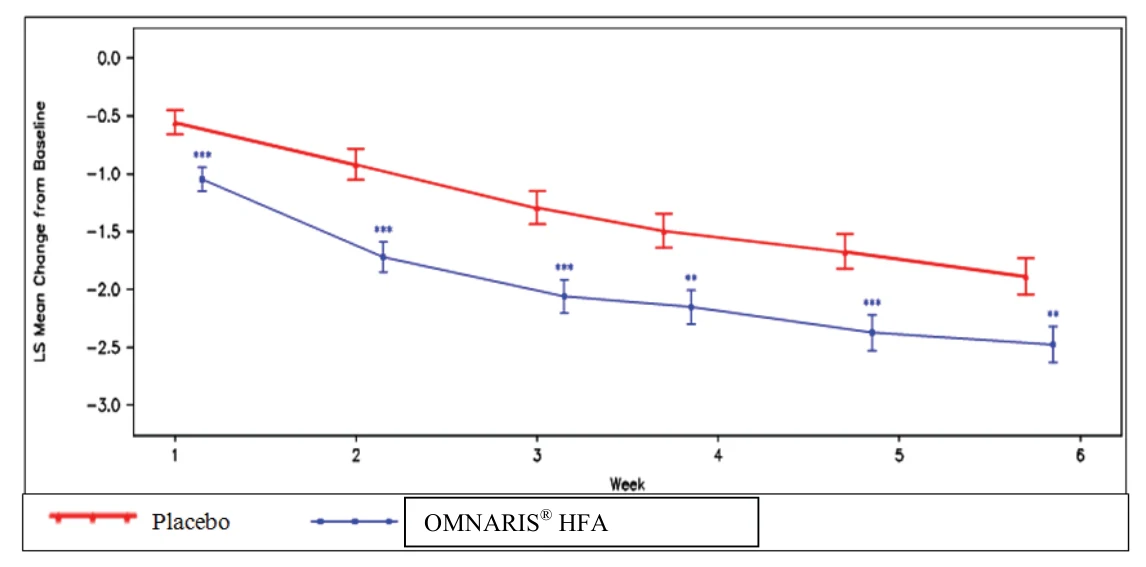
Perennial Allergic Rhinitis (PAR) Trial: In study 060-633, a 26-week placebo-controlled, double-blind trial was conducted in patients with perennial allergic rhinitis. Patients had a demonstrated sensitivity to at least one allergen known to induce PAR (house dust mite, cockroach, molds, and animal dander) using a standard skin prick test. The primary efficacy endpoint was the difference from placebo in the change from baseline of the average of morning and evening rTNSS score averaged over the first 6 weeks of treatment. In this trial, OMNARIS® HFA 100 mcg once daily was statistically significantly different from placebo (See Table 5 and Figure 3) in decreasing nasal symptom scores, difference of 0.69 (95% CI: 0.35, 1.04; p=0.0001). Differences from placebo in the morning pre-dose instantaneous total nasal symptom score indicate that the effect was maintained over the full 24-hour dosing interval. OMNARIS® HFA 100 mcg also demonstrated a greater decrease from baseline in the overall RQLQ(S) compared to placebo. TOSS was not evaluated in this trial.
Table 5- Mean Changes in Efficacy Variables in Adult and Adolescent Patients with Seasonal or Perennial Allergic Rhinitis (SAR or PAR): ITT population
| Trial | Treatment | N | Mean Baselinea | LS Mean Change from Baseline | Difference From Placebob | ||||
| Estimate | 95% CI | p-valuec | |||||||
| Seasonal Allergic Rhinitis | |||||||||
| AM and PM Reflective Total Nasal Symptom Score | |||||||||
| 060-622 | OMNARIS® HFA 100 mcg | 237 | 9.32 | -1.45 | 0.94 | 0.57, 1.32 | <0.0001 | ||
| Placebo | 235 | 9.10 | -0.51 | ||||||
| 060-634 | OMNARIS® HFA 100 mcg | 226 | 9.34 | -1.75 | 1.04 | 0.61, 1.46 | <0.0001 | ||
| Placebo | 220 | 9.28 | -0.72 | ||||||
| AM and PM Instantaneous total Nasal Symptom Score | |||||||||
| 060-622 | OMNARIS® HFA 100 mcg | 237 | 8.68 | -1.34 | 0.87 | 0.50, 1.25 | <0.0001 | ||
| Placebo | 235 | 8.61 | -.047 | ||||||
| 060-634 | OMNARIS® HFA 100 mcg | 226 | 8.60 | -1.58 | 0.90 | 0.49, 1.32 | <0.0001 | ||
| Placebo | 220 | 8.53 | -0.68 | ||||||
| Reflective Total Ocular Symptom Score | |||||||||
| 060-622 | OMNARIS® HFA 100 mcg | 237 | 5.79 | -0.78 | 0.54 | 0.26, 0.83 | 0.0002 | ||
| Placebo | 235 | 5.67 | -0.23 | ||||||
| 060-634 | OMNARIS® HFA 100 mcg | 226 | 6.17 | -0.91 | 0.37 | 0.05, 0.68 | 0.0241 | ||
| Placebo | 220 | 6.23 | -0.54 | ||||||
Table 5 (continued)
| Trial | Treatment | N | Mean Baselinea | LS Mean Change from Baseline | Difference From Placebob | ||||||
| Estimate | 95% CI | p-valuec | |||||||||
| Rhinoconjunctivitis Quality of Life Questionnaire with Standardised Activities | |||||||||||
| 060-622 | OMNARIS® HFA 100 mcg | 237 | 4.01 | -0.84 | 0.60 | 0.37, 0.83 | <0.0001 | ||||
| Placebo | 234 | 3.95 | -0.24 | ||||||||
| 060-634 | OMNARIS® HFA 100 mcg | 226 | 3.79 | -1.07 | 0.54 | 0.29, 0.78 | <0.0001 | ||||
| Placebo | 220 | 3.61 | -0.53 | ||||||||
| Perennial Allergic Rhinitis | |||||||||||
| AM and PM Reflective Total Nasal Symptom Score | |||||||||||
| 060-633 | OMNARIS® HFA 100 mcg | 298 | 8.53 | -1.97 | 0.69 | 0.35, 1.04 | 0.0001 | ||||
| Placebo | 307 | 8.62 | -1.28 | ||||||||
| AM and PM Instantaneous total Nasal Symptom Score | |||||||||||
| 060-633 | OMNARIS® HFA 100 mcg | 298 | 7.66 | -1.77 | 0.58 | 0.25, 0.92 | 0.0014 | ||||
| Placebo | 307 | 7.70 | -1.18 | ||||||||
a Baseline for rTNSS and rTOSS, are averages of the AM and PM responses obtained during the Run-in Period up to 6 days prior to randomization and includes AM score prior to randomization. Baseline RQLQ(S) is from the randomization visit assessment.
b Estimates (LS Mean), 95% Confidence Intervals, and p-values were obtained from ANCOVA analyses with treatment and center as fixed effects and baseline as covariate in the model.
c P-values are adjusted for multiplicity, which are nominal p-values.
In addition, the four nasal symptoms comprising rTNSS and ocular symptoms comprising rTOSS were evaluated on an individual basis.
Table 6- Mean Changes from Baseline in AM and PM in Individual Nasal Symptom Score (INSS) and Individual Ocular Symptom Score in Adult and Adolescent Patients With Seasonal or Perennial Allergic Rhinitis (SAR or PAR) treated with 100 mcg OMNARIS® HFA
| Nasal Symptom | Study | Difference in Treatment and Placebo (LS mean) | 95% CI | p-value |
| Sneezing | 060-622* | 0.28 | 0.17, 0.39 | <0.0001 |
| 060-634** | 0.31 | 0.19, 0.43 | <0.0001 | |
| Runny Nose | 060-622 | 0.21 | 0.10, 0.31 | 0.0001 |
| 060-634 | 0.30 | 0.18, 0.42 | <0.0001 | |
| Nasal Itching | 060-622 | 0.22 | 0.11, 0.32 | <0.0001 |
| 060-634 | 0.23 | 0.11, 0.34 | 0.0001 | |
| Nasal Congestion | 060-622 | 0.24 | 0.15, 0.33 | <0.0001 |
| 060-634 | 0.20 | 0.09, 0.31 | 0.0004 | |
| Itching Eyes | 060-622 | 0.21 | 0.09, 0.33 | 0.0004 |
| 060-634 | 0.14 | 0.02, 0.27 | 0.0264 | |
| Redness of Eyes | 060-622 | 0.19 | 0.06, 0.31 | 0.0030 |
| 060-634 | 0.16 | 0.03, 0.29 | 0.0188 | |
| Tearing of Eyes | 060-622 | 0.22 | 0.10, 0.34 | 0.0003 |
| 060-634 | 0.22 | 0.08, 0.36 | 0.0025 |
* provides data for Study 060-622 averaged over two weeks.
** provides data for Study 060-634 averaged over two weeks
Figure 1: Daily average of AM and PM rTNSS - LS mean change from baseline (ITT population): study 060-622
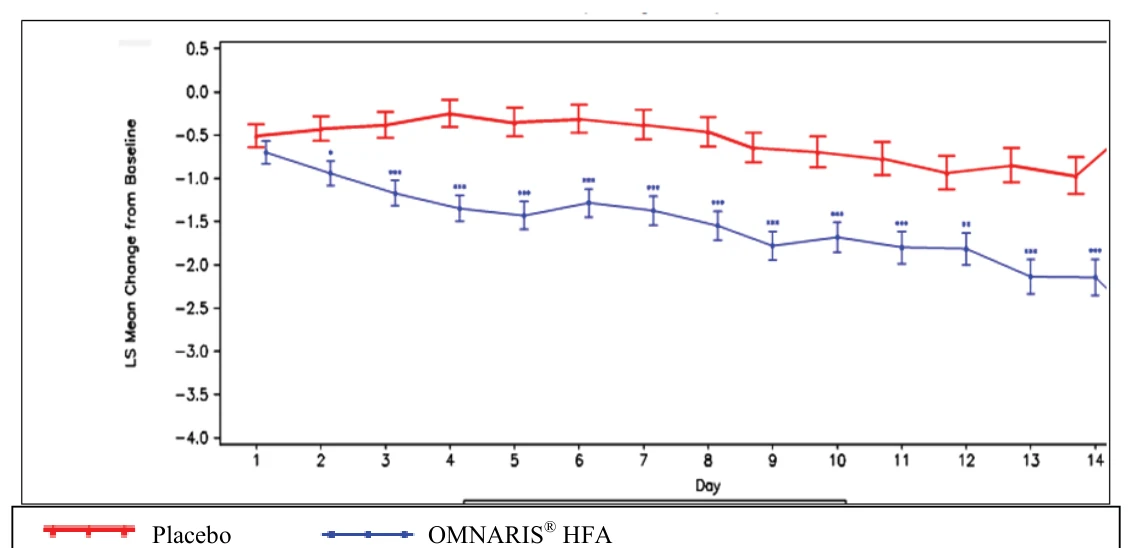
* p < 0.05; ** p < 0.01; *** p < 0.001. The number of subjects with available data on Day 15 was approximately 10% in each treatment group. Due to further reduced numbers of subjects with available data after Day 15, further LS means were not displayed.
Placebo OMNARIS® HFA
Figure 2: Daily average of AM and PM rTNSS - LS mean change from baseline (ITT population): study 060-634
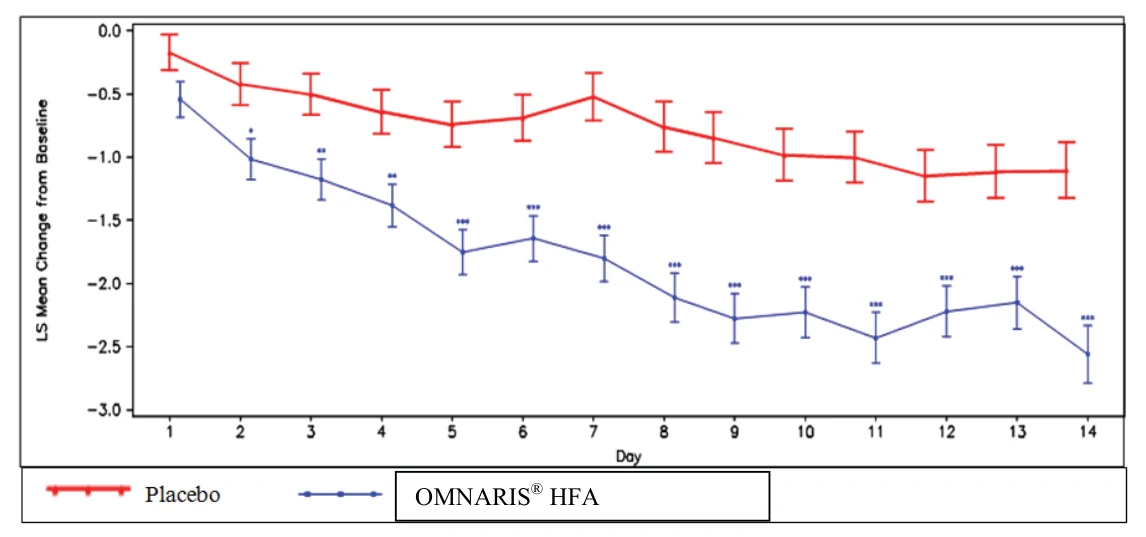
* p < 0.05; ** p < 0.01; *** p < 0.001. Due to the small number of subjects with available data after Day 14, the LS means were not displayed after Day 14.
Figure 3: Change from baseline in average AM and PM reflective TNSS in perennial allergic rhinitis: study 060-633
* p < 0.05; ** p < 0.01; *** p < 0.001
Onset of Action: Onset of action was evaluated in one 2-week seasonal allergic rhinitis trial by frequent recording of instantaneous symptom score. Onset of effect was seen at 36 hours following the first dose. Maximum benefit is usually achieved within 1 to 2 weeks after initiation of dosing.
OMNARIS® HFA
OMNARIS® HFA
DETAILED PHARMACOLOGY
Human Pharmacology
Pharmacokinetics:
Investigations in primary human nasal epithelial cells (HNEC), bronchial epithelial and smooth muscle cells have shown rapid cell penetration of ciclesonide, conversion to active metabolite M1, and a long duration of anti-inflammatory action in vitro.
In studies in HNEC it was demonstrated that the pharmacological active metabolite M1 can reversibly form fatty acid conjugates (primary oleate) which can serve as a slow release pool for the active metabolite in nasal tissue. The long-term retention of M1 at relatively stable levels for up to 24 hours was demonstrated. These properties contribute to long-term retention of M1 in the cells.
Animal Pharmacology
The main mechanism of corticosteroid action in allergic rhinitis is considered due to anti-inflammation. The anti-inflammatory properties of ciclesonide and M1 were shown in several in vitro and in vivo experiments. In a guinea pig model of allergic rhinitis, it was demonstrated that the repeated treatment with ciclesonide could prevent the immediate (increase in nasal resistance) and late response (influx of inflammatory cells) following allergen challenge.
TOXICOLOGY
Toxicology studies conducted with ciclesonide showed effects typically associated with administering high doses of glucocorticoids; no unexpected effects were found in the toxicology studies conducted with ciclesonide.
Acute toxicity
Oral and intraperitoneal acute toxicity studies were performed in rats and mice. The approximate LD50 values are significantly higher than doses that would be administered to humans.
Table 7- LD50 Values in Oral and Intraperitoneal Acute Toxicity Studies
| Species | Route | Doses (mg/kg) | LD50 (mg/kg) |
| Mouse | Intraperitoneal | 0, 50, 100, 200 | >200 |
| Mouse | Oral | 0, 2000 | >2000 |
| Rat | Intraperitoneal | 0, 50, 100, 200 | >200 |
| Rat | Oral | 0, 2000 | >2000 |
Chronic Toxicity
In all toxicity studies, ciclesonide was well tolerated by animals of all investigated species with adverse effects limited to those associated with glucocorticoid activity that were either completely or mostly reversible after cessation of treatment. There was no indication of clinically relevant effects in the respiratory tract.
Table 8- No Observed Adverse Effect Level in Chronic Toxicity Studies with Intranasal Application of Ciclesonide
| Species | Duration | Application form | NOAEL (mcg/kg/day) |
| Rat | 4 weeks | Intranasal (hypotonic suspension) | 429 |
| Rat | 4 weeks | Intranasal (hypotonic suspension) | 429 |
| Dog | 4 weeks | Intranasal (hypotonic suspension) | 480 |
| Dog | 6 months | Intranasal (hypotonic suspension) | 4800 mcg/body/day |
In both rat studies, a reduction in weight gain, slight deviations in clinical chemistry parameters, and a reduction in thymus weight reflected the pharmacological activity of ciclesonide. All findings were reversible.
The 4-week study in dogs revealed a reduction in body weight gain, elevation of clinical chemistry parameters, and low thymus and adrenal weights correlating with thymus and adrenal atrophy. The lymphoid aggregates associated with the respiratory mucosa tended to be smaller. All findings were attributed to the glucocorticoid pharmacology of ciclesonide and showed reversibility after the treatment-free period.
In the 6-month dog study, substance-related findings included a slight decrease in leukocyte and lymphocyte count, low adrenal weights, cortical and thymus atrophy and atrophy of the mucosal-associated lymphoid tissue in the respiratory mucosa of the nasal cavity. All these findings were very slight or slight, showed complete reversibility after the recovery period and are considered to be due to the glucocorticoid pharmacological action of ciclesonide.
Inhalation administration of ciclesonide was evaluated in a series of studies of up to 6-months duration in rats and 12-months duration in dogs, and the no observed adverse effect levels (NOAEL) were determined.
Table 9- No Observed Adverse Effect Level in Chronic Toxicity Studies with Inhalation Administration of Ciclesonide
| Species | Duration | Application form | NOAEL (mcg /kg/day) |
| Rat | 4 week | Powder | 50.5 |
| Rat | 4 week | MDI | Males: 50.3;Females 55.2 |
| Rat | 6 months | Powder | Males: 44.5;Females 49.6 |
| Dog | 4 week | Powder | 50 |
| Dog | 4 week | MDI | 61 |
| Dog | 4 week | MDI | 15 (highest dose studied) |
| Dog | 13 week | MDI | 53 |
| Dog | 12 month | Powder | 47 |
In the rat, comparable and typical glucocorticoid-like effects were observed which were completely or partially reversible during the recovery periods – slight reductions in body, spleen and thymus weights and minor alterations in erythrocytes, lymphocytes, differential blood cell picture, serum urea, serum creatinine, serum corticosterone and urine electrolyte levels, increased development of alveolar structures in the mammary gland, atrophy of lymphocytic components in thymus, spleen, and lymph nodes, atrophy of adrenal cortex.
Dogs similarly showed only exaggerated glucocorticoid-like effects – atrophy of lymphocytic components in thymus, spleen and lymph nodes, suppression of serum cortisol levels, atrophy of adrenal cortex.
The initial effects seen in toxicity studies – decrease of body-weight gain, lymphoid tissue depletion, adrenal atrophy, and, in rats, activation of erythrocyte parameters - result from pronounced pharmacological glucocorticoid activity, demonstrating the continuum of actions recognized for corticosteroids and seen with other glucocorticoids. Because of the need for the enzymatic conversion of ciclesonide ester to its active metabolite and the high plasma protein binding of both ciclesonide and its metabolite, the results suggest that ciclesonide can be used in humans at therapeutic doses that are expected to be devoid of both local (upper and lower respiratory tract, mouth, esophagus, stomach) and systemic glucocorticoid effects.
Mutagenicity
Ciclesonide was negative in the conducted in vitro test for genotoxicity:
- in the Ames test for gene mutation in bacteria;
- in the HPRT test for gene mutation in mammalian cells;
- in the test for chromosome aberrations in human lymphocytes and the in vitro micronucleus test in Chinese hamster V79 cells.
Moreover, racemic ciclesonide was also negative in an Ames test.
Four independent in vivo micronucleus tests were performed in mice covering a range of orally administered doses of glucocorticoids including ciclesonide. Threshold doses were found for all glucocorticoids which induced micronuclei in vivo. This induction of micronuclei is known from the literature. A positive response at high doses of glucocorticoids in the in vivo micronucleus assays is not indicative for a genotoxic potential.
Carcinogenicity
Two carcinogenicity studies were performed with ciclesonide; one study was conducted in mice (2-year study, oral gavage) and the other in rats (2-year study, inhalation).
Doses in the mouse study were 150, 450, and 900 mcg/kg/day administered by oral gavage. No compound related malignant tumors were reported. However, histology showed small, focal and solitary gastric adenomas at a very low incidence (one male and three females in the high dose group, one male each in the low and mid dose group). The adenoma were small, focal, solitary, and incidentally observed at the end of the 2-year study. They did not affect survival rate and only reached statistical significance by trend analysis in high dose females. There were also non-neoplastic changes consisting of a slightly increased incidence of hyperplastic changes in the epithelium of the antrum, mainly at the junction with the duodenum (mainly in males), and focal squamous metaplasia at the junction of the antrum and duodenum were detected for mice receiving 900 or 450 mcg/kg/day. The benign gastric adenomas in mice were only present in one species (mouse), only in one site (the antrum of the stomach), and only by one route of administration (oral gavage). For the oral gavage in the mouse, polyethylene glycol 400 (PEG 400) was used as the vehicle. PEG 400 has been reported to be a digestive tract irritant and to potentiate the activity of drugs. There is no PEG in the commercial nasal formulations. Hyperplastic and neoplastic changes in the stomach of
the mice should be seen together as the result of response processes to irritating action. The benign neoplastic findings in the antrum are unlikely to present a safety concern for humans.
Inhalation doses in the rat carcinogenicity study were for males/females, 14/16.2, 34.9/40.4, and 89.3/103.6 mcg/kg/day administered by MDI over one hour. After 2 years of daily exposure, the results of the rat inhalation carcinogenicity study indicate the absence of a tumorigenic potential of inhaled ciclesonide.
Reproduction and Teratology
No effects were observed in rats on fertility, embryofoetal development, or pre/post natal studies apart from a reduction in body weight or body weight gain in animals receiving 300 mcg/kg/day and 900 mcg/kg/day orally (all studies were conducted with 100/300/900 mcg/kg/day). In rabbits, embryotoxic effects (reduced litter weight, incomplete ossification) and teratogenic effects (like cleft palate, flexure of paw, enlarged fontanelle, parchment-like skin) were observed over the dose range of 5 to 100 mcg/kg/day given subcutaneously. The effects observed with ciclesonide in rabbits are those reported for other glucocorticosteroids. The no-effect for maternal toxicity in rabbits was established at 25 mcg/kg/day and for embryofoetal development at 1 mcg/kg/day.
REFERENCES
- 1. Nave R, Bethke TD, van Marle SP, Zech K. Pharmacokinetics of [14C] ciclesonide after oral and intravenous administration to healthy subjects. Clin Pharmacokinet 2004; 43(7): 479-486.
- 2. Nave R, Drollman A, Steinijans VW, Zech K, Bethke TD. Lack of pharmacokinetic drug-drug interaction between ciclesonide and erythromycin. Int J of Clin Pharmacol Ther 2005; 43(6): 264-270.
- 3. Nave R, Meyer W, Fuhst R, Zech K. Formation of fatty acid conjugates of ciclesonide active metabolite in the rat lung after 4-week inhalation of ciclesonide. Pulm Pharmacol Ther 2005; 18 (2005) 390-396.
- 4. Ratner P, Darken P, Wingertzahn M, Shah T. Ciclesonide and beclomethasone dipropionate coadministration: effect on cortisol in perennial allergic rhinitis. J Asthma 2007; 44: 629-633.
- 5.
Nave, R. Clinical Pharmacokinetic and Pharmacodynamic Profile of Inhaled Ciclesonide.
Clin Pharmacokinet 2009; 48(4): 243-252.