


Product Monograph - Nutropin Aq - SC 5mg/mL
SUMMARY PRODUCT INFORMATION
Route of Administration | Dosage Form / Strength | Clinically Relevant Non-medicinal Ingredients |
| intramuscular, subcutaneous | lyophilized powder for injection; 10 mg/vial | mannitol Note: The Bacteriostatic Water for Injection, supplied with NUTROPIN (somatropin for injection) contains a preservative, benzyl alcohol. (See WARNINGS AND PRECAUTIONS, Pediatrics) |
| intramuscular, subcutaneous | solution; 10 mg/2 mL vial | None. |
| subcutaneous | solution; 10 mg/2 mL pen cartridge solution; NuSpin® injection device prefilled with 5 mg/2 mL, 10 mg/2 mL, or 20 mg/2 mL cartridge | None. |
| For a complete listing of non-medicinal ingredients see Dosage Forms, Composition and Packaging section. | ||
DESCRIPTION
Somatropin is a single-chain protein of 191 amino acids, including four cysteine residues present as two intrachain disulfides. Somatropin is synthesized in a specific laboratory strain of E. coli bacteria (which has been modified by the addition of a plasmid coding for hGH) as a precursor consisting of the rhGH molecule preceded by the secretion signal from an E. coli protein. This precursor is then cleaved in the plasma membrane of the cell. The native protein is secreted into the periplasm where it is folded appropriately. The primary and secondary structures of somatropin are identical with pituitary-derived human growth hormone.
INDICATIONS AND CLINICAL USE
Pediatric Patients
NUTROPIN (somatropin) is indicated for:
- the long-term treatment of children who have growth failure due to growth hormone inadequacy.
- the treatment of children who have growth failure associated with chronic renal insufficiency up to the time of renal transplantation. Therapy with NUTROPIN should be used in conjunction with optimal management of chronic renal insufficiency.
- the long-term treatment of short stature associated with Turner syndrome.
Adult Patients
NUTROPIN (somatropin) is indicated for:
the replacement of endogenous growth hormone (GH) in patients with adult GH deficiency
(GHD) who meet both of the following criteria:
- 1. Biochemical diagnosis of adult GH deficiency by means of a subnormal response to a standard growth hormone stimulation test (peak GH ≤5µg/L), and
- 2. Adult-onset: Patients who have adult GH deficiency either alone or with multiple hormone deficiencies (hypopituartarism) as a result of pituitary disease, hypothalmic disease, surgery, radiation therapy, or trauma; or
- 3. Childhood-onset: Patients who were GH deficient during childhood, confirmed as an adult before replacement therapy with NUTROPIN is started.
CONTRAINDICATIONS
- Growth hormone [NUTROPIN (somatropin)] is contraindicated in patients who are hypersensitive to somatropin or to any ingredient in the formulation. For a complete listing, see the DOSAGE FORMS, COMPOSITION AND PACKAGING section of the product monograph.
- Growth hormone [NUTROPIN (somatropin for injection) lyophilized powder], when reconstituted with Bacteriostatic Water for Injection, USP (benzyl alcohol preserved), should not be used in newborns or in patients with a known sensitivity to benzyl alcohol [See WARNINGS AND PRECAUTIONS].
- Growth hormones [NUTROPIN] should not be initiated to treat patients with acute critical illness due to the complications following open heart or abdominal surgery, multiple accidental trauma or to patients having acute respiratory failure. Clinical studies demonstrated that high doses of growth hormone were associated with a significantly increased morbidity and mortality in those patients [see WARNINGS AND PRECAUTIONS, General].
- Growth hormones [NUTROPIN] should not be used for growth promotion in pediatric patients with closed epiphyses. Growth hormones have no effect on cartilaginous growth areas of the long bone. Treatment of pediatric growth disorders with growth hormones should be discontinued when the patient has reached satisfactory adult height, or the epiphyses are closed [see WARNINGS AND PRECAUTIONS, Musculoskeletal].
- Growth hormones [NUTROPIN] should not be used or should be discontinued when there is any evidence of neoplastic activity. Antitumor therapy should be completed before growth hormone therapy [NUTROPIN] is initiated. Growth hormones [NUTROPIN] should be discontinued if there is evidence of recurrent tumor growth [see WARNINGS AND PRECAUTIONS, Carcinogenesis and Mutagenesis].
- Intracranial tumor shall be inactive and anti-malignancy treatment must be completed with evidence of remission prior to the institution of growth hormone [NUTROPIN] therapy. Patients should be examined frequently for progression or recurrence of the underlying process [see WARNINGS AND PRECAUTIONS, Carcinogenesis and Mutagenesis].
- Growth hormones [NUTROPIN] should not be administered in patients with active proliferative or severe non-proliferative diabetic retinopathy.
Growth hormone [NUTROPIN] is contraindicated in patients with Prader-Willi syndrome who are severely obese, have a history of upper airway obstruction or sleep
apnea, or have severe respiratory impairment. There have been reports of sudden death when growth hormone was used in such patients. NUTROPIN is not indicated for the treatment of pediatric patients who have growth failure due to genetically confirmed Prader-Willi syndrome [see WARNINGS AND PRECAUTIONS].
WARNINGS AND PRECAUTIONS
- Growth hormones [NUTROPIN] therapy should be directed by physicians experienced in the diagnosis and management of pediatric patients with growth hormone deficiency, Turner syndrome, chronic renal insufficiency (CRI) or adult patients with either childhood-onset or adult-onset growth hormone deficiency [see INDICATIONS AND CLINICAL USE].
- Any switch from one brand of growth hormone to another should be made cautiously and only under medical supervision.
- Growth hormones [NUTROPIN] shall only be used if, once reconstituted, the resulting solution is water-clear and devoid of particulate matter [see DOSAGE and ADMINISTRATION, Reconstitution].
- Benzyl alcohol as a preservative in Bacteriostatic Water for Injection, USP has been associated with toxicity in newborns. When administering NUTROPIN (somatropin for injection) lyophilized powder in newborns or in patients sensitive to benzyl alcohol, reconstitute with Sterile Water for Injection, USP. When Sterile Water for Injection, USP is used, use only one dose of NUTROPIN per vial and discard the unused portion [see DOSAGE AND ADMINISTRATION, Administration].
- There have been reports of fatalities after initiating therapy with growth hormone in pediatric patients with Prader-Willi syndrome who had one or more of the following risk factors: severe obesity, history of upper airway obstruction or sleep apnea, or unidentified respiratory infection (see CONTRAINDICATIONS and WARNINGS AND PRECAUTIONS, Congenital Disorders).
General
A significant increase in mortality was reported among growth hormone [NUTROPIN]
treated patients with acute critical illnesses in intensive care units due to complications following open heart surgery or abdominal surgery, multiple accidental trauma or acute respiratory failure compared with those receiving placebo [see CONTRAINDICATIONS and ADVERSE REACTIONS].
- It is recommended that Insulin-like Growth Factor-I (IGF-I) concentrations be monitored regularly [see DOSAGE AND ADMINISTRATION].
Concomitant glucocorticoid therapy may inhibit the response to growth hormone [see
WARNINGS AND PRECAUTIONS, Drug Interactions and DRUG INTERACTIONS].
Instructions on appropriate use should be given [see PART III: CONSUMER
INFORMATION, PROPER USE OF THIS MEDICATION, INFORMATION FOR THE PARENT/PATIENT].
- If injected subcutaneously, the injection site should be rotated to minimize the risk of lipoatrophy occurring [see DOSAGE AND ADMINISTRATION].
- To avoid transmission of disease, cartridge and prefilled syringe shall not be used by more than one person.
- Patients being treated with growth hormones should be informed of the potential benefits and risks associated with treatment. Patients should be instructed to contact their physician should they experience any side effects or discomfort during treatment with growth hormones [see PART III: CONSUMER INFORMATION].
Carcinogenesis and Mutagenesis
Carcinogenicity and mutagenicity studies have not been conducted with NUTROPIN. Patients developing neoplasia should be reported to the Health Products and Food Branch (HPFB) by the treating physician.
Patients should be monitored carefully for any malignant transformation of skin lesions.
Patients with preexisting tumors or growth hormone deficiency secondary to an intracranial lesion should be examined routinely for progression or recurrence of the underlying disease process [see CONTRAINDICATIONS]. In pediatric patients, clinical literature has revealed no relationship between growth hormone [NUTROPIN] replacement therapy and central nervous system (CNS) tumor recurrence or new extracranial tumors. In adults, it is unknown whether there is any relationship between growth hormone replacement therapy and CNS tumor recurrence [see WARNINGS AND PRECAUTIONS, Neurologic].
Secondary Neoplasm in Survivors of Childhood Cancer:
In childhood cancer survivors, an increased risk of a second neoplasm (benign and malignant) has been reported in patients treated with growth hormone [NUTROPIN] after their first neoplasm. Intracranial tumors, in particular meningiomas in patients treated with radiation to the head for their first neoplasm, were the most common of these second neoplasms. However, in childhood cancer survivors, no increased risk of primary cancer recurrence has been reported in patients treated with growth hormones.
Congenital Disorders
Prader-Willi Syndrome:
There have been reports of sleep apnea and fatalities after initiating therapy with growth hormone [NUTROPIN] in pediatric patients with Prader-Willi syndrome who had one or more of the following risk factors: severe obesity, history of upper airway obstruction or sleep apnea, or unidentified (e.g. previously undiagnosed/mildly symptomatic) respiratory infection. Male patients with one or more of these factors may be at greater risk than females.
Patients with Prader-Willi syndrome should be evaluated for signs of upper airway obstruction and sleep apnea before initiation of treatment with growth hormone [NUTROPIN]. If during treatment with growth hormone [NUTROPIN] patients show signs of upper airway obstruction (including onset of or increased snoring) and /or new onset of sleep apnea treatment should be interrupted and the patients should be treated as indicated.
All patients with Prader-Willi syndrome treated with growth hormone [NUTROPIN] should also have effective weight control and be monitored for signs of respiratory infection, which should be diagnosed as early as possible and treated aggressively (see CONTRAINDICATIONS).
Turner Syndrome:
Patients with Turner syndrome may be at increased risk for development of intracranial hypertension therefore these patients should be evaluated for signs and symptoms of intracranial hypertension and treated aggressively before initiation of treatment with growth hormone [NUTROPIN] [see WARNINGS AND PRECAUTIONS, Neurologic].
Patients with Turner syndrome should be evaluated carefully for otitis media and other ear disorders before and during treatment with growth hormones since these patients have an increased risk of ear or hearing disorders [see ADVERSE REACTIONS]. In the presence of ear infection or hearing disorders, these patients should be treated as indicated.
Patients with Turner syndrome are at risk for cardiovascular disorders (e.g. stroke, aortic aneurysm, hypertension) and these conditions should be monitored closely before and during treatment with growth hormone [NUTROPIN].
Patients with Turner syndrome have an inherently increased risk of developing autoimmune thyroid disease. Therefore, patients should have periodic thyroid function tests and be treated as indicated [see WARNINGS AND PRECAUTIONS, Endocrine and Metabolism].
Skeletal abnormalities including scoliosis are commonly seen in untreated Turner syndrome patients [see WARNINGS AND PRECAUTIONS, Musculoskeletal].
Dependence/Tolerance
Growth hormone [NUTROPIN] is not a drug of dependence.
There is no evidence that tolerance to growth hormone develops that would require increased dosing over time.
Endocrine and Metabolism
Glucose Intolerance and Diabetes Mellitus
Because NUTROPIN may induce a state of insulin resistance, patients should be observed for evidence of glucose intolerance.
For patients with diabetes mellitus, the insulin dose may require adjustment when growth hormone [NUTROPIN] therapy is instituted. Because growth hormone may reduce insulin sensitivity, particularly in obese individuals, patients should be observed for evidence of glucose intolerance. Patients with diabetes or glucose intolerance should be monitored closely during growth hormone therapy as an adjustment of their antidiabetic therapy may be required [see WARNINGS AND PRECAUTIONS, Monitoring and Laboratory Tests].
As treatment with growth hormone [NUTROPIN] may decrease insulin sensitivity, particularly at higher doses in susceptible patients, previously undiagnosed impaired glucose tolerance (IGT) and overt diabetes mellitus may be unmasked during growth hormone treatment, and new onset type 2 diabetes mellitus has been reported in patients taking growth hormone. Therefore, glucose levels should be monitored periodically in all patients treated with growth hormone, especially in those with risk factors for diabetes, such as obesity (including obese patients with Prader-Willi syndrome), Turner syndrome, or a family history of diabetes mellitus.
Therapy with growth hormone [NUTROPIN] in adults with growth hormone deficiency of adult onset was associated with an increase of median fasting insulin in the NUTROPIN 0.0125 mg/kg/day group from 9.0 µU/mL at baseline to 13.0 µU/mL at Month 12 with a return to the baseline median after a 3-week post-washout period off growth hormone therapy. In the placebo group there was no change from 8.0 µU/mL at baseline to Month 12, and after the post-washout the median was 9.0 µU/mL. The between-treatment-groups difference in change from baseline to Month 12 was significant, p <0.0001. In childhood onset subjects there was a change of median fasting insulin in the NUTROPIN 0.025 mg/kg/day group from 11.0 µU/mL at baseline to 20.0 µU/mL at Month 12, in the NUTROPIN 0.0125 mg/kg/day group from 8.5 µU/mL to 11.0 µU/mL and in the placebo group from 7.0 µU/mL to 8.0 µU/mL. The between-treatment-groups difference for these changes was significant, p =0.0007.
In subjects with adult onset growth hormone deficiency there was no between treatment group difference in changes from baseline to Month 12 in mean HbA1c, p =0.08. In childhood onset mean HbA1c increased in the NUTROPIN 0.025 mg/kg/day group from 5.2% at baseline to 5.5% at Month 12, and did not change in the NUTROPIN 0.0125 mg/kg/day group from 5.1% at baseline or in the placebo group from 5.3% at baseline. The between-treatment-groups difference was significant, p =0.009.
Hypopituitarism
In patients with hypopituitarism (multiple hormonal deficiencies) standard hormonal replacement therapy should be monitored closely when human growth hormone therapy [NUTROPIN] is administered.
Hypothyroidism
Hypothyroidism may develop during treatment with human growth hormone [NUTROPIN]. Growth hormone can affect the metabolism of thyroid hormones by increasing the extrathyroidal conversion of T4 to T3 and this lowering effect on T4 may unmask incipient central hypothyroidism in hypopituitary patients.
Thyroid function should be evaluated before starting growth hormone [NUTROPIN] therapy and regularly assessed during treatment, not less frequently than annually [see WARNINGS AND PRECAUTIONS, Monitoring and Laboratory Tests]. If hypothyroidism is diagnosed in the course of growth hormone therapy, it should be corrected because untreated hypothyroidism will jeopardize the response to growth hormone.
Immune
As with any protein, local or systemic allergic reactions may occur. Parents/Patients should be informed that such reactions are possible and that prompt medical attention should be sought if allergic reactions occur.
Local allergic reactions
With growth hormone therapies [NUTROPIN] patients may experience redness, swelling, pain, inflammation, or itching at the site of injection [see ADVERSE REACTIONS]. Most of these minor reactions usually resolve in a few days to a few weeks. They may occur if the injection is not properly made (irritants in the skin cleansing agent or poor injection technique), or if the patient is allergic to the growth hormone or any excipients [see CONTRAINDICATIONS].
Rarely, SC administration of growth hormone products [NUTROPIN] can result in lipoatrophy (depression in the skin) or lipohypertrophy (enlargement or thickening of tissue). Patients should be advised to consult their doctor if they notice any of these conditions.
Continuous rotation of the injection site within a given area may help reduce or prevent these reactions. On rare occasion, injection site reactions may require discontinuation of growth hormone therapy [NUTROPIN].
Systemic allergic reactions
Systemic allergic reactions have rarely occurred with growth hormone therapy [NUTROPIN] [see ADVERSE REACTIONS]. These reactions may be characterized by a generalized rash (with pruritus), shortness of breath, wheezing, angioneurotic edema and drop in blood pressure
[see ADVERSE REACTIONS]. Severe cases of generalized allergy including anaphylactic reaction may be life threatening [see CONTRAINDICATIONS].
If any serious hypersensitivity or allergic reactions occurs, growth hormone [NUTROPIN] therapy should be discontinued immediately and appropriate therapy initiated as per general guidelines.
Antibody Production
As with all therapeutic proteins, a small percentage of patients may develop antibodies during treatment with growth hormones. The detection of antibody formation is highly dependent on the sensitivity and specificity of the assay. Additionally, the observed incidence of antibody (including neutralizing antibody) positivity in an assay may be influenced by several factors including assay methodology, sample handling, timing of sample collection, concomitant medications, and underlying disease. For these reasons, comparison of the incidence of antibodies to growth hormone [NUTROPIN] with the incidence of antibodies to other products may be misleading. In the case of growth hormone, antibodies with binding capacities lower than 2 mg/L have not been associated with growth attenuation. In a very small number of patients treated with growth hormone, when binding capacity was greater than 2 mg/L, interference with the growth response was observed.
Short-term immunologic and renal function studies were carried out in a group of patients with chronic renal insufficiency after approximately one year of growth hormone treatment to detect potential adverse effects of antibodies to growth hormone. Testing included measurements of Clq, C3, C4, rheumatoid factor, creatinine, creatinine clearance and blood urea nitrogen (BUN). No adverse effects of growth hormone antibodies were noted.
In clinical studies of patients treated with NUTROPIN (somatropin for injection) lyophilized powder for the first time, 0/107 growth hormone inadequate (GHI) patients and 0/125 chronic renal insufficiency (CRI) patients screened for antibody production developed antibodies with binding capacities ≥ 2 mg/L at six months.
In a clinical study of naive patients who were treated with NUTROPIN AQ, (somatropin injection) 0/60 growth hormone-deficient patients, who were screened for development of antibodies throughout 15 months of treatment, developed antibodies with binding capacities above 2 mg/L.
In addition to an evaluation of compliance with the treatment program and thyroid status, testing for antibodies to human growth hormone should be carried out in any patient who fails to respond to therapy.
Patients who have demonstrated an allergic reaction to other growth hormone products may demonstrate an allergic reaction to NUTROPIN. If growth deceleration is observed that is not
attributable to another cause, the physician should consider testing the patient for antibodies to growth hormone.
Musculoskeletal
Patients with epiphyseal closure who were treated with growth hormone replacement therapy in childhood should be re-evaluated according to the criteria in the INDICATIONS AND CLINICAL USE section before continuation of growth hormone therapy at the reduced dose level recommended for growth hormone-deficient adults.
Chronic Renal Insufficiency in Pediatric Patients
Patients with growth failure secondary to chronic renal insufficiency (CRI) should be examined periodically for evidence of progression of renal osteodystrophy. Slipped capital femoral epiphysis or avascular necrosis of the femoral head may be seen in children with advanced renal osteodystrophy, and it is uncertain whether these problems are affected by growth hormone therapy. X-rays of the hips should be obtained prior to initiating therapy for CRI patients. Children with CRI receiving growth hormone should be serially monitored for avascular necrosis, slipped capital femoral epiphysis and renal osteodystrophy with serial radiographs and appropriate clinical chemistry tests. Treatment with growth hormone [NUTROPIN] should be discontinued at the time of renal transplantation.
Slipped Capital Femoral Epiphysis in Pediatric Patients
Slipped capital femoral epiphysis may also occur more frequently in patients with endocrine disorders, including growth hormone deficiency, or in patients undergoing rapid growth. Therefore, physicians and parents should be alert to the development of a limp or complaints of hip or knee pain in both GHI and CRI patients treated with growth hormone [NUTROPIN]. Any child with the onset of a limp or complaining of hip or knee pain during growth hormone therapy [NUTROPIN] should be evaluated.
Otitis Media and Cardiovascular Disorders in Patients with Turner Syndrome
Patients with Turner syndrome should be evaluated carefully for otitis media and other ear disorders. In a randomized-controlled trial, there was a statistically significant increase, as compared to untreated controls, in otitis media (43% vs. 26%) and ear disorders (18% vs. 5%) in patients receiving growth hormone. In addition, patients with Turner syndrome should be monitored closely for cardiovascular disorders (e.g. stroke, aortic aneurysm, hypertension) as these patients are also at risk for these conditions.
Progression of Preexisting Scoliosis in Pediatric Patients
Progression of scoliosis can occur in children who experience rapid growth. Because growth hormone [NUTROPIN] increases growth rate, patients with a history of scoliosis who are treated with growth hormone should be monitored for progression of scoliosis. Growth hormone has not been shown to increase the incidence of scoliosis.
Fluid Retention
Increased tissue turgor (non-edematous swelling, particularly in the hands and feet) and musculoskeletal discomfort (pain, swelling and/or stiffness) may occur during treatment with growth hormones [NUTROPIN] [see ADVERSE REACTIONS]. These symptoms may resolve spontaneously, with analgesic therapy, or after reducing the dosage [see DOSAGE AND ADMINISTRATION].
Carpal Tunnel Syndrome
Carpal tunnel syndrome may occur during treatment with growth hormone [NUTROPIN] [see ADVERSE REACTIONS]. If the symptoms of carpal tunnel syndrome do not resolve by decreasing the dosage of growth hormone, consider interruption of treatment and reinitiation at a lower dose.
Neurologic
Patients with a history of an intracranial lesion should be examined frequently for progression or recurrence of the lesion.
Intracranial hypertension (IH) with papilledema, visual changes, headache, nausea and/or vomiting has been reported in a small number of patients treated with growth hormone products. Symptoms usually occurred within the first eight (8) weeks of the initiation of the growth hormone therapy. In all reported cases, IH-associated signs and symptoms resolved after termination of therapy or a reduction of the growth hormone dose.
Funduscopic examination of patients is recommended at the initiation and periodically during the course of growth hormone therapy. Patients with Turner syndrome and CRI may be at increased risk for development of IH.
Pancreatitis
Children treated with growth hormone [NUTROPIN] may have an increased risk of developing pancreatitis compared to adults treated with somatropin. Although rare, pancreatitis should be considered in growth hormone-treated children who develop abdominal pain [see ADVERSE REACTIONS].
Renal / Hepatic / Biliary / Pancreatic impairments
No studies have been conducted with growth hormone [NUTROPIN] in patients with hepatic/biliary/pancreatic impairments.
Subjects with chronic renal failure tend to have decreased somatropin clearance compared to those with normal renal function [see DOSAGE AND ADMINISTRATION, Recommended Dose and Dose Adjustment, Chronic Renal Insufficiency].
Reproduction studies
No adequate and well-controlled reproduction studies with growth hormone therapies [NUTROPIN] have been performed [see WARNINGS AND PRECAUTIONS, Special Populations, Pregnant Women].
Drug Interactions
Caution and careful monitoring is recommended when administering growth hormones [NUTROPIN] with compounds that are metabolized by the CYP450 or CYP3A4 liver enzymes (e.g corticosteroids, sex steroids, anticonvulsants, cyclosporine and others [see DRUG INTERACTIONS, Cytochrome P450 (CYP450)-Metabolized Drugs]).
Concomitant glucocorticoid treatment may inhibit the growth promoting effect of human growth hormone [NUTROPIN] [see DRUG INTERACTIONS, Glucocorticoid Therapy]. Growth hormone deficient children with coexisting ACTH deficiency should have their glucocorticoid replacement dose carefully adjusted to avoid an inhibitory effect on growth.
The patient should be advised to consult physician when using other medications in addition to growth hormone products [NUTROPIN].
Special Populations
Pregnant Women: There are no adequate and well controlled studies in pregnant women. It is also not known whether growth hormone [NUTROPIN] can cause fetal harm when administered to a pregnant woman or can affect reproduction capacity. Therefore, growth hormone should be given to a pregnant woman only if clearly indicated and under medical supervision.
Patients should be advised to inform their doctor if they are pregnant or are contemplating pregnancy.
Nursing Women: It is not known whether somatropin is excreted in human milk. There are no adequate and well-controlled studies in nursing women. Therefore, growth hormones [NUTROPIN] should be used with caution in nursing women. Due to the large molecular weight, it is unlikely that it would be passed intact into the maternal milk and absorption of intact protein from the gastrointestinal tract of the infant is also unlikely. However, secretion of breakdown products of the drug in breast milk has not been studied. Because many drugs are excreted in human milk, caution should be exercised when growth hormone [NUTROPIN] is administered to a nursing mother.
Pediatrics (6 months - 3 years of age): Prudence is indicated for children aged 6 months to 3 years, when administering NUTROPIN (somatropin for injection) lyophilized powder reconstituted in Bacteriostatic Water for Injection, USP (benzyl alcohol preserved); although there is no information on the toxicity of benzyl alcohol for this age group, the toxic dose for premature neonates is in the range of 100 to 250 mg/kg per day.
Geriatrics (> 65 years of age): Clinical studies of growth hormone [NUTROPIN] did not include sufficient numbers of elderly subjects to determine whether they respond differently from younger subjects. Other reported clinical experience has not identified differences in responses between the elderly and younger patients. In general, dose selection for an elderly patient should be cautious, usually starting at the low end of the dosing range, reflecting the greater frequency of decreased hepatic, renal or cardiac function, and of concomitant disease or other drug therapy. Experience with prolonged rhGH treatment in adults is limited.
Elderly patients may be more prone to develop adverse reactions.
Adult Patients: Patients with ephiphyseal closure who were treated with growth hormone replacement therapy [NUTROPIN] in childhood should be re-evaluated according to the criteria in INDICATIONS AND CLINICAL USE before continuation of growth hormone replacement therapy at the reduced dose level required for growth hormone-deficient adults.
Clinical trial experience with prolonged treatment with growth hormone [NUTROPIN] in adults is limited. Adverse events such as peripheral edema, myalgia, and arthralgia were reported during post-marketing studies [see ADVERSE REACTIONS].
In addition, an assessment of clinical trial data and post-marketing data of patients treated with growth hormone therapy found that carpal tunnel syndrome occurs more frequently in patients over 40 years of age, and in almost half of these cases the recommended maximum dose had been exceeded. In the majority of cases, the condition resolved with a decrease in dosage, interruption of treatment, discontinuation of treatment or spontaneously. The maximum recommended dosage should not be exceeded.
Obese individuals are more likely to manifest adverse effects when treated with a weight-based regimen.
Monitoring and Laboratory Tests
Serum levels of inorganic phosphorous, alkaline phosphatase, and parathyroid hormone may increase with therapy with growth hormone [NUTROPIN]. Changes in thyroid hormone laboratory measurements may develop during growth hormone treatment of children who lack adequate endogenous growth hormone secretion. As untreated hypothyroidism prevents optimal response to growth hormone, patients should have periodic thyroid function tests and should be treated with thyroid hormone when indicated [see WARNINGS AND PRECAUTIONS, Endocrine and Metabolism]. Patients with Turner syndrome have an inherently increased risk of developing autoimmune thyroid disease.
For information on when monitoring or laboratory tests are needed, see WARNINGS AND PRECAUTIONS: General, Carcinogenesis and Mutagenesis, Congenital Disorders, Endocrine
and Metabolism, Musculoskeletal, and Neurologic.
Information for Patients
Patients being treated with growth hormone [NUTROPIN] and/or their parents should be informed regarding the potential benefits and risks associated with treatment including the possible side effects. If home use is determined to be desirable by the physician, instructions on appropriate use should be given, including a review of the contents of the ‘Information for the Patient/Parent’ Insert [See PART III: CONSUMER INFORMATION, PROPER USE OF THIS MEDICATION, INFORMATION FOR THE PATIENT/PARENT]. This information is intended to aid in the safe and effective administration of the medication. It is not a disclosure of all possible adverse or unintended effects.
Female patients should be advised to inform their doctor if they are pregnant or are contemplating pregnancy [see PART III: CONSUMER INFORMATION, WARNINGS AND PRECAUTIONS].
If home use is prescribed, a puncture resistant container for the disposal of used syringes and needles should be recommended to the patient. Patients and/or parents should be thoroughly instructed in the importance of proper disposal and cautioned against any reuse of needles and syringes [see PART III: CONSUMER INFORMATION, PROPER USE OF THIS MEDICATION, INFORMATION FOR THE PARENT/PATIENT].
ADVERSE REACTIONS
Adverse Drug Reaction Overview
The adverse event data reflect the clinical trial and post-marketing experience of using NUTROPIN (somatropin).
Most Serious and/or Most Frequently Observed Adverse Reactions
This list presents the most seriousa and/or most frequently observedb adverse reactions during treatment with somatropin:
- a Sudden death in pediatric patients with Prader-Willi syndrome with risk factors including severe obesity, history of upper airway obstruction or sleep apnea and unidentified respiratory infection [see CONTRAINDICATIONS and WARNINGS AND PRECAUTIONS].
- a Intracranial tumors, in particular meningiomas, in teenagers/young adults treated with radiation to the head as children for a first neoplasm and somatropin [see CONTRAINDICATIONS and WARNINGS AND PRECAUTIONS].
- a Pancreatitis [see WARNINGS AND PRECAUTIONS].
- a, b Glucose intolerance including impaired glucose tolerance/impaired fasting glucose as well as overt diabetes mellitus [see WARNINGS AND PRECAUTIONS].
- a Intracranial hypertension [see WARNINGS AND PRECAUTIONS].
- a Significant diabetic retinopathy [see CONTRAINDICATIONS].
a Slipped capital femoral epiphysis in pediatric patients [see WARNINGS AND
PRECAUTIONS].
a Progression of preexisting scoliosis in pediatric patients [see WARNINGS AND
PRECAUTIONS].
- b Fluid retention manifested by edema, arthralgia, myalgia, nerve compression syndromes including carpal tunnel syndrome/paraesthesias [see WARNINGS AND PRECAUTIONS].
- a Unmasking of latent central hypothyroidism [see WARNINGS AND PRECAUTIONS].
- a Injection site reactions/rashes and lipoatrophy (as well as rare generalized hypersensitivity reactions) [see WARNINGS AND PRECAUTIONS].
Clinical Trial Adverse Drug Reactions
Because clinical trials are conducted under very specific conditions the adverse reaction rates observed in the clinical trials may not reflect the rates observed in practice and should not be compared to the rates in the clinical trials of another drug. Adverse drug reaction information from clinical trials is useful for identifying drug-related adverse events and for approximating rates.
Acute Critical Illness: In two placebo controlled clinical trials in non-growth hormone deficient adult patients (n=522) a significant increase in mortality has been reported among somatropin treated patients with acute critical illnesses in intensive care units due to complications following open heart surgery or abdominal surgery, multiple accidental trauma, or to patients having acute respiratory failure (41.9%) compared to those receiving placebo (19.3%). Doses of 5.3-8 mg/day were given. The safety of continuing growth hormone treatment in patients receiving replacement doses for approved indications who concurrently develop these illnesses has not been established. Therefore, the potential benefit of treatment continuation with growth hormone in patients having an acute critical illness should be weighed against the potential risk [see CONTRAINDICATIONS and WARNINGS AND PRECAUTIONS].
Leukemia has been reported in a small number of growth hormone deficient patients treated with growth hormone. It is uncertain whether this increased risk is related to the pathology of growth hormone deficiency itself, growth hormone therapy or other associated treatments, such as radiation therapy for intracranial tumours. On the basis of current evidence, experts cannot conclude that growth hormone therapy is responsible for these occurrences. The risk to GHI, Turner syndrome, and CRI patients, if any, remains to be established.
In studies of children treated with NUTROPIN, injection site pain was reported infrequently.
Adverse drug reactions which have been reported infrequently (< 1%) in growth hormone-treated children include mild and transient peripheral edema. In GHD adults, edema or peripheral edema was reported in 41% of GH-treated patients and 25% of placebo-treated patients. In GHD
adults, arthralgias and joint disorders were reported in 27% of GH-treated patients and 15% of placebo-treated patients.
Other rare (< 0.1%) adverse drug reactions reported in growth hormone-treated patients include the following: 1) Musculoskeletal: arthralgias; carpal tunnel syndrome, 2) Skin: increased growth of pre-existing nevi (malignant nevi transformation has not been reported), 3) Endocrine: gynecomastia and pancreatitis.
Post-Market Adverse Drug Reactions
Adverse events that have been observed during the post-marketing period are similar to those seen in clinical trials with NUTROPIN.
DRUG INTERACTIONS
Overview
There was no evidence in the controlled studies of somatropin’s interaction with drugs commonly used in patients. However, formal drug interaction studies have not been conducted.
Drug-Drug Interactions
11 β-Hydroxysteroid Dehydrogenase Type 1
Growth hormone [NUTROPIN] therapy may affect the metabolism of glucocorticoids, by inhibiting the microsomal enzyme 11β-hydroxysteroid dehydrogenase type 1 (11βHSD-1) which is required for the conversion of cortisone to its active metabolite, cortisol, in hepatic and adipose tissue. Individuals with untreated growth hormone deficiency have relative increases in 11βHSD-1 and serum cortisol. Introduction of growth hormone therapy may result in inhibition of 11βHSD-1 and reduced serum cortisol concentrations. In consequence, previously undiagnosed central (secondary) hypoadrenalism may be unmasked and glucocorticoid replacement may be required in patients treated with growth hormones.
Patients treated with glucocorticoid replacement for previously diagnosed hypoadrenalism may require an increase in their maintenance or stress doses following initiation of growth hormone therapy [NUTROPIN]; this may be especially true for patients treated with cortisone acetate and prednisone since conversion of these drugs to their biologically active metabolites is dependent on the activity of 11βHSD-1.
Cytochrome P450 (CYP450)-Metabolized Drugs
Growth hormone [NUTROPIN] also enhances the activity of CYP3A4, a cytochrome P450 enzyme involved in glucocorticoid catabolism. Therefore, growth hormone therapy may both unmask unsuspected adrenocorticotropic hormone (ACTH) deficiencies and negate low replacement glucocorticoid doses used in secondary adrenal insufficiency (AI) by decreasing the availability of cortisol. Patients starting growth hormone therapy may require adjustments in
their glucocorticoid replacement doses, and stress doses.
Growth hormone therapy [NUTROPIN] may increase CYP450 and CYP3A4 mediated antipyrine clearance in man.
Glucocorticoid Therapy
Concomitant glucocorticoid therapy may inhibit the growth promoting effect of growth hormone [NUTROPIN]. If glucocorticoid replacement therapy is required, glucocorticoid dosage and compliance should be monitored carefully to avoid either adrenal insufficiency or inhibition of growth promoting effects.The use of NUTROPIN in patients with chronic renal insufficiency receiving glucocorticoid therapy has not been evaluated.
Oral Estrogen
Because oral estrogens may reduce insulin-like growth factor (IGF-1) response to somatropin treatment, girls and women receiving oral estrogen replacement may require greater somatropin dosages (see DOSAGE AND ADMINISTRATION, Recommended Dose and Dose Adjustment).
Drug-Food Interactions
Interactions with food have not been established.
Drug-Herb Interactions
Interactions with herbal products have not been established.
Drug-Laboratory Tests Interactions
Interactions with laboratory tests have not been established.
DOSAGE AND ADMINISTRATION
Dosing Considerations
The dosage and administration schedule of NUTROPIN (somatropin) should be individualized for each patient.
Adult Patients: Patients with epiphysis closure who were treated with growth hormone replacement therapy [NUTROPIN] in childhood should be re-evaluated according to the criteria in INDICATIONS AND CLINICAL USE before continuation of growth hormone replacement therapy at the reduced dose level required for growth hormone-deficient adults [see WARNINGS AND PRECAUTIONS, Musculoskeletal].
A lower starting dose may be necessary in older and obese patients [see WARNINGS AND PRECAUTIONS, Special Populations].
Recommended Dose and Dosage Adjustment
Pediatric Growth Hormone Deficiency: A somatropin dose of up to 0.3 mg/kg/week (approximately 0.90 IU/kg/wk) administered in divided daily doses by subcutaneous or intramuscular injection is recommended.
The total number of milligrams (mg) per daily dose is calculated as follows:
Dose (mg) per injection = Patient weight (kg) x up to 0.043 (mg/kg)
In pubertal patients, a weekly dosage of up to 0.7 mg/kg divided daily may be used.
The total number of milligrams (mg) per daily dose is calculated as follows:
Dose (mg) per injection = Patient weight (kg) x up to 0.1 (mg/kg)
Therapy should not be continued if final desired height is achieved or epiphyseal fusion occurs. Patients who fail to respond adequately while on therapy with NUTROPIN should be evaluated to determine the cause of unresponsiveness.
Turner syndrome: A weekly dosage of up to 0.375 mg/kg/week divided into equal doses 3 to 7 times per week by subcutaneous injection is recommended.
The total number of milligrams (mg) per daily dose is calculated as follows:
Dose (mg) per injection = Patient weight (kg) x up to 0.054 (mg/kg)
For administration three times a week, the total number of milligrams (mg) per dose is calculated as follows:
Dose (mg) per injection = Patient weight (kg) x up to 0.125 (mg/kg)
Therapy should not be continued if final desired height is achieved or epiphyseal fusion occurs. Patients who fail to respond adequately while on therapy with NUTROPIN should be evaluated to determine the cause of unresponsiveness.
Chronic renal insufficiency: A somatropin dose of up to 0.35 mg/kg/week (approximately 1.05 IU/kg/wk) administered in divided daily doses by subcutaneous or intramuscular injection is recommended.
The total number of milligrams (mg) per daily dose is calculated as follows:
Dose (mg) per injection = Patient weight (kg) x up to 0.05 (mg/kg)
Therapy may be continued up to the time of renal transplantation. Therapy should not be continued if final height is achieved or epiphyseal fusion occurs. Patients who fail to respond adequately while on therapy with NUTROPIN should be evaluated to determine the cause of unresponsiveness.
In order to optimize therapy for CRI patients who require dialysis, the following guidelines for selecting the injection schedule are recommended:
- 1. Hemodialysis patients should receive their injection at night just prior to going to sleep or at least 3-4 hours after their hemodialysis to prevent hematoma formation due to heparin.
- 2. Chronic Cycling Peritoneal Dialysis patients should receive their injection in the morning after they have completed dialysis.
- 3. Chronic Ambulatory Peritoneal Dialysis patients should receive their injection in the evening at the time of the overnight exchange.
Adult Growth Hormone Deficiency: The recommended dosage at the start of therapy is not more than 0.042 mg/kg/week given as a daily subcutaneous injection. The dose may be increased according to individual patient requirements to a maximum of 0.175 mg/kg /week in patients under 35 years and to a maximum of 0.0875 mg/kg/week in patients over 35 years.
Starting Dose: The total number of milligrams (mg) per daily dose for adult patients is calculated as follows:
Dose (mg) per injection = Patient weight (kg) x 0.006 (mg/kg)
Maximum Dose: For patients under 35 years, the total number of milligrams (mg) per daily dose is calculated as follows:
Dose (mg) per injection = Patient weight (kg) x up to 0.025 (mg/kg)
For patients over 35 years, the total number of milligrams (mg) per daily dose is calculated as follows:
Dose (mg) per injection = Patient weight (kg) x up to 0.0125 (mg/kg)
To minimize the occurrence of adverse events in older or overweight patients, lower doses may be necessary. During therapy, dosage should be decreased if required by the occurrence of side
effects or excessive insulin-like growth factor I [IGF-I] levels.
In order to reach the defined treatment goal, estrogen-replete women may need higher doses than men. Oral estrogen administration may increase the dose requirements in women.
Missed Dose
Patients who miss a dose of NUTROPIN should contact their physician for instructions.
Administration
NUTROPIN (somatropin for injection) - Vials of 10 mg
Reconstitution:
NUTROPIN (somatropin for injection) lyophilized powder is dispensed in vials of 10 mg.
A 10 mg vial of NUTROPIN lyophilized powder should be reconstituted with 1 to 10 mL of Bacteriostatic Water for Injection, USP (benzyl alcohol preserved). (For example, a 10 mg vial of NUTROPIN lyophilized powder reconstituted with 10 mL of Bacteriostatic Water will be reconstituted to a concentration of 1 mg somatropin/mL Bacteriostatic Water).
When NUTROPIN lyophilized powder is reconstituted to 1 mg somatropin per mL, the recommended daily somatropin dose of 0.05 mg/kg for treatment of chronic renal insufficiency contains 0.45 mg/kg benzyl alcohol while the recommended daily somatropin dose of 0.043 mg/kg for treatment of growth hormone deficiency contains 0.387 mg/kg benzyl alcohol. The recommended daily somatropin dose of 0.1 mg/kg for treatment of growth hormone deficiency for pubertal patients contains 0.09 mg/kg benzyl alcohol. The recommended daily dose of 0.054 mg/kg for Turner syndrome contains 0.486 mg/kg benzyl alcohol, while the three dose a week regimen contains 1.134 mg/kg benzyl alcohol in each dose.
See WARNINGS AND PRECAUTIONS (Pediatrics) for use in newborns, persons sensitive to benzyl alcohol and for use in children aged 6 months to 3 years. When Sterile Water for Injection, USP is used use only one dose of NUTROPIN per vial and discard the unused portion.
To prepare the NUTROPIN solution, slowly inject the Bacteriostatic Water for Injection, USP into the NUTROPIN vial, aiming the stream of liquid against the glass wall of the vial. Then swirl the NUTROPIN vial with a gentle rotary motion until the contents are completely dissolved. Do not shake. Because NUTROPIN is a protein, shaking can result in a cloudy solution. After reconstitution, the NUTROPIN solution should be clear, ie. it should not have any solid particles floating on the surface. If you notice lumps or solid particles of powder, continue to gently swirl the solution until all of the powder has dissolved. If the solution does not become clear, do not inject it. Note also that occasionally, after refrigeration, small colourless particles of
protein may be present in the NUTROPIN solution. This is not unusual for solutions containing proteins. Allow the vial to come to room temperature and gently swirl until the solution is clear. If the solution remains cloudy or hazy, do not inject it.
Choosing an injection site: The site of injection should be rotated each time NUTROPIN is administered. Recommended injection sites include upper arm, abdomen, and thigh. Detailed instructions on how to use NUTROPIN are provided in the Information for the Parent/Patient Guide [see PART III: CONSUMER INFORMATION, PROPER USE OF THIS MEDICATION].
NUTROPIN AQ (somatropin injection) - Vials of 10 mg
The vials contain a solution ready for injection. No reconstitution or preparation is required.
Injection:
Before needle insertion, wipe the septum of all vials to be used, both the NUTROPIN AQ and diluent vials, with rubbing alcohol or an antiseptic solution to prevent contamination of the contents by microorganisms that may be introduced by repeated needle insertions. NUTROPIN AQ must be administered using sterile, disposable syringes and needles. The syringes should be of small enough volume that the prescribed dose can be drawn from the vial with reasonable accuracy. If the route of injection selected is intramuscular, the needle should be of sufficient length [usually 2.5 cm (1 inch) or more] to ensure that the injection reaches the muscular layer.
Choosing an injection site: The site of injection should be rotated each time NUTROPIN AQ is administered. Recommended injection sites include upper arm, abdomen, and thigh. Detailed instructions on how to use NUTROPIN are provided in the Information for the Parent/Patient Guide [see PART III: CONSUMER INFORMATION, PROPER USE OF THIS MEDICATION].
NUTROPIN AQ PEN Cartridge (somatropin injection) of 10 mg
The NUTROPIN AQ PEN Cartridge is intended for use only with the NUTROPIN AQ PEN. The pen cartridge contains a 10 mg/2 mL solution ready for subcutaneous use. No reconstitution or preparation is required. The NUTROPIN AQ PEN (10 mg) allows for administration of a minimum dose of 0.1 mg to a maximum dose of 4.0 mg, in increments of 0.1 mg. It is recommended that NUTROPIN AQ be administered using sterile, disposable needles.
Injection:
Before needle insertion, wipe the septum of the cartridge with rubbing alcohol or an antiseptic solution to prevent contamination of the contents by microorganisms that may be introduced by repeated needle insertions. Load the pen cartridge into the NUTROPIN AQ PEN barrel and attach the needle. Push the button on the side of the pen opposite the digital display, which releases a spring-loaded “knob” at the top of the pen. The “knob” is then twisted in a clockwise
direction that brings the desired dose into the dose selection window. Once the dose is selected, remove the needle cap, insert the needle into the injection site, and depress the “knob” located at the top of the pen. This advances the plunger to displace the selected dose. After the injection, the needle is removed from the pen and discarded. NUTROPIN AQ must be administered using sterile, disposable needles.
Choosing an injection site: The site of injection should be rotated each time NUTROPIN AQ PEN is administered. Recommended injection sites include upper arm, abdomen, and thigh. Detailed instructions on how to use the NUTROPIN AQ PEN are provided in the Information for the Parent/Patient Guide [see PART III: CONSUMER INFORMATION, PROPER USE OF THIS MEDICATION].
NUTROPIN AQ NuSpin (somatropin injection) of 5 mg, 10 mg, and 20 mg
NUTROPIN AQ NuSpin 5, 10, and 20 are multi-dose, dial-a-dose injection devices prefilled with NUTROPIN AQ (somatropin injection) in a 5 mg/2 mL, 10 mg/2 mL, and 20 mg/2 mL cartridge, respectively, for subcutaneous use. They were designed to allow for simplified and accurate dose delivery making dose administration easier. It is recommended that NUTROPIN AQ be administered using sterile, disposable needles.
The NUTROPIN AQ NuSpin allows for flexible dosing administration, as follows:
NUTROPIN AQ NuSpin 5 from a minimum dose of 0.05 mg to a maximum dose of
1.75 mg in increments of 0.05 mg.
- NUTROPIN AQ NuSpin 10 from a minimum dose of 0.1 mg to a maximum dose of 3.5 mg in increments of 0.1 mg.
- NUTROPIN AQ NuSpin 20 from a minimum dose of 0.2 mg to a maximum dose of 7.0 mg in increments of 0.2 mg.
The NUTROPIN AQ NuSpin pre-filled cartridges contain a solution ready for injection. A replaceable cartridge is not needed. No reconstitution or preparation is required.
Injection:
Preparing the NuSpin device: The spinning dose knob allows the desired dose to be chosen as prescribed. The desired dose is selected by rotating the dose knob until the appropriate dose appears in the dose window. Place one hand where the activator can easily slide. While holding the NuSpin device, insert the needle into the skin by pushing downward until the appropriate depth is reached. Then, slide the activator toward the needle. This slide activator delivers the medication automatically. The activator should be held down until the dose knob returns to “0.0”. The dose knob rotates during and after injection to show when the dose delivery is complete. The time for each dose is relatively quick, and happens within approximately 5 seconds. It may help to count out loud for 5 seconds while holding the activator down. Then,
withdraw the NUTROPIN AQ NuSpin device. If the dose knob returns to “0.0”, this provides assurance that the full dose has been delivered. If the dose knob stops before it returns to “0.0”, the NUTROPIN AQ NuSpin is empty and the full dose has not been delivered. The number shown in the dose window is the remaining amount needed to obtain a full dose.
Choosing an injection site: The site of injection should be rotated each time NUTROPIN AQ NuSpin is administered. Recommended injection sites include upper arm, abdomen, and thigh. Detailed instructions on how to use NUTROPIN AQ NuSpin are provided in the Information for the Parent/Patient Guide [see PART III: CONSUMER INFORMATION, PROPER USE OF THIS MEDICATION].
OVERDOSAGE
Theoretical risks of long-term human growth hormone [NUTROPIN] treatment with doses exceeding the recommended dosage are signs and symptoms of gigantism and/or acromegaly. Short-term overdosage could lead initially to hypoglycemia and subsequently to hyperglycemia. Furthermore, overdose with somatropin is likely to cause fluid retention. If any signs of overdosage occur, treatment should be discontinued.
For management of a suspected drug overdose, contact your regional Poison Control Centre.
ACTION AND CLINICAL PHARMACOLOGY
Mechanism of Action
General
NUTROPIN (somatropin) is a human growth hormone (hGH) produced by recombinant DNA technology. The amino acid sequence of the somatropin protein is identical to that of pituitary-derived human growth hormone. In vitro and in vivo preclinical testing, and clinical testing have demonstrated that NUTROPIN is therapeutically equivalent to pituitary-derived human growth hormone in pharmacokinetics, in stimulation of linear growth and in other actions. Treatment of children who lack adequate secretion of endogenous growth hormone with NUTROPIN results in an increase in growth rate and an increase in insulin-like growth factor-I [IGF-I], similar to that seen with pituitary-derived human growth hormone.
Treatment with NUTROPIN in children with Turner syndrome (a condition without a deficiency of GH) results in an increase in growth rate and an overall increase in cumulative growth, as compared with Historical Controls.
Treatment with NUTROPIN of children with chronic renal insufficiency results in improved growth rate and height standard deviation and an overall increase in cumulative growth, as
compared to placebo-treated children with chronic renal insufficiency. Adults with growth hormone deficiency acquired during childhood or adulthood treated with NUTROPIN show an improvement in body fat mass and lean mass. Adults with growth hormone deficiency acquired during childhood treated with NUTROPIN also show an improvement in bone mineral density.
Actions that have been demonstrated for NUTROPIN and/or pituitary-derived human growth hormone include:
Tissue Growth
Skeletal Growth: NUTROPIN stimulates skeletal growth in children with growth failure due to a lack of adequate secretion of endogenous growth hormone and in children with growth failure secondary to chronic renal insufficiency. Skeletal growth is accomplished at the epiphyseal plates at the ends of a growing long bone. Growth and metabolism of epiphyseal plate cells are directly stimulated by growth hormone and one of its mediators, IGF-I. Serum levels of IGF-I are low in children and adolescents who are growth hormone deficient, but increase during treatment with NUTROPIN. New bone is formed at the epiphyses in response to growth hormone. This results in linear growth until these growth plates fuse at the end of puberty.
The clinical effect of the skeletal growth action of somatropin has been observed in well-controlled clinical trials with NUTROPIN in the treatment of growth hormone inadequacy, chronic renal insufficiency patients, and patients with Turner syndrome [see DETAILED PHARMACOLOGY]. Limited data regarding the clinical post-transplant growth effect of treatment with NUTROPIN administered prior to transplant is available [see DETAILED PHARMACOLOGY].
Cell Growth: Treatment with pituitary-derived human growth hormone results in an increase in both the number and the size of skeletal muscle cells.
Organ Growth: Growth hormone of human pituitary origin influences the size of internal organs, including kidneys, and increases red cell mass. Treatment of hypophysectomized or genetic dwarf rats with somatropin results in organ growth that is proportional to the overall body growth. In normal rats subjected to nephrectomy-induced uremia, somatropin promoted skeletal and body growth.
Protein Metabolism
Linear growth is facilitated in part by growth hormone-stimulated protein synthesis. This is reflected by nitrogen retention as demonstrated by a decline in urinary nitrogen excretion and blood urea nitrogen concentration during growth hormone therapy.
Carbohydrate Metabolism
Growth hormone is a modulator of carbohydrate metabolism. For example, patients with inadequate secretion of growth hormone sometimes experience fasting hypoglycemia which is
improved by treatment with growth hormone. Growth hormone therapy may decrease glucose tolerance. Untreated patients with chronic renal insufficiency and Turner syndrome have an increased incidence of glucose intolerance. Administration of NUTROPIN to normal adults, patients who lack adequate secretion of endogenous growth hormone and patients with chronic renal insufficiency resulted in increases in mean serum fasting and postprandial insulin levels. However, mean fasting and postprandial glucose levels and mean hemoglobin A1C levels remained within the normal range. There were no clinically significant persistent abnormalities in any of these measurements of glucose regulation that were related to growth hormone treatment.
Lipid Metabolism
Acute administration of pituitary derived human growth hormone to humans results in lipid mobilization. Non-esterified fatty acids increase in plasma within two hours of pituitary-derived human growth hormone administration. In growth hormone deficient patients, long-term growth hormone administration often decreases body fat. Mean cholesterol levels decreased in patients treated with NUTROPIN.
Mineral Metabolism
The retention of total body potassium in response to growth hormone administration is thought to result from cellular growth. Serum levels of inorganic phosphorus may increase slightly in patients with inadequate secretion of endogenous growth hormone, chronic renal insufficiency, or patients with Turner syndrome, after growth hormone therapy due to the metabolic activity associated with bone growth as well as increased tubular reabsorption of phosphate by the kidney. Serum calcium is not significantly altered in these patients. Sodium retention also occurs. Adults with childhood-onset GH deficiency show low bone mineral density (BMD). GH therapy results in increases in serum alkaline phosphatase [see WARNINGS AND PRECAUTIONS, Monitoring and Laboratory Tests].
Connective Tissue Metabolism
Growth hormone stimulates the synthesis of chondroitin sulfate and collagen as well as the urinary excretion of hydroxyproline.
Pharmacokinetics
Table 1 Summary of Pharmacokinetic Parameters of NUTROPIN in Healthy Adult Males 0.1 mg (approximately 0.3 IU a )/kg SC
Cmax (µg/L) | t½ (h) | AUC0-∞ (µg·hr/L) | Clearance (mL/[hr·kg]) | Volume of distribution (mL/kg) | |
| Single dose mean b | 56.1 | 7.5 | 626 c | 116-174 d | 50 |
a Based on current International Standard of 3 IU=1 mg.
b n=36
c Compares with that of somatrem (590 ng•hr/mL); the AUC of NUTROPIN somatropin is similar regardless of site of injection. d In healthy adults and children.
Table 2 Summary of Pharmacokinetic Parameters of NUTROPIN AQ in Healthy Adult Males
0.1 mg (approximately 0.3 IU a )/kg SC & 0.05 mg (approximately 0.15 IU a)/kg SC
Cmax (µg/L) | t½ (h) | AUC0-∞ (µg·hr/L) | Clearance CL/F (mL/[hr·kg]) | Volume of distribution V/F (mL/kg) | |
Single dose 0.10 mg/kg mean b | 71.1 | 2.3 | 673 c | 116-174 d | 50 |
Single dose 0.05 mg mean b | 72.5 | 2.22 | 486 | 106 | 343 |
a Based on current International Standard of 3 IU=1 mg.
b n=36 for 0.10 mg/kg dose; n=29 for 0.05 mg/kg dose
c Comparable with that of NUTROPIN lyophilized powder. NUTROPIN AQ was bioequivalent to NUTROPIN lyophilized powder after subcutaneous administration based on the statistical evaluation of the ratios of the geometric mean of log transformed AUC and Cmax.
d In healthy adults and children.
In both normal and growth hormone deficient adults and children, the intramuscular and subcutaneous pharmacokinetic profiles of somatropin are similar regardless of growth hormone or dosing regimen used. Growth hormone localizes to highly perfused organs, particularly the liver and kidney. Both the liver and kidney have been shown to be important metabolizing organs for pituitary-derived human growth hormone.
Special Populations and Conditions
Pediatrics: Available literature data suggests that rhGH clearances are similar in adults and children.
Gender: No data is available for rhGH. Available data for methionyl human growth hormone and pituitary-derived human growth hormone suggests that there are no consistent gender-based differences in rhGH clearance.
Race: No data is available.
Hepatic Insufficiency: A reduction in rhGH clearance has been noted in patients with severe liver dysfunction. The clinical significance of this decrease is unknown.
Renal Insufficiency: Children and adults with chronic renal failure (CRF) tend to have decreased clearance as compared to normals. However, no rhGH accumulation has been reported in children with CRF or end-stage renal disease dosed with current regimens.
Turner Syndrome: No pharmacokinetic data are available for exogenously administered rhGH. However, reported half-lives, and elimination rates of endogenous GH in this population are similar to the ranges observed for normal subjects and GHD populations.
Growth Hormone Insufficiency (GHI): Reported values for clearance of rhGH in adults and children with GHI range from 138-245 mL/hr/kg and are similar to those observed in healthy adults and children. Mean terminal t1/2 values following intravenous and subcutaneous administration in GHI patients are also similar to those observed in healthy adult males.
STORAGE AND STABILITY
NUTROPIN (somatropin for injection)
Before Reconstitution: NUTROPIN (somatropin for injection) lyophilized powder and Bacteriostatic Water for Injection, USP (benzyl alcohol preserved) must be refrigerated at 2-8 °C. Avoid freezing the vials of NUTROPIN and Bacteriostatic Water for Injection, USP (benzyl alcohol preserved). Expiration dates are stated on the labels.
After Reconstitution: Vial contents are stable for 14 days when reconstituted with Bacteriostatic Water for Injection, USP (benzyl alcohol preserved) and refrigerated at 2-8 °C. Discard the unused portion after 14 days. Do not freeze the reconstituted vial of NUTROPIN.
The remaining Bacteriostatic Water for Injection, USP in the multiple use vial must be refrigerated at 2-8 °C, and may be used for 14 days after first entry. Avoid freezing the Bacteriostatic Water for Injection, USP (benzyl alcohol preserved).
Unusual Handling Conditions: Vials of unreconstituted NUTROPIN lyophilized powder may be held at ambient temperature (not to exceed 37 °C) for a total time not to exceed seven days. Vials of reconstituted NUTROPIN lyophilized powder should not be exposed to temperatures greater than 25 °C for more than 24 hours in total.
NUTROPIN AQ (somatropin injection)
Store under refrigeration at 2-8°C. Do not freeze.
NUTROPIN AQ PEN Cartridge
Do not freeze. Protect from light. When not in use, store under refrigeration at 2-8°C.
NUTROPIN AQ PEN Cartridges should be discarded after 28 days of the first use.
NUTROPIN AQ NuSpin
Do not freeze. Protect from light. When not in use, store under refrigeration at 2-8°C.
NuSpin injection device should be discarded after 28 days of the first use.
DOSAGE FORMS, COMPOSITION AND PACKAGING
Availability of Dosage Forms
NUTROPIN (somatropin for injection) lyophilized powder is supplied as:
- 10 mg (approximately 30 IU) of lyophilized, sterile somatropin per vial - There is one 10 mg vial of NUTROPIN and one 10 mL multiple use vial of Bacteriostatic Water for Injection, USP (benzyl alcohol preserved) per carton.
NUTROPIN AQ (somatropin injection) is supplied as:
10 mg (approximately 30 IU) vials containing 2 mL of somatropin solution - There are six
10 mg vials of NUTROPIN AQ per carton.
NUTROPIN AQ PEN Cartridge is supplied as:
- 10 mg (approximately 30 IU) pen cartridges containing 2 mL of somatropin solution - There is one 10 mg cartridge of NUTROPIN AQ per carton.
NUTROPIN AQ NuSpin 5 is supplied as:
- 5 mg (approximately 15 IU) cartridge containing 2 mL of somatropin solution, prefilled in the NuSpin injection device - There is one NUTROPIN AQ NuSpin 5 per carton.
NUTROPIN AQ NuSpin 10 is supplied as:
- 10 mg (approximately 30 IU) cartridge containing 2 mL of somatropin solution, prefilled in the NuSpin injection device - There is one NUTROPIN AQ NuSpin 10 per carton.
NUTROPIN AQ NuSpin 20 is supplied as:
- 20 mg (approximately 60 IU) cartridge containing 2 mL of somatropin solution, prefilled in the NuSpin injection device - There is one NUTROPIN AQ NuSpin 20 per carton.
Composition
NUTROPIN Lyophilized Powder
10 mg NUTROPIN Vial
somatropin 10 mg (approx. 30 IU)
mannitol 90.0 mg
glycine 3.4 mg
sodium phosphate monobasic 0.8 mg
sodium phosphate dibasic 2.6 mg
Diluent Vial
The diluent vial contains Bacteriostatic Water for Injection, USP (benzyl alcohol preserved), packaged in a sterile 10 mL multiple use vial. Each mL contains 0.9% benzyl alcohol as an antimicrobial preservative. The diluent pH is 4.5-7.0. After reconstitution of NUTROPIN lyophilized powder with Bacteriostatic Water for Injection, USP, the resultant solution is nearly isotonic at a concentration of 5 mg growth hormone per mL and has a pH of approximately 7.4.
NUTROPIN AQ
10 mg/2 mL Vial (5 mg/mL)
somatropin 10.0 mg (approx. 30 IU) (5 mg/mL)
sodium chloride 17.4 mg (8.7 mg/mL)
phenol 5 mg (2.5 mg/mL)
polysorbate 20 4 mg (2 mg/mL)
sodium citrate 10 mM (5 mM/mL)
The solution is nearly isotonic at a concentration of 5 mg/mL somatropin and has a pH of approximately 6.0.
NUTROPIN AQ PEN Cartridge
10 mg/2 mL (5 mg/mL) pen cartridge
somatropin 10.0 mg (approx. 30 IU) (5 mg/mL)
sodium chloride 17.4 mg (8.7 mg/mL)
phenol 5 mg (2.5 mg/mL)
polysorbate 20 4 mg (2 mg/mL)
sodium citrate 10 mM (5 mM/mL)
NUTROPIN AQ NuSpin 5
NuSpin injection device prefilled with a 5 mg/2 mL (2.5 mg/mL) cartridge
somatropin 5.0 mg (approx. 15 IU) (2.5 mg/mL) sodium chloride 17.4 mg (8.7 mg/mL)
phenol 5 mg (2.5 mg/mL)
polysorbate 20 4 mg (2 mg/mL)
sodium citrate 10 mM (5 mM/mL)
NUTROPIN AQ NuSpin 10
NuSpin injection device prefilled with a 10 mg/2 mL (5 mg/mL) cartridge somatropin 10.0 mg (approx. 30 IU) (5 mg/mL) sodium chloride 17.4 mg (8.7 mg/mL)
phenol 5 mg (2.5 mg/mL)
polysorbate 20 4 mg (2 mg/mL)
sodium citrate 10 mM (5 mM/mL)
NUTROPIN AQ NuSpin 20
NuSpin injection device prefilled with a 20 mg/2 mL (10 mg/mL) cartridge
somatropin 20.0 mg (approx. 60 IU) (10 mg/mL) sodium chloride 17.4 mg (8.7 mg/mL)
phenol 5 mg (2.5 mg/mL)
polysorbate 20 4 mg (2mg/mL)_
sodium citrate 10 mM (5 mM/mL)
PART II: SCIENTIFIC INFORMATION
PHARMACEUTICAL INFORMATION
Drug Substance
Proper or Common name: somatropin
Biological name: recombinant human growth hormone (rhGH)
Molecular weight: 22 125 daltons
Structure: Somatropin is a single-chain protein of 191 amino acids, including four cysteine residues present as two intrachain disulfides. The primary and secondary structures of somatropin are identical with pituitary-derived human growth hormone [see DESCRIPTION].
Product Characteristics
Lyophilized Powder
NUTROPIN (somatropin for injection) lyophilized powder is a sterile white lyophilized powder of highly purified rhGH, intended for subcutaneous administration or intramuscular administration after reconstitution with Bacteriostatic Water for Injection, USP (benzyl alcohol preserved).
Solution
NUTROPIN AQ (somatropin injection) is a clear, sterile solution of highly purified rhGH, intended for subcutaneous administration.
CLINICAL TRIALS
Clinical Effect of NUTROPIN on Growth Failure in Pubertal Patients due to Growth Hormone Inadequacy (GHI)
Study demographics and trial design
Table 3 Summary of patient demographics for clinical trial M0380g in growth failure in pubertal patients due to GHI
Study #
| Trial design | Dosage, route of administration and duration | Study subjects (n) | Mean age (Range) |
Gender
M0380g
Phase III Multicenter Randomized Open label | 0.3 mg/kg/wk 0.7 mg/kg /wk Subcutaneous Until the bone age ≥16 years for boys and ≥14 years for girls and the growth rate was <2 cm/yr for 1 year. Follow-up visits for height measurements every 6 months until adult height reached. | 97 | 13.9 M: 17.2 ± 1.3 (13.6 – 19.4) F: 15.8 ± 1.8 (11.9 – 19.3) |
42 M, 7 F 41 M, 7 F
Study results
Treatment with NUTROPIN of children who lack adequate secretion of endogenous growth hormone resulted in an increase in growth rate and an increase in insulin-like growth factor-I [IGF-I], similar to that seen with pituitary-derived human growth factor.
All patients were already in puberty (Tanner stage 2) and had bone ages ≤14 yr in males or ≤12 yr in females. Mean baseline height standard deviation (SD) score was - 1.3. The mean last measured height in all 97 patients after a mean duration of 2.7± 1.2 years, by analysis of covariance (ANCOVA) adjusting for baseline height, is shown below.
Table 4 Results of study FR M0380g in growth failure in pubertal patients due to GHI
| Last Measured Height* (cm) |
Height Differences Between Groups (cm) Mean ± SE
| 0.3 mg/kg/wk Mean ± SD | 0.7 mg/kg/wk Mean ± SD |
Male
| 170.9 ± 7.9 (n=42) | 174.5 ± 7.9 (n=41) |
3.6 ± 1.7
Female
| 154.7 ± 6.3 (n=7) | 157.6 ± 6.3 (n=7) |
2.9 ± 3.4
*Adjusted for baseline height
The mean height SD score at last measured height (n=97) was -0.7±1.00 in the 0.3 mg/kg/wk group and -0.1 ± 1.2 in the 0.7 mg/kg/wk group. For patients completing 3.5 or more years (mean 4.1 years) of treatment with NUTROPIN (15/49 in the 0.3 mg/kg/wk group and 16/48 patients in the 0.7 mg/kg/wk group), the mean last measured height was 166.1±8.0 in the 0.3 mg/kg/wk group and 171.8 ± 7.1 cm in the 0.7 mg/kg/wk group, adjusting for baseline height and sex.
The mean change in bone age was approximately one year for each year in the study in both dose groups. Patients with baseline height SD scores above -1.0 were able to attain normal adult heights with 0.3 mg/kg/wk dose of NUTROPIN (mean height SD score at near adult height = -0.1, n=15).
Thirty-one patients had bone mineral density (BMD) determined by dual energy x-ray absorpitometry (DEXA) scans at study conclusion. The two dose groups did not differ significantly in mean SD score for total body BMD (- 0.9± 1.9 in the 0.3 mg/kg/wk group vs. -0.8 ± 1.2 in the 0.7 mg/kg/wk group, n=20) or lumbar spine BMD (-1.0± 1.0 in the 0.3 mg/kg/wk group vs. -0.2 ± 1.7 in the 0.7 mg/kg/wk group, n=21).
Over a mean duration of 2.7 years, patients in the 0.7 mg/kg/wk group were more likely to have IGF-I values above the normal range than the patients in the 0.3 mg/kg/wk group (27.7% vs. 9.0% of IGF-I measurements for individual patients). The clinical significance of elevated IGF-I values is unknown.
There was 1 incident of each of the following adverse events reported in the 0.7 mg/kg/wk group: broadening of the nasal bridge, large feet reported as “large shoe size”, ankle swelling and hip pain.
Three cases of eosinophilia were reported in the 0.7 mg/kg/wk group, which were of unknown significance. Mean changes in overall eosinophil counts in the 0.7 mg/kg/wk group were not clinically significant compared to the 0.3 mg/kg/wk group.
Clinical Effect of NUTROPIN on Growth Failure due to Chronic Renal Insufficiency (CRI)
Study demographics and trial design
Two multicenter, randomized, controlled clinical trials were conducted to determine whether treatment with NUTROPIN prior to renal transplantation in children with chronic renal insufficiency could improve their growth rates and height deficits. One study was a double-blinded, placebo-controlled trial and the other was an open-label, randomized trial. The dose of NUTROPIN in both controlled studies was 0.05 mg/kg/day administered daily by subcutaneous injection. Combining the data from all patients completing two years in the two controlled studies provides data from 62 children treated with NUTROPIN and 28 children as control subjects (either placebo-treated or untreated).
Study results
The mean first year growth rate was 10.8 cm/yr for patients treated with NUTROPIN, compared with a mean growth rate of 6.5 cm/yr for control subjects (p<0.00005). The mean second year growth rate was 7.8 cm/yr for patients treated with NUTROPIN, compared with a mean growth rate of 5.5 cm/yr for control subjects (p<0.00005). There was a significant improvement in the standard deviation score for mean height in the NUTROPIN group (-2.9 at baseline to -1.5 at month 24, n=62) but no significant change in the control subjects (-2.8 at baseline to -2.9 at month 24, n=28). The mean third year growth rate of 7.6 cm/yr in the patients treated with NUTROPIN (n=27) suggests that NUTROPIN stimulates growth rate beyond two years. However, there are no control data for the third year because control patients crossed over to growth hormone treatment after two years of participation in the placebo-controlled study. The gains in height were accompanied by appropriate advancement of skeletal age. These data demonstrate that therapy with NUTROPIN improves growth rate and corrects the acquired height deficit associated with CRI. Currently there are insufficient data regarding the benefit of treatment beyond three years. Although predicted final height was improved during therapy with NUTROPIN, the effect of NUTROPIN on final adult height remains to be determined.
Note on post transplant growth: The North American Pediatric Renal Transplant Cooperative Study (NAPRTCS) has reported data for growth after transplant in children who did not receive growth hormone (n=300). The average change in height SD score during the initial two years post-transplant was 0.18. Controlled studies of growth hormone treatment for short stature associated with CRI were not designed to compare the growth between treated and untreated patients after they received renal transplants, however, growth data is available from 7 patients who were not treated with growth hormone prior to undergoing transplant (control subjects) and 13 patients who were treated with NUTROPIN up to the time of transplant (treatment with NUTROPIN was discontinued at time of transplant). These 20 patients have been followed for at least 11 months post-transplant. Of the control patients, 4 showed improvement in their height SD score and 3 had either no significant change or a decrease in height SD score. Of the patients treated with NUTROPIN, all 13 had either no significant change or an increase in height SD score after transplantation, indicating that the individual gains achieved with growth hormone therapy prior to transplant were maintained after transplantation. The differences in the height deficit narrowed between the treated (prior to transplant) and untreated groups in the post-transplant period.
Clinical Effect of NUTROPIN on Growth Failure due to Turner Syndrome
Study demographics and trial design
A long-term, open-label multicenter, historically controlled study was conducted to evaluate the efficacy of GH for the treatment of girls with short stature due to Turner syndrome (85-044).
In the study, the effect of long-term treatment with NUTROPIN (0.375 mg/kg/week given either 3 times per week or daily) on adult height was determined by comparing adult heights in the treated patients with those of age-matched historical controls with Turner syndrome (TS) who never received any growth-promoting therapy. In Study 85-044, patients treated with NUTROPIN early were randomized to receive estrogen replacement therapy (conjugated estrogens, 0.3 mg escalating to 0.625 mg daily) at either age 12 or 15 years.
Study results
Table 5 Results of Study 85-044 in patients with Turner Syndrome Study Group
| N at Adult Height | GH Age (yr) | Estrogen Age (yr) | GH Duration (yr) |
Adult Height Gain (cm)a Ab Bb Cb
| 29 26 51 | 9.4 9.6 12.7 | 15.0 12.3 13.7 | 6.1 5.6 3.8 |
8.3 5.9 5.0 aAnalysis of covariance vs. controls
bA: GH age <11yr, estrogen age 15 yr
B: GH age <11 yr, estrogen age 12 yr
C: GH age >11 yr, estrogen at Month 12
In Study 85-044, early treatment with NUTROPIN (mean duration of GH therapy 5.6 years) combined with estrogen replacement at age 12 years resulted in an adult height gain of 5.9 cm (n=26) compared with matched historical controls. In patients who initiated estrogen at age 15 years (mean duration of GH therapy was 6.1 years), had a mean adult height gain of 8.3 cm (n=29). Patients who initiated treatment with NUTROPIN after age 11 (mean age 12.7 years; mean duration of GH therapy 3.8 years) had a mean adult height gain of 5.0 cm (n=51).
The greatest improvement in adult height was observed in patients who received early treatment with NUTROPIN and estrogen after age 14 years.
The National Cooperative Growth Study (NCGS) is an observational registry of children treated with recombinant growth hormone (GH) products manufactured by Genentech, Inc (South San Francisco, CA). As of December 2003, there were 4749 patients with Turner Syndrome in the NCGS database; 3938 had not previously received GH, were prepubertal at the onset of GH therapy, and were treated for at least 6 months with GH. Near adult height (NAH) was achieved by 685 of these patients. Of these patients, 68 patients received NUTROPIN exclusively throughout therapy in NCGS, Of the 68 patients, 40 reported estrogen therapy (2 patients also reported androgen therapy), while 28 (or 41%) of the 68 patients had some degree of
spontaneous pubertal development and no reported exogenous estrogen therapy. The use of estrogen was defined in the patients by the documentation of administration of any estrogen on the NCGS data sheets. The age at onset of estrogen exposure was determined as the last age that Tanner stage 1 breast development was noted on the NCGS report data sheet.
Results
There were no significant differences in baseline characteristics between the patients reporting estrogen therapy with or without androgen therapy and the patients not reporting estrogen therapy. At NAH the only significant differences, p<0.0001, between these groups were for years of estrogen-free NUTROPIN therapy and years of NUTROPIN and estrogen therapy. In all of these groups including the pooled data of all 68 patients, gain over Lyon PAH (cm) was significantly different from zero, p ≤ 0.001, as well as, gain over Lyon PAH SDS, p <0.0001. The average dose of NUTROPIN used in the total cohort (n=68) over the years of treatment (adjustments being made for weight changes at variable time points and for responsiveness) was 0.279 mg/kg/week (+/- 0.106).
Table 6 Turner Syndrome patients from NCGS treated with NUTROPIN achieving near adult height*
Baseline
| Mean | SD | Maximum | Median |
Minimum
Age (yr)
| 13.05 | 2.24 | 17.82 | 13.30 |
9.57 Height (cm)
| 132.57 | 10.17 | 152.10 | 135.15 |
103.40 Lyon Height SDS
| 0.52 | 1.03 | 3.60 | 0.35 |
-2.50 Lyon PAHa (cm)
| 146.48 | 6.93 | 167.20 | 145.35 |
126.20 Bone Ageb (yr)
| 10.85 | 2.09 | 14.17 | 11.00 |
5.00 Bone Age Delay b (yr)
| 1.94 | 1.42 | 5.14 | 1.76 |
-1.06 Near Adult Height
Estrogen-Free NUTROPIN Rx (yr)
| 3.67 | 2.35 | 8.15 | 3.17 |
0.0
NUTROPIN Rx + Estrogen (yr)
| 2.43 | 2.54 | 9.22 | 2.06 |
0.0
Total NUTROPIN Rx (yr)
| 6.10 | 1.53 | 9.56 | 6.06 |
2.40 Age at onset of Estrogen Exposure (yr)
| 14.58 | 1.88 | 18.63 | 14.57 |
9.86
Age at Near Adult Height (yr)
| 17.38 | 1.64 | 21.77 | 17.31 |
14.01 Height (cm)
| 152.95 | 5.41 | 167.0 | 153.2 |
143.0 Gain over L.yon PAHa (cm)
| 6.48c | 6.22 | 17.80 | 7.66 |
-11.20 Gain over Lyon PAHa SDS
| 1.37c | 0.97 | 3.63 | 1.42 |
-0.79 *n=68
aPAH is predicted adult height bn=53, which requires a baseline bone age >6 yr; 15 girls were missing baseline bone age and 2 bone ages were <6 yr.
cp<0.0001
Adult Growth Hormone Deficiency (GHD)
Study demographics and trial design
Table 7 Summary of patient demographics for clinical trials M0431g (adult-onset)
and M0381g (childhood-onset) in adult GHDa
Study #
| Trial design | Dosage, route of administration and duration | Study subjects (n=number) | Mean age (Range) |
Gender
M0431g
Phase II Multicenter Randomized Double-blind Placebo-controlled | 0.0125 or 0.00625 mg/kg/dayb subcutaneous 12 months | 166 | 48.3 ± 11.3 (20.8-70.7) |
86 M, 80 F
M0381g
Phase II/III Randomized Multicenter Double-blind Placebo-controlled | 0.025 or 0.0125 mg/kg/day subcutaneous 24 months | 64 | 23.8 ± 4.1 (14.5-33.7) |
39 M, 25 F a The studies were designed to assess the effects of replacement therapy with GH on body composition. b Doses of 0.025 mg/kg/day were not tolerated in these subjects.
Study results
Significant changes from baseline to Month 12 of treatment in body composition (i.e., total body percent fat mass, trunk percent fat mass and total body percent lean mass by DEXA scan) were seen in all NUTROPIN groups in both studies (p <0.0001 for change from baseline and vs. placebo), whereas no statistically significant changes were seen in either of the placebo groups. In the adult-onset study, the NUTROPIN group improved mean total body fat from 35.0% to 31.5%, mean trunk fat from 33.9% to 29.5%, and mean lean body mass from 62.2% to 65.7%, whereas the placebo group had mean changes of 0.2% or less (p=not significant). Due to the possible effect of GH-induced fluid retention on DEXA measurements of lean body mass, DEXA scans were repeated approximately 3 weeks after completion of therapy; mean percent lean body mass in the NUTROPIN group was 65.0%, a change of 2.8% from baseline, compared with a change of 0.4% in the placebo group (p<0.0001) between groups).
In the childhood-onset study, the high-dose NUTROPIN group improved mean total body fat from 38.4% to 32.1%, mean trunk fat from 36.7% to 29.0% and mean lean body mass from 59.1% to 65.5%; the low-dose NUTROPIN group improved mean total body fat from 37.1% to 31.3%, mean trunk fat from 37.9% to 30.6% and mean lean body mass from 60.0% to 66.0%; the placebo group had mean changes of 0.6% or less (p=not significant).
Table 8 Results of studies M0431g and M0381g in adult GHD: Changes from baseline to month 12 in proportion of fat and lean by DEXA (Adult-onset and Childhood-onset, respectively)
Primary
Endpoints
M0431g M0381g
Placebo
(n=62)
NUTROPIN (n=63)
Between-group
t-test
p-value
Placebo (n=13)
NUTROPIN 0.0125
mg/kg/day (n=15)
NUTROPIN 0.025
mg/kg/day (n=15)
Placebo vs. pooled
NUTROPIN t-test-p-value
Proportion Mean ± SD Number of subjects
Total body percent fat
Baseline 36.8 ± 11.3 35.0 ± 11.2 0.38 35.0 ± 7.4 37.1 ± 13.2 38.4 ± 11.8 0.45
Month 12 36.8 ± 1.5 31.5 ± 12.5 35.2 ± 8.2 31.3 ± 13.6 32.1 ± 13.4
Baseline to
month 12 change
-0.1 ± 3.0 -3.6 ± 3.6 < 0.0001 +0.2 ± 2.9 -5.8 ± 4.3 -6.3 ± 4.3 < 0.0001
Post-washout 36.4 ± 11.5 32.2 ± 12.5 N/A N/A N/A
Baseline to post-
washout change
-0.4 ± 3.1 -2.8 ± 3.5 < 0.0001 N/A N/A N/A
Trunk percent fat
Baseline 35.3 ± 11.6 33.9 ± 10.4 0.50 32.5 ± 8.3 37.9 ± 13.4 36.7 ± 12.8 0.23
Month 12 35.4 ± 11.6 29.5 ± 11.8 33.1 ± 9.4 30.6 ± 13.8 29.0 ± 13.6
Baseline to
month 12 change
0.0 ± 3.7 -4.3 ± 4.3 < 0.0001 +0.6 ± 3.9 -7.3 ± 4.8 -7.6 ± 5.3 <0.0001
Post-washout 34.9 ± 11.5 30.5 ± 11.6 N/A N/A N/A
Baseline to post-
washout change
-0.3 ± 3.5 -3.4 ± 4.1 N/A N/A N/A
Total body percent lean
Baseline 60.4 ± 11.0 62.2 ± 11.0 0.37 62.0 ±7.2 60.0 ± 12.7 59.1 ± 11.3 0.48
Month 12 60.5 ± 11.1 65.7 ± 12.3 61.8 ± 7.8 66.0 ± 13.4 65.5 ± 12.9
Baseline to
month 12 change
+ 0.2 ± 2.9 +3.6 ± 3.6 < 0.0001 -0.2 ± 2.8 +6.0 ± 4.2 +6.4 ± 4.2 <0.0001
Post-washout 60.9 ± 11.1 65.0 ± 12.2 N/A N/A N/A
Baseline to post-
washout change
+ 0.4 ± 3.0 +2.8 ± 3.4 < 0.0001 N/A N/A N/A
In the adult-onset study, significant decreases from baseline to Month 12 in LDL cholesterol and LDL:HDL ratio were seen in the NUTROPIN group compared to the placebo group, p <0.02; there were no statistically significant between-group differences in change from baseline to Month 12 in total cholesterol, HDL cholesterol or triglycerides. In the childhood-onset study, significant decreases from baseline to Month 12 in total cholesterol, LDL cholesterol and LDL:HDL ratio were seen in the high-dose NUTROPIN group only, compared to the placebo group, p <0.05. There were no statistically significant between-group differences in HDL cholesterol or triglycerides from baseline to Month 12.
In the childhood-onset study, 55% of the patients had decreased spine bone mineral density (BMD) (z-score <-1) at baseline. The administration of NUTROPIN (n=16) (0.025 mg/kg/day) for two years resulted in increased spine BMD from baseline when compared to placebo (n=13) (4.6% vs. 1.0%, respectively, p <0.03); a transient decrease in spine BMD was seen at six months in the patients treated with NUTROPIN. Thirty-five percent of subjects treated with this dose had supraphysiological levels of IGF-I at some point during the study, which may carry unknown risks. No significant improvement in total body BMD was found when compared to placebo. A lower GH dose (0.0125 mg/kg/day) did not show significant increments in either of these bone parameters when compared to placebo. No statistically significant effects on BMD were seen in the adult-onset study where patients received GH (0.0125 mg/kg/day) for one year.
Muscle strength, physical endurance, and quality of life measurements were not markedly abnormal at baseline, and no statistically significant effects of therapy with NUTROPIN were observed in the two studies.
Comparative Bioavailability Studies
A randomized, open-label, single-center, three-period, crossover study conducted in 117 healthy, adult male subjects evaluated the equivalence of three different formulations of NUTROPIN AQ (the 5 mg/mL reference formulation, and the 2.5 mg/mL and 10 mg/mL test formulations). Each formulation of NUTROPIN AQ was administered as a single subcutaneous dose of 2.5 mg under fed conditions. These results are summarized in the table below.
Table 9
| Estimate of Bioequivalence Criteria for NUTROPIN AQ | ||
| at a common dose of 2.5 mg | ||
| From measured and log transformed data in Study L3594g | ||
| Geometric Least-Squares Mean (GLSM) |
| Parameter | Treatment* | GLSM | Pairwise Comparison | Ratio of GLSM | 90% Confidence Interval |
AUCT (ng⋅h/mL) | 10 mg/mL | 307.76 | 10 / 5(**) | 101.40 | 98.00-105.00 |
| 5 mg/mL | 302.81 | 10 / 2.5 | 103.50 | 100.00-107.10 | |
| 2.5 mg/mL | 296.68 | 2.5 / 5(**) | 98.00 | 94.70-101.40 |
| Parameter | Treatment* | GLSM | Pairwise Comparison | Ratio of GLSM | 90% Confidence Interval |
Cmax (ng/mL) | 10 mg/mL | 34.89 | 10 / 5(**) | 99.00 | 91.10-107.50 |
| 5 mg/mL | 35.25 | 10 / 2.5 | 99.70 | 91.80-108.40 | |
| 2.5 mg/mL | 34.97 | 2.5 / 5(**) | 99.20 | 91.30-107.80 |
* NUTROPIN AQ 10 mg/mL (20 mg/2 mL), NUTROPIN AQ 5 mg/mL (10 mg/2 mL), or NUTROPIN AQ
2.5 mg/mL (5 mg/2 mL) [Genentech, Inc., USA]
** Ratio (Test/Reference) for bioequivalence estimate criteria
DETAILED PHARMACOLOGY
NUTROPIN (somatropin) is identical in amino acid sequence to native human pituitary hormone.
Pharmacological studies were conducted in vivo in rodents, rabbits, primates and in vitro using human donor cells or isolated organ preparations to demonstrate the efficacy, pharmacokinetics, bioavailability and tissue distribution of rhGH. In addition, in vitro, preclinical and clinical testing have demonstrated that NUTROPIN is therapeutically equivalent to pituitary-derived human growth hormone.
Efficacy
The primary indication of clinical efficacy is increased stature following growth hormone supplementation in children with insufficient endogenous growth hormone, i.e. hypopituitary dwarfism, and chronic renal insufficiency. Recombinant human growth hormone was evaluated at five doses (up to five fold the clinical dose) in weight gain bioassays. NUTROPIN was shown to be bioequivalent in stimulating weight gain in growth hormone deficient (hypophysectomized) rats. NUTROPIN exhibited equivalent effects on both overall bone growth, as measured by absolute length of the femur, and increased width of the proliferative zones of the growth plate.
The efficacy of rhGH was further demonstrated in peripubertal rhesus monkeys with functional pituitary glands. These animals exhibited an increased circulating level of insulin-like growth factor I [IGF-I] and an increase in sitting height after the administration of the rhGH three times weekly, compared with untreated controls.
A Phase 1, double-blind, parallel study was conducted in 20 normal adult males to determine the safety and acute pharmacologic action of rhGH. There were no serious adverse effects associated with administration of rhGH to healthy volunteers at a dose of 0.125 mg/kg/day for 4 days. All subjects experienced an increase in weight. This change was significant 24 hours after the first dose and averaged 2-3 kg at the end of the study. An increase in intravascular volume and hemodilution probably account for the systemic decrease in hemoglobin. Myalgias were experienced by several of the subjects, possibly related to tissue swelling as a result of fluid retention. These observations are not common among children who are generally given smaller
doses of growth hormone suggesting that fluid retention is related to the large doses given to these adult males.
The clinical growth effect of treatment with NUTROPIN in growth hormone inadequate and chronic renal insufficiency patients has been observed in well-controlled Phase III clinical trials.
Pharmacokinetics
Recombinant human growth hormone distributes to highly perfused tissues. Distribution studies of radio iodinated growth hormone injected into rats demonstrate that the liver and kidneys are the primary sites of localization. Animal studies suggest that the kidney is the dominant organ of clearance. Growth hormone is filtered by the glomerulus and reabsorbed in the proximal tubules. It is then cleaved within renal cells into its constituent amino acids, which return to the systemic circulation.
The pharmacokinetics of NUTROPIN (somatropin for injection) lyophilized powder have been investigated in healthy men after the subcutaneous administration of 0.1 mg/kg of body weight. A mean peak concentration (Cmax) of 56.1 ng/mL occurred at a mean time of 7.5 hrs. The extent of absorption of NUTROPIN, assessed by area under the concentration versus time curve [AUC], was 626 ng•hr/mL. The AUC of NUTROPIN is similar regardless of site of injection.
After subcutaneous injection of 0.1 mg/kg NUTROPIN AQ, (somatropin injection) a mean peak concentration (Cmax) of 71.1 ng/mL occurred at a mean time of 3.9h. The extent of absorption of NUTROPIN AQ (AUC) was 673 ng.h/mL and was comparable with that of NUTROPIN lyophilized powder. NUTROPIN AQ was bioequivalent to NUTROPIN lyophilized powder after subcutaneous administration based on the statistical evaluation of the ratios of the geometric mean of log transformed AUC and Cmax.
Following subcutaneous injection of 0.05 mg/kg NUTROPIN AQ, a mean observed maximum drug concentration (Cmax) of 72.5 ng/mL occurred at a mean time of observed maximum concentration (Tmax) of 4.2 hours (see Figure 1). The AUC of NUTROPIN AQ was 486 ng•h/mL.
Figure 1 Mean (SD) serum GH concentrations versus time (n=29) (Linear scale;
pharmacokinetic population)
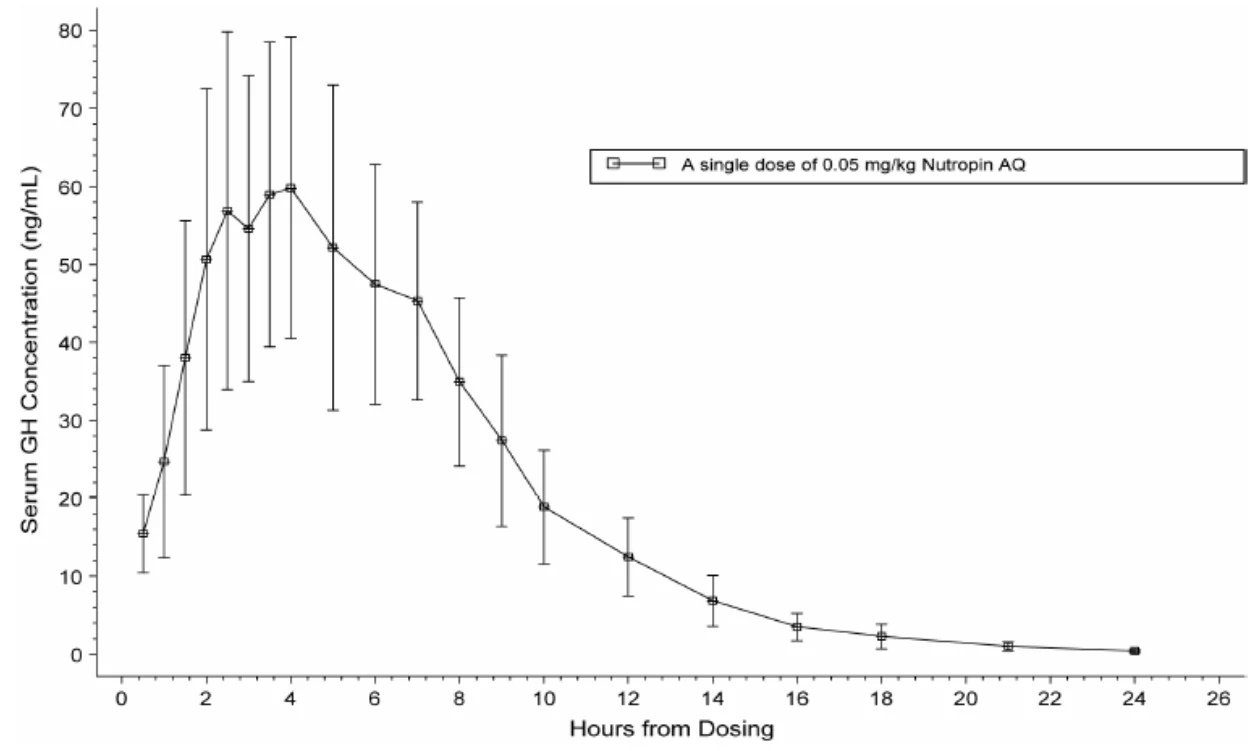
In both normal and growth hormone deficient (GHD) adults and children, the intramuscular and subcutaneous pharmacokinetic profiles of somatropin are similar regardless of the type of growth hormone or dosing regimen used. The subcutaneous pharmacokinetic profile of NUTROPIN is comparable to estimates in the published literature. A small number of dose-ranging studies suggest that clearance and AUC of somatropin is proportional to dose in the therapeutic dose range. The reduction in clearance rates seen in severe liver or kidney dysfunction are consistent with the role of the liver and kidney as major elimination organs for exogenously administered human growth hormone. Pharmacokinetic studies in children with chronic renal insufficiency, Turner syndrome, and growth failure have not been done.
TOXICOLOGY
Safety
No toxic effects were observed in rat or monkey after fourteen days of rhGH administration. In one study, rhGH was administered in doses ranging from 0.125 to 0.625 mg/kg to 36 rhesus monkeys for 2 weeks (6 injections). No clinical toxicity was seen. In another study 40 male and 40 female rats were assigned to one of the following dose groups (20/group with 5M,5F treated and 5M,5F as controls): 0, 0.125, 0.625 or 3.125 mg/kg per day. No treatment related effects were seen in the 0.125 mg/kg group, nor in females at 0.625 mg/kg. At 0.625 mg and 3.125 mg/kg/day, males showed elevated adrenal weights while females receiving
3.125 mg/kg/day showed elevated total body weight. These changes were most likely related to physiological effects and not to toxic effects. There was no local toxicity and local injection effects were comparable to the control group.
After 13 weeks of rhGH at up to six times the clinical dose of 0.1 mg/kg, there were no significant toxicological effects seen in monkeys treated three times weekly.
Intramuscular or subcutaneous administration of rhGH at two times the clinical dose in rabbits failed to show significantly greater local inflammation or degenerative changes at the sites of injection in these animals compared with placebo-treated animals whereas carageenan, a recognized irritant, caused markedly increased myodegeneration and necrosis at the injection site.
Immunogenicity
In studies in rhesus monkeys designed to predict possible immunogenicity of rhGH during therapeutic use, a positive antibody titer was observed in 2 out of 23 animals receiving rhGH at doses of 125 or 625 µg/kg body weight three times weekly for more than 12 weeks. These were two of the five animals treated with rhGH and estradiol; no monkeys dosed with rhGH alone had a positive antibody titer.
A study in transgenic mice (which express human growth hormone), to screen for the immunogenicity of somatropin NUTROPIN AQ (somatropin injection), indicated that NUTROPIN AQ does not have greater immunogenic potential than somatropin NUTROPIN (somatropin for injection) lyophilized powder.
Drug Interactions
The effects of thyroxine (0.02 mg/kg) and prednisone (10 mg/kg) co-administered with growth hormone (1.6 mg/kg) on rat hepatic drug metabolizing enzymes was also evaluated. Three days of prednisone therapy decreased cytochrome P-450 concentration, increased monoxygenase and UDP-glucuronosyltransferase activities, and slightly decreased glutathione S-transferase activity. After five days of prednisone therapy, all Phase II conjugation reactions were decreased. Thyroxine (0.1 and 0.2 mg/kg) administration caused a concentration-dependent decrease in cytochrome P-450 concentration and monooxygenase activities and no apparent effects on Phase II conjugation enzyme activities. Doses of 1 mg/kg thyroxine caused a decrease in glutathione S-transferase activity after five days. The results from this study suggest that prednisone and thyroxine do not statistically alter the hepatic microsomal mixed function oxidase system.
Earlier work by Wilson demonstrated that exogenously administered pituitary-derived growth hormone reduced the activity of the hepatic mixed function oxidase enzymes. Other investigators have documented a reduction in Phase I biotransformation reactions as well as Phase II enzymatic reactions. These results suggest that exogenously administered growth hormone alters the disposition of other drugs given concurrently with growth hormone as well as altering its own disposition. Additional studies are necessary to demonstrate the clinical significance of these alterations.
REFERENCES
- 1. Aceto T Jr, Frasier SD, Hayles AB, et al. Collaborative study of the effects of human growth hormone in growth hormone deficiency: I. First year of therapy. J Clin Endocrinol Metab 1972; 35:483-96.
- 2.
Arslanian SA, Becker DJ, Lee PA, et al. Growth hormone therapy and tumor recurrence.
Findings in children with brain neoplasms and hypopituitarism. Am J Dis Child 1985; 139:347-50.
- 3. Attie KM, Chernausek S, Frane J, Rosenfeld RG, et al. Growth hormone use in Turner syndrome: a preliminary report on the effect of early vs. delayed estrogen. In: Turner Syndrome in a Life-Span Perspective. Albertsson-Wikland K, Ranke M, ed. Elsevier Science, 1995, pp 175-81.
- 4.
Bernstein, J. The normal kidney: morphologic development and anatomy. In: Rudolph,
A.M.,ed. Pediatrics. Seventeenth Edition. Appleton-Century Craft:1171-1172.
- 5. Brody JS, Fisher AB, Gocmen A, et al. Acromegalic pneumonomegaly: lung growth in the adult. Clin Invest 1970; 49:1051-60.
- 6.
Chipman JJ, Zerwerkh J, Nicar M, et al. Effect of growth hormone administration:
reciprocal changes in serum 1 alpha, 25-dihydroxyvitamin D and intestinal calcium absorption. J Clin Endocrinol Metab 1980; 51:321-4.
- 7. Cheek DB, Brasei JA, Elliott D, Scott R. Muscle cell size and number in normal children and in dwarfs (pituitary, cretins and primordial). Preliminary observation. Bull Johns Hopkins Hosp 1966; 119:46-62.
- 8.
Codner E, Mericq V, Cassoria F. Optimizing growth hormone therapy during puberty. Horm
Res 1997; 48 Suppl 5: 16-20.
- 9. Costin G, Kogut MD, Frasier SD. Effect of low dose human growth hormone on carbohydrate metabolism in children with hypopituitarism. J Pediatr 1972;80:796-803.
- 10.
Daughaday W. The Adenohypophysis. In: Williams RM, ed. Textbook of Endocrinology
6th Ed. WB Saunders 1981;87-99.
- 11. Eriksson L, Nilsson B, Carlstrom K, et al. Secretory pattern of growth hormone regulates steroid sulfatase activity in rat liver. J Steroid Biochem 1989; 33:413-16.
- 12.
Frasier SD. Human pituitary growth hormone (hGH) therapy in growth hormone deficiency.
Endocr Rev 1983; 4:155-70.
- 13. Guler HP, Zapf J, Scheiwiller E, et al. Recombinant human insulin-like growth factor I stimulates growth and has distinct effects on organ size in hypophysectomized rats. Proc Natl Acad Sci USA 1988;85:4889-93.
- 14.
Henneman PH, Forbes AP, Modawer M, et al. Effects of human growth hormone in man. J
Clin Invest 1960;39:1223.
- 15. Jorgensen JO, Flyvbjerg A, Lauritzen T, et al. Dose-response studies with biosynthetic human growth hormone (GH) in GH-deficient patients. J Clin Endocrinol Metab 1988; 67:36-40.
- 16. Kaplan SL, Underwood LE, August GP et al. Clinical studies with recombinant-DNA-derived methionyl human growth hormone in growth hormone deficient children. Lancet 1986;1: 697-700
- 17.
Kurtz A, Jelkmann W, Bauer C. A new candidate for the regulation of erythropoiesis.
Insulin-like growth factor 1. FEBS Lett 1982;149:105-8.
- 18. Levitsky LL, Schoeller DA, Lambert GH, et al. Effect of growth hormone therapy in growth hormone-deficient children on cytochrome P-450- dependent 3-N-demethylation of caffeine as measured by the caffeine 13 CO2 breath test. Dev Pharmacol Ther 1989; 12:90-5.
- 19. Lippe BM, Kaplan SA, Golden MP, et al. Carbohydrate tolerance and insulin receptor binding in children with hypopituitarism: response after acute and chronic human growth hormone administration. J Clin Endocrinol Metab 1981;53(3):507-13.
- 20. Marcus R, Butterfield G, Holloway L, et al. Effects of shortterm administration of recombinant human growth hormone to elderly people. J Clin Endocrinol Metab 1990; 70:519-27.
- 21. Mehls 0, Ritz E, Hunziker EB, et al. Improvement of growth and food utilization by human recombinant growth hormone in uremia. Kidney Int 1988; 33:45-52.
- 22. Nakano M, Kainer G, Foreman JW, et al. The effects of exogenous rat growth hormone therapy on growth of uremic rats fed an 8% protein diet. Pediatr Res 1989;26:204-7.
- 23. Parker ML, Utiger RD, Daughaday WH. Studies on human growth hormone II. The physiologic disposition and metabolic fate of human growth hormone in man. J Clin Invest 1962; 41:262-8.
- 24. Prader A, Lilig R, Szeky J, Wagner H. The effect of human growth hormone in hypopituitary dwarfism. Arch Dis Child 1964;39:535-544.
- 25. Prasad V, Greig F, Bastian W, et al. Slipped capital femoral epiphysis during treatment with recombinant growth hormone for isolated, partial growth hormone deficiency. J Pediatr 1990; 116:397-99.
- 26.
Preece MA. Diagnosis and treatment of children with growth hormone deficiency. Clin
Endocrinol Metab 1982; 11:1-24.
- 27.
Raben MS. Hollenberg CH. Effect of growth hormone on plasma fatty acids. J Clin Invest
1959;38:484-488.
- 28. Redmond GP, Bell JJ, Perel JM. Effect of human growth hormone on amobarbital metabolism in children. Clin Pharmacol Ther 1978; 24:213-18.
- 29. Redmond GP, Bell JJ, Nichola PS, Perel JM. Effect of growth hormone on human drug metabolism: time course and substrate specificity. Pediatr Pharmacol 1980; 1:63-70.
- 30. Rosenbaum M., Gertner JM. Metabolic clearance rates of synthetic human growth hormone in children, adult women and adult men. J Clin Endocrinol Metab 1989; 69:820-4.
- 31. Rosenfeld RG, Aggarwal BB, Hintz RL, Dollar LA. Recombinant DNA-derived methionyl human growth hormone is similar in membrane binding properties to human pituitary growth hormone. Biochemical and Biophysical Research Communications 1982;106:202-209.
- 32. Rosenfeld RG, Attie K, Frane J, Brasel JA, Burstein S, Cara JF, et al, Growth hormone therapy of Turner’s syndrome: Beneficial effect on adult height. J Pediatr 1998;132:319-24.
- 33. Rosenfeld RG, Frane J, Attie K, et al. Six-year results of a randomized, prospective trial of human growth hormone and oxandrolone in Turner syndrome. J Pediatr 1992;121:49-55.
- 34. Rosenfeld RG, Wilson DM, Dollar LA, Bennett A, Hintz RL. Both human pituitary growth hormone and recombinant DNA-derived human growth hormone cause insulin resistance at a postreceptor site. J Clin Endocrinol Metab 1982;54:1033-38.
- 35. Tönshoff B, Heinrich U, Mehl O. How safe is the treatment of uraemic children with recombinant human growth hormone? Pediatr Nephrol 1991; 5:454-60.
- 36. Salmon WD Jr, Daughaday WH. A hormonally controlled serum factor which stimulates sulfate incorporation by cartilage in vitro. J Lab Clin Med 1957;49:825-836.
- 37. Sherwin RS, Schulman GA, Hendler R, Walesky M, Belous A, Tambolane W. Effect of growth hormone on oral glucose tolerance and circulating metabolic fuels in man. Diabetologia 1983;24:155-61
- 38.
Skottner A, Forsman A, Fholenhag K, Helleberg A, Lofberg E, Fryklund L. Vangbo B,
Skoog B. Human growth hormone produced by E. coli: a preliminary study of effects on hypophysectomized rats. In: Gueriguian JL, ed. Insulins, Growth Hormone and Recombinant DNA Technology. Raven Press, New York 1981;108:1-15.
- 39.
Stebbing N, Olson K, Lin N, Harkins RN, Snider C, Ross MJ, Fields F, May L, Fenno J,
Fodge D, Prender G. Biological comparison of natural and recombinant Growth Hormone and Recombinant DNA Technology. Raven Press, New York 1981;12-21.
- 40. Tanner JM, Whitehouse RM, Hughes PC, Vince FP. Effect of human growth hormone treatment for 1 to 7 years on growth of 100 children, with growth hormone deficiency, low birthweight, inherited smallness, Turner's syndrome and other complaints. Arch Dis Child 1971;46:745-82.
- 41. Thomsett MJ, Conte FA, Kaplan SL, Grumbach MM. Endocrine and neurologic outcome in childhood craniopharyngioma: review of effect of treatment in 42 patients. J Pediatr 1980;97:728-35.
- 42.
Thomson JA, McCrossan J, Mason DK. Salivary gland enlargement in acromegaly. Clin
Endocrinol 1974;3:1-4.
- 43.
Watkins SL. Bone disease in patients receiving growth hormone. Kidney Int Suppl 1996;
53:S126-7.
- 44. Wilson JT. Alterations of normal development of drug metabolism by injection of growth hormone. Nature 1970; 225:861-63.
- 45.
Wilson JT. Growth hormone modulation of liver drug metabolic enzyme activity in the rat:
- 1. Effect of the hormone on the content and rate of reduction of microsomal cytochrome P-450. Biochem Pharmacol 1973; 22:1717-28.