


Product Monograph - Omnitrope
1 INDICATIONS
Omnitrope (somatropin for injection) is indicated for:
Children
The long-term treatment of children, who have growth failure due to an inadequate secretion of endogenous growth hormone (growth hormone deficiency [GHD]). Other causes of short stature should be excluded.
SGA Indication
Omnitrope is indicated for the treatment of growth failure (current height standard deviation score [SDS] < - 2) in short children born SGA (birth weight and/or length below -2 SD) and who fail to achieve catch-up growth (height velocity SDS < 0 during the last year) by 2 to 4 years or later.
TS Indication
The treatment of short stature associated with Turner syndrome in patients whose epiphyses are not closed.
ISS Indication
The long-term treatment of idiopathic short stature (ISS), also called non-growth hormone-deficient short stature, defined by height standard deviation score (SDS) <-2.25, and associated with growth rates unlikely to permit attainment of adult height in the normal range, in pediatric patients for whom diagnostic evaluation excludes other causes associated with short stature that should be observed or treated by other means. Omnitrope treatment for ISS should be prescribed only for those patients whose epiphyses are not closed.
Adults
Omnitrope (somatropin [rDNA origin] for injection) is indicated for replacement of endogenous growth hormone in adults with growth hormone deficiency who meet either of the following two criteria:
Adult Onset (AO): Patients who have growth hormone deficiency, either alone or associated with multiple hormone deficiencies (hypopituitarism), as a result of pituitary disease, hypothalamic disease, surgery, radiation therapy, or trauma; or
Childhood Onset (CO): Patients who were growth hormone deficient during childhood as a result of congenital, genetic, acquired, or idiopathic causes.
Patients who were treated with somatropin for growth hormone deficiency in childhood and whose epiphyses are closed should be re-evaluated before continuation of somatropin therapy at the reduced dose level recommended for growth hormone deficient adults. According to current standards, confirmation of the diagnosis of adult growth hormone deficiency in both groups involves an appropriate growth hormone provocative test with two exceptions: (1) patients with multiple other pituitary hormone deficiencies due to organic disease; and (2) patients with congenital/genetic growth hormone deficiency.
1.1 Pediatrics
Based on the data submitted and reviewed by Health Canada, the efficacy and safety of Omnitrope in pediatric patients has been established. Therefore Health Canada has authorized indications for pediatric use (see 1 INDICATIONS, 14 CLINICAL TRIALS).
1.2 Geriatrics
The safety and efficacy of Omnitrope in patients aged 65 and over have not been evaluated in clinical studies (see 7 WARNINGS AND PRECAUTIONS, 7.1 Special Populations, 7.1.4 Geriatrics).
2 CONTRAINDICATIONS
Omnitrope (somatropin for injection) should not be used when there is any evidence of neoplastic activity. Intracranial lesions must be inactive and antitumour therapy complete prior to the institution of therapy. Treatment with Omnitrope should be discontinued if there is evidence of tumour growth.
Growth hormone should not be used for growth promotion in children with fused epiphyses.
Somatropin is contraindicated in patients with active proliferative or severe non-proliferative diabetic retinopathy.
Omnitrope is contraindicated in patients with acute critical illness due to complications following open heart or abdominal surgery, multiple accidental trauma, or acute respiratory failure. (see 7 WARNINGS AND PRECAUTIONS)
Omnitrope 5.0 mg/1.5 mL solution which also contains the preservative benzyl alcohol, should not be administered in newborns or in patients with a known sensitivity to benzyl alcohol (see 7 WARNINGS AND PRECAUTIONS).
Omnitrope is contraindicated in patients with a history of hypersensitivity to any of its components.
3 SERIOUS WARNINGS AND PRECAUTIONS BOX
Serious Warnings and Precautions
|
|---|
4 DOSAGE AND ADMINISTRATION
4.1 Dosing Considerations
Therapy with Omnitrope (somatropin for injection) should be supervised by a physician who is experienced in the diagnosis and management of pediatric patients with growth failure associated with growth hormone deficiency (GHD), Turner syndrome (TS), those who were born small for gestational age (SGA) or Idiopathic Short Stature (ISS), and adult patients with either childhood onset or adult onset GHD.
The Omnitrope dosage and administration schedule should be individualized based on the growth response of each patient.
Response to somatropin therapy in pediatric patients tends to decrease with time. However, in pediatric patients, the failure to increase growth rate, particularly during the first year of therapy, indicates the need for close assessment of compliance and evaluation for other causes of growth failure, such as hypothyroidism, undernutrition, advanced bone age and antibodies to recombinant human GH (rhGH).
Treatment with Omnitrope for short stature should be discontinued when the epiphyses are fused.
4.2 Recommended Dose and Dosage Adjustment
The recommended dosage of Omnitrope is:
Table 1: The recommended dosage of Omnitrope
| Indication | Recommended Dose (mg/kg body weight) | Route 4 | Comments |
| Pediatric Growth Hormone Deficiency 1 | 0.16 - 0.24 mg/kg body weight/week | SC | Divided into 6-7 doses diagnosis of GHD should be confirmed before Omnitrope is administered. |
| Adults Growth Hormone Deficiency | 0.15 - 0.3 mg/day 2 | SC | Divided into 6-7 doses |
| Turner Syndrome 1 | 0.33 mg/kg body weight per week | SC | Divided into 6-7 doses |
| Idiopathic Short Stature 1 | UP TO 0.47 mg/kg body weight per week 3 | SC | Divided into 6-7 doses |
| Small for Gestational Age 1 | UP TO 0.48 mg/kg body weight per week | SC | Divided into 6-7 doses |
1 Omnitrope dosage must be adjusted for the individual patient.
2 Final dose should be individually increased as required with respect to age and gender to a maximum daily maintenance dose of 1.33 mg. Women may require higher doses than men. This means that there is a risk that women, especially those on oral estrogen replacement may be under-treated. As normal physiological growth hormone production decreases with age, dose requirements may be reduced.
3 Treatment should stop when near adult height is achieved (height velocity < 2 cm/ yr and/or bone age >16 yr in boys and >14 yr in girls) or when height is in the normal adult range (above -2 SDS).
4 Omnitrope may be administered in the thigh, buttocks or abdomen; the site of SC injections (administered preferably in the evenings) should be rotated daily to help prevent lipoatrophy.
Adults Growth Hormone Deficiency
Clinical response, side effects and determination of IGF-1 in serum may be used as guidance for dose titration. The level of IGF-1 should not exceed the upper limit of normal IGF-1 levels matched to age and sex.
It is recommended that IGF-1 concentrations be monitored regularly and GH dose be reduced in children with a plasma IGF-1 above + 2SD.
Small for Gestational Age
Recent literature has recommended initial treatment with larger doses of somatropin (e.g., 0.48 mg/kg/week), especially in very short children (i.e., height SDS <–3), and/or older/ pubertal children, and that a reduction in dosage (e.g., gradually towards 0.24 mg/kg/week) should be considered if substantial catch-up growth is observed during the first few years of therapy. On the other hand, in younger SGA children (e.g., approximately <4 years) with less severe short stature (i.e., baseline height SDS values between -2 and -3), consideration should be given to initiating treatment at a lower dose (e.g., 0.24 mg/kg/week), and titrating the dose as needed over time. In all children, clinicians should carefully monitor the growth response, and adjust the somatropin dose as necessary.
Dosing should continue until final height is reached. Treatment should be discontinued after the first year of treatment if the height velocity SDS is below + 1. Treatment should be discontinued if height velocity is < 2 cm/year and, if confirmation is required, bone age is > 14 years (girls) or > 16 years (boys) corresponding to closure of the epiphyseal growth plates.
In short children born SGA, it is recommended that IGF I concentration be measured before initiation of treatment and monitored every 6 months thereafter. If on repeated measurements IGF-1 concentrations exceed +2 SD compared to references for age and pubertal status, the IGF-1/IGFBP-3 ratio could be taken into account to consider dose adjustment.
No studies with somatropin have been carried out in geriatric patients or in patients with hepatic or renal impairment.
4.4 Administration
Omnitrope (somatropin for injection) – 5.0 mg/1.5 mL; 10.0 mg/1.5 mL, 15.0 mg/1.5 mL Cartridges
Omnitrope 5.0 mg/1.5 mL, 10.0 mg/1.5 mL and 15.0 mg/1.5 mL solutions for injection, are sterile, ready-to-use solutions filled in pen cartridges.
The presentations are indicated for multiple use. They should only be administered with the Omnitrope® Surepal 5, Omnitrope® Surepal 10 and Omnitrope® Surepal 15 pen injection devices specifically developed for use with Omnitrope 5.0 mg/1.5 mL, Omnitrope 10.0 mg/1.5 mL, and Omnitrope 15.0 mg/1.5 mL respectively. The solutions must be administered using sterile, disposable pen needles. The solution must be clear prior to insertion of the cartridge into the Pen. Do not inject if the solution is cloudy. Patients and caregivers have to receive appropriate training and instruction on the proper use of the Omnitrope cartridges and pens from the physician or other suitable qualified healthcare professionals.
After the first injection, the content of the cartridge must be used within 28 days. The cartridge should remain in the pen and be refrigerated between 2 and 8°C. Do not freeze. Protect from light (see 11
STORAGE, STABILITY AND DISPOSAL).
The following is a general description of the administration process. The manufacturer’s instructions provided with the pens must be followed for loading the cartridge, attaching the injection needle and for the administration.
Wash your hands.
- 1. Ensure that the solution in the cartridge is clear and colourless prior to inserting the cartridge into the Pen. Do not use if the solution is cloudy or contains particulate matter.
- 2. Disinfect the rubber membrane of the cartridge with an alcohol swab.
- 3. Insert the cartridge into the Omnitrope Pen following the instructions for use provided with the pen.
- 4. Clean the site of injection with an alcohol swab.
- 5. Administer the appropriate dose by subcutaneous injection using a sterile pen needle. The sites of injection should be rotated each time Omnitrope is administered to avoid lipoatrophy.
- 6. Remove the pen needle and dispose of it in accordance with local requirements.
4.5 Missed Dose
For patients who miss a dose of Omnitrope, it is not recommended to double the next dose. Administer the regular dose at the next scheduled dosage time. Patients should contact their physician for instructions.
5 OVERDOSAGE
There is little information on acute or chronic overdosage with Omnitrope. Intravenously administered growth hormone has been shown to result in an acute decrease in plasma glucose and subsequently to hyperglycemia. It is thought that the same effect might occur on rare occasions with high dosages of Omnitrope administered subcutaneously. Long-term overdosage may result in signs and symptoms of acromegaly, with resultant and considerable morbidity and mortality from cardiovascular complications and malignancy. Furthermore, overdose with somatropin is likely to cause fluid retention.
| For management of a suspected drug overdose, contact your regional poison control centre immediately. |
|---|
6 DOSAGE FORMS, STRENGTHS, COMPOSITION AND PACKAGING
To help ensure the traceability of biologic products, including biosimilars, health professionals should recognise the importance of recording both the brand name and the non-proprietary (active ingredient) name as well as other product-specific identifiers such as the Drug Identification Number (DIN) and the batch/lot number of the product supplied.
Table 2: Dosage Forms, Strengths, Composition and Packaging
Omnitrope Pen Cartridge is supplied as:
Omnitrope 5.0 mg/1.5 mL is supplied in the following pack sizes:
- One cartridge per carton
- Five cartridges per carton
- Ten cartridges per carton
Omnitrope 10.0 mg/1.5 mL is supplied in the following pack sizes:
- One cartridge per carton
- Five cartridges per carton
- Ten cartridges per carton
Omnitrope 15.0 mg/1.5 mL is supplied in the following pack sizes:
- One cartridge per carton
- Five cartridges per carton
| Route of Administration | Dosage Form / Strength/Composition | Non-medicinal Ingredients | ||
| Subcutaneous injection | Solution: Omnitrope Pen Cartridges contain somatropin solution for injection: | |||
5 mg/1.5 mL (3.3 mg/mL): Each 1.5 mL pen cartridge contains: 5.0 mg of somatropin (15 IU/1.5 mL) | Each 1.5 mL pen cartridge contains: benzyl alcohol as preservative, disodium hydrogen phosphate heptahydrate, mannitol, poloxamer 188, sodium dihydrogen phosphate dihydrate and water for injection. Phosphoric acid and/or sodium hydroxide may have been used to adjust pH | |||
10 mg/1.5 mL (6.7 mg/mL): Each 1.5 mL pen cartridge contains: 10.0 mg of somatropin (30.0 IU/1.5 mL) | Each 1.5 mL pen cartridge contains: disodium hydrogen phosphate heptahydrate, glycine, phenol as preservative, poloxamer 188, sodium dihydrogen phosphate dihydrate and water for injection. Phosphoric acid and/or sodium hydroxide may have been used to adjust pH | |||
and 15 mg/1.5 mL (10.0 mg/mL): Each 1.5 mL pen cartridge contains: 15.0 mg of somatropin (45.0 IU/1.5 mL) | Each 1.5 mL pen cartridge contains: disodium hydrogen phosphate heptahydrate, phenol as preservative, poloxamer 188, sodium chloride, sodium dihydrogen phosphate dihydrate and water for injection. Phosphoric acid and/or sodium hydroxide may have been used to adjust pH | |||
Description
Omnitrope (somatropin for injection) is a polypeptide hormone of recombinant DNA origin. It has 191 amino acid residues and a molecular weight of 22,125 Daltons and an isoelectric point (pH) of 5.1. The amino acid sequence of the product is identical to that of human growth hormone of pituitary origin (somatropin). Omnitrope is synthesized in a strain of Escherichia coli which has been modified by the addition of the human growth hormone gene.
Omnitrope comes in one dosage form: clear, colourless, sterile solution intended for subcutaneous injection.
7 WARNINGS AND PRECAUTIONS
Please see 3 SERIOUS WARNINGS AND PRECAUTIONS BOX.
General
Patients and caregivers who will administer Omnitrope should receive appropriate training and instruction on the proper use of Omnitrope from the physician or other suitably qualified health professionals.
The site of SC injection of Omnitrope should be rotated daily between the thigh, buttocks and abdomen in order to avoid lipoatrophy.
It is recommended that insulin-like growth factor-I (IGF-I) concentrations be monitored regularly and maintained within the normal range for age and sex.
To avoid transmission of disease, Omnitrope cartridge and prefilled syringe must not be used by more than one person.
Acute Critical Illness
Increased mortality in patients with acute critical illness due to complications following open heart surgery, abdominal surgery or multiple accidental trauma, or those with acute respiratory failure has been reported after treatment with pharmacologic amounts of somatropin (see 2 CONTRAINDICATIONS). The safety of continuing somatropin treatment in patients receiving replacement doses for approved indications who concurrently develop these illnesses has not been established. Therefore, the potential benefit of treatment continuation with somatropin in patients having acute critical illnesses should be weighed against the potential risk.
The effects of somatropin on recovery were studied in two placebo controlled trials involving 522 critically ill adult patients suffering complications following open heart surgery, abdominal surgery, multiple accidental trauma or acute respiratory failure. Mortality was higher in patients treated with daily doses of 5.3 or 8 mg somatropin compared to patients receiving placebo, 42% vs. 19%. Based on this information, these types of patients should not be treated with somatropin.
Carcinogenesis and Mutagenesis
Carcinogenesis studies have not been conducted with rhGH. rhGH is not expected to be carcinogenic in human as the rhGH molecule is identical to the native hormone and the treatment is substitution therapy. No potential mutagenicity of rhGH was revealed in a battery of tests including the Ames test, a test designed to demonstrate chromosome damaging potential, induction of gene mutations in mammalian cells (L5178Y) in vitro and in intact bone marrow cells (rats).
Leukemia has been reported in a small number of growth hormone deficient patients, treated with growth hormone, including growth hormone of pituitary origin as well as of recombinant DNA origin (somatrem and somatropin). Based on the current evidence, experts cannot conclude that growth hormone therapy is responsible for these occurrences.
Patients treated with growth hormone may have an increased risk of developing neoplasm.
Neoplasms
Patients with pre-existing tumours or with GHD secondary to an intracranial lesion should be examined frequently for progression or recurrence of the underlying disease process.
In pediatric patients, clinical literature has revealed no relationship between somatropin replacement therapy and central nervous system (CNS) tumour recurrence or new extracranial tumours. However, in childhood cancer survivors, an increased risk of a second neoplasm has been reported in patients treated with somatropin after their first neoplasm. Intracranial tumours, in particular meningiomas were the most common of these second neoplasms especially in patients treated with radiation to the head. In adults, it is unknown whether there is any relationship between somatropin replacement therapy and CNS tumour recurrence. Patients should be monitored carefully for any malignant transformation of skin lesions.
Closed Epiphyses
Somatropin should not be used for growth promotion in pediatric patients with closed epiphyses.
Treatment of pediatric growth disorders with growth hormones should be discontinued when the patient has reached satisfactory adult height, or when the epiphyses are closed.
Congenital Disorders
Turner’s syndrome:
Patients with Turner syndrome may be at increased risk for development of intracranial hypertension. Therefore, these patients should be evaluated for signs and symptoms of intracranial hypertension and, if present, this condition should be treated before initiation of treatment with somatropin.
Patients with Turner syndrome should be evaluated carefully for otitis media and other ear disorders before and during treatment with somatropin because these patients have an increased risk of ear and hearing disorders (see 8 ADVERSE REACTIONS).
Patients with Turner syndrome are at risk for cardiovascular disorders (e.g. hypertension, stroke, and aortic dilatation, aneurysm and dissection) and these patients should be monitored closely for development or worsening of these conditions before and during treatment with somatropin.
Patients with Turner syndrome have an inherently increased risk of developing autoimmune thyroid disease. Therefore, these patients should have periodic thyroid function tests performed and be treated appropriately (see 7 WARNINGS AND PRECAUTIONS, Endocrine and Metabolism).
Note: Skeletal abnormalities including scoliosis are commonly seen in untreated patients with Turner syndrome.
Dependence/ Liability
Somatropin is not considered to be a drug that has potential to produce drug dependency. Somatropin does not have stimulant, depressant or hallucinogenic effects on the central nervous system that could be expected to lead to psychological or physical dependency.
Potential for Misuse: Inappropriate use of somatropin by individuals who do not have indications for which growth hormone is approved, may result in clinically significant negative health consequences
Endocrine and Metabolism
Patients with diabetes mellitus or glucose intolerance should be monitored closely during therapy with somatropin as an adjustment of their antidiabetic therapy may be required.
Treatment with somatropin may decrease insulin sensitivity, particularly at higher doses in patients with risk factors for diabetes mellitus, such as obesity, Turner syndrome, or a family history of diabetes mellitus, those receiving high dose corticosteroid therapy, and patients with impaired glucose tolerance or pre-existing diabetes mellitus. As a result, previously undiagnosed impaired glucose tolerance and overt diabetes mellitus may be unmasked during somatropin treatment. Therefore, patients who receive somatropin should be monitored for evidence of abnormal glucose metabolism and/or diabetes mellitus. New-onset type 2 diabetes mellitus has been reported in children and adults receiving somatropin.
In patients with hypopituitarism standard hormonal replacement therapy should be monitored closely when Omnitrope therapy is administered.
Somatropin can increase the extrathyroidal conversion of thyroxine (T4) to triiodothyronine (T3) and may unmask incipient hypothyroidism. Because inadequate treatment of hypothyroidism may prevent optimal response to somatropin, thyroid function should be evaluated before starting somatropin therapy and should be monitored regularly during treatment, not less frequently than annually.
Notes Regarding Potential Effects of Somatropin on Glucocorticoid Metabolism: The microsomal enzyme 11β-hydroxysteroid dehydrogenase type 1 (11βHSD-1) is required for conversion of cortisone to its active metabolite, cortisol in hepatic and adipose tissue. Endogenous growth hormone and exogenous somatropin inhibit the activity of 11βHSD-1. Therefore growth hormone deficiency is associated with a relative increase in 11βHSD-1 activity, which in turn results in a relative increase in serum cortisol. Somatropin treatment may inhibit 11βHSD-1, resulting in relative reduction of serum cortisol concentrations.
In addition, somatropin may enhance the activity of CYP3A4, a cytochrome P450 enzyme involved in glucocorticoid catabolism. Therefore, by increasing the activity of CYP3A4, somatropin could potentially decrease serum cortisol concentration. Because somatropin may both inhibit 11βHSD-1 (an enzyme required for production of cortisol) and induce activity of CYP3A4 (an enzyme involved in cortisol breakdown), careful monitoring of serum cortisol concentrations is required for all patients receiving concomitant glucocorticoid and somatropin therapy.
As a consequence of its actions on enzymes involved in cortisol metabolism, somatropin treatment may unmask previously undiagnosed central (secondary) hypoadrenalism, and glucocorticoid replacement may be required. In addition, patients treated with glucocorticoids for previously diagnosed hypoadrenalism (primary or secondary) may require adjustments of their maintenance or stress doses following initiation of somatropin treatment; this may be especially true for patients treated with cortisone acetate and prednisone, because conversion of these drugs to their biologically active metabolites is dependent on the activity of 11βHSD-1 (see 7 WARNINGS AND PRECAUTIONS, Monitoring and Laboratory Tests).
Fluid Retention
Fluid retention during somatropin replacement therapy in adults may occur. Clinical manifestations of fluid retention are usually transient and dose dependent.
Immune
Local allergic reactions:
Patients receiving somatropin treatment may experience redness, swelling, pain, inflammation, or itching at the site of injection (see 8 ADVERSE REACTIONS).
Most of these minor reactions usually resolve in a few days to a few weeks. Such reactions may occur if the injection is given incorrectly (irritants in the skin cleansing agent or poor injection technique), or if the patient is allergic to somatropin or any non-medicinal ingredient (see 2 CONTRAINDICATIONS).
Rarely, subcutaneous administration of somatropin can result in lipoatrophy or lipohypertrophy. Regular rotation of the injection site may help reduce or prevent these reactions.
Patients should be advised to consult their doctor if they notice any of the conditions described above.
On rare occasion, injection site reactions may require discontinuation of somatropin therapy.
Systemic allergic reactions:
As with any protein, local or systemic allergic reactions may occur. Parents/patients should be informed that such reactions are possible and that prompt medical attention should be sought if allergic reactions occur.
These reactions may be characterized by a generalized rash (with pruritus), shortness of breath, wheezing, angioneurotic edema and drop in blood pressure (see 8 ADVERSE REACTIONS).
Severe cases of generalized allergy including anaphylactic reaction may be life-threatening (see 2 CONTRAINDICATIONS).
If any serious hypersensitivity or allergic reactions occurs, somatropin therapy should be discontinued immediately and appropriate therapy initiated.
Serious systemic hypersensitivity reactions including anaphylactic reactions and angioedema have been reported with post-marketing use of somatropin products. Patients and caregivers should be informed that such reactions are possible and that prompt medical attention should be sought if an allergic reaction occurs (see 2 CONTRAINDICATIONS).
Antibody production:
A small percentage of patients treated with somatropin may develop antibodies during treatment that could potentially reduce treatment response (see 8 ADVERSE REACTIONS).
Patients who have demonstrated an allergic reaction to other somatropin products may demonstrate an allergic reaction to Omnitrope.
Intracranial Hypertension
Intracranial hypertension (IH) with papilledema, visual changes, headache, nausea and/or vomiting has been reported in a small number of patients treated with growth hormone products. Symptoms usually occurred within the first eight weeks of initiation of growth hormone therapy. In all reported cases, IH-associated signs and symptoms resolved after termination of therapy or a reduction of growth hormone dose. Fundoscopic examination of patients is recommended at the initiation, and periodically during the course of, growth hormone therapy. If papilledema is observed by fundoscopy during somatropin treatment, treatment should be stopped. If somatropin-induced IH is diagnosed, treatment with somatropin can be restarted at a lower dose after IH associated signs and symptoms have resolved. Patients with Turner syndrome may be at increased risk for the development of IH.
Monitoring and Laboratory Tests
Serum levels of inorganic phosphorus, alkaline phosphatase, parathyroid hormone (PTH) and IGF-1 may increase during somatropin therapy.
Adults: Adult patients, during GH treatment, should be monitored at 1- to 2-month intervals during dose titration and every 6 months thereafter with clinical assessment, evaluation for adverse effects, IGF-1 levels, and other parameters of GH response. Other laboratory testing should include a lipid profile and a fasting glucose. These should be assessed annually.
Patients with an intra- or extra-cranial neoplasm in remission who are receiving treatment with somatropin should be examined carefully and at regular intervals by the physician. In case of persistent edema or severe paraesthesia the dosage should be decreased in order to avoid the development of carpal tunnel syndrome (see 8 ADVERSE REACTIONS).
Children: Children, during GH treatment, should be monitored every 3 to 6 months with measurement of IGF- 1/IGFBP-3 levels and clinical assessment expressed as increase in height (SD per year) and change in height velocity.
Bone age should be monitored periodically during somatropin administration.
Patients with an intra- or extra-cranial neoplasm in remission who are receiving treatment with somatropin should be examined carefully and at regular intervals by the physician.
In short children born SGA, it is recommended that IGF I concentration be measured before initiation of treatment and monitored every 6 months thereafter. If on repeated measurements IGF-1 concentrations exceed +2 SD compared to references for age and pubertal status, the IGF-1/IGFBP-3 ratio could be taken into account to consider dose adjustment.
Musculoskeletal
Musculoskeletal discomfort (pain, swelling and/or stiffness) may occur during treatment with somatropin (see 8 ADVERSE REACTIONS). These symptoms may resolve spontaneously, with analgesic therapy, or after reducing the dosage (see 4 DOSAGE AND ADMINISTRATION).
Swelling of the hands and feet may occur during treatment with somatropin and may lead to carpal tunnel syndrome, which may be improved by decreasing the dosage of somatropin.
Somatropin has not been shown to increase the incidence of scoliosis. However, progression of pre-existing scoliosis can occur in pediatric patients who experience rapid growth. Therefore, because somatropin increases growth rate, patients with a history of scoliosis who are treated with somatropin should be monitored for progression of scoliosis.
Slipped capital femoral epiphysis may occur more frequently in patients with endocrine disorders (including pediatric growth hormone deficiency, Turner syndrome and hypothyroidism) or in patients undergoing rapid growth. Any pediatric patient with the onset of a limp or complaints of hip or knee pain during somatropin therapy should be carefully evaluated (see Monitoring and Laboratory Tests).
Pancreatitis
Cases of pancreatitis have been reported rarely in children and adults receiving somatropin treatment, with some evidence supporting a greater risk in children compared with adults. Pancreatitis should be considered in any somatropin treated patients, especially a child, who develops persistent severe abdominal pain.
Renal/Hepatic/Biliary/Pancreatic Impairments
Somatropin doses may need to be adjusted in patients with renal and/or hepatic and/or biliary and/or pancreatic impairments.
Reproductive Health: Female and Male Potential
No adequate and well-controlled clinical studies with Omnitrope in reproduction function have been performed (see 7.1 Special Populations, 7.1.1 Pregnant Women).
Animal reproductive studies in rats and rabbits treated during the period of organogenesis have not given evidence of any harmful effects on the fetus. There are however, no adequate and well- controlled studies in pregnant women. Because animal reproductive studies are not always predictive of human response, this drug should be used during pregnancy only if clearly needed.
Sensitivity/Resistance
Patients with known sensitivities to benzyl alcohol should not use the Omnitrope 5.0 mg/1.5 mL as it contains benzyl alcohol.
Sensitivity to Diluent: Benzyl alcohol has been associated with toxicity in newborns.
Omnitrope 5.0 mg/1.5 mL solution also contains the ingredient benzyl alcohol as a preservative. It must not be used in newborns.
Information for Patients
Patients and/or their caregivers should be informed about potential advantages and disadvantages of Omnitrope therapy including the possible side effects. It should be noted that although serious adverse events may be rare, their occurrence needs to be outweighed by the benefits.
If home use is determined to be desirable by the physician, patients should also be offered instruction for use of injection devices, storage, travelling and other pertinent information. (see PATIENT MEDICATION INFORMATION, INSTRUCTIONS FOR USE).
7.1 Special Populations
7.1.1 Pregnant Women
Reproduction studies have not been conducted with Omnitrope. There are no adequate and well controlled studies of somatropin treatment in pregnant women. Therefore, the safety of somatropin has not been established in this subpopulation. It is also not known whether Omnitrope can cause fetal harm when administered to a pregnant woman. Omnitrope should be given to a pregnant woman only if the benefits clearly outweigh the risks and only under medical supervision.
Female patients should be advised to inform their doctor if they are, or become pregnant, or are contemplating pregnancy.
7.1.2 Breast-feeding
There is no experimental data available that suggests whether peptide hormones, such as growth hormone, pass over into the breast milk but absorption in the gastrointestinal tract of the infant of intact protein is extremely unlikely.
7.1.3 Pediatrics
Pediatric Patients: (see 1 INDICATIONS).
Pediatrics (< 3 years of age): Prudence is indicated for children under age of 3 years, when administering Omnitrope 5.0 mg/1.5 mL solution (benzyl alcohol preserved); although there is no information on the toxicity of benzyl alcohol for this age group, the toxic dose for premature neonates is in the range of 100 to 250 mg/kg per day.
Children who have endocrine disorders, including growth hormone deficiency, may develop slipped capital femoral epiphyses more frequently than children in the general population. Any pediatric patient with onset of a limp during somatropin therapy should be evaluated.
Note: Some of the height gain obtained with somatropin treatment may be lost if treatment is stopped before final height is reached.
Turner Syndrome: see 7 WARNINGS AND PRECAUTIONS, Congenital Disorders.
Idiopathic Short Stature: Other medical reasons or treatments that could explain growth disturbance should be ruled out before starting Omnitrope treatment for children with idiopathic short stature. Omnitrope treatment for idiopathic short stature should be prescribed only for those patients whose epiphyses are not closed and should be managed by physicians who have sufficient knowledge of idiopathic short stature and the efficacy/safety profile of somatropin.
Small for Gestational Age: In short children born small for gestational age (SGA) other medical reasons or treatments that could explain growth disturbance should be ruled out before starting treatment with somatropin (Omnitrope). Experience with SGA patients with Silver-Russell syndrome is limited, as is experience in initiating treatment in SGA patients near onset of puberty.
In short children born SGA, it is recommended that IGF-1 concentration should be measured before initiation of treatment and monitored every 6 months thereafter. If on repeated measurements IGF-1 concentrations exceed +2 SD compared to references for age and pubertal status, the IGF-1/IGFBP-3 ratio could be taken into account to consider dose adjustment.
7.1.4 Geriatrics
Geriatrics (> 65 years of age): The safety and effectiveness of Omnitrope in patients aged 65 and over has not been evaluated in clinical studies. Elderly patients may be more sensitive to the action of Omnitrope and may be more prone to develop adverse reactions. A lower starting dose and smaller dose increments should be considered for older patients.
7.1.5 Others
Adult Patients: Patients with ephiphyseal closure who were treated with somatropin therapy in childhood should be re-evaluated according to the criteria provided in 1 INDICATIONS before continuation of somatropin therapy at the reduced dose level required for growth hormone-deficient adults.
Experience with prolonged treatment in adults is limited. Adverse events such as peripheral edema, myalgia, arthralgia, and paresthesiae have been reported during post-marketing studies (see 8 ADVERSE REACTIONS).
Growth hormone deficiency in the adult is a lifelong condition and should be treated accordingly. Experience with patients over sixty years of age is limited.
Note: Based on assessment of clinical trial data, post-marketing data, and spontaneous reports carpal tunnel syndrome appears to occur more frequently in patients over 40 years of age than in younger patients. In almost half of the reported cases the recommended maximum somatropin dose had been exceeded. In the majority of cases, the condition resolved spontaneously or with a decrease in dosage, interruption of treatment, or discontinuation of treatment. The maximum recommended dosage should not be exceeded.
Obese Patients: Obese individuals are more likely to manifest adverse effects when treated with a weight-based regimen (see 4 DOSAGE AND ADMINISTRATION).
8 ADVERSE REACTIONS
The adverse drug reaction profiles reported in clinical studies that compared Omnitrope to the reference biologic drug were comparable. The description of adverse reactions in this section is based on clinical experience with the reference biologic drug.
8.1 Adverse Reaction Overview
Patients with growth hormone deficiency are characterized by extracellular volume deficit. When treatment with somatropin is started this deficit is rapidly corrected. In adult patients adverse effects related to fluid retention, such as peripheral edema, face edema, stiffness in the extremities, arthralgia, myalgia and paraesthesia are common. In general these adverse effects are mild to moderate, arise within the first months of treatment and subside spontaneously or with dose-reduction. Severe hypersensitivity has been reported in post-marketing use of somatropin products.
The incidence of these adverse effects is related to the administered dose, the age of patients, and possibly inversely related to the age of patients at the onset of growth hormone deficiency. In children such adverse effects are uncommon.
Somatropin has been reported to reduce serum cortisol levels, possibly by affecting carrier proteins or by increased hepatic clearance. The clinical relevance of these findings may be limited. Nevertheless, corticosteroid replacement therapy should be optimised before initiation of Omnitrope (somatropin for injection) therapy (see 7 WARNINGS AND PRECAUTIONS, Endocrine and Metabolism).
8.2 Clinical Trial Adverse Reactions
Clinical trials are conducted under very specific conditions. The adverse reaction rates observed in the clinical trials; therefore, may not reflect the rates observed in practice and should not be compared to the rates in the clinical trials of another drug. Adverse reaction information from clinical trials may be useful in identifying and approximating rates of adverse drug reactions in real-world use.
Adults
Clinical Trials in adults with GHD
In clinical trials with the reference product somatropin recurrence of pituitary adenoma and of craniopharyngioma were reported in one case each. In these patient categories tumour recurrence is not uncommon, but it is as yet not possible to compare rates between patients on GH treatment and those without such substitution.
In clinical trials with somatropin in 1145 GHD adults, the majority of the adverse events consisted of mild to moderate symptoms of fluid retention, including peripheral swelling, arthralgia, pain and stiffness of the extremities, peripheral edema, myalgia, paresthesia, and hypoesthesia. These events were reported early during therapy, and tended to be transient and/or responsive to dosage reduction.
Table 3 displays the adverse events reported by 5 % or more of adult GHD patients in clinical trials after various durations of treatment with somatropin. Also presented are the corresponding incidence rates of these adverse events in placebo patients during the 6-month double-blind portion of the clinical trials.
Table 3: Adverse events reported by ≥ 5% of 1145 adult GHD patients during clinical trials of somatropin and placebo, grouped by duration of treatment
| Double Blind Phase | Open Label Phase Somatropin | |||||||||||||
| Adverse Event | Placebo 0–6 mo. n = 572 % Patients | Somatropin 0–6 mo. n = 573 % Patients | 6–12 mo. n = 504 % Patients | 12–18 mo. n = 63 % Patients | 18–24 mo. n = 60 % Patients | |||||||||
| Swelling, peripheral | 5.1 | 17.5* | 5.6 | 0 | 1.7 | |||||||||
| Arthralgia | 4.2 | 17.3* | 6.9 | 6.3 | 3.3 | |||||||||
| Upper respiratory infection | 14.5 | 15.5 | 13.1 | 15.9 | 13.3 | |||||||||
| Pain, extremities | 5.9 | 14.7* | 6.7 | 1.6 | 3.3 | |||||||||
| Edema, peripheral | 2.6 | 10.8* | 3.0 | 0 | 0 | |||||||||
| Paresthesia | 1.9 | 9.6* | 2.2 | 3.2 | 0 | |||||||||
| Headache | 7.7 | 9.9 | 6.2 | 0 | 0 | |||||||||
| Stiffness of extremities | 1.6 | 7.9* | 2.4 | 1.6 | 0 | |||||||||
| Fatigue | 3.8 | 5.8 | 4.6 | 6.3 | 1.7 | |||||||||
| Myalgia | 1.6 | 4.9* | 2.0 | 4.8 | 6.7 | |||||||||
| Back pain | 4.4 | 2.8 | 3.4 | 4.8 | 5.0 | |||||||||
* Increased significantly when compared to placebo, P≤ 0.025: Fisher´s Exact Test (one-sided)
n = number of patients receiving treatment during the indicated period.
% = percentage of patients who reported the event during the indicated period.
Post-Trial Extension Studies in Adults
In expanded post-trial extension studies with the reference product, diabetes mellitus developed in 12 of 3031 patients (0.4%) during treatment with somatropin. All 12 patients had predisposing factors, e.g., elevated glycosylated hemoglobin levels and/or marked obesity, prior to receiving somatropin. Of the 3031 patients receiving somatropin, 61 (2%) developed symptoms of carpal tunnel syndrome, which lessened after dosage reduction or treatment interruption (52) or surgery (9). Other adverse events that have been reported include generalized edema and hypoesthesia.
8.2.1 Clinical Trial Adverse Reactions – Pediatrics
Children
Anti-hGH Antibodies
As with all therapeutic proteins, there is potential for immunogenicity. The detection of antibody formation is highly dependent on the sensitivity and specificity of the assay. Additionally, the observed incidence of antibody (including neutralizing antibody) positivity in an assay may be influenced by several factors including assay methodology, sample handling, timing of sample collection, concomitant medications, and underlying disease. For these reasons, comparison of the incidence of antibodies to somatropin with the incidence of antibodies to other products may be misleading. In the case of growth hormone, antibodies with binding capacities lower than 2 mg/mL have not been associated with growth attenuation. In a very small number of patients treated with somatropin, when binding capacity was greater than 2 mg/mL, interference with the growth response was observed.
Clinical Trials in children with GHD
In clinical studies with somatropin in children, the following events were reported infrequently: injection site reactions, e.g. pain or burning associated with the injection, fibrosis, nodules, rash, inflammation, pigmentation; bleeding; lipoatrophy; headache; hematuria; hypothyroidism; mild hyperglycemia.
Clinical Trials in children with SGA
In clinical studies of 273 pediatric patients born small for gestational age treated with somatropin, the following clinically significant events were reported: mild transient hyperglycemia, one patient with benign intracranial hypertension, two patients with central precocious puberty, two patients with jaw prominence, and several patients with aggravation of preexisting scoliosis, injection site reactions, and self-limited progression of pigmented nevi. IGF-1 levels ranged from < 20 ng/mL to 593 ng/mL.
Anti-GH antibodies were assessed at baseline, 12 and 24 months in somatropin -treated SGA children enrolled in a study with another somatropin. At 12 months, the study included 27 untreated SGA children, 59 SGA children treated with somatropin at a dose of 33 mcg/kg body weight/day and 51 short SGA children treated with somatropin at a dose of 67mcg/kg body weight/day. At 24 months, the study included 10 untreated SGA children, 62 short SGA children treated with somatropin at a dose of 33 mcg/kg body weight/day (including 9 children who received no treatment during the first 12 months of the study) and 56 SGA children treated with somatropin at a dose of 67 mcg/kg body weight/day (including 8 children who received no treatment during the first 12 months of the study). None of these patients were determined to be positive for anti-GH antibodies at baseline or at any time during the course of the 24 months of the study.
Table 4: Adverse events reported in ≥ 1% of children (baseline to month 12) - all causality
| Body system / Preferred Term | Untreated N=76 | 0.033 mg/kg/day N=105 | 0.067 mg/kg/day N=117 | 0.1 mg/kg/day N=19 | |||||||||
| n (%) | n (%) | n (%) | n (%) | ||||||||||
| Skin & Appendage | |||||||||||||
| Naevus | 0 | 0 | 1(0.9) | 2 (10.5) | |||||||||
| Nail disorder | 0 | 1(1.0) | 0 | 0 | |||||||||
| Rash erythematous | 0 | 1(1.0) | 0 | 0 | |||||||||
| Skin disorder | 0 | 1(1.0) | 0 | 0 | |||||||||
| Body system / Preferred Term | Untreated N=76 | 0.033 mg/kg/day N=105 | 0.067 mg/kg/day N=117 | 0.1 mg/kg/day N=19 | |||||||||
| n (%) | n (%) | n (%) | n (%) | ||||||||||
| Urticaria acute | 0 | 1(1.0) | 0 | 0 | |||||||||
| Musculoskeletal | |||||||||||||
| Fracture | 0 | 1(1.0) | 1(0.9) | 0 | |||||||||
| Skeletal malformation | 0 | 0 | 0 | 1(5.3) | |||||||||
| Tooth malformation | 0 | 1(1.0) | 0 | 0 | |||||||||
| Central & Peripheral Nervous System | |||||||||||||
| Convulsions | 0 | 1(1.0) | 0 | 0 | |||||||||
| Dysphonia | 0 | 1(1.0) | 0 | 0 | |||||||||
| Headache | 0 | 1(1.0) | 0 | 0 | |||||||||
| Vision | |||||||||||||
| Strabismus | 1(1.3) | 0 | 1(0.9) | 0 | |||||||||
| Hearing & Vestibular system | |||||||||||||
| Ear disorder nos | 0 | 1(1.0) | 1(0.9) | 0 | |||||||||
| Psychiatric | |||||||||||||
| Nervousness | 0 | 1(1.0) | 0 | 0 | |||||||||
| Personality disorder | 1(1.3) | 0 | 0 | 1(5.3) | |||||||||
| Gastrointestinal | |||||||||||||
| Abdominal pain | 0 | 0 | 1(0.9) | 0 | |||||||||
| Anorexia | 1(1.3) | 2(1.9) | 0 | 0 | |||||||||
| Anus disorder | 1(1.3) | 0 | 0 | 0 | |||||||||
| Enteritis | 1(1.3) | 0 | 0 | 0 | |||||||||
| Gastroenteritis | 0 | 2(1.9) | 2(1.7) | 0 | |||||||||
| Hernia nos | 1(1.3) | 0 | 1(0.9) | 0 | |||||||||
| Surgical intervention | 0 | 1(1.0) | 2(1.7) | 0 | |||||||||
| Vomiting | 2(2.6) | 0 | 1(0.9) | 0 | |||||||||
| Metabolism and Nutritional | |||||||||||||
| Hyperglycaemia | 0 | 1(1.0) | 0 | 0 | |||||||||
| Extra Cardiac | |||||||||||||
| Vein distended | 0 | 1(1.0) | 0 | 0 | |||||||||
| Respiratory Total | |||||||||||||
| Surgical intervention | 1(1.3) | 2(1.9) | 4(3.4) | 1(5.3) | |||||||||
| Apnea | 0 | 1(1.0) | 0 | 0 | |||||||||
| Asthma | 2(2.6) | 0 | 3(2.6) | 0 | |||||||||
| Bronchitis | 0 | 5(4.8) | 4(3.4) | 0 | |||||||||
| Coughing | 2(2.6) | 0 | 4(3.4) | 1(5.3) | |||||||||
| Epistaxis | 1(1.3) | 0 | 0 | 0 | |||||||||
| Laryngitis | 0 | 0 | 1(0.9) | 1(5.3) | |||||||||
| Pneumonia | 0 | 2(1.9) | 2(1.7) | 1(5.3) | |||||||||
| Rhinitis | 1(1.3) | 2(1.9) | 6(5.1) | 1(5.3) | |||||||||
| Upper respiratory tract infection | 1(1.3) | 7(6.7) | 7(6.0) | 2(10.5) | |||||||||
| Red Blood Cell | |||||||||||||
| Anemia | 1(1.3) | 0 | 0 | 0 | |||||||||
| White Cell | |||||||||||||
| Body system / Preferred Term | Untreated N=76 | 0.033 mg/kg/day N=105 | 0.067 mg/kg/day N=117 | 0.1 mg/kg/day N=19 | |||||||||
| n (%) | n (%) | n (%) | n (%) | ||||||||||
| Lymphadenopathy | 1(1.3) | 0 | 0 | 0 | |||||||||
| Platelet/Bleed | |||||||||||||
| Purpura thrombocytopenic | 0 | 1(1.0) | 0 | 0 | |||||||||
| Thrombocytopenia | 0 | 1(1.0) | 0 | 0 | |||||||||
| Reproductive-Male | |||||||||||||
| Testis disorder | 1(1.3) | 1(1.0) | 0 | 0 | |||||||||
| General Total | |||||||||||||
| Surgical intervention | 0 | 1(1.0) | 2(1.7) | 0 | |||||||||
| Accident | 0 | 0 | 0 | 1(5.3) | |||||||||
| Allergic reaction | 0 | 1(1.0) | 0 | 0 | |||||||||
| Allergy | 2(2.6) | 0 | 1(0.9) | 0 | |||||||||
| Fever | 2(2.6) | 0 | 1(0.9) | 1(5.3) | |||||||||
| Influenza-like symptoms | 0 | 0 | 2(1.7) | 0 | |||||||||
| Application Site | |||||||||||||
| Injection site reaction | 0 | 1(1.0) | 0 | 0 | |||||||||
| Tympanic membrane perforation | 0 | 1(1.0) | 0 | 0 | |||||||||
| Resistance Mechanism | |||||||||||||
| Herpes zoster | 0 | 1(1.0) | 1(0.9) | 0 | |||||||||
| Infection | 0 | 3(2.9) | 3(2.6) | 0 | |||||||||
| Infection bacterial | 1(1.3) | 3(2.9) | 0 | 0 | |||||||||
| Infection fungal | 0 | 1(1.0) | 0 | 0 | |||||||||
| Infection viral | 6(7.9) | 7(6.7) | 8(6.8) | 0 | |||||||||
| Otitis media | 1(1.3) | 8(7.6) | 8(6.8) | 0 | |||||||||
| Pharyngitis | 6(7.9) | 5(4.8) | 5(4.3) | 0 | |||||||||
Less Common Clinical Trial Adverse Drug Reactions (Baseline to Month 12)
Clinical trial adverse drug reactions with a frequency of less than 1% are presented in the following listing:
Skin & Appendage disorders: eczema
Musculoskeletal disorders: bone development abnormal, spine malformation
Central and Peripheral nervous system disorders: ataxia
Psychiatric disorders: aggressive reaction, concentration impaired
Gastrointestinal disorders: abdominal pain, malabsorption
Endocrine disorders: gynaecomastia, puberty precocious
Respiratory disorders: sinusitis
Urinary disorders: dysuria
General disorders: hepatomegaly
Table 5: Adverse events reported in ≥ 1% of children (12 to 24 month) - all causality
| Body system / Preferred Term | Untreated N=53 | 0.033 mg/kg/day N=106 | 0.067 mg/kg/day N=118 | 0.1 mg/kg/day N=19 | ||||||||||
| n (%) | n (%) | n (%) | n (%) | |||||||||||
| Skin & Appendage | ||||||||||||||
| Eczema | 0 | 1(0.9) | 2(1.7) | 0 | ||||||||||
| Skin discolouration | 0 | 0 | 2(1.7) | 0 | ||||||||||
| Musculoskeletal | ||||||||||||||
| Osteomyelitis | 0 | 0 | 0 | 1(5.3) | ||||||||||
| Central & Peripheral Nervous System | ||||||||||||||
| Convulsions | 0 | 0 | 0 | 1(5.3) | ||||||||||
| Vision | ||||||||||||||
| Myopia | 0 | 0 | 1(0.8) | 2(10.5) | ||||||||||
| Strabismus | 0 | 0 | 0 | 1(5.3) | ||||||||||
| Vision abnormal | 1(1.9) | 0 | 0 | 0 | ||||||||||
| Psychiatric | ||||||||||||||
| Agitation | 0 | 0 | 2(1.7) | 0 | ||||||||||
| Gastrointestinal | ||||||||||||||
| Gastroenteritis | 2(3.8) | 1(0.9) | 2(1.7) | 0 | ||||||||||
| Surgical intervention | 1(1.9) | 2(1.9) | 4(3.4) | 0 | ||||||||||
| Respiratory | ||||||||||||||
| Surgical intervention | 0 | 4(3.8) | 3(2.5) | 1(5.3) | ||||||||||
| Asthma | 0 | 2(1.9) | 2(1.7) | 0 | ||||||||||
| Bronchitis | 0 | 3(2.8) | 3(2.5) | 1(5.3) | ||||||||||
| Coughing | 1(1.9) | 4(3.8) | 2(1.7) | 0 | ||||||||||
| Pneumonia | 1(1.9) | 1(0.9) | 1(0.8) | 1(5.3) | ||||||||||
| Rhinitis | 1(1.9) | 4(3.8) | 4(3.4) | 1(5.3) | ||||||||||
| Sinusitis | 0 | 0 | 0 | 1(5.3) | ||||||||||
| Upper respiratory tract infection | 2(3.8) | 5(4.7) | 2(1.7) | 0 | ||||||||||
| Urinary | ||||||||||||||
| Urinary incontinence | 1(1.9) | 0 | 0 | 0 | ||||||||||
| General | ||||||||||||||
| Surgical intervention | 2(3.8) | 3(2.8) | 5(4.2) | 1(5.3) | ||||||||||
| Allergic reaction | 1(1.9) | 1(0.9) | 0 | 0 | ||||||||||
| Allergy | 1(1.9) | 1(0.9) | 3(2.5) | 0 | ||||||||||
| Fever | 0 | 1(0.9) | 2(1.7) | 0 | ||||||||||
| Influenza-like symptoms | 0 | 2(1.9) | 4(3.4) | 1(5.3) | ||||||||||
| Edema pharynx | 1(1.9) | 0 | 0 | 0 | ||||||||||
| Pain | 2(3.8) | 0 | 1(0.8) | 0 | ||||||||||
| Resistance Mechanism | ||||||||||||||
| Balanoposthitis | 0 | 0 | 0 | 1(5.3) | ||||||||||
| Herpes simplex | 0 | 1(0.9) | 0 | 1(5.3) | ||||||||||
| Infection | 0 | 1(0.9) | 2(1.7) | 0 | ||||||||||
| Infection bacterial | 2(3.8) | 3(2.8) | 0 | 0 | ||||||||||
| Infection viral | 3(5.7) | 13(12.3) | 5(4.2) | 0 | ||||||||||
| Otitis media | 1(1.9) | 7(6.6) | 5(4.2) | 4(21.1) | ||||||||||
| Body system / Preferred Term | Untreated N=53 | 0.033 mg/kg/day N=106 | 0.067 mg/kg/day N=118 | 0.1 mg/kg/day N=19 | |||||
| n (%) | n (%) | n (%) | n (%) | ||||||
| Pharyngitis | 2(3.8) | 8(7.5) | 8(6.8) | 0 | |||||
Less Common Clinical Trial Adverse Drug Reactions (12 to 24 Month)
Clinical trial adverse drug reactions with a frequency of less than 1% are presented in the following listing:
Skin & Appendage disorders: acne, nail disorder, pruritus, skin dry, sweating increased, urticaria
Musculoskeletal disorders: arthralgia, fracture, spine malformation
Central and Peripheral nervous system disorders: absences, headaches
Vision: conjunctivitis
Hearing and Vestibular system disorders: earache
Gastrointestinal disorders: abdominal pain, anorexia, enteritis
Metabolism and nutritional system disorders: hypoglycemia
Endocrine disorders: puberty precocious
Extra cardiac: vein distended
Respiratory disorders: thyroid adenoma
Red blood cell: anemia
White blood cell: lymphadenopathy
Platelet/bleed disorder: purpura, thrombocytopenia
Urinary disorders: cystitis, urinary tract infection, urogenital malformation
Neoplasm disorder: neoplasm nos
General disorders: accident
Table 6: Most frequent adverse events (reported in ≥ 1% of children treated with somatropin continuously up to month 72) – 0-72 population
| Body system / Preferred Term | 0.033 mg/kg/day N=37 | 0.067 mg/kg/day N=25 | Total N=62 | |||||
| n (%) | n (%) | n ( %) | ||||||
| Skin & Appendage | ||||||||
| Angioedema | 1(2.7) | 0 | 1(1.6) | |||||
| Eczema | 1(2.7) | 0 | 1(1.6) | |||||
| Fistula incomplete | 0 | 1(4.0) | 1(1.6) | |||||
| Nail disorder | 1(2.7) | 0 | 1(1.6) | |||||
| Pruritus | 0 | 1(4.0) | 1(1.6) | |||||
| Rash erythematous | 1(2.7) | 0 | 1(1.6) | |||||
| Skin disorder | 3(8.1) | 0 | 3(4.8) | |||||
| Body system / Preferred Term | 0.033 mg/kg/day N=37 | 0.067 mg/kg/day N=25 | Total N=62 | ||||||||
| n (%) | n (%) | n ( %) | |||||||||
| Skin exfoliation | 0 | 1(4.0) | 1(1.6) | ||||||||
| Sweating increased | 1(2.7) | 0 | 1(1.6) | ||||||||
| Urticaria | 1(2.7) | 1(4.0) | 2(3.2) | ||||||||
| Verruca | 0 | 1(4.0) | 1(1.6) | ||||||||
| Musculo-Skeletal | |||||||||||
| Arthrosis | 1(2.7) | 0 | 1(1.6) | ||||||||
| Fracture | 3(8.1) | 1(4.0) | 4(6.5) | ||||||||
| Joint malformation | 1(2.7) | 0 | 1(1.6) | ||||||||
| Spine malformation | 1(2.7) | 0 | 1(1.6) | ||||||||
| Tooth malformation | 1(2.7) | 0 | 1(1.6) | ||||||||
| Central & Peripheral Nervous System | |||||||||||
| Absences | 1(2.7) | 0 | 1(1.6) | ||||||||
| Headache | 2(5.4) | 0 | 2(3.2) | ||||||||
| Hyperkinesia | 0 | 2(8.0) | 2(3.2) | ||||||||
| Muscle contractions involuntary | 0 | 1(4.0) | 1(1.6) | ||||||||
| Neuritis | 1(2.7) | 0 | 1(1.6) | ||||||||
| Paralysis | 0 | 1(4.0) | 1(1.6) | ||||||||
| Vision | |||||||||||
| Conjunctivitis | 1(2.7) | 1(4.0) | 2(3.2) | ||||||||
| Hearing & Vestibular System | |||||||||||
| Ear disorder nos | 1(2.7) | 1(4.0) | 2(3.2) | ||||||||
| Earache | 1(2.7) | 0 | 1(1.6) | ||||||||
| Psychiatric | |||||||||||
| Concentration impaired | 1(2.7) | 0 | 1(1.6) | ||||||||
| Thinking abnormal | 0 | 1(4.0) | 1(1.6) | ||||||||
| Gastro-Intestinal | |||||||||||
| Abdominal pain | 3(8.1) | 1(4.0) | 4(6.5) | ||||||||
| Anorexia | 1(2.7) | 0 | 1(1.6) | ||||||||
| Diarrhoea | 1(2.7) | 0 | 1(1.6) | ||||||||
| Enteritis | 1(2.7) | 0 | 1(1.6) | ||||||||
| Gastroenteritis | 4(10.8) | 6(24.0) | 10(16.1) | ||||||||
| Hernia nos | 1(2.7) | 0 | 1(1.6) | ||||||||
| Intestinal obstruction | 1(2.7) | 0 | 1(1.6) | ||||||||
| Stomatitis aphthous | 1(2.7) | 0 | 1(1.6) | ||||||||
| Surgical intervention | 1(2.7) | 2(8.0) | 3(4.8) | ||||||||
| Tooth disorder | 1(2.7) | 0 | 1(1.6) | ||||||||
| Vomiting | 1(2.7) | 0 | 1(1.6) | ||||||||
| Metabolic & Nutritional | |||||||||||
| Hypoglycaemia | 0 | 1(4.0) | 1(1.6) | ||||||||
| Endocrine | |||||||||||
| Osteomalacia | 0 | 1(4.0) | 1(1.6) | ||||||||
| Puberty precocious | 1(2.7) | 1(4.0) | 2(3.2) | ||||||||
| Respiratory | |||||||||||
| Body system / Preferred Term | 0.033 mg/kg/day N=37 | 0.067 mg/kg/day N=25 | Total N=62 | ||||||||
| n (%) | n (%) | n ( %) | |||||||||
| Surgical intervention | 7(18.9) | 4(16.0) | 11(17.7) | ||||||||
| Asthma | 1(2.7) | 1(4.0) | 2(3.2) | ||||||||
| Bronchitis | 4(10.8) | 5(20.0) | 9(14.5) | ||||||||
| Coughing | 5(13.5) | 2(8.0) | 7(11.3) | ||||||||
| Laryngitis | 1(2.7) | 1(4.0) | 2(3.2) | ||||||||
| Pneumonia | 2(5.4) | 1(4.0) | 3(4.8) | ||||||||
| Rhinitis | 13(35.1) | 6(24.0) | 19(30.6) | ||||||||
| Sinusitis | 2(5.4) | 0 | 2(3.2) | ||||||||
| Upper respiratory tract infection | 9(24.3) | 9(36.0) | 18(29.0) | ||||||||
| Red blood cell | |||||||||||
| Anaemia | 0 | 1(4.0) | 1(1.6) | ||||||||
| White cell | |||||||||||
| Lymphadenopathy | 1(2.7) | 1(4.0) | 2(3.2) | ||||||||
| Platelet/Bleed | |||||||||||
| Haematoma | 1(2.7) | 0 | 1(1.6) | ||||||||
| Urinary | |||||||||||
| Cystitis | 1(2.7) | 0 | 1(1.6) | ||||||||
| Urinary incontinence | 1(2.7) | 1(4.0) | 2(3.2) | ||||||||
| Urinary tract infection | 0 | 1(4.0) | 1(1.6) | ||||||||
| Urogenital malformation | 1(2.7) | 0 | 1(1.6) | ||||||||
| Reproductive-Male | |||||||||||
| Penis disorder | 0 | 1(4.0) | 1(1.6) | ||||||||
| Testis disorder | 1(2.7) | 0 | 1(1.6) | ||||||||
| Neoplasms | |||||||||||
| Neoplasm nos | 1(2.7) | 0 | 1(1.6) | ||||||||
| General | |||||||||||
| Surgical intervention | 0 | 3(12.0) | 3(4.8) | ||||||||
| Allergic reaction | 3(8.1) | 0 | 3(4.8) | ||||||||
| Allergy | 2(5.4) | 0 | 2(3.2) | ||||||||
| Deviating laboratory value | 0 | 1(4.0) | 1(1.6) | ||||||||
| Fatigue | 1(2.7) | 0 | 1(1.6) | ||||||||
| Fever | 1(2.7) | 2(8.0) | 3(4.8) | ||||||||
| Hepatomegaly | 0 | 1(4.0) | 1(1.6) | ||||||||
| Hypothermia | 1(2.7) | 0 | 1(1.6) | ||||||||
| Inflammatory reaction nos | 0 | 1(4.0) | 1(1.6) | ||||||||
| Influenza-like symptoms | 2(5.4) | 2(8.0) | 4(6.5) | ||||||||
| Pain | 1(2.7) | 0 | 1(1.6) | ||||||||
| Application Site | |||||||||||
| Injection site atrophy | 0 | 1(4.0) | 1(1.6) | ||||||||
| Injection site fibrosis | 0 | 1(4.0) | 1(1.6) | ||||||||
| Injection site reaction | 0 | 1(4.0) | 1(1.6) | ||||||||
| Otitis externa | 0 | 1(4.0) | 1(1.6) | ||||||||
| Resistance Mechanism | |||||||||||
| Body system / Preferred Term | 0.033 mg/kg/day N=37 | 0.067 mg/kg/day N=25 | Total N=62 | ||||||||
| n (%) | n (%) | n ( %) | |||||||||
| Abscess | 0 | 1(4.0) | 1(1.6) | ||||||||
| Herpes ocular | 0 | 1(4.0) | 1(1.6) | ||||||||
| Herpes simplex | 2(5.4) | 1(4.0) | 3(4.8) | ||||||||
| Infection | 5(13.5) | 6(24.0) | 11(17.7) | ||||||||
| Infection bacterial | 6(16.2) | 0 | 6(9.7) | ||||||||
| Infection fungal | 1(2.7) | 0 | 1(1.6) | ||||||||
| Infection viral | 14(37.8) | 3(12.0) | 17(27.4) | ||||||||
| Otitis media | 9(24.3) | 8(32.0) | 17(27.4) | ||||||||
| Pharyngitis | 12(32.4) | 7(28.0) | 19(30.6) | ||||||||
| Sepsis | 0 | 1(4.0) | 1(1.6) | ||||||||
| Events | |||||||||||
| Bite | 2(5.4) | 0 | 2(3.2) | ||||||||
| Molluscum contagiosa | 0 | 1(4.0) | 1(1.6) | ||||||||
Adverse Events Leading to Termination of Treatment
Clinical trial adverse drug reactions with the reference product that lead to treatment termination are listed below by dose group:
0.033 mg/kg/day: Thrombocytopenic purpura
0.067 mg/kg/day: Aggressive reaction, Ataxia, Retinal dystrophy (2 patients)
Discontinuous therapy: Diabetes mellitus, Surgical intervention, Muscle malformation.
Respiratory Adverse Events in children with SGA
In the open- label SGA studies with the reference product, the percentage of respiratory adverse events for the 3 active treatment groups (16.2% in 0.033 mg/kg/day, 20.5% in 0.067 mg/kg/day and 26.3% in 0.1 mg/kg/day) were higher than in the untreated group (10.5%) between 0 - 12 months. Between 12 - 24 months, the incidence of respiratory events was also higher in the 3 active treatment groups (18.9% in 0.033 mg/kg/day; 13.6% in 0.067 mg/kg/day; 21.1% in 0.1 mg/kg/day) compared to 7.5% in the untreated control group. Respiratory adverse events included mostly upper respiratory tract infections. Adverse events classified as 'resistance mechanism' which included viral infection, otitis media, and pharyngitis occurred at a higher rate in 2 of the active treatment groups (21.9% in 0.033 mg/kg/day; 19.7% in 0.067 mg/kg/day; 0% in 0.1 mg/kg/day) compared to the untreated control group (15.8%) between 0 - 12 months. Between 12 - 24 months, the incidence of resistance mechanism adverse events was higher in all 3 active treatment groups (25.5% in 0.033 mg/kg/day; 16.1% in 0.067 mg/kg/day; 31.6% in 0.1 mg/kg/day) compared to 13.2% in the untreated control group. However, none of the differences among the four study groups were evaluated for statistical significance.
The adverse events most frequently reported for the study periods were: viral infections, otitis media, pharyngitis, upper respiratory tract infections, and rhinitis. Overall, these events were consistent with the pattern of normal childhood illnesses in this age group. No evidence of a dose-related pattern was apparent. There were a higher number of patients in 2 of the somatropin-treated groups
(0.033 mg/kg/day, n=105; 0.067 mg/kg/day, n=117) than in the untreated group (n=76); however the highest dose group (0.1 mg/kg/day) had only 19 patients. While, the investigators did not consider these events to be treatment-related, this cannot be ruled out.
IGF-1 levels
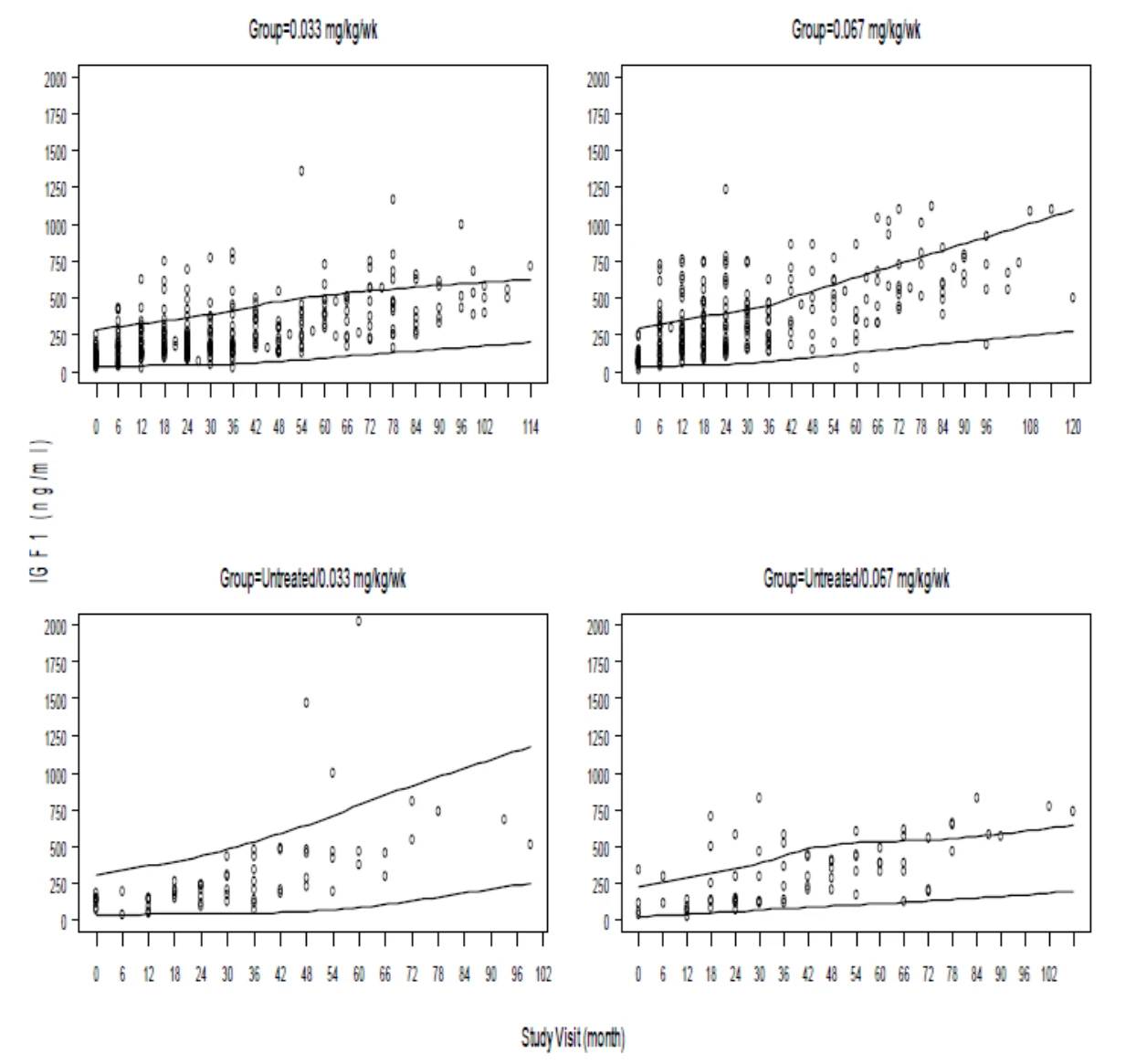
Table 7 summarizes the frequencies of subjects with IGF-1 levels below/above or within normal range, organized for all treatment groups side-by-side and across all visits from a study with another somatropin. Subject groups Untreated/0.033 mg/kg/wk and Untreated/0.067 mg/kg/wk include subjects who served as untreated controls for 12 months or longer, and were subsequently treated with somatropin 0.033 mg/kg/wk or 0.067 mg/kg/wk, respectively. In Figure 1, the solid reference lines were created by averaging individual upper and lower limits of normal ranges across all subjects with observed IGF-1 levels at a given time-point. As such, the reference lines are for overall inference, as they represent an approximation of the exact normative values. As can be seen in the various graphs, IGF-1 levels generally ranged from <20 ng/mL to 593 ng/mL.
Table 7: Frequency of subjects with IGF-1 levels below/above or within normal range for all treatment groups and across all visits
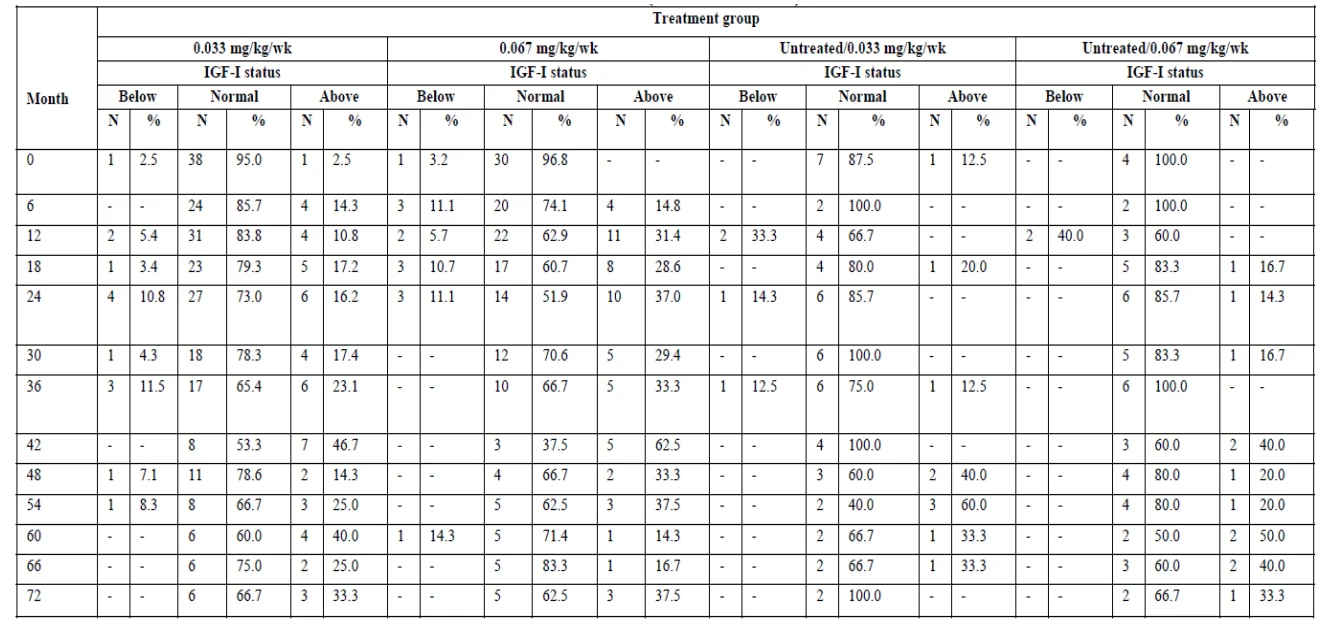
FIGURE 1: IGF-I VALUES BY STUDY MONTH
Clinical Trials in children with Turner Syndrome
In two clinical studies with somatropin in pediatric patients with Turner syndrome, the most frequently reported adverse events were respiratory illnesses (influenza, tonsillitis, otitis, sinusitis), joint pain, and urinary tract infection. The only treatment-related adverse event that occurred in more than 1 patient was joint pain. In one study in children with TS, none of the 42 patients discontinued from the study early while in the second study, none of the patients discontinued before 18 months.
Table 8: Summary of adverse events (AE) that occurred in at least 1 patient - all causality
| WHO Dictionary Term | Somatropin N= 22 | Somatropin plus ethinyloestradiol N=20 |
| Joint Pain | 4 (18.2%) | 3 (15.0%) |
| Epilepsy | 1 (4.5%) | 1 (5.0%) |
| Sinusitis | 1 (4.5%) | 1(5.0%) |
| Cellulitis | 1 (4.5%) | 0 |
| Urinary Tract Infection | 0 | 1 (5.0%) |
| Dysfunctional voiding | 0 | 1 (5.0%) |
| Menarche | 1 (4.5%) | 0 |
| Varicella | 1 (4.5%) | 0 |
| Measles | 1 (4.5%) | 0 |
| Herpes Zoster | 1 (4.5%) | 0 |
| Total AEs | 9(41.0%) | 6 (30.0%) |
Table 9: Summary of adverse events that occurred in at least 1 patient – all causality
| WHO dictionary term | Somatropin N=17 | Somatropin + oxandrolone N=17 | ||||
| Skin and appendage disorders | ||||||
| Furonculosis | 1 (5.9%) | 0 | ||||
| Loss of hair | 1 (5.9%) | 0 | ||||
| Eczema | 0 | 1 (5.9%) | ||||
| Musculo-skeletal system disorders | ||||||
| Joint Pain | 1 (5.9%) | 1 (5.9%) | ||||
| Radius farcture | 0 | 1 (5.9%) | ||||
| Hearing and vestibular disorders | ||||||
| Tympanic membrane | 1 (5.9%) | 0 | ||||
| Psychiatric disorders | ||||||
| Nervousness | 1 (5.9%) | 0 | ||||
| Increased Appetite | 0 | 2 (11.8 %) | ||||
| Liver and biliary system | ||||||
| Hepatitis A | 1 (5.9%) | 0 | ||||
| Hepatic injury | 0 | 1 (5.9%) | ||||
| Metabolic and nutritional disorders | ||||||
| Insulin value increased | 0 | 1 (5.9%) | ||||
| Endocrine disorders | ||||||
| Hypothyroidism | 1 (5.9%) | 0 | ||||
| Thyroiditis | 1 (5.9%) | 0 | ||||
| Vascular (extra cardiac) disorders | ||||||
| Flushing | 1 (5.9%) | 0 | ||||
| Respiratory Infections | ||||||
| Otitis | 3 (17.6%) | 1 (5.9%) | ||||
| Tonsillitis | 2 (11.8%) | 3 (17.6%) | ||||
| Rhinitis | 1 | 0 | ||||
| WHO dictionary term | Somatropin N=17 | Somatropin + oxandrolone N=17 | |||||
| Sinusitis | 2 (11.8%) | 1 (5.9%) | |||||
| Influenza | 1 (5.9%) | 4 (23.5%) | |||||
| Pneumonia | 0 | 1 (5.9%) | |||||
| Bronchitis | 0 | 2 (11.8 %) | |||||
| White cell and res disorders | |||||||
| Neutropenia, chronic | 1 (5.9%) | 0 | |||||
| Platelet, bleeding and clotting disorders | |||||||
| Epistaxis | 2 (11.8%) | 0 | |||||
| Hematoma | 0 | 1 (5.9%) | |||||
| Urinary system disorders | |||||||
| Urinary Tract Infection | 3 (17.6%) | 0 | |||||
| Hematuria | 1 (5.9%) | 0 | |||||
| Enuresis | 0 | 1 (5.9%) | |||||
| Reproductive disorders | |||||||
| Metrorrhagia | 0 | 1 (5.9%) | |||||
| Leukorrhea | 0 | 1 (5.9%) | |||||
| Spotting | 0 | 1 (5.9%) | |||||
| Hemorrhage | 0 | 1 (5.9%) | |||||
| Vaginitis | 0 | 1 (5.9%) | |||||
| Body as a whole – General disorders | |||||||
| Car accident | 0 | 1 (5.9 %) | |||||
| Fatigue | 0 | 1 (5.9%) | |||||
| Voice alteration | 0 | 1 (5.9%) | |||||
Clinical Trials in children with Turner’s syndrome
In one study with the reference product with patients with TS, respiratory infections (otitis, tonsillitis, sinusitis, influenza, bronchitis) represented the majority of adverse events in children with TS with eight patients in the somatropin group and 11 patients in the somatropin and oxandrolone groups. The instances of the respiratory infections were assessed as unrelated to study drug. No patient discontinued treatment due to a treatment related adverse event. Younger patients, including patients with TS, treated or untreated, are known to have generally greater incidence of otitis media and ear problems.
In a second study with the reference product, one patient experienced sinusitis, orbital cellulitis and grand mal seizure. These events were considered to be unlikely related to the study drug as per the investigator and they were also low in frequency.
Clinical Trials in children with Idiopathic Short Stature
In two open-label clinical studies with somatropin in pediatric patients with ISS, the most commonly encountered adverse events include upper respiratory tract infections, influenza, tonsillitis, nasopharyngitis, gastroenteritis, headaches, increased appetite, pyrexia, fracture, altered mood, and arthralgia. In one of the two studies, during somatropin treatment, the mean IGF-1 standard deviation (SD) scores were maintained in the normal range. IGF-1 SD scores above +2 SD were observed as follows: 1 subject (3%), 10 subjects (30%) and 16 subjects (38%) in the untreated control, 0. 23 and the 0.47 mg/kg/week groups, respectively, had at least one measurement; while 0 subjects (0%), 2 subjects (7%) and 6 subjects (14%) had two or more consecutive IGF-1 measurements above +2 SD.
Table 10: Incidence of treatment-emergent adverse events that occurred in at least 1 patient
| Body system / Preferred Term | Prepubertal | Pubertal | Somatropin 0.033 and 0.067 mg/kg/day N = 112 | Untreated Controlsb N = 61 | |||||||||||
0.033 mg/kg/day N = 47 | 0.067 mg/kg/day N = 49 | Untreated Controls N = 46 | 0.067 mg/kg/day N = 16 | Untreated Controls N = 15 | |||||||||||
| n (%) | n (%) | n (%) | n (%) | n (%) | n (%) | n (%) | |||||||||
| Blood and lymphatic system disorders | |||||||||||||||
| Anaemia | 0 (0.0) | 1 (2.0) | 0 (0.0) | 0 (0.0) | 0 (0.0) | 1 (0.9) | 0 (0.0) | ||||||||
| Eosinophilia | 1 (2.1) | 0 (0.0) | 0 (0.0) | 0 (0.0) | 0 (0.0) | 1 (0.9) | 0 (0.0) | ||||||||
| Iron deficiency anaemia | 0 (0.0) | 0 (0.0) | 0 (0.0) | 0 (0.0) | 1 (6.7) | 0 (0.0) | 1 (1.6) | ||||||||
| Lymphadenopathy | 0 (0.0) | 1 (2.0) | 0 (0.0) | 0 (0.0) | 0 (0.0) | 1 (0.9) | 0 (0.0) | ||||||||
| Mononucleosis syndrome | 0 (0.0) | 1 (2.0) | 0 (0.0) | 0 (0.0) | 0 (0.0) | 1 (0.9) | 0 (0.0) | ||||||||
| Congenital, familial and genetic disorders | |||||||||||||||
| Epidermal naevus | 1 (2.1) | 0 (0.0) | 0 (0.0) | 0 (0.0) | 0 (0.0) | 1 (0.9) | 0 (0.0) | ||||||||
| Pigmented naevus | 1 (2.1) | 0 (0.0) | 0 (0.0) | 0 (0.0) | 0 (0.0) | 1 (0.9) | 0 (0.0) | ||||||||
| Skeleton dysplasia | 0 (0.0) | 1 (2.0) | 0 (0.0) | 0 (0.0) | 0 (0.0) | 1 (0.9) | 0 (0.0) | ||||||||
| Ear and labyrinth disorders | |||||||||||||||
| Motion sickness | 0 (0.0) | 0 (0.0) | 1 (2.2) | 0 (0.0) | 0 (0.0) | 0 (0.0) | 1 (1.6) | ||||||||
| Vertigo | 0 (0.0) | 0 (0.0) | 1 (2.2) | 1 (6.3) | 0 (0.0) | 1 (0.9) | 1 (1.6) | ||||||||
| Endocrine disorders | |||||||||||||||
| Delayed puberty | 0 (0.0) | 0 (0.0) | 4 (8.7) | 0 (0.0) | 0 (0.0) | 0 (0.0) | 4 (6.6) | ||||||||
| Goitre | 0 (0.0) | 1 (2.0) | 0 (0.0) | 0 (0.0) | 0 (0.0) | 1 (0.9) | 0 (0.0) | ||||||||
| Pituitary cyst | 1 (2.1) | 0 (0.0) | 0 (0.0) | 0 (0.0) | 0 (0.0) | 1 (0.9) | 0 (0.0) | ||||||||
| Precocious puberty | 0 (0.0) | 0 (0.0) | 1 (2.2) | 0 (0.0) | 0 (0.0) | 0 (0.0) | 1 (1.6) | ||||||||
| Thyroid disorder | 0 (0.0) | 1 (2.0) | 0 (0.0) | 0 (0.0) | 0 (0.0) | 1 (0.9) | 0 (0.0) | ||||||||
| Eye disorders | |||||||||||||||
| Astigmatism | 0 (0.0) | 1 (2.0) | 0 (0.0) | 0 (0.0) | 0 (0.0) | 1 (0.9) | 0 (0.0) | ||||||||
| Conjunctivitis | 1 (2.1) | 1 (2.0) | 1 (2.2) | 1 (6.3) | 0 (0.0) | 3 (2.7) | 1 (1.6) | ||||||||
| Conjunctivitis allergic | 1 (2.1) | 1 (2.0) | 0 (0.0) | 0 (0.0) | 0 (0.0) | 2 (1.8) | 0 (0.0) | ||||||||
| Eye inflammation | 0 (0.0) | 0 (0.0) | 0 (0.0) | 1 (6.3) | 0 (0.0) | 1 (0.9) | 0 (0.0) | ||||||||
| Eye redness | 0 (0.0) | 0 (0.0) | 0 (0.0) | 1 (6.3) | 0 (0.0) | 1 (0.9) | 0 (0.0) | ||||||||
| Visual disturbance | 0 (0.0) | 1 (2.0) | 0 (0.0) | 0 (0.0) | 0 (0.0) | 1 (0.9) | 0 (0.0) | ||||||||
| Gastrointestinal disorders | |||||||||||||||
| Abdominal pain | 0 (0.0) | 0 (0.0) | 0 (0.0) | 0 (0.0) | 1 (6.7) | 0 (0.0) | 1 (1.6) | ||||||||
| Abdominal pain upper | 1 (2.1) | 4 (8.2) | 0 (0.0) | 0 (0.0) | 0 (0.0) | 5 (4.5) | 0 (0.0) | ||||||||
| Constipation | 2 (4.3) | 0 (0.0) | 0 (0.0) | 0 (0.0) | 0 (0.0) | 2 (1.8) | 0 (0.0) | ||||||||
| Nausea | 0 (0.0) | 2 (4.1) | 1 (2.2) | 0 (0.0) | 0 (0.0) | 2 (1.8) | 1 (1.6) | ||||||||
| Tooth disorder | 0 (0.0) | 1 (2.0) | 0 (0.0) | 0 (0.0) | 0 (0.0) | 1 (0.9) | 0 (0.0) | ||||||||
| Vomiting | 0 (0.0) | 1 (2.0) | 0 (0.0) | 0 (0.0) | 0 (0.0) | 1 (0.9) | 0 (0.0) | ||||||||
| Body system / Preferred Term | Prepubertal | Pubertal | Somatropin 0.033 and 0.067 mg/kg/day N = 112 | Untreated Controlsb N = 61 | ||||||||||||||
0.033 mg/kg/day N = 47 | 0.067 mg/kg/day N = 49 | Untreated Controls N = 46 | 0.067 mg/kg/day N = 16 | Untreated Controls N = 15 | ||||||||||||||
| n (%) | n (%) | n (%) | n (%) | n (%) | n (%) | n (%) | ||||||||||||
| General disorders and administration site conditions | ||||||||||||||||||
| Chest discomfort | 1 (2.1) | 1 (2.0) | 0 (0.0) | 0 (0.0) | 0 (0.0) | 2 (1.8) | 0 (0.0) | |||||||||||
| Chest pain | 1 (2.1) | 1 (2.0) | 0 (0.0) | 0 (0.0) | 0 (0.0) | 2 (1.8) | 0 (0.0) | |||||||||||
| Disease recurrence | 1 (2.1) | 0 (0.0) | 0 (0.0) | 0 (0.0) | 0 (0.0) | 1 (0.9) | 0 (0.0) | |||||||||||
| Fatigue | 1 (2.1) | 1 (2.0) | 0 (0.0) | 0 (0.0) | 0 (0.0) | 2 (1.8) | 0 (0.0) | |||||||||||
| Hunger | 0 (0.0) | 0 (0.0) | 0 (0.0) | 1 (6.3) | 0 (0.0) | 1 (0.9) | 0 (0.0) | |||||||||||
| Edema peripheral | 1 (2.1) | 0 (0.0) | 0 (0.0) | 1 (6.3) | 0 (0.0) | 2 (1.8) | 0 (0.0) | |||||||||||
| Pain | 0 (0.0) | 0 (0.0) | 1 (2.2) | 0 (0.0) | 0 (0.0) | 0 (0.0) | 1 (1.6) | |||||||||||
| Pyrexia | 8 (17.0) | 4 (8.2) | 2 (4.3) | 1 (6.3) | 0 (0.0) | 13 (11.6) | 2 (3.3) | |||||||||||
| Thirst | 0 (0.0) | 2 (4.1) | 0 (0.0) | 1 (6.3) | 0 (0.0) | 3 (2.7) | 0 (0.0) | |||||||||||
| Immune system disorders | ||||||||||||||||||
| Hypersensitivity | 1 (2.1) | 3 (6.1) | 2 (4.3) | 0 (0.0) | 0 (0.0) | 4 (3.6) | 2 (3.3) | |||||||||||
| Seasonal allergy | 1 (2.1) | 3 (6.1) | 1 (2.2) | 1 (6.3) | 1 (6.7) | 5 (4.5) | 2 (3.3) | |||||||||||
| Infections and infestations | ||||||||||||||||||
| Appendicitis | 0 (0.0) | 0 (0.0) | 0 (0.0) | 0 (0.0) | 1 (6.7) | 0 (0.0) | 1 (1.6) | |||||||||||
| Borrelia infection | 0 (0.0) | 1 (2.0) | 1 (2.2) | 0 (0.0) | 0 (0.0) | 1 (0.9) | 1 (1.6) | |||||||||||
| Ear infection | 1 (2.1) | 3 (6.1) | 0 (0.0) | 0 (0.0) | 0 (0.0) | 4 (3.6) | 0 (0.0) | |||||||||||
| Eye infection | 1 (2.1) | 0 (0.0) | 0 (0.0) | 1 (6.3) | 0 (0.0) | 2 (1.8) | 0 (0.0) | |||||||||||
| Gastroenteritis | 7 (14.9) | 4 (8.2) | 0 (0.0) | 1 (6.3) | 1 (6.7) | 12 (10.7) | 1 (1.6) | |||||||||||
| Impetigo | 1 (2.1) | 2 (4.1) | 0 (0.0) | 0 (0.0) | 0 (0.0) | 3 (2.7) | 0 (0.0) | |||||||||||
| Infectious mononucleosis | 0 (0.0) | 0 (0.0) | 0 (0.0) | 0 (0.0) | 1 (6.7) | 0 (0.0) | 1 (1.6) | |||||||||||
| Influenza | 8 (17.0) | 7 (14.3) | 2 (4.3) | 3 (18.8) | 1 (6.7) | 18 (16.1) | 3 (4.9) | |||||||||||
| Mycoplasma infection | 2 (4.3) | 1 (2.0) | 0 (0.0) | 0 (0.0) | 0 (0.0) | 3 (2.7) | 0 (0.0) | |||||||||||
| Nasopharyngitis | 7 (14.9) | 5 (10.2) | 1 (2.2) | 0 (0.0) | 0 (0.0) | 12 (10.7) | 1 (1.6) | |||||||||||
| Orchitis | 0 (0.0) | 0 (0.0) | 1 (2.2) | 0 (0.0) | 0 (0.0) | 0 (0.0) | 1 (1.6) | |||||||||||
| Otitis media acute | 1 (2.1) | 0 (0.0) | 0 (0.0) | 0 (0.0) | 0 (0.0) | 1 (0.9) | 0 (0.0) | |||||||||||
| Parotitis | 1 (2.1) | 0 (0.0) | 0 (0.0) | 0 (0.0) | 0 (0.0) | 1 (0.9) | 0 (0.0) | |||||||||||
| Pertussis | 1 (2.1) | 0 (0.0) | 0 (0.0) | 0 (0.0) | 0 (0.0) | 1 (0.9) | 0 (0.0) | |||||||||||
| Pharyngitis | 3 (6.4) | 0 (0.0) | 1 (2.2) | 1 (6.3) | 0 (0.0) | 4 (3.6) | 1 (1.6) | |||||||||||
| Pneumonia | 1 (2.1) | 1 (2.0) | 0 (0.0) | 0 (0.0) | 0 (0.0) | 2 (1.8) | 0 (0.0) | |||||||||||
| Pyelonephritis | 0 (0.0) | 0 (0.0) | 0 (0.0) | 0 (0.0) | 1 (6.7) | 0 (0.0) | 1 (1.6) | |||||||||||
| Respiratory tract infection | 0 (0.0) | 2 (4.1) | 0 (0.0) | 0 (0.0) | 0 (0.0) | 2 (1.8) | 0 (0.0) | |||||||||||
| Rhinitis | 1 (2.1) | 2 (4.1) | 0 (0.0) | 0 (0.0) | 0 (0.0) | 3 (2.7) | 0 (0.0) | |||||||||||
| Scarlet fever | 0 (0.0) | 1 (2.0) | 0 (0.0) | 0 (0.0) | 0 (0.0) | 1 (0.9) | 0 (0.0) | |||||||||||
| Sinusitis | 0 (0.0) | 1 (2.0) | 1 (2.2) | 0 (0.0) | 0 (0.0) | 1 (0.9) | 1 (1.6) | |||||||||||
| Streptococcal infection | 1 (2.1) | 0 (0.0) | 0 (0.0) | 0 (0.0) | 0 (0.0) | 1 (0.9) | 0 (0.0) | |||||||||||
| Tonsillitis | 7 (14.9) | 5 (10.2) | 2 (4.3) | 1 (6.3) | 1 (6.7) | 13 (11.6) | 3 (4.9) | |||||||||||
| Upper respiratory tract infection | 14 (29.8) | 20 (40.8) | 5 (10.9) | 2 (12.5) | 2 (13.3) | 36 (32.1) | 7 (11.5) | |||||||||||
| Body system / Preferred Term | Prepubertal | Pubertal | Somatropin 0.033 and 0.067 mg/kg/day N = 112 | Untreated Controlsb N = 61 | ||||||||||||
0.033 mg/kg/day N = 47 | 0.067 mg/kg/day N = 49 | Untreated Controls N = 46 | 0.067 mg/kg/day N = 16 | Untreated Controls N = 15 | ||||||||||||
| n (%) | n (%) | n (%) | n (%) | n (%) | n (%) | n (%) | ||||||||||
| Urinary tract infection | 0 (0.0) | 0 (0.0) | 1 (2.2) | 1 (6.3) | 0 (0.0) | 1 (0.9) | 1 (1.6) | |||||||||
| Varicella | 1 (2.1) | 0 (0.0) | 2 (4.3) | 1 (6.3) | 0 (0.0) | 2 (1.8) | 2 (3.3) | |||||||||
| Viral infection | 0 (0.0) | 0 (0.0) | 0 (0.0) | 2 (12.5) | 0 (0.0) | 2 (1.8) | 0 (0.0) | |||||||||
| Injury, poisoning and procedural complications | ||||||||||||||||
| Ankle fracture | 0 (0.0) | 1 (2.0) | 0 (0.0) | 0 (0.0) | 0 (0.0) | 1 (0.9) | 0 (0.0) | |||||||||
| Clavicle fracture | 1 (2.1) | 0 (0.0) | 0 (0.0) | 0 (0.0) | 0 (0.0) | 1 (0.9) | 0 (0.0) | |||||||||
| Concussion | 2 (4.3) | 0 (0.0) | 0 (0.0) | 0 (0.0) | 0 (0.0) | 2 (1.8) | 0 (0.0) | |||||||||
| Contusion | 1 (2.1) | 0 (0.0) | 0 (0.0) | 0 (0.0) | 0 (0.0) | 1 (0.9) | 0 (0.0) | |||||||||
| Eye injury | 1 (2.1) | 0 (0.0) | 0 (0.0) | 0 (0.0) | 0 (0.0) | 1 (0.9) | 0 (0.0) | |||||||||
| Fall | 1 (2.1) | 0 (0.0) | 0 (0.0) | 0 (0.0) | 0 (0.0) | 1 (0.9) | 0 (0.0) | |||||||||
| Femur fracture | 1 (2.1) | 0 (0.0) | 0 (0.0) | 0 (0.0) | 0 (0.0) | 1 (0.9) | 0 (0.0) | |||||||||
| Hand fracture | 1 (2.1) | 0 (0.0) | 0 (0.0) | 1 (6.3) | 0 (0.0) | 2 (1.8) | 0 (0.0) | |||||||||
| Head injury | 0 (0.0) | 0 (0.0) | 1 (2.2) | 0 (0.0) | 0 (0.0) | 0 (0.0) | 1 (1.6) | |||||||||
| Joint dislocation | 1 (2.1) | 0 (0.0) | 0 (0.0) | 0 (0.0) | 1 (6.7) | 1 (0.9) | 1 (1.6) | |||||||||
| Joint injury | 2 (4.3) | 1 (2.0) | 0 (0.0) | 0 (0.0) | 0 (0.0) | 3 (2.7) | 0 (0.0) | |||||||||
| Limb injury | 1 (2.1) | 1 (2.0) | 1 (2.2) | 0 (0.0) | 1 (6.7) | 2 (1.8) | 2 (3.3) | |||||||||
| Lower limb fracture | 0 (0.0) | 1 (2.0) | 0 (0.0) | 0 (0.0) | 0 (0.0) | 1 (0.9) | 0 (0.0) | |||||||||
| Mouth injury | 0 (0.0) | 0 (0.0) | 1 (2.2) | 0 (0.0) | 0 (0.0) | 0 (0.0) | 1 (1.6) | |||||||||
| Overdose | 1 (2.1) | 0 (0.0) | 0 (0.0) | 0 (0.0) | 0 (0.0) | 1 (0.9) | 0 (0.0) | |||||||||
| Radius fracture | 0 (0.0) | 1 (2.0) | 0 (0.0) | 0 (0.0) | 0 (0.0) | 1 (0.9) | 0 (0.0) | |||||||||
| Road traffic accident | 1 (2.1) | 1 (2.0) | 1 (2.2) | 0 (0.0) | 1 (6.7) | 2 (1.8) | 2 (3.3) | |||||||||
| Skull fracture | 0 (0.0) | 0 (0.0) | 0 (0.0) | 0 (0.0) | 1 (6.7) | 0 (0.0) | 1 (1.6) | |||||||||
| Tibia fracture | 1 (2.1) | 1 (2.0) | 0 (0.0) | 0 (0.0) | 0 (0.0) | 2 (1.8) | 0 (0.0) | |||||||||
| Wound | 2 (4.3) | 0 (0.0) | 0 (0.0) | 0 (0.0) | 0 (0.0) | 2 (1.8) | 0 (0.0) | |||||||||
| Investigations | ||||||||||||||||
| Blood immunoglobulin G decreased | 0 (0.0) | 0 (0.0) | 1 (2.2) | 0 (0.0) | 0 (0.0) | 0 (0.0) | 1 (1.6) | |||||||||
| Blood testosterone decreased | 1 (2.1) | 0 (0.0) | 0 (0.0) | 0 (0.0) | 0 (0.0) | 1 (0.9) | 0 (0.0) | |||||||||
| Blood thyroid stimulating hormone decreased | 0 (0.0) | 1 (2.0) | 0 (0.0) | 0 (0.0) | 1 (6.7) | 1 (0.9) | 1 (1.6) | |||||||||
| Cardiac murmur | 0 (0.0) | 0 (0.0) | 1 (2.2) | 0 (0.0) | 0 (0.0) | 0 (0.0) | 1 (1.6) | |||||||||
| Haemoglobin decreased | 0 (0.0) | 0 (0.0) | 0 (0.0) | 0 (0.0) | 1 (6.7) | 0 (0.0) | 1 (1.6) | |||||||||
| Heart rate irregular | 0 (0.0) | 0 (0.0) | 0 (0.0) | 0 (0.0) | 1 (6.7) | 0 (0.0) | 1 (1.6) | |||||||||
| Heart sounds abnormal | 0 (0.0) | 0 (0.0) | 1 (2.2) | 0 (0.0) | 0 (0.0) | 0 (0.0) | 1 (1.6) | |||||||||
| Thyroxine decreased | 0 (0.0) | 0 (0.0) | 0 (0.0) | 0 (0.0) | 1 (6.7) | 0 (0.0) | 1 (1.6) | |||||||||
| Thyroxine free decreased | 0 (0.0) | 2 (4.1) | 0 (0.0) | 0 (0.0) | 0 (0.0) | 2 (1.8) | 0 (0.0) | |||||||||
| Metabolism and nutrition disorders | ||||||||||||||||
| Appetite disorder | 1 (2.1) | 0 (0.0) | 0 (0.0) | 0 (0.0) | 0 (0.0) | 1 (0.9) | 0 (0.0) | |||||||||
| Decreased appetite | 2 (4.3) | 0 (0.0) | 0 (0.0) | 0 (0.0) | 0 (0.0) | 2 (1.8) | 0 (0.0) | |||||||||
| Increased appetite | 6 (12.8) | 5 (10.2) | 0 (0.0) | 3 (18.8) | 0 (0.0) | 14 (12.5) | 0 (0.0) | |||||||||
| Body system / Preferred Term | Prepubertal | Pubertal | Somatropin 0.033 and 0.067 mg/kg/day N = 112 | Untreated Controlsb N = 61 | ||||||||||||
0.033 mg/kg/day N = 47 | 0.067 mg/kg/day N = 49 | Untreated Controls N = 46 | 0.067 mg/kg/day N = 16 | Untreated Controls N = 15 | ||||||||||||
| n (%) | n (%) | n (%) | n (%) | n (%) | n (%) | n (%) | ||||||||||
| Lactose intolerance | 0 (0.0) | 0 (0.0) | 0 (0.0) | 1 (6.3) | 0 (0.0) | 1 (0.9) | 0 (0.0) | |||||||||
| Markedly reduced dietary intake | 0 (0.0) | 1 (2.0) | 0 (0.0) | 0 (0.0) | 0 (0.0) | 1 (0.9) | 0 (0.0) | |||||||||
| Musculoskeletal and connective tissue disorders | ||||||||||||||||
| Arthralgia | 2 (4.3) | 5 (10.2) | 1 (2.2) | 0 (0.0) | 1 (6.7) | 7 (6.3) | 2 (3.3) | |||||||||
| Back disorder | 0 (0.0) | 1 (2.0) | 0 (0.0) | 0 (0.0) | 0 (0.0) | 1 (0.9) | 0 (0.0) | |||||||||
| Back pain | 0 (0.0) | 5 (10.2) | 1 (2.2) | 0 (0.0) | 2 (13.3) | 5 (4.5) | 3 (4.9) | |||||||||
| Jaw disorder | 0 (0.0) | 1 (2.0) | 0 (0.0) | 0 (0.0) | 0 (0.0) | 1 (0.9) | 0 (0.0) | |||||||||
| Limb discomfort | 0 (0.0) | 1 (2.0) | 0 (0.0) | 0 (0.0) | 0 (0.0) | 1 (0.9) | 0 (0.0) | |||||||||
| Lower limb deformity | 0 (0.0) | 1 (2.0) | 0 (0.0) | 0 (0.0) | 0 (0.0) | 1 (0.9) | 0 (0.0) | |||||||||
| Muscle cramp | 0 (0.0) | 0 (0.0) | 1 (2.2) | 0 (0.0) | 0 (0.0) | 0 (0.0) | 1 (1.6) | |||||||||
| Neck pain | 0 (0.0) | 1 (2.0) | 0 (0.0) | 0 (0.0) | 0 (0.0) | 1 (0.9) | 0 (0.0) | |||||||||
| Osteochondrosis | 0 (0.0) | 0 (0.0) | 1 (2.2) | 1 (6.3) | 0 (0.0) | 1 (0.9) | 1 (1.6) | |||||||||
| Pain in extremity | 1 (2.1) | 3 (6.1) | 0 (0.0) | 0 (0.0) | 0 (0.0) | 4 (3.6) | 0 (0.0) | |||||||||
| Patellofemoral pain syndrome | 1 (2.1) | 0 (0.0) | 0 (0.0) | 0 (0.0) | 0 (0.0) | 1 (0.9) | 0 (0.0) | |||||||||
| Periostitis | 1 (2.1) | 0 (0.0) | 0 (0.0) | 0 (0.0) | 0 (0.0) | 1 (0.9) | 0 (0.0) | |||||||||
| Scoliosis | 0 (0.0) | 0 (0.0) | 0 (0.0) | 1 (6.3) | 0 (0.0) | 1 (0.9) | 0 (0.0) | |||||||||
| Tendonitis | 0 (0.0) | 1 (2.0) | 0 (0.0) | 0 (0.0) | 0 (0.0) | 1 (0.9) | 0 (0.0) | |||||||||
| Torticollis | 0 (0.0) | 0 (0.0) | 0 (0.0) | 1 (6.3) | 0 (0.0) | 1 (0.9) | 0 (0.0) | |||||||||
| Nervous system disorders | ||||||||||||||||
| Disturbance in attention | 0 (0.0) | 1 (2.0) | 0 (0.0) | 0 (0.0) | 0 (0.0) | 1 (0.9) | 0 (0.0) | |||||||||
| Epilepsy | 0 (0.0) | 1 (2.0) | 0 (0.0) | 0 (0.0) | 0 (0.0) | 1 (0.9) | 0 (0.0) | |||||||||
| Facial paresis | 0 (0.0) | 0 (0.0) | 1 (2.2) | 0 (0.0) | 0 (0.0) | 0 (0.0) | 1 (1.6) | |||||||||
| Headache | 5 (10.6) | 9 (18.4) | 5 (10.9) | 2 (12.5) | 0 (0.0) | 16 (14.3) | 5 (8.2) | |||||||||
| Migraine | 1 (2.1) | 1 (2.0) | 1 (2.2) | 1 (6.3) | 1 (6.7) | 3 (2.7) | 2 (3.3) | |||||||||
| Movement disorder | 0 (0.0) | 0 (0.0) | 1 (2.2) | 0 (0.0) | 0 (0.0) | 0 (0.0) | 1 (1.6) | |||||||||
| Nervous system disorder | 1 (2.1) | 0 (0.0) | 0 (0.0) | 0 (0.0) | 0 (0.0) | 1 (0.9) | 0 (0.0) | |||||||||
| Paraesthesia | 0 (0.0) | 0 (0.0) | 0 (0.0) | 1 (6.3) | 0 (0.0) | 1 (0.9) | 0 (0.0) | |||||||||
| Petit mal epilepsy | 1 (2.1) | 0 (0.0) | 0 (0.0) | 0 (0.0) | 0 (0.0) | 1 (0.9) | 0 (0.0) | |||||||||
| Psychomotor hyperactivity | 0 (0.0) | 1 (2.0) | 0 (0.0) | 0 (0.0) | 0 (0.0) | 1 (0.9) | 0 (0.0) | |||||||||
| Syncope | 2 (4.3) | 1 (2.0) | 0 (0.0) | 0 (0.0) | 0 (0.0) | 3 (2.7) | 0 (0.0) | |||||||||
| Psychiatric disorders | ||||||||||||||||
| Aggression | 3 (6.4) | 3 (6.1) | 0 (0.0) | 0 (0.0) | 0 (0.0) | 6 (5.4) | 0 (0.0) | |||||||||
| Apathy | 1 (2.1) | 0 (0.0) | 0 (0.0) | 0 (0.0) | 0 (0.0) | 1 (0.9) | 0 (0.0) | |||||||||
| Attention deficit/hyperactivity disorder | 1 (2.1) | 0 (0.0) | 0 (0.0) | 0 (0.0) | 0 (0.0) | 1 (0.9) | 0 (0.0) | |||||||||
| Depressed mood | 1 (2.1) | 1 (2.0) | 0 (0.0) | 0 (0.0) | 0 (0.0) | 2 (1.8) | 0 (0.0) | |||||||||
| Depression | 0 (0.0) | 0 (0.0) | 1 (2.2) | 0 (0.0) | 0 (0.0) | 0 (0.0) | 1 (1.6) | |||||||||
| Dissociative identity disorder | 1 (2.1) | 0 (0.0) | 0 (0.0) | 0 (0.0) | 0 (0.0) | 1 (0.9) | 0 (0.0) | |||||||||
| Eating disorder | 1 (2.1) | 0 (0.0) | 0 (0.0) | 0 (0.0) | 0 (0.0) | 1 (0.9) | 0 (0.0) | |||||||||
| Body system / Preferred Term | Prepubertal | Pubertal | Somatropin 0.033 and 0.067 mg/kg/day N = 112 | Untreated Controlsb N = 61 | ||||||||||||
0.033 mg/kg/day N = 47 | 0.067 mg/kg/day N = 49 | Untreated Controls N = 46 | 0.067 mg/kg/day N = 16 | Untreated Controls N = 15 | ||||||||||||
| n (%) | n (%) | n (%) | n (%) | n (%) | n (%) | n (%) | ||||||||||
| Elevated mood | 0 (0.0) | 1 (2.0) | 0 (0.0) | 0 (0.0) | 0 (0.0) | 1 (0.9) | 0 (0.0) | |||||||||
| Euphoric mood | 0 (0.0) | 1 (2.0) | 0 (0.0) | 0 (0.0) | 0 (0.0) | 1 (0.9) | 0 (0.0) | |||||||||
| Impulse-control disorder | 1 (2.1) | 0 (0.0) | 0 (0.0) | 0 (0.0) | 0 (0.0) | 1 (0.9) | 0 (0.0) | |||||||||
| Irritability | 2 (4.3) | 2 (4.1) | 0 (0.0) | 0 (0.0) | 0 (0.0) | 4 (3.6) | 0 (0.0) | |||||||||
| Mental disorder | 1 (2.1) | 0 (0.0) | 2 (4.3) | 0 (0.0) | 0 (0.0) | 1 (0.9) | 2 (3.3) | |||||||||
| Mood altered | 3 (6.4) | 7 (14.3) | 0 (0.0) | 2 (12.5) | 0 (0.0) | 12 (10.7) | 0 (0.0) | |||||||||
| Mood swings | 3 (6.4) | 3 (6.1) | 1 (2.2) | 0 (0.0) | 0 (0.0) | 6 (5.4) | 1 (1.6) | |||||||||
| Personality change | 1 (2.1) | 0 (0.0) | 0 (0.0) | 0 (0.0) | 0 (0.0) | 1 (0.9) | 0 (0.0) | |||||||||
| School refusal | 1 (2.1) | 0 (0.0) | 0 (0.0) | 0 (0.0) | 0 (0.0) | 1 (0.9) | 0 (0.0) | |||||||||
| Sleep disorder | 1 (2.1) | 0 (0.0) | 0 (0.0) | 0 (0.0) | 0 (0.0) | 1 (0.9) | 0 (0.0) | |||||||||
| Social phobia | 0 (0.0) | 1 (2.0) | 0 (0.0) | 0 (0.0) | 0 (0.0) | 1 (0.9) | 0 (0.0) | |||||||||
| Stress symptoms | 1 (2.1) | 0 (0.0) | 0 (0.0) | 0 (0.0) | 0 (0.0) | 1 (0.9) | 0 (0.0) | |||||||||
| Renal and urinary disorders | ||||||||||||||||
| Calculus bladder | 0 (0.0) | 0 (0.0) | 1 (2.2) | 0 (0.0) | 0 (0.0) | 0 (0.0) | 1 (1.6) | |||||||||
| Reproductive system and breast disorders | ||||||||||||||||
| Dysmenorrhoea | 0 (0.0) | 0 (0.0) | 0 (0.0) | 0 (0.0) | 1 (6.7) | 0 (0.0) | 1 (1.6) | |||||||||
| Gynaecomastia | 0 (0.0) | 1 (2.0) | 0 (0.0) | 0 (0.0) | 0 (0.0) | 1 (0.9) | 0 (0.0) | |||||||||
| Hydrocele | 0 (0.0) | 1 (2.0) | 1 (2.2) | 0 (0.0) | 0 (0.0) | 1 (0.9) | 1 (1.6) | |||||||||
| Menorrhagia | 1 (2.1) | 0 (0.0) | 0 (0.0) | 0 (0.0) | 0 (0.0) | 1 (0.9) | 0 (0.0) | |||||||||
| Phimosis | 1 (2.1) | 0 (0.0) | 0 (0.0) | 1 (6.3) | 0 (0.0) | 2 (1.8) | 0 (0.0) | |||||||||
| Testicular torsion | 0 (0.0) | 1 (2.0) | 0 (0.0) | 1 (6.3) | 0 (0.0) | 2 (1.8) | 0 (0.0) | |||||||||
| Respiratory, thoracic and mediastinal disorders | ||||||||||||||||
| Asthma | 1 (2.1) | 3 (6.1) | 2 (4.3) | 1 (6.3) | 0 (0.0) | 5 (4.5) | 2 (3.3) | |||||||||
| Cough | 2 (4.3) | 2 (4.1) | 1 (2.2) | 1 (6.3) | 0 (0.0) | 5 (4.5) | 1 (1.6) | |||||||||
| Dyspnoea | 1 (2.1) | 0 (0.0) | 1 (2.2) | 0 (0.0) | 0 (0.0) | 1 (0.9) | 1 (1.6) | |||||||||
| Nasal congestion | 1 (2.1) | 2 (4.1) | 0 (0.0) | 0 (0.0) | 0 (0.0) | 3 (2.7) | 0 (0.0) | |||||||||
| Pharyngolaryngeal pain | 1 (2.1) | 5 (10.2) | 2 (4.3) | 0 (0.0) | 0 (0.0) | 6 (5.4) | 2 (3.3) | |||||||||
| Rhinitis allergic | 1 (2.1) | 3 (6.1) | 0 (0.0) | 0 (0.0) | 0 (0.0) | 4 (3.6) | 0 (0.0) | |||||||||
| Skin and subcutaneous tissue disorders | ||||||||||||||||
| Cafe au lait spots | 0 (0.0) | 0 (0.0) | 1 (2.2) | 0 (0.0) | 0 (0.0) | 0 (0.0) | 1 (1.6) | |||||||||
| Dermal cyst | 0 (0.0) | 1 (2.0) | 0 (0.0) | 0 (0.0) | 0 (0.0) | 1 (0.9) | 0 (0.0) | |||||||||
| Dermatitis allergic | 0 (0.0) | 0 (0.0) | 0 (0.0) | 1 (6.3) | 0 (0.0) | 1 (0.9) | 0 (0.0) | |||||||||
| Eczema | 2 (4.3) | 1 (2.0) | 1 (2.2) | 0 (0.0) | 0 (0.0) | 3 (2.7) | 1 (1.6) | |||||||||
| Hyperhidrosis | 0 (0.0) | 1 (2.0) | 0 (0.0) | 0 (0.0) | 0 (0.0) | 1 (0.9) | 0 (0.0) | |||||||||
| Ingrowing nail | 0 (0.0) | 1 (2.0) | 0 (0.0) | 0 (0.0) | 0 (0.0) | 1 (0.9) | 0 (0.0) | |||||||||
| Pigmentation disorder | 0 (0.0) | 0 (0.0) | 0 (0.0) | 1 (6.3) | 0 (0.0) | 1 (0.9) | 0 (0.0) | |||||||||
| Prurigo | 1 (2.1) | 0 (0.0) | 1 (2.2) | 0 (0.0) | 0 (0.0) | 1 (0.9) | 1 (1.6) | |||||||||
| Psoriasis | 1 (2.1) | 0 (0.0) | 0 (0.0) | 0 (0.0) | 0 (0.0) | 1 (0.9) | 0 (0.0) | |||||||||
| Skin disorder | 0 (0.0) | 1 (2.0) | 0 (0.0) | 0 (0.0) | 0 (0.0) | 1 (0.9) | 0 (0.0) | |||||||||
| Body system / Preferred Term | Prepubertal | Pubertal | Somatropin 0.033 and 0.067 mg/kg/day N = 112 | Untreated Controlsb N = 61 | |||||||||||
0.033 mg/kg/day N = 47 | 0.067 mg/kg/day N = 49 | Untreated Controls N = 46 | 0.067 mg/kg/day N = 16 | Untreated Controls N = 15 | |||||||||||
| n (%) | n (%) | n (%) | n (%) | n (%) | n (%) | n (%) | |||||||||
| Urticaria | 1 (2.1) | 0 (0.0) | 2 (4.3) | 0 (0.0) | 0 (0.0) | 1 (0.9) | 2 (3.3) | ||||||||
| Social circumstances | |||||||||||||||
| Corrective lens user | 0 (0.0) | 1 (2.0) | 0 (0.0) | 0 (0.0) | 0 (0.0) | 1 (0.9) | 0 (0.0) | ||||||||
| Death of parent | 1 (2.1) | 0 (0.0) | 0 (0.0) | 0 (0.0) | 0 (0.0) | 1 (0.9) | 0 (0.0) | ||||||||
| Death of relative | 1 (2.1) | 1 (2.0) | 0 (0.0) | 0 (0.0) | 0 (0.0) | 2 (1.8) | 0 (0.0) | ||||||||
| Death of sibling | 0 (0.0) | 1 (2.0) | 0 (0.0) | 0 (0.0) | 0 (0.0) | 1 (0.9) | 0 (0.0) | ||||||||
| Divorced parents | 0 (0.0) | 0 (0.0) | 0 (0.0) | 0 (0.0) | 1 (6.7) | 0 (0.0) | 1 (1.6) | ||||||||
| Physical assault | 1 (2.1) | 0 (0.0) | 0 (0.0) | 0 (0.0) | 0 (0.0) | 1 (0.9) | 0 (0.0) | ||||||||
| Smoker | 0 (0.0) | 1 (2.0) | 0 (0.0) | 0 (0.0) | 0 (0.0) | 1 (0.9) | 0 (0.0) | ||||||||
| Social problem | 1 (2.1) | 0 (0.0) | 0 (0.0) | 0 (0.0) | 0 (0.0) | 1 (0.9) | 0 (0.0) | ||||||||
| Surgical and medical procedures | |||||||||||||||
| Appendicectomy | 1 (2.1) | 1 (2.0) | 0 (0.0) | 0 (0.0) | 0 (0.0) | 2 (1.8) | 0 (0.0) | ||||||||
| Brain tumour operation | 0 (0.0) | 0 (0.0) | 1 (2.2) | 0 (0.0) | 0 (0.0) | 0 (0.0) | 1 (1.6) | ||||||||
| Ear tube insertion | 0 (0.0) | 1 (2.0) | 0 (0.0) | 0 (0.0) | 0 (0.0) | 1 (0.9) | 0 (0.0) | ||||||||
| Hernia repair | 0 (0.0) | 1 (2.0) | 0 (0.0) | 0 (0.0) | 0 (0.0) | 1 (0.9) | 0 (0.0) | ||||||||
| Meniscus operation | 0 (0.0) | 1 (2.0) | 0 (0.0) | 0 (0.0) | 0 (0.0) | 1 (0.9) | 0 (0.0) | ||||||||
| Skin neoplasm excision | 1 (2.1) | 0 (0.0) | 0 (0.0) | 0 (0.0) | 0 (0.0) | 1 (0.9) | 0 (0.0) | ||||||||
| Surgery | 1 (2.1) | 0 (0.0) | 1 (2.2) | 1 (6.3) | 0 (0.0) | 2 (1.8) | 1 (1.6) | ||||||||
| Tonsillectomy | 1 (2.1) | 0 (0.0) | 0 (0.0) | 0 (0.0) | 0 (0.0) | 1 (0.9) | 0 (0.0) | ||||||||
| Tooth extraction | 1 (2.1) | 0 (0.0) | 0 (0.0) | 0 (0.0) | 0 (0.0) | 1 (0.9) | 0 (0.0) | ||||||||
| Vascular disorders | |||||||||||||||
| Hypertension | 0 (0.0) | 1 (2.0) | 0 (0.0) | 0 (0.0) | 0 (0.0) | 1 (0.9) | 0 (0.0) | ||||||||
| Hypotension | 1 (2.1) | 0 (0.0) | 0 (0.0) | 0 (0.0) | 0 (0.0) | 1 (0.9) | 0 (0.0) | ||||||||
Table 11: Treatment-related adverse events based on probable, possible, not assessable, and unknown definition and reported in ≥ 2% of somatropin treated subjects
| Adverse Event | Somatropin a 0.033 and 0.067 mg/kg/day N = 112 | Untreated Controlsb N = 61 | Prepubertal | Pubertal | ||||||||||||||||
0.033 mg/kg/day N = 47 | 0.067 mg/kg/day N = 49 | Untreated Controls N = 46 | 0.067 mg/kg/day N = 16 | Untreated Controls N = 15 | ||||||||||||||||
| n | % | n | % | n | % | n | % | n | % | n | % | n | % | |||||||
Upper respiratory infection | 15 | 13.4 | 2 | 3.3 | 8 | 17.0 | 6 | 12.2 | 2 | 4.3 | 1 | 6.3 | 0 | 0.0 | ||||||
| Increased appetite | 14 | 12.5 | 0 | 0.0 | 6 | 12.8 | 5 | 10.2 | 0 | 0.0 | 3 | 18.8 | 0 | 0.0 | ||||||
| Mood altered | 11 | 9.8 | 0 | 0.0 | 3 | 6.4 | 6 | 12.2 | 0 | 0.0 | 2 | 12.5 | 0 | 0.0 | ||||||
| Headache | 10 | 8.9 | 1 | 1.6 | 5 | 10.6 | 4 | 8.2 | 1 | 2.2 | 1 | 6.3 | 0 | 0.0 | ||||||
| Influenza | 9 | 8.0 | 0 | 0.0 | 5 | 10.6 | 3 | 6.1 | 0 | 0.0 | 1 | 6.3 | 0 | 0.0 | ||||||
| Gastroenteritis | 6 | 5.4 | 0 | 0.0 | 3 | 6.4 | 3 | 6.1 | 0 | 0.0 | 0 | 0.0 | 0 | 0.0 | ||||||
| Nasopharyngitis | 6 | 5.4 | 1 | 1.6 | 4 | 8.5 | 2 | 4.1 | 1 | 2.2 | 0 | 0.0 | 0 | 0.0 | ||||||
| Aggression | 5 | 4.5 | 0 | 0.0 | 3 | 6.4 | 2 | 4.1 | 0 | 0.0 | 0 | 0.0 | 0 | 0.0 | ||||||
| Fracturec | 4 | 3.6 | 0 | 0.0 | 2 | 4.2 | 2 | 4.1 | 0 | 0.0 | 0 | 0.0 | 0 | 0.0 | ||||||
| Adverse Event | Somatropin a 0.033 and 0.067 mg/kg/day N = 112 | Untreated Controlsb N = 61 | Prepubertal | Pubertal | |||||||||||||||
0.033 mg/kg/day N = 47 | 0.067 mg/kg/day N = 49 | Untreated Controls N = 46 | 0.067 mg/kg/day N = 16 | Untreated Controls N = 15 | |||||||||||||||
| n | % | n | % | n | % | n | % | n | % | n | % | n | % | ||||||
| Pharyngolaryngeal pain | 4 | 3.6 | 1 | 1.6 | 1 | 2.1 | 3 | 6.1 | 1 | 2.2 | 0 | 0.0 | 0 | 0.0 | |||||
| Rhinitis allergic | 4 | 3.6 | 0 | 0.0 | 1 | 2.1 | 3 | 6.1 | 0 | 0.0 | 0 | 0.0 | 0 | 0.0 | |||||
| Mood swings | 4 | 3.6 | 1 | 1.6 | 3 | 6.4 | 1 | 2.0 | 1 | 2.2 | 0 | 0.0 | 0 | 0.0 | |||||
| Ear infection | 3 | 2.7 | 0 | 0.0 | 1 | 2.1 | 2 | 4.1 | 0 | 0.0 | 0 | 0.0 | 0 | 0.0 | |||||
| Tonsillitis | 3 | 2.7 | 2 | 3.3 | 0 | 0.0 | 2 | 4.1 | 2 | 4.3 | 1 | 6.3 | 0 | 0.0 | |||||
| Cough | 3 | 2.7 | 1 | 1.6 | 1 | 2.1 | 2 | 4.1 | 1 | 2.2 | 0 | 0.0 | 0 | 0.0 | |||||
a Includes all somatropin treated Subjects in the Safety Analysis Population. b Includes all Untreated Controls in the Safety Analysis Population. c Consists of: ankle fracture (n = 1 somatropin), clavicle fracture (n = 1 somatropin), radius fracture (n = 1 somatropin), tibia fracture (n = 2 somatropin). | |||||||||||||||||||
Adverse Events Leading to Termination of Treatment
Clinical trial adverse drug reactions that lead to treatment termination are listed below:
Dissociative identity disorder, pituitary cyst, mood swings and irritability.
Table 12: Incidence (%) of treatment-emergent adverse events reported in ≥ 1% of patients
| Body system / Preferred Term | Somatropin 0.047 mg/kg/day N = 18 | Control group N = 19 | ||||
| n | % | n | % | |||
| Endocrine Disorders | ||||||
| Hypothyroidism | 2 | 11.1 | 0 | 0.0 | ||
| Infection | 3 | 16.7 | 1 | 5.3 | ||
| Eye Disorders | ||||||
| Hypermetropia | 1 | 5.6 | 0 | 0.0 | ||
| General Disorders and Administration Site Conditions | ||||||
| Influenza like illness | 2 | 11.1 | 0 | 0.0 | ||
| Injection site rash | 1 | 5.6 | 0 | 0.0 | ||
| Pyrexia | 1 | 5.6 | 0 | 0.0 | ||
| Investigations | ||||||
| Increased alanine aminotransferase | 1 | 5.6 | 0 | 0.0 | ||
| Increased aspartate aminotransferase | 1 | 5.6 | 0 | 0.0 | ||
| Increased blood insulin | 1 | 5.6 | 0 | 0.0 | ||
| Decreased blood thyroid stimulating hormone | 1 | 5.6 | 0 | 0.0 | ||
| Increased blood thyroid stimulating hormone | 1 | 5.6 | 0 | 0.0 | ||
| Increased tri-iodothyronine | 1 | 5.6 | 0 | 0.0 | ||
| Increased blood triglycerides | 1 | 5.6 | 0 | 0.0 | ||
| Eosinophil percentage increased | 2 | 11.1 | 0 | 0.0 | ||
| Decreased oestradiol | 1 | 5.6 | 0 | 0.0 | ||
| Body system / Preferred Term | Somatropin 0.047 mg/kg/day N = 18 | Control group N = 19 | |||||
| n | % | n | % | ||||
| Metabolism and Nutrition Disorders | |||||||
| Impaired glucose tolerance | 1 | 5.6 | 0 | 0.0 | |||
| Trace element deficiency | 1 | 5.6 | 0 | 0.0 | |||
| Ear and Labyrinth Disorders | |||||||
| Middle ear effusion | 1 | 5.6 | 0 | 0.0 | |||
| Gastrointestinal Disorders | |||||||
| Diarrhoea | 1 | 5.6 | 1 | 5.3 | |||
| Nausea | 1 | 5.6 | 0 | 0.0 | |||
| Umbilical hernia | 1 | 5.6 | 0 | 0.0 | |||
| Vomiting | 2 | 11.1 | 1 | 5.3 | |||
| Infections and Infestations | |||||||
| Acute tonsillitis | 4 | 22.2 | 0 | 0.0 | |||
| Bronchitis | 3 | 16.7 | 3 | 15.8 | |||
| Ear infection | 1 | 5.6 | 0 | 0.0 | |||
| Febrile infection | 2 | 11.1 | 1 | 5.3 | |||
| Gastroenteritis | 2 | 11.1 | 1 | 5.3 | |||
| Measles | 0 | 0.0 | 1 | 5.3 | |||
| Nasopharyngitis | 2 | 11.1 | 0 | 0.0 | |||
| Otitis media | 1 | 5.6 | 1 | 5.3 | |||
| Otitis media acute | 0 | 0.0 | 1 | 5.3 | |||
| Rhinitis | 2 | 11.1 | 0 | 0.0 | |||
| Rubella | 1 | 5.6 | 0 | 0.0 | |||
| Scarlet fever | 1 | 5.6 | 1 | 5.3 | |||
| Sinusitis | 1 | 5.6 | 0 | 0.0 | |||
| Skin infection | 1 | 5.6 | 0 | 0.0 | |||
| Tonsillitis | 3 | 16.7 | 0 | 0.0 | |||
| Infections and Infestations | |||||||
| Upper respiratory tract infection | 2 | 11.1 | 1 | 5.3 | |||
| Varicella | 0 | 0.0 | 1 | 5.3 | |||
| Viral infection | 2 | 11.1 | 0 | 0.0 | |||
| Viral upper respiratory tract infection | 0 | 0.0 | 1 | 5.3 | |||
| Injury, Poisoning and Procedural Complications | |||||||
| Arthropod bite | 1 | 5.6 | 0 | 0.0 | |||
| Concussion | 1 | 5.6 | 0 | 0.0 | |||
| Fall | 1 | 5.6 | 0 | 0.0 | |||
| Foot fracture | 1 | 5.6 | 0 | 0.0 | |||
| Skin injury | 1 | 5.6 | 0 | 0.0 | |||
| Musculoskeletal and Connective Tissue Disorders | |||||||
| Arthralgia | 1 | 5.6 | 0 | 0.0 | |||
| Nervous System Disorders | |||||||
| Disturbance in attention | 1 | 5.6 | 0 | 0.0 | |||
| Dizziness | 1 | 5.6 | 0 | 0.0 | |||
| Body system / Preferred Term | Somatropin 0.047 mg/kg/day N = 18 | Control group N = 19 | ||||
| n | % | n | % | |||
| Headache | 4 | 22.2 | 0 | 0.0 | ||
| Mental impairment | 1 | 5.6 | 0 | 0.0 | ||
| Petit mal epilepsy | 1 | 5.6 | 0 | 0.0 | ||
| Renal and Urinary Disorders | ||||||
| Leukocyturia | 1 | 5.6 | 0 | 0.0 | ||
| Reproductive System and Breast Disorders | ||||||
| Balanitis | 0 | 0.0 | 1 | 5.3 | ||
| Breast induration | 1 | 5.6 | 0 | 0.0 | ||
| Breast swelling | 1 | 5.6 | 0 | 0.0 | ||
| Gynaecomastia | 1 | 5.6 | 0 | 0.0 | ||
| Respiratory, Thoracic and Mediastinal Disorders | ||||||
| Asthma | 0 | 0.0 | 1 | 5.3 | ||
| Cough | 1 | 5.6 | 0 | 0.0 | ||
| Pharyngolaryngeal pain | 1 | 5.6 | 0 | 0.0 | ||
| Skin and Subcutaneous Tissue Disorders | ||||||
| Dermatitis allergic | 1 | 5.6 | 0 | 0.0 | ||
| Dermatitis atopic | 1 | 5.6 | 0 | 0.0 | ||
| Eczema | 1 | 5.6 | 0 | 0.0 | ||
| Hyperhidrosis | 1 | 5.6 | 0 | 0.0 | ||
| Neurodermatitis | 1 | 5.6 | 1 | 5.3 | ||
| Pruritus | 1 | 5.6 | 0 | 0.0 | ||
| Psoriasis | 1 | 5.6 | 0 | 0.0 | ||
| Surgical and Medical Procedures | ||||||
| Adenoidectomy | 0 | 0.0 | 1 | 5.3 | ||
| Adenotonsillectomy | 0 | 0.0 | 1 | 5.3 | ||
| Myringotomy | 0 | 0.0 | 1 | 5.3 | ||
| Nasal polypectomy | 0 | 0.0 | 1 | 5.3 | ||
| Umbilical hernia repair | 1 | 5.6 | 0 | 0.0 | ||
Clinical Trials in children with Idiopathic Short Stature
In ISS studies with the reference product, the most frequently encountered respiratory adverse events, seen in ≥ 5 % of subjects, included infections and infestations (upper respiratory tract infections, influenza, tonsillitis, nasopharyngitis).
In the pivotal study with the reference product, eight of the 15 subjects with upper respiratory infection were in the lower dose somatropin treatment group (0.033 mg/kg/day; prepubertal) and seven received 0.067 mg/kg/day (six prepubertal and one pubertal).
Influenza occurred in four subjects that received 0.067 mg/kg/day (three prepubertal and one pubertal) and in five subjects that received 0.033 mg/kg/day. Nasopharyngitis was also reported only in prepubertal somatropin treated subjects (four at 0.033 mg/kg/day and two at 0.067 mg/kg/day).
8.3 Less Common Clinical Trial Adverse Reactions
8.3.1 Less Common Clinical Trial Adverse Reactions – Pediatrics
Less common clinical trial adverse reactions in adults and pediatric patients have been described by indication in section 8.2 above.
8.4 Post-Market Adverse Reactions
- always possible to reliably estimate their frequency or establish a causal relationship to drug exposure. The adverse events reported during post-marketing surveillance do not differ from those listed/discussed above (see 8.2 Clinical Trials Adverse Reactions) in children and adults.
- (methionylated rhGH) and GH of pituitary origin. It is uncertain whether these cases of leukemia are related to GH therapy, the pathology of GHD itself, or other associated treatments such as radiation therapy. On the basis of current evidence, experts have not been able to conclude that GH therapy per se was responsible for these cases of leukemia. The risk for children with GHD, if any, remains to be established (see 2 CONTRAINDICATIONS AND 7 WARNINGS AND PRECAUTIONS).
- somatropin: headaches (children and adults), gynecomastia (children), and pancreatitis (see 7 WARNINGS AND PRECAUTIONS), rash (children and adults), pruritus (children and adults) and urticaria (children and adults).
- reported with post- marketing use of somatropin products (see 2 CONTRAINDICATIONS and 7 WARNINGS AND PRECAUTIONS – Immune).
- -onset type 2 diabetes mellitus has been reported.
Slipped capital femoral epiphysis and Legg-Calve-Perthes disease have been reported in children treated with growth hormone. No causal relationship has been demonstrated with somatropin.
9 DRUG INTERACTIONS
9.2 Drug Interactions Overview
No studies on the interactions with other drugs have been performed since recombinant somatropin has the same amino acid sequence as pituitary-derived growth hormone]
9.4 Drug-Drug Interactions
Cytochrome P450 (CYP450)-Metabolized Drugs
Limited published data indicate that growth hormone treatment increases cytochrome P450 (CP450) mediated antipyrine clearance in man. These data suggest that growth hormone administration may alter the clearance of compounds known to be metabolized by CP450 liver enzymes (e.g. corticosteroids, sex steroids, anticonvulsants, cyclosporine). Careful monitoring is advisable when growth hormone is administered in combination with other drugs known to be metabolized by CP450 liver enzymes.
β-Hydroxysteroid Dehydrogenase Type 1
The microsomal enzyme 11β-hydroxysteroid dehydrogenase type 1 (11βHSD-1) is required for conversion of cortisone to its active metabolite, cortisol, in hepatic and adipose tissue. GH and somatropin inhibit 11βHSD-1. Consequently, individuals with untreated GH deficiency have relative increases in 11βHSD-1 and serum cortisol. Introduction of somatropin treatment may result in inhibition of 11βHSD-1 and reduced serum cortisol concentrations. As a consequence, previously undiagnosed central (secondary) hypoadrenalism may be unmasked and glucocorticoid replacement may be required in patients treated with somatropin. In addition, patients treated with glucocorticoid replacement for previously diagnosed hypoadrenalism may require an increase in their maintenance or stress doses following initiation of somatropin treatment; this may be especially true for patients treated with cortisone acetate and prednisone since conversion of these drugs to their biologically active metabolites is dependent on the activity of 11βHSD-1.
Concomitant Glucocorticoids
Concomitant glucocorticoid treatment may inhibit the growth-promoting effect of human growth hormone.
GHD children with coexisting ACTH deficiency should have their glucocorticoid replacement dose carefully adjusted to avoid an inhibitory effect on growth. Therefore, patients treated with glucocorticoids should have their growth monitored carefully to assess the potential impact of glucocorticoid treatment on growth. (see 7 WARNINGS AND PRECAUTIONS – Endocrine and Metabolism and 9 DRUG INTERACTIONS - β-Hydroxysteroid Dehydrogenase Type 1)
Patients with ACTH deficiency should be carefully monitored to avoid adrenal insufficiency.
Oral Estrogen
In patients on oral estrogen replacement, a larger dose of somatropin may be required to achieve the defined treatment goal. If a woman taking somatropin begins oral estrogen therapy, the dose of somatropin may need to be increased to maintain the serum insulin-like growth factor-I (IGF-I) levels within the normal age-appropriate range. However, the maximum recommended weekly dose should not be exceeded.
If a woman on somatropin discontinues oral estrogen therapy, the dose of somatropin may need to be reduced to avoid excess of growth hormone and/or side effects.
Insulin and/or Oral/Injectable Hypoglycemic Agents
In patients with diabetes mellitus requiring drug therapy, the dose of insulin and/or oral/injectable agent may require adjustment when somatropin therapy is initiated (see 7 WARNINGS AND PRECAUTIONS).
Table 13 - Established or Potential Drug-Drug Interactions with Omnitrope
| Therapeutic Class | Effect | Clinical comment |
| Glucocorticoids | Concomitant glucocorticoid treatment may inhibit the growth promoting effect of human growth hormone. | Patients treated with glucocorticoid replacement for hypoadrenalism require vigilant assessment of their glucocorticoid replacement, and may require an increase in their maintenance doses when receiving growth hormone. |
| β-Hydroxysteroid Dehydrogenase Type 1 (11βHSD-1) | Somatropin treatment may inhibit 11βHSD-1 and reduce serum cortisol and untreated GH deficiency may increase 11βHSD-1 and serum cortisol | Glucocorticoid replacement may be required in patients treated with somatropin with careful monitoring of the growth to assess the potential impact of glucocorticoid treatment on growth. |
| Cytochrome P450 | Somatropin may be an inducer of CP450 3A4 when administered in combination with drugs known to be metabolized by CP450 liver enzymes. | Patients should be monitored for clinical effectiveness of such drugs. |
| Insulin and anti-hypoglycemic agents | Patients with diabetes mellitus who receive concomitant somatropin may require adjustment of their doses of insulin and/or other antihypoglycemic agents. | Because somatropin may induce a state of insulin resistance, patients who receive somatropin should be monitored for evidence of abnormal glucose metabolism and/or diabetes mellitus. New-onset type 2 diabetes mellitus has been reported in children and adults receiving somatropin. |
| Oral Estrogen | In patients on oral estrogen replacement, a larger dose of somatropin may be required to achieve the defined treatment goal. | The dose of somatropin may need to be increased to maintain the serum insulin-like growth factor-I (IGF-I) levels within the normal age-appropriate range. However, the maximum recommended weekly dose should not be exceeded. If a woman on somatropin discontinues oral estrogen therapy, the dose of somatropin may need to be reduced to avoid excess of growth hormone and/or side effects. |
Legend: ACTH = Adrenocorticotropic Hormone
9.5 Drug-Food Interactions
Interactions with food have not been established.
9.6 Drug-Herb Interactions
Interactions with herbal products have not been established.
9.7 Drug-Laboratory Test Interactions
Interactions with laboratory tests have not been established.
10 CLINICAL PHARMACOLOGY
10.1 Mechanism of Action
Somatropin is a polypeptide hormone of recombinant DNA origin. The amino acid sequence of the product is identical to that of human growth hormone of pituitary origin. Somatropin stimulates linear growth in children with growth hormone deficiency.
In vitro, preclinical and clinical tests have demonstrated that somatropin is therapeutically equivalent to pituitary growth hormone and achieves similar pharmacokinetic profiles in normal adults.
10.2 Pharmacodynamics
Treatment of growth hormone deficient (GHD) children with Genotropin produces increased growth rate and IGF – I (Insulin like Growth Factor- I) concentrations that are similar to those seen after therapy with pituitary growth hormone.
Treatment of GH deficient adults with Genotropin increases serum IGF-I to normal levels, improves body composition and Quality of Life.
In addition, the following actions have been demonstrated for Omnitrope (somatropin for injection) and/or human growth hormone of pituitary origin.
Tissue Growth
- Skeletal Growth: Somatropin stimulates skeletal growth in children with GHD. The measurable increase in body length after administration of somatropin or pituitary growth hormone results from an effect on the epiphyseal plates of long bones. Concentrations of IGF-I, which may play a role in skeletal growth, are generally low in the serum of GHD children, but tend to increase during treatment with somatropin. Elevations in mean serum alkaline phosphatase concentration are also seen.
- Cell Growth: It has been shown that there are fewer skeletal muscle cells in short-statured children who lack endogenous growth hormone as compared with the normal pediatric population. Treatment with somatropin for injection results in an increase in both the number and size of skeletal muscle cells.
Protein Metabolism
Linear growth is facilitated in part by increased cellular protein synthesis. Nitrogen retention, as demonstrated by decreased urinary nitrogen excretion and serum urea nitrogen, follows the initiation of therapy with somatropin. Treatment with somatropin results in a similar decrease in serum urea nitrogen. In adults with GHD, treatment with somatropin increases protein synthesis and increases overall lean body mass.
Carbohydrate Metabolism
Children with hypopituitarism sometimes experience fasting hypoglycemia, which is improved by treatment with somatropin. Large doses of growth hormone may impair glucose tolerance.
Lipid Metabolism
In growth hormone-deficient patients, administration of recombinant somatropin has resulted in lipid mobilization, reduction in body fat stores, and increased plasma fatty acids.
Mineral Metabolism
Somatropin induces retention of sodium, potassium, and phosphorus. Retention of sodium, potassium, and phosphorus is induced by pituitary growth hormone in children. In treated adults, osteocalcin and procollagen levels are significantly increased. Serum concentrations of inorganic phosphate are increased in patients with growth hormone deficiency after therapy with somatropin or pituitary growth hormone. Serum calcium is not significantly altered by either somatropin or pituitary growth hormone. Growth hormone could increase calciuria.
Quality of Life
Quality of Life as measured by the Nottingham Health Profile showed significant improvements in “energy” and “sleep” in the GH-treated group in comparison with the placebo group. The total wellbeing score, produced by the Psychological General Well-Being Scale, was significantly better for the GH-group than for the placebo group. For “anxiety”, “depression” and “positive well-being” a trend towards improvement was found in the GH treated group but the effect was not statistically significant.
10.3 Pharmacokinetics
Absorption
The pharmacokinetic profile after an intramuscular injection (IM) is similar to SC injection. No significant differences have been noted in Tmax, Cmax or area under the curve between these two routes of administration.
Approximately 80% of somatropin is absorbed following subcutaneous (SC) injection. Maximum serum concentrations are achieved 3 - 4 hours following SC injection.
11 STORAGE, STABILITY AND DISPOSAL
Omnitrope (somatropin for injection) 5.0 mg/ 1.5 mL, 10.0 mg/1.5 mL, 15.0 mg/1.5 mL:
Omnitrope pen cartridges for use with Surepal 5, Surepal 10 and Surepal 15.
- Keep out of reach and sight of children.
- Store in the original package in order to protect from light.
- Store between 2 and 8°C (in a refrigerator). Do not freeze.
- Use a cool box for transporting the package(s) if you are travelling.
- After the first injection, the cartridge should remain in the pen injector and has to be kept in a refrigerator between 2°C to 8°C for a maximum of 28 days (see Instructions for Use of the pen injector).
- Do not use after the expiry date stated on the label and carton.
- Do not use Omnitrope if it was frozen or subject to high temperatures.
- Do not use Omnitrope if you notice that the solution is cloudy or contains particles.
12 SPECIAL HANDLING INSTRUCTIONS
No special handling instructions were identified.
PART II: SCIENTIFIC INFORMATION
13 PHARMACEUTICAL INFORMATION
Drug Substance
Proper name: Somatropin
Common name: recombinant human growth hormone (rhGH)
Molecular formula: C990H1528N262O300S7 (191 amino acid residues)
Molecular mass: 22,125 Daltons
Structural formula:
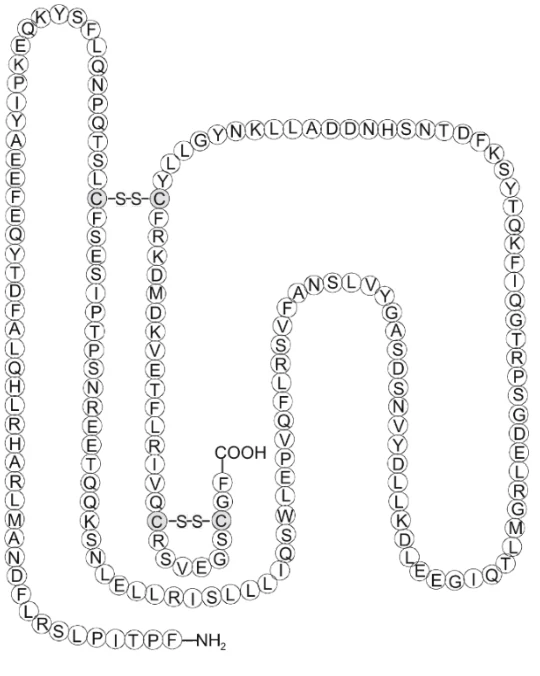
Physicochemical properties:
Biological Activity The biological activity of growth hormone is approximately 3.0 international units/1 mg.
14 CLINICAL TRIALS
14.4 Clinical Trials - Reference Biologic Drug
Efficacy and Safety Studies
Children
Patient response to Genotropin 5.3 mg/mL and 1.3 mg/mL has been monitored through the Kabi International Growth Study (KIGS). 46 patients received the 5.3 mg/mL formulation and 342 received the 1.3 mg/mL formulation at a dose of (0.17 - 0.23 IU/kg/wk) for at least one year for growth hormone insufficiency. After 12 months the group treated with Genotropin 1.3 mg/mL showed an increase in mean height from 123.5±19.2 cm to 131.9±18.8 cm, and the group treated with Genotropin 5.3 mg/mL showed an increase in mean height from 125.0 ±20.2 cm to 139.1±17.1 cm. Therefore, although the two formulations have not been shown to be equally bioavailable, they are both efficacious when used in a clinical setting.
SGA
Pediatric Patients Born Small for Gestational Age (SGA) Who Fail to Manifest Catch-up Growth by Age 2: The safety and efficacy of Genotropin in the treatment of children born small for gestational age (SGA) were evaluated in 4 pivotal, randomized, open-label, controlled multicenter, multinational clinical trials that each evaluated 3 parallel groups (2 somatropin-treated groups and one untreated control group). Studies were conducted at study sites in France, the northern European countries of Sweden, Finland, Denmark, and Norway, Germany, and Belgium. All studies used height velocity SDS (HV SDS) as the primary endpoint. Since it is a measure of change in height over a set time period (usually a year), HV SDS is the most appropriate measure for comparisons among treatment groups during periods of rapid growth, such as catch-up growth. HV SDS was measured over two 12- month periods, from baseline to month 12 and from month 12 to month 24. The measurement of height with a Harpenden stadiometer, or comparable wall-mounted device, was used in the studies and is widely employed as an objective measure to assess growth response. Further, to minimize bias, the effects of the drug were assessed relative to an untreated control group, using appropriate statistical methods that incorporated correction for multiple comparisons.
Patients (age range of 2 to 8 years) were observed for 12 months before being randomized to receive either Genotropin (two doses per study, most often 0.24 and 0.48 mg/kg/week) as a daily SC injection or no treatment for the first 24 months of the studies. After 24 months in the studies, all patients received Genotropin.
Patients who received any dose of Genotropin showed significant increases in growth during the first 24 months of study, compared with patients who received no treatment GH treatment accelerated the growth of SGA children in a dose dependent manner. At entry to the study, the mean growth rate SD score (SDS) was -1.1±1.1 for untreated controls (n = 72), -1.2±1.4 for the 0.033 mg/kg/day group (n = 104), and -1.2±1.1 for the 0.067 mg/kg/day group (n = 117). After the start of the study, the growth rate SDS in the respective groups were: -0.8±1.2 (n = 76), 2.5±1.8 (n = 105), and 4.4±2.1 (n = 117) during the first year; and -0.7±1.0 (n = 59), 0.9±1.8 (n = 105), and 2.1±2.0 (n = 117) during the second year (see table 14).
Children receiving 0.48 mg/kg/week demonstrated a significant improvement in height SDS (secondary endpoint) compared with children treated with 0.24 mg/kg/week. Height SDS at entry was -3.1±0.9 for the untreated control (n = 40), -3.2±0.8 for the 0.033 mg/kg/day group (n = 76), and -3.4±1.0 for the 0.067 mg/kg/day group (n = 93). The corresponding values after 24 months of treatment were -2.9±0.9 (n = 40), -2.0±0.8 (n = 76), and -1.7±1.0 (n = 93). Thus, treatment with somatropin improved the height of short-stature children born SGA by 1.2 SDS at 0.033 mg/kg/day and by 1.7 SDS at 0.067 mg/kg/day (Table 15). Both of these doses resulted in a slower but constant increase in growth between months 24 to 72.
| TABLE 14: Efficacy of Genotropin in Children Born Small for Gestational Age | |||||||
|---|---|---|---|---|---|---|---|
| (Mean ± SD) | |||||||
Genotropin (0.24 mg/kg/week) | Genotropin (0.48 mg/kg/week) | Untreated Control | |||||
Mean growth rate SD Score (SDS) Baseline SDS | -1.2±1.4 (n = 104) | -1.2±1.1 (n = 117) | -1.1±1.1 (n = 72) | ||||
| Growth rate SDS at 12 months | 2.5*±1.8 (n = 105) | 4.4*±2.1 (n = 117) | -0.8±1.2 (n = 76) | ||||
| Growth rate SDS at 24 months | 0.9*±1.8 (n = 105) | 2.1*±2.0 (n = 117) | -0.7±1.0 (n = 59) | ||||
*p = 0.0001 vs Untreated Control group
| TABLE 15: Efficacy of Genotropin in Children Born Small for Gestational Age | |||||||
|---|---|---|---|---|---|---|---|
| (Mean ± SD) | |||||||
Genotropin (0.24 mg/kg/week) n=76 | Genotropin (0.48 mg/kg/week) n=93 | Untreated Control n=40 | |||||
Height Standard Deviation Score (SDS) Baseline SDS | -3.2 ± 0.8 | -3.4 ± 1.0 | -3.1 ± 0.9 | ||||
| SDS at 24 months | -2.0 ± 0.8 | -1.7 ± 1.0 | -2.9 ± 0.9 | ||||
| Change in SDS from baseline to month 24 | 1.2* ± 0.5 | 1.7*† ± 0.6 | 0.1 ± 0.3 | ||||
*p = 0.0001 vs Untreated Control group
† p = 0.0001 vs group treated with Genotropin 0.24 mg/kg/week
A supplementary analysis of the change in height SDS from baseline to month 24 was performed that included height SDS at baseline, age at baseline, and sex as covariates. The analysis indicates that the effect of somatropin on the change in height SDS is greater at a younger age but that the effect is prominent up to 8 years of age at the start of treatment.
Patients enrolled in the four randomized, multicenter studies of the safety and efficacy of Genotropin therapy in patients with short stature born small for gestational age (SGA) were followed as controls or treated patients for 2 and 6 years, respectively. Forty nine of the total cohort of 188 patients were followed for 2 years as untreated controls, 62 received continuous Genotropin treatment for 6 years and 77 received discontinuous Genotropin treatment for 6 years. Of the 62 patients who received continuous therapy, 35 received a daily Genotropin dose of 33 mcg/kg body weigh/day and 27 received a daily Genotropin dose of 67 mcg/kg body weigh/day. The 77 patients who were treated with discontinuous therapy received Genotropin treatment for 2 to 3 years followed by a withdrawal phase of 1 to 2 yr, and then by either no or 1 or more episodes of further Genotropin treatment at a dose of 33 mcg/kg body weigh/day, averaged over 6 years.
At the start of the studies, the average age of the 188 patients was 5.2 yr (range, 2–8 yr) and the mean height SDS was - 3.4. After 2 yr, the untreated control group experienced an increase in height, of 0.1 ± 0.1 SD over baseline (not shown in table 16). Continuous Genotropin treatment at a dose of 33 mcg/kg/day and 67 mcg/kg/day for 2 years resulted in an increase in height over baseline of 1.2 SD and 1.7 SD respectively, and an increase in height over baseline of 2.1 SD and 2.6 SD, in the 0.033 mg/kg/day and 0.067 mg/kg/day groups at 6 years, respectively. After 2 years there were no untreated control patients available for comparison. The height SDS at 72 months in all groups is greater than - 2, in the normal range.
| TABLE 16: Effect of No Treatment, Some Treatment, or Continuous Treatment on Height SDS During Month 24 to Month 72 - PP 0-72 Population | |||||||||
|---|---|---|---|---|---|---|---|---|---|
| Mean Height SDS | Treatment Group | ||||||||
Disc/Not Re-trt N=15 | Disc/Some Re-trt N=50 | Continuous 0.033 mg/kg/day N=27 | Continuous 0.067 mg/kg/day N=25 | ||||||
Change from baseline to month 24 | 2.4 | 1.7 | 1.2 | 1.7 | |||||
Change from baseline to month 72 | 1.6 | 1.6 | 2.1 | 2.6 | |||||
Change from month 24 to month 72 | -0.8 | -0.1 | 0.9 | 0.9 | |||||
Height SDS at month 72 | -1.7 | -1.6 | -1.4 | -1.3 | |||||
Abbreviations: Disc/Not Re-trt= patients in the discontinuous group who were not treated during month 24 to month 72; Disc/some trt=patients in the discontinuous group who received some treatment during month 24 to month 72
Mean PAH SDS during the baseline to month 72 period is displayed graphically in Figure 2. As expected, the mean PAH SDS curves over the 72-month treatment period show a pattern similar to the non-adjusted mean height SDS curves. The PAH SDS curves for all treatment groups approached 0 SD, thus indicating a normalization of childhood stature when adjusted for genetic potential.
FIGURE 2. Effect of Somatropin Treatment on Mean (±SEM) PAH SDS PP 0-72 Population
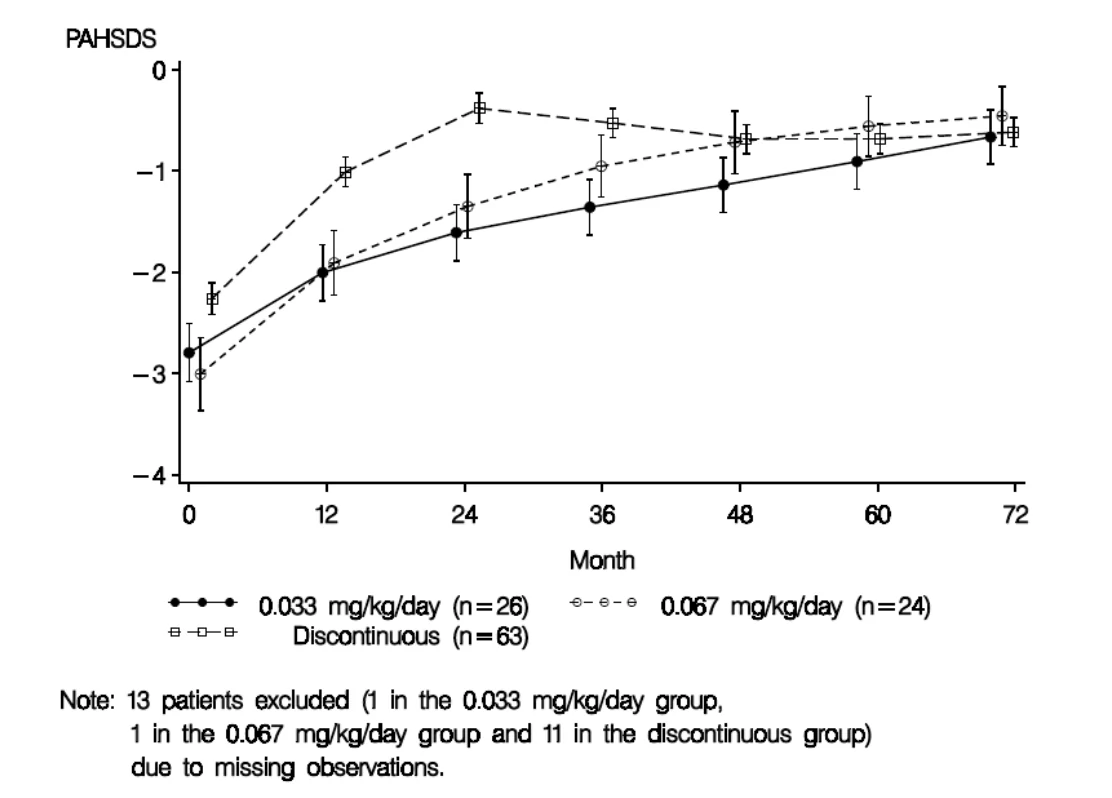
Turner Syndrome
Two randomized, open-label, clinical trials were conducted that evaluated the efficacy and safety of Genotropin in Turner syndrome patients with short stature. Turner syndrome patients were treated with Genotropin alone or Genotropin plus adjunctive hormonal therapy (ethinylestradiol or oxandrolone). A total of 38 patients were treated with Genotropin alone in the two studies. In Study 055, 22 patients were treated for 12 months, and in Study 092, 16 patients were treated for 12 months. Patients received Genotropin at a dose between 0.13 to 0.33 mg/kg/week.
SDS for height velocity and height are expressed using either the Tanner (Study 055) or Sempé (Study 092) standards for age-matched normal children as well as the Ranke standard (both studies) for age-matched, untreated Turner syndrome patients.
Both studies demonstrated statistically significant increases from baseline in all of the linear growth variables (i.e., mean height velocity, height velocity SDS, and height SDS) after treatment with Genotropin (see Table 17). The linear growth response was greater in Study 055 wherein patients were treated with a larger dose of Genotropin.
| TABLE 17: Growth Parameters (Mean ± SD) after 12 Months of Treatment with Genotropin In Pediatric Patients with Turner Syndrome in Two Open Label Studies | ||||||||
|---|---|---|---|---|---|---|---|---|
Genotropin 0.33 mg/kg/week Study 055, n=22 | Genotropin 0.13–0.23 mg/kg/week Study 092, n=16 | |||||||
| Height Velocity (cm/yr) | ||||||||
| Baseline | 4.1 ± 1.5 | 3.9 ± 1.0 | ||||||
| Month 12 | 7.8 ± 1.6 | 6.1 ± 0.9 | ||||||
| Change from baseline (95% CI) | 3.7 (3.0, 4.3) | 2.2 (1.5, 2.9) | ||||||
| Height Velocity SDS (Tanner^/Sempé# Standards) | (n=20) | |||||||
| Baseline | -2.3 ± 1.4 | -1.6 ± 0.6 | ||||||
| Month 12 | 2.2 ± 2.3 | 0.7 ± 1.3 | ||||||
| Change from baseline (95% CI) | 4.6 (3.5, 5.6) | 2.2 (1.4, 3.0) | ||||||
| Height Velocity SDS (Ranke Standard) | ||||||||
| Baseline | -0.1 ± 1.2 | -0.4 ± 0.6 | ||||||
| Month 12 | 4.2 ± 1.2 | 2.3 ± 1.2 | ||||||
| Change from baseline (95% CI) | 4.3 (3.5, 5.0) | 2.7 (1.8, 3.5) | ||||||
| Height SDS (Tanner^/Sempé# Standards) | ||||||||
| Baseline | -3.1 ± 1.0 | -3.2 ± 1.0 | ||||||
| Month 12 | -2.7 ± 1.1 | -2.9 ± 1.0 | ||||||
| Change from baseline (95% CI) | 0.4 (0.3, 0.6) | 0.3 (0.1, 0.4) | ||||||
| Height SDS (Ranke Standard) | ||||||||
| Baseline | -0.2 ± 0.8 | -0.3 ± 0.8 | ||||||
| Month 12 | 0.6 ± 0.9 | 0.1 ± 0.8 | ||||||
| Change from baseline (95% CI) | 0.8 (0.7, 0.9) | 0.5 (0.4, 0.5) | ||||||
SDS = Standard Deviation Score
Ranke standard based on age-matched, untreated Turner syndrome patients
Tanner^/Sempé# standards based on age-matched normal children
p< 0.05, for all changes from baseline
Idiopathic Short Stature
The long-term efficacy and safety of Genotropin in patients with idiopathic short stature (ISS) were evaluated in one randomized, open-label, clinical trial that enrolled 105 prepubertal children with ISS and in one small supportive open-label trial that included 37 randomized prepubertal children with ISS. In the pivotal trial, patients were enrolled on the basis of short stature, stimulated GH secretion > 10 ng/mL. A total of 177 patients were intitially enrolled, but criteria for idiopathic short stature were retrospectively applied and therefore patients with SGA and those that were pubertal were removed from the ISS pre-pubertal analysis. All patients were observed for height progression for 12 months and were subsequently randomized to Genotropin or observation only and followed to final height. Two Genotropin doses were evaluated in this trial: 0.23 mg/kg/week (0.033 mg/kg/day) and 0.47 mg/kg/week (0.067 mg/kg/day). Baseline patient characteristics for the ISS patients who remained prepubertal at randomization (n= 105) were: mean (± SD): chronological age 11.4 (1.3) years, height SDS -2.4 (0.4), height velocity SDS -1.1 (0.8), and height velocity 4.4 (0.9) cm/yr, IGF-1 SDS -0.8 (1.4). Patients were treated for a median duration of 5.7 years. Results for final height SDS are displayed by treatment arm in Table 18. Genotropin therapy improved final height in ISS children relative to untreated controls. The observed mean gain in final height was 9.8 cm for females and 5.0 cm for males for both doses combined compared to untreated control subjects. A height gain of 1 SDS was observed in 10 % of untreated subjects, 50% of subjects receiving 0.23 mg/kg/week and 69% of subjects receiving 0.47 mg/kg/week.
| TABLE 18: Final Height SDS Results for Pre-Pubertal Patients with ISS* | |||||||||||
|---|---|---|---|---|---|---|---|---|---|---|---|
Untreated (n=30) | GEN 0.033 mg/kg/day (0.23 mg/kg/week) (n=33) | GEN 0.067 mg/kg/day (0.47 mg/kg/week) (n=42) | GEN 0.033 mg/kg/day (0.23 mg/kg/week) vs. Untreated (95% CI) ** | GEN 0.067 mg/kg/day (0.47 mg/kg/week) vs. Untreated (95% CI)** | GEN 0.033 mg/kg/day (0.23 mg/kg/week) vs. GEN 0.067 mg/kg/day (0.47 mg/kg/week)** | ||||||
Final height SDS minus baseline SDS | 0.41 (0.58) | 0.95 (0.75) | 1.36 (0.64) | +0.53 (0.20, 0.87) p=0.0022 | +0.94 (0.63,1.26) p<0.0001 | -0.41(-0.72,-0.10) p=0.0105 | |||||
Final height SDS minus baseline predicted final height SDS | 0.23 (0.66) | 0.73 (0.63) | 1.05 (0.83) | +0.60 (0.09, 1,11) p=0.0217 | +0.90 (0.42,1.39) p=0.0004 | -0.30(-0.69,0.09) p= 0.1272 | |||||
*Mean (SD) are observed values.
**Least square means based on ANCOVA (final height SDS and final height SDS minus baseline predicted height SDS were adjusted for baseline height SDS)
Supportive Study CTN 89-050 was a randomized, open-label, multicenter study that evaluated the efficacy and safety of Genotropin treatment in prepubertal children diagnosed with ISS. Thirty seven children who fulfilled the study entry criteria were randomly assigned to receive Genotropin at a dosage of 0.047 mg/kg body weight per day (n=18) or to serve as untreated controls (n=19). The primary efficacy variable, the change in height SDS for bone age (HSDS-BA) after 36 months, was evaluated in the ITT population, which included 18 subjects in each group who were randomized and had at least one post-baseline efficacy measurement. All subjects were prepubertal at study start and remain so throughout the study. After 36 months, the mean HSDS-BA increased by 0.34 ± 1.60 from baseline in the treated group (n = 18) and decreased -0.46 ± 1.58 SD in the untreated control group (n =17), but the difference in the mean change (0.8 SD) did not reach statistical significance (p = 0.192).
Height SDS, however, increased significantly compared to untreated controls at both Months 12 and 36 (p<0.001), as did growth velocity SDS for bone age and growth velocity SDS (each p< 0.001) at both time points. Mean changes from baseline in height (cm) and growth velocity (cm/year) were both significantly greater in the Genotropin group compared to the untreated control group (each p<0.001). The number of subjects who achieved an increase of at least 1.0 SDS in height SDS was significantly greater in the Genotropin group at Month 36 than in the untreated control group (p<0.001). Improvements in growth variables involving chronologic age were better predictors of response to therapy than variables that were adjusted for bone age.
Adults
Adult Growth Hormone Deficiency (GHD)
Genotropin lyophilized powder was compared with placebo in six randomized clinical trials involving a total of 172 adult GHD patients. These trials included a 6-month double-blind treatment period, during which 85 patients received Genotropin and 87 patients received placebo, followed by an open-label treatment period in which participating patients received Genotropin for up to a total of 24 months. Genotropin was administered as a daily SC injection at a dose of 0.04 mg/kg/week for the first month of treatment and 0.08 mg/kg/week for subsequent months.
Beneficial changes in body composition were observed at the end of the 6-month treatment period for the patients receiving Genotropin as compared with the placebo patients. Lean body mass, total body water, and lean/fat ratio increased while total body fat mass and waist circumference decreased. These effects on body composition were maintained when treatment was continued beyond 6 months. Bone mineral density declined after 6 months of treatment but returned to baseline values after 12 months of treatment.
15 MICROBIOLOGY
No microbiological information is required for this drug product.
16 NON-CLINICAL TOXICOLOGY
16.2 Non-Clinical Toxicology – Reference Biologic Drug
General Toxicology:
Acute Toxicity
A single subcutaneous dose of 300 mg/kg of somatropin (more than 8000 times the intended human dose) was given to Sprague Dawley rats with no lethality during the 48 hour observation period.
Short Term Toxicity
The general toxicity of somatropin in Sprague Dawley rats has been studied after repeated intramuscular administration of 0.34 (0.125 mg), 1.7 (0.625 mg) and 8.14 (3.125 mg) IU/kg/day. A positive control group received pituitary human growth hormone (pit hGH) at 3.125 mg/ day, and a negative control group received glycine phosphate solution.
No deaths occurred and no drug related clinical signs were observed. A dose related increase in body weight gain, as compared to the controls, was recorded in females receiving 0.625 or 3.125 mg/kg/day recombinant somatropin. Females given pit hGH (3.125 mg/kg/day) also showed increased weight gain. The body weight gain of male rats was similar in all groups, including control. The food consumption of drug treated animals was comparable to that of the controls, except for an increase in food intake in females given 3.125 mg/kg/day of either recombinant somatropin or pit hGH.
Organ weight analysis showed statistically significant increased absolute and relative group mean weights of the adrenals in males, but not in females, receiving 0.625 or 3.125 mg/kg/day of somatropin, as well as in males given pit hGH. A marginal increase in the absolute group mean weights of the ovaries was recorded in females receiving 3.125 mg/kg/day of recombinant somatropin or pit hGH.
In total, intramuscular treatment with somatropin for one month was well tolerated in all treatment groups. A growth promoting effect (increase in body weight gain) was demonstrated in female rats at the two highest dose levels, but in none of the male groups, with an associated increase in food consumption. A small uterine nodule, compatible with a decidual cell reaction, was observed in one rat from the high dose somatropin group. A hormonal influence was also evidenced by a dose related mammary gland hyperplasia in females at the two highest dose levels of somatropin as well as in females from the pit hGH group.
Chronic Toxicity
The general toxicity of somatropin has been evaluated in cynomolgus monkeys following daily subcutaneous injections of 0.13, 0.65 or 3.23 mg/kg for 52 weeks. Administration at dose levels up to 3.23 mg/kg did not produce any clinical toxic effects. Drug-related changes associated with a dose level of 3.23 mg/kg were a decrease of serum progesterone levels at the estimated luteal phase and a tendency to reduce serum prolactin levels for males and females. In addition, there was an indication of increased immunoreactivite insulin levels in serum from male animals. Prolonged menstrual cycles, and/or absence of cyclicity was seen in some high dose females.
Microscopic examination showed a dose-related adipocyte hypertrophy in the abdominal fat in treated males and females alveolar dilatation/hyperplasia of the mammary gland. The alveolar dilitation was found in three females from each of the treatment groups. Mammary gland hyperplasia was seen only in high dose animals (one male and one female). The microscopic findings showed regression during the recovery period.
Reproductive Studies:
Studies for effects on embro-fetal development carried out with somatropin at doses of 1, 3 and 10 IU/kg/day administered SC in the rat and 0.25, 1 and 4 IU/kg/day administered IM in the rabbit, resulted in effects on maternal body weight gains (increased in rats and decreased in rabbits) but were not teratogenic. In rats receiving SC doses during gametogenesis and up to seven days of pregnancy, 10 IU/kg/day produced anestrus or extended estrus cycles and fewer and less motile sperm in males. When given to pregnant female rats (days one to seven of gestation) at 10 IU/kg/day a very slight increase in fetal deaths were observed. At 3 IU/kg/day rats showed slightly extended estrus cycles, whereas at 1 IU/kg/day no effects were noted.
In perinatal and postnatal studies in rats, somatropin doses of 1, 3 and 10 IU/kg/day produced growth-promoting effects in the dams but not in the fetuses. Young rats at the highest doses showed increased weight gain during suckling but the effect was not apparent by 10 weeks of age. No adverse effects were observed on gestation, morphogenesis, parturition, lactation, postnatal development or reproductive capacity of the offspring due to somatropin.
Mutagenicity Studies:
No potential mutagenicity of somatropin was revealed in a battery of mutagenicity tests including bacterial tests to demonstrate induction of gene mutations (Ames test in Salmonella and E. coli), a test to demonstrate the chromosome damaging potential in human cells cultured in vitro (human lymphocytes), a test to demonstrate the induction of gene mutations in mammalian cells grown in vitro (mouse lymphoma L5178Y cells) and a test to demonstrate the induction of chromosomal damage in vivo (bone marrow cells in rats).
Immunotoxicity:
In the three month monkey study the immunological investigation comprised assays for antibodies both to growth hormone and to periplasmic E. coli peptides in selected animals at completion of the treatment period. No antibodies could be detected either to growth hormone or to periplasmic E. coli peptides. Furthermore, no changes suggestive of an immunological response or changes in the immune system were seen.
17 SUPPORTING PRODUCT MONOGRAPHS
- 1. GENOTROPIN®GoQuickTM Lyophilized Powder for reconstitution: 5 mg, 5.3 mg, 12 mg pre-filled pen, GoQuick; GENOTROPIN®MiniQuickTM Lyophilized Powder for reconstitution: 0.2 mg, 0.4 mg, 0.6 mg, 0.8 mg, 1.0 mg, 1.2 mg, 1.4 mg, 1.6 mg, 1.8 mg, and 2.0 mg prefilled syringe, MiniQuick, submission control 229726, Product Monograph, Pfizer Canada ULC. June 22, 2020.