


Product Monograph - Orladeyo
1 INDICATIONS
ORLADEYO (berotralstat) is indicated for the routine prevention of attacks of hereditary angioedema (HAE) in adults and pediatric patients 12 years of age and older.
Limitations of Use:
The safety and efficacy of ORLADEYO for the treatment of acute HAE attacks have not been established. ORLADEYO should not be used for the treatment of acute HAE attacks. Additional doses or doses of ORLADEYO higher than the 150 mg once daily dose are not recommended due to the potential for QT prolongation (see 7 WARNINGS AND PRECAUTIONS, Cardiovascular).
1.1 Pediatrics
Pediatrics (≥12 years and weighing ≥40 kg)
Based on the data submitted and reviewed by Health Canada, the safety and efficacy of ORLADEYO in pediatric patients in this age and weight group has been established. Therefore, Health Canada has authorized an indication for pediatric use in patients ≥12 years of age (see 14 CLINICAL TRIALS).
The safety and efficacy of ORLADEYO have not been established in patients <12 years of age.
1.2 Geriatrics (≥65 years)
Evidence from clinical studies and experience suggests that use in the geriatric population is not associated with differences in safety or effectiveness (see 14 CLINICAL TRIALS). Berotralstat has not been studied in patients ≥75 years of age.
2 CONTRAINDICATIONS
ORLADEYO is contraindicated in patients who are hypersensitive to this drug or to any ingredient in the formulation, including any non-medicinal ingredient, or component of the container. For a complete listing, see 6 DOSAGE FORMS, STRENGTHS, COMPOSITION AND PACKAGING.
4 DOSAGE AND ADMINISTRATION
4.1 Dosing Considerations
ORLADEYO is not intended for the treatment of acute HAE attacks. Patients should not take additional doses of ORLADEYO to treat an acute attack of HAE.
4.2 Recommended Dose and Dosage Adjustment
Adults and Pediatric Patients (≥12 years and weighing ≥40 kg)
The recommended dose of ORLADEYO is one 150 mg capsule, taken orally once daily with food.
Geriatrics (≥65 years)
No dosage adjustment is required for geriatric patients.
Hepatic Impairment
No dosage adjustment is required for patients with mild hepatic impairment. Use of ORLADEYO in patients with moderate or severe hepatic impairment (Child-Pugh Class B or C) should be avoided (see 7 WARNINGS AND PRECAUTIONS, Hepatic/Biliary/Pancreatic and 10.3 Pharmacokinetics, Special Populations and Conditions, Hepatic Insufficiency).
Renal Impairment
No dosage adjustment is required for patients with mild or moderate renal impairment. Use of berotralstat in patients with severe renal impairment should be avoided. If treatment is required, monitor patients for QT prolongation (see 10.3 Pharmacokinetics, Special Populations and Conditions, Renal Insufficiency).
4.4 Administration
One ORLADEYO capsule is taken with food at approximately the same time each day (see 10.3 Pharmacokinetics, Effect of Food and 14.1 Efficacy and Safety Studies).
4.5 Missed Dose
Advise patients that in the event of a missed dose of ORLADEYO, the missed dose should be taken as soon as possible on the same day, with a return to the normal schedule the following day. Patients should not take more than one dose per day.
5 OVERDOSAGE
There is no experience with overdoses of ORLADEYO. There is no available information to identify potential signs and symptoms of overdose. In clinical trials, the highest single dose taken was 890 mg and the highest daily dose was 450 mg for 14 days. No serious adverse reactions were reported with these higher doses.
| For management of a suspected drug overdose, contact your regional poison control centre. |
|---|
6 DOSAGE FORMS, STRENGTHS, COMPOSITION AND PACKAGING
Table 1. Dosage Forms, Strengths, Composition and Packaging
| Route of Administration | Dosage Form / Strength / Composition | Non-medicinal Ingredients |
|---|---|---|
| Oral | Capsule 150 mg berotralstat (as berotralstat hydrochloride) | Black iron oxide, colloidal silicon dioxide, crospovidone, gelatin, indigo carmine (FD&C Blue #2), magnesium stearate, pharmaceutical grade printing ink, pregelatinized starch, red iron oxide, titanium dioxide |
ORLADEYO comes in size 1 capsules with a light blue opaque cap, with black imprint “BCX” and a white opaque body with black imprint “150”. ORLADEYO capsules are available in a rigid film blister card with an aluminum foil backing. A 28-day supply is provided in a carton containing four 7-capsule blister cards.
7 WARNINGS AND PRECAUTIONS
General
ORLADEYO should not be used for treatment of acute attacks of HAE. In the event of an acute attack, individualized treatment should be initiated with an approved rescue medicine.
Cardiovascular
Additional doses or doses of ORLADEYO higher than 150 mg once daily are not recommended. An increase in QT was observed at dosages higher than the recommended 150 mg once daily dosage and the increase was concentration-dependent (see 10.2 Pharmacodynamics). Educate patients on the importance of treatment compliance.
Hepatic/Biliary/Pancreatic
Patients with moderate or severe hepatic impairment may develop increased serum berotralstat concentrations. Use of berotralstat in these patients should be avoided (see 10.3 Pharmacokinetics, Special Populations and Conditions, Hepatic Insufficiency).
Reproductive Health: Female and Male Potential
Fertility
There are no data on the influence of berotralstat use on human fertility. Based on animal studies, no effect on reproduction or fertility is expected with berotralstat (see 16 NON-CLINICAL TOXICOLOGY).
7.1 Special Populations
7.1.1 Pregnant Women
There are insufficient data in pregnant women available to inform drug-related risks with ORLADEYO use in pregnancy. Animal studies did not indicate any direct or indirect harmful effects with respect to reproductive toxicity (see 16 NON-CLINICAL TOXICOLOGY). As a precautionary measure, it is preferable to avoid the use of ORLADEYO during pregnancy.
7.1.2 Breast-feeding
There are no data on the presence of berotralstat in human milk. A study conducted in rats demonstrated that the Cmax of berotralstat in pup plasma on Lactation Day 14 was <5% of the maternal plasma Cmax. It is unknown if ORLADEYO is excreted in human milk (see 10.3 Pharmacokinetics, 16 NON-CLINICAL TOXICOLOGY). A risk to the newborns/infants cannot be excluded. Precaution should be exercised because many drugs can be excreted in human milk.
7.1.3 Pediatrics
Pediatrics (≥12 years and weighing ≥40 kg):
The safety and effectiveness of ORLADEYO were evaluated in 6 pediatric patients aged 12 to <18 years as part of pivotal Study 302, Part 1 (4 of these patients were treated with ORLADEYO) and in an additional 22 pediatric patients aged 12 to <18 years in the long-term, open-label safety study (Study 204). Results of the subgroup analysis were similar to that observed in adults (see 8.2.1 Clinical Trial Adverse Reactions – Pediatrics). Warnings applicable to adults are also applicable to pediatric use.
Pediatrics (<12 years):
No data are available to Health Canada; therefore, Health Canada has not authorized an indication for pediatric use in this age group.
7.1.4 Geriatrics (≥65 years)
The safety and effectiveness of ORLADEYO were evaluated in 9 patients aged >65 years in Part 1 of Study 302 (6 of these patients were treated with ORLADEYO), and an additional 7 patients in the long-term, open-label safety study (Study 204). Results of the subgroup analysis by age were consistent with overall study results (see 8 ADVERSE REACTIONS).
8 ADVERSE REACTIONS
8.1 Adverse Reaction Overview
The overall safety of ORLADEYO has been evaluated in multiple long-term clinical studies, which included 381 patients with HAE (uncontrolled, open-label and placebo-controlled, blinded studies).
Of the patients treated with ORLADEYO in the placebo-controlled blinded Phase 3 study (Study 302, Part 1), the most common adverse reactions associated with ORLADEYO 150 mg were gastrointestinal reactions, which included abdominal pain in any location (23%), vomiting (15%), and diarrhea (15%) (Table 2). These reactions generally occurred early after initiation of treatment with ORLADEYO, became less frequent with time, and typically self-resolved. No patients in the ORLADEYO 150 mg dose group discontinued treatment due to a gastrointestinal adverse reaction. There were no serious drug-related treatment-emergent adverse events in patients who received ORLADEYO.
8.2 Clinical Trial Adverse Reactions
Clinical trials are conducted under very specific conditions. The adverse reaction rates observed in the clinical trials may therefore not reflect the rates observed in practice and should not be compared to the rates in the clinical trials of another drug. Adverse reaction information from clinical trials may be useful in identifying and approximating rates of adverse drug reactions in real-world use.
The primary safety evaluation of ORLADEYO was based on Week 24 data from Part 1 of a 3-part, double-blind, parallel-group, and placebo-controlled study (Study 302) in 120 patients with Type I or II HAE randomized and dosed with either ORLADEYO 110 mg, 150 mg, or placebo, once daily with food.
In Study 302, 81 patients aged 12 years and older with HAE received at least one dose of ORLADEYO in Part 1. The proportion of patients who discontinued study drug prematurely due to adverse reactions was 7% and 3% for patients treated with 110 mg and 150 mg of ORLADEYO, respectively, and 3% for patients treated with placebo.
Table 2 shows the adverse reactions that occurred in >10% of patients receiving ORLADEYO 150 mg that also occurred at a higher rate (difference of ≥5%) than in the placebo group.
Table 2. Adverse Reactions Observed in >10% of Patients Treated with Berotralstat 150 mg or Placebo (Study 302, Part 1, Safety population)
| Adverse Reaction (MedDRA SOC) | Berotralstat 150 mg | Placebo |
|---|---|---|
| (N=40) | (N=39) | |
| n (%) | n (%) | |
| Gastrointestinal Disorders: | ||
| Abdominal paina | 9 (23) | 4 (10) |
| Vomiting | 6 (15) | 1 (3) |
| Diarrheab | 6 (15) | 0 |
| Musculoskeletal and Connective Tissue Disorders: | ||
| Back Pain | 4 (10) | 1 (3) |
Abbreviations: MedDRA = Medical Dictionary for Regulatory Activities, SOC = System Organ Class a Includes abdominal pain, abdominal discomfort, and abdominal tenderness.
b Includes diarrhea and frequent bowel movements.
8.2.1 Clinical Trial Adverse Reactions – Pediatrics
The safety of ORLADEYO was evaluated in a subgroup of 6 pediatric patients aged 12 to <18 years and weighing ≥40 kg as part of Study 302, and in 28 pediatric patients aged 12 to <18 years as part of Study 204, the long-term, open-label safety study. The safety profile was similar to that observed in adults. Adverse reactions applicable to adults are also applicable to pediatric use.
8.3 Less Common Clinical Trial Adverse Reactions
Less frequent adverse reactions that occurred with an incidence <10% included:
Gastrointestinal Disorders: Flatulence, gastroesophageal reflux disease
Nervous System Disorders: Headache
Skin and Subcutaneous Tissue Disorders: Rash
A maculopapular drug rash was reported in <1% of patients treated with ORLADEYO. The rash resolved, including in patients who continued dosing.
8.4 Abnormal Laboratory Findings: Hematology, Clinical Chemistry and Other Quantitative Data
Table 3 shows treatment-emergent laboratory abnormalities that occurred in patients receiving ORLADEYO 150 mg that also occurred at a higher rate than in the placebo group.
Table 3. Summary of Treatment-Emergent Laboratory Abnormalities (Grade 3/4 or ≥2 Grade Shift)a Observed in Patients Treated with Berotralstat 150 mg or Placebo (Study 302, Part 1, Safety population)
| Laboratory Abnormality | Grade 3 or 4 Events n (%) | ≥2 Grade Shift n (%) | ||
|---|---|---|---|---|
Berotralstat 150 mg (N=40) | Placebo (N=39) | Berotralstat 150 mg (N=40) | Placebo (N=39) | |
| Chemistry: | ||||
| ALT increase (U/L) | 1 (2.5)b | 0 | 2 (5.0) | 0 |
| Amylase increase (U/L) | 1 (2.5)c | 0 | 0 | 0 |
| AST increase (U/L) | 1 (2.5)b | 0 | 1 (2.5)b | 0 |
| GGT increase (U/L) | 1 (2.5)b | 2 (5.1) | 1 (2.5)b | 0 |
| Lipase increase (U/L) | 1 (2.5)c | 0 | 0 | 0 |
| Sodium increase (mmol/L) | 0 | 0 | 1 (2.5) | 0 |
| Urinalysis: | ||||
| Urine Protein increase (mg/dL) | 0 | 0 | 2 (5.0) | 0 |
Abbreviations: ALT = Alanine Aminotransferase, AST = Aspartate Aminotransferase, GGT = Gamma Glutamyl Transferase
a Grade determined by DMID (Division of Microbiology and Infectious Diseases) Adult Toxicity Table (November 2007).
b The same subject had elevations in ALT (Grade 3 and 4), AST (Grade 3 and ≥2 Grade Shift) and GGT (Grade 3 and ≥2 Grade Shift) which were reported as a treatment-emergent adverse event (LFT abnormal).
c The same subject had elevations in Amylase (Grade 3) and Lipase (Grade 3). No treatment-emergent adverse event was reported related to these findings.
LFT elevations, which generally improved with or without discontinuation of berotralstat, were observed in some patients, primarily in those who discontinued androgen therapy within 14 days of initiating ORLADEYO treatment in Study 204, the long-term, open-label safety study. Abrupt discontinuation of androgens immediately prior to initiating ORLADEYO should be avoided.
8.5 Post-Market Adverse Reactions
The following adverse reactions have been identified during post-market use of ORLADEYO. Because post-market reactions are reported voluntarily from a population of uncertain size, it is not always possible to reliably estimate their frequency or establish a causal relationship to drug exposure.
Gastrointestinal Disorders: Nausea
9 DRUG INTERACTIONS
9.2 Drug Interaction Overview
Potential for Other Drugs to Affect ORLADEYO
Berotralstat is a P-glycoprotein (P-gp) and breast cancer resistance protein (BCRP) substrate.
P-gp and BCRP Inhibitors:
Cyclosporine, a P-gp and BCRP inhibitor, decreased berotralstat 150 mg Cmax by 7%, while AUC0-last and AUC0-inf increased by 27% and 24%, respectively. No dose adjustment of berotralstat is necessary with concomitant use of P-gp and BCRP inhibitors. Close monitoring for adverse events is recommended for concomitant use with P-gp and BCRP inhibitors.
P-gp and BCRP Inducers:
P-gp and BCRP inducers (e.g., rifampicin, St. John’s wort) may decrease berotralstat plasma concentration, leading to reduced efficacy of berotralstat. The use of P-gp inducers is not recommended with berotralstat.
9.4 Drug-Drug Interactions
Potential for ORLADEYO to Affect Other Drugs
Cytochrome P450 (CYP)2D6 and CYP3A4 Substrates:
Berotralstat at a once-daily dose of 150 mg is a moderate inhibitor of CYP2D6 and CYP3A4. For concomitant medications with a narrow therapeutic index that are predominantly metabolized by CYP2D6 or CYP3A4, appropriate monitoring and dose adjustment of these medications may be required.
P-gp Substrates:
Berotralstat at a dose of 300 mg is a P-gp inhibitor. Appropriate monitoring and dose adjustment may be required for P-gp substrates when co-administered with ORLADEYO.
The effect of berotralstat on the pharmacokinetics of certain drugs has been evaluated in drug-drug interaction studies and is presented in Table 4, along with the relevant therapeutic recommendations.
Table 4. Established or Potential Drug-Drug Interactions
| Proper Name | Source of Evidence | Effect | Clinical Comment |
| Midazolam (CYP3A4 probe substrate) | CT | Co-administration of midazolam (single oral dose of 4 mg) with an oral daily dose of 150 mg of berotralstat resulted in an increase of midazolam AUC0-inf by 2.2-fold and Cmax by 45%. | For concomitant medications that are CYP3A4 substrates with a narrow therapeutic index (e.g., cyclosporine, fentanyl), appropriate monitoring and dose adjustment may be required when co-administered with ORLADEYO. |
| Amlodipine | CT | Co-administration of amlodipine (single oral dose of 5 mg) with an oral daily dose of 150 mg of berotralstat resulted in an increase of amlodipine AUC0-inf by 77% and Cmax by 45%. | No dosage adjustment needed when amlodipine is co-administered with ORLADEYO. |
| Danazol | CT | Co-administration of danazol (single oral dose of 200 mg) with an oral daily dose of 150 mg of berotralstat resulted in a decrease of danazol AUC0-inf by 22% and Cmax by 24%. | No dosage adjustment needed when danazol is co-administered with ORLADEYO. |
| Dextromethorphan (CYP2D6 probe substrate) | CT | Co-administration of dextromethorphan (single oral dose of 30 mg) with an oral daily dose of 150 mg of berotralstat resulted in an increase of dextromethorphan AUC0-inf by 2.8-fold and Cmax by 3.0-fold. | For concomitant medications that are CYP2D6 substrates with a narrow therapeutic index (e.g., thioridazine, pimozide) appropriate monitoring and dose adjustment may be required when co-administered with ORLADEYO. |
| Desipramine | CT | Co-administration of desipramine (single oral dose of 50 mg) with an oral daily dose of 150 mg of berotralstat resulted in an increase of desipramine AUC0-inf by 2.1-fold and Cmax by 64%. | No dosage adjustment needed when desipramine is co-administered with ORLADEYO. |
| Tolbutamide (CYP2C9 probe substrate) | CT | Co-administration of tolbutamide (single oral dose of 500 mg) with an oral daily dose of 150 mg of berotralstat resulted in an increase of tolbutamide AUC0-inf by 2.0-fold and Cmax by 19%. | No dose adjustment for CYP2C9 substrates like tolbutamide when co-administered with ORLADEYO. |
| Omeprazole (CYP2C19 probe substrate) | CT | Co-administration of omeprazole (single oral dose of 40 mg) with an oral daily dose of 150 mg of berotralstat resulted in an increase of omeprazole AUC0-inf by 24% and Cmax by 21%. | No dose adjustment for CYP2C19 substrates like omeprazole when co-administered with ORLADEYO. |
| Digoxin (P-gp probe substrate) | CT | Co-administration of digoxin (single oral dose of 0.25 mg) with an oral daily dose of 350 mg of berotralstat resulted in an increase of digoxin AUC0-inf by 31% and Cmax by 58%. | Monitor serum digoxin concentrations and adjust the dose as needed when co-administered with ORLADEYO. |
| Rosuvastatin (BCRP probe substrate) | CT | Co-administration of rosuvastatin (single oral dose of 10 mg) with an oral daily dose of 350 mg of berotralstat resulted in a decrease of rosuvastatin AUC0-inf by 16% and Cmax by 24%. | No dose adjustment for BCRP substrate like rosuvastatin when co-administered with ORLADEYO. |
Abbreviations: AUC = Area under curve; CYP = Cytochrome P450; AUC0-24 = AUC from time zero to 24 hours post dose; AUC0-inf = AUC extrapolate to infinite time; BCRP = Breast cancer resistance protein; Cmax = Maximum observed concentration; CT = Clinical Trial; P-gp = Pglycoprotein-.
Oral Contraceptives
As a moderate inhibitor of CYP3A4, berotralstat may increase concentrations of oral contraceptives metabolised by CYP3A4. The coadministration of berotralstat with desogestrel increased the AUC of etonogestrel (active metabolite) by 58%, Cmax was not affected. The effect of berotralstat on the CYP2C9 conversion of desogestrel to etonogestrel was negligible. No dose adjustment is recommended when berotralstat is used concomitantly with desogestrel.
9.5 Drug-Food Interactions
Food does not impact the bioavailability of berotralstat, however, berotralstat is to be administered with food to minimize gastrointestinal adverse events.
9.6 Drug-Herb Interactions
Interactions of berotralstat with St. John’s wort, a P-gp inducer, may decrease berotralstat plasma concentrations (see 9.2 Drug Interaction Overview).
9.7 Drug-Laboratory Test Interactions
Interactions of berotralstat with laboratory tests have not been established.
10 CLINICAL PHARMACOLOGY
10.1 Mechanism of Action
Berotralstat is a plasma kallikrein inhibitor that binds to plasma kallikrein and inhibits its proteolytic activity. Plasma kallikrein is a serine protease that cleaves high-molecular-weight-kininogen (HMWK) to generate cleaved HMWK (cHMWK) and bradykinin, a potent vasodilator that increases vascular permeability resulting in swelling and pain associated with HAE. In patients with HAE due to C1-inhibitor (C1-INH) deficiency or dysfunction, normal regulation of plasma kallikrein activity is not present, which leads to uncontrolled increases in plasma kallikrein activity and results in angioedema attacks. Berotralstat decreases plasma kallikrein activity to control excess bradykinin generation in patients with HAE.
10.2 Pharmacodynamics
Concentration-dependent inhibition of plasma kallikrein, measured as a reduction from baseline of specific enzyme activity, was demonstrated after oral administration of ORLADEYO once daily in patients with HAE. At the recommended dose of 150 mg once daily, the reduction was sustained through 24 hours, with a maximum effect observed 2 to 3 hours after dosing.
Cardiac Electrophysiology
At the steady-state Cmax of berotralstat at the recommended dose of 150 mg once daily, the mean corrected QT interval increased by 3.4 ms (90% upper CI bound of 6.8 ms), which is below the 10 ms threshold for concern. At a supratherapeutic dose of 450 mg once daily (3 times the recommended dose), steady-state exposures were 4-fold higher than at the recommended 150 mg dose, and the corrected QT interval increased by a mean of 21.9 ms.
10.3 Pharmacokinetics
Berotralstat exposure (Cmax and AUCτ) increased in a greater than dose-proportional manner over the dose range of 30 to 1000 mg (single dose) and 125 to 500 mg/day (multiple dose). Steady state is reached by Days 6 to 12.
The steady state pharmacokinetic parameters at the therapeutic dose of 150 mg once daily are presented in Table 5. Exposure of berotralstat at steady state is approximately 6 times that observed after a single dose. The pharmacokinetics of berotralstat is similar between healthy adult subjects and patients with HAE.
Table 5. Steady State Pharmacokinetic Parameters of Berotralstat 150 mg Once Daily in Healthy Subjectsa
| PK Parameter | Steady State Median (range) |
|---|---|
| Cmax (ng/mL) | 155 (110, 234) |
| Cmin (ng/mL) | 90.7 (61.3, 136) |
| Tmax (h) | 2.5 (1.0, 8.1) |
| t1/2 effective (h)b | 89.7 (64.0, 116) |
| AUCτ (ng.h/mL) | 2680 (1880, 3790) |
| CL/F (L/h) | 56.3 (39.6, 79.9) |
| Vz/F (L) | 3160 (1290, 6380) |
| ARc | 5.91 (4.37, 7.51) |
|---|
a Subjects dosed approximately 1.5 hours after receiving a moderate fat breakfast (Study BCX7353-106).
b Calculated using equation t1/2eff = τ*ln2/ln[AR/AR-1]; τ being the dosing interval.
c Accumulation ratio (based on AUC).
Absorption
The median time to maximum plasma concentration (Tmax) of berotralstat when administered with food is 5 hours (range 1 to 8 hours).
Effect of Food
No differences in the Cmax and AUC of berotralstat were observed following administration with a high-fat meal. However, the median Tmax was delayed by 3 hours, from 2 hours (fasted) to 5 hours (fed, range 1 to 8 hours). Berotralstat is to be administered with food to minimize gastrointestinal adverse events.
Distribution
Plasma protein binding is approximately 99%. After a single oral radiolabelled berotralstat 300 mg dose, the blood to plasma ratio was approximately 0.92.
Metabolism
Berotralstat is metabolised by CYP2D6 and by CYP3A4 with low turnover in vitro. After a single oral radiolabelled berotralstat 300 mg dose, berotralstat represented 34% of the total plasma radioactivity, with 8 metabolites, each accounting for between 1.8% and 7.8% of the total radioactivity. Structures for 5 of the 8 metabolites are known. It is unknown whether any metabolites are pharmacologically active.
Berotralstat 150 mg once daily is a moderate inhibitor of CYP2D6 and CYP3A4, and a weak inhibitor of CYP2C9. Berotralstat is not an inhibitor of CYP2C19. Berotralstat at double the recommended dose is a weak inhibitor of P-gp and is not an inhibitor of BCRP.
Elimination
After a single dose of 150 mg, the median half-life of berotralstat is approximately 93 hours (range 39 to 152 hours).
After a single oral radiolabelled berotralstat 300 mg dose, approximately 9% was excreted in urine (3.4% unchanged; range 1.8% to 4.7%) and 79% was excreted in feces (50% as unchanged berotralstat).
Special Populations and Conditions
- Pediatrics: Based on population pharmacokinetic analyses that included pediatric patients aged 12 to <18 years and weighing at least 40 kg, exposure at steady state following oral administration of berotralstat 150 mg once daily was approximately 15% to 30% higher compared to adults. However, this difference is not considered to be clinically relevant, and no dose adjustments are recommended in pediatric patients aged 12 to <18 years and weighing ≥40 kg.
- Geriatrics (≥65 years): Population pharmacokinetic analyses showed that age did not meaningfully influence the pharmacokinetics of berotralstat. Berotralstat has not been studied in patients older than 75 years of age; however, age is not expected to affect exposure to berotralstat. No dose adjustments are recommended for this demographic.
- Sex: Population pharmacokinetic analyses showed that sex did not meaningfully influence the pharmacokinetics of berotralstat.
- Pregnancy and Breast-feeding: There is no pharmacokinetic information of berotralstat in pregnant or breast-feeding women.
- Ethnic Origin: Population pharmacokinetic analyses showed that race did not meaningfully influence the pharmacokinetics of berotralstat.
- Hepatic Insufficiency: The pharmacokinetics of a single 150 mg oral dose of berotralstat were studied in subjects with mild, moderate, and severe hepatic function (Child-Pugh Class A, B or C). The pharmacokinetics of berotralstat were unchanged in subjects with mild hepatic impairment compared to subjects with normal hepatic function. In subjects with moderate hepatic impairment, Cmax was increased by 77%, while AUC0-inf was increased by 78%. In subjects with severe hepatic impairment, Cmax was increased by 27%, while AUC0-inf was decreased by 6%. The percent of unbound berotralstat increased 2-fold from a mean of 1.2% in healthy subjects to a mean of 2.4% in subjects with severe hepatic impairment. Use of berotralstat should be avoided in patients with moderate or severe hepatic impairment (Child-Pugh Class B or C) as patients may have increased plasma concentrations associated with a risk of QT prolongation.
- Renal Insufficiency: The pharmacokinetics of a single 200 mg oral dose of berotralstat were studied in subjects with severe renal impairment (estimated GFR <30 mL/min/1.73 m2). When compared to a concurrent cohort with normal renal function (estimated GFR >90 mL/min/1.73 m2), no clinically relevant differences were observed. Cmax was increased by 39%, while no difference was observed in AUC. No dose adjustment is required for patients with mild or moderate renal impairment. Patients with severe renal impairment may be at risk of QT prolongation. Avoid use of berotralstat in these patients.
The pharmacokinetics of berotralstat has not been studied in patients with End-Stage Renal Disease (CLCR <15 mL/min or estimated GFR <15 mL/min/1.73 m2 or patients requiring hemodialysis).
- Body Weight: Body weight was identified as a covariate describing the variability of clearance and volume of distribution, resulting in higher exposure (AUC and Cmax) in lighter patients. However, this difference is not considered to be clinically relevant.
11 STORAGE, STABILITY AND DISPOSAL
Store at room temperature (20°C to 25°C). ORLADEYO capsules are stable for 48 months when stored in the original container. Keep out of reach and sight of children.
Do not throw away any medicines via wastewater or household waste. These measures will help protect the environment.
12 SPECIAL HANDLING INSTRUCTIONS
Do not use this medicine after the expiry date which is stated on the carton and blister after EXP. The expiry date refers to the last day of that month.
PART II: SCIENTIFIC INFORMATION
13 PHARMACEUTICAL INFORMATION
Drug Substance
Proper/Common name: Berotralstat hydrochloride
Chemical name: IUPAC name: (R)-1-(3-(Aminomethyl)phenyl)-N-(5-((3-cyanophenyl)((cyclopropylmethyl)amino)methyl)-2- fluorophenyl)-3-(trifluoromethyl)-1H-pyrazole-5-carboxamide dihydrochloride
Molecular formula and molecular mass: C30H26F4N6O . 2 HCl Dihydrochloride: 635.48 Free base: 562.56
Structural formula:
Product Characteristics
Berotralstat dihydrochloride is a white to off-white powder that is soluble in water at pH ≤4.
| Aqueous Solubility | |
| pH 1.2 | ≈ 38.0 mg/mL at ambient temperature (soluble) |
| pH 4.0 | ≈ 47.0 mg/mL at ambient temperature (soluble) |
| pH 7.0 | ≈ 1.09 mg/mL at ambient temperature (slightly soluble) |
14 CLINICAL TRIALS
14.1 Efficacy and Safety Studies
The efficacy of ORLADEYO for the prevention of angioedema attacks in patients aged 12 years and older with Type I or II HAE was demonstrated in Part 1 of a 3-part Phase 3, multicentre, randomized, double-blind, placebo-controlled, parallel-group study (Study 302).
Table 6. Summary of Pivotal Clinical Trial Design and Patient Demographics (Study 302; ITT Population)
| Study # | Study Design | Dosage, Route of Administration and Duration | Study Subjects (N) | Mean Age (yrs) (Range) | Sex (%) |
|---|---|---|---|---|---|
| Study 302 Part I | Randomized, double-blind, parallel group, placebo-controlled | 150 mg capsule, 110 mg capsulea, or placebo capsule. Oral, once daily with food. Duration: 24 weeks | Berotralstat 150 mg: 40 Berotralstat 110 mgb: 41 Placebob: 40 | 41.6 (12-74) | Male: 34% Femaleb: 66% |
Abbreviation: ITT – Intent-to-Treat
a Half the berotralstat patients received a 110 mg capsule, a strength not available in Canada.
b One female patient in the ITT population was randomized to placebo but not treated.
The study included 120 patients (114 adults and 6 adolescents ≥12 years of age, weighing ≥40 kg) who experienced at least two investigator-confirmed attacks within the first 8 weeks of the run-in period and took at least one dose of study treatment. Nine patients were ≥65 years of age. Patients were randomized into 1 of 3 parallel treatment arms, stratified by baseline attack rate (<2 or ≥2 attacks/month), in a 1:1:1 ratio (berotralstat 110 mg, berotralstat 150 mg, or placebo by oral administration once daily, with food) for the 24-week treatment period (Part 1).
Patients discontinued other prophylactic HAE medications prior to entering the study; however, all patients were allowed to use rescue medications for treatment of breakthrough HAE attacks.
Eighty-one patients received at least one dose of berotralstat in the 24-week period (40 patients received the 150 mg dose). Overall, 66% of patients were female and 93% of patients were Caucasian. A history of laryngeal angioedema attacks was reported in 74% of patients, and 75% reported prior use of long-term prophylaxis. The median attack rate during the prospective run-in period (baseline attack rate) was 2.9/month. Seventy percent of patients enrolled had a baseline attack rate of ≥2 attacks/month.
14.2 Study Results
ORLADEYO 150 mg produced a statistically significant and clinically meaningful reduction in the rate of HAE attacks compared to placebo through 24 weeks in the primary endpoint Intent-to-Treat (ITT) population as shown in Table 7. The percent reduction in HAE attack rate was greater with ORLADEYO 150 mg compared to placebo, regardless of the baseline attack rate.
Table 7. Reduction in HAE Attack Rate (Study 302; ITT Population)
| Primary Endpoint | ORLADEYO 150 mg N=40 | PLACEBO N=40a | p-value |
|---|---|---|---|
| Investigator-confirmed attack rate over 28 daysb | 1.31 | 2.35 | <0.001 |
| Percent reduction from placebo (95% CI) | 44.2% (23.0, 59.5) | - | |
Abbreviation: ITT = Intent-to-Treat
a One patient in the ITT population was randomized to placebo but was not treated.
b Statistical analysis based on a negative binomial regression model; number of attacks included as dependent variable, treatment included as fixed effect, baseline attack rate included as covariate, and logarithm of duration on treatment included as offset variable.
Reduction in attack rates was sustained through Week 24 (6 months) of the study (Figure 1).
Figure 1: HAE Attack Rate per Month Through 6 Months of Treatment with ORLADEYO 150 mg
| Baseline | 1 | 2 | 3 | 4 | 5 | 6 | |||||
|---|---|---|---|---|---|---|---|---|---|---|---|
| Month | |||||||||||
| berotralstat 150 mg | N= | 40 | 37 | 37 | 37 | 37 | 37 | 37 | |||
| Placebo | N= | 39a | 39 | 38 | 37 | 36 | 34 | 34 | |||
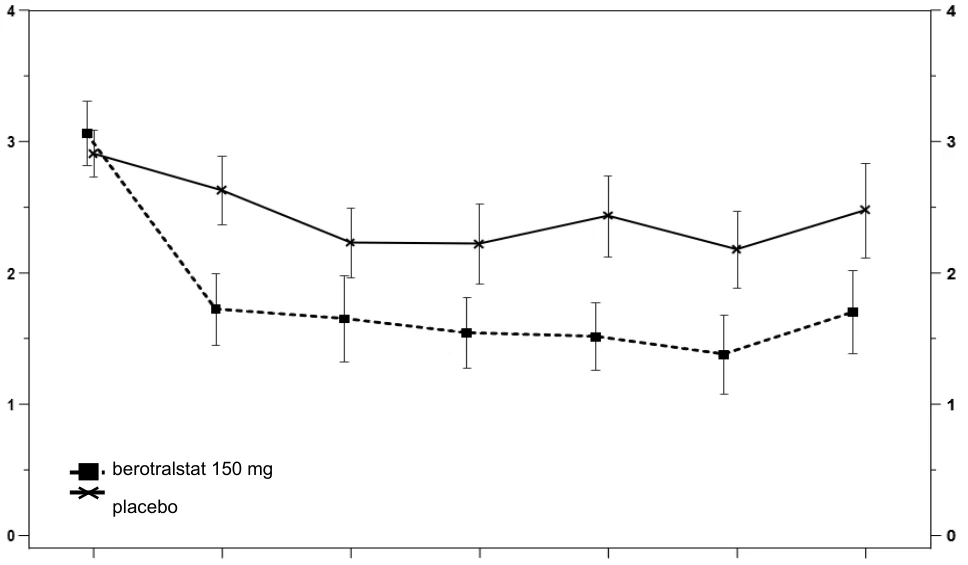
Mean (+ / -SE M ) I nv es ti gator -Confi rmed Atta c k Rat e (attack s /month )
berotralstat 150 mg
placebo
Abbreviation: SEM = Standard error of the mean
a One patient in the ITT population was randomized to placebo but was not treated, and therefore, was not included in the baseline analysis.
Predefined exploratory endpoints included the proportion of responders to study drug, defined as at least a 50% relative reduction in HAE attacks during treatment compared with the baseline attack rate; 58% of patients receiving 150 mg ORLADEYO had a ≥50% reduction in their HAE attack rates compared to baseline versus 25% of placebo patients. In post-hoc analyses, 50% and 23% of patients receiving 150 mg ORLADEYO had a ≥70% or ≥90% reduction in their HAE attack rates compared to baseline versus 15% and 8% of placebo patients, respectively.
The rate of attacks reported as moderate or severe was reduced by 40% in patients receiving 150 mg ORLADEYO versus placebo.
ORLADEYO 150 mg reduced the rate of HAE attacks requiring treatment with standard of care acute attack treatments by 49.2% (95% CI: 25.5%, 65.4%) compared to placebo (rate per 28 days: 1.04 vs. 2.05).
Health-Related Quality of Life
The Angioedema Quality of Life Questionnaire (AE-QoL) was administered to patients in Study 302 as the first secondary endpoint. An AE-QoL total score reduction of 6 points was considered a clinically meaningful improvement. Patients receiving berotralstat 150 mg experienced clinically meaningful improvement from baseline in the total score (Least squares [LS] mean change [SE] -14.6 [2.6]), however, the improvement did not reach statistical significance compared with placebo (-9.7 [2.6]). The largest improvement was observed in the individual functioning domain score with a LS mean change from placebo (95% confidence interval) of -9.10 (-18.58, 0.38).
16 NON-CLINICAL TOXICOLOGY
General Toxicology
In a 6-month repeat-dose toxicity study evaluating once-daily oral administration in rats, berotralstat was well tolerated at doses up to and including 20 mg/kg (highest dose tested). At the no-observed-adverse-effect level (NOAEL) of 20 mg/kg (exposure [AUC] 3.8-fold the human adult exposure at 150 mg, once daily), minimal liver toxicity was noted.
In a 9-month repeat-dose toxicity study evaluating once-daily oral administration in cynomolgus monkeys, berotralstat was well tolerated at 30 mg/kg (lowest dose tested). At the NOAEL of 30 mg/kg, exposure (AUC) was 1.5-fold the human adult exposure at 150 mg, once daily. At higher doses liver and kidney toxicity were observed.
Carcinogenicity
Carcinogenicity of berotralstat was evaluated in a 2-year study in Wistar rats and a 26-week study in Tg.rasH2 transgenic mice. The berotralstat doses (oral gavage) were up to 20 and 50 mg/kg/day in rats and mice (approximately 5 and 10 times the maximum recommended human daily dose [MRHDD] on a plasma AUC basis, respectively). No evidence of tumorigenicity was observed in either species.
Genotoxicity
Berotralstat tested negative in the in vitro bacterial reverse mutation assay (Ames test), the in vitro chromosomal aberration assay in human peripheral blood lymphocytes, and the in vivo rat micronucleus assay. No genotoxic effects were identified.
Reproductive and Developmental Toxicology
In a fertility study in rats, berotralstat at oral doses up to 45 mg/kg/day (approximately 2 times the MRHDD on a mg/m2 basis) showed no effect on fertility in males or females. The NOAEL for parental toxicity was 25 mg/kg/day based on adverse lower body weight gain at 45 mg/kg/day in males.
Special Toxicology
Consistent findings in subchronic and chronic toxicity studies indicated that berotralstat can cause in phospholipidosis in rats and monkeys.