


Product Monograph - Rinvoq
Recent Major Label Changes
| 1 Indications | 2025-08 |
|---|---|
| 4.1 Dosage and Administration, Dosing Considerations | 2025-04 |
| 4.2 Dosage and Administration, Recommended Dose and Dosage Adjustment | 2025-08 |
| 4.4 Dosage and Administration, Administration | 2025-08 |
| 7 Warnings and Precautions, Endocrine and Metabolism | 2025-12 |
| 7 Warnings and Precautions, Immunizations | 2024-07 |
| 7 Warnings and Precautions, Gastrointestinal | 2025-03 |
| 7 Warnings and Precautions, 7.1.3 Pediatrics | 2025-04 |
| 7 Warnings and Precautions, 7.1.4 Geriatrics | 2025-08 |
| 7 Warnings and Precautions, Reproductive Health | 2026-07 |
Table of Contents
Certain sections or subsections that are not applicable at the time of the preparation of the most recent authorized product monograph are not listed.
Recent Major Label Changes .................................................................................................... 2
Table of Contents .................................................................................................................... 2
Part 1: Healthcare Professional Information ............................................................................ 5
- 1.
Indications ........................................................................................................................ 5
1.1. Pediatrics .................................................................................................................... 6
1.2. Geriatrics ..................................................................................................................... 6
- 2. Contraindications ............................................................................................................. 6
- 3. Serious Warnings and Precautions Box ............................................................................. 7
- 4.
Dosage and Administration .............................................................................................. 8
4.1. Dosing Considerations ................................................................................................. 8
4.2. Recommended Dose and Dosage Adjustment ............................................................ 8
Rheumatoid Arthritis, Psoriatic Arthritis and Axial Spondyloarthritis ................................ 8
Giant Cell Arteritis ............................................................................................................. 8
Atopic Dermatitis .............................................................................................................. 9
Ulcerative Colitis ............................................................................................................... 9
Crohn’s Disease ................................................................................................................. 9
Dose Interruption ............................................................................................................ 10
Dosing in Special Populations .......................................................................................... 11
4.3. Reconstitution ........................................................................................................... 12
4.4. Administration .......................................................................................................... 12
4.5. Missed Dose .............................................................................................................. 13
- 5. Overdose ........................................................................................................................ 13
- 6. Dosage Forms, Strengths, Composition, and Packaging .................................................. 13
- 7.
Warnings and Precautions .............................................................................................. 14
Carcinogenesis and Genotoxicity ......................................................................................... 14
Cardiovascular ..................................................................................................................... 14
Endocrine and Metabolism .................................................................................................. 15
Gastrointestinal ................................................................................................................... 15
Hematologic ........................................................................................................................ 15
Hepatic/Biliary/Pancreatic ................................................................................................... 16
Hypersensitivity Reactions ................................................................................................... 16
Immune ............................................................................................................................... 17
Immunizations ..................................................................................................................... 17
Infections ............................................................................................................................. 17
Monitoring and Laboratory Tests ........................................................................................ 18
Musculoskeletal ................................................................................................................... 18
Reproductive Health ............................................................................................................ 19
7.1. Special Populations ................................................................................................... 19
7.1.1. Pregnancy ........................................................................................................ 19
7.1.2. Breastfeeding .................................................................................................. 19
7.1.3. Pediatrics ......................................................................................................... 20
7.1.4. Geriatrics ......................................................................................................... 20
7.1.5. Asian Patients .................................................................................................. 21
- 8.
Adverse Reactions .......................................................................................................... 21
8.1. Adverse Reaction Overview ...................................................................................... 21
8.2. Clinical Trial Adverse Reactions ................................................................................. 23
8.2.1. Clinical Trial Adverse Reactions – Pediatrics .................................................... 34
8.3. Less Common Clinical Trial Adverse Reactions .......................................................... 35
8.3.1. Less Common Clinical Trial Adverse Reactions – Pediatrics ............................. 35
8.4. Abnormal Laboratory Findings: Hematologic, Clinical Chemistry, and Other Quantitative Data ................................................................................................................ 35
8.5. Post-Market Adverse Reactions ................................................................................ 41
- 9.
Drug Interactions ............................................................................................................ 41
9.2. Drug Interactions Overview ...................................................................................... 41
9.3. Drug-Behaviour Interactions ..................................................................................... 41
9.4. Drug-Drug Interactions ............................................................................................. 42
9.5. Drug-Food Interactions ............................................................................................. 45
9.6. Drug-Herb Interactions ............................................................................................. 46
9.7. Drug-Laboratory Test Interactions ............................................................................ 46
- 10.
Clinical Pharmacology ..................................................................................................... 46
10.1. Mechanism of Action ............................................................................................. 46
10.2. Pharmacodynamics ............................................................................................... 47
10.3. Pharmacokinetics .................................................................................................. 48
- 11.
Storage, Stability, and Disposal ....................................................................................... 50
Others: ............................................................................................................................ 50
Part 2: Scientific Information ................................................................................................. 51
- 13. Pharmaceutical Information ........................................................................................... 51
- 14.
Clinical Trials ................................................................................................................... 52
14.1. Clinical Trials by Indication .................................................................................... 52
Rheumatoid Arthritis ....................................................................................................... 52
Psoriatic Arthritis ............................................................................................................. 62
Axial Spondyloarthritis .................................................................................................... 66
Ankylosing Spondylitis ..................................................................................................... 66
Non-radiographic Axial Spondyloarthritis ....................................................................... 69
Giant Cell Arteritis ........................................................................................................... 72
Atopic Dermatitis ............................................................................................................ 75
Ulcerative Colitis ............................................................................................................. 82
Crohn’s Disease ............................................................................................................... 89
- 16. Non-Clinical Toxicology ................................................................................................... 95
Patient Medication Information ............................................................................................ 97
Part 1: Healthcare Professional Information
1. Indications
Rheumatoid Arthritis
RINVOQ (upadacitinib) is indicated for the treatment of adults with moderately to severely active rheumatoid arthritis who have had an inadequate response or intolerance to methotrexate.
RINVOQ may be used as monotherapy or in combination with methotrexate or other nonbiologic disease-modifying antirheumatic drugs (DMARDs).
Psoriatic Arthritis
RINVOQ is indicated for the treatment of adults with active psoriatic arthritis who have had an inadequate response or intolerance to methotrexate or other DMARDs.
RINVOQ may be used as monotherapy or in combination with methotrexate.
Axial Spondyloarthritis (axSpA)
Ankylosing Spondylitis (AS, radiographic axial spondyloarthritis)
RINVOQ is indicated for the treatment of adults with active ankylosing spondylitis who have had an inadequate response to a biologic DMARD or when use of those therapies is inadvisable.
RINVOQ may be used as monotherapy or in combination with nonsteroidal anti-inflammatory drugs (NSAIDs).
Non-radiographic Axial Spondyloarthritis (nr-axSpA)
RINVOQ is indicated for the treatment of adults with active non-radiographic axial spondyloarthritis with objective signs of inflammation who have had an inadequate response to a biologic DMARD or when use of those therapies is inadvisable.
RINVOQ may be used as monotherapy or in combination with NSAIDs.
Giant Cell Arteritis
RINVOQ is indicated for the treatment of adult patients with giant cell arteritis (GCA).
RINVOQ is used in combination with a tapering course of corticosteroids and as monotherapy following discontinuation of corticosteroids.
Atopic Dermatitis
RINVOQ is indicated for the treatment of adults and adolescents 12 years of age and older with refractory moderate to severe atopic dermatitis (AD) who are not adequately controlled with a systemic treatment (e.g., steroid or biologic) or when use of those therapies is inadvisable.
RINVOQ can be used with or without topical corticosteroids.
Ulcerative Colitis
RINVOQ is indicated for the treatment of adult patients with moderately to severely active ulcerative colitis (UC) who have demonstrated prior treatment failure, i.e., an inadequate response to, loss of response to, or intolerance to at least one of conventional, and/or biologic therapy.
Crohn’s Disease
RINVOQ is indicated for the treatment of adult patients with moderately to severely active Crohn’s disease (CD) who have demonstrated prior treatment failure, i.e., an inadequate response to, loss of response to, or intolerance to at least one of conventional and/or biologic therapy.
Limitations of Use
RINVOQ should not be used in combination with other Janus kinase (JAK) inhibitors, immunomodulating biologics (e.g., biologic DMARDs), or with potent immunosuppressants such as azathioprine, 6-mercaptopurine and cyclosporine (see 7 WARNINGS AND PRECAUTIONS).
1.1. Pediatrics
Pediatrics (< 18 years of age): The safety and efficacy of RINVOQ in children and adolescents aged 0 to less than 18 years with rheumatoid arthritis, psoriatic arthritis, axial spondyloarthritis, ulcerative colitis or Crohn’s disease have not yet been established. No data are available; therefore, RINVOQ should not be used in this pediatric population (see 4.2 Recommended Dose and Dosage Adjustment, 7.1.3 Pediatrics, and 10.3 Pharmacokinetics).
Based on the data submitted and reviewed by Health Canada, the safety and efficacy of RINVOQ in pediatric patients 12-17 years of age, weighing ≥ 40 kg has been established for the treatment of refractory moderate to severe atopic dermatitis not adequately controlled with a systemic treatment (e.g., steroid or biologic) or when use of those therapies is inadvisable.
The safety and efficacy of RINVOQ in adolescents weighing < 40 kg and in children aged 0 to less than 12 years with atopic dermatitis have not yet been established. No data are available; therefore, RINVOQ should not be used in this pediatric patient population (see 4.2 Recommended Dose and Dosage Adjustment, 7.1.3 Pediatrics, and 10.3 Pharmacokinetics).
1.2. Geriatrics
Geriatrics (≥ 65 years of age): Caution should be used when treating geriatric patients with RINVOQ. There are limited data in patients 75 years of age and older. In clinical studies of patients treated with RINVOQ, there was an increased incidence of adverse events, including serious infections, in patients 65 years of age and older (see 4.2 Recommended Dose and Dosage Adjustment, 7.1.4 Geriatrics, and 10.3 Pharmacokinetics).
2. Contraindications
RINVOQ is contraindicated in patients who are hypersensitive to upadacitinib or to any ingredient in the formulation, including any non-medicinal ingredient, or component of the container. For a complete listing, see 6 DOSAGE FORMS, STRENGTHS, COMPOSITION AND PACKAGING.
3. Serious Warnings and Precautions Box
SERIOUS INFECTIONS Patients treated with RINVOQ are at increased risk for developing serious infections that may lead to hospitalization or death (see 7 WARNINGS AND PRECAUTIONS and 8.2 Clinical Trial Adverse Reactions). Most patients who developed these infections were taking concomitant immunosuppressants such as methotrexate or corticosteroids. If a serious infection develops, interrupt RINVOQ until the infection is controlled. Reported infections include:
Treatment with RINVOQ should not be initiated in patients with active infections including chronic or localized infections. The risks and benefits of treatment with RINVOQ should be carefully considered prior to initiating therapy in patients with chronic or recurrent infection. Patients should be closely monitored for the development of signs and symptoms of infection during and after treatment with RINVOQ, including the possible development of tuberculosis in patients who tested negative for latent tuberculosis infection prior to initiating therapy (see 7 WARNINGS AND PRECAUTIONS). MALIGNANCIES Lymphoma and other malignancies have been observed in patients treated with RINVOQ. An increase in malignancies, including lung cancer, were observed in rheumatoid arthritis (RA) patients 50 years or older with at least one additional cardiovascular (CV) risk factor who were taking a different JAK inhibitor, compared with tumour necrosis factor (TNF) inhibitors. Caution should be applied when using RINVOQ in geriatric patients, patients who are current or past smokers, and patients with other malignancy risk factors (see 7 WARNINGS AND PRECAUTIONS). THROMBOSIS Thrombosis, including deep venous thrombosis, pulmonary embolism, and arterial thrombosis, have occurred in patients treated with JAK inhibitors, including RINVOQ, for inflammatory conditions. Many of these adverse events were serious and some resulted in death. RA patients 50 years or older with at least one additional CV risk factor had a higher rate of all-cause mortality and thrombosis, including pulmonary embolism, deep venous thrombosis, and arterial thrombosis in a clinical trial with a different JAK inhibitor compared to TNF inhibitors. Consider the risks and benefits prior to treating patients who may be at increased risk for thrombosis. Discontinue RINVOQ and promptly evaluate patients with symptoms of thrombosis (see 7 WARNINGS AND PRECAUTIONS). MAJOR ADVERSE CARDIOVASCULAR EVENTS Major adverse cardiovascular events, including non-fatal myocardial infarction, were observed more frequently in RA patients 50 years or older with at least one additional CV risk factor in a clinical trial with a different JAK inhibitor compared to TNF inhibitors. Caution should be applied when using RINVOQ in geriatric patients, patients who are current or past smokers, and patients with other CV risk factors (see 7 WARNINGS AND PRECAUTIONS). |
|---|
4. Dosage and Administration
4.1. Dosing Considerations
- RINVOQ should not be initiated in patients with active infections including chronic or localized infections (see 7 WARNINGS AND PRECAUTIONS).
- RINVOQ should not be initiated in patients with an absolute lymphocyte count (ALC) less than 0.5 x 10⁹ cells/L, absolute neutrophil count (ANC) less than 1 x 10⁹ cells/L, or hemoglobin level less than 80 g/L (see 7 WARNINGS AND PRECAUTIONS).
- RINVOQ should not be initiated in patients with severe hepatic impairment (Child-Pugh C) (see 10.3 Pharmacokinetics).
- RINVOQ should not be used concomitantly with other potent systemic immunosuppressants. Concomitant use of RINVOQ with other potent immunosuppressants (such as azathioprine, cyclosporine, tacrolimus), biologic DMARDs, or other JAK inhibitors has not been evaluated in clinical studies. There is a risk of additive immunosuppression when RINVOQ is co-administered with potent immunosuppressant drugs (see 7 WARNINGS AND PRECAUTIONS and 9.4 Drug-Drug Interactions).
- RINVOQ 15 mg once daily should be used with caution in patients receiving chronic treatment with strong CYP3A inhibitors. RINVOQ 30 mg once daily is not recommended for patients receiving chronic treatment with strong CYP3A4 inhibitors. For patients with ulcerative colitis using strong CYP3A4 inhibitors, the recommended induction dose is 30 mg once daily (for up to 8 weeks) and the recommended maintenance dose is 15 mg once daily. For patients with Crohn’s disease using strong CYP3A4 inhibitors, the recommended induction dose is 30 mg once daily (for up to 12 weeks) and the recommended maintenance dose is 15 mg once daily. Upadacitinib exposure is increased when co-administered with strong CYP3A inhibitors (such as ketoconazole and clarithromycin) (see 9.2 Drug Interactions Overview).
- Co-administration of RINVOQ with strong CYP3A4 inducers is not recommended. Upadacitinib exposure is decreased when co-administered with strong CYP3A inducers (such as rifampin), which may lead to reduced therapeutic effect of RINVOQ (see 7 WARNINGS AND PRECAUTIONS and 9.2 Drug Interactions Overview).
- RINVOQ 15 mg once daily is the recommended dose for patients with severe renal impairment. No dose adjustment is required in patients with mild or moderate renal impairment (see 10.3 Pharmacokinetics).
4.2. Recommended Dose and Dosage Adjustment
Note: See Table 1 for the summary of the recommended dose for each indication.
Rheumatoid Arthritis, Psoriatic Arthritis and Axial Spondyloarthritis
The recommended oral dose of RINVOQ is 15 mg once daily.
Giant Cell Arteritis
The recommended dose of RINVOQ is 15 mg once daily in combination with a tapering course of corticosteroids.
RINVOQ 15 mg once daily can be used as monotherapy following discontinuation of corticosteroids.
RINVOQ 15 mg monotherapy should not be used for the treatment of acute relapses.
Atopic Dermatitis
Adults and adolescent patients 12 years of age and older weighing at least 40 kg
The recommended starting dose of RINVOQ is 15 mg once daily. If an adequate response (e.g., EASI 75) is not achieved, consider increasing dosage to 30 mg once daily. For some patients, such as those with severe disease, a starting dose of 30 mg once daily may be appropriate. Discontinue RINVOQ if an adequate response is not achieved with the 30 mg dose after 16 weeks of treatment. Use the lowest effective dose needed to maintain response.
For patients ≥ 65 years of age, the only recommended maintenance dose is 15 mg once daily. The 30 mg dose once daily is not recommended in these patients.
RINVOQ has not been studied in adolescents weighing less than 40 kg.
Ulcerative Colitis
Induction
The recommended induction dose is RINVOQ 45 mg once daily for 8 weeks.
Maintenance
The recommended dose for maintenance treatment is RINVOQ 15 mg once daily. For some patients, such as those with refractory, severe, or extensive disease, a maintenance dose of 30 mg once daily may be appropriate. Use the lowest effective dose needed to maintain response. Discontinue treatment if response is not maintained with the 30 mg dose.
For patients ≥ 65 years of age, the only recommended maintenance dose is 15 mg once daily. The 30 mg dose once daily is not recommended in these patients.
In patients who have responded to treatment with RINVOQ, corticosteroids may be reduced and/or discontinued in accordance with standard of care.
Crohn’s Disease
Induction
The recommended induction dose of RINVOQ is 45 mg once daily for 12 weeks.
Maintenance
The recommended dose of RINVOQ for maintenance treatment is 15 mg or 30 mg once daily based on patient presentation.
- A dose of 30 mg once daily may be appropriate for patients with high disease burden (such as refractory or severe disease) or those who do not show adequate therapeutic benefit with 15 mg once daily.
- The lowest effective dose for maintenance should be used.
For patients ≥ 65 years of age, the recommended maintenance dose is 15 mg once daily.
In patients who are responding to induction or maintenance treatment with RINVOQ, corticosteroids may be reduced and/or discontinued in accordance with standard of care.
Table 1. Recommended dose of RINVOQ
| Indication | Age | Indicated Dose |
|---|---|---|
| Rheumatoid Arthritis | Adults 18 years of age or older | 15 mg once daily |
| Psoriatic Arthritis | Adults 18 years of age or older | 15 mg once daily |
| Axial Spondyloarthritis | Adults 18 years of age or older | 15 mg once daily |
| Giant Cell Arteritis | Adults 18 years of age or older | 15 mg once daily |
| Atopic Dermatitis | Adults 18 to 64 years of age and adolescents 12 to 17 years of age ≥ 40 kg | 15 mg or 30 mg once dailya |
| Adults ≥ 65 years of age | 15 mg once daily | |
| Ulcerative Colitis | ||
| Induction | Adults 18 years of age or older | 45 mg once daily for 8 weeks |
| Maintenance | Adults 18 to 64 years of age | 15 mg or 30 mg once dailya |
| Adults ≥ 65 years of age | 15 mg once daily | |
| Crohn’s Disease | ||
| Induction | Adults 18 of age or older | 45 mg once daily for 12 weeks |
| Maintenance | Adults 18 to 64 years of age | 15 mg or 30 mg once dailya |
| Adults ≥ 65 years of age | 15 mg once daily | |
| ||
Dose Interruption
RINVOQ treatment should be interrupted if a patient develops a serious infection until the infection is controlled (see 7 WARNINGS AND PRECAUTIONS).
RINVOQ treatment should be interrupted for management of laboratory abnormalities as described in Table 2.
Table 2. Laboratory measures and monitoring guidance
| Laboratory measure | Action | Monitoring guidance |
|---|---|---|
| Absolute Neutrophil Count (ANC) | Treatment should be interrupted if ANC is < 1 x 10⁹ cells/L and may be restarted once ANC returns above this value | Evaluate at baseline and then no later than 12 weeks after initiation of treatment. Thereafter evaluate according to individual patient management. |
| Absolute Lymphocyte Count (ALC) | Treatment should be interrupted if ALC is < 0.5 x 10⁹ cells/L and may be restarted once ALC returns above this value | |
| Hemoglobin (Hb) | Treatment should be interrupted if Hb is < 80 g/L and may be restarted once Hb returns above this value | |
| Hepatic transaminases | Treatment should be temporarily interrupted if drug-induced liver injury is suspected | Evaluate at baseline and thereafter according to routine patient management. |
| Lipids | Patients should be managed according to international clinical guidelines for hyperlipidemia | Evaluate at baseline and 12 weeks after initiation of treatment. Thereafter evaluate according to international clinical guidelines for hyperlipidemia. |
Dosing in Special Populations
Pediatrics (< 18 years of age):
Atopic Dermatitis: The safety and efficacy of RINVOQ in adolescents weighing < 40 kg and in children aged 0 to less than 12 years have not yet been established. No data are available; therefore, RINVOQ should not be used in this pediatric patient population (see 1.1 Pediatrics, 7.1.3 Pediatrics, and 10.3 Pharmacokinetics).
Rheumatoid Arthritis, Psoriatic Arthritis, Axial Spondyloarthritis, Ulcerative Colitis or Crohn’s Disease: Health Canada has not authorized an indication for pediatric use of RINVOQ. No data are available regarding the safety and efficacy of RINVOQ in children and adolescents aged 0 to less than 18 years. Therefore, RINVOQ should not be used in this pediatric patient population (see 1.1 Pediatrics, 7.1.3 Pediatrics, and 10.3 Pharmacokinetics).
Geriatric (≥ 65 years of age): Rheumatoid Arthritis, Psoriatic Arthritis, Axial Spondyloarthritis, Giant Cell Arteritis, Atopic Dermatitis, Ulcerative Colitis (maintenance treatment phase) or Crohn’s Disease (maintenance treatment phase): RINVOQ 15 mg once daily is the only recommended dose in patients aged 65 years and older. No dose adjustment is required (see 7.1.4 Geriatrics and 10.3 Pharmacokinetics).
Hepatic Impairment: RINVOQ should not be used in patients with severe hepatic impairment (Child-Pugh C). The use of RINVOQ has not been studied in patients with severe hepatic impairment. No dose adjustment is required in patients with mild (Child-Pugh A) or moderate (Child-Pugh B) hepatic impairment (see 10.3 Pharmacokinetics).
Renal Impairment: No dose adjustment is required in patients with mild or moderate renal impairment. The use of RINVOQ has not been studied in subjects with end stage renal disease (see 10.3 Pharmacokinetics).
For patients with severe renal impairment, the following dose adjustments are recommended:
Table 3. Recommended Dose for Severe Renal Impairment
| Indication | Recommended once daily dose | ||
|---|---|---|---|
| Severe renal impairment | Rheumatoid arthritis, psoriatic arthritis, axial spondyloarthritis, giant cell arteritis, and atopic dermatitis | 15 mg | |
| Ulcerative Colitis, Crohn’s Disease | Induction: 30 mg | ||
| Maintenance: 15 mg | |||
4.3. Reconstitution
No reconstitution required.
4.4. Administration
RINVOQ is to be taken orally once daily with or without food and may be taken at any time of the day. RINVOQ tablets should be swallowed whole. RINVOQ should not be split, crushed, or chewed.
Rheumatoid Arthritis
RINVOQ may be used as monotherapy or in combination with methotrexate or other nonbiologic disease-modifying antirheumatic drugs (DMARDs).
Psoriatic Arthritis
RINVOQ may be used as monotherapy or in combination with methotrexate.
Axial Spondyloarthritis
RINVOQ may be used as monotherapy or in combination with NSAIDs.
Giant Cell Arteritis
RINVOQ is used in combination with a tapering course of corticosteroids and as monotherapy following discontinuation of corticosteroids.
Atopic Dermatitis
Concomitant Topical Therapies: RINVOQ can be used with or without topical corticosteroids. Topical calcineurin inhibitors may be used for sensitive areas such as the face, neck, and intertriginous and genital areas.
Ulcerative Colitis and Crohn’s Disease
RINVOQ may be used as monotherapy or in combination with conventional therapy.
4.5. Missed Dose
If a dose of RINVOQ is missed and it is more than 10 hours from the next scheduled dose, advise the patient to take a dose as soon as possible and then to take the next dose at the usual time. If a dose is missed and it is less than 10 hours from the next scheduled dose, advise the patient to skip the missed dose and take only a single dose as usual the following day. Advise the patient not to double a dose to make up for a missed dose.
5. Overdose
Upadacitinib was administered in clinical trials up to doses equivalent in daily AUC (area under the curve) to 60 mg extended-release once daily. Adverse events were comparable to those seen at lower doses and no specific toxicities were identified. Approximately 90% of upadacitinib in the systemic circulation is eliminated within 24 hours of dosing (within the range of doses evaluated in clinical studies). In case of an overdose, it is recommended that the patient be monitored for signs and symptoms of adverse reactions. Patients who develop adverse reactions should receive appropriate treatment.
| For the most recent information in the management of a suspected drug overdose, contact your regional poison control centre or Health Canada’s toll-free number, 1-844 POISON-X (1-844-764-7669). |
|---|
- 6. Dosage Forms, Strengths, Composition, and Packaging
Table 4. Dosage Forms, Strengths, Composition and Packaging
| Route of Administration | Dosage Form / Strength/Composition | Non-medicinal Ingredients |
| oral | extended-release tablet/ 15 mg/upadacitinib | black iron oxide (E172)/ferrosoferric oxide, hypromellose, iron oxide red (E172), macrogol/polyethylene glycol, magnesium stearate, mannitol, microcrystalline cellulose, polyvinyl alcohol, silica (colloidal anhydrous)/colloidal silicon dioxide, talc, tartaric acid, and titanium dioxide (E171) |
| oral | extended-release tablet/ 30 mg/upadacitinib | hypromellose, iron oxide red (E172), macrogol/polyethylene glycol, magnesium stearate, mannitol, microcrystalline cellulose, polyvinyl alcohol, silica (colloidal anhydrous)/colloidal silicon dioxide, talc, tartaric acid, and titanium dioxide (E171) |
| oral | extended-release tablet/ 45 mg/upadacitinib | hypromellose, iron oxide red (E172), iron oxide yellow (E172), macrogol/polyethylene glycol, magnesium stearate, mannitol, microcrystalline cellulose, polyvinyl alcohol, silica (colloidal anhydrous)/colloidal silicon dioxide, talc, tartaric acid, and titanium dioxide (E171). |
Description
RINVOQ 15 mg extended-release tablets are purple, biconvex oblong, with dimensions of 14 x 8 mm, and debossed with ‘a15’ on one side. The tablets are provided in bottles. Each bottle contains 30 tablets.
RINVOQ 30 mg extended-release tablets are red, biconvex oblong, with dimensions of 14 x 8 mm, and debossed with ‘a30’ on one side. The tablets are provided in bottles. Each bottle contains 30 tablets.
RINVOQ 45 mg extended-release tablets are yellow biconvex oblong, with dimensions of 14 x 8 mm, and debossed with ‘a45’ on one side. The tablets are provided in bottles. Each bottle contains 28 tablets.
The tablets do not contain gluten.
7. Warnings and Precautions
Please see 3 SERIOUS WARNINGS AND PRECAUTIONS BOX.
Carcinogenesis and Genotoxicity
Lymphoma and other malignancies were observed in clinical studies of RINVOQ (see 8.2 Clinical Trial Adverse Reactions). A higher rate of malignancies, including NMSC, was observed with RINVOQ 30 mg compared to RINVOQ 15 mg.
In a large randomized active-controlled study in RA patients 50 years and older with at least one additional CV risk factor, an increased incidence of malignancy, particularly lung cancer, lymphoma and NMSC, was observed with a different JAK inhibitor compared to TNF inhibitors. Patients who were 65 years and older, and current or past smokers were at additional increased risk.
Consider the risks and benefits of RINVOQ treatment prior to initiating therapy in geriatric patients, patients who are current or past smokers, patients with a known malignancy other than a successfully treated NMSC or when considering continuing RINVOQ in patients who develop a malignancy.
Non-Melanoma Skin Cancer (NMSC): NMSC is a dose-related adverse reaction, with a greater risk of occurrence and reoccurrence in patients treated with 30 mg RINVOQ than in patients treated with 15 mg RINVOQ. An increase in NMSC was observed in patients treated with RINVOQ compared to TNF inhibitors. Caution should be used when treating patients with a prior history of NMSC. Periodic skin examination is recommended for patients who are at increased risk for skin cancer.
Cardiovascular
Thrombosis: Thrombosis, including deep venous thrombosis (DVT), pulmonary embolism (PE), and arterial thrombosis, have occurred in patients treated for inflammatory conditions with JAK inhibitors, including RINVOQ (see 8.2 Clinical Trial Adverse Reactions). Many of these adverse events were serious and some resulted in death.
In a large, randomized, active-controlled study in RA patients 50 years of age and older with at least one additional CV risk factor, a dose dependent increased incidence of venous thromboembolic events (VTE) was observed with a different JAK inhibitor compared with TNF inhibitors.
Consider the risks and benefits of RINVOQ treatment prior to treating patients who may be at increased risk of thrombosis. Risk factors that should be considered in determining the patient's risk for DVT/PE include older age, current or history of smoking, obesity, a medical history of DVT/PE, prothrombotic disorder, use of combined hormonal contraceptives or hormone replacement therapy, patients undergoing major surgery, or prolonged immobilization. If clinical features of DVT/PE occur, RINVOQ treatment should be discontinued, and patients should be evaluated promptly and treated appropriately.
Major Adverse Cardiovascular Events: In a large, randomized, active-controlled study in RA patients 50 years of age and older with at least one additional CV factor, an increased incidence of major adverse cardiovascular events (MACE: non-fatal myocardial infarction [MI], non-fatal stroke, and CV deaths excluding PE) was observed with a different JAK inhibitor compared with TNF inhibitors. This increase in MACE was primarily due to an increased incidence of non-fatal MI.
Consider the risks and benefits of RINVOQ treatment prior to initiating therapy in geriatric patients, patients who are current or past smokers, and patients with other CV risk factors, or when considering continuing RINVOQ in patients who develop MACE.
Endocrine and Metabolism
Lipids: Treatment with RINVOQ was associated with increases in lipid parameters, including total cholesterol, low-density lipoprotein (LDL) cholesterol, and high-density lipoprotein (HDL) cholesterol (see 8.4 Abnormal Laboratory Findings: Hematologic, Clinical Chemistry and Other Quantitative Data). Elevations in LDL cholesterol decreased to pre-treatment levels in response to statin therapy. The effect of these lipid parameter elevations on cardiovascular morbidity and mortality has not been determined.
Assessment of lipid parameters should be performed at baseline, 12 weeks after initiation of RINVOQ treatment and thereafter according to the clinical guidelines for hyperlipidemia. Manage patients according to clinical guidelines for the management of hyperlipidemia (see 8.4 Abnormal Laboratory Findings: Hematologic, Clinical Chemistry and Other Quantitative Data)
Hypoglycemia in Patients Treated for Diabetes: There have been reports of hypoglycemia following initiation of JAK inhibitors, including RINVOQ, in patients receiving medication for diabetes. Dose adjustment of anti-diabetic medicinal products may be necessary in the event that hypoglycemia occurs.
Gastrointestinal
Gastrointestinal Perforations: Events of gastrointestinal perforation have been reported in clinical studies with RINVOQ (see 8.2 Clinical Trial Adverse Reactions), and from post-marketing sources.
RINVOQ should be used with caution in patients who may be at increased risk for gastrointestinal perforation (e.g., patients with diverticular disease, a history of diverticulitis, or who are taking NSAIDs, corticosteroids or opioids). Patients presenting with new onset abdominal symptoms should be evaluated promptly for early identification of gastrointestinal perforation.
Medication Residue in Stool: Reports of medication residue in stool or ostomy output have occurred in patients taking RINVOQ. Most reports described anatomic (e.g., ileostomy, colostomy, intestinal resection) or functional gastrointestinal conditions with shortened gastrointestinal transit times. Patients should be instructed to contact their healthcare provider if medication residue is observed repeatedly. Patients should be clinically monitored, and alternative treatment should be considered if there is an inadequate therapeutic response.
Hematologic
Anemia: Decreases in hemoglobin levels to less than 80 g/L were reported in RINVOQ clinical studies (see 8.4 Abnormal Laboratory Findings: Hematologic, Clinical Chemistry and Other Quantitative Data). Evaluate hemoglobin prior to initiation of RINVOQ and thereafter according to routine patient management. Do not initiate RINVOQ treatment, and interrupt RINVOQ treatment in patients with a low hemoglobin level (i.e., less than 80 g/L) (see 4.1 Dosing Considerations and 4.2 Recommended Dose and Dosage Adjustment and 7 WARNINGS AND PRECAUTIONS)
Lymphopenia: Absolute Lymphocyte Counts (ALC) less than 0.5 x 10⁹ cells/L were reported in RINVOQ clinical studies (see 8.4 Abnormal Laboratory Findings: Hematologic, Clinical Chemistry and Other Quantitative Data). Evaluate lymphocyte counts prior to initiation of RINVOQ and thereafter according to routine patient management. Do not initiate RINVOQ treatment, and interrupt RINVOQ treatment in patients with a low lymphocyte count (i.e., less than 0.5 x 10⁹ cells/L) (see 4.1 Dosing Considerations, and 4.2 Recommended Dose and Dosage Adjustment and 7 WARNINGS AND PRECAUTIONS).
Neutropenia: Treatment with RINVOQ was associated with an increased incidence of neutropenia (ANC less than 1 x 10⁹ cells/L) (see 8.4 Abnormal Laboratory Findings: Hematologic, Clinical Chemistry and Other Quantitative Data). Evaluate neutrophil counts prior to initiating RINVOQ and thereafter according to routine patient management. Do not initiate RINVOQ treatment, and interrupt RINVOQ treatment in patients with a low neutrophil count (i.e., ANC less than 1 x 10⁹ cells/L) (4.1 Dosing Considerations, 4.2 Recommended Dose and Dosage Adjustment and 7 WARNINGS AND PRECAUTIONS).
Hepatic/Biliary/Pancreatic
Treatment with RINVOQ was associated with an increased incidence of liver enzyme elevation compared to placebo (see 8.4 Abnormal Laboratory Findings: Hematologic, Clinical Chemistry and Other Quantitative Data). Increases to ≥ 3X the upper limit of normal (ULN) for both alanine transaminase (ALT) and aspartate transaminase (AST) were the more frequently reported, but increases to ≥ 5X and ≥ 10X ULN were also observed in patients treated with RINVOQ in clinical trials. Unconfirmed drug induced liver injury (DILI) was observed in four patients receiving upadacitinib in clinical trials, including 2 patients receiving RINVOQ. Upadacitinib was discontinued in 3 cases and was continued without interruption in one patient receiving RINVOQ.
Liver enzymes should be evaluated before initiating RINVOQ treatment and thereafter according to routine patient management. Prompt investigation of the cause of liver enzyme elevation is recommended to identify potential cases of DILI. If increases in ALT or AST are observed during routine patient management and DILI is suspected, RINVOQ should be interrupted until this diagnosis is excluded (see 4.2 Recommended Dose and Dosage Adjustment and 8.4 Abnormal Laboratory Findings: Hematologic, Clinical Chemistry and Other Quantitative Data).
Although patients with active hepatitis B or C infection were excluded from clinical trials, cases of hepatitis B virus reactivation were still reported in patients enrolled in the clinical studies of RINVOQ. Screening for viral hepatitis and monitoring for reactivation should be performed in accordance with clinical guidelines before starting and during therapy with RINVOQ. If hepatitis B virus DNA is detected while receiving RINVOQ, a liver specialist should be consulted (see 8.4 Abnormal Laboratory Findings: Hematologic, Clinical Chemistry and Other Quantitative Data).
The use of RINVOQ has not been studied in patients with severe hepatic impairment and therefore, RINVOQ should not be used in these patients (see 4.2 Recommended Dose and Dosage Adjustment and 10.3 Pharmacokinetics).
Hypersensitivity Reactions
Serious hypersensitivity reactions such as anaphylaxis and angioedema were reported in patients receiving RINVOQ in clinical trials. If a clinically significant hypersensitivity reaction occurs, discontinue RINVOQ and institute appropriate therapy (see 8 ADVERSE REACTIONS).
Immune
RINVOQ should not be used concomitantly with other potent immunosuppressants. Concomitant use of RINVOQ with other potent immunosuppressants (such as azathioprine, cyclosporine, tacrolimus), biologic DMARDs, or other JAK inhibitors has not been evaluated in clinical studies. There is a risk of additive immunosuppression when RINVOQ is co-administered with potent immunosuppressant drugs (see 4.1 Dosing Considerations and 9.2 Drug Interactions Overview).
Immunizations
No data are available on the response to vaccination with live vaccines in patients receiving RINVOQ. Live or attenuated vaccines should not be used immediately prior to or during RINVOQ therapy. The interval between live vaccinations and initiation of RINVOQ therapy should be in accordance with current vaccination guidelines regarding immunosuppressive agents. Prior to initiating RINVOQ treatment, it is recommended that patients be brought up to date with all immunizations, including prophylactic zoster vaccinations, in agreement with current immunization guidelines. In patients already receiving RINVOQ, prophylactic herpes zoster vaccination administered concomitantly with RINVOQ may achieve satisfactory humoral response (see 10.2 Pharmacodynamics). Individuals taking RINVOQ may have a reduced antibody response to non-live vaccines (see 10.2 Pharmacodynamics).
Infections
Serious Infections: Serious and sometimes fatal infections have been reported in patients receiving RINVOQ. The most frequent serious infections reported with RINVOQ included pneumonia and cellulitis (see 8.2 Clinical Trial Adverse Reactions). Among opportunistic infections, tuberculosis, multidermatomal herpes zoster, oral/esophageal candidiasis, and cryptococcosis were reported with RINVOQ. A higher rate of serious infections was observed with RINVOQ 30 mg compared to RINVOQ 15 mg.
RINVOQ should not be initiated in patients with active infections including chronic or localized infections. Consider the risks and benefits of treatment prior to initiating RINVOQ in patients:
- With chronic or recurrent infection
- Who have been exposed to tuberculosis
- With a history of a serious or an opportunistic infection
- Who have resided or traveled in areas of endemic tuberculosis or endemic mycoses; or
- With underlying conditions that may predispose them to infection.
Closely monitor patients for the development of signs and symptoms of infection during and after treatment with RINVOQ. Interrupt RINVOQ if a patient develops a serious or opportunistic infection. A patient who develops a new infection during treatment with RINVOQ should undergo prompt and complete diagnostic testing appropriate for an immunocompromised patient; appropriate antimicrobial therapy should be initiated, the patient should be closely monitored, and RINVOQ should be interrupted if the patient is not responding to antimicrobial therapy. Do not resume RINVOQ treatment until the infection is controlled.
Tuberculosis: Patients should be screened for tuberculosis (TB) before starting RINVOQ therapy. RINVOQ should not be given to patients with active TB. Anti-TB therapy should be considered prior to initiation of RINVOQ in patients with previously untreated latent TB or active TB in whom an adequate course of treatment cannot be confirmed, and for patients with a negative test for latent TB but who have risk factors for TB infection.
Consultation with a physician with expertise in the treatment of TB is recommended to aid in the decision about whether initiating anti-TB therapy is appropriate for an individual patient.
Monitor patients for the development of signs and symptoms of TB, including patients who tested negative for latent TB infection prior to initiating therapy.
Viral Reactivation: Viral reactivation, including cases of herpes virus reactivation (e.g., herpes zoster) and hepatitis B virus reactivation, were reported in clinical studies with RINVOQ (see 8.2 Clinical Trial Adverse Reactions). If a patient develops herpes zoster, consider temporarily interrupting RINVOQ until the episode resolves.
Screening for viral hepatitis and monitoring for reactivation should be performed in accordance with clinical guidelines before starting and during therapy with RINVOQ. Patients who were positive for hepatitis C antibody and hepatitis C virus RNA, were excluded from clinical studies. Patients who were positive for hepatitis B surface antigen or hepatitis B virus DNA were excluded from clinical studies. However, cases of hepatitis B reactivation were still reported in patients enrolled in the clinical studies of RINVOQ. If hepatitis B virus DNA is detected while receiving RINVOQ, a liver specialist should be consulted.
Monitoring and Laboratory Tests
Hematology: Lymphocyte counts, neutrophil counts, and hemoglobin should be evaluated before initiating RINVOQ treatment and thereafter according to routine patient management. Treatment should not be initiated and should be interrupted in patients with low lymphocyte count (ALC less than 0.5 x 10⁹ cells/L), low neutrophil count (ANC less than 1 x 10⁹ cells/L), or low hemoglobin level (less than 80 g/L) (see 4.1 Dosing Considerations, 4.2 Recommended Dose and Dosage Adjustment and 7 WARNINGS AND PRECAUTIONS).
Lipids: Assessment of lipid parameters should be performed at baseline, 12 weeks after initiation of RINVOQ treatment and thereafter according to the clinical guidelines for hyperlipidemia. Patients should be managed according to clinical guidelines for the management of hyperlipidemia (see 4.2 Recommended Dose and Dosage Adjustment and 8.4 Abnormal Laboratory Findings: Hematologic, Clinical Chemistry and Other Quantitative Data).
Liver Enzyme Elevations: Liver enzymes should be evaluated before initiating RINVOQ treatment and thereafter according to routine patient management. Prompt investigation of the cause of liver enzyme elevation is recommended to identify potential cases of drug-induced liver injury. If increases in ALT or AST are observed during routine patient management and drug-induced liver injury is suspected, RINVOQ treatment should be interrupted until this diagnosis is excluded (see 4.2 Recommended Dose and Dosage Adjustment and 8.4 Abnormal Laboratory Findings: Hematologic, Clinical Chemistry and Other Quantitative Data).
Musculoskeletal
Treatment with RINVOQ was associated with dose-related increases in creatine phosphokinase (CPK) (see 8.4 Abnormal Laboratory Findings: Hematologic, Clinical Chemistry and Other Quantitative Data). CPK levels should be checked in patients with symptoms of muscle weakness and/or muscle pain to evaluate for evidence of rhabdomyolysis.
Reproductive Health
Pregnancy: Based on findings in animal studies, RINVOQ may cause fetal harm when administered to a pregnant woman. Administration of upadacitinib to rats and rabbits during organogenesis caused increases in fetal malformations (see 16 NON-CLINICAL TOXICOLOGY). Pregnant women should be advised of the potential risk to a fetus. Females of reproductive potential should be advised to use effective contraception during treatment with RINVOQ and for 4 weeks following completion of therapy (see 7.1.1 Pregnancy).
Semen discolouration: Reports of semen discolouration (blue or green) have occurred in patients taking RINVOQ. Most reports occurred with RINVOQ 30 mg and 45 mg, within the first three months of treatment, although some occurred after almost a year. The mechanism and clinical relevance are unknown. Patients should be advised to report any changes in semen colour to their healthcare professional.
7.1. Special Populations
7.1.1. Pregnancy
RINVOQ should not be used during pregnancy. There are limited human data on the use of upadacitinib in pregnant women. There are no adequate and well-controlled studies to assess the use of RINVOQ in pregnant women. Studies in animals have shown reproductive toxicity (see 16 NON-CLINICAL TOXICOLOGY) In animal embryo-fetal developmental studies, upadacitinib was teratogenic in rats and rabbits with dose-related increases in skeletal malformations in rat fetuses and an increased incidence of cardiovascular malformations in rabbit fetuses when exposed in utero. Increased post-implantation loss was seen in rabbits and decreased fetal body weights were observed in both rats and rabbits. The effect of upadacitinib on human fertility has not been evaluated. Animal studies do not indicate effects with respect to fertility (see 16 NON-CLINICAL TOXICOLOGY).
Based on animal studies, upadacitinib has the potential to adversely affect a developing fetus and may cause embryo-fetal harm when administered to pregnant women. Women of reproductive potential should be advised to use effective contraception during treatment and for 4 weeks following the final dose of RINVOQ. If the patient becomes pregnant while taking RINVOQ, inform the patient of the potential hazard to a fetus.
7.1.2. Breastfeeding
RINVOQ should not be used during breast-feeding. It is unknown if upadacitinib is excreted in human milk. Lactation studies have not been conducted to assess the presence of upadacitinib in human milk, the effects on the breastfed infant, or the effects on milk production. Available pharmacodynamic/ toxicological data in animals have shown excretion of upadacitinib in milk. Following administration of upadacitinib to lactating rats, upadacitinib exposure was approximately 30-fold greater in milk than in maternal plasma. Approximately 97% of drug-related material in milk was parent drug.
A risk to newborns/infants cannot be excluded. When a drug is present in animal milk, it is likely that the drug will be present in human milk. Because of the potential for serious adverse reactions in the breastfed infant, patients should be advised not to breast-feed during treatment with RINVOQ, and for 6 days (approximately 10 half-lives) after the last dose.
7.1.3. Pediatrics
Pediatrics (<18 years of age):
Atopic Dermatitis: A total of 542 adolescents aged 12 to 17 years with moderate to severe atopic dermatitis were randomized across the three global Phase 3 studies, of which 344 were evaluated for the primary analysis. Adolescents in the primary analysis were randomized to either 15 mg (N = 114) or 30 mg (N = 114) RINVOQ or matching placebo (N = 116) in monotherapy or combination with topical corticosteroids. Efficacy was consistent between the adolescents and adults (see 14.1 Clinical Trials by Indication). The adverse event profile in adolescents was generally similar to the adults.
Safety and efficacy of RINVOQ in patients less than 12 years of age with atopic dermatitis have not been established.
Rheumatoid Arthritis, Psoriatic Arthritis, Axial Spondyloarthritis, Ulcerative Colitis, or Crohn’s Disease: No data are available to Health Canada; therefore, Health Canada has not authorized an indication for pediatric use (see 1.1 Pediatrics, 4.2 Recommended Dose and Dosage Adjustment, and 10.3 Pharmacokinetics).
7.1.4. Geriatrics
Caution should be used when treating geriatric patients with RINVOQ. There are limited data in patients 75 years of age and older.
Rheumatoid Arthritis: In five Phase 3 clinical studies, 518 rheumatoid arthritis patients treated with RINVOQ were 65 years of age and older, including 78 patients 75 years of age and older.
Psoriatic Arthritis: In two Phase 3 clinical studies, 129 psoriatic arthritis patients treated with RINVOQ were 65 years of age or older, including 18 patients 75 years of age and older. Although no differences in effectiveness were observed between these patients and younger patients, there was an increased incidence of adverse events, including serious infections and adverse events leading to RINVOQ discontinuation in patients ≥ 65 years of age (see 1.2 Geriatrics, 4.2 Recommended Dose and Dosage Adjustment, and 10.3 Pharmacokinetics).
Axial Spondyloarthritis
- Ankylosing Spondylitis: In two Phase 3 clinical studies, 32 ankylosing spondylitis patients treated with RINVOQ were 65 years of age or older, including 4 patients 75 years of age or older.
- Non-radiographic Axial Spondyloarthritis: In one Phase 3 clinical study, a total of 9 non-radiographic axial spondyloarthritis patients were 65 years of age or older.
Giant Cell Arteritis: Of the 428 patients treated in the Phase 3 clinical study for GCA, 167 patients treated with RINVOQ 15 mg were 65 years of age and older, including 65 patients who were 75 years of age and older.
Atopic Dermatitis: In three Phase 3 clinical studies, 115 atopic dermatitis patients treated with RINVOQ were 65 to 75 years of age at study entry. In the elderly, a higher rate of overall adverse events was observed compared to younger patients and in the RINVOQ 30 mg dose group compared to the 15 mg dose group. The use of 30 mg in patients over 65 years of age is not recommended.
Ulcerative Colitis: Of the 576 patients who responded to RINVOQ 45 mg once daily induction treatment and received maintenance treatment in the ulcerative colitis studies, 52 patients were 65 years of age or older. In the elderly patients, a higher rate of overall adverse events was observed compared to younger patients and in the RINVOQ 30 mg once daily dose group compared to the RINVOQ 15 mg once daily dose group. The use of 30 mg for maintenance in patients over 65 years of age is not recommended.
Crohn’s Disease: Of the 673 patients who responded to RINVOQ 45 mg induction treatment and received maintenance treatment in the phase 3 clinical studies, 23 patients were 65 years of age or older. A higher rate of overall adverse events was observed in the elderly with RINVOQ 30 mg compared to younger patients and RINVOQ 15 mg dose.
7.1.5. Asian Patients
Asian patients have an increased risk of herpes zoster compared to other races. Therefore, RINVOQ should be used with caution in these patients (see 8 ADVERSE REACTIONS).
8. Adverse Reactions
8.1. Adverse Reaction Overview
Rheumatoid Arthritis, Psoriatic Arthritis and Axial Spondyloarthritis
The most commonly reported adverse reactions occurring in ≥ 2% of patients treated with RINVOQ 15 mg were upper respiratory tract infection, nausea, bronchitis, blood creatine phosphokinase (CPK) increased, urinary tract infection, ALT increased, AST increased, neutropenia, headache, cough and back pain. There is increased incidence of opportunistic infections including herpes zoster in patients taking RINVOQ. A higher incidence of herpes zoster was observed in Asian patients. Therefore, RINVOQ should be used with caution in Asian patients.
In clinical trials, the most common SAEs in patients treated with upadacitinib (incidence rate of ≥ 0.5 per 100 patient-years) included pneumonia, osteoarthritis, and pulmonary embolism. Uncommon SAEs in patients treated with upadacitinib include deep vein thrombosis, arterial thrombosis, gastrointestinal perforation, anemia, malignancies, and cellulitis.
The most common causes of death in the upadacitinib clinical program were cardiovascular related.
The most common adverse reactions leading to discontinuation from treatment were infections. The most common infections (incidence rate of ≥ 0.5 per 100 patient-years) resulting in discontinuation of treatment were pneumonia and herpes zoster [see 7 WARNINGS AND PRECAUTIONS, 8.2 Clinical Trial Adverse Reactions, 8.3 Less Common Clinical Trial Adverse Reactions, 8.4 Abnormal Laboratory Findings: Hematologic, Clinical Chemistry and Other Quantitative Data].
Giant Cell Arteritis
In the placebo-controlled period (52 weeks) of the giant cell arteritis clinical trial, the most commonly reported adverse reactions occurring in > 5% of patients treated with RINVOQ 15 mg were upper respiratory tract infection (21.5%), headache (16.3%), fatigue (9.1%), peripheral edema (8.6%), cough (7.2%), anemia (6.7%), rash (5.7%), herpes zoster (5.3%), and nausea (5.3%).
The most common SAE in patients treated with RINVOQ 15 mg was pulmonary embolism (2.4% in patients receiving RINVOQ 15 mg vs 1.8% in patients receiving placebo).
Atopic Dermatitis
In the placebo-controlled atopic dermatitis clinical trials, the most commonly reported adverse reactions (≥ 2% of patients) with RINVOQ 15 mg or 30 mg were upper respiratory tract infection (25.4%), acne (15.1%), herpes simplex (8.4%), headache (6.3%), CPK increased (5.5%), cough (3.2%), folliculitis (3.2%), abdominal pain (2.9%), nausea (2.7%), neutropenia (2.3%), pyrexia (2.1%), and influenza (2.1%).
The most common serious adverse reactions were serious infections.
The safety profile of upadacitinib with long-term treatment was generally consistent with the safety profile during the placebo-controlled period.
The safety profile in adolescents was generally similar to that in adults, with dose dependent increases in the rate of some adverse events, including neutropenia and herpes zoster. At both doses, the rate of neutropenia was slightly increased in adolescents compared to adults. At both doses, the rate of herpes zoster was higher in adults compared to that in adolescents.
Ulcerative Colitis
In the placebo-controlled ulcerative colitis clinical trials, the most commonly reported adverse reactions (≥ 2% of patients) with induction dose of RINVOQ 45 mg were upper respiratory tract infection (8.3%), acne (6.3%), blood CPK increased (5.1%), neutropenia (4.6%), rash (3.5%), lymphopenia (2.5%), pyrexia (2.5%), folliculitis (2.2%) and herpes simplex (2.1%). With maintenance dose of RINVOQ 15 mg or 30 mg, the most commonly reported adverse reactions (≥ 2% of patients) were upper respiratory tract infection (19.9%), blood CPK increased (7.6%), neutropenia (6.0%), rash (5.2%), herpes zoster (4.4%), hypercholesterolemia (4.0%), AST increased (3.6%), folliculitis (3.6%), influenza (3.2%), and herpes simplex (3.2%), ALT increased (2.8%), and hyperlipidemia (2.4%).
The most common serious adverse reactions were serious infections.
The safety profile of upadacitinib with long-term treatment was generally consistent with the safety profile during the placebo-controlled periods.
Overall, the safety profile observed in patients with ulcerative colitis was consistent with the safety profiles in other indications.
Crohn’s Disease
The most commonly reported adverse reactions occurring in ≥ 2% of patients treated with RINVOQ 45 mg, 30 mg, or 15 mg in the induction and maintenance clinical trials were upper respiratory tract infection (14.9%), pyrexia (8.7%), anemia (7.4%), headache (6.6%), acne (6.2%), herpes zoster (6.1%), blood CPK increased (4.1%), pneumonia (4.1%), bronchitis (3.9%), aspartate transaminase increased (3.9%), fatigue (3.9%), alanine transaminase increased (3.5%), influenza (3.0%), herpes simplex (2.7%), and neutropaenia (2.2%).
The most common SAEs and AEs leading to discontinuation from treatment in Crohn’s disease patients treated with RINVOQ were worsening of Crohn’s disease.
Overall, the safety profile observed in patients with Crohn’s disease treated with RINVOQ was consistent with the known safety profile of RINVOQ.
In subjects taking RINVOQ 30 mg in the maintenance and open label extension studies of the Phase 3 clinical trial program, thromboses and gastrointestinal perforations were observed. (See 8.2 Clinical Trial Adverse Reactions, Table 13)
8.2. Clinical Trial Adverse Reactions
Clinical trials are conducted under very specific conditions. Therefore, the frequencies of adverse reactions observed in the clinical trials may not reflect frequencies observed in clinical practice and should not be compared to frequencies reported in clinical trials of another drug.
Rheumatoid Arthritis
A total of 3833 patients with rheumatoid arthritis were treated with upadacitinib in the Phase 3 clinical studies, of whom 2806 were exposed to upadacitinib for at least one year.
In five Phase 3 studies, 2630 patients received at least 1 dose of RINVOQ 15 mg, of whom 1860 were exposed for at least one year. In Studies I, II, III and V, 1213 patients received at least 1 dose of RINVOQ 15 mg, of whom 986 patients were exposed for at least one year, and 1203 patients received at least 1 dose of upadacitinib 30 mg, of whom 946 were exposed for at least one year.
The following four safety datasets were integrated from the five Phase 3 clinical studies and were used to evaluate the adverse drug reaction profile of RINVOQ 15 mg once daily (QD):
- 1) Placebo-controlled studies: Studies III, IV, and V were integrated to represent the safety of RINVOQ 15 mg (n = 1035) in comparison to placebo (n = 1042) for up to 12 to 14 weeks following treatment initiation.
- 2) Studies III and V were integrated to represent safety through 12 weeks for placebo (n = 390), RINVOQ 15 mg (n = 385), and upadacitinib 30 mg (n = 384). Study IV did not include the 30 mg dose and therefore, safety data for upadacitinib 30 mg can only be compared to placebo and RINVOQ 15 mg data from pooling Studies III and V.
- 3) Methotrexate (MTX)-controlled studies: Studies I and II were integrated to represent safety through 12 to 14 weeks for MTX (n = 530), RINVOQ 15 mg (n = 534), and upadacitinib 30 mg (n = 529).
- 4) 12-Month exposure dataset: Studies I, II, III, and V were integrated to represent the long-term safety of RINVOQ 15 mg (n = 1213) and upadacitinib 30 mg (n = 1203).
Exposure adjusted incidence rates were adjusted by study for all the adverse events (AEs) reported.
The adverse reactions occurring in ≥ 1% of patients treated with RINVOQ 15 mg once daily during the double-blind, placebo-controlled portion of the three placebo-controlled studies (Studies III, IV, and V) for up to 12 to 14 weeks are listed below in Table 5.
Table 5. Adverse Reactions Reported in ≥ 1% of Rheumatoid Arthritis Patients Treated with RINVOQ 15 mg in Placebo-controlled Studies
Placebo N = 1042 (%) | RINVOQ 15 mg N = 1035 (%) | Adalimumaba N = 327 (%) | |||||
| Upper respiratory tract infection (URTI)* | 9.5 | 13.5 | 8.0 | ||||
| Nausea | 2.2 | 3.5 | 2.4 | ||||
| Blood creatine phosphokinase (CPK) increased | 0.9 | 2.5 | 0.3 | ||||
| Cough | 1.0 | 2.2 | 1.2 | ||||
| Neutropenia | 0.2 | 1.8 | 0.3 | ||||
| Pyrexia | 0 | 1.2 | 0.3 | ||||
| Hypercholesterolemia | 0.2 | 1.1 | 1.2 | ||||
| Weight increased | 0.3 | 1.0 | 0.3 | ||||
*URTI includes: acute sinusitis, laryngitis, nasopharyngitis, oropharyngeal pain, pharyngitis, pharyngotonsillitis, rhinitis, sinusitis, tonsillitis, viral upper respiratory tract infection | |||||||
The frequency of herpes zoster, lymphopenia, CPK elevations and ALT/AST elevations were higher with RINVOQ 15 mg compared to adalimumab.
Specific Adverse Reactions
The exposure-adjusted rates of specific adverse reactions are provided in Table 6.
Table 6. Specific Adverse Reactions Reported in Rheumatoid Arthritis Patients in Clinical Trials with RINVOQ
Placebo-controlled Studies Week 12/14 n (n/100 PY) | MTX-controlled Studies Week 12/14 n (n/100 PY) | 12-month Exposure n (n/100 PY) | |||||||||||||||||||||||||
|---|---|---|---|---|---|---|---|---|---|---|---|---|---|---|---|---|---|---|---|---|---|---|---|---|---|---|---|
Placebo N= 1042 | RINVO Q 15 mg N= 1035 | Upadacitinib 30 mg N= 384 | MTX N= 530 | RINVO Q 15 mg N= 534 | Upadacitinib 30 mg N= 529 | RINVOQ 15 mg N= 1213 | Upadacitinib 30 mg N= 1203 | ||||||||||||||||||||
| Infections | 218 (95.7) | 284 (127.8) | 126 (180.3) | 127 (119.5) | 104 (91.8) | 128 (115.1) | 615 (83.8) | 674 (99.7) | |||||||||||||||||||
| Serious Infectionsa | 6 (2.3) | 12 (4.6) | 7 (8.2) | 2 (1.6) | 3 (2.4) | 8 (6.4) | 38 (3.5) | 59 (5.6) | |||||||||||||||||||
| TBb | 0 | 0 | 0 | 0 | 0 | 0 | 2 (0.2) | 1 (< 0.1) | |||||||||||||||||||
Opportunistic Infections (excluding TB) | 3 (1.2) | 5 (1.9) | 6 (7.1) | 1 (0.8) | 0 | 4 (3.2) | 7 (0.6) | 15 (1.4) | |||||||||||||||||||
Malignancy (excluding NMSC) | 1 (0.4) | 1 (0.4) | 3 (3.5) | 1 (0.8) | 3 (2.4) | 0 | 13 (1.2) | 14 (1.3) | |||||||||||||||||||
| Gastrointestin al Perforations | 0 | 0 | 0 | 0 | 0 | 2 (1.6) | 1 (< 0.1) | 4 (0.4) | |||||||||||||||||||
| Venous Thrombosisc | 1 (0.4) | 1 (0.4) | 0 | 0c | 1 (0.8) | 1 (0.8) | 5 (0.5) | 4 (0.4) | |||||||||||||||||||
| Arterial Thrombosisd | 0 | 0 | 0 | 0 | 0 | 0d | 0 | 2 (0.2) | |||||||||||||||||||
| |||||||||||||||||||||||||||
Psoriatic Arthritis
A total of 1827 patients with psoriatic arthritis were treated with upadacitinib in clinical studies, of whom 722 were exposed to upadacitinib for at least one year. In the Phase 3 studies, 907 patients received at least 1 dose of RINVOQ 15 mg, of whom 359 were exposed for at least one year.
Two placebo-controlled studies were integrated (640 patients on RINVOQ 15 mg once daily and 635 patients on placebo) to evaluate the safety of RINVOQ 15 mg in comparison to placebo for up to 24 weeks after treatment initiation.
Overall, the safety profile observed in patients with active psoriatic arthritis treated with RINVOQ 15 mg was consistent with the safety profile observed in patients with rheumatoid arthritis.
During the 24-week placebo-controlled period, the frequencies of herpes zoster and herpes simplex were > 1% (1.1% and 1.4%, respectively) with RINVOQ 15 mg and 0.8% and 1.3%, respectively, with placebo. A higher incidence of acne and bronchitis was also observed in patients treated with RINVOQ 15 mg (1.3% and 3.9%, respectively) compared to placebo (0.3% and 2.7%, respectively).
In patients treated with upadacitinib in combination with MTX therapy compared to patients treated with monotherapy, higher rates were observed for serious infections (1.1% vs 0.5%, respectively), hepatic disorders (7.7% vs 4.2%, respectively), elevation of CPK (7.1% vs 5.2%, respectively), anemia (1.3% vs 0.5%, respectively), and lymphopenia (1.3% vs 1.1%, respectively).
Axial Spondyloarthritis
Ankylosing Spondylitis
A total of 596 patients with ankylosing spondylitis were treated with RINVOQ 15 mg in the two clinical studies representing 577.3 patient-years of exposure, of whom 228 were exposed to RINVOQ 15 mg for at least one year.
Overall, the safety profile observed in patients with active ankylosing spondylitis treated with RINVOQ 15 mg was consistent with the safety profile observed in patients with rheumatoid arthritis and psoriatic arthritis.
During the 14-week placebo-controlled period in study AS-I, the frequency of increased CPK was 8.6% with RINVOQ 15 mg and 2.1% with placebo. During the 14-week placebo-controlled period in study AS-II the frequency of hyperuricemia was 2.8% with RINVOQ 15 mg and 0.5% with placebo.
Non-radiographic Axial Spondyloarthritis
A total of 187 patients with non-radiographic axial spondyloarthritis were treated with RINVOQ 15 mg in one clinical study representing 116.6 patient-years of exposure, of whom 35 were exposed to RINVOQ 15 mg for at least one year.
Overall, the safety profile observed in patients with active non-radiographic axial spondyloarthritis treated with RINVOQ 15 mg was consistent with the safety profile observed in patients with rheumatoid arthritis, psoriatic arthritis and ankylosing spondylitis. No new safety findings were identified.
Giant Cell Arteritis
In the Phase 3 study, 209 patients with giant cell arteritis received at least 1 dose of RINVOQ 15 mg, of whom 122 were exposed for at least one year during the 52-week placebo-controlled period.
The safety profile observed in patients with giant cell arteritis was generally consistent with the known safety profile for RINVOQ. Peripheral edema was observed more frequently in GCA patients receiving RINVOQ compared to placebo (Table 7).
Table 7. Adverse Reactions Reported in ≥5% Patients Treated with RINVOQ 15 mg and at least 1% higher than Placebo in the Placebo-controlled Period (52 weeks) of the Giant Cell Arteritis Study
Placebo N = 112 (%) | RINVOQ 15 mg N = 209 (%) | |||
Placebo N = 112 (%) | RINVOQ 15 mg N = 209 (%) | |||
| Upper respiratory tract infection (URTI)a | 20.5 | 21.5 | ||
| Headache | 11.6 | 16.3 | ||
| Fatigue | 5.4 | 9.1 | ||
| Peripheral edemab | 2.7 | 8.6 | ||
| Coughc | 3.6 | 7.2 | ||
| Cystitis | 2.7 | 7.2 | ||
| Anemiad | 2.7 | 6.7 | ||
| Rashe | 2.7 | 5.7 | ||
| Herpes zosterf | 2.7 | 5.3 | ||
| Nausea | 3.6 | 5.3 | ||
| ||||
Specific Adverse Reactions
The exposure-adjusted rates of specific adverse reactions are provided in Table 8.
Table 8. Specific Adverse Reactions Reported in Giant Cell Arteritis Patients in the Placebo-controlled Clinical Trial with RINVOQ
Atopic Dermatitis
A total of 2898 patients 12 years of age and older with atopic dermatitis were treated with upadacitinib in global clinical studies, of whom 1920 were exposed to upadacitinib for at least one year. In the global Phase 3 studies, 1239 patients received at least 1 dose of RINVOQ 15 mg, of whom 791 were exposed
Placebo-controlled Study Week 52 n (n/100 PY) | |||||||
|---|---|---|---|---|---|---|---|
Placebo N = 112 | RINVOQ 15 mg N = 209 | ||||||
| Serious Infectionsa | 12 (12.9) | 12 (6.9) | |||||
| Opportunistic Infections (excluding TB and herpes zoster) | 1 (1.1) | 4 (2.3) | |||||
| Herpes zoster | 3 (3.3) | 11 (6.4) | |||||
| MACEb | 2 (2.1) | 0 | |||||
| Malignancy (excluding NMSC) | 2 (2.1) | 4 (2.3) | |||||
| Venous Thrombosisb | 4 (4.3) | 7 (3.9) | |||||
| Arterial Thrombosisb | 0 | 2 (1.1) | |||||
Adverse reactions of active TB and gastrointestinal perforations were not reported in giant cell arteritis patients in the 52 weeks of placebo-controlled study | |||||||
for at least one year and 1246 patients received at least 1 dose of RINVOQ 30 mg, of whom 826 were exposed for at least one year.
In the global Phase 3 studies and supplemental adolescent substudies, 264 adolescents received at least 1 dose of RINVOQ 15 mg, of whom 220 were exposed for at least one year and 265 adolescents received at least 1 dose of RINVOQ 30 mg, of whom 236 were exposed for at least one year.
The adverse reactions occurring in ≥ 1% of patients treated with RINVOQ 15 mg or 30 mg once daily during the double-blind, placebo-controlled portion of the four global studies for up to 16 weeks are listed below in
Table 9.
Table 9. Adverse Reactions Reported in ≥ 1% of Atopic Dermatitis Patients Treated with RINVOQ 15 mg or 30 mg in Placebo-Controlled Studies
| Adverse Reaction | Placebo | RINVOQ 15 mg | RINVOQ 30 mg |
|---|---|---|---|
N = 902 (%) | N = 899 (%) | N = 906 (%) | |
| Upper respiratory tract infection (URTI)* | 16.5 | 22.6 | 25.4 |
| Acne | 2.2 | 9.6 | 15.1 |
| Herpes simplex** | 1.7 | 4.1 | 8.4 |
| Headache | 4.3 | 5.6 | 6.3 |
| Cough | 1.4 | 3.2 | 3.0 |
| Folliculitis | 1.1 | 2.1 | 3.2 |
| Abdominal pain*** | 0.8 | 2.9 | 2.3 |
| Nausea | 0.6 | 2.7 | 2.6 |
| Pyrexia | 1.0 | 1.7 | 2.1 |
| Influenza | 0.3 | 2.1 | 1.5 |
| Weight increased | 0.6 | 1.8 | 1.9 |
| Fatigue | 0.6 | 1.3 | 1.9 |
| Herpes zoster | 0.6 | 1.6 | 1.5 |
| Urticaria | 0.6 | 0.9 | 1.5 |
* Includes laryngitis, laryngitis viral, nasopharyngitis, oropharyngeal pain, pharyngeal abscess, pharyngitis, pharyngitis streptococcal, pharyngotonsillitis, respiratory tract infection, respiratory tract infection viral, rhinitis, rhinolaryngitis, sinusitis, tonsillitis, tonsillitis bacterial, upper respiratory tract infection, viral pharyngitis, viral upper respiratory tract infection ** Includes genital herpes, genital herpes simplex, herpes dermatitis, herpes ophthalmic, herpes simplex, nasal herpes, ophthalmic herpes simplex, herpes virus infection, oral herpes *** Includes abdominal pain and abdominal pain upper | |||
The safety profile of RINVOQ with long-term treatment was similar to the safety profile observed at Week 16.
Specific Adverse Reactions
The exposure-adjusted rates of specific adverse reactions are provided in
Table 10.
Table 10. Specific Adverse Reactions Reported in Atopic Dermatitis Patients in Clinical Trials with RINVOQ
Ulcerative Colitis
RINVOQ has been studied in 1313 patients with moderately to severely active UC in one Phase 2b, three Phase 3 (UC-1, UC-2 and UC-3) randomized, double-blind, placebo-controlled clinical studies (see 14.1 Clinical Trials by Indication), and a long-term extension study. A total of 959 patients were exposed to RINVOQ for at least one year.
In the induction studies (Phase 2b, UC-1, and UC-2), 719 patients received at least one dose of RINVOQ 45 mg, of whom 513 were exposed to 45 mg of RINVOQ QD for 8 weeks.
In the maintenance study UC-3 and the long-term extension study, 285 patients received at least one dose of RINVOQ 15 mg, of whom 193 were exposed for at least one year and 291 patients received at least one dose of RINVOQ 30 mg, of whom 214 were exposed for at least one year.
Placebo-controlled Studies Week 16 n(n/100 PY) | Long-term Exposure n(n/100 PY)d | ||||||||||||||||
|---|---|---|---|---|---|---|---|---|---|---|---|---|---|---|---|---|---|
Placebo N = 902 | RINVOQ 15 mg N = 899 | RINVOQ 30 mg N = 906 | RINVOQ 15 mg N = 1239 | RINVOQ 30 mg N = 1246 | |||||||||||||
| Infections | 271 (130.5) | 348 (168.2) | 390 (193.8) | 642 (80.3) | 711 (94.2) | ||||||||||||
| Serious Infectionsa | 5 (2.0) | 7 (2.6) | 4 (1.5) | 26 (1.9) | 30 (2.1) | ||||||||||||
| TBb | 0 | 0 | 0 | 1 (< 0.1) | 1 (< 0.1) | ||||||||||||
Opportunistic Infections (excluding TB and herpes zoster)c | 4 (1.6) | 6 (2.2) | 7 (2.6) | 20 (1.5) | 20 (1.4) | ||||||||||||
| Herpes zoster | 5 (2.0) | 14 (5.2) | 14 (5.2) | 46 (3.4) | 69 (5.0) | ||||||||||||
| Malignancy (excluding NMSC) | 0 | 0 | 4 (1.5) | 2 (0.1) | 7 (0.5) | ||||||||||||
| Gastrointestinal Perforations | 0 | 0 | 0 | 0 | 0 | ||||||||||||
| Venous Thrombosis | 1 (0.4) | 0 | 0 | 1 (< 0.1) | 1 (< 0.1) | ||||||||||||
| Arterial Thrombosis | 1 (0.4) | 0 | 0 | 0 | 0 | ||||||||||||
| |||||||||||||||||
Induction Studies (Phase 2b, UC-1, UC-2)
Table 11. Adverse Reactions Reported in ≥1% of Ulcerative Colitis Patients Treated with RINVOQ 45 mg in Placebo-Controlled Induction Studies
| Adverse Reaction | Placebo N = 378 n (%) | RINVOQ 45 mg N = 719 n (%) | ||
|---|---|---|---|---|
| Upper respiratory tract infection* | 6.9 | 8.3 | ||
| Acne* | 1.3 | 6.3 | ||
| Blood CPK increased | 1.3 | 5.1 | ||
| Neutropenia* | 0.3 | 4.6 | ||
| Rash* | 0.8 | 3.5 | ||
| Pyrexia | 1.6 | 2.5 | ||
| Lymphopenia* | 0.5 | 2.5 | ||
| Folliculitis | 0.5 | 2.2 | ||
| Herpes simplex* | 0.3 | 2.1 | ||
| *Presented as grouped term. | ||||
Maintenance Study (UC-3)
Table 12. Adverse Reactions Reported in ≥1% of Ulcerative Colitis Patients Treated with RINVOQ 15 mg or 30 mg in the Placebo-Controlled Maintenance Studya
Placebo N = 245 (%) | RINVOQ 15 mg N = 250 (%) | RINVOQ 30 mg N = 251 (%) | |||||
|---|---|---|---|---|---|---|---|
| Upper respiratory tract infection* | 18.4 | 16.8 | 19.9 | ||||
| Blood CPK increased | 2.0 | 6.0 | 7.6 | ||||
| Pyrexia | 2.9 | 3.2 | 6.0 | ||||
| Neutropenia | 2.0 | 3.2 | 6.0 | ||||
| Rash* | 4.5 | 5.2 | 5.2 | ||||
| Herpes zoster | 0 | 4.8 | 5.6 | ||||
| Hypercholesterolemia* | 0.8 | 2.4 | 4.0 | ||||
| Folliculitis | 1.6 | 2.0 | 3.6 | ||||
| Influenza | 1.2 | 2.8 | 3.2 | ||||
| Herpes simplex* | 1.2 | 2.4 | 3.2 | ||||
| ALT increased | 0.4 | 2.8 | 2.8 | ||||
| Hyperlipidemia* | 0 | 2.4 | 2.4 | ||||
| AST increased | 0.8 | 3.6 | 2.0 | ||||
a. Upadacitinib 45 mg 8-week induction responders *Presented as grouped term. | |||||||
The safety profile of RINVOQ with long-term treatment was consistent with that in the placebo-controlled period.
Table 13. Specific Adverse Reactions Reported in Ulcerative Colitis Patients in Clinical Trials with RINVOQ
Placebo-Controlled Induction Week 8 n (n/100 PY) | Placebo-Controlled Maintenance Week 52 n (n/100 PY) | Long-Term Exposureb n (n/100 PY) | ||||||||||||||||||||
|---|---|---|---|---|---|---|---|---|---|---|---|---|---|---|---|---|---|---|---|---|---|---|
Placebo N= 378 | RINVOQ 45 mg N= 719 | Placebo N= 245 | RINVOQ 15 mg N= 250 | RINVOQ 30 mg N= 251 | RINVOQ 15 mg N= 285 | RINVOQ 30 mg N= 291 | ||||||||||||||||
| Infections | 66 (129.4) | 149 (152.3) | 95 (95.5) | 101 (68.5) | 111 (71.1) | 170 (54.6) | 195 (59.6) | |||||||||||||||
| Serious Infectionsa | 5 (9.0) | 9 (8.2) | 8 (6.0) | 9 (4.6) | 8 (3.7) | 17 (2.9) | 29 (4.4) | |||||||||||||||
| TB | 0 | 0 | 0 | 0 | 0 | 0 | 0 | |||||||||||||||
Opportunistic Infections (excluding TB and herpes zoster) | 1 (1.8) | 3 (2.7) | 2 (1.5) | 2 (1.0) | 2 (0.9) | 2 (0.3) | 4 (0.6) | |||||||||||||||
| Herpes Zoster | 0 | 4 (3.6) | 0 | 12 (6.2) | 14 (6.6) | 26 (4.8) | 41 (6.4) | |||||||||||||||
| Malignancy (excluding NMSC) | 0 | 0 | 1 (0.7) | 1 (0.5) | 2 (0.9) | 4 (0.7) | 3 (0.4) | |||||||||||||||
| Gastrointestinal Perforations | 1 (1.8) | 0 | 1(0.7) | 0 | 0 | 0 | 0 | |||||||||||||||
| Venous Thrombosis | 1 (1.8) | 1 (0.9) | 0 | 2 (1.0) | 2 (0.9) | 4 (0.7) | 4 (0.6) | |||||||||||||||
a. The most frequently reported serious infection in the ulcerative colitis studies was COVID-19 pneumonia. b. Events and exposure are inclusive of the maintenance period (52 Weeks) and long-term extension for patients remaining on the same dose. | ||||||||||||||||||||||
Crohn’s Disease
RINVOQ has been studied in patients with moderately to severely active Crohn’s Disease (CD) in three Phase 3 (CD-1, CD-2, and CD-3) randomized, double-blind, placebo-controlled clinical studies (see 14 Clinical Trials) with a total of 833 patients representing 1203 patient-years of exposure, of whom a total of 536 patients were exposed for at least one year.
In the induction studies (CD-1 and CD-2), 674 patients received at least one dose of RINVOQ 45 mg during the placebo-controlled period, of whom 592 were exposed for 12 weeks and 142 patients received at least one dose of RINVOQ 30 mg during the extended treatment period.
In the maintenance study CD-3, 221 patients received at least one dose of RINVOQ 15 mg, of whom 89 were exposed for at least one year and 229 patients received at least one dose of RINVOQ 30 mg, of whom 107 were exposed for at least one year.
Induction Studies (Phase 3, CD-1, CD-2)
Table 14. Adverse Reactions Reported in ≥ 1% of Patients with Crohn’s Disease Treated with RINVOQ 45 mg in Placebo-Controlled Induction Studies (CD-1 and CD-2)
| Adverse Reaction | Placebo | RINVOQ 45 mg Once Daily |
|---|---|---|
N = 347 (%) | N = 674 (%) | |
| Upper respiratory tract infection* | 8.1 | 12.9 |
| Anemia* | 5.5 | 7.4 |
| Acne* | 1.7 | 6.2 |
| Pyrexia | 2.6 | 4.2 |
| Increased blood creatine phosphokinase | 1.2 | 3.0 |
| Influenza | 0.6 | 3.0 |
| Herpes simplex* | 1.2 | 2.7 |
| Herpes zoster* | 0 | 2.2 |
| Neutropenia* | 0.3 | 2.1 |
| Folliculitis | 0.3 | 1.3 |
| Hypercholesterolemia* | 0 | 1.0 |
| * Presented as grouped term | ||
Maintenance Study (Phase 3, CD-3)
Table 15. Adverse Reactions Reported in ≥ 1% of Patients with Crohn’s Disease Treated with RINVOQ 15 mg or 30 mg in the Placebo-Controlled Maintenance Study (CD-3)a
| Adverse Reaction | Placebo | RINVOQ 15 mg Once Daily | RINVOQ 30 mg Once Daily |
|---|---|---|---|
| N = 223 (%) | N = 221 (%) | N = 229 (%) | |
| Upper respiratory tract infection* | 11.2 | 14.9 | 14.0 |
| Pyrexia | 2.7 | 6.8 | 8.7 |
| Headache* | 1.8 | 3.6 | 6.6 |
| Herpes zoster* | 2.2 | 4.1 | 6.1 |
| Acne* | 3.6 | 2.3 | 5.2 |
| Increased blood creatine phosphokinase | 1.8 | 4.1 | 3.9 |
| Fatigue | 2.2 | 3.6 | 3.9 |
| Pneumonia* | 0.4 | 4.1 | 1.7 |
| Aspartate aminotransferase increased | 0.4 | 1.4 | 3.9 |
| Bronchitis* | 0 | 1.4 | 3.9 |
| Alanine aminotransferase increased | 0 | 2.3 | 3.5 |
| Neutropenia* | 0.4 | 1.4 | 2.2 |
| Hyperlipidemia* | 0 | 1.8 | 0.9 |
| Hypercholesterolemia* | 0 | 1.8 | 0.4 |
a. Patients who were responders to 12 weeks induction therapy with RINVOQ 45 mg once daily * Presented as grouped term | |||
Specific Adverse Reactions
The exposure-adjusted rates of specific adverse reactions are provided in Table 16.
Table 16. Specific Adverse Reactions Reported in Crohn’s Disease Patients in Clinical Trials with RINVOQ
Induction Week 12 n (n/100 PY) | Maintenance Long-Term Exposureb n (n/100 PY) | ||||||||||||||||||||
|---|---|---|---|---|---|---|---|---|---|---|---|---|---|---|---|---|---|---|---|---|---|
Placebo N = 347 | RINVOQ 45 mg N = 674 | Placebo N = 223 | RINVOQ 15 mg N = 221 | RINVOQ 30 mg N = 229 | |||||||||||||||||
| Infections | 68 (99.8) | 205 (164.9) | 71 (74.2) | 94 (64.3) | 107 (68.0) | ||||||||||||||||
| Serious Infectionsa | 6 (7.9) | 13 (8.7) | 10 (7.4) | 7 (3.2) | 13 (5.3) | ||||||||||||||||
| TB | 0 | 0 | 0 | 0 | 0 | ||||||||||||||||
Opportunistic Infections (excluding TB) | 0 | 2 (1.3) | 0 | 1 (0.4) | 1 (0.4) | ||||||||||||||||
| Herpes Zoster | 0 | 15 (10.0) | 5 (3.7) | 9 (4.2) | 14 (5.7) | ||||||||||||||||
Malignancy (excluding NMSC) | 0 | 0 | 1(0.7) | 1 (0.4) | 4 (1.5) | ||||||||||||||||
| Gastrointestinal Perforationsc | 0 | 1 (0.7) | 1 (0.7) | 1 (0.4) | 1 (0.4) | ||||||||||||||||
| Venous Thrombosisd | 0 | 0 | 0 | 0 | 1 (0.4) | ||||||||||||||||
| Arterial Thrombosise | 0 | 0 | 0 | 0 | 0 | ||||||||||||||||
| |||||||||||||||||||||
8.2.1. Clinical Trial Adverse Reactions – Pediatrics
Adolescents with Atopic Dermatitis
A total of 541 adolescents aged 12 to 17 years weighing at least 40 kg with atopic dermatitis were treated in the global Phase 3 studies (n = 343) and the supplemental adolescent substudies (n = 198). The safety profile for RINVOQ 15 mg and 30 mg was similar in adolescents and adults. With long-term exposure, the adverse drug reaction of skin papilloma was reported in 3.4% and 6.8% of adolescent patients with atopic dermatitis in the upadacitinib 15 mg and 30 mg groups, respectively.
8.3. Less Common Clinical Trial Adverse Reactions
Rheumatoid Arthritis
Infections and Infestations: herpes zoster, herpes simplex, pneumonia, oral candidiasis.
Psoriatic Arthritis
The incidence rates of less common clinical trial adverse drug reactions (< 1%) in the two controlled Phase 3 psoriatic arthritis clinical studies were generally similar to those reported in RA clinical studies with the exception of herpes zoster, herpes simplex, and NMSC.
Atopic Dermatitis
Other adverse reactions (other than the adverse reactions listed in Table 9) reported in < 1% of patients in the RINVOQ 15 mg and/or 30 mg groups and at a higher rate than in the placebo group through Week 16 included oral candidiasis, pneumonia, and NMSC.
Ulcerative Colitis
Other adverse reactions reported in less than 1% of patients in the RINVOQ 45 mg group and at a higher rate than in the placebo group through Week 8 included herpes zoster and pneumonia.
Crohn’s Disease
Other adverse reactions reported in less than 1% of patients in the RINVOQ 45 mg group and at a higher rate than in the placebo group through Week 12 included bronchitis, pneumonia, oral candidiasis, and hyperlipidemia.
Other adverse reactions reported in less than 1% of patients in the RINVOQ 15 mg and/or 30 mg group and at a higher rate than in the placebo group through Week 52 included oral candidiasis and NMSC.
8.3.1. Less Common Clinical Trial Adverse Reactions – Pediatrics
Not applicable
8.4. Abnormal Laboratory Findings: Hematologic, Clinical Chemistry, and Other Quantitative Data
Clinical Trial Findings
Rheumatoid Arthritis
Clinically significant changes in hematology and chemistry laboratory findings during the clinical trials are presented in Table 17 and Table 18.
Table 17. Biochemical changes Reported in Rheumatoid Arthritis Patients in Clinical Trials with RINVOQ
Table 18. Hematological changes Reported in Rheumatoid Arthritis Patients in Placebo-controlled Clinical Trials with RINVOQ
| Placebo-controlled Studies | |||||||||
|---|---|---|---|---|---|---|---|---|---|
Placeboa N = 1042 (%) | RINVOQ 15 mga N = 1035 (%) | Upadacitinib 30 mga N = 384 (%) | |||||||
| Neutropeniab | < 0.1 | 1.1 | 2.4 | ||||||
| Lymphopeniac | 0.7 | 0.9 | 2.4 | ||||||
| Anemiad | < 0.1 | < 0.1 | 0 | ||||||
| |||||||||
Lipid Elevations
RINVOQ 15 mg treatment was associated with dose-related increases in total cholesterol, triglycerides, and LDL cholesterol. Upadacitinib was also associated with increases in HDL cholesterol. Elevations in LDL and HDL cholesterol peaked by Week 8 and remained stable thereafter. In controlled studies, for up to 12/14 weeks, changes from baseline in lipid parameters in patients treated with RINVOQ 15 mg and upadacitinib 30 mg, respectively, are summarized below:
- Mean LDL cholesterol increased by 0.38 mmol/L and 0.44 mmol/L.
- Mean HDL cholesterol increased by 0.21 mmol/L and 0.23 mmol/L.
- The mean LDL/HDL ratio remained stable.
- Mean triglycerides increased by 0.15 mmol/L and 0.16 mmol/L.
Placebo-controlled Studies Week 12/14 (%) | MTX-controlled Studies Week 12/14 (%) | ||||||||||||||
|---|---|---|---|---|---|---|---|---|---|---|---|---|---|---|---|
Placeboa N = 1042 | RINVOQ 15 mga N = 1035 | Upadacitinib 30 mga N = 384 | MTX N = 530 | RINVOQ 15 mg N = 534 | Upadacitinib 30 mg N = 529 | ||||||||||
| ALT ≥ 3X ULN | 1.5 | 2.1 | 1.0 | 1.9 | 0.8 | 1.7 | |||||||||
| AST ≥ 3X ULN | 0.7 | 1.5 | 0 | 0.9 | 0.4 | 1.3 | |||||||||
| CPK ≥ 5X ULNb | 0.3 | 1.0 | 0 | 0 | 0.8 | 1.1 | |||||||||
ULN = Upper limit of normal in at least one measurement
| |||||||||||||||
Psoriatic Arthritis
In the controlled clinical trials in psoriatic arthritis, changes in hematologic and clinical chemistry findings observed with RINVOQ treatment were similar to the changes observed in clinical trials in RA.
Axial Spondyloarthritis
In the controlled clinical trials in ankylosing spondylitis and non-radiographic axial spondyloarthritis, changes in hematologic and clinical chemistry findings observed with RINVOQ treatment were similar to the changes observed in clinical trials in RA and PsA.
Giant Cell Arteritis
In the clinical trial in giant cell arteritis, changes in hematologic and clinical chemistry findings observed with RINVOQ treatment were similar to the changes observed in clinical trials in RA, PsA and axSpA.
Atopic Dermatitis
Clinically significant changes in hematology and chemistry laboratory findings during the clinical trials are presented in Table 19 and Table 20.
Table 19. Biochemical changes Reported in Atopic Dermatitis Patients in Clinical Trials with RINVOQ
Placebo-controlled Studies Week 16 (%) | ||||||
|---|---|---|---|---|---|---|
Placebo N = 902 | RINVOQ 15 mg N = 899 | RINVOQ 30 mg N = 906 | ||||
| ALT ≥ 3X ULN | 1.1 | 0.7 | 1.4 | |||
| AST ≥ 3X ULN | 0.9 | 1.2 | 1.1 | |||
| CPK ≥ 5X ULNa | 1.7 | 3.3 | 4.4 | |||
ULN = Upper limit of normal in at least one measurement
| ||||||
Table 20. Hematological changes Reported in Atopic Dermatitis Patients in Placebo-controlled Clinical Trials with RINVOQ
| Placebo-controlled Studies | |||||||||
|---|---|---|---|---|---|---|---|---|---|
Placebo N= 902 (%) | RINVOQ 15 mg N= 899 (%) | RINVOQ 30 mg N= 906 (%) | |||||||
| Neutropeniaa | 0 | 0.4 | 1.3 | ||||||
| Lymphopeniab | 0.1 | 0.1 | 0.3 | ||||||
| Anemiac | 0 | 0 | 0.1 | ||||||
| |||||||||
Lipid Elevations
RINVOQ treatment was associated with dose- related increases in lipid parameters including total cholesterol, LDL cholesterol, and HDL cholesterol.
In controlled studies, for up to 16 weeks, changes from baseline in lipid parameters in patients treated with RINVOQ 15 mg and 30 mg, respectively, are summarized below:
- Mean LDL cholesterol increased by 0.21 mmol/L and 0.34 mmol/L in the RINVOQ 15 mg and 30 mg groups, respectively.
- Mean HDL cholesterol increased by 0.19 mmol/L and 0.24 mmol/L in the RINVOQ 15 mg and 30 mg groups, respectively.
- The mean LDL/HDL ratio remained stable.
- Mean triglycerides increased by 0.09 mmol/L and 0.09 mmol/L in the RINVOQ 15 mg and 30 mg groups, respectively.
Small increases in LDL cholesterol were observed after Week 16.
Ulcerative Colitis
Clinically significant changes in hematology and chemistry laboratory findings during the clinical trials are presented in Table 21 and
Table 22
Table 21. Biochemical changes Reported in Ulcerative Colitis Patients in Placebo-controlled Clinical Trials with RINVOQ
Induction Week 8 (%) | Maintenance Week 52 (%) | |||||||||||
|---|---|---|---|---|---|---|---|---|---|---|---|---|
Placebo N= 378 | RINVOQ 45 mg N= 719 | Placebo N= 245 | RINVOQ 15 mg N= 250 | RINVOQ 30 mg N= 251 | ||||||||
| ALT ≥3X ULN | 0 | 1.5 | 1.2 | 2.0 | 4.4 | |||||||
| AST ≥3X ULN | 0.3 | 1.5 | 0.4 | 1.6 | 2.0 | |||||||
| CPK ≥5X ULNa | 0.3 | 2.2 | 1.2 | 4.4 | 6.8 | |||||||
ULN = Upper limit of normal in at least one measurement a. Most elevations > 5 x ULN were transient and did not require treatment discontinuation. | ||||||||||||
Table 22. Hematological changes Reported in Ulcerative Colitis Patients in Placebo-controlled Clinical Trials with RINVOQ
Induction Week 8 (%) | Maintenance Week 52 (%) | |||||||||||||
|---|---|---|---|---|---|---|---|---|---|---|---|---|---|---|
Placebo N= 378 | RINVOQ 45 mg N= 719 | Placebo N= 245 | RINVOQ 15 mg N= 250 | RINVOQ 30 mg N= 251 | ||||||||||
| Neutropeniaa | 0 | 2.8 | 0.8 | 0.8 | 2.4 | |||||||||
| Lymphopeniab | 0.8 | 2.0 | 0.8 | 1.6 | 1.2 | |||||||||
| Anemiac | 2.1 | 0.3 | 1.2 | 0 | 0.4 | |||||||||
a. Decrease in neutrophil counts, below 1 x 10⁹ cells/L in at least one measurement. In clinical studies, treatment was interrupted in response to ANC less than 1 x 10⁹ cells/L. b. Decrease in lymphocyte counts, below 0.5 x 10⁹ cells/L in at least one measurement. c. Decrease in hemoglobin, below 80 g/L in at least one measurement. | ||||||||||||||
Lipid elevations
RINVOQ treatment was associated with increases in lipid parameters including total cholesterol, LDL cholesterol, and HDL cholesterol in placebo-controlled induction and maintenance studies over 8 and 52 weeks, respectively. Changes from baseline in lipid parameters are summarized below:
- Mean total cholesterol increased by 0.95 mmol/L in the RINVOQ 45 mg induction group and by 0.87 mmol/L and 1.19 mmol/L in the RINVOQ 15 mg and 30 mg maintenance groups, respectively.
- Mean HDL increased by 0.44 mmol/L in the RINVOQ 45 mg induction group and by 0.24 mmol/L and 0.34 mmol/L in the RINVOQ 15 mg and 30 mg maintenance groups, respectively.
- Mean LDL increased by 0.52 mmol/L in the RINVOQ 45 mg induction group and by 0.64 mmol/L and 0.80 mmol/L in the RINVOQ 15 mg and 30 mg maintenance groups, respectively.
- Mean triglycerides decreased by 0.05 mmol/L in the RINVOQ 45 mg induction group and changed by -0.02 mmol/L and 0.12 mmol/L in the RINVOQ 15 mg and 30 mg maintenance groups, respectively.
Crohn’s Disease
Clinically significant changes in hematology and chemistry laboratory findings during the clinical trials are presented in Table 23 and Table 24.
Table 23. Biochemical Changes Reported in Crohn’s Disease Patients in Clinical Trials with RINVOQ
Placebo-Controlled Induction Studies Week 12 (%) | Placebo-Controlled Maintenance and Study Long-termb (%) | |||||||||||
|---|---|---|---|---|---|---|---|---|---|---|---|---|
Placebo N = 347 | RINVOQ 45 mg N = 674 | Placebo N = 223 | RINVOQ 15 mg N = 221 | RINVOQ 30 mg N = 229 | ||||||||
| ALT ≥3X ULN | 2.9 | 2.1 | 1.8 | 2.3 | 4.4 | |||||||
| AST ≥3X ULN | 0.9 | 1.5 | 1.4 | 1.8 | 2.2 | |||||||
| CPK ≥5X ULNa | 0.6 | 2.4 | 0.9 | 2.3 | 4.8 | |||||||
ULN = Upper limit of normal in at least one measurement
| ||||||||||||
Table 24. Hematological changes Reported in Crohn’s Disease Patients in Clinical Trials with RINVOQ
Placebo-Controlled Induction Studies Week 12 (%) | Placebo-Controlled Maintenance and Long-term Studyd (%) | |||||||||||||
|---|---|---|---|---|---|---|---|---|---|---|---|---|---|---|
Placebo N = 347 | RINVOQ 45 mg N = 674 | Placebo N = 223 | RINVOQ 15 mg N = 221 | RINVOQ 30 mg N = 229 | ||||||||||
| Neutropeniaa | 0 | 0.9 | 0 | 1.4 | 2.6 | |||||||||
| Lymphopeniab | 2.0 | 2.2 | 1.8 | 4.6 | 5.2 | |||||||||
| Anemiac | 1.4 | 2.7 | 2.8 | 1.4 | 4.4 | |||||||||
| ||||||||||||||
Lipid Elevations
RINVOQ treatment was associated with dose-related increases in lipid parameters including total cholesterol, LDL cholesterol, and HDL cholesterol in placebo-controlled induction and maintenance studies over 12 weeks and long-term (including placebo-controlled 52-week maintenance and long-term extension periods for patients remaining on the same dose), respectively. Changes from baseline in lipid parameters are summarized below:
- Mean total cholesterol increased by 0.60 mmol/L in the RINVOQ 45 mg induction group and by 0.50 mmol/L and 0.68 mmol/L in the RINVOQ 15 mg and 30 mg maintenance groups, respectively.
- Mean HDL cholesterol increased by 0.23 mmol/L in the RINVOQ 45 mg induction group and by 0.14 mmol/L and 0.16 mmol/L in the RINVOQ 15 mg and 30 mg maintenance groups, respectively.
- Mean LDL cholesterol increased by 0.35 mmol/L in the RINVOQ 45 mg induction group and by 0.37 mmol/L and 0.53 mmol/L in the RINVOQ 15 mg and 30 mg maintenance groups, respectively.
- Mean triglycerides increased by 0.03 mmol/L in the RINVOQ 45 mg induction group and had no change in the RINVOQ 15 mg and 30 mg maintenance groups.
8.5. Post-Market Adverse Reactions
The following adverse reactions have been identified during post-market use of RINVOQ. Because these reactions are reported voluntarily from a population of uncertain size, it is generally not possible to reliably estimate their frequency or establish a causal relationship to drug exposure.
- Hypersensitivity
- Semen discolouration (blue or green). See 7 Warnings and Precautions, Reproductive Health.
9. Drug Interactions
9.2. Drug Interactions Overview
In vitro assessment of interactions
In vitro metabolism studies indicated that upadacitinib metabolism is mediated by CYP3A4 with a potential minor contribution from CYP2D6.
In vitro studies indicate that upadacitinib does not inhibit or induce the activity of cytochrome P450 (CYP) enzymes (CYP1A2, CYP2B6, CYP2C8, CYP2C9, CYP2C19, CYP2D6, and CYP3A4) or the transporters P-gp, BCRP, OATP1B1, OATP1B3, OCT1, OCT2, OAT1, OAT3, MATE1, and MATE2K at clinically relevant concentrations.
In vitro, upadacitinib is a substrate for the efflux transporters P-gp and BCRP.
9.3. Drug-Behaviour Interactions
Not applicable.
9.4. Drug-Drug Interactions
Potential for Other Drugs to Affect the Pharmacokinetics of Upadacitinib
Upadacitinib exposure is increased when co-administered with strong CYP3A4 inhibitors (such as ketoconazole and clarithromycin). RINVOQ 15 mg once daily should be used with caution in patients receiving chronic treatment with strong CYP3A4 inhibitors. RINVOQ 30 mg once daily dose is not recommended for patients receiving chronic treatment with strong CYP3A4 inhibitors. For patients with ulcerative colitis using strong CYP3A4 inhibitors, the recommended induction dose is 30 mg once daily (for up to 8 weeks) and the recommended maintenance dose is 15 mg once daily (see 4.1 Dosing Considerations). For patients with Crohn’s disease using strong CYP3A4 inhibitors, the recommended induction dose is 30 mg once daily (for up to 12 weeks) and the recommended maintenance dose is 15 mg once daily.
Upadacitinib exposure is decreased when co-administered with strong CYP3A4 inducers (such as rifampin), which may lead to reduced therapeutic effect of RINVOQ. Coadministration of RINVOQ with strong CYP3A4 inducers is not recommended (see 4.1 Dosing Considerations).
The effect of co-administered drugs on upadacitinib plasma exposures is provided in Table 25. The drugs listed in this table are based on either drug interaction case reports or studies, or potential interactions due to the expected magnitude and seriousness of the interaction (i.e., those identified as contraindicated).
Table 25. Change in Pharmacokinetics of Upadacitinib in the Presence of Co-administered Drugs
| Co-administered Drug | Regimen of Co-administered Drug | Regimen of Upadacitinib | N | Ratio (with/without co-administered drug) No effect = 1.0 (90% CI)a | Clinical Comment | |
|---|---|---|---|---|---|---|
| Cmax | AUC | |||||
| Methotrexate | 10 to 25 mg/week | 6 to 24 mg BIDb | 11 | 0.97 (0.86-1.09) | 0.99 (0.93- 1.06) | No dose adjustment of RINVOQ is required |
Strong CYP3A4 inhibitor: Ketoconazole | 400 mg QD x 6 days | 3 mg single doseb | 11 | 1.70 (1.55-1.89) | 1.75 (1.62-1.88) | RINVOQ 15 mg once daily is the recommended dose for rheumatoid arthritis, psoriatic arthritis, axial spondyloarthritis, giant cell arteritis and atopic dermatitis. Use RINVOQ with caution if used chronically. For ulcerative colitis and Crohn’s Disease, the induction dose should be reduced to 30 mg and the maintenance dose should be reduced to 15 mg when combined with strong CYP3A4 inhibitors. |
Strong CYP3A4 inducer: Rifampin | 600 mg QD x 9 days | 12 mg single doseb | 12 | 0.49 (0.44-0.55) | 0.39 (0.37-0.42) | Coadministration of RINVOQ with strong CYP3A4 inducers is not recommended |
OATP1B inhibitor: Rifampin | 600 mg single dose | 12 mg single doseb | 12 | 1.14 (1.02- 1.28) | 1.07 (1.01- 1.14) | No dose adjustment of RINVOQ is required |
| ||||||
Methotrexate, inhibitors of organic anion transporting polypeptide 1B (OATP1B) transporters, and pH modifying medications (e.g., antacids or proton pump inhibitors) have no effect on upadacitinib plasma exposures (based on in vitro assessments and population pharmacokinetic analyses). CYP2D6 metabolic phenotype had no effect on upadacitinib pharmacokinetics (based on population pharmacokinetic analyses), indicating that inhibitors of CYP2D6 have no clinically relevant effect on upadacitinib exposures.
Potential for Upadacitinib to Affect the Pharmacokinetics of Other Drugs
The effect of upadacitinib on plasma exposures of other drugs is provided in Table 26. The drugs listed in this table are based on either drug interaction case reports or studies, or potential interactions due to the expected magnitude and seriousness of the interaction (i.e., those identified as contraindicated).
Table 26. Drug Interactions: Change in Pharmacokinetics of Co-administered Drugs in the Presence of Upadacitinib
| Co-administered Drug | Regimen of Co-administered Drug | Regimen of Upadacitinib | N | Ratio (with/without co-administered drug) No effect = 1.0 (90% CI)a | Clinical Comment | |
|---|---|---|---|---|---|---|
| Co-administered Drug | Regimen of Co-administered Drug | Regimen of Upadacitinib | N | Ratio (with/without co-administered drug) No effect = 1.0 (90% CI)a | Clinical Comment | |
| Cmax | AUC | |||||
| Cmax | AUC | |||||
| Methotrexate | 10 to 25 mg/week | 6 mg to 24 mg BID x 27 days | 11 | 1.03 (0.86-1.23) | 1.14 (0.91-1.43) | No dose adjustment of methotrexate is required |
| Sensitive CYP1A2 Substrate Caffeine | 200 mg single dose | 30 mg QD x 10 days | 20 | 1.13 (1.05- 1.22) | 1.22 (1.15- 1.29) | No dose adjustment of CYP1A2 drug substrates is required |
| 200 mg single dose | 45 mg QD x 10 days | 18 | 1.05 (0.97-1.14) | 1.04 (0.95-1.13) | ||
Sensitive CYP3A Substrate Midazolam | 5 mg single dose | 30 mg QD x 10 days | 20 | 0.74 (0.68-0.80) | 0.74 (0.68-0.80) | No dose adjustment of CYP3A drug substrates is required |
| 5 mg single dose | 45 mg QD x 10 days | 19 | 0.75 (0.69-0.83) | 0.76 (0.69-0.83) | ||
| Sensitive CYP2D6 Substrate Dextromethorphan | 30 mg single dose | 30 mg QD x 10 days | 20 | 1.09 (0.98- 1.21) | 1.07 (0.95- 1.22) | No dose adjustment of CYP2D6 drug substrates is required |
| 30 mg single dose | 45 mg QD x 11 days | 19 | 1.30 (1.13- 1.50) | 1.35 (1.18- 1.54) | ||
| Sensitive CYP2C9 Substrate S-Warfarin | 10 mg single dose | 30 mg QD x 10 days | 20 | 1.07 (1.02- 1.11) | 1.11 (1.07- 1.15) | No dose adjustment of CYP2C9 drug |
| substrates is required | 10 mg single dose | 45 mg QD x 10 days | 18 | 1.18 (1.05-1.33) | 1.12 (1.05-1.20) | |
| Sensitive CYP2C19 Marker 5-OH Omeprazole to Omeprazole metabolic ratio | 40 mg single dose omeprazole | 30 mg QD x 10 days | 20 | -- | 1.09 (1.00- 1.19) | No dose adjustment of CYP2C19 drug substrates is required |
| 40 mg single dose omeprazole | 45 mg QD x 10 days | 18 | -- | 0.96 (0.90-1.02) | ||
| CYP2B6 Substrate Bupropion | 150 mg single dose | 30 mg QD x 10 days | 22 | 0.87 (0.79- 0.96) | 0.92 (0.87- 0.98) | No dose adjustment of CYP2B6 drug substrates is required |
| Rosuvastatin | 5 mg single dose | 30 mg QD x 10 days | 12 | 0.77 (0.63-0.94) | 0.67 (0.56-0.82) | No dose adjustment of rosuvastatin is required |
| Atorvastatin | 10 mg single dose | 30 mg QD x 10 days | 24 | 0.88 (0.79-0.97) | 0.77 (0.70-0.85) | No dose adjustment of atorvastatin is required |
| Ethinylestradiol | 0.03 mg single dose | 30 mg QD x 11 days | 22 | 0.96 (0.89- 1.02) | 1.11 (1.04- 1.19) | No dose adjustment of ethinylestradiol is required |
| Levonorgestrel | 0.15 mg single dose | 30 mg QD x 11 days | 22 | 0.96 (0.87- 1.06) | 0.96 (0.85- 1.07) | No dose adjustment of levonorgestrel is required |
|
Immunosuppressants, Other JAK Inhibitors, or Biologic DMARDs
There is a risk of added immunosuppression when RINVOQ is co-administered with other potent immunosuppressive drugs (e.g., tacrolimus, cyclosporine, azathioprine). The combined use of RINVOQ with other potent immunosuppressants, other JAK inhibitors, or biologic DMARDs has not been evaluated in clinical studies and is not recommended (see 4.1 Dosing Considerations and 7 WARNINGS AND PRECAUTIONS).
9.5. Drug-Food Interactions
Grapefruit inhibits CYP3A-mediated metabolism. RINVOQ should be used with caution when administered concomitantly with grapefruit juice.
Following single dose oral administration of RINVOQ extended-release tablets with a high-fat, high-calorie meal, there was an increase in upadacitinib AUCT and Cmax when compared to administration under fasting conditions (see 10.3 Pharmacokinetics); however, RINVOQ can be administered with or without food (see 4.4 Administration and 14 CLINICAL TRIALS).
9.6. Drug-Herb Interactions
St John’s Wort is a CYP3A inducer which may lead to reduced therapeutic effect of RINVOQ. Coadministration of RINVOQ with St John’s Wort is not recommended.
9.7. Drug-Laboratory Test Interactions
Interactions with laboratory tests have not been established.
10. Clinical Pharmacology
10.1. Mechanism of Action
Upadacitinib is a Janus Kinase (JAK) inhibitor. JAKs are intracellular enzymes that transduce signals from cell surface receptors for cytokines or growth factors involved in a broad range of cellular processes including inflammatory responses, hematopoiesis and immune surveillance. Within the signaling pathway, JAKs phosphorylate and activate Signal Transducers and Activators of Transcription (STATs) which modulate intracellular activity including gene expression. Upadacitinib modulates the signaling pathway at the point of JAKs, preventing the phosphorylation and activation of STATs. JAK enzymes transmit cytokine signaling through their pairing (e.g., JAK1/JAK2, JAK1/JAK3, JAK1/TYK2, JAK2/JAK2, JAK2/TYK2).
Upadacitinib inhibits JAKs with a high degree of selectivity against other kinases in the human genome. In cell-free isolated enzyme assays, upadacitinib had greater inhibitory potency at JAK1 relative to JAK2, JAK3 and TYK2 with IC50 values of 43, 120, 2300, and 4700 nM for JAK1, JAK2, JAK3, and TYK2, respectively. However, in human leukocyte cellular assays, upadacitinib inhibited cytokine-induced STAT phosphorylation mediated by JAK1 and JAK1/JAK3 more potently than JAK2/JAK2 mediated STAT phosphorylation. Upadacitinib blocked IL-2 induced (JAK1/JAK3) and IL-6 induced (JAK1/JAK2) STAT phosphorylation at 9 to 13 nM and erythropoietin induced (JAK2/JAK2) STAT phosphorylation at 628 nM.
Pro-inflammatory cytokines (including IL-4, IL-13, IL-22, TSLP, IL-31 and IFN-γ) transduce signals via the JAK1 pathway and are involved in atopic dermatitis pathogenesis. JAK1 inhibition with upadacitinib modulates the signaling of the JAK-dependent cytokines underlying the signs and symptoms of atopic dermatitis, including chronic eczematous rash and pruritus, and underlying the inflammatory burden and signs and symptoms of ulcerative colitis. The relevance of inhibition of specific JAK enzymes to therapeutic effectiveness is not currently known.
Pro-inflammatory cytokines (primarily IL-6, IL-7, IL-15, and IFNγ) transduce signals via the JAK1 pathway and are involved in pathology of inflammatory bowel diseases. JAK1 inhibition with upadacitinib modulates the signaling of the JAK-dependent cytokines underlying the inflammatory burden and signs and symptoms of inflammatory bowel diseases. The relevance of inhibition of specific JAK enzymes to therapeutic effectiveness is not currently known.
10.2. Pharmacodynamics
Inhibition of IL-6 Induced STAT3 and IL-7 Induced STAT5 Phosphorylation
In healthy volunteers, the administration of upadacitinib (immediate release formulation) resulted in a dose- and concentration-dependent inhibition of IL-6 (JAK1/JAK2)-induced STAT3 and IL-7 (JAK1/JAK3)-induced STAT5 phosphorylation in whole blood. The maximal inhibition was observed 1 hour after dosing which returned to near baseline by the end of dosing interval.
Lymphocytes
In patients with rheumatoid arthritis, treatment with upadacitinib was associated with a small, transient increase in mean ALC from baseline up to Week 36 which gradually returned to, at or near baseline levels with continued treatment.
Immunoglobulins
In patients with rheumatoid arthritis, small decreases from baseline in mean IgG and IgM levels were observed with upadacitinib treatment in the controlled period of the clinical studies; however, the mean values at baseline and at all visits were within the normal reference range.
High-sensitivity C-reactive Protein (hsCRP) and Other Markers of Inflammation
In patients with rheumatoid arthritis, treatment with upadacitinib was associated with significant decreases from baseline in mean hsCRP levels as early as Week 1, which were maintained with continued treatment.
In patients with ulcerative colitis, treatment with upadacitinib was associated with decreases from baseline in mean hsCRP levels as early as Week 2 which were maintained with continued treatment through Week 52.
In patients with Crohn’s disease, reductions in hsCRP and fecal calprotectin (FCP) were observed after treatment with upadacitinib. Decreases in hsCRP and FCP were maintained out to Week 52 in the maintenance study.
Fecal Calprotectin
In patients with ulcerative colitis, treatment with upadacitinib 45 mg was associated with improvement from baseline fecal calprotectin, which was then maintained with upadacitinib 15 mg and 30 mg treatment through Week 52.
Cardiac Electrophysiology
The effect of upadacitinib on QTc interval was evaluated in subjects who received single and multiple doses of upadacitinib. Upadacitinib does not prolong QTc interval at therapeutic or supratherapeutic plasma concentrations.
Vaccine Studies
Humoral response following the administration of pneumococcal 13-valent conjugate vaccine was evaluated in 111 patients with rheumatoid arthritis under stable treatment with RINVOQ 15 mg (n = 87) or 30 mg (n = 24). The majority of patients were female (85.6%) and 97% of patients (n = 108) were on concomitant methotrexate. A ≥ 2-fold increase in antibody concentration to ≥ 6 of 12 pneumococcal antigens was achieved by 67.5% (95% CI: 57.4, 77.5) and 56.5% (95% CI: 36.3, 76.8) of patients treated with RINVOQ 15 mg and 30 mg, respectively.
Humoral response following the administration of adjuvanted recombinant glycoprotein E herpes zoster vaccine was evaluated in 93 patients with rheumatoid arthritis under stable treatment with RINVOQ 15 mg. The majority of patients were female (78.5%) and 98% of patients (n=91) were on concomitant methotrexate. 49% of patients were on oral corticosteroids at baseline. A satisfactory humoral response, defined as ≥ 4-fold increase of anti-glycoprotein E titer levels at week 16 (4 weeks post-dose 2 vaccination), was achieved by 88% [95% CI: 81.0, 94.5] of patients treated with RINVOQ 15 mg.
10.3. Pharmacokinetics
Absorption
Upadacitinib is absorbed following administration of the extended-release formulation with a median time to maximum observed plasma concentration (Tmax) of approximately 2 to 3 hours under fasting conditions and 4 hours under non-fasting conditions. Upadacitinib plasma exposures are proportional to dose over the range of 7.5 mg to 45 mg using the extended-release formulation under fasting conditions.
Steady-state plasma concentrations are achieved within 4 days with minimal accumulation after multiple once-daily administrations using the 15 mg extended-release formulation. The pharmacokinetics of upadacitinib do not change over time.
The pharmacokinetic properties of RINVOQ are provided in Table 27.
Table 27. Summary of RINVOQ’s Pharmacokinetic Parameters in Humans
Cmax, ss (ng/mL) | t½ (h) | AUCτ, ss (ng*hr/mL) | Apparent Oral Clearance (L/h) | ||||||
| Healthy Volunteers | 28.1 ± 9.29a | 8.8 ± 5.4c | 251 ± 69.8a | 64.9 ± 18.77a | |||||
| Rheumatoid Arthritis Patients | 41.3 ± 7.2b | 9-14d | 396 ± 141b | 40.5 (37)e | |||||
Abbreviations: Cmax, ss = maximum observed drug concentration; t1/2 = terminal elimination half-life; AUCτ, ss = area under the concentration-time curve during one dosing interval at steady state. Values presented are mean ± standard deviation unless otherwise specified.
| |||||||||
Following single dose oral administration of RINVOQ extended-release tablets with a high-fat, high-calorie meal, there was an increase in upadacitinib AUCT and Cmax of approximately 27% and 63%, respectively for the 15 mg strength, 21% and 36%, respectively for the 30 mg strength, and 27% and 60%, respectively for the 45 mg strength when compared to administration under fasting conditions. In clinical trials, upadacitinib was administered without regard to meals (see 4.2 Recommended Dose and Dosage Adjustment).
Distribution
Upadacitinib is 52% bound to plasma proteins. Upadacitinib partitions similarly between plasma and blood cellular components with a blood to plasma ratio of 1.0.
Metabolism
Upadacitinib metabolism is mediated by mainly CYP3A4 with a potential minor contribution from CYP2D6. The pharmacologic activity of upadacitinib is attributed to the parent molecule. In a human radiolabeled study, unchanged upadacitinib accounted for 79% of the total radioactivity in plasma while the main metabolite detected (product of monooxidation followed by glucuronidation) accounted for 13% of the total plasma radioactivity. No active metabolites have been identified for upadacitinib.
Elimination
Following single dose administration of (14C)upadacitinib immediate-release solution, upadacitinib was eliminated predominantly as the unchanged parent substance in urine (24%) and feces (38%). Approximately 34% of upadacitinib dose was excreted as metabolites. Upadacitinib mean terminal elimination half-life ranged from 9 to 14 hours. Subjects with rheumatoid arthritis (RA) are estimated to have ~38% lower upadacitinib CL/F (apparent oral clearance) compared to healthy subjects (Table 27).
Special populations and conditions
Pediatrics
No meaningful difference in the systemic exposure of upadacitinib was observed in pediatric patients with atopic dermatitis 12 years of age and older weighing at least 40 kg compared to adults.
Geriatrics
Age did not have a clinically meaningful effect on upadacitinib exposure. (see 4.2 Recommended Dose and Dosage Adjustment).
Other Intrinsic Factors
Age, sex, body weight, race and ethnicity did not have a clinically meaningful effect on upadacitinib exposure. Upadacitinib pharmacokinetic exposures are generally consistent across rheumatoid arthritis, psoriatic arthritis, axial spondyloarthritis, giant cell arteritis, atopic dermatitis, ulcerative colitis and Crohn’s Disease patients.
Hepatic Impairment
Mild (Child-Pugh A) and moderate (Child-Pugh B) hepatic impairment has no clinically relevant effect on upadacitinib exposure. Upadacitinib AUCinf was 28% and 24% higher in subjects with mild and moderate hepatic impairment, respectively, compared to subjects with normal liver function. Upadacitinib Cmax was unchanged in subjects with mild hepatic impairment and 43% higher in subjects with moderate hepatic impairment compared to subjects with normal liver function. Upadacitinib was not studied in patients with severe hepatic impairment (Child-Pugh C) and should not be intitated in this patient population (see 4.2 Recommended Dose and Dosage Adjustment).
Renal Impairment
Upadacitinib AUCinf was 18, 33, and 44% higher in subjects with mild, moderate, and severe renal impairment, respectively, compared to subjects with normal renal function. Upadacitinib Cmax was similar in subjects with normal and impaired renal function. For dosing in patients with renal impairment see 4.2 Recommended Dose and Dosage Adjustment.
- Storage, Stability, and Disposal
Temperature:
Store at 2 to 25°C.
Moisture:
Store in the original bottle, containing a 3 gram desiccant canister, in order to protect from moisture.
Others:
Keep out of reach and sight of children.
Part 2: Scientific Information
13. Pharmaceutical Information
Drug Substance
Non-proprietary name of the drug substance(s): Upadacitinib (INN)
Chemical name:
(3S,4R)-3-Ethyl-4-(3H-imidazo(1,2-a)pyrrolo(2,3-e)pyrazin-8-yl)-N-(2,2,2-trifluoroethyl)pyrrolidine-1-carboxamide hydrate (2:1)
Molecular formula and molecular mass: C17H19F3N6O • ½ H2O (hemihydrate)
389.38 g/mol (hemihydrate)
380.38 g/mol (anhydrate)
Structure (for biologics)/Structural formula:
Physicochemical properties: Upadacitinib is a white to light brown powder. The solubility of upadacitinib in water is 38 to less than 0.2 mg/mL across a pH range of 2 to 9 at 37°C.
14. Clinical Trials
14.1. Clinical Trials by Indication
Rheumatoid Arthritis
The efficacy and safety of RINVOQ (upadacitinib) 15 mg once daily were assessed in five Phase 3 randomized, double-blind, multicenter studies in patients with moderately to severely active rheumatoid arthritis and fulfilling the American College of Rheumatology (ACR)/European League Against Rheumatism (EULAR) 2010 classification criteria (see Table 28). Patients over 18 years of age were eligible to participate. The presence of at least 6 tender and 6 swollen joints and evidence of systemic inflammation based on elevation of high-sensitivity C-reactive protein (hsCRP) was required at baseline. Although other doses have been studied, the recommended dose of RINVOQ is 15 mg once daily.
Baseline demographics were generally similar among the treatment groups in each study and comparable between the studies. Typical of the overall rheumatoid arthritis population, the majority of patients were female and white. The mean (standard deviation (SD)) age ranged from 53.4 (12.73) to 57.1 (11.42) years. The baseline demographics in each study are shown in Table 28.
Table 28. Summary of patient demographics for clinical trials in Rheumatoid Arthritis
| Study # | Study design | Dosage, route of administration and duration | Study subjects, N | Mean age, years (SD) | Female, % | Mean Disease Duration, years (SD)f |
| Study # | Study design | Dosage, route of administration and duration | Study subjects, N | Mean age, years (SD) | Female, % | Mean Disease Duration, years (SD)f |
STUDY I SELECT-EARLY (M13-545) | Randomized, double-blind, active-controlled, multicenter, in MTX-naïvea patients Monotherapy | RINVOQ 15 mg Upadacitinib 30 mg MTX Tablets, orally, once daily Main treatment period: 24 weeks | 947 | 53.4 (12.73) | 76.3 | 2.7 (5.38) |
STUDY II SELECT-MONOTHERAPY (M15-555) | Randomized, double-blind, active-controlled, multicenter, in MTX-IRb patients Monotherapy | RINVOQ 15 mg Upadacitinib 30 mg MTX Tablets, orally, once daily Main treatment period: 14 weeks | 648 | 54.3 (12.05) | 80.7 | 6.6 (7.58) |
STUDY III SELECT-NEXT (M13-549) | Randomized, double-blind, placebo-controlled, multicenter, in csDMARD-IRc patients On background csDMARDs | RINVOQ 15 mg Upadacitinib 30 mg Placebo Tablets, orally, once daily Main treatment period: 12 weeks | 661 | 55.7 (11.65) | 78.7 | 7.3 (7.72) |
STUDY IV SELECT-COMPARE (M14-465) | Randomized, double-blind, placebo- and active- controlled, multicenter, in MTX-IRd patients On background MTX | RINVOQ 15 mg Placebo Tablets, orally, once daily Adalimumab 40 mg EOW Main treatment period: 26 weeks | 1629 | 53.9 (12.07) | 79.3 | 8.2 (7.97) |
STUDY V SELECT-BEYOND (M13-542) | Randomized, double-blind, placebo-controlled, multicenter, in bDMARD-IRe patients On background csDMARDs | RINVOQ 15 mg Upadacitinib 30 mg Placebo Tablets, orally, once daily Main treatment period: 12 weeks | 499 | 57.1 (11.42) | 83.9 | 13.2 (9.45) |
| ||||||
Study I (M13-545) was a 48-week trial in 947 patients with moderately to severely active rheumatoid arthritis who were naïve to methotrexate (MTX). Patients received RINVOQ 15 mg or upadacitinib 30 mg once daily or MTX as monotherapy. At Week 26, non-responding patients on upadacitinib could be rescued with the addition of MTX, while patients on MTX could be rescued with the addition of blinded RINVOQ 15 mg or upadacitinib 30 mg once daily. The primary endpoint was the proportion of patients who achieved an ACR50 response at Week 12. Key secondary endpoints included disease activity score (DAS28-CRP) ≤ 3.2 at Week 12, DAS28-CRP < 2.6 at Week 24, change from baseline in Health Assessment Questionnaire – Disability Index (HAQ-DI) at Week 12, and change from baseline in van der Heijde-modified total Sharp Score (mTSS) at Week 24.
Study II (M15-555) was a 14-week monotherapy trial in 648 patients with moderately to severely active rheumatoid arthritis who had an inadequate response to MTX. Patients received RINVOQ 15 mg or upadacitinib 30 mg once daily monotherapy or continued their stable dose of MTX monotherapy. At Week 14, patients who were randomized to MTX were advanced to RINVOQ 15 mg or upadacitinib 30 mg once daily monotherapy in a blinded manner based on pre-determined assignment at baseline. The primary endpoint was the proportion of patients who achieved an ACR20 response at Week 14. Key secondary endpoints included DAS28-CRP ≤ 3.2, DAS28-CRP < 2.6, and change from baseline in HAQ-DI at Week 14.
Study III (M13-549) was a 12-week trial in 661 patients with moderately to severely active rheumatoid arthritis who had an inadequate response to conventional synthetic disease-modifying anti-rheumatic drugs (csDMARDs). Patients received RINVOQ 15 mg or upadacitinib 30 mg once daily or placebo added to background csDMARD therapy. At Week 12, patients who were randomized to placebo were advanced to RINVOQ 15 mg or upadacitinib 30 mg once daily in a blinded manner based on pre-determined assignment at baseline. The primary endpoint was the proportion of patients who achieved an ACR20 response at Week 12. Key secondary endpoints included DAS28-CRP ≤ 3.2, DAS28-CRP < 2.6, and change from baseline in HAQ-DI at Week 12.
Study IV (M14-465) was a 48-week trial in 1629 patients with moderately to severely active rheumatoid arthritis who had an inadequate response to MTX. Patients received RINVOQ 15 mg once daily, adalimumab, or placebo added to background MTX. From Week 14, non-responding patients on RINVOQ 15 mg could be rescued to adalimumab in a blinded manner, and non-responding patients on adalimumab or placebo could be rescued to RINVOQ 15 mg in a blinded manner. At Week 26, all patients randomized to placebo were switched to RINVOQ 15 mg once daily in a blinded manner. The primary endpoint was the proportion of patients who achieved an ACR20 response at Week 12 versus placebo. Key secondary endpoints versus placebo included DAS28-CRP ≤ 3.2, DAS28-CRP < 2.6, change from baseline in HAQ-DI at Week 12, and change from baseline in mTSS at Week 26.
Study V (M13-542) was a 12-week trial in 499 patients with moderately to severely active rheumatoid arthritis who had an inadequate response or intolerance to biologic DMARDs. Patients received RINVOQ 15 mg or upadacitinib 30 mg once daily or placebo added to background csDMARD therapy. At Week 12, patients who were randomized to placebo were advanced to RINVOQ 15 mg or upadacitinib 30 mg once daily in a blinded manner based on pre-determined assignment at baseline. The primary endpoint was the proportion of patients who achieved an ACR20 response at Week 12. Key secondary endpoints included DAS28-CRP ≤ 3.2 and change from baseline in HAQ-DI at Week 12.
Study Results
The percentages of patients treated with RINVOQ 15 mg achieving ACR20, ACR50, and ACR70 responses, DAS28-CRP < 2.6 in all studies are shown in Table 29.
In all studies, patients treated with RINVOQ 15 mg, alone or in combination with csDMARDs, achieved significantly higher ACR20, ACR50, and ACR70 response rates compared to MTX monotherapy or placebo, respectively, at the primary efficacy time point, except for ACR70 in Study V (Table 29).
In Study IV, the percentage of patients achieving ACR20 responses by visit is shown in Figure 1. In Studies III and V, significantly higher ACR20 response rates were observed as early as Week 1 with RINVOQ 15 mg versus placebo.
Treatment with RINVOQ 15 mg, alone or in combination with csDMARDs, resulted in significantly greater improvements in the individual ACR components compared to placebo or MTX at the primary efficacy time point (Table 30).
Table 29. Proportion of Patients Achieving ACR Responses and DAS28-CRP < 2.6
| Efficacy Measure | Study | Study I MTX-Naïve | Study II MTX-IR | Study III csDMARD-IR | Study IVh MTX-IR | Study V bDMARD-IR | |||||
|---|---|---|---|---|---|---|---|---|---|---|---|
| Monotherapy | Monotherapy | Background csDMARDs | Background MTX | Background csDMARDs | |||||||
| MTX | RINVOQ 15 mg % Δ (95% CI) | MTX | RINVOQ 15 mg % Δ (95% CI) | PBO | RINVOQ 15 mg % Δ (95% CI) | PBO | RINVOQ 15 mg % Δ (95% CI) | ADA 40 mg | PBO | RINVOQ 15 mg % Δ (95% CI) | |
| Week | N = 314 | 317 | 216 | 217 | 221 | 221 | 651 | 651 | 327 | 169 | 164 |
| ACR 20f | |||||||||||
| 12a/14b | 54 | 76e 22 (14, 29) | 41 | ||||||||
68e 27 (18, 36) | 36 | ||||||||||
64e 28 (19, 37) | 36 | 71e 34 (29, 39) | 63 | 28 | |||||||
65e 36 (26, 46) | |||||||||||
| 24c/26d | 59 | 79e 20 (13, 27) | 36 | 67e 32 (27, 37) | 57 | ||||||
| ACR 50f | |||||||||||
| 12a/14b | 28 | 52e 24 (16, 31) | 15 | ||||||||
42e 27 (19, 35) | 15 | ||||||||||
38e 23 (15, 31) | 15 | 45e 30 (26, 35) | 29 | 12 | |||||||
34e 22 (14, 31) | |||||||||||
| 24c/26d | 33 | 60e 27 (19, 34) | 21 | 54e 33 (28, 38) | 42 | ||||||
| ACR 70g | |||||||||||
| 12a/14b | 14 | 33e 19 (12, 25) | 3 | ||||||||
23e 20 (14, 26) | 6 | ||||||||||
21e 15 (9, 21) | 5 | 25e 20 (6, 24) | 14 | 7 | |||||||
12 5 (-1, 11) | |||||||||||
| 24c/26d | 19 | 45e 26 (19, 33) | 10 | 35e 25 (21, 29) | 23 | ||||||
| DAS28-CRP < 2.6f | |||||||||||
| 12a/14b | 14 | 36e 22 (16, 29) | 8 | ||||||||
28e 20 (13, 27) | 10 | ||||||||||
31e 21 (14, 28) | 6 | 29e 23 (19, 27) | 18 | 10 | |||||||
29e 19 (11, 27) | |||||||||||
| 24c/26d | 19 | 48e 30 (23, 37) | 9 | 41e 32 (27, 36) | 27 | ||||||
Patients who discontinued randomized treatment, or had cross-over between randomized treatments, or were missing data at week of evaluation were imputed as non-responders in the analyses.
| |||||||||||
Table 30. Components of ACR Response (mean change from baseline)a
| ACR Component | Study | Study I MTX-Naïve | Study II MTX-IR | Study III csDMARD-IR | Study IV MTX-IR | Study V bDMARD-IR | ||||||||||||||||||||||||||||
|---|---|---|---|---|---|---|---|---|---|---|---|---|---|---|---|---|---|---|---|---|---|---|---|---|---|---|---|---|---|---|---|---|---|---|
| Monotherapy | Monotherapy | Background csDMARDs | Background MTX | Background csDMARDs | ||||||||||||||||||||||||||||||
| MTX | RINVOQ 15 mg | MTX | RINVOQ 15 mg | PBO | RINVOQ 15 mg | PBO | RINVOQ 15 mg | ADA 40 mg | PBO | RINVOQ 15 mg | ||||||||||||||||||||||||
| Week | N = 314 | 317 | 216 | 217 | 221 | 221 | 651 | 651 | 327 | 169 | 164 | |||||||||||||||||||||||
| Number of tender joints (0-68) | 12 b/14c | -13 | -17h | -11 | -15h | -8 | -14h | -10 | -16h | -14 | -8 | -16h | ||||||||||||||||||||||
| 24d/26e | -16 | -19h | -9 | -18h | -15 | |||||||||||||||||||||||||||||
| Number of swollen joints (0-66) | 12 b/14c | -10 | -12h | -8 | -11h | -6 | -9h | -7 | -11h | -10 | -6 | -11h | ||||||||||||||||||||||
| 24d/26e | -12 | -14h | -6 | -12h | -11 | |||||||||||||||||||||||||||||
| Painf | 12 b/14c | -25 | -36h | -14 | -26h | -10 | -30h | -15 | -32h | -25 | -10 | -26h | ||||||||||||||||||||||
| 24d/26e | -28 | -40h | -19 | -37h | -32 | |||||||||||||||||||||||||||||
| Patient global assessmentf | 12 b/14c | -25 | -35h | -11 | -23h | -10 | -30h | -15 | -30h | -24 | -10 | -26h | ||||||||||||||||||||||
| 24d/26e | -28 | -39h | -18 | -36h | -30 | |||||||||||||||||||||||||||||
| Disability Index (HAQ-DI)g | 12 b/14c | -0.5 | -0.8h | -0.3 | -0.7h | -0.3 | -0.6h | -0.3 | -0.6h | -0.5 | -0.2 | -0.4h | ||||||||||||||||||||||
| 24d/26e | -0.6 | -0.9h | -0.3 | -0.7h | -0.6 | |||||||||||||||||||||||||||||
| Physician global assessmentf | 12 b/14c | -35 | -46h | -26 | -40h | -23 | -38h | -25 | -39h | -36 | -26 | -39h | ||||||||||||||||||||||
| 24d/26e | -45 | -50h | -27 | -45h | -41 | |||||||||||||||||||||||||||||
| hsCRP (mg/L) | 12 b/14c | -10.6 | -17.5h | -1.1 | -10.2h | -0.4 | -10.1h | -1.7 | -12.5h | -9.2 | -1.1 | -11.0h | ||||||||||||||||||||||
| 24d/26e | -11.6 | -18.4h | -1.5 | -13.5h | -10.3 | |||||||||||||||||||||||||||||
| ||||||||||||||||||||||||||||||||||
Figure 1. Percent of Patients Achieving ACR20 in Study IV
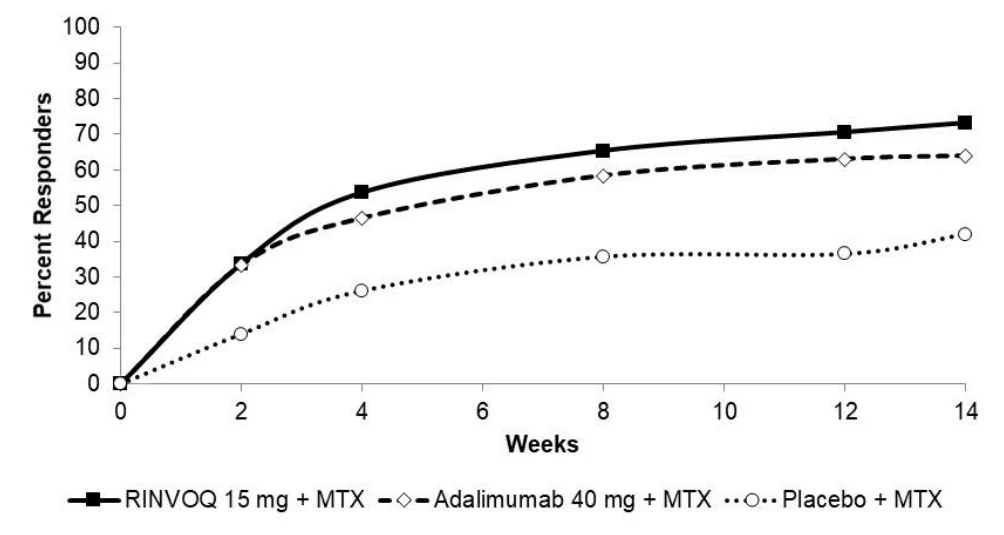
Patients who discontinued randomized treatment, or were missing ACR20 results, or were lost-to-follow-up or withdrawn from the study were imputed as non-responders.
In Study I and Study IV, a higher proportion of patients treated with RINVOQ 15 mg alone or in combination with MTX, achieved DAS28-CRP < 2.6 compared to MTX or placebo at the primary efficacy time point (Table 31).
Table 31. Proportion of Patients with DAS28-CRP Less Than 2.6 with Number of Residual Active Joints at Primary Efficacy Time Point
Study I MTX-Naïve | Study IV MTX-IR | |||||||||||
|---|---|---|---|---|---|---|---|---|---|---|---|---|
| Monotherapy | Background MTX | |||||||||||
| DAS28-CRP Less Than 2.6 | MTX N = 314 | RINVOQ 15 mg N = 317 | MTX N = 651 | RINVOQ 15 mg N = 651 | ||||||||
| Proportion of responders at Week 12 (n) | 14% (43) | 36% (113) | 6% (40) | 29% (187) | ||||||||
| Of responders, proportion with 0 active joints (n) | 51% (22) | 45% (51) | 60% (24) | 48% (89) | ||||||||
| Of responders, proportion with 1 active joint (n) | 35% (15) | 23% (26) | 20% (8) | 23% (43) | ||||||||
| Of responders, proportion with 2 active joints (n) | 9% (4) | 17% (19) | 15% (6) | 13% (25) | ||||||||
| Of responders, proportion with 3 or more active joints (n) | 5% (2) | 15% (17) | 5% (2) | 16% (30) | ||||||||
Radiographic Response
Inhibition of progression of structural joint damage was assessed using the modified Total Sharp Score (mTSS) and its components, the erosion score, and joint space narrowing score at Week 26 in Study IV and Week 24 in Study I. The proportion of patients with no radiographic progression (mTSS change from baseline ≤ 0) was also assessed.
In Study IV, treatment with RINVOQ 15 mg resulted in significantly greater inhibition of the progression of structural joint damage compared to placebo at Weeks 26 (Table 32). Analyses of erosion and joint space narrowing scores were consistent with overall results. In this study, 76% of patients in the placebo plus MTX group experienced no radiographic progression at Week 26 compared to 84% of patients treated with RINVOQ 15 mg.
In Study I, treatment with RINVOQ 15 mg monotherapy resulted in significantly greater inhibition of the progression of structural joint damage compared to MTX monotherapy at Week 24 (Table 32). Analyses of erosion and joint space narrowing scores were consistent with overall results. In this study, 78% of the patients in the MTX monotherapy group experienced no radiographic progression at Week 24 compared to 88% of the patients treated with RINVOQ 15 mg monotherapy.
Table 32. Radiographic Changes
| Measurement tool | Study | Study I MTX-Naïve | Study IV MTX-IR | ||||||||||||
|---|---|---|---|---|---|---|---|---|---|---|---|---|---|---|---|
| Monotherapy | Background MTX | ||||||||||||||
| Treatment Group | MTX | RINVOQ 15 mg Δ (95% CI) | PBOa | RINVOQ 15 mg Δ (95% CI) | ADA 40 mg | ||||||||||
| Week | |||||||||||||||
| Modified Total Sharp Score, mean change from baseline | 24b/26c | 0.7 | 0.1f -0.5 (-0.9, -0.2) | 0.9 | 0.2e -0.7 (-1.0, -0.4) | 0.1 | |||||||||
| Erosion Score, mean change from baseline | 24b/26c | 0.3 | 0.1e -0.3 (-0.4, -0.1) | 0.4 | 0e -0.4 (-0.6, -0.2) | 0 | |||||||||
| Joint Space Narrowing Score, mean change from baseline | 24b/26c | 0.3 | 0.1g -0.2 (-0.4, -0.0) | 0.6 | 0.2e -0.4 (-0.6, -0.2) | 0.1 | |||||||||
| Proportion of patients with no radiographic progressiond | 24b/26c | 77.7 | 87.5f 9.8 (3.5, 16.2) | 76.0 | 83.5f 7.5 (3, 12.1) | 86.8 | |||||||||
| |||||||||||||||
Physical Function Response and Health-Related Outcomes
Treatment with RINVOQ 15 mg, alone or in combination with csDMARDs, resulted in a significant improvement in physical function compared to all comparators (placebo, MTX, or adalimumab) as measured by HAQ-DI at Week 12/14 (Table 33).
In Studies II, III, and IV, treatment with RINVOQ 15 mg resulted in a significantly greater improvement in the mean duration of morning joint stiffness compared to placebo or MTX at Week 12/14.
Other Health-Related Outcomes
Across all studies, patients receiving RINVOQ 15 mg experienced significantly greater improvement from baseline in physical component summary (PCS) score, mental component summary (MCS) scores, and in all 8 domains of the Short Form Health Survey (SF-36) compared to placebo in combination with csDMARDs or MTX monotherapy at Week 12/14.
Fatigue was assessed by the Functional Assessment of Chronic Illness Therapy-Fatigue score (FACIT-F) in Studies I, III, and IV. Improvement in fatigue at Week 12 was observed in patients treated with RINVOQ 15 mg compared to patients on placebo in combination with csDMARDs MTX monotherapy.
Table 33. Physical Function Response HAQ-DI (MCID) at Week 12b/14c
| Study | Study I MTX-Naïve | Study II MTX-IR | Study III csDMARD-IR | Study IV MTX-IR | Study V bDMARD-IR | ||||||
|---|---|---|---|---|---|---|---|---|---|---|---|
| MTX | RINVOQ 15 mg | MTX | RINVOQ 15 mg | PBO | RINVOQ 15 mg | PBO | RINVOQ 15 mg | ADA 40 mg | PBO | RINVOQ 15 mg | |
| N | 314 | 317 | 216 | 217 | 221 | 221 | 651 | 651 | 327 | 169 | 164 |
Change from Baselinea Δ (95% CI) | -0.49 | -0.83d -0.34 (-0.44, -0.25) | -0.32 | -0.65d -0.33 (-0.43, -0.22) | -0.25 | -0.59d -0.33 (-0.43, -0.24) | -0.28 | -0.60d -0.31 (-0.37, -0.25) | -0.49 | -0.17 | -0.39d -0.22 (-0.34, -0.10) |
| HAQ-DI Responder Ratese (%) | 54 | 77d | 39 | 62d | 43 | 67d | 44 | 64d | 64 | 27 | 56d |
| |||||||||||
Psoriatic Arthritis
The efficacy and safety of RINVOQ 15 mg once daily was assessed in two Phase 3 randomized, double-blind, multicenter, placebo-controlled studies in patients 18 years of age or older with moderately to severely active psoriatic arthritis (Table 34). All patients had active psoriatic arthritis for at least 6 months based upon the Classification Criteria for Psoriatic Arthritis (CASPAR), at least 3 tender joints and at least 3 swollen joints, and active plaque psoriasis or history of plaque psoriasis. For both studies, the primary endpoint was the proportion of patients who achieved an ACR20 response at Week 12. The studies include long-term extensions for up to 5 years (SELECT-PsA 1) and 3 years (SELECT-PsA 2).
Table 34. Summary of Patient Demographics for Clinical Trials in Psoriatic Arthritis
| Study # | Trial design | Dosage, route of administration and duration | Study subjects, Nc | Mean age, years (SD) | Female, % | Mean Disease Duration, years (SD)d |
|---|---|---|---|---|---|---|
Study-PsA I SELECT- PsA 1 (M15-572) | Randomized, double-blind, placebo- and active- controlled, multicenter, in non-biologic DMARD-IRa patients | RINVOQ 15 mg Upadacitinib 30 mg Placebo, orally, once daily Adalimumab 40 mg EOW Main treatment period: 24 weeks | 1704 | 50.8 (12.22) | 53.2 | 6.1 (6.97) |
Study-PsA II SELECT- PsA 2 (M15-554) | Randomized, double-blind, placebo-controlled, multicenter, in bDMARD-IRb patients | RINVOQ 15 mg Upadacitinib 30 mg Placebo, orally, once daily Main treatment period: 24 weeks | 641 | 53.4 (11.83) | 54.3 | 10.1 (9.18) |
| ||||||
Study-PsA I (M15-572) was a 24-week trial in 1705 patients who had an inadequate response or intolerance to at least one non-biologic DMARD. At baseline, 1393 (82%) of patients were on at least one concomitant non-biologic DMARD, 1084 (64%) of patients received concomitant MTX only, and 311 (18%) of patients were on monotherapy. Patients received RINVOQ 15 mg or upadacitinib 30 mg once daily, adalimumab 40 mg EOW, or placebo. From Week 16, non-responding patients could be rescued with addition or modification of standard of care. At Week 24, all patients randomized to placebo were switched to RINVOQ 15 mg or upadacitinib 30 mg once daily in a blinded manner based on pre-determined assignment at baseline.
Study-PsA II (M15-554) was a 24-week trial in 642 patients who had an inadequate response or intolerance to at least one biologic DMARD. At baseline, 296 (46%) of patients were on at least one concomitant non-biologic DMARD, 222 (35%) of patients received concomitant MTX only, and 345 (54%) of patients were on monotherapy. Patients received RINVOQ 15 mg or upadacitinib 30 mg once daily or placebo. From Week 16, non-responding patients could be rescued with addition or modification of standard of care. At Week 24, all patients randomized to placebo were switched to RINVOQ 15 mg or upadacitinib 30 mg once daily in a blinded manner based on pre-determined assignment at baseline.
Study Results
In both studies, a significantly greater proportion of patients treated with RINVOQ 15 mg achieved ACR20 response compared to placebo at Week 12 (Table 35, Figure 2 for PsA-I). Onset of efficacy was seen as early as Week 2 for ACR20.
Treatment with RINVOQ 15 mg resulted in improvements in individual ACR components, including tender/painful and swollen joint counts, patient and physician global assessments, HAQ-DI, pain assessment, and hsCRP compared to placebo at Week 12 (Table 36).
In Study-PsA I, RINVOQ 15 mg achieved non-inferiority compared to adalimumab in the proportion of patients achieving ACR20 response at Week 12 with values of 71% and 65% for RINVOQ and adalimumab, respectively; superiority to adalimumab could not be demonstrated.
A higher proportion of patients treated with RINVOQ 15 mg achieved ACR50 and ACR70 responses at Week 12 compared to placebo.
The efficacy of RINVOQ 15 mg, as assessed by ACR20, was demonstrated regardless of subgroups evaluated including baseline BMI, baseline hsCRP, and number of prior non-biologic DMARDs (≤ 1 or > 1).
Within each study, consistent responses were observed with RINVOQ 15 mg alone or in combination with non-biologic DMARDs for primary and key secondary endpoints.
Figure 2. Percent of Patients Achieving ACR20 in Study-PsA I
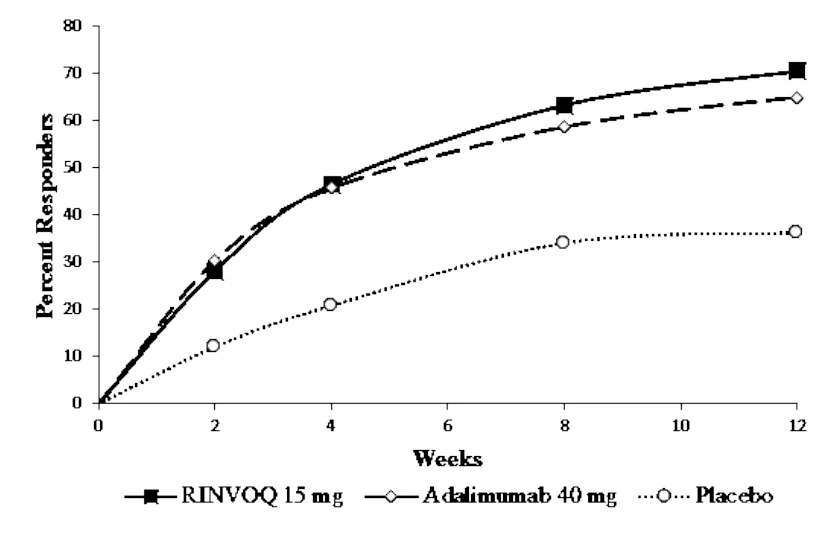
Table 35. Clinical Trial Summary
| Efficacy Measure | Study | Study-PsA I non-biologic DMARD-IR | Study-PsA II bDMARD-IR | |||
|---|---|---|---|---|---|---|
| Treatment Group | PBO | RINVOQ 15 mg | ADA 40 mg | PBO | RINVOQ 15 mg | |
| N | 423 | 429 | 429 | 212 | 211 | |
| ACR20 (% of patients) | Week 12 | 36 | 71e | 65 | 24 | 57e |
| Week 24 | 45 | 73f | 67 | 20 | 59f | |
| ACR50 (% of patients) | Week 12 | 13 | 38f | 38 | 5 | 32f |
| Week 24 | 19 | 52f | 44 | 9 | 38f | |
| ACR70 (% of patients) | Week 12 | 2 | 16f | 14 | 1 | 9f |
| Week 24 | 5 | 29f | 23 | 1 | 19f | |
| MDA (% of patients) | Week 24 | 12 | 37e | 33 | 3 | 25e |
| Resolution of enthesitis (LEI=0; % of patients)a | Week 24 | 32 | 54e | 47 | ||
| Resolution of dactylitis (LDI=0; % of patients)b | Week 24 | 40 | 77b | 74 | ||
| PASI75 (% of patients)c | Week 16 | 21 | 63e | 53 | 16 | 52e |
| Week 24 | 27 | 64f | 59 | 19 | 54f | |
| sIGA 0/1 (% of patients)d | Week 16 | 11 | 42e | 39 | 9 | 37e |
| Modified Sharp/van der Heijde Score | Baseline | 13.05 | 13.44 | 14.89 | ||
| Week 24 | 13.31 | 13.42e | 14.92 | |||
Patients who discontinued randomized treatment or were missing data at week of evaluation were imputed as non-responders in the analyses. For MDA, resolution of enthesitis, and resolution of dactylitis at Week 24, the subjects rescued at Week 16 were imputed as non-responders in the analyses.
| ||||||
Radiographic Response
In Study-PsA I, inhibition of progression of structural damage was assessed radiographically and expressed as the change from baseline in modified Sharp/van der Heijde Score (SHS). Treatment with RINVOQ 15 mg resulted in significantly greater inhibition of the progression of structural joint damage as measure by SHS compared to placebo at Week 24 (Table 36). Similar results were observed for both of the SHS components, joint erosion, and joint space narrowing scores.
Table 36. Components of ACR Response
| ACR Component | Study | Study-PsA I non-biologic DMARD-IR | Study-PsA II bDMARD-IR | |||
|---|---|---|---|---|---|---|
| Treatment Group | PBO | RINVOQ 15 mg | ADA 40 mg | PBO | RINVOQ 15 mg | |
| N | 423 | 429 | 429 | 212 | 211 | |
| Number of tender/painful joints (0-68) | Baseline Week 12 | 19.6 12.4 | 20.4 8.7d | 19.9 9.3 | 25.4 19.3 | 24.8 12.2d |
| Number of swollen joints (0-66) | Baseline Week 12 | 10.9 5.6 | 11.5 3.4d | 11.6 3.7 | 11.8 7.2 | 11.2 4.4d |
| Patient assessment of paina | Baseline Week 12 | 6.1 5.1 | 6.2 3.8d | 5.9 3.6 | 6.6 6.0 | 6.3 4.4d |
| Patient global assessmenta | Baseline Week 12 | 6.3 5.2 | 6.6 3.8d | 6.3 3.7 | 6.9 6.1 | 6.8 4.5d |
| Disability index (HAQ-DI)b | Baseline Week 12 | 1.11 0.98 | 1.15 0.72c | 1.11 0.78 | 1.23 1.12 | 1.08 0.79c |
| Physician global assessmenta | Baseline Week 12 | 6.5 4.3 | 6.7 3.0d | 6.6 3.1 | 6.4 5.0 | 6.5 3.3d |
| hsCRP (mg/L) | Baseline Week 12 | 11.3 10.2 | 11.3 4.2d | 11.0 3.7 | 9.0 9.6 | 11.2 3.9d |
| ||||||
Response rates for ACR20/50/70, MDA, PASI75, sIGA, enthesitis resolution, and dactylitis resolution in patients treated with RINVOQ 15 mg were maintained through Week 56.
Physical Function Response and Health-Related Outcomes
In both studies, patients treated with RINVOQ 15 mg showed significant improvement from baseline in physical function as assessed by HAQ-DI at Week 12 when compared to placebo (Table 36), which was maintained through Week 56.
Health-related quality of life was assessed by SF-36. In both studies, patients receiving RINVOQ 15 mg experienced significantly greater improvement from baseline in the Physical Component Summary score compared to placebo at Week 12. Improvements from baseline were maintained through Week 56 in both studies.
Patients receiving RINVOQ 15 mg experienced significantly greater improvement from baseline in fatigue, as measured by FACIT-F score, at Week 12 compared to placebo in both studies. Improvements from baseline were maintained through Week 56 in both studies.
Axial Spondyloarthritis
Ankylosing Spondylitis
The efficacy and safety of RINVOQ 15 mg once daily were assessed in two randomized, double-blind, multicenter, placebo-controlled studies in patients 18 years of age or older with active ankylosing spondylitis based upon the Bath Ankylosing Spondylitis Disease Activity Index (BASDAI) ≥ 4 and Patient’s Assessment of Total Back Pain score ≥ 4. The primary endpoint for both studies was the proportion of patients achieving an Assessment of SpondyloArthritis international Society 40 (ASAS40) response at Week 14. Both studies included a long-term extension for up to 2 years (Table 37).
Table 37. Summary of Patient Demographics for Clinical Trials in Ankylosing Spondylitis
| Study # | Study design | Dosage, route of administration and duration | Study subjects (N)b | Mean age (SD) | Female (%) | Mean Duration Since Diagnosis (years) (SD) |
STUDY AS-I SELECT-AXIS 1 (M16-098) | Randomized, double-blind, multicenter, placebo-controlled, in NSAID-IRa bDMARD-naïve patients | RINVOQ 15 mg Placebo orally, once daily Main treatment period: 14 weeks | 187 | 45.4 (12.50) | 29 | 6.9 (8.94) |
STUDY AS-II SELECT-AXIS 2 (M19-944 – Study 1) | Randomized, double-blind, multicenter, placebo-controlled, in bDMARD-IRc patients | RINVOQ 15 mg Placebo orally, once daily Main treatment period: 14 weeks | 420 | 42.4 (12.08) | 26 | 7.7 (7.52) |
Abbreviations: bDMARD = biologic disease-modifying anti-rheumatic drug; IR = inadequate responder; NSAID = Nonsteroidal Anti-inflammatory Drug, SD = standard deviation
| ||||||
Study AS-I (M16-098) was a 14-week trial in 187 ankylosing spondylitis patients with an inadequate response to at least two NSAIDs or intolerance to or contraindication for NSAIDs and had no previous exposure to biologic DMARDs. At baseline, patients had symptoms of ankylosing spondylitis for an average of 14.4 years and approximately 81% and 16% of the patients were on concomitant NSAID(s) and/or a conventional synthetic (cs) DMARD, respectively. Patients received RINVOQ 15 mg once daily or placebo. At Week 14, all patients randomized to placebo were switched to RINVOQ 15 mg once daily.
Study AS-II (M19-944) was a 14-week trial in 420 ankylosing spondylitis patients with an inadequate response to 1 or 2 biologic DMARDs. At baseline, patients had symptoms of ankylosing spondylitis for an average of 12.8 years and approximately 78% and 31% of the patients were on concomitant NSAID(s) and/or a csDMARD, respectively. Patients received RINVOQ 15 mg once daily or placebo. At Week 14, all patients randomized to placebo were switched to RINVOQ 15 mg once daily.
Study Results
In both studies, a significantly greater proportion of patients treated with RINVOQ 15 mg achieved an ASAS40 response compared to placebo at Week 14 (Figure 3 and Table 38). Onset of efficacy was seen as early as Week 2 in Study AS-I and Week 4 in Study AS-II. In Study AS-I, efficacy was maintained through Week 104 as assessed by the endpoints presented in Table 38.
Treatment with RINVOQ 15 mg resulted in improvements in individual ASAS components (
Table 39) and other measures of disease activity, including BASDAI and hsCRP compared to placebo at Week 14 (Table 38).
Examination of baseline body mass index (BMI), symptom duration of ankylosing spondylitis and baseline hsCRP did not identify differences in response to RINVOQ among these subgroups at Week 14.
Figure 3. Percent of Patients Achieving ASAS40 in Study AS-II*
*Results are based on non-responder imputation in conjunction with multiple imputation.
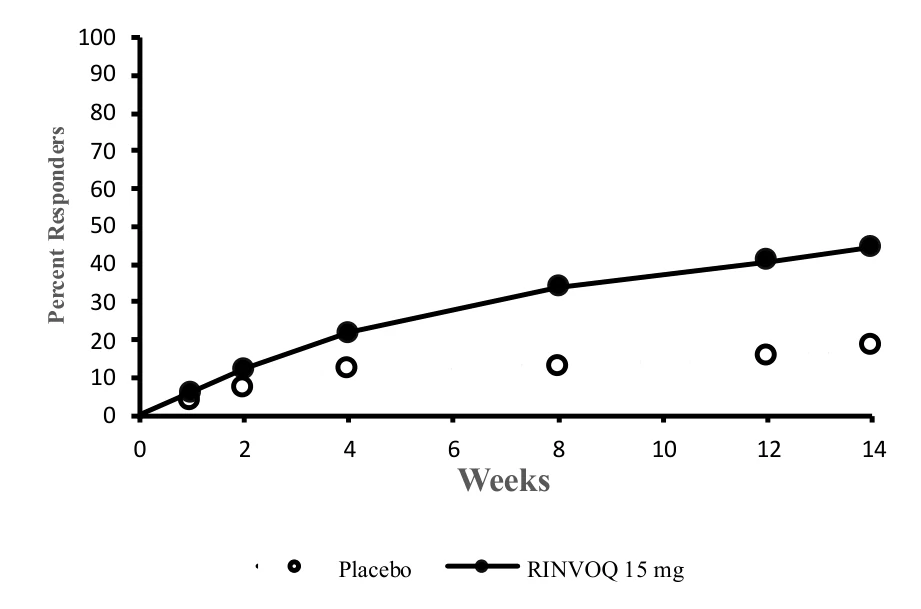
Table 38. Efficacy results of RINVOQ at Week 14
| Efficacy Measure | Study | Study AS-I bDMARD-naïve | Study AS-II bDMARD-IR | ||
|---|---|---|---|---|---|
| Treatment Group | PBO | RINVOQ 15 mg | PBO | RINVOQ 15 mg | |
| N | 94 | 93 | 209 | 211 | |
| ASAS40 (% of patients) | Week 14 | 25.5 | 51.6a | 18.2 | 44.5a |
| ASAS20 (% of patients) | Week 14 | 40.4 | 64.5c | 38.3 | 65.4a |
| ASAS Partial Remission (% of patients) | Week 14 | 1.1 | 19.4a | 4.3 | 17.5a |
| BASDAI 50 (% of patients) | Week 14 | 23.4 | 45.2b | 16.7 | 43.1a |
| ASDAS-CRP | Baseline | 3.69 | 3.52 | 3.87 | 3.86 |
| Week 14 | 3.07 | 2.06a | 3.36 | 2.32a | |
| ASDAS Inactive Disease (% of patients) | Week 14 | 0 | 16.1c | 1.9 | 12.8a |
| ASDAS Low Disease Activity (% of patients) | Week 14 | - | - | 10.1 | 44.1a |
| SPARCC MRI Spine Score | Baseline | 12.54 | 11.24 | 8.76 | 11.20 |
| Week 14 | 10.06 | 3.25 a | 9.16 | 6.80 a | |
| Nocturnal Back Pain | Baseline | 6.37 | 6.43 | 7.20 | 7.10 |
| Week 14 | 4.56 | 2.95 c | 5.63 | 3.88 a | |
Abbreviations: ASAS20 (or 40) = Assessment of SpondyloArthritis international Society ≥ 20% (or ≥ 40%) improvement; ASDAS-CRP = Ankylosing Spondylitis Disease Activity Score C-Reactive Protein; BASDAI = Bath Ankylosing Spondylitis Disease Activity Index; PBO = placebo; SPARCC MRI = SpondyloArthritis Research Consortium of Canada Magnetic Resonance Imaging
For binary endpoints, Week 14 results are based on non-responder imputation (Study AS-I) and on non-responder imputation in conjunction with multiple imputation (Study AS-II). | |||||
Table 39. Components of ASAS Response
| Efficacy Measure | Study | Study AS-I bDMARD-naïve | Study AS-II bDMARD-IR | |
|---|---|---|---|---|
| Treatment Group | PBO | RINVOQ 15 mg | PBO | RINVOQ 15 mg |
| N | 94 | 93 | 209 | 211 |
| Patient Global Assessment of Disease Activitya | ||||
| Baseline | 6.8 | 6.7 | 7.3 | 7.4 |
| Week 14 | 5.4 | 3.7d | 5.9 | 4.3d |
| Total Back Paina | ||||
| Baseline | 6.7 | 6.9 | 7.4 | 7.5 |
| Week 14 | 5.0 | 3.6d | 5.9 | 4.4c |
| BASFIa | ||||
| Baseline | 5.64 | 5.41 | 6.20 | 6.25 |
| Week 14 | 4.18 | 3.07d | 5.09 | 3.98c |
| Inflammationb | ||||
| Baseline | 6.65 | 6.63 | 6.73 | 6.85 |
| Week 14 | 4.59 | 3.37d | 5.11 | 3.87d |
Abbreviations: ASAS = Assessment of SpondyloArthritis international Society; BASFI = Bath Ankylosing Spondylitis Functional Index; PBO = placebo
| ||||
Health-Related Outcomes
Improvements were observed as early as Week 1 for total back pain and Week 2 for nocturnal back pain in Study AS-II.
In Study AS-II, patients treated with RINVOQ 15 mg showed significant improvements in health-related quality of life and overall health as measured by ASQoL and ASAS Health Index, respectively, compared to placebo at Week 14. Improvements in ASQoL and ASAS Health Index were also observed in Study AS-I compared to placebo at Week 14.
Enthesitis
In Study AS-II, patients with pre-existing enthesitis treated with RINVOQ 15 mg showed significant improvement in enthesitis compared to placebo as measured by change from baseline in Maastrich Ankylosing Spondylitis Enthesitis Score (MASES) at Week 14. Improvements in MASES were also observed in Study AS-I compared to placebo at Week 14.
Spinal mobility
In Study AS-II, patients treated with RINVOQ 15 mg showed significant improvement in spinal mobility compared to placebo as measured by change from baseline in Bath Ankylosing Spondylitis Metrology Index (BASMI) at Week 14. Improvements in BASMI were also observed in Study AS-I compared to placebo at Week 14.
Non-radiographic Axial Spondyloarthritis
The efficacy and safety of RINVOQ 15 mg once daily were assessed in one randomized, double-blind, multicenter, placebo-controlled study in patients 18 years of age or older with active non-radiographic axial spondyloarthritis (Table 40). Study SELECT AXIS 2 (Study 2) was a 52-week placebo-controlled trial in 313 patients with active non-radiographic axial spondyloarthritis with an inadequate response to at least 2 NSAIDs or intolerance to or contraindication for NSAIDs (i.e., NSAID-IR). Patients must have had objective signs of inflammation indicated by elevated C reactive protein (CRP) (defined as > upper limit of normal), and/or sacroiliitis on magnetic resonance imaging (MRI), and no definitive radiographic evidence of structural damage on sacroiliac joints. Patients had active disease as defined by the Bath Ankylosing Spondylitis Disease Activity Index (BASDAI) ≥ 4 and a Patient's Assessment of Total Back Pain score ≥ 4 based on a 0 – 10 numerical rating scale (NRS) at the Screening and Baseline Visits.
At baseline, 74.8% and 29.1% of the patients were on a concomitant NSAID or csDMARD, respectively. 32.9% of the patients had an inadequate response or intolerance to bDMARD therapy. Patients received RINVOQ 15 mg once daily or placebo. The primary endpoint was the proportion of patients achieving an Assessment of SpondyloArthritis international Society 40 (ASAS40) response at Week 14.
Table 40. Summary of Patient Demographics for Clinical Trial in Non-radiographic Axial Spondyloarthritis
| Study # | Trial design | Dosage, route of administration and duration | Study subjects, (N)a | Mean age, years (SD) | Female, % | Mean Disease Duration, years (SD) |
|---|---|---|---|---|---|---|
| SELECT-AXIS 2 (M19-944 – Study 2) | Randomized, double-blind, multicenter placebo- controlled, in NSAID-IR patients | RINVOQ 15 mg Placebo orally, once daily Main treatment period: 52 weeks | 313 | 42.1 (12.21) | 58.5 | 4.4 (5.68) |
| ||||||
Study Results
In SELECT-AXIS 2, a significantly greater proportion of patients treated with RINVOQ 15 mg achieved an ASAS40 response compared to placebo at Week 14 (Table 41, Figure 4). Onset of efficacy was seen as early as Week 2 for ASAS40.
Treatment with RINVOQ 15 mg resulted in improvement in individual ASAS components (Table 42) and other measures of disease activity, including BASDAI and hsCRP compared to placebo at Week 14.
Examination of baseline BMI, symptom duration of non-radiographic axial spondyloarthritis, baseline hsCRP, MRI sacroiliitis, and prior use of bDMARDs did not identify differences in response to RINVOQ among these subgroups at Week 14.
Figure 4. Percent of Patients Achieving ASAS40*
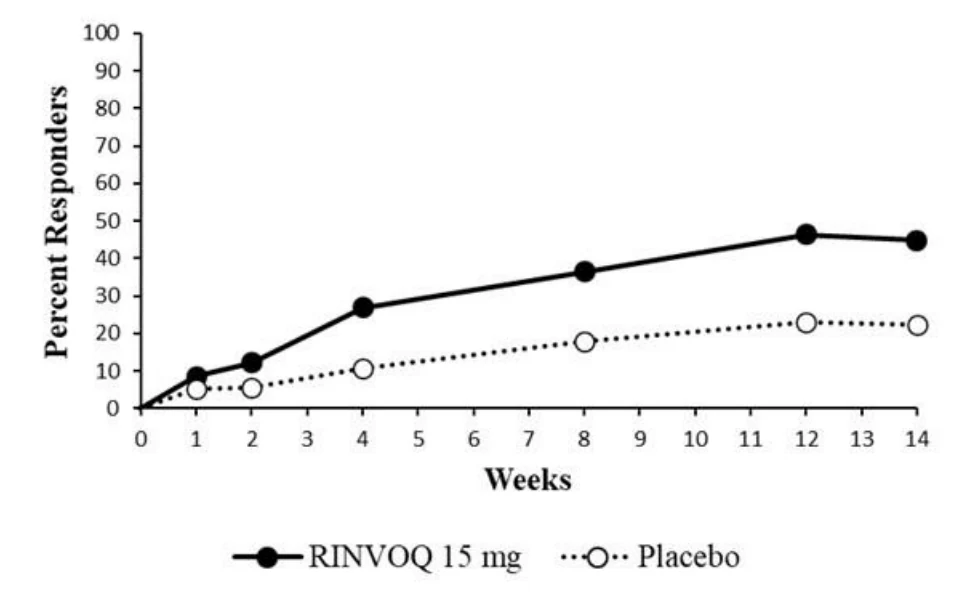
*Results are based on non-responder imputation in conjunction with multiple imputation.
Table 41. Efficacy Results of RINVOQ at Week 14
| Treatment Group | PBO (N = 157) | RINVOQ 15 mg (N = 156) | |
|---|---|---|---|
| ASAS40 (% of patients) | Week 14 | 22.5 | 44.9a |
| ASAS20 (% of patients) | Week 14 | 43.8 | 66.7a |
| ASAS Partial Remission (% of patients) | Week 14 | 7.6 | 18.6b |
| BASDAI 50 (% of patients) | Week 14 | 22.1 | 42.3a |
| ASDAS-CRP | Baseline | 3.61 | 3.61 |
| Week 14 | 2.90 | 2.22a | |
| ASDAS Inactive Disease (% of patients) | Week 14 | 5.2 | 14.1b |
| ASDAS Low Disease Activity (% of patients) | Week 14 | 18.3 | 42.3a |
| SPARCC MRI score (SI joints) | Baseline | 3.49 | 4.39 |
| Week 14 | 3.37 | 1.90a | |
| Nocturnal Back Pain | Baseline | 6.98 | 6.68 |
| Week 14 | 5.05 | 3.74a | |
a. Multiplicity-controlled p≤0.001 RINVOQ vs placebo comparison. b. Multiplicity-controlled p≤0.01 RINVOQ vs placebo comparison. For binary endpoints, results are based on non-responder imputation in conjunction with multiple imputation. | |||
Table 42. Components of ASAS Response
| Treatment Group | PBO (N = 157) | RINVOQ 15 mg (N = 156) | |
|---|---|---|---|
| Patient Global Assessment of Disease Activitya | Baseline | 7.30 | 7.03 |
| Week 14 | 5.35 | 4.16d | |
| Total Back Paina | Baseline | 7.32 | 7.26 |
| Week 14 | 5.27 | 4.29c | |
| BASFIa | Baseline | 5.97 | 5.96 |
| Week 14 | 4.47 | 3.33c | |
| Inflammationb | Baseline | 6.68 | 6.60 |
| Week 14 | 4.69 | 3.48d | |
a. Numeric rating scale (NRS): 0 = best; 10 = worst. b. Mean of BASDAI questions 5 and 6 assessing morning stiffness severity and duration: 0= best, 10 = worst. c. Multiplicity-controlled p ≤ 0.001 RINVOQ vs placebo comparison. d. Nominal p ≤ 0.001 RINVOQ vs placebo comparison. | |||
Health-Related Outcomes
Patients treated with RINVOQ 15 mg showed significant improvements in health-related quality of life and overall health as measured by Ankylosing Spondylitis Quality of Life (ASQoL) and ASAS Health Index, respectively, compared to placebo at Week 14.
Giant Cell Arteritis
The efficacy and safety of RINVOQ 15 mg once daily were assessed in SELECT-GCA, a Phase 3 randomized, double-blind, multicenter, placebo-controlled study in patients 50 years of age and older (81.8% were 65 years of age and older; 93.7% White) with new-onset or relapsing giant cell arteritis (Table 43). SELECT-GCA was a 52-week study in which 428 patients were randomized in a 2:1:1 ratio and dosed once daily with RINVOQ 15 mg, upadacitinib 7.5 mg, or placebo. All patients received background corticosteroid therapy (prednisone/prednisolone). The RINVOQ and upadacitinib-treated groups followed a pre-specified corticosteroid taper regimen with the aim to reach 0 mg by 26 weeks, while the placebo-treated group followed a pre-specified corticosteroid taper regimen with the aim to reach 0 mg by 52 weeks. The primary endpoint was the proportion of patients achieving sustained remission at Week 52 as defined by the absence of giant cell arteritis signs and symptoms from Week 12 through Week 52 and adherence to the protocol-defined corticosteroid taper regimen. A key secondary endpoint was the proportion of patients achieving sustained complete remission at Week 52 as defined by the absence of giant cell arteritis signs and symptoms from Week 12 through Week 52, normalization of erythrocyte sedimentation rate (ESR) and high sensitivity C-reactive protein (hsCRP) from Week 12 through Week 52, and adherence to the protocol-defined corticosteroid taper regimen. The study included a 52-week extension for a total study duration of up to 2 years.
Table 43. Summary of Patient Demographics for Clinical Trials in Giant Cell Arteritis
| Study # | Study design | Dosage, route of administration and duration | Study subjects (N)a | Mean age (SD) | Female (%) | Mean Duration Since Diagnosis (days)b (SD) |
| SELECT-GCA (M16-852) | Randomized, double-blind, multicenter, placebo-controlled study in patients 50 years of age and older with new onset or relapsing giant cell arteritis | Upadacitinib 7.5 mg RINVOQ 15 mg Placebo Pre-specified corticosteroid taper Orally, once daily Main treatment period: 52 weeks | 428 | 71.1 (7.37) | 73.1 | 252.2 (578.72) |
| ||||||
Study Results
RINVOQ 15 mg and a 26-week corticosteroid taper showed superiority in achieving sustained remission at Week 52 compared to placebo and a 52-week corticosteroid taper (Table 44).
Treatment effects in subgroups (sex, age, race, prior use of interleukin-6 inhibitor, new onset or relapsing giant cell arteritis, baseline corticosteroid dose, and giant cell arteritis with or without polymyalgia rheumatica) were generally consistent with the results in the overall study population.
Table 44. Clinical Response in SELECT-GCA
| Treatment Group | PBO + 52-week corticosteroid taper N= 112 n (%) | RINVOQ 15 mg + 26-week corticosteroid taper N= 209 n (%) | Treatment Difference vs PBO (95% CI) | |||||
|---|---|---|---|---|---|---|---|---|
| Sustained remission at Week 52 | 33 (29.0%) | 97 (46.4%) | 17.1%a (6.3, 27.8) | |||||
| Sustained complete remission at Week 52 | 18 (16.1%) | 78 (37.1%) | 20.7%a (11.3, 30.2) | |||||
| Patients with one or more GCA flares through Week 52b | 55.6%c | 34.3%c | 0.47 a,d (0.29, 0.74) | |||||
Abbreviations: ESR = erythrocyte sedimentation rate; GCA = giant cell arteritis; hsCRP = high sensitivity C-reactive protein; PBO = placebo; UPA = upadacitinib
| ||||||||
Treatment with RINVOQ 15 mg and a 26-week corticosteroid taper resulted in improvements in the components of sustained complete remission at Week 52 compared to placebo and a 52-week corticosteroid taper (Table 45).
Table 45. Components of Sustained Complete Remission at Week 52
| Treatment Group | PBO + 52-week corticosteroid taper N= 112 n (%) | RINVOQ 15mg + 26-week corticosteroid taper N= 209 n (%) | ||
|---|---|---|---|---|
| Absence of GCA signs and symptomsa | 33 (29.8%) | 97 (46.3%) | ||
| Normalization of ESRb | 27 (23.8%) | 98 (47.0%) | ||
| Normalization of hsCRPc | 28 (25.0%) | 110 (52.6%) | ||
| Adherence to protocol-defined corticosteroid taper regimen | 44 (39.3%) | 122 (58.4%) | ||
| ||||
Complete remission
The proportion of patients achieving complete remission at Week 52 and Week 24 was significantly higher in patients receiving RINVOQ 15 mg and a 26-week corticosteroid taper (50.2% and 57.2%, respectively) compared to patients receiving placebo and a 52-week corticosteroid taper (19.6% and 36.1%, respectively).
Cumulative corticosteroid exposure
Among patients who completed the 52-week study, the cumulative corticosteroid exposure at Week 52 was significantly lower in patients treated with RINVOQ 15 mg and a 26-week corticosteroid taper compared to those treated with placebo and a 52-week corticosteroid taper (median 1615 mg vs 2882 mg, respectively), an effect due in part to differing pre-specified taper regimens.
Atopic Dermatitis
The efficacy and safety of RINVOQ 15 mg and 30 mg once daily were assessed in 2782 patients (12 years of age and older) from three Phase 3 randomized, double-blind, multicenter studies (Table 46).
The study subjects included 542 adolescent (344 in the primary analysis) and 2240 adult patients with refractory moderate to severe atopic dermatitis (AD) not adequately controlled by topical medication(s).
The majority of the study subjects had been treated with systemic therapy or phototherapy prior to initiating RINVOQ treatment. At baseline, patients had to have all the following: an Investigator's Global Assessment (vIGA-AD) score ≥ 3 in the overall assessment of AD (erythema, induration/papulation, and oozing/crusting) on an increasing severity scale of 0 to 4, an Eczema Area and Severity Index (EASI) score ≥ 16 (composite score assessing extent and severity of erythema, edema/papulation, scratches and lichenification across 4 different body sites), a minimum body surface area (BSA) involvement of ≥ 10%, and weekly average Worst Pruritus Numerical Rating Scale (NRS) ≥ 4.
In all three studies, patients received RINVOQ once daily at doses of 15 mg or 30 mg or matching placebo for 16 weeks. In two of the studies (Measure Up 1 and Measure Up 2), RINVOQ was used as monotherapy, whereas in the third study, AD UP, patients also received concomitant topical corticosteroids (TCS). Following completion of the double blinded period, patients originally randomized to RINVOQ were to continue receiving the same dose until Week 136. Patients in the placebo group were re-randomized in a 1:1 ratio to receive RINVOQ 15 mg or 30 mg until Week 136.
All three studies assessed the co-primary endpoints of the proportion of subjects with a vIGA-AD 0 (clear) or 1 (almost clear) with at least a 2-point improvement and the proportion of subjects with EASI 75 (improvement of at least 75% in EASI score from baseline) at Week 16.
Key secondary endpoints included EASI 90 and EASI 100 at Week 16 and the proportion of subjects with reduction in itch (≥ 4-point improvement in the Worst Pruritus NRS from baseline) at Week 16 and other timepoints. In the monotherapy studies, key secondary endpoints included worsening of disease (EASI increase ≥ 6.6 points during double-blind period) and the proportion of subjects from baseline to Week 16 with reduction in: symptoms severity (≥ 28-point improvement in the Atopic Dermatitis Symptoms Scale [ADerm-SS] 7-item total symptom score [TSS-7]); symptom frequency (≥ 12-point improvement in the Patient Oriented Eczema Measure); skin pain (≥ 4-point improvement in the ADerm-SS Skin Pain); health-related quality of life (≥4-point improvement in the Dermatology Life Quality Index [DLQI]; DLQI 0/1); the impact of AD related to sleep (≥ 12-point improvement in the Atopic Dermatitis Impact Scale [ADerm-IS] Sleep), daily activities (≥ 14-point improvement in the ADerm-IS Daily Activities), and emotional state (≥ 11-point improvement in the ADerm-IS Emotional State) ; and anxiety and depression symptoms (Hospitalization Anxiety and Depression Scale scores < 8 for both subscales).
Table 46. Summary of Patient Demographics for Clinical Trials in Atopic Dermatitis
| Study # | Trial Design | Dosage, Route of Administration and Duration | Study Subjects (N)a | Age (years) Mean (Range) | Female (%) | Mean Disease Duration (years) (SD)b |
|---|---|---|---|---|---|---|
MEASURE-UP 1 (M16-045) | Randomized, double-blind, placebo-controlled, multicenter, in moderate to severe AD patients Monotherapy | RINVOQ 15 mg RINVOQ 30 mg Placebo Tablets, orally, once daily Main treatment period: 16 weeks | 847 | 34.0 (12-75) | 46.2 | 20.7 (15.14) |
MEASURE-UP 2 (M18-891) | Randomized, double-blind, placebo-controlled, multicenter, in moderate to severe AD patients Monotherapy | RINVOQ 15 mg RINVOQ 30 mg Placebo Tablets, orally, once daily Main treatment period: 16 weeks | 836 | 33.6 (12-75) | 43.7 | 20.2 (13.75) |
| AD UP (M16-047) | Randomized, double-blind, placebo-controlled, multicenter, in moderate to severe AD patients Combination Therapy with TCS | RINVOQ 15 mg plus TCS RINVOQ 30 mg plus TCS Placebo plus TCS Tablets, orally, once daily Main treatment period: 16 weeks | 901 | 34,1 (12-75) | 39.3 | 23.4 (15.09) |
Abbreviations: AD = atopic dermatitis, SD = standard deviation, TCS = topical corticosteroids
| ||||||
Study Results
Clinical Response
RINVOQ demonstrated consistent responses in the co-primary and key secondary endpoints across all three studies. Both the co-primary, as well as all key secondary endpoints were multiplicity-controlled and achieved statistical significance vs placebo (p < 0.001).
Monotherapy Studies (MEASURE UP 1 AND MEASURE UP 2)
In the MEASURE UP studies, a significantly greater proportion of patients treated with RINVOQ 15 mg or 30 mg compared to placebo achieved vIGA-AD 0 or 1 response and EASI 75 at Week 16 (Table 47)
Table 47. Efficacy Results of RINVOQ Monotherapy Studies at Week 16 (co-primary endpoints)
| Study | MEASURE UP 1 | MEASURE UP 2 | ||||||||||
|---|---|---|---|---|---|---|---|---|---|---|---|---|
| Treatment Group | PBO | RINVOQ 15 mg | RINVOQ 30 mg | PBO | RINVOQ 15 mg | RINVOQ 30 mg | ||||||
| Number of subjects randomized | 281 | 281 | 285 | 278 | 276 | 282 | ||||||
| % responders | ||||||||||||
| vIGA-AD 0/1a,b | 8.4 | 48.1c | 62.0c | 4.7 | 38.8c | 52.0c | ||||||
| EASI 75a | 16.3 | 69.6c | 79.7c | 13.3 | 60.1c | 72.9c | ||||||
Abbreviations: PBO = placebo
| ||||||||||||
Table 48. Efficacy Results of RINVOQ Monotherapy Studies at Week 16 (key secondary endpoints)
| Study | MEASURE UP 1 | MEASURE UP 2 | ||||||||||||||||||
|---|---|---|---|---|---|---|---|---|---|---|---|---|---|---|---|---|---|---|---|---|
| Treatment Group | PBO | RINVOQ 15 mg | RINVOQ 30 mg | PBO | RINVOQ 15 mg | RINVOQ 30 mg | ||||||||||||||
| Number of subjects randomized | 281 | 281 | 285 | 278 | 276 | 282 | ||||||||||||||
| % responders | ||||||||||||||||||||
| EASI 90a | 8.1 | 53.1d | 65.8d | 5.4 | 42.4d | 58.5d | ||||||||||||||
| EASI 100a | 1.8 | 16.7d | 27.0d | 0.7 | 14.1d | 18.8d | ||||||||||||||
Worst Pruritus NRSb (≥ 4-point improvement) | 11.8 (N = 272) | 52.2d (N = 274) | 60.0d (N = 280) | 9.1 (N = 274) | 41.9d (N = 270) | 59.6d (N = 280) | ||||||||||||||
| Mean % change (SE) | ||||||||||||||||||||
| SCORADc | -32.7 (2.33) | -65.7d (1.78) | -73.1d (1.73) | -28.4 (2.50) | -57.9d (2.01) | -68.4d (2.04) | ||||||||||||||
Abbreviations: PBO = placebo; SCORAD = SCORing Atopic Dermatitis
| ||||||||||||||||||||
A rapid improvement in skin clearance (defined as EASI 75 by Week 2) was also achieved for both doses compared to placebo. A significantly greater proportion of patients treated with RINVOQ 15 mg or 30 mg achieved clinically meaningful improvement in itch compared to placebo at Week 16. Rapid improvement in itch (defined as a ≥ 4-point reduction in Worst Pruritus NRS by Week 1) was also achieved for both doses compared to placebo, with differences observed as early as 1 day after initiating RINVOQ 30 mg and 2 days after initiating RINVOQ 15 mg. A significantly smaller proportion of patients treated with RINVOQ 15 mg or 30 mg had a disease flare defined as a clinically meaningful worsening of disease during the initial 16 weeks of treatment compared to placebo.
Figure 5 and Figure 6 show the proportion of patients achieving an EASI 75 response and the proportion of patients with ≥ 4-point improvement in the Worst Pruritus NRS, respectively, up to Week 16.
Figure 5. Proportion of Patients Achieving an EASI 75 Response in Monotherapy Studies
MEASURE UP 1
MEASURE UP 2
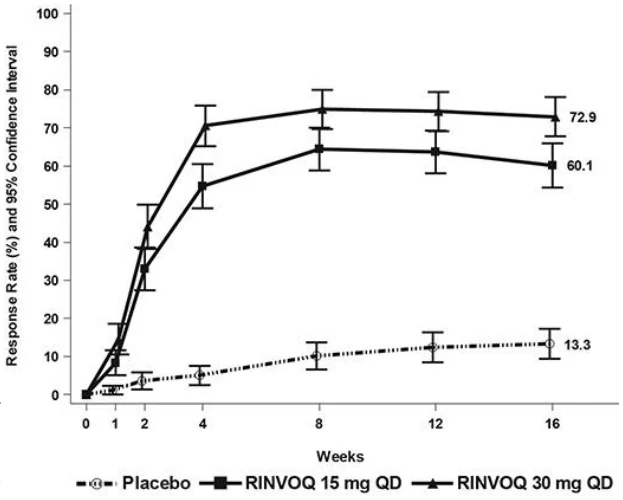
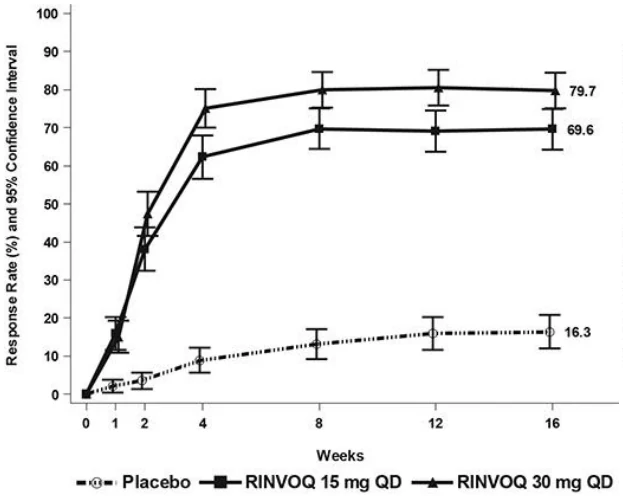
Figure 6. Proportion of Patients with ≥ 4-point Improvement in the Worst Pruritus NRS in Monotherapy Studies
MEASURE UP 1
MEASURE UP 2
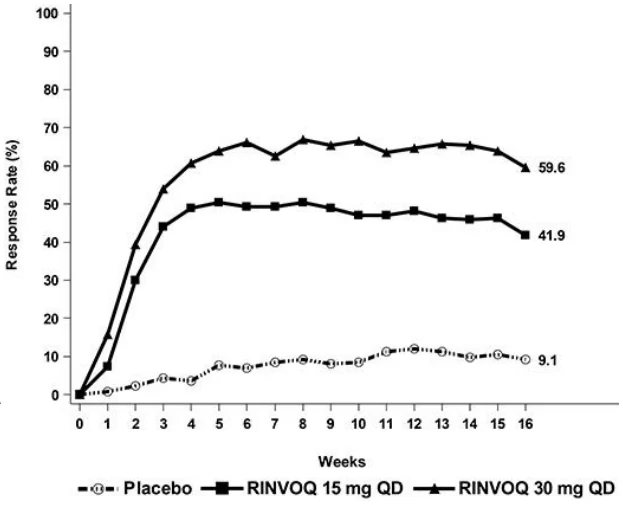
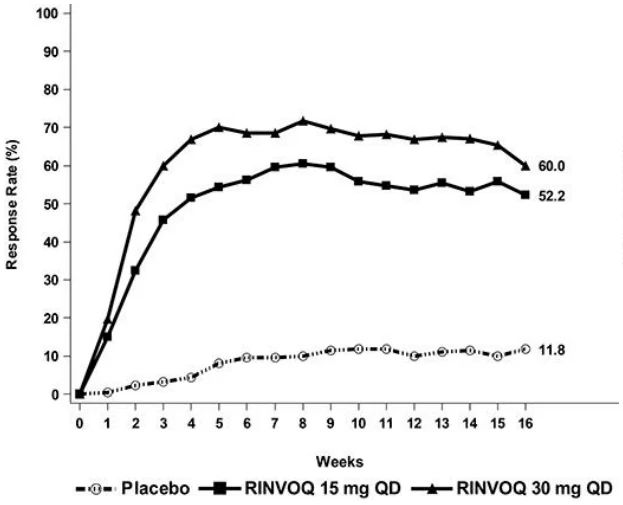
In both studies the efficacy of RINVOQ 15 mg and 30 mg was maintained through Week 52.
Treatment effects in subgroups (weight, age, gender, race, and prior systemic treatment with immunosuppressants) in both studies were consistent with the results in the overall study population.
Concomitant TCS Study (AD UP)
In AD UP, a significantly greater proportion of patients treated with RINVOQ 15 mg + TCS or 30 mg + TCS achieved vIGA-AD 0 or 1 response and EASI 75 compared to placebo + TCS at Week 16 (Table 49).
Table 49. Efficacy Results of RINVOQ + Concomitant TCS at Week 16 (co-primary endpoints)
| Treatment Group | Placebo + TCS | RINVOQ 15 mg + TCS | RINVOQ 30 mg + TCS | |||
|---|---|---|---|---|---|---|
| Number of subjects randomized | 304 | 300 | 297 | |||
| % responders | ||||||
| vIGA-AD 0/1a,b | 10.9 | 39.6c | 58.6c | |||
| EASI 75a | 26.4 | 64.6c | 77.1c | |||
Abbreviations: PBO = placebo
| ||||||
Table 50. Efficacy Results of RINVOQ + Concomitant TCS at Week 16 (key secondary endpoints)
| Treatment Group | Placebo + TCS | RINVOQ 15 mg + TCS | RINVOQ 30 mg + TCS | |||||||
|---|---|---|---|---|---|---|---|---|---|---|
| Number of subjects randomized | 304 | 300 | 297 | |||||||
| % responders | ||||||||||
| EASI 90a | 13.2 | 42.8d | 63.1d | |||||||
| EASI 100a | 1.3 | 12.0e | 22.6d | |||||||
Worst Pruritus NRSb (≥ 4-point improvement) | 15.0 N = 294 | 51.7d N = 288 | 63.9d N = 291 | |||||||
| Mean % change (SE) | ||||||||||
| SCORADc | -33.6 (1.90) | -61.2e (1.70) | -71.0e (1.71) | |||||||
Abbreviations: PBO = placebo
| ||||||||||
A rapid improvement in skin clearance was also achieved for both doses compared to placebo + TCS. In addition, a higher EASI 90 response rate was achieved for both doses at Week 4 compared to placebo + TCS.
A significantly greater proportion of patients treated with RINVOQ 15 mg + TCS or 30 mg + TCS achieved a rapid, and clinically meaningful improvement in itch compared to placebo + TCS.
Figure 7 and Figure 8 show the proportion of patients achieving an EASI 75 response and the proportion of patients with ≥ 4-point improvement in the Worst Pruritus NRS, respectively up to Week 16.
Figure 7. Proportion of Patients Achieving an EASI 75 Response AD UP Study
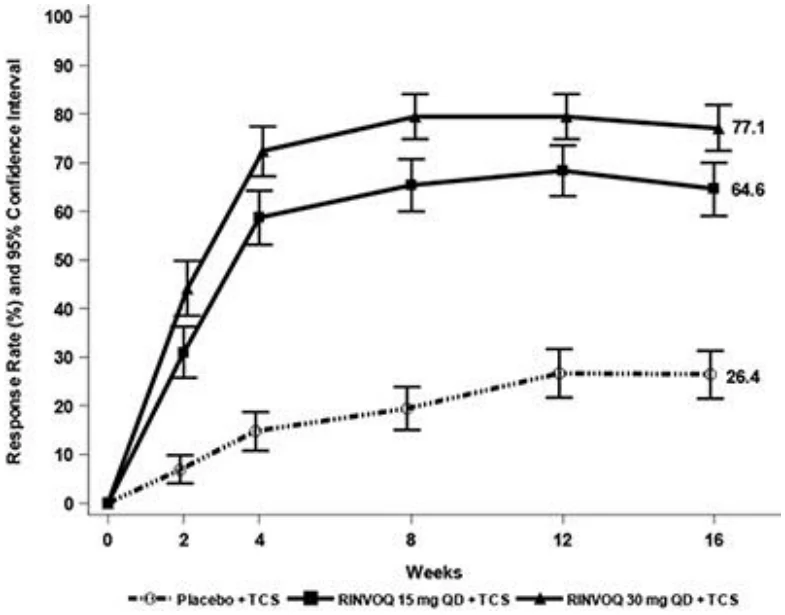
Figure 8. Proportion of Patients with ≥4-point Improvement in the Worst Pruritus NRS in AD UP Study
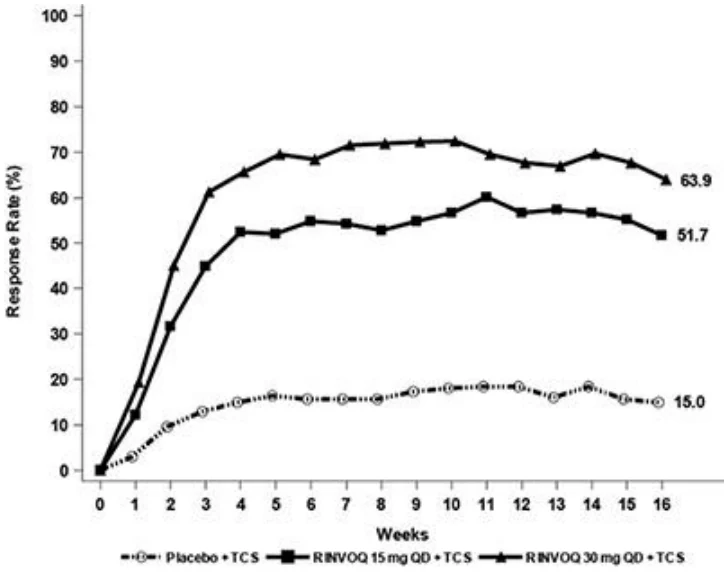
Treatment effects in subgroups (weight, age, gender, race, and prior systemic treatment with immunosuppressants) in AD UP were consistent with the results in the overall study population.
Results at Week 16 continued to be observed through Week 52 in patients treated with RINVOQ 15 mg + TCS or 30 mg + TCS.
Quality of Life/Patient Reported Outcomes
In the MEASURE UP studies, greater proportions of patients treated with RINVOQ 15 mg and 30 mg versus placebo achieved clinically meaningful reductions in symptom severity, symptom frequency, skin pain, health-related quality of life, and on patient-reported effects on sleep, daily activities, and emotional state. Anxiety and depression symptoms were reduced. All patient-reported outcome comparisons versus placebo at Week 16 were statistically significant for both RINVOQ 15 mg and 30 mg (multiplicity-controlled p < 0.001).
Adolescent Population
A total of 542 adolescents aged 12 to 17 years with moderate to severe atopic dermatitis were randomized across the three Phase 3 studies, of which 344 were evaluated for the primary analysis. Adolescents in the primary analysis were randomized to either 15 mg (N = 114) or 30 mg (N = 114) RINVOQ or matching placebo (N = 116), in monotherapy or combination with topical corticosteroids. Efficacy was consistent between the adolescents and adults (Table 51). Safety and efficacy of RINVOQ in adolescents weighing less than 40 kg and in patients less than 12 years of age with atopic dermatitis have not been established.
Table 51. Efficacy Results of RINVOQ for Adolescents at Week 16 (Subgroup Results of Co-primary Endpoints)
| Study | MEASURE UP 1 | MEASURE UP 2 | AD UP | ||||||
|---|---|---|---|---|---|---|---|---|---|
| Treatment Group | PBO | RINVO Q 15 mg | RINVO Q 30 mg | PBO | RINVO Q 15 mg | RINVO Q 30 mg | PBO + TCS | RINVO Q 15 mg + TCS | RINVO Q 30 mg + TCS |
| Number of adolescent subjects randomize d | 40 | 42 | 42 | 36 | 33 | 35 | 40 | 39 | 37 |
| % responders | |||||||||
| vIGA-AD 0/1a,b | 7.5 % | 38.1% | 69.0% | 2.8% | 42.4% | 62.5% | 7.5% | 30.8% | 64.9% |
| EASI 75a | 8.3 % | 71.4% | 83.3% | 13.9 % | 66.7% | 74.5% | 30.0 % | 56.4% | 75.7% |
Abbreviations: PBO = placebo
| |||||||||
Table 52. Efficacy Results of RINVOQ for Adolescents at Week 16
| Study | MEASURE UP 1 | MEASURE UP 2 | AD UP | ||||||
|---|---|---|---|---|---|---|---|---|---|
| Treatment Group | PBO | RINVO Q 15 mg | RINVO Q 30 mg | PBO | RINVO Q 15 mg | RINVO Q 30 mg | PBO + TCS | RINVO Q 15 mg + TCS | RINVO Q 30 mg + TCS |
| Number of adolescent subjects randomized | 40 | 42 | 42 | 36 | 33 | 35 | 40 | 39 | 37 |
| % responders | |||||||||
Worst Pruritus NRSa,b (≥ 4-point improvement ) | 15.4 % N = 39 | 45.0% N = 40 | 54.8% N = 42 | 2.8 % N = 36 | 33.3% N = 30 | 50.0% N = 34 | 13.2 % N = 38 | 41.7% N = 36 | 54.5% N = 33 |
Abbreviations: PBO = placebo
| |||||||||
Results at Week 16 were maintained through Week 76 in adolescents treated with RINVOQ 15 mg or 30 mg.
Ulcerative Colitis
The efficacy and safety of RINVOQ were evaluated in three multicenter, double-blind, randomised, placebo-controlled Phase 3 clinical studies in patients with moderate to severe ulcerative colitis (UC) who had demonstrated prior treatment failure, i.e., an inadequate response to, loss of response to, or intolerance to at least one of conventional (oral aminosalicylates, corticosteroids, immunosuppressants), and/or biologic (tumour necrosis factor-alpha [TNFα] antagonists, interleukin 12/23 inhibitor or integrin receptor antagonist) therapy. These included two replicate induction studies, UC-1 and UC-2, and a maintenance study, UC-3.
The study population in the pivotal trials consisted of patients aged between 18 and 75 years of age with moderate to severe UC. Disease activity was based on the modified Mayo Score (mMS). The mMS is based on the Mayo scoring system excluding Physician's Global Assessment and ranges from 0 to 9. It consists of three sub-scores, each ranging from 0 (normal) to 3 (most severe): stool frequency subscore (SFS), rectal bleeding subscore (RBS), and a centrally-reviewed endoscopy subscore (ES). Eligible patients had an mMS of 5 to 9 points and an ES of 2 to 3 points (confirmed by central reader) at baseline; an ES of 2 was defined by marked erythema, lack of vascular pattern, friability, and erosions, whereas a score of 3 was defined by spontaneous bleeding and ulceration. Patients with moderate disease had an mMS ≤7, whereas patients with severe disease had an mMS >7.
Table 53. Summary of Patient Demographics for Clinical Trials in Ulcerative Colitis
| Study # | Trial design | Dosage, route of administration and duration | Study subjects, N | Mean age, years (SD) | Female, % | Mean Disease Duration, years (SD) |
|---|---|---|---|---|---|---|
| Induction | ||||||
UC-1 U-ACHIEVE Induction M14-234 (Substudy 2) | Randomized, double-blind, placebo-controlled, multicenter study, in patients witha or without biologic failureb | RINVOQ 45 mg Placebo, Orally, once daily Main treatment period: 8 weeks | 473 | 43.8 (14.22) | 37.6 | 8.8 (7.71) |
UC-2 U-ACCOMPLISH M14-675 | Randomized, double-blind, placebo-controlled, multicenter study, in patients witha or without biologic failureb | RINVOQ 45 mg Placebo, Orally, once daily Main treatment period: 8 weeks | 515 | 42.2 (14.59) | 37.7 | 7.3 (6.71) |
| Maintenance | ||||||
UC-3 U-ACHIEVE Maintenance M14-234 (Substudy 3) | Randomized, double-blind, placebo-controlled, multicenter study, in patients witha or without biologic failureb | RINVOQ 15 mg RINVOQ 30 mg Placebo, Orally, once daily Main treatment period: 52 weeks | 451 | 42.8 (14.38) | 41.0 | 8.6 (7.89) |
| ||||||
Study Results
Induction studies (UC-1 and UC-2)
In studies UC-1 and UC-2, 988 patients (473 and 515 patients, respectively) with moderately to severely active UC were randomized to RINVOQ 45 mg or placebo for 8 weeks with a 2:1 treatment allocation ratio. Disease activity was moderate in 61% and 60% of patients in studies UC-1 and UC-2, respectively.
All enrolled patients had prior treatment failure to conventional and/or biologic treatment. Prior treatment failure to at least 1 biologic therapy was present in 52% and 51% of patients in studies UC-1 and UC-2, respectively. Previous treatment failure to conventional therapy but not biologics was seen in 48% and 49% of patients in studies UC-1 and UC-2, respectively.
At Baseline in studies UC-1 and UC-2, respectively, 39% and 37% of patients received corticosteroids, 1.1% and 0.8% received immunomodulators and 68% and 69% received aminosalicylates. Enrolled patients were permitted to use stable doses of oral aminosalicylates, methotrexate, UC-related antibiotics, and/or oral corticosteroids (up to 30 mg/day prednisone or equivalent). Concomitant biologic therapies, azathioprine, 6-mercaptopurine, intravenous or rectal corticosteroids were prohibited.
The primary endpoint in both studies was clinical remission per mMS, defined as SFS ≤ 1 and not greater than baseline, RBS of 0, and ES ≤ 1 at Week 8. Multiplicity-controlled secondary endpoints included clinical response, endoscopic and histologic improvement, abdominal pain and bowel urgency, and other health related outcomes.
The primary endpoint in the two induction studies was met. A statistically significantly higher proportion of patients in the RINVOQ 45 mg group achieved clinical remission per mMS score at Week 8 compared to placebo (Table 54).
Table 54. Proportion of Patients Meeting the Primary Efficacy Endpoint, Clinical Remission at Week 8 in Induction Studies UC-1 and UC-2
| UC-1 | UC-2 | ||||
|---|---|---|---|---|---|
| PBO N = 154 | RINVOQ 45 mg N = 319 | Treatment Difference (95% CI) | PBO N = 174 | RINVOQ 45 mg N = 341 | Treatment Difference (95% CI) |
| 4.8% | 26.1% | 21.6%* (15.8, 27.4) | 4.1% | 33.5% | 29.0%* (23.2, 34.7) |
Abbreviation: PBO = placebo * p <0.001, adjusted treatment difference (95% CI) |
There was a higher proportion of patients treated with RINVOQ 45 mg compared to placebo achieving the primary endpoint both in patients with (UC-1: 17.9% vs 0.4%; UC-2: 29.6% vs 2.4%) and without (UC-1: 35.2% vs 9.2%; UC-2: 37.5% vs 5.9%) prior biologic failure.
RINVOQ 45 mg was statistically significantly superior to placebo for all multiplicity-controlled secondary endpoints.
Table 55. Proportion of Patients Meeting Selected Key Secondary Efficacy Endpoints at Week 8 in Induction Studies UC-1 and UC-2
| UC-1 | UC-2 | ||||||||||||||||
|---|---|---|---|---|---|---|---|---|---|---|---|---|---|---|---|---|---|
| Endpoint | PBO N = 154 | RINVOQ 45 mg N = 319 | Treatment Difference (95% CI) | PBO N = 174 | RINVOQ 45 mg N = 341 | Treatment Difference (95% CI) | |||||||||||
| Clinical responsea | 27.3% | 72.6% | 46.3%* (38.4, 54.2) | 25.4% | 74.5% | 49.4%* (41.7, 57.1) | |||||||||||
| With prior biologic failure+ | 12.8% | 64.4% | 51.6% | 19.3% | 69.4% | 50.1% | |||||||||||
| Without prior biologic failure+ | 42.1% | 81.8% | 39.7% | 31.8% | 79.8% | 48.0% | |||||||||||
| Endoscopic remissionb | 1.3% | 13.7% | 12.7%* (8.4, 17.0) | 1.7% | 18.2% | 15.9%* (11.4, 20.3) | |||||||||||
| With prior biologic failure+ | 0 | 8.9% | 8.9% | 1.2% | 12.7% | 11.6% | |||||||||||
| Without prior biologic failure+ | 2.6% | 19.1% | 16.4% | 2.4% | 23.8% | 21.5% | |||||||||||
| Endoscopic improvementc | 7.4% | 36.3% | 29.3%* (22.6, 35.9) | 8.3% | 44.0% | 35.1%* (28.6, 41.6) | |||||||||||
| With prior biologic failure+ | 1.7% | 27.0% | 25.3% | 4.8% | 37.1% | 32.3% | |||||||||||
| Without prior biologic failure+ | 13.2% | 46.8% | 33.6% | 12.0% | 51.2% | 39.2% | |||||||||||
| Histologic-endoscopic mucosal improvement (HEMI)d | 6.6% | 30.1% | 23.7%* (17.5, 30.0) | 5.9% | 36.7% | 30.1%* (24.1, 36.2) | |||||||||||
| With prior biologic failure+ | 1.4% | 22.7% | 21.3% | 4.6% | 30.7% | 26.1% | |||||||||||
| Without prior biologic failure+ | 11.8% | 38.2% | 26.4% | 7.2% | 42.9% | 35.7% | |||||||||||
Abbreviation: PBO = placebo +The number of patients “With prior biologic failure” in UC-1 and UC-2 are 78 and 89 in the placebo group, and 168 and 173 in the RINVOQ 45 mg group, respectively; the number of patients “Without prior biologic failure” in UC-1 and UC-2 are 76 and 85 in the placebo group, and 151 and 168 in the RINVOQ 45 mg group, respectively. * p <0.001, adjusted treatment difference (95% CI) a. Per mMS: decrease ≥2 points and ≥30% from Baseline and a decrease in RBS ≥ 1 from Baseline or an absolute RBS ≤1 b. Normalization of the endoscopic appearance of the mucosa, defined as ES of 0 c. ES ≤1 without friability. d. ES ≤1 without friability and Geboes score ≤3.1 (indicating neutrophil infiltration in <5% of crypts, no crypt destruction and no erosions, ulcerations, or granulation tissue). | |||||||||||||||||
Rectal Bleeding and Stool Frequency Subscores
The onset of response was assessed using the SFS and RBS (partial modified Mayo Score [pmMS]). Initial response was defined as a decrease of ≥1 point and ≥30% from baseline in pmMS and a decrease in RBS ≥1 or an absolute RBS≤1. Onset of response occurred as early as Week 2 in a greater proportion of patients treated with RINVOQ 45 mg compared to placebo.
Endoscopic and Histologic Assessment
RINVOQ 45 mg achieved endoscopic improvement, endoscopic remission, and histologic endoscopic mucosal improvement at Week 8 both in patients with or without previous biologic failure (see Table 55).
Endoscopic remission (ES = 0) with Geboes histologic score < 2.0, indicating no neutrophil in crypts or lamina propria and no increase in eosinophil, no crypt destruction, and no erosions, ulcerations or granulation tissue was achieved by a greater proportion of patients treated with RINVOQ 45 mg compared to placebo at Week 8 (UC-1: 10.7% vs 1.3%, UC-2: 13.5% vs 1.7%).
Abdominal Pain and Bowel Urgency
A greater proportion of patients treated with RINVOQ 45 mg compared to placebo had no abdominal pain (UC-1: 47% vs 23%, UC-2: 54% vs 24%) and no bowel urgency (UC-1: 48% vs 21%, UC-2: 54% vs 26%) at Week 8.
Other Health Related Outcomes
In both induction studies, patients receiving RINVOQ 45 mg experienced significantly greater improvement from baseline in fatigue, as measured by FACIT-F score, and quality of life as measured by Inflammatory Bowel Disease Questionnaire (IBDQ), at Week 8 compared to placebo.
Maintenance Study (UC-3)
The efficacy analysis for UC-3 evaluated 451 patients who had achieved clinical response per mMS, defined as mMS decrease ≥2 points and ≥30% from Baseline and a decrease in RBS ≥ 1 from Baseline or an absolute RBS ≤1, following 8-week RINVOQ 45 mg induction treatment. Patients were randomized in a 1:1:1 ratio to receive RINVOQ 15 mg, 30 mg, or placebo for up to 52 weeks.
The primary endpoint was clinical remission per mMS at Week 52. Multiplicity-controlled secondary endpoints included maintenance of clinical remission, corticosteroid-free clinical remission, endoscopic improvement, histologic endoscopic mucosal improvement and other health related outcomes.
The primary endpoint was met since the proportion of patients who had clinical remission at Week 52 was statistically significantly higher in the patients treated with 15 mg RINVOQ and 30 mg RINVOQ, compared to placebo (Table 56).
Table 56. Proportion of Patients Meeting the Primary Efficacy Endpoint, Clinical Remission at Week 8 in Induction Studies UC-1 and UC-2 at Week 52 in Maintenance Study UC-3
| PBO N = 149 | RINVOQ 15 mg N = 148 | RINVOQ 30 mg N = 154 | Treatment Difference 15 mg vs PBO (95% CI) | Treatment Difference 30 mg vs PBO (95% CI) |
|---|---|---|---|---|
| 12.1% | 42.3% | 51.7% | 30.7%* (21.7, 39.8) | 39.0%*(29.7, 48.2) |
Abbreviation: PBO = placebo *p <0.001, adjusted treatment difference (95% CI) | ||||
The clinical remission rate was numerically higher in patients treated with RINVOQ 30 mg and did not depend on prior biologic treatment failure. The proportion of patients with prior biologic failure meeting the primary efficacy endpoint was 40.5% with RINVOQ 15 mg, 49.1% with RINVOQ 30 mg, vs 7.5% with placebo. Similarly, higher proportion of patients without prior biologic failure treated with RINVOQ achieved clinical remission (RINVOQ 15 mg: 43.9%, RINVOQ 30 mg: 54.0% vs 17.6% in placebo).
RINVOQ 15 mg and 30 mg were statistically significantly superior to placebo for all multiplicity-controlled ranked secondary endpoints.
Table 57. Proportion of Patients Meeting Selected Secondary Efficacy Endpoints at Week-52 in Maintenance Study UC-3
| Endpoint | PBO N = 149 | RINVOQ 15 mg N = 148 | RINVOQ 30 mg N = 154 | Treatment Difference 15 mg vs PBO (95% CI) | Treatment Difference 30 mg vs PBO (95% CI) |
|---|---|---|---|---|---|
| Maintenance of clinical remissiona | N = 54 22.2% | N = 47 59.2% | N = 58 69.7% | 37.4%* (20.3, 54.6) | 47.0%* (30.7, 63.3) |
| With prior biologic failure | N = 22 13.6% | N = 17 76.5% | N = 20 73.0% | 62.8% | 59.4% |
| Without prior biologic failure | N = 32 28.1% | N = 30 49.4% | N = 38 68.0% | 21.3% | 39.9% |
| Corticosteroid-free clinical remissionb | N = 54 22.2% | N = 47 57.1% | N = 58 68.0% | 35.4%* (18.2, 52.7) | 45.1%* (28.7, 61.6) |
| With prior biologic failure | N = 22 13.6% | N = 17 70.6% | N = 20 73.0% | 57.0% | 59.4% |
| Without prior biologic failure | N = 32 28.1% | N = 30 49.4% | N = 38 65.4% | 21.3% | 37.2% |
| Endoscopic remissionc | 5.6% | 24.2% | 25.9% | 18.7%* (11.0, 26.4) | 19.4%* (11.7, 27.2) |
| With prior biologic failure+ | 2.5% | 21.5% | 20.0% | 19.0% | 17.5% |
| Without prior biologic failure+ | 9.3% | 26.8% | 31.2% | 17.5% | 21.9% |
| Endoscopic improvementd | 14.5% | 48.7% | 61.6% | 34.4%* (25.1, 43.7) | 46.3%* (36.7, 55.8) |
| With prior biologic failure+ | 7.8% | 43.3% | 56.1% | 35.5% | 48.3% |
| Without prior biologic failure+ | 22.5% | 53.6% | 66.6% | 31.1% | 44.1% |
| Histologic-endoscopic mucosal improvemente | 11.9% | 35.0% | 49.8% | 23.8%* (14.8, 32.8) | 37.3%* (27.8, 46.8) |
| With prior biologic failure+ | 5.2% | 32.9% | 47.6% | 27.7% | 42.4% |
| Without prior biologic failure+ | 20.0% | 36.9% | 51.8% | 16.9% | 31.8% |
+The number of patients “With prior biologic failure” are 81, 71, and 73 in the placebo, RINVOQ 15 mg, and 30 mg group, respectively. The number of patients “Without prior biologic failure” are 68, 77, and 81 in the placebo, RINVOQ 15 mg, and 30 mg group, respectively. *p <0.001, adjusted treatment difference (95% CI) a. Clinical remission per mMS at Week 52 among patients who achieved clinical remission at the end of the induction treatment b. Clinical remission per mMS at Week 52 and corticosteroid-free for ≥90 days immediately preceding Week 52 among patients who achieved clinical remission at the end of the induction treatment c. ES subscore = 0 d. ES ≤1 without friability e. ES ≤1 without friability and Geboes score ≤3.1 (indicating neutrophil infiltration in <5% of crypts, no crypt destruction and no erosions, ulcerations, or granulation tissue | |||||
Disease Activity and Symptoms
For patients who achieved clinical remission per mMS at induction, it was sustained at Week 52 by a significantly greater proportion of patients treated with RINVOQ 15 mg and 30 mg compared to placebo (Table 56).
Endoscopic and Histologic Assessment
RINVOQ 15 mg and 30 mg demonstrated endoscopic improvement, endoscopic remission, histologic and endoscopic mucosal improvement at Week 52 both in the patients with or without previous biologic failure (Table 57). Endoscopic remission with Geboes histologic score < 2.0 was achieved by a greater proportion of patients treated with RINVOQ 15 mg and 30 mg once daily compared to placebo at Week 52 (18% and 19% vs 5%).
In UC-3, maintenance of endoscopic improvement at Week 52 (ES ≤1 without friability) was seen in a significantly greater proportion of patients treated with RINVOQ 15 mg and 30 mg compared to placebo (15 mg: 61.6%, 30 mg: 69.5% vs 19.2%) among patients who achieved endoscopic improvement at the end of induction.
Abdominal Pain and Bowel Urgency
At Week 52, a greater proportion of patients treated with RINVOQ 15 mg and 30 mg compared to placebo had no abdominal pain (15 mg: 46%, 30 mg: 55% vs 21%) and no bowel urgency (15 mg: 56%, 30 mg: 64% vs 17%).
Other Health Related Outcomes
In the maintenance study, patients receiving RINVOQ 15 mg and 30 mg experienced significantly greater improvement from baseline in fatigue, as measured by FACIT-F score, and quality of life as measured by IBDQ, at Week 52 compared to placebo.
Crohn’s Disease
The efficacy and safety of RINVOQ was evaluated in three multicenter, double-blind, placebo-controlled Phase 3 clinical studies: two induction studies, CD-1 (U-EXCEED) and CD-2 (U-EXCEL), followed by a 52-week maintenance treatment and long-term extension study CD-3 (U-ENDURE). The co-primary endpoints were clinical remission and endoscopic response at Week 12 for CD-1 and CD-2, and at Week 52 for CD-3.
Enrolled patients were 18 to 75 years of age with moderately to severely active CD defined as an average daily very soft or liquid stool frequency (SF) ≥ 4 and/or average daily abdominal pain score (APS) ≥ 2, and a centrally-reviewed Simple Endoscopic Score for CD (SES-CD) of ≥ 6, or ≥4 for isolated ileal disease, excluding the narrowing component.
Table 58. Summary of Patient Demographic for Clinical Trials in Crohn's Disease
| Study # | Trial Design | Dosage, Route of Administration and Duration | Study Subjects (N)a | Age (years) Mean (Range) | Female (%) | Mean Disease Duration (years) (SD)b |
|---|---|---|---|---|---|---|
| Induction | ||||||
CD-1 U-EXCEED (M14-431) | Randomized, double-blind, placebo-controlled, multicenter, in biologic failurec patients | RINVOQ 45 mg Placebo Tablets, orally, once daily Main treatment period: 12 weeks | 495 | 38.1 (18-74) | 46.5 | 11.7 (9.04) |
CD-2 U-EXCEL (M14-433) | Randomized, double-blind, placebo-controlled, multicenter, in patients withc or withoutd biologic failure | RINVOQ 45 mg Placebo Tablets, orally, once daily Main treatment period: 12 weeks | 526 | 39.6 (18-74) | 46.2 | 8.9 (9.01) |
| Maintenance | ||||||
CD-3 U-ENDURE (M14-430) | Randomized, double-blind, placebo-controlled, multicenter, in patients who achieved clinical response to Studies CD-1 or CD-2 | RINVOQ 30 mg RINVOQ 15 mg Placebo Tablets, orally, once daily Main treatment period: 52 weeks | 502 | 37.7 (18-72) | 43.6 | 10.1 (8.77) |
Abbreviations: CD = Crohn’s Disease, SD = standard deviation
| ||||||
Induction Studies (CD-1 and CD-2)
In CD-1 and CD-2, 1021 patients (495 and 526, respectively) were randomized to RINVOQ 45 mg once daily or placebo for 12 weeks with a 2:1 treatment allocation ratio.
In CD-1, all patients had an inadequate response or were intolerant to treatment with one or more biologic therapies (prior biologic failure). Of these patients, 61% (301/495) had inadequate response or were intolerant to two or more biologic therapies.
In CD-2, 45% (239/526) patients had an inadequate response or were intolerant to treatment with one or more biologic therapies (prior biologic failure), and 55% (287/526) had an inadequate response or were intolerant to treatment with conventional therapies but not to biologic therapy (without prior biologic failure).
At baseline in CD-1 and CD-2, 34% and 36% of patients received corticosteroids, 7% and 3% of patients received immunomodulators, and 15% and 25% of patients received aminosalicylates, respectively.
In both studies, patients receiving corticosteroids at baseline initiated a corticosteroid taper regimen starting at Week 4.
Both studies included a 12- week extended treatment period with RINVOQ 30 mg once daily for patients who received RINVOQ 45 mg once daily and did not achieve clinical response per SF/APS (≥ 30% decrease in average daily very soft or liquid SF and/or ≥ 30% decrease in average daily APS and neither greater than baseline) at Week 12.
Study Results
Disease Activity and Symptoms
In CD-1 and CD-2, a significantly greater proportion of patients treated with RINVOQ 45 mg achieved the co-primary endpoint of clinical remission at Week 12 compared to placebo (Table 59). In both studies, onset of efficacy was rapid, with a significantly greater proportion of patients treated with RINVOQ 45 mg achieving clinical response 100 (CR-100) as early as Week 2 compared to placebo (Table 59). A significantly greater proportion of patients achieved clinical remission at Week 4 compared to placebo (Table 59).
A statistically greater proportion of patients treated with RINVOQ 45 mg achieved corticosteroid-free clinical remission compared to placebo at Week 12 in both CD-1 and CD-2 (Table 59).
Endoscopic Assessment
In CD-1 and CD-2, a significantly greater proportion of patients treated with RINVOQ 45 mg achieved the co-primary endpoint of endoscopic response at Week 12 compared to placebo (Table 59). Improvements were also observed for ulcer-free endoscopy (mucosal healing) in patients treated with RINVOQ 45 mg.
Table 59. Proportion of Patients Meeting Primary and Additional Efficacy Endpoints in Induction Studies CD-1 and CD-2
| Study | CD-1 (U-EXCEED) | CD-2 (U-EXCEL) | ||||
|---|---|---|---|---|---|---|
| Treatment Group | PBO N = 171 | UPA 45 mg N = 324 | Treatment Difference (95% CI) | PBO N = 176 | UPA 45 mg N = 350 | Treatment Difference (95% CI) |
| Co-Primary Endpoints at Week 12 | ||||||
| Clinical remissiona | 14% | 40% | 26% (19, 33)* | 22% | 51% | 29% (21, 36)* |
| Prior biologic failure | N=78 14% | N=161 47% | 33% (22, 44) | |||
| Without prior biologic failure | N=98 29% | N=189 54% | 26% (14, 37) | |||
| Endoscopic responseb | 4% | 35% | 31% (25, 37)* | 13% | 46% | 33% (26, 40)* |
| Prior biologic failure | N=78 9% | N=161 38% | 29% (19, 39) | |||
| Without prior biologic failure | N=98 16% | N=189 52% | 36% (25, 46) | |||
| Additional Endpoints at Week 12 | ||||||
| Clinical remission per CDAIc | 21% | 39% | 18% (10, 26)* | 29% | 49% | 21% (13, 29)* |
| Clinical response (CR-100)d | 27% | 51% | 23% (14, 31)* | 37% | 57% | 20% (11, 28)* |
| Corticosteroid-free clinical remissiona,e | N=60 7% | N=108 37% | 30% (19, 41)* | N=64 13% | N=126 44% | 33% (22, 44)* |
| Endoscopic remissionf | 2% | 19% | 17% (12, 22)* | 7% | 29% | 22% (16, 28)* |
| Early Onset Endpoints | ||||||
| Clinical remission at Week 4a | 9% | 32% | 23% (17, 30)* | 15% | 36% | 21% (14, 28)* |
| CR-100 at Week 2d | 12% | 33% | 21% (14, 28)* | 20% | 32% | 12% (4, 19)** |
Abbreviation: PBO = placebo, UPA = upadacitinib Note: Studies were powered to determine statistical significance in the overall population, not powered in subgroup of subjects with prior biologic failure or without prior biologic failure. * p < 0.001, adjusted treatment difference (95% CI) ** p < 0.01, adjusted treatment difference (95% CI)
| ||||||
Other Health Related Outcomes
In CD-1 and CD-2, patients receiving RINVOQ 45 mg experienced significantly greater improvement from baseline in fatigue, as measured by FACIT-Fatigue score, and quality of life as measured by Inflammatory Bowel Disease Questionnaire (IBDQ), at Week 12 compared to placebo.
Maintenance Study (CD-3)
The efficacy analysis for CD-3 evaluated 502 patients who achieved clinical response per SF/APS with the 12-week RINVOQ 45 mg once daily induction treatment. Patients were re-randomized to receive a maintenance regimen of either RINVOQ 15 mg or 30 mg once daily or placebo for 52 weeks, representing a total of at least 64 weeks of therapy.
Disease Activity and Symptoms
A significantly greater proportion of patients treated with RINVOQ 15 mg and 30 mg achieved the co-primary endpoint of clinical remission at Week 52 compared to placebo (Table 60).
In patients who achieved clinical remission at induction, clinical remission was sustained at Week 52 by a greater proportion of patients treated with RINVOQ 15 mg and 30mg compared to placebo in the maintenance study. Differences in clinical remission rates in patients treated with RINVOQ 15 mg and 30 mg compared to placebo were identified by Week 4 of the maintenance study.
Table 60. Proportion of Patients Meeting Primary and Additional Efficacy Endpoints at Week 52 in Maintenance Study CD-3
| Treatment Group | PBO+ N = 165 | UPA 15 mg N = 169 | UPA 30 mg N = 168 | Treatment Difference 15 mg vs PBO (95% CI) | Treatment Difference 30 mg vs PBO (95% CI) |
|---|---|---|---|---|---|
| Treatment Group | PBO+ N = 165 | UPA 15 mg N = 169 | UPA 30 mg N = 168 | Treatment Difference 15 mg vs PBO (95% CI) | Treatment Difference 30 mg vs PBO (95% CI) |
| Co-Primary Endpoints | |||||
| Clinical remissiona | 14% | 36% | 46% | 22% (14, 30)* | 32% (23, 40)* |
| Prior biologic failure | N = 126 9% | N = 124 32% | N = 127 43% | 24% (14, 33) | 34% (24, 44) |
| Without prior biologic failure | N = 39 33% | N = 45 44% | N = 41 59% | 12% (9, 33) | 26% (5, 47) |
| Endoscopic responseb | 7% | 28% | 40% | 21% (14, 28)* | 34% (26, 41)* |
| Prior biologic failure | N = 126 4% | N = 124 23% | N = 127 39% | 19% (11, 27) | 35% (26, 44) |
| Without prior biologic failure | N = 39 18% | N = 45 40% | N = 41 44% | 22% (3, 41) | 26% (7, 45) |
| Additional Endpoints | |||||
| Clinical remission per CDAIc | 15% | 37% | 48% | 24% (15, 32)* | 33% (24, 42)* |
| Clinical response (CR-100)d | 15% | 41% | 51% | 27% (18, 36)* | 36% (28, 45)* |
| Corticosteroid-free clinical remissiona,e | N = 61 5% | N = 63 38% | N = 63 38% | 33% (20, 46)* | 34% (21, 46)* |
| Maintenance of clinical remissiona,f | N = 101 20% | N = 105 50% | N = 105 60% | 32% (20, 44)* | 40% (28, 52)* |
| Endoscopic remissiong | 5% | 19% | 29% | 14% (8, 21)* | 24% (16, 31)* |
| Clinical remission and endoscopic remission | 4% | 14% | 23% | 10% (4, 16)** | 18% (11, 25)* |
Abbreviation: PBO = placebo, UPA = upadacitinib Note: Study was powered to determine statistical significance in the overall population, not powered in subgroup of subjects with prior biologic failure or without prior biologic failure + The placebo group consisted of patients who achieved clinical response per SF/APS with RINVOQ 45 mg at the end of the induction study and were randomized to receive placebo at the start of maintenance therapy * p < 0.001, adjusted treatment difference (95% CI) ** p < 0.01, adjusted treatment difference (95% CI)
| |||||
Endoscopic Assessment
In CD-3, a significantly greater proportion of patients treated with RINVOQ 15 mg and 30 mg achieved the co-primary endpoint of endoscopic response at Week 52 compared to placebo (Table 60). Improvements were also observed for ulcer-free endoscopy (mucosal healing) in patients with RINVOQ 15 mg and 30 mg.
Resolution of Extra-intestinal Manifestations
Resolution of extra-intestinal manifestations (e.g., articular, skin, anemia) was observed in a greater proportion of patients treated with RINVOQ 15 mg (25%) and a significantly greater proportion of patients treated with RINVOQ 30 mg (36%) compared to placebo (15%) at Week 52.
Other Health Related Outcomes
In CD-3, patients receiving RINVOQ 30 mg experienced significantly greater improvement from baseline in fatigue, as measured by FACIT-Fatigue score at Week 52 compared to placebo. Patients treated with RINVOQ 15 mg and 30 mg experienced significantly greater improvement from baseline in quality of life, as measured by IBDQ, at Week 52 compared to placebo.
16. Non-Clinical Toxicology
General Toxicology (single and repeat-dose studies)
In nonclinical studies, decreases in circulating lymphocytes and cellularity of lymphoid tissues, as well as suppression of erythropoiesis, were observed in rats and dogs at clinically relevant doses. In the 39-week dog study, secondary effects related to immunosuppression-induced opportunistic infections, such as demodicosis (mange) in dogs, were observed at exposures approximately two times the expected exposure (AUC) at the clinical dose of 15 mg daily, at similar exposures to those at the clinical dose of 30 mg daily, and at 0.9 times the exposure at the maximum recommended human dose (MRHD) of 45 mg daily, but there were no decreases in circulating lymphocytes and cellularity of lymphoid tissues. Immunotoxicity evaluations in male and female rats revealed complete suppression of IgM and IgG antibody responses to an injected test antigen (keyhole limpet hemocyanin) at all upadacitinib dose levels (5-50 mg/kg/day) in juvenile animals, and a dose-dependent suppression of IgM and IgG responses at all dose levels (5-60 mg/kg/day) in adult rats. The magnitude of the decreases in antibody responses were greater than the decreases in lymphocyte count in rats. The findings in juvenile and adult rats indicated upadacitinib-related suppression of antibody responses, consistent with JAK inhibition.
Genotoxicity
Upadacitinib was not mutagenic or genotoxic based on the results of an in vitro bacterial mutagenicity assay (Ames assay), an in vitro chromosome aberration assay in human peripheral blood lymphocytes, and an in vivo male rat bone marrow micronucleus assay for gene mutations and chromosomal aberrations.
Carcinogenicity
The carcinogenic potential of upadacitinib was evaluated in Sprague-Dawley rats and Tg.rasH2 mice. No evidence of tumorigenicity was observed in male or female rats that received upadacitinib for up to 101 weeks at oral doses up to 15 or 20 mg/kg/day, respectively (approximately 4 and 10 times the clinical dose of 15 mg, 2 and 5 times the clinical dose of 30 mg, and 1.7 and 4 times the daily MRHD exposure at 45 mg, on an AUC basis for males and female rats, respectively). No evidence of tumorigenicity was observed in male or female Tg.rasH2 mice that received upadacitinib for 26 weeks at oral doses up to 20 mg/kg/day, at which systemic exposures to upadacitinib were similar to those expected at the MRHD of 45 mg daily.
Reproductive and Developmental Toxicology
Upadacitinib was teratogenic in rats and rabbits when given at exposures of 1.6 and 15 times the clinical dose of 15 mg daily, 0.8 and 7.6 times the clinical dose of 30 mg daily, and 0.6 and 6 times the MRHD of 45 mg daily (on an AUC basis at maternal oral doses of 4 mg/kg/day and 25 mg/kg/day, respectively).
In two rat embryofetal development studies, pregnant animals were dosed orally during the period of organogenesis from gestation day (GD) 6 to GD 17. Upadacitinib was teratogenic at all dose levels studied in rats except the lowest dose of 1.5 mg/kg/day at which systemic exposure to upadacitinib was approximately 0.3 times the exposure at the 15 mg dose, 0.15 times the exposure at the 30 mg dose, and 0.10 times the exposure at the MRHD of 45 mg daily on an AUC basis.
At maternal oral doses of 4, 5, 25, and 75 mg/kg/day, upadacitinib-related effects included an increase in two particular skeletal malformations (i.e., misshapen humerus and bent scapula) and, at 75 mg/kg/day (at an exposure of approximately 84 times the 15 mg dose, 43 times the 30 mg dose and 31 times the MRHD of 45 mg on an AUC basis), an increase in bent bones of the fore- and hind-limbs in the absence of maternal toxicity. Additionally, at 25 and 75 mg/kg/day, there was an increase in bent ribs, a skeletal variation, which was also considered upadacitinib-related.
In a rabbit embryofetal development study, pregnant animals were dosed orally during the period of organogenesis from GD 7 to GD 19. Upadacitinib was teratogenic when given at 25 mg/kg/day. Developmental effects observed at 25 mg/kg/day in rabbits included an increase in post-implantation losses, increases in total and early resorptions, lower fetal body weights, and increased incidence of cardiac malformations. In addition, maternal toxicity was evident in the 25 mg/kg/day dose group from body weight loss, lower food consumption, and the increased occurrence of aborted pregnancies. Systemic exposure to upadacitinib at the no-effect dose of 10 mg/kg/day was about twice that at the clinical dose of 15 mg daily, at approximately the same exposure as the 30 mg dose daily, and 0.8 times the exposure at the MRHD of 45 mg daily.
In a pre-/postnatal development study in rats, development of the offspring consequent to exposure of the mothers from implantation through lactation and weaning was tested. Because manifestations of effects induced during this period may be delayed, observations were continued through sexual maturity of the pups. Mothers were dosed orally from GD 6 to Lactation Day 20. Upadacitinib had no effects at any dose level (2.5, 5, and 10 mg/kg/day) in mothers or their offspring in behavioral or reproductive endpoints.
In a fertility and early embryonic development study in rats, upadacitinib had no effect on fertility at oral doses up to 50 mg/kg/day in males and 75 mg/kg/day in females. However, maintenance of pregnancy was adversely affected at oral doses of 25 and 75 mg/kg/day as demonstrated by dose related increases in fetal resorptions associated with post-implantation losses, which were attributed to the developmental/teratogenic effects of upadacitinib in rats. The 5 mg/kg/day dose was the no-effect dose for early embryonic development.