


Product Monograph - Salofalk (R) 5-ASA Suppositories - 250mg
ACTIONS AND CLINICAL PHARMACOLOGY
SALOFALK7 suppositories contain mesalamine (5-aminosalicylic acid, 5-ASA), the active principle of the prodrug sulfasalazine (SAS)1, 5, 6, 14. Although its mode of action is not clear, 5-ASA is thought to affect the inflammatory process through its ability to inhibit prostaglandin synthesis37, 38, interfere with leukotriene synthesis and consequent leukocyte migration16-18 as well as act as a potent scavenger of free radicals50. Regardless of the mode of action, 5-ASA appears to be active only topically. SALOFALK7 suppositories are inserted into the rectum thus providing topical application to the affected area.
Rectal administration, either as 250, 500 or 1000 mg suppositories or as 4g/60g or
2g/60g rectal suspension of mesalamine (5-aminosalicylic acid) allows for direct targeting of free 5-ASA to the sites of inflammation along the mucosal lumen of the rectum, sigmoid and distal large bowel. Systemic absorption of rectally administered
5-ASA is low as shown by urinary and rectal recoveries which range from 5 to 35% of the amount given19,24,33. Rectally administered 5-ASA with minimal systemic absorption thus acts locally on the recto-sigmoidal colon. Plasma concentrations are low, peaking at about 10µg/mL for daily rectal dosing of 4 grams25 and are negligible
24 hours after administration26.
5-ASA and its major metabolite N-acetyl-5-aminosalicylic acid (N-Ac-5-ASA) are short
lived in the serum with a half-life reported at between 5-10 hours42 and 24 hours29, 43,
- 47.
N-acetyl-5-ASA exhibits a half life reported at 5-10 hours42 and 24 hours29,43-47.
In patients with active ulcerative colitis or Crohn=s disease receiving 500 mg of 5-ASA t.i.d. orally, mean steady state plasma levels of 5-ASA and N-acetyl-5-ASA averaged 0.7 and 1.2
µg/mL respectively and were reached within 4-6 hours after administration. Treatment with a smaller dose (250 mg t.i.d.)
Achieved levels of 0.4 and 1.0 µg/mL respectively. The elimination half life thus appears to be dose dependent (1.4 "
0.6 hour at 500 mg t.i.d. vs 0.6" 0.2 hour at 250 mg t.i.d.42).
Regardless of the mode of administration, 5-aminosalicylic acid appears to be only effective topically.
INDICATIONS AND CLINICAL USE
SALOFALK7 mesalamine (5-aminosalicylic acid) suppositories, 250, 500 or 1000 mg are indicated in the management of ulcer-ative proctitis and as adjunctive therapy in more extensive distal ulcerative colitis (DUC).
CONTRAINDICATIONS
SALOFALK7 mesalamine (5-aminosalicylic acid) is contraindicated in patients with urinary tract obstructions and in infants under two years of age. Patients hypersensitive to salicylates including Aspirin7 may also be hypersensitive to this medication.
WARNINGS
Mesalamine (5-aminosalicylic acid, 5-ASA) should be used only
after critical appraisal of the risk to benefit ratio in patients with underlying liver of kidney disease, bleeding or clotting disorders as well as during pregnancy and lactation. Caution should be exercised in patients with elevated BUN.
PRECAUTIONS
Periodic urinalysis to assess kidney function is recommended since prolonged
mesalamine (5-aminosalicylic acid) therapy may damage the kidneys. Caution should be exercised when mesalamine is first used in patients known to be allergic to
sulfasalazine(SAS). These patients should be instructed to discontinue therapy at the first sign of rash or fever.
Epigastric pain, also commonly associated with I.B.D. and prednisone or SAS therapy (18%, Singleton et al N.C.D.S., 1983), should be investigated in order to exclude pericarditis and pancreatitis or hepatitis either as adverse drug reactions to 5-ASA or secondary manifestations or inflammatory bowel disease.
Drug Interactions:
No known drug interactions exist. The hypoglycemic effect of sulfonylureas may be enhanced. Interactions with coumarins, methotrexate, probenicid, sulfapyrazone, spironolactone, furosemide and rifampicin can not be excluded.
ADVERSE REACTIONS
Hypersensitivity reactions have been reported in a sub-group of patients known to be allergic to SAS including rash, fever, and dizziness. The apparent frequency is estimated at 3-4%15-51, with
reactions occurring at the onset of therapy and resolving promptly following discontinuation.
In rare cases, following mesalamine (5-aminosalicylic acid) administration,
exacerbation of ulcerative colitis characterized by cramping, acute abdominal pain and diarrhea has been reported. Acute pancreatitis, hepatitis and pleural effusion have also been reported in association both with mesalamine and SAS, as have rare instances of pericarditis. Both pancreatitis and pericarditis have also been reported as manifestations of inflammatory bowel disease. Finally, acute or chronic interstitial nephritis has been reported in association with orally-administered mesalamine.
Other reported side effects include headache, flatulence, nausea, and alopecia, but do not appear to be common. During controlled clinical trials involving the administration of either rectal mesalamine or placebo, the following adverse reactions were reported in more than 0.1% of cases:
| SYMPTOM | ||||||
| % (N) | ||||||
| SALOFALK7 | PLACEBO | |||||
| (N = 841) | (N = 176) | |||||
| Abdominal pain, cramps & discomfort | 7.9 (67) | 7.9 (14) | ||||
| Headache | 6.7 (57) | 11.3 (20) | ||||
| Gas or flatulence | 6.0 (51) | 4.5 (8) | ||||
| Nausea | 5.6 (47) | 6.8 (12) | ||||
| Flu | 5.2 (44) | 0.5 (1) | ||||
| Tired, weak, malaise or fatigue | 3.3 (28) | 4.5 (8) | ||||
| Fever | 3.0 (26) | 0 | ||||
| Rash | 2.8 (24) | 2.2 (4) | ||||
| Spots | 2.2 (19) | 5.1 (9) | ||||
| Cold, sore throat | 2.0 (17) | 2.8 (5) | ||||
| Diarrhea | 2.1 (18) | 3.9 (7) | ||||
| Leg, joint pain | 2.0 (17) | 1.1 (2) | ||||
| Dizziness | 1.7 (15) | 2.8 (5) | ||||
| Bloating | 1.4 (12) | 1.1 (2) | ||||
| Back pain | 1.3 (11) | 0.5 (1) | ||||
| Pain on insertion of tip (enema) | 1.3 (11) | 0.5 (1) | ||||
| Hemorrhoids | 1.3 (11) | 0 | ||||
| Itching | 1.1 (10) | 0.5 (1) | ||||
| Rectal pain | 1.1 (10) | 0 | ||||
| Constipation | 0.9 (8) | 2.2 (4) | ||||
| Hair loss | 0.8 (7) | 1.1 (2) | ||||
| Peripheral edema | 0.5 (5) | 6.2 (11) | ||||
| UTI, urinary burning | 0.5 (5) | 2.2 (4) | ||||
| Rectal pain, soreness or burning | 0.5 (5) | 1.7 (3) | ||||
| Asthenia | 0.1 (1) | 2.2 (4) | ||||
| Insomnia | 0.1 (1) | 1.7 (3) | ||||
| Upper Respiratory Tract Infection | 0.1 (1) | 0.5 (1) | ||||
| Pericarditis | 0.1 (1) | 0 | ||||
| Pancreatitis | 0.1 (1) | 0 | ||||
| Exacerbation of IBD | 0.1 (1) | 0 | ||||
SYMPTOMS AND TREATMENT OF OVERDOSE
There is no experience with acute overdosage in humans. The drug is not metabolized to salicylate. There is no specific antidote and treatment is symptomatic and supportive.
DOSAGE AND ADMINISTRATION
Two 250 mg or one 500 mg SALOFALK7 mesalamine (5-aminosalicylic acid) suppositories are self-administered on a daily t.i.d. or b.i.d. basis. One 1000 mg SALOFALK7 suppository is self-administered on a once daily basis. The usual adult dose is 1.0 - 1.5 g/day29 and dosing is continued until a significant response is achieved or until the patient achieves remission. Dose tapering is recommended. Abrupt discontinuation is not recommended. Best results are expected with prolonged retention.
In children between the ages of 2 and 12, information on the safety and efficacy of SALOFALK7 suppositories is limited. Therefore, use should be limited to situations where a clear benefit is expected.
PHARMACEUTICAL INFORMATION
DRUG SUBSTANCE:
Chemical name: 5-aminosalicylic acid (5-ASA)
Proper name: mesalamine (USP, USAN)
Other name: mesalazine (INN, BAN)
Structural formula:
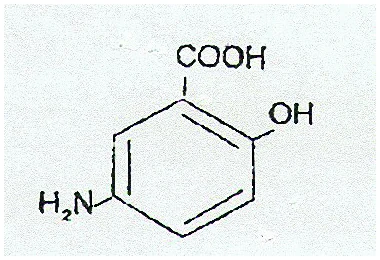
Molecular formula: C7H7NO3 Molecular weight: 153.14 Description: 5-aminosalicylic acid is a light tan, needle shaped, crystalline powder. It is slightly soluble water and 10% HCl solution. It is very slightly soluble in methanol and is practically insoluble in chloroform, ethylene oxide, and ethanol. It is soluble in 10% NaOH solution.
The melting range is 272-280EC.
COMPOSITION:
In addition to the active ingredient mesalamine (5-aminosalicylic acid), SALOFALK7
suppositories contain the following non-medicinal ingredients: Witepsol H-15 (suppository wax base).
STORAGE:
SALOFALK7 mesalamine (5-aminosalicylic acid) suppositories must be stored in a cool place, preferably between 20E and 25EC.
AVAILABILITY
SALOFALK7 mesalamine (5-aminosalicylic acid) suppositories 250,
500, or 1000 mg are available in strips of 5 suppositories; boxes of 30 suppositories.
PHARMACOLOGY
5-ASA is the active metabolite of the prodrug SAS which acts to suppress
inflammatory bowel disease. Pharmacologic tests were conducted on 5-ASA by R.C.C., Itingen, Switzerland. Most used the oral route of administration at a dose of 500 mg/kg in order to simulate practice-relevant conditions.
No adverse effect of 5-ASA on the following parameters or in the following tests could be established: tremorine antagonism, hexobarbital sleep time, motor activity, anticonvulsant action (metrazol and electric shock), blood pressure, heart rate, respiratory rate (up to 10 mg/kg, i.v.), tocolysis (antispasmodic assay), local anaesthesia, antihyperthermal and antipyretic effects. In the paw-edema test with carrageen injection, 200 mg/kg administered orally proved ineffective, but 500 mg/kg 5-ASA administered orally exhibited mild antiphlogistic action.
In the renal function tests (natriuresis and diuresis), no biologically relevant effects of 200 mg/kg administered orally were demonstrated. After 600 mg/kg, marked functional changes were observed: increases in both total urinary output, natriuresis and proteinuria. The urinary sediment contained increased numbers of erythrocytes and epithelial cells. Both potassium elimination and specific weight were reduced. It can be concluded from these experiments that even high doses of 5-ASA have no effect on vital parameters. Disturbances in renal function are to be expected only at dosages equivalent to a single dose at least 8 to 10 times the daily dose in man. Mode of action: The mode of action of 5-ASA is still under investigation with several biochemical mechanisms being
proposed. At present, the action of 5-ASA in treating inflammatory bowel disease appears to be associated with the metabolism of arachidonic acid. Studies suggest that interference of 5-ASA with either leukotriene or prostaglandin metabolism response mechanism16-18. Since prostaglandins definitely play a decisive role in inflammatory ulcerative intestinal disease, interference with the metabolism of prostanoids has long been postulated as the possible mechanism of action34-36. Inflammatory intestinal disease is often accompanied by diffuse tissue reactions including ulceration and cellular infiltration of lymphocytes, plasma cells, eosinophils and polymorphonuclear cells. For example, prostaglandin synthetase activity of the mucosa37 as well as 6-keto-prostaglandin F1 and thromboxane B2 also increase during active disease. In addition, increased prostaglandin38 stimulate active ion secretion which in turn contributes to the diarrhea associated with the disease. 5-ASA prevents
accumulation of thromboxane B2 and 6-keto-prostaglandin F138. In addition, both 5-ASA and SAS reverse H2O and Cl-secretion and increase Na+ secretion in experimentally-induced colitis in guinea pigs39. Mush et al.40 demonstrated that intestinal secretion is stimulated not only by prostaglandins but also by the
metabolites of arachidonic acid generated via the lipoxigenase pathway. Both SAS and 5-ASA are known to inhibit polymorphonuclear cell migration possibly via lipoxygenase inhibition41 at concentrations lower than those required to inhibit prostaglandin synthesis.
It is thus possible that both SAS and 5-ASA are capable of inhibiting both pathways via lipoxygenase inhibition.
TOXICOLOGY
A full battery of animal toxicology studies was conducted, including additional long-term carcinogenicity and chronic toxicity studies and three studies aimed at satisfying the special requirements for rectal dosage forms of 5-ASA, thereby providing safety data additional to the rectal tolerance study in dogs.
Brief summary of findings to date:
Animal studies to date show the kidney to be the only significant target organ for 5-ASA toxicity in rats and dogs. At high doses, the lesions produced consisted of papillary necrosis and multifocal proximal tubular injury. In rats, the no-effect levels were 160 mg/kg/day for females and 40 mg/kg/day for males (minimal and
reversible tubular lesions seen) after 13 weeks of oral administration. In dogs, the "no-effect" level in both males and females was 40 mg/kg/day after six months of oral administration. Aside from gastric and heart lesions, as well as bone marrow depression seen in some of the rats at the 640 mg/kg level and considered
secondary effects of the kidney damage, no other signs of systemic toxicity were noted at daily doses up to 160 mg/kg in rats and 120 mg/kg in dogs for 13 weeks and six months, respectively.
During up to 127 weeks of administration in rats of doses of 0, 50, 100 and 320 mg/kg/day, no significant differences were noted in unscheduled deaths, clinical signs, nodules or masses, between groups. Ophthalmoscopic investigations revealed no treatment-related changes. Treatment with SALOFALK7 was not associated with oncogenic changes or an increased tumor risk. The assessment of hematology, clinical biochemistry and urinalysis indicated no changes of
toxicological significance at 13, 26 and 52 weeks of treatment.
After 127 weeks, analysis of the lesions indicated slight substance-related and dose-dependent toxic changes as degenerative kidney damage and hyalinization of the tubular basement membrane and Bowman's capsule in the 100 mg and 320 mg/kg/day groups. Ulceration of the gastric mucosa and atrophy of the seminal vesicles were also more frequent in the 320 mg/kg/day group.
The battery of tests completed to date shows also that 5-ASA is devoid of embryotoxicity and teratogenicity in rats and rabbits; that it does not affect male rat fertility after five weeks of oral administration at 296 mg/kg/day; that it lacks the potential to affect late pregnancy, delivery, lactation or pup development in rats; and that it is without mutagenic properties in a standard series of tests.
Nephrotoxic potential of 5-aminosalicylic acid:
Owing to its structural relationship both to phenacetin, the aminophenols and salicylates, 5-ASA was included in a series of compounds studied following identification of antipyretic-analgesic nephropathy in humans. Calder et al. (Brit. Med. J., Nov. 27, 1971; Brit. Med. J., Jan. 15, 1972; Xenobiot Vol. 5, 1975) reported that, in rats, in addition to the proximal tubule necrosis seen with
acetyl-salicylic acid and phenacetin derivatives, 5-ASA produced papillary necrosis, following single intravenous doses ranging from 150 mg/kg to 872 mg/kg27, 28.
Diener et al.27 have shown that oral doses of 5-ASA of 30 mg/kg and 200 mg/kg daily for four weeks failed to produce any adverse effects on kidney function or histology in rat.
In a 13-week rat study, there were no renal lesions after four weeks in the animals receiving up to 160 mg/kg orally per day, but severe papillary necrosis and proximal tubular injury were
seen in most animals receiving 640 mg/kg orally per day. At 13 weeks, the female animals were free of pathology up to 160 mg/kg; minimal and reversible lesions in the tubules occurred in a few males (with no changes in renal function) at the 40 mg/kg level. After six months of oral administration in dogs, no toxicity was seen in the 40 mg/kg/day group. At 80 mg/kg/day, two of eight treated dogs showed slight to moderate renal papillary necrosis. These two dogs as well as two others showed minimal to moderate tubular lesions. At 120 mg/kg/day, two females had slight papillary necrosis. These and two others showed minimal to moderate tubule injury.
Thus, the animal toxicity data suggest that 5-ASA has a nephrotoxic potential comparable to acetyl-salicylic acid; on the other hand, extensive investigations of the problem of analgesic nephropathy have led to a current consensus that it is the combination products that provide the greatest hazard, and that single-ingredient antipyretic analgesics such as acetyl-salicylic acid are safe when taken in
reasonable doses. See Emkey (Amer. J. Med., June 24, 1983) and Editorial (Amer. Pharm., May 1984).
It is important to note, that despite 40 years of use of SAS world-wide for
treatment and long-term prophylaxis of ulcerative colitis and Crohn's disease, there has been no report of kidney disease directly attributable to the drug or to the diseases being treated. The fact that SAS results in therapeutic levels of sulfapyridine might have led to kidney disease mistaken as a systemic complication of inflammatory bowel disease, but we are aware of no report listing kidney disease as a complication either of ulcerative colitis or of Crohn's disease.
BIBLIOGRAPHY
- 1.
Svartz, N. Salazopyrin, a new sulfanilamide preparation.
Acta Med Scand, 1942; 110, fasc. 6: 577-598.
- 2.
Goldman, P., Peppercorn, MA. Drug Therapy, sulfasalazine.
N Engl J. Med, 1975; 293: 20-23.
- 3. Das, KM., Eastwood, MA., McManus, JPA., Sircus, W. The metabolism of salicylazosulfapyridine in ulcerative colitis. Gut 1973; 14: 631-641.
- 4.
Goldman, P. Sulfasalazine, formerly
salicylazosulfapyridine. Latest Thinking, Rowell Pub.
- 5. Peppercorn, MA., Goldman, P. The role of intestinal bacteria in metabolism of salicylasulfapyridine. J. Pharmacol Exp Ther, 1972; 181: 555-562.
- 6. Schroder, H., Campbell, DES. Absorption, metabolism, and excretion of salicylazosulfapyridine in man. Clin Pharmacol Ther, 1972; 13: 539-551.
- 7. Peppercorn, MA., Goldman, P. Distribution studies of salicylazosulfapyridine and its metabolites. Gastroenterol, 1973; 64: 240-245.
- 8.
Rowell Pub. SAS-500 sulfasalazine USP 500 mg tablets.
November 1980: BA200-2E-10M.
- 9. Das, KM., Chowdhury, JR., Zapp B., Fara JW. Small bowel absorption of sulfasalazine and its hepatic metabolism in human beings, cats, and rats. Gastroenterol, 1979: 77: 280-284.
- 10.
Shafii, A., Chowdhury, JR., Das, KM. Absorption,
enterohepatic circulation, and excretion of 5-aminosalicylic acid in rats. Am J Gastroenterol 1982; 77: 297-299.
- 11.
Das, KM., Eastwood, MA., McManus, JPA., Sircus, W. The role of the colon in the metabolism of
salicylazosulfapyridine. Scand J Gastroent 1974; 137-141.
- 12. Azad Khan, KA., Piris J., Truelove, SC. An experiment to determine the active therapeutic moiety of sulfasalazine. Lancet 1977; Oct: 892-895.
- 13.
Drug Information for the Health Care Provider, USP
Dispensing Information; Vol. 1, 1984.
- 14. Canadian IND, 7HP841412, Vol. 1, pp 81-82.
- 15.
Campieri, M., Lanfranchi, G., Brignola, C., Bazzocchi, G.,
Miguzzi, M., Calari, M. 5-aminosalicylic acid as rectal enema in ulcerative colitis patients unable to take sulfasalazine. Lancet 1984; Feb., Vol. 1: p. 403
- 16.
Lagumsky, M., Karmeli, F., Sharon, P., Zor, U., Cohen, F.,
Rachmilewitz, D.: Enhanced thromboxane A2 and prostacyclin production in ulcerative colitis and its inhibition by steroids and sulfasalazine. Gastroenterology 1981; 81: 444-449.
- 17. Hoult, JRS., Moore, PK. Effects of sulfasalazine and its metabolites on prostaglandin synthesis, inactivation and actions on smooth muscle. Brit J Pharmacol 1980; 68: 719-730.
- 18. Goldin E., Rachmilewitz, D. Prostanoid cytoprotection for maintaining remission in ulcerative colitis-failure of 15(R), 15-methylprostaglandin E2. Digest Dis Sci 1983; 28: 807-811.
- 19. van Hees, PAM., Bakker, JH., van Tongeren, JHM. Effect of sulfapyridine, 5-aminosalicylic acid, and placebo in patients with idiopathic proctitis: a study to determine the active therapeutic moiety of sulfasalazine, in man. Gut 1980; 21: 632-635.
- 20.
Fisher, C., Maier, K., Stumpf, E., Gaisberg, U von., Klotz
U. Disposition of 5-aminosalicylic acid, the active metabolite of sulfasalazine, in man. Eur J Clin Pharmacol 1983; 25: 511-515.
- 21.
Bondesen, S., Haagen Nielsen, O., Jacobsen, O., Norby
Rasmussen, S., Honore Hansen, S., Halskov S., Binder, V., Hvidberg, EF. 5-aminosalicylic acid enemas in patients with active ulcerative colitis. Scand J of
Gastroenterology 1984; Vol. 19: No. 5.
- 22.
Dew, MJ., Cardwell, M., Kidwai, NS., Evans, BK., Rhodes, J.
5-aminosalicylic acid in serum and urine after administration by enema to patients with colitis. J Pharmacol 1983; 35: 323-324.
- 23.
Campieri, M., Lanfranchi, GA., Boschi, S., Brignola, C.,
Bazzocchi, G., Minguzzi, MR., Fois, F. Absorption of rectally administered 5-ASA in patients with ulcerative colitis. Gastro 1984; 86: 2.
- 24. Rowell Unpublished Data, Protocol III, 1984.
- 25.
Campieri, M., Lanfranchi, GA., Bazzocchi, G., Brignola, C.,
Sarti, G., Franzin, G., Battocchia, A., Labo, G., Dal Monte, PR. Treatment of ulcerative colitis with high-dose
5-aminosalicylic acid enemas. Lancet 1981; Aug.: 270-1.
- 26.
Campieri, M., Lanfranchi, GA., Brignola, C., Bazzocchi, G.,
Miguzzi, MR., Giochetti, P. High-dose 5-aminosalicylic acid enemas in the treatment of ulcerative colitis. Gastroenterology 1984; 5: 164-171.
- 27.
Diener, U., Tuczek, HV., Fisher, C., Maier, K., Klotz, U.
Renal function was not impaired by treatment with 5-aminosalicylic acid in rats and man. Archives of Pharmacology 1984; 326: 278-282.
- 28. Canadian IND #7HP841412, Volumes 3 and 4.
- 29. Klotz, U. Clinical pharmacokinetics of sulfasalazine its metabolites and other prodrugs of 5-aminosalicylic acid. Clinical Pharmacokinetics (Accepted for publication).
- 30. Klotz, U. Clinical efficacy of 5-aminosalicylic acid in the treatment of inflammatory bowel disease. American Journal of gastroenterology (08-85).
- 31. Maier, K., Fruhmorgen, P., Bode, J Ch, et al. Successful management of chronic inflammatory bowel disease with oral 5-aminosalicylic acid. Dtsh. Med. Wochenshr. 1985; 110: 363.8.
- 32.
Rasmussen, SN.,Binder, V., Maier, K., et al. Treatment of
Crohn's disease with peroral 5-aminosalicylic acid. Gastroenterology 1983; 85: 1350.3.
- 33. Klotz, U., Maier, K., Fisher, C., Bauer, Kh. A new slow release form of 5-aminosalicylic acid. Gut; 1984; 25: A552.
- 34.
Ligumsky, M., Karmeli, F., Sharon, P., Zor, U., Cohen, F.,
Rachmilewits, P. Enhanced thromboxane A2 and prostacyclin production by cultured rectal mucosa in ulcerative colitis and its inhibition by steroids and sulfasalazine. Gastroenterology 1981; 81: 444-449.
- 35. Sharon, P., Ligumsky, M., Rachmilewitz, D., Zor, U. Role of prostaglandins in ulcerative colitis. Enhanced production during active disease and inhibition by sulfasalazine. Gastroenterology 75: 1978: 638.
- 36. Smith, PR., Dawson, DJ., Swan, CHJ. Prostaglandin synthetase activity in acute ulcerative colitis. Effects of treatment with sulfasalazine, codein phosphate and prednisolone. Gut 20; 1979: 80.
- 37.
Harris, DW., Smoth, PR., Swan, HJ. Determination of prostaglandin synthetase activity in rectal biopsy material
and its significance in colonic disease. Gut 19; 1978: 975.
- 38.
Gould, SR. Prostaglandins, ulcerative colitis and
sulfasalazine. Lancet II; 1975: 988.
- 39. Peterson, DJ., Colony, PC. Anti-secretory effects of sulfasalazine and 5-aminosalicylic acid in experimental colitis. Gastroenterology, 1984; 1271 1983.
- 40. Mush, MW., et al. Arachidonic acid metabolism and colonic secretion. Gastroenterology, 1984; 1962, 1983.
- 41. Sircar, JC., et al. Inhibition of soybean lipoxygenase by sulfasalazine and 5-aminosalicylic acid; a possible mode of action in ulcerative colitis. Biochemical Pharmacology, 32: 170, 1983.
- 42. Klotz, U. Clinical pharmacokinetics of sulfasalazine, its metabolites and other prodrugs of 5-aminosalicylic acid. Clinical Pharmacokinetic, August 1985.
- 43. Rasmussen et al. 5-aminosalicylic acid in a slow release preparation: Bioavailability, plasma level and excretion. Gastroenterology 83: 1062, 1982.
- 44. Das, KM., Eastwood, MA., McManus, JPA., Sircus, W. Adverse reactions with salicylazosulfapyridine therapy and the relation with drug metabolism and acetylator phenotype. New Engl. J. of Med., 289: 491, 1983.
- 45. Dew, MJ., Hughes, PJ., Lee, MG., Evans, BK., Rhodes, J., et al. An oral preparation to release drugs in the colon. Br. J. of Clin. Pharmac. 14: 405, 1982.
- 46.
Dew, MJ., Hughes, PJ., Harries, AD., Williams, G., Evans,
BK., Rhodes, J. Maintenance of remission in ulcerative colitis with oral preparations of 5-aminosalicylic acid. Br. Med. J.: 285; 51, 1982.
- 47.
Dew, MJ., Rider, REJ., Evans, N., Evans, BK., Rhodes, J.
Colonic release of 5-aminosalicylic acid from an oral preparation of 5-aminosalicylic acid.
Br. J. of Pharmac. 16: 185, 1983.
- 48.
Dew, MJ., Ebden, P., Kidway, NS., Lee, G., Evans, BK.,
Rhodes, J. Comparison of the absorption and metabolism of sulfapyridine and acrylic coated 5-aminosalicylic acid in normal subjects and patients with colitis. Br. J. of Pharma. 17: 474, 1984.
- 49. Hardy, JG., Healy, JNC., Reynolds, JR. Evaluation of an enteric coated delayed release 5-aminosalicylic acid tablet in patients with inflammatory bowel disease. Aliment. Pharmacol. Therapy (1987) 1, 273-280.
- 50. Ahnfelt-Ronne and Haagen Nielsen O. The anti-inflammatory moiety of SAS 5-aminosalicylic acid is a radical scavenger. Agents and Actions, Vol. 5/6 (1986).
- 51. May et al. Munch. Med. Wschr. 129 (43), 786-789 (Published in german).
- 52.
Sutherland, L., Martin F. Maintenance therapy with 2g and
4g 5-aminosalicylic acid retention enemas. Canadian J of Gastroenterology. Vol. 1, No. 1 3-6 (1987).
- 53. Sachedina, B., Saibil, F., Cohen, LB., Whittey, J.: Acute pancreatitis due to 5-aminosalicylate. Annals of Internal Medicine, 1989: Vol. 110, No. 6, pp 490-492.
- 54. Young, BA., McLeod, RS., Cohen, Z.: Exacerbation of ulcerative colitis following administration of 5-ASA enemas. Canadian Journal of Gastroenterology, Vol. 3, No. 2 (1989).
- 55.
Rachmilewitz, D. et al.: Coated mesalazine (5-
aminosalicylic acid) versus sulphasalazine in the treatment of active ulcerative colitis: a randomized trial. British Medical Journal, Vol. 298, No. 6666, pp. 82-86, (1989)