


Patient Medication Information: uses, side effects, how to take - Enspryng
What is ENSPRYNG used for?
- ENSPRYNG is for treatment of ‘neuromyelitis optica spectrum disorders’ (NMOSD).
It is used in adults and young people from 12 years of age.
- ENSPRYNG reduces the risk of a relapse or attack of NMOSD.
What is NMOSD?
NMOSD is an autoimmune disease of the central nervous system that mainly affects the optic nerves and spinal cord.
- The damage to the optic nerves causes swelling. This leads to pain and loss of sight.
The damage to the spinal cord causes:
- weakness or loss of movement in the legs or arms,
- loss of feeling, and
- problems with bladder and bowel function.
In a ‘relapse’, or an ‘attack’ of NMOSD, there is swelling in the nervous system. The swelling causes people to have new symptoms, or have symptoms that they have had before.
How does ENSPRYNG work?
ENSPRYNG blocks the action of a protein called ‘interleukin-6’ (IL-6).
- This protein is involved in swelling in the body.
What are the ingredients in ENSPRYNG?
Medicinal ingredients: satralizumab
Non-medicinal ingredients: L-arginine, L-aspartic Acid, L-histidine, poloxamer 188, and water for injection.
ENSPRYNG comes in the following dosage forms:
Solution, in a single-use, pre-filled syringe of 120 mg/mL.
Do not use ENSPRYNG if:
- You are allergic to ENSPRYNG (satralizumab) or
- You are allergic to any of the other ingredients of this medicine or components of the container.
To help avoid side effects and ensure proper use, talk to your healthcare professional before you take ENSPRYNG. Talk about any health conditions or problems you may have, including if you:
Have any signs of infection
Symptoms could include fever or chills; cough that does not go away; sore throat;
- herpes (such as cold sore, shingles or genital sores); skin redness, swelling, tenderness or pain; feeling or being sick, diarrhea or belly pain.
- Your doctor will wait until the infection is gone before giving you ENSPRYNG or allowing you to continue to inject ENSPRYNG.
Have recently been given any vaccine or might be given a vaccine in the near future.
- Your doctor will check if you need any vaccines before you start ENSPRYNG.
- Do not get ‘live’ or ‘live attenuated’ vaccines (for example BCG for tuberculosis or vaccines against yellow fever) while you are taking ENSPRYNG.
- However, your doctor may recommend that you get a seasonal flu vaccine, since these are usually not ‘live’ or ‘live attenuated.’
Have increased liver enzymes - see “Serious side effects and what to do about them” below.
- Your doctor will do blood tests to check these amounts and monitor how well your liver is working.
Are pregnant or breast-feeding, or think you may be pregnant or are planning to have a baby.
- Women of childbearing potential must use effective contraception during and up to 3 months after treatment with ENSPRYNG.
- Breastfeeding is not recommended during treatment with ENSPRYNG as a risk to the nursing infant cannot be excluded.
Other warnings you should know about:
- Do not give this medicine to children under 12 years of age. This is because it has not yet been studied in this age group.
ENSPRYNG is not likely to affect you being able to drive, cycle or use any tools or machines.
Tell your healthcare professional about all the medicines you take, including any drugs, vitamins, minerals, natural supplements or alternative medicines.
How to take ENSPRYNG:
Read carefully and follow the enclosed instructions under “Instructions for Use” below on how to administer ENSPRYNG.
Always use this medicine exactly as your healthcare professional has told you. Check with your healthcare professional if you are not sure how to inject it.
- ENSPRYNG is given by injection under the skin (sub-cutaneously).
- Always use the entire contents of the syringe during injection.
Usual dose:
Each injection contains 120 mg of satralizumab. The first injection will be given under the supervision of your healthcare professional.
- The first three injections are given once every two weeks. These are called ‘loading doses’.
- After this, the injection is given every four weeks. This is called the ‘maintenance dose’. Keep taking ENSPRYNG once every four weeks for as long as your doctor tells you to.
Allergic reaction:
Tell your doctor right away or go to the emergency department of your nearest hospital, if you experience any signs of allergic reactions during or after the injection such as:
- tight chest or wheezing
- feeling short of breath
- fever or chills
- severe dizziness or light-headedness
- swelling of the lips, tongue, face
- skin itching, hives or rash.
Do not take the next dose until you have informed your doctor and your doctor has told you to take the next dose.
Instructions for Use
Read these Instructions for Use:
- Before you start using your pre-filled syringe.
- Each time you get a prescription refill. This is because it may contain new information.
- This information does not replace talking to your healthcare professional about your condition or treatment.
- Your healthcare professional will decide if you or a caregiver can give you injections of ENSPRYNG at home. They will also show you or a caregiver how to use the syringe before you use it for the first time.
- Talk to your healthcare professional if you have any questions.
Important Information:
- Each syringe is pre-filled with a medicine called ENSPRYNG.
- Each carton of ENSPRYNG contains only 1 pre-filled syringe.
- Each pre-filled syringe can be used only once.
- Do not share your syringes with other people. You may give them a serious infection or get a serious infection from them.
- Do not take the needle cap off until you are ready to inject ENSPRYNG.
- Do not use the syringe if it has been dropped or damaged.
- Do not try to take the syringe apart at any time.
- Do not leave the syringe unattended.
- Do not re-use the same syringe.
How should I store the ENSPRYNG pre-filled syringe?
- Keep the unused syringe in the refrigerator between 2 to 8°C until ready to use. Do not freeze. Do not use the syringe if it has been frozen.
- Keep the syringe and all medicines out of the reach of children.
- Keep the syringe in its original carton away from direct sunlight.
- Always keep the syringe dry.
Supplies needed to give your injection
Each ENSPRYNG carton contains:
- 1 pre-filled syringe for one-time use only.
Not included in the carton:
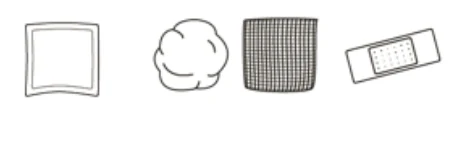
1 alcohol pad
- 1 sterile cotton ball or gauze
- 1 small bandage
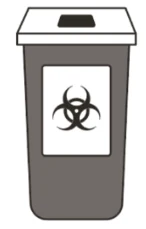
- 1 puncture-resistant sharps container for safe disposal of the needle cap and used syringe. See Step 21 “Disposing of ENSPRYNG” at the end of these Instructions for Use.
ENSPRYNG pre-filled syringe
(See Figure A and Figure B)
Before use:
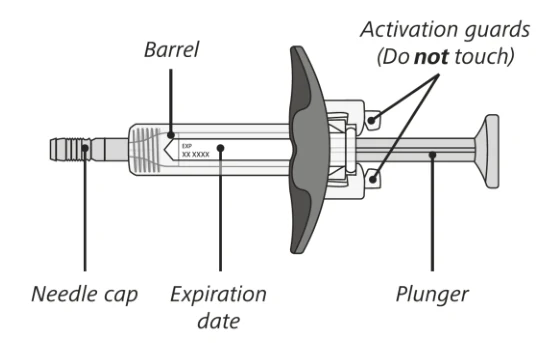
Figure A
After use:
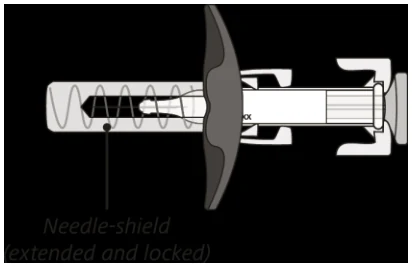
Figure B
The syringe has a needle-shield that automatically covers the needle when the injection is complete.
Prepare to use ENSPRYNG
- 1. Take the carton containing the syringe out of the refrigerator and place it on a clean, flat work surface (like a table).
- 2. Check the expiration date on the back of the carton (See Figure C). Do not use if the carton has expired.
- 3. Check the front of the carton is sealed (Figure C). Do not use if the seal has been broken.
If the expiration date has passed or the seal is broken, do not use. In this case, go to Step 21 “Disposing of ENSPRYNG” and contact your healthcare professional.
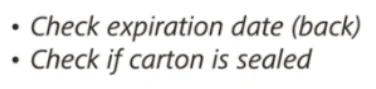
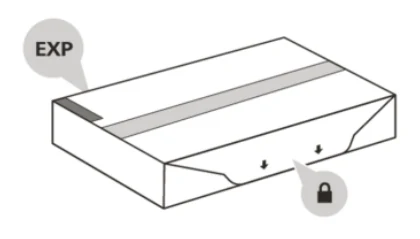
Figure C
- 4. Open the sealed carton (See Figure D).
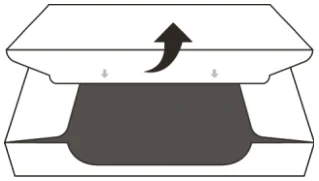
Figure D
- 5.
Carefully lift the syringe out of the carton by holding the barrel (See Figure E).
- Do not turn the carton upside down to remove the syringe.
- Do not touch the activation guards - this may damage the syringe.
- Do not hold the plunger or needle cap.
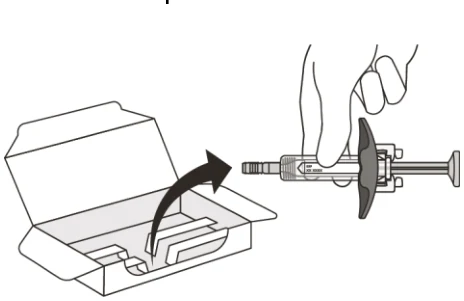
Figure E
Check the syringe
(See Figure F)
- 6. Check the expiration date on the syringe. Do not use the syringe if it has expired.
- 7. Check the syringe for any damage. Do not use if it is cracked or broken.
- 8.
Check that the liquid through the viewing window is clear and colorless to pale yellow. Do not inject the medicine if the liquid is cloudy, discoloured, or has particles in it.
- There may be some small air bubbles in the syringe. This is normal and you should not try to remove them.
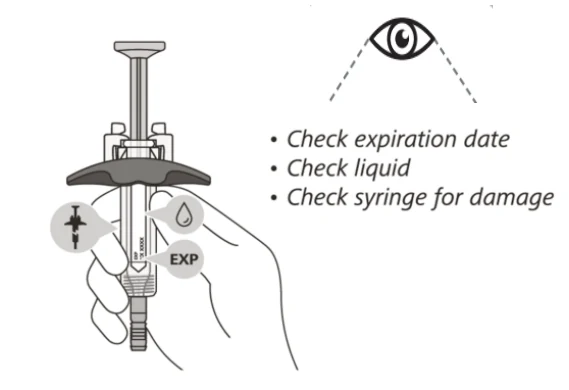
Figure F
If the expiry date has passed, the syringe is damaged or the liquid is cloudy, discoloured, or has particles in it, do not use. In this case, go to Step 21 “Disposing of ENSPRYNG” and contact your healthcare professional.
Let your syringe warm up
- 9.
Once you have checked the syringe, place it on a clean, flat work surface (like a table) for 30 minutes. This will allow it to reach room temperature (See Figure G).
It is important to let the syringe warm up slowly. Injecting cold solution may feel uncomfortable and make it harder to push out.
- Do not speed up the warming process in any way. Do not use a microwave or place the syringe in warm water.
- Do not remove the needle cover while the syringe is reaching room temperature.
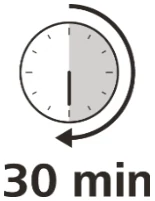
Figure G
Wash your hands
- 10. Wash your hands with soap and water (See Figure H).
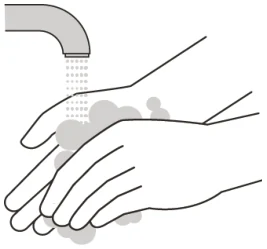
Figure H
Choose the injection site
- 11.
Choose your injection site in either:
- The lower part of your stomach (abdomen) or
- The front middle of your thighs (See Figure I).
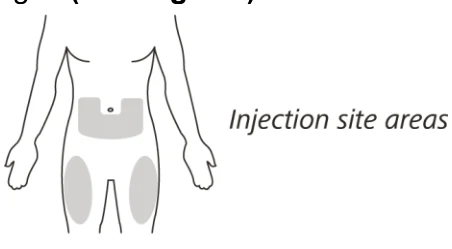
Figure I
- Do not select the 5 cm area around your belly button.
- Do not select areas with moles, scars, bruises, or areas where the skin is tender, red, hard or broken.
Choose a different injection site for each new injection. Each new injection should be at least 2.5 cm away from the place where you last injected.
Clean the injection site
- 12.
Wipe the injection site with an alcohol pad and let it air dry.
- Do not fan or blow on the area which you have cleaned.
- Do not touch the injection site again before you give the injection.
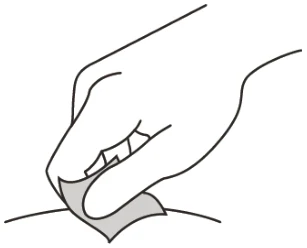
Figure J
Inject ENSPRYNG
- 13.
Hold the barrel of the syringe between your thumb and index finger. With your other hand, pull the needle cap straight off. You may see a drop of liquid at the end of the needle - this is normal and will not affect your dose (See Figure K).
- Use the syringe within 5 minutes of removing the cap or the needle may clog.
- Do not take the needle cap off until you are ready to inject ENSPRYNG.
- Do not put the needle cap back on once it has been removed as this may damage the needle.
- Do not touch the needle or let it touch any surfaces after removing the needle cap.
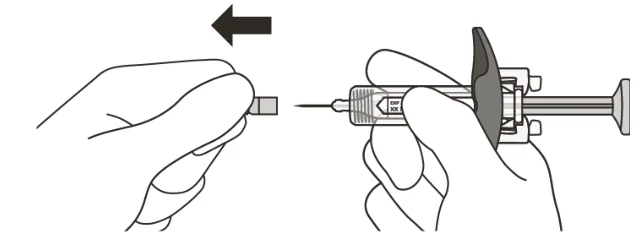
Figure K
- 14. Throw away the needle cap in a puncture-resistant sharps container immediately. See Step 21 “Disposing of ENSPRYNG”.
- 15. Hold the barrel of the syringe using your thumb and index finger. With your other hand, pinch the area of skin you have cleaned (See Figure L).
- 16.
Use a quick, dart-like motion to insert the needle at an angle between 45° to 90° (See Figure L).
- Do not insert the needle through clothing.
- Do not change the angle of the injection.
- Do not insert the needle again.
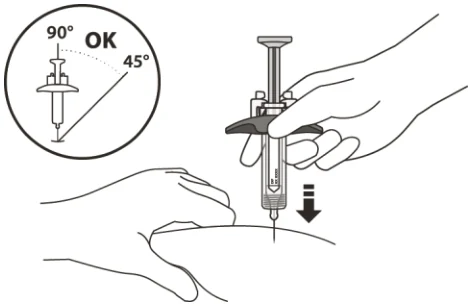
Figure L
- 17. After the needle is inserted, let go of the pinched skin.
- 18. Slowly inject all of the medicine by gently pushing the plunger all the way down until it touches the activation guards (See Figure M).
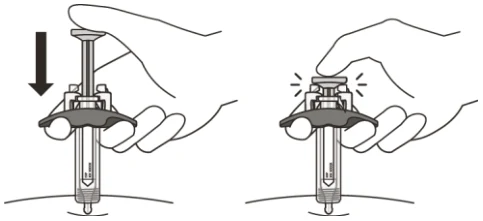
Figure M
- 19. Gently release the plunger and allow the needle to come out of the skin at the same angle it was inserted (See Figure N).
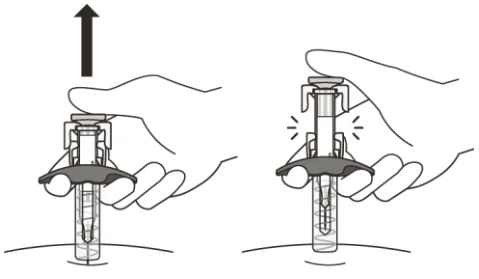
Figure N
- The needle will now be covered by the needle-shield. If the needle is not covered, carefully place the syringe into a puncture-resistant sharps container to avoid injury. See Step 21 “Disposing of ENSPRYNG”.
Taking care of the injection site
- 20. There may be a little bleeding at the injection site. You can press a cotton ball or gauze over the injection site but do not rub it. If needed, you may also cover the area you injected with a small bandage. If the medicine gets into contact with your skin, wash the area with water.
Disposing of ENSPRYNG
- 21. Do not try to re-cap your syringe. Put your used syringe in a sharps disposal container immediately after use (See Figure O). Do not throw away (dispose of) the syringe in your household waste and do not recycle them.
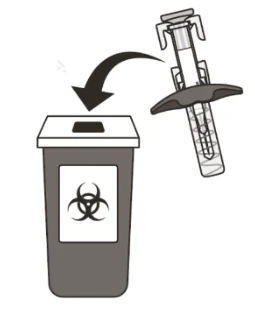
Figure O
Ask your healthcare professional for information about where you can get a "sharps" container or what other types of puncture-resistant containers you can use to safely
dispose of your used syringes and needle caps, if you do not have one.
- Dispose of the used sharps disposal container as instructed by your healthcare professional.
- Do not dispose of your used sharps disposal container in your household waste.
- Do not recycle your used sharps disposal container.
Overdose:
Because ENSPRYNG is given in one pre-filled syringe, it is unlikely that you will receive too much. However, if you are worried, talk to your healthcare professional.
If you accidentally inject ENSPRYNG more frequently than told to by your doctor, call your doctor. Always take the outer carton with you when you go to see the doctor.
| If you think you have taken too much ENSPRYNG, contact your healthcare professional, hospital emergency department or regional poison control centre immediately, even if there are no symptoms. |
Missed Dose:
For the treatment to be fully effective, it is very important to keep having the injections.
If your healthcare professional is giving your injections and you miss an appointment, make another one right away.
If you are injecting ENSPRYNG yourself and you miss an injection, give it as soon as possible. Do not wait until the next planned dose. After giving the missed dose, your next dose should be given either:
- for loading doses - two weeks later
- for maintenance doses - four weeks later
Check with your healthcare professional if you are not sure.
Do not suddenly stop using ENSPRYNG without asking your doctor first. If you have any further questions on the use of this medicine, ask your healthcare professional.
What are possible side effects from using ENSPRYNG?
These are not all the possible side effects you may feel when taking ENSPRYNG. If you experience any side effects not listed here, contact your healthcare professional.
The most common side effects of ENSPRYNG include:
Injection-Related Reactions (Very common: may affect more than 1 in 10 people)
In most cases these are mild reactions, but some can be serious.
Tell your doctor right away if you have any of these signs during or after the injection, particularly in the first 24 hours after the injection:
- redness, itching, pain or swelling where the injection is given
- rash, red or itchy skin or hives
- feeling flushed
- headache
- throat irritation, swelling or pain
- feeling short of breath
- low blood pressure
- fever or chills
- feeling tired or dizzy
- feeling sick to your stomach or vomiting
- diarrhea
- fast heart rate, fluttering or pounding heart (heart palpitations)
You may experience the following other side effects:
Other Side Effects
Very common (may affect more than 1 in 10 people):
- headache
- joint pain
Common (may affect up to 1 in 10 people):
- stiffness
- migraine
- being unable to sleep
- swelling in your lower legs, feet or hands
- rash or itching
- allergies or hay fever
- low levels of fibrinogen, a type of blood clotting protein shown in tests
- low levels of white blood cells as shown in blood tests
- high levels of bilirubin, a yellowish substance formed in the liver, as shown in a blood test
Your doctor may also test your blood to check for other abnormal test results.
Serious side effects and what to do about them
| Symptom / effect | Talk to your healthcare professional | Stop taking drug and get immediate medical help |
| Only if severe | In all cases | |
Liver enzyme increase:
| ||
| ✓ | ||
If you have a troublesome symptom or side effect that is not listed here or becomes bad enough to interfere with your daily activities, talk to your healthcare professional.
Reporting Side Effects
You can report any suspected side effects associated with the use of health products to Health Canada by:
NOTE: Contact your health professional if you need information about how to manage your side effects. The Canada Vigilance Program does not provide medical advice. |
Storage:
- Keep this medicine out of the sight and reach of children.
- Do not use this medicine after the expiry date which is stated on the pre-filled syringe label and carton after ‘EXP’. The expiry date refers to the last day of that month.
- Store in a refrigerator (2 to 8°C) until ready to use. Do not freeze. Do not use the syringe if it has been frozen. Always keep the syringe dry. Keep the pre-filled syringes in the outer carton in order to protect from light and moisture.
- If unopened and kept in the outer carton, ENSPRYNG can be taken out of and returned to the refrigerator.
- If stored at room temperature, the total time out of refrigeration should not be longer than 8 days at a temperature that does not exceed 30°C.
Do not use this medicine if you notice that it is cloudy, discoloured, or contains visible particles.
ENSPRYNG is a colourless to slightly yellow liquid.
Do not use the pre-filled syringe if it is cracked or broken. Check the pre-filled syringe and needle safety device for any damage.
After removing the cap, the injection must be started within 5 minutes to prevent the medicine from drying out and blocking the needle. If the pre-filled syringe is not used within 5 minutes of cap removal, you must dispose of it in a puncture resistant container and use a new pre-filled syringe.
Do not throw away any medicines via wastewater or household waste. Ask your pharmacist how to throw away medicines you no longer use. These measures will help protect the environment.
If you want more information about ENSPRYNG:
- Talk to your healthcare professional
- Find the full product monograph that is prepared for healthcare professionals and includes this Patient Medication Information by visiting the Health Canada website; the manufacturer’s website www.rochecanada.com, or by calling 1-888-762-4388.
ENSPRYNG® is a registered trade-mark of Chugai Seiyaku Kabushiki Kaisha, used under license
©Copyright 2021, Hoffmann-La Roche Limited