


Product Monograph - Eylea Hd
Recent Major Label Changes
| 1 Indications | 2026-10 |
| 4 Dosage and Administration, 4.1 Dosing Considerations | 2026-05 |
| 4 Dosage and Administration, 4.2 Recommended Dose and Dosage Adjustment | 2026-10 |
| 4 Dosage and Administration, 4.4 Administration | 2026-05 |
| 7 Warnings and Precautions | 2026-10 |
Table of Contents
Certain sections or subsections that are not applicable at the time of the preparation of the most recent authorized product monograph are not listed.
Recent Major Label Changes ........................................................................................................... 2
Table of Contents ............................................................................................................................ 2
Part I: Healthcare Professional Information .................................................................................... 4
1 Indications ................................................................................................................................... 4
1.1 Pediatrics ...................................................................................................................................... 4
1.2 Geriatrics ....................................................................................................................................... 4
2 Contraindications ......................................................................................................................... 4
4 Dosage and Administration .......................................................................................................... 4
4.1 Dosing Considerations .................................................................................................................. 4
4.2 Recommended Dose and Dosage Adjustment ............................................................................. 4
4.4 Administration .............................................................................................................................. 5
4.5 Missed Dose ................................................................................................................................ 12
5 Overdose ................................................................................................................................... 12
6 Dosage Forms, Strengths, Composition, and Packaging .............................................................. 12
7 Warnings and Precautions .......................................................................................................... 13
General ……………………………………………………………………………………………………………………………………13
Driving and Operating Machinery .................................................................................................. 13
Immune ……………………………………………………………………………………………………………………………………13
Ophthalmologic .............................................................................................................................. 14
Reproductive Health: Female and Male Potential ......................................................................... 15
Systemic Effects ............................................................................................................................. 15
7.1 Special Populations ..................................................................................................................... 15
7.1.1 Pregnancy .............................................................................................................................. 15
7.1.2 Breastfeeding ........................................................................................................................ 15
7.1.3 Pediatrics ............................................................................................................................... 15
7.1.4 Geriatrics ............................................................................................................................... 15
8 Adverse Reactions ...................................................................................................................... 16
8.1 Adverse Reaction Overview ........................................................................................................ 16
8.2 Clinical Trial Adverse Reactions .................................................................................................. 17
8.3 Less Common Clinical Trial Adverse Reactions ........................................................................... 23
8.4 Abnormal Laboratory Findings: Hematologic, Clinical Chemistry and Other Quantitative Data 23
8.5 Post-Market Adverse Reactions ................................................................................................. 23
9 Drug Interactions ....................................................................................................................... 23
9.2 Drug Interactions Overview ........................................................................................................ 23
9.3 Drug-Behaviour Interactions ...................................................................................................... 23
9.4 Drug-Drug Interactions ............................................................................................................... 23
9.5 Drug-Food Interactions ............................................................................................................... 23
9.6 Drug-Herb Interactions ............................................................................................................... 24
9.7 Drug-Laboratory Test Interactions.............................................................................................. 24
10 Clinical Pharmacology .............................................................................................................. 24
10.1 Mechanism of Action ................................................................................................................ 24
10.2 Pharmacodynamics ................................................................................................................... 24
10.3 Pharmacokinetics ...................................................................................................................... 24
10.4 Immunogenicity ........................................................................................................................ 25
11 Storage, Stability, and Disposal ................................................................................................ 26
12 Special Handling Instructions .................................................................................................... 26
PART 2: Scientific Information ....................................................................................................... 27
13 Pharmaceutical Information ..................................................................................................... 27
14 Clinical Trials ............................................................................................................................ 28
14.1 Clinical Trials by Indication ....................................................................................................... 28
15 Microbiology ............................................................................................................................ 38
16 Non-Clinical Toxicology ............................................................................................................ 38
Patient Medication Information .................................................................................................... 40
Part I: Healthcare Professional Information
1 Indications
EYLEA HD (aflibercept injection) is indicated for:
- the treatment of neovascular (wet) age-related macular degeneration (AMD)
- the treatment of diabetic macular edema (DME)
- the treatment of macular edema secondary to retinal vein occlusion (RVO)
1.1 Pediatrics
Pediatrics (< 18 years of age): No data are available to Health Canada; therefore, Health Canada has not authorized an indication for pediatric use.
1.2 Geriatrics
Geriatrics (≥ 65 years of age): Clinical studies of EYLEA HD include participants 65 years of age and older. No clinically significant differences in efficacy or safety were seen with increasing age in these studies.
2 Contraindications
- Patients who are hypersensitive to this drug, to any ingredient in the formulation, or to any component of the container. For a complete listing, see 6 Dosage Forms, Strengths, Composition, and Packaging section.
- Patients with ocular or periocular infection
- Patients with active intraocular inflammation
4 Dosage and Administration
4.1 Dosing Considerations
- FOR OPHTHALMIC INTRAVITREAL INJECTION ONLY.
- The Eylea HD pre-filled syringe with OcuClick dosing system or vial is for single-use only.
- The pre-filled syringe with OcuClick dosing system or vial contents should not be split or further compounded. Use of more than one injection from a pre-filled syringe with OcuClick dosing system or vial may increase the risk of contamination and subsequent infection.
- Eylea HD must only be administered by a qualified healthcare professional experienced in administering intravitreal injections.
- Aflibercept at a dose of 8 mg must only be administered using Eylea HD. Aflibercept at a dose of 2 mg must only be administered using Eylea.
4.2 Recommended Dose and Dosage Adjustment
Treatment of wet AMD
Eylea HD 8 mg (0.07 mL) is administered by intravitreal injection every month (4 weeks +/- 1 week) for the first 3 consecutive doses, followed by 8 mg (0.07 mL) every 8 to 16 weeks (+/- 1 week). Following 12 months of treatment and based on the healthcare professional’s judgement of visual and anatomic outcomes, the dosing intervals may be further adjusted to a maximum of 20 weeks (+/- 1 week) using increments of up to 4 weeks. Subsequently, based on the healthcare professional’s judgement of visual and anatomic outcomes, the dosing intervals may be further adjusted to a maximum of 24 weeks in select patients using increments of 2 weeks (see 14 Clinical Trials).
Patients should be assessed regularly. Monitoring visits and dosing interval should be based on the patient’s status and at the healthcare professional’s discretion.
Treatment of DME
Eylea HD 8 mg (0.07 mL) is administered by intravitreal injection every month (4 weeks +/- 1 week) for the first 3 consecutive doses, followed by 8 mg (0.07 mL) every 8 to 16 weeks (+/- 1 week). Following 12 months of treatment and based on the healthcare professional’s judgement of visual and anatomic outcomes, the dosing intervals may be further adjusted to a maximum of 20 weeks (+/- 1 week) using increments of up to 4 weeks. Subsequently, based on the healthcare professional’s judgement of visual and anatomic outcomes, the dosing intervals may be further adjusted to a maximum of 24 weeks in select patients using increments of 2 weeks (see 14 Clinical Trials).
Patients should be assessed regularly. Monitoring visits and dosing interval should be based on the patient’s status and at the healthcare professional’s discretion.
Treatment of RVO
Eylea HD 8 mg (0.07 mL) is administered by intravitreal injection once every month (4 weeks +/- 1 week) for the first 3 consecutive doses, followed by 8 mg (0.07 mL) every 8 weeks (+/- 1 week). The dosing interval may be adjusted in increments of 4 weeks up to a maximum of 16 weeks (+/-1 week) based on the healthcare professional’s judgement of visual and anatomic outcomes. If visual and/or anatomic outcomes deteriorate, the dosing interval should be shortened by 4 weeks. The interval between two doses should not be shorter than 4 weeks (see 14 Clinical Trials).
Patients should be assessed regularly. Monitoring visit schedule and dosing interval should be based on the patient’s status and at the healthcare professional’s discretion.
Special Populations
Hepatic and/or renal impairment: No specific studies in patients with hepatic and/or renal impairment were conducted with Eylea HD.
Geriatrics (≥ 65 years of age): No special dosing considerations are needed in elderly populations.
Pediatrics (< 18 years of age): The safety and efficacy of Eylea HD have not been established in pediatric patients. Health Canada has not authorized an indication for pediatric use.
4.4 Administration
Intravitreal injections must be carried out by a qualified healthcare professional experienced in administering intravitreal injections, and according to medical standards and under controlled aseptic conditions, which include surgical hand disinfection and the use of sterile gloves, a sterile drape, and a sterile eyelid speculum (or equivalent). The peri-ocular skin, eyelid, and ocular surface should be disinfected. Adequate anesthesia and a topical broad spectrum microbicide should be used prior to the injection.
Prior to administration, visually inspect the solution for injection. Do not use the pre-filled syringe with OcuClick dosing system or vial if particulates, cloudiness, or discolouration are visible. Do not use if any part of the pre-filled syringe with OcuClick dosing system is damaged or loose, or if the syringe cap is detached from the Luer-lock.
For the intravitreal injection a 30 G x ½ inch injection needle (not supplied) should be used. Use of a smaller size needle (higher gauge) than the recommended 30 G x ½ inch injection needle may result in increased injection forces.
Immediately following the intravitreal injection, patients should be monitored for elevation in intraocular pressure. Appropriate monitoring may consist of a check for perfusion of the optic nerve head or tonometry. If required, sterile equipment for paracentesis should be available.
Patients should be instructed to report any symptoms suggestive of intraocular inflammation or infections (including endophthalmitis, retinal vasculitis with or without occlusion, and scleritis), retinal detachment or tear, cataract, or increased intraocular pressure (e.g., eye pain, redness of the eye, photophobia, blurring or loss of vision) immediately following intravitreal injection.
THE PRE-FILLED SYRINGE WITH OCUCLICK DOSING SYSTEM OR VIAL IS FOR SINGLE-USE ONLY. EACH PRE-FILLED SYRINGE WITH OCUCLICK DOSING SYSTEM OR VIAL IS TO BE USED ONLY FOR THE TREATMENT OF ONE EYE WITH 8 MG / 0.07 ML OF EYLEA HD.
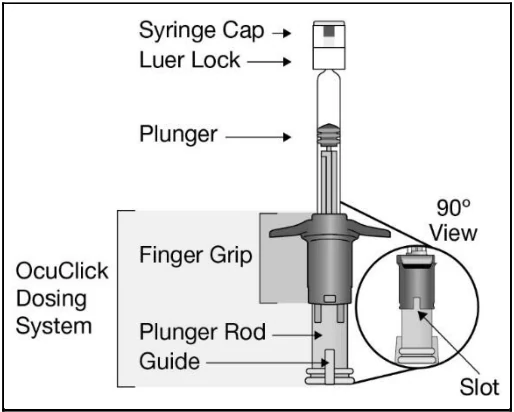
The pre-filled syringe with OcuClick dosing system contains more than the recommended dose of aflibercept 8 mg (0.07 mL). The excess volume must be expelled before injecting (see 12 Special Handling Instructions).
To expel the air bubbles along with excess drug, slowly depress the plunger rod until it stops, ensuring that the guide on the plunger rod reaches the finger grip (equivalent to 0.07 mL containing 8 mg aflibercept) (see 5 Overdose and 12 Special Handling Instructions).
Prior to usage, the unopened vial of Eylea HD or Eylea HD pre-filled syringe with OcuClick dosing system in its blister pack may be stored at room temperature (25°C) for up to 24 hours.
AFTER INJECTION, ANY UNUSED PRODUCT OR WASTE MATERIAL MUST BE DISCARDED.
After opening the blister pack or vial, proceed under aseptic conditions.
To prepare Eylea HD for intravitreal injection, please adhere to the following instructions:
Filter needle:
Blunt filter (fill) needle, not for skin injection. Do not autoclave the blunt filter (fill) needle. The filter needle is non-pyrogenic. Do not use it if individual packaging is damaged. Discard the used blunt filter (fill) needle in approved sharps collector. Caution: Re-use of the filter needle may lead to infection or other illness/injury.
Vials:
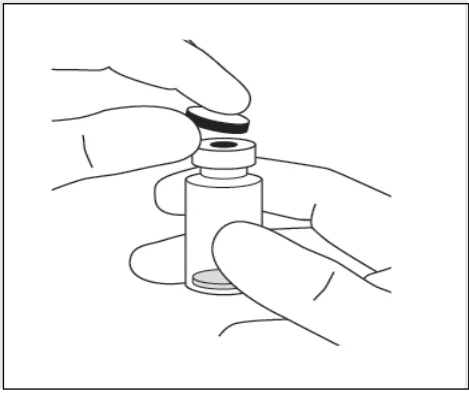
1.
Remove the protective plastic cap from the vial (see Figure 1).
Figure 1
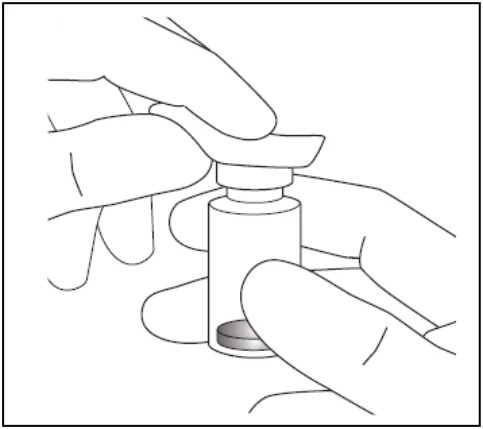
2.
Clean the top of the vial with an alcohol wipe (see Figure 2)
Figure 2
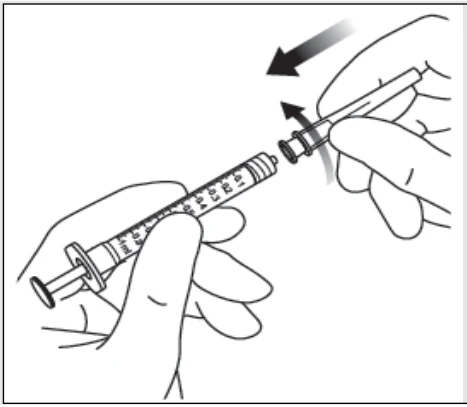
3.
Remove the 18 G, 5-micron filter needle supplied in the carton from its pouch. Attach the filter needle to a 1-mL sterile, Luer-lock syringe (not supplied) by twisting it onto the Luer lock syringe tip (see Figure 3).
Figure 3
4.
Push the filter needle into the centre of the vial stopper until the needle is completely inserted into the vial and the tip touches the bottom edge of the vial.
5.
Using aseptic technique withdraw all of the Eylea HD vial contents into the syringe, keeping the vial in an upright position, slightly inclined to ease complete withdrawal. To deter the introduction of air, ensure the bevel of the filter needle is submerged into the liquid. Continue to tilt the vial during withdrawal keeping the bevel of the filter needle submerged in the liquid (see Figure 4 and Figure 5).
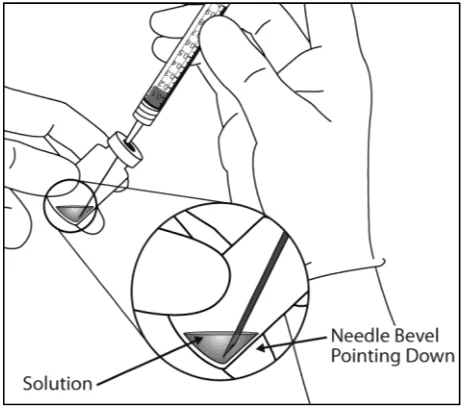
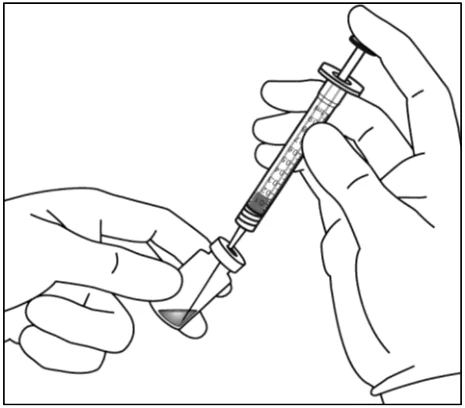
Figure 4
Figure 5
6.
Ensure that the plunger rod is drawn sufficiently back when emptying the vial in order to completely empty the filter needle. After injection, discard any unused product or waste material in accordance with local regulations.
7.
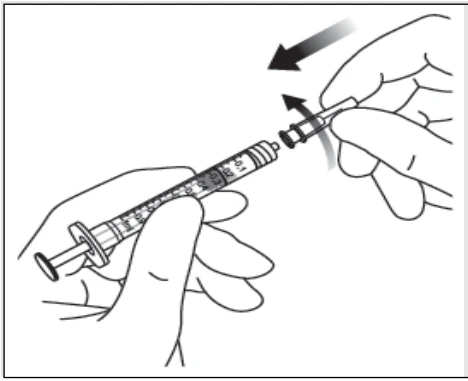
Remove the filter needle from the syringe and properly dispose of the filter needle.
Note: Filter needle is not to be used for intravitreal injection.
8.
Using aseptic technique, attach a 30 G x ½ inch injection needle (not supplied) to the syringe by firmly twisting the injection needle onto the Luer-lock syringe tip (see Figure 6).
Figure 6
9.
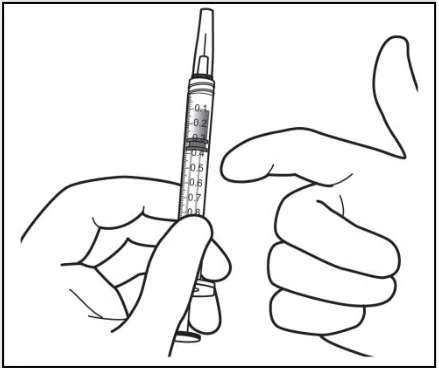
Holding the syringe with the needle pointing up, check the syringe for bubbles. If there are bubbles, gently tap the syringe with your finger until the bubbles rise to the top (see Figure 7).
Figure 7
10.
To eliminate all of the bubbles and to expel excess drug, slowly depress the plunger so that the flat plunger edge aligns with the line that marks 0.07 mL on the syringe.
See Figure 8 and Figure 9.
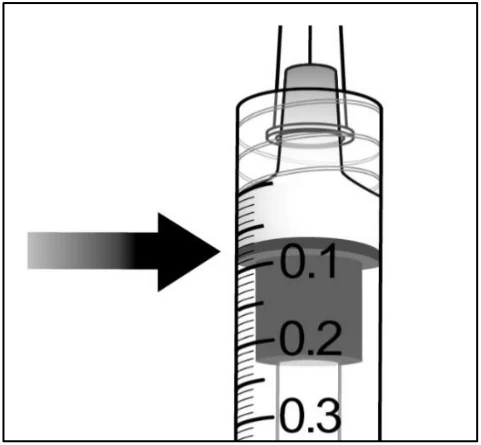
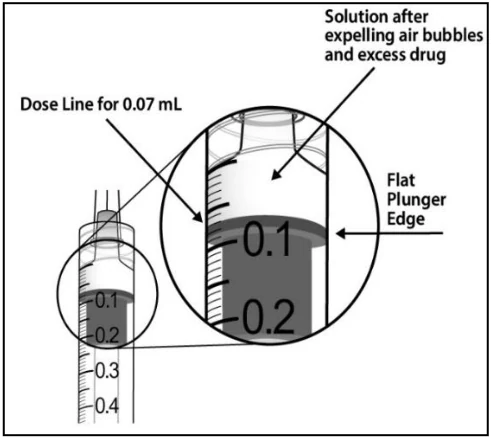
Figure 9
Pre-filled syringe with integrated OcuClick dosing system:
Figure 8
| 1. | When ready to administer Eylea HD, open the carton and remove the sterilized blister pack. Carefully peel open the blister pack ensuring the sterility of its contents. Keep the syringe in the sterile tray until ready for assembly. | ||||
| 2. | Using aseptic technique, remove the syringe from the sterilized blister pack. | ||||
| 3. | Snap off (do not twist off) the syringe cap by holding the syringe in one hand and the syringe cap with the thumb and forefinger of the other hand (see Figure 10) | Figure 10 | |||
| 4. | To avoid compromising the sterility of the product, do not pull back on the plunger. | ||||
| 5. | Using aseptic technique, firmly twist a 30 G x ½ inch injection needle onto the Luer-lock syringe tip (see Figure 11). | 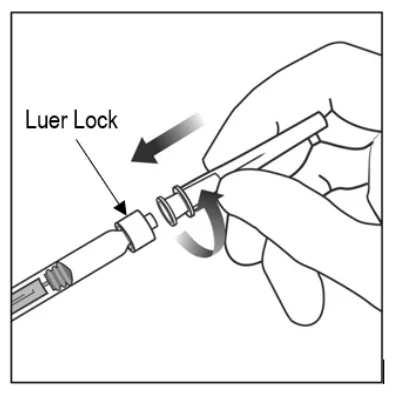 Figure 11 | |||
| 6. | Holding the syringe with the needle pointing up, check the syringe for bubbles. If there are bubbles, gently tap the syringe with your finger until the bubbles rise to the top (see Figure 12). | 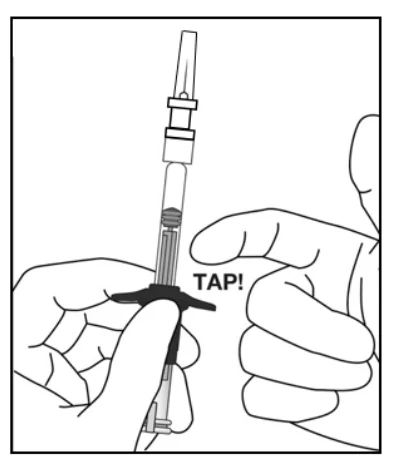 | |||
| Figure 12 | |||||
| 7. | The syringe does not have a dose line because it is designed to set the dose mechanically as shown in the steps below. Priming and setting the dose must be done using the following steps. To eliminate all bubbles and to expel excess drug, with the needle pointing up, slowly depress the plunger rod (see Figure 13) until it stops (i.e. when the guide on the plunger rod reaches the finger grip) (see Figure 14). Note: The priming steps of this syringe with OcuClick dosing system may differ from other pre-filled syringes; ensure priming steps are carefully followed. | ||||
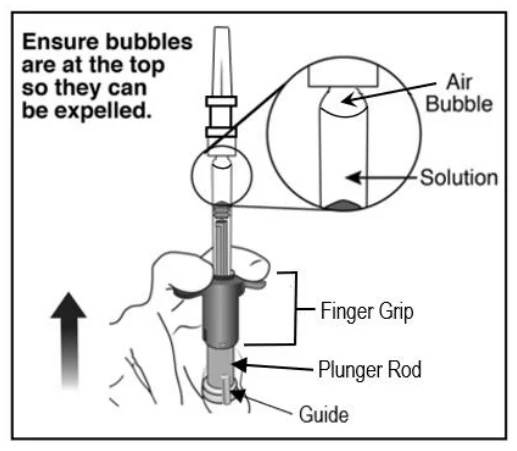 Figure 13 | 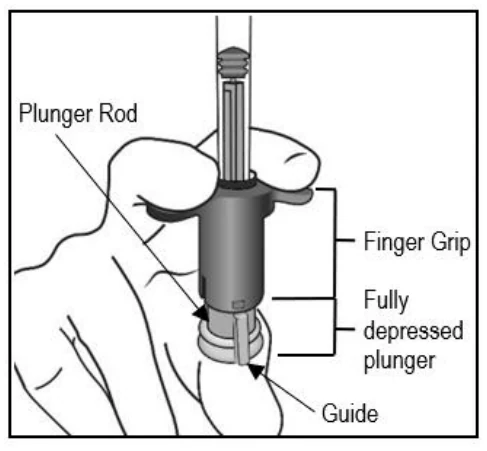 Figure 14 | ||||
| 8 | Turn the end of the plunger rod 90 degrees clockwise or counterclockwise until the guide of the plunger rod aligns with the slot. You may hear a “click” (see Figure 15). Note: Now the device is ready to dose. Do not push the plunger rod before insertion into the eye. | 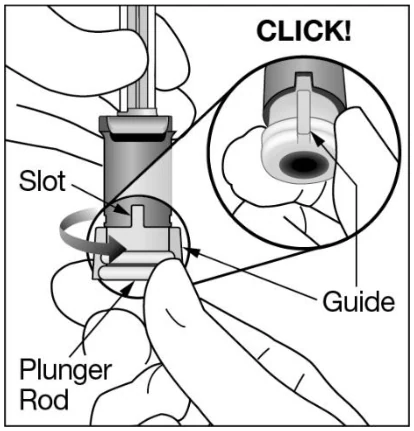 Figure 15 | |||
| 9. | Insert the needle into the ocular injection site. Inject the solution by pushing in the plunger rod until it stops (i.e. until the guide is completely within the slot) (see Figure 16). This will deliver a single dose of 0.07 mL containing 8 mg aflibercept. Do not apply additional pressure once the guide is within the slot. It is normal to see a small amount of residual solution left in the syringe. | 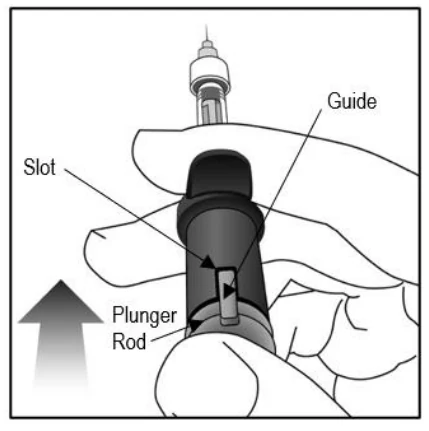 Figure 16 | |||
4.5 Missed Dose
If a planned injection of Eylea HD is missed, reschedule a new appointment for an examination and injection as soon as possible. Reset the dose schedule to administer the next sequential dose after the missed dose is administered.
5 Overdose
Overdosing with increased injection volume may increase intraocular pressure. Therefore, in case of an overdose, intraocular pressure should be monitored and if deemed necessary by the treating healthcare provider and corrective treatment initiated, if deemed necessary see 7 Warnings and Precautions and 12 Special Handling Instructions).
| For the most recent information in the management of a suspected drug overdose, contact your regional poison control centre or Health Canada’s toll-free number, 1-844 POISON-X (1-844-764-7669). |
6 Dosage Forms, Strengths, Composition, and Packaging
To help ensure the traceability of biologic products, including biosimilars, healthcare professionals should recognise the importance of recording both the brand name and the non-proprietary (active ingredient) name as well as other product-specific identifiers such as the Drug Identification Number (DIN) and the batch/lot number of the product supplied.
Table 1: Dosage Forms, Strengths, and Composition
| Route of Administration | Dosage Form / Strength/Composition | Non-Medicinal Ingredients |
|---|---|---|
| Intravitreal Injection | Solution / 8 mg / 0.07 mL | L-arginine monohydrochloride; L-histidine; L-histidine monohydrochloride monohydrate; polysorbate 20; sucrose and water for injection |
Eylea HD is provided as a sterile, clear to slightly opalescent, colourless to pale yellow, iso-osmotic, aqueous solution containing L-arginine monohydrochloride; L-histidine; L-histidine monohydrochloride monohydrate; polysorbate 20; sucrose and water for injection.
One millilitre solution for intravitreal injection contains 114.3 mg aflibercept.
Vials
Each carton includes a type I glass vial containing a nominal fill volume of 0.263 mL solution for intravitreal injection with an elastomeric rubber stopper, and an 18 G filter needle.
Each vial provides a usable amount to deliver a single dose of 0.07 mL containing 8 mg aflibercept.
Pre-filled Syringes
Each carton includes a pre-filled syringe with OcuClick dosing system containing a nominal fill volume of 0.184 mL solution for intravitreal injection.
Each pre-filled syringe with OcuClick dosing system provides a usable amount to deliver a single dose of 0.07 mL containing 8 mg aflibercept.
7 Warnings and Precautions
General
Aflibercept at a dose of 8 mg must only be provided using Eylea HD (8 mg / 0.07 mL). Eylea HD must not be used to provide a dose other than 8 mg.
Driving and Operating Machinery
Patients may experience temporary visual disturbances after an intravitreal injection with Eylea HD and the associated eye examinations. They should not drive or use machines until visual function has recovered sufficiently.
Immune
Hypersensitivity
As with all therapeutic proteins, there is a risk of hypersensitivity reactions including anaphylaxis. Hypersensitivity reactions may manifest as rash, pruritus, urticaria, severe anaphylactic/anaphylactoid reactions, or severe intraocular inflammation. Patients should be instructed to report any symptoms of anaphylaxis, allergic reactions or intraocular inflammation (e.g., pain, photophobia, or redness, which, although non-specific, should also be assessed as potential hypersensitivity reactions).
Ophthalmologic
Endophthalmitis, Retinal detachments and Cataracts
Intravitreal injections, including those with aflibercept, have been associated with endophthalmitis, retinal detachment, retinal tear, retinal pigment epithelium tear, cataract including traumatic cataract, vitreous hemorrhage, and hyphema (see 8 Adverse Reactions). The proper aseptic injection technique must always be used when administering Eylea HD (see 4.4 Administration). Patients experiencing any symptoms suggestive of any event listed above should tell their healthcare professional without delay and should be managed appropriately.
Retinal vasculitis and Retinal occlusive vasculitis
Retinal vasculitis and retinal occlusive vasculitis have been reported with the use of Eylea HD, typically in the presence of intraocular inflammation or treatment with other intravitreal agents. Patients experiencing any change in vision following treatment should tell their healthcare professional without delay and should be managed appropriately.
Increase in Intraocular Pressure (IOP)
Transient increases in intraocular pressure (IOP) have been observed within 60 minutes of an intravitreal injection, including with Eylea HD (see 8 Adverse Reactions). Sustained increases in intraocular pressure have also been reported after repeated intravitreal dosing with vascular endothelial growth factor (VEGF) inhibitors.
In all cases, both intraocular pressure and the perfusion of the optic nerve head must therefore be monitored and managed appropriately.
Eylea HD has not been tested in patients with poorly controlled glaucoma.
Other
As with other intravitreal anti-VEGF treatments, treatment should be withheld and resumed only when considered appropriate in cases of:
- An IOP of ≥ 30 mmHg
- Within the previous or next 28 days in the event of a performed or planned intraocular surgery
- A retinal break. The treatment should not be resumed until the break is adequately repaired
There is only limited experience in the treatment of subjects with DME due to type I diabetes or in diabetic patients with an HbA1c over 12% or with proliferative diabetic retinopathy.
Eylea HD has not been studied in patients with active systemic infections or in patients with concurrent eye conditions such as retinal detachment or macular hole. There is also no experience of treatment with Eylea HD in diabetic patients with uncontrolled hypertension. This lack of information should be considered by the healthcare professional when treating such patients.
In the Eylea HD clinical trials of AMD, DME, and RVO only one eye per patient was treated with Eylea HD (see 14 Clinical Trials).
The safety and efficacy of Eylea HD therapy administered to both eyes concurrently or consecutively have not been studied. If bilateral treatment is performed at the same time, this could lead to an increased systemic exposure, which could increase the risk of systemic adverse events. (see 16 Non-Clinical Toxicology).
Reproductive Health: Female and Male Potential
Individuals of childbearing potential have to use effective contraception during treatment and for at least 4 months after the last intravitreal injection of Eylea HD (see 7.1.1 Pregnancy).
Fertility
There are no fertility data in humans. Results from animal studies with high systemic exposure indicate that aflibercept can impair male and female fertility (see 16 Non-Clinical Toxicology).
Systemic Effects
Thromboembolic Events
Arterial thromboembolic events (ATEs) are adverse events potentially related to systemic VEGF inhibition. There is a potential risk of ATEs following intravitreal use of VEGF inhibitors, including Eylea HD.
ATEs, as defined by the Antiplatelet Trialists’ Collaboration (APTC) criteria, include nonfatal myocardial infarction, nonfatal stroke, or vascular death (including deaths of unknown cause). There are limited data on safety in the treatment of patients with DME with a history of stroke or transient ischemic attacks or myocardial infarction within the last 6 months.
The incidence of APTC ATEs observed in the Eylea HD clinical studies in patients with wet AMD (PULSAR), DME (PHOTON), and RVO (QUASAR) was 1.8%, 6.7%, and 1.5% respectively. Across indications, no notable difference between the patient groups treated with Eylea HD and the comparator group treated with Eylea were observed.
Non-ocular Hemorrhages
Non-ocular hemorrhages have been reported following intravitreal injection of VEGF inhibitors, including aflibercept, and there is a theoretical risk that these may relate to VEGF inhibition.
7.1 Special Populations
7.1.1 Pregnancy
There are no data on the use of aflibercept in pregnant individuals. Studies in animals have shown reproductive toxicity including fetal loss and severe embryofetal malformations (see 16 Non-Clinical Toxicology). Eylea HD should not be used during pregnancy.
7.1.2 Breastfeeding
It is not known whether aflibercept is excreted in human milk. A risk to the breastfed child cannot be excluded. Eylea HD is not recommended during breastfeeding. A decision must be made whether to discontinue breastfeeding or to postpone, if feasible, therapy with Eylea HD.
7.1.3 Pediatrics
Pediatric Use (< 18 years of age): No data are available to Health Canada; therefore, Health Canada has not authorized an indication for pediatric use.
7.1.4 Geriatrics
In the wet AMD Phase III study, approximately 89% of the patients randomized to treatment with Eylea HD or Eylea were ≥65 years of age and approximately 51% were ≥75 years of age.
In the DME Phase II/III study, approximately 44% of the patients randomized to treatment with Eylea HD or Eylea were ≥65 years of age, and approximately 11% were ≥75 years of age.
In the RVO Phase III study, approximately 58% of the patients randomized to treatment with Eylea HD or Eylea were ≥65 years of age and approximately 25% were ≥75 years of age.
No clinically significant differences in efficacy or safety were seen with increasing age in these studies.
8 Adverse Reactions
8.1 Adverse Reaction Overview
Treatment of wet AMD
A total of 1009 (Eylea HD n = 673; Eylea n = 336) patients with up to 96 weeks exposure to Eylea HD or Eylea constituted the safety population in the double-blind, active-controlled study, PULSAR (see 14 Clinical Trials).
Serious adverse reactions related to the injection procedure have occurred in 0.4% of patients with Eylea HD and included intraocular pressure increased (see 7 Warnings and Precautions).
The ocular serious adverse reactions in patients treated with Eylea HD were retinal detachment (0.7%), cataract (0.6%), intraocular pressure increase (0.3%), and retinal tear (0.1%).
The most frequently observed adverse reactions in at least 2% of patients treated with Eylea HD were, cataract (9.4%), intraocular pressure increased (3.4%), vitreous floaters (3.3%), vitreous detachment (3.0%), and conjunctival hemorrhage (2.7%) see Table 2.
Treatment of DME
A total of 658 patients (Eylea HD n = 491; Eylea n = 167) with up to 96 weeks exposure to aflibercept constituted the safety population in the double-blind, active-controlled study PHOTON.
Serious adverse reactions related to the injection procedure have occurred in 0.2% of patients with Eylea HD and included intraocular pressure increased (see 7 Warnings and Precautions).
The ocular serious adverse reactions in patients treated with Eylea HD were cataract (0.2%), cataract nuclear (0.2%), cataract subcapsular (0.2%), intraocular pressure increase (0.2%), and retinal detachment (0.2%).
The most frequently observed adverse reactions in at least 2% of patients treated with Eylea HD were cataract (7.5%), vitreous floaters (5.3%), conjunctival hemorrhage (5.1%), vitreous detachment (4.3%), eye pain (2.6%), punctate keratitis (2.4%), and intraocular pressure increase (2.2%), see Table 3.
Treatment of RVO
A total of 892 patients (Eylea HD n = 591; Eylea n = 301) with up to 64 weeks exposure to aflibercept constituted the safety population in the double-blind, active-controlled study QUASAR.
Serious adverse reactions related to the injection procedure have occurred in 0.3% of patients with Eylea HD and included cataract and endophthalmitis (see 7 Warnings and Precautions).
The ocular serious adverse reactions in patients treated with Eylea HD were cataract (0.2%), glaucoma (0.2%), retinal vasculitis (0.2%), retinal vein occlusion (0.2%), visual acuity reduced (0.2%), and vitritis (0.2%).
Through Week 64, the most frequently observed adverse reactions in at least 2% of patients treated with Eylea HD were intraocular pressure increased (5.9%), cataract (4.9%), conjunctival hemorrhage (4.4%), vitreous detachment (3.2%), see Table 4.
8.2 Clinical Trial Adverse Reactions
Clinical trials are conducted under very specific conditions. The adverse reaction rates observed in the clinical trials; therefore, may not reflect the rates observed in practice and should not be compared to the rates in the clinical trials of another drug. Adverse reaction information from clinical trials may be useful in identifying and approximating rates of adverse drug reactions in real-world use.
Treatment of wet AMD
The safety data include all adverse reactions (serious and non-serious) with a reasonable possibility of causality to the injection procedure or medicinal product reported (see Table 2 for baseline to week 96 data).
Table 2: Adverse Reactions with Incidence rate ≥1% in any treatment arm in the Eylea HD wet AMD Phase III study (PULSAR, through 96 weeks)
| Primary system organ class Preferred term MedDRA Version 26.0 | Baseline to Week 48 | Baseline to Week 96 | |||||||||||||||||
|---|---|---|---|---|---|---|---|---|---|---|---|---|---|---|---|---|---|---|---|
Eylea HD 8Q12 N= 335 | Eylea HD 8Q16 N= 338 | Eylea 2Q8 N= 336 | Eylea HD 8Q12 N= 335 | Eylea HD 8Q16 N= 338 | Eylea 2Q8 N= 336 | ||||||||||||||
| Eye disorders | |||||||||||||||||||
| Cataract | 4% | 4% | 3% | 9% | 10% | 7% | |||||||||||||
| Vitreous floaters | 1% | 4% | 3% | 2% | 5% | 5% | |||||||||||||
| Vitreous detachment | 2% | 3% | 2% | 2% | 4% | 2% | |||||||||||||
| Conjunctival hemorrhage | 2% | 2% | 2% | 3% | 2% | 3% | |||||||||||||
| Eye pain | 2% | 1% | 1% | 2% | 2% | 2% | |||||||||||||
| Punctate keratitis | <1% | 1% | 1% | 1% | 2% | 2% | |||||||||||||
| Retinal pigment epithelial tear | 2% | 1% | 1% | 2% | 1% | 1% | |||||||||||||
| Cataract subcapsular | 0 | <1% | <1% | <1% | <1% | 2% | |||||||||||||
| Cataract nuclear | 0 | 0 | 0 | 0 | <1% | 1% | |||||||||||||
| Vision blurred | 0 | 0 | 1% | <1% | 1% | 1% | |||||||||||||
| Detachment of retinal pigment epithelium | 1% | <1% | 1% | <1% | 1% | 1% | |||||||||||||
| General disorders and administration site conditions | |||||||||||||||||||
| Injection site pain | <1% | 1% | 1% | <1% | 1% | 1% | |||||||||||||
| Immune system disorders | |||||||||||||||||||
| Hypersensitivity* | 1% | 1% | 1% | 2% | 1% | 1% | |||||||||||||
| Injury, poisoning and procedural complications | |||||||||||||||||||
| Corneal abrasion | 1% | 1% | 1% | 1% | 1% | 1% | |||||||||||||
| Investigations | |||||||||||||||||||
| Intraocular pressure increased | 3% | 3% | 2% | 4% | 3% | 3% | |||||||||||||
A subject is counted only once within each primary SOC and preferred term. Ocular adverse drug reactions consider treatment emergent adverse events (TEAEs) in study eye only. TEAE in fellow eye are not considered. 8Q12: Aflibercept 8 mg administered every 12 weeks after 3 initial injections at 4-week intervals. 8Q16: Aflibercept 8 mg administered every 16 weeks after 3 initial injections at 4-week intervals
2Q8: Aflibercept 2 mg administered every 8 weeks, after 3 initial injections at 4-week intervals.
*Hypersensitivity includes: pruritus, rash and urticaria
Treatment of DME
The data described in Table 3 reflects exposure to Eylea HD in one randomized, double blind, controlled phase II/III study in 658 (8Q12 n= 328, 8Q16, n= 163; 2Q8: n= 167) patients with up to 96 weeks of exposure to Eylea HD.
Table 3: Adverse Reactions with Incidence rate ≥1% in any treatment arm in the Eylea HD DME Phase II/III study (PHOTON, through 96 weeks)
System/Organ Class Preferred Term (MedDRA Version 26.0) | Baseline to 48 Weeks | Baseline to 96 Weeks | ||||||||||||||
|---|---|---|---|---|---|---|---|---|---|---|---|---|---|---|---|---|
Eylea HD 8Q12 (N= 328) | Eylea HD 8Q16 (N= 163) | Eylea 2Q8 (N= 167) | Eylea HD 8Q12 (N= 328) | Eylea HD 8Q16 (N= 163) | Eylea 2Q8 (N= 167) | |||||||||||
| Eye Disorders | ||||||||||||||||
| Cataract | 2% | 5% | 1% | 6% | 12% | 4% | ||||||||||
| Vitreous floaters | 5% | 2% | 2% | 6% | 4% | 4% | ||||||||||
| Conjunctival hemorrhage | 4% | 4% | 4% | 5% | 5% | 4% | ||||||||||
| Vitreous detachment | 3% | 2% | 1% | 5% | 3% | 4% | ||||||||||
| Punctate keratitis | 2% | 4% | 1% | 2% | 4% | 1% | ||||||||||
| Eye pain | 2% | 1% | 2% | 3% | 2% | 2% | ||||||||||
| Vision blurred | 1% | 1% | 2% | 1% | 1% | 3% | ||||||||||
| Cataract subcapsular | 1% | 0 | 1% | 3% | 0 | 1% | ||||||||||
| Cataract nuclear | <1% | 1% | 1% | 2% | 1% | 2% | ||||||||||
| Corneal erosion | 0 | 1% | 0 | 1% | 2% | 0 | ||||||||||
| General disorders and administration site conditions | ||||||||||||||||
| Injection site pain | 1% | 0 | 0 | 1% | 1% | 0 | ||||||||||
| Immune System Disorders | ||||||||||||||||
| Hypersensitivity* | 1% | 1% | 0 | 1% | 1% | 0 | ||||||||||
| Injury, Poisoning and Procedural Complications | ||||||||||||||||
| Corneal abrasion | 1% | 1% | 1% | 1% | 1% | 2% | ||||||||||
| Investigations | ||||||||||||||||
| Intraocular pressure increased | 2% | 1% | 4% | 3% | 1% | 4% | ||||||||||
The percentage was based on the number of patients in each treatment group as denominator. Patients are only counted once in each row but may appear in more than one row.
Ocular adverse drug reactions consider treatment emergent adverse events (TEAEs) in study eye only. TEAEs in the fellow eye are not considered.
2 mg: Aflibercept 2 mg administered every 8 weeks after 5 initial injections at 4-week intervals.
8Q12: Aflibercept 8 mg administered every 12 weeks after 3 initial injections at 4-week intervals.
8Q16: Aflibercept 8 mg administered every 16 weeks after 3 initial injections at 4-week intervals.
*Hypersensitivity includes: pruritus and rash
Treatment of RVO
The data described in Table 4 reflects exposure to Eylea HD in one randomized, double blind, controlled phase III study in 892 (8Q8/3 n= 293, 8Q8/5 n= 298, 2Q4/ n= 301) patients with up to 64 weeks of exposure to Eylea HD.
Table 4: Adverse Reactions with Incidence rate ≥1% in any treatment arm in the Eylea HD RVO Phase III study (QUASAR, through 64 weeks)
System/Organ Class Preferred Term (MedDRA Version 28.0) | Baseline to 36 Weeks | Baseline to 64 Weeks | |||||||||||||||||||||
|---|---|---|---|---|---|---|---|---|---|---|---|---|---|---|---|---|---|---|---|---|---|---|---|
Eylea HD 8Q8/3 (N=293) | Eylea HD 8Q8/5 (N=298) | Eylea HD Combined (N=591) | Eylea 2Q4 (N=301) | Eylea HD 8Q8/3 (N=293) | Eylea HD 8Q8/5 (N=298) | Eylea HD Combined (N=591) | Eylea 2Q4 (N=301) | ||||||||||||||||
| Eye disorders | |||||||||||||||||||||||
| Cataract | 2% | 3% | 3% | 3% | 4% | 6% | 5% | 6% | |||||||||||||||
| Conjunctival hemorrhage | 3% | 2% | 3% | 2% | 5% | 4% | 4% | 3% | |||||||||||||||
| Vitreous detachment | 3% | 3% | 3% | 1% | 3% | 3% | 3% | 1% | |||||||||||||||
| Eye pain | 2% | 1% | 2% | 1% | 2% | 1% | 2% | 1% | |||||||||||||||
| Vitreous floaters | 1% | 1% | 1% | 1% | 2% | 1% | 2% | 1% | |||||||||||||||
| Punctate keratitis | 1% | 1% | 1% | 2% | 1% | 1% | 1% | 2% | |||||||||||||||
| Vision blurred | <1% | <1% | <1% | 0 | 1% | <1% | 1% | 0 | |||||||||||||||
| Retinal tear | <1% | 1% | 1% | 0 | <1% | 1% | 1% | <1% | |||||||||||||||
| Lacrimation increased | 0 | 0 | 0 | 0 | 0 | 0 | 0 | 1% | |||||||||||||||
| Immune system disorders | |||||||||||||||||||||||
| Hypersensitivity* | 1% | 1% | 1% | 1% | 1% | 2% | 1% | <1% | |||||||||||||||
| Infections and infestations | |||||||||||||||||||||||
| Endophthalmitis | <1% | 0 | <1% | 1% | <1% | 0 | <1% | 1% | |||||||||||||||
| Injury, poisoning and procedural complications | |||||||||||||||||||||||
| Corneal abrasion | 0 | 1% | <1% | <1% | <1% | 2% | 1% | <1% | |||||||||||||||
| Investigations | |||||||||||||||||||||||
| Intraocular pressure increased | 6% | 5% | 5% | 2% | 6% | 5% | 6% | 3% | |||||||||||||||
The percentage was based on the number of patients in each treatment group as denominator. Patients are only counted once in each row but may appear in more than one row.
Ocular adverse drug reactions consider treatment emergent adverse events (TEAEs) in study eye only. TEAEs in the fellow eye are not considered.
2Q4: Aflibercept 2 mg administered every 4 weeks, followed by adjustment of treatment intervals
8Q8/3: Aflibercept 8 mg administered with 3 initial injections every 4 weeks, followed by extension of treatment interval to every 8 weeks and further adjustment of treatment intervals
8Q8/5: Aflibercept 8 mg administered with 5 initial injections every 4 weeks, followed by extension of treatment interval to every 8 weeks and further adjustment of treatment intervals.
*Hypersensitivity includes: hypersensitivity, rash, pruritus, urticaria
8.3 Less Common Clinical Trial Adverse Reactions
Treatment of wet AMD, DME, and RVO
Less common adverse drug reactions reported in <1% of the patients treated with Eylea HD for up to 96 weeks and an extension phase in the Phase II/III AMD and DME studies and up to 64 weeks in the Phase III RVO study (AMD, DME and RVO pooled data).
Eye Disorders: cataract cortical, cataract nuclear, cataract subcapsular, cataract traumatic, conjunctival hyperaemia, corneal erosion, corneal edema, corneal epithelium defect, detachment of retinal pigment epithelium, endophthalmitis, eyelid edema, foreign body sensation in eyes, iridocyclitis, iritis, lacrimation increased, lenticular opacities, ocular hyperemia, retinal detachment, retinal pigment epithelial tear, retinal tear, uveitis, vision blurred, and vitritis.
General Disorders and Administration Site Conditions: injection site hemorrhage and injection site pain.
8.4 Abnormal Laboratory Findings: Hematologic, Clinical Chemistry and Other Quantitative Data
Clinical Trial Findings
There were no hematologic or clinical chemistry ADRs seen in Phase II/III wet AMD, DME and RVO studies.
8.5 Post-Market Adverse Reactions
Eye Disorder: anterior chamber flare, blindness, scleritis, episcleritis, retinal vasculitis and retinal occlusive vasculitis
Immune system disorders: severe anaphylactic/anaphylactoid reactions
Infections and infestations: hypopyon
9 Drug Interactions
9.2 Drug Interactions Overview
No formal drug interaction studies have been performed with Eylea HD. Eylea HD must not be mixed with other medicinal products.
Adjunctive use of verteporfin photodynamic therapy (PDT) and Eylea HD has not been studied.
The safety and efficacy of wet AMD patients who were previously treated with laser photocoagulation have not been studied.
9.3 Drug-Behaviour Interactions
The interaction of Eylea HD with individual behavioural risks (e.g. cigarette smoking, cannabis use, and/or alcohol consumption) has not been studied.
9.4 Drug-Drug Interactions
Interactions with other drugs have not been established.
9.5 Drug-Food Interactions
Interactions with food have not been established.
9.6 Drug-Herb Interactions
Interactions with herbal products have not been established.
9.7 Drug-Laboratory Test Interactions
Interactions with laboratory tests have not been established.
10 Clinical Pharmacology
10.1 Mechanism of Action
Vascular endothelial growth factor-A (VEGF-A) and placental growth factor (PlGF) are members of the VEGF family of pro-angiogenic factors that can act as potent mitogenic, chemotactic, and vascular permeability factors for endothelial cells. VEGF acts via 2 receptor tyrosine kinases, VEGFR-1 and VEGFR-2, present on the surface of endothelial cells. PlGF binds only to VEGFR-1, which is also present on the surface of leukocytes. Excessive activation of these receptors by VEGF-A can result in pathological neovascularization and excessive vascular permeability which is believed to contribute to vision loss in a variety of ocular diseases.
Aflibercept acts as a soluble decoy receptor that binds VEGF-A and PlGF with higher affinity than their natural receptors, and thereby can inhibit the binding and activation of these cognate VEGF receptors.
10.2 Pharmacodynamics
Treatment of wet AMD
In the Phase III study (PULSAR), at Week 48, the mean change from baseline in central retinal thickness (CRT) (Eylea HD 8Q12 and Eylea HD 8Q16 vs. Eylea 2Q8) was -141.9 and -147.1 microns vs. -126.3 microns. At Week 96, the mean change from baseline in central retinal thickness (CRT) (Eylea HD 8Q12 and Eylea HD 8Q16 vs. Eylea 2Q8) was -143.9 and -153.4 microns vs. -135.8 microns.
Treatment of DME
PHOTON Study
In the Phase II/III study (PHOTON), at Week 48, the mean change from baseline in CRT (Eylea HD 8Q12 and Eylea HD 8Q16 vs. Eylea 2Q8) was -171.65 and -148.30 microns vs. -165.31 microns. At Week 96, the mean change from baseline in CRT (Eylea HD 8Q12 and Eylea HD 8Q16 vs. Eylea 2Q8) was -185.28 and -154.98 microns vs. -186.95 microns.
Treatment of RVO
QUASAR Study
In the Phase III study (QUASAR), at Week 36, the mean change from baseline in CRT (Eylea HD 8Q8/3 and Eylea HD 8Q8/5 vs. Eylea 2Q4) was -365.9 and -351.0 microns vs. -397.3 microns.
10.3 Pharmacokinetics
Table 5: Summary of observed free aflibercept pharmacokinetic parameters in combined DME and wet AMD populations with dense pharmacokinetic sampling, who received a single unilateral 8 mg intravitreal dose
| Cmax (mg/L) | tmax (d) | tlast (d) | AUC(0-28d) (day·mg/L) |
|---|---|---|---|
| 0.248 (0.210) n = 50 | 1.02 (0.147 - 4.03) n = 48 | 21.0 (2.00 - 32.0) n = 48 | 1.77 (0.758) n = 44 |
Cmax = maximum observed concentration, tmax = time of Cmax , tlast = last observed concentration above the lower limit of quantitation, AUC(0-28d) = area under the concentration-time curve from time zero to 28 days after administration.
Cmax and AUC(0-28d) are provided as mean (SD), tmax and tlast as median (range). Eylea HD is administered directly into the vitreous to exert local effects in the eye.
Absorption:
Following intravitreal administration of aflibercept, a fraction of the administered dose is expected to bind with free endogenous VEGF to form an inactive VEGF: aflibercept complex in the eye. From the ocular space, free and bound aflibercept are slowly absorbed into the systemic circulation where it is predominately observed as the inactive stable complex with VEGF; however, only "free aflibercept" is able to bind endogenous VEGF. Peak observed plasma concentrations (Cmax) of free aflibercept are reached within 4 days after administration.
Distribution:
Since consistent pharmacokinetics between the wet AMD and DME populations were observed, pharmacokinetic parameters are presented for the two populations combined. Following unilateral intravitreal administration of 8 mg aflibercept, the mean (SD) Cmax of free aflibercept in plasma was 0.25 (0.21) mg/L, and the median time to maximal observed concentration in plasma was 1 day. The accumulation of free aflibercept in plasma following three initial monthly intravitreal doses was minimal. Subsequently, no further accumulation was observed. These data are also supported by population pharmacokinetic analyses. Pharmacokinetic parameters in patients with RVO estimated by population modelling analysis were consistent with AMD and DME populations.
Metabolism:
As Eylea HD is a protein-based therapeutic, no metabolism studies have been conducted.
Elimination:
Aflibercept is expected to be eliminated through both binding to endogenous VEGF and a slower non-saturable clearance (e.g., proteolysis) mechanism. The median time to reach the last quantifiable concentration of free aflibercept in plasma for 8 mg administered intravitreally was 3 weeks.
Special Populations and Conditions
- Pediatrics (< 18 years of age): Wet AMD does not occur in children or adolescents. The safety and efficacy of Eylea HD have not been studied in pediatric patients for the indications of wet AMD and DME.
- Geriatrics (≥ 65 years of age): No special considerations are needed.
- Hepatic Insufficiency: No specific studies in patients with hepatic impairment were conducted with Eylea HD.
- Renal Insufficiency: No special studies in patients with renal impairment were conducted with Eylea HD.
The systemic exposures to aflibercept in patients with mild to severe renal impairment were similar to those with normal renal function.
10.4 Immunogenicity
As with all therapeutic proteins, there is a potential for immunogenicity with Eylea HD.
Immunogenicity was measured in serum samples. The immunogenicity data reflect the percentage of patients whose test results were considered positive for antibodies to Eylea HD in immunoassays, and are highly dependent on the sensitivity and specificity of the assays.
During the 96-week treatment with aflibercept administered IVT, treatment-emergent antibodies to Eylea HD were detected in 2.5% of patients treated for DME and 4.4% of patients treated for wet AMD.
11 Storage, Stability, and Disposal
Vial
Store in a refrigerator at 2°C to 8°C. Do not freeze.
Keep the vial in the outer carton in order to protect from light.
Pre-filled syringe
Store in a refrigerator at 2°C to 8°C. Do not freeze.
Keep the pre-filled syringe with OcuClick dosing system in its blister pack and in the outer carton in order to protect from light.
12 Special Handling Instructions
Do not use if the package or its components are expired, damaged, or have been tampered with.
For the intravitreal injection, a 30 G x ½ inch injection needle should be used.
Vial
THE VIAL IS FOR SINGLE USE IN ONE EYE ONLY.
Check the label on the vial to make sure you have the correct strength.
Prior to administration, visually inspect the solution for injection. Do not use the vial if particulates, cloudiness, or discolouration are visible.
Prior to usage, the unopened Eylea HD vial may be stored at room temperature (25°C) for up to 24 hours. After opening the vial, proceed under aseptic conditions.
Pre-filled syringe
THE PRE-FILLED SYRINGE WITH OCUCLICK DOSING SYSTEM IS FOR SINGLE USE IN ONE EYE ONLY.
The pre-filled syringe with OcuClick dosing system contains more than the recommended dose of aflibercept 8 mg (0.07 mL). The excess volume must be discarded prior to the administration.
Prior to administration visually inspect the solution for injection. Do not use the pre-filled syringe with OcuClick dosing system if particulates, cloudiness, or discolouration are visible.
Prior to usage, the blister pack of Eylea HD may be stored at room temperature (25°C) for up to 24 hours.
After opening the blister pack, proceed under aseptic conditions.
PART 2: Scientific Information
13 Pharmaceutical Information
Drug Substance
Proper name:
Aflibercept
Chemical name:
des-432-lysine-[human vascular endothelial growth factor receptor 1-(103-204)-peptide (containing Ig-like C2-type 2 domain) fusion protein with human vascular endothelial growth factor receptor 2-(206-308)-peptide (containing Ig-like C2-type 3 domain fragment) fusion protein with human immunoglobulin G1-(227 C-terminal residues)-peptide (Fc fragment)], (211-211’:214-214’)-bisdisulfide dimer
Molecular formula:
C4318H6788N1164O1304S32
Molecular weight:
Without glycolysation: 97 kDa
With glycolysation: 115 kDa
Structural formula:
Physicochemical properties:
Aflibercept is a dimeric glycoprotein. The Eylea HD solution for intravitreal administration is a sterile, clear to opalescent, colourless to pale yellow, iso-osmotic solution.
pH:
Eylea HD solution for intravitreal injection: 5.8

Pharmaceutical standard: In-house standard
Product Characteristics:
Eylea HD (aflibercept injection) is a recombinant fusion protein consisting of portions of human Vascular Endothelial Growth Factor (VEGF) receptor 1 and 2 extracellular domains fused to the Fc portion of human IgG1 and formulated as an isosmotic solution for intravitreal administration. Aflibercept is produced in Chinese hamster ovary (CHO) K1 cells by recombinant DNA technology.
14 Clinical Trials
14.1 Clinical Trials by Indication
Treatment of Wet AMD
PULSAR Study
The safety and efficacy of Eylea HD (aflibercept injection) was assessed in a Phase 3, randomized, multi-center, double-blind, active-controlled study (PULSAR) in patients with wet AMD. PULSAR was conducted in Canada, Europe, Latin America, Asia and the United States of America. A total of 1009 patients were randomized 1:1:1 ratio to 1 of 3 dosing regimens, with 870 patients completing the study through week 96. Patients could continue with an optional open label extension through week 156.
Dosing regimens:
- 1) Eylea administered at 2 mg every 8 weeks (+/- 1 week) following 3 initial monthly doses (Eylea 2Q8),
- 2) Eylea HD administered at 8 mg every 12 weeks (+/- 1 week) following 3 initial monthly doses (Eylea HD 8Q12), and
- 3) Eylea HD administered at 8 mg every 16 weeks (+/- 1 week) after 3 initial monthly doses (Eylea HD 8Q16)
Starting at Week 16, patients in the Eylea HD 8Q12- and 8Q16- groups could be treated as frequently as every 8 weeks (+/- 1 week) based on protocol-defined visual and anatomic outcomes (e.g., decreased visual acuity, increased central subfield thickness, presence of new foveal hemorrhage or new foveal neovascularization, etc.). The minimum interval between injections was 8 weeks (+/- 1 week) in all groups. As of week 52, extension of the dosing interval up to 20 weeks (+/- 1 week) by up to 4-week increments in the 8Q12- and 8Q16-groups was allowed and decided based on visual and anatomic criteria.
At the end of the main phase of the study at week 96, 62% (625/1009) of patients who were randomized and completed the 96 week study enrolled into the open-label extension phase to week 156. 417 patients originally assigned to 8Q12 and 8Q16 continued Eylea HD at their current intervals. 208 patients originally assigned to 2Q8 at the beginning of the study were switched to Eylea HD starting at 12-week intervals. 56% (563/1009) of randomized patients completed the Week 156 study. Treatment intervals could be further adjusted by 2 weeks based on the healthcare professional’s judgement of visual and/or anatomic outcomes. The minimum and maximum dosing intervals allowed in the extension phase were every 8 weeks and every 24 weeks, respectively.
Patients in the 8Q12-, 8Q16- and 2Q8-groups who completed week 48 received a median (mean) of 6.0 (6.1), 5.0 (5.2) and 7.0 (6.9) injections, respectively.
Patients in the 8Q12-, 8Q16- and 2Q8-groups who completed week 96 received a median (mean) of 9.0 (9.7), 8.0 (8.2) and 13.0 (12.8) injections, respectively.
Table 6: Summary of Patient Demographics for Eylea HD Clinical Trials in wet AMD
| Study | Trial Design | Dosage, route of administration, and duration | Study Subjects (n) | Mean Age (Range) years | Sex |
|---|---|---|---|---|---|
| PULSAR | randomized, multi-center, double-blind, active-controlled | Intravitreal injection following 3 initial monthly doses,
| Eylea HD 8Q12: n=335 Eylea HD 8Q16: n=338 Eylea 2Q8: n=336 | 74.5 (50 to 96) | Male: 45.5% Female: 54.5% |
The primary efficacy endpoint was the mean change from baseline in best corrected visual acuity (BCVA) measured by the Early Treatment Diabetic Retinopathy Study (ETDRS) letter score at Week 48.
Treatment with 8Q12 and 8Q16 was shown to be non-inferior to treatment with 2Q8 in terms of the primary efficacy endpoint at Week 48 using the pre-specified non-inferiority margin of 4 letters (Table 7).
Table 7: Efficacy Outcomes at Week 48 from the PULSAR study (wet AMD)
| Efficacy Outcomes | Eylea HD 8Q12 (N = 335) | Eylea HD 8Q16 (N = 338) | Eylea 2Q8 (N = 336) |
|---|---|---|---|
| Mean BCVA (SD) at baseline | 59.9 (13.4) | 60.0 (12.4) | 58.9 (14.0) |
| Change in BCVA from baseline at Week 48 as measured by ETDRS letter scorec | |||
| Arithmetic mean (SD), observed | 6.7 (12.6) | 6.2 (11.7) | 7.6 (12.2) |
| LS mean (SE)a | 6.06 (0.77) | 5.89 (0.72) | 7.03 (0.74) |
| Difference in LS meansa, b(95% CI) | -0.97 (-2.87, 0.92) | -1.14 (-2.97, 0.69) | |
| p-value (one-sided non-inferiority test at a margin of 4 letters) a, b | 0.0009 | 0.0011 | |
CI: Confidence interval; LS: Least square; SD: Standard deviation; SE: Standard error
- a LS mean, CI and p-value based on an MMRM with baseline measurement as covariate, treatment group as factor, visit and stratification variables used for randomization (geographical region, categorical baseline BCVA) as fixed factors as well as terms for the interaction between baseline measurement and visit and for the interaction between treatment and visit.
- b Absolute difference is Eylea HD 8Q12 or 8Q16 groups minus Eylea 2Q8 group, respectively.
- c Full Analysis Set
At week 48, 79.4% of patients in the 8Q12 group were maintained with the 8Q12 treatment interval and 76.6% of patients in the 8Q16 group were maintained with the 8Q16 treatment intervals.
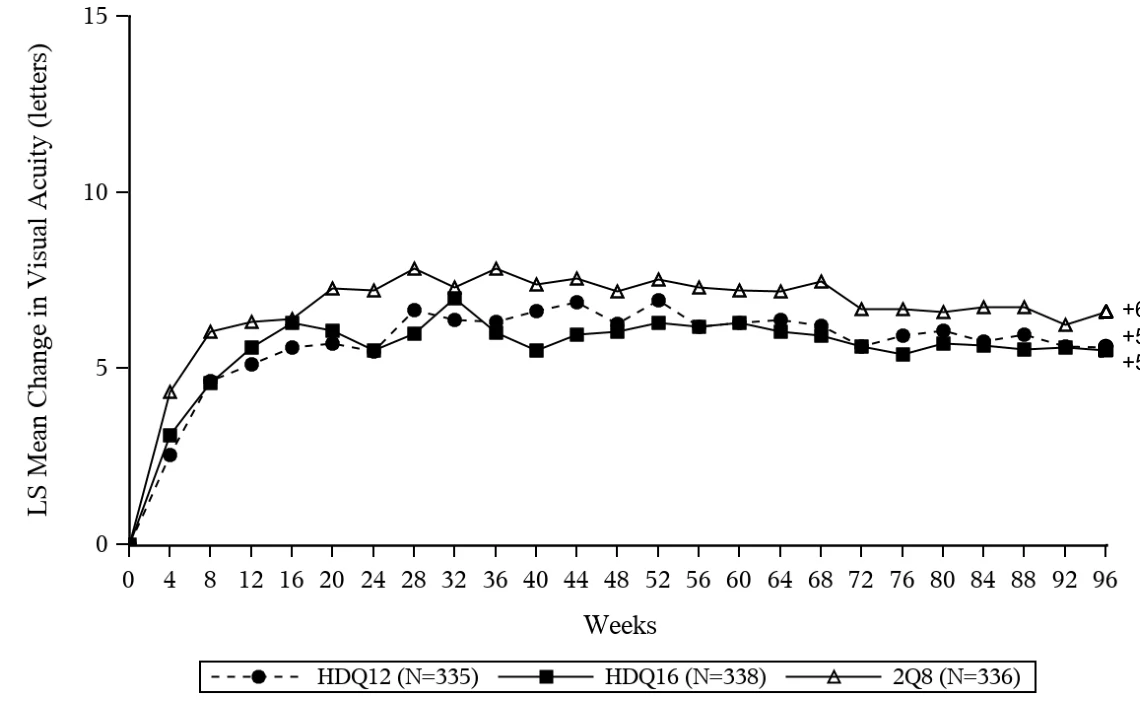
Figure 17: LS mean change in BCVA as measured by ETDRS letter score from baseline through week 96 (Full Analysis Set) in PULSAR study
At week 96, the mean change in BCVA from baseline was +5.9, +5.6 and +7.4 letters for patients randomized to receive Eylea HD 8Q12, 8Q16 and Eylea 2Q8, respectively.
Among patients who completed the study through Week 96, 75.3% (219/291) in the 8Q12 group and 70.2% (205/292) in the 8Q16 group maintained their treatment interval.
At week 96, in an exploratory analysis of 90 (26.9%) and 140 (41.4%) of Eylea HD 8Q12 and 8Q16 patients that extended and maintained the dosing regimen to 20 week intervals, the mean change in BCVA from baseline was 10.1 and 8.6 letters (Eylea HD 8Q12 and 8Q16).
Among the cohort of patients who entered the extension phase of the study, the mean change in BCVA from baseline at Week 156 was +3.6, +3.2 and +4.6 letters in patients receiving Eylea HD 8Q12, 8Q16 and Eylea 2Q8/Eylea HD, respectively.
Through 156 weeks, 10.1% (68/673) of patients who were originally randomized to 8Q12 and 8Q16 extended and maintained at least two consecutive q24 intervals without subsequent shortening.
Treatment of DME
PHOTON Study
The safety and efficacy of Eylea HD (aflibercept injection) was assessed in a Phase 2/3, randomized, multi-center, double-blind, active-controlled study (PHOTON) in patients with DME. PHOTON was conducted in Canada, Europe, Japan, United Kingdom and the United States of America. A total of 658 patients were randomized 2:1:1 ratio to 1 of 3 dosing regimens, with 534 patients completing the study through week 96. Patients could continue with an optional open label extension through week 156.
Dosing regimens:
- 1) Eylea HD administered every 12 weeks (+/- 1 week) (8Q12), after 3 initial injections at 4 week intervals
- 2) Eylea HD administered every 16 weeks (+/- 1 week) (8Q16), after 3 initial injections at 4 week intervals
- 3) Eylea administered every 8 weeks (+/- 1 week) (2Q8), after 5 initial injections at 4 week intervals
Starting at Week 16, patients in the Eylea HD 8Q12- and 8Q16-groups could be treated as frequently as every 8 weeks (+/- 1 week) based on protocol-defined visual and anatomic outcomes (e.g., decreased visual acuity, increased central subfield thickness, presence of new foveal hemorrhage or new foveal neovascularization, etc.). The minimal interval between injections was 8 weeks (+/- 1 week) in all groups. As of Week 52, extension of the dosing interval up to 20 weeks (+/- 1 week) by 4-week increments in the 8Q12- and 8Q16-groups was allowed and decided based on visual and anatomic criteria.
At the end of the main phase of the study at Week 96, 40% (265/658) of patients who were randomized and completed the 96 week study enrolled into the open-label extension phase to week 156. 195 patients originally assigned to 8Q12 and 8Q16 continued Eylea HD at their current intervals. 70 patients originally assigned to 2Q8 at the beginning of the study were switched to Eylea HD starting at 12-week intervals. 32% (210/658) of randomized patients completed Week 156 study. Treatment intervals could be further adjusted based on the healthcare professional’s judgement of visual and/or anatomic outcomes. The minimum and maximum dosing intervals allowed in the extension phase were every 8 weeks and every 24 weeks, respectively.
Patients in the 8Q12-, 8Q16- and 2Q8- groups who completed week 48 received a median (mean) of 6.0 (6.0), 5.0 (5.0) and 8.0 (7.9) injections, respectively.
Patients in the 8Q12-, 8Q16- and 2Q8-groups who completed week 96 received a median (mean) of 9.0 (9.5), 8.0 (7.8) and 14.0 (13.8) injections, respectively.
Table 8: Summary of Patient Demographics for Eylea HD Clinical Trials in DME
| Study | Trial Design | Dosage, route of administration, and duration | Study Patients (n) | Mean Age (Range) years | Sex |
|---|---|---|---|---|---|
| PHOTON | randomized, multi-center, double-blind, active-controlled. | Intravitreal injection
| Eylea HD 8Q12: n= 328 Eylea HD 8Q16: n= 163 Eylea 2Q8: n= 167 | 62.3 (24 to 90) | Male: 60.9 % Female: 39.1 % |
The primary efficacy endpoint was the mean change from baseline in best corrected visual acuity (BCVA) measured by the Early Treatment Diabetic Retinopathy Study (ETDRS) letter score at Week 48.
Treatment with Eylea HD (both 8Q12- and 8Q16-groups) was shown to be non-inferior to treatment with Eylea (2Q8), in terms of the primary efficacy endpoint at Week 48 using the pre-specified non-inferiority margin of 4 letters (Table 9).
Table 9: Efficacy outcomes at Week 48 from the PHOTON study
| Efficacy Outcomes | Eylea HD 8Q12 (N = 328) | Eylea HD 8Q16 (N = 163) | Eylea 2Q8 (N = 167) |
|---|---|---|---|
| Mean BCVA (SD) at baseline | 63.6 (10.10) | 61.4 (11.76) | 61.5 (11.22) |
| Change in BCVA from baseline at Week 48 as measured by ETDRS letter scorec | |||
| Arithmetic mean (SD), observed | 8.77 (8.95) | 7.86 (8.38) | 9.21 (8.99) |
| LS mean (SE) a | 8.10 (0.61) | 7.23 (0.71) | 8.67 (0.73) |
Difference in LS means (95% CI) a,b | -0.57 (-2.26, 1.13) | -1.44 (-3.27, 0.39) | |
| p-value (one-sided non-inferiority test at a margin of 4 letters) a,b | <0.0001 | 0.0031 | |
CI: Confidence interval; LS: Least square; SD: Standard deviation; SE: Standard error
a LS mean, CI and p-value based on an MMRM with baseline measurement as covariate, treatment group as factor, visit and stratification variables used for randomisation (geographical region, categorical baseline BCVA) as fixed factors as well as terms for the interaction between baseline measurement and visit and for the interaction between treatment and visit.
b Absolute difference is Eylea HD 8Q12- or 8Q16-groups minus Eylea 2Q8-groups, respectively.
c Full analysis set
At week 48, 91.0% of patients in the 8Q12 group were maintained with the 8Q12 treatment interval and 89.1% of patients in the 8Q16 group were maintained with the 8Q16 treatment intervals.
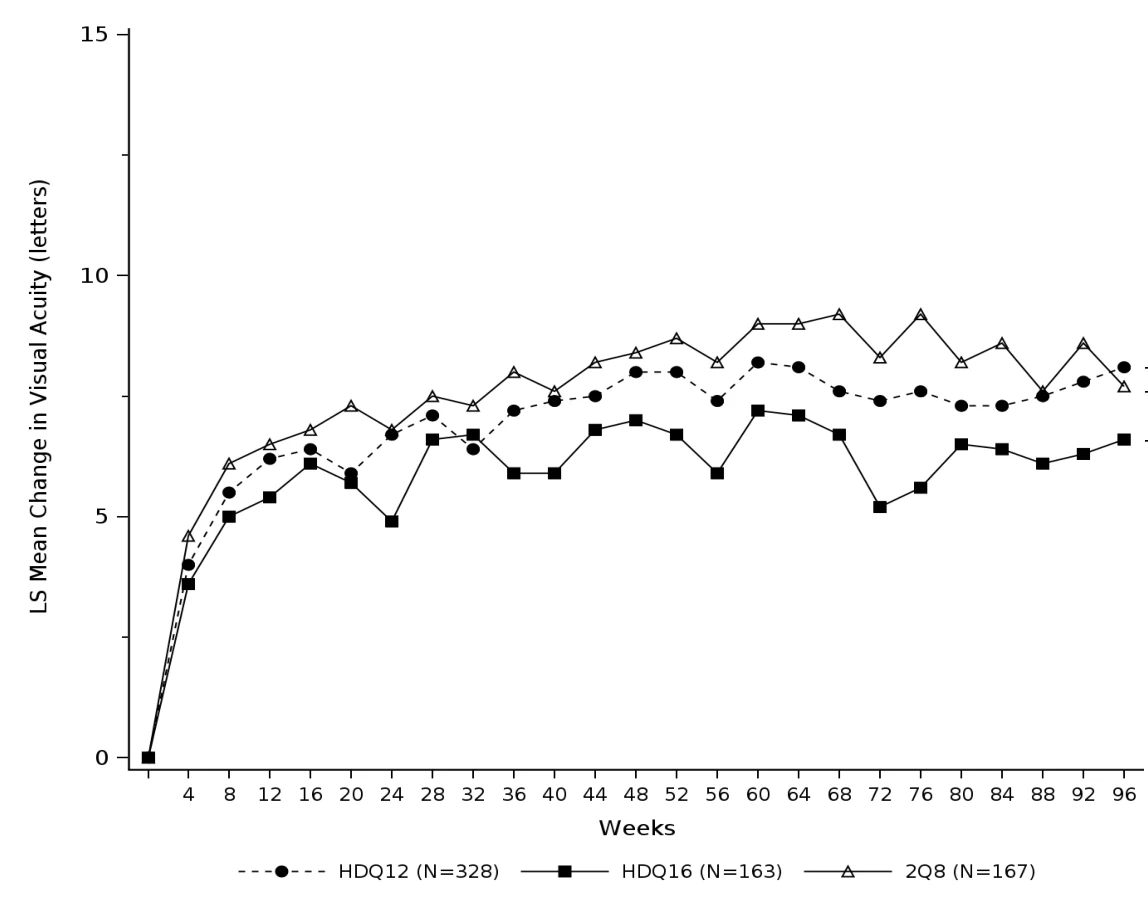
Figure 18: LS mean change in BCVA as measured by ETDRS letter score from baseline through week 96 (full analysis set) in the PHOTON study
At week 96, the mean change in BCVA from baseline was +8.82, +7.50 and +8.41 letters for patients receiving Eylea HD 8Q12, 8Q16 and Eylea 2Q8, respectively.
Among patients who completed the study through Week 96, 87.5% (224/256) in the 8Q12 group and 83.5% (116/139) in the 8Q16 group maintained their treatment interval.
At week 96, in an exploratory analysis of 76(23.2%) and 57(35.0%) of Eylea HD 8Q12 and 8Q16 patients that extended and maintained the dosing regimen to 20 week intervals, the mean change in BCVA from baseline was 10.1 and 9.6 letters (Eylea HD 8Q12 and 8Q16).
Among the cohort of patients who entered the extension phase of the study, the mean change in BCVA from baseline at Week 156 was +6.8, +8.1 and +6.5 letters in patients receiving Eylea HD 8Q12, 8Q16 and Eylea 2Q8/Eylea HD respectively.
Through 156 weeks, 5.3% (26/491) of patients who were originally randomized to 8Q12 and 8Q16 extended and maintained at least two consecutive q24 intervals without subsequent shortening.
Treatment of RVO
QUASAR Study
The safety and efficacy of Eylea HD (aflibercept injection) was assessed in a Phase 3, randomized, multi-center, double-blind, active-controlled study (QUASAR) in patients with RVO. QUASAR was conducted in the Asia-Pacific region, Europe, Japan, and the United States of America. A total of 892 patients were treated and analyzed for efficacy. The distribution of RVO subtypes included BRVO (52.4%), CRVO (35.7%), and HRVO (12.0%) across all treatment groups. Patients were randomized in a 1:1:1 ratio to 1 of 3 dosing regimens:
Dosing regimens:
- 4) Eylea HD administered every 8 weeks (+/- 1 week), after 3 initial injections at 4-week intervals (8Q8/3)
- 5) Eylea HD administered every 8 weeks (+/- 1 week), after 5 initial injections at 4-week intervals(8Q8/5)
- 6) Eylea 2 mg administered every 4 weeks (+/- 1 week) (2Q4)
Starting at Week 8 for Eylea HD 8Q8/3 or Week 16 for Eylea HD 8Q8/5, patients were treated every 8 weeks (+/- 1 week). Thereafter, the dosing interval could be shortened or extended by 4 weeks during treatment with Eylea HD, based on protocol-defined visual and anatomic outcomes (e.g., decreased visual acuity, increased central subfield thickness, presence of new foveal hemorrhage or new foveal neovascularization).
As of Week 16 for Eylea HD 8Q8/3, Week 24 for Eylea HD 8Q8/5, or Week 40 for Eylea 2Q4 (if previously extended), shortening of dosing interval by 4 weeks was possible, based on treatment response according to pre-specified dose-regimen modification (DRM) criteria.
As of Week 32 for Eylea HD 8Q8/3, Week 40 for Eylea HD 8Q8/5 or Week 32 for Eylea 2Q4, extension of dosing interval was possible, based on treatment response according to pre-specified DRM criteria.
The minimal interval between injections was 4 weeks (+/- 1 week) in all groups.
Patients in the Eylea HD 8Q8/3-, Eylea HD 8Q8/5- and Eylea 2Q4-groups who completed week 36 received a median (mean) of 6.0 (6.1), 7.0 (6.9) and 9.0 (8.8) injections, respectively.
Patients in the Eylea HD 8Q8/3-, Eylea HD 8Q8/5- and Eylea 2Q4-groups who completed week 64 received a median (mean) of 8.0 (8.4), 9.0 (9.4) and 11.0 (11.7) injections, respectively.
Table 10: Summary of Patient Demographics for Eylea HD Clinical Trials in RVO
| Study | Trial Design | Dosage, route of administration, and duration | Study Patients (n) | Mean Age (Range) years | Sex |
|---|---|---|---|---|---|
| QUASAR | randomized, multi-center, double-blind, active-controlled, non-inferiority trial. | Intravitreal injection
| Eylea HD 8Q8/3: n= 293 Eylea HD 8Q8/5: n= 298 Eylea 2Q4: n= 301 | 65.9 (23 to 95) | Male: 52.2 % Female: 47.8 % |
The primary efficacy endpoint was the change from baseline in best corrected visual acuity (BCVA) measured by the Early Treatment Diabetic Retinopathy Study (ETDRS) letter score at Week 36.
Treatment with Eylea HD (both 8Q8/3- and 8Q8/5-groups) was shown to be non-inferior to treatment with Eylea (2Q4-group), in terms of the primary efficacy endpoint at Week 36 using the pre-specified non-inferiority margin of 4 letters (Table 11).
Table 11: Efficacy outcomes at Week 36 from the QUASAR study
| Efficacy Outcomes | Eylea HD 8Q8/3 (N = 293) | Eylea HD 8Q8/5 (N = 298) | Eylea 2Q4 (N = 301) |
|---|---|---|---|
| Mean BCVA (SD) at baseline | 55.2 (13.6) | 55.4 (13.4) | 54.1 (14.3) |
| Change in BCVA from baseline at Week 36 as measured by ETDRS letter scorec | |||
| Arithmetic mean (SD), observed | 17.0 (11.8) | 19.1 (11.2) | 17.8 (13.1) |
| LS mean (SE) a | 17.4 (0.7) | 18.3 (0.6) | 17.5 (0.7) |
Difference in LS means (95% CI) a,b | -0.1 (-2.0, 1.9) | 0.8 (-1.1, 2.7) | |
| p-value (one-sided non-inferiority test at a margin of 4 letters) a,b | <0.0001 | 0.0001 | |
CI: Confidence interval; ETDRS: Early Treatment Diabetic Retinopathy Study; LS: Least square; SD: Standard deviation; SE: Standard error
a LS mean, CI and p-value based on a mixed model for repeated measures (MMRM) with baseline best corrected visual acuity (BCVA) measurement as covariate, treatment group as factor, visit and stratification variables used for randomisation (geographical region, categorical baseline BCVA and RVO type) as fixed factors as well as terms for the interaction between baseline BCVA and visit and for the interaction between treatment and visit.
b Difference is Eylea HD 8Q8/3- or 8Q8/5-groups minus Eylea 2Q4-groups, respectively.
c Full analysis set, all randomized patients who received at least 1 dose of study medication
d One-sided non-inferiority test at a pre-specified significance level of 2.5% using a pre-specified non-inferiority margin of 4 ETDRS letters
At Week 36, 88.5% (246/278) of patients in the 8Q8/3- and 93.4% (255/273) of patients in the 8Q8/5-group were maintained on the original randomized treatment interval of 8 weeks.
Figure 19: LS mean change in BCVA as measured by ETDRS letter score from baseline through week 64 (full analysis set) in the QUASAR study
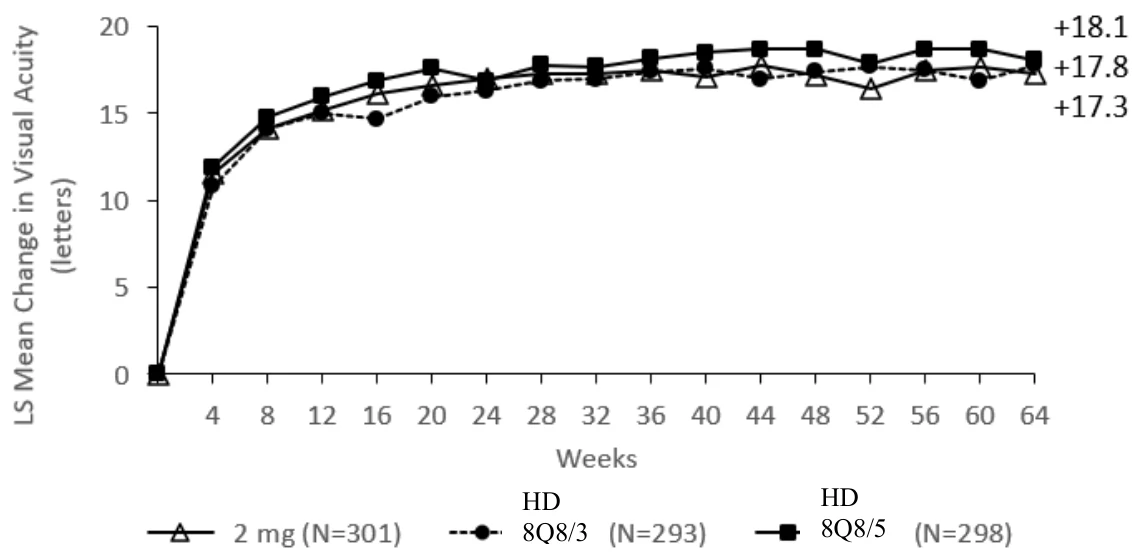
At Week 64, the mean change in BCVA from baseline was +17.3, +19.2 and +17.4 letters for patients receiving Eylea HD 8Q8/3, 8Q8/5 and Eylea 2Q4, respectively.
At Week 64, among the 795 patients who completed the treatment phase, 88.1% (237/269) of in the 8Q/3-group and 90.1% (233/256) of patients in the 8Q8/5-group were maintained on their original randomized treatment interval of 8 weeks or greater. At week 64, 56.1% (151/269) of patients in the 8Q8/3-group had completed treatment intervals of 16 weeks.
15 Microbiology
No microbiological information is required for this drug product.
16 Non-Clinical Toxicology
General toxicology: The toxicological profile of aflibercept was assessed in several non-clinical repeated dose studies in monkeys. In brief, the following pivotal studies were performed:
- 1) a 9-week or 6-month repeat-dose intravitreal study with 12 weeks of recovery, where monkeys were administered aflibercept doses of 0, 4, or 7 mg/eye bilaterally every 4 weeks; the clinically relevant formulation for aflibercept 8 mg was used in the 6-month treatment arm. Erosions and ulcerations of the respiratory epithelium in nasal turbinates were observed in monkeys treated with aflibercept at all doses. A No Observed Adverse Effect Level (NOAEL) was not identified. At the Lowest Observed Adverse Effect Level (LOAEL) of 4 mg/eye in monkeys, the systemic exposure was 50- and 77-fold higher based on Cmax and AUC when compared to corresponding values in wet AMD and DME patients after a unilateral intravitreal dose of 8 mg. Systemic toxicity was not fully assessed in this study.
- 2)
an 8-month repeat-dose intravitreal study with 4-months of recovery, where monkeys were administered aflibercept bilaterally every 4 weeks at doses of 0, 0.5, 2, or 4 mg/eye in the marketed aflibercept 2 mg formulation. Systemic effects were limited to erosions and ulcerations of the respiratory epithelium in nasal turbinates in monkeys treated with aflibercept at doses of 2 or 4 mg/eye. At the NOAEL of 0.5 mg/eye in monkeys, the systemic exposure was 3.2- and 3.8-fold higher based on Cmax and AUC when compared to corresponding values in wet AMD and DME patients after a unilateral intravitreal dose of 8 mg.
HD 8Q8/3
HD 8Q8/5
- 3) a 6-month repeat-dose intravenous study with 5-months of recovery, where monkeys were administered aflibercept intravenously once weekly for 15 weeks; then once every 2 weeks for 12 weeks at doses of 0, 3, 10, or 30 mg/kg. No NOAEL was identified. At the Lowest Observed Adverse Effect Level (LOAEL) of 3 mg/eye in monkeys, the systemic exposure was 104-fold higher based on AUC when compared to corresponding values in wet AMD and DME patients after a unilateral intravitreal dose of 8 mg. Under these conditions and high systemic exposure, aflibercept can cause system-wide organ effects. Monkeys given aflibercept had reduced body weight and developed erosion/ulceration of the nasal turbinate epithelia leading to hemorrhage. Anemia related to bleeding as a result of lesions in the nasal cavity resulted in the premature euthanization of one monkey in the low-dose group. Monkeys administered doses ≥ 3 mg/kg developed deformity or abnormal bone growth of spinal vertebrae or bones of the limbs, along with muscular atrophy, and joint degeneration. Monkeys also developed renal inflammation and glomerulopathy accompanied by proteinuria and albuminuria. At doses ≥ 10 mg/kg, monkeys showed vascular degeneration/proliferation in tissues of the GI tract, heart, joints, and nervous system, as well as liver inflammation and necrosis.
Genotoxicity: No studies have been conducted on the mutagenic potential of aflibercept.
Carcinogenicity: No studies have been conducted on the carcinogenic potential of aflibercept.
Reproductive and developmental toxicology: Effects on male and female fertility were assessed as part of a 6-month repeat-dose intravenous study with 5-months of recovery, where monkeys were administered aflibercept intravenously once weekly for 15 weeks; then once every 2 weeks for 12 weeks at doses of 0, 3, 10, or 30 mg/kg. Absent or irregular menses associated with alterations in female reproductive hormone levels and changes in sperm morphology and motility were observed at all dose levels. In addition, females showed decreased ovarian and uterine weight accompanied by compromised luteal development and reduction of maturing follicles. These changes correlated with uterine and vaginal atrophy. A NOAEL was not identified. Intravenous administration of the lowest dose of aflibercept assessed in monkeys (3 mg/kg) resulted in systemic exposure (AUC) that was approximately 104-fold higher than the exposure in wet AMD and DME patients after a unilateral intravitreal dose of 8 mg. All changes were reversible within 20 weeks after cessation of treatment.
Aflibercept produced embryo-fetal toxicity in an embryo-fetal development study in pregnant rabbits with intravenous administration (3 to 60 mg/kg on gestation Days 6, 9, 12, 15 and 18). The maternal NOAEL was at the dose of 3 mg/kg. At this dose, the systemic exposures based on Cmax and AUC for free aflibercept were approximately 226- and 46-fold higher than the exposure in wet AMD and DME patients after a unilateral intravitreal dose of 8 mg.
In embryo-fetal development studies in pregnant rabbits, aflibercept produced embryo-fetal toxicity when administered every three days during organogenesis to pregnant rabbits at intravenous doses ≥3 mg/kg (3 to 60 mg/kg on gestation day 6, 9, 12, 15, and 18), or every six days at subcutaneous doses ≥0.1 mg /kg (on gestation day 1, 7, and 13). Adverse embryo-fetal effects included increased incidences of postimplantation loss and fetal malformations, including anasarca, umbilical hernia, diaphragmatic hernia, gastroschisis, cleft palate, ectrodactyly, intestinal atresia, spina bifida, encephalomeningocele, heart and major vessel defects, and skeletal malformations (fused vertebrae, sternebrae, and ribs; supernumerary vertebral arches and ribs; and incomplete ossification). The maternal NOAEL in these studies was 3 mg per kg IV. Aflibercept produced fetal malformations at all doses assessed in rabbits and the fetal NOAEL was less than 0.1 mg per kg SC. Administration of the lowest dose assessed in rabbits (0.1 mg per kg SC) resulted in systemic exposure (AUC) that was approximately 1.0 times the exposure in wet AMD and DME patients after a unilateral intravitreal dose of 8 mg.