


Product Monograph - Lacrisert
INDICATIONS
LACRISERT (hydroxypropyl cellulose ocular system, USP) ophthalmic insert is indicated in patients with moderate to severe dry eye syndromes, including keratoconjunctivitis sicca. LACRISERT is indicated in patients who remain symptomatic after an adequate trial of therapy with artificial tear solutions.
LACRISERT is also indicated for patients with:
Exposure keratitis Decreased corneal sensitivity
DOSAGE AND ADMINISTRATION
One LACRISERT (hydroxypropyl cellulose ocular system, USP) ophthalmic insert in each eye once daily is usually sufficient to relieve the symptoms associated with moderate to severe dry eye syndromes. Individual patients may require more flexibility in the use of LACRISERT, some patients may require twice daily use for optimal results.
In some patients, the concomitant administration of a replacement tear solution at the time of insertion may be of benefit to assist in the dissolution of the insert and removal of debris. Saline drops may be used with LACRISERT in cases with severe dry eyes to assist in the dissolution of the insert and removal of debris. Clinical experience with LACRISERT indicates that in some patients several weeks may be required before satisfactory improvement of symptoms is achieved.
LACRISERT is inserted into the inferior cul-de-sac of the eye beneath the base of the tarsus, not in apposition to the cornea.
NOTE: Occasionally LACRISERT is inadvertently expelled from the eye, especially in patients with shallow conjunctival fornices or when the eye is rubbed. The patient should be cautioned against rubbing the eye(s) containing LACRISERT, especially upon awakening, so as to not dislodge or expel the insert. If required, another LACRISERT ophthalmic insert may be inserted. If experience indicates that transient blurred vision develops in an individual patient, the patient may want to remove LACRISERT a few hours after insertion to avoid this. Another LACRISERT ophthalmic insert may be inserted if needed.
Expulsion of undissolved inserts one to several hours after application may occur in patients with Schirmer tests of 0 mm.
If LACRISERT causes worsening of symptoms, the patient should be instructed to inspect the conjunctival sac to make certain LACRISERT is in the proper location, deep in the inferior cul-de-sac of the eye, beneath the base of the tarsus. If these symptoms persist, LACRISERT should be removed and the patient should contact the physician.
CONTRAINDICATIONS
Hypersensitivity to hydroxypropyl cellulose.
PRECAUTIONS
Instructions for inserting and removing LACRISERT (hydroxypropyl cellulose ocular system, USP) ophthalmic insert should be carefully followed. If improperly placed in the inferior cul-de-sac, LACRISERT may result in corneal abrasion.
Because this product may produce transient blurring of vision, patients should be instructed to exercise caution when operating hazardous machinery or driving a motor vehicle.
The safety and efficacy of LACRISERT has not been evaluated in patients with the following conditions: ocular infections or history of infection, eye region surgery or history of ocular trauma, contact lenses use, history of dendritic keratitis, intraocular diseases, severe cicatricial changes in the conjunctiva, significant corneal or conjunctival structural changes, acute ocular disease unrelated to keratoconjunctivitis sicca (KCS), and patients with evidence of recent ocular or adnexal surgery.
Pediatric Use
Safety and efficacy in pediatric patients have not been established.
ADVERSE REACTIONS
The following adverse reactions have been reported in patients treated with LACRISERT (hydroxypropyl cellulose ocular system, USP), but were in most instances mild and transient:
- Transient blurring of vision (see PRECAUTIONS) Ocular discomfort or irritation
- Matting or stickiness of eyelashes Photophobia
- Hypersensitivity Edema of the eyelids Hyperemia
- Tearing
- Foreign body sensation
PHARMACEUTICAL INFORMATION
Drug Substance
Proper Name: Hydroxypropyl cellulose
Chemical Name: Cellulose, 2-hydroxypropyl ether
Empirical Formula: -CH2CHOHCH3
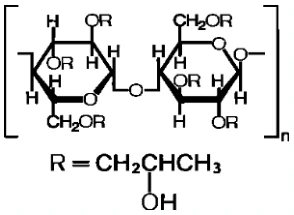
Structural Formula:
Molecular Weight: 1 x 10⁶ g/mol
Physicochemical Properties
Description: Hydroxypropyl cellulose is an off-white, odorless, tasteless powder.
Solubility: It is soluble in water below 38ºC, and in many polar organic solvents such as ethanol, propylene glycol, dioxane, methanol, isopropyl alcohol (95%), dimethyl sulfoxide, and dimethyl formamide.
Composition
Each LACRISERT insert is 5 mg of hydroxypropyl cellulose. LACRISERT contains no preservatives or other ingredients. It is about 1.27mm in diameter by about 3.5 mm long.
Storage Recommendations
Store below 30ºC.
AVAILABILITY OF DOSAGE FORMS
LACRISERT (hydroxypropyl cellulose ocular system, USP) ophthalmic insert, a rod- shaped, water-soluble, ophthalmic preparation made of hydroxypropyl cellulose, 5 mg, is supplied as follows:
Packages of 60 units, together with illustrated instructions and a special applicator for removing LACRISERT from the unit dose blister and inserting it into the eye. A spare applicator is included in each package.
Illustrated instructions are included in each package, but initially patients must be instructed in the correct method of insertion. While in the ophthalmologist's office, the patient should read the instructions, then practice insertions and removal of LACRISERT until proficiency is achieved.