


Product Monograph - Miebo
1 INDICATIONS
MIEBO (perfluorohexyloctane ophthalmic solution, 100% w/w) is indicated for the treatment of the signs and symptoms of dry eye disease (DED).
1.1 Pediatrics
Pediatrics (< 18 years of age): No data are available to Health Canada; therefore, Health Canada has not authorized an indication for pediatric use.
1.2 Geriatrics
Geriatrics (> 65 years of age): No overall differences in safety or effectiveness have been observed between elderly and younger adult patients.
2 CONTRAINDICATIONS
Perfluorohexyloctan is contraindicated in patients with:
- known hypersensitivity to perfluorohexyloctane
4 DOSAGE AND ADMINISTRATION
4.1 Dosing Considerations
- For topical ophthalmic use only
- MIEBO should not be administered while wearing contact lenses. If contact lenses are worn, they should be removed prior to the administration of the solution. Contact lenses may be reinserted 30 minutes after the administration of MIEBO.
4.2 Recommended Dose and Dosage Adjustment
Instill one drop of MIEBO four times daily into each affected eye. This recommended dose is the maximum recommended dose and should be used both as the starting dose and throughout long term treatment. No dosage adjustment is required in any comorbid conditions. The effect of MIEBO has not been studied in patients with hepatic or renal impairment, and no dosage adjustment is recommended as the potential for systemic exposure is low. Limited data from clinical studies exists for long term administration of MIEBO (up to 12 months). It is expected that use of the product will continue long term.
Health Canada has not authorized an indication for pediatric use.
4.4 Administration
Patients should be counselled on the proper administration to ensure proper dosage is administered:
- 1. Remove the cap from eye drop bottle.
- 2. Holding the bottle upright, gently squeeze the bottle.
Patients should be advised to wash their hands before each use and not to touch the tip of the bottle to the eye or any other surface, in order to avoid eye injury or contamination of the solution.
4.5 Missed Dose
If a dose of this medication is missed, it should be applied as soon as possible. However, if it is almost time for the next dose, the missed dose should be skipped and the regular dosing schedule resumed. Do not try to catch up on missed drops by applying more than one dose at a time.
5 OVERDOSAGE
There is no information regarding topical overdose in patients taking MIEBO. Due to low systemic concentrations of perfluorohexyloctane after topical ocular treatment, the likelihood of systemic intoxication from topical ocular use is remote.
For management of a suspected drug overdose, contact your regional poison control centre.
6 DOSAGE FORMS, STRENGTHS, COMPOSITION AND PACKAGING
Table 1 – Dosage Forms, Strengths, Composition and Packaging
MIEBO is a sterile ophthalmic solution containing perfluorohexyloctane, 100% w/w.
Perfluorohexyloctane is a clear and colorless liquid. As a water-free, preservative-free, single-component product, it is free of any additional ingredients.
MIEBO is supplied in polypropylene bottles with dropper tips and screw caps in the following sizes:
1.6 mL fill in a 5 mL container (physician’s sample)
3 mL fill in a 5 mL container
7 WARNINGS AND PRECAUTIONS
General
For topical ophthalmic use only.
MIEBO should not be administered while wearing contact lenses. Contact lenses should be removed
- 3. While squeezing, turn the bottle upside down and release the pressure (drawing air into the bottle).
- 4. Keeping the bottle upside down, place the bottle above your eye and squeeze it again to release a drop into your eye.
| Route of Administration | Dosage Form / Strength/Composition | Non-medicinal Ingredients |
| Ophthalmic | Solution containing perfluorohexyloctane 100% w/w | None |
prior to and for at least 30 minutes after administration of MIEBO.
MIEBO has not been studied in patients with active ocular or systemic infection. If an infection occurs during treatment, MIEBO should be temporarily withheld until the infection has been resolved.
Perfluorohexyloctane is a member of the class of semi-fluorinated alkanes. Notwithstanding the low systemic exposure with ophthalmic use, there is no information regarding the bioaccumulative potential of perfluorohexyloctane through long-term MIEBO use.
Carcinogenesis and Mutagenesis
Refer to 16 NON-CLINICAL TOXICOLOGY.
Driving and Operating Machinery
Transient blurred vision has been reported in patients treated with MIEBO. If patients experience blurred vision, they should be advised not to drive or operate machinery until vision has cleared.
Immune
MIEBO has not been studied in patients with ocular allergies and hypersensitivity reactions. There is the potential to experience hypersensitivity to MIEBO. If a hypersensitivity reaction occurs, patients should be advised to discontinue MIEBO treatment.
Ophthalmologic
Caution is advised in patients with history of other ophthalmologic conditions and trauma, as well as in patients with dry eye disease secondary to scarring, irradiation, alkali burns, cicatricial pemphigoid, or destruction of conjunctival goblet cells as with vitamin A deficiency, as MIEBO has not been studied in these patient groups.
Potential for Eye Injury and Contamination
Advise patients not to touch the tip of the vial to their eye or any other surface, in order to avoid eye injury or contamination of the solution.
7.1 Special Populations
7.1.1 Pregnant Women
Studies in pregnant rabbits have shown maternal toxicity of decreased body weight and loss of appetite at high oral doses of perfluorohexyloctane, but no fetal toxicity was observed. See 16 NON-CLINICAL TOXICOLOGY.
Perfluorohexyloctane is a member of the class of semi-fluorinated alkanes. The use of these substances during pregnancy is unknown. MIEBO should be used with caution during pregnancy.
7.1.2 Breast-feeding
There are no data on the presence of perfluorohexyloctane in human milk, the effects on the breastfed infant, or the effects on milk production. No studies were conducted to investigate the potential excretion of perfluorohexyloctane in the milk of animals. Furthermore, the potential effects for the class of semi-fluorinated alkanes used during breast-feeding is unknown.
The lack of clinical data during lactation precludes a clear determination of the risk of MIEBO to an infant during lactation; however, the developmental and health benefits of breast-feeding should be considered along with the mother’s clinical need for MIEBO and any potential adverse effects on the breast-fed child from MIEBO. Because many drugs are excreted in human breast milk, precaution should be exercised when MIEBO is administered to a nursing woman.
7.1.3 Pediatrics
Pediatrics (< 18 years of age): No data are available to Health Canada; therefore, Health Canada has not authorized an indication for pediatric use.
7.1.4 Geriatrics
Geriatrics (≥ 65 years of age): No overall differences in safety or effectiveness have been observed between elderly and younger adult patients.
8 ADVERSE REACTIONS
8.1 Adverse Reaction Overview
The most common adverse reactions reported in subjects following the use of MIEBO were blurred vision (2.2%) and ocular hyperemia (1.1%).
8.2 Clinical Trial Adverse Reactions
Clinical trials are conducted under very specific conditions. The adverse reaction rates observed in the clinical trials; therefore, may not reflect the rates observed in practice and should not be compared to the rates in the clinical trials of another drug. Adverse reaction information from clinical trials may be useful in identifying and approximating rates of adverse drug reactions in real-world use.
SEECASE, GOBI and MOJAVE Pooled Safety Data
The safety data presented are the pooled dataset from two multi-center, randomized, double-masked, saline-controlled Phase 3 clinical studies (GOBI and MOJAVE), and one multi-center, randomized, double-masked, saline-controlled Phase 2 study (SEECASE). A total of 1,442 subjects with a history of DED and clinical signs of meibomian gland dysfunction received MIEBO (four times a day) or saline for 57 days. Overall, the mean age of the 728 subjects who received MIEBO was 56 years (range, 19-87 years) and the majority of subjects were female (75%). The proportion of subjects experiencing treatment-emergent adverse events (TEAEs) (17.6% vs 15.8%) and drug-related adverse events (AEs) (6.0% vs 5.0%) were similar between MIEBO and the saline group. Most of the TEAEs were mild or moderate in severity. The most common TEAEs reported in ≥1% of subjects treated with MIEBO were vision blurred (2.2%) and ocular hyperemia (1.1%) (Table 2). There were no non-ocular AEs that occurred at ≥1% at a higher incidence in the MIEBO group compared to saline control. See 14 CLINICAL TRIALS.
Table 2 Treatment Emergent Adverse Events (TEAEs) in ≥1% of Subjects Treated with MIEBO and Higher than Saline Control in Pooled 8-week Studies (Safety Population – Pooled Data for Studies SEECASE, GOBI, and MOJAVE)
| System Organ Class Preferred Term | MIEBO n = 728 (%) | Saline n = 714 (%) |
Eye Disorders Vision blurred Ocular hyperaemia | 16 (2.2) 8 (1.1) | 3 (0.4) 1 (0.1) |
There were no ocular serious adverse events or deaths, and no treatment related non ocular adverse events occurred with MIEBO treatment.
KALAHARI Extension Study Safety Data
Long-term safety data are provided by a 52-week open label extension (OLE) study KALAHARI. All 208 subjects had completed the pivotal Phase 3 GOBI study and received MIEBO four times daily in both eyes for 52 weeks. Overall, subjects in the KALAHARI study had a mean age of 61 years (range, 19-88 years); most (70%) were female subjects. Ocular TEAEs were experienced by 13.9% of subjects overall, with 6.3% of subjects reporting ≥1 drug-related ocular TEAE. The most common ocular TEAEs not observed in the 8-week studies were vitreous detachment (1.9%), allergic conjunctivitis (1.4%), and increased lacrimation (1.4%). Chalazion, dry eye, hordeolum and instillation site pain all occurred in 1% of subjects. Increased frequency of TEAEs compared with the 57-day studies is attributed to the longer duration of study. The most common non-ocular TEAEs were COVID-19 (2.9%), hypertension (1.9%), and hypercholesterolaemia (1.4%). Sinusitis, urinary tract infection, arthralgia, neuralgia, and insomnia all occurred in 1% of subjects. None of the ocular TEAEs were considered drug-related. Most ocular and non-ocular TEAEs were mild to moderate in severity. Serious adverse events were reported in 4.8% of subjects and none were considered drug-related.
8.3 Less Common Clinical Trial Adverse Reactions
The observed adverse drug reactions are provided below for those events reported by <1% of patients who received MIEBO four times daily in the three pooled 8-week saline-controlled clinical trials.
Congenital, Familial and Genetic Disorders: corneal dystrophy
Eye disorders: Blepharitis, conjunctival hyperemia, conjunctival papillae, corneal epithelial microcysts, eye discharge, eye pain, eye pruritis, eyelid margin crusting, eyelid oedema, erythema of the eyelid, eyelid pain, foreign body sensation in eyes, lacrimation increased, swelling of the eyelid, visual acuity reduced
General disorders and administration site conditions: Instillation site discomfort, instillation site irritation, instillation site pain, instillation site reaction
Infections and Infestations: Hordeolum
Skin and subcutaneous tissue disorders: Dermatitis contact
8.5 Post-market adverse reactions
Other ophthalmic formulations containing perfluorohexyloctane captured the following post-market adverse reactions:
Eye disorders: Eye allergy, eye swelling, ocular discomfort, ocular hyperemia, periorbital disorder, periorbital swelling, photophobia, vision blurred, visual impairment
General disorders and administration site conditions: Device intolerance, drug intolerance
Skin and subcutaneous tissue disorders: Dry skin, erythema
9 DRUG INTERACTIONS
9.2 Drug Interactions Overview
Specific interaction studies have not been conducted with MIEBO.
9.4 Drug-Drug Interactions
Interactions with other drugs have not been established.
9.5 Drug-Food Interactions
Interactions with food have not been established.
9.6 Drug-Herb Interactions
Interactions with herbal products have not been established
9.7 Drug-Laboratory Test Interactions
Interactions with laboratory tests have not been established.
10 CLINICAL PHARMACOLOGY
10.1 Mechanism of Action
Perfluorohexyloctane, a semifluorinated alkane, which also belongs to the group of per- and polyfluoroalkyl substances (PFAS), contains 6 perfluorinated carbon atoms and 8 hydrogenated carbon atoms. The compound demonstrates amphiphilic behavior and self-assembly effects involving lipophilic and lipophobic effects on the ocular surface.
Perfluorohexyloctane forms a monolayer at the air-liquid interface of the tear film, which stabilizes the natural tear film and reduces evaporation. The exact mechanism of action of MIEBO in DED is not known.
10.2 Pharmacodynamics
No traditional pharmacodynamic studies were conducted as perfluorohexyloctane is chemically and metabolically inert with no known pharmacological activity.
10.3 Pharmacokinetics
The pharmacokinetics of perfluorohexyloctane following topical ocular administration of MIEBO has not been quantitatively characterized in humans. A single pharmacokinetic study was conducted that showed low systemic perfluorohexyloctane blood levels after topical ocular administration. Low level systemic accumulation was shown in rabbits administered perfluorohexyloctane via ocular instillation twice daily for five days compared to a single instillation. Perfluorohexyloctane was not metabolized by human liver microsomes in vitro.
11 STORAGE, STABILITY AND DISPOSAL
Store at 20°C to 25°C (68°F to 77°F); excursions permitted between 15°C to 30°C (59°F to 86°F). After opening, MIEBO may be used for approximately four weeks. Discard unused portion.
Keep out of reach and sight of children.
12 SPECIAL HANDLING INSTRUCTIONS
There are no special handling instructions for this product.
PART II: SCIENTIFIC INFORMATION
13 PHARMACEUTICAL INFORMATION
Drug Substance
Proper name: perfluorohexyloctane
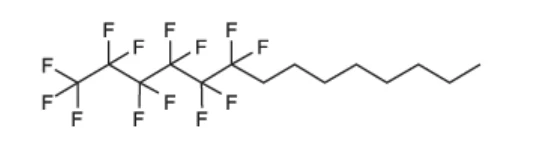
Chemical name: 1,1,1,2,2,3,3,4,4,5,5,6,6-tridecafluorotetradecane
Molecular formula and molecular mass: C14H17F13 432.26g/mol
Structural formula:
Physicochemical properties
Description: Perfluorohexyloctane is a clear, colorless, odorless liquid
14 CLINICAL TRIALS
14.1 Clinical Trials by Indication
Table 3 - Summary of patient demographics for clinical trials in patients with Dry Eye Disease (DED) associated with Meibomian Gland Dysfunction (MGD).
| Study # | Study design | Dosage, route of administration and duration | Study subject s (n) | Mean age (Range) | Sex M/F (%) |
NVU-003 (GOBI) | Phase 3, multi-center, randomized, double-masked, saline-controlled | MIEBO (100% perfluorohexyloctane) or saline (0.6% NaCl) one drop per eye four times daily by ophthalmic route for 8 weeks | 597 | 60.9 (19-88) | 27.5/72.5 |
BL-904 (MOJAVE) | Phase 3, multi-center, randomized, double-masked, saline-controlled | MIEBO (100% perfluorohexyloctane) or saline (0.6% NaCl) one drop per eye four times daily by ophthalmic route for 8 weeks | 620 | 53.6 (19-88) | 21.3/78.7 |
NVU-004 (KALAHARI) | Phase 3, multi-center, open-label, single-arm 12-month extension to NVU-003 | MIEBO (100% perfluorohexyloctane) one drop per eye four times daily by ophthalmic route for 52 weeks | 208 | 61.2 (19-88) | 29.8/70.2 |
The safety and efficacy of MIEBO for the treatment of the signs and symptoms of DED associated with MGD were assessed in a total of 1,217 subjects randomized into two 57-day, multi-center, double-masked, saline-controlled studies across 68 sites in the United States (GOBI and MOJAVE). Patients were randomized to MIEBO or saline control in a 1:1 ratio and dosed four times daily where 614 subjects received MIEBO. In each study, subjects had to be at least 18 years of age; have a subject-reported history of DED in both eyes for at least 6 months; and have each of following at Visit 0 and Visit 1: tear film break-up time (TFBUT) ≤5 seconds; ocular surface disease index (OSDI) score ≥25; an unanesthetized Schirmer’s test I score ≥5 mm; total MGD score ≥ 3 (range, 0- 15); total corneal fluorescein staining (tCFS) score between 4 and 11 based on the National Eye Institute (NEI) scale. Further, subjects had to have at least one eye (the same eye) that satisfied all criteria listed above for Visit 0 (Screening) and Visit 1 (Randomization and treatment). All subjects had to provide written informed consent and be able and willing to follow instructions, including participation in all trial assessments and visits. Mechanical therapies for MGD (lid scrubs, lid wipes, and warm compresses) were allowed throughout the studies. Most (95.9%) of the treated subjects completed the dosing regimen. The mean age was 57 years (range 19-88 years). The majority of patients were female (76%).
Using the NEI/Industry Workshop Scale, corneal fluorescein staining (CFS) scores (5 areas of the cornea) were recorded by the Investigator as Grade 0 (no staining) to Grade 3 (heavy staining); a total score (tCFS) was calculated (maximum of 15) which served as the primary assessment of signs of DED.
Subjects rated severity of eye dryness and other symptomatology (both eyes simultaneously) using a visual analog scale (VAS) ranging from 0 (no discomfort) to 100 (maximal discomfort). This served as the primary assessment of symptoms of DED.
Long-term safety and efficacy of MIEBO were assessed in a multi-center, open-label, single-arm, extension study (KALAHARI). A total of 208 subjects from GOBI were enrolled and dosed four times daily with MIEBO for approximately 10 to 12 months. Most (76.9%) of the subjects completed the long-term safety extension study. 2.4% of subjects discontinued MIEBO due to an ocular TEAE, and none of the subjects had a serious ocular TEAE. The most common reason for study discontinuation was ‘withdrawal by subject’ (12.5%).
Details on the patient demographics for the two pivotal studies (GOBI and MOJAVE) and one extension study (KALAHARI) conducted in patients with DED associated with MGD are provided in Table 3.
Efficacy results from the two pivotal studies (GOBI and MOJAVE) in patients with DED associated with MGD are summarized in Table 4.
Table 4 - Results of Pivotal Phase 3 Studies GOBI and MOJAVE in Patients with Dry Eye Disease associated with Meibomian Gland Dysfunction (Full Analysis Set)
| GOBI | MOJAVE | |||||||||||
MIEBO (n = 303) | Saline (n = 294) | MIEBO (n = 311) | Saline (n = 309) | |||||||||
| Primary Endpoints | ||||||||||||
Change from baseline in the total corneal fluorescein staining (tCFS) score at day 57 Mean (SD) Difference MIEBO - Saline (95% CI) p-value | -2.0 (2.6) -0.95 (-1.35, -0.54) <0.0001 | -1.0 (2.7) | -2.3 (2.8) -1.28 (-1.69, -0.87) <0.0001 | -1.1 (2.9) | ||||||||
Change from baseline in the Eye Dryness Score (Visual Analog Scale [VAS]) at day 57 Mean (SD) Difference MIEBO - Saline (95% CI) p-value | -27.4 (27.9) -7.59 (-11.77, -3.41) 0.0004 | -19.7 (26.7) | -29.5 (28.6) -10.22 (-14.33, -6.12) <0.0001 | -19.0 (27.2) | ||||||||
| Secondary Endpoints | ||||||||||||
Change from baseline in the total corneal fluorescein staining (tCFS) score at day 15 Mean (SD) Difference MIEBO – Saline (95% CI) p-value | -1.7 (2.1)
| -1.1 (2.2) | -1.9 (2.3)
| -1.3 (2.4) | ||||||||
Change from baseline in the Eye Dryness Score (Visual Analog Scale [VAS]) at day 15 Mean (SD) Difference MIEBO - Saline (95% CI) p-value | -18.0 (24.0) -4.75 (-8.19, -1.31) 0.0069 | -13.4 (23.3) | -18.5 (23.6) -7.46 (-10.90, -4.02) <0.0001 | -10.5 (23.9) | ||||||||
| Note: tCFS is of the study eye. Testing was done hierarchically in the fixed sequence of tCFS at day 57, eye dryness at day 57, eye dryness at day 15, and tCFS at day 15. Treatment differences and p-values are from ANCOVA models with terms for baseline value, site, baseline dryness score stratum (< 70 vs. ≥ 70), and treatment. | ||||||||||||
Effects on Signs of Dry Eye Disease
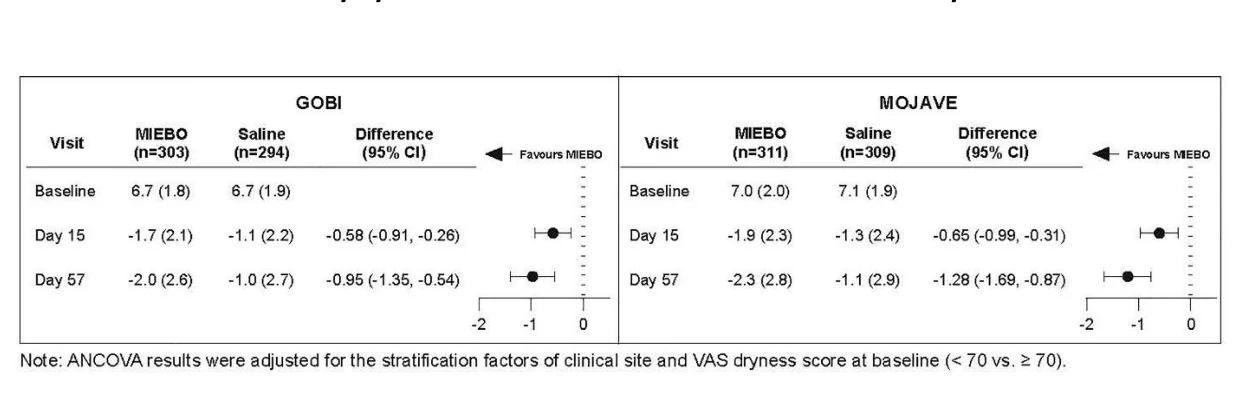
Total corneal fluorescein staining (tCFS) was recorded at each study visit using the National Eye Institute (NEI) standardized grading system of 0-3 for each of the five areas on the cornea (inferior, superior, central, nasal, and temporal), totaling a maximum tCFS score for each eye of 15. The average baseline tCFS was approximately 6.7 in GOBI and 7.0 in MOJAVE. At Days 15 and 57, a statistically significant reduction in tCFS favoring MIEBO was observed in both studies (Figure 1).
Effects on Symptoms of Dry Eye Disease
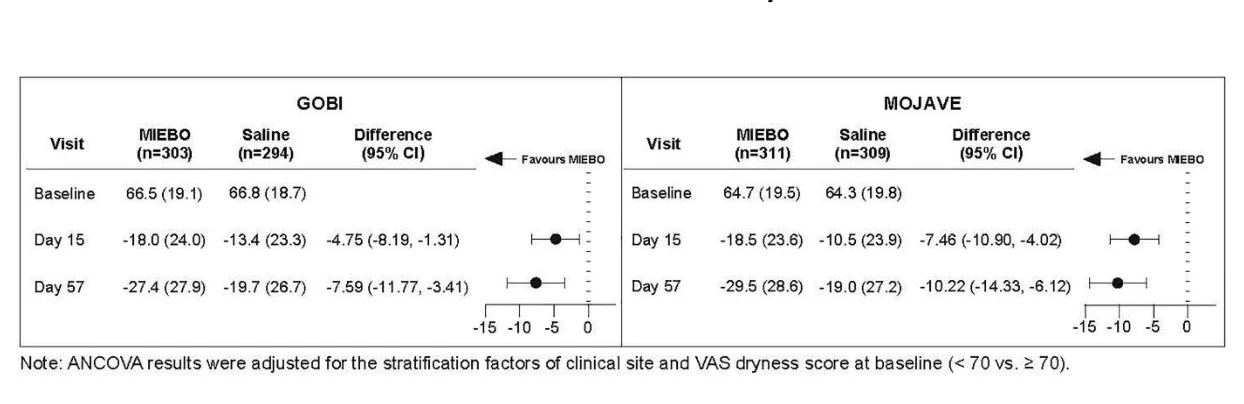
Eye dryness score was rated by patients using a visual analogue scale (VAS) (0 = no discomfort, 100 = maximal discomfort) at each study visit. The average baseline VAS eye dryness score was approximately 67 in GOBI and 65 in MOJAVE. At Days 15 and 57, a statistically significant reduction in VAS eye dryness score favoring MIEBO was observed in both studies (Figure 2).
Figure 2: Mean Change (SD) from Baseline and Treatment Difference (MIEBO-Saline) in Eye Dryness Score (Study Eye) in the Pivotal Phase 3 Studies GOBI and MOJAVE in Patients with Dry Eye Disease associated with Meibomian Gland Dysfunction
Figure 1: Mean Change (SD) from Baseline and Treatment Difference (MIEBO-Saline) in Total Corneal Fluorescein Staining Score (Study Eye) in the Pivotal Phase 3 Studies GOBI and MOJAVE in Patients with Dry Eye Disease associated with Meibomian Gland Dysfunction
15 MICROBIOLOGY
MIEBO is an anhydrous product comprised of 100% perfluorohexyloctane and will not support microbial growth despite not containing any antimicrobial preservative.
16 NON-CLINICAL TOXICOLOGY
General Toxicology:
Acute Toxicity:
The single dose oral LD50 of perfluorohexyloctane in rats was found to be >2000 mg/kg.
Long Term Toxicity:
No treatment-related toxicity was observed in New Zealand White (NZW) rabbits instilled with 40 μL/eye perfluorohexyloctane bilaterally four times per day for 26 weeks (NOAEL = 147 mg/kg; 24 times the maximal recommended human dose (MRHD)).
Ocular Toxicity:
No treatment-related ocular adverse effects were noted in NZW rabbits instilled with 40 μL/eye perfluorohexyloctane bilaterally four times per day for 26 weeks (NOAEL = 213.9 bilateral dosing mg/eye/day; 3.6 times the MRHD).
Carcinogenicity:
Long-term animal studies have not been conducted to evaluate the carcinogenic potential of perfluorohexyloctane.
Genotoxicity:
Perfluorohexyloctane was not mutagenic or clastogenic in a standard battery of genotoxicity tests, including a bacterial mutagenicity assay, an in vitro chromosome aberration assay using human peripheral lymphocytes, and an in vivo bone marrow micronucleus assay in rats.
Reproductive and Developmental Toxicology:
Oral administration of perfluorohexyloctane (250, 500, and 1000 mg/kg/day) to pregnant rabbits on gestation days 6 to 17 (period of organogenesis) caused maternal toxicity, characterized by reduced body weight gain and food consumption, and miscarriages at all doses tested. Reduced fetal weights were also observed at all doses tested. Observations of fetal malformations were considered incidental and not treatment-related. A maternal NOAEL was not established for pregnant rabbits. The foetal NOAEL was 250 mg/kg/day corresponding to 41 times the MRHD.
In pregnant rats orally administered perfluorohexyloctane (300, 1000, and 2000 mg/kg/day) on gestation days 6 to 17, no evidence of embryofetal toxicity or teratogenicity were observed at doses up to 2000 mg/kg/day which was considered the fetal and maternal NOEL (165 times the MRHD).