


Product Monograph - Verkazia
1 INDICATIONS
Verkazia (cyclosporine) is indicated for:
- Treatment of severe vernal keratoconjunctivitis in children from 4 years of age through adolescence.
1.1 Pediatrics
Pediatrics (4 years of age through adolescence [12 to 18 years]): Based on the data submitted and reviewed by Health Canada, the safety and efficacy of Verkazia in pediatric patients has been established; therefore, Health Canada has authorized an indication for pediatric use. (Refer to Section 3.2 below)
1.2 Geriatrics
Geriatrics (> 65 years of age): No data are available to Health Canada; therefore, Health Canada has not authorized an indication for geriatric use.
2 CONTRAINDICATIONS
Verkazia is contraindicated in patients who are hypersensitive to this drug or to any ingredient in the formulation, including any non-medicinal ingredient, or component of the container. For a complete listing, see Dosage Forms, Strengths, Composition and Packaging.
- Patients with active or suspected ocular or peri-ocular infection.
- Patients with ocular malignancies or premalignant conditions.
3 DOSAGE AND ADMINISTRATION
3.1 Dosing Considerations
- There are no special dosing considerations which need to be taken into account prior to initiating therapy with Verkazia (cyclosporine) ophthalmic emulsion. Efficacy and safety of Verkazia has not been studied beyond 12 months.
- Verkazia eye drops should not be used until at least 15 minutes after any other eye drops are used.
3.2 Recommended Dose and Dosage Adjustment
Children from 4 years of age through adolescence:
The recommended dose is one drop of Verkazia 4 times a day (morning, noon, afternoon and evening) to be applied to each affected eye. The treatment should be discontinued if no improvement in signs and symptoms of Vernal Keratoconjunctivitis is observed. The treatment can be maintained at the recommended dose or decreased to one drop twice daily once adequate control of signs and symptoms is achieved. Treatment should be discontinued after signs and symptoms are resolved and reinitiated upon their recurrence.
Verkazia is not approved for use in children below 4 years of age.
3.3 Administration
Patients should be instructed to wash their hands before instilling Verkazia into the eye(s). Prior to administration, the single-dose container of Verkazia should be gently shaken. Patients should be instructed to use nasolacrimal occlusion and to close the eyelids for 2 minutes after instillation, to reduce the systemic absorption. This may result in a decrease in systemic undesirable effects and an increase in local activity.
Each single-dose container of Verkazia is sufficient to treat both eyes.
For single-use only. Any unused emulsion after opening the vial should be discarded immediately.
3.4 Missed Dose
If a dose is missed, treatment should be continued on the next instillation as normal. Patients should be advised not to instill more than one drop for each instillation in the affected eye(s).
4 OVERDOSAGE
A topical overdose is not likely to occur after ocular administration.
| For management of a suspected drug overdose, contact your regional poison control centre. |
|---|
5 DOSAGE FORMS, STRENGTHS, COMPOSITION AND PACKAGING
Table 1 – Dosage Forms, Strengths, Composition and Packaging.
Verkazia (cyclosporine) is supplied as 0.3 mL unpreserved emulsion and filled into single-dose, low-density polyethylene (LDPE) containers presented in a sealed aluminum pouch.
Each mL of Verkazia contains 1 mg of cyclosporine, and the following non-medicinal ingredients: cetalkonium chloride, glycerol, medium-chain triglycerides, poloxamer 188, tyloxapol, sodium hydroxide (to adjust pH), water for injection.
| Route of Administration | Dosage Form / Strength/Composition | Non-medicinal Ingredients |
| Ophthalmic | Emulsion, 0.1% w/v | Cetalkonium chloride, glycerol, medium-chain triglycerides, poloxamer 188, tyloxapol, sodium hydroxide (to adjust pH), water for injection. |
Verkazia, a cyclosporine cationic nanoemulsion, uses Novasorb® technology to optimize absorption and increase residence time. Novasorb® is a cationic, i.e., positively-charged, emulsion composed of oil nanodroplets stabilized by surfactants and dispersed in an aqueous phase. Verkazia’s cationic nanoemulsion vehicle improves cyclosporine absorption and increases ocular residence time. Better spreading and improved residence time translates into a two-fold increase in cyclosporine ocular bioavailability over anionic cyclosporine nanoemulsions.
One pouch contains five single-dose containers.
Pack size: Pack sizes of 30 and 120 single-dose containers.
6 WARNINGS AND PRECAUTIONS
General
Verkazia (cyclosporine) is for ophthalmic use only.
Driving and Operating Machinery
Due caution should be exercised when driving or operating a vehicle or potentially dangerous machinery.
Verkazia has moderate influence on the ability to drive and use machines.
This medicinal product may induce temporary blurred vision or other visual disturbances which may affect the ability to drive or use machines. Patients should be advised not to drive or use machines until their vision has cleared.
Ophthalmologic
Ophthalmic medicinal products, which affect the immune system, including cyclosporine, may affect host defences against local infections and malignancies. Therefore, regular monitoring of the eye(s) is recommended when Verkazia is used long-term.
Contact lenses: Patients wearing contact lenses have not been studied. Therefore, the use of Verkazia with contact lenses is not recommended.
Concomitant Ophthalmic therapy: Co-administration of Verkazia with eye drops containing corticosteroids may potentiate the effects of Verkazia on the immune system.
Hepatic
The effect of Verkazia has not been studied in patients with hepatic impairment. However, no special dose adjustment is needed in this population as systemic exposure to cyclosporine is negligible (see Action and Clinical Pharmacology).
Renal
The effect of Verkazia has not been studied in patients with renal impairment. However, no special dose adjustment is needed in this population as systemic exposure to cyclosporine is negligible (see Action and Clinical Pharmacology).
Skin
Verkazia has not been studied in patients with an active orofacial herpes simplex infection, a history of ocular herpes, varicella-zoster, or vaccinia virus infection and should therefore be used with caution in such patients.
6.1 Special Populations
6.1.1 Pregnant Women
There are no data from the use of Verkazia in pregnant women.
However, studies in animals have shown reproductive toxicity following systemic administration of cyclosporine at exposures sufficiently in excess of the maximum human exposure from ophthalmic use, indicating little relevance to the clinical use of Verkazia.
Verkazia is not recommended during pregnancy unless the benefits outweigh the risks.
6.1.2 Breast-feeding
Cyclosporine is known to be excreted in breast milk following systemic administration. There is insufficient information on the effects of cyclosporine in newborns/infants. However, at therapeutic doses of cyclosporine in eye drops, it is unlikely that sufficient amounts would be present in breast milk. A decision must be made whether to discontinue breast-feeding or to discontinue/abstain from Verkazia therapy taking into account the benefit of breast-feeding for the child and the benefit of therapy for the woman.
It is unknown if the drug is excreted in human milk following ocular topical administration of Verkazia. Because many drugs are excreted in human milk, precaution should be exercised.
6.1.3 Pediatrics
Pediatrics (< 4 years of age): No data are available to Health Canada; therefore, Health Canada has not authorized an indication for pediatric use under the age of 4 years.
6.1.4 Geriatrics
The elderly population has not been studied in clinical studies. Verkazia is not indicated for the geriatric population.
7 ADVERSE REACTIONS
7.1 Adverse Reaction Overview
The most common adverse drug reactions following the use of Verkazia (cyclosporine) are eye pain and eye pruritus which are usually non-serious, transitory and occur during instillation. Most of the known adverse reactions following the use of Verkazia occur in or around the eye.
7.2 Clinical Trial Adverse Reactions
Because clinical trials are conducted under very specific conditions, the adverse reaction rates observed in the clinical trials may not reflect the rates observed in practice and should not be compared to the rates in the clinical trials of another drug. Adverse reaction information from clinical trials is useful for identifying drug-related adverse events and for approximating rates.
Table 2 below presents the most common adverse reactions from the clinical study (VEKTIS) conducted with Verkazia 0.1% (n=111) during the 4-month, randomized, double-masked period when the comparison to Vehicle (n=58) was possible. The majority of suspected adverse drug reactions reported in clinical studies and related to the use of Verkazia were ocular and mild or moderate in severity.
Table 2 Most Common (>1%) Adverse Drug Reactions from Clinical Trial (VEKTIS Study)
| Body system | Adverse reaction | High dose (4 drops daily) n = 57 % | Low dose (2 drops daily) n = 54 % | Vehicle (4 drops daily) n = 58 % | |||||||
|---|---|---|---|---|---|---|---|---|---|---|---|
| Eye disorders | Eye pain* | 12.3 % | 7.4 % | 3.4 % | |||||||
| Eye pruritus** | 3.5% | 3.7% | 3.4% | ||||||||
| Ocular hyperaemia*** | 3.5% | 1.9% | 5.2% | ||||||||
| Foreign body sensation in eyes | 3.5% | 0% | 0% | ||||||||
| Eye irritation | 1.8 % | 0% | 1.7 % | ||||||||
| Infections and infestations | Upper respiratory tract infection**** | 5.3% | 7.4% | 3.4% | |||||||
| Nervous system disorders | Headache | 7% | 0% | 1.7% | |||||||
| Respiratory, thoracic and mediastinal disorders | Oropharyngeal pain | 1.8 % | 1.9% | 1.7 % | |||||||
| Cough | 3.5% | 0% | 0% | ||||||||
*Eye pain includes Instillation site pain
**Eye pruritus includes Instillation site pruritus
***Ocular hyperaemia includes Instillation site erythema
****Upper respiratory tract infection includes Nasopharyngitis, Pharyngitis, Rhinitis and Tonsillitis
Other adverse drug reactions in patients treated with Verkazia identified from the overall safety data from VEKTIS Study including the follow-up period (with no comparison to vehicle) are:
- Eye disorders: Ocular discomfort (1.1%), Lacrimation increased (0.7%)
8 DRUG INTERACTIONS
8.1 Overview
Interactions with other drugs have not been established.
8.2 Drug-Drug Interactions
Interactions with other drugs have not been established.
Combination with other medicinal products that affect the immune system:
In clinical studies, co-administration of Verkazia (4 times daily) with eye drops containing corticosteroids was reported for 18 patients. No safety concerns were identified.
8.3 Drug-Food Interactions
Interactions with food have not been established.
8.4 Drug-Herb Interactions
Interactions with herbal products have not been established.
8.5 Drug-Laboratory Test Interactions
Interactions with laboratory tests have not been established.
9 ACTION AND CLINICAL PHARMACOLOGY
9.1 Mechanism of Action
Following ocular administration, cyclosporine is passively absorbed by T-lymphocytes, where its binding to cyclophilin A inactivates calcineurin, and prevents NF-AT translocation into the nucleus, thus blocking the release of pro-inflammatory cytokines such as IL-2 and hence T-lymphocyte activation. Blocking NF-AT also interferes in the allergy process. Cyclosporine inhibits histamine release from mast cells and basophils through a reduction in IL-5 production and may reduce eosinophil recruitment and effects on the conjunctiva and cornea. Cyclosporine is also known to up-regulate the release of anti-inflammatory cytokines. All available evidence suggests that cyclosporine acts specifically and reversibly on lymphocytes and does not depress hematopoiesis or have any effect on the function of phagocytic cells.
9.2 Pharmacokinetics
Formal pharmacokinetic studies have not been conducted in humans with Verkazia. Blood concentrations of Verkazia were measured using a specific high-pressure liquid chromatography-mass spectrometry assay. In 166 patients at baseline from one efficacy study (55 patients in the high dose group (Verkazia 4 times daily), 53 in the low dose group (Verkazia 2 times daily) and 58 in the vehicle QID group, plasma concentrations of cyclosporine were measured before administration and after 2, 4, and 12 months of treatment.
In the high dose group after 4 months of ocular instillation of Verkazia 4 times daily (n=50), 20 patients had values below the lower limit of detection (0.050 ng/mL) and 13 patients had values below the lower limit of quantification (0.100 ng/mL). Quantifiable values not exceeding 0.670 ng/mL were measured in 14 patients, values considered to be negligible. Cyclosporinemia was not measured for 3 patients.
At Month 12, (n= 68 patients) values were below the lower limit of detection for 38 patients and below the lower limit of quantification in 10 patients. 12 patients had measurable values (maximum 0.291 ng/mL), all considered to be negligible values. Cyclosporinemia was not measured for 8 patients.
In the low dose group, after 4 months of ocular instillation of Verkazia 2 times daily
(n= 47 patients), 34 patients had values below the lower limit of detection (0.050 ng/mL) and 7 patients had values below the lower limit of quantification (0.100 ng/mL). Quantifiable values not exceeding 0.336 ng/mL were measured in 5 patients, values considered to be negligible. Cyclosporinemia was not measured for 1 patient.
At Month 12 (n= 61 patients), values were below the lower limit of detection for 47 patients and below the lower limit of quantification in 6 patients. 5 patients had measurable values (maximum 0.300 ng/mL), all considered to be negligible values. Cyclosporinemia was not measured for 3 patients.
10 STORAGE, STABILITY AND DISPOSAL
Do not freeze Verkazia (cyclosporine). Store below 30°C. Keep out of the sight and reach of children.
After opening of the aluminum pouch, the single-dose container should be kept in the pouch to protect from light and avoid evaporation. Any opened individual single-dose container with any remaining emulsion should be discarded immediately after use.
11 SPECIAL HANDLING INSTRUCTIONS
Any unused medicinal product after opening the vial should be returned to the pharmacy for disposal.
PART II: SCIENTIFIC INFORMATION
12 PHARMACEUTICAL INFORMATION
Drug Substance
Proper name: Ciclosporin and Ciclosporin A (Ph.Eur.); Cyclosporine (USP)
Chemical name: The chemical names for cyclosporine are cyclo[-[ (2S,3R,4R,6E)-3-Hydroxy-4-methyl-2-(methylamino) oct-6-enoyl]-L-2-aminobutanoyl-N-methylglycyl-N-methyl-L-leucyl-L-valyl-N-methyl-L-leucyl-L-alanyl-D-alanyl-N-methyl-L-leucyl-N-methyl-L-leucyl-N-methyl-L-valyl-] and
[R-[R*,R*-(E)]]-Cyclic(L-alanyl-D-alanyl-Nmethyl- L-leucyl-N-methyl-L-leucyl-N-methyl-Lvalyl-3-hydroxy-N,4-dimethyl-L-2-amino-6-octenoyl-L-alpha-aminobutyryl-N-methylglycyl-N-methyl-L-leucyl-L-valyl-N-methyl-L-leucyl)
Molecular formula and: C62H111N11O12
Molecular mass: 1202.61
Structural formula:
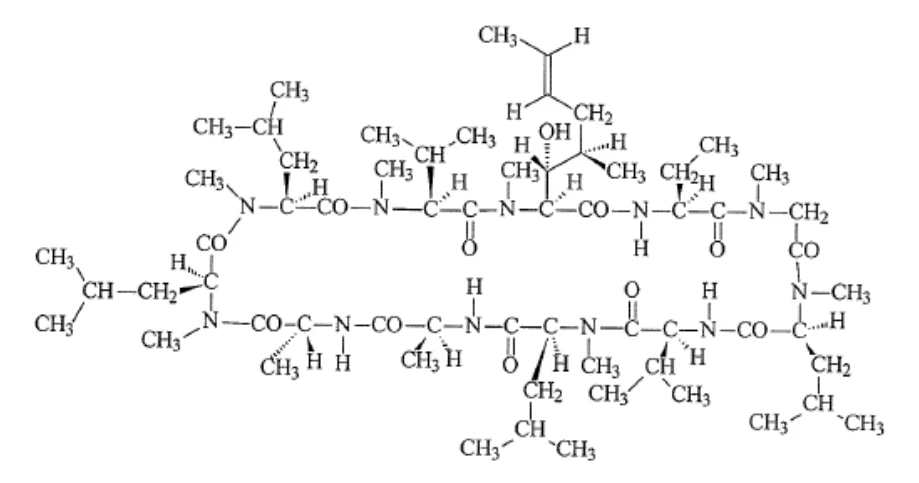
Physicochemical properties: Cyclosporine is a fine white or almost white powder and is practically insoluble in water. Its melting point is 148-151°C.
13 CLINICAL TRIALS
13.1 Trial Design and Study Demographics
Table 3 – Summary of Patient Demographics (VEKTIS Study) in Vernal Keratoconjunctivitis
| Study # | Trial design | Dosage, route of administration and duration | Study subjects (n) | Mean age (Range) | Sex % Male/Female |
Phase III VEKTIS (NVG09B 113) | Randomized, double-masked, parallel group, multicenter, placebo (vehicle) controlled study for 4 months (Period 1) + 8 month double masked safety follow-up with 2 parallel active arms (Period 2) (In Period 2, vehicle group switched to Verkazia 0.1% four times daily or Verkazia 0.1% twice daily + Vehicle twice daily) | Period 1:
Period 2:
Ocular route | 169 patients with severe VKC
| 9.2 (4 – 17) | 78.6/21.4 |
In a 12 month double-masked, vehicle controlled, pivotal clinical trial (VEKTIS study), 169 patients with severe vernal keratoconjunctivitis (VKC) (grade 3 or 4 on the Bonini scale) and severe keratitis (grade 4 or 5 on the modified Oxford scale) were randomised to 4 drops of Verkazia (high dose) or 2 drops of Verkazia (low dose) and 2 drops of vehicle or 4 drops of vehicle for the first 4 months (Period 1). Patients randomized to the vehicle group were switched to Verkazia (four times or twice daily) from Month 4 to Month 12 (Period 2).
168 patients [127 children (75.6%) and 41 adolescents (24.4%)] were included in the efficacy analyses. Mean age was 9.2 years (SD: 3.3, age range: 4-17 years). There were more male [n=132 (78.6%)] than female patients [n=36 (21.4%)]. The time since diagnosis of VKC was 3.4 years (SD: 2.6, range: 0 – 12 years). 79.2% of the patients had previous VKC treatment before entering the study.
The primary efficacy endpoint considered all patients (n=168). Efficacy was assessed every month during the 4-month treatment period and compared with baseline using a composite primary endpoint based on keratitis assessed by the Modified Oxford scale, the need for rescue medicinal product (use of topical steroids) and the occurrence of corneal ulceration.
Penalty adjusted CFS score at Month X = CFS (baseline) – CFS (Month X) + Penalty (-1 in case of rescue medicinal product and corneal ulceration, respectively). Primary endpoint (average penalty adjusted CFS score over the 4 months) = (sum of penalties adjusted CFS score at Month X) / 4.
13.2 Study Results
Table 4 – Results of the Primary Endpoint (VEKTIS Study) in Vernal Keratoconjunctivitis
| Visit | High dose regimen (N=56) | Low dose regimen (N=54) | vehicle (N=58) | |||||||||||
|---|---|---|---|---|---|---|---|---|---|---|---|---|---|---|
| Month 1 | N | 56 | 54 | 58 | ||||||||||
| Mean | 1.51 | 1.19 | 0.72 | |||||||||||
| 95% CI | 1.10 - 1.91 | 0.79 - 1.59 | 0.35 - 1.09 | |||||||||||
| SD | 1.51 | 1.46 | 1.41 | |||||||||||
| Median | 1.00 | 1.00 | 0.00 | |||||||||||
| Min, Max | -1.0, 4.0 | -2.0, 3.5 | -1.0, 4.0 | |||||||||||
| Month 2 | N | 56 | 54 | 58 | ||||||||||
| Mean | 1.81 | 2.06 | 1.09 | |||||||||||
| 95% CI | 1.37 - 2.25 | 1.64 - 2.49 | 0.73 - 1.46 | |||||||||||
| SD | 1.64 | 1.56 | 1.40 | |||||||||||
| Median | 2.00 | 2.00 | 1.00 | |||||||||||
| Min, Max | -3.0, 4.5 | -3.0, 4.0 | -2.0, 4.0 | |||||||||||
| Month 3 | N | 56 | 54 | 58 | ||||||||||
| Mean | 2.42 | 2.28 | 1.69 | |||||||||||
| 95% CI | 1.94 - 2.90 | 1.84 - 2.72 | 1.26 - 2.12 | |||||||||||
| SD | 1.79 | 1.61 | 1.62 | |||||||||||
| Median | 3.00 | 3.00 | 2.00 | |||||||||||
| Min, Max | -2.0, 5.0 | -2.0, 4.0 | -2.0, 4.0 | |||||||||||
| Month 4 | N | 56 | 54 | 58 | ||||||||||
| Mean | 2.51 | 2.19 | 1.87 | |||||||||||
| 95% CI | 2.03 - 2.99 | 1.73 - 2.64 | 1.45 - 2.29 | |||||||||||
| SD | 1.79 | 1.65 | 1.59 | |||||||||||
| Median | 3.00 | 3.00 | 2.00 | |||||||||||
| Min, Max | -3.0, 5.0 | -3.0, 4.0 | -2.0, 4.0 | |||||||||||
Table 4 – Results of the Primary Endpoint (VEKTIS Study) in Vernal Keratoconjunctivitis (Continued)
| Visit | High dose regimen (N=56) | Low dose regimen (N=54) | vehicle (N=58) | |||||||||||
|---|---|---|---|---|---|---|---|---|---|---|---|---|---|---|
| Primary endpoint (average penalties adjusted CFS score over the 4 months) | N | 56 | 54 | 58 | ||||||||||
| Mean | 2.06 | 1.93 | 1.34 | |||||||||||
| 95% CI | 1.67 - 2.45 | 1.56 - 2.30 | 1.02 - 1.67 | |||||||||||
| SD | 1.44 | 1.37 | 1.22 | |||||||||||
| Median | 2.31 | 2.25 | 1.38 | |||||||||||
| Min, Max | -1.3, 4.6 | -2.0, 3.9 | -1.5, 4.0 | |||||||||||
Note: Penalties adjusted CFS score at Month X = CFS (baseline) - CFS (Month X) + Penalty (rescue medication and corneal ulceration). Primary endpoint (average penalties adjusted CFS score over the 4 months) = (sum of penalties adjusted CFS score at Month X) / 4.
Least Square (LS) mean difference vs. vehicle was 0.76 [95% Confidence Interval (CI): 0.26, 1.27] for the high dose group and 0.67 (95% CI: 0.16, 1.18) for the low dose group. Both differences were statistically significant with p=0.007 for the high dose and p=0.010 for the low dose group. In the subgroup of patients with a mean of 4 VAS (photophobia, tearing, mucous discharge and itching) higher than 80 at baseline, LS mean difference vs. vehicle was 1.09 [95% Confidence Interval [CI]): [-0.07:2.25] for the high dose group and -0.13 (95% CI: [-1.42: 1.16]) for the low dose group. In the subgroup of patients with a mean of 4 symptoms VAS ≤80, LS mean difference vs. vehicle was 0.66 [95% CI: [0.1: 1.22] for the high dose group and 0.97 (95% CI: [0.44:1.51]) for the low dose group.
There was a significantly higher number of CFS responders in both active groups as compared to vehicle (p=0.005 for the high dose group, and p=0.010 for the low dose group) with 55.4%, 50.0% and 27.6% of responders in the high dose, low dose and vehicle groups respectively.
A responder was defined as a patient 1) with a mean CFS score over the 4 months of treatment ≤ 50% of baseline, 2) who did not withdraw from the study for a reason possibly due to treatment, 3) with no experience of corneal ulceration and 4) no use of rescue medicinal product in the last 4 months of treatment. The excess rate with respect to vehicle was 27.8% for the high dose regimen and 22.4% for the low dose one.
Rescue medicinal product (topical steroids) was used more often in the vehicle than in the high dose regimen: 32.1% in the high dose group and 31.5% in the low dose group received at least one course of rescue medicinal product compared to 53.4% in the vehicle group.
All four symptoms (photophobia, tearing, itching and mucous discharge) improved over time and the difference from baseline at Month 4 for each symptom largely exceeded 10 mm. LS mean difference vs. vehicle for photophobia was -20.9 [95% (CI): -32.4, -9.4] for the high dose group and -6.7 (95% CI: -18.5, 5.1) for the low dose group. LS mean difference vs. vehicle for tearing was -15.6 [95% (CI): -26.2, -5.0] for the high dose group and -9.0 (95% CI: -19.8, 1.8) for the low dose group. LS mean difference vs. vehicle for itching was -19.4 [95% (CI): -30.6, -8.3] for the high dose group and -10.9 (95% CI: -22.2, 0.5) for the low dose group. LS mean difference vs. vehicle for mucous discharge was -18.0 [95% (CI): -29.6, -6.3] for the high dose group and -6.9 (95% CI: -18.8, 4.9) for the low dose group.
For the average of VKC symptoms, the difference in the LS mean vs. vehicle in the high dose group was statistically significant at all time points compared to vehicle and reached -19.4 mm at month 4 (p<0.05).
Patient quality of life (Quick questionnaire) improved significantly better in the high dose group compared to vehicle at all time points for both domains (except month 1 for the daily activities domain). Patient quality of life improved significantly better in the low dose group compared to vehicle at month 2 for both domains. The improvement was clinically relevant as illustrated by the effect size versus vehicle over 4 months (symptoms domain: 0.67 and daily activities domain: 0.44 for the high dose vs. vehicle and symptoms domain: 0.44 and daily activities domain: 0.25 for the low dose).
In Period 2, analyses demonstrated stability of improvements achieved during Period 1 for both dose regimens.
14 NON-CLINICAL TOXICOLOGY
Five preclinical safety studies evaluated the local effects of repeated dose cyclosporine ophthalmic cationic emulsion during the development of Verkazia (Table 5). Details of the study conduct, and results are in Table 5. The animal safety studies were tested in cyclosporine concentrations at up to 0.1% administered up to six times daily and the Verkazia 1 mg/mL is well tolerated. Blood concentrations of cyclosporine following ocular instillation were consistently very low. It was confirmed clinically that the systemic cyclosporine levels following topical ocular administrations of Verkazia is very limited (Section 9.2)
Carcinogenesis and Mutagenesis:
Systemic carcinogenicity studies were carried out in male and female mice and rats. In the 78-week oral (diet) mouse study, at doses of 1, 4, and 16 mg/kg/day, evidence of a statistically significant trend was found for lymphocytic lymphomas in females, and the incidence of hepatocellular carcinomas in mid-dose males significantly exceeded the control value.
In the 24-month oral (diet) rat study, conducted at 0.5, 2, and 8 mg/kg/day, pancreatic islet cell adenomas significantly exceeded the control rate in the low dose level. The hepatocellular carcinomas and pancreatic islet cell adenomas were not dose related. The low doses in mice and rats are approximately 80 and 40 times greater, respectively, than the daily human dose of one drop (25 μL) of Verkazia 4 times daily into each eye of a 16 kg person (0.0125 mg/kg), assuming that the entire dose is absorbed.
In genetic toxicity tests, cyclosporine has not been found to be mutagenic/genotoxic in the Ames Test, the V79-HGPRT Test, the micronucleus test in mice and Chinese hamsters, the chromosome-aberration tests in Chinese hamster bone-marrow, the mouse dominant lethal assay, and the DNA-repair test in sperm from treated mice. Cyclosporine was positive in an in vitro sister chromatid exchange (SCE) assay using human lymphocytes.
Reproductive Toxicology:
No evidence of teratogenicity was observed in rats or rabbits receiving oral doses of cyclosporine of up to 17 mg/kg/day or 30 mg/kg/day, respectively, during organogenesis. These doses in rats and rabbits are approximately 1,360 and 2,400 times greater, respectively, than the daily human dose of one drop (25 μL) of Verkazia 4 times daily into each eye of a 16 kg person (0.0125 mg/kg/day), assuming that the entire dose is absorbed.
Adverse effects were seen in reproduction studies in rats only at dose levels toxic to dams. At toxic doses (rats at 30 mg/kg/day and rabbits at 100 mg/kg/day), cyclosporine oral solution, USP, was embryo- and fetotoxic as indicated by increased pre- and postnatal mortality and reduced fetal weight, together with related skeletal retardations. These doses are 2,400 times and 8,000 times greater, respectively than the daily human dose of one-drop (25 μL) of Verkazia 4 times daily into each eye of a 16 kg person (0.0125 mg/kg/day), assuming that the entire dose is absorbed.
Offspring of rats receiving a 45 mg/kg/day oral dose of cyclosporine from Day 15 of pregnancy until Day 21 post-partum – a maternally toxic level- exhibited an increase in postnatal mortality; this dose is 3,600 times greater than the daily human topical dose of Verkazia, 0.0125 mg/kg/day, assuming that the entire dose is absorbed. No adverse events were observed at oral doses of up to 15 mg/kg/day (1,200 times greater than the daily human dose).
Table 1: Local Tolerance Studies with Verkazia 1 mg/mL
| Species | Animal/Group | Dose & Route | Dosing Duration | Parameters Measured | Results |
|---|---|---|---|---|---|
| Repeated ocular toxicity | |||||
| Rabbit | New Zealand White (5 or 7/sex/group) | 4 times daily ocular instillations at 0.25, 0.5, and 1 mg/mL cyclosporine & vehicle | 28 days | Slit lamp ocular examination, ophthalmoscopy, ocular histology & toxicokinetics | Ocular observations with a slit lamp revealed no clear differences between groups or between treated and untreated eyes. Ocular reactions were confined to slight conjunctival redness, occurring more frequently at the high dose, that were observed in all animals and which are common in rabbits dosed with ophthalmic products. Ocular histology indicated very slight to slight signs of irritation mainly in nictitans membrane and eyelids probably due to repeated instillation and were unrelated to treatment. Cyclosporine blood concentration was below the lowest limit of quantification (LLOQ, 2 ng/mL) whatever the strength, except for one female rabbit treated with Verkazia 1 mg/mL and displaying a blood level of 9.6 ng/mL. Four instillations per day for 28 days of Verkazia 1 mg/mL appear to be safe and well tolerated by the rabbit eye. |
| Rabbit | New Zealand White (5/sex/group) | 4 times daily ocular instillations at 1 mg/mL cyclosporine & vehicle | 28 days | Slit lamp ocular examination, ophthalmoscopy & toxicokinetics | Cyclosporine blood concentration was below the lowest limit of quantification (LLOQ, 2 ng/mL). Verkazia 1 mg/mL is safe and well tolerated by rabbit eyes at a dosing schedule up to four times daily. |
| Rabbit | New Zealand White (4/sex/group) | 4 times daily ocular instillations at 0.5 and 1 mg/mL cyclosporine & vehicle | 28 days | Slit lamp ocular examination, ophthalmoscopy, ocular histology & toxicokinetics | Cyclosporine blood concentration was < 0.2 ng/mL and <0.3 ng/mL for 0.5 mg/mL and 1 mg/mL doses, respectively. Verkazia 1 mg/mL is safe and well tolerated by rabbit eyes at a dosing schedule up to four times daily. |
| Rabbit | New Zealand White (4/sex/group) | 6 times daily ocular instillations at 0.5 and 1 mg/mL cyclosporine & vehicle | 28 days | Slit lamp ocular examination, ophthalmoscopy, ocular histology & toxicokinetics | Under the experimental conditions adopted, the repeated instillations of the two strengths (0.5 and 1 mg/mL cyclosporine) of Verkazia in the rabbit eyes (six times daily for 28 consecutive days) were well tolerated locally since only some slight and transient conjunctivae irritation reactions were observed. Cyclosporine blood concentration was below the LLOQ (0.1 ng/mL) whatever the strength. Verkazia 1 mg/mL is safe and well tolerated by rabbit eyes at a dosing schedule up to six times daily. |
| Rabbit | New Zealand white (3/group) | Five ocular instillations of 50 μL within 20 minutes 1 mg/mL cyclosporine & vehicle | 120 minutes | Corneal sensitivity was tested before treatment and 10, 20, 30, 45, 60 and 120 minutes after the last instillation using an esthesiometer of Cochet-Bonnet. | No decrease in corneal sensitivity was observed after treatment with Verkazia 1 mg/mL. |