


Product Monograph - Xiidra
SUMMARY PRODUCT INFORMATION
| Route of Administration | Dosage Form / Strength | Clinically Relevant Nonmedicinal Ingredients |
| Ophthalmic | Solution containing lifitegrast 5% (w/v). | For a complete listing see Dosage Forms Composition and Packaging Section |
INDICATIONS AND CLINICAL USE
XIIDRA® (Lifitegrast) is indicated for the treatment of the signs and symptoms of dry eye disease.
Geriatrics (> 65 years of age)
No overall differences in safety or effectiveness have been observed between elderly and younger patients.
Pediatrics (< 18 years of age)
The safety and efficacy of XIIDRA have not been established in pediatric patients.
CONTRAINDICATIONS
Patients who are hypersensitive to this drug or to any ingredient in the formulation or component of the container. For a complete listing, see the Dosage Forms, Composition and Packaging section of the Product Monograph.
WARNINGS AND PRECAUTIONS
Immune
Hypersensitivity reactions are possible with XIIDRA. Rarely, allergic-type hypersensitivity reactions, including anaphylaxis, have been reported with post marketing reports for XIIDRA. Immediately discontinue administration and initiate appropriate treatment if hypersensitivity reactions occur.
Driving and Operating Machinery
XIIDRA may cause transient blurred vision at instillation. If patients experience blurred vision, they should be advised not to drive or operate machinery until their vision has cleared.
Special Populations
Pregnant Women
There are no adequate and well-controlled studies of XIIDRA use in pregnant women. In a reproductive toxicology study in rats, intravenous administration of lifitegrast from pre-mating through gestation day 17 resulted in an increase in incidence of pre-implantation loss and incidences of skeletal malformations. In a reproductive toxicity study in rabbits, intravenous administration of lifitegrast during organogenesis resulted in incidences of omphalocele. Since human systemic exposure to lifitegrast following ocular administration at the recommended human ophthalmic dose (RHOD) is low, the applicability of animal findings to the risk of lifitegrast use in humans during pregnancy is unclear.
XIIDRA should be used with caution during pregnancy (see TOXICOLOGY, Reproductive and Developmental Toxicity).
Nursing Women
It is not known whether XIIDRA is excreted in human milk. Because many drugs are excreted in human milk, caution should be exercised when XIIDRA is administered to a nursing woman.
Pediatrics
The safety and efficacy of XIIDRA have not been established in pediatric patients.
Geriatrics
No overall differences in safety or effectiveness have been observed between elderly and younger patients.
ADVERSE REACTIONS
Adverse Drug Reaction Overview
The most common ocular adverse reactions were eye irritation (18%), eye pain (13%) and instillation site reactions (12%); the majority of ocular adverse reactions were mild and transient in nature. The most common non-ocular adverse reaction was dysgeusia (14%).
Clinical Trial Adverse Drug Reactions
Because clinical trials are conducted under very specific conditions, the adverse reaction rates observed in the clinical trials may not reflect the rates observed in practice and should not be compared to the rates in the clinical trials of another drug. Adverse drug reaction information from clinical trials is useful for identifying drug-related adverse events and for approximating rates.
In 5 clinical studies of dry eye disease, 1401 subjects received at least 1 dose of lifitegrast (1287 of which received lifitegrast ophthalmic solution 5%). The majority of subjects (84%) had ≤3 months of treatment exposure. 177 subjects were exposed to lifitegrast for >6 months and 170 subjects were exposed to lifitegrast for approximately 12 months. The lifitegrast population was predominantly female (77%) and white (84%).
The incidence rates of adverse reactions listed in the following table were derived from placebo-controlled trials of up to 12 weeks duration in patients receiving XIIDRA:
| Table 1: Treatment Emergent Adverse Events in ≥ 1 % Dry Eye Disease Patients Treated with XIIDRA and Greater than Placebo in 12-week Dry Eye Disease studies – Safety Population1 | ||
|---|---|---|
System Organ Class (Preferred Term) | XIIDRA N=1067 (%) | Placebo N=1066 (%) |
| Eye Disorders | ||
| Visual Acuity Reduced | 35 (3.3) | 42 (3.9) |
| Vision Blurred | 29 (2.7) | 8 (0.8) |
| Lacrimation Increased | 28 (2.6) | 4 (0.4) |
| Eye Irritation | 25 (2.3) | 9 (0.8) |
| Eye Pain | 18 (1.7) | 8 (0.8) |
| Ocular Hyperemia | 16 (1.5) | 6 (0.6) |
| Eye Pruritus | 14 (1.3) | 11 (1.0) |
| Conjunctival Hemorrhage | 11 (1.0) | 5 (0.5) |
| Table 1: Treatment Emergent Adverse Events in ≥ 1 % Dry Eye Disease Patients Treated with XIIDRA and Greater than Placebo in 12-week Dry Eye Disease studies – Safety Population1 | |||
|---|---|---|---|
System Organ Class (Preferred Term) | XIIDRA N=1067 (%) | Placebo N=1066 (%) | |
| Photophobia | 11 (1.0) | 1 (<0.1) | |
| Gastrointestinal Disorders | |||
| Dysgeusia | 150 (14.1) | 2 (0.2) | |
| General Disorders and Administration Site Conditions | |||
| Instillation Site Irritation | 162 (15.2) | 28 (2.6) | |
| Instillation Site Reaction | 129 (12.1) | 25 (2.3) | |
| Instillation Site Pain | 119 (11.2) | 23 (2.2) | |
| Instillation Site Pruritus | 37 (3.5) | 8 (0.8) | |
| Nervous System Disorders | |||
| Headache | 20 (1.9) | 8 (0.8) | |
1 Patients from safety population received at least one dose of study treatment during the study trial.
Long-Term Study
A long-term randomized, double-masked and placebo-controlled safety study was conducted over the course of 12 months in 332 patients (262 subjects completed) with dry eye disease. Patients were allowed to use artificial tears concomitantly. The safety profile observed in this long-term study was similar to that seen in the short-term 12-week studies.
Post-Market Adverse Reactions
The following adverse reactions have been identified during post-approval use of XIIDRA. Because these reactions are reported voluntarily from a population of uncertain size, it is not always possible to reliably estimate their frequency or establish a causal relationship to drug exposure.
Serious adverse reactions identified in post-marketing hypersensitivity reports included anaphylactic reaction, swollen tongue, hypersensitivity, Type IV hypersensitivity reaction, asthma, dyspnoea, pharyngeal edema, respiratory distress, angioedema, conjunctivitis allergic, and dermatitis allergic.
DRUG INTERACTIONS
Drug-Drug Interactions
No formal drug-drug interaction studies have been conducted.
Drug-Food Interactions
Interactions with food have not been established.
Drug-Herb Interactions
Interactions with herbal products have not been established.
Drug-Laboratory Interactions
Interactions with laboratory tests have not been established.
Drug-Lifestyle Interactions
Interactions with lifestyle have not been established
DOSAGE AND ADMINISTRATION
Recommended Dose and Dosage Adjustment
One drop of XIIDRA twice a day (i.e., AM and PM approximately 12 hours apart) into each eye.
Missed Dose
Advise the patient that a missed dose should be taken as soon as they remember unless it is almost time for their next dose. If that is the case, advise the patient to continue with their next scheduled dose. Patients should not take two doses at the same time.
Administration
Contact lenses should be removed prior to the administration of XIIDRA and may be reinserted 15 minutes following administration.
Instill one drop of XIIDRA into each eye using a single-use container. The single-use container should be discarded immediately after use.
Advise patients to wash their hands before each use and not to touch the tip of the single-use container to their eye or any other surface, in order to avoid eye injury or contamination of the solution.
Advise patients that the solution for one single-use container is to be used immediately after opening. It can be used to dose both eyes. The single-use container, including any remaining contents, should be discarded immediately after administration.
Instruct patients to store single-use containers in the original foil pouch until ready to use.
OVERDOSAGE
There is no information regarding overdose in patients taking XIIDRA.
| For management of a suspected drug overdose, contact your regional Poison Control Centre. |
|---|
ACTION AND CLINICAL PHARMACOLOGY
Mechanism of Action
Lifitegrast binds to the integrin lymphocyte function-associated antigen-1 (LFA-1), a cell surface protein found on leukocytes and blocks the interaction of LFA-1 with its cognate ligand intercellular adhesion molecule-1 (ICAM-1).1 ICAM-1 may be over expressed in corneal and conjunctival tissues in dry eye disease.2 LFA-1/ICAM-1 interactions supports T-cell migration and activation, which promotes the release of cytokines that sustain inflammation. In vitro studies demonstrated that lifitegrast may inhibit T-cell adhesion to ICAM-1 and may inhibit the secretion of key inflammatory cytokines in human peripheral blood mononuclear cells. The exact mechanism of action of lifitegrast in dry eye disease is not known.
Pharmacodynamics
No studies of pharmacodynamic effects have been performed in humans.
Pharmacokinetics
Absorption
Tear: When administered clinically twice daily for 10 days, tear pharmacokinetic parameters for
1 Module 2.6.2 Pharmacology Written Summary, section 2.6.2.2.1 In Vitro Pharmacodynamics
2 Relocation of sentence from deleted paragraph
lifitegrast 5% were: Cmax = 91,413 ± 43,308 ng/mL, AUC0-8hours = 127,697 ± 66,418 ng·h/mL and Tmax 0.44 ± 0.22 hours. There was no accumulation of lifitegrast in tears during twice daily and 3 times daily administration of lifitegrast.
Plasma: In clinical studies, lifitegrast 5% solution is rapidly absorbed into the plasma with a mean Tmax of 0.09 ± 0.01 hours (approximately 5.4 minutes) when administered twice daily for 10 days. Lifitegrast is also rapidly eliminated from plasma with lifitegrast concentrations typically being measureable for only up to 30 minutes after administration. Systemic exposure to lifitegrast is low with Cmax=1.70 ± 1.36 ng/mL and AUC0-8hours = 0.69 ± 0.47 ng·h/mL when administered twice daily for 10 days; therefore lifitegrast disposition half-life (t½) cannot be determined accurately. The overall plasma pharmacokinetic profile demonstrated no systemic accumulation of lifitegrast when administered twice daily over 10 days.
Distribution
Following topical ocular administration to rats, dogs, or rabbits, lifitegrast was absorbed into the eye with a high level of exposure in anterior ocular tissues, the site of action, and limited distribution to the posterior segment. Systemic exposure following topical administration was found to be limited.
Lifitegrast is highly bound to human serum albumin (mean of 94.8 to 97.6%). Binding to melanin was moderate in vitro (mean of 35.2-60.4% bound); however tissue distribution of [14C]-lifitegrast in pigmented and albino rats was comparable indicating that lifitegrast did not preferentially bind to melanin.
Metabolism
An in vitro 14C-lifitegrast metabolic study in rat, dog, monkey and human hepatocytes showed that lifitegrast is metabolically stable with minimal CYP-mediated conversion to metabolites across species. No metabolites were characterized from pooled plasma, urine and fecal homogenate samples, following either IV or ocular administration of [14C]-lifitegrast in rats and dogs.
Excretion
In nonclinical studies, the majority of the drug is excreted unchanged via the fecal route. The main route of excretion following ocular administration was via feces, accounting for approximately 60% of the administered radioactivity up to 168 hours post-dose. Urinary excretion accounted for up to 2% of the administered radioactivity.
STORAGE AND STABILITY
Store between 15-30°C. After opening of the aluminum pouch, the single-use containers should be kept in the original foil pouch to protect from light. Any opened single-use container should be discarded immediately after use.
DOSAGE FORMS, COMPOSITION AND PACKAGING
XIIDRA (lifitegrast ophthalmic solution 5%) is supplied as a sterile solution with a pH range of 7.0 – 8.0 and an osmolality range of 200 – 330 mOsmol/kg.
XIIDRA contains Active: lifitegrast 50 mg/mL; Inactives: sodium chloride, sodium hydroxide and/or hydrochloric acid (to adjust pH), sodium phosphate dibasic anhydrous, sodium thiosulfate pentahydrate, and water for injection.
XIIDRA is a sterile, preservative-free, clear, colourless to slightly yellowish solution supplied in low density polyethylene single-use containers, packaged in foil pouches. Each single-use container contains 0.2 mL solution corresponding to 10 mg lifitegrast.
XIIDRA is available in cartons of 12 pouches. Each pouch contains 5 single-use containers.
XIIDRA is also available in cartons of 4 pouches. Each pouch contains 5 single-use containers.
PART II: SCIENTIFIC INFORMATION
PHARMACEUTICAL INFORMATION
Drug Substance
Common name: Lifitegrast
Chemical name: (S)-2-(2-(benzofuran-6-carbonyl)-5,7-dichloro-1,2,3,4-tetrahydroisoquinoline-6
-carboxamido)- 3-(3-(methylsulfonyl) phenyl)propanoic acid
Molecular formula and molecular mass: C29H24Cl2N2O7S and its molecular weight is 615.48.
Structural formula:
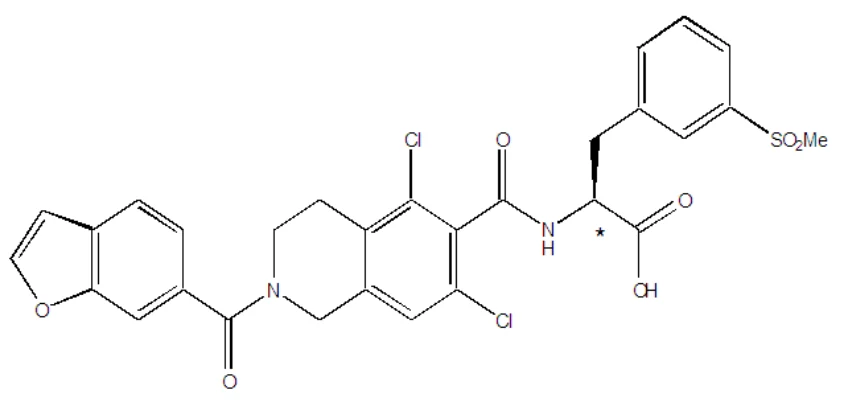
* Chiral center
Physicochemical properties: Lifitegrast is a white to off-white powder which is soluble in water, its aqueous solubility is pH dependent.
| pH | Solubility (µg/mL) |
|---|---|
| 1.2 | 0.5 |
| 3.0 | 2.0 |
| 4.0 | 20 |
| 5.0 | 166 |
| 6.0 | >1000 |
| 7.0 | >1000 |
| 8.0 | >1000 |
CLINICAL TRIALS
Study demographics and trial design
| Table 2: Summary of patient demographics for 12-week efficacy studies in Dry Eye Disease Patients | ||||||||
| Study # | Trial design | Dosage, route of administration and duration | Study subjects (n = number) | Mean age (Range) | Gender | |||
| Study 1 | Multicenter, randomized, prospective, double-masked, placebo controlled, parallel arm study; CAE used at screening | 0.1, 1.0, or 5.0% lifitegrast or placebo; single drop BID; 84 days (12 weeks) | n=230 | 62.3 years (26-91) | Male: 22.2% Female:77.8% | |||
| Study 2 | Multicenter, randomized, prospective, double-masked, placebo controlled, parallel arm study: CAE used at screening | 5.0% lifitegrast or placebo; single eye drop BID; 12 weeks | n=588 | 60.6 years (20-91) | Male: 24.1% Female:75.9% | |||
| Study 3 | Multicenter, randomized, prospective, double-masked, placebo controlled, parallel arm study; stratified by ICSS (≤1.5 or >1.5) and EDS (<60 or ≥60) in trial design; recent artificial tear use required | 5.0% lifitegrast or placebo; single eye drop BID; 12 weeks | n=718 | 58.8 years (19-97) | Male: 23.4% Female:76.6% | |||
| Study 4 | Multicenter, randomized, prospective, double-masked, placebo controlled, parallel arm study; stratified by ICSS (≤1.5 or >1.5) and EDS (<60 or ≥60) in trial design; recent artificial tear use required | 5.0% lifitegrast or placebo; single eye drop BID; 12 weeks | n=711 | 58.7 years (18-93) | Male: 24.5% Female:75.5% | |||
The effects of lifitegrast treatment on the signs and symptoms of dry eye disease were assessed in a total of 2247 subjects in four 12-week, randomized, multi-centre, double-masked, placebo-controlled studies. In all studies, subjects were randomized to XIIDRA 5% or placebo in 1:1 ratio. The majority of subjects were 55 years of age and older (68%), white (85%) and female (76%). In all studies, subjects reported a history of dry eye disease in both eyes at study entry. In studies 1 and 2, a controlled adverse environment (CAE) model was used during the screening period to identify subjects who were more susceptible to environmental stressors. In studies 3 and 4, subjects were required to have a history of recent artificial tear use. In all four studies, use of artificial tears was prohibited during the 12-week study period.
Enrolment criteria included minimal signs (i.e., Corneal Fluorescein Staining [CFS] and non-anesthetized Schirmer Tear Test (STT) and symptoms (i.e., Eye Dryness Score [EDS] and Ocular Discomfort Score [ODS]) severity scores at baseline.
Study results
Effects on Symptoms of Dry Eye Disease
Eye dryness Score (EDS) was rated by patients using a visual analogue scale (VAS) (0 = no discomfort, 100 = maximal discomfort) at each study visit. The average baseline EDS was between 40 and 70. A larger reduction in EDS favoring XIIDRA was observed in all studies at Day 42 and Day 84 (see Figure 1).
Figure 1: Mean Change (SD) from Baseline and Treatment Difference (XIIDRA – Vehicle) in Eye Dryness Score in 12-Week Studies in Patients with Dry Eye Disease
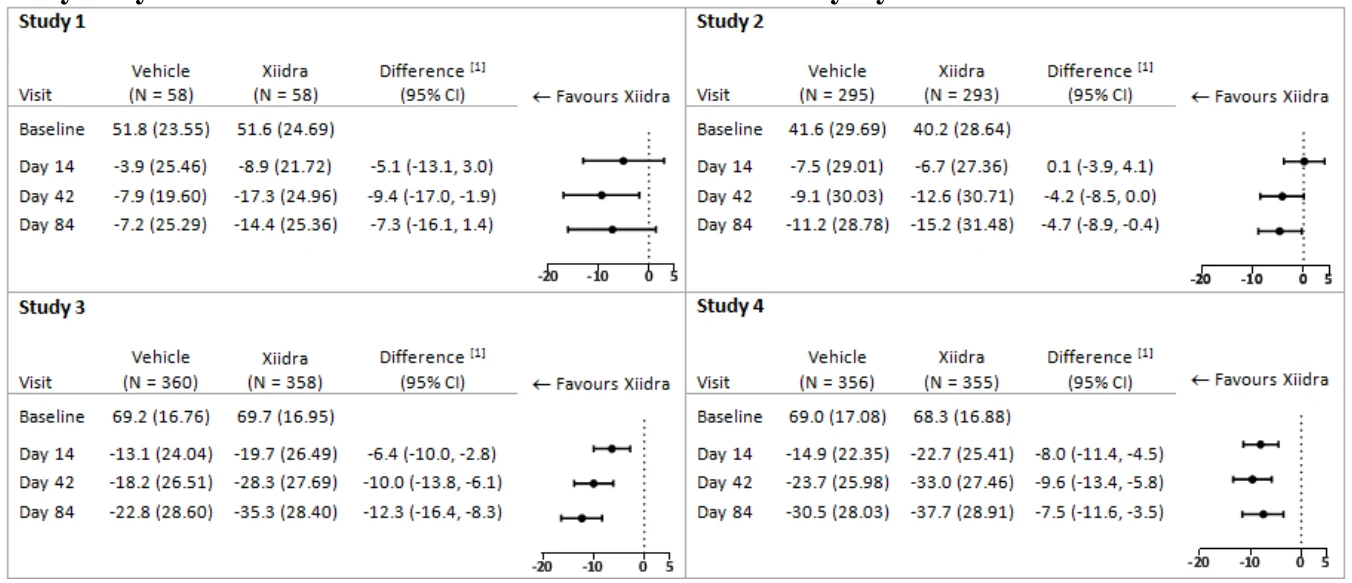
[1] Based on ANCOVA model adjusted for baseline value in Study 1, and ANCOVA model adjusted for baseline value and randomization stratification factors in Studies 2-4. All randomized and treated patients were included in the analysis and missing data were imputed using last-available data. In Study 1, one XIIDRA treated subject who did not have a baseline value was excluded from analysis.
Effects on Signs of Dry Eye Disease
Inferior fluorescein corneal staining score (ICSS) (0 = no staining, 1 = few/rare punctate lesions, 2 = discrete and countable lesions, 3 = lesions too numerous to count but not coalescent, 4 = coalescent) was recorded at each study visit. The average baseline ICSS was approximately 1.8 in Studies 1 and 2, and 2.4 in Studies 3 and 4. At Day 84, a larger reduction in ICSS favoring XIIDRA was observed in three of the four studies (see Figure 2).
Figure 2: Mean Change (SD) from Baseline and Treatment Difference (XIIDRA – Vehicle) in Inferior Corneal Staining Score in 12-Week Studies in Patients with Dry Eye Disease.
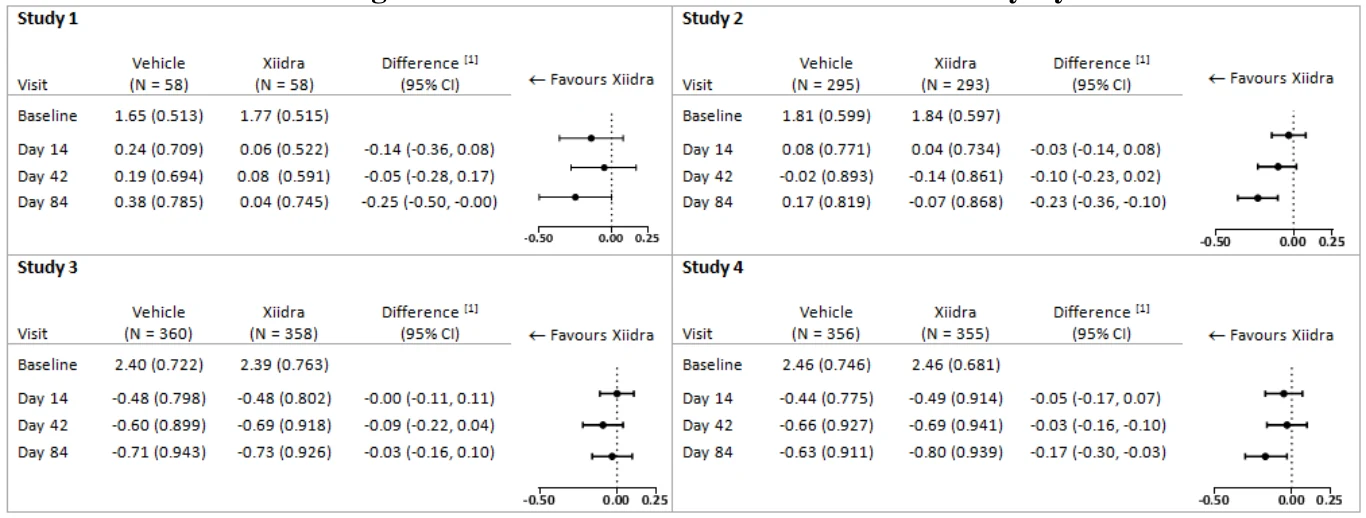
[1] Based on ANCOVA model adjusted for baseline value in Study 1, and ANCOVA model adjusted for baseline value and randomization stratification factors in Studies 2-4. All randomized and treated patients were included in the analysis and missing data were imputed using last-available data. In Study 2, one Vehicle treated subject who did not have a study eye designated was excluded from analysis.
DETAILED PHARMACOLOGY
Lifitegrast binds to the integrin lymphocyte function-associated antigen-1 (LFA-1), a cell surface protein found on leukocytes and blocks the interaction of LFA-1 with its cognate ligand intercellular adhesion molecule-1 (ICAM-1). ICAM-1 may be overexpressed in corneal and conjunctival tissues in dry eye disease. LFA-1/ICAM-1 interactions support T-cell migration and activation, which promotes the release of cytokines that sustain inflammation. In vitro studies demonstrated that lifitegrast may inhibit T-cell adhesion to ICAM-1 and may inhibit the secretion of key inflammatory cytokines in human peripheral blood mononuclear cells. The therapeutic effects of lifitegrast were demonstrated in several in vivo pharmacology studies, including a veterinary clinical study in dogs with spontaneously occurring keratoconjunctivitis sicca, in which a 1.0% dose of lifitegrast ophthalmic solution administered TID for 12 weeks resulted in improved Schirmer Tear Test scores, indicative of increased tear production. A pharmacological response in attenuating conjunctival inflammation was also observed histopathologically. In a murine model of corneal abrasion and inflammation associated with contact lens usage, topical ocular administration of lifitegrast (0.1%, 1.0% and 5.0%) prior to corneal abrasion and/or bacterial challenge, correlated with significant reduction in neutrophil infiltration at all 3 dose levels. Additional testing confirmed that lifitegrast was presence in the corneal tissue at all 3 dose levels.
In safety pharmacology studies, the IV administration of lifitegrast was shown to have no adverse effects on CNS, CV, or pulmonary functions.
TOXICOLOGY
Thirteen-week and 39-week repeat-dose ocular toxicity studies were conducted in New Zealand White rabbits and beagle dogs using the topical ocular route of administration with three times daily dosing (TID). Squinting or blinking immediately following dosing with lifitegrast was observed in both species, but was non-adverse. Other non-adverse findings in the 39-week studies included a slight increase in the severity of muscle fiber regeneration in the tongue of rabbits dosed ≥ 1.05 mg/eye/day, and minimal granulomatous inflammation of the tongue in a few dogs at the highest dose of 5.25 mg/eye/day. In both species, the no-observed-adverse-effect level (NOAEL) for ocular toxicity was 5.25 mg/eye/day (35 µL/eye of 5% formulation; TID), the highest dose tested. This NOAEL provides a 1.05-fold margin of safety in terms of total mg/day, and a 138-fold and 16-fold margin of safety when comparing systemic exposure (AUC) in rabbits and dogs, respectively, to the highest exposure reported in human clinical trials.
The NOAEL for the systemic toxicity of lifitegrast in beagle dogs following intravenous administration is 30 mg/kg/day, the highest dose tested in a 4-week study, providing a margin of safety of approximately 20,000-fold based on plasma AUC values. In rats, the NOAEL for systemic toxicity is 10 mg/kg/day, based on the following findings at 30 mg/kg/day in a 13-week intravenous study: an increase in incidence of thymic epithelial hyperplasia in females, renal/bladder/ureter and prostatic effects in one male, and testicular/epididymal effects in a second male. The NOAEL in rats provides a margin of safety of approximately 660-fold.
Since human systemic exposure to lifitegrast following ocular administration at the RHOD is low, the applicability of animal findings to the risk of XIIDRA use is unclear.
Carcinogenicity
Long-term studies in animals to evaluate carcinogenic potential of lifitegrast have not been performed on the basis that systemic exposure following topical ocular administration of lifitegrast is very low.
Genotoxicity
Lifitegrast was not mutagenic in the in vitro Ames assay. Lifitegrast also showed no evidence of clastogenicity in the in vitro chromosomal aberration assay in mammalian cells (Chinese hamster ovary cells), except at a cytotoxic concentration in the absence of metabolic activation. Lifitegrast was not clastogenic in an in vivo mouse micronucleus, indicating lack of genotoxic potential.
Reproductive and Developmental Toxicity
In a combined, reproductive and developmental toxicity study, lifitegrast at intravenous doses of up to 30 mg/kg/day, from pre-mating through gestation day 17, had no effect on fertility and reproductive performance in male and female rats. The NOAEL of 30 mg/kg/day provides for a margin of safety of approximately 5400-fold based on plasma AUC values.
In the reproductive and developmental study in rats, the NOAEL for developmental toxicity was 10 mg/kg/day based on an increase in incidence of pre-implantation loss and incidences of skeletal malformations observed at 30 mg/kg/day. The NOAEL of 10 mg/kg/day provides for a margin of safety of approximately 460-fold based on plasma AUC values.
In a developmental toxicity study in rabbits, intravenous administration of lifitegrast to pregnant rabbits during organogenesis (gestation days 7 through 19) resulted in incidences of omphalocele (an external malformation) at the lowest (3 mg/kg/day) and highest (30 mg/kg/day) doses tested. A NOAEL for developmental toxicity in the rabbit was therefore not identified. The systemic exposure (AUC) at the lowest dose was approximately 460-fold the highest exposure reported in human clinical trials.