


Product Monograph - Mandelamine
ACTION AND CLINICAL PHARMACOLOGY
Methenamine mandelate a urinary antibacterial agent, is the chemical combination of mandelic acid with methenamine. MANDELAMINE (Methenamine Mandelate Tablets U.S.P.) is available for oral use as film-coated tablets.
Methenamine mandelate is readily absorbed but remains essentially inactive until it is excreted by the kidney and concentrated in the urine. An acid urine is essential for antibacterial action, with maximum efficacy occurring at pH 5.5 or less.
Mechanism of Action
In an acid urine, mandelic acid exerts its antibacterial action and also contributes to the acidification of the urine. Mandelic acid is excreted by both glomerular filtration and tubular excretion.
Pharmacokinetics and Metabolism
The methenamine component, in an acid urine, is hydrolyzed to ammonia and to the bactericidal agent formaldehyde. There is equally effective antibacterial activity against both gram-positive and gram-negative organisms, since the antibacterial action of mandelic acid and formaldehyde is nonspecific. There are reports that methenamine mandelate is ineffective in some infections with Proteus vulgaris and urea-splitting strains of Pseudomonas aeruginosa and Aerobacter aerogenes. Since urea-splitting strains may raise the pH of the urine, particular attention to supplementary acidification, with agents such as ascorbic acid, is required. However, results in any single case will depend to a large extent on the underlying pathology and the overall management.
INDICATIONS AND USAGE
MANDELAMINE (Methenamine Mandelate Tablets U.S.P.) are indicated for the suppression or elimination of bacteriuria associated with pyelonephritis, cystitis and other urinary tract infections; also those neurologic diseases leading to an infected residual urine.
CONTRAINDICATIONS
MANDELAMINE (Methenamine Mandelate Tablets U.S.P.) are contraindicated in patients with renal and severe hepatic insufficiency. Methenamine mandelate should not be used in patients who are hypersensitive to the drug.
WARNINGS
The methenamine salts of MANDELAMINE (Methenamine Mandelate Tablets U.S.P.) should be avoided in patients with gout because these drugs may precipitate urate crystals in their urine. A similar situation may arise in patients with a predisposition to the formation of uric acid stones.
PRECAUTIONS
General
Dysuria may occur (usually at higher than recommended dosage) with the use of MANDELAMINE (Methenamine Mandelate Tablets U.S.P.). This can be controlled by reducing the dosage and the acidification. When urine acidification is contraindicated or unattainable (as with some urea-splitting bacteria), the drug is not recommended.
Information for the Patient
The patient should inform the physician if she is pregnant or is a nursing mother.
The patient should be instructed to take no other antibiotics for urinary tract infection while taking MANDELAMINE (Methenamine Mandelate Tablets U.S.P.).
Laboratory Tests
Formaldehyde interferes with fluorometric procedures for determination of urinary catecholamines and vanilmandelic acid (VMA) causing erroneously high results. Formaldehyde also causes falsely decreased urine estriol levels by reacting with estriol when acid hydrolysis techniques are used; estriol determinations which use enzymatic hydrolysis are unaffected by formaldehyde.
Formaldehyde causes falsely elevated 17-hydroxycorticosteroid levels when the Porter-Silber method is used and falsely decreases 5-hydroxy-indoleacetic acid (5H1AA) levels by inhibiting colour development when nitrosonaphthol methods are used.
Drug Interactions
Formaldehyde and sulfamethizole form an insoluble precipitate in acid urine; therefore, methenamine mandelate should not be administered concurrently with sulfamethizole, or other sulfonamides.
Carcinogenesis, Mutagenesis, Impairment of Fertility
Animal reproduction studies have not been conducted with MANDELAMINE (Methenamine Mandelate Tablets U.S.P.). It is also not known whether methenamine mandelate can cause fetal harm when administered to a pregnant woman or can affect reproduction capacity.
Usage in Pregnancy
The use of MANDELAMINE (Methenamine Mandelate Tablets U.S.P.) has not been adequately studied in pregnant women. Therefore, methenamine mandelate should be given to pregnant women only if clearly needed, and if the potential benefit outweighs the risk.
Usage in Nursing Mothers
Methenamine is excreted is human breast milk. Therefore, before considering the use of MANDELAMINE (Methenamine Mandelate Tablets U.S.P.) in nursing mothers, one should consider the decision to discontinue nursing.
Pediatric Use
See DOSAGE AND ADMINISTRATION.
ADVERSE REACTIONS
An occasional patient taking MANDELAMINE (Methenamine Mandelate Tablets U.S.P.) may experience gastrointestinal disturbance or a generalized skin rash.
Microscopic and, rarely, gross hematuria have been described.
SYMPTOMS AND TREATMENT OF OVERDOSAGE
Symptoms:
Symptoms of overdosage with MANDELAMINE (Methenamine Mandelate Tablets U.S.P.) may include gastrointestinal disturbances and urinary tract irritation.
Treatment:
Treatment consists of removal of stomach contents by lavage or emesis. Alkinization with sodium bicarbonate or sodium citrate. Force fluids.
DOSAGE AND ADMINISTRATION
Adults: MANDELAMINE (Methenamine Mandelate Tablets U.S.P.) 500 mg - 2 tablets 4 times a day.
Children over 5 years: 1 tablet 4 times daily.
Children under 5 years: 250 mg/14 kg 4 times daily.
Composition
Each brown, film-coated MANDELAMINE (Methenamine Mandelate Tablets U.S.P.) contains: methenamine mandelate 500 mg. Nonmedicinal ingredients: calcium stearate, isopropyl alcohol, povidone, silica and stearic acid; coating: candelilla wax, hydroxypropylmethylcellulose,
opaspray brown and propylene glycol. Energy: 0 kcal. Gluten-, lactose-, paraben-, sodium-, sulfite-and tartazine-free.
Stability and Storage Recommendations
Store MANDELAMINE (Methenamine Mandelate Tablets U.S.P.) at controlled room temperature 15Ε-30ΕC. Preserve in well closed containers.
AVAILABILITY AND DOSAGE FORMS
MANDELAMINE (Methenamine Mandelate Tablets U.S.P.) 500 mg are available in bottles of 100 tablets.
PHARMACEUTICAL INFORMATION
Drug Substance
Proper Name: Methenamine mandelate
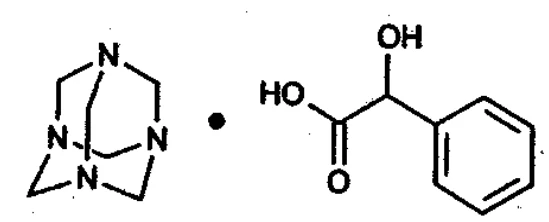
Chemical Name: Benzeneacetic acid, α-hydroxy-, (±)-, compd. With 1,3,5,7- tetraazatricyclo[3.3.1.13,7]decane (1:1).
Hexamethylenetetramine mono-(±)-mandelate
Empirical Formula: C6H12N4.C8H8O3
Molecular Weight: 292.34
Structural Formula:
REFERENCES
- 1. Kucers A, Bennet N McK. The Use of Antibiotics. 4th Edition. Lippincott Co. Philadelphia PA. 1989; pp. 1344-1348.
- 2. USPDI. 12th Edition. 1992; pp. 1861-1864.