


Product Monograph - Raptiva
SUMMARY PRODUCT INFORMATION
Route of Administration | Dosage Form / Strength | Clinically Relevant Nonmedicinal Ingredients |
| Subcutaneous injection | Lyophilized powder for reconstitution / 150 mg per vial | There are no clinically relevant nonmedicinal ingredients. For a complete listing of non-medicinal ingredients see Dosage Forms, Composition and Packaging section. |
INDICATIONS AND CLINICAL USE
RAPTIVA (efalizumab) is indicated for the treatment of moderate to severe chronic plaque psoriasis in adult patients (18 years or older) who are candidates for systemic therapy or phototherapy.
Geriatrics
The dosage and administration schedule in the elderly (≥ 65 years) should be the same as for adults (see also WARNINGS AND PRECAUTIONS).
Pediatrics
There is no experience with RAPTIVA in patients under 18 years of age. RAPTIVA is not currently indicated for pediatric patients.
CONTRAINDICATIONS
RAPTIVA is contraindicated in:
Patients who are hypersensitive to efalizumab, or to any ingredient in the formulation, or
Chinese Hamster Ovary cell proteins. For a complete listing see the DOSAGE FORMS, COMPOSITION AND PACKAGING section.
- Patients with history of malignancies or existing malignancies.
- Patients with immunodeficiencies.
- Patients with active tuberculosis and other severe infections.
WARNINGS AND PRECAUTIONS
General
RAPTIVA is an immunomodulating agent and has the potential to increase the risk or the severity of infections and reactivate latent, chronic infections. RAPTIVA should be administered with caution to patients with chronic infections or history of recurrent infections.
RAPTIVA has not been studied extensively in combination with other immunosuppressive treatments for psoriasis and should be used cautiously in this setting.
Discontinuation
Management of patients discontinuing RAPTIVA should include close observation. In case of disease recurrence, the treating physician should institute the most appropriate psoriasis treatment as necessary.
Abrupt discontinuation of RAPTIVA without substitution treatment may be followed by recurrence of psoriasis or emergence of new psoriasis morphologies, including erythrodermic and pustular psoriasis. Such recurrences have been observed in 5% to 10% of cases. According to clinical trials, if RAPTIVA was resumed upon relapse, the frequency of recurrence of psoriasis was below 1%.
Cases of inflammatory polyradiculoneuropathy have been observed in post-marketing surveillance in patients receiving RAPTIVA. Most patients improved after discontinuation of RAPTIVA, therefore RAPTIVA should be stopped following the diagnosis of inflammatory polyradiculoneuropathy.
Arthritis
Cases of arthritis have been observed (see ADVERSE REACTIONS) during treatment or after discontinuation of RAPTIVA.
Carcinogenesis and Mutagenesis
RAPTIVA is an immunomodulating agent and has the potential to increase the risk of malignancy. However, the relationship between RAPTIVA and increased risk of malignancies and lymphoproliferative disorders has not been established due to the small observation period of clinical trials. RAPTIVA should be discontinued if a malignancy develops while a patient is in treatment.
Long-term animal studies have not been conducted to evaluate the carcinogenic potential of efalizumab. Studies in mice, sensitive to lymphoma induction, using analogous antibody (muM17) that selectively inhibits mouse CD11a functional activity revealed no evidence of lymphoma development or any other neoplasia when administered up to 30 mg/kg/week subcutaneously (SC) for 6 months (see TOXICOLOGY).
Hematologic
Thrombocytopenia
Thrombocytopenia may occur during treatment with RAPTIVA and may be associated with clinical signs such as echimoses, spontaneous bruising or bleeding from muco-cutaneous tissues. If any of these manifestations occur, efalizumab treatment should be stopped immediately, a platelet count should be performed and appropriate symptomatic treatment should be instituted immediately (see WARNINGS AND PRECAUTIONS – Monitoring and Laboratory Tests and ADVERSE REACTIONS). Assessment of platelet counts is recommended upon initiating and periodically while receiving RAPTIVA treatment. It is recommended that assessments be more frequent when initiating the therapy (e.g., monthly) and may decrease in frequency as the treatment continues (e.g., every 3 months).
Hemolytic Anemia
Hemolytic anemia may occur during treatment with RAPTIVA. In post-marketing surveillance, rare cases of severe hemolytic anemia have been reported during treatment with RAPTIVA. RAPTIVA should be discontinued immediately if hemolytic anemia occurs.
Immune
RAPTIVA is an immunomodulating agent that alters T-lymphocyte function and may affect host defense against infections. Patients who develop a severe infection while undergoing treatment with RAPTIVA should be monitored and according to severity, RAPTIVA should be discontinued. RAPTIVA should be used with caution in patients with a history of clinically significant recurrent infections.
Immunizations
Limited data are available on the effects of vaccination or on the secondary transmission of infection by live vaccines in patients receiving RAPTIVA. Neo-vaccinations given during treatment with RAPTIVA may induce antibody levels lower than those observed in non-treated subjects, but the clinical significance of this is unknown. Patients should not receive live and live attenuated vaccines during RAPTIVA treatment. Before vaccination, treatment with RAPTIVA should be withheld for 6 weeks and can resume 2 weeks after vaccination (see DRUG INTERACTIONS).
Sensitivity
As for any recombinant product, RAPTIVA is potentially immunogenic. Consequently, if any serious hypersensitivity or allergic reaction occurs, RAPTIVA should be discontinued immediately and appropriate therapy initiated (see ADVERSE REACTIONS).
Sexual Function/Reproduction
In a fertility and general reproduction study with an analogue antibody, no adverse effects were noted on mating, fertility, or reproduction parameters in male and female mice.
Skin
Psoriasis
During treatment with RAPTIVA, cases of exacerbation of psoriasis (worsening and/or change in morphology), including pustular, erythrodermic and guttate subtypes of psoriasis have been
observed (see ADVERSE REACTIONS). The majority of these cases occurred in non-responders. In such cases, it is recommended to discontinue treatment with RAPTIVA.
Abrupt discontinuation of RAPTIVA may cause a recurrence or exacerbation of plaque psoriasis including erythrodermic and pustular psoriasis.
Special Populations
Pregnant Women: In general, immunoglobulins are known to cross the placental barrier. There is only incidental clinical experience with efalizumab in pregnant women. RAPTIVA should not be given to a pregnant woman, and women of childbearing potential should be advised to use appropriate contraception. In a developmental toxicity study conducted in mice using an analogous antibody that selectively inhibits mouse CD11a functional activity, no evidence of maternal toxicity, embryotoxicity, or teratogenicity was observed.
In a perinatal/postnatal reproduction toxicity study, no adverse effects on behavioral and reproductive parameters were observed in male and female offspring (F1 generation) of female mice exposed to an analogous antibody during gestation and lactation. A reduction in the primary antibody response was observed in F1 generation male and female mice at 11 weeks of age. Sibling F1 mice tested at 25 weeks of age, however, were able to mount a primary antibody response that did not vary significantly from control animals.
Nursing Women: It is not known whether RAPTIVA is excreted in human milk or absorbed systemically after ingestion. Many drugs and immunoglobulins are excreted in human milk, and an antibody analogous to efalizumab was detected in maternal milk samples in mice. There is the potential for serious adverse reactions in nursing infants from RAPTIVA. Therefore women should not breastfeed during treatment with RAPTIVA.
Pediatrics: The safety and effectiveness of RAPTIVA in pediatric patients (< 18 years old) has not been established. RAPTIVA should not be administered to pediatric patients (< 18 years old).
Geriatrics: No differences in safety or efficacy were observed between elderly (≥ 65 years) patients and younger patients. As there is a higher incidence of infections in the elderly population in general, caution should be used in treating the elderly.
Renal and Hepatic Impairment: RAPTIVA has not been studied in patients with renal or hepatic impairment and should therefore be used with caution in such patients (see ADVERSE REACTIONS).
Monitoring and Laboratory Tests:
Assessment of platelet counts is recommended upon initiating and periodically while receiving RAPTIVA treatment. It is recommended that assessments be more frequent when initiating the therapy (e.g., monthly) and may decrease in frequency as the treatment continues (e.g., every 3 months). Immune-mediated thrombocytopenia and hemolytic anemia have been observed during
the treatment with RAPTIVA. (see WARNINGS AND PRECAUTIONS, Hematologic).
ADVERSE REACTIONS
Adverse Drug Reaction Overview
The most serious adverse drug reactions (ADRs) observed during treatment with RAPTIVA in clinical trials or from post-marketing experience are: serious infections, malignancies, thrombocytopenia, hemolytic anemia, arthritis events, and psoriasis worsening and variants (see WARNINGS AND PRECAUTIONS).
The most common ADRs observed during RAPTIVA therapy were mild to moderate dose-related acute flu-like symptoms including headache, fever, chills, nausea and myalgia. In large placebo-controlled clinical studies, these reactions were observed in approximately 41% of RAPTIVA-treated patients and in 24% of placebo-treated patients over 12 weeks of treatment. Headache was the most prevalent type of flu-like symptoms. These reactions were greatest with the first dose administration, decreasing with the second and subsequent doses. Severe acute events of headache, chills, fever and myalgia were reported only in the efalizumab-treated subjects affecting 3.6% of subjects.
Antibodies to efalizumab were detected in only 6% of patients. In this small number of patients no differences were observed in pharmacokinetics, pharmacodynamics, clinically noteworthy adverse events or clinical efficacy.
Clinical Trial Adverse Drug Reactions
As clinical trials are conducted under very specific conditions the adverse reaction rates observed in the clinical trials may not reflect the rates observed in practice and should not be compared to the rates in the clinical trials of another drug. Adverse drug reaction information from clinical trials is useful for identifying drug-related adverse events and for approximating rates.
Summary listing of Adverse Events
Adverse events seen in four randomized, double-blind, placebo-controlled clinical trials (ACD2058g, ACD2059g, ACD2390g, ACD2600g) of 12 weeks of treatment in patients with moderate to severe plaque psoriasis are listed in the table below by body system and frequency of occurrence in the efalizumab group.
All Adverse Events occurring with incidence ≥ 1% in either group Studies ACD2058g, ACD2059g, ACD2390g and ACD2600g (FT Period*)
| COSTART Body System | COSTART Preferred Term | Placebo (N=715) | efalizumab 1.0mg/kg/wk (N=1213) |
| Body as a Whole | HEADACHE INFECTION CHILLS PAIN FEVER ASTHENIA FLU SYNDROME ACCIDENTAL INJURY BACK PAIN ABDOMINAL PAIN VIRAL INFECTION CHEST PAIN MALAISE ALLERGIC REACTION INFECTION BACTERIAL INJECTION SITE PAIN LAB TEST ABNORMAL CYST NECK PAIN PHOTOSENSITIVITY REACTION | 159 (22.2%) 110 (15.4%) 32 (4.5%) 38 (5.3%) 24 (3.4%) 37 (5.2%) 29 (4.1%) 45 (6.3%) 14 (2.0%) 6 (0.8%) 8 (1.1%) 4 (0.6%) 5 (0.7%) 6 (0.8%) 4 (0.6%) 7 (1.0%) 7 (1.0%) 2 (0.3%) 11 (1.5%) 7 (1.0%) | 391 (32.2%) 166 (13.7%) 154 (12.7%) 122 (10.1%) 80 (6.6%) 81 (6.7%) 83 (6.8%) 68 (5.6%) 50 (4.1%) 25 (2.1%) 27 (2.2%) 20 (1.6%) 18 (1.5%) 14 (1.2%) 15 (1.2%) 14 (1.2%) 16 (1.3%) 13 (1.1%) 8 (0.7%) 6 (0.5%) |
| Cardiovascular | MIGRAINE HYPERTENSION VASODILATATION | 2 (0.3%) 6 (0.8%) 11 (1.5%) | 16 (1.3%) 12 (1%) 11 (0.9%) |
| Digestive | NAUSEA DIARRHEA VOMITING GASTROENTERITIS DYSPEPSIA | 51 (7.1%) 48 (6.7%) 12 (1.7%) 24 (3.4%) 6 (0.8%) | 128 (10.6%) 72 (5.9%) 26 (2.1%) 29 (2.4%) 15 (1.2%) |
| Hemic/Lymphatic | ECCHYMOSIS LYMPHADENOPATHY | 11 (1.5%) 6 (0.8%) | 17 (1.4%) 17 (1.4%) |
| Metabolic/Nutritional | PERIPHERAL EDEMA | 18 (2.5%) | 47 (3.9%) |
| Musculo-skeletal | MYALGIA ARTHRALGIA ARTHRITIS | 35 (4.9%) 19 (2.7%) 16 (2.2%) | 102 (8.4%) 52 (4.3%) 29 (2.4%) |
| Nervous | DIZZINESS PARESTHESIA INSOMNIA DEPRESSION HYPERTONIA | 21 (2.9%) 16 (2.2%) 9 (1.3%) 7 (1%) 15 (2.1%) | 41 (3.4%) 19 (1.6%) 17 (1.4%) 12 (1%) 9 (0.7%) |
| Respiratory | PHARYNGITIS RHINITIS SINUSITIS COUGH INCREASED BRONCHITIS LUNG DISORDER | 47 (6.6%) 46 (6.4%) 34 (4.8%) 31 (4.3%) 9 (1.3%) 7 (1%) | 88 (7.3%) 81 (6.7%) 63 (5.2%) 48 (4.0%) 27 (2.2%) 6 (0.5%) |
| Skin/Appendages | HERPES SIMPLEX ACNE PRURITUS PSORIASIS | 24 (3.4%) 4 (0.6%) 34 (4.8%) 10 (1.4%) | 49 (4.0%) 45 (3.7%) 37 (3.1%) 39 (3.2%) |
| COSTART Body System | COSTART Preferred Term | Placebo (N=715) | efalizumab 1.0mg/kg/wk (N=1213) |
RASH URTICARIA | 20 (2.8%) 3 (0.4%) | 37 (3.1%) 16 (1.3%) | |
| Special Senses | CONJUNCTIVITIS DEAFNESS OTITIS MEDIA EAR PAIN EAR DISORDER | 10 (1.4%) 5 (0.7%) 9 (1.3%) 6 (0.8%) 8 (1.1%) | 28 (2.3%) 13 (1.1%) 18 (1.5%) 14 (1.2%) 10 (0.8%) |
| Urogenital | URINARY TRACT INFECTION | 9 (1.3%) | 19 (1.6%) |
* FT Period = First Treatment Period
The adverse event profile in study IMP 24011(CLEAR) is similar to that observed in the above clinical trials.
In addition, the long-term open-label study, ACD2243g did not show any noteworthy differences in frequency of adverse events as compared to 12 weeks of exposure to RAPTIVA. The incidence rate of adverse events decreases over time.
Additional Information
Psoriasis: In the first 12 weeks of placebo-controlled studies, the rate of psoriasis adverse events was 3.2% in the RAPTIVA-treated patients and 1.4% in the placebo-treated patients. Among 3291 patients in the combined safety database, 39 patients presented an erythrodermic or pustular psoriasis (1.2%). Seventeen of these events occurred after discontinuation of RAPTIVA, while 22 occurred during treatment. In the cases occurring during treatment, most of these events (16/22) occurred in patients presenting no response to RAPTIVA. Cases occurring after discontinuation were observed both in patients responding or not responding to RAPTIVA treatment. In the integrated safety database, 19 (0.7%) of subjects experienced a serious adverse event of psoriasis.
Psoriatic arthritis: In the first 12 weeks of placebo-controlled studies, psoriatic arthritis and exacerbation or flare of psoriatic arthritis were observed in 1.8% of both the RAPTIVA-treated patients and the placebo-treated patients. In these studies, the incidence of other types of arthritis-related adverse events was similar between the RAPTIVA and placebo groups.
Flu-like syndrome: In large placebo-controlled clinical studies, approximately 17% of subjects in excess of placebo reported flu-like symptoms including headaches, chills, fever, nausea and myalgia. The percentage of subjects reporting flu-like symptoms was greatest with the first injection and decreased by more than 50% with the second injection. These symptoms diminished thereafter to a percentage comparable to that of subjects treated with placebo. Headache was the most prevalent component of flu-like symptoms. None of these events were serious and less than 3.6% were considered severe. Overall less than 1% of subjects discontinued therapy because of acute flu-like symptoms.
Hypersensitivity and allergic disorders: RAPTIVA is potentially immunogenic, and may cause exacerbation of pre-existing allergic disorders. In large placebo-controlled clinical studies, the percentage of subjects experiencing adverse events suggestive of hypersensitivity, including
urticaria, rash and allergic reactions was slightly higher in the RAPTIVA group (8%) than in the placebo group (7%). No case of anaphylaxis has been reported with the use of RAPTIVA in these clinical studies but was reported in the post-marketing setting (see WARNINGS AND PRECAUTIONS).
Infections: RAPTIVA is an immunomodulating agent that alters T-lymphocyte function. Treatment with RAPTIVA may be associated with increased risk of developing serious infections. In placebo-controlled clinical trials, infection rates were 27.3% in RAPTIVA-treated patients versus 24.0% in placebo-treated patients. In both controlled and uncontrolled studies, the overall incidence of hospitalization for infections was 1.6 per 100 patient-years for RAPTIVA-treated patients compared with 1.2 per 100 patient-years for placebo-treated patients.
During the 12 weeks of controlled clinical trials, serious infections were reported for 0.4% of RAPTIVA-treated subjects versus 0.1% of placebo-treated subjects. Serious infections included pneumonia, cellulitis, abscess, sepsis, sinusitis, bronchitis, gastroenteritis, aseptic meningitis, Legionnaire's disease, septic arthritis, and vertebral osteomyelitis (see WARNINGS AND PRECAUTIONS). No opportunistic infections, including reactivation of tuberculosis, were reported during clinical trials.
Less Common Clinical Trial Adverse Drug Reactions (<1%)
All Adverse Events occurring with incidence <1% in the efalizumab group Studies ACD2058g, ACD2059g, ACD2390g and ACD2600g (FT Period*)
COSTART Body
System
COSTART Preferred Term
Body as a Whole
Neck pain, Photosensitivity reaction, Cellulitis, Neck rigidity, Face edema, Injection site reaction, Injection site hypersensitivity, Infection fungal, Flank pain, Abscess, Granuloma, Hernia, Infection parasitic, Axillary moniliasis, Hangover effect, Hormone level altered, Immunoglobulins increased, Injection site inflammation, Injection site mass, Pelvic pain, Polyserositis, Sarcoidosis, Sepsis
Cardiovascular
Vasodilatation, Hypertension, Syncope, Atrial fibrillation, Peripheral vascular disorder, Arrhythmia, Cardiovascular disorder, Congestive heart failure, Coronary artery disorder, Hemorrhage, Palpitation, Vascular disorder, Angina pectoris, Arteriospasm, Cardiomegaly, Myocardial infarct, Phlebitis, Postural hypotension, Supraventricular tachycardia, Tachycardia, Varicose vein, Vascular anomaly
Digestive
Dry mouth, Anorexia, Constipation, Periodontal abscess, Tooth disorder, Gastrointestinal disorder, Tooth caries, Ulcerative stomatitis, Aphthous stomatitis, Flatulence, Gastrointestinal hemorrhage, Gingivitis, Mouth ulceration, Rectal disorder, Thirst, Colitis, Gastritis, Glossitis, Liver function tests abnormal, Enteritis, Gum hemorrhage, Oral moniliasis, Rectal hemorrhage, Abnormal stools, Cholecystitis, Dysphagia, Increased appetite, Increased salivation, Stomatitis
Endocrine Diabetes mellitus, Goiter
Hemic/Lymphatic
Anemia, Hypochromic anemia, Leukocytosis, Leukopenia, Thrombocythemia, Thrombocytopenia, Fibrinogen increased, Lymphocytosis, Petechia
Metabolic/Nutritional
Hyperglycemia, SGPT increased, Edema, SGOT increased, Creatine phosphokinase increased, Hypercholesteremia, Gout, Alkaline phosphatase increased, Dehydration, Generalized edema, Hyperkalemia, Hyperphosphatemia, Hypokalemia, Healing abnormal, Hyperchloremia, Hyperlipemia, Hypoglycemia, Weight loss
COSTART Body
System
COSTART Preferred Term
Musculo-skeletal
Leg cramps, Tendon disorder, Joint disorder, Myasthenia, Arthrosis, Bone pain, Bone disorder, Bursitis, Twitching
Nervous
Depression, Somnolence, Hypertonia, Anxiety, Nervousness, Vertigo, Facial paralysis, Libido decreased, Tremor, Agitation, Confusion, Hyperesthesia, Thinking abnormal, Abnormal dreams, Emotional lability, Incoordination, Movement disorder, Myelitis, Neuralgia, Reflexes decreased
Respiratory
Dyspnea, Lung disorder, Asthma, Pneumonia, Epistaxis, Laryngitis, Voice alteration, Sputum increased, Hyperventilation, Laryngismus, Bronchiolitis, Hemoptysis, Pleural disorder, Skin/Appendages
Sweating, Nail disorder, Fungal dermatitis, Contact dermatitis, Maculopapular rash, Skin neoplasm, Alopecia, Dry skin, Eczema, Furunculosis, Vesiculobullous rash, Pustular rash, Skin hypertrophy, Angioedema, Exfoliative dermatitis, Herpes zoster, Skin carcinoma, Skin disorder, Skin ulcer, Hair disorder, Seborrhea, Skin discoloration, Subcutaneous nodule, Erythema multiforme, Miliaria
Special Senses
Tinnitus, Taste perversion, Otitis externa, Eye pain, Lacrimation disorder, Amblyopia, Cataract nos, Dry eyes, Taste loss, Abnormal vision, Blepharitis, Diplopia, Scleritis, Exophthalmos, Eye disorder, Photophobia, Visual field defect, Vitreous disorder Urogenital
Kidney calculus, Hematuria, Albuminuria, Cystitis, Vaginitis, Dysuria, Glycosuria, Menorrhagia, Pyuria, Urinary frequency, Breast pain, Vaginal moniliasis, Amenorrhea, Breast neoplasm, Menstrual disorder, Abnormal ejaculation, Abortion, Calcium crystalluria, Cervix disorder, Dysmenorrhea, Metrorrhagia, Nephrosis, Polyuria, Urinary incontinence, Urinary urgency, Urination impaired, Uterine hemorrhage
* FT Period = First Treatment Period
Application site reaction: Injection site reactions have been reported with an incidence rate of less than 1%.
Neoplasms - benign and malignant: In placebo-controlled clinical trials, the overall incidences of malignancy (the majority of which were non-melanoma skin cancers) were similar in RAPTIVA-treated patients and in placebo-treated patients. In addition, the incidences of specific tumours in RAPTIVA patients (such as lymphoma), were in line with those observed in control psoriasis populations. Among psoriasis patients who received RAPTIVA at any dose, the overall incidence of malignancies of any kind was 1.7 per 100 patient-years for RAPTIVA-treated patients compared with 1.6 per 100 patient-years for placebo-treated patients. 12 week-treatment with RAPTIVA during placebo-controlled clinical trials has demonstrated that the rate of malignancies was within the expected range in the psoriatic population.
Abnormal Hematologic and Clinical Chemistry Findings
Leucocytosis and lymphocytosis: In large placebo-controlled clinical studies, between 40 and 50% of subjects developed sustained asymptomatic reversible lymphocytosis during RAPTIVA therapy. All values were between 2.5 fold and 3.5 fold the ULN (Upper Limit of Normal). Lymphocyte count returned to baseline after therapy discontinuation. A slight elevation in absolute neutrophil count and eosinophil count were observed but in a smaller proportion of patients (approximately 10%).
Thrombocytopenia: In the combined safety database of 3291 RAPTIVA-treated patients, there were nine occurrences (0.3%) of reversible thrombocytopenia (with less than 52,000 cells per µl) reported. Four of these patients had clinical signs of thrombocytopenia. Based on available platelet count measurements, the onset of platelet decline was between 8 and 12 weeks after the first dose of RAPTIVA in 5 patients, but occurred later in the other patients. In one patient, thrombocytopenia occurred 3 weeks after treatment discontinuation. The platelet count nadirs occurred between 12 and 72 weeks after the first dose of RAPTIVA. (See WARNINGS AND PRECAUTIONS).
Hemolytic Anemia: In clinical trials, two reports of hemolytic anemia were observed. Additional cases have been reported in the post-marketing setting.
Elevation of alkaline phosphatase: In large placebo-controlled clinical studies approximately 4.5% of patients developed sustained elevation of alkaline phosphatase throughout RAPTIVA therapy compared to 1% of placebo patients. All values were between 1.5 fold and 3 fold the ULN, and returned to baseline levels after therapy discontinuation.
Elevation of ALT: About 5.7% of patients developed elevation in ALT during RAPTIVA therapy compared to 3.5% in placebo. All occurrences were asymptomatic and values above 2.5 fold ULN were not more frequent in RAPTIVA group than in the placebo group. All values returned to baseline levels upon therapy discontinuation.
Post-Market Adverse Drug Reactions
In post-marketing surveillance, aseptic meningitis has been reported; quantification of frequency has not been determined but the frequency is likely to be rare. Reports of severe thrombocytopenia, severe infections and rare cases of hemolytic anemia have been received post-marketing. Post-marketing reports of serious infections include necrotizing fasciitis and tuberculous pneumonia.
Cases of inflammatory polyradiculoneuropathy have been observed in post-marketing surveillance in patients receiving RAPTIVA. Most patients improved after discontinuation of RAPTIVA, therefore RAPTIVA should be stopped following the diagnosis of inflammatory polyradiculoneuropathy.
DRUG INTERACTIONS
Overview
There have been no formal drug interaction studies conducted with RAPTIVA. For a monoclonal antibody, no interactions with cytochrome P450 enzyme metabolism are anticipated.
Limited data are available on the effects of vaccination or on the secondary transmission of infection by live vaccines in patients receiving RAPTIVA. Patients should not receive live and live-attenuated vaccines during RAPTIVA treatment. (See WARNINGS AND PRECAUTIONS)
Interactions with food, herbal products and laboratory tests have not been established.
Drug-Drug Interactions
The interaction of RAPTIVA with other systemic antipsoriatic therapies, such as cyclosporin, methotrexate or oral retinoids, has not been formally studied. Limited data from clinical studies has been accumulated on concomitant use of RAPTIVA and methotrexate, oral retinoids, UVB phototherapy, non-steroidal anti-inflammatory drugs (NSAIDs) and topical antipsoriastic agents. (ACD2243g, HUPA600). RAPTIVA should be administered with caution in combination with these medications.
Given the mechanism of action of RAPTIVA it is not recommended to use RAPTIVA in combination with other immunosuppressive drugs.
RAPTIVA has been used in combination with topical corticosteroids in psoriasis patients. Concomitant use of these treatments did not appear to affect safety. Use of such combinations did not result in improved efficacy compared to use of RAPTIVA alone.
DOSAGE AND ADMINISTRATION
Dosing Considerations
Before initiating a patient on RAPTIVA therapy, please review completely the CONTRAINDICATIONS and WARNINGS AND PRECAUTIONS sections of the Product Monograph.
RAPTIVA is intended for use under the guidance and supervision of a health care professional. Patients may self-inject the subcutaneous injection following proper training in measurement of the correct dose and in injection technique.
Fever and flu-like symptoms can be treated with acetaminophen or a non-steroidal anti-inflammatory drug (NSAID). Pre-medication with these drugs may decrease the incidence of these events and further increase the tolerability of RAPTIVA.
Recommended Dose and Dosage Adjustment
RAPTIVA should be administered as an initial single 0.7 mg/kg body weight dose followed by weekly injections of 1.0 mg/kg body weight. The maximum single dose should not exceed a total of 200 mg. The volume to be injected should be calculated as follows:
Dose Volume to be injected per 10 kg body weight
| Single initial dose: 0.7 mg/kg | 0.07 mL |
| Subsequent doses: 1.0 mg/kg | 0.1 mL |
RAPTIVA is administered as a subcutaneous injection. Injection sites should be rotated.
Missed Dose
If a patient misses a dose of RAPTIVA, it is recommended that the dose be given as soon as it is remembered, however, the dose should not be doubled.
Reconstitution
RAPTIVA should be administered using the sterilized, disposable syringe and needles provided (see DOSAGE FORMS, COMPOSITION AND PACKAGING). Remove the cap from the pre-filled syringe containing Sterile Water for Injection for reconstitution. Attach needle to syringe. Remove the plastic cap protecting the rubber stopper of the RAPTIVA vial and wipe the top of the rubber stopper with an alcohol swab. After cleaning with the alcohol swab, do not touch the top of the vial. To prepare the RAPTIVA solution, using the provided pre-filled diluent syringe slowly inject the 1.3 mL of Sterile Water for Injection into the RAPTIVA vial. Swirl the product vial with a GENTLE rotary motion to dissolve the product. DO NOT SHAKE. (Shaking will cause foaming of the RAPTIVA solution.) Generally, dissolution of RAPTIVA takes less than 5 minutes.
Reconstitute immediately before use and use only once. Although not recommended, the solution may be stored at 2 to 8 °C for up to 24 hours.
The reconstituted solution should be clear to slightly opalescent and colorless to pale yellow.
In the absence of compatibility studies, this medicinal product must not be mixed with other medicinal products.
No other medications should be added to solutions containing RAPTIVA. RAPTIVA should not be reconstituted with other diluents.
Administration
Visually inspect the solution for particulate matter and discolouration prior to administration. The solution should not be used if discoloured or cloudy or if particulate matter remains. Invert the vial and taking care to keep the needle below the level of the liquid, draw up the solution into the syringe, removing from the vial more than the dose to be given. Check the syringe for bubbles while keeping the needle in the vial. Gently tap the syringe and push the plunger up until the liquid in the syringe is equal to the dose that was prescribed.
Replace the needle on the syringe with a new needle. Do not touch the needle or allow the needle to come in contact with anything.
Sites for self-injection include buttocks, thigh, abdomen, or upper arm. Injection sites should be rotated.
Following administration, discard any unused reconstituted RAPTIVA solution.
OVERDOSAGE
In a clinical study, where subjects were exposed to higher doses of efalizumab (up to 10 mg/kg/wk IV, where 1 mg/kg/wk IV efalizumab is approximately equivalent to 2 mg/kg/wk SC), one subject receiving 3 mg/kg IV dose experienced hypertension, chills, and fever on the day of study drug dosing, which required hospitalization. Another subject who received a single dose of 10 mg/kg IV experienced severe vomiting following administration of RAPTIVA, which also required hospitalization. Both occurrences fully resolved without any clinical sequelae. Doses up to 4 mg/kg/wk SC for 10 weeks have been administered without any toxic effect.
There is no known antidote to RAPTIVA or any specific treatment for RAPTIVA overdose other than withholding treatment and patient observation. In case of overdose, it is recommended that the patient be monitored under close medical care and appropriate symptomatic treatment instituted immediately.
ACTION AND CLINICAL PHARMACOLOGY
Mechanism of Action
Efalizumab is a recombinant humanized monoclonal antibody that binds specifically to the CD11a subunit of LFA-1 (lymphocyte function-associated antigen-1), a leukocyte cell surface protein.
By this mechanism, efalizumab inhibits the binding of LFA-1 to ICAM-1, which interferes with T lymphocytes adhesion to other cell types. LFA-1 is present on activated T-lymphocytes, and ICAM-1 is up-regulated on endothelial cells and keratinocytes in psoriasis plaques. By preventing LFA-1/ICAM binding, efalizumab may alleviate signs and symptoms of psoriasis by inhibiting several stages in the immunologic cascade (Jullien 2004):
- Inhibition of primary T-lymphocyte activation in lymph nodes (including T-lymphocyte proliferation, interleukin-2 (IL-2) receptor expression, CD11a expression, and cytokine release);
- Inhibition of T-lymphocyte binding to endothelial cells and trafficking to psoriatic lesions;
- Inhibition of T-lymphocyte reactivation in dermis/epidermis and interaction with keratinocytes.
Pharmacodynamics
In studies using an initial dose of 0.7 mg/kg followed by 11 weekly doses of 1.0 mg/kg/wk, efalizumab maximally and reversibly reduced expression of CD11a on circulating T-lymphocytes to approximately 15-30% of pre-dose baseline values and CD11a binding site availability to drop to <5%. The full effect was seen 24 to 48 hours after the first dose, and was maintained between weekly SC doses. Within 5 to 8 weeks following the 12th and final dose of 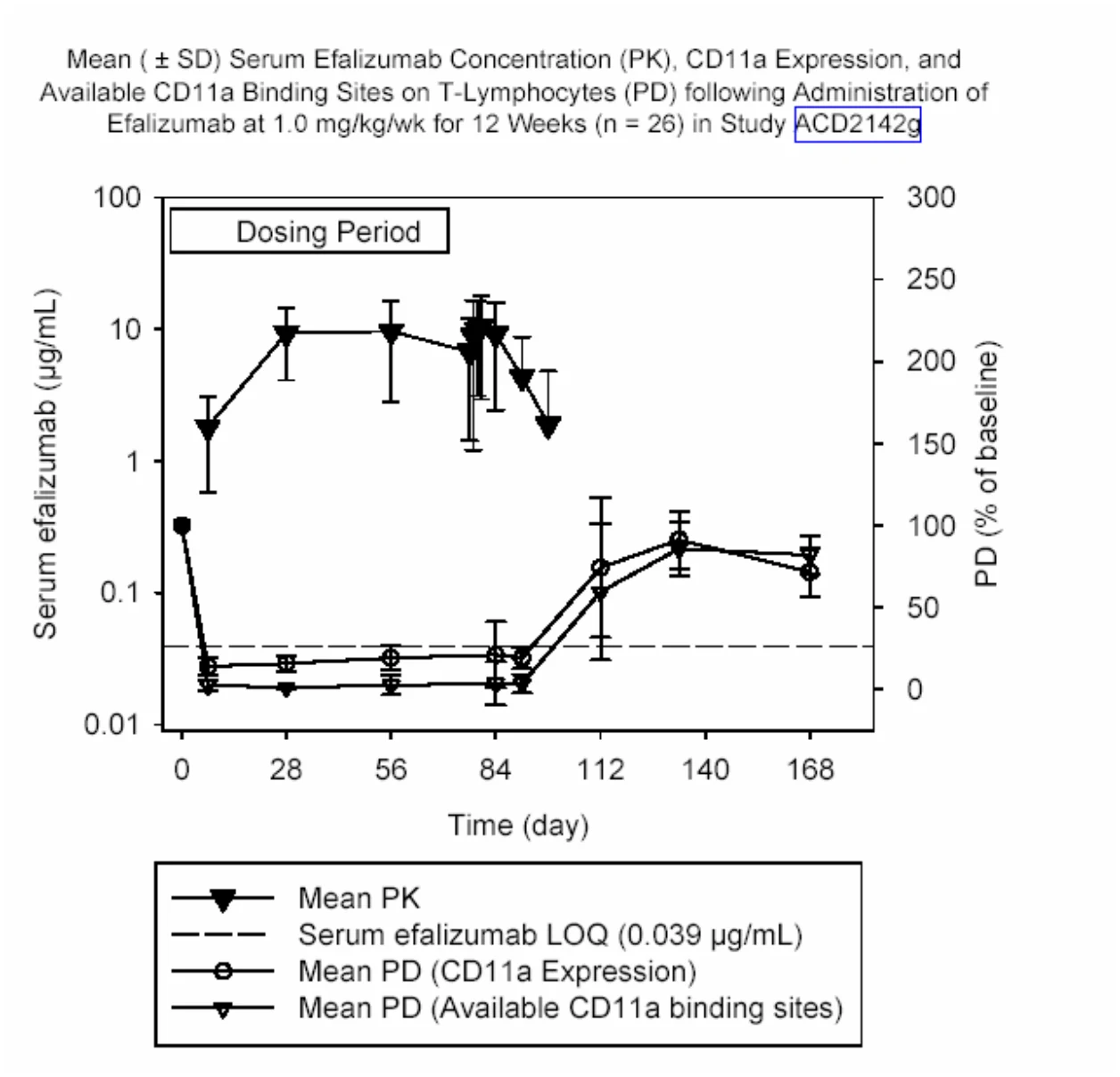
efalizumab administered at 1.0 mg/kg/wk, CD11a levels returned to within 25% of baseline values.
Another pharmacodynamic marker, consistent with the mechanism of action of efalizumab, was the reversible increase in the absolute counts of circulating leukocytes observed during efalizumab treatment. Increased absolute counts were apparent within 24 hours of the first dose, remained elevated with weekly dosing, and returned to baseline after treatment cessation. The largest increase occurred in the absolute count of circulating lymphocytes. In clinical trials, mean lymphocyte counts approximately doubled relative to baseline in subjects receiving 1.0 mg/kg/wk of RAPTIVA. The increase included CD4 T-lymphocytes, CD8 T-lymphocytes, B-lymphocytes, and natural killer (NK) cells, although NK cells and CD4 cells increased less relative to other cell types. At a dose of 1.0 mg/kg/wk subcutaneous efalizumab, lymphocyte levels returned to within 10% of baseline by 8 weeks post last dose. The reversible increase in circulating lymphocytes may reflect decreased T-cell migration into skin, demargination, or
release from lymph nodes or skin, as a result of CD11a blockade. No depletion in T-cells was noted.
Pharmacokinetics
Summary of RAPTIVA’s Pharmacokinetics Parameters in adult patients
| Dose | Cmax | t1/2 | AUC0-t | Clearance | Volume of Distribution |
| 1.0mg/kg/wk | 12.4 µg/mL | 5.5-10.5 days* | 67.7 ± 45.0 µg•day/mL | 24±18mL/kg/day | 110 mL/kg (0.03mg/kg IV dose) 58 mL/kg (10mg/kg IV dose) |
*Actual t1/2 at the lower end of this range
Distribution
Efalizumab shows non-linear pharmacokinetics with disproportionate increases in AUC with increasing doses. This may be due to the saturation of the CD11a receptor on leukocytes.
Steady state was achieved at week 4. At the 1 mg/kg/wk dose level (with an initial dose of 0.7 mg/kg the first week), mean efalizumab plasma trough values were 11.1±7.9 µg/mL. Measurements of volume of distribution of the central compartment after single intravenous doses were 110 mL/kg at dose 0.03 mg/kg and 58 mL/kg at dose 10 mg/kg.
Excretion
Efalizumab is cleared by nonlinear saturable elimination (dose dependent). Mean steady state clearance is 24 mL/kg/day (range 5-76 mL/kg/day) at 1 mg/kg/day subcutaneous. The elimination half-life was about 5.5-10.5 days at 1 mg/kg/day subcutaneous. Tend at steady state is 25 days (range 13-35 days). Weight is the most significant covariate affecting efalizumab clearance. The clearance of efalizumab was not significantly affected by gender, race, baseline PASI, baseline lymphocyte count, and age.
Absorption
After subcutaneous administration of efalizumab peak plasma concentrations are reached after 1-2 days. Comparison with intravenous data indicated an average bioavailability of about 50% at the recommended dose level of 1.0 mg/kg/wk subcutaneous.
Biotransformation
The metabolism of efalizumab is through internalisation followed by intracellular degradation as a consequence of either binding to cell surface CD11a or through endocytosis. The expected degradation products are small peptides and individual amino acids, which are eliminated by glomerular filtration. Cytochrome P450 enzymes as well as conjugation reactions are not involved in the metabolism of efalizumab.
Non-linearity
Efalizumab shows dose-dependent nonlinear pharmacokinetics, which can be explained by its saturable specific binding to cell surface receptors CD11a. It appeared that the receptor-mediated
clearance of efalizumab was saturated when plasma efalizumab concentrations were above 1 µg/mL.
Through population pharmacokinetic analysis, weight was found to affect efalizumab clearance. Covariates such as baseline PASI, baseline lymphocyte count and age had modest effects on clearance; gender and ethnic origin had no effect. The pharmacokinetics of efalizumab in pediatric patients has not been studied. The effect of renal or hepatic impairment on the pharmacokinetics of efalizumab has not been studied.
Human anti-human antibodies (HAHA) to efalizumab were detected in approximately 6.3% of patients evaluated. Although exposure to efalizumab was apparently reduced in these subjects, the HAHA response had no impact on pharmacodynamic parameters or pharmacokinetics. There was no apparent impact on overall safety, or clinical efficacy of the medicinal product.
Special Populations and Conditions
The clearance of efalizumab was not significantly affected by gender, race, and age.
Renal Insufficiency: No formal studies have been conducted to examine the pharmacokinetics of RAPTIVA in psoriatic patients with renal impairment.
Hepatic Insufficiency: No formal studies have been conducted to examine the pharmacokinetics of RAPTIVA in patients with hepatic impairment.
STORAGE AND STABILITY
Do not use a vial beyond the date stamped on the carton or vial label. The carton containing RAPTIVA sterile powder must be refrigerated at 2-8 °C. Do not freeze. Protect the lyophilized material during extended storage from excessive exposure to light.
The reconstituted solution should be clear to slightly opalescent and colorless to pale yellow. The solution is to be used immediately (i.e. within 3 hours).
Keep in a safe place out of the reach of children.
SPECIAL HANDLING INSTRUCTIONS
RAPTIVA is for single use only. One vial of RAPTIVA should be reconstituted with the solvent before use. The solution should reconstitute in no more than 5 minutes. The reconstituted solution is a clear to slightly opalescent, colourless to pale yellow solution, and should not be administered if it contains particles or is not clear.
Any unused product or waste material should be disposed of in accordance with local requirements.
DOSAGE FORMS, COMPOSITION AND PACKAGING
To ensure delivery of 125 mg of efalizumab, each vial of RAPTIVA contains 150 mg of the active ingredient as a lyophilized, preservative-free sterile powder. Reconstitution with 1.3 mL of solvent yields a solution containing efalizumab at 100 mg/mL. Each vial also contains histidine, histidine hydrochloride monohydrate, Polysorbate 20 and sucrose. RAPTIVA is to be administered subcutaneously.
RAPTIVA is available in:
Packs of 1 vial of 150 mg RAPTIVA (powder), 1 pre-filled syringe containing 1.3 mL of
Sterile Water for Injection solvent, two 25-gauge needles, one for reconstitution and one for injection.
- Packs of 4 vials of 150 mg RAPTIVA (powder), 4 pre-filled syringes containing 1.3 mL of Sterile Water for Injection (solvent), eight 25-gauge needles, four for reconstitution and four for injection.
The vial and pre-filled syringe do not contain latex.
PART II: SCIENTIFIC INFORMATION
PHARMACEUTICAL INFORMATION
Drug Substance
Proper name: efalizumab
Chemical name: Recombinant humanized monoclonal antibody to CD11a
Molecular Weight: Approximately 149 kDa
Relevant Physicochemical properties:
Efalizumab is a full-length humanized IgG1 kappa monoclonal antibody generated by recombinant DNA techniques. Efalizumab comprises human variable framework and constant regions, and complementarity-determining regions derived from a murine monoclonal antibody that binds to human CD11a. Each molecule of efalizumab comprises two identical light chains of 214 amino acid residues and two heavy chains of 450 or 451 amino acid residues. Consistent with the structure of human IgG1, each light chain contains two intrachain disulfide bonds, each heavy chain contains four intrachain disulfide bonds and a glycosylated asparagine residue, each light chain is covalently coupled to a heavy chain through a disulfide bond, and the two heavy chains are covalently coupled to each other through two interchain disulfide bonds. The pI of efalizumab is 9.0-9.2, reflecting heterogeneity in the processing of the heavy chain terminal lysine residue. Efalizumab is expressed in a suspension of mammalian cells (Chinese hamster ovary cell line) cultured in a nutrient medium containing the antibiotic gentamycin. Gentamycin is removed by the purification process, resulting in residual levels of <0.2 ppm. Furthermore, the purification process includes specific viral inactivation and removal procedures.
CLINICAL TRIALS
Over 3500 patients have been treated in clinical trials with Raptiva®(efalizumab) to date. The efficacy of RAPTIVA is largely based on 7 key studies: 5 placebo-controlled studies, plus two extension studies ranging from 12 weeks to 1 year and a long-term, open-label trial for treatment up to 36 months. Patients randomized to the RAPTIVA dose group achieved statistically significantly better responses than placebo on the primary endpoint, achieving a greater or equal to 75% improvement in PASI score compared to baseline in all studies.
Study demographics and trial design
Table 1- Summary of patient demographics for clinical trials in specific indication
| Study # | Trial design | Dosage, route of administration and duration | Study subjects (n=number) | Mean age (Range) | Gender |
| Pivotal Studies | |||||
| ACD2390g | Randomized, Double-blind, Placebo- controlled. | 1mg/kg/wk SC e or placebo SC in ratio of 2:1 for 12 weeks initial treatment. | 556 | 45.2 (18-75) | M: 383 (68.9%) F: 173 (31.1%) |
| ACD2600g | Randomized, Double-blind, Placebo- controlled. | 1mg/kg/wk SC e or placebo SC in ratio 2:1 for 12 weeks initial treatment. | 686 | 45.9 (18-77) | M: 443 (64.6%) F: 243 (35.4%) |
| Supportive Studies | |||||
| ACD2058g | Randomized, Double-blind, Placebo- controlled. | 2mg/kg/wk SC d, 1mg/kg/wk SC d or placebo SC in ratio 1:1:1a, for 12 weeks initial treatment. | 498 | 44.1 (18-75) | M: 360 (72.3%) F: 138 (27.7%) |
| ACD2059g | Randomized, Double-blind, Placebo- controlled. | 2mg/kg/wk SC d, e, 1mg/kg/wk SC d, e or placebo SC in ratio 2:2:1b, for 12 weeks initial treatment. | 597 | 45.6 (18-74) | M: 387 (64.8%) F: 210 (35.2%) |
| IMP24011c | Randomized, Double-blind, Placebo- controlled. | 1mg/kg/wk SC e or placebo SC in ratio 2:1 for 12 weeks initial treatment. | 793 | 45 (18-73) | M: 257 (68.2%) F: 120 (31.8%) |
a Actually 2:2:1:1, with high and low dose placebo which were combined for analysis. b Actually 4:4:1:1, with high and low dose placebo which were combined for analysis. c IMP24011: Data from preliminary results (interim analysis)
d XOMA efalizumab formulation
e Genentech efalizumab formulation
Study results
Major controlled clinical trials
The safety and efficacy of RAPTIVA in moderate to severe plaque psoriasis patients has been demonstrated in five randomized, double-blind, placebo-controlled Phase III studies. The CLEAR study IMP24011 (n=377) included patients who were not controlled by, contraindicated to, or intolerant to two or more systemic therapies.
In all studies the primary endpoint was the proportion of patients with a ≥ 75% improvement in the Psoriasis Area and Severity Index score (a PASI 75 response) relative to baseline when assessed one week after a 12-week treatment course. PASI is a physician-performed assessment of the extent of psoriasis and the degree of erythema, scaling and thickness. Possible score range from 0 (no disease) to 72 (maximal disease).
In all five studies, patients randomized to the RAPTIVA group achieved statistically significantly better responses than placebo on the primary endpoint (PASI 75 response) (see Table 2 below).
Table 2: Primary Efficacy Endpoint: Proportion of Subjects with ≥ 75% Improvement in PASI after 12 weeks of Treatment (PASI 75)
| Study | Placebo | RAPTIVAa | |
| 1.0mg/kg/wk | Treatment Effect [95% CI] | ||
| ACD2058g s | 2% (n=170) | 39% (n=162) b | 37% [29%, 44%] |
| ACD2059g s | 5% (n=122) | 22% (n=232) b | 18% [9%, 27%] |
| ACD2390g p | 4% (n=187) | 27% (n=369) b | 22% [16%, 30%] |
| ACD2600g p | 3% (n=236) | 24% (n=450)b | 21% [15%,27%] |
| IMP24011(CLEAR)c,s | 6% (n=125) | 34% (n=252)b | 28% [21%,35%] |
a p-values compared each RAPTIVA group with placebo using Fisher's exact test within each study. b p<0.001. c IMP24011: Data from preliminary results (interim analysis) s Supportive studies p Pivotal studies | |||
The same results were confirmed in a subgroup analysis of patients who were either not controlled by, were contraindicated to, or were intolerant to two or more systemic therapies (CLEAR study IMP24011).
Secondary endpoints include the proportion of subjects who achieved a rating of Minimal or Clear on a static global assessment by the physician, the Overall Lesion Severity (OLS) index, the proportion of patients with a clinically significant response as measured by a ≥ 50% improvement in PASI score (a PASI 50 response) relative to baseline after 12 weeks of treatment (see Table 3 below), the time-course of mean PASI percentage improvement from baseline, improvement in the Dermatology Life Quality Index (DLQI), pruritus, Psoriasis Symptom
Assessment (PSA), the Physician’s Global Assessment (PGA) of change, change in the PASI thickness component, and change in the body surface area affected.
Table 3: Percentage of Patients Responding with ≥50% Improvement in PASI After 12 weeks (PASI 50)
| Study | Placebo | RAPTIVAa 1.0 mg/kg/wk | Treatment Effect [95% CI] |
| ACD2058g s | 15% | 61% b | 46% [37%, 55%] |
| ACD2059g s | 16% | 52% b | 36% [26%, 45%] |
| ACD2390g p | 14% | 59%b | 45% [37%, 51%] |
| ACD2600g p | 14% | 52% b | 38% [31%, 44%] |
| IMP24011(CLEAR)c,s | 16% | 57% b | 41% [31%, 49%] |
a p-values compared RAPTIVA group with placebo using logistic regression including baseline PASI score, prior treatment for psoriasis and geographical region as covariates. b p<0.001. c IMP24011: Data from preliminary results (interim analysis) s Supportive studies p Pivotal studies | |||
In all five studies a statistically significant proportion of patients randomized to the RAPTIVA dose group achieved an OLS rating of ‘minimal’ or ‘clear’, and a PGA rating of ‘excellent’ or ‘cleared’ after 12 weeks of treatment, compared to placebo. Of these patients, some achieved a complete clearance of disease after 12 weeks of treatment as indicated by an OLS rating of ‘clear’ and a PGA rating of ‘cleared’. Mean improvement from baseline for the patient-reported outcome scales (DLQI, PSA, itching scale) was statistically significantly higher in RAPTIVA-treated patients compared to the placebo-treated subjects (see Table 4 below).
Table 4: Patient Reported Outcomes: Improvement from Baseline after 12 weeks of Treatment
| Study | Mean (SD) | ||
| Placebo | 1.0 mg/kg/wk efalizumab | ||
| DLQI, improvement from baseline a | ACD2058g s ACD2059g s ACD2390g p IMP24011 h,s | 2.1 (6.0) 1.7 (5.1) 1.6 (5.7) 2.5 (6.9) | 5.3 (6.5) b 5.5 (6.0) b 5.6 (6.6) b 6.2 (7.7) c |
| PSA, improvement in frequency from baseline d | ACD2058g s ACD2059g s ACD2390g p ACD2600g p IMP24011 h,s | 1.8 (5.4) 1.2 (5.1) 2.6 (5.4) 1.6 (5.1) 1.8 (5.8) | 5.6 (5.9) b 5.7 (6.0) b 6.8 (6.5) b 5.5 (6.2) b 5.7 (6.2) c |
| PSA, improvement in severity from baseline e | ACD2058g s ACD2059g s ACD2390g p ACD2600g p IMP24011 h,s | 2.0 (6.1) 1.2 (5.1) 2.5 (5.4) 1.8 (5.5) 1.6 (6.4) | 6.1 (6.3) b 5.7 (6.0) b 7.0 (7.0) b 6.1 (6.7) b 6.5 (6.6) c |
Itching Scale, Improvement from baselinef | ACD2058g s ACD2059g s | 0.5 (2.9) 0.4 (1.5) | 2.8 (3.4) g 1.3 (1.6) g |
| Study | Mean (SD) | ||
| Placebo | 1.0 mg/kg/wk efalizumab | ||
| ACD2390g p IMP24011 h,s | 0.7 (2.8) 0.6 (2.6) | 2.8 (3.3) g 2.7 (3.2) c | |
a Mean baseline values for DLQI varied from 11.5 to 13.5 in Studies ACD2058g, ACD2059g, ACD2390g and
IMP24011.
b p<0.001. Comparisons of efalizumab vs. placebo were made using the Wilcoxon rank-sum test. c p<0.001, calculated from ANOVA adjusting for region, baseline, baseline PASI, and previous use of systemic therapy. d Mean baseline values for the PSA frequency scale varied form 12.3 to 14.3 in Studies ACD2058g, ACD2059g,
ACD2390g, ACD2600g, and IMP24011.
e Mean baseline values for the PSA severity scale varied from 12.8 to 15.0 in Studies ACD2058g, ACD2059g,
ACD2390g, ACD2600g, AND IMP24011.
f Itching Scale scores ranged from 0-10 in Studies ACD2058g, ACD2390g and IMP24011 and from 0-5 in Study
ACD2059g, with 0 equating to no itching. Baseline values for itching for all subjects varied from 2.8 to 6.4 in Studies ACD2058g, ACD2059g, ACD2390g, and IMP24011.
g p<0.001. Comparisons of efalizumab vs. placebo were made using two sample t-tests. h IMP24011: Data from preliminary results (interim analysis)
p Pivotal studies
s Supportive studies
The weak correlation observed between PASI and DLQI in the above-mentioned trials indicates that both dimensions need to be considered to assess patient response and therapeutic benefit.
The improvement in PASI score in the RAPTIVA arm relative to the placebo arm was seen as early as Week 2 of treatment and increased over time.
Two of the Phase III trials (ACD2058g and ACD2059g) had second randomized, blinded treatment periods designed to provide guidance for subject management after the initial 12-week treatment course. These trials evaluated extended treatment exposure and retreatment and indicated that:
- The median time to relapse among PASI responders who discontinued treatment after 12 weeks is approximately 67 days (time to relapse [≥ 50% loss of improvement] was evaluated in patients who were classified as responders [≥ 75% improved on PASI] after 12 weeks of treatment.).
- The majority of responding patients who were responders at the end of 12 weeks and continued RAPTIVA treatment, maintained this response at 24 weeks.
Extended treatment showed additional benefit for subjects who, at the end of the initial
12-week treatment, were either non-responders (subjects who did not achieve a PASI-50 response) or partial responders (subjects who achieved a PASI-50 but not a PASI-75 response).
RAPTIVA re-treatment was effective in subjects whose psoriasis recurred after
RAPTIVA withdrawal.
Long-Term Treatment Studies
Extension data up to 1 year were obtained in several phase III studies (ACD2058g, ACD2059g, ACD2391g, ACD2601g) and long-term data up to 108 weeks have been obtained in one open label study (ACD2243g [see table below]).
Table 5: Summary of Overall Patient Exposure
| Treatment duration completed | 24 weeks | 48 weeks | 96 weeks | 108 weeks | 120 weeks | 132 weeks | 144 weeks |
| Number of Patients | 1053 | 222 | 171 | 162 | 152 | 146 | 108 |
The long-term, Phase III, open-label study ACD2243g assessed the PASI-75 response over multiple 12-week treatment segments. This study recruited 339 patients with moderate to severe plaque psoriasis. All patients received an initial 12 weeks of RAPTIVA therapy, at which point their response to treatment was assessed. In order for patients to enter long-term continuous RAPTIVA therapy in the maintenance treatment period, they had to have achieved at least a PASI-50 response or an OLS rating of Clear, Minimal or Mild at Week 12. Patients, who did not achieve this level of clinical benefit at week 12, were withdrawn from the study. Of the 339 patients recruited to the study, 86% (n=290) achieved the required clinical benefit at week 12. PASI-75 and PASI-50 responses were 41% and 82% respectively. The initial response to RAPTIVA therapy was maintained with continuous treatment over a 108-week period for those patients who remained on treatment (“As-treated” population), as shown in Table 5 below.
Table 6: PASI 50, PASI 75 and PASI 90 Results for the As-Treated patients in the Long Term Study ACD2243g up to week 108 (Preliminary results of ongoing 156-week study)
Parameter Week 12 Week 24 Week 36 Week 48 Week 60 Week 72 Week 84 Week 96 Week 108 n 339 290 269 247 228 202 194 182 170 PASI-50 278 (82.0%) 223 (76.9%) 218 (81.0%) 198 (80.2%) 182 (79.8%) 178 (88.1%) 167 (86.1%) 156 (85.7%) 155 (91.2%) PASI-75 140 (41.3%) 150 (51.7%) 157 (58.4%) 153 (61.9%) 147 (64.5%) 135 (66.8%) 131 (67.5%) 124 (68.1%) 122 (71.8%) PASI-90 44 (13.0%) 65 (22.4%) 66 (24.5%) 67 (27.1%) 71 (31.1%) 79 (39.1%) 66 (34.0%) 66 (36.3%) 60 (35.3%)
Updated number of patients
Pivotal Comparative Bioavailability Studies
Study Demographics and Design
Table 7: Summary of patient demographics for comparative bioavailability studies
| Study # | Trial design | Dosage, route of administration and duration | Study subjects (n=number randomized) | Mean age (SD) | Gender |
Study ACD2389g | Phase I, open-label, cross-over. | 2 single injections of 1 mg/kg efalizumab (either XOMA-manufactured or Genentech- manufactured) s.c at 42 days interval | 99 | 27.9 (6.9) years | M: 41 (41.4%) F: 58 (58.6%) |
| t |
Study ACD2389g:
The bioequivalence of the Genentech formulation has been assessed versus the XOMA formulation. Mean values of Cmax and AUClast were higher for the Genentech formulation, while mean values of Tmax were similar. The 90 % confidence intervals of the ratios of AUClast and Cmax were not within the pre-defined range of 0.8 to 1.25.
Table 8: Summary Table of Comparative Bioavailability Parameters
efalizumab (Genentech formulation vs XOMA formulation) From measured data Geometric Mean Arithmetic Mean (CV %) | ||||
| Parameter | efalizumab Genentech formulation (Test) | efalizumab XOMA formulation (Reference) | % Ratio of Geometric Means | 90% Confidence Interval |
AUCT (µg⋅d/mL) | 37.0 43.6 (56.1) | 26.6 32.6 (58.0) | 139% | 125% – 155% |
AUCI (µg⋅d/mL) | 38.5 44.9 (55.2) | 27.7 33.4 (57.1) | Not evaluated | Not evaluated |
CMAX (µg/mL) | 4.44 4.87 (40.7) | 3.60 4.10 (48.3) | 123% | 112% - 135% |
| TMAX (d) | 3.46 (1.44 – 7.99) | 3.44 (0.96 – 6.98) | ||
efalizumab (Genentech formulation vs XOMA formulation) From measured data Geometric Mean Arithmetic Mean (CV %) | ||||
| Parameter | efalizumab Genentech formulation (Test) | efalizumab XOMA formulation (Reference) | % Ratio of Geometric Means | 90% Confidence Interval |
| T½ linear (d) | 5.69 (43.2) | 5.05 (41.7) | ||
| T½ non-linear (d) | 1.67 (99.8) | 1.76 (90.6) | ||
Although the XOMA and Genentech formulations are not bioequivalent, pivotal clinical data for efficacy and safety have been obtained with the Genentech formulation, which is the only one marketed.
Efalizumab was well tolerated, and no serious or severe adverse events were reported. The only adverse event possibly related to efalizumab that resulted in withdrawal was mild leukocytosis. This event occurred equally after the first dose of either XOMA or Genentech efalizumab and is related to the mechanism of action of efalizumab. Transient, mild leukocytosis has been seen in previous clinical trials with efalizumab and is completely reversible upon discontinuation of treatment. Three subjects were human anti-human antibody (HAHA) positive during the study; the rate of HAHA formation (3%) was similar to that observed in previous efalizumab trials. One subject had a positive pregnancy test prior to Period 2 dose and was discontinued form the study.
DETAILED PHARMACOLOGY
LFA-1/ICAM interactions, which are strongly implicated in the initiation and maintenance of psoriasis, play a critical role in T-lymphocyte function by mediating activities such as adhesion, migration, and activation. Inhibiting the LFA-1/ICAM interaction can interrupt any and all of these processes. Targeted therapeutics that limit T-lymphocyte activation, adhesion, and migration can dramatically improve psoriasis and other T-cell-mediated diseases. Monoclonal antibodies that block LFA-1/ICAM binding have been shown to successfully inhibit T-lymphocyte activation, T-lymphocyte-B-lymphocyte interactions, T-lymphocyte-mediated cytolysis, T-lymphocyte adhesion, and other T-lymphocyte-mediated activities. The results of the nonclinical studies presented in the table below indicate that the pharmacology of efalizumab is consistent with other monoclonal antibodies that inhibit LFA-1/ICAM interactions described in the literature. Studies to define the primary pharmacodynamics of efalizumab have demonstrated that: (1) efalizumab binds similarly to human and chimpanzee T-lymphocytes, confirming activity in the species used for safety studies; (2) efalizumab inhibits LFA-1/ICAM lymphocyte stimulation and proliferation in vitro as shown in the human mixed lymphocyte response (MLR) and lymphocyte activation by anti-CD3 antibodies; (3) efalizumab interrupts cell adhesion demonstrated by inhibition of binding to human endothelial cells and keratinocytes in vitro; (4) as an additional effect of inhibiting lymphocyte adhesion to human endothelial cells,
efalizumab inhibits in vitro T-lymphocyte migration in a dose-dependent manner. As a result of efalizumab binding to LFA-1, studies demonstrate (1) in vitro and in vivo down modulation of CD11a on T lymphocytes and (2) efalizumab induction of increased circulating white blood cells (WBC) in vivo.
Efalizumab is highly specific for human and chimpanzee CD11a, and does not cross-react with other species. Therefore, a surrogate molecule, muM17, was used in mouse studies. Nonclinical studies examining the primary pharmacodynamics of muM17, used for reproductive toxicology studies demonstrate: (1) muM17 binds to murine CD11a with an affinity similar to that demonstrated in the binding of efalizumab to human CD11a; (2) muM17 inhibits LFA-1/ICAM cell stimulation in vitro as demonstrated in the murine MLR, and (3) muM17 binding induces time-dependent down modulation of CD11a on mouse lymphocytes, and the antibody is internalized at a similar rate. In vivo, muM17 induces down-modulation of CD11a on T-lymphocytes in peripheral blood, lymph nodes, and thymus. Consistent with the pharmacological effect of efalizumab, muM17 mobilizes white blood cells in vivo, which persists during the dosing period. A secondary pharmacodynamic effect unrelated to the therapeutic effect of efalizumab and muM17 is the reduction of antibody responses to foreign antigen and NK cell activity. In chimpanzees, efalizumab significantly inhibited the primary antibody responses against tetanus toxoid given during the dosing period. However, following clearance of the drug, these animals developed anti-toxoid titers following re-vaccination of the antigen, indicating that the suppressive effect on humoral immune responses is reversible upon clearance of the antibody. muM17 similarly inhibited a primary immune response against the T-lymphocyte-dependent antigen, sheep red blood cells (SRBC), in adult male and female mice given doses of ≥ 3 mg/kg. muM17 also reduced the development of a secondary antibody response to SRBC but to a lesser degree than its inhibition of a primary response. Male and female F1 mice exposed to muM17 in utero and during lactation also demonstrated inhibition of primary immune responses to SRBC at 11 weeks of age (8 weeks post-weaning), which later returned to levels that did not significantly differ from those of control F1 mice by 25 weeks of age (22 weeks post-weaning). Significant reductions in NK cell activity were also observed in mice receiving ≥ 3 mg/kg/wk of muM17. Following a recovery washout period, NK cell activity was no longer reduced in female mice but was still significantly reduced in male mice.
Table 10: Overall Summary of Nonclinical Pharmacology Studies with efalizumab
| Study No. | Study Title | Results/Conclusions |
| 00-118-1046 | Compare rhuMAb CD11a from Genentech and from XOMA for Binding to Human and Chimpanzee T-Lymphocytes | EC50 values for efalizumab binding to human T-lymphocytes were 0.050 ± 0.004 and to chimpanzee lymphocytes were 0.081 ± 0.024. efalizumab bound comparably to both human and chimpanzee CD11a on T-lymphocytes. |
| 00-174-1046 | In Vitro Modulation of CD11a on Human T-Cells with XOMA and Genentech Humanized Anti CD11a | Maximal down modulation was observed at the highest concentration of 1 µg/mL, resulting in a 38%-54% decrease of CD11a expression from baseline levels. The results from this study show that efalizumab tested in this assay was able to down modulate CD11a expression on T-lymphocytes. |
| 01-404-1049 | Effect of efalizumab in a Human One Way Mixed Lymphocyte Reaction (MLR) | Incubation of the human effector lymphocytes and stimulator cells with increasing concentrations of efalizumab resulted in a dose dependent inhibition of lymphocyte proliferation monitored by decreases in the incorporation of 3H-thymidine. The IC50 values (the concentration at which 50% inhibition of the mixed lymphocyte reaction [MLR] occurs) obtained from efalizumab titration curves were 0.063 µg/mL and 0.094 µg/mL, respectively, with maximal inhibition occurring at 2.5 µg/mL. Efalizumab inhibited the human one way MLR in vitro in a dose dependent manner. |
| 01-436-1049 | Effect of efalizumab on T-Cell Activation | Efalizumab inhibited anti-CD3-stimulated lymphocyte activation in a dose-dependent manner. The IC50 value for inhibition of activation was determined as 0.24 µg/mL. Efalizumab can inhibit T-lymphocyte activation. |
| 01-263-1046 | Effect of -CD11a Antibody (Xanelim™) on the Adhesion of Human T-lymphocytes to Endothelial Cells | Peripheral blood T-cells were incubated with efalizumab in concentrations ranging from 0.01 to 10 µg/mL. Adhesion to the endothelial cell monolayers was inhibited in a dose-dependent manner with a maximal inhibition of 61%. The IC50 concentration calculated from the inhibition curves was 0.13 µg/mL. Efalizumab inhibited the adhesion of activated T-cells to endothelial cells in a dose-dependent manner |
| 01-426-1046 | Effect of efalizumab on the Adhesion of Human T- Lymphocytes to Keratinocytes | Peripheral blood T-cells incubated with efalizumab in concentrations ranging from 0.01 to 10 µg/mL. Adhesion to the keratinocyte monolayers was inhibited in a dose-dependent manner with a maximal inhibition of 60%. The IC50 concentration calculated from the inhibition curves was 0.19 µg/mL. Efalizumab inhibited the adhesion of activated T-cells to keratinocytes in a dose-dependent manner. |
Table 10 (continued): Overall Summary of Nonclinical Pharmacology Studies with efalizumab
| 01-437-1049 | Effect of efalizumab on Transendothelial Migration of T-Cells | Lymphocyte migration across human umbilical vein endothelial cells monolayers was inhibited in a dose-dependent manner, and the IC50 value for inhibition was 0.01 µg/mL. Results of this mechanism of action study demonstrate that efalizumab can inhibit in vitro migration of lymphocytes across vascular endothelial cell monolayers. |
| 91-328-1049 | Expression of Lymphocyte Adhesion Molecules in Psoriatic Skin and the Effects of anti-LFA-1. | Serial sections stained with anti-lymphocyte function antigen-1 (LFA-1) antibody showed increased reactivity with T-lymphocytes and corresponded to regions of skin showing high levels of intercellular adhesion molecule-1 (ICAM-1) expression. In summary, increased expression of ICAM-1 on keratinocytes and increased expression of LFA-1 are present in psoriatic skin. |
| 01-427-1046 | Anti-CD11a Ameliorates Disease in the Human Psoriatic Skin-SCID Mouse Transplant Model: Comparison of Antibody to CD11a with Cyclosporin A and Clobetasol Propionate | Treatment with the murine parent antibody to efalizumab, MHM24, reduced the increases in skin thickness attributable to psoriasis. In this animal model, anti-CD11a antibodies can inhibit the pathophysiologic mechanisms contributing to increased skin thickness in psoriasis. |
Table 11: Overall Summary of Nonclinical Special Toxicity Studies with Murine Anti--Mouse CD11a Monoclonal Antibody (muM17)
Study Duration = Start of treatment to end of observation period. SC = Subcutaneously.
F = Female. EP = Epicutaneously.
NA = Not applicable. NC = Not Calculated
| Study No. | Species/ Strain | No. Experiments | Treatment | Study Duration | Comments: |
| 01-143-1049 | Human (whole blood) Mouse/CD--1® (whole blood) | 6 7 | efalizumab 125I efalizumab muM17 125I--muM17 M17 125I--M17 | N/A | These data suggest that efalizumab,, the mouse surrogate antibody muM17, and M17 had comparable in vitro binding affinities for CD11a in whole human and mouse blood, respectively. |
| 01-142-1049 | Mouse/ C57BL/l6 and Balb/c | 3 | muM17 | N/A | muM17 inhibited the mixed lymphocyte reaction in a dose-dependent manner |
| 01-245-1049 | Mouse/ Crl:CD-1® (ICR)BR | 1 | 0 mg/kg, sc 3 mg/kg, sc 10 mg/kg, sc 30 mg/kg, sc 30 mg/kg, sc 30 µg, epb | 12 days | Treatment of mice with ≥ 3 mg/kg muM17 resulted in a significant down modulation of cell-mediated immune function as measured by the delayed-type hypersensitivity response. muM17 had potent activity even when administered only prior to the challenge phase (83% of the total effect when administered prior to both induction and challenge), suggesting that inhibition of cellular influx and resulting edema in the skin is a significant component of activity. muM17 doses ≥ 10 mg/kg had maximal effect. |
| 01-319-1049 | Mouse/ TSG-p53® Wild-Type | 1 | 0, sc 3, sc 10, sc 30 µg, epb | 12 days | Treatment of mice with 3 and 10 mg/kg muM17 resulted in a statistically significant diminution of the delayed-type hypersensitivity response as compared to vehicle control animals, and these data demonstrated that muM17 is a potent modulator of cell-mediated immune function in TSG-p53® wild-type mice. Overall, there was little difference noted in kinetics or absolute degree of cell-mediated immune suppression produced by either 3 mg/kg or 10 mg/kg muM17 in this mouse strain. |
| 00-520A-104 7 | Mouse/ CD-1® | 1 | 0 mg/kg, sc 3, mg/kg, sc 10, mg/kg, sc | 49 days | There were no muM17 treatment-related adverse effects at doses up to 10 mg/kg/wk for 2 weeks. There was an inverse relationship between CD11a expression and saturation. Doses ≥ 3 mg/kg produced CD11a down-modulation of > 90%, which correlated with saturation of approximately 90%. |
TOXICOLOGY
Efalizumab is a recombinant, humanized, full-length IgG1 monoclonal antibody to CD11a. Because of the restricted binding specificity of efalizumab to humans and chimpanzees, the nonclinical safety program included studies using muM17, a chimeric rat/mouse anti-mouse CD11a antibody.
Efalizumab was generally well tolerated in chimpanzees at doses up to 40 mg/kg/week for 6 months, and this represents a safety factor of 339 based on cumulative mg/kg dose and 174 based on the cumulative AUC, as compared to a clinical dose of 1 mg/kg/wk for 12 weeks. The surrogate antibody, muM17, was also well tolerated in mice at doses up to 30 mg/kg/week for 4 and 7 weeks in females and males, respectively, providing a plasma concentration-based exposure ratio (estimated approximately 1 week after the last dose) of up to 70 in female mice and 23 in male mice, compared to the clinical dose of 1 mg/kg/wk of efalizumab. A chronic toxicology study of 6-month confirmed the good safety profile of muM17. Toxicologically significant changes observed with efalizumab and muM17 administration were associated with immunomodulatory activity of the antibody, which included a reduction in the primary humoral immune response and NK cell activity, and altered lymphocyte trafficking from the peripheral blood to lymphoid tissues, resulting in elevations in WBC counts, increased concentration of lymphocytes in the spleen, and decreased cellularity in the lymph nodes. These occurred at doses approximately equivalent to the clinical dose of 1 mg/kg/wk of efalizumab. After cessation of exposure to the drug, efalizumab or muM17, most of the immune parameters returned to normal and a normal secondary immune response was elicited.
In pups of mice treated with an antibody analogue of efalizumab, a decrease in T-cell dependent immunity was observed up to at least 11 weeks of age. Only at 25 weeks of age was this decrease no longer significant.
No lymphomas were observed following 6 months treatment with an antibody analogue of efalizumab in a 6 months study with TSG-p53 wild type mice. No teratogenic effects were seen in mice during organogenesis.
Table 12: Overall Summary of Single-Dose Toxicity Studies with Murine Anti-Mouse CD11a Monoclonal Antibody (muM17)
Study No./ Study Type | Species/ Strain | No./Sex/ Group | Route of Admin.a | Dose (mg/kg) | Estimated Safety Factor | Study Durationc | Comments |
Plasma Concentration Basedb | |||||||
00-299-1047 Single dose | Mouse/ CD-1® | 6-24/F | SC | 0 5 50 | NC | 6 days | Administration of muM17 up to 50 mg/kg in female mice was generally well tolerated. muM17 treatment resulted in a dose-dependent increase in WBC count; this increased WBC count at 24 hours was the result relative increases in both lymphocytes and neutrophils, while later timepoints reflected solely an elevation in lymphocytes. CD69 expression was not elevated indicating that muM17 did not appear to activate T-cells. The WBC count increase is likely a result of the pharmacological activity of muM17 resulting in an inhibition of trafficking of WBCs from the blood to tissues. |
NC = Safety factor not estimated. Safety factors for mice were estimated for Studies 00-342-1049, 01-006-1049, and 00-319-1049. a SC = Subcutaneous.
b Safety factors calculated based on plasma concentration(x mg/kg, mouse)/plasma concentration(3 mg/kg, mouse). c Study Duration = 6 days from the start of treatment to end of observation period.
Table 13: Overall Summary of Repeat-Dose Toxicity Studies with efalizumab
| Study No./ Study Type | Species/ Strain | No./Sex/ Group | Route of Admin.a | Dose (mg/kg) | Estimated Safety Factor | Study Durationc | Comments |
AUC and Dose Basedb | |||||||
| 960809 Multidose (5-day) | Chimpanzee | 1/F, 1/M | IV | 2 10 | NC | 147 days | There were no significant treatment-related toxicities observed during this study. |
961109 Multidose 26-weeks | Chimpanzee | 2-3/F, 2-3/M | IV | 0 8/2/8 40/10/40 40/10 | 0 and 0 35 and 69 174 and 339 23 and 50 | 356 days | Efalizumab was generally well tolerated up to 40 mg/kg/wk. Treatment-related adverse effects included a significant reduction on the antibody response to tetanus toxoid and a decrease in the number of CD3+ lymphocytes (paracortical atrophy) and neutrophil infiltration of the lymph nodes at doses ≥8 mg/kg/wk. All animals had significant levels of anti-tetanus toxoid antibodies when they were again immunized with tetanus toxoid 1 year after the last dose, suggesting that the immunosuppressive effect of efalizumab on the humoral immune response is reversible upon drug clearance. |
980309 Single dose (re-exposure) | Chimpanzee | 1/F, 1-2/M | IV | 0 2 10 | NC | 99 days (follow up) | There were no apparent adverse reactions associated with the acute re-treatment of efalizumab to chimpanzees following chronic prior exposure and a subsequent drug free period. Re-exposure of a chimpanzee that had previously developed an anti-efalizumab antibody response in a previous multidose study resulted in a boosted antibody response to the test article, but no adverse effects associated with the boosted response were observed. |
NC = Safety factor not estimated. Safety factors for chimpanzees were estimated for the 6-month study (Study 961109). a IV = Intravenous; SC = Subcutaneous.
b AUC based safety factor was calculated as accumulative AUC(x mg/kg, IV, chimpanzee)/accumulative AUC(1 mg/kg, SC, human). Dose based safety factor calculated as (accumulative Dose(x mg/kg, IV, chimpanzee/0.3)/accumulative Dose(1 mg/kg, SC, human). c Study Duration = Start of treatment to end of observation period.
Table 14: Overall Summary of Repeat-Dose Studies with Murine Anti-Mouse CD11a Monoclonal Antibody (muM17)
Study No./ Study Type | Species/ Strain | No./Sex/ Group | Route of Admin.a | Dose (mg/kg) | Estimated Safety Factor | Study Durationc | Comments |
Plasma Concentration Basedb | |||||||
99-362-1047 Multidose (4-weeks) | Mouse/ CD-1 | 4-19/F | SC | 0 0.1 1 10 | NC | 56 days | There were no significant adverse effects noted as a result of muM17 treatment up to 10 mg/kg/wk for 4 weeks. A transient increase in WBC and down-modulation of CD11a expression on T-lymphocytes were likely associated with the pharmacological activity of the antibody. |
00-297-1047 Multidose (4-weeks) | Mouse/ CD-1 | 4-48/F | SC | 0 3 30 | NC | 97 days | There were no apparent muM17 treatment related adverse effects either during treatment with muM17 or following a recovery period. Down-modulation of CD11a expression on blood T-lymphocytes was reversible upon withdrawal of treatment. A weekly ≥ 3 mg/kg muM17 regimen maintained maximal down-modulation of CD11a expression and was reversible on recovery. |
01-229-1049 Multidose (4-weeks) | Mouse/ TSG-p53 WT | 10/M, 10/F | SC | 0 3 10 30 | NC | 29 days | Based on the results of this study, doses of 0 (Vehicle), 3, 10, and 30 mg/kg/week of muM17 were recommended for the 6-month toxicity study with muM17 in TSG-p53 WT mice. |
01-273-1049 Multidose (4-weeks) | Mouse/ Crl:CD-1 ® (ICR)BR | 74/M, 76/F 46/M, 46/F 20/M, 20/F 20/M, 20/F | SC | 0 3 10 30 | 29 days (recovery : 50 days) | Weekly administration of muM17 at ≥ 3 mg/kg/wk for 4 weeks resulted in significant reductions in the spleen IgM antibody (primary) response to sheep erythrocytes (SRBC). The spleen IgG antibody (secondary) response to SRBC was also reduced in ≥ 3 mg/kg/wk mice, but this reduction was not statistically significant. Natural killer cells activity was significantly reduced in treated mice in ≥ 3 mg/kg/wk dose groups. A significant increase in the anti-CD3 antibody-stimulated spleen cell proliferative response was noted in ≥ 3 mg/kg/wk females, but not males. Other muM17-related effects included significant increases in spleen cell number and CD4+ and CD3+ spleen lymphocytes. All of these changes were reversible upon clearance of muM17, with the exception of NK cell activity in male mice. |
01-292-1049 Multidose (6 months) | Mouse/T SG-p53® WT | 36/M, 36/F 24/M, 24/F 24/M, 24/F 36/M, 36/F | SC | 0 3 10 30 | 183 days (recovery : 258-260 days) | Administration of muM17 at weekly doses as high as 30 mg/kg/week did not produce any effect on survival, clinical or necropsy observations or body weight gain during the dose or recovery periods. No dose-dependent changes occurred for clinical chemistry values evaluated at the end of the dose period and post dose period. No lymphomas were observed in any of the treated mice. MuM17 at doses ≥ 3 mg/kg/week had effects on peripheral leukocyte counts and the spleen that appeared consistent with a modulation of trafficking of peripheral leukocytes into lymphoid tissues. However, these effects did not appear to have any toxicologically significant adverse effect on mice and, therefore, the no-observable effect-level (NOAEL) was greater than 30 mg/kg/week. |
NC = Safety factor not estimated. a IV = Intravenous; SC = Subcutaneous.
b AUC based safety factor was calculated as accumulative AUC(x mg/kg, IV, chimpanzee)/accumulative AUC(1 mg/kg, SC, human). Dose based safety factor calculated as (accumulative Dose(x mg/kg, IV, chimpanzee/0.3)/accumulative Dose(1 mg/kg, SC, human). c Study Duration = Start of treatment to end of observation period.
Table 15: Overall Summary of Fertility and Early Embryonic Development Toxicity Studies with Murine Anti-Mouse CD11a Monoclonal Antibody (muM17)
Study No./ Study Type | Species/ Strain | No./Sex/ Group | Route of Admin.a | Dose (mg/kg) | Estimated Safety Factor | Study Duration | Comments |
Plasma Concentration Basedb | |||||||
00-342-1049 Pilot Developmental Toxicity | Mouse/ Crl:CD-1 (ICR)BR | 5/F | SC | 50 | 19 | 18 daysc | muM17 was detected in maternal plasma, fetal plasma, and amniotic fluid samples. These results demonstrate proportional transfer of muM17 across the placenta from mother to fetus. |
01-006-1049 Fertility | Mouse/ Crl:CD-1 (ICR)BR | 25/F, 25-50/M | SC | 0 3 10 30 | 0 1 8 and 13 (5)d 26 and 70 (23)d | 56 daysd | The reproductive and developmental no-observable-adverse-effect-level (NOEL) of muM17 is ≥ 30 mg/kg/week due to the absence of any apparent effect of muM17 at all doses tested on the various fertility and reproductive parameters evaluated. In treated males, doses ≥ 3 mg/kg/week were associated with a significant reduction in the spleen IgM response to SRBC. A reduction in sperm count of 11%, 16% and 42% relative to the control group was noted in males in the 3, 10 and 30 mg/kg/week group, respectively, however, the observed reduction in mice is not considered toxicologically significant and is unlikely to affect the safety profile in humans. Other muM17-related effects include elevated WBC counts, larger spleen size and increased spleen weight, and increased spleen lymphocyte concentrations and decreased cellularity in the mesenteric lymph nodes. |
00-319-1049 Developmental Toxicity | Mouse/ Crl:CD-1 (ICR)BR | 24/F | SC | 0 3 10 30 | 0 1 4 12 | 18 days | The maternal no-observable-adverse-effect-level (NOAEL) of muM17 is greater than 30 mg/kg/wk. The developmental NOAEL is also greater than 30 mg/kg/wk (no effects were observed at the highest dose tested). |
Table 15 (continued): Overall Summary of Fertility and Early Embryonic Development
Toxicity Studies with Murine Anti-Mouse CD11a Monoclonal Antibody (muM17)
Study No./ Study Type | Species/ Strain | No./Sex/ Group | Route of Admin.a | Dose (mg/kg) | Estimated Safety Factor | Study Durationc | Comments |
Plasma Concentration Basedb | |||||||
00-576-1049 Peri- and Post-Natal Developmental | Mouse/ Crl:CD-1 (ICR)BR | 25/F | SC | 0 3 10 30 | NC NC NC NC | The maternal NOAEL for muM17 in F0 dams is 10 mg/kg/week. The NOEL for muM17 in F1 generation mice (exposed to muM17 in utero and/or via the mother’s milk) for behavioral and reproductive toxicity is maternal 30 mg/kg/week. No adverse effects were noted in F2 generation pups. Treatment-related findings in F1 generation mice, likely a result of the pharmacological activity of muM17, included increased spleen weights, visibly larger spleens, and increased spleen cell number. As a result of exposure to muM17 in utero and/or via the mother’s milk, reductions in the spleen IgM and IgG antibody (primary) responses to SRBC were noted in ≥3 mg/kg/week F1 generation mice at 11 weeks of age. No significant decreases in the spleen IgM antibody response were noted in F1 mice at 25 weeks of age, indicating that the immunosuppressive activity of muM17 on the primary antibody response is reversible. |
NC = Safety factor not estimated. Safety factors for mice were estimated for Studies 00-342-1049, 01-006-1049, and 00-319-1049. a SC = Subcutaneous.
b Safety factors calculated based on plasma concentration(x mg/kg, mouse)/plasma concentration(3 mg/kg, mouse). c Study Duration = Start of treatment to end of observation period.
d For the fertility study, minimum and maximum safety factors were reported for female mice. Safety factors for male mice are in parenthesis.
Table 16: Overall Summary of Other Toxicity Studies
Study No./ Study Type | Test System | Concentration (µg/mL) | Comments |
IM534 In vitro Tissue Cross Reactivity | Normal human cranial nerves and inner ear | 1 10 | Cryosections of human optic chiasm, acoustic nerve, and inner ear were evaluated for binding with the biotinylated monoclonal antibody efalizumab and a species- and isotype-matched negative control antibody directed against another antigen. Specific binding occurred on intravascular leukocytes, glial/microglial cells, perivascular adventitial cells, and stromal cells of the nervous tissues. The labeled cells are reported to express CD11a. No binding was observed on the intrinsic cells of the inner ear. Cross-reactivity with other structures of the central nerves and inner ear was not observed. |
IM297 In vitro Tissue Cross Reactivity | Normal chimpanzee (Pan troglodytes) tissues | 1 10 | Efalizumab bound to blood lymphocytes and monocytes/macrophages in cryosections of many organs. In addition, binding occurred on stromal cells of the connective tissues of most organs and on intraepithelial cells of many organs. In the central nervous tissues of the brain and spinal cord, binding occurred to perivascular adventitial cells that by location, were considered to be of microglial origin. In all cells, binding occurred both to the cell membranes and cytoplasmic structures, the latter in a granular pattern. The data indicate that the CD11a receptor is likely retained in cytoplasmic stores and expressed on the cell membrane. The chimpanzee appears to be a relevant model for testing efalizumab for evaluating tissue/cellular expression of CD11a in humans since tissue distribution is similar in both species. |
IM296 In vitro Tissue Cross Reactivity | Normal Human Tissues | 1 10 | Efalizumab bound to blood lymphocytes and monocytes/macrophages both in blood smears and cryosections of most organs. In addition, binding occurred on stromal cells of the connective tissues of most organs and on intraepithelial cells of many organs. These cells were considered to be dendritic cells (Langerhans cells of stratified squamous epithelia) or intraepithelial leukocytes that expressed the CD11a determinant. In the central nervous tissues of the brain and spinal cord, binding occurred to perivascular adventitial cells that by location, were considered to be of microglial origin, which are cells known to constitutively express LFA-1. In all cells, binding occurred predominantly on cell membranes and less intensely to cytoplasmic structures, the latter in a granular pattern. The cross-reactivity of efalizumab in human tissues was consistent with the anticipated distribution and expression of CD11a. |
Table 16 (continued): Overall Summary of Other Toxicity Studies
Study No./ Study Type | Test System | Concentration (µg/mL) | Comments |
99-390-1049 In vitro Tissue Cross Reactivity | Normal Mouse Tissues | 0 (vehicle) 1 10 | The test article reacted with individual lymphocytes, macrophages and megakaryocytes of cryosections of a positive control mouse spleen; no reactivity was observed on the spleen sections with the negative control antibody of the same isotype (IgG1). No staining was observed on the negative control cerebellar tissues with the test article. Biotinylated muM17 reacted with blood leukocytes (lymphocytes and monocytes/macrophages) in cryosections of many organs. In addition, binding occurred on stromal cells of the connective tissues of most organs and on intraepithelial cells (Langerhans cells of stratified squamous epithelia) or intraepithelial leukocytes that expressed the CD11a determinant. Binding was especially prominent in lymphoid tissues in T-cell-dependent areas of the spleen. In all cells, binding occurred predominantly on cell membranes and less intensely to cytoplasmic structures. In addition, the murine monoclonal antibody stained the cytoplasm of epithelial cells from the large intestine (1 out of 3 mice) and small intestine (2 out of 4 mice) and the cells from the meninges of the optic nerve (1 out of 4 mice); this cross-reactivity is likely artifactual since cells in these locations characteristically do not express LFA-1. The cross reactivity of biotinylated muM17 in mouse tissues was similar to the anticipated expression of CD11a in mice and with the cross reactivity of efalizumab in human tissues. |
Table 16 (continued): Overall Summary of Other Toxicity Studies
Study No./ Study Type | Species/ Strain | No./Sex/ Group | Route of Admin.a | Dose (mg/kg) | Estimated Safety Factor | Study Durationc | Comments |
| AUC and Dose Basedb | |||||||
970609 In vivo Investigative Tox | Chimpanzee | 1-2/M | IV Infusion | 0 40 | NC | 3 days | There were no significant treatment-related effects observed in chimpanzees receiving 40 mg/kg/day IV Infusions over 2 days. Evaluation of body temperature data indicated slight elevations in temperature that were comparable between the vehicle control and efalizumab-treated animals. |
970909 In vivo Investigative Tox | Chimpanzee | 1-3/M | IV Infusion | 0 40 | NC | 9 days | No effect of efalizumab on body temperature was identified. |
NC = Safety factor not estimated. Safety factors for chimpanzees were estimated for the 6-month study. a IV = Intravenous.
b AUC based safety factor was calculated as accumulative AUC(x mg/kg, IV, chimpanzee)/accumulative AUC(1 mg/kg, SC, human). Dose based safety factor calculated as (accumulative Dose(x mg/kg, IV, chimpanzee/0.3)/accumulative Dose(1 mg/kg, SC, human). c Study Duration = Start of treatment to end of observation period.
d WSRC = White Sands Research Center (Coulston Foundation), Alamogordo NM.
REFERENCES
Bauer RJ, Dedrick RL, White ML, Murray MJ, Garovoy MR. Population pharmacokinetics and pharmacodynamics of the anti-CD11a antibody hu1124 in human subjects with psoriasis. J Pharmacokinet Biopharm 1999; 27: 397–420.
Fischer A, Durandy A, Sterkers G, Griscelli C. Role of the LFA-1 molecule in cellular interactions required for antibody production in humans. J Immunol 1986; 136: 3198–203.
Gottlieb AB, Krueger JG, Wittkowski K, Dedrick R, Walicke PA, Garovoy M. Psoriasis as a model for T-cell-mediated disease: immunobiologic and clinical effects of treatment with multiple doses of efalizumab, an anti-CD11a antibody. Arch Dermatol 2002; 138(5): 591–600.
Gottlieb A, Miller B, Chaudhari U, Oh C, Sherr A, Solodkina G, et al. Clinical and histological effects of subcutaneously administered anti-CD11a (hu1124) in subjects with psoriasis [abstract]. J Invest Dermatol 2000; 114: 840.
Koo J, Lebwohl M. Duration of remission of psoriasis therapies. J Am Acad Dermatol 1999; 41(1): 51–9.
Krueger J, Gottlieb AB, Miller B, Dedrick R, Garovoy M, Walicke P. Anti-CD11a (hu1124) treatment for psoriasis concurrently increases circulating T cells and decreases plaque T cells, consistent with inhibition of cutaneous T-cell trafficking. Hot off the benches. J Invest Dermatol 2000; 115: 333a.
Lebwohl M. Advances in psoriasis therapy. Dermatol Clin 2000; 18: 13–9.
Margolis D, Bilker W, Hennessy S, Vittorio C, Santanna J, Strom BL. The risk of malignancy associated with psoriasis. Arch Dermatol 2001; 137: 778–83.
Papp K, Bissonnette R, Krueger JG, Carey W, Gratton D, Gulliver WP, et al. The effective treatment of moderate to severe psoriasis with a new anti-CD11a monoclonal antibody. J Am Acad Dermat 2001; 45: 665–74.
Gottlieb AB, Miller B, Lowe N, Shapiro W, Hudson C, Bright R, Ling M, Magee A, McCall CO, Rist T, Dummer W, Walicke P, Bauer RJ, White M, Garovoy M. Subcutaneously administered efalizumab (anti-CD11a) improves signs and symptoms of moderate to severe plaque psoriasis. J Cutan Med Surg. 2003 May-Jun;7(3):198-207.
Saskatchewan Health Report: Incidence Rates of Malignancy, Serious Infection and Thrombotic Events in Adult Psoriasis Patients Receiving Systemic or UV Light Therapies
Werther WA, Gonzalez TN, O'Connor SJ, McCabe S, Chan B, Hotaling T, et al. Humanization of an anti-lymphocyte function-associated antigen (LFA)-1 monoclonal antibody and reengineering of the humanized antibody for binding to rhesus LFA-1. J Immunol 1996; 157: 4986–95.
Leonardi CL, Papp KA, Gordon KB. Extended efalizumab therapy improves chronic plaque psoriasis: results from a randomized phase III trial. J Am Acad Dermatol 2005; 52:425-433. (Study ACD2058g)
Lebwohl M, Tyring SK, Hamilton TK et al. A novel targeted T-cell moderator, efalizumab, for plaque psoriasis. N Engl J Med 2003; 349:2004-2013. (Study ACD2059g)
Gordon KB, Papp KA, Hamilton TK et al. Efalizumab for patients with moderate to severe plaque psoriasis. JAMA 2003; 290:3073-3080. (Study ACD2390g)
Menter A, Gordon K, Carey W et al. Efficacy and safety observed during 24 weeks of efalizumab therapy in patients with moderate to severe plaque psoriasis. Arch Dermatol 2005; 141:31-38. (Study ACD2390g)
Papp KA, Bressinck R, Fretzin S, Goffe B, Kempers S, Gordon KB, Caro I, Walicke PA, Wang X, Menter A; Efalizumab Study Group. Safety of efalizumab in adults with chronic moderate to severe plaque psoriasis: a phase IIIb, randomized, controlled trial. Int J Dermatol. 2006 May;45(5):605-14. (Study ACD2600g)
Study ACD2243g: An Open-Label, Randomized, Multicenter Study to Evaluate the Safety, Tolerability, and Efficacy of Subcutaneously Administered Anti-CD11a Used in Combination with Topical Psoriasis Therapies for Prolonged Maintenance Treatment. Data on file.
Gottlieb AB, Gordon KB, Lebwohl MG et al. Extended efalizumab therapy sustains efficacy without increasing toxicity in patients with moderate to severe chronic plaque psoriasis. J Drugs Dermatol 2004; 3(6):614-624. (Study ACD2243g)
Leonardi CL. Current concepts and review of efalizumab in the treatment of psoriasis. Dermatol Clin. 2004 Oct;22(4):427-35, ix. (Study ACD2243g)
Gottlieb, A. B. et al. Long-term continuous efalizumab therapy in patients with moderate to severe chronic plaque psoriasis:Updated results from an ongoing trial. J Am Acad Dermatol 2006; 54(4): S154-63.
Poulin Y, Papp KA, Carey W, Gulliver W, Gupta AK. A favourable benefit/risk ratio with efalizumab: a review of the clinical evidence. J Cutan Med Surg. 2006;9 Suppl 1:10-7. (Study ACD2243g)
Dubertret, L. et al. CLinical experience acquired with the efalizumab (Raptiva) (CLEAR) trial in patients with moderate-to-severe plaque psoriasis: results from a phase III international randomized, placebo-controlled trial. British Journal of Dermatology 2006; 155(1): 170-181.
Ortonne, J.P. et al. Impact of efalizumab on patient-reported outcomes in high-need psoriasis patients: results of the international, randomized, placebo-controlled Phase III Clinical Experience Acquired with Raptiva (CLEAR) trial [NCT00256139]. BMC Dermatology 2005; 5:13.
Sterry W, Stingl G, Langley RG, Zacharie H, Lahfa M, Giannetti A, Ferrandiz C, Sinclair R, Saurat JH; CLEAR Multinational Study Group. CLinical Experience Acquired with Raptiva (CLEAR) trial in patients with moderate-to-severe plaque psoriasis: results from extended treatment in an international, Phase III, placebo-controlled trial. J Dtsch Dermatol Ges. 2006 Nov;4(11):947-56. (Study 24011)
Study HUPS300: A Phase IIIb, Open-label, Multicenter Study to Evaluate the Transition from Subcutaneous Efalizumab Therapy to Approved Systemic and/or Phototherapy Psoriasis Treatments in Adults with Moderate to Severe Plaque Psoriasis. Data on file.
Cather JC, Menter A. Efalizumab: Continuous therapy for chronic psoriasis. Expert Opin Biol Ther 2005; 5(3):393-403. (Study HUPS300)
Hamilton TK. Clinical considerations of efalizumab therapy in patients with psoriasis. Semin Cutan Med Surg. 2005 Mar;24(1):19-27. (Study HUPS300)
Carlin CS, Feldman SR, Krueger JG, Menter A, Krueger GG. A 50% reduction in the Psoriasis Area and Severity Index (PASI 50) is a clinically significant endpoint in the assessment of psoriasis. J Am Acad Dermatol. 2004 Jun;50(6):859-66.
Menter A, Kosinski M, Bresnahan BW, Papp KA, Ware JE Jr. Impact of efalizumab on psoriasis-specific patient-reported outcomes. Results from three randomized, placebo-controlled clinical trials of moderate to severe plaque psoriasis. J Drugs Dermatol. 2004 Jan-Feb;3(1):27-
- 38. (Study ACD2058g, ACD2059, ACD2390g)
Study ACD2062g: An Open-Label, Multidose, Multicenter Study to Evaluate the Safety and Tolerability of Subcutaneously Administered Anti-CD11a in Adults with Plaque Psoriasis Previously Treated with Anti-CD11a or Placebo. Data on file.
Finlay AY, Ortonne JP. Patient satisfaction with psoriasis therapies: an update and introduction to biologic therapy. J Cutan Med Surg. 2004 Sep-Oct;8(5):310-20. (Study ACD2062g)
Study HURA 501: A Phase II, Double-blind, Placebo-controlled Study to Determine the Safety, Efficacy, Pharmacokinetics and Pharmacodynamics of Efalizumab in Subjects with Moderate to Severe Rheumatoid Arthritis on a Stable Dose of Methotrexate. Data on file.
Study HURA 502: A Multidose, Multicenter Study to Evaluate the Safety of Subcutaneously Administered Efalizumab in Adults With Rheumatoid Arthritis on Background Therapy and Previously Treated With Efalizumab or Placebo. Data on file.
Papp KA, Miller B, Gordon KB, Caro I, Kwon P, Compton PG, Leonardi CL; Efalizumab Study Group. Efalizumab retreatment in patients with moderate to severe chronic plaque psoriasis. J Am Acad Dermatol. 2006 Apr;54(4 Suppl 1):S164-70. (Study ACD2062g)
Jullien D, Prinz JC, Langley RG, Caro I, Dummer W, Joshi A, Dedrick R, Natta P. T-cell modulation for the treatment of chronic plaque psoriasis with efalizumab (Raptiva): mechanisms of action. Dermatology. 2004;208:297-306.