


Product Monograph - Tagrisso
RECENT MAJOR LABEL CHANGES
| 1 INDICATIONS | 04/2025 |
|---|---|
| 1 INDICATIONS, 1.2 Geriatrics | 06/2024 |
| 4 DOSAGE AND ADMINISTRATION, 4.1 Dosing Considerations | 06/2024 |
| 4 DOSAGE AND ADMINISTRATION, 4.2 Recommended Dose and Dosage Adjustment | 04/2025 |
| 7 WARNINGS AND PRECAUTIONS | 04/2025 |
| 7 WARNINGS AND PRECAUTIONS, 7.1.4 Geriatrics | 06/2024 |
TABLE OF CONTENTS
Sections or subsections that are not applicable at the time of authorization are not listed.
RECENT MAJOR LABEL CHANGES ......................................................................................3
TABLE OF CONTENTS ...........................................................................................................3
PART I: HEALTH PROFESSIONAL INFORMATION................................................................4
1 INDICATIONS...............................................................................................................4
1.1 Pediatrics...........................................................................................................6
1.2 Geriatrics ...........................................................................................................6
2 CONTRAINDICATIONS ................................................................................................6
3 SERIOUS WARNINGS AND PRECAUTIONS BOX.......................................................6
4 DOSAGE AND ADMINISTRATION ...............................................................................7
4.1 Dosing Considerations .......................................................................................7
4.2 Recommended Dose and Dosage Adjustment....................................................7
4.4 Administration ....................................................................................................9
4.5 Missed Dose .................................................................................................... 10
5 OVERDOSAGE .......................................................................................................... 10
6 DOSAGE FORMS, STRENGTHS, COMPOSITION AND PACKAGING ....................... 10
7 WARNINGS AND PRECAUTIONS ............................................................................. 10
7.1 Special Populations ......................................................................................... 17
7.1.1 Pregnant Women ........................................................................................ 17
7.1.2 Breast-feeding............................................................................................. 17
7.1.3 Pediatrics .................................................................................................... 18
7.1.4 Geriatrics .................................................................................................... 18
8 ADVERSE REACTIONS ............................................................................................. 18
8.1 Adverse Reaction Overview ............................................................................. 18
8.2 Clinical Trial Adverse Reactions ....................................................................... 20
8.4 Abnormal Laboratory Findings: Hematologic, Clinical Chemistry and Other Quantitative Data ........................................................................................................ 32
8.5 Post-Market Adverse Reactions ....................................................................... 34
9 DRUG INTERACTIONS .............................................................................................. 35
9.2 Drug Interactions Overview .............................................................................. 35
9.4 Drug-Drug Interactions ..................................................................................... 35
9.5 Drug-Food Interactions .................................................................................... 37
9.6 Drug-Herb Interactions ..................................................................................... 37
9.7 Drug-Laboratory Test Interactions .................................................................... 38
10 CLINICAL PHARMACOLOGY .................................................................................... 38
10.1 Mechanism of Action........................................................................................ 38
10.2 Pharmacodynamics ......................................................................................... 38
10.3 Pharmacokinetics ............................................................................................ 38
11 STORAGE, STABILITY AND DISPOSAL ................................................................... 42
PART II: SCIENTIFIC INFORMATION ................................................................................... 43
13 PHARMACEUTICAL INFORMATION ......................................................................... 43
14 CLINICAL TRIALS ..................................................................................................... 44
14.1 Clinical Trials by Indication ............................................................................... 44
Adjuvant Treatment of EGFR Mutation-Positive Non-Small Cell Lung Cancer (NSCLC), With or Without Prior Adjuvant Chemotherapy ............................................................ 44
Locally Advanced Unresectable (Stage III) EGFR Mutation-Positive NSCLC, Following Prior Chemoradiation ................................................................................................. 50
EGFR Mutation-Positive NSCLC ................................................................................ 54
EGFR T790M Mutation-Positive Advanced NSCLC..................................................... 66
15 MICROBIOLOGY........................................................................................................ 72
16 NON-CLINICAL TOXICOLOGY .................................................................................. 72
PATIENT MEDICATION INFORMATION ............................................................................... 74
PART I: HEALTH PROFESSIONAL INFORMATION
1 INDICATIONS
EGFR Mutation-Positive NSCLC
Adjuvant
TAGRISSO (osimertinib) is indicated as adjuvant therapy after tumour resection in patients with stage IB-IIIA1 non-small cell lung cancer (NSCLC) whose tumours have epidermal growth factor receptor (EGFR) exon 19 deletions or exon 21 (L858R) substitution mutations (see 14 CLINICAL TRIALS).
- A validated test is required to identify EGFR mutation-positive status prior to treatment (see7 WARNINGS AND PRECAUTIONS, Assessment of EGFR Mutation Status).
Unresectable Stage III TAGRISSO is indicated for the treatment of patients with locally advanced, unresectable (stage III) NSCLC whose tumours have EGFR exon 19 deletions or exon 21 (L858R) substitution mutations (either alone or in combination with other EGFR mutations) and whose disease has not progressed during or following platinum based chemoradiation therapy.
- A validated test is required to identify EGFR mutation-positive status prior to treatment (see 7 WARNINGS AND PRECAUTIONS, Assessment of EGFR Mutation Status).
- Marketing authorization with conditions was based on the primary efficacy endpoint of progression-free survival (PFS). Continued approval for this indication may be contingent upon verification and description of clinical benefit in subsequent analyses (see 14 CLINICAL TRIALS).
Metastatic (monotherapy)
TAGRISSO is indicated for the first-line treatment of patients with locally advanced (not amenable to curative therapies), or metastatic NSCLC whose tumours have EGFR exon 19 deletions or exon 21 (L858R) substitution mutations (either alone or in combination with other EGFR mutations).
- A validated test is required to identify EGFR mutation-positive status prior to treatment (see 7 WARNINGS AND PRECAUTIONS, Assessment of EGFR Mutation Status).
Metastatic (in combination with chemotherapy)
TAGRISSO is indicated in combination with pemetrexed and platinum-based chemotherapy for the first-line treatment of patients with locally advanced (not amenable to curative therapies) or metastatic NSCLC whose tumours have EGFR exon 19 deletions or exon 21 (L858R) substitution mutations.
- A validated test is required to identify EGFR mutation-positive status prior to treatment (see 7 WARNINGS AND PRECAUTIONS, Assessment of EGFR Mutation Status).
EGFR T790M Mutation-Positive NSCLC
TAGRISSO is indicated for the treatment of patients with locally advanced or metastatic EGFR T790M mutation-positive NSCLC whose disease has progressed on or after EGFR tyrosine kinase inhibitor (TKI) therapy.
1 According to American Joint Committee on Cancer (7th edition)
NOC/c
- A validated test is required to identify EGFR T790M mutation-positive status prior to treatment (see 7 WARNINGS AND PRECAUTIONS, Assessment of EGFR T790M Mutation Status, and Monitoring and Laboratory Tests).
- Marketing authorization was based on results from a randomized Phase III trial (AURA3) demonstrating that TAGRISSO is superior to chemotherapy in prolonging progression-free survival (PFS) as assessed by investigator using RECIST v1.1.
1.1 Pediatrics
Pediatrics (<18 years of age): No data are available to Health Canada; therefore, Health Canada has not authorized an indication for pediatric use.
1.2 Geriatrics
Older patients reported more Grade 3 or higher adverse reactions compared to younger patients (11% versus 9%) with TAGRISSO monotherapy in the ADAURA, FLAURA, FLAURA2 (monotherapy arm) and AURA trials (n=1813). No overall differences in efficacy or predicted steady state exposure of osimertinib were observed between these patients and younger patients. See 4.1 Dosing Considerations, 7.1 Special Populations, and 10.3 Pharmacokinetics. Refer to the Product Monographs of pemetrexed and cisplatin/carboplatin when used in combination with TAGRISSO.
2 CONTRAINDICATIONS
Do not use TAGRISSO (osimertinib) in patients who are hypersensitive to this drug or to any ingredient in the formulation, including any non-medicinal ingredient, or component of the container. For a complete listing of ingredients, see 6 DOSAGE FORMS, STRENGTHS, COMPOSITION AND PACKAGING.
3 SERIOUS WARNINGS AND PRECAUTIONS BOX
Serious Warnings and Precautions
|
|---|
4 DOSAGE AND ADMINISTRATION
4.1 Dosing Considerations
Age, body weight, gender, race and smoking status: No dosage adjustment is required, either as monotherapy or in combination with pemetrexed and platinum-based chemotherapy, due to patient age, body weight, gender, ethnicity and smoking status (see 10.3 Pharmacokinetics and 1.2 Geriatrics).
Hepatic Impairment: Based on clinical studies, no dose adjustments are necessary in patients with mild hepatic impairment (Child Pugh A) or moderate hepatic impairment (Child Pugh B). Similarly, based on population PK analysis, no dose adjustment is recommended in patients with mild hepatic impairment (total bilirubin ≤ULN and AST >ULN or total bilirubin between 1.0 to 1.5x ULN and any AST) or moderate hepatic impairment (total bilirubin between 1.5 to 3 times ULN and any AST). The appropriate dose of TAGRISSO has not been established in patients with severe hepatic impairment (see 10.3 Pharmacokinetics).
Renal Impairment: Based on clinical studies and population PK analysis, no dose adjustments are necessary in patients with mild, moderate or severe renal impairment. The safety and efficacy of TAGRISSO has not been established in patients with end-stage renal disease [Creatinine clearance (CLcr) less than 15 mL/min, calculated by the Cockcroft and Gault equation], or on dialysis. Caution should be exercised when treating patients with severe and end-stage renal impairment (see 10.3 Pharmacokinetics).
4.2 Recommended Dose and Dosage Adjustment
The recommended dose of TAGRISSO (osimertinib) is 80 mg tablet taken orally once a day.
TAGRISSO can be used as a monotherapy or in combination with pemetrexed and platinum-based (cisplatin or carboplatin) chemotherapy in patients with locally advanced or metastatic NSCLC. Refer to the Product Monographs for pemetrexed and cisplatin/carboplatin for dosing information when TAGRISSO is used in combination with chemotherapy.
Patients in the adjuvant setting should receive treatment for up to 3 years or until disease recurrence or unacceptable toxicity.
Patients with locally advanced or metastatic lung cancer should receive TAGRISSO treatment until disease progression or unacceptable toxicity regardless of if prescribed as monotherapy or in combination with pemetrexed and platinum-based chemotherapy.
Dose adjustments are not necessary for generally manageable adverse reactions. If dose reduction or modification is necessary based on individual safety and tolerability, then the dose of TAGRISSO should be reduced to 40 mg taken once daily. Dose reduction guidelines for adverse reactions toxicities are provided in Table 1.
Table 1 Recommended dose modifications for TAGRISSO
| Target Organ | Adverse Reactiona | Dose Modification |
| Pulmonaryb | ILD/Pneumonitis if no recent definitive chemoradiation therapy was received | Permanently discontinue TAGRISSO if ILD is confirmed. See 7 WARNINGS AND PRECAUTIONS, Interstitial Lung Disease (ILD) for further guidance and management. |
| ILD/Pneumonitis following definitive platinum-based chemoradiation therapy: Asymptomatic (Grade 1) | Continue TAGRISSO or interrupt and restart, as appropriate. | |
| ILD/Pneumonitis following definitive platinum-based chemoradiation therapy: Grade ≥2 | Permanently discontinue TAGRISSO | |
| Radiation Pneumonitis: Symptomatic (Grade 2) | Withhold TAGRISSO until symptoms resolve and restart, as appropriate. | |
| Radiation Pneumonitis if: | Permanently discontinue TAGRISSO | |
| Symptoms do not resolve after 4 weeks of interrupting TAGRISSO | ||
| Symptoms (Grade 2) recur after restarting TAGRISSO | ||
| Severe or life-threatening (Grade 3 or 4) | ||
| Cardiacb | QTc interval greater than 500 msec on at least 2 separate ECGs | Withhold TAGRISSO until QTc interval is less than 481 msec or recovery to baseline if baseline QTc is greater than or equal to 481 msec, then restart at a reduced dose (40 mg). |
| QTc interval prolongation with signs/symptoms of serious arrhythmia | Permanently discontinue TAGRISSO. | |
| Asymptomatic, absolute decrease in LVEF of 10% from baseline and below 50% | Withhold TAGRISSO for up to 4 weeks. If improved to baseline LVEF, resume. If not improved to baseline, permanently discontinue. | |
| Symptomatic congestive heart failure | Permanently discontinue TAGRISSO. |
| Target Organ | Adverse Reactiona | Dose Modification |
| Cutaneousb | Stevens-Johnson Syndrome and Toxic epidermal necrolysis | Permanently discontinue TAGRISSO. |
| Blood and Lymphatic systemb | Aplastic Anemia | Permanently discontinue TAGRISSO. |
| Other | Grade 3 or higher adverse reaction | Withhold TAGRISSO for up to 3 weeks. |
| If Grade 3 or higher adverse reaction improves to Grade 0-2 after withholding of TAGRISSO for up to 3 weeks | TAGRISSO may be restarted at the same dose (80 mg) or a lower dose (40 mg). | |
| Grade 3 or higher adverse reaction that does not improve to Grade 0-2 after withholding for up to 3 weeks | Permanently discontinue TAGRISSO. |
a Note: The intensity of clinical adverse events graded by the National Cancer Institute (NCI) Common Terminology Criteria for Adverse Events (CTCAE) version 4.0.
b See 7 WARNINGS AND PRECAUTIONS
When TAGRISSO is administered in combination with pemetrexed and platinum-based chemotherapy, modify the dose of any one of the treatments for the management of adverse reactions, as appropriate. For TAGRISSO dose modification instructions, see Table 1. Withhold, reduce the dose or permanently discontinue pemetrexed, cisplatin or carboplatin according to their respective Product Monographs.
Pediatrics (<18 years age): The safety and efficacy of TAGRISSO in children below 18 years of age have not been established. There are currently no available data. Health Canada has not authorized an indication for pediatric use.
Geriatrics (≥65 years age): Population pharmacokinetic (PK) analysis indicated that age did not have an impact on the exposure of osimertinib and hence, no dosage adjustment is required in this patient population (see 10.3 Pharmacokinetics).
4.4 Administration
TAGRISSO can be taken with or without food at the same time each day.
The tablet should be swallowed whole with water. The tablet should not be crushed, split or chewed.
If the patient is unable to swallow the tablet, it may first be dispersed in 50 mL of non-carbonated water (room temperature). The tablet should be dropped in the water, without crushing, stirred until dispersed and immediately swallowed. An additional 50 mL of water should be added to ensure that no residue remains in the glass and then immediately swallowed. No other liquids should be added.
If administration via nasogastric tube is required, the same process as above should be followed but using volumes of 15 mL for the initial dispersion and 15 mL for the residue rinses. The resulting total volume of 30 mL of liquid should be immediately administered as per the nasogastric tube manufacturer’s instructions with appropriate water flushes (see 10 CLINICAL PHARMACOLOGY). The dispersion and residues should be administered within 30 minutes of the addition of the tablets to water.
4.5 Missed Dose
If a dose of TAGRISSO is missed, make up the dose unless the next dose is due within 12 hours.
5 OVERDOSAGE
In TAGRISSO clinical trials a limited number of patients were treated with daily doses of up to 240 mg without dose limiting toxicities. In these trials, patients who were treated with TAGRISSO daily doses of 160 mg and 240 mg experienced an increase in the frequency and severity of a number of typical EGFR-inhibitor induced AEs (primarily diarrhea and skin rash) compared to the 80 mg dose.
There is no specific treatment in the event of TAGRISSO overdose. Physicians should treat symptomatically and follow general supportive measures, including ECG monitoring.
| For management of a suspected drug overdose, contact your regional poison control centre. |
|---|
6 DOSAGE FORMS, STRENGTHS, COMPOSITION AND PACKAGING
Table 2 Dosage Forms, Strengths, Composition and Packaging
Dosage Forms:
- TAGRISSO 40 mg tablets are beige, round and biconvex tablets marked with “AZ” and “40” on one side and plain on the other side.
- TAGRISSO 80 mg tablets are beige, oval and biconvex tablets marked with “AZ” and “80” on one side and plain on the other side.
Packaging: Both strengths of TAGRISSO are available in aluminum foil/foil blister in cartons of 30 tablets (3 packs of 10 tablets).
7 WARNINGS AND PRECAUTIONS
Please see 3 SERIOUS WARNINGS AND PRECAUTIONS BOX.
General
Assessment of EGFR Mutation Status: Prior to the use of TAGRISSO as an adjuvant therapy
| Route of Administration | Dosage Form / Strength/Composition | Non-medicinal Ingredients |
| Oral | Tablets, 40 mg and 80 mg | Tablet core: low-substituted hydroxpropyl cellulose, mannitol, microcrystalline cellulose, sodium stearyl fumarate Tablet coat: black iron oxide, macrogol 3350, polyvinyl alcohol, red iron oxide, talc, titanium dioxide, yellow iron oxide |
after tumour resection in patients with NSCLC, it is necessary that EGFR mutation-positive status [EGFR exon 19 deletions or exon 21 (L858R) substitution mutations] in tumour tissue DNA from diagnostic tumour biopsy specimen or tumour tissue taken during surgery is determined using a validated test method by laboratories with demonstrated proficiency in the specific technology being used.
Prior to the use of TAGRISSO in patients with locally advanced, unresectable (stage III) NSCLC following chemoradiation, it is necessary that EGFR mutation-positive status (EGFR exon 19 deletions or exon 21 [L858R] substitution mutations) in tumour specimens is determined using a validated test method by laboratories with demonstrated proficiency in the specific technology being used.
Prior to the use of TAGRISSO as a first-line treatment for patients with locally advanced or metastatic NSCLC whose tumours have EGFR mutations, it is necessary that EGFR mutation-positive status (EGFR exon 19 deletions or exon 21 (L858R) substitution mutations) in tumour specimens is determined using a validated test method by laboratories with demonstrated proficiency in the specific technology being used.
Prior to the use of TAGRISSO as a treatment for locally advanced or metastatic NSCLC that has progressed on or after EGFR TKI therapy, it is necessary that EGFR T790M mutation-positive status in tumour specimens is determined using a validated test method by laboratories with demonstrated proficiency in the specific technology being used. See 7 WARNINGS AND PRECAUTIONS, Monitoring and Laboratory Tests and 14 CLINICAL TRIALS. A validated and robust methodology is necessary to minimize false negative and false positive results.
Drug Interactions: Strong CYP3A4 inducers decrease osimertinib exposure (see 9 DRUG INTERACTIONS). Avoid co-administration of strong CYP3A4 inducers (such as rifampicin, phenytoin, carbamazepine and St. John’s Wort) with TAGRISSO. If concurrent use is unavoidable, increase TAGRISSO dosage to 160 mg daily when co-administering with a strong CYP3A4 inducer and continue dosage at 160 mg daily for 3 weeks following discontinuation of the strong CYP3A4 inducer. Resume TAGRISSO dosage at 80 mg daily 3 weeks after discontinuation of a strong CYP3A4 inducer.
TAGRISSO increases the exposure of breast cancer resistant protein (BCRP) and/or P-glycoprotein (P-gp) substrates. Patients taking concomitant medications with disposition dependent upon BCRP or P-gp and with narrow therapeutic indices should be closely monitored for signs of changed tolerability as a result of increased exposure of the concomitant medication whilst receiving TAGRISSO (see 9 DRUG INTERACTIONS).
Cardiovascular
QT Interval Prolongation: QTc interval prolongation has been reported in 7.1% (129 of 1813) of patients treated with TAGRISSO monotherapy. Of the 1813 patients treated with TAGRISSO monotherapy in clinical trials treated with TAGRISSO 80 mg, 1.1% of patients (n=20) were found to have a QTc greater than 500 msec, and 4.3% of patients (n=78) had an increase in QTc from baseline of greater than 60 msec.
Of the 276 patients treated with TAGRISSO in combination with pemetrexed and platinum-based chemotherapy in the FLAURA2 study, 1.8% were found to have a QTc >500 msec, and 10.5% of patients had an increase from baseline QTc >60 msec.
No QTc-related arrhythmias were reported.
A pharmacokinetic/pharmacodynamic analysis with TAGRISSO predicted a concentration-dependent increase in QTc interval prolongation. No QTc-related arrhythmias were reported in the ADAURA, LAURA, FLAURA or AURA trials. Patients with clinically important abnormalities in rhythm and conduction and patients with resting QTc interval greater than 470 msec were excluded from these trials.
QTc prolongation may lead to an increased risk of ventricular arrhythmias including torsade de pointes. Torsade de pointes is a polymorphic ventricular tachyarrhythmia. Generally, the risk of torsade de pointes increases with the magnitude of QTc prolongation produced by the drug. Torsade de pointes may be asymptomatic or experienced by the patient as dizziness, palpitations, syncope, or seizures. If sustained, torsade de pointes can progress to ventricular fibrillation and sudden cardiac death.
Risk factors for torsade de pointes in the general population include, but are not limited to, the following: female gender; age ≥65 years; baseline prolongation of the QT/QTc interval; presence of genetic variants affecting cardiac ion channels or regulatory proteins, especially congenital long QT syndromes; family history of sudden cardiac death at <50 years of age; cardiac disease (e.g., myocardial ischemia or infarction, congestive heart failure, cardiomyopathy, conduction system disease); history of arrhythmias; electrolyte disturbances (e.g., hypokalemia, hypomagnesemia, hypocalcemia) or conditions leading to electrolyte disturbances (e.g., persistent vomiting, eating disorders); bradycardia; acute neurological events (e.g., intracranial or subarachnoid haemorrhage, stroke, intracranial trauma); diabetes mellitus; and autonomic neuropathy.
Treatment with TAGRISSO is not recommended in patients with congenital long QT syndrome, or who are taking medicinal products known to prolong the QTc interval (see 9 DRUG INTERACTIONS). Hypokalemia, hypomagnesemia, and hypocalcemia should be corrected prior to TAGRISSO administration.
Particular care should be exercised when administering TAGRISSO to patients who are suspected to be at an increased risk of experiencing torsade de pointes during treatment with a QTc-prolonging drug (see 9 DRUG INTERACTIONS).
In a Phase II trial (AURA2), during steady-state treatment on Day 43, mean changes from baseline in the QTc interval ranged from 13.0 msec (95% CI: 11.0, 14.9) to 16.2 msec (95% CI: 14.1, 18.3) over the course of the day.
When possible, avoid use of TAGRISSO in patients with congenital long QT syndrome. Monitor electrocardiograms (ECGs) prior to initiating and periodically during treatment (see 7 WARNINGS AND PRECAUTIONS, Monitoring and Laboratory Tests). Withhold TAGRISSO in patients who develop a QTc interval greater than 500 msec on at least 2 separate ECGs until the QTc interval is less than 481 msec or recovery to baseline if the baseline QTc interval is greater than or equal to 481 msec, then resume TAGRISSO at a reduced dose as described in 4.2 Recommended Dose and Dosage Adjustment. Permanently discontinue TAGRISSO in patients who develop QTc interval prolongation in combination with any of the following: Torsade de pointes, polymorphic ventricular tachycardia, signs/symptoms of serious arrhythmia (see 4 DOSAGE AND ADMINISTRATION).
When drugs that prolong the QTc interval are prescribed, healthcare professionals should counsel their patients concerning the nature and implications of the ECG changes, underlying diseases and disorders that are considered to represent risk factors, demonstrated and predicted drug-drug interactions, symptoms suggestive of arrhythmia, risk management strategies, and other information relevant to the use of the drug. Patients should be advised to contact their healthcare provider immediately to report any new chest pain or discomfort, changes in heartbeat, palpitations, dizziness, light-headedness, fainting, or changes in or new use of other medications.
Cardiomyopathy and Left Ventricular Dysfunction: Across clinical trials, cardiomyopathy (defined as cardiac failure, chronic cardiac failure, congestive heart failure, pulmonary edema or decreased ejection fraction) occurred in 3.8% of the 1813 TAGRISSO-treated patients; 0.1% of cardiomyopathy cases were fatal.
In the FLAURA2 study, cardiomyopathy occurred in 9% (mainly driven by events of Left Ventricular Ejection Fraction (LVEF) decreased) of the 276 patients who received TAGRISSO in combination with pemetrexed and platinum-based chemotherapy; 1.1% of cardiomyopathy cases were fatal mainly driven by incidence of LVEF decrease.
LVEF decreases ≥10 percentage points and a drop to <50% occurred in 4.2% (65/1557) of patients treated with TAGRISSO monotherapy who had baseline and at least one follow-up LVEF assessment. In the ADAURA study,1.5% (5/325) of patients treated with TAGRISSO experienced LVEF decreases greater than or equal to 10 percentage points and a drop to less than 50%.
In the FLAURA2 study, 8% (21/262) of patients treated with TAGRISSO in combination with pemetrexed and platinum-based chemotherapy, who had baseline and at least one follow-up LVEF assessment, experienced LVEF decreases greater than or equal to 10 percentage points and a drop to less than 50%. In the LAURA study, following platinum-based chemoradiation therapy, 3.0% (4/135) of patients treated with TAGRISSO and no patients treated with placebo experienced LVEF decreases greater than or equal to 10 % points and a drop to less than 50%.
Based on the available clinical trial data, a causal relationship between effects on changes in cardiac contractility and TAGRISSO has not been established, however, causality cannot be completely ruled out.
For patients who will be receiving TAGRISSO monotherapy, conduct cardiac monitoring, including assessment of LVEF at baseline and during treatment, in patients with cardiac risk factors. In patients who develop relevant cardiac signs/symptoms during treatment, cardiac monitoring including LVEF assessment should be considered.
For patients who will be receiving TAGRISSO in combination with pemetrexed and platinum-based chemotherapy, conduct cardiac monitoring, including assessment of LVEF at baseline and during treatment, in all patients.
Discontinuation of treatment with TAGRISSO should be considered in patients who develop congestive heart failure. See 7 WARNINGS AND PRECAUTIONS, Monitoring and Laboratory Tests; 4.2 Recommended Dose and Dosage Adjustment.
Driving and Operating Machinery
No studies on the effects on the ability to drive and use machines have been performed. If patients experience visual impairment, dizziness or other symptoms affecting their ability to concentrate and react, it is recommended that they do not drive or use machines until the effect subsides.
Hematologic
Rare reports of aplastic anemia have been reported in association with TAGRISSO treatment. Some cases had a fatal outcome. Before initiating treatment, patients should be advised of signs and symptoms of aplastic anemia including but not limited to persistent fever, bruising, bleeding, pallor. If signs and symptoms suggestive of aplastic anemia develop, drug should be interrupted, and the patient should be closely monitored. TAGRISSO should be discontinued in patients with confirmed aplastic anemia.
Hepatic/Biliary/Pancreatic
In a clinical trial, patients with mild hepatic impairment (Child Pugh A, n=7) or moderate hepatic impairment (Child Pugh B, n=5) had no increase in exposure compared to patients with normal hepatic function (n=10) after a single 80 mg dose of TAGRISSO. Based on a pharmacokinetic analysis of 134 patients with baseline mild hepatic impairment (total bilirubin ≤ ULN and AST >ULN or total bilirubin between 1.0 to 1.5 x ULN and any AST), 8 patients with moderate hepatic impairment (total bilirubin between 1.5 x to 3.0 x ULN and any AST) and 1216 patients with normal hepatic function (total bilirubin ≤ ULN and AST ≤ ULN), osimertinib exposures were similar in these groups. Osimertinib is eliminated via hepatic metabolism. There are no data in patients with severe hepatic impairment. An appropriate dose of TAGRISSO has not been established in patients with severe hepatic impairment (see 4 DOSAGE AND ADMINISTRATION, Hepatic Impairment and 10.3 Pharmacokinetics).
Monitoring and Laboratory Tests
ECG Monitoring: ECG evaluations should be performed prior to initiating therapy with TAGRISSO, and periodically during treatment to monitor for QTc prolongation (see 4 DOSAGE AND ADMINISTRATION; 7 WARNINGS AND PRECAUTIONS, Cardiovascular; 8.2 Clinical Trial Adverse Reactions, ECG Findings; 9 DRUG INTERACTIONS).
Electrolyte Monitoring: Electrolyte levels (calcium, potassium, and magnesium) should be assessed prior to initiating therapy with TAGRISSO, and monitored periodically during treatment with TAGRISSO, particularly in patients at risk for these electrolyte abnormalities (see 7 WARNINGS AND PRECAUTIONS, Cardiovascular; 9 DRUG INTERACTIONS). Hypocalcemia, hypokalemia, and hypomagnesemia should be corrected prior to TAGRISSO administration.
Hematologic Monitoring: Perform complete blood count with differential before starting TAGRISSO, periodically throughout treatment, and more frequently if indicated.
If aplastic anemia is suspected, withhold TAGRISSO and obtain hematology consultation.
Left Ventricular Ejection Fraction Monitoring: Cardiac monitoring including an assessment of left ventricular ejection fraction (LVEF) at baseline and during treatment should be considered for patients with cardiac risk factors when TAGRISSO is used as monotherapy and in all patients when TAGRISSO is used in combination with pemetrexed and platinum-based chemotherapy. Consider cardiac monitoring including LVEF assessment in patients who develop relevant cardiac signs/symptoms during treatment. Discontinuation of treatment with TAGRISSO should be considered in patients who develop congestive heart failure (see 4.2 Recommended Dose and Dosage Adjustment; 7 WARNINGS AND PRECAUTIONS, Cardiovascular; 8.2 Clinical Trial Adverse Reactions, Left Ventricular Performance).
Ophthalmologic Monitoring: Patients presenting with signs and symptoms suggestive of keratitis such as acute or worsening: eye inflammation, lacrimation, light sensitivity, blurred vision, eye pain and/or red eye should be referred promptly to an ophthalmology specialist (see 4.2 Recommended Dose and Dosage Adjustment; 8 ADVERSE REACTIONS).
Ophthalmologic
Keratitis was reported in 0.6% (n=10) of the 1813 patients treated with TAGRISSO monotherapy in the ADAURA, FLAURA, FLAURA2 and AURA trials. Patients presenting with signs and symptoms suggestive of keratitis such as acute or worsening: eye inflammation, lacrimation, light sensitivity, blurred vision, eye pain and/or red eye should be referred promptly to an ophthalmology specialist (see 7 WARNINGS AND PRECAUTIONS, Monitoring and Laboratory Tests). Contact lens use is also known to be an independent risk factor for ocular toxicity, including keratitis. Caution should be exercised when driving or operating machinery by patients who experience vision disorder (see 4.2 Recommended Dose and Dosage Adjustment; 8 ADVERSE REACTIONS).
Renal
In a clinical trial, patients with severe renal impairment (CLcr 15 to less than 30 mL/min; n=7) compared to patients with normal renal function (CLcr greater than or equal to 90 mL/min; n=8) after a single 80 mg dose of TAGRISSO showed a 1.85-fold increase in AUC (90% CI: 0.94, 3.64) and a 1.19-fold increase in Cmax (90% CI: 0.69, 2.07). Furthermore, based on a population pharmacokinetic analysis of 593 patients with baseline mild renal impairment (CLcr 60 to <90 mL/min), 254 patients with moderate renal impairment (CLcr 30 to <60 mL/min), 5 patients with severe renal impairment (CLcr 15 to <30 mL/min) and 502 patients with normal renal function (≥90 mL/min), osimertinib exposures were similar. The safety and efficacy of TAGRISSO has not been established in patients with end-stage renal disease (CLcr <15 mL/min) or on dialysis. Caution should be exercised when treating patients with severe and end-stage renal impairment (see 4.1 Dosing Considerations, Renal Impairment and 10.3 Pharmacokinetics).
Reproductive Health: Female and Male Potential
Fertility
There are no data on the effect of TAGRISSO on human fertility. Results from animal studies have shown that TAGRISSO has effects on male and female reproductive organs and could impair fertility (see 16 NON-CLINICAL TOXICOLOGY).
Respiratory
Interstitial Lung Disease (ILD): Interstitial Lung Disease (ILD) or ILD-like adverse reactions (e.g., pneumonitis) were reported in 4.0% and were fatal in 0.4% (n=7) of the 1813 patients who received TAGRISSO monotherapy 80 mg in the ADAURA, FLAURA, FLAURA2 and AURA trials.
Patients with past medical history of ILD or evidence of clinically active ILD, or patients with radiation pneumonitis requiring steroid treatment were excluded from these trials.
The incidence of ILD was 11.2% in patients of Japanese ethnicity, 2.3% in patients of non-Japanese Asian ethnicity and 2.7% in non-Asian patients. The median time from first dose to onset of ILD or ILD-like adverse reactions was 2.8 months (see 4.1 Dosing Considerations; 8 ADVERSE REACTIONS and 10.3 Pharmacokinetics).
In the FLAURA2 study these events were reported in 3.3% of the 276 patients who received TAGRISSO in combination with pemetrexed and platinum-based chemotherapy; 0.4% were fatal.
The incidence of ILD was 14.9% in patients of Japanese ethnicity and 1.7% in non-Asian patients; no patients of non-Japanese Asian ethnicity had an event of ILD in the FLAURA2 TAGRISSO + chemotherapy arm. The median time from first dose to onset of ILD or ILD-like adverse reactions was 5.3 months.
Withhold TAGRISSO and promptly investigate for ILD in any patient who presents with worsening of respiratory symptoms indicative of ILD (e.g., dyspnea, cough and fever). Permanently discontinue TAGRISSO if ILD is confirmed (see 4.2 Recommended Dose and Dosage Adjustment and 8 ADVERSE REACTIONS).
ILD following definitive platinum-based chemoradiation therapy:
In the LAURA study, following definitive platinum-based chemoradiation therapy, ILD or ILD-like adverse reactions (e.g., pneumonitis) were reported in 7.7% (11 of 143) of patients who received TAGRISSO and 1.4% (1 of 73) of patients who received placebo. In the TAGRISSO arm, the incidence of ILD or ILD-like adverse reactions was 6.6% (6 of 91 patients) in patients of non-Japanese Asian ethnicity and 17.2% (5 of 29 patients) in non-Asian patients; no patients of
Japanese ethnicity had an event of ILD. The median time from first dose to onset of ILD or ILD-like adverse reactions was 57 days in the TAGRISSO arm. The median time from last dose of radiotherapy to onset of ILD or ILD-like adverse reactions was 91 days in the TAGRISSO arm. There was one fatal case reported for ILD or ILD-like adverse reactions in the TAGRISSO arm and no fatal cases in the placebo arm (See 8.2Clinical Trial Adverse Reactions).
For patients treated with TAGRISSO following definitive platinum‑based chemoradiation therapy, refer to dose modification instructions (See 4.2 Recommended Dose and Dosage Adjustment):
Radiation pneumonitis: Radiation pneumonitis can be observed for up to a year after patients receive radiation therapy to the lungs. In the LAURA study, following definitive platinum-based chemoradiation therapy, radiation pneumonitis was reported in 48.3% (69 of the143) of patients who received TAGRISSO and 38.4% (28 of the 73) of patients who received placebo. The median time from first dose to onset of radiation pneumonitis was 52 days in the TAGRISSO arm and 54 days in the placebo arm. The median time from last dose of radiotherapy to onset of radiation pneumonitis was 76 days in the TAGRISSO arm and 80 days in the placebo arm. Of the 143 patients in the TAGRISSO arm, 3 (2.1%) had Grade 3 events of radiation pneumonitis, and no Grade 4 or Grade 5 events were reported in either arm (See 8.2Clinical Trial Adverse Reactions).
For patients treated with TAGRISSO following definitive platinum‑based chemoradiation therapy, refer to dose modification instructions (See 4.2 Recommended Dose and Dosage Adjustment).
Skeletal Muscles
Case reports of blood CPK increased have been observed with osimertinib therapy in pooled clinical trials (n=1479), including CTCAE Grades ≥ 3 (0.3%), in absence of regular monitoring of blood CPK levels. There were no CTCAE grade 5 adverse events reported. Post-marketing reports of myositis and rhabdomyolysis have also been reported. Consider measuring blood CPK levels if clinically appropriate.
Skin
Skin and subcutaneous tissue disorders with TAGRISSO have been mainly mild in nature, including rash, dry skin, paronychia, pruritus, palmar-plantar erythrodysesthesia syndrome, alopecia and erythema multiforme. CTCAE Grade 3 events of rash occurred in 15/ 1813 (0.8%) patients, treated with TAGRISSO monotherapy which consisted of dermatitis acneiform in 2/1813 (0.1%) patients, dermatitis in 2/1813 (0.1%) patients, erythema in 3/1813 (0.2%) patients, rash erythematous in 2/1813 (0.1%) patients, rash macular in 1/1813 (0.1%) patients, rash maculo-papular in 3/1813 (0.2%) patients and rash papular in 2/1813 (0.1%) patients.
Bullous and exfoliative skin disorders: Rare, non-fatal cases of Stevens-Johnson syndrome have been reported with the use of TAGRISSO treatment (see 8.5 Post-Market Adverse Reactions). Before initiating treatment, patients should be advised of signs and symptoms of Stevens-Johnson syndrome. TAGRISSO should be interrupted or discontinued immediately if the patient develops severe bullous, blistering or exfoliating conditions.
Erythema multiforme and Toxic epidermal necrolysis: Based on the pooled dataset analysis of the clinical trial data, uncommon cases of erythema multiforme and toxic epidermal necrolysis have been identified with the use of TAGRISSO treatment (see 8.5 Post-Market Adverse Reactions). Before initiating treatment, patients should be advised of signs and symptoms of erythema multiforme and toxic epidermal necrolysis. If signs and symptoms suggestive of erythema multiforme develop, close patient monitoring and drug interruption or discontinuation of TAGRISSO should be considered. If signs and symptoms suggestive of toxic epidermal necrolysis appear, TAGRISSO should be interrupted. TAGRISSO should be discontinued immediately if toxic epidermal necrolysis is diagnosed.
Paronychia: Paronychia was observed in 609/1813 (33.6%) patients who received TAGRISSO 80 mg as monotherapy in the ADAURA, FLAURA, FLAURA2 (monotherapy arm) and AURA trials (n=1813) and was generally mild (380/1813, 21.0%, CTCAE Grade 1) or moderate (221/1813, 12.2%, CTCAE Grade 2) in nature. In the AURA3 trial, paronychia led to dose reduction in 0.4% (1/279) of patients with no treatment discontinuations. In the FLAURA trial, paronychia led to dose reduction in 0.4% (1/279) of patients; 0.4% (1/279) of patients discontinued due to paronychia. In the FLAURA2 trial, paronychia led to dose reduction in 0.4% (1/275) of patients treated with TAGRISSO monotherapy, with no treatment discontinuations. In the ADAURA trial, paronychia led to dose reduction in 1.2% (4/337) of patients with no treatment discontinuations. See 8 ADVERSE REACTIONS. Physicians should advise patients to use moisturizers regularly on the skin and nails and to keep hands clean and dry as prevention measures. Physicians should treat paronychia accordingly.
7.1 Special Populations
Females and Males of Reproductive Potential
Females: Advise females of childbearing potential to avoid becoming pregnant while receiving TAGRISSO and use effective contraception for at least 2 months after final dose.
Males: Male patients with female partners of reproductive potential should be advised that pregnancy should be avoided while receiving TAGRISSO and for at least 4 months after final dose.
7.1.1 Pregnant Women
There are no data in pregnant women using TAGRISSO. Studies in animals have shown reproductive toxicity (see 16 NON-CLINICAL TOXICOLOGY).
Based on its mechanism of action and preclinical data, TAGRISSO may cause fetal harm when administered to a pregnant woman. Administration of osimertinib to pregnant rats was associated with embryolethality, reduced fetal growth and neonatal death at exposures similar to what is expected in humans (see 16 NON-CLINICAL TOXICOLOGY).
Pregnant women must be advised of the potential risk of TAGRISSO to the fetus or potential risk for miscarriage. TAGRISSO should not be used during pregnancy unless clearly necessary and after a careful consideration of the need of the mother and the risk to the fetus. Women should avoid becoming pregnant (see 7.1 Special Populations, Females and Males of Reproductive Potential, Females).
7.1.2 Breast-feeding
It is not known whether TAGRISSO or its metabolites are excreted in human milk. Administration to rats during gestation and early lactation was associated with adverse effects, including reduced growth rates and neonatal death. There is insufficient information on the excretion of osimertinib or its metabolites in animal milk. A risk to the breastfed child cannot be excluded. Breastfeeding should be discontinued during treatment with TAGRISSO therapy.
7.1.3 Pediatrics
Pediatrics (<18 years of age): No data are available to Health Canada; therefore, Health Canada has not authorized an indication for pediatric use.
7.1.4 Geriatrics
In the ADAURA, FLAURA, FLAURA2 and AURA trials (TAGRISSO monotherapy; n=1813), 42% of patients were ≥65 years of age, of whom 11% were ≥75 years of age. Compared with younger patients (<65 years of age), more patients ≥65 years old had reported adverse reactions that led to study drug dose modifications (interruptions or reductions) (14% versus 10%). The types of adverse reactions reported were similar regardless of age. Older patients reported more Grade 3 or higher adverse reactions compared to younger patients (11% versus 9%). No overall differences in efficacy or predicted steady state exposure of osimertinib were observed between these patients and younger patients. See 4.1 Dosing Considerations; 10.3 Pharmacokinetics. Refer to the Product Monographs of pemetrexed and cisplatin/carboplatin when used in combination with TAGRISSO.
8 ADVERSE REACTIONS
8.1 Adverse Reaction Overview
The data described below reflect exposure to TAGRISSO as monotherapy (80 mg daily) from pooled Phase I [AURA1 (n=173)], Phase II [AURA extension (n=201), AURA2 (n=210)] and Phase III [ADAURA (n=337), FLAURA (n=338), FLAURA2 (monotherapy arm; n=275) and AURA3 (n=279)] data from 1813 patients with EGFR mutation-positive NSCLC (see 14 CLINICAL TRIALS). In ADAURA, the median duration of study treatment was 22.5 months for patients receiving TAGRISSO (n=337) and 18.7 months for patients receiving placebo. In FLAURA, the median duration of study treatment was 16.2 months for patients receiving TAGRISSO (n=279) and 11.5 months for patients receiving EGFR TKI comparator. In FLAURA2, the median duration of study treatment was 22.3 months for patients receiving TAGRISSO with chemotherapy (n=279) and 19.3 months for patients receiving TAGRISSO monotherapy (n=278). In AURA3, the median duration of exposure was 8.1 months for patients receiving TAGRISSO (n=279) and 4.2 months for patients receiving chemotherapy (n=136).
Across all treatment settings, where patients were treated with TAGRISSO monotherapy [ADAURA, FLAURA, FLAURA2 (monotherapy arm) and AURA trials (n=1813)], the majority of adverse events (AEs) were mild or moderate in severity (CTCAE Grade 1 and 2). Grade 3 or higher adverse events with TAGRISSO were reported in 37.2% of patients. Serious Adverse Events (SAEs) were reported in 28.7% of patients. AEs leading to death were reported in 3.8% of patients.
The most commonly reported (in ≥10% of patients, n=1813) adverse drug reactions (ADRs) among patients treated with TAGRISSO monotherapy, by grouped terms include diarrhea (46.6%), rash (46.1%), paronychia (33.6%), dry skin (32.0%), stomatitis (23.8%), pruritus (17.2%), thrombocytopenia (15.9%), leukopenia (13.8%) and neutropenia (12.0%). ADRs by grouped terms with a Grade ≥3 severity (in ≥1% of patients, n=1813) include neutropenia (2.1%), diarrhea (1.4%) and ILD (1.4%) lymphopenia (1.2%), thrombocytopenia (1.2%), QTc interval prolongation (1.0%) and leukopenia (1.0%). ILD (2.0%) was also reported as a serious adverse reaction (SAR).
The safety of TAGRISSO given in combination with pemetrexed and platinum-based chemotherapy is based on data in 276 patients with EGFR mutation-positive NSCLC and was consistent with TAGRISSO monotherapy and known safety profiles of pemetrexed and platinum-based chemotherapy.
Patients with a medical history of ILD, drug-induced ILD, radiation pneumonitis that required steroid treatment, or any evidence of clinically active ILD were excluded from clinical trials. Patients with clinically important abnormalities in rhythm and conduction as measured by resting electrocardiogram (ECG) (e.g., QTc interval greater than 470 msec) were excluded from these trials. Patients had LVEF evaluation at screening and every 12 weeks thereafter.
In the ADAURA, FLAURA, FLAURA2 and AURA trials, the incidence of ILD-like adverse reactions for patients treated with TAGRISSO monotherapy was 11.2% in patients of Japanese ethnicity, 2.3% in patients of non-Japanese Asian ethnicity and 2.7% in non-Asian patients. The median time from first dose to onset of ILD or ILD-like adverse reactions was 2.8 months (see 7 WARNINGS AND PRECAUTIONS, Respiratory; 4.1 Dosing Considerations; 10.3 Pharmacokinetics).
In patients treated with TAGRISSO 80 mg once daily as monotherapy, ADRs that led to dose modification (interruption or reduction) occurred in 11.9% (215/1813) of the patients. Dose reductions due to ADRs occurred in 3.6% (66/1813) of the patients. Discontinuation due to adverse reactions was 4.7% (85/1813). The most frequent adverse drug reaction leading to discontinuation of TAGRISSO was ILD/pneumonitis (3.4% [61/1813]).
Fatal adverse drug reactions were reported in 0.4% (7/1813) of patients treated with TAGRISSO monotherapy. SARs were reported in 28.7% (521/1813) of patients treated with TAGRISSO monotherapy.
LAURA Trial
The safety of TAGRISSO (80 mg once daily) following platinum‑based chemoradiation therapy is based on data from 143 patients with EGFR mutation‑positive NSCLC who received TAGRISSO in the LAURA trial. The safety profile of TAGRISSO in this disease setting was manageable and was consistent with TAGRISSO monotherapy and the known safety profile of treatment following platinum-based chemoradiation therapy. Most adverse reactions were Grade 1 or 2 in severity. The median duration of study treatment was 24.0 months for patients receiving TAGRISSO (n=143) and 8.3 months for patients receiving placebo.
The most commonly reported (in ≥10% of patients, n=143) adverse drug reactions in TAGRISSO arm by grouped terms include radiation pneumonitis (48.3%), diarrhea (35.7%), rash (35.7%), paronychia (23.1%), dry skin (17.5%), stomatitis (15.4%) and pruritus (12.6%). Adverse drug reactions by grouped terms with a Grade ≥3 severity (in ≥1% of patients, n=143) in the osimertinib arm include diarrhea (2.1%), radiation pneumonitis (2.1%) and ILD (1.4%).
Serious adverse drug reactions were reported in 13.3% (19/143) of patients treated with TAGRISSO; the most common SARs (≥ 1%) were radiation pneumonitis 10.5% (15/143) and ILD (grouped term) (2.1% [3/143]) (comprising PTs of ILD, 0.7% [1/143], and pneumonitis, 1.4% [2/143])
Adverse drug reactions (ADRs) that led to dose interruption occurred in 42.0% (60/143) of the patients in the TAGRISSO arm. Adverse drug reactions that led to dose reductions occurred in 4.9% (7/143) of the patients in the TAGRISSO arm. Adverse drug reactions that led to discontinuation occurred in 8.4% (12/143) of the patients in the TAGRISSO arm. The most frequent ADR leading to discontinuation of TAGRISSO was radiation pneumonitis (4.9% [7/143]).
Fatal adverse drug reactions were reported in 0.7% (1/143) of TAGRISSO-treated patients.
8.2 Clinical Trial Adverse Reactions
Clinical trials are conducted under very specific conditions. The adverse reaction rates observed in the clinical trials; therefore, may not reflect the rates observed in practice and should not be compared to the rates in the clinical trials of another drug. Adverse reaction information from clinical trials may be useful in identifying and approximating rates of adverse drug reactions in real-world use.
ADAURA Trial
Tables below summarize the adverse drug reactions regardless of investigator assessed causality (Table 3) and laboratory abnormalities observed in EGFR mutation positive NSCLC patients treated with 80 mg TAGRISSO as adjuvant therapy in the ADAURA Phase III clinical trial.
Table 3 Adverse drug reactions reported in ADAURAa (Safety analysis set)
| Preferred term | TAGRISSO (N=337) | Placebo (N=343) | |||||||||||||||||
| CTCAE Gradeb | Any Grade n (%) | Grade 3 or Higher n (%)c | Any Grade n (%) | Grade 3 or Higher n (%)c | |||||||||||||||
| Eye Disorders | |||||||||||||||||||
| Keratitisd | 2 (0.6) | 0 (0) | 1 (0.3) | 0 (0) | |||||||||||||||
| Gastrointestinal Disorders | |||||||||||||||||||
| Diarrhea | 156 (46.3) | 8 (2.4) | 68 (19.8) | 1 (0.3) | |||||||||||||||
| Stomatitise | 95 (28.2) | 6 (1.8) | 22 (6.4) | 0 (0) | |||||||||||||||
| Investigations | |||||||||||||||||||
| Blood creatine phosphokinase increased | 11(3.3) | 3 (0.9) | |||||||||||||||||
| Electrocardiogram QT prolongedf | 2 (0.6) | 0 (0) | |||||||||||||||||
| Respiratory, Thoracic and Mediastinal Disorders | |||||||||||||||||||
| Epistaxis | 19 (5.6) | 0 (0) | 3 (0.9) | 0 (0) | |||||||||||||||
| Interstitial lung diseaseg | 10 (3.0) | 0 (0) | 0 (0) | 0 (0) | |||||||||||||||
| Skin and Subcutaneous Tissue Disorders | |||||||||||||||||||
| Rashh | 132 (39.2) | 1 (0.3) | 65 (19.0) | 0 (0) | |||||||||||||||
| Paronychiai | 123 (36.5) | 3 (0.9) | 13 (3.8) | 0 (0) | |||||||||||||||
| Dry skinj | 99 (29.4) | 1 (0.3) | 25 (7.3) | 0 (0) | |||||||||||||||
| Pruritusk | 65 (19.3) | 0 (0) | 30 (8.7) | 0 (0) | |||||||||||||||
| Alopecia | 19 (5.6) | 0 (0) | 7 (2.0) | 0 (0) | |||||||||||||||
| Palmar-plantar erythrodysesthesi a syndrome | 6 (1.8) | 0 (0) | 0 (0) | 0 (0) | |||||||||||||||
| Skin hyperpigmentation | 6 (1.8) | 0 (0) | 0 (0) | 0 (0) | |||||||||||||||
| Urticaria | 5 (1.5) | 0 (0) | 1 (0.3) | 1 (0.3) | |||||||||||||||
| Preferred term | TAGRISSO (N=337) | Placebo (N=343) | ||||||||
| Findings based on test results presented as CTCAE grade shifts | ||||||||||
| Leukocytes decreasedl | 175 (54.0) | 0 (0) | 85 (25.4) | 0 (0) | ||||||
| Platelet count decreasedl | 153 (47.2) | 0 (0) | 22 (6.6) | 1 (0.3) | ||||||
| Lymphocytes decreasedl | 142 (43.8) | 7 (2.2) | 48 (14.4) | 3 (0.9) | ||||||
| Neutrophils decreasedl | 83 (25.6) | 1 (0.3) | 34 (10.2) | 1 (0.3) | ||||||
| Blood creatinine increasedl | 32 (9.8) | (0) | 15 (4.5) | 1 (0.3) | ||||||
In ADAURA, the median duration of study treatment was 22.5 months for patients in the TAGRISSO arm and 18.7 months for patients in the placebo arm.
a Only events for patients receiving at least one dose of TAGRISSO as their randomized treatment are summarized. Frequency reported in this table are regardless of causality.
b National Cancer Institute Common Terminology Criteria for Adverse Events, version 4.0
c All events were Grade 3. There were no deaths.
d Cases reported within the clustered terms: keratitis, punctate keratitis, corneal erosion, corneal epithelium defect.
e Includes: stomatitis, mouth ulceration.
f Represents the incidence of patients who had a QTcF prolongation >500 msec.
g Cases reported within the clustered terms: interstitial lung disease, pneumonitis.
h Cases reported within the clustered terms for rash AEs: rash, rash generalized, rash erythematous, rash macular, rash maculo-papular, rash papular, rash pustular, rash pruritic, rash vesicular, rash follicular, erythema, folliculitis, acne, dermatitis, dermatitis acneiform, drug eruption, skin erosion, pustule.
i Cases reported within the clustered terms: nail bed disorder, nail bed inflammation, nail bed infection, nail discolouration, nail pigmentation, nail disorder, nail toxicity, nail dystrophy, nail infection, nail ridging, onychalgia, onychoclasis, onycholysis, onychomadesis, onychomalacia, paronychia.
j Cases reported within the clustered terms: dry skin, skin fissures, xerosis, eczema, xeroderma.
k Cases reported within the clustered terms: pruritus, pruritus generalized, eyelid pruritus.
l Represents the incidence of laboratory findings, not of reported adverse events.
In the ADAURA study, the incidence of patients with adverse events leading to discontinuations or dose modifications (treatment interruption and/or a dose reduction) was 11.0% and 28.8% in patients treated with TAGRISSO 80 mg once daily vs. 2.9% and 11.4%, respectively, in patients on the placebo arm.
LAURA Trial
Tables below summarize the adverse drug reactions regardless of investigator assessed causality (Table 5) and laboratory abnormalities (Table 5 and Table 9) observed in unresectable locally advanced EGFR mutation positive NSCLC patients treated with 80 mg TAGRISSO in the LAURA Phase III clinical trial.
Table 4 Adverse drug reactions reported in LAURAa study
| Preferred term | TAGRISSO (N=143) | Placebo (N=73) | |||||||
| CTCAE Gradeb | All n (%) | 3 or Higher n (%) | All n (%) | 3 or Higher n (%) | |||||
| Eye Disorders | |||||||||
| Keratitisc | 1 (0.7) | 0 (0) | 1 (1.4) | 0 (0) | |||||
| Gastrointestinal Disorders | |||||||||
| Preferred term | TAGRISSO (N=143) | Placebo (N=73) | ||||||||||||||
| Diarrhea | 51 (35.7) | 3 (2.1) | 10 (13.7) | 0 (0) | ||||||||||||
| Stomatitisd | 22 (15.4) | 0 (0) | 3 (4.1) | 0 (0) | ||||||||||||
| Investigations | ||||||||||||||||
| Blood creatine phosphokinase increased | 5 (3.5) | 2 (1.4) | 0 (0) | 0 (0) | ||||||||||||
| Electrocardiogra m QT prolongede | 1 (0.7) | 0 (0) | ||||||||||||||
| Respiratory, Thoracic and Mediastinal Disorders | ||||||||||||||||
| Interstitial lung diseasef | 11 (7.7) | 3 (2.1)g | 1 (1.4) | 0 (0) | ||||||||||||
| Epistaxis | 1 (0.7) | 0 (0) | 0 (0) | 0 (0) | ||||||||||||
| Radiation Pneumonitish | 69 (48.3) | 3 (2.1) | 28 (38.4) | 0 (0) | ||||||||||||
| Skin disorders | ||||||||||||||||
| Rashi | 51 (35.7) | 1 (0.7) | 14 (19.2) | 0 (0) | ||||||||||||
| Paronychiaj | 33 (23.1) | 0 (0) | 1 (1.4) | 0 (0) | ||||||||||||
| Dry skink | 25 (17.5) | 1 (0.7) | 4 (5.5) | 0 (0) | ||||||||||||
| Pruritusl | 18 (12.6) | 0 (0) | 5 (6.9) | 0 (0) | ||||||||||||
| Alopecia | 2 (1.4) | 0 (0) | 0 (0) | 0 (0) | ||||||||||||
| Urticaria | 2 (1.4) | 0 (0) | 1 (1.4) | 0 (0) | ||||||||||||
| Palmar-plantar erythrodysesthesi a syndrome | 0 (0) | 0 (0) | 0 (0) | 0 (0) | ||||||||||||
| Skin hyperpigmentatio n | 0 (0) | 0 (0) | 0 (0) | 0 (0) | ||||||||||||
| Erythema Multiforme | 0 (0) | 0 (0) | 0 (0) | 0 (0) | ||||||||||||
| Findings based on test results presented as CTCAE grade shifts | ||||||||||||||||
| Lymphocytes decreasedm | 100 (70.4) | 5 (3.5) | 29 (40.3) | 1(1.4) | ||||||||||||
| Leukocytes decreasedm | 94 (66.2) | 4 (2.8) | 17 (23.6) | 0 (0) | ||||||||||||
| Platelet count decreasedm | 73 (51.4) | 2 (1.4) | 6 (8.3) | 1(1.4) | ||||||||||||
| Neutrophils decreasedm | 59 (41.5) | 3 (2.1) | 11 (15.3) | 1(1.4)) | ||||||||||||
| Blood creatinine increasedm,n | 27 (19.0) | 0 (0) | 9 (12.3) | 0 (0) | ||||||||||||
a Only events for patients receiving at least one dose of their randomized treatment are summarized.
b National Cancer Institute Common Terminology Criteria for Adverse Events, version 5.0.
c Includes: corneal erosion, corneal epithelium defect, keratitis, punctuate keratitis.
d Includes: mouth ulceration, stomatitis.
e Represents the incidence of patients who had a QTcF prolongation >500 msec.
f Includes: interstitial lung disease, pneumonitis, organizing pneumonia.
g One CTCAE Grade 5 event (fatal) was reported.
h Includes: radiation pneumonitis and radiation fibrosis-lung
i Includes: acne, dermatitis, dermatitis acneiform, drug eruption, erythema, folliculitis, pustule, rash, rash erythematous, rash follicular, rash macular, rash maculo-papular, rash papular, rash pruritic, rash pustular, rash vesicular, skin erosion.
j Includes: nail bed disorder, nail bed infection, nail bed inflammation, nail discolouration, nail disorder, nail dystrophy, nail infection, nail pigmentation, nail ridging, nail toxicity, onychalgia, onychoclasis, onycholysis, onychomadesis, onychomalacia, paronychia.
k Includes: dry skin, eczema, skin fissures, xeroderma, xerosis.
l Includes: eyelid pruritus, pruritus.
m Represents the incidence of laboratory findings, not of reported adverse events.
n A lower baseline blood creatinine clearance (<30 mL/min) was used in the LAURA study compared to other monotherapy TAGRISSO studies (<50 mL/min) so grade shifts were more likely to occur.
FLAURA Trial
Tables below summarize the adverse drug reactions regardless of investigator assessed causality (Table 5) and laboratory abnormalities (Table 5 and Table 9) observed in previously untreated EGFR mutation positive NSCLC patients treated with 80 mg TAGRISSO in the FLAURA Phase III clinical trial.
Table 5 Adverse drug reactions reported in FLAURAa (Safety analysis set)
| Preferred term | TAGRISSO (N=279) | EGFR TKI comparator (gefitinib or erlotinib) (N=277) | |||||||||||||||||
CTCAE Gradeb n(%) | All | 3 or Higher | All | 3 or Higher | |||||||||||||||
| Eye Disorders | |||||||||||||||||||
| Keratitisc | 1 (0.4) | 0 (0) | 4 (1.4) | 0 (0) | |||||||||||||||
| Gastrointestinal Disorders | |||||||||||||||||||
| Diarrhead | 161 (57.7) | 6 (2.2) | 159 (57.4) | 7 (2.5) | |||||||||||||||
| Stomatitise | 88 (31.5) | 2 (0.7) | 60 (21.7) | 3 (1.1) | |||||||||||||||
| Infection and Infestation | |||||||||||||||||||
| Upper respiratory tract infection | 28 (10.0) | 0 | 18 (6.5) | 0 | |||||||||||||||
| Investigations | |||||||||||||||||||
| Blood creatine phosphokinase increased | 1 (0.4) | 1 (0.4) | |||||||||||||||||
| Electrocardiogram QT prolongedf | 28 (10.0) | 6 (2.2) | 11 (4.0) | 2 (0.7) | |||||||||||||||
| Respiratory, Thoracic and Mediastinal Disorders | |||||||||||||||||||
| Epistaxis | 17 (6.1) | 0 (0) | 14 (5.1) | 0 (0) | |||||||||||||||
| Interstitial lung diseaseg | 11 (3.9) | 3 (1.1) | 6 (2.2) | 4 (1.4) | |||||||||||||||
| Skin disorders | |||||||||||||||||||
| Rashh | 161 (57.7) | 3 (1.1) | 216 (78.0) | 19 (6.9) | |||||||||||||||
| Dry skini | 100 (35.8) | 1 (0.4) | 100 (36.1) | 3 (1.1) | |||||||||||||||
| Paronychiaj | 97 (34.8) | 1 (0.4) | 91 (32.9) | 2 (0.7) | |||||||||||||||
| Pruritusk | 48 (17.2) | 1 (0.4) | 46 (16.6) | 0 (0) | |||||||||||||||
| Alopecia | 20 (7.2) | 0 (0) | 35 (12.6) | 0 (0) | |||||||||||||||
| Urticaria | 6 (2.2) | 2 (0.7) | 1 (0.4) | 0 (0) | |||||||||||||||
| Preferred term | TAGRISSO (N=279) | EGFR TKI comparator (gefitinib or erlotinib) (N=277) | ||||||||||
| Palmar-plantar erythrodysesthesi a syndrome | 4 (1.4) | 0 (0) | 7 (2.5) | 0 (0) | ||||||||
| Skin hyperpigmentation | 1 (0.4) | 0 (0) | 3 (1.1) | 0 (0) | ||||||||
| Erythema Multiforme | 1 (0.4) | 0 (0) | 0 (0) | 0 (0) | ||||||||
| Findings based on test results presented as CTCAE grade shifts | ||||||||||||
| Leukocytes decreasedl | 191 (71.8) | 1 (0.4) | 82 (31.4) | 1 (0.4) | ||||||||
| Lymphocytes decreasedl | 168 (62.9) | 15 (5.6) | 94 (35.7) | 11 (4.2) | ||||||||
| Platelet count decreasedl | 138 (50.5) | 2 (0.7) | 33(12.3) | 1 (0.4) | ||||||||
| Neutrophils decreasedl | 109 (40.8) | 8 (3.0) | 27 (10.3) | 0 (0) | ||||||||
| Blood creatinine increasedl | 24 (8.8) | 0 (0) | 18 (6.7) | 1 (0.4) | ||||||||
a Only events for patients receiving at least one dose of TAGRISSO as their randomized treatment are summarized. Frequency reported in this table are regardless of causality.
b National Cancer Institute Common Terminology Criteria for Adverse Events, version 4.0
c Cases reported within the clustered terms: keratitis, punctate keratitis, corneal erosion, corneal epithelium defect.
d 1 CTCAE grade 5 event (fatal) was reported in the EGFR TKI comparator arm.
e Includes cases reported within the clustered terms: stomatitis, mouth ulceration.
f The frequency of “Electrocardiogram QT prolonged” represents reported adverse events in the FLAURA study. Frequencies of QTc intervals of >500 ms or >60 ms are presented under QT Interval Prolongation (see 7 WARNINGS AND PRECAUTIONS, Cardiovascular, QT Interval Prolongation).
g Cases reported within the clustered terms: interstitial lung disease, pneumonitis.
h Cases reported within the clustered terms for rash AEs: rash, rash generalized, rash erythematous, rash macular, rash maculo-papular, rash papular, rash pustular, rash pruritic, rash vesicular, rash follicular, erythema, folliculitis, acne, dermatitis, dermatitis acneiform, drug eruption, skin erosion , pustule.
i Cases reported within the clustered terms: dry skin, skin fissures, xerosis, eczema, xeroderma.
j Cases reported within the clustered terms: nail bed disorder, nail bed inflammation, nail bed infection, nail discolouration, nail pigmentation, nail disorder, nail toxicity, nail dystrophy, nail infection, nail ridging, onychalgia, onychoclasis, onycholysis, onychomadesis, onychomalacia, paronychia.
k Cases reported within the clustered terms: pruritus, pruritus generalized, eyelid pruritus.
l Represents the incidence of laboratory findings, not of reported adverse events.
FLAURA2 Trial
Tables below summarize the adverse drug reactions regardless of investigator assessed causality (Table 6) and laboratory abnormalities (Table 6 and Table 10) observed in previously untreated EGFR mutation- positive NSCLC patients treated with 80 mg TAGRISSO in the FLAURA2 Phase III clinical trial.
Table 6 Adverse drug reactions reported in FLAURA2a (Safety analysis set)
| Preferred term | TAGRISSO with pemetrexed and platinum-based chemotherapy (N=276) | TAGRISSO (N=275) | ||||||||||||||||
|---|---|---|---|---|---|---|---|---|---|---|---|---|---|---|---|---|---|---|
CTCAE Gradeb n(%) | All | 3 or Higher | All | 3 or Higher | ||||||||||||||
| Eye Disorders | ||||||||||||||||||
| Keratitisc | 2 (0.7) | 0 (0) | 0 (0) | 0 (0) | ||||||||||||||
| Gastrointestinal Disorders | ||||||||||||||||||
| Diarrhead | 120 (43.5) | 8 (2.9) | 112 (40.7) | 1 (0.4) | ||||||||||||||
| Stomatitise | 86 (31.2) | 1 (0.4) | 59 (21.5) | 1 (0.4) | ||||||||||||||
| Investigations | ||||||||||||||||||
| Blood creatine phosphokinase increased | 9 (3.3) | 3 (1.1) | 9 (3.3) | 0 (0) | ||||||||||||||
| Electrocardiogra m QT prolongedf | 5 (1.8) | 5 (1.8) | ||||||||||||||||
| Respiratory, Thoracic and Mediastinal Disorders | ||||||||||||||||||
| Epistaxis | 20 (7.2) | 1 (0.4) | 18 (6.5) | 0 (0) | ||||||||||||||
| Interstitial lung diseaseg | 9 (3.3) | 2 (0.7) | 10 (3.6) | 5 (1.8) | ||||||||||||||
| Skin disorders | ||||||||||||||||||
| Rashh | 135 (48.9) | 7 (2.5) | 121 (44.0) | 4 (1.5) | ||||||||||||||
| Paronychiai | 75 (27.2) | 2 (0.7) | 87 (31.6) | 1 (0.4) | ||||||||||||||
| Dry skinj | 65 (23.6) | 0 (0.0) | 84 (30.2) | 0 (0.0) | ||||||||||||||
| Alopecia | 24 (8.7) | 0 (0) | 15 (5.5) | 0 (0) | ||||||||||||||
| Pruritusk | 22 (8.0) | 0 (0.0) | 31 (11.3) | 0 (0) | ||||||||||||||
| Palmar-plantar erythrodysesthesi a syndrome | 15 (5.4) | 0 (0) | 9 (3.3) | 0 (0) | ||||||||||||||
| Urticaria | 4 (1.4) | 1 (0.4) | 4 (1.5) | 0 (0) | ||||||||||||||
| Erythema Multiforme | 4 (1.4) | 2 (0.7) | 1 (0.4) | 0 (0) | ||||||||||||||
| Findings based on test results presented as CTCAE grade shifts | ||||||||||||||||||
| Leukocytes decreasedl | 241 (87.6) | 55 (20.0) | 147 (53.5) | 9 (3.3) | ||||||||||||||
| Platelet count decreasedl | 235 (85.5) | 45 (16.4) | 121 (44.0) | 5 (1.8) | ||||||||||||||
| Neutrophils decreasedl | 233 (84.7) | 99 (36.0) | 111 (40.4) | 13 (4.7) | ||||||||||||||
| Lymphocytes decreasedl | 214 (77.8) | 43 (15.7) | 151 (54.9) | 18 (6.6) | ||||||||||||||
| Blood creatinine increasedl | 60 (21.8) | 1 (0.4) | 23 (8.4) | 0 (0.0) | ||||||||||||||
In FLAURA2, the median duration of study treatment was 22.3 months for patients in the TAGRISSO with pemetrexed and platinum-based chemotherapy arm and 19.3 months for patients in the TAGRISSO monotherapy arm.
a Only events for patients receiving at least one dose of their randomized treatment are summarized. Frequency reported in this table are regardless of causality.
b National Cancer Institute Common Terminology Criteria for Adverse Events, version 5.0
c Includes: corneal erosion, corneal epithelium defect, keratitis, punctuate keratitis.
d 1 CTCAE grade 5 event (fatal) was reported.
e Includes: stomatitis, mouth ulceration.
f Represents the incidence of patients who had a QTcF prolongation >500 msec.
g Includes: interstitial lung disease, pneumonitis, and organizing pneumonia.
h Includes: acne, dermatitis, dermatitis acneiform, drug eruption, erythema, folliculitis, pustule, rash, rash erythematous, rash follicular, rash macular, rash maculo-papular, rash papular, rash pruritic, rash pustular, rash vesicular, skin erosion.
i Cases reported within the clustered terms: nail bed disorder, nail bed inflammation, nail bed infection, nail discolouration, nail pigmentation, nail disorder, nail toxicity, nail dystrophy, nail infection, nail ridging, onychalgia, onychoclasis, onycholysis, onychomadesis, onychomalacia, paronychia.
j Includes: dry skin, skin fissures, xerosis, eczema, xeroderma.
k Includes: pruritus, eyelid pruritus.
l Represents the incidence of laboratory findings, not of reported adverse events.
AURA3 Trial
Tables below summarize the adverse drug reactions regardless of causality (Table 7) and laboratory abnormalities (Table 12) observed in TAGRISSO-treated patients in a randomized, open label, active-controlled Phase III trial (AURA3) in 419 patients with locally advanced or metastatic EGFR T790M mutation-positive NSCLC whose disease has progressed on or after EGFR TKI therapy.
The most common all-causality adverse reactions (≥20%) in patients treated with TAGRISSO were diarrhea (41%), rash (34%), dry skin (23%), nail toxicity (22%), and fatigue/asthenia (23%). The most common (≥1%) all-causality adverse events of CTCAE Grade ≥3 for patients treated with TAGRISSO were pulmonary embolism (1.4%), neutrophil count decreased, asthenia, decreased appetite, diarrhea, fatigue, alanine aminotransferase increased, aspartate aminotransferase increased and dyspnea (1.1% each).
The most frequent adverse reactions leading to dose reductions or interruptions were prolongation of the QT interval (1.8%), neutropenia (1.1%) and diarrhea (1.1%). Adverse reactions resulting in permanent discontinuation of TAGRISSO occurred in 7% of patients treated with TAGRISSO. The most frequent adverse reaction leading to discontinuation of TAGRISSO was ILD/pneumonitis (3.2%). Serious adverse reactions were reported in 18% of patients treated with TAGRISSO and 26% in the chemotherapy group. No single serious adverse reaction was reported in 2% or more patients treated with TAGRISSO. SAEs reported in more than 2 patients in the TAGRISSO arm were pulmonary embolism (1.4%), pneumonia (1.1%), dyspnea (1.1%), vomiting, cardiac failure, ILD, respiratory failure, back pain, road traffic accident and pyrexia (0.7% each). One patient (0.4%) treated with TAGRISSO experienced a fatal adverse reaction (ILD/pneumonitis).
Table 7 Adverse drug reactions reported in AURA3a (Safety analysis set)
| Preferred term | TAGRISSO 80 mg once daily (N=279) | Chemotherapy (Pemetrexed/Cisplatin or Pemetrexed/Carboplatin) (N=136) | ||||||||||||||||||
|---|---|---|---|---|---|---|---|---|---|---|---|---|---|---|---|---|---|---|---|---|
CTCAE Gradeb n(%)c | All | 1 | 2 | 3 or Higher | All | 1 | 2 | 3 or Higher | ||||||||||||
| Eye Disorders | ||||||||||||||||||||
| Dry eye | 10 (3.6) | 8 (2.9) | 2 (0.7) | 0 (0.0) | 4 (2.9) | 4 (2.9) | 0 (0.0) | 0 (0.0) | ||||||||||||
| Vision blurred | 9 (3.2) | 8 (2.9) | 1 (0.4) | 0 (0.0) | 0 (0.0) | 0 (0.0) | 0 (0.0) | 0 (0.0) | ||||||||||||
| Keratitisf,m | 3 (1.1) | 1 (0.4) | 2 (0.7) | 0 (0.0) | 1 (0.7) | 0 (0.0) | 1 (0.7) | 0 (0.0) | ||||||||||||
| Conjunctival disordersl | 22 (7.9) | 16 (5.7) | 6 (2.1) | 0 (0.0) | 10 (7.4) | 8 (0.7) | 2 1.5 | 0 (0.0) | ||||||||||||
| Gastrointestinal Disorders | ||||||||||||||||||||
| Diarrheam | 113 (40.5) | 96 (34.4) | 14 (5.0) | 3 (1.1) | 15 (11.0) | 10 (7.4) | 3 (2.2) | 2 (1.5) | ||||||||||||
| Nausea | 45 (16.1) | 36 (12.9) | 7 (2.5) | 2 (0.7) | 67 (49.3) | 41 (30.1) | 21 (15.4) | 5 (3.7) | ||||||||||||
| Stomatitism, n | 52 (18.6) | 43 (15.4) | 9 (3.2) | 0 (0.0) | 21 (15.4) | 13 (9.6) | 6 (4.4) | 2 (1.5) | ||||||||||||
| Constipation | 39 (14.0) | 35 (12.5) | 4 (1.4) | 0 (0.0) | 47 (34.6) | 40 (29.4) | 7 (5.1) | 0 (0.0) | ||||||||||||
| Vomiting | 31 (11.1) | 25 (9.0) | 5 (1.8) | 1 (0.4) | 27 (19.9) | 15 (11.0) | 9 (6.6) | 3 (2.2) | ||||||||||||
| General Disorders and Administration Site Conditions | ||||||||||||||||||||
| Fatigue | 44 (15.8) | 31 (11.1) | 10 (3.6) | 3 (1.1) | 38 (27.9) | 23 (16.9) | 14 (10.3) | 1 (0.7) | ||||||||||||
| Asthenia | 20 (7.2) | 14 (5.0) | 3 (1.1) | 3 (1.1) | 20 (14.7) | 10 (7.4) | 4 (2.9) | 6 (4.4) | ||||||||||||
| Infections and Infestations | ||||||||||||||||||||
| Nasopharyngitis | 28 (10.0) | 24 (8.6) | 4 (1.4) | 0 (0.0) | 7 (5.1) | 3 (2.2) | 4 (2.9) | 0 (0.0) | ||||||||||||
| Investigations | ||||||||||||||||||||
| Blood creatine phosphokinase increased | 2 (0.7) | 1 (0.7) | ||||||||||||||||||
| QTc interval prolongationk,m | 4 (1.4) | 0 (0.0) | ||||||||||||||||||
| Metabolism and Nutrition Disorders | ||||||||||||||||||||
| Decreased appetite | 50 (17.9) | 41 (14.7) | 6 (2.2) | 3 (1.1) | 49 (36.0) | 35 (25.7) | 10 (7.4) | 4 (2.9) | ||||||||||||
| Musculoskeletal and Connective Tissue Disorders | ||||||||||||||||||||
| Preferred term | TAGRISSO 80 mg once daily (N=279) | Chemotherapy (Pemetrexed/Cisplatin or Pemetrexed/Carboplatin) (N=136) | ||||||||||||||||||||
|---|---|---|---|---|---|---|---|---|---|---|---|---|---|---|---|---|---|---|---|---|---|---|
CTCAE Gradeb n(%)c | All | 1 | 2 | 3 or Higher | All | 1 | 2 | 3 or Higher | ||||||||||||||
| Back pain | 29 (10.4) | 20 (7.2) | 8 (2.9) | 1 (0.4) | 12 (8.8) | 10 (7.4) | 1 (0.7) | 1 (0.7) | ||||||||||||||
| Nervous System Disorders | ||||||||||||||||||||||
| Headache | 28 (10.0) | 23 (8.2) | 5 (1.8) | 0 (0.0) | 15 (11.0) | 14 (10.3) | 1 (0.7) | 0 (0.0) | ||||||||||||||
| Respiratory, Thoracic and Mediastinal Disorders | ||||||||||||||||||||||
| Cough | 46 (16.5) | 39 (14.0) | 7 (2.5) | 0 (0.0) | 19 (14.0) | 13 (9.6) | 6 (4.4) | 0 (0.0) | ||||||||||||||
| Dyspnea | 24 (8.6) | 15 (5.4) | 6 (2.2) | 3 (1.1) | 18 (13.2) | 12 (8.8) | 6 (4.4) | 0 (0.0) | ||||||||||||||
| Epistaxis | 15 (5.4) | 15 (5.4) | 0 (0.0) | 0 (0.0) | 2 (1.5) | 2 (1.5) | 0 (0.0) | 0 (0.0) | ||||||||||||||
| Interstitial lung diseased,e,m | 10 (3.6) | 3 (1.1) | 6 (2.2) | 1 (0.4) | 1 (0.7) | 0 (0.0) | 0 (0.0) | 1 (0.7) | ||||||||||||||
| Skin disorders | ||||||||||||||||||||||
| Rashg,m | 94 (33.7) | 82 (29.4) | 10 (3.6) | 2 (0.7) | 8 (5.9) | 7 (5.1) | 1 (0.7) | 0 (0.0) | ||||||||||||||
| Dry skinh,m | 65 (23.3) | 58 (20.8) | 7 (2.5) | 0 (0.0) | 6 (4.4) | 5 (3.7) | 1 (0.7) | 0 (0.0) | ||||||||||||||
| Paronychia i,m | 61 (21.9) | 47 (16.8) | 14 (5.0) | 0 (0.0) | 2 (1.5) | 1 (0.7) | 1 (0.7) | 0 (0.0) | ||||||||||||||
| Pruritusj,m | 36 (12.9) | 33 (11.8) | 3 (1.1) | 0 (0.0) | 7 (5.1) | 5 (3.7) | 2 (1.5) | 0 (0.0) | ||||||||||||||
| Alopecia | 10 (3.6) | 8 (2.9) | 2 (0.7) | 0 (0.0) | 4 (2.9) | 3 (2.2) | 1 (0.7) | 0 (0.0) | ||||||||||||||
| Urticaria | 7 (2.5) | 5 (1.8) | 2 (0.7) | 0 (0.0) | 2 (1.5) | 2 (1.5) | 0 (0.0) | 0 (0.0) | ||||||||||||||
| Palmar-plantar erthrodysesthes ia syndrome | 5 (1.8) | 4 (1.4) | 1 (0.4) | 0 (0.0) | 1 (0.7) | 0 (0.0) | 1 (0.7) | 0 (0.0) | ||||||||||||||
| Skin hyperpigmentati on | 1 (0.4) | 1 (0.4) | 0 (0) | 0 (0) | 5 (3.7) | 3 (2.2) | 2 (1.5) | 0 (0) | ||||||||||||||
| Erythema Multiforme | 2 (0.7) | 2 (0.7) | 0 (0) | 0 (0) | 0 (0) | 0 (0) | 0 (0) | 0 (0) | ||||||||||||||
a Data is cumulative from AURA3 trial; only events for patients receiving at least one dose of TAGRISSO are summarized. Frequency reported in this table are regardless of causality.
b National Cancer Institute Common Terminology Criteria for Adverse Events, version 4.0.
c Percentages rounded to 1 decimal place.
d Includes cases reported within the clustered terms: interstitial lung disease and pneumonitis.
e 1 CTCAE grade 5 event (fatal) was reported.
f Includes cases reported within the clustered terms: keratitis, punctate keratitis, corneal epithelium defect and corneal erosion.
g Includes cases reported within the clustered terms for rash AEs: rash, rash generalized, rash erythematous, rash macular, rash maculo-papular, rash papular, rash pustular, erythema, folliculitis, acne, dermatitis and dermatitis acneiform.
h Includes cases reported within the clustered terms: dry skin, skin fissures, xerosis, eczema.
i Includes cases reported within the clustered terms: nail disorders, nail bed disorders, nail bed inflammation, nail bed tenderness, nail discoloration, nail disorder, nail dystrophy, nail infection, nail ridging, onychalgia, onychoclasis, onycholysis, onychomadesis, paronychia.
j Includes cases reported within the clustered terms: pruritus, pruritus generalized, eyelid pruritus.
k Represents the incidence of patients who had a QTcF prolongation >500msec, See 8.2 Clinical Trial Adverse Reactions, QT Interval Prolongation below.
l Includes cases reported within the clustered terms: dry eye, conjunctivitis, keratitis, conjunctival hemorrhage, conjunctival hyperaemia.
m Adverse reactions associated with TAGRISSO.
n Includes cases reported within the clustered terms: Stomatitis, mouth ulceration.
ADAURA, FLAURA, FLAURA2, and AURA Trials
The safety findings in the single-arm Phase I AURA1, Phase II AURAex and AURA2 trials were generally consistent with those observed in the TAGRISSO arm of the Phase III ADAURA, FLAURA, FLAURA2 and AURA3 trials. No additional or unexpected toxicity has been observed and adverse events have been aligned in type, severity and frequency.
Adverse drug reactions are presented in Table 8 regardless of investigator assessed causality based on adverse event reports in a pooled dataset from the 1813 patients who received TAGRISSO at a dose of 80 mg daily in the ADAURA, FLAURA, FLAURA2 (monotherapy arm) and AURA trials.
Table 8 Adverse drug reactions reported in patients treated with TAGRISSO 80 mg in the ADAURA, FLAURA, FLAURA2 (monotherapy arm) and AURAa trials
| Preferred terma | TAGRISSO 80 mg once daily N=1813 | ||||||||
|---|---|---|---|---|---|---|---|---|---|
| All Gradesb n(%) | Grade 3 and higher n(%) | ||||||||
| Blood and lymphatic system disorders | |||||||||
| Aplastic Anemia | 1 (0.06) | 1 (0.06) | |||||||
| Eye disorders | |||||||||
| Keratitisc | 10 (0.6) | 1 (0.06) | |||||||
| Gastrointestinal disorders | |||||||||
| Diarrhea | 845 (46.6) | 26(1.4) | |||||||
| Stomatitisd | 432 (23.8) | 8 (0.4) | |||||||
| Investigations | |||||||||
| Blood creatine phosphokinase increased | 34 (1.9) | 5 (0.3) | |||||||
| QTc interval prolongatione | 20 (1.1) | ||||||||
| Respiratory, thoracic and mediastinal disorders | |||||||||
| Epistaxis | 114 (6.3) | 0 (0) | |||||||
| Interstitial lung diseasef | 73 (4.0) | 25 (1.4)g | |||||||
| Preferred terma | TAGRISSO 80 mg once daily N=1813 | ||||||||
|---|---|---|---|---|---|---|---|---|---|
| All Gradesb n(%) | Grade 3 and higher n(%) | ||||||||
| Skin and subcutaneous tissue disorders | |||||||||
| Rashh | 836 (46.1) | 15 (0.8) | |||||||
| Paronychiai | 609 (33.6) | 8 (0.4) | |||||||
| Dry skinj | 580 (32.0) | 2 (0.1) | |||||||
| Pruritusk | 311 (17.2) | 1 (0.06) | |||||||
| Alopecia | 90 (5.0) | 0 (0) | |||||||
| Urticaria | 35 (1.9) | 2 (0.1) | |||||||
| Palmar-plantar erythrodysesthesia syndrome | 38 (2.1) | 0 (0) | |||||||
| Skin hyperpigmentationl | 15 (1.0) | 0 (0) | |||||||
| Erythema Multiforme | 6 (0.3) | 0 (0) | |||||||
| Toxic epidermal necrolysism | 3 (0.2) | 0 (0) | |||||||
| Cutaneous Vasculitism | 3 (0.2) | 0 (0) | |||||||
| Findings based on test results presented as CTCAE grade shifts | |||||||||
| Platelet count decreasedn | 953 (53.1) | 24 (1.3) | |||||||
| Neutrophils count decreasedn | 635 (35.5) | 72 (4.0) | |||||||
| Lymphocytes decreasedn | 1139 (63.8) | 147 (8.2) | |||||||
| Leukocytes count decreasedn | 1157 (64.7) | 32 (1.8) | |||||||
| Blood creatinine increasedn | 153 (8.5) | 3 (0.2) | |||||||
a Data is pooled from Phase III (ADAURA, FLAURA, FLAURA2 (monotherapy arm) and AURA3), Phase II (AURAex and AURA2) and Phase I (AURA1) trials; only events for patients receiving at least one dose of TAGRISSO are summarized. Frequency reported in this table are regardless of causality.
b National Cancer Institute Common Terminology Criteria for Adverse Events, version 5.0.
c Includes cases reported within the clustered terms: Keratitis, punctate keratitis, corneal erosion, corneal epithelium defect.
d Includes cases reported within the clustered terms: stomatitis, mouth ulceration.
e Represents the incidence of patients who had a QTcF prolongation >500msec.
f Includes cases reported within the clustered terms: Interstitial lung disease, pneumonitis and organizing pneumonia.
g Seven CTCAE grade 5 events (fatal) were reported.
h Includes cases reported within the clustered terms for rash AEs: rash, rash erythematous, rash macular, rash maculo-papular, rash papular, rash pustular, rash pruritic, rash vesicular, rash follicular, erythema, folliculitis, acne, dermatitis, dermatitis acneiform, drug eruption, skin erosion, pustule.
i Includes cases reported within the clustered terms: nail bed disorders, nail bed inflammation, nail bed infection, nail discoloration, nail pigmentation, nail disorder, nail toxicity, nail dystrophy, nail infection, nail ridging, onychalgia, onychoclasis, onycholysis, onychomadesis, onychomalacia, paronychia.
j Includes cases reported within the clustered terms: dry skin, skin fissures, xerosis, eczema, xeroderma.
k Includes cases reported within the clustered terms: pruritus, eyelid pruritus.
l Cases of erythema dyschromicum perstans have been reported in the post-marketing setting m Estimated frequency. The upper limit of 95% CI for the point estimate is 3/1813(0.17%). No reports in clinical trials.
n Represents the incidence of laboratory findings, not of reported adverse events.
Hematological Events: Early reductions in the median laboratory counts of leukocytes, lymphocytes, neutrophils and platelets have been observed in patients treated with TAGRISSO, which stabilized over time and then remained above the lower limit of normal. Adverse events of leukopenia, lymphopenia, neutropenia and thrombocytopenia have been reported, most of which were mild or moderate in severity and did not lead to dose interruptions.
QT Interval Prolongation: Of the 1813 patients in the pooled ADAURA (n=337), FLAURA (n=338), FLAURA2 (monotherapy arm; n=278) and AURA Phase I (n=173), II (n=411) and III (n=279) trials treated with TAGRISSO 80 mg, 20 patients (1.1%) were found to have a QTc greater than 500 msec, 79 patients (4.4%) had a QTc greater than 480 msec, 11 patients (0.6%) had an increase from baseline QTc greater than 90 msec, and 78 patients (4.3%) had an increase from baseline QTc greater than 60 msec. No ventricular arrhythmias were reported in any of the above-mentioned trials or the LAURA trial. Consider periodic monitoring with ECGs and electrolytes in patients with congenital long QTc syndrome, congestive heart failure, electrolyte abnormalities, or those who are taking medications known to prolong the QTc interval (see 7 WARNINGS AND PRECAUTIONS, Cardiovascular, QT Interval Prolongation; 4.2 Recommended Dose and Dosage Adjustment).
ECG Findings: The effects of TAGRISSO 80 mg/day on cardiac electrophysiology were assessed in 210 patients in AURA2, which included serial ECGs at baseline following a single dose and steady-state.
In AURA2, TAGRISSO 80 mg/day was associated with a concentration-dependent prolongation of the QTcF interval (QTcF=QT/RR1/3). During steady-state treatment on Day 43, mean changes from baseline in the QTcF interval ranged from 13.0 msec (95% CI: 11.0, 14.9) to 16.2 msec (95% CI: 14.1, 18.3) over the course of the day (see 7 WARNINGS AND PRECAUTIONS, Cardiovascular).
Heart Rate: TAGRISSO 80 mg/day was also associated with a concentration-dependent reduction in RR-derived ventricular heart rate. During steady-state treatment on Day 43 in AURA2, mean changes from baseline in RR-derived ventricular heart rate ranged from -2.1 (95% CI: -3.6, -0.5) to -5.9 bpm (95% CI: -7.5, -4.3) over the course of the day. In a pooled analysis of data from AURA2 and AURAex, the mean changes from baseline in pre-dose RR-derived ventricular heart rate were -1.7 bpm (95% CI: -2.8, -0.5), -2.1 bpm (95% CI: -3.2, -0.9), -0.7 (95% CI: -1.8, 0.4) and -0.7 bpm (95% CI: -1.8, 0.5), on days 64, 85, 106 and day 127, respectively. No events of ventricular bradycardia were reported in the Phase II or III trials.
Left Ventricular Performance: The effects of TAGRISSO 80 mg daily on ventricular performance were assessed in patients in the ADAURA, FLAURA, FLAURA2 (monotherapy arm) and AURA trials. Left ventricular ejection fraction (LVEF) was determined at screening and every 12 weeks relative to the first dose until treatment discontinuation. In those trials, LVEF decreases ≥10 percentage points and a drop to <50% occurred in 4.2% (65/1557) of patients treated with TAGRISSO who had baseline and at least one follow-up LVEF assessment. Consider cardiac monitoring, including an assessment of LVEF at baseline and during treatment in patients with cardiac risk factors. Assessment of LVEF in patients who develop relevant cardiac signs or symptoms during treatment should be considered. Discontinuation of treatment with TAGRISSO should be considered in patients who develop congestive heart failure (see 7
WARNINGS AND PRECAUTIONS, Cardiovascular and 4.2 Recommended Dose and Dosage Adjustment).
Geriatrics (≥65 years of age): Among patients treated with TAGRISSO monotherapy in the ADAURA, FLAURA, FLAURA2(monotherapy arm) and AURA trials (n=1813), 42% of patients were ≥65 years of age, and 11% were ≥75 years of age. Compared with younger patients (<65 years of age), more patients ≥65 years old had reported adverse reactions that led to study drug dose modifications (interruptions or reductions) (14% versus 10%). The types of adverse reactions reported were similar regardless of age. Older patients reported more Grade 3 or higher adverse reactions compared to younger patients (11% versus 9%). No overall differences in efficacy or predicted steady state exposure of osimertinib were observed between these patients and younger patients. See 7.1 Special Populations; 4.1 Dosing Considerations; 10.3 Pharmacokinetics.
8.4 Abnormal Laboratory Findings: Hematologic, Clinical Chemistry and Other Quantitative Data
Clinical Trial Findings
Table 9 includes a summary of hematologic findings from the FLAURA trial (see 8 ADVERSE REACTIONS). Table 9 summarizes the grade shift change in clinical chemistry parameters in previously untreated first-line patients treated with TAGRISSO 80 mg and standard of care.
FLAURA Trial
Table 9 Clinical chemistry, maximum CTCAE grade shift from baseline during treatment in FLAURA (Safety analysis set)
| Parameter | TAGRISSO 80 mg once daily (N=279) | Standard of Care (SoC) (N=277) | |||||||||||||||||||
CTCAE grade change n (%) of patients | All | 1 | 2 | 3 | 4 | All | 1 | 2 | 3 | 4 | |||||||||||
| ALT (increased) (TAGRISSO, n=272) (SoC, n=268) | 56 (20.6) | 49 (18.0) | 5 (1.8) | 2 (0.7) | 0 | 138 (51.5) | 90 (33.6) | 27 (10.1) | 19 (7.1) | 2 (0.7) | |||||||||||
| AST (increased) (TAGRISSO, n=272) (SoC, n=268) | 59 (21.7) | 52 (19.1) | 4 (1.5) | 3 (1.1) | 0 | 114 (42.5) | 87 (32.5) | 16 (6.0) | 10 (3.7) | 1 (0.4) | |||||||||||
| Total bilirubin (TAGRISSO, n=272) (SoC, n=266) | 39 (14.3) | 36 (13.2) | 3 (1.1) | 0 | 0 | 78 (29.3) | 51 (19.2) | 24 (9.0) | 3 (1.1) | 0 | |||||||||||
FLAURA2 Trial
Table 10 Clinical chemistry, maximum CTCAE grade shift from baseline during treatment in FLAURA2a (Safety analysis set)
| Parameter | TAGRISSO with pemetrexed and platinum-based chemotherapy (N=276) | TAGRISSO (N=275) | ||||||||||||||||||
|---|---|---|---|---|---|---|---|---|---|---|---|---|---|---|---|---|---|---|---|---|
CTCAE grade change n (%) of patients | All | 1 | 2 | 3 | 4 | All | 1 | 2 | 3 | 4 | ||||||||||
| ALT (increased) (TAGRISSO + chemo, n=275) (TAGRISSO, n=275) | 193 (70.2) | 125 (45.5) | 41 (14.9) | 24 (8.7) | 3 (1.1) | 113 (41.1) | 87 (31.6) | 16 (5.8) | 9 (3.3) | 1 (0.4) | ||||||||||
| AST (increased) (TAGRISSO + chemo, n=274) (TAGRISSO, n=273) | 173 (63.1) | 151 (55.1) | 14 (5.1) | 7 (2.6) | 1 (0.4) | 71 (26.0) | 65 (23.8) | 4 (1.5) | 1 (0.4) | 1 (0.4) | ||||||||||
| Total bilirubin (TAGRISSO + chemo, n=273) (TAGRISSO, n=275) | 79 (28.9) | 44 (16.1) | 28 (10.3) | 7 (2.6) | 0 | 75 (27.3) | 42 (15.3) | 27 (9.8) | 3 (1.1) | 3 (1.1) | ||||||||||
a Includes assessments on or after the date of first dose and up to and including 28 days following discontinuation of randomized treatment. Baseline is defined as the last result obtained prior to the start of study treatment. Percentages have been calculated using the number of patients (n) with a baseline value and at least one on -treatment value. Only worsening shifts in CTCAE grade are included (where the maximum on-treatment CTCAE grade > baseline CTCAE grade).
CTCAE = Common Terminology Criteria for Adverse Events (version 5.0)
LAURA Trial
Table 11 Clinical chemistry, maximum CTCAE grade shift from baseline during treatment in LAURAa (Safety analysis set)
| Parameter | TAGRISSO (N=143) | Placebo (N=73) | |||||||||||||||||
|---|---|---|---|---|---|---|---|---|---|---|---|---|---|---|---|---|---|---|---|
CTCAE grade changea n (%) of patients | All | 1 | 2 | 3 | 4 | All | 1 | 2 | 3 | 4 | |||||||||
| ALT (increased) (TAGRISSO, n=142) (Placebo, n=72) | 39 (27.5) | 28 (19.7) | 7 (4.9) | 3 (2.1) | 1 (0.7) | 18 (25.0) | 18 (25.0) | 0 | 0 | 0 | |||||||||
| AST (increased) (TAGRISSO, n=142) (Placebo, n=72) | 35 (24.6) | 30 (21.1) | 2 (1.4) | 3 (2.1) | 0 | 13 (18.1) | 13 (18.1) | 0 | 0 | 0 | |||||||||
| Total bilirubin (TAGRISSO, n=142) (Placebo, n=72)) | 13 (9.2) | 11 (7.7) | 1 (0.7) | 1 (0.7) | 0 | 7 (9.7) | 5 (6.9) | 2 (2.8) | 0 | 0 | |||||||||
a Includes assessments on or after the date of first dose and up to and including the earlier of 28 days following discontinuation of randomized treatment and the day before the start of subsequent anticancer therapy. Baseline is defined as the last result obtained prior to the start of study treatment. If 2 visits are equally eligible to assess patient status at baseline, the average is taken as a baseline value. Percentages have been calculated using the number of patients (n) with a baseline value and at least one on-treatment value. Only worsening shifts in CTCAE grade are included (where the maximum on -treatment CTCAE grade > baseline CTCAE grade).
AURA 3 Trial
Decreases from baseline in median values for platelets, neutrophils and leucocytes were observed early in treatment with TAGRISSO. Median values appeared to stabilize after the initial drop [time of steady state (cycle 3 day 1)] with the majority of patients experiencing no change in CTCAE grade, or a single grade change from baseline. Table 12 below summarizes the shift changes in these hematologic parameters in patients treated with TAGRISSO 80 mg in the AURA3 trial.
Table 12 Hematology, maximum CTCAE grade shift from baseline occurring in patients during treatment in AURA3 (Safety analysis set)
| Parameter | TAGRISSO 80 mg once daily (N=279) | Chemotherapy (Pemetrexed/Cisplatin or Pemetrexed/Carboplatin) (N=131a) | |||||||||||||||||||||
| All | 1 | 2 | 3 | 4 | All | 1 | 2 | 3 | 4 | ||||||||||||||
CTCAE grade change n (%) of patients | CTCAE grade change n (%) of patients | ||||||||||||||||||||||
| Hematology | |||||||||||||||||||||||
| Blood creatinine increase | 18 (6.5) | 18 (6.5) | 0 (0.0) | 0 (0.0) | 0 (0.0) | 12 (9.2) | 12 (9.2) | 0 (0.0) | 0 (0.0) | 0 (0.0) | |||||||||||||
| Leukocytes decreased | 170 (60.9) | 127 (45.5 ) | 40 (14.3) | 3 (1.1) | 0 (0.0) | 98 (74.8) | 58 (44.3) | 33 (25.2) | 5 (3.8) | 2 (1.5) | |||||||||||||
| Lymphopeni a | 171 (61.3) | 87 (31.2 ) | 63 (22.6) | 18 (6.5) | 3 (1.1) | 76 (58.0) | 25 (19.1) | 39 (29.8) | 10 (7.6) | 2 (1.5) | |||||||||||||
| Neutrophils decreased | 75 (26.9) | 37 (13.3 ) | 32 (11.5) | 5 (1.8) | 1 (0.4) | 64 (48.9) | 19 (14.5) | 29 (22.1) | 8 (6.1) | 8 (6.1) | |||||||||||||
| Platelet count decreased | 127 (45.5) | 123 (44.1 ) | 2 (0.7) | 1 (0.4) | 1 (0.4) | 63 (48.1) | 43 (32.8) | 10 (7.6) | 7 (5.3) | 3 (2.3) | |||||||||||||
a Based on the number of patients with available follow-up laboratory data.
CTCAE = Common Terminology Criteria for Adverse Events (version 4.0).
8.5 Post-Market Adverse Reactions
The following adverse reactions have been reported during post-marketing experience. Because these reactions are reported voluntarily from a population of uncertain size, it is not always possible to estimate their frequency reliably.
The following single isolated cases were reported in other clinical trials with TAGRISSO though causality could not be determined due to confounding factors: potential Hy’s Law, bronchiolitis obliterans organizing pneumonia (BOOP), blindness and endophthalmitis/uveitis, and pneumonia (fatal).
Skin and subcutaneous tissue disorders: Rare, non-fatal post-marketing case reports of Stevens-Johnson syndrome have been reported in association with TAGRISSO. A frequency of ‘Rare’ has been derived from the single report received from a dataset of 5391 patients in the ADAURA, FLAURA and AURA studies and a post-marketing study.
Uncommon cases of erythema multiforme have been reported in association with TAGRISSO. A frequency of ‘uncommon’ has been derived from a dataset of 1813 patients in the ADAURA, FLAURA, FLAURA2 (monotherapy arm) and AURA studies. Post-marketing reports consistent with erythema multiforme minor and major have been received, including reports from a post-marketing surveillance study (n=3578).
Cases of erythema dyschromicum perstans have been reported.
Cases of cutaneous vasculitis have also been reported.
Hematologic disorders: Aplastic anemia has been reported in patients treated with TAGRISSO in clinical trials and post-marketing. The majority of cases were reported in the post-marketing setting including one case with fatal outcome of aplastic anemia. A frequency of ‘rare’ has been derived with only one non-fatal case of aplastic anemia reported from clinical studies dataset of 1813 patients.
Skeletal muscles: Myopathy-related events such as myositis and rhabdomyolysis have been reported.
9 DRUG INTERACTIONS
9.2 Drug Interactions Overview
In vitro studies have demonstrated that the Phase I metabolism of osimertinib is predominantly via CYP3A4 and CYP3A5. Clinical studies demonstrate that strong CYP3A4 inducers can decrease the exposure of osimertinib and that osimertinib may increase the exposure of BCRP and P-gp substrates. The related findings and precautions are discussed further below.
9.4 Drug-Drug Interactions
Effect of Other Drugs on TAGRISSO
Strong CYP3A4/5 Inhibitors: In a clinical pharmacokinetic trial in NSCLC patients, co-administration of 80 mg single dose of osimertinib with a strong CYP3A4 inhibitor itraconazole (200 mg b.i.d for 5 days) decreased the osimertinib maximum plasma concentration (Cmax) by approximately 20% and increased the area under the curve (AUC) by approximately 24%. Given the inter-patient variability of 46% in the osimertinib exposure in the population PK analysis, this change of 24% is not clinically significant. Due to the dose proportional, linear and time independent PK of osimertinib, the effect of a strong CYP3A4 inhibitor at steady state is likely to be similar to that seen after a single dose. Hence, CYP3A4 inhibitors are unlikely to affect the exposure of osimertinib.
Strong CYP3A Inducers: Strong CYP3A4 inducers can decrease the exposure of osimertinib. In a clinical pharmacokinetic study in patients, the steady-state AUC and Cmax of osimertinib was reduced by -78% and by -73% respectively, when co-administered with rifampicin (600 mg daily for 21 days). It is recommended that concomitant use of strong CYP3A inducers (e.g.
Phenytoin, rifampicin, carbamazepine, St. John’s Wort) with TAGRISSO should be avoided. If not possible, then increase TAGRISSO dose to 160 mg during the treatment with strong CYP3A inducer and continue dosing at 160 mg for 3 weeks following discontinuation of the strong CYP3A inducer. Resume TAGRISSO dosage at 80 mg 3 weeks after discontinuation of the strong CYP3A inducer. Based on physiologically-based pharmacokinetic (PBPK) model simulations, no dose adjustments are required when TAGRISSO is used with moderate and/or weak CYP3A inducers.
Effect of TAGRISSO on Other Drugs
BCRP substrates: Based on in vitro studies, osimertinib is a competitive inhibitor of BCRP transporter. In a clinical PK study, co-administration of TAGRISSO with rosuvastatin (sensitive BCRP substrate) increased the AUC and Cmax of rosuvastatin by 35% and 72%, respectively. Patients taking concomitant medications with disposition dependent upon BCRP and with narrow therapeutic index should be closely monitored for signs of changed tolerability as a result of increased exposure of the concomitant medication whilst receiving TAGRISSO (see 7 WARNINGS AND PRECAUTIONS, Drug Interactions).
PXR/P-gp substrates: In a clinical PK study, co-administration of TAGRISSO with fexofenadine (PXR/P-gp substrate) increased the AUC and Cmax of fexofenadine by 56% and 76% after a single dose and 27% and 25% at steady state, respectively. Patients taking concomitant medications with disposition dependent upon P-gp and with narrow therapeutic index (e.g. digoxin, dabigatran, aliskiren) should be closely monitored for signs of changed tolerability as a result of increased exposure of the concomitant medication whilst receiving TAGRISSO (see 7 WARNINGS AND PRECAUTIONS, Drug Interactions).
CYP3A4/5 substrates: Based on in vitro studies, osimertinib is a competitive inhibitor of CYP3A4/5 and may induce CYP3A enzymes. In a clinical PK study, co-administration of TAGRISSO with simvastatin (sensitive CYP3A4 substrate) decreased the AUC and Cmax of simvastatin by -9% and by -23% respectively. These changes are small and not likely to be of clinical significance. Clinical PK interactions with CYP3A4 substrates are unlikely.
Interactions with Drug Transport Systems
In vitro studies have shown that osimertinib is not a substrate of OATP1B1 and OATP1B3. In vitro, osimertinib does not inhibit P-gp, OAT1, OAT3, OATP1B1, OATP1B3, MATE1, MATE2K and OCT2 at clinically relevant concentrations.
Effects of osimertinib on P-gp and BCRP: In vitro studies show that osimertinib is a substrate of P-gp and BCRP transporter but an interaction with co-administered P-gp or BCRP inhibitors or inducers seems unlikely (see 7 WARNINGS AND PRECAUTIONS, Drug Interactions and 9.4 Drug-Drug Interactions).
Gastric Acid Reducing Agents
In a clinical pharmacokinetic trial, co-administration of omeprazole did not result in clinically relevant changes in osimertinib exposures (see 10 CLINICAL PHARMACOLOGY). Gastric pH modifying agents (e.g., proton pump inhibitors, H2 antagonists and antacids) can be concomitantly used with TAGRISSO without any restrictions.
QT Interval Prolonging Drugs
The concomitant use of TAGRISSO with QTc interval-prolonging drugs should be avoided to the extent possible (See 7 WARNINGS AND PRECAUTIONS, Cardiovascular & Monitoring and Laboratory Tests; 8.2 Clinical Trial Adverse Reactions, QT Interval Prolongation and ECG
Findings). Drugs that have been associated with QT interval prolongation and/or torsade de pointes include, but are not limited to, the examples in the following list. Chemical/pharmacological classes are listed if some, although not necessarily all, class members have been implicated in QTc interval prolongation and/or torsade de pointes:
- Class IA antiarrhythmics (e.g., quinidine, procainamide, disopyramide)
- Class III antiarrhythmics (e.g., amiodarone, sotalol, ibutilide, dronedarone)
- Class 1C antiarrhythmics (e.g., flecainide, propafenone)
- antipsychotics (e.g., chlorpromazine, pimozide, haloperidol, droperidol, ziprasidone, risperidone)
- antidepressants (e.g., fluoxetine, citalopram, venlafaxine, tricyclic/tetracyclic antidepressants [e.g., amitriptyline, imipramine, maprotiline])
- opioids (e.g., methadone)
- macrolide antibiotics and analogues (e.g., erythromycin, clarithromycin, azithromycin, tacrolimus)
- quinolone antibiotics (e.g., moxifloxacin, levofloxacin, ciprofloxacin)
- pentamidine
- antimalarials (e.g., quinine, chloroquine)
- azole antifungals (e.g., ketoconazole, fluconazole, voriconazole)
- domperidone
- 5-hydroxytryptamine (5-HT)3 receptor antagonists (e.g., ondansetron)
- tyrosine kinase inhibitors (e.g., sunitinib, nilotinib, ceritinib, vandetanib)
- arsenic trioxide
- histone deacetylase inhibitors (e.g., vorinostat)
- beta-2 adrenoceptor agonists (e.g., salmeterol, formoterol).
Drugs that Affect Electrolytes
The use of TAGRISSO with drugs that can disrupt electrolyte levels should be avoided to the extent possible. Drugs that can disrupt electrolyte levels include, but are not limited to, the following:
- loop, thiazide, and related diuretics
- laxatives and enemas
- amphotericin B
- high-dose corticosteroids.
The above list of potentially interacting drugs is not comprehensive. Current information sources should be consulted for newly approved drugs that decrease heart rate, prolong the QT/QTc interval, or decrease electrolytes, as well as for older drugs for which these effects have recently been established.
9.5 Drug-Food Interactions
Based on a clinical pharmacokinetic trial in patients at 80 mg, food (high-calorie, high-fat meal) does not alter osimertinib bioavailability to a clinically meaningful extent (AUC increase 6% (90% CI: -5, 19) and Cmax decrease -7% (90% CI: -19, 6)). Hence, it is recommended that TAGRISSO be taken with or without food.
9.6 Drug-Herb Interactions
Avoid co-administering St. John’s Wort and other herbs which are strong inducers of CYP3A4 with TAGRISSO (see 9.4 Drug-Drug Interactions).
9.7 Drug-Laboratory Test Interactions
Interactions with laboratory tests have not been established.
10 CLINICAL PHARMACOLOGY
10.1 Mechanism of Action
TAGRISSO (osimertinib), a Tyrosine Kinase Inhibitor (TKI), is an oral, potent, and selective irreversible inhibitor of both Epidermal Growth Factor Receptor (EGFR) sensitizing-mutations (EGFRm) and T790M resistance mutation (T790M) that has limited activity against wild-type EGFR.
10.2 Pharmacodynamics
TAGRISSO (osimertinib) has been evaluated in preclinical in vitro and in vivo models to determine its primary pharmacology and mode of action. In vitro studies have demonstrated that TAGRISSO has high potency and inhibitory activity against EGFR across a range of all clinically relevant EGFR sensitising-mutant (EGFRm) and T790M mutant non-small cell lung cancer (NSCLC) cell lines (apparent IC50s from 6 nM to 54 nM against phospho-EGFR). This leads to inhibition of cell growth, while showing significantly less activity against EGFR in wild-type cell lines (apparent IC50s 480 nM to 1.8 μM against phospho-EGFR). In vivo oral administration of TAGRISSO led to profound and durable tumour shrinkage in both EGFRm and T790M NSCLC xenograft and transgenic mouse lung tumour models.
Cardiovascular: Osimertinib inhibited the hERG (human ether-a-go-go-related gene)-encoded potassium channel in Chinese Hamster Ovary cells (N=4) with an IC50 of 0.69 μM. Osimertinib caused statistically significant decreases in heart rate (15-20%) and increases in the QT interval (5-7%) in conscious telemetry dogs (N=4) following oral administration of single ascending doses of 0, 6, 20 and 60 mg/kg, which produced mean osimertinib Cmax values of 1, 0.52, 1.71 and 2.51 µmol/L, respectively.
CNS Distribution and In Vivo Intracranial Tumour Regression: TAGRISSO crosses the blood-brain barrier and is active in the Central Nervous System in non-clinical models.
In a rat study, a single oral dose of [14C]-osimertinib was distributed to the intact brain with a maximum blood ratio of 2.2, with brain radioactivity levels being detectable out to 21 days. In a IV micro-dose PET study, [11C] osimertinib penetrated the blood-brain barrier of the intact cynomolgus monkey brain (brain to blood AUC ratio of 2.62). Osimertinib was also distributed to the intact mouse brain (brain to plasma AUC ratio 1.8-2.8) following oral dosing.
These data are consistent with observations of anti-tumour activity of osimertinib in a pre-clinical mutant-EGFR intracranial brain mouse metastasis xenograft model (PC9; exon 19 del), osimertinib (25 mg/kg/day) demonstrated significant tumour regression that was sustained during the 60 day study period, and was associated with an increase in survival of the mice compared to control animals (78% survival after 8 weeks for osimertinib compared to 11% in control group).
Drug interactions: Based on in vitro studies, osimertinib is a competitive inhibitor of CYP 3A4/5 but not 1A2, 2A6, 2B6, 2C8, 2C9, 2C19, 2D6 and 2E1 at clinically relevant concentrations. In vitro, osimertinib is not an inhibitor of UGT1A1 and UGT2B7 at clinically relevant concentrations hepatically. Intestinal inhibition of UGT1A1 is possible but the clinical impact is unknown.
10.3 Pharmacokinetics
The pharmacokinetics of TAGRISSO have been studied in healthy volunteers after single dose and in NSCLC patients after both single and multiple doses. The summary of steady state PK parameters of TAGRISSO is shown in Table 13.
Table 13 Summary of 80 mg Osimertinib Pharmacokinetic Parameters in NSCLC Patients Across AURA Trials
| Css,max (nM) | t½ (h) | AUCss (nM*h) | Clearance (L/h) | Volume of distribution (L) | |
| Steady State | 509 | 44 | 11040 | 14.3 | 918 |
The values are based on a population PK simulation of 100000 patients age (range: 25 to 91 years), gender (males 35%), ethnicity [including White (27.5%), Asian non-Japanese or non-Chinese (23.6%), Japanese (18.7%), Chinese (20.3%), other (9.95%)] and smoking status (current smokers (2.5%), former smokers (30.7%)) were calculated for an 80-mg AZD9291 simulated dose from the final PPK model (with inter-individual variability) along with patient demographics taken from AURA Phase I, AURA extension, AURA2, AURA3 and FLAURA.
The AUC and Cmax increased dose proportionally over 20 to 240 mg dose range.
Based on an analysis of dose-exposure response relationships over the dose range of 20 mg (0.25 times the recommended dose) to 240 mg (3 times the recommended dose), no significant efficacy (objective response rate (ORR), Duration of Response (DoR) and Progression-Free Survival (PFS)) relationship for osimertinib was identified. Over the same dose range, increased exposure led to increased probability of adverse reactions, specifically rash, diarrhoea and ILD.
Administration of TAGRISSO once daily results in approximately 3-fold accumulation with steady-state exposures achieved by 15 days of dosing.
At steady-state, circulating plasma concentrations are typically maintained within a 1.6-fold range over the 24-hour dosing interval.
The pharmacokinetics in patients treated with osimertinib in combination with pemetrexed and platinum-based chemotherapy are similar to those in patients treated with osimertinib monotherapy.
Absorption:
Following oral administration of TAGRISSO, peak plasma concentrations of osimertinib were achieved with a median (min-max) tmax of 6 (3-24) hours, with several peaks observed over the first 24 hours in some patients. The absolute bioavailability of TAGRISSO is 70% (90% CI: 67, 73).
In healthy volunteers administered an 80 mg tablet where gastric pH was elevated by dosing of omeprazole for 5 days, osimertinib exposure was not affected (AUC and Cmax increase by 7% and 2%, respectively) with the 90% CI for exposure ratio contained within the 80-125% limit. [text]
Distribution:
Population estimated mean volume of distribution at steady-state (Vss/F) of osimertinib is 918 L indicating extensive distribution into tissue. In vitro, plasma protein binding of osimertinib is 94.7% (5.3% free). Osimertinib has also been demonstrated to bind covalently to rat and human plasma proteins, human serum albumin and rat and human hepatocytes.
Metabolism:
In vitro studies indicate that Phase I metabolism of osimertinib is predominantly via CYP3A4, and CYP3A5. Two pharmacologically active metabolites (AZ7550 and AZ5104) have been identified in the plasma of animal species and in human plasma after oral dosing with osimertinib; AZ7550 showed a similar pharmacological profile to osimertinib while AZ5104 showed greater potency across both mutant and wild-type EGFR. The systemic exposure of each metabolite (AZ7550 and AZ5104) was approximately 10% of the osimertinib exposure at steady-state. Both metabolites appeared slowly in plasma after administration of TAGRISSO to patients, with a median (min-max) tmax of 24 (4-72) and 24 (6-72) hours, respectively. In human plasma, parent osimertinib accounted for 0.8%, with the 2 metabolites contributing 0.08% and 0.07% of the total radioactivity with the majority of the radioactivity being covalently bound to plasma proteins. The geometric mean exposure of both AZ5104 and AZ7550, based on AUC, was approximately 10% each of the exposure of osimertinib at steady-state.
The main metabolic pathway of osimertinib was oxidation and dealkylation. Other metabolites detected in human hepatocytes included glutathione and cysteinylglycine adduct. At least 12 components were observed in the pooled urine and faecal samples in humans with 5 components accounting for >1% of the dose of which unchanged osimertinib, AZ5104 and AZ7550, accounted for approximately 1.9, 6.6 and 2.7% of the dose while a cysteinyl adduct (M21), and an unknown metabolite (M25) accounted for 1.5% and 1.9% of the dose, respectively.
Based on in vitro studies, osimertinib is a competitive inhibitor of CYP 3A4/5 but not 1A2, 2A6, 2B6, 2C8, 2C9, 2C19, 2D6 and 2E1 at clinically relevant concentrations. Based on in vitro studies, osimertinib is not an inhibitor of UGT1A1 and UGT2B7 at clinically relevant concentrations hepatically. Intestinal inhibition of UGT1A1 is possible but the clinical impact is unknown.
Elimination:
Osimertinib is primarily eliminated via the feces (68%) and to a lesser extent in the urine (14%). Unchanged osimertinib accounted for approximately 2% of the elimination with 0.8% in urine and 1.2% in feces.
Special Populations and Conditions
- Pediatrics: The safety and efficacy of TAGRISSO in children below 18 years of age have not been established.
- Geriatrics: Population PK analysis indicated that age did not have an impact on the exposure of osimertinib and hence, TAGRISSO can be used in adults without regard to age.
- Age, Sex, Ethnic Origin, Smoking Status: In a population based PK analysis (n=1367), no clinically significant relationships were identified between predicted steady-state exposure (AUCss) and patient’s age (range: 25 to 91 years), gender (65% female), ethnicity (including White, Asian, Japanese, Chinese and non-Asian-non-White patients) and smoking status (34 (2.5%) current smokers, n=419 (30.7%) former smokers).
Hepatic Insufficiency: Osimertinib is metabolized in the liver. In a clinical trial, patients with mild hepatic impairment (Child Pugh A, n=7) or moderate hepatic impairment (Child Pugh B, n=5) had no increase in exposure compared to patients with normal hepatic function (n=10) after a single 80 mg dose of TAGRISSO. The AUC and Cmax for osimertinib were reduced to 63.3% and 51.4% respectively in patients in mild hepatic impairment and to 68.4% and 60.7% respectively in patients with moderate hepatic impairment when compared to patients with normal liver function. For the metabolite
- max were 66.5% and 66.3% respectively in patients with mild hepatic impairment, and 50.9% and 44.0% respectively in patients with moderate hepatic impairment when compared to the exposure in patients with normal liver function (see 4.1 Dosing Considerations). Based on population PK analysis, there was no relationship between markers of hepatic function (ALT, AST, bilirubin) and osimertinib exposure. The hepatic impairment marker serum albumin showed an effect on the PK of osimertinib. Clinical trials excluded patients with AST or ALT >2.5 x upper limit of normal (ULN), or if due to underlying malignancy, >5.0 x ULN or with total bilirubin >1.5 x ULN. Data from 134 patients with mild hepatic impairment (total bilirubin ≤ ULN and AST > ULN or total bilirubin between 1.0 to 1.5 x ULN and any AST), 8 patients with moderate hepatic impairment (total bilirubin between 1.5 x to 3.0 x ULN and any AST) and 1216 patients with normal hepatic function (total bilirubin ≤ ULN and AST ≤ ULN), showed similar osimertinib exposures. There are no data available on patients with severe hepatic impairment.
- Renal Insufficiency: Urinary excretion of metabolites is <2% of the dose. In a clinical trial, patients with severe renal impairment (CLcr 15 to less than 30 mL/min; n=7) compared to patients with normal renal function (CLcr greater than or equal to 90 mL/min; n=8) after a single 80 mg dose of TAGRISSO showed a 1.85-fold increase in AUC (90% CI: 0.94, 3.64) and a 1.19-fold increase in Cmax (90% CI: 0.69, 2.07). Furthermore, based on a population PK analysis of 593 patients with mild renal impairment (CLcr 60 to less than 90 mL/min), 254 patients with moderate renal impairment (CLcr 30 to less than 60 mL/min), 5 patients with severe renal impairment (CLcr 15 to less than 30 mL/min) and 502 patients with normal renal function (greater than or equal to 90 mL/min), osimertinib exposures were similar. Patients with CLcr less than 10 mL/min were not included in the clinical trials. There are no data in patients with end stage renal disease (see 7.1 Special Populations).
- Body Weight: Population PK analysis indicated that body weight was a significant covariate with a less than 20% change in osimertinib AUCss expected across a body weight range of 88 kg to 43 kg, respectively (95% to 5% quantiles) when compared to the AUCss for the median body weight of 62 kg. Taking the extremes of body weight into consideration, from <43 kg to >88 kg, AZ5104 metabolite ratios ranged from 11.8% to 9.6% while for AZ7550 it ranged from 12.8% to 8.1%, respectively. These exposure changes due to body weight differences are not considered clinically relevant.
- Serum Albumin: Based on population PK analysis, serum albumin was identified as a significant covariate with a less than 30% change in osimertinib AUCss expected across the albumin range of 29 to 46 g/L respectively (95% to 5% quantiles) when compared to the AUCss for the median baseline albumin of 39 g/L. These exposure changes due to baseline albumin are not considered clinically relevant.
- Brain Metastases: In a microdose PET study in EGFR mutation positive NSCLC patients (n=4) with brain metastases, brain penetration and distribution of osimertinib was achieved at a median Tmax of 22 min and a mean Cmax of 1.5% injected dose reached the brain. This was similar to that observed in a healthy volunteers study (n=7; Tmax: 11 min; Cmax 2.2% of injected dose reached the brain).
Non-clinical Pharmacokinetics: Quantitative whole body autoradiography study in rats upon single oral dosing demonstrated that [14C]-osimertinib-related radioactivity was rapidly and well distributed into most tissues, including the central nervous system. The distribution of radioactivity in pigmented rats resembled that found in albino rats, except for that in melanin containing tissues, where the concentration of radioactivity was high, and still measurable 60 days post-dose.
Plasma protein binding has not been determined. Osimertinib binds covalently to human serum albumin.
In all species, osimertinib related material was primarily excreted in the feces with < 5% recovered in urine.
11 STORAGE, STABILITY AND DISPOSAL
Store at controlled room temperature (15-30°C).
Keep in a safe place out of the reach of children.
PART II: SCIENTIFIC INFORMATION
13 PHARMACEUTICAL INFORMATION
| Drug Substance | |
|---|---|
| Proper name: | osimertinib mesylate |
| Chemical name: | N-(2-{[2-(Dimethylamino)ethyl](methyl)amino}-4-methoxy-5-{[4-(1-methyl-1H-indol-3-yl)pyrimidin-2-yl]amino}phenyl)prop-2-enamide methansulfonate (IUPAC) |
| Molecular formula and molecular mass: | C28H33N7O2•CH4O3S 595.71 (as mesylate); 499.61 (as free base) |
| Structural formula: | 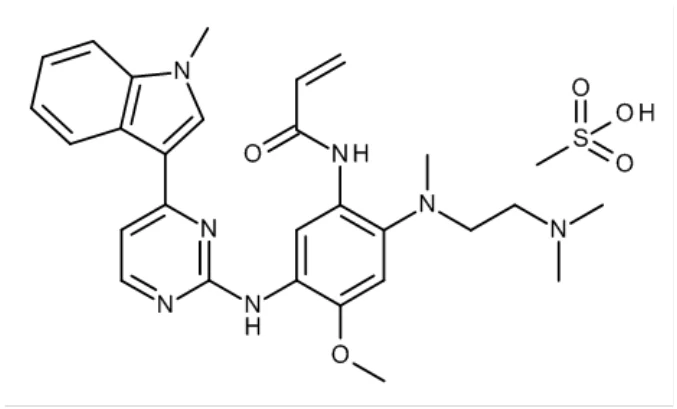 |
| Physicochemical properties: | A white to brown powder with a melting point, defined as the onset temperature (differential scanning calorimetry) of approximately 248ºC. It has a high aqueous solubility across the physiological pH range of 1.2 to 7.0. It is an anhydrous and non-hygroscopic substance with a distribution coefficient (logD) of 3.4 (at pH 7.4) and pKa of 4.4 (aniline) and 9.5 (aliphatic amine). |
14 CLINICAL TRIALS
14.1 Clinical Trials by Indication
Adjuvant Treatment of EGFR Mutation-Positive Non-Small Cell Lung Cancer (NSCLC), With or Without Prior Adjuvant Chemotherapy
Trial Design and Study Demographics (ADAURA)
Table 14 Summary of patient demographics for clinical trials in ADAURA
| Study # | Study design | Dosage, route of administration and duration | Study subjects (n) | Mean age (Range) | Sex |
D5164C 00001 (ADAUR A) | Phase III, randomized (1:1), double-blind, placebo-controlled, that investigated TAGRISSO 80 mg once daily as adjuvant-treatment for EGFR mutation positive NSCLC with or without prior adjuvant Chemotherapy | 80 mg tablets, once daily | TAGRISSO: n=339 Placebo: n=343 | TAGRISSO: 62.5 (30-86) Placebo: 61.6 (31-82) | TAGRISSO: Female: n=230 Male: n=109 Placebo: Female: n=248 Male: n=95 |
The efficacy and safety of TAGRISSO (osimertinib) for the adjuvant treatment of patients with EGFR mutation-positive (exon 19 deletions or exon 21 L858R substitution mutations) NSCLC who have had complete tumour resection with or without prior adjuvant chemotherapy was demonstrated in a randomized, double-blind, placebo-controlled study (ADAURA).
Eligible patients with resectable tumours (stage IB-IIIA according to the American Joint Committee on Cancer (AJCC) 7th edition) were required to have EGFR exon 19 deletions or exon 21 L858R substitution mutations identified prospectively by the cobas® EGFR Mutation Test (Roche Molecular Systems) using diagnostic tumour biopsy specimen or tumour tissue taken during surgery, by central testing. The study excluded patients with clinically important ECG abnormalities identified on resting ECG (e.g. QTc interval >470 ms), history of ILD or prior treatment with neoadjuvant or adjuvant EGFR-TKIs.
Patients were randomized (1:1) to receive TAGRISSO 80 mg orally once daily or placebo following recovery from surgery and standard adjuvant chemotherapy. Patients not receiving adjuvant chemotherapy were randomized within 10 weeks and patients receiving adjuvant chemotherapy within 26 weeks following surgery. Randomization was stratified by mutation type (exon 19 deletions or exon 21 L858R substitution mutations), ethnicity (Asian or non-Asian) and staging based on TNM (IB or II or IIIA) according to the American Joint Committee on Cancer (AJCC) 7th edition. Treatment was given for 3 years or until disease recurrence or unacceptable toxicity.
The primary efficacy outcome measure was disease-free survival (DFS) by investigator assessment for stage II-IIIA. Secondary endpoints included DFS for the overall population (stage IB-IIIA) and overall survival (OS) for stage II-IIIA and stage IB-IIIA.
A total of 682 patients were randomized to TAGRISSO (n=339) or to placebo (n=343). The median age was 63 years (range 30-86 years), 11% were ≥75 years of age and 72% were never smokers. Overall, study demographics and baseline characteristics were balanced between the treatment groups (see Table 15).
Table 15 Demographics and key baseline disease characteristics in ADAURA trial with TAGRISSO 80 mg (overall population)
| TAGRISSO | Placebo | |||||||||||
|---|---|---|---|---|---|---|---|---|---|---|---|---|
| (N=339) | (N=343) | |||||||||||
| Demographics | ||||||||||||
| Age (years) | ||||||||||||
| Mean (standard deviation) | 62.5 (10.27) | 61.6 (10.37) | ||||||||||
| Median (minimum-maximum) | 64.0 (30-86) | 62.0 (31-82) | ||||||||||
| Sex, n (%) | ||||||||||||
| Male | 109 (32.2) | 95 (27.7) | ||||||||||
| Female | 230 (67.8) | 248 (72.3) | ||||||||||
| Race, n (%) | ||||||||||||
| Asian | 216 (63.7) | 218 (63.6) | ||||||||||
| White | 122 (36.0) | 122 (35.6) | ||||||||||
| Other | 1 (0.3) | 2 (0.6) | ||||||||||
| Missinga | 0 (0) | 1 (0.3) | ||||||||||
| Ethnic group, n (%) | ||||||||||||
| Hispanic/Latino | 12 (3.5%) | 9 (2.6%) | ||||||||||
| Asian (other than Chinese or Japanese) | 78 (23.0) | 67 (19.5) | ||||||||||
| Chinese | 95 (28.0) | 100 (29.2) | ||||||||||
| Japanese | 46 (13.6) | 51 (14.9) | ||||||||||
| Other | 108 (31.9) | 116 (33.8) | ||||||||||
| Body mass index (kg/m2)b | ||||||||||||
| Mean (standard deviation) | 24.8 (4.29) | 24.9 (4.36) | ||||||||||
| Median (minimum-maximum) | 24.4 (15.1-41.8) | 24.1 (16.6-42.0) | ||||||||||
| Key baseline disease characteristics | ||||||||||||
| WHO performance status | ||||||||||||
| 0 | 216 (63.7) | 218 (63.6) | ||||||||||
| 1 | 123 (36.3) | 125 (36.4) | ||||||||||
| AJCC stage at diagnosisc | ||||||||||||
| IB | 107 (31.6) | 109 (31.8) | ||||||||||
| IIA | 86 (25.4) | 90 (26.2) | ||||||||||
| IIB | 29 (8.6) | 26 (7.6) | ||||||||||
| IIIA | 117 (34.5) | 118 (34.4) | ||||||||||
| EGFR mutations by central cobas testd | ||||||||||||
| Exon 19 deletions | 185 (54.6) | 188 (54.8) | ||||||||||
| L858R | 153 (45.1)e | 155 (45.2) | ||||||||||
| Histology type | ||||||||||||
| Adenocarcinomaf | 326 (96.2) | 332 (96.8) | ||||||||||
| Bronchial gland carcinoma (NOS) | 1 (0.3) | 2 (0.6) | ||||||||||
| Carcionoma, adenosquamous, malignant | 4 (1.2) | 5 (1.5) | ||||||||||
| Other | 8 (2.4) | 4 (1.2) | ||||||||||
| Lung cancer resection type | ||||||||||||
| TAGRISSO | Placebo | |||||
|---|---|---|---|---|---|---|
| (N=339) | (N=343) | |||||
| Lobectomy | 328 (96.8) | 322 (93.9) | ||||
| Sleeve Resection | 1 (0.3) | 3 (0.9) | ||||
| Bilobectomy | 7 (2.1) | 8 (2.3) | ||||
| Pneumonectomy | 3 (0.9) | 10 (2.9) | ||||
| Adjuvant platinum-based chemotherapy (prior to randomization) g | 202 (59.6) | 207 (60.3) | ||||
| IBh | 27 (25.2) | 30 (27.5) | ||||
| IIAh | 60 (69.8) | 65 (72.2) | ||||
| IIBh | 20 (69.0) | 20 (76.9) | ||||
| IIIAh | 95 (81.2) | 92 (78.0) | ||||
DCO: 17 January 2020 a One patient had missing race information due to local law. b Body mass index = weight(kg)/[height(m)]2 c AJCC TNM lung cancer staging 7th edition. d Patients may have more than one EGFR mutation. Note: There were 12 mis-stratified patients in the IVRS. The data presented here show actual numbers confirmed by prospective central testing. e Note: One patient was negative for both mutations and was discontinued from the study before receiving osimertinib. f Includes: Adenocarcinoma: acinar; Adenocarcinoma: papillary, malignant; Adenocarcinoma: malignant; Adenocarcinoma: bronchiolo-alveolar; and Adenocarcinoma: solid with mucus formation g Excludes 1 patient who received non-platinum based adjuvant chemotherapy h Percentages are calculated from number of patients in full analysis set with the corresponding AJCC Staging (7th edition) | ||||||
Study Results (ADAURA)
Efficacy results from ADAURA are summarized in Table 16, Figure 1, Figure 2 and Figure 3. Patients with stage II-IIIA disease treated with TAGRISSO compared to placebo, achieved 83% reduction in the risk of disease recurrence or death (median not calculable (NC) and 19.6 months, respectively, HR=0.17, 99.06% CI:0.11, 0.26; P<0.0001). The overall population (IB-IIIA) treated with TAGRISSO compared to placebo demonstrated 80% reduction in the risk of disease recurrence or death (median NC and 27.5 months, respectively, HR=0.20, 99.12% CI: 0.14, 0.30; P<0.0001). At time of DFS analysis, the median duration of exposure to TAGRISSO and placebo was 22.5 months and 18.7 months, respectively.
In the overall population, there were 37 patients who had disease recurrence on TAGRISSO. The most commonly reported sites of recurrence were: lung (19 patients); lymph nodes (10 patients) and CNS (5 patients). There were 157 patients who had disease recurrence on placebo. The most commonly reported sites were: lung (61 patients); lymph nodes (48 patients) and CNS (34 patients).
The final analysis of OS demonstrated a statistically significant improvement of OS with a 51% reduction in the risk of death for patients treated with TAGRISSO compared to placebo for both the stage II-IIIA population (21.3% maturity; HR=0.49; 95.03% CI: 0.33, 0.73; p value=0.0004) and the overall population (IB-IIIA; 18.2% maturity; HR=0.49; 95.03% CI: 0.34, 0.70; p value < 0.0001). At the time of OS final analysis, the median follow-up time in censored patients was 61.5 months in both treatment arms in the overall population (IB-IIIA).
Table 16 Efficacy results in the overall patient population (stage IB-IIIA) by investigator assessment
| Stage IB-IIIA population | |||||||||||
|---|---|---|---|---|---|---|---|---|---|---|---|
| Efficacy Parameter | TAGRISSO (n=339) | Placebo (n=343) | |||||||||
| Disease Free Survival (DFS) | |||||||||||
| Number of Events (%) | 37 (10.9) | 159 (46.4) | |||||||||
| Recurrent disease (%) | 37 (10.9) | 157 (45.8) | |||||||||
| Deaths (%) | 0 | 2 (0.6) | |||||||||
| Median DFS, months (95% CI) | NC (NC, NC) | 27.5 (22.0, 35.0) | |||||||||
HR (99.12% CI) P-value a | 0.20 (0.14, 0.30) <0.0001 | ||||||||||
| DFS rate at 12 months, % (95% CI) | 97.4 (94.9, 98.7) | 68.5 (63.2, 73.2) | |||||||||
| DFS rate at 24 months, % (95% CI) | 89.1 (84.5, 92.4) | 52.4 (46.4, 58.1) | |||||||||
| DFS rate at 36 months, % (95% CI) b | 78.9 (68.7, 86.1) | 40.0 (32.1, 47.8) | |||||||||
| Overall Survival (OS) | |||||||||||
| Number of deaths (18% maturity) | 42 (12.4) | 82 (23.9) | |||||||||
| Median OS, months (95% CI) | NC (NC, NC) | NC (NC, NC) | |||||||||
HR (95.03% CI) P-value c | 0.49 (0.34, 0.70) <0.0001 | ||||||||||
HR=Hazard Ratio; CI=Confidence Interval, NC=Not Calculable
DFS results based on investigator assessment.
Median follow-up time for DFS was 22.1 months for patients receiving TAGRISSO and 16.6 months for patients receiving placebo.
Median follow-up time for OS in censored patients was 61.5 months in both the TAGRISSO arm and the placebo arm.
DFS results are from the primary analysis (17 January 2020). OS results are from the final analysis (27 January 2023).
a Adjusted for an interim analysis (29% maturity) a p-value < 0.0088 was required to achieve statistical significance.
b The number of patients at risk at 36 months was 27 patients in the TAGRISSO arm, and 20 patients in the placebo arm.
c Adjusted for interim analyses a p-value < 0.0497 was required to achieve statistical significance.
Figure 1 Kaplan-Meier Curve of Disease-Free Survival for the Overall Population (Stage IB-IIIA Patients) by investigator assessment
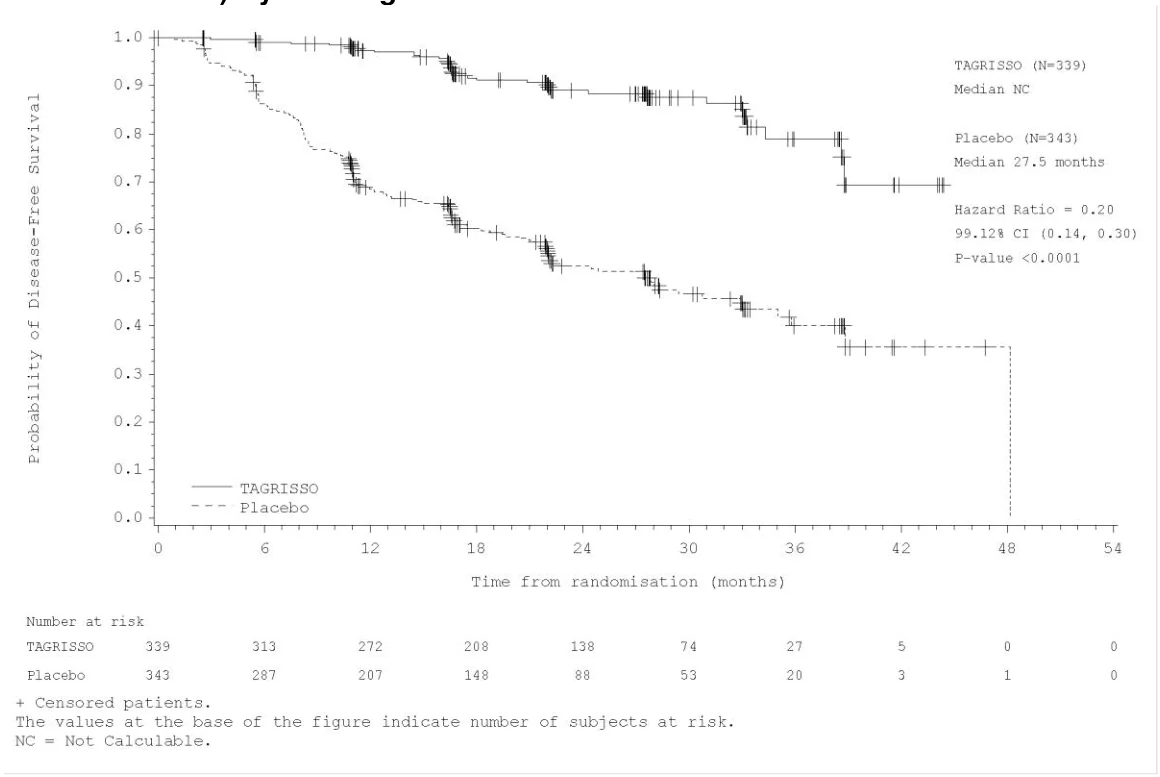
The DFS benefit of TAGRISSO compared to placebo was consistent across all predefined subgroups analysed (see Figure 2). The OS benefit of TAGRISSO compared to placebo was generally consistent across predefined subgroups, which included disease stage, EGFR mutation status, race, adjuvant chemotherapy use, gender, age, and smoking history.
Figure 2 Disease-free survival, forest plot, by subgroup (for the overall population, Stage IB-IIIA)
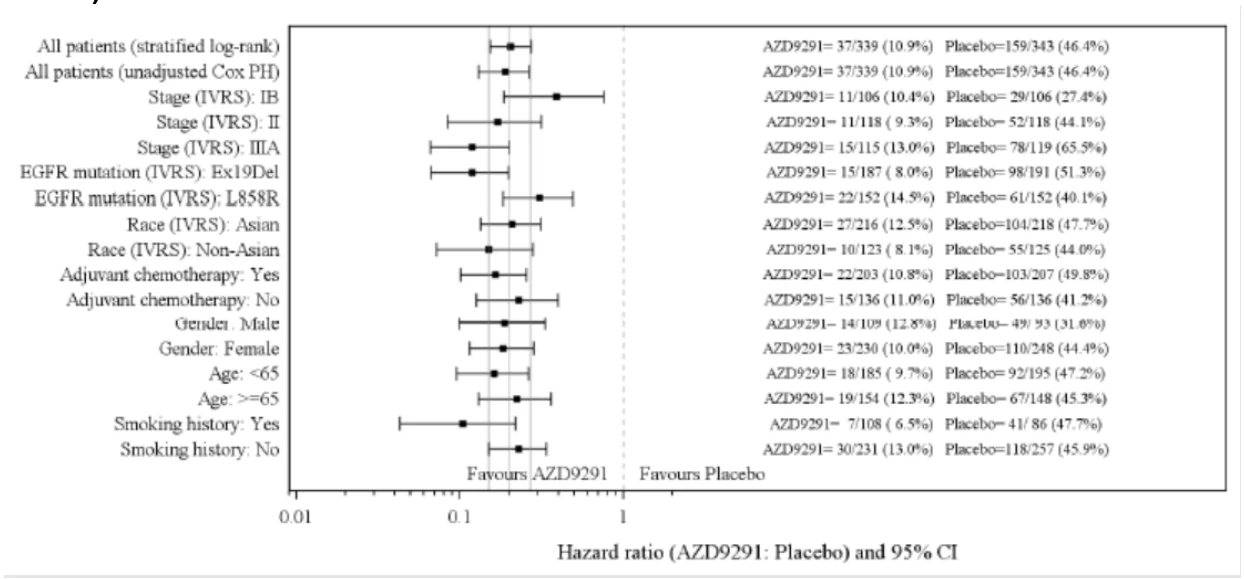
The analysis was performed using a Cox proportional hazards model including treatment, subgroup and a treatment-by-subgroup interaction term. Subgroup categories with less than 20 events were excluded from the analysis. A hazard ratio <1 favours TAGRISSO (AZD9291). DCO: 17 January 2020
Figure 3 Kaplan-Meier Curve of Overall Survival in Overall Population (Stage IB-IIIA patients)
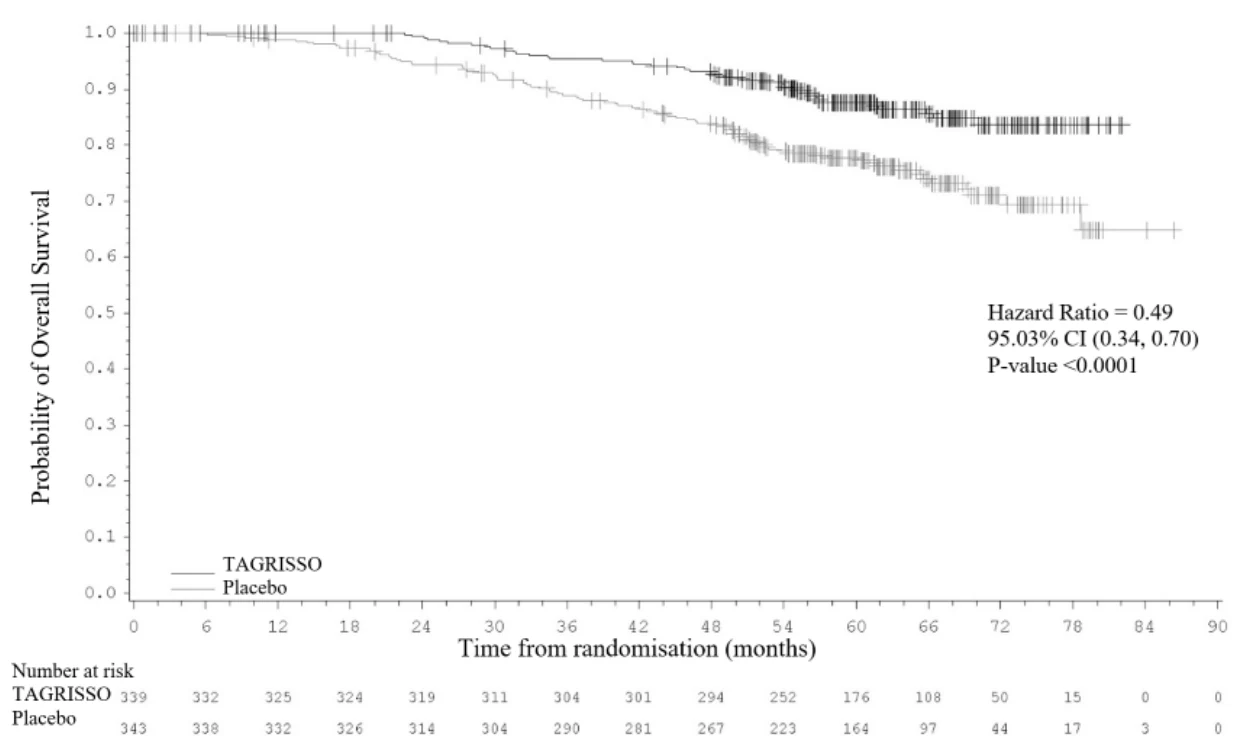
Locally Advanced Unresectable (Stage III) EGFR Mutation-Positive NSCLC, Following Prior Chemoradiation
Trial Design and Study Demographics (LAURA)
Table 17 Summary of patient demographics for LAURA
| Study # | Study design | Dosage, route of administration and duration | Study subjects (n) | Mean age (Range) | Sex |
D5160C 00048 (LAURA) | Phase III, randomized (2:1), double-blind, placebo-controlled, investigated TAGRISSO 80 mg once daily as treatment for stage III unresectable EGFR mutation positive NSCLC following chemoradiation | 80 mg tablets, once daily | TAGRISSO: n=143 Placebo: n=73 | TAGRISSO: 60.9 (36-84) Placebo: 62.3 (37-83) | TAGRISSO: Female: n=90 Male: n=53 Placebo: Female: n=42 Male: n=31 |
The efficacy and safety of TAGRISSO for the treatment of patients with EGFR mutation-positive, locally advanced, unresectable (stage III) NSCLC, who had not progressed during or following definitive platinum based chemoradiation therapy, was demonstrated in a randomised, double-blind, placebo-controlled study (LAURA). Patients were to receive concurrent chemoradiation therapy (CCRT) or sequential chemoradiation therapy (SCRT) regimens, where at least 2 cycles or 5 weekly doses of platinum-based chemotherapy and a total dose of radiation of 60 Gy ±10% (54 Gy to 66 Gy) were to be completed ≤6 weeks prior to randomisation. Patient tumour tissue samples were required to have an EGFR exon 19 deletion or exon 21 L858R mutation, as identified by central or local testing using a certified/approved test.
Patients were randomised (2:1) to receive either TAGRISSO 80 mg orally once daily (n=143) or placebo (n=73). Randomisation was stratified by prior chemoradiation strategy (CCRT vs SCRT), tumour staging prior to chemoradiation (IIIA vs IIIB/IIIC), and by the China cohort. Patients continued to receive study treatment until intolerance to therapy or confirmed disease progression. Post progression, all patients were offered open label TAGRISSO in accordance with local clinical practice if, in the opinion of the treating physician, there was an expected clinical benefit.
The primary efficacy endpoint was PFS as assessed by blinded independent central review (BICR). Key secondary efficacy endpoints were overall survival (OS) and CNS PFS by BICR.
Table 18 Demographics and key baseline disease characteristics in LAURA trial (full analysis set)
| TAGRISSO | Placebo | |||||||||||
|---|---|---|---|---|---|---|---|---|---|---|---|---|
| (N=143) | (N=73) | |||||||||||
| Demographics | ||||||||||||
| Age (years) | ||||||||||||
| Mean (standard deviation) | 60.9 (10.38) | 62.3 (12.01) | ||||||||||
| Median (minimum-maximum) | 62.0 (36, 84) | 64.0 (37, 83) | ||||||||||
| Age group (years), n (%) | ||||||||||||
| <50 | 24 (16.8) | 12 (16.4) | ||||||||||
| ≥50-<65 | 57 (39.9) | 27 (37.0) | ||||||||||
| ≥65-<75 | 49 (34.3) | 20 (27.4) | ||||||||||
| ≥75 | 13 (9.1) | 14 (19.2) | ||||||||||
| Sex, n (%) | ||||||||||||
| Male | 53 (37.1) | 31 (42.5) | ||||||||||
| Female | 90 (62.9) | 42 (57.5) | ||||||||||
| Race, n (%) | ||||||||||||
| American Indian or Alaska Native | 2 (1.4) | 1 (1.4) | ||||||||||
| Asian | 116 (81.1) | 62 (84.9) | ||||||||||
| White | 20 (14.0) | 10 (13.7) | ||||||||||
| Other | 5 (3.5) | 0 (0) | ||||||||||
| Smoking history, n (%) | ||||||||||||
| Never smokers | 102 (71.3) | 49 (67.1) | ||||||||||
| Current smokers | 4 (2.8) | 1 (1.4) | ||||||||||
| Former smokers | 37 (25.9) | 23 (31.5) | ||||||||||
| WHO performance status | ||||||||||||
| 0 (normal activity) | 80 (55.9) | 31 (42.5) | ||||||||||
| 1 (restricted activity) | 63 (44.1) | 42 (57.5) | ||||||||||
| Disease Stage, n (%) a | ||||||||||||
| Stage IIIA | 52 (36.4) | 24 (32.9) | ||||||||||
| Stage IIIB | 67 (46.9) | 38 (52.1) | ||||||||||
| Stage IIIC | 24 (16.8) | 11 (15.1) | ||||||||||
| Prior CRT | ||||||||||||
| CCRT | 131 (91.6) | 62 (84.9) | ||||||||||
| SCRT | 12 (8.4) | 11 (15.1) | ||||||||||
| Prior Chemotherapy | ||||||||||||
| Carboplatin | 75 (52.4) | 44 (60.3) | ||||||||||
| Cisplatin | 66 (46.2) | 29 (39.7) | ||||||||||
| Paclitaxel | 69 (48.3) | 34 (46.6) | ||||||||||
| Pemetrexed | 39 (27.3) | 22 (30.1) | ||||||||||
| Vinorelbine | 18 (12.6) | 7 (9.6) | ||||||||||
| Etoposide | 15 (10.5) | 8 (11.0) | ||||||||||
| Prior Radiotherapy | ||||||||||||
| Median Total Dose (Gy) | 60.0 | 60.0 | ||||||||||
| Response to prior CRT | ||||||||||||
| CR | 4 (2.8) | 3 (4.1) | ||||||||||
| PR | 67 (46.9) | 27 (37.0) | ||||||||||
| SD | 61 (42.7) | 37 (50.7) | ||||||||||
| PD | 0 | 0 | ||||||||||
| Non-evaluable | 11 (7.7) | 6 (8.2) | ||||||||||
| TAGRISSO | Placebo | ||||||||
|---|---|---|---|---|---|---|---|---|---|
| (N=143) | (N=73) | ||||||||
| Time from end date of radiotherapy to randomization (weeks) | |||||||||
| Mean (standard deviation) | 4.22 (1.390) | 4.05 (1.514) | |||||||
| Median (minimum-maximum) | 4.29 (0.7-6.4) | 4.29 (0.4-6.0) | |||||||
| EGFR mutations as used for randomization, n (%) | |||||||||
| Exon 19 deletion | 74 (51.7) | 43 (58.9) | |||||||
| Exon 21 L858R | 68 (47.6) | 30 (41.1) | |||||||
| Missing b | 1 (0.7) | 0 | |||||||
a Disease stage summarised based on values entered into the eCRF and categorised prior to CRT according to AJCC/UICC 8th Edition.
b Patients randomised without an approved local positive EGFR test result or central EGFR test result.
DCO: 05 January 2024
Study Results (LAURA)
At the primary analysis treatment with TAGRISSO following platinum based chemoradiation therapy resulted in a statistically significant and clinically meaningful improvement in PFS compared to placebo (Table 19 and Kaplan-Meier curve Figure 4). A greater proportion of patients treated with TAGRISSO were alive and progression free at 6, 12, 18, 24 and 36 months (84%, 74%, 67%, 65% and 58%, respectively) compared to patients treated with placebo (45%, 22%, 14%, 13% and 10%, respectively).
At the interim analysis, overall survival data were immature (20% maturity) (see Table 19).
Table 19 Efficacy results from the LAURA study (Full analysis set)
| Efficacy Parameter | TAGRISSO (N=143) | Placebo (N=73) | ||||||
|---|---|---|---|---|---|---|---|---|
| Progression-Free Survival | ||||||||
| Number of Events (%) | 57 (40) | 63 (86) | ||||||
| Median, Months (95% CI) | 39.1 (31.5, NC) | 5.6 (3.7, 7.4) | ||||||
| HR (95% CI); 2-sided P-value | 0.16 (0.10, 0.24); P<0.001 | |||||||
| Overall Survival (Interim) | ||||||||
| Number of deaths (%) | 28 (20) | 15 (21) | ||||||
| Median, Months (95% CI) | 54.0 (46.5, NC) | NC (42.1, NC) | ||||||
| HR (95% CI); 2-sided P-value | 0.81 (0.42, 1.56); P=0.530 a | |||||||
HR=Hazard Ratio; CI=Confidence Interval, NC=Not Calculable
PFS results as assessed by BICR.
Median follow-up time for PFS in all patients was 22.0 months in the TAGRISSO arm and 5.6 months in the placebo arm.
A HR <1 favours TAGRISSO, an Odds ratio of >1 favours TAGRISSO.
a Adjusted for an interim analysis (20% maturity) a p-value <0.00036 was required to achieve statistical significance.
Figure 4 Kaplan-Meier Curves of Progression-Free Survival as assessed by BICR in LAURA
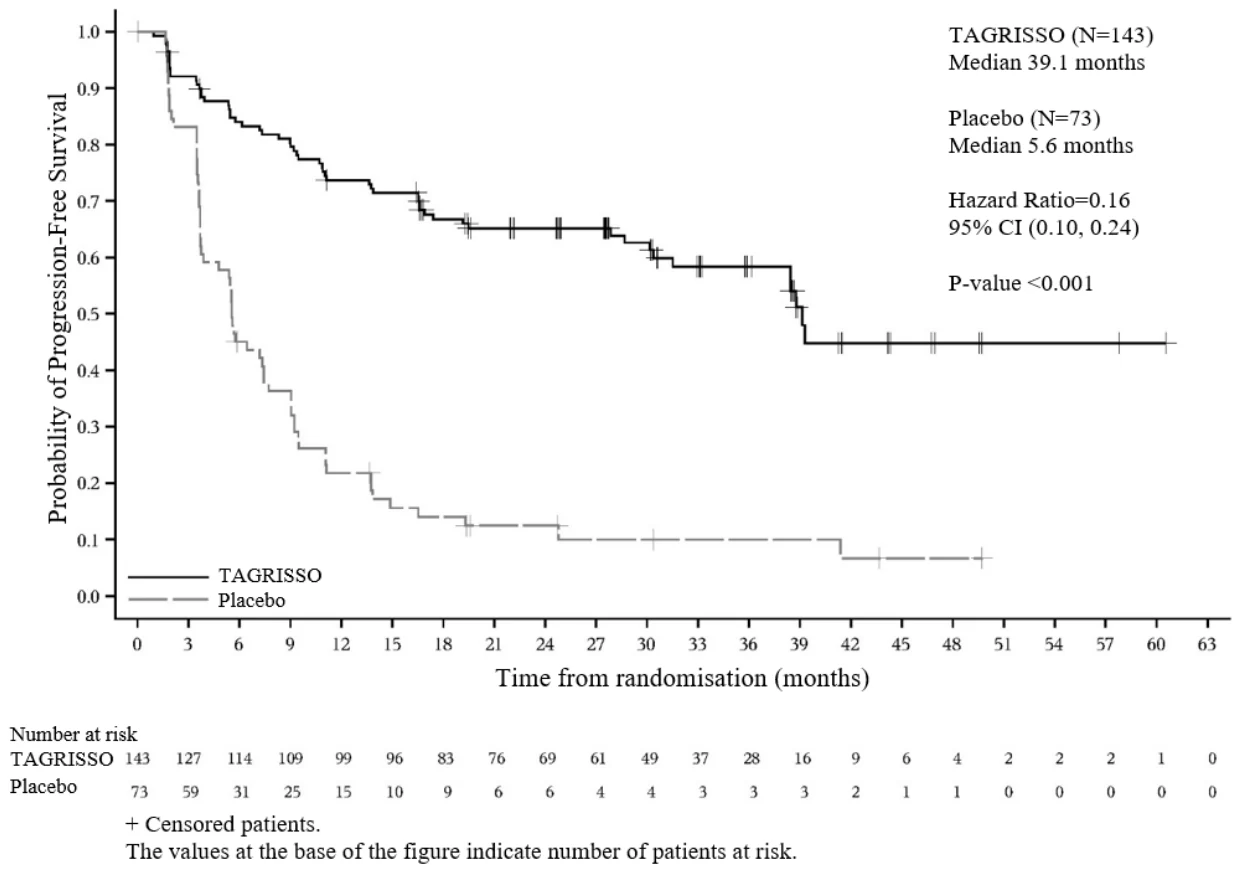
CNS metastases efficacy in the LAURA trial
Per protocol, all patients underwent baseline magnetic resonance imaging (MRI) brain scans and all but one patient had scheduled on-treatment MRI brain scans. There was a nominal improvement in CNS PFS (based on neuroradiologist BICR assessment) in patients treated with TAGRISSO compared to placebo. The median CNS PFS was NC for TAGRISSO arm and 14.9 months in Placebo (27% maturity; HR=0.17; 95% CI: 0.09, 0.32). A lower proportion of patients had new CNS lesions in the TAGRISSO arm compared to the placebo arm (17/143 [12%] vs 26/73 [36%], respectively).
EGFR Mutation-Positive NSCLC
Table 20 Summary of patient demographics for clinical trials for first-line treatment of EGFR mutation-positive locally advanced or metastatic NSCLC patients
| Study # | Study design | Dosage, route of administratio n and duration | Study subjects (n) | Mean age (Range) | Sex |
D5160C000 07 (FLAURA) | Phase III, randomized (1:1), double-blind, active-controlled, that investigated TAGRISSO 80 mg once daily as first line-treatment for EGFR mutation positive locally advanced or metastatic NSCLC | 80 mg tablets, once daily | TAGRISSO: n=279 EGFR TKI: n=277 | TAGRISSO: 62.7 (26-85) EGFR TKI: 63.3 (35-93) | TAGRISSO: Female: n=178 Male: n=101 EGFR TKI: Female: n=172 Male: n=105 |
D5169C000 01 (FLAURA2) | Phase III, randomized (1:1), open-label, active-controlled, that investigated TAGRISSO 80 mg once daily in combination with pemetrexed and platinum-based chemotherapy as first line-treatment for EGFR mutation positive locally advanced or metastatic NSCLC | TAGRISSO + chemotherapy: TAGRISSO 80 mg tablets, once daily + pemetrexed IV, 500 mg/m2 Q3W + Either cisplatin, 75 mg/m2 Q3W or carboplatin, AUC5, Q3W TAGRISSO monotherapy: TAGRISSO 80 mg tablets, once daily | TAGRISSO + chemotherapy: n=279 TAGRISSO monotherapy: n=278 | TAGRISSO + chemotherapy: 61.0 (26-83) TAGRISSO monotherapy: 60.7 (30-85) | TAGRISSO + chemotherapy: Female: n=173 Male: n=106 TAGRISSO monotherapy: Female: n=169 Male: n=109 |
Trial Design and Study Demographics (FLAURA)
The efficacy and safety of TAGRISSO for the treatment of patients with EGFR mutation positive locally advanced or metastatic NSCLC, who had not received previous systemic treatment for advanced disease, was demonstrated in a Phase III, randomized, double-blind, active-controlled trial (FLAURA). Patient tumour tissue samples were required to have one of the two common EGFR mutations known to be associated with EGFR TKI sensitivity (Ex19del or L858R), as identified by local or central testing.
Patients were randomized 1:1 to receive either TAGRISSO (n=279, 80 mg orally once daily) or EGFR TKI comparator (n=277; gefitinib 250 mg orally once daily or erlotinib 150 mg orally once daily). Randomization was stratified by EGFR mutation type (exon 19 deletion or L858R) and ethnicity (Asian or non-Asian). Patients received study therapy until intolerance to therapy, or the investigator determined that the patient was no longer experiencing clinical benefit. For patients receiving EGFR TKI comparator, post-progression crossover to open-label TAGRISSO was permitted provided tumour samples tested positive for the T790M mutation.
The primary efficacy endpoint was progression-free survival (PFS) as assessed by investigator. Additional efficacy endpoints included objective response rate (ORR), duration of response (DoR), overall survival (OS), second PFS after start of first subsequent therapy (PFS2), time to first subsequent therapy or death (TFST) and time from randomization to second progression on subsequent treatment or death (TSST) as assessed by investigator. CNS PFS, CNS ORR and CNS DoR as assessed by BICR, and patient reported outcomes (PRO) were also assessed.
The baseline demographic and disease characteristics of the overall study population were (see Table 21): median age 64 years (range 26-93 years), ≥75 years old (14%), female (63%), White (36%), Asian (62%), never smokers (64%). All patients had a World Health Organization (WHO) performance status of 0 or 1. Thirty-six percent (36%) of patients had metastatic bone disease and 35% of patients had extra-thoracic visceral metastases. Twenty one percent (21%) of patients had CNS metastases (identified by CNS lesion site at baseline, medical history, and/or prior surgery, and/or prior radiotherapy to CNS metastases).
Table 21 Demographics and key baseline disease characteristics in FLAURA trial with TAGRISSO 80 mg (full analysis set)
| Osimertinib | EGFR TKI comparator (gefitinib or erlotinib) | ||||||||
|---|---|---|---|---|---|---|---|---|---|
| (N=279) | (N=277) | ||||||||
| Demographics | |||||||||
| Age (years) | |||||||||
| Mean (standard deviation) | 62.7 (10.70) | 63.3 (10.90) | |||||||
| Median (minimum-maximum) | 64.0 (26-85) | 64.0 (35-93) | |||||||
| Age group (years), n (%) | |||||||||
| <50 | 32 (11.5) | 37 (13.4) | |||||||
| ≥50-<65 | 121 (43.4) | 108 (39.0) | |||||||
| ≥65-<75 | 90 (32.3) | 89 (32.1) | |||||||
| ≥75 | 36 (12.9) | 43 (15.5) | |||||||
| Sex, n (%) | |||||||||
| Male | 101 (36.2) | 105 (37.9) | |||||||
| Female | 178 (63.8) | 172 (62.1) | |||||||
| Race, n (%) | |||||||||
| Asian | 174 (62.4) | 173 (62.5) | |||||||
| Black or African American | 2 (0.7) | 2 (0.7) | |||||||
| Osimertinib | EGFR TKI comparator (gefitinib or erlotinib) | |||||||||
|---|---|---|---|---|---|---|---|---|---|---|
| (N=279) | (N=277) | |||||||||
| White | 101 (36.2) | 100 (36.1) | ||||||||
| American-Indian or Alaska Native | 1 (0.4) | 1 (0.4) | ||||||||
| Missing | 1 (0.4) | 1 (0.4) | ||||||||
| Smoking history, n (%) | ||||||||||
| Never smokers | 182 (65.2) | 175 (63.2) | ||||||||
| Current smokers | 8 (2.9) | 9 (3.2) | ||||||||
| Former smokers | 89 (31.9) | 93 (33.6) | ||||||||
| Key baseline disease characteristics | ||||||||||
| WHO performance status | ||||||||||
| 0 (normal activity) | 112 (40.1) | 116 (41.9) | ||||||||
| 1 (restricted activity) | 167 (59.9) | 160 (57.8) | ||||||||
| Missing | 0 | 1 (0.4) | ||||||||
| Overall disease classification | ||||||||||
| Metastatica | 264 (94.6) | 262 (94.6) | ||||||||
| Locally-advancedb | 14 (5.0) | 15 (5.4) | ||||||||
| Missing | 1 (0.4) | 0 | ||||||||
| CNS metastasesc | 53 (19.0) | 63 (22.7) | ||||||||
| Extra-thoracic visceral metastases | 94 (33.7) | 103 (37.2) | ||||||||
| Liver metastases | 41 (14.7) | 37 (13.4) | ||||||||
| Bone & locomotor metastases | 97 (34.8) | 102 (36.8) | ||||||||
| EGFR mutations as used for randomizationd | ||||||||||
| Exon 19 deletion | 175 (62.7) | 174 (62.8) | ||||||||
| Exon 21 L858R | 104 (37.3) | 103 (37.2) | ||||||||
a Metastatic disease - Patient had any metastatic site of disease.
b Locally advanced - Patient had only locally advanced sites of disease.
c This is a programmatically derived composite endpoint with a list of contributing data sources.
d EGFR mutations based on the test (local or central) used to determine randomization strata (Ex19del or L858R).
Study Results (FLAURA)
TAGRISSO demonstrated a clinically meaningful and statistically significant improvement in PFS compared to EGFR TKI comparator (median 18.9 months and 10.2 months, respectively, HR=0.46, 95% CI: 0.37, 0.57; P<0.0001). Efficacy results from FLAURA by investigator assessment are summarized in Table 22, and the Kaplan-Meier curve for PFS is shown in Figure 5. The final analysis of overall survival (58% maturity) demonstrated a statistically significant improvement with an HR of 0.799 (95.05% CI: 0.641, 0.997; P=0.0462) in patients randomized to TAGRISSO compared to EGFR TKI comparator (Table 22 and Figure 6).
Table 22 Efficacy results from FLAURA by investigator assessment (Full analysis set)
| Efficacy Parameter | TAGRISSO (n=279) | EGFR TKI comparator (gefitinib or erlotinib) (n=277) | ||||||||||||||
|---|---|---|---|---|---|---|---|---|---|---|---|---|---|---|---|---|
| Progression-Free Survival | ||||||||||||||||
| Number of Events (62% maturity) | 136 (49) | 206 (74) | ||||||||||||||
| Median PFS, months (95% CI) | 18.9 (15.2, 21.4) | 10.2 (9.6, 11.1) | ||||||||||||||
| HR (95% CI); P-value | 0.46 (0.37, 0.57); <0.0001 | |||||||||||||||
| Overall Survival | ||||||||||||||||
| Number of deaths, (58% maturity) | 155 (56) | 166 (60) | ||||||||||||||
| Median OS, months (95% CI) | 38.6 (34.5, 41.8) | 31.8 (26.6, 36.0) | ||||||||||||||
| HR (95.05% CI); P-value | 0.799 (0.641, 0.997); 0.0462† | |||||||||||||||
| Objective Response Rate*a | ||||||||||||||||
| Number of responses Response Rate (95% CI) | 223 80 (75, 85) | 210 76 (70, 81) | ||||||||||||||
| Complete Response, n(%) | 7 (2.5) | 4 (1.4) | ||||||||||||||
| Partial Response, n(%)b | 216 (77.4) | 206 (74.4) | ||||||||||||||
| Odds ratio (95% CI); P-value | 1.3 (0.9, 1.9); 0.2421 | |||||||||||||||
| Duration of Response (DoR)* | ||||||||||||||||
| Median DoR, months (95% CI) | 17.2 (13.8, 22.0) | 8.5 (7.3, 9.8) | ||||||||||||||
HR=Hazard Ratio; CI=Confidence Interval
PFS, ORR and DoR results based on RECIST investigator assessment
* Based on unconfirmed response
Median follow-up time for PFS was 15.0 months for patients receiving TAGRISSO and 9.7 months for patients receiving EGFR TKI comparator.
Median survival follow-up time was 35.8 months for patients receiving TAGRISSO and 27.0 months for patients receiving EGFR TKI comparator.
PFS, ORR and DoR results are from data cut-off 12 June 2017. OS results are from data cut-off 25 June 2019.
A HR< 1 favours TAGRISSO, an Odds ratio of >1 favours TAGRISSO
† Adjusted for an interim analysis (25% maturity) a p value < 0.0495 was required to achieve statistical significance a ORR results by Blinded Independent Central Review (BICR) were consistent with those reported via investigator assessment; ORR by BICR assessment was 78% (95% CI:73, 83) on TAGRISSO and 70% (95% CI:65, 76) on EGFR TKI comparator.
Figure 5 Kaplan-Meier Curves of Progression-Free Survival as assessed by investigator in FLAURA
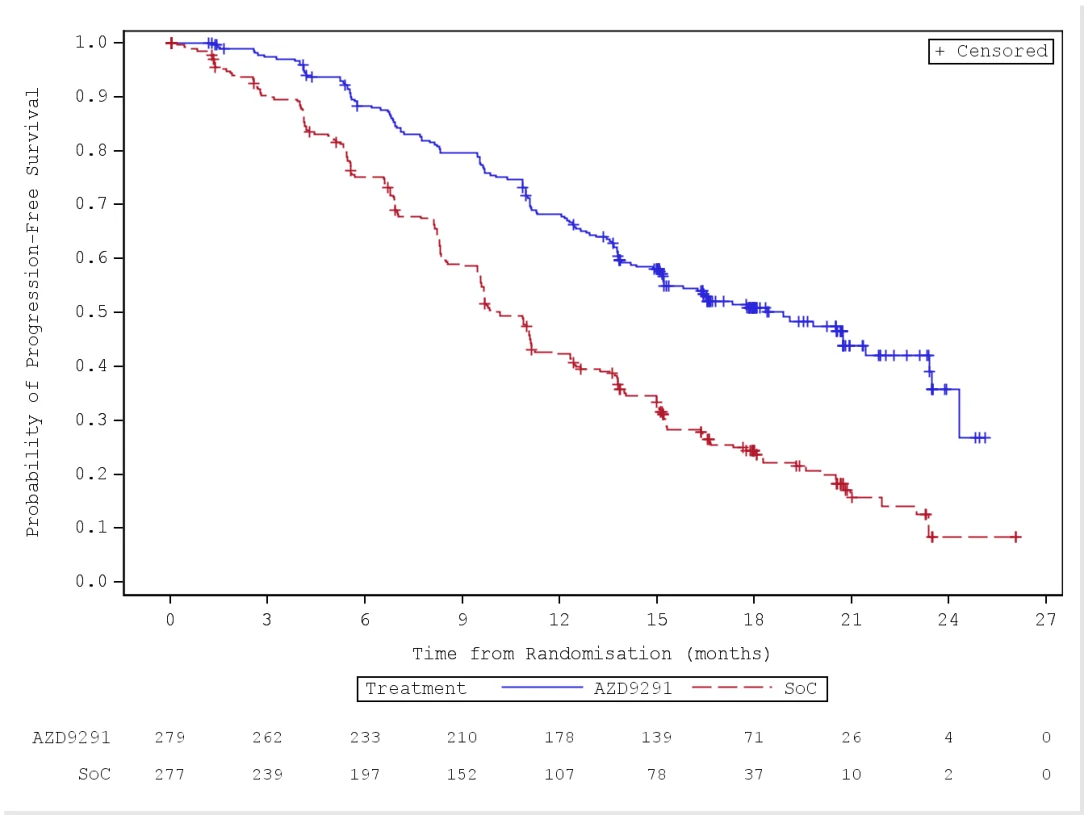
Figure 6 Kaplan-Meier Curves of Overall Survival in FLAURA
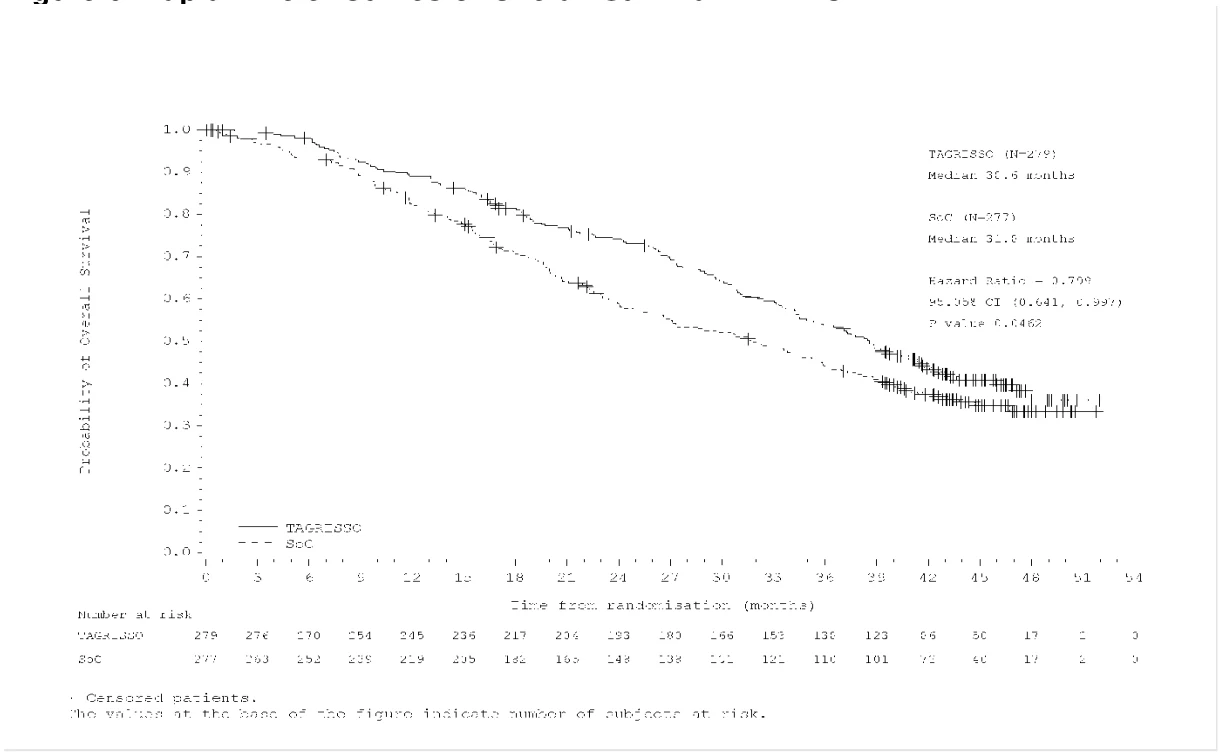
The PFS benefit of TAGRISSO compared to EGFR TKI comparator was consistent across all predefined subgroups analysed, including ethnicity, age, gender, smoking history, CNS metastases status at study entry and EGFR mutation type (exon 19 deletion or L858R).
Patients randomized to TAGRISSO as first-line treatment also had clinically meaningful improvements in second PFS after start of first subsequent therapy (PFS2), time from randomization to first subsequent treatment of death (TFST) and time from randomization to second subsequent treatment or death (TSST) compared to patients randomized to EGFR TKI comparator. A continued clinical benefit beyond initial progression for patients treated with TAGRISSO was demonstrated by a clinically meaningful delay to PFS2 (HR: 0.58 [95% CI: 0.44, 0.78]; p=0.0004), TFST (HR: 0.51 [95% CI: 0.40, 0.64]; p < 0.0001) and TSST (HR: 0.60 [95% CI: 0.45, 0.80]; p=0.0005) for patients on TAGRISSO compared to patients on EGFR TKI comparator. The analysis of these post-progression endpoints demonstrated that PFS benefit was largely preserved through subsequent lines of therapy.
In patients with locally advanced EGFRm NSCLC not amenable to curative surgery or radiotherapy, the objective response rate was 93% (95% CI: 66, 100) for patients receiving TAGRISSO (n=14) and 60% (95% CI: 32, 84) for patients receiving EGFR TKI comparator (n=15).
CNS metastases efficacy in the FLAURA trial
Patients with CNS metastases not requiring steroids and with stable neurologic status for at least two weeks after completion of the definitive therapy and steroids were eligible to be randomized in the FLAURA study. Of 556 patients, 200 patients had available baseline brain scans. A BICR assessment of these scans resulted in a subgroup of 128/556 (23%) patients with CNS metastases and these data are summarized in Table 23. EGFR mutation type (Ex19del or L858R) and ethnicity (Asian or non-Asian) was generally balanced within this analysis between the treatment arms. CNS efficacy by RECIST v1.1 in FLAURA demonstrated a statistically significant improvement in CNS PFS (HR=0.48, 95% CI: 0.26, 0.86; P=0.014).
Table 23 CNS efficacy by BICR in patients with CNS metastases on a baseline brain scan in FLAURA
| Efficacy Parameter | TAGRISSO (n=61) | EGFR TKI comparator (gefitinib or erlotinib) (n=67) | ||||||||||
|---|---|---|---|---|---|---|---|---|---|---|---|---|
| CNS Progression-Free Survivala | ||||||||||||
| Number of Events (%) | 18 (30) | 30 (45) | ||||||||||
| Median CNS PFS, months (95% CI) | NC (16.5, NC) | 13.9 (8.3, NC) | ||||||||||
| HR (95% CI); P-value | 0.48 (0.26, 0.86); 0.014 | |||||||||||
| CNS progression free and alive at 6 months (%) 95% CI) | 87 (74, 94) | 71 (57, 81) | ||||||||||
| CNS progression free and alive at 12 months (%) (95% CI) | 77 (62, 86) | 56 (42, 68) | ||||||||||
| CNS Objective Response Ratea | ||||||||||||
| CNS Response Rate % (n) (95% CI) | 66 (40) (52, 77) | 43 (29) (31, 56) | ||||||||||
| Odds ratio (95% CI); P-value | 2.5 (1.2, 5.2); 0.011 | |||||||||||
| CNS Duration of Responsea | ||||||||||||
| Median CNS DoR, months (95% CI) | NC (12, NC) | 14 (7, 19) | ||||||||||
| Patients remaining in response at 6 months (%) (95% CI) | 86 (70, 94) | 76 (55, 89) | ||||||||||
| Efficacy Parameter | TAGRISSO (n=61) | EGFR TKI comparator (gefitinib or erlotinib) (n=67) |
|---|---|---|
| Patients remaining in response at 12 months (%) (95% CI) | 65 (46, 79) | 67 (43, 82) |
HR=Hazard Ratio; CI=Confidence Interval, NC=Not Calculable
A HR< 1 favours TAGRISSO, an Odds ratio of >1 favours TAGRISSO
a CNS PFS, ORR and DoR determined by RECIST v1.1by CNS BICR (CNS measurable and non -measurable lesions at baseline by BICR) n=61 for TAGRISSO and n=67 for EGFR TKI comparator; responses are unconfirmed
A pre-specified PFS subgroup based on CNS metastases status (identified by CNS lesion site at baseline, medical history, and/or prior surgery, and/or prior radiotherapy to CNS metastases) at study entry was performed in FLAURA and is shown in Figure 7. Irrespective of CNS lesion status at study entry, patients in the TAGRISSO arm demonstrated an efficacy benefit over those in the EGFR TKI comparator arm.
Figure 7 Overall PFS by investigator assessment by CNS metastases status at study entry, Kaplan-Meier plot (full analysis set) in FLAURA
Irrespective of CNS lesion status at study entry, based on investigator assessment, there were fewer patients with new CNS lesions in the TAGRISSO arm compared to the EGFR TKI comparator arm (TAGRISSO, 11/279 [3.9%] compared to EGFR TKI comparator, 34/277 [12.3%]). In the subset of patients without CNS lesions at baseline, there were a lower number of new CNS lesions in the TAGRISSO arm compared to the EGFR TKI comparator arm (7/226 [3.1%] vs. 15/214 [7.0%], respectively).
Patient Reported Outcomes (PRO)
Patient-reported symptoms and health-related quality of life (HRQL) were electronically collected using the EORTC QLQ-C30 and its lung cancer module (EORTC QLQ-LC13). At baseline, no differences in patient reported symptoms, function or HRQL were observed between TAGRISSO and EGFR TKI comparator (gefitinib or erlotinib) arms. Data collected from
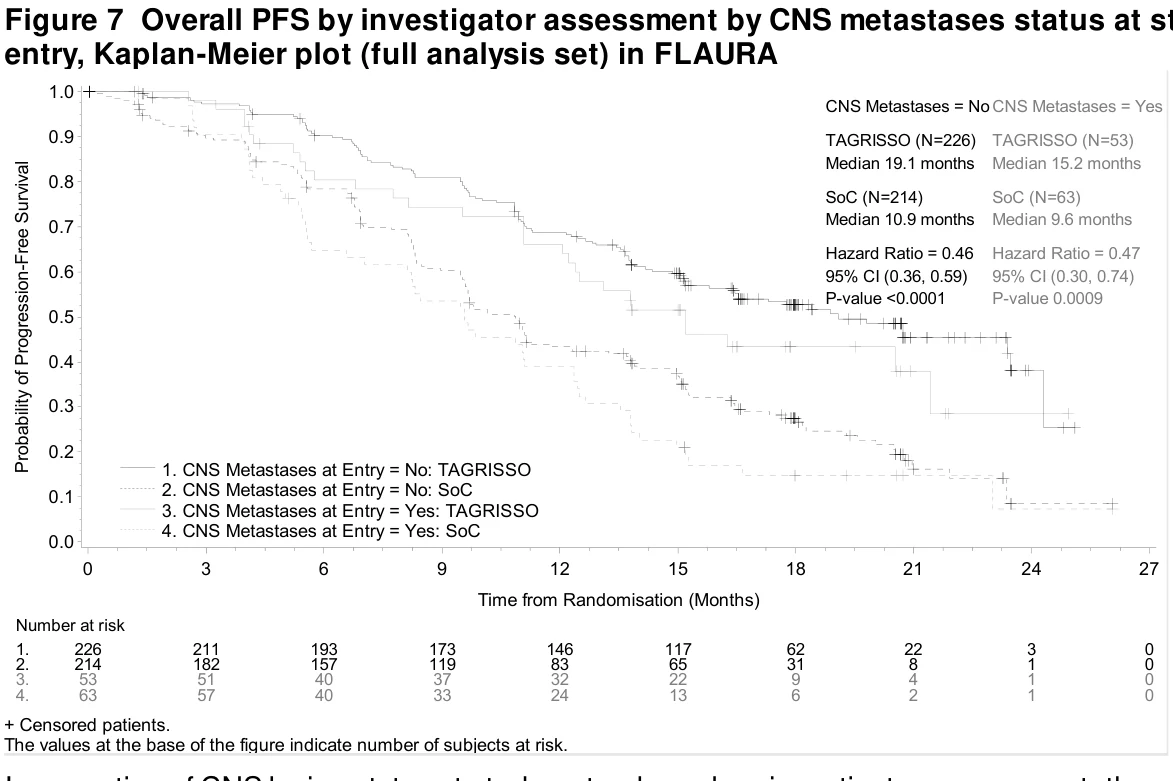
baseline up to month 9 showed similar improvements in TAGRISSO and EGFR TKI comparator groups for the five pre-specified primary PRO symptoms (cough, dyspnea, chest pain, fatigue, and appetite loss). Up to month 9, there were no clinically meaningful differences (as assessed by a difference of ≥10 points) between the TAGRISSO and EGFR TKI comparator groups in functioning or HRQL.
Trial Design and Study Demographics (FLAURA2)
The efficacy and safety of TAGRISSO in combination with pemetrexed and platinum-based chemotherapy for the treatment of patients with EGFR mutation-positive locally advanced or metastatic NSCLC, who had not received prior systemic treatment for advanced disease, was evaluated in a randomized, open-label, active-controlled study (FLAURA2). Patient tumour tissue samples were required to have one of the two common EGFR mutations known to be associated with EGFR TKI sensitivity (Ex19del or L858R), as identified by local or central testing.
Patients were randomized (1:1) to one of the following treatment arms:
- TAGRISSO (80 mg) orally once daily with pemetrexed (500 mg/m2) and the investigator’s choice of cisplatin (75 mg/m2) or carboplatin (AUC5) administered intravenously on Day 1 of 21-day cycles for 4 cycles, followed by TAGRISSO (80 mg) orally once daily and pemetrexed (500 mg/m2) administered intravenously every 3 weeks (n=279)
- TAGRISSO (80 mg) orally once daily (n=278)
Randomization was stratified by race (Chinese/Asian, non-Chinese/Asian or non-Asian), WHO performance status (0 or 1), and method for tissue testing (central or local). Patients received study therapy until intolerance to therapy, or the investigator determined that the patient was no longer experiencing clinical benefit.
The primary efficacy endpoint was PFS as assessed by investigator per RECIST 1.1, a sensitivity analysis for PFS by BICR was conducted. OS was a key secondary endpoint. Additional efficacy endpoints included ORR, DoR, disease control rate (DCR), depth of response, PFS2, TFST and TSST as assessed by investigator. CNS PFS, CNS ORR, CNS DoR, and CNS depth of response as assessed by BICR, and PRO were also assessed.
The baseline demographic and disease characteristics of the overall study population (Table 24) were: median age 61 years (range 26-85 years), ≥75 years old (8%), female (61%), Asian (64%), White (28%), never smokers (66%). All patients had a WHO performance status of 0 or 1; 49% of patients had metastatic bone disease, 53% of patients had extra-thoracic metastases and 20% had liver metastases. Forty-one percent (41%) of patients had CNS metastases (identified by investigator based on CNS lesion site at baseline, medical history, and/or prior surgery, and/or prior radiotherapy to CNS metastases).
Table 24 Demographics and key baseline disease characteristics in FLAURA2 trial (full analysis set)
| TAGRISSO with Pemetrexed and Platinum-based Chemotherapy | TAGRISSO | |||||||||||
|---|---|---|---|---|---|---|---|---|---|---|---|---|
| (N=279) | (N=278) | |||||||||||
| Demographics | ||||||||||||
| Age (years) a | ||||||||||||
| Mean (standard deviation) | 61.0 (10.03) | 60.7 (10.57) | ||||||||||
| Median (minimum-maximum) | 61.0 (26, 83) | 61.5 (30, 85) | ||||||||||
| Age group (years), n (%) a | ||||||||||||
| <50 | 38 (13.6) | 44 (15.8) | ||||||||||
| ≥50-<65 | 136 (48.7) | 122 (43.9) | ||||||||||
| ≥65-<75 | 82 (29.4) | 88 (31.7) | ||||||||||
| ≥75 | 23 (8.2) | 24 (8.6) | ||||||||||
| Sex, n (%) | ||||||||||||
| Male | 106 (38.0) | 109 (39.2) | ||||||||||
| Female | 173 (62.0) | 169 (60.8) | ||||||||||
| Race, n (%) | ||||||||||||
| Black or African | 2 (0.7) | 3 (1.1) | ||||||||||
| Native Hawaiian or other Pacific Islander | 0 | 0 | ||||||||||
| American Indian or Alaska Native | 11 (3.9) | 6 (2.2) | ||||||||||
| Asian | 179 (64.2) | 176 (63.3) | ||||||||||
| White | 74 (26.5) | 83 (29.9) | ||||||||||
| Other | 13 (4.7) | 10 (3.6) | ||||||||||
| Smoking history, n (%) | ||||||||||||
| Never smokers | 188 (67.4) | 181 (65.1) | ||||||||||
| Current smokers | 4 (1.4) | 4 (1.4) | ||||||||||
| Former smokers | 87 (31.2) | 93 (33.5) | ||||||||||
| WHO performance status | ||||||||||||
| 0 (normal activity) | 104 (37.3) | 102 (36.7) | ||||||||||
| 1 (restricted activity) | 174 (62.4) | 176 (63.3) | ||||||||||
| 2 b | 1 (0.4) | 0 | ||||||||||
| Overall disease classification at study entry, n(%) | ||||||||||||
| Metastatic c | 265 (95.0) | 271 (97.5) | ||||||||||
| Locally-advanced d | 14 (5.0) | 7 (2.5) | ||||||||||
| CNS metastases e | 116 (41.6) | 110 (39.6) | ||||||||||
| Extra-thoracic visceral metastases f | 147 (52.7) | 149 (53.6) | ||||||||||
| Liver metastases f | 43 (15.4) | 66 (23.7) | ||||||||||
| EGFR mutations as used for randomization, n(%) | ||||||||||||
| Exon 19 deletion g | 172 (61.6) | 169 (60.8) | ||||||||||
| Exon 21 L858R | 106 (38.0) | 107 (38.5) | ||||||||||
a Age at study entry.
b Patient E2805038 had a WHO PS of 1 at the time of randomization but prior to study drug administration on Cycle 1 Day 1 had a record of WHO PS 2 attributed to mobility issues. This was transient with the WHO PS returning to 1 at Cycle 2 Day 1.
c Patients had any metastatic site of disease
d Patients had only locally advanced sites of disease
e CNS lesions as identified by the Investigator and recorded in the eCRF based on CNS lesion site at baseline, medical history, and/or prior surgery, and/or prior radiotherapy to CNS metastases.
f This is a programmatically derived composite endpoint with a list of contributing eCRF data sources.
g Patients with both Exon 19 deletion and L858R are included in the Exon 19 deletion subgroup.
DCO: 03 April 2023
Study Results (FLAURA2)
TAGRISSO in combination with pemetrexed and platinum-based chemotherapy demonstrated a clinically meaningful and statistically significant improvement in PFS compared to TAGRISSO monotherapy (51% maturity; HR=0.62, 95% CI: 0.49, 0.79; P<0.0001; median 25.5 months and 16.7 months, respectively). The second interim analysis of OS (DCO 08 January 2024) demonstrated an HR of 0.75 (95% CI: 0.57, 0.97; P=0.0280, 41% maturity) for TAGRISSO with pemetrexed and platinum-based chemotherapy versus TAGRISSO monotherapy which did not reach statistical significance. Efficacy results by investigator assessment are summarized in
Table 25, and the Kaplan-Meier curve for PFS is shown in Figure 8.
Table 25 Efficacy results from FLAURA2 by investigator assessment (Full analysis set)
| Efficacy Parameter | TAGRISSO with Pemetrexed and Platinum-based Chemotherapy (N=279) | TAGRISSO (N=278) | ||||||||
|---|---|---|---|---|---|---|---|---|---|---|
| Progression-Free Survival a | ||||||||||
| Number of Events (51.3% maturity) | 120 (43) | 166 (60) | ||||||||
| Median PFS, months (95% CI) | 25.5 (24.7, NC) | 16.7 (14.1, 21.3) | ||||||||
| HR (95% CI); P-value | 0.62 (0.49, 0.79); <0.0001 | |||||||||
| Overall Survival | ||||||||||
| Number of deaths, (41% maturity) | 100 (36) | 126 (45) | ||||||||
| Median OS in months (95% CI) | NC (38.0, NC) | 36.7 (33.2, NC) | ||||||||
| HR (95.05% CI); P-value | 0.75 (0.57, 0.97); P=0.0280 b | |||||||||
| Objective Response Rate c,d | ||||||||||
| Number of responses Response Rate (95% CI) | 232 83 (78, 87) | 210 76 (70, 80) | ||||||||
| Odds ratio (95% CI); P-value e | 1.61 (1.06, 2.44); 0.0261 | |||||||||
| Duration of Response (DoR) c | ||||||||||
| Median, Months (95% CI) f | 24.0 (20.9, 27.8) | 15.3 (12.7, 19.4) | ||||||||
HR=Hazard Ratio; CI=Confidence Interval, NC=Not Calculable
PFS, ORR, and DoR results based on RECIST investigator assessment.
Median follow-up time for PFS in all patients was 19.5 months in the TAGRISSO with pemetrexed and platinum-based chemotherapy arm and 16.5 months in the TAGRISSO monotherapy arm.
PFS, ORR and DoR, results are from DCO 03 April 2023. OS results are from DCO 08 January 2024.
A HR<1 favours TAGRISSO with pemetrexed and platinum-based chemotherapy, an Odds ratio >1 favours TAGRISSO with pemetrexed and platinum-based chemotherapy.
a A sensitivity analysis of PFS by blinded independent central review (BICR) was consistent with PFS by investigator assessment.
b Based on the second interim analysis (41% maturity) a p-value < 0.00001 was required to achieve statistical significance.
c Based on unconfirmed response.
d ORR results by BICR were consistent with those reported via investigator assessment; ORR by BICR assessment was 92% (95% CI: 88, 95) for patients in the TAGRISSO with pemetrexed and platinum-based chemotherapy arm and 83% (95% CI: 78, 87) for patients in the TAGRISSO monotherapy arm.
e The analysis was performed using a logistic regression stratified by race (Chinese/Asian vs. Non -Chinese/Asian vs. Non-Asian), WHO performance status (0 vs. 1), and method used for tissue testing (central vs. local).
f Calculated using the Kaplan-Meier method.
Figure 8 Kaplan-Meier Curves of Progression-Free Survival as assessed by investigator in FLAURA2
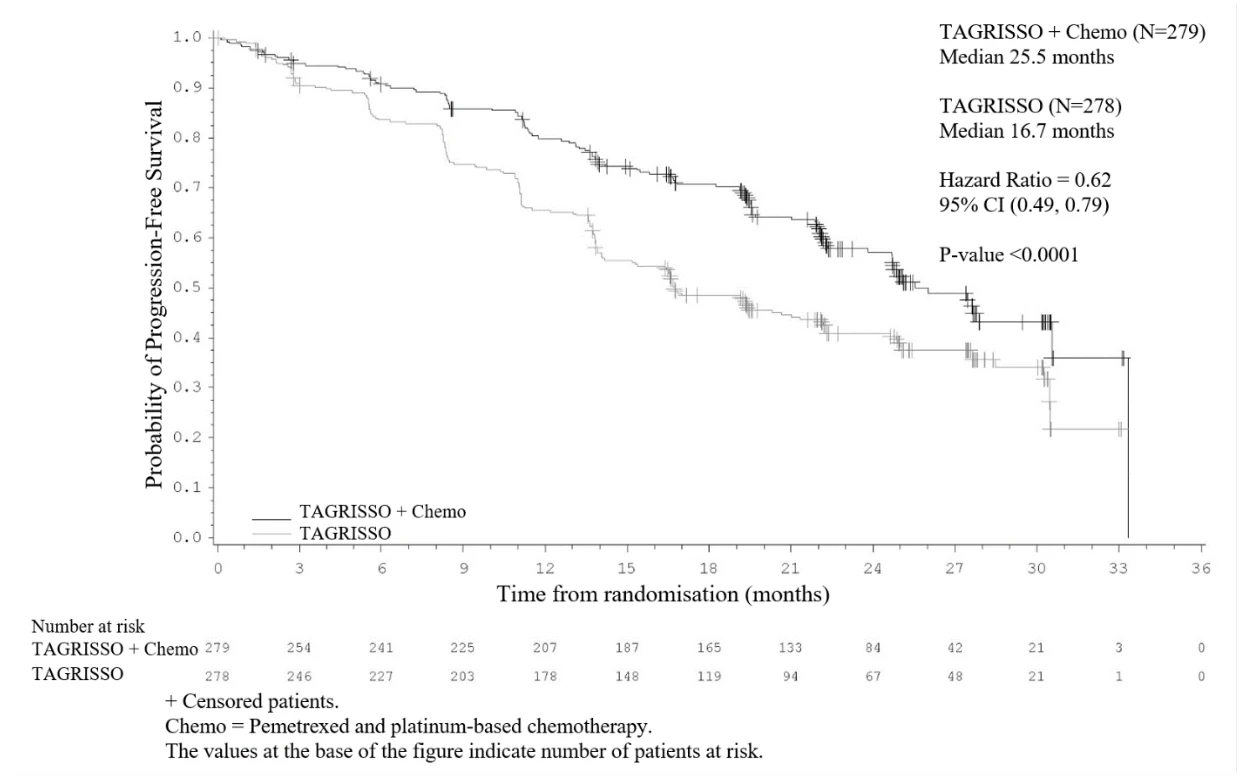
The PFS benefit of TAGRISSO in combination with pemetrexed and platinum-based chemotherapy compared to TAGRISSO monotherapy was consistent across all predefined subgroups analyzed, including ethnicity, age, gender, smoking history, CNS metastases status at study entry and EGFR mutation type (Exon 19 deletion or L858R).
CNS metastases efficacy in FLAURA2
All patients had available baseline brain scans reviewed by BICR using modified RECIST. 78/557 (14%) patients had CNS measurable lesions (cEFR subgroup). Results of pre-specified exploratory analysis of CNS PFS by BICR is summarized in Table 26.
Table 26 CNS efficacy by BICR in patients with CNS metastases on a baseline brain scan in FLAURA2
| Efficacy Parameter | CNS Measurable Lesions (cEFR) | |||||||||
|---|---|---|---|---|---|---|---|---|---|---|
| TAGRISSO with Pemetrexed and Platinum-based Chemotherapy (N=40) | TAGRISSO (N=38) | |||||||||
| CNS Progression-Free Survival a | ||||||||||
| Number (%) of events | 11 (28) | 18 (47) | ||||||||
| Median CNS PFS, months (95% CI) | NC (23.0, NC) | 17.3 (13.9, NC) | ||||||||
| HR (95% CI); P-value b | 0.40 (0.19, 0.84); 0.0157 | |||||||||
| CNS Objective Response Rate a | ||||||||||
Number of CNS responses (n), CNS Response Rate % (95% CI) | 35 88 (73, 96) | 33 87 (72, 96) | ||||||||
| Complete response | 19 (48) | 6 (16) | ||||||||
| Partial response | 16 (40) | 27 (71) | ||||||||
| Odds ratio (95% CI); P- value b,c | 1.06 (0.28, 4.00); 0.9308 | |||||||||
| CNS Duration of Response a | ||||||||||
| Median CNS DoR, months (95% CI) | NC (21.6, NC) | 20.9 (12.6, NC) | ||||||||
| Patients remaining in response at 12 months (%) (95% CI) | 93 (75, 98) | 74 (53, 87) | ||||||||
| Patients remaining in response at 24 months (%) (95% CI) | 57 (27, 78) | 45 (22, 65) | ||||||||
HR=Hazard Ratio; CI=Confidence Interval, NC=Not Calculable
A HR< 1 favours TAGRISSO with pemetrexed and platinum-based chemotherapy, an Odds ratio >1 favours TAGRISSO with pemetrexed and platinum-based chemotherapy.
a Based on unconfirmed responses.
b Nominal P-value.
c The analysis was performed using logistic regression with a factor for treatment.
The median best percentage change in target CNS lesion size from baseline was -94% (range: -100% to 7%) in the TAGRISSO with pemetrexed and platinum-based chemotherapy arm and -61% (range: - 100% to 68%) in the TAGRISSO monotherapy arm.
Patient-reported symptoms and HRQL were electronically collected using the EORTC QLQ-C30 and its lung cancer module (EORTC QLQ-LC13). At baseline, no differences in patient-reported symptoms, physical function or global health status/quality of life (GHS/QoL) were observed between the TAGRISSO with pemetrexed and platinum-based chemotherapy arm and the TAGRISSO monotherapy arm.
Data collected from baseline up to month 19 showed similar improvements for three of the five pre-specified primary PRO symptoms (cough, dyspnoea, and chest pain) in the TAGRISSO with pemetrexed and platinum-based chemotherapy arm compared with the TAGRISSO monotherapy arm, with improvement in cough reaching the established clinically relevant cutoff (change from baseline ≤-10) in both arms. There was a trend towards improvement for appetite loss and fatigue in the TAGRISSO monotherapy arm. In the TAGRISSO with pemetrexed and platinum-based chemotherapy arm, there was a trend towards worsening in fatigue during the first 4 cycles of chemotherapy followed by a trend towards improvement, and a trend towards worsening in appetite loss. Both arms reported no clinically meaningful changes in physical functioning and Global health status/QoL (GHS/QoL).
EGFR T790M Mutation-Positive Advanced NSCLC
Trial Design and Study Demographics (AURA3)
Table 27 Summary of patient demographics for clinical trials in EGFR T790M mutation positive NSCLC.
| Study # | Study design | Dosage, route of administratio n and duration | Study subjects (n) | Median age (Range) | Sex |
D5106C000 03 (AURA3) | Phase III, randomized (2:1), open label, active-controlled study that investigated TAGRISSO 80 mg once daily as treatment for locally advanced or metastatic EGFR T790M mutation positive NSCLC. | 80 mg Tablet, Once daily | TAGRISSO: n=279 Platinum-based doublet chemotherapy n=140 | TAGRISSO: 62.0 (25-85) Platinum-based doublet chemotherapy 63.0 (20-90) | TAGRISSO: 107 Platinum-based doublet chemotherapy 172 |
The efficacy and safety of TAGRISSO 80 mg tablets for the treatment of patients with locally advanced or metastatic EGFR T790M NSCLC whose disease has progressed on or after EGFR TKI therapy, was demonstrated in a randomized, open label, active-controlled Phase III trial (AURA3). All patients were required to have EGFR T790M mutation positive NSCLC identified by the cobas EGFR mutation test performed in a central laboratory prior to randomization. The EGFR T790M mutation status was also assessed using ctDNA extracted from a plasma sample taken during screening. The primary efficacy endpoint was progression-free survival (PFS) as assessed by the investigator. Secondary efficacy endpoints included objective response rate (ORR), duration of response (DoR) and overall survival (OS) as assessed by the investigator.
Patients were randomized in a 2:1 (TAGRISSO: platinum-based doublet chemotherapy) ratio to receive TAGRISSO (n=279) or platinum-based doublet chemotherapy (n=140). Randomization was stratified by ethnicity (Asian and non-Asian). Patients in the TAGRISSO arm received TAGRISSO 80 mg orally once daily until intolerance to therapy, or the investigator determined that the patient was no longer experiencing clinical benefit. Chemotherapy consisted of pemetrexed 500 mg/m2 with carboplatin AUC5 or pemetrexed 500 mg/m2 with cisplatin 75 mg/m2 on Day 1 of every 21-day cycle for up to 6 cycles. Patients whose disease has not progressed after four cycles of platinum-based chemotherapy may receive pemetrexed maintenance therapy (pemetrexed 500 mg/m2 on Day 1 of every 21-day cycle). Subjects on the chemotherapy arm who had objective radiological progression (by the investigator and confirmed by independent central imaging review) were given the opportunity to cross over to receive treatment with TAGRISSO.
Demographic and disease characteristics for AURA3 are provided in Table 28.
| Table 28 Demographic and disease characteristics in Phase III AURA3 trial (Full analysis set) | ||||
| Characteristic | TAGRISS O 80mg | Chemothera py | Total | |
| (N=279) | (N=140) | (N=419) | ||
| Age (years), n (%) | ||||
| Median (range) | 62.0 (25-85) | 63.0 (20-90) | 62.0 (20-90) | |
| <65 | 165 (59.2) | 77 (55.0) | 242 (57.8) | |
| ≥65-<75 | 72 (25.8) | 41 (29.3) | 113 (27.0) | |
| ≥75 | 42 (15.1) | 22 (15.7) | 64 (15.3) | |
| Sex, n (%) | ||||
| Male | 107 (38.4) | 43 (30.7) | 150 (35.8) | |
| Female | 172 (61.6) | 97 (69.3) | 269 (64.2) | |
| Race, n (%) | ||||
| White | 89 (31.9) | 45 (32.1) | 134 (32.0) | |
| Black or African American | 4 (1.4) | 1 (0.7) | 5 (1.2) | |
| Asian | 182 (65.2) | 92 (65.7) | 274 (65.4) | |
| Other | 4 (1.4) | 2 (1.4) | 6 (1.4) | |
| Smoking status, n (%) | ||||
| Never | 189 (67.7) | 94 (67.1) | 283 (67.5) | |
| Current | 14 (5.0) | 8 (5.7) | 22 (5.3) | |
| Former | 76 (27.2) | 38 (27.1) | 114 (27.2) | |
| WHO performance status, n (%) | ||||
| 0 (Normal activity) | 102 (36.6) | 56 (40.0) | 158 (37.7) | |
| 1 (Restricted activity) | 177 (63.4) | 84 (60.0) | 261 (62.3) | |
| Histology type | ||||
| Squamous cell carcinoma (NOS) | 3 (1.1) | 0 (0.0) | 3 (0.7) | |
| Adenocarcinomab | 274 (98.2) | 139 (99.3) | 413 (98.6) | |
| Non-small cell carcinoma | 0 (0.0) | 1 (0.7) | 1 (0.2) | |
| Adenosquamous carcinoma | 2 (0.7) | 0 (0.0) | 2 (0.5) | |
| Table 28 Demographic and disease characteristics in Phase III AURA3 trial (Full analysis set) | ||||
| Characteristic | TAGRISS O 80mg | Chemothera py | Total | |
| (N=279) | (N=140) | (N=419) | ||
| Overall disease classification | ||||
| Metastatic | 266 (95.3) | 138 (98.6) | 404 (96.4) | |
| Locally advanced | 13 (4.7) | 2 (1.4) | 15 (3.6) | |
| Metastases | ||||
| CNSa | 93 (33.3) | 51 (36.4) | 144 (34.4) | |
| Extra-thoracic Visceral | 145 (52.0) | 80 (57.1) | 225 (53.7) | |
| Liver | 56 (20.1) | 41 (29.3) | 97 (23.2) | |
| Bone/locomotor | 105 (37.6) | 71 (50.7) | 176 (42.0) | |
| Number of previous anti-cancer treatment regimens for advanced disease | ||||
| 1 | 269 (96.4) | 134 (95.7) | 403 (96.2) | |
| 2 | 9 (3.2) | 6 (4.3) | 15 (3.6) | |
| 3 | 1 (0.4) | 0 (0.0) | 1 (0.2) | |
| Median (range) | 1.0 (1-3) | 1.0 (1-2) | 1.0 (1-3) | |
| EGFR Mutations by cobas® central test | ||||
| EGFR EXON 20 T790M | 275 (98.6) | 138 (98.6) | 413 (98.6) | |
| EGFR EXON 21 L858R | 83 (29.7) | 45 (32.1) | 128 (30.5) | |
| EGFR EXON 19 Deletion | 191 (68.5) | 87 (62.1) | 278 (66.3) | |
| G719X | 4 (1.4) | 2 (1.4) | 6 (1.4) | |
| S768I | 1 (0.4) | 1 (0.7) | 2 (0.5) | |
| EGFR EXON 20 Insertion | 1 (0.4) | 2 (1.4) | 3 (0.7) | |
| Duration of Prior EGFR TKI Therapy | ||||
| <6 Months | 17 (6.1) | 7 (5.0) | 24 (5.7) | |
| ≥ 6 Months | 262 (93.9) | 133 (95.0) | 395 (94.3) | |
a CNS metastases at study entry identified by CNS lesion site at baseline, medical history, and/or prior surgery, and/or prior radiotherapy to CNS metastases.
b Includes: Adenocarcinoma (Not otherwise specified); Adenocarcinoma: acinar; Adenocarcinoma: papillary; Adenocarcinoma: bronchioloalveolar; Adenocarcinoma: solid with mucus formation and; Adenocarcinoma: bronchioloalveolar carcinoma (bac) and papillary.
Study Results (AURA3)
At the time of the primary PFS analysis, 43.9% of patients were ongoing on their randomized treatment (59.5% in the TAGRISSO arm and 11.8% in the chemotherapy arm).
AURA3 demonstrated a clinically meaningful and statistically significant improvement in PFS in the patients treated with TAGRISSO compared to chemotherapy. Efficacy results from AURA3 by investigator assessment are summarized in Table 29, and the Kaplan-Meier curve for PFS is shown in Figure 9.
Table 29 Efficacy results from AURA3 by investigator assessment (Full analysis set)
| Efficacy Parameter | TAGRISSO (n=279) | Chemotherapy (n=140) | |||||||||||
|---|---|---|---|---|---|---|---|---|---|---|---|---|---|
| Progression-Free Survival | |||||||||||||
| Number of Events (% maturity) | 140 (50) | 110 (79) | |||||||||||
| Median PFS, months (95% CI) | 10.1 (8.3, 12.3) | 4.4 (4.2, 5.6) | |||||||||||
| HR (95% CI); P-value | 0.30 (0.23, 0.41); <0.001 | ||||||||||||
| Objective Response Rate | |||||||||||||
| Number of responses a, Response Rate (95% CI) | 197 71 (65, 76) | 44 31 (24, 40) | |||||||||||
| Complete Response, n(%)a | 4 (1.4) | 2 (1.4) | |||||||||||
| Partial Response, n(%)a | 193 (69.2) | 42 (30.0) | |||||||||||
| Odds ratio (95% CI); P-value | 5.4 (3.5, 8.5); <0.001 | ||||||||||||
| Duration of Response | |||||||||||||
| Median DoR, months (95% CI) | 9.7 (8.3, 11.6) | 4.1 (3.0, 5.6) | |||||||||||
CI=confidence interval; HR=Hazard Ratio All efficacy results based on RECIST investigator assessment A HR<1 favours TAGRISSO
a Response does not require confirmation
Figure 9 Kaplan-Meier Curves of Progression-Free Survival as assessed by investigator in AURA3
0 3 6 9 12 15 18 0 .0 0 .2 0 .4 0 .6 0 .8 1 .0 Pr o g r e s s io n Fr e e Su r v iv a l Pr o b a b ilit y Time (Months) TAGRISSO Chemotherapy 279 240 162 88 50 13 0 TAGRISSO 140 93 44 17 7 1 0 Chemotherapy Number at risk Tick marks represent censored observations TAGRISSO (N=279) Median 10.1 months Chemotherapy (N=140) Median 4.4 months Hazard Ratio = 0.30 95% CI (0.23, 0.41) P value <0.001
The AURA3 primary outcome measure included a sensitivity analysis of PFS using Blinded Independent Central Review (BICR); this analysis demonstrated a consistent treatment effect (HR 0.28; 95% CI: 0.20, 0.38; p<0.0001) with that observed by investigator assessment.
Clinically meaningful improvements in PFS with HRs less than 0.50 in favour of patients receiving TAGRISSO compared to those receiving chemotherapy were consistently observed in all predefined subgroups analysed, including ethnicity, age, gender, smoking history, CNS metastases status at study entry, EGFR mutation (exon 19 deletion and L858R), and duration of first-line therapy with an EGFR-TKI.
Among the patients in AURA3 treated with TAGRISSO with objective responses, 81.7% (161/279) had documentation of response at 6 weeks, and 94.9% (187/279) had documentation of response at 12 weeks.
The overall survival (OS) data was not mature at the time of the final PFS analysis (25% of patients had died). The final OS analysis was performed based on 281 death events (67% maturity, at which time 99 patients (71%) randomized to chemotherapy had crossed over to TAGRISSO treatment). Median OS in the TAGRISSO arm was 26.8 months compared to 22.5 months in the chemotherapy arm [Hazard ratio 0.87 (95% CI 0.67, 1.12)], not statistically significant.
CNS Metastasis Efficacy Data in AURA3 Trial
An analysis of PFS by investigator assessment using RECIST v1.1 was performed in 419 patients based on CNS metastases status (Yes or No) at study entry (see Figure 10). The benefit of TAGRISSO was reported in patients with or without CNS metastases at baseline.
Figure 10 Kaplan-Meier curve of overall PFS by CNS metastases status at study entry in AURA3 as assessed by investigator (Full analysis set)
| CNS metastases status: Yes | CNS metastases status: No |
|---|
A BICR assessment of CNS efficacy by RECIST v1.1 was performed in a subgroup of 116/419 (28%) patients identified to have CNS metastases on a baseline brain scan are summarized in Table 30.
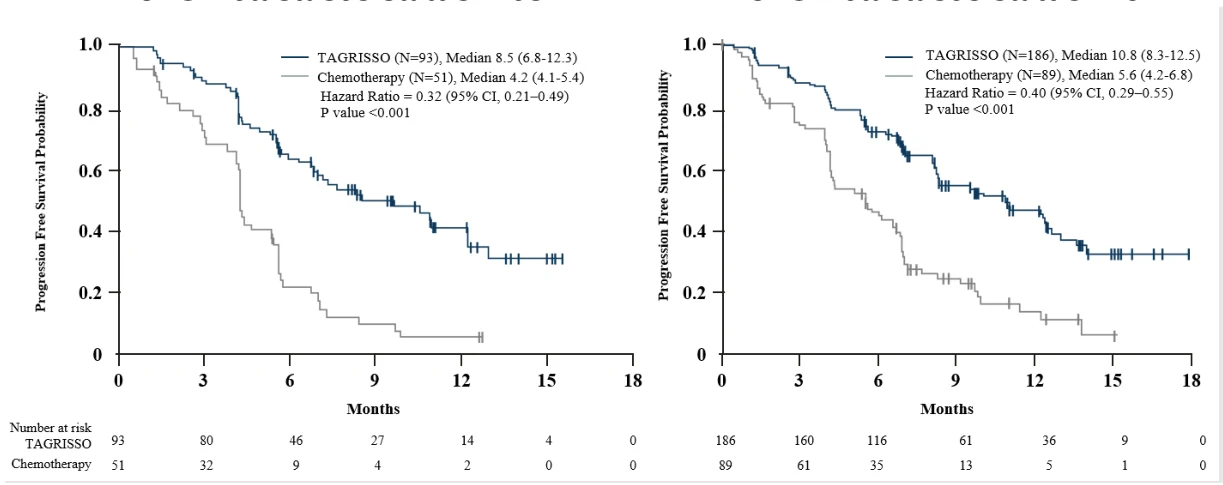 |
|---|
Table 30 CNS efficacy by BICR in patients with CNS metastases on a baseline brain scan in AURA3 (Full analysis set)
| Efficacy Parameter | TAGRISSO | Chemotherapy | ||||||||||||
|---|---|---|---|---|---|---|---|---|---|---|---|---|---|---|
| CNS Objective Response Ratea | ||||||||||||||
| CNS response rate %, (n/N) (95% CI) | 70% (21/30) (51, 85) | 31% (5/16) (11, 59) | ||||||||||||
| Complete Response, n (%) | 2 (6.7) | 1 (6.3) | ||||||||||||
| Partial Response, n (%) | 19 (63.3) | 4 (25.0) | ||||||||||||
| Odds Ratio (95% CI); P-value | 5.1 (1.4, 21); 0.015 | |||||||||||||
| CNS Duration of Responseb | ||||||||||||||
| Median, Months (95% CI) | 8.9 (4.3, NC) | 5.7 (NC, NC) | ||||||||||||
| CNS Disease Control Rate (DCR) | ||||||||||||||
| DCR (Number with CNS disease control) (95% CI) | 87% (65/75) (77, 93) | 68% (28/41) (52, 82) | ||||||||||||
| Odds Ratio (95% CI); P-value | 3 (1.2, 7.9); 0.021 | |||||||||||||
| CNS Progression-free survivalc | N=75 | N=41 | ||||||||||||
| Number of Events (% maturity) | 19 (25) | 16 (39) | ||||||||||||
| Median, Months (95% CI) | 11.7 (10, NC) | 5.6 (4.2, 9.7) | ||||||||||||
| HR (95% CI); P-value | 0.32 (0.15, 0.69); 0.004 | |||||||||||||
CI=confidence interval; HR=Hazard Ratio; NC=Non-calculable A HR< 1 favours TAGRISSO
a CNS ORR and DoR determined by RECIST v1.1 by CNS BICR in the evaluable for response population (CNS measurable lesions at baseline by BICR) n=30 for TAGRISSO and n=16 for Chemotherapy.
b Based on patients in the evaluable for response population with response only; DoR defined as the time from the date of first documented response (complete response or partial response, or stable disease ≥6 weeks).
c CNS PFS determined by RECIST v1.1by CNS BICR in the full analysis set population (CNS measurable and non -measurable lesions at baseline by BICR) N=75 for TAGRISSO and N=41 for Chemotherapy.
Thirty-seven (37%) percent (28/75) of patients treated with TAGRISSO and with BICR identified CNS metastases had received prior brain radiation, including 19% (14/75) who completed radiation treatment within 6 months before starting treatment. CNS responses were observed irrespective of prior brain radiation status.
TAGRISSO decreased the appearance of new CNS metastases (4.7%) as compared with chemotherapy (14.3%) according to RECIST v1.1 by investigator assessment; 2.5% compared to 9.3%, respectively based on BICR assessment.
EGFR T790M Mutation-Positive Advanced NSCLC - Phase II (AURAex and AURA2) Trials
The use of TAGRISSO 80 mg in the treatment of patients with locally advanced or metastatic EGFR T790M mutation-positive NSCLC who progressed on prior systemic therapies, including an EGFR TKI was investigated in two Phase II, multicenter, single-arm, open-label clinical trials, AURAex (Phase II Extension cohort of 201 patients) and AURA2 (210 patients). All patients were required to have EGFR T790M mutation-positive NSCLC, identified by the cobas EGFR mutation test performed in a central laboratory prior to dosing.
The primary efficacy endpoint of both trials was objective response rate (ORR) based on BICR using RECIST v1.1. Secondary efficacy endpoints included DoR.
Baseline characteristics of the overall study population (AURAex and AURA2) were as follows: median age 63 years, 13% of patients were ≥75 years old, female (68%), White (36%), Asian (60%). All patients received at least one prior line of therapy. Thirty-one percent (31%) had received 1 prior line of therapy (EGFR-TKI treatment only, second line, chemotherapy naïve), 69% had received 2 or more prior lines. Seventy-two percent (72%) of patients were never smokers, 100% of patients had a World Health Organization (WHO) performance status of 0 or 1. Fifty-nine percent (59%) of patients had extra-thoracic visceral metastasis including 39% with CNS metastases (identified by CNS lesion site at baseline, medical history, and/or prior surgery and/or prior radiotherapy to CNS metastases) and 29% with liver metastases. Forty-seven percent (47%) of patients had metastatic bone disease.
With a median duration of follow-up of 13 months (AURAex and AURA2) in the 411 patients, the ORR was 66% (95% CI: 61, 71). In patients with a confirmed response, the median DoR was 12.5 months (95% CI: 11.1, non-evaluable).
Objective response rates above 50% were observed in all predefined subgroups analysed, including line of therapy, race, age and region.
CNS Metastases Efficacy Data in Phase II Trials (AURAex and AURA2)
A BICR assessment of CNS efficacy by RECIST v1.1 was performed in a subgroup of 50 (out of 411) patients identified to have measurable CNS metastases on a baseline brain scan. A CNS ORR of 54% (27/50 patients; 95% CI: 39.3, 68.2) was observed with 12% being complete responses.
15 MICROBIOLOGY
No microbiological information is required for this drug product.
16 NON-CLINICAL TOXICOLOGY
Carcinogenicity:
Repeat dose toxicity
The main findings observed in repeat dose toxicity studies in rats and dogs comprised atrophic, inflammatory and/or degenerative changes affecting the epithelia of the eye (cornea), GI tract (including tongue), skin, and male and female reproductive tracts. These findings occurred at plasma concentrations that were below those seen in patients at the 80 mg therapeutic dose. The findings present following 1 month of dosing were largely reversible within 1 month of cessation of dosing.
Lens fibre degeneration was observed in the 104-week carcinogenicity rat study at exposures 0.2-times the AUC observed at the recommended clinical dose of 80 mg once daily and was consistent with the ophthalmoscopic observation of lens opacities which were first noted from week 52 and showed a gradual increase in incidence and severity with increased duration of dosing.
Carcinogenesis and mutagenesis
Osimertinib showed no carcinogenic potential when administered orally to Tg rasH2 transgenic mice for 26 weeks. An increased incidence of proliferative vascular lesions (angiomatous hyperplasia and haemangioma) in the mesenteric lymph node was observed in the rat 104-week carcinogenicity study at exposures 0.2-times the AUC observed at the recommended clinical dose of 80 mg once daily. This is consistent with a vascular response in rats to long term drug exposure and is not predictive of carcinogenic potential for vascular neoplasms in humans. Osimertinib did not cause genetic damage in in vitro and in vivo assays.
Reproductive and Developmental Toxicology: Based on studies in animals, male fertility may be impaired by treatment with TAGRISSO. Degenerative changes were present in the testes in rats and dogs exposed to osimertinib for ≥1 month and there was a reduction in male fertility in rats following exposure to osimertinib for 3 months. These findings were seen at clinically relevant plasma concentrations. Pathology findings in the testes seen following 1 month dosing were reversible in rats; however, a definitive statement on reversibility of lesions in dogs cannot be made.
Based on studies in animals, female fertility may be impaired by treatment with TAGRISSO. In repeat dose toxicity studies, an increased incidence of anestrus, corpora lutea degeneration in the ovaries and epithelial thinning in the uterus and vagina were seen in rats exposed to osimertinib for ≥1 month at clinically relevant plasma concentrations. Findings in the ovaries seen following 1 month dosing were reversible. In a female fertility study in rats, administration of osimertinib at 20 mg/kg/day (approximately equal to the recommended daily clinical dose of 80 mg) had no effects on estrus cycling or the number of females becoming pregnant, but caused early embryonic deaths. These findings showed evidence of reversibility following a 1-month off-dose.
In a modified embryofetal development study in the rat, osimertinib caused embryolethality when administered to pregnant rats prior to embryonic implantation. These effects were seen at a maternally tolerated dose of 20 mg/kg/day where exposure was equivalent to the human exposure at the recommended dose of 80 mg daily (based on total AUC). Exposure at doses of 20 mg/kg and above during organogenesis caused reduced fetal weights but no adverse effects on external or visceral fetal morphology. When osimertinib was administered to pregnant female rats throughout gestation and then through early lactation, there was demonstrable exposure to osimertinib and its metabolites in suckling pups plus a reduction in pup survival and poor pup growth (at doses of 20 mg/kg and above).