


Product Monograph - Tisseel Kit Vh 1.0
Serious Warnings and Precautions
TISSEEL (Fibrin Sealant (Human), Vapor Heated, Solvent/Detergent Treated) should not be applied intravascularly, since this may lead to thromboembolic complications, which may be life-threatening. Especially in coronary bypass surgery, TISSEEL should be applied with caution to minimize any risk of intravascular application.
However, if in well-founded cases the injection of TISSEEL and/or Thrombin Solution/s into a tissue or vessel is indicated, careful risk/benefit analysis of the individual case is to be carried out.
As with any other protein products, hypersensitivity or allergic/anaphylactic reactions may occur in rare cases (<1/10,000). In isolated cases, these reactions have progressed to severe anaphylaxis. These reactions may also occur in patients receiving Aprotinin or TISSEEL for the first time or even if first application was well tolerated, but generally risk may be increased if the preparation is applied repeatedly over time or in the same setting. Symptoms associated with allergic anaphylactic reactions include: flush, urticaria, pruritus, nausea, drop in blood pressure, tachycardia or bradycardia, dyspnea, severe hypotension and anaphylactic shock.
In the event of hypersensitivity reactions, administration of TISSEEL is to be discontinued. Mild reactions can be managed with antihistamines. Severe hypotensive reactions require immediate intervention using current principles of shock therapy.
Air or gas embolism has occurred with the use of spray devices employing pressure regulator to administer fibrin sealants. This event appears to be related to the use of the spray device at higher than recommended pressures and in close proximity to the tissue surface.
In the submucous injection of fibrin sealant into hollow organs to stop GI-bleeding (stomach, duodenum), the following points are to be considered:
- Insertion of the needle into the organ wall may result in accidental perforation, which in rare cases may injure adjoining organs or vessels.
- Injection into the submucous membrane may cause a mechanical dissection between the tunica mucosa and the tunica muscularis propria, which in rare cases may lead to vessel injury or the formation of an intramural hematoma.
- Injection into the nasal mucosa must be avoided, as severe allergic-anaphylactoid reactions have been seen and thromboembolic events may occur.
This product must not be used in animals.
The user is cautioned against the spray application of TISSEEL with devices produced by other manufacturers. The EASYSPRAY control device and the Spray Set may be obtained from Baxter.
To prevent TISSEEL from adhering to gloves and instruments, wet these with saline before contact with Sealant.
To avoid the formation of excess granulation tissue and to ensure gradual absorption of the solidified fibrin sealant, only a thin layer of TISSEEL should be applied.
Immediately before application, expel and discard the first several drops from the application cannula to ensure adequate mixing of the Sealer Protein and Thrombin Solutions.
Application Precautions
Apply TISSEEL as a thin layer. Excessive clot thickness may negatively interfere with the product’s efficacy and the wound healing process.
When applying TISSEEL using a spray device, be sure to use the pressure within the pressure range recommended by the spray device manufacturer. In the absence of a specific recommendation avoid using pressure above 20-25 psi. Do not spray closer than the distance recommended by the spray device manufacturer. In the absence of a specific recommendation avoid spraying closer than 10-15 cm from the surface of the tissue. When spraying TISSEEL, changes in blood pressure, pulse, oxygen saturation and end tidal CO2 should be monitored because of the possibility of occurrence of air or gas embolism.
The sealer protein and thrombin solutions can be denatured by alcohol, iodine or heavy metal ions (e.g. antiseptic solutions). If any of these substances have been used to clean the wound area, the area must be thoroughly rinsed before application of TISSEEL.
Cardiovascular
In coronary bypass surgery, TISSEEL should be applied with caution to minimize any risk of intravascular application.
Sexual Function/Reproduction
Animal reproduction studies have not been conducted with TISSEEL. It is also not known whether it can affect reproduction capacity.
Special Populations
Pregnant Women: No experience.
Animal reproduction studies have not been conducted with TISSEEL. It is also not known whether it can cause fetal harm when administered to a pregnant woman.
Nursing Women:
It is not known whether this drug is excreted in human milk. Because many drugs are excreted in human milk, caution should be exercised when TISSEEL is administered to a lactating woman.
Neurosurgical Procedures
The safety and effectiveness of TISSEEL used alone or in combination with biocompatible carriers in neurosurgical procedures or other surgeries involving confined spaces have not been evaluated.
1.6 ADVERSE REACTIONS
Adverse Drug Reaction Overview
TISSEEL (Fibrin Sealant (Human), Vapor Heated, Solvent/Detergent Treated) should not be applied intravascularly, since this may lead to anaphylactic reactions and/or thromboembolic complications, which both may be life-threatening. Especially in coronary bypass surgery, TISSEEL should be applied with caution to minimize any risk of intravascular application.
However, if in well-founded cases the injection of TISSEEL and/or Thrombin Solution(s) into a tissue or vessel is indicated, careful risk/benefit analysis of the individual case is to be carried out.
Allergic and/or anaphylactic reactions may occur in patients with a history of hypersensitivity against bovine protein and/or Aprotinin. Such reactions may be seen in the event of repeated administration, even if the first application was well tolerated. However, allergic and/or anaphylactic reactions may also occur in patients receiving TISSEEL for the first time.
If symptoms require treatment to be initiated, this should be effected in the usual manner, as for instance with antihistamines, corticoids or adrenalin. No adverse events of this type were reported during the clinical trials for TISSEEL.
Clinical Trial Adverse Drug Reactions (ADRs)
Because clinical trials are conducted under widely varying conditions, adverse reaction rates observed in the clinical trials may not reflect the rates observed in practice.
TISSEEL 500 IU (Fast Set):
The following ADRs have been reported from three clinical trials. None of the events was classified as serious.
During a clinical study in cardiovascular surgery where 157 patients were treated with TISSEEL 500 IU (Fast Set) two cases of increased Fibrin D-Dimer levels were observed, but did not exceed values reported in the literature occurring after this type of surgery. Postoperatively increased D-Dimers may result at least partly from the degradation of Fibrin Sealant (see Part II Clinical Trials, trial number 550003).
In a study in axillary lymph node dissection where 79 patients were treated with TISSEEL 500 IU (Fast Set), the most frequently occurring ADRs were seroma (13 cases) and pain in limb (4 cases). However, the overall incidence of (related and unrelated) seroma and procedural pain was comparable between the TISSEEL 500 IU (Fast Set) and an untreated control group (21.5% vs. 18.3%) in this study. Other adverse events reported were: 2 cases each of nausea, post-operative wound infection and post-procedural pain, and 1 case each of pain, increase of body temperature, increase of fibrin degradation products, sensory disturbance, rash, axillary vein thrombosis and hypotension.
No adverse events related to TISSEEL 500 IU (Fast Set) were reported from a study in hip joint replacement from the 53 patients treated with the product.
The related adverse events of the cardiovascular surgery study and the lymph node dissection study are listed according to their system organ class in the table below. Frequencies are based on patients treated in the respective studies because the indications of the two studies were too different to pool the data.
| System Organ Class | Adverse events (Preferred Term) | TISSEEL 500 IU Number of events/Number of patients treated |
| Blood and lymphatic system disorders | Fibrin D-Dimer increased | 2 of 157 |
| Increase of Fibrin degradation products | 1 of 79 | |
| Nervous system disorders | Sensory disturbance | 1 of 79 |
| Gastrointestinal disorders | Nausea | 2 of 79 |
| Skin and subcutaneous tissue disorders | Rash | 1 of 79 |
| Musculosceletal and connective tissue disorders | Pain in extremity | 4 of 79 |
| Infections and infestations | Postoperative wound infection | 2 of 79 |
| Injury, poisoning and procedural complications | Seroma | 13 of 79 |
| Vascular disorders | Axillary vein thrombosis | 1 of 79 |
| Hypotension | 1 of 79 | |
General disorders and administration site conditions | Procedural Pain | 2 of 79 |
| Pain | 1 of 79 | |
| Body temperature increased | 1 of 79 |
Post-Market Adverse Drug Reactions
The adverse reactions listed below reflect what has been reported in post-marketing experience with Baxter Fibrin Sealants:
Immune system disorders:
Anaphylactic responses, hypersensitivity
Cardiac disorders:
Bradycardia, tachycardia
Vascular disorders:
Hypotension, haematoma
Respiratory, thoracic and mediastinal disorders: Dyspnoea
Gastrointestinal disorders:
Nausea, intestinal obstruction
Skin and subcutaneous tissue disorders: Urticaria
General disorders and administration site conditions:
Flushing, impaired healing, oedema, pyrexia
Injury, poisoning and procedural complication:
Seroma
There have been rare reports of serious adverse events such as paralysis and other compressive complications possibly related to the use of fibrin sealant in combination with resorbable hemostatic agents.
There have also been rare reports of fatalities following the misadministration of topical thrombin.
There have been rare reports of air embolism associated with misapplication of fibrin sealant using a spray device.
Because these reactions are reported voluntarily and the population is of uncertain size, it is not always possible to reliably estimate the frequency of these reactions.
1.7 DRUG INTERACTIONS
Overview
No formal interaction studies have been performed. Drug Interactions are not known. TISSEEL (Fibrin Sealant (Human), Vapor Heated, Solvent/Detergent Treated) can even be applied in fully heparinised patients (e.g. extracorporeal circulation).
1.8 DOSAGE AND ADMINISTRATION
TISSEEL 500 IU (Fast Set) (Fibrin Sealant (Human), Vapor Heated, Solvent/Detergent Treated) is available in two different dosage forms: Kit and Frozen.
TISSEEL Kit consists of 2 vials containing powder preparations of Sealer Protein Concentrate and Thrombin and two vials containing liquid preparations of Aprotinin and Calcium Chloride. The Sealer Protein Concentrate is reconstituted with the Aprotinin and produces a solution that is referred to as the Sealer Protein-Aprotinin Solution. Thrombin is reconstituted with the Calcium Chloride Solution, which produces a solution that is referred to as the Thrombin-Calcium Chloride Solution. These two solutions are applied using an application device described in DOSAGE AND ADMINISTRATION, Application Section. TISSEEL Kit is available in 2, 4 and 10 mL pack sizes (1, 2 and 5 mL reconstituted Sealer Protein Solution and 1, 2 and 5 mL reconstituted Thrombin Solution).
TISSEEL Frozen consists of a pre-filled double-chamber syringe containing Sealer Protein-Aprotinin Solution and Thrombin-Calcium Chloride Solution. TISSEEL Frozen is available in 2, 4 and 10 mL pack sizes.
The setting rate of the TISSEEL Thrombin-Calcium Chloride Solution depends on the concentration of the Thrombin Solution used. The setting process will be complete within seconds with a Thrombin concentration of 500 IU/mL, which may be advantageous to achieve hemostasis.
Dosing Considerations
The required dose of TISSEEL depends on the size of the surface to be covered. The approximate surface areas covered by each package size of TISSEEL are listed in the following table:
Administration
Various methods can be used to apply the two components of TISSEEL:
Simultaneous Application:
- a) using application cannula contained in DUPLOJECT System / DUO Set
- b) using Spray Set and Easy Spray
- c) using DUPLOCATH Application Catheters or other accessories provided by Baxter
Preparation of TISSEEL Kit (Freeze-Dried)
The following instructions are for the reconstitution of TISSEEL Kit using the DUPLOJECT System provided within the Kit. However, an equivalent device can also be used. For operation instructions please refer to the Instructions for Use provided together with this device.
- 1. How to Prepare TISSEEL Sealer Protein Solution
Freeze-dried Sealer Protein Concentrate is reconstituted in the Aprotinin Solution of 3,000 KIU/mL.
Reconstitution of Freeze-Dried Sealer Protein Concentrate Using FIBRINOTHERM
Area to be sealed (cannula, catheter) | Area to be sealed using compressed gas (spray application) | Required package size of TISSEEL |
| 8 cm2 16 cm2 40 cm2 | 25-100 cm2 50-200 cm2 125-500 cm2 | 2 mL 4 mL 10 mL |
device:
For ease of handling, a combined heating and stirring device, FIBRINOTHERM, has been developed to meet the specific requirements of reconstituting freeze-dried Sealer Protein Concentrate. FIBRINOTHERM is a thermoblock with a magnetic stirrer (the vials for freeze-dried Sealer Protein Concentrate contain a magnetic spin propeller to stir the contents). Heating and stirring can be operated independently. In a first step, FIBRINOTHERM heats up to 37°C and then maintains that temperature constantly with minimum variation. The signal light will turn on and off as FIBRINOTHERM is maintaining its temperature. FIBRINOTHERM has been designed to hold the various vial sizes of freeze-dried Sealer Protein Concentrate and Aprotinin Solution.
- After plugging the FIBRINOTHERM into an electrical socket and activating the warmer using the amber switch, place all four vials from the TISSEEL Kit into prewarmed warming wells with the appropriate sized adaptor ring. Refrigerated product may take up to 5 minutes to warm. Room temperature product will take less.
Transfer Aprotinin Solution into vial containing freeze-dried Sealer Protein Concentrate using blue-scaled syringe of corresponding size (or syringe that has been used for dilution of Aprotinin Solution).
Note: Only combine preheated Aprotinin Solution with preheated Sealer Protein Concentrate.
- Place vial into largest opening of FIBRINOTHERM (if necessary, use adaptors). Turn on stirrer with flip switch and stir contents for 8 – 10 minutes.
Reconstitution of freeze-dried Sealer Protein Concentrate is complete as soon as no undissolved particles are detectable in transparent light. Otherwise, replace into FIBRINOTHERM and agitate for another few minutes until the solution appears homogeneous.
Note: Keep the Sealer Protein Solution at 37°C or at room temperature without stirring if it is not to be used immediately. Before use the solution should be warmed to 37°C. To ensure homogeneity, stir or swirl briefly before drawing up the Sealer Protein Solution into the blue-scaled syringe provided in DUPLOJECT System.
Reconstitution of Freeze-Dried Sealer Protein Concentrate Using a Water-Bath:
Preheat the vials containing the Sealer Protein Concentrate (lyophilized) and the
Aprotinin Solution for approximately 3 minutes in a water bath at a temperature of 33 to 37°C. (Heating beyond 37°C must be avoided!)
- Remove the flip-off caps from the vial containing freeze-dried Sealer Protein Concentrate and the vial containing Aprotinin Solution, disinfect the rubber stoppers of both vials with a germicidal solution and allow to dry. Do not use iodine-containing preparations such as betadine for disinfection.
- Transfer Aprotinin Solution into vial containing freeze-dried Sealer Protein Concentrate using blue-scaled syringe of corresponding size (or syringe that has been used for dilution of Aprotinin Solution).
- Allow vial to stand at 37°C for one minute.
- Swirl briefly and vigorously with a circular motion (avoid excessive frothing) and replace vial into water-bath for another 10 – 15 minutes.
- Reconstitution of freeze-dried Sealer Protein Concentrate is complete as soon as no undissolved particles are detectable in transparent light. Otherwise, swirl again briefly and keep vial at 37°C for a few more minutes.
- Draw up Sealer Protein Solution into a sterile blue-scaled syringe using aseptic precautions (insert a needle through the rubber stopper at its center to allow access of air). Note: If not used immediately, keep Sealer Protein Solution at 37°C. The maximum holding time of 4 hours upon reconstitution must not be exceeded. To ensure homogeneity, swirl with a circular motion (avoid frothing) before drawing up the solution.
- How to Prepare Thrombin Solution
Remove the flip-off caps from the vial containing Thrombin and the vial containing
Calcium Chloride Solution, disinfect the rubber stoppers of both vials with a germicidal solution and allow to dry. Do not use iodine-containing preparations such as betadine for disinfection.
- Transfer the contents of the vial with Calcium Chloride Solution into the vial containing the freeze-dried Thrombin using the sterile reconstitution components provided with the DUPLOJECT System.
- Swirl briefly.
- Place the vial into the adapted opening of the FIBRINOTHERM device or Water Bath.
- Reconstitution of Thrombin is complete when all of the Thrombin concentrate is dissolved.
- Keep the Thrombin Solution at 37°C until used.
Transferring to the Sterile Field:
For transfer of the Sealer Protein Solution and the Thrombin Solution to the sterile field, the scrub nurse should withdraw the solutions while the circulating nurse holds the non-sterile vials. The solutions should be withdrawn slowly by firm constant aspiration to reduce the risk of large air bubbles.
After reconstitution, the product must be used within 4 hours.
Note: Do not use the syringes and needles previously used for reconstitution of freeze-dried Sealer Protein Concentrate to prevent premature setting.
Preparation of TISSEEL Frozen (in pre-filled syringes)
TISSEEL in pre-filled syringe (frozen) must be prepared (thawed) under controlled conditions using following options:
Option 1 – Thawing on the sterile field using a Sterile Water Bath:
33°C to 37°C sterile water bath - transfer double-chamber syringe set and the inner pouch to the sterile field, remove the double-chamber syringe with pre-filled syringes from inner pouch and
place directly into sterile water bath. Ensure the contents of the syringe are completely immersed under the water.
Approximate thawing and warming times when using this method are:
| Pack Size | Thawing/Warming Times 33°C to 37°C Sterile Water Bath (Pouches Removed) |
| 2 mL | 5 minutes |
| 4 mL | 5 minutes |
| 10 mL | 12 minutes |
Option 2 – Thawing off the sterile field using a Water Bath:
33°C to 37°C non-sterile water bath, double-chamber syringe in two pouches - maintain the double-chamber syringe set in both pouches and place into a water bath off the sterile field for appropriate time. Ensure the pouches remain submerged throughout thawing. Remove from the water bath after thawing, dry external pouch and transfer inner pouch and pre-filled syringes onto the sterile field.
Approximate thawing and warming times when using this method are:
| Pack Size | Thawing/Warming Times 33°C to 37°C Non-Sterile Water Bath (In Pouches) |
| 2 mL | 30 minutes |
| 4 mL | 40 minutes |
| 10 mL | 80 minutes |
Option 3 – Thawing off the sterile field using an Incubator:
Incubator (33°C to 37°C) in pouches – maintain the -pre-filled syringe in both pouches and place into an incubator for appropriate time. Remove from incubator after thawing and transfer inner pouch and pre-filled syringes onto the sterile field.
Approximate thawing and warming times when using this method are:
| Pack Size | Thawing/Warming Times 33°C to 37°C Incubator (In Pouches) |
| 2 mL | 40 minutes |
| 4 mL | 85 minutes |
| 10 mL | 105 minutes |
Thawed, unopened pouches of TISSEEL 500 IU (Fast Set) may be stored for up to 7 days at room temperature (15-25°C) after removal from the freezer.
NOTE:
After thawing, the product must not be refrigerated, refrozen or be exposed to temperatures above 37oC.
Keep the product at 33-37oC until needed.
The product must be used within 12 hours after warming to 33-37oC or removal from original pouches.
Do not use TISSEEL unless it is completely thawed and warmed (liquid consistency).
Do not remove the protective syringe cap until use.
Application 17
Application Considerations
The setting rate depends on the concentration of the human Thrombin as contained in the Thrombin-Calcium Chloride solution used. The TISSEEL Thrombin component is provided in a 500 IU/mL concentration (TISSEEL 500 IU, Fast Set). A 4 IU/mL concentration (ARTISS 4 IU, Slow Set) is also available.
- Before application, the wound surface should be as dry as possible. Apply TISSEEL as a thin layer. The initial amount of the product to be applied should be sufficient to entirely cover the intended application area.
- If TISSEEL does not fully adhere to tissue and bleeding continues, remove TISSEEL clot and repeat application.
Ensure that the two components are quickly and thoroughly mixed, which is essential for
TISSEEL to gain the optimum strength.
- The Spray Set is particularly suitable for spraying of larger areas.
In operation sites where access is difficult or when using an endoscope or trocar,
TISSEEL can be applied using DUPLOCATH Application Catheters.
- With the use of TISSEEL, 500 IU/mL, the clotting process will be completed within seconds.
- Once turbid, TISSEEL can no longer be manipulated.
- Solidified Sealant reaches its ultimate strength after about two hours (70% after about ten minutes).
- Simultaneous Application using application cannula contained in DUPLOJECT System or DUO Set:
Administration using DUPLOJECT System
For application, clip the two single-use syringes with the reconstituted Sealer Protein
Solution and Thrombin Solution into the DUPLOJECT Two-Syringe Clip and connect this assembly to a joining piece and an application cannula.
- The common plunger of the DUPLOJECT Two-Syringe Clip ensures that equal volumes are fed through the joining piece, before being mixed in the application cannula and ejected.
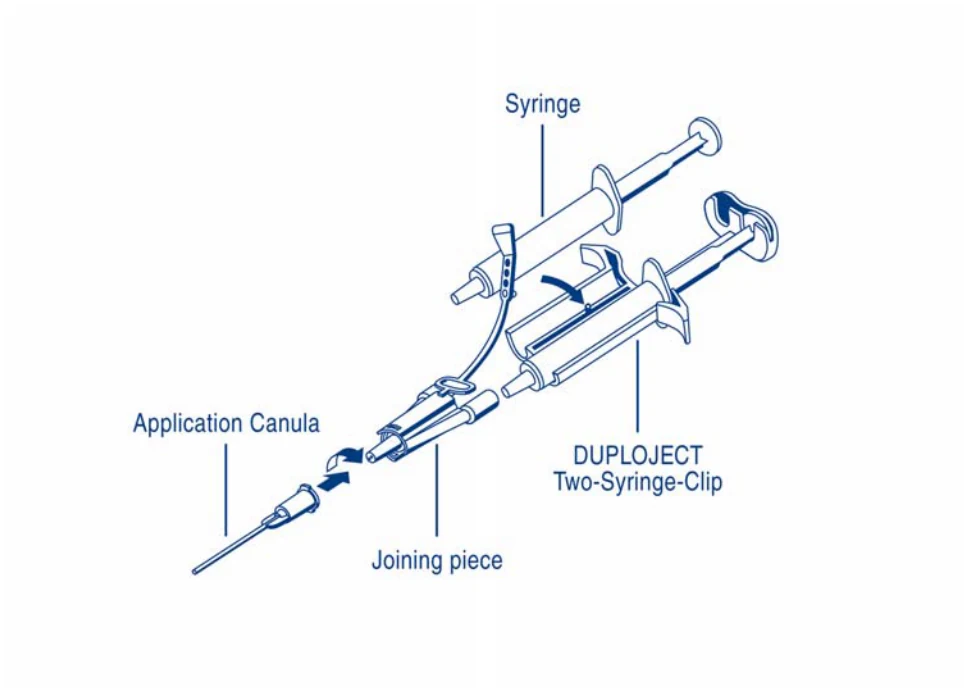
Operating Instructions:
- Place the two syringes filled with Sealer Protein Solution and with Thrombin Solution into the clip. Both syringes should be filled with equal volumes.
- Connect the nozzles of the two syringes to the joining piece ensuring that they are firmly fixed. Secure the joining piece by fastening the tether strap to the DUPLOJECT Two-Syringe Clip. Should the pull strap tear, use the spare joining piece. If none is available, further use is still possible but tightness of the connection needs to be ensured to prevent any risk of leaking.
- Fit an application cannula onto the joining piece.
- Do not expel the air remaining inside the joining piece or application cannula until you start actual application as the aperture of the cannula may clog otherwise.
- Apply the mixed Sealer Protein - Thrombin Solution onto the recipient surface or surfaces of the parts to be sealed.
If application of the fibrin sealant components is interrupted, clogging may occur in the cannula. To resume application, replace the application cannula with a new one. If the apertures of the joining piece are clogged, use the spare joining piece provided in the DUPLOJECT System.
Note: For operation instructions please refer to the Instructions for Use provided together with the DUPLOJECT System.
Administration using DUO Set
For application, the double-chamber syringe with the Sealer Protein Solution and the
Thrombin Solution has to be connected to a joining piece and an application cannula.
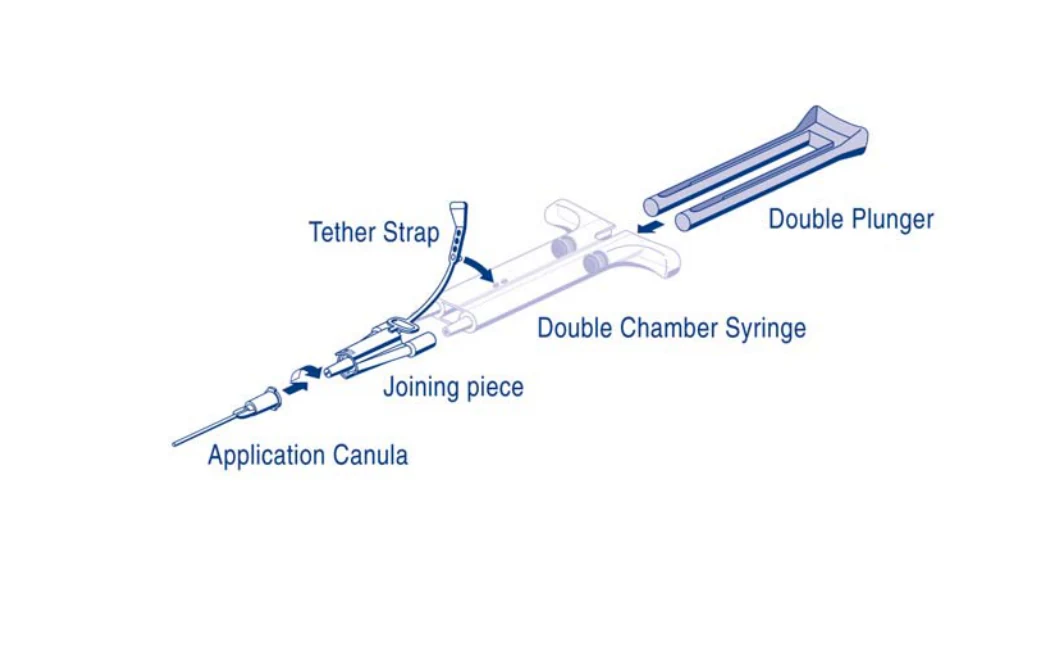
Operating Instructions:
- Remove the cap covering the nozzles of the double-chamber syringe.
Connect the nozzles of the double-chamber syringe to the joining piece ensuring that they are firmly fixed. Secure the joining piece by fastening the tether strap to the double-chamber syringe. Should the pull strap tear, use the spare joining piece. If none is available, further use is still possible but tightness of the connection needs to be ensured to prevent any risk of leaking.
Fit an application cannula onto the joining piece.
- Fit the double plunger to the end of the syringe chamber.
- Do not expel the air remaining inside the joining piece or application cannula until you start actual application as the aperture of the cannula may clog otherwise
- Apply the mixed Sealer Protein - Thrombin Solution onto the recipient surface or surfaces of the parts to be sealed
If application of the fibrin sealant components is interrupted, clogging may occur in the cannula. To resume application, replace the application cannula with a new one. If the apertures of the joining piece are clogged, use the spare joining piece provided in the Duo Set.
- b) Simultaneous Application Using Spray Set and EASYSPRAY:
Spray Set and EASYSPRAY can be connected to TISSEEL Kit (see drawing below) and TISSEEL Frozen in the same way.
Note: For operation instructions please refer to the Instructions for Use provided together with
Spray Set and Easy Spray.
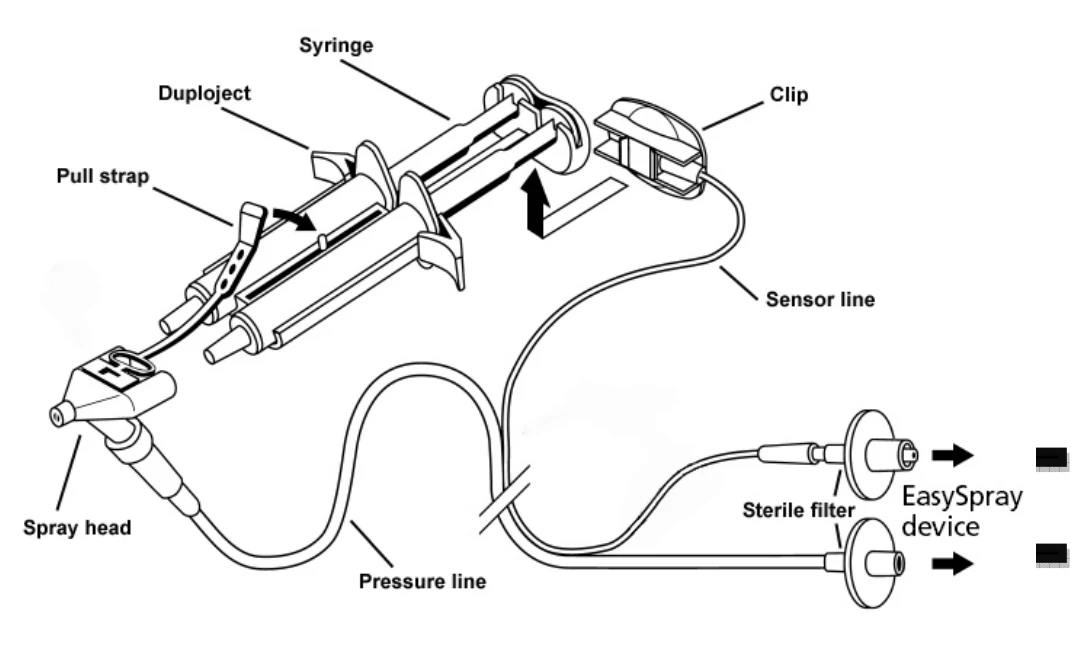
connect to the EASYSPRAY Device
The Spray Set is particularly suitable for spraying of larger areas, e.g. to control oozing of parenchymatous organs or to adhere skin grafts. The two components are sprayed simultaneously using sterile propellant gas via EASYSPRAY, and the volume of the Solutions ejected is controlled with the DUPLOJECT System / DUO Set plunger. Spray at a minimum distance of 10 cm. The user is cautioned against the spray application of TISSEEL with devices produced by other manufacturers.
- c) Simultaneous Application Using DUPLOCATH Application Catheters or other accessories provided by Baxter:
In operation sites where access is difficult or when using an endoscope or trocar, TISSEEL can be applied using DUPLOCATH Application Catheters.
Note: For operation instructions please refer to the Instructions for Use provided together with
DUPLOCATH Application Catheter 25, 35 or 180.
In case of using other accessories provided by Baxter, please refer to the operating instructions contained in the Instructions for Use for the particular accessory.
- d)
Simultaneous Application by Premixing:
Mix equal volumes of the two components and immediately apply them to the recipient surface or surfaces. If desired, the Thrombin Solution can be mixed with spongiosa to pack bone defects. Hold in place for three minutes. Once turbid, TISSEEL can no longer be manipulated.
Gluing of Tissue
After the two components have been applied, approximate the wound areas. Fix or hold the glued parts in the desired position for three to five minutes to ensure that the setting Sealant adheres firmly to the surrounding tissue. Solidified Sealant reaches its ultimate strength after about two hours (70% after about ten minutes).
1.9 OVERDOSAGE
As the product is actively used by the surgeon, overdose is very unlikely to occur.
For Management of a suspected drug overdose, contact your regional Poison Control Centre.
1.10 ACTION AND CLINICAL PHARMACOLOGY
Mechanism of Action
TISSEEL (Fibrin Sealant (Human), Vapor Heated, Solvent/Detergent Treated) is a tissue glue with sealing, hemostyptic and gluing properties, which does not interfere with but may enhance wound healing.
The action of TISSEEL simulates key features of the physiological process of wound closure. A highly concentrated fibrinogen Aprotinin solution, which among other ingredients contains Factor XIII co-fractionated from the plasma, and a solution of thrombin and calcium chloride are applied to the wound area, where the mixture coagulates. The presence of Factor XIII causes the fibrin to crosslink, which gives the coagulum additional resilience. Aprotinin prevents premature degradation of the clot.
Pharmacodynamics
Thrombin is a highly specific protease that transforms the fibrinogen contained in Sealer Protein (Human) into fibrin. Part of the thrombin is adsorbed by the fibrin, and any excess thrombin is inactivated by protease inhibitors in the blood.
Fibrinolysis Inhibitor, Aprotinin (Bovine or Synthetic), is a polyvalent protease inhibitor that prevents premature degradation of fibrin. Free Aprotinin has a half-life (t ½) of approx. 0.82 and is eliminated by the kidney. Preclinical studies with different fibrin sealant preparations simulating the fibrinolytic activity generated by extracorporeal circulation in patients during cardiovascular surgery have shown that incorporation of Aprotinin in the product formulation increases resistance of the fibrin sealant clot to degradation in a fibrinolytic environment.
Pharmacokinetics
TISSEEL is intended for local application only, therefore systemic exposure or distribution to other organs or tissues is not expected and pharmacokinetic studies were not conducted.
1.11 STORAGE AND STABILITY
When stored between 2°C and 25°C (36°F and 77°F), TISSEEL (Fibrin Sealant (Human), Vapor Heated, Solvent/Detergent Treated) Kit, lyophilized, is stable until the expiry date indicated on the label.
When stored between ≤ -20°C (≤ -4°F), TISSEEL (Fibrin Sealant (Human), Vapor Heated, Solvent/Detergent Treated) Frozen, in pre-filled syringes, is stable until the expiry date indicated on the label.
1.12 DOSAGE FORMS, COMPOSITION AND PACKAGING
Dosage Forms and Packaging
TISSEEL (Fibrin Sealant (Human), Vapor Heated, Solvent/Detergent Treated) is available in two different dosage forms: Kit and Frozen.
| Strength | Volume (Total) | Kit | Frozen |
| 500 IU/mL | 2 mL 4 mL 10 mL | One vial lyophilized Sealer Protein (Human) Concentrate, to be reconstituted with one vial 1.0 mL/ 2.0 mL/ 5.0 ml of Aprotinin Solution, sterile One vial lyophilized Thrombin (Human) 500 IU, to be reconstituted with one vial 1.0 mL/ 2.0 mL/ 5.0 mL of Calcium Chloride Solution, sterile | 1.0 mL/ 2.0 mL/ 5.0 mL of sterile frozen TISSEEL Sealer Protein (Human)-Aprotinin Solution 1.0 mL/ 2.0 mL/ 5.0 mL of sterile frozen Thrombin (Human)
|
TISSEEL Kit also contains DUPLOJECT System, the Kit for Reconstitution and Application consisting of 4 transfer needles, 2 blue-scaled syringes, 2 black-scaled syringes, 1 DUPLOJECT two-syringe clip, 2 joining pieces and 4 application cannulas.
TISSEEL Frozen also contains DUO Set, the sterile accessory devices consisting of 1 plunger, 2 joining pieces and 4 application cannulas.
See the following Accessories Section for more accessories for use with TISSEEL .
Composition
TISSEEL 500 IU Kit consists of 4 separate vials containing Sealer Protein (Human), Aprotinin (bovine or synthetic) Solution, Thrombin (Human) and Calcium Chloride Solution.
TISSEEL 500 IU Frozen consists of a double-chamber syringe containing Sealer Protein-Aprotinin (bovine or synthetic) Solution (syringe body 1) and Thrombin-Calcium Chloride Solution (syringe body 2).
After reconstituting the vials in the Kit, the resulting concentrations of the Sealer Protein-Aprotinin solution and the Thrombin-Calcium Chloride solution are the same as those in the Frozen presentation.
| Amount | ||
| 1 | Sealer Protein (Human)-Aprotinin Solution, sterile, contains: | |
| 96-125 mg/mL | |
| 0.6-10 U/mL** | |
| 72-110 mg/mL | |
| 2-9 mg/mL | |
| 40 – 120 µg/mL | |
| 2 | Aprotinin (bovine or synthetic) Solution, sterile | 3,000 KIU/mL*** |
| 3 | Thrombin (Human) | 500 IU/mL **** |
| 4 | Calcium Chloride Solution, sterile | 40 μmol/mL |
* Development data, not tested at the Final Product level
** One unit corresponds to the amount of Factor XIII contained in 1 mL of fresh normal plasma. *** 30 Kallidinogenase Inactivator Units (KIU) correspond to 1 FIP-Unit18.
**** One International Unit (IU) of Thrombin is defined as the activity contained in 0.0853 mg of the First International Standard of Human Thrombin19.
All plasma units used for manufacture are ALT tested and non-reactive in tests for Hbs-antigen and antibodies to HCV, HIV-1 and HIV-2. Before further processing all individual plasma donations are subjected to an inventory hold for a possible look-back of plasma donations suspected of infection. All plasma units are tested by HIQ-PCR = Hyland Immuno Quality Assured Polymerase Chain Reaction.
1.13 ACCESSORIES
The following are some accessories for use with TISSEEL VH S/D. A complete list of accessories can be obtained from a Baxter representative. When using these devices, strictly follow the Instructions for Use of the devices.
| FIBRINOTHERM | Combined Heating and Stirring Device |
| EASYSPRAY | Propellant gas control unit, manometer, reducing valve, and pressure tube. |
| Spray Set (sterile, disposable) | Disposable set consisting of sterile filter with connection tube, sensing line and a spray head. |
| DUPLOCATH 25 Application Catheter | Length: approximately 25 cm (10”) Diameter: approximately 5 french (approx. 0.17 cm) Radiopaque. Sterile. Disposable. |
| DUPLOCATH 35 M.I.S Application Catheter | Catheter: Length: approximately 35 cm (14”)1 Diameter: approximately 5 french (approx. 0.17 cm) Adapter: Length: approximately 30 cm (12”) Diameter: 15 french (0.5 cm) For insertion through a 5-6 mm trocar in minimally invasive surgery (M.I.S.) Radiopaque. Sterile. Disposable. |
| DUPLOCATH 180 Application Catheter | Length: approximately 180 cm (70”) Diameter: approximately 5 french (approx. 0.17 cm) For use with an endoscope. The Application Catheter 180 can be shortened to any length necessary. Radiopaque. Sterile. Disposable. |
Alternative reconstitution accessories are available for TISSEEL .
2. PART II: SCIENTIFIC INFORMATION
2.1 PHARMACEUTICAL INFORMATION
Drug Substance
See PART I – DESCRIPTION and PART II – DETAILED PHARMACOLOGY Sections.
Product Characteristics
See PART I – DESCRIPTION and PART II – DETAILED PHARMACOLOGY Sections.
Viral Inactivation
TISSEEL (Fibrin Sealant (Human), Vapor Heated, Solvent/Detergent Treated) is made from human plasma. Products made from human plasma may contain infectious agents, such as viruses, that can cause disease. The risk that such products will transmit an infectious agent has been reduced by screening plasma donors for prior exposure to certain viruses (see Pharmacology), by testing for the presence of certain current virus infections, and by inactivating and removing certain viruses in the course of the manufacture.
The manufacturing procedure for TISSEEL includes processing steps designed to further reduce the risk of viral transmission. In particular, vapor heating and solvent/detergent treatment processes are included in the manufacturing of Sealer Protein Concentrate and Thrombin. In addition the reduction factors as associated with DEAE-Sephadex Batch Chromatography and Ion Exchange Chromatography of the Thrombin drug substance purification were investigated. Validation studies were conducted using samples drawn from manufacturing intermediates for each of the two human plasma derived components. These samples were spiked with stock virus suspensions of known titers followed by further processing under conditions equivalent to those in the respective manufacturing steps.
The virus reduction factors (expressed as log10) of independent manufacturing steps were as follows for each of the viruses tested:
Reduction Factors for Virus Removal and/or Inactivation Sealer Protein Component | ||||||
| Manufacturing Step | Mean Reduction Factors [log10] of Virus Tested* | |||||
| HIV-1 | HAV | BVDV | PRV | MMV | B19V | |
| Early Manufacturing Steps | n.d. | n.d. | n.d. | n.d. | 2.7** | 3.4** |
| 2.3** | ||||||
| Solvent/Detergent Treatment | >5.3 | n.d. | >5.7 | >5.9 | n.d. | n.d. |
| Vapor Heat Treatment | >5.5 | >5.6 | >5.7 | >6.7 | 1.2 | 1.0 |
| Overall Reduction Factor (ORF) | >10.8 | >5.6 | >11.4 | >12.6 | 3.5 | 3.3 |
Reduction Factors for Virus Removal and/or Inactivation Thrombin Component | ||||||
| Mean Reduction Factors [log10] of Virus Tested* | ||||||
| Manufacturing Step | HIV-1 | HAV | BVDV | PRV | MMV | B19V |
| Removal of Thrombin precursor protein from Cryosupernatant | 3.2 | 1.5 | 1.8 | 2.5 | 1.2 | 1.7 |
| Vapor Heat Treatment | >5.5 | >4.9 | >5.3 | >6.7 | 1.0 | >4 |
| Solvent/Detergent Treatment | >5.3 | n.d. | >5.5 | >6.4 | n.d. | n.d. |
| Ion Exchange Chromatography | n.d. | n.d. | n.d. | n.d. | 3.6 | n.d. |
| Overall Reduction Factor (ORF) | >14.0 | >6.4 | >12.6 | >15.6 | 5.8 | >5.7 |
n.d. = not determined
* The mean RF of all runs was calculated. E.g. when two runs were performed in study A and one run in study B for HIV-1, then the mean of the three RF’s was calculated and listed in the table. ** As a conservative value for general and robust Parvovirus reduction capacity in steps 1 to 8, 2.3 logs were calculated from MMV and B19V reduction factors (omitting the higher B19V reduction factor). For calculation of and rationale behind this value, see further above in the section where the corresponding study is discussed. For calculation of virus-specific overall reduction factors, however, only virus-specific individual reduction factors were considered.
HIV-1: Human immunodeficiency virus 1; HAV: Hepatitis A virus; BVDV: Bovine viral diarrhea virus, a model for Hepatitis C virus; PRV: Pseudorabies virus, a model for enveloped DNA viruses, among those Hepatitis B virus; MMV: Mice minute virus, a model for Human Parvovirus B19, B19V: Human Parvovirus B19.
2.2 CLINICAL TRIALS
Numerous clinical studies investigating the safety and efficacy of the product as a hemostyptic and biodegradable tissue glue in various fields of surgery have been performed. A number of these were controlled studies in fields including orthopedic surgery1, abdominal surgery2, urology3, and cardiovascular surgery4, 5. The cardiovascular safety study10 using the heat treated product has shown that TISSEEL (Fibrin Sealant (Human), Vapor Heated, Solvent/Detergent Treated) transmits neither hepatitis viruses nor HIV. Pre-clinical studies have shown that the vapor treated product is at least as effective as the heat treated product. In the clinical study 550003 described below, TISSEEL was shown to be non-inferior to an earlier formulation of the product, TISSEEL VH (predecessor product) and both products were shown not to transmit hepatitis, HIV or P19B.
Use of TISSEEL has invariably shown superior results in the groups treated as against the untreated controls who underwent the same types of surgery. These results were attributable to an improved hemostasis and, therefore, reduced blood loss, a tighter sealing of sutures preventing leakages or a fast and uncomplicated healing of the surgical wound.
In none of the studies have systemic side-effects been seen nor has any product related transmission of viral hepatitis or HIV occurred in any of the patients treated.
TISSEEL 500 IU (Fast Set):
TISSEEL 500 IU was evaluated in a prospective, parallel design, randomized (1:1), double-blind, multicenter clinical study (550003) against an earlier formulation of the product, TISSEEL VH, in 317 subjects undergoing cardiac surgery requiring cardiopulmonary bypass (CPB) and median sternotomy. Patients were treated with TISSEEL 500 IU or the control product only when hemostasis was not achieved by conventional surgical methods. For the endpoint, hemostasis achieved at the primary treatment site within 5 minutes of treatment and maintained until closure of the surgical wound, TISSEEL 500 IU was as least effective as the earlier formulation of the product using a one-sided 97.5% confidence interval on the difference in the proportion of subjects successfully treated.
| Hemostasis within 5 minutes and maintained until surgical closure | ||
| TISSEEL 500 IU | Predecessor product TISSEEL VH | |
| Intent to Treat Analysis | 127/144 (88.2%) | 129/144 (89.6%) |
| Per Protocol Analysis | 108/123 (87.8%) | 122/135 (90.4%) |
Geriatrics (> 65 years of age):
In this Phase 3 clinical study of TISSEEL 500 IU, 71 of 144 subjects were 65 and over. No overall differences in safety or effectiveness were observed between these subjects and younger
subjects, and other reported clinical experience has not identified differences in responses between the elderly and younger patients.
An earlier formulation of TISSEEL’s predecessor product, TISSEEL HT (heat treated, containing bovine thrombin) was evaluated in an open-label crossover study against control topical hemostatic agents in 489 patients undergoing cardiovascular reoperation or resternotomy at 11 institutions. Patients were randomized to TISSEEL HT or control hemostatic agents when a topical hemostatic was needed at the conclusion of surgery and after all attempts at surgical hemostasis. Patients were crossed to the alternative therapy if bleeding continued after the 5 minute endpoint. At 10 centres, TISSEEL HT was used after administration of protamine sulfate. At one site, TISSEEL HT could be used before administration of protamine sulfate. 365 of the 489 patients developed bleeding episodes requiring treatment. In these patients, for the endpoint, successful hemostasis at 5 minutes, TISSEEL HT was statistically significantly superior to control topical hemostatic agents.
| Hemostasis within 5 minutes | |
| Predecessor TISSEEL HT | Control Topical Hemostatic Agent |
| 82.4% (159/193) | 44.5% (76/172) |
| Pearson χ2 two sided; p <0.0001; intent-to-treat analysis | |
Similarly, absolute time to cessation of bleeding was statistically significantly shorter for TISSEEL HT than for control topical hemostatic agents (p<0.0001, Wilcoxon-Gehan test, two sided).
In a single center, open label trial, an earlier formulation of TISSEEL HT was compared to historical controls in patients undergoing laparotomy for blunt or penetrating traumatic injury to the spleen and/or liver. Use of TISSEEL HT resulted in the need for statistically significantly fewer splenectomies than control hemostatic maneuvers:
Splenectomy Rate Injury to: Predecessor
TISSEEL HT
Historic Controls
Spleen 0/19 14/22 p <0.001 Spleen and liver 1/26 19/34 p <0.001
TISSEEL HT did not result in significantly reduced mortality in patients with blunt or penetrating trauma to the liver alone or to the liver and spleen (p=0.067, χ2, one sided). In a single center, prospective open label study of 120 patients randomized to standard of care (59 patients) or standard of care plus fibrin sealant (61 patients) for elective colostomy closure after temporary colostomy placement for treatment of traumatic injury to the colon, the earlier version of TISSEEL HT plus standard of care was also shown to be significantly superior to standard of care alone (p=0.0406, Jonckheere-Terpstra test for ordinal data, two sided) with regard to anastomotic complications (leakage, intra-abdominal abscess formation, re-operation, septic shock, and death).
2.3 DETAILED PHARMACOLOGY
The substances in the TISSEEL (Fibrin Sealant (Human), Vapor Heated, Solvent/Detergent Treated) Kit are used to prepare two components: Sealer Protein Solution and Thrombin Solution. Sealer Protein Solution is produced by dissolving Sealer Protein Concentrate in Aprotinin Solution. Freeze-dried Thrombin, dissolved in Calcium Chloride Solution, yields the Thrombin Solution.
The assembly for TISSEEL Frozen is reflecting the composition of the Kit components after reconstitution, filled in a double-chamber syringe, which is stored in a deep frozen condition: Sealer Protein Concentrate-Aprotinin (syringe chamber 1) and Thrombin-Calcium Chloride Solution (syringe chamber 2).
The two components are mixed either immediately before application to the recipient surface or in situ using one of the methods described under Application. The Sealer Protein / Thrombin Solution, after mixing, is a viscous solution adhering to wound surfaces and quickly sets to form a white, rubberlike mass, which continues to gain in strength within two hours following application. This process is made use of to achieve hemostasis, and to seal or glue tissue.
In this manner, the need for sutures may be reduced, although not totally eliminated. The time until Sealant sets can be used to approximate wound edges, to provide optimum conditions for healing. In the course of wound healing, Sealant is completely absorbed20.
Fibrin Sealant is a two-component biological sealant produced from pooled human plasma. As for all plasma products, the following measures are implemented to ensure the safety of the product from the potential presence of pathogenic viruses in human plasma:
- Donor selection
Sealer Protein Concentrate
(Human)
Aprotinin Solution
(Bovine or Synthetic)
Thrombin (Human)
Calcium Chloride Solution
Sealer Protein-Aprotinin Solution
Thrombin-Calcium Chloride Solution
TISSEEL Fibrin Sealant
- Donation testing of single donations and also at the mini-pool and manufacturing pool level
- The use of PCR assay system (PCR) for release of plasma pools
- Effective virus inactivation/removal steps integrated into the manufacturing process including validation
Each plasma donation is tested for infectious markers for human immunodeficiency virus, types 1 and 2 (HIV-1/-2), hepatitis C virus (HCV) and hepatitis B surface antigen (HbsAg) The criteria for release of each single plasma donation for further manufacturing are as follows:
- HIV-1 / HIV-2 antibody: non-reactive
- HbsAg: non-reactive
- HCV antibody: non-reactive
Each manufacturing plasma pool is tested and released for further manufacturing only when
non-reactive for Human Immunodeficiency Virus (HIV), Hepatitis C Virus (HCV),
Hepatitis A Virus (HAV) and Hepatitis B Virus (HBV) using Nucleic Acid Testing (NAT)
- Parvovirus B19 concentration not exceeding 104 IU / mL as measured by NAT
Plasma pool are tested using HIQ-PCR = Hyland Immuno Quality Assured Polymerase Chain Reaction. With the PCR method, in general 500 genome equivalents/mL of the above viruses can be determined reliably, with the actual sensitivity of HIQ-PCR being below that. Therefore all pools which have been tested and evaluated as being positive lead to exclusion from further processing.
The plasma safety precautions and virus inactivation/removal steps taken during the manufacture of TISSEEL VH S/D 500 IU are equivalent to those used for ARTISS 4 IU. During the pivotal clinical study of TISSEEL VH S/D 500 IU Fibrin Sealant there were zero confirmed seroconversions for HAV, HBV, HCV, HIV or B19V (Baxter clinical study 550003).
Although viral safety was not an endpoint in the other clinical studies, any issues concerning viral safety would have been detected and followed up in the process of AE reporting. No reports concerning viral transmission from any studies, involving Fibrin Sealant 4 IU (ARTISS) or 500 IU (TISSEEL) were received.
The therapeutic activities of TISSEEL are hemostasis, gluing and sealing of tissue, and the support of wound healing.
Physiologically, the process of wound closure starts when a bleeding ceases. In places where injured blood vessels lie open, hemostatic plugs form of platelets and fibrin, which become more and more solid as other blood cells, particularly erythrocytes, are involved. Because the bleeding ceases, blood that has escaped into the wound bed earlier coagulates. In a next step fibrin in both the coagulated blood and hemostatic plug retracts, plasma is squeezed out, the blood vessels contract, and the wound area becomes smaller. As various cells begin to proliferate into the retracted blood coagula, wound healing sets in.
In developing Fibrin Sealant, this principle has at least partly been simulated by applying a highly concentrated fibrinogen solution, which also contains factor XIII as co-fractionated from the plasma, and a solution of thrombin and calcium chloride to the wound area, where the mix coagulates. Since the Sealant does not contain thrombocytes, the clotted fibrin does not appreciably retract. When the mixture is applied, however, the fibrin concentration in the coagulum is the same as or higher than that of a retracted hemostatic plug. To preserve the coagulum until the wound healing has reached a stage where it is no longer required, the Sealant has been designed to contain a fibrinolysis inhibitor.
The fibrin in the Sealant adheres perfectly to the wound edges guaranteeing adequate sealing effect. Similar to the hemostatic plug, wound healing is promoted by the fibrin applied. Combined application of Sealant with a mixture of autologous or homologous spongiosa provides excellent plugging material for bone defects. Using adequate technique, TISSEEL is also an excellent tool in sealing autologous or homologous cartilage and bone.
TISSEEL and all of its components have not been observed to affect systemic circulation, respiration, or the central nervous system. This is attributable to both, the fact that only minimal quantities of each single component are applied compared to their use for other indications, and the fact that TISSEEL becomes only locally effective.
The mechanism underlying solidification of tissue and persistence of a solidified clot have been investigated in numerous studies.
As a biologic material, Fibrin Sealant becomes completely absorbed at a rate which depends both on the fibrinolytic activity of the surrounding tissue and the quantity of Fibrinolysis Inhibitor added. In the course of wound healing the Sealant clot is gradually replaced by ingrowing tissue, Thrombin is inactivated by the physiological protease inhibitors, Calcium Chloride is subjected to the calcium and chloride catabolism of the organism, and Aprotinin and its metabolites are eliminated by the kidney.
2.4 TOXICOLOGY
The local application of TISSEEL (Fibrin Sealant (Human), Vapor Heated, Solvent/Detergent Treated) underlines the importance of histological studies for toxicology data. Accordingly, histologies have been performed on various species in tissues ranging from skin, vessels, nerves, tendons, organ tissue to bone.
In vivo toxicology studies indicated no acute toxicity and normal local tolerance reactions of TISSEEL Frozen1 with bovine or synthetic Aprotinin in rats and rabbits, respectively. Furthermore, no difference between synthetic and bovine Aprotinin for single-dose toxicity after intravenous application could be detected in mice and rats and synthetic Aprotinin was well tolerated in rabbits.
No skin sensitizing potential of synthetic Aprotinin was shown in a Guinea Pig Maximization Test.
In vitro, no differences were found between TISSEEL 500 IU Frozen with bovine or synthetic Aprotinin and the predecessor product TISSEEL VH 500 IU lyophilized Kit with respect to cellular compatibility, or mutagenicity.
Synthetic Aprotinin was non-mutagenic an Ames test.
Cellular compatibility was confirmed in an additional in vitro study comparing both TISSEEL preparations (frozen and lyophilized) and the predecessor product TISSEEL VH (lyophilized) Kit.
In summary, presented in vitro and in vivo data support the equivalence of TISSEEL (frozen and lyophilized) with the predecessor product TISSEEL VH (lyophilized Kit). Moreover, it was shown that synthetic Aprotinin has no negative impact on the safety of the Fibrin Sealant.
Long-term animal studies to evaluate the carcinogenic potential of TISSEEL or studies to determine the effect of TISSEEL on fertility have not been performed.
On the following page the toxicology program is presented.
1 The composition of TISSEEL frozen, thawed, is identical to the composition of the reconstituted TISSEEL freeze-dried.
Toxicology program for Baxter Fibrin Sealants
| Study Type | Route of Administration | Species | Test Article |
| Single-dose Toxicity | s.c. | Rat | TISSEEL (frozen) |
| Single-dose Toxicity | s.c. | Rabbit | TISSEEL (frozen) |
| Single-dose Toxicity | s.c. | Rat | TISSEEL s-apr (frozen) |
| Single-dose Toxicity | s.c. | Rabbit | TISSEEL s-apr (frozen) |
| Single-dose Toxicity | i.v. | Mouse | Synthetic Aprotinin |
| Single-dose Toxicity | i.v. | Rat | Synthetic Aprotinin |
| Genotoxicity | i.v. | E.coli | TISSEEL (frozen) |
| Genotoxicity | i.v. | Salmonella typhimurium | Synthetic Aprotinin |
| Local Tolerance | i.v., paravenous | Rabbit | Synthetic Aprotinin |
| Cytotoxicity | i.v. | Human lung fibroblasts | TISSEEL (frozen) |
| Cytotoxicity | i.v. | Human lung fibroblasts | TISSEEL (lyophilized) |
| Cytotoxicity | i.v. | Human lung fibroblasts | TISSEEL s-apr (frozen) |
| Skin Sensitization | intradermal, epicutan | Guinea pig | Synthetic Aprotinin |
- 3. PART III: CONSUMER INFORMATION
3.1 PATIENT COUNSELLING INFORMATION
Because this product is made from human plasma, the physician should discuss the risks and benefits with the patient. Patient should be encouraged to consult with their physician if symptoms of B19 virus infection appear (fever, drowsiness, chills and runny nose followed about two weeks later by a rash and joint pain).
In case of drug overdose, contact a health care practitioner, hospital emergency department or regional Poison Control Centre immediately, even if there are no symptoms.
REFERENCES
- 1. BÖSCH P.: Die Fibrinspongiosaplastik. Wr. Klin. Wschr. 93, Suppl. 124 (1981)
- 2.
SCHEELE J. et al.: Anastomosensicherung am Verdauungstrakt mit Fibrinkleber. In:
Nahttechnische Grundlagen, experimentelle Befunde, klinische Erfahrungen. Zlbl. Für Chirurgie 103, 1325–1336 (1978).
- 3.
GASSER G. et al.: Über die Verwendung eines Fibrinklebers bei Prostatektomie: Vorläufige
Mitteilung. In: Fibrinogen, Fibrin und Fibrinkleber, F. K. Schattauer Verlag, 271–273 (1980)
- 4.
ROUSOU J., LEVITSKY S., COSGROVE D. et al.: Randomized Clinical Trial of Fibrin
Sealant in Patients Undergoing Resternotomy of Reoperation After Cardiac Operations. In: The Journal of Thoracic and Cardiovascular Surgery, Vol. 97, No. 2, 194–203 (1989)
- 5.
WOLNER E.: Fibrin Gluing in Cardiovascular Surgery. Thorac. Cardiovasc. Surg. 30, Georg
Thieme Verlag Stuttgart, N. York, 236–237 (1982)
- 6.
MARCZELL A., EFFERDINGER F., SPOULA H., STIERER M.: Anwendungsbereiche des
Fibrinklebers in der Abdominalchirurgie. Acta Chir. Austriaca 11, 26. 137–141 (1979)
- 7.
SCHEELE J.: Klinische Erfahrungen mit der Fibrinklebung an parenchymatösen
Oberbauchorganen. Akt. Chir. 17 (1982)
- 8.
KALMAR P., KREBBER H. J., POKAR H., TILSNER V.: Bioadhesives in Cardiac and
Vascular Surgery. Thorac. Cardiovasc. Surg. 30, 230–231 (1982)
- 9.
HAVERICH A., WALTERBUSCH G., BORST H. G.: The Use of Fibrin Glue for Sealing
Vascular Prostheses of High Porosity. Thorac. Cardiovasc. Surg. 29, 252–254 (1981)
- 10.
BÖSCH P., NOWOTNY Ch., SCHWÄGERL W., LEBER H.: Über die Wirkung des
Fibrinklebesystems bei orthopädischen Operationen an Hämophilen und bei anderen Blutgerinnungsstörungen. In: Fibrinogen, Fibrin und Fibrinkleber, Kl. Schimpf, F. K. Schattauer Verl., 275–277 (1980)
- 11.
THETTER O.: Fibrin Adhesive and its Application in Thoracic Surgery. Thorac. Cardiovasc.
Surg. 29, 290–292 (1981)
- 12.
HARTEL W., LAAS J.: Zusätzliche Abdichtung von Pleura-Läsionen mit Fibrinkleber
Klinische Studie (1981)
- 13.
STAINDL O.: Beitrag zur chirurgischen Behandlung gutartiger Trachealstenosen. Wr. Med.
Wschr. 128, 175–177 (1978)
- 14.
VECSEY D.: Über eine neue Methode der Blutstillung mit Klebematerial bei der
Adenomektomie. Urologie und Nephrol. 73, 57–62 (1980)
- 15.
HENNING K., PFLÜGER H., RAUCHENWALD K., URLESBERGER H.: Klinische
Erfahrung mit Fibrinkonzentrat in der Nierenparenchymchirurgie. Helv. chir. Acta 47, 297 (1980)
- 16.
RAUCHENWALD K., HENNING K., URLESBERGER H.: Humanfibrinklebung bei
Nephrotomie Helv. chir. Acta 45, 283–286 (1978)
- 17.
REDL H., SCHLAG G., DINGES H. P.: Methods of Fibrin Seal Application. Thorac.
Cardiovasc. Surg. 30, 223–227 (1982)
- 18.
HENNRICH N., BRÜMMER W.: 3. Bericht: Trypsin-Inhibitor. Pharm. Ind. 35, 272–273
(1973)
- 19.
ROBERTSON I., GAFFNEY P. J., BANGHAM D. R.: Standard for human thrombin.
Thrombos. Diathes. Haemorrh., Stuttgart 34, 3–18 (1975)
- 20.
REDL H. et al.: Grundlagen der Fibrinklebung. In: Fibrinkleber in Orthopädie und
Traumatologie 4. Heidelberger Orthopädie-Symposium, H. Cotta/A. Braun (Eds.), Georg Thieme Verlag: 18–21 (1982)
- 21.
Validation of Virus Removal and Inactivation in the Course of the Manufacture of Sealant
Protein Concentrate (Human) Vapor Heated (without Creatine) Using HIV-1, HAV, and Model Viruses
- 22.
Validation of Virus Removal and Inactivation by DEAE-Adsorption, Lyophilization, and
Vapor Heating in the Course of the Manufacture of Thrombin (Human) Vapor Heated, Using HIV-1, and Model Viruses
- 23.
Validation of Virus Inactivation by Vapor Heating of Thrombin (Human) Using Hepatitis A
Virus
- 24.
A Study to Determine the Safety of Virus Inactivated Factor Concentrates in Hemophiliacs
Naive to Blood Product Administration - International Factor Safety Study” Part II: Antihemophilic Factor/Factor VIII Concentrate (Human) IMMUNO, Vapor Heated (Evaluation as of February 23, 1994)
- 25.
A Study to Determine the Safety of Virus Inactivated Factor Concentrates in Hemophiliacs
Naive to Blood Product Administration - International Factor Safety Study” Part II: Factors VII and IX (Evaluation as of March 1, 1995).
- 26.
Spontaneous Adverse Experience Reports: TISSUCOL/TISSEEL KIT, Two-Component
Fibrin Sealant, Freeze Dried, Steam Treated (January 01, 1990 to December 31, 1995)