


Product Monograph - Vyndaqel
Recent Major Label Changes
| 2026-05 |
|---|
Table of Contents
Certain sections or subsections that are not applicable at the time of the preparation of the most recent authorized product monograph are not listed.
Recent Major Label Changes ................................................................................................. 2
Table of Contents ................................................................................................................. 2
Part 1: Healthcare Professional Information.......................................................................... 4
- 1.
Indications..................................................................................................................... 4
1.1. Pediatrics .................................................................................................................... 4
1.2. Geriatrics .................................................................................................................... 4
- 2. Contraindications .......................................................................................................... 4
- 4.
Dosage and Administration ............................................................................................ 4
4.1. Dosing Considerations ............................................................................................... 4
4.2. Recommended Dose and Dosage Adjustment .......................................................... 4
4.4. Administration ........................................................................................................... 5
4.5. Missed Dose ............................................................................................................... 5
- 5. Overdose ....................................................................................................................... 5
- 6. Dosage Forms, Strengths, Composition, and Packaging .................................................. 5
- 7.
Warnings and Precautions ............................................................................................. 6
General ................................................................................................................................... 6
Carcinogenesis and Genotoxicity ........................................................................................... 6
Driving and Operating Machinery .......................................................................................... 6
Hepatic/Biliary/Pancreatic ..................................................................................................... 6
Renal ....................................................................................................................................... 6
Reproductive Health ............................................................................................................... 6
7.1. Special Populations .................................................................................................... 6
7.1.1. Pregnancy ........................................................................................................... 6
7.1.2. Breastfeeding ..................................................................................................... 7
7.1.3. Pediatrics ............................................................................................................ 7
7.1.4. Geriatrics ............................................................................................................ 7
- 8.
Adverse Reactions ......................................................................................................... 7
8.1. Adverse Reaction Overview ....................................................................................... 7
8.2. Clinical Trial Adverse Reactions ................................................................................. 7
8.4. Abnormal Laboratory Findings: Hematologic, Clinical Chemistry, and Other Quantitative Data ....................................................................................................... 9
8.5. Post-Market Adverse Reactions ................................................................................. 9
- 9.
Drug Interactions ........................................................................................................... 9
9.2. Drug Interactions Overview ....................................................................................... 9
9.4. Drug-Drug Interactions ............................................................................................ 10
9.5. Drug-Food Interactions ............................................................................................ 11
9.6. Drug-Herb Interactions ............................................................................................ 11
9.7. Drug-Laboratory Test Interactions........................................................................... 11
- 10.
Clinical Pharmacology .................................................................................................. 11
10.1. Mechanism of Action ............................................................................................... 11
10.2. Pharmacodynamics .................................................................................................. 11
10.3. Pharmacokinetics ..................................................................................................... 11
- 11. Storage, Stability, and Disposal .................................................................................... 13
- 12. Special Handling Instructions ....................................................................................... 13
Part 2: Scientific Information .............................................................................................. 14
- 13. Pharmaceutical Information ........................................................................................ 14
- 14.
Clinical Trials ............................................................................................................... 14
14.1. Clinical Trials by Indication ...................................................................................... 14
- 15. Microbiology ............................................................................................................... 19
- 16. Non-Clinical Toxicology ................................................................................................ 19
Patient Medication Information ......................................................................................... 21
Part 1: Healthcare Professional Information
1. Indications
VYNDAQEL (tafamidis meglumine) is indicated for:
- the treatment of adult patients with cardiomyopathy due to transthyretin-mediated amyloidosis, wildtype or hereditary, to reduce cardiovascular mortality and cardiovascular-related hospitalization.
1.1. Pediatrics
Pediatrics (<18 years of age): No data are available to Health Canada; therefore, Health Canada has not authorized an indication for pediatric use.
1.2. Geriatrics
Geriatrics (≥65 years of age): Safety and efficacy were demonstrated in this population.
2. Contraindications
VYNDAQEL is contraindicated in patients who are hypersensitive to this drug or to any ingredient in the formulation, including any non-medicinal ingredient, or component of the container. For a complete listing, see 6. Dosage Forms, Strengths, Composition and Packaging.
4. Dosage and Administration
4.1. Dosing Considerations
- VYNDAQEL (tafamidis meglumine) capsules and VYNDAMAX (tafamidis) capsules are different formulations with the active moiety tafamidis. To avoid dosing errors, it is important that prescriptions should specify VYNDAQEL (tafamidis meglumine) or VYNDAMAX (tafamidis) and the prescribed dose. VYNDAQEL and VYNDAMAX are not interchangeable on a per mg basis (see 10.3 Pharmacokinetics, 14.2 Comparative Bioavailability Studies of the Product Monograph for VYNDAMAX). The recommended dose of VYNDAMAX (tafamidis) is 61 mg tafamidis (administered as one 61 mg tafamidis capsule) orally once daily.
4.2. Recommended Dose and Dosage Adjustment
The recommended dose is VYNDAQEL (tafamidis meglumine) 80 mg administered as four 20 mg tafamidis meglumine capsules (equivalent to 48.8 mg tafamidis) orally once daily. The dose may be reduced to one capsule of 20 mg VYNDAQEL if not tolerated (see 14 Clinical Trials).
Special populations
Pregnant Women: VYNDAQEL should not be used during pregnancy (see 7 Warnings and Precautions 7.1.1 Pregnancy).
Women of childbearing potential should use appropriate contraception when taking VYNDAQEL and continue to use contraception for 1-month after stopping treatment.
Pediatrics (<18 years of age): No data are available to Health Canada; therefore, Health Canada has not authorized an indication for pediatric use.
Geriatrics (≥65 years of age): No dosage adjustment is required for elderly patients (≥65 years).
Renal or hepatic impairment: VYNDAQEL has not been studied in patients with severe hepatic impairment and use is not recommended in these patients. No dosage adjustment is required for patients with mild or moderate hepatic impairment. Data are limited in patients with severe renal impairment. No dosage adjustment is required for patients with renal impairment.
4.4. Administration
The capsules should be swallowed whole and not crushed or cut. VYNDAQEL may be taken with or without food.
4.5. Missed Dose
If a dose is missed, the patient should take the dose as soon as remembered. If it is almost time for the next dose, the patient should skip the missed dose and take the next dose at the regularly scheduled time.
5. Overdose
There is minimal clinical experience with overdose. During clinical trials, two patients diagnosed with ATTR-CM accidentally ingested a single tafamidis meglumine dose of 160 mg without adverse events. The highest dose of tafamidis meglumine given to healthy volunteers in a clinical trial was 480 mg as a single dose.
For the most recent information in the management of a suspected drug overdose, contact your regional poison control centre or Health Canada’s toll-free number, 1-844 POISON-X (1-844-764-7669).
- 6. Dosage Forms, Strengths, Composition, and Packaging
Table 1 – Dosage Forms, Strengths and Composition
Description
VYNDAQEL 20 mg: yellow, opaque, oblong (approximately 21 mm) capsule printed with “VYN 20” in red. 120 capsules (one month supply) supplied in 4 intermediary cartons. Each intermediary carton contains 3 blister cards, with 10 capsules each.
| Route of Administration | Dosage Form/ Strength/Composition | Non-Medicinal Ingredients |
| Oral | Capsule 20 mg: Each soft gelatin capsule (filled with a white to pink suspension) contains 20 mg of micronized tafamidis meglumine (equivalent to 12.2 mg tafamidis) | Ammonium hydroxide 28%, brilliant blue FCF, carmine, gelatin, glycerin, iron oxide (yellow), polyethylene glycol 400, polysorbate 80, polyvinyl acetate phthalate, propylene glycol, sorbitan monooleate, sorbitol, and titanium dioxide. |
7. Warnings and Precautions
General
No studies have been conducted in organ transplant patients. The efficacy and safety of VYNDAQEL in organ transplant patients has not been established. Tafamidis is not recommended in these patients.
Based on the potential of VYNDAQEL to inhibit the efflux transporter BCRP (breast cancer resistant protein), caution should be used when co-administering VYNDAQEL and BCRP substrates, because of the risk of BCRP substrate related adverse reactions (see 9.4 Drug-Drug Interactions).
Carcinogenesis and Genotoxicity
Carcinogenesis: There was no evidence of an increased incidence of neoplasia in the transgenic (Tg)-rasH2 mouse following repeated daily administration for 26 weeks at daily doses of 0, 10, 30 or 90 mg/kg. There was no evidence of increased incidence of neoplasia in a 2-year carcinogenicity study in rats at exposures 18-times the human AUC at the clinical dose of 80 mg tafamidis meglumine (see 16 Non-Clinical Toxicology).
Mutagenesis: There was no evidence of mutagenicity or clastogenicity in vitro, and an in vivo rat micronucleus study was negative.
Driving and Operating Machinery
VYNDAQEL has not been shown to influence the ability to drive and use machines.
Hepatic/Biliary/Pancreatic
VYNDAQEL has not been studied in patients with severe hepatic impairment and use is not recommended in these patients.
Renal
Limited data are available in patients with severe renal impairment (creatinine clearance less than or equal to 30 mL/min).
Reproductive Health
- Teratogenic Risk
Studies in animals have shown developmental toxicity (see 16 Non-Clinical Toxicology). The potential risk for humans is unknown. VYNDAQEL should not be used during pregnancy.
Women of childbearing potential should use appropriate contraception when taking VYNDAQEL and continue to use contraception for 1-month after stopping treatment.
7.1. Special Populations
7.1.1. Pregnancy
There are no adequate and well-controlled clinical studies with the use of VYNDAQEL in pregnant women. Studies in animals have shown developmental toxicity (see 16 Non-Clinical Toxicology). The potential risk for humans is unknown. VYNDAQEL should not be used during pregnancy.
7.1.2. Breastfeeding
There are no clinical data available to support the presence of tafamidis in human breast milk. Nonclinical data demonstrate that tafamidis is secreted in the milk of lactating rats (see 16 Non-Clinical Toxicology. When a drug is present in animal milk, it is likely the drug will be present in human milk. The effect of VYNDAQEL on nursing infants after administration to the mother has not been studied. Based on findings from animal studies which suggest the potential for serious adverse reactions in the breastfed infant, VYNDAQEL should not be used by nursing women.
7.1.3. Pediatrics
Pediatrics (<18 years of age): No data are available to Health Canada; therefore, Health Canada has not authorized an indication for pediatric use.
7.1.4. Geriatrics
Geriatrics (≥65 years of age): Safety and efficacy were demonstrated in this population.
8. Adverse Reactions
8.1. Adverse Reaction Overview
The most frequently reported Treatment emergent Serious Adverse Events (TESAEs) in the tafamidis 80 mg, 20 mg and placebo groups respectively were condition aggravated (22.7%, 23.9% and 32.8%); cardiac failure (19.3%, 18.2%, and 22.6%), cardiac failure congestive (11.9%, 15.9% and 17.5%), cardiac failure acute (13.1%, 4.5% and 9.6%), fall (5.1%, 5.7% and 2.8%) and syncope (3.4%, 0%, 5.6%).
Treatment emergent Adverse Events (TEAEs) with a higher incidence in the tafamidis 80 mg and 20 mg treatment group than placebo (≥2x placebo and reported by ≥4 patients) respectively, included cystitis (3.4%, 2.3% and 0%), sinusitis (5.7%, 5.7% and 0.6%), asthenia (10.2%, 12.5% and 6.2%), balance disorder (8.5%, 2.3% and 1.1%) and cataract (5.1%, 3.4% and 1.1%).
8.2. Clinical Trial Adverse Reactions
Clinical trials are conducted under very specific conditions. Therefore, the frequencies of adverse reactions observed in the clinical trials may not reflect frequencies observed in clinical practice and should not be compared to frequencies reported in clinical trials of another drug.
The data across clinical trials reflect exposure of 377 ATTR-CM patients to either 20 mg or 80 mg (administered as four 20 mg capsules) of VYNDAQEL daily for an average of 24.5 months (ranging from 1 day to 111 months). The population included adult patients diagnosed with ATTR-CM with baseline NYHA (New York Heart Association) Class I, Class II or Class III respectively at 9.1%, 61.4%, and 29.5% in the pooled tafamidis arm and at 7.3%, 57.1% and 35.6%, respectively on placebo. The mean age was approximately 75 years (ranging from 46 years to 91 years of age); >90% were male, and approximately 82% were Caucasian (see 14.1 Clinical Trials by Indication Table 6 - Patient Demographics and Baseline Characteristics).
Adverse events were assessed from ATTR-CM clinical trials with VYNDAQEL including a 30-month placebo-controlled trial in patients diagnosed with ATTR-CM. The frequency of adverse events in patients treated with VYNDAQEL 20 mg (n=88) or 80 mg (n=176; administered as four 20 mg capsules) was comparable to placebo (n=177). Listed below are all causality adverse events reported in the pivotal clinical trial.
A similar proportion of VYNDAQEL-treated patients compared to placebo discontinued due to an adverse event in the 30-month placebo-controlled trial in patients diagnosed with ATTR-CM [12 (6.8%), 5 (5.7%), and 11 (6.2%)] from the tafamidis meglumine 80 mg, tafamidis meglumine 20 mg, and placebo groups, respectively].
Table 2 – Most Common (≥10%) Treatment-Emergent Adverse Events Reported at Higher Rate in the Tafamidis Meglumine 20 mg and/or 80 mg groups than in the Placebo Group (All Causality)
| System Organ Class Preferred Term | Tafamidis 20 mg N=88 n (%) | Tafamidis 80 mg N=176 n (%) | Placebo N=177 n (%) |
|---|---|---|---|
| Cardiac disorders | |||
| atrial fibrillation | 16 (18.2%) | 35 (19.9%) | 33 (18.6%), |
| cardiac failure | 30 (34.1%) | 46 (26.1%) | 60 (33.9%) |
| cardiac failure acute | 4 (4.5%) | 24 (13.6%) | 17 (9.6%) |
| cardiac failure congestive | 17 (19.3%) | 22 (12.5%) | 33 (18.6%) |
| General disorders and administration site conditions | |||
| asthenia | 11 (12.5) | 18 (10.2) | 11 (6.2) |
| edema peripheral | 17 (19.3) | 30 (17.0) | 31 (17.5) |
| Infections and infestations | |||
| bronchitis | 9 (10.2) | 21 (11.9) | 19 (10.7) |
| pneumonia | 10 (11.4) | 23 (13.1) | 17 (9.6) |
| Injury, poisoning and procedural complications | |||
| fall | 27 (30.7) | 43 (24.4) | 41 (23.2) |
| Musculoskeletal and connective tissue disorders | |||
| muscle spasms | 10 (11.4) | 15 (8.5) | 14 (7.9) |
| pain in extremity | 6 (6.8) | 27 (15.3) | 20 (11.3) |
| Psychiatric disorders | |||
| insomnia | 12 (13.6) | 20 (11.4) | 22 (12.4) |
| Renal and urinary disorders | |||
| hematuria | 10 (11.4) | 10 (5.7) | 17 (9.6) |
| Respiratory, thoracic and mediastinal disorders | |||
| Cough | 16 (18.2) | 21 (11.9) | 30 (16.9) |
| Vascular disorders | |||
| hypotension | 12 (13.6) | 19 (10.8) | 19 (10.7) |
The reported incidence of hypothyroidism was 6.8%, 5.7% and 5.6% in patients in the tafamidis 80 mg, 20 mg and placebo groups, respectively.
8.4. Abnormal Laboratory Findings: Hematologic, Clinical Chemistry, and Other Quantitative Data
Clinical Trial Findings
The incidence of thyroxine abnormality <0.8 x LLN was greater in the tafamidis meglumine 80 mg group (29.7%) than in the tafamidis meglumine 20 mg (12.3%) and placebo (4.5%) groups. No clinically meaningful shifts in free thyroxine or thyroid stimulating hormone values were observed, and no corresponding signal in thyroid dysfunction was observed in the analysis of TEAEs (see 8.2 Clinical Trial Adverse Reactions for rates of hypothyroidism reported in clinical trials).
Low neutrophil count (<0.8 x LLN) was more frequent with tafamidis treatment than with placebo (1.9% tafamidis meglumine 80 mg, 1.2% tafamidis meglumine 20 mg, 0.6% placebo).
Elevated liver function tests were more frequent in the tafamidis meglumine 80 mg group (3.4%) than in the tafamidis meglumine 20 mg (2.3%) and placebo (1.1%) groups.
8.5. Post-Market Adverse Reactions
The following treatment emergent adverse drug reactions have been observed in the ATTR-CM population:
Gastrointestinal disorders: diarrhea
Skin and subcutaneous tissue disorders: rash, pruritus
9. Drug Interactions
9.2. Drug Interactions Overview
In vitro studies:
Cytochrome P450 Enzymes: Tafamidis induces CYP2B6 and CYP3A4 and does not induce CYP1A2. Tafamidis does not inhibit cytochrome P450 enzymes CYP1A2, CYP3A4, CYP3A5, CYP2B6, CYP2C9, CYP2C19, CYP2D6 and moderately inhibits CYP2C8.
UDP glucuronosyltransferase (UGT): Tafamidis inhibits intestinal activities of UGT1A1 but neither induces nor inhibits other UDP glucuronosyltransferase (UGT) systemically.
Transporter Systems: Tafamidis inhibits breast cancer resistant protein (BCRP).
In vitro studies and model predictions show that tafamidis has a potential to inhibit the organic anion transporters OAT1 and OAT3 at clinically relevant concentrations.
Tafamidis did not show a potential to inhibit Multi-Drug Resistant Protein (MDR1) (also known as P-glycoprotein; P-gp), organic cation transporter OCT2, multidrug and toxin extrusion transporters MATE1 and MATE2K and, organic anion transporting polypeptide OATP1B1 and OATP1B3.
Clinical studies:
Transporter Systems: Tafamidis inhibits breast cancer resistant protein (BCRP). In a clinical study in healthy participants, the exposure of the BCRP substrate rosuvastatin increased approximately 2-fold following multiple doses of 61 mg tafamidis daily dosing.
In a clinical study (n=12) using healthy participants, the renal clearance of the OAT3 substrate rosuvastatin did not change following multiple doses of 61 mg tafamidis daily dosing. This suggests that any inhibition of OAT3 by tafamidis may not result in clinically significant interactions with OAT3 substrates.
9.4. Drug-Drug Interactions
The drugs listed in Table 3 are based on either drug interaction case reports or studies, or potential interactions due to the expected magnitude and seriousness of the interaction.
Table 3 - Established or Potential Drug-Drug Interactions
| Drug Name | Source of Evidence | Effect | Clinical comment |
| CYP3A4 substrates (e.g., midazolam, triazolam) | In vivo | Tafamidis (20 mg) did not affect the PK of CYP3A4 substrate midazolam; the effect of 80 mg has not been studied. | In vitro, tafamidis induces CYP3A4 and may decrease exposure of substrates of this CYP enzyme at the higher dose of 80 mg. Caution should be exercised when VYNDAQEL is co-administered with CYP3A4 substrates. Dose adjustment may be needed for these substrates. |
| Substrates of breast cancer resistant protein BCRP (e.g., methotrexate, rosuvastatin, atorvastatin, apixaban, rivaroxaban, imatinib) | In vitro, in vivo | Tafamidis inhibits BCRP systemically and in the GI tract and may increase exposure of substrates of this transporter. | Caution should be exercised when VYNDAQEL is co-administered with BCRP substrates. Patients should be carefully monitored for BCRP substrate related adverse reactions when used concomitantly with VYNDAQEL. A dose adjustment of the BCRP substrate may be needed. |
| Substrates of organic anion transporters 1 (OAT1) and OAT3 (e.g., antiretroviral agents, diuretics, methotrexate, NSAIDs, olmesartan, pravastatin) | In vitro, in vivo | In vitro data indicates that tafamidis has a potential to inhibit OAT1 and may therefore decrease exposure of substrates of this transporter. | Caution should be exercised when VYNDAQEL is co-administered with OAT1 and OAT3 substrates. Dose adjustment may be needed for these substrates. There is limited clinical evidence to suggest that any inhibition of OAT3 (specifically) by tafamidis may not result in clinically significant interactions with OAT3 substrates. |
9.5. Drug-Food Interactions
No clinically significant differences in the pharmacokinetics of tafamidis were observed following administration of a high fat, high calorie meal.
9.6. Drug-Herb Interactions
Interactions with herbal products have not been established.
9.7. Drug-Laboratory Test Interactions
Interactions with laboratory tests have not been established.
10. Clinical Pharmacology
10.1. Mechanism of Action
Tafamidis is a selective stabilizer of transthyretin (TTR). Tafamidis binds to TTR at the thyroxine binding sites, stabilizing the tetramer and slowing dissociation into monomers, the rate-limiting step in the amyloidogenic process.
10.2. Pharmacodynamics
A TTR stabilization assay was utilized as a pharmacodynamic marker and assessed the stability of the TTR tetramer under denaturation conditions. Tafamidis stabilized both the wild-type TTR tetramer and the tetramers of 14 TTR variants tested clinically after once-daily dosing. Tafamidis also stabilized the TTR tetramer for an additional 26 variants tested ex vivo.
The tafamidis 80 mg dose was selected based on maximal TTR % stabilization data from PK studies. The clinical relevance of a higher TTR stabilization is not known.
Cardiac Electrophysiology
At a single dose of 400 mg, approximately 2.2 times the steady state peak plasma concentration (Cmax) at the recommended dose, tafamidis does not prolong the QTc interval to any clinically relevant extent.
10.3. Pharmacokinetics
Table 4 - Summary of Tafamidis Meglumine Pharmacokinetic Parameters in Patients with ATTR-CM
Tafamidis meglumine | Cmax (µg/mL) | Tmaxa (h) | t½ (h) | AUCtau (µg*h/mL) | CL (L/h) | Vss (L) | ||||
|---|---|---|---|---|---|---|---|---|---|---|
| Steady-state meanb | 20 mg, QD | 3.00 | 1.75 (0.5, 10.5) | 57 | 60.39 | 0.203 | 16.6 | |||
| 80 mg, QD | 11.99 | 241.50 | ||||||||
a Median (5th, 95th quantile) Tmax values across 1000 simulated trials of n = 30 patients with ATTR-CM; b Population PK estimates assuming 80 kg body weight and ≥ 65 years of age across 1000 simulated trials of n = 30 patients with ATTR-CM; CL = apparent oral clearance; Vss = steady-state apparent oral volume of distribution
The pharmacokinetic profile of tafamidis was characterized in healthy volunteers (n = 333) and patients with transthyretin amyloidosis (n = 427). Steady-state PK parameters were estimated by a population PK analysis. Tafamidis apparent oral clearance was affected by age and body weight. Over the range of 57.5 to 93 kg (corresponding to the 10th and 90th percentile of the observed weights) the clearance changed from 0.85-fold to 1.14-fold relative to the median weight and it decreased by 14.5% in subjects ≥ 65 years of age compared to younger subjects.
Absorption
After oral administration of VYNDAQEL once daily, the maximum peak concentration (Cmax) is achieved at a median time (tmax) within 4 hours after dosing in the fasted state.
Concomitant administration of a high fat, high calorie meal altered the rate of absorption, but not the extent of absorption. These results support the administration of VYNDAQEL with or without food.
Distribution
Tafamidis is highly protein bound (>99%) in plasma. The apparent steady-state volume of distribution is 16 liters.
Metabolism
While there is no explicit evidence of biliary excretion of tafamidis in humans, based on preclinical data, it is suggested that tafamidis is metabolized by glucuronidation and excreted via the bile. This route of metabolism and excretion is likely in humans, as approximately 59% of the total administered dose is recovered in feces mostly as unchanged drug, and approximately 22% recovered in urine mostly as the glucuronide metabolite.
Elimination
The mean half-life of tafamidis is approximately 49 hours. The apparent oral clearance of tafamidis is 0.228 L/hr. The degree of drug accumulation at steady state after repeated tafamidis daily dosing is approximately 2.5-fold greater than that observed after a single dose.
Special populations and conditions
- Pediatrics: Tafamidis has not been studied and is not indicated in this population.
- Ethnic origin: No clinically significant differences in the pharmacokinetics of tafamidis were observed based on race/ethnicity (Caucasian and Japanese).
Hepatic Insufficiency: Pharmacokinetic data indicated decreased systemic exposure (approximately 40%) and approximately 68% increase of total clearance (0.52 L/h versus 0.31 L/h) of tafamidis meglumine in subjects with moderate hepatic impairment (Child-Pugh Class B) compared to healthy subjects. As TTR levels are lower in patients with moderate hepatic impairment than in healthy subjects, the exposure of VYNDAQEL relative to the amount of TTR would be sufficient for stabilization of the TTR tetramer in these patients.
Exposure to VYNDAQEL was similar between subjects with mild hepatic impairment (Child-Pugh Class A) and healthy subjects.
The pharmacokinetics of VYNDAQEL in patients with severe hepatic impairment (Child-Pugh Class C) is unknown.
- Renal Insufficiency: VYNDAQEL has not specifically been evaluated in patients with renal impairment. Limited data are available in patients with severe renal impairment (CrCl ≤30 mL/min).
- Storage, Stability, and Disposal
Store VYNDAQEL at room temperature 15°C to 25°C. Keep out of the reach and sight of children.
12. Special Handling Instructions
There are no special handling instructions for this drug product.
Part 2: Scientific Information
13. Pharmaceutical Information
Drug Substance
Non-proprietary name of the drug substance: tafamidis meglumine
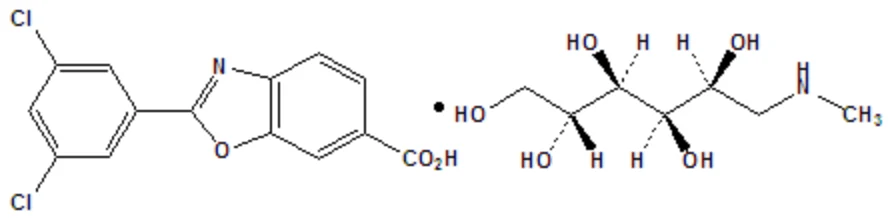
Chemical name: 2 (3,5 dichlorophenyl) benzoxazole 6 carboxylic acid mono (1 deoxy 1 methylamino D glucitol)
Molecular formula and molecular mass:
Tafamidis meglumine
The molecular formula is C14H7Cl2NO3 C7H17NO5, and the molecular mass is 503.33 g/mol
Tafamidis free acid
The molecular formula is C14H7Cl2NO3, and the molecular mass is 308.12 g/mol
Structural formula:
Physicochemical properties: Tafamidis meglumine is a white to pink powder. It is slightly soluble in water and methanol.
| Aqueous Solubility of Tafamidis Meglumine | |
|---|---|
| Solution | Solubility (mg/mL) |
| Water | > 4.628 |
| 0.1 N NaOH | > 4.187 |
| Buffer, pH 6.8 | 3.121 |
| Buffer, pH 5.0 | 0.000 |
| Buffer, pH 4.5 | 0.000 |
| Buffer, pH 3.0 | 0.007 |
| 0.1 N HCl | 0.000 |
14. Clinical Trials
14.1. Clinical Trials by Indication
Cardiomyopathy
Table 5 - Summary of Patient Demographics for Clinical Trials in Cardiomyopathy
| Study # | Study design | Dosage, route of administration and duration | Study subjects (n) | Mean age (Range) | Sex |
| B3461028 | Double-blind, placebo-controlled, randomized | Oral and 30 months | 441 patients enrolled into the study n=177 in the placebo arm n=88 in the tafamidis meglumine 20 mg arm n=176 in the tafamidis meglumine 80 mg arm. | 74.5 years (range: 46 to 88 years) in tafamidis-treat ed patients 74.1 years (range: 51 to 89 years) in placebo patients | Female and Male |
Efficacy was demonstrated in a multicenter, international, double-blind, placebo-controlled, randomized study in 441 patients with wild type or hereditary ATTR-CM.
Eligible patients had ATTR-CM confirmed by biopsy specimens obtained from cardiac and noncardiac sites and, in patients without ATTRm, by the presence of transthyretin precursor protein confirmed on immunohistochemical analysis, scintigraphy, or mass spectrometry.
Patients were randomized to either tafamidis meglumine 20 mg (n=88) or 80 mg [administered as four 20 mg tafamidis meglumine capsules] (n=176) or matching placebo (n=177) once daily, in addition to standard of care (e.g., diuretics) for 30 months. Treatment assignment was stratified by the presence or absence of a variant TTR genotype and by baseline NYHA Class. Transplant patients were excluded from this study.
Table 6 - Patient Demographics and Baseline Characteristics
| Characteristic | Pooled Tafamidis N=264 | Placebo N=177 | |
|---|---|---|---|
| Characteristic | Pooled Tafamidis N=264 | Placebo N=177 | |
| Age — year | |||
| Mean (Standard Deviation) | 74.5 (7.2) | 74.1 (6.7) | |
| Median (minimum, maximum) | 75 (46, 88) | 74 (51, 89) | |
| Sex — number (%) | |||
| Male | 241 (91.3) | 157 (88.7) | |
| Female | 23 (8.7) | 20 (11.3) | |
| TTR Genotype — number (%) | |||
| ATTRm | 63 (23.9) | 43 (24.3) | |
| ATTRwt | 201 (76.1) | 134 (75.7) | |
| NYHA Class — number (%) | |||
| NYHA Class I | 24 (9.1) | 13 (7.3) | |
| NYHA Class II | 162 (61.4) | 101 (57.1) | |
| NYHA Class III | 78 (29.5) | 63 (35.6) | |
Abbreviations: ATTRm = variant transthyretin amyloid, ATTRwt = wild type transthyretin amyloid, NYHA=New York Heart Association.
The primary analysis used a hierarchical combination applying the method of Finkelstein-Schoenfeld (F-S) to all-cause mortality and frequency of cardiovascular-related hospitalizations, which was defined as the number of times a subject is hospitalized for cardiovascular-related morbidity. The method compared each patient to every other patient within each stratum in a pair-wise manner that proceeded in a hierarchical fashion using all-cause mortality followed by frequency of cardiovascular-related hospitalizations when patients cannot be differentiated based on mortality.
This analysis demonstrated a significant reduction (p=0.0006) in all-cause mortality and frequency of cardiovascular-related hospitalizations in the pooled tafamidis meglumine 20 mg and 80 mg groups versus placebo (Table 7).
Table 7 - Primary Analysis Using Finkelstein-Schoenfeld (F-S) Method of All-Cause Mortality and Frequency of Cardiovascular-Related Hospitalizations
| Primary Analysis | Pooled Tafamidis N=264 | Placebo N=177 | |||||
|---|---|---|---|---|---|---|---|
| Number (%) of Subjects Alive* at Month 30 | 186 (70.5) | 101 (57.1) | |||||
| Average Cardiovascular-related Hospitalizations During 30 months (per patient per year) Among Those Alive at Month 30 | 0.297 | 0.455 | |||||
| p-value from F-S Method | 0.0006 | ||||||
* Heart transplantation and cardiac mechanical assist device implantation are considered indicators of approaching end stage. As such, these subjects are treated in the analysis as equivalent to death. Therefore, such subjects are not included in the count of “Number of Subjects Alive at Month 30” even if such subjects are alive based on 30 month vital status follow-up assessment.
The hazard ratio from the all-cause mortality Cox-proportional hazard model for pooled VYNDAQEL versus placebo was 0.70 (95% confidence interval [CI] 0.51, 0.96), indicating a 30% relative reduction in the risk of death relative to the placebo group (p=0.026).
The difference in mortality events between groups was attributable to CV related events.
Overall, 20.8% of the pooled tafamidis and 33.3% of the placebo groups had CV-related deaths.
Non-CV-related deaths were reported in 5.3% of the pooled tafamidis and 7.3 % of the placebo group.
A Kaplan-Meier plot of time to event all-cause mortality is presented in Figure 1.
Figure 1: All-Cause Mortality*
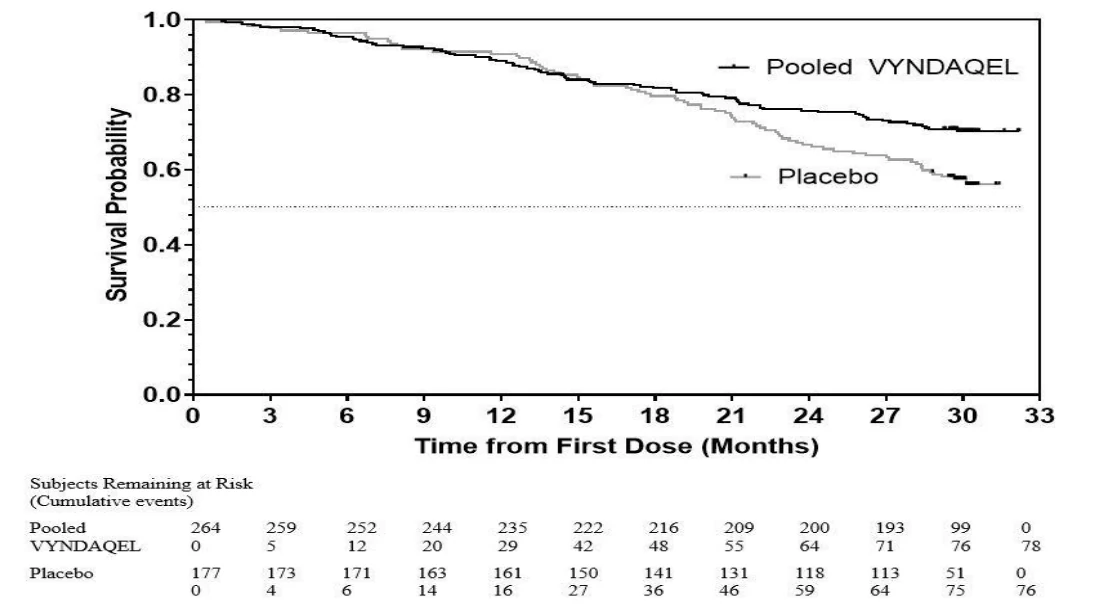
*Heart transplants and cardiac mechanical assist devices treated as death. Hazard ratio from Cox proportional hazards model with treatment, TTR genotype (variant and wild type), and NYHA baseline classification (NYHA Classes I and II combined and NYHA Class III) as factors.
There were significantly fewer cardiovascular-related hospitalizations with tafamidis compared with placebo with a reduction in risk of 32% (Table 8).
Table 8 - Cardiovascular-Related Hospitalization Frequency
Pooled VYNDAQEL N=264 | Placebo N=177 | |||||||
|---|---|---|---|---|---|---|---|---|
| Total (%) Number of Subjects with Cardiovascular-related Hospitalizations | 138 (52.3) | 107 (60.5) | ||||||
| Cardiovascular-related Hospitalizations per Year* | 0.48 | 0.70 | ||||||
| Pooled VYNDAQEL vs Placebo Treatment Difference (Relative Risk Ratio)* | 0.68 | |||||||
| p-value* | <0.0001 | |||||||
*This analysis was based on a Poisson regression model with treatment, TTR genotype (variant and wild type), New York Heart Association (NYHA). Baseline classification (NYHA Classes I and II combined and NYHA Class III), treatment-by-TTR genotype interaction, and treatment-by-NYHA baseline classification interaction terms as factors.
The treatment effect of tafamidis on functional capacity and health status was assessed by the 6-Minute Walk Test (6MWT) and the Kansas City Cardiomyopathy Questionnaire-Overall Summary (KCCQ-OS) score, respectively. A significant treatment effect favoring tafamidis was first observed at Month 6 and remained significant through Month 30 for both the 6MWT and the KCCQ-OS.
The Kansas City Cardiomyopathy Questionnaire-Overall Summary (KCCQ-OS) score is composed of four domains including Total Symptoms (Symptom Frequency and Symptom Burden), Physical Limitation, Quality of Life, and Social Limitation. The Overall Summary score and domain scores range from 0 to 100, with higher scores representing better health status. The distribution for change from Baseline to Month 30 for KCCQ-OS shows that the proportion of patients with worse KCCQ-OS scores was lower for the pooled VYNDAQEL-treated group compared to placebo, and the proportion with improved scores was higher.
Results of the primary analysis, the components of the primary analysis, functional capacity (6MWT) and health status (KCCQ-OS) at Month 30, cardiovascular-related mortality, and TTR-stabilization at Month 1 were analyzed by individual doses (80 mg and 20 mg) compared to placebo.
In the pivotal trial, comparable TTR stabilization rates were seen for both the 20 mg and 80 mg doses at 12 months (83% and 88%, respectively).
Both tafamidis meglumine doses (80mg and 20mg) appeared to be as effective. However, the study was not powered to distinguish between doses. The hazard ratios from the all-cause mortality for the 80 mg and 20 mg tafamidis doses relative to placebo were 0.69 (95% CI 0.49, 0.98) and 0.72 (95% CI 0.45, 1.14), respectively. The relative risk ratios for CV-related hospitalization between the tafamidis 80 mg and 20 mg relative to placebo were 0.70 (95% CI 0.57, 0.86) and 0.66 (95% CI 0.51, 0.86).
The key secondary endpoints (6-minute walk test and the KCCQ-OS score) were also comparable between doses.
Potential benefit for the 80 mg dose was suggested in post hoc exploratory analyses of reduction of cardiac biomarker NT-proBNP at month 30 and reaching a difference from placebo at an earlier time point.
Results from F-S method represented by the win ratio for the combined endpoint and its components (all-cause mortality and frequency of CV-related hospitalization) favored tafamidis versus placebo across wild type, variant and NYHA Class I & II subgroups.
In NYHA Class III subgroup, the proportion of patients with CV-related hospitalizations were 76.9% vs 58.7% and CV mortality were 51.3% vs 49.2% for pooled tafamidis and placebo treatment groups respectively.
Analyses of 6MWT and KCCQ-OS favored tafamidis relative to placebo within each subgroup.
Figure 2: Results by Subgroup, Dose, and Components of Primary Analysis
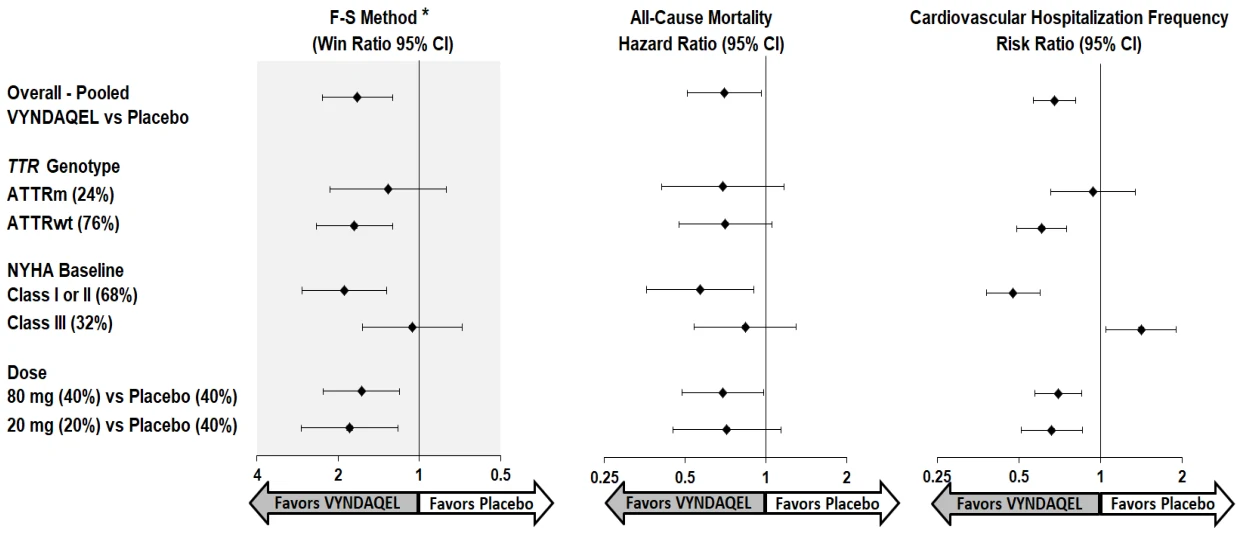
Abbreviations: ATTRm = variant transthyretin amyloid, ATTRwt = wild type transthyretin amyloid, F-S = Finkelstein Schoenfeld, CI = Confidence Interval
*F-S results presented using win ratio (based on all-cause mortality and frequency of cardiovascular hospitalization) Win ratio is the number of pairs of treated-patient “wins” divided by number of pairs of placebo patient “wins”. Heart transplants and cardiac mechanical assist devices treated as death.
There are no clinical data in patients of NYHA Class IV at baseline.
15. Microbiology
No microbiological information is required for this drug product.
16. Non-Clinical Toxicology
The non-clinical program of tafamidis meglumine was based on conventional studies of safety pharmacology, pharmacodynamic and pharmacokinetic studies, repeat-dose toxicity, reproductive and developmental toxicity, carcinogenicity, genetic toxicity, phototoxicity, and immunotoxicity. Non-clinical toxicology findings which are relevant for the safe use of the drug and/or contribute to the understanding of a drug’s toxicological profile are summarized below:
General toxicology and carcinogenicity
In repeat-dose toxicity and carcinogenicity studies, even though there was no evidence of neoplasia, the liver and/or kidney appeared as target organs for toxicity in the different species tested. Liver effects were observed at exposures approximately ≥0.7 times the human exposure at a dose of 80 mg tafamidis meglumine.
Significant non neoplastic lesions were noted in the kidneys (nephrosis) and liver (centrilobular hypertrophy and single cell necrosis) in the Tg rasH2 mice at dose levels ≥2.9 times the clinical dose of 80 mg tafamidis meglumine. Renal nephrosis was noted only in male (Tg) rasH2 mice with a higher incidence and severity at 90 mg/kg/day and not observed at ≤30 mg/kg/day, with corresponding AUC24 values, which was ≤2.9 times the human steady state AUC24 at the clinical dose of 80 mg tafamidis meglumine.
Reproductive and developmental toxicology
Fertility: There were no effects of tafamidis meglumine on fertility, reproductive performance, or mating behavior in the rat at any dose up to 30 mg/kg (human equivalent dose of tafamidis meglumine greater than 4.8 mg/kg/day). Rats were dosed daily (5, 15, and 30 mg/kg/day) prior to cohabitation (for at least 15 days for females and 28 days for males), throughout the cohabitation period to the day prior to termination of males and through to implantation of females (Gestation Day 7). No adverse effects were noted on male rats at any dose. Females had statistically significant weight loss and decreased feed consumption in the highest dose group during the first week of dosing.
The paternal and maternal no observed effect level for reproductive toxicity of tafamidis meglumine is 30 mg/kg/day, 6.9-times the clinical dose of 80 mg tafamidis meglumine.
Placental and milk transfer: Pregnant and lactating female rats were administered repeated daily oral doses of tafamidis meglumine (15 mg/kg/day) followed by a single oral gavage dose of 14C-tafamidis meglumine on Lactation Day 4 or 12. Radiolabelled material was observed in blood and fetal tissues and distribution was widespread by the first timepoint analyzed, suggesting that dose-related material had crossed the placental barrier. The concentrations in fetal tissue were generally higher on Day 19 of gestation as compared to Day 15 of gestation. Radioactivity was observed in milk by 1 hour post-dose and increased thereafter. The ratio of the highest radioactivity associated with 14C-tafamidis meglumine in milk (8 hours post-dose) vs. plasma (1 hour post-dose) was approximately 1.6 on Day 12, indicating tafamidis meglumine is transferred to milk after oral administration.
Developmental toxicity: In an embryo-fetal developmental toxicity study in rabbits, oral administration of tafamidis meglumine (0, 0.5, 2, and 8 mg/kg/day) throughout organogenesis resulted in increased embryofetal mortality, reduced fetal body weights, and an increased incidence of fetal malformations at 8 mg/kg/day (approximately 9 times the human exposure of 80 mg tafamidis meglumine based on AUC), which was also maternally toxic. Increased incidences of fetal skeletal variations were observed at doses ≥0.5 mg/kg/day (approximately equivalent to the human exposure of 80 mg tafamidis meglumine based on AUC).
In an embryo-fetal development toxicity study in rats, oral administration of tafamidis (15, 30, and 45 mg/kg/day) from Gestation Day 7 through 17 resulted in decreased fetal weights at ≥30 mg/kg/day (approximately ≥9.7-times the human AUC at the clinical dose of 80 mg tafamidis meglumine). The no observable adverse effect level (NOAEL) for embryo-fetal development in rats was 15 mg/kg/day (6.6 times the human exposure of 80 mg tafamidis meglumine based on AUC).
In the rat pre- and postnatal development study with tafamidis, pregnant rats were orally administered tafamidis meglumine at doses of 5, 15, or 30 mg/kg/day from Gestation Day 7 through Lactation Day 20. High pup mortality at 30 mg/kg/day resulted in early termination of this group. Decreased pup survival and reduced pup weights was also noted at 15 mg/kg/day. Decreased pup weights in males were associated with delayed sexual maturation (preputial separation) at 15 mg/kg/day. Impaired performance in a water-maze test for learning and memory was observed at 15 mg/kg/day. The NOAEL for viability and growth in the F1 generation offspring following maternal dose administration during pregnancy and lactation with tafamidis was 5 mg/kg/day (human equivalent dose of tafamidis=0.8 mg/kg/day), a dose approximately equivalent to the clinical dose of 80 mg tafamidis meglumine.