


Product Monograph - Onpattro
RECENT MAJOR LABEL CHANGES
| 4 DOSAGE AND ADMINISTRATION, 4.2 Recommended Dose and Dosage Adjustment | 06/2023 |
|---|
TABLE OF CONTENTS
Sections or subsections that are not applicable at the time of authorization are not listed.
RECENT MAJOR LABEL CHANGES..............................................................................................2
PART I: HEALTH PROFESSIONAL INFORMATION .......................................................................4
1 INDICATIONS ................................................................................................................4
1.1 Pediatrics ............................................................................................................4
1.2 Geriatrics.............................................................................................................4
2 CONTRAINDICATIONS ...................................................................................................4
4 DOSAGE AND ADMINISTRATION...................................................................................4
4.1 Dosing Considerations .........................................................................................4
4.2 Recommended Dose and Dosage Adjustment.......................................................4
4.3 Reconstitution .....................................................................................................6
4.4 Administration.....................................................................................................6
4.5 Missed Dose ........................................................................................................7
5 OVERDOSAGE ...............................................................................................................7
6 DOSAGE FORMS, STRENGTHS, COMPOSITION AND PACKAGING ...................................8
7 WARNINGS AND PRECAUTIONS ....................................................................................8
7.1 Special Populations ............................................................................................ 10
7.1.1 Pregnant Women ...........................................................................................10
7.1.2 Breast-feeding ................................................................................................11
7.1.3 Pediatrics .......................................................................................................11
7.1.4 Geriatrics .......................................................................................................11
8 ADVERSE REACTIONS .................................................................................................. 12
8.1 Adverse Reaction Overview................................................................................ 12
8.2 Clinical Trial Adverse Reactions .......................................................................... 12
8.3 Less Common Clinical Trial Adverse Reactions ................................................... 13
8.4 Abnormal Laboratory Findings: Hematologic, Clinical Chemistry and Other Quantitative Data ........................................................................................................ 14
9 DRUG INTERACTIONS.................................................................................................. 14
9.2 Drug Interactions Overview................................................................................ 14
9.3 Drug-Behavioural Interactions............................................................................ 14
9.4 Drug-Drug Interactions ...................................................................................... 14
9.5 Drug-Food Interactions ...................................................................................... 15
9.6 Drug-Herb Interactions ...................................................................................... 15
9.7 Drug-Laboratory Test Interactions ...................................................................... 15
10 CLINICAL PHARMACOLOGY ......................................................................................... 15
10.1 Mechanism of Action ...................................................................................... 15
10.2 Pharmacodynamics ........................................................................................ 15
10.3 Pharmacokinetics ........................................................................................... 16
11 STORAGE, STABILITY AND DISPOSAL ........................................................................... 18
12 SPECIAL HANDLING INSTRUCTIONS............................................................................. 18
PART II: SCIENTIFIC INFORMATION ........................................................................................ 19
13 PHARMACEUTICAL INFORMATION.............................................................................. 19
14 CLINICAL TRIALS.......................................................................................................... 19
14.1 Clinical Trials by Indication .............................................................................. 19
Indication: Treatment of polyneuropathy in adult patients with hATTR amyloidosis ......19
15 MICROBIOLOGY .......................................................................................................... 25
16 NON-CLINICAL TOXICOLOGY ....................................................................................... 25
PATIENT MEDICATION INFORMATION ................................................................................... 28
PART I: HEALTH PROFESSIONAL INFORMATION
1 INDICATIONS
ONPATTRO (patisiran) is indicated for the treatment of polyneuropathy in adult patients with hereditary transthyretin-mediated amyloidosis (hATTR amyloidosis).
1.1 Pediatrics
Pediatrics (< 18 years of age): No data are available to Health Canada. Therefore, Health Canada has not authorized an indication for pediatric use.
1.2 Geriatrics
Evidence from clinical studies supports the safe and efficacious use of ONPATTRO in the geriatric population (see 7.1.4 Geriatrics; 10.3 Pharmacokinetics).
2 CONTRAINDICATIONS
ONPATTRO is contraindicated in:
- patients with a history of severe hypersensitivity (e.g., anaphylaxis or anaphylactoid reactions) to patisiran or to any ingredient in the formulation, including any non-medicinal ingredient, or component of the container. For a complete listing, see 6 DOSAGE FORMS, STRENGTHS, COMPOSITION AND PACKAGING.
4 DOSAGE AND ADMINISTRATION
4.1 Dosing Considerations
- ONPATTRO (patisiran) should be administered by a healthcare professional.
- Premedications are required (see 4.2 Recommended Dose and Dosage Adjustment).
- Administer only as an intravenous infusion after dilution (see 4.4 Administration).
- Vitamin A supplements are recommended (see 7 WARNINGS AND PRECAUTIONS).
4.2 Recommended Dose and Dosage Adjustment
Adults (≥ 18 years of age): The recommended dose of ONPATTRO is 0.3 mg/kg administered via intravenous (IV) infusion once every 3 weeks.
Dosing is based on body weight, to a maximum dose of 30 mg. For patients weighing ≥ 100 kg, the recommended dose of ONPATTRO should not exceed 30 mg.
Required Premedication
All patients should receive premedication prior to ONPATTRO administration to reduce the risk of infusion-related reactions (IRRs) (see 7 WARNINGS AND PRECAUTIONS). Each of the following premedications should be given on the day of ONPATTRO infusion, at least 60 minutes prior to the start of infusion:
- Intravenous corticosteroid (dexamethasone 10 mg, or equivalent)
- Oral acetaminophen (500 mg)
- Intravenous H1 blocker (diphenhydramine 50 mg, or equivalent)
- Intravenous H2 blocker (famotidine 20 mg, or equivalent)
For premedications not available or not tolerated intravenously, equivalents may be administered orally.
If clinically indicated, the corticosteroid may be tapered to a minimum dose of 5 mg of dexamethasone (intravenous), or equivalent, for patients who are tolerating their infusions well.
Additional or higher doses of one or more of the premedications may be administered to reduce the risk of IRRs, if needed (see 7 WARNINGS AND PRECAUTIONS).
Vitamin A Supplementation
Supplementation with the recommended daily amount of vitamin A is recommended (see 7 WARNINGS AND PRECAUTIONS).
- Pediatrics (<18 years of age): Health Canada has not authorized an indication for pediatric use.
- Geriatrics: No dose adjustment is required in patients ≥ 65 years of age (see 10.3 Pharmacokinetics).
- Hepatic impairment: No dose adjustment is necessary in patients with mild hepatic impairment (see 10.3 Pharmacokinetics). ONPATTRO has not been studied in patients with moderate or severe hepatic impairment.
- Liver transplant: No dose adjustment is necessary in patients with prior liver transplant (see 8.2 Clinical Trial Adverse Reactions; 10.3 Pharmacokinetics).
- Renal impairment: No dose adjustment is necessary in patients with mild or moderate renal impairment (estimated glomerular filtration rate [eGFR] ≥ 30 to < 90 mL/min/1.73 m2) (see 10.3 CLINICAL PHARMACOLOGY, Pharmacokinetics). ONPATTRO has not been studied in patients with severe renal impairment or end-stage renal disease.
4.3 Reconstitution
- Remove ONPATTRO from the refrigerator. Do not shake or vortex.
- Inspect visually for particulate matter and discoloration. Do not use if discoloration or foreign particles are present. ONPATTRO is a white to off-white, opalescent, homogeneous solution. A white to off-white coating may be observed on the inner surface of the vial, typically at the liquid-headspace interface. Product quality is not impacted by presence of the white to off-white coating.
- Calculate the required volume of ONPATTRO based on the recommended weight-based dosage, to a maximum of 15 mL (30 mg) (see 4.2 Recommended Dose and Dosage Adjustment).
- Withdraw the entire contents of one or more vials into a single sterile syringe.
- Filter ONPATTRO through a sterile 0.45-micron polyethersulfone (PES) syringe filter into a sterile container.
- Withdraw the required volume of filtered ONPATTRO from the sterile container using a sterile syringe.
- Dilute the required volume of filtered ONPATTRO into an infusion bag containing 0.9% sodium chloride solution for a total volume of 200 mL. Use infusion bags that are DEHP-free.
- Gently invert the bag to mix the solution. Do not shake. Do not mix or dilute with other drugs.
- Discard unused portion of ONPATTRO.
- Inspect the infusion bag visually for particulate matter and discoloration prior to administration. DO NOT use if solution contains particles.
- Check the container for minute leaks prior to use by squeezing the bag firmly; ensure that the seal is intact. If leaks are found, discard solution, as sterility may be impaired.
- ONPATTRO does not contain preservatives. The diluted solution should be administered immediately after preparation. If not used immediately, store in the infusion bag at room temperature (15 °C to 30 °C) for up to 16 hours (including infusion time). Do not freeze.
4.4 Administration
- Dilute ONPATTRO prior to intravenous infusion (see 4.3 Reconstitution).
- Use a dedicated line with an infusion set containing a 1.2-micron polyethersulfone (PES) in-line infusion filter. Use infusion sets and lines that are di(2-ethylhexyl)phthalate-free (DEHP-free).
- Infuse the diluted solution of ONPATTRO intravenously over approximately 80 minutes at an initial infusion rate of approximately 1 mL/min for the first 15 minutes; then, if well tolerated, increase to approximately 3 mL/min for the remainder of the infusion. The duration of infusion may be extended in the event of an IRR (see 7 WARNINGS AND PRECAUTIONS).
- Administer only through a free-flowing venous access line. Monitor the infusion site for possible infiltration during drug administration. Suspected extravasation should be managed according to local standard practice for non-vesicants.
- Observe the patient during the infusion and, if clinically indicated, following the infusion (see 7 WARNINGS AND PRECAUTIONS).
- After completion of the infusion, flush the IV administration set with 0.9% sodium chloride solution to ensure that all ONPATTRO has been administered.
4.5 Missed Dose
If a dose is missed, administer ONPATTRO as soon as possible.
- If ONPATTRO is administered within 3 days of the missed dose, continue dosing according to the patient’s original schedule.
- If ONPATTRO is administered more than 3 days after the missed dose, continue dosing every 3 weeks thereafter.
5 OVERDOSAGE
Reported experience with overdose is limited. In case of overdose, it is recommended that the patient be monitored for any signs or symptoms of adverse effects and given appropriate treatment.
| For management of a suspected drug overdose, contact your regional poison control centre. |
|---|
6 DOSAGE FORMS, STRENGTHS, COMPOSITION AND PACKAGING
Table 1 – Dosage Forms, Strengths, Composition and Packaging
ONPATTRO contains patisiran, a double-stranded small interfering ribonucleic acid (siRNA), formulated as lipid nanoparticles for delivery to hepatocytes.
ONPATTRO contains 10.5 mg patisiran sodium equivalent to 10 mg patisiran free acid in 5 mL per vial. ONPATTRO is a sterile, preservative-free, white to off-white, opalescent, homogeneous solution for intravenous infusion. ONPATTRO is supplied in a single-use, 10-mL Type I glass vial with a Flurotec®-coated chlorobutyl stopper and an aluminum flip-off cap containing 5 mL of solution at a concentration of 2 mg of patisiran per 1 mL. The Flurotec®-coated stopper is not made with natural rubber latex.
ONPATTRO is available in cartons containing one single-use vial each.
7 WARNINGS AND PRECAUTIONS
General
Infusion-Related Reactions
Infusion-related reactions (IRRs) have been observed in patients treated with ONPATTRO (patisiran). In clinical studies, all patients received premedication with a corticosteroid, acetaminophen, and H1 and H2 blockers to reduce the risk of IRRs. In a double-blind placebo-controlled study, called APOLLO, 18.9% of ONPATTRO-treated patients experienced IRRs, compared to 9.1% of placebo-treated patients. In ONPATTRO-treated patients, all IRRs were either mild (95.2%) or moderate (4.8%) in severity. Among ONPATTRO-treated patients who experienced an IRR, 78.6% experienced the first IRR within the first 2 infusions. The frequency of IRRs decreased over time. Few IRRs led to infusion interruption. IRRs resulted in permanent discontinuation of ONPATTRO in < 1% of patients in clinical studies. Across clinical studies, the most common symptoms (reported in ≥ 2% of patients) of IRRs with ONPATTRO were flushing, back pain, nausea, abdominal pain, dyspnea, and headache (see 8.2 Clinical Trial
| Route of Administration | Dosage Form / Strength/Composition | Non-medicinal Ingredients |
|---|---|---|
| Intravenous infusion | 2 mg of patisiran per 1 mL | cholesterol; DLin-MC3-DMA ((6Z,9Z,28Z,31Z)-heptatriaconta-6,9,28,31-tetraen-19-yl-4-(dimethylamino) butanoate); DSPC (1,2-distearoyl-sn-glycero-3-phosphocholine); PEG2000-C-DMG (α-(3’-{[1,2-di(myristyloxy) propanoxy] carbonylamino}propyl)-ω-methoxy, polyoxyethylene); potassium phosphate, monobasic, anhydrous; sodium chloride; sodium phosphate, dibasic, heptahydrate; water for injection |
Adverse Reactions). IRRs, associated with the use of ONPATTRO, may include hypotension and syncope.
Patients should receive premedications on the day of ONPATTRO infusion, at least 60 minutes prior to the start of infusion (see 4.2 Recommended Dose and Dosage Adjustment). If an IRR occurs, consider slowing or interrupting the infusion and instituting medical management (e.g., corticosteroids or other symptomatic treatment) as clinically indicated. If the infusion is interrupted, consider resuming at a slower infusion rate after symptoms have resolved. Discontinue the ONPATTRO infusion in the case of a serious or life-threatening IRR.
Some patients who experience IRRs may benefit from a slower infusion rate or additional or higher doses of one or more of the premedications with subsequent infusions to reduce the risk of IRRs.
Reduced Serum Vitamin A Levels and Recommended Supplementation
By reducing serum TTR protein, ONPATTRO treatment leads to a decrease in serum vitamin A levels. Supplementation at the recommended daily amount of vitamin A is advised for patients taking ONPATTRO (see 10.2 Pharmacodynamics).
Serum vitamin A levels should not be used to guide vitamin A supplementation during treatment with ONPATTRO (see 9.7 Drug-Laboratory Test Interactions).
Particular care should be taken by women of child-bearing potential and during early stages of pregnancy as levels of serum vitamin A too low or too high may increase the risk of fetal malformations (see 7.1.1 Pregnant Women).
Ocular changes may occur in patients with hATTR amyloidosis due to amyloid deposition in the eye. If a patient develops ocular symptoms suggestive of vitamin A deficiency (e.g., reduced night vision or night blindness, persistent dry eye, eye inflammation, corneal inflammation or ulceration, corneal thickening, or corneal perforation), referral to an ophthalmologist is recommended.
Cardiovascular
Hypotension and syncope events may be observed as infusion related reactions (see 7 WARNINGS AND PRECAUTIONS, Infusion-Related Reactions).
Driving and Operating Machinery
No studies of the effects on the ability to drive or operate machinery during treatment with ONPATTRO have been performed. Exercise caution when driving or operating a vehicle or potentially dangerous machinery.
Monitoring and Laboratory Tests
Serum TTR is a carrier of retinol binding protein, which facilitates transport of vitamin A in the blood. Treatment with ONPATTRO reduces serum TTR levels, which results in reduced levels of retinol binding protein and vitamin A in the serum. However, transport and tissue uptake of vitamin A can occur through alternative mechanisms in the absence of retinol binding protein. As a result, laboratory tests for serum vitamin A do not reflect the total amount of vitamin A in the body and should not be used to guide vitamin A supplementation during treatment with ONPATTRO (see 7 WARNINGS AND PRECAUTIONS, Reduced Serum Vitamin A Levels and Recommended Supplementation; 10.2 Pharmacodynamics).
Ophthalmologic
Ocular signs and symptoms may be caused by hATTR amyloidosis. If a patient develops ocular symptoms suggestive of vitamin A deficiency, including reduced night vision or night blindness, persistent dry eyes, eye inflammation, corneal inflammation or ulceration, corneal thickening or corneal perforation, referral to an ophthalmologist is recommended (see 7 WARNINGS AND PRECAUTIONS, Reduced Serum Vitamin A Levels and Recommended Supplementation).
Reproductive Health: Female and Male Potential
Fertility
There are no data on the effects of ONPATTRO on human fertility. No impact on male or female fertility was detected in animal studies (see 16 NON-CLINICAL TOXICOLOGY).
Function
There are no data on the effects of ONPATTRO on human sexual function.
Teratogenic Risk
ONPATTRO is not recommended for use during pregnancy (see 7.1.1 Pregnant Women).
Treatment with ONPATTRO reduces serum levels of vitamin A. Due to the potential teratogenic risk arising from unbalanced vitamin A levels, it is recommended that women of child-bearing potential use effective contraception during treatment with ONPATTRO and for 12 weeks after stopping treatment.
In non-clinical studies, patisiran had no adverse effects on embryofetal development at doses that did not result in maternal toxicity (see 16 NON-CLINICAL TOXICOLOGY).
7.1 Special Populations
7.1.1 Pregnant Women
ONPATTRO is not recommended for use during pregnancy.
There are no data on the use of ONPATTRO in pregnant women. The effects of a reduction in maternal serum TTR or serum vitamin A levels on the fetus are unknown (see 7 WARNINGS AND PRECAUTIONS, Teratogenic Risk; 7 WARNINGS AND PRECAUTIONS, Reduced Serum Vitamin A Levels and Recommended Supplementation; 10.2 Pharmacodynamics).
During the first 60 days of pregnancy, too high or too low vitamin A levels may both be associated with an increased risk of fetal malformation. Therefore, pregnancy should be ruled out before initiating ONPATTRO. Women of childbearing potential should practice effective contraception while receiving ONPATTRO. If a woman intends to become pregnant, ONPATTRO and vitamin A supplementation should be discontinued, and serum vitamin A levels should be monitored and seen to have returned to normal before conception is attempted.
In the event of an unplanned pregnancy, ONPATTRO should be discontinued.
No adverse effects on pregnancy or embryofetal development were observed with weekly administration of ONPATTRO, at 0.8 and 0.6 times the recommended human dose (RHD) unadjusted for dosing schedule to rats and rabbits, respectively. However, spontaneous abortions, reduced embryofetal survival, and reduced fetal body weights were observed in rabbits at human equivalent dose (HED) 1.1 times the RHD, unadjusted for dosing schedule. No significant placental transfer was detected in rats or rabbits (see 16 NON-CLINICAL TOXICOLOGY).
7.1.2 Breast-feeding
There is no information regarding the presence of ONPATTRO in human milk, the effects on the breastfed infant, or the effects on milk production. The development and health benefits of breastfeeding should be considered along with the mother’s clinical need for ONPATTRO and any potential adverse effects on the breastfed infant from ONPATTRO or from the underlying maternal condition.
In lactating rats, patisiran was not present in milk, although small amounts of the lipid components DLin-MC3-DMA and PEG2000-C-DMG were present in milk (see 16 NON-CLINICAL TOXICOLOGY).
7.1.3 Pediatrics
Pediatrics (< 18 years of age): No data are available to Health Canada; therefore, Health Canada has not authorized an indication for pediatric use (see 1.1 Pediatrics).
7.1.4 Geriatrics
No overall differences in safety or effectiveness were observed between patients ≥ 65 years old and younger patients, but greater sensitivity of some older individuals cannot be ruled out (see 10.3 Pharmacokinetics).
8 ADVERSE REACTIONS
8.1 Adverse Reaction Overview
The most frequently occurring adverse reactions reported in ONPATTRO-treated patients (≥ 10% of patients and occurring ≥ 3 percentage points more frequently than in placebo-treated patients) were peripheral edema and infusion-related reactions (see 7 WARNINGS AND PRECAUTIONS). The only adverse reaction resulting in the discontinuation of ONPATTRO was an infusion-related reaction (1 patient, 0.7%).
8.2 Clinical Trial Adverse Reactions
Clinical trials are conducted under very specific conditions. The adverse reaction rates observed in the clinical trials, therefore, may not reflect the rates observed in practice and should not be compared to the rates in the clinical trials of another drug. Adverse reaction information from clinical trials may be useful in identifying and approximating rates of adverse drug reactions in real-world use.
In placebo-controlled and open-label clinical studies, a total of 224 patients with hATTR amyloidosis received ONPATTRO (patisiran) for a median of 2.2 years, with some individuals receiving exposure to ONPATTRO for up to 4.1 years. Of these 224 patients, 186 patients received ≥ 1 year of treatment, 137 patients received ≥ 2 years of treatment, and 52 patients received ≥ 3 years of treatment.
In the pivotal, placebo-controlled study, called APOLLO, 148 patients received 0.3 mg/kg ONPATTRO and 77 patients received placebo administered once every 3 weeks via intravenous infusion for up to 18 months, with a mean ONPATTRO exposure of 17.7 months. All patients received premedication with a corticosteroid, acetaminophen, and H1 and H2 blockers (see 4.2 Dosage and Dosage Adjustment).
The safety profile of ONPATTRO was generally consistent across all subgroups including age, sex, race, weight, geographic region, V30M mutation status, disease stage, and patients that met pre-defined criteria for cardiac involvement, i.e., having baseline left ventricular (LV) wall thickness ≥ 13 mm, with no history of hypertension or aortic valve disease.
Adverse reactions for ONPATTRO are defined as those adverse events occurring at a ≥ 3 percentage point higher frequency in patients treated with ONPATTRO, compared with placebo, and other potentially relevant adverse events based on other studies with ONPATTRO. The adverse reactions are presented as MedDRA preferred terms (MedDRA version 18.0), sorted under the respective System Organ Class (SOCs) (Table 2).
Table 2 – Adverse Reactions That Occurred at a ≥ 3 Percentage Point Higher Frequency with ONPATTRO Compared to Placebo in the APOLLO Trial
ONPATTRO N=148 (%) | Placebo N=77 (%) | |
General disorders and administration site conditions Peripheral edema | 30 | 22 |
Immune system disorders Infusion-related reaction* | 19 | 9 |
Gastrointestinal disorders Dyspepsia | 8 | 4 |
Musculoskeletal and connective tissue disorders Muscle spasms Arthralgia | 8 7 | 1 0 |
Respiratory, thoracic and mediastinal disorders Dyspnea | 7 | 0 |
Skin and subcutaneous tissue disorders Erythema | 7 | 3 |
Infections and infestations Bronchitis Rhinitis Sinusitis | 6 4 4 | 3 0 0 |
Ear and labyrinth disorders Vertigo | 5 | 1 |
*Infusion-related reaction symptoms include but are not limited to: arthralgia or pain (including back, neck, or musculoskeletal pain), flushing (including erythema of face or skin warm), nausea, abdominal pain, dyspnea or cough, chest discomfort or chest pain, headache, pruritus, rash, chills, dizziness, fatigue, increased heart rate or palpitations, hypotension (which may include syncope), hypertension, facial edema.
Liver Transplant
In an open-label study in 23 patients with hATTR amyloidosis and polyneuropathy progression after receiving a liver transplant, the safety profile was consistent with that observed in previous clinical studies of patients with hATTR amyloidosis (see 10.3 Pharmacokinetics).
8.3 Less Common Clinical Trial Adverse Reactions
General disorders and administration site conditions: extravasation, including phlebitis or thrombophlebitis, infusion or injection site swelling, dermatitis, cellulitis, erythema or injection site redness, burning sensation, or injection site pain.
8.4 Abnormal Laboratory Findings: Hematologic, Clinical Chemistry and Other Quantitative Data
Immunogenicity
Anti-drug antibodies to ONPATTRO were evaluated by measuring antibodies specific to PEG2000-C-DMG, a lipid component exposed on the surface of ONPATTRO. In the placebo-controlled and open-label clinical studies, 7 of 194 (3.6%) patients with hATTR amyloidosis developed anti-drug antibodies, as measured during treatment with ONPATTRO. One additional patient had pre-existing anti-drug antibodies. Anti-drug antibody titers were low and transient with no evidence of an effect on clinical efficacy, the safety profile, or the pharmacokinetic or pharmacodynamic profiles of ONPATTRO.
The detection of antibody formation is highly dependent on the sensitivity and specificity of the assay. In addition, the observed incidence of antibody positivity in an assay may be influenced by several factors including assay methodology, sample handling, timing of sample collection, concomitant medications and underlying disease. For these reasons, comparison of the incidence of antibodies to ONPATTRO with the incidence of antibodies to other products may be misleading.
Vitamin A Levels
Serum TTR is a carrier of retinol binding protein, which facilitates transport of vitamin A in the blood. Treatment with ONPATTRO reduces serum TTR levels, which results in reduced levels of retinol binding protein and vitamin A in the serum (see 7 WARNINGS AND PRECAUTIONS).
9 DRUG INTERACTIONS
9.2 Drug Interactions Overview
No formal clinical drug interaction studies have been performed with ONPATTRO.
9.3 Drug-Behavioural Interactions
Drug-behavioural interactions have not been established.
9.4 Drug-Drug Interactions
No formal clinical drug interaction studies have been performed. ONPATTRO (patisiran) is not expected to cause drug-drug interactions or to be affected by inhibitors or inducers of cytochrome P450 enzymes. The components of ONPATTRO are not inhibitors or inducers of cytochrome P450 enzymes or transporters, except for time-dependent inhibition and weak induction of CYP2B6 in vitro. The net effect on CYP2B6 substrates (e.g., bupropion and efavirenz) in vivo is unknown. Patisiran is not a substrate of cytochrome P450 enzymes. In a population pharmacokinetic analysis, concomitant use of strong or moderate CYP3A inducers and inhibitors did not impact the pharmacokinetic parameters of patisiran.
9.5 Drug-Food Interactions
Interactions with food have not been established.
9.6 Drug-Herb Interactions
Interactions with herbal products have not been established.
9.7 Drug-Laboratory Test Interactions
Interactions with laboratory tests have not been established.
10 CLINICAL PHARMACOLOGY
10.1 Mechanism of Action
In patients with hATTR amyloidosis, serum variant and wild-type TTR proteins form amyloid deposits in tissues leading to progressive polyneuropathy and cardiomyopathy. ONPATTRO contains patisiran, a double-stranded siRNA that specifically targets a genetically conserved sequence in the 3’ untranslated region of all variant and wild-type TTR mRNA. Patisiran is formulated as lipid nanoparticles to deliver the siRNA to hepatocytes, the primary source of TTR protein in the circulation. Through a natural process called RNA interference (RNAi), patisiran causes the catalytic degradation of TTR mRNA, resulting in reduced serum TTR protein. In animal studies, patisiran-mediated reductions in TTR mRNA resulted in reduced serum TTR protein.
10.2 Pharmacodynamics
The pharmacodynamic effects of ONPATTRO were evaluated in hATTR amyloidosis patients treated with 0.3 mg/kg ONPATTRO via intravenous infusion once every 3 weeks.
Mean serum TTR was reduced by approximately 80% within 10 to 14 days after a single dose. With repeat dosing every 3 weeks, mean reductions of serum TTR after 9 and 18 months of treatment were 83% and 84%, respectively. The mean maximum reduction of serum TTR over 18 months was 88%. Similar TTR reductions were observed regardless of TTR mutation, sex, age, or race. In an ongoing open-label extension study, serum TTR reduction was maintained up to 3 years with continued dosing. In a dose-ranging study, greater TTR reduction was maintained over the dosing interval with the recommended dosing regimen of 0.3 mg/kg every 3 weeks compared to 0.3 mg/kg every 4 weeks.
Serum TTR is a carrier of retinol binding protein, which facilitates transport of vitamin A in the blood. Mean reductions in serum retinol binding protein of 45% and serum vitamin A of 62% were observed over 18 months (see 7 WARNINGS AND PRECAUTIONS).
Cardiac electrophysiology
Formal QTc studies have not been conducted with ONPATTRO. Based on its physicochemical properties, ONPATTRO has a low likelihood of direct ion channel interactions. There is no evidence from nonclinical or clinical studies to suggest that ONPATTRO delays ventricular repolarization.
10.3 Pharmacokinetics
The pharmacokinetic properties of ONPATTRO were characterised by measuring the plasma concentrations of patisiran and the lipid components DLin-MC3-DMA and PEG2000-C-DMG.
Table 3 – Summary of ONPATTRO Pharmacokinetic Parameters in Patients with hATTR Amyloidosis Following 0.3mg/kg Intravenous Administration Every 3 Weeks
| Analytes | Cmaxa | Ctrougha | AUCτa |
| Patisiran | 7.15 ± 2.14 mcg/mL | 0.021 ± 0.044 mcg/mL | 184 ± 159 mcg·h/mL |
| DLin-MC3-DMA | 40.2 ± 11.5 mcg/mL | 1.75 ± 0.698 mcg/mL | 1403 ± 514 mcg·h/mL |
| PEG2000-C-DMG | 4.22 ± 1.22 mcg/mL | 0.0236 ± 0.0093 mcg/mL | 145 ± 64.7 mcg·h/mL |
aSteady state with every 3 weeks dosing, mean ± SD
Absorption: Greater than 95% of patisiran in the circulation is associated with lipid nanoparticles. At the recommended dose regimen of 0.3 mg/kg every 3 weeks, steady state was reached by 24 weeks of treatment. The estimated mean ± SD steady-state peak concentrations (Cmax), trough concentrations (Ctrough), and area under the curve (AUCτ) were 7.15 ± 2.14 mcg/mL, 0.021 ± 0.044 mcg/mL, and 184 ± 159 mcg·h/mL, respectively. The accumulation of AUCτ was 3.2-fold at steady state compared to the first dose.
Patisiran exposure increased proportionally with increase in dose over the range evaluated in clinical studies (0.01 to 0.5 mg/kg). Patisiran exhibits linear and time-independent pharmacokinetics with chronic dosing at the recommended dose regimen of 0.3 mg/kg every 3 weeks.
Distribution: Plasma protein binding of ONPATTRO is low, with ≤ 2.1% binding observed in vitro with human serum albumin and human α1-acid glycoprotein. ONPATTRO distributes primarily to the liver. Minimal distribution was detected in the central nervous system and heart. At the recommended dose regimen of 0.3 mg/kg every 3 weeks, the mean ± SD steady-state volume of distribution of patisiran (Vss) was 0.26 ± 0.20 L/kg. The mean ± SD volume of distribution of DLin-MC3-DMA and of PEG2000-C-DMG was 0.47 ± 0.24 L/kg and 0.13 ± 0.05 L/kg, respectively.
Metabolism: The siRNA component of patisiran is metabolized by nucleases to nucleotides of various lengths. DLin-MC3-DMA is primarily metabolized to 4-dimethylaminobutyric acid (DMBA) by hydrolysis. There is little to no metabolism of PEG2000-C-DMG.
Elimination: At the recommended dose regimen of 0.3 mg/kg every 3 weeks, mean ± SD steady-state plasma clearance (CLss) of patisiran was 3.0 ± 2.5 mL/h/kg. The mean ± SD terminal elimination half-life (t1/2β) was 3.2 ± 1.8 days. Less than 1% of patisiran in the administered dose was recovered intact in urine.
The estimated DLin-MC3-DMA mean ± SD steady-state CLss was 2.1 ± 0.8 mL/h/kg. Approximately 5.5% of DLin-MC3-DMA was recovered after 96 hours as its metabolite (DMBA) in urine.
The estimated PEG2000-C-DMG mean ± SD steady-state CLss was 2.1 ± 0.6 mL/h/kg. In rats and monkeys, PEG2000-C-DMG is eliminated unchanged in the bile. PEG2000-C-DMG excretion in humans was not measured.
Special Populations and Conditions
Pediatrics: The safety and efficacy of ONPATTRO have not been studied in children or adolescents < 18 years old; therefore, Health Canada has not authorized an indication for pediatric use.
Geriatrics: In the placebo-controlled study, 62 (41.9%) patients treated with ONPATTRO were ≥ 65 years old and 9 (6.1%) patients were ≥ 75 years old. There were no significant differences in steady-state pharmacokinetic parameters or TTR reduction between patients < 65 years old and ≥ 65 years old.
Sex: Clinical studies did not identify significant differences in steady-state pharmacokinetic parameters or TTR reduction based on sex.
Pregnancy and Breast-feeding:
There is no information regarding the presence of ONPATTRO in human milk. In lactating rats, patisiran was not present in milk, although small amounts of the lipid components DLin-MC3-DMA and PEG2000-C-DMG were present in milk (see 16 NON-CLINICAL TOXICOLOGY).
Genetic Polymorphism: ONPATTRO was designed to target a region in the human TTR gene that is conserved across different human populations (i.e. no polymorphisms). In clinical studies, there was no difference in steady state PK exposures between patients with V30M mutation and non-V30M mutation.
Ethnic Origin: Clinical studies did not identify significant differences in steady-state pharmacokinetic parameters or TTR reduction based on race (non-Caucasian vs. Caucasian).
Hepatic Insufficiency: Population pharmacokinetic and pharmacodynamic analyses indicated no impact of mild hepatic impairment (bilirubin ≤ 1 x ULN and AST > 1 x ULN, or bilirubin > 1.0 to 1.5 x ULN and any AST) on patisiran exposure or TTR reduction compared to patients with normal hepatic function. ONPATTRO has not been studied in patients with moderate or severe hepatic impairment.
Liver Transplant: In a clinical study in hATTR amyloidosis patients who had undergone prior liver transplant, steady-state pharmacokinetic parameters and TTR reduction were comparable to those observed in patients without a liver transplant.
Renal Insufficiency: Population pharmacokinetic and pharmacodynamic analyses indicated no impact of mild or moderate renal impairment (eGFR ≥ 30 to < 90 mL/min/1.73 m2) on patisiran exposure or TTR reduction compared to subjects with normal renal function. ONPATTRO has not been studied in patients with severe renal impairment or end-stage renal disease.
Obesity: There is no information regarding the pharmacokinetics of ONPATTRO in obese patients. For patients weighing ≥100 kg, the maximum dose should not exceed 30 mg regardless of the patient’s body weight (see 4.2 Recommended Dose and Dosage Adjustment). Population pharmacokinetic and pharmacodynamic analyses indicated comparable PK exposure and TTR reduction in patients weighing <100 kg with 0.3 mg/kg patisiran and patients ≥100 kg who received the maximum dose of 30 mg patisiran.
11 STORAGE, STABILITY AND DISPOSAL
Temperature
Store under refrigeration (2 °C to 8 °C).
Do not freeze. Discard vial if it has been frozen.
If refrigeration is not available, ONPATTRO can be stored at room temperature up to 25 °C for up to 14 days.
Other
For storage conditions of ONPATTRO after dilution in the infusion bag, see 4.3 DOSAGE AND ADMINISTRATION, Reconstitution.
12 SPECIAL HANDLING INSTRUCTIONS
Not Applicable.
PART II: SCIENTIFIC INFORMATION
13 PHARMACEUTICAL INFORMATION
Drug Substance
Proper name/USAN/Common name: patisiran
Molecular formula and molecular mass: C412 H520 N148 O290 P40 ; 13424 Da
Structural formula:
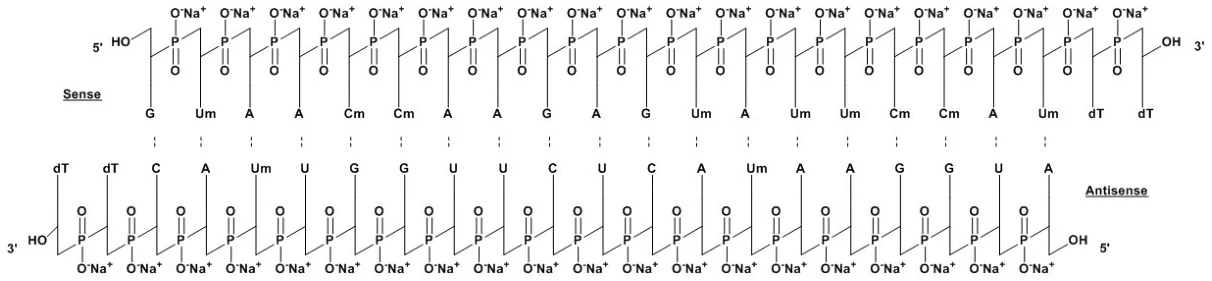
A, adenosine; C, cytidine; G, guanosine; U, uridine; Cm, 2’-O-methylcytidine; Um, 2’-O-methyluridine; dT, thymidine
Physicochemical properties:
- The solubility of patisiran drug substance in water and phosphate buffered saline has been determined to be at least 220 mg/mL
- pH of a 1% solution in KCl: 5.0 – 7.5
- pKa of ~6.5
14 CLINICAL TRIALS
14.1 Clinical Trials by Indication
Indication: Treatment of polyneuropathy in adult patients with hATTR amyloidosis
Table 4– Summary of patient demographics for clinical trials in patients with hATTR amyloidosis treated for polyneuropathy
| Study # | Study design | Dosage, route of administration and duration | Study subjects (n) | Median age Years (Range) | Sex |
| ALN-TTR02-004 (APOLLO) | Phase 3, global, randomized (2:1), double-blind, placebo-controlled | 0.3 mg/kg, via intravenous infusion once every 3 weeks, for 18 months | patisiran: 148 placebo: 77 | 62 (24, 83) | Male (74%) Female (26%) |
| Study # | Study design | Dosage, route of administration and duration | Study subjects (n) | Median age Years (Range) | Sex |
| ALN-TTR02-008 | Phase 3b, global, open-label | 0.3 mg/kg, via intravenous infusion once every 3 weeks, for 12 months | patisiran: 24 (23 treated) | 58 (43, 75) | Male (57%) Female (43%) |
Study ALN-TTR02-004 (APOLLO)
The efficacy of ONPATTRO (patisiran) was demonstrated in a global, randomized, double-blind, placebo-controlled study in 225 patients with hATTR amyloidosis having a TTR mutation and symptomatic polyneuropathy. Patients were randomized 2:1 to receive 0.3 mg/kg ONPATTRO or placebo via IV infusion once every 3 weeks for 18 months. All patients received premedication with a corticosteroid, acetaminophen, and H1 and H2 blockers.
In the study, 148 patients received patisiran and 77 patients received placebo. The median patient age at baseline was 62 (range: 24 to 83) years. 74% of patients were male, 26% were female. The majority of patients were Caucasian (72%), followed by Asian (23%), Black (2%), and Other (2%). Patients were from Western Europe (44%), North America (21%), Asia (20%), Central and South America (8%), or Eastern Europe (8%). Thirty-nine (39) different TTR mutations were represented; the most common (≥ 5%) were V30M (43%), A97S (9%), T60A (7%), E89Q (6%), and S50R (5%). Approximately 10% of patients had the V30M mutation and early onset of symptoms (< 50 years old). At baseline, 46% of patients had Stage 1 disease (unimpaired ambulation; mostly mild sensory, motor and autonomic neuropathy in the lower limbs), and 53% had Stage 2 disease (assistance with ambulation required; mostly moderate impairment progression to the lower limbs, upper limbs, and trunk). Approximately half (53%) of patients had prior treatment with tafamidis meglumine or diflunisal. Forty-nine percent (49%) and 50% of patients had a New York Heart Association (NYHA) Class of I or II, respectively; patients with NYHA Class III or IV were excluded. The majority of patients (56%) met pre-defined criteria for cardiac involvement, i.e., LV wall thickness ≥ 13 mm at baseline with no history of hypertension or aortic valve disease. Patient demographics and baseline characteristics were balanced between treatment groups, except for a higher proportion of patients in the ONPATTRO group having a non-V30M mutation (62% vs. 48%), and that met pre-defined criteria for cardiac involvement (61% vs. 47%). Ninety-three percent (93%) of ONPATTRO-treated and 62% of placebo-treated patients completed 18 months of the assigned treatment.
The primary efficacy endpoint was the change from baseline to 18 months in the modified Neuropathy Impairment Score +7 (mNIS+7). This endpoint is a composite measure of motor, sensory, and autonomic polyneuropathy, including assessments of motor strength and reflexes, quantitative sensory testing, nerve conduction studies, and postural blood pressure, with the score ranging from 0 to 304 points, where an increasing score indicates worsening impairment. The key secondary endpoint was the change from baseline to 18 months in Norfolk Quality of Life-Diabetic Neuropathy (QoL-DN) total score. The Norfolk QoL-DN questionnaire, a patient-reported score, includes domains relating to small fiber, large fiber, and autonomic nerve function, symptoms of polyneuropathy, and activities of daily living, with the total score ranging from -4 to 136, where increasing score indicates worsening quality of life. Other secondary endpoints measured motor strength (NIS-weakness [NIS-W]), patient-reported ability to perform activities of daily living and social participation such as eating, bathing, dressing, and standing (Rasch-Built Overall Disability Scale [R-ODS]), gait speed (10-meter walk test), nutritional status (modified body mass index [mBMI]), and patient-reported autonomic symptoms such as dizziness, constipation, diarrhea, nausea/vomiting, and incontinence (Composite Autonomic Symptom Score [COMPASS-31]).
Study ALN-TTR02-008 (post-orthotopic liver transplant)
In this open-label study, 23 patients with hATTR amyloidosis and polyneuropathy progression after receiving a liver transplant were treated with ONPATTRO at a dose of 0.3 mg/kg via IV infusion once every 3 weeks. Median time from transplant to first ONPATTRO dose was 9.4 years and median duration of ONPATTRO treatment was 13.1 months. All patients received concomitant immunosuppressants.
Table 5 – Results of study ALN-TTR02-004 (APOLLO) in patients with hATTR amyloidosis treated for polyneuropathy
| Endpointa | Baseline, Mean (SD) | Change from Baseline at 18 months, LS Mean (SEM) | ONPATTRO-Placebo Treatment Difference, LS Mean (95% CI) | p-value | ||
|---|---|---|---|---|---|---|
ONPATTRO N=148 | Placebo N=77 | ONPATTRO | Placebo | |||
| Primary | ||||||
| mNIS+7b | 80.9 (41.5) | 74.6 (37.0) | -6.0 (1.7) | 28.0 (2.6) | -34.0 (-39.9,-28.1) | 9.3x10⁻²⁴ |
| Secondary | ||||||
| Norfolk QoL-DNb | 59.6 (28.2) | 55.5 (24.3) | -6.7 (1.8) | 14.4 (2.7) | -21.1 (-27.2, -15.0) | 1.1x10⁻¹⁰ |
| NIS-Wb | 32.7 (25.2) | 29.0 (23.0) | 0.05 (1.3) | 17.9 (2.0) | -17.9 (-22.3, -13.4) | 1.4x10⁻¹³ |
| R-ODSc | 29.7 (11.5) | 29.8 (10.8) | 0.0 (0.6) | -8.9 (0.9) | 9.0 (7.0, 10.9) | 4.1x10⁻¹⁶ |
| 10-meter walk test (m/sec)c | 0.80 (0.40) | 0.79 (0.32) | 0.08 (0.02) | -0.24 (0.04) | 0.31 (0.23, 0.39) | 1.9x10⁻¹² |
| mBMId | 970 (210) | 990 (214) | -3.7 (9.6) | -119 (14.5) | 116 (82, 149) | 8.8x10⁻¹¹ |
| COMPASS-31b | 30.6 (17.6) | 30.3 (16.4) | -5.3 (1.3) | 2.2 (1.9) | -7.5 (-11.9, -3.2) | 0.0008 |
| LS mean, least squares mean; SD, standard deviation; SEM, standard error of the mean; CI, confidence interval aAll endpoints analyzed using the mixed-effect model repeated measures (MMRM) method. bA lower number indicates less impairment/fewer symptoms cA higher number indicates less disability/less impairment dmBMI: body mass index (BMI; kg/m2) multiplied by serum albumin (g/L); a higher number indicates better nutritional status | ||||||
Patients treated with ONPATTRO demonstrated significant improvements in the primary endpoint and all secondary endpoints, compared to patients who received placebo (all p < 0.001) (Table 5).
ONPATTRO treatment led to a 34.0-point improvement in neuropathy (mNIS+7) relative to placebo (p=9.3x10⁻²⁴), with a mean change from baseline of -6.0 points (improvement) with ONPATTRO compared to an increase of 28.0 points (worsening) with placebo at 18 months (Table 5). Improvement in neuropathy with ONPATTRO relative to placebo was observed at 9 months, the first post-baseline assessment in the study (Figure 1). At 18 months, improvements relative to placebo were observed across all mNIS+7 components, and 56.1% of ONPATTRO-treated patients experienced an improvement in neuropathy (mNIS+7 change from baseline of < 0 points), compared to 3.9% of placebo-treated patients (p=1.8x10⁻¹⁵; odds ratio of 39.9 [95% CI: 11.0, 144.4]). Some patients treated with ONPATTRO had reduced dependence on or no longer required walking aids, which was not observed in placebo-treated patients.
Figure 1 – Change from Baseline in mNIS+7
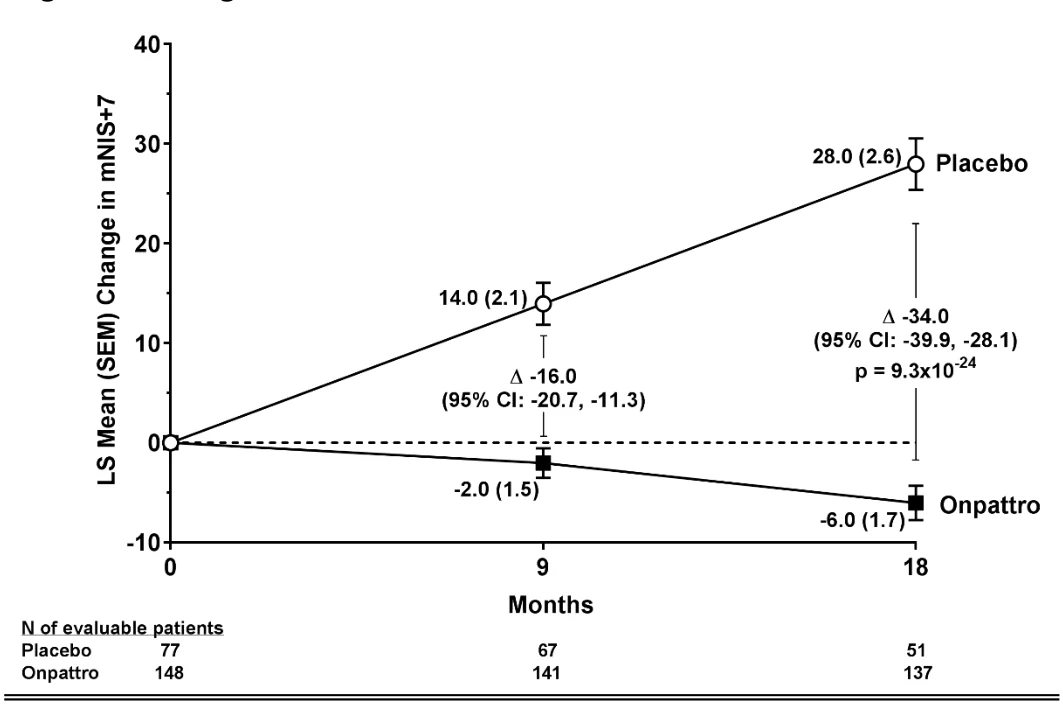
A decrease in mNIS+7 indicates improvement
Treatment difference is shown as the LS mean difference (95% CI) for ONPATTRO – placebo.
ONPATTRO treatment led to a 21.1-point improvement in Norfolk QoL-DN score relative to placebo (p=1.1x10⁻¹⁰), with a mean change from baseline of -6.7 points (improvement) compared to an increase of 14.4 points (worsening) with placebo at 18 months, see Table 5, above. Improvement was observed at 9 months, the first post-baseline assessment in the study. At 18 months, improvements relative to placebo were observed across all domains of Norfolk QoL-DN. 51.4% of ONPATTRO-treated patients experienced an improvement in quality of life (Norfolk QoL-DN change from baseline of < 0 points), compared to 10.4% of placebo-treated patients (odds ratio of 10.0 [95% CI: 4.4, 22.5]).
ONPATTRO treatment resulted in improvements in motor strength (NIS-W and grip strength), patient-reported ability to perform activities of daily living and social participation (R-ODS) and symptoms of autonomic dysfunction (COMPASS-31), nutritional status (mBMI), as well as faster gait speed (10-meter walk test).
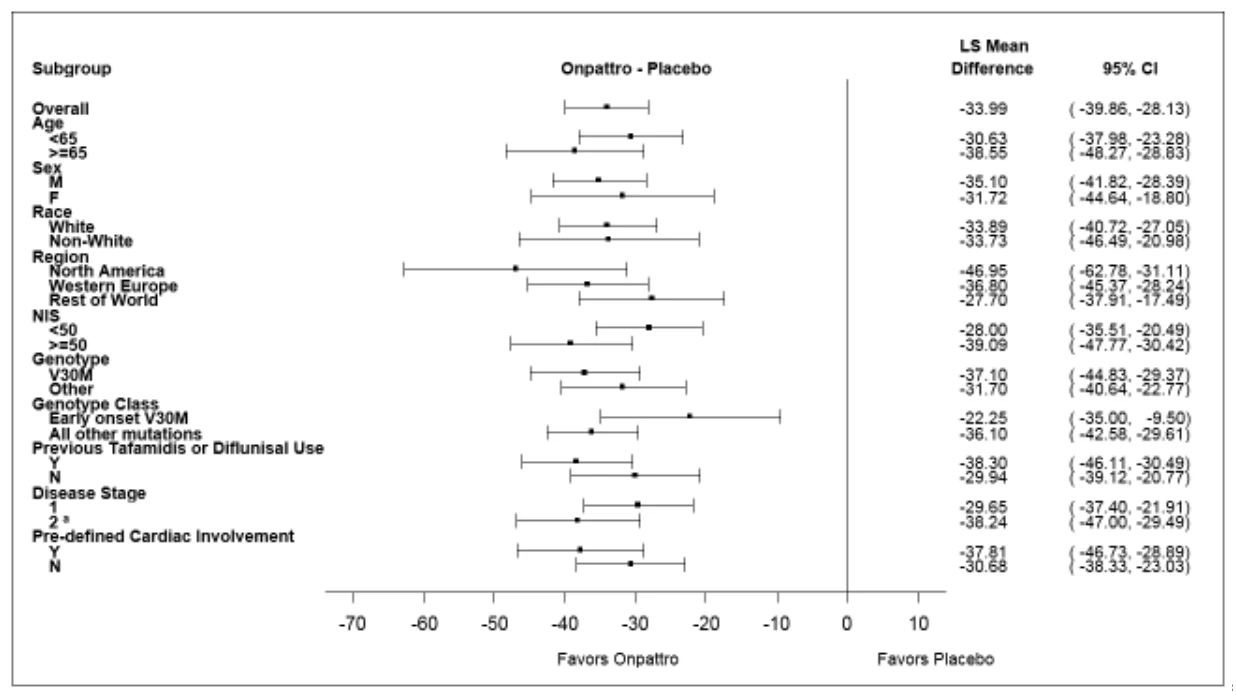
Patients receiving ONPATTRO experienced similar improvements relative to placebo in mNIS+7 and Norfolk QoL-DN score across all subgroups including age, sex, race, region, NIS score, V30M mutation status, prior tafamidis meglumine or diflunisal use, disease stage, and patients that met pre-defined criteria for cardiac involvement (Figure 2).
Figure 2 – Forest Plot of Mean Treatment Difference (Change from Baseline to 18 Months), by Subgroup
mNIS+7
In patients with pre-defined cardiac involvement, several cardiac parameters were assessed in the APOLLO study as exploratory endpoints. Centrally assessed echocardiograms showed decreases in LV wall thickness (LS mean difference: -0.9 mm, 95% CI -1.7, -0.2) and absolute longitudinal strain (LS mean difference: -1.37%, 95% CI -2.48, -0.27) from baseline with ONPATTRO treatment, relative to placebo. N-terminal pro-B type natriuretic peptide (NT-proBNP) was 727 ng/L and 711 ng/L (geometric mean) at baseline in ONPATTRO-treated and placebo-treated patients, respectively. NT-proBNP decreased by 11% (95% CI -1%, 22%) in ONPATTRO-treated patients, and increased by 97% (95% CI 55%, 150%) in placebo-treated patients. Improvements in LV wall thickness and NT-proBNP were also observed relative to placebo in the overall study population receiving ONPATTRO.
Data from the APOLLO study was supported by data from two open-label studies that demonstrated maintenance of efficacy for up to 36 months. Furthermore, patients who received placebo in the placebo-controlled study subsequently experienced a mean reduction in mNIS+7 following 12 months of treatment with ONPATTRO in an open-label study.
Table 6 – Results of study ALN-TTR02-008 in patients with hATTR amyloidosis treated for polyneuropathy post-orthotopic liver transplant
| Primary Endpoint | Baseline (mg/L), Mean (SD) N=23 | Percent reduction from Baselinea, Median (95% CI)b | p valuec |
|---|---|---|---|
| Serum TTR levels | 202.1 (54.1) | 91.0 (86.1, 92.3) | 4.5×10⁻⁸ |
SD, standard deviation; CI, confidence interval
a Primary endpoint is defined as the average of the Month 6 and 12 TTR percent reductions from baseline.
b 95% CI is calculated from a distribution-free method.
c p-value is obtained using the Wilcoxon signed-rank test.
15 MICROBIOLOGY
No microbiological information is required for this drug product.
16 NON-CLINICAL TOXICOLOGY
Patisiran is pharmacologically active in monkeys but not in rodents or rabbits. A rodent-specific surrogate of ONPATTRO, comprised of an siRNA directed against rodent TTR and the same lipid nanoparticle formulation as ONPATTRO, was included in some of the studies in rats.
General Toxicology: Liver and spleen were the primary target organs of toxicity in both rats and monkeys. Intravenous administration of ONPATTRO led to increases in serum liver markers (ALT, AST, ALP, and/or total bilirubin) and histopathology findings in the liver (hepatocellular/single cell necrosis, inflammation, pigment deposition, and/or monocytic infiltration) at doses of > 0.1 mg/kg every 2 or 4 weeks up to 4 doses in rats. Similar microscopic liver findings (minimal to moderate in severity) were observed in monkeys dosed at 3 mg/kg every 2 weeks up to 4 doses; however minimal to moderate increases in ALT, AST and/or LD were observed at ≥ 0.3 mg/kg. In monkeys dosed at 1.0 mg/kg every 3 weeks (14 doses), histopathology findings in liver included centrilobular vacuolation, single cell necrosis, mixed cell infiltration, and pigment deposits (all of minimal to slight severity). These changes were not correlated with changes in liver enzymes. At > 1.0 mg/kg every 3 weeks (14 doses), these liver findings were of higher severity (minimal, moderate, or marked) and were associated with increases in ALT, AST, and ALP. In spleen, lymphoid atrophy/necrosis and histiocytosis in the white pulp was observed in rats and hypocellularity of the red pulp was observed in monkeys. In general, all findings observed at the end of dosing in the rat and monkey toxicity studies were not observed or were observed with reduced severity at the end of the 60- to 90-day recovery period, indicating that the toxicities were reversible or partially reversible. The no-observed-adverse-effect level (NOAEL) in rats was 0.1 mg/kg after 2 doses administered 4 weeks apart (HED < 0.1 times the RHD). The NOAEL in the chronic 9-month monkey toxicity study was 0.3 mg/kg every 3 weeks (HED 0.3 times the RHD).
Carcinogenicity: ONPATTRO was not carcinogenic in TgRasH2 mice at doses up to 6 mg/kg every 2 weeks when administered by intravenous bolus for 26 weeks (HED, unadjusted for dosing schedule, 1.7 times the RHD).
Genotoxicity: ONPATTRO was not mutagenic or clastogenic in the Ames bacterial mutagenicity assay, chromosomal aberration assay in human peripheral blood lymphocytes, or in the in vivo mouse micronucleus assay.
Reproductive and Developmental Toxicology: Intravenous administration of ONPATTRO or a rodent-specific surrogate to male rats at doses up to 0.3 mg/kg every other week (HED, unadjusted for dosing schedule, 0.2 times the RHD) for 10 weeks prior to mating, or to female rats at doses up to 1.5 mg/kg weekly (HED, unadjusted for dosing schedule, 0.8 times the RHD) for 3 weeks prior to mating and on gestation days 6, 13, and 19, had no impact on fertility or reproductive performance. The rat-specific surrogate resulted in the expected pharmacological decreases in serum TTR and vitamin A concentrations, with no impact on fertility or reproductive performance.
Intravenous administration of ONPATTRO at doses up to 2 mg/kg every 3 weeks for 39 weeks (HED 2.2 times the RHD) had no effect on male reproductive assessments in sexually mature cynomolgus monkeys (i.e., semen volume and appearance, sperm concentration, motility, and morphology, testicular size, and spermatogenic staging).
In female rats, intravenous administration of ONPATTRO at doses up to 1.5 mg/kg weekly for 3 weeks prior to mating and on gestation days 6, 13, and 19 did not result in any embryofetal defects (HED, unadjusted for dosing schedule, 0.8 times the RHD). Fetal exposure to patisiran and PEG2000-C-DMG (α-(3’-{[1,2-di(myristyloxy)propanoxy]carbonylamino}propyl)-ω-methoxy, polyoxyethylene) was not detectable. Fetal exposure to the lipid component DLin-MC3-DMA ((6Z,9Z,28Z,31Z)-heptatriaconta-6,9,28,31-tetraen-19-yl-4-(dimethylamino) butanoate) was negligible (≤ 0.04% of maternal plasma Cmax).
In pregnant rabbits, intravenous administration of ONPATTRO at doses up to 0.6 mg/kg on gestation days 7, 13, and 19 did not result in any embryofetal effects (HED, unadjusted for dosing schedule, 0.6 times the RHD). Spontaneous abortions, reduced embryofetal survival, and reduced fetal body weights were observed at doses ≥ 1 mg/kg at doses where maternal toxicity was also observed (HED, unadjusted for dosing schedule, 1.1 times the RHD). There were no external embryofetal malformations or variations. Fetal exposure to patisiran was not detectable. Fetal exposure to the lipid components DLin-MC3-DMA ((6Z,9Z,28Z,31Z)-heptatriaconta-6,9,28,31-tetraen-19-yl-4-(dimethylamino) butanoate) and PEG2000-C-DMG (α-(3’-{[1,2-di(myristyloxy)propanoxy]carbonylamino}propyl)-ω-methoxy, polyoxyethylene) was negligible (≤ 0.4% of maternal plasma Cmax).
Intravenous administration of a rodent-specific surrogate to female rats prior to mating and during gestation resulted in the expected pharmacological decreases in circulating TTR concentrations (> 95%) and vitamin A concentrations (88%). No embryofetal effects were observed.
In female rats administered ONPATTRO or a rodent-specific surrogate at doses up to 1.5 mg/kg on gestation days 7, 13, and 19 and lactation days 6, 12, and 18, there were no effects on mortality, growth, sexual maturation, behavior, mating, fertility, or reproductive performance of the pups (HED, unadjusted for dosing schedule, 0.8 times the RHD). Patisiran was not present in milk, although small amounts of the lipid components DLin-MC3-DMA ((6Z,9Z,28Z,31Z)-heptatriaconta-6,9,28,31-tetraen-19-yl-4-(dimethylamino) butanoate) and PEG2000-C-DMG (α-(3’-{[1,2-di(myristyloxy)propanoxy]carbonylamino}propyl)-ω-methoxy, polyoxyethylene) were present in milk (up to 7% of concomitant maternal plasma concentrations).
Special Toxicology: In monkeys dosed every 3 weeks for 39 weeks, consistent with the pharmacodynamic effect of patisiran, decreases in serum TTR concentrations (up to 98%) were observed. A secondary effect on serum vitamin A concentrations resulted in decreases (up to 81%) that were not associated with signs of vitamin A deficiency, as evaluated through ophthalmic examinations, electroretinograms, and histopathology of the eye. Similarly, a secondary effect on thyroxine (decreases up to 50%) was observed, with no effect on histopathology of the thyroid.