


Product Monograph - Yeytuo
1 Indications
YEYTUO (lenacapavir) is indicated for pre-exposure prophylaxis (PrEP) to reduce the risk of sexually acquired HIV-1 in at-risk adults and adolescents weighing ≥ 35 kg.
1.1 Pediatrics
Pediatrics (adolescents weighing ≥ 35 kg): The use of YEYTUO in adolescents is supported by Phase 3 clinical studies for HIV-1 PrEP that included 59 individuals aged 16 to <18 years and weighing ≥ 37.1 kg who received YEYTUO, as well as extrapolation of safety and efficacy from adults to individuals aged 12 to <18 years and weighing ≥ 35 kg based on comparable population pharmacokinetic (PK)-simulated exposures (see 7 Warnings and Precautions, 14 Clinical Trials and 10.3 Pharmacokinetics).
1.2 Geriatrics
Geriatrics (≥ 65 years of age): No differences in safety or efficacy of YEYTUO were observed in the 13 individuals aged 65 years and older included in the Phase 3 studies (see 4 Dosage and Administration, 7 Warnings and Precautions).
2 Contraindications
YEYTUO is contraindicated in individuals:
- with unknown or positive HIV-1 status (see 7 Warnings and Precautions).
- receiving strong CYP3A inducers (including carbamazepine, phenytoin, and St. John’s wort), but excluding rifampin, due to significantly decreased lenacapavir plasma concentrations, which may result in reduced effectiveness of YEYTUO (see 9 Drug Interactions).
- who are hypersensitive to YEYTUO or to any ingredient in the formulation, including any non-medicinal ingredient, or component of the container. For a complete listing, see 6 Dosage Forms, Strengths, Composition and Packaging.
3 Serious Warnings and Precautions
RISK OF DRUG RESISTANCE WITH USE OF YEYTUO IN UNDIAGNOSED HIV-1 INFECTION
Use of YEYTUO in individuals with HIV-1 increases the risk of developing resistance to lenacapavir. Individuals must be tested for HIV-1 infection prior to initiating YEYTUO, and should be tested prior to each subsequent injection of YEYTUO and as clinically appropriate. Do not initiate YEYTUO unless HIV-1 negative-status is confirmed. Individuals who acquire HIV-1 while receiving YEYTUO must transition to a complete HIV-1 treatment regimen (see 4 Dosage and Administration, 7 Warnings and Precautions).
4 Dosage and Administration
4.1 Dosing Considerations
- Prior to starting YEYTUO, healthcare professionals should identify individuals who agree to the required dosing schedule, counsel individuals about the importance of adherence to scheduled dosing visits, and discuss safer sex practices to reduce the risk of sexually transmitted infections (STIs). Testing for other STIs may be appropriate (see 7 Warnings and Precautions).
- Screen all individuals for HIV-1 prior to initiating YEYTUO and routinely thereafter as clinically appropriate while receiving YEYTUO. Individuals must have a documented negative HIV-1 test prior to initiating YEYTUO (see 3 Serious Warnings and Precautions, 7 Warnings and Precautions). If clinical symptoms consistent with acute HIV-1 infection are present or recent (<1 month) exposures to HIV-1 are suspected, negative HIV-1 status should be reconfirmed.
- HIV-1 testing should be performed using test(s) in accordance with applicable guidelines.
- Initiation dosing requires YEYTUO injection to be given with YEYTUO tablets. YEYTUO injections must be administered subcutaneously by a healthcare professional into the abdomen.
4.2 Recommended Dose and Dosage Adjustment
The YEYTUO dosing schedule in adults and adolescents weighing ≥ 35 kg consists of a required initiation dosing (subcutaneous injections and oral tablets) followed by twice yearly (once every 6-months) continuation dosing (subcutaneous injections) (Table 1). YEYTUO oral tablets may be taken with or without food.
- Initiation: On Day 1, the required dose is 927 mg (2 x 1.5 mL injections) of YEYTUO by subcutaneous injection and 600 mg (2 x 300 mg tablets) of YEYTUO orally. On Day 2, the required dose is 600 mg (2 x 300 mg tablets) orally.
- Continuation: The required dose is 927 mg (2 x 1.5 mL injections) of YEYTUO administered by subcutaneous injection every 6-months (26 weeks) from the date of last injection (+/- 2 weeks).
Table 1. Dosing Schedule for YEYTUO Initiation and Continuation
| Time | |
|---|---|
| Dosage of YEYTUO: Initiationa | |
| Day 1 | 927 mg by subcutaneous injection (2 x 1.5 mL injections) 600 mg orally (2 x 300 mg tablets) |
| Day 2 | 600 mg orally (2 x 300 mg tablets) |
| Dosage of YEYTUO: Continuation | |
Every 6-Months (26 weeks)b +/-2 weeks | 927 mg by subcutaneous injection (2 x 1.5 mL injections) |
a. The complete initiation dosing schedule, consisting of subcutaneous injections and oral tablets, is required; the efficacy of YEYTUO has only been established with this dosing schedule.
b. From the date of last injection.
Pediatrics (weighing < 35 kg)
The safety and efficacy of YEYTUO have not been established in individuals weighing < 35 kg.
Geriatrics (≥ 65 years of age)
No dose adjustment of YEYTUO is required for elderly individuals. There are limited data available on the use of YEYTUO in individuals aged 65 years and over (see 10.3 Pharmacokinetics).
Hepatic Impairment
No dose adjustment of YEYTUO is required in individuals with mild or moderate hepatic impairment (Child-Pugh Class A or B). YEYTUO has not been studied in individuals with severe hepatic impairment (Child-Pugh Class C), therefore it should be administered with caution in these individuals.
Renal Impairment
No dose adjustment of YEYTUO is required in individuals with mild, moderate, or severe renal impairment (estimated creatinine clearance ≥ 15 mL/min). YEYTUO has not been studied in individuals with end stage renal disease (ESRD) (estimated creatinine clearance < 15 mL/min), therefore it should be administered with caution in these individuals.
4.4 Administration
YEYTUO injection is a long-acting injection, and is only for subcutaneous administration into the abdomen by a healthcare professional. Do NOT administer intradermally due to risk of serious injection site reactions (see 7 Warnings and Precautions).
Use aseptic technique. No reconstitution of the injectable solution is required prior to administration. Visually inspect the solution in the vials for particulate matter and discoloration prior to administration. YEYTUO injection is yellow to brown solution. Do not use YEYTUO injection if the solution is discolored or if it contains particulate matter. Once the solution is withdrawn from the vials, the subcutaneous injections should be administered as soon as possible (see 11 Storage, Stability and Disposal).
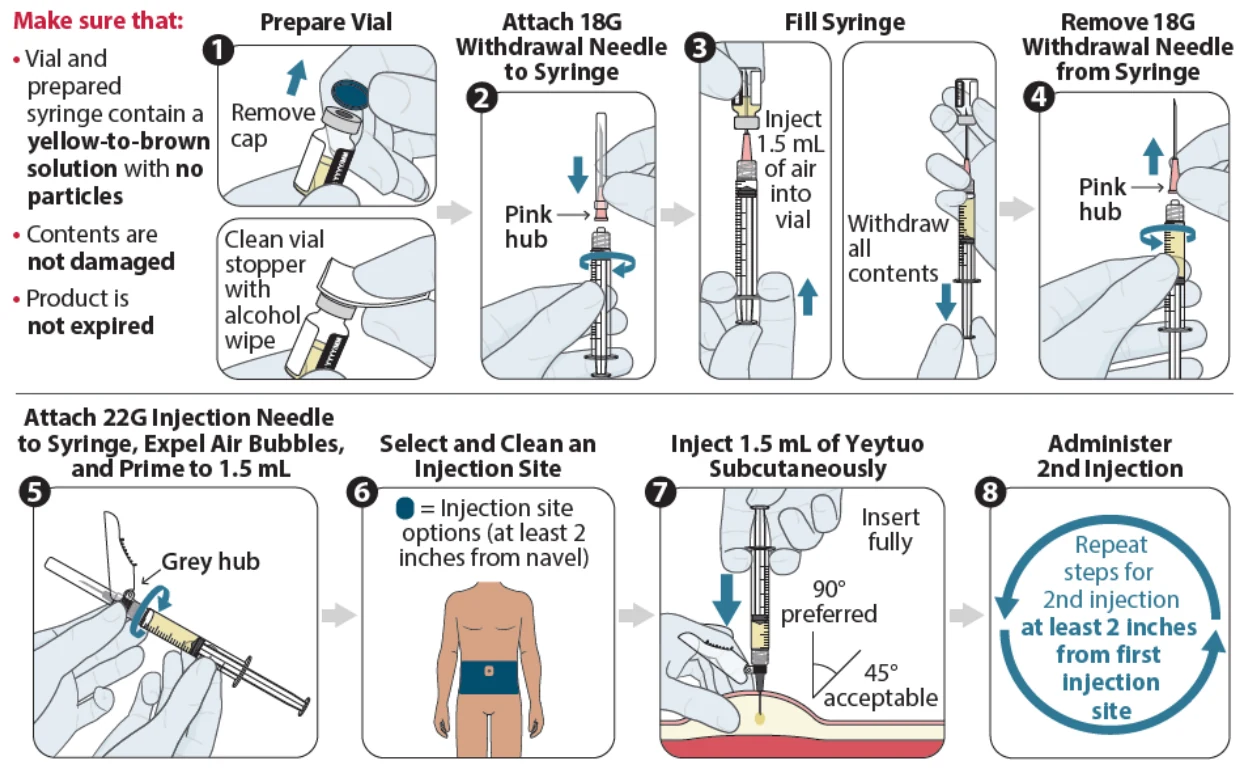
Refer to Figure 1 to identify the components for use in the administration steps. The administration steps are provided in Figure 2. The 18-gauge needle is for withdrawal only in this kit.
The injection kit components are for single use only. Two 1.5 mL injections are required for a complete dose.
A subcutaneous drug depot forms following YEYTUO injection. In some individuals, this may lead to a nodule at the injection site (see 8 Adverse Reactions and 10.3 Pharmacokinetics).
Figure 1. YEYTUO Withdrawal Needle Injection Kit Components

Figure 2. YEYTUO Injection Steps for Withdrawal Needle Injection Kit
4.5 Missed Dose
Anticipated Delayed Injections
During continuation dosing, if a scheduled 6-month injection visit is anticipated to be delayed by more than 2 weeks, YEYTUO tablets may be used for oral bridging on an interim basis (for up to 6 months if needed), until injections resume. Refer to Table 2 below for the dosing schedule for anticipated delayed injections.
Table 2. Dosing Schedule for Anticipated Delayed Injections: Weekly Oral Dosage
| Time since last injection | Dosage of YEYTUO |
|---|---|
| 26 to 28 weeks | Oral dosage of 300 mg taken once every 7 days (for up to 6 months if needed). Resume the continuation injection dosage (Table 1) within 7 days after the last oral dose. |
Missed Injections
Individuals who miss a scheduled injection visit should be clinically reassessed to ensure resumption of YEYTUO remains appropriate and that the individual remains HIV-1 negative. During continuation dosing, if more than 28 weeks have elapsed since the last injection and YEYTUO tablets have not been taken for oral bridging, see Table 3 below for the dosing schedule after missed injections.
Table 3. Dosing Schedule after Missed Injections
| Time since last injection | Dosage of YEYTUO |
|---|---|
| More than 28 weeks | Reinitiate with initiation dosing schedule from Day 1 (Table 1) and then continue with continuation injection dosing. |
5 Overdosage
If overdose occurs, the individual must be monitored for evidence of toxicity. Treatment of overdose with YEYTUO consists of general supportive measures including monitoring of vital signs as well as observation of the clinical status of the individual. As lenacapavir is highly protein bound, it is unlikely to be significantly removed by dialysis.
For the most recent information in the management of a suspected drug overdose, contact your regional poison control centre or Health Canada's toll-free number, 1-844 POISON-X (1-844-764-7669).
6 Dosage Forms, Strengths, Composition and Packaging
Table 4. Dosage Forms, Strengths, and Composition
YEYTUO injection is a sterile, preservative-free, clear, yellow to brown solution with no visible particles.
YEYTUO injection is packaged in a dosing kit containing:
- 2 single-use clear glass vials of YEYTUO, each containing sufficient volume to allow withdrawal of 1.5 mL/463.5 mg (309 mg/mL) of lenacapavir. Vials are sealed with an
| Route of Administration | Dosage Form/ Strength/Composition | Non-medicinal Ingredients |
| Subcutaneous Injection | Each single-dose vial contains 463.5 mg/1.5 mL (309 mg/mL) of lenacapavir (as lenacapavir sodium). | Polyethylene Glycol 300, Water for Injection |
| Oral | Each tablet contains 300 mg of lenacapavir (as lenacapavir sodium). | Copovidone, Croscarmellose Sodium, Iron Oxide Black, Iron Oxide Red, Iron Oxide Yellow, Magnesium Stearate, Mannitol, Microcrystalline Cellulose, Poloxamer 407, Polyethylene Glycol, Polyvinyl Alcohol, Talc, Titanium Dioxide. |
- elastomeric closure and aluminum overseal with flip-off cap;
- 2 disposable syringes, 2 withdrawal needles (18-gauge, 1½ inch), and 2 injection safety needles for subcutaneous injection (22-gauge, ½ inch).
YEYTUO tablets are beige, capsule-shaped, film-coated tablets, debossed with ‘GSI’ on one side of the tablet and ‘62L’ on the other side of the tablet.
YEYTUO tablets are packaged in a bottle containing:
- 4 tablets of YEYTUO, each containing 300 mg of lenacapavir, in a white, high-density polyethylene (HDPE) bottle containing polyester coil and silica gel desiccant, and enclosed with a polypropylene continuous thread, child-resistant cap with an induction-sealed, aluminum-faced liner.
7 Warnings and Precautions
General
Management to Reduce the Risk of Sexually Acquired Infections and Development of HIV-1 Resistance
Prevention Strategy
YEYTUO should only be used to reduce the risk of HIV-1 acquisition in individuals confirmed to be HIV-1 negative (see 2 Contraindications, 4 Dosage and Administration). Confirm HIV-1 negative status prior to initiation of YEYTUO and routinely thereafter as clinically appropriate in individuals receiving YEYTUO. YEYTUO is not always effective in preventing HIV-1 acquisition. The exact time from initiation of YEYTUO to maximal protection against HIV-1 infection is unknown.
Use YEYTUO to reduce the risk of HIV-1 acquisition as part of an overall risk reduction strategy for transmission of STIs. Identify individuals for whom the required initiation and every 6-month continuation injection dosing schedule is appropriate. Non-adherence to the required initiation and continuation dosing schedule (see 4.2 Recommended Dose and Dosage Adjustment) may lead to HIV-1 acquisition. Counsel and support individuals on adhering to the YEYTUO administration schedule, on the use of other measures to prevent STIs, and on the importance of testing for HIV-1 and other STIs.
Risk of Resistance
There is a risk of developing resistance to lenacapavir if an individual acquires HIV-1 either before or when receiving YEYTUO, or following discontinuation of YEYTUO. YEYTUO alone does not constitute a complete regimen for HIV-1 treatment. Individuals should be tested prior to each injection and additionally as clinically appropriate to confirm HIV-1 negative status. Individuals who are confirmed to have HIV-1 must immediately begin a complete HIV-1 treatment regimen to reduce the risk of developing resistance.
Seroconversion while on YEYTUO is considered an adverse event and should be reported to the Canadian Vigilance Program by:
- Visiting the Web page on Adverse Reaction Reporting: www.canada.ca/en/health-canada/services/drugs-health-products/medeffect-canada for information on how to report online, by mail or by fax; or
- Calling 1-866-234-2345 (toll-free).
Long-Acting Properties
YEYTUO injection is a long-acting subcutaneous injection. Residual concentrations of lenacapavir may remain in the systemic circulation of individuals for prolonged periods (up to 12 months or longer). The prolonged release characteristics of YEYTUO should be considered with regard to potential for drug-drug interactions, fetal exposure during pregnancy, and presence in human breast milk, even when YEYTUO is discontinued (see 7 Warnings and Precautions, 9 Drug Interactions).
If YEYTUO is discontinued and it is clinically appropriate to continue PrEP, alternative forms of PrEP should be considered and initiated within 28 weeks of the last YEYTUO injection.
Reproductive Health
Fertility
There are no data on the effects of YEYTUO on human male or female fertility. For non-clinical data, see 16 Non-Clinical Toxicology, Reproductive and Developmental Toxicology.
Skin
Injection Site Reactions with Improper Administration
Improper administration (intradermal injection) of lenacapavir has been associated with serious injection site reactions, including necrosis and ulcer. Ensure YEYTUO is only administered subcutaneously (see 4.4 Administration).
7.1 Special Populations
7.1.1 Pregnancy
Clinical experience with YEYTUO in pregnancy is based on 366 individuals who received lenacapavir during pregnancy, including 342 women in PURPOSE 1, which was not a dedicated pregnancy study but participants were not required to use contraception (see 14.1 Clinical Trials). Of these, in 228 known pregnancy outcomes, the rates of adverse pregnancy outcomes were similar to reported background rates. The benefits and the risks of initiating or continuing YEYTUO during pregnancy should be discussed. YEYTUO may be considered during pregnancy if the potential benefit outweighs the potential risk to the fetus. In PURPOSE 1, lenacapavir exposures during each trimester of pregnancy and postpartum were comparable to those in non-pregnant participants (see 10.3 Pharmacokinetics, Special Populations and Conditions).
Studies in animals have shown no evidence of teratogenicity or an effect on reproductive function. In offspring from rat and rabbit dams treated with lenacapavir during pregnancy, there were no toxicologically significant effects on developmental endpoints.
In rats and rabbits, embryofetal development was not affected at exposures up to 20 and 159 times the human exposure, respectively, at the recommended human dose (RHD). In rats, pre- and postnatal development was not affected at exposures up to 6 times the human exposure at the RHD.
Transfer of lenacapavir from maternal to neonatal rats was observed in a prenatal and postnatal development study, but it is not known whether the transport occurred via the placenta or the milk; therefore, the potential for lenacapavir to pass into the placenta in humans is not known.
Antiretroviral Pregnancy Registry: To monitor maternal-fetal outcomes of pregnant individuals exposed to ART (antiretroviral therapy), including YEYTUO, an Antiretroviral Pregnancy Registry has been established. Healthcare professionals are encouraged to register individuals:
http://www.apregistry.com
Telephone: (800) 258-4263
Fax: (800) 800-1052
7.1.2 Breastfeeding
Lenacapavir is present in human milk. Lenacapavir was detected at very low levels in infants who were breastfed by individuals who became pregnant while receiving YEYTUO (see 10.3 Pharmacokinetics, Special Populations and Conditions). No adverse effects of lenacapavir were observed in 89 infants who were breastfed by individuals receiving YEYTUO. It is not known if YEYTUO affects milk production.
7.1.3 Pediatrics
Pediatrics (adolescents weighing ≥ 35 kg): The safety and efficacy of YEYTUO was established in two Phase 3 studies that included 59 individuals aged 16 to <18 years and weighing ≥ 37.1 kg who received YEYTUO. Clinical safety and PK data from these individuals and population PK-simulated exposures in adolescents aged 16 to <18 years and weighing ≥ 35 kg were comparable to adults and supports the use of YEYTUO in these individuals (see 8 Adverse Reactions, 10.3 Pharmacokinetics). In individuals <16 years of age and weighing ≥ 35 kg, population PK-simulated exposures were comparable to exposures in adults and adolescents aged ≥ 16 years. Therefore, the use of YEYTUO in adolescents <16 years of age and weighing ≥ 35 kg is supported by extrapolation of clinical safety and efficacy data from the Phase 3 studies to these individuals (see 10.3 Pharmacokinetics).
Pediatrics (weighing < 35 kg): The safety and efficacy of YEYTUO in individuals weighing < 35 kg have not been established.
7.1.4 Geriatrics
Geriatrics (≥ 65 years of age): The safety and efficacy of YEYTUO in geriatric individuals were established in 13 participants aged 65 years and older who received YEYTUO in the Phase 3 studies. Based on population PK modelling, no dose-adjustment is required in individuals aged 65 years and older (see 10.3 Pharmacokinetics).
8 Adverse Reactions
8.1 Adverse Reaction Overview
The following adverse drug reactions are discussed in other sections:
- Injection Site Reactions with Improper Administration (see 7 Warnings and Precautions)
In the Phase 3 clinical studies for YEYTUO, 4323 participants received YEYTUO with a median duration of exposure of 40 weeks. The most common adverse reactions were injection site reactions, reported in 3288 (76%) participants. Serious adverse events (regardless of attribution to study drug by the investigator) were reported in 130 (3%) participants receiving YEYTUO. Adverse events that led to discontinuation of study drug occurred in 41 (<1%) participants receiving YEYTUO. The most common adverse events leading to discontinuation of study drug were injection site nodule and injection site pain, reported in 21 and 9 participants, respectively.
8.2 Clinical Trial Adverse Reactions
Clinical trials are conducted under very specific conditions. Therefore, the frequencies of adverse reactions observed in the clinical trials may not reflect frequencies observed in clinical practice and should not be compared to frequencies reported in clinical trials of another drug.
The safety assessment of YEYTUO is based on data from two randomized, double-blind, active-controlled studies, PURPOSE 1 and PURPOSE 2, in which a total of 8616 participants received YEYTUO (N=4323), DESCOVY (emtricitabine [FTC]/tenofovir alafenamide [TAF]; N=2135) once daily, or TRUVADA (FTC/tenofovir disoproxil fumarate [TDF]; N=2158) once daily for HIV-1 PrEP. In PURPOSE 1, the median duration of exposure to YEYTUO, DESCOVY, and TRUVADA was 43, 42, and 41 weeks, respectively. In PURPOSE 2, the median duration of exposure to both YEYTUO and TRUVADA was 39 weeks.
The most common adverse reaction (all Grades) reported in at least 5% of participants in either PURPOSE 1 or PURPOSE 2 are presented in Table 5.
Table 5. Adverse Reaction (All Grades) Reported in ≥ 5%a of Participants Receiving YEYTUO in PURPOSE 1 or PURPOSE 2
| PURPOSE 1 | PURPOSE 2 | ||||||||||
|---|---|---|---|---|---|---|---|---|---|---|---|
| Adverse Reaction | YEYTUO Every 26 Weeks (N=2140) | DESCOVY / TRUVADAb Once Daily (N=3204) | YEYTUO Every 26 Weeks (N=2183) | TRUVADAb Once Daily (N=1088) | |||||||
GENERAL DISORDERS AND ADMINISTRATION SITE CONDITIONS Injection Site Reactionsc | 69% | 35% | 83% | 69% | |||||||
NERVOUS SYSTEM DISORDERS Headache | 7% | 8% | 2% | 2% | |||||||
- a. Frequencies of adverse reactions are based on all adverse events attributed to study drug (or to the procedure) by the investigator.
- b. Participants received placebo subcutaneous injections.
- c. Includes injection site nodule, pain, induration, erythema, swelling, pruritus, bruising, warmth, discoloration, edema, ulcer, hematoma, hemorrhage, and discomfort.
Local Injection Site Reactions (ISRs)
In PURPOSE 1, 69% of participants receiving YEYTUO experienced ISRs, compared to 35% of participants receiving placebo injections (and DESCOVY or TRUVADA). Most participants who received YEYTUO had mild (Grade 1, 50%) or moderate (Grade 2, 19%) severity ISRs. Grade 3 ISRs were reported in 4 (0.2%) participants, and included ulcer and nodule. YEYTUO was discontinued due to ISRs in 4 (0.2%) participants. None of the ISRs were serious. The incidence of ISRs decreased with subsequent injections.
In PURPOSE 2, 83% of participants receiving YEYTUO experienced ISRs, compared to 69% of participants receiving placebo injections (and TRUVADA). Most participants had mild (Grade 1, 66%) or moderate (Grade 2, 17%) severity ISRs. Grade 3 ISRs were reported in 14 (0.6%) participants, and included ulcer, pain, erythema, edema, and dermatitis. YEYTUO was discontinued due to ISRs in 26 (1.2%) participants. None of the ISRs were serious. The incidence of ISRs decreased with subsequent injections.
Nodules:
YEYTUO injections form a drug depot subcutaneously for the slow release of YEYTUO, which may lead to a nodule at the injection site in some individuals (see 4.4 Administration, 10.3 Pharmacokinetics). In PURPOSE 1, injection site nodule was reported in 64% of participants who received YEYTUO and resolved more slowly than other ISRs. The median duration of nodules was 190 (interquartile range: 91 to 274) days. Of the injection site nodule events associated with Day 1 YEYTUO injections, 44% had resolved within a median time of 186 days. In PURPOSE 2, injection site nodule was reported in 63% of participants and resolved more slowly than other ISRs. The median duration of nodules was 183 (interquartile range: 89 to 274) days. Of the injection site nodule events associated with Day 1 YEYTUO injections, 50% had resolved within a median time of 192 days.
Other ISRs:
In PURPOSE 1, the other ISRs reported in more than 2% of participants who received YEYTUO were pain (31%), swelling (4%), induration (4%), and pruritus (2%). The median duration of ISRs, excluding nodules and indurations, was 9 (interquartile range: 4 to 29) days.
In PURPOSE 2, the other ISRs reported in more than 2% of participants who received YEYTUO were pain (56%), erythema (17%), induration (16%), swelling (7%), bruising (3%), pruritus (3%), and warmth (2%). The median duration of ISRs, excluding nodules and indurations, was 4 (interquartile range: 2 to 8) days.
8.2.1 Clinical Trial Adverse Reactions – Pediatrics
In 59 pediatric participants aged 16 to < 18 years and weighing ≥ 37.1 kg who received YEYTUO in PURPOSE 1 and PURPOSE 2, the safety of YEYTUO was comparable to that observed in adults.
8.4 Abnormal Laboratory Findings: Hematologic, Clinical Chemistry and Other Quantitative Data
Clinical Trial Findings
The frequency of selected laboratory abnormalities (Grades 3 or 4) occurring in ≥ 1% of participants in the YEYTUO or TRUVADA groups in PURPOSE 1 or PURPOSE 2 are presented in Table 6. A causal association between YEYTUO and these laboratory abnormalities has not been established.
Table 6. Selected Laboratory Abnormalities (Grades 3 or 4) Reported in ≥ 1% of Participants in Either PURPOSE 1 or PURPOSE 2 (Randomized Blinded Phase Safety Analysis Set)
| PURPOSE 1 | PURPOSE 2 | |||||||||||
|---|---|---|---|---|---|---|---|---|---|---|---|---|
YEYTUO (N = 2140) | TRUVADA (N = 1070) | YEYTUO (N = 2183) | TRUVADA (N = 1088) | |||||||||
| Laboratory Parameter Abnormality | ||||||||||||
| AST (≥ 5.0 x ULN) | <1% | <1% | 1.0% | <1% | ||||||||
| Creatine kinase (≥ 5.0 x ULN) | 1.3% | 1.1% | 3.8% | 4.7% | ||||||||
| Creatinine clearance (decreased) | 1.9% | 2.2% | 2.0% | 3.7% | ||||||||
| Urine glucose (glycosuria) | <1% | 0% | 1.0% | 1.4% | ||||||||
AST = Aspartate aminotransferase; ULN = upper limit of normal
9 Drug Interactions
9.2 Drug Interactions Overview
Effects of Other Drugs on YEYTUO
Drugs that are strong inducers of CYP3A may significantly decrease plasma concentrations of lenacapavir which may result in reduced effectiveness of YEYTUO. Concomitant administration of YEYTUO with strong CYP3A inducers, other than rifampin, is contraindicated; dose adjustment of YEYTUO is required if rifampin is co-administered (see 2 Contraindications and 9.4 Drug-Drug Interactions). Drugs that are moderate inducers of CYP3A may decrease plasma concentrations of lenacapavir. Concomitant administration of YEYTUO with moderate inducers of CYP3A, other than rifabutin, is not recommended; dose adjustment of YEYTUO is required if rifabutin is co-administered (see 9.4 Drug-Drug Interactions).
Strong CYP3A4 inhibitors alone or strong inhibitors of CYP3A4 and P-gp together do not result in a clinically meaningful increase in lenacapavir exposures. Drugs that are strong inhibitors of CYP3A, P-gp, and UGT1A1 together (i.e., all 3 pathways; e.g. atazanavir/cobicistat) may significantly increase plasma concentrations of YEYTUO and are not recommended with YEYTUO.
Effect of YEYTUO on Other Drugs
Lenacapavir is a moderate inhibitor of CYP3A and a P-gp inhibitor. Caution is advised if YEYTUO is co-administered with a sensitive CYP3A substrate and/or P-gp substrate with a narrow therapeutic index. Lenacapavir is not a clinically meaningful inhibitor of BCRP and does not inhibit OATP.
If YEYTUO is discontinued, residual concentrations of lenacapavir may remain in the systemic circulation of individuals for prolonged periods. These concentrations may affect the exposures of other drugs (i.e. sensitive CYP3A and/or P-gp substrates) that are initiated within 9 months after the last subcutaneous dose of YEYTUO (see 9.4 Drug-Drug Interactions).
In Vitro Studies
Lenacapavir is not a substrate, inducer, or inhibitor of CYP1A2, CYP2B6, CYP2C8, CYP2C9, CYP2C19, and CYP2D6. Lenacapavir is not an inducer of CYP3A4.
Lenacapavir is not an inhibitor of UGT1A1, OAT1, OAT3, OCT1, OCT2, MATE1, or MATE 2-K.
Lenacapavir is not a substrate of BCRP, OATP1B1, or OATP1B3.
9.3 Drug-Behaviour Interactions
The interaction of YEYTUO with individual behavioural risks (e.g. cigarette smoking, cannabis use, and/or alcohol consumption) has not been studied.
9.4 Drug-Drug Interactions
Drug interaction information for YEYTUO with potential concomitant drugs is summarized in Table 7. The drug interactions described are based on the results of the studies conducted with YEYTUO or are potential drug interactions that may occur with YEYTUO.
Table 7. Established and Other Potentially Significanta Drug Interactions
| Proper/Common name | Effect on Concentrationb | Clinical comment |
| Proper/Common name | Effect on Concentrationb | Clinical comment |
| Proper/Common name | Effect on Concentrationb | Clinical comment |
| Proper/Common name | Effect on Concentrationb | Clinical comment |
Antiarrhythmics digoxin | ↑ digoxin | Caution is warranted and serum digoxin concentrations should be monitored. The dose of digoxin may need to be reduced when co-administered with YEYTUO. |
Anticoagulants Direct Oral Anticoagulants (DOACs) rivaroxaban betrixaban dabigatran edoxaban | ↑ DOAC | Due to potential bleeding risk, dose adjustment of DOAC may be required. Monitor DOAC levels when co-administered with YEYTUO. Refer to the DOAC Product Monograph(s) for concomitant administration with combined moderate CYP3A and P-gp inhibitors. |
Anticonvulsants carbamazepine oxcarbazepine phenobarbital phenytoin | ↓ lenacapavir | Concomitant administration of carbamazepine, oxcarbazepine, phenobarbital, or phenytoin may decrease lenacapavir plasma concentrations, which may result in reduced effectiveness. Concomitant administration of YEYTUO with carbamazepine or phenytoin is contraindicated. Concomitant administration of YEYTUO with oxcarbazepine or phenobarbital is not recommended. Alternative anticonvulsants should be considered. |
Antimycobacterials rifabutin rifampinc rifapentine | ↓ lenacapavir | Concomitant administration of YEYTUO with rifampin, rifapentine or rifabutin may decrease lenacapavir plasma concentrations and should generally be avoided. If co-administration of YEYTUO with rifampin or rifabutin is unavoidable, maintain the usual YEYTUO dosing schedule (see 4.2 Recommended Dose and Dosage Adjustment) and administer additional dose(s) of YEYTUO as follows: Rifampin:
|
Rifabutin:
After stopping rifampin or rifabutin, maintain the usual YEYTUO dosing schedule. Dosing recommendations are not available in individuals initiating YEYTUO while already receiving rifampin or rifabutin, or in individuals receiving the weekly oral dosage of YEYTUO during oral bridging. | ||
Corticosteroids (systemic) Cortisone/hydrocortisone Dexamethasone | ↑ corticosteroids (systemic) ↓ lenacapavir (dexamethasone) | Concomitant administration of corticosteroids whose exposures are significantly increased by CYP3A inhibitors can increase the risk for Cushing's syndrome and adrenal suppression. Initiate with the lowest starting dose and titrate carefully while monitoring for safety. Concomitant administration of systemic dexamethasone may decrease lenacapavir plasma concentrations, which may result in reduced effectiveness. Caution is warranted when systemic dexamethasone is concomitantly administered with YEYTUO, particularly for long-term use. Alternative corticosteroids should be considered. |
Ergot derivatives dihydroergotamine ergotamine methylergonovine | ↑ dihydroergotamine ↑ ergotamine ↑ methylergonovine | Concomitant administration of YEYTUO with dihydroergotamine, ergotamine, or methylergonovine is not recommended. |
HMG-CoA Reductase Inhibitors lovastatin simvastatin | ↑ lovastatin ↑ simvastatin | Initiate lovastatin and simvastatin with the lowest starting dose and titrate carefully while monitoring for safety (e.g., myopathy). |
Phosphodiesterase-5 (PDE-5) sildenafil tadalafil vardenafil | ↑ PDE5 inhibitors | Concomitant administration of YEYTUO with tadalafil for the treatment of pulmonary arterial hypertension is not recommended. For the treatment of erectile dysfunction, it is recommended that a starting dose of sildenafil no more than 25 mg; vardenafil no more than 5 mg in 24 hours; or tadalafil no more than 10 mg in 72 hours (for use as needed) or no more than 2.5 mg (for once daily use) be concomitantly administered with YEYTUO. |
Sedatives/Hypnotics midazolam (oral)c triazolam | ↑ midazolam (oral) ↑ triazolam | Caution is warranted when midazolam or triazolam is concomitantly administered with YEYTUO. |
a. This table is not all inclusive.
b. ↑ = increase, ↓ = decrease
c. Indicates that a drug-drug interaction study was conducted.
Drug Interaction Studies
The effects of co-administered drugs on the exposure of lenacapavir are shown in Table 8. The effects of lenacapavir on the exposure of co-administered drugs are shown in Table 9.
Table 8. Drug Interactions: Changes in Pharmacokinetic Parameters for Lenacapavira in the Presence of the Co-administered Drug
| Co-administered Drug | Dose of Coadministered Drug (mg) | N | Mean Ratio of Lenacapavir Pharmacokinetic Parameters (90% CI)b; No effect = 1.00 | |
|---|---|---|---|---|
| Co-administered Drug | Dose of Coadministered Drug (mg) | N | Mean Ratio of Lenacapavir Pharmacokinetic Parameters (90% CI)b; No effect = 1.00 | |
| Cmax | AUC | |||
| Cmax | AUC | |||
Cobicistat (fed) (Inhibitor of CYP3A [strong] and P-gp) | 150 once daily | 29 | 2.10 (1.62, 2.72)c | 2.28 (1.75, 2.96)c |
Darunavir/cobicistat (fed) (Inhibitor of CYP3A [strong] and inhibitor and inducer of P-gp) | 800/150 once daily | 29 | 2.30 (1.79, 2.95)c | 1.94 (1.50, 2.52)c |
Voriconazole (fasted) (Inhibitor of CYP3A [strong]) | 400 twice daily, 200 twice dailyd | 25 | 1.09 (0.81, 1.47) | 1.41 (1.10, 1.81) |
Atazanavir/cobicistat (fed) (Inhibitor of CYP3A [strong], UGT1A1, and P-gp) | 300/150 once daily | 21 | 6.60 (4.99, 8.73) | 4.21 (3.19, 5.57) |
Rifampin (fasted) (Inducer of CYP3A [strong], P-gp, and UGT) | 600 once daily | 25 | 0.45 (0.34, 0.60) | 0.16 (0.12, 0.20) |
Efavirenz (fasted) (Inducer of CYP3A [moderate] and P-gp) | 600 once daily | 18 | 0.64 (0.45, 0.92) | 0.44 (0.32, 0.59) |
| Famotidine (2 hours before, fasted) | 40 once daily | 25 | 1.01 (0.75, 1.34) | 1.28 (1.00, 1.63) |
a. Single dose of lenacapavir 300 mg administered orally
b. All No Effect Boundaries are 50% – 200% except where indicated.
c. No Effect Boundary of 70% – 143%
d. 400 mg loading dose twice daily for a day, followed by 200 mg maintenance dose twice daily
Table 9. Drug Interactions: Changes in Pharmacokinetic Parameters for Co-administered Drugs in the Presence of Lenacapavira
| Co-administered Drug | Dose of Coadminister ed Drug (mg) | N | Mean Ratio of Coadministered Drug Pharmacokinetic Parameters (90% CI)b; No effect = 1.00 | |
|---|---|---|---|---|
| Cmax | AUC | |||
Tenofovir alafenamide (fed) (substrate of P-gp) | 25 single dose | 28 | 1.24 (0.98, 1.58) | 1.32 (1.09, 1.59) |
Tenofovirc (substrate of P-gp) | 1.23 (1.05, 1.44) | 1.47 (1.27, 1.71) | ||
Pitavastatin (simultaneous administration, fed) (substrate of OATP) | 2 single dose | 30 | 1.00 (0.84, 1.19) | 1.11 (1.00, 1.25) |
Pitavastatin (3 days after lenacapavir, fed) (substrate of OATP) | 2 single dose | 28 | 0.85 (0.69, 1.05) | 0.96 (0.87, 1.07) |
Rosuvastatin (fed) (substrate of BCRP and OATP) | 5 single dose | 30 | 1.57 (1.38, 1.80) | 1.31 (1.19, 1.43) |
Midazolam (simultaneous administration, fed) (substrate of CYP3A) | 2.5 single dose | 28 | 1.94 (1.81, 2.08) | 3.59 (3.30, 3.91) |
1-hydroxymidazolamd (substrate of CYP3A) | 0.54 (0.50, 0.59) | 0.76 (0.72, 0.80) | ||
Midazolam (1 day after lenacapavir, fed) (substrate of CYP3A) | 2.5 single dose | 28 | 2.16 (2.02, 2.30) | 4.08 (3.77, 4.41) |
1-hydroxymidazolamd (substrate of CYP3A) | 0.52 (0.48, 0.57) | 0.84 (0.80, 0.88) | ||
a. Following 600 mg twice daily for 2 days, single 600 mg doses of lenacapavir were administered with each coadministered drug, resulting in lenacapavir exposures similar to or higher than those at the usual YEYTUO dosing schedule (see 4.2 Recommended Dose and Dosage Adjustment).
b. All No Effect Boundaries are 70% - 143%.
c. Tenofovir alafenamide is converted to tenofovir in vivo.
d. Major active metabolite of midazolam.
Drugs without clinically significant interactions with YEYTUO
Based on drug interaction studies conducted with YEYTUO or potential drug interactions that may occur with YEYTUO, no clinically significant drug interactions have been observed, nor are expected, with: atorvastatin, famotidine, gender-affirming hormones (feminizing or masculinizing), itraconazole, ketoconazole, oral and long-acting contraceptives, pitavastatin, rosuvastatin, tenofovir alafenamide, and voriconazole.
9.5 Drug-Food Interactions
YEYTUO tablets can be administered without regard to food (see 10 Clinical Pharmacology, 10.3 Pharmacokinetics).
9.6 Drug-Herb Interactions
Concomitant administration of St. John’s wort may decrease lenacapavir plasma concentrations, which may result in reduced effectiveness of YEYTUO. Concomitant administration of YEYTUO with St. John’s wort is contraindicated.
9.7 Drug-Laboratory Test Interactions
Interactions with laboratory tests have not been established.
10 Clinical Pharmacology
10.1 Mechanism of Action
Lenacapavir is a multistage, selective inhibitor of HIV-1 capsid function that directly binds to the interface between capsid protein (CA) subunits. Lenacapavir inhibits HIV-1 replication by interfering with multiple, essential steps of the viral lifecycle including:
- 1. capsid-mediated nuclear uptake of HIV-1 proviral DNA (by blocking nuclear import proteins binding to capsid),
- 2. DNA virus assembly and release (by binding to and destabilizing capsid precursor proteins that assemble at the plasma membrane [interfering with Gag/Gag-Pol functioning, reducing production of CA subunits]), and
- 3. capsid core formation (by disrupting the rate of capsid subunit association, leading to dysfunctional malformed capsids).
10.2 Pharmacodynamics
Effects on Electrocardiogram
In a parallel-design thorough QT/QTc study, lenacapavir had no clinically relevant effect on the QTcF interval at supratherapeutic exposures of lenacapavir 16-fold higher than the therapeutic exposure of YEYTUO.
10.3 Pharmacokinetics
The pharmacokinetic (PK) properties of YEYTUO are provided in Table 10. The population PK parameter estimates of YEYTUO after oral and subcutaneous administration to adult people who may benefit from PrEP (PWBP) are provided in Table 11. Similar exposures are achieved when YEYTUO is administered subcutaneously in the abdomen.
Table 10. Pharmacokinetic Properties of Lenacapavir
| Oral | Subcutaneous | |||||||||||||
|---|---|---|---|---|---|---|---|---|---|---|---|---|---|---|
| Absorption | ||||||||||||||
| % Absolute bioavailability | 4 to 7 | 91a | ||||||||||||
| Tmaxb | 4 hours | 77 to 84 daysc | ||||||||||||
| Effect of low-fat meal (relative to fasting)d | AUCinf ratio | 98.6 (58.2,167.2) | - | |||||||||||
| Cmax ratio | 115.8 (55.4, 242.1) | - | ||||||||||||
| Effect of high-fat meal (relative to fasting)e | AUCinf ratio | 115.2 (72.0, 184.5) | - | |||||||||||
| Cmax ratio | 145.2 (77.9, 270.5) | - | ||||||||||||
| Distribution | ||||||||||||||
| % bound to human plasma proteins | >98.5 | |||||||||||||
| Blood-to-plasma ratio | 0.5 to 0.7f | |||||||||||||
| Steady State Volume of Distribution (L) | 1657 | |||||||||||||
| Elimination | ||||||||||||||
| Clearance (L/h) | 3.4 | |||||||||||||
| Apparent t1/2 | 10 to 12 days | 8 to 12 weeks | ||||||||||||
| Metabolism | ||||||||||||||
| Metabolic pathway(s) | CYP3A (minor), UGT1A1 (minor) | |||||||||||||
| Excretion | ||||||||||||||
| Routes of elimination | Excretion into bile, Intestinal secretion by Pgp, Metabolismg | |||||||||||||
| % of dose excreted in urineh | <1 | |||||||||||||
| % of dose excreted in fecesh | 76 | |||||||||||||
| % of dose of unchanged drugh | in plasma | 69 | ||||||||||||
| in feces | 33 | |||||||||||||
a. Values reflect absolute bioavailability following subcutaneous administration of the 927 mg dose.
b. Values reflect administration of lenacapavir with or without food.
c. Subcutaneously administered lenacapavir forms a drug depot whereby lenacapavir is slowly released from the site of administration.
d. Values refer to geometric mean ratio [low-fat meal/ fasting] of PK parameters and (90% confidence interval). Low fat meal is approximately 400 kcal, 25% fat.
e. Values refer to geometric mean ratio [high-fat meal/ fasting] of PK parameters and (90% confidence interval). High fat meal is approximately 1000 kcal, 50% fat.
f. Values reflect the blood-to-plasma ratio of lenacapavir following a single dose intravenous administration of [14C] lenacapavir through 336 hours postdose.
g. Metabolized via oxidation, N-dealkylation, hydrogenation, amide hydrolysis, glucuronidation, hexose conjugation, pentose conjugation, and glutathione conjugation; primarily via CYP3A and UGT1A1 and no single circulating metabolite accounted for >10% of plasma drug-related exposure.
h. Dosing in mass balance studies: single dose intravenous administration of [14C] lenacapavir to participants.
Table 11. Pharmacokinetic Parameters of Lenacapavir Following Oral and Subcutaneous Administration to Adult PWBP Receiving YEYTUOa
| Parameter Mean (%CV) | Day 1 to end of Month 6 | Steady State |
|---|---|---|
| Cmax (ng/mL) | 73.8 (48.6) | 82.4 (40.4) |
| AUCtau (h•ng/mL) | 188108 (41.0) | 257334 (38.7) |
Ctrough (ng/mL) | 27.0 (51.1) | 36.9 (53.5) |
PWBP = People Who may Benefit from PrEP; CV = Coefficient of Variation
a. Simulated exposures utilizing population PK analysis.
Absorption
Oral Administration
Lenacapavir is rapidly absorbed following oral administration with peak plasma concentrations occurring 4 hours after administration of YEYTUO. Absolute bioavailability following oral administration of lenacapavir to PWBP is low (approximately 4 to 7%). Lenacapavir is a substrate of P-gp.
Lenacapavir AUC, Cmax and Tmax were comparable following administration of a low fat (~400 kcal, 25% fat) or high fat (~1000 kcal, 50% fat) meal relative to fasted conditions. Oral lenacapavir can be administered without regard to food.
Subcutaneous Administration
Absolute bioavailability of lenacapavir following subcutaneous administration to PWBP was 91%. Subcutaneously administered lenacapavir forms a drug depot whereby lenacapavir is slowly released from the site of administration, with peak plasma concentrations occurring 77 to 84 days postdose.
Distribution
Lenacapavir steady state volume of distribution in PWBP was 1657 liters. Lenacapavir is highly bound to plasma proteins (> 98.5%).
Metabolism
Following a single intravenous dose of radiolabeled-lenacapavir to healthy participants, 76% of the total radioactivity was recovered from feces and < 1% from urine. Unchanged lenacapavir was the predominant moiety in plasma (69%) and feces (33%). Metabolism played a lesser role in lenacapavir elimination. Lenacapavir was metabolized via oxidation, N-dealkylation, hydrogenation, amide hydrolysis, glucuronidation, hexose conjugation, pentose conjugation, and glutathione conjugation; primarily via CYP3A and UGT1A1. No single circulating metabolite accounted for > 10% of plasma drug-related exposure.
Elimination
The median apparent half-life following oral and subcutaneous administration ranged from 10 to 12 days, and 8 to 12 weeks, respectively. Systemic clearance of lenacapavir in PWBP was 3.4 L/h.
Linearity/Non-Linearity
The single dose pharmacokinetics of lenacapavir after oral administration are non-linear and less than dose proportional over the dose range of 50 to 1800 mg.
The single dose pharmacokinetics of lenacapavir after subcutaneous injection (309 mg/mL) are dose proportional over the dose range of 309 to 927 mg.
Special Populations and Conditions
- Age, Sex, Gender Identity, Race, Ethnicity, and Weight: Population PK analysis using data from studies in adults and adolescents weighing at least 35 kg did not identify any clinically relevant differences in the exposure of lenacapavir due to age, sex assigned at birth, gender identity, race, ethnicity, or weight.
Pediatrics: The population PK parameter estimates of YEYTUO after oral and subcutaneous administration to adolescents (weighing at least 35 kg) are provided in Table 12.
Table 12. Pharmacokinetic Parameters of Lenacapavir Following Oral and Subcutaneous Administration to Adolescent PWBP Receiving YEYTUOa
| Parameter Mean (%CV) | Day 1 to end of Month 6 | Steady State |
|---|---|---|
| Cmax (ng/mL) | 81.4 (50.8) | 90.1 (41.7) |
| AUCtau (h•ng/mL) | 205420 (42.1) | 279630 (39.3) |
Ctrough (ng/mL) | 29.1 (51.4) | 39.8 (53.7) |
CV = coefficient of variation
- a. Simulated exposures in individuals aged 12 to <18 years and weighing ≥ 35 kg utilizing population PK analysis.
- • Pregnancy and Breastfeeding: Lenacapavir exposures during pregnancy and postpartum in participants who received YEYTUO were between -22% to +12% (Cmax) and -10% to +15% (Ctrough) of those observed in non-pregnant participants. These exposure changes are not considered clinically relevant. The median lenacapavir concentration in human breast milk to maternal plasma ratio in participants (n=8) who received YEYTUO was 0.63 (range: 0.29 to 1.90). The median infant-to-mother plasma ratio for lenacapavir in infants (n=11) who were breastfed by individuals receiving YEYTUO was 0.05 (range: 0.00 to 0.20).
- • Hepatic Insufficiency: The pharmacokinetics of a single 300 mg oral dose of lenacapavir were evaluated in a dedicated study in participants with moderate hepatic impairment (Child-Pugh Class B). Total and unbound mean lenacapavir exposures were 1.47- to 2.84-fold and 2.61- to 5.03-fold higher for AUCinf and Cmax, respectively in participants with moderate hepatic impairment (Child-Pugh B) compared to participants with normal hepatic function. The observed increased lenacapavir exposures were not considered clinically relevant. The pharmacokinetics of lenacapavir have not been studied in individuals with severe hepatic impairment (Child-Pugh C).
- • Renal Insufficiency: The pharmacokinetics of a single 300 mg oral dose of lenacapavir were evaluated in a dedicated study in participants with severe renal impairment (estimated creatinine clearance ≥ 15 and < 30 mL/minute). Lenacapavir exposures were increased (1.84-fold and 2.62-fold for AUCinf and Cmax, respectively) in participants with severe renal impairment compared to participants with normal renal function; however, the increase was not considered clinically relevant. The pharmacokinetics of lenacapavir have not been studied in individuals with end-stage renal disease, including those on dialysis.
11 Storage, Stability and Disposal
YEYTUO injection: Store in the original package. Store below 30 °C. Keep the vials in the original carton until just prior to preparation of the injections in order to protect them from light. Once the solution has been drawn into the syringes, the injections should be administered as soon as possible.
YEYTUO tablets: Store in the original package. Store below 30 °C.
Part 2: Scientific Information
13 Pharmaceutical Information
Drug Substance
Common Name: lenacapavir sodium (USAN)
Chemical name: Sodium (4-chloro-7-(2-((S)-1-(2-((3bS,4aR)-5,5-difluoro-3-(trifluoromethyl)-3b,4,4a,5-tetrahydro-1H-cyclopropa[3,4]cyclopenta[1,2-c]pyrazol-1-yl)acetamido)-2-(3,5-difluorophenyl)ethyl)-6-(3-methyl-3-(methylsulfonyl)but-1-yn-1-yl)pyridin-3-yl)-1-(2,2,2-trifluoroethyl)-1H-indazol-3-yl)(methylsulfonyl)amide.
Empirical formula: C39H31ClF10N7NaO5S2
C39H32CIF10N7O5S2 (lenacapavir free acid)
Molecular Weight: 990.3
968.3 (lenacapavir free acid)
Structural formula:
Physicochemical properties:
Description: Lenacapavir sodium is a light yellow to yellow solid.
Solubility: The solubility is 0.11 μg/mL and 0.31 μg/mL in 20°C water at pH 1.8 and pH 6.9, respectively. The partition coefficient (log P) is 5.1 and the pKa is 6.8.
14 Clinical Trials
14.1 Clinical Trials by Indication
HIV-1 Pre-Exposure Prophylaxis in Adults and Adolescents
The efficacy and safety of YEYTUO in preventing the acquisition of HIV-1 were evaluated in a diverse population of individuals in two randomized, double-blind, active-controlled, multinational studies (PURPOSE 1 and PURPOSE 2).
PURPOSE 1 was conducted in South Africa and Uganda in sexually active cisgender adolescent girls and young women between 16 and 25 years of age who were at-risk of acquiring HIV-1. Participants who were HIV-1 negative at screening were randomized to receive YEYTUO (N=2134), once daily DESCOVY (N=2136), or once daily TRUVADA
(N=1068) in a 2:2:1 ratio. Participants were not required to use contraception throughout the study.
PURPOSE 2 was conducted in cisgender men, transgender women, transgender men, and gender nonbinary individuals aged 16 years of age and older who were sexually active with partners assigned male at birth. Participants were enrolled in Argentina, Brazil, Mexico, Peru, South Africa, Thailand, and United States. Participants who were HIV-1 negative at screening were randomized to receive YEYTUO (N=2179) or once daily TRUVADA (N=1086) in a 2:1 ratio.
Table 13. PURPOSE 1 and PURPOSE 2 Study Design
| Study Number | Study Design | Participant Population | Dosage, Route of administration, Number of Participantsa by Study Group |
|---|---|---|---|
| PURPOSE 1 (GS-US-412-5624) | Phase 3, randomized, double-blinded, multicentre study | Cisgender women ≥ 16 to ≤ 25 years of age | YEYTUO group (N=2134): SC LEN + PTM oral F/TAF or SC LEN + PTM oral F/TDF DESCOVY group (N=2136): Oral F/TAF + placebo SC LEN TRUVADA group (N=1068): Oral F/TDF + placebo SC LEN |
| PURPOSE 2 (GS-US-528-9023) | Phase 3, randomized, double-blinded, multicentre study | CGM, TGW, TGM, and GNB people ≥ 16 years of age | YEYTUO group (N=2179): SC LEN + PTM oral F/TDF TRUVADA group (N=1086): Oral F/TDF + placebo SC LEN |
CGM: cisgender men; F/TAF: emtricitabine/tenofovir alafenamide; F/TDF: emtricitabine/tenofovir disoproxil fumarate; GNB: gender nonbinary people; LEN: lenacapavir; PTM: placebo-to-match; SC: subcutaneous; TGM: transgender men; TGW: transgender women
- a. Participants who were randomized and dosed (Full Analysis Set)
The demographic characteristics and baseline characteristics of individuals in PURPOSE 1 and PURPOSE 2 are provided in Table 14 and Table 15. Baseline characteristics in the randomized participants were similar to the screened population.
Table 14. Participant Demographics and Baseline Characteristics for PURPOSE 1 (Randomized Blinded Phase Safety Analysis Set)
YEYTUO (N=2140) | TRUVADA (N=1070) | |
|---|---|---|
YEYTUO (N=2140) | TRUVADA (N=1070) | |
| Age (years) | ||
| Mean (range) | 21 (16-25) | 21 (16-25) |
| Age Categories (years) | ||
| 16 to <18 | 56 (2.6%) | 23 (2.1%) |
| ≥18 | 2084 (97.4%) | 1047 (97.9%) |
| Sex Assigned at Birth | ||
| Female | 2140 (100%) | 1070 (100%) |
| Race, n (%)a | ||
| 2137 (99.9%) | 1068 (99.8%) | |
| Ethnicity, n (%) | ||
| Not Hispanic or Latino | 2140 (100%) | 1070 (100%) |
| Baseline Weight (kg) | ||
| Mean (range) | 66.8 (37.1-192.1) | 67.6 (38.0-150.5) |
| Modified VOICE Risk Score at Screening, n (%) | ||
| < 5 | 186 (9.0%) | 75 (7.2%) |
| ≥ 5 | 1890 (91.0%) | 962 (92.8%) |
| Any substance use in past 12 weeks, n (%) | ||
| Yes | 626 (30.4%) | 329 (31.8%) |
| No | 1432 (69.6%) | 704 (68.2%) |
| Opioids use in past 12 weeks, n (%) | ||
| Yes | 66 (3.1%) | 25 (2.4%) |
| No | 2039 (96.9%) | 1027 (97.6%) |
“Missing” and “prefer not to answer” were excluded from the percentage calculations.
- a. Values may not add up to 100% as percentages ≤ 0.5% were excluded.
Table 15. Participant Demographics and Baseline Characteristics for PURPOSE 2 (Randomized Blinded Phase Safety Analysis Set)
YEYTUO (N=2183) | TRUVADA (N=1088) | |
|---|---|---|
YEYTUO (N=2183) | TRUVADA (N=1088) | |
| Age (years) | ||
| Mean (range) | 30 (17-74) | 31 (17-73) |
| Age Categories (years) | ||
| 16 to < 18 | 3 (0.1%) | 1 (< 0.1%) |
| 18 to ≤ 25 | 749 (34.3%) (34.3%) | 343 (31.5%) (31.5%) |
| > 25 to < 35 | 912 (41.8%) | 423 (38.9%) |
| 35 to < 50 | 454 (20.8%) | 267 (24.5%) |
| ≥ 50 | 65 (3.0%) | 54 (5.0%) |
| Sex Assigned at Birth, n (%) | ||
| Male | 2140 (98.0%) | 1064 (97.8%) |
| Female | 43 (2.0%) | 24 (2.2%) |
| Gender Identity, n (%)a | ||
| Cisgender man (CGM) | 1697 (77.7%) | 846 (77.8%) |
| Transgender man (TGM) | 29 (1.3%) | 14 (1.3%) |
| Transgender woman (TGW) | 315 (14.4%) | 161 (14.8%) |
| Nonbinary | 136 (6.2%) | 63 (5.8%) |
| Assigned male at birth | 122 (5.6%) | 53 (4.9%) |
| Assigned female at birth | 14 (0.6%) | 10 (0.9%) |
| Diagnosed STIa at baseline, n (%) | ||
| Rectal chlamydia | 177 (8.2%) | 92 (8.5%) |
| Rectal gonorrhea | 104 (4.8%) | 54 (5.0%) |
| Pharyngeal gonorrhea | 129 (5.9%) | 81 (7.5%) |
| Syphilis | 84 (3.8%) | 43 (4.0%) |
| Race, n (%)b | ||
| American Indian or Alaska Native | 20 (0.9%) | 13 (1.2%) |
| Asian | 269 (12.4%) | 144 (13.3%) |
| 584 (26.9%) | 301 (27.7%) | |
| White | 722 (33.2%) | 344 (31.7%) |
| Hispanic or Latino | 592 (27.2%) | 278 (25.6%) |
| Not Hispanic or Latino | 130 (6.0%) | 66 (6.1%) |
| Black/White | 185 (8.5%) | 98 (9.0%) |
| White/American Indian or Alaska Native | 316 (14.5%) | 141 (13.0%) |
| Multi-racial (Other) | 53 (2.4%) | 34 (3.1%) |
| Ethnicity, n (%) | ||
| Hispanic or Latino | 1378 (63.2%) | 675 (62.0%) |
| Not Hispanic or Latino | 804 (36.8%) | 413 (38.0%) |
| Baseline Weight (kg) | ||
| Mean (range) | 78.4 (37.8-195.4) | 79.2 (42.0-178.7) |
| Any substance use in past 12 weeks, n (%) | ||
| Yes | 1153 (55.9%) | 593 (57.7%) |
| No | 910 (44.1%) | 435 (42.3%) |
| Opioids use in past 12 weeks, n (%) | ||
| Yes | 33 (1.6%) | 14 (1.4%) |
| No | 2053 (98.4%) | 1022 (98.6%) |
“Missing”, “Not permitted”, and “prefer not to answer” were excluded from the percentage calculations. a. Based on laboratory results.
b. Values may not add up to 100% as percentages ≤ 0.5% were excluded.
Study Results
PURPOSE 1
The efficacy outcome was diagnosis of incident HIV-1 infection in HIV-1 negative participants that received study drug during the Randomized Blinded Phase. At a pre-planned interim analysis, zero (0) incident HIV-1 infections were observed in the YEYTUO group (0/2134; 0% of participants) compared to 16 in the TRUVADA group (16/1068; 1.5% of participants).
YEYTUO demonstrated superiority with a 100% reduction in the risk of HIV-1 acquisition over TRUVADA (rate ratio, 0.00; 95% CI, 0.00 to 0.10; p < 0.0001) (Table 16). This met the prespecified interim stopping criteria for the Randomized Blinded Phase determined by the Data Monitoring Committee and open-label YEYTUO was offered to all participants.
Table 16. Overall HIV-1 Infection Outcomes in PURPOSE 1a
YEYTUO N=2134 | TRUVADA N=1068 | Rate Ratio (95% CI) | |
|---|---|---|---|
| Person-years | 1939 | 949 | - |
| HIV-1 infections (incidence rate per 100 person-years) | 0 (0.00) | 16 (1.69) | YEYTUO / TRUVADA: 0.000 (0.000, 0.101) p <0.0001 |
CI = confidence interval
- a. The determination of efficacy was based on planned interim analyses (which became the final analyses) following sequential testing of HIV-1 incidence for YEYTUO compared to background HIV-1 incidence followed by YEYTUO compared to TRUVADA, all at alpha level of 0.0026 when 50% of randomized participants completed at least 52 weeks of follow-up or prematurely discontinued from the study. YEYTUO also demonstrated superiority in the risk of incident HIV-1 infection over background HIV-1 incidence as determined by a Recent Infection Testing Algorithm.
In the YEYTUO group, 91.1% (n=1832/2012) and 93.5% (n=836/894) of participants received on-time Week 26 and Week 52 YEYTUO subcutaneous injections, respectively.
PURPOSE 2
The efficacy outcome was diagnosis of incident HIV-1 infection in HIV-1 negative participants that received study drug during the Randomized Blinded Phase. At a pre-planned interim analysis, two incident HIV-1 infections were observed in the YEYTUO group (2/2179; 0.1% participants) compared to 9 in the TRUVADA group (9/1086; 0.8% of participants). YEYTUO demonstrated superiority with an 89% reduction in the risk of HIV-1 acquisition over TRUVADA (rate ratio: 0.11; 95% CI: 0.02, 0.51; p = 0.0024) (Table 17). This met the prespecified interim stopping criteria for the Randomized Blinded Phase determined by the Data Monitoring Committee and open-label YEYTUO was offered to all participants. HIV-1 infections in the two participants receiving YEYTUO were diagnosed using standard serologic HIV testing, with no evidence of delayed diagnosis of HIV-1.
Table 17. Overall HIV-1 Infection Outcomes in PURPOSE 2a
YEYTUO N=2179 | TRUVADA N=1086 | Rate Ratio (95% CI) | |
|---|---|---|---|
| Person-years | 1938 | 967 | - |
| HIV-1 infections (incidence rate per 100 person-years) | 2 (0.1) | 9 (0.93) | YEYTUO / TRUVADA: 0.111 (0.024, 0.513) p = 0.00245 |
CI = confidence interval
- a. The determination of efficacy was based on planned interim analyses (which became the final analyses) following sequential testing of HIV-1 incidence for YEYTUO compared to background HIV-1 incidence followed by YEYTUO compared to TRUVADA, all at alpha level of 0.0026 when 50% of randomized participants completed at least 52 weeks of follow-up or prematurely discontinued from the study. YEYTUO also demonstrated superiority in the risk of incident HIV-1 infection over background HIV-1 incidence as determined by a Recent Infection Testing Algorithm.
In the YEYTUO group, 87.2% (n=1737/1993) and 92.7% (n=709/765) of participants received on-time Week 26 and Week 52 YEYTUO subcutaneous injections, respectively.
15 Microbiology
Antiviral Activity in Cell Culture
The antiviral activity of lenacapavir against laboratory and clinical isolates of HIV-1 was assessed in lymphoblastoid cell lines, PBMCs, primary monocyte/macrophage cells, and CD4+ T-lymphocytes. The EC50 and selectivity (CC50/EC50) values ranged from 0.03 to 0.19 nm and 140,000 to >1,670,000, respectively, for wild-type HIV-1 virus. The protein-adjusted EC95 for lenacapavir was 4 nM (3.87 ng per mL) in the MT-4 T-cell line for wild-type HIV-1 virus.
Lenacapavir displayed antiviral activity in cell culture against all HIV-1 groups (M, N, O), including subtypes A, A1, AE, AG, B, BF, C, D, E, F, G, H (EC50 ranging from 0.02 – 0.16 nM).
Lenacapavir was 15- to 25-fold less active against HIV-2 isolates relative to HIV-1.
Resistance
In Cell Culture
HIV-1 variants with reduced susceptibility to lenacapavir have been selected in cell culture. In vitro resistance selections with lenacapavir identified 7 mutations in CA: L56I, M66I, Q67H, K70N, N74D/S, and T107N singly or in dual combination. Phenotypic susceptibility to lenacapavir was reduced 4- to >3,226-fold, relative to wild-type virus. The T107N and Q67H capsid variants conferred low level resistance to lenacapavir (4- to 6.3-fold), K70N, N74D and the double mutant Q67H+N74S conferred moderate lenacapavir resistance (22- to 32-fold), and L56I and M66I, as well as four additional double mutant viruses (M66I+Q67H, Q67H+N74D, Q67H+T107N, N74D+T107N), all conferred high level lenacapavir resistance (58- to >3,226-fold). HIV-1 variants with >10-fold reduction in susceptibility to lenacapavir compared to wild-type virus displayed diminished replication capacity in primary human CD4+ T lymphocytes and macrophages (0.03 – 28% and 1.9 – 72% of wild-type virus, respectively).
In Clinical Trials
In the PURPOSE 1 study of sexually active cisgender women, 2 incident infections among participants in the YEYTUO group occurred after the time of the primary analysis. Genotyping of clinical isolates in one of the participants had no lenacapavir resistance-associated capsid substitutions detected. The second participant had viral loads that were too low for genotyping at the time of analysis.
In the PURPOSE 2 study of sexually active cisgender men, transgender women, transgender men, and gender nonbinary individuals, there were 3 incident infections among participants in the YEYTUO group. One of the incident infections occurred after the time of the primary analysis. Genotyping of clinical isolates identified lenacapavir resistance-associated capsid substitutions N74D in two participants and Q67H/K70R in one participant.
Cross Resistance
The in vitro antiviral activity of lenacapavir was determined against a broad spectrum of HIV-1 site-directed mutants and participant-derived HIV-1 isolates with resistance to the 4 main classes of antiretroviral agents (NRTIs, NNRTIs, INSTIs and PIs; n=58), as well as to viruses resistant to maturation inhibitors (n=32), and to viruses resistant to the entry inhibitors (EI) class (fostemsavir, ibalizumab, maraviroc, and enfuvirtide; n=42). These data indicated that lenacapavir remained fully active against all variants tested, thereby demonstrating a non- overlapping resistance profile to the antiretroviral agent classes noted above. In addition, the antiviral activity of lenacapavir in participant isolates was unaffected by the presence of naturally occurring Gag polymorphisms.
16 Non-Clinical Toxicology
General Toxicology: No clinically relevant systemic adverse effects were observed after repeat-dose subcutaneous toxicity studies that provided exposure for at least 26 weeks in rats and 39 weeks in dogs or in toxicity studies after daily oral dosing to rats and dogs for 28 days. Expected local granulomatous inflammation was observed at the injection sites due to depot formation.
Genotoxicity: Lenacapavir was not mutagenic or clastogenic in conventional genotoxicity assays
Carcinogenicity: Lenacapavir was not carcinogenic in a 6-month rasH2 transgenic mouse study at doses of up to approximately 88 times the exposure in humans at the recommended human dose. In a 2-year rat carcinogenicity study, there were lenacapavir-treatment induced subcutaneous primary sarcomas associated with fibrosis and inflammation present at the injection sites in animals administered 927 mg/kg/dose once every 13 weeks. Ten percent (11/110) of the animals manifested sarcomas at the high dose where each animal had up to 16 injection sites – corresponding to an incidence of <1% total injection sites across animals at the high dose. Drug concentrations in the injection depot sites are difficult to determine but systemically, the 927 mg/kg dose corresponds to 44 times the exposure in humans at the RHD. At the no-observed-adverse-effect level (NOAEL), the 309 mg/kg/dose corresponds to 25 times the exposure in humans at the RHD. Rats are prone to sarcoma formation at the subcutaneous injection site, but a clinical relevance cannot be excluded considering the long duration of the drug depot in humans. There were no neoplasms associated with systemic exposure to lenacapavir at any dose.
Reproductive and Developmental Toxicology: There were no effects on fertility, mating performance or early embryonic development when lenacapavir was administered to rats at systemic exposures (AUC) up to 9 times the exposure to humans at the recommended human dose of lenacapavir. There were no effects on neonatal growth and development when lenacapavir was administered to juvenile rats at systemic exposures (AUC) up to 38 times the exposure to humans at the recommended human dose of lenacapavir.