


Product Monograph - Zoryve
Recent Major Label Changes
| 2026-08 |
|---|---|
| 2026-08 |
| 2025-11 |
| 2025-11 |
| 2025-11 |
| 2025-11 |
| 2025-03 |
| 2025-03 |
| 2025-03 |
| 2024-10 |
| 2024-10 |
| 2024-10 |
Table of Contents
Certain sections or subsections that are not applicable at the time of the preparation of the most recent authorized product monograph are not listed.
Recent Major Label Changes ................................................................................................. 2
Table of Contents ................................................................................................................. 2
Part 1: Healthcare Professional Information.......................................................................... 5
- 1.
Indications..................................................................................................................... 5
1.1. Pediatrics ................................................................................................................. 5
1.2. Geriatrics ................................................................................................................. 6
- 2. Contraindications .......................................................................................................... 6
- 4.
Dosage and Administration ............................................................................................ 6
4.1. Dosing Considerations ............................................................................................. 6
4.2. Recommended Dose and Dosage Adjustment ........................................................ 6
4.3. Reconstitution ......................................................................................................... 6
4.4. Administration ......................................................................................................... 6
4.5. Missed Dose ............................................................................................................ 7
- 5. Overdose ....................................................................................................................... 7
- 6. Dosage Forms, Strengths, Composition, and Packaging .................................................. 7
- 7.
Warnings and Precautions ............................................................................................. 8
General ................................................................................................................................... 8
Hepatic/Biliary/Pancreatic ..................................................................................................... 8
Reproductive Health ............................................................................................................... 8
7.1. Special Populations ................................................................................................. 8
7.1.1. Pregnancy ................................................................................................... 8
7.1.2. Breastfeeding ............................................................................................. 9
7.1.3. Pediatrics .................................................................................................... 9
7.1.4. Geriatrics .................................................................................................. 10
- 8.
Adverse Reactions ....................................................................................................... 10
8.1. Adverse Reaction Overview .................................................................................. 10
8.2. Clinical Trial Adverse Reactions ............................................................................. 11
8.3. Less Common Clinical Trial Adverse Reactions ..................................................... 16
- 9.
Drug Interactions ......................................................................................................... 16
9.2. Drug Interactions Overview .................................................................................. 16
9.4. Drug-Drug Interactions .......................................................................................... 16
9.5 Drug-Food Interactions ......................................................................................... 17
9.6 Drug-Herb Interactions .......................................................................................... 17
9.7 Drug-Laboratory Test Interactions ........................................................................ 17
- 10.
Clinical Pharmacology .................................................................................................. 17
10.1. Mechanism of Action ............................................................................................ 17
10.3. Pharmacokinetics .................................................................................................. 17
- 11. Storage, Stability, and Disposal .................................................................................... 22
- 12. Special Handling Instructions ....................................................................................... 22
Part 2: Scientific Information .............................................................................................. 23
- 13. Pharmaceutical Information ........................................................................................ 23
- 14.
Clinical Trials ............................................................................................................... 23
14.1. Clinical Trials by Indication .................................................................................... 23
Treatment of Plaque Psoriasis ............................................................................... 23
Treatment of Atopic Dermatitis in Adults and Pediatric Subjects 6 to 17 Years of Age ......................................................................................................................... 28
Treatment of Atopic Dermatitis in Pediatric Subjects 2 to 5 Years of Age ........... 31
Treatment of Seborrheic Dermatitis ..................................................................... 34
- 15. Microbiology ............................................................................................................... 37
- 16. Non-Clinical Toxicology ................................................................................................ 37
Patient Medication Information ......................................................................................... 38
Patient Medication Information ......................................................................................... 42
Part 1: Healthcare Professional Information
1. Indications
Plaque Psoriasis
ZORYVE® (roflumilast cream, 0.3%) is indicated for topical treatment of plaque psoriasis, including treatment of psoriasis in the intertriginous areas, in patients 12 years of age and older.
ZORYVE® (roflumilast foam, 0.3%) is indicated for topical treatment of plaque psoriasis of the scalp and body in patients 12 years of age and older.
Atopic Dermatitis
ZORYVE® (roflumilast cream, 0.15%) is indicated for topical treatment of mild to moderate atopic dermatitis in patients 6 years of age and older.
ZORYVE® (roflumilast cream, 0.05%) is indicated for topical treatment of mild to moderate atopic dermatitis in pediatric patients 2 to 5 years of age.
Seborrheic Dermatitis
ZORYVE® (roflumilast foam, 0.3%) is indicated for topical treatment of seborrheic dermatitis in patients 9 years of age and older.
1.1. Pediatrics
Plaque Psoriasis
Pediatrics (12 to <18 years): The safety and efficacy data submitted for ZORYVE cream 0.3% and ZORYVE foam 0.3% in patients 12 to 17 are very limited. Health Canada has authorized indications for ZORYVE cream 0.3% and ZORYVE foam 0.3% for pediatric use primarily from extrapolation of data generated from adult patients (see 7.1.3. Pediatrics, 8.2. Clinical Trial Adverse Reactions, 10.3. Pharmacokinetics).
Pediatrics (<12 years): No data for ZORYVE cream 0.3% or ZORYVE foam 0.3% are available to Health Canada; therefore, Health Canada has not authorized ZORYVE cream 0.3% or ZORYVE foam 0.3% in the treatment of plaque psoriasis for pediatric patients below the age of 12 years.
Atopic Dermatitis
Pediatrics (6 to <18 years): Based on the data submitted and reviewed by Health Canada, the safety and efficacy of ZORYVE cream 0.15% in pediatric patients 6 to <18 years of age have been established; therefore, Health Canada has authorized an indication for pediatric use (see 7.1.3. Pediatrics, 8.2. Clinical Trial Adverse Reactions, 10.3. Pharmacokinetics). No data are available to Health Canada; therefore, Health Canada has not authorized ZORYVE cream 0.15% in the treatment of atopic dermatitis for pediatric use in patients below the age of 6 years.
Pediatrics (2 to <6 years): Based on the data submitted and reviewed by Health Canada, the safety and efficacy of ZORYVE cream 0.05% in pediatric patients 2 to <6 years of age have been established; therefore, Health Canada has authorized an indication for pediatric use (see 7.1.3. Pediatrics, 8.2. Clinical Trial Adverse Reactions, 10.3. Pharmacokinetics).
Pediatrics (<2 years): No data are available to Health Canada; therefore, Health Canada has not authorized ZORYVE cream 0.05% or 0.15% in the treatment of atopic dermatitis for pediatric use in patients below the age of 2 years.
Seborrheic Dermatitis
Pediatrics (9 to <18 years): The safety and efficacy data submitted in patients 9 to 17 are limited. Health Canada has authorized an indication for ZORYVE foam 0.3% for pediatric use primarily from extrapolation of data generated from adult patients (see 7.1.3. Pediatrics, 8.2. Clinical Trial Adverse Reactions, 10.3. Pharmacokinetics).
Pediatrics (<9 years): No data for ZORYVE foam 0.3% are available to Health Canada; therefore, Health Canada has not authorized an indication for pediatric patients below the age of 9 years.
1.2. Geriatrics
In pivotal trials, efficacy and safety in subjects 65 years of age and older were found to be comparable to that in adults less than 65 years of age (see 7.1.4. Geriatrics).
2. Contraindications
ZORYVE is contraindicated in patients:
- with moderate to severe liver impairment (Child-Pugh B or C) (see 10.3. Pharmacokinetics, Special Populations and Conditions, Hepatic Insufficiency).
- who are hypersensitive to this drug or to any ingredient in the formulation, including any non-medicinal ingredient, or component of the container. For a complete listing, see 6. Dosage Forms, Strengths, Composition, and Packaging.
4. Dosage and Administration
4.1. Dosing Considerations
Not applicable
4.2. Recommended Dose and Dosage Adjustment
Apply ZORYVE to affected areas once daily.
No dosage adjustment is required in geriatric patients, patients with renal impairment, or in patients with mild hepatic impairment (Child-Pugh A) (see 10.3. Pharmacokinetics, Special Populations and Conditions).
4.3. Reconstitution
Not applicable
4.4. Administration
Apply ZORYVE topically once a day to affected areas of skin and rub in completely. Wash hands after application unless hands are being treated.
If deemed medically necessary to use during breastfeeding, use ZORYVE on the smallest area of skin for the shortest duration possible. Do not apply ZORYVE directly to the nipple or areola to avoid direct infant exposure (see 7.1.2. Breastfeeding).
ZORYVE is for topical use only and not for ophthalmic, oral, or intravaginal use (see 7. Warnings and Precautions, General).
4.5. Missed Dose
Advise patients if they forget to use ZORYVE as directed that they may skip the missed application and go back to their regular schedule the following day.
5. Overdose
There are no data from clinical trials regarding signs and symptoms of overdose of ZORYVE. If surplus ZORYVE has been applied, the excess should be wiped off.
| For the most recent information in the management of a suspected drug overdose, contact your regional poison control centre or Health Canada’s toll-free number, 1-844 POISON-X (1-844-764-7669). |
|---|
- 6. Dosage Forms, Strengths, Composition, and Packaging
Table 1 – Dosage Forms, Strengths, and Composition
| Route of Administration | Dosage Form / Strength/Composition | Non-Medicinal Ingredients |
| Topical | Cream: 3 mg of roflumilast per gram (0.3%) of white to off-white cream Cream: 1.5 mg of roflumilast per gram (0.15%) of white to off-white cream Cream: 0.5 mg of roflumilast per gram (0.05%) of white to off-white cream | ceteareth-10 phosphate, cetearyl phosphate, cetostearyl alcohol, diethylene glycol monoethyl ether, hexylene glycol, isopropyl palmitate, methylparaben, propylparaben, purified water, sodium hydroxide, and white petrolatum. Hydrochloric acid may have been added to adjust pH. |
| Topical | Foam: 3 mg of roflumilast per gram (0.3%) of white to off-white foam | ceteareth-10 phosphate, cetearyl phosphate, cetostearyl alcohol, diethylene glycol monoethyl ether, hexylene glycol, isopropyl palmitate, methylparaben, propylparaben, purified water, sodium hydroxide, and white petrolatum. Hydrochloric acid may have been added to adjust pH. |
Description
ZORYVE cream contains 0.05%, 0.15%, or 0.3% roflumilast (w/w) in a white to off-white cream and is supplied in 5-g (physician sample) and 60-g aluminum tubes.
ZORYVE foam contains 0.3% roflumilast (w/w) in a white to off-white foam and is supplied in 25-g (physician sample) and 60-g pressurized aluminum cans.
7. Warnings and Precautions
General
ZORYVE is for topical use only and not for ophthalmic, oral, or intravaginal use.
Hepatic/Biliary/Pancreatic
ZORYVE is contraindicated in patients with moderate to severe liver impairment (Child-Pugh B or C) (see 10.3. Pharmacokinetics, Special Populations and Conditions, Hepatic Insufficiency).
Reproductive Health
Fertility
Slight reduction in male fertility was seen in conjunction with epididymal toxicity in rats dosed orally with 1.8 mg/kg/day (about 2.2 and 8.8 times human exposure to unbound roflumilast and roflumilast N-oxide, respectively, when roflumilast was administered orally). However, a human spermatogenesis study investigated reproductive safety of 500-mcg oral roflumilast in healthy male volunteers. No adverse treatment effects were found on parameters of the male reproductive system including reproductive hormones (see 16. Non-Clinical Toxicology, Reproductive and Developmental Toxicology).
7.1. Special Populations
7.1.1. Pregnancy
ZORYVE should not be used during labor and delivery. There are no human studies that have investigated effects of ZORYVE on preterm labor or labor at term; however, animal studies showed that oral roflumilast disrupted the labor and delivery process in mice.
There are no adequate and well controlled studies of oral or topical roflumilast in pregnant women. The potential risk for humans is unknown.
Studies of oral roflumilast in animals have shown reproductive toxicity at doses above the human recommended dose (see 16. Non-Clinical Toxicology, Reproductive and Developmental Toxicology).
| ZORYVE foam is dispensed from an aluminum can pressurized with propellant (butane, isobutane, and propane). |
7.1.2. Breastfeeding
ZORYVE should only be used by a breastfeeding mother if deemed medically necessary, considering a potential risk to the baby. To minimize potential exposure to the breastfed infant via breast milk, use ZORYVE on the smallest area of skin and for the shortest duration possible while breastfeeding. Advise breastfeeding women not to apply ZORYVE directly to the nipple or areola to avoid direct infant exposure.
There is no information regarding the presence of topically administered roflumilast in human milk, the effects on the breastfed infant, or the effects on milk production.
Oral roflumilast and/or its metabolites are excreted into the milk of lactating rats. Excretion of roflumilast and/or its metabolites into human milk is probable. The developmental and health benefits of breastfeeding should be considered along with the mother’s clinical need for ZORYVE and any potential adverse effects on the breastfed infant from ZORYVE or from the underlying maternal condition.
7.1.3. Pediatrics
Plaque Psoriasis
Pediatrics (12 to <18 years): Because of limited data available in this age group, Health Canada has authorized indications for ZORYVE cream 0.3% and ZORYVE foam 0.3% for pediatric use primarily from extrapolation of data generated from adult patients. There was no evidence of a meaningfully different adverse reaction profile in patients aged 12 to 17, relative to adults (see 8.2. Clinical Trial Adverse Reactions and 10.3. Pharmacokinetics).
Pediatrics (<12 years): The safety and effectiveness of ZORYVE cream 0.3% and ZORYVE foam 0.3% in the treatment of plaque psoriasis in pediatric patients below the age of 12 years have not been established (see 1.1. Pediatrics); therefore, Health Canada has not authorized ZORYVE cream 0.3% or ZORYVE foam 0.3% in the treatment of plaque psoriasis for pediatric patients below the age of 12 years.
Atopic Dermatitis
Pediatrics (6 to <18 years): Based on the data submitted and reviewed by Health Canada, the safety and efficacy of ZORYVE cream 0.15% in pediatric patients 6 to <18 years of age have been established; therefore, Health Canada has authorized an indication for pediatric use (see 8.2. Clinical Trial Adverse Reactions and 10.3. Pharmacokinetics).
Pediatrics (2 to <6 years): Based on the data submitted and reviewed by Health Canada, the safety and efficacy of ZORYVE cream 0.05% have been established in pediatric patients aged 2 to <6 years; therefore, Health Canada has authorized an indication for pediatric use (see 8.2. Clinical Trial Adverse Reactions and 10.3. Pharmacokinetics).
Pediatrics (<2 years): No data are available to Health Canada; therefore, Health Canada has not authorized ZORYVE cream 0.05% and 0.15% in the treatment of atopic dermatitis for pediatric use in patients below the age of 2 years (see 1.1. Pediatrics).
Seborrheic Dermatitis
Pediatrics (9 to <18 years): Because of limited data available in this age group, Health Canada has authorized an indication for ZORYVE foam 0.3% for pediatric use primarily from extrapolation of data generated from adult patients. There was no evidence of a meaningfully different adverse reaction profile in adolescent patients aged 9 to 17, relative to adults (see 8.2. Clinical Trial Adverse Reactions and 10.3. Pharmacokinetics).
Pediatrics (<9 years): The safety and effectiveness of ZORYVE foam 0.3% in pediatric patients below the age of 9 years have not been established (see 1.1. Pediatrics).
7.1.4. Geriatrics
Plaque Psoriasis
A total of 70 subjects 65 years of age or older with psoriasis of the body were exposed to ZORYVE cream 0.3% in the two 8-week vehicle-controlled clinical trials. A total of 56 subjects 65 years of age or older with psoriasis of the scalp and body were exposed to ZORYVE foam 0.3% in the controlled clinical trials. No overall differences in safety or effectiveness were observed between these subjects and those <65 years of age. Nevertheless, greater sensitivity of some older individuals cannot be ruled out. Based on available data for roflumilast, no adjustment of dosage in geriatric patients is warranted (see 1.2. Geriatrics and 10.3. Pharmacokinetics, Special Populations and Conditions, Geriatrics).
Atopic Dermatitis
Of the 885 patients with atopic dermatitis treated with ZORYVE cream 0.15% in the two 4-week, vehicle-controlled clinical trials, a total of 44 subjects (5%) were 65 years of age or older. No overall differences in safety or effectiveness were observed between these subjects and those <65 years of age. Nevertheless, greater sensitivity of some older individuals cannot be ruled out see 1.2. Geriatrics and 10.3. Pharmacokinetics, Special Populations and Conditions, Geriatrics).
Seborrheic Dermatitis
A total of 66 subjects 65 years of age or older with seborrheic dermatitis were exposed to ZORYVE foam 0.3% in the controlled clinical trials. No overall differences in safety or effectiveness were observed between these subjects and those <65 years of age. Nevertheless, greater sensitivity of some older individuals cannot be ruled out. Based on available data for roflumilast, no adjustment of dosage in geriatric patients is warranted (see 1.2. Geriatrics and 10.3. Pharmacokinetics, Special Populations and Conditions, Geriatrics).
8. Adverse Reactions
8.1. Adverse Reaction Overview
The most common adverse drug reactions reported in clinical trials among patients with plaque psoriasis 12 years of age and older treated with ZORYVE cream 0.3% or ZORYVE foam 0.3% are diarrhea, nausea, and headache.
The most common adverse drug reactions reported in clinical trials among patients with atopic dermatitis 6 years of age and older treated with ZORYVE cream 0.15% are headache and nausea.
The most common adverse drug reactions reported in clinical trials among patients with seborrheic dermatitis 9 years of age and older treated with ZORYVE foam 0.3% are nasopharyngitis, nausea, and headache.
The most common adverse drug reactions reported in clinical trials among patients with atopic dermatitis aged 2 to 5 years treated with ZORYVE cream 0.05% are upper respiratory tract infection, diarrhea, and vomiting.
8.2. Clinical Trial Adverse Reactions
Clinical trials are conducted under very specific conditions. The adverse reaction rates observed in the clinical trials, therefore, may not reflect the rates observed in practice and should not be compared to the rates in the clinical trials of another drug. Adverse reaction information from clinical trials may be useful in identifying and approximating rates of adverse drug reactions in real-world use.
Plaque Psoriasis
Cream 0.3%
In 2 multicenter, randomized, double-blind, vehicle-controlled trials (DERMIS-1 and DERMIS-2), 877 subjects (of which 14 were aged 12 to 17 years of age and 106 were 65 years of age or older) with plaque psoriasis of the body were treated with ZORYVE cream 0.3% or vehicle once daily for 8 weeks. The proportion of subjects who discontinued treatment due to an adverse reaction was 1.0% for subjects treated with ZORYVE cream 0.3% and 1.3% for subjects treated with vehicle. The adverse reactions reported by ≥1% of patients treated with ZORYVE in clinical trials are listed in Table 2.
Table 2 - Adverse Reactions Reported in ≥1% of Patients Treated with ZORYVE Cream 0.3% for 8 Weeks
ZORYVE N=576 (%) | Vehicle N=305 (%) | |
Gastrointestinal Diarrhea Nausea | 18 (3.1) 7 (1.2) | 0 2 (0.7) |
Infections and infestations Upper respiratory tract infection Urinary tract infection | 6 (1.0) 6 (1.0) | 1 (0.3) 2 (0.7) |
Nervous system disorders Headache | 14 (2.4) | 3 (1.0) |
Psychiatric disorders Insomnia | 8 (1.4) | 2 (0.7) |
Skin and subcutaneous tissue disorders Application site pain | 6 (1.0) | 1 (0.3) |
In 594 patients who continued treatment with ZORYVE cream 0.3% for up to 64 weeks in open-label extension studies, the adverse reaction profile was similar to that observed in vehicle-controlled studies.
Pediatrics (12 to <18 years): Use of ZORYVE cream 0.3% in this age group was limited to two 8-week, vehicle-controlled safety and efficacy trials which included 8 patients aged 12 to 17 years who received ZORYVE cream 0.3% (1.4% of patients treated with ZORYVE cream). Eighteen adolescent patients were treated with ZORYVE cream 0.3% in open-label studies of 2- and 24-weeks duration. There was no evidence of a meaningfully different adverse reaction profile in patients aged 12 to 17, relative to adults (see 10.3. Pharmacokinetics, Special Populations and Conditions, Pediatrics and 14.1. Clinical Trials by Indication).
Foam 0.3%
In two multicenter, randomized, double-blind, vehicle-controlled trials, 734 subjects (of which 12 were aged 12 to 17 years of age, and 82 were 65 years of age or older) with plaque psoriasis of the scalp and body were treated with ZORYVE foam or vehicle foam once daily for 8 weeks. The proportion of subjects who discontinued treatment due to an adverse reaction was 2.1% for subjects treated with ZORYVE foam 0.3% and 1.6% for subjects treated with vehicle. The adverse reactions reported by ≥1% of patients treated with ZORYVE in clinical trials are listed in Table 3.
Table 3 - Adverse Reactions Reported in ≥1% of Patients Treated with ZORYVE Foam 0.3% for 8 Weeks
ZORYVE N=479 (%) | Vehicle N=255 (%) | |
Gastrointestinal Diarrhea Nausea | 12 (2.5) 8 (1.7) | 4 (1.6) 0 (0) |
Infections and infestations Nasopharyngitis | 6 (1.3) | 2 (0.8) |
Nervous system disorders Headache | 15 (3.1) | 3 (1.2) |
Pediatrics (12 to <18 years): Use of ZORYVE foam in this age group was limited to two 8-week vehicle-controlled safety and efficacy trials which included 8 patients aged 12 to 17 years who received ZORYVE foam (1.7% of patients treated with ZORYVE). Seven adolescent patients were treated with ZORYVE foam in an open-label study of 8 weeks duration. There was no evidence of a meaningfully different adverse reaction profile in patients aged 12 to 17, relative to adults (see 10.3. Pharmacokinetics, Special Populations and Conditions, Pediatrics and 14.1. Clinical Trials by Indication).
Atopic Dermatitis
Adverse Reactions from Clinical Trials in Adults and Pediatric Subjects 6 to 17 Years of Age
In 2 multicenter, randomized, double-blind, vehicle-controlled trials (INTEGUMENT-1 and INTEGUMENT-2), 1336 subjects (of which 614 were aged 6 to 17 years of age and 65 were 65 years of age or older) with atopic dermatitis were treated with ZORYVE cream 0.15% or vehicle once daily for 4 weeks. The proportion of subjects who discontinued treatment due to an adverse reaction was 1.6% for subjects treated with ZORYVE cream 0.15% and 1.1% for subjects treated with vehicle cream. The adverse reactions reported by ≥1% of patients treated with ZORYVE in clinical trials are listed in Table 4.
Table 4 - Adverse Reactions Reported in ≥1% of Patients Treated with ZORYVE Cream 0.15% for 4 Weeks
ZORYVE N=885 (%) | Vehicle N=451 (%) | |
Gastrointestinal Diarrhea Nausea Vomiting | 13 (1.5) 17 (1.9) 13 (1.5) | 2 (0.4) 2 (0.4) 2 (0.4) |
Nervous system disorders Headache | 26 (2.9) | 4 (0.9) |
Skin and subcutaneous tissue disorders Application site pain | 13 (1.5) | 3 (0.7) |
Pediatrics (6 to <18 years): Use of ZORYVE cream 0.15% in this age group included 406 patients aged 6 to 17 years from two 4-week, vehicle-controlled safety and efficacy trials (45.9% of patients treated with ZORYVE), and 481 patients from the open-label extension study, of which 104 were treated for 52 weeks. There was no evidence of a meaningfully different adverse reaction profile in patients aged 6 to 17, relative to adults (see 10.3. Pharmacokinetics, Special Populations and Conditions, Pediatrics and 14.1. Clinical Trials by Indication).
Adverse Reactions from Clinical Trials in Pediatric Subjects 2 to 5 Years of Age
In a multicenter, randomized, double-blind, vehicle-controlled trial (INTEGUMENT-PED), 652 pediatric subjects 2 to 5 years of age with mild to moderate atopic dermatitis were treated with ZORYVE cream 0.05% or vehicle once daily for 4 weeks. The proportion of subjects who discontinued treatment due to an adverse reaction was 1.1% for subjects treated with ZORYVE cream 0.05% and 2.3% for subjects treated with vehicle. The adverse reactions reported by ≥1% of patients treated with ZORYVE in clinical trials are listed in Table 5.
Table 5 - Adverse Reactions Reported in ≥1% of Patients Treated with ZORYVE Cream 0.05% for 4 Weeks
ZORYVE N=437 (%) | Vehicle N=215 (%) | |
Gastrointestinal Diarrhea Vomiting | 11 (2.5) 9 (2.1) | 1 (0.5) 0 |
Infections and infestations Upper respiratory tract infection Rhinitis Conjunctivitis | 18 (4.1) 7 (1.6) 6 (1.4) | 3 (1.4) 0 0 |
Nervous system disorders Headache | 5 (1.1) | 0 |
Pediatrics (2 to <6 years): Use of ZORYVE cream 0.05% in this age group included 652 patients aged 2 to 5 years from one 4-week, vehicle-controlled safety and efficacy trial (67.0% of patients treated with
ZORYVE), and 572 patients from open-label trials, of which 353 were treated for 52 weeks.
Safety in Adults and Pediatric Subjects 2 to 17 Years of Age through 56 Weeks
The long-term safety of ZORYVE cream 0.15%, and ZORYVE cream 0.05%, was assessed in an open-label extension study of 1219 subjects 2 years of age and older with mild to moderate atopic dermatitis who had completed one of the 4-week vehicle-controlled INTEGUMENT studies. The safety profile of ZORYVE cream remained consistent with continued treatment and was similar in 562 subjects 2 to 5 years of age treated for up to 56 weeks with ZORYVE cream 0.05%, and in 657 subjects 6 years of age and older treated for up to 56 weeks with ZORYVE cream 0.15%.
Seborrheic Dermatitis
In two multicenter, randomized, double-blind, vehicle-controlled trials, 683 subjects (of which 32 were aged 9 to 17 years of age and 98 were 65 years of age or older) with seborrheic dermatitis were treated with ZORYVE foam or vehicle once daily for 8 weeks. The proportion of subjects who discontinued treatment due to an adverse reaction was 0.9% for subjects treated with ZORYVE foam and 2.2% for subjects treated with vehicle. The adverse reactions reported by ≥1% of patients treated with ZORYVE foam in clinical trials are listed in Table 6.
Table 6 - Adverse Reactions Reported in ≥1% of Patients Treated with ZORYVE Foam 0.3% for 8 Weeks
| ZORYVE N=458 (%) | Vehicle N=225 (%) | |
Gastrointestinal Nausea | 6 (1.3) | 0 (0) |
Infections and infestations Nasopharyngitis | 7 (1.5) | 1 (0.4) |
Nervous system disorders Headache | 5 (1.1) | 0 (0) |
In 408 patients who continued treatment with ZORYVE foam for up to 24 to 52 weeks in the open-label, long-term study, the adverse reaction profile was similar to that observed in vehicle-controlled studies.
Pediatrics (9 to <18 years): Use of ZORYVE foam in this age group was limited to an 8-week vehicle-controlled safety and efficacy trial which included 17 patients aged 9 to 17 years who received ZORYVE foam (5.6% of patients treated with ZORYVE). Twenty-three pediatric patients were treated with ZORYVE foam in open-label studies of up to 52-weeks duration. There was no evidence of a meaningfully different adverse reaction profile in patients aged 9 to 17, relative to adults (see 10.3. Pharmacokinetics, Special Populations and Conditions, Pediatrics and 14.1. Clinical Trials by Indication).
Description of Selected Clinical Trial Findings
Diarrhea
Seventeen of the eighteen cases of diarrhea reported in patients with psoriasis treated with ZORYVE cream 0.3% during DERMIS-1 and DERMIS-2 were mild, and the eighteenth was moderate. The majority of the cases occurred within the first 2 weeks of treatment and resolved over time with continued dosing. No cases led to discontinuation or interruption of treatment.
Nine of the twelve cases of diarrhea reported in patients treated with ZORYVE foam 0.3% during the psoriasis vehicle-controlled clinical trials were mild, and three cases were moderate. The majority of the cases occurred within the first week of treatment and resolved over time with continued dosing. One case required interruption of treatment, and 3 cases led to discontinuation.
Diarrhea was reported in 11 (2.5%) patients 2 to 5 years of age with atopic dermatitis treated with ZORYVE cream 0.05% during INTEGUMENT-PED, compared with one case in the vehicle group. All cases were mild, ten cases resolved over time with continued dosing, and one case required interruption of treatment. No cases led to discontinuation of treatment.
Weight Loss
When body weight was measured in patients with plaque psoriasis of the body participating in clinical trials, the proportion of patients losing 5% or more of body weight at Week 8 across DERMIS-1 and DERMIS-2 was 4% in the roflumilast group, compared to 2.3% in the vehicle group. In patients who continued to apply roflumilast cream 0.3% in open-label extension studies, this number increased to 9.5% by Week 28 and 13.4% at Week 52 of treatment. In vehicle-controlled clinical trials where ZORYVE foam 0.3% was investigated in patients with plaque psoriasis of the scalp and body, the proportion of patients losing 5% or more of body weight in the roflumilast group was 5.3% compared to 2.3% in the vehicle group, similar to that observed in DERMIS-1 and DERMIS-2. In controlled and long-term, open-label clinical trials where roflumilast cream 0.15% was investigated in patients with atopic dermatitis, the proportion of patients losing 5% or more of body weight in the roflumilast group was similar to that observed in clinical trials in plaque psoriasis.
Headache
Headache was reported in 1.1% of patients with seborrheic dermatitis treated with ZORYVE foam 0.3%, compared with no cases in the vehicle group. In patients with plaque psoriasis of the scalp and body, headache was reported in 3.1% of patients treated with ZORYVE foam 0.3%, compared to 1.2% in the vehicle group. All cases of headache were mild or moderate. One patient discontinued treatment due to headache. Similar rates of headache were reported in patients 2 to 5 years of age with atopic dermatitis treated with ZORYVE cream 0.05% during INTEGUMENT-PED. All cases were mild.
Nausea
Cases of nausea were reported in 6 (1.3%) patients with seborrheic dermatitis and in 8 (1.7%) patients with plaque psoriasis of the scalp and body treated with ZORYVE foam 0.3%, compared with no cases in the vehicle group. The majority of these cases were mild, had an onset within the first 2 weeks of treatment, and resolved over time with continued dosing. One patient treated for scalp and body psoriasis discontinued treatment due to nausea, and two cases required interruption of treatment.
Vomiting
Cases of vomiting (all mild) were reported in 9 (2.1%) patients 2 to 5 years of age treated with ZORYVE cream 0.05% during INTEGUMENT-PED, compared with no cases in the vehicle group. The majority of these cases had an onset within the first 2 weeks of treatment and resolved within 1 day with continued dosing. Eight cases resolved during continued dosing, and one case required interruption of treatment. No cases led to discontinuation.
Oral Roflumilast in the Treatment of Chronic Obstructive Pulmonary Disease
Cardiovascular
In clinical trials of oral roflumilast, supraventricular arrhythmia including atrial fibrillation was reported as a common event (>1%).
Neurologic
In clinical trials of oral roflumilast, an increased number of neurologic events such as dizziness, headache, and tremor have been reported in patients treated with roflumilast compared to those treated with placebo.
Psychiatric
In clinical trials of oral roflumilast, an increased number of psychiatric events such as anxiety, depression, and insomnia/sleep disorders have been reported in patients treated with roflumilast compared to those treated with placebo.
8.3. Less Common Clinical Trial Adverse Reactions
Plaque Psoriasis
The adverse reaction of insomnia was reported in fewer than 1% of subjects treated with ZORYVE foam 0.3%.
Atopic Dermatitis
The adverse reaction of insomnia was reported in fewer than 1% of subjects treated with ZORYVE cream 0.15%.
Seborrheic Dermatitis
The following additional adverse reactions were reported in fewer than 1% of subjects treated with ZORYVE foam: diarrhea and insomnia.
9. Drug Interactions
9.2. Drug Interactions Overview
No formal drug-drug interaction studies were conducted with ZORYVE.
In vitro studies and clinical drug-drug interaction studies suggest that the metabolism of roflumilast to its N-oxide metabolite is mediated by CYP1A2 and 3A4. Both roflumilast and roflumilast N-oxide have intrinsic PDE4 inhibitory activity. The coadministration of roflumilast with systemic CYP1A2 and/or 3A4 inhibitors may therefore increase roflumilast systemic exposure and may result in increased adverse reactions (see 10. Clinical Pharmacology).
9.4. Drug-Drug Interactions
Drugs that Inhibit Cytochrome P450 (CYP) Enzymes
The coadministration of roflumilast with systemic CYP3A4 inhibitors (e.g., erythromycin, ketoconazole), CYP1A2 inhibitors (e.g., fluvoxamine), or dual inhibitors that inhibit both CYP3A4 and CYP1A2 simultaneously (e.g., enoxacin, cimetidine) may increase roflumilast systemic exposure. If these products are coadministered with ZORYVE, advise patients of the increased potential for adverse reactions.
The drugs listed in Table 7 are based on either drug interaction case reports or studies with the use of oral roflumilast, or potential interactions due to the expected magnitude and seriousness of the interaction.
Table 7 – Established or Potential Drug-Drug Interactions
| Proper Name | Source of Evidence | Effect | Clinical Comment |
| Erythromycin | P/CT | ↑ tPDE4i by 9% | When coadministering ZORYVE with potent CYP3A4 inhibitors, advise patients of the increased potential for adverse reactions. |
| Ketoconazole | P/CT | ↑ tPDE4i by 9% | |
| Fluvoxamine | P/CT | ↑ tPDE4i by 59% | When coadministering ZORYVE with potent CYP1A2 inhibitors, advise patients of the increased potential for adverse reactions. |
| Enoxacin | P/CT | ↑ tPDE4i by 25% | When coadministering ZORYVE with potent CYP3A4/CYP1A2 inhibitors, advise patients of the increased potential for adverse reactions. |
| Cimetidine | P/CT | ↑ tPDE4i by 47% | |
Legend: P = Potential; CT = Clinical Trial; tPDE4i = Total PDE4 Inhibition
9.5 Drug-Food Interactions
Interactions with food have not been evaluated, as it is not applicable for topical products.
9.6 Drug-Herb Interactions
Interactions with herbal products have not been established.
9.7 Drug-Laboratory Test Interactions
Interactions with laboratory tests have not been established.
10. Clinical Pharmacology
10.1. Mechanism of Action
Roflumilast and its active metabolite (roflumilast N-oxide) are selective inhibitors of PDE4. Roflumilast and roflumilast N-oxide inhibition of PDE4 (a major cyclic-3′,5′-adenosine monophosphate (cyclic AMP)-metabolizing enzyme) activity leads to accumulation of intracellular cyclic AMP. Roflumilast is a non-steroid, anti-inflammatory agent, which when applied topically, is thought to exert its therapeutic action via inhibition of PDE4 and subsequent inhibition of inflammatory markers associated with plaque psoriasis, atopic dermatitis, or seborrheic dermatitis.
10.3. Pharmacokinetics
Absorption
Plaque Psoriasis
The pharmacokinetics of ZORYVE cream 0.3% was investigated in 18 adult and 6 adolescent (13 to 16 years of age) subjects with plaque psoriasis and a mean body surface area (BSA) involvement of approximately 27% and approximately 13% in adults and adolescents, respectively. In this study, on average, subjects applied 3 to 6.5 g of ZORYVE cream 0.3% once daily for 15 days. Plasma concentrations of roflumilast and roflumilast N-oxide (see Metabolism) were quantifiable in all but 2 subjects (an adult and an adolescent) at Day 15. Following application of ZORYVE cream 0.3%, the plasma concentration versus time profile was relatively flat, generally with a peak-to-trough ratio less than 2.
In adults, the mean ± SD systemic exposure (AUC0-24) was 72.7 ± 53.1 and 628 ± 648 h∙ng/mL for roflumilast and the N-oxide metabolite, respectively. In adolescents, the mean ± SD AUC0-24 was 25.1 ± 24.0 and 140 ± 179 h∙ng/mL for roflumilast and the N-oxide metabolite, respectively.
Table 8 - Summary of ZORYVE Cream 0.3% Pharmacokinetic Parameters in Adolescents and Adults Following Multiple Topical Administrations Under Maximal Use Conditions
| Age (Years) | Analyte | N | BSA (%) | Cmax (ng/mL) | AUC0-24 (h⋅ng/mL) |
| 18 and older | Roflumilast | 18 | 26.8±6.80 (25.3%) | 3.72±2.49 (67.1%) | 72.7±53.1 (73.0%) |
| N-oxide | 18 | 26.8±6.80 (25.3%) | 30.6±29.4 (96.2%) | 628±648 (103%) | |
| 12 to <18 | Roflumilast | 5 | 13.6±3.65 (26.8%) | 1.27±1.23 (96.7%) | 25.1±24.0 (95.4%) |
| N-oxide | 6 | 13.0±3.80 (27.5%) | 7.17±9.39 (131%) | 140±179 (128%) |
Data are presented as Mean ± SD (coefficient of variation [%]).
The pharmacokinetics of ZORYVE foam 0.3% was investigated in 19 adult and 7 adolescent (12 to 16 years of age) subjects with plaque psoriasis of the scalp and body. The entire scalp (BSA of approximately 4.5%) was treated in addition to the mean ± SD BSA involvement on the body of 25.0 ± 7.88% and 10.4 ± 0.54% in adults and adolescents, respectively. In this study, on average, subjects applied approximately 5.3 to 10.3 g of ZORYVE foam 0.3% once daily for 15 days. Following application of ZORYVE foam 0.3%, the plasma concentration versus time profile was flat, with mean peak-to-trough ratios of approximately 1.2 for both roflumilast and roflumilast N-oxide.
In adults, the mean ± SD Cmax was 4.48 ± 2.28 and 29.9 ± 17.5 ng/mL for roflumilast and the N-oxide metabolite, respectively. The mean ± SD AUC0-24 was 90 ± 58.7 and 567 ± 436 h∙ng/mL for roflumilast and the N-oxide metabolite, respectively. In adolescent subjects, the extrapolated mean ± SD AUC0-24 (based on pre-dose concentration) was 35.5 ± 41.4 and 270 ± 293 h∙ng/mL for roflumilast and the N-oxide metabolite, respectively.
Table 9 - Summary of ZORYVE Foam 0.3% Pharmacokinetic Parameters in Adolescents and Adults Following Multiple Topical Administrations Under Maximal Use Conditions
| Age (Years) | Analyte | N | BSA of body involvement (%) | Total* BSA (%) | Cmax† (ng/mL) | AUC0-24‡ (h⋅ng/mL) |
| Age (Years) | Analyte | N | BSA of body involvement (%) | Total* BSA (%) | Cmax† (ng/mL) | AUC0-24‡ (h⋅ng/mL) |
| 18 and older | Roflumilast | 19 | 25.0±7.88 (31.5%) | 29.5±7.88 (26.7%) | 4.48±2.28 (50.9%) | 90.0±58.7 (65.2%) |
| N-Oxide | 19 | 25.0±7.88 (31.5%) | 29.5±7.88 (26.7%) | 29.9±17.5 (58.5%) | 567±436 (76.9%) | |
| 12 to <18 | Roflumilast | 7 | 10.4±0.535 (5.13%) | 14.9±0.535 (3.58%) | 1.48±1.73 (117%) | 35.5±41.4 (117%) |
| N-Oxide | 7 | 10.4±0.535 (5.13%) | 14.9±0.535 (3.58%) | 11.3±12.2 (109%) | 270±293 (109%) | |
Data are presented as Mean ± SD (coefficient of variation [%]).
*4.5% (the entire scalp BSA) + BSA of body involvement.
†Cmax values represent pre-dose concentration values for pediatric subjects.
‡AUC0-24 values are extrapolated from pre-dose concentration values for pediatric subjects.
Atopic Dermatitis
The pharmacokinetics of ZORYVE cream 0.15% was investigated in 11 pediatric subjects 12 to 16 years of age and 12 pediatric subjects 6 to 11 years of age with atopic dermatitis and a mean ± SD BSA involvement of 33.7 ± 14.8% and 43.5 ± 10.5%, respectively. On average, subjects applied 8.2 to 10.5 g of ZORYVE once daily.
In pediatric subjects 12 to 16 years of age, the Day 14 mean ± SD systemic exposure (AUC0-24) was 62.9 ± 53.0 and 336 ± 310 h∙ng/mL for roflumilast and the N-oxide metabolite, respectively. In pediatric subjects 6 to 11 years of age, the Day 14 mean ± SD AUC0-24 was 102 ± 96.5 and 743 ± 710 h∙ng/mL for roflumilast and the N-oxide metabolite, respectively.
Table 10 - Summary of ZORYVE Cream 0.15% Pharmacokinetic Parameters in Adolescents and Children Following Multiple Topical Administrations Under Maximal Use Conditions
| Age (Years) | Analyte | N | BSA (%) | Cmax (ng/mL) | AUC0-24 (h⋅ng/mL) |
| 12 to <17 | Roflumilast | 11 | 34.3±15.3 (44.7%) | 5.41±9.01 (167%) | 62.9±53.0 (84.4%) |
| N-oxide | 12 | 33.7±14.8 (43.8%) | 15.5±13.9 (89.6%) | 336±310 (92.1%) | |
| 6 to <12 | Roflumilast | 12 | 43.8±10.9 (24.9%) | 5.31±5.43 (102%) | 102±96.5 (94.1%) |
| N-oxide | 13 | 43.5±10.5 (24.1%) | 33.8±31.2 (92.5%) | 743±710 (95.5%) |
Data are presented as Mean ± SD (coefficient of variation [%]).
The pharmacokinetics of ZORYVE cream 0.05% was investigated in 9 pediatric subjects 2 to 5 years of age with atopic dermatitis and a mean ± SD BSA involvement of 42.4 ± 6.21%. On average, subjects applied 5.2 g of ZORYVE once daily. Plasma concentrations of roflumilast and roflumilast N-oxide (see Metabolism) were quantifiable in all but 3 subjects at Day 14.
In pediatric subjects 2 to 5 years of age, the Day 14 mean ± SD systemic exposure (AUC0-24) was 47.2 ± 27.4 and 338 ± 280 h∙ng/mL for roflumilast and the N-oxide metabolite, respectively.
Table 11 - Summary of ZORYVE Cream 0.05% Pharmacokinetic Parameters in Children Following Multiple Topical Administrations Under Maximal Use Conditions
| Age (Years) | Analyte | N | BSA (%) | Cmax (ng/mL) | AUC0-24 (h⋅ng/mL) |
| 2 to 5 | Roflumilast | 6 | 41.3±7.31 (17.7%) | 3.21±2.72 (84.9%) | 47.2±27.4 (58.1%) |
| N-oxide | 7 | 41.9±6.82 (16.3%) | 14.9±11.9 (80.6%) | 338±280 (82.9%) | |
Data are presented as Mean ± SD (coefficient of variation [%]).
Seborrheic Dermatitis
The pharmacokinetics of ZORYVE foam was investigated in 10 adult and 10 pediatric (11 to 16 years of age) subjects with seborrheic dermatitis and a mean body surface area (BSA) involvement of 6.5 ± 1.08% and 5.5 ± 1.27% in adult and pediatric patients, respectively. In this study, on average, subjects applied 4.1 g of ZORYVE foam once daily for 15 days. Plasma concentrations of roflumilast and roflumilast N-oxide (see Metabolism) were quantifiable in all but 2 subjects (2 adults) at Day 15. Following application of ZORYVE foam, the plasma concentration versus time profile was relatively flat, generally with a peak-to-trough ratio of approximately 1.65.
In adults, the mean ± SD systemic exposure (AUC0-24) was 36.6 ± 23.7 and 261 ± 190 h∙ng/mL for roflumilast and the N-oxide metabolite, respectively. In pediatric subjects, the extrapolated mean ± SD AUC0-24 (based on pre-dose concentration) was 25.1 ± 30.2 and 253 ± 404 h∙ng/mL for roflumilast and the N-oxide metabolite, respectively.
Table 12 - Summary of ZORYVE Foam 0.3% Pharmacokinetic Parameters in Adolescents and Adults Following Multiple Topical Administrations Under Maximal Use Conditions
| Age (Years) | Analyte | N | BSA (%) | Cmax* (ng/mL) | AUC0-24† (h⋅ng/mL) |
| 18 and older | Roflumilast | 10 | 6.50±1.08 (16.6%) | 2.21±1.62 (73.1%) | 36.6±23.7‡ (64.8%) |
| N-oxide | 10 | 6.50±1.08 (16.6%) | 13.8±8.96 (64.8%) | 261±190 (72.8%) | |
| 9 to <18 | Roflumilast | 10 | 5.50±1.27 (23.1%) | 0.943±1.23 (130%) | 25.1±30.2‡ (120%) |
| N-oxide | 10 | 5.50±1.27 (23.1%) | 10.5±16.8 (160%) | 253±404 (160%) |
Data are presented as Mean ± SD (coefficient of variation [%]).
*Cmax values represent pre-dose concentration values for pediatric subjects.
†AUC0-24 values are extrapolated from pre-dose concentration values for pediatric subjects.
‡N=9
Distribution
Plasma protein binding of roflumilast and its N-oxide metabolite is approximately 99% and 97%, respectively. Studies in rats with radiolabeled oral roflumilast indicate low penetration across the blood-brain barrier. Roflumilast has been demonstrated to cross the placenta in pregnant rats. In addition, it is secreted into milk of breeding dams.
Metabolism
Roflumilast is extensively metabolized via Phase I (cytochrome P450) and Phase II (conjugation) reactions. The N-oxide metabolite is the only major metabolite observed in the plasma of humans. Following oral administration, roflumilast and roflumilast N-oxide account for the majority (87.5%) of total dose administered in plasma. Roflumilast was not detectable in urine, while roflumilast N-oxide was only a trace metabolite (less than 1%). Other conjugated metabolites such as roflumilast N-oxide glucuronide and 4-amino-3,5-dichloropyridine N-oxide were detected in urine.
While roflumilast is three times more potent than roflumilast N-oxide at inhibition of the PDE4 enzyme in vitro, the plasma AUC of roflumilast N-oxide on average is approximately 8-fold greater than the plasma AUC of roflumilast following topical administration. A similar ratio was observed following intravenous administration, whereas following oral administration the N-oxide metabolite circulated on average about 10-fold higher than the parent.
In vitro studies and clinical drug-drug interaction studies suggest that the metabolism of roflumilast to its N-oxide metabolite is mediated by CYP1A2 and 3A4. Based on further in vitro results in human liver microsomes, therapeutic plasma concentrations of roflumilast and roflumilast N-oxide do not inhibit CYP1A2, 2A6, 2B6, 2C8, 2C9, 2C19, 2D6, 2E1, 3A4/5, or 4A9/11; therefore, there is a low probability of relevant interactions with substances metabolized by these P450 enzymes. In addition, in vitro studies demonstrated no induction of the CYP1A2, 2A6, 2C9, 2C19, or 3A4/5 and only a weak induction of CYP2B6 by roflumilast.
Elimination
The plasma clearance after short-term intravenous infusion of roflumilast is on average about 9.6 L/h. Following multiple topical administrations of ZORYVE cream or foam, the half-lives of both roflumilast and the N-oxide metabolite were approximately 4 to 5 days.
Special populations and conditions
- Pediatrics 2 to 17 years: Following topical administration, no clinically significant differences in the exposure of roflumilast and roflumilast N-oxide were observed based on age (see 7.1.3. Pediatrics).
- Geriatrics Following topical administration, no clinically significant differences in the exposure of roflumilast and roflumilast N-oxide were observed based on age (see 7.1.4. Geriatrics).
- Sex Following topical administration, no clinically significant differences in the exposure of roflumilast and roflumilast N-oxide were observed based on sex.
- Ethnic origin Following topical administration, no clinically significant differences in the exposure of roflumilast and roflumilast N-oxide were observed based on ethnicity.
- Hepatic Insufficiency No studies were conducted with topical roflumilast in subjects with hepatic impairment. The pharmacokinetics of oral roflumilast 250 mcg once daily were tested in patients with mild to moderate hepatic impairment classified as Child-Pugh A and B. In these patients, the tPDE4i was increased by about 20% in patients with Child-Pugh A and about 90% in patients with Child-Pugh B. ZORYVE is contraindicated in patients with moderate or severe hepatic impairment classified as Child-Pugh B or C (see 2. Contraindications).
Renal Insufficiency No studies were conducted with topical roflumilast in subjects with renal impairment. Following oral administration, no clinically significant differences in the pharmacokinetics of roflumilast and roflumilast N-oxide were observed in subjects with severe
- renal impairment (creatinine clearance 10-30 mL/min) (see 4.2. Recommended Dose and Dosage Adjustment).
- Storage, Stability, and Disposal
Store at 15°C to 30°C.
Do not freeze ZORYVE foam. Do not puncture or incinerate container. Do not expose ZORYVE foam to heat or temperature above 50°C. Store ZORYVE foam in an upright position.
Disposal
Any unused medicinal product should be disposed of in accordance with local requirements.
12. Special Handling Instructions
Advise the patient or caregivers to read the Patient Medication Information.
Advise patients or caregivers that ZORYVE is for external use only and is not for ophthalmic, oral, or intravaginal use. Advise patients or caregivers to wash hands after application unless hands are being treated (see 4.4. Administration).
The propellants in ZORYVE foam are very flammable. Do not use in presence of open flame or spark.
Part 2: Scientific Information
13. Pharmaceutical Information
Drug Substance
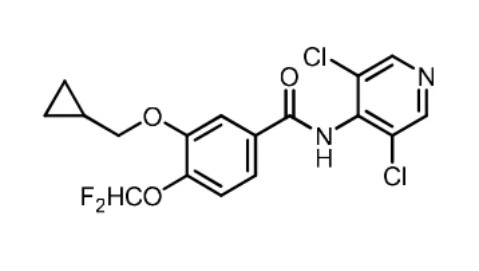
Non-proprietary name of the drug substance(s): Roflumilast
Chemical name: N-(3,5-Dichloropyridin-4-yl)-3-cyclopropylmethoxy-4-difluoromethoxy-benzamide
Molecular formula and molecular mass: C17H14Cl2F2N2O3; 403.22 g/mol
Structural formula:
Physicochemical properties: Roflumilast is practically insoluble in water and hexane, sparingly soluble in ethanol, and freely soluble in acetone.
14. Clinical Trials
14.1. Clinical Trials by Indication
Treatment of Plaque Psoriasis
Cream 0.3%
Two Phase 3, multicenter, randomized, double-blind, vehicle-controlled trials (DERMIS-1 and DERMIS-2) enrolled a total of 881 subjects with mild to severe plaque psoriasis [i.e., Investigator Global Assessment (IGA) of disease severity of 2 to 4 at baseline] and an affected BSA of 2% to 20%, including face, extremities, trunk, genitals, and/or intertriginous areas. The study populations ranged in age from 6 to 88 years with 4 subjects younger than 12 years of age, 14 subjects aged 12 to 17 years, 757 subjects aged 18 to 64 years, and 106 subjects aged 65 years or older. Race was predominantly White (82%). At baseline, 16% of subjects had an IGA score of 2 (mild), 76% had an IGA score of 3 (moderate), and 8% had an IGA score of 4 (severe). One hundred seventy-nine (20%) subjects had an intertriginous IGA (I-IGA) score of 2 (mild) or higher at baseline, and 678 (77%) subjects had a baseline Worst Itch-Numeric Rating Scale (WI-NRS) score of 4 or higher on a scale of 0 to 10.
Table 13 - Summary of Patient Demographics for Clinical Trials in Plaque Psoriasis
| Study # | Study design | Dosage, route of administration and duration | Study subjects (n) | Mean age (years) (range) | Sex |
| DERMIS-1 [NCT04211363] | Multicenter, randomized, double-blind, vehicle-controlled | Roflumilast cream 0.3%, topical application once daily for 8 weeks | 286 | 47.6 (9 to 86) | Male: 66.1% Female: 33.9% |
| Vehicle cream, topical application once daily for 8 weeks | 153 | 48.7 (13 to 88) | Male: 62.7% Female: 37.3% | ||
| DERMIS-2 [NCT04211389] | Multicenter, randomized, double-blind, vehicle-controlled | Roflumilast cream 0.3%, topical application once daily for 8 weeks | 290 | 46.9 (6 to 82) | Male: 60.7% Female: 39.3% |
| Vehicle cream, topical application once daily for 8 weeks | 152 | 47.1 (8 to 82) | Male: 65.8% Female: 34.2% |
Demographic and baseline disease characteristics were similar across studies and treatment groups in the pivotal Phase 3 studies, including mean baseline values for BSA affected by psoriasis, IGA, Psoriasis Symptom Diary© (PSD), Psoriasis Area and Severity Index (PASI), and WI-NRS. Among subjects with I-IGA greater than or equal to 2 (at least mild) at baseline, mean baseline I-IGA was similar across treatment groups and studies.
Subjects were randomized 2:1 to receive ZORYVE cream 0.3% or vehicle applied once daily for 8 weeks to lesions of plaque psoriasis (excluding scalp). The primary endpoint was the proportion of subjects who achieved IGA treatment success, defined as an IGA score of clear (0) or almost clear (1), plus at least a 2-grade IGA score improvement from baseline, at Week 8. Secondary endpoints included the proportion of subjects that achieved I-IGA success at Week 8, IGA success at Week 4, WI-NRS success at Weeks 2, 4, and 8, and a 75% reduction in PASI at Week 8.
Primary Endpoint
The results of the primary efficacy endpoint analysis in both pivotal trials demonstrated that patients treated with ZORYVE cream 0.3% had a clinically meaningful and statistically significant improvement in IGA success at Week 8 (41.5% and 36.7%) when compared with those treated with vehicle (5.8% and 7.1%). The results of the primary efficacy endpoint from the 2 pivotal trials are summarized in Table 14. ZORYVE showed significant improvement based on IGA success compared to vehicle within 4 weeks of the first dose.
Table 14 - IGA Treatment Success at Week 8 in Subjects with Mild to Severe Plaque Psoriasis
| DERMIS-1 | DERMIS-2 | ||||||||||
|---|---|---|---|---|---|---|---|---|---|---|---|
| ZORYVE cream 0.3% | Vehicle | ZORYVE cream 0.3% | Vehicle | ||||||||
| Number of subjects randomized | N=286 | N=153 | N=290 | N=152 | |||||||
| IGA success* | 41.5% | 5.8% | 36.7% | 7.1% | |||||||
| Difference from vehicle (95% CI)† | 39.7% (32.4%, 47.0%) | 29.5% (21.5%, 37.6%) | |||||||||
Abbreviations: CI = Confidence Interval
*IGA Treatment Success was defined as an IGA score of clear (0) or almost clear (1), plus a 2-grade IGA score improvement from baseline at Week 8 (Multiple Imputation).
†Treatment Difference and 95% CI are based on the Cochran-Mantel-Haenszel method stratified by site, baseline IGA, and baseline intertriginous involvement.
Secondary Endpoints
At Week 4 and Week 8, more patients treated with ZORYVE cream 0.3% achieved statistical significance in WI-NRS success compared to those receiving vehicle (Figure 1). For subjects with intertriginous area involvement (baseline I-IGA of at least mild), significantly more achieved I-IGA success at Week 8 in the ZORYVE treatment group compared with the vehicle group. The results of the secondary efficacy endpoints from the 2 pivotal trials are summarized in Table 15.
Figure 1 - WI-NRS Success* Over Time in Patients with Plaque Psoriasis
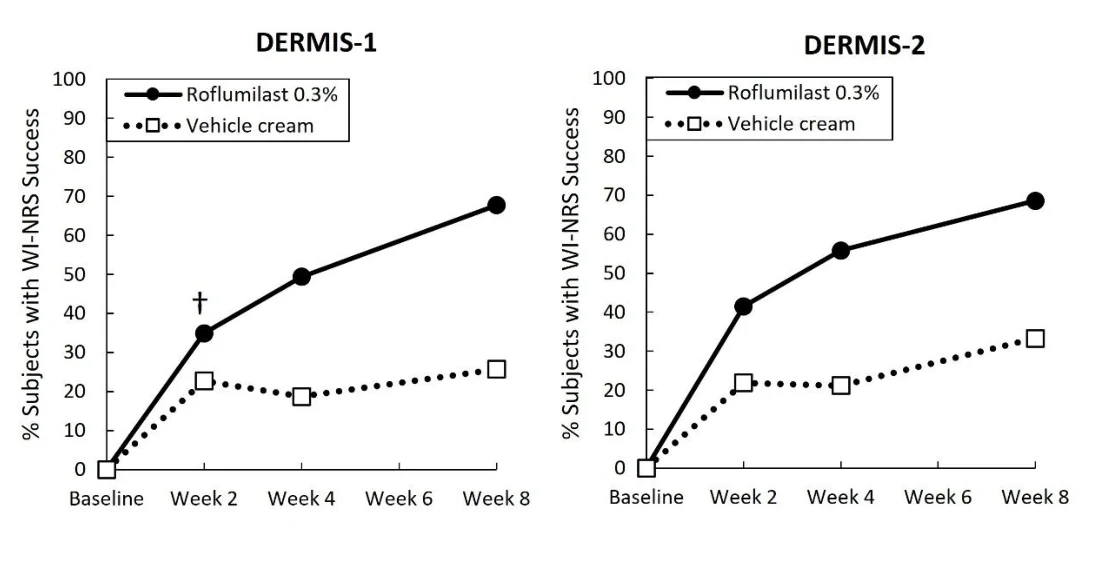
*WI-NRS success is a reduction of at least 4 points in patients with a WI-NRS score of 4 or higher at baseline.
†The treatment difference at Week 2 in DERMIS-1 was not statistically significant.
Table 15 - Results of the Secondary Efficacy Endpoints in Patients with Plaque Psoriasis at Week 8
| Study Endpoint | DERMIS-1 | DERMIS-2 | ||||||||||
|---|---|---|---|---|---|---|---|---|---|---|---|---|
| ZORYVE cream 0.3% | Vehicle | ZORYVE cream 0.3% | Vehicle | |||||||||
| I-IGA success* Difference from vehicle (95% CI) | N=63 | N=32 | N=53 | N=31 | ||||||||
| 71.5% | 13.8% | 67.5% | 17.9% | |||||||||
| 66.5 (47.1, 85.8) p<0.0001 | 51.6 (29.3, 73.8) p<0.0004 | |||||||||||
| PASI-75 Difference from vehicle (95% CI) | N=286 | N=153 | N=290 | N=152 | ||||||||
| 41.2% | 7.0% | 37.8% | 5.3% | |||||||||
| 36.1 (28.5, 43.8) p<0.0001 | 32.3 (24.9, 39.8) p<0.0001 | |||||||||||
*Defined as an I-IGA score of clear (0) or almost clear (1), plus a 2-grade I-IGA score improvement from baseline at Week 8.
Durability of Response
In patients continuing treatment with ZORYVE cream 0.3% in open-label extension studies of 6- and 12-months duration, there was no evidence of decreased efficacy beyond 8 weeks of treatment.
Foam 0.3%
A Phase 3, multicenter, randomized, double-blind, vehicle-controlled trial (ARRECTOR) enrolled a total of 432 subjects with plaque psoriasis of the scalp and body [i.e., Scalp-Investigator Global Assessment (S-IGA) of disease severity of at least 3 at baseline and Body-Investigator Global Assessment (B-IGA) of disease severity of at least 2 at baseline]. The affected BSA was at least 10% of the total scalp and up to 20% on the body (including face, extremities, trunk, genitals, and/or intertriginous areas). The study population ranged in age from 12 to 87 years with 10 subjects aged 12 to 17 years, 368 subjects aged 18 to 64 years, and 54 subjects aged 65 years or older. Race was predominantly White (81.9%). At baseline, 370 subjects (86%) had an S-IGA score of 3 (moderate), and 62 subjects (14%) had an S-IGA score of 4 (severe); 119 subjects (28%) had a B-IGA score of 2 (mild), 290 subjects (67%) had a B-IGA score of 3 (moderate), 23 subjects (5% ) had a B-IGA score of 4 (severe), and 326 subjects (77%) had a baseline Scalp Itch-Numeric Rating Scale (SI-NRS) score of 4 or higher on a scale of 0 to 10.
Table 16 - Summary of Patient Demographics for the Clinical Trial in Plaque Psoriasis of the Scalp and Body
| Study # | Study design | Dosage, route of administration and duration | Study subjects (n) | Mean age (years) (range) | Sex |
| ARRECTOR [NCT05028582] | Phase 3, multicenter, randomized, double-blind, vehicle-controlled | Roflumilast foam 0.3%, topical application once daily for 8 weeks | 281 | 48.6 (12 to 87) | Male: 45.9% Female: 54.1% |
| Vehicle foam, topical application once daily for 8 weeks | 151 | 45.0 (15 to 78) | Male: 39.7% Female: 60.3% |
Demographic and baseline disease characteristics were similar between the ZORYVE foam 0.3% and vehicle groups in the pivotal Phase 3 study, including mean baseline values for total BSA affected by psoriasis of the scalp and body, S-IGA, B-IGA, PSD, Psoriasis Area and Severity Index (PASI), Psoriasis Scalp Severity Index (PSSI), WI-NRS, and SI-NRS scores.
Subjects were randomized 2:1 to receive ZORYVE foam 0.3% or vehicle applied once daily for 8 weeks to lesions of plaque psoriasis of the scalp and body. The co-primary endpoints for ARRECTOR were the proportion of subjects who achieved S-IGA treatment success and B-IGA treatment success, defined as S-IGA score and B-IGA score of clear (0) or almost clear (1), plus at least a 2-grade improvement from baseline, at Week 8 (Table 17). Secondary endpoints included the proportion of subjects that achieved S-IGA success at Weeks 2 and 4, S-IGA score of clear (0) at Week 8, SI-NRS success at Weeks 2, 4, and 8, change from baseline in SI-NRS score at Day 1, 72 hours, and Week 1, WI-NRS success at Week 8, a 75% reduction in PASI at Week 8, and 75% reduction in PSSI at Week 8. PSD aggregate and individual symptom scores for itching, pain, and scaling at Week 8 were also evaluated as secondary endpoints. SI-NRS and WI-NRS success were defined as a reduction of at least 4 points in subjects with a baseline score of at least 4.
Primary Endpoint
The results of the co-primary efficacy endpoint analysis in the pivotal trial demonstrated that patients treated with ZORYVE foam 0.3% had a clinically meaningful and statistically significant improvement in
S-IGA and B-IGA success at Week 8 (66.4% and 45.5%) when compared with those treated with vehicle (27.8% and 20.1%).
Table 17 – S-IGA and B-IGA Treatment Success at Week 8 in Subjects with Plaque Psoriasis of the Scalp and Body
| ARRECTOR | |||||
|---|---|---|---|---|---|
| ZORYVE foam 0.3% | Vehicle | ||||
| Number of subjects randomized | N=281 | N=151 | |||
| S-IGA success* | 66.4% | 27.8% | |||
| Difference from vehicle (95% CI)† | 37.1% (27.1%, 47.1%) | ||||
| B-IGA success* | 45.5% | 20.1% | |||
| Difference from vehicle (95% CI)† | 24.8% (15.0%, 34.6%) | ||||
Abbreviations: CI = Confidence Interval
*S-IGA treatment success and B-IGA treatment success were defined as a score of clear (0) or almost clear (1), plus a 2-grade score improvement from baseline at Week 8 (Multiple Imputation).
†Treatment difference and 95% CI are based on the CMH method stratified by pooled site and baseline IGA strata.
Secondary Endpoints
Patients receiving ZORYVE foam 0.3% showed significant improvement based on S-IGA success compared to vehicle within 2 weeks of the first dose (see Figure 2). At Week 8, more patients treated with ZORYVE foam 0.3% achieved statistical significance in SI-NRS success (65.3% vs. 30.3% for a treatment difference of 35.4% and 95% CI of (23.9, 47.0)) (see Figure 3). Change from baseline in SI-NRS score was observed as early as 24 hours (least squares mean difference: -0.35; 95% CI: (-0.64, -0.06; p=0.0164)). Additional secondary efficacy endpoint results at Week 8 from the pivotal trial are summarized in Table 18.
Figure 2: S-IGA Success* Over Time in Subjects with Plaque Psoriasis in Trial ARRECTOR
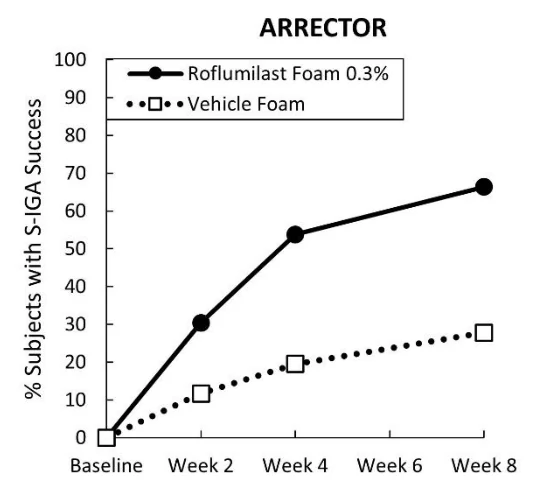
*S-IGA success is defined as an S-IGA score of clear or almost clear plus a 2-grade improvement from baseline.
Figure 3 - SI-NRS Success* Over Time
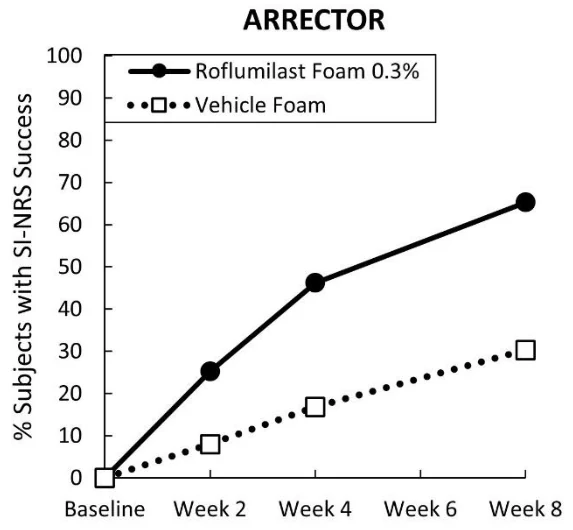
*SI-NRS success is a reduction of at least 4 points in patients with a SI-NRS score of 4 or higher at baseline.
Table 18 - Results of Secondary Efficacy Endpoints in Patients with Plaque Psoriasis at Week 8
| Study Endpoint | ARRECTOR | |||||
|---|---|---|---|---|---|---|
| ZORYVE foam 0.3% | Vehicle | |||||
S-IGA Score of clear (0) Difference from vehicle (95% CI) | N=281 | N=151 | ||||
| 40.0% | 9.1% | |||||
31.9 (23.60, 40.40) p<0.0001 | ||||||
| WI-NRS Success* Difference from vehicle (95% CI) | N=203 | N=110 | ||||
| 63.1% | 30.1% | |||||
| 32.8 (20.34, 45.16) p˂0.0001 | ||||||
| PASI-75 Difference from vehicle (95% CI) | N=281 | N=151 | ||||
| 50.1% | 16.8% | |||||
32.3 (23.21, 41.44) p˂0.0001 | ||||||
| PSSI-75 Difference from vehicle (95% CI) | N=281 | N=151 | ||||
| 70.9% | 31.3% | |||||
37.6 (27.62, 47.62) p˂0.0001 | ||||||
*WI-NRS success is a reduction of at least 4 points in patients with a WI-NRS score of 4 or higher at baseline.
Treatment of Atopic Dermatitis in Adults and Pediatric Subjects 6 to 17 Years of Age
Two multicenter, randomized, double-blind, vehicle-controlled trials (INTEGUMENT-1 and INTEGUMENT-2) enrolled a total of 1337 subjects with mild to moderate atopic dermatitis. At baseline, subjects had a mean affected BSA of 14% (range of 3% to 88%), and 42% had facial involvement. The study population ranged in age from 6 to 91 years, with 615 subjects aged 6 to 17 years, 657 subjects aged 18 to 64 years, and 65 subjects aged 65 years or older. Race was predominantly White (59.5%). At baseline, 24% of subjects had a validated Investigator Global Assessment for Atopic Dermatitis (vIGA-AD) score of 2 (mild), and 76% had a vIGA-AD score of 3 (moderate). Eight hundred thirteen (60.8%) subjects 12 years of age and older had a baseline WI-NRS score of 4 or higher on a scale of 0 to 10. At baseline, the mean Eczema Area and Severity Index (EASI) total score was 10.1.
Table 19 - Summary of Patient Demographics for Clinical Trials in Atopic Dermatitis
| Study # | Study design | Dosage, route of administration and duration | Study subjects (n) | Mean age (years) (range) | Sex |
| INTEGUMENT-1 [NCT04773587] | Multicenter, randomized, double-blind, vehicle-controlled | Roflumilast cream 0.15%, topical application once daily for 4 weeks | 433 | 28.1 (6 to 91) | Male: 45.3% Female: 54.7% |
| Vehicle cream, topical application once daily for 4 weeks | 221 | 28.5 (6 to 84) | Male: 41.6% Female: 58.4% | ||
| INTEGUMENT-2 [NCT04773600] | Multicenter, randomized, double-blind, vehicle-controlled | Roflumilast cream 0.15%, topical application once daily for 4 weeks | 451 | 27.7 (6 to 84) | Male: 44.1% Female: 55.9% |
| Vehicle cream, topical application once daily for 4 weeks | 232 | 26.2 (6 to 79) | Male: 38.4% Female: 61.6% |
Demographic and baseline disease characteristics were similar across studies and treatment groups in the pivotal Phase 3 studies, including mean baseline values for BSA affected by atopic dermatitis, mean EASI score, vIGA-AD, and WI-NRS.
Subjects were randomized 2:1 to receive ZORYVE cream 0.15% or vehicle applied once daily for 4 weeks. The primary endpoint was the proportion of subjects who achieved vIGA-AD treatment success, defined as a vIGA-AD score of clear (0) or almost clear (1), plus at least a 2-grade vIGA-AD score improvement from baseline, at Week 4. Secondary endpoints included the proportion of subjects that achieved vIGA-AD success at Weeks 2 and 1, at least a 75% reduction in EASI (EASI-75) at Week 4, and WI-NRS success at Weeks 4, 2, and 1. WI-NRS success was defined as a reduction of at least 4 points from baseline in subjects 12 years of age or older with a baseline WI-NRS score of at least 4.
Primary Endpoint
The results of the primary efficacy endpoint analysis in both pivotal trials demonstrated that patients treated with ZORYVE cream 0.15% had a clinically meaningful and statistically significant improvement in vIGA-AD success at Week 4 (32.0% and 28.9%) when compared with those treated with vehicle (15.2% and 12.0%). The results of the primary efficacy endpoint from the 2 pivotal trials are summarized in Table 20.
Table 20 - Efficacy at Week 4 in Patients with Mild to Moderate Atopic Dermatitis
| INTEGUMENT-1 | INTEGUMENT-2 | |||||||||
|---|---|---|---|---|---|---|---|---|---|---|
| ZORYVE cream 0.15% | Vehicle | ZORYVE cream 0.15% | Vehicle | |||||||
| Subjects randomized | N=433 | N=221 | N=451 | N=232 | ||||||
| vIGA-AD success* | 32.0% | 15.2% | 28.9% | 12.0% | ||||||
| Difference from vehicle (95% CI)† | 17.4% (11.09%, 23.75%) | 16.5% (10.61%, 22.42%) | ||||||||
Abbreviations: CI = Confidence Interval
*vIGA-AD success was defined as a vIGA-AD score of “clear” (0) or “almost clear” (1), plus a 2-grade vIGA-AD score improvement from baseline at Week 4 (Multiple Imputation).
†The difference in percent and related 95% CIs are Mantel-Haenszel estimates stratified by pooled study site and vIGA-AD randomization strata.
Secondary Endpoints
ZORYVE cream 0.15% showed significant improvement based on vIGA-AD success compared to vehicle as early as 2 weeks in both pivotal trials (Figure 4). At Week 4, the proportion of patients with EASI-75 was significantly larger in the ZORYVE treatment group compared with the vehicle group. More patients treated with ZORYVE achieved statistical significance in WI-NRS success compared to those receiving vehicle (Figure 5). The results of the secondary efficacy endpoints from the 2 pivotal trials are summarized in Table 21.
Figure 4 - vIGA-AD Success Over Time in Patients with Mild to Moderate Atopic Dermatitis*
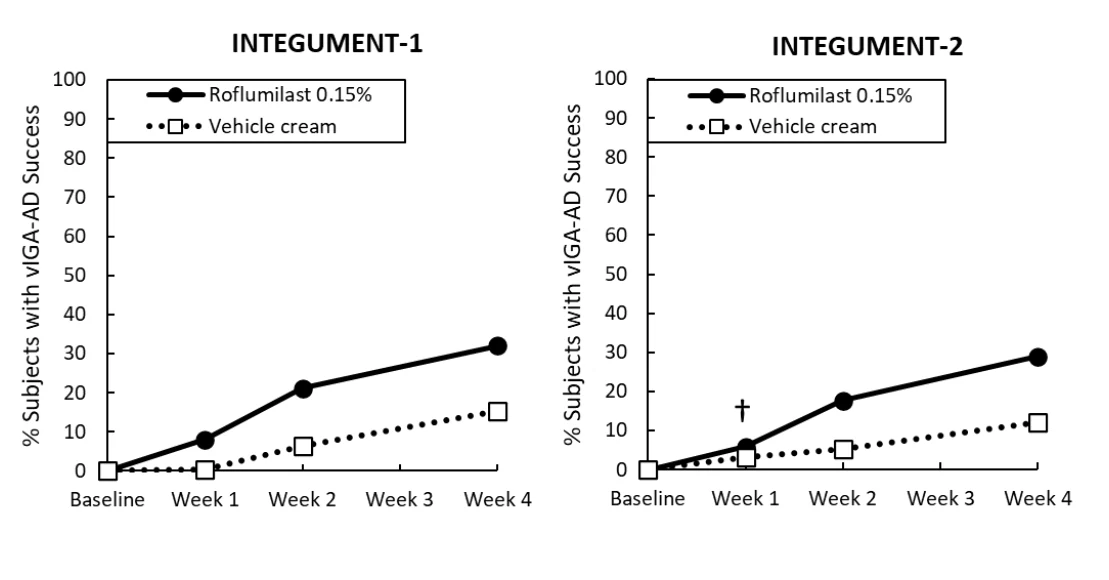
*vIGA-AD success was defined as a vIGA-AD score of “clear” (0) or “almost clear” (1), plus a 2-grade vIGA-AD score improvement from baseline at Week 4 (Multiple Imputation).
†The treatment difference at Week 1 in INTEGUMENT-2 was not statistically significant.
Figure 5 - WI-NRS Success Over Time in Patients with Mild to Moderate Atopic Dermatitis*
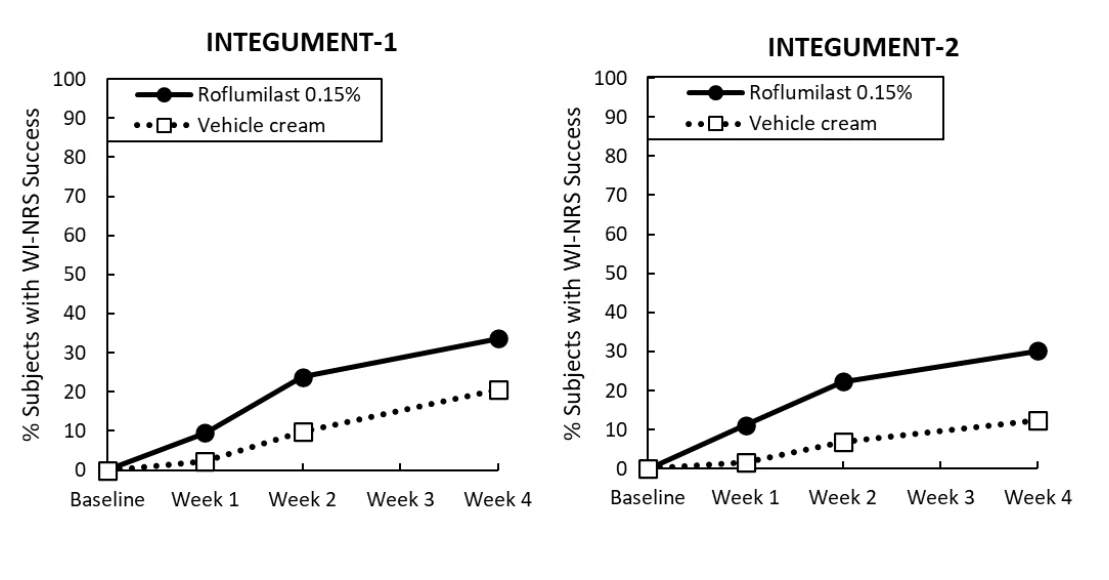
*WI-NRS success in subjects 12 years of age or older is a reduction of at least 4 points in subjects with a WI-NRS score of 4 or higher at baseline.
Table 21 - Results of the Secondary Efficacy Endpoints in Patients with Atopic Dermatitis at Week 4
| INTEGUMENT-1 | INTEGUMENT-2 | ||||||||||||
|---|---|---|---|---|---|---|---|---|---|---|---|---|---|
| ZORYVE cream 0.15% | Vehicle | ZORYVE cream 0.15% | Vehicle | ||||||||||
| Subjects ≥12 years randomized with baseline WI-NRS score ≥4 | N=278 | N=135 | N=264 | N=136 | |||||||||
| WI-NRS success* | 33.6% | 20.7% | 30.2% | 12.4% | |||||||||
| Difference from vehicle (95% CI)† | 13.3% (4.01%, 22.60%) | 15.0% (6.52%, 23.54%) | |||||||||||
| Subjects randomized | N=433 | N=221 | N=451 | N=232 | |||||||||
| EASI-75‡ | 43.2% | 22.0% | 42.0% | 19.7% | |||||||||
| Difference from vehicle (95% CI)† | 22.0% (15.09%, 28.94%) | 20.8% (14.14%, 27.50%) | |||||||||||
Abbreviations: CI = Confidence Interval
*WI-NRS success was defined as a reduction of at least 4 points from baseline for subjects 12 years of age or older with a baseline score of at least 4.
†The difference in percent and related 95% CIs are Mantel-Haenszel estimates stratified by pooled study site and vIGA-AD randomization strata.
‡EASI-75 was defined as achievement of at least a 75% reduction in the EASI total score.
Treatment of Atopic Dermatitis in Pediatric Subjects 2 to 5 Years of Age
A multicenter, randomized, double-blind, vehicle-controlled trial (INTEGUMENT-PED) enrolled a total of 652 pediatric subjects 2 to 5 years of age with mild to moderate atopic dermatitis. At baseline, subjects had a mean affected BSA of 22% (range of 3% to 82%), and 53% had facial involvement. Race was predominantly White (69.2%). At baseline, 22% of subjects had a validated Investigator Global Assessment for Atopic Dermatitis (vIGA-AD) score of 2 (mild), 78% had a vIGA-AD score of 3 (moderate), and the mean Eczema Area and Severity Index (EASI) total score was 12.0.
Table 22 - Summary of Pediatric Patient Demographics for the Clinical Trial in Atopic Dermatitis
| Study # | Study design | Dosage, route of administration and duration | Study subjects (n) | Mean age (years) (range) | Sex |
| INTEGUMENT-PED [NCT04845620] | Phase 3 multicenter, randomized, double-blind, vehicle-controlled | Roflumilast cream 0.05%, topical application once daily for 4 weeks | 436 | 3.3 (2 to 5) | Male: 51.6% Female: 48.4% |
| Vehicle cream, topical application once daily for 4 weeks | 215 | 3.2 (2 to 5) | Male: 54.0% Female: 46.0% |
Demographic and baseline disease characteristics were similar between the ZORYVE cream and vehicle groups in the pivotal Phase 3 study, including mean baseline values for BSA affected by atopic dermatitis, mean EASI score, vIGA-AD, and atopic dermatitis involvement location.
Subjects were randomized 2:1 to receive ZORYVE cream 0.05% or vehicle cream applied once daily for 4 weeks. The primary endpoint was the proportion of subjects who achieved vIGA-AD treatment success defined as a score of clear (0) or almost clear (1), plus at least a 2-grade vIGA-AD score improvement from baseline, at Week 4. Secondary endpoints included the proportion of subjects that achieved vIGA-AD success at Weeks 2 and 1, vIGA-AD score of clear (0) or almost clear (1) at Weeks 4, 2, and 1, and at least a 75% reduction in EASI (EASI-75) at Week 4.
Primary Endpoint
The results of the primary efficacy endpoint analysis in the pivotal trial demonstrated that patients treated with ZORYVE cream 0.05% had a clinically meaningful and statistically significant improvement in vIGA-AD success at Week 4 (25.4%) when compared with those treated with vehicle (10.7%) (Table 23).
Table 23 - Efficacy at Week 4 in Pediatric Patients with Mild to Moderate Atopic Dermatitis
| INTEGUMENT-PED | ||||||
|---|---|---|---|---|---|---|
| ZORYVE cream 0.05% | Vehicle | |||||
| Subjects randomized | N=436 | N=215 | ||||
| vIGA-AD success* | 25.4% | 10.7% | ||||
| Difference from vehicle (95% CI)† | 14.9% (9.04%, 20.79%) | |||||
Abbreviations: CI = Confidence Interval
*vIGA-AD success was defined as a vIGA-AD score of clear (0) or almost clear (1), plus a 2-grade vIGA-AD score improvement from baseline at Week 4 (Multiple Imputation).
†The difference in percent and related 95% CI is a Mantel-Haenszel estimate stratified by pooled study site and vIGA-AD randomization strata.
Secondary Endpoints
ZORYVE cream 0.05% showed significant improvement based on vIGA-AD success compared to vehicle within 1 week of the first dose.
Figure 6 - vIGA-AD Success Over Time in Pediatric Patients with Mild to Moderate Atopic Dermatitis*
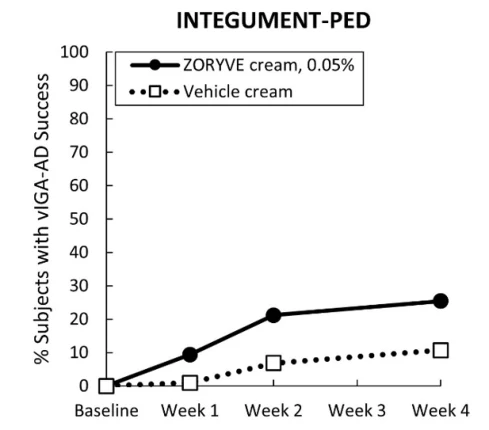
*vIGA-AD success was defined as a vIGA-AD score of clear (0) or almost clear (1), plus a 2-grade vIGA-AD score improvement from baseline at Week 4 (Multiple Imputation).
At Week 4, the proportion of patients with EASI-75 was significantly larger in the ZORYVE treatment group compared with the vehicle group. A higher percentage of subjects achieved vIGA-AD clear (0) or almost clear (1) at Weeks 1, 2, and 4 in the group who received ZORYVE cream 0.05% compared to the group who received vehicle cream (Week 1: 17.0% vs. 3.7%, Week 2: 30.4% vs. 10.6%, Week 4: 35.4% vs. 14.6%). The results of secondary efficacy endpoints from the pivotal trial are summarized in Table 24.
Table 24 - Results of Secondary Efficacy Endpoints at Week 4 in Pediatric Patients with Atopic Dermatitis
| INTEGUMENT-PED | ||||||
|---|---|---|---|---|---|---|
| ZORYVE cream 0.05% | Vehicle | |||||
| Subjects randomized | N=436 | N=215 | ||||
| EASI-75‡ | 39.4% | 20.6% | ||||
| Difference from vehicle (95% CI)† | 18.3% (11.05%, 25.46%) | |||||
| vIGA-AD clear (0) or almost clear (1) | 35.4% | 14.6% | ||||
| Difference from vehicle (95% CI)† | 19.9% (13.54%, 26.30%) | |||||
Abbreviations: CI = Confidence Interval
*vIGA-AD success was defined as a vIGA-AD score of clear (0) or almost clear (1), plus a 2-grade vIGA-AD score improvement from baseline at Week 4 (Multiple Imputation).
†The difference in percent and related 95% CIs are Mantel-Haenszel estimates stratified by pooled study site and vIGA-AD randomization strata.
‡EASI-75 was defined as achievement of at least a 75% reduction in the EASI total score.
Durability of Response in Treatment of Atopic Dermatitis in Adults and Pediatric Subjects 2 to 17 Years of Age
In patients continuing treatment with ZORYVE cream 0.15% or 0.05% administered daily or twice weekly, in an open-label extension study of 6- and 12-months duration, there was no evidence of decreased efficacy beyond 4 weeks of treatment.
Treatment of Seborrheic Dermatitis
A Phase 3, randomized, double-blind, vehicle-controlled trial (STRATUM) enrolled a total of 457 subjects with seborrheic dermatitis involving the scalp (93.4%), face (62.1%), and/or body and a minimum Investigator Global Assessment (IGA) of moderate (IGA of 3 on a 5-point scale from 0 to 4). The study population ranged in age from 9 to 87 years, with 32 subjects aged 9 to 17 years, 368 subjects aged 18 to 64 years, and 57 subjects aged 65 years or older. Race was predominantly White (78%). At baseline, 93.7% of subjects had an IGA score of 3 (moderate), and 6.3% had an IGA score of 4 (severe); 92.6% of subjects had Overall Assessment of Erythema score of 2 (moderate), and 7.2% had a score of 3 (severe); 84.5% of subjects had Overall Assessment of Scaling score of 2 (moderate), and 15.5% had a score of 3 (severe). At baseline, 66.5% of subjects had a Worst Itch-Numeric Rating Scale (WI-NRS) score of 4 or higher on a scale of 0 to 10.
Table 25 - Summary of Patient Demographics for the Clinical Trial in Seborrheic Dermatitis
| Study # | Study design | Dosage, route of administration and duration | Study subjects (n) | Mean age (years) (range) | Sex |
| STRATUM [NCT04973228] | Phase 3, multicenter, randomized, double-blind, vehicle-controlled | Roflumilast foam 0.3%, topical application once daily for 8 weeks | 304 | 43.2 (9 to 87) | Male: 50.3% Female: 49.7% |
| Vehicle foam, topical application once daily for 8 weeks | 153 | 41.8 (9 to 83) | Male: 49.0% Female: 51.0% |
Demographic and baseline disease characteristics were similar between the ZORYVE foam and vehicle groups in the pivotal Phase 3 study, including mean baseline values for BSA affected by seborrheic dermatitis, IGA, Overall Assessment of Erythema, Overall Assessment of Scaling, and WI-NRS.
Subjects were randomized 2:1 to receive ZORYVE foam or vehicle foam applied once daily for 8 weeks to lesions of seborrheic dermatitis. The primary endpoint was the proportion of subjects who achieved IGA treatment success, defined as an IGA score of clear (0) or almost clear (1), plus at least a 2-grade IGA score improvement from baseline, at Week 8 (Table 26). Secondary endpoints included the proportions of subjects that achieved IGA success at Weeks 2 and 4 (Figure 7), an IGA score of 0 at Week 8, an Overall Assessment of Erythema of 0 at Week 8, an Overall Assessment of Scaling of 0 at Week 8, and WI-NRS success at Weeks 2, 4, and 8 (Figure 8). WI-NRS success was defined as a reduction of at least 4 points in subjects with baseline WI-NRS score of at least 4.
Primary Endpoint
The results of the primary efficacy endpoint analysis in the pivotal trial demonstrated that patients treated with ZORYVE foam had a clinically meaningful and statistically significant improvement in IGA success at Week 8 (79.5%) when compared with those treated with vehicle (58.0%) (Table 26).
Table 26: IGA Treatment Success at Week 8 in Subjects with Seborrheic Dermatitis
| ZORYVE | Vehicle | |
|---|---|---|
| Number of subjects randomized | N=304 | N=153 |
| IGA success* | 79.5% | 58.0% |
| Difference from vehicle (99% CI)† | 20.6% | (8.2%, 33.0%) |
Abbreviations: CI = Confidence Interval
*IGA treatment success was defined as an IGA score of clear (0) or almost clear (1), plus at least a 2-grade IGA score improvement from baseline at Week 8 (Multiple Imputation).
†Treatment difference and 99% CI are based on the CMH method stratified by pooled site and baseline IGA strata.
Secondary Endpoints
ZORYVE foam showed significant improvement based on IGA success compared to vehicle within 2 weeks of the first dose.
Figure 7: IGA Treatment Success* Over Time
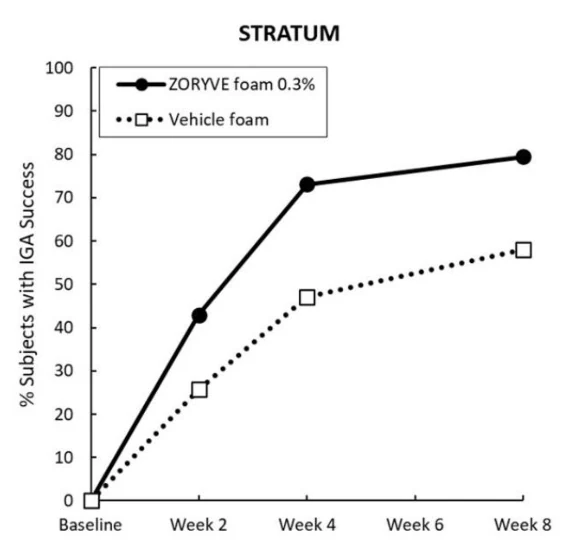
*IGA treatment success was defined as an IGA score of clear (0) or almost clear (1), plus at least a 2-grade IGA score improvement from baseline at Week 8 (Multiple Imputation).
A higher percentage of subjects who received ZORYVE foam achieved an IGA score of clear (0) at Week 8 compared to subjects who received vehicle (50.6% vs. 27.7%).
A higher percentage of subjects who received ZORYVE foam achieved an Overall Erythema score of None (0) at Week 8 compared to subjects who received vehicle (57.8% vs. 32.0%). A higher percentage of subjects who received ZORYVE foam achieved an Overall Scaling score of None (0) at Week 8 compared to subjects who received vehicle (58.1% vs. 36.5%).
At Weeks 2, 4, and 8, more patients treated with ZORYVE foam achieved statistical significance in WI-NRS success compared to those receiving vehicle (see Figure 8).
Figure 8: WI-NRS Success* Over Time†
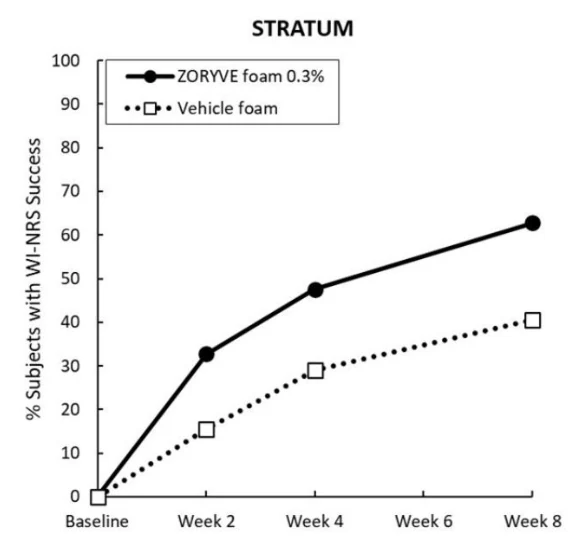
*WI-NRS success is a reduction of at least 4 points in subjects with a WI-NRS score of 4 or higher at baseline (Multiple Imputation).
†At baseline, N=206 for ZORYVE foam and N=98 for Vehicle foam.
The results of the secondary efficacy endpoints from the pivotal trial are summarized in Table 27.
Table 27 - Results of the Secondary Efficacy Endpoints in Patients with Seborrheic Dermatitis at Week 8
| Study Endpoint | STRATUM | |||
|---|---|---|---|---|
| ZORYVE | Vehicle | |||
| N=304 | N=153 | |||
| IGA score of clear (0) Difference from vehicle (95% CI) | 50.6% | 27.7% | ||
| 22.5 (13.22, 31.83) p<0.0001 | ||||
| Overall Erythema Score of None (0) Difference from vehicle (95% CI) | 57.8% | 32.0% | ||
| 26.8 (17.36, 36.27) p<0.0001 | ||||
| Overall Scaling Score of None (0) Difference from vehicle (95% CI) | 58.1% | 36.5% | ||
| 20.9 (11.07, 30.82) p<0.0001 | ||||
Durability of Response
In patients treated with ZORYVE foam in the long-term, open-label study of up to 6- and 12-months duration, there was no evidence of decreased efficacy.
15. Microbiology
No microbiological information is required for this drug product.
16. Non-Clinical Toxicology
Genotoxicity Roflumilast did not reveal a genotoxic potential in a standard battery of genotoxicity assays in vitro and in vivo (Ames test, E. coli bacterial gene mutation test, gene mutation test in V79 Chinese Hamster cells, unscheduled DNA-synthesis test, cytogenetic study with human lymphocytes micronucleus test) assessing different genetic endpoints.
Carcinogenicity In the two 2-year carcinogenicity studies in hamsters, roflumilast was administered by gavage at doses up to 16 mg/kg/day. Nasal neoplasms (undifferentiated carcinomas of the olfactory epithelium and adenocarcinoma of Bowman’s gland) were observed at high doses of roflumilast. No other treatment-related neoplastic findings were observed. Overall, the tumor-free level in the animals was 4 mg/kg/day. The significance of this finding to humans is unknown.
Long-term studies were conducted in mice with oral and topical roflumilast to evaluate its carcinogenic potential. In a 2-year oral carcinogenicity study in mice, roflumilast was administered by gavage at doses up to 18 mg/kg/day in males, and 12 mg/kg/day in females. No roflumilast-related tumors occurred. In a 2-year dermal carcinogenicity study in mice, topical doses of 0.15%, 0.5%, or 1% roflumilast cream were administered once daily. No roflumilast-related neoplastic findings were noted at topical doses up to 0.5% roflumilast cream in females and 1% roflumilast cream in males.
Reproductive and developmental toxicology No embryo-fetal development studies have been conducted with topical roflumilast. The summed AUCs of roflumilast and its active N-oxide metabolite in humans are comparable when roflumilast is administered at the topical maximum recommended human dose (MRHD) and when roflumilast is taken orally at the MRHD, suggesting the risk is no greater following topical administration.
Roflumilast was not teratogenic in rats and rabbits following oral administration up to the highest doses of 1.8 mg/kg/day in rats and 0.8 mg/kg/day in rabbits.
Administered at the same doses, roflumilast has been shown to induce mild retardation of embryo-fetal development (incomplete ossification) in the rat, but not in the rabbit. Exposure of pregnant rats to unbound roflumilast and roflumilast N-oxide was 1.7 and 10.8 times higher, respectively, than exposure in women at the 500-mcg oral roflumilast dose. In one of three oral roflumilast rat studies on fertility and embryo-fetal development, post-implantive losses were observed at oral doses of 0.6 mg/kg/day and 1.8 mg/kg/day. Post-implantive losses were not seen in rabbits up to oral doses of 0.8 mg/kg/day. Rat and rabbit fetuses were exposed to roflumilast and the permeability of the placental barrier for drug-related material increased with the progression of pregnancy. Prolongation of gestation was seen in mice due to a potential tocolytic effect.
A fertility study of oral roflumilast in rats showed a slight reduction in male fertility in conjunction with epididymal toxicity in rats dosed orally with 1.8 mg/kg/day (about 2.2 and 8.8 times human exposure to unbound roflumilast and roflumilast N-oxide, respectively, when roflumilast was administered orally) (see 7. Warnings and Precautions, Fertility). There was no effect on female fertility up to the highest oral roflumilast dose of 1.5 mg/kg/day in rats.