


Product Monograph - Cosentyx
RECENT MAJOR LABEL CHANGES
| 1 INDICATION | 2024-04 |
|---|---|
| 4 DOSAGE AND ADMINISTRATION, 4.1 Dosing Considerations | 2025-05 |
| 4 DOSAGE AND ADMINISTRATION, 4.2 Recommended Dose and Dose Adjustment | 2024-04 |
| 7 WARNINGS AND PRECAUTIONS, Immune | 2025-05 |
| 7 WARNINGS AND PRECAUTIONS, 7.1.4 Geriatrics | 2024-04 |
TABLE OF CONTENTS
Sections or subsections that are not applicable at the time of authorization are not listed.
RECENT MAJOR LABEL CHANGES .......................................................................................... 2
TABLE OF CONTENTS ............................................................................................................ 2
Part 1: Health Professional Information ................................................................................ 5
- 1.
Indications ................................................................................................................ 5
1.1 Pediatrics ................................................................................................................ 5
1.2 Geriatrics ................................................................................................................ 6
- 2. Contraindications ...................................................................................................... 6
- 4.
Dosage and Administration ....................................................................................... 6
4.1 Dosing Considerations ........................................................................................... 6
4.2 Recommended Dose and Dosage Adjustment ...................................................... 6
4.3 Reconstitution ........................................................................................................ 8
4.4 Administration ....................................................................................................... 8
4.5 Missed Dose ........................................................................................................... 8
- 5. Overdose .................................................................................................................. 9
- 6. Dosage Forms, Strengths, Composition and Packaging ............................................... 9
- 7.
Warnings and Precautions ....................................................................................... 10
Carcinogenesis and Genotoxicity ..................................................................................... 10
Gastrointestinal ................................................................................................................ 11
Immune ............................................................................................................................ 11
Reproductive Health ........................................................................................................ 12
Sensitivity/Resistance ...................................................................................................... 12
Skin ................................................................................................................................... 12
7.1 Special Populations .............................................................................................. 12
7.1.1 Pregnancy ......................................................................................................... 12
7.1.2 Breastfeeding ................................................................................................... 13
7.1.3 Pediatrics .......................................................................................................... 13
7.1.4 Geriatrics .......................................................................................................... 13
- 8.
Adverse Reactions ................................................................................................... 13
8.1 Adverse Reaction Overview ................................................................................. 13
8.2 Clinical Trial Adverse Reactions ........................................................................... 14
8.3 Less Common Clinical Trial Adverse Reactions .................................................... 21
8.5 Post-Market Adverse Reactions ........................................................................... 21
- 9.
Drug Interactions .................................................................................................... 22
9.2 Drug Interactions Overview ................................................................................. 22
9.5 Drug-Food Interactions ........................................................................................ 22
9.6 Drug-Herb Interactions ........................................................................................ 22
9.7 Drug-Laboratory Test Interactions....................................................................... 22
- 10.
Clinical Pharmacology ............................................................................................. 22
10.1 Mechanism of Action ........................................................................................... 22
10.2 Pharmacodynamics .............................................................................................. 22
10.3 Pharmacokinetics ................................................................................................. 23
- 11. Storage, Stability and Disposal ................................................................................. 25
- 12. Special Handling Instructions ................................................................................... 25
Part 2 : Scientific Information ............................................................................................. 26
- 13. Pharmaceutical Information .................................................................................... 26
- 14.
Clinical Trials ........................................................................................................... 27
14.1 Clinical Trials by Indication .................................................................................. 27
14.1.1 Plaque psoriasis .................................................................................................... 27
14.1.2 Psoriatic arthritis ................................................................................................... 40
14.1.3 Axial spondyloarthritis (axSpA) ............................................................................. 50
14.1.4 Juvenile Idiopathic Arthritis (JIA) categories: ....................................................... 60
14.1.5 Hidradenitis Suppurativa ...................................................................................... 62
- 16. Non-Clinical Toxicology ........................................................................................... 67
Patient Medication Information ......................................................................................... 69
Part 1: Health Professional Information
1. Indications
COSENTYX® (secukinumab injection/secukinumab for injection) is indicated for:
Adult patients
Plaque psoriasis
COSENTYX is indicated for the treatment of moderate to severe plaque psoriasis in adult patients who are candidates for systemic therapy or phototherapy.
Psoriatic arthritis
COSENTYX is indicated for the treatment of adult patients with active psoriatic arthritis when the response to previous disease-modifying anti-rheumatic drug (DMARD) therapy has been inadequate. COSENTYX can be used alone or in combination with methotrexate (see 14.1.1 Psoriatic arthritis).
Axial spondyloarthritis (axSpA)
Ankylosing spondylitis (AS, radiographic axial spondyloarthritis)
COSENTYX is indicated for the treatment of adult patients with active ankylosing spondylitis who have responded inadequately to conventional therapy (see 14.1.3 Axial spondyloarthritis (axSpA), Ankylosing spondylitis).
Non-radiographic axial spondyloarthritis (nr-axSpA)
COSENTYX is indicated for the treatment of active non-radiographic axial spondyloarthritis with objective signs of inflammation as indicated by elevated C-reactive protein (CRP) and/or magnetic resonance imaging (MRI) evidence in adults who have responded inadequately, or are intolerant to nonsteroidal anti-inflammatory drugs (NSAIDs).
Hidradenitis Suppurativa
COSENTYX is indicated for the treatment of adult patients with moderate to severe hidradenitis suppurativa (acne inversa) who have responded inadequately to conventional systemic hidradenitis suppurativa therapy (see 14.1.5 Hidradenitis suppurativa).
1.1 Pediatrics
Plaque psoriasis
COSENTYX (secukinumab injection/secukinumab for injection) is indicated for the treatment of moderate to severe plaque psoriasis in patients 6 year and older who are candidates for systemic therapy or phototherapy.
Juvenile Idiopathic Arthritis (JIA) categories:
Enthesitis-Related Arthritis (ERA)
COSENTYX is indicated for the treatment of active enthesitis-related arthritis in patients 6 years and older whose disease has responded inadequately to, or who cannot tolerate, conventional therapy.
Juvenile Psoriatic Arthritis (JPsA)
COSENTYX is indicated for the treatment of active juvenile psoriatic arthritis in patients 6 years and older whose disease has responded inadequately to, or who cannot tolerate, conventional therapy.
1.2 Geriatrics
Geriatrics (≥ 65 years of age): Limited data are available to Health Canada regarding this age group (see 7.1.4 Geriatrics).
2. Contraindications
4. Dosage and Administration
4.1 Dosing Considerations
- COSENTYX is intended for use under the guidance of a health professional. Patients may self-inject after proper training and when deemed appropriate.
- Prior to subcutaneous administration, visually inspect the solution for particulate matter and discoloration. The solution is colorless to slightly yellow.
- Prior to initiating treatment with COSENTYX, patients should be evaluated for tuberculosis (TB) infection and Hepatitis B virus (HBV) infection. COSENTYX should not be given to patients with active tuberculosis or active HBV infection (see 7 Warnings and Precautions, Infections).
4.2 Recommended Dose and Dosage Adjustment
- Plaque psoriasis
Adult patients
The recommended dose is 300 mg by subcutaneous injection with initial dosing at Weeks 0, 1, 2, 3, and 4 followed by monthly maintenance dosing. Each 300 mg dose is given as one subcutaneous injection of 300 mg or as two subcutaneous injections of 150 mg. A maintenance dose of 300 mg every 2 weeks may provide additional benefit for adult patients with a body weight of 90 kg or higher.
Pediatric patients aged 6 years and older
The recommended dose is based on body weight (Table 1) and administered by subcutaneous injection with initial dosing at Weeks 0, 1, 2, 3, and 4 followed by monthly maintenance dosing. Each 75 mg dose is given as 1 subcutaneous injection of 75 mg. Each 150 mg dose is given as 1 subcutaneous injection of 150 mg. Each 300 mg dose is given as one subcutaneous injection of 300 mg or as two subcutaneous injections of 150 mg.
Table 1 Recommended dose of COSENTYX for pediatric plaque psoriasis
| Body weight at time of dosing | Recommended Dose |
|---|---|
| <50 kg | 75 mg |
| ≥50 kg | 150 mg (*may be increased to 300 mg) |
| *Some patients may derive additional benefit from the higher dose. | |
- Psoriatic arthritis
The recommended dose is 150 mg by subcutaneous injection with initial dosing at Weeks 0, 1, 2, 3, and 4 followed by monthly maintenance dosing.
For psoriatic arthritis patients with coexistent moderate to severe plaque psoriasis, use the dosing and administration recommendations for adult plaque psoriasis (see 4.2 Recommended Dose and Dosage Adjustment, Plaque psoriasis).
If a patient is an anti-TNF-alpha inadequate responder (IR) or continues to have active psoriatic arthritis, consider using the 300 mg dose. Each 300 mg dose is given as one subcutaneous injection of 300 mg or as two subcutaneous injections of 150 mg.
- Axial spondyloarthritis (axSpA)
Ankylosing spondylitis (AS, radiographic axial spondyloarthritis)
The recommended dose is 150 mg by subcutaneous injection with initial dosing at Weeks 0, 1, 2, 3, and 4 followed by monthly maintenance dosing. If a patient continues to have active ankylosing spondylitis, consider a monthly maintenance dosage of 300 mg. Each 300 mg dose is given as one subcutaneous injection of 300 mg or as two subcutaneous injections of 150 mg.
Non-radiographic axial spondyloarthritis (nr-axSpA)
The recommended dose is 150 mg by subcutaneous injection with initial dosing at Weeks 0, 1, 2, 3, and 4, followed by monthly maintenance dosing.
- Juvenile Idiopathic Arthritis (JIA) categories:
Enthesitis-Related Arthritis (ERA) and Juvenile Psoriatic Arthritis (JPsA)
The recommended dose is based on body weight.
- For patients weighing < 50 kg the dose is 75 mg.
- For patients weighing ≥ 50 kg the dose is 150 mg.
COSENTYX is administered by subcutaneous injection at Weeks 0, 1, 2, 3, and 4 followed by monthly maintenance dosing (every 4 weeks). Each 75 mg dose is given as one subcutaneous injection of 75 mg. Each 150 mg dose is given as one subcutaneous injection of 150 mg.
- Hidradenitis Suppurativa
The recommended dose is 300 mg of secukinumab by subcutaneous injection with initial dosing at Weeks 0, 1, 2, 3 and 4, followed by monthly maintenance dosing (every 4 weeks). Based on clinical response, the maintenance dose can be increased to 300 mg every 2 weeks. Each 300 mg dose is given as one subcutaneous injection of 300 mg or as two subcutaneous injections of 150 mg.
For all of the above indications, available data suggest that a clinical response is usually achieved within 16 weeks of treatment. Consideration should be given to discontinuing treatment in patients who have shown no response by 16 weeks of treatment. Some patients with an initial partial response may subsequently improve with continued treatment beyond 16 weeks.
Special populations:
Renal impairment / hepatic impairment
COSENTYX has not been studied specifically in these patient populations.
4.3 Reconstitution
Parenteral Products:
Powder for solution for injection* COSENTYX is administered subcutaneous injection. COSENTYX powder for solution must be reconstituted before use (see 6 Dosage Forms, Strengths, Composition and Packaging).
*single-use vial not available in Canada
4.4 Administration
Pre-filled syringe & pre-filled pen
COSENTYX is intended for use under the guidance and supervision of a physician. COSENTYX is administered by subcutaneous injection in the lower abdomen, front of the thigh, or outer upper arm. If possible, areas of the skin that show psoriasis should be avoided as injection sites.
After proper training in subcutaneous injection technique, patients may self-inject COSENTYX or may be injected by a caregiver if a physician determines that it is appropriate and provides instructions. However, the physician should ensure appropriate follow-up of patients. Patients or caregivers should be instructed to inject the full amount of COSENTYX according to the instructions provided in the Patient Medication Information. Comprehensive instructions for administration are given in the Patient Medication Information.
For patients receiving the 75 mg dose, the 75 mg/0.5 mL pre-filled syringe should be used.
Powder for solution for injection*
COSENTYX is administered by subcutaneous injection. COSENTYX powder for solution must be reconstituted before use (see 6 Dosage Forms, Strengths, Composition and Packaging).
*single-use vial not available in Canada
Instructions for use are provided in 12 Special Handling Instructions.
4.5 Missed Dose
In the case of a missed or late dose of COSENTYX, the next dose should be given as soon as possible. The following dose should be given according to the regular dosing schedule.
5. Overdose
Doses up to 30 mg/kg (i.e. approximately 2,000 to 3,000 mg) have been administered intravenously in clinical studies in adults without dose-limiting toxicity. In the event of overdose, it is recommended that the patient be monitored for any signs or symptoms of adverse reactions and appropriate symptomatic treatment be instituted immediately.
| For the most recent information in the management of a suspected drug overdose, contact your regional poison control centre or Health Canada’s toll-free number, 1-844 POISON-X (1-844-764-7669). |
|---|
6. Dosage Forms, Strengths, Composition and Packaging
To help ensure the traceability of biologic products, healthcare professionals should record both the brand name and the non-proprietary (active ingredient) name as well as other product-specific identifiers such as the Drug Identification Number (DIN) and the batch/lot number of the product supplied.
Table 2 Dosage Forms, Strengths, and Composition
| Route of Administration | Dosage Form / Strength/Composition | Non-Medicinal Ingredients |
| Subcutaneous Injection (s.c.) | 75 mg/0.5 mL in a carton containing one (1) pre-filled glass syringe | L-histidine/histidine hydrochloride monohydrate, L-methionine, polysorbate 80, Trehalose dehydrate, water for injection. |
| 150 mg/mL in a carton containing one (1) pre-filled glass syringe | ||
| 150 mg/mL in a carton containing two (2) pre-filled glass syringes | ||
| 150 mg/mL in a carton containing one (1) pre-filled SensoReady pen | ||
| 150 mg/mL in a carton containing two (2) pre-filled SensoReady pen | ||
| 300 mg/2 mL in a carton containing one (1) pre-filled glass syringe | ||
| 300 mg/2 mL in a carton containing one (1) pre-filled UnoReady pen | ||
The removable cap of the COSENTYX 1 mL pre-filled syringe/SensoReady pen contains a derivative of natural rubber latex.
Each 0.5 mL pre-filled syringe contains 75 mg secukinumab.
Each 1 mL pre-filled syringe or SensoReady pen contains 150 mg secukinumab.
Each 2 mL pre-filled syringe or UnoReady pen contains 300 mg secukinumab.
COSENTYX does not contain preservatives.
*single-use vial not available in Canada
•75 mg/0.5 mL solution for injection in pre-filled syringe consisting of a sterile solution in a single use pre-filled syringe (PFS) with a staked 27 gauge fixed ½ inch needle with plunger stopper and rigid needle shield. The syringe is fitted with a passive safety guard.
•150 mg/1 mL solution for injection in pre-filled syringe consisting of a sterile solution in a single use pre-filled syringe (PFS) with a staked 27 gauge fixed ½ inch needle with plunger stopper and rigid needle shield. The syringe is fitted with a passive safety guard.
•150 mg/1 mL solution for injection in pre-filled SensoReady pen consisting of a sterile solution in a single use pre-filled syringe with a 27 gauge fixed ½ inch needle with plunger stopper and rigid needle shield assembled into a pen of a triangular shape with a removable rubber cap.
•300 mg/2 mL solution for injection in pre-filled syringe consisting of a sterile solution in a single use pre-filled syringe (PFS) with a staked 27 gauge fixed ½ inch needle with plunger stopper and rigid needle shield. The syringe is fitted with a passive safety guard.
•300 mg/2 mL solution for injection in pre-filled UnoReady pen consisting of a sterile solution in a single use pre-filled syringe with a 27 gauge fixed ½ inch needle with plunger stopper and rigid needle shield assembled into a pen of a squared shape with a removable cap.
•COSENTYX (secukinumab) is also supplied as a powder for solution in a single-use (type 1) glass vial with a coated stopper*. Each vial of powder for solution for subcutaneous injection contains 150 mg of COSENTYX when reconstituted with 1 mL water for injection.
7. Warnings and Precautions
Carcinogenesis and Genotoxicity
Carcinogenicity studies have not been conducted for secukinumab.
150mg/mL single use vial* (lyophilized powder) | Sucrose, L-histidine, L-histidine hydrochloride monohydrate, polysorbate 80, water for injection |
Gastrointestinal
Inflammatory Bowel Disease
Cases of new onset and exacerbations of inflammatory bowel disease, in some cases serious, occurred in clinical studies in both COSENTYX and placebo groups. In addition, cases of new onset inflammatory bowel disease have been reported with post-marketing use (see 8 Adverse Reactions). Patients who are treated with COSENTYX should be monitored for signs and symptoms of inflammatory bowel disease.
Immune
Infections
COSENTYX has the potential to increase the risk of infections. In clinical studies, higher rates of infections have been observed in patients receiving COSENTYX compared with placebo (see 8 Adverse Reactions). Most of these were mild or moderate.
Caution should be exercised when considering the use of COSENTYX in patients with a chronic infection or a history of recurrent infection.
Patients should be instructed to seek medical advice if signs or symptoms suggestive of an infection occur. If a patient develops a serious infection, the patient should be closely monitored and COSENTYX should not be administered until the infection resolves.
Tuberculosis
Tuberculosis (active and/or latent reactivation) has been reported in patients treated with COSENTYX. Prior to initiating treatment with COSENTYX, patients should be evaluated for tuberculosis (TB) infection. COSENTYX should not be given to patients with active tuberculosis. Treatment of latent tuberculosis infection should be initiated prior to administering COSENTYX. Anti-tuberculosis therapy should also be considered prior to initiation of COSENTYX in patients with past history of latent or active TB in whom an adequate course of treatment cannot be confirmed. Patients receiving COSENTYX should be monitored closely for signs and symptoms of active tuberculosis during and after treatment.
Hepatitis B reactivation
Hepatitis B virus reactivation has been reported in patients treated with COSENTYX. Prior to initiating treatment with COSENTYX, patients should be evaluated for Hepatitis B virus (HBV) in accordance with clinical guidelines for immunosuppressants. COSENTYX should not be given to patients with active hepatitis B. Patients with evidence of positive HBV serology should consult liver disease experts before start of treatment and should be monitored for clinical and laboratory signs of HBV reactivation during COSENTYX treatment. If reactivation of HBV occurs while on COSENTYX, discontinuation of the treatment should be considered, and patients should be treated according to clinical guidelines.
Vaccinations
Prior to initiating therapy with COSENTYX, consider completion of all age appropriate immunizations according to current immunization guidelines. Live vaccines should not be given concurrently with COSENTYX (see 9.2 Drug Interactions Overview). Patients receiving COSENTYX may receive concurrent inactivated or non-live vaccinations. In a study, after meningococcal and inactivated influenza vaccinations, a similar proportion of healthy adult volunteers treated with 150 mg of secukinumab and those treated with placebo were able to mount an adequate immune response of at least a 4-fold increase in antibody titres to meningococcal and influenza vaccines. The data suggest that COSENTYX does not suppress the humoral immune response to the meningococcal or influenza vaccines in adults.
Reproductive Health
Fertility
The effect of COSENTYX on human fertility has not been evaluated. Animal studies do not indicate direct or indirect harmful effects with respect to fertility.
Sensitivity/Resistance
Hypersensitivity reactions
Serious hypersensitivity reactions, including urticaria, angioedema, and rare cases of anaphylactic reactions have been reported in patients receiving COSENTYX. If a serious hypersensitivity reaction occurs, administration of COSENTYX should be discontinued immediately and appropriate therapy initiated.
Latex-sensitive individuals – 1 mL pre-filled syringe/SensoReady pen
The removable cap of the COSENTYX 1 mL pre-filled syringe/SensoReady pen contains a derivative of natural rubber latex. Although no natural rubber latex is detected in the cap, the safe use of COSENTYX 1 mL pre-filled syringe/SensoReady pen in latex-sensitive individuals has not been studied.
Skin
Eczematous eruptions
In post-marketing reports, cases of severe eczematous eruptions, including dermatitis-like eruptions, dyshidrotic eczema, and erythroderma (exfoliative dermatitis), were reported in patients receiving COSENTYX; some cases resulted in hospitalization (see 8 Adverse Reactions). The onset of eczematous eruptions was variable, ranging from days to months after the first dose of COSENTYX.
Treatment with COSENTYX may need to be discontinued to resolve the eczematous eruption.
7.1 Special Populations
7.1.1 Pregnancy
There are no adequate and well controlled clinical trials of COSENTYX in pregnant women. Animal studies do not indicate direct or indirect harmful effects with respect to pregnancy, embryonic/foetal development, parturition or postnatal development (see 16 Non-Clinical Toxicology, Reproductive and developmental toxicology). COSENTYX should be used during pregnancy only if the potential benefit justifies the potential risk to the foetus.
7.1.2 Breastfeeding
It is not known whether secukinumab is excreted in human milk. Because many drugs are excreted in human milk, caution should be exercised when COSENTYX is administered to a nursing woman.
7.1.3 Pediatrics
Pediatrics (< 18 years of age)
Safety and effectiveness in pediatric patients with the JIA categories of ERA and JPsA below the age of 6 years have not been established.
Safety and effectiveness in pediatric patients with moderate to severe plaque psoriasis below the age of 6 years have not been established.
Safety and effectiveness in pediatric patients below the age of 18 years in other indications have not yet been established.
7.1.4 Geriatrics
Geriatrics (≥ 65 years of age)
Of the 3430 plaque psoriasis patients exposed to COSENTYX in clinical trials, a total of 230 were 65 years or older, and 32 subjects were 75 years and older.
Of the 2,536 psoriatic arthritis patients exposed to COSENTYX in clinical studies, a total of 236 patients were 65 years of age or older and 25 patients were 75 years of age or older.
Of the 794 ankylosing spondylitis patients exposed to COSENTYX in clinical studies, a total of 29 patients were 65 years of age or older and 3 patients were 75 years of age or older.
Of the 524 non-radiographic axial spondyloarthritis patients exposed to COSENTYX in clinical studies, a total of 9 patients were 65 years of age or older and 2 patients were 75 years of age or older.
Of the 721 hidradenitis suppurativa patients exposed to COSENTYX in clinical studies, a total of 11 patients were 65 years of age or older and 0 patients were 75 years of age or older.
Although limited in patient number, no differences in safety and efficacy were observed between older and younger patients.
- 8. Adverse Reactions
8.1 Adverse Reaction Overview
The most frequently reported adverse drug reactions in adults were upper respiratory tract infections (most frequently nasopharyngitis, pharyngitis and rhinitis). Most of the events were mild or moderate in severity.
In the placebo-controlled period of the phase III studies the proportion of patients who discontinued treatment due to adverse events was approximately 1.2% in the COSENTYX arms and 1.2% in the placebo arm in the plaque psoriasis studies, 1.6% in the COSENTYX arms and 2.7% in the placebo arm in the psoriatic arthritis studies, 2.0% in the COSENTYX arms and 3.7% in the placebo arm in the ankylosing spondylitis studies and 0.8 in the COSENTYX arms and 1.6% in the placebo arm in the 20 week placebo-controlled period of the non-radiographic axial spondyloarthritis study, and 1.5% in the COSENTYX arms and 1.4% in the placebo arm in the hidradenitis suppurativa studies.
8.2 Clinical Trial Adverse Reactions
Clinical trials are conducted under very specific conditions. Therefore, the frequencies of adverse reactions observed in the clinical trials may not reflect frequencies observed in clinical practice and should not be compared to frequencies reported in clinical trials of another drug.
Over 20,000 patients have been treated with COSENTYX in blinded and open-label clinical studies in various indications (plaque psoriasis, psoriatic arthritis, ankylosing spondylitis, non-radiographic axial spondyloarthritis, hidradenitis suppurativa and other autoimmune conditions), representing 34,908 patient years of exposure. Of these, over 14,000 patients were exposed to COSENTYX for at least one year.
Adverse drug reactions in plaque psoriasis
Adult patients
Four randomized, double-blind, placebo-controlled phase III studies in moderate to severe plaque psoriasis were pooled to evaluate the safety of COSENTYX in comparison to placebo up to 12 weeks after treatment initiation. In total, 2,076 patients were evaluated (692 patients on 150 mg, 690 patients on 300 mg and 694 patients on placebo); one trial contained an active comparator arm, etanercept, of 323 patients.
Table 3 presents the adverse reactions that occurred at a rate ≥ 1% in patients treated with COSENTYX through Week 12 in the placebo controlled period of studies 1, 2, 3 and 4 [ERASURE, FIXTURE, FEATURE and JUNCTURE].
Table 3 Adverse Drug Reactions Reported by ≥ 1% of Patients through Week 12 in Phase III Studies 1, 2, 3 and 4 [ERASURE, FIXTURE, FEATURE and JUNCTURE]
| Adverse Reactions | Secukinumab | Placebo (N=694) n (%) | Etanercept* (N=323) n (%) | |||||||||
|---|---|---|---|---|---|---|---|---|---|---|---|---|
| Adverse Reactions | Secukinumab | Placebo (N=694) n (%) | Etanercept* (N=323) n (%) | |||||||||
300 mg (N=690) n (%) | 150 mg (N=692) n (%) | |||||||||||
300 mg (N=690) n (%) | 150 mg (N=692) n (%) | |||||||||||
| Infections and Infestations | ||||||||||||
| Nasopharyngitis | 79 (11.4) | 85 (12.3) | 60 (8.6) | 36 (11.1) | ||||||||
| Upper respiratory tract infection | 17 (2.5) | 22 (3.2) | 5 (0.7) | 7 (2.2) | ||||||||
| Rhinitis | 10 (1.4) | 10 (1.4) | 5 (0.7) | 3 (0.9) | ||||||||
| Oral herpes | 9 (1.3) | 1 (0.1) | 2 (0.3) | 0 | ||||||||
| Pharyngitis | 8 (1.2) | 7 (1.0) | 0 | 0 | ||||||||
| Gastrointestinal Disorders | ||||||||||||
| Diarrhea | 28 (4.1) | 18 (2.6) | 10 (1.4) | 11 (3.4) | ||||||||
| Skin and Subcutaneous Tissue Disorders | ||||||||||||
| Urticaria | 4 (0.6) | 8 (1.2) | 1 (0.1) | 2 (0.6) | ||||||||
| Dermatitis (including eczema)1,2 | 12 (1.7) | 8 (1.2) | 3 (0.4) | 4 (1.2) | ||||||||
| Respiratory, Thoracic, and Mediastinal Disorders | ||||||||||||
| Rhinorrhea | 8 (1.2) | 2 (0.3) | 1 (0.1) | 2 (0.6) | ||||||||
* Etanercept data from FIXTURE study only
- 1) ADR added based on post-marketing reports. Frequency determined based on placebo-controlled clinical studies (phase III) in plaque psoriasis patients.
- 2) These events are related to Eczematous eruptions.
Flexible dosing in adult patients with bodyweight ≥90 kg
The safety of COSENTYX in adult patients weighing ≥90 kg with moderate to severe plaque psoriasis was assessed in a phase III study (Study A2324) with 331 patients (165 patients received COSENTYX 300 mg every 2 weeks (Q2W) or 166 patients received COSENTYX 300 mg every 4 weeks (Q4W) (see 14.1.1 Plaque psoriasis, Plaque Psoriasis Dose Flexibility). The safety profiles of the two dosing regimens, COSENTYX 300 mg administered every 4 weeks and COSENTYX 300 mg administered every 2 weeks, in patients weighing ≥90 kg were comparable and consistent with the safety profile reported in psoriasis patients. In Study A2324, the most common (≥5%) adverse drug reactions in adult subjects with a bodyweight of ≥90 kg were nasopharyngitis, headache, diarrhea, upper respiratory tract infection, and oropharyngeal pain. Headache, neutropenia, injection site bruising, and pruritus were more frequent in the COSENTYX 300 mg Q2W group than in the COSENTYX 300 mg Q4W group. At Week 52, the incidence of hypersensitivity was higher in the Q2W group than the Q4W group; this difference was mainly driven by the events of dermatitis, dermatitis contact, and urticaria.
Pediatric patients
The safety of COSENTYX was assessed in two phase III studies in pediatric patients with plaque psoriasis. Study A2310, was double-blind, placebo- and active controlled study of 162 patients from 6 to less than 18 years of age with severe plaque psoriasis.
Study A2311, was an open-label study of 84 patients from 6 to less than 18 years of age with moderate to severe plaque psoriasis. The safety profile reported in these studies for patients who received COSENTYX up to week 52 in study A2310, and up to week 24 in study A2311 was consistent with the safety profile reported in adult plaque psoriasis patients.
Adverse drug reactions in psoriatic arthritis
COSENTYX was studied in three placebo-controlled psoriatic arthritis trials with 1,999 patients (1,367 patients on COSENTYX and 632 patients on placebo) for a total exposure of 1,285 patient- years of study exposure on COSENTYX (median duration of exposure for secukinumab-treated patients: 456 days in PsA1 Study, 245 days in PsA2 Study and 169 days in PsA3 Study). The safety profile observed in patients with psoriatic arthritis treated with COSENTYX is consistent with the safety profile in psoriasis.
Of the 703 patients, who received COSENTYX, 299 patients received a subcutaneous loading dose of COSENTYX (PsA2 Study) and 404 patients received an intravenous loading dose of secukinumab (PsA1 Study) followed by COSENTYX administered by subcutaneous injection every four weeks. During the 16-week placebo-controlled portion of the trials in patients with psoriatic arthritis, the overall proportion of patients with adverse events was similar in the secukinumab and placebo-treatment groups (59% and 58%, respectively).
Table 4 presents the adverse drug reactions that occurred at a rate ≥ 1% in patients treated with COSENTYX through Week 16 in the placebo controlled Phase III Psoriatic Arthritis studies PsA1 (FUTURE 1) and PsA2 (FUTURE 2).
Table 4 Adverse Drug Reactions Reported by ≥ 1% of patients through Week 16 in Phase III Study PsA1 (FUTURE 1) and Study PsA2 (FUTURE 2)
| Adverse Reactions | Secukinumab (PsA2) | Secukinumab (PsA1) | Placebo | |||||||||||||||
| 75 mg N=99 n (%) | 150 mg N=100 n (%) | 300 mg N=100 n (%) | 10 mg/kg 75 mg N=202 n (%) | 10 mg/kg 150 mg N=202 n (%) | N=300 n (%) | |||||||||||||
| Infections and Infestations | ||||||||||||||||||
| Upper respiratory tract infections | 10 (10.1) | 8 (8.0) | 4 (4.0) | 9 (4.5) | 13 (6.4) | 17 (5.7) | ||||||||||||
| Nasopharyngitis | 6 (6.1) | 4 (4.0) | 6 (6.0) | 14 (6.9) | 19 (9.4) | 17 (5.7) | ||||||||||||
| Pharyngitis | 1 (1.0) | 0 | 1 (1.0) | 2 (1.0) | 4 (2.0) | 0 | ||||||||||||
| Rhinitis | 3 (3.0) | 2 (2.0) | 0 | 3 (1.5) | 0 | 0 | ||||||||||||
| Conjunctivitis | 0 | 2 (2.0) | 0 | 1 (0.5) | 3 (1.5) | 0 | ||||||||||||
| Oral herpes | 1 (1.0) | 0 | 4 (4.0) | 0 | 5 (2.5) | 3 (1.0) | ||||||||||||
| Tinea pedis | 0 | 0 | 0 | 3 (1.5) | 1 (0.5) | 0 | ||||||||||||
Skin and Subcutaneous Tissue Disorders | ||||||||||||||||||
| Urticaria | 1 (1.0) | 0 | 2 (2.0) | 1 (0.5) | 1 (0.5) | 0 | ||||||||||||
The safety profile observed in Study PsA3 (FUTURE 5) was generally similar to that observed in studies PsA1 (FUTURE 1) and PsA2 (FUTURE 2).
COSENTYX was studied in one placebo-controlled trial (MAXIMISE) with 498 PsA patients with axial manifestations included in the safety analysis set (332 patients received COSENTYX 150 mg or 300 mg, see 14.1.2 for details; and 166 patients on placebo) for a total exposure of 249.4 patient-years on COSENTYX 300 mg and 245.9 patient-years on COSENTYX 150 mg (median duration of total exposure for secukinumab-treated patients: 418 days). The safety profile observed in Study MAXIMISE was consistent with the safety profile of COSENTYX in the previous PsA studies.
Adverse drug reactions in axial spondyloarthritis (axSpA)
Ankylosing spondylitis (AS, radiographic axial spondyloarthritis)
COSENTYX was studied in three placebo-controlled ankylosing spondylitis trials with 816 patients (544 patients on COSENTYX and 272 patients on placebo). The median duration of exposure for secukinumab-treated patients was 469 days in AS 1 Study, 460 days in AS 2 Study and 1,142 days in AS3 Study. The safety profile observed in patients with ankylosing spondylitis treated with COSENTYX is consistent with the safety profile in psoriasis.
Of the 544 patients who received COSENTYX, 145 patients received a subcutaneous load of COSENTYX (AS2-Study) and 399 received an intravenous loading dose of secukinumab (AS1 Study and AS3-Study) followed by COSENTYX administered by subcutaneous injection every four weeks. During the 16-week placebo-controlled period, the proportion of patients with adverse events (AEs) was numerically higher in the secukinumab groups than the placebo-treatment groups (60% and 55%, respectively), driven primarily by AEs in the infections and infestations SOC (mainly nasopharyngitis).
Table 5 presents the adverse drug reactions that occurred at a rate ≥ 1% in patients treated with COSENTYX through Week 16 in the placebo controlled phase III ankylosing spondylitis studies AS1 (MEASURE 1), AS2 (MEASURE 2) and AS3 (MEASURE 3).
Table 5 Adverse Drug Reactions Reported by ≥ 1% of Patients through Week 16 in
Phase III Study AS1 (MEASURE 1), Study AS2 (MEASURE 2) and Study AS3 (MEASURE 3)
| Secukinumab (AS2) | Secukinumab (AS1) | Secukinumab (AS3) | Placebo | |||||||||
| 75 mg N=73 n (%) | 150 mg N=72 n (%) | 10 mg/kg 75 mg N=124 n (%) | 10 mg/kg 150 mg N=125 n (%) | 10 mg/kg 150 mg N=74 n (%) | 10 mg/kg 300 mg N=76 n (%) | N=271 n (%) | ||||||
| Adverse Reactions | ||||||||||||
| Infections and Infestations | ||||||||||||
| Nasopharyngitis | 6 (8.2) | 8 (11.1) | 13 (10.5) | 17 (13.6) | 6 (8.1) | 3 (3.9) | 14 (5.2) | |||||
| Upper respiratory tract infection | 4 (5.5) | 1 (1.4) | 4 (3.2) | 1 (0.8) | 0 | 0 | 6 (2.2) | |||||
| Pharyngitis | 0 | 0 | 2 (1.6) | 3 (2.4) | 1 (1.4) | 3 (3.9) | 2 (0.7) | |||||
| Oral herpes | 0 | 2 (2.8) | 2 (1.6) | 1 (0.8) | 0 | 0 | 1 (0.4) | |||||
Non-radiographic axial spondyloarthritis (nr-axSpA)
COSENTYX was studied in one randomized, double-blind, placebo-controlled non-radiographic axial spondyloarthritis trial with 555 patients (369 patients on COSENTYX and 186 patients on placebo) for a total of 758 patient-years of study exposure (median duration of exposure for secukinumab-treated patients: 540 days). The most commonly reported adverse drug reactions up to Week 20 in secukinumab patients were nasopharyngitis (12.5%), diarrhea (6.2%), headache (6.0%), and upper respiratory tract infections (6.0%). The safety profile observed in patients with axial spondyloarthritis (ankylosing spondylitis and non-radiographic axial spondyloarthritis) treated with COSENTYX is consistent with the safety profile in psoriasis.
Adverse drug reactions in Juvenile Idiopathic Arthritis (JIA) categories: Enthesitis-related arthritis and Juvenile psoriatic arthritis
COSENTYX was studied in one randomized withdrawal trial with 86 pediatric patients aged 2 to <18 years of age with the ERA (n=52) and JPsA (n=34) categories of JIA. Age at baseline ranged from 2 to 17 years, with 3 patients between 2 to <6 years, 22 patients 6 to <12 years and 61 patients 12 to <18 years.
The safety profile reported in this study was consistent with the safety profile reported in adult patients.
Adverse drug reactions in Hidradenitis Suppurativa
COSENTYX was studied in two placebo-controlled hidradenitis suppurativa trials with 1,084 patients (721 patients on COSENTYX and 363 on placebo) with a total exposure of 825 patient-years of study exposure (median duration of exposure for secukinumab-treated patients: 307 days). The most commonly reported adverse drug reactions up to Week 16 in patients treated with COSENTYX were headache (10.4%), nasopharyngitis (8.0%), and diarrhea (4.6%).
Table 6 Adverse Drug Reactions Reported by ≥ 1% of Patients through Week 16 in Phase III Studies M2301 (SUNSHINE) and M2302 (SUNRISE)
Adverse Reactions
| Secukinumab | Placebo (N=363) n (%) | ||||||||
|---|---|---|---|---|---|---|---|---|---|
300 mg Q2W (N=361) n (%) | 300 mg Q4W (N=360) n (%) | ||||||||
| Infections and Infestations | |||||||||
| Nasopharyngitis | 33 (9.1) | 25 (6.9) | 29 (8.0) | ||||||
| Upper respiratory tract infection | 14 (3.9) | 9 (2.5) | 11 (3.0) | ||||||
| Pharyngitis | 7 (1.9) | 4 (1.1) | 4 (1.1) | ||||||
| Tonsillitis | 4 (1.1) | 5 (1.4) | 1 (0.3) | ||||||
| Conjunctivitis | 2 (0.6) | 4 (1.1) | 1 (0.3) | ||||||
| Sinusitis | 4 (1.1) | 1 (0.3) | 5 (1.4) | ||||||
| Gastrointestinal Disorders | |||||||||
| Diarrhea | 13 (3.6) | 20 (5.6) | 22 (6.1) | ||||||
| Nausea | 9 (2.5) | 10 (2.8) | 11 (3.0) | ||||||
| General disorders and administration site conditions | |||||||||
| Fatigue | 8 (2.2) | 14 (3.9) | 10 (2.8) | ||||||
| Nervous system disorders | |||||||||
| Headache | 38 (10.5) | 37 (10.3) | 29 (8.0) | ||||||
| Respiratory, Thoracic, and Mediastinal Disorders | |||||||||
| Rhinorrhea | 5 (1.4) | 1 (0.3) | 4 (1.1) | ||||||
Description of Select Adverse Reactions
Infections
Adult patients
In the placebo-controlled period of clinical studies in plaque psoriasis (a total of 1,382 patients treated with COSENTYX and 694 patients treated with placebo up to 12 weeks), infections were reported in 28.7% of patients treated with COSENTYX compared with 18.9% of patients treated with placebo. Most of these were mild or moderate. Serious infections occurred in 0.14% of patients treated with COSENTYX and in 0.3% of patients treated with placebo (see 7 Warnings and Precautions, Infections).
Over the entire treatment period (a total of 3,430 plaque psoriasis patients treated with COSENTYX for up to 52 weeks for the majority of patients), infections were reported in 47.5% of patients treated with COSENTYX (0.9 per patient-year of follow-up). Serious infections were reported in 1.2% of patients treated with COSENTYX (0.015 per patient-year of follow-up).
Similar to clinical trials in patients with plaque psoriasis, in the psoriatic arthritis clinical trials there was an increased proportion of patients with infections in the COSENTYX groups (29%) compared to placebo group (26%) in the 16-week placebo-controlled period with 1.3% serious infections in the COSENTYX groups compared to 0.3% in the placebo group. Over the entire treatment period, infections were reported in 51% of patients treated with COSENTYX, of which 2.6% were serious infections (see 7 Warnings and Precautions, Infections).
Similar to clinical trials in patients with plaque psoriasis, in the ankylosing spondylitis clinical trials there was an increased proportion of patients with infections in the COSENTYX groups (29%) compared to the placebo group (19%) in the 16-week placebo-controlled period with 0.2% serious infections in the COSENTYX groups. Over the entire treatment period, infections were reported in 56% of patients treated with COSENTYX, with 1.3% cases of serious infections (see 7 Warnings and Precautions, Infections).
In the nr-axSpA clinical trial, the proportion of patients with infections in the COSENTYX groups (35.5%) was similar to the proportion in the placebo group (32.8%) in the 20-week placebo-controlled period with 0.5% cases of serious infections in the COSENTYX groups. Over the entire treatment period, infections were reported in 59.5% of patients treated with COSENTYX, with 2.2% cases of serious infections (see 7 Warnings and Precautions, Infections).
In the placebo-controlled period of clinical studies in hidradenitis suppurativa (a total of 721 patients treated with secukinumab and 363 patients treated with placebo for up to 16 weeks), infections were reported in 30.7% of patients treated with COSENTYX and 31.7% of patients treated with placebo). Most of these were non-serious, mild or moderate in severity, and did not require treatment discontinuation or interruption.
Overall in the clinical development program, phase III data showed an increasing trend for some types of infection with increasing serum concentration of secukinumab. Candida infections, herpes viral infections, staphylococcal skin infections, and infections requiring treatment increased as serum concentration of secukinumab increased.
Neutropenia was observed in clinical trials. Most cases of secukinumab-associated neutropenia were transient and reversible. No serious infections were associated with cases of neutropenia.
Pediatric patients
In pediatric patients, in the 12 week placebo-controlled period of Study A2310, infections were reported in 37.5% of patients in the high-dose COSENTYX group, 32.5% of patients in the low dose group and 39.0% of patients in the placebo group. The most frequently reported infections in COSENTYX -treated patients were upper respiratory tract infections (22.5%). Over the 24 week treatment period, a total of 114 patients were treated with COSENTYX, including placebo cross-over patients. The rate of reported infections during this period was 49.1%; the most commonly reported infections were upper respiratory tract infections (32.5 %). During this study, serious infections events were reported in 3.5% of COSENTYX -treated patients and included toxic shock syndrome, bronchitis, bacterial enterocolitis, and lung abscess/pneumonia/infectious pleural effusion in one patient each. Over the 24 week treatment period, newly occurring or worsening neutropenia was reported in 18 (15.8%) COSENTYX treated patients (17 out of 18 CTCAE Grade 1 and/or 2).
Hypersensitivity Reactions
In clinical studies, urticaria, rare cases of anaphylactic reactions and angioedema have been observed in patients receiving COSENTYX (see 7 Warnings and Precautions, Hypersensitivity reactions). Angioedema cases have also been reported in the post-marketing setting (see 8.5 Post-Market Adverse Reactions).
Immunogenicity
In psoriasis, psoriatic arthritis, ankylosing spondylitis, non-radiographic axial spondyloarthritis and hidradenitis suppurativa clinical studies, less than 1% of patients treated with COSENTYX developed antibodies to secukinumab up to 52 weeks of treatment. About half of the treatment emergent anti-drug antibodies were neutralizing, but this was not associated with loss of efficacy or PK abnormalities.
Inflammatory bowel disease
In psoriatic arthritis clinical trials, there were cases of Crohn’s disease and ulcerative colitis that include patients who experienced either exacerbations or the development of new disease. There were three cases of inflammatory bowel disease, of which two patients received secukinumab and one received placebo (see 7 Warnings and Precautions, Inflammatory Bowel Disease).
Among the 794 patients exposed to COSENTYX in the ankylosing spondylitis clinical trials, there were 8 cases of inflammatory bowel disease during the treatment period (5 Crohn’s (0.4 per 100 patient-years) and 3 ulcerative colitis (0.2 per 100 patient-years)). During the placebo-controlled 16-week period, there were 2 Crohn’s disease exacerbations and 1 new onset ulcerative colitis case that was a serious adverse event in patients treated with COSENTYX compared to none of the patients treated with placebo. During the remainder of the study when all patients received COSENTYX, 1 patient developed Crohn’s disease, 2 patients had Crohn’s exacerbations, 1 patient developed ulcerative colitis, and 1 patient had an ulcerative colitis exacerbation (see 7 Warnings and Precautions, Inflammatory Bowel Disease).
In the non-radiographic axial spondyloarthritis program, with 524 patients exposed to COSENTYX there were 7 cases of inflammatory bowel disease during the entire treatment period (5 Crohn’s (0.5 per 100 patient-years) and 2 ulcerative colitis (0.2 per 100 patient-years)). Of the 7 cases, one case of Crohn’s and one case of ulcerative colitis were reported as exacerbations. There were 2 serious events of ulcerative colitis and 1 serious event of Crohn’s disease reported. During the placebo-controlled period, there was 1 case of Crohn’s disease (see 7 Warnings and Precautions, Gastrointestinal).
Among the 86 patients exposed to COSENTYX in the JIA (JPsA and ERA) F2304 clinical trial, there was one serious case of Crohn’s Disease during the treatment period 2 in a patient treated with COSENTYX (0.7 per 100 patient-years) (see 7 Warnings and Precautions, Gastrointestinal).
8.3 Less Common Clinical Trial Adverse Reactions
Adult plaque psoriasis patients
Adverse reactions that occurred at a frequency less than 1% in the placebo-controlled period of the plaque psoriasis studies 1, 2, 3, and 4 through Week 12 included:
Blood and Lymphatic System Disorder: neutropenia.
Infections and infestations: conjunctivitis, oral candidiasis, sinusitis, tinea pedis, and tonsillitis
Investigations: gamma-glutamyltransferase increased
Pediatric plaque psoriasis patients
Adverse reactions that occurred at a frequency less than 2% (i.e., in one patient) in patients treated with COSENTYX during the placebo-controlled period (12 weeks) of the pediatric plaque psoriasis study A2310 included:
General disorders and administration site conditions: injection-site hypersensitivity,
Infections and infestations: abscess limb, folliculitis, fungal skin infection, gastrointestinal viral infection, herpes virus infection, hordeolum, impetigo, nail candida, pyoderma, toxic shock syndrome and viral upper respiratory tract infection,
Skin and subcutaneous tissue disorders: urticaria
Psoriatic Arthritis, Ankylosing Spondylitis, Non-radiographic axial spondyloarthritis, hidradenitis suppurativa
No additional adverse reactions were reported at a frequency less than 1% in patients treated with COSENTYX in the clinical trials in psoriatic arthritis, ankylosing spondylitis, non-radiographic axial spondyloarthritis, or hidradenitis suppurativa.
8.5 Post-Market Adverse Reactions
The following adverse drug reactions in Table 7 have been derived from post-marketing experience with COSENTYX via spontaneous case reports and literature cases. Because these reactions are reported voluntarily from a population of uncertain size, it is not possible to reliably estimate their frequency.
Table 7 Adverse drug reactions from spontaneous reports and literature
Infections and Infestations Mucosal and cutaneous candidiasis Inflammatory bowel disease (including Crohn’s disease and ulcerative colitis) Skin and subcutaneous tissue disorders Dyshidrotic eczema Hypersensitivity vasculitis Pyoderma gangrenosum Dermatitis exfoliative generalized Angioedema |
|---|
9. Drug Interactions
9.2 Drug Interactions Overview
The formation of CYP450 enzymes may be altered by increased levels of cytokines (e.g., TNFα, IL-1β, IL-6, IFN) during chronic inflammation. In a study in subjects with plaque psoriasis, no interaction was observed between secukinumab and midazolam (CYP3A4 substrate).
Live vaccines should not be given concurrently with COSENTYX (see also 7 Warnings and Precautions, Vaccinations).
In a study, after meningococcal and inactivated influenza vaccinations, a similar proportion of adult patients treated with COSENTYX and patients treated with placebo were able to mount an adequate immune response of at least a 4-fold increase in antibody titers to meningococcal and influenza vaccines.
9.5 Drug-Food Interactions
Interactions with food have not been established.
9.6 Drug-Herb Interactions
Interactions with herbal products have not been established.
9.7 Drug-Laboratory Test Interactions
Interactions with laboratory tests have not been established.
10. Clinical Pharmacology
10.1 Mechanism of Action
Secukinumab is a human IgG1κ antibody, a first-in-class agent that selectively binds to and neutralizes interleukin-17A (IL-17A), a naturally occurring cytokine involved in normal inflammatory and immune responses. IL-17A is highly upregulated in lesional skin in contrast to non-lesional skin of plaque psoriasis patients. Increased numbers of IL-17A producing lymphocytes and innate immune cells and increased levels of IL-17A have been found in the blood of patients with psoriasis, psoriatic arthritis, ankylosing spondylitis and non-radiographic axial spondyloarthritis. IL-17A is upregulated in hidradenitis suppurativa lesions and increased IL-17A serum levels have been observed in affected patients. The frequency of IL-17-producing cells was higher in the subchondral bone marrow of facet joints from patients with ankylosing spondylitis. Increased numbers of IL-17A producing lymphocytes have also been found in patients with non-radiographic axial spondyloarthritis. Secukinumab works by targeting IL-17A and inhibiting its interaction with the IL-17 receptor, which is expressed on various cell types including keratinocytes and synoviocytes and enthesial cells. Secukinumab inhibits the release of proinflammatory cytokines and chemokines. Inhibition of IL-17A was shown to be effective in the treatment of AS, thus establishing the key role of this cytokine in axial spondyloarthritis (see 14.3 Ankylosing spondylitis).
10.2 Pharmacodynamics
Serum levels of total IL-17A (free and secukinumab-bound IL-17A) measured at Week 4 and 12 were increased following secukinumab treatment in adult subjects with psoriasis. In a clinical exploratory study with secukinumab, infiltrating epidermal neutrophils and various neutrophil associated markers that were increased in lesional skin of adult plaque psoriasis patients were significantly reduced after one to two weeks of treatment. The relationship between the pharmacodynamic activity and its clinical effects is unknown.
Secukinumab has also been shown to lower levels of C-reactive protein (CRP) by approximately 50% by Week 1, in both psoriatic arthritis and ankylosing spondylitis. Compared to placebo, the difference was approximately 29% by Week 16 in non-radiographic axial spondyloarthritis. An approximately 22% decrease in CRP levels was observed in hidradenitis suppurativa patients at Week 2.
10.3 Pharmacokinetics
Secukinumab exhibited dose-proportional pharmacokinetics in adult subjects with plaque psoriasis over a dose range from 25 mg to 300 mg following subcutaneous administrations. The PK properties of secukinumab observed in adult ankylosing spondylitis and non-radiographic axial spondyloarthritis patients were similar to those displayed in adult plaque psoriasis patients. The mean steady-state trough concentration of secukinumab was approximately 26% lower in HS subjects than that in adult plaque psoriasis patients.
Absorption
Following a single subcutaneous dose of 150 mg or 300 mg administered as two injections of 150 mg in adult plaque psoriasis patients, secukinumab reached mean (± SD) peak serum concentrations of 13.7 ± 4.8 mcg/mL and 27.3 ± 9.5 mcg/mL, respectively, between 5 and 6 days post dose (Table 8).
Table 8 Summary of Secukinumab pharmacokinetic parameters in Psoriasis
| Cmax,sd (mcg/mL) | Tmax,sd (days) | t½ (day) | Cmax,ss (mcg/mL) | AUCtau,ss (mcg.day/mL) | CL (L/day) | Vz (L) | ||||||
|---|---|---|---|---|---|---|---|---|---|---|---|---|
| s.c. dose of 150 mg mean (±SD) | 13.7 ± 4.8 | 5 – 6 | 26.9 (22 – 31) | 27.6 ± 10.7 | 622 ± 257 | 0.19 (0.14 – 0.22) | 7.1 – 8.6 | |||||
| s.c. dose of 300 mg mean (±SD) | 27.3 ± 9.5 | 5 – 6 | 27 (22 – 31) | 55.2 ± 21.5 | 1245 ± 515 | 0.19 (0.14 – 0.22) | 7.1 – 8.6 | |||||
Cmax,sd, Tmax,sd, t1/2, AUCtau,ss and mean CL result from a pop PK model in psoriasis patients. Range of CL and Vz result from clinical pharmacology studies in psoriasis after i.v. administration. sd is single dose, AUCtau,ss is AUC at steady state at maintenance. | ||||||||||||
Following subcutaneous administration of 150 or 300 mg every 4 weeks in adult plaque psoriasis patients, the mean (±SD) serum trough concentrations of secukinumab ranged from 22.8 ± 10.2 mcg/mL (150 mg) to 45.4 ± 21.2 mcg/mL (300 mg) at Week 12. Steady-state concentrations of secukinumab were achieved by Week 24 following the every 4 week dosing regimens. The mean (+SD) steady-state trough concentrations ranged from 16.7 ± 8.2 mcg/mL (150 mg) to 34.4 ± 16.6 mcg/mL (300 mg).
Secukinumab absolute bioavailability following subcutaneous dose of 150 mg was estimated 55% (90% CI; 43% to 70%) in adult subjects with plaque psoriasis in a small crossover pharmacokinetic study.
Following subcutaneous administrations of 300 mg at Weeks 0, 1, 2, 3, and 4 followed by 300 mg every 2 weeks, the mean ± SD steady-state secukinumab trough concentration at Week 16 was approximately 55.1±26.7 mcg/mL and 58.1±30.1 mcg/mL in Hidradenitis Suppurativa study 1 and study 2, respectively.
Distribution:
The mean volume of distribution during the terminal phase (Vz) following a single intravenous administration ranged from 7.10 to 8.60 L in adult plaque psoriasis patients suggesting that secukinumab undergoes limited distribution to peripheral compartments.
Secukinumab concentrations in interstitial fluid in the skin of adult plaque psoriasis patients ranged from 28% to 39% of those in serum at 1 and 2 weeks after a single subcutaneous dose of 300 mg secukinumab (administered as two injections of 150 mg).
Metabolism:
The metabolic pathway of secukinumab has not been characterized. As a human IgG1κ monoclonal antibody secukinumab is expected to be degraded into small peptides and amino acids via catabolic pathways in the same manner as endogenous IgG.
Elimination
The mean systemic clearance (CL) was 0.19 L/d (ranged 0.14 – 0.22 L/day) and the mean half-life was estimated 27 days (ranged 22 to 31 days) in adult plaque psoriasis patients following intravenous administration.
In patients with hidradenitis suppurativa, as estimated by a population PK analysis, the mean systemic CL was 0.26 L/day. The mean elimination half-life was 23 days.
Special populations and conditions
- Pediatrics (<18 years of age): In a pool of the two pediatric studies, patients with moderate to severe plaque psoriasis (6 to less than 18 years of age) were administered secukinumab at the recommended pediatric dosing regimen. At Week 24, secukinumab steady state mean ± SD serum trough concentrations were 32.6 ± 10.8 mcg/mL (n = 8), 19.8 ± 6.96 mcg/mL (n = 24), and 27.3 ± 10.1 mcg/mL (n = 36), in subjects weighing < 25 kg and receiving 75 mg of secukinumab, subjects weighing ≥ 25 and < 50 kg and receiving 75 mg of secukinumab, and subjects weighing ≥ 50 kg and receiving 150 mg of secukinumab, respectively.
Juvenile Idiopathic Arthritis (JIA) categories: Enthesitis-Related Arthritis (ERA) and Juvenile Psoriatic Arthritis (JPsA)
In a pediatric study, ERA and JPsA patients (2 to less than 18 years of age and weighing 16.5 kg or greater) were administered secukinumab at the recommended pediatric dosing regimen. At Week 24, patients weighing 16.5 to < 50 kg receiving 75 mg every 4 weeks, and patients weighing ≥ 50 kg receiving 150 mg every 4 weeks had similar mean steady state trough concentrations.
Geriatrics: Based on population PK analysis, clearance in elderly patients and patients less than 65
- years of age was similar.
- Sex: The impact of sex differences on exposure is considered to be not clinically relevant.
- Ethnic origin: The impact of race differences on exposure is considered to be not clinically relevant.
- Hepatic Insufficiency: No pharmacokinetic data are available in patients with hepatic impairment.
- Renal Insufficiency: No pharmacokinetic data are available in patients with renal impairment.
- Effect of weight on PK: Secukinumab clearance and volume of distribution increase as body weight increases.
11. Storage, Stability and Disposal
Store COSENTYX in a refrigerator at 2°C to 8°C and protect from light. Keep the product in the original carton until the time of use. Do not shake.
For the pre-filled syringe and pre-filled pen only: Do not freeze.
If necessary, the pre-filled syringe and the pre-filled pen may be stored unrefrigerated for a single period of up to 4 days at room temperature, not above 30°C. Discard the pre-filled syringe or pre-filled pen after 4 days if left unrefrigerated.
12. Special Handling Instructions
Following administration of COSENTYX (secukinumab injection) using the pre-filled syringe or the pre-filled Pen, the syringe or pen should be disposed of in a puncture-resistant container for syringes and needles. Patients or caregivers should be instructed in the technique as well as proper syringe and needle disposal, and not to reuse these items.
Keep out of reach from children.
Incompatibilities
Solution for injection in pre-filled syringe and pre-filled pen: These medicinal products must not be mixed with other medicinal products.
Powder for solution for injection: COSENTYX should not be mixed with any medication or diluents other than sterile water for injection.
Part 2 : Scientific Information
13. Pharmaceutical Information
Drug Substance
Proper name: COSENTYX®
Chemical name: Secukinumab
Molecular formula and molecular mass: Secukinumab is a fully human IgG1 monoclonal anti-IL-17A antibody with a molecular mass of 147,944 Daltons when deglycosylated. Secukinumab is produced in a recombinant Chinese Hamster Ovary (CHO) cell line.
Structural (for biologics): Secukinumab is an antibody that contains two heavy chains and two light chains. Both heavy chains contain oligosaccharide chains linked to the protein at Asn307.
Physicochemical properties: Secukinumab drug substance is a colorless to slightly yellow aqueous solution. The pH of the aqueous solution of secukinumab drug substance is in the range of 5.5 – 6.1.
Pharmaceutical standard: House Standard
Product Characteristics:
COSENTYX (secukinumab injection) is supplied as:
•75mg/0.5mL Solution for injection in pre-filled syringe consisting of a sterile solution in a single use Pre-Filled Syringe (PFS) with a staked 27 gauge fixed ½ inch needle with plunger stopper and rigid needle shield. The syringe is fitted with a passive safety guard.
•150 mg/1mL Solution for injection in pre-filled syringe consisting of a sterile solution in a single use Pre-Filled Syringe (PFS) with a staked 27 gauge fixed ½ inch needle with plunger stopper and rigid needle shield. The syringe is fitted with a passive safety guard.
•150 mg/1mL Solution for injection in pre-filled SensoReady® pen consisting of a sterile solution in a single use Pre-Filled Syringe (PFS) with a 27 gauge fixed ½ inch needle with plunger stopper and rigid needle shield assembled into a pen of a triangular shape with a removable rubber cap.
•300 mg/2 mL solution for injection in pre-filled syringe consisting of a sterile solution in a single-use pre-filled syringe (PFS) with a staked 27 gauge fixed ½ inch needle with plunger stopper and rigid needle shield. The syringe is fitted with a passive safety guard.
•300 mg/2 mL solution for injection in pre-filled UnoReadyTM pen consisting of a sterile solution in a single use pre-filled syringe with a 27 gauge fixed ½ inch needle with plunger stopper and rigid needle shield assembled into a pen of a squared shape with a removable cap.
COSENTYX (secukinumab for injection) is supplied as:
•Powder for solution in a single-use (type 1) glass vial with a coated stopper*. Each vial of powder for solution for subcutaneous injection contains 150 mg of COSENTYX when reconstituted with 1 mL water for injection.
*single-use vial not available in Canada
14. Clinical Trials
14.1 Clinical Trials by Indication
14.1.1 Plaque psoriasis
Adult patients
The safety and efficacy of COSENTYX were assessed in four randomized, double-blind, placebo-controlled phase III studies in a total of 2,403 patients 18 years of age and older with plaque psoriasis who had a minimum body surface area involvement of 10%, and Psoriasis Area and Severity Index (PASI) score greater than or equal to 12, and who were candidates for phototherapy or systemic therapy [ERASURE, FIXTURE, FEATURE, JUNCTURE]. The efficacy and safety of COSENTYX 150 mg and 300 mg were evaluated versus either placebo or etanercept.
In addition, the safety and efficacy of COSENTYX was evaluated in 205 patients with moderate to severe palmoplantar (palms and soles) plaque psoriasis (GESTURE), and in 198 patients with moderate to severe plaque psoriasis with significant nail involvement (TRANSFIGURE). In these studies, each 300 mg dose was given as two subcutaneous injections of 150 mg.
300 mg/2 mL pre-filled syringe and 300 mg/2 mL pre-filled pen
Two randomized, double-blind, placebo-controlled studies in patients with plaque psoriasis were conducted to evaluate the safety and efficacy of secukinumab 300 mg when administered subcutaneously as a single 2 mL pre-filled syringe (ALLURE, 214 patients) or as a single 2 mL pre-filled pen (MATURE, 122 patients) compared to secukinumab 300 mg when administered as two subcutaneous injections in a 150 mg/1 mL pre-filled syringe. The co-primary endpoints were the proportion of patients who achieved a PASI 75 response and IGA mod 2011 ’clear’ or ‘almost clear’ response versus placebo at Week 12.
Study demographics and trial design
Of the 2,403 patients who were included in the placebo-controlled Studies 1 to 4 (see Table 9), 79% were biologic-naïve, 45% were non-biologic failures, 8% were biologic failures, 6% were anti-TNF failures, and 2% were anti-p40 failures. Baseline disease characteristics were generally consistent across all treatment groups with a median baseline Psoriasis Area Severity Index (PASI) score from 19 to 20, IGA mod 2011 baseline score ranged from “moderate” (62%) to “severe” (38%), median baseline Body Surface Area (BSA) ≥ 27% and median Dermatology Life Quality Index (DLQI) score from 10 to 12. Approximately 15 to 25% of patients in phase III studies had psoriatic arthritis (PsA) at baseline. These characteristics (PASI, IGA mod 2011, and DLQI) were measured at baseline and throughout the study.
Table 9 Summary of Patient Demographics for Clinical Trials in Specific Indication
| Study # | Trial design | Dosage, route of administration and duration | Study subjects (N=number) | Mean age (Range) | Sex |
| Study # | Trial design | Dosage, route of administration and duration | Study subjects (N=number) | Mean age (Range) | Sex |
| Study # | Trial design | Dosage, route of administration and duration | Study subjects (N=number) | Mean age (Range) | Sex |
| Study 1 (ERASURE) | Randomized, double-blind, placebo-controlled, multicenter | Secukinumab 150 mg or 300 mg, or placebo; SC once a week at baseline and Weeks 1, 2, 3, then q month starting at Week 4 until Week 48 Secukinumab 150 mg: N=245 Secukinumab 300 mg: N=245 Placebo: N=248 | N=738 | 45.1 (19-83) | M=509 F=229 |
| Study 2 (FIXTURE) | Randomized, double-blind, placebo-controlled, active-comparator controlled, multicenter | Secukinumab 150 mg or 300 mg or placebo, SC once a week at baseline and Weeks 1, 2, 3, then q month starting at Week 4 until Week 48 Etanercept 50 mg, SC twice a week until Week 12, then weekly from Week 12 through Week 51 Secukinumab 150 mg: N=327 Secukinumab 300 mg: N=327 Etanercept 50 mg: N=326 Placebo: N=326 | N=1,306 | 44.4 (18-82) | M=929 F=377 |
| Study 3 (FEATURE) | Randomized, double-blind, controlled, multicenter, with prefilled syringe | Secukinumab 150 mg or 300 mg, or placebo; SC once a week at baseline and Weeks 1, 2, 3, then q month starting at Week 4 until Week 12 Secukinumab 150 mg: N=59 Secukinumab 300 mg: N=59 Placebo: N=59 | N=177 | 45.9 (18-77) | M=117 F=60 |
| Study 4 (JUNCTURE) | Randomized, double-blind, controlled, multicenter, with SensoReady pen | Secukinumab 150 mg or 300 mg, or placebo; SC once a week at baseline and Weeks 1, 2, 3, then q month starting at Week 4 until Week 12 Secukinumab 150 mg: N=61 Secukinumab 300 mg: N=60 Placebo: N=61 | N=182 | 44.7 (18-83) | M=125 F=57 |
| Study 5 (TRANSFIGURE) | Randomized, double-blind, placebo-controlled, multicenter | Secukinumab 150 mg or 300 mg SC once weekly at baseline and Weeks 1, 2, 3, then q month starting at Week 4 until Week 128 or placebo SC once weekly at baseline and Weeks 1, 2, 3, 4, 8 followed by 150 mg or 300 mg SC once weekly at Week 16 to Week 20 and then q month starting at Week 24 until Week 128 | N=198 | 44.1 (19-74) | M=160 F=38 |
| Study 6 (GESTURE) | Randomized, double-blind, placebo-controlled, multicenter | Secukinumab 150 mg or 300 mg SC once weekly at baseline and Weeks 1, 2, 3, then q month starting at week 4 until Week 128 or placebo SC once weekly at baseline and Weeks 1, 2, 3, 4, 8 followed by 150 mg or 300 mg SC once weekly at Week 16 to Week 20 and then q month starting at Week 24 until Week 128 | N=205 | 50.7 (19-80) | M=112 F=93 |
Study 7 (SCALP) | Randomized, double-blind, placebo-controlled, parallel-group, multicenter | Secukinumab 300 mg SC once weekly at baseline and Weeks 1, 2, 3, 4, 8, 12, 16, and 20 or placebo SC once weekly at baseline and Weeks 1, 2, 3, 4, 8 | N=102 | 41.9 (18-69) | M=48 F=54 |
Study 8 (ALLURE) | Randomized, double-blind, placebo-controlled, parallel-group, multicenter | Secukinumab 300 mg (2 mL syringe or 2x1 mL syringe) SC at Randomization, Weeks 1, 2, and 3 followed by q 4 weeks, starting at Week 4 up to Week 12, then at Weeks 12, 13, 14, and 15, thereafter q 4 weeks starting at Week 16 and up to Week 48 OR placebo (2 mL syringe or 2x1 mL syringe) SC at Randomization, Weeks 1, 2, and 3 followed by q 4 weeks, starting at Week 4 up to Week 12, then at Weeks 12, 13, 14, and 15, thereafter q 4 weeks starting at Week 16 and up to Week 48 | N = 214 | 43.5 (17-74) | M=133 F=81 |
Study 9 (MATURE) | Randomized, double-blind, placebo-controlled, parallel-group, multicenter | Secukinumab 300 mg (2 mL pen or 2 × 1 mL PFS) SC at Randomization, Weeks 1, 2, and 3, followed by dosing at Week 4 and Week 8, then q 4-weeks starting at Week 12 up to Week 48 OR placebo (2 mL pen or 2 × 1 mL PFS) SC at Randomization, Weeks 1, 2, and 3, followed by dosing at Week 4 and Week 8, then q 4-weeks starting at Week 12 up to Week 48 | N=122 | 44.1 (18 - 72) | M= 85 F= 37 |
Table 10 Baseline Disease Characteristics in ERASURE, FIXTURE, FEATURE, JUNCTURE for COSENTYX and Placebo
Secukinumab 150 mg N=692 | Secukinumab 300 mg N=691 | Placebo N=692 | |
| Median PASI | 19.2 | 19.8 | 19.4 |
| PASI > 20, n (%) | 324 (46.8) | 337 (48.8) | 327 (47.3) |
| IGA of severe, n (%) | 253 (36.6) | 255 (36.9) | 268 (38.7) |
| Psoriatic arthritis present, n (%) | 118 (17.1) | 126 (18.2) | 134 (19.4) |
| Prior exposure to systemic therapy, n (%) | 447 (64.6) | 438 (63.4) | 420 (60.7) |
| Failed to respond to systemic therapy, n (%) | 343 (49.6) | 325 (47.0) | 317 (45.8) |
| Prior exposure to biologic therapy, n (%) | 161 (23.3) | 146 (21.1) | 147 (21.2) |
| Failed to respond to biologic therapy, n (%) | 69 (10.0) | 50 (7.2) | 56 (8.1) |
| Prior exposure to systemic therapy excluding biologics, n (%) | 393 (56.8) | 373 (54.0) | 363 (52.5) |
| Failed to respond to systemic therapy excluding biologics, n (%) | 318 (46.0) | 303 (43.8) | 294 (42.5) |
Note: The baseline disease characteristics from the etanercept arm in the FIXTURE study (not shown in table) were consistent with the other treatment groups.
The co-primary endpoints in the placebo and active controlled studies were the proportion of patients who achieved a PASI 75 response and IGA mod 2011 ’clear’ or ‘almost clear’ response versus placebo at Week 12 (see Table 11).
The PASI is a composite score that takes into consideration both the fraction of body surface area affected and the nature and severity of psoriatic changes within the affected regions (induration, erythema and scaling). The IGA mod 2011 is a 5-category scale including “0 = clear” “1 = almost clear”, “2 = mild”, “3 = moderate” or “4 = severe” indicating the physician’s overall assessment of the psoriasis severity focusing on induration, erythema and scaling. Treatment success of “clear” or “almost clear” consisted of no signs of psoriasis or normal to pink coloration of lesions, no thickening of the plaque and none to minimal focal scaling. Based on the Phase III data in secukinumab, IGA mod 2011 ’clear’ or ‘almost clear’ response correlates to a PASI response of around PASI 90, rather than with a PASI 75 response. This may be due to the strict definition of "almost clear" on the IGA mod 2011 scale which, for example, does not allow for any thickening of the skin.
Study Results:
Adult patients
The 300 mg dose provided improved skin clearance across efficacy endpoints of PASI 75/90/100, and IGA mod 2011 ‘clear’ or ‘almost clear’ responses across all studies with peak effects seen at Week 16 and sustained to Week 52.
COSENTYX was efficacious in biologic-naive, biologic/anti-TNF-exposed and biologic/anti-TNF-failure patients.
Efficacy measures at Week 12
In the ERASURE and the FIXTURE studies, compared with placebo, significantly greater proportions of patients randomized to 150 mg or 300 mg secukinumab achieved a clear or almost clear IGA mod 2011 score, and significantly greater proportions of patients randomized to 150 mg or 300 mg secukinumab were PASI 90 and PASI 100 responders at Week 12 (Table 11). Superiority versus placebo was demonstrated at both the 300 mg and 150 mg secukinumab doses in these studies.
Table 11 Summary of PASI 75/90 & IGA mod 2011 ‘Clear’ or ‘Almost Clear’ Clinical Response at Week 12 in Psoriasis Studies ERASURE and FIXTURE (FAS)
| ERASURE | FIXTURE | |||||||||||||||||||
| Placebo | COSENTYX | Placebo | COSENTYX | Etanercept | ||||||||||||||||
| 150 mg | 300 mg | 150 mg | 300 mg | |||||||||||||||||
| Number of patients | 246 | 244 | 245 | 324 | 327 | 323 | 323 | |||||||||||||
PASI 75 response n (%) | 11 (4.5%) | 174 (71.6%)* | 200 (81.6%)* | 16 (4.9%) | 219 (67.0%)^* | 249 (77.1%)^* | 142 (44.0%) | |||||||||||||
| IGA mod 2011 “clear” or “almost clear” response n (%) | 6 (2.40%) | 125 (51.2%)* | 160 (65.3%)* | 9 (2.8%) | 167 (51.1%)^* | 202 (62.5%)^* | 88 (27.2%) | |||||||||||||
PASI 90 response n (%) | 3 (1.2%) | 95 (39.1%)* | 145 (59.2%)* | 5 (1.5%) | 137 (41.9%)* | 175 (54.2%)* | 67 (20.7%) | |||||||||||||
* p values versus placebo and adjusted for multiplicity: p<0.0001 ^ p values versus etanercept: p=0.0250 Note: p values reflected in the table are only those that correspond to hypotheses pre-specified in the testing strategy | ||||||||||||||||||||
In the FIXTURE study, 24.1% and 14.4% of patients receiving secukinumab 300 mg and 150 mg, respectively, achieved a PASI 100 response at Week 12 compared with 0% of patients receiving placebo and 4.3% of the patients receiving Etanercept. In the ERASURE study, 28.6% and 12.8% of patients receiving secukinumab 300 mg and 150 mg, respectively, achieved a PASI 100 response at Week 12 compared with 0.8% of patients receiving placebo.
In the FEATURE study, 69.5% and 75.9% of patients receiving secukinumab 150 mg and 300 mg, respectively, achieved a PASI 75 response at Week 12 compared with 0% of patients receiving placebo. In the JUNCTURE study, 71.7% and 86.7% of patients receiving secukinumab 150 mg and 300 mg, respectively, achieved a PASI 75 response at Week 12 compared with 3.3% of patients receiving placebo.
In FEATURE, 52.5% and 69.0% of patients receiving 150 mg or 300 mg secukinumab, respectively, achieved IGA mod 2011 score of a cleared or almost clear compared with 2.8% of the placebo patients at Week 12. In JUNCTURE, 53.3% and 73.3% of patients receiving 150 mg or 300 mg secukinumab, respectively, achieved IGA mod 2011 score of a cleared or almost clear compared with 2.8% of the placebo patients at Week 12.
Examination of age, gender, and race subgroups did not identify differences in response to COSENTYX among these subgroups.
With continued treatment over 52 weeks response was maintained as outlined for PASI 75 response from the FIXTURE study (see Figure 1) which shows PASI 75 response over time. In addition, subjects in FIXTURE who were PASI 75 responders maintained their responses in 84% (210/249) of subjects treated with COSENTYX 300 mg and in 82% (180/219) of subjects treated with COSENTYX 150 mg. Similarly, subjects in ERASURE who were PASI 75 responders at Week 12 maintained their responses in 81% (161/200) of the subjects treated with COSENTYX 300 mg and in 72% (126/174) of subjects treated with COSENTYX 150 mg. FIXTURE subjects who were clear or almost clear on the IGA also maintained their responses in 80% (161/202) of subjects treated with COSENTYX 300 mg and in 68% (113/167) of subjects treated with COSENTYX 150 mg. ERASURE subjects who were clear or almost clear on the IGA at Week 12 also maintained their responses in 74% (119/160) of subjects treated with COSENTYX 300 mg and in 59% (74/125) of subjects treated with COSENTYX 150 mg.
Figure 1 Time course of PASI 75 responders (non-responder imputation) over entire treatment – FIXTURE Study
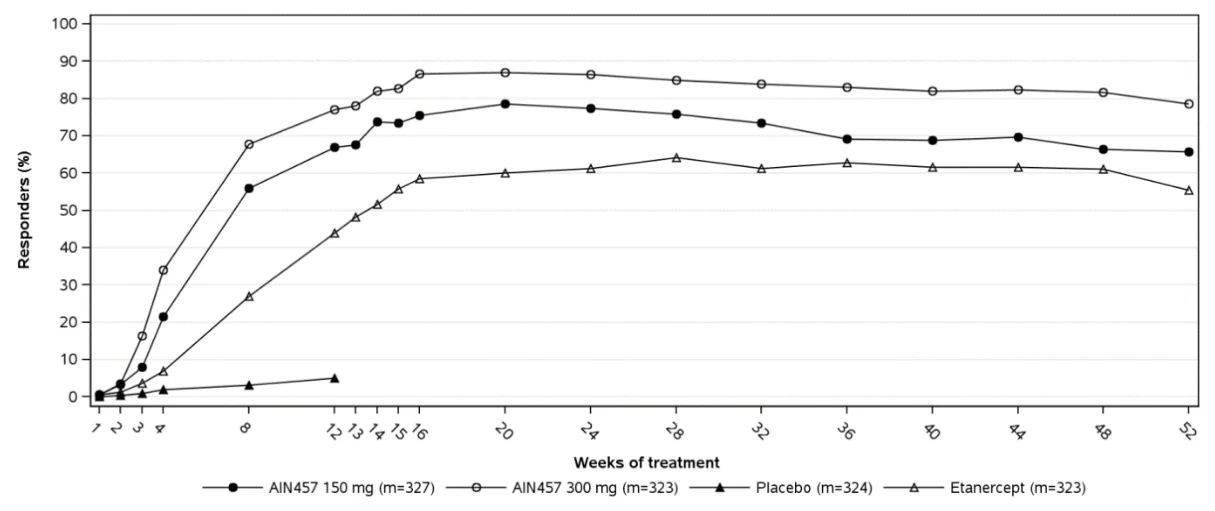
m = number of subjects evaluable
Among subjects who chose to participate (40%) in using the Psoriasis Symptom Diary, significant improvements in signs and symptoms of itching, pain and scaling at Week 12 were reported in COSENTYX – treated groups compared to placebo (ERASURE and FIXTURE).
Improvements at Week 12 from baseline compared to placebo (ERASURE, FIXTURE) and etanercept (FIXTURE) were demonstrated in the DLQI, these improvements were maintained for 52 weeks.
Other Clinical Trials
Effect in difficult-to-treat forms of psoriasis
TRANSFIGURE was a randomized, double-blind, placebo-controlled, parallel group, multicenter phase III study. Patients were adults with chronic moderate to severe plaque type psoriasis for at least 6 months prior to randomization including significant nail involvement defined by fingernail NAPSI ≥ 16 and number of fingernails involved ≥ 4 and a PASI score ≥ 12 and BSA ≥ 10%. Patients had to be candidates for systemic therapy defined as having psoriasis considered inadequately controlled by topical treatment and/or phototherapy and/or previous systemic therapy. Patients were randomized in a 1:1:1 ratio to receive COSENTYX 300 mg (N=66), 150 mg (N=67) or placebo (N=65). Randomization was stratified by body weight at Baseline Visit (< 90 kg or ≥ 90 kg). Dosing was by subcutaneous injection once weekly for 5 weeks (at Baseline, Weeks 1, 2, 3, and 4) followed by dosing every 4 weeks, starting at Week 8. The primary endpoint was percentage change from baseline at Week 16 in NAPSI score. The results, adjusted mean changes from baseline -46.1% for COSENTYX 300 mg vs. -11.7% for placebo (difference in adjusted means -34.4% [95% CI -45.2, -23.5]; p<0.0001), were statistically significant. At Week 16, all placebo patients were re-randomized to COSENTYX 150 mg or 300 mg and the study continued to 132 weeks. In this study, each 300 mg dose was administered as two injections of 150 mg.
GESTURE was a randomized, double-blind, placebo-controlled, parallel group, multicenter phase III study. Patients were adults with chronic moderate to severe plaque type psoriasis for at least 6 months including at baseline significant involvement of palms and soles as defined by a Palmoplantar Investigator’s Global Assessment (ppIGA) score of ≥ 3 (on a 5-point scale) and at least 1 extra psoriasis plaque on the skin. Patients were candidates for systemic therapy defined as having psoriasis considered inadequately controlled by topical treatment (including super potent topical corticosteroid) and/or phototherapy and/or previous systemic therapy. Patients were randomized 1:1:1 to receive COSENTYX 300 mg (N=69), COSENTYX 150 mg (N=68) or placebo (N=68). Randomization was stratified by body weight at Baseline Visit (< 90 kg or ≥ 90 kg). Dosing was by subcutaneous injection once weekly for 5 weeks (at Baseline, Weeks 1, 2, 3, and 4) followed by dosing every 4 weeks, starting at Week 8. The primary endpoint was ppIGA score of 0 (clear) or 1 (almost clear/minimal) response at Week 16 (to be considered a ppIGA responder at Week 16, a patient had a ppIGA score of 0 or 1 at the Week 16 visit and a reduction of at least 2 points on the ppIGA scale from baseline). The ppIGA scale was based on the IGA modified version 2011 specifically applied to the palms and soles; the ppIGA is a non-validated tool for the measurement of palmoplantar psoriasis severity. Superior efficacy was observed for COSENTYX 300 mg vs. placebo with respect to ppIGA 0 or 1 response at Week 16 (33.3% vs. 1.5%, respectively; p<0.0001). At Week 16 and at Week 80, patients treated with placebo who were not ppIGA 0 or 1 responders were re-randomized, to receive COSENTYX 150 mg or 300 mg. Patients in the COSENTYX treatment groups remained in the same groups. The study continued to 132 weeks. In this study, each 300 mg dose was administered as two injections of 150 mg.
In a randomized, double-blind, placebo-controlled, multicenter study (SCALP), COSENTYX was evaluated in 102 patients with moderate to severe scalp psoriasis, defined as having a Psoriasis Scalp Severity Index (PSSI) score of greater than or equal to 12, an IGA mod 2011 scalp only score of 3 or greater, and at least 30% of the scalp affected. In this study, 62% of patients had at least 50% or more of scalp surface area affected. The proportions of subjects achieving a PSSI 90 response at Week 12 were 52.9% and 2.0% for the COSENTYX 300 mg and the placebo groups (p<0.001), respectively. The proportions of subjects achieving an IGA scalp only score of 0 or 1 (clear or almost clear) at Week 12 were 56.9% and 5.9% for the COSENTYX 300 mg and the placebo groups (p<0.001), respectively. In this study, each 300 mg dose was administered as two injections of 150 mg.
300 mg/2 mL pre-filled syringe and 300 mg/2 mL pre-filled pen
Two randomized, double-blind, placebo-controlled studies in patients with plaque psoriasis were conducted to evaluate the safety and efficacy of secukinumab 300 mg when administered subcutaneously as a single 2 mL pre-filled syringe (ALLURE) or as a single 2 mL pre-filled pen (MATURE) compared to secukinumab 300 mg when administered as two subcutaneous injections in a 150 mg/1 mL pre-filled syringe. The co-primary endpoints were the proportion of patients who achieved a PASI 75 response and IGA mod 2011 ’clear’ or ‘almost clear’ response versus placebo at Week 12. The key secondary endpoint was the proportion of patients who achieved a reduction in PASI score of at least 90% (PASI 90) from baseline to Week 12.
In the ALLURE study, the proportion of subjects achieving a PASI 75 and an IGA mod 2011 0 or 1 responses at Week 12 were 88.9% and 76.4% for the secukinumab 300 mg/2mL pre-filled syringe group compared to 1.7% and 1.4% in the placebo group. In the MATURE study, the proportion of subjects achieving a PASI 75 and an IGA mod 2011 0 or 1 responses at Week 12 were 95.1% and 75.6% for the secukinumab 300 mg/2mL pre-filled pen group compared to 10% and 7.6% in the placebo group. PASI 90 response at Week 12 was achieved with secukinumab 300 mg/2mL pre-filled syringe compared to placebo in 66.7% versus 1.6% of subjects, respectively (ALLURE study), and secukinumab 300 mg/2mL pre-filled pen compared to placebo in 75.6% versus 5% of subjects, respectively (MATURE study).
Plaque Psoriasis Dose Flexibility
The efficacy, safety, and tolerability of COSENTYX 300 mg administered subcutaneously every 4 weeks vs. COSENTYX 300 mg administered every 2 weeks in adult patients weighing ≥ 90 kg with moderate to severe plaque psoriasis were assessed in a randomized, double-blind, multicenter 52-week study of 331 patients. Patients were randomized 1:1 as follows:
- secukinumab 300 mg at Weeks 0, 1, 2, 3, and 4 followed by the same dose every 2 weeks up to Week 52 (n=165).
- secukinumab 300 mg at Weeks 0, 1, 2, 3, and 4 followed by the same dose every 4 weeks up to Week 16 (n=166).
Patients randomized to receive secukinumab 300 mg every 4 weeks who were PASI 90 responders at Week 16 continued to receive the same dosing regimen up to Week 52. Patients randomized to receive COSENTYX 300 mg every 4 weeks who were PASI 90 non-responders at Week 16 either continued on the same dosing regimen, or were reassigned to receive COSENTYX 300 mg every 2 weeks up to Week 52.
Table 12 Summary of patient demographics for Study A2324
| Study # | Trial design | Dosage, route of administration and duration | Study subjects (N=number) | Mean age (Range) | Sex |
|---|---|---|---|---|---|
| A2324 | Randomized, double-blind, parallel-group, multicenter | Secukinumab 300 mg SC at Weeks 0, 1, 2, 3 and 4 then q 2 weeks up to Week 52 or secukinumab 300 mg SC at Weeks 0, 1, 2, 3 and 4 then q 4 weeks up to Week 16, after that PASI 90 responders received 300 mg q 4 weeks up to Week 52 and PASI non-responders received either 300 mg q 4 weeks, or were reassigned to receive 300 mg q 2 weeks up to Week 52. | N=331 | 47.1 (18-83) | M=248 F=83 |
Table 13 Baseline Disease Characteristics in Study A2324
Secukinumab 300 mg Q2W N=165 | Secukinumab 300 mg Q4W N=166 | |
| Median PASI | 18.5 | 18.3 |
| PASI > 20, n (%) | 72 (43.6) | 68 (41.0) |
| IGA of severe, n (%) | 66 (40.0) | 59 (35.5) |
| Psoriatic arthritis present, n (%) | 27 (16.4) | 24 (14.5) |
| Prior exposure to systemic therapy, n (%) | 105 (63.6) | 106 (63.9) |
| Failed to respond to systemic therapy, n (%)* | 85 (81.0) | 86 (81.1) |
| Prior exposure to biologic therapy, n (%) | 51 (30.9) | 46 (27.7) |
| Failed to respond to biologic therapy, n (%)* | 21 (41.2) | 27 (58.7) |
| Prior exposure to systemic therapy excluding biologics, n (%) | 84 (50.9) | 88 (53.0) |
| Failed to respond to systemic therapy excluding biologics, n (%)* | 79 (94.0) | 75 (85.2) |
* Percentage of patients who failed a treatment is calculated from the number of patients who received the treatment
Study Results:
In the study that enrolled patients weighing ≥90 kg, the primary and key secondary endpoints were the proportion of patients who achieved a PASI 90 response and IGA mod 2011 ‘clear’ or ‘almost clear’ (0 or 1) response at Week 16. At Week 16, the proportion of patients who were PASI 90 responders was higher in the group treated with the every 2 week regimen vs. the every 4 week regimen (73.2% vs. 55.5%, respectively). The treatment difference was clinically relevant and statistically significant (one-sided p-value = 0.0003). The proportion of patients who achieved an IGA mod 2011 ‘clear’ or ‘almost clear’ response was also higher but not statistically significant in the group treated with the every 2 week regimen vs. the group treated with the every 4 week regimen (74.2% vs. 65.9%, respectively).
In an exploratory analysis in patients ≥90 kg, PASI 90 non-responders at week 16 who were up-titrated to secukinumab 300 mg Q2W experienced improved response rates compared to those who remained on the secukinumab 300 mg Q4W dosing regimen.
Pediatric patients
Severe plaque psoriasis
As presented in Table 14, a randomized, double-blind, placebo and etanercept-controlled study was conducted in pediatric patients aged 6 to less than 18 years of age with severe plaque psoriasis, as defined by a PASI score ≥20, an IGA mod 2011 score of 4, and BSA involvement of ≥10%, who were candidates for systemic therapy.
Table 14 Summary of patient demographics for Study A2310
| Study # | Trial design | Dosage, route of administration and duration | Study subjects (N=number) | Mean age (Range) | Sex |
| Study A2310 | Multicenter, randomized, double-blind, parallel group, placebo- and active (etanercept)-controlled study. | Secukinumab low dose (75 mg for body weight <50 kg or 150 mg for body weight ≥50 kg), secukinumab high dose (75 mg for body weight <25 kg, 150 mg for body weight ≥25 kg and <50 kg, or 300 mg for body weight ≥50 kg), or placebo, SC at Weeks 0, 1, 2, 3, and 4 followed by the same dose every 4 weeks, or etanercept (0.8 mg/kg weekly, up to a maximum of 50 mg). | N=162 | 13.5 (6-17) | M= 65 F= 97 |
Study A2310 evaluated 162 patients who were randomized to receive either low dose of COSENTYX, high dose of COSENTYX placebo or etanercept (see Table 14 for dosing regimens). Approximately 43% had prior exposure to phototherapy, 53% to conventional systemic therapy, 2% had prior exposure to biologics, and 9% had concomitant psoriatic arthritis. Patient distribution by weight and age at randomisation is described in Table 15.
Table 15 Patient distribution by weight and age for pediatric psoriasis in Study A2310
| Randomisation strata | Description | Secukinumab low dose n=40 | Secukinumab high dose n=40 | Placebo n=41 | Etanercept n=41 | Total N=162 | |||||||||
|---|---|---|---|---|---|---|---|---|---|---|---|---|---|---|---|
| Age | 6-<12 years | 8 | 9 | 10 | 10 | 37 | |||||||||
| ≥12- <18 years | 32 | 31 | 31 | 31 | 125 | ||||||||||
| Weight | <25 kg | 2 | 3 | 3 | 4 | 12 | |||||||||
| ≥25-<50 kg | 17 | 15 | 17 | 16 | 65 | ||||||||||
| ≥50 kg | 21 | 22 | 21 | 21 | 85 | ||||||||||
Patients randomized to receive placebo who were non-responders at Week 12 were switched to either the secukinumab low or high dose group (dose based on body weight group) and received study drug at Weeks 12, 13, 14, and 15, followed by the same dose every 4 weeks starting at Week 16. All patients were followed for efficacy and safety during the 52 weeks following the first dose.
As presented in Table 16, an open label, two-arm, parallel group, multicentre phase III study enrolled 84 pediatric patients 6 to less than 18 years of age with moderate to severe plaque psoriasis (as defined by a PASI score ≥12, an IGA mod 2011 score of ≥3, and involving ≥10% of the body surface area) who were candidates for systemic therapy. All patients were followed for efficacy and safety for at least 24 weeks following first administration.
Table 16 Summary of patient demographics for Study A2311
| Study # | Trial design | Dosage, route of administration and duration | Study subjects (N=number) | Mean age (Range) | Sex |
| Study A2311 | Multicenter, randomized, open label, two-arm, parallel group study. | Secukinumab low dose (75 mg for body weight <50 kg or 150 mg for body weight ≥50 kg), secukinumab high dose (75 mg for body weight <25 kg, 150 mg for body weight ≥25 kg and <50 kg, or 300 mg for body weight ≥50 kg) SC at Weeks 0, 1, 2, 3, and 4 followed by the same dose every 4 weeks. | N=84 | 12.6 (6-17) | M= 39 F= 45 |
Study Results:
Study A2310
The co-primary endpoints at Week 12 were the proportion of patients treated with a low and high dose of COSENTYX who achieved a PASI 75 response and IGA mod 2011 ’clear’ or ‘almost clear’ (0 or 1) response versus placebo. The key secondary endpoint at Week 12 was the proportion of patients who achieved a PASI 90 response.
At Week 12, the efficacy of both the low and the high dose of secukinumab was comparable for the co-primary endpoints. The risk ratio estimates in favour of both secukinumab doses were statistically significant for both the PASI 75 and IGA mod 2011 0 or 1 responses (see Table 17).
Table 17 Summary of Clinical Response in Severe Pediatric Psoriasis at Week 12*
| Response criterion | Treatment comparison | 'test' | 'control' | Risk ratio | |||||||||
| 'test' vs. 'control' | n**/m (%) | n**/m (%) | estimate (95% CI) | p-value*** | |||||||||
| At week 12 | |||||||||||||
| PASI 75 | Secukinumab Low dose vs. Placebo | 32/40 (80.1) | 6/41(14.9) | 5.37 (2.52, 11.44) | <.0001 | ||||||||
| Secukinumab High dose vs. Placebo | 32/40 (80.2) | 6/41(14.9) | 5.38 (2.53, 11.45) | <.0001 | |||||||||
| Secukinumab Low dose vs. Etanercept | 32/40 (80.1) | 27/41 (65.7) | 1.22 (0.92, 1.62) | ||||||||||
| Secukinumab High dose vs. Etanercept | 32/40 (80.2) | 27/41 (65.7) | 1.22 (0.92, 1.62) | ||||||||||
| IGA 0/1 | Secukinumab Low dose vs. Placebo | 28/40 (69.8) | 3/41 (6.3) | 11.34 (3.06, 42.02) | <.0001 | ||||||||
| Secukinumab High dose vs. Placebo | 25/40(62.6) | 3/41(6.3) | 10.17 (2.72, 37.97) | <.0001 | |||||||||
| Secukinumab Low dose vs. Etanercept | 28/40 (69.8) | 15/41 (36.3) | 1.93 (1.20, 3.08) | ||||||||||
| Secukinumab High dose vs. Etanercept | 25/40(62.6) | 15/41 (36.3) | 1.73 (1.06, 2.80) | ||||||||||
| PASI 90 | Secukinumab Low dose vs. Placebo | 28/40(71.1) | 1/41(2.5) | 28.55 (4.08, 199.83) | <.0001 | ||||||||
| Secukinumab High dose vs. Placebo | 28/40(69.3) | 1/41(2.5) | 27.82 (3.97, 194.83) | <.0001 | |||||||||
| Secukinumab Low dose vs. Etanercept | 28/40(71.1) | 13/41 (31.4) | 2.27 (1.36, 3.77) | ||||||||||
| Secukinumab High dose vs. Etanercept | 28/40(69.3) | 13/41 (31.4) | 2.21 (1.33, 3.68) | ||||||||||
* multiple imputation was used to handle missing values ** n is the rounded mean number of responders for 100 imputations, m = number of subjects evaluable. *** The family-wise type I error was set to 2.5% (one-sided) and each hypothesis of secukinumab Low or High dose compared to Placebo was tested sequentially at 1.25% with respect to the co-primary and key secondary endpoints, and p-value is from an exact logistic regression model with treatment group, baseline body-weight category and age category as factors. | |||||||||||||
Patients were followed for efficacy and safety up to 52 weeks following the first dose. Results for the co-primary endpoints and key secondary endpoint at Week 52 were consistent with those observed at Week 12. The safety profiles of the low dose and the high dose were comparable.
At Week 24, the PASI 75 response was 94.9% for COSENTYX low dose and 91.0% for COSENTYX high dose. At the same time point, the IGA 0 or 1 response was 89.6% for COSENTYX low dose and 78.3% for COSENTYX high dose. PASI 90 response at Week 24 was 84.4% for COSENTYX low dose and 80.2% for COSENTYX high dose. By week 52 the PASI 75 response was 89.8% for COSENTYX low dose and 91.2% for COSENTYX high dose. At the same time point, the IGA 0 or 1 response was 74.5% for COSENTYX low dose and 78.1% for COSENTYX high dose. PASI 90 response at Week 52 was 76.5% for COSENTYX low dose and 82.6% for COSENTYX high dose.
Pediatric patients treated with COSENTYX reported an improvement in health-related quality of life as measured by a CDLQI (Children’s Dermatology Life Quality Index) score of 0 or 1 (indicating no impairment) compared to placebo at Week 12 (COSENTYX low dose 44.7%, COSENTYX high dose 50%, placebo 15%).
Study A2311
The co-primary endpoints were the proportion of patients who achieved a reduction in PASI score of at least 75% (PASI 75) and IGA mod 2011 ‘clear’ or ‘almost clear’ (0 or 1) with at least a 2 point improvement from baseline to Week 12. Key secondary endpoint included PASI 90 response at Week 12.
At Week 12, the efficacy of both the low and the high dose of secukinumab was comparable for the co-primary endpoints (see Table 18).
Patients were followed for efficacy for 24 weeks following first administration. Results for the co-primary endpoints and key secondary endpoint at Week 24 were consistent with those observed at Week 12. The safety profiles of the low dose and the high dose were comparable.
Table 18 Summary of clinical response in moderate to severe pediatric psoriasis at Weeks 12*
| Week 12 | |||||||
Secukinumab low dose | Secukinumab high dose | ||||||
| Number of patients | 42 | 42 | |||||
| PASI 75 response n (%) | 39 (92.9%) | 39 (92.9%) | |||||
| IGA mod 2011 ‘clear’ or ‘almost clear’ response n (%) | 33 (78.6%) | 35 (83.3%) | |||||
| PASI 90 response n (%) | 29 (69.0%) | 32 (76.2%) | |||||
| * non-responder imputation was used to handle missing values | |||||||
14.1.2 Psoriatic arthritis
The safety and efficacy of COSENTYX were assessed in 1,999 patients in three randomized, double-blind, placebo-controlled phase III studies in adult patients, age 18 years and older with active psoriatic arthritis (≥ 3 swollen and ≥ 3 tender joints) despite non-steroidal anti-inflammatory drug (NSAID), corticosteroids or disease-modifying anti-rheumatic drug (DMARD) therapy. Patients in these studies had a diagnosis of PsA of at least five years. The majority of patients also had active psoriasis skin lesions or a documented history of psoriasis. Over 61% and 43% of the PsA patients had enthesitis and dactylitis at baseline.
PsA1 Study (FUTURE 1) evaluated 606 patients, of whom 60.7% had concomitant MTX. Patients with each subtype of PsA were enrolled, including polyarticular arthritis with no evidence of rheumatoid nodules (76.7%), spondylitis with peripheral arthritis (18.5%), asymmetric peripheral arthritis (60.2%), distal interphalangeal involvement (59.6%) and arthritis mutilans (7.9%). 29% (N=178) of patients were previously treated with an anti-TNF-alpha agent and discontinued the anti-TNF-alpha agent for either lack of efficacy or intolerance. Patients randomized to COSENTYX received 10 mg/kg, i.v. at Weeks 0, 2, and 4, followed by either 75 mg or 150 mg s.c. every month starting at Week 8. Patients receiving placebo were re-randomized to receive COSENTYX (either 75 mg or 150 mg every 4 weeks) at Week 16 or Week 24 based on responder status (≥ 20% improvement from baseline in both tender and swollen joint counts).
PsA2 Study (FUTURE 2) evaluated 397 patients, of whom 46.6% had concomitant MTX. Patients with each subtype of PsA were enrolled, including polyarticular arthritis with no evidence of rheumatoid nodules (85.9%), spondylitis with peripheral arthritis (21.7%), asymmetric peripheral arthritis (64.0%), distal interphalangeal involvement (57.9%) and arthritis mutilans (6.3%). 35% (N=139) of patients were previously treated with an anti-TNF-alpha agent and discontinued the anti-TNF-alpha agent for either lack of efficacy or intolerance. Patients randomized to COSENTYX received 75 mg, 150 mg or 300 mg s.c. at Weeks 0, 1, 2, 3, and 4 followed by the same dose every month. Patients receiving placebo were re-randomized to receive COSENTYX (either 150 mg or 300 mg every 4 weeks) at Week 16 or Week 24 based on responder status (≥ 20% improvement from baseline in both tender and swollen joint counts).
The two studies had the same primary endpoint: the percentage of patients achieving at least a 20% improvement in the American College of Rheumatology (ACR 20) criteria at Week 24. The key secondary endpoints were PASI 75, PASI 90, DAS28-CRP, SF-36, HAQ-DI, ACR 50, presence of dactylitis, and presence of enthesitis. Structural damage was also followed radiographically in the PsA1 Study by measuring the mean change in modified Total Sharp score (mTSS).
PsA3 Study (FUTURE 5) evaluated 996 patients, of whom 50.1% had concomitant MTX treatment. Patients with each subtype of PsA were enrolled, including polyarticular arthritis with no evidence of rheumatoid nodules (78.7%), spondylitis with peripheral arthritis (19.8%), asymmetric peripheral arthritis (65%), distal interphalangeal involvement (56.7%) and arthritis mutilans (6.8%). Patients were randomized to receive COSENTYX 150 mg, 300 mg, or placebo s.c. at Weeks 0, 1, 2, 3 and 4 followed by the same dose every month, or a once monthly injection of COSENTYX 150 mg. Patients treated with placebo received COSENTYX, either 150 mg or 300 mg, s.c., per baseline randomization, at Week 16 or Week 24 based upon responder status. The primary endpoint was ACR 20 response at Week 16. Structural damage was followed radiographically in the PsA3 study by measuring the key secondary endpoint of change from baseline in modified Total Sharp Score (mTSS) at Week 24. The other key secondary endpoints were PASI 75, PASI 90, DAS28-CRP, SF-36, HAQ-DI, ACR 50, presence of dactylitis, and presence of enthesitis.
The evidence indicates that there are no differences in ACR20 responses with the intravenous loading dose regimen compared to the subcutaneous (SC) loading dose regimen. COSENTYX is NOT recommended for use with an intravenous (IV) loading dose (see 4 Dosage and Administration).
Axial manifestations in psoriatic arthritis
A randomized, double-blind, placebo-controlled study (MAXIMISE) assessed the efficacy of secukinumab in 485 PsA patients with axial manifestations (axPsA) who were naive to biologic treatment and responded inadequately to NSAIDs. The clinical diagnosis of axPsA was based on the presence of active spinal disease defined by Bath Ankylosing Spondylitis Disease Activity Index (BASDAI) score ≥ 4, spinal pain Visual Analogue Scale (VAS) ≥ 40, and inadequate response to ≥ 2 NSAIDs over a period of 4 weeks. The mean time since first diagnosis of axPsA was 3 years. Patients randomized to COSENTYX received 150 mg or 300 mg s.c. at Weeks 0, 1, 2, 3, and 4 followed by the same dose every month. Patients were allowed to continue pre-study NSAIDs, methotrexate (MTX), and corticosteroids at a stable dose from baseline through to the end of study. The primary variable of at least 20% improvement in Assessment of SpondyloArthritis international Society (ASAS) criteria at Week 12.
Table 19 Summary of Trial Design and Patient Demographics for Clinical Trials in Psoriatic Arthritis
| Study # | Trial design | Dosage, route of administration and duration | Study subjects (N=number) | Mean age (Range) | Sex |
| Study # | Trial design | Dosage, route of administration and duration | Study subjects (N=number) | Mean age (Range) | Sex |
Study 1 (FUTURE 1) | Randomized, double-blind, placebo-controlled, multicenter | Secukinumab IV loading dose (10 mg/kg) or PBO at Wks 0, 2, 4 followed by 75 mg s.c., 150 mg s.c., or PBOa q month. Secukinumab 75 mg: N=202 Secukinumab 150 mg: N=202 Placebo: N=202 | N=606 | 49.0 (20-77) | M= 276 (45.5%) F= 330 (54.5%) |
Study 2 (FUTURE 2) | Randomized, double-blind, placebo-controlled, multicenter | Secukinumab SC loading dose of 75 mg, 150 mg, 300 mg or PBO at Wks 0, 1, 2, 3, 4 followed by 75 mg s.c., 150 mg s.c., 300 mg s.c., or PBOb q month. Secukinumab 75 mg: N=99 Secukinumab 150 mg: N=100 Secukinumab 300 mg: N=100 Placebo: N=98 | N=397 | 48.0 (20-77) | M= 192 (48.4%) F= 205 (51.6%) |
| Study 3 (FUTURE 5) | Randomized, double-blind, placebo-controlled, multicenter | Secukinumab 150 mg s.c. q4w from Wk 0 to Wk 24 + PBO s.c. at Wks 1, 2 and 3; then q4w from Wk 4 to Wk 24 (N=222) Secukinumab 150 mg s.c. + PBO at Wks 0, 1, 2, and 3; then q4w from Wk 4 to Week 24 (secukinumab) (N=220) Secukinumab 300 mg s.c. at Wks 0, 1, 2, and 3, then q4w from Wk 4 to Wk 24 (N=222) PBO s.c. at Wks 0, 1, 2, and 3; then q4w from Wk 4 to 12 or Wk 20 (N=332) | N=996 | 48.8 (19-81) | M= 500 (50.2%) F= 496 (49.8%) |
| Study 4 (MAXIMISE) | Randomized, double-blind, placebo-controlled, multicenter | Secukinumab 150 mg + PBO s.c. at Baseline, Week 1, 2, 3 and 4, then 4 weeks later at Week 8; then q4w from Week 12 to Week 52. Secukinumab 300 mg s.c. at Baseline, Week 1, 2, 3 and 4, then 4 weeks later at Week 8; then q4w from Week 12 to Week 52. PBO s.c. at Baseline, Week 1, 2, 3 and 4, then 4 weeks later at Week 8; then Secukinumab 150 mg + PBO s.c. q4w from Week 12 to Week 52 OR Secukinumab 300 mg q4w from Week 12 to Week 52 | N=485 | 46.5 (18-78) | M= 240 (49.4%) F= 245 (50.6%) |
a PBO non-responders (< 20% improvement from baseline in tender or swollen joint counts) were re-randomized 1:1 at Wk 16 to receive either secukinumab 75 mg or 150 mg s.c. every 4 Wks; PBO responders at Wk 16 were re-randomized 1:1 at Wk 24 to receive either secukinumab 75 mg or 150 mg s.c. every 4 Wks.
b PBO non-responders (< 20% improvement from baseline in tender or swollen joint counts) were re-randomized 1:1 at Wk 16 to receive either secukinumab 150 mg or 300 mg s.c. every 4 Wks; PBO responders at Wk 16 were re-randomized 1:1 at Wk 24 to receive either secukinumab 150 mg or 300 mg every 4 Wks.
Study Results:
Signs and symptoms
Patients treated with COSENTYX 150 mg and 300 mg subcutaneous (SC) dosing demonstrated greater improvements in ACR 20 and ACR 50 response compared to placebo at Week 24 (see Table 20).
Table 20 Clinical response in Study PsA2 at Week 24
Placebo (N=98) | COSENTYX 150 mg (N=100) | COSENTYX 300 mg (N=100) | ||||||||
|---|---|---|---|---|---|---|---|---|---|---|
| ACR 20 response % (n) | 15% (15) | 51% (51) | 54% (54) | |||||||
| Difference from placebo (95% CI) | - | 36% (24%, 48%) | 39% (27%, 51%) | |||||||
| p-valuea | - | p<0.0001 | p<0.0001 | |||||||
| ACR 50 response % (n) | 7% (7) | 35% (35) | 35% (35) | |||||||
| Difference from placebo (95% CI) | - | 28%b (18%, 38%) | 28% b (17%, 38%) | |||||||
| ACR 70 response % (n) | 1% (1) | 21% (21) | 20% (20) | |||||||
| Difference from placebo (95% CI) | - | 20% b (12%, 28%) | 19% b (11%, 27%) | |||||||
ACR: American College of Rheumatology a p-value is based on the logistic regression with treatment and TNF-alpha inhibitor status as factors and baseline weight as a covariate. Type 1 error rate controlled using a hierarchical testing strategy. b 95% confidence intervals for ACR 50 and ACR 70 are not adjusted for multiplicity testing. Patients who met escape criteria (less than 20% improvement in tender or swollen joint counts) at Week 16 were considered non-responders at Week 24. Premature discontinuation from the placebo-controlled portion period (24 weeks) for any reason: placebo 10.2% (10/98), COSENTYX 150 mg 5% (5/100) and COSENTYX 300 mg 3% (3/100). All patients who prematurely discontinued, for any reason, were considered non-responders for ACR 20, ACR 50, and ACR 70. Concomitant methotrexate usage: placebo 51% (50/98), COSENTYX 150 mg 44% (44/100) and COSENTYX 300 mg 44% (44/100). | ||||||||||
The onset of action of COSENTYX occurred as early as Week 2 and was maintained up to Week 52.
The percentage of patients achieving ACR 20 response, by visit, up to Week 24 is shown in Figure 2.
Figure 2 Percent of patients achieving ACR 20 response through Week 24 in Study PsA2
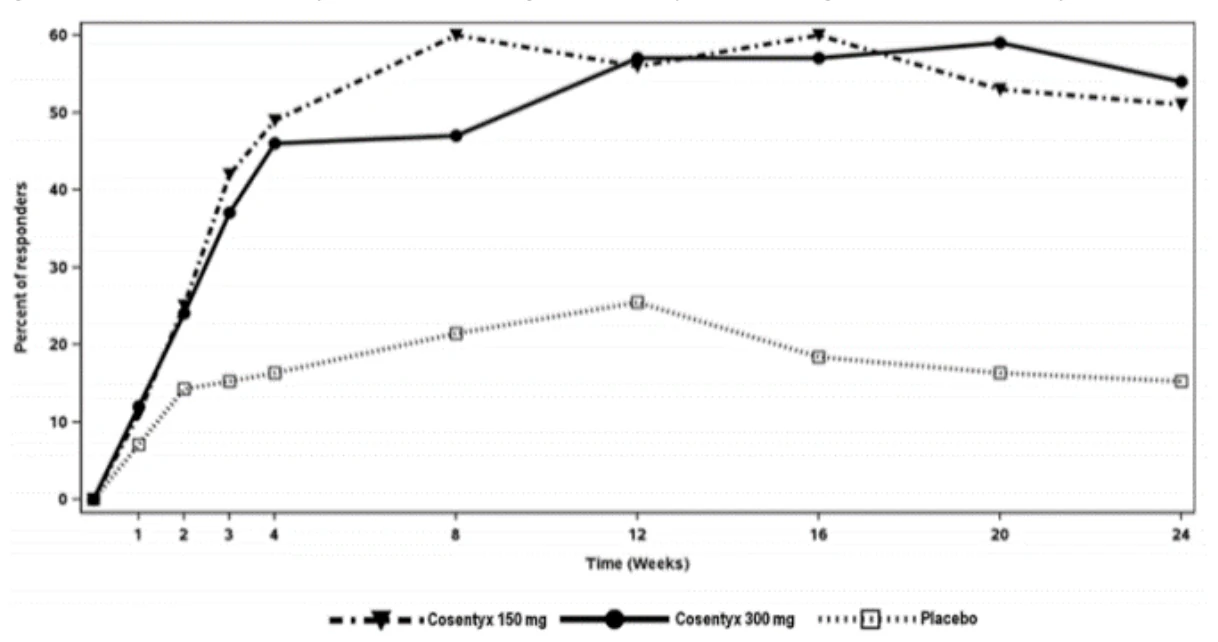
Patients who met escape criteria (less than 20% improvement in tender or swollen joint counts) at Week 16 were considered non-responders at Week 24.
The results of the components of the ACR response criteria are shown in Table 21.
Table 21 Mean change from baseline in ACR components in Study PsA2 at Week 24
COSENTYX 150 mg (N=100) | COSENTYX 300 mg (N=100) | Placebo (N=98) | ||||||||||||||
|---|---|---|---|---|---|---|---|---|---|---|---|---|---|---|---|---|
COSENTYX 150 mg (N=100) | COSENTYX 300 mg (N=100) | Placebo (N=98) | ||||||||||||||
Baseline Mean | Change from baseline at Week 24 Mean (SE) | Baseline Mean | Change from baseline at Week 24 Mean (SE) | Baseline Mean | Change from baseline at Week 24 Mean (SE) | |||||||||||
Baseline Mean | Change from baseline at Week 24 Mean (SE) | Baseline Mean | Change from baseline at Week 24 Mean (SE) | Baseline Mean | Change from baseline at Week 24 Mean (SE) | |||||||||||
Number of swollen joints (Scale 0 to 76) | 11.9 | -6.32d (0.618) | 11.2 | -7.28d (0.619) | 12.1 | -5.14d (0.867) | ||||||||||
Number of tender joints (Scale 0 to 78) | 24.1 | -11.42d (1.25) | 20.2 | -10.84d (1.25) | 23.4 | -4.28d (1.74) | ||||||||||
| Patient’s assessment of paina | 58.9 | -23.39d (2.25) | 57.7 | -22.35d (2.26) | 55.4 | -11.71d (3.18) | ||||||||||
| Patient global assessmenta | 62.0 | -25.78d (2.19) | 60.7 | -26.70d (2.21) | 57.6 | -10.14d (3.07) | ||||||||||
| Physician global assessmenta | 56.7 | -32.97d (1.82) | 55.0 | -38.52d (1.840) | 55.0 | -25.23d (2.526) | ||||||||||
| Disability Index (HAQ)b | 1.22 | -0.48d (0.05) | 1.28 | -0.56d (0.05) | 1.17 | -0.31d (0.06) | ||||||||||
| CRP (mg/L)c | 14.42 | -8.82 (27.30) e | 11.08 | -7.00 (14.76) e | 8.17 | -2.42 (8.79)e | ||||||||||
a Visual analog scale; 0=best, 100=worst b Disability index of the Health Assessment Questionnaire (HAQ); 0 = best, 3 = worst; measures the patient’s ability to perform the following: dress/groom, arise, eat, walk, reach, grip, maintain hygiene, and maintain daily activity. c Mean change based upon observed data at Week 24; placebo patients include PBO non-responders (less than 20% improvement in tender or swollen joint counts) who began receiving secukinumab at Week 16. | ||||||||||||||||
d (LS) mean treatment change from baseline e Standard deviation | ||||||||||||||||
Of patients who received COSENTYX 150 mg, 300 mg or placebo, 65% (N=193/298) were anti-TNF-alpha-naïve patients and 35% (N=105/298) were anti-TNF-alpha inadequate responder (IR) patients.
For anti-TNF-alpha-naïve patients, ACR 20 responses at Week 24 were 63.5% (N=40/63), 58.2% (N=39/67) and 15.9% (N=10/63) for COSENTYX 150 mg, 300 mg, and placebo, respectively.
For anti-TNF-alpha-IR patients, ACR 20 responses at Week 24 were 29.7% (N=11/37), 45.5% (N=15/33) and 14.3% (N=5/35) in for COSENTYX 150 mg, 300 mg and placebo, respectively.
Patients treated with COSENTYX 150 mg and 300 mg subcutaneous (SC) dosing demonstrated greater improvements in ACR 20 and ACR 50 compared to placebo at Week 16 (see Table 22). Improvement was maintained to Week 24.
Table 22 Clinical response in Study PsA3 at Week 16
Placebo (N=332) | COSENTYX 150 mg (N=220) | COSENTYX 300 mg (N=222) | ||||||||
|---|---|---|---|---|---|---|---|---|---|---|
| Week 16 | ||||||||||
| ACR 20 response % (n) | 27.4 (91) | 55.5 (122) | 62.6 (139) | |||||||
| Difference from placebo (95% CI) | - | 28.0% (19.9%, 36.2%) | 35.2% (27.2%, 43.2%) | |||||||
| p-valuea | - | p<0.0001 | p<0.0001 | |||||||
| ACR 50 response % (n) | 8.1 (27) | 35.9 (79) | 39.6 (88) | |||||||
| Difference from placebo (95% CI) | - | 27.8% (20.8%, 34.8%) | 31.5% (24.4%, 38.6%) | |||||||
ACR: American College of Rheumatology a p-value is based on the logistic regression with treatment and TNF-alpha inhibitor status as factors and baseline weight as a covariate. Type 1 error rate controlled using a hierarchical testing strategy | ||||||||||
The percentage of patients achieving ACR 20 response, by visit, up to Week 16 is shown in Figure 3.
Figure 3 Percent of patients achieving ACR 20 response through Week 16 in Study PsA3
The results of the components of the ACR response criteria are shown in Table 23.
Table 23 Mean change from baseline in ACR components in Study PsA3 at Week 16
COSENTYX 150 mg (N=220) | COSENTYX 300 mg (N=222) | Placebo (N=332) | |||||||||||
|---|---|---|---|---|---|---|---|---|---|---|---|---|---|
Baseline Mean | Change from Baseline | Baseline Mean | Change from Baseline | Baseline Mean | Change from Baseline | ||||||||
Week 16 Mean (SE) | Week 16 Mean (SE) | Week 16 Mean (SE) | |||||||||||
Number of swollen joints (Scale 0 to 76) | 12.1 | -6.66 (0.450) | 10.0 | -7.16 (0.449) | 11.7 | -4.54 (0.375) | |||||||
Number of tender joints (Scale 0 to 78) | 21.2 | -9.75 (0.818) | 19.8 | -10.76 ( 0.816) | 21.2 | -5.61 (0.680) | |||||||
| Patient’s assessment of paina | 56.5 | -18.03 (1.603) | 52.8 | -20.79 (1.594) | 53.6 | -6.50 (1.337) | |||||||
| Patient global assessmenta | 53.9 | -13.90 (1.638) | 55.0 | -17.84 (1.630) | 52.5 | -5.62 (1.369) | |||||||
| Physician global assessmenta | 57.7 | -30.50 (1.464) | 55.4 | -34.40 (1.460) | 54.3 | -15.38 ( 1.209) | |||||||
| Disability Index (HAQ)b | 1.27 | -0.44 (0.035) | 1.21 | -0.55 (0.035) | 1.26 | -0.21 (0.029) | |||||||
| CRP (mg/L)c | 13.60 | -8.87 (20.63)d | 9.92 (17.50)d | -5.70 (16.32)d | 13.09 (27.32)d | -2.05 (20.64)d | |||||||
a Visual analog scale; 0=best, 100=worst b Disability index of the Health Assessment Questionnaire (HAQ); 0 = best, 3 = worst; measures the patient’s ability to perform the following: dress/groom, arise, eat, walk, reach, grip, maintain hygiene, and maintain daily activity. c Mean change based upon observed data at Week 24; placebo patients include PBO non-responders (less than 20% improvement in tender or swollen joint counts) who began receiving secukinumab at Week 16. d Standard deviation |
|---|
Radiographic Response
In PsA3 Study, inhibition of progression of structural damage was assessed radiographically and expressed by the modified Total Sharp Score (mTSS) and its components, the Erosion Score (ES) and the Joint Space Narrowing Score (JSN), at Week 24 compared to baseline. Radiographs of hands, wrists, and feet were obtained at baseline, Week 16 and/or Week 24 and scored independently by at least two readers who were blinded to treatment group and visit number. COSENTYX 150 mg and 300 mg treatment inhibited the rate of progression of peripheral joint damage compared with placebo treatment as measured by the change from baseline in mTSS at Week 24 (see Table 24).
Table 24 Rate of Change per 24 Weeks in Modified Total Sharp Score
| Treatment | n | Rate of Change per 24 weeks | Difference From Placebo (95% CI) |
| Secukinumab 150 mg No Load (N = 222) | 210 | -0.09 | -0.58 (-0.92, -0.24) |
| Secukinumab 150 mg With Load (N = 220) | 213 | 0.14 | -0.34 (-0.68, 0.00) |
| Secukinumab 300 mg With Load (N = 222) | 217 | 0.03 | -0.45 (-0.79, -0.12) |
| Placebo (N = 332) | 301 | 0.48 |
N – number of subjects randomized
n – number of subjects included in the analysis
CI – confidence interval
Results from a linear mixed effects model that included data after escape for placebo subjects who received escape therapy at Week 16. The model assumes approximately linear progression over time and estimates a difference in rates (slopes) of progression over 24 weeks to compare treatment arms.
Patient Reported Outcomes
In PsA2 Study, the mean change from baseline in the Disease Activity Index Score 28 using C-reactive protein (DAS28-CRP) at Week 24 was -1.58 and -0.96 in patients treated with COSENTYX 150 mg and placebo, respectively.
In patients with coexisting plaque psoriasis (≥ 3% skin involvement with psoriasis at baseline), the proportion of patients who responded based on Psoriasis Area Severity Index 75 (PASI 75) were 48% (N=28/58) and 16% (N=7/43) in the COSENTYX 150 mg and placebo groups, respectively.
In PsA2 Study, the mean change from baseline by Week 24 in Health Assessment Questionnaire-Disability Index (HAQ-DI) was -0.48 vs. -0.31 in patients treated with COSENTYX 150 mg and patients treated with placebo, respectively. The proportion of patients who achieved at least -0.3 improvement in HAQ-DI score from baseline was 46% (N=46/100) in COSENTYX 150 mg group, compared with 16.3% (N=16/99) in the placebo group.
COSENTYX -treated patients reported improvements in health-related quality of life as measured by the SF-36 Physical Component Summary at Week 24 as compared to placebo.
Axial manifestations in psoriatic arthritis
The primary variable of at least a 20% improvement in Assessment of SpondyloArthritis International Society (ASAS 20) criteria at week 12 was met. Treatment with secukinumab 150 mg or 300 mg compared to placebo resulted in clinically meaningful improvement in signs and symptoms (including greater decreases from baseline in spinal pain) and improvement in physical function (see Table 25).
Table 25 Clinical response on MAXIMISE Study at Week 12
Placebo (n=164) | 150 mg (n=157) | 300 mg (n=164) | |||||||
|---|---|---|---|---|---|---|---|---|---|
ASAS 20 response, % (95% CI) | 31.2 (24.6, 38.7) | 66.3* (58.4, 73.3) | 62.9* (55.2, 70) | ||||||
ASAS 40 response, % (95% CI) | 12.2 (7.8, 18.4) | 39.5 (32.1, 47.4) | 43.6 (36.2, 51.3) | ||||||
BASDAI 50, % (95% CI) | 9.8 (5.9, 15.6) | 32.7 (25.8, 40.5) | 37.4 (30.1, 45.4) | ||||||
Spinal pain, VAS (95% CI) | -13.6 (-17.2, -10) | -28.5 (-32.2, -24.8) | -26.5 (-30.1, -22.9) | ||||||
Physical function, HAQDI (95% CI) | -0.155 (-0.224, -0.086) | -0.330 (-0.401, -0.259) | -0.389 (-0.458, -0.320) | ||||||
| * p<0.0001; ASAS: Assessment of SpondyloArthritis International Society Criteria; BASDAI: Bath Ankylosing Spondylitis Disease Activity Index; VAS: Visual Analog Scale; HAQDI: Health Assessment Questionnaire – Disability Index | |||||||||
Improvement in ASAS 20 and ASAS 40 for both secukinumab doses were observed by Week 4 and were maintained up to 52 weeks.
14.1.3 Axial spondyloarthritis (axSpA)
Ankylosing spondylitis (AS, radiographic axial spondyloarthritis)
The safety and efficacy of COSENTYX were assessed in 816 patients in three randomized, double-blind, placebo-controlled phase III studies in adult patients (mean age: 42 yrs, range: 18-77 yrs.) with active ankylosing spondylitis (AS) with a BASDAI ≥ 4 despite non-steroidal anti-inflammatory drug (NSAID), corticosteroid or disease-modifying anti-rheumatic drug (DMARD) therapy. Patients in the AS1 Study and AS2 Study had a diagnosis of AS for a median of 2.7 to 5.8 years.
AS1 Study (MEASURE 1) evaluated 371 patients, of whom 14.8% and 33.4% used concomitant MTX or sulfasalazine, respectively. 27.0% of patients enrolled in the study were previously treated with an anti-TNF-alpha agent who either discontinued due to lack of efficacy or intolerance. Patients randomized to COSENTYX received 10 mg/kg, i.v. at Weeks 0, 2, and 4, followed by either 75 mg or 150 mg s.c. every month. Patients receiving placebo were re-randomized to receive COSENTYX (either 75 mg or 150 mg every 4 weeks) at Week 16 or Week 24 based on ASAS 20 response.
AS2 Study (MEASURE 2) evaluated 219 patients, of whom 11.9% and 14.2% used concomitant MTX or sulfasalazine, respectively. 38.8% of patients enrolled in the study were previously treated with an anti-TNF-alpha agent who either discontinued due to lack of efficacy or intolerance. Patients randomized to COSENTYX received 75 mg or 150 mg s.c. at Weeks 0, 1, 2, 3, and 4 followed by the same dose every month. At Week 16, patients who were randomized to placebo at baseline were re-randomized to receive COSENTYX (either 75 mg or 150 mg) s.c. every month. The two studies had the same primary endpoint: the percentage of patients achieving at least a 20% improvement in ASAS 20 criteria at Week 16. The secondary endpoints were ASAS 40, hsCRP, ASAS 5/6, total BASDAI, SF-36 PCS, ASQoL, and ASAS partial remission.
AS3 Study (MEASURE 3) evaluated 226 patients, of whom 13.3% and 23.5% used concomitant MTX or sulfasalazine, respectively. Patients randomized to COSENTYX received 10 mg/kg, i.v. at Weeks 0, 2, and 4, followed by either 150 mg or 300 mg s.c. every month. At Week 16, patients who were randomized to placebo at baseline were re-randomized to receive COSENTYX (either 150 mg or 300 mg) s.c. every month. The primary endpoint was ASAS20 at Week 16. Patients were blinded to the treatment regimen up to Week 52, and the study continued to Week 156.
The evidence indicates that there are no differences in ASAS 20 responses with the intravenous loading dose regimen compared to the subcutaneous (SC) loading dose regimen. COSENTYX is NOT recommended for use with an intravenous (IV) loading dose (see 4 Dosage and Administration).
Table 26 Summary of Patient Demographics for Clinical Trials in Specific Indication
| Study # | Trial design | Dosage, route of administration and duration | Study subjects (N=number) | Mean age (Range) | Sex | |
| Study # | Trial design | Dosage, route of administration and duration | Study subjects (N=number) | Mean age (Range) | Sex | |
| AS1 Study (MEASURE 1) | Randomized, double-blind, placebo-controlled, multicenter | Secukinumab iv loading dose 10 mg/kg or PBO Wks 0, 2, 4 followed by 75 mg sc, 150 mg sc, or PBOa, b q month Secukinumab 75 mg: N=124 Secukinumab 150 mg: N=125 Placebo: N=122 | N=371 | 41.8 (18-76) | M= 257 (69%) F= 114 (31%) | |
| AS2 Study (MEASURE 2) | Randomized, double-blind, placebo-controlled, multicenter | Secukinumab sc loading dose of 75 mg, 150 mg, or PBO Wks 0, 1, 2, 3 followed by 75 mg sc, 150 mg sc, or PBOc q month Secukinumab 75 mg: N=73 Secukinumab 150 mg: N=72 Placebo: N=74 | N=219 | 43.3 (19-77) | M= 153 (70%) F= 66 (30%) | |
| AS3 Study (MEASURE 3) | Secukinumab iv loading dose 10 mg/kg at Weeks 0, 2, 4 or PBO iv Maintenance dose: 150 mg and 300 mg administered sc q4wk from Week 8 or PBO sc Secukinumab 150 mg: N=74 Secukinumab 300 mg: N=76 Placebo: N=76 | N=226 | 42.5 (20-73) | M=136 (60%) F=90 (40%) | ||
a PBO non-responders (not achieving ASAS 20) were re-randomized 1:1 at Wk 16 to receive either secukinumab 75 or 150 mg sc every 4 Wks b PBO responders (achieving ≥ ASAS 20) were re-randomized 1:1 at Wk 16 to receive either secukinumab 75 or 150 mg sc every 4 Wks starting at Wk 24 c PBO patients were re-randomized 1:1 at Wk 16 to receive either secukinumab 75 or 150 mg sc every 4 Wks d PBO patients were re-randomized 1:1 at Wk 16 to receive either secukinumab 150 mg or 300 mg sc every 4 Wks | ||||||
Study Results:
Signs and symptoms
Patients treated with COSENTYX 150 mg demonstrated greater improvements in ASAS 20 and ASAS 40 responses compared to placebo at Week 16. Responses were observed in patients regardless of concomitant therapies or prior anti-TNF-alpha exposure status.
In AS2 Study, treatment with COSENTYX 150 mg resulted in greater improvement in ASAS 20 and ASAS 40 compared with placebo at Week 16 (see Table 27).
Table 27 Efficacy Results for AS2 Study at Week 16
| COSENTYX 150 mg (N=72) | Placebo (N=74) | Difference from placebo (95% CI) | p-value | ||||
|---|---|---|---|---|---|---|---|
| ASAS 20 response % (n) | 61% (44) | 28% (21) | 33 (18, 48) | p=0.0001a | |||
| ASAS 40 response % (n) | 36% (26) | 11% (8) | 25 (12, 38) | p=0.0008a | |||
ASAS: Assessment of SpondyloArthritis International Society Criteria. a p-value is based on the logistic regression with treatment and TNF-alpha inhibitor status as factors and baseline weight as a covariate. All p-values adjusted for multiplicity of testing based on pre-defined hierarchy. Premature discontinuation from the placebo-controlled period (16 weeks) for any reason: placebo 11% (8/74) and COSENTYX 150 mg 8% (6/72). All patients who prematurely discontinued, for any reason, were considered non-responders for ASAS 20 and ASAS 40 response endpoints. | |||||||
The mean change in BASDAI score, a composite index representing the disease activity in AS patients, from baseline at Week 16 was 2.19 vs. 0.85 in COSENTYX 150 mg-treated patients and placebo-treated patients, respectively.
The results of the main components of the ASAS 20 response criteria are shown in Table 28.
Table 28 Main components of the ASAS 20 response criteria at baseline and Week 16 in AS2 Study (mean score and SD)
COSENTYX 150 mg (N=72) | Placebo (N=74) | ||||||||||||
|---|---|---|---|---|---|---|---|---|---|---|---|---|---|
| ASAS 20 Response criteria | Baseline | Week16 | Change from baseline at Week 16 | Baseline | Week16 | Change from baseline at Week 16 | |||||||
| -Patient global assessment (0-10) 1 | 6.7 (1.7) | 3.8 (2.4) | -3.0 (2.6) | 7.0 (1.6) | 5.5 (2.2) | -1.5 (2.5) | |||||||
| -Total spinal pain (0-10) | 6.6 (1.7) | 3.7 (2.5) | -2.9 (2.5) | 6.9 (1.9) | 5.7 (2.3) | -1.2 (2.6) | |||||||
| -BASFI (0-10) 2 | 6.2 (2.1) | 3.8 (2.6) | -2.3 (2.2) | 6.1 (2.0) | 5.3 (2.6) | -0.8 (1.9) | |||||||
| -Inflammation (0-10) 3 | 6.5 (2.1) | 4.0 (2.5) | -2.5 (2.9) | 6.5 (2.1) | 5.7 (2.4) | -0.8 (2.3) | |||||||
1 Percent of subjects with at least a 20% and 10 unit improvement measured on a Visual Analog Scale (VAS) with 0= none, 10= severe 2 Bath Ankylosing Spondylitis Functional Index 3 Inflammation is the mean of two patient-reported stiffness self-assessment in BASDAI | |||||||||||||
The percentage of patients achieving an ASAS 20 response by visit up to Week 16 is shown in Figure 4, with separation compared to placebo occurring as early as Week 1.
Figure 4 ASAS 20 responses in AS2 Study over time up to Week 16
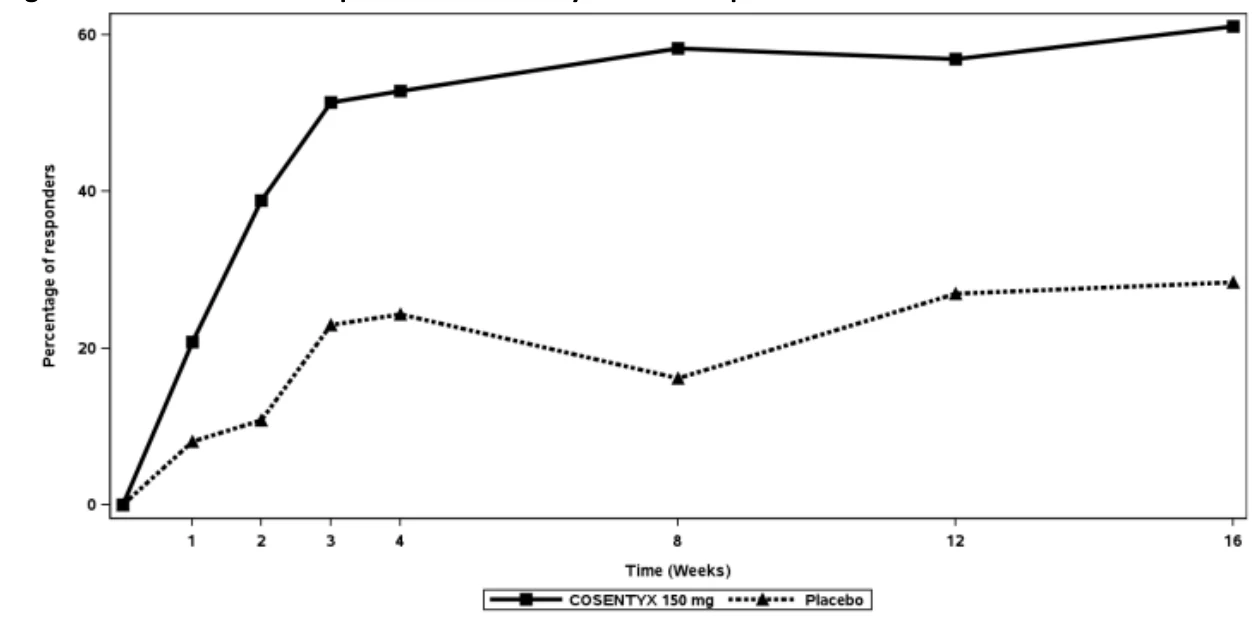
ASAS 20 responses at Week 16 were 68.2% vs. 31.1% in anti-TNF-alpha-naïve patients and 50.0% vs. 24.1% in anti-TNF-alpha-IR patients for COSENTYX 150 mg and placebo, respectively.
Spinal mobility was assessed by BASMI. The mean change from baseline in BASMI score at Week 16 was -0.51 vs. -0.22 in COSENTYX 150 mg-treated patients and placebo-treated patients, respectively.
In AS2 Study, among 72 patients initially randomised to COSENTYX 150 mg, 61 (84.7%) patients were still on treatment at Week 52. Among these patients, the ASAS 20 and ASAS 40 responses were achieved by 45 (73.8%) and 35 (57.4%) subjects respectively.
The mean change from baseline by Week 16 in Ankylosing Spondylitis Quality of Life (ASQoL) was -4.00 vs. -1.37 in patients treated with COSENTYX 150 mg and patients treated with placebo, respectively. Patients treated with COSENTYX reported improvements in the SF-36 Physical Component Summary (PCS) Score at Week 16 compared to placebo.
In AS3 Study, treatment with COSENTYX 150 mg and COSENTYX 300 mg resulted in greater improvements in ASAS 20 and ASAS 40 compared with placebo at Week 16 (see Table 29).
Table 29 Efficacy Results for AS3 Study at Week 16
| COSENTYX 150 mg (N=74) | COSENTYX 300 mg (N=76) | Placebo (N=76) | Difference from placebo (95% CI); p-value | ||||
|---|---|---|---|---|---|---|---|
| COSENTYX 150 mg | COSENTYX 300 mg | ||||||
| ASAS 20 response % (n) | 58% (43) | 61% (46) | 37% (28) | 21 (6, 37); p=0.0102a | 24 (9, 39); p=0.0075a | ||
| ASAS 40 response % (n) | 41% (30) | 42% (32) | 21% (16) | 20 (5, 34); p=0.0102a | 21 (7, 36); p=0.0102a | ||
ASAS: Assessment of SpondyloArthritis International Society Criteria. a p-value is based on the logistic regression with treatment and TNF-alpha inhibitor status as factors and baseline weight as a covariate. All p-values adjusted for multiplicity of testing based on pre-defined hierarchy. Premature discontinuation from the placebo-controlled period (16 weeks) for any reason: placebo 3.9% (3/76), COSENTYX 150 mg 0% (0/74) and COSENTYX 300 mg 1.3% (1/76). All patients who prematurely discontinued, for any reason, were considered non-responders for ASAS 20 and ASAS 40 response endpoints. | |||||||
Non-radiographic axial spondyloarthritis (nr-axSpA)
The safety and efficacy of COSENTYX were assessed in 555 patients in one randomized, double-blind, placebo-controlled phase III study consisting of a 2-year core phase and a 2-year extension phase in patients with active non-radiographic axial spondyloarthritis (nr-axSpA). All patients fulfilled the ASAS classification criteria for axial spondyloarthritis (axSpA) with no radiographic evidence of changes in the sacroiliac joints that would meet the modified New York criteria for ankylosing spondylitis (AS). Patients enrolled had active disease, defined as a BASDAI ≥4, total back pain VAS of ≥40 (on a scale of 0 to 100 mm), despite current or previous non-steroidal anti-inflammatory drug (NSAID) therapy and increased C-reactive protein (CRP) and/or evidence of sacroiliitis on Magnetic Resonance Imaging (MRI). Patients in this study had a diagnosis of axSpA for a mean of 2.1 to 3.0 years and 54% of the study participants were female.
In Nr-axSpA 1 Study (PREVENT), 57.6% of patients had increased CRP, 72.2% had evidence of sacroiliitis on MRI and 29.9% had both increased CRP and evidence of sacroiliitis on MRI. Overall, 9.7% of patients were previously treated with an anti-TNF-alpha agent and discontinued the anti-TNF-alpha agent for either lack of efficacy or intolerance (anti-TNF-alpha-IR patients). Additionally, 9.9% and 14.8% used concomitant MTX or sulfasalazine, respectively.
Patients were treated with COSENTYX 150 mg subcutaneous treatment with load (Weeks 0, 1, 2, 3, and 4) or without load (Weeks 0 and 4) followed by the same dose every 4 weeks or placebo. In the double-blind period, patients received either placebo or COSENTYX for 52 weeks. Starting Week 16, dose adjustment or addition of concomitant NSAIDs and DMARDs was permitted. Starting at Week 20, patients were allowed to switch to open-label COSENTYX 150 mg monthly or other biologic at the discretion of the investigator and patient. There were 2 primary endpoints which assessed at least 40% improvement in ASAS40 at Week 16 and Week 52 in the anti-TNF-naïve population.
Table 30 Summary of Patient Demographics for Clinical Trials in Specific Indication
| Study # | Trial design | Dosage, route of administration and duration | Study subjects (N=number) | Mean age (Range) | Sex |
| Nr-axSpA 1 Study (PREVENT) | Randomized , double-blind, placebo-controlled, multicenter | Secukinumab s.c. loading dose of 150 mg Wks 0, 1, 2, 3 followed by 150 mg s.c. q month Secukinumab 150 mg s.c. q month (with PBO weeks 1, 2, 3), or PBO Wks 0, 1, 2, 3 followed by PBO q month Secukinumab 150 mg Load: N=185 Secukinumab 150 mg No Load: N=184 Placebo: N=186 | N=555 | 39.4 (18-80) | M= 255 (45.9%) F= 300 (54.1%) |
Study Results:
In Nr-axSpA 1 Study, treatment with COSENTYX 150 mg resulted in significant improvements in the measure of disease activity compared to placebo at Week 16 and Week 52 (Table 31).
Table 31 Summary of Clinical Response in Nr-axSpA 1 Study at Week 16 and Week 52
| Number of subjects with ASAS40 response (%) | COSENTYX 150 mg with load (n= 185) | COSENTYX 150 mg without load (n= 184) | Placebo (n= 186) | Difference from placebo (95% CI) | |||||
|---|---|---|---|---|---|---|---|---|---|
COSENTYX 150 mg with load | COSENTYX 150 mg without load | ||||||||
| Week 16 | 74 (40) | 75 (41) | 52 (28) | 12 (2, 22) | 13 (3, 22) | ||||
| Week 52 | 62 (34) | 70 (38) | 36 (19) | 14 (5, 23) | 19 (10, 28) | ||||
Difference in proportions with 95% CI based on normal approximation.
Signs and symptoms
In Nr-axSpA 1 Study, treatment with COSENTYX 150 mg resulted in significant improvements in the measures of disease activity compared to placebo at Week 16 and Week 52. These measures include ASAS 40, ASAS 5/6, BASDAI, BASDAI 50, high-sensitivity CRP (hsCRP), ASAS 20 response, ASAS partial remission compared to placebo (see Table 32). Efficacy for all these endpoints was maintained up to Week 52.
Table 32 Clinical response in Nr-axSpA 1 Study at Week 16
| Outcome (p-value vs placebo) | Placebo | COSENTYX 150 mg1 | Difference from placebo (95% CI) | ||||||
|---|---|---|---|---|---|---|---|---|---|
| Number of TNF-naive patients randomized | 171 | 164 | |||||||
| ASAS 40 response, % | 29.2% | 41.5% | 12.3 (2.5, 22.8)* | ||||||
| Total number of patients randomized | 186 | 185 | |||||||
| ASAS 40 response, % | 28.0% | 40.0% | 12.7 (3.0, 22.4)* | ||||||
| ASAS 5/6, % | 23.7% | 40.0% | 17.1 (7.4, 26.7)* | ||||||
| BASDAI, LS mean change from baseline score | -1.46 | -2.35 | -0.89 (-1.39, -0.38)* | ||||||
| BASDAI 50, % | 21.0% | 37.3% | 18.5 (8.7, 27.4)* | ||||||
| hsCRP, (post-BSL/BSL ratio) | 0.91 | 0.64 | 0.70 (0.58, 0.84)* | ||||||
| ASAS 20 response, % | 45.7% | 56.8% | 11.7 (1.7, 23.0)* | ||||||
| ASAS partial remission, % | 7.0% | 21.6% | 14.6 (7.5, 21.7)* | ||||||
1secukinumab 150 mg s.c. at weeks 0, 1, 2, 3, and 4 followed by the same dose every month All p-values adjusted for multiplicity of testing based on pre-defined hierarchy Non-responder imputation used for missing binary endpoints, mixed models with repeated measures applied to continuous endpoints Model Based Treatment Difference *p < 0.05 versus placebo ASAS: Assessment of SpondyloArthritis International Society Criteria; BASDAI: Bath Ankylosing Spondylitis Disease Activity Index; hsCRP: high-sensitivity C-reactive protein; BSL: baseline; LS: least square | |||||||||
The results of the main components of the ASAS 40 response criteria for all patients randomized are shown in Table 33. Responses were sustained up to Week 52.
Table 33 Main components of the ASAS40 response criteria and other measures of disease activity in nr-axSpA patients at baseline and Week 16 in Nr-axSpA 1 Study
| Placebo (N = 186) | COSENTYX 150 mg1 (N = 185) | |||||||||
|---|---|---|---|---|---|---|---|---|---|---|
| Baseline | Week 16 change from baseline | Baseline | Week 16 change from baseline | |||||||
| ASAS40 Response criteria | ||||||||||
| -Patient global assessment of Disease Activity (0 to 100 mm) | 68.8 | -13.78 | 72.6 | -24.10 | ||||||
| -Total back pain (0 to 100 mm) | 70.9 | -15.64 | 73.3 | -24.96 | ||||||
| -BASFI (0 to 10) | 5.893 | -1.01 | 6.244 | -1.75 | ||||||
| -Inflammation (0 to 10) | 6.588 | -1.71 | 7.206 | -2.76 | ||||||
| hsCRP (mg/L) Mean Change at Week 16 | 10.76 | -2.42 | 13.17 | -7.90 | ||||||
| BASDAI (0 to 10) | 6.760 | -1.46 | 7.082 | -2.35 | ||||||
| 7.52 | -2.03 | 7.76 | -3.00 | ||||||
| 6.13 | -1.60 | 6.29 | -2.26 | ||||||
| BASMI | 2.765 | -0.13 | 2.923 | -0.26 | ||||||
1secukinumab 150 mg s.c. at weeks 0, 1, 2, 3, and 4 followed by the same dose every month
The percentage of patients achieving an ASAS 40 response in anti-TNF-alpha naïve patients by visit is shown in Figure 5.
Figure 5 ASAS 40 responses in anti-TNF-alpha naïve patients in Nr-axSpA 1 Study over time up to Week 16
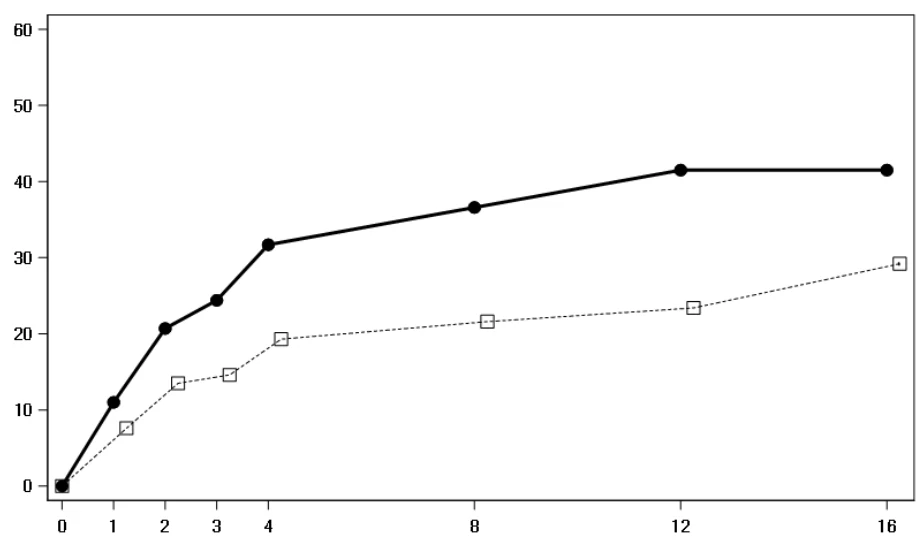
ASAS 40 responses were also improved at Week 16 in anti-TNF-alpha-IR patients for COSENTYX 150 mg compared with placebo.
Physical function and health-related quality of life
Patients treated with COSENTYX 150 mg showed improvements by Week 16 compared to placebo-treated patients in physical function as assessed by the BASFI (Week 16: -1.75 vs -1.01). They also showed improvements compared to placebo-treated patients by Week 16 in health-related quality of life as measured by ASQoL (LS mean change: Week 16: -3.45 vs -1.84) and SF-36 Physical Component Summary (SF-36 PCS) (LS mean change: Week 16: 5.71 vs 2.93) These improvements were sustained up to Week 52.
Spinal mobility
Spinal mobility was assessed by BASMI up to Week 16. Numerically greater improvements were demonstrated in patients treated with COSENTYX compared with placebo-treated patients at Weeks 4, 8, 12 and 16.
Reduction of inflammation in magnetic resonance imaging (MRI)
Objective signs of inflammation were assessed by MRI at baseline and Week 16 and expressed as change from baseline in Berlin SI-joint edema score for sacroiliac joints. Mean change from baseline to Week 16 was statistically significantly greater for secukinumab 150 mg compared to placebo (−1.68 vs. −0.39 , p< 0.05).
Perc entage o f re spo nd ers
Time (Weeks)
- Secukinumab 150 mg Load Placebo
14.1.4 Juvenile Idiopathic Arthritis (JIA) categories:
Enthesitis-Related Arthritis (ERA) and Juvenile Psoriatic Arthritis (JPsA)
The efficacy and safety of secukinumab were assessed in 86 patients in a 3-part, double-blind, placebo-controlled, event-driven, randomized withdrawal, Phase III study in patients 2 to < 18 years of age with active ERA or JPsA as diagnosed based on a modified International League of Associations for Rheumatology (ILAR) JIA classification criteria. Active disease (ERA or JPsA) was defined as having both: ≥ 3 active joints (swollen or if not swollen must be both tender and limited range of motion) at Baseline, and ≥1 site of active enthesitis at Baseline or documented by history.
The study consisted of an open-label portion (Part 1), followed by randomized withdrawal (Part 2), followed by open-label treatment (Part 3). In open-label Part 1, all patients received secukinumab until Week 12. Patients classified as responders (achieving JIA ACR 30 response) at Week 12 entered into the Part 2 double-blind phase and were randomized 1:1 to continue treatment with secukinumab or begin treatment with placebo until Week 104 or until a disease flare occurred. Patients who experienced a disease flare entered Part 3 and received open-label secukinumab treatment until Week 104.
The JIA patient subtypes at study entry were: 60.5% (n=52) ERA and 39.5% JPsA (n=34), who either had inadequate response or were intolerant to ≥1 disease-modifying antirheumatic drugs (DMARDs) and ≥1 nonsteroidal anti-inflammatory drugs (NSAIDs). Patients weight at baseline ranged from 16.5kg to 143.2 kg (<50 kg, n=30; ≥50 kg, n=56). In the study 65.1% of patients were treated concomitantly with MTX. Patients were given a dose of 75 mg if weighing < 50 kg, or 150 mg if weighing ≥ 50 kg. Age at baseline ranged from 2 to 17 years, with 3 patients between 2 to <6 years, 22 patients 6 to <12 years and 61 patients 12 to <18 years.
The primary endpoint was time to flare in the randomized withdrawal period (Part 2). Disease flare was defined as a ≥ 30% worsening in at least three of the six JIA ACR response criteria and ≥ 30% improvement in not more than one of the six JIA ACR response criteria and a minimum of two active joints.
Table 34 Summary of Patient Demographics for Clinical Trials in Specific Indication
| Study # | Trial design | Dosage, route of administration and duration | Study subjects (N=number) | Mean age (Range) | Sex |
| Study F2304 | three-part randomized withdrawal, double-blind, placebo-controlled, event-driven | Part 1: Secukinumab sc 75 mg or 150 mg (based upon weight) at Baseline, Weeks 1, 2, 3, 4, and 8. Part 2: Secukinumab sc 75 mg or 150 mg (based upon weight) or PBO at week 12, then q 4 weeks until Week 100 included. Part 3: Secukinumab sc 75 mg or 150 mg (based upon weight) q 4 weeks until Week 100 included. | N=86 | 13.1 (2-17) | M= 57 (66.3%) F= 29 (33.7%) |
Study Results:
At the end of the open-label Part 1, 75 out of 86 (87.2%) patients demonstrated a JIA ACR30 response and entered into Part 2. The hazard ratio (95% confidence interval) for secukinumab compared with placebo was 0.28 (0.13, 0.63), representing a 72% reduction in the risk of flare (Figure 6).
During Part 2, a total of 21 patients in the placebo group experienced a flare event (11 JPsA patients and 10 ERA patients) compared with 10 patients in the secukinumab group (4 JPsA patients and 6 ERA patients).
Figure 6 Kaplan-Meier estimates of the time to disease flare in Part 2
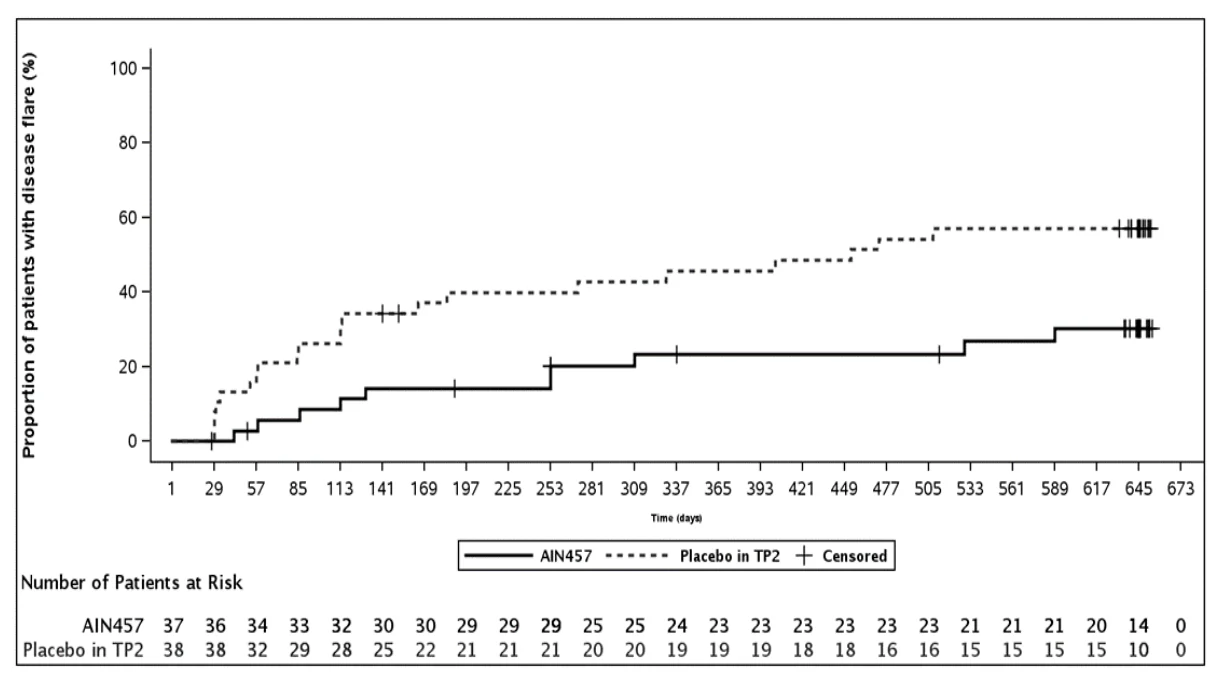
Subjects who did not experience a disease flare in TP2, were censored at the date of their last non-missing flare evaluation in TP2 (including subjects who discontinued prematurely for reasons other than experiencing a disease flare, subjects mistakenly switched to TP3 and subjects who completed TP2 without a flare).
In open-label Part 1, all patients received secukinumab until Week 12. The JIA ACR 30, 50, 70 and 90 responses, including by JIA category, at Week 12 are presented in Table 35 below.
Table 35 JIA ACR 30, 50, 70 and 90 responses at Week 12
| Number of subjects with response (%) | JIA ACR 30 | JIA ACR 50 | JIA ACR 70 | JIA ACR 90 |
|---|---|---|---|---|
| Total (N=86) | 75 (87.2%) | 72 (83.7%) | 58 (67.4%) | 33 (38.4%) |
| ERA (N=52) | 44 (84.6%) | 41 (78.8%) | 34 (65.4%) | 17 (32.7%) |
| JPsA (N=34) | 31 (91.2%) | 31 (91.2%) | 24 (70.6%) | 16 (47.1%) |
*Non-responder imputation was used to handle missing values
14.1.5 Hidradenitis Suppurativa
The efficacy and safety of secukinumab were assessed in 1,084 patients in two randomized, double-blind, placebo-controlled phase III studies in adults with moderate to severe hidradenitis suppurativa (HS) who were candidates for systemic biologic therapy. Patients enrolled in HS study M2301 (SUNSHINE) and HS study M2302 (SUNRISE) had Hurley stage I (4.6% and 2.8%, respectively), II (61.4% and 56.7%, respectively) or III (34.0% and 40.5%, respectively) disease at baseline with at least five inflammatory lesions affecting two or more anatomical areas. The proportion of patients weighing ≥90 kg was 54.7% in HS study M2301 and 50.8% in HS study M2302. Patients in these studies had a diagnosis of moderate to severe HS for a mean of 7.3 years and 56.3% of the study participants were female.
In HS study M2301 and HS study M2302, 23.8% and 23.2% of patients, respectively, were previously treated with a biologic and discontinued the biologic agent (bio-exposed patients).
HS study M2301 evaluated 541 patients and HS study M2302 evaluated 543 patients, of whom 12.8% and 10.7%, respectively, received concomitant stable dose of antibiotics. In both studies, patients randomized to secukinumab received 300 mg subcutaneously at Weeks 0, 1, 2, 3 and 4, followed by 300 mg every 2 weeks (Q2W) or every 4 weeks (Q4W). At Week 16, patients who had been randomized to placebo were reassigned to receive secukinumab 300 mg at Weeks 16, 17, 18, 19 and 20 followed by either secukinumab 300 mg Q2W or secukinumab 300 mg Q4W.
The primary endpoint in both studies was the proportion of patients achieving a Hidradenitis Suppurativa Clinical Response defined as at least a 50% decrease in abscesses and inflammatory nodules (AN) count with no increase in the number of abscesses and/or in the number of draining fistulae relative to baseline (HiSCR50) at Week 16. Reduction in HS-related skin pain was a secondary endpoint, which was defined as at least a 30% reduction and at least 2 unit reduction from baseline in Patient's Global Assessment of Skin Pain and assessed using a Numerical Rating Scale (NRS) in patients who entered the studies with a baseline NRS pain score of 3 or greater.
Table 36 Summary of Patient Demographics for Clinical Trials in Hidradenitis Suppurativa
| Study # | Trial design | Dosage, route of administration and duration | Study subjects (N=number) | Mean age (Range) | Sex |
|---|---|---|---|---|---|
| Study # | Trial design | Dosage, route of administration and duration | Study subjects (N=number) | Mean age (Range) | Sex |
Study M2301 (SUNSHINE) | Randomized, double-blind, placebo-controlled, parallel group | Treatment Period 1 (Week 0-16): Secukinumab s.c. loading dose of 300 mg at Baseline and weeks 1, 2, 3 and 4 followed by 300 mg s.c. every two or four weeks (Q2W or Q4W) Placebo at Baseline and weeks 1, 2, 3 and 4 followed by Placebo every two weeks Treatment Period 2 (Week 16-52): Subjects who were randomized to either of the two secukinumab dose regimens continued on the same dose regimen Subjects who were randomized to either of the two ‘Placebo to secukinumab’ regimens received secukinumab 300 mg at Weeks 16, 17, 18, 19, and 20 as an induction, then at the randomized schedule of either Q2W or Q4W thereafter | N=541 | 36.1 (18˂75) | M=43.8 % F=56.2 % |
Study M2302 (SUNRISE) | Randomized, double-blind, placebo-controlled, parallel group | Treatment Period 1 (Week 0-16): Secukinumab s.c. loading dose of 300 mg at Baseline and weeks 1, 2, 3 and 4 followed by 300 mg s.c. every two or four weeks (Q2W or Q4W) Placebo at Baseline and weeks 1, 2, 3 and 4 followed by Placebo every two weeks Treatment Period 2 (Week 16-52): Subjects who were randomized to either of the two secukinumab dose regimens continued on the same dose regimen Subjects who were randomized to either of the two ‘Placebo to secukinumab’ regimens received secukinumab 300 mg at Weeks 16, 17, 18, 19, and 20 as an induction, then at the randomized schedule of either Q2W or Q4W thereafter | N=543 | 36.3 (18˂75) | M=43.6 % F=56.4 % |
Study Results:
The results of the primary and key secondary efficacy endpoints are provided in Table 37.
Table 37 Results of Key Efficacy Endpoints at Week 16 in Subjects with Hidradenitis suppurativa in Study M2301 and Study M2302a,b
Study M2301 (SUNSHINE) | Study M2302 (SUNRISE) | ||||||||||||
|---|---|---|---|---|---|---|---|---|---|---|---|---|---|
Placebo (N=180) | COSENTYX 300 mg Q4Wh (N=180) | COSENTYX 300 mg Q2Wh (N=181) | Placebo (N=183) | COSENTYX 300 mg Q4Wh (N=180) | COSENTYX 300 mg Q2Wh (N=180) | ||||||||
| Primary endpointb | |||||||||||||
| HiSCR50c, % | 33.7% | 41.8% | 45.0%* | 31.2% | 46.1%* | 42.3%* | |||||||
| Risk differencef (CI)g | 8.9 (-4.3, 22.2) | 13.0 (2.4, 23.6) | 15.0 (1.7, 28.3) | 11.9 (1.3, 22.6) | |||||||||
| Key Secondary endpoints | |||||||||||||
| AN countd, LS mean % change from baseline | -24.3 | -42.4 | -46.8* | -22.4 | -45.5* | -39.3* | |||||||
| Mean differencef (CI)g | -18.6 (-33.6, -3.6) | -23.5 (-34.7, -12.2) | -23.1 (-39.4, -6.8) | -17.4 (-30.8, -3.9) | |||||||||
| Flarese, % | 29.0% | 23.2% | 15.4%* | 27.0% | 15.6%* | 20.1% | |||||||
| Risk differencef (CI)g | -6.6 (-19.0, 5.8) | -14.7 (-23.9, -5.5) | -10.9 (-22.0, 0.1) | -6.3 (-15.4, 2.9) | |||||||||
*Statistically significant versus placebo based on the pre-defined testing hierarchy and overall two-sided p-value of 0.05. a For the primary endpoint, HiSCR50, subjects who received rescue medication and who discontinued treatment due to adverse events or lack of efficacy were considered as treatment failures (i.e. non-responders). b Multiple imputation was implemented for missing data. c HiSCR50: The proportion of subjects achieving a Hidradenitis Suppurativa Clinical Response defined as at least a 50% decrease in abscesses (fluctuant, with or without drainage, tender or painful) and inflammatory nodules (tender, erythematous, pyogenic granulomatous lesions) with no increase in the number of abscesses and no increase in the number of draining fistulae (sinus tracts, with communications to skin surface, draining purulent fluid) from baseline. d AN count: The number of abscesses and inflammatory nodules. e Flares: A flare is defined as at least a 25% increase in abscess and inflammatory nodule (AN) count with a minimum increase of 2 AN relative to baseline. f Difference: Marginal risk difference or mean difference and estimated using GEE. Covariates included treatment group, Hurley stage, baseline AN count, geographical region, use of antibiotic and baseline body weight, and interaction of treatment group and visit. g Confidence interval (CI): CI with coverage greater than 95% and accounting for multiplicity. h Subjects received COSENTYX 300 mg by subcutaneous injection at Weeks 0, 1, 2, 3, and 4, followed by 300 mg COSENTYX every 4 weeks (Q4W) or every 2 weeks (Q2W). HiSCR: Hidradenitis Suppurativa Clinical Response; CI: Confidence interval. | |||||||||||||
Pre-specified exploratory analyses demonstrated a numerical trend in key efficacy endpoints at Week 2 in favour of COSENTYX relative to placebo.
Pre-specified exploratory analyses from study M2301 and M2302 demonstrated that HiSCR50 response at Week 52 was achieved by 58.3% (n=56) and 64.9% (n=61) of subjects in the COSENTYX Q4W group, and 51.7% (n=45) and 66.3% (n=65) of subjects in the COSENTYX Q2W groups, respectively.
In a pre-specified analysis of patient’s reported global assessment of skin pain using a numerical rating scale (NRS) at Week 16 in subjects who entered the studies with a baseline score of 3 or greater, based on pooled data from study M2301 and study M2302, the proportion of subjects achieving a 30% reduction and at least 2 unit reduction from baseline in NRS (NRS30) was 33.5% in COSENTYX Q4W, 36.6% in COSENTYX Q2W, and 23.0% in placebo. The estimated pooled risk difference for COSENTYX Q4W compared to placebo was 10.4 (95% CI; -0.2, 21.0) and for COSENTYX Q2W compared to placebo was 14.3 (95% CI; 5.9, 22.8).
In a post-hoc analysis of HiSCR50 at Week 16 based on pooled data from study M2301 and study M2302, the proportion of subjects achieving HiSCR50 was 43.9% and 31.9% in the COSENTYX Q4Wand placebo group, respectively; and 44.4% and 31.9% in the COSENTYX Q2W and placebo group, respectively. The estimated pooled risk difference for COSENTYX Q4W compared to placebo was 11.9 (95% CI; 4.8, 19.1) and for COSENTYX Q2W compared to placebo was 12.5 (95% CI; 5.3, 19.6).
In a post-hoc analysis of HiSCR50 at Week 16 based on pooled data from study M2301 and study M2302, the proportion of biologic-naive subjects achieving HiSCR50 was 45.4%, 45.6%, and 34.2% in the COSENTYX Q4W, COSENTYX Q2W, and placebo group, respectively; the proportion of biologic-exposed subjects achieving HiSCR50 was 38.8%, 37.0%, and 27.3% in the COSENTYX Q4W, COSENTYX Q2W, and placebo group, respectively.
In a pre-specified analysis of the Dermatology Life Quality Index (DLQI) response at Week 16, the proportion of subjects achieving at least a 5 point decrease from baseline in DLQI total score in study M2301 was 48.4%, 47.8%, and 28.9% in the COSENTYX Q4W, COSENTYX Q2W, and placebo group, respectively; in study M2302 was 47.2%, 37.5%, and 31.7% in the COSENTYX Q4W, COSENTYX Q2W, and placebo group, respectively.
16. Non-Clinical Toxicology
General toxicology
Single-dose Toxicity
Single subcutaneous injection of secukinumab to the monkey at doses of 15 or 150 mg/kg followed by a 7- or 28-day observation period was well tolerated systemically and at the injection sites. The highest dose of 150 mg/kg administered, was concluded as the NOAEL.
Repeat-dose Toxicity
Secukinumab was well tolerated following weekly IV doses of up to 150 mg/kg for up to 26 weeks and SC doses up to 150 mg/kg for 13 weeks. There was no evidence of treatment-related adverse findings in immunotoxicity (including infections or hypersensitivity reactions) and safety pharmacology evaluations. Immunogenicity was detected in one animal given 150 mg/kg/week subcutaneously for 13 weeks. Serum concentrations that are well tolerated in animals for 13 weeks of s.c. dosing are in excess of at least 110-fold (Cmax) and 120-fold (Cav) the serum concentrations in psoriasis patients at maintenance therapy, treated with a clinical dose of 300 mg s.c. q4 weeks.
Table 38 Sub-Chronic and Chronic Toxicology (Pivotal studies)
| Study Type | Species | Route | No. of animals/ group | Doses (Mg/kg/week) | Findings |
| 13 week | Cynomolgus monkey | subcutaneous | 3m 3f 2m 2f recovery | 15, 50, 150 | No adverse signs of toxicity NOAEL = 150 mg/kg/week |
| 4 week | Cynomolgus monkey | intravenous | 3m 3f 2m 2f recovery | 10, 30, 100 | No adverse signs of toxicity NOAEL = 150 mg/kg/week |
| 4 week | Cynomolgus monkey | intravenous | 3m 3f 2m 2f recovery | 15, 50, 150 | No adverse signs of toxicity NOAEL = 150 mg/kg/week |
| 26 week | Cynomolgus monkey | intravenous | 4m 4f 2m 2f recovery | 15, 50, 150 | No adverse signs of toxicity NOAEL = 150mg/kg/week |
Genotoxicity
Genotoxicity studies have not been conducted for secukinumab.
Carcinogenicity
Carcinogenicity studies have not been conducted for secukinumab
Reproductive and developmental toxicology
In an embryo fetal development study in cynomolgus monkeys secukinumab was neither teratogen nor embryotoxic at doses up to 150 mg/kg/week. The mouse surrogate antibody BZN035, a murine anti-murine IL-17A antibody, caused no adverse findings on reproduction or development.
Table 39 Reproductive Toxicology (pivotal studies)
| Study Type | Species | Route | No. of animals/ group | Doses (Mg/kg/week) | Findings |
| Fertility and early embryonic development study | Mice | subcutaneous | 24m 24f | 15, 50, 150 | BZN035 was neither teratogen nor embryotoxic. BZN035 did not affect fertility of the adult mice nor the development of the pups exposed via the treated mother. NOEL = 150 mg/kg/week |
| Embryo fetal development study | Cynomolgus monkey | subcutaneous | 16f | 15, 50, 150 | Secukinumab was neither teratogen nor embryotoxic. NOAEL = 150 mg/kg/week |
| Pre- and postnatal development study | Mice | subcutaneous | 24f | 15, 50, 150 | BZN035 did not affect pregnancy or delivery; or morphological, functional and immunological developmental parameters of offspring. NOAEL = 150 mg/kg/week |
Juvenile Toxicity
Juvenile toxicity studies have not been conducted with secukinumab.
Special toxicology
No non-specific tissue binding was observed when secukinumab was applied to normal human or cynomolgus monkey tissues.