


Product Monograph - Bimzelx
Recent Major Label Changes
| 2024-03, 2025-12 |
|---|---|
| 2024-03, 2025-12 |
| 2024-11, 2025-12 |
| 2024-03, 2024-11, 2025-12 |
Table of Contents
Certain sections or subsections that are not applicable at the time of the preparation of the most recent authorized product monograph are not listed.
Recent Major Label Changes ................................................................................................... 2
Table of Contents ................................................................................................................... 2
Part 1: Healthcare Professional Information ........................................................................... 4
- 1.
Indications ....................................................................................................................... 4
1.1. Pediatrics .................................................................................................................. 4
1.2. Geriatrics .................................................................................................................. 4
- 2. Contraindications ............................................................................................................ 4
- 4.
Dosage and Administration ............................................................................................. 5
4.1. Dosing Considerations .............................................................................................. 5
4.2. Recommended Dose and Dosage Adjustment ......................................................... 5
4.4. Administration .......................................................................................................... 6
4.5. Missed Dose ............................................................................................................. 6
- 5. Overdose ......................................................................................................................... 6
- 6. Dosage Forms, Strengths, Composition, and Packaging ................................................... 6
- 7.
Warnings and Precautions ............................................................................................... 7
Gastrointestinal .................................................................................................................... 7
Immune ................................................................................................................................ 7
Reproductive Health ............................................................................................................. 8
7.1. Special Populations .................................................................................................. 8
7.1.1. Pregnancy ........................................................................................................ 8
7.1.2. Breastfeeding .................................................................................................. 9
7.1.3. Pediatrics ......................................................................................................... 9
7.1.4. Geriatrics ......................................................................................................... 9
- 8.
Adverse Reactions ........................................................................................................... 9
8.1. Adverse Reaction Overview ...................................................................................... 9
8.2. Clinical Trial Adverse Reactions ................................................................................ 9
8.3. Less Common Clinical Trial Adverse Reactions ....................................................... 16
8.4. Abnormal Laboratory Findings: Hematologic, Clinical Chemistry and Other Quantitative Data ............................................................................................................... 17
- 9.
Drug Interactions ........................................................................................................... 17
9.4. Drug-Drug Interactions ........................................................................................... 17
9.5. Drug-Food Interactions........................................................................................... 17
9.6. Drug-Herb Interactions ........................................................................................... 17
9.7. Drug-Laboratory Test Interactions ......................................................................... 17
- 10.
Clinical Pharmacology ................................................................................................... 17
10.1. Mechanism of Action .............................................................................................. 17
10.2. Pharmacodynamics ................................................................................................ 18
10.3. Pharmacokinetics ................................................................................................... 18
10.4. Immunogenicity ...................................................................................................... 20
- 11. Storage, Stability, and Disposal ...................................................................................... 21
Part 2: Scientific Information ................................................................................................ 22
- 13. Pharmaceutical Information .......................................................................................... 22
- 14.
Clinical Trials .................................................................................................................. 22
14.1. Clinical Trials by Indication ..................................................................................... 22
Plaque Psoriasis .................................................................................................................. 22
Psoriatic Arthritis ................................................................................................................ 26
Axial spondyloarthritis ........................................................................................................ 31
Hidradenitis suppurativa .................................................................................................... 36
- 16. Non-Clinical Toxicology .................................................................................................. 38
Patient Medication Information ........................................................................................... 40
Part 1: Healthcare Professional Information
1. Indications
Bimzelx (bimekizumab injection) is indicated for:
Psoriasis (PsO)
The treatment of moderate to severe plaque psoriasis in adult patients who are candidates for systemic therapy or phototherapy.
Psoriatic arthritis (PsA)
The treatment of adult patients with active psoriatic arthritis. Bimzelx can be used alone or in combination with a conventional non-biologic disease-modifying antirheumatic drug (cDMARD) (e.g., methotrexate).
Axial Spondyloarthritis (axSpA)
Ankylosing Spondylitis (AS, radiographic spondyloarthritis)
The treatment of adult patients with active ankylosing spondylitis who have responded inadequately or are intolerant to conventional therapy.
Non-radiographic axial spondyloarthritis (nr-axSpA)
The treatment of adult patients with active non-radiographic axial spondyloarthritis with objective signs of inflammation as indicated by elevated C-reactive protein (CRP) and/or magnetic resonance imaging (MRI) who have responded inadequately or are intolerant to nonsteroidal anti-inflammatory drugs (NSAIDs).
Hidradenitis suppurativa (HS)
The treatment of adult patients with moderate to severe hidradenitis suppurativa with an inadequate response to conventional systemic therapy.
1.1. Pediatrics
Pediatrics (<18 years of age): No data are available to Health Canada; therefore, Health Canada has not authorized an indication for pediatric use.
1.2. Geriatrics
Geriatrics (≥ 65 years of age): Data are available to Health Canada regarding this age group (see 7.1.4 Warnings and Precautions, Special Populations, Geriatrics).
Of the 5862 patients with PsO, PsA, axSpA, and HS exposed to Bimzelx in Phase II and Phase III clinical trials, 447 (7.6%) were 65 years or older and 55 (0.9%) were 75 years or older.
2. Contraindications
Bimzelx (bimekizumab injection) is contraindicated in patients who are hypersensitive to this drug or to any ingredient in the formulation, including any non-medicinal ingredient, or component of the container. For a complete listing, see 6. Dosage Forms, Strengths, Composition, and Packaging.
4. Dosage and Administration
4.1. Dosing Considerations
After proper training in subcutaneous injection technique, patients may self-inject if their physician determines that it is appropriate and with medical follow-up as necessary. Patients should be instructed to inject the full amount of Bimzelx according to the Instructions for Use.
Each pre-filled syringe or autoinjector is for single-use only, and is available in the following presentations:
- 160 mg bimekizumab for injection in a 1 mL pre-filled syringe or autoinjector
- 320 mg bimekizumab for injection in a 2 mL pre-filled syringe or autoinjector
PsO and HS patients should be instructed to inject either two separate 160 mg single-use pre-filled syringes or autoinjectors or one 320 mg single-use pre-filled syringe or autoinjector for the full 320 mg dose.
4.2. Recommended Dose and Dosage Adjustment
Plaque Psoriasis (PsO)
The recommended dose of Bimzelx (bimekizumab injection) for adult patients with plaque psoriasis is 320 mg (given as two subcutaneous injections of 160 mg or one subcutaneous injection of 320 mg) every 4 weeks for the first 16 weeks, and every 8 weeks thereafter.
At the prescriber’s discretion, discontinuation of treatment may be considered in patients who have shown no improvement after 16 weeks of treatment.
For patients with a body weight ≥ 120 kg and who did not achieve a complete skin response, a dose of 320 mg every 4 weeks after Week 16 may be considered (see 10.3. Clinical Pharmacology, Pharmacokinetics, Special Populations and Conditions, Obesity).
Psoriatic Arthritis
The recommended dose for adult patients with active psoriatic arthritis is 160 mg (given as one subcutaneous injection of 160 mg) every 4 weeks.
For psoriatic arthritis patients with coexistent moderate to severe plaque psoriasis, the recommended dose is the same as for plaque psoriasis. After 16 weeks, regular assessment of efficacy is recommended and if a sufficient clinical response in joints cannot be maintained, a switch to the recommended dose for psoriatic arthritis can be considered.
Axial spondyloarthritis (axSpA)
The recommended dose of Bimzelx for adult patients with active axSpA (including ankylosing spondylitis and non-radiographic axial spondyloarthritis) is 160 mg (given as one subcutaneous injection of 160 mg) every 4 weeks.
Hidradenitis suppurativa (HS)
The recommended dose of Bimzelx for adult patients with hidradenitis suppurativa is 320 mg (given as two subcutaneous injections of 160 mg or one subcutaneous injection of 320 mg) every 2 weeks up to Week 16 and every 4 weeks thereafter.
Pediatrics (< 18 years of age): The safety and efficacy of Bimzelx in children and adolescents below the age of 18 years has not been established. Bimzelx is not indicated for use in pediatric patients.
Geriatrics (≥ 65 years of age): No dose adjustment is required based on population PK modeling (see 10.3. Clinical Pharmacology, Pharmacokinetics, Special Populations and Conditions, Geriatrics).
Renal or Hepatic Impairment: Bimzelx has not been directly studied in these patient populations (see 10.3. Clinical Pharmacology, Pharmacokinetics, Special Populations and Conditions, Hepatic Insufficiency and Renal Insufficiency).
4.4. Administration
Bimzelx is administered by subcutaneous injection. Suitable areas for injection include thigh, abdomen and upper arm. Injection sites should be rotated, and injections should not be given into psoriasis plaques or areas where the skin is tender, bruised, erythematous, or indurated. Patients should self-administer in the thigh and abdomen only.
4.5. Missed Dose
If a dose is missed, it should be administered as soon as possible. Thereafter, dosing should be resumed at the regular schedule (i.e. 2, 4 or 8 weeks later). Do not administer two doses at the same time to make up for a missed dose.
5. Overdose
Single doses of 640 mg intravenously or 640 mg subcutaneously, followed by 320 mg subcutaneously every two weeks for five doses have been administered in clinical studies without dose-limiting toxicity. In the event of overdose, it is recommended that the patient be monitored for any signs and symptoms of adverse reactions and appropriate symptomatic treatment be instituted immediately.
For the most recent information in the management of a suspected drug overdose, contact your regional poison control centre or Health Canada’s toll-free number, 1-844 POISON-X (1-844-764-7669).
- 6. Dosage Forms, Strengths, Composition, and Packaging
To help ensure the traceability of biologic products, including biosimilars, health professionals should recognise the importance of recording both the brand name and the non-proprietary (active ingredient) name as well as other product-specific identifiers such as the Drug Identification Number (DIN) and the batch/lot number of the product supplied.
Table 1: Dosage Forms, Strengths, Composition and Packaging
| Route of Administration | Dosage Form / Strength/Composition | Non-medicinal Ingredients | ||
| Subcutaneous use | Solution for injection / 160 mg / 1.0 mL pre-filled syringe | Acetic acid, glycine, Polysorbate 80, sodium acetate trihydrate, water for injection | ||
| Solution for injection / 160 mg / 1.0 mL autoinjector | ||||
| Solution for injection / 320 mg / 2.0 mL pre-filled syringe | ||||
| Solution for injection / 320 mg / 2.0 mL autoinjector | ||||
Bimzelx (bimekizumab injection) is available in the following forms:
Bimzelx 160 mg solution for injections in pre-filled syringe
One mL pre-filled syringe (type I glass) with a fluoropolymer-laminated bromobutyl rubber stopper, staked 27G, ½” thin wall needle, and a rigid needle shield consisting of a thermoplastic elastomer needle cover and a polypropylene rigid shield, assembled in a passive safety device. Available in a pack size of 1 pre-filled syringe and a pack size of 2 pre-filled syringes.
Bimzelx 320 mg solution for injection in pre-filled syringe
Two mL pre-filled syringe (type I glass) with a fluoropolymer-laminated bromobutyl rubber stopper, staked 27G, ½” thin wall needle, and a rigid needle shield consisting of a thermoplastic elastomer needle cover and a polypropylene rigid shield assembled in a passive safety device. Available in a pack size of 1 pre-filled syringe.
Bimzelx 160 mg solution for injections in autoinjector
One mL autoinjector containing a pre-filled syringe (type I glass) with a fluoropolymer-laminated bromobutyl rubber stopper, staked 27G, ½” thin wall needle, and a rigid needle shield consisting of a thermoplastic elastomer needle cover and a polypropylene rigid shield. Available in a pack size of 1 autoinjector and a pack size of 2 autoinjectors.
Bimzelx 320 mg solution for injection in autoinjector
Two mL autoinjector containing a pre-filled syringe (type I glass) with a fluoropolymer-laminated bromobutyl rubber stopper, staked 27G, ½” thin wall needle, and a rigid needle shield consisting of a thermoplastic elastomer needle cover and a polypropylene rigid shield. Available in a pack size of 1 autoinjector.
No components of the pre-filled syringe or autoinjector are made with natural rubber latex.
Not all pack sizes may be marketed.
7. Warnings and Precautions
Gastrointestinal
Inflammatory bowel disease
Cases of new or exacerbations of inflammatory bowel disease (Ulcerative Colitis and Crohn’s Disease) were reported during Bimzelx treatment. Bimzelx is not recommended in patients with inflammatory bowel disease. If a patient develops signs and symptoms of inflammatory bowel disease or experiences an exacerbation of pre-existing inflammatory bowel disease, Bimzelx should be discontinued and appropriate medical management should be initiated.
Immune
Hypersensitivity
Serious hypersensitivity reactions were observed in clinical trials.
As with all therapeutic proteins including Bimzelx, there is a potential for anaphylaxis. If an anaphylactic or other serious allergic reaction occurs, immediately discontinue the administration of Bimzelx and initiate appropriate medical treatment. Inform patients/caregivers of the signs and symptoms of anaphylaxis and hypersensitivity reactions, and instruct them to seek immediate medical care if signs and symptoms occur.
Vaccinations
Prior to initiating therapy with Bimzelx, consider completion of all age appropriate immunizations according to current immunization guidelines.
Live vaccines should be avoided in patients treated with Bimzelx.
Patients treated with Bimzelx may receive inactivated or non-live vaccinations. Healthy individuals who received a single 320 mg dose of Bimzelx two weeks prior to vaccination with an inactivated seasonal influenza vaccine had similar antibody responses compared to individuals who did not receive Bimzelx prior to vaccination.
Infections
Bimzelx has the potential to increase the risk of infections. Higher rates of infections such as upper respiratory tract infections and oral candidiasis were observed in patients receiving Bimzelx compared with placebo (see 8.2. Adverse Reactions, Clinical Trial Adverse Reactions, Infections).
Caution should be exercised when considering the use of Bimzelx in patients with a chronic infection or a history of recurrent infection; patients with active infections, serious infections, or a history of opportunistic, recurrent or chronic infections were excluded from Bimzelx clinical trials. Treatment with Bimzelx should not be initiated in patients with any clinically important active infection until the infection resolves or is adequately treated.
Patients treated with Bimzelx should be instructed to seek medical advice if signs or symptoms of clinically important chronic or acute infection occur. If a patient develops a clinically important infection or is not responding to standard therapy, the patient should be closely monitored and Bimzelx should not be administered until the infection resolves.
Pre-treatment evaluation for tuberculosis (TB)
Prior to initiating treatment with Bimzelx, patients should be evaluated for TB infection. Bimzelx should not be given to patients with active TB. Patients receiving Bimzelx should be monitored for signs and symptoms of active TB. Anti-TB therapy should be considered prior to initiating Bimzelx in patients with a past history of latent or active TB in whom an adequate course of treatment cannot be confirmed.
Reproductive Health
- Fertility: The effect of Bimzelx on human fertility has not been evaluated.
7.1. Special Populations
7.1.1. Pregnancy
There is very limited data on the use of Bimzelx in pregnant women. The effect of Bimzelx on pregnancy is unknown. Human IgG1 is known to cross the placental barrier; therefore, bimekizumab may be transferred from the mother to the fetus. In a pre- and postnatal development study conducted in pregnant monkeys, bimekizumab biodistributed to the fetus, but did not demonstrate teratogenicity. Male offspring exposed to bimekizumab in utero showed reduced neutrophil counts and reduced IgG response to antigen challenge, with transient discoloration of the lips (see 16. Non-Clinical Toxicology). Animal studies are not always predictive of human response; therefore, it is unknown whether Bimzelx can cause fetal harm when administered to a pregnant woman. Women of childbearing potential should use adequate contraception while using Bimzelx and for at least 4 months after the last Bimzelx dose.
7.1.2. Breastfeeding
There are no data on the presence of Bimzelx in human milk, the effects on the breastfed infant, or the effects on human milk production. Because human immunoglobulin G (IgG) is secreted into human milk, precaution should be exercised.
7.1.3. Pediatrics
No data are available to Health Canada; therefore, Health Canada has not authorized an indication for pediatric use.
7.1.4. Geriatrics
In the placebo-controlled period of Phase III clinical studies in plaque psoriasis, a higher incidence of oral candidiasis (18.2% versus 6.3%), and dermatitis and eczema (7.3% versus 2.8%) was observed in patients over 65 years of age compared to younger patients (see 1.2. Indications, Geriatrics and 4.2 Dosage and Administration, Recommended Dose and Dosage Adjustment, Geriatrics).
8. Adverse Reactions
8.1. Adverse Reaction Overview
In the placebo-controlled period of the Phase III studies in plaque psoriasis, psoriatic arthritis, axial spondyloarthritis, and hidradenitis suppurativa, the most frequently reported adverse drug reactions (ADRs) with Bimzelx were upper respiratory tract infections (most frequently nasopharyngitis) and oral candidiasis. The proportion of patients who discontinued treatment due to adverse events was 2.2% with Bimzelx versus 1.6% with placebo. Serious adverse events were reported for 2.0% of patients with Bimzelx versus 0.9% with placebo.
8.2. Clinical Trial Adverse Reactions
Clinical trials are conducted under very specific conditions. The adverse reaction rates observed in the clinical trials; therefore, may not reflect the rates observed in practice and should not be compared to the rates in the clinical trials of another drug. Adverse reaction information from clinical trials may be useful in identifying and approximating rates of adverse drug reactions in real-world use.
A total of 5862 patients have been treated with Bimzelx in blinded and open-label clinical studies in plaque psoriasis, psoriatic arthritis, axial spondyloarthritis (including ankylosing spondylitis and non-radiographic axial spondyloarthritis), and hidradenitis suppurativa, representing 11469 patient-years of exposure. Of these, 4660 patients were exposed to Bimzelx for at least one year.
Plaque Psoriasis
Data from placebo- and active-controlled studies (BE VIVID and BE READY) were pooled to evaluate the safety of Bimzelx 320 mg Q4W for up to 16 weeks. Table 2 summarizes the adverse events (regardless of causality) reported in this safety pool. Data from comparator treatment arms of the active-controlled studies (BE VIVID and BE SURE) are also included.
Table 2: Adverse Events (regardless of causality) Reported in ≥ 1% of Patients with Plaque Psoriasis through Week 16 in the Bimzelx Treatment Group, and More Frequently than in the Placebo Group
Bimzelx 320 mg Q4W N = 670 n (%)1 | Placebo N = 169 n (%)1 | Ustekinumab N = 163 n (%)2 | Adalimumab N = 159 n (%)3 | ||||||||||||
|---|---|---|---|---|---|---|---|---|---|---|---|---|---|---|---|
Bimzelx 320 mg Q4W N = 670 n (%)1 | Placebo N = 169 n (%)1 | Ustekinumab N = 163 n (%)2 | Adalimumab N = 159 n (%)3 | ||||||||||||
| Infections and infestations | |||||||||||||||
| Oral Candidiasis | 49 (7.3) | 0 | 0 | 0 | |||||||||||
| Oropharyngeal candidiasis | 8 (1.2) | 0 | 0 | 0 | |||||||||||
| Upper respiratory tract infections* | 97 (14.5) | 23 (13.6) | 22 (13.5) | 44 (27.7) | |||||||||||
| Folliculitis | 8 (1.2) | 0 | 0 | 2 (1.3) | |||||||||||
| Gastroenteritis | 8 (1.2) | 0 | 0 | 4 (2.5) | |||||||||||
| Tinea infections** | 14 (2.1) | 0 | 0 | 1 (0.6) | |||||||||||
| Oral herpes | 7 (1.0) | 0 | 2 (1.2) | 1 (0.6) | |||||||||||
| Nervous System disorders | |||||||||||||||
| Headache | 22 (3.3) | 0 | 7 (4.3) | 5 (3.1) | |||||||||||
| Respiratory, thoracic and mediastinal disorders | |||||||||||||||
| Cough | 8 (1.2) | 1 (0.6) | 2 (1.2) | 1 (0.6) | |||||||||||
| Skin and subcutaneous tissue disorders | |||||||||||||||
| Acne | 8 (1.2) | 0 | 0 | 1 (0.6) | |||||||||||
| Dry skin | 8 (1.2) | 0 | 1 (0.6) | 1 (0.6) | |||||||||||
| Pruritus generalized | 11 (1.6) | 2 (1.2) | 2 (1.2) | 0 | |||||||||||
| General disorders and administration site conditions | |||||||||||||||
| Injection site reactions*** | 19 (2.8) | 2 (1.2) | 2 (1.2) | 2 (1.3) | |||||||||||
| Fatigue | 7 (1.0) | 0 | 0 | 2 (1.3) | |||||||||||
| Gastrointestinal disorders | |||||||||||||||
| Toothache | 8 (1.2) | 0 | 0 | 2 (1.3) | |||||||||||
| Vascular disorders | |||||||||||||||
| Hypertension | 11 (1.6) | 2 (1.2) | 5 (3.1) | 10 (6.3) | |||||||||||
1 Based on pooled data from placebo-controlled period from BE VIVID and BE READY through Week 16
2 Based on comparator treatment arm from BE VIVID through Week 16
3 Based on comparator treatment arm from BE SURE through Week 16
* Includes nasopharyngitis, pharyngitis, upper respiratory tract infection, rhinitis, tonsillitis, sinusitis, and peritonsillar abscess.
**Includes tinea pedis, tinea cruris, tinea versicolour, body tinea, and tinea infection.
***Includes injection site erythema, injection site reaction, injection site oedema, injection site pain, injection site bruising, and injection site swelling.
Adverse Reactions Through Weeks 52 and 56
The safety profile of Bimzelx in the Maintenance Period of the Phase III pivotal trials in plaque psoriasis was generally consistent with the safety profile during the Initial Treatment Period. Malignancies (excluding nonmelanoma skin cancer) were observed during treatment with Bimzelx in the plaque psoriasis clinical trials (0.4/100 participant-years), though causality is not established.
Psoriatic Arthritis
Data from two placebo-controlled studies (BE COMPLETE and BE OPTIMAL) were pooled to evaluate the safety of Bimzelx 160 mg Q4W for up to 16 weeks. Table 3 summarizes the adverse events (regardless of causality) reported in at least 1% of all patients receiving Bimzelx, and greater than the placebo group.
Table 3: Adverse Events (regardless of causality) Reported in ≥ 1% of Patients with Psoriatic Arthritis through Week 16 in the Bimzelx Treatment Group, and More Frequently than in the Placebo Group
Bimzelx 160 mg Q4W N = 698 n (%)1 | Placebo N = 413 n (%)1 | ||||||
|---|---|---|---|---|---|---|---|
Bimzelx 160 mg Q4W N = 698 n (%)1 | Placebo N = 413 n (%)1 | ||||||
| Blood and lymphatic system disorders | |||||||
| Neutropenia | 8 (1.1) | 0 | |||||
| Gastrointestinal disorders | |||||||
| Diarrhea | 19 (2.7) | 8 (1.9) | |||||
| Stomatitis | 8 (1.1) | 0 | |||||
| Infections and infestations | |||||||
| Oral candidiasis | 16 (2.3) | 0 | |||||
| Bronchitis | 11 (1.6) | 1 (0.2) | |||||
| Upper respiratory tract infections* | 102(14.6) | 43 (10.4) | |||||
| Urinary tract infection | 14 (2.0) | 7 (1.7) | |||||
| Nervous system disorders | |||||||
| Headache | 25 (3.6) | 7 (1.7) | |||||
| Respiratory, thoracic and mediastinal disorders | |||||||
| Oropharyngeal pain | 9 (1.3) | 0 | |||||
| Skin and subcutaneous tissue disorders | |||||||
| Dry skin | 7 (1.0) | 1 (0.2) | |||||
| Pruritus | 7 (1.0) | 0 | |||||
1 Based on pooled data from placebo-controlled period from BE OPTIMAL and BE COMPLETE through Week 16
* Includes laryngitis, nasopharyngitis, pharyngitis, rhinitis, sinobronchitis, sinusitis, acute sinusitis, chronic sinusitis, tonsillitis, and upper respiratory tract infection.
Axial Spondyloarthritis (including ankylosing spondylitis and non-radiographic axial spondyloarthritis)
Data from placebo-controlled studies in ankylosing spondylitis (BE MOBILE 2) and in non-radiographic axial spondyloarthritis (BE MOBILE 1) were pooled to evaluate the safety of Bimzelx 160 mg Q4W for up to 16 weeks. Table 4 summarizes the adverse events (regardless of causality) reported in this safety pool.
Table 4: Adverse Events (regardless of causality) Reported in ≥ 1% of Patients with ankylosing spondylitis or non-radiographic axial spondyloarthritis through Week 16 in the Bimzelx Treatment Group, and More Frequently than in the Placebo Group
Bimzelx 160 mg Q4W N = 349 n (%)1 | Placebo N = 237 n (%)1 | ||||||
|---|---|---|---|---|---|---|---|
Bimzelx 160 mg Q4W N = 349 n (%)1 | Placebo N = 237 n (%)1 | ||||||
| Gastrointestinal disorders | |||||||
| Diarrhoea | 10 (2.9) | 3 (1.3) | |||||
| Toothache | 5 (1.4) | 1 (0.4) | |||||
| Dyspepsia | 4 (1.1) | 0 | |||||
| Abdominal discomfort | 4 (1.1) | 0 | |||||
| General disorders and administration site conditions | |||||||
| Injection site reactions* | 12 (3.4) | 4 (1.7) | |||||
| Fatigue | 4 (1.1) | 2 (0.8) | |||||
| Hepatobiliary disorders | |||||||
| Hepatic steatosis | 4 (1.1) | 1 (0.4) | |||||
| Infections and infestations | |||||||
| Upper respiratory tract infections** | 57 (16.3) | 36 (15.2) | |||||
| Oral candidiasis | 13 (3.7) | 0 | |||||
| Vulvovaginal mycotic infection | 6 (1.7) | 0 | |||||
| Gastroenteritis | 4 (1.1) | 2 (0.8) | |||||
| Oral herpes | 4 (1.1) | 0 | |||||
| Folliculitis | 4 (1.1) | 2 (0.8) | |||||
| Musculoskeletal and connective tissue disorders | |||||||
| Musculoskeletal pain | 4 (1.1) | 1 (0.4) | |||||
| Nervous system disorders | |||||||
| Headache | 12 (3.4) | 7 (3.0) | |||||
| Respiratory, thoracic and mediastinal disorders | |||||||
| Oropharyngeal pain | 4 (1.1) | 0 | |||||
| Skin and subcutaneous tissue disorders | |||||||
| Rash | 8 (2.3) | 1 (0.4) | |||||
| Dermatitis and eczema*** | 9 (2.6) | 1 (0.4) | |||||
| Vascular disorders | |||||||
| Hypertension | 5 (1.4) | 2 (0.8) | |||||
1 Based on pooled data from placebo-controlled period from BE MOBILE 1 and BE MOBILE 2 through Week 16
*Includes injection site pain, Injection site erythema, Injection site urticaria, Injection site hyperaesthesia, Injection site paraesthesia and Injection site rash.
**Includes laryngitis, nasopharyngitis, pharyngitis, rhinitis, sinusitis, acute sinusitis, tonsillitis, upper respiratory tract infection.
***Includes dermatitis, eczema, hand dermatitis, dermatitis allergic, dyshidrotic eczema and prurigo.
Hidradenitis Suppurativa
Data from placebo-controlled studies in hidradenitis suppurativa (BE HEARD I and BE HEARD II) were pooled to evaluate safety of Bimzelx for up to 16 weeks. Table 5 summarizes the adverse events (regardless of causality) reported in at least 1% of patients receiving Bimzelx, and greater than the placebo group.
Table 5: Adverse Events (regardless of causality) Reported in ≥ 1% of Patients with Hidradenitis suppurativa through Week 16, and More Frequently than in the Placebo Group.
Bimzelx 320 mg Q2W N = 576 n (%)1 | Placebo N = 146 n (%)1 | ||||
|---|---|---|---|---|---|
Bimzelx 320 mg Q2W N = 576 n (%)1 | Placebo N = 146 n (%)1 | ||||
| Gastrointestinal disorders | |||||
| Diarrhoea | 36 (6.3) | 7 (4.8) | |||
| Dyspepsia | 6 (1.0) | 0 | |||
| Abdominal pain* | 21 (3.6) | 4 (2.7) | |||
| Constipation | 10 (1.7) | 0 | |||
| General disorders and administration site conditions | |||||
| Asthenic conditions** | 30 (5.2) | 6 (4.1) | |||
| Pyrexia | 19 (3.3) | 2 (1.4) | |||
| Injection site reactions*** | 37 (6.4) | 2 (1.4) | |||
| Infections and Infestations | |||||
| Oral candidiasis | 41 (7.1) | 0 | |||
| Vulvovaginal candidiasis | 6 (1.0) | 0 | |||
| Otitis externa | 9 (1.6) | 1 (0.7) | |||
| Vulvovaginal mycotic infection | 10 (1.7) | 0 | |||
| Folliculitis | 16 (2.8) | 0 | |||
| Tinea pedis | 7 (1.2) | 0 | |||
| Upper respiratory tract infections**** | 53 (9.2) | 7 (4.8) | |||
| Corona virus infection | 20 (3.5) | 2 (1.4) | |||
| Musculoskeletal and connective tissue disorders | |||||
| Myalgia | 7 (1.2) | 1 (0.7) | |||
| Nervous system disorders | |||||
| Headache | 40 (6.9) | 10 (6.8) | |||
| Psychiatric disorders | |||||
| Anxiety | 6 (1.0) | 1 (0.7) | |||
| Depression | 6 (1.0) | 1 (0.7) | |||
| Respiratory, thoracic and mediastinal disorders | |||||
| Cough | 6 (1.0) | 1 (0.7) | |||
| Oropharyngeal pain | 15 (2.6) | 2 (1.4) | |||
| Skin and subcutaneous tissue disorders | |||||
| Acne | 9 (1.6) | 0 | |||
| Dermatitis and eczema***** | 53 (9.2) | 6 (4.1) | |||
| Pruritus | 13 (2.3) | 1 (0.7) | |||
| Urticaria | 8 (1.4) | 0 | |||
1 Based on pooled data from placebo-controlled period from BE HEARD I and BE HEARD II through Week 16
* Includes abdominal pain, abdominal pain upper.
** Includes asthenia, fatigue, malaise.
*** Includes injection site bruising, injection site discolouration, injection site erythema, injection site haemorrhage, injection site pain, injection site pruritus, injection site rash, injection site reaction, injection site swelling, injection site urticaria.
**** Includes laryngitis, nasopharyngitis, pharyngeal abscess, pharyngitis, rhinitis, sinusitis, acute sinusitis, tonsillitis, upper respiratory tract infection.
***** Includes dermatitis, dermatitis allergic, dermatitis atopic, dermatitis contact, seborrheic dermatitis, eczema, dyshidrotic eczema, eczema nummular, intertrigo.
Infections
During the placebo-controlled period of Phase III clinical studies in plaque psoriasis, infections were reported in 36% of patients treated with Bimzelx for up to 16 weeks compared with 23% of patients treated with placebo. Serious infections occurred in 0.3% of patients treated with Bimzelx and 0% treated with placebo.
Over the entire treatment period of Phase III studies in plaque psoriasis, infections were reported in 63% of patients treated with Bimzelx (120.4 per 100 patient-years). The majority of infections were nonserious and mild to moderate upper respiratory tract infections and oral candidiasis. Serious infections were reported in 1.5% of patients treated with Bimzelx (1.6 per 100 patient-years).
During the placebo-controlled period of Phase III clinical studies in psoriatic arthritis, infections were reported in 27.1% of patients treated with Bimzelx for up to 16 weeks compared with 17.7% of patients treated with placebo. Serious infections occurred in 0.4% of patients treated with Bimzelx and 0% treated with placebo.
Over the entire treatment period of Phase III studies in psoriatic arthritis, infections were reported in 49.1% of patients treated with Bimzelx (58.1 per 100 patient-years). The majority of infections were nonserious and mild to moderate. Serious infections were reported in 1.8% of patients treated with Bimzelx (1.3 per 100 patient-years).
During the placebo-controlled period of Phase III clinical studies in axial spondyloarthritis (AS and nr-axSpA) infections were reported in 30.4% of patients treated with Bimzelx for up to 16 weeks compared with 23.6% of patients treated with placebo. Serious infections occurred in 0.3% of patients treated with Bimzelx and 0.4% treated with placebo.
Over the entire treatment period of Phase III studies in axial spondyloarthritis (AS and nr-axSpA), infections were reported in 54.4% of patients treated with Bimzelx (68.3 per 100 patient-years). The majority of infections were nonserious and mild to moderate. Serious infections were reported in 1.9% of patients treated with Bimzelx (1.5 per 100 patient-years).
During the placebo-controlled period of Phase III clinical studies in hidradenitis suppurativa, infections were reported in 33.0% of patients treated with Bimzelx for up to 16 weeks compared with 20.5% of patients treated with placebo. Serious infections occurred in 0.1% of patients treated with Bimzelx and 0% treated with placebo.
Over the entire treatment period of Phase III studies in hidradenitis suppurativa, infections were reported in 68.0% of patients treated with Bimzelx (104.7 per 100 patient-years). The majority of infections were nonserious and mild to moderate. Serious infections were reported in 2.1% of patients treated with Bimzelx (1.7 per 100 patient-years).
Across indications, no cases of active tuberculosis were reported from clinical studies.
Fungal infections
During the placebo-controlled period of Phase III clinical studies in plaque psoriasis, fungal infections were reported in 12.7% of patients treated with Bimzelx for up to 16 weeks compared with 1.2% of patients treated with placebo. Vulvovaginal candidiasis was reported in 1.6% of female patients treated with Bimzelx for up to 16 weeks compared with 0% of female patients treated with placebo.
Over the entire treatment period of Phase III studies in plaque psoriasis, fungal infections (mainly oral and oropharyngeal candidiasis) were reported in 23.6% of patients treated with Bimzelx (28.7 per 100 patient-years). More than 98% of all reported cases over the entire treatment period were non-serious, mild or moderate in severity, and did not require treatment discontinuation. Fungal events, including candidiasis and tinea infections, were reported as resolved in 88.5% of cases. In the vast majority of patients (94.6%) the event resolved without Bimzelx interruption or withdrawal. On an annual basis, recurrence (2 or more infections) was observed in 8.8% of patients treated with Bimzelx.
In the placebo-controlled period of Phase III studies, oral and oropharyngeal candidiasis rates in patients treated with bimekizumab were 2.3% and 0% respectively in psoriatic arthritis, 3.7% and 0.3% respectively in axial spondyloarthritis (AS and nr-axSpA), and 7.1% and 0% respectively in hidradenitis suppurativa. Oral and oropharyngeal candidiasis were reported in 0% of patients treated with placebo across these studies.
Neutropenia
Neutropenia was observed with Bimzelx in Phase III clinical studies in plaque psoriasis. In the 16 weeks placebo-controlled period neutropenia grade 3/4 were observed at the same frequency of 0.6% in patients receiving Bimzelx or placebo. Over the entire treatment period of Phase III studies, neutropenia grade 3/4 were observed in 1% of patients treated with Bimzelx.
The incidence of neutropenia in psoriatic arthritis, axial spondyloarthritis (AS and nr-axSpA) (nr-axSpA and AS), and hidradenitis suppurativa clinical studies was similar to that observed in plaque psoriasis studies.
Across indications, most cases were transient and did not require treatment discontinuation. No serious infections were associated with neutropenia.
8.3. Less Common Clinical Trial Adverse Reactions
Adverse reactions that occurred in less than 1% of patients treated with Bimzelx1 in the placebo-controlled period were:
Infections and infestations: herpes simplex, otitis media, conjunctivitis, cutaneous and other mucosal candidiasis (including oesophageal)
- 1 list derived from events that were deemed reasonably drug-related or causal
8.4. Abnormal Laboratory Findings: Hematologic, Clinical Chemistry and Other Quantitative Data
Not applicable.
9. Drug Interactions
9.4. Drug-Drug Interactions
No direct drug-drug interaction studies have been performed in humans.
The formation of some CYP450 enzymes is suppressed by increased levels of cytokines during chronic inflammation. Thus, anti-inflammatory treatments, such as with the IL-17A and IL-17F inhibitor Bimzelx (bimekizumab injection), may result in normalization of CYP450 levels, resulting in a lower exposure of co-medications metabolized by CYP450. Therefore, a clinically relevant effect on CYP450 substrates with a narrow therapeutic index, in which the dose is individually adjusted (e.g. warfarin) cannot be excluded. On initiation of Bimzelx therapy in patients being treated with these types of medicinal products, therapeutic monitoring should be considered.
Population pharmacokinetic (PK) data analyses indicated that concomitant administration of conventional disease modifying antirheumatic drugs (cDMARDs) including methotrexate, or prior exposure to biologics have no clinically relevant impact on the clearance of bimekizumab.
9.5. Drug-Food Interactions
Interactions with food have not been established.
9.6. Drug-Herb Interactions
Interactions with herbal products have not been established.
9.7. Drug-Laboratory Test Interactions
Interactions with laboratory tests have not been established.
10. Clinical Pharmacology
10.1. Mechanism of Action
Bimekizumab is a humanized IgG1/κ monoclonal antibody with two identical antigen binding regions that bind and neutralize IL-17A, IL-17F and IL-17AF cytokines, blocking their interaction with the IL-17RA/IL-17RC receptor complex. Levels of IL-17A and IL-17F are elevated in several immune mediated inflammatory diseases. In lesional HS tissue, IL-17F is particular highly expressed, mainly due to IL-1b. In vitro, dual neutralization of both IL-17A and IL-17F with bimekizumab suppresses the expression of inflammation related genes and proteins to a greater extent than inhibition of IL-17A alone.
10.2. Pharmacodynamics
No formal pharmacodynamic studies have been conducted with bimekizumab.
10.3. Pharmacokinetics
The pharmacokinetic (PK) properties of bimekizumab were similar in patients with plaque psoriasis (PsO), psoriatic arthritis (PsA) and axial spondyloarthritis (AS and nr-axSpA). Based on population PK analyses and using a reference bodyweight of 90 kg, the bimekizumab apparent clearance and volume of distribution, respectively, in patients with hidradenitis suppurativa (HS) were estimated to be approximately 31% and 18% higher than for the aforementioned indications, with an estimated half-life in HS of 20 days. Consequently, the median steady state trough concentration at a dose of 320 mg every 4 weeks was approximately 40% lower in HS compared to other indications.
Bimekizumab exhibited dose-proportional PK in patients with plaque psoriasis over a dose range from 64 mg to 480 mg following multiple subcutaneous administrations.
A summary of AUC, Cmax, Tmax and Ctrough at steady-state in patients with moderate to severe plaque psoriasis for the 320mg Q4W and 320mg Q8W regimens is provided in Table 6.
Table 6: Summary of Steady-State Bimekizumab PK Parameters in Patients with Moderate to Severe Plaque Psoriasis based on population PK analysisa
AUCssb (mcg.day/mL) Median [2.5,97.5] c | Cmax,ss (mcg/mL) Median [2.5,97.5] c | Tmax,ss (day) Median [2.5,97.5] c | Ctrough,ss (mcg/mL) Median [2.5,97.5] c | |
| 320 mg Q4W | 878 [383, 1970] | 43.3 [20.3, 91.0] | 3.28 [3.06, 3.42] | 19.7 [6.94, 50.1] |
| 320 mg Q8W | 846 [366, 1870] | 29.5 [14.4, 59.8] | 3.67 [3.29, 3.94] | 5.36 [1.23, 16.1] |
AUCss: Area under the Curve in a dosing interval at steady-state; Cmax,ss: maximum concentration; Ctrough,ss: trough concentration at steady state; Tmax,ss: time to maximum concentration; Q4W: every 4 weeks; Q8W: every 8 weeks a The typical body weight of patients with plaque psoriasis in the population PK analysis was 90kg
b The dosing interval was 28 days for the Q4W regimen and 56 days for the Q8W regimen
c 2.5th and 97.5th percentiles.
Absorption
Population PK analysis showed that bimekizumab was absorbed with an average absolute bioavailability of 70.1% in healthy volunteers.
Based on population PK analysis in plaque psoriasis patients with a typical body weight of 90 kg, following a single subcutaneous dose of 320 mg, bimekizumab reached a median peak plasma concentration of 25 mcg/mL, between 3 and 4 days post dose.
The median peak and trough concentration at steady-state following subcutaneous administration of 320 mg every 4 weeks are 43 mcg/mL and 20 mcg/mL, respectively, based on population PK analysis. Steady-state exposure is reached after approximately 16 weeks and exhibited a 1.7-fold increase in bimekizumab Cmax and AUC following repeated four weekly dosing compared to a single dose.
After switching from the 320 mg every 4 weeks dosing regimen to the 320 mg every 8 weeks dosing regimen at Week 16, steady-state is achieved approximately 16 weeks after the switch, based on population PK analysis. Median peak and trough plasma concentrations are 30 mcg/mL and 5 mcg/mL, respectively, at steady-state during every 8-week dosing.
Distribution
Based on population PK analysis, the median (coefficient of variation %) volume of distribution (V/F) at steady state was 11.2 (30.5%) L in plaque psoriasis patients.
Metabolism
Bimekizumab is a monoclonal antibody and is expected to be degraded into small peptides and amino acids via catabolic pathways in the same manner as endogenous immunoglobulins.
Elimination
Based on population PK analyses, the median (coefficient of variation %) apparent clearance (CL/F) of bimekizumab was 0.337 L/day (32.7%) and the mean terminal elimination half-life of bimekizumab was 23 days in patients with plaque psoriasis.
Positive anti-drug antibody status and missing or negative neutralizing antibody status had a 5% higher CL/F than study participants with negative anti-drug antibody status, while study participants with anti-drug antibody -positive status and neutralizing antibody-positive status had a 16% higher CL/F. However, anti-drug antibody and neutralizing antibody status had no impact on efficacy and no clinically relevant impact on safety.
Special populations and conditions
- Pediatrics: The pharmacokinetics of bimekizumab in pediatric patients has not been evaluated.
- Geriatrics: Based on population PK analysis (n = 355 for age ≥ 65 years with PsO, PsA, axSpA, and HS), bimekizumab clearance was similar across the age range. No dose adjustment is required.
- Sex: Population PK modelling indicated females have 9% faster apparent clearance (CL/F) compared to males but this has no clinically meaningful effect on bimekizumab exposure. No dose adjustment is required.
- Ethnic origin: No clinically meaningful differences in bimekizumab exposure were observed in Japanese or Chinese subjects compared to Caucasian subjects in a clinical PK study. No dose adjustment is required.
- Hepatic Insufficiency: No specific studies have been conducted to determine the effect of hepatic impairment on the pharmacokinetics of bimekizumab.
- Renal Insufficiency: No specific studies have been conducted to determine the effect of renal impairment on the pharmacokinetics of bimekizumab.
- Obesity: Population PK modelling for PsO and HS indicated that exposure decreased as body weight increased. In PsO, the average bimekizumab plasma concentration in adult patients weighing ≥120 kg was predicted to be at least 30% lower than in adult patients weighing 90 kg. Dose adjustment in PsO may be appropriate in some patients weighing ≥120 kg (see 4. Dosage and Administration).
10.4. Immunogenicity
As with all therapeutic proteins, there is the potential for immunogenicity with Bimzelx. The detection of anti-drug antibody formation is highly dependent on the sensitivity and specificity of the assay. Additionally, the observed incidence of anti-drug antibody (including neutralizing antibody) positivity in an assay may be influenced by several factors, including assay methodology, sample handling, timing of sample collection, concomitant medications, and underlying disease. For these reasons, comparison of the incidence of antibodies to bimekizumab with the incidence of antibodies to other products may be misleading.
Across indications, no clinically meaningful impact on PK, clinical response or safety profile was associated with anti-bimekizumab antibodies or neutralizing antibodies development.
Plaque Psoriasis
Approximately 45% (116/257) of plaque psoriasis patients treated with Bimzelx up to 56 weeks at the recommended dosing regimen (320 mg every 4 weeks up to Week 16 and 320 mg every 8 weeks thereafter) developed anti-drug antibodies. Of the patients who developed anti-drug antibodies, approximately 34% (40/116) had antibodies that were classified as neutralizing, which represents 16% (40/257) of all patients treated with Bimzelx.
Psoriatic Arthritis
Approximately 31% (218/698) of patients with psoriatic arthritis treated with Bimzelx at the recommended dosing regimen (160 mg every 4 weeks) up to 16 weeks had anti-drug antibodies. Of the patients with anti-drug antibodies, about 33% (72/218) had antibodies that were classified as neutralizing, which represents 10% (72/698) of all patients treated with Bimzelx. By week 24, approximately 36% (157/431) of patients with psoriatic arthritis in the BE OPTIMAL study treated with Bimzelx at the recommended dosing regimen (160 mg every 4 weeks) had anti-drug antibodies. Of the patients with anti-drug antibodies, about 41% (65/157) had antibodies that were classified as neutralizing, which represents 15% (65/431) of all patients in the BE OPTIMAL study treated with Bimzelx.
Axial spondyloarthritis (axSpA)
- Ankylosing spondylitis (AS, radiographic axial spondyloarthritis)
Approximately 37% (72/194) of patients with AS treated with Bimzelx up to 24 weeks at the recommended dosing regimen (160 mg every 4 weeks) had anti-drug antibodies. Of the patients with anti-drug antibodies, approximately 49% (35/72) had antibodies that were classified as neutralizing, which represents 18% (35/194) of all patients treated with Bimzelx.
- Non-radiographic axial spondyloarthritis (nr-axSpA)
Approximately 51% (61/119) of patients with nr-axSpA treated with Bimzelx up to 24 weeks at the recommended dosing regimen (160 mg every 4 weeks) had anti-drug antibodies. Of the patients with anti-drug antibodies, approximately 43% (26/61) had antibodies that were classified as neutralizing, which represents 22% (26/119) of all patients treated with Bimzelx.
Hidradenitis suppurativa
Approximately 59% of HS patients treated with Bimzelx up to 48 weeks at the recommended dosing regimen (320 mg every 2 weeks up to Week 16 and 320 mg every 4 weeks thereafter) developed anti-drug antibodies. Of the patients who developed anti-drug antibodies, approximately 63% (37% of all patients treated with Bimzelx) had antibodies that were classified as neutralizing.
- 11. Storage, Stability, and Disposal
Store in a refrigerator (2 to 8°C, or 34 to 46°F).
Do not freeze.
Store Bimzelx (bimekizumab injection) in the original carton in order to protect from light.
If necessary, Bimzelx may be stored at room temperature up to 25°C / 77°F, protected from light, for a maximum of 25 days, within the expiration of the product. Do not store above 25°C / 77°F. Discard the product if it is not used within 25 days of storage at room temperature.
The date of removal may be recorded in the date field provided on the carton.
Do not put pre-filled syringes or autoinjectors back in the refrigerator once they have reached room temperature.
Any unused medicinal product or waste material should be disposed of in accordance with local requirements.
Part 2: Scientific Information
13. Pharmaceutical Information
Drug Substance
Non-proprietary name of the drug substance: Bimekizumab
Chemical name: Immunoglobulin G1, anti-IL17A and anti-IL17F
Molecular formula and molecular mass: Bimekizumab is an engineered, humanized, full-length IgG1 monoclonal antibody. The theoretical molecular mass of bimekizumab is approximately 150 kDa.
Structure: Bimekizumab is an antibody that contains two heavy chains of the gamma-1 subclass and two light chains of the human kappa subclass. Each heavy chain contains 455 amino acids and each light chain contains 214 amino acids. The chains are linked by disulfide bonds. Each heavy chain contains an N-linked glycan and clipped C-terminal lysine.
Physicochemical properties: Bimekizumab injection is a liquid, clear to slightly opalescent, and colourless to pale brownish-yellow solution, with a pH of 5.1.
Pharmaceutical standard: No international standard is used. The reference standard for Bimzelx is derived from a bimekizumab drug substance batch at 160mg/mL
Product Characteristics:
Bimzelx contains bimekizumab, a recombinant humanized full-length monoclonal antibody of the IgG1 sub-class, expressed in a genetically engineered Chinese Hamster Ovary cell line. It binds to human IL-17A and IL-17F and blocks cellular activation induced by these cytokines. The antibody consists of 2 heavy chains composed of 455 amino acid residues each, and 2 light chains composed of 214 amino acid residues each, and has a molecular weight of approximately 150 kDa. Bimekizumab injection is a sterile, preservative-free, clear to slightly opalescent, and colourless to and pale brownish-yellow solution for subcutaneous use, with a pH of 5.1.
14. Clinical Trials
14.1. Clinical Trials by Indication
Plaque Psoriasis
The safety and efficacy of Bimzelx (bimekizumab injection) was evaluated in 1480 patients with moderate to severe plaque psoriasis in three Phase III multicenter, randomized, placebo and/or active comparator -controlled studies. Patients were at least 18 years of age, had a Psoriasis Area and Severity Index (PASI) score ≥12 and Body Surface Area (BSA) affected by PSO ≥10%, an Investigators Global Assessment (IGA) score ≥3 on a 5-point scale and were candidates for systemic psoriasis therapy and/or phototherapy. The efficacy and safety of Bimzelx were evaluated versus placebo and ustekinumab (BE VIVID), versus placebo (BE READY), and versus adalimumab (BE SURE).
A summary of trial design and patient demographics for the three clinical trials is provided in Table 7.
Table 7: Summary of Patient Demographics for Clinical Trials in Plaque Psoriasis
| Study # | Trial design | Dosage, route of administration and durationa | Study subjects (n) | Mean age (Range) Years | Sex % |
| BE VIVID | Phase III, randomized, double blind, placebo- and active-controlled, parallel-group study | BKZ: 320 mg SC Q4W for 52 weeks UST: 45 mg or 90 mg SC at Weeks 0 and 4; then Q12W for 52 weeks PBO: for 16 weeks then BKZ 320 mg SC Q4W for 36 weeks | Adult patients with moderate to severe plaque psoriasis BKZ: 321 UST: 163 PBO: 83 | 46.1 (18-81) | Male: 71.6 Female: 28.4 |
| BE READY | Phase III, randomized, double blind, PBO- controlled study | BKZ: 320 mg SC Q4W for 16 weeks, then 40 weeks BKZ 320 mg SC Q4W or BKZ 320 mg SC Q8W or PBO PBO: for 16 weeks, then PBO for 40 weeks or BKZ 320 mg SC Q4W for 12 weeks | Adult patients with moderate to severe plaque psoriasis BKZ: 349 PBO: 86 | 44.3 (18-81) | Male: 72.0 Female: 28.0 |
| BE SURE | Phase III, randomized, double blind, active-controlled, parallel-group study | BKZ: 320 mg SC Q4W for 56 weeks or BKZ 320 mg SC Q4W for 16 weeks then BKZ 320 mg Q8W for 40 weeks ADA: 80 mg SC at week 0; then 40 mg SC Q2W for 24 weeks starting at week 1, followed by BKZ 320 mg SC Q4W for 32 weeks | Adult patients with moderate to severe plaque psoriasis BKZ 320mg Q4W: 158 BKZ 320mg Q4W/Q8W: 161 ADA: 159 | 44.9 (18-83) | Male: 68.6 Female: 31.4 |
BKZ = Bimzelx; PBO = Placebo; UST = ustekinumab; ADA = adalimumab; SC = subcutaneous; Q2W = every two weeks; Q4W = every 4 weeks; Q8W = every 8 weeks; Q12W = every 12 weeks
aDetailed information on dosage, route of administration and duration of these clinical trials are provided below.
The BE VIVID study evaluated 567 patients for 52 weeks where patients were randomized to receive either Bimzelx 320 mg every 4 weeks, ustekinumab (45 mg or 90 mg, depending on patient weight, at baseline and Week 4 and then every 12 weeks), or placebo for an initial 16 weeks followed by Bimzelx 320 mg every 4 weeks.
The BE READY study evaluated 435 patients for 56 weeks. Patients were randomized to receive Bimzelx 320 mg every 4 weeks or placebo. At Week 16, patients who achieved a PASI 90 response entered the 40-week randomized withdrawal period. Patients initially randomized to Bimzelx 320 mg every 4 weeks were re-randomized to either Bimzelx 320 mg every 4 weeks or Bimzelx 320 mg every 8 weeks or placebo (i.e. withdrawal of Bimzelx). Patients initially randomized to placebo continued to receive placebo provided they were PASI 90 responders. Patients who did not achieve a PASI 90 response at Week 16 entered an open-label escape arm and received Bimzelx 320 mg every 4 weeks for 12 weeks. Patients who relapsed (did not achieve PASI 75 response) during the randomized withdrawal period also entered the 12-week escape arm.
The BE SURE study evaluated 478 patients for 56 weeks. Patients were randomized to receive either Bimzelx 320 mg every 4 weeks through Week 56, Bimzelx 320 mg every 4 weeks through Week 16 followed by Bimzelx 320 mg every 8 weeks through Week 56, or adalimumab as per labeling recommendation through Week 24 followed by Bimzelx 320 mg every 4 weeks through Week 56.
Baseline characteristics were consistent across all three studies. Among those, the median baseline BSA was 20%, the median baseline PASI score was 18 and the baseline IGA score was severe in 33% of patients. A total of 27% of study subjects had a history of psoriatic arthritis, and a total of 93% patients had scalp involvement. The median baseline scores for Patient Symptoms Diary (PSD) pain, itch and scaling items ranged between 6 and 7 on a 0-10 points scale and the median baseline Dermatology Life Quality Index (DLQI) total score was 9.
Across all three studies, 38% of patients had received a prior biologic therapy, 23% had received at least one anti-IL17 agent (primary anti-IL17 agent failures were excluded) and 13% had received at least one TNF-antagonist. Twenty-two percent were naïve to any systemic therapy (including non-biologic and biologic) and 39% of patients had received prior phototherapy or chemotherapy.
The efficacy of Bimzelx was evaluated with respect to impact on skin disease overall, specific body locations (scalp, nails and hand and foot), patient reported symptoms and impact on quality of life. The three studies assessed the changes from baseline to Week 16 in the two co-primary endpoints:
- the proportion of patients who achieved at least a 90% reduction from baseline PASI (PASI 90)
- the proportion of patients who achieved an IGA score of “clear or almost clear” (IGA 0/1), with at least two points improvement from baseline.
PASI 100 response at Week 16 and PASI 75 response at Week 4 were key secondary endpoints in all three studies. IGA 0 at Week 16 was an additional key secondary endpoint in BE VIVID and BE READY.
Study Results
Skin disease overall
Treatment with Bimzelx in adult patients with plaque psoriasis resulted in significant improvement in the measures of disease activity compared to placebo, ustekinumab or adalimumab at Week 16. The key efficacy results are shown in Table 8.
Table 8: Summary of Clinical Responses at Week 16 in BE VIVID, BE READY and BE SURE
| BE VIVID | BE READY | BE SURE | ||||||||||||
|---|---|---|---|---|---|---|---|---|---|---|---|---|---|---|
Placebo (N= 83) n (%) | Bimzelx 320 mg Q4W (N= 321) n (%) | Ustekinumab (N=163) n (%) | Placebo (N= 86) n (%) | Bimzelx 320 mg Q4W (N= 349) n (%) | Bimzelx 320 mg Q4W (N= 319) n (%) | Adalimumab (N= 159) n (%) | ||||||||
PASI 90 Week 16 | 4 (4.8) | 273 (85.0) a, b | 81 (49.7) | 1 (1.2) | 317 (90.8) a | 275 (86.2) a | 75 (47.2) | |||||||
IGA 0/1 Week 16 | 4 (4.8) | 270 (84.1) a, b | 87 (53.4) | 1 (1.2) | 323 (92.6) a | 272 (85.3) a | 91 (57.2) | |||||||
PASI 100 Week 16 | 0 (0.0) | 188 (58.6) a | 34 (20.9) | 1 (1.2) | 238 (68.2) a | 194 (60.8) a | 38 (23.9) | |||||||
IGA 0 Week 16 | 0 (0.0) | 188 (58.6) a | 36 (22.1) | 1 (1.2) | 243 (69.6) a | - | - | |||||||
Q4W - every 4 weeks. Non-Responder Imputation (NRI) is used.
IGA 0/1 response was defined as Clear (0) or Almost Clear (1) with at least a 2-category improvement from Baseline at Week 16. IGA 0 response was defined as Clear (0) with at least a 2-category improvement from Baseline at Week 16.
All comparisons were based on the stratified Cochran-Mantel-Haenszel (CMH) test where region and prior biologic exposure were used as stratification variables. All tests were performed at a 2-sided alpha level of 0.05 and p-values were based on the CMH test using the general association. A fixed sequence testing procedure to account for multiplicity and control the familywise Type I error rate was pre-specified in each study.
- a) p<0.001 versus placebo (BE VIVID and BE READY), versus adalimumab (BE SURE), included in pre-specified testing procedure.
- b) p<0.001 versus ustekinumab (BE VIVID), included in pre-specified testing procedure.
In BE VIVID, after one dose, by Week 4, 76.9% of patients treated with Bimzelx achieved a PASI 75 response compared to 2.4% and 15.3% for placebo and ustekinumab-treated patients, respectively. As early as Week 2, PASI 90 response rate was higher for Bimzelx compared to placebo and ustekinumab. At Week 52 in Bimzelx Q4W patients, PASI 90 and IGA 0/1 response rates were sustained at 81.6% and 77.9% respectively.
In BE SURE, by Week 4, 76.5% of patients treated with Bimzelx achieved a PASI 75 response compared to 31.4% with adalimumab. In patients receiving Bimzelx, Week 16 PASI 90 and IGA0/1 response rates were sustained through Week 56. For patients receiving Q8W during maintenance, PASI 90 and IGA 0/1 response rates were 82.6% and 83.2% respectively at Week 56. For patients receiving Q4W maintenance treatment, PASI 90 and IGA 0/1 response rates were 84.8% and 82.3%, respectively.
In BE READY, by Week 4, 75.9% of patients treated with Bimzelx achieved a PASI 75 response compared to 1.2% with placebo. In the Randomized-Withdrawal Period, for patients who achieved PASI 90 response at Week 16 and received Bimzelx Q8W maintenance treatment, 91.0% and 90.0% maintained PASI 90 and IGA0/1 response at Week 56, respectively. While in patients who achieved PASI 90 response at Week 16 and received Bimzelx Q4W maintenance treatment, 85.8% and 86.8% maintained PASI 90 and IGA0/1 response at Week 56, respectively.
Maintenance of responses at Week 52 in Bimzelx responders at Week 16
In an integrated analysis of BE VIVID, BE READY and BE SURE, among PASI 100 responders at Week 16, 88.5% of the patients who switched to Bimzelx 320 mg every 8 weeks had PASI 100 at Week 52. Similarly, among PASI 90 responders or IGA 0/1 responders at Week 16, 90.3% and 91.5% of the patients who switched to Bimzelx 320 mg every 8 weeks had PASI 90 and IGA 0/1 respectively at Week 52.
Health-related Quality of Life / Patient Reported Outcomes
Patient symptoms were assessed using a Patient Symptoms Diary (PSD). PSD response is defined as a change from baseline to Week 16 ≥ to a pre-specified threshold.
In BE READY, Week 16 PSD response rates for pain, itch and scaling with Bimzelx were 78.8% (201/255), 75.5% (210/278) and 78.0% (223/286) versus 9.0% (6/67), 5.6% (4/72) and 5.7% (4/70) with placebo.
In BE VIVID, Week 16 PSD response rates for pain, itch and scaling with Bimzelx were 77.3% (177/229), 76.6% (187/244) and 78.5% (193/246) versus 68.2% (73/107), 65.8% (77/117) and 59.5% (69/116) with ustekinumab and 16.7% (9/54), 13.1% (8/61) and 12.7% (8/63) with placebo.
In BE SURE, Week 16 PSD response rates for pain, itch and scaling with Bimzelx were 71.4% (180/252), 68.3% (179/262) and 70.9% (185/261) versus 58.3% (63/108), 50.0% (58/116) and 49.6% (59/119) with adalimumab.
Impact of psoriasis on health-related quality of life was measured using the Dermatology Life Quality Index (DLQI).
In BE READY, the percentage of patients with DLQI of 0/1 (no impact of psoriasis on health-related quality of life) at Week 16 were 75.6% and 5.8%, in the Bimzelx and Placebo groups, respectively.
In BE VIVID, DLQI 0/1 response rates at Week 16 were 67.3%, 42.3% and 12.0%, in the Bimzelx, Ustekinumab and Placebo groups, respectively. DLQI 0/1 response rates continued to increase beyond week 16 and then were maintained through week 52 (74.8% in patients treated with Bimzelx 320 mg every 4 weeks).
In BE SURE, DLQI 0/1 response rates at Week 16 were 63.0% and 46.5%, in the Bimzelx and Adalimumab groups, respectively. At week 56, 78.9% and 74.1% of patients had a DLQI 0/1 with Bimzelx 320 mg every 8 weeks and Bimzelx 320 mg every 4 weeks, respectively.
Psoriatic Arthritis
The safety and efficacy of Bimzelx were evaluated in 1112 adult patients (at least 18 years of age) with active psoriatic arthritis (PsA) in two multicenter, randomized, double-blind, placebo-controlled studies (BE OPTIMAL and BE COMPLETE). The BE OPTIMAL study included an active reference treatment arm (adalimumab, N=140). For both studies, patients had a diagnosis of active psoriatic arthritis for at least 6 months based on the Classification Criteria for Psoriatic Arthritis (CASPAR) and had active disease with tender joint count (TJC) ≥3 and swollen joint count (SJC) ≥3. Patients had a diagnosis of PsA for a median of 4.6 years. At baseline, 55.9% of patients had ≥ 3% Body Surface Area (BSA) with active plaque psoriasis with 10.4% of patients having moderate to severe plaque psoriasis. 31.9% and 12.3% had enthesitis and dactylitis at baseline respectively. The primary efficacy endpoint in both studies was the American College of Rheumatology (ACR) 50 response at Week 16.
The BE OPTIMAL study evaluated 852 patients not previously exposed to any biologic disease-modifying anti-rheumatic drug (bDMARD) for the treatment of psoriatic arthritis or psoriasis. In this study, 78.3% of patients had received prior treatment with ≥ 1 conventional DMARDs (cDMARDs). At baseline, 58.2% of patients were receiving concomitant methotrexate (MTX), 11.3% were receiving concomitant cDMARDs other than MTX, and 30.5% were receiving no cDMARDs.
The BE COMPLETE study evaluated 400 patients with an inadequate response (lack of efficacy) or intolerance to treatment with 1 or 2 tumor necrosis factor alpha inhibitors (anti-TNFα – IR) for either psoriatic arthritis or psoriasis. At baseline, 42.5% of patients were receiving concomitant MTX, 8.0% were receiving concomitant cDMARDs other than MTX, and 49.5% were receiving no cDMARDs.
A summary of trial design and patient demographics for the 2 clinical trials is provided in Table 9.
Table 9: Summary of Patient Demographics for Clinical Trials in Psoriatic Arthritis
| Study # | Trial design | Dosage, route of administration and duration | Study subjects (n) | Mean age (Range) Years | Sex % |
|---|---|---|---|---|---|
| BE OPTIMAL | Phase III, randomized, double-blind, placebo-controlled, active-reference study | BKZ 160 mg SC Q4W for 52 weeks ADA 40 mg SC Q2W for 52 weeks PBO: for 16 weeks then BKZ 160 mg SC Q4W for 36 weeks | Adult patients with active psoriatic arthritis BKZ: 431 ADA: 140 PBO: 281 | 48.7 (20-84) | Male: 46.8 Female: 53.2 |
| BE COMPLETE | Phase III, randomized, double-blind, placebo-controlled study | BKZ 160 mg SC Q4W for 16 weeks PBO: for 16 weeks | Adult patients with active psoriatic arthritis BKZ: 267 PBO: 133 | 50.5 (20-85) | Male: 47.5 Female: 52.5 |
BKZ = Bimzelx; PBO = Placebo; UST = ustekinumab; ADA = adalimumab; SC = subcutaneous; Q2W = every two weeks; Q4W = every 4 weeks
Study Results
In BE OPTIMAL and BE COMPLETE, treatment with Bimzelx resulted in clinically meaningful improvements in measures of disease activity compared to placebo at Week 16, with similar response rates seen in both patient populations (see Table 10).
Table 10: Clinical response in studies BE OPTIMAL and BE COMPLETE
| BE OPTIMAL (bDMARD-naïves) | BE COMPLETE (anti TNFα-IRs) | ||||||||||||||
|---|---|---|---|---|---|---|---|---|---|---|---|---|---|---|---|
Placebo (N=281) n (%) | BKZ 160 mg Q4W (N=431) n (%) | Difference from placebo (95% CI)b) | Placebo (N=133) n (%) | BKZ 160 mg Q4W (N=267) n (%) | Difference from placebo (95% CI)b) | ||||||||||
ACR 20 Week 16 | 67 (23.8) | 268 (62.2) | 38.3 (31.4, 45.3) | 21 (15.8) | 179 (67.0) | 51.2 (42.1, 60.4) | |||||||||
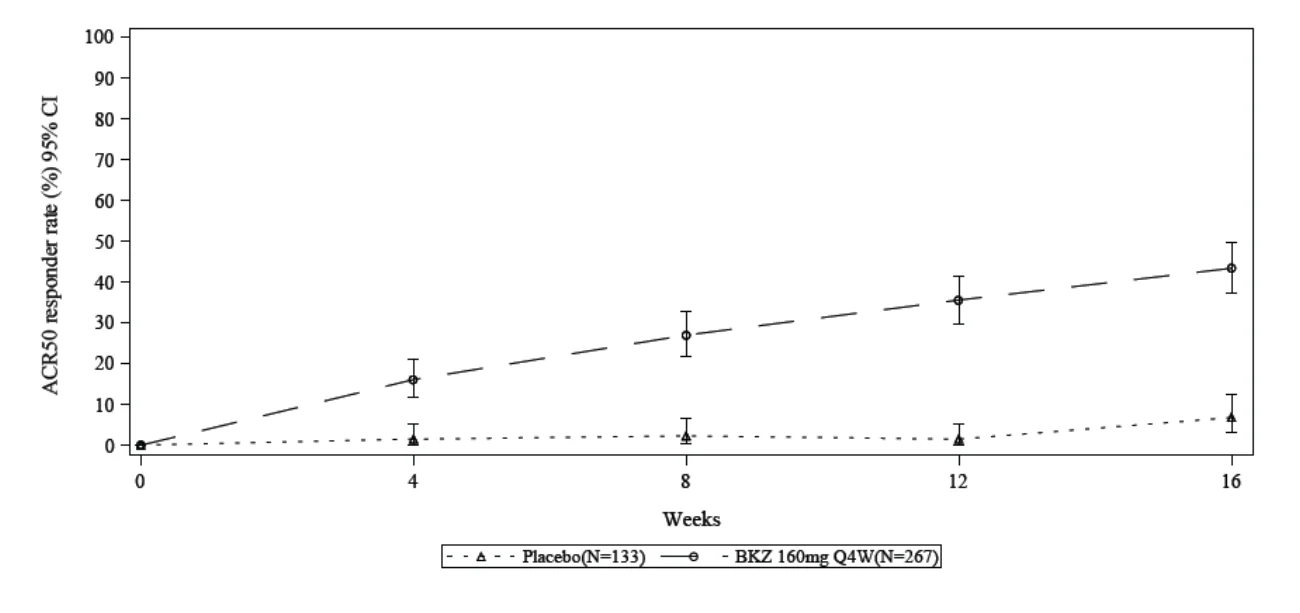
ACR 50 Week 16 | 28 (10.0) | 189 (43.9)* | 33.9 (27.4, 40.4) | 9 (6.8) | 116 (43.4)* | 36.7 (27.7, 45.7) | |||||||||
ACR 70 Week16 | 12 (4.3) | 105 (24.4) | 20.1 (14.7, 25.5) | 1 (0.8) | 71 (26.6) | 25.8 (18.2, 33.5) | |||||||||
MDA(a) Week 16 | 37 (13.2) | 194 (45.0)* | 31.8 (25.2, 38.5) | 8 (6.0) | 118 (44.2)* | 38.2 (29.2, 47.2) | |||||||||
| Patients with ≥3% BSA | (N=140) | (N=217) | - | (N=88) | (N=176) | - | |||||||||
PASI 90 Week 16 | 4 (2.9) | 133 (61.3)* | 58.4 (49.9, 66.9) | 6 (6.8) | 121 (68.8)* | 61.9 (51.5, 72.4) | |||||||||
PASI 100 Week 16 | 3 (2.1) | 103 (47.5) | 45.3 (36.7, 54.0) | 4 (4.5) | 103 (58.5) | 54.0 (43.1, 64.8) | |||||||||
BKZ 160 mg Q4W= Bimzelx 160 mg every 4 weeks. CI= confidence internal. NC=Not calculable
(a) A patient was classified as achieving Minimal Disease Activity (MDA) when meeting 5 of the 7 following criteria: tender joint count ⩽1; swollen joint count ⩽1; Psoriasis Activity and Severity Index ⩽1 or body surface area ⩽3; patient pain visual analogue scale (VAS) ⩽15; patient global disease activity VAS ⩽20; Health Assessment Questionnaire Disability Index ⩽0.5; tender entheseal points ⩽1
(b) Unadjusted differences are shown
* p<0.001 versus placebo adjusted for multiplicity. NRI is used.
Dactylitis and Enthesitis
In an analysis of pooled data from the BE OPTIMAL and BE COMPLETE studies, 75.6% vs. 51.1% of patients with dactylitis at baseline treated with Bimzelx vs placebo had resolution of dactylitis (LDI=0) at Week 16, and 49.8% vs 34.9% of patients with enthesitis at baseline treated with Bimzelx vs placebo had resolution of enthesitis (LEI=0) at Week 16.
Improvements from baseline were shown in all individual ACR components with Bimzelx (see Table 11).
Table 11: Mean Change from baseline in ACR components in studies BE OPTIMAL and BE COMPLETE at Week 16
| BE OPTIMAL (bDMARD-naïves) | BE COMPLETE (TNFα-IRs) | ||||||||||
|---|---|---|---|---|---|---|---|---|---|---|---|
Placebo (N=281) | BKZ 160 mg Q4W (N=431) | Placebo (N=133) | BKZ 160 mg Q4W (N=267) | ||||||||
| Number of swollen joints | |||||||||||
| Baseline | 9.5 | 9.0 | 10.3 | 9.7 | |||||||
| Mean change at Week 16 | -3.0 | -6.6 | -2.0 | -7.0 | |||||||
| Number of tender joints | |||||||||||
| Baseline | 17.1 | 16.8 | 19.3 | 18.4 | |||||||
| Mean change at Week 16 | -3.2 | -10.0 | -2.4 | -10.9 | |||||||
| Patient’s Assessment of Pain | |||||||||||
| Baseline | 56.8 | 53.7 | 61.7 | 58.3 | |||||||
| Mean change at Week 16 | -6.2 | -23.6 | -4.5 | -27.7 | |||||||
| Patient Global Assessment | |||||||||||
| Baseline | 58.6 | 54.4 | 63.0 | 60.5 | |||||||
| Mean change at Week 16 | -7.7 | -26.3 | -5.5 | -31.8 | |||||||
| Physician Global Assessment | |||||||||||
| Baseline | 57.3 | 57.2 | 57.7 | 59.3 | |||||||
| Mean change at Week 16 | -12.5 | -37.4 | -6.8 | -39.4 | |||||||
| Disability Index (HAQ-DI) | |||||||||||
| Baseline | 0.9 | 0.8 | 1.0 | 1.0 | |||||||
| Mean change at Week 16 | -0.1 | -0.3* | -0.1 | -0.4* | |||||||
| hs-CRP (mg/l) | |||||||||||
| Baseline (geometric mean) | 4.4 | 3.7 | 4.8 | 4.8 | |||||||
| Ratio to Baseline at Week 16 | 0.9 | 0.6 | 1.1 | 0.5 | |||||||
HAQ-DI = Health Assessment Questionnaire-Disability Index. CRP= C-reactive protein.
Multiple Imputation (MI) is used. *p<0.001 reference-based imputation versus placebo adjusted for multiplicity.
Figure 1: ACR 50 response over time up to Week 16 in BE OPTIMAL (NRI)
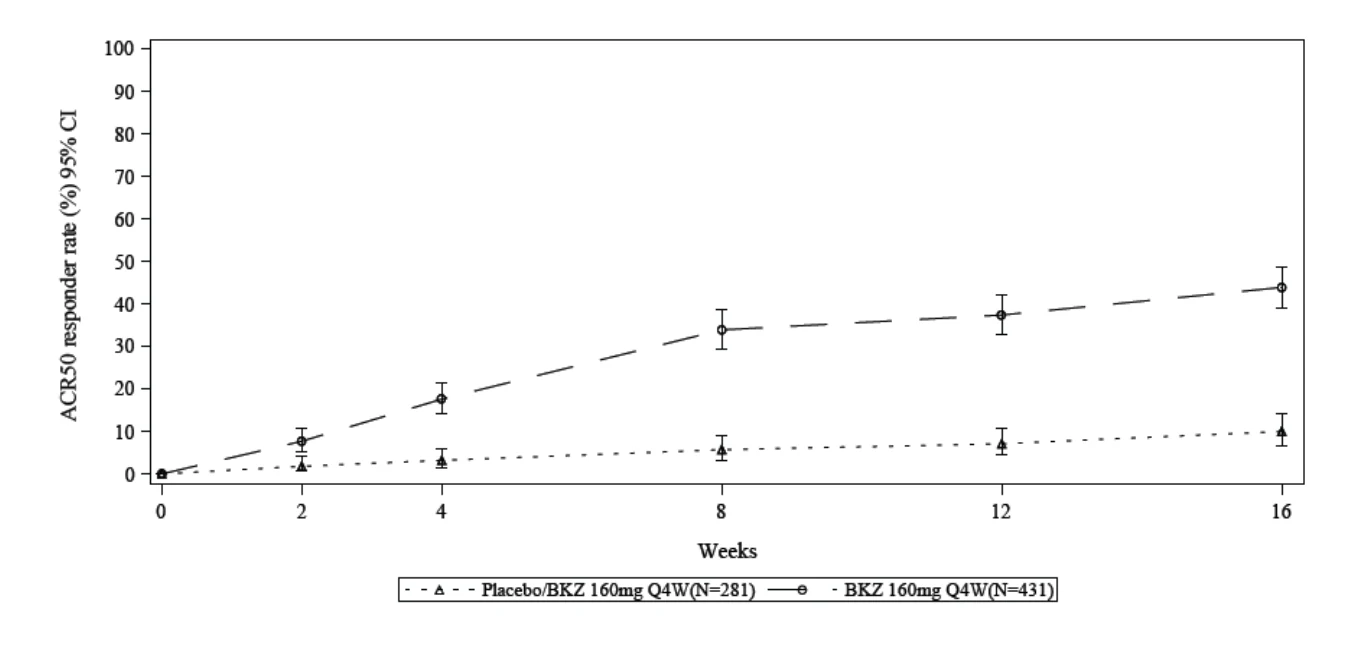
Figure 2: ACR 50 response over time up to Week 16 in BE COMPLETE (NRI)
In both studies, responses observed in the Bimzelx-treated groups were similar in patients receiving and not receiving concomitant cDMARDs (including MTX).
Patients with axial involvement at baseline, approximately 74% of patients, (defined as a Bath Ankylosing Spondylitis Disease Activity Index (BASDAI) score ≥4) showed greater improvement from baseline in BASDAI compared with placebo at Week 16.
Radiographic response
In BE OPTIMAL, inhibition of progression of structural damage was assessed radiographically and expressed as the change from baseline in the Van der Heijde modified total Sharp Score (vdHmTSS) and its components, the Erosion Score (ES) and the Joint Space Narrowing score (JSN) at Week 16.
Bimzelx significantly inhibited the rate of progression of joint damage at Week 16 in both the population with elevated hs-CRP and/or at least 1 bone erosion at baseline and the overall population compared to placebo using vdHmTSS change from baseline (p=0.001). The percentage of patients with no radiographic joint damage progression (defined as a change from baseline in mTSS of ≤0.5) from randomization to Week 16 was 83.9% for Bimzelx and 77.5% for placebo in the population with elevated hs-CRP and/or at least 1 bone erosion. Similar responses were achieved in the overall population (85.7% for Bimzelx and 78.8% for placebo).
Physical function and other health-related outcomes
Both bDMARD-naïve (BE OPTIMAL) and anti-TNFα-IR (BE COMPLETE) patients receiving Bimzelx showed significant improvement from baseline in physical function compared to placebo patients at Week 16 (p<0.001) as assessed by the HAQ-DI (see Table 11). In both studies, a greater proportion of patients achieved a clinically meaningful reduction of at least 0.35 in HAQ-DI score from baseline in the Bimzelx group compared with placebo at Week 16.
Bimzelx -treated patients reported significant improvement from baseline in the Short Form-36 item Health Survey Physical Component Summary (SF-36 PCS) score at Week 16 compared to placebo (LS Mean change from baseline: 6.3 versus 1.9, p<0.001 in BE OPTIMAL and 6.2 versus 0.1, p<0.001 in BE COMPLETE).
In both studies, Bimzelx-treated patients reported meaningful reduction from baseline in fatigue as measured by the Functional Assessment of Chronic Illness Therapy (FACIT)-Fatigue score at Week 16 compared to placebo.
Axial spondyloarthritis
Ankylosing Spondylitis and Non-radiographic Axial Spondyloarthritis
The efficacy and safety of Bimzelx were evaluated in 586 adult patients with active axial spondyloarthritis (axSpA) in two multicenter, randomized, double-blind, placebo-controlled studies: one in non-radiographic axial spondyloarthritis (nr-axSpA) and one in ankylosing spondylitis (AS), also known as radiographic axSpA.
A summary of trial design and patient demographics for the Phase III clinical trials (BE MOBILE 1 in nr-axSpA and BE MOBILE 2 in AS) is provided in Table 12.
Table 12: Summary of Patient Demographics for Clinical Trials in Axial Spondyloarthritis
| Study # | Trial design | Dosage, route of administration and duration | Study subjects (n) | Mean age (Range) Years | Sex % |
| BE MOBILE 1 (nr-axSpA) | Phase III, randomized, double blind, placebo-controlled | BKZ: 160 mg SC Q4W for 52 weeks PBO: for 16 weeks then BKZ 160 mg SC Q4W for 36 weeks | Adult patients with active non-radiographic axial spondyloarthritis BKZ: 128 PBO: 126 | 39.4 (18-76) | Male: 54.3 Female: 45.7 |
BE MOBILE 2 (AS) | Phase III, randomized, double blind, placebo- controlled | BKZ: 160 mg SC Q4W for 52 weeks PBO: for 16 weeks then BKZ 160 mg SC Q4W for 36 weeks | Adult patients with moderate to severe active ankylosing spondylitis BKZ: 221 PBO: 111 | 40.4 (19-80) | Male: 72.3 Female: 27.7 |
BKZ = Bimzelx; PBO = Placebo; SC = subcutaneous; Q4W = every 4 weeks
The BE MOBILE 1 study evaluated 254 patients with active nr-axSpA. Patients had axSpA meeting the ASAS classification criteria, with age of symptoms onset <45 years, and no evidence of radiographic changes in the sacroiliac joints that would meet the modified New York criteria for AS. Patients had active disease as defined by a Bath Ankylosing Spondylitis Disease Activity Index (BASDAI) ≥4 and spinal pain ≥4 on a 0 to 10 numeric rating scale (NRS). Patients also had objective signs of inflammation as indicated by elevated C-reactive protein (CRP) level and/or evidence of sacroiliitis on Magnetic Resonance Imaging (MRI) as well as a history of inadequate response to 2 different non-steroidal anti-inflammatory drugs (NSAIDs) or intolerance or contraindication to NSAIDs. At baseline, patients had symptoms of nr-axSpA for a mean of 9 years (median of 5.5 years). Overall 10.6% of patients were previously treated with an anti-TNFα agent.
The BE MOBILE 2 study evaluated 332 patients with active AS. Patients had AS meeting the Modified New York criteria for AS including radiologic evidence (X-ray) , with age of symptoms onset <45 years. Patients had active disease as defined by a BASDAI ≥4 and spinal pain ≥4 on a 0 to 10 numeric rating scale (NRS). Patients had a history of inadequate response to 2 different NSAIDs or intolerance or contraindication to NSAIDs. At baseline, patients had symptoms of AS for a mean of 13.5 years (median of 11 years). Overall 16.3% of patients were previously treated with an anti-TNFα agent.
Study Results
The primary efficacy endpoint in both studies was the percentage of patients achieving an Assessment of SpondyloArthritis International Society (ASAS) 40 response at Week 16.
Treatment with Bimzelx resulted in significant improvement in signs and symptoms, and in measures of disease activity compared to placebo at Week 16 in both nr-axSpA and AS patient populations (see Table 13). In AS patients, a similar ASAS 40 response was seen regardless of prior anti-TNFα exposure.
Table 13: Clinical responses in BE MOBILE 1 and BE MOBILE 2 at Week 16
| BE MOBILE 1 (nr-axSpA) | BE MOBILE 2 (AS) | |||||||||||
|---|---|---|---|---|---|---|---|---|---|---|---|---|
Placebo (N=126) n (%) | BKZ 160 mg Q4W (N=128) n (%) | Difference from placebo (95% CI)b) | Placebo (N=111) n (%) | BKZ 160 mg Q4W (N=221) n (%) | Difference from placebo (95% CI)b) | |||||||
| ASAS 40 | 27 (21.4) | 61 (47.7)* | 26.2 (14.9, 37.5) | 25 (22.5) | 99 (44.8)* | 22.3 (11.5, 33.0) | ||||||
| ASAS 40 in anti-TNFα naïves | 22 (23.4) (N=94) | 84 (45.7)* (N=184) | 22.3 (10.5, 34.0) | |||||||||
| ASAS 20 | 48 (38.1) | 88 (68.8)* | 30.7 (19.0, 42.3) | 48 (43.2) | 146 (66.1)* | 22.8 (11.8, 33.8) | ||||||
| ASAS-partial remission | 9 (7.1) | 33 (25.8)* | 18.6 (9.7, 27.6) | 8 (7.2) | 53 (24.0)* | 16.8 (8.1, 25.5) | ||||||
| ASDAS-major improvement | 9 (7.1) | 35 (27.3)* | 20.2 (11.2, 29.3) | 6 (5.4) | 57 (25.8)* | 20.4 (11.7, 29.1) | ||||||
BKZ 160 mg Q4W = Bimzelx 160 mg every 4 weeks. ASDAS = Ankylosing Spondylitis Disease Activity Score.
*p<0.001 versus placebo, adjusted for multiplicity.
- b) Unadjusted differences are shown.
Improvements in the components of the ASAS 40 response criteria and other measures of efficacy are shown in Table 14.
Table 14: ASAS 40 components and other measures of efficacy in BE MOBILE 1 and BE MOBILE 2 at Week 16
| BE MOBILE 1 (nr-axSpA) | BE MOBILE 2 (AS) | ||||||||||
|---|---|---|---|---|---|---|---|---|---|---|---|
| BE MOBILE 1 (nr-axSpA) | BE MOBILE 2 (AS) | ||||||||||
Placebo (N= 126) | BKZ 160 mg Q4W (N= 128) | Placebo (N= 111) | BKZ 160 mg Q4W (N=221) | ||||||||
Placebo (N= 126) | BKZ 160 mg Q4W (N= 128) | Placebo (N= 111) | BKZ 160 mg Q4W (N=221) | ||||||||
| ASAS components | |||||||||||
| ASAS components | |||||||||||
| 6.9 -1.4 | 7.1 -3.2 | 6.7 -1.6 | 6.6 -2.7 | |||||||
| 7.1 -1.7 | 7.3 -3.4 | 7.2 -1.9 | 7.1 -3.3 | |||||||
| 5.3 -1.0 | 5.5 -2.5* | 5.2 -1.1 | 5.3 -2.2* | |||||||
| 6.9 -1.9 | 7.0 -3.6 | 6.8 -2.1 | 6.7 -3.2 | |||||||
Nocturnal spinal pain Baseline Mean change from baseline | 6.7 -1.7 | 6.9 -3.6* | 6.8 -1.9 | 6.6 -3.3* | |||||||
BASDAI Baseline Mean change from baseline | 6.7 -1.5 | 6.9 -3.1* | 6.5 -1.9 | 6.5 -2.9* | |||||||
BASMI Baseline Mean change from baseline | 3.0 -0.1 | 2.9 -0.4 | 3.8 -0.2 | 3.9 -0.5** | |||||||
hs-CRP (mg/L) Baseline (Geometric Mean) Ratio to Baseline | 5.0 0.8 | 4.6 0.4 | 6.7 0.9 | 6.5 0.4 | |||||||
PtGADA = Patient’s Global Assessment of Disease Activity. BASFI = Bath Ankylosing Spondylitis Functional Index. BASMI = Bath Ankylosing Spondylitis Metrology Index. Hs-CRP = high sensitivity C-reactive protein
Multiple Imputation (MI) is used.
*p<0.001 reference-based imputation versus placebo, adjusted for multiplicity. **p<0.01 reference-based imputation versus placebo, adjusted for multiplicity.
The ASAS 40 response over time up to Week 16 in BE MOBILE 1 and BE MOBILE 2 is shown in Figure 3 and Figure 4, respectively.
Figure 3: ASAS 40 response over time up to Week 16 in BE MOBILE 1 (NRI)
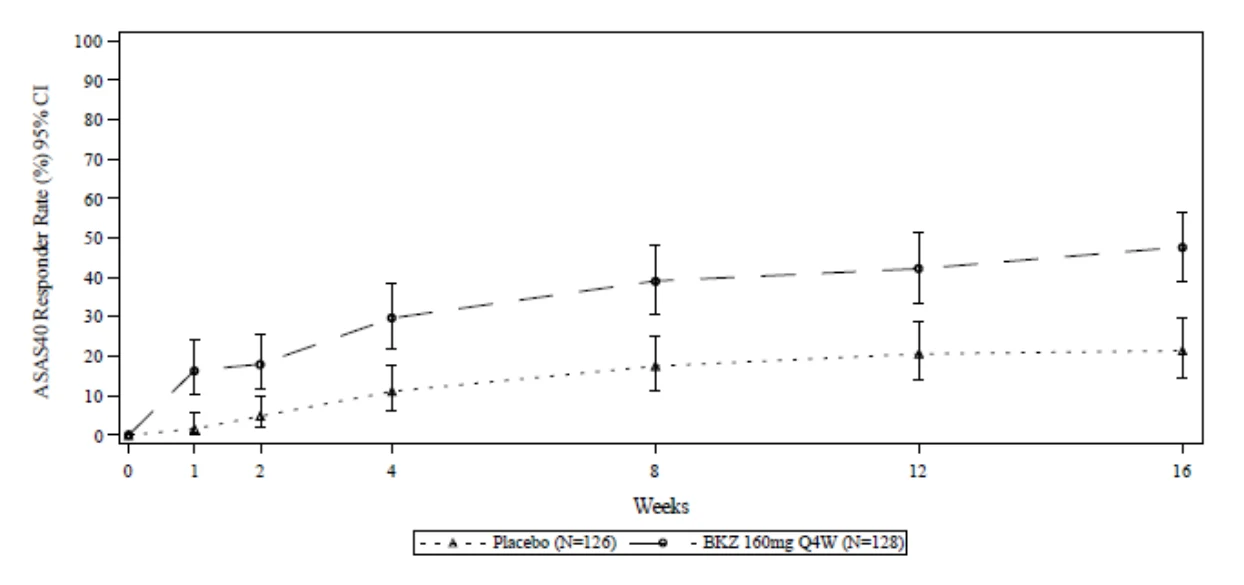
Figure 4: ASAS 40 response over time up to Week 16 in BE MOBILE 2 (NRI)
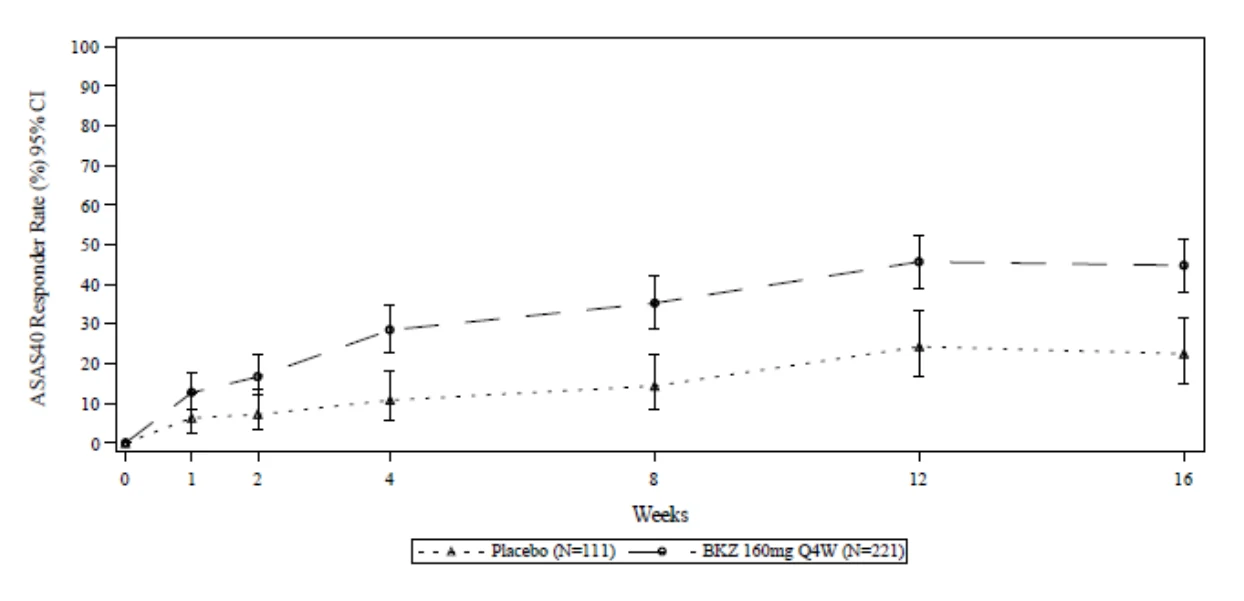
At Week 16, among patients with enthesitis at baseline, the proportion of patients with enthesitis resolution as assessed by the Maastricht Ankylosing Spondylitis Enthesitis (MASES) index was greater with Bimzelx compared to placebo (BE MOBILE 1: 51.1% versus 23.9% and BE MOBILE 2: 51.5% versus 32.8%).
Reduction of inflammation
Bimzelx reduced inflammation as measured by hs-CRP (see Table 14) and as assessed by MRI in an imaging sub-study. Signs of inflammation were assessed at Week 16 as change from baseline in Spondyloarthritis Research Consortium of Canada (SPARCC) score for sacroiliac joints and Ankylosing Spondylitis spine Magnetic Resonance Imagine-activity (ASspiMRI-a score in the Berlin modification) for the spine. At Week 16, mean reduction from baseline in SPARCC MRI score in the bimekizumab group compared with placebo was -6.26 vs -1.45 respectively in BE MOBILE 1, and -5.61 vs 1.13 in BE MOBILE 2. Mean reduction from baseline in ASspiMRI-a score in the bimekizumab group compared with placebo was -0.68 vs -0.14 respectively in BE MOBILE 1, and -2.29 vs 0.00 in BE MOBILE 2.
Physical function and other health-related outcomes
Patients treated with Bimzelx showed significant improvement from baseline in physical function as assessed by the BASFI (see Table 14). Patients treated with Bimzelx reported significant improvement from baseline compared to placebo-treated patients in SF-36 PCS score (LS Mean change from baseline at Week 16 in BE MOBILE 1: 9.3 versus 5.4, p<0.001 and in BE MOBILE 2: 8.5 versus 5.2, p<0.001).
Patients treated with Bimzelx reported significant improvement from baseline in health-related quality of life as measured by the AS Quality of Life Questionnaire (ASQoL) compared to placebo (LS Mean change from baseline at Week 16 in BE MOBILE 1: -4.9 versus -2.3, p<0.001 and in BE MOBILE 2: -4.6 versus -3.0, p<0.001) as well as meaningful reduction in fatigue as assessed by the FACIT-Fatigue score (Mean change from baseline at Week 16 in BE MOBILE 1: 8.5 for Bimzelx versus 3.9 for placebo and in BE MOBILE 2: 8.4 for Bimzelx versus 5.0 for placebo).
Hidradenitis suppurativa
The safety and efficacy of Bimzelx was evaluated in two Phase III multicenter, randomized, double-blind, placebo-controlled studies (BE HEARD I and BE HEARD II), in adult subjects with moderate to severe Hidradenitis Suppurativa (HS) who have had a history of inadequate response to a course of systemic antibiotics for treatment of HS. Subjects enrolled in these studies had a Hurley Stage II or Hurley Stage III disease, with ≥5 inflammatory lesions (i.e., number of abscesses plus number of inflammatory nodules). A summary of trial design and patient demographics is provided in Table 15.
Table 15: Summary of Patient Demographics for Clinical Trials in Hidradenitis Suppurativa
| Study # | Trial design | Dosage, route of administration and duration | Study subjects* (n) | Mean age (Range) Years | Sex % |
| BE HEARD I | Phase III, randomized, double blind, placebo-controlled | Randomized 2:2:2:1 BKZ: 320 mg SC Q2W for 48 weeks (Q2W/Q2W) BKZ: 320 mg SC Q4W for 48 weeks (Q4W/Q4W) BKZ: 320 mg SC Q2W to week 16 then 320 mg SC Q4W up to week 48 (Q2W/Q4W) PBO: for 16 weeks then BKZ 320 mg SC Q2W up to week 48 | Adult patients with moderate to severe hidradenitis suppurativa BKZ 320 mg Q2W/Q2W: 143 BKZ 320 mg Q4W/Q4W: 144 BKZ 320 mg Q2W/Q4W: 146 PBO:72 | 36.7 (18 – 78) | Male: 37.0% Female: 63.0% |
| BE HEARD II | Phase III, randomized, double blind, placebo- controlled | Randomized 2:2:2:1 BKZ: 320 mg SC Q2W for 48 weeks (Q2W/Q2W) BKZ: 320 mg SC Q4W for 48 weeks (Q4W/Q4W) BKZ: 320 mg SC Q2W to week 16 then 320 mg SC Q4W up to week 48 (Q2W/Q4W) PBO: for 16 weeks then BKZ 320 mg SC Q2W up to week 48 | Adult patients with moderate to severe hidradenitis suppurativa BKZ 320 mg Q2W/Q2W: 145 BKZ 320 mg Q4W/Q4W: 144 BKZ 320 mg Q2W/Q4W: 146 PBO:74 | 36.6 (18 – 75) | Male: 49.3% Female: 50.7% |
BKZ = Bimzelx; PBO = Placebo; SC = subcutaneous; Q2W = every 2 weeks; Q4W = every 4 weeks
* Randomized set
A total of 1014 subjects were randomized 2:2:2:1 to receive subcutaneous injections of either BIMZELX 320 mg every 2 weeks (Q2W) until Week 48, BIMZELX 320 mg every 4 weeks (Q4W) until Week 48, BIMZELX 320 mg every 2 weeks (Q2W) until Week 16 followed by BIMZELX 320 mg every 4 weeks
(Q4W) until Week 48, or placebo every 2 weeks (Q2W) until Week 16 followed by BIMZELX 320 mg every 2 weeks (Q2W) until Week 48. Concomitant oral antibiotic use was allowed if the patient was on a stable dose regimen of doxycycline, minocycline, or an equivalent systemic tetracycline for 28 days prior to baseline.
Baseline characteristics were consistent across both studies and reflective of a population with moderate to severe HS. At baseline, the mean age of all patients was 36.6 years, and 56.8% of patients were female. 79.7% of patients were White, and 10.8% were Black or African American. 45.6% of patients were current smokers. Patients had a median disease duration of 5.3 years (mean 8.0 years). The proportions of Hurley Stage II and Stage III patients were 55.7% and 44.3% respectively, and 8.5% were receiving concomitant antibiotic therapy for HS.
The primary efficacy endpoint in both studies was the Hidradenitis Suppurativa Clinical Response 50 (HiSCR50) at Week 16, i.e. at least a 50% reduction in the total abscess and inflammatory nodule count with no increase in abscess or draining tunnel count relative to baseline. The key secondary endpoint was Hidradenitis Suppurativa Clinical Response 75 (HiSCR75) at Week 16, i.e. at least a 75% reduction in the total abscess and inflammatory nodule count with no increase in abscess or draining tunnel count relative to baseline.
Study Results
Key efficacy results from BE HEARD I and BE HEARD II evaluating the initial treatment period with BIMZELX at Week 16 in subjects with moderate to severe HS are shown in Table 16. The results reflect the predefined primary analysis in which any systemic antibiotic use prior to Week 16 resulted in imputation of nonresponse.
Table 16: Clinical responses in BE HEARD I and BE HEARD II at Week 16 – primary analysisa
| BE HEARD I | BE HEARD II | |||||||||||||
|---|---|---|---|---|---|---|---|---|---|---|---|---|---|---|
Placebo (N=72) | BKZ 320mg Q2W (N=289)b | Placebo (N=74) | BKZ 320mg Q2W (N=291) b | |||||||||||
| Primary endpoint | ||||||||||||||
| HiSCR50, % | 28.7 | 47.8* | 32.2 | 52.0* | ||||||||||
| Difference vs placebo (95% CI) | 18.1 (6.3, 30.0) | 19.6 (7.5, 31.7) | ||||||||||||
| Key secondary endpoint | ||||||||||||||
| HiSCR75, % | 18.4 | 33.4* | 15.6 | 35.7* | ||||||||||
| Difference vs placebo (95% CI) | 15.4 (3.7, 27.0) | 20.6 (9.9, 31.3) | ||||||||||||
cfb = change from baseline; AN = abscess and inflammatory nodule; DT = draining tunnel
a Patients who take systemic antibiotics for any reason or who discontinue due to adverse event or lack of efficacy are treated as non-responders at all subsequent visits for responder variables. Other missing data were imputed via multiple imputation.
b BKZ 320mg Q2W subjects were pooled from the BKZ 320mg Q2W/Q2W and BKZ 320mg Q2W/Q4W groups.
* Statistically significant versus placebo based on the pre-defined testing hierarchy at the overall 2-sided 0.05 significance level.
The efficacy of bimekizumab was demonstrated regardless of prior biologics therapy and systemic antibiotic use at baseline.
Prespecified exploratory analyses demonstrated a numerical trend in key efficacy endpoints at Week 4 in favour of Bimzelx relative to placebo.
In prespecified exploratory analyses, for subjects treated with Bimzelx 320 mg every 2 weeks and then switched to Bimzelx 320 mg every 4 weeks at Week 16: of the 104 who completed the Week 48 treatment period in the BE HEARD I study, 83 (79.8%) achieved a HiSCR50 response at Week 48; and, of the 107 who completed the Week 48 treatment period in the BE HEARD II study, 87 (81.3%) achieved a HiSCR50 response at week 48.
In a prespecified analysis of the secondary endpoint - skin pain response at Week 16, defined as at least a 3-point decrease from Baseline in the Hidradenitis Suppurativa Symptom Daily Diary (HSSDD) weekly worst skin pain score among subjects with a score of ≥ 3 at baseline, the proportions of patients achieving a skin pain response in BE HEARD I was 32.3% and 15.0% in the Bimzelx 320 mg Q2W and placebo group, respectively, and in BE HEARD II was 31.8% and 10.9% in the Bimzelx 320 mg Q2W and placebo group, respectively.
In BE HEARD I, the mean change from baseline (standard error) in the Dermatology Life Quality Index (DLQI) at Week 16 was of -5.0 (0.4) and -2.7 (0.9) in the Bimzelx 320 mg Q2W and placebo group, respectively. In BE HEARD II, the results were -4.6 (0.3) and -3.2 (0.6) in the Bimzelx 320 mg Q2W and placebo group, respectively.
16. Non-Clinical Toxicology
The adverse effects observed in conducted non-clinical studies were attributed to the pharmacological effect of bimekizumab on muco-epidermal immunity, more generally on the skin, oral mucosa, and intestines.
General toxicology: In a single dose toxicity study, cynomolgus monkeys were administered bimekizumab at dose levels of 1 to 200mg/kg by the iv or sc route. Five out of 8 animals given the dose of 10mg/kg developed diarrhea, dehydration, and body weight loss due to intestinal infection between 26 and 40 days after dosing, with identification of Balantidium coli in faeces. The infection resolved in 4 animals after antibiotic treatment. A no-observed-adverse-effect-level (NOAEL) could not be determined for this study.
In an 8-week study, cynomolgus monkeys were administered bimekizumab once per week at intravenous doses of 0, 20 or 200mg/kg or subcutaneous doses of 50 or 200mg/kg (14 to 187-times the human exposure at the maximum recommended human dose [MRHD] based on AUC). One female in the high-dose group developed a mouth abscess following infection. Animals from all bimekizumab dosing groups showed dose-related, asymptomatic, and reversible focal necrosis of the mucosa associated lymphoid tissue in the large intestine associated with presence of Balantidium coli in the crypts and erosion of the surface intestinal mucosa. A NOAEL could not be determined for this study.
In a 26-week repeat-dose toxicity study, 6 male and 6 female cynomolgus monkeys per group were administered bimekizumab subcutaneously at doses of 0 (vehicle), 50, or 200mg/kg once a week (37- or 109-times the human exposure at the MRHD based on AUC). Animals were treated prophylactically with oral metronidazole to reduce gut protozoa and anaerobic bacteria 4 months prior to the initiation of dosing. Two animals in the low-dose group were euthanized after repeated episodes of infectious enteritis. Most animals given bimekizumab developed dose-related superficial dermatitis, mainly on ventral surface of the trunk, inguinal and axillary areas and upper part of limbs, associated with the proliferation of gram-positive cocci on the skin, mainly Staphylococcus aureus. Some of the animals had skin ulcerations and pustules and/or enlarged lymph nodes. A NOAEL could not be determined for this study.
Genotoxicity: Genotoxicity studies have not been conducted with bimekizumab.
Carcinogenicity: Carcinogenicity studies have not been conducted with bimekizumab.
Reproductive and developmental toxicology: In an enhanced pre- and postnatal development study, pregnant cynomolgus monkeys were administered bimekizumab subcutaneously at doses of 0, 20, or 50 mg/kg once per week (13- or 27-times the MRHD based on AUC) throughout organogenesis until parturition. At the highest dose (27-times the human exposure at the MRHD based on AUC), maternal animals showed test-article related dermal changes (e.g. discoloration and squamous or scabby skin). No effects on gestation, parturition, infant survival, or fetal and postnatal development were observed. At birth, serum bimekizumab concentrations in infant monkeys were comparable to those of mothers. Male infants exposed to bimekizumab in utero were found to have reduced neutrophil counts and IgG response to antigen challenge. F1 animals showed transient discoloration of the lips. These changes reflect immunomodulatory properties of bimekizumab. Bimekizumab concentration in breast milk was not investigated.
Effects on male and female fertility have not been directly evaluated in animal studies. However menstrual cyclicity, testis size, semen quality and histological structure of the reproductive organs demonstrated no effects of bimekizumab during a 26-week toxicology study at doses up to 109-times the human exposure at the MRHD based on AUC.