


Product Monograph - Taltz
RECENT MAJOR LABEL CHANGES
| 7.0 Warnings and Precautions, Eczematous Eruptions | MM/YYYY |
|---|
TABLE OF CONTENTS
RECENT MAJOR LABEL CHANGES ............................................................................ 2
TABLE OF CONTENTS .................................................................................................. 2
PART I: HEALTH PROFESSIONAL INFORMATION .................................................... 4
1 INDICATIONS ...................................................................................................... 4
1.1 Pediatrics ............................................................................................. 4
1.2 Geriatrics .............................................................................................. 4
2 CONTRAINDICATIONS ....................................................................................... 4
4 DOSAGE AND ADMINISTRATION ..................................................................... 4
4.1 Dosing Considerations ......................................................................... 4
4.2 Recommended Dose and Dosage Adjustment .................................... 5
4.4 Administration ...................................................................................... 6
4.5 Missed Dose ........................................................................................ 7
5 OVERDOSAGE .................................................................................................... 7
6 DOSAGE FORMS, STRENGTHS, COMPOSITION AND PACKAGING ............. 7
7 WARNINGS AND PRECAUTIONS ...................................................................... 8
7.1 Special Populations .............................................................................. 9
7.1.1 Pregnant Women .................................................................................... 9
7.1.2 Breast-feeding ......................................................................................... 9
7.1.3 Pediatrics .............................................................................................. 10
7.1.4 Geriatrics ............................................................................................... 10
8 ADVERSE REACTIONS .................................................................................... 10
8.1 Adverse Reaction Overview ............................................................... 10
8.2 Clinical Trial Adverse Reactions ......................................................... 10
8.2.1 Clinical Trial Adverse Reactions – Pediatrics ........................................ 17
8.3 Less Common Clinical Trial Adverse Reactions ................................. 18
8.3.1 Less Common Clinical Trial Adverse Reactions – Pediatrics ................ 18
8.4 Abnormal Laboratory Findings: Hematologic, Clinical Chemistry and Other Quantitative Data ...................................................................................... 19
8.5 Post-Market Adverse Reactions ......................................................... 19
9 DRUG INTERACTIONS ..................................................................................... 20
9.2 Drug Interactions Overview ................................................................ 20
9.5 Drug-Food Interactions ....................................................................... 20
9.6 Drug-Herb Interactions ....................................................................... 20
9.7 Drug-Laboratory Test Interactions ...................................................... 20
10 CLINICAL PHARMACOLOGY ........................................................................... 20
10.1 Mechanism of Action .......................................................................... 20
10.2 Pharmacodynamics ............................................................................ 21
10.3 Pharmacokinetics ............................................................................... 21
11 STORAGE, STABILITY AND DISPOSAL ......................................................... 22
12 SPECIAL HANDLING INSTRUCTIONS ............................................................ 22
PART II: SCIENTIFIC INFORMATION ......................................................................... 23
13 PHARMACEUTICAL INFORMATION ............................................................... 23
14 CLINICAL TRIALS ............................................................................................. 23
14.1 Clinical Trials by Indication ................................................................. 23
14.3 Immunogenicity .................................................................................. 48
15 MICROBIOLOGY ............................................................................................... 49
16 NON-CLINICAL TOXICOLOGY ......................................................................... 49
PATIENT MEDICATION INFORMATION ..................................................................... 50
INSTRUCTIONS FOR USE .......................................................................................... 58
INSTRUCTIONS FOR USE .......................................................................................... 66
PART I: HEALTH PROFESSIONAL INFORMATION
1 INDICATIONS
Plaque Psoriasis
TALTZ (ixekizumab) is indicated for the treatment of adult patients with moderate-to-severe plaque psoriasis who are candidates for systemic therapy or phototherapy.
Psoriatic Arthritis
TALTZ is indicated for the treatment of adult patients with active psoriatic arthritis who have responded inadequately to, or are intolerant to one or more disease-modifying antirheumatic drugs (DMARD). TALTZ can be used alone or in combination with a conventional DMARD (cDMARD) (e.g., methotrexate).
Ankylosing Spondylitis
TALTZ is indicated for the treatment of adult patients with active ankylosing spondylitis who have responded inadequately to, or are intolerant to conventional therapy.
Non-radiographic Axial Spondyloarthritis
TALTZ is indicated for the treatment of adult patients with active non-radiographic axial spondyloarthritis with objective signs of inflammation who have responded inadequately to, or are intolerant to conventional therapy.
1.1 Pediatrics
Pediatrics (6 to <18 years of age): The safety and efficacy of TALTZ for the treatment of moderate-to-severe plaque psoriasis have been established in pediatric patients from 6 to less than 18 years of age. Therefore, TALTZ is indicated for the treatment of pediatric patients from 6 to less than 18 years of age with moderate-to-severe plaque psoriasis who are candidates for systemic therapy or phototherapy (see 7.1.3 Pediatrics and 14 CLINICAL TRIALS, Pediatric plaque psoriasis).
1.2 Geriatrics
Although no differences in safety or efficacy were observed between older and younger patients, the number of patients aged 65 and over is not sufficient to determine whether they respond differently from younger patients (see 7.1.4 Geriatrics).
2 CONTRAINDICATIONS
TALTZ is contraindicated in patients with known serious hypersensitivity to ixekizumab or to any of the excipients. For a complete listing of excipients, see 6 DOSAGE FORMS, STRENGTHS, COMPOSITION AND PACKAGING. See 7 WARNINGS AND PRECAUTIONS.
4 DOSAGE AND ADMINISTRATION
4.1 Dosing Considerations
- TALTZ is intended for use under the guidance and supervision of a health care professional.
- Adult patients may self-inject after training in subcutaneous injection technique using the prefilled autoinjector or prefilled syringe.
- If a physician determines that it is appropriate, pediatric patients weighing more than 50 kg may self-inject 80 mg of TALTZ using the autoinjector or prefilled syringe after training and demonstration of proper subcutaneous injection technique; caregiver supervision is recommended. TALTZ doses of 20 mg or 40 mg must be prepared and administered by a qualified healthcare provider using aseptic technique (see 4.2 Recommended Dose and Dosage Adjustment).
4.2 Recommended Dose and Dosage Adjustment
Plaque psoriasis
- Adult
The recommended dose is 160 mg by subcutaneous injection (two 80 mg injections) at Week 0, followed by 80 mg (one injection) at Weeks 2, 4, 6, 8, 10, and 12, then 80 mg (one injection) every 4 weeks.
- Pediatric
TALTZ is administered by subcutaneous injection every 4 weeks (Q4W). The recommended dose in pediatric patients from 6 to less than 18 years of age with moderate-to-severe plaque psoriasis is based on the following weight categories (Table 1).
See 4.4 Administration, Pediatric psoriasis for specific instructions on the preparation and administration of this dose.
Table 1 - Recommended Dosing for Pediatric Patients with Moderate-to-Severe Plaque Psoriasis
| Pediatric Patient’s Weight | Starting Dose (Week 0) | Dose every 4 weeks (Q4W) Thereafter |
|---|---|---|
| Greater than 50 kg | 160 mg (two 80 mg injections) | 80 mg |
| 25 to 50 kg | 80 mg | 40 mg |
| Less than 25 kg | 40 mg | 20 mg |
Psoriatic arthritis
- The recommended dose is 160 mg by subcutaneous injection (two 80 mg injections) at Week 0, followed by 80 mg every 4 weeks. For psoriatic arthritis patients with coexistent moderate-to-severe plaque psoriasis, use the dosing regimen for plaque psoriasis (see 4 DOSAGE AND ADMINISTRATION, Plaque psoriasis). For psoriatic arthritis patients with coexistent mild plaque psoriasis, use the dosing regimen for psoriatic arthritis: 160 mg at Week 0, followed by 80 mg every 4 weeks (see 14 CLINICAL TRIALS).
Ankylosing spondylitis
- The recommended dose is 80 mg by subcutaneous injection every 4 weeks. Limited data suggests that some TNF inhibitor experienced patients with ankylosing spondylitis may benefit from a 160 mg starting dose. Conventional disease-modifying antirheumatic drugs (cDMARD) (e.g., sulfasalazine), corticosteroids, non-steroidal anti-inflammatory drugs (NSAIDs), and/or analgesics may be continued during treatment with ixekizumab.
Non-radiographic axial spondyloarthritis
- The recommended dose is 80 mg by subcutaneous injection every 4 weeks. Conventional disease-modifying antirheumatic drugs (cDMARD) (e.g., sulfasalazine), corticosteroids, non-steroidal anti-inflammatory drugs (NSAIDs), and/or analgesics may be continued during treatment with ixekizumab.
Dosing Considerations for Special Populations
- Renal impairment/Hepatic impairment
TALTZ has not been studied specifically in these patient populations.
4.4 Administration
There are two presentations for TALTZ (prefilled autoinjector and prefilled syringe). See the TALTZ Instructions for Use for each presentation for more detailed instructions on the preparation and administration of TALTZ.
Before injection, remove TALTZ prefilled autoinjector or TALTZ prefilled syringe from the refrigerator and allow TALTZ to reach room temperature (30 minutes) without removing the needle cap.
Inspect TALTZ visually for particulate matter and discolouration prior to administration. The TALTZ solution is clear and colourless to slightly yellow. Do not use if the liquid contains visible particles, is discoloured or cloudy. TALTZ does not contain preservatives therefore discard any unused product remaining in the prefilled autoinjector or prefilled syringe after injection. See 4.2 Recommended Dose and Dosage Adjustment for additional instruction on preparing pediatric doses of 20 mg and 40 mg.
TALTZ is for subcutaneous administration. Administer each injection at a different anatomic location (such as upper arms, thighs or any quadrant of abdomen) than the previous injection, and not into areas where the skin is tender, bruised, erythematous, indurated or affected by psoriasis. Administration of TALTZ in the upper, outer arm may be performed by a caregiver or healthcare provider.
Instruct patients using the prefilled autoinjector or prefilled syringe to inject the full amount (1 mL), which provides 80 mg of TALTZ, according to the directions provided in the Instructions for Use.
Pediatric psoriasis
TALTZ doses of 20 mg or 40 mg must be prepared and administered by a qualified healthcare professional. Use only the commercial TALTZ 80 mg/1 mL prefilled syringe when preparing the prescribed 20 mg and 40 mg pediatric dose.
- 1. Gather the following necessary supplies for preparation:
- • 0.5 mL or 1 mL disposable syringe
- • Sterile needle for withdrawal
- • 27-gauge sterile needle for administration
- • Sterile, clear glass vial.
- 2. Expel the entire contents of the prefilled syringe into the sterile vial. DO NOT shake or swirl the vial. No other medications should be added to solutions containing TALTZ.
- 3. Using the 0.5 mL or 1 mL disposable syringe and sterile needle, withdraw the prescribed dose from the vial (0.25 mL for 20 mg; 0.5 mL for 40 mg).
- 4. Remove the needle from the syringe and replace it with a 27-gauge needle prior to administering TALTZ to the patient.
Storage
If necessary, TALTZ may be stored in the sterile vial, at room temperature, for up to 4 hours from first puncturing the vial. Discard any unused TALTZ and the disposable syringe in a puncture-resistant container immediately following administration.
4.5 Missed Dose
Patients who miss a dose of TALTZ should be advised to inject this missed dose as soon as they become aware of it, and then follow with their next scheduled dose.
5 OVERDOSAGE
Doses up to 180 mg have been administered subcutaneously in clinical trials without dose-limiting toxicity. Overdoses up to 240 mg, subcutaneously, have been reported without any serious adverse events. In the event of overdosage, it is recommended that the patient be monitored for any signs or symptoms of adverse reactions and appropriate symptomatic treatment be instituted immediately.
| For management of a suspected drug overdose, contact your regional poison control centre. |
|---|
6 DOSAGE FORMS, STRENGTHS, COMPOSITION AND PACKAGING
To help ensure the traceability of biologic products, including biosimilars, health professionals should recognize the importance of recording both the brand name and the non-proprietary (active ingredient) name as well as other product-specific identifiers such as the Drug Identification Number (DIN) and the batch/lot number of the product supplied.
Table 2 - Dosage Forms, Strengths, Composition and Packaging
| Route of Administration | Dosage Form / Strength / Composition | Non-medicinal Ingredients |
| Subcutaneous Injection (S.C.) | Sterile solution for injection / 80 mg/1 mL (prefilled autoinjector or prefilled syringe) | Sucrose, polysorbate 80, and water for injection. Sodium hydroxide may have been added to adjust pH. |
TALTZ is supplied as:
- 80 mg single-dose prefilled autoinjector (pack sizes: carton of 1, 2 or 3)*
- 80 mg single-dose prefilled syringe (pack sizes: carton of 1, 2 or 3)*
*Not all pack sizes and presentations may be marketed.
The TALTZ prefilled autoinjector and prefilled syringe each contain a 1 mL glass syringe with a fixed 27 gauge ½ inch needle and are manufactured to deliver 80 mg ixekizumab.
TALTZ is for single use and, therefore, contains no antimicrobial preservatives.
TALTZ prefilled autoinjector and prefilled syringe do not contain latex.
7 WARNINGS AND PRECAUTIONS
General
- Infections
TALTZ has a potential to increase the risk of infection. In clinical trials, infections have been observed in TALTZ-treated patients. Most of the infections were mild or moderate in severity and did not lead to early discontinuation. See 8 ADVERSE REACTIONS.
TALTZ should be used with caution in patients with clinically important chronic or active infection.
Patients should be instructed to seek medical advice if signs or symptoms suggestive of an infection occur. If a patient develops a serious infection or is not responding to standard therapy, the patient should be closely monitored and TALTZ should not be administered until the infection resolves.
TALTZ should not be given to patients with active tuberculosis (TB). Prior to initiating treatment with TALTZ, patients should be evaluated for TB infection. Treatment of latent TB infection should be initiated prior to administering TALTZ. Anti-tuberculosis therapy should also be considered prior to initiation of TALTZ in patients with past history of latent or active TB in whom an adequate course of treatment cannot be confirmed. Patients receiving TALTZ should be monitored closely for signs and symptoms of active TB during and after treatment.
Gastrointestinal
- Inflammatory Bowel Disease
Cases of new or exacerbations of inflammatory bowel disease, including Crohn’s disease and ulcerative colitis, have been reported in TALTZ-treated patients. TALTZ is not recommended in patients with inflammatory bowel disease as patients treated with TALTZ may be at increased risk of inflammatory bowel disease. Inflammatory bowel disease (in particular, Crohn’s disease) occurred more frequently in TALTZ-treated pediatric patients than adults. During TALTZ treatment, monitor patients closely for onset or exacerbation of pre-existing inflammatory bowel disease. If a patient develops signs or symptoms of inflammatory bowel disease, discontinue TALTZ and initiate appropriate medical management. See 8 ADVERSE REACTIONS.
Immune
- Vaccination
Prior to initiating therapy with TALTZ, consider completion of all age appropriate immunizations according to current immunization guidelines. Patients treated with TALTZ should not receive live vaccines. See 9 DRUG INTERACTIONS. No data are available on the response to live vaccines.
Reproductive Health: Female and Male Potential
- Fertility
No data are available on the effect of TALTZ on human fertility. Animal studies did not show any effects on fertility endpoints. See 16 NON-CLINICAL TOXICOLOGY.
Sensitivity/Resistance
- Hypersensitivity
Serious hypersensitivity reactions, including anaphylaxis, angioedema and urticaria, have been reported in TALTZ-treated patients. See 8 ADVERSE REACTIONS. If a serious hypersensitivity reaction occurs, administration of TALTZ should be discontinued immediately and appropriate therapy initiated.
Skin
- Eczematous Eruptions
In the postmarketing setting, rare cases of severe eczematous eruptions, including atopic dermatitis-like eruptions, dyshidrotic eczema, and erythroderma were reported in patients receiving TALTZ; some cases resulted in hospitalization. The onset of eczematous eruptions was variable, ranging from days to months after the first dose of TALTZ. See 8 ADVERSE REACTIONS. Treatment may need to be discontinued to resolve the eczematous eruption.
7.1 Special Populations
7.1.1 Pregnant Women
No clinical studies have been conducted with TALTZ in pregnant women to establish the safety of TALTZ during pregnancy. Studies in cynomolgus monkeys showed that ixekizumab crosses the placental barrier. No effects on embryo-fetal development were observed in fetuses from pregnant monkeys administered ixekizumab by subcutaneous injection during organogenesis to near parturition up to 19 times the maximum human recommended dose (MRHD). Neonatal deaths occurred in the offspring of pregnant monkeys administered weekly subcutaneous injections of ixekizumab from the beginning of organogenesis until parturition at 1.9 times the MRHD. Animal studies are not always predictive of human response, therefore the clinical significance of these findings is not known. See 16 NON-CLINICAL TOXICOLOGY.
7.1.2 Breast-feeding
It is unknown if TALTZ (ixekizumab) is excreted in human milk. Precaution should be exercised because many drugs can be excreted in human milk.
7.1.3 Pediatrics
The safety and efficacy of TALTZ for the treatment of moderate-to-severe plaque psoriasis have been established in pediatric patients from 6 to less than 18 years of age. Use of TALTZ in this age group is supported by evidence from a multicenter, randomized, double-blind trial in which 115 pediatric patients were exposed to TALTZ during the 12-week placebo-controlled period of the trial. The majority of patients (77%) were ages 12 to less than 18 years. TALTZ has not been studied in patients younger than 6 years of age. Data on the safety and efficacy of TALTZ in pediatric patients weighing <25 kg are limited.
The safety and efficacy in pediatric patients below the age of 18 years with the principal diagnosis of psoriatic arthritis, ankylosing spondylitis or non-radiographic axial spondyloarthritis have not been established.
7.1.4 Geriatrics
Of the 4204 plaque psoriasis patients exposed to TALTZ in clinical trials, a total of 301 were 65 years or older, and 36 patients were 75 years or older. Of the 454 psoriatic arthritis patients exposed to TALTZ during the 24-week placebo-controlled period of the 2 pivotal clinical trials, a total of 69 were 65 years or older, and 6 patients were 75 years or older. Of the 376 ankylosing spondylitis patients exposed to TALTZ during the 16-week placebo-controlled period of the 2 pivotal clinical trials, a total of 19 were 65 years or older, and 3 patients were 75 years or older. Of the 198 non-radiographic axial spondyloarthritis patients exposed to TALTZ during the 16-week placebo-controlled period of the pivotal clinical trial, a total of 6 were 65 years or older, and no patients were 75 years or older. Although no differences in safety or efficacy were observed between older and younger patients, the number of patients aged 65 and over is not sufficient to determine whether they respond differently from younger patients. See 10 CLINICAL PHARMACOLOGY.
8 ADVERSE REACTIONS
8.1 Adverse Reaction Overview
The most frequently reported adverse drug reactions were injection site reactions and upper respiratory tract infections (most frequently nasopharyngitis). Most of the reactions were mild or moderate in severity and did not lead to discontinuation of TALTZ.
In the placebo-controlled period of the phase 3 studies, the proportion of patients who discontinued treatment due to adverse events was 2% in TALTZ-treated patients and 1.1% in placebo-treated patients in adult plaque psoriasis studies, 4.2% in the TALTZ-treated patients and 3.6% in the placebo-treated patients in psoriatic arthritis studies, 4.3% in the TALTZ-treated patients and 1.1% in the placebo-treated patients in ankylosing spondylitis studies, and 0.5% in the TALTZ-treated patients and 1.9% in the placebo-treated patients during the 16-week placebo-controlled period in non-radiographic axial spondyloarthritis studies.
8.2 Clinical Trial Adverse Reactions
Clinical trials are conducted under very specific conditions. The adverse reaction rates observed in the clinical trials; therefore, may not reflect the rates observed in practice and should not be compared to the rates in the clinical trials of another drug. Adverse reaction information from clinical trials may be useful in identifying and approximating rates of adverse drug reactions in real-world use.
Adverse Drug Reactions in Adult Plaque Psoriasis Trials
A total of 4204 adult plaque psoriasis patients were treated with TALTZ in blinded and open-label clinical trials. Of these, 2190 patients were exposed for at least 1 year.
Three randomized, double-blind, placebo-controlled phase 3 trials (UNCOVER-1, UNCOVER-2, and UNCOVER-3) in adult plaque psoriasis patients were integrated to evaluate the safety of TALTZ in comparison to placebo up to 12 weeks. In two of the trials (UNCOVER-2 and UNCOVER-3), the safety of TALTZ included a comparison to an active comparator, etanercept, up to 12 weeks. In total, 3858 patients were evaluated (1167 to TALTZ 80 mg Q2W group, 1161 to TALTZ 80 mg Q4W group, 739 to etanercept 50 mg twice weekly group, and 791 to placebo group). See 14 CLINICAL TRIALS.
Table 3 summarizes the adverse drug reactions that occurred at a frequency of ≥1% in patients treated with TALTZ during the placebo-controlled 12-week period of UNCOVER-1, UNCOVER-2, and UNCOVER-3.
Table 3 - Adverse Drug Reactions Reported by Greater Than or Equal to 1% of Adult Patients with Plaque Psoriasis Through Week 12 in the 3 UNCOVER Trials
| Adverse Drug Reactions | TALTZ | Placebo | Etanercepta | ||||||
|---|---|---|---|---|---|---|---|---|---|
| 80 mg Q2W (N = 1167) n (%) | 80 mg Q4W (N = 1161) n (%) | (N = 791) n (%) | (N = 739) n (%) | ||||||
| General disorders and administration site conditions | |||||||||
| Injection site reactions | 196 (16.8%) | 150 (12.9%) | 26 (3.3%) | 121 (16.4%) | |||||
| Infections and infestations | |||||||||
| Upper respiratory tract infectionb | 163 (14.0%) | 155 (13.4%) | 101 (12.8%) | 92 (12.4%) | |||||
| Tinea infections | 17 (1.5%) | 10 (0.9%) | 1 (0.1%) | 1 (0.1%) | |||||
| Gastrointestinal disorders | |||||||||
| Nausea | 23 (2.0%) | 15 (1.3%) | 5 (0.6%) | 3 (0.4%) | |||||
| Respiratory, thoracic and mediastinal disorders | |||||||||
| Oropharyngeal pain | 16 (1.4%) | 20 (1.7%) | 4 (0.5%) | 7 (0.9%) | |||||
a Etanercept data from UNCOVER-2 and UNCOVER-3 studies only.
b Upper respiratory tract infection includes: nasopharyngitis and upper respiratory tract infection.
Adverse Drug Reactions in Psoriatic Arthritis Trials
A total of 1118 psoriatic arthritis patients were treated with TALTZ in blinded and open-label clinical trials. Of these, 365 patients were exposed for at least 1 year.
Two randomized, double-blind, placebo-controlled phase 3 trials (SPIRIT-P1 and SPIRIT-P2) in psoriatic arthritis patients were integrated to evaluate the safety of TALTZ in comparison to placebo up to 24 weeks. A total of 678 patients were studied (225 to TALTZ 80 mg Q2W, 229 to TALTZ 80 mg Q4W and 224 to placebo). See 14 CLINICAL TRIALS.
During the 24-week placebo-controlled period of these trials, the proportion of patients with adverse events was higher in the TALTZ Q4W group compared to the placebo group (67% and 57%, respectively). The safety profile observed in patients with psoriatic arthritis treated with TALTZ Q4W is consistent with the safety profile in patients with plaque psoriasis with the exception of the frequencies of influenza (1.3%) and conjunctivitis (1.3%).
Table 4 summarizes the adverse drug reactions that occurred at a frequency of ≥1% in patients treated with TALTZ during the 24-week placebo-controlled period of the SPIRIT-P1 and SPIRIT-P2 trials.
Table 4 - Adverse Drug Reactions Reported by Greater Than or Equal to 1% of Patients with Psoriatic Arthritis Through Week 24 in the 2 SPIRIT Trials
| Adverse Drug Reactions | TALTZ | Placebo | ||||||
|---|---|---|---|---|---|---|---|---|
| 80 mg Q4W (N = 229) n (%) | 80 mg Q2W (N = 225) n (%) | (N = 224) n (%) | ||||||
| General disorders and administration site conditions | ||||||||
| Injection site reactionsa | 40 (17.5%) | 57 (25.3%) | 10 (4.5%) | |||||
| Infections and infestations | ||||||||
| Upper respiratory tract infectionb | 33 (14.4%) | 23 (10.2%) | 25 (11.2%) | |||||
| Conjunctivitis | 3 (1.3%) | 3 (1.3%) | 0 | |||||
| Influenza | 3 (1.3%) | 1 (0.4%) | 1 (0.4%) | |||||
| Oral candidiasis | 1 (0.4%) | 4 (1.8%) | 0 | |||||
| Rhinitis | 1 (0.4%) | 4 (1.8%) | 0 | |||||
| Gastrointestinal disorders | ||||||||
| Nausea | 1 (0.4%) | 5 (2.2%) | 3 (1.3%) | |||||
| Respiratory, thoracic and mediastinal disorders | ||||||||
| Oropharyngeal pain | 7 (3.1%) | 2 (0.9%) | 1 (0.4%) | |||||
a Injection site reactions includes: injection site reaction, injection site erythema, injection site hypersensitivity, injection site pruritus, injection site swelling, injection site pain, injection site rash, injection site haematoma, injection site bruising, injection site induration, injection site urticaria, injection site discolouration, injection site inflammation, injection site papule, and injection site haemorrhage.
b Upper respiratory tract infection includes: nasopharyngitis, upper respiratory tract infection, and viral respiratory tract infection.
Adverse Drug Reactions in Ankylosing Spondylitis Trials
A total of 639 ankylosing spondylitis patients were treated with TALTZ in blinded and open-label clinical trials. Of these, 341 patients were exposed for at least 1 year.
Two randomized, double-blind, placebo-controlled phase 3 trials (COAST-V and COAST-W) in ankylosing spondylitis patients were integrated to evaluate the safety of TALTZ in comparison to placebo up to 16 weeks. A total of 566 patients were studied (181 on TALTZ 80 mg Q2W, 195 on TALTZ 80 mg Q4W and 190 on placebo). See 14 CLINICAL TRIALS.
During the 16-week placebo-controlled period of these trials, the proportion of patients with adverse events was higher in the TALTZ Q4W group compared to the placebo group (56.4% and 44.7%, respectively). The safety profile observed in patients with ankylosing spondylitis treated with TALTZ Q4W is consistent with the safety profile in patients with plaque psoriasis with the exception of the frequency of inflammatory bowel disease (1.5%) and rhinitis (1.0%). Additional treatment-emergent adverse events reported by greater than or equal to 1% of patients treated with TALTZ Q4W and occurring more frequently than in the placebo group included diarrhea (3.1%), headache (1.5%), iridocyclitis (1.5%), eczema (1.0%), and pruritus (1.0%). At baseline, 22.3% of patients in the COAST-V and COAST-W studies had a history of iridocyclitis.
Table 5 summarizes the adverse drug reactions that occurred at a frequency of ≥1% in patients treated with TALTZ during the 16-week placebo-controlled period of the COAST-V and COAST-W trials.
Table 5 - Adverse Drug Reactions Reported by Greater Than or Equal to 1% of Patients with Ankylosing Spondylitis Through Week 16 in the 2 COAST Trials
| Adverse Drug Reactions | TALTZ | Placebo | |||||
|---|---|---|---|---|---|---|---|
| 80 mg Q4W (N = 195) n (%) | 80 mg Q2W (N = 181) n (%) | (N = 190) n (%) | |||||
| General disorders and administration site conditions | |||||||
| Injection site reactionsa | 12 (6.2%) | 27 (14.9%) | 10 (5.3%) | ||||
| Infections and infestations | |||||||
| Upper respiratory tract infectionb | 32 (16.4%) | 25 (13.8%) | 15 (7.9%) | ||||
| Tinea infection | 2 (1.0%) | 1 (0.6%) | 0 | ||||
| Rhinitis | 2 (1.0%) | 1 (0.6%) | 0 | ||||
| Gastrointestinal disorders | |||||||
| Inflammatory bowel diseasec | 3 (1.5%) | 1 (0.6%) | 1 (0.5%) | ||||
| Respiratory, thoracic and mediastinal disorders | |||
|---|---|---|---|
| Oropharyngeal pain | 5 (2.6%) | 0 | 0 |
a Injection site reactions includes: injection site reaction, injection site pain, injection site erythema, injection site rash, injection site pruritus, injection site dermatitis, injection site hypersensitivity, injection site mass, injection site oedema, injection site bruising, injection site paraesthesia.
b Upper respiratory tract infection includes: nasopharyngitis, pharyngitis, and upper respiratory tract infection.
c Inflammatory bowel disease includes adjudicated cases of Crohn’s disease and ulcerative colitis.
Adverse Drug Reactions in Non-Radiographic Axial Spondyloarthritis Trial
A total of 288 non-radiographic axial spondyloarthritis patients were treated with TALTZ in the blinded and open-label periods in a clinical trial. Of these, 212 patients were exposed for at least 1 year.
One randomized, double-blind placebo-controlled phase 3 trial (COAST-X) in non-radiographic axial spondyloarthritis patients was used to evaluate the safety of TALTZ in comparison to placebo up to 16 weeks. A total of 302 patients were studied (102 on TALTZ 80 mg Q2W, 96 on TALTZ 80 mg Q4W and 104 on placebo). See 14 CLINICAL TRIALS.
During the 16-week placebo-controlled period of this trial, the proportion of patients with adverse events was higher in the TALTZ Q4W group compared to the placebo group (54.2% and 49.0%, respectively). The safety profile observed in patients with non-radiographic axial spondyloarthritis treated with TALTZ Q4W is consistent with the safety profile in patients with plaque psoriasis with the exception of the frequency of influenza (1.0%), conjunctivitis (1.0%), and inflammatory bowel disease (1.0%).
Table 6 summarizes the adverse drug reactions that occurred at a frequency of ≥1% in patients treated with TALTZ during the 16-week placebo-controlled period of the COAST-X trial.
Table 6 - Adverse Drug Reactions Reported by Greater Than or Equal to 1% of Patients with Non-radiographic Axial Spondyloarthritis Through Week 16 in the COAST-X Trial
| Adverse Drug Reactions | TALTZ | Placebo | |||
|---|---|---|---|---|---|
| 80 mg Q4W (N = 96) n (%) | 80 mg Q2W (N = 102) n (%) | (N = 104) n (%) | |||
| General disorders and administration site conditions | |||||
| Injection site reactionsa | 15 (15.6%) | 22 (21.6%) | 7 (6.7%) | ||
| Infections and infestations | |||||
| Upper respiratory tract infectionb | 20 (20.8%) | 16 (15.7%) | 14 (13.5%) | ||
| Influenza | 1 (1.0%) | 2 (2.0%) | 1 (1.0%) |
|---|---|---|---|
| Conjunctivitis | 1 (1.0%) | 0 | 1 (1.0%) |
| Gastrointestinal disorders | |||
| Inflammatory bowel diseasec | 1 (1.0%) | 0 | 0 |
a Injection site reactions includes: injection site reaction, injection site erythema, injection site swelling, injection site pain, injection site haematoma, injection site nodule, injection site rash, injection site urticaria, injection site bruising, injection site discolouration.
b Upper respiratory tract infection includes: nasopharyngitis, pharyngitis, and upper respiratory tract infection.
c Inflammatory bowel disease includes adjudicated cases of Crohn’s disease and ulcerative colitis.
The adverse event profile for the non-radiographic axial spondyloarthritis trial up to Week 52 prior to transition to open label TALTZ 80 mg Q2W remains consistent with that of Weeks 0 to 16.
Injection Site Reactions
The most frequent injection site reactions observed in adult and pediatric psoriasis patients were injection site erythema and injection site pain.
In psoriatic arthritis patients, the most frequent injection site reactions observed were injection site erythema, injection site hypersensitivity and injection site pruritus.
In ankylosing spondylitis patients, the most frequent injection site reactions observed were injection site pain and injection site erythema.
In non-radiographic axial spondyloarthritis patients, the most frequent injection site reactions observed were injection site erythema, injection site swelling, and injection site pain.
Injection site reactions across all indications were predominantly mild-to-moderate in severity and rarely led to discontinuation of TALTZ.
Infections
In the placebo-controlled period of the phase 3 clinical trials in adult plaque psoriasis (a total of 2328 patients treated with TALTZ and 791 patients treated with placebo up to 12 weeks), infections were reported in 27.2% of patients treated with TALTZ (Q2W and Q4W) compared with 22.9% of patients treated with placebo. Most of these were mild or moderate. Serious infections occurred in 0.4% and 0.7% of patients treated with TALTZ Q2W and Q4W, respectively, and in 0.4% of patients treated with placebo. See 7 WARNINGS AND PRECAUTIONS.
During the maintenance treatment period, the exposure-adjusted incidence rate of infections was 0.71 per patient year (56.0%) in patients treated with TALTZ with the recommended dosing regimen (Q4W), compared with 0.78 per patient year (35.6%) in patients treated with placebo. The exposure-adjusted incidence rate of serious infections was 0.02 per patient year (1.4%) in patients treated with TALTZ (Q4W) and 0.02 per patient year (0.7%) in patients treated with placebo.
Over the entire treatment period (a total of 4204 adult plaque psoriasis patients treated with TALTZ for up to 60 weeks for the majority of patients), the exposure-adjusted incidence rate of infections was 0.47 per patient year (52.8%) in patients treated with TALTZ. The exposure-adjusted incidence rate of serious infections was 0.02 per patient year (1.6%) in patients treated with TALTZ.
In the placebo-controlled period of the IXORA-Peds trial in pediatric plaque psoriasis, infections were reported by 32.2% of patients treated with TALTZ compared with 25.0% of patients treated with placebo. Most of these were mild or moderate. There were no serious or opportunistic infections reported.
In the placebo-controlled period of the psoriatic arthritis clinical trials, infections were reported in 32.8% of patients treated with TALTZ (Q2W and Q4W) compared with 27.7% of patients treated with placebo. Most of these were mild or moderate. Patients treated with TALTZ reported serious infections (1.3%) and opportunistic infections (3.3%) more commonly than patients treated with placebo (0% serious and 0.4% opportunistic infections). In patients treated with TALTZ, 9.3% had multiple or recurrent infections compared to 4.9% in placebo-treated patients. No increase in risk of infections has been observed with increasing duration of exposure to TALTZ. See 7 WARNINGS AND PRECAUTIONS.
In the placebo-controlled period of the ankylosing spondylitis clinical trials, infections were reported in 23.9% of patients treated with TALTZ (Q2W and Q4W) compared with 12.1% of patients treated with placebo. Most of these were mild or moderate. Patients treated with TALTZ reported serious infections (1.1%) and opportunistic infections (0.5%) more commonly than patients treated with placebo (0% serious and 0% opportunistic infections). No increase in risk of infections has been observed with increasing duration of exposure to TALTZ. See 7 WARNINGS AND PRECAUTIONS.
In the 16-week placebo-controlled period of the non-radiographic axial spondyloarthritis clinical trial, infections were reported in 26.3% of patients treated with TALTZ (Q2W and Q4W) compared with 22.1% of patients treated with placebo. Most of these were mild to moderate. There were no severe infections, serious infections or infections leading to discontinuation. No increase in risk of infections has been observed with increasing duration of exposure to TALTZ. See 7 WARNINGS AND PRECAUTIONS.
Active Comparator Studies
In the 2 adult psoriasis clinical studies that included an active comparator (UNCOVER-2 and UNCOVER-3), the frequency of serious adverse events was 1.9% for both etanercept and for TALTZ, and the frequency of discontinuation due to adverse events was 1.2% for etanercept and 2.0% for TALTZ. The frequency of infections was 21.5% for etanercept and 26.0% for TALTZ, with the majority of the events mild to moderate in severity. The frequency of serious infections was 0.4% for etanercept and 0.5% for TALTZ.
Allergic reactions/hypersensitivity
Adult plaque psoriasis
In the placebo-controlled period of the UNCOVER-1, UNCOVER-2 and UNCOVER-3 clinical trials through Week 12, 3.7% of patients treated with TALTZ reported one or more allergic reaction or hypersensitivity events compared with 2.1% of patients treated with placebo. Serious reactions and events identified as potentially anaphylactic occurred in 0.2% and 0.3% of patients treated with TALTZ, respectively and in 0.1% and 0.3% of patients treated with placebo, respectively.
Psoriatic arthritis
In the placebo-controlled period of the SPIRIT-P1 and SPIRIT-P2 clinical trials through Week 24, patients treated with TALTZ had a higher incidence of non-anaphylactic allergic or hypersensitivity reactions (5.3%) compared to those treated with placebo (1.8%). Serious reactions were rare but have occurred after TALTZ administration.
Ankylosing spondylitis
In the placebo-controlled period of the COAST-V and COAST-W clinical trials through Week 16, patients treated with TALTZ had a higher incidence of non-anaphylactic allergic or hypersensitivity reactions (4.0%) compared to those treated with placebo (1.1%). Serious non-anaphylactic reactions occurred in 1 (0.3%) patient treated with TALTZ, 0 patients treated with placebo, respectively.
Non-radiographic axial spondyloarthritis
In the placebo-controlled period of the COAST-X clinical trial through Week 16, patients treated with TALTZ had a similar incidence of non-anaphylactic allergic or hypersensitivity reactions (2.0%) compared to those treated with placebo (2.9%). Serious reactions and events identified as potentially anaphylactic occurred in 0 patients treated with TALTZ and 1 (1.0%) of patients treated with placebo.
8.2.1 Clinical Trial Adverse Reactions – Pediatrics
Adverse Drug Reactions in Pediatric Plaque Psoriasis Trials
In the IXORA-Peds trial, a total of 196 pediatric patients from 6 to less than 18 years of age with moderate-to-severe plaque psoriasis were treated with TALTZ Q4W. Of these, 114 patients were exposed to TALTZ for at least one year.
During the placebo-controlled period of the study, the safety profile observed in these pediatric patients was generally consistent with the safety profile in adult patients with moderate-to-severe plaque psoriasis treated with TALTZ with the exception of the frequencies of conjunctivitis (2.6%), influenza (1.7%), and urticaria (1.7%). In the 12-week placebo-controlled period, Crohn’s disease occurred in 1 patient (0.9%) in the TALTZ group and 0 patients in the placebo group. During the combined placebo-controlled and open-label maintenance periods, Crohn’s disease occurred in a total of 4 TALTZ-treated patients (2.0%). All 4 patients were discontinued from TALTZ treatment.
Table 7 summarizes the adverse drug reactions that occurred at a frequency of ≥1% in pediatric patients treated with TALTZ during the 12-week placebo-controlled period of the IXORA-Peds trial.
Table 7 - Adverse Drug Reactions Reported by Greater Than or Equal to 1% of Pediatric Patients with Plaque Psoriasis Through Week 12 in the IXORA-Peds Trial
| Adverse Drug Reactions | TALTZ Q4Wa | Placebo | |
|---|---|---|---|
| (N = 115) n (%) | (N = 56) n (%) | ||
| General disorders and administration site conditions | ||
|---|---|---|
| Injection site reactionsb | 14 (12.2%) | 1 (1.8%) |
| Infections and infestations | ||
| Upper respiratory tract infectionc | 22 (19.1%) | 9 (16.1%) |
| Conjunctivitis | 3 (2.6%) | 0 |
| Influenza | 2 (1.7%) | 0 |
| Gastrointestinal disorders | ||
| Nausea | 6 (5.2%) | 1 (1.8%) |
| Respiratory, thoracic and mediastinal disorders | ||
| Oropharyngeal pain | 3 (2.6%) | 1 (1.8%) |
| Skin and subcutaneous tissue disorders | ||
| Urticaria | 2 (1.7%) | 0 |
a At Week 0, patients received 160 mg, 80 mg, or 40 mg of TALTZ, depending on weight category. Starting at Week 4, patients received 80 mg, 40 mg, or 20 mg, respectively, every 4 weeks for 12 weeks.
b Injection site reactions includes: injection site reaction and injection site pain.
c Upper respiratory tract infection includes: nasopharyngitis, pharyngitis, pharyngotonsillitis, tonsillitis, and upper respiratory tract infection.
Allergic reactions/hypersensitivity
In the placebo-controlled period of the IXORA-Peds clinical trial through Week 12, 5.2% of patients treated with TALTZ reported one or more allergic reaction or hypersensitivity events compared with 1.8% of patients treated with placebo. None of the reactions were anaphylactic in nature and there were no severe or serious allergic reaction or hypersensitivity events.
8.3 Less Common Clinical Trial Adverse Reactions
Gastrointestinal disorders: inflammatory bowel disease.
Infections: influenza, rhinitis, conjunctivitis, oral candidiasis, esophageal candidiasis, tinea infection.
Skin and subcutaneous tissue disorders: urticaria.
8.3.1 Less Common Clinical Trial Adverse Reactions – Pediatrics
Pediatric plaque psoriasis
Adverse reactions that occurred at a frequency less than 1% in the placebo-controlled period of IXORA-Peds through Week 12 included: inflammatory bowel disease.
8.4 Abnormal Laboratory Findings: Hematologic, Clinical Chemistry and Other Quantitative Data
Clinical Trial Findings
Laboratory Assessment of Cytopenia
Neutropenia was observed in clinical trials. In general, neutropenia was transient and did not require discontinuation of TALTZ and was not associated with an increased frequency of infections.
In the placebo-controlled and active-controlled period of the clinical trials in adult patients with plaque psoriasis (UNCOVER-2 and UNCOVER-3), neutropenia ≥Grade 3 (<1,000 cells/mm3) was observed in 0.3% of patients receiving TALTZ Q2W, compared to 0.5% of patients treated with etanercept and 0.3% of patients treated with placebo. The remaining cases of neutropenia were low grade, either Grade 2 (2.6% for TALTZ Q2W versus 3.3% for etanercept; 0.3% for placebo; ≥1,000 to <1,500 cells/mm3) or Grade 1 (7.0% for TALTZ Q2W versus 9.9% for etanercept; 3.4% for placebo; ≥1,500 cells/mm3 up to normal).
In the placebo-controlled and active-controlled period of the adult plaque psoriasis clinical trials (UNCOVER-2 and UNCOVER-3), thrombocytopenia (Grade 1) was reported in 3.0% of patients treated with TALTZ Q2W compared to 4.5% of patients treated with etanercept and 1.7% of patients treated with placebo.
The cytopenia profile in psoriatic arthritis, ankylosing spondylitis, non-radiographic axial spondyloarthritis, and pediatric plaque psoriasis clinical studies was similar to that observed in the adult psoriasis studies. Compared to placebo-treated patients, more patients treated with ixekizumab had a decrease in neutrophil counts. Most of the TALTZ-treated patients with decreased neutrophil counts had treatment-emergent decreases to Grade 1 or 2. In ankylosing spondylitis clinical studies, neutropenia was not associated with an increased frequency of infections.
8.5 Post-Market Adverse Reactions
The following undesirable effect (adverse drug reaction) is based on postmarketing spontaneous reports or published literature. Because these reactions are reported voluntarily from a population of uncertain size, it is not always possible to reliably estimate their frequency or establish a causal relationship to TALTZ exposure.
Immune system disorders
Anaphylaxis
Infections
Esophageal candidiasis
Skin and subcutaneous tissue disorders
Eczematous eruptions, including dyshidrotic eczema, exfoliative dermatitis, atopic dermatitis-like eruptions
9 DRUG INTERACTIONS
9.2 Drug Interactions Overview
The safety of TALTZ in combination with other immunomodulatory agents or phototherapy has not been evaluated.
The pharmacokinetics of ixekizumab were not significantly different when ixekizumab was administered alone compared with concomitant administration of methotrexate in patients with psoriatic arthritis.
The clearance of ixekizumab was not significantly different when ixekizumab was administered alone compared with concomitant administration of oral corticosteroids, non-steroidal anti-inflammatory drugs (NSAIDs), or cDMARDs (sulfasalazine and methotrexate) in patients with ankylosing spondylitis or non-radiographic axial spondyloarthritis.
Live vaccinations should not be given concurrently with TALTZ. See 7 WARNINGS AND PRECAUTIONS.
Healthy individuals who received ixekizumab had similar antibody responses 1 month after vaccination with tetanus and pneumococcal vaccines compared to individuals who did not receive ixekizumab. The safety and clinical effectiveness of vaccines have not been assessed in patients undergoing treatment with ixekizumab.
Results from a drug-drug interaction study in adult patients with moderate-to-severe psoriasis determined that administration of TALTZ with drugs metabolized by CYP3A4 (i.e., midazolam), CYP2C9 (i.e., warfarin), CYP2C19 (i.e., omeprazole), CYP1A2 (i.e., caffeine) or CYP2D6 (i.e., dextromethorphan) does not have a clinically significant impact on the pharmacokinetics of these drugs.
9.5 Drug-Food Interactions
Interactions with food have not been established.
9.6 Drug-Herb Interactions
Interactions with herbal products have not been established.
9.7 Drug-Laboratory Test Interactions
Interactions with laboratory tests have not been established.
10 CLINICAL PHARMACOLOGY
10.1 Mechanism of Action
Ixekizumab is an IgG4 monoclonal antibody that selectively binds (binding affinity of <3 pM) interleukin 17A (IL-17A), a naturally occurring proinflammatory cytokine. This binding inhibits the interaction of IL-17A with the IL-17 receptor, thereby neutralizing the biological activity of IL-17A. Elevated levels of IL-17A have been implicated in the pathogenesis of a variety of autoimmune diseases. Ixekizumab also binds and neutralizes interleukin 17A/F. Ixekizumab inhibits the release of proinflammatory cytokines and chemokines.
10.2 Pharmacodynamics
No formal pharmacodynamic studies have been conducted with TALTZ.
10.3 Pharmacokinetics
The pharmacokinetic properties of ixekizumab were similar in the adult plaque psoriasis, psoriatic arthritis, ankylosing spondylitis, and non-radiographic axial spondyloarthritis indications. Unless otherwise indicated, the data referenced in this section refer to analyses conducted in adult plaque psoriasis patients.
Ixekizumab exhibited dose-proportional pharmacokinetics in plaque psoriasis patients over a dose range of 5 to 160 mg following subcutaneous administration.
Absorption
Following a single subcutaneous dose of 160 mg ixekizumab in patients with plaque psoriasis, the mean peak concentration (Cmax) of 16.2 ± 6.57 µg/mL was achieved within approximately 5 days.
After the 160 mg starting dose and the 80 mg Q2W dosing regimen, steady state was achieved by Week 5 (range 2 – 10 weeks). The mean (±SD) steady-state maximum concentration (Cmax,ss) and trough concentration (Ctrough,ss) estimates were 15.6 ± 6.23 µg/mL, and 9.74 ± 4.81 µg/mL, respectively.
After switching from the 80 mg Q2W dosing regimen to the 80 mg Q4W dosing regimen at Week 12, steady state was achieved by approximately 12 weeks. The mean (±SD) Cmax,ss and Ctrough,ss estimates were 10.5 ± 4.16 µg/mL, and 3.63 ± 2.33 µg/mL, respectively. The average subcutaneous bioavailability of ixekizumab was estimated in the range of 60% to 81% by population pharmacokinetic analysis in subjects with plaque psoriasis. Administration of ixekizumab via injection in the thigh achieved a higher bioavailability relative to that achieved using other injection sites including the arm and abdomen.
Distribution
From population pharmacokinetic analyses, the mean total volume of distribution at steady-state was 7.11 L in patients with plaque psoriasis.
Metabolism
The metabolic pathway of ixekizumab has not been characterized. Ixekizumab is a monoclonal antibody and is expected to be degraded into small peptides and amino acids via catabolic pathways in the same manner as endogenous IgGs.
Elimination
In a population pharmacokinetic analysis, mean serum clearance was 0.0161 L/hr (0.39L/day). The estimated mean elimination half-life is 13 days in plaque psoriasis patients. Ixekizumab clearance and volume of distribution increase as body weight increases.
Special Populations and Conditions
- Pediatrics
Pediatric psoriasis patients (from 6 to less than 18 years of age) were administered ixekizumab at the recommended pediatric dosing regimen for 12 weeks. Patients weighing >50 kg and 25 to 50 kg had a mean ±SD steady-state trough concentration of 3.8 ±2.2 µg/mL and 3.9 ±2.4 µg/mL at Week 12, respectively. There were limited PK data in patients (n=2) weighing <25 kg at Week 12.
Safety and effectiveness of TALTZ in pediatric patients (<6 years of age) have not been evaluated.
- Geriatrics
Of the 4204 plaque psoriasis patients exposed to TALTZ in clinical trials, a total of 301 were 65 years or older, and 36 patients were 75 years or older. Based on population pharmacokinetic analysis, the clearance of ixekizumab in elderly patients was similar to patients less than 65 years of age.
- Hepatic Insufficiency
Specific clinical pharmacology studies to evaluate the effects of hepatic on the pharmacokinetic of ixekizumab have not been conducted.
- Renal Insufficiency
Specific clinical pharmacology studies to evaluate the effects of renal impairment on the pharmacokinetic of ixekizumab have not been conducted.
11 STORAGE, STABILITY AND DISPOSAL
TALTZ is sterile and preservative-free. Discard any unused portion after injection.
TALTZ must be protected from light until use. Store refrigerated at 2°C to 8°C (36°F to 46°F). TALTZ may be stored unrefrigerated for up to 5 days at a temperature not above 30ºC (86°F). Do not freeze. Do not use TALTZ if it has been frozen. Do not shake.
For pediatric TALTZ doses of 20 mg and 40 mg, after expelling the entire contents of the prefilled syringe into a sterile vial, TALTZ may be stored in the sterile vial, at room temperature, for up to 4 hours from first puncturing the vial.
Keep in safe place out of the reach and sight of children.
12 SPECIAL HANDLING INSTRUCTIONS
Discard the TALTZ single-dose prefilled autoinjector or syringe after use in a puncture-resistant container.
For pediatric TALTZ doses of 20 mg and 40 mg, discard any unused TALTZ and the disposable syringe in a puncture-resistant container immediately following administration.
Patients or caregivers should be instructed in the technique as well as proper syringe and needle disposal, and not to reuse these items.
PART II: SCIENTIFIC INFORMATION
13 PHARMACEUTICAL INFORMATION
Drug Substance
Proper name: ixekizumab
Chemical name: ixekizumab is a humanized IgG4 monoclonal antibody, anti-(human interleukin 17A)
Molecular formula and molecular mass: TALTZ® (ixekizumab) is a humanized immunoglobulin G subclass 4 (IgG4) monoclonal antibody (mAb) comprised of two identical light chain polypeptides of 219 amino acids each and two identical heavy chain polypeptides of 445 amino acids each, and has a molecular weight of 146,158 Daltons for the protein backbone of the molecule.
Physicochemical properties: ixekizumab solution is clear to opalescent, colourless to slightly yellow to slightly brown with a pH of 5.4 - 6.0.
Pharmaceutical standard: Corporate Reference Standard
Product Characteristics:
TALTZ is available in a single-dose prefilled autoinjector or a single-dose prefilled syringe to deliver 80 mg ixekizumab.
TALTZ is supplied as:
- 80 mg single-dose prefilled autoinjector (pack sizes: carton of 1, 2 or 3)*
- 80 mg single-dose prefilled syringe (pack sizes: carton of 1, 2 or 3)*
*Not all pack sizes and presentations may be marketed.
The prefilled autoinjector and prefilled syringe each contain a 1 mL glass syringe and are manufactured to deliver 80 mg of ixekizumab.
14 CLINICAL TRIALS
14.1 Clinical Trials by Indication
Adult plaque psoriasis
The safety and efficacy of TALTZ were assessed in three multicentre, randomized, double-blind, placebo-controlled studies (UNCOVER-1, UNCOVER-2, and UNCOVER-3) in a total of 3866 patients 18 years of age and older with plaque psoriasis who had a minimum body surface area involvement of 10%, a static Physician Global Assessment (sPGA) score of ≥3 and Psoriasis Area and Severity Index (PASI) score ≥12, and who were candidates for phototherapy or systemic therapy. Patients with guttate, erythrodermic, or pustular psoriasis were excluded from the studies.
Each pivotal study evaluated short-term efficacy (up to 12 weeks, the “Induction Dosing Period”) of TALTZ versus placebo; 2 of the 3 studies (UNCOVER-2 and UNCOVER-3) included etanercept as an active comparator treatment. Studies UNCOVER-1 and UNCOVER-2 evaluated maintenance of efficacy for an additional 48 weeks after induction treatment (up to
Week 60, the “Maintenance Dosing Period”) using a randomized withdrawal design for TALTZ-treated patients who met response criteria (defined as static Physician Global Assessment [sPGA] (0,1) at Week 12). In the induction dosing period, subjects were randomized to either placebo or TALTZ (80 mg every two weeks [Q2W]) for 12 weeks, following a 160 mg starting dose, or etanercept 50 mg twice weekly for 12 weeks in studies UNCOVER-2 and UNCOVER-3.
In all three studies, the co-primary endpoints were the proportion of patients who achieved at least a 75% reduction in PASI score (PASI 75) from baseline to Week 12 and the proportion of patients with an sPGA (0,1) (clear or minimal) with at least a 2-point improvement from baseline. PASI is a composite score that takes into consideration both the percentage of body surface area affected and the nature and severity of psoriatic plaques (induration, erythema and scaling) within the affected regions. The sPGA is a 6 category scale ranging from 0 (clear) to 5 (very severe) that indicates the physician’s overall assessment of psoriasis based on plaque thickness/induration, erythema, and scaling.
Other evaluated outcomes included the proportion of patients with an sPGA score of 0 (clear), a reduction of at least 90% in PASI (PASI 90), and a reduction of 100% in PASI (PASI 100).
Patient demographics, baseline characteristics, or disease severity were consistent across all 3 studies. The majority of patients were enrolled in North America (51.3%) and Europe (42.8%). Patients’ baseline illness was moderate to severe as indicated by a mean baseline sPGA score of 3.6, a mean baseline PASI score of 20.2, and a mean baseline percentage of body surface area involvement (%BSA) of 27.3. Baseline sPGA score was severe or very severe in 51% of subjects in UNCOVER-1, 50% in UNCOVER-2, and 48% in UNCOVER-3.
Approximately 43.5% of patients had received phototherapy prior to enrollment; 49.3% had received prior conventional systemic therapy; 26.4% had received prior biologic therapy for the treatment of psoriasis. Of the patients who had received prior biologic therapy, 14.9% had received at least one anti-TNF-α agent, and 8.7% had received an anti-IL-12/IL-23 and 10.3% had an inadequate response to biologic therapy. A total of 23.4% of study patients had a history of psoriatic arthritis.
Table 8 - Summary of study design and patient demographics for UNCOVER-1, UNCOVER-2, and UNCOVER-3
| Study # | Study design | Dosage, route of administration and duration | Study subjects (n = number) | Mean age (Range) | Gender |
| UNCOVER-1 (RHAZ) | multicentre, randomized, double-blind, placebo-controlled | Induction (Week 0 to Week 12): 160 mg starting dose, then 80 mg Q2W (n = 433); 160 mg starting dose, then 80 mg Q4W (n = 432); Placebo (n = 431) Maintenance (Week 12 to Week 60): 80 mg Q4W (n = 229); 80 mg Q12W (n = 227); Placebo (n = 226) | N = 1296 682 | 45.7 (18 - 88) 44.8 (18-88) | M = 883 (68.1%) F = 413 (31.9%) M = 460 (67.4%)| F = 222 (32.6%) |
| UNCOVER-2 (RHBA) | multicentre, randomized, double-blind, placebo-controlled, active-comparator | Induction (Week 0 to Week 12): 160 mg starting dose, then 80 mg Q2W (n = 351); 160 mg starting dose, then 80 mg Q4W (n = 347); Placebo (n = 168); Etanercept (n = 358) Maintenance (Week 12 to Week 60): 80 mg Q4W (n = 187); 80 mg Q12W (n = 181); Placebo (n = 176) | 1224 544 | 45.0 (18 - 84) 44.0 (18 - 84) | M = 821 (67.1%) F = 403 (32.9%) M = 361 (66.4%) F = 183 (33.6%) |
| UNCOVER-3 (RHBC) | multicentre, randomized, double-blind, placebo-controlled, active-comparator | Induction (Week 0 to Week 12): 160 mg starting dose, then 80 mg Q2W (n = 385); 160 mg starting dose, then 80 mg Q4W; (n = 386 ) Placebo (n = 193); Etanercept (n = 382) | 1346 | 45.8 (17 - 88) | M = 918 (68.2%) F = 428 (31.8%) |
Abbreviations: Q2W = every 2 weeks; Q4W = every 4 weeks; Q12W = every 12 weeks.
Clinical Response at 12 Weeks
The results for UNCOVER-1, UNCOVER-2 and UNCOVER-3 are presented in Tables 9, 10, and 11, respectively. In addition, see Figure 1 for PASI 75 response rates.
Table 9 - Efficacy Results at Week 12 (NRI)a in UNCOVER-1
| Placebo N = 431 | TALTZ | |||||||||
|---|---|---|---|---|---|---|---|---|---|---|
| 80 mg Q2W N = 433 | 80 mg Q4W N = 432 | |||||||||
| sPGA of “0” (clear) or “1” (minimal)c, n (%) | 14 (3.2%) | 354 (81.8%) | 330 (76.4%) | |||||||
| Difference from Placebo (97.5% CI) | -- | 78.5% (73.9%, 83.1%)b | 73.1% (68.2, 78.1)b | |||||||
| PASI 75c, n (%) | 17 (3.9%) | 386 (89.1%) | 357 (82.6%) | |||||||
| Difference from Placebo (97.5% CI) | -- | 85.2% (81.2%, 89.2%)b | 78.7% (74.1%, 83.3%)b | |||||||
| sPGA of “0” (clear), n (%) | 0 | 160 (37.0%) | 149 (34.5%) | |||||||
| Difference from Placebo (97.5% CI) | -- | 37.0% (31.7%, 42.2%)b | 34.5% (29.4%, 39.6%)b |
|---|---|---|---|
| PASI 90, n (%) | 2 (0.5%) | 307 (70.9%) | 279 (64.6%) |
| Difference from Placebo (97.5% CI) | -- | 70.4% (65.5%, 75.4%)b | 64.1% (58.9%, 69.3%)b |
| PASI 100, n (%) | 0 | 153 (35.3%) | 145 (33.6%) |
| Difference from Placebo (97.5% CI) | -- | 35.3% (30.2%, 40.5%)b | 33.6 (28.5%, 38.7%)b |
Abbreviations: N = number of patients in the intent-to-treat population; NRI = Non-Responder Imputation.
a Patients with missing data were counted as non-responders.
b p-value <0.001 compared with placebo.
p-value is based on a logistic regression analysis with treatment, geographic region, previous non-biologic systemic therapy, and baseline weight category included as factors (where placebo response rate is zero, p-value is based on Fisher’s exact test).
p-value is adjusted for multiplicity of testing based on pre-defined hierarchy.
Confidence interval corresponds to an alpha level of 0.025.
c Co-primary objectives.
Table 10 - Efficacy Results at Week 12 (NRI)a in UNCOVER-2
| Placebo (N = 168) | TALTZ | Etanercept (N = 358) | |||||||||||
|---|---|---|---|---|---|---|---|---|---|---|---|---|---|
| 80 mg Q2W (N = 351) | 80 mg Q4W (N = 347) | ||||||||||||
| sPGA of “0” clear) or “1” (minimal)d, n (%) | 4 (2.4%) | 292 (83.2%) | 253 (72.9%) | 129 (36.0%) | |||||||||
| Difference from Placebo (97.5% CI) | -- | 80.8% (75.6%, 86.0%)b | 70.5% (64.6%, 76.5%)b | -- | |||||||||
| Difference from Etanercept (97.5% CI) | -- | 47.2 (39.9%, 54.4%)b,c | 36.9% (29.1%, 44.7%)b,c | -- | |||||||||
| PASI 75d, n (%) | 4 (2.4%) | 315 (89.7%) | 269 (77.5%) | 149 (41.6%) | |||||||||
| Difference from Placebo (97.5% CI) | -- | 87.4% (82.9%, 91.9%)b | 75.1 (69.5%, 80.8%)b | -- | |||||||||
| Difference from Etanercept (97.5% CI) | -- | 48.1% (41.2%, 55.0%)b,c | 35.9% (28.2%, 43.6%)b,c | -- | |||||||||
| sPGA of “0” clear), n (%) | 1 (0.6%) | 147 (41.9%) | 112 (32.3%) | 21 (5.9%) | |||||||||
| Difference from Placebo (95% CI) | -- | 41.3% (35.2%, 47.3%)b | 31.7% (25.9%, 37.5%)b | -- |
|---|---|---|---|---|
| Difference from Etanercept (97.5% CI) | -- | 36.0% (29.5%, 42.5%)b | 26.4% (20.1%, 32.7%)b | -- |
| PASI 90, n (%) | 1 (0.6%) | 248 (70.7%) | 207 (59.7%) | 67 (18.7%) |
| Difference from Placebo (97.5% CI) | -- | 70.1% (64.4%, 75.7%)b | 59.1% (53.0%, 65.1%)b | -- |
| Difference from Etanercept (97.5% CI) | -- | 51.9% (44.8%, 59.1%)b | 40.9% (33.4%, 48.4%)b | -- |
| PASI 100, n (%) | 1 (0.6%) | 142 (40.5%) | 107 (30.8%) | 19 (5.3%) |
| Difference from Placebo (97.5% CI) | -- | 39.9% (33.8%, 45.9%)b | 30.2% (24.5%, 36.0%)b | -- |
| Difference from Etanercept (97.5% CI) | -- | 35.1% (28.7%, 41.6%)b | 25.5% (19.4%, 31.7%)b | -- |
Abbreviations: N = number of patients in the intent-to-treat population; NRI = Non-Responder Imputation.
a Patients with missing data were counted as non-responders.
b p-value <0.001.
p-value is based on Cochran-Mantel-Haenszel test stratified by pooled center and adjusted for multiplicity of testing based on pre-defined hierarchy.
Confidence interval corresponds to an alpha level of 0.025.
c Non-inferiority was demonstrated using a fixed margin approach before proceeding with superiority testing of ixekizumab compared to etanercept.
d Co-primary objectives.
Table 11 - Efficacy Results at Week 12 (NRI)a in UNCOVER-3
| Placebo (N = 193) | TALTZ | Etanercept (N = 382) | |||||||||||
|---|---|---|---|---|---|---|---|---|---|---|---|---|---|
| 80 mg Q2W (N = 385) | 80 mg Q4W (N = 386) | ||||||||||||
| sPGA of “0” (clear) or “1” (minimal)d, n (%) | 13 (6.7%) | 310 (80.5%) | 291 (75.4%) | 159 (41.6%) | |||||||||
| Difference from Placebo (97.5% CI) | -- | 73.8% (67.7%, 79.9%)b | 68.7% (62.3%, 75.0%)b | -- | |||||||||
| Difference from Etanercept (97.5% CI) | -- | 38.9% (31.7%, 46.1%)b,c | 33.8% (26.3%, 41.3%)b,c | -- | |||||||||
| PASI 75d, n (%) | 14 (7.3%) | 336 (87.3%) | 325 (84.2%) | 204 (53.4%) | |||||||||
| Difference from Placebo (97.5% CI) | -- | 80.0% (74.4%, 85.7%)b | 76.9% (71.0%, 82.8%)b | -- | |||||||||
| Difference from Etanercept (97.5% CI) | -- | 33.9% (27.0%, 40.7%)b,c | 30.8% (23.7%, 37.9%)b,c | -- |
|---|---|---|---|---|
| sPGA of “0” (clear), n (%) | 0 | 155 (40.3%) | 139 (36.0%) | 33 (8.6%) |
| Difference from Placebo (97.5% CI) | -- | 40.3% (34.7%, 45.9%)b | 36.0% (30.5%, 41.5%)b | -- |
| Difference from Etanercept (97.5% CI) | -- | 31.6% (25.2%, 38.1%)b | 27.4% (21.0%, 33.7%)b | -- |
| PASI 90, n (%) | 6 (3.1%) | 262 (68.1%) | 252 (65.3%) | 98 (25.7%) |
| Difference from Placebo (97.5% CI) | -- | 64.9% (58.9%, 71.0%)b | 62.2% (56.1%, 68.3%)b | -- |
| Difference from Etanercept (97.5% CI) | -- | 42.4% (35.1%, 49.7%)b | 39.6% (32.2%, 47.0%)b | -- |
| PASI 100, n (%) | 0 | 145 (37.7%) | 135 (35.0%) | 28 (7.3%) |
| Difference from Placebo (97.5% CI) | -- | 37.7% (32.1%, 43.2%)b | 35.0% (29.5%, 40.4%)b | -- |
| Difference from Etanercept (97.5% CI) | -- | 30.3% (24.0%, 36.6%)b | 27.6% (21.4%, 33.9%)b | -- |
Abbreviations: N = number of patients in the intent-to-treat population; NRI = Non-Responder Imputation.
a Patients with missing data were counted as non-responders.
b p-value <0.001.
p-value is based on Cochran-Mantel-Haenszel test stratified by pooled center and adjusted for multiplicity of testing based on pre-defined hierarchy.
Confidence interval corresponds to an alpha level of 0.025.
c Non-inferiority was demonstrated using a fixed margin approach before proceeding with superiority testing of ixekizumab compare to etanercept.
d Co-primary objectives.
Figure 1 - PASI 75 response rates at each post-baseline visit (NRI), Induction Dosing Period (UNCOVER-2 and UNCOVER-3)
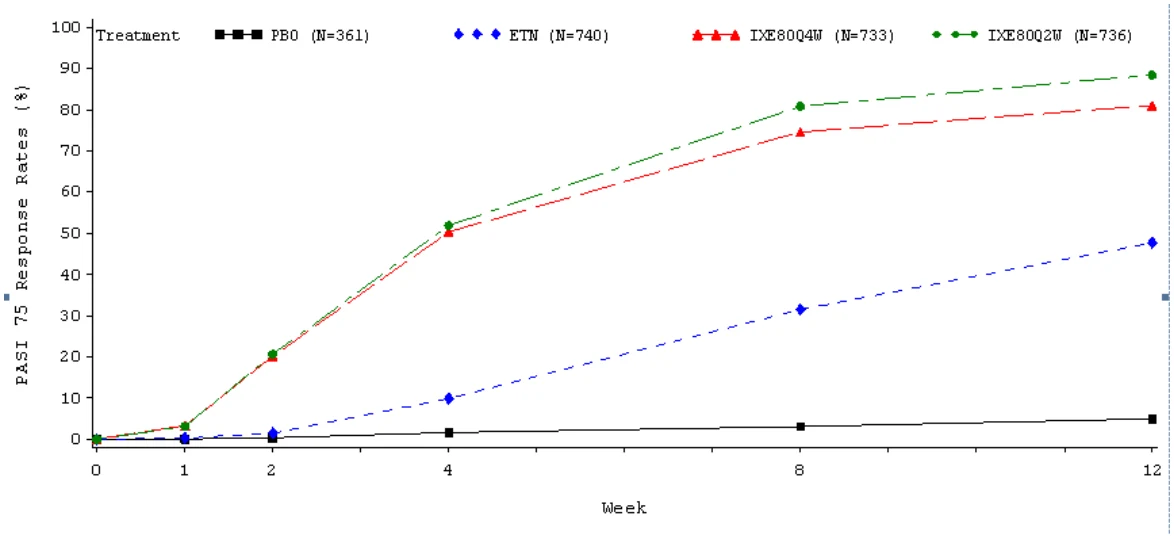
Abbreviations: PBO = Placebo; ETN = Etanercept; IXE80 Q2W = Ixekizumab 80 mg Q2W; IXE80 Q4W = Ixekizumab 80 mg Q4W; N = number of patients in the analysis population; NRI = Non-Responder Imputation; PASI = Psoriasis Area and Severity Index.
Examination of results stratified by previous treatment with a biologic agent did not identify differences in response to TALTZ in biologic-naive and biologic-experienced patients.
Maintenance of Response at 60 Weeks
To evaluate the maintenance and durability of response, patients originally randomized to TALTZ and who were responders at Week 12 (i.e., sPGA score of 0,1) in UNCOVER-1 and UNCOVER-2 were re-randomized to an additional 48 weeks of one of the following treatment regimens: TALTZ 80 mg every 4 weeks (Q4W), TALTZ 80 mg every 12 weeks (Q12W), or placebo. Non-responders (sPGA >1) at Week 12 and patients who relapsed (sPGA ≥3) during the maintenance period were placed on TALTZ 80 mg Q4W.
The response rates for those patients re-randomized to the recommended maintenance dose of TALTZ 80 mg Q4W based on the recommended induction dose of TALTZ 80 mg Q2W are provided in Table 12.
Table 12 - Maintenance of Response at Week 60 (NRI)a in UNCOVER-1
| Endpoint at Week 60 | TALTZ 80 mg Q2W (induction)/placebo (maintenance) (N = 110) | TALTZ 80 mg Q2W (induction)/80 mg Q4W (maintenance) (N = 119) |
|---|---|---|
| Maintained sPGA of “0” (clear) or “1” (minimal)c, n (%) | 9 (7.7%) | 89 (74.8%) |
| Difference from Placebo (98.75% CI) | -- | 67.1% (55.4%, 78.8%)b |
|---|
Abbreviations: N = number of patients in the analysis population; NRI = Non-Responder Imputation.
a Patients with missing data were counted as non-responders.
b p-value <0.001.
p-value is based on a logistic regression analysis with treatment and baseline weight category as factors.
Confidence interval corresponds to an alpha level of 0.0125.
c p-value is adjusted for multiplicity of testing based on pre-defined hierarchy.
Among the patients who achieved sPGA 0 or 1 at Week 12, the response rates were sPGA 0 = 55% and PASI 100 = 52% at Week 60.
Improvements at Week 12 from baseline compared to placebo (UNCOVER-1 and UNCOVER-3) were demonstrated in Dermatology Life Quality Index (DLQI); these improvements were maintained for 60 weeks (UNCOVER-1).
Clinical Response in Genital Psoriasis
A randomized, double-blind, placebo-controlled study (IXORA-Q) was conducted in 149 adult patients with plaque psoriasis who had a minimum BSA involvement of 1%, a sPGA score of ≥3 (at least moderate psoriasis), a sPGA of Genitalia score of ≥3 (at least moderate genital psoriasis), who failed to respond to or were intolerant of at least one topical therapy used for treatment of psoriasis affecting the genital area, and who were candidates for systemic therapy or phototherapy. Patients were randomized to placebo or TALTZ (initial dose of 160 mg followed by 80 mg every 2 weeks for 12 weeks). Randomization was stratified by BSA involvements of 1% to <10% and ≥10%. The primary endpoint was the proportion of patients who achieved a “0” (clear) or “1” (minimal) response on the sPGA of Genitalia at Week 12. Baseline BSA involvement was ≥10% for approximately 60% of patients. Median baseline PASI score was 12.2 and approximately 42% of patients had a sPGA of Genitalia score at baseline indicating severe or very severe genital psoriasis. Approximately 24% of study participants were female.
Results for the primary endpoint in Study IXORA-Q are presented in Table 13.
Table 13 - Efficacy Results at Week 12 (NRI)a in Adults with Genital Psoriasis in IXORA-Q
| Endpoint | Placebo | TALTZ 80 mg Q2Wb |
|---|---|---|
| Number of patients randomized | N=74 | N=75 |
| sPGA of Genitalia “0” (clear) or “1” (minimal), n (%) | 6 (8.1%) | 55 (73.3%) |
| Difference from placebo (95% CI) p-value | -- | 65.2% (53.4%, 77.0%)c <0.001 |
Abbreviations: NRI = Non-Responder Imputation.
a Patients with missing data were counted as non-responders.
b At Week 0, patients received 160 mg of TALTZ, followed by 80 mg every 2 weeks for 12 weeks.
c p-value is based on the logistic regression analysis with treatment and baseline BSA category as factors. Confidence intervals are constructed using the simple asymptotic method, without continuity correction.
For patients with a baseline Genital Psoriasis Symptoms Scale (GPSS) Itch numeric rating scale (NRS) score of ≥4 (GPSS Itch NRS is an 11-point scale), the proportion of patients that reported a ≥4-point reduction in GPSS Itch NRS score at Week 12, was 55.4% for patients receiving TALTZ and 5.9% for patients receiving placebo. Patient-perceived impact of genital psoriasis on limiting frequency of sexual activity (intercourse or other activities) was assessed by the Genital Psoriasis Sexual Frequency Questionnaire (GenPs-SFQ) Item 2 (In the past week how often did your genital psoriasis limit the frequency of your sexual activity?). Scores for the GenPs-SFQ Item 2 range from 0 to 4 (0=never, 1=rarely, 2=sometimes, 3=often, 4=always). For patients who reported a GenPs-SFQ Item 2 score ≥2 at baseline, the proportion of patients that reported a score of 0 or 1 at Week 12, was 78.4% for patients receiving TALTZ and 21.4% for patients receiving placebo.
Pediatric plaque psoriasis
A randomized, double-blind, multicenter, placebo-controlled trial (IXORA-Peds), enrolled 171 pediatric patients from 6 to less than 18 years of age, with moderate-to-severe plaque psoriasis (as defined by a sPGA score ≥3, involving ≥10% of the body surface area, and a PASI score ≥12) who were candidates for phototherapy or systemic therapy, or were inadequately controlled on topical therapy.
Patients were randomized to placebo (n=56) or TALTZ (n=115) with dosing stratified by weight:
- <25 kg: 40 mg at Week 0 followed by 20 mg Q4W
- 25 kg to 50 kg: 80 mg at Week 0 followed by 40 mg Q4W
- >50 kg: 160 mg at Week 0 followed by 80 mg Q4W
The co-primary endpoints were the proportion of patients who achieved at least a 75% reduction in PASI score (PASI 75) from baseline to Week 12 and the proportion of patients with an sPGA (0,1) (clear or minimal) with at least a 2-point improvement from baseline.
Other evaluated outcomes included the proportion of patients who achieved PASI 90, PASI 100, sPGA of “0”, and Children’s Dermatology Life Quality Index/Dermatology Life Quality Index (CDLQI/DLQI).
Patients had a median baseline PASI score of 17 (range from 12 to 49). Baseline sPGA score was severe or very severe in 49% of patients. The mean age of onset of psoriasis was 8.4 years, and the mean duration of psoriasis was 5.5 years. The majority of patients (75%) were 12 to less than 18 years of age, with a mean age of 13.5 years. Patients had a mean weight of 62.7 kg and a mean BMI of 23.9 kg/m2. Of all patients, 22% had received prior phototherapy, 32% had received prior conventional systemic therapy, and 4% had received previous biologic therapy for the treatment of plaque psoriasis.
Table 14 - Summary of Study Design and Patient Demographics for IXORA-Peds
| Study # | Study design | Dosage, route of administration and duration | Study subjects (N = number) | Mean age (Range) | Gender |
| IXORA-Peds (RHCD) | multicentre, randomized, double-blind, placebo-controlled | Patients weighing <25 kg: TALTZ 40 mg SC starting dose at Week 0, followed by 20 mg SC Q4W. Placebo SC Q4W. Patients weighing 25-50 kg: TALTZ 80 mg SC starting dose at Week 0, followed by 40 mg SC Q4W. Placebo SC Q4W. Patients weighing >50 kg: TALTZ 160 mg SC starting dose at Week 0, followed by 80 mg SC Q4W. Placebo SC Q4W. | 171 | 13.5 (6 – 17) | M = 72 (42.1%) F = 99 (57.9%) |
Abbreviations: F = female; kg = kilogram; M = male; Q4W = every 4 weeks; SC = subcutaneous.
The efficacy results of TALTZ are presented in Table 15. For PASI 75 and sPGA (0,1) (“clear” or “minimal”), pediatric patients treated with TALTZ according to the prescribed dosing regimen demonstrated a greater clinical response at Week 12 compared to those treated with placebo.
Table 15 - Efficacy Results (NRI)a in Pediatric Patients with Plaque Psoriasis in IXORA-Peds
| Placebo (N = 56) | TALTZ Q4Wb (N = 115) | ||||
|---|---|---|---|---|---|
| sPGA of “0” (clear) or “1” (minimal), n (%) | |||||
| Week 4 | 4 (7.1%) | 55 (47.8%) | |||
| Difference from Placebo (95% CI) | -- | 40.7% (29.3%, 52.0%)d | |||
| Week 12c | 6 (10.7%) | 93 (80.9%) | |||
| Difference from Placebo (95% CI) | -- | 70.2% (59.3%, 81.0%)d | |||
| PASI 75, n (%) | |||||
| Week 4 | 5 (8.9%) | 62 (53.9%) | |||
| Difference from Placebo (95% CI) | -- | 45.0% (33.2%, 56.8%)d | |||
|---|---|---|---|---|---|
| Week 12c | 14 (25.0%) | 102 (88.7%) | |||
| Difference from Placebo (95% CI) | -- | 63.7% (51.0%, 76.4%)d | |||
| sPGA “0” (clear), n (%) | |||||
| Week 12 | 1 (1.8%) | 60 (52.2%) | |||
| Difference from Placebo (95% CI) | -- | 50.4% (40.6%, 60.2%)d | |||
| PASI 90, n (%) | |||||
| Week 12 | 3 (5.4%) | 90 (78.3%) | |||
| Difference from Placebo (95% CI) | -- | 72.9% (63.3%, 82.5%)d | |||
| PASI 100, n (%) | |||||
| Week 12 | 1 (1.8%) | 57 (49.6%) | |||
| Difference from Placebo (95% CI) | -- | 47.8% (38.0%, 57.6%)d | |||
Abbreviations: N = Number of patients in the intent-to-treat population; NRI = Non-Responder Imputation.
a Patients with missing data were counted as non-responders.
b At Week 0, patients received 160 mg, 80 mg, or 40 mg of TALTZ, depending on weight category. Starting at Week 4, patients received 80 mg, 40 mg, or 20 mg, respectively, every 4 weeks for 12 weeks.
c Co-primary endpoints.
d p<0.001, p-value is adjusted for multiplicity of testing based on pre-defined hierarchy.
At Week 12, 74 (64.3%) TALTZ-treated patients and 13 (23.2%) placebo patients reported a CDLQI/DLQI score of 0 or 1.
Psoriatic arthritis
The safety and efficacy of TALTZ were assessed in 780 patients, in two randomized, double-blind, placebo-controlled studies (SPIRIT-P1 and SPIRIT-P2) in adult patients, age 18 years and older with active psoriatic arthritis (at least 3 swollen and at least 3 tender joints) despite non-steroidal anti-inflammatory drug (NSAID), corticosteroid or DMARD therapy. In SPIRIT-P1, patients also had at least 1 disease-related definite joint erosion on hand or foot x-rays as determined by the central reader or had a C-reactive protein (CRP) >6 mg/L at screening. In SPIRIT-P2, patients were required to have prior treatment with 1 or more cDMARDs and prior treatment with at least 1 but not more than 2 anti-TNF-α agents, and to have discontinued the anti-TNF-α agent due to either an inadequate response (based on a minimum of 12 weeks on therapy) or documented intolerance. In both studies, patients were required to have active psoriatic skin lesions (plaque) or a documented history of plaque psoriasis.
The SPIRIT-P1 study evaluated patients with psoriatic arthritis who were biologic-naive, whereas the SPIRIT-P2 study evaluated patients with psoriatic arthritis who were anti-TNF-α agent-experienced. In both studies, patients were treated with either TALTZ 160 mg at Week 0 followed by 80 mg every 2 weeks (Q2W) or 4 weeks (Q4W), or placebo. SPIRIT-P1 also included adalimumab 40 mg Q2W as an active reference arm for sensitivity analysis. In both studies, patients who received placebo (or adalimumab in SPIRIT-P1) were re-randomized to TALTZ (80 mg Q2W or Q4W) at Week 16 if they were inadequate responders (defined as patients with <20% improvement from baseline in both tender joint count and swollen joint count) or at Week 24 (see Table 16).
In SPIRIT-P1, 69.5% had psoriasis involving ≥3% of body surface area (BSA), 58.0% had enthesitis, and 37.6% had dactylitis at baseline. The majority of patients (64.0%) were receiving a cDMARD at baseline and 14.6% of patients were cDMARD naive. A total of 54.2% of patients were using methotrexate (MTX) at baseline. The majority of patients were Caucasian (94%) and were enrolled in Europe (73%) and the United States (20%).
In SPIRIT-P2, 62.5% of patients had psoriasis involving ≥3% of BSA, 75.2% had enthesitis, and 23.7% had dactylitis at baseline. A total of 56.2% and 35.3% of patients were inadequate responders to 1 and 2 anti-TNF-α agents, respectively, and 8.5% were intolerant to an anti-TNF-α agent. More than half of the patients (51.0%) were receiving a cDMARD at baseline. A total of 41.0% of patients were using MTX at baseline. The majority of patients were Caucasian (92%) and were enrolled in the United States (52%) and Europe (41%).
The primary endpoint for both studies was the percentage of patients achieving at least a 20% improvement in the American College of Rheumatology (ACR20) criteria at Week 24 (see Table 18 for components of ACR20). Secondary endpoints evaluated included ACR50, ACR70; PASI 75; Health Assessment Questionnaire - Disability Index (HAQ-DI); Leeds Enthesitis Index (LEI) scores, and Minimal Disease Activity (MDA). Structural damage was also followed radiographically in the SPIRIT-P1 study by measuring the mean change from baseline to Week 24 in the modified total Sharp score (mTSS).
Table 16 - Summary of study design and patient demographics for SPIRIT-P1 and SPIRIT-P2
| Study # | Study design | Dosage, route of administration and durationa | Study subjects (N = number) | Mean age (Range) | Gender |
| SPIRIT-P1 (RHAP) | multicentre, randomized, double-blind, placebo-controlled, active-reference | TALTZb 160 mg SC starting dose at Week 0, followed by 80 mg SC Q2W (n = 103) or 80 mg SC Q4W (n = 107); Placeboc SC Q2W (n = 106); Adalimumabd 40 mg SC Q2W (n=101) | 417 | 49.5 (19.0 – 76.0) | M = 192 (46.0%) F = 225 (54.0%) |
| SPIRIT-P2 (RHBE) | multicentre, randomized, double-blind, placebo-controlled | TALTZb 160 mg SC starting dose at Week 0, followed by 80 mg SC Q2W (n = 123) or 80 mg SC Q4W (n =122); Placeboc SC Q2W (n = 118) | 363 | 51.9 (18.0 – 86.0) | M = 169 (46.6%) F = 194 (53.4%) |
a Patients in all treatment groups with an inadequate response at Week 16 received rescue therapy (modification to background therapy).
b At Week 16, TALTZ inadequate responders received rescue therapy but remained on their assigned treatment.
c At Week 16, placebo inadequate responders were re-randomized (1:1) to one of the TALTZ regimens. They received a 160 mg SC starting dose of TALTZ at Week 16 and their assigned TALTZ regimen thereafter. At Week 24, all patients still receiving placebo were re-randomized (1:1) to one of the TALTZ regimens. They received a 160 mg starting dose of TALTZ at Week 24 and their assigned TALTZ thereafter.
d At Week 16, adalimumab inadequate responders were re-randomized (1:1) to one of the TALTZ regimens, but first underwent an 8-week washout period. They received a 160 mg SC starting dose of TALTZ at Week 24 and their assigned TALTZ regimen thereafter. At Week 24, all patients still receiving adalimumab were re-randomized (1:1) to one of the TALTZ regimens, but first underwent an 8-week washout period. They received an 80 mg dose of TALTZ at Week 32 and their assigned TALTZ regimen thereafter. The study was not powered to test equivalence or non-inferiority of TALTZ versus adalimumab.
Clinical Response
In both studies, patients treated with TALTZ 80 mg Q2W or 80 mg Q4W demonstrated a greater clinical response compared to placebo at Week 12 and Week 24 (Table 17). Responses were similar in patients regardless of concomitant methotrexate or cDMARD treatment. In SPIRIT-P2, responses were seen regardless of prior inadequate response or intolerance to anti-TNF-α therapy.
There was no clear evidence of improved ACR response with the more frequent TALTZ 80 mg Q2W dose group compared to the 80 mg Q4W dose group. Responses were similar regardless of age, gender, race, and body weight. In patients with psoriatic arthritis and coexistent moderate-to-severe plaque psoriasis, TALTZ 80 mg Q2W demonstrated additional clinical benefit on skin clearance, whereas in patients with psoriatic arthritis and coexistent mild plaque psoriasis there was no added benefit to receiving TALTZ 80 mg Q2W compared to Q4W.
Table 17 - Efficacy Results at Week 12 and 24 (NRI)a,b in SPIRIT-P1 and SPIRIT-P2
| SPIRIT-P1 biologic-naive | SPIRIT-P2 anti-TNF-α – experiencedc | |||||||||
|---|---|---|---|---|---|---|---|---|---|---|
| TALTZ 80 mg Q4W (N=107) | Placebo (N=106) | TALTZ 80 mg Q4W (N=122) | Placebo (N=118) | |||||||
| ACR20 response | ||||||||||
| Week 12 (%) | 57 | 31 | 50 | 22 | ||||||
| Difference from placebo (95% CI) | 26 (13, 39)d | 28 (16, 40)d | ||||||||
| Week 24 (%) | 58 | 30 | 53 | 20 | ||||||
| Difference from placebo (95% CI) | 28 (15, 41)d | 34 (22, 45)d | ||||||||
| ACR50 response | ||||||||||
| Week 12 (%) | 34 | 5 | 31 | 3 | ||||||
| Difference from placebo (95% CI) | 29 (19, 39)e | 28 (19, 37)e | ||||
|---|---|---|---|---|---|---|
| Week 24 (%) | 40 | 15 | 35 | 5 | ||
| Difference from placebo (95% CI) | 25 (14, 37)e | 30 (21, 40)e | ||||
| ACR70 response | ||||||
| Week 12 (%) | 15 | 0 | 15 | 2 | ||
| Difference from placebo (95% CI) | 15 (8, 22)e | 13 (6, 20)e | ||||
| Week 24 (%) | 23 | 6 | 22 | 0 | ||
| Difference from placebo (95% CI) | 18 (9, 27)e | 22 (15, 30)e | ||||
Abbreviations: ACR = American College of Rheumatology; CI = Confidence Interval; N = number of patients in the intent-to-treat population; NRI = Non-Responder Imputation.
a Patients with missing data were counted as non-responders.
b Patients who met inadequate responder criteria (less than 20% improvement in tender and swollen joint counts) at Week 16 were considered non-responders at Week 24.
c Included patients who had prior treatment with at least 1 but not more than 2 anti-TNF-α agents, and discontinued the anti-TNF-α agent due to either an inadequate response or documented intolerance.
d p value <0.001.
e ACR50 and ACR70 are not adjusted for multiplicity testing.
The percentage of patients achieving ACR20 response by visit, up to Week 24, is shown in Figure 2. In both studies, clinical response occurred as early as Week 1.
Figure 2 - Percent of Patients Achieving ACR20 Responsea in SPIRIT-P1 and SPIRIT-P2 Through Week 24
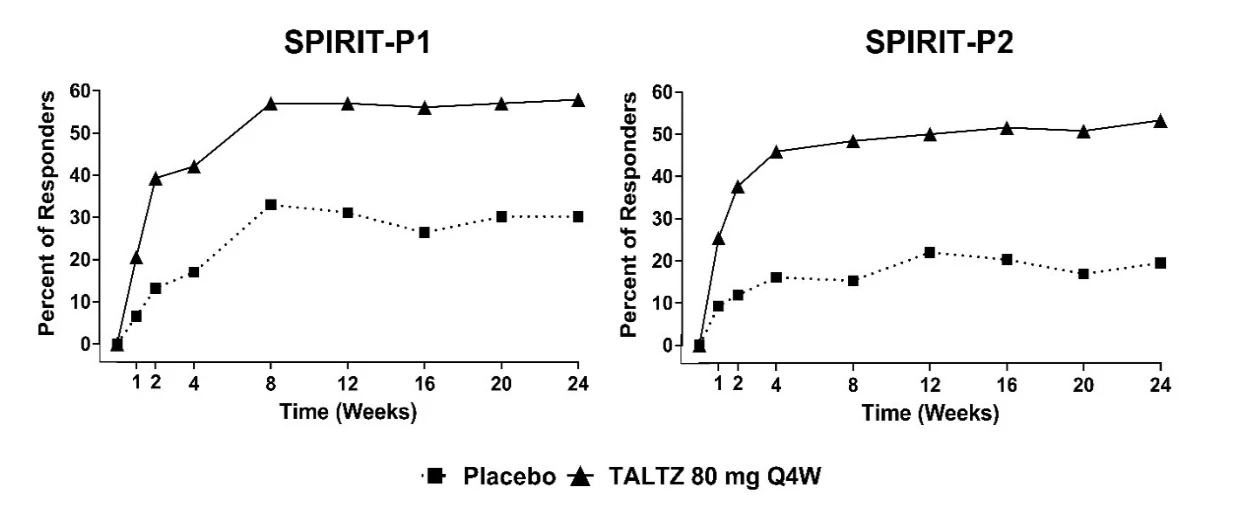
a Patients who met inadequate responder criteria (less than 20% improvement in tender and swollen joint counts) at Week 16 were considered non-responders at Week 24.
The improvements in the components of the ACR response and Minimal Disease Activity (MDA) criteria are shown in Table 18.
Table 18 - Efficacy Results in ACR Components and MDA Criteria at Week 12 and 24
| SPIRIT-P1 biologic-naive | SPIRIT-P2 anti-TNF-α – experienceda | ||||||||||||
|---|---|---|---|---|---|---|---|---|---|---|---|---|---|
| Placebo (N=106) | TALTZ 80 mg Q4W (N=107) | Placebo (N=118) | TALTZ 80 mg Q4W (N=122) | ||||||||||
| Number of Swollen Joints | |||||||||||||
| Mean Baseline | 10.6 | 11.4 | 10.3 | 13.1 | |||||||||
| Mean Change at Week 12 | -3.2 | -6.2 | -2.6 | -5.8 | |||||||||
| Mean Change at Week 24 | -3.5 | -7.0 | -5.0 | -8.5 | |||||||||
| Number of Tender Joints | |||||||||||||
| Mean Baseline | 19.2 | 20.5 | 23.0 | 22.0 | |||||||||
| Mean Change at Week 12 | -3.5 | -10.3 | -5.4 | -9.4 | |||||||||
| Mean Change at Week 24 | -4.7 | -11.9 | -6.2 | -12.7 | |||||||||
| Patient’s Assessment of Painb | |||||||||||||
| Mean Baseline | 58.5 | 60.1 | 63.9 | 63.9 | |||||||||
| Mean Change at Week 12 | -9.1 | -26.6 | -11.9 | -29.8 | |||||||||
| Mean Change at Week 24 | -14.0 | -29.6 | -21.4 | -36.9 | |||||||||
| Patient’s Global Assessment of Disease Activityb | |||||||||||||
| Mean Baseline | 61.1 | 62.7 | 64.1 | 66.4 | |||||||||
| Mean Change at Week 12 | -11.1 | -29.7 | -10.7 | -34.5 | |||||||||
| Mean Change at Week 24 | -14.8 | -33.8 | -19.0 | -40.7 | |||||||||
| Physician’s Global Assessment of Disease Activityb | |||||||||||||
| Mean Baseline | 55.9 | 57.6 | 58.9 | 60.3 | |||||||||
| Mean Change at Week 12 | -16.6 | -34.0 | -15.9 | -34.4 | |||||||||
| Mean Change at Week 24 | -24.2 | -38.5 | -18.3 | -40.0 | |||||||||
| Disability Index (HAQ-DI)c | |||||||||||||
| Mean Baseline | 1.2 | 1.2 | 1.2 | 1.2 | |||||||||
| Mean Change at Week 12 | -0.1 | -0.4 | -0.1 | -0.4 | |||||||||
| Mean Change at Week 24 | -0.2 | -0.4e | -0.2 | -0.6e | |||||||||
| CRP (mg/L) | |||||||||||||
| Mean Baseline | 15.1 | 12.8 | 12.1 | 17.0 | |||||||||
| Mean Change at Week 12 | -3.2 | -8.8 | -4.3 | -11.4 | |||||||||
| Mean Change at Week 24 | -3.9 | -8.8 | -3.6 | -11.8 | |||
|---|---|---|---|---|---|---|---|
| Minimal Disease Activity (MDA)d | |||||||
| Response at Week 12 (%) | 5 | 21 | 5 | 25 | |||
| Response at Week 24 (%) | 15 | 30 | 3 | 28e | |||
Abbreviations: N = number of patients in the intent-to-treat population.
a Included patients who had prior treatment with at least 1 but not more than 2 anti-TNF-α agents, and discontinued the anti-TNF-α agent due to either an inadequate response or documented intolerance.
b Visual analog scale (mm); 0=best, 100=worst.
c Health Assessment Questionnaire - Disability Index (HAQ-DI): 0 = best, 3 = worst; measures the patient’s ability to perform the following: dress/groom, arise, eat, walk, reach, grip, maintain hygiene, and maintain daily activity. HAQ-DI at Week 24 was adjusted for multiplicity in both studies.
d Minimal Disease Activity (MDA): patients are classified as achieving MDA if they fulfill 5 of 7 outcome measures: tender joint count (TJC) ≤1; swollen joint count (SJC) ≤1; Psoriasis Activity and Severity Index (PASI total score) ≤1 or body surface area (BSA) ≤3; patient pain visual analog scale (VAS) score of ≤15; patient global disease activity VAS score of ≤20; HAQ-DI score ≤0.5; and tender entheseal points ≤1. MDA is based on Non-Responder Imputation (patients with missing data were counted as non-responders). MDA at Week 24 was adjusted for multiplicity in SPIRIT-P2.
e p value <0.001.
In patients with pre-existing enthesitis, numerical improvements in LEI mean change from baseline at Week 12 in SPIRIT-P1 and in resolution of enthesitis (LEI=0) at Week 24 in SPIRIT-P2 were seen in TALTZ-treated patients compared to those treated with placebo.
In patients with coexistent plaque psoriasis (≥3% BSA psoriasis skin involvement at baseline), the skin lesions of psoriasis improved with TALTZ treatment, relative to placebo, as measured by PASI 75 at Week 12 in the TALTZ 80 mg Q4W compared to the placebo groups. The proportion of patients who achieved PASI 75 responses were 75.3% (55/73) versus 7.5% (5/67) in SPIRIT-P1 and 57.4% (39/68) versus 10.4% (7/67) in SPIRIT-P2. In SPIRIT-P1, patients experienced improvement in itch severity, when compared to placebo at Week 12.
Radiographic Response
Radiographic changes were assessed in SPIRIT-P1. Inhibition of progression of structural damage was assessed radiographically and expressed as the change in mTSS and its components, the erosion score and joint space narrowing score at Week 24, compared to baseline. The mTSS was modified for psoriatic arthritis by addition of hand distal interphalangeal joints.
TALTZ 80 mg Q4W inhibited the progression of structural joint damage (mTSS) compared to placebo at Week 24. The adjusted mean change from baseline in the mTSS was 0.17 for TALTZ 80 mg Q4W and 0.49 for placebo (95% CI for mean differences for TALTZ minus placebo; -0.55, -0.10).
Patient Reported Outcomes
General health status was assessed by the Short Form Health Survey (SF-36). At Weeks 12 and 24 in SPIRIT-P1 and SPIRIT-P2, patients treated with TALTZ showed greater improvement from baseline in the SF-36 Physical Component Summary (PCS) score and all 8 domains compared to patients treated with placebo, and improved or did not worsen in the SF-36 Mental Component Summary score.
Maintenance of Response at 52 Weeks
To evaluate the maintenance of response, patients originally randomized to TALTZ who completed Week 24 of the SPIRIT-P1 trial continued in an extension phase on either TALTZ 80 mg Q2W or Q4W treatment. At Week 52, 80.6% of patients on Q4W dosing who had achieved ACR20 at Week 24 maintained this response. For patients on Q4W dosing for 52 weeks, 74.2% had a change from baseline of ≤0.5 in their mTSS score, indicating minimal progression of structural damage.
Ankylosing spondylitis
The efficacy and safety of TALTZ were assessed in 657 patients, in two randomized, double-blind, placebo-controlled studies (COAST-V and COAST-W) in adult patients, age 18 years and older with active ankylosing spondylitis. Patients had active disease as defined by the Bath Ankylosing Spondylitis Disease Activity Index (BASDAI) ≥4 despite non-steroidal anti-inflammatory drug (NSAID), corticosteroid, or disease modifying anti-rheumatic drug (DMARD) therapy.
COAST-V evaluated 341 biologic-naive patients, who were treated with either TALTZ 80 mg or 160 mg at Week 0 followed by 80 mg every 2 weeks (Q2W) or 4 weeks (Q4W), adalimumab 40 mg every 2 weeks (active reference arm), or with placebo. Patients receiving placebo were re-randomized at Week 16 to receive TALTZ (160 mg initial dose, followed by 80 mg Q2W or Q4W). Patients receiving adalimumab were re-randomized at Week 16 to receive TALTZ at Week 20 (80 mg initial dose, followed by 80 mg Q2W or Q4W).
COAST-W evaluated 316 TNF inhibitor experienced patients (90% were inadequate responders and 10% were intolerant to TNF inhibitors). All patients were treated with TALTZ 80 mg or 160 mg at Week 0 followed by 80 mg Q2W or Q4W, or with placebo. Patients receiving placebo were re-randomized at Week 16 to receive TALTZ (160 mg initial dose, followed by 80 mg Q2W or Q4W).
At baseline, patients had symptoms of ankylosing spondylitis for an average of 17 years across both studies. At baseline, approximately 32% of the patients were on a concomitant cDMARD. In COAST-W, all patients discontinued previous treatment with 1 (63%) or 2 (37%) TNF inhibitors due to either inadequate response or intolerance. Across both studies the majority of patients were Caucasian (73%) and were enrolled in Europe (46%).
The primary efficacy endpoint in both studies was the percentage of patients achieving an Assessment of Spondyloarthritis International Society 40 (ASAS40) response at Week 16. Secondary endpoints evaluated included ASAS20, ASDAS, BASDAI Score, BASMI, hsCRP, MRI Spine SPARCC, BASDAI50, ASDAS <2.1, ASAS HI, and SF-36.
Table 19 - Summary of study design and patient demographics for COAST-V and COAST-W
| Study # | Study design | Dosage, route of administration and durationa | Study subjects (N = number) | Mean age (Range) | Gender |
| COAST-V (RHBV) | Multicentre, randomized, double-blind, placebo- and active-controlled period (0 to 16 weeks) followed by extended treatment period (16-52 weeks) | TALTZ 80 mg or 160 mg SC starting dose at Week 0, followed by 80 mg SC Q2W (n = 83) or 80 mg SC Q4W (n = 81); Placebo SC Q2W (n = 87); Adalimumaba 40 mg SC Q2W (n = 90) | 341 | 41.7 (19 – 78) | M = 276 (81.2%) F = 64 (18.8%) |
| COAST-W (RHBW) | Multicentre, randomized, double-blind, placebo- controlled period (0 to 16 weeks) followed by extended treatment period (16-52 weeks) | TALTZ 80 mg or 160 mg SC starting dose at Week 0, followed by 80 mg SC Q2W (n = 98) or 80 mg SC Q4W (n = 114); Placebo SC Q2W (n = 104) | 316 | 46.1 (18 – 76) | M = 253 (80.1%) F = 63 (19.9%) |
a At Week 16, patients on adalimumab were re-randomized (1:1 ratio) to TALTZ 80 mg Q2W or 80 mg Q4W with an 80 mg starting dose. The last dose of adalimumab was administered at Week 14 followed by a 6-week washout period, and the first TALTZ 80 mg starting dose was given at Week 20.
Clinical Response
In both studies, patients treated with TALTZ 80 mg Q2W or 80 mg Q4W demonstrated a greater clinical response compared to placebo at Week 16 (Table 20). Responses were similar in patients regardless of concomitant therapies (i.e., NSAIDs and cDMARDs).
There was no clear evidence of improved ASAS40 response with the more frequent TALTZ 80 mg Q2W dose group compared to the TALTZ 80 mg Q4W dose group. Responses were similar regardless of gender and body weight. In COAST-W responses were seen regardless of the number of prior TNF inhibitors.
Table 20 - ASAS20 and ASAS40 Efficacy Results at Week 16 (NRI)a in COAST-V and COAST-W
| COAST-V biologic-naive | COAST-W TNF inhibitor experiencedb | ||||||||||||
|---|---|---|---|---|---|---|---|---|---|---|---|---|---|
| TALTZ 80 mg Q4Wc (N=81) | Placebo (N=87) | TALTZ 80 mg Q4Wc (N=114) | Placebo (N=104) | ||||||||||
| ASAS40 responsed,e, % | 48.1 | 18.4 | 25.4 | 12.5 | |||||||||
| Difference from placebo (95% CI) | 29.8 (16.2, 43.3)f | -- | 12.9 (2.7, 23.2)h | -- | |||||||||
| ASAS20 responsed, % | 64.2 | 40.2 | 48.2 | 29.8 | |||||||||
| Difference from placebo (95% CI) | 24.0 (9.3, 38.6)g | -- | 18.4 (5.7, 31.1)g | -- | |||||||||
Abbreviations: N = number of patients in the intent-to-treat population; NRI = Non-Responder Imputation.
a Patients with missing data were counted as non-responders.
b TNF inhibitor experienced includes patients who discontinued previous treatment with 1 or 2 TNF inhibitors due to either inadequate response or intolerance.
c At Week 0, patients received 80 mg or 160 mg of TALTZ.
d An ASAS20 response is defined as a ≥20% improvement and an absolute improvement from baseline of ≥1 unit (range 0 to 10) in ≥3 of 4 domains (Patient Global Assessment, Spinal Pain, Function [BASFI], and Inflammation), and no worsening of ≥20% and ≥1 unit (range 0 to 10) in the remaining domain. An ASAS40 response is defined as a ≥40% improvement and an absolute improvement from baseline of ≥2 units in ≥3 of 4 domains without any worsening in the remaining domain.
e Primary endpoint.
f p value <0.001.
g p value <0.01.
h p value <0.05.
In COAST-V and COAST-W, statistically significant differences from placebo for ASAS20 were observed as early as Week 1 in the TALTZ 80 mg Q4W group, compared to the placebo group. For ASAS40, TALTZ 80 mg Q4W achieved a statistically significant difference from placebo by Week 1 in COAST-W and by Week 2 in COAST-V (see Figure 3).
Figure 3 - Percent of Patients Achieving ASAS40 Response in COAST-V and COAST-W through Week 16, NRIa
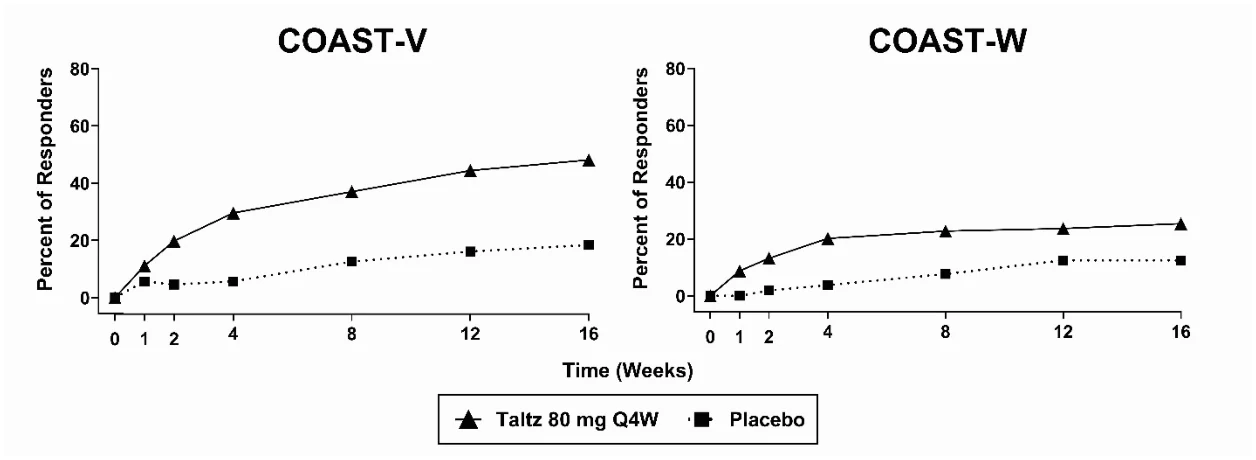
a Patients with missing data were counted as non-responders.
The improvement in the main components of the ASAS40 response criteria and other measures of disease activity are shown in Table 21.
Table 21 - ASAS Components and Other Measures of Disease Activity at Week 16
| COAST-V biologic-naive | COAST-W TNF inhibitor experienceda | ||||||||||||
|---|---|---|---|---|---|---|---|---|---|---|---|---|---|
| TALTZ 80 mg Q4Wb (N=81) | Placebo (N=87) | TALTZ 80 mg Q4Wb (N=114) | Placebo (N=104) | ||||||||||
| ASAS Components | |||||||||||||
| Patient Global Assessment (0-10) | |||||||||||||
| Baseline | 6.9 | 7.1 | 8.0 | 7.8 | |||||||||
| Mean Change from Baseline | -2.5 | -1.4 | -2.4 | -0.7 | |||||||||
| Total Spinal Pain (0-10) | |||||||||||||
| Baseline | 7.2 | 7.4 | 7.9 | 7.8 | |||||||||
| Mean Change from Baseline | -3.2 | -1.7 | -2.4 | -1.0 | |||||||||
| BASFI (0-10) | |||||||||||||
| Baseline | 6.06 | 6.35 | 7.35 | 7.01 | |||||||||
| Mean Change from Baseline | -2.39g | -1.16 | -1.69g | -0.64 | |||||||||
| Inflammation (0-10)c | |||||||||||||
| Baseline | 6.51 | 6.76 | 7.21 | 7.20 | |||||||||
| Mean Change from Baseline | -3.18 | -1.27 | -2.42 | -0.70 | |||||||||
| ASDAS | ||||||||||
|---|---|---|---|---|---|---|---|---|---|---|
| Baseline | 3.71 | 3.89 | 4.15 | 4.05 | ||||||
| Mean Change from Baseline | -1.43g | -0.46 | -1.16g | -0.11 | ||||||
| BASDAI Score | ||||||||||
| Baseline | 6.75 | 6.81 | 7.54 | 7.32 | ||||||
| Mean Change from Baseline | -2.92 | -1.39 | -2.17g | -0.92 | ||||||
| BASMI | ||||||||||
| Baseline | 3.87 | 4.51 | 4.68 | 4.88 | ||||||
| Mean Change from Baseline | -0.50 | -0.08 | -0.35 | -0.05 | ||||||
| hsCRP (mg/L) | ||||||||||
| Baseline | 12.19 | 15.97 | 20.16 | 16.02 | ||||||
| Mean Change from Baseline | -5.21 | 1.43 | -11.10 | 9.72 | ||||||
| MRI Spine SPARCCd | ||||||||||
| Baseline | 14.53 | 15.80 | 8.30 | 6.37 | ||||||
| Mean Change from Baseline | -11.02g | -1.51 | -2.99h | 3.29 | ||||||
| BASDAI50e (%), NRIf | 42g | 17 | 22 | 10 | ||||||
| ASDAS <2.1 (%) (Low Disease Activity), NRIf | 43 | 13 | 18h | 5 | ||||||
Abbreviations: ASDAS = Ankylosing Spondylitis Disease Activity Score; BASDAI = Bath Ankylosing Spondylitis Disease Activity Index; BASFI = Bath Ankylosing Spondylitis Functional Index; BASMI = Bath Ankylosing Spondylitis Metrology Index; hsCRP = High sensitivity C-reactive protein; ITT = Intent-to-Treat; MRI Spine SPARCC = Spondyloarthritis Research Consortium of Canada Magnetic Resonance Imaging Scoring of the Spine (23 discovertebral unit scale); NRI = Non-Responder Imputation.
a TNF inhibitor experienced includes patients who discontinued previous treatment with 1 or 2 TNF inhibitors due to either inadequate response or intolerance.
b At Week 0, patients received 80 mg or 160 mg of TALTZ.
c Inflammation is the mean of patient-reported stiffness self-assessments (questions 5 and 6) in BASDAI.
d The numbers of ITT patients with MRI data at baseline are as follows: COAST-V: TALTZ, n = 81; PBO, n = 82. COAST-W: TALTZ, n = 58; PBO, n = 51.
e BASDAI50 response defined as an improvement of ≥50% of the BASDAI score from baseline.
f Patients with missing data were counted as non-responders.
g p value <0.001 (p values are only shown for endpoints with type I error controlled in pre-defined multiple testing scheme).
h p value <0.01 (p values are only shown for endpoints with type I error controlled in pre-defined multiple testing scheme).
Patient Reported Outcomes
General health status and quality of life was assessed by the Short Form Health Survey (SF-36). At Week 16, in COAST-V and COAST-W, compared to placebo, patients treated with TALTZ 80 mg Q4W showed significantly greater improvement from baseline in the SF-36 Physical Component Summary (PCS) score (p<0.001 for both studies).
Non-radiographic axial spondyloarthritis
The efficacy and safety of TALTZ were assessed in a randomized, double-blind, 52-week placebo-controlled study (COAST-X) in 303 adult patients age 18 years and older with active axial spondyloarthritis for at least 3 months. Patients must have had objective signs of inflammation indicated by elevated C-reactive protein (CRP) and/or sacroiliitis on magnetic resonance imaging (MRI), and no definitive radiographic evidence of structural damage on sacroiliac joints. Patients had active disease as defined by the Bath Ankylosing Spondylitis Disease Activity Index (BASDAI) ≥4, and spinal pain ≥4 on a 0 to 10 numerical rating scale (NRS). Patients must have had an inadequate response to at least two NSAIDs or a history of intolerance to NSAIDs. Patients were treated with either placebo or TALTZ 80 mg or 160 mg at Week 0, followed by either 80 mg every 2 weeks (Q2W) or 80 mg every 4 weeks (Q4W). Initiation and/or dose adjustment of concomitant medications (NSAIDs, cDMARDs, corticosteroids, analgesics) were permitted starting at Week 16. Patients who were considered inadequate responders based on investigator clinical judgment starting as of Week 16 up to Week 44 could be transitioned to open-label TALTZ 80 mg Q2W.
At baseline, patients had symptoms of non-radiographic axial spondyloarthritis for an average of 11 years. At baseline, approximately 39% of the patients were on a concomitant cDMARD. The majority of patients were white (79.1%) and were enrolled in Europe (53.8%).
The primary endpoint was the percentage of patients achieving an Assessment of Spondyloarthritis International Society 40 (ASAS40) response at Week 16. Secondary endpoints evaluated included ASDAS, BASDAI score, SF-36 PCS, ASDAS low disease activity (<2.1), MRI SIJ SPARCC score at Week 16 and ASAS40 at Week 52.
Table 22 - Summary of Study Design and Patient Demographics for COAST-X
| Study # | Study design | Dosage, route of administration and durationa | Study subjects (N = number) | Mean age (Range) | Gender |
| COAST-X (RHBX) | 52-week multicentre, randomized, double-blind, placebo-controlled | TALTZ 80 mg or 160 mg SC starting dose at Week 0, followed by 80 mg SC Q2W (n = 102) or 80 mg SC Q4W (n = 96); Placebo SC Q2W (n =105) | 303 | 40.3 years (18 - 73 years) | M = 143 (47.2%) F = 160 (52.8%) |
a Starting at Week 16 and up to Week 44, patients who were determined as inadequate responders by investigators were given the option to make changes in their background therapy and/or transition to open label TALTZ 80 mg Q2W.
Clinical Response
Higher proportions of patients treated with TALTZ 80 mg Q4W achieved ASAS40 response compared to placebo at Week 16 (Table 23). Responses were similar regardless of concomitant therapies (i.e., NSAIDs and cDMARDs).
There was no clear evidence of improved ASAS40 response with the more frequent TALTZ 80 mg Q2W dose group compared to the TALTZ 80 mg Q4W dose group. No significant differences were seen in response rate by gender and body weight.
Table 23 - ASAS40 Responses in COAST-X at Week 16 NRIa
| TALTZ 80 mg Q4Wb (N=96) | Placebo (N=105) | |
|---|---|---|
| ASAS40 responsec, % | 35.4 | 19.0 |
| Difference from placebo (95% CI) | 16.4 (4.2, 28.5)d | -- |
Abbreviations: N = number of patients in the intent-to-treat population; NRI = Non-responder Imputation.
a Patients with missing data at Week 16 data were counted as non-responders.
b At Week 0, patients received 80 mg or 160 mg of TALTZ.
c An ASAS40 response is defined as a ≥40% improvement and an absolute improvement from baseline of ≥2 units in ≥3 of 4 domains (Patient Global Assessment, Spinal Pain, Function [BASFI], and Inflammation) without any worsening in the remaining domain.
d p value <0.05.
The percent of patients achieving ASAS40 responses by visit is shown in Figure 4. A significantly higher proportion of patients treated with TALTZ 80 mg Q4W achieved an ASAS40 response as early as Week 1 compared with placebo.
Figure 4 - ASAS40 Responses in COAST-X through Week 16, NRIa
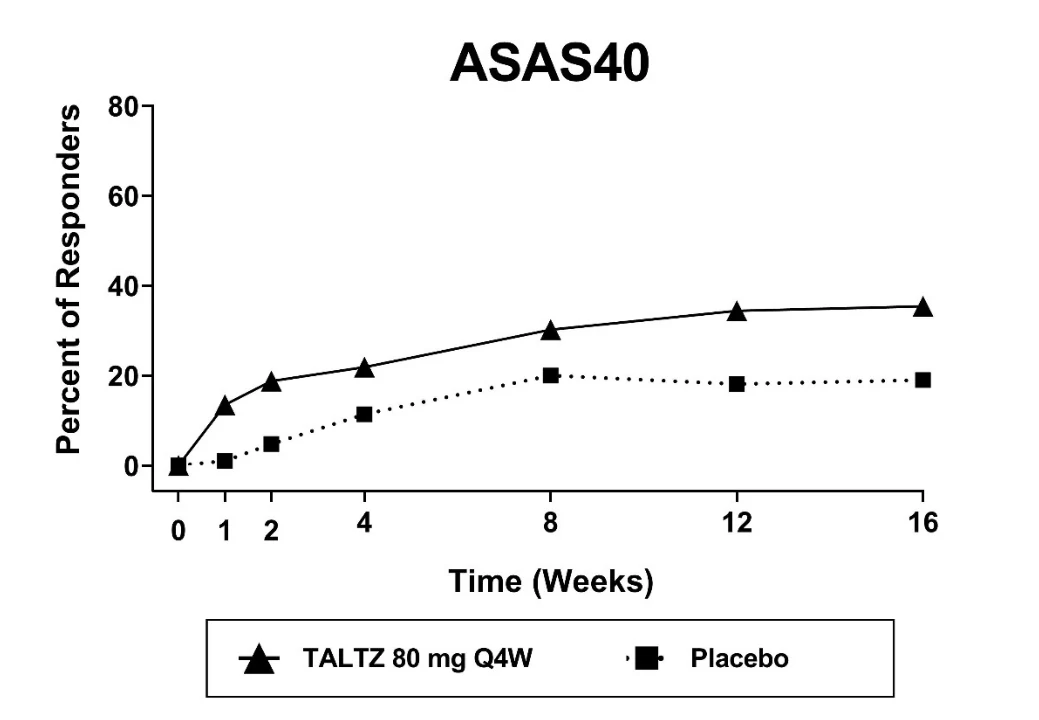
a Patients with missing data were counted as non-responders.
The improvement in the main components of the ASAS40 response criteria and other measures of disease activity are shown in Table 24.
Table 24 - ASAS Components and Other Measures of Disease Activity in COAST-X at Week 16
| TALTZ 80 mg Q4Wa (N=96) | Placebo (N=105) | |||
|---|---|---|---|---|
| ASAS Components | ||||
| Patient Global Assessment (0-10) | ||||
| Baseline | 7.1 | 7.4 | ||
| Mean Change from Baseline | -2.3 | -1.3 | ||
| Total Spinal Pain (0-10) | ||||
| Baseline | 7.3 | 7.4 | ||
| Mean Change from Baseline | -2.4 | -1.5 | ||
| BASFI (0-10) | ||||
| Baseline | 6.4 | 6.7 | ||
| Mean Change from Baseline | -2.0 | -1.3 | ||
| Inflammation (0-10)b | ||||
|---|---|---|---|---|
| Baseline | 6.8 | 7.0 | ||
| Mean Change from Baseline | -2.4 | -1.4 | ||
| ASDAS | ||||
| Baseline | 3.8 | 3.8 | ||
| Mean Change from Baseline | -1.1e | -0.6 | ||
| BASDAI Score | ||||
| Baseline | 7.0 | 7.2 | ||
| Mean Change from Baseline | -2.2e | -1.5 | ||
| BASMI | ||||
| Baseline | 3.2 | 3.2 | ||
| Mean Change from Baseline | -0.4 | -0.2 | ||
| hsCRP (mg/L) | ||||
| Baseline | 12.4 | 14.3 | ||
| Mean Change from Baseline | -8.1 | -4.8 | ||
| MRI SIJ SPARCCc | ||||
| Baseline | 5.1 | 6.3 | ||
| Mean Change from Baseline | -3.4e | -0.3 | ||
| ASDAS <2.1 (%) (Low Disease Activity), NRId | 27.7%e | 12.4% | ||
Abbreviations: ASDAS = Ankylosing Spondylitis Disease Activity Score; BASDAI = Bath Ankylosing Spondylitis Disease Activity Index; BASFI = Bath Ankylosing Spondylitis Functional Index; BASMI = Bath Ankylosing Spondylitis Metrology Index; hsCRP = High sensitivity C-reactive protein; MRI SIJ SPARCC = Spondyloarthritis Research Consortium of Canada Magnetic Resonance Imaging Scoring of the sacroiliac joint; NRI = Non-responder Imputation.
a At Week 0, patients received 80 mg or 160 mg of TALTZ.
b Inflammation is the mean of patient-reported stiffness self-assessments (questions 5 and 6) in BASDAI questionnaire.
c The numbers of ITT patients with MRI data at baseline and Week 16 are as follows: TALTZ, n=85; PBO, n=90.
d Patients with missing data were counted as non-responders. Percentages are based on the number of patients in the ITT population with baseline ASDAS ≥2.1.
e p value <0.05 (p values are only shown for endpoints with type I error controlled in pre-defined multiple testing scheme).
In COAST-X, a significantly higher proportion of patients treated with TALTZ 80 mg Q4W achieved ASAS40 response at Week 52 compared to placebo (30.2% vs 13.3%, respectively; p<0.01). Efficacy as assessed by the endpoints presented in Table 24 was also maintained up to Week 52.
Patient Reported Outcomes
General health status and quality of life was assessed by the Short Form Health Survey (SF-36). At Week 16 and maintained at Week 52, non-radiographic axial spondyloarthritis patients treated with TALTZ 80 mg Q4W showed significantly greater improvement from baseline in the SF-36 Physical Component Summary (PCS) score compared with placebo (p<0.05).
14.3 Immunogenicity
As with all therapeutic proteins there is a potential for immunogenicity with TALTZ. The detection of antibody formation is highly dependent on the sensitivity and specificity of the assay.
Adult plaque psoriasis
By week 12, approximately 9% of adult patients treated with TALTZ at the recommended dosing regimen developed anti-drug antibodies.
Approximately 22% of adult patients treated with TALTZ at the recommended dosing regimen developed antibodies to ixekizumab during the 60-week treatment period. The clinical effects of antibodies to ixekizumab are dependent on the antibody titer; higher antibody titers were associated with decreasing drug concentration and clinical response.
Of the adult patients who developed anti-drug antibodies to ixekizumab during the 60-week treatment period, approximately 9%, which equates to 2% of subjects treated with TALTZ at the recommended dosing regimen, had antibodies that were classified as neutralizing. Neutralizing antibodies were associated with low drug concentrations and reduced clinical response.
Pediatric plaque psoriasis
In pediatric patients treated with TALTZ at the recommended dosing regimen every 4 weeks for up to 12 weeks (IXORA-Peds), 18% (21 out of 115) developed anti-drug antibodies. Of the 21 patients who developed anti-drug antibodies, 5 had confirmed neutralizing antibodies associated with low drug concentrations. An association between immunogenicity and efficacy has not been established.
Psoriatic arthritis
In patients treated with TALTZ 80 mg every 4 weeks for up to 52 weeks (SPIRIT-P1), 11% (n=12) developed anti-drug antibodies. Of the 12 patients who developed anti-drug antibodies, 8 had confirmed neutralizing antibodies. An association between immunogenicity and efficacy has not been established.
Ankylosing spondylitis
In patients treated with TALTZ 80 mg every 4 weeks for up to 16 weeks, 5.2% (n=10) developed anti-drug antibodies. Of the 10 patients who developed anti-drug antibodies, 3 had confirmed neutralizing antibodies. An association between immunogenicity and efficacy has not been established.
Non-radiographic axial spondyloarthritis
Of patients treated with TALTZ 80 mg every 4 weeks for up to 52 weeks, 8.9% (n=5) developed anti-drug antibodies. No patient had neutralizing antibodies. An association between immunogenicity, drug concentration, and efficacy has not been observed.
Across all indications an association between immunogenicity and treatment emergent adverse events has not been established. The percentages of patients that had allergic reactions/hypersensitivity adverse events were similar between patients with and without antibodies to ixekizumab. An association between injection site reactions and the presence of antibodies to ixekizumab has not been established.
The detection of antibody formation is highly dependent on the sensitivity and specificity of the assay. Additionally, the observed incidence of antibody (including neutralizing antibody) positivity in an assay may be influenced by several factors including assay methodology, sample handling, timing of sample collection, concomitant medications, and underlying disease. For these reasons, comparison of incidence of antibodies to TALTZ across indications or with the incidences of antibodies to other products may be misleading.
15 MICROBIOLOGY
No microbiological information is required for this drug product.
16 NON-CLINICAL TOXICOLOGY
General Toxicology: No significant adverse effects, including any organ toxicity or undesirable effects on immune function (e.g. T-cell dependent antibody response or NK cell activity) were observed in cynomolgus monkeys when administered ixekizumab by intravenous and subcutaneous injection up to dose levels of 50 mg/kg QW (19 times the MRHD on a mg/kg basis) for 8 and 39 weeks respectively.
Carcinogenicity: Carcinogenicity studies have not been conducted with ixekizumab.
Genotoxicity: Mutagenicity and genotoxicity studies have not been conducted with ixekizumab.
Reproductive and Developmental Toxicology: There were no ixekizumab related effects on surrogate markers of fertility (e.g. estrous cyclicity, sperm parameters and reproductive organ weights) or histopathological findings in reproductive tissues when administered to sexually mature cynomolgus monkeys by subcutaneous injection up to doses of 50 mg/kg QW for 13 weeks. The monkeys were not mated to evaluate fertility. No effects on embryo-fetal development were observed in fetuses from pregnant cynomolgus monkeys administered ixekizumab by subcutaneous injection during organogenesis to near parturition up to doses of 50 mg/kg QW. Neonatal deaths occurred in the offspring of pregnant monkeys administered ixekizumab by subcutaneous injection from the beginning of organogenesis until parturition. Infant losses (death or forced euthanasia) occurred in 0/14, 2/12 and 5/14 successful pregnancies in control, 5 mg/kg and 50 mg/kg QW treatment groups, respectively and were attributable to maternal neglect (3), early delivery (2), congenital defect (1) and trauma (1). Surviving animals (14, 10 and 9 at 0, 5 and 50 mg/kg, respectively) did not display any treatment related functional or immunological developmental effects. Ixekizumab was shown to cross the placenta and was present in the blood of offspring for up to 6 months of age. Ixekizumab was detected at low levels in the breast milk of cynomolgus monkeys. The clinical significance of these findings is not known.
Juvenile Toxicity: Juvenile toxicity studies were not conducted with ixekizumab.