


Product Monograph - Tremfya
Recent Major Label Changes
| 1 Indications, 1.1 Pediatrics | 2026-08 |
|---|---|
| 1 Indications | 2025-11 |
| 2 Contraindications | 2026-08 |
| 4 Dosage and Administration, 4.1 Dosing Considerations | 2026-08 |
| 4 Dosage and Administration, 4.2 Recommended Dose and Dosage Adjustment | 2026-08 |
| 4 Dosage and Administration, 4.4 Administration | 2026-08 |
| 4 Dosage and Administration | 2025-11 |
| 7 Warnings and Precautions, General | 2026-08 |
| 7 Warnings and Precautions, Hepatotoxicity | 2026-08 |
7 Warnings and Precautions, Immune , Vaccinations | 2026-08 |
| 7 Warnings and Precautions, Pediatrics | 2026-08 |
| 7 Warnings and Precautions, General, Infections | 2025-11 |
| 7 Warnings and Precautions, 7.1.4 Geriatrics7.1.4 Geriatrics | 2025-11 |
Table of Contents
Certain sections or subsections that are not applicable at the time of the preparation of the most recent authorized product monograph are not listed.
Recent Major Label Changes ................................................................................................... 2
Table of Contents ...................................................................................................................... 2
Part 1: Health Professional Information .................................................................................. 5
1 Indications ..................................................................................................................... 5
1.1 Pediatrics ................................................................................................................ 5
1.2 Geriatrics ................................................................................................................ 6
2 Contraindications .......................................................................................................... 6
4 Dosage and Administration .......................................................................................... 6
4.1 Dosing Considerations ............................................................................................ 6
4.2 Recommended Dose and Dosage Adjustment ....................................................... 7
4.4 Administration ......................................................................................................... 9
4.5 Missed Dose ......................................................................................................... 10
5 Overdose ...................................................................................................................... 10
6 Dosage Forms, Strengths, Composition, and Packaging ......................................... 10
7 Warnings and Precautions ......................................................................................... 12
General .........................................................................................................................12
Hepatotoxicity ................................................................................................................12
Immune .........................................................................................................................13
Reproductive Health ......................................................................................................13
Sensitivity/Resistance .................................................................................................... 13
7.1 Special Populations .............................................................................................. 13
7.1.1 Pregnancy .......................................................................................................13
7.1.2 Breastfeeding ..................................................................................................14
7.1.3 Pediatrics ........................................................................................................14
7.1.4 Geriatrics.........................................................................................................15
8 Adverse Reactions ...................................................................................................... 15
8.1 Adverse Reaction Overview .................................................................................. 15
8.2 Clinical Trial Adverse Reactions ........................................................................... 16
8.2.1 Clinical Trial Adverse Reactions – Pediatrics ................................................23
8.3 Less Common Clinical Trial Adverse Reactions .................................................... 23
8.5 Post-Market Adverse Reactions ............................................................................ 23
9 Drug Interactions ......................................................................................................... 23
9.4 Drug-Drug Interactions ......................................................................................... 23
9.5 Drug-Food Interactions ......................................................................................... 24
9.6 Drug-Herb Interactions ......................................................................................... 24
9.7 Drug-Laboratory Test Interactions ........................................................................ 24
10 Clinical Pharmacology ................................................................................................ 24
10.1 Mechanism of Action .......................................................................................... 24
10.2 Pharmacodynamics ........................................................................................... 25
10.3 Pharmacokinetics ............................................................................................... 25
10.4 Immunogenicity .................................................................................................. 27
11 Storage, Stability, and Disposal ................................................................................. 29
12 Special Handling Instructions .................................................................................... 29
Part 2: Scientific Information ................................................................................................. 30
13 Pharmaceutical Information ....................................................................................... 30
14 Clinical Trials ............................................................................................................... 31
14.1 Clinical Trials by Indication ................................................................................. 31
Plaque Psoriasis - Adults ...............................................................................................31
Plaque Psoriasis – Pediatrics (6 to 17 years of age) ......................................................35
Psoriatic Arthritis - Adults...............................................................................................38
Psoriatic Arthritis – Pediatrics (6 to 17 years of age) ......................................................42
Crohn’s Disease ............................................................................................................43
Ulcerative Colitis ............................................................................................................47
16 Non-clinical Toxicology .............................................................................................. 55
Patient Medication Information (TREMFYA) .......................................................................... 57
Instructions For Use (TREMFYA 45 mg VarioJect Injector) ........................................... 66
Instructions For Use (TREMFYA 100 mg Pre-filled Syringe) .......................................... 77
Instructions For Use (TREMFYA 200 mg Pre-filled Syringe) .......................................... 85
Instructions For Use (TREMFYA 100 mg Pen) .............................................................. 95
Instructions For Use (TREMFYA 200 mg Pen) ............................................................ 106
Instructions For Use (TREMFYA One-Press) .............................................................. 117
Patient Medication Information (TREMFYA I.V.) ................................................................. 125
Part 1: Health Professional Information
Guselkumab administered subcutaneously will be referred to throughout the Product Monograph as TREMFYA. Guselkumab administered through intravenous infusion will be referred to throughout the Product Monograph as TREMFYA I.V.
1 Indications
Plaque Psoriasis
TREMFYA (guselkumab injection) is indicated for:
- the treatment of adult patients with moderate-to-severe plaque psoriasis who are candidates for systemic therapy or phototherapy.
Psoriatic Arthritis
TREMFYA (guselkumab injection) is indicated for:
- the treatment of adult patients with active psoriatic arthritis. TREMFYA can be used alone or in combination with a conventional disease-modifying antirheumatic drug (cDMARD) (e.g., methotrexate).
Crohn’s disease
TREMFYA/TREMFYA I.V. (guselkumab injection/guselkumab for injection) is indicated for:
- the treatment of adult patients with moderately to severely active Crohn’s disease.
Ulcerative Colitis
TREMFYA/TREMFYA I.V. (guselkumab injection/guselkumab for injection) is indicated for:
- the treatment of adult patients with moderately to severely active ulcerative colitis.
1.1 Pediatrics
Plaque Psoriasis
- (6 years to 17 years): TREMFYA (guselkumab injection) is indicated for the treatment of pediatric patients 6 years of age and older with moderate to severe plaque psoriasis who are candidates for systemic therapy or phototherapy (see 4.1 Dosing Considerations).
- (< 6 years of age): No data are available to Health Canada; therefore, Health Canada has not authorized an indication for pediatric patients less than 6 years of age.
Psoriatic Arthritis
- (6 years to 17 years): TREMFYA (guselkumab injection) is indicated in pediatric patients 6 years of age and older with active psoriatic arthritis supported by model-based extrapolation (see 4.1 Dosing Considerations and 14.1 Clinical Trials by Indication - Psoriatic Arthritis – Pediatrics (6 to 17 years of age)).
- (< 6 years of age): No data are available to Health Canada; therefore, Health Canada has not authorized an indication for pediatric patients less than 6 years of age.
Crohn’s Disease:
- (< 18 years): No data are available to Health Canada; therefore, Health Canada has not authorized an indication for pediatric use.
Ulcerative Colitis:
- (< 18 years): No data are available to Health Canada; therefore, Health Canada has not authorized an indication for pediatric use.
The safety and efficacy of TREMFYA I.V. in pediatric patients have not been evaluated.
1.2 Geriatrics
Of the 3406 adult plaque psoriasis and psoriatic arthritis subjects exposed to TREMFYA in Phase 2 and Phase 3 clinical trials, a limited number of subjects were 65 years or older (n = 185, 5%) or 75 years and older (n=13, 0.4%). Of the 1089 Crohn’s disease subjects exposed to TREMFYA/TREMFYA I.V. in clinical trials, 40 were 65 years or older, and 5 were 75 years or older. Of the 1228 ulcerative colitis subjects exposed to TREMFYA/TREMFYA I.V. in clinical trials, 69 were 65 years or older, and 14 were 75 years or older. Thus, data in these age groups are limited (see 10 Clinical Pharmacology).
2 Contraindications
TREMFYA/TREMFYA I.V. is contraindicated in patients with
4 Dosage and Administration
TREMFYA is administered by subcutaneous injection. TREMFYA I.V. is administered by intravenous infusion.
4.1 Dosing Considerations
TREMFYA/TREMFYA I.V. is intended for use under the guidance and supervision of a physician.
TREMFYA may be administered by a healthcare professional, or a caregiver, or an adult patient may self-inject after proper training in subcutaneous injection technique.
TREMFYA is not intended for pediatric self-administration. TREMFYA One-Press and TREMFYA I.V. are not intended for use in pediatric patients.
Recommended Evaluations and Immunizations Prior to Treatment Initiation
- Evaluate patients for tuberculosis (TB) infection according to the Canadian Tuberculosis Standards prior to initiating treatment with TREMFYA (see 7 Warnings and Precautions)
- If clinically indicated, evaluate liver enzymes and bilirubin levels prior to initiating treatment with TREMFYA (see 7 Warnings and Precautions).
- Complete all age-appropriate vaccinations according to current Canadian immunization guidelines (see 7 Warnings and Precautions).
The BioAdvance® Network has been established to facilitate the administration of TREMFYA/TREMFYA I.V. BioAdvance clinics are staffed by qualified healthcare professionals specially trained in the administration of TREMFYA/TREMFYA I.V. and care of patients with Crohn’s disease or ulcerative colitis. BioAdvance clinics are available across Canada. Information about the BioAdvance Network and location of the nearest BioAdvance Network clinic can be obtained by calling Janssen Inc. Medical Information at: 1-800-567-3331.
4.2 Recommended Dose and Dosage Adjustment
Plaque psoriasis
Adults
The recommended dosage of TREMFYA is 100 mg administered by subcutaneous injection at week 0 and week 4, followed by maintenance dosing every 8 weeks thereafter.
Pediatric patients (6 years of age and older)
TREMFYA is administered by subcutaneous injection at Week 0, Week 4, and every 8 weeks thereafter.
- For pediatric patients 6 years of age and older who also weigh 40 kg or more, the recommended dose is 100 mg, administered using the 1 mL pre-filled syringe or 1 mL pre-filled pen.
- For pediatric patients 6 years of age and older who also weigh less than 40 kg, the recommended dose is shown below in
- Table 1, up to a maximum of 45 mg, administered using the 45 mg/0.45 mL variable dose injector.
Table 1: Recommended Dose of TREMFYA for Subcutaneous Injection in Pediatric Patients with Body Weight Less than 40 kg
Body Weight (kg) (at time of dosing) | Dose (mg) | Turn 45 mg/0.45 mL Variable Dose Injector Plunger to Dose Number |
|---|---|---|
| 12-15 kg | 20 | 20 |
| 16-19 kg | 25 | 25 |
| 20-23 kg | 30 | 30 |
| 24-26 kg | 35 | 35 |
| 27-30 kg | 40 | 40 |
| 31-39 kg | 45 | 45 |
Psoriatic arthritis
Adults
The recommended dosage of TREMFYA is 100 mg administered by subcutaneous injection at week 0 and week 4, followed by maintenance dosing every 8 weeks thereafter.
TREMFYA can be used alone or in combination with a conventional disease-modifying antirheumatic drug (cDMARD) (e.g., methotrexate).
Pediatric patients (6 years of age and older)
TREMFYA is administered by subcutaneous injection at Week 0, Week 4, and every 8 weeks thereafter.
- For pediatric patients 6 years of age and older who also weigh 40 kg or more, the recommended dose is 100 mg, administered using the 1 mL pre-filled syringe or 1 mL pre-filled pen.
- For pediatric patients 6 years of age and older who also weigh less than 40 kg, the recommended dose is shown above in
- Table 1, up to a maximum of 45 mg, administered using the 45 mg/0.45 mL variable dose injector.
TREMFYA may be administered alone or in combination with a cDMARD (e.g., methotrexate).
Crohn’s disease and Ulcerative Colitis
Induction:
The recommended induction dosage is:
- 200 mg of TREMFYA I.V. administered by intravenous infusion over a period of at least one hour at Week 0, Week 4 and Week 8.
or
- 400 mg of TREMFYA administered by subcutaneous injection at Week 0, Week 4 and Week 8. Each 400 mg dose is given as two injections of 200 mg
Maintenance:
The recommended maintenance dosage is 100 mg of TREMFYA administered by subcutaneous injection at Week 16 and every 8 weeks thereafter.
A dose of 200 mg administered by subcutaneous injection at Week 12 and every 4 weeks thereafter may be considered for patients who do not show adequate therapeutic benefit to guselkumab, or according to clinical judgement (see 14 Clinical Trials).
Immunomodulators and/or corticosteroids may be continued during treatment with TREMFYA. In patients who have responded to treatment with TREMFYA, corticosteroids may be reduced or discontinued in accordance with standard of care.
4.4 Administration
Subcutaneous Administration (TREMFYA)
TREMFYA is administered by subcutaneous injection.
The prescribed dose of TREMFYA should be injected according to the directions provided in the “Instructions for Use” document.
Before injection, remove TREMFYA from the refrigerator and allow TREMFYA to reach room temperature (30 minutes) without removing the needle cap.
Inspect TREMFYA visually for particulate matter and discolouration prior to administration. TREMFYA is a clear and colourless to light yellow solution. Do not use if the liquid contains large particles, is discoloured or cloudy. Discard any unused product remaining after injection.
Adult use
TREMFYA is intended for use under the guidance and supervision of a physician. TREMFYA may be administered by a healthcare professional, or a caregiver, or an adult patient may self-inject after proper training in subcutaneous injection technique.
Pediatric use
TREMFYA One-Press is not intended for use in pediatric patients.
TREMFYA is not intended for pediatric self-administration.
TREMFYA is intended for use under the guidance and supervision of a physician. TREMFYA may be administered by a healthcare professional, or an adult caregiver who has received proper training and demonstrated proper subcutaneous injection technique.
It is recommended that the caregiver's first injection be supervised by a healthcare professional. A caregiver may inject Tremfya if a healthcare professional deems that this is appropriate. Physicians should ensure appropriate medical follow-up for pediatric patients receiving TREMFYA injections at home.
Intravenous Infusion (TREMFYA I.V.)
TREMFYA I.V. is for IV infusion only. Intravenous infusion of TREMFYA I.V. should be administered by qualified healthcare professionals. TREMFYA I.V. is not intended for use in pediatric patients.
TREMFYA I.V. solution for intravenous infusion must be diluted, prepared and infused by a healthcare professional using aseptic technique. TREMFYA I.V. does not contain preservatives.
Each vial is for single use only.
Inspect TREMFYA I.V. visually for particulate matter and discolouration prior to administration. TREMFYA I.V. is a clear and colourless to light yellow solution that may contain small translucent particles. Do not use if the liquid contains large particles, is discoloured or cloudy.
Add TREMFYA I.V. to a 250 mL intravenous infusion bag of 0.9% Sodium Chloride Injection as follows:
- 1. Withdraw and then discard 20 mL of the 0.9% Sodium Chloride Injection from the 250 mL infusion bag which is equal to the volume of TREMFYA I.V. to be added.
- 2. Withdraw 20 mL of TREMFYA I.V. from the vial and add it to the 250 mL intravenous infusion bag of 0.9% Sodium Chloride Injection for a final concentration of 0.8 mg/mL. Gently mix the diluted solution. Discard the vial with any remaining solution.
- 3. Visually inspect the diluted solution for particulate matter and discolouration before infusion. Infuse the diluted solution over a period of at least one hour.
- 4. Use only an infusion set with an in-line, sterile, non-pyrogenic, low protein binding filter (pore size 0.2 micrometer).
- 5. Do not infuse TREMFYA I.V. concomitantly in the same intravenous line with other medicinal products.
- 6. Dispose any unused medicinal product in accordance with local requirements.
4.5 Missed Dose
Patients who miss a dose of TREMFYA should be advised to inject this missed dose as soon as they become aware of it, and then follow with their next regularly scheduled dose.
5 Overdose
Intravenous doses up to 1200 mg as well as subcutaneous doses up to 400 mg at a single dosing visit have been administered in clinical studies without dose-limiting toxicity. In the event of overdosage, monitor the patient for any signs or symptoms of adverse reactions and administer appropriate symptomatic treatment immediately.
| For the most recent information in the management of a suspected drug overdose, contact your regional poison control centre or Health Canada's toll-free number, 1-844 POISON-X (1-844-764-7669). |
|---|
6 Dosage Forms, Strengths, Composition, and Packaging
To help ensure the traceability of biologic products, including biosimilars, health professionals should recognize the importance of recording both the brand name and the non-proprietary (active ingredient) name as well as other product-specific identifiers such as the Drug Identification Number (DIN) and the batch/lot number of the product supplied.
Table 2: Dosage Forms, Strengths and Composition
| Route of Administration | Dosage Form / Strength | Clinically Relevant Nonmedicinal Ingredients |
| Subcutaneous Injection (SC) | Sterile solution for injection in a variable dose injector, 45 mg/ 0.45 mL (100 mg/ mL) | L-histidine, L-histidine monohydrochloride monohydrate, polysorbate 80, sucrose and water for injection |
| Subcutaneous Injection (SC) | Sterile solution for injection in pre-filled syringe: 200 mg / 2mL (100 mg / mL), 100 mg / 1 mL | L-histidine, L-histidine monohydrochloride monohydrate, polysorbate 80, sucrose and water for injection |
| Subcutaneous Injection (SC) | Sterile solution for injection in a patient-controlled injector: 100 mg / 1 mL | L-histidine, L-histidine monohydrochloride monohydrate, polysorbate 80, sucrose and water for injection |
| Subcutaneous Injection (SC) | Sterile solution for injection in a single-dose pen: 200 mg / 2mL (100 mg / mL) 100 mg / 1 mL | L-histidine, L-histidine monohydrochloride monohydrate, polysorbate 80, sucrose and water for injection |
| Intravenous Infusion (IV) | Sterile solution in single-use vial: 200 mg / 20 mL (10 mg / mL) | EDTA disodium dihydrate, L-histidine, L-histidine monohydrochloride monohydrate, L-methionine, polysorbate 80, sucrose and water for injection |
TREMFYA/TREMFYA I.V. (guselkumab injection) is a fully human immunoglobulin G1 lambda (IgG1λ) monoclonal antibody (mAb) that binds selectively to the extracellular human interleukin 23 (IL-23) protein with high specificity and affinity. Guselkumab is produced in a mammalian cell line using recombinant DNA technology.
TREMFYA
TREMFYA is supplied as:
Variable dose injector: A sterile solution in a single-dose glass syringe with a 27G, half-inch fixed needle assembled in a variable dose injector packaged in a carton, containing:
- 45 mg guselkumab (100 mg/mL in a 0.45 mL fill volume). The variable dose injector called VarioJect® injector delivers a dose between 10 mg and 45 mg in 5 mg increments; for pediatric patients weighing less than 40 kg.
Pre-filled syringe: A sterile solution in a single-dose glass syringe with a 27G, half inch fixed needle assembled in a passive needle guard delivery system packaged in a carton, containing:
- 100 mg guselkumab (100 mg/mL in a 1 mL fill volume) for adults and pediatric patients weighing 40 kg or more.
- 200 mg guselkumab (100 mg/mL in a 2 mL fill volume) for adults.
Pen: A sterile solution in a single-dose glass syringe with a 27G, half-inch fixed needle assembled in a pre-filled pen packaged in a carton, containing:
- 100 mg guselkumab (100 mg/mL in a 1 mL fill volume) for adults and pediatric patients weighing 40 kg or more.
- 200 mg guselkumab (100 mg/mL in a 2 mL fill volume) for adults.
TREMFYA One-Press: A sterile solution in a single-dose glass syringe with a 27G, half inch fixed needle assembled in a patient-controlled injector packaged in a carton, containing:
- 100 mg guselkumab (100 mg/mL in a 1 mL fill volume) for adults.
TREMFYA does not contain preservatives. TREMFYA contains Polysorbate 80, an excipient with known effect.
The TREMFYA pre-filled syringe, pen, and TREMFYA One-Press needle guard and plunger stopper are not made with natural rubber latex.
TREMFYA I.V.
TREMFYA I.V. is supplied as a sterile solution for intravenous infusion in a single-use type 1 glass vial containing 200 mg guselkumab (10 mg/mL in a 20 mL volume) packaged in a carton.
TREMFYA I.V. does not contain preservatives. TREMFYA I.V. contains Polysorbate 80, an excipient with known effect.
7 Warnings and Precautions
General
Infections
TREMFYA/TREMFYA I.V. is a selective immunomodulatory agent which has the potential to increase the risk of infection. Infections have been observed in clinical trials in plaque psoriasis (23% vs 21% for placebo; ≤ 0.2% serious infections in both groups) and psoriatic arthritis (21% in both TREMFYA and placebo groups; ≤ 0.8% serious infections in both groups). A similar risk of infection was seen in the placebo-controlled trials in subjects with Crohn’s disease and in subjects with ulcerative colitis. The most common type of infection reported was respiratory tract infection (See 8 Adverse Reactions, Infections).
Treatment with TREMFYA/TREMFYA I.V. should not be initiated in patients with any clinically important active infection until the infection resolves or is adequately treated (see 2 Contraindications).
Instruct patients treated with TREMFYA/TREMFYA I.V. to seek medical advice if signs or symptoms of clinically important chronic or acute infection occur. If a patient develops a clinically important or serious infection or is not responding to standard therapy, monitor the patient closely and discontinue TREMFYA/TREMFYA I.V. until the infection resolves.
Tuberculosis
Evaluate patients for TB infection according to the Canadian Tuberculosis Standards prior to initiating treatment with TREMFYA/TREMFYA I.V. Initiate treatment of latent TB prior to administering TREMFYA/TREMFYA I.V. Patients receiving TREMFYA/TREMFYA I.V. should be monitored for signs and symptoms of active TB during and after treatment. Do not administer TREMFYA/TREMFYA I.V. to patients with active TB infection. Consider anti-TB therapy prior to initiating TREMFYA/TREMFYA I.V. in patients with a past history of latent or active TB in whom an adequate course of treatment cannot be confirmed.
Hepatotoxicity
A serious adverse reaction of drug-induced liver injury was reported in a clinical trial subject with Crohn’s disease following three doses of a higher than the recommended induction regimen (see 8.2 Clinical Trial Adverse Reactions).
If clinically indicated, evaluate liver enzymes and bilirubin at baseline, and periodically thereafter according to routine patient management.
Consider other treatment options in patients with evidence of acute liver disease or cirrhosis. Prompt investigation of the cause of liver enzyme elevation is recommended to identify potential cases of drug-induced liver injury. Interrupt treatment if drug-induced liver injury is suspected, until this diagnosis is excluded. Instruct patients to seek immediate medical attention if they experience symptoms suggestive of hepatic dysfunction (see 8.2 Clinical Trial Adverse Reactions).
Immune
Vaccinations
Prior to initiating therapy with TREMFYA/TREMFYA I.V., consider completion of all age appropriate immunizations according to current Canadian immunization guidelines. Avoid use of live vaccines in patients treated with TREMFYA/TREMFYA I.V. Medications that interact with the immune system may increase the risk of infection following administration of live vaccines (see 9 Drug Interactions). No data are available on the response to live or inactive vaccines.
Reproductive Health
- Fertility
The effect of TREMFYA/TREMFYA I.V. on human fertility has not been evaluated. No guselkumab-related effects on fertility parameters were identified in a female fertility study conducted in guinea pigs. In a male guinea pig fertility study, total litter loss was observed in a limited subset of untreated females following administration of males with guselkumab at a subcutaneous dose of 100 mg/kg twice weekly (AUClast was 43-fold greater than the human exposure following a dose of 200 mg given subcutaneously). This observation was not repeated in a second male fertility study. No effects were observed at 25 mg/kg (AUClast was 10-fold greater than the human exposure) (see 16 Non-clinical Toxicology).
Sensitivity/Resistance
Hypersensitivity
Serious hypersensitivity reactions, including anaphylaxis, have been reported in the postmarketing setting. Some serious hypersensitivity reactions occurred several days after treatment with TREMFYA, including cases with urticaria and dyspnea. If a serious hypersensitivity reaction occurs, appropriate therapy should be instituted and administration of TREMFYA/TREMFYA I.V. should be discontinued.
7.1 Special Populations
7.1.1 Pregnancy
The use of TREMFYA/TREMFYA I.V. in pregnant women has not been studied. The effect of TREMFYA/TREMFYA I.V. on human pregnancy is unknown. Studies in cynomolgus monkeys showed that guselkumab crosses the placental barrier. Fetal losses and neonatal deaths occurred in the offspring of pregnant monkeys administered weekly subcutaneous injections of guselkumab from the beginning of organogenesis until parturition (AUClast was 7-fold greater than human levels following a dose of 200 mg given subcutaneously). A drug-related effect could not be ruled out. No adverse developmental effects were observed in surviving infants.
Animal studies are not always predictive of human response, and therefore, the clinical significance of these findings is unknown (see 16 Non-clinical Toxicology).
Women of childbearing potential should use adequate contraception while using TREMFYA/TREMFYA I.V. and for at least 12 weeks after the last TREMFYA/TREMFYA I.V. dose. TREMFYA/TREMFYA I.V. should be used during pregnancy only if the potential benefit justifies the potential risk to the fetus.
To monitor outcomes in women exposed to TREMFYA/TREMFYA I.V. during pregnancy, a pregnancy registry has been established. Healthcare professionals are encouraged to register patients and pregnant women are encouraged to enroll themselves by calling 1-877-311- 8972.
7.1.2 Breastfeeding
There are no data on the presence of guselkumab in human milk, the effects on the breastfed infant, or the effects on milk production. Guselkumab was not detected in the milk of lactating cynomolgus monkeys (see 16 Non-clinical toxicology). The developmental and health benefits of breastfeeding should be considered, as well as any potential adverse effects on the breastfed infant.
7.1.3 Pediatrics
Plaque Psoriasis
- Pediatrics (6 years to 17 years): The safety and efficacy of TREMFYA have been established in pediatric patients 6 to 17 years of age with moderate-to-severe plaque psoriasis. Pediatric patients weighing 40–50 kg receiving a 100 mg guselkumab dose may experience higher exposure levels. Data are limited to characterize safety at these exposure levels in pediatric patients. Therefore, appropriate clinical monitoring is recommended (see 10.3 Pharmacokinetics, 14.1 Clinical Trials by Indication, and 4.2 Recommended Dose and Dosage Adjustment).
- Pediatrics (< 6 years of age): No data are available to Health Canada; therefore, Health Canada has not authorized an indication for pediatric use.
Psoriatic Arthritis
- Pediatrics (6 years to 17 years): No clinical data are available to Health Canada for pediatric patients with active psoriatic arthritis. The use of TREMFYA in pediatric patients 6 to 17 years of age with active juvenile psoriatic arthritis is supported by model-based extrapolation from studies of TREMFYA in adults and pediatric subjects with plaque psoriasis and adults with psoriatic arthritis, including efficacy, safety, and pharmacokinetic data (see 8.2.1 Clinical Trial Adverse Reactions – Pediatrics and 14.1 Clinical trials by Indication - Plaque Psoriasis – Pediatrics (6 to 17 years of age), 10.3 Pharmacokinetics, and 4.2 Recommended Dose and Dosage Adjustment).
- Pediatrics (< 6 years of age): No data are available to Health Canada; therefore, Health Canada has not authorized an indication for pediatric use.
Crohn’s disease and Ulcerative Colitis
Pediatrics (< 18 years of age): No data are available to Health Canada; therefore, Health Canada has not authorized an indication for pediatric use.
7.1.4 Geriatrics
Of the 3406 adult plaque psoriasis and psoriatic arthritis subjects exposed to TREMFYA in Phase 2 and Phase 3 clinical trials, a limited number of subjects were 65 years or older (n = 185, 5%) or 75 years and older (n=13, 0.4%). Of 1089 Crohn’s disease subjects exposed to TREMFYA/TREMFYA I.V. in clinical trials, 40 were 65 years or older, and 5 were 75 years or older. Of 1228 ulcerative colitis subjects exposed to TREMFYA/TREMFYA I.V. in clinical trials, 69 were 65 years or older, and 14 were 75 years or older. Thus data in these age groups are limited (see 10 Clinical Pharmacology).
8 Adverse Reactions
8.1 Adverse Reaction Overview
The most frequently reported adverse drug reaction (>10%) through the placebo-controlled period of the phase 3 plaque psoriasis and psoriatic arthritis clinical trials in TREMFYA-treated subjects was respiratory tract infections.
In the placebo-controlled period of the phase 3 studies in plaque psoriasis, the proportion of TREMFYA-treated subjects who discontinued treatment due to adverse events was 1.3% (11/823) compared to 0.9% (8/422) in placebo-treated subjects. Serious adverse events were reported in 1.9% (16/823) of TREMFYA-treated subjects and 1.4% (6/422) of placebo-treated subjects through 16 weeks.
In the placebo-controlled period of the phase 3 studies in psoriatic arthritis, the proportion of TREMFYA-treated subjects who discontinued treatment due to adverse events was 1.7% (13/748) compared to 1.9% (7/372) in placebo-treated subjects. Serious adverse events were reported in 2.0% (15/748) of TREMFYA-treated subjects and 3.2% (12/372) of placebo-treated subjects through 24 weeks.
In the pooled Phase 2/3 GALAXI studies in Crohn’s disease, the proportion of TREMFYA I.V.-treated subjects who discontinued treatment due to adverse events was 1.7% (11/649) compared to 4.3% (9/211) in placebo-treated subjects through 12 weeks. Serious adverse events were reported in 2.9% (19/649) of TREMFYA I.V.-treated subjects and 6.2% (13/211) of placebo-treated subjects through 12 weeks.
In the 12-week phase 3 induction study in ulcerative colitis, the proportion of TREMFYA I.V.-treated subjects who discontinued treatment due to adverse events was 1.7% (7/421) compared to 3.9% (11/280) in placebo-treated subjects. Serious adverse events were reported in 2.9% (12/421) of TREMFYA I.V.-treated subjects and 7.1% (20/280) of placebo-treated subjects through 12 weeks.
In the placebo-controlled phase 3 ASTRO study, the proportion of TREMFYA-treated subjects who discontinued treatment due to adverse events was 1.1% (3/279) compared to 5.8% (8/139) in placebo-treated subjects through 12 weeks. Serious adverse events were reported in 2.5% (7/279) of TREMFYA-treated subjects and 7.9% (11/139) of placebo-treated subjects through
12 weeks.
Overall, the safety profile of TREMFYA/TREMFYA I.V. was generally similar across indications.
8.2 Clinical Trial Adverse Reactions
Clinical trials are conducted under very specific conditions. Therefore, the frequency of adverse reactions observed in clinical trials may not reflect frequencies observed in clinical practice and should not be compared to frequencies reported in clinical trials of another drug.
Adults
The safety profile of TREMFYA in plaque psoriasis and psoriatic arthritis is based on data from the Phase 2 (PSO2001) and Phase 3 (VOYAGE 1, VOYAGE 2, NAVIGATE, and ORION) studies in plaque psoriasis and the Phase 2 (PSA2001) and the Phase 3 (DISCOVER 1 and DISCOVER 2) studies in psoriatic arthritis. Of the 3406 TREMFYA-treated subjects, 2716 subjects were exposed for at least 1 year, and 1917, 1482, 1393 and 950 subjects were exposed for at least 2, 3, 4 and 5 years, respectively. Most subjects (n=2516) received a dosage regimen of 100 mg TREMFYA as subcutaneous injection every 8 weeks. In the phase 3 psoriatic arthritis trials 725 subjects (including placebo crossovers) received a dosage regimen of 100 mg TREMFYA as subcutaneous injection every 4 weeks.
The safety profile of TREMFYA/TREMFYA I.V. in Crohn’s disease is based on data from the Phase 2 (GALAXI 1) and Phase 3 (GALAXI 2, GALAXI 3, GRAVITI) studies in 1089 subjects with Crohn’s disease.
The safety profile of TREMFYA/TREMFYA I.V. in ulcerative colitis is based on data from Phase 2 (QUASAR induction dose-ranging study) and Phase 3 (ASTRO, QUASAR induction study [IS] and QUASAR maintenance study [MS]) studies in 1228 subjects with ulcerative colitis.
Adverse Drug Reactions in Plaque Psoriasis Trials
Table 3 provides a summary of adverse reactions that occurred at a rate of at least 1% and at a higher rate in the TREMFYA group than in the placebo group during the 16-week, placebo-controlled period of the pooled clinical trials, VOYAGE 1 and VOYAGE 2.
Table 3: Adverse reactions reported by ≥1% of subjects through Week 16 in VOYAGE 1 and VOYAGE 2
Placebo N = 422 n (%) | TREMFYAa N = 823 n (%) | Adalimumabb N = 581 n (%) | |
|---|---|---|---|
| Gastrointestinal disorders | |||
| Diarrhea | 4 (0.9%) | 13 (1.6%) | 7 (1.2%) |
| General disorders and administration site conditions | |||
| Injection site reactionsc | 12 (2.8%) | 37 (4.5%) | 42 (7.2%) |
| Infections and Infestations | |||
| Upper respiratory infectionsd | 54 (12.8%) | 118 (14.3%) | 80 (13.8%) |
| Gastroenteritise | 4 (0.9%) | 11 (1.3%) | 8 (1.4%) |
| Herpes simplex infectionsf | 2 (0.5%) | 9 (1.1%) | 8 (1.4%) |
| Tinea infectionsg | 0 | 9 (1.1%) | 3 (0.5%) |
| Musculoskeletal and connective tissue disorders | |||
| Arthralgia | 9 (2.1%) | 22 (2.7%) | 11 (1.9%) |
| Nervous system disorders | |||
| Headacheh | 14 (3.3%) | 38 (4.6%) | 18 (3.1%) |
a Subjects received 100 mg of TREMFYA at Week 0, Week 4, and every 8 weeks thereafter; b Subjects received adalimumab at 80 mg Week 0, 40 mg week 1 then 40 mg q2w thereafter c Injection site reactions include injection site erythema, bruising, hematoma, hemorrhage, swelling, edema, pruritus, pain,discolouration, induration, inflammation, and urticaria. d Upper respiratory infections include nasopharyngitis, upper respiratory tract infection (URTI), pharyngitis, and viral URTI. e Gastroenteritis includes gastroenteritis and viral gastroenteritis f Herpes simplex infections include oral herpes, herpes simplex, genital herpes, genital herpes simplex, and nasal herpes simplex. g Tinea infections include tinea pedis, tinea cruris, tinea infection, and tinea manuum infections. h Headache includes headache and tension headache.
Safety profile through Week 264 in Plaque Psoriasis Trials
Through week 48 of VOYAGE 1 and VOYAGE 2, the types and the frequency of the adverse reactions in the TREMFYA-treated subjects were similar to those observed during the first 16 weeks of treatment.
Among 1221 subjects who were initially randomized to TREMFYA or who crossed over from placebo, 1119 subjects received open-label TREMFYA in the uncontrolled extension periods of VOYAGE 1 and VOYAGE 2. Through up to 5 years (N=1221; median duration of follow-up of 262.1 weeks [Range: 1-276]), the safety profile of TREMFYA was consistent with that observed in the controlled periods of VOYAGE 1 and VOYAGE 2.
Adverse Drug Reactions in Psoriatic Arthritis Trials
Table 4 provides a summary of adverse reactions that occurred at a rate of at least 1% and at a higher rate in the TREMFYA group than in the placebo group during the 24-week, placebo-controlled period of the pooled clinical trials, DISCOVER 1 and DISCOVER 2.
Table 4: Adverse reactions reported by ≥1% of subjects through Week 24 in DISCOVER 1 and DISCOVER 2
Placebo N = 372 n (%) | TREMFYA q8wa N = 375 n (%) | TREMFYA q4wb N = 373 n (%) | |
|---|---|---|---|
| Gastrointestinal disorders | |||
| Diarrhea | 3 (0.8%) | 6 (1.6%) | 4 (1.1%) |
| General disorders and administration site conditions | |||
| Injection site reactionsc | 1 (0.3%) | 5 (1.3%) | 3 (0.8%) |
| Infections and Infestations | |||
| Respiratory tract infectionsd | 45 (12.1%) | 46 (12.3%) | 52 (13.9%) |
| Investigations | |||
| Transaminases increasede | 17 (4.6%) | 31 (8.3%) | 32 (8.6%) |
| Neutrophil count decreased f | 3 (0.8%) | 7 (1.9%) | 7 (1.9%) |
| Nervous system disorders | |||
| Headacheg | 3 (0.8%) | 8 (2.1%) | 7 (1.9%) |
a Subjects received 100 mg of TREMFYA at Week 0, Week 4, and every 8 weeks thereafter b Subjects received 100 mg of TREMFYA at Week 0, Week 4, and every 4 weeks thereafter c Injection site reactions include injection site erythema, bruising, hematoma, hemorrhage, swelling, edema, pruritus, pain, discolouration, induration, inflammation, and urticaria. d Respiratory tract infections include nasopharyngitis, upper respiratory tract infection (URTI), bronchitis, pharyngitis, and viral URTI. eTransaminases increased includes alanine aminotransferase increased, aspartate aminotransferase increased, hepatic enzyme increased, transaminases increased, liver function test abnormal, hypertransaminasaemia f Neutrophil count decreased includes neutrophil count decreased and neutropenia g Headache includes headache and tension headache.
Among the 1120 adult subjects with active psoriatic arthritis from DISCOVER 1 and DISCOVER 2, who were initially randomized to TREMFYA or placebo, 1074 subjects (including those who crossed over from placebo) received TREMFYA at or after week 24 in the double-blind, not placebo-controlled, active treatment periods of DISCOVER 1 and DISCOVER 2. Through 1 year in DISCOVER 1 and 2 years in DISCOVER 2, the safety profile of TREMFYA was consistent with that observed in the controlled periods.
Adverse Drug Reactions in Crohn’s Disease Trials
GALAXI
The clinical trials GALAXI 1, GALAXI 2, and GALAXI 3 enrolled 1349 subjects, of whom 649 subjects were randomized to receive TREMFYA I.V. 200 mg by IV infusion at Week 0, 4 and 8 followed by a maintenance dose of either TREMFYA 200 mg SC at Week 12 and every 4 weeks thereafter or TREMFYA 100 mg SC at Week 16 and every 8 weeks thereafter.
Table 5 provides a summary of adverse reactions that occurred at a rate of at least 3% and at a higher rate in the TREMFYA/TREMFYA I.V. group than in the placebo group through Week 48 in the pooled analysis.
| Table 5: Adverse Reactions Occurring in ≥3% of Subjects through Week 48 in GALAXI 1, GALAXI 2, and GALAXI 3 | ||||||||||
|---|---|---|---|---|---|---|---|---|---|---|
Placebo N=211 n (%) | TREMFYA I.V. 200 mg → 100 mg q8w SC N=353 n (%) | TREMFYA I.V. 200 mg → 200 mg q4w SC N=296 n (%) | ||||||||
| Gastrointestinal disorders | ||||||||||
| Diarrhea | 3 (1.4%) | 12 (3.4%) | 8 (2.7%) | |||||||
| General disorders and administration site conditions | ||||||||||
| Injection site reactionsa | 0 | 11 (3.1%) | 10 (3.4%) | |||||||
| Infections and Infestations | ||||||||||
| Respiratory tract infectionsb | 30 (14.2%) | 97 (27.5%) | 100 (33.8%) | |||||||
| Gastroenteritisc | 2 (0.9%) | 10 (2.8%) | 9 (3.0%) | |||||||
| Investigations | ||||||||||
| Transaminases increasedd | 3 (1.4%) | 11 (3.1%) | 11 (3.7%) | |||||||
| Musculoskeletal and connective tissue disorders | ||||||||||
| Arthralgia | 8 (3.8%) | 29 (8.2%) | 25 (8.4%) | |||||||
| Nervous system disorders | ||||||||||
| Headachee | 6 (2.8%) | 17 (4.8%) | 24 (8.1%) | |||||||
| Skin and subcutaneous tissue disorders | ||||||||||
| Rashf | 4 (1.9%) | 8 (2.3%) | 10 (3.4%) | |||||||
a Injection site reactions includes injection site erythema, injection site bruising, injection site haematoma, injection site haemorrhage, injection site swelling, injection site oedema, injection site pruritus, injection site pain, injection site discolouration, injection site induration, injection site inflammation, injection site urticaria.
b Respiratory tract infections includes nasopharyngitis, upper respiratory tract infection (URTI), bronchitis, pharyngitis, viral URTI, COVID-19, influenza.
c Gastroenteritis includes gastroenteritis, gastroenteritis viral
d Transaminases increased includes alanine aminotransferase increased, aspartate aminotransferase increased, hepatic enzyme increased, transaminases increased, liver function test abnormal, hypertransaminasaemia.
e Headache includes headache, tension headache.
f Rash includes rash, rash erythematous, rash papular, rash pruritic.
GRAVITI
The clinical trial GRAVITI evaluated 347 subjects, of whom 230 subjects were randomized to receive TREMFYA 400 mg SC at Week 0, 4 and 8 followed by a maintenance dose of either TREMFYA 200 mg SC at Week 12 and every 4 weeks thereafter or TREMFYA 100 mg SC at Week 16 and every 8 weeks thereafter.
Table 6 provides a summary of adverse reactions that occurred at a rate of at least 3% and at a higher rate in the TREMFYA/TREMFYA I.V. group than in the placebo group through Week 48.
| Table 6: Adverse Reactions Occurring in ≥3% of Subjects through Week 48 in GRAVITI | |||||||||
|---|---|---|---|---|---|---|---|---|---|
Placebo N=117 n (%) | TREMFYA 400 mg SC Induction→ 100 mg q8w SC N=115 n (%) | TREMFYA 400 mg SC Induction→ 200 mg q4w SC N=115 n (%) | |||||||
| Gastrointestinal disorders | |||||||||
| Diarrhea | 3 (2.6%) | 6 (5.2%) | 4 (3.5%) | ||||||
| Infections and Infestations | |||||||||
| Respiratory tract infectionsa | 29 (24.8%) | 38 (33.0%) | 35 (30.4%) | ||||||
| Gastroenteritisb | 1 (0.9%) | 5 (4.3%) | 3 (2.6%) | ||||||
| Musculoskeletal and connective tissue disorders | |||||||||
| Arthralgia | 4 (3.4%) | 6 (5.2%) | 5 (4.3%) | ||||||
| Nervous system disorders | |||||||||
| Headachec | 5 (4.3%) | 7 (6.1%) | 9 (7.8%) | ||||||
a Respiratory tract infections includes nasopharyngitis, upper respiratory tract infection (URTI), bronchitis, pharyngitis, viral URTI, COVID-19, influenza.
b Gastroenteritis includes gastroenteritis, gastroenteritis viral
c Headache includes headache, tension headache.
Adverse Drug Reactions in Ulcerative Colitis Trials
Adverse reactions that occurred at a rate of at least 2% and at a higher rate in the TREMFYA I.V. group than in the placebo group during the 12-week induction studies QUASAR induction dose-ranging study and QUASAR IS were rash (includes rash erythematous, rash papular, and rash pruritic).
Table 7 provides a summary of adverse reactions that occurred at a rate of at least 3% and at a higher rate in the TREMFYA group than in the placebo group during the 44-week maintenance study QUASAR-MS.
Table 7: Adverse reactions reported by ≥3% of subjects through Week 44 in QUASAR-MS
Placebo N = 192 n (%) | TREMFYA 100 mg Q8wa N = 186 n (%) | TREMFYA 200 mg Q4wb N = 190 n (%) | |
|---|---|---|---|
| General disorders and administration site conditions | |||
| Injection site reactionsc | 2 (1.0%) | 2 (1.1%) | 9 (4.7%) |
| Infections and Infestations | |||
| Respiratory tract infectionsd | 18 (9.4%) | 15 (8.1%) | 26 (13.7%) |
| Gastroenteritise | 3 (1.6%) | 2 (1.1%) | 6 (3.2%) |
| Musculoskeletal and connective tissue disorders | |||
| Arthralgia | 13 (6.8%) | 8 (4.3%) | 15 (7.9%) |
a TREMFYA 100 mg as a subcutaneous injection every 4 weeks after the induction regimen b TREMFYA 200 mg as a subcutaneous injection every 4 weeks after the induction regimen.
c Injection site reactions includes: Injection site erythema, injection site bruising, injection site hematoma, injection site hemorrhage, injection site swelling, injection site edema, injection site pruritus, injection site pain, injection site discolouration, injection site induration, injection site inflammation, injection site urticaria.
d Respiratory tract infections includes: nasopharyngitis, upper respiratory tract infection, bronchitis, pharyngitis, viral upper respiratory tract infection.
e Gastroenteritis includes: Gastroenteritis, Gastroenteritis viral.
The clinical trial ASTRO evaluated 418 subjects, of whom 279 were randomized to receive TREMFYA 400 mg SC at Week 0, 4, and 8 followed by a maintenance dose of either TREMFYA 200 mg SC at Week 12 and every 4 weeks thereafter or TREMFYA 100 mg SC at Week 16 and every 8 weeks thereafter.
Table 8 provides a summary of adverse reactions that occurred at a rate of at least 3% and at a higher rate in the TREMFYA group than in the placebo group through Week 12.
Table 8: Adverse reactions reported by ≥3% of subjects through Week 12 in ASTRO
Placebo N=139 n (%) | TREMFYA 400 mg SC q4w N=279 n (%) | |
|---|---|---|
| General disorders and administration site conditions | ||
| Injection site reactionsa | 2 (1.4%) | 13 (4.7%) |
| Musculoskeletal and connective tissue disorders | ||
| Arthralgia | 1 (0.7%) | 11 (3.9%) |
| Nervous system disorders | ||
| Headacheb | 2 (1.4%) | 10 (3.6%) |
a Injection site reactions includes injection site erythema, injection site bruising, injection site haematoma, injection site haemorrhage, injection site swelling, injection site oedema, injection site pruritus, injection site pain, injection site discolouration, injection site induration, injection site inflammation, injection site urticaria.
b Headache includes headache, tension headache.
The safety profile of TREMFYA was consistent through Week 12 and through Week 24.
Infections
Infections have been observed in clinical trials in plaque psoriasis (23% for TREMFYA vs 21% for placebo; ≤ 0.2% serious infections in both groups) and psoriatic arthritis (21% in both TREMFYA and placebo groups; ≤ 0.8% serious infections in both groups). A similar risk of infection was seen in the placebo-controlled trials in subjects with Crohn’s disease and in subjects with ulcerative colitis.
In plaque psoriasis or psoriatic arthritis trials, adverse events of infection reported in ≥ 1% of subjects treated with TREMFYA through the placebo-controlled period were respiratory tract infections, gastroenteritis, tinea infections, and herpes simplex infections.
Elevated Liver Enzymes
During the placebo-controlled period of the plaque psoriasis clinical trials, adverse events of increases in liver enzymes were reported in 2.6% of TREMFYA treated subjects and 1.9% of placebo-treated subjects. None of these events led to discontinuation of TREMFYA treatment.
During the placebo-controlled period of the two phase 3 psoriatic arthritis clinical trials, adverse events of transaminases increased (includes alanine aminotransferase (ALT) increased, aspartate aminotransferase (AST) increased, hepatic enzyme increased, transaminases increased, liver function test abnormal, and hypertransaminasaemia) were reported more frequently in the TREMFYA-treated subjects (8.3% of q8w group, and 8.6% of q4w group) than in the placebo-treated subjects (4.6%).
Based on laboratory assessments, an increased incidence of liver enzyme elevations was observed in subjects treated with TREMFYA q4w compared to subjects treated with TREMFYA q8w or placebo. Most transaminase increases (ALT and AST) were ≤ 3 x upper limit of normal (ULN). Transaminase increases from > 3 to ≤ 5 x ULN and > 5 x ULN were low in frequency (Table 9). A similar pattern was observed through the end of the 2-year Phase 3 psoriatic arthritis clinical study (DISCOVER 2). In most cases, the increase in transaminases was transient and did not lead to discontinuation of treatment.
Table 9: Frequency of subjects with transaminase increases post-baseline in two Phase III psoriatic arthritis clinical studies
| Through Week 24a | Through 1 Yearb | |||||||||
|---|---|---|---|---|---|---|---|---|---|---|
Placebo N=370d | TREMFYA 100 mg q8w N=373d | TREMFYA 100 mg q4wc N=371d | TREMFYA 100 mg q8w N=373d | TREMFYA 100 mg q4wc N=371d | ||||||
| ALT | ||||||||||
| >1 to ≤3 x ULN | 30.0% | 28.2% | 35.0% | 33.5% | 41.2% | |||||
| >3 to ≤ 5 x ULN | 1.4% | 1.1% | 2.7% | 1.6% | 4.6% | |||||
| >5 x ULN | 0.8% | 0.8% | 1.1% | 1.1% | 1.1% | |||||
| AST | ||||||||||
| >1 to ≤3 x ULN | 20.0% | 18.8% | 21.6% | 22.8% | 27.8% | |||||
| >3 to ≤ 5 x ULN | 0.5% | 1.6% | 1.6% | 2.9% | 3.8% | |||||
| >5 x ULN | 1.1% | 0.5% | 1.6% | 0.5% | 1.6% | |||||
a placebo-controlled period b subjects randomized to placebo at baseline and crossed over to TREMFYA are not included c q4w dosing is not recommended in psoriatic arthritis patients d number of subjects with at least one post-baseline assessment for the specific laboratory test within the time period | ||||||||||
In pooled Phase 2/3 Crohn’s disease clinical studies, through the reporting period of approximately one-year, adverse events of increased transaminases (includes ALT increased, AST increased, hepatic enzyme increased, transaminases increased, hepatic function abnormal, and liver function test increased) were reported in 3.4% of subjects in the TREMFYA 200 mg SC q4w treatment group and 4.1% of subjects in the TREMFYA 100 mg SC q8w treatment group compared to 2.4% in the placebo group. Based on laboratory assessments in pooled Phase 2/3 Crohn’s disease clinical studies, the frequency of ALT or AST elevations were lower than those observed in psoriatic arthritis Phase 3 clinical studies. Through the reporting period of approximately one-year, ALT or AST elevations ≥ 3x ULN were reported in 2.7% of subjects in the TREMFYA 200 mg SC q4w treatment group and 2.6% of subjects in the TREMFYA 100 mg SC q8w treatment group compared to 1.9% in the placebo group. In most cases, the increase in transaminases was transient and did not lead to discontinuation of treatment.
A serious adverse reaction of drug-induced liver injury was reported in a clinical trial subject with Crohn’s disease following three doses of a higher than the recommended induction regimen. This subject had peak alanine aminotransferase (ALT) of 18x the upper limit of normal (ULN), aspartate aminotransferase (AST) of 11x ULN, and total bilirubin of 2.4x ULN. TREMFYA was subsequently discontinued, and the liver test abnormalities resolved following administration of corticosteroids.
8.2.1 Clinical Trial Adverse Reactions – Pediatrics
Pediatric Plaque Psoriasis
TREMFYA was studied in one placebo- and active-controlled clinical study of pediatric subjects with moderate-to-severe plaque psoriasis (PROTOSTAR). This clinical study was evaluated through the placebo-controlled period (Part1 Week 16) and through 1 year (Week 52 for Part 1 and Part 2) in 120 subjects 6 to 17 years of age. The long-term safety observation for young children (≥6 to <12 years of age) is limited (see 14 Clinical Trials).
The safety profile of TREMFYA in this study was consistent with the safety profile reported in adult plaque psoriasis studies (see 7 Warnings and Precautions, 7.1.3 Pediatrics, 8.2 Clinical Trial Adverse Reactions)
Psoriatic Arthritis
No clinical data is available to Health Canada for pediatric patients with active psoriatic arthritis. The use of TREMFYA in pediatric patients 6 to 17 years of age with active juvenile psoriatic arthritis is supported by model-based extrapolation, which relies on adult psoriatic arthritis and pediatric plaque psoriasis efficacy, safety, and pharmacokinetic data, based on similarity in disease and drug response in children (see 7 Warnings and Precautions, 7.1.3 Pediatrics, 10.3 Pharmacokinetics).
8.3 Less Common Clinical Trial Adverse Reactions
Adverse reactions that occurred at rates <1% in the TREMFYA group during the placebo controlled- period of the phase 3 clinical trials:
Infections and Infestations: candida infections, gastroenteritis, herpes simplex infections, tinea infections
Nervous system disorders: migraine
Skin and subcutaneous tissue disorders: urticaria
8.5 Post-Market Adverse Reactions
The following adverse reactions have been reported during post-marketing experience. Because these reactions are reported voluntarily from a population of uncertain size, it is not always possible to estimate their frequency reliably or establish a causal relationship to drug exposure.
Immune System disorders: anaphylaxis, hypersensitivity
Skin and Subcutaneous Tissue Disorders: rash, urticaria
9 Drug Interactions
9.4 Drug-Drug Interactions
Live vaccines
Live vaccines should not be given while a patient is undergoing therapy with TREMFYA/TREMFYA I.V. (see 7 Warnings and Precautions, Immune).
Immunosuppression Therapy
The safety and efficacy of TREMFYA/TREMFYA I.V. in combination with immunosuppressant drugs, including biologics, or with phototherapy, have not been evaluated.
Interactions with CYP450 Substrates
The formation of cytochrome P450 (CYP) enzymes can be altered by increased levels of certain cytokines (e.g., interleukin [IL]-1β, IL-6, tumor necrosis factor-alpha, and interferon) during chronic inflammation.
In a Phase 1 drug-drug interaction study in subjects (N=12) with moderate to severe plaque psoriasis, the results suggested a low potential for clinically relevant drug interactions between a single SC dose of guselkumab and substrates metabolized by CYP3A4, CYP2C9, CYP2C19, and CYP1A2. However, the results were highly variable and the interaction potential of guselkumab with drugs metabolized by CYP2D6 cannot be ruled out.
Upon initiation of TREMFYA/TREMFYA I.V. in patients who are receiving concomitant CYP450 substrates, particularly those with a narrow therapeutic index, consider monitoring for therapeutic effect or drug concentration and consider dosage adjustment as needed.
9.5 Drug-Food Interactions
Interactions with food have not been established.
9.6 Drug-Herb Interactions
Interactions with herbal products have not been established.
9.7 Drug-Laboratory Test Interactions
Interactions with laboratory tests have not been established.
10 Clinical Pharmacology
10.1 Mechanism of Action
Guselkumab is a human IgG1λ monoclonal antibody (mAb) that binds selectively to the p19 subunit of interleukin 23 (IL-23) through the antigen binding site and inhibits its interaction with cell surface IL-23 receptor. IL-23 is a naturally-occurring cytokine that is involved in normal inflammatory and immune responses. Guselkumab inhibits the release of proinflammatory cytokines and chemokines (e.g. IL-17A, IL-17F and IL-22). Levels of IL-23 are elevated in the skin of patients with plaque psoriasis. In patients with Crohn’s disease or ulcerative colitis, levels of IL-23 are elevated in the colon tissue.
Guselkumab binds Fc-gamma receptor 1 (CD64) through its Fc region and has demonstrated dual-binding to IL-23 and CD64 in vitro. Myeloid cells expressing CD64 have been shown to be a predominant source of IL-23 in inflamed tissue in psoriasis, Crohn’s disease, and ulcerative colitis.
10.2 Pharmacodynamics
In clinical trials in subjects with plaque psoriasis, guselkumab reduced serum levels of IL-17A, IL-17F and IL-22 relative to pre-treatment levels based on exploratory analyses of these pharmacodynamic markers.
In Phase 3 studies in psoriatic arthritis, evaluated subjects had elevated serum levels of the acute phase proteins C-reactive protein, serum amyloid A and IL-6, and the Th17 effector cytokines IL-17A, IL-17F and IL-22 at baseline. Exploratory analyses found serum levels of these proteins measured at Week 4 and Week 24 were decreased compared to baseline following guselkumab treatment.
In subjects with Crohn’s disease and ulcerative colitis, guselkumab treatment led to a decrease in inflammatory markers including CRP and fecal calprotectin through induction Week 12, which were sustained through one year of maintenance treatment. Serum protein levels of IL-17A, IL-22 and IFNγ were reduced as early as Week 4, and continued to decrease through induction Week 12. Guselkumab also reduced colon mucosal biopsy RNA levels of IL-17A, IL-22 and IFNγ at Week 12.
The relationship between these pharmacodynamic markers and the mechanism(s) by which guselkumab exerts its clinical effects is unknown.
10.3 Pharmacokinetics
Guselkumab exhibited linear pharmacokinetics in healthy subjects or subjects with psoriasis over a dose range from 10 mg to 300 mg following subcutaneous injections.
The pharmacokinetics of guselkumab in subjects with psoriatic arthritis was similar to that in subjects with plaque psoriasis.
Table 10: Summary of guselkumab pharmacokinetic parameters following a single-dose IV or SC administration in healthy subjects
| Dose | Mean Cmax (mcg/mL) | Median Tmax (days) | Mean t1/2 (days) | Mean AUC0-∞ (mcg*day/mL) | Mean CL/F (for SC) or CL (for IV) (L/day) | Mean Vd/F (for SC) or Vd (for IV) (L) |
|---|---|---|---|---|---|---|
| 100 mg SC | 8.09 | 5.5 | 17 | 188 | 0.681 | 16.6 |
| 200 mg SC | 15.9 | 5.0 | 19 | 491 | 0.455 | 12.1 |
| 200 mg IV | 58.8 | Not Applicable | 24 | 855 | 0.249 | 8.26 |
Abbreviations: Cmax = Maximum observed serum concentration. Tmax = Time to reach maximum observed serum concentration. t1/2 terminal half-life. AUC0-∞ = Area under the serum concentration versus time curve from time zero to infinity. CL = clearance. CL/F apparent total systemic clearance after extravascular administration. Vd = Volume of distribution. Vd/F = apparent volume of distribution after extravascular administration.
Absorption:
Following a single 100 mg subcutaneous injection in healthy subjects, guselkumab reached a mean (± SD) maximum serum concentration (Cmax) of 8.09 ± 3.68 mcg/mL by approximately 5.5 days post dose.
The absolute bioavailability of guselkumab following a single 100 mg subcutaneous injection was estimated to be approximately 49% in healthy subjects.
In subjects with psoriasis, steady-state serum guselkumab concentrations were achieved by Week 20 following subcutaneous administrations of 100 mg guselkumab at Weeks 0 and 4, and every 8 weeks thereafter. The mean (± SD) steady-state trough serum guselkumab concentrations in two Phase 3 studies were 1.15 ± 0.73 mcg/mL and 1.23 ± 0.84 mcg/mL.
In subjects with psoriatic arthritis, following subcutaneous administration of 100 mg of TREMFYA at Weeks 0, 4, and every 8 weeks thereafter, mean (± SD) steady-state trough serum guselkumab concentration was approximately 1.18 ± 0.87 mcg/mL.
In subjects with Crohn’s disease, mean peak serum guselkumab concentration at Week 8 was 70.5 mcg/mL following the recommended intravenous induction dose regimen of TREMFYA I.V. 200 mg at Weeks 0, 4, and 8. Following the recommended subcutaneous induction dose regimen of TREMFYA 400 mg at Weeks 0, 4, and 8, mean peak serum concentration was estimated to be 27.7 mcg/mL in subjects with Crohn’s disease. The total systemic exposure (AUC) after the recommended induction dose regimens was similar following subcutaneous and intravenous induction. Following subcutaneous maintenance dosing of 100 mg TREMFYA every 8 weeks or 200 mg TREMFYA every 4 weeks in subjects with Crohn’s disease, mean steady-state trough serum guselkumab concentrations were approximately 1.2 mcg/mL and 10.1 mcg/mL, respectively.
In subjects with ulcerative colitis, mean peak serum guselkumab concentration at Week 8 was 68.3 mcg/mL following the recommended intravenous induction dose regimen of TREMFYA I.V. 200 mg at Weeks 0, 4, and 8. Following the recommended subcutaneous induction dose regimen of TREMFYA 400 mg at Weeks 0, 4, and 8, mean peak serum guselkumab concentration was estimated to be 28.8 mcg/mL in subjects with ulcerative colitis. The total AUC after the recommended induction dose regimens was similar following subcutaneous and intravenous induction. Following subcutaneous maintenance dosing of 100 mg TREMFYA every 8 weeks or 200 mg TREMFYA every 4 weeks, mean steady-state trough serum guselkumab concentrations at Week 44 were approximately 1.4 mcg/mL and 10.7 mcg/mL, respectively.
Distribution:
Based on population pharmacokinetic analyses, the apparent volume of distribution of guselkumab following subcutaneous administration was 13.5 L in subjects with plaque psoriasis,11.4 L in subjects with Crohn’s disease, and 10.1 L in subjects with ulcerative colitis.
Metabolism:
The exact pathway through which guselkumab is metabolized has not been characterized. As a human IgG monoclonal antibody, guselkumab is expected to be degraded into small peptides and amino acids via catabolic pathways in the same manner as endogenous IgG.
Elimination:
Based on population pharmacokinetic analyses, the apparent clearance of guselkumab following subcutaneous administration was 0.516 L/day in subjects with plaque psoriasis, 0.568 L/day in subjects with Crohn’s disease and 0.531 L/day in subjects with ulcerative colitis. Mean half-life (T1/2) of guselkumab was approximately 17 days in healthy subjects, approximately 15 to 18 days in subjects with plaque psoriasis across studies, and approximately 17 days in subjects with Crohn’s disease and in subjects with ulcerative colitis.
Clearance and volume of distribution of guselkumab increase as body weight increases, based on population pharmacokinetic analyses. However, observed clinical trial data indicate that dose adjustment for body weight is not warranted.
Population pharmacokinetic analyses indicated that concomitant use of acetaminophen, NSAIDs, oral corticosteroids and conventional DMARDs such as methotrexate, azathioprine, and 6-mercaptopurine did not affect the clearance of guselkumab.
Special Populations and Conditions
- Pediatrics: In a clinical study of 120 pediatric subjects 6 to 17 years of age with moderate-to-severe plaque psoriasis, steady-state serum concentrations of guselkumab were achieved by Week 20. Overall, the observed guselkumab trough concentrations in pediatric subjects with plaque psoriasis were within range of those observed for adult subjects with plaque psoriasis and adult subjects with psoriatic arthritis after administration of TREMFYA. The recommended dosing regimen for TREMFYA results in generally comparable predicted serum guselkumab exposure in pediatric subjects relative to adults. Predicted exposure varies across pediatric weight groups, with higher exposure in subjects weighing 40-50 kg.
Geriatrics: Population pharmacokinetic analyses indicated there were no apparent changes in clearance estimate in subjects ≥ 65 years of age compared to subjects < 65 years of age, suggesting no dose adjustment is needed for elderly patients. Of the 1384 plaque psoriasis subjects exposed to TREMFYA in phase 3 clinical studies and included in the population pharmacokinetic analysis (pop PK), 70 subjects were 65 years of age or older, including 4 subjects who were 75 years of age or older. Of the 746 psoriatic arthritis subjects exposed to TREMFYA in phase III clinical studies and included in the pop PK analysis, a total of 38 subjects were 65 years of age or older, and no subjects were 75 years of age or older. Of the 1009 Crohn’s disease subjects exposed to TREMFYA/TREMFYA I.V. in clinical studies and included in the pop PK analysis, a total of 39 subjects were 65 years of age or older, including 5 subjects were 75 years of age or older. Of the 859 ulcerative colitis subjects exposed to TREMFYA/TREMFYA I.V. in clinical studies and included in the pop PK analysis, a total
- of 52 subjects were 65 years of age or older, including 9 subjects were 75 years of age or older.
- Gender, Race, Age: The clearance of guselkumab was not impacted by sex, age, or race.
- Hepatic Insufficiency: No specific study has been conducted to determine the effect of hepatic impairment on the pharmacokinetics of guselkumab.
- Renal Insufficiency: No specific study has been conducted to determine the effect of renal impairment on the pharmacokinetics of guselkumab.
10.4 Immunogenicity
As with all therapeutic proteins, there is the potential for immunogenicity with TREMFYA/TREMFYA I.V. The immunogenicity of TREMFYA/TREMFYA I.V. was evaluated using a sensitive and drug-tolerant immunoassay. The detection of antibody formation is highly dependent on the sensitivity and specificity of the assay. Additionally, the observed incidence of antibody (including neutralizing antibody) positivity in an assay may be influenced by several factors including assay methodology, sample handling, timing of sample collection, concomitant medications, and underlying disease. For these reasons, comparison of incidence of antibodies to TREMFYA/TREMFYA I.V. with the incidences of antibodies to other products may be misleading.
Plaque Psoriasis
Adult subjects
In adult subjects with psoriasis in clinical trials (PSO2001, VOYAGE 1, VOYAGE 2, and NAVIGATE), approximately 6% of subjects treated with TREMFYA developed antidrug antibodies in up to 52 weeks of treatment. Of the subjects who developed antidrug antibodies, approximately 7% had antibodies that were classified as neutralizing which equates to 0.4% of all subjects treated with TREMFYA. Among the 46 subjects who developed antibodies to guselkumab and had evaluable data, 21 subjects exhibited lower trough levels of guselkumab, including one subject who experienced loss of efficacy after developing high antibody titers. However, antibodies to guselkumab were generally not associated with changes in clinical response or development of injection-site reactions.
Pediatric Subjects
In pediatric subjects with psoriasis in clinical trials (PROTOSTAR), 18% (n=21) of subjects treated with TREMFYA developed antidrug antibodies in up to 44 weeks of treatment. Of the subjects who developed antidrug antibodies, none had antibodies that were classified as neutralizing. Antibodies to guselkumab were not associated with changes in pharmacokinetics, clinical efficacy or development of injection-site reactions. However, the small number of subjects who were positive for antibodies to guselkumab limits definitive conclusions.
Psoriatic Arthritis
In adult subjects with psoriatic arthritis in clinical trials, 2% (n=15) of subjects treated with TREMFYA developed antidrug antibodies in up to 24 weeks of treatment. Of these subjects, 1 (7%) had antibodies that were classified as neutralizing which equates to 0.1% of all psoriatic arthritis subjects treated with TREMFYA. None developed injection site reactions through Week 24. Overall, the small number of subjects who were positive for antibodies to guselkumab limits definitive conclusion of the effect of immunogenicity on the pharmacokinetics, safety, and efficacy of guselkumab.
Crohn’s Disease
In adult subjects with Crohn’s disease in pooled Phase 2/3 (GALAXI) analyses up to Week 48, 5% (30/634) of subjects treated with guselkumab developed antidrug antibodies. Of these subjects who developed antidrug antibodies, 7% (2/30) had antibodies that were classified as neutralizing antibodies, which equates to 0.3% (2/634) of guselkumab-treated subjects. In a Phase 3 (GRAVITI) analysis up to Week 48, 9% (24/273) of subjects treated with guselkumab developed antidrug antibodies. Of these subjects who developed antidrug antibodies, 13% (3/24) had antibodies that were classified as neutralizing antibodies, which equates to 1% (3/273) of guselkumab-treated subjects. Most of the subjects who were positive for antibodies to guselkumab had low titers. There were no identified clinically meaningful effects of antidrug antibodies on pharmacokinetics or effectiveness of guselkumab over the treatment duration of 48 weeks. A definitive conclusion regarding the impact of antidrug antibodies on the development of injection site reactions is precluded by the small number of participants who had an injection site reaction.
Ulcerative Colitis
In pooled analyses of adult subjects with ulcerative colitis in Phase 2/3 studies (QUASAR) up to Week 56 (n=501), 12% (n=58) of subjects treated with guselkumab developed antidrug antibodies. Of these subjects who developed antidrug antibodies, 16% (n=9) had antibodies that were classified as neutralizing which equates to 2% of all subjects treated with guselkumab. Most of the subjects who were positive for antibodies to guselkumab had low titers. Overall, the small number of ulcerative colitis subjects who were positive for antibodies to guselkumab limits definitive conclusion of the effect of immunogenicity on the pharmacokinetics, safety, and efficacy of guselkumab.
In an analysis of adult subjects with ulcerative colitis in a Phase 3 study (ASTRO) up to Week 24, 9% (24/279) of subjects treated with TREMFYA developed antidrug antibodies. Of these subjects who developed antidrug antibodies, 12% (3/24) had antibodies that were classified as neutralizing antibodies, which equates to 1% (3/279) of TREMFYA-treated subjects. Most of the subjects who were positive for antibodies to guselkumab had low titers. Overall, the small number of ulcerative colitis subjects who were positive for antibodies to guselkumab limits definitive conclusion of the effect of immunogenicity on the pharmacokinetics, safety, and efficacy of guselkumab.
11 Storage, Stability, and Disposal
TREMFYA/TREMFYA I.V. is sterile and preservative-free. Discard any unused portion. Store in a refrigerator at 2°C to 8°C (36°F to 46°F). Do not freeze. Store in original carton until time of use. Protect from light. Do not shake. Keep out of sight and reach of children.
Storage of diluted TREMFYA I.V. infusion solution:
The diluted infusion solution may be kept at room temperature up to 25°C (77°F) for up to 10 hours. Storage time at room temperature begins once the diluted solution has been prepared. The infusion should be completed within 10 hours after the dilution in the infusion
- bag.
- Do not freeze.
- Discard any unused portion of the infusion solution.
12 Special Handling Instructions
Following administration of TREMFYA/TREMFYA I.V., discard any unused portion. The product should be disposed of in a puncture resistant container. Patients or caregivers should be instructed on how to properly dispose of the product, and told not to reuse these items.
Part 2: Scientific Information
13 Pharmaceutical Information
Drug Substance
Proper name: guselkumab
Chemical name: guselkumab
Molecular formula and molecular mass: Guselkumab is a fully human immunoglobulin IgG1λ mAb with an average molecular weight of 146,613 Daltons
Physicochemical properties: TREMFYA/TREMFYA I.V. (guselkumab injection/guselkumab for injection) is a clear and colourless to light yellow solution and essentially free of visible particulate material with a pH of approximately 5.8
Product Characteristics:
TREMFYA
TREMFYA is supplied as:
Variable dose injector: sterile solution in a single-dose glass syringe with a fixed 27G, half-inch needle assembled in a variable dose injector containing:
- 45 mg guselkumab (100 mg/mL in a 0.45 mL fill volume)
Pre-filled syringe: sterile solution in a single-dose glass syringe with a fixed 27G, half inch needle assembled in a passive needle guard delivery system containing:
- 100 mg guselkumab (100 mg/mL in a 1 mL fill volume)
- 200 mg guselkumab (100 mg/mL in a 2 mL fill volume)
Pen: sterile solution in a single-dose glass syringe with a 27G, half inch fixed needle assembled in a pre-filled pen containing:
- 100 mg guselkumab (100 mg/mL in a 1 mL fill volume)
- 200 mg guselkumab (100 mg/mL in a 2 mL fill volume)
TREMFYA One-Press: sterile solution in a single-dose glass syringe with a fixed 27G, half inch needle assembled in a patient-controlled injector containing:
- 100 mg guselkumab (100 mg/mL in a 1 mL fill volume)
TREMFYA does not contain preservatives.
TREMFYA I.V.
TREMFYA I.V. is supplied as a sterile solution for intravenous infusion in a single-use type 1 glass vial containing 200 mg guselkumab (10 mg/mL in a 20 mL volume).
TREMFYA I.V. does not contain preservatives.
14 Clinical Trials
14.1 Clinical Trials by Indication
Plaque Psoriasis - Adults
Table 11: Summary of trial designs and subject demographics
| Study # | Trial design | Dosage, route of administration and duration | Total number of subjects | Mean age (Range) | Gender |
| VOYAGE 1 | A phase 3, multicenter, randomized, double-blind, placebo and active comparator controlled study | Guselkumab (n=329) 100 mg SC Weeks 0, 4 then q8w Placebo (n=174) SC Weeks 0, 4, 12 → guselkumab 100 mg SC Week 16, 20 then q8wa Adalimumab (n=334) SC 80 mg Week 0, 40 mg week 1 then 40 mg q2w.b | 837 | 43.7 (18-87) | M=608 F=229 |
| VOYAGE 2 | A phase 3, multicenter, randomized, double-blind, placebo and active comparator controlled study | Guselkumab (n=496) 100 mg SC Weeks 0, 4, 12 and 20c Placebo (n=248) SC Weeks 0, 4, 12 → guselkumab 100 mg SC Week 16, 20a Adalimumab (n=248) 80 mg Week 0, 40 mg week 1 then 40 mg q2w.d | 992 | 43.0 (18-74) | M=692 F=300 |
a The placebo group crossed over to receive guselkumab at Weeks 16 and 20 then q8w b All subjects, including those randomized to adalimumab at Week 0, received TREMFYA 100 mg at Week 52 and every 8 weeks thereafter. c Subjects randomized to TREMFYA at Week 0 who were PASI 90 responders at Week 28 were re-randomized to either continue treatment with TREMFYA maintenance therapy or withdrawal of therapy. d PASI 90 non-responders at week 28 started to receive TREMFYA at week 28 and then week 32 and every 8 weeks thereafter.
The efficacy and safety of TREMFYA was assessed in two Phase 3, multicenter, randomized, double-blind studies (VOYAGE 1 and VOYAGE 2) in subjects 18 years or older with moderate to severe plaque psoriasis (with or without psoriatic arthritis) defined by Investigator’s Global Assessment (IGA) ≥ 3, a Body Surface Area (BSA) involvement ≥ 10%, and Psoriasis Area and Severity Index (PASI) score ≥ 12, and were candidates for systemic therapy or phototherapy for psoriasis. Subjects with guttate, erythrodermic, or pustular psoriasis were excluded from the studies. No concomitant antipsoriatic therapies were allowed during the studies.
The two pivotal studies (VOYAGE 1 and 2) evaluated the efficacy and safety of guselkumab for the treatment of subjects with moderate to severe plaque-type psoriasis and enrolled a total of 1829 subjects who were randomized to placebo, TREMFYA, or adalimumab.
The co-primary endpoints in VOYAGE 1 and VOYAGE 2 were the proportions of subjects who achieved an IGA score of cleared (0) or minimal (1) and the proportions of subjects who achieved a PASI 90 response at Week 16, comparing the TREMFYA group and the placebo group.
The IGA is a 5-category scale: 0 = cleared, 1 = minimal, 2 = mild, 3 = moderate, 4 = severe, that indicates the physician’s overall assessment of psoriasis focusing on plaque thickness/induration, erythema and scaling.
Other endpoints included the proportions of subjects who achieved an IGA score of cleared (0), a PASI 100, PASI 75 response and regional disease as measured by scalp-specific IGA (ss-IGA). Patient-reported outcomes were assessed based on the Psoriasis Symptoms and Signs Diary (PSSD) and Dermatology Life Quality Index (DLQI).
Baseline disease characteristics were generally consistent across all treatment groups for the study populations in VOYAGE 1 and 2 with a median BSA of 22% and 24%, a median baseline PASI score of 19 for both studies, a baseline IGA score of severe for 25% and 23% of subjects, and a history of psoriatic arthritis for 19% and 18% subjects, respectively.
Of all subjects who were included in the VOYAGE 1 and VOYAGE 2 studies, 32% and 29% were naïve to conventional systemic and biologic systemic therapy; 54% and 57% had received prior phototherapy, and 62% and 64% had received prior conventional systemic therapy, respectively. In both studies, 21% had received prior biologic systemic therapy, including 11% who had received at least one anti-tumour necrosis factor alpha (TNFα) agent, and approximately 10% who had received an anti-IL-12/IL-23 agent.
The results of VOYAGE 1 and VOYAGE 2 studies are presented in Table 12 and Table 13 below.
Table 12: Summary of Clinical Responses at Week 16 (NRIa) in Psoriasis Studies (Co- Primary Endpoints)
| VOYAGE 1 | VOYAGE 2 | ||||||||
|---|---|---|---|---|---|---|---|---|---|
TREMFYA (N=329) n (%) | Placebo (N=174) n (%) | Treatment differenceb (95% CI) | TREMFYA (N=496) n (%) | Placebo (N=248) n (%) | Treatment differenceb (95% CI) | ||||
| IGA response of 0/1 | 280 (85%)c | 12 (7%) | 78% (73%,83%) | 417 (84%)c | 21 (8%) | 76% (71%,80%) | |||
| PASI 90 response | 241 (73%)c | 5 (3%) | 70% (65%,76%) | 347 (70%)c | 6 (2%) | 68% (64%,72%) | |||
a Non-responder imputation. b Treatment difference versus placebo adjusted by investigator site with Mantel-Haenszel weights. c p-value < 0.001; p-value is based on the Cochran-Mantel-Haenszel chi-square test stratified by investigator site.
Table 13: Summary of Clinical Responses (NRIa) in Psoriasis Studies (Secondary Endpoints)
| VOYAGE 1 | VOYAGE 2 | |||||||
|---|---|---|---|---|---|---|---|---|
TREMFYA (N=329) n (%) | Adalimumab (N=334) n (%) | Treatment differenceb (95% CI) | TREMFYA (N=496) n (%) | Adalimumab (N=248) n (%) | Treatment differenceb (95% CI) | |||
| IGA response of 0/1 | ||||||||
| Week 16 | 280 (85%)c | 220 (66%) | 19% (13%,25%) | 417 (84%)c | 168 (68%) | 16% (11%,22%) | ||
| Week 24 | 277 (84%)c | 206 (62%) | 23% (17%,29%) | 414 (83%)c | 161 (65%) | 18% (12%,25%) | ||
| IGA response of 0 | ||||||||
| Week 24 | 173 (53%)c | 98 (29%) | 25% (18%,31%) | 257 (52%)c | 78 (31%) | 20% (13%,27%) | ||
| PASI 75 response | ||||||||
| Week 16 | 300 (91%)c | 244 (73%) | 18% (13%,23%) | 428 (86%)c | 170 (69%) | 18% (12%,24%) | ||
| PASI 90 response | ||||||||
| Week 16 | 241 (73%)c | 166 (50%) | 24% (17%,31%) | 347 (70%)c | 116 (47%) | 23% (17%,30%) | ||
| Week 24 | 264 (80%)c | 177 (53%) | 28% (22%,34%) | 373 (75%)c | 136 (55%) | 20% (14%,27%) | ||
a Non-Responder Imputation. b Treatment difference versus adalimumab adjusted by investigator site with Mantel-Haenszel weights. c p-value < 0.001; p-value is based on the Cochran-Mantel-Haenszel chi-square test stratified by investigator site. Type 1 error rate is controlled based on a pre-defined hierarchical testing procedure.
TREMFYA demonstrated superiority to placebo for the co-primary endpoints of IGA cleared (0) or minimal (1), and PASI 90 at week 16 (Table 12).
In addition, TREMFYA demonstrated statistical superiority to adalimumab for IGA cleared or minimal (0 or 1), PASI 90 and PASI 75 at week 16 and IGA cleared (0), IGA cleared or minimal (0 or 1) and PASI 90 at week 24 (see Table 13). In VOYAGE 1, with continued treatment over 48 weeks, IGA cleared (0), IGA cleared or minimal (0 or 1) and PASI 90 responses in guselkumab treated subjects were maintained and remained significantly greater than those achieved with adalimumab (IGA cleared (0), 50% vs 26%, IGA cleared or minimal (0 or 1), 81% vs 55%, PASI 90, 76% vs. 48%).
In the VOYAGE 1 study, at week 16, 37% of subjects receiving TREMFYA achieved PASI 100 compared to 17% of adalimumab treated subjects, and 1% of placebo treated subjects. In VOYAGE 2, at Week 16, 34% of subjects receiving TREMFYA achieved PASI 100 compared to 21% of adalimumab treated subjects, and 1% of placebo-treated subjects.
In VOYAGE 1, among 494 subjects randomized to TREMFYA or who crossed over from placebo, 460 subjects received open-label TREMFYA in the uncontrolled extension period after week 48. At week 252, 76.9% (380/494) of subjects remained on TREMFYA and 66.6% (329/494) achieved PASI 90.
In TREMFYA treated-subjects, improvement was seen in psoriasis involving the scalp (as measured by the Scalp-specific Investigator Global Assessment [ss-IGA]). Specifically, in the subset of subjects with a baseline ss-IGA score ≥ 2, 83.4% and 80.6% in the TREMFYA group in VOYAGE 1 and VOYAGE 2, respectively, achieved an ss-IGA score of 0 or 1 and at least a 2-grade improvement from baseline compared to 14.5% and 10.9% in the placebo group, respectively at week 16.
Maintenance and Durability of Response
To evaluate the maintenance and durability of response, subjects originally randomized to TREMFYA and who were PASI 90 responders at Week 28 in the VOYAGE 2 study were re-randomized to continue maintenance treatment with TREMFYA or be withdrawn from therapy (i.e., placebo). At week 48, 88.6% of subjects in the continuous maintenance treatment group were PASI 90 responders compared with 36.8% in the withdrawal group. By week 72, 86.0% of subjects in the continuous maintenance treatment group were PASI 90 responders compared with 11.5% in the withdrawal group.
Patient-reported Outcomes
Significantly greater improvements in psoriasis symptoms (itch, pain, stinging, burning and skin tightness) at Week 16 were seen in TREMFYA compared to placebo in both studies based on the Psoriasis Symptoms and Signs Diary (PSSD). Significantly greater proportions of subjects on TREMFYA compared to adalimumab achieved a PSSD symptom score of 0 (symptom-free) at Week 24 in both studies.
Improvements in the Dermatology Life Quality Index (DLQI) from baseline were observed in subjects treated with TREMFYA compared to placebo at Week 16.
Active-Controlled Study in Ustekinumab Inadequate Responders – NAVIGATE
The NAVIGATE study evaluated the efficacy of 24 weeks of treatment with TREMFYA in subjects (N=268) who had an inadequate response (defined as IGA ≥2) at Week 16 after initial treatment with ustekinumab (dosed at Week 0 and Week 4). These subjects were randomized to either continue ustekinumab treatment every 12 weeks or to switch to TREMFYA 100 mg given at Weeks 16, 20, and every 8 weeks thereafter. Baseline characteristics for randomized subjects were similar to those observed in VOYAGE 1 and VOYAGE 2.
In subjects with an inadequate response to ustekinumab, a greater proportion of subjects who switched to TREMFYA treatment achieved an IGA score of 0 or 1 and had a ≥ 2-grade improvement at Week 28 compared to subjects who continued ustekinumab treatment (31% vs 14%, respectively).
TREMFYA One-Press - ORION
ORION evaluated the efficacy, safety, and PK of guselkumab administered with the patient-controlled One-Press injector. In this study, 78 subjects were randomized to receive either TREMFYA One-Press (100 mg at Weeks 0 and 4 and every 8 weeks thereafter, N= 62), or placebo (N= 16). Baseline characteristics for randomized subjects were comparable to those observed in VOYAGE 1 and VOYAGE 2. The co-primary endpoints were the same as those for VOYAGE 1 and VOYAGE 2. The secondary endpoints included the proportion of subjects who achieved an IGA score 0 at Week 16 and the proportion of subjects who achieved a PASI 100 response at Week 16.
A greater proportion of subjects in the guselkumab group achieved an IGA score of 0 or 1 or a PASI 90 response at Week 16 (81% and 76%, respectively) than in the placebo group (0% for both endpoints). The proportion of subjects who achieved an IGA score of 0 at Week 16 was higher in the guselkumab group compared to the placebo group (56.5% vs. 0%). The proportion of subjects who achieved a PASI 100 response at Week 16 was higher in the guselkumab group compared to the placebo group (50.0% vs. 0%).
Plaque Psoriasis – Pediatrics (6 to 17 years of age)
The safety and efficacy of TREMFYA were assessed in a multicenter, randomized, placebo- and active biological comparator-controlled study (PROTOSTAR) in 120 pediatric subjects aged 6 to 17 years with moderate to severe plaque psoriasis who were candidates for phototherapy or systemic therapy and inadequately controlled by phototherapy and/or topical therapies. This clinical study was evaluated through the placebo-controlled period (Part 1 to Week 16) and through 1 year (Week 52 for Parts 1 and 2 combined). Due to a change in study conduct, only adolescent subjects were included in the open label Part 2 phase.
Enrolled subjects had an IGA score of ≥3 (“moderate”) on a 5-point scale of overall disease severity, a PASI ≥12, and a minimum affected BSA of ≥10%, and at least one of the following: 1) very thick lesions, 2) clinically relevant facial, genital, or hand/foot involvement, 3) PASI ≥20, 4) BSA >20% or 5) IGA=4. Subjects with unstable suicidal ideation or suicidal behaviour, guttate, erythrodermic, or pustular psoriasis were excluded from the clinical study.
Table 14: Summary of subject demographics for clinical trials in pediatric plaque psoriasis
| Study # | Trial design | Part | Dosage, route of administration and duration | Study participants (n) | Mean age (Range) | Gender % (n) |
|---|---|---|---|---|---|---|
| PROTOSTAR | A phase 3, multicenter, randomized, placebo and active biological comparator-controlled study | 1a 1b | Weight-based GUS dosea up to 100 mg and matching weight-based PBOb, administered SC at Weeks 0, 4, and 12. Treatment through Week 52 was based on PASI 90 response status at Week 16 for GUS and PBO subjects Weight-based open-label active biological comparator SC weekly dose up to 50 mg through Week 15 and weight-based GUS SC dose up to 100 mg at Week 20, 24 then q8w through Week 48 | GUS: 31 PBO: 15 COMP: 16 GUS: 10 PBO: 10 | 14.7 (12 – 17) 15.0 (12 – 17) 14.7 (12 – 17) 9.3 (6 – 11) 8.5 (7 – 11) | male 65% (20) female 35% (11) male 53% (8) female 47% (7) male 38% (6) female 63% (10) male 40% (4) female 60% (6) male 40% (4) female 60% (6) |
Weight based GUS dosea up to 100 mg and matching weight-based PBOb, administered SC at Weeks 0, 4, and 12. Treatment through Week 52 was based on PASI 90 response status at Week 16 for GUS and PBO subjects Weight-based open-label active biological comparator SC weekly dose up to 50 mg through Week 15 and weight-based GUS SC dose up to 100 mg at Week 20, 24 then q8w through Week 48 | COMP: 10 | 9.1 (6 – 11) | male 90% (9) female 10% (1) | |||
| Single-arm Open-label | 2 | Weight-based dose of open-label GUS SC Week 0, 4, then q8w through week 52 | GUS: 28 | 15.1 (12 – 17) | male 60.7% (17) female 39.3% (11) |
Abbreviations: SC=subcutaneous; GUS=guselkumab; PBO=placebo; COMP=active biological comparator
a GUS and PBO treated PASI 90 nonresponders at Week 16 received GUS through Week 52. GUS and PBO treated PASI 90 responders at Week 16 were withdrawn from study intervention and then received retreatment upon loss of ≥50% of their Week 16 PASI improvement.
b Subjects randomized to the open-label active biological comparator received a SC dose based on body weight: 1) weight <63 kg: 0.8 mg/kg or 2) weight ≥63 kg: 50 mg.
In PROTOSTAR, in the TREMFYA group, subjects with a body weight less than 70 kg received 1.3 mg/kg administered with the 45 mg/0.45 mL variable dose injector, and subjects with a body weight of 70 kg or more received 100 mg administered with the prefilled syringe. Of the 92 subjects in the controlled part of the study, baseline demographic characteristics were generally comparable across treatment groups. Overall, over 55% were male, 85% were white, the mean body weight was approximately 57.3 kg, and the mean age was 12.9 years with 33% of the subjects less than 12 years.
The baseline disease characteristics were generally comparable across treatment groups with median baseline BSA of 20%, median baseline PASI score approximately 17, and baseline IGA score of severe (IGA score = 4) for 21.7% of subjects, and a history of psoriatic arthritis for <5% of subjects. Approximately 41% had a CDLQI score ≥10 (median 7.0). Prior phototherapy or prior conventional systemic therapy was received by 32% of subjects and prior biologic systemic therapy was received by 10% of subjects.
The co-primary endpoints were the proportion of subjects who achieved a PASI 90 response and the proportion of subjects who achieved an IGA score of 0 (“cleared”) or 1 (“minimal”) at Week 16. The secondary endpoints were the proportion of subjects who achieved a PASI 75 response, an IGA score of cleared (0) or a PASI 100 response at Week 16.
The results of PROTOSTAR are presented in Table 15 and Table 16 below.
Table 15: Summary of Clinical Responses at Week 16 (NRIa) in the Pediatric Psoriasis Study (Co-Primary Endpoints)
| Endpoint | PROTOSTAR | ||||
|---|---|---|---|---|---|
TREMFYA (N=41) n (%) | Placebo (N=25) n (%) | Treatment difference (95% CI)d | |||
| IGA response of 0/1b,c | 27 (65.9%)e | 4 (16.0%) | 49.9% (25.9, 69.4)e | ||
| PASI 90 responseb | 23 (56.1%)e | 4 (16.0%) | 40.1 (15.6, 61.3)e | ||
a NRI: nonresponder imputation.
b Co-primary endpoint.
c IGA response of 0 (cleared) or 1 (minimal).
d CIs are based on exact method.
e p-value < 0.05, represent the comparisons with placebo and are based on Fisher’s exact test stratified by age group and region (pooled).
Table 16: Summary of Clinical Responses at Week 16 in the Pediatric Psoriasis Study (Secondary Endpoints)
| Endpoint | PROTOSTAR | ||||
|---|---|---|---|---|---|
TREMFYA (N=41) n (%) | Placebo (N=25) n (%) | Treatment difference (95% CI) | |||
| IGA response of 0 (cleared) a,b | 16 (39.0%)b | 1 (4.0%) | 35.0 (10.5, 56.8)b | ||
| PASI 75 response a,b | 31 (75.6%)b | 5 (20.0%) | 55.6 (32.1, 74.0)b | ||
| PASI 100 response a,b | 14 (34.1%)b | 0 (0.0%) | 34.1 (9.7, 56.1)b | ||
a NRI: nonresponder imputation for missing binary endpoints.
b p-value < 0.05, represent the comparisons with placebo and are based on the Fisher’s exact test stratified by age group and region (pooled).
At Week 16 a greater improvement in the CDLQI score in the TREMFYA group was reported compared with the placebo group (least squares mean -7.3 vs -1.9, respectively).
Psoriatic Arthritis - Adults
Table 17: Summary of trial designs and subject demographics
| Study # | Trial design | Dosage, route of administration and duration | Total number of subjects | Mean age (Range) | Gender |
| DISCOVER 1 | A phase 3, multicenter, randomized, double-blind, placebo-controlled study | Guselkumab (n=127) 100 mg SC Weeks 0, 4 then q8w Guselkumab (n=128) 100 mg SC Weeks 0, then q4w Placebo (n=126) SC Weeks 0, then q4w to Week 20 → guselkumab 100 mg SC Week 24, then q4w | 381 | 48.4 (19-74) | M=195 F=186 |
| DISCOVER 2 | A phase 3, multicenter, randomized, double-blind, placebo-controlled study | Guselkumab (n=248) 100 mg SC Weeks 0, 4 then q8w Guselkumab (n=245) 100 mg SC Weeks 0, then q4w Placebo (n=246) SC Weeks 0, then q4w to Week 20 → guselkumab 100 mg SC Week 24, then q4w | 739 | 45.7 (19-75) | M=388 F=351 |
The safety and efficacy of TREMFYA were assessed in 1120 subjects in 2 randomized, double-blind, placebo-controlled studies (DISCOVER 1 and DISCOVER 2) in adult subjects with active psoriatic arthritis (≥3 swollen joints, ≥3 tender joints, and a C-reactive protein (CRP) level of ≥0.3 mg/dL in DISCOVER 1 and ≥5 swollen joints, ≥5 tender joints, and a CRP level of ≥0.6 mg/dL in DISCOVER 2) who had inadequate response to standard therapies (e.g. conventional DMARDs [cDMARDs]), apremilast, or nonsteroidal anti-inflammatory drugs [NSAIDs]). Subjects in these studies had a diagnosis of psoriatic arthritis for at least 6 months based on the Classification criteria for Psoriatic Arthritis (CASPAR) and a median duration of psoriatic arthritis of 4 years at baseline.
In DISCOVER 1 approximately 30% of subjects had been previously treated with up to 2 anti-tumor necrosis factor alpha (anti-TNFα) agents whereas in DISCOVER 2 all subjects were biologic naïve. Approximately 58% of subjects from both studies had concomitant methotrexate (MTX) use. Subjects with different subtypes of psoriatic arthritis were enrolled in both studies, including polyarticular arthritis with the absence of rheumatoid nodules (40%), spondylitis with peripheral arthritis (30%), asymmetric peripheral arthritis (23%), distal interphalangeal involvement (7%) and arthritis mutilans (1%). At baseline, over 65% and 42% of the subjects had enthesitis and dactylitis, respectively and over 75% had ≥3% body surface area (BSA) psoriasis skin involvement. The primary endpoint in both studies was the percentage of subjects achieving an ACR20 response at Week 24.
Signs and Symptoms
The ACR responses at Week 24 are presented in Table 18 below. Comparable response rates were observed regardless of prior anti-TNFα exposure in DISCOVER 1, and in both trials comparable response rates were observed regardless of concomitant cDMARD use or previous treatment with cDMARDs.
Figure 1 shows the proportion of subjects with ACR 20 response, by visit, up to Week 24 in DISCOVER 2.
Table 18: Percent of Subjects with ACR Responsesa,b at Week 24 in DISCOVER 1 and DISCOVER 2
| DISCOVER 1 | DISCOVER 2 | |||||||||||||
|---|---|---|---|---|---|---|---|---|---|---|---|---|---|---|
Placebo (N=126) | TREMFYA 100 mg q8w (N=127) | Difference from Placebo (95% CI) p-value | Placebo (N=246) | TREMFYA 100 mg q8w (N=248) | Difference from Placebo (95% CI) p-value | |||||||||
| ACR 20 response | 22.2% | 52.0% | 29.8% (18.6, 41.1) <0.001c | 32.9% | 64.1% | 31.2% (22.9, 39.5) <0.001d | ||||||||
| ACR 50 response | 8.7% | 29.9% | 14.2% | 31.5% | ||||||||||
| ACR 70 response | 5.6% | 11.8% | 4.1% | 18.5% | ||||||||||
a Subjects with <5% improvement from baseline in both tender and swollen joint counts at Week 16 were qualified for early escape and were permitted to initiate or increase the dose of concomitant medications including NSAIDs, oral corticosteroid and cDMARD, and remained on the randomized study treatment. At Week 16, 19.0% and 3.1% (DISCOVER 1) and 15.4% and 5.2%, (DISCOVER 2) of the subjects in the placebo and TREMFYA 100mg q8w groups respectively met early escape criteria. b Subjects with missing data at Week 24 were imputed as non-responders. Subjects who initiated or increased the dose of cDMARD or oral corticosteroids over baseline, discontinued study or study medication, or initiated protocol prohibited medications/therapies for psoriatic arthritis prior to Week 24 were considered as treatment failures and non-responders. At Week 24, 16.7% and 5.5% (DISCOVER 1), and 6.9% and 4.8% (DISCOVER 2) of the subjects in the placebo group and the TREMFYA 100 mg q8w group met treatment failure criteria. c Treatment differences, 95% CIs and p-values were based on the Cochran-Mantel-Haenszel test stratified by baseline non-biologic cDMARD and prior anti-TNFα agents. d Treatment differences, 95% CIs and p-values were based on the Cochran-Mantel-Haenszel test stratified by baseline non-biologic cDMARD and prior CRP (<2.0, ≥2.0 mg/dL).
Figure 1: Percent of Subjects Achieving ACR 20 Response by Visit Through Week 24 in DISCOVER 2
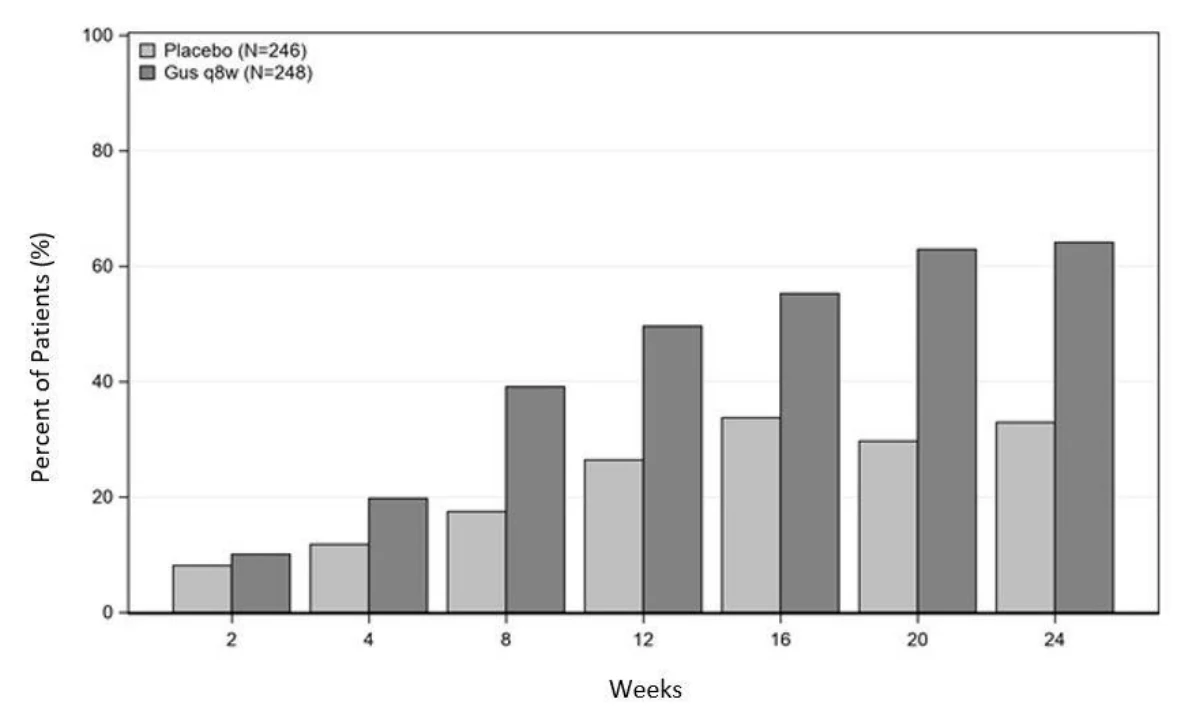
In DISCOVER 1, among 127 subjects randomized to TREMFYA 100 mg q8w, 123 subjects received TREMFYA at or after 24 weeks in the double-blind, not placebo controlled, active treatment period. 91.3% (116/127) of subjects remained on TREMFYA at Week 48.
In DISCOVER 2, among 248 subjects randomized to TREMFYA 100 mg q8w, 240 subjects received TREMFYA at or after 24 weeks in the double-blind, not placebo controlled, active treatment period. 89.9% (223/248) of subjects remained on TREMFYA at Week 100.
In an exploratory analysis among TREMFYA 100 mg q8w subjects who achieved ACR 20 at Week 24, 80.6% (54/67) in DISCOVER 1 and 89.9% (143/159) in DISCOVER 2 were ACR 20 responders at Week 52; and 83% (132/159) were ACR 20 responders at Week 100 in DISCOVER 2.
Table 19: Mean change from Baseline in ACR Component Scores at Week 24 Based on Observed Data
| DISCOVER 1 | DISCOVER 2 | |||||||||||
|---|---|---|---|---|---|---|---|---|---|---|---|---|
Placebo (N=126) | TREMFYA 100 mg q8w (N=127) | Placebo (N=246) | TREMFYA 100 mg q8w (N=248) | |||||||||
| No. of Swollen Joints | ||||||||||||
| Baseline | 10.1 | 10.9 | 12.3 | 11.7 | ||||||||
| Mean change at Week 24 | -5.1 | -7.3 | -6.4 | -8.1 | ||||||||
| No. of Tender Joints | ||||||||||||
| Baseline | 19.8 | 20.2 | 21.6 | 19.8 | ||||||||
| Mean change at Week 24 | -6.8 | -10.5 | -7.3 | -10.4 | ||||||||
| Patient’s Assessment of Pain | ||||||||||||
| Baseline | 5.8 | 6.0 | 6.3 | 6.3 | ||||||||
| Mean change at Week 24 | -0.7 | -2.2 | -1.1 | -2.5 | ||||||||
| Patient Global Assessment | ||||||||||||
| Baseline | 6.1 | 6.5 | 6.5 | 6.5 | ||||||||
| Mean change at Week 24 | -0.9 | -2.5 | -1.2 | -2.5 | ||||||||
| Physician Global Assessment | ||||||||||||
| Baseline | 6.3 | 6.2 | 6.7 | 6.6 | ||||||||
| Mean change at Week 24 | -2.2 | -3.5 | -2.5 | -3.8 | ||||||||
| Disability Index (HAQ-DI) | ||||||||||||
| Baseline | 1.2 | 1.2 | 1.3 | 1.3 | ||||||||
| Mean change at Week 24 | -0.1 | -0.3 | -0.2 | -0.4 | ||||||||
| CRP (mg/dL) | ||||||||||||
| Baseline | 1.4 | 1.6 | 2.1 | 2.0 | ||||||||
| Mean change at Week 24 | -0.0 | -0.7 | -0.5 | -1.1 | ||||||||
In DISCOVER 1, the proportion of subjects who achieved Minimal Disease Activity (MDA) at Week 24 was 22.8% (29/127) in the TREMFYA 100mg q8w group and 11.1% (14/126) in the placebo group. In DISCOVER 2, the proportion of subjects who achieved MDA at Week 24 was 25% (62/248) in the TREMFYA 100mg q8w group and 6.1% (15/246) in the placebo group.
Psoriasis Skin Response
In subjects with ≥3% BSA psoriasis skin involvement and an IGA score of ≥2 at baseline, the proportion of subjects who achieved a psoriasis response at Week 24, defined as an IGA of 0 (cleared) or 1 (minimal) and a ≥2-grade reduction from baseline, was assessed. In DISCOVER 1, the proportions of subjects achieving a psoriasis IGA response were 57.3% and 15.4% for the TREMFYA 100mg q8w and placebo dose groups respectively. In DISCOVER 2, the proportions of these subjects achieving a psoriasis IGA response were 70.5% and 19.1% for the TREMFYA 100mg q8w and placebo dose groups respectively.
Enthesitis and Dactylitis
Treatment with TREMFYA resulted in improvement in dactylitis and enthesitis in subjects with pre-existing dactylitis or enthesitis at baseline.
Radiographic Response
In DISCOVER 2, inhibition of structural damage progression was measured radiographically and expressed as the mean change from baseline in the total modified van der Heijde-Sharp (vdH-S) score at Week 24. The mean change (95% CI) in progression from baseline in the vdH-S was 0.52 (0.18, 0.96) for TREMFYA 100 mg q8w and 0.95 (0.61, 1.29) for placebo at Week 24.
Physical Function and Other Patient Reported Outcomes
At Week 24, a greater mean improvement from baseline in physical function, as measured by the Health Assessment Questionnaire-Disability Index (HAQ-DI) was shown in both studies in the TREMFYA 100 mg q8w group compared to placebo. The mean change from baseline at Week 24 was -0.32 and -0.073 (DISCOVER 1) and -0.37 and -0.13 (DISCOVER 2) for the TREMFYA 100mg q8w and placebo dose groups respectively (p<0.001 in both trials).
At Week 24, subjects in the TREMFYA group in both DISCOVER 1 and DISCOVER 2 showed greater improvement from baseline in the SF-36 PCS compared with placebo. At Week 24 there was numeric improvement in the physical functioning, role-physical, bodily-pain, general health, social-functioning and vitality domains but not in the role-emotional and mental health domains. Subjects in the TREMFYA group in both DISCOVER 1 and DISCOVER 2 showed improvement from baseline in fatigue measured with FACIT-fatigue at Week 24.
Psoriatic Arthritis – Pediatrics (6 to 17 years of age)
No clinical data is available to Health Canada for pediatric patients with active psoriatic arthritis. The use of TREMFYA in pediatric patients 6 to 17 years of age with active juvenile psoriatic arthritis is supported by model‑based extrapolation, which relies on adult psoriatic arthritis and pediatric plaque psoriasis efficacy, safety, and PK data, based on similarity in disease and drug response in children (see 10.3 Pharmacokinetics).
The study results are not applicable.
Crohn’s Disease
Table 20: Summary of trial designs and subject demographics
| Study # | Trial design | Dosage, route of administration and duration | Total number of subjects | Mean age (Range) | Sex |
| GALAXI 2 | A phase 3, multicentre, randomized, double-blind, placebo-controlled 48-week treat-through study | Guselkumab (n=146) 200 mg IV Weeks 0, 4, 8 → 200 mg SC q4w Guselkumab (n=143) 200 mg IV Weeks 0, 4, 8 → 100 mg SC q8w Placebo (n=76) | 508 | 36.4 (18-74) | M=281 F=227 |
| GALAXI 3 | A phase 3, multicentre, randomized, double-blind, placebo-controlled 48-week treat-through study | Guselkumab (n=150) 200 mg IV Weeks 0, 4, 8 → 200 mg SC q4w Guselkumab (n=143) 200 mg IV Weeks 0, 4, 8 → 100 mg SC q8w Placebo (n=72) | 513 | 36.6 (18-76) | M=307 F=206 |
| GRAVITI | A phase 3, multicentre, randomized, double-blind, placebo-controlled 24-week treat-through study | Guselkumab (n=115) 400 mg SC Weeks 0, 4, 8 → 200 mg SC q4w Guselkumab (n=115) 400 mg SC Weeks 0, 4, 8 → 100 mg SC q8w Placebo (n=117) | 347 | 37.5 (18-83) | M=203 F=144 |
The efficacy and safety of TREMFYA/TREMFYA I.V. were evaluated in three Phase 3 trials in adult subjects with moderately to severely active Crohn’s disease who had prior treatment failure (inadequate response, loss of response or intolerance) with either oral corticosteroids, conventional immunomodulators (AZA, 6-MP, MTX), and/or biologic therapy (TNF blocker or vedolizumab): two identically designed 48-week multicentre, randomized, double-blind, placebo- and biologic active-controlled, parallel group trials (intravenous induction and subcutaneous (SC) maintenance: GALAXI 2 and GALAXI 3) and one 48-week multicentre, randomized, double-blind, placebo-controlled, parallel group trial (SC induction and SC maintenance: GRAVITI). Moderately to severely active Crohn’s disease was defined as a Crohn’s Disease Activity Index (CDAI) score of ≥ 220 and ≤ 450 and a Simple Endoscopic Score for CD (SES-CD) of ≥6 (or ≥4 for subjects with isolated ileal disease). In addition, efficacy and safety of TREMFYA/TREMFYA I.V. were evaluated in a Phase 2 dose-ranging study (GALAXI 1). All four trials had a treat-through study design: subjects randomized to TREMFYA/TREMFYA I.V. maintained that treatment assignment for the duration of the trial.
IV Induction / SC Maintenance Studies: GALAXI 2 and GALAXI 3
Subjects were randomized in a 2:2:2:1 ratio to receive TREMFYA I.V. 200 mg induction at Weeks 0, 4 and 8 followed by TREMFYA 200 mg SC maintenance every 4 weeks (q4w) (n = 146 in GALAXI 2 and n = 150 in GALAXI 3); or TREMFYA I.V. 200 mg induction at Weeks 0, 4 and 8, followed by TREMFYA 100 mg SC maintenance every 8 weeks (q8w) (n =
143 in both GALAXI 2 and GALAXI 3); or ustekinumab 6 mg/kg IV induction at Week 0 followed by ustekinumab 90 mg SC q8w maintenance (n = 143 in GALAXI 2 and n = 148 in GALAXI 3); or placebo (n = 76 in GALAXI 2 and n = 72 in GALAXI 3). Placebo non-responders received ustekinumab starting at Week 12. Randomization (see Table 20) was stratified by baseline CDAI score (≤300 or >300), baseline SES-CD score (≤12 or >12), prior BIO-Failure status (Yes/No) and baseline corticosteroid use (Yes/No).
A total of 1021 subjects were evaluated in GALAXI 2 (N=508) and GALAXI 3 (N=513). The median age was 34 years; 42.4% were female; and 74.3% identified as White, 21.3% as Asian, and 1.5% as Black or African American.
In GALAXI 2, 52.8% of subjects had previously failed at least one biologic therapy, 41.9% were biologic-naïve, and 5.3% had previously received but had not failed a biologic. At baseline, 37.4% of subjects were receiving oral corticosteroids and 29.9% of subjects were receiving conventional immunomodulators. The median CDAI score was 284.5 and the median SES-CD score was 11.0.
In GALAXI 3, 51.9% of subjects had previously failed at least one biologic therapy, 41.5% were biologic-naïve, and 6.6% had previously received but had not failed a biologic. At baseline, 36.1% of subjects were receiving oral corticosteroids and 30.2% of subjects were receiving conventional immunomodulators. The median CDAI score was 286 and the median SES-CD score was 11.0.
In GALAXI 2 and GALAXI 3, the composite co-primary endpoints were (1) clinical response at Week 12 and clinical remission at Week 48 and (2) clinical response at Week 12 and endoscopic response at Week 48 compared to placebo (Table 21). Key secondary composite endpoints included clinical response at Week 12 and corticosteroid-free clinical remission at Week 48, and clinical response at Week 12 and endoscopic remission at Week 48.
Clinical response is defined as ≥100-point reduction from baseline in CDAI score or CDAI score <150. Clinical remission is defined as a CDAI score <150. Endoscopic response is defined as ≥ 50% improvement (reduction) from baseline in SES-CD Score or SES-CD Score ≤ 2. Endoscopic remission is defined as a SES-CD Score ≤ 4 and at least a 2-point reduction from baseline with no subscore greater than 1 in any individual component. For composite endpoints, the same subject had to achieve each component of the endpoint.
The findings for primary and key secondary endpoints are shown in Table 21.
Table 21: Primary and Key Secondary Composite Endpoints in GALAXI 2 and GALAXI 3
| GALAXI 2 | |||||
| Endpoint | Placebo N=76 | TREMFYA I.V. Induction → 100 mg SC q8wa N=143 | TREMFYA I.V. Induction → 200 mg SC q4wb N=146 | Treatment Difference (95% CI)c | |
| TREMFYA 100 mg | TREMFYA 200 mg | ||||
| Co-primary endpoints | |||||
| Clinical response at Week 12 and clinical remission at Week 48 | 9 (12%) | 70 (49%) | 80 (55%) | 38% (27%, 49%)d | 43% (32%, 54%)d |
| Clinical response at Week 12 and endoscopic response at Week 48 | 4 (5%) | 56 (39%) | 56 (38%) | 34% (24%, 43%)d | 33% (24%, 42%)d |
| Key secondary endpoints | |||||
| Clinical response at Week 12 and corticosteroid-free clinical remission at Week 48 | 7 (9%) | 67 (47%) | 74 (51%) | 39% (28%, 49%)d | 41% (31%, 52%)d |
| Clinical response at Week 12 and endoscopic remission at Week 48 | 2 (3%) | 38 (27%) | 48 (33%) | 24% (16%, 32%)d | 30% (21%, 39%)d |
| GALAXI 3 | |||||
| Endpoint | Placebo (N=72) | TREMFYA I.V. Induction → 100 mg SC q8wa (N=143) | TREMFYA I.V. Induction → 200 mg SC q4wb (N=150) | Treatment Difference (95% CI)c | |
| TREMFYA 100 mg | TREMFYA 200 mg | ||||
| Co-primary endpoints | |||||
| Clinical response at Week 12 and clinical remission at Week 48 | 9 (13%) | 67 (47%) | 72 (48%) | 34% (23%, 45%)d | 35% (24%, 46%)d |
| Clinical response at Week 12 and endoscopic response at Week 48 | 4 (6%) | 48 (34%) | 54 (36%) | 28% (19%, 37%)d | 31% (21%, 40%)d |
| Key secondary endpoints | |||||
| Clinical response at Week 12 and corticosteroid-free clinical remission at Week 48 | 9 (13%) | 65 (45%) | 67 (45%) | 33% (22%, 44%)d | 31% (20%, 43%)d |
| Clinical response at Week 12 and endoscopic remission at Week 48 | 4 (6%) | 34 (24%) | 34 (23%) | 18% (10%, 27%)d | 17% (8%, 25%)d |
a TREMFYA I.V. 200 mg at Weeks 0, 4, and 8 followed by TREMFYA 100 mg SC q8w.
b TREMFYA I.V. 200 mg at Weeks 0, 4, and 8 followed by TREMFYA 200 mg SC q4w.
c The adjusted treatment difference and the CIs were based on the common risk difference test using Mantel-Haenszel stratum weights and the Sato variance estimator.
d Statistically significant versus placebo based on the pre-defined testing hierarchy at the 2-sided 0.05 significance level
In GALAXI 2, in subjects who had prior biologic failure receiving TREMFYA I.V. followed by TREMFYA 100 mg SC q8w / TREMFYA 200 mg SC q4w (N=77/N=73), 39%/52% demonstrated clinical response at Week 12 and clinical remission at Week 48, and 36%/26% demonstrated clinical response at Week 12 and endoscopic response at Week 48, compared with 13% and 5%, respectively, in subjects receiving placebo (N=39). In subjects who were biologic-naïve receiving TREMFYA I.V. followed by TREMFYA 100 mg SC q8w / TREMFYA 200 mg SC q4w (N=58/N=63), 60%/59% demonstrated clinical response at Week 12 and clinical remission at Week 48, and 45%/49% demonstrated clinical response at Week 12 and endoscopic response at Week 48, compared with 9% and 6%, respectively, in subjects receiving placebo (N=34).
In GALAXI 3, in subjects who had prior biologic failure receiving TREMFYA I.V. followed by TREMFYA 100 mg SC q8w / TREMFYA 200 mg SC q4w (N=76/N=74), 53%/47% demonstrated clinical response at Week 12 and clinical remission at Week 48, and 36%/36% demonstrated clinical response at Week 12 and endoscopic response at Week 48, compared with 13% and 5%, respectively, in subjects receiving placebo (N=39). In subjects who were biologic-naïve receiving TREMFYA I.V. followed by TREMFYA 100 mg SC q8w / TREMFYA 200 mg SC q4w (N=58/N=65), 43%/51% demonstrated clinical response at Week 12 and clinical remission at Week 48, and 36%/38% demonstrated clinical response at Week 12 and endoscopic response at Week 48, compared with 15% and 7%, respectively, in subjects receiving placebo (N=27).
In GALAXI 2, following the induction period, 47% (n=136) of subjects receiving TREMFYA I.V. demonstrated clinical remission at Week 12 and 38% (n=109) demonstrated endoscopic response at Week 12, compared with 22% (n=17) and 11% (n=8), respectively, of subjects receiving placebo. In GALAXI 3, following the induction period, 47% (n=138) of subjects receiving TREMFYA I.V. demonstrated clinical remission at Week 12 and 36% (n=106) demonstrated endoscopic response at Week 12, compared with 15% (n=11) and 14% (n=10), respectively, of subjects receiving placebo.
SC Induction / SC Maintenance Study: GRAVITI
In GRAVITI, subjects were randomized in a 1:1:1 ratio to receive TREMFYA 400 mg SC induction at Weeks 0, 4 and 8 followed by TREMFYA 200 mg SC q4w maintenance (n = 115); or TREMFYA 400 mg SC induction at Weeks 0, 4 and 8, followed by TREMFYA 100 mg SC q8w maintenance (n = 115); or placebo (n = 117). All subjects in the placebo group who met rescue criteria received treatment with TREMFYA 400 mg SC induction followed by TREMFYA 100 mg SC maintenance every 8 weeks. The randomization (see Table 20) was stratified by baseline CDAI score (≤300 or >300), baseline SES-CD score (≤12 or >12), and prior BIO-Failure status (Yes/No).
A total of 347 subjects were evaluated. The median age of subjects was 36 years; 41.5% were female; and 66% identified as White, 21.9% as Asian, and 2.6% as Black or African American.
In GRAVITI, 46.4% of subjects had previously failed at least one biologic therapy, 46.4% were biologic-naïve, and 7.2% had previously received but had not failed a biologic. At baseline, 29.7% of subjects were receiving oral corticosteroids and 28.5% of the subjects were receiving conventional immunomodulators. The median CDAI score was 289 and the median SES-CD score was 10.0.
The co-primary endpoints were clinical remission at Week 12 and endoscopic response at Week 12 compared to placebo (Table 22).
The results at week 12 following the induction period are shown in Table 22.
| Table 22: Efficacy Endpoints at Week 12 in GRAVITI | ||||||
| Endpoint | Placebo (N=117) | TREMFYA 400 mg SCa (N=230) | Treatment Difference vs Placebo (95% CI)b | |||
| Clinical Remission at Week 12 | 25 (21%) | 129 (56%) | 35% (25%, 45%)c | |||
| Endoscopic Response at Week 12 | 25 (21%) | 95 (41%) | 20% (10%, 30%)c | |||
a TREMFYA 400 mg SC induction at Weeks 0, 4 and 8 b The adjusted treatment difference and the CIs were based on the common risk difference test using Mantel-Haenszel stratum weights and the Sato variance estimator. c Statistically significant versus placebo based on the pre-defined testing hierarchy at the 2-sided 0.05 significance level | ||||||
In GRAVITI, in subjects who had prior biologic failure receiving TREMFYA 400 mg SC (N=108), 60% demonstrated clinical remission at Week 12 and 33% demonstrated endoscopic response at Week 12, compared with 17% and 17%, respectively, in subjects receiving placebo (N=53). In subjects receiving TREMFYA 400 mg SC who were biologic-naïve (N=105), 50% demonstrated clinical remission at Week 12 and 49% demonstrated endoscopic response at Week 12, compared with 25% and 27%, respectively, in subjects receiving placebo (N=56).
In GRAVITI, following the maintenance period, the endpoints of clinical remission, endoscopic response, and endoscopic remission at week 48 were consistent with the maintenance results observed in the GALAXI 2/GALAXI 3 studies.
Ulcerative Colitis
Table 23: Summary of trial designs and subject demographics
| Study # | Trial design | Dosage, route of administration and duration | Total number of subjects | Mean age (Range) | Gender |
| QUASAR induction dose-ranging study | A phase 2b, multicenter, randomized, double-blind, placebo-controlled study | Guselkumab (n=107) 400 mg IV Weeks 0, 4, 8 Guselkumab (n=101) 200 mg IV Weeks 0, 4, 8 Placebo (n=105) IV | 313 | 39 (18-84) | M=185 F=128 |
| QUASAR-IS | A phase 3, multicenter, randomized, double-blind, placebo-controlled study | Guselkumab (n=421) 200 mg IV Weeks 0, 4, 8 Placebo (n=280) IV | 701 | 39 (18-79) | M=399 F=302 |
| QUASAR-M | A phase 3, multicenter, randomized, double-blind, placebo-controlled study | Guselkumab (n=190) 200 mg SC every 4 weeks Guselkumab (n=188) 100 mg SC every 8 weeks Placebo (n=190) SC | 568 | 39 (18-79) | M=311 F=257 |
| ASTRO | A phase 3, multicenter, randomized, double-blind, placebo-controlled 24-week treat-through study | Guselkumab (n=140) 400 mg SC Weeks 0, 4, 8 → 200 mg SC q4w Guselkumab (n=139) 400 mg SC Weeks 0, 4, 8 → 100 mg SC q8w Placebo (n=139) | 418 | 42 (18-80) | M=256 F=162 |
The efficacy and safety of TREMFYA/TREMFYA I.V. were evaluated in three Phase 3 multicenter, randomized, double-blind, placebo-controlled studies (QUASAR intravenous induction study, QUASAR maintenance study and ASTRO subcutaneous induction study) in adult subjects with moderately to severely active ulcerative colitis who had an inadequate response, loss of response, or intolerance to corticosteroids, conventional immunomodulators, and/or an advanced therapy (biologic therapy [TNF blockers, vedolizumab], or a Janus kinase [JAK] inhibitor and/or sphingosine-1-phosphate receptor modulators [S1PRM] [applicable only for ASTRO]). In addition, efficacy and safety of TREMFYA I.V. were evaluated in a randomized, double-blind, placebo controlled, Phase 2b induction dose-finding study (QUASAR induction dose-ranging study).
Disease activity was assessed by the modified Mayo score (mMS), a 3-component Mayo score (0-9) which consists of the sum of the following subscores (0 to 3 for each subscore): stool frequency (SFS), rectal bleeding (RBS), and findings on centrally reviewed endoscopy (ES). Moderately to severely active ulcerative colitis was defined as a mMS between 5 and 9, an RBS >1, and an ES of 2 (defined by marked erythema, absent vascular pattern, friability, and/or erosions) or an ES of 3 (defined by spontaneous bleeding and ulceration).
QUASAR Induction Study: QUASAR IS
In the induction study QUASAR IS, a total of 701 subjects were randomized in a 3:2 ratio to receive either TREMFYA I.V. 200 mg (n = 421) or placebo by intravenous infusion at Week 0, Week 4, and Week 8 (n = 280). Randomization was stratified by ADT-failure status (ie, inadequate response or failure to tolerate TNFα antagonists, vedolizumab, or tofacitinib) (Yes/No), region (Eastern Europe, Asia, or Rest of World), and concomitant use of corticosteroids at baseline (Yes/No) (see Table 23).
At baseline the median mMS was 7, with 35.5% of subjects having a baseline mMS of 5 to 6 and 64.5% having a mMS of 7 to 9, and 67.9% of subjects with a baseline ES of 3. Extensive disease was present in 47.8% of subjects. The median age was 39 years (ranging from 18 to 79 years); 43.1% were female; and 72.5% identified as White, 21.4% as Asian, 1% as Black, 0.1% as American Indian or Alaskan Native, and 0.1% as multiple racial groups.
Enrolled subjects were permitted to use stable doses of oral aminosalicylates, methotrexate, 6-MP, AZA and/or oral corticosteroids. At baseline, 72.5% of subjects were receiving aminosalicylates, 20.8% of subjects were receiving immunomodulators (MTX, 6-MP, or AZA), and 43.1% of subjects were receiving corticosteroids. Concomitant biologic therapies or JAK inhibitors were not permitted.
A total of 49.1% of subjects had previously failed at least one advanced therapy. Of these subjects, 87.5%, 54.1% and 18.0% had previously failed a TNF blocker, vedolizumab or a JAK inhibitor, respectively, and 47.4% had failed treatment with 2 or more of these therapies. A total of 48.4% of subjects were advanced therapy naive, and 2.6% had previously received but had not failed an advanced therapy.
The primary endpoint was clinical remission as defined by the mMS at Week 12. Secondary endpoints at Week 12 included but were not limited to endoscopic improvement, clinical response, and histologic endoscopic mucosal improvement (see Table 24). Clinical remission is defined as a stool frequency subscore of 0 or 1 and not increased from induction baseline, a rectal bleeding subscore of 0, and an endoscopy subscore of 0 or 1 with no friability present on the endoscopy. Endoscopic improvement is defined as an endoscopy subscore of 0 or 1 with no friability present on the endoscopy. Clinical response is defined as a decrease from induction baseline in the modified Mayo score by ≥30% and ≥2 points, with either a ≥1-point decrease from induction baseline in the rectal bleeding subscore or a rectal bleeding subscore of 0 or 1. Histologic endoscopic mucosal improvement is defined as a combination of histologic improvement (neutrophil infiltration in <5% of crypts, no crypt destruction, and no erosions, ulcerations or granulation tissue according to the Geboes grading system) and endoscopic improvement as defined above.
The findings for the primary and key secondary endpoints assessed at Week 12 of QUASAR IS are shown in Table 24.
| Table 24: Proportion of Subjects Meeting Efficacy Endpoints at Week 12 in QUASAR IS | ||||||||||
|---|---|---|---|---|---|---|---|---|---|---|
| Endpoint | Placebo (N=280) | TREMFYA I.V. 200 mga (N=421) | Treatment Difference (95% CI) | |||||||
| Clinical remission | 22 (8%) | 95 (23%) | 15% (10%, 20%)b | |||||||
| Advanced therapy naïvec | 16/137 (12%) | 64/202 (32%) | ||||||||
| Prior advanced therapy failure | 5/136 (4%) | 26/208 (13%) | ||||||||
| Endoscopic improvement | 31 (11%) | 113 (27%) | 16% (10%, 21%)b | |||||||
| Advanced therapy naïvec | 23/137 (17%) | 77/202 (38%) | ||||||||
| Prior advanced therapy failure | 7/136 (5%) | 31/208 (15%) | ||||||||
| Clinical response | 78 (28%) | 259 (62%) | 34% (27%, 41%)b | |||||||
| Advanced therapy naïvec | 48/137 (35%) | 144/202 (71%) | ||||||||
| Prior advanced therapy failure | 27/136 (20%) | 107/208 (51%) | ||||||||
| Histologic endoscopic mucosal improvement | 21 (8%) | 99 (24%) | 16% (11%, 21%)b | |||||||
| Advanced therapy naïvec | 15/137 (11%) | 66/202 (33%) | ||||||||
| Prior advanced therapy failure | 6/136 (4%) | 28/208 (13%) | ||||||||
a TREMFYA I.V. 200 mg as an intravenous infusion at Week 0, Week 4, and Week 8. b Statistically significant versus placebo based on the pre-defined testing hierarchy at the 2-sided 0.05 significance level, adjusted treatment difference (95% CI) based on Cochran-Mantel-Haenszel method (adjusted for stratification factors: advanced therapy failure status and concomitant use of corticosteroids at baseline). c Does not include an additional 7 participants in the placebo group and 11 participants in the TREMFYA group who were previously exposed to but did not fail an advanced therapy. | ||||||||||
Symptomatic Assessment
Symptomatic remission is defined as a stool frequency subscore of 0 or 1 and not increased from induction baseline, and a rectal bleeding subscore of 0. At Week 12, symptomatic remission was achieved in 50% of subjects treated with TREMFYA I.V. and 21% of subjects treated with placebo. At Week 4, symptomatic remission was achieved in 23% of subjects treated with TREMFYA I.V. and 13% of subjects treated with placebo.
Endoscopic Assessment
Endoscopic remission (endoscopy subscore of 0) at Week 12 was achieved in 15% of subjects treated with TREMFYA I.V. and 5% of subjects treated with placebo.
Health Related Quality of Life
Fatigue response is defined as a ≥7 point improvement from baseline, which is considered clinically meaningful, as assessed using the PROMIS-Fatigue Short form 7a. At Week 12, fatigue response was achieved in 41% of subjects treated with TREMFYA I.V. and 21% of subjects treated with placebo.
IBDQ remission (Total Inflammatory Bowel Disease Questionnaire score ≥170) at Week 12 was achieved in 51% of subjects treated with TREMFYA I.V. and 30% of subjects treated with placebo.
Maintenance Study: QUASAR MS
The maintenance study (QUASAR MS) evaluated 568 subjects who achieved clinical response at Week 12 following the intravenous administration of TREMFYA I.V. in either QUASAR IS or from the QUASAR induction dose-ranging study. These subjects were randomized in a 1:1:1 ratio to receive a subcutaneous maintenance regimen of either TREMFYA 100 mg every 8 weeks, TREMFYA 200 mg every 4 weeks or placebo for 44 weeks. Randomization was stratified by clinical remission status at maintenance baseline (Yes/No), concomitant use of corticosteroids at maintenance baseline (Yes/No), and induction treatment (TREMFYA I.V. 400 mg, TREMFYA I.V. 200 mg, and placebo IV → TREMFYA I.V. 200 mg) (see Table 23).
The primary endpoint was clinical remission as defined by mMS at Week 44. Secondary endpoints at Week 44 included but were not limited to symptomatic remission, endoscopic improvement, corticosteroid-free clinical remission, histologic endoscopic mucosal improvement, and fatigue response (see Table 25). Clinical remission is defined as a stool frequency subscore of 0 or 1 and not increased from induction baseline, a rectal bleeding subscore of 0, and an endoscopy subscore of 0 or 1 with no friability present on the endoscopy. Endoscopic improvement is defined as an endoscopy subscore of 0 or 1 with no friability present on the endoscopy. Clinical response is defined as a decrease from induction baseline in the modified Mayo score by ≥30% and ≥2 points, with either a ≥1-point decrease from induction baseline in the rectal bleeding subscore or a rectal bleeding subscore of 0 or 1. Histologic endoscopic mucosal improvement is defined as a combination of histologic improvement (neutrophil infiltration in <5% of crypts, no crypt destruction, and no erosions, ulcerations or granulation tissue according to the Geboes grading system) and endoscopic improvement as defined above.
The findings for the primary and key secondary endpoints assessed at Week 44 of QUASAR MS are shown in Table 25.
| Table 25: Proportion of Subjects Meeting Efficacy Endpoints at Week 44 in QUASAR MS | |||||||||||
|---|---|---|---|---|---|---|---|---|---|---|---|
| Endpoint | Placebo N=190 | TREMFYA 100 mg q8wa N=188 | TREMFYA 200 mg q4wb N=190 | Treatment Difference vs Placebo (95% CI) | |||||||
| TREMFYA 100 mg | TREMFYA 200 mg | ||||||||||
| Clinical remission | 36 (19%) | 85 (45%) | 95 (50%) | 25% (16%, 34%)c | 30% (21%, 38%)c | ||||||
| Advanced therapy naïved | 28/108 (26%) | 53/105 (50%) | 56/96 (58%) | ||||||||
| Prior advanced therapy failure | 6/75 (8%) | 31/77 (40%) | 35/88 (40%) | ||||||||
| Corticosteroid-free clinical remissione | 35 (18%) | 85 (45%) | 93 (49%) | 26% (17%, 34%)c | 29% (20%, 38%)c | ||||||
| Advanced therapy naïved | 28/108 (26%) | 53/105 (50%) | 54/96 (56%) | ||||||||
| Prior advanced therapy failure | 5/75 (7%) | 31/77 (40%) | 35/88 (40%) | ||||||||
| Endoscopic improvement | 36 (19%) | 93 (49%) | 98 (52%) | 30% (21%, 38%)c | 31% (22%, 40%)c | ||||||
| Advanced therapy naïved | 28/108 (26%) | 56/105 (53%) | 57/96 (59%) | ||||||||
| Prior advanced therapy failure | 6/75 (8%) | 35/77 (45%) | 37/88 (42%) | ||||||||
| Histologic endoscopic mucosal improvement | 32 (17%) | 82 (44%) | 91 (48%) | 26% (17%, 34%)c | 30% (21%, 38%)c | ||||||
| Advanced therapy naïved | 25/108 (23%) | 52/105 (50%) | 54/96 (56%) | ||||||||
| Prior advanced therapy failure | 6/75 (8%) | 29/77 (38%) | 34/88 (39%) | ||||||||
| Clinical response | 82 (43%) | 146 (78%) | 142 (75%) | 34% (25%, 43%)c | 31% (21%, 40%)c | ||||||
| Advanced therapy naïved | 58/108 (54%) | 87/105 (83%) | 78/96 (81%) | ||||||||
| Prior advanced therapy failure | 21/75 (28%) | 54/77 (70%) | 59/88 (67%) | ||||||||
a TREMFYA 100 mg as a subcutaneous injection every 8 weeks after the induction regimen. b TREMFYA 200 mg as a subcutaneous injection every 4 weeks after the induction regimen. c Statistically significant versus placebo based on the pre-defined testing hierarchy at the 2-sided 0.05 significance level, adjusted treatment difference (95% CI) based on Cochran-Mantel-Haenszel method adjusted for randomization stratification factors. d Does not include an additional 7 participants in the placebo group, 6 participants in the TREMFYA 100mg group, and 6 participants in the TREMFYA 200mg group who were previously exposed to but did not fail an advanced therapy. e Not requiring any treatment with corticosteroids for at least 8 weeks prior to Week 44 and also meeting the criteria for clinical remission at Week 44. | |||||||||||
Symptomatic Assessment
Symptomatic remission is defined as a stool frequency subscore of 0 or 1 and not increased from induction baseline, and a rectal bleeding subscore of 0. At Week 44, symptomatic remission was achieved in 70% of subjects treated with TREMFYA 100 mg q8w, 69% of subjects treated with TREMFYA 200 mg q4w, and 37% of subjects treated with placebo.
Maintenance of Clinical Remission
Maintenance of clinical remission at Week 44 in subjects who achieved clinical remission 12 weeks after induction was achieved in 61% of subjects treated with TREMFYA 100 mg q8w, 72% of subjects treated with TREMFYA 200 mg q4w, and 34% of subjects treated with placebo.
Endoscopic and Histologic Assessment
Endoscopic remission (endoscopy subscore of 0) at Week 44 was achieved in 35% of subjects treated with TREMFYA 100 mg q8w, 34% of subjects treated with TREMFYA 200 mg q4w, and 15% of subjects treated with placebo.
Histologic remission (Geboes histologic score ≤2 B.0 indicating the absence of neutrophils from the mucosa [both lamina propria and epithelium], no crypt destruction, and no erosions, ulcerations or granulation tissue) at Week 44 was achieved by 59% subjects treated with TREMFYA 100 mg SC q8w, 61% of subjects treated with TREMFYA 200 mg SC q4w, and 27% of subjects treated with placebo.
Combined endoscopic remission and histologic remission at Week 44 was achieved by 31% of subjects treated with TREMFYA 100 mg SC q8w, 33% of subjects treated with TREMFYA 200 mg SC q4w, and 14% of subjects treated with placebo.
Health Related Quality of Life
Fatigue response is defined as a ≥7-point improvement from baseline, which is considered clinically meaningful, as assessed using the PROMIS-Fatigue Short form 7a. At Week 44, fatigue response was achieved in 51% of subjects treated with TREMFYA 100 mg q8w, 43% of subjects treated with TREMFYA 200 mg q4w, and 29% of subjects treated with placebo.
IBDQ remission (Total Inflammatory Bowel Disease Questionnaire score ≥170) at Week 44 was achieved in 64% of subjects treated with TREMFYA 100 mg q8w, 64% of subjects treated with TREMFYA 200 mg q4w, and 37% of subjects treated with placebo.
ASTRO Study
In ASTRO, a total of 418 subjects were randomized in a 1:1:1 ratio to receive TREMFYA 400 mg subcutaneous induction at Weeks 0, 4 and 8 followed by TREMFYA 200 mg subcutaneous maintenance every 4 weeks; or TREMFYA 400 mg subcutaneous induction at Weeks 0, 4 and 8, followed by TREMFYA 100 mg subcutaneous maintenance every 8 weeks; or placebo. Randomization was stratified by ADT-failure status (inadequate response, loss of response, or intolerance to ADT) (Yes/No), and Mayo endoscopy subscore at baseline (moderate [2]/severe [3]).
At baseline the median mMS was 7, with 35.3% of subjects having a baseline mMS of 5 to 6 and 62.1% having a mMS of 7 to 9, and 56.0% of subjects with a baseline ES of 3. Extensive disease was present in 53.6% of subjects. The median age of subjects was 40 years (ranging from 18 to 80 years); 38.8% were female; and 64.6% identified as White, 28.9% as Asian, and 3.1% as Black or African American.
Enrolled subjects were permitted to use stable doses of oral aminosalicylates, immunomodulators (azathioprine, 6-mercaptopurine, methotrexate), and/or oral corticosteroids (up to 20 mg/day prednisone or equivalent). At baseline, 77.3% of subjects were receiving aminosalicylates, 20.1% of subjects were receiving immunomodulators, and 32.8% of subjects were receiving corticosteroids. Concomitant biologic therapies, JAK inhibitors, or sphingosine-1-phosphate receptor modulators (S1PRM) were not permitted.
A total of 40.2% of subjects had previously failed treatment with at least one advanced therapy. Of these subjects, 69.6% had failed one class of advanced therapy, and 30.4% had failed two or more classes. A total of 58.1% were advanced therapy naïve, and 1.7% had previously received but had not failed an advanced therapy.
The primary endpoint was clinical remission at Week 12. Secondary endpoints at Week 12 included symptomatic remission, endoscopic improvement, clinical response and histologic-endoscopic mucosal improvement (see Table 26). Secondary endpoints at Week 24 included clinical remission, symptomatic remission, and endoscopic improvement (see Table 27).
Clinical remission is defined as a stool frequency subscore of 0 or 1 and not increased from baseline, a rectal bleeding subscore of 0, and an endoscopy subscore of 0 or 1 with no friability. Symptomatic remission is defined as a stool frequency subscore of 0 or 1 and not increased from induction baseline, and a rectal bleeding subscore of 0. Endoscopic improvement (healing) is defined as an endoscopy subscore of 0, or 1 with no friability. Clinical response is defined as a decrease from baseline in the modified Mayo score by ≥30% and ≥2 points, with either a ≥1 point decrease from baseline in the rectal bleeding subscore or a rectal bleeding subscore of 0 or 1. Histologic-endoscopic mucosal improvement is defined as an endoscopy subscore of 0 or 1 with no friability and Geboes score ≤3.1 (indicating neutrophil infiltration in <5% of crypts, no crypt destruction, and no erosions, ulcerations, or granulation tissue).
The findings for the primary and key secondary endpoints of ASTRO study are shown in Table 26 when assessed at Week 12 and in Table 27 when assessed at Week 24.
| Table 26: Proportion of Subjects Meeting Efficacy Endpoints at Week 12 in ASTRO | ||||||||||
|---|---|---|---|---|---|---|---|---|---|---|
| Endpoint | Placebo (N=139) | TREMFYA 400 mg SCa (N=279) | Treatment Difference vs Placebo (95% CI)b | |||||||
| Clinical remission | 9 (6%) | 77 (28%) | 21% (15%, 28%)b | |||||||
| Advanced therapy naïvec | 7/79 (9%) | 59/164 (36%) | ||||||||
| Prior advanced therapy failure | 2/56 (4%) | 18/112 (16%) | ||||||||
| Endoscopic improvement | 18 (13%) | 104 (37%) | 24% (17%, 32%)b | |||||||
| Advanced therapy naïvec | 14/79 (18%) | 75/164 (46%) | ||||||||
| Prior advanced therapy failure | 4/56 (7%) | 27/112 (24%) | ||||||||
| Clinical response | 48 (35%) | 183 (66%) | 31% (22%, 40%)b | |||||||
| Advanced therapy naïvec | 33/79 (42%) | 117/164 (71%) | ||||||||
| Prior advanced therapy failure | 14/56 (25%) | 64/112 (57%) | ||||||||
| Histologic endoscopic mucosal improvement | 15 (11%) | 85 (30%) | 20% (12%, 27%)b | |||||||
| Advanced therapy naivec | 11/79 (14%) | 63/164 (38%) | ||||||||
| Prior advanced therapy failure | 4/56 (7%) | 21/112 (19%) | ||||||||
a TREMFYA 400 mg SC induction at Week 0, Week 4, and Week 8 b Statistically significant versus placebo based on the pre-defined testing hierarchy at the 2-sided 0.05 significance level; adjusted treatment difference (95% CI) based on the Mantel-Haenszel estimate of the common risk difference adjusted for randomization stratification factors. c Does not include an additional 4 subjects in the placebo group and 3 subjects in the TREMFYA group that were previously exposed to but did not fail an advanced therapy. | ||||||||||
Table 27: Proportion of Subjects Meeting Efficacy Endpoints at Week 24 in ASTRO
| Endpoint | Placebo (N=139) | TREMFYA 400 mg SC induction→ 100 mg SC q8wa (N=139) | TREMFYA 400 mg SC induction→ 200 mg SC q4wb (N=140) | Treatment Difference vs Placebo (95% CI)c | |
|---|---|---|---|---|---|
| Endpoint | Placebo (N=139) | TREMFYA 400 mg SC induction→ 100 mg SC q8wa (N=139) | TREMFYA 400 mg SC induction→ 200 mg SC q4wb (N=140) | Treatment Difference vs Placebo (95% CI)c | |
| TREMFYA 100 mg | TREMFYA 200 mg | ||||
| TREMFYA 100 mg | TREMFYA 200 mg | ||||
| Clinical remission | 13 (9%) | 49 (35%) | 51 (36%) | 26% (17%, 35%)c | 27% (18%, 36%)c |
| Advanced therapy naïved | 10/79 (13%) | 40/81 (49%) | 36/83 (43%) | ||
| Prior advanced therapy failure | 3/56 (5%) | 9/57 (16%) | 15/55 (27%) | ||
| Endoscopic improvement | 17 (12%) | 56 (40%) | 63 (45%) | 28% (18%, 38%)c | 33% (23%, 42%)c |
| Advanced therapy naïved | 14/79 (18%) | 44/81 (54%) | 43/83 (52%) | ||
| Prior advanced therapy failure | 3/56 (5%) | 11/57 (19%) | 20/55 (36%) | ||
| Clinical Response | 43 (31%) | 88 (63%) | 86 (61%) | 32% (21%, 43%)c | 30% (20%, 41%)c |
| Advanced therapy naïved | 29/79 (37%) | 60/81 (74%) | 60/83 (72%) | ||
| Prior advanced therapy failure | 12/56 (21%) | 27/57 (47%) | 26/55 (47%) | ||
a TREMFYA 400 mg SC induction at Weeks 0, 4 and 8, followed by TREMFYA 100 mg SC q8w b TREMFYA 400 mg SC induction at Weeks 0, 4 and 8, followed by TREMFYA 200 mg SC q4w c Statistically significant versus placebo based on the pre-defined testing hierarchy at the 2-sided 0.05 significance level; adjusted treatment difference (95% CI) based on the Mantel-Haenszel estimate of the common risk difference adjusted for randomization stratification factors. d Does not include an additional 4 subjects in the placebo group, 1 subject in the TREMFYA 100 mg group, and 2 subjects in the TREMFYA 200 mg group were previously exposed to but did not fail an advanced therapy. | |||||
Rectal Bleeding and Stool Frequency Subscores
Decreases in rectal bleeding and stool frequency subscores were observed as early as Week 2 in subjects treated with TREMFYA compared to placebo.
Symptomatic Assessment
At Week 12, symptomatic remission was achieved in 51% of subjects treated with TREMFYA and 21% of subjects treated with placebo. At Week 24, symptomatic remission was achieved in 55% of subjects in the TREMFYA 100 mg SC q8w arm, 50% of subjects in the TREMFYA 200 mg SC q4w arm, and 25% of subjects in the placebo arm.
Endoscopic Assessment
Endoscopic remission (normalization) was defined as ES of 0. At Week 12, endoscopic remission was achieved in 17% of subjects treated with TREMFYA 400 mg SC induction compared to 4% of subjects on placebo. At Week 24, endoscopic remission was achieved in 21% of subjects in the TREMFYA 100 mg SC q8w arm, 26% of subjects in the TREMFYA 200 mg SC q4w arm, and 4% of subjects in the placebo arm.
16 Non-clinical Toxicology
General Toxicology: In repeat-dose toxicity studies in cynomolgus monkeys, guselkumab was well-tolerated at weekly doses up to 50 mg/kg intravenously for 5 weeks or 50 mg/kg subcutaneously for up to 24 weeks. Additionally, there were no effects on cardiovascular, respiratory, and nervous system function, clinical pathology, or anatomical pathology parameters. At the NOAEL dose (50 mg/kg once weekly), AUClast was approximately 23 times the clinical exposure following a dose of 200 mg given intravenously and approximately 22 times the clinical exposure following a dose of 400 mg given subcutaneously to adults.
Genotoxicity: Studies have not been conducted to evaluate the genotoxic potential of guselkumab.
Carcinogenicity: Studies have not been conducted to evaluate the carcinogenic potential of guselkumab.
Reproductive and Developmental Toxicology: In a combined embryo-fetal developmental and pre- and post-natal development toxicity study, pregnant cynomolgus monkeys (19, 20, and 20 in the 0, 10 and 50 mg/kg groups, respectively) were administered weekly subcutaneous doses of guselkumab from the beginning of organogenesis to parturition. Neonatal deaths occurred in the offspring of 1 of 16 control monkeys and of 3 of 14 monkeys in each of the guselkumab-administered groups (AUClast at the 10 mg/kg dose was 7-fold greater than human levels following a dose of 200 mg given subcutaneously). These neonatal deaths were attributed to maternal neglect, trauma, and early or late delivery, although a drug-related effect could not be ruled out. Fetal losses (spontaneous abortions, including stillbirths) were also observed at all dose levels, all of which were within the historical control range for the testing facility, but for which a drug-related effect could also not be ruled out. The clinical significance of these findings is unknown. No guselkumab-related effects on functional or immunological development were observed in the infants from birth through 6 months of age.
No effects on fertility or early embryonic development were observed following administration of female guinea pigs with guselkumab at subcutaneous doses up to 100 mg/kg twice-weekly before mating, through mating, and during early gestation to implantation (AUClast was 21-fold greater than human levels following a dose of 200 mg given subcutaneously).
In a male fertility and early embryonic development toxicity study conducted in guinea pigs, the incidence of total litter loss increased in untreated females (5 of 22 untreated females) mated with males administered with guselkumab at a subcutaneous dose of 100 mg/kg twice weekly prior to mating and through mating for a total of 21 doses. In a second male fertility and early embryonic developmental toxicity study, there were no total litter losses in untreated females mated with treated males (100 mg/kg twice weekly). No effects on male fertility or early embryonic development were observed at a dose of 25 mg/kg (AUClast was 10-fold greater than human levels following a dose of 200 mg given subcutaneously).
Juvenile Toxicity: No juvenile toxicity studies have been conducted with guselkumab.