


Product Monograph - Dom-Anagrelide
SUMMARY PRODUCT INFORMATION
| Route of Administration | Dosage Form Strength | All Nonmedicinal Ingredients |
| oral | capsule 0.5 mg | Crospovidone, Lactose, Magnesium Stearate, Microcrystalline Cellulose, and Povidone. Capsule Shells Contain: Gelatin, Silicon Dioxide, Sodium Lauryl Sulfate, and Titanium Dioxide. |
INDICATIONS AND CLINICAL USE
Dom-ANAGRELIDE (anagrelide hydrochloride capsules) is indicated for:
- Treatment of patients with thrombocythemia secondary to myeloproliferative neoplasms to reduce the elevated platelet count and the risk of thrombosis and to ameliorate associated symptoms, including thrombo-hemorrhagic events.
Dom-ANAGRELIDE is intended for chronic usage and has not been evaluated for treatment of the acute life threatening complications of thrombocytosis.
Geriatrics (>65 years of age)
The safety and effectiveness of anagrelide hydrochloride has not been evaluated in studies specific to the elderly.
Pediatrics (<16 years of age)
The safety and efficacy of anagrelide hydrochloride in patients under 16 years of age have not been established.
CONTRAINDICATIONS
- Patients who are hypersensitive to this drug or to any ingredient in the formulation or component of the container (see DOSAGE FORMS, COMPOSITION AND PACKAGING).
- Anagrelide is contraindicated in patients with severe hepatic impairment. Use of anagrelide in patients with severe hepatic impairment has not been studied. Anagrelide must be used with caution in patients with moderate hepatic impairment as exposure to anagrelide is increased 8-fold in such patients (see DOSAGE AND ADMINISTRATION; ACTION AND CLINICAL PHARMACOLOGY; WARNINGS AND PRECAUTIONS, Hepatic/Biliary/ Pancreatic).
WARNINGS AND PRECAUTIONS
General
The decision to treat asymptomatic young adults with thrombocythemia secondary to myeloproliferative neoplasms should be individualized.
Sudden discontinuation or interruption of anagrelide hydrochloride treatment is followed by an increase in platelet count. Following discontinuation, an increase in platelet count can be observed within four days.
Cardiovascular
Due to the positive inotropic and chronotropic effects and cardiovascular side-effects (see ADVERSE REACTIONS) of anagrelide hydrochloride, it should be used with caution in patients with known or suspected heart disease, and only if the potential benefits of therapy outweigh the potential risks.
A pre-treatment cardiovascular examination (including investigations such as echocardiograph, electrocardiogram) is recommended for all patients, along with careful monitoring during treatment and further investigations carried out as necessary. In humans, therapeutic doses of anagrelide hydrochloride may cause cardiovascular effects, including vasodilation, tachycardia, palpitations, and congestive heart failure.
Anagrelide has been shown to increase the heart rate, resulting in an apparent increase in QTc interval of the electrocardiogram in healthy volunteers. The clinical impact of this effect is unknown (see ACTION AND CLINICAL PHARMACOLOGY, Pharmacodynamics – Effects on Heart Rate and QTc Interval).
Caution should be taken when using anagrelide in patients with known risk factors for prolongation of the QT interval, such as congenital long QT syndrome, a known history of acquired QTc prolongation, medicinal products that can prolong QTc interval and hypokalemia.
Care should also be taken in populations that may have a higher maximum plasma concentration (Cmax) of anagrelide or its active metabolite, 3-hydroxy-anagrelide, e.g., hepatic impairment (see
ACTION AND CLINICAL PHARMACOLOGY, Special Populations and Conditions) or use with CYP1A2 inhibitors (see DRUG INTERACTIONS, Drug-Drug Interactions).
Bleeding
Use of concomitant anagrelide and acetylsalicylic acid has been associated with major hemorrhagic events (see DRUG INTERACTIONS, Drug-Drug Interactions).
Hepatic/Biliary/Pancreatic
Hepatic metabolism represents the major route of anagrelide clearance and liver function may therefore be expected to influence this process. Anagrelide hydrochloride has not been studied in patients with severe hepatic impairment and is contraindicated (see CONTRAINDICATIONS). Exposure to anagrelide is increased 8-fold in patients with moderate hepatic impairment (see DOSAGE AND ADMINISTRATION; ACTION AND CLINICAL PHARMACOLOGY, Special Populations and Conditions – Hepatic Insufficiency). It is recommended that patients with mild and moderate hepatic impairment receive anagrelide hydrochloride only if, in the physician's judgment, the potential benefits of therapy outweigh the potential risks. Patients with mild or moderate hepatic impairment should be carefully and regularly monitored for cardiovascular effects and hepatic toxicity while receiving anagrelide hydrochloride (see WARNINGS AND PRECAUTIONS, Cardiovascular, and ADVERSE REACTIONS). In patients with moderate hepatic impairment, a dosage reduction is required (see DOSAGE AND ADMINISTRATION, Recommended Dose and Dosage Adjustment).
Pulmonary
Interstitial Lung Diseases
Interstitial lung diseases (including allergic alveolitis, eosinophilic pneumonia and interstitial pneumonitis) have been reported to be associated with the use of anagrelide in post-marketing reports. Most cases presented with progressive dyspnea associated with lung infiltrations. The time of onset ranges from 1 week to several years after initiating anagrelide. In most cases, the symptoms improved after discontinuation of anagrelide (see ADVERSE REACTIONS, Post-Market Adverse Drug Reactions).
Renal
It is recommended that patients with renal insufficiency (creatinine ≥2 mg/dL) receive anagrelide hydrochloride when, in the physician's judgment, the potential benefits of therapy outweigh the potential risks. These patients should be monitored closely for signs of renal toxicity while receiving anagrelide hydrochloride (see ADVERSE REACTIONS).
Special Populations
Pregnant Women
There are no adequate and well-controlled studies in pregnant women. Anagrelide hydrochloride should be used during pregnancy only if the potential benefit justifies the potential risk to the fetus.
Anagrelide hydrochloride is not recommended in women who are or may become pregnant. If this drug is used during pregnancy, or if the patient becomes pregnant while taking this drug, the patient should be apprised of the potential harm to the fetus. Women of child-bearing potential should be instructed that they must not be pregnant and that they should use contraception while taking anagrelide hydrochloride. Anagrelide hydrochloride may cause fetal harm when administered to a pregnant woman (see TOXICOLOGY, Reproduction and Teratology).
Nursing Women
It is not known whether this drug is excreted in human milk. Because many drugs are excreted in human milk and because of the potential for serious adverse reaction in nursing infants from anagrelide hydrochloride, a decision should be made whether to discontinue nursing or to discontinue the drug, taking into account the importance of the drug to the mother.
Geriatrics (>65 years of age)
Pharmacokinetic (PK) differences between elderly and younger patients with essential thrombocythemia (ET) have been observed (see ACTION AND CLINICAL PHARMACOLOGY, Special Populations and Conditions - Geriatrics and DOSAGE AND ADMINISTRATION).
Pediatrics (<16 years of age)
The safety and efficacy of anagrelide hydrochloride in patients under 16 years of age have not been established. Myeloproliferative neoplasms are uncommon in pediatric patients and limited data are available in this population. An open-label study conducted in 17 pediatric patients 7-14 years of age and 18 adult patients (67% of which were elderly patients, i.e., 65 years of age and older) with essential thrombocythemia indicated that dose and body weight-normalized exposure, Cmax and AUC of anagrelide were lower in children/adolescents compared to adults (Cmax 48%, AUCt 55%). (See ACTION AND CLINICAL PHARMACOLOGY, Pharmacokinetics). Anagrelide should be used in this patient group with caution.
Monitoring and Laboratory Tests
Anagrelide hydrochloride therapy requires close clinical supervision of the patient. To monitor the effect of anagrelide hydrochloride and prevent the occurrence of thrombocytopenia, platelet counts should be performed every two days during the first week of treatment and at least weekly thereafter, until the maintenance dosage is reached. Typically, platelet count begins to respond within 7 to 14 days at the proper dosage. The time to complete response, defined as platelet count ≤600,000/mcL, ranged from 4 to 12 weeks. Most patients will experience an adequate response at a dose of 1.5 to 3.0 mg/day. In case of overdose, close clinical supervision of the patient is required, including monitoring of the platelet count for thrombocytopenia. Dosage should be decreased or stopped as appropriate, until platelet count returns to within the normal range. However, in patients with hepatic insufficiency or renal insufficiency, liver function and kidney function tests should be performed at least once per month or when deemed necessary in the physician’s judgement (see DOSAGE AND ADMINISTRATION). Electrolytes (potassium, magnesium and calcium) should also be monitored.
As cases of hepatitis have been reported from post-marketing surveillance, it is recommended that liver functions (ALT and AST) tests are performed before anagrelide treatment is initiated and at regular intervals thereafter (see WARNINGS AND PRECAUTIONS, Hepatic/Biliary/Pancreatic; DOSAGE AND ADMINISTRATION; ACTION AND CLINICAL PHARMACOLOGY, Special Populations and Conditions).
Carcinogenesis and Mutagenesis
In a two-year rat carcinogenicity study, a higher incidence of uterine adenocarcinoma, relative to controls, was observed in females receiving the dose of 30 mg/kg/day (at least 174 times human AUC exposure after a 1 mg twice daily dose). Adrenal benign and malignant phaeochromocytomas were increased relative to controls in males at all dose levels (receiving 3 mg/kg/day and above), and in females receiving the doses of 10 and 30 mg/kg/day (at least 10 and 18 times respectively human AUC exposure after a 1 mg twice daily dose).
Anagrelide produced no detectable or reproducible increases in gene mutational activity in studies conducted in vitro with mutant strains of Salmonella typhimurium in the Ames test, or in a mouse lymphoma mutagenesis assay, with or without a rat hepatic drug metabolising enzyme system.
In addition, no clastogenic activity was seen in vitro using cultured human peripheral lymphocytes or in vivo in a mouse bone marrow erythrocyte micronucleus assay. At the concentrations and doses employed in these studies, there was no indication that anagrelide was a potential mutagen either directly or after metabolic activation.
ADVERSE REACTIONS
Adverse Drug Reaction Overview
Analysis of the adverse events in a population consisting of 942 patients diagnosed with myeloproliferative neoplasms of varying etiology [Essential Thrombocythemia (ET): 551; Polycythemia Vera (PV): 117; other myeloproliferative neoplasms (OMPN): 274] has shown that all disease groups have the same adverse event profile. While most reported adverse events during anagrelide hydrochloride therapy have been mild in intensity and have decreased in frequency with continued therapy, serious adverse events reported were reported in these patients. These include the following: congestive heart failure, myocardial infarction, cardiomyopathy, cardiomegaly, complete heart block, atrial fibrillation, cerebrovascular accident, pericarditis, pericardial effusion, pleural effusion, pulmonary infiltrates, pulmonary fibrosis, pulmonary hypertension, pancreatitis, gastric/duodenal ulceration, and seizure.
The mean duration of anagrelide hydrochloride therapy for ET, PV, Chronic Myelogenous Leukemia (CML) and OMPN patients was 65, 67, 40 and 44 weeks, respectively. Of the 942 patients treated with anagrelide hydrochloride, 161 (17%) were discontinued from the study because of adverse events or abnormal laboratory test results. The most common adverse events for treatment discontinuation were headache, diarrhea, edema, palpitation, and abdominal pain. Overall, the occurrence rate of all adverse events was 17.9 per 1,000 treatment days. The occurrence rate of adverse events increased at higher dosages of anagrelide hydrochloride.
Clinical Trial Adverse Drug Reactions
Because clinical trials are conducted under very specific conditions the adverse reaction rates observed in the clinical trials may not reflect the rates observed in practice and should not be compared to the rates in the clinical trials of another drug. Adverse drug reaction information from clinical trials is useful for identifying drug-related adverse events and for approximating rates.
The most frequently reported adverse reactions to anagrelide hydrochloride (in 5% or greater of 942 patients with myeloproliferative neoplasm) in clinical trials are included in Table 1:
| Table 1:Adverse events with an incidence of ≥5% |
| Anagrelide hydrochloride | |||
| Body as a Whole | Headache Asthenia Abdominal pain Pain, other Fever Chest pain Malaise Back pain | (43.5%) (23.1%) (16.5%) (15.0%) (8.9%) (8.0%) (6.4%) (5.9%) | |
| Cardiovascular | Palpitations Tachycardia | (26.1%) (7.5%) | |
| Digestive | Diarrhea Nausea Flatulence Vomiting Anorexia Dyspepsia | (25.7%) (17.1%) (10.2%) (9.7%) (7.7%) (5.2%) | |
| Metabolic | Edema, other Peripheral edema | (20.6%) (8.5%) | |
| Nervous | Dizziness Paresthesia | (15.4%) (5.9%) | |
| Respiratory | Dyspnea Pharyngitis Cough | (11.9%) (6.8%) (6.3%) | |
| Skin and Appendages | Pruritus Rash, including urticaria | (5.5%) (8.3%) | |
Table 2:Adverse events with an incidence of 1% to <5%:
| Anagrelide hydrochloride | |
|---|---|
| Body as a Whole | Accidental injury, cellulitis, chills, flu symptoms, infection, neck pain, photosensitivity. |
| Cardiovascular | Angina pectoris, arrhythmia, cardiovascular disease, congestive heart failure, heart failure, hemorrhage, hypertension, hypotension, migraine, postural hypotension, syncope, thrombosis, vasodilatation. |
| Digestive | Constipation, dry mouth, dysphagia, eructation, gastritis, GI distress,GI hemorrhage, melena, nausea and vomiting. |
| Hemic & Lymphatic | Anemia, ecchymosis, lymphadenoma, thrombocytopenia, Platelet counts below 100,000/mcL occurred in 84 patients (ET: 35; PV: 9; OMPN: 40), reduction below 50,000/mcL occurred in 44 patients (ET: 7; PV: 6; OMPN: 31) while on anagrelide hydrochloride therapy. Thrombocytopenia promptly recovered upon discontinuation of anagrelide hydrochloride. |
| Hepatic | Elevated liver enzymes were observed in 3 patients (ET: 2; OMPN: 1) during anagrelide hydrochloride therapy. |
| Musculoskeletal | Arthralgia, arthritis, bone pain, leg cramps, myalgia. |
| Nervous | Amnesia, confusion, depression, insomnia, nervousness, somnolence. |
| Nutritional Disorders | Dehydration, edema, weight gain, weight loss. |
| Anagrelide hydrochloride | |
|---|---|
| Respiratory | Asthma, bronchitis, epistaxis, pneumonia, respiratory disease, rhinitis, sinusitis. |
| Skin and Appendages | Alopecia, skin discoloration, skin disease, skin ulcer, sweating. |
| Special Senses | Abnormal vision, amblyopia, conjunctivitis, diplopia, ear disorder, eye disorder, tinnitus, visual field abnormality. |
| Urogenital | Dysuria, hematuria, nocturia, urinary frequency, urinary incontinence, urinary tract disorder, urinary tract infection. |
Renal abnormalities occurred in 15 patients (ET: 10; PV: 4; OMPN: 1). Six ET, 4 PV and 1 with OMPN experienced renal failure (approximately 1%) while on anagrelide hydrochloride treatment; in 4 cases, the renal failure was considered to be possibly related to anagrelide hydrochloride treatment. The remaining 11 were found to have pre-existing renal impairment and were successfully treated with anagrelide hydrochloride. Doses ranged from 1.5-6.0 mg/day, with exposure periods of 2 to 12 months. No dose adjustment was required because of renal insufficiency.
Other adverse drug reactions seen in these or other clinical studies: supraventricular tachycardia (uncommon), ventricular tachycardia (uncommon), hypoesthesia (common).
Post-Market Adverse Drug Reactions
In individual case reports, a causal relationship has been established between acute pulmonary reactions (severe hypersensitivity pneumonia ‘allergic alveolitis’, pulmonary infiltrates/fibrosis, and dyspnea) and the use of anagrelide. Anagrelide hydrochloride should be discontinued in patients showing acute pulmonary reactions. Cases of torsade de pointes have been reported (see WARNINGS AND PRECAUTIONS, Cardiovascular). Congestive heart failure, cardiomyopathy, myocardial infarction and tubulointerstitial nephritis have occurred in a small number of patients with the use of anagrelide. Hepatitis has also been reported in patients who have taken anagrelide treatment. The incidence of these events is not known.
DRUG INTERACTIONS
Overview
Anagrelide is an inhibitor of cyclic AMP phosphodiesterase (PDE) III. The effects of medicinal products with similar properties, such as the inotrope milrinone, may be exacerbated by anagrelide.
Drug-Drug Interactions
Limited pharmacokinetic and/or pharmacodynamic studies investigating possible interactions between anagrelide and other medicinal products have been conducted. In vivo interaction studies in humans have demonstrated that digoxin and warfarin do not affect the PK properties of anagrelide, nor does anagrelide affect the PK properties of digoxin or warfarin.
Apart from acetylsalicylic acid discussed further below, additional drug interaction studies have not been conducted, with the other most common medications used concomitantly with anagrelide hydrochloride in clinical trials, which were acetaminophen, furosemide, iron, ranitidine, hydroxyurea, and allopurinol. The most frequently used concomitant cardiac medication has been digoxin. There is no clinical evidence to suggest that anagrelide hydrochloride interacts with any of these compounds.
Anagrelide is metabolized at least in part by CYP1A2. It is known that CYP1A2 is inhibited by several medicinal products, including fluvoxamine, and such medicinal products could theoretically adversely influence the clearance of anagrelide and its active metabolite BCH24426. Anagrelide demonstrates some limited inhibitory activity towards CYP1A2 which may present a theoretical potential for interaction with other co-administered medicinal products sharing that clearance mechanism, e.g., theophylline. Drug-drug interactions with CYP1A2 substrates and inhibitors cannot be excluded.
There is a single case report which suggests that sucralfate may interfere with anagrelide hydrochloride absorption.
Two clinical interaction studies in healthy subjects, a single-dose study of co-administered anagrelide 1 mg and acetylsalicylic acid 900 mg and a repeat-dose dose study of co-administered anagrelide 1 mg once daily and acetylsalicylic acid 75 mg once daily, demonstrated greater ex vivo anti-platelet aggregation effects than administration of acetylsalicylic acid alone. In the repeat-dose study, anagrelide alone had no effect on platelet aggregation, but did slightly enhance the inhibition of platelet aggregation by acetylsalicylic acid. There was a short-lived decrease in platelet aggregation beyond the effects of acetylsalicylic acid alone for the first 2 hours after administration. The clinical relevance of this interaction in essential thrombocythemia patients is unknown.
Co-administered anagrelide 1 mg and acetylsalicylic acid 900 mg single-dose was generally well tolerated. There was no effect on bleeding time, prothrombin time (PT) or activated partial thromboplastin time (aPTT). No clinically relevant pharmacokinetic interactions between anagrelide and acetylsalicylic acid were observed. In that same study, acetylsalicylic acid alone produced a marked inhibition in platelet aggregation ex vivo.
At therapeutic doses, anagrelide may potentiate the effects of other medicinal products that inhibit platelet aggregation. In some essential thrombocythemia patients concomitantly treated with acetylsalicylic acid and anagrelide, major haemorrhages occurred. Therefore, the potential risks and benefits of the concomitant use of anagrelide with acetylsalicylic acid should be assessed, particularly in patients with a high risk profile for haemorrhage and/or with a platelet count greater than 1000x109/L before treatment is commenced.
Drug-Food Interactions
Food decreased the Cmax of anagrelide by 14%, but increased the AUC0-∞ by 20%. For both parameters, the exposure after food was not equivalent to that in the fasted state. Food decreased the Cmax of the active metabolite BCH24426 by 29%, but had no effect on the AUC0-∞. The most marked effects of food were evident in a longer time lag before absorption (or appearance, in the case of BCH24426), a slower rate of absorption and a later time of peak for plasma concentration of both anagrelide and BCH24426.
Grapefruit juice has been shown to inhibit CYP1A2 and therefore could also reduce the clearance of anagrelide.
Drug-Herb Interactions
Interactions with herbal products have not been established.
Drug-Laboratory Interactions
Interactions with laboratory tests have not been established.
DOSAGE AND ADMINISTRATION
Recommended Dose and Dosage Adjustment
Treatment with Dom-ANAGRELIDE (anagrelide hydrochloride capsules) should be initiated under close medical supervision. The recommended starting dosage of Dom-ANAGRELIDE is 0.5 mg qid or 1 mg bid, which should be maintained for at least one week. Dosage should then be adjusted to the lowest effective dosage required to reduce and maintain platelet count below 600,000/mcL, and ideally to the normal range. The dosage should be increased by not more than 0.5 mg/day in any one week. Dosage should not exceed 10 mg/day or 2.5 mg in a single dose (see WARNINGS AND PRECAUTIONS, Monitoring Laboratory Tests). The decision to treat asymptomatic young adults with thrombocythemia secondary to myeloproliferative neoplasms should be individualized.
It is recommended that patients with moderate hepatic impairment start anagrelide therapy at a dose of 0.5 mg/day and be maintained for a minimum of one week with careful and regular monitoring of cardiovascular effects and hepatic toxicity. The dosage increment must not exceed more than 0.5 mg/day in any one-week. The potential risks and benefits of anagrelide therapy in a patient with mild and moderate impairment of hepatic function should be assessed before treatment is commenced. Use of anagrelide in patients with severe hepatic impairment has not been studied. Use of anagrelide in patients with severe hepatic impairment is contraindicated (see CONTRAINDICATIONS).
The observed pharmacokinetic differences between the elderly and younger patients with ET would not be expected to require alteration of the recommended dosing regimen of anagrelide hydrochloride (see ACTION AND CLINICAL PHARMACOLOGY, Special Populations and Conditions - Geriatrics).
To monitor the effect of Dom-ANAGRELIDE and prevent the occurrence of thrombocytopenia, platelet counts should be performed every two days during the first week of treatment and at least weekly thereafter until the maintenance dosage is reached.
Typically, platelet count begins to respond within 7 to 14 days at the proper dosage. The time to complete response, defined as platelet count ≤600,000/mcL, ranged from 4 to 12 weeks. Most patients will experience an adequate response at a dose of 1.5 to 3.0 mg/day. Patients with known or suspected heart disease, renal insufficiency, or hepatic dysfunction should be monitored closely.
OVERDOSAGE
Acute Toxicity and Symptoms
There have been a small number of post-marketing case reports of intentional overdose with anagrelide hydrochloride. Reported symptoms include sinus tachycardia and vomiting. Symptoms resolved with conservative management. Platelet reduction from anagrelide hydrochloride therapy is dose related; therefore, thrombocytopenia, which can potentially cause bleeding, is expected from overdosage. Should overdosage occur, cardiac, and central nervous system toxicity can also be expected.
Management and Treatment
In case of overdosage, close clinical supervision of the patient is required; this especially includes monitoring of the platelet count for thrombocytopenia. Dosage should be decreased or stopped, as appropriate, until the platelet count returns to within the normal range.
| For management of a suspected drug overdose, contact your regional Poison Control Centre. |
ACTION AND CLINICAL PHARMACOLOGY
Mechanism of Action
The mechanism by which anagrelide hydrochloride reduces blood platelet count is still under investigation. Studies in patients support a hypothesis of dose-related reduction in platelet production resulting from a decrease in megakaryocyte hypermaturation. In blood withdrawn from normal volunteers treated with anagrelide, a disruption was found in the postmitotic phase of megakaryocyte development and a reduction in megakaryocyte size and ploidy. At therapeutic doses anagrelide does not produce significant changes in white cell counts or coagulation parameters, and may have a small, but clinically insignificant effect on red cell parameters.
Anagrelide was shown to inhibit PDE III found in platelets and as a result raises cAMP levels, which in turn may explain the inhibitory effect on platelet aggregation. Platelet aggregation is inhibited in humans at doses higher than those required to reduce platelet count. Two major metabolites, one active and one inactive, have been identified. The active metabolite, BCH24426 or 3-hydroxy anagrelide, shows similar potency and efficacy as anagrelide in the platelet lowering effect. Exposure as measured by plasma AUC is approximately 2-fold higher for 3-hydroxy anagrelide (BCH24426) compared to anagrelide. The inactive metabolite, RL603 or 5,6-dichloro-3,4-dihydroquinazolin-2-ylamine, does not participate in the overall affect of anagrelide.
Pharmacodynamics
Oral administration of single and multiple doses of anagrelide in healthy volunteers caused dose-related reductions in platelet count during treatment. In addition, dose-related reductions occur in platelet aggregation. These effects were reversible following cessation of treatment. No clinically important changes in other study variables were noted, i.e., bleeding time, platelet survival time, bone marrow morphology, blood pressure, pulse rate, urinalysis, and EKG. Anagrelide is well tolerated at low doses. A 5 mg dose caused orthostatic hypotension and dizziness in healthy volunteers; doses of 1 to 2 mg/day were tolerable.
In most cases, the incidence of adverse effects is dose-related intensity is mild, duration is transient, and treatment is unnecessary.
In 9 subjects receiving a single 5- mg dose of anagrelide, standing blood pressure decreased an average of 22/15 mmHg, usually accompanied by dizziness. Only minimal changes in blood pressure were observed following a dose of 2 mg.
Pharmacological evaluation of anagrelide and its metabolites showed that 3-hydroxy anagrelide (BCH24426) had a comparable inhibitory effect to the parent drug on megakaryocytopoiesis – and therefore platelet formation – while RL603 was inactive. Anagrelide and 3-hydroxy anagrelide (BCH24426) were also found to be inhibitors of PDEIII although 3-hydroxy anagrelide (BCH24426) was almost forty times more potent than the parent drug while RL603 was again virtually inactive.
Effects on Heart Rate and QTc Interval
The effect of two dose levels of anagrelide (0.5 mg and 2.5 mg single doses) on the heart rate and QTc interval was evaluated in a double-blind, randomized, placebo- and active-controlled, cross-over study in healthy adult men and women.
A dose-related increase in heart rate was observed during the first 12 hours, with the maximum increase occurring around the time of maximal concentrations. The maximum change in mean heart rate occurred at 2 hours after administration and was +7.8 beats per minute (bpm) for 0.5 mg and +29.1 bpm for 2.5 mg.
An apparent transient increase in mean QTc was observed for both doses during periods of increasing heart rate and the maximum change in mean QTcF (Fridericia correction) was +5.0 msec occurring at 2 hours for 0.5 mg and +10.0 msec occurring at 1 hour for 2.5 mg. The evidence suggests that this increase in QTc may be due to the physiological effect of the increasing heart rate and the corresponding QT-RR hysteresis, rather than a direct effect on repolarization.
Pharmacokinetics
Absorption
Single oral-dose administration of either 1 or 2 mg of anagrelide resulted in Cmax values ranging between 7 and 13ng/mL, about 1 hour after administration.
Pharmacokinetic data obtained from healthy subjects comparing the pharmacokinetics of anagrelide in the fed and fasted states showed that administration of a 1 mg dose of anagrelide with food decreased the Cmax by 14%, but increased the AUC by 20%. For both parameters, the exposure after food was not equivalent to that in the fasted state. Food decreased the Cmax of the active metabolite BCH24426 by 29%, but had no effect on the AUC0-∞. The most marked effects of food were evident in a longer time lag before absorption (or appearance, in the case of BCH24426), a slower rate of absorption and a later time of peak for plasma concentration of both anagrelide and BCH24426.
Distribution
The available plasma concentration time data at the steady state in patients showed no evidence of anagrelide accumulation in plasma after repeated administration. Long-term oral administration (≥2 months to >5 years) of anagrelide at doses of 2 to 4 mg/day resulted in plasma levels within the range expected after a single dose.
Metabolism
The drug is extensively metabolized; less than 1% is recovered in the urine as anagrelide. At fasting and at a dose of 0.5 mg of anagrelide, the plasma half-life is 1.3 hours.
Excretion
Following oral administration of 14C-anagrelide in humans, more than 70% of the radioactivity was recovered in urine. Urinary excretion was monophasic, while the plasma half-life of anagrelide was in the range of 1 to 2 hours. This pharmacokinetic half-life is consistent with the clinical dose frequency of 2 to 4 times per day. The plasma half-life of the pharmacologically active metabolite, 3-hydroxy anagrelide (BCH24426), was approximately 3 hours.
There was a statistically greater amount of anagrelide metabolite excreted in the urine during the 24-hour period after fasted administration of anagrelide, compared to after the fed state. These differences, however, were not considered to be clinically significant.
Long-term oral administration (≥2 months to >5 years) of anagrelide at doses of 2 to 4 mg/day resulted in mean excretion values for the major metabolite in the 24-hour urine sample similar to those values obtained following single oral-dose administration of 0.5 mg of anagrelide.
Special Populations and Conditions
Geriatrics
Pharmacokinetic data from fasting elderly patients with ET (age range 65 to 75 years) compared to fasting adult patients (age range 22 to 50 years) indicate that the Cmax and AUC of anagrelide were 36% and 61% higher respectively in elderly patients, but that the Cmax and AUC of the active metabolite, 3-hydroxy anagrelide, were 42% and 37% lower respectively in the elderly patients. These differences were likely caused by lower presystemic metabolism of anagrelide to 3-hydroxy anagrelide in the elderly patients.
Pediatrics
An open-label study conducted in 17 pediatric patients 7 to 14 years of age and
18 adult patients (67% of which were elderly patients, i.e., 65 years of age and older) with essential thrombocythemia indicated that dose and body weight-normalized exposure, Cmax and AUC of anagrelide were lower in children/adolescents compared to adults (Cmax 48%, AUCt 55%).
| Summary of PK Parameters for Anagrelide and Metabolite in Adolescent/Adult and Pediatric/Adolescent Subjects on 0.5 mg bid Regimen | |||||||||||
|---|---|---|---|---|---|---|---|---|---|---|---|
| Anagrelide | BCH24426 | ||||||||||
PK Parameter | AA (n=4) Mean (SD) | PA (n=4-6) Mean (SD) | AA (n=4) Mean (SD) | PA (n=4-6) Mean (SD) | |||||||
Tmax (h) | 1.9 (1.5) | 3.9 (3.1) | 2.4 (1.1) | 4.0 (3.1) | |||||||
Cmax (ng/mL) | 3.1 (1.3) | 1.9 (0.6) | 4.5 (1.8) | 5.5 (2.8) | |||||||
Cmin (ng/mL) | 0 | 0.03 (0.04) | 0.2 (0.1) | 0.4 (0.2) | |||||||
AUC (ng.h/mL) | 8.6 (3.3) | 8.2 (3.3) | 19.9 (3.7) | 24.4 (8.3) | |||||||
| T1/2z (h) | 1.5 (0.5) | 3.9 (3.7) | 2.8 (0.7) | 4.2 (1.6) | |||||||
Cavg (ng/mL) | 0.7 (0.3) | 0.7 (0.3) | 1.7 (0.3) | 2.0 (1.7) | |||||||
| FI | 4.3 (1.0) | 3.2 (2.2) | 2.5 (0.6) | 1.1 (0.9) | |||||||
CI/F (mL/min) | 1062 (315) | 1169 (465) | 429 (71) | 1004 (455) | |||||||
AA: Adolescent/adult subject group; PA: Pediatric/adolescent subject group.
Hepatic Insufficiency
Hepatic metabolism represents the major route of anagrelide clearance and liver function is expected to influence this process. Accordingly, an open label pharmacokinetic study has been performed on subjects with moderate hepatic impairment (and otherwise healthy) vs. healthy subjects. A single dose of 1 mg anagrelide was administered to each individual. Though a limited number of patients were enrolled for the study, the results show that AUC0-∞ was nearly 8 times higher in subjects with moderate hepatic impairment (n=10) than in healthy subjects (n=10). A strong correlation has been established between the AUC measurements and the Child-Pugh Score (indicator of hepatic impairment severity). Pharmacokinetic measurements performed on 3-hydroxy anagrelide (BCH24426, the active metabolite of anagrelide) and RL603 (the inactive metabolite of anagrelide) show approximately a doubling of AUC in patients with moderate hepatic impairment as compared to healthy subjects. No study has been performed either on patients with severe or on patients with mild hepatic impairment, therefore, no data are available.
STORAGE AND STABILITY
Store between 15°C and 30°C in a light-resistant container. Protect from moisture.
DOSAGE FORMS, COMPOSITION AND PACKAGING
0.5 mg:
Each hard gelatin, white opaque capsule, with "0.5 mg" printed on body and cap with black ink, contains 0.5 mg anagrelide as anagrelide hydrochloride and the following nonmedicinal ingredients: crospovidone, lactose, magnesium stearate, microcrystalline cellulose, and povidone. Capsule shells contain gelatin, silicon dioxide, sodium lauryl sulfate, and titanium dioxide. Available in bottles of 100 and 500 capsules.
PART II: SCIENTIFIC INFORMATION
PHARMACEUTICAL INFORMATION
Drug Substance
Common Name: Anagrelide Hydrochloride Monohydrate
Chemical Name: 6,7-dichloro1,5-dihydroimidazo[2,1-b]quinozolin-2(3H)-one hydrochloride monohydrate
Molecular formula: C10H7C12N3O•HCl•H2O
Molecular weight: 310.59 g/mol
Molecular structure:
Cl Cl N N N O H .HCl.H2O
Physiochemical properties
Description: A white to off white crystalline powder
Solubility: Slightly soluble in dimethyl sulphoxide and sightly soluble in dimethyl formamide. In aqueous solutions at 25 C, the solubility of anagrelide below pH 3 increased as the pH was decreased. The solubility at pH 0.96 was 236 mcg/mL. Between pH 4 and pH 8, the solubility remained constant at 1.2 mcg/mL. Above pH 8, the solubility increased with increasing pH consistent with ionization of the quinazoline moiety. The solubility at pH 11.4 was 992 mcg/mL.
pKa: The estimated pKa values were 2.9 and 9.8.
Melting Point: The melting point was above 300ºC.
CLINICAL TRIALS
Comparative Bioavailability Studies
A comparative bioavailability study comparing Dom-ANAGRELIDE 0.5 mg capsules manufactured by Dominion Pharmacal, with AGRYLIN® 0.5 mg capsules manufactured by Shire Biochem Inc. was conducted in healthy male adult volunteers under fasted conditions. Bioavailability data were measured and the results are summarized in the table below:
Summary Table of the Comparative Bioavailability Data for a Single Dose Study Under Fasted Conditions
Anagrelide ( A single 1 mg dose - 2 X 0.5 mg) From measured data Geometric Mean Arithmetic Mean (CV %) |
| Parameter | Dom-ANAGRELIDE | AGRYLIN®† | % Ratio of Geometric Means | 90% Confidence Interval |
|---|---|---|---|---|
AUCT (pg.h/mL) | 8867.2 9425.1 (35.5) | 9764.7 10290.9 (34.1) | 90.81 | 85.53-96.41 |
AUCI (pg.h/mL) | 9024.4 9571.4 (35.0) | 9919.8 10434.8 (33.6) | 90.97 | 85.85-96.40 |
CMAX (pg/mL) | 3502.8 3798.8 (39.8) | 3762.5 4105.0 (45.0) | 93.10 | 80.96-107.06 |
TMAX* (h) | 1.25 (0.50-2.50) | 0.84 (0.50-3.00) | ||
T½** (h) | 1.38 (18.8) | 1.40 (14.9) |
†AGRYLIN® is manufactured by Shire Biochem Inc. and purchased in Canada.
*expressed as the median (range) only
** expressed as Mean (CV %)
The test formulation (Dom-ANAGRELIDE 0.5 mg capsules, Dominion Pharmacal, Montréal, Québec, Canada) is judged to be bioequivalent to the Canadian Reference Product (AGRYLIN® 0.5 mg capsules, Shire Canada Inc., Oakville, Ontario, Canada) on the basis of the Cmax and AUC parameters.
Clinical Studies
Study demographics and trial design
A total of 942 patients with myeloproliferative neoplasms including 551 patients with Essential Thrombocythemia (ET), 117 patients with Polycythemia Vera (PV), 178 patients with Chronic Myelogenous Leukemia (CML), and 96 patients with other myeloproliferative neoplasms (OMPN), were treated with anagrelide in three clinical trials. Patients with OMPN included 87 patients who had Myeloid Metaplasia with Myelofibrosis (MMM), and 9 patients who had unknown myeloproliferative neoplasms.
Patients with ET, PV, CML, or MMM were diagnosed based on the following criteria:
ET
- Platelet count ≥900,000 on two determinations
- Profound megakaryocytic hyperplasia in bone marrow
- Absence of Philadelphia chromosome
- Normal red cell mass
Normal serum iron and ferritin and normal marrow iron stores
PV†
- A1 Increased red cell mass
- A2 Normal arterial oxygen saturation
- A3 Splenomegaly
B1 Platelet count ≥400,000/mcL, in absence
of iron deficiency or bleeding
B2 Leucocytosis (≥12,000/mcL, in the
absence of infection)
- B3 Elevated leucocyte alkaline phosphatase
B4 Elevated serum B12
CML
- Persistent granulocyte count ≥50,000/mcL, without evidence of infection
- Absolute basophil count ≥ 100/mcL
- Evidence for hyperplasia of the granulocytic line in the bone marrow
- Philadelphia chromosome present
Leucocyte alkaline phosphatase ≤ lower limit of the laboratory normal range
MMM
- Myelofibrotic (hypocellular, fibrotic) bone marrow
- Prominent megakaryocytic metaplasia in bone marrow
- Splenomegaly
- Moderate to severe normochromic normocytic anemia
- White cell count may be variable; (80,000-100,000/mcL
- Increased platelet count
- Variable red cell mass; teardrop poikilocytes
- Normal to high leucocyte alkaline phosphatase
- Absence of Philadelphia chromosome
† Diagnosis was positive if A1, A2, and A3 present; or, if no splenomegaly, diagnosis was positive if A1 and A2 are present with any two of B1, B2, or B3.
Study results
The parameters used to determine the efficacy of anagrelide in the treatment of patients with thrombocythemia secondary to myeloproliferative neoplasms showed a clinically significant improvement over time of treatment. Anagrelide was shown to be an efficacious treatment for patients with thrombocytosis, decreasing the platelet count and the incidence of symptoms associated with a high platelet count. It is also effective in patients who have failed on or been intolerant of other anti-thrombocytotic therapy. Unlike other agents used to treat thrombocytosis, the action of anagrelide is specific to platelets and overall has no clinical effect on the plasma level of other formed elements in the blood.
Patients were enrolled in clinical trials if their platelet count was ≥900,000/mcL on two occasions or ≥650,000/mcL on two occasions with documentation of symptoms associated with thrombocythemia. The mean duration of anagrelide therapy for ET, PV, CML, and OMPN patients was 65, 67, 40, and 44 weeks, respectively; 23% of patients received treatment for 2 years. Patients were treated with anagrelide starting at doses of 0.5-2.0 mg every 6 hours. The dose was increased if the platelet count was still high, but to no more than 12 mg each day. Efficacy was defined as reduction of platelet count to or near physiologic levels (150,000-400,000/mcL). The criteria for defining subjects as “responders” were reduction in platelets for at least 4 weeks to ≤600 000/mcL, or by at least 50% from baseline value. Subjects treated for less than 4 weeks were not considered evaluable. The results are depicted graphically below:
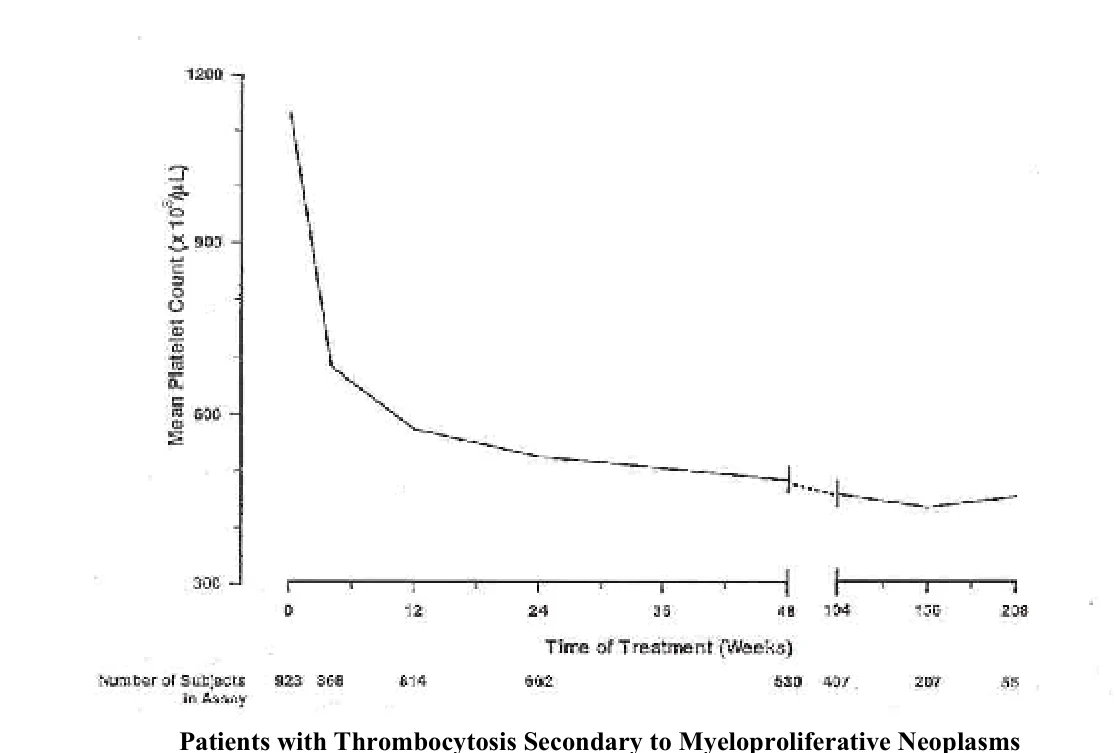
Patients with Thrombocytosis Secondary to Myeloproliferative Neoplasms
Mean Platelet Count During Anagrelide Therapy
Table 3: Patients with Thrombocytosis Secondary to Myeloproliferative Neoplasms
|
|---|
| Time on Treatment | ||||||||||
|---|---|---|---|---|---|---|---|---|---|---|
| Weeks | Years | |||||||||
| Baseline | 4 | 12 | 24 | 48 | 2 | 3 | 4 | |||
| Mean* | 1131 | 683 | 575 | 526 | 484 | 460 | 437 | 457 | ||
| N | 923† | 868 | 814 | 662 | 530 | 407 | 207 | 55 | ||
* x 103/mcL
- †Nine hundred and forty-two subjects with myeloproliferative neoplasms were enrolled in three research studies. Of these, 923 had platelet counts over the duration of the studies.
DETAILED PHARMACOLOGY
Clinically, anagrelide hydrochloride was found to be an effective, highly specific platelet-reducing agent. Anagrelide's effects on platelets are fully reversible. Moreover, it has no clinically significant effect on the other formed elements in the blood. These findings were demonstrated both preclinically and clinically.
Preclinical pharmacology data that are available demonstrate anagrelide's specificity toward platelets. While anagrelide was found to be a potent inhibitor of platelet aggregation, it had no significant effect on other cellular components of the blood. Additional significant pharmacologic effects attributed to anagrelide administration are hypotension and positive inotropic activity.
Mechanism of Action
Anagrelide is a highly selective platelet-lowering agent. In vitro studies of human megakaryocytopoiesis suggested that, in vivo, its thrombocytopenic activity results primarily from an inhibitory effect on the post-mitotic phase of megakaryotic maturation. Anagrelide inhibited thrombopoietin-induced megakaryocytopoiesis in a dose-dependent manner with an estimated IC50 of approximately 30 nM (= 7.7 ng/mL), consistent with the in vivo Cmax of 7-13 ng/mL after doses of 0.5-1 mg. Three in vivo studies in humans (published in abstract form) have confirmed that anagrelide decreases circulating platelet counts in thrombocythemic subjects by inhibiting megakaryocyte maturation and ploidy.
Effect on Platelet Count
An effect on platelet count was demonstrated in only a few animal studies. In one rat study, a decreased platelet count was found in male Sprague-Dawley rats treated at 1,000 mg/kg for 27 days. In another rat study, decreased platelet counts were observed in all female rats dosed for 1 year with 120.5, 361.5 and 1,205 mg /kg/day of anagrelide hydrochloride. Platelet counts were decreased from pre-study values by 30 to 54% in male beagle dogs, and by 23 to 40% in females treated for 1 year at doses of 10, 300, and 600 mg/kg/day.
Anti-thrombotic Studies
The ability of anagrelide to inhibit thrombosis was demonstrated in four different animal models: rat, rabbit, dog, and rhesus monkey. Anagrelide was found to be a potent, broad-spectrum platelet aggregation inhibitor whose effects are dose-related. It is 50 times more potent than acetylsalicylic acid as an anticoagulant and was found to have a synergistic effect on platelet aggregation inhibition when administered in conjunction with heparin.
Cardiovascular Pharmacology
Preclinical cardiovascular information was obtained during the course of studies conducted in four different animal models: rat, guinea pig, ferret, and dog.
The key findings in these studies was that anagrelide has a significant direct positive inotropic effect and direct vasodilatory effect; and causes dose-related decreases in mean blood pressure and reflexogenic increases in heart rate. Anagrelide was also shown to be a potent vasodilator and cardiotonic agent in dogs. All of these effects were seen at doses higher than the recommended clinical dose of 2.0 mg/day.
General Pharmacology Studies
General pharmacologic effects of anagrelide were studied in five different animal models: rat, guinea pig, ferret, rabbit, and dog. The overall conclusions from these studies were that anagrelide causes the following:
- simple competitive antagonism of peripheral 5-HT receptors in the rat fundus model
- a decrease in diuresis sodium and chlorine excretion in the volume-loaded normotensive rat
- a dose-related prolongation of bleeding time in the guinea pig extracorporeal shunt model
- no behavioural or neurological changes in the conscious dog model
- weak airway dilation in the anesthetized dog model
- inhibition of both cyclic AMP (cAMP) phosphodiesterase (PDE) and cyclic GMP PDE activity in a study of supernatant and sonicate models
- inhibition of cAMP PDE activity in another study of supernatant and sonicate models
- an increase in cAMP level and cAMP-dependent protein kinase (cA-PK) ratio in the washed human platelet model
- inhibition of platelet PDE and resultant elevation of cAMP in the intact platelet model
Pharmacokinetics
Studies on the absorption, distribution, metabolism, and excretion (ADME) in four different models (rat, dog, monkey, and human) revealed that the orally-administered anagrelide is generally well absorbed, widely distributed to tissues, extensively metabolized, and excreted in the urine.
The monkey most closely resembled man in the route, rate, and extent of excretion. Human and animal urinary metabolite profiles were quantitatively similar. Each of the 3 main metabolites present in human urine were present in animal urine, but quantities were generally smaller.
Oral administration in the monkey resulted in rapid absorption with peak plasma levels occurring 4 to 8 hours after dosing. Capsule dose absorption from the intestinal tract was 76%. The main route of elimination was the urine; by 6 days after drug administration, the mean cumulative urinary excretion level of the dosed radioactivity was 61%.
A secondary route of elimination was in feces, the mean cumulative fecal excretion level over 6 days after drug administration was 31% in monkeys. The amount of parent compound detected in the urine as unchanged drug was less than 3%. Bioavailability in the primate was 92%, with a terminal half-life of 2 days.
In humans, 61% of the administered radioactivity was excreted in the 24 hours following administration and over 90% had been excreted by 72 hours after administration; 79% was in the urine and 21% recovered in the feces. The data indicate that all radioactivity was recovered in the urine and feces within 168 hours (7 days) of oral administration.
TOXICOLOGY
Acute Toxicity
Acute oral doses of anagrelide as high as 2,500 mg/kg in mice and 1,500 mg/kg in the rat, caused decreased activity immediately after administration; all animals recovered within 1 to 2 days. Intraperitoneal administration of 500 mg/kg of anagrelide to mice, resulted in the death of all animals within 3 days, while administration of 250 mg/kg caused decreased activity with recovery by 2 days.
In dogs, diarrhea was observed 4 to 5 days after a single oral dose of 10 mg/kg of anagrelide and after 1 to 2 days with doses of ≥50 mg/kg. Emesis was also observed, 2 days after a dose of 100 mg/kg and on the day of dosing with doses of ≥500 mg/kg; all animals recovered.
Single oral doses of 200 mg/kg of anagrelide in rhesus monkeys caused soft stools and a transient decrease in food consumption after 3 days; all animals recovered.
These results indicate that the acute oral LD50 is >2,500 mg/kg in mice, >1,500 mg/kg in the rat, >800 mg/kg in dogs, and >200 mg/kg in primates (rhesus monkey).
Long-Term Toxicity
Anagrelide was administered daily to rats by oral gavage for 27 days at doses of 50 to 1,000 mg/kg/day. Findings included flushing of the ears, feet, and nose. Drug-related changes seen at 1,000 mg/kg/day consisted of decreased platelet counts, retarded body weight gains in males, and mild fibrosis and myocarditis along with labored respiration and/or rales; one female died. In a 94-day study, administration of 4 to 12 mg/kg/day of anagrelide resulted in dose-related intestinal tract lesions and increased liver, adrenal, and thyroid weights relative to body weight at the highest dose.
Administration of escalating oral doses up to 3,200 mg/kg over a period of 7 days in dogs resulted in a decrease in food consumption, in females at doses as low as 100 mg/kg, and in males at doses as low as 800 mg/kg. Clinical signs of gastrointestinal upset were evident; all dogs exhibited loose stools, diarrhea, and ultimately vomited as the dose was increased. In a 28-day repeat-dose study in the dog, the only abnormalities reported with oral doses were diarrhea and vomiting at doses of 500 to 800 mg/kg/day.
Multidose studies were performed in primates using oral doses of 10 mg/kg/day for 14 days or 4 to 12 mg/kg/day of anagrelide for up to 92 days of treatment. Clinical signs related to anagrelide treatment consisted of diarrhea, emesis, soft and/or loose stools and decreased food consumption.
Chronic toxicity studies were carried out for up to 12 months in rats and dogs. In the rat, doses of 120.5, 361.5, and 1,205 mg/kg/day of anagrelide were administered orally by diet. Treatment-related findings included the following: hunched posture; dilated vagina in females; increases and decreases in body weight; increased food consumption; mild transient increases in mean corpuscular volume (MCV) and mean corpuscular hemoglobin (MCH), decreased platelet counts in females; changes in serum chemistry indicative of mild to moderate liver and kidney damage in all groups; increased cholesterol, decreased triglycerides, decreased alanine aminotransferase (ALT) and aspartate aminotransferase (AST) in males, increased creatinine in males, marginal increases in basal urea nitrogen (BUN) and creatinine in females, increased urine volume; liver and kidneys in all treated rats and adrenals in males were significantly increased in weight relative to body weight and/or brain weight; focal hyperplasia at the highest dose and pheochromocytomas at doses ≥361.5 mg/kg/day. There were 24 deaths during the study (see Table 4); though none were attributed to anagrelide treatment, necropsy findings indicated kidney and liver damage.
Table 4: Unscheduled Deaths
| Anagrelide ( mg/kg/day) | |||||||||
| 0 | 120.5 | 361.5 | 1,205 | ||||||
| Cause of Death * | |||||||||
| Leukemia | 1M | 1M | |||||||
| Nephropathy | 2M | ||||||||
| Inflammation/infection and/or hemorrhage/thrombi | 1M | 2M | 2M | 2M; 1F | |||||
| Heart failure | 1M | ||||||||
| Accident | 1M | 1F | |||||||
| Unknown | 1F | 3M | 5M | ||||||
| Total | 1M | 6M; 1F | 6M; 1F | 8M; 1F | |||||
* Animals may have had more than one finding at necropsy/histopathology
In the chronic dog toxicity study, repeated exposure to 10 to 600 mg/kg/day of anagrelide were associated with a variety of toxicities, including: diarrhea and emesis; significant reductions in red cell counts, hemoglobin, hematocrit, and platelet counts; a tendency toward increased kidney weight in both sexes and increased liver weight in females; dose-related cardiac changes consisting of minimal to marked hemorrhage and chronic inflammation were present in the myocardium of the right atrium and left AV valves along with proliferative changes in some cardiac vessels.
Reproduction and Teratology
A comprehensive range of fertility, organogenesis, and peri/postnatal toxicity studies were performed in rats at oral doses of 60 to 900 mg/kg/day of anagrelide.
In these studies, females were dosed from Days 6 to 15 or 18 of gestation, Day 6 gestation through Day 7 lactation, or Day 15 gestation to Day 21 lactation. The average number of live pups was significantly reduced on Day 1 postpartum in the 60 and 120 mg/kg/day dosage groups; Days 4 and 21 postpartum in the 120 and 240 mg/kg/day dosage groups and Day 7 postpartum in the 120 mg/kg/day dosage group. Average body weights of pups were significantly reduced in all anagrelide-treated groups at Day 1 postpartum; in the 120 and 240 mg/kg/day groups on days 4 and 7 postpartum, and in the 240 mg/kg/day group on Day 14 postpartum. Administration of anagrelide did not adversely affect the averages for implantations and live litter sizes, number of dams with all stillbirths, number of dams with all pups dying during lactation, sex ratios, or clinical and necropsy observations of the pups.
Doses of 240 mg/kg/day and higher were associated with an increase in the incidence of pups dying on Days 1 to 4 postpartum, a decrease in the percentage of pups surviving to Day 7 postpartum, and a decrease in the average pup weight/litter.
Fetal body weights were significantly reduced by 5 to 7% in groups receiving 300 and 900 mg/kg/day. Significant reversible delays in fetal ossification occurred in groups given doses of 100 mg/kg/day or higher. No fetal malformations were attributable to doses of anagrelide as high as 900 mg/kg/day. Deaths occurred when rats were continued to be dosed during delivery and early lactation.
In organogenesis studies with rabbits, oral doses of 30 to 480 mg/kg of anagrelide, administered from Days 6 to 18 of gestation revealed that doses of ≥60 mg/kg/day caused body weight loss, severe decreases in food consumption, decreased live litter sizes, and increased number and percentages of resorptions per litter. Deaths occurred in all dosed groups and there were two deformed fetuses, one at 30 and another at 240 mg/kg/day. A second study of similar design employed doses of 1 to 20 mg/kg/day. Body weight gains were significantly increased with 10 or 20 mg/kg/day while food consumption significantly decreased during dosing. There were no deaths, abortions, premature deliveries, changes in litter parameters, or fetal malformations with oral doses of ≤20 mg/kg/day.
Carcinogenesis and Mutagenesis
(See WARNINGS AND PRECAUTIONS, Carcinogenesis and Mutagenesis).
REFERENCES
- 1. Anagrelide Study Group. Anagrelide, a therapy for thrombocythemic states: experience in 577 patients. Am J Med 1992;92(1):69-76.
- 2. Barbui T, Finazzi G. Clinical parameters for determining when and when not to treat essential thrombocythemia. Semin Hematol 1999;36(1 Suppl 2):14-8.
- 3. Bennett CL, Weinberg PO, Golub RM. Cost-effectiveness model of a phase II clinical trial of a new pharmaceutical for essential thrombocythemia: Is it helpful to policy makers. Semin Hematol 1999;36(1 Suppl 2):26-9.
- 4. Chintagumpala MM, Kennedy LL, Steuber CP. Treatment of essential thrombocythemia with anagrelide. J Pediatr 1995;127(3):495-598.
- 5. Gilbert H. Historical perspective on the treatment of essential thrombocythemia and polycythemia vera. Semin Hematol 1999;36(1 Suppl 2):19-22.
- 6. Mazur EM, Rosmarin AG, Sohl PA, Newton JL, Narendran A. Analysis of the mechanism of anagrelide-induced thrombocytopenia in humans. Blood 1992 Apr;79(8):1931-1937.
- 7. Murphy S. Diagnostic criteria and prognosis in polycythemia vera and essential thrombocythemia. Semin Hematol 1999;36(1 Suppl 2):9-13.
- 8. Murphy S. Therapeutic dilemmas: Balancing the risks of bleeding, thrombosis, and leukemic transformation in myeloproliferative disorders (MPD). FK Schattauer Verlagsgesellschaft mbH (Stuttgart) 1997;78(1):622-6.
- 9. Petitt RM, Silverstein MN, Petrone ME. Anagrelide for control of thrombocythemia in polycythemia and other myeloproliferative disorders. Semin Hematol 1997;34(1):51-4.
- 10. Silverstein MN, Tefferi A. Treatment of essential thrombocythemia with anagrelide. Semin Hematol 1999;36(1 Suppl 2):23-5.
- 11. Silverstein MN. Anagrelide in myeloproliferative diseases. In: Wasserman LR, Berk PK, BBerlin NI. Editors: Polycythemia vera and the myeloproliferative disorders. Philadelphia, (PA). WB Saunders Company; 1995 p 329-36.
- 12. Silverstein MN, Petitt RM, Solberg LA Jr, Fleming JS, Knight RC, Schacter LP. Anagrelide: A new drug for treating thrombocytosis. N Engl J Med 1988;318 (20):1292-4.
- 13. Solberg LA Jr, Tefferi A, Oles KJ, Tarach JS, Petitt RM, Forstrom LA, Silverstein MN. The effects of anagrelide on human megakaryocytopoiesis. Br J Haematol 1997;99(1):174-80.
- 14. Spencer CM, Brogden RN. Anagrelide. A review of its pharmacodynamic and pharmacokinetic properties, and therapeutic potential in the treatment of thrombocythaemia. Drugs 1994;47(6): 809-22.
- 15. Tefferi A. Pathogenetic mechanisms in chronic myeloproliferative disorders: Polycythemia vera, essential thrombocythemia, agnogenic myeloid metaplasia, and chronic myelogenous leukemia. Semin Hematol 1999;36(1 Suppl 2):3-8.
- 16. Tefferi A, Elliott MA, Solberg LA Jr, Silverstein MN. New drugs in essential thrombocythemia and polycythemia vera. Blood Rev 1997;11(1):1-7.
- 17. Van Genderen PJ, Leenknegt H, Michiels JJ, Budde U. Acquired von Willebrand disease in myeloproliferative disorders. Leukemia and Lymphoma 1996;(22 Suppl.1) :79-82.
- 18. Product Monograph : AGRYLIN®, Shire Pharma Canada ULC, Control number 200919, Revision date: March 13, 2017.