


Product Monograph - Efudex
RECENT MAJOR LABEL CHANGES
| CONTRAINDICATIONS | 03/2020 |
| WARNINGS AND PRECAUTIONS | 03/2020 |
TABLE OF CONTENTS
Sections or subsections that are not applicable at the time of authorization are not listed.
RECENT MAJOR LABEL CHANGES ..................................................................................... 2
TABLE OF CONTENTS .......................................................................................................... 2
PART I: HEALTH PROFESSIONAL INFORMATION............................................................... 4
1 INDICATIONS.............................................................................................................. 4
2 CONTRAINDICATIONS ............................................................................................... 4
3 SERIOUS WARNINGS AND PRECAUTIONS BOX...................................................... 4
4 DOSAGE AND ADMINISTRATION .............................................................................. 5
4.2 Recommended Dose and Dosage Adjustment .................................................... 5
4.4 Administration..................................................................................................... 5
4.5 Missed Dose....................................................................................................... 5
4.7 Instructions for Preparation and Use ................................................................... 5
5 OVERDOSAGE ........................................................................................................... 6
6 DOSAGE FORMS, STRENGTHS, COMPOSITION AND PACKAGING ........................ 6
7 WARNINGS AND PRECAUTIONS .............................................................................. 6
7.1 Special Populations ............................................................................................ 7
7.1.1 Pregnant Women ............................................................................................ 7
7.1.2 Breast-feeding ................................................................................................. 7
7.1.3 Pediatrics (≥ 18 years of age) .......................................................................... 7
8 ADVERSE REACTIONS .............................................................................................. 7
8.2 Clinical Trial Adverse Reactions .......................................................................... 7
8.4 Abnormal Laboratory Findings: Hematologic, Clinical Chemistry and Other Quantitative Data Clinical Trial Findings........................................................................ 7
9 DRUG INTERACTIONS ............................................................................................... 8
9.4 Drug-Drug Interactions........................................................................................ 8
9.5 Drug-Food Interactions ....................................................................................... 8
9.6 Drug-Herb Interactions........................................................................................ 8
9.7 Drug-Laboratory Test Interactions ....................................................................... 8
10 CLINICAL PHARMACOLOGY ..................................................................................... 8
10.1 Mechanism of Action ....................................................................................... 8
10.2 Pharmacokinetics ............................................................................................ 8
11 STORAGE, STABILITY AND DISPOSAL .................................................................... 9
12 SPECIAL HANDLING INSTRUCTIONS ....................................................................... 9
PART II: SCIENTIFIC INFORMATION .................................................................................. 10
13 PHARMACEUTICAL INFORMATION ........................................................................ 10
14 CLINICAL TRIALS .................................................................................................... 11
15 MICROBIOLOGY....................................................................................................... 11
16 NON-CLINICAL TOXICOLOGY ................................................................................. 11
PATIENT MEDICATION INFORMATION .............................................................................. 12
PART I: HEALTH PROFESSIONAL INFORMATION
1 INDICATIONS
EFUDEX is recommended for the topical treatment of premalignant keratoses and superficial basal cell carcinoma.
- 1.1 Pediatrics (≥ 18 years of age)
Based on the data submitted and reviewed by Health Canada, the safety and efficacy of EFUDEX in pediatric patients has not been established; therefore, Health Canada has not authorized an indication for pediatric use
2 CONTRAINDICATIONS
- EFUDEX is contraindicated in patients who are hypersensitive to this drug or to any ingredient in the formulation, including any non-medicinal ingredient, or component of the container. For a complete listing, see 6 DOSAGE FORMS, STRENGTHS, COMPOSITION AND PACKAGING.
- EFUDEX is contraindicated during pregnancy and during the lactation period (see 7 WARNINGS AND PRECAUTIONS, 7.1 Special Populations, 7.1.1 Pregnant Woman; 7.1.2 Breast-feeding).
- EFUDEX is contraindicated in patients with known dihydropyridine dehydrogenase (DPD) enzyme deficiency (see 7 WARNINGS AND PRECAUTIONS).
- EFUDEX must not be used in conjunction with brivudine*, sorivudine* and analogues. Brivudine, sorivudine and analogues are potent inhibitors of the fluorouracil-degrading enzyme dihydropyrimidine dehydrogenase (DPD) (see 7 WARNINGS AND PRECAUTIONS and 9 DRUG INTERACTIONS, 9.2 Drug-Drug Interactions).
*Not authorized for sale in Canada
3 SERIOUS WARNINGS AND PRECAUTIONS BOX
Serious Warnings and Precautions
|
4 DOSAGE AND ADMINISTRATION
4.2 Recommended Dose and Dosage Adjustment
EFUDEX should be applied twice daily with a non-metal applicator or suitable glove in an amount of the cream sufficient to cover the lesion. When EFUDEX is applied to a lesion, a response occurs with the following sequence: erythema, usually followed by vesiculation, erosion, ulceration, necrosis and epithelization. The lower frequency and intensity of activity in adjacent normal skin indicate a selective cytotoxic property. Medication should be continued until the inflammatory reaction reaches the erosion, ulceration, and necrosis stage, at which time use of the drug should be terminated. The usual duration of therapy is from two to four weeks. Complete healing of the lesion may not be evident for one to two months following cessation of EFUDEX therapy.
While the patient is undergoing EFUDEX therapy, consideration can be given to curettage, wound excision and removal of pathological tissue.
Health Canada has not authorized an indication for pediatric use.
4.4 Administration
EFUDEX is preferably applied with a non-metal applicator or suitable glove; if it is applied with the fingertips, the hands should be washed immediately afterward. EFUDEX should be applied with care near the eyes, nostrils and mouth. To rule out the presence of a frank neoplasm, a biopsy should be made of those lesions failing to respond to treatment or recurring after treatment.
4.5 Missed Dose
If you miss a dose of EFUDEX, apply it as soon as you remember. However, if more than a few hours have passed, skip the missed dose and go back to your regular dosing schedule. If you miss more than one dose, check with your doctor.
4.7 Instructions for Preparation and Use
- a. Wash the affected area with soap and water.
- b. Carefully dry the affected area and wait until it is completely dry.
c. Apply a thin layer of EFUDEX enough to cover the entire area. It is recommended that a cotton-tipped swab or a suitable glove is used to apply EFUDEX. However, if you have to use your fingertips, wash your hands immediately after use.
Note: Be careful if you are applying EFUDEX to your face and avoid getting any into your eyes, nostrils, or mouth.
- d. Wash your hands thoroughly immediately after using EFUDEX.
5 OVERDOSAGE
Since EFUDEX is applied topically it is highly unlikely that an overdosage would occur. In the event that this preparation is accidentally ingested, signs of toxicity may include diarrhea, stomatitis, thrombocytopenia (platelets under 100,000) and leukopenia (WBC under 3,500). These symptoms may be ameliorated by leucovorin.
| For management of a suspected drug overdose, contact your regional poison control centre. |
6 DOSAGE FORMS, STRENGTHS, COMPOSITION AND PACKAGING
Table – Dosage Forms, Strengths, Composition and Packaging.
EFUDEX (fluorouracil) is cytotoxic.
Packaging
EFUDEX cream contains 5 % w/w of fluorouracil. Available in a tube of 40 g.
7 WARNINGS AND PRECAUTIONS
Endocrine and Metabolism
The enzyme dihydropyrimidine dehydrogenase (DPD) plays an important role in the breakdown of fluorouracil. Inhibition, deficiency or decreased activity of this enzyme can result in accumulation of fluorouracil. EFUDEX must not be used on patients with known dihydropyrimidine dehydrogenase (DPD) deficiency. Life-threatening systemic toxicity has been reported with the topical use of fluorouracil a patient with DPD deficiency. Signs of fluorouracil toxicity may include nausea, vomiting, diarrhea, stomatitis, esophagopharyngitis, gastrointestinal ulceration and bleeding, hemorrhage from any site and bone marrow depression (thrombocytopenia and agranulocytosis). If toxicity is observed or suspected, immediately stop treatment, wash treated area with warm water and seek medical attention immediately.
Skin
If an occlusive dressing is used, there may be an increase in the incidence of inflammatory reactions in the adjacent normal skin.
Prolonged exposure to ultraviolet lights should be avoided while under treatment with EFUDEX because the intensity of the reaction may be increased.
| Route of Administration | Dosage Form / Strength/Composition | Non-medicinal Ingredients |
| Topical | 5 % w/w Cream | Propylene Glycol, Polysorbate 60 and Parabens (Methyl and Propyl), Purified Water, Stearyl Alcohol and White Petrolatum |
Appropriate therapy for pre-existing concomitant inflammatory dermatoses should be instituted before using the drug (see 2 CONTRAINDICATIONS).
7.1 Special Populations
7.1.1 Pregnant Women
Since fluorouracil is known to have teratogenic properties, the potential value of its use in women of childbearing potential should be weighed against the risks involved.
7.1.2 Breast-feeding
EFUDEX should not be used when breastfeeding or plan to breastfeed. It is unknown if the drug is excreted in human milk. Because many drugs are excreted in human milk and there is some systemic absorption of fluorouracil after topical administration, and because of the potential for serious adverse reactions in nursing infants, a decision should be made whether to discontinue nursing or to discontinue drug use, taking into account the importance of the drug to the mother.
7.1.3 Pediatrics (≥ 18 years of age)
Based on the data submitted and reviewed by Health Canada, the safety and efficacy of EFUDEX in pediatric patients has not been established; therefore, Health Canada has not authorized an indication for pediatric use.
8 ADVERSE REACTIONS
8.2 Clinical Trial Adverse Reactions
Because clinical trials are conducted under very specific conditions, the adverse reaction rates observed in the clinical trials may not reflect the rates observed in practice and should not be compared to the rates in the clinical trials of another drug. Adverse reaction information from clinical trials is useful for identifying drug-related adverse events and for approximating rates.
The most frequently encountered local reactions are pain, pruritus, hyperpigmentation and burning at the site of application. Other local reactions include dermatitis, scarring, soreness and tenderness. Insomnia, stomatitis, suppuration, scaling, swelling, irritability, medicinal taste, photosensitivity and lacrimation have also been reported.
8.4 Abnormal Laboratory Findings: Hematologic, Clinical Chemistry and Other Quantitative Data Clinical Trial Findings
Laboratory abnormalities reported include leucocytosis, thrombocytopenia, toxic granulation and eosinophilia.
9 DRUG INTERACTIONS
9.4 Drug-Drug Interactions
Concomitantly administration of nucleoside analogues such as capecitabine, brivudine* and sorivudine* with EFUDEX is contraindicated (see 2 CONTRAINDICATIONS), as concomitantly administered nucleoside analogues may result in an inhibition of dihydropyrimidine dehydrogenase (DPD).
*Not authorized for sale in Canada
9.5 Drug-Food Interactions
Interactions with food have not been established.
9.6 Drug-Herb Interactions
Interactions with herbal products have not been established.
9.7 Drug-Laboratory Test Interactions
Interactions with laboratory tests have not been established.
10 CLINICAL PHARMACOLOGY
10.1 Mechanism of Action
There is evidence that the metabolism of fluorouracil in the anabolic pathway blocks the methylation reaction of deoxyuridylic acid to thymidylic acid. In this fashion fluorouracil interferes with the synthesis of deoxyribonucleic acid (DNA) and, to a lesser extent, inhibits the formation of ribonucleic acid (RNA). Since DNA and RNA are essential for cell division and growth, the effect of fluorouracil may be to create a thymine deficiency which provokes unbalanced growth and death of the cell. The effects of DNA and RNA deprivation are most marked on those cells which grow more rapidly, and which take up fluorouracil at a more rapid pace. The catabolic metabolism of fluorouracil results in degradative products (e.g., CO2, urea, alpha fluoro beta alanine) which are inactive.
Studies in man with topical application of C14 labelled EFUDEX demonstrate insignificant absorption as measured by C14 content of plasma, urine and respiratory CO2.
10.2 Pharmacokinetics
Fluorouracil is a fluorinated pyrimidine antimetabolite which is structurally similar to uracil, one of the necessary building blocks in cellular division and growth. Fluorouracil is a competitive antagonist for uracil in the formulation of RNA. DNA may be inhibited indirectly because of dependence of its synthesis on RNA.
Fluorouracil is a potent inhibitor of: Lactobacillus leichmannii, Lactobacillus plantarum, Lactobacillus casei, and Streptococcus faecalis, and the yeast, Saccharomyces carlsbergensis. It has been shown that parenteral fluorouracil inhibits the growth of human neoplasms and that its therapeutic effects are greatest on the cells of the bone marrow, the intestinal mucosa and certain tumours of the breast, rectum and colon.
A tolerance study of topically applied fluorouracil in 80 volunteers revealed no laboratory abnormalities when treated groups were compared to controls. A second study evaluated the sensitizing and irritating capabilities of topically applied fluorouracil in 216 healthy volunteers by means of the Draize Test. The results of this study indicated that 5% fluorouracil in propylene glycol solution was more irritating than 5% fluorouracil in a cream base and that this formulation produced a degree of conditioned irritability.
An absorption excretion study conducted in six patients with C14 labelled fluorouracil indicated that the levels of C14 activity were insignificant in plasma, urine and CO2 (expired) after topical application. It was therefore concluded that the drug could safely be used to treat skin lesions.
11 STORAGE, STABILITY AND DISPOSAL
- Store between 15ºC and 30ºC.
- Medicines should not be disposed of down the drain or in household garbage.
- Any unused product or waste material should be disposed of in accordance with local requirements.
12 SPECIAL HANDLING INSTRUCTIONS
- Do not use EFUDEX after the expiration date printed on the tube.
- Keep EFUDEX and all medicines out of the reach of children.
PART II: SCIENTIFIC INFORMATION
13 PHARMACEUTICAL INFORMATION
Drug Substance
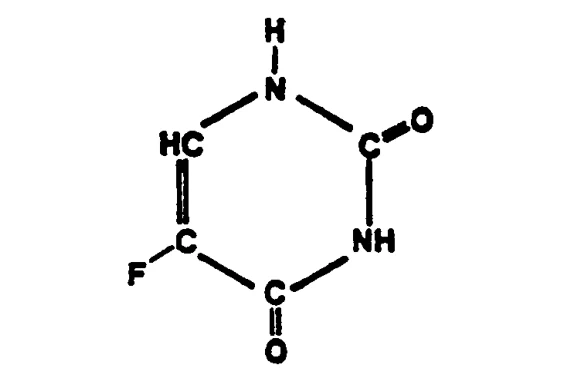
Proper name: Fluorouracil
Chemical name: 5-Fluoropyrimidine-2, 4-dione
Molecular formula: C4H3FN2O2
Molecular mass: 130.08 g/mol
Structural formula:
Physicochemical properties
Description: White to almost white, almost odourless, crystalline powder.
Solubility: Sparingly soluble in water, slightly soluble in alcohol, almost insoluble in chloroform and ether.
14 CLINICAL TRIALS
The clinical trial data based on which the original indication was initially authorized are not available.
15 MICROBIOLOGY
No microbiological information is required for this drug product.
16 NON-CLINICAL TOXICOLOGY
Acute toxicological studies in five species with parenterally administered fluorouracil showed that rodents and primates were better able to tolerate this antineoplastic substance than were cats and dogs. Species which metabolize fluorouracil to alpha fluoro acetic acid demonstrate signs of abnormal CNS disturbances in addition to the accepted cytotoxicity, thereby demonstrating a greater frequency of acute toxic signs.
Metabolic studies in mice and in man with C14 labelled fluorouracil given parenterally showed that tumor tissue demonstrated higher specific activities than did surrounding tissues. Additionally, fluorouracil is apparently metabolized to acid soluble fluorouridine nucleotides and is incorporated into RNA, but not DNA.
Long term testing of 5% fluorouracil as the cream, emulsion, or the solution at doses equivalent to 0.1, 0.3 and 1.0 g/kg/day, 5 days/week for 13 weeks produced a variety of local and systemic effects. The above doses were equivalent to 5, 15 and 50 mg/kg/day of fluorouracil to rats.
Signs of toxic reactions occurred within one week of treatment with the vanishing cream preparation and at about four weeks with the solution and the emulsion. Retardation of hair growth, ulceration, necrosis and infection were noted in the treated skin areas. The majority of the animals being treated with the highest dose of fluorouracil in the vanishing cream base died.
This did not occur in those groups treated with the solution or the emulsion, although weight loss was observed. The difference in toxicity was attributed to the increased percutaneous absorption of the preparation with the vanishing cream base. The lower treatment levels demonstrated, for the most part, only signs of local changes of the skin. This finding is not inconsistent with the cytotoxic properties of fluorouracil.
The use of the topical preparations upon rabbit skin revealed a high degree of sensitivity. Doses approximating 0.3 to 0.6 mg/kg/day, applied 5 days/week resulted in death. In all instances severe skin changes and infection were noted. Those treated with 0.01 g/kg/day (0.5 mg/kg) tolerated the treatment over the four-week test period. Again, it was apparent that the signs observed were consistent with the therapeutic mode of action.