


Product Monograph - Genvoya
RECENT MAJOR LABEL CHANGES
| 2 Contraindications | 11/2020 |
| 7 Warnings and Precautions, General | 05/2020 |
TABLE OF CONTENTS
Sections or subsections that are not applicable at the time of authorization are not listed.
RECENT MAJOR LABEL CHANGES ..................................................................................... 2
TABLE OF CONTENTS .......................................................................................................... 2
PART I: HEALTH PROFESSIONAL INFORMATION............................................................... 4
1 INDICATIONS.............................................................................................................. 4
1.1 Pediatrics .......................................................................................................... 4
1.2 Geriatrics .......................................................................................................... 4
2 CONTRAINDICATIONS ............................................................................................... 4
3 SERIOUS WARNINGS AND PRECAUTIONS BOX...................................................... 6
4 DOSAGE AND ADMINISTRATION .............................................................................. 6
4.1 Dosing Considerations ...................................................................................... 6
4.2 Recommended Dose and Dosage Adjustment ................................................... 7
4.4 Administration ................................................................................................... 7
4.5 Missed Dose ..................................................................................................... 7
5 OVERDOSAGE ........................................................................................................... 8
6 DOSAGE FORMS, STRENGTHS, COMPOSITION AND PACKAGING ........................ 9
7 WARNINGS AND PRECAUTIONS .............................................................................. 9
7.1 Special Populations......................................................................................... 12
7.1.1 Pregnant Women ........................................................................................ 12
7.1.2 Breast-feeding ............................................................................................ 12
7.1.3 Pediatrics.................................................................................................... 13
7.1.5 Others ........................................................................................................ 13
8 ADVERSE REACTIONS ............................................................................................ 13
8.1 Adverse Reaction Overview ............................................................................ 13
8.2 Clinical Trial Adverse Reactions ...................................................................... 14
8.2.1 Clinical Trial Adverse Reactions – Pediatrics ................................................... 15
8.3 Less Common Clinical Trial Adverse Reactions (< 1%) .................................... 16
8.4 Abnormal Laboratory Findings: Hematologic, Clinical Chemistry and Other Quantitative Data ....................................................................................................... 16
8.5 Post-Market Adverse Reactions....................................................................... 20
9 DRUG INTERACTIONS ............................................................................................. 20
9.1 Serious Drug Interactions ................................................................................ 20
9.2 Drug Interactions Overview ............................................................................. 21
9.3 Drug-Behavioural Interactions ......................................................................... 21
9.4 Drug-Drug Interactions .................................................................................... 21
9.5 Drug-Food Interactions.................................................................................... 39
9.6 Drug-Herb Interactions .................................................................................... 39
9.7 Drug-Laboratory Test Interactions ................................................................... 39
10 CLINICAL PHARMACOLOGY ................................................................................... 39
10.1 Mechanism of Action ....................................................................................... 39
10.2 Pharmacodynamics......................................................................................... 40
10.3 Pharmacokinetics............................................................................................ 41
11 STORAGE, STABILITY AND DISPOSAL .................................................................. 46
12 SPECIAL HANDLING INSTRUCTIONS ..................................................................... 47
PART II: SCIENTIFIC INFORMATION .................................................................................. 48
13 PHARMACEUTICAL INFORMATION ........................................................................ 48
14 CLINICAL TRIALS .................................................................................................... 51
14.1 Clinical Trials by Indication .............................................................................. 51
HIV-1 With No Known Mutations to the Individual Components of GENVOYA ............. 51
15 MICROBIOLOGY....................................................................................................... 74
16 NON-CLINICAL TOXICOLOGY ................................................................................. 76
PATIENT MEDICATION INFORMATION .............................................................................. 80
PART I: HEALTH PROFESSIONAL INFORMATION
1 INDICATIONS
GENVOYA (150 mg elvitegravir/150 mg cobicistat/200 mg emtricitabine/10 mg tenofovir alafenamide) is indicated as a complete regimen for the treatment of human immunodeficiency virus type 1 (HIV-1) infection in adults and pediatric patients weighing ≥ 25 kg and with no known mutations associated with resistance to the individual components of GENVOYA.
1.1 Pediatrics
Pediatrics (weighing ≥ 25 kg): The safety and efficacy in children weighing ≥ 25 kg are based on data from an open-label clinical study (see 8 ADVERSE REACTIONS and 14 CLINICAL TRIALS).
Pediatrics (weighing < 25 kg): No data are available to Health Canada; therefore, Health Canada has not authorized an indication for use in pediatrics weighing < 25 kg.
1.2 Geriatrics
Geriatrics (≥ 65 years of age): No differences in safety or efficacy have been observed between elderly patients and adult patients < 65 years of age (see 10 CLINICAL PHARMACOLOGY).
2 CONTRAINDICATIONS
GENVOYA is contraindicated in patients with known hypersensitivity to any of the components of the product. For a complete listing, see the 6 DOSAGE FORMS, STRENGTHS, COMPOSITION AND PACKAGING section of the Product Monograph.
Coadministration with the following drugs listed in Table 1 is contraindicated due to the potential for serious and/or life-threatening events or loss of virologic response and possible resistance to GENVOYA. See also 9.4 Drug-Drug Interactions.
Table 1. Drugs That Are Contraindicated with GENVOYA
| Drug Class | Drugs within class that are contraindicated with GENVOYA | Clinical Comment |
|---|---|---|
| Alpha 1-adrenoreceptor antagonists | alfuzosin | Potential for increased alfuzosin concentrations, which can result in hypotension. |
| Anticonvulsants | carbamazepine, phenobarbital, phenytoin | Carbamazepine, phenobarbital, and phenytoin are potent inducers of CYP450 metabolism and may cause significant decrease in the plasma concentration of elvitegravir, cobicistat and tenofovir alafenamide. This may result in loss of therapeutic effect to GENVOYA. |
| Drug Class | Drugs within class that are contraindicated with GENVOYA | Clinical Comment |
|---|---|---|
| Antihistamines | astemizole*, terfenadine* | Potential for serious and/or life-threatening reactions such as cardiac arrhythmias. |
| Antimycobacterials | rifampin | Rifampin is a potent inducer of CYP450 metabolism and may cause significant decrease in the plasma concentration of elvitegravir, cobicistat and tenofovir alafenamide. This may result in loss of therapeutic effect to GENVOYA. |
| Benzodiazepines | orally administered midazolam*, triazolam | Triazolam and orally administered midazolam are extensively metabolized by CYP3A4. Coadministration of triazolam or orally administered midazolam with GENVOYA may cause large increases in the concentration of these benzodiazepines. The potential exists for serious and/or life-threatening events such as prolonged or increased sedation or respiratory depression. |
| Beta 2-adrenoceptor agonist | salmeterol | Coadministration of salmeterol with GENVOYA may result in increased risk of cardiovascular adverse events associated with salmeterol, including QT prolongation, palpitations, and sinus tachycardia. |
| Direct oral anticoagulants | apixaban, rivaroxaban | Apixaban and rivaroxaban are primarily metabolized by CYP3A4 and transported by P-gp. Coadministration with GENVOYA may result in increased plasma concentrations of apixaban or rivaroxaban, which may lead to an increased bleeding risk. |
| Ergot derivatives | dihydroergotamine, ergonovine, ergotamine, methylergonovine* | Potential for serious and/or life-threatening events such as acute ergot toxicity characterized by peripheral vasospasm and ischemia of the extremities and other tissues. |
| GI motility agents | cisapride* | Potential for serious and/or life-threatening events such as cardiac arrhythmias. |
| Herbal products | St. John’s Wort (Hypericum perforatum) | Coadministration of products containing St. John’s Wort and GENVOYA may result in reduced plasma concentrations of elvitegravir, cobicistat and tenofovir alafenamide. This may result in loss of therapeutic effect and development of resistance. |
| HMG-CoA reductase inhibitors | lovastatin, simvastatin | Potential for serious reactions such as myopathy, including rhabdomyolysis. |
| Microsomal triglyceride transfer protein inhibitor | lomitapide | Potential for increased lomitapide concentrations which may result in markedly increased transaminases. |
| Drug Class | Drugs within class that are contraindicated with GENVOYA | Clinical Comment |
|---|---|---|
| Neuroleptics | lurasidone pimozide | Potential for serious and/or life-threatening reactions. Potential for serious and/or life-threatening events such as cardiac arrhythmias. |
| PDE-5 inhibitors | sildenafil† | A safe and effective dose in combination with GENVOYA has not been established for sildenafil (REVATIO®) when used for the treatment of pulmonary arterial hypertension. There is increased potential for sildenafil-associated adverse events (which include visual disturbances, hypotension, priapism, and syncope). |
*Not marketed in Canada.
†For the treatment of pulmonary arterial hypertension.
3 SERIOUS WARNINGS AND PRECAUTIONS BOX
Serious Warnings and Precautions
GENVOYA is not approved for the treatment of chronic hepatitis B virus (HBV) infection and the safety and efficacy of GENVOYA have not been established in patients coinfected with HIV-1 and HBV. Discontinuation of GENVOYA therapy in patients coinfected with HIV-1 and HBV may be associated with severe acute exacerbations of hepatitis due to the emtricitabine or tenofovir alafenamide components of GENVOYA. Hepatic function should be monitored closely with both clinical and laboratory follow-up for at least several months in patients who are coinfected with HIV-1 and HBV and discontinue GENVOYA. If appropriate, initiation of anti-hepatitis B therapy may be warranted (see 7.1 Special Populations). |
4 DOSAGE AND ADMINISTRATION
4.1 Dosing Considerations
GENVOYA is one tablet (containing 150 mg of elvitegravir, 150 mg of cobicistat, 200 mg of emtricitabine and 10 mg of tenofovir alafenamide) taken orally once daily with food.
Testing Prior to Initiation and During Treatment with GENVOYA
Prior to or when initiating GENVOYA, test patients for hepatitis B virus infection.
Prior to or when initiating GENVOYA, and during treatment with GENVOYA, assess serum creatinine, estimated creatinine clearance (CrCl), urine glucose and urine protein in all patients on a clinically appropriate schedule. In patients with chronic kidney disease, also assess serum phosphorus (see 7 WARNINGS AND PRECAUTIONS, Renal).
4.2 Recommended Dose and Dosage Adjustment
Adults and Pediatric Patients weighing ≥ 25 kg
The recommended dose of GENVOYA is one tablet daily.
Pediatrics (weighing < 25 kg)
No data are available to Health Canada; therefore, Health Canada has not authorized an indication for use in pediatrics weighing < 25 kg.
Geriatrics (≥ 65 years of age) No dose adjustment is required for elderly patients. No differences in safety or efficacy have been observed between elderly patients and adult patients < 65 years of age.
Renal Impairment
No dose adjustment of GENVOYA is required in adult patients with estimated CrCl ≥ 30 mL/minute or in adult patients with end stage renal disease (estimated CrCl < 15 mL/minute) on chronic hemodialysis. On days of hemodialysis, administer GENVOYA after completion of hemodialysis treatment.
GENVOYA is not recommended in patients with estimated CrCl ≥ 15 and < 30 mL/minute, or < 15 mL/minute who are not on chronic hemodialysis, as the safety of GENVOYA has not been established in these populations.
No data are available to make dose recommendations in pediatric patients with renal impairment.
Hepatic Impairment
No dose adjustment of GENVOYA is required in patients with mild (Child-Pugh Class A) or moderate (Child-Pugh Class B) hepatic impairment. GENVOYA has not been studied in patients with severe hepatic impairment (Child-Pugh Class C); therefore, GENVOYA is not recommended for use in patients with severe hepatic impairment (see 10 CLINICAL PHARMACOLOGY).
4.4 Administration
GENVOYA is one tablet (containing 150 mg of elvitegravir, 150 mg of cobicistat, 200 mg of emtricitabine and 10 mg of tenofovir alafenamide) taken orally once daily with food.
4.5 Missed Dose
If a patient misses a dose of GENVOYA within 18 hours of the time it is usually taken, the patient should take GENVOYA with food as soon as possible, and then take the next dose of GENVOYA at the regularly scheduled time.
If a patient misses a dose of GENVOYA by more than 18 hours, the patient should not take the missed dose, but resume the usual dosing schedule.
5 OVERDOSAGE
If overdose occurs the patient must be monitored for evidence of toxicity. Treatment of overdose with GENVOYA consists of general supportive measures including monitoring of vital signs as well as observation of the clinical status of the patient.
Elvitegravir Limited clinical experience is available at doses higher than the therapeutic dose of elvitegravir in GENVOYA. In one study, boosted elvitegravir equivalent to 2 times the therapeutic dose of 150 mg once daily for 10 days was administered to 42 healthy subjects. No severe adverse reactions were reported. The effects of higher doses are not known. As elvitegravir is highly bound to plasma proteins, it is unlikely that it will be significantly removed by hemodialysis or peritoneal dialysis.
Cobicistat Limited clinical experience is available at doses higher than the therapeutic dose of cobicistat in GENVOYA. In two studies, a single dose of cobicistat 400 mg (2.7 times the dose in GENVOYA) was administered to a total of 60 healthy subjects. No severe adverse reactions were reported. The effects of higher doses are not known. As cobicistat is highly bound to plasma proteins, it is unlikely that it will be significantly removed by hemodialysis or peritoneal dialysis.
Emtricitabine Limited clinical experience is available at doses higher than the therapeutic dose of emtricitabine in GENVOYA. In one clinical pharmacology study, single doses of emtricitabine 1200 mg (6 times the dose in GENVOYA) were administered to 11 subjects. No severe adverse reactions were reported. The effects of higher doses are not known.
Emtricitabine can be removed by hemodialysis, which removes approximately 30% of the emtricitabine dose over a 3 hour dialysis period starting within 1.5 hours of emtricitabine dosing.
It is not known whether emtricitabine can be removed by peritoneal dialysis.
Tenofovir alafenamide Limited clinical experience is available at doses higher than the therapeutic dose of tenofovir alafenamide in GENVOYA. A single supratherapeutic dose of 125 mg tenofovir alafenamide was administered to 48 healthy subjects. No serious adverse reactions were reported. The effects of higher doses are unknown. Tenofovir is efficiently removed by hemodialysis with an extraction coefficient of approximately 54%.
| For management of a suspected drug overdose, contact your regional poison control centre. |
6 DOSAGE FORMS, STRENGTHS, COMPOSITION AND PACKAGING
Table 2. Dosage Forms, Strengths, Composition and Packaging
| Route of Administration | Dosage Form/ Strength/Composition | Non-medicinal Ingredients |
|---|---|---|
| Oral | Tablet 150 mg elvitegravir/150 mg cobicistat/200 mg emtricitabine/10 mg tenofovir alafenamide (as 11.2 mg tenofovir alafenamide hemifumarate) | Croscarmellose sodium, hydroxypropyl cellulose, lactose monohydrate, magnesium stearate, microcrystalline cellulose, silicon dioxide, and sodium lauryl sulfate. The tablets are coated with a coating material containing polyvinyl alcohol, titanium dioxide, polyethylene glycol, talc, indigo carmine aluminum lake, and iron oxide yellow. |
GENVOYA is available as green capsule-shaped, film-coated tablets, debossed with ‘GSI’ on one side of the tablet and ‘510’ on the other side of the tablet. Each bottle contains 30 tablets and a silica gel desiccant and closed with a child-resistant closure.
7 WARNINGS AND PRECAUTIONS
Please see 3 SERIOUS WARNINGS AND PRECAUTIONS BOX.
General
GENVOYA is a fixed dose combination of elvitegravir, cobicistat, emtricitabine and tenofovir alafenamide.
It should not be coadministered with any other antiretroviral products including products which contain elvitegravir, cobicistat, emtricitabine, or tenofovir alafenamide (ATRIPLA®, BIKTARVY®, COMPLERA®, DESCOVY®, EMTRIVA®, ODEFSEY®, Prezcobix®, STRIBILD®, Symtuza®, TRUVADA®, TYBOST®, VEMLIDY®); or with products containing lamivudine or tenofovir disoproxil fumarate (3TC®, ATRIPLA, Combivir®, COMPLERA, Delstrigo®, Dovato®, Kivexa®, STRIBILD, Triumeq®, Trizivir®, TRUVADA, VIREAD®). GENVOYA should not be administered concurrently with ritonavir or ritonavir-containing products (Kaletra®, Norvir®) or regimens due to similar effects of cobicistat and ritonavir on cytochrome P450 (CYP3A). GENVOYA should not be administered with adefovir dipivoxil (HEPSERA®).
Risk of Adverse Reactions or Loss of Virologic Response Due to Drug Interactions with CYP3A Substrates or Inducers:
Coadministration of GENVOYA with drugs that are primarily metabolized by CYP3A may result in increased plasma concentrations of such drugs, which may lead to serious and/or life-threatening events. Coadministration of GENVOYA with drugs that have active metabolite(s) formed by CYP3A may result in reduced plasma concentrations of these active metabolite(s), potentially leading to loss of therapeutic effect of the coadministered drug. Drugs that induce CYP3A activity may decrease plasma concentrations of cobicistat and elvitegravir, which may lead to loss of therapeutic effect of GENVOYA and development of resistance (see 2 CONTRAINDICATIONS and 9 DRUG INTERACTIONS).
Driving and Operating Machinery
Patients should be informed that cases of dizziness have been reported during treatment with GENVOYA. Patients who experience dizziness, trouble concentrating or drowsiness should avoid driving or operating machinery.
Endocrine and Metabolism
Serum Lipids and Blood Glucose
Serum lipid and blood glucose levels may increase during antiretroviral therapy (ART). Disease control and lifestyle changes may also be contributing factors. Consideration should be given to the measurement of serum lipids and blood glucose. Lipid disorders and blood glucose elevations should be managed as clinically appropriate.
Hepatic/Biliary/Pancreatic
Hepatic Impairment
No pharmacokinetic or safety data are available regarding the use of GENVOYA in patients with severe hepatic impairment (Child-Pugh Class C). Therefore, GENVOYA is not recommended for use in patients with severe hepatic impairment.
The safety and efficacy of GENVOYA have not been established in patients with underlying liver disorders. Patients with chronic hepatitis B or C who are treated with ART are at increased risk for severe and potentially fatal hepatic adverse events (see 7.1 Special Populations).
Pancreatitis
Caution should be exercised in the use of GENVOYA in patients with a history of pancreatitis or risk factors for the development of pancreatitis. Pancreatitis has occurred during the use of nucleoside analogues. Therapy should be suspended in patients with suspected pancreatitis.
Lactic Acidosis/Severe Hepatomegaly with Steatosis
Lactic acidosis and severe hepatomegaly with steatosis, including fatal cases, have been reported with the use of nucleoside analogs, including emtricitabine, a component of GENVOYA, and tenofovir disoproxil fumarate, another prodrug of tenofovir, alone or in combination with other antiretrovirals. Treatment with GENVOYA should be suspended in any patient who develops clinical or laboratory findings suggestive of lactic acidosis or pronounced hepatotoxicity (which may include hepatomegaly and steatosis even in the absence of marked transaminase elevations).
Immune
Immune Reconstitution Inflammatory Syndrome
Immune reconstitution inflammatory syndrome has been reported in patients treated with combination ART, including emtricitabine, a component of GENVOYA. During the initial phase of combination antiretroviral treatment, patients whose immune system responds may develop an inflammatory response to indolent or residual opportunistic infections (such as Mycobacterium avium complex (MAC) infection, cytomegalovirus (CMV) infection, Pneumocystis jirovecii pneumonia (PCP), or tuberculosis (TB)), which may necessitate further evaluation and treatment.
Autoimmune disorders (such as Graves’ disease, polymyositis, Guillain-Barré syndrome, and autoimmune hepatitis) have also been reported to occur in the setting of immune reconstitution inflammatory syndrome, however, the time to onset is more variable, and can occur many months after initiation of treatment.
Musculoskeletal
Bone Effects
Tenofovir alafenamide and tenofovir have been shown to be associated with decreases in bone mineral density (BMD) in animal toxicology studies and in human clinical trials. In a pooled analysis of two Phase 3 clinical studies in HIV-1 infected ART treatment-naïve adults, the percentage of patients treated with GENVOYA who had more than a 3% decrease from baseline in hip and spine BMD at Week 48 was 17% and 27%, respectively, at Week 96 was 23% and 26%, respectively, and at Week 144 was 28% and 30%, respectively (see 14 CLINICAL TRIALS).
The effects of tenofovir alafenamide-associated changes in BMD on long-term bone health and future fracture risk are unknown.
Renal
Although cobicistat may cause modest increases in serum creatinine and modest declines in estimated CrCl without affecting renal glomerular function (see 8.4 Abnormal Laboratory Findings: Hematologic, Clinical Chemistry and Other Quantitative Data) patients who experience a confirmed increase in serum creatinine of greater than 0.4 mg per dL (35.36 µmol/L) from baseline should be closely monitored for renal safety, including measuring serum phosphorus, urine glucose and urine protein (see 4.1 Dosing Considerations).
Renal impairment, including cases of acute renal failure and Fanconi syndrome (renal tubular injury with severe hypophosphatemia), has been reported with the use of tenofovir prodrugs in both animal toxicology studies and human trials. In clinical trials with GENVOYA, there have been no cases of Fanconi syndrome or proximal renal tubulopathy.
Patients taking tenofovir prodrugs who have impaired renal function and those taking nephrotoxic agents including non-steroidal anti-inflammatory drugs are at increased risk of developing renal-related adverse reactions.
GENVOYA is not recommended in patients with estimated CrCl of 15 to below 30 mL/min, or in patients with estimated CrCl below 15 mL/min who are not receiving chronic hemodialysis.
7.1 Special Populations
7.1.1 Pregnant Women
There are not sufficient data to recommend the routine initiation of GENVOYA in women during pregnancy. GENVOYA should not be used in pregnant women unless the potential benefits outweigh the potential risks to the fetus and mother. Lower exposures of elvitegravir and cobicistat have been reported during pregnancy compared to postpartum. Closely monitor viral load during pregnancy, if GENVOYA is continued to be used.
In the embryo-fetal development study in rats, administration of tenofovir alafenamide was associated with reduced fetal body weight and delayed ossification rate at ≥ 100 mg/kg. The no-observed-adverse-effect-level (NOAEL) for embryo-fetal development was 25 mg/kg (approximately 10 times the clinical tenofovir exposure based on AUC).
In the embryo-fetal toxicity study in pregnant rabbits, administration of tenofovir alafenamide resulted in significantly increased number of litters with minor external and visceral anomalies at 100 mg/kg (approximately 90 times the clinical tenofovir exposure based on AUC). The NOAEL for embryo-fetal development was 30 mg/kg/day (approximately 17 times the clinical tenofovir exposure based on AUC).
In the peri- and postnatal development study, administration of tenofovir disoproxil fumarate, another prodrug of tenofovir, to pregnant rats resulted in increased peri/postparturn pup mortality, reduced pup survival, reduced pup body weights, reduced survival of F1 generation, reduced body weight/food consumption of F1 generation and delayed sexual maturation of F1 generation at ≥ 400 mg/kg (approximately 90 times the clinical tenofovir exposure based on AUC). The NOAEL for these effects was 150 mg/kg (approximately 25 times the clinical tenofovir exposure based on AUC). These results are considered relevant to tenofovir alafenamide.
Antiretroviral Pregnancy Registry: To monitor fetal outcomes of pregnant women exposed to ART including GENVOYA, an Antiretroviral Pregnancy Registry has been established. Healthcare providers are encouraged to register patients, http://www.apregistry.com Telephone: (800) 258-4263 Fax: (800) 800-1052
7.1.2 Breast-feeding
HIV-1 infected mothers should not breastfeed their infants to avoid risking postnatal transmission of HIV. Studies in rats have demonstrated that elvitegravir, cobicistat, and tenofovir are secreted in milk. It is not known whether elvitegravir, cobicistat, or tenofovir alafenamide is excreted in human milk.
In humans, samples of breast milk obtained from five HIV-1 infected mothers show that emtricitabine is secreted in human milk at estimated neonatal concentrations 3 to 12 times higher than the emtricitabine IC50 but 3 to 12 times lower than the Cmin achieved from oral administration of emtricitabine. Breastfeeding infants whose mothers are being treated with emtricitabine may be at risk for developing viral resistance to emtricitabine. Other emtricitabine-associated risks in infants breastfed by mothers being treated with emtricitabine are unknown.
Tenofovir-associated risks, including the risk of developing viral resistance to tenofovir, in infants breastfed by mothers being treated with tenofovir alafenamide are unknown. Because of both the potential for HIV transmission and the potential for serious adverse reactions in nursing infants, mothers should be instructed not to breastfeed if they are receiving GENVOYA.
7.1.3 Pediatrics
Pediatrics (weighing < 25 kg): No data are available to Health Canada; therefore, Health Canada has not authorized an indication for use in pediatrics weighing < 25 kg.
7.1.5 Others
Patients Coinfected with HIV and HBV
The safety and efficacy of GENVOYA have not been established in patients coinfected with HIV-1 and HBV. It is recommended that all patients with HIV-1 be tested for HBV before or when initiating ART.
Severe acute exacerbations of hepatitis B (and association with liver decompensation and liver failure in some patients) may occur in patients coinfected with HBV and HIV-1 after discontinuation of emtricitabine and tenofovir alafenamide, two of the components of GENVOYA.
Hepatic function should be closely monitored with both clinical and laboratory follow-up for at least several months in patients who discontinue GENVOYA and are coinfected with HIV-1 and HBV. If appropriate, initiation of anti-hepatitis B therapy may be warranted. In patients with advanced liver disease or cirrhosis, post-treatment exacerbation of hepatitis may lead to hepatic decompensation and liver failure. Therefore, in these patients, discontinuation of treatment without initiation of alternative anti-hepatitis B therapy is not recommended.
8 ADVERSE REACTIONS
8.1 Adverse Reaction Overview
The following adverse drug reactions are discussed in other sections of the labeling:
- Severe Acute Exacerbations of Hepatitis B [See 3 SERIOUS WARNINGS AND PRECAUTIONS BOX]
- Immune Reconstitution Inflammatory Syndrome [See 7 WARNINGS AND PRECAUTIONS].
- Lactic Acidosis/Severe Hepatomegaly with Steatosis [See 7 WARNINGS AND PRECAUTIONS]
8.2 Clinical Trial Adverse Reactions
Clinical trials are conducted under very specific conditions. The adverse reaction rates observed in the clinical trials; therefore, may not reflect the rates observed in practice and should not be compared to the rates in the clinical trials of another drug. Adverse reaction information from clinical trials may be useful in identifying and approximating rates of adverse drug reactions in real-world use.
Clinical Trials in Treatment-Naïve Adults
The safety assessment of GENVOYA is based on Weeks 48, 96, and 144 pooled data from 1733 patients in two comparative clinical trials, Study GS-US-292-0104 (Study 104) and Study GS-US-292-0111 (Study 111), in antiretroviral treatment-naive HIV-1 infected adult patients. A total of 866 patients received GENVOYA once daily.
The proportion of patients who discontinued treatment with GENVOYA or STRIBILD due to adverse events, regardless of severity, was 0.9% and 1.5% at Week 48, and 1.3% and 3.3% at Week 144, respectively. Table 3 displays the frequency of adverse reactions (Grades 2-4) greater than or equal to 1% observed in patients receiving GENVOYA.
Table 3. Adverse Reactionsa (Grades 2-4) Reported in ≥ 1% of HIV-1 Infected Treatment-Naïve Adults Receiving GENVOYA in Studies 104 and 111 (Week 48 and 144 Analysis)
| Week 48 and 144b | |||||||
|---|---|---|---|---|---|---|---|
| GENVOYA (N=866) | STRIBILD (N=867) | ||||||
| GASTROINTESTINAL DISORDERS | |||||||
| Nausea | 1% | 1% | |||||
| Diarrhea | 1% | < 1% | |||||
| GENERAL DISORDERS AND ADMINISTRATION SITE CONDITIONS | |||||||
| Fatigue | 1% | 1% | |||||
| NERVOUS SYSTEM DISORDERS | |||||||
| Headache | 1% | 1% | |||||
a. Frequencies of adverse reactions are based on Grades 2-4 adverse events attributed to study drugs by the investigator.
b. The frequency of adverse reactions are the same for Week 48 through Week 144.
Clinical Trials in Virologically Suppressed Patients
No new adverse reactions to GENVOYA were identified through Weeks 48 and 96 in an open-label clinical trial GS-US-292-0109 (Study 109) of virologically suppressed patients who switched from a tenofovir disoproxil fumarate-containing combination regimen to GENVOYA (N=959).
Clinical Trials in Adult Patients with Renal Impairment
The safety of GENVOYA was evaluated through Weeks 24, 96, and 144 in an open-label clinical trial GS-US-292-0112 (Study 112) in 248 HIV-1 infected patients who were either treatment-naïve (N=6) or virologically suppressed (N=242) with mild to moderate renal impairment (estimated CrCl by Cockcroft-Gault method 30 - 69 mL/min). The safety profile of GENVOYA in patients with mild to moderate renal impairment was similar to that in patients with normal renal function (estimated CrCl ≥ 80 mL/min) (see 14 CLINICAL TRIALS).
The safety of GENVOYA in 55 virologically suppressed HIV-1 infected patients with end stage renal disease (estimated CrCl by Cockcroft-Gault method < 15 mL/min) on chronic hemodialysis was evaluated through Week 48 in a single arm, open-label clinical study (GS-US-292-1825). The safety profile of GENVOYA in patients with end stage renal disease on chronic hemodialysis was similar to that in patients with normal renal function.
8.2.1 Clinical Trial Adverse Reactions – Pediatrics
Pediatrics (6 to < 18 years of age)
The safety of GENVOYA was evaluated in 50 HIV-1 infected, treatment-naïve pediatric patients between the ages of 12 to < 18 years (≥ 35 kg) through Week 48 in Cohort 1 of an open-label clinical trial GS-US-292-0106 (Study 106) and in 23 virologically suppressed pediatric patients between the ages of 6 to < 12 years (≥ 25 kg) through Week 24 in Cohort 2 of Study 106 (see 14 CLINICAL TRIALS). The safety profile in pediatric patients who received treatment with GENVOYA was similar to that in adults.
One 13 year old female patient in Cohort 1 developed unexplained uveitis while receiving GENVOYA that resolved and did not require discontinuation of GENVOYA.
In Cohort 1 of Study 106, 4 patients experienced treatment-emergent worsening in the spine (N = 39) and/or TBLH (N = 37) height-age-adjusted BMD Z-score clinical status from baseline at Week 24, where a relationship to GENVOYA could not be excluded. However, two of these patients subsequently showed improvements in BMD at Week 48. In Cohort 2 of Study 106, 2 patients had significant (at least 4%) lumbar spine BMD loss at Week 24 (see 7 WARNINGS AND PRECAUTIONS).
Also within Cohort 2 of Study 106, although all subjects had HIV-1 RNA < 50 copies/mL, there was a decrease from baseline in mean CD4+ cell count at Week 24. All subjects maintained their CD4+ cell counts above 400 cells/mm3 (see 14.1 Clinical Trials by Indication, HIV-1 With No Known Mutations in Pediatrics).
The mean baseline and mean change from baseline in CD4+ cell count and in CD4% from Week 2 to Week 24 are presented in Table 4.
Table 4. Mean Change in CD4+ Count and Percentage from Baseline to Week 24 in Virologically-Suppressed Pediatric Patients from 6 to < 12 Years Who Switched to GENVOYA
| Baseline | Mean Change from Baseline | |||||
| Week 2 | Week 4 | Week 12 | Week 24 | |||
| CD4+ Cell Count (cells/mm3) | 966 (201.7)a | -162 | -125 | -162 | -150 | |
| CD4% | 40 (5.3)a | + 0.5% | -0.1% | -0.8% | -1.5% | |
a. Mean (SD)
8.3 Less Common Clinical Trial Adverse Reactions (< 1%)
In addition to the adverse reactions presented in Table 3, abdominal pain, dyspepsia, flatulence, rash, and vomiting occurred at a frequency of < 1% and/or at severity of Grade 1 in the GENVOYA group.
Adverse Reactions from Clinical Trials of the Components of GENVOYA
For information on the safety profiles of EMTRIVA® or TYBOST®, consult the Product Monographs for these products.
8.4 Abnormal Laboratory Findings: Hematologic, Clinical Chemistry and Other Quantitative Data
Clinical Trial Findings
The frequency of laboratory abnormalities (Grades 3-4) occurring in at least 2% of patients receiving GENVOYA in Studies 104 and 111 are presented in Table 5.
Table 5. Laboratory Abnormalities (Grades 3-4) Reported in ≥ 2% of Patients Receiving GENVOYA in Studies 104 and 111 (Week 48, and Week 144 Analyses)
| Week 48 | Week 144 | ||||||||||
|---|---|---|---|---|---|---|---|---|---|---|---|
GENVOYA (N=866) | STRIBILD (N=867) | GENVOYA (N=866) | STRIBILD (N=867) | ||||||||
| Laboratory Parameter Abnormalitya | |||||||||||
| Amylase (> 2.0 x ULN) | < 2% | 3% | 3% | 5% | |||||||
| ALT (> 5.0 x ULN) | < 2% | < 2% | 3% | 3% | |||||||
| AST (> 5.0 x ULN) | < 2% | < 2% | 3% | 4% | |||||||
| Creatine Kinase (≥ 10.0 x ULN) | 7% | 6% | 11% | 10% | |||||||
| Urine RBC (Hematuria) (> 75 RBC/HPF) | < 2% | 2% | 3% | 3% | |||||||
| LDL-cholesterol (fasted) (> 4.92 mmol/L) | 5% | 2% | 11% | 5% | |||||||
| Total Cholesterol (fasted) (> 7.77 mmol/L) | < 2% | 1% | 4% | 3% | |||||||
| Lipaseb (≥ 3.0 x ULN) | 4% | 8% | 5% | 8% | |||||||
a. Frequencies are based on treatment-emergent laboratory abnormalities.
b. Lipase test was performed only for patients with serum amylase > 1.5 x ULN (N=90 for GENVOYA arm, N=113 for STRIBILD arm at Week 48; N=127 for GENVOYA arm, N=154 for STRIBILD arm at Week 144).
Cobicistat (a component of GENVOYA) has been shown to increase serum creatinine due to inhibition of tubular secretion of creatinine without affecting renal glomerular function. Increases in serum creatinine occurred by Week 2 of treatment and remained stable through 144 weeks. In treatment-naïve patients, a mean change from baseline of 7.07 ± 10.96 μmol/L, 3.54 ± 10.08 μmol/L, and 3.54 ± 10.61 μmol/L was observed after 48, 96, and 144 weeks of treatment, respectively.
Serum Lipids
Patients receiving GENVOYA experienced higher increases in serum lipids than those receiving STRIBILD. In the clinical trials of GENVOYA, a similar percentage of patients receiving GENVOYA and STRIBILD were on lipid lowering agents at baseline (2% and 3%, respectively). Similar percentages of subjects in each treatment group initiated lipid-modifying medications through Week 144, 5.5% and 5.8% in subjects receiving GENVOYA and STRIBILD, respectively.
Changes from baseline in total cholesterol, HDL-cholesterol, LDL-cholesterol, triglycerides, and total cholesterol to HDL ratio at Weeks 48 and 144 are presented in Table 6.
Table 6. Lipid Values, Mean Change from Baseline, Reported in Patients Receiving GENVOYA or STRIBILD in Studies 104 and 111a (Week 48 and Week 144 Analyses)
| Week 48 | Week 144 | |||||||||||||||||
|---|---|---|---|---|---|---|---|---|---|---|---|---|---|---|---|---|---|---|
GENVOYA (N=866) | STRIBILD (N=867) | GENVOYA (N=866) | STRIBILD (N=867) | |||||||||||||||
| Baseline | Changeb at Week 48 | Baseline | Changeb at Week 48 | Baseline | Changec at Week 144 | Baseline | Changec at Week 144 | |||||||||||
| Total Cholesterol (fasted), mmol/L | 4.19 [N=757] | + 0.78 [N=757] | 4.29 [N=742] | + 0.34 [N=742] | 4.19 [N=647] | + 0.80 [N=647] | 4.27 [N=627] | + 0.36 [N=627] | ||||||||||
| HDL-cholesterol (fasted), mmol/L | 1.19 [N=757] | + 0.18 [N=757] | 1.16 [N=742] | + 0.10 [N=742] | 1.21 [N=647] | + 0.18 [N=647] | 1.19 [N=627] | + 0.08 [N=627] | ||||||||||
| LDL-cholesterol (fasted), mmol/L | 2.69 [N=753] | + 0.39 [N=753] | 2.77 [N=744] | + 0.08 [N=744] | 2.66 [N=643] | + 0.52 [N=643] | 2.77 [N=628] | + 0.21 [N=628] | ||||||||||
| Triglycerides (fasted), mmol/L | 1.28 [N=757] | + 0.33 [N=757] | 1.34 [N=742] | + 0.11 [N=742] | 1.25 [N=647] | + 0.33 [N=647] | 1.30 [N=627] | + 0.19 [N=627] | ||||||||||
| Total Cholesterol to HDL ratio | 3.7 [N=757] | 0.2 [N=757] | 3.9 [N=742] | 0 [N=742] | 3.7 [N=647] | 0.2 [N=647] | 3.8 [N=627] | 0.1 [N=627] | ||||||||||
a. Excludes patients who received lipid lowering agents during the treatment period.
b. The change from baseline is the mean of within patient changes from baseline for patients with both baseline and Week 48 values.
c. The change from baseline is the mean of within patient changes from baseline for patients with both baseline and Week 144 value.
8.5 Post-Market Adverse Reactions
In addition to the adverse reaction reports from clinical trials, the following possible adverse reactions have been identified during post-approval use of products containing emtricitabine or tenofovir alafenamide. Because these events have been reported voluntarily from a population of unknown size, estimates of frequency cannot be made. These events have been considered possible adverse reactions due to a combination of their seriousness, frequency of reporting or potential causal relationship with treatment. No additional adverse reactions have been identified during post-approval use of other components of GENVOYA.
Emtricitabine
The following adverse experiences have been reported in post-marketing experience without regard to causality; some events represent a single report.
| Blood and lymphatic system disorders: | Thrombocytopenia |
| Gastrointestinal disorders: | Pancreatitis |
| General disorders and administrative site conditions: | Pyrexia |
| Metabolism and nutrition disorders: | Lactic acidosis |
Tenofovir Alafenamide
| Skin and subcutaneous tissue disorders: | Angioedema, urticaria |
9 DRUG INTERACTIONS
9.1 Serious Drug Interactions
Serious Drug Interactions Cobicistat, a component of GENVOYA, is a strong inhibitor of cytochrome P450 (CYP3A) and a CYP3A substrate. Coadministration of GENVOYA with drugs that are primarily metabolized by CYP3A may result in increased plasma concentrations of such drugs, which may lead to serious and/or life-threatening events. Coadministration of GENVOYA with drugs that have active metabolite(s) formed by CYP3A may result in reduced plasma concentrations of these active metabolite(s). Elvitegravir, a component of GENVOYA, is metabolized by CYP3A. Drugs that induce CYP3A activity may decrease plasma concentrations of cobicistat, elvitegravir and tenofovir alafenamide, which may lead to loss of therapeutic effect of GENVOYA and development of resistance (see 2 CONTRAINDICATIONS, 7 WARNINGS AND PRECAUTIONS and 9 DRUG INTERACTIONS, Table 7 – Established and Other Potentially Significant Drug Interactions). |
9.2 Drug Interactions Overview
Potential of GENVOYA to Affect Other Drugs
Cobicistat, a component of GENVOYA, is a strong inhibitor of CYP3A and a weak inhibitor of CYP2D6. The transporters that cobicistat inhibits include p-glycoprotein (P-gp), BCRP, OATP1B1, and OATP1B3. Thus, coadministration of GENVOYA with drugs that are primarily metabolized by CYP3A or CYP2D6, or are substrates of P-gp, BCRP, OATP1B1, or OATP1B3 may result in increased plasma concentrations of such drugs. Coadministration of GENVOYA with drugs that have active metabolite(s) formed by CYP3A may result in reduced plasma concentrations of these active metabolite(s). Elvitegravir is a modest inducer of CYP2C9 and may decrease the plasma concentrations of CYP2C9 substrates.
Potential for Other Drugs to Affect One or More Components of GENVOYA
Elvitegravir and cobicistat, components of GENVOYA, are metabolized by CYP3A. Cobicistat is also metabolized, to a minor extent, by CYP2D6. Drugs that induce CYP3A activity are expected to increase the clearance of elvitegravir and cobicistat, resulting in decreased plasma concentration of cobicistat, and thus that of elvitegravir, which may lead to loss of therapeutic effect of GENVOYA and development of resistance.
Coadministration of GENVOYA with other drugs that inhibit CYP3A may decrease the clearance and increase the plasma concentration of cobicistat (see 9 DRUG INTERACTIONS, Table 7).
Coadministration of GENVOYA with drugs that inhibit the lysosomal carboxypeptidase cathepsin A (CatA) may decrease metabolism of tenofovir alafenamide to tenofovir in target cells, which may lead to reduced therapeutic effect of GENVOYA and development of resistance (see 9 DRUG INTERACTIONS, Table 7).
Tenofovir alafenamide is also a substrate of P-gp and CYP3A4. Drugs that potently induce CYP3A4 activity may decrease the exposure to tenofovir alafenamide, which may result in reduced antiviral activity of GENVOYA and development of resistance (see 9 DRUG INTERACTIONS, Table 7).
9.3 Drug-Behavioural Interactions
Interactions of GENVOYA with individual behavioural risks have not been established.
9.4 Drug-Drug Interactions
GENVOYA is indicated as a complete regimen for the treatment of HIV-1 infection; therefore, GENVOYA should not be coadministered with other antiretroviral medications for treatment of HIV-1 infection. Complete information regarding potential drug-drug interactions with other antiretrovirals products is not provided (see 7 WARNINGS AND PRECAUTIONS, General).
Established and Other Potentially Significant Interactions
The drug interactions described in Table 7 are based on studies conducted with GENVOYA, or the components of GENVOYA (elvitegravir, cobicistat, emtricitabine or tenofovir alafenamide) as individual components and/or in combination, or are potential drug interactions that may occur with GENVOYA. The table is not comprehensive and not all-inclusive (see also 2 CONTRAINDICATIONS).
Table 7. Established and Other Potentially Significanta Drug Interactions
| Concomitant Drug Class: Drug Name | Effect on Concentrationb | Clinical Comment |
|---|---|---|
Alpha 1-Adrenoreceptor Antagonist: alfuzosin | ↑ alfuzosin | Alfuzosin is primarily metabolized by CYP3A. Coadministration with GENVOYA may result in increased plasma concentrations of alfuzosin, which is associated with the potential for serious and/or life-threatening reactions. Coadministration of GENVOYA and alfuzosin is contraindicated. |
Antiarrhythmics: amiodarone bepridil* digoxin disopyramide flecainide systemic lidocaine mexiletine propafenone quinidine | ↑ antiarrhythmics | Concentrations of these antiarrhythmic drugs may be increased when coadministered with cobicistat. Caution is warranted and clinical monitoring is recommended upon coadministration of these agents with GENVOYA. |
Antibacterials: clarithromycin telithromycin* | ↑ clarithromycin ↑ telithromycin ↑ cobicistat | Concentrations of clarithromycin and/or cobicistat may be altered when clarithromycin is coadministered with GENVOYA. Patients with CLcr ≥ 60 mL/min: No dose adjustment of clarithromycin is required. Patients with CLcr between 30 mL/min and 60 mL/min: The dose of clarithromycin should be reduced by 50%. Concentrations of telithromycin and/or cobicistat may be increased when telithromycin is coadministered with GENVOYA. Clinical monitoring is recommended upon coadministration with GENVOYA. |
| Anticoagulants: | ↓ or ↑ warfarin | Concentrations of warfarin may be affected upon coadministration with GENVOYA. It is |
| Concomitant Drug Class: Drug Name | Effect on Concentrationb | Clinical Comment | |||
|---|---|---|---|---|---|
| warfarin | recommended that the international normalized ratio (INR) be monitored upon coadministration with GENVOYA. | ||||
Direct Oral Anticoagulants (DOACs): apixaban rivaroxaban dabigatran edoxaban | ↑ DOACs | DOACs are primarily metabolized by CYP3A4 and/or transported by P-gp. Coadministration with GENVOYA may result in increased plasma concentrations of the DOAC, which may lead to an increased bleeding risk. Coadministration of a DOAC affected by both P-gp and CYP3A4, including apixaban and rivaroxaban, is contraindicated with GENVOYA. Clinical monitoring and/or dose adjustment is recommended when a DOAC transported by P-gp, including dabigatran or edoxaban, is coadministered with GENVOYA. Refer to the Product Monograph of the coadministered DOAC. | |||
Anticonvulsants: carbamazepine ethosuximide oxcarbazepine phenobarbital phenytoin | ↑ ethosuximide ↓ elvitegravir ↓ cobicistat ↓ tenofovir alafenamide | Carbamazepine, a potent CYP3A inducer, decreases cobicistat, elvitegravir and tenofovir alafenamide plasma concentrations, which may result in loss of therapeutic effect and development of resistance. Coadministration of GENVOYA with carbamazepine, phenobarbital, or phenytoin is contraindicated. Coadministration of oxcarbazepine, a CYP3A inducer, may decrease cobicistat and elvitegravir plasma concentrations, which may result in loss of therapeutic effect and development of resistance. Alternative anticonvulsants should be considered. Concentrations of ethosuximide may be increased when coadministered with cobicistat. Clinical monitoring is recommended upon coadministration with GENVOYA. | |||
Antidepressants: Selective Serotonin Reuptake Inhibitors (SSRIs): sertraline TCAs trazodone | ↑ SSRIs ↔ sertraline ↑ TCAs ↑ trazodone | Concentrations of sertraline are not affected upon coadministration with GENVOYA. No dose adjustment is required upon coadministration. Concentrations of other antidepressant agents may be increased when coadministered with cobicistat. Dose titration may be required for most drugs of the SSRI class. Concentrations of trazodone may increase upon coadministration with cobicistat. Dose reduction should be considered when trazodone is coadministered with GENVOYA. | |||
| Concomitant Drug Class: Drug Name | Effect on Concentrationb | Clinical Comment |
|---|---|---|
Antifungals: itraconazole ketoconazole voriconazole | ↑ antifungals ↑ cobicistat | Concentrations of ketoconazole, itraconazole and/or cobicistat may increase with coadministration of GENVOYA. When administering with GENVOYA, the maximum daily dose of ketoconazole and itraconazole should not exceed 200 mg per day. Concentrations of voriconazole may be increased when coadministered with cobicistat. Clinical monitoring may be needed upon coadministration with GENVOYA. |
Anti-gout: colchicine | ↑ colchicine | Dose reductions of colchicine may be required. GENVOYA should not be coadministered with colchicine in patients with renal or hepatic impairment. |
Antihistamines: astemizole terfenadine | ↑ astemizole ↑ terfenadine | Concentrations of astemizole and terfenadine may be increased when coadministered with cobicistat. Clinical monitoring is recommended when these agents are coadministered with GENVOYA. |
Antimycobacterial: rifabutin rifampin rifapentine | ↓ elvitegravir ↓ cobicistat ↓ tenofovir alafenamide | Coadministration of rifampin, rifabutin, and rifapentine, potent CYP3A inducers, may significantly decrease cobicistat, elvitegravir and tenofovir alafenamide plasma concentrations, which may result in loss of therapeutic effect and development of resistance. Coadministration of GENVOYA with rifampin is contraindicated. Coadministration of GENVOYA with rifabutin or rifapentine is not recommended. |
Antiplatelets: clopidogrel prasugrel | ↓ clopidogrel active metabolite ↔ prasugrel active metabolite | Coadministration of clopidogrel with cobicistat is expected to decrease clopidogrel active metabolite plasma concentrations, which may reduce the antiplatelet activity of clopidogrel. Coadministration of clopidogrel with GENVOYA is not recommended. GENVOYA is not expected to have a clinically relevant effect on plasma concentrations of the active metabolite of prasugrel. |
Antipsychotics: Quetiapine | ↑ quetiapine | GENVOYA should not be used in combination with quetiapine. Due to CYP3A4 inhibition by cobicistat, concentrations of quetiapine are expected to increase, which can result in serious and/or life-threatening adverse reactions. If coadministration is necessary, monitoring and |
| Concomitant Drug Class: Drug Name | Effect on Concentrationb | Clinical Comment | ||
|---|---|---|---|---|
| quetiapine dose reduction may be required. | ||||
Benzodiazepines: diazepam lorazepam midazolam triazolam | ↑ diazepam ↔ lorazepam ↑ midazolam ↑ triazolam | Midazolam and triazolam are primarily metabolized by CYP3A. Coadministration with GENVOYA may result in increased plasma concentrations of these drugs, which are associated with the potential for serious and/or life-threatening reactions. Coadministration of GENVOYA and orally administered midazolam and triazolam are contraindicated. Concentrations of other benzodiazepines, including diazepam and parenterally administered midazolam, may be increased when administered with GENVOYA. Coadministration should be done in a setting that ensures close clinical monitoring and appropriate medical management in case of respiratory depression and/or prolonged sedation. Dose reduction may be necessary. Based on non-CYP-mediated elimination pathways for lorazepam, no effect on plasma concentrations is expected upon coadministration with GENVOYA. | ||
Beta-Blockers: metoprolol timolol | ↑ beta-blockers | Concentrations of beta-blockers may be increased when coadministered with cobicistat. Clinical monitoring is recommended and a dose decrease may be necessary when these agents are coadministered with GENVOYA. | ||
Calcium Channel Blockers: amlodipine diltiazem felodipine nicardipine* nifedipine verapamil | ↑ calcium channel blockers | Concentrations of calcium channel blockers may be increased when coadministered with cobicistat. Caution is warranted and clinical monitoring is recommended upon coadministration with GENVOYA. | ||
| Concomitant Drug Class: Drug Name | Effect on Concentrationb | Clinical Comment |
|---|---|---|
Systemic Corticosteroids: dexamethasone | ↓ elvitegravir ↓ cobicistat | Coadministration of dexamethasone, a CYP3A inducer, may significantly decrease cobicistat and elvitegravir plasma concentrations, which may result in loss of therapeutic effect and development of resistance. Alternative corticosteroids should be considered. |
Corticosteroids: betamethasone budesonide dexamethasone fluticasone mometasone triamcinolone | ↑ corticosteroids | Coadministration of GENVOYA with corticosteroids that are sensitive to CYP3A inhibition can increase the risk for Cushing’s syndrome and adrenal suppression, which have been reported during postmarketing use of cobicistat-containing products. Coadministration of corticosteroids sensitive to CYP3A inhibition and GENVOYA is not recommended unless the potential benefit to the patient outweighs the risks. Alternative corticosteroids which are less dependent on CYP3A metabolism should be considered, particularly for long-term use. |
Endothelin Receptor Antagonists: bosentan | ↓ elvitegravir ↓ cobicistat | Coadministration with GENVOYA may lead to decreased elvitegravir and/or cobicistat exposures and loss of therapeutic effect and development of resistance. Alternative endothelin receptor antagonists may be considered. |
Ergot Derivatives: dihydroergotamine ergonovine* ergotamine methylergonovine | ↑ ergot derivatives | Ergot derivatives are primarily metabolized by CYP3A. Coadministration with GENVOYA may result in increased plasma concentrations of these drugs, which is associated with the potential for serious and/or life-threatening reactions. Coadministration of GENVOYA and dihydroergotamine, ergonovine, ergotamine, and methylergonovine are contraindicated. |
GI Motility Agents: cisapride* | ↑ cisapride | Cisapride is primarily metabolized by CYP3A. Coadministration with GENVOYA may result in increased plasma concentrations of cisapride, which is associated with the potential for serious and/or life-threatening reactions. Coadministration of GENVOYA and cisapride is contraindicated. |
| Concomitant Drug Class: Drug Name | Effect on Concentrationb | Clinical Comment |
|---|---|---|
Hepatitis C Virus Antiviral Agents: elbasvir/grazoprevir | ↑ elbasvir ↑ grazoprevir | Coadministration with GENVOYA may result in increased plasma concentrations of elbasvir and grazoprevir. Coadministration of GENVOYA with elbasvir/grazoprevir is not recommended. |
HMG-CoA Reductase Inhibitors: atorvastatin lovastatin rosuvastatin simvastatin | ↑ HMG-CoA reductase inhibitors | HMG CoA reductase inhibitors are primarily metabolized by CYP3A. Coadministration with GENVOYA may result in increased plasma concentrations of lovastatin or simvastatin, which are associated with the potential for serious and/or life-threatening reactions. Coadministration of GENVOYA with lovastatin and simvastatin are contraindicated. Concentrations of atorvastatin are increased when coadministered with elvitegravir and cobicistat. Start with the lowest dose of atorvastatin and titrate carefully while monitoring for safety (eg, myopathy). Do not exceed a dosage of atorvastatin 20 mg daily. Concentrations of rosuvastatin are transiently increased when coadministered with elvitegravir and cobicistat. Dose modifications are not necessary when rosuvastatin is administered in combination with GENVOYA. |
Hormonal Contraceptives: drospirenone/ethinyl estradiol norgestimate/ethinyl estradiol | ↑ drospirenone ↑ norgestimate ↓ ethinyl estradiol | Plasma concentrations of drospirenone may be increased when coadministered with cobicistat-containing products. Clinical monitoring is recommended due to the potential for hyperkalemia. Coadministration of GENVOYA and a norgestimate/ethinyl estradiol-containing hormonal oral contraceptive is expected to decrease plasma concentrations of ethinyl estradiol and increase norgestimate. Use caution when coadministering GENVOYA and a hormonal contraceptive. The hormonal contraceptive should contain at least 30 mcg of ethinyl estradiol. The effects of increases in the concentration of the progestational component norgestimate are not fully known and can include increased risk of insulin resistance, dyslipidemia, acne and venous |
| Concomitant Drug Class: Drug Name | Effect on Concentrationb | Clinical Comment | ||
|---|---|---|---|---|
thrombosis. The potential unknown risks and benefits associated with coadministration of norgestimate/ethinyl estradiol with GENVOYA should be considered, particularly in women who have risk factors for these events. Coadministration of GENVOYA, or its components, with oral contraceptives containing progestogens other than drospirenone or norgestimate or with other hormonal contraceptives (eg, contraceptive patch, contraceptive vaginal ring) has not been studied; therefore alternative non-hormonal methods of contraception should be considered. | ||||
Immunosuppressants: cyclosporine rapamycin* sirolimus tacrolimus | ↑ immuno-suppressants ↑ tenofovir alafenamide | Concentrations of these immunosuppressant agents may be increased when coadministered with cobicistat. Coadministration with cyclosporine may result in increased plasma concentration of tenofovir alafenamide. Therapeutic monitoring is recommended upon coadministration with GENVOYA. | ||
Narcotic Analgesics: buprenorphine/ naloxone | ↑ buprenorphine ↑ norbuprenorphine ↓ naloxone | Concentrations of buprenorphine and norbuprenorphine are increased when coadministered with GENVOYA. No dose adjustment of buprenorphine/naloxone is required upon coadministration with GENVOYA. Patients should be closely monitored for sedation and cognitive effects. | ||
Inhaled Beta Agonist: salmeterol | ↑ salmeterol | Coadministration with GENVOYA may result in increased plasma concentrations of salmeterol, which is associated with the potential for serious and/or life-threatening reactions. Coadministration of salmeterol and GENVOYA is not recommended. | ||
Medications or Oral Supplements Containing Polyvalent Cations (eg, Mg, Al, Ca, Fe, Zn): calcium or iron supplements, including multivitamins cation-containing antacids or laxatives sucralfate buffered medications | ↓ elvitegravir | Elvitegravir plasma concentrations are expected to be lower with medications or oral supplements containing polyvalent cations, including antacids, due to local complexation in the GI tract and not to changes in gastric pH. It is recommended to separate GENVOYA and administration of medications, antacids, or oral supplements containing polyvalent cations by at least 2 hours. For information on other acid reducing agents (eg, H2-receptor antagonists and proton pump inhibitors), see 9 DRUG INTERACTIONS, Drugs | ||
| Concomitant Drug Class: Drug Name | Effect on Concentrationb | Clinical Comment | |||
|---|---|---|---|---|---|
| without Clinically Significant Interactions with GENVOYA. | |||||
Microsomal triglyceride transfer protein inhibitor: lomitapide | ↑ lomitapide | Coadministration with GENVOYA is contraindicated due to potential for markedly increased transaminases. | |||
Neuroleptics: perphenazine pimozide risperidone thioridazine* | ↑ neuroleptics | Pimozide is primarily metabolized by CYP3A. Coadministration with GENVOYA may result in increased plasma concentrations of pimozide, which is associated with the potential for serious and/or life-threatening reactions. Coadministration of GENVOYA with pimozide is contraindicated. For other neuroleptics, consider reducing the dose of the neuroleptic upon coadministration with GENVOYA. | |||
Phosphodiesterase-5 (PDE-5) Inhibitors: sildenafil tadalafil vardenafil | ↑ PDE-5 inhibitors | PDE-5 inhibitors are primarily metabolized by CYP3A. Coadministration with GENVOYA may result in increased plasma concentrations of sildenafil and tadalafil, which may result in PDE-5 inhibitor-associated adverse reactions. Coadministration of GENVOYA with sildenafil for the treatment of pulmonary arterial hypertension is contraindicated. Caution should be exercised, including consideration of dose reduction, when coadministering GENVOYA with tadalafil for the treatment of pulmonary arterial hypertension. For the treatment of erectile dysfunction, it is recommended that a single dose of sildenafil no more than 25 mg in 48 hours, vardenafil no more than 2.5 mg in 72 hours, or tadalafil no more than 10 mg in 72 hours be coadministered with GENVOYA. | |||
Sedative/hypnotics: buspirone orally-administered zolpidem* | ↑sedatives /hypnotics | With sedative/hypnotics, dose reduction may be necessary upon coadministration with GENVOYA and clinical monitoring is recommended. | |||
*Not marketed in Canada.
CLcr = creatinine clearance; HMG-CoA = 3-hydroxy-3-methyl-glutaryl-CoA
a. This table is not all inclusive.
b. ↑ = increase, ↓ = decrease, ↔ = no effect
Drugs without Clinically Significant Interactions with GENVOYA Based on drug interaction studies conducted with GENVOYA or the components of GENVOYA, no clinically significant drug interactions have been observed or are expected with entecavir, famciclovir, famotidine, ledipasvir/sofosbuvir, omeprazole, ribavirin, sertraline, sofosbuvir, sofosbuvir/velpatasvir, and sofosbuvir/velpatasvir/voxilaprevir.
Methadone exposures are unaffected upon coadministration with elvitegravir and cobicistat. No dose adjustment of methadone is required upon coadministration with GENVOYA.
Assessment of Drug Interactions
Emtricitabine
In vitro and clinical pharmacokinetic drug-drug interaction studies have shown that the potential for CYP-mediated interactions involving emtricitabine with other medicinal products is low.
Emtricitabine is primarily excreted by the kidneys by a combination of glomerular filtration and active tubular secretion. No drug-drug interactions due to competition for renal excretion have been observed; however, coadministration of emtricitabine with drugs that are eliminated by active tubular secretion may increase concentrations of emtricitabine, and/or the coadministered drug.
Drugs that decrease renal function may increase concentrations of emtricitabine. Tenofovir Alafenamide
Tenofovir alafenamide is a substrate of P-gp and BCRP transporters. Drugs that strongly affect P-gp and BCRP activity may lead to changes in tenofovir alafenamide absorption. However, upon coadministration with cobicistat in GENVOYA, near maximal inhibition of P-gp by cobicistat is achieved leading to increased availability of tenofovir alafenamide with resulting exposures comparable to tenofovir alafenamide 25 mg single agent. As such, tenofovir alafenamide exposures following administration of GENVOYA are not expected to be further increased when used in combination with another P-gp and/or BCRP inhibitor.
In vitro and clinical pharmacokinetic drug-drug interactions studies have shown that the potential for CYP-mediated interactions involving tenofovir alafenamide with other medicinal products is low.
Tenofovir alafenamide is not an inhibitor or inducer of CYP3A in vivo.
Drug Interaction Studies
Drug-drug interaction studies were conducted with GENVOYA or various combinations of GENVOYA components including elvitegravir (coadministered with cobicistat or ritonavir), cobicistat administered alone, or tenofovir alafenamide (administered alone or coadministered with emtricitabine).
As GENVOYA should not be administered with other antiretroviral medications, information regarding drug-drug interactions with other antiretroviral agents is not provided (see 7 WARNINGS AND PRECAUTIONS).
The effects of coadministered drugs on the exposure of elvitegravir are shown in Table 8. The effects of coadministered drugs on the exposure of tenofovir alafenamide are shown in Table 9. The effects of GENVOYA or its components on the exposure of coadministered drugs are shown in Table 10.
Table 8. Drug Interactions: Changes in Pharmacokinetic Parameters for Elvitegravir in the Presence of the Coadministered Druga
| Coadministered Drug | Dose of Coadministered Drug (mg) | Elvitegravir Dose (mg) | Cobicistat or Ritonavir Booster Dose (mg) | N | % Change of Elvitegravir Pharmacokinetic Parameters (90% CI)b | |||||||||||
|---|---|---|---|---|---|---|---|---|---|---|---|---|---|---|---|---|
| Cmax | AUC | Cmin | ||||||||||||||
| Antacids | 20 mL single dose given 4 hours before elvitegravir | 50 single dose | Ritonavir 100 single dose | 8 | ⇔ | ⇔ | ⇔ | |||||||||
| 20 mL single dose given 4 hours after elvitegravir | 10 | ⇔ | ⇔ | ⇔ | ||||||||||||
| 20 mL single dose given 2 hours before elvitegravir | 11 | ⇔ | ⇔ | ⇔ | ||||||||||||
| 20 mL single dose given 2 hours after elvitegravir | 10 | ⇔ | ⇔ | ⇔ | ||||||||||||
| 20 mL single dose simultaneously administered with elvitegravir | 50 single dose | Ritonavir 100 single dose | 13 | ↓47 (↓53 to ↓40) | ↓45 (↓50 to ↓40) | ↓41 (↓48 to ↓33) | ||||||||||
| Atorvastatin | 10 single dose | 150 once dailye | Cobicistat 150 once dailye | 16 | ⇔ | ⇔ | ⇔ | |||||||||
| Carbamazepine | 200 twice daily | 150 once daily | Cobicistat 150 once daily | 12 | ↓45 (↓51 to ↓39) | ↓69 (↓72 to ↓67) | ↓97 (↓98 to ↓60) | |||||||||
| Famotidinec | 40 once daily given 12 hours after elvitegravir | 150 once daily | Cobicistat 150 once | 10 | ⇔ | ⇔ | ⇔ | |||||||||
| Coadministered Drug | Dose of Coadministered Drug (mg) | Elvitegravir Dose (mg) | Cobicistat or Ritonavir Booster Dose (mg) | N | % Change of Elvitegravir Pharmacokinetic Parameters (90% CI)b |
|---|
| Cmax | AUC | Cmin | |||||
|---|---|---|---|---|---|---|---|
| daily | 40 once daily given simultaneously with elvitegravir | 16 | ⇔ | ⇔ | ⇔ | ||
| Ketoconazole | 200 twice daily | 150 once daily | Ritonavir 100 once daily | 18 | ⇔ | ↑48 (↑36 to ↑62) | ↑67 (↑48 to ↑88) |
| Ledipasvir/ Sofosbuvir | 90/400 once daily | 150 once dailyd | Cobicistat 150 once dailyd | 30 | ⇔ | ⇔ | ↑46 (↑28 to ↑66) |
| Omeprazolec | 40 once daily given 2 hours before elvitegravir | 50 once daily | Ritonavir 100 once daily | 9 | ⇔ | ⇔ | ⇔ |
| 20 once daily given 2 hours before elvitegravir | 150 once daily | Cobicistat 150 once daily | 11 | ⇔ | ⇔ | ⇔ | |
| 20 once daily given 12 hours after elvitegravir | 11 | ⇔ | ⇔ | ⇔ | |||
| Rifabutin | 150 once every other day | 150 once daily | Cobicistat 150 once daily | 12 | ⇔ | ↓21 (↓26 to ↓15) | ↓67 (↓73 to ↓60) |
| Rosuvastatin | 10 single dose | 150 once daily | Cobicistat 150 once daily | 10 | ⇔ | ⇔ | ⇔ |
| Sertraline | 50 single dose | 150 once dailye | Cobicistat 150 once dailye | 19 | ⇔ | ⇔ | ⇔ |
| Sofosbuvir/Velpatasvir | 400/100 once daily | 150 once dailye | Cobicistat 150 once dailye | 24 | ⇔ | ⇔ | ⇔ |
| Sofosbuvir/ Velpatasvir/ Voxilaprevir | 400/100/100 + 100 Voxilaprevirg once daily | 150 once dailye | Cobicistat 150 once dailye | 29 | ⇔ | ⇔ | ↑32 (↑17 to ↑49) |
↑ = Increase; ↓ = Decrease; ⇔ = No Effect; NA = Not Applicable
a. All interaction studies conducted in healthy volunteers.
b. All No Effect Boundaries are 70% -143% unless otherwise specified.
c. No Effect Boundary 70% - no upper bound.
d. % change of Cobicistat PK parameters (90% CI) was unchanged for Cmax, ↑59% (↑49%, ↑70%) for AUC, and ↑325% (↑247%, ↑422%) for Cmin.
e. Study conducted w ith GENVOYA.
f. Study conducted w ith STRIBILD.
g. Study conducted with additional voxilaprevir 100 mg to achieve voxilaprevir exposures expected in HCV -infected patients.
Table 9. Drug Interactions: Changes in Pharmacokinetic Parameters for Tenofovir Alafenamide in the Presence of the Coadministered Druga
| Coadministered Drug | Dose of Coadministered Drug (mg) | Tenofovir Alafenamide (mg) | N | % Change of Tenofovir Alafenamide Pharmacokinetic Parameters (90% CI)b | ||||||||||
|---|---|---|---|---|---|---|---|---|---|---|---|---|---|---|
| Cmax | AUC | Cmin | ||||||||||||
| Cobicistat | 150 once daily | 8 once daily | 12 | ↑183 (↑120 to ↑265) | ↑165 (↑129 to ↑207) | NA | ||||||||
| Ledipasvir/Sofosbuvir | 90/400 once daily | 10 once dailyd | 30 | ⇔ | ⇔ | NA | ||||||||
| Efavirenz | 600 once daily | 40 once dailyc | 11 | ↓22 (↓42 to ↑5) | ⇔ | NA | ||||||||
| Sertraline | 50 single dose | 10 once dailyd | 19 | ⇔ | ⇔ | NA | ||||||||
| Sofosbuvir/Velpatasvir | 400/100 once daily | 10 once dailyd | 24 | ↓20 (↓32 to ↓6) | ⇔ | NA | ||||||||
| Sofosbuvir/ Velpatasvir/Voxilaprevir | 400/100/100 + 100 Voxilaprevire once daily | 10 once dailyd | 29 | ↓21 (↓32 to ↓8) | ⇔ | NA | ||||||||
NA = Not Available/Not Applicable
a. All interaction studies conducted in healthy volunteers.
b. All No Effect Boundaries are 70% -143% unless otherwise specified.
c. Study conducted w ith DESCOVY.
d. Study conducted w ith GENVOYA.
e. Study conducted with additional voxilaprevir 100 mg to achieve voxilaprevir exposures expected in HCV-infected patients.
Table 10. Drug Interactions: Changes in Pharmacokinetic Parameters for Coadministered Drug in the Presence of GENVOYA or the Individual Componentsa
| Coadministered Drug | Dose of Coadministered Drug (mg) | Elvitegravir Doseb (mg) | Cobicistat Booster Dose (mg) | Tenofovir Alafenamide (mg) | N | % Change of Coadministered Drug Pharmacokinetic Parameters (90% CI)b | ||||||||||
|---|---|---|---|---|---|---|---|---|---|---|---|---|---|---|---|---|
| Cmax | AUC | Cmin | ||||||||||||||
| Atorvastatin | 10 single dose | 150 once dailyf | 150 once dailyf | 10 once dailyf | 16 | ↑132 (↑91 to ↑182) | ↑160 (↑131 to ↑193) | NC | ||||||||
| Buprenorphine | 16 - 24 once daily | 150 once daily | 150 once daily | NA | 17 | ⇔ | ↑35 (↑18 to ↑55) | ↑66 (↑43 to ↑93) | ||||||||
| Norbuprenorphine | ↑24 (↑3 to ↑49) | ↑42 (↑22 to ↑67) | ↑57 (↑31 to ↑88) | |||||||||||||
| Carbamazepine | 200 twice daily | 150 once daily | 150 once daily | NA | 12 | ↑40 (↑32 to ↑49) | ↑43 (↑36 to ↑52) | ↑51 (↑41 to ↑62) | ||||||||
| Carbamazepine-10,11-epoxide | ⇔ | ↓35 (↓37 to ↓34) | ↓41 (↓43 to ↓39) | |||||||||||||
| Desipraminec | 50 single dose | NA | 150 once daily | NA | 8 | ↑24 (↑8 to ↑44) | ↑65 (↑36 to ↑102) | NA | ||||||||
| Coadministered Drug | Dose of Coadministered Drug (mg) | Elvitegravir Doseb (mg) | Cobicistat Booster Dose (mg) | Tenofovir Alafenamide (mg) | N | % Change of Coadministered Drug Pharmacokinetic Parameters (90% CI)b |
|---|
| Cmax | AUC | Cmin | ||||||
|---|---|---|---|---|---|---|---|---|
| Digoxinc | 0.5 single dose | NA | 150 once daily | NA | 22 | ↑41 (↑29 to ↑55) | ⇔ | NA |
| Ledipasvir | 90 once daily | 150 once dailyf | 150 once dailyf | 10 once dailyf | 30 | ↑65 (↑53 to ↑78) | ↑79 (↑64 to ↑96) | ↑93 (↑74 to ↑115) |
| Sofosbuvir | 400 once daily | ↑28 (↑13 to ↑47) | ↑47 (↑35 to ↑59) | NA | ||||
| GS-331007i | ↑29 (↑24 to ↑35) | ↑48 (↑44 to ↑53) | ↑66 (↑60 to ↑73) | |||||
| Naloxone | 4 - 6 once daily | 150 once daily | 150 once daily | NA | 17 | ↓28 (↓39 to ↓15) | ↓28 ↓41 to ↓13) | NA |
| Norgestimatec/ ethinyl estradiolc | 0.180/0.215/ 0.250 norgestimate once daily | 150 once dailyd | 150 once dailyd | NA | 13 | ↑108 (↑100 to ↑117) | ↑126 (↑115 to ↑137) | ↑167 (↑143 to ↑192) |
| 0.025 ethinyl estradiol once daily | ⇔ | ↓25 (↓31 to ↓19) | ↓44 (↓48 to ↓39) |
| Coadministered Drug | Dose of Coadministered Drug (mg) | Elvitegravir Doseb (mg) | Cobicistat Booster Dose (mg) | Tenofovir Alafenamide (mg) | N | % Change of Coadministered Drug Pharmacokinetic Parameters (90% CI)b |
|---|
| Cmax | AUC | Cmin | ||||||
|---|---|---|---|---|---|---|---|---|
| Norelgestromin | 0.180/0.215/ 0.250 norgestimate once daily / 0.025 ethinyl estradiol once daily | NA | NA | 25 once dailye | 15 | ⇔ | ⇔ | ⇔ |
| Norgestrel | ⇔ | ⇔ | ⇔ | |||||
| Ethinyl estradiol | ⇔ | ⇔ | ⇔ | |||||
| R-Methadone | 80-120 daily | 150 once daily | 150 once daily | NA | 11 | ⇔ | ⇔ | ⇔ |
| S-Methadone | ⇔ | ⇔ | ⇔ | |||||
| Sertraline | 50 single dose | 150 once dailyf | 150 once dailyf | 10 once dailyf | 19 | ⇔ | ⇔ | NA |
| Rifabutin | 150 once every other day | 150 once daily | 150 once daily | NA | 12 | ⇔g | ⇔g | ⇔g |
| 25-O-desacetyl-rifabutin | 12 | ↑384 (↑309 to ↑474)g | ↑525 (↑408 to ↑669)g | ↑394 (↑304 to ↑504)g | ||||
| Rosuvastatin | 10 single dose | 150 once daily | 150 once daily | NA | 10 | ↑89 (↑48 to ↑142)h | ↑38 (↑13 to ↑67) | NA |
| Coadministered Drug | Dose of Coadministered Drug (mg) | Elvitegravir Doseb (mg) | Cobicistat Booster Dose (mg) | Tenofovir Alafenamide (mg) | N | % Change of Coadministered Drug Pharmacokinetic Parameters (90% CI)b |
|---|
| Cmax | AUC | Cmin | ||||||
|---|---|---|---|---|---|---|---|---|
| Sofosbuvir | 400/100 once daily | 150 once dailyf | 150 once dailyf | 10 once dailyf | 24 | ↑23 (↑7 to ↑42) | ↑37 (↑24 to ↑52) | NA |
| GS-331007i | ↑29 (↑25 to ↑33) | ↑48 (↑43 to ↑53) | ↑58 (↑52 to ↑65) | |||||
| Velpatasvir | ↑30 (↑17 to ↑45) | ↑50 (↑35 to ↑66) | ↑60 (↑44 to ↑78) | |||||
| Sofosbuvir | 400 once daily | 150 once dailyf | 150 once dailyf | 10 once dailyf | 29 | ↑27 (↑9 to ↑48) | ⇔ | NC |
| GS-331007i | ⇔ | ↑43 (↑39 to ↑47) | NC | |||||
| Velpatasvir | 100 once daily | ⇔ | ⇔ | ↑46 (↑30 to ↑64) | ||||
| Voxilaprevir | 100 + 100j once daily | ↑92 (↑63 to ↑126) | ↑171 (↑130 to ↑219) | ↑350 (↑268 to ↑450) |
NA = Not Available/Not Applicable
a. All interaction studies conducted in healthy volunteers.
b. All No Effect Boundaries are 70% -143% unless otherwise specified.
c. No Effect Boundary 80%-125%.
d. Study conducted w ith STRIBILD.
e. Study conducted with DESCOVY (emtricitabine/tenofovir alafenamide).
f. Study conducted with GENVOYA.
g. Comparison based on rifabutin 300 mg once daily.
h. No Effect Boundary 70%-175% for rosuvastatin Cmax.
i. The predominant circulating metabolite of sofosbuvir.
j Study conducted with additional voxilaprevir 100 mg to achieve voxilaprevir exposures expected in HCV -infected patients.
9.5 Drug-Food Interactions
Relative to fasting conditions, administration with a light meal (~373 kcal, 20% fat) increased the mean systemic exposure of elvitegravir by 34%. The alterations in mean systemic exposures of cobicistat and emtricitabine were not clinically significant.
Relative to fasting conditions, administration with a high fat meal (~800 kcal, 50% fat) increased the mean systemic exposure of elvitegravir by 87%. The alterations in mean systemic exposures of cobicistat and emtricitabine were not clinically significant.
Relative to fasting conditions, administration of GENVOYA with a light meal (~400 kcal, 20% fat) or high-fat meal (~800 kcal, 50% fat) increased the mean systemic exposures of tenofovir alafenamide by approximately 15% and 18%, respectively. The alterations in mean systemic exposures of tenofovir alafenamide were not clinically significant.
GENVOYA should be taken with food.
9.6 Drug-Herb Interactions
Coadministration of St. John’s wort, a potent CYP3A inducer, may significantly decrease cobicistat, elvitegravir and tenofovir alafenamide plasma concentrations, which may result in loss of therapeutic effect and development of resistance.
Coadministration of GENVOYA with St. John’s wort is contraindicated.
9.7 Drug-Laboratory Test Interactions
Interactions of GENVOYA with laboratory tests have not been established.
10 CLINICAL PHARMACOLOGY
10.1 Mechanism of Action
GENVOYA is a fixed-dose combination of antiviral drugs elvitegravir (boosted by the pharmacokinetic enhancer cobicistat), emtricitabine and tenofovir alafenamide.
Elvitegravir
Elvitegravir is an HIV-1 integrase strand transfer inhibitor (INSTI). Integrase is an HIV-1 encoded enzyme that is required for viral replication. Inhibition of integrase prevents the integration of HIV-1 DNA into host genomic DNA, blocking the formation of the HIV-1 provirus and propagation of the viral infection. Elvitegravir does not inhibit human topoisomerases I or II.
Cobicistat
Cobicistat is a selective, mechanism-based inhibitor of cytochromes P450 of the CYP3A subfamily. Inhibition of CYP3A-mediated metabolism by cobicistat enhances the systemic exposure of CYP3A substrates, such as elvitegravir, where bioavailability is limited and half-life is shortened by CYP3A-dependent metabolism.
Emtricitabine
Emtricitabine is a nucleoside analogue of 2’-deoxycytidine. Emtricitabine is phosphorylated by cellular enzymes to form emtricitabine triphosphate. Emtricitabine triphosphate inhibits HIV replication through incorporation into viral DNA by the HIV reverse transcriptase, which results in DNA chain-termination.
Emtricitabine has activity that is specific to human immunodeficiency virus (HIV-1 and HIV-2) and hepatitis B virus.
Emtricitabine triphosphate is a weak inhibitor of mammalian DNA polymerases that include mitochondrial DNA polymerase γ and there was no evidence of toxicity to mitochondria in vitro and in vivo.
Tenofovir Alafenamide
Tenofovir alafenamide is a phosphonamidate prodrug of tenofovir (2’-deoxyadenosine monophosphate analogue) and differs from tenofovir disoproxil fumarate which is another prodrug of tenofovir. Tenofovir alafenamide is permeable into cells and due to increased plasma stability, and intracellular activation through hydrolysis by cathepsin A, tenofovir alafenamide is efficient in loading tenofovir into peripheral blood mononuclear cells (PBMCs) (including lymphocytes and other HIV target cells) and macrophages. Intracellular tenofovir is subsequently phosphorylated to the pharmacologically active metabolite tenofovir diphosphate. Tenofovir diphosphate inhibits HIV replication through incorporation into viral DNA by the HIV reverse transcriptase, which results in DNA chain-termination.
Tenofovir has activity that is specific to human immunodeficiency virus (HIV-1 and HIV-2). Tenofovir alafenamide displayed antiviral activity in cell culture against all HIV-1 groups. Tenofovir diphosphate is a weak inhibitor of mammalian DNA polymerases that include mitochondrial DNA polymerase γ. In the in vitro study, tenofovir alafenamide did not significantly affect mitochondrial DNA in HepG2 cells.
10.2 Pharmacodynamics
Effects on Electrocardiogram
Thorough QT studies have been conducted for elvitegravir, cobicistat, and tenofovir alafenamide. The effect of emtricitabine or the combination regimen GENVOYA on the QT interval is not known.
The electrocardiographic effects of cobicistat were determined in a study of 48 healthy adult patients. Cobicistat did not prolong the QTcF interval at exposures 2- and 4-fold above the recommended therapeutic dose. A modest increase in PR interval (+9.6 msec) occurred around Cmax, 3 to 5 hours after dosing with 250 mg of cobicistat. This finding was not considered to be clinically significant.
In a thorough QT/QTc study in 126 healthy patients, elvitegravir at therapeutic or supratherapeutic dose approximately 2-fold the recommended therapeutic dose did not affect the QT/QTc interval and did not prolong the PR interval.
In a thorough QT/QTc study in 48 healthy patients, tenofovir alafenamide at the therapeutic dose or at a supratherapeutic dose approximately 5 times the recommended therapeutic dose did not affect the QT/QTc interval and did not prolong the PR interval.
Effects on Serum Creatinine
The effect of cobicistat on serum creatinine was investigated in a Phase 1 study in patients with normal renal function (estimated CrCl ≥ 80 mL/min; N = 18) and mild to moderate renal impairment (estimated CrCl: 50-79 mL/min; N = 12). A statistically significant change of estimated CrCl by Cockcroft-Gault method from baseline was observed after 7 days of treatment with cobicistat 150 mg among patients with normal renal function (-9.9 ± 13.1 mL/min) and mild to moderate renal impairment (-11.9 ± 7.0 mL/min). These decreases in estimated CrCl by Cockcroft-Gault method were reversible after cobicistat was discontinued. The actual glomerular filtration rate, as determined by the clearance of probe drug iohexol, was not altered from baseline following treatment of cobicistat among patients with normal renal function and mild to moderate renal impairment, indicating cobicistat inhibits tubular secretion of creatinine, reflected as a reduction in estimated CrCl by Cockcroft-Gault method, without affecting the actual glomerular filtration rate.
10.3 Pharmacokinetics
Absorption:
GENVOYA: Following oral administration with food in HIV-1 infected adult patients, peak plasma concentrations were observed 4 hours post-dose for elvitegravir, 3 hours post-dose for cobicistat, 3 hours post-dose for emtricitabine, and 1 hour post-dose for tenofovir alafenamide (see Table 11 for additional pharmacokinetic parameters).
Table 11. Pharmacokinetic Parameters of Elvitegravir, Cobicistat, Emtricitabine, Tenofovir Alafenamide, and its Metabolite Tenofovir Exposure Following Oral Administration of GENVOYA with Food in HIV-Infected Adults
| Parameter Mean (CV%) | Elvitegravira | Cobicistatb | Emtricitabineb | Tenofovir Alafenamidec | Tenofovird |
Cmax (microgram per mL) | 1.7 (22.5) | 1.1 (35.6) | 1.9 (27.1) | 0.16 (51.1) | 0.02 (26.1) |
AUCtau (microgram•hour per mL) | 23.0 (32.5) | 8.3 (46.1) | 12.7 (35.3) | 0.21 (71.8) | 0.29 (27.4) |
Ctrough (microgram per mL) | 0.45 (57.7) | 0.05 (262.8) | 0.14 (174.2) | NA | 0.01 (28.5) |
CV = Coefficient of Variation; NA = Not Applicable
a. From Population Pharmacokinetic analysis, N=419.
b. From Intensive Pharmacokinetic analysis, N=61-62, except cobicistat Ctrough N=53.
c. From Population Pharmacokinetic analysis, N=539.
d. From Population Pharmacokinetic analysis in Studies 104 and 111, N=841.
Distribution:
Elvitegravir
Elvitegravir is 98-99% bound to human plasma proteins and binding is independent of drug concentration over the range of 1 ng/mL to 1.6 µg/mL. The mean plasma to blood drug concentration ratio was 1.37.
Cobicistat
Cobicistat is 97-98% bound to human plasma proteins and the mean plasma to blood drug concentration ratio was 2.
Emtricitabine
In vitro binding of emtricitabine to human plasma proteins is < 4% and is independent of concentration over the range of 0.02 to 200 μg/mL. At peak plasma concentration, the mean plasma to blood drug concentration ratio was ~ 1.0 and the mean semen to plasma drug concentration ratio was ~ 4.0.
Tenofovir Alafenamide
The binding of tenofovir to human plasma proteins is < 0.7% and is independent of concentration over the range of 0.01–25 μg/mL. The binding of tenofovir alafenamide to human plasma proteins in samples collected during clinical studies was approximately 80%.
Metabolism:
Elvitegravir
The majority of elvitegravir metabolism is mediated by CYP3A enzymes. Elvitegravir also undergoes glucuronidation via UGT1A1/3 enzymes.
Cobicistat
Cobicistat is metabolized by CYP3A and to a minor extent by CYP2D6 enzymes and does not undergo glucuronidation.
Emtricitabine
Emtricitabine is not significantly metabolized.
Tenofovir Alafenamide
Metabolism is a major elimination pathway for tenofovir alafenamide in humans, accounting for > 80% of an oral dose. In vitro studies have shown that tenofovir alafenamide is metabolized to tenofovir (major metabolite) by cathepsin A in peripheral blood mononuclear cells (PBMCs) (including lymphocytes and other HIV target cells) and macrophages; and by carboxylesterase-1 in hepatocytes. Tenofovir alafenamide is a substrate of P-gp and BCRP transporters, and is minimally metabolized by CYP3A4. Upon coadministration with the moderate CYP3A inducer probe efavirenz, tenofovir alafenamide exposure was unaffected.
In vivo, tenofovir alafenamide is hydrolyzed within cells to form tenofovir (major metabolite), which is phosphorylated to the active metabolite, tenofovir diphosphate. In human clinical studies, a 10 mg oral dose of tenofovir alafenamide in GENVOYA resulted in tenofovir diphosphate concentrations > 4-fold higher in PBMCs and > 90% lower concentrations of tenofovir in plasma as compared to a 300 mg oral dose of tenofovir disoproxil fumarate in STRIBILD.
In vitro, tenofovir alafenamide is not an inhibitor of CYP1A2, CYP2B6, CYP2C8, CYP2C9, CYP2C19, CYP2D6, or UGT1A1. Tenofovir alafenamide is not an inhibitor or inducer of CYP3A in vivo.
Elimination:
Elvitegravir
The median terminal plasma half-life of elvitegravir is approximately 12.9 hours. After single dose administration of [14C] elvitegravir (coadministered with 100 mg ritonavir), 94.8% and 6.7% of the administered dose was excreted in feces and urine, respectively.
Cobicistat
The median terminal plasma half-life of cobicistat is approximately 3.5 hours. With single dose administration of [14C] cobicistat after multiple dosing of cobicistat for six days, 86.2% and 8.2% of the administered dose was excreted in feces and urine, respectively.
Emtricitabine
Emtricitabine is primarily excreted in the urine by a combination of glomerular filtration and active tubular secretion.
Tenofovir Alafenamide
Tenofovir alafenamide is eliminated following metabolism to tenofovir. Tenofovir is eliminated from the body in the feces and urine by both glomerular filtration and active tubular secretion. Tenofovir alafenamide and tenofovir have a median plasma half-life of 0.51 and 32.37 hours, respectively. Renal excretion of intact tenofovir alafenamide is a minor pathway with less than 1% of the dose eliminated in urine. The pharmacologically active metabolite, tenofovir diphosphate, has a half-life of 150-180 hours within PBMCs.
Special Populations and Conditions
Pediatrics (≥ 6 to < 18 years of age)
Exposures of elvitegravir, cobicistat, emtricitabine, and tenofovir alafenamide achieved in 24 pediatric patients aged 12 to < 18 years who received GENVOYA in Study 106 (Table 12) were similar to exposures achieved in treatment-naïve adults (Table 11) following administration of GENVOYA.
Table 12. Multiple Dose Pharmacokinetic Parameters of Elvitegravir, Cobicistat, Emtricitabine, Tenofovir Alafenamide (TAF) and its Metabolite Tenofovir Following Oral Administration of GENVOYA in HIV-Infected Pediatric Patients Aged 12 to less than 18 Yearsa
Parameter Mean (CV%) | Elvitegravir | Cobicistat | Emtricitabine | Tenofovir Alafenamide | Tenofovir |
Cmax (microgram per mL) | 2.2 (19.2) | 1.2 (35.0) | 2.3 (22.5) | 0.17 (64.4) | 0.02 (23.7) |
AUCtau (microgram•hour per mL) | 23.8 (25.5) | 8.2b (36.1) | 14.4 (23.9) | 0.20b (50.0) | 0.29b (18.8) |
Ctrough (microgram per mL) | 0.30 (81.0) | 0.03c (180.0) | 0.10b (38.9) | NA | 0.01 (21.4) |
CV = Coefficient of Variation; NA = Not Applicable
- a. From Intensive PK analysis in a trial in treatment-naïve pediatric patients with HIV-1 infection, cohort 1 of Study 106 (N=24).
- b. N=23
- c. N=15
Exposures of elvitegravir, cobicistat, emtricitabine, and tenofovir alafenamide achieved in 23 pediatric patients between the ages of 6 to < 12 years (≥ 25 kg) who received GENVOYA in Study 106 (Table 13) were generally higher (20-80%) than exposures achieved in adults (Table 11); however, the increase was not considered clinically relevant as the safety profiles were similar in adult and pediatric patients.
Table 13. Multiple Dose Pharmacokinetic Parameters of Elvitegravir, Cobicistat, Emtricitabine, Tenofovir Alafenamide (TAF) and its Metabolite Tenofovir Following Oral Administration of GENVOYA in HIV-Infected Pediatric Patients Aged 6 to less than 12 Yearsa
Parameter Mean (CV%) | Elvitegravir | Cobicistat | Emtricitabine | Tenofovir Alafenamide | Tenofovir |
Cmax (microgram per mL) | 3.1 (38.7) | 2.1 (46.7) | 3.4 (27.0) | 0.31 (61.2) | 0.03 (20.8) |
AUCtau (microgram•hour per mL) | 33.8b (57.8) | 15.9c (51.7) | 20.6b (18.9) | 0.33 (44.8) | 0.44 (20.9) |
Ctrough (microgram per mL) | 0.37 (118.5) | 0.1 (168.7) | 0.11 (24.1) | NA | 0.02 (24.9) |
CV = Coefficient of Variation; NA = Not Applicable
a. From Intensive PK analysis in a trial in virologically-suppressed pediatric patients with HIV-1 infection, cohort 2 of
Study 106 (N=23).
b. N=22
c. N=20
Geriatrics (≥ 65 years of age)
Pharmacokinetic-pharmacodynamic analysis of HIV-infected patients in Phase 2 and Phase 3 trials of GENVOYA showed that within the age range studied (8 to 82 years), age did not have a clinically relevant effect on exposures of tenofovir alafenamide.
Sex
No clinically relevant pharmacokinetic differences have been observed between men and women for cobicistat-boosted elvitegravir, emtricitabine and tenofovir alafenamide.
Ethnic Origin
Elvitegravir, Cobicistat and Tenofovir Alafenamide: Population pharmacokinetic analysis in HIV-1 infected patients indicated that race had no clinically relevant effect on the exposure of cobicistat-boosted elvitegravir, cobicistat or tenofovir alafenamide.
Emtricitabine: No pharmacokinetic differences due to race have been identified following the administration of emtricitabine.
Hepatic Insufficiency
Elvitegravir and Cobicistat: A study of the pharmacokinetics of cobicistat-boosted elvitegravir was performed in healthy patients and patients with moderate hepatic impairment. No clinically relevant differences in elvitegravir or cobicistat pharmacokinetics were observed between patients with moderate hepatic impairment (Child-Pugh Class B) and healthy patients. No dosage adjustment of elvitegravir or cobicistat is necessary for patients with mild to moderate hepatic impairment. The effect of severe hepatic impairment (Child-Pugh Class C) on the pharmacokinetics of elvitegravir or cobicistat has not been studied.
Emtricitabine: The pharmacokinetics of emtricitabine has not been studied in patients with hepatic impairment; however, emtricitabine is not significantly metabolized by liver enzymes, so the impact of liver impairment should be limited.
Tenofovir Alafenamide: Clinically relevant changes in the pharmacokinetics of tenofovir alafenamide or its metabolite tenofovir were not observed in patients with mild, moderate, or severe hepatic impairment; no tenofovir alafenamide dose adjustment is required in patients with hepatic impairment.
Renal Insufficiency
Mild to Moderate Renal Impairment (estimated CrCl ≥ 30 and < 70 mL/min)
The safety, virologic, and immunologic responses of GENVOYA in HIV-1 infected patients with mild to moderate renal impairment (estimated CrCl by Cockcroft-Gault method 30 - 69 mL/min) were evaluated in 242 virologically suppressed patients and 6 treatment-naïve patients in an open-label trial, Study 112. The safety profile of GENVOYA in patients with mild to moderate renal impairment was similar to that in patients with normal renal function.
Severe Renal Impairment (estimated CrCl ≥ 15 and < 30 mL/minute)
No clinically relevant differences in elvitegravir, cobicistat, tenofovir alafenamide, or tenofovir pharmacokinetics were observed between healthy patients and patients with severe renal impairment (estimated CrCl ≥ 15 and < 30 mL/min) in Phase 1 studies of cobicistat-boosted elvitegravir or of tenofovir alafenamide, respectively. In a separate Phase 1 study of emtricitabine alone, emtricitabine exposures were increased in subjects with severe renal impairment. The safety of GENVOYA has not been established in subjects with estimated CrCl ≥ 15 mL/min and < 30 mL/min.
End Stage Renal Disease (estimated CrCl < 15 mL/minute)
Exposures of emtricitabine and tenofovir in 12 subjects with end stage renal disease (estimated CrCl < 15 mL/minute) on chronic hemodialysis who received GENVOYA in Study 1825 were significantly higher than in subjects with normal renal function. However, the safety profile of GENVOYA in subjects with end stage renal disease on chronic hemodialysis was similar to that in subjects with normal renal function. No clinically relevant differences in elvitegravir, cobicistat, or tenofovir alafenamide pharmacokinetics were observed in patients with end stage renal disease as compared to those with normal renal function.
There are no pharmacokinetic data on elvitegravir, cobicistat, or tenofovir alafenamide in patients with estimated CrCl < 15 mL/min not on chronic hemodialysis.
Hepatitis B and/or Hepatitis C Virus Coinfection
Elvitegravir: Limited data from population pharmacokinetic analysis (N=24) indicated that hepatitis B and/or C virus infection had no clinically relevant effect on the exposure of cobicistat-boosted elvitegravir.
Cobicistat: There were insufficient pharmacokinetic data in the clinical trials to determine the effect of hepatitis B and/or C virus infection on the pharmacokinetics of cobicistat.
Emtricitabine and Tenofovir Alafenamide: Pharmacokinetics of emtricitabine and tenofovir alafenamide have not been fully evaluated in patients coinfected with hepatitis B and/or C virus.
11 STORAGE, STABILITY AND DISPOSAL
Store below 30°C (86°F).
- Keep container tightly closed.
- Dispense only in original container.
- Do not use if seal over bottle opening is broken or missing.
- Keep out of reach and sight of children
12 SPECIAL HANDLING INSTRUCTIONS
There are no special handling instructions.
PART II: SCIENTIFIC INFORMATION
13 PHARMACEUTICAL INFORMATION
GENVOYA is a fixed-dose combination, single tablet regimen containing elvitegravir, cobicistat, emtricitabine, and tenofovir alafenamide hemifumarate. Elvitegravir is an HIV-1 integrase strand transfer inhibitor (INSTI). Cobicistat is a mechanism-based inhibitor of cytochrome P450 (CYP) enzymes of the CYP3A family. Emtricitabine is a synthetic nucleoside analog of cytidine. Tenofovir alafenamide, a nucleoside reverse transcriptase inhibitor (NRTI), is a prodrug of tenofovir converted in vivo to tenofovir, and acyclic nucleoside phosphanate (nucleotide) analog of adenosine 5'-monophosphate.
Elvitegravir
Drug Substance
Common Name: elvitegravir (USAN)
Chemical Name: 3-quinolinecarboxylic acid, 6-[(3-chloro-2-fluorophenyl)methyl]-1,4-dihydro-1-[(1S)-1-(hydroxymethyl)-2-methylpropyl]-7-methoxy-4-oxo-
Empirical Formula: C23H23ClFNO5
Molecular Weight: 447.9
Structural Formula:
Physicochemical Properties:
Description: Elvitegravir is a white to pale yellow powder.
Solubility: The solubility is approximately 0.0003 mg/mL in water at 20°C. The partition coefficient (log P) cannot be determined due to its low solubility in aqueous media and the pKa is 6.6 (carboxylic acid).
Cobicistat
Drug Substance
Common Name: cobicistat (USAN)
Chemical Name: 1,3-Thiazol-5-ylmethyl [(2R,5R)-5-{[(2S)-2-[(methyl{[2-(propan-2-yl)-1,3-thiazol-4-yl]methyl}carbamoyl)amino]-4-(morpholin-4-yl)butanoyl]amino}-1,6-diphenylhexan-2-yl]carbamate
Empirical Formula: C40H53N7O5S2
Molecular Weight: 776.0
Structural Formula:
Physicochemical Properties:
Description: Cobicistat is adsorbed onto silicon dioxide. Cobicistat is a white to pale yellow solid.
Solubility: The solubility is approximately 0.1 mg/mL in water at 20°C. The partition coefficient (log P) is 4.3 (n-octanol/phosphate buffer pH 8.5) and the pKa is pKa1 = 1.8 (thiazole group), pKa2 = 2.5 (alkylthiazole group), pKa3 = 6.4 (morpholino group).
Emtricitabine
Drug Substance
Common Name: emtricitabine (USAN)
Chemical Name: 5-fluoro-1-(2R,5S)-[2-(hydroxymethyl)-1,3-oxathiolan-5-yl]cytosine
Empirical Formula: C8H10FN3O3S
Molecular Weight: 247.24
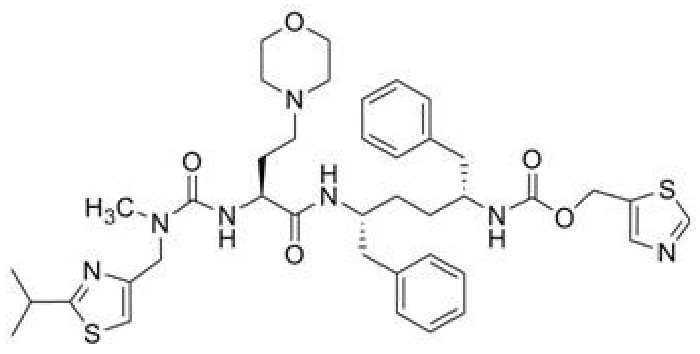 |
Structural Formula:
Physicochemical Properties:
Description: Emtricitabine is a white to off-white crystalline powder.
Solubility: The solubility is approximately 112 mg/mL in water at 25°C. The partition coefficient (log P) is −0.43 and the pKa is 2.65.
Tenofovir alafenamide
Drug Substance
Common Name: Tenofovir alafenamide hemifumarate Tenofovir alafenamide fumarate (USAN)
Chemical Name: Propan-2-yl N-[(S)-({[(2R)-1-(6-amino-9H-purin-9-yl)propan-2-yl]-oxy}methyl)(phenoxy)phosphoryl]-l-alaninate, (2E)-but-2-enedioate (2:1)
Empirical Formula: C21H29O5N6P•1/2(C4H4O4)
Molecular Weight: 534.5
Structural Formula:
Physicochemical Properties:
Description: TAF hemifumarate is a white to off-white or tan powder.
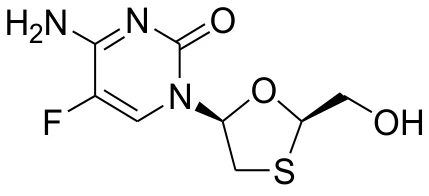 |
Solubility: The solubility of TAF hemifumarate in water, pH 8.0 (50 mM phosphate buffer) at 20°C is 4.86 mg/mL. The partition coefficient (log P) is 1.6 and the pKa is 3.96.
14 CLINICAL TRIALS
14.1 Clinical Trials by Indication
HIV-1 With No Known Mutations to the Individual Components of GENVOYA
Description of Clinical Studies
The efficacy and safety of GENVOYA in HIV-1 infected, treatment-naïve adults are based on 48-week data from two randomized, double-blind, active-controlled studies, Study 104 and Study 111 (N=1733). The efficacy and safety of GENVOYA in virologically suppressed HIV-1 infected adults are based on 48-week data from a randomized, open-label, active-controlled study, Study 109 (N=1436).
The efficacy and safety of GENVOYA in HIV-1 infected, virologically suppressed patients with mild to moderate renal impairment is based on 24-week data from an open-label study, Study 112 (N=242).
The efficacy and safety of GENVOYA in HIV-1 infected, virologically suppressed patients with end stage renal disease on chronic hemodialysis is based on 48-week data from a single arm, open-label study, Study 1825 (N=55).
The efficacy and safety of GENVOYA in HIV-1 infected, treatment-naïve pediatric patients between the ages of 12 to < 18 years (≥ 35 kg) is based on 24-week data from Cohort 1 of an open-label study, Study 106 (N=50).
The efficacy and safety of GENVOYA in virologically suppressed HIV-1 pediatric patients between the ages of 6 to < 12 years (≥ 25 kg) is based on 24-week from Cohort 2 of an open-label study, Study 106 (N=23).
Treatment Naïve HIV-1 Infected Patients
In both Study 104 and Study 111, patients were randomized in a 1:1 ratio to receive either GENVOYA (N = 866) once daily or STRIBILD (elvitegravir 150 mg/cobicistat 150 mg/emtricitabine 200 mg/tenofovir disoproxil fumarate 300 mg; N = 867) once daily.
In Studies 104 and 111, the mean age was 36 years (range 18-76), 85% were male, 57% were White, 25% were Black, and 10% were Asian. Nineteen percent of patients identified as Hispanic/Latino. The mean baseline plasma HIV-1 RNA was 4.5 log10 copies per mL (range 1.3–7.0). The mean baseline CD4+ cell count was 427 cells /mm3 (range 0-1360) and 13% had CD4+ cell counts < 200 cells /mm3. Twenty-three percent of patients had baseline viral loads > 100,000 copies per mL.
For demographic and baseline characteristics for Study 104 and 111, see
Table 14.
Table 14. Pooled Demographic and Baseline Characteristics of Antiretroviral Treatment-naïve HIV-1 Infected Adult Patients in Studies 104 and 111
| GENVOYA (N=866) | STRIBILD (N=867) | ||||||||||
| Demographic characteristics | |||||||||||
| Median age, years (range) | 33 (18-74) | 35 (18-76) | |||||||||
| Sex | |||||||||||
| Male | 733 | 740 | |||||||||
| Female | 133 | 127 | |||||||||
| Race | |||||||||||
| American Indian/ Alaska Native | 5 | 8 | |||||||||
| White | 485 | 498 | |||||||||
| 223 | 213 | ||||||||||
| Native Hawaiian/ Pacific Islander | 5 | 4 | |||||||||
| Asian | 91 | 89 | |||||||||
| Other | 57 | 55 | |||||||||
| Baseline disease characteristics | |||||||||||
| Median baseline plasma HIV-1 RNA log10 copies/mL (range) | 4.58 (2.57-6.89) | 4.58 (1.28-6.98) | |||||||||
Percentage of patients with viral load ≤ 100,000 copies/mL | 77.4 | 77.5 | |||||||||
Percentage of patients with viral load > 100,000 to ≤ 400,000 copies/mL | 17.0 | 17.8 | |||||||||
Percentage of patients with viral load > 400,000 copies/mL | 5.7 | 4.7 | |||||||||
| Median baseline CD4+ cell count /µL (range) | 404 (0-1311) | 406 (1-1360) | |||||||||
| Percentage of patients with CD4+ cell counts < 200 cells/mm3 | 13.0 | 13.5 | |||||||||
| HIV disease status | |||||||||||
| Asymptomatic | 779 | 800 | |||||||||
| Symptomatic HIV infection | 53 | 34 | |||||||||
| AIDS | 31 | 29 | |||||||||
| Unknown | 3 | 4 |
| Estimated CrCl by Cockcroft-Gault method (mL/min), median (Q1, Q3) | 117.0 (99.6, 135.6) | 113.9 (99.0, 133.6) |
| Proteinuria by urinalysis (dipstick) | ||
| Grade 0 | 778 | 780 |
| Grade 1 | 80 | 67 |
| Grade 2 | 8 | 18 |
| Grade 3 | 0 | 1 |
| -Missing- | 0 | 1 |
In both studies, patients were stratified by baseline HIV-1 RNA (≤ 100,000 copies per mL, > 100,000 copies per mL to ≤ 400,000 copies per mL, or > 400,000 copies per mL), by CD4 count (< 50 cells per μL, 50-199 cells per μL, or ≥ 200 cells per μL), and by region (US or ex-US).
Treatment outcomes of Studies 104 and 111 through 48 and 144 weeks are presented in Table 15.
Table 15. Pooled Virologic Outcomes of Studies 104 and 111 at Weeks 48a and 144b
| Week 48 | Week 144 | |||||||||||||||||
|---|---|---|---|---|---|---|---|---|---|---|---|---|---|---|---|---|---|---|
| GENVOYA (N=866) | STRIBILD (N=867) | GENVOYA (N=866) | STRIBILD (N=867) | |||||||||||||||
Virologic Success HIV-1 RNA < 50 copies/mL | 92% | 90% | 84% | 80% | ||||||||||||||
| Treatment Difference | 2.0% (95% CI: -0.7% to 4.7%) | 4.2% (95% CI: 0.6% to 7.8%) | ||||||||||||||||
Virologic Failure HIV-1 RNA ≥ 50 copies/mLc | 4% | 4% | 5% | 4% | ||||||||||||||
| No Virologic Data at Week 48 or Week 144 Window | 4% | 6% | 11% | 16% | ||||||||||||||
| Discontinued Study Drug Due to AE or Deathd | 1% | 2% | 1% | 3% | ||||||||||||||
| Discontinued Study Drug Due to Other Reasons and Last Available HIV-1 RNA < 50 copies/mLe | 2% | 4% | 9% | 11% | ||||||||||||||
| Missing Data During Window but on Study Drug | 1% | < 1% | 1% | 1% | ||||||||||||||
| Proportion (%) of Patients with HIV‑1 RNA < 50 copies/mL by Subgroup | ||||||||||||||||||
Age < 50 years ≥ 50 years | 716/777 (92%) 84/89 (94%) | 680/753 (90%) 104/114 (91%) | 647/777 (83%) 82/89 (92%) | 602/753 (80%) 92/114 (81%) | ||||||||||||||
Sex Male Female | 674/733 (92%) 126/133 (95%) | 673/740 (91%) 111/127 (87%) | 616/733 (84%) 113/133 (85%) | 603/740 (81%) 91/127 (72%) | ||||||||||||||
| Week 48 | Week 144 |
|---|
| GENVOYA (N=866) | STRIBILD (N=867) | GENVOYA (N=866) | STRIBILD (N=867) | |
|---|---|---|---|---|
Race Nonblack | 197/223 (88%) 603/643 (94%) | 177/213 (83%) 607/654 (93%) | 168/223 (75%) 561/643 (87%) | 152/213 (71%) 542/654 (83%) |
Baseline Viral Load ≤ 100,000 copies/mL > 100,000 copies/mL | 629/670 (94%) 171/196 (87%) | 610/672 (91%) 174/195 (89%) | 567/670 (85%) 162/196 (83%) | 537/672 (80%) 157/195 (81%) |
Baseline CD4+ cell count < 200 cells /mm3 ≥ 200 cells /mm3 | 96/112 (86%) 703/753 (93%) | 104/117 (89%) 680/750 (91%) | 93/112 (83%) 635/753 (84%) | 94/117 (80%) 600/750 (80%) |
a. Week 48 window was between Day 294 and 377 (inclusive).
b. Week 144 window was between Day 966 and 1049 (inclusive).
c. Included patients w ho had ≥ 50 copies/mL in the Week 48 or 144 w indow ; patients w ho discontinued early due to lack or loss of efficacy; patients w ho discontinued for reasons other than an adverse event (AE), death or lack or loss of efficacy and at the time of discontinuation had a viral value of ≥ 50 copies/mL.
d. Includes patients who discontinued due to AE or death at any time point from Day 1 through the time window if this resulted in no virologic data on treatment during the specified w indow .
e. Includes patients w ho discontinued for reasons other than an AE, death or lack or loss of efficacy; eg, w ithdrew consent, los s to follow -up, etc.
GENVOYA met the noninferiority criteria in achieving HIV-1 RNA < 50 copies/mL at Week 48 and 96 when compared to STRIBILD. At Week 144, GENVOYA demonstrated statistical superiority (p = 0.021) in achieving HIV-1 RNA < 50 copies/mL when compared to STRIBILD. In Studies 104 and 111, the 95% CIs for differences in virologic success between treatment groups included zero for most subgroups evaluated suggesting no differences between the treatments.
In Studies 104 and 111, the mean increase from baseline in CD4+ cell count at Week 48, Week 96, and Week 144 was 230 cells/mm3, 280 cells/mm3, and 326 cells/mm3, respectively, in GENVOYA-treated patients, and 211 cells/mm3, 266 cells /mm3, and 305 cells/mm3, respectively, in STRIBILD treated patients (p = 0.024, p = 0.14, and p = 0.06 at Week 48, Week 96, and Week 144, respectively).
Bone Mineral Density
In the pooled analysis of Studies 104 and 111, the effects of GENVOYA compared to that of STRIBILD on bone mineral density (BMD) from baseline to Week 48, Week 96, and Week 144 were assessed by dual-energy X-ray absorptiometry (DXA). As shown in Table 16, in patients who had both baseline and Weeks 48, 96, and 144 measurements (Week 48: N = 780 and 784 in the GENVOYA group and N = 767 and 773 in the STRIBILD group, for hip and spine, respectively; Week 96: N = 716 and 722 in the GENVOYA group and N = 711 and 714 in the STRIBILD group for hip and spine, respectively; Week 144: N = 690 and 702 in the GENVOYA group and N = 683 and 686 in the STRIBILD group, for hip and spine, respectively) there were smaller decreases in BMD in the GENVOYA group as compared to STRIBILD.
Table 16. Measures of Bone Mineral Density in Studies 104 and 111 (Week 48, Week 96, and Week 144 Analyses)
| Week 48 | Week 96 | Week 144 | ||||||||||||||||||||||||||||||||||
|---|---|---|---|---|---|---|---|---|---|---|---|---|---|---|---|---|---|---|---|---|---|---|---|---|---|---|---|---|---|---|---|---|---|---|---|---|
| GENVOYA | STRIBILD | Treatment Difference | GENVOYA | STRIBILD | Treatment Difference | GENVOYA | STRIBILD | Treatment Difference | ||||||||||||||||||||||||||||
| Hip DXA Analysis | N=780 | N=767 | Difference in LSM (95% CI) | P-value | N=716 | N=711 | Difference in LSM (95% CI) | P-value | N=690 | N=683 | Difference in LSM (95% CI) | P-value | ||||||||||||||||||||||||
| Mean (SD) Percent Change in BMD | -0.7% (3.3%) | -3.0% (3.4%) | 2.3% (2.0 to 2.6) | p < 0.001 | -0.7% (3.9%) | -3.3% (4.0%) | 2.6% (2.2 to 3.0) | p < 0.001 | -0.8% (4.4%) | -3.4% (4.3%) | 2.6% (2.2 to 3.1) | p < 0.001 | ||||||||||||||||||||||||
Patients with Categorical Change: > 3% Decrease in BMD > 3% Increase in BMD | 17% 7% | 50% 3% | -- | -- | 23% 12% | 56% 6% | -- | -- | 28% 13% | 55% 6% | -- | -- | ||||||||||||||||||||||||
| Patients with No Decrease ( ≥ zero % change) in BMD | 35% | 14% | -- | -- | 39% | 16% | -- | -- | 40% | 19% | -- | -- | ||||||||||||||||||||||||
| Lumbar Spine DXA Analysis | N=784 | N=773 | N=722 | N=714 | N=702 | N=686 | ||||||||||||||||||||||||||||||
| Mean (SD) Percent Change in BMD | -1.3% (3.1%) | -2.9% (3.2%) | 1.6% (1.2 to 1.9) | p < 0.001 | -1.0% (3.7%) | -2.8% (3.9%) | 1.8% (1.4 to 2.2) | p < 0.001 | -0.9% (4.1%) | -3.0% (4.3%) | 2.0% (1.6 to 2.5) | p < 0.001 | ||||||||||||||||||||||||
| Week 48 | Week 96 | Week 144 |
|---|
| GENVOYA | STRIBILD | Treatment Difference | GENVOYA | STRIBILD | Treatment Difference | GENVOYA | STRIBILD | Treatment Difference | |||||||||||||
|---|---|---|---|---|---|---|---|---|---|---|---|---|---|---|---|---|---|---|---|---|---|
Patients with Categorical Change: > 3% Decrease in BMD > 3% Increase in BMD | 27% 7% | 46% 3% | -- | -- | 26% 11% | 48% 6% | -- | -- | 30% 13% | 49% 7% | -- | -- | |||||||||
| Patients with No Decrease ( ≥ zero % change) in BMD | 34% | 17% | -- | -- | 37% | 21% | -- | -- | 39% | 22% | -- | -- | |||||||||
Changes in Renal Laboratory Tests and Renal Safety Laboratory tests were performed in Studies 104 and 111 to compare the effect of TAF, administered as a component of GENVOYA, to that of tenofovir DF, administered as a component of STRIBILD, on renal laboratory parameters. As shown in Table 17, there were statistically significantly higher increases in serum creatinine, Urine Protein to Creatinine Ratio (UPCR), Urine Albumin to Creatinine Ratio (UACR), urine retinol binding protein (RBP) to creatinine ratio, and urine beta-2-microglobulin to creatinine ratio in the STRIBILD group as compared to the GENVOYA group. There were zero cases of Fanconi syndrome or Proximal Renal Tubulopathy (PRT) in the GENVOYA group through Week 144.
Table 17. Change from Baseline in Renal Laboratory Tests in Studies 104 and 111 (Week 48, Week 96, and Week 144 Analyses)
| Week 48 | Week 96 | Week 144 | ||||||||||||||||||||||||
|---|---|---|---|---|---|---|---|---|---|---|---|---|---|---|---|---|---|---|---|---|---|---|---|---|---|---|
| GENVOYA (N=866) | STRIBILD (N=867) | Treatment Difference | GENVOYA (N=866) | STRIBILD (N=867) | Treatment Difference | GENVOYA (N=866) | STRIBILD (N=867) | Treatment Difference | ||||||||||||||||||
| Serum Creatinine (μmol/L)a | 7.07 ± 10.96 | 9.72 ± 19.18 | -3.54 p < 0.001 | 3.54 ± 10.08 | 6.19 ± 11.23 | -2.65 p < 0.001 | 3.54 ± 10.61 | 6.19 ± 11.23 | -3.54 p < 0.001 | |||||||||||||||||
| Proteinuria by Urine Dipstickb | 31% | 37% | p = 0.022 | 36% | 41% | p = 0.034 | 40% | 45% | p = 0.027 | |||||||||||||||||
| Urine Protein to Creatinine Ratio [UPCR]c | -3.4% | 19.8% | p < 0.001 | -9.1% | 16.2% | p < 0.001 | -10.5% | 25.2% | p < 0.001 | |||||||||||||||||
| Urine Albumin to Creatinine Ratio [UACR]c,d | -4.7% | 7.1% | p < 0.001 | -5.2% | 4.9% | p < 0.001 | -d | -d | -d | |||||||||||||||||
| Urine RBP to Creatinine Ratioc | 9.2% | 51.2% | p < 0.001 | 13.8% | 74.2% | p < 0.001 | 34.8% | 111% | p < 0.001 | |||||||||||||||||
| Urine Beta-2-Microglobulin to Creatinine Ratioc | -31.7% | 24.1% | p < 0.001 | -32.1% | 33.5% | p < 0.001 | -25.7% | 53.8% | p < 0.001 | |||||||||||||||||
a. Mean change ± SD.
b. Includes all severity grades (1-3).
c. Median percent change.
d. UACR was assessed up to Week 96.
At Weeks 48, 96, and 144, the proportion of patients with any grade hypophosphatemia in GENVOYA was 3.6%, 5.6%, and 6.8%, respectively, and 4.0%, 5.4%, and 7.6%, respectively, in STRIBILD. The median (Q1, Q3) change from baseline in FEPO4 was 2.0% (-1.2%, 5.6%), 2.1% (-1.3%, 5.5%), and 3.0% (-0.7%, 7.2%) at Weeks 48, 96, and 144, respectively, in patients receiving GENVOYA, and 2.6% (-0.7%, 6.4%), 2.7% (-0.8%, 7.0%), and 4.1% (0.2%, 8.0%) at Weeks 48, 96, and 144, respectively, in patients receiving STRIBILD (p = 0.006, 0.009, and 0.001, at Weeks 48, 96, and 144, respectively).
The median (Q1, Q3) change from baseline in the ratio of the renal tubular maximum reabsorption rate of phosphate to the glomerular filtration rate (TmP/GFR) was -0.2 (-0.7 mg/dL, 0.2 mg/dL), -0.3 mg/dL (-0.9 mg/dL, 0.2 mg/dL), and -0.4 mg/dL (-1.0 mg/dL, 0.1 mg/dL) at Weeks 48, 96, and 144, respectively, in patients receiving GENVOYA, and -0.3 (-0.7 mg/dL, 0.2 mg/dL), -0.4 mg/dL (-0.8 mg/dL, 0.1 mg/dL), and -0.5 mg/dL (-1.0 mg/dL, 1.0 mg/dL) at Weeks 48, 96, and 144, respectively, in patients receiving STRIBILD (p = 0.21, 0.35, and 0.011 at Weeks 48, 96, and 144, respectively).
Changes in Lipid Laboratory Tests
Increases from baseline were observed in both treatment groups for the fasting lipid parameters total cholesterol, direct LDL, HDL, and triglycerides at Weeks 48, 96, and 144. The median increase from baseline for these parameters was greater in the GENVOYA group compared with the STRIBILD group (p < 0.001 for the difference between treatment groups for fasting total cholesterol, direct LDL, HDL, and triglycerides). Median (Q1, Q3) change from baseline at Weeks 48, 96, and 144 in total cholesterol to HDL ratio was 0.1 (-0.3, 0.5), 0.1 (-0.3, 0.7), and 0.2 (-0.3, 0.7), respectively, in the GENVOYA group and 0.0 (-0.5, 0.4), 0.0 (-0.4, 0.5), and 0.1 (-0.4, 0.6), respectively, in the STRIBILD group (p < 0.001 for the difference between treatment groups at Weeks 48 and 96; p = 0.006 at Week 144).
Virologically Suppressed HIV-1 Infected Patients
In Study 109, the efficacy and safety of switching from either ATRIPLA (efavirenz/emtricitabine/tenofovir disoproxil fumarate [EFV/FTC/TDF]), TRUVADA (emtricitabine/tenofovir disoproxil fumarate [FTC/TDF]) plus atazanavir (boosted by either cobicistat or ritonavir), or STRIBILD to GENVOYA were evaluated in a randomized, open-label study of virologically suppressed (HIV-1 RNA < 50 copies/mL) HIV-1 infected adults (N = 1436). Patients must have been stably suppressed (HIV-1 RNA < 50 copies/mL) on their baseline regimen for at least 6 months and had no resistance mutations to any of the components of GENVOYA prior to study entry. Patients were randomized in a 2:1 ratio to either switch to GENVOYA at baseline (N = 959), or stay on their baseline antiretroviral regimen (N = 477). Patients had a mean age of 41 years (range 21-77), 89% were male, 67% were White, and 19% were Black. The mean baseline CD4+ cell count was 697 cells/mm3 (range 79-1951). Demographic and baseline characteristics are presented in Table 18.
Patients were stratified by prior treatment regimen. At screening, 42% of patients were receiving TRUVADA plus atazanavir (boosted by either cobicistat or ritonavir), 32% of patients were receiving STRIBILD, and 26% of patients were receiving ATRIPLA.
Table 18. Demographic and Baseline Characteristics of Virologically Suppressed HIV-1 Infected Adult Patients in Study 109
| Study 109 | |||||||||||||||
| GENVOYA (N= 959) | Baseline Regimen (N= 477) | ||||||||||||||
| Demographic characteristics | |||||||||||||||
| Median age, years (range) | 41 (21-77) | 40 (22-69) | |||||||||||||
| Sex | |||||||||||||||
| Male | 856 | 427 | |||||||||||||
| Female | 103 | 50 | |||||||||||||
| Race | |||||||||||||||
| American Indian/ Alaska Native | 5 | 2 | |||||||||||||
| White | 651 | 314 | |||||||||||||
| 169 | 102 | ||||||||||||||
| Native Hawaiian/ Pacific Islander | 6 | 1 | |||||||||||||
| Asian | 59 | 35 | |||||||||||||
| Other | 67 | 22 | |||||||||||||
| Not permitted | 2 | 1 | |||||||||||||
| Prior treatment regimen | |||||||||||||||
| STB | 306 | 153 | |||||||||||||
| ATR | 251 | 125 | |||||||||||||
| ATV/boosted +TVD | 402 | 199 | |||||||||||||
| Baseline disease characteristics | |||||||||||||||
| HIV-1 RNA < 50 copies/mL | 943 | 466 | |||||||||||||
| CD4 cell count (cells/μL), median (Q1, Q3) | 675 (520, 833) | 662 (525, 831) | |||||||||||||
| Estimated CrCl by Cockcroft-Gault method (mL/min), median (Q1, Q3) | 105.7 (89.4, 126.0) | 107.7 (88.7, 128.2) | |||||||||||||
| Proteinuria by urinalysis (dipstick) | |||||||||||||||
| Grade 0 | 873 | 430 | |||||||||||||
| Grade 1 | 81 | 44 | |||||||||||||
| Grade 2 | 4 | 3 | |||||||||||||
| Grade 3 | 0 | 0 | |||||||||||||
| -Missing- | 1 | 0 | |||||||||||||
STB: STRIBILD; ATR: ATRIPLA; ATV: atazanavir; TVD: TRUVADA
Treatment outcomes of Study 109 through 48 and 96 weeks are presented in Table 19.
Table 19. Virologic Outcomes of Study 109 at Weeks 48a and 96b
| Week 48 | Week 96 | ||||||||||||||
|---|---|---|---|---|---|---|---|---|---|---|---|---|---|---|---|
| GENVOYA (N=959) | Baseline Regimen (N=477) | GENVOYA (N=959) | Baseline Regimen (N=477) | ||||||||||||
Virologic Success HIV-1 RNA < 50 copies/mL | 97% | 93% | 93% | 89% | |||||||||||
| Treatment Difference | 4.1% (95% CI: 1.6% to 6.7%) | 3.7% (95% CI: 0.4% to 7.0%) | |||||||||||||
| p-value | p < 0.001 | p = 0.017 | |||||||||||||
Virologic Failure HIV-1 RNA ≥ 50 copies/mLc | 1% | 1% | 2% | 2% | |||||||||||
| No Virologic Data at Week 48 Window | 2% | 6% | 5% | 9% | |||||||||||
| Discontinued Study Drug Due to AE or Deathd | 1% | 1% | 1% | 3% | |||||||||||
| Discontinued Study Drug Due to Other Reasons and Last Available HIV-1 RNA < 50 copies/mLe | 1% | 4% | 3% | 6% | |||||||||||
| Missing Data During Window but on Study Drug | 0 | ≤ 1% | 1% | < 1% | |||||||||||
a. Week 48 window was between Day 294 and 377 (inclusive).
b. Week 96 window was between Day 630 and 713 (inclusive).
c. Included patients w ho had ≥ 50 copies/mL in the Week 48 or Week 96 w indow ; patients w ho discontinued early due to lack or loss of efficacy; patients who discontinued for reasons other than an adverse event (AE), death or lack or loss of efficacy and at the time of discontinuation had a viral value of ≥ 50 copies/mL.
d. Includes patients who discontinued due to AE or death at any time point from Day 1 through the time window if this resulted in no virologic data on treatment during the specified window .
e. Includes patients who discontinued for reasons other than an AE, death or lack or loss of efficacy; eg, withdrew consent, loss to follow -up, etc.
Switching to GENVOYA was superior at Week 48 (p < 0.001) and at Week 96 (p = 0.017) in maintaining HIV-1 RNA < 50 copies/mL when compared to patients who stayed on their baseline regimen.
The mean increase from baseline in CD4+ cell count at Week 48 and Week 96 was 35 cells/mm3 and 60 cells /mm3 in GENVOYA-treated patients, respectively, and 24 cells/mm3 and 42 cells /mm3 in patients who stayed on their baseline regimen, respectively.
Bone Mineral Density: Changes in BMD from baseline to Week 48 were assessed by DXA in patients who had both baseline and Week 48 measurements (N=869 and N=881 in the GENVOYA arm, and N=428 and N=436 in patients who remained on their baseline regimen, for hip and spine, respectively). Changes in BMD from baseline to Week 96 were assessed by DXA in patients who had both baseline and Week 96 measurements (N= 809 and N= 821 in the
GENVOYA arm, and N= 396 and N= 401 in patients who remained on their baseline regimen, for hip and spine, respectively). Results for Weeks 48 and 96 are summarized in Table 20.
At Week 96, the mean (SD) change from baseline was 2.4% (3.6) and 2.1% (3.8) in the GENVOYA group and -0.5% (3.4) and -0.1% (3.5) in the FTC/TDF + 3rd agent baseline regimen group, in hip and spine BMD, respectively (p < 0.001 for the differences between groups at Week 96).
Table 20. Measures of Bone Mineral Density in Study 109 (Week 48 and Week 96 Analyses)
| Week 48 | Week 96 | ||||||||||||||||||||||||
|---|---|---|---|---|---|---|---|---|---|---|---|---|---|---|---|---|---|---|---|---|---|---|---|---|---|
| GENVOYA | Baseline Regimen | Treatment Difference | GENVOYA | Baseline Regimen | Treatment Difference | ||||||||||||||||||||
| Hip DXA Analysis | N=869 | N=428 | Difference in LSM (95% CI) | P-value | N=809 | N=396 | Difference in LSM (95% CI) | P-value | |||||||||||||||||
| Mean (SD) Percent Change in BMD | 1.5% (2.7%) | -0.3% (2.8%) | 1.8% (1.5 to 2.1) | p < 0.001 | 2.4% (3.6%) | -0.5% (3.4%) | 2.9% (2.5 to 3.3) | p < 0.001 | |||||||||||||||||
Patients with Categorical Change: > 3% Decrease in BMD > 3% Increase in BMD | 3% 21% | 13% 7% | -- | 2% 35% | 15% 9% | -- | |||||||||||||||||||
| Patients with No Decrease (≥ zero % change) in BMD | 78% | 46% | -- | 82% | 43% | -- | |||||||||||||||||||
| Lumbar Spine DXA Analysis | N=881 | N=436 | N=821 | N=401 | |||||||||||||||||||||
| Mean (SD) Percent Change in BMD | 1.6% (3.8%) | -0.4% (4.1%) | 2.0% (1.5 to 2.4) | p < 0.001 | 2.1% (3.8%) | -0.1% (3.5%) | 2.2% (1.8 to 2.6) | p < 0.001 | |||||||||||||||||
Patients with Categorical Change: > 3% Decrease in BMD > 3% Increase in BMD | 8% 33% | 19% 13% | -- | 6% 37% | 17% 18% | -- | |||||||||||||||||||
| Patients with No Decrease (≥ zero % change) in BMD | 74% | 47% | -- | 75% | 47% | -- | |||||||||||||||||||
Changes in Renal Laboratory Tests and Renal Safety
There were decreases from baseline in proteinuria (UPCR), albuminuria (UACR), and tubular proteinuria (urine RBP to creatinine ratio and urine beta-2-microglobulin to creatinine ratio), and also in other measures of proximal renal tubular dysfunction (including fractional excretion of uric acid [FEUA]) in patients receiving GENVOYA, as compared with increases from baseline in patients who stayed on their TDF-containing baseline regimen, collectively indicating a reduced impact of TAF on proximal renal tubular function. At Week 96, the median percentage change in UPCR was −26% vs. 9%; in UACR it was −14% vs. 11%. At Week 48, the median percentage change in urine RBP to creatinine ratio was −33% vs. 18%; and in urine beta-2-microglobulin to creatinine ratio it was −52% vs. 19%. P-value was < 0.001 for all comparisons. There were zero cases of Fanconi syndrome or PRT in patients switching to GENVOYA through Week 96.
HIV-1 Infected Patients with Renal Impairment Study 112: Virologically-suppressed adults with renal impairment
In Study 112, the efficacy and safety of GENVOYA were evaluated in an open-label clinical study in which 242 HIV-1 infected patients with mild to moderate renal impairment (estimated CrCl by Cockcroft-Gault method between 30 to 69 mL/minute) switched to GENVOYA as shown in Table 21. Patients were virologically suppressed (HIV-1 RNA < 50 copies/mL) for at least 6 months before switching to GENVOYA.
The mean age was 58 years (range 24-82), with 63 patients (26%) who were ≥ 65 years of age. Seventy-nine percent were male, 63% were White, 18% were Black, and 14% were Asian. Thirteen percent of patients identified as Hispanic/Latino. At baseline, median estimated CrCl was 56 mL/minute, and 33% of patients had an estimated CrCl from 30 to 49 mL/minute. The mean baseline CD4+ cell count was 664 cells /mm3 (range 126-1813).
Table 21. Demographic and Baseline Characteristics of Virologically Suppressed HIV-1 Infected Adult Patients in Study 112
| Study 112 | ||||||||||
| Cohort 1: ART-Experienced | ||||||||||
| Baseline estimated CrCl by Cockcroft-Gault method < 50 mL/min (N = 80) | Baseline estimated CrCl by Cockcroft-Gault method ≥ 50 mL/min (N = 162) | |||||||||
| Demographic characteristics | ||||||||||
| Median age, years (range) | 59 (31-82) | 58 (24-76) | ||||||||
| Sex | ||||||||||
| Male | 59 | 133 | ||||||||
| Female | 21 | 29 | ||||||||
| Race | ||||||||||
| American Indian/ Alaska Native | 1 | 0 |
| White | 39 | 113 |
| 14 | 30 | |
| Native Hawaiian/ Pacific Islander | 0 | 2 |
| Asian | 23 | 11 |
| Other | 3 | 4 |
| Not permitted | 0 | 2 |
| Baseline disease characteristics | ||
| HIV-1 RNA categories (copies/mL) | ||
| < 50 | 78 | 158 |
| ≥ 50 to ≤ 100,000 | 2 | 4 |
| > 100,000 to ≤ 400,000 | 0 | 0 |
| CD4 cell count (cells/uL), median (Q1, Q3) | 622 (449, 844) | 635 (461, 797) |
| HIV disease status | ||
| Asymptomatic | 46 | 134 |
| Symptomatic HIV infection | 18 | 10 |
| AIDS | 16 | 18 |
| Estimated CrCl by Cockcroft-Gault methodb (mL/min), median (Q1, Q3) | 42.6 (37.7, 45.7) | 60.3 (55.5, 65.0) |
| Proteinuria by urinalysis (dipstick) | ||
| Grade 0 | 45 | 118 |
| Grade 1 | 23 | 33 |
| Grade 2 | 12 | 11 |
| Grade 3 | 0 | 0 |
In a substudy, patients given GENVOYA (N=32) had no change from baseline in their actual glomerular filtration rate at Week 24, as measured by iohexol clearance.
At Week 24, 95.0% (230/242 patients) maintained HIV-1 RNA < 50 copies/mL after switching to GENVOYA. Three patients had virologic failure at Week 24. At Week 96, 88.4% (214/242) of patients maintained HIV-1 RNA < 50 copies/mL after switching to GENVOYA. At Week 144, 83.1% (197/237) maintained HIV-1 RNA < 50 copies/mL after switching to GENVOYA; 14.8% of patients had no virologic data in the Week 144 window. Five patients among the entire study population had virologic failure at Week 144.
Changes from baseline in renal laboratory tests at Weeks 24, 96, and 144 in patients who switched to GENVOYA are presented in Table 22. The prevalence of clinically significant proteinuria (UPCR > 200 mg/g) was 42% at baseline, and decreased to 21%, 18%, and 16% at Weeks 24, 96, and 144, respectively. The prevalence of clinically significant albuminuria (UACR ≥ 30 mg/g) was 49% at baseline, and decreased to 27%, 27%, and 32% at Weeks 24, 96, and 144, respectively. Other renal assessments, including fractional excretion of uric acid, serum cystatin C, and serum phosphorus showed small changes from baseline at each time point through Weeks 24, 96, and 144. Overall, multiple assessments of renal function indicate that changes in renal function were observed as soon as 1 week after switching to GENVOYA and persisted through 144 weeks.
Table 22. Change from Baseline in Renal Laboratory Tests at Week 24, Week 96, and Week 144 in Virologically Suppressed Patients with Renal Impairment who Switched to GENVOYA in Study 112 (Week 24, Week 96, and Week 144 Analyses)
| Week 24 | Week 96 | Week 144 | |||||||
|---|---|---|---|---|---|---|---|---|---|
| GENVOYA (N=242) | |||||||||
| Serum Creatinine (μmol/L)a | 1.77 ± 22.19 | -2.65 ± 24.66 | -4.42 ± 25.38 | ||||||
| Improvement in Proteinuria by Urine Dipstickb | 57/76 (75%) | 60/71 (85%) | 56/66 (85%) | ||||||
| Urine Protein to Creatinine Ratio [UPCR]c | -35.3% | -37.7% | -45.7% | ||||||
| Urine Albumin to Creatinine Ratio [UACR]c | -38.8% | -45.5% | -35.1% | ||||||
| Urine RBP to Creatinine Ratioc | -56.2% | -64.1% | -63.8% | ||||||
| Urine Beta-2-Microglobulin to Creatinine Ratioc | -70.7% | -83.6% | -81.9% | ||||||
a. Mean change ± SD.
b. An improvement of at least 1 toxicity grade from baseline.
c. Median percent change.
Bone Mineral Density: In virologically suppressed patients with renal impairment who switched to GENVOYA, mean percentage increases from baseline at Weeks 24, 96, and 144 were observed in hip and spine BMD. At Week 144, assessment of BMD using a threshold of 3% for changes from baseline revealed higher percentages of patients had increases versus decreases from baseline in BMD at both hip (38.4% versus 9.0%) and spine (47.4% versus 10.3%).
At Week 144, the mean (SD) percentage BMD increase from baseline was 3.2% (4.9) at the hip and 3.6% (5.2) at the spine for patients who switched to GENVOYA from a TDF-based regimen.
The median (Q1, Q3) percentage increases from baseline in hip and spine BMD were higher in virologically suppressed patients who switched to GENVOYA from a TDF-based regimen (hip: 2.3% [0.4%, 4.8%], spine: 3.7% [0.7%, 6.0%]) than in those patients who switched to GENVOYA from a non-TDF-based regimen (hip: 1.0% [-1.5%, 3.3%], spine: 0.6% [-1.6%, 4.1%]). The percentage changes (increases) from baseline in hip and spine BMD were statistically significant at each time point through Week 144 for virologically suppressed patients who switched to GENVOYA from a TDF-based regimen (p < 0.001).
Study 1825: Virologically-suppressed adults with end stage renal disease (ESRD) receiving chronic hemodialysis
In Study 1825, the efficacy and safety of GENVOYA were evaluated in a single arm, open-label clinical study in which 55 HIV-1 infected adults with end stage renal disease (estimated CrCl by Cockcroft-Gault method < 15 mL/min) receiving chronic hemodialysis for at least 6 months switched to GENVOYA. Patients were virologically suppressed (HIV-1 RNA < 50 copies/mL) for at least 6 months before switching to GENVOYA.
The mean age was 48 years (range 23-64). Seventy-six percent were male, 82% were Black and 18% were White. Fifteen percent of patients identified as Hispanic/Latino. The mean baseline CD4+ cell count was 545 cells/mm3 (range 205-1473).
At Week 48, 81.8% (45/55 patients) maintained HIV-1 RNA < 50 copies/mL after switching to GENVOYA. Two patients had HIV-1 RNA ≥ 50 copies/mL by Week 48. Seven patients discontinued the study drug due to AE or other reasons while suppressed. One patient did not have an HIV-1 RNA measurement at Week 48. There were no clinically significant changes in fasting lipid laboratory tests in patients who switched to GENVOYA.
HIV-1 With No Known Mutations in Pediatrics
In Study 106, the efficacy, safety, and pharmacokinetics of GENVOYA in HIV-1 infected patients were evaluated in an open-label study in HIV-1-infected treatment-naïve adolescents between the ages of 12 to < 18 years (≥ 35 kg) (N=50) through Week 48 and in virologically suppressed pediatric patients between the ages of 6 to < 12 years (≥ 25 kg) (N=23) through Week 24.
Cohort 1: Treatment-Naïve Adolescents (12 to < 18 Years of Age and Weighing ≥ 35 kg)
Patients in Cohort 1 had a mean age of 15 years (range: 12 to 17), 44% were male, 12% were Asian, and 88% were black. At baseline, mean plasma HIV-1 RNA was 4.6 log10 copies/mL, median CD4+ cell count was 456 cells/mm3 (range: 95 to 1110), and median CD4+% was 23% (range: 7% to 45%). Twenty-two percent had baseline plasma HIV-1 RNA > 100,000 copies/mL as shown in Table 23.
Table 23. Demographic and Baseline Characteristics of Treatment-naïve HIV-1 Infected Adolescent Patients in Study 106 (Cohort 1)
| Study 106 (Cohort 1) | ||||||||
|---|---|---|---|---|---|---|---|---|
| GENVOYA (N= 50) | ||||||||
| Demographic characteristics | ||||||||
| Median age, years (range) | 15 (12-17) | |||||||
| Sex | ||||||||
| Male | 22 | |||||||
| Female | 28 | |||||||
| Race | ||||||||
| Asian | 6 | |||||||
| 44 | ||||||||
| Baseline BMI (kg/m2), median (Q1, Q3) | 20.0 (18.1, 23.1) | |||||||
| Baseline disease characteristics | ||||||||
| HIV-1 RNA (log10 copies/mL), median (Q1, Q3) | 4.65 (4.25, 4.94) | |||||||
| HIV-1 RNA > 100,000 copies/mL | 11 | |||||||
| CD4 cell count (cells/μL), median (Q1, Q3) | 456 (332, 574) | |||||||
| Mode of infection (HIV risk factors) | ||||||||
| Heterosexual sex | 12 | |||||||
| Homosexual sex | 8 | |||||||
| IV drug use | 1 | |||||||
| Vertical transmission | 32 | |||||||
| HIV disease status | ||||||||
| Asymptomatic | 42 | |||||||
| Symptomatic HIV infection | 8 | |||||||
| Estimated CrCl by Schwartz formula (mL/min/1.73 m2), median (Q1, Q3) | 156 (129.0, 185.0) | |||||||
| Proteinuria by urinalysis (dipstick), n (%) | ||||||||
| Grade 0 | 48 | |||||||
| Study 106 (Cohort 1) |
|---|
| GENVOYA (N= 50) | |
|---|---|
| Grade 1 | 1 |
| Grade 2 | 1 |
| Grade 3 | 0 |
Cohort 1: Treatment-naïve Adolescents (≥ 12 to < 18 Years of Age and Weighing ≥ 35 kg)
At Week 24, out of 23 patients assessed for efficacy, 91% of patients treated with GENVOYA achieved HIV-1 RNA < 50 copies/mL. At Week 48, 92% (46/50) of patients treated with GENVOYA achieved HIV-1 RNA < 50 copies/mL. The mean increase from baseline in CD4+ cell count at Weeks 24 and 48 was 212 cells/mm3 and 224 cells /mm3, respectively. Two patients had virologic failure by snapshot at Week 24 and three of the 50 patients had virologic failure by snapshot at Week 48; no emergent resistance to GENVOYA was detected through Weeks 24 and 48.
Fifty patients in Cohort 1 were assessed for safety at Weeks 24 and 48 (these patients received GENVOYA for 24 and 48 weeks). BMD by DXA was assessed in 47 patients for spine at both Week 24 and Week 48. BMD by DXA was assessed in 45 and 44 patients for total body less head (TBLH) at Week 24 and Week 48, respectively. Mean (SD) BMD increased from baseline to Week 24, +1.6% (3.9%) at the lumbar spine and +0.6 % (2.5%) for TBLH. Mean (SD) BMD increased from baseline to Week 48, +4.2% (5.0%) at the lumbar spine and +1.3% (2.7%) for TBLH.
Cohort 2: Virologically Suppressed Children (6 to < 12 Years of Age and Weighing ≥ 25 kg)
Patients in Cohort 2 had a mean age of 10 years (range: 8 to 11), a mean baseline weight of 31.6 kg (range: 26 to 58), 39% were male, 13% were Asian, and 78% were black. At baseline, median CD4+ cell count was 969 cells/mm3 (range: 603 to 1421), and median CD4+% was 39% (range: 30% to 51%). All 23 patients had baseline plasma HIV-1 RNA < 50 copies/mL as shown in Table 24.
Table 24. Demographic and Baseline Characteristics of Virologically Suppressed Patients in Study 106 (Cohort 2)
| Study 106 (Cohort 2) | ||||||||
|---|---|---|---|---|---|---|---|---|
| GENVOYA (N= 23) | ||||||||
| Demographic characteristics | ||||||||
| Median age, years (range) | 10 (8-11) | |||||||
| Sex | ||||||||
| Male | 9 | |||||||
| Female | 14 | |||||||
| Race | ||||||||
| Asian | 3 | |||||||
| 18 | ||||||||
| White | 2 | |||||||
| Baseline BMI (kg/m2), median (Q1, Q3) | 15.9 (15.2, 18.1) | |||||||
| Baseline disease characteristics | ||||||||
| HIV-1 RNA < 50 copies/mL | 23 | |||||||
| CD4 cell count (cells/μL), median (Q1, Q3) | 969 (843, 1087) | |||||||
| Mode of infection (HIV risk factors) | ||||||||
| Vertical transmission | 23 | |||||||
| HIV disease status | ||||||||
| Asymptomatic | 23 | |||||||
| Estimated CrCl by Schwartz formula (mL/min/1.73 m2), median (Q1, Q3) | 150.0 (134.7, 165.6) | |||||||
| Proteinuria by urinalysis (dipstick), n (%) | ||||||||
| Grade 0 | 22 | |||||||
| Grade 1 | 1 | |||||||
| Grade 2 | 0 | |||||||
| Grade 3 | 0 | |||||||
Cohort 2: Virologically Suppressed Children (6 to < 12 Years of Age and Weighing ≥ 25 kg)
At Week 24, 100% (23/23) of patients in Cohort 2 remained suppressed (HIV-1 RNA < 50 copies/mL) after switching to GENVOYA. The mean change from baseline in CD4+ cell count at Week 24 was -150 cells/mm3. No emergent resistance to GENVOYA was detected through Week 24.
Among the patients in Cohort 2 who had both baseline and Week 24 measurements, BMD by DXA was assessed in 21 patients for spine and 23 patients for TBLH. Mean (SD) BMD increased from baseline to Week 24, +2.9% (4.9%) at the lumbar spine and +1.7% (2.5%) for TBLH.
15 MICROBIOLOGY
Antiviral Activity
Elvitegravir, Cobicistat, Emtricitabine, and Tenofovir Alafenamide: When tested, elvitegravir, emtricitabine, and tenofovir alafenamide demonstrated synergistic antiviral activity in cell culture. Antiviral synergy was maintained for elvitegravir, emtricitabine, and tenofovir alafenamide when tested in the presence of cobicistat.
Elvitegravir: The antiviral activity of elvitegravir against laboratory and clinical isolates of HIV-1 was assessed in T lymphoblastoid cell lines, monocyte/macrophage cells, and primary peripheral blood lymphocytes. The 50% effective concentrations (EC50) ranged from 0.02 to 1.7 nM. Elvitegravir displayed antiviral activity in cell culture against HIV-1 clades A, B, C, D, E, F, G, and O (EC50 values ranged from 0.1 to 1.3 nM) and activity against HIV-2 (EC50 value of 0.53 nM). Elvitegravir did not show inhibition of replication of HBV or HCV in cell culture.
Cobicistat: Cobicistat has no detectable antiviral activity in cell culture against HIV-1, HBV, or HCV and does not antagonize the antiviral activity of elvitegravir, emtricitabine, or tenofovir.
Emtricitabine: The antiviral activity of emtricitabine against laboratory and clinical isolates of HIV-1 was assessed in T lymphoblastoid cell lines, the MAGI-CCR5 cell line, and primary peripheral blood mononuclear cells. The EC50 values for emtricitabine were in the range of 0.0013–0.64 μM. Emtricitabine displayed antiviral activity in cell culture against HIV-1 clades A, B, C, D, E, F, and G (EC50 values ranged from 0.007–0.075 μM) and showed strain specific activity against HIV-2 (EC50 values ranged from 0.007–1.5 μM).
Tenofovir Alafenamide: The antiviral activity of tenofovir alafenamide against laboratory and clinical isolates of HIV-1 subtype B was assessed in lymphoblastoid cell lines, PBMCs, primary monocyte/macrophage cells and CD4-T lymphocytes. The EC50 values for tenofovir alafenamide were in the range of 2.0 to 14.7 nM.
Tenofovir alafenamide displayed antiviral activity in cell culture against all HIV-1 groups (M, N, O), including sub-types A, B, C, D, E, F, and G (EC50 values ranged from 0.10 to 12.0 nM) and strain specific activity against HIV-2 (EC50 values ranged from 0.91 to 2.63 nM).
In a study of tenofovir alafenamide with a broad panel of representatives from the major classes of approved anti-HIV agents (NRTIs, NNRTIs, INSTIs, and PIs), additive to synergistic effects were observed. No antagonism was observed for these combinations.
Resistance
In Cell Culture
Elvitegravir: HIV-1 isolates with reduced susceptibility to elvitegravir have been selected in cell culture. Reduced susceptibility to elvitegravir was associated with the primary integrase substitutions T66A/I, E92G/Q, S147G, and Q148R. Additional integrase substitutions observed in cell culture selection included D10E, S17N, H51Y, F121Y, S153F/Y, E157Q, D232N, R263K, and V281M.
Emtricitabine: HIV-1 isolates with reduced susceptibility to emtricitabine have been selected in cell culture. Reduced susceptibility to emtricitabine was associated with M184V/I substitutions in HIV-1 RT.
Tenofovir Alafenamide: HIV-1 isolates with reduced susceptibility to tenofovir alafenamide have been selected in cell culture. HIV-1 isolates selected by tenofovir alafenamide expressed a K65R substitution in HIV-1 RT; in addition, a K70E substitution in HIV-1 RT has been transiently observed. HIV-1 isolates with the K65R substitution have reduced susceptibility to abacavir, emtricitabine, tenofovir alafenamide, tenofovir, and lamivudine. In vitro drug resistance selection studies with tenofovir alafenamide have shown no development of resistance increases above 2.5-fold after 6 months in culture.
In Clinical Trials
In Treatment-Naïve Patients: In a pooled analysis of antiretroviral-naive patients receiving GENVOYA in Phase 3 Studies 104 and 111, genotyping was performed on plasma HIV-1 isolates from all patients with HIV-1 RNA ≥ 400 copies/mL at confirmed virologic failure, at Week 144, or at time of early study drug discontinuation. As of Week 144, the development of one or more primary elvitegravir, emtricitabine, or tenofovir alafenamide resistance-associated mutations was observed in 12 of 22 patients with evaluable genotypic data from paired baseline and GENVOYA treatment-failure isolates (12 of 866 patients [1.4%]) compared with 12 of 20 treatment-failure isolates from patients with evaluable genotypic data in the STRIBILD treatment group (12 of 867 patients [1.4%]). Of the 12 patients with resistance development in the GENVOYA group, the mutations that emerged were M184V/I (N = 11) and K65R/N (N = 2) in reverse transcriptase and T66T/A/I/V (N = 2), E92Q (N = 4), Q148Q/R (N = 1) and N155H (N = 2) in integrase. Of the 12 patients with resistance development in the STRIBILD group, the mutations that emerged were M184V/I (N = 9), K65R/N (N = 4), and L210L/W (N = 1) in reverse transcriptase and E92Q/V (N = 4), Q148R (N = 2), and N155H/S (N = 3) in integrase. In both treatment groups, most patients who developed resistance mutations to elvitegravir developed resistance mutations to both emtricitabine and elvitegravir.
In phenotypic analyses of patients in the final resistance analysis population, 7 of 22 patients (32%) had HIV-1 isolates with reduced susceptibility to elvitegravir in the GENVOYA group compared with 7 of 20 patients (35%) in the STRIBILD group, 8 patients (36%) had reduced susceptibility to emtricitabine in the GENVOYA group compared with 7 patients (35%) in the STRIBILD group. One patient in the GENVOYA group (1 of 22 [4.5%]) and 2 patients in the STRIBILD group (2 of 20 [10%]) had reduced susceptibility to tenofovir.
In Virologically Suppressed Patients: Three patients with emergent resistance to GENVOYA were identified (M184M/I; M184I + E92G; M184V + E92Q) as of Week 96 in a clinical study of virologically suppressed patients who switched from a regimen containing emtricitabine/tenofovir disoproxil fumarate and a third agent (Study 109, N = 959).
Cross Resistance
In HIV-1 Infected Treatment-Naïve Patients or Virologically Suppressed Patients: No cross-resistance has been demonstrated for elvitegravir-resistant HIV-1 isolates and emtricitabine or tenofovir, or for emtricitabine- or tenofovir-resistant isolates and elvitegravir.
Elvitegravir: Cross-resistance has been observed among INSTIs. Elvitegravir-resistant viruses showed varying degrees of cross-resistance in cell culture to raltegravir depending on the type and number of substitutions in HIV-1 integrase. Of the primary elvitegravir resistance-associated substitutions tested (T66A/I/K, E92G/Q, T97A, S147G, Q148H/K/R, and N155H), all but three (T66I, E92G, and S147G) conferred greater than 1.5-fold reduced susceptibility to raltegravir (above the biological cutoff for raltegravir) when introduced individually into a wild-type virus by site-directed mutagenesis. Of the primary raltegravir resistance-associated substitutions (Y143C/H/R, Q148H/K/R, and N155H), all but Y143C/H conferred greater than 2.5-fold reductions in susceptibility to elvitegravir (above the biological cutoff for elvitegravir). Viruses expressing elvitegravir or raltegravir resistance mutations maintain susceptibility to dolutegravir.
Emtricitabine: Cross-resistance has been observed among NRTIs. Emtricitabine-resistant isolates harboring an M184V/I substitution in HIV-1 RT were cross-resistant to lamivudine. HIV-1 isolates containing the K65R RT substitution, selected in vivo by abacavir, didanosine, and tenofovir, demonstrated reduced susceptibility to inhibition by emtricitabine.
Tenofovir Alafenamide: The K65R and K70E mutations result in reduced susceptibility to abacavir, didanosine, lamivudine, emtricitabine, and tenofovir, but retain sensitivity to zidovudine.
Multinucleoside resistant HIV-1 with a T69S double insertion mutation or with a Q151M mutation complex including K65R showed reduced susceptibility to tenofovir alafenamide.
HIV-1 containing the K103N or Y181C mutations associated with resistance to NNRTIs were susceptible to tenofovir alafenamide.
HIV-1 containing mutations associated with resistance to PIs, such as M46I, I54V, V82F/T, and L90M were susceptible to tenofovir alafenamide.
16 NON-CLINICAL TOXICOLOGY
General Toxicology:
No toxicology studies have been conducted with GENVOYA tablets. The toxicology information is based on studies conducted with elvitegravir, cobicistat, emtricitabine or tenofovir alafenamide as individual agents.
Elvitegravir: The nonclinical safety profile of elvitegravir has been studied in mice, rats, rabbits and dogs. Elvitegravir has demonstrated minimal acute toxicity after oral dosing to rats and dogs (lethal dose > 2000 mg/kg and > 1000 mg/kg in rats and dogs, respectively). There were no significant adverse effects in mice treated for 13 weeks at doses up to 2000 mg/kg/day. No adverse target organ toxicity has been observed in studies up to 26 weeks in rats and 39 weeks in dogs at dose levels up to 2000 mg/kg/day and 100 mg/kg/day, respectively. Two nonadverse findings, not considered clinically relevant, were observed in rats and dogs. Lipid-like vacuoles were observed in the lamina propria, mainly in the upper small intestine (duodenum and/or jejunum) in rats and dogs, but there were no toxic or reactive changes associated with these vacuoles. Increased cecal weight and dilatation with whitish loose contents in rats were not accompanied by histopathologic changes or adverse clinical observations. The NOAELs for elvitegravir are considered to be 2000 mg/kg/day for mice and rats, and 100 mg/kg/day for dogs
- the highest doses evaluated in the 13-week, 26-week, and 39-week repeat-dose studies, respectively.
Cobicistat: The nonclinical safety profile of cobicistat has been studied in mice, rats, rabbits and dogs. The single dose toxicity of COBI was low; the maximum tolerated dose was 100 mg/kg in mice; no adverse effects were noted in rats at 500 mg/kg. In repeat-dose studies (up to 13 weeks in mice, up to 26 weeks in rats; up to 39 weeks in dogs), target organs identified were liver (mouse, rat, and dog) and thyroid (rat). The liver effects in mice and rats are considered adaptive changes, are commonly seen in rodents with microsomal enzyme inducers, and are considered secondary to microsomal enzyme induction. In dogs, hepatic changes were considered an adaptive response, and not adverse based on their minimal severity, the absence of degeneration, and their reversibility after cessation of dosing. The thyroid changes in rats are considered adaptive changes, secondary to hepatic microsomal enzyme induction and thyroid hormone imbalance. The thyroid effects are considered rodent specific and predispose rats, but not humans, to thyroid neoplasms. The NOAELs for cobicistat are considered to be 5 (males) and 50 (females) mg/kg/day for mice, 30 mg/kg/day for rats, and 10 mg/kg/day for dogs in the 13-week, 26-week, and 39-week repeat-dose studies, respectively.
Tenofovir alafenamide: The general toxicology profile of tenofovir alafenamide has been studied in mice, rats, dogs and monkeys. The target organs were the kidney and bone. The effects on the kidneys included cortical tubular basophilia and tubular karyomegaly in both rats and dogs and additionally cortical tubular degeneration/regeneration in dogs. These effects did not appear to meaningfully affect renal function except for possibly related reduction in serum calcitriol (1,25-dihydroxyvitamin D3) that may be implicated in the bone effects (see below). The tenofovir alafenamide-related effects on the bone included decreases in bone mineral density and mineral content observed in both rats and dogs. In the 9-month dog study, animals dosed at 18/12 mg/kg/day (approximately 47 times the clinical exposure based on AUC) failed to mature skeletally. The NOAEL in the rat and dog was 25 mg/kg/day (approximately 13 times clinical tenofovir exposure based on AUC) and 2 mg/kg/day (approximately 4 times the clinical tenofovir exposure based on AUC), respectively. These effects were partially reversible upon treatment discontinuation.
Electrocardiographic effects occurred in the 9-month dog study and included prolongation of PR intervals at ≥ 6 mg/kg (approximately 15 times the clinical exposure based on AUC) and reduction in heart rate with an associated QT prolongation at 18/12 mg/kg (approximately 47 times the clinical exposure based on AUC); the heart rate changes were reversible following a three-month recovery period. The NOAEL was 2 mg/kg (approximately 4 times the clinical tenofovir exposure based on AUC). These effects might have been due to a reduction in triiodothryonine (T3) levels.
Carcinogenicity:
Elvitegravir: In long-term carcinogenicity studies of elvitegravir were carried out in mice (104 weeks) and in rats for up to 88 weeks (males) and 90 weeks (females). No drug-related increases in tumor incidence were found in mice at doses up to 2000 mg/kg/day alone or in combination with 25 mg/kg/day RTV at exposures 3- and 14-fold, respectively, the human systemic exposure at the recommended daily dose of 150 mg. No drug-related increases in tumor incidence were found in rats at doses up to 2000 mg/kg/day at exposures 12- to 27-fold, respectively in male and female, the human systemic exposure.
Cobicistat: In a long-term carcinogenicity study in mice, no drug-related increases in tumor incidence were observed at doses up to 50 and 100 mg/kg/day (males and females, respectively). Cobicistat exposures at these doses were approximately 7 (male) and 16 (females) times, respectively, the human systemic exposure at the therapeutic daily dose. In a long-term carcinogenicity study of cobicistat in rats, an increased incidence of follicular cell adenomas and/or carcinomas in the thyroid gland was observed at doses of 25 and 50 mg/kg/day in males, and at 30 mg/kg/day in females. The follicular cell findings are considered to be rat-specific, secondary to hepatic microsomal enzyme induction and thyroid hormone imbalance, and are not relevant for humans. At the highest doses tested in the rat carcinogenicity study, systemic exposures were approximately 2 times the human systemic exposure at the therapeutic daily dose.
Emtricitabine: In long-term carcinogenicity studies of emtricitabine, no drug-related increases in tumor incidence were found in mice at doses up to 750 mg/kg/day (23 times the human systemic exposure at the therapeutic dose of 200 mg/day) or in rats at doses up to 600 mg/kg/day (28 times the human systemic exposure at the therapeutic dose).
Tenofovir Alafenamide: Because there is a lower tenofovir exposure in rats and mice after tenofovir alafenamide administration compared to tenofovir disoproxil fumarate, carcinogenicity studies were conducted only with tenofovir disoproxil fumarate. Long-term oral carcinogenicity studies of tenofovir disoproxil fumarate in mice and rats were carried out at exposures up to approximately 10 times (mice) and 4 times (rats) those observed in humans at the 300 mg therapeutic dose of tenofovir disoproxil fumarate for HIV-1 infection. At the high dose in female mice, liver adenomas were increased at exposures 10 times that in humans. In rats, the study was negative for carcinogenic findings at exposures up to 4 times that observed in humans at the therapeutic dose.
Genotoxicity:
Elvitegravir: Elvitegravir was not genotoxic in the reverse mutation bacterial test (Ames test) and the rat micronucleus assay. In an in vitro chromosomal aberration test, elvitegravir was negative with metabolic activation; however, an equivocal response was observed without activation.
Cobicistat: Cobicistat was not genotoxic in the reverse mutation bacterial test (Ames test), mouse lymphoma or rat micronucleus assays.
Emtricitabine: Emtricitabine was not genotoxic in the reverse mutation bacterial test (Ames test), mouse lymphoma or mouse micronucleus assays.
Tenofovir Alafenamide: Tenofovir alafenamide was not genotoxic in the reverse mutation bacterial test (Ames test), mouse lymphoma or rat micronucleus assays.
Reproductive and Developmental Toxicology:
Elvitegravir: Reproductive studies were conducted in rats and rabbits. Animal studies do not indicate direct or indirect harmful effects of elvitegravir with respect to pregnancy, fetal development, parturition or postnatal development. There were no effects on mating or fertility parameters.
Studies in animals have shown no evidence of teratogenicity or an effect on reproductive function. In offspring from rat and rabbit dams treated with elvitegravir during pregnancy, there were no toxicologically significant effects on developmental endpoints. The exposures at the embryo-fetal No Observed Adverse Effects Levels (NOAELs) in rats and rabbits were respectively 23 and 0.2 times higher than the exposure in humans at the recommended daily dose of 150 mg.
Elvitegravir did not affect fertility in male and female rats at approximately 16- and 30-fold higher exposures (AUC), respectively, than in humans at the therapeutic 150 mg daily dose.
Fertility was normal in the offspring of rats exposed daily from before birth (in utero) through sexual maturity at daily exposures (AUC) of approximately 18-fold higher than human exposures at the recommended 150 mg daily dose.
Cobicistat: Reproductive studies were conducted in rats and rabbits. Animal studies do not indicate direct or indirect harmful effects of cobicistat with respect to pregnancy, fetal development, parturition or postnatal development. There were no effects on mating or fertility parameters.
Studies in animals have shown no evidence of teratogenicity or an effect on reproductive function. In offspring from rat and rabbit dams treated with cobicistat during pregnancy, there were no toxicologically significant effects on developmental endpoints. The exposures at the embryo-fetal NOAELs in rats and rabbits were respectively 1.8 and 4.3 times higher than the exposure in humans at the recommended daily dose of 150 mg.
Cobicistat did not affect fertility in male or female rats at daily exposures (AUC) approximately 4-fold higher than human exposures at the recommended 150 mg daily dose. Fertility was normal in the offspring of rats exposed daily from before birth (in utero) through sexual maturity at daily exposures (AUC) of approximately 1.2-fold higher than human exposures at the recommended 150 mg daily dose.
Emtricitabine: The incidence of fetal variations and malformations was not increased in embryofetal toxicity studies performed with emtricitabine in mice at exposures (AUC) approximately 60-fold higher and in rabbits at approximately 120-fold higher than human exposures at the recommended daily dose.
Emtricitabine did not affect fertility in male rats at approximately 140-fold or in male and female mice at approximately 60-fold higher exposures (AUC) than in humans given the recommended 200 mg daily dose. Fertility was normal in the offspring of mice exposed daily from before birth (in utero) through sexual maturity at daily exposures (AUC) of approximately 60-fold higher than human exposures at the recommended 200 mg daily dose.
Tenofovir Alafenamide: There were no effects on fertility when tenofovir alafenamide was administered to male rats at a dose equivalent to 155 times the human dose based on body surface area comparisons for 28 days prior to mating and to female rats for 14 days prior to mating through day seven of gestation.