


Product Monograph - Hypertet
1 INDICATIONS
HyperTET® (Tetanus Immunoglobulin (Human)) is indicated for:
- prophylaxis against tetanus following injury in patients whose immunization is incomplete or uncertain (see DOSAGE AND ADMINISTRATION).
- It is also indicated, although evidence of effectiveness is limited, in the regimen of treatment of active cases of tetanus.
Refer to the Canadian Immunization Guide for the most recent recommendations. (see: https://www.canada.ca/en/public-health/services/canadian-immunization-guide.html).
1.1 Pediatrics
Safety and effectiveness in the pediatric population have not been established.
1.2 Geriatrics
Safety and effectiveness in the geriatric population have not been established.
2 CONTRAINDICATIONS
HyperTET® (Tetanus Immunoglobulin [Human]) is contraindicated in:
- Anaphylactic or severe systemic hypersensitivity reactions to Immunoglobulin (Human), or to any ingredient in the formulation, including any non-medicinal ingredient, or component of the container. For a complete listing, see the DOSAGE FORMS, COMPOSITION AND PACKAGING.
- HyperTET® should not be administered to patients who have severe thrombocytopenia or any coagulation disorder that would contraindicate intramuscular injections.
- IgA deficient patients with antibodies against IgA and a history of hypersensitivity.
3 SERIOUS WARNINGS AND PRECAUTIONS BOX
Serious Warnings and Precautions
|
4 DOSAGE AND ADMINISTRATION
4.1 Dosing Considerations
For intramuscular injection only.
Do not give intravenously.
4.2 Recommended Dose and Dosage Adjustment
Prophylaxis for Tetanus:
The following table is a summary guide to tetanus prophylaxis in wound management:
| Guide to Tetanus Prophylaxis in Wound Management | ||||
| History of Tetanus Immunization (Doses)1 | Clean, Minor Wounds | All Other Wounds2 | ||
| Vaccine 3 | HyperTET® | Vaccine 3 | HyperTET® | |
| Unknown or less than 3 doses in a vaccine series | Yes | No | Yes | Yes |
| 3 or more doses in a vaccine series and less than 5 years since last booster dose | No | No | No | No4 |
| 3 or more doses in a vaccine series and more than 5 years but less than 10 years since last booster dose | No | No | Yes | No4 |
| 3 or more doses in a vaccine series and more than 10 years since last booster dose | Yes | No | Yes | No4 |
1 According to the Canadian Immunization Guide, there is limited evidence on the protective concentrations of tetanus antitoxin in the Canadian population. A serosurvey of adult blood donors in Toronto found that 17.5% of donors did not have protective levels of tetanus antitoxin. Factors associated with lack of immunity to tetanus include increasing age, birth outside Canada, and absence of immunization records.
2 Such as, but not limited to, wounds contaminated with dirt, feces, soil, and saliva; puncture wounds; avulsions; and wounds resulting from missiles, crushing, burns and frostbite.
3 Age appropriate tetanus toxoid-containing vaccine formulation.
4 Individuals with humoral immune deficiency who have wounds that are not minor and clean should receive both TIG and tetanus toxoid-containing vaccine, regardless of the time elapsed since the last booster.
The prophylactic dose of HyperTET® (Tetanus Immunoglobulin [Human]) is 250 units administered by deep intramuscular injection for adult and pediatric patients (see Table above). The Canadian Immunization Guide recommends administering the entire 250 unit dose of tetanus immunoglobulin (Human) regardless of a child's size, since theoretically the same amount of toxin will be produced in a child or adult's body by the infecting tetanus organism.
At the same time, but in a different extremity and with a separate syringe, administer an age-appropriate tetanus toxoid-containing vaccine according to the manufacturer’s package insert. To ensure continued protection, booster doses of tetanus toxoid-containing (Td) vaccine should be given every 10 years.
The single injection of tetanus toxoid-containing vaccine only initiates the series for producing active immunity in the recipient. Previously unvaccinated patients, including those with uncertain histories of vaccination, must complete the primary vaccination series, using an age-appropriate formulation. Without such, the active immunization series is incomplete. If a contraindication to using tetanus toxoid-containing preparations exists for a person who has not completed a primary series of tetanus toxoid immunization and that person has a wound that is neither clean nor minor (as classified in the Table above), only passive immunization should be given using HyperTET®.
Since tetanus is actually a local infection, proper initial wound care is of paramount importance. The use of HyperTET® is adjunctive to this procedure.
Treatment of active cases of tetanus:
Standard therapy for the treatment of active tetanus including the use of HyperTET® must be implemented immediately. The dosage should be adjusted according to the severity of the infection.
4.4 Administration
Parenteral drug products should be inspected visually for particulate matter and discoloration prior to administration, whenever solution and container permit. They should not be used if particulate matter and/or discoloration are present. Do not use after expiration date. The pre-filled syringes are single use. Discard any unused contents immediately into biohazardous waste.
Injections should only be made intramuscularly and care should be taken to draw back on the plunger of the pre-filled syringe before injection in order to be certain that the needle is not in a blood vessel. Intramuscular injections are preferably administered in the anterolateral aspects of the upper thigh and the deltoid muscle of the upper arm. The gluteal region should not be used routinely as an injection site because of the risk of injury to the sciatic nerve. If the gluteal region is used, the central region MUST be avoided; only the upper, outer quadrant should be used.
HyperTET® is supplied as a pre-filled syringe comprised of a syringe barrel with plunger, a needle with a needle cap (shield), and a plastic UltraSafe® needle guard. Please follow instructions below for proper use of pre-filled syringe and UltraSafe® Needle Guard.
Directions for administration of pre-filled syringe:
- 1. Remove the prefilled syringe from the package. Lift pre-filled syringe by barrel, not by plunger. The plastic UltraSafe® needle guard must be kept in its original position until after administration, and should only be pulled down over the needle for disposal of the used syringe.
- 2. Twist the plunger rod clockwise until the threads are seated. Do not use if the pre-filled syringe is prematurely engaged.
- 3. With the rubber needle shield secured on the pre-filled syringe tip, push the plunger rod forward a few millimeters to break any friction seal between the stopper and the glass syringe barrel.
- 4. Remove the needle shield and expel air bubbles (Do not remove the needle shield to prepare the product for administration until immediately prior to the anticipated injection time).
- 5. Proceed with hypodermic needle puncture.
- 6. Aspirate prior to injection to confirm that the needle is not in a vein or artery.
- 7. Inject the medication.
Directions for disposal of pre-filled syringe after administration:
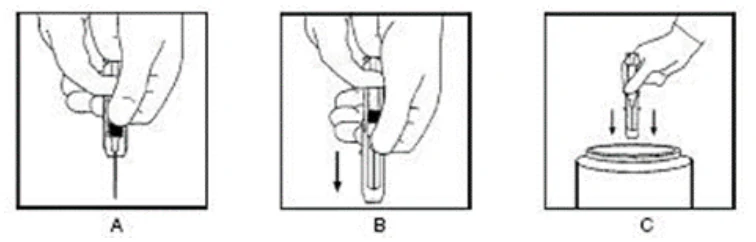
- 1. Keeping your hands away from the needle, grasp the Ultrasafe® needle guard and slide it forward towards the uncovered needle until the plastic guard completely covers the needle and clicks into place. If audible click is not heard, guard may not be completed activated. (See Diagrams A and B)
- 2. Place entire syringe with Ultrasafe® needle guard activated into an approved sharps container for proper disposal. (See Diagram C)
5 OVERDOSAGE
Although no data are available, clinical experience with other immunoglobulin preparations suggests that the only manifestations would be pain and tenderness at the injection site.
| For management of a suspected drug overdose, contact your regional poison control centre. |
6 DOSAGE FORMS, STRENGTHS, COMPOSITION AND PACKAGING
To help ensure the traceability of biologic products, including biosimilars, health professionals should recognise the importance of recording both the brand name and the non-proprietary (active ingredient) name as well as other product-specific identifiers such as the Drug Identification Number (DIN) and the batch/lot number of the product supplied.
Table – Dosage Forms, Strengths, Composition and Packaging
HyperTET® (Tetanus Immunoglobulin [Human]) is supplied as a single-use, pre-filled syringe with an attached UltraSafe® Needle Guard for your protection and convenience. Please follow instructions above for proper use of pre-filled syringe and UltraSafe® Needle Guard.
Each HyperTET® pre-filled syringe contains 250 Antitoxin Units (AU) in 1 mL, and the sterile solution appears clear or slightly opalescent, and colorless or pale yellow or light brown. HyperTET® contains no preservative and is latex-free.
Description
HyperTET® (Tetanus Immunoglobulin [Human]) is a clear or slightly opalescent, and colorless or pale yellow or light brown sterile solution of human tetanus immunoglobulin for intramuscular administration; it contains no preservative and is supplied as a single dose of 250 Antitoxin Units (AU) in a pre-filled syringe. HyperTET® is prepared from pools of human plasma collected from healthy donors by a combination of cold ethanol fractionation, caprylate precipitation and filtration, caprylate incubation, anion-exchange chromatography, nanofiltration and low pH incubation. HyperTET® consists of 15–18% protein solution at a pH of 4.1 - 4.8 in 0.16 - 0.26 M glycine. The product is standardized against the U.S. Standard Antitoxin and the U.S. Control Tetanus Toxin and contains not less than 250 tetanus antitoxin units per mL.
7 WARNINGS AND PRECAUTIONS
Please see the Serious Warnings and Precautions Box at the beginning of Part I: Health Professional Information.
General
HyperTET® (Tetanus Immunoglobulin [Human]) is made from human plasma and may carry a risk of transmitting infectious agents, e.g. such as viruses, the variant Creutzfeldt-Jakob disease (vCJD) agent, and, theoretically, the Creutzfeldt-Jakob disease (CJD) agent, despite steps designed to reduce this risk. HyperTET® is purified from human plasma obtained from healthy donors. When medicinal biological products are administered, infectious diseases due to transmission of pathogens cannot be totally excluded. However, in the case of products prepared from human plasma, the risk of transmission of pathogens is reduced by: (1)
| Route of Administration | Dosage Form / Strength/Composition | Non-medicinal Ingredients |
| Intramuscular injection | Injectable solution; 15-18% protein, containing 250 antitoxin units (AU) in 1 mL | glycine |
epidemiological controls on the donor population and selection of individual donors by a medical interview; (2) screening of individual donations and plasma pools for viral infection markers; and (3) manufacturing procedures with demonstrated capacity to inactivate/remove pathogens.
ALL infections thought by a physician possibly to have been transmitted by this product should be reported by the physician or other healthcare provider to Grifols Canada Ltd. at 1-866-482-5226.
The physician should discuss the risks and benefits of this product with the patient, before prescribing or administering it to the patient.
HyperTET® should not be administered intravenously because of the potential for serious reactions (see Hypersensitivity Reactions).
Chemoprophylaxis against tetanus is neither practical nor useful in managing wounds. Wound cleaning, debridement when indicated, and proper immunization are important. The need for tetanus toxoid (active immunization), with or without TIG (passive immunization), depends on both the condition of the wound and the patient's vaccination history. Rarely has tetanus occurred among persons with documentation of having received a primary series of toxoid injections. See table under Recommended Dose and Dosage Adjustment.
Skin tests should not be done. The intradermal injection of concentrated IgG solutions often causes a localized area of inflammation which can be misinterpreted as a positive allergic reaction. In actuality, this does not represent an allergy; rather, it is localized tissue irritation. Misinterpretation of the results of such tests can lead the physician to withhold needed human antitoxin from a patient who is not actually allergic to this material. True allergic responses to human IgG given in the prescribed intramuscular manner are rare.
Hematologic
In patients who have severe thrombocytopenia or any coagulation disorder that would contraindicate intramuscular injections HyperTET® should be given only if the expected benefits outweigh the risks.
Hypersensitivity Reactions
HyperTET® should be given with caution to patients with a history of prior systemic allergic reactions following the administration of human immunoglobulin preparations. Although systemic reactions to intramuscular immunoglobulin preparations are rare, epinephrine should be available for treatment of acute anaphylactic reactions.
Systemic Reactions
Inject intramuscularly only. Do not administer HyperTET® intravenously because of the potential for serious reactions (e.g., Renal Dysfunction/Failure, Hemolysis, Transfusion-Related Acute Lung Injury [TRALI]). Do not inject into a blood vessel.
7.1 Special Populations
7.1.1 Pregnant Women
There are no data with HyperTET® use in pregnant women to inform a drug-associated risk. Animal reproduction studies have not been conducted with HyperTET®. It is also not known whether HyperTET® can cause fetal harm when administered to a pregnant woman or can affect reproduction capacity. HyperTET® should be given to a pregnant woman only if clearly needed.
7.1.2 Breast-feeding
There is no information regarding the presence of HyperTET® in human milk, the effect on the breastfed infant, or the effects on milk production. The developmental and health benefits of breastfeeding should be considered along with the mother’s clinical need for HyperTET® and any potential adverse effects on the breastfed infant from HyperTET® or from the underlying maternal condition.
7.1.3 Pediatrics
Safety and effectiveness in the pediatric population have not been established.
7.1.4 Geriatrics
Safety and effectiveness in geriatric population have not been established.
8 ADVERSE REACTIONS
8.1 Adverse Reaction Overview
Slight soreness at the site of injection and slight temperature elevation may be noted at times, as well as rash and pruritus. Sensitization to repeated injections of human immunoglobulin is extremely rare. In the course of routine injections of large numbers of persons with immunoglobulin there have been a few isolated occurrences of angioneurotic edema, nephrotic syndrome, and anaphylactic shock after injection
8.5 Post-Market Adverse Reactions
The following adverse reactions have been identified during post-approval use with HyperTET® (Tetanus Immunoglobulin [Human]) made using the previous solvent/detergent manufacturing process (HyperTET® S/D). Because these reactions are reported voluntarily from a population of uncertain size, it is not always possible to reliably estimate their frequency or establish a causal relationship to drug exposure.
Anaphylactic reactions, although rare, have been reported following the injection of human immunoglobulin preparations.
The following have been identified as the most frequently reported post-marketing adverse reactions.
| General disorders and administration site conditions: | Injection site reaction*, fatigue, pyrexia |
| Immune system disorders | Anaphylactic reaction**, hypersensitivity** |
| Nervous system disorders | Headache |
| Gastrointestinal disorders | Nausea |
* These reactions have been manifested by pain, inflammation, and hemorrhage
** These reactions have been manifested by rash, flushing, angioedema, urticaria and dyspnea
9 DRUG INTERACTIONS
9.4 Drug-Drug Interactions
Antibodies in immunoglobulin preparations may interfere with the response to live viral vaccines such as measles, mumps, polio, and rubella. Therefore, use of such vaccines should be deferred until approximately 3 months after HyperTET® (Tetanus immunoglobulin [Human]) administration.
No interactions with other products are known.
10 CLINICAL PHARMACOLOGY
10.1 Mechanism of Action
HyperTET® (Tetanus Immunoglobulin (Human)) supplies passive immunity to those individuals who have low or no immunity to the toxin produced by the tetanus organism, Clostridium tetani. The antibodies act to neutralize the free form of the powerful exotoxin produced by this bacterium.
10.2 Pharmacodynamics
Several studies suggest the value of human tetanus antitoxin in the treatment of active tetanus. In 1961 and 1962, Nation et al, using HyperTET® (Tetanus Immunoglobulin [Human]) treated 20 patients with tetanus using single doses of 3,000 to 6,000 antitoxin units in combination with other accepted clinical and nursing procedures. Six patients, all over 45 years of age, died of causes other than tetanus. The authors felt that the mortality rate (30%) compared favourably with their previous experience using equine antitoxin in larger doses and that the results were much better than the 60% national death rate for tetanus reported from 1951 to 1954. Blake et al, however, found in a data analysis of 545 cases of tetanus reported to the Centers for Disease Control from 1965 to 1971 that survival was no better with 8,000 units of human tetanus immunoglobulin (TIG) than with 500 units; however, an optimal dose could not be determined.
Serologic tests indicate that naturally acquired immunity to tetanus toxin does not occur in the United States. Thus universal primary vaccination, with subsequent maintenance of adequate antitoxin levels by means of appropriately timed boosters, is necessary to protect persons among all age groups. Tetanus toxoid is a highly effective antigen; a completed primary series generally induces protective levels of serum antitoxin that persist for ≥ 10 years.
Passive immunization with HyperTET® may be undertaken concomitantly with active immunization using tetanus toxoid in those persons who must receive an immediate injection of tetanus antitoxin and in whom it is desirable to begin the process of active immunization. Based on the work of Rubbo, McComb and Dwyer, and Levine et al, the physician may thus supply immediate passive protection against tetanus, and at the same time begin formation of active immunization in the injured individual.
10.3 Pharmacokinetics
Peak blood levels of IgG are obtained approximately 2 days after intramuscular injection. The half-life of IgG in the circulation of individuals with normal IgG levels is approximately 23 days.
In a clinical study of 12 healthy human subjects receiving a 20 IU/kg intramuscular dose of HyperRAB® (Rabies Immunoglobulin [Human]), detectable passive rabies neutralizing antibody was present by the second day and persisted through the 21 day follow-up evaluation period. HyperRAB® is manufactured via the same process, using the same controls as HyperTET®, except that the starting material (plasma) has a higher titer of rabies antibody, versus tetanus antitoxin. The figure below shows the mean levels of rabies virus antibodies in IU/mL across the 21 day evaluation period and indicates that the titer remains stable during this period.
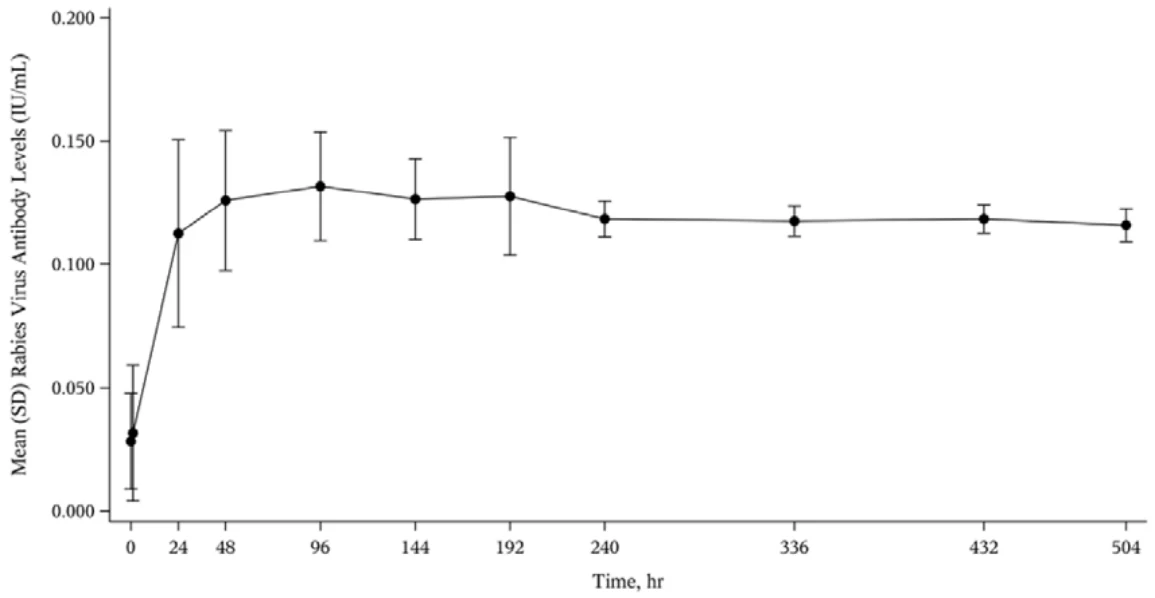
Figure: Mean (Standard Deviation) Rabies Virus Antibody Levels (IU/mL) versus Time following a Single 20 IU/kg Dose of HyperRAB® by Intramuscular Injection
11 STORAGE, STABILITY AND DISPOSAL
HyperTET® (Tetanus Immunoglobulin [Human]) should be stored at 2–8°C. Do not freeze. Solution that has been frozen should not be used. Do not use beyond expiration date. Discard unused portion.
12 SPECIAL HANDLING INSTRUCTIONS
Not Applicable.
PART II: SCIENTIFIC INFORMATION
13 PHARMACEUTICAL INFORMATION
Drug Substance
Proper name: HyperTET®
Common name: Tetanus Immunoglobulin (Human)
Product Characteristics:
HyperTET® is a clear or slightly opalescent, and colorless or pale yellow or light brown sterile solution of human antitetanus immunoglobulin for intramuscular administration. HyperTET® contains no preservative. HyperTET® is prepared from pools of human plasma collected from healthy donors (hyperimmunized with tetanus vaccine) by a combination of cold ethanol fractionation, caprylate precipitation and filtration, caprylate incubation, anion-exchange chromatography, nanofiltration and low pH incubation. HyperTET® consists of 15 to 18% protein at pH 4.1 to 4.8 in 0.16 to 0.26 M glycine. The product is standardized against the U.S. Standard Antitoxin and the U.S. Control Tetanus Toxin and contains not less than 250 tetanus antitoxin units in 1 mL.
Viral Inactivation
When medicinal biological products are administered, infectious diseases due to transmission of pathogens cannot be totally excluded. However, in the case of products prepared from human plasma, the risk of transmission of pathogens is reduced by epidemiological surveillance of the donor population and selection of individual donors by medical interview; testing of individual donations and plasma pools; and the presence in the manufacturing processes of steps with demonstrated capacity to inactivate/remove pathogens.
In the manufacturing process of HyperTET®, there are several steps with the capacity for viral inactivation or removal. The main steps of the manufacturing process that contribute to the virus clearance capacity are as follows:
- Caprylate precipitation/depth filtration
- Caprylate incubation
- Depth filtration
- Column chromatography
- Nanofiltration
- Low pH final container incubation
To provide additional assurance of the pathogen safety of the final product, the capacity of the HyperTET® manufacturing process to remove and/or inactivate viruses has been demonstrated by laboratory spiking studies on a scaled down process model using a wide range of viruses with diverse physicochemical properties.
The combination of all of the above mentioned measures provides the final product with a high margin of safety from the potential risk of transmission of infectious viruses.
The caprylate/chromatography manufacturing process was also investigated for its capacity to decrease the infectivity of an experimental agent of transmissible spongiform encephalopathy (TSE), considered as a model for the variant Creutzfeldt-Jakob disease (vCJD), and Creutzfeldt-Jakob disease (CJD) agents. These studies provide reasonable assurance that low levels of vCJD/CJD agent infectivity, if present in the starting material, would be removed by the caprylate/chromatography manufacturing process.
14 CLINICAL TRIALS
Though formal safety and efficacy trials have not been conducted with HyperTET®, the clinical effectiveness of Tetanus Immunoglobulin (Human) is well established. Please refer to the most recent edition of the Canadian Immunization Guide for information regarding efficacy and safety.
15 MICROBIOLOGY
No microbiological information is required for this drug product.
16 NON-CLINICAL TOXICOLOGY
Not Applicable.