


Product Monograph - Kimmtrak
RECENT MAJOR LABEL CHANGES
| Not applicable. |
TABLE OF CONTENTS
RECENT MAJOR LABEL CHANGES............................................................................................ 2
TABLE OF CONTENTS .............................................................................................................. 2
PART I: HEALTH PROFESSIONAL INFORMATION ..................................................................... 4
1 INDICATIONS .............................................................................................................. 4
1.1 Pediatrics .............................................................................................................. 4
1.2 Geriatrics............................................................................................................... 4
2 CONTRAINDICATIONS ................................................................................................. 4
3 SERIOUS WARNINGS AND PRECAUTIONS BOX ............................................................ 4
4 DOSAGE AND ADMINISTRATION................................................................................. 4
4.1 Dosing Considerations ........................................................................................... 4
4.2 Recommended Dose and Dosage Adjustment ........................................................ 5
4.3 Reconstitution ....................................................................................................... 8
4.4 Administration..................................................................................................... 10
4.5 Missed Dose ........................................................................................................ 10
5 OVERDOSAGE ........................................................................................................... 10
6 DOSAGE FORMS, STRENGTHS, COMPOSITION AND PACKAGING ............................... 11
7 WARNINGS AND PRECAUTIONS ................................................................................ 11
7.1 Special Populations.............................................................................................. 12
7.1.1 Pregnant Women ....................................................................................... 12
7.1.2 Breast-feeding............................................................................................ 13
7.1.3 Pediatrics ................................................................................................... 13
7.1.4 Geriatrics ................................................................................................... 13
8 ADVERSE REACTIONS ................................................................................................ 13
8.1 Adverse Reaction Overview ................................................................................. 13
8.2 Clinical Trial Adverse Reactions ............................................................................ 14
8.2.1 Clinical Trial Adverse Reactions – Pediatrics ....................................................... 16
8.3 Less Common Clinical Trial Adverse Reactions (occurring in ˂10% and ≥ 1% of
Patients with Metastatic Uveal Melanoma in Study 202) ............................................ 17
8.3.1 Less Common Clinical Trial Adverse Reactions – Pediatrics ................................ 17
8.4 Abnormal Laboratory Findings: Hematologic, Clinical Chemistry and Other Quantitative Data ...................................................................................................... 17
8.5 Post-Market Adverse Reactions............................................................................ 18
9 DRUG INTERACTIONS................................................................................................ 18
9.2 Drug Interactions Overview.................................................................................. 18
9.4 Drug-Drug Interaction .......................................................................................... 19
9.5 Drug-Food Interactions ........................................................................................ 19
9.6 Drug-Herb Interactions ........................................................................................ 19
9.7 Drug-Laboratory Test Interactions........................................................................ 19
10 CLINICAL PHARMACOLOGY ....................................................................................... 19
10.1 Mechanism of Action ......................................................................................... 19
10.2 Pharmacodynamics............................................................................................ 19
10.3 Pharmacokinetics .............................................................................................. 19
11 STORAGE, STABILITY AND DISPOSAL ......................................................................... 21
12 SPECIAL HANDLING INSTRUCTIONS........................................................................... 21
PART II: SCIENTIFIC INFORMATION ...................................................................................... 22
13 PHARMACEUTICAL INFORMATION............................................................................ 22
14 CLINICAL TRIALS........................................................................................................ 22
14.1 Clinical Trials by Indication ................................................................................. 22
14.2 Immunogenicity................................................................................................. 24
15 MICROBIOLOGY ........................................................................................................ 25
16 NON-CLINICAL TOXICOLOGY ..................................................................................... 25
PATIENT MEDICATION INFORMATION ................................................................................. 26
PART I: HEALTH PROFESSIONAL INFORMATION
1 INDICATIONS
KIMMTRAK (tebentafusp) is indicated for:
- the treatment of human leukocyte antigen (HLA)-A*02:01-positive adult patients with unresectable or metastatic uveal melanoma.
1.1 Pediatrics
Pediatrics (˂ 18 years of age): No data are available to Health Canada; therefore, Health Canada has not authorized an indication for pediatric use.
1.2 Geriatrics
Geriatrics (≥ 65 years of age): Of the 410 patients with metastatic uveal melanoma treated with KIMMTRAK, 175 (43%) were 65 years of age and older and 38 (9%) were 75 years of age and older. Evidence from clinical studies suggests that use in the geriatric population is associated with no overall differences in safety or effectiveness.
2 CONTRAINDICATIONS
KIMMTRAK is contraindicated in patients who are hypersensitive to this drug or to any ingredient in the formulation, including any non-medicinal ingredient, or component of the container. For a complete listing, see DOSAGE FORMS, STRENGTHS, COMPOSITION AND PACKAGING.
3 SERIOUS WARNINGS AND PRECAUTIONS BOX
SERIOUS Warnings and Precautions
Cytokine Release Syndrome (CRS), which may be serious or life-threatening, occurred in patients receiving KIMMTRAK. Monitor for at least 16 hours following the first three infusions and then clinically as indicated. (see DOSAGE AND ADMINISTRATION and WARNINGS AND PRECAUTIONS) |
4 DOSAGE AND ADMINISTRATION
4.1 Dosing Considerations
- A positive HLA-A*02:01 genotype status is required for the selection of patients for treatment with KIMMTRAK [see WARNINGS AND PRECAUTIONS].
- To minimize the risk of hypotension associated with cytokine release syndrome, administer intravenous fluids prior to starting KIMMTRAK based on clinical evaluation and the volume status of the patient [see WARNINGS AND PRECAUTIONS].
- For patients with pre-existing adrenal insufficiency on maintenance systemic corticosteroids, consider adjusting the corticosteroid dose given the risk of hypotension [see WARNINGS AND PRECAUTIONS].
4.2 Recommended Dose and Dosage Adjustment
Recommended Dose
The recommended dosage of KIMMTRAK administered intravenously is:
- 20 mcg on Day 1
- 30 mcg on Day 8
- 68 mcg on Day 15
- 68 mcg once every week thereafter
Treat patients until unacceptable toxicity or disease progression occur.
Administer the first three infusions of KIMMTRAK in an appropriate healthcare setting by intravenous infusion over 15-20 minutes. Monitor patients during the infusion and for at least 16 hours after the infusion is complete.
If the patient does not experience Grade 2 or worse hypotension (requiring medical intervention) during or after the third infusion, administer subsequent doses in an appropriate ambulatory care setting, and monitor patients for a minimum of 30 minutes following each of these infusions [see WARNINGS AND PRECAUTIONS].
Dosage Adjustment
Cytokine Release Syndrome (CRS)
Identify CRS based on clinical presentation [see WARNINGS AND PRECAUTIONS]. Evaluate for and treat other causes of fever, hypoxia and hypotension. If CRS is suspected, continue monitoring until resolution and manage according to recommendations in Table 1.
Table 1: Recommended Management and Dose Modifications for Cytokine Release Syndrome (CRS)
| CRS Grade* | Management |
Grade 1 Temperature ≥ 38°C No hypotension or hypoxia | Treat for symptoms as appropriate. Monitor for escalation in CRS severity |
Grade 2 Temperature ≥ 38°C WITH Hypotension that responds to fluids and does not require vasopressors. OR Oxygen requirement includes low flow nasal cannula (delivery of oxygen ≤ 6L/min) or blow- | Symptom management as per Grade 1 in addition to the following measures: Administer bolus intravenous fluids as needed for hypotension Manage oxygen requirement with supplemental oxygen and additional respiratory support as needed. Increase monitoring to determine resolution or |
| by | escalation in severity If Grade 2 CRS symptoms do not rapidly improve to Grade ≤1 within 2–3 hours, then treat as Grade 3. (For the subsequent dose, administer corticosteroid premedication (e.g. dexamethasone 4mg or equivalent) at least 30 minutes prior to next dose.) |
Grade 3 Temperature ≥ 38°C AND Require a vasopressor with or without vasopressin OR Require high flow nasal cannula (delivery of oxygen > 6L/min), face mask or non-rebreather mask or Venturi mask | Management per Grade 2 and include the following measures: Withhold KIMMTRAK until CRS and sequelae have resolved Administer intravenous corticosteroid (e.g., 2 mg/kg/day methylprednisolone or equivalent) Resume KIMMTRAK at same dose level (i.e., do not escalate if severe CRS occurred during initial dose escalation; resume escalation once dosage is tolerated) For Grade3 CRS, administer corticosteroid premedication (e.g. dexamethasone 4 mg or equivalent) at least 30 minutes prior to next dose Consider administering tocilizumab |
Grade 4 Temperature ≥ 38°C Require multiple vasopressors (excluding vasopressin) Requiring positive pressure (e.g. CPAP, BiPAP, intubation and mechanical ventilation) | Discontinue KIMMTRAK Administer intravenous corticosteroid (e.g., 2 mg/kg/day methylprednisolone or equivalent) Consider administering tocilizumab |
*Based on ASTCT consensus grading of CRS criteria (Lee et.al 2019)1
Acute Skin Reactions
Recommended management and dose modifications for acute skin reactions is provided in Table 2.
1 Lee W, Santomasso BD, Locke FL, et al. ASTCT consensus grading for cytokine release Syndrome and neurologic toxicity associated with immune effector cells. Biol Blood Marrow Transplant. 2019;25:625-38.
Table 2: Recommended Management and Dose Modifications for Acute Skin Reactions
| Adverse Reactions | Severity of Adverse Reaction | Management |
|---|---|---|
Acute Skin Reactions [See WARNINGS AND PRECAUTIONS] | Grade 2 or 3* (Moderate to Severe) | Withhold KIMMTRAK until < Grade 1 or baseline Use local skin management and systemic antihistamine regimen and oral steroids where required. For persistent reactions not responding to oral steroids, consider intravenous corticosteroid (e.g., 2 mg/kg/day methylprednisolone or equivalent) Resume KIMMTRAK at same dose level (i.e., do not escalate if Grade 3 skin reactions occurred during initial dose escalation; resume escalation once dosage is tolerated) |
Grade 4* (Life Threatening) | Permanently discontinue KIMMTRAK Administer intravenous corticosteroid (e.g., 2 mg/kg/day methylprednisolone or equivalent) | |
Elevated Liver Enzymes [See WARNINGS AND PRECAUTIONS] | Grade 3 or 4* | Withhold KIMMTRAK until ≤ Grade 1 or baseline. Resume KIMMTRAK at same dose level if the elevated liver enzymes occur in the setting of Grade 3 CRS; resume escalation if next administration is tolerated. If the elevated liver enzymes occur outside the setting of Grade 3 CRS
Administer intravenous corticosteroids if no improvement within 24 hours |
| Adverse Reactions | Severity of Adverse Reaction | Management |
|---|---|---|
| Other Adverse Reactions | Grade 3* | Withhold KIMMTRAK until ≤ Grade 1 or baseline Resume KIMMTRAK at same dose level (i.e., do not escalate if other Grade 3 adverse reaction occurred during initial dose escalation; resume escalation once dosage is tolerated) |
| Grade 4 * | Permanently discontinue KIMMTRAK |
*Based on National Cancer Institute Common Terminology Criteria for Adverse Events (CTCAE) version 4.03 (NCI CTCAEv4.03).
4.3 Reconstitution
KIMMTRAK must be diluted prior to intravenous administration. Each vial of KIMMTRAK is intended for use as single-dose only. Do not shake the vial.
Ensure the following are available prior to preparing KIMMTRAK for administration:
- 1 mL sterile syringes with graduations of 2 decimal places
- Sterile needles
- Albumin (Human); use concentration as per local availability. Examples include but are not restricted to the following strengths 5%, 20% or 25%
A 100 mL 0.9% Sodium Chloride Injection, USP infusion bag
- The infusion bag should be constructed of polyolefins (PO) [such as polyethylene (PE) and polypropylene (PP)] or polyvinyl chloride (PVC)
- A sterile, non-pyrogenic, low protein binding 0.2 micron in-line filter infusion set for administration of the final infusion bag.
Parenteral drug products and infusion bags should be inspected visually for particulate matter and discoloration prior to administration, whenever solution and container permit. Use aseptic technique for dilution and preparation of dosing solutions. Closed system transfer devices (CSTDs) must not be used for dose preparation of KIMMTRAK solution for infusion.
A two-step process is required for preparation of the final KIMMTRAK dose:
- 1. Step 1: Prepare the infusion bag:
Use aseptic technique, prepare the infusion bag as follows:
- a. Using a 1 mL syringe and a sterile needle, withdraw the calculated volume of Albumin (Human) (into the syringe (see Table 3 below) and add to 100 mL 0.9% Sodium Chloride Injection, USP bag to make a final Albumin (Human) concentration between 225 mcg /mL and 275 mcg /mL.
Table 3: Dilution – Examples of Albumin (Human) Concentration and Acceptable Withdrawal Volumes
| Vial Size | Volume (range) of Diluent to be Added to Vial | Approximate Available Volume (range) | Concentration per mL |
| 2 mL | 0.50 mL (0.45 mL - 0.55 mL) of 5 % (50 g/L) Albumin (Human) | 0.50 mL (0.45 mL – 0.55 mL) | 225 mcg/mL - 275 mcg/mL |
| 0.13 mL (0.12 mL - 0.14 mL) of 20% (200 g/L) Albumin (Human) | 0.13 mL (0.12 mL – 0.14 mL) | ||
| 0.10 mL (0.09 mL - 0.11 mL) of 25% (250 g/L) Albumin (Human) | 0.10 mL (0.09 mL – 0.11 mL) | ||
b. Gently homogenize the diluted solution by completing the following steps:
- i. Invert the infusion bag so that the entry port is positioned at the top of the bag and tap the side of port tubing to ensure that any residual solution is released into the bulk solution.
- ii. Mix by gently rotating the bag lengthwise at least 5 times. Do not shake the infusion bag.
- iii. Repeat (i) and (ii) an additional three times.
- Step 2: Preparation of KIMMTRAK solution for infusion
- a. Using a 1 mL syringe and a sterile needle, withdraw the required volume of KIMMTRAK 100 mcg/ 0.5 mL as per the dose required (shown in Table 4 below) and add to the prepared 100 mL infusion bag containing 0.9% Sodium Chloride Injection, USP plus Albumin (Human).
- b. Do NOT flush the needle and syringe on transfer. Discard the vial containing the unused portion of KIMMTRAK [see STORAGE, STABIILTY AND DISPOSAL and SPECIAL HANDLING INSTRUCTIONS]. Do not prepare more than one dose from the vial.
Table 4: KIMMTRAK (tebentafusp) Volumes Required for Addition to Infusion Bag
| Day of treatment | Dose (mcg) of KIMMTRAK | Volume (mL) of KIMMTRAK |
| Day 1 | 20 | 0.10 |
| Day 8 | 30 | 0.15 |
| Day 15 and weekly thereafter | 68 | 0.34 |
- c. Mix the infusion bag by following the same procedure outlined in Step 1b.
Important Preparation Instructions
KIMMTRAK does not contain a preservative. The prepared infusion bag should be administered
- within 4 hours from the time of preparation including the duration of infusion. During the 4-hour window, the KIMMTRAK infusion bag should remain at room temperature.
- If not used immediately, store the KIMMTRAK reconstituted infusion bag in a refrigerator at 2°C to 8°C for up to 24 hours from the time of preparation. This includes the time allowed for equilibration of the infusion bag to room temperature and the duration of the infusion.
- Once removed from the refrigerator, KIMMTRAK infusion bag must not be refrigerated again. Do not freeze. Discard unused KIMMTRAK solution beyond the recommended storage time [see STORAGE, STABILITY AND DISPOSAL].
4.4 Administration
- Immediately administer the diluted solution via intravenous infusion over 15-20 minutes through a dedicated intravenous line. A sterile, non-pyrogenic, low protein binding 0.2 micron in-line filter infusion set should be used. Administer the entire contents of the KIMMTRAK infusion bag.
- Administer the prepared infusion bag within 4 hours from the time of preparation including the duration of infusion. During the 4-hour window, the KIMMTRAK infusion bag should remain at room temperature.
- If not used immediately, store the KIMMTRAK infusion bag in a refrigerator at 2°C to 8°C and infuse within 24 hours from the time of preparation, which includes the storage time in the refrigerator, the time allowed for equilibration of the infusion bag to room temperature, and the duration of the infusion.
- Once removed from the refrigerator, do not refrigerate KIMMTRAK infusion bag again. Do not freeze. Discard unused KIMMTRAK solution beyond the recommended storage time.
- Do not mix KIMMTRAK with other drugs or administer other drugs through the same intravenous line.
- Upon completion of KIMMTRAK infusion, flush the infusion line with adequate volume of sterile 0.9% Sodium Chloride Injection, USP to ensure that the entire contents of the infusion bag are administered.
4.5 Missed Dose
If a dose of KIMMTRAK is missed, reschedule patient for immediate administration. Subsequent doses should not be administered less than 1 week apart.
5 OVERDOSAGE
There is no known specific antidote for KIMMTRAK overdose. In the event of suspected overdose, interrupt KIMMTRAK, undertake general supportive measures, and observe until clinical stabilization.
| For management of a suspected drug overdose, contact your regional poison control centre. |
6 DOSAGE FORMS, STRENGTHS, COMPOSITION AND PACKAGING
Table 5: Dosage Forms, Strengths, Composition and Packaging
KIMMTRAK (tebentafusp) is supplied in a single-dose vial as a sterile, preservative-free, clear, colorless or slightly yellowish solution for intravenous administration by infusion.
7 WARNINGS AND PRECAUTIONS
Immune
Cytokine Release Syndrome
Cytokine release syndrome (CRS), which may be life threatening, occurred in patients receiving KIMMTRAK. Manifestations of CRS may include fever, hypotension, hypoxia, chills, nausea, vomiting, rash, elevated transaminases, fatigue, and headache. CRS (≥ Grade 2) occurred in 77% of patients in Study IMCgp100-202 who received KIMMTRAK [see ADVERSE REACTIONS]. Among patients who received KIMMTRAK, 23% received systemic corticosteroids for at least 1 infusion, 8% received supplemental oxygen during at least 1 infusion, and 0.8% received a vasopressor for at least 1 infusion. CRS led to permanent discontinuation in 1.2% of patients.
In Study IMCg100-202, 60% of patients experienced ≥ Grade 2 CRS with more than 1 infusion, with the median number of events being 2 (range 1 - 12). The majority (84%) of episodes of CRS started the day of infusion. Among cases that resolved, the median time to resolution of CRS was 2 days.
Ensure that healthcare providers administering KIMMTRAK have immediate access to medications and resuscitative equipment to manage CRS. Ensure patients are euvolemic prior to initiating the infusions. Closely monitor patients for signs or symptoms of CRS following infusions of KIMMTRAK [see DOSAGE AND ADMINISTRATION]. Monitor fluid status, vital signs, and oxygenation level and provide appropriate therapy. Withhold or discontinue KIMMTRAK depending on persistence and severity of CRS [see DOSAGE AND ADMINISTRATION].
Monitoring and Laboratory Tests
Patients treated with KIMMTRAK must have a positive HLA-A*02:01 genotype status using a validated HLA sequencing system.
Elevations in liver enzymes occurred in patients treated with KIMMTRAK. Monitor ALT, AST, and total bilirubin.
Reproductive Health: Female and Male Potential
There is no available data with KIMMTRAK in pregnant woman [see 7.1 Special Populations, Pregnant Women]
Fertility
There is no available data on effect of KIMMTRAK on fertility. Advise female of reproductive
| Route of Administration | Dosage Form / Strength/Composition | Non-medicinal Ingredients |
| Intravenous infusion | 100 mcg /0.5 mL tebentafusp solution | Citric acid monohydrate, disodium hydrogen phosphate, mannitol, polysorbate 20, trehalose, and water for injection |
potential to use effective contraception during treatment with KIMMTRAK and for 1 week following the last dose of KIMMTRAK.
Verify pregnancy status in females of reproductive potential prior to initiating KIMMTRAK treatment.
Teratogenic Risk
No animal reproductive and developmental toxicity studies have been conducted with KIMMTRAK to assess whether it can cause fetal harm when administered to a pregnant woman. It is not known if KIMMTRAK has the potential to be transferred to the fetus.
Advise women of the potential risk to fetus.
Acute Skin Reactions
Skin reactions, including rash, pruritus, erythema and cutaneous edema occurred in patients treated with KIMMTRAK. In study IMCgp100-202, skin reactions occurred in 91% of patients treated with KIMMTRAK, including Grade 2 (44%) and Grade 3 (21%) events. Skin reactions included rash (83%), pruritus (69%), erythema (25%), and cutaneous edema (27%) [see ADVERSE REACTIONS].
The median time to onset of skin reactions was 1 day (range: 1 – 55 days). The median time to improvement to ≤ Grade 1 was approximately 6 days.
Monitor patients for skin reactions. If skin reactions occur, treat with antihistamine and topical or systemic steroids based on persistence and severity of symptoms. Withhold or permanently discontinue KIMMTRAK depending on the severity of skin reactions [see DOSAGE AND ADMINISTRATION].
Elevated Liver Enzymes
In Study IMCgp100-202, increases in alanine aminotransferase or aspartate aminotransferase were observed in 65% of patients treated with KIMMTRAK.
In patients experiencing ALT/AST elevations, 73% initially occurred within the first 3 infusions with KIMMTRAK. Most patients experiencing Grade 3 or 4 ALT/AST elevations had improvement to ≤ Grade 1 within 7 days. For events that were observed outside the setting of CRS, the median time to onset was 129 days. Grade 3 or greater elevations in liver enzymes outside the setting of CRS occurred in approximately 8% of patients.
Elevations in liver enzymes led to permanent discontinuation in 0.4% of patients receiving KIMMTRAK. Monitor alanine aminotransferase (ALT), aspartate aminotransferase (AST), and total blood bilirubin prior to the start of and during treatment with KIMMTRAK. Withhold KIMMTRAK according to severity [see DOSAGE AND ADMINISTRATION].
7.1 Special Populations
7.1.1 Pregnant Women
There is no available clinical data with KIMMTRAK in pregnant woman.
No animal reproductive and developmental toxicity studies have been conducted with KIMMTRAK to assess whether it can cause fetal harm when administered to a pregnant woman. It is not known if KIMMTRAK has the potential to be transferred to the fetus.
Advise women of the potential risk to fetus.
7.1.2 Breast-feeding
There is no information regarding the presence of KIMMTRAK in human milk, the effect on the breastfed infant, and the effects on milk production. The developmental and health benefits of breastfeeding should be considered along with the mother’s clinical need for KIMMTRAK and any potential adverse effects on the breastfed infant from KIMMTRAK or from the underlying maternal condition.
It is unknown if KIMMTRAK (tebentafusp) is excreted in human milk. Precaution should be exercised because many drugs can be excreted in human milk.
7.1.3 Pediatrics
No data are available to Health Canada; therefore, Health Canada has not authorized an indication for pediatric use.
7.1.4 Geriatrics
Of the 245 patients with metastatic uveal melanoma treated with KIMMTRAK on IMCgp100-202, 47% were 65 years of age and older and 9% were 75 years of age and older. No overall differences in safety or efficacy were observed between patients ≥ 65 years of age compared to younger adult patients.
8 ADVERSE REACTIONS
8.1 Adverse Reaction Overview
The safety of KIMMTRAK was evaluated in study IMCgp100-202 (study 202), a randomized, open-label, active-controlled trial in 378 systemic therapy naive patients with metastatic uveal melanoma [see CLINICAL TRIALS]. Patients were randomized to receive either KIMMTRAK or investigator’s choice treatment (pembrolizumab, ipilimumab or dacarbazine).
The most common adverse reactions (≥ 30 %) in patients treated with KIMMTRAK were cytokine release syndrome, rash, pyrexia, pruritus, fatigue, nausea, chills, hypo/hyperpigmentation, abdominal pain, edema, hypotension, dry skin, headache and vomiting.
Serious adverse reactions occurred in 28% of patients who received KIMMTRAK. Serious adverse reactions occurring in ≥ 2% of patients were cytokine release syndrome (10%), rash (4.5%), pyrexia (2.4%), and hypotension (2%). One patient (0.4%) experienced a fatal adverse reaction (pulmonary embolism).
Adverse reactions led to permanent discontinuation in 3.3% of patients who received KIMMTRAK and in 6.3% of patients who received investigator’s choice treatment. Adverse reactions that led to permanent discontinuation of KIMMTRAK were anaphylactic reaction, brain edema, cytokine release syndrome, fatigue, hepatotoxicity, hypotension, and nausea (each 0.4%).
Adverse reactions resulting in dosage interruption occurred in 25% of patients who received KIMMTRAK and 13.5% of patients treated with investigator’s choice treatment (dosed every 3 weeks), with a median interruption duration of 14 and 21 days, respectively. Adverse reactions which required dosage interruption in ≥ 2% of patients included fatigue (3.7%), lipase increased (2.9%), pyrexia (2.4%), alanine aminotransferase increase (2%), and aspartate aminotransferase increase (2%).
Adverse reactions leading to dose reduction occurred in 5% of patients who received KIMMTRAK. Adverse reactions which required dosage reduction in ≥ 2% of patients were cytokine release syndrome (2.4%), and rash (2%).
The most common (≥50%) laboratory abnormalities in patient who received KIMMTRAK were decreased lymphocyte count, increased creatinine, increased glucose, increased AST, increased ALT, decreased hemoglobin, and decreased phosphate.
8.2 Clinical Trial Adverse Reactions
Clinical trials are conducted under very specific conditions. The adverse reaction rates observed in the clinical trials; therefore, may not reflect the rates observed in practice and should not be compared to the rates in the clinical trials of another drug. Adverse reaction information from clinical trials may be useful in identifying and approximating rates of adverse drug reactions in real-world use.
The safety of KIMMTRAK was evaluated in study IMCgp100-202 (study 202), a randomized, open-label, active-controlled trial in 378 systemic therapy naive patients with metastatic uveal melanoma [see CLINICAL TRIALS]. Patients were randomized (2:1) to receive KIMMTRAK weekly by intravenous infusion according to the recommended intra-patient dosing regimen or Investigator’s choice treatment (pembrolizumab, ipilimumab, or dacarbazine) at the approved doses of these agents until disease progression or unacceptable toxicity [see DOSAGE AND ADMINISTRATION]. The median duration of exposure was 23 weeks in KIMMTRAK treated patients and 9 weeks with investigator’s choice treatment.
Table 6 displays the adverse reactions observed in study IMCgp100-202 (study 202).
Table 6: Adverse Reactions Reported in ≥ 10% of Patients with Metastatic Uveal Melanoma in Study IMCgp100-202 (Study 202)
KIMMTRAK n = 245 (%) | Investigator’s Choice a n = 111 (%) | ||||||||||||
|---|---|---|---|---|---|---|---|---|---|---|---|---|---|
All Grades % | Grade 3 or 4 % | All Grades % | Grade 3 or 4 % | ||||||||||
| Gastrointestinal disorders | |||||||||||||
| Abdominal pain b | 45 | 2.9 | 33 | 3.6 | |||||||||
| Nausea c | 49 | 2 | 26 | 0.9 | |||||||||
| Vomiting c | 30 | 1.2 | 9 | 0 | |||||||||
| Diarrhea | 25 | 1.2 | 20 | 2.7 | |||||||||
| Constipation | 18 | 0 | 11 | 0 | |||||||||
| General disorders and administration site conditions | |||||||||||||
| Pyrexia c | 76 | 3.7 | 7 | 0.9 | |||||||||
| Fatigue d | 64 | 5.7 | 42 | 0.9 | |||||||||
| Edema e | 45 | 0 | 10 | 0 | |||||||||
KIMMTRAK n = 245 (%) | Investigator’s Choice a n = 111 (%) |
|---|
All Grades % | Grade 3 or 4 % | All Grades % | Grade 3 or 4 % | |
|---|---|---|---|---|
| Chills c | 48 | 0.4 | 4 | 0 |
| Immune system disorders | ||||
| Cytokine release syndrome f | 89 | 0.8 | 3 | 0 |
| Metabolism and nutrition disorders | ||||
| Decreased Appetite | 18 | 0.8 | 14 | 0 |
| Musculoskeletal and connective tissue disorders | ||||
| Arthralgia | 22 | 0.8 | 16 | 0 |
| Back pain | 18 | 0.4 | 8 | 0 |
| Respiratory, thoracic and mediastinal disorders | ||||
| Cough | 18 | 0.4 | 9.9 | 0.9 |
| Dyspnoea | 13 | 0.4 | 6.3 | 0 |
| Nervous system disorders | ||||
| Headache c | 31 | 0.4 | 10 | 0.9 |
| Paraesthesia | 11 | 0 | 0.9 | 0 |
| Dizziness | 11 | 0 | 8.1 | 0.9 |
| Skin and subcutaneous tissue disorders | ||||
| Rash g | 83 | 18.4 | 28 | 0 |
| Pruritus | 69 | 4.5 | 23 | 0 |
Hypopigmentation/ Hyperpigmentation h | 47 | 0.4 | 6 | 0 |
| Dry skin | 31 | 0 | 4 | 0 |
| Erythema | 25 | 0 | 1 | 0 |
| Vascular disorders | ||||
| Hypotension c | 39 | 3.3 | 3 | 0 |
| Hypertension | 16 | 9 | 7 | 2.7 |
| Flushing | 10 | 0 | 0.9 | 0 |
KIMMTRAK n = 245 (%) | Investigator’s Choice a n = 111 (%) |
|---|
All Grades % | Grade 3 or 4 % | All Grades % | Grade 3 or 4 % | |
|---|---|---|---|---|
| Musculoskeletal and Connective Tissue Disorders | ||||
| Myalgia | 10 | 0 | 6.3 | 0 |
| Pain in extremity | 10 | 0 | 2.7 | 0 |
| Cardiovascular Disorders | ||||
| Tachycardia | 10 | 0 | 2.7 | 0 |
| Hepatobiliary Disorders | ||||
| Hyperbilirubinemia | 11 | 3.3 | 7.2 | 4.5 |
| Blood and Lymphatic System Disorders | ||||
| Anaemia | 10 | 0.4 | 3.6 | 0 |
ALT = alanine aminotransferase; AST = aspartate aminotransferase
a Investigator’s choice:
- i. Dacarbazine: 1000 mg/m2 on Day 1 of each 21-day cycle
- ii. Ipilimumab: 3 mg/kg on Day 1 of each 21-day cycle for maximum of 4 doses
- iii. Pembrolizumab: 2 mg/kg up to maximum of 200 mg or 200 mg IV, where approved locally on Day 1 of each 21 -day cycle
b Includes abdominal discomfort, abdominal pain, abdominal pain lower, abdominal pain upper, abdominal tenderness, epigastric discomfort, flank pain, gastrointestinal pain and hepatic pain
c Some of the events may be associated with CRS or may be isolated reported events
d Includes fatigue and asthenia
e Includes eye edema, eye swelling, eyelid edema, periorbital swelling, periorbital edema, swelling of eyelid, pharyngeal edema, lip edema, lip swelling, face edema, generalized edema, localized edema, edema, edema peripheral, peripheral swelling, swelling, swelling face
f CRS was adjudicated using the ASTCT consensus grading CRS criteria (Lee et.al 2019). Adjudicated CRS is provided in lieu of investigator reported CRS.
g Includes blister, dermatitis, dermatitis acneiform, dermatitis allergic, dermatitis bullous, dermatitis contact, dermatosis, drug eruption, eczema, eczema eyelids, erythema multiforme, exfoliative rash, interstitial granulomatous dermatitis, lichenification, lichenoid keratosis, palmar-plantar erythrodysaesthesia syndrome, papule, psoriasis, rash, rash erythematous, rash generalised, rash macular, rash maculo-papular, rash papular, rash pruritic, rash vesicular, seborrhoea, seborrhoeic dermatitis, skin abrasion, skin erosion, skin exfoliation, skin irritation, skin plaque, solar dermatitis, toxic skin eruption, urticaria.
h Includes achromotrichia acquired, ephelides, eyelash discolouration, eyelash hypopigmentation, hair colour changes, lentigo, pigmentation disorder, retinal depigmentation, skin depigmentation, skin discolouration, skin hyperpigmentation, skin hypopigmentation, solar lentigo, vitiligo
8.2.1 Clinical Trial Adverse Reactions – Pediatrics
Not applicable.
8.3 Less Common Clinical Trial Adverse Reactions (occurring in ˂10% and ≥ 1% of Patients with Metastatic Uveal Melanoma in Study 202)
Eye disorders: lacrimation increased (3%), ocular hyperaemia (1.6%)
Gastrointestinal Disorders: dyspepsia (8%)
General Disorders and Administrative Site Conditions: influenza like illness (7%)
Infections and Infestations: nasopharyngitis (8%)
Musculoskeletal and Connective Tissue Disorders: muscle spasms (6%), musculoskeletal chest pain (4%)
Nervous System Disorder: taste disorder (7%)
Psychiatric disorders: insomnia (9%), anxiety (5%)
Respiratory, thoracic and mediastinal disorders: hypoxia (1.6 %)
Skin and Subcutaneous Tissue Disorders: alopecia (9%), night sweats (5%)
8.3.1 Less Common Clinical Trial Adverse Reactions – Pediatrics
Not applicable.
8.4 Abnormal Laboratory Findings: Hematologic, Clinical Chemistry and Other Quantitative Data
Clinical Trial Findings
Table 7: Selected Laboratory Abnormalities (≥ 10%) Worsening from baseline in patients who received KIMMTRAK versus Investigator’s Choice
| KIMMTRAKa (N = 245) | Investigator’s Choicea (pembrolizumab, or ipilimumab, or dacarbazine) (N = 111) | |||||||||||
|---|---|---|---|---|---|---|---|---|---|---|---|---|
Grades 1-4 % | Grades 3-4 % | Grades 1-4 % | Grades 3-4 % | |||||||||
| HEMATOLOGY | ||||||||||||
| Lymphocyte count decreased | 91 | 56 | 26 | 1.8 | ||||||||
| Hemoglobin decreased | 51 | 0.8 | 20 | 0.9 | ||||||||
| Platelet count decreased | 16 | 0 | 15 | 0.9 | ||||||||
| Neutrophil count decreased | 14 | 2 | 8 | 1.8 | ||||||||
| CHEMISTRY | ||||||||||||
| Creatinine increased | 87 | 0.4 | 73 | 0 | ||||||||
| Glucose increased | 66 | 3.3 | 39 | 4.6 | ||||||||
| AST increased | 55 | 13 | 39 | 1.9 | ||||||||
| KIMMTRAKa (N = 245) | Investigator’s Choicea (pembrolizumab, or ipilimumab, or dacarbazine) (N = 111) |
|---|
Grades 1-4 % | Grades 3-4 % | Grades 1-4 % | Grades 3-4 % | |
|---|---|---|---|---|
| ALT increased | 52 | 9 | 29 | 1.8 |
| Phosphate decreased | 51 | 11 | 20 | 2 |
| Albumin decreased | 47 | 2.1 | 14 | 0.9 |
| Calcium decreased | 45 | 1.6 | 15 | 1.9 |
| Lipase increased | 37 | 15 | 28 | 6 |
| Magnesium decreased | 34 | 0 | 8 | 0 |
| Alk phos increased | 34 | 2.9 | 36 | 1.8 |
| Sodium decreased | 30 | 2.9 | 15 | 0.9 |
| Potassium increased | 29 | 1.6 | 15 | 0.9 |
| Bilirubin increased | 27 | 4.1 | 14 | 7 |
| Amylase increased | 23 | 4.1 | 18 | 1 |
| Glucose decreased | 18 | 0.4 | 4.6 | 0 |
| Potassium decreased | 17 | 0.8 | 8 | 0.9 |
| Calcium increased | 13 | 0 | 3.7 | 0 |
Alk Phos = Alkaline Phosphatase; AST=aspartate aminotransferase; ALT=alanine aminotransferase
8.5 Post-Market Adverse Reactions
Not applicable.
9 DRUG INTERACTIONS
9.2 Drug Interactions Overview
Formal drug interaction trials have not been performed with KIMMTRAK. Initiation of KIMMTRAK treatment causes transient release of cytokines that may suppress CYP450 enzymes. The highest drug-drug interaction risk is during the first 24 hours of the first three doses of KIMMTRAK in patients who are receiving concomitant CYP450 substrates, particularly those with a narrow therapeutic index. In these patients, monitor for toxicity (e.g., warfarin) or drug concentrations (e.g., cyclosporine). Adjust the dose of the concomitant drug as needed [see CLINICAL PHARMACOLOGY, 10.2 Pharmacodynamics].
9.4 Drug-Drug Interaction
Interactions with other drugs have not been established.
9.5 Drug-Food Interactions
Interactions with food have not been established.
9.6 Drug-Herb Interactions
Interactions with herbal products have not been established
9.7 Drug-Laboratory Test Interactions
Interactions with laboratory tests have not been established.
10 CLINICAL PHARMACOLOGY
10.1 Mechanism of Action
Tebentafusp is a bispecific gp100 peptide-HLA-A*02:01 directed T cell receptor CD3 T cell engager. The TCR arm binds to a gp100 peptide presented by human leukocyte antigen-A*02:01 (HLA-A*02:01) on the cell surface of uveal melanoma tumor cells.
In vitro, tebentafusp bound to HLA-A*02:01-positive uveal melanoma cells and activated polyclonal T cells to release inflammatory cytokines and cytolytic proteins, which results in direct lysis of uveal melanoma tumor cells.
10.2 Pharmacodynamics
Lymphocyte counts declined the day after the first 3 doses and returned to baseline prior to subsequent doses.
Serum levels of cytokines (IFN-γ, TNFα, IL-2, IL-6, IL-10 and IL-1RA) and chemokines (CXCL9, CXCL10, CXCL11, hepatocyte growth factor, and monocyte chemoattractant protein-1) were increased during the first three doses of KIMMTRAK with peak levels between 8 to 24 hours after treatment with KIMMTRAK and levels returned to baseline prior to subsequent doses. In subsequent treatment cycles, cytokine elevation occurred in fewer patients with lesser intensity compared to the first 3 doses.
The exposure-response relationship and time course of pharmacodynamic response for the safety and effectiveness of KIMMTRAK have not been fully characterized.
10.3 Pharmacokinetics
The pharmacokinetics of tebentafusp appear linear and dose-proportional over a dose range of 20 mcg to 68 mcg.
Table 8: Summary of KIMMTRAK Pharmacokinetic Parameters in metastatic UM population
Cmax {pg/mL} (%CV) | Cmin {pg/mL} (%CV) | Tmax {hr} (%CV) | T1/2 {hr} (%CV) | AUCa {hr*pg/mL} (%CV) | CLb {mL/hr} (%CV) | Vd {mL} (%CV) | |
Single dose mean (20 mcg) [n=xx] | 3640 (23.3) [6] | BLQ (N/A) [6] | 0.50 (0.50 – 0.50) [6] | 6.273 (5.59 – 10.1) [6] | 33030 (16.5) [6] | 605.5 (18.9) [6] | NC |
Multiple doses (68 mcg) [n=xx] | 11520 (25.8) [6] | BLQ (N/A) [6] | 0.50 (0.50 – 0.50) [6] | 7.488 (5.70 – 11.9) [6] | 109800 (23.3) [6] | 682.9 (24.5) [6] | 7563 (23.9) [6] |
BLQ = below limit of quantitation; NC = not calculable; AUC = area under the concentration-time curve; AUCinf = area under the concentration-time curve from time 0 to infinity; AUCtau = area under the concentration-time curve over the dosing interval; CL or CL0 = clearance; CLss = clearance steady state; Cmax = maximum observed concentration; t1/2 = terminal phase half-life; tmax = time of maximum observed concentration; Vz = terminal phase volume of distribution.
a Parameter presented as AUCinf for single dose and AUCtau for multiple doses
b Parameter presented as CL0 for single dose and CLss for multiple doses
Parameter summary statistics presented as geometric mean (CV) except for tmax and t1/2 which are presented as median (minimum – maximum)
Absorption
Following weekly intravenous infusion in metastatic uveal melanoma patients, the maximum plasma concentrations (Cmax) reached 4.2 ng/mL - 13.7 ng/mL immediately at the end of infusion (T= 0.5 hrs). No accumulation was observed with a weekly dosing regimen at the target therapeutic doses.
Distribution
Tebentafusp geometric mean (%CV) steady-state volume of distribution is 7.56 L (24%).
Metabolism
The metabolic pathway of tebentafusp has not been characterized. Like other protein therapeutics, tebentafusp is expected to be to be catabolized into small peptides and amino acids.
Elimination
The excretion of tebentafusp is not fully characterized. The geometric mean clearance of tebentafusp is 16.4 L/d (CV: 24.5%) and median terminal half-life is 7.5 hours (range: 6.8-7.5 hours).
Special Populations and Conditions
- Geriatrics: A population pharmacokinetic analysis indicated that there was no significant effect of age (23 to 91 years) on tebentafusp clearance.
- Sex: A population pharmacokinetic analysis indicated that there was no significant effect of gender on tebentafusp clearance.
- Ethnic Origin: A population pharmacokinetic analysis indicated that there was no significant effect of race on tebentafusp clearance.
- Hepatic Insufficiency: No formal pharmacokinetic studies of tebentafusp have been conducted in patients with hepatic impairment. Baseline and on treatment ALT/AST elevations did not impact tebentafusp pharmacokinetics. No dose adjustments based on ALT/AST levels are recommended.
- Renal Insufficiency: No formal pharmacokinetic studies have been conducted to investigate the effect of renal impairment. The estimated KIMMTRAK clearance slightly decreased (3.32 L/d) in patients with moderate renal impairment (CrCL ranging 30 to 59 mL/min). High interpatient variability was observed (78%) and clearance values in renal impaired patients were essentially within the range observed in patients with normal renal function. No impact on safety or efficacy parameters was identified in patients with mild to moderate renal impairment and no dose adjustments are recommended. There is no information available in patients with severe renal impairment (CrCL less than 30 mL/min).
- Obesity: A population pharmacokinetic analysis indicated that there was no significant effect of weight (43 to 163 kg) on tebentafusp clearance.
11 STORAGE, STABILITY AND DISPOSAL
- Store KIMMTRAK vials in the original package refrigerated at 2°C to 8°C and protect from light until time of use. Do not freeze. Do not shake.
- Store the prepared infusion bag containing diluted KIMMTRAK solution for infusion at room temperature (15 to 30°C) for 4 hours or at 2°C to 8°C for 24 hours. Do not freeze [see DOSAGE AND ADMINISTRATION].
Keep out of reach and sight of children.
12 SPECIAL HANDLING INSTRUCTIONS
Discard the vial containing the unused portion of KIMMTRAK in accordance with local requirements.
PART II: SCIENTIFIC INFORMATION
13 PHARMACEUTICAL INFORMATION
Drug Substance
Proper name: Tebentafusp
Molecular formula and molecular mass: Tebentafusp has a predicted mass of 76145 Da based on the amino acid sequence derived from the DNA sequence precluding N-terminal methionine.
Structural formula: Tebentafusp is a high affinity, soluble human T cell receptor (TCR) that binds gp100 melanoma antigen and is composed of an alpha chain and a beta chain subunit. The subunits are linked by an inter-chain disulfide bond between cysteine residues α157 and β427. The beta subunit of the TCR is fused with a single-chain variable fragment (scFv) domain of an anti-CD3 antibody via a short linker. The alpha chained is composed of 195 amino acid residues and the beta chain is composed of 500 amino acid residues.
Physicochemical properties: Tebentafusp consists of a recombinant bispecific fusion protein solubilized at 0.20 mg/mL in a formulation buffer of 41 mM disodium hydrogen phosphate, 9 mM citric acid, 5% (w/v) trehalose, 1% (w/v) mannitol, 0.02% (w/v) polysorbate 20, pH 6.5. The appearance of the drug substance is a clear, colorless liquid, essentially free of visible particles. Due to the low protein concentration, and relatively low content of other components, tebentafusp drug substance has a viscosity value close to that of water (1 cP).
14 CLINICAL TRIALS
14.1 Clinical Trials by Indication
Table 9: Summary of Patient Demographics for Clinical Trials in Patients with Metastatic Uveal Melanoma
| Study # | Study design | Dosage, route of administration and duration | Study subjects (n) | Median age (Range) | Sex |
|---|---|---|---|---|---|
| IMCgp100-202 (Study 202) | Phase 3, open-label, randomized, controlled, multi-center | Tebentafusp solution for intravenous infusion: 20 mcg on Day 1, 30 mcg on Day 8, 68 mcg on Day 15, 68 mcg once every week thereafter until disease progression or unacceptable toxicity Investigator’s choicec | 252/245ab 126/111ab | 64 years (23 to 92 years) | 190 Male / 188 Female |
a Randomized/treated
b HLA-A*02:01-positive advanced uveal melanoma previously untreated in the metastatic setting (1L)
c Investigator’s choice:
- iv. Dacarbazine: 1000 mg/m2 on Day 1 of each 21-day cycle
- v. Ipilimumab: 3 mg/kg on Day 1 of each 21-day cycle for maximum of 4 doses
- vi. Pembrolizumab: 2 mg/kg up to maximum of 200 mg or 200 mg IV, where approved locally on Day 1 of each 21 -day cycle
Study IMCgp100-202 (Study 202): First-line metastatic uveal melanoma
KIMMTRAK was evaluated in IMCgp100-202, a randomized, open-label, multicenter trial (NCT03070392) that enrolled patients with metastatic uveal melanoma (N=378). Patients were required to be HLA-A*02:01 genotype positive identified by a central assay. Patients were excluded if they received prior systemic therapy for metastatic or advanced uveal melanoma or localized liver-directed therapy. Prior surgical resection of oligometastatic disease was permitted. Patients with clinically significant cardiac disease or the presence of symptomatic or untreated brain metastasis were excluded.
Patients were randomized (2:1) to receive KIMMTRAK weekly by intravenous infusion administered at 20 mcg intravenously on Day 1, 30 mcg intravenously on Day 8, 68 mcg intravenously on Day 15, and 68 mcg intravenously once every week thereafter (N=252) or Investigator’s choice (N=126) of pembrolizumab (82 %), ipilimumab (12%), or dacarbazine (6%).
Randomization was stratified by lactate dehydrogenase (LDH) level at study entry. Across both arms, patients stopped treatment for disease progression, unless the patient was otherwise deriving benefit, or for unacceptable toxicity. 43% of patients received treatment beyond initial progression (as per RECIST 1.1) with KIMMTRAK.
The major efficacy outcome was overall survival (OS). An additional efficacy outcome was investigator-assessed progression free survival (PFS) per RECIST 1.1. See Table 10 and Figure 1 for primary endpoint results.
The median age was 64 years (range 23 to 92 years); 50% were female; 87% were Caucasian and 12% were unreported. Baseline ECOG performance status was 0 (73%), 1 (21%), or 2 (0.3%); 36% had elevated LDH level; and 94% had liver metastasis.
Table 10: Results of study 202 (in HLA A*02:01-positive advanced uveal melanoma previously untreated in the metastatic setting)
| Primary and Secondary Endpoints | KIMMTRAK) (1L) (N = 252) | Investigator Choice Therapy (1L) (N = 126) | ||||||
|---|---|---|---|---|---|---|---|---|
| Overall Survival (OS)1 | ||||||||
| Number of deaths | 87(35%) | 63 (50%) | ||||||
| Median months (95% CI) | 21.7 (18.6, 28.6) | 16 (9.7, 18.4) | ||||||
| HR (95% CI)2 | 0.51 (0.37, 0.71) | |||||||
| p-value3,4 | <0.0001 | |||||||
| Primary and Secondary Endpoints | KIMMTRAK) (1L) (N = 252) | Investigator Choice Therapy (1L) (N = 126) | |||||
|---|---|---|---|---|---|---|---|
| Progression-free Survival (PFS)5 | |||||||
| Number (%) of patients with event | 198 (79%) | 97 (77%) | |||||
| Median in months (95% CI) | 3.3 (3, 5) | 2.8 (2.8, 3) | |||||
| HR (95% CI)2 | 0.73 (0.58, 0.94) | ||||||
| p-value3,6 | 0.00139 | ||||||
1L= first line; CI= Confidence Interval; HR= Hazard Ratio;
1 Based on pre-specified interim analysis
2 Hazard ratio is from a cox stratified proportional hazards model stratified by LDH status
3 Two-sided p-value based on log rank test stratified by LDH.
4 Compared to the interim efficacy boundary of 0.006.
5 Final PFS analysis.
6 Compared to the efficacy boundary of 0.05.
Figure 1 Kaplan-Meier Estimate of Overall Survival in Study 202 (ITT Analysis Set)
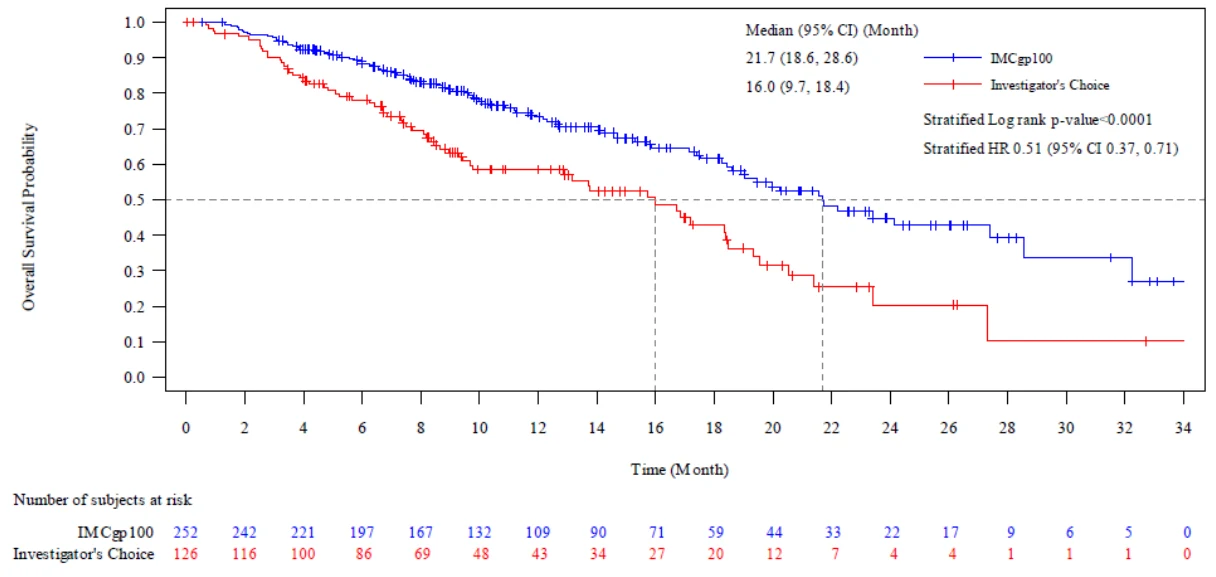
CI = confidence interval; HR = hazard ratio; IMCgp100 = tebentafusp; ITT = Intent-to-treat.
14.2 Immunogenicity
As with all therapeutic proteins, there is potential for immunogenicity. The detection of antibody formation is highly dependent on the sensitivity and specificity of the assay. Additionally, the observed incidence of antibody (including neutralizing antibody) positivity in an assay may be influenced by several factors including assay methodology, sample handling, timing of sample collection, concomitant medications, and underlying disease. For these reasons, comparison of the incidence of antibodies in the studies described below with the incidence of antibodies in other studies or to other products may be misleading.
Treatment-emergent anti-tebentafusp antibodies were detected in 29% of patients receiving tebentafusp across all doses in study IMCgp100-202. The median onset time to ADA formation was 6-9 weeks after tebentafusp treatment. The ability of these binding ADA to neutralize tebentafusp is unknown.
Median titer in the ADA-positive subgroup was 8192 across the 67 treatment cycles. The exposure (AUC0-7 days) of tebentafusp decreased by 97% and terminal half-life decreased to 10-14 minutes in patients with ADA titers greater than 8192.
The tebentafusp clearance increased in patients with high titer ADAs. Exploratory analyses with limited data suggest that formation of ADA does not appear to have clinically significant effect on frequency or severity of hypersensitivity related adverse reactions and no observed sign of decreased overall survival.
15 MICROBIOLOGY
No microbiological information is required for this drug product.
16 NON-CLINICAL TOXICOLOGY
Tebentafusp is a human-specific protein and there are no relevant animal species in which nonclinical toxicology of tebentafusp could be tested.
Carcinogenicity: No long-term carcinogenicity animal studies have been conducted with KIMMTRAK.
Genotoxicity: No long-term genotoxicity animal studies have been conducted with KIMMTRAK.
Reproductive and Developmental Toxicology: No long-term animal studies have been conducted to evaluate the effects of KIMMTRAK on fertility in males or females.