


Product Monograph - Opdivo
Recent Major Label Changes
| 2024-07 2025-06 2025-07 2025-11 2026-02 |
|---|---|
| 2024-07 2025-06 2025-07 2026-02 |
| 2025-06 2026-06 |
| 2024-07 2025-06 2025-07 2026-02 |
Table of Contents
Certain subsections that are not applicable at the time of the preparation of the most recent authorized product monograph are not listed.
Recent Major Label Changes ..................................................................................................... 5
Table of Contents ........................................................................................................................ 5
PART 1: Healthcare Professional Information ......................................................................... 8
- 1.
Indications ................................................................................................................. 8
1.1. Pediatrics ........................................................................................................... 10
1.2. Geriatrics ............................................................................................................ 10
- 2. Contraindications ..................................................................................................... 10
- 3. Serious Warnings and Precautions Box .................................................................. 11
- 4.
Dosage and Administration ..................................................................................... 11
4.1. Dosing Considerations ................................................................................ 11
4.2. Recommended Dose and Dosage Adjustment ........................................... 11
4.4. Reconstitution .............................................................................................. 22
4.5. Administration .............................................................................................. 22
4.6. Missed Dose ................................................................................................ 23
- 5. Overdose ................................................................................................................. 23
- 6. Dosage Forms, Strengths, Composition, and Packaging ........................................ 23
- 7.
Warnings and Precautions ........................................................................................... 23
7.1. Special Populations ..................................................................................... 31
7.1.1. Pregnancy ................................................................................................... 31
7.1.2. Breastfeeding .............................................................................................. 32
7.1.3. Pediatrics ..................................................................................................... 32
7.1.4. Geriatrics ..................................................................................................... 32
- 8.
Adverse Reactions ........................................................................................................ 35
8.1. Adverse Reaction Overview ........................................................................ 35
8.2. Clinical Trial Adverse Reactions .................................................................. 49
8.2.1. Clinical Trial Adverse Reactions - Pediatrics ............................................. 132
8.3. Less Common Clinical Trial Adverse Reactions ........................................ 133
8.4. Abnormal Laboratory Findings: Hematologic, Clinical Chemistry and Other Quantitative Data .................................................................................................... 139
8.5. Post-Market Adverse Reactions ................................................................ 157
- 9.
Drug interactions ........................................................................................................ 158
9.2. Drug Interactions Overview ....................................................................... 158
9.4. Drug-Drug Interactions .............................................................................. 158
9.5. Drug-Food Interactions .............................................................................. 158
9.6. Drug-Herb Interactions .............................................................................. 158
9.7. Drug-Laboratory Test Interactions ............................................................. 158
- 10.
Clinical Pharmacology ................................................................................................ 158
10.1. Mechanism of Action ................................................................................. 158
10.2. Pharmacodynamics ................................................................................... 159
10.3. Pharmacokinetics ...................................................................................... 159
10.4. Immunogenicity ......................................................................................... 160
- 11. Storage, Stability and Disposal ................................................................................. 162
- 12. Special Handling Instructions .................................................................................... 162
PART 2: Scientific Information ............................................................................................. 163
- 13. Pharmaceutical information ....................................................................................... 163
- 14.
Clinical Trials ............................................................................................................... 163
14.1. Clinical Trials by Indication ........................................................................ 165
Unresectable or Metastatic Melanoma .................................................................... 165
Adjuvant Treatment of Melanoma ........................................................................... 178
Metastatic NSCLC ................................................................................................... 184
Neoadjuvant Treatment of Resectable Non-Small Cell Lung Cancer ..................... 200
Neoadjuvant and Adjuvant Treatment of resectable NSCLC .................................. 203
Unresectable Malignant Pleural Mesothelioma ....................................................... 206
Metastatic RCC ....................................................................................................... 208
Recurrent or Metastatic SCCHN ............................................................................. 218
Classical Hodgkin Lymphoma (cHL) ....................................................................... 223
MSI-H/dMMR Metastatic Colorectal Cancer (CRC) ................................................ 225
Adjuvant Treatment of Resected Esophageal or Gastroesophageal Junction Cancer 228
Adjuvant Treatment of Urothelial Carcinoma .......................................................... 234
First-line Treatment of Unresectable or Metastatic Urothelial Carcinoma ............... 237
Unresectable or Metastatic Treatment of Esophageal Squamous Cell Carcinoma (ESCC) .................................................................................................................... 240
Unresectable or Advanced Hepatocellular Carcinoma (HCC) ................................ 245
- 15. Microbiology ................................................................................................................ 247
- 16. Non-Clinical Toxicology ............................................................................................. 247
- 17. Supporting Product Monographs .............................................................................. 253
Patient Medication Information ............................................................................................. 254
PART 1: Healthcare Professional Information
1. Indications
Pr OPDIVO (nivolumab) is indicated for:
Unresectable or Metastatic Melanoma:
- as monotherapy or in combination with ipilimumab, the treatment of adult patients with unresectable or metastatic melanoma who have not received prior systemic therapy for unresectable or metastatic melanoma.
- the treatment of adult patients with unresectable or metastatic melanoma and disease progression following ipilimumab and, if BRAF V600 mutation-positive, a BRAF inhibitor.
Adjuvant Treatment of Melanoma:
- as monotherapy, the adjuvant treatment of adult patients after complete resection of melanoma with regional lymph node involvement, in transit metastases/satellites without metastatic nodes, or distant metastases.
- as monotherapy, the adjuvant treatment of adult patients with Stage IIB or IIC melanoma following complete resection.
Metastatic Non-Small Cell Lung Cancer (NSCLC):
- as monotherapy, the treatment of adult patients with locally advanced or metastatic non-small cell lung cancer (NSCLC) with progression on or after platinum-based chemotherapy. Patients with EGFR or ALK genomic tumour aberrations should have disease progression on a therapy for these aberrations prior to receiving Opdivo.
- in combination with ipilimumab, the treatment of adult patients with metastatic NSCLC, expressing PD-L1 ≥ 1% as determined by a validated test, with no EGFR or ALK genomic tumour aberrations, and no prior systemic therapy for metastatic NSCLC (see 14 CLINICAL TRIALS for the treatment benefit by PD-L1 tumour expression).
- in combination with ipilimumab and 2 cycles of platinum-doublet chemotherapy, the treatment of adult patients with metastatic NSCLC with no EGFR or ALK genomic tumour aberrations, and no prior systemic therapy for metastatic NSCLC.
Neoadjuvant Treatment of Resectable Non-Small Cell Lung Cancer (NSCLC):
in combination with platinum-doublet chemotherapy, the neoadjuvant treatment of adult patients with resectable NSCLC (tumours ≥4 cm or node positive).
- Positive associations were observed between the level of PD-L1 expression and advanced disease stage, and the magnitude of the treatment benefit (see 14 CLINICAL TRIALS).
Neoadjuvant and Adjuvant Treatment of Resectable Non-Small Cell Lung Cancer (NSCLC):
in combination with platinum-doublet chemotherapy, the neoadjuvant treatment of adult patients with resectable Stage II (>4 cm), IIIA, IIIB (T3-4N2) NSCLC and no known epidermal growth factor
- receptor (EGFR) mutations or anaplastic lymphoma kinase (ALK) rearrangements, followed by OPDIVO as a single agent in the adjuvant setting after surgical resection (see 14 CLINICAL TRIALS).
Unresectable Malignant Pleural Mesothelioma (MPM):
- in combination with ipilimumab, the treatment of adult patients with unresectable malignant pleural mesothelioma (MPM) who have not received prior systemic therapy for MPM.
Metastatic Renal Cell Carcinoma (RCC):
- as monotherapy, the treatment of adult patients with advanced or metastatic renal cell carcinoma (RCC) who have received prior anti-angiogenic therapy.
- in combination with ipilimumab, the treatment of adult patients with intermediate/poor-risk advanced or metastatic RCC.
- in combination with cabozantinib, the first-line treatment of adult patients with advanced (not amenable to curative surgery or radiation therapy) or metastatic RCC.
Squamous Cell Carcinoma of the Head and Neck (SCCHN):
- the treatment of recurrent or metastatic squamous cell carcinoma of the head and neck (SCCHN) in adults progressing on or after platinum-based therapy.
Classical Hodgkin Lymphoma (cHL):
as monotherapy, the treatment of adult patients with classical Hodgkin Lymphoma (cHL) that has relapsed or progressed after:
- autologous stem cell transplantation (ASCT) and brentuximab vedotin, or
- 3 or more lines of systemic therapy including ASCT.
An improvement in survival or disease-related symptoms has not yet been established.
Microsatellite Instability-High (MSI-H)/ Mismatch Repair Deficient (dMMR) Metastatic Colorectal Cancer:
- in combination with ipilimumab, the first-line treatment of adult patients with unresectable or metastatic microsatellite instability-high (MSI-H) or mismatch repair deficient (dMMR) colorectal cancer.
in combination with ipilimumab, the treatment of adult patients with MSI-H or dMMR metastatic colorectal cancer after prior fluoropyrimidine-based therapy in combination with oxaliplatin or irinotecan.
The marketing authorization with conditions is primarily based on tumour objective response rate and durability of response. An improvement in survival has not yet been established (see 14 CLINICAL TRIALS).
Adjuvant Treatment of Resected Esophageal or Gastroesophageal Junction (GEJ) Cancer:
- the adjuvant treatment of completely resected esophageal or gastroesophageal junction (GEJ) cancer in patients who have residual pathologic disease following prior neoadjuvant chemoradiotherapy (CRT) (see 14 CLINICAL TRIALS).
Gastric Cancer, Gastroesophageal Junction Cancer, or Esophageal Adenocarcinoma (GC/GEJC/EAC):
in combination with fluoropyrimidine- and platinum-containing chemotherapy, the treatment of adult patients with HER2 negative advanced or metastatic gastric, gastroesophageal junction or esophageal adenocarcinoma.
- A positive association was observed between PD-L1 CPS score and the magnitude of the treatment benefit (see 14 CLINICAL TRIALS).
Urothelial Carcinoma (UC):
as a monotherapy the adjuvant treatment of adult patients with urothelial carcinoma (UC) who are at high risk of recurrence after undergoing radical resection of UC.
- A positive association was observed between tumour PD-L1 expression and the magnitude of the treatment benefit. An improvement in overall survival has not yet been established (see 14 CLINICAL TRIALS).
- in combination with cisplatin and gemcitabine, the first-line treatment of adult patients with unresectable or metastatic urothelial carcinoma (see 14 CLINICAL TRIALS).
Unresectable or Metastatic Esophageal Squamous Cell Carcinoma (ESCC):
- in combination with ipilimumab, the treatment of adult patients with unresectable or metastatic ESCC, with tumour cell PD-L1 expression ≥ 1% as determined by a validated test, and no prior systemic therapy for metastatic ESCC (see 14 CLINICAL TRIALS).
- in combination with fluoropyrimidine- and platinum-containing chemotherapy, the treatment of adult patients with unresectable or metastatic ESCC, with tumour cell PD-L1 expression ≥ 1% as determined by a validated test, and no prior systemic therapy for metastatic ESCC (see 14 CLINICAL TRIALS).
Unresectable or Advanced Hepatocellular Carcinoma (HCC):
- in combination with ipilimumab, the first-line treatment of adult patients with unresectable or advanced HCC.
1.1. Pediatrics
Pediatrics (< 18 years of age): The safety and efficacy of Opdivo have not been established in pediatric patients; therefore, Health Canada has not authorized an indication for pediatric use (see 8.2.1 Clinical Trial Adverse Reactions - Pediatrics and 10.3 Pharmacokinetics, Special Populations and Conditions, Pediatrics).
1.2. Geriatrics
Geriatrics (> 65 years of age): No overall differences in efficacy were reported between elderly patients (≥ 65 years) and younger patients (< 65 years). Limited safety and efficacy information is available for Opdivo in cHL ≥ 65 years of age (n=7/266) (see 7.1.4 Geriatrics).
2. Contraindications
Opdivo (nivolumab) is contraindicated in patients who are hypersensitive to nivolumab or to any ingredient in the formulation, including any non-medicinal ingredient, or component of the container.
For a complete listing see 6 DOSAGE FORMS, STRENGTHS, COMPOSITION AND PACKAGING.
- 3. Serious Warnings and Precautions Box
Serious Warnings and Precautions
Opdivo as monotherapy or in combination with ipilimumab can cause severe and fatal immune-mediated adverse reactions, including pneumonitis, interstitial lung disease, encephalitis, myocarditis, Stevens-Johnson Syndrome (SJS), toxic epidermal necrolysis (TEN) and autoimmune hemolytic anemia [see 7 WARNINGS AND PRECAUTIONS, Immune-mediated adverse reactions]. Immune-mediated adverse reactions may involve any organ system. While most of these reactions occurred during treatment, onset months after the last dose has been reported [see 7 WARNINGS AND PRECAUTIONS and 8 ADVERSE REACTIONS]. Early diagnosis and appropriate management are essential to minimize potential life-threatening complications. Patients should be monitored for signs and symptoms suggestive of immune-mediated adverse reactions [see 7 WARNINGS AND PRECAUTIONS and 4 DOSAGE AND ADMINISTRATION for management guidelines for these adverse reactions]. Opdivo or Opdivo in combination with ipilimumab must be permanently discontinued for any severe immune-related adverse reaction that recurs and for any life-threatening immune-mediated adverse reaction. Healthcare professionals should consult the ipilimumab Product Monograph prior to initiation of Opdivo in combination with ipilimumab. |
|---|
4. Dosage and Administration
4.1. Dosing Considerations
Patient Selection
Metastatic NSCLC:
Select patients with metastatic NSCLC for treatment with Opdivo in combination with ipilimumab based on PD-L1 expression. A test authorized by Health Canada which is equivalent to that used in clinical trials should be required (see 7 WARNINGS AND PRECAUTIONS and 14 CLINICAL TRIALS).
MSI-H/dMMR mCRC:
Patients should be selected for treatment based on MSI-H or dMMR tumour status as determined by an accredited laboratory using validated testing methods (see 14 CLINICAL TRIALS).
4.2. Recommended Dose and Dosage Adjustment
Recommended Dose
Opdivo as monotherapy:
The recommended dose of Opdivo as monotherapy is presented in Table 1:
Table 1: Recommended Dosages for Opdivo as a Single Agent
| Indication | Recommended Opdivo Dosage | Duration of Therapy |
|---|---|---|
| Indication | Recommended Opdivo Dosage | Duration of Therapy |
| Unresectable or metastatic melanoma | 3 mg/kg every 2 weeks or 240 mg every 2 weeks or 480 mg every 4 weeks (30-minute intravenous infusion) | Continue treatment as long as clinical benefit is observed or until treatment is no longer tolerated by the patient. |
| Metastatic non-small cell lung cancer | ||
| Advanced or metastatic renal cell carcinoma | ||
| Squamous cell carcinoma of the head and neck | ||
| Classical Hodgkin lymphoma | ||
| Adjuvant Treatment of Resected Esophageal or Gastroesophageal Junction | 240 mg every 2 weeks or 480 mg every 4 weeks (30-minute intravenous infusion) | After completing 16 weeks of therapy, administer as 480 mg every 4 weeks until disease progression or unacceptable toxicity for a total treatment duration of 1 year. Continue treatment as long as clinical benefit is observed or until treatment is no longer tolerated by the patient. |
| Adjuvant treatment of melanoma (Stage III/IV) | 3 mg/kg every 2 weeks or 240 mg every 2 weeks or 480 mg every 4 weeks (30-minute intravenous infusion) | Continue treatment as long as clinical benefit is observed or until treatment is no longer tolerated by the patient for up to 1 year. |
| Adjuvant treatment of melanoma (Stage IIB/IIC) | 240 mg every 2 weeks or 480 mg every 4 weeks (30-minute intravenous infusion) | Continue treatment as long as clinical benefit is observed or until treatment is no longer tolerated by the patient (unacceptable |
| toxicity) for up to 1 year. | ||
| Adjuvant treatment of urothelial carcinoma (UC) | 240 mg every 2 weeks (30-minute intravenous infusion) or 480 mg every 4 weeks (30-minute intravenous infusion) | Continue treatment as long as clinical benefit is observed or until treatment is no longer tolerated by the patient for up to 1 year. |
If patients need to be switched from the 3 mg/kg or 240 mg every 2 weeks schedule to the 480 every 4 weeks schedule, the first 480 mg dose should be administered two weeks after the last 3 mg/kg or 240 mg dose. Conversely, if patients need to be switched from the 480 mg every 4 weeks schedule to the 3 mg/kg or 240 mg every 2 weeks schedule, the first 3 mg/kg or 240 mg dose should be administered four weeks after the last 480 mg dose (see 10.2 Pharmacodynamics/ 10.3 Pharmacokinetics).
Opdivo in combination with ipilimumab:
The recommended dosages of Opdivo in combination with ipilimumab is presented in Table 2.
Table 2: Recommended doses of Opdivo in combination with ipilimumab
| Indication | Recommended Opdivo Dosage | Duration of Therapy |
|---|---|---|
| Unresectable or metastatic melanoma | Combination Phase 1 mg/kg every 3 weeks (30-minute intravenous infusion) with ipilimumab 3 mg/kg intravenously over 30 minutes on the same day Single Agent Phase 3 mg/kg every 2 weeksa or 240 mg every 2 weeksa or 480 mg every 4 weeksb (30-minute intravenous infusion) | In combination with ipilimumab every 3 weeks for the first 4 doses or until unacceptable toxicity, whichever occurs earlier. After completing combination therapy, administer Opdivo as single agent. Continue treatment as long as clinical benefit is observed or until treatment is no longer tolerated by the patient. |
| Previously untreated unresectable or metastatic MSI-H or dMMR colorectal cancer | Combination phase 240 mg every 3 weeks (30-minute intravenous infusion) with ipilimumab 1 mg/kg intravenously (30-minute intravenous infusion) Single Agent Phase administered 3 weeks after the last dose of the combination phase 240 mg every 2 weeks or 480 mg every 4 weeks | In combination with ipilimumab for a maximum of 4 doses After completing a maximum of 4 doses of combination therapy, administer Opdivo as single agent until disease progression or unacceptable toxicity, or up to 2 years |
| (30-minute intravenous infusion) | ||
| Metastatic renal cell carcinoma | Combination phase 3 mg/kg every 3 weeks (30-minute intravenous infusion) with ipilimumab 1 mg/kg intravenously over 30 minutes on the same day Single Agent Phase 3 mg/kg every 2 weeksa or 240 mg every 2 weeksa or 480 mg every 4 weeksb (30-minute intravenous infusion) | In combination with ipilimumab every 3 weeks for the first 4 doses After completing combination therapy, administer as Opdivo as single agent. Continue treatment as long as clinical benefit is observed or until treatment is no longer tolerated by the patient. |
| Previously treated metastatic MSI-H/dMMR colorectal cancer | ||
| Previously untreated metastatic NSCLC | 3 mg/kg every 2 weeks or 360 mg every 3 weeks (30-minute intravenous infusion) with ipilimumab 1 mg/kg every 6 weeks (30-minute intravenous infusion) Select patients based on the presence of positive PD-L1 expression as determined by an accredited laboratory using a validated test. A test authorized by Health Canada which is equivalent to that used in clinical trials should be required (see 14 CLINICAL TRIALS). | In combination with ipilimumab until disease progression, unacceptable toxicity, or up to 2 years in patients without disease progression. |
| Unresectable malignant pleural mesothelioma | 3 mg/kg every 2 weeks or 360 mg every 3 weeks (30-minute intravenous infusion) with ipilimumab 1 mg/kg every 6 weeks (30-minute intravenous infusion) | In combination with ipilimumab until disease progression, unacceptable toxicity, or up to 2 years in patients without disease progression |
| Unresectable or metastatic esophageal squamous cell carcinoma | 3 mg/kg every 2 weeks or 360 mg every 3 weeks (30-minute intravenous infusion) with ipilimumab 1 mg/kg every 6 weeks (30-minute intravenous infusion) | In combination with ipilimumab until disease progression, unacceptable toxicity, or up to 2 years in patients without disease progression |
| Unresectable or advanced hepatocellular carcinoma | Combination Phase 1 mg/kg every 3 weeks with ipilimumab 3 mg/kg intravenously (30-minute intravenous infusion on the same day) Single Agent Phase 240 mg every 2 weeks or 480 mg every 4 weeks (30-minute intravenous infusion) | In combination with ipilimumab for a maximum 4 doses After completing a maximum 4 doses of combination therapy, administer as single agent until disease progression, unacceptable toxicity, or up to 2 years |
- a. 3 weeks after the last dose of the combination of nivolumab and ipilimumab
- b. 6 weeks after the last dose of the combination of nivolumab and ipilimumab
Opdivo in combination with cabozantinib:
Advanced or metastatic renal cell carcinoma
The recommended dose is Opdivo 240 mg every 2 weeks or 480 mg every 4 weeks (30-minute intravenous infusion) in combination with cabozantinib 40 mg administered orally every day without food (Table 3).
Table 3: Recommended doses and infusion times for intravenous administration of Opdivo in combination with cabozantinib
| Recommended Dose | Duration | |
|---|---|---|
| Opdivo | 240 mg over 30 minutes every 2 weeks or 480 mg over 30 minutes every 4 weeks | In combination with cabozantinib, until disease progression, unacceptable toxicity, or up to 2 years in patients without disease progression |
| cabozantinib | 40 mg orally once daily without food | In combination with Opdivo, until disease progression or unacceptable toxicity |
Refer to the cabozantinib product monograph for recommended cabozantinib dose information.
Opdivo in combination with ipilimumab and chemotherapy:
Unresectable or Metastatic NSCLC
The recommended dose is Opdivo 360 mg administered as a 30-minute intravenous infusion every 3 weeks in combination with ipilimumab 1 mg/kg administered as a 30-minute intravenous infusion every 6 weeks, and platinum-doublet chemotherapy administered every 3 weeks for 2 cycles. After completion of 2 cycles of chemotherapy, treatment is continued with Opdivo 360 mg every 3 weeks in combination with ipilimumab 1 mg/kg every 6 weeks until disease progression, unacceptable toxicity, or up to 2 years in patients without disease progression (Table 4).
Table 4: Recommended doses and infusion times for intravenous administration of Opdivo in combination with ipilimumab and platinum-doublet chemotherapy
| Recommended Dose | Duration | |
|---|---|---|
| Opdivo | 360 mg over 30 minutes every 3 weeks | In combination with ipilimumab until disease progression, unacceptable toxicity, or up to 2 years in patients without disease progression |
| Ipilimumab | 1 mg/kg over 30 minutes every 6 weeks | In combination with Opdivo until disease progression, unacceptable toxicity, or up to 2 years in patients without disease progression |
| Chemotherapy | histology-based platinum doublet chemotherapy every 3 weeks | 2 cycles of histology-based platinum-doublet chemotherapy |
Opdivo in combination with chemotherapy:
Gastric cancer, gastroesophageal junction cancer or esophageal adenocarcinoma
The recommended dose is 360 mg nivolumab administered intravenously over 30 minutes in combination with fluoropyrimidine- and platinum-containing chemotherapy every 3 weeks or 240 mg nivolumab administered intravenously over 30 minutes in combination with fluoropyrimidine- and platinum-containing chemotherapy every 2 weeks. Treatment is recommended until disease progression or unacceptable toxicity. The maximum treatment duration for Opdivo is 2 years (Table 5).
Table 5 : Recommended doses and infusion times for intravenous administration of Opdivo in combination with fluoropyrimidine- and platinum-containing chemotherapy
| Recommended Dose | Duration | |||
|---|---|---|---|---|
| Opdivo | 360 mg over 30 minutes every 3 weeks with fluoropyrimidine- and platinum-containing chemotherapy every 3 weeks or 240 mg over 30 minutes every 2 weeks with fluoropyrimidine- and platinum-containing chemotherapy every 2 weeks | Until disease progression, unacceptable toxicity, or up to 2 years in patients without disease progression | ||
| Chemotherapy | ||||
Unresectable or metastatic esophageal squamous cell carcinoma
The recommended dose is 240 mg nivolumab administered intravenously over 30 minutes every 2 weeks in combination with fluoropyrimidine- and platinum-containing chemotherapy every 4 weeks or
480 mg nivolumab administered intravenously over 30 minutes in combination with fluoropyrimidine- and platinum-containing chemotherapy every 4 weeks. Treatment is recommended until disease progression or unacceptable toxicity. The maximum treatment duration for Opdivo is 2 years (Table 6).
Table 6 : Recommended doses and infusion times for intravenous administration of Opdivo in combination with fluoropyrimidine- and platinum-containing chemotherapy
| Recommended Dose | Duration | |||
|---|---|---|---|---|
| Opdivo | 240 mg over 30 minutes every 2 weeks with fluoropyrimidine- and platinum-containing chemotherapy every 4 weeks or 480 mg over 30 minutes every 4 weeks with fluoropyrimidine- and platinum-containing chemotherapy every 4 weeks | Until disease progression, unacceptable toxicity, or up to 2 years in patients without disease progression | ||
| Chemotherapy | ||||
Neoadjuvant Treatment of Resectable Non-Small Cell Lung Cancer
The recommended dose is 360 mg nivolumab administered intravenously over 30 minutes in combination with platinum-doublet chemotherapy every 3 weeks for 3 cycles (Table 7).
Table 7: Recommended dose and infusion time for intravenous administration of Opdivo in combination with platinum-doublet chemotherapy
| Recommended Dose | Duration | |
|---|---|---|
| Opdivo | 360 mg over 30 minutes every 3 weeks with platinum- doublet chemotherapy every 3 weeks | In combination with platinum-doublet chemotherapy for 3 cycles |
First-line treatment of unresectable or metastatic urothelial carcinoma
The recommended dose is Opdivo 360 mg administered intravenously over 30 minutes in combination with cisplatin and gemcitabine on the same day every 3 weeks for up to 6 cycles. After completing up to 6 cycles of combination therapy, continue treatment with single agent Opdivo 240 mg every 2 weeks or
480 mg every 4 weeks administered intravenously over 30 minutes until disease progression, unacceptable toxicity, or up to 2 years from first dose.
Neoadjuvant and Adjuvant Treatment of Resectable Non-Small Cell Lung Cancer
The recommended dose is 360 mg nivolumab administered intravenously over 30 minutes in combination with platinum-doublet chemotherapy every 3 weeks for up to 4 cycles in the neoadjuvant phase, followed after surgery by nivolumab 480 mg every 4 weeks in the adjuvant phase. Treatment is recommended until disease progression or recurrence, unacceptable toxicity, or up to 1 year (13 cycles; Table 8).
Table 8: Recommended dose, infusion time and duration of neoadjuvant OPDIVO in combination with platinum-doublet chemotherapy followed by adjuvant OPDIVO as a single agent
| Recommended Dose | Duration | |||
|---|---|---|---|---|
| OPDIVO | 360 mg over 30 minutes every 3 weeks with platinum- doublet chemotherapy on the same day every 3 weeks | Neoadjuvant: in combination with platinum-doublet chemotherapy until disease progression or unacceptable toxicity, for up to 4 cycles | ||
| 480 mg over 30 minutes every 4 weeks | Adjuvant: following neoadjuvant therapy and surgery administer as a single agent until disease progression, recurrence, or unacceptable toxicity, for up to 1 year (13 cycles) | |||
Table 9: Recommended dose and infusion time for intravenous administration of Opdivo in combination with cisplatin and gemcitabine
| Recommended Dose | Duration | |
|---|---|---|
| Opdivo | 360 mg over 30 minutes every 3 weeks with cisplatin and gemcitabine every 3 weeks for 6 cycles followed by Opdivo as single agent administered intravenously at either 240 mg every 2 weeks over 30 minutes or at 480 mg every 4 weeks over 30 minutes | In combination with cisplatin and gemcitabine for up to 6 cycles. After completing combination therapy, administer Opdivo as single agent, until disease progression, unacceptable toxicity, or up to 2 years from first dose. |
Recommended Dosage Adjustment
For treatment with Opdivo, monotherapy or in combination with other therapeutic agents, dose escalation or reduction is not recommended. Dosing delay or discontinuation may be required based on individual safety and tolerability. When Opdivo is administered in combination, refer to the product monograph of the other combination therapy agents regarding dosing.
Treatment with Opdivo or Opdivo in combination with ipilimumab may be continued for clinically stable patients with initial evidence of disease progression until disease progression is confirmed. Atypical responses (i.e., an initial transient increase in tumour size or small new lesions within the first few months followed by tumour shrinkage) have been observed.
Recommendations for Opdivo modifications are provided in Table 10.
Table 10: Recommended Treatment Modifications for Opdivo Monotherapy or in Combination with other therapeutic agents
| Target Organ/System | Adverse Reactiona | Treatment Modification | ||
|---|---|---|---|---|
| Endocrine | Grade 2 or 3 hypothyroidism, Grade 2 or 3 hyperthyroidism, and Grade 2 hypophysitis Grade 2 adrenal insufficiency Grade 3 diabetes | Withhold dose(s) until symptoms resolve and acute management with corticosteroids, if needed, is completeb | ||
Grade 3 or 4 hypophysitis Grade 4 hypothyroidism Grade 4 hyperthyroidism Grade 3 or 4 adrenal insufficiency Grade 4 diabetes | Permanently discontinue treatmentc | |||
Gastrointestinal Hepatic in patients without HCC NOTE: For RCC patients treated with Opdivo in combination with cabozantinib with liver enzyme elevations, see dosing guidelines following this table | Grade 2 or 3 diarrhea or colitis | Withhold dose(s) until symptoms resolve and management with corticosteroids is complete | ||
Grade 3 diarrhea or colitis Opdivo in combination with ipilimumab | Permanently discontinue treatment | |||
| Grade 4 diarrhea or colitis | Permanently discontinue treatmentc | |||
| Grade 2 elevation in aspartate aminotransferase (AST), alanine aminotransferase (ALT), or total bilirubin | Withhold dose(s) until laboratory values return to baseline and management with corticosteroids is complete | |||
| Grade 3 or 4 elevation in AST, ALT, or total bilirubin | Permanently discontinue treatmentc | |||
| Hepatic in patients with HCC | If AST/ALT is within normal limits at baseline and increases to > 3 and ≤ 10 times ULN or Baseline AST/ALT is > 1 and ≤ 3 times ULN and increases to > 5 and ≤ 10 times ULN or Baseline AST/ALT is > 3 and ≤ 5 times ULN and increases to > 8 and ≤ 10 times ULN AST/ALT increases to > 10 times ULN or Total bilirubin increases to > 3 times ULN | Withhold dose(s) until laboratory values return to baseline and management with corticosteroids, if needed, is complete Permanently discontinue treatmentc | ||
| Pulmonary | Grade 2 pneumonitis | Withhold dose(s) until symptoms resolve, radiographic abnormalities improve, and management with corticosteroids is complete | ||
| Grade 3 or 4 pneumonitis | Permanently discontinue treatmentc | |||
| Renal | Grade 2 creatinine elevation | Withhold dose(s) until creatinine returns to baseline and management with corticosteroids is complete | ||
| Grade 3 or 4 creatinine elevation | Permanently discontinue treatmentc | |||
| Skin | Grade 3 rash | Withhold dose(s) until symptoms resolve and management with corticosteroids is complete | ||
| Suspected Stevens-Johnson syndrome (SJS) or toxic epidermal necrolysis (TEN) | Withhold dose(s) | |||
Grade 4 rash Confirmed SJS/TEN | Permanently discontinue treatmentc | |||
| Encephalitis | New-onset moderate or severe neurologic signs or symptoms | Withhold dose(s) until symptoms resolve and management with corticosteroids is complete | ||
| Immune-mediated encephalitis | Permanently discontinue treatmentc | |||
| Myocarditis | Grade 2, 3 or 4 myocarditis | Permanently discontinue treatmentc | ||
| Neurological Toxicitiesd | Grade 2 | Withholde | ||
| Grade 3 or 4 | Permanently discontinue | |||
| treatmentc | ||||
| Other | Grade 3 or 4 | Permanently discontinue treatmentc | ||
- a. National Cancer Institute Common Terminology Criteria for Adverse Events (CTCAE) v4.0.
- b. May resume treatment while receiving physiologic replacement therapy.
- c. See 7 WARNINGS AND PRECAUTIONS for treatment recommendations.
- d. Permanently discontinue treatment for demyelinating disease of any grade.
- e. Resume in patients with complete or partial resolution (Grade 0 to 1) after corticosteroid taper. Permanently discontinue if no complete or partial resolution within 12 weeks of last dose or inability to reduce prednisone to 10 mg per day (or equivalent) or less within 12 weeks of initiating steroids.
Opdivo in combination with cabozantinib in RCC
When Opdivo is used in combination with cabozantinib, the above treatment modifications in Table 10 also apply to the Opdivo component. In addition, for liver enzyme elevations, in patients with RCC being treated with Opdivo in combination with cabozantinib:
- If ALT or AST >3 times ULN but ≤10 times ULN without concurrent total bilirubin ≥2 times ULN, both Opdivo and cabozantinib should be withheld until these adverse reactions recover to Grades 0-1. Corticosteroid therapy may be considered. Rechallenge with a single medicine or rechallenge with both medicines after recovery may be considered. If rechallenging with cabozantinib, refer to cabozantinib product monograph.
- If ALT or AST >10 times ULN or >3 times ULN with concurrent total bilirubin ≥2 times ULN, both Opdivo and cabozantinib should be permanently discontinued and corticosteroid therapy may be considered (see 7 WARNINGS AND PRECAUTIONS and 8 ADVERSE REACTIONS).
Pediatrics:
The safety and efficacy of Opdivo in pediatric patients (<18 years of age) have not been established; therefore, Health Canada has not authorized an indication for pediatric use.
Renal Impairment:
No dose adjustment is needed in patients with mild or moderate renal impairment based on a population PK analysis. Data are not sufficient for drawing a conclusion on patients with severe renal impairment (see 10 CLINICAL PHARMACOLOGY).
Hepatic Impairment:
No dose adjustment is needed for patients with mild hepatic impairment (total bilirubin [TB] >1.0 to 1.5 times the upper limit of normal [ULN] or AST >ULN) based on a population PK analysis. Opdivo has not been studied in patients with moderate (TB >1.5 to 3.0 times ULN and any AST) or severe (TB >3 times ULN and any AST) hepatic impairment (see 10 CLINICAL PHARMACOLOGY).
Opdivo in combination with cabozantinib has not been studied in patients with hepatic impairment. No dosing recommendation can be provided (see 7 WARNINGS AND PRECAUTIONS, 8 ADVERSE REACTIONS, and the product monograph for cabozantinib).
4.4. Reconstitution
Opdivo is supplied as a liquid for intravenous infusion (see 6 DOSAGE FORMS, STRENGTHS, COMPOSITION AND PACKAGING). For information on administration, and instructions for preparation and use, see 4.5 Administration.
4.5. Administration
Opdivo is to only be administered by intravenous infusion.
Visually inspect drug product solution for particulate matter and discolouration prior to administration. Discard if solution is cloudy, if there is pronounced discolouration (solution may have a pale-yellow colour), or if there is foreign particulate matter other than a few translucent-to-white, amorphous particles. Do not shake.
Administer the infusion over 30 minutes through an intravenous line containing a sterile, non-pyrogenic, low protein binding in-line filter (pore size of 0.2-1.2 micrometer).
Opdivo should not be infused concomitantly in the same intravenous line with other agents. Physical or biochemical compatibility studies have not been conducted to evaluate the coadministration of Opdivo with other agents.
Flush the intravenous line with 0.9% Sodium Chloride Injection, USP or 5% Dextrose Injection, USP after each dose.
When Opdivo is administered in combination with ipilimumab or with ipilimumab and chemotherapy, or with chemotherapy, Opdivo should be given first followed by ipilimumab (if applicable) and then by chemotherapy (if applicable), on the same day. Use separate infusion bags and filters for each infusion.
When Opdivo is administered in combination with chemotherapy, if any agents are withheld, the other agents may be continued. If dosing is resumed after a delay, either the combination treatment, Opdivo monotherapy or chemotherapy alone could be resumed based on the evaluation of the individual patient.
When Opdivo is taken with cabozantinib, administer Opdivo first during the day followed by cabozantinib on an empty stomach, preferably in the evening.
Instructions for Preparation and Use
Opdivo can be used for intravenous administration either:
- without dilution: withdraw the required volume of Opdivo injection, 10 mg/mL, and aseptically transfer into a sterile intravenous container (PVC container, non-PVC container, or glass bottle); or
after diluting with either 0.9% Sodium Chloride Injection, USP or 5% Dextrose Injection, USP, according to the following instructions:
-the final infusion concentration should range between 1 to 10 mg/mL.
-the total volume of infusion must not exceed 160 mL. For patients weighing less than 40 kg, the total volume of infusion must not exceed 4 mL per kilogram of patient weight.
Mix diluted solution by gentle inversion of the infusion container, do not shake.
The prepared infusion solution may be stored under refrigeration conditions: 2°C to 8°C and protected from light for up to 7 days (a maximum of 8 hours of the total 7 days can be at room temperature 20°C to 25°C and room light). The administration of the nivolumab infusion must be completed within 7 days of preparation.
Discard partially used vials or empty vials of Opdivo (see 11 STORAGE, STABILITY AND DISPOSAL).
4.6. Missed Dose
If a planned dose of Opdivo is missed, it should be administered as soon as possible. The schedule of administration should be adjusted to maintain the prescribed dosing interval.
5. Overdose
There is no information on overdosage with Opdivo (nivolumab).
| For the most recent information in the management of a suspected drug overdose, contact your regional poison control centre or Health Canada’s toll-free number, 1-844 POISON-X (1-844-764-7669). |
|---|
- 6. Dosage Forms, Strengths, Composition, and Packaging
To help ensure the traceability of biologic products, healthcare professionals should record both the brand name and the non-proprietary (active ingredient) name as well as other product-specific identifiers such as the Drug Identification Number (DIN) and the batch/lot number of the product supplied.
Table 11: Dosage Forms, Strengths, Composition and Packaging
Opdivo (nivolumab) Injection is a sterile, preservative-free, non-pyrogenic, clear to opalescent, colourless to pale-yellow liquid for intravenous infusion that may contain light (few) particles. The solution has an approximate pH of 6. Opdivo is supplied at a nominal concentration of 10 mg/mL nivolumab in either 40-mg or 100-mg single-use vials and contains the following inactive ingredients: sodium citrate dihydrate (5.88 mg/mL), sodium chloride (2.92 mg/mL), mannitol (30 mg/mL), pentetic acid (0.008 mg/mL), polysorbate 80 (0.2 mg/mL), sodium hydroxide and/or hydrochloric acid may have been added to adjust pH, and Water for Injection, USP.
7. Warnings and Precautions
Please see 3 SERIOUS WARNINGS AND PRECAUTIONS BOX.
| Route of Administration | Dosage Form / Strength/Composition | Non-medicinal Ingredients |
| Intravenous Infusion | Sterile Solution for Injection/ 40 mg nivolumab /4 mL (10 mg/mL) Sterile Solution for Injection/ 100 mg nivolumab /10 mL (10 mg/mL) | Hydrochloric acid, mannitol (E421), pentetic acid, polysorbate 80, sodium chloride, sodium citrate, sodium hydroxide, and water for injection. |
General
Opdivo (nivolumab) should be administered under the supervision of physicians experienced in the treatment of cancer.
When Opdivo is administered in combination with ipilimumab, refer to the product monograph for ipilimumab prior to initiation of treatment.
When Opdivo is administered in combination with chemotherapy, refer to the product monograph of the other combination therapy agents regarding dosing.
When Opdivo is administered in combination with cabozantinib, refer to the product monograph for cabozantinib prior to initiation of treatment.
Increased mortality in patients with multiple myeloma [not an approved indication] when Opdivo is added to a thalidomide analogue and dexamethasone.
In randomized clinical trials in patients with multiple myeloma, the addition of a PD-1 blocking antibody, including Opdivo, to a thalidomide analogue plus dexamethasone, a use for which no PD-1 blocking antibody is indicated, resulted in increased mortality. Treatment of patients with multiple myeloma with a PD-1 blocking antibody in combination with a thalidomide analogue plus dexamethasone is not recommended outside of controlled clinical trials.
Patients on controlled sodium diet
Each mL of this medicinal product contains 0.1 mmol (or 2.30 mg) sodium. To be taken into consideration when treating patients on a controlled sodium diet.
GC/GEJC/EAC:
Patients who had known human epidermal growth factor receptor 2 (HER2) positive cancer, baseline ECOG performance score ≥ 2 or had untreated central nervous system (CNS) metastases were excluded from the clinical study in GC, GEJC or EAC (see 14 CLINICAL TRIALS). In the absence of data, nivolumab in combination with chemotherapy should be used with caution in the HER2 negative subpopulations (baseline ECOG performance score ≥ 2 or had untreated CNS metastases), after careful consideration of the potential benefit/risk on an individual basis.
Unresectable or Metastatic ESCC:
In CHECKMATE-648, a higher number of deaths within 4 months was observed with nivolumab in combination with ipilimumab compared to chemotherapy. Physicians should consider the delayed onset of effect of nivolumab in combination with ipilimumab before initiating treatment in patients with poorer prognostic features and/or aggressive disease (see 14 CLINICAL TRIALS).
Unresectable or Advanced HCC:
In CHECKMATE-9DW, a higher number of deaths within the first 6 months was observed with nivolumab in combination with ipilimumab compared to lenvatinib or sorafenib. A higher risk of death may be associated with poor prognostic features. Physicians should consider this risk before initiating treatment with nivolumab in combination with ipilimumab in patients with poor prognostic features (see 14 CLINICAL TRIALS).
Carcinogenesis and Mutagenesis
The mutagenic and carcinogenic potential of nivolumab have not been evaluated.
Driving and Operating Machinery
Exercise caution when driving or operating a vehicle or potentially dangerous machinery.
Hematologic
Haemophagocytic lymphohistiocytosis (HLH)
Haemophagocytic lymphohistiocytosis (HLH) has been reported in relation to the use of Opdivo either as monotherapy, or in combination with ipilimumab. Patients should be closely monitored. If HLH is suspected, Opdivo or Opdivo in combination with ipilimumab should be withheld. If HLH is confirmed, Opdivo or Opdivo in combination with ipilimumab should be discontinued and treatment for HLH should be initiated, as deemed medically appropriate (see 8 ADVERSE REACTIONS).
Hepatic/Biliary/Pancreatic
Hepatotoxicity (Opdivo in combination with cabozantinib for RCC)
Opdivo in combination with cabozantinib can cause hepatic toxicity with higher frequencies of Grade 3 and 4 ALT and AST elevations compared to Opdivo alone (see 8 ADVERSE REACTIONS). Liver enzymes and bilirubin should be monitored before initiation of and periodically throughout treatment. Consider more frequent monitoring as compared to when the drugs are administered as single agents. Delayed occurrence of liver enzyme elevations after discontinuation of treatment has been reported. For elevated liver enzymes, interrupt Opdivo and cabozantinib and consider administering corticosteroids as needed (see 4 DOSAGE AND ADMINISTRATION and the product monograph for cabozantinib).
Hepatic events (Opdivo in combination with ipilimumab for HCC)
In CHECKMATE-9DW, a higher incidence of hepatic events was observed in patients receiving Opdivo in combination with ipilimumab in comparison to those treated with lenvatinib or sorafenib (see 8 ADVERSE REACTIONS). Liver enzymes and bilirubin should be monitored before initiation of and periodically throughout treatment. Consider more frequent monitoring as compared to when the drugs are administered as single agents. Delayed occurrence of liver enzyme elevations after discontinuation of treatment has been reported. For elevated liver enzymes, interrupt Opdivo and/or ipilimumab and consider administering corticosteroids as needed (see 4 DOSAGE AND ADMINISTRATION and the product monograph for ipilimumab).
Immune
Immune-Mediated Adverse Reactions
Adverse reactions observed with immunotherapies such as Opdivo may differ from those observed with non-immunotherapies, can be severe and life-threatening, and may require immunosuppression. Early identification of adverse reactions and intervention are essential to minimize potential life-threatening complications. Immune-mediated adverse reactions have occurred at higher frequencies when Opdivo was administered in combination with ipilimumab compared with Opdivo as monotherapy. Most immune-mediated adverse reactions improved or resolved with appropriate management, including initiation of corticosteroids and treatment modifications.
Patients should be monitored for signs and symptoms suggestive of immune-mediated adverse reactions and appropriately managed with treatment modification. Opdivo or Opdivo in combination with ipilimumab must be permanently discontinued for any severe immune-mediated adverse reaction that recurs and for any life-threatening immune-mediated adverse reaction (see 4 DOSAGE AND ADMINISTRATION).
Patients should be monitored continuously (at least up to 5 months after the last dose) as an adverse reaction with Opdivo or Opdivo in combination with ipilimumab may occur at any time during or after discontinuation of therapy. If immunosuppression with corticosteroids is used to treat an adverse reaction, a taper of at least 1 month duration should be initiated upon improvement. Rapid tapering may lead to worsening of the adverse reaction. Non-corticosteroid immunosuppressive medications should be added if there is worsening or no improvement despite corticosteroid use.
Do not resume Opdivo or Opdivo in combination with ipilimumab while the patient is receiving immunosuppressive doses of corticosteroids or other immunosuppressive medications. Prophylactic antibiotics should be used to prevent opportunistic infections in patients receiving immunosuppressive medications.
Immune-Mediated Endocrinopathies
Opdivo can cause severe endocrinopathies, including hypothyroidism, hyperthyroidism, adrenal insufficiency (including secondary adrenocortical insufficiency), hypophysitis (including hypopituitarism), diabetes mellitus (including fulminant type I diabetes), and diabetic ketoacidosis. These have been observed with Opdivo monotherapy and Opdivo in combination with ipilimumab. Monitor patients for signs and symptoms of endocrinopathies such as fatigue, weight change, headache, mental status changes, abdominal pain, unusual bowel habits, and hypotension, or nonspecific symptoms which may resemble other causes such as brain metastasis or underlying disease, changes in blood glucose levels and thyroid function. If signs or symptoms are present, complete endocrine function evaluation (see 4 DOSAGE AND ADMINISTRATION and 8 ADVERSE REACTIONS). Long-term hormone replacement therapy may be necessary in cases of immune-related endocrinopathies.
For Grade 2 or 3 hypothyroidism, withhold Opdivo or Opdivo in combination with ipilimumab and initiate thyroid hormone replacement therapy. For Grade 2 or 3 hyperthyroidism, withhold Opdivo or Opdivo in combination with ipilimumab and initiate antithyroid therapy. For Grade 4 hypothyroidism, or Grade 4 hyperthyroidism, permanently discontinue Opdivo or Opdivo in combination with ipilimumab. Corticosteroids at a dose of 1 to 2 mg/kg/day methylprednisolone equivalents should also be considered, as clinically indicated. Upon improvement, for Grade 2 or 3, resume Opdivo or Opdivo in combination with ipilimumab after corticosteroid taper. Monitoring of thyroid function should continue to ensure appropriate hormone replacement is utilized.
For Grade 2 adrenal insufficiency, withhold Opdivo or Opdivo in combination with ipilimumab, and initiate physiologic corticosteroid replacement. For Grade 3 or 4 (life-threatening) adrenal insufficiency, permanently discontinue Opdivo or Opdivo in combination with ipilimumab. Monitoring of adrenal function and hormone levels should continue to ensure appropriate corticosteroid replacement is utilized.
For Grade 2 hypophysitis, withhold Opdivo or Opdivo in combination with ipilimumab and initiate appropriate hormone therapy. For Grade 3 or 4 hypophysitis, permanently discontinue Opdivo or
Opdivo in combination with ipilimumab. Corticosteroids at a dose of 1 to 2 mg/kg/day methylprednisolone equivalents should also be considered, as clinically indicated. Upon improvement, for Grade 2, resume Opdivo or Opdivo in combination with ipilimumab after corticosteroid taper. Monitoring of pituitary function and hormone levels should continue to ensure appropriate hormone replacement is utilized.
For Grade 3 diabetes, Opdivo or Opdivo in combination with ipilimumab should be withheld, and insulin replacement should be initiated as needed. Monitoring of blood sugar should continue to ensure appropriate insulin replacement is utilized. For Grade 4 diabetes, permanently discontinue Opdivo
Immune-Mediated Gastrointestinal Adverse Reactions
Opdivo can cause severe diarrhea or colitis. This has been observed with Opdivo monotherapy and Opdivo in combination with ipilimumab. Monitor patients for diarrhea and additional symptoms of colitis, such as abdominal pain and mucus or blood in stool. Rule out infectious and disease-related etiologies. Cytomegalovirus (CMV) infection/reactivation has been reported in patients with corticosteroid-refractory immune-related colitis. Stool infections work-up (including CMV, other viral etiology, culture, Clostridium difficile, ova, and parasite) should be performed upon presentation of diarrhea or colitis to exclude infectious or other alternate etiologies (see 4 DOSAGE AND ADMINISTRATION and 8 ADVERSE REACTIONS).
For Grade 4 diarrhea or colitis, permanently discontinue Opdivo or Opdivo in combination with ipilimumab and initiate corticosteroids at a dose of 1 to 2 mg/kg/day methylprednisolone equivalents.
For Grade 3 diarrhea or colitis, withhold Opdivo and initiate corticosteroids at a dose of 1 to 2 mg/kg/day methylprednisolone equivalents. Upon improvement, resume Opdivo after corticosteroid taper. If worsening or no improvement occurs despite initiation of corticosteroids, permanently discontinue Opdivo. Grade 3 diarrhea observed with Opdivo in combination with ipilimumab also requires permanent discontinuation of treatment and initiation of corticosteroids at a dose of 1 to 2 mg/kg/day methylprednisolone equivalents.
For Grade 2 diarrhea or colitis, withhold Opdivo or Opdivo in combination with ipilimumab and start immediate corticosteroid treatment at a dose of 0.5 to 1 mg/kg/day methylprednisolone equivalents. Upon improvement, resume Opdivo or Opdivo in combination with ipilimumab after corticosteroid taper if needed. If worsening or no improvement occurs despite initiation of corticosteroids, increase dose to 1 to 2 mg/kg/day methylprednisolone equivalents and permanently discontinue Opdivo or Opdivo in combination with ipilimumab.
Addition of an alternative immunosuppressive agent to the corticosteroid therapy, or replacement of the corticosteroid therapy, should be considered in corticosteroid-refractory immune-related colitis if other causes are excluded (including CMV infection/reactivation evaluated with viral PCR on biopsy, and other viral, bacterial, and parasitic etiology).
Immune-Mediated Hepatic Adverse Reactions
Opdivo can cause severe hepatotoxicity, including hepatitis. This has been observed with Opdivo monotherapy and Opdivo in combination with ipilimumab. Monitor patients for signs and symptoms of hepatotoxicity, such as transaminase and total bilirubin elevations. Rule out infectious and disease-related etiologies (see 4 DOSAGE AND ADMINISTRATION and 8 ADVERSE REACTIONS).
For Grade 3 or 4 transaminase or total bilirubin elevation, permanently discontinue Opdivo or Opdivo in combination with ipilimumab and initiate corticosteroids at a dose of 1 to 2 mg/kg/day methylprednisolone equivalents.
For Grade 2 transaminase or total bilirubin elevation, withhold Opdivo or Opdivo in combination with ipilimumab and start immediate corticosteroid treatment at a dose of 0.5 to 1 mg/kg/day methylprednisolone equivalents. Upon improvement, resume Opdivo or Opdivo in combination with ipilimumab after corticosteroid taper if needed. If worsening or no improvement occurs despite initiation of corticosteroids, increase dose to 1 to 2 mg/kg/day methylprednisolone equivalents and permanently discontinue Opdivo or Opdivo in combination with ipilimumab.
Refer to Table 9 for further details on dose modifications for patients with RCC and HCC.
Immune-Mediated Pulmonary Adverse Reactions
Opdivo can cause severe pneumonitis or interstitial lung disease, including fatal cases. These have been observed with Opdivo monotherapy and Opdivo in combination with ipilimumab. Monitor patients for signs and symptoms of pneumonitis, such as radiographic changes (eg, focal ground glass opacities, patchy filtrates), dyspnea, and hypoxia. Rule out infectious and disease-related etiologies (see 4 DOSAGE AND ADMINISTRATION and 8 ADVERSE REACTIONS).
For Grade 3 or 4 pneumonitis, permanently discontinue Opdivo or Opdivo in combination with ipilimumab and initiate corticosteroids at a dose of 2 to 4 mg/kg/day methylprednisolone equivalents.
For Grade 2 (symptomatic) pneumonitis, withhold Opdivo or Opdivo in combination with ipilimumab and initiate corticosteroids at a dose of 1 mg/kg/day methylprednisolone equivalents. Upon improvement, resume Opdivo or Opdivo in combination with ipilimumab after corticosteroid taper. If worsening or no improvement occurs despite initiation of corticosteroids, increase dose to 2 to 4 mg/kg/day methylprednisolone equivalents and permanently discontinue Opdivo or Opdivo in combination with ipilimumab.
Immune-Mediated Renal Adverse Reactions
Opdivo can cause severe nephrotoxicity, including nephritis and renal failure. This has been observed with Opdivo monotherapy and Opdivo in combination with ipilimumab. Monitor patients for signs and symptoms of nephrotoxicity. Most patients present with asymptomatic increase in serum creatinine. Rule out disease-related etiologies (see 4 DOSAGE AND ADMINISTRATION and 8 ADVERSE REACTIONS).
For Grade 3 or 4 serum creatinine elevation, permanently discontinue Opdivo or Opdivo in combination with ipilimumab and initiate corticosteroids at a dose of 1 to 2 mg/kg/day methylprednisolone equivalents.
For Grade 2 serum creatinine elevation, withhold Opdivo or Opdivo in combination with ipilimumab and initiate corticosteroid treatment at a dose of 0.5 to 1 mg/kg/day methylprednisolone equivalents. Upon improvement, resume Opdivo or Opdivo in combination with ipilimumab after corticosteroid taper. If worsening or no improvement occurs despite initiation of corticosteroids, increase dose to 1 to 2 mg/kg/day methylprednisolone equivalents and permanently discontinue Opdivo or Opdivo in combination with ipilimumab.
Immune-Mediated Skin Adverse Reactions
Opdivo can cause severe rash. This has been observed with Opdivo monotherapy and Opdivo in combination with ipilimumab (see 4 DOSAGE AND ADMINISTRATION and 8 ADVERSE REACTIONS).
Monitor patients for rash. Withhold Opdivo or Opdivo in combination with ipilimumab for Grade 3 rash and permanently discontinue Opdivo or Opdivo in combination with ipilimumab for Grade 4 rash. Administer corticosteroids at a dose of 1 to 2 mg/kg/day methylprednisolone equivalents for severe or life-threatening rash.
Rare cases of Stevens-Johnson syndrome (SJS) and toxic epidermal necrolysis (TEN), some with fatal outcome, have been observed. If symptoms or signs of SJS or TEN appear, Opdivo or Opdivo in combination with ipilimumab should be withheld and the patient referred to a specialized unit for assessment and treatment. If the patient has confirmed SJS or TEN, permanent discontinuation of Opdivo or Opdivo in combination with ipilimumab is recommended.
Immune-Mediated Encephalitis
Opdivo can cause immune-mediated encephalitis. This has been observed in less than 1% of patients treated with Opdivo monotherapy and Opdivo in combination with ipilimumab in clinical trials across doses and tumour types, including fatal cases.
Withhold Opdivo or Opdivo in combination with ipilimumab in patients with new-onset moderate to severe neurologic signs or symptoms and evaluate to rule out infectious or other causes of moderate to severe neurologic deterioration. Evaluation may include, but not be limited to, consultation with a neurologist, brain MRI, and lumbar puncture.
If other etiologies are ruled out, administer corticosteroids at a dose of 1 to 2 mg/kg/day prednisone equivalents for patients with immune-mediated encephalitis, followed by corticosteroid taper. Permanently discontinue Opdivo or Opdivo in combination with ipilimumab for immune-mediated encephalitis (see 4 DOSAGE AND ADMINISTRATION and 8 ADVERSE REACTIONS).
Immune-Mediated Myocarditis-Myositis-Myasthenia Gravis Overlap Syndrome
Cases of Myocarditis-Myositis-Myasthenia Gravis Overlap Syndrome (presenting as an overlap of either two or all three conditions), some with fatal outcome, have been reported with nivolumab, nivolumab in combination with other therapeutic agents, and other immune checkpoint inhibitors. It is important to recognize overlapping symptoms; patients presenting with signs or symptoms of one condition should also be monitored and evaluated for the other two conditions. Early recognition and aggressive management are essential to address associated morbidity and risk of mortality (see 4 Dosage and Administration).
Other Immune-Mediated Adverse Reactions
Opdivo can cause other clinically significant and potentially fatal immune-mediated adverse reactions. Across clinical trials of Opdivo and Opdivo in combination with ipilimumab investigating various doses and tumour types, the following immune-mediated adverse reactions were reported in less than 1% of patients: uveitis, Guillain-Barré syndrome, pancreatitis, autoimmune neuropathy (including facial and abducens nerve paresis), demyelination, myasthenic syndrome, myasthenia gravis, aseptic meningitis, gastritis, sarcoidosis, duodenitis, myositis, myocarditis, rhabdomyolysis, aplastic anemia, and myelitis
(including transverse myelitis). Cases of Vogt-Koyanagi-Harada syndrome and hypoparathyroidism have been reported during post approval use of Opdivo or Opdivo in combination with ipilimumab (see 4 DOSAGE AND ADMINISTRATION and 8 ADVERSE REACTIONS).
For suspected immune-mediated adverse reactions, perform adequate evaluation to confirm etiology or exclude other causes. Based on the severity of the adverse reaction, withhold Opdivo or Opdivo in combination with ipilimumab and administer corticosteroids. Upon improvement, resume Opdivo or Opdivo in combination with ipilimumab after corticosteroid taper. Permanently discontinue Opdivo or Opdivo in combination with ipilimumab for any severe immune-mediated adverse reaction that recurs and for any life-threatening immune-mediated adverse reaction.
Cases of autoimmune hemolytic anemia, some with fatal outcome, have been reported with Opdivo or Opdivo in combination with ipilimumab (see 8 ADVERSE REACTIONS). Patients with signs and symptoms of anemia should undergo a prompt diagnostic workup to evaluate for autoimmune hemolytic anemia. If autoimmune hemolytic anemia is suspected, hematology consultation should be initiated. Based on the severity of anemia as defined by hemoglobin level, withhold or permanently discontinue Opdivo or Opdivo in combination with ipilimumab. Red blood cell transfusion may be necessary in severe cases.
Cases of myotoxicity (myositis, myocarditis, and rhabdomyolysis), some with fatal outcome, have been reported with Opdivo or Opdivo in combination with ipilimumab. Some cases of myocarditis can be asymptomatic, so a diagnosis of myocarditis requires a high index of suspicion. Therefore, patients with cardiac or cardio-pulmonary symptoms should undergo a prompt diagnostic workup to evaluate for myocarditis with close monitoring. If myocarditis is suspected, prompt initiation of a high dose of steroids (prednisone 1 to 2 mg/kg/day or methylprednisolone 1 to 2 mg/kg/day), and prompt cardiology consultation with diagnostic workup including electrocardiogram, troponin assay, and echocardiogram should be initiated. Additional testing may be warranted, as guided by the cardiologist, and may include cardiac magnetic resonance imaging. Once a diagnosis is established, Opdivo or Opdivo in combination with ipilimumab should be withheld. For grade 3 myocarditis, Opdivo or Opdivo in combination with ipilimumab therapy should be permanently discontinued (see 4 DOSAGE AND ADMINISTRATION and 8 ADVERSE REACTIONS).
Solid organ transplant rejection has been reported in the post-marketing setting in patients treated with Opdivo. Treatment with Opdivo may increase the risk of rejection in solid organ transplant recipients. Consider the benefit of treatment with Opdivo versus the risk of possible organ rejection in these patients.
Rapid-onset and severe graft-versus-host disease (GVHD), some with fatal outcome, has been reported in the post-marketing setting in patients who had undergone prior allogeneic stem cell transplant and subsequently received Opdivo (see 8 ADVERSE REACTIONS).
Complications, including fatal events, occurred in patients who received allogeneic hematopoietic stem cell transplantation (HSCT) after Opdivo.
Preliminary results from the follow-up of patients undergoing allogeneic hematopoietic stem cell transplantation (HSCT) after previous exposure to nivolumab showed a higher-than-expected number of cases of acute GVHD and transplant related mortality (TRM).
These complications may occur despite intervening therapy between PD-1 blockade and allogeneic HSCT.
Follow patients closely for early evidence of transplant-related complications such as hyperacute GVHD, severe (Grade 3 to 4) acute GVHD, steroid-requiring febrile syndrome, hepatic veno-occlusive disease (VOD), and other immune-mediated adverse reactions, and intervene promptly (see 4 DOSAGE AND ADMINISTRATION and 8 ADVERSE REACTIONS).
Infusion Reactions
Opdivo can cause severe infusion reactions. These have been reported in clinical trials of Opdivo and Opdivo in combination with ipilimumab. In case of a severe or life-threatening infusion reaction (Grade 3 or 4), Opdivo or Opdivo in combination with ipilimumab infusion must be discontinued and appropriate medical therapy administered. Patients with mild or moderate infusion reaction may receive Opdivo or Opdivo in combination with ipilimumab with close monitoring and use of premedication according to local treatment guidelines for prophylaxis of infusion reactions (see 4 DOSAGE AND ADMINISTRATION and 8 ADVERSE REACTIONS).
Monitoring and Laboratory Tests
Liver function tests, thyroid function tests, blood glucose and electrolytes should be monitored prior to and periodically during treatment. Patients should be closely monitored during treatment for signs and symptoms of immune-mediated adverse reactions, including but not limited to, dyspnea, hypoxia; increased frequency of bowel movements, diarrhea; elevated transaminase and bilirubin levels; elevated creatinine levels; rash pruritis; headache, fatigue, hypotension, mental status changes; visual disturbances; muscle pain or weakness; paresthesias.
Metastatic NSCLC and SCCHN
In the clinical trials, PD-L1 testing was conducted using the Health Canada approved PD-L1 IHC 28-8 pharmDx assay. However, the role of the PD-L1 expression status has not been fully elucidated.
In patients with metastatic non-squamous NSCLC or SCCHN and no measurable tumour PD-L1 expression or in those deemed non-quantifiable, close monitoring for unequivocal progression during the first months of treatment with Opdivo may be clinically prudent.
Reproductive Health: Female and Male Potential
Fertility studies have not been performed with nivolumab. Advise women of reproductive potential to use effective contraception during treatment with Opdivo and for at least 5 months after the last dose of Opdivo (see 7.1.1 Pregnant Women).
7.1. Special Populations
7.1.1. Pregnancy
There are no adequate and well-controlled studies of Opdivo in pregnant women. In animal reproduction studies, administration of nivolumab to cynomolgus monkeys from the onset of organogenesis through delivery resulted in increased abortion and premature infant death (see PART 2, 16 NON-CLINICAL TOXICOLOGY). Human IgG4 is known to cross the placental barrier and nivolumab is an immunoglobulin G4 (IgG4); therefore, nivolumab has the potential to be transmitted from the mother to the developing fetus. Opdivo is not recommended during pregnancy unless the clinical benefit outweighs the potential risk to the fetus.
7.1.2. Breastfeeding
It is unknown whether nivolumab is secreted in human milk. Because antibodies are secreted in human milk and because of the potential for serious adverse reactions in nursing infants from nivolumab, a decision should be made whether to discontinue nursing or to discontinue Opdivo, taking into account the importance of Opdivo to the mother.
7.1.3. Pediatrics
The safety and efficacy of Opdivo has not been established in pediatric patients (< 18 years of age) (see 1 INDICATIONS, 1.1 Pediatrics); therefore, Health Canada has not authorized an indication for pediatric use (see 8 ADVERSE REACTIONS; 8.2.1 Clinical Trial Adverse Reactions - Pediatrics and 10.3 Pharmacokinetics, Special Populations and Conditions, Pediatrics).
7.1.4. Geriatrics
No overall differences in safety or efficacy were reported between elderly patients (≥ 65 years) and younger patients (< 65 years). Limited safety and efficacy information is available for Opdivo in cHL ≥ 65 years of age (n=7/266).
Unresectable or Metastatic Melanoma:
Of the 210 patients randomized to Opdivo in CHECKMATE-066, 50% were 65 years of age or older. Of the 272 patients randomized to Opdivo in CHECKMATE-037, 35% were 65 years of age or older. Of the 316 patients randomized to Opdivo in CHECKMATE-067, 37% were 65 years of age or older and of the 314 patients randomized to Opdivo administered with ipilimumab, 41% were 65 years of age or older.
Adjuvant Treatment of Melanoma:
Of the 453 patients randomized to Opdivo in CHECKMATE-238, 27% were 65 years of age or older and 4% were 75 years or older. Data from patients 75 years of age or older are too limited to draw conclusions.
Of the 526 patients randomized to Opdivo in CHECKMATE-76K, 42% were 65 years of age or older and 15.4% were 75 years or older. Data from patients 75 years of age or older are too limited to draw conclusions.
Metastatic NSCLC:
Of the 427 patients randomized with Opdivo in NSCLC Studies CHECKMATE-057 and CHECKMATE-017, 38% of patients were 65 years or older and 7% were 75 years or older. Data from patients 75 years of age or older are too limited to draw conclusions on this population.
Of the 576 patients randomized to Opdivo 3 mg/kg every 2 weeks with ipilimumab 1 mg/kg every 6 weeks in CHECKMATE-227, 48% were 65 years or older and 10% were 75 years or older. Data from patients 75 years of age or older are too limited to draw conclusions on this population. However, there was a higher discontinuation rate due to adverse reactions in patients aged 75 years or older (29.3%)
relative to all patients who received Opdivo with ipilimumab (18.1%). For patients who received treatment with chemotherapy, the discontinuation rate was 7.0% in patients aged 75 years or older compared with a discontinuation rate of 9.1% for all patients.
Of the 361 patients randomized to Opdivo 360 mg every 3 weeks in combination with ipilimumab 1 mg/kg every 6 weeks and platinum-doublet chemotherapy every 3 weeks (for 2 cycles) in CHECKMATE-9LA, 51% were 65 years or older and 10% were 75 years or older. For patients treated with Opdivo in combination with ipilimumab and chemotherapy, there was a higher discontinuation rate due to adverse reactions in patients aged 75 years or older (43%) relative to all patients (28%). For patients who received treatment with chemotherapy only, the discontinuation rate was 16% in patients aged 75 years or older compared with a discontinuation rate of 17% for all patients.
Neoadjuvant NSCLC
Of the 358 patients randomized to Opdivo 360 mg in combination with platinum-doublet chemotherapy every 3 weeks for 3 cycles in CHECKMATE-816, 51% were 65 years old or older and 7% were 75 years old or older. No overall differences in safety or effectiveness were reported between patients 65 years or older and those younger than 65 years.
Neoadjuvant and Adjuvant NSCLC
Of the 229 patients randomized to Opdivo 360 mg in combination with platinum-doublet chemotherapy every 3 weeks for up to 4 cycles, followed by Opdivo 480 mg every 4 weeks in CHECKMATE-77T, 56% were 65 years old or older and 5% were 75 years old or older. No overall differences in safety were reported between patients 65 years and older and those younger than 65 years.
Unresectable Malignant Pleural Mesothelioma:
Of the 303 patients randomized to Opdivo 3 mg/kg every 2 weeks with ipilimumab 1 mg/kg every 6 weeks in CHECKMATE-743, 77% were 65 years old or older and 26% were 75 years or older. Data from patients 75 years of age or older are too limited to draw conclusions on this population; however, there were higher rates of serious adverse events and discontinuation due to adverse events in patients aged 75 years or older (67% and 36%, respectively) relative to patients younger than 75 years who received Opdivo with ipilimumab (51% and 27%, respectively). For patients aged 75 years or older who received chemotherapy, the rate of serious adverse events was 30% and the discontinuation rate due to adverse events was 27% relative to 24% and 18% respectively for patients younger than 75 years.
Metastatic RCC:
Of the 410 patients randomized to Opdivo in CHECKMATE-025, 37% were 65 years of age or older and 8% were 75 years or older. Data from patients 75 years of age or older are too limited to draw conclusions on this population. Of the 550 patients randomized to Opdivo in combination with ipilimumab in CHECKMATE-214, 38% were 65 years or older and 8% were 75 years or older.
Of the 320 patients who received Opdivo in combination with cabozantinib in CHECKMATE-9ER, 41% were 65 years of age or older and 9% were 75 years or older. No overall difference in safety was reported between elderly patients and younger patients.
Recurrent or Metastatic SCCHN:
Of the 240 patients randomized to Opdivo in CHECKMATE-141, 28% were 65 years or older and 5% were
75 years or older.
Adjuvant Treatment of Completely Resected Esophageal or Gastroesophageal Junction Cancer:
Of the patients randomized to Opdivo in CHECKMATE-577, 36% of patients were 65 years or older and 5% were 75 years or older.
Gastric cancer, gastroesophageal junction cancer or esophageal adenocarcinoma
Of the 1581 patients randomized to receive either Opdivo in combination with chemotherapy (n=789) or chemotherapy (n=792) in CHECKMATE-649 (GC, GEJC, or EAC), 39% were 65 years or older and 10% were 75 years or older. No overall difference in safety was reported between elderly patients and younger patients.
MSI-H/dMMR mCRC:
Of the 202 patients randomized to Opdivo in combination with ipilimumab in CHECKMATE-8HW, 42% were 65 years old or older and 18% were 75 years or older. No overall difference in safety was reported between older patients and younger patients. However, patients in the Opdivo in combination with ipilimumab arm that were 65 years or older reported higher all causality adverse events leading to discontinuation (25.9%), including higher Grade 3-4 events (21.2%), compared to younger patients of <65 years (15.7% and 9.6%, respectively). Data from patients 75 years of age or older are too limited to draw conclusions on this population.
Of the 119 patients randomized to Opdivo in combination with ipilimumab in CHECKMATE-142, 32% were 65 years or older and 9% were 75 years or older. Data from patients 65 years of age or older are too limited to draw conclusions on this population.
Adjuvant UC:
Of the 353 patients randomized to Opdivo, in CHECKMATE-274, 56% of patients were 65 years or older and 19% were 75 years or older. No overall differences in effectiveness were reported between elderly patients and younger patients.
Data from patients 75 years of age or older are too limited to draw conclusions on this population. However, patients in the Opdivo arm that were 75 years or older reported higher all causality serious adverse events (43.9%), including higher Grade 3-4 events (36.4%), compared to younger patients (<65 years: 25.4-27.1% and (65-75 years:17.7-21.9%, respectively). Also, patients 75 years and older reported higher drug-related Grade 3-4 serious adverse events (16.7%) and higher all causality Grade 3-4 events leading to discontinuation (19.7%) compared to younger age groups (<65 years: 3.9-6.9% and 65-75 years: 7.1-11.5%, respectively).
Unresectable or Metastatic Urothelial Carcinoma:
Of the 304 patients randomized to Opdivo in combination with cisplatin and gemcitabine, in CHECKMATE-901, 51% of patients were 65 years or older and 11% were 75 years or older. In the all randomized population, no overall difference in safety was reported between elderly patients and younger patients; however, there was a higher rate of Grade 3-4 adverse events reported in patients aged 75 years or older (88.2%) relative to the overall population (72.4%). Data from patients 75 years of age or older are too limited to draw conclusions.
Unresectable or Metastatic ESCC:
Of the 325 patients randomized to Opdivo in combination with ipilimumab in CHECKMATE-648, 43% were 65 years or older and 7% were 75 years or older. Of the 158 patients randomized to Opdivo in combination with ipilimumab in subjects expressing tumour cell PD-L1 ≥ 1%, 40% were 65 years or older and 5% were 75 years or older. In the all randomized population, no overall difference in safety was reported between older patients and younger patients; however, there was a higher discontinuation rate due to adverse reactions in patients aged 75 years or older (38%) relative to all patients who received Opdivo with ipilimumab (23%). For patients aged 75 years or older who received chemotherapy, the discontinuation rate due to adverse reactions was 33% relative to 23% for all patients.
Of the 321 patients randomized to Opdivo in combination with chemotherapy, in CHECKMATE-648, 48% of patients were 65 years or older and 10% were 75 years or older. Of the 158 patients randomized to Opdivo in combination with chemotherapy in subjects expressing tumour cell PD-L1 ≥ 1%, 47% were 65 years or older and 10% were 75 years or older. In the all randomized population, no overall difference in safety was reported between the elderly patients and younger patients.
Unresectable or Advanced HCC:
Of the 335 patients randomized to Opdivo in combination with ipilimumab in CHECKMATE-9DW, 52% were 65 years old or older and 14% were 75 years or older. No overall difference in safety was reported between elderly patients and younger patients, however there were higher rates of serious adverse reactions and discontinuation due to adverse reactions in patients aged 75 years or older (67% and 35%, respectively) relative to all patients who received Opdivo with ipilimumab (53% and 27%, respectively).
8. Adverse Reactions
8.1. Adverse Reaction Overview
Unresectable or Metastatic Melanoma:
In CHECKMATE-066, Opdivo was administered at 3 mg/kg every 2 weeks in patients with advanced (unresectable or metastatic) treatment-naive, BRAF V600 wild-type melanoma (n=206) or dacarbazine at 1000 mg/m2 every 3 weeks (n=205) (see 14 CLINICAL TRIALS). Opdivo patients in this study received a median of 12 doses. The median duration of therapy was 6.51 months (95% CI: 4.86, NA) for Opdivo and 2.10 months (95% CI: 1.87, 2.40) for chemotherapy. In this trial, 47% of patients received Opdivo for greater than 6 months and 12% of patients received Opdivo for greater than 1 year.
In CHECKMATE-067, Opdivo as a single agent at 3 mg/kg every 2 weeks (n=313) or Opdivo 1 mg/kg in combination with ipilimumab 3 mg/kg every 3 weeks for 4 doses followed by Opdivo 3 mg/kg as a single agent every 2 weeks (n=313) or ipilimumab as a single agent at 3 mg/kg every 3 weeks for 4 doses (n=311) was administered in patients with advanced (unresectable or metastatic) treatment-naive melanoma (see 14 CLINICAL TRIALS). The median duration of therapy was 2.8 months (95% CI: 2.40, 3.91) with a median of 4 doses (range: 1-76 for Opdivo; 1-4 for ipilimumab) for Opdivo in combination with ipilimumab, 6.6 months (95% CI: 5.16, 9.66) with a median of 15 doses (range: 1-77) for single-agent Opdivo, and 3.0 months (95% CI: 2.56, 3.71) with a median of 4 doses (range: 1-4) in ipilimumab.
In the Opdivo in combination with ipilimumab arm, 39% of patients received treatment for greater than 6 months and 30% received treatment for greater than 1 year. In the single-agent Opdivo arm, 53% received treatment for greater than 6 months and 40% received treatment for greater than 1 year.
In CHECKMATE-037, Opdivo was administered at 3 mg/kg every 2 weeks in patients with advanced (unresectable or metastatic) melanoma (n=268) or investigator’s choice of chemotherapy (n=102), either dacarbazine 1000 mg/m2 every 3 weeks or the combination of carboplatin AUC 6 every 3 weeks plus paclitaxel 175 mg/m2 every 3 weeks (see 14 CLINICAL TRIALS). Patients were required to have progression of disease on or following ipilimumab treatment and, if BRAF V600 mutation positive, a BRAF inhibitor. Patients treated with Opdivo in this study received a median of eight doses. The median duration of therapy was 5.3 months (range: 1 day-13.8+ months) for Opdivo and 2 months (range: 1 day-9.6+ months) for chemotherapy. In this ongoing trial, 24% of patients received Opdivo for greater than 6 months and 3% of patients received Opdivo for greater than 1 year.
Adjuvant Treatment of Melanoma:
The safety of Opdivo as a single agent was evaluated in CHECKMATE-238, a randomized (1:1), double-blind Phase 3 trial in which 905 patients with completely resected Stage IIIB/C or Stage IV melanoma received Opdivo 3 mg/kg administered as an intravenous infusion over 60 minutes every 2 weeks (n=452) or ipilimumab 10 mg/kg (n=453) administered as an intravenous infusion every 3 weeks for 4 doses then every 12 weeks beginning at Week 24 for up to a 1 year (see 14 CLINICAL TRIALS). The median duration of exposure was 11.5 months (95% CI: 11.47, 11.53) in Opdivo-treated patients and was 2.7 months (95% CI: 2.33, 3.25) in ipilimumab-treated patients. In this ongoing trial, 74% of patients received Opdivo for greater than 6 months.
The safety of Opdivo as a single agent was evaluated in CHECKMATE-76K, a randomized (2:1), double-blind Phase 3 trial in which 788 patients with completely resected Stage IIB or IIC melanoma received Opdivo 480 mg administered as an intravenous infusion over 30 minutes every 4 weeks (n=524) or placebo administered as an intravenous infusion over 30 minutes every 4 weeks (n=264) for up to a 1 year (see 14 CLINICAL TRIALS). The median duration of exposure was 11.0 months (range: 0.0, 12.1) in Opdivo-treated patients and was 11.0 months (range: 0.0, 12.7) in placebo-treated patients. In this ongoing trial, 77.5% of patients received Opdivo for greater than 6 months.
Metastatic NSCLC (previously treated):
Second-line Treatment of Metastatic NSCLC:
Opdivo 3 mg/kg has been administered to approximately 535 patients with metastatic NSCLC, from two Phase 3 randomized trials in patients with metastatic squamous NSCLC (CHECKMATE-017) and non-squamous NSCLC (CHECKMATE-057), and a Phase 2 single-arm trial in squamous NSCLC (CHECKMATE-063).
CHECKMATE-017 was conducted in patients with metastatic squamous NSCLC and progression on or after one prior platinum doublet-based chemotherapy regimen (see 14 CLINICAL TRIALS). Patients received 3 mg/kg of Opdivo (n=131) administered intravenously over 60 minutes every 2 weeks or docetaxel (n=129) administered intravenously at 75 mg/m2 every 3 weeks. The median duration of therapy was 3.3 months (range: 1 day-21.65+ months) with a median of 8 doses (range: 1-48) in Opdivo-treated patients and was 1.4 months (range: 1 day-20.01+ months) in docetaxel-treated patients.
Therapy was discontinued due to adverse reactions in 3% of patients receiving Opdivo and 10% of patients receiving docetaxel.
CHECKMATE-057 was conducted in patients with metastatic non-squamous NSCLC and progression on or after one prior platinum doublet-based chemotherapy regimen (see 14 CLINICAL TRIALS). Patients received 3 mg/kg of Opdivo (n=287) administered intravenously over 60 minutes every 2 weeks or docetaxel (n=268) administered intravenously at 75 mg/m2 every 3 weeks. The median duration of therapy was 2.6 months (range: 0-24.0+ months) with a median of 6 doses (range: 1-52) in Opdivo-treated patients and was 2.3 months (range: 0-15.9 months) in docetaxel-treated patients. Therapy was discontinued due to adverse reactions in 5% of patients receiving Opdivo and 15% of patients receiving docetaxel.
CHECKMATE-063 was a single-arm multinational, multicenter trial in 117 patients with metastatic squamous NSCLC and progression on both a prior platinum-based therapy and at least one additional systemic therapy (see 14 CLINICAL TRIALS). The median duration of therapy was 2.3 months (range: 1 day-16.1+ months). Patients received a median of 6 doses (range: 1-34).
Metastatic NSCLC (previously untreated):
First-line Treatment of Metastatic NSCLC:
CHECKMATE-227:
The safety of Opdivo in combination with ipilimumab was evaluated in CHECKMATE-227, a randomized, multicenter, multi-cohort, open-label trial in patients with previously untreated metastatic or recurrent NSCLC with no EGFR or ALK genomic tumour aberrations (see 14 CLINICAL TRIALS). Patients received Opdivo 3 mg/kg by intravenous infusion over 30 minutes every 2 weeks and ipilimumab 1 mg/kg by intravenous infusion over 30 minutes every 6 weeks (N = 576) or platinum-doublet chemotherapy every 3 weeks for 4 cycles (N = 570). The median duration of therapy in Opdivo and ipilimumab-treated patients was 4.2 months (range: 1 day to 25.5 months): 39% of patients received Opdivo and ipilimumab for >6 months and 23% of patients received Opdivo and ipilimumab for >1 year. The median duration of therapy in platinum-doublet chemotherapy treated patients was 2.6 months (range: 1 day to 37.6+ months): 24% of patients received platinum-doublet chemotherapy for >6 months and 8% of patients received platinum-doublet chemotherapy for >1 year.
Serious adverse events occurred in 52% of patients treated with Opdivo in combination with ipilimumab compared with 36% of patients treated with platinum-doublet chemotherapy. Adverse events leading to discontinuation of study therapy were reported in 24% of patients treated with Opdivo in combination with ipilimumab and in 15% of patients treated with platinum-doublet chemotherapy. In addition, 54% of patients treated with Opdivo in combination with ipilimumab compared with 49% of patients treated with platinum-doublet chemotherapy had at least one dose withheld for an adverse event (dose delay or dose reduction).
The most frequent (≥ 2%) serious adverse events were pneumonia, diarrhea/colitis, pneumonitis, hepatitis, pulmonary embolism, adrenal insufficiency, and hypophysitis. The most common (≥ 20%) adverse events were fatigue, rash, decreased appetite, musculoskeletal pain, diarrhea/colitis, dyspnea, cough, hepatitis, nausea, and pruritus. Fatal adverse events occurred in 1.7% of patients and included events of pneumonitis (4 patients), myocarditis, acute kidney injury, shock, hyperglycemia, multi-system organ failure, and renal failure.
CHECKMATE-9LA:
The safety of Opdivo in combination with ipilimumab and 2 cycles of platinum-doublet chemotherapy was evaluated in CHECKMATE-9LA, a randomized, multicenter, open-label trial in patients with previously untreated metastatic or recurrent NSCLC with no EGFR or ALK tumour aberrations (see 14 CLINICAL TRIALS). Patients received either Opdivo 360 mg administered intravenously over 30 minutes every 3 weeks in combination with ipilimumab 1 mg/kg administered intravenously over 30 minutes every 6 weeks and platinum-doublet chemotherapy administered every 3 weeks for 2 cycles; or platinum-doublet chemotherapy administered every 3 weeks for 4 cycles. The median duration of therapy for Opdivo in combination with ipilimumab and platinum-doublet chemotherapy was 6.1 months (range: 1 day to 19.1 months): 50% of patients received Opdivo and ipilimumab for > 6 months and 13% of patients received Opdivo and ipilimumab for > 1 year.
Serious adverse events occurred in 56.7% of patients treated with Opdivo in combination with ipilimumab and platinum-doublet chemotherapy compared with 41.3% of patients treated with platinum-doublet chemotherapy. The most frequent (≥2%) serious adverse events reported in patients treated with Opdivo in combination with ipilimumab and platinum-doublet chemotherapy were pneumonia, diarrhea, febrile neutropenia, anemia, acute kidney injury, musculoskeletal pain, dyspnea, pneumonitis, and respiratory failure. Fatal adverse reactions occurred in 7 patients treated with Opdivo in combination with ipilimumab and platinum-doublet chemotherapy and included hepatic toxicity, hepatitis, acute renal failure, sepsis, pneumonitis, diarrhea with hypokalemia, and massive hemoptysis in the setting of thrombocytopenia. Adverse events leading to discontinuation of study therapy were reported in 27.9% of patients treated with Opdivo in combination with ipilimumab and platinum-doublet chemotherapy and 16.9% of patients treated with platinum-doublet chemotherapy. In addition, 56.4% of patients treated with Opdivo in combination with ipilimumab and platinum-doublet chemotherapy compared with 45.8% of patients treated with platinum-doublet chemotherapy had at least one dose withheld for an adverse event (dose delay or dose reduction). With longer follow-up (minimum 23.3 months), the safety results observed for patients who received Opdivo in combination with ipilimumab and 2 cycles of platinum-doublet chemotherapy remained consistent with the pre-specified interim analysis.
Earl-Stage Resectable NSCLC
Neoadjuvant Treatment of Resectable NSCLC:
CHECKMATE-816
The safety of Opdivo in combination with platinum-doublet chemotherapy was evaluated in CHECKMATE-816, a randomized, open-label, multicenter trial in patients with resectable NSCLC (see 14 CLINICAL TRIALS). Patients received either Opdivo 360 mg administered in combination with platinum-doublet chemotherapy administered every 3 weeks for 3 cycles; or platinum-doublet chemotherapy administered every 3 weeks for 3 cycles.
The most common (>10%) adverse events were nausea, constipation, vomiting, neutropenia, anemia, thrombocytopenia, fatigue, malaise, decreased appetite, rash, alopecia, hiccups, and neuropathy peripheral.
Serious adverse events occurred in 30% of patients who were treated with Opdivo in combination with platinum-doublet chemotherapy. The most frequent (>2%) serious adverse events were pneumonia and vomiting.
Study therapy with Opdivo in combination with platinum-doublet chemotherapy was permanently discontinued for adverse events in 10% of patients and 30% had at least one treatment withheld for an adverse event. The most common adverse events (≥1%) resulting in permanent discontinuation of Opdivo in combination with platinum doublet chemotherapy were anaphylactic reaction (1.7%), decreased neutrophil count (1.1%) and fatigue (1.1%).
No deaths due to study drug toxicity were reported in patients treated with Opdivo in combination with platinum-doublet chemotherapy.
Neoadjuvant and Adjuvant Treatment of Resectable NSCLC:
CHECKMATE-77T
The safety of Opdivo in combination with platinum-doublet chemotherapy was evaluated in CHECKMATE-77T, a randomized, double-blind, multicenter trial in patients with resectable NSCLC (see 14 CLINICAL TRIALS). Patients received either neoadjuvant Opdivo 360 mg administered in combination with platinum-doublet chemotherapy every 3 weeks, or placebo and platinum-doublet chemotherapy administered every 3 weeks, until disease progression or unacceptable toxicity, for up to 4 cycles, followed by adjuvant Opdivo 480 mg as a single agent every 4 weeks or placebo every 4 weeks after surgery, until disease progression, recurrence, or unacceptable toxicity, for up to 13 cycles.
Adverse reactions reported in at least 1% of patients receiving OPDIVO and platinum-doublet chemotherapy followed by OPDIVO alone after surgery are reported in Table 21. The median duration of exposure to Opdivo was 10.3 months for nivolumab in combination with chemotherapy followed by nivolumab alone and 12.6 months for placebo in combination with chemotherapy followed by placebo alone.
Serious adverse reactions occurred in 19.3% of patients who received Opdivo in combination with platinum-doublet chemotherapy as neoadjuvant treatment followed by surgery and continued as monotherapy adjuvant treatment with Opdivo; the most frequent (≥1%) were pneumonitis (2.2%), colitis, pneumonia, neutrophil count decreased, and acute kidney injury (1.3% each). Fatal adverse reactions occurred in 1.3% of patients, including two deaths due to pneumonitis and one due to pneumonia. Permanent discontinuation of any study drug due to a treatment-related adverse reaction occurred in 19.3% of patients. The most frequent (≥1.0%) adverse reactions leading to discontinuation reported in the nivolumab arm were pneumonitis (2.6%), peripheral sensory neuropathy (2.2%), and diarrhoea (1.3%).
Neoadjuvant Phase of CHECKMATE-77T
A total of 228 patients received at least 1 dose of Opdivo in combination with platinum-doublet chemotherapy as neoadjuvant treatment and 230 patients received at least 1 dose of placebo in combination with platinum-doublet chemotherapy as neoadjuvant treatment.
Serious adverse reactions occurred in 14.0% of patients who received Opdivo in combination with platinum-doublet chemotherapy as neoadjuvant treatment; the most frequent (≥1%) serious adverse reactions were pneumonia (1.3%) and neutrophil count decreased (1.3%).
Permanent discontinuation of any study drug due to an adverse reaction occurred in 11.4% of patients who received Opdivo in combination with platinum-doublet chemotherapy as neoadjuvant treatment; the most frequent (≥1%) adverse reaction that led to permanent discontinuation was peripheral sensory neuropathy (2.2%).
Of the 228 Opdivo-treated patients and 230 placebo-treated patients who received neoadjuvant treatment, 3.1% (n=7) and 1.7% (n=4), respectively, did not receive surgery due to adverse reactions.
Of the 178 Opdivo-treated patients who received surgery, 4.5% (n=8) experienced delay of surgery (surgery more than 6 weeks from last neoadjuvant treatment) due to adverse reactions. Of the 178 placebo-treated patients who received surgery, 3.9% (n=7) experienced delay of surgery due to adverse reactions.
Of the 178 Opdivo-treated patients who received surgery, 7% (n=13) did not receive adjuvant treatment due to adverse reactions. Of the 178 placebo-treated patients who received surgery, 2.8% (n=5) did not receive adjuvant treatment due to adverse reactions.
Adjuvant Phase of CHECKMATE-77T
A total of 142 patients in the Opdivo arm and 152 patients in the placebo arm received at least 1 dose of adjuvant treatment.
Of the patients who received single agent Opdivo as adjuvant treatment, 7.0% experienced serious adverse reactions; the most frequent serious (≥1%) adverse reactions were pneumonitis (2.1%). Permanent discontinuation of adjuvant Opdivo due to an adverse reaction occurred in 9.9% of patients; the most frequent (≥1%) adverse reactions that led to permanent discontinuation of adjuvant Opdivo were pneumonitis (2.8%), diarrhea (1.4%), and interstitial lung disease (1.4%).
Unresectable Malignant Pleural Mesothelioma:
The safety of Opdivo in combination with ipilimumab was evaluated in CHECKMATE-743, a randomized, open-label trial in patients with previously untreated unresectable malignant pleural mesothelioma (see 14 CLINICAL TRIALS). Patients received Opdivo 3 mg/kg over 30 minutes by intravenous infusion every 2 weeks and ipilimumab 1 mg/kg over 30 minutes by intravenous infusion every 6 weeks for up to 2 years (N = 300), or platinum-doublet chemotherapy every 3 weeks for 6 cycles (N = 284). The median duration of therapy in Opdivo and ipilimumab-treated patients was 5.6 months (range: 0 to 26.2 months) and 3.5 months (range: 0-4.7 months) for chemotherapy; 48% of patients received Opdivo and ipilimumab for >6 months and 24% of patients received Opdivo and ipilimumab for >1 year.
Serious adverse events occurred in 49% of patients treated with Opdivo in combination with ipilimumab compared with 22% of patients treated with platinum-doublet chemotherapy. Among patients treated with Opdivo in combination with ipilimumab, the most frequent (≥ 2%) serious adverse events were pyrexia, pneumonia, pleural effusion, colitis, pneumonitis, acute kidney injury, infusion-related reaction, and diarrhea. Fatal adverse reactions occurred in 3 (1%) patients treated with Opdivo in combination with ipilimumab and included pneumonitis, acute heart failure, and encephalitis.
Opdivo and/or ipilimumab were discontinued due to adverse events in 28% of patients, with 6% discontinued ipilimumab alone. Study treatment was discontinued for adverse events in 19% of patients treated with platinum-doublet chemotherapy. In addition, 52% of patients treated with Opdivo in combination with ipilimumab compared with 42% of patients treated with platinum-doublet chemotherapy had at least one dose withheld due to an adverse event (dose delay or dose reduction).
Advanced or Metastatic RCC (previously treated):
The safety of Opdivo was evaluated in a randomized open-label Phase 3 trial (CHECKMATE-025) in which 803 patients with advanced RCC who had experienced disease progression during or after 1 or 2 anti-angiogenic treatment regimens, received Opdivo 3 mg/kg intravenously every 2 weeks (n=406) or everolimus 10 mg po daily (n=397) (see 14 CLINICAL TRIALS). The median duration of treatment was 5.5 months (range: 0-29.6+ months) with a median of 12 doses (range: 1-65) in Opdivo-treated patients and was 3.7 months (range: 6 days-25.7+ months) in everolimus-treated patients.
Study therapy was discontinued for adverse reactions in 8% of patients receiving Opdivo and 13% of patients receiving everolimus. Serious adverse reactions occurred in 12% of patients receiving Opdivo and 13% of patients receiving everolimus. The most frequent serious adverse reactions reported in at least 1% of patients in the Opdivo arm were pneumonitis and diarrhea.
No treatment related deaths were associated with Opdivo versus two with everolimus.
Advanced or Metastatic RCC (previously untreated):
CHECKMATE-214
The safety of Opdivo 3 mg/kg, administered with ipilimumab 1 mg/kg was evaluated in CHECKMATE-214, a randomized open-label trial in which 1082 patients with previously untreated advanced RCC received Opdivo 3 mg/kg in combination with ipilimumab 1 mg/kg every 3 weeks for 4 doses followed by Opdivo monotherapy at the 3 mg/kg dose (n=547) every 2 weeks or sunitinib administered orally 50 mg daily for 4 weeks followed by 2 weeks off, every cycle (n=535) (see 14 CLINICAL TRIALS). The median duration of treatment was 7.9 months (range: 1 day to 21.4+ months) in Opdivo plus ipilimumab treated patients and 7.8 months (range: 1 day to 20.2+ months) in sunitinib-treated patients. A total of 79% of the patients received all four doses of ipilimumab with Opdivo.
Study therapy was discontinued for adverse reactions in 22% of Opdivo plus ipilimumab patients and 12% of sunitinib patients. Serious adverse reactions occurred in 30% of patients receiving Opdivo plus ipilimumab and 15% of patients receiving sunitinib. The most frequent serious adverse reactions reported in at least 1% of patients were diarrhea, pneumonitis, hypophysitis, adrenal insufficiency, colitis, hyponatremia, increased ALT, pyrexia, and nausea.
In CHECKMATE-214, Grade 3-4 adverse reactions were reported in 46% of Opdivo plus ipilimumab patients and in 63% of sunitinib patients. Among the patients treated with Opdivo in combination with ipilimumab, 169/547 (31%) had the first onset of Grade 3 or 4 adverse reactions during the initial combination phase. Among the 382 patients in this group who continued treatment in the single-agent phase, 144 (38%) experienced at least one Grade 3 or 4 adverse reaction during the single-agent phase. With longer follow-up (minimum 41.4 months), the safety results observed for patients who received Opdivo plus ipilimumab remained consistent with the pre-specified interim analysis (minimum follow-up of 17.5 months).
At 41.4 months minimum follow-up, there were eight treatment-related deaths associated with Opdivo in combination with ipilimumab versus four in patients treated with sunitinib.
CHECKMATE-9ER
The safety of Opdivo with cabozantinib was evaluated in CHECKMATE-9ER, a randomized, open-label study in patients with previously untreated advanced or metastatic RCC. Patients received Opdivo 240 mg every 2 weeks with cabozantinib 40 mg orally once daily (n=320) or sunitinib 50 mg daily, administered orally for 4 weeks on treatment followed by 2 weeks off (n=320) (see 14 CLINICAL TRIALS). Cabozantinib could be interrupted or reduced to 20 mg daily or 20 mg every other day. The median duration of treatment was 14.3 months (range: 0.2-27.3 months) in Opdivo and cabozantinib-treated patients and 9.2 months (range: 0.8-27.6 months) in sunitinib-treated patients. In this trial, 82.2% of patients in the Opdivo and cabozantinib arm were exposed to treatment for >6 months and 60.3% of patients were exposed to treatment for >1 year.
In patients treated with Opdivo in combination with cabozantinib, higher frequencies of Grades 3 and 4 increased ALT (9.8%) and increased AST (7.9%) were seen compared to Opdivo alone. In patients with Grade ≥2 increased ALT or AST (n=83): median time to onset was 2.3 months (range: 2.0 to 88.3 weeks), 28% received systemic corticosteroids for median duration of 1.7 weeks (range: 0.9 to 52.3 weeks), and resolution to Grades 0-1 occurred in 89% with median time to resolution of 2.1 weeks (range: 0.4 to 83.6+ weeks). Among the 44 patients who were rechallenged with either Opdivo (n=11) or cabozantinib (n=9) monotherapy or with both (n=24), recurrence of Grade ≥2 increased ALT or AST was observed in 2 patients receiving Opdivo, 2 patients receiving cabozantinib, and 7 patients receiving both Opdivo and cabozantinib (see 4 DOSAGE AND ADMINISTRATION and 7 WARNINGS AND PRECAUTIONS).
Grade 3-4 adverse events occurred in 70% of patients receiving Opdivo and cabozantinib. The most frequent (≥5%) Grade 3-4 adverse events were hypertension, hyponatremia, palmar-plantar erythrodysesthesia syndrome, fatigue, diarrhea, increased lipase, increased transaminases, hypophosphatemia and pulmonary embolism.
Serious adverse events occurred in 46% of patients receiving Opdivo and cabozantinib. The most frequent (≥1%) serious adverse events were diarrhea, pneumonitis, pulmonary embolism, pneumonia, adrenal insufficiency, hyponatremia, urinary tract infection and pyrexia.
There was one (0.3%) treatment-related death in patients receiving Opdivo and cabozantinib. The cause of death was small intestine perforation. Within 100 days of the last study dose, nine subjects (2.8%) had death classified as “other”, not related to disease progression or to study treatment by the investigator, which included: intestinal perforation, intestinal perforation secondary to radiation injury, upper gastrointestinal hemorrhage, cardio-respiratory arrest, cardiac arrest, septic shock, hyponatremia, hypoglycemia and pain.
Adverse events leading to permanent discontinuation of either Opdivo, cabozantinib or both occurred in 19.7% of patients: 6.6% Opdivo only, 7.5% cabozantinib only, and 5.6% both drugs due to same adverse event at the same time. Adverse events leading to dose interruption or reduction of either Opdivo, cabozantinib or both occurred in 83.4% of patients: 3.1% Opdivo only, 46.3% cabozantinib only, and 21.3% both drugs due to same adverse event at the same time, and 6.3% both drugs sequentially. 56% of subjects taking cabozantinib had dose reductions and the median time to first dose reduction due to an adverse event was 98 days. Dose reductions were not permitted with Opdivo treatment.
Recurrent or Metastatic SCCHN:
The safety of Opdivo was evaluated in a randomized, open-label, Phase 3 trial (CHECKMATE-141) in patients with recurrent or metastatic SCCHN and progression during or after one prior platinum-based therapy. Patients received 3 mg/kg of Opdivo (n=236) administered intravenously over 60 minutes every 2 weeks or investigator’s choice of either cetuximab (n=13), 400 mg/m2 loading dose followed by 250 mg/m2 weekly, or methotrexate (n=46) 40 to 60 mg/m2 weekly, or docetaxel (n=52) 30 to 40 mg/m2 weekly (see 14 CLINICAL TRIALS). The median duration of therapy was 1.9 months (range: 0.03-16.1+ months) in Opdivo-treated patients and was 1.9 months (range: 0.03-9.1 months) in patients receiving investigator’s choice. In this trial, 18% of patients received Opdivo for greater than 6 months and 2.5% of patients received Opdivo for greater than 1 year.
In CHECKMATE-141, therapy was discontinued for adverse reactions in 4% of patients receiving Opdivo and in 10% of patients receiving investigator’s choice. Twenty-four percent (24%) of Opdivo-treated patients had a drug delay for an adverse reaction. Serious adverse reactions occurred in 7% of Opdivo-treated patients and in 15% receiving investigator’s choice.
There were two treatment-related deaths associated with Opdivo (pneumonitis and hypercalcemia) versus none in patients treated with investigator’s choice therapy.
cHL:
The safety of Opdivo 3 mg/kg every 2 weeks was evaluated in 266 adult patients with cHL (243 patients in CHECKMATE-205 and 23 patients in CHECKMATE-039) (see 14 CLINICAL TRIALS). The median duration of therapy was 18.6 months (range: 12.1 to 20.5 months). Patients received a median of 23 doses (range: 1 to 48).
Opdivo was discontinued due to adverse reactions in 6.4% of patients. Serious adverse reactions occurred in 10.9% of patients receiving nivolumab. The most frequent serious adverse reactions reported in at least 1% of patients were infusion-related reaction and pneumonitis.
MSI-H/dMMR mCRC (previously untreated):
CHECKMATE-8HW:
The safety of Opdivo in combination with ipilimumab was evaluated in CHECKMATE-8HW, a phase 3, randomized, three arm, open-label trial in patients with unresectable or metastatic CRC with known tumor MSI-H or dMMR status as determined in accordance with local standard of practice (see 14 CLINICAL TRIALS). In CHECKMATE-8HW, in the first-line setting, safety was evaluated in 200 metastatic CRC patients who received Opdivo in combination with ipilimumab, and 88 metastatic CRC patients who received investigator’s choice of chemotherapy.
Patients were treated with Opdivo in combination with ipilimumab, for a maximum of 4 doses, followed by Opdivo as a single agent until disease progression, unacceptable toxicity, or up to 2 years.
Treatment could be administered beyond RECIST 1.1 assessed progressive disease if there was a clinical benefit as determined by investigator and therapy was tolerated. Patients were treated with chemotherapy until disease progression or unacceptable toxicity.
The median follow-up for the safety population was 31.5 months (range: 6.1 to 48.4 months). In the Opdivo and ipilimumab arm, the median duration of exposure to Opdivo was 13.5 months (range: 0 to 32.3 months), 69% were exposed for >6 months and 53% were exposed for >1 year.
Serious adverse reactions occurred in 19% of patients receiving Opdivo in combination with ipilimumab. The most frequent serious adverse reactions reported in ≥1% of patients who received Opdivo with ipilimumab were adrenal insufficiency (4.0%), immune-mediated enterocolitis (2.5%), hypophysitis (1.5%), pneumonitis 1.5% and colitis (1.0%).
Fatal adverse reactions occurred in 2 (1%) patients who received Opdivo in combination with ipilimumab; these included myocarditis and pneumonitis (1 patient each).
In the Opdivo and ipilimumab arm, 16.5% of patients discontinued and 28.0% of patients were delayed due to an adverse reaction.
The most common adverse reactions reported in ≥10% of patients treated with Opdivo in combination with ipilimumab were fatigue, pruritus, diarrhea, hypothyroidism, rash, adrenal insufficiency and transaminases increased.
MSI-H/dMMR mCRC (previously treated):
CHECKMATE-142:
The safety of Opdivo administered in combination with ipilimumab was evaluated in CHECKMATE-142, a multicenter, non-randomized, multiple parallel-cohort, open-label trial (see 14 CLINICAL TRIALS).
In CHECKMATE-142, 119 patients with mCRC received a combination therapy of Opdivo 3 mg/kg and ipilimumab 1 mg/kg every 3 weeks for 4 doses, then Opdivo 3 mg/kg every 2 weeks until disease progression or until unacceptable toxicity. The median duration of therapy was 24.9 months (range: 0 to 44+ months). Patients received a median of 51.0 doses (range: 1 to 93) of Opdivo and 4.0 doses (range: 1-4) of ipilimumab.
In this ongoing trial, 64.7% of patients received Opdivo in combination with ipilimumab for greater than 1 year.
Opdivo was discontinued due to adverse reactions in 13% of patients on the combination therapy. Serious adverse reactions occurred in 22.7% of patients receiving nivolumab in combination with ipilimumab. The most frequent (≥1%) serious adverse reactions were colitis (2.5%), abdominal pain (1.7%), hypophysitis (1.7%), pyrexia (2.5%), increased transaminase (1.7%), anemia (1.7%) and acute kidney injury (1.7%).
Adjuvant Treatment of Resected Esophageal or GEJ Cancer:
The safety of Opdivo was evaluated in CHECKMATE-577, a randomized, placebo-controlled, double-blind, multicenter trial in 792 treated patients with resected esophageal or gastroesophageal junction cancer who had residual pathologic disease following CRT (see 14 CLINICAL TRIALS). The trial excluded patients who did not receive concurrent CRT prior to surgery, who had stage IV resectable disease, autoimmune disease, or any condition requiring systemic treatment with either corticosteroids (>10 mg daily prednisone or equivalent) or other immunosuppressive medications. Patients received either Opdivo 240 mg or placebo by intravenous infusion over 30 minutes every 2 weeks for 16 weeks followed by 480 mg or placebo by intravenous infusion over 30 minutes every 4 weeks beginning at week 17. Patients were treated until disease recurrence, unacceptable toxicity, or for up to 1-year total duration. The median duration of exposure was 10.14 months (range: <0.1 to 14.2 months) in Opdivo-treated patients and 8.99 months (range: <0.1 to 15 months) in placebo-treated patients. Among patients who received Opdivo, 61.1% were exposed for >6 months and 54.3% were exposed for >9 months.
In CHECKMATE-577, Grade 3-4 adverse reactions were reported in 13.3% of Opdivo patients and in 5.8% of placebo patients. Serious adverse reactions occurred in 33% of patients receiving Opdivo. A serious adverse reaction reported in ≥2% of patients who received Opdivo was pneumonitis. One fatal adverse reaction of myocardial infarction occurred in a patient with multiple significant comorbidities who received Opdivo.
Opdivo was discontinued in 12% of patients and was delayed in 28% of patients for an adverse reaction.
GC/GEJC/EAC (previously untreated):
First-line Treatment of GC/GEJC/EAC:
The safety of Opdivo in combination with chemotherapy was evaluated in CHECKMATE-649, a randomized, multicenter, open-label trial in patients with previously untreated advanced or metastatic gastric cancer or gastroesophageal junction cancer or esophageal adenocarcinoma (see 14 CLINICAL TRIALS). The trial excluded patients who were known HER2 positive, had a baseline ECOG performance score ≥2 or had untreated CNS metastases. Patients were randomized to receive Opdivo in combination with chemotherapy or chemotherapy. Patients received one of the following treatments:
- Opdivo 240 mg in combination with FOLFOX (fluorouracil, leucovorin and oxaliplatin) every 2 weeks or FOLFOX every 2 weeks.
- Opdivo 360 mg in combination with CapeOX (capecitabine and oxaliplatin) every 3 weeks or CapeOX every 3 weeks.
Patients were treated with Opdivo in combination with chemotherapy or chemotherapy until disease progression, unacceptable toxicity, or up to 2 years (for nivolumab only). Among patients who received Opdivo and chemotherapy (n=782), 54% were exposed for >6 months and 28% were exposed for >1 year.
Fatal adverse reactions occurred in 16 (2.0%) patients who were treated with Opdivo in combination with chemotherapy; these included pneumonitis (4 patients), febrile neutropenia (2 patients), stroke (2 patients), gastrointestinal toxicity, intestinal mucositis, septic shock, pneumonia, infection, gastrointestinal bleeding, mesenteric vessel thrombosis, and disseminated intravascular coagulation. Fatal adverse reactions occurred in 4 (0.5%) patients who were treated in the chemotherapy arm; these included pulmonary thromboembolism, asthenia and severe hypoxia, study drug toxicity with diarrhea and intestinal pneumonia (1 patient each).
In CHECKMATE-649, Grade 3-4 adverse reactions were reported in 59.1% of patients with Opdivo in combination with chemotherapy and in 44.5% with chemotherapy. Serious adverse reactions occurred in 22% of patients treated with Opdivo in combination with chemotherapy. Opdivo and chemotherapy was discontinued in 36% of patients and at least one dose was withheld in 67% of patients due to an adverse reaction. The most common adverse reaction leading to discontinuation for Opdivo in combination with chemotherapy was peripheral neuropathy and peripheral sensory neuropathy.
The most frequent serious adverse reactions reported in ≥2% of patients treated with Opdivo in combination with chemotherapy were diarrhea, febrile neutropenia, and pneumonitis.
After a minimum follow-up of 12.1 months, the most frequent adverse reactions were peripheral neuropathy (50%), neutropenia (43%), nausea (41%), thrombocytopaenia (36%), fatigue (33%), diarrhea (32%), anaemia (28%), vomiting (25%), decreased appetite (20%), increased transaminases (18%), rash (14%), palmar-plantar erythrodysaesthaesia syndrome (12%) and lipase increased (11%). Median duration of therapy was 6.8 months (95% CI 6.11, 7.36) for nivolumab in combination with chemotherapy and 4.9 months (95% CI 4.47, 5.29) for chemotherapy.
Adjuvant Treatment of Urothelial Carcinoma:
The safety of Opdivo was evaluated in CHECKMATE-274, a phase 3, randomized, double-blind, multicenter trial of adjuvant Opdivo versus placebo in adult patients who had undergone radical resection of UC originating in the bladder or upper urinary tract (renal pelvis or ureter) and were at high risk of recurrence (see 14 CLINICAL TRIALS). CHECKMATE-274 randomized 709 patients (353 and 356 to the Opdivo and placebo arms respectively), 699 of whom received at least one dose of study treatment (351 in the Opdivo arm and 348 in the placebo arm). Patients received Opdivo 240 mg by intravenous infusion over 30 minutes every 2 weeks until recurrence or toxicity for a maximum of 1 year. The median duration of treatment was 8.77 months (range: 0 to 12.5) and 8.21 months (range: 0 to 12.6) for Opdivo and placebo arms, respectively. The extent of exposure among all treated subjects was approximately the same for the Opdivo arm compared with the placebo arm (19.0 vs 18.0 doses).
Twenty-two patients (6.3%) in the treatment group and 17 patients (4.9%) in the placebo arm died from causes other than disease progression. In the treatment group, 2 patients (0.6%) died from pneumonitis which was attributed to treatment with Opdivo. Fatalities that were attributed to other reasons and were not considered related to study drug were reported in 17 (4.8%) subjects in the Opdivo arm. These included sepsis and septic shock (3), pulmonary thromboembolism (2), disease progression in new lung primary, overall clinical deterioration, sudden death, surgery related complications, fatal bowel perforation, rupture of the abdominal aorta, meningitis, kidney failure and sepsis, syncope and heart failure, atrial fibrillation with rapid ventricular response, cardiopulmonary failure, and liver failure and death. The cause of death in 3 patients in the Opdivo arm was unknown.
Opdivo was discontinued for adverse reactions in 13% of patients; the most common adverse reactions reported were pneumonitis, rash, increased alanine amino transferase, and colitis. Opdivo was delayed for adverse reactions in 16% of patients; the most common adverse reactions reported were diarrhea, alanine amino transferase increase, lipase increased, blood creatinine increased, and hyperthyroidism.
Serious adverse reactions occurred in 9% of patients. The most frequent serious adverse reactions reported were pneumonitis, colitis, and acute kidney injury (0.9% each). The most common adverse reactions (reported in >10% of patients) were rash, fatigue/asthenia, pruritus, thyroid disorders, and diarrhea. Grade 3-4 adverse reactions were reported in 17.9% of Opdivo patients and in 7.2% of placebo patients.
First-line Treatment of Unresectable or Metastatic Urothelial Carcinoma:
The safety of Opdivo was evaluated in CHECKMATE-901, a randomized, open-label trial in 608 cisplatin-eligible patients with unresectable or metastatic urothelial carcinoma (see 14 CLINICAL TRIALS). Patients received either Opdivo 360 mg with cisplatin and gemcitabine every 3 weeks for up to 6 cycles followed by single-agent Opdivo 480 mg every 4 weeks until disease progression, unacceptable toxicity, or up to 2 years (n=304), or cisplatin and gemcitabine chemotherapy every 3 weeks for up to 6 cycles (n=288). Patients discontinuing cisplatin alone were permitted to switch to carboplatin.
The median duration of therapy was 7.4 months (range: 0.0 to 47.9) in patients receiving Opdivo with chemotherapy, and 3.7 months (range: 0.0 to 14.3) in patients receiving chemotherapy alone.
Serious treatment-related adverse reactions occurred in 24.7% of patients receiving Opdivo in combination with chemotherapy. The most frequent serious treatment-related adverse reactions reported in ≥2% of patients who received Opdivo with chemotherapy were thrombocytopenia (4.0%), acute kidney injury (2.6%), and anemia (2.0%). The most frequent treatment-related adverse reactions (reported in ≥20% of patients) were anemia, neutropenia, nausea, fatigue, thrombocytopenia, decreased appetite, white blood cell count decreased, and rash. Grade 3-4 treatment-related adverse reactions were reported in 61.5% of patients receiving Opdivo with chemotherapy and in 51.4% of patients receiving chemotherapy alone.
Fatal adverse reactions considered treatment-related, occurred in 7 (2.3%) patients who received Opdivo in combination with chemotherapy; these included sepsis (2 patients), myocarditis, adrenal insufficiency, acute kidney injury, thrombocytopenia and hypovolemic shock (1 patient each). Two patients (0.7%) who received chemotherapy alone, died due to acute kidney failure and septic shock (1 patient each).
Opdivo and/or chemotherapy were discontinued in 21.1% of patients and were delayed in 61.5% of patients for a treatment-related adverse reaction. In the chemotherapy alone arm, 17.4% of patients discontinued treatment and 50.0% of patients had treatment delayed due to a treatment-related adverse reaction.
Unresectable or Metastatic Treatment of ESCC:
The safety of Opdivo in combination with chemotherapy or ipilimumab was evaluated in CHECKMATE-648, a randomized, active-controlled, multicenter, open-label trial in patients with previously untreated unresectable advanced, recurrent or metastatic ESCC (see 14 CLINICAL TRIALS).
Among patients who received Opdivo in combination with ipilimumab or chemotherapy, 158 (49%) and 156 (48%) had tumour cell PD-L1 expression ≥ 1%, respectively.
Patients received one of the following treatments:
- Opdivo 240 mg on days 1 and 15, 5-FU (fluorouracil) 800 mg/m2/day intravenously on days 1 through 5 (for 5 days), and cisplatin 80 mg/m2 intravenously on day 1 (of a 4-week cycle).
- Opdivo 3 mg/kg every 2 weeks in combination with ipilimumab 1 mg/kg every 6 weeks.
- 5-FU (fluorouracil) 800 mg/m2/day intravenously on days 1 through 5 (for 5 days), and cisplatin 80 mg/m2 intravenously on day 1 (of a 4-week cycle).
First-line Treatment of Unresectable or Metastatic ESCC: In Combination with Ipilimumab
Among patients who received Opdivo and ipilimumab, 28% were exposed for >6 months and 15% were exposed for >1 year. The median duration of exposure was 2.8 months (range: 0 to 24 months).
Fatal treatment-related adverse reactions occurred in 5 (1.6%) patients who received Opdivo in combination with ipilimumab; these included pneumonitis, interstitial lung disease, pulmonary embolism, and acute respiratory distress syndrome. Serious adverse reactions occurred in 69% of patients receiving Opdivo in combination with ipilimumab. Opdivo and/or ipilimumab were discontinued in 23% of patients and were delayed in 47% of patients for an adverse reaction.
The most frequent serious adverse events reported in ≥2% of patients who received Opdivo with ipilimumab were pneumonia (9.6%), pyrexia (4.3%), pneumonitis (4.0%), aspiration pneumonia (3.7%), dysphagia (3.7%), hepatic function abnormal (2.8%), decreased appetite (2.8%), adrenal insufficiency (2.5%), and dehydration (2.5%). The most common adverse events reported in ≥20% of patients treated with Opdivo in combination with ipilimumab were rash, pyrexia, nausea, diarrhea, fatigue, and constipation.
First-line Treatment of Unresectable or Metastatic ESCC: In Combination with Fluoropyrimidine- and Platinum-containing Chemotherapy
Among patients who received Opdivo with chemotherapy, 48% were exposed for >6 months and 20% were exposed for >1 year. The median duration of exposure was 5.7 months (range: 0.1 to 30.6 months).
Fatal treatment-related adverse events occurred in 5 (1.6%) patients who received Opdivo in combination with chemotherapy; these included pneumonitis, pneumatosis intestinalis, pneumonia, and acute kidney injury. Serious adverse events occurred in 62% of patients receiving Opdivo in combination with chemotherapy. Opdivo and/or chemotherapy were discontinued in 39% of patients and were delayed in 71% of patients for an adverse event.
The most frequent serious adverse events reported in ≥2% of patients who received Opdivo with chemotherapy were pneumonia (10.6%), dysphagia (6.5%), esophageal stenosis (2.9%), acute kidney injury (2.9%), and pyrexia (2.3%). The most common adverse events reported in ≥20% of patients treated with Opdivo in combination with chemotherapy were nausea, decreased appetite, constipation, stomatitis, fatigue, diarrhea, and vomiting.
Unresectable or Advanced HCC:
The safety of Opdivo in combination with ipilimumab was evaluated in CHECKMATE-9DW, a phase 3, randomized, multicenter, open-label trial in adult patients with unresectable or advanced HCC. Patients received either Opdivo in combination with ipilimumab (n=332) or Investigator’s choice of sorafenib (n=50) or lenvatinib (n=275) (see 14 Clinical Trials).
In the Opdivo and ipilimumab arm, the median duration of exposure to Opdivo was 4.7 months (range: <0.1 to 24.4 months), 45% were exposed for >6 months and 30% were exposed for >1 year. The median duration of exposure in the SOC arm was 6.9 months (range <0.1 to 45.8 months), 52% were exposed for >6 months and 29% were exposed for >1 year. Serious adverse reactions occurred in 53% of patients receiving Opdivo in combination with ipilimumab. The most frequent non-liver related serious adverse reactions reported in >2% of patients who received Opdivo with ipilimumab were colitis (2.7%). Liver-related serious adverse events occurred in 17% of patients treated with Opdivo in combination with ipilimumab, including Grade 3-4 events in 16% of patients. The most commonly reported all grade liver-related serious adverse events were ascites (2.4%).
Fatal treatment-related adverse reactions occurred in 12 (3.6%) patients who received Opdivo in combination with ipilimumab; these included immune-mediated hepatitis, hepatic insufficiency, hepatic failure, decompensated cirrhosis, diarrhea/colitis, autoimmune hemolytic anemia/hepatic failure and dysautonomia. Three fatalities (0.9%) deemed to be treatment-related occurred in the lenvatinib/sorafenib arm due to hepatorenal syndrome, ischemic stroke and acute kidney injury.
Opdivo and/or ipilimumab were discontinued in 27% of patients; Dose delay or interruptions occurred in 62%.
The most common adverse events reported in ≥20% of patients treated with Opdivo in combination with ipilimumab were transaminases increased (36.1%), rash (35.8%), pruritus (34.3%), fatigue (32.8%), diarrhea (22.0%).
8.2. Clinical Trial Adverse Reactions
Clinical trials are conducted under very specific conditions. The adverse reaction rates observed in the clinical trials may not reflect the rates observed in practice and should not be compared to the rates in the clinical trials of another drug. Adverse reaction information from clinical trials may be useful in identifying and approximating rates of adverse drug reactions in real-world use.
Opdivo is most commonly associated with adverse reactions resulting from increased or excessive immune activity (see 7 WARNINGS AND PRECAUTIONS for guidance on management of immune-mediated adverse reactions). Most of these adverse reactions, including severe reactions, resolved following initiation of appropriate medical therapy or withdrawal of Opdivo (see 7 WARNINGS AND PRECAUTIONS).
Unresectable or Metastatic Melanoma:
CHECKMATE-066:
In CHECKMATE-066 (monotherapy), the most frequently reported adverse reactions (occurring at ≥15%) were fatigue, nausea, diarrhea, pruritus and rash. The majority of adverse reactions were mild to moderate (Grade 1 or 2). Opdivo therapy was discontinued for adverse reactions in 2.4% of patients. Fifteen percent (15%) of Opdivo-treated patients had a drug delay for an adverse reaction.
Table 12 lists adverse reactions that occurred in at least 1% of patients in CHECKMATE-066.
| Table 12: Adverse Reactions Reported in at Least 1% of Patients in CHECKMATE-066 | ||||||||||||||
Opdivo (n=206) | Dacarbazine (n=205) | |||||||||||||
| System Organ Class Preferred Term | Any Grade | Grades 3-4 | Any Grade | Grades 3-4 | ||||||||||
| Percentage (%) of Patientsa | ||||||||||||||
| General Disorders and Administration Site Conditions | ||||||||||||||
| Fatigue | 30.1 | 0 | 25.4 | 1.5 | ||||||||||
| Pyrexia | 7.3 | 0 | 5.4 | 0.5 | ||||||||||
| Edema | 3.4 | 0.5 | 1.0 | 0 | ||||||||||
| Gastrointestinal Disorders | ||||||||||||||
| Nausea | 16.5 | 0 | 41.5 | 0 | ||||||||||
Diarrhea
16.0
1.0
15.6
0.5
Constipation
10.7
0
12.2
0
Vomiting
6.3
0.5
21.0
0.5
Abdominal pain
4.4
0
2.4
0
Skin and Subcutaneous Tissue Disorders
Rash
20.9
1.0
4.9
0
Pruritus
17.0
0.5
5.4
0
Vitiligo
10.7
0
0.5
0
Erythema
6.3
0
2.0
0
Dry Skin
4.4
0
1.0
0
Alopecia
3.4
0
1.0
0
Nervous System Disorders
Headache
4.4
0
7.3
0
Peripheral Neuropathy
2.9
0
5.4
0
Musculoskeletal and Connective Tissue Disorders
Musculoskeletal Pain
8.7
0.5
2.9
0
Arthralgia
5.8
0
1.5
0
Metabolism and Nutrition Disorders
Decreased appetite
5.3
0
9.3
0
Hyperglycemia
1.5
1.0
0
0
Endocrine Disorders
Hypothyroidism
4.4
0
0.5
0
Hyperthyroidism
3.4
0.5
0
0
Hypopituitarism
1.5
0
0
0
Injury, Poisoning, and Procedural Complications
Infusion-related reaction
4.4
0
3.9
0
Infections and Infestations
Upper respiratory tract infection
1.9
0
0
0
Respiratory, Thoracic, and Mediastinal Disorders
Cough
2.9
0
1.0
0
Dyspnea
1.9
0
2.0
0
Pneumonitis
1.5
0
0
0
Renal and Urinary Disorders
Renal Failure
1.5
0.5
0
0
- a. Incidences presented in this table are based on reports of drug-related adverse events.
CHECKMATE-067:
At the primary analysis (28 months minimum follow-up), in CHECKMATE-067 (monotherapy and combination therapy), the most common adverse reactions (reported in at least 20% of patients) in either the Opdivo in combination with ipilimumab arm or the single-agent Opdivo arm were fatigue, rash, diarrhea, nausea and pruritis. The overall frequency of serious adverse events (SAEs) was higher in the Opdivo in combination with ipilimumab group (71.2%) compared to the Opdivo monotherapy (42.5%) and ipilimumab monotherapy groups (55.0%). The overall frequency of drug-related SAEs was higher in the Opdivo in combination with ipilimumab group (48.6%) compared to the Opdivo monotherapy (9.9%) and ipilimumab monotherapy groups (22.5%). The overall frequency of AEs leading to discontinuation was higher in the Opdivo in combination with ipilimumab group (47.0%) compared to the Opdivo monotherapy (18.2%) and ipilimumab monotherapy (25.1%) groups.
A total of 127 (40.6%), 141 (45.0%), and 195 (62.7%) deaths were reported in Opdivo in combination with ipilimumab, Opdivo, and ipilimumab groups, respectively prior to final database lock. Disease progression was the most common cause of death in all 3 groups (109 [34.8%], 123 [39.3%], and 181 [52.8%]), respectively. There were two treatment-related deaths in patients receiving Opdivo in combination with ipilimumab. The cause of death was autoimmune myocarditis and liver toxicity/liver necrosis, respectively. There was one treatment-related death in patients treated with single-agent Opdivo. The cause of death was neutropenia. There was one treatment related death in patients treated with ipilimumab. The cause of death was colon perforation. Within 100 days of the last study dose, in the Opdivo in combination with ipilimumab group fifteen subjects (4.8%) had death classified as ‘other’ by the investigator, these included: pulmonary embolus (3 events), sudden cardiac death, cardiopulmonary arrest, respiratory failure (2 events), emphysema and lung fibrosis, pneumonia (2 events), cerebral hemorrhage, worsening of general condition, multi-organ failure, accident, and euthanasia. In the Opdivo monotherapy group, seven subjects (2.2%) had death classified as “other”, these included: gastrointestinal bleeding, upper gastrointestinal bleeding, intraabdominal problem, perforated diverticulitis, intracranial hemorrhage and subarachnoid hemorrhage, sepsis, and macrophagic activation syndrome. The causes of death classified as ‘other’ were not considered related to study drug by the investigator.
Among the patients treated with Opdivo in combination with ipilimumab, 196/313 (63%) had the first onset of Grade 3 or 4 adverse reactions during the initial combination phase. Among the 147 patients in this group who continued treatment in the single-agent phase, 71 (48%) experienced at least one Grade 3 or 4 adverse reaction during the single-agent phase.
As compared to the overall study population, no meaningful differences in safety were observed based on BRAF status or PD-L1 expression level.
Table 13 summarizes the adverse reactions that occurred in at least 1% of patients in either Opdivo-containing arm or in the ipilimumab arm in CHECKMATE-067.
Table 13: Adverse Reactions Reported in at Least 1% of Patients (CHECKMATE-067)
Opdivo + ipilimumab (n=313) | Opdivo (n=313) | ipilimumab (n=311) | |||||||||||||||||||
| System Organ Class Preferred Term | Any Grade | Grades 3-4 | Any Grade | Grades 3-4 | Any Grade | Grades 3-4 | |||||||||||||||
| Percentage (%) of Patientsa | |||||||||||||||||||||
| General Disorders and Administration Site Conditions | |||||||||||||||||||||
| Fatigue | 45.7 | 4.2 | 40.9 | 1.3 | 33.4 | 1.6 | |||||||||||||||
| Pyrexia | 19.2 | 0.6 | 7.0 | 0 | 6.8 | 0.3 | |||||||||||||||
| Chills | 7.0 | 0 | 3.8 | 0 | 3.2 | 0 | |||||||||||||||
| Influenza-like Illness | 2.9 | 0 | 3.5 | 0 | 3.5 | 0.3 | |||||||||||||||
| Edemab | 3.5 | 0 | 3.5 | 0 | 2.6 | 0.3 | |||||||||||||||
| Malaise | 2.9 | 0.3 | 1.0 | 0.3 | 0.3 | 0 | |||||||||||||||
| Pain | 2.2 | 0 | 0.6 | 0 | 1.6 | 0 | |||||||||||||||
| General physical health deterioration | 1.0 | 0.3 | 0 | 0 | 0.3 | 0.3 | |||||||||||||||
| Thirst | 1.3 | 0 | 0 | 0 | 0 | 0 | |||||||||||||||
| Gastrointestinal Disorders | |||||||||||||||||||||
| Diarrhea | 45.4 | 9.6 | 21.4 | 2.9 | 33.8 | 5.8 | |||||||||||||||
| Nausea | 28.1 | 2.2 | 13.1 | 0 | 16.4 | 0.6 | |||||||||||||||
| Vomiting | 16.0 | 2.6 | 7.0 | 0.3 | 7.7 | 0.3 | |||||||||||||||
| Abdominal pain | 12.8 | 0.3 | 8.3 | 0 | 11.3 | 1.0 | |||||||||||||||
| Colitis | 13.1 | 8.6 | 2.9 | 1.3 | 11.6 | 8.4 | |||||||||||||||
| Dry Mouth | 6.1 | 0 | 4.2 | 0 | 2.3 | 0 | |||||||||||||||
| Constipation | 3.8 | 0 | 6.1 | 0 | 5.5 | 0 | |||||||||||||||
| Stomatitis | 3.8 | 0.3 | 2.6 | 0 | 1.6 | 0 | |||||||||||||||
| Dyspepsia | 2.6 | 0 | 3.5 | 0 | 2.3 | 0 | |||||||||||||||
| Gastritis | 1.3 | 0.6 | 0 | 0 | 0.3 | 0 | |||||||||||||||
| Abdominal distension | 1.0 | 0 | 2.6 | 0 | 0.6 | 0 | |||||||||||||||
| Pancreatitis | 1.0 | 0.3 | 1.0 | 1.0 | 0.3 | 0 | |||||||||||||||
| Skin and Subcutaneous Tissue Disorders | |||||||||||||||||||||
| Rashc | 46.6 | 5.4 | 30.4 | 1.6 | 36.7 | 2.6 | |||||||||||||||
| Pruritus | 35.8 | 1.9 | 21.4 | 0.3 | 36.3 | 0.3 | |||||||||||||||
| Vitiligo | 8.6 | 0 | 8.9 | 0.3 | 5.1 | 0 | |||||||||||||||
| Dry Skin | 4.8 | 0 | 5.4 | 0 | 3.5 | 0 | |||||||||||||||
| Erythema | 1.9 | 0.3 | 2.9 | 0 | 1.6 | 0.3 | |||||||||||||||
| Hyperhidrosis | 3.8 | 0 | 1.0 | 0 | 1.3 | 0 | |||||||||||||||
| Night sweats | 2.9 | 0 | 1.0 | 0 | 1.6 | 0 | |||||||||||||||
| Eczema | 2.9 | 0 | 2.2 | 0.3 | 0.6 | 0 | |||||||||||||||
| Alopecia | 1.9 | 0 | 2.2 | 0 | 0 | 0 | |||||||||||||||
| Skin hypopigmentation | 1.6 | 0 | 2.2 | 0 | 0.6 | 0 | |||||||||||||||
| Hair colour changes | 1.3 | 0 | 1.3 | 0 | 0.3 | 0 | |||||||||||||||
| Photosensitivity | 1.0 | 0 | 0.3 | 0 | 0.3 | 0 | |||||||||||||||
| Psoriasis | 0.3 | 0 | 1.6 | 0 | 0.3 | 0 | |||||||||||||||
Urticaria
1.0
0
0
0
1.0
0
Musculoskeletal and Connective Tissue Disorders
Arthralgia
13.4
0.3
9.3
0.3
6.8
0
Musculoskeletal Paind
8.6
0.3
10.9
0.3
8.4
0
Muscular weakness
1.9
0.3
1.3
0
1.0
0
Muscle spasms
2.2
0.6
1.9
0
1.3
0
Musculoskeletal stiffness
1.0
0
1.0
0.3
0.3
0
Myositis
1.0
0
0
0
0
0
Arthritis
0.3
0
1.0
0
0.3
0
Metabolism and Nutrition Disorders
Decreased appetite
19.2
1.3
11.5
0
13.2
0.3
Dehydration
4.5
1.6
0.3
0
1.6
0.6
Hyperglycaemia
2.6
1.3
0.6
0.3
0.6
0
Hyponatremia
3.2
1.3
0.6
0.3
1.0
0.6
Hypoalbuminemia
1.9
0
0.6
0
0.6
0
Hypokalemia
2.2
0.3
0.3
0.3
0.6
0.3
Hypomagnesemia
1.0
0
0.6
0
0.6
0
Diabetes Mellitus
1.0
0.6
1.0
0.3
0
0
Hypocalcemia
1.6
0
0
0
0
0
Endocrine Disorders
Hypothyroidism
16.3
0.3
10.2
0
4.5
0
Hyperthyroidism
10.9
1.0
4.8
0
1.0
0
Hypophysitis
7.3
1.6
0.6
0.6
3.9
1.6
Thyroiditis
4.8
0.6
1.3
0
0.3
0
Adrenal Insufficiency
3.5
1.9
1.0
0.3
1.3
0.3
Hypopituitarism
1.6
1.0
0.3
0.3
1.3
0.6
Respiratory, Thoracic, and Mediastinal Disorders
Dyspnea
11.8
1.0
7.0
0.3
4.5
0
Cough
8.3
0
6.4
0.6
5.1
0
Pneumonitis
7.3
1.0
1.6
0.3
1.9
0.3
Wheezing
1.0
0
1.0
0
0.3
0
Nervous System Disorders
Headache
10.9
0.6
7.7
0
8.0
0.3
Dizziness
5.4
0
5.4
0
3.5
0
Neuropathy Peripheral
5.8
0.3
3.5
0.3
1.9
0
Dysgeusia
4.5
0
5.8
0
2.9
0
Lethargy
3.2
0
1.6
0
1.6
0
Paresthesia
1.6
0
2.9
0.3
2.6
0
Syncope
1.3
0.3
0.3
0.3
0
0
Somnolence
1.0
0.3
0.3
0
0
0
Tremor
1.0
0
0
0
0.3
0
Injury, Poisoning, and Procedural Complications
Infusion-related reaction
2.9
0
2.6
0.3
2.6
0.3
Blood and Lymphatic System Disorders
Anemia
4.4
0.6
1.6
0
2.6
0
Eosinophilia
2.2
0
0.6
0
0.3
0
Thrombocytopenia
2.2
0.6
1.9
0.3
0
0
Neutropenia
1.3
0.3
1.3
1.0e
0.6
0.3
Hepatobiliary Disorders
Hepatitis
4.5
3.8
0.6
0.6
0.6
0.3
Hyperbilirubinaemia
2.2
0
0.3
0
1.0
0
Hepatotoxicity
3.2
2.6
0.6
0.6
0.3
0
Hepatocellular injury
1.0
0.6
1.0
0.6
0.3
0
Eye Disorders
Blurred vision
2.2
0
1.9
0
1.6
0
Dry eye
1.3
0
2.2
0
1.6
0
Uveitis
1.0
0
0.6
0
1.0
0.3
Psychiatric Disorders
Anxiety
1.6
0
0.3
0
0.6
0
Confusional state
1.0
0
0.3
0
0
0
Depression
1.6
0
1.0
0
0.6
0.3
Infections and Infestations
Upper respiratory tract infection
1.3
0
0.6
0
0.6
0
Conjunctivitis
1.3
0
0.3
0
0.6
0
Pneumonia
1.0
0
0
0
0.3
0
Vascular Disorders
Hypotension
1.9
0.6
0.3
0.3
1.0
0
Hypertension
1.3
0.3
1.6
0.6
1.3
0.6
Flushing
1.6
0
1.0
0
1.6
0
Renal and Urinary Disorders
Acute kidney injury
1.3
1.0
0
0
0.6
0
Immune System Disorders
Hypersensitivity
1.3
0
1.9
0
0.0
0
Cardiac Disorders
Tachycardia
1.6
0
0
0
0.6
0
Palpitations
1.0
0
0.3
0
0.6
0
- a. Incidences presented in this table are based on reports of drug-related adverse events.
- b. Edema is a composite term which includes peripheral edema, peripheral swelling and swelling
- c. Rash is a composite term which includes maculopapular rash, rash erythematous, rash pruritic, rash follicular, rash macular, rash morbilliform, rash papular, rash papulosquamous, rash vesicular, rash generalised, exfoliative rash, dermatitis, dermatitis acneiform, dermatitis allergic, dermatitis atopic, dermatitis bullous, dermatitis exfoliative, dermatitis psoriasiform and drug eruption.
- d. Musculoskeletal pain is a composite term which includes back pain, bone pain, musculoskeletal chest pain, musculoskeletal discomfort, myalgia, neck pain, pain in extremity, and spinal pain
- e. Includes one Grade 5 event (refer to Blood and Lymphatic System Disorders - Neutropenia).
Based on a follow-up of 60 months, there were no new safety signals observed and therefore no meaningful changes occurred in the safety profile of Opdivo and Opdivo in combination with ipilimumab.
CHECKMATE-037:
In CHECKMATE-037 (monotherapy), the most frequently reported adverse reactions (occurring at ≥15%) were fatigue, nausea, diarrhea, pruritus and rash. The majority of adverse reactions were mild to moderate (Grade 1 or 2). Opdivo was discontinued due to adverse reactions in 2% of patients receiving Opdivo and in 8% of patients receiving chemotherapy. Ten percent (10%) of Opdivo-treated patients had a drug delay for an adverse reaction. Serious adverse reactions occurred in 6% of patients receiving Opdivo. Grade 3 and 4 adverse reactions occurred in 5% of patients receiving Opdivo.
The frequency of adverse events in the cardiac disorders system organ class regardless of causality was higher in the Opdivo group (27/268; 10.1% all grades, 4.1% grade 3-5) than in the chemotherapy group (1/102; 1% all grades) in post-CTLA4/BRAF inhibitor metastatic melanoma population (CHECKMATE-037). Incidence rates of cardiac events per 100 person-years of exposure were 13.4 in the Opdivo group vs none in the chemotherapy group. Serious cardiac events were reported by 4.5% patients in the Opdivo group vs none in the chemotherapy group. One serious cardiac adverse event (ventricular arrhythmia) was considered related to Opdivo by investigators.
At the final analysis for CHECKMATE-037, there were no new safety signals observed and therefore with additional follow-up, no meaningful changes occurred in the safety profile of Opdivo.
Table 14 lists adverse reactions that occurred in at least 1% of patients in CHECKMATE-037.
Table 14: Adverse Reactions Reported in at Least 1% of Patients in CHECKMATE-037
Opdivo (n=268) | Chemotherapy (n=102) | ||||||||||||||
| System Organ Class Preferred Term | Any Grade | Grades 3-4 | Any Grade | Grades 3-4 | |||||||||||
| Percentage (%) of Patientsa | |||||||||||||||
| General Disorders and Administration Site Conditions | |||||||||||||||
| Fatigue | 29.5 | 0.7 | 40.2 | 3.9 | |||||||||||
| Pyrexia | 3.4 | 0 | 4.9 | 1.0 | |||||||||||
| Edema | 3.0 | 0 | 1.0 | 0 | |||||||||||
| Gastrointestinal Disorders | |||||||||||||||
| Diarrhea | 11.2 | 0.4 | 14.7 | 2.0 | |||||||||||
| Nausea | 9.3 | 0 | 37.3 | 2.0 | |||||||||||
| Vomiting | 3.4 | 0.4 | 19.6 | 2.0 | |||||||||||
| Abdominal pain | 2.6 | 0.4 | 2.9 | 0 | |||||||||||
| Constipation | 2.2 | 0 | 13.7 | 1.0 | |||||||||||
| Stomatitis | 1.1 | 0 | 2.9 | 0 | |||||||||||
| Colitis | 1.1 | 0.7 | 0 | 0 | |||||||||||
| Skin and Subcutaneous Tissue Disorders | |||||||||||||||
| Rash | 16.8 | 0.4 | 6.9 | 0 | |||||||||||
| Pruritus | 16.0 | 0 | 2.0 | 0 | |||||||||||
| Vitiligo | 5.2 | 0 | 0 | 0 | |||||||||||
| Dry Skin | 4.9 | 0 | 0 | 0 | |||||||||||
Musculoskeletal and Connective Tissue Disorders
Arthralgia
5.6
0.4
11.8
1.0
Musculoskeletal Pain
5.2
0
9.8
0
Metabolism and Nutrition Disorders
Decreased appetite
5.2
0
15.7
0
Hyperglycemia
1.1
0.7
0
0
Endocrine Disorders
Hypothyroidism
5.6
0
0
0
Hyperthyroidism
1.9
0
1.0
0
Respiratory, Thoracic, and Mediastinal Disorders
Dyspnea
3.7
0
7.8
0
Cough
2.6
0
0
0
Pneumonitis
2.2
0
0
0
Nervous System Disorders
Peripheral Neuropathy
2.6
0.4
22.5
2.0
Headache
2.6
0
2.9
0
Dizziness
1.5
0
2.9
0
Investigations
Lipase increased
1.5
1.1
2.0
1.0
Amylase increased
1.1
0.7
0
0
Injury, Poisoning, and Procedural Complications
Infusion-related reaction
1.1
0.4
6.9
0
Infections and Infestations
Upper respiratory tract infection
1.1
0
0
0
Eye Disorders
Uveitis
1.5
0.4
0
0
- a. Incidences presented in this table are based on reports of drug-related adverse events.
Overall, there were no differences in the types or frequencies of adverse drug reactions reported in CHECKMATE-066 and CHECKMATE-037. The frequency of cardiac adverse events was lower in the Opdivo group than in the dacarbazine group in the metastatic melanoma without prior treatment population (CHECKMATE-066).
The safety profile of Opdivo in combination with ipilimumab in CHECKMATE-069 was consistent with that observed in CHECKMATE-067.
Adjuvant Treatment of Melanoma:
CHECKMATE-238:
In CHECKMATE-238, the most frequently reported adverse reactions (occurring at ≥10%) in the Opdivo group were fatigue, rash, diarrhea, pruritus, nausea, arthralgia, musculoskeletal pain, and hypothyroidism. The majority of adverse reactions were mild to moderate (Grade 1 or 2). Grade 3-4 adverse reactions were reported in 14% of Opdivo patients and 46% of ipilimumab patients.
Study therapy was discontinued for adverse reactions in 8% of Opdivo patients and 42% of ipilimumab patients. In the Opdivo group, the most frequently reported adverse reactions (occurring at ≥1%) leading to discontinuation were diarrhea (1.5%) and colitis (1.1%). Twenty percent (20%) of Opdivo-treated patients had a drug delay (dose omission or reduction) for an adverse reaction. The most frequently reported adverse reactions (occurring at ≥1%) leading to dose delay were diarrhea (3.3%), ALT increased (2.9%), AST increased (2.4%), hypothyroidism (2.0%), hyperthyroidism (1.8%), arthralgia (1.5%), increased lipase (1.3%) and increased amylase (1.1%).
Serious adverse reactions occurred in 5% of Opdivo patients and 31% of ipilimumab patients. The most frequently reported serious adverse reactions (occurring at ≥0.5%) in Opdivo patients were diarrhea (0.7%) and pneumonitis (0.7%).
Table 15 lists adverse reactions that occurred in at least 1% of patients in CHECKMATE-238 at the pre-specified interim analysis (18 months of minimum follow-up). At the final analysis for CHECKMATE-238 with a minimum of 48 months of follow-up, there were no new safety signals observed and therefore with additional follow-up, no meaningful changes occurred in the safety profile of Opdivo.
Table 15: Adverse Reactions Reported in at Least 1% of Patients in CHECKMATE-238
Opdivo (n=452) | Ipilimumab (n=453) | |||||||||||||
| System Organ Class Preferred Term | Any Grade | Grades 3-4 | Any Grade | Grades 3-4 | ||||||||||
| Percentage (%) of Patientsa | ||||||||||||||
| General Disorders and Administration Site Conditions | ||||||||||||||
| Fatigueb | 46.5 | 0.7 | 44.4 | 1.8 | ||||||||||
| Influenza like illness | 2.0 | 0 | 2.4 | 0.2 | ||||||||||
| Pyrexia | 1.5 | 0 | 11.9 | 0.4 | ||||||||||
| Chest pain | 1.1 | 0 | 0.4 | 0 | ||||||||||
| Pain | 1.1 | 0.2 | 1.5 | 0 | ||||||||||
| Gastrointestinal Disorders | ||||||||||||||
| Diarrhea | 24.3 | 1.5 | 45.9 | 9.5 | ||||||||||
| Nausea | 15.0 | 0.2 | 20.1 | 0 | ||||||||||
| Abdominal painc | 9.3 | 0 | 13.0 | 0.2 | ||||||||||
| Dry mouth | 5.3 | 0 | 3.1 | 0 | ||||||||||
| Stomatitis | 3.3 | 0.2 | 1.8 | 0 | ||||||||||
| Dyspepsia | 2.9 | 0 | 3.8 | 0 | ||||||||||
| Vomiting | 2.7 | 0.2 | 9.7 | 0.4 | ||||||||||
| Constipation | 2.4 | 0 | 2.2 | 0 | ||||||||||
| Colitis | 2.0 | 0.7 | 11.3 | 8.6 | ||||||||||
| Abdominal distension | 1.8 | 0 | 2.0 | 0 | ||||||||||
| Flatulence | 1.1 | 0 | 0.7 | 0 | ||||||||||
| Skin and Subcutaneous Tissue Disorders | ||||||||||||||
| Rashd | 28.5 | 1.1 | 42.8 | 4.9 | ||||||||||
| Pruritus | 23.2 | 0 | 33.6 | 1.1 | ||||||||||
| Erythema | 4.4 | 0 | 3.5 | 0 | ||||||||||
Vitiligo
4.2
0
1.8
0
Eczema
2.9
0
1.8
0.2
Alopecia
1.8
0
2.9
0
Dry Skin
1.8
0
1.5
0.4
Generalized pruritus
1.8
0
1.5
0
Nervous System Disorders
Headache
9.7
0.2
17.4
1.5
Dizziness
3.5
0
3.5
0
Dysgeusia
2.7
0
2.6
0
Paraesthesia
2.7
0
2.2
0
Neuropathy peripheral
1.1
0
3.3
0
Musculoskeletal and Connective Tissue Disorders
Arthralgia
12.6
0.2
10.8
0.4
Musculoskeletal paine
11.3
0.4
9.5
0.2
Musculoskeletal stiffness
1.1
0
0.9
0
Tendonitis
1.1
0
0
0
Metabolism and Nutrition Disorders
Decreased appetite
4.0
0
8.6
0.2
Hyponatremia
1.1
0
1.5
0.7
Endocrine Disorders
Hypothyroidismf
11.1
0.2
6.8
0.4
Hyperthyroidism
8.4
0.2
4.0
0.2
Thyroiditis
2.2
0
1.8
0.2
Hypophysitis
1.5
0.4
10.6
2.4
Adrenal insufficiency
1.1
0.2
2.6
0.7
Injury, Poisoning, and Procedural Complications
Infusion-related reaction
2.0
0
1.5
0
Eye Disorders
Dry eye
2.2
0
1.5
0
Vision blurred
1.3
0
2.2
0
Psychiatric Disorders
Insomnia
1.8
0
1.8
0
Vascular Disorders
Flushing
1.5
0
3.3
0
Cardia Disorders
Palpitations
1.3
0
0.2
0
Immune System Disorders
Sarcoidosis
1.1
0.2
0.2
0
Respiratory, Thoracic, and Mediastinal Disorders
Dyspnea
4.2
0.4
5.3
0
Cough
2.2
0
5.1
0
Pneumonitis
1.3
0
2.4
0.9
Blood and Lymphatic System Disorders
Anemia
1.1
0
2.2
0.2
- a. Incidences presented in this table are based on reports of drug-related adverse events (CTCAE v4.0).
- b. Includes asthenia.
- c. Includes abdominal discomfort, lower abdominal pain, upper abdominal pain, and abdominal tenderness.
- d. Includes dermatitis also described as acneiform, allergic, bullous, or exfoliative and rash described as generalized, erythematous, macular, papular, maculopapular, pruritic, pustular, vesicular, or butterfly, and drug eruption.
- e. Includes back pain, bone pain, musculoskeletal chest pain, musculoskeletal discomfort, myalgia, neck pain, spinal pain, and pain in extremity.
- f. Includes secondary hypothyroidism and autoimmune hypothyroidism.
CHECKMATE 76K:
In CHECKMATE-76K, the most frequently reported adverse reactions (reported at ≥10%) in the Opdivo group were fatigue, pruritus, diarrhea, rash, arthralgia, and hypothyroidism. The majority of adverse reactions were mild to moderate (Grade 1 or 2). Grade 3-4 adverse reactions were reported in 10.3% of Opdivo patients and 2.3% of placebo patients. A fatal adverse reaction was reported in 1 (0.2%) Opdivo patient (heart failure and acute kidney injury).
Serious adverse reactions were reported in 4.8% of Opdivo patients and 1.1% of placebo patients. The most frequently (reported in > 1% patient) reported serious adverse reactions in Opdivo patients were colitis, diarrhea, adrenal insufficiency and myocarditis.
Study therapy was discontinued for adverse reactions in 14.7% of Opdivo patients and 2.7% of placebo patients. In the Opdivo group, the most frequently reported adverse reactions (occurring at ≥1%) leading to discontinuation were athralgia (1.7%), diarrhea (1.1%), colitis (1.0%), increased ALT (1.0%), increased AST (1.0%) and rash (1.0%). 15.6% of Opdivo-treated patients had a drug delay (dose omission) for an adverse reaction. The most frequently reported adverse reactions (occurring at ≥1%) leading to dose delay were diarrhea (1.7%), arthralgia (1.5%), increased ALT (1.3%), increased blood creatinine phosphokinase (1.3%), hypothyroidism (1.1%), and hyperthyroidism (1.0%).
Table 16 lists adverse reactions that were reported in at least 1% of Opdivo-treated patients in CHECKMATE-76K (7.8 months of minimum follow-up).
Table 16: Adverse Reactions Reported in at Least 1% of Patients in CHECKMATE-76K
Opdivo (n=524) | Placebo (n=264) | ||||||||||||||
| System Organ Class Preferred Term | Any Grade | Grades 3-4 | Any Grade | Grades 3-4 | |||||||||||
| Percentage (%) of Patientsa | |||||||||||||||
| General Disorders and Administration Site Conditions | |||||||||||||||
| Fatigueb | 27.1 | 0 | 26.9 | 0.4 | |||||||||||
| Gastrointestinal Disorders | |||||||||||||||
| Diarrhea | 15.3 | 0.8 | 9.5 | 0 | |||||||||||
| Nausea | 7.4 | 0 | 2.7 | 0 | |||||||||||
| Dry mouth | 6.9 | 0 | 2.7 | 0 | |||||||||||
| Abdominal painc | 1.9 | 0 | 2.3 | 0 | |||||||||||
| Stomatitisd | 1.9 | 0 | 1.1 | 0 | |||||||||||
| Colitise | 1.5 | 0.4 | 0 | 0 | |||||||||||
| Constipation | 1.5 | 0 | 0.8 | 0 | |||||||||||
| Pancreatitisf | 1.1 | 0.2 | 0 | 0 | |||||||||||
Vomiting
1.1
0
0.8
0
Skin and Subcutaneous Tissue Disorders
Rashg
20.2
1.3
9.8
0
Pruritus
18.5
0.2
9.5
0
Eczemah
2.1
0
0.8
0
Dry skin
1.7
0.2
1.1
0
Vitiligo
1.7
0
1.1
0
Lichenoid keratosis
1.0
0
0.4
0
Respiratory, Thoracic, and Mediastinal Disorders
Coughi
3.1
0
0.4
0
Dyspneaj
2.7
0
0
0
Pneumonitisk
1.3
0.2
0.4
0
Injury, Poisoning, and Procedural Complications
Infusion-related reaction
5.2
0
0.8
0
Nervous System Disorders
Headache
4.0
0
3.8
0
Dizziness
2.1
0
1.5
0
Eye Disorders
Dry eyel
2.3
0
0.4
0
Musculoskeletal and Connective Tissue Disorders
Arthralgia
10.3
0.2
5.7
0
Musculoskeletal painm
7.3
0
8.3
0
Arthritis
2.3
0
0
0
Muscle spasms
1.3
0
0.8
0
Endocrine Disorders
Hypothyroidismn
10.5
0
0
0
Hyperthyroidism
6.9
0.2
1.1
0
Adrenal insufficiency
1.9
0.4
1.1
0
Thyroid disorder
1.0
0
0
0
Thyroiditiso
1.0
0
0
0
Hepatobiliary disorders
Hepatitisp
1.1
0.6
0.8
0.4
Metabolism and nutrition disorders
Decreased appetite
3.4
0
0.8
0
Hypophosphatemia
1.3
0.2
1.9
0
Blood and lymphatic system disorders
Eosinophiliaq
3.1
0
0.4
0
Thrombocytopeniar
1.5
0.2
0.4
0
Investigations
Increased Transaminasess
7.8
1.3
5.3
0.4
Increased Blood creatine phosphokinase
5.7
1.1
4.9
0
Increased Lipase
3.4
0.8
3.0
1.1
| Increased Blood thyroid stimulating hormone | 2.5 | 0 | 1.9 | 0 |
| Increased Amylase | 1.9 | 0.2 | 1.5 | 0 |
| Increased Gamma-glutamyltransferase | 1.7 | 0.6 | 0 | 0 |
| Increased Blood bilirubin | 1.3 | 0 | 0 | 0 |
| Increased Blood alkaline phosphatase | 1.1 | 0.4 | 0 | 0 |
| Increased Blood creatinine | 1.1 | 0 | 0 | 0 |
| Decreased Blood thyroid stimulating hormone | 1.1 | 0 | 0 | 0 |
- a. Incidences presented in this table are based on reports of drug-related adverse events (CTCAE v5.0).
- b. Includes fatigue and asthenia.
- c. Includes abdominal pain, abdominal discomfort, lower abdominal pain, and upper abdominal pain.
- d. Includes stomatitis, aphthous ulcer, mouth ulceration, and mucosal inflammation.
- e. Includes colitis, and autoimmune colitis.
- f. Includes pancreatitis, and autoimmune pancreatitis.
- g. Includes rash, dermatitis, dermatitis described as acneiform, allergic, psoriasiform and rash described as erythematous, follicular, macular, papular, maculo-papular, pruritic, pustular, and vesicular.
- h. Includes eczema, dyshidrotic eczema, and eczema nummular.
- i. Includes cough, and productive cough.
- j. Includes dyspnea and dyspnea exertional.
- k. Includes pneumonitis and interstitial lung disease.
- l. Includes dry eye
- m. Includes musculoskeletal pain, back pain, bone pain, musculoskeletal chest pain, musculoskeletal discomfort, myalgia, neck pain, spinal pain, sacral pain, pain in extremity, and tendon pain.
- n. Includes hypothyroidism and autoimmune hypothyroidism.
- o. Includes thyroiditis and autoimmune thyroiditis.
- p. Includes hepatitis and autoimmune hepatitis.
- q. Includes eosinophilia and increased count eosinophilia.
- r. Includes thrombocytopenia and platelet count decreased.
- s. Includes increased transaminase, hypertransaminamia, increased aspartate aminotransferase, increased alanine aminotransferase.
Metastatic NSCLC:
Metastatic NSCLC (previously treated):
In patients who received 3 mg/kg Opdivo monotherapy in CHECKMATE-017 and CHECKMATE-057, the most frequently reported adverse drug reactions (occurring at ≥10%) were fatigue, nausea, rash, and decreased appetite (Table 17). The majority of adverse drug reactions were mild to moderate (Grade 1 or 2).
Table 17 summarizes adverse drug reactions that occurred in at least 1% of patients receiving Opdivo in CHECKMATE-017 and CHECKMATE-057.
Table 17: Adverse Drug Reactions Reported in at Least 1% of Patients in CHECKMATE-017 and CHECKMATE-057
| Opdivo (n=418) | Docetaxel (n=397) | ||||||||||||||
| Adverse Reaction | All Grades | Grades 3-4 | All Grades | Grades 3-4 | |||||||||||
| Percentage (%) of Patients | |||||||||||||||
| General Disorders and Administration Site Conditions | |||||||||||||||
| Fatiguea | 26 | 1 | 45 | 8 | |||||||||||
| Pyrexia | 3 | 0 | 7 | 0.3 | |||||||||||
| Edemab | 3 | 0 | 11 | 0.3 | |||||||||||
| Gastrointestinal Disorders | |||||||||||||||
| Nausea | 11 | 0.5 | 25 | 1 | |||||||||||
| Diarrhea | 8 | 0.5 | 22 | 2 | |||||||||||
| Vomiting | 5 | 0 | 9 | 0.3 | |||||||||||
| Constipation | 4 | 0 | 7 | 0.5 | |||||||||||
| Stomatitis | 3 | 0 | 14 | 2 | |||||||||||
| Skin and Subcutaneous Tissue Disorders | |||||||||||||||
| Rashc | 11 | 0.7 | 10 | 0.8 | |||||||||||
| Pruritus | 7 | 0 | 1 | 0 | |||||||||||
| Urticaria | 1 | 0 | 0.5 | 0 | |||||||||||
| Metabolism and Nutrition Disorders | |||||||||||||||
| Decreased appetite | 11 | 0.2 | 17 | 1 | |||||||||||
| Musculoskeletal and Connective Tissue Disorders | |||||||||||||||
| Musculoskeletal paind | 6 | 0.2 | 18 | 1 | |||||||||||
| Arthralgiae | 6 | 0 | 6 | 0 | |||||||||||
| Respiratory, Thoracic, and Mediastinal Disorders | |||||||||||||||
| Pneumonitis | 4 | 1 | 0.5f | 0.3 | |||||||||||
| Cough | 4 | 0.2 | 1 | 0 | |||||||||||
| Dyspnea | 3 | 0.5 | 3 | 0.3 | |||||||||||
| Nervous System Disorders | |||||||||||||||
| Peripheral neuropathy | 4 | 0 | 22 | 2 | |||||||||||
| Headache | 1 | 0 | 2 | 0 | |||||||||||
| Endocrine Disorders | |||||||||||||||
| Hypothyroidism | 6 | 0 | 0 | 0 | |||||||||||
| Hyperthyroidism | 1 | 0 | 0 | 0 | |||||||||||
| Injury, Poisoning and Procedural Complications | |||||||||||||||
| Infusion-related reaction | 2 | 0 | 2 | 0.3 | |||||||||||
- a. Includes asthenia.
- b. Includes face edema, peripheral edema, local swelling, localized edema, orbital edema, generalized edema, peripheral swelling, swelling face.
- c. Includes maculopapular rash, rash erythematous, rash macular, rash papular, rash pustular, rash pruritic, rash generalized, dermatitis, dermatitis exfoliative, dermatitis acneiform, dermatitis bullous, drug eruption, toxic skin eruption, and erythema.
- d. Includes back pain, bone pain, musculoskeletal chest pain, musculoskeletal discomfort, myalgia, neck pain, pain in extremity, and spinal pain.
- e. Includes arthritis and osteoarthritis.
- f. Includes 1 Grade 5 event.
Metastatic Squamous NSCLC Trial:
The most common adverse drug reactions (reported in at least 10% of patients) in CHECKMATE-063 were fatigue, decreased appetite, nausea, diarrhea, and rash.
Metastatic NSCLC (previously untreated):
CHECKMATE-227:
Table 18 lists adverse reactions that occurred in at least 1% of Opdivo plus ipilimumab treated patients in CHECKMATE-227.
Table 18: Adverse Reactions Reported in at Least 1% of Patients Receiving Opdivo and Ipilimumab in CHECKMATE-227
Opdivo + ipilimumab (n=576) | Platinum-doublet chemotherapy (n=570) | ||||||||||||
| System Organ Class Preferred Term | Any Grade | Grades 3-4 | Any Grade | Grades 3-4 | |||||||||
| Percentage (%) of Patientsa | |||||||||||||
| Skin and Subcutaneous Tissue Disorders | |||||||||||||
| Rashb | 28.0 | 3.1 | 8.4 | 0.2 | |||||||||
| Pruritus | 14.2 | 0.5 | 1.1 | 0 | |||||||||
| Dry skin | 5.4 | 0.2 | 1.1 | 0 | |||||||||
| Erythema | 1.9 | 0.2 | 0.5 | 0 | |||||||||
| Eczemac | 1.4 | 0.5 | 0 | 0 | |||||||||
| Generalised pruritus | 1.0 | 0 | 0.2 | 0 | |||||||||
| General Disorders and Administration Site Conditions | |||||||||||||
| Fatigued | 23.8 | 3.0 | 31.1 | 2.3 | |||||||||
| Pyrexia | 7.5 | 0.3 | 3.2 | 0 | |||||||||
| Edemae | 2.8 | 0 | 5.8 | 0 | |||||||||
| Malaise | 1.6 | 0 | 3.9 | 0 | |||||||||
| Chills | 1.2 | 0 | 0.2 | 0 | |||||||||
| Xerosis | 1.0 | 0 | 0 | 0 | |||||||||
| Gastrointestinal Disorders | |||||||||||||
| Diarrhea | 17.0 | 1.7 | 9.6 | 0.7 | |||||||||
| Nausea | 9.9 | 0.5 | 36.1 | 2.1 | |||||||||
| Vomiting | 4.9 | 0.3 | 13.5 | 2.3 | |||||||||
| Constipation | 4.5 | 0 | 14.9 | 0.4 | |||||||||
| Stomatitisf | 3.5 | 0.2 | 8.9 | 1.1 | |||||||||
| Abdominal paing | 2.8 | 0.2 | 2.6 | 0 | |||||||||
| Dry Mouth | 2.8 | 0 | 0.4 | 0 | |||||||||
| Colitis | 2.3 | 0.7 | 0 | 0 | |||||||||
| Pancreatitish | 1.0 | 0.7 | 0 | 0 | |||||||||
| Endocrine Disorders | |||||||||||||
Hypothyroidism
12.5
0.3
0
0
Hyperthyroidism
8.3
0
0
0
Adrenal insufficiency
3.3
1.7
0
0
Hypophysitis
2.1
1.0
0
0
Hypopituitarism
1.2
0.5
0
0
Metabolism and Nutrition Disorders
Decreased appetite
13.2
0.7
19.6
1.2
Hyponatremia
3.1
1.7
1.9
0.5
Dehydration
1.2
0.5
1.2
0.2
Hypoalbuminemia
1.2
0
1.1
0.2
Hypokalemia
1.2
0.3
1.1
0.4
Diabetes mellitus
1.0
0.7
0
0
Respiratory, Thoracic, and Mediastinal Disorders
Pneumonitisi
8.3o
3.3
1.1
0.5
Dyspnea
2.6
0.2
1.4
0
Cough
2.1
0.2
0.4
0
Musculoskeletal and Connective Tissue Disorders
Arthralgia
5.0
0.7
0.4
0
Musculoskeletal painj
4.2
0.2
2.6
0
Arthritisk
1.4
0.7
0
0
Immune System Disorders
Infusion-related reaction
3.3
0
0.9
0.2
Investigations
Increased transaminasesl
11.5
4.5
5.8
0.2
Increased lipase
7.5
4.0
0.9
0.4
Increased amylase
6.3
3.0
0.9
0.2
Increased blood creatinine
2.4
0
3.3
0
Increased blood alkaline phosphatase
2.3
0.7
1.1
0
Weight decreased
2.1
0.2
1.8
0.2
Decreased white blood cell count
1.6
0
0.2
0
Increased thyroid stimulating hormone
1.0
0
0
0
Hepatobiliary Disorders
Hepatitis
2.1
1.9
0
0
Nervous System Disorders
Dysgeusia
2.1
0
5.1
0
Headache
1.9
0
1.4
0
Paresthesia
1.4
0
1.9
0
Renal and Urinary Disorders
Renal failure (including acute kidney injury)
1.4
0.3
1.4
0.4
Blood and Lymphatic System Disorders
Anemiam
4.0
1.4
33.3
11.6
Thrombocytopenian
1.4
0.3
17.9
7.7
| Infections and Infestations | ||||
| Conjunctivitis | 1.0 | 0 | 1.8 | 0 |
| Immune System Disorders | ||||
| Infusion-related reaction | 3.3 | 0 | 0.9 | 0.2 |
| Hepatobiliary Disorders | ||||
| Hepatitis | 2.1 | 1.9 | 0 | 0 |
| Eye Disorders | ||||
| Dry eye | 1.6 | 0 | 1.2 | 0 |
- a. Incidences presented in this table are based on reports of drug-related adverse events (CTCAE v4.0).
- b. Includes rash, maculopapular rash, rash erythematous, rash macular, rash papular, rash pustular, exfoliative rash, rash pruritic, rash generalized, nodular rash, dermatitis, autoimmune dermatitis, dermatitis acneiform, dermatitis allergic, dermatitis atopic, dermatitis bullous, dermatitis psoriasiform, drug eruption.
- c. Includes eczema, dyshidrotic eczema, and eczema nummular.
- d. Includes fatigue and asthenia.
- e. Includes edema, peripheral edema, generalized edema, peripheral swelling, and swelling.
- f. Includes stomatitis, mouth ulceration and mucosal inflammation.
- g. Includes abdominal pain, abdominal discomfort, lower abdominal pain, upper abdominal pain and abdominal tenderness.
- h. Includes pancreatitis, autoimmune pancreatitis, and acute pancreatitis.
- i. Includes pneumonitis and Interstitial lung disease.
- j. Includes musculoskeletal pain, back pain, bone pain, musculoskeletal chest pain, musculoskeletal discomfort, myalgia, neck pain, pain in extremity, and spinal pain.
- k. Includes arthritis, autoimmune arthritis and polyarthritis.
- l. Includes increase transaminases, increased alanine aminotransferase and increased aspartate aminotransferase.
- m. Includes anemia, increased hemoglobin, and iron deficiency anemia.
- n. Includes thrombocytopenia and decreased platelet counts.
- o. Includes 4 Grade 5 events.
CHECKMATE-9LA:
In CHECKMATE-9LA, the most frequently reported adverse reactions (occurring at ≥ 10%) in patients who received Opdivo in combination with ipilimumab and platinum-doublet chemotherapy were fatigue, nausea, rash, anemia, diarrhea, pruritus, decreased appetite, hypothyroidism, neutropenia, and vomiting.
Table 19 lists adverse reactions that occurred in at least 1% of patients treated with Opdivo and ipilimumab and platinum-doublet chemotherapy in CHECKMATE-9LA.
Table 19: Adverse Reactions Reported in at Least 1% of Patients Receiving Opdivo and Ipilimumab and Platinum-Doublet Chemotherapy in CHECKMATE-9LA
Opdivo and Ipilimumab and Platinum-Doublet Chemotherapy (n=358) | Platinum-Doublet Chemotherapy (n=349) | |||||||||||
| System Organ Class Preferred Term | Any Grade | Grades 3-4 | Any Grade | Grades 3-4 | ||||||||
| Percentage (%) of Patientsa | ||||||||||||
| Gastrointestinal Disorders | ||||||||||||
| Nausea | 26.3 | 1.4 | 36.1 | 0.9 | ||||||||
| Diarrhea | 20.4n | 3.9 | 12.0 | 1.1 | ||||||||
| Vomiting | 13.1 | 1.7 | 14.6 | 1.4 | ||||||||
Constipation
8.9
0
10.9
0
Stomatitis
6.4
0.6
4.6
0.9
Abdominal painb
4.2
0.3
4.0
0
Colitis
3.4
1.4
0.3
0
Dry Mouth
2.2
0
0
0
Pancreatitis
1.1
0.8
0
0
Skin and Subcutaneous Tissue Disorders
Rashc
25.4
3.6
4.9
0.3
Pruritus
18.4
0.8
1.1
0
Alopecia
8.9
0.8
8.9
0.6
Dry skin
3.6
0
0.3
0
Erythema
1.7
0
0.6
0
Urticaria
1.4
0
0.3
0
Night sweats
1.1
0
0
0
Skin toxicity
1.1
0
0.3
0
General Disorders and Administration Site Conditions
Fatigued
36.0
3.1
28.1
2.9
Pyrexia
5.6
0
3.2
0.3
Malaise
2.5
0
4.3
0
Edemae
1.7
0
5.2
0
Blood and Lymphatic System Disorders
Anemiaf
22.6
5.6
37.5
13.8
Neutropeniag
13.7
8.7
20.3
11.5
Thrombocytopeniah
6.7
3.1
13.5
3.4
Febrile neutropenia
3.9
3.9
3.2
2.9
Lymphopeniai
2.0
0.3
1.4
0.3
Metabolism and Nutrition Disorders
Decreased appetite
15.6
1.1
15.2
1.1
Dehydration
3.1
1.4
2.0
0.6
Hypomagnesemia
2.8
0
3.2
0
Hypoalbuminemia
1.7
0
0.9
0
Hypokalemia
1.4
0
1.4
0.3
Hyponatremia
1.4
0.6
1.1
1.1
Hypophosphatemia
1.1
0.3
0
0
Endocrine Disorders
Hypothyroidism
14.5
0.3
1
0
Hyperthyroidism
7.5
0
0
0
Adrenal insufficiency
3.6
1.4
0
0
Hypophysitis
1.4
0.8
0
0
Thyroiditis
1.4
0
0
0
Musculoskeletal and Connective Tissue Disorders
Musculoskeletal painj
8.9
0.3
6.3
0
Arthralgia
7.3
0.3
3.4
0.3
Arthritisk
1.7
0.6
0.3
0
Nervous System Disorders
Dysgeusia
3.9
0
2.6
0
Peripheral neuropathy
3.9
0
6.9
0.3
Dizziness
3.1
0
0.9
0
Headache
2.0
0.3
0.6
0
Paresthesia
1.1
0
3.7
0
Respiratory, Thoracic, and Mediastinal Disorders
Pneumonitis
5.3
1.4
1.1
0.3
Dyspnea
2.5
0.6
1.1
0
Cough
1.4
0
0.3
0
Infections and Infestations
Conjunctivitis
2.2
0
2.3
0
Pneumonia
1.7
0.6
0.9
0.9
Folliculitis
1.1
0
0
0
Oral candidiasis
1.1
0
0.9
0
Respiratory tract infectionl
1.1
0.8
0.9
0.3
Hepatobiliary Disorders
Hepatotoxicity
2.8
1.4
0.6
0
Hepatitis
1.7
1.4
0
0
Hepatocellular injury
1.4
0.8
0.3
0
Immune System Disorders
Infusion-related reaction
3.4
0.6
0.9
0.6
Hypersensitivity
1.7
0
0.3
0
Investigations
Increased transaminasesm
8.1
2.0
4.3
0.6
Increased amylase
5.0
2.2
1.4
0
Increased lipase
5.0
3.6
0.9
0.3
Increased blood creatinine
4.5
0.3
4.0
0
Decreased weight
3.9
0
2.3
0
Increased blood alkaline phosphatase
2.8
0
2.6
0
Decreased white blood cell count
2.8
0.8
2.3
0.6
Increased thyroid stimulating hormone
2.0
0
0
0
Renal and Urinary Disorders
Acute kidney injury
1.7
1.4
1.4
0.6
Renal failure
1.7
0.3
0.6
0.6
Eye Disorders
Dry eye
1.7
0
1.4
0
- a. Incidences presented in this table are based on reports of drug-related adverse events (CTCAE v4.0).
- b. Includes abdominal pain, abdominal discomfort, lower abdominal pain, and upper abdominal pain.
- c. Includes rash, maculopapular rash, rash erythematous, rash macular, rash papular, rash pruritic, rash generalized, rash morbilliform, dermatitis, dermatitis acneiform, dermatitis allergic, dermatitis atopic, dermatitis bullous, drug eruption.
- d. Includes fatigue and asthenia.
- e. Includes edema, peripheral edema, generalized edema, peripheral swelling, and swelling.
- f. Includes anemia, increased hemoglobin, and iron deficiency anemia.
- g. Includes neutropenia and decreased neutrophil count.
- h. Includes thrombocytopenia and decreased platelet counts.
- i. Includes lymphopenia and decreased lymphocyte count.
- j. Includes musculoskeletal pain, back pain, bone pain, musculoskeletal chest pain, myalgia, neck pain, pain in extremity, and spinal pain.
- k. Includes arthritis and polyarthritis.
- l. Includes respiratory tract infection, upper respiratory tract infection, nasopharyngitis, pharyngitis and rhinitis.
- m. Includes increase transaminases, increased alanine aminotransferase and increased aspartate aminotransferase.
- n. Includes 1 Grade 5 event.
Neoadjuvant NSCLC
CHECKMATE-816:
In CHECKMATE-816, the most frequently reported adverse reactions (occurring at ≥ 10%) in patients who received Opdivo in combination with platinum-doublet chemotherapy were nausea, constipation, vomiting, fatigue, malaise, decreased appetite, rash, alopecia, and peripheral neuropathy.
Table 20 lists adverse reactions that occurred in at least 1% of patients treated with Opdivo and platinum-doublet chemotherapy in CHECKMATE-816.
Table 20: Adverse Reactions Reported in at Least 1% of Patients Receiving Opdivo and Platinum-Doublet Chemotherapy in CHECKMATE-816
Opdivo and Platinum-Doublet Chemotherapy (n=176) | Platinum-Doublet Chemotherapy (n=176) | |||||||||||||
| System Organ Class Preferred Term | Any Grade | Grades 3-4 | Any Grade | Grades 3-4 | ||||||||||
| Percentage (%) of Patientsa | ||||||||||||||
| Blood and Lymphatic System Disorders | ||||||||||||||
| Neutropeniab | 29.5 | 15.9 | 36.9 | 22.2 | ||||||||||
| Anemia | 24.4 | 3.4 | 23.3 | 3.4 | ||||||||||
| Thrombocytopeniad | 9.7 | 2.3 | 10.2 | 1.1 | ||||||||||
| Leukopenia | 8.5 | 0.6 | 6.3 | 1.7 | ||||||||||
| Febrile neutropenia | 1.7 | 1.7 | 3.4 | 3.4 | ||||||||||
| Myelosuppression | 1.1 | 1.1 | 0.6 | 0.6 | ||||||||||
| Gastrointestinal Disorders | ||||||||||||||
| Nausea | 33.0 | 0.6 | 41.5 | 0.6 | ||||||||||
| Constipation | 21.0 | 0 | 20.5 | 1.1 | ||||||||||
| Vomiting | 8.5 | 1.1 | 10.8 | 0.6 | ||||||||||
| Diarrhea | 5.7 | 0.6 | 11.4 | 2.3 | ||||||||||
Abdominal paine Stomatitisf | 4.0 2.8 | 0 0 | 4.0 3.4 | 0.6 0 | ||||||||||
| Dyspepsia | 2.3 | 0 | 2.8 | 0 | ||||||||||
| Dry mouth | 1.1 | 0 | 0.6 | 0 | ||||||||||
| Epigastric discomfort | 1.1 | 0 | 0 | 0 | ||||||||||
| General Disorders and Administration Site Conditions | ||||||||||||||
| Fatigueh | 21.6 | 1.7 | 17.6 | 0.6 | ||||||||||
| Malaise | 13.6 | 0.6 | 12.5 | 0.6 | ||||||||||
Pyrexia
3.4
0
6.3
0
Edema
Pain
2.3
1.1
0
0.6
4.5
2.8
0
0.6
Skin and Subcutaneous Tissue Disorders
Rashj
19.3
2.3
6.8
0
Alopecia
9.7
0
14.2
0
Pruritusk
4.5
0
1.1
0.
Erythema
1.1
0
0
0
Erythema multiforme
1.1
0
0.6
0
Metabolism and Nutrition Disorders
Decreased appetite
16.5
1.1
21.6
2.3
Hypomagnesemial
3.4
0.6
5.7
0
Hypoglycemia
2.3
1.1
0
0
Hyponatremia
1.7
1.1
2.8
1.1
Hypoalbuminemia
1.1
0
1.7
0
Nervous System Disorders
Peripheral neuropathyn
12.5
0
5.1
0
Dizzinesso
3.4
0
2.3
0
Respiratory, Thoracic, and Mediastinal Disorders
Hiccups
6.8
0
13.6
0
Dyspnea
1.7
0
1.7
0
Epistaxis
1.1
0
0
0
Pneumonitisp
1.1
0
0
0
Musculoskeletal and Connective Tissue Disorders
Musculoskeletal painq
4.5
0
2.3
0
Arthralgia
2.3
0.6
4.0
0
Muscular weakness
1.7
0
1.7
0
Endocrine Disorders
Hyperthyroidism
2.3
0
0
0
Hypothyroidism
1.1
0
0
0
Thyroiditisr
1.1
0
0
0
Infections and Infestations
Pneumonias
1.1
0
1.1
0.6
Immune System Disorders
Hypersensitivity
3.4
1.7
0.6
0.6
Injury, Poisoning and Procedural Complications
Infusion related reaction
2.8
0.6
2.3
0.6
Vascular Disorders
Vasculitis
1.7
0
0
0
Ear and Labyrinth Disorders
Tinnitus Renal and Urinary Disorders Renal impairment Cardiac Disorders Atrial fibrillation Hepatobiliary Disorders Hepatic function abnormal | 2.8 1.1 1.1 1.1 | 0 0 0 0 | 5.1 0.6 0.6 0.6 | 0 0 0 0 |
a. Incidences presented in this table are based on reports of drug-related adverse events (CTCAE v4.0).
b. Includes neutropenia and neutrophil count decreased.
c. Includes anemia, hemoglobin decreased and iron deficiency.
d. Includes thrombocytopenia, platelet count decreased.
e. Includes abdominal pain, abdominal discomfort and abdominal pain upper.
f. Includes stomatitis, mouth ulceration and mucosal inflammation.
g. Includes dyspepsia and gastroesophageal reflux disease.
h. Includes fatigue and asthenia.
i. Includes edema, generalised edema, edema peripheral, peripheral swelling and swelling.
j. Includes rash, dermatitis atopic, dermatitis bullous, drug eruption, rash maculo-papular, rash pruritic, dermatitis and dermatitis acneiform.
k. Includes pruritus and pruritus allergic.
l. Includes hypomagnesemia and blood magnesium decreased.
m. Includes blood albumin decreased.
n. Includes peripheral neuropathy, dysaesthesia, hypoaesthesia, peripheral motor neuropathy and peripheral sensory neuropathy.
o. Includes dizziness and vertigo.
p. Includes pneumonitis and interstitial lung disease.
q. Includes musculoskeletal pain, musculoskeletal chest pain, back pain, myalgia, neck pain and pain in extremity.
r. Includes thyroiditis and autoimmune thyroiditis.
s. Includes pneumonia, pneumonia bacterial and pneumonia influenzal.
Neoadjuvant and Adjuvant Treatment of Resectable NSCLC
CHECKMATE-77T:
In CHECKMATE-77T, the most frequently reported adverse reactions (occurring at ≥ 10%) in patients who received neoadjuvant Opdivo, in combination with platinum-doublet chemotherapy followed by Opdivo monotherapy after surgery were anemia, neutropenia, thrombocytopenia, constipation, nausea, diarrhea, fatigue, transaminase increased, white blood cell count decreased, neuropathy peripheral, arthralgia, decreased appetite, alopecia and rash.
Table 21: Adverse Reactions Reported in at Least 1% of Patients Receiving Opdivo and platinum-doublet chemotherapy followed by Opdivo alone after surgery in CHECKMATE-77T
Opdivo + Chemo ⁄ Opdivo (n=228) | Placebo + Chemo ⁄ Chemo (n=230) | ||||||
| System Organ Class Preferred Term | Any Grade | Grades 3-4 | Any Grade | Grades 3-4 | |||
| Percentage (%) of Patientsa | |||||||
| Blood and Lymphatic Disorders | |||||||
Anemiab
25.4
3.5
23.0
3.5
Neutropeniac
24.6
13.2
17.8
12.2
Thrombocytopeniad
10.1
1.3
10.0
1.3
Lymphopeniae
3.9
0.4
0.4
0
Leukopenia
Febrile neutropenia
2.2
1.8
0
1.8
5.7
0.4
0.9
0.4
Ear and Labyrinth Disorders
Tinnitus
| Endocrine Disorders | ||||
| Hypothyroidism | 8.3 | 0 | 0.7 | 0 |
| Hyperthyroidism | 5.7 | 0.4 | 0 | 0 |
Thyroid Disorder
Adrenal insufficiency
Gastrointestinal Disorders
1.8
8.3
5.7
1.8
1.3
0
0
0.4
0
0
1.7
1.7
1.7
0
0
0
0
0
0
0
Nausea
23.2
0.9
28.3
1.3
Constipation
22.4
0
17.0
0.4
Diarrhea
11.4
0.9
8.3
0
Vomiting
7.5
0.9
7.4
0.4
Stomatitisf
5.7
0
6.5
0
Abdominal paing
3.5
0
5.7
0
Dyspepsiah
2.6
0
1.7
0
Gastritis
Colitis
2.2
1.3
0
0.4
0
0
0
0
General Disorders and Administration Site Conditions
Fatiguei
28.1
2.2
27.4
1.3
Malaise
Pyrexiaj
Edemak
4.8
3.9
3.1
0
0.4
0
6.5
1.7
1.3
0
0
0
Pain
Chest painl
2.2
1.3
0.4
0
0
0
0.4
0
Investigations
White blood cell count decreased Transaminase increasedm
11.0
10.1
5.7
0.9
4.3
4.8
0.9
0.4
Blood creatine increased
9.6
0
2.6
0
Blood alkaline phosphatase increased
3.9
0
1.3
0
Gamma-glutamyltransferase increased
Blood bilirubin increased
Weight decreased
Blood creatine phosphokinase increased
2.6
2.2
1.8
1.3
0.4
0
0
0.4
0.9
0.4
1.7
0.4
0.4
0
0
0
Blood thyroid stimulating hormone increased
1.3
0
0.4
0
Nervous System Disorders
Neuropathy peripheraln
21.9
0.9
20.9
0.0
Dysgeusia
3.1
0
5.7
0
Paraesthesia
3.1
0
1.7
0
| Dizzinesso | 2.2 | 0 | 2.6 | 0 |
Polyneuropathy Headache | 2.2 1.8 | 0.4 0 | 1.3 1.3 | 0 0 |
| Metabolism and Nutrition Disorders | ||||
Decreased appetite Hyperglycemia Hyponatremia Hypokalemia Hypoalbuminemiap | 13.6 3.1 2.6 1.3 1.3 | 0 0.4 1.8 0 0 | 12.6 0.9 2.2 1.7 0.4 | 0.4 0 0.9 0 0 |
| Musculoskeletal and Connective Tissue Disorders | ||||
| Arthralgia | 11.4 | 1.3 | 10.9 | 0.4 |
Musculoskeletal painq Muscular weakness | 9.2 1.8 | 0.4 0.9 | 11.3 0.9 | 0 0.4 |
| Respiratory, Thoracic, and Mediastinal Disorders | ||||
Hiccups Pneumonitisr Dyspneas Epistaxis Skin and Subcutaneous Disorders Alopecia Rasht Pruritus Dry skin | 7.0 5.7 1.8 1.8 22.8 15.8 8.8 3.5 | 0 0.9 0 0 0.4 0.9 0.4 0 | 4.3 1.3 0.9 0.9 23.0 10.4 4.3 1.7 | 0 0.9 0 0 0 0 0 0 |
Infections and infestations Pneumoniau Injury, poisoning and procedural complications Infusion related reaction Immune System Disorders Hypersensitivityv Renal and Urinary Disorders Renal failurew Chronic kidney disease Hepatobiliary Disorders Hepatic function abnormal | 1.8 3.9 2.2 1.8 1.3 1.8 | 1.3 0.4 0.4 0.9 0.4 0.9 | 2.2 2.6 1.3 1.7 0.4 0.4 | 1.3 0.4 0.4 0.4 0 0.4 |
- a. Incidences presented in this table are based on reports of drug-related adverse events (CTCAE v4.0).
- b. Includes anemia, iron deficiency anemia, normocytic anemia, and red blood cell count decreased.
- c. Includes neutropenia and neutrophil count decreased.
- d. Includes thrombocytopenia and platelet count decreased.
- e. Includes lymphopenia and lymphocyte count decreased.
- f. Includes stomatitis and mucosal inflammation
- g. Includes abdominal pain, abdominal discomfort, and abdominal pain upper.
- h. Includes dyspepsia and gastroesophageal reflux disease.
- i. Includes fatigue and asthenia.
- j. Includes pyrexia and tumor associated fever.
- k. Includes edema, generalized edema, and edema peripheral.
- l. Includes chest pain, non-cardiac chest pain, and chest discomfort.
- m. Includes transaminase increased, aspartate aminotransferase increased, and alanine aminotransferase increased.
- n. Includes neuropathy peripheral, hypoesthesia, peripheral motor neuropathy, and peripheral sensory neuropathy.
- o. Includes dizziness and vertigo.
- p. Includes hypoalbuminemia and blood albumin decreased.
- q. Includes musculoskeletal pain, back pain, bone pain, pain in extremity, musculoskeletal chest pain, and myalgia.
- r. Includes pneumonitis and interstitial lung disease.
- s. Includes dyspnea and dyspnea exertional.
- t. Includes rash, dermatitis, dermatitis acneiform, dermatitis allergic, rash maculo-papular, rash pruritic, and rash pustular.
- u. Includes pneumonia and organizing pneumonia.
- v. Includes hypersensitivity and anaphylactic reaction.
- w. Includes renal failure and acute kidney injury.
Unresectable Malignant Pleural Mesothelioma:
In CHECKMATE-743, the most frequently reported adverse reactions (occurring at ≥ 10%) in patients who received Opdivo in combination with ipilimumab were rash, fatigue, diarrhea, pruritus, hypothyroidism, and nausea.
Table 22: Adverse Reactions Reported in at Least 1% of Patients Receiving Opdivo and Ipilimumab in CHECKMATE-743
Opdivo and Ipilimumab (n=300) | Chemotherapy (n=284) | |||||||||||||
| System Organ Class Preferred Term | Any Grade | Grades 3-4 | Any Grade | Grades 3-4 | ||||||||||
| Percentage (%) of Patientsa | ||||||||||||||
| Skin and Subcutaneous Tissue Disorders | ||||||||||||||
| Rashb | 27.3 | 2.3 | 7.8 | 0.4 | ||||||||||
| Pruritusc | 16.3 | 1.0 | 0.4 | 0 | ||||||||||
| Dry skin | 2.3 | 0 | 0.4 | 0 | ||||||||||
Erythema
2.0
0
1.8
0
Gastrointestinal Disorders
Diarrhead
22.0
5.3
8.1
1.1
Nausea
10.0
0.3
36.6
2.5
Constipation
4.0
0
14.8
0.4
Abdominal paine
3.0
0
3.5
0.4
Dry mouth
2.7
0
0.4
0
Vomiting
2.7
0
14.4
2.1
Stomatitisf
2.0
0
8.5
1.1
Dyspepsiag
1.0
0
1.1
0
Pancreatitish
1.0
0
0
0
General Disorders and Administration Site Conditions
Fatiguei
21.7
1.0
33.1
5.6
Pyrexiaj
5.3
0
1.8
0.4
Edemak
3.3
0
3.5
0
Chills
1.7
0
0
0
Xerosis
1.7
0
0
0
Influenza like illness
1.0
0
0
0
Investigations
Increased lipase
6.7
4.3
0.4
0.4
Increased transaminasesl
6.7
2.0
1.1
0
Increased amylase
5.7
2.3
0.4
0
Increased blood creatinine
4.0
0
4.9
0
Increased blood alkaline phosphatase
2.7
0.3
0.7
0
Increased blood bilirubin
1.3
0.3
0
0
Increased gamma- glutamyltransferase
1.3
0.7
0.4
0
Endocrine Disorders
Hypothyroidismm
12.0
0
0
0
Hyperthyroidism
3.7
0
0
0
Adrenal insufficiency
2.0
0.3
0
0
Hypophysitis
2.0
0
0
0
Hypopituitarism
2.0
1.0
0
0
Musculoskeletal and Connective Tissue Disorders
Musculoskeletal painn
10.7
0.3
1.8
0
Arthralgia
7.3
0.3
0
0
Arthritiso
2.0
1.0
0
0
Metabolism and Nutrition Disorders
Decreased appetite
9.7
0.7
17.6
0.7
Hyponatremia
1.7
0.7
2.1
0.7
Hyperglycemia
1.0
0.3
0.7
0
Hypokalemiap
1.0
0
0.7
0
Respiratory, Thoracic, and Mediastinal Disorders
Pneumonitisq
6.7
0.7
0
0
Dyspnear
1.7
0
0.7
0.4
Coughs
1.3
0
0.7
0
Injury, poisoning and procedural
Infusion related reaction
8.0
1.0
0.7
0
Hepatobiliary Disorders
Hepatic function abnormal
3.0
1.7
0.7
0
Hepatitist
2.3
1.7
0
0
Drug-induced liver injury
1.0
0.7
0.4
0
Nervous system disorders
Headache
1.3
0
0.7
0
Dizzinessu
1.0
0
2.1
0
Dysgeusia
1.0
0
6.7
0
Neuropathy peripheralv
1.0
0
3.5
0
Blood and Lymphatic system Disorders
Anemiaw
2.0
0.3
36.3
11.3
Thrombocytopeniax
1.3
0.7
10.2
4.2
Eosinophilia
1.0
0
0
0
Lymphopeniay
1.0
0
2.1
0.7
Immune System Disorders
Hypersensitivityz
4.0
0.3
1.8
0
Renal and Urinary Disorders
Acute kidney injury
2.0
1.3
1.1
0
- a. Incidences presented in this table are based on reports of drug-related adverse events (CTCAE v4.0).
- b. Includes rash, acne, dermatitis, dermatitis acneiform, dermatitis allergic, dermatitis contact, eczema, rash erythematous, rash macular, rash maculopapular, rash papular, rash pruritic, skin exfoliation, skin reaction, skin toxicity, toxic skin eruption, and urticaria.
- c. Includes pruritus and pruritus allergic.
- d. Includes diarrhea, colitis, colitis ulcerative, enteritis, and enterocolitis.
- e. Includes abdominal pain, abdominal discomfort, abdominal pain lower, abdominal pain upper, and gastrointestinal pain.
- f. Includes stomatitis, mouth ulceration, and mucosal inflammation.
- g. Includes dyspepsia and gastroesophageal reflux disease.
- h. Includes pancreatitis and autoimmune pancreatitis
- i. Includes fatigue and asthenia.
- j. Includes pyrexia and tumour associated fever
- k. Includes edema, generalized edema, edema peripheral, and peripheral swelling.
- l. Includes increased transaminases, increased alanine aminotransferase and increased aspartate aminotransferase.
- m. Includes hypothyroidism, autoimmune hypothyroidism, autoimmune thyroiditis, increased blood thyroid stimulating hormone, and tri-iodothyronine free decreased.
- n. Includes musculoskeletal pain, back pain, bone pain, flank pain, involuntary muscle contractions, muscle spasms, muscle twitching, musculoskeletal chest pain, musculoskeletal stiffness, myalgia, neck pain, non-cardiac chest pain, pain in extremity, polymyalgia rheumatica, and spinal pain
- o. Includes arthritis, osteoarthritis and polyarthritis.
- p. Includes hypokalemia and blood potassium decreased.
- q. Includes pneumonitis, immune-mediated pneumonitis, and interstitial lung disease.
- r. Includes dyspnea and dyspnea exertional.
- s. Includes cough and productive cough.
- t. Includes hepatitis, autoimmune hepatitis and immune-mediated hepatitis.
- u. Includes dizziness, dizziness postural, and vertigo.
- v. Includes peripheral neuropathy, dysesthesia, hypoesthesia, peripheral motor neuropathy and peripheral sensory neuropathy.
- w. Includes anemia, anemia of chronic disease, decreased hemoglobin, iron deficiency anemia and normocytic anemia.
- x. Includes thrombocytopenia and platelet count decreased.
- y. Includes lymphopenia and lymphocyte count decreased.
- z. Includes hypersensitivity and infusion related hypersensitivity reaction.
Advanced or Metastatic RCC:
Previously treated:
Table 23 lists adverse reactions that occurred in at least 1% of patients in pivotal renal cell carcinoma trial CHECKMATE-025:
Table 23: Adverse Reactions Reported in at Least 1% of Patients in CHECKMATE-025
Opdivo (n=406) | Everolimus (n=397) | ||||||||||||||
| System Organ Class Preferred Term | Any Grade | Grades 3-4 | Any Grade | Grades 3-4 | |||||||||||
| Percentage (%) of Patientsa | |||||||||||||||
| General Disorders and Administration Site Conditions | |||||||||||||||
| Fatigue | 36.7 | 2.7 | 39.0 | 4.0 | |||||||||||
| Pyrexia | 8.6 | 0 | 9.3 | 0.5 | |||||||||||
| Edema | 5.7 | 0 | 15.4 | 0.5 | |||||||||||
| Chills | 4.9 | 0 | 2.8 | 0 | |||||||||||
| Chest Pain | 2.2 | 0 | 1.5 | 0 | |||||||||||
| Influenza-Like Illness | 1.7 | 0.5 | 1.0 | 0 | |||||||||||
| Malaise | 1.5 | 0 | 1.8 | 0 | |||||||||||
| Pain | 1.2 | 0.5 | 0.8 | 0 | |||||||||||
| Gastrointestinal Disorders | |||||||||||||||
| Nausea | 14.0 | 0.2 | 16.6 | 0.8 | |||||||||||
| Diarrhea | 12.3 | 1.2 | 21.2 | 1.3 | |||||||||||
| Constipation | 5.9 | 0.2 | 5.3 | 0 | |||||||||||
| Vomiting | 5.9 | 0 | 9.1 | 0.3 | |||||||||||
| Stomatitis | 4.7 | 0 | 45.6 | 7.3 | |||||||||||
| Abdominal pain | 3.9 | 0 | 4.0 | 0 | |||||||||||
| Dry Mouth | 3.9 | 0 | 3.5 | 0 | |||||||||||
| Dyspepsia | 2.0 | 0 | 2.5 | 0 | |||||||||||
| Colitis | 1.7 | 0.7 | 0 | 0 | |||||||||||
| Abdominal Distention | 1.5 | 0 | 0 | 0 | |||||||||||
| Skin and Subcutaneous Tissue Disorders | |||||||||||||||
| Rash | 18.2 | 1.0 | 30.7 | 1.0 | |||||||||||
| Pruritus | 14.0 | 0 | 9.8 | 0 | |||||||||||
| Dry Skin | 6.4 | 0 | 8.3 | 0 | |||||||||||
| Erythema | 2.7 | 0 | 1.5 | 0.3 | |||||||||||
Alopecia
1.2
0
1.0
0
Hyperhydrosis
1.2
0
0.3
0
Night Sweats
1.0
0
1.0
0
Palmar-Plantar Erythrodysesthesia Syndrome
1.0
0
5.5
0
Respiratory, Thoracic, and Mediastinal Disorders
Cough
9.6
0
20.7
0
Dyspnea
9.1
1.0
15.6
0.5
Pneumonitis
4.4
1.5
17.6
3.3
Dysphonia
1.7
0
0.8
0
Nasal Congestion
1.0
0
0.5
0
Wheezing
1.0
0
0.5
0
Musculoskeletal and Connective Tissue Disorders
Musculoskeletal Pain
9.4
0.5
5.5
0
Arthralgia
6.7
0.2
3.5
0
Arthritis
1.7
0.2
0.3
0
Joint Swelling
1.7
0
0.5
0
Muscle Spasms
1.7
0
0.8
0
Muscular Weakness
1.0
0.2
0
0
Musculoskeletal Stiffness
1.0
0.2
0
0
Metabolism and Nutrition Disorders
Decreased appetite
11.8
0.5
20.7
1.0
Hyperglycemia
2.2
1.2
11.6
3.8
Hypertriglyceridemia
1.2
0
19.1
5.8
Hyponatremia
1.2
0.5
0.5
0.3
Nervous System Disorders
Headache
5.9
0
4.8
0.3
Dizziness
3.2
0
3.0
0
Dysgeugia
2.7
0
12.8
0
Peripheral Neuropathy
2.0
0
2.3
0
Blood and Lymphatic Disorders
Anemia
8.4
1.7
24.9
7.8
Lymphopenia
2.7
0.7
2.0
0.5
Thrombocytopenia
1.2
0.2
6.5
1.0
Neutropenia
1.0
0
2.3
0.5
Endocrine Disorders
Hypothyroidism
5.9
0.2
0.5
0
Hyperthyroidism
1.7
0
0.3
0
Adrenal Insufficiency
1.5
0.5
0
0
Infections and Infestations
Upper respiratory tract infection
2.2
0
2.0
0
Pneumonia
1.0
0
3.5
1.5
Eye Disorders
Dry Eye
1.5
0
1.3
0
Lacrimation Increased
1.2
0
1.5
0
Vascular Disorders
Hypertension
2.0
0.7
2.3
1.0
Flushing
1.7
0
0.5
0
Hypotension
1.7
0
0
0
Injury, Poisoning, and Procedural Complications
Infusion-related reaction
3.2
0
0
0
Immune System Disorders
Hypersensitivity
2.2
0.2
0.3
0
Psychiatric Disorders
Insomnia
1.0
0
1.3
0
Renal and Urinary Disorders
Pollakiuria
1.0
0
0.3
0
- a. Incidences presented in this table are based on reports of drug-related adverse events.
Previously untreated:
CHECKMATE-214
Table 24 lists adverse reactions that occurred in at least 1% of Opdivo plus ipilimumab-treated patients in CHECKMATE-214 at the pre-specified interim analysis (17.5 months of minimum follow-up). There were no new safety signals observed with longer follow-up (minimum 41.4 months), and therefore with additional follow-up, the safety profile of Opdivo plus ipilimumab remained consistent with the pre-specified interim analysis.
Table 24: Adverse Reactions Reported in at Least 1% of Patients in CHECKMATE-214
Opdivo + ipilimumab (n=547) | Sunitinib (n=535) | ||||||||||||
| System Organ Class Preferred Term | Any Grade | Grades 3-4 | Any Grade | Grades 3-4 | |||||||||
| Percentage (%) of Patientsa | |||||||||||||
| General Disorders and Administration Site Conditions | |||||||||||||
| Fatigue | 47.5 | 5.5 | 62.1 | 11.2 | |||||||||
| Pyrexia | 14.4 | 0.4 | 6.2 | 0.2 | |||||||||
| Edema | 4.9 | 0.2 | 8.6 | 0.4 | |||||||||
| Influenza-like illness | 4.8 | 0.4 | 2.4 | 0.2 | |||||||||
| Chills | 3.3 | 0 | 3.7 | 0.2 | |||||||||
| Pain | 2.0 | 0 | 3.2 | 0 | |||||||||
| Chest pain | 1.8 | 0 | 1.9 | 0.2 | |||||||||
| Malaise | 1.5 | 0 | 4.7 | 0 | |||||||||
| Gastrointestinal Disorders | |||||||||||||
| Diarrhea | 26.5 | 3.8 | 52.0 | 5.2 | |||||||||
| Nausea | 19.9 | 1.5 | 37.8 | 1.1 | |||||||||
| Vomiting | 10.8 | 0.7 | 20.6 | 1.9 | |||||||||
| Abdominal pain | 9.0 | 0.4 | 14.4 | 0.2 | |||||||||
| Stomatitis | 6.8 | 0 | 53.1 | 5.4 | |||||||||
| Constipation | 6.4 | 0 | 7.3 | 0 | |||||||||
| Dry Mouth | 5.7 | 0 | 6.0 | 0 | |||||||||
Dyspepsia
3.8
0.2
27.1
0
Colitis
3.7
2.2
0.4
0
Dysphagia
1.5
0
1.7
0.2
Pancreatitis
1.3
0.4
1.3
0.7
Abdominal distention
1.1
0
3.9
0
Skin and Subcutaneous Tissue Disorders
Rash
33.8
3.5
19.8
0.6
Pruritus
28.2
0.5
9.2
0
Dry skin
7.3
0
8.6
0
Erythema
2.7
0
0.9
0
Hyperhydrosis
1.5
0
1.3
0
Night sweats
1.5
0
0.4
0
Urticaria
1.5
0.2
0.4
0
Generalized pruritus
1.5
0
0.4
0
Endocrine Disorders
Hypothyroidism
15.7
0.4
25.0
0.2
Hyperthyroidism
11.2
0.7
2.2
0
Adrenal insufficiency
5.3
2.0
0
0
Hypophysitis
4.0
2.7
0
0
Thyroiditis
3.3
0.2
0
0
Metabolism and Nutrition Disorders
Decreased appetite
13.7
1.3
24.9
0.9
Hyperglycemia
5.1
1.5
1.9
0
Hyponatremia
4.4
2.9
3.7
2.2
Dehydration
3.1
1.1
3.6
1.5
Hyperkalemia
2.6
0.7
2.2
0.4
Diabetes mellitus
1.8
1.1
0
0
Hypomagnesemia
1.8
0.2
3.6
0.6
Hypoalbuminemia
1.3
0
1.7
0
Hypokalemia
1.3
0.4
1.7
0.2
Hypophosphatemia
1.3
0.2
3.4
0.4
Musculoskeletal and Connective Tissue Disorders
Musculoskeletal pain
14.8
1.5
14.0
0.4
Arthralgia
13.9
0.9
7.3
0
Muscle spasms
4.0
0
3.2
0
Arthritis
2.0
0.2
0.4
0
Muscular weakness
1.8
0
1.3
0.4
Nervous System Disorders
Headache
9.7
0.7
12.1
0.2
Dizziness
6.0
0.4
6.0
0.4
Dysgeusia
5.7
0
33.5
0.2
Peripheral neuropathy
4.0
0.2
5.8
0.4
Paresthesia
3.3
0.4
3.9
0
Respiratory, Thoracic, and Mediastinal Disorders
Cough
8.4
0
6.2
0
Dyspnea
6.8
0.2
8.2
0.4
Pneumonitis
6.2
1.1
0.2
0
Dysphonia
1.3
0
3.9
0.2
Pleural effusion
1.3
0
0.2
0.2
Oropharyngeal pain
1.1
0
2.4
0.2
Blood and Lymphatic Disorders
Anemia
6.4
0.4
15.9
4.5
Lymphopenia
1.5
0.4
4.5
2.4
Neutropenia
1.1
0.4
19.3
10.3
Thrombocytopenia
1.1
0.2
29.5
11.2
Infections and Infestations
Conjunctivitis
1.5
0
0.7
0
Pneumonia
1.5
0.2
0.4
0
Upper respiratory tract infection
1.5
0.2
0.6
0
Eye Disorders
Vision Blurred
1.6
0
0.4
0
Dry Eye
1.5
0
1.1
0
Vascular Disorders
Hypertension
2.2
0.7
40.7
16.1
Hypotension
2.2
0.7
0.7
0.2
Flushing
1.6
0
1.3
0
Renal and Urinary Disorders
Acute kidney injury
1.8
0.7
1.7
0.6
Psychiatric Disorders
Insomnia
1.6
0
2.1
0
Confusional state
1.1
0
0
0
Injury, Poisoning, and Procedural Complications
Infusion-related reaction
2.6
0
0
0
Hepatobiliary Disorders
Hepatitis
1.3
0.9
0.2
0.2
Cardiac Disorders
Palpitations
1.3
0
0.9
0
Tachycardia
1.3
0
0.4
0
Immune System Disorders
Hypersensitivity
1.6
0
1.1
0.4 a. Incidences presented in this table are based on reports of drug-related adverse events.
CHECKMATE-9ER
Table 25 lists adverse events that occurred in greater than 10% of Opdivo plus cabozantinib-treated patients in CHECKMATE-9ER (10.6 months of minimum follow-up).
Table 25: Adverse Events Reported in ≥10% of Patients in CHECKMATE-9ER
Opdivo + cabozantinib (n=320) | Sunitinib (n=320) | ||||||||||
| System Organ Class Preferred Term | Any Grade | Grades 3-4 | Any Grade | Grades 3-4 | |||||||
| Percentage (%) of Patientsa | |||||||||||
| Blood and Lymphatic Disorders | |||||||||||
Anemia Thrombocytopenia | 15 12 | 2 1 | 25 36 | 4 9 | |||||||
| Endocrine Disorders | |||||||||||
| Hypothyroidismb | 34 | 0 | 30 | 0 | |||||||
| Hyperthyroidism | 10 | 1 | 3 | 0 | |||||||
| Gastrointestinal Disorders | |||||||||||
| Diarrhea | 64 | 7 | 47 | 4 | |||||||
| Stomatitisc | 37 | 3 | 46 | 4 | |||||||
| Nausea | 27 | 1 | 31 | 0 | |||||||
| Abdominal paind | 22 | 2 | 15 | 0 | |||||||
| Vomiting | 17 | 2 | 21 | 0 | |||||||
| Dyspepsiae | 15 | 0 | 22 | 0 | |||||||
| Constipation | 12 | 1 | 13 | 0 | |||||||
| General Disorders and Administration Site Conditions | |||||||||||
| Fatiguef | 51 | 8 | 50 | 8 | |||||||
| Pyrexia | 12 | 1 | 9 | 1 | |||||||
| Edema | 12 | 0 | 10 | 0 | |||||||
| Infections and infestations | |||||||||||
| Upper respiratory tract infection | 20 | 0 | 8 | 0 | |||||||
| Investigations | |||||||||||
| Weight decreased | 11 | 1 | 3 | 0 | |||||||
| Metabolism and Nutrition Disorders | |||||||||||
| Decreased appetite | 28 | 2 | 20 | 1 | |||||||
| Musculoskeletal and Connective Tissue Disorders | |||||||||||
| Musculoskeletal paing | 33 | 4 | 29 | 3 | |||||||
| Arthralgia | 18 | 0 | 9 | 0 | |||||||
| Muscle spasms | 12 | 0 | 2 | 0 | |||||||
| Nervous System Disorders | |||||||||||
| Dysgeusia | 24 | 0 | 22 | 0 | |||||||
| Headache | 16 | 0 | 12 | 1 | |||||||
| Dizziness | 13 | 1 | 6 | 0 | |||||||
| Renal and Urinary Disorders | |||||||||||
| Proteinuria | 10 | 3 | 8 | 2 | |||||||
| Respiratory, Thoracic, and Mediastinal Disorders | |||||||||||
| Cough | 20 | 0 | 17 | 0 | |||||||
| Dysphonia | 17 | 0 | 3 | 0 | |||||||
| Dyspnea | 11 | 0 | 9 | 2 | |||||||
| Skin and Subcutaneous Tissue Disorders | |||||||||||
| Palmar-plantar erythrodysesthesia syndrome | 40 | 8 | 41 | 8 | |||||||
| Rashh | 36 | 3 | 14 | 0 | |||||||
| Pruritus | 19 | 0 | 4 | 0 | |||||||
| Vascular Disorders | |||||||||||
| Hypertensioni | 36 | 13 | 39 | 14 | |||||||
a. Incidences presented in this table are based on reports of treatment-emergent adverse events, independent of the relationship to the study drug.
b. Hypothyroidism includes primary hypothyroidism
c. Stomatitis is a composite term which includes mucosal inflammation, aphthous ulcer, mouth ulceration d. Abdominal pain includes abdominal discomfort, abdominal pain lower, abdominal pain upper
e. Dyspepsia includes gastroesophageal reflux
f. Fatigue includes asthenia
g. Musculoskeletal pain is a composite term which includes back pain, bone pain, musculoskeletal chest pain, musculoskeletal discomfort, myalgia, neck pain, pain in extremity, spinal pain
h. Rash is a composite term which includes dermatitis, dermatitis anceiform, dermatitis bullous, exfoliative rash, rash erythematous, rash follicular, rash macular, rash maculo-papular, rash papular, rash pruritic
i. Hypertension includes blood pressure increased, blood pressure systolic increased
Recurrent or Metastatic SCCHN:
Table 26 lists adverse reactions that occurred in at least 1% of patients in pivotal squamous cell cancer of the head and neck CHECKMATE-141:
Table 26: Adverse Reactions Reported in at Least 1% of Patients in CHECKMATE-141
Opdivo (n=236) | Investigator Choicea (n=111) | |||||||||||||
| System Organ Class Preferred Term | Any Grade | Grades 3-4 | Any Grade | Grades 3-4 | ||||||||||
| Percentage (%) of Patientsb | ||||||||||||||
| General Disorders and Administration Site Conditions | ||||||||||||||
| Fatigue | 17.8 | 2.5 | 31.5 | 4.5 | ||||||||||
| Pyrexia | 1.7 | 0 | 3.6 | 1.8 | ||||||||||
| Edema | 2.5 | 0 | 1.8 | 0 | ||||||||||
| Gastrointestinal Disorders | ||||||||||||||
| Nausea | 8.5 | 0 | 20.7 | 0.9 | ||||||||||
| Diarrhea | 6.8 | 0 | 13.5 | 1.8 | ||||||||||
| Stomatitis | 3.8 | 0.4 | 21.6 | 4.5 | ||||||||||
| Vomiting | 3.4 | 0 | 7.2 | 0 | ||||||||||
| Dysphagia | 1.7 | 0.4 | 0 | 0 | ||||||||||
| Constipation | 1.3 | 0 | 3.6 | 0 | ||||||||||
| Skin and Subcutaneous Tissue Disorders | ||||||||||||||
| Rash | 10.6 | 0 | 12.6 | 1.8 | ||||||||||
| Pruritus | 7.2 | 0 | 0 | 0 | ||||||||||
| Dry Skin | 3.0 | 0 | 9.0 | 0 | ||||||||||
Respiratory, Thoracic, and Mediastinal Disorders
Cough
2.5
0.4
0
0
Pneumonitis
2.1
0.8
0.9
0
Musculoskeletal and Connective Tissue Disorders
Arthralgia
2.1
0
0
0
Metabolism and Nutrition Disorders
Decreased appetite
7.2
0
7.2
0
Hyponatremia
1.7
0.8
3.6
2.7
Hypomagnesaemia
1.3
0
3.6
0
Investigations
Lipase Increased
2.5
1.7
0
0
Transaminase Increased
1.7
0.8
2.7
0.9
Weight Decreased
1.7
0
5.4
0
Thyroid stimulating hormone
1.3
0
0
0
Nervous System Disorders
Headache
1.7
0.4
0.9
0
Blood and Lymphatic System Disorders
Anemia
5.1
1.3
16.2
4.5
Lymphopenia
2.5
1.3
3.6
3.6
Thrombocytopenia
2.5
0
6.3
2.7
Endocrine Disorders
Hypothyroidism
4.2
0.4
0.9
0
Vascular Disorders
Hypertension
1.7
0.4
0
0
Injury, Poisoning, and Procedural Complications
Infusion-related reaction
1.3
0
1.8
0.9
- a. Cetuximab, methotrexate or docetaxel.
- b. Incidences presented in this table are based on reports of drug-related adverse events.
cHL:
CHECKMATE-205 and CHECKMATE-039:
The most common adverse reactions (reported in at least 10% of patients) were fatigue, diarrhea, nausea, rash, pruritus, and infusion-related reactions. At the final analysis and subsequent follow-up (minimum follow-up of 61.9 months) for CHECKMATE-205, there were no new safety signals observed and therefore with additional follow-up, no meaningful changes occurred in the safety profile of Opdivo. Table 27 summarizes adverse reactions that occurred in at least 1% of patients in studies CHECKMATE-205 and CHECKMATE-039:
Table 27: Adverse Reactions Reported in at Least 1% of Patients in CHECKMATE-205 and CHECKMATE-039
Opdivo (n=266) | ||||||||
| Percentage (%) of Patients | ||||||||
| System Organ Class Preferred Term | Any Grade | Grades 3-4 | ||||||
| General Disorders and Administration Site Conditions | ||||||||
| Fatigue a | 22.9 | 0.8 | ||||||
| Pyrexia | 9.4 | 0 | ||||||
| Chills | 3.0 | 0 | ||||||
| Edema | 2.3 | 0 | ||||||
| Pain | 1.5 | 0 | ||||||
| Chest Pain | 1.1 | 0 | ||||||
| Malaise | 1.1 | 0 | ||||||
| Gastrointestinal Disorders | ||||||||
| Diarrhea | 14.7 | 0.8 | ||||||
| Nausea | 10.5 | 0 | ||||||
| Vomiting | 7.9 | 0.4 | ||||||
| Abdominal Pain b | 6.0 | 0.8 | ||||||
| Stomatitis | 4.9 | 0.4 | ||||||
| Constipation | 4.1 | 0 | ||||||
| Dry Mouth | 1.5 | 0 | ||||||
| Dyspepsia | 1.5 | 0 | ||||||
| Colitis | 1.1 | 0.8 | ||||||
| Pancreatitis | 1.1 | 0.4 | ||||||
| Skin and Subcutaneous Tissue Disorders | ||||||||
| Rashc | 14.7 | 1.1 | ||||||
| Pruritus | 10.2 | 0 | ||||||
| Alopecia | 2.6 | 0 | ||||||
| Urticaria | 1.1 | 0 | ||||||
| Musculoskeletal and Connective Tissue Disorders | ||||||||
| Musculoskeletal Pain d | 7.9 | 0 | ||||||
| Arthralgia | 7.5 | 0 | ||||||
| Arthritis | 1.9 | 0.4 | ||||||
| Muscle Spasms | 1.5 | 0 | ||||||
| Respiratory, Thoracic, and Mediastinal Disorders | ||||||||
| Cough | 6.0 | 0 | ||||||
| Pneumonitis | 4.5 | 0 | ||||||
| Dyspnea e | 4.1 | 0.8 | ||||||
| Oropharyngeal Pain | 1.9 | 0 | ||||||
| Endocrine Disorders | ||||||||
| Hypothyroidism | 9.4 | 0 | ||||||
| Hyperthyroidism | 1.9 | 0 | ||||||
| Nervous System Disorders | ||||||||
| Headache | 5.6 | 0 | ||||||
| Peripheral Neuropathy e | 4.9 | 0.4 | ||||||
Amnesia
1.1
0
Dysgeusia
1.1
0
Syncope
1.1
0.8
Injury, Poisoning, and Procedural Complications
Infusion related reaction
13.2
0.4
Metabolism and Nutrition Disorders
Decreased Appetite
3.4
0
Hyperglycemia
2.3
0
Hypercalcemia
1.5
0.4
Hypophosphatemia
1.1
0.4
Infections and Infestations
Upper Respiratory Tract Infection
3.0
0
Pneumonia
1.5
0.8
Respiratory Tract Infection f
1.1
0
Urinary Tract Infection
1.1
0
Investigations
Weight Increased
1.1
0
Immune System Disorders
Hypersensitivity
2.3
0.4
Hepatobiliary Disorders
Hepatitis
1.9
1.5
Vascular Disorders
Flushing
1.1
0
Neoplasms Benign, Malignant and Unspecified
Tumour Pain
1.1
0
- a. Includes asthenia.
- b. Includes abdominal discomfort and upper abdominal pain.
- c. Includes dermatitis, dermatitis acneiform, dermatitis exfoliative, rash macular, rash maculopapular, rash papular, and rash pruritic.
- d. Includes back pain, bone pain, musculoskeletal chest pain, musculoskeletal discomfort, myalgia, neck pain, and pain in extremity.
- e. Includes hyperaesthesia, hypoaesthesia, peripheral motor neuropathy, and peripheral sensory neuropathy.
- f. Includes nasopharyngitis, pharyngitis, and rhinitis.
Complications, including fatal events, occurred in patients who received allogeneic HSCT after Opdivo
In 40 evaluated patients from two cHL studies who underwent allogeneic HSCT after discontinuing Opdivo, Grade 3 or 4 acute GVHD was reported in 7/40 patients (17.5%). Hyperacute GVHD, defined as acute GVHD occurring within 14 days after stem cell infusion, was reported in two patients (5%). A steroid-requiring febrile syndrome, without an identified infectious cause, was reported in six patients (15%) within the first 6 weeks post-transplantation, with five patients responding to steroids. Hepatic VOD occurred in one patient, who died of GVHD and multi-organ failure. Six of 40 patients (15%) died from complications of allogeneic HSCT after Opdivo. The 40 patients had a median follow-up from subsequent allogeneic HSCT of 2.9 months (range: 0-17 months).
Further to a subsequent update of safety information from the final analysis (median 5.6 months (range 0-19 months)) for CHECKMATE-205, 9 additional patients underwent allogeneic HSCT resulting in higher rates of Grade 3 or 4 acute GVHD (13/49 patients, 26.5%) and of hyperacute GVHD (3/49 patients, 6%). Also, from the CHECKMATE-205 final study report, the number of deaths reported due to complications of allogeneic HSCT after Opdivo was updated to 9 of 49 patients (18.4%).
Further to a subsequent update of safety information with longer follow-up (median 43.8 months (range 0-68 months)) for CHECKMATE-205, 13 additional patients underwent allogeneic HSCT resulting in higher rates of Grade 3 or 4 acute GVHD (17/62 patients, 27.4%) and of hyperacute GVHD (4/62 patients, 6.5%). The number of deaths reported due to complications of allogeneic HSCT after Opdivo was updated to 19 of 62 patients (30.6%).
MSI-H/dMMR mCRC:
Previously untreated:
CHECKMATE-8HW
Table 28, lists the adverse reactions that occurred in at least 1% of patients treated with Opdivo in combination with ipilimumab in CHECKMATE-8HW.
| Table 28: Adverse Reactions in at least 1% of Patients Treated with Opdivo and Ipilimumab in CHECKMATE-8HW | ||||||||||||||
|---|---|---|---|---|---|---|---|---|---|---|---|---|---|---|
| Table 28: Adverse Reactions in at least 1% of Patients Treated with Opdivo and Ipilimumab in CHECKMATE-8HW | ||||||||||||||
| Table 28: Adverse Reactions in at least 1% of Patients Treated with Opdivo and Ipilimumab in CHECKMATE-8HW | ||||||||||||||
Adverse Reaction System Organ Class Preferred Term | Opdivo and Ipilimumab (n=200) | Chemotherapy (n=88) | ||||||||||||
Adverse Reaction System Organ Class Preferred Term | Opdivo and Ipilimumab (n=200) | Chemotherapy (n=88) | ||||||||||||
Adverse Reaction System Organ Class Preferred Term | Opdivo and Ipilimumab (n=200) | Chemotherapy (n=88) | ||||||||||||
| All Grades (%) | Grades 3-4 (%) | All Grades (%) | Grades 3-4 (%) | |||||||||||
| All Grades (%) | Grades 3-4 (%) | All Grades (%) | Grades 3-4 (%) | |||||||||||
| All Grades (%) | Grades 3-4 (%) | All Grades (%) | Grades 3-4 (%) | |||||||||||
| General Disorders and Administration Site Conditions | ||||||||||||||
| Fatiguea | 26.5 | 1.5 | 47.7 | 5.7 | ||||||||||
| Pyrexia | 1.5 | 0 | 1.1 | 0 | ||||||||||
| Xerosis | 1.5 | 0 | 1.1 | 0 | ||||||||||
| Malaise | 1.0 | 0 | 2.3 | 0 | ||||||||||
| Edema | 1.0 | 0 | 2.3 | 0 | ||||||||||
| Gastrointestinal Disorders | ||||||||||||||
| Diarrhea | 21.0 | 1.0 | 51.1 | 4.5 | ||||||||||
| Nausea | 5.0 | 0 | 46.6 | 2.3 | ||||||||||
| Abdominal painb | 4.0 | 0.5 | 4.5 | 0 | ||||||||||
| Dry Mouth | 3.0 | 0 | 2.3 | 0 | ||||||||||
| Constipation | 2.5 | 0 | 6.8 | 0 | ||||||||||
| Immune-mediated enterocolitisc | 2.5 | 2.5 | 0 | 0 | ||||||||||
| Stomatitisd | 2.5 | 0 | 19.3 | 0 | ||||||||||
| Colitis | 2.0 | 0.5 | 1.1 | 1.1 | ||||||||||
| Vomiting | 2.0 | 0 | 20.5 | 1.1 | ||||||||||
| Proctitis | 1.0 | 0 | 0 | 0 | ||||||||||
| Skin and Subcutaneous Tissue Disorders | ||||||||||||||
| Pruritus | 22.5 | 0 | 4.5 | 0 | ||||||||||
| Rashe | 15.0 | 2.0 | 11.4 | 2.3 | ||||||||||
| Dry skin | 5.0 | 0 | 1.1 | 0 | ||||||||||
| Skin Lesion | 2.0 | 0 | 0 | 0 | ||||||||||
| Alopecia | 1.5 | 0 | 11.4 | 0 | ||||||||||
| Erythema | 1.5 | 0 | 2.3 | 0 | ||||||||||
| Nail disorderf | 1.0 | 0 | 2.3 | 0 | ||||||||||
| Skin exfoliation | 1.0 | 0 | 1.1 | 0 | ||||||||||
| Musculoskeletal and Connective Tissue Disorders | ||||||||||||||
| Arthralgia | 9.0 | 0.5 | 2.3 | 0 | ||||||||||
| Musculoskeletal paing | 3.0 | 0 | 3.4 | 0 | ||||||||||
| Arthritish | 2.0 | 0 | 0 | 0 | ||||||||||
| Myositis | 1.0 | 0.5 | 0 | 0 | ||||||||||
| Endocrine Disorders | ||||||||||||||
| Hypothyroidism | 16.0 | 1.0 | 0 | 0 | ||||||||||
| Adrenal insufficiency | 10.0 | 3.0 | 0 | 0 | ||||||||||
| Hyperthyroidism | 9.0 | 0 | 0 | 0 | ||||||||||
| Hypophysitis | 4.5 | 2.0 | 0 | 0 | ||||||||||
| Thyroiditis | 1.5 | 0.5 | 0 | 0 | ||||||||||
| Glucocorticoid deficiency | 1.0 | 0.5 | 0 | 0 | ||||||||||
| Metabolism and Nutrition Disorders | ||||||||||||||
| Decreased appetite | 5.0 | 0.5 | 22.7 | 1.1 | ||||||||||
| Hyperkalemiai | 2.0 | 0 | 2.3 | 1.1 | ||||||||||
| Hyponatremia | 2.0 | 0 | 2.3 | 1.1 | ||||||||||
| Hypophosphatemia | 1.5 | 0.5 | 0 | 0 | ||||||||||
| Diabetes mellitusj | 1.0 | 0 | 0 | 0 | ||||||||||
| Hyperglycemia | 1.0 | 0.5 | 1.1 | 0 | ||||||||||
| Hypocalcemia | 1.0 | 0 | 0 | 0 | ||||||||||
| Nervous System Disorders | ||||||||||||||
| Dizzinessk | 3.0 | 0 | 1.1 | 0 | ||||||||||
| Headache | 2.0 | 0.5 | 5.7 | 0 | ||||||||||
| Peripheral neuropathyl | 1.0 | 0 | 22.7 | 1.1 | ||||||||||
| Respiratory, Thoracic and Mediastinal Disorders | ||||||||||||||
| Cough | 2.5 | 0 | 0 | 0 | ||||||||||
| Pneumonitis | 2.5 | 1.0 | 0 | 0 | ||||||||||
| Dyspneam | 2.0 | 0 | 1.1 | 0 | ||||||||||
| Hepatobiliary Disorders | ||||||||||||||
| Hepatotoxicity | 2.5 | 0 | 0 | 0 | ||||||||||
| Hepatitisn | 2.0 | 1.5 | 0 | 0 | ||||||||||
| Hepatic cytolysis | 1.0 | 1.0 | 0 | 0 | ||||||||||
| Blood and Lymphatic System Disorders | ||||||||||||||
| Anemia | 2.5 | 0 | 15.9 | 3.4 | ||||||||||
| Neutropeniao | 2.0 | 0.5 | 35.2 | 17.0 | ||||||||||
| Investigations | ||||||||||||||
| Transaminases increasedp | 11.5 | 1.5 | 5.7 | 0 | ||||||||||
| Lipase increased | 8.0 | 2.5 | 3.4 | 0 | ||||||||||
| Amylase increased | 6.5 | 1.0 | 3.4 | 0 | ||||||||||
| Blood bilirubin increased | 3.0 | 0 | 0 | 0 | ||||||||||
| Blood alkaline phosphatase increased | 2.5 | 0.5 | 0 | 0 | ||||||||||
| Blood creatinine increased | 2.0 | 0 | 1.1 | 0 | ||||||||||
| Gamma-glutamyltransferase increased | 1.5 | 0.5 | 0 | 0 | ||||||||||
| Blood thyroid stimulating hormone | 1.0 | 0 | 0 | 0 | ||||||||||
| Blood urea increased | 1.0 | 0 | 4.5 | 0 | ||||||||||
| Weight decreased | 1.0 | 0 | 0 | 0 | ||||||||||
| Infections and Infestations | ||||||||||||||
| Conjunctivitis | 1.0 | 0 | 0 | 0 | ||||||||||
| Injury, Poisoning and Procedural Complications | ||||||||||||||
| Infusion related reaction | 3.5 | 0 | 6.8 | 1.1 | ||||||||||
| Eye Disorders | ||||||||||||||
| Dry eye | 1.0 | 0 | 1.1 | 0 | ||||||||||
| Immune system Disorders | ||||||||||||||
| Hypersensitivityq | 1.5 | 0 | 2.3 | 0 | ||||||||||
| Neoplasms Benign, Malignant and Unspecific | ||||||||||||||
| Tumour pain | 1.0 | 0 | 0 | 0 | ||||||||||
| Renal and Urinary Disorders | ||||||||||||||
| Renal failurer | 1.0 | 0.5 | 1.1 | 0 | ||||||||||
| Vascular Disorders | ||||||||||||||
| Thrombosiss | 1.0 | 0.5 | 2.3 | 0 | ||||||||||
| Cardiac Disorders | ||||||||||||||
| Myocarditist | 1.0 | 1.0 | 1.1 | 1.1 | ||||||||||
Incidences presented in this table are based on reports of drug-related adverse events (CTCAE v5.0).
a Includes fatigue and asthenia.
b Includes abdominal pain, abdominal discomfort, and upper abdominal pain.
c Includes immune-mediated enterocolitis and enterocolitis.
d Includes stomatitis, aphthous ulcer, mouth ulceration, and mucosal inflammation.
e Includes rash, dermatitis, dermatitis acneiform, dermatitis allergic, dermatitis psoriasiform, drug eruption, rash maculo-papular, rash papular, and rash pruritic.
f Includes nail disorder, koilonychia, nail dystrophy, and onychalgia.
g Includes musculoskeletal pain, back pain, myalgia, and neck pain.
h Includes arthritis, and polyarthritis.
i Includes hyperkalemia.
j Includes diabetes mellitus, and type 1 diabetes mellitus.
k Includes dizziness and vertigo.
l Includes peripheral neuropathy, cold dysaesthesia, dysaesthesia, and peripheral sensory neuropathy.
m Includes dyspnea and dyspnea exertional.
n Includes hepatitis, immune-mediated hepatitis and autoimmune hepatitis.
o Includes neutropenia and decreased neutrophil count.
p Includes alanine aminotransferase increased, aspartate aminotransferase increased and hypertransaminasaemia.
q Includes hypersensitivity, drug hypersensitivity and anaphylactic reaction.
r Includes renal failure and acute kidney injury.
s Includes thrombosis, jugular vein thrombosis, pelvic venous thrombosis, and pulmonary artery thrombosis.
t Includes immune-mediated myocarditis and myocarditis.
Previously treated:
CHECKMATE-142
In the dataset of nivolumab 3 mg/kg in combination with ipilimumab 1 mg/kg in CRC (n =119), the most frequent adverse reactions (≥ 10%) were fatigue (28.6%), rash (25.3%), diarrhea (25.2%), pruritus (20.2%), hypothyroidism (17.6%), pyrexia (15.1%), hyperthyroidism (14.3%), nausea (13.4%), decreased appetite (10.9%) and anemia (10.1%). The majority of adverse reactions were mild to moderate (Grade 1 or 2) with 31.9% Grade 3-4 adverse reactions.
Table 29, lists the adverse reactions that occurred in at least 1% of patients treated with Opdivo in combination with ipilimumab in CHECKMATE-142.
Table 29: Adverse Reactions Reported in at Least 1% of Patients in CHECKMATE-142
Opdivo + ipilimumaba (n=119) | |||||||
| System Organ Class Preferred Term | Any Grade | Grades 3-4 | |||||
| Percentage (%) of Patients | |||||||
| General Disorders and Administration Site Conditions | |||||||
| Fatigue | 34 (28.6) | 3 (2.5) | |||||
| Pyrexia | 18 (15.1) | 0 | |||||
| Influenza like illness | 6 (5.0) | 0 | |||||
| Chills | 5 (4.2) | 0 | |||||
| Face edema | 2 (1.7) | 0 | |||||
| Edema | 2 (1.7) | 0 | |||||
| Pain | 2 (1.7) | 0 | |||||
| Gastrointestinal Disorders | |||||||
| Diarrhea | 30 (25.2) | 3 (2.5) | |||||
| Nausea | 16 (13.4) | 1 (0.8) | |||||
| Vomiting | 8 (6.7) | 1 (0.8) | |||||
Abdominal pain
8 (6.7)
2 (1.7)
Stomatitis
5 (4.2)
0
Dry mouth
7 (5.9)
0
Dyspepsia
4 (3.4)
0
Constipation
4 (3.4)
0
Colitis
3 (2.5)
3 (2.5)
Skin and Subcutaneous Tissue Disorders
Rash
30 (25.3)
2 (2.5)
Pruritus
24 (20.2)
2 (1.7)
Dry skin
11 (9.2)
0
Erythema
4 (3.4)
0
Alopecia
2 (1.7)
0
Endocrine Disorders
Hypothyroidism
21 (17.6)
1 (0.8)
Hyperthyroidism
17 (14.3)
0
Adrenal Insufficiency
8 (6.7)
1 (0.8)
Hypophysitis
4 (3.4)
2 (1.7)
Thyroiditis
4 (3.4)
2 (1.7)
Autoimmune thyroid disorder
2 (1.7)
1 (0.8)
Blood and Lymphatic System Disorders
Anemia
12 (10.1)
3 (2.5)
Neutropenia
5 (4.2)
0
Thrombocytopenia
10 (8.4)
1 (0.8)
Lymphopenia
3 (2.5)
0
Musculoskeletal and Connective Tissue Disorders
Arthralgia
10 (8.4)
1 (0.8)
Musculoskeletal painb
10 (8.4)
1 (0.8)
Joint stiffness
2 (1.7)
0
Metabolism and Nutrition Disorders
Decreased appetite
13 (10.9)
2 (1.7)
Hypomagneaemia
3 (2.5)
0
Dehydration
2 (1.7)
1 (0.8)
Hypocalcaemia
2 (1.7)
0
Hyponatraemia
2 (1.7)
2 (1.7)
Nervous System Disorders
Dizziness
4 (3.4)
0
Headache
7 (5.9)
0
Neuropathy peripheral
4 (3.4)
0
Respiratory, Thoracic, and Mediastinal Disorders
Pneumonitis
7 (5.9)
1 (0.8)
Dyspnoea
3 (2.5)
2 (1.7)
Hepatobiliary Disorders
Hepatitis
3 (2.5)
3 (2.5)
Injury, Poisoning, and Procedural Complications
Infusion related reaction
4 (3.4)
0
Renal and Urinary Disorders
| Acute kidney injury | 2 (1.7) | 2 (1.7) |
| Immune System Disorders | ||
| Sarcoidosis | 2 (1.7) | 0 |
| Eye disorders | ||
| Vision blurred | 2 (1.7) | 0 |
- a. Nivolumab in combination with ipilimumab for the first 4 doses then followed by nivolumab monotherapy.
- b. Musculoskeletal pain is a composite term which includes back pain, bone pain, musculoskeletal chest pain, musculoskeletal discomfort, myalgia, neck pain, pain in extremity, and spinal pain.
Adjuvant Treatment of Resected Esophageal or GEJ Cancer
Table 30 summarizes the adverse reactions in CHECKMATE-577:
Table 30: Adverse Reactions Reported in at Least 1% of Patients in CHECKMATE-577
Opdivo (n=532) | Placebo (n=260) | ||||||||||||||
|---|---|---|---|---|---|---|---|---|---|---|---|---|---|---|---|
| System Organ Class Preferred Term | Any Grade | Grades 3-4 | Any Grade | Grades 3-4 | |||||||||||
| Percentage (%) of Patientsa | |||||||||||||||
| General Disorders and Administration Site Conditions | |||||||||||||||
| Fatigueb | 22.0 | 1.1 | 12.7 | 0.4 | |||||||||||
| Influenza like illness | 1.5 | 0.2 | 0.8 | 0 | |||||||||||
| Pyrexia | 1.5 | 0 | 0.8 | 0 | |||||||||||
| Gastrointestinal Disorders | |||||||||||||||
| Diarrhea | 16.5 | 0.4 | 15.0 | 0.8 | |||||||||||
| Nausea | 8.8 | 0 | 5.0 | 0 | |||||||||||
| Vomiting | 4.1 | 0.2 | 3.1 | 0 | |||||||||||
| Dry Mouth | 3.0 | 0 | 1.2 | 0 | |||||||||||
| Abdominal Painc | 2.4 | 0 | 2.3 | 0 | |||||||||||
| Stomatitis | 2.3 | 0.2 | 1.9 | 0 | |||||||||||
| Constipation | 1.3 | 0 | 0.4 | 0 | |||||||||||
| Dyspepsiad | 1.1 | 0 | 0.8 | 0.4 | |||||||||||
| Skin and Subcutaneous Tissue Disorders | |||||||||||||||
| Rashe | 16.0 | 0.9 | 5.8 | 0.4 | |||||||||||
| Pruritus | 10.0 | 0.4 | 3.5 | 0 | |||||||||||
| Dry Skin | 3.2 | 0.2 | 1.2 | 0 | |||||||||||
| Eczema | 1.1 | 0 | 0.4 | 0 | |||||||||||
| Erythema | 1.1 | 0 | 0.4 | 0 | |||||||||||
| Respiratory, Thoracic, and Mediastinal Disorders | |||||||||||||||
| Dyspnoeaf | 4.1 | 0.4 | 1.2 | 0 | |||||||||||
| Pneumonitis | 4.1 | 0.9 | 1.5 | 0.4 | |||||||||||
| Coughg | 3.6 | 0 | 2.7 | 0 | |||||||||||
| Musculoskeletal and Connective Tissue Disorders | |||||||||||||||
| Arthralgia | 5.6 | 0.2 | 1.5 | 0 | |||||||||||
| Musculoskeletal Painh | 5.5 | 0 | 2.3 | 0 | |||||||||||
| Metabolism and Nutrition Disorders | |||||||||||||||
| Decreased appetite | 4.9 | 0 | 1.9 | 0 | |||||||||||
| Hyperglycaemia | 1.1 | 0.4 | 0 | 0 | |||||||||||
| Investigations | |||||||||||||||
| Increased transaminasesi | 7.0 | 0.6 | 4.2 | 0.8 | |||||||||||
| Increased amylase | 4.3 | 1.7 | 0.8 | 0 | |||||||||||
| Increased alkaline phosphatase | 3.2 | 0.2 | 1.2 | 0 | |||||||||||
| Increased lipase | 2.6 | 1.3 | 1.9 | 0.8 | |||||||||||
| Decreased weight | 2.1 | 0 | 0 | 0 | |||||||||||
| Decreased white blood cell count | 1.9 | 0.2 | 0.4 | 0 | |||||||||||
| Increased blood thyroid stimulating hormone | 1.5 | 0 | 0.4 | 0 | |||||||||||
| Increased creatinine | 1.1 | 0 | 0.8 | 0 | |||||||||||
| Nervous System Disorders | |||||||||||||||
| Headache | 2.1 | 0 | 3.5 | 0 | |||||||||||
| Neuropathy peripheral | 1.7 | 0.2 | 1.9 | 0 | |||||||||||
| Dizziness | 1.5 | 0 | 1.9 | 0 | |||||||||||
| Blood and Lymphatic System Disorders | |||||||||||||||
| Lymphopeniaj | 3.0 | 1.1 | 1.9 | 0.4 | |||||||||||
| Neutropeniak | 2.3 | 0 | 1.5 | 0 | |||||||||||
| Anemial | 1.5 | 0 | 1.2 | 0 | |||||||||||
| Endocrine Disorders | |||||||||||||||
| Hypothyroidism | 9.4 | 0 | 1.5 | 0 | |||||||||||
| Hyperthyroidism | 6.8 | 0 | 0.4 | 0 | |||||||||||
| Thyroiditis | 1.5 | 0.4 | 0 | 0 | |||||||||||
| Injury, Poisoning, and Procedural Complications | |||||||||||||||
| Infusion-related reaction | 1.5 | 0 | 0.8 | 0 | |||||||||||
- a. Incidences presented in this table are based on reports of drug-related adverse events.
- b. Includes asthenia.
- c. Includes upper abdominal pain, lower abdominal pain, and abdominal discomfort.
- d. Includes gastroesophageal reflux.
- e. Includes rash pustular, dermatitis, dermatitis acneiform, dermatitis allergic, dermatitis bullous, exfoliative rash, rash erythematous, rash macular, rash maculo-papular, rash popular, rash pruritic.
- f. Includes dyspnea exertional.
- g. Includes productive cough.
- h. Includes back pain, bone pain, musculoskeletal chest pain, musculoskeletal discomfort, myalgia, myalgia intercostal, neck pain, pain in extremity, spinal pain.
- i. Includes alanine aminotransferase increased, aspartate aminotransferase increased.
- j. Includes lymphopenia and decreased lymphocyte count.
- k. Includes neutropenia and decreased neutrophil count.
- l. Includes anemia, increased hemoglobin, and iron deficiency anemia.
GC/GEJC/EAC (previously untreated):
Table 31 lists adverse reactions that occurred in at least 1% of patients in CHECKMATE-649:
Table 31: Adverse Reactions Reported in at Least 1% of Patients in CHECKMATE-649
Opdivo in combination with Fluoropyrimidine- and Platinum-based Chemotherapy (n=782) | Fluoropyrimidine- and Platinum-based Chemotherapy (n=767) | ||||||||||
|---|---|---|---|---|---|---|---|---|---|---|---|
| System Organ Class Preferred Term | Any Grade | Grades 3-4 | Any Grade | Grades 3-4 | |||||||
| Percentage (%) of Patientsa | |||||||||||
General Disorders and Administration Site Conditions | |||||||||||
| Fatigue | 33.4 | 4.7 | 31.7 | 3.5 | |||||||
| Pyrexia | 8.2 | 0.5 | 2.9 | 0.1 | |||||||
| Edema (including peripheral edema) | 3.3 | 0 | 1.3 | 0 | |||||||
| Gastrointestinal Disorders | |||||||||||
| Nausea | 41.3 | 2.6 | 38.1 | 2.5 | |||||||
| Diarrhea | 32.4 | 4.5 | 26.9 | 3.1 | |||||||
| Vomiting | 24.9 | 2.2 | 21.6 | 3.1 | |||||||
| Stomatitis | 14.7 | 1.7 | 12.0 | 0.8 | |||||||
| Constipation | 9.3 | 0.3 | 8.0 | 0 | |||||||
| Abdominal Pain | 7.3 | 0.5 | 7.0 | 0.4 | |||||||
| Dry Mouth | 2.8 | 0.1 | 0.9 | 0 | |||||||
| Colitis | 1.8 | 1.0 | 0.1 | 0 | |||||||
Skin and Subcutaneous Tissue Disorders | |||||||||||
| Rasha | 13.9 | 1.7 | 2.9 | 0.1 | |||||||
Palmar-plantar erythrodysaesthaesia syndrome | 12.0 | 1.4 | 10.6 | 0.8 | |||||||
| Pruritus | 6.9 | 0.1 | 1.0 | 0 | |||||||
| Skin hyperpigmentation | 3.5 | 0.1 | 1.6 | 0 | |||||||
| Alopecia | 2.7 | 0 | 1.8 | 0.1 | |||||||
| Dry skin | 2.4 | 0 | 2.0 | 0 | |||||||
| Erythema | 1.4 | 0.3 | 0.4 | 0 | |||||||
Musculoskeletal and Connective Tissue Disorders | |||||||||||
| Musculoskeletal Painb | 3.8 | 0.3 | 1.8 | 0 | |||||||
| Arthralgia | 2.7 | 0 | 0.8 | 0.1 | |||||||
| Muscular weakness | 1.5 | 0.1 | 1.3 | 0 | |||||||
Respiratory, Thoracic, and Mediastinal Disorders | |||||||||||
| Pneumonitis | 5.0 | 1.8 | 0.5 | 0.1 | |||||||
| Cough | 3.2 | 0 | 1.6 | 0 | |||||||
| Dyspnea | 2.9 | 0.4 | 1.0 | 0 | |||||||
| Endocrine Disorders | |||||||||||
| Hypothyroidism | 9.0 | 0 | 0.3 | 0 | |||||||
Hyperthyroidism
3.3
0
0
0
Nervous System Disorders
Peripheral Neuropathy
49.9
6.5
43.9
4.7
Paraesthesia
7.5
0.3
8.0
0.1
Headache
5.1
0.3
2.2
0.1
Dizziness
2.8
0
3.1
0.1
Eye Disorders
Dry eye
1.8
0.1
0.4
0
Blurred vision
1.2
0
0.1
0
Blood and Lymphatic System
Disorders
Febrile neutropaenia
2.6
2.2
1.2
1.2
Metabolism and Nutrition
Disorders
Decreased Appetite
20.1
1.8
18.1
1.7
Infections and Infestations
Pneumonia
2.2
0.5
0.7
0.3
Immune System Disorders
Hypersensitivity
6.8
0.6
2.1
0.7
Infusion related reaction
0.4
0.1
0.1
0.1
Vascular Disorders
Thrombosis
1.4
0.1
0.7
0.1
Hypertension
1.2
0.6
0.7
0.3
Investigations
Increased lipase
11.4
5.8
4.4
2.1
Increased amylase
9.1
2.7
2.9
0.3
Increased alkaline phosphatase
6.6
0.6
4.4
0.3 a. Rash is a composite term which includes maculopapular rash, rash erythematous, rash pruritic, rash macular, rash morbilliform, rash papular, rash generalised, dermatitis, dermatitis acneiform, dermatitis allergic, dermatitis atopic, dermatitis bullous, drug eruption, and exfoliative rash, nodular rash, rash vesicular.
b. Musculoskeletal pain is a composite term which includes back pain, bone pain, musculoskeletal chest pain, myalgia, neck pain, pain in extremity, spinal pain, and musculoskeletal discomfort.
Urothelial Carcinoma:
Table 32 lists the adverse reactions that occurred in at least 1% of patients treated with Opdivo in CHECKMATE-274.
Table 32: Adverse Reactions Reported in at Least 1% of Patients in CHECKMATE-274
| Adverse Reaction | Opdivo (n=351) | PLACEBO (n=348) | |||||||||||
|---|---|---|---|---|---|---|---|---|---|---|---|---|---|
System Organ Class Preferred Term | All Grades | Grades 3-4 | All Grades | Grades 3-4 | |||||||||
| Percentage (%) of Patientsa | |||||||||||||
| Skin and Subcutaneous Tissue | |||||||||||||
| Rashb | 29.1 | 1.7 | 9.8 | 0 | |||||||||
| Pruritus | 23.1 | 0 | 11.5 | 0 | |||||||||
| Dry skin | 3.1 | 0 | 2.3 | 0 | |||||||||
| General disorders and administration site conditions | |||||||||||||
| Fatigue/astheniac | 23.6 | 0.9 | 16.4 | 0 | |||||||||
| Oedema peripheral | 2.3 | 0 | 0.6 | 0 | |||||||||
| Influenza like illness | 1.7 | 0 | 1.1 | 0 | |||||||||
| Pyrexia | 1.7 | 0 | 0.6 | 0 | |||||||||
| Gastrointestinal disorders | |||||||||||||
| Diarrhead | 18.2 | 1.7 | 11.2 | 0.9 | |||||||||
| Nausea | 6.8 | 0 | 3.7 | 0 | |||||||||
| Abdominal paine | 3.4 | 0 | 2.6 | 0 | |||||||||
| Dry mouth | 3.1 | 0 | 0.6 | 0 | |||||||||
| Vomiting | 3.1 | 0 | 2.0 | 0 | |||||||||
| Constipation | 2.6 | 0.3 | 1.1 | 0 | |||||||||
| Investigations | |||||||||||||
| Lipase increased | 9.7 | 5.1 | 5.7 | 2.6 | |||||||||
| Amylase increased | 9.4 | 3.7 | 5.7 | 1.4 | |||||||||
| Blood alkaline phosphatase increased | 2.3 | 0.3 | 0.6 | 0 | |||||||||
| Weight decreased | 1.4 | 0 | 0.3 | 0 | |||||||||
| Blood uric acid increased | 1.1 | 0 | 1.1 | 0.3 | |||||||||
| Lymphocyte count decreased | 1.1 | 0 | 0.9 | 0.3 | |||||||||
| Platelet count decreased | 1.1 | 0.3 | 0.3 | 0 | |||||||||
| Weight increased | 1.1 | 0 | 1.4 | 0 | |||||||||
| Endocrine Disorders | |||||||||||||
| Thyroid disordersf | 18.5 | 0 | 3.4 | 0 | |||||||||
| Metabolism and Nutrition Disorders | |||||||||||||
| Decreased appetite | 5.7 | 0.6 | 3.2 | 0 | |||||||||
| Hyponatremia | 1.4 | 0.6 | 0.9 | 0 | |||||||||
| Hyperglycemia | 1.1 | 0 | 2.9 | 0.6 | |||||||||
| Musculoskeletal and Connective Tissue Disorders | |||||||||||||
| Musculoskeletal paing | 7.4 | 0.3 | 2.3 | 0 | |||||||||
| Arthralgia | 4.6 | 0.3 | 4.6 | 0 | |||||||||
| Arthritis | 1.1 | 0 | 0 | 0 | |||||||||
| Hepatobiliary disorders | |||||||||||||
| Hepatitish | 7.4 | 1.7 | 4.6 | 0.3 | |||||||||
| Nervous System Disorders | |||||||||||||
| Headache | 2.6 | 0 | 1.7 | 0 | |||||||||
| Peripheral neuropathy | 1.4 | 0 | 0.6 | 0 | |||||||||
| Dysgeusia | 1.1 | 0 | 0.6 | 0 | |||||||||
| Dizzinessi | 2.0 | 0 | 2.0 | 0 | |||||||||
| Renal and urinary disorders | |||||||||||||
| Renal dysfunctionj | 7.1 | 1.1 | 3.4 | 0 | |||||||||
| Respiratory, thoracic and mediastinal disorders | |||||||||||||
| Pneumonitis | 4.6 | 0.9 | 1.4 | 0 | |||||||||
| Dyspneak | 3.4 | 0 | 0.6 | 0 | |||||||||
| Coughl | 2.3 | 0 | 0.9 | 0 | |||||||||
| Blood and lymphatic system disorders | |||||||||||||
| Anemia | 2.3 | 0 | 1.4 | 0 | |||||||||
| Injury, poisoning and procedural complications | |||||||||||||
| Infusion related reaction | 3.7 | 0.6 | 0.6 | 0 | |||||||||
| Infections and infestations | |||||||||||||
| Pneumonia | 1.1 | 0 | 0.3 | 0 | |||||||||
| Vascular disorders | |||||||||||||
| Hypertension | 1.1 | 0.3 | 0 | 0 | |||||||||
- a. Incidences presented in this table are based on reports of drug-related adverse events (CTCAE v4.0).
- b. Includes acne, blister, dermatitis, dermatitis acneiform, dermatitis allergic, dermatitis contact, eczema, eczema asteatotic, eczema nummular, erythema, erythema multiforme, lichen sclerosus, lichenoid keratosis, pemphigoid, photosensitivity reaction, pigmentation disorder, psoriasis, rash, rash erythematous, rash macular, rash maculo-papular, rash papular, rash pruritic, rosacea, skin exfoliation, skin lesion, skin reaction, toxic skin eruption, and urticaria.
- c. Includes fatigue and asthenia
- d. Includes colitis, colitis microscopic, diarrhea, duodenitis, enteritis, immune-mediated enterocolitis.
- e. Includes abdominal pain, abdominal discomfort, lower abdominal pain, upper abdominal pain, and abdominal tenderness
- f. Includes blood thyroid stimulating hormone decreased, blood thyroid stimulating hormone increased, goitre, hyperthyroidism, hypothyroidism, thyroid mass, thyroiditis, thyroiditis subacute,
- g. Includes musculoskeletal pain, back pain, bone pain, musculoskeletal chest pain, musculoskeletal discomfort, myalgia, neck pain, pain in extremity, and spinal pain
- h. Includes aspartate aminotransferase increased, alanine aminotransferase increased, blood bilirubin increased, cholangitis, drug-induced liver injury, hepatic failure, hepatic function abnormal, hepatitis, hepatocellular injury, hyperbilirubinaemia, gamma-glutamyltransferase increased, liver injury, transaminases increased
- i. Includes dizziness, dizziness postural and vertigo
- j. Includes acute kidney injury, autoimmune nephritis, blood creatinine increased, glomerular filtration rate decreased, immune-mediated nephritis, nephritis, renal failure, and renal impairment.
- k. Includes dyspnea and dyspnea exertional
- l. Includes cough, productive cough and upper-airway cough syndrome
First-line Treatment of Unresectable or Metastatic Urothelial Carcinoma:
Table 33 lists the adverse reactions that occurred in at least 1% of patients treated with Opdivo in CHECKMATE-901.
| Table 33: Adverse Reactions Reported in at Least 1% of Patients - CHECKMATE-901 | |||||||||||||
|---|---|---|---|---|---|---|---|---|---|---|---|---|---|
| Table 33: Adverse Reactions Reported in at Least 1% of Patients - CHECKMATE-901 | |||||||||||||
| Table 33: Adverse Reactions Reported in at Least 1% of Patients - CHECKMATE-901 | |||||||||||||
| Adverse Reaction | Opdivo and Cisplatin and Gemcitabine (n=304) | Cisplatin and Gemcitabine (n=288) | |||||||||||
| Adverse Reaction | Opdivo and Cisplatin and Gemcitabine (n=304) | Cisplatin and Gemcitabine (n=288) | |||||||||||
| Adverse Reaction | Opdivo and Cisplatin and Gemcitabine (n=304) | Cisplatin and Gemcitabine (n=288) | |||||||||||
System Organ Class Preferred Term | All Grades (%) | Grades 3-4 (%) | All Grades (%) | Grades 3-4 (%) | |||||||||
System Organ Class Preferred Term | All Grades (%) | Grades 3-4 (%) | All Grades (%) | Grades 3-4 (%) | |||||||||
System Organ Class Preferred Term | All Grades (%) | Grades 3-4 (%) | All Grades (%) | Grades 3-4 (%) | |||||||||
| Blood and lymphatic system disorders | |||||||||||||
| Anemiaa | 57.6 | 22.0 | 47.6 | 17.7 | |||||||||
| Neutropeniab | 53.0 | 33.2 | 47.9 | 25.7 | |||||||||
| Thrombocytopeniac | 34.5 | 13.8 | 26.7 | 9.4 | |||||||||
| Leukopenia | 12.5 | 2.3 | 11.5 | 1.7 | |||||||||
| Lymphopeniad | 6.9 | 2.6 | 4.9 | 1.4 | |||||||||
| Febrile neutropenia | 2.0 | 1.6 | 0.7 | 0.7 | |||||||||
| Myelosuppression | 1.3 | 0.7 | 1.7 | 1.4 | |||||||||
| Gastrointestinal disorders | |||||||||||||
| Nausea | 46.7 | 0.3 | 47.9 | 1.0 | |||||||||
| Vomiting | 18.1 | 1.3 | 16.7 | 2.1 | |||||||||
| Constipation | 14.5 | 0 | 13.9 | 0.3 | |||||||||
| Diarrhea | 13.2 | 1.3 | 8.7 | 0 | |||||||||
| Stomatitise | 5.9 | 0.3 | 3.8 | 0 | |||||||||
| Abdominal painf | 3.9 | 0 | 4.5 | 0.3 | |||||||||
| Dyspepsiag | 3.0 | 0 | 2.4 | 0 | |||||||||
| Dry mouth | 2.3 | 0 | 0.3 | 0 | |||||||||
| Oral dysesthesia | 1.0 | 0 | 0 | 0 | |||||||||
| General disorders and administration site conditions | |||||||||||||
| Fatigueh | 39.1 | 3.0 | 36.8 | 3.1 | |||||||||
| Edemai | 6.3 | 0 | 3.1 | 0 | |||||||||
| Malaise | 4.9 | 0.3 | 3.8 | 0 | |||||||||
| Pyrexiaj | 4.3 | 0.3 | 5.2 | 0 | |||||||||
| Xerosis | 2.0 | 0 | 0.3 | 0 | |||||||||
| Pain | 1.0 | 0.3 | 0 | 0 | |||||||||
| Investigations | |||||||||||||
| White blood cell count decreased | 21.1 | 9.9 | 13.9 | 3.8 | |||||||||
| Blood creatinine increased | 12.8 | 0.3 | 12.5 | 0 | |||||||||
| Transaminases increasedk | 10.2 | 2.0 | 5.2 | 0.7 | |||||||||
| Amylase increased | 7.6 | 1.6 | 3.1 | 0.3 | |||||||||
| Lipase increased | 7.2 | 2.0 | 3.5 | 0.7 | |||||||||
| Blood thyroid stimulating hormone increased | 4.6 | 0 | 0 | 0 | |||||||||
| Weight decreased | 4.3 | 0 | 4.5 | 0 | |||||||||
| Blood alkaline phosphatase increased | 2.6 | 0 | 2.1 | 0 | |||||||||
| Blood lactate dehydrogenase increased | 1.3 | 0 | 0.7 | 0 | |||||||||
| Blood sodium decreased | 1.3 | 0.3 | 0.3 | 0.3 | |||||||||
| Gamma-glutamyltransferase increased | 1.3 | 0.7 | 1.7 | 0 | |||||||||
| Platelet count increased | 1.0 | 0 | 0.3 | 0 | |||||||||
| Skin and Subcutaneous Tissue | |||||||||||||
| Rashl | 20.1 | 2.3 | 4.5 | 0.3 | |||||||||
| Pruritusm | 14.8 | 0.7 | 2.8 | 0 | |||||||||
| Alopecia | 5.6 | 0 | 8.7 | 0 | |||||||||
| Dry skin | 2.6 | 0 | 0 | 0 | |||||||||
| Erythema | 1.0 | 0 | 0 | 0 | |||||||||
| Skin lesion | 1.0 | 0 | 0 | 0 | |||||||||
| Metabolism and nutrition disorders | |||||||||||||
| Decreased appetite | 22.4 | 1.3 | 15.6 | 0.3 | |||||||||
| Hypomagnesemian | 5.3 | 0.7 | 7.3 | 0.3 | |||||||||
| Hyponatremia | 4.3 | 2.0 | 2.8 | 1.0 | |||||||||
| Hypoalbuminemiao | 2.3 | 0 | 1.0 | 0 | |||||||||
| Hypokalemiap | 2.3 | 0.3 | 2.1 | 0 | |||||||||
| Dehydration | 1.6 | 0.3 | 0.7 | 0.3 | |||||||||
| Hyperkalemiaq | 1.6 | 0.3 | 0.3 | 0 | |||||||||
| Hyperglycemia | 1.3 | 0.7 | 0 | 0 | |||||||||
| Hypoproteinemia | 1.0 | 0 | 0.3 | 0 | |||||||||
| Nervous System Disorders | |||||||||||||
| Peripheral neuropathy | 12.2 | 0.7 | 7.3 | 0 | |||||||||
| Dysgeusia | 5.3 | 0 | 3.8 | 0 | |||||||||
| Paraesthesia | 4.6 | 0 | 4.9 | 0.3 | |||||||||
| Dizzinessr | 3.6 | 0 | 4.5 | 0 | |||||||||
| Headache | 3.3 | 0 | 2.1 | 0 | |||||||||
| Endocrine disorders | |||||||||||||
| Hypothyroidism | 13.2 | 0 | 0 | 0 | |||||||||
| Hyperthyroidism | 6.6 | 0.3 | 0 | 0 | |||||||||
| Respiratory, thoracic and mediastinal disorders | |||||||||||||
| Hiccups | 3.6 | 0.3 | 2.4 | 0 | |||||||||
| Dyspnea | 3.0 | 0 | 2.1 | 0 | |||||||||
| Coughs | 2.3 | 0 | 0 | 0 | |||||||||
| Pulmonary embolism | 2.0 | 1.6 | 3.8 | 2.1 | |||||||||
| Pneumonitist | 1.3 | 0 | 0 | 0 | |||||||||
| Epistaxis | 1.0 | 0.7 | 0 | 0 | |||||||||
| Renal and Urinary Disorders | |||||||||||||
| Renal failureu | 7.6 | 3.3 | 6.9 | 1.0 | |||||||||
| Renal impairment | 2.0 | 0 | 0.7 | 0 | |||||||||
| Hematuria | 1.1 | 0.3 | 1.0 | 0.3 | |||||||||
| Musculoskeletal and connective tissue disorders | |||||||||||||
| Musculoskeletal painv | 4.9 | 0.3 | 2.4 | 0 | |||||||||
| Arthralgia | 3.9 | 0 | 0.7 | 0 | |||||||||
| Arthritisw | 1.0 | 0 | 0 | 0 | |||||||||
| Vascular disorders | |||||||||||||
| Hypotensionx | 2.0 | 0.7 | 0.7 | 0 | |||||||||
| Vascular pain | 2.0 | 0 | 0.3 | 0 | |||||||||
| Flushingy | 1.3 | 0 | 0.7 | 0 | |||||||||
| Phlebitis | 1.3 | 0 | 1.0 | 0 | |||||||||
| Hypertensionz | 1.0 | 0.3 | 0.7 | 0.3 | |||||||||
| Vasculitis | 1.0 | 0 | 0.7 | 0 | |||||||||
| Infections and infestations | |||||||||||||
| Sepsisaa | 2.0 | 1.6 | 0.3 | 0.3 | |||||||||
| Upper respiratory tract infectionbb | 1.6 | 0 | 0.3 | 0.3 | |||||||||
| Urinary tract infectioncc | 1.6 | 0.3 | 2.4 | 1.4 | |||||||||
| Pneumoniadd | 1.3 | 0.3 | 1.0 | 0.7 | |||||||||
| Ear and labyrinth disorders | |||||||||||||
| Tinnitus | 4.6 | 0 | 6.3 | 0 | |||||||||
| Deafness | 1.0 | 0 | 1.7 | 0 | |||||||||
| Hypoacusis | 1.0 | 0 | 1.7 | 0.3 | |||||||||
| Cardiac disorders | |||||||||||||
| Myocarditisee | 1.0 | 0.7 | 0 | 0 | |||||||||
| Hepatobiliary disorders | |||||||||||||
| Hepatic function abnormal | 1.0 | 0.3 | 0 | 0 | |||||||||
| Injury, poisoning and procedural complications | |||||||||||||
| Infusion related reaction | 2.6 | 0 | 1.4 | 0 | |||||||||
| Psychiatric disorders | |||||||||||||
| Insomnia | 1.0 | 0 | 1.4 | 0 | |||||||||
Incidences presented in this table are based on reports of drug-related adverse events.
Toxicity was graded per NCI CTCAE v4.
- a. Includes anemia and hemoglobin decreased
- b. Includes neutropenia and neutrophil count decreased
- c. Includes thrombocytopenia and platelet count decreased
- d. Includes lymphopenia and lymphocyte count decreased
- e. Includes stomatitis, aphthous ulcer, mouth ulceration, and mucosal inflammation
- f. Includes abdominal pain, abdominal discomfort, abdominal pain lower, and abdominal pain upper
- g. Includes dyspepsia and gastrooesophageal reflux disease
- h. Includes fatigue and asthenia
- i. Includes edema, edema peripheral, peripheral swelling, and swelling
- j. Includes pyrexia, body temperature increased, and tumour associated fever
- k. Includes alanine aminotransferase increased and aspartate aminotransferase increased
- l. Includes rash, dermatitis, dermatitis acneiform, dermatitis allergic, dermatitis atopic, drug eruption, exfoliative rash, rash erythematous, rash macular, rash maculo-papular, rash papular, and rash pustular
- m. Includes pruritus, and pruritus allergic
- n. Includes hypomagnesemia and blood magnesium decreased
- o. Includes hypoalbuminemia and blood albumin decreased
- p. Includes hypokalemia and blood potassium decreased
- q. Includes hyperkalemia and blood potassium increased
- r. Includes dizziness and vertigo
- s. Includes cough and productive cough
- t. Includes pneumonitis and interstitial lung disease
- u. Includes renal failure and acute kidney injury
- v. Includes musculoskeletal pain, back pain, bone pain, musculoskeletal chest pain, myalgia, neck pain, pain in extremity, sacral pain, and spinal pain
- w. Includes arthritis and osteoarthritis
- x. Includes hypotension and orthostatic hypotension
- y. Includes flushing and hot flush
- z. Includes hypertension and blood pressure increased
- aa. Includes sepsis, abdominal sepsis, bacterial sepsis, klebsiella sepsis, pulmonary sepsis, septic shock, and staphylococcal sepsis
- bb. Includes upper respiratory tract infection, nasopharyngitis, pharyngitis, and rhinitis
- cc. Includes urinary tract infection
- dd. Includes pneumonia and pneumonia bacterial
- ee. Includes myocarditis and immune-mediated myocarditis
Unresectable or Metastatic ESCC:
Table 34 summarizes the adverse reactions that occurred in at least 1% of patients in either Opdivo-containing arm or in the chemotherapy arm in CHECKMATE-648.
Table 34: Adverse Reactions Reported in at Least 1% of Patients (CHECKMATE-648)
Opdivo and Ipilimumab (n=322) | Opdivo with Cisplatin and 5 FU (n=310) | Cisplatin and 5-FU (n=304) | ||||||||||||||||||
| System Organ Class Preferred Term | Any Grade | Grades 3-4 | Any Grade | Grades 3-4 | Any Grade | Grades 3-4 | ||||||||||||||
| Percentage (%) of Patientsa | ||||||||||||||||||||
| Skin and Subcutaneous Tissue Disorders | ||||||||||||||||||||
| Rashb | 25.2 | 3.1 | 10.0 | 0.3 | 2.3 | 0 | ||||||||||||||
| Pruritus | 13.4 | 0.9 | 7.4 | 0 | 0.7 | 0 | ||||||||||||||
| Dry skin | 2.5 | 0.6 | 2.3 | 0 | 2.0 | 0 | ||||||||||||||
| Erythema multiforme | 1.2 | 0.3 | 0 | 0 | 0.3 | 0 | ||||||||||||||
| Alopecia | 0.6 | 0 | 10.0 | 0 | 10.5 | 0 | ||||||||||||||
| Gastrointestinal Disorders | ||||||||||||||||||||
| Diarrhea | 9.9 | 0.6 | 19.4 | 1.0 | 15.1 | 2.0 | ||||||||||||||
Nausea
8.1
0.3
58.7
3.5
52.0
2.6
Stomatitisc
5.9
0
41.6
8.7
32.9
3.0
Vomiting
5.6
1.2
18.1
2.3
16.1
3.0
Constipation
2.2
0.3
19.0
0.6
21.7
0.3
Colitis
1.9
0.6
1.9
1.3
0
0
Pancreatitis
1.2
0.9
0
0
0
0
Endocrine Disorders
Hypothyroidism
13.4
0
5.8
0
0
0
Hyperthyroidism
6.2
0.6
2.3
0
0
0
Adrenal Insufficiency
4.3
2.2
1.9
0
0
0
Hypopituitarism
3.4
1.6
0.6
0
0
0
Hypophysitis
2.8
1.6
0
0
0
0
Thyroiditis
2.5
0.3
0
0
0
0
General Disorders and Administration Site Conditions
Fatigued
11.2
1.6
25.5
2.9
20.7
4.3
Pyrexiae
8.1
0.3
2.6
0
3.3
0
Edema
0
0
6.8
0
5.3
0
Investigations
Increased amylase
2.5
1.2
1.0
0.3
0
0
Increased blood alkaline phosphatase
2.5
0
2.9
0
1.3
0
Increased blood creatinine
1.6
0
12.6
0.3
10.5
0.3
Increased lipase
1.6
1.6
0.6
0.3
0
0
Metabolism and Nutrition Disorders
Decreased appetite
5.9
1.6
42.6
4.2
42.8
3.0
Hyponatremia
2.8
2.5
9.4
5.5
6.3
3.0
Hyperglycaemia
2.2
0.6
0.3
0
0.7
0
Hypoalbuminemia
1.9
0
1.6
0
1.3
0
Diabetes Mellitus
1.6
0.6
0.6
0.6
0
0
Hypokalemiaf
1.6
0.6
4.5
1.6
4.9
1.6
Hypomagnesemia
0.9
0
1.9
0.3
2.3
0.7
Hypophosphataemia
0.9
0
2.3
1.9
1.0
0.3
Hypocalcemia
0.3
0
1.6
0.6
0.7
0
Hyperkalemia
0
0
1.0
0
2.0
0
Respiratory, Thoracic, and Mediastinal Disorders
Pneumonitis
8.1
2.8
5.8
0.6
0
0
Coughg
1.2
0
1.3
0
0.7
0
Blood and Lymphatic System Disorders
Thrombocytopenia
1.9
0
13.9
1.3
11.8
2.3
Neutropenia
0.6
0
29.7
10.6
23.4
10.2
Leukopenia
0.3
0
3.2
0.6
3.3
0.3
Febrile neutropenia
0
0
1.6
1.6
1.3
1.3
Hepatobiliary Disorders
Hepatitis
1.2
1.2
0
0
0
0
Infections and Infestations
Pneumoniah
1.6
0.6
2.6i
1.3
3.0
0
Musculoskeletal and Connective Tissue Disorders
Musculoskeletal Painj
2.8
0
0.6
0
0.7
0
Nervous System Disorders
Headache
1.9
0.3
2.6
0
1.0
0
Peripheral Neuropathyk
0.6
0
16.5
0
11.8
1.0
Dizziness
0.3
0
2.6
0
5.3
0
Lethargy
0.3
0
1.0
0
0
0
Injury, Poisoning, and Procedural Complications
Infusion-related reaction
2.5
0
1.3
0
0.3
0
Renal and Urinary Disorders
Renal Failure
0.6
0.6
5.2
1.9
5.6
1.0
Nephropathy
0
0
1.0
0.3
0.7
0
Vascular Disorders
Hypertension
0
0
1.6
0.3
1.0
0 a. Incidences presented in this table are based on reports of drug-related adverse events.
b. Includes rash, dermatitis, dermatitis acneiform, dermatitis allergic, dermatitis bullous, drug eruption, exfoliative rash, rash erythematous, rash follicular, rash macular, rash maculo-papular, rash papular, and rash pruritic.
c. Includes stomatitis, aphthous ulcer, mouth ulceration, and mucosal inflammation.
d. Includes fatigue, asthenia.
e. Includes pyrexia, tumour associated fever.
f. Includes hypokalemia, blood potassium decreased.
g. Includes cough, productive cough.
h. Includes pneumonia, organizing pneumonia, pneumonia bacterial, and pneumonia pseudomonal.
i. Includes one Grade 5 event
j. Includes back pain, bone pain, musculoskeletal chest pain, myalgia, neck pain, pain in extremity, and spinal pain.
k. Includes peripheral neuropathy, hyperaesthesia, hypoaesthesia, peripheral motor neuropathy, peripheral sensorimotor neuropathy, and peripheral sensory neuropathy.
First-line Unresectable or Advanced HCC:
CHECKMATE-9DW
Table 35 lists the adverse reactions that occurred in at least 1% of patients treated with Opdivo in combination with ipilimumab or in the SOC in CHECKMATE-9DW.
Table 35 Adverse Reactions in at least 1% of Patients in CHECKMATE-9DW
Opdivo (n=332) | Investigator Choice (lenvatinib or sorafenib) (n=335) | |||||||||||||
| System Organ Class Preferred Term | Any Grade | Grades 3-4 | Any Grade | Grades 3-4 | ||||||||||
| Percentage (%) of Patientsa | ||||||||||||||
| Skin and Subcutaneous tissue disorders | ||||||||||||||
| Rashb | 31.0 | 3.3 | 13.2 | 0.9 | ||||||||||
| Pruritus | 28.0 | 1.5 | 3.1 | 0 | ||||||||||
| Dry skin | 1.8 | 0 | 2.5 | 0 | ||||||||||
| Palmar-plantar erythrodysaesthesia syndrome | 1.8 | 0 | 30.5 | 3.4 | ||||||||||
| Eczemac | 1.2 | 0.3 | 0.6 | 0 | ||||||||||
| Investigations | ||||||||||||||
| Increased transaminasesd | 24.7 | 9.3 | 10.8 | 1.8 | ||||||||||
| Increased lipase | 11.1 | 5.1 | 5.5 | 1.2 | ||||||||||
| Increased amylase | 9.3 | 0.9 | 2.8 | 0.3 | ||||||||||
| Increased blood bilirubin | 4.2 | 0.3 | 7.1 | 1.5 | ||||||||||
| Increased blood thyroid stimulating hormone | 2.1 | 0 | 2.8 | 0 | ||||||||||
| Decreased weight | 2.1 | 0 | 11.4 | 1.5 | ||||||||||
| Increased blood alkaline phosphatase | 1.2 | 0 | 0.9 | 0.3 | ||||||||||
| Endocrine Disorders | ||||||||||||||
| Hypothyroidisme | 12.3 | 0 | 24.3 | 0 | ||||||||||
| Hyperthyroidism | 10.2 | 0.6 | 1.5 | 0 | ||||||||||
| Thyroiditisf | 5.4 | 0.6 | 4.0 | 0 | ||||||||||
| Adrenal insufficiency | 3.9 | 0.9 | 0 | 0 | ||||||||||
| Hypophysitis | 1.5 | 0.3 | 0 | 0 | ||||||||||
| Gastrointestinal Disorders | ||||||||||||||
| Diarrhea | 14.2 | 1.2 | 35.1 | 3.1 | ||||||||||
| Nausea | 5.7 | 0 | 9.5 | 0.6 | ||||||||||
Colitis Stomatitisg | 4.2 3.6 | 2.4 0 | 0 12.9 | 0 0.6 | ||||||||||
| Vomiting | 2.7 | 0.3 | 5.5 | 0.3 | ||||||||||
| Pancreatitish | 2.4 | 1.2 | 0.3 | 0.3 | ||||||||||
| Abdominal Paini | 1.8 | 0.3 | 9.8 | 0.3 | ||||||||||
| Dry mouth | 1.8 | 0 | 2.2 | 0 | ||||||||||
| Constipation | 1.5 | 0 | 4.9 | 0 | ||||||||||
| General Disorders and Administration Site Conditions | ||||||||||||||
| Fatiguej | 18.4 | 0.3 | 30.5 | 3.4 | ||||||||||
Pyrexiak
3.9
0
1.8
0.3
Malaise
1.8
0.3
3.4
0.3
Xerosis
1.5
0
0
0
Edemal
1.2
0
4.0
0.6
Hepatobiliary Disorders
Hepatitis
2.7
1.8
0
0
Immune-mediated hepatitis
2.4
2.1
0
0
Hepatic failurem
1.8
1.8
0.3
0.3
Hyperbilirubinaemia
1.8
0.6
1.8
0.3
Hepatic function abnormal
1.2
0.9
0.3
0.3
Metabolism and Nutrition Disorders
Decreased appetite
6.9
0.3
21.5
1.5
Hyperglycemian
1.5
0.6
0.3
0
Hypokalemiao
1.2
0
0.9
0
Musculoskeletal and Connective Tissue Disorders
Arthralgia
5.1
0.3
5.8
0.3
Musculoskeletal painp
4.8
0
5.2
0
Blood and Lymphatic System Disorders
Eosinophilia
2.7
0
0.3
0
Thrombocytopeniaq
1.8
0.3
15.4
2.8
Lymphopeniar
1.5
0.6
1.2
0.6
Neutropenias
1.5
0.9
4.6
2.2
Anemiat
1.2
0
4.9
0.9
Nervous System Disorders
Headache
1.5
0
4.3
0.3
Dizzinessu
1.2
0
2.5
0
Respiratory, Thoracic and Mediastinal Disorders
Pneumonitisv
2.1
0.3
0
0
Dyspneaw
1.2
0.3
0.6
0.3
Injury, Poisoning and Procedural Complications
Infusion-related reaction
Vascular Disorders
Hypertensionx
2.1
0
0.3
0
1.5
0
41.5
11.7 a. Incidences presented in this table are based on reports of drug-related adverse events
b. Includes rash, rash erythematous, rash macular, rash maculo-papular, rash papular, rash pruritic, rash vesicular, rash pustular, dermatitis, dermatitis acneiform, dermatitis atopic, and drug eruption c. Includes eczema and eczema nummular
d. Includes increased transaminases, hypertransaminasaemia, increased alanine aminotransferase, and increased aspartate aminotransferase
e. Includes hypothyroidism and primary hypothyroidism
f. Includes thyroiditis, thyroiditis subacute, and autoimmune thyroiditis
g. Includes stomatitis, aphthous ulcer, mouth ulceration, mucosal inflammation, and mucosal ulceration h. Includes pancreatitis, acute pancreatitis, and autoimmune pancreatitis
i. Includes abdominal pain, abdominal discomfort, lower abdominal pain, and upper abdominal pain j. Includes fatigue and asthenia
k. Includes pyrexia and tumour associated fever
l. Includes edema, generalised edema, peripheral edema, and peripheral swelling
m. Includes hepatic failure, acute hepatic failure
n. Includes hyperglycemia and decreased blood glucose
o. Includes hypokalemia and decreased blood potassium
p. Includes musculoskeletal pain, back pain, bone pain, musculoskeletal chest pain, musculoskeletal discomfort, myalgia, neck pain, and pain in extremity
q. Includes thrombocytopenia and decreased platelet count
r. Includes lymphopenia and decreased lymphocyte count
s. Includes neutropenia and decreased neutrophil count
t. Includes anemia and decreased hemoglobin
u. Includes dizziness, dizziness postural and vertigo
v. Includes pneumonitis and interstitial lung disease
w. Includes dyspnea and dyspnea exertional
x. Includes hypertension, increased blood pressure, and essential hypertension
Description of Immune-Mediated Adverse Reactions
Data for the following immune-mediated adverse reactions are based on patients who received Opdivo monotherapy or Opdivo in combination with ipilimumab in clinical studies across tumour types (melanoma, NSCLC, MPM, RCC, SCCHN, cHL, CRC and esophageal or GEJ cancer, HCC), and include the cHL indication based on CHECKMATE-205 and CHECKMATE-039, as well as the CRC indication based on CHECKMATE-142, approved with conditions. Analyses also include safety data from completed studies in other tumour types. Rates of immune-mediated adverse reactions were generally similar across tumour types for patients who received Opdivo monotherapy. In each tumour type, the most commonly reported immune-mediated adverse reactions were:
- RCC: hepatic (11.3%), renal (6.9%) and pulmonary (specifically pneumonitis) (3.9%).
- Metastatic BRAF Wild-type melanoma: gastrointestinal (17.7%) and skin (38.4%).
- Adjuvant treatment of melanoma (stage III/IV): skin (44.5%) and gastrointestinal (25.2%).
- Adjuvant treatment of melanoma (stage IIB/IIC): skin (34.5%), endocrine (20.6%), gastrointestinal (16.2%) and hepatic (11.3%).
- NSCLC: pulmonary (specifically pneumonitis) (3.6%).
- SCCHN: endocrine (11.0%) and gastrointestinal (14.8%).
- Esophageal or GEJ cancer: skin (24.4%), gastrointestinal (17.1%), endocrine (17.5%) and hepatic (9.2%).
- UC: skin (40.7%), endocrine (19.1%), and gastrointestinal (18.5%).
The frequency of immune-mediated adverse events observed in esophageal or GEJ cancer are consistent with that established across tumour types for Opdivo.
For patients receiving Opdivo 1 mg/kg in combination with ipilimumab 3 mg/kg in melanoma in CHECKMATE-067, there was a higher frequency of liver and thyroid test abnormalities reported in the Opdivo 1 mg/kg in combination with ipilimumab 3 mg/kg group compared with the monotherapy groups. Grade 3-4 abnormalities in liver were also reported with higher frequency in the Opdivo in combination with ipilimumab group (19.8%) compared with the monotherapy Opdivo (2.6%) and monotherapy ipilimumab (1.6%) groups. For patients receiving Opdivo monotherapy, skin, gastrointestinal and endocrine adverse reactions were the most common (45.7%, 22.4%, and 17.3%, respectively). For patients receiving Opdivo 1 mg/kg in combination with ipilimumab 3 mg/kg, skin, gastrointestinal and endocrine adverse reactions were the most common (65.0%, 46.7%, and 31.5%, respectively).
For patients receiving Opdivo 3 mg/kg in combination with ipilimumab 1 mg/kg in RCC, skin, endocrine, and gastrointestinal adverse reactions were the most common (48.8%, 32.5%, and 28.2%, respectively).
For patients receiving Opdivo 240 mg every 2 weeks in combination with cabozantinib 40 mg once daily in advanced or metastatic RCC, skin, gastrointestinal, endocrine, and hepatic adverse reactions (any grade) were the most common (62.2%, 57.5%, and 42.8%, and 40.0% respectively). Overlapping toxicity of Opdivo and cabozantinib is observed. Medical management guidelines for both agents should be followed (see the product monograph for cabozantinib).
For patients receiving Opdivo 3 mg/kg in combination with ipilimumab 1 mg/kg in NSCLC, skin, endocrine, gastrointestinal and hepatic adverse reactions were the most common (34.0%, 23.8%, 18.2% and 15.8%, respectively).
For patients receiving Opdivo 360 mg in combination with ipilimumab 1 mg/kg and platinum-doublet chemotherapy in NSCLC, skin, endocrine, gastrointestinal and hepatic adverse reactions were the most common (37.7%, 24.0%, 22.3% and 13.4%, respectively).
For patients receiving Opdivo 360 mg in combination with chemotherapy in neoadjuvant treatment in resectable NSCLC, skin, hepatic and renal adverse reactions were the most common (22.2%, 7.4% and 7.4%, respectively).
For patients receiving neoadjuvant treatment of OPDIVO 360 mg in combination with chemotherapy followed after surgery with OPDIVO alone in resectable NSCLC, skin, endocrine, hepatic, gastrointestinal and renal adverse reactions were the most common (23.7%, 14.5%, 13.2%, 12.3% and 11.4% respectively).
For patients receiving Opdivo 3 mg/kg in combination with ipilimumab 1 mg/kg in MPM, skin, gastrointestinal, endocrine, and hepatic adverse reactions were the most common (36.0%, 22.0%, 17.3% and 12.0%, respectively).
For patients receiving Opdivo 240 mg in combination with ipilimumab 1 mg/kg in CRC, skin, endocrine, gastrointestinal and hepatic adverse reactions were the most common (34.5%, 33.5%, 23.0%, and 19.5% respectively)
For patients receiving Opdivo 3 mg/kg in combination with ipilimumab 1 mg/kg in CRC, skin, endocrine, gastrointestinal and hepatic adverse reactions were the most common (35.3%, 31.9%, 25.2% and 23.5% respectively).
For patients receiving Opdivo 240 mg or 360 mg in combination with chemotherapy in GC/GEJC/EAC, gastrointestinal, skin, hepatic and endocrine adverse reactions were the most common (33.5%, 27.4%, 26.0% and 13.7% respectively).
For patients receiving Opdivo 3 mg/kg in combination with ipilimumab 1 mg/kg in ESCC, skin, endocrine, and hepatic adverse reactions were the most common (34.2%, 27.3% and 13.0%, respectively).
For patients receiving Opdivo240 mg in combination with chemotherapy in ESCC, renal, gastrointestinal and skin adverse reactions were the most common (23.9%, 20.6% and 17.4%, respectively).
For patients receiving Opdivo360 mg in combination with cisplatin and gemcitabine in unresectable or metastatic urothelial carcinoma, skin, endocrine, and renal adverse reactions were the most common (31.6%, 21.1% and 19.1%, respectively).
For patients receiving Opdivo 1 mg/kg in combination with ipilimumab 3 mg/kg in HCC, skin, hepatic and endocrine adverse reactions were most common (51.8%, 34.3% and 28.3%).
The management guidelines for these adverse reactions are described in Table 10.
Immune-Mediated Endocrinopathies
Opdivo monotherapy:
In patients treated with Opdivo monotherapy, the incidence of endocrinopathies (thyroid disorders, adrenal disorders, pituitary disorders and diabetes) was 13.6% (683/5018). The incidence of thyroid disorders, including hypothyroidism or hyperthyroidism, was 12.4% (620/5018). The majority of cases were Grade 1 or 2 in severity reported in 6.3% (315/5018) and 5.9% (296/5018) of patients, respectively. Grade 3 thyroid disorders were reported in 0.2% (9/5018) of patients. Hypophysitis (four Grade 1; seven Grade 2, nine Grade 3, and one Grade 4), hypopituitarism (six Grade 2 and two Grade 3), adrenal insufficiency including secondary adrenocortical insufficiency and acute adrenocortical insufficiency (two Grade 1; twenty-three Grade 2; and ten Grade 3) were reported. The incidence of diabetes mellitus, including Type 1 diabetes mellitus and diabetic ketoacidosis was 0.3% (17/5018) (one Grade 1, three Grade 2, ten Grade 3, and three Grade 4). No Grade 5 cases were reported in these studies.
The median time to onset was 11.1 weeks (range: 0.1-126.7). Thirty-seven patients received high-dose corticosteroids (at least 40 mg prednisone equivalents) for a median duration of 2.1 weeks (range 0.1-51.1). Twelve patients (0.2%) with Grade 2, ten (0.2%) with Grade 3, and two (<0.1%) with Grade 4 endocrinopathies required permanent discontinuation of Opdivo. Resolution of endocrinopathies occurred in 329 patients (48.2%). Median time to resolution was 48.6 weeks (ranged from 0.4 to 204.4+), + denotes a censored observation.
Opdivo 1 mg/kg in combination with ipilimumab 3 mg/kg in melanoma:
In patients treated with Opdivo 1 mg/kg in combination with ipilimumab 3 mg/kg in melanoma, the incidence of endocrinopathies (thyroid disorders, adrenal disorders, pituitary disorders and diabetes) was 31.4% (141/448). The incidence of thyroid disorders was 25% (113/448). Grade 2 and Grade 3 thyroid disorders were reported in 14.5% (65/448) and 1.3% (6/448) of patients, respectively. Grade 2 and Grade 3 hypophysitis (including lymphocytic hypophysitis) occurred in 5.8% (26/448) and 2.0% (9/448) of patients, respectively. Grade 2 and 3 hypopituitarism occurred in 0.4% (2/448) and 0.7% (3/448) of patients, respectively. Grade 2, Grade 3 and Grade 4 adrenal insufficiency (including secondary adrenocortical insufficiency) occurred in 1.6% (7/448), 1.3% (6/448), and 0.2% (1/448) of patients, respectively. Grade 1, Grade 2, Grade 3 and Grade 4 diabetes mellitus and Grade 4 diabetic ketoacidosis were each reported in 0.2% (1/448) of patients. No Grade 5 endocrinopathy was reported.
Median time to onset of these endocrinopathies was 1.5 months (range: 0.0-10.1). Twelve patients (2.7%) required discontinuation of Opdivo in combination with ipilimumab. Thirty-eight patients received high-dose corticosteroids (at least 40 mg prednisone equivalents) for a median duration of 2.8 weeks (range: 0.1-12.7). Resolution occurred in 64 patients (45.4%). Time to resolution ranged from 0.4-155.4+ weeks.
Opdivo 3 mg/kg in combination with ipilimumab 1 mg/kg in RCC:
In patients treated with Opdivo 3 mg/kg in combination with ipilimumab 1 mg/kg in RCC, the incidence of endocrinopathies (thyroid disorders, adrenal disorders, pituitary disorders and diabetes) was 32.5% (178/547). The incidence of thyroid disorders was 27.2% (149/547). Grade 2 and Grade 3 thyroid disorders were reported in 15.7% (86/547) and 1.3% (7/547) of patients, respectively. Hypophysitis occurred in 4.0% (22/547) of patients. Grade 2, Grade 3, and Grade 4 cases were reported in 0.5% (3/547), 2.4% (13/547), and 0.4% (2/547) of patients, respectively. Grade 2 hypopituitarism occurred in 0.4% (2/547) of patients. Grade 2, Grade 3, and Grade 4 adrenal insufficiency (including secondary adrenocortical insufficiency) occurred in 2.9% (16/547), 2.2% (12/547) and 0.4% (2/547) of patients, respectively. Diabetes mellitus including Type 1 diabetes mellitus (three Grade 2, two Grade 3, and three Grade 4), and diabetic ketoacidosis (one Grade 4) were reported. No Grade 5 endocrinopathy was reported.
The median time to onset was 1.9 months (range: 0.0-22.3). Sixteen (2.9%) patients required permanent discontinuation. Forty-five patients received high-dose corticosteroids (at least 40 mg prednisone equivalents) for a median duration of 2.1 weeks (range 0.1-24.3). Resolution of endocrinopathies occurred in 76 patients (43%) with a time to resolution ranging from 0.4-130.3+.
Opdivo 240 mg every 2 weeks in combination with cabozantinib 40 mg in RCC:
In patients treated with Opdivo 240 mg every 2 weeks in combination with cabozantinib 40 mg in RCC, the incidence of endocrinopathies (thyroid disorders, adrenal disorders, pituitary disorders and diabetes) was 42.8% (137/320). The incidence of thyroid disorders was 42.2% (135/320). Grade 2 and Grade 3 thyroid disorders were reported in 21.9% (70/320) and 0.9% (3/320) of patients, respectively. Hypophysitis occurred in 0.6% (2/320) of patients. Grade 2, and Grade 3 cases were reported in 0.3% (1/320), and 0.3% (1/320) of patients, respectively. Adrenal insufficiency occurred in 4.7% (15/320) of patients. Grade 2, and Grade 3 adrenal insufficiency (including secondary adrenocortical insufficiency) occurred in 1.6% (5/320), and 1.9% (6/320) of patients, respectively. Diabetes mellitus including Type 1 diabetes mellitus was not reported. No Grade 4 or 5 endocrinopathy was reported.
The median time to onset was 2.8 months (range: 0.5-19.5). Five (1.6%) patients required permanent discontinuation. Six patients received high-dose corticosteroids (at least 40 mg prednisone equivalents) for a median duration of 1 week (range 0.3-10.7). Resolution of endocrinopathies occurred in 47 patients (34.3%). Time to resolution ranged from 0.9-101.4+ weeks.
Adrenal insufficiency led to permanent discontinuation of Opdivo and cabozantinib in 0.9% and withholding of Opdivo and cabozantinib in 2.8% of patients with RCC. Approximately 80% (12/15) of patients with adrenal insufficiency received hormone replacement therapy, including systemic corticosteroids. Adrenal insufficiency resolved in 27% (n=4) of the 15 patients. Of the 9 patients in whom Opdivo with cabozantinib was withheld for adrenal insufficiency, 6 reinstated treatment after symptom improvement; of these, all (n=6) received hormone replacement therapy and 2 had recurrence of adrenal insufficiency.
Opdivo 3 mg/kg in combination with ipilimumab 1 mg/kg in NSCLC:
In patients treated with Opdivo 3 mg/kg in combination with ipilimumab 1 mg/kg in NSCLC, the incidence of endocrinopathies (thyroid disorders, adrenal disorders, pituitary disorders and diabetes) was 23.8% (137/576). The incidence of thyroid disorders was 20.0% (115/576). Grade 2, Grade 3, and Grade 4 thyroid disorders were reported in 10.6% (61/576), 0.3% (2/576) and 0.2% (1/576) of patients, respectively. Hypophysitis occurred in 2.1% (12/576) of patients. Grade 2, Grade 3 and Grade 4 cases were reported in 0.7% (4/576), 0.9% (5/576) and 0.2% (1/576) of patients, respectively. Grade 2 and Grade 3 hypopituitarism occurred in 0.2% (1/576) and 0.5% (3/576) of patients, respectively. Grade 2 and Grade 3 adrenal insufficiency occurred in 1.0% (6/576) and 1.7% (10/576) of patients, respectively. Diabetes mellitus including Type 1 diabetes mellitus (one Grade 2, three Grade 3, and one Grade 4) were reported. No Grade 5 endocrinopathy was reported.
The median time to onset was 2.3 months (range: 0.5-16.1). Nine (1.6%) patients required permanent discontinuation. Twenty-three patients received high-dose corticosteroids (at least 40 mg prednisone equivalents) for a median duration of 1.9 weeks (range 0.1-6.1). Resolution of endocrinopathies occurred in 57 patients (42%) with a time to resolution ranging from 0.7-176.6+ weeks.
Opdivo 360 mg in combination with ipilimumab 1 mg/kg and platinum-doublet chemotherapy in NSCLC:
In patients treated with nivolumab 360 mg in combination with ipilimumab 1 mg/kg and platinum-doublet chemotherapy in NSCLC, the incidence of endocrinopathies (thyroid disorders, adrenal disorders, pituitary disorders and diabetes) was 24.0% (86/358). The incidence of thyroid disorders was 21% (74/358). Grade 2 and Grade 3 thyroid disorders were reported in 12.3% (44/358) and 0.3% (1/358) of patients, respectively. Hypophysitis occurred in 1.4% (5/358) of patients. Grade 2 and Grade 3 cases were reported in 0.6% (2/358) and 0.8% (3/358) of patients, respectively. Grade 2 hypopituitarism occurred in 0.3% (1/358) of patients. Grade 2 and Grade 3 adrenal insufficiency occurred in 1.7% (6/358) and 1.4% (5/358) of patients, respectively. Diabetes mellitus including Type 1 diabetes mellitus was not reported. No Grade 5 endocrinopathy was reported.
Median time to onset of these endocrinopathies was 2.8 months (range: 0.4-13.4). Seven patients (2.0%) required permanent discontinuation. Seven patients received high-dose corticosteroids (at least 40 mg prednisone equivalents) for a median duration of 2.0 weeks (range: 0.1-4.4). Resolution occurred in 30 patients (35.3%). Time to resolution ranged from 1.4 to 72.4+ weeks.
Opdivo 360 mg in combination with platinum-doublet chemotherapy in resectable NSCLC:
In patients treated with 360 mg nivolumab in combination with platinum-doublet chemotherapy in resectable NSCLC, the incidence of endocrinopathies (thyroid disorders and diabetes) was 5.7%
(10/176). The incidence of thyroid disorders was 5.1% (9/176). Grade 2 thyroid disorders were reported in 0.6% (1/176) of patients. Diabetes mellitus (Grade 1) was reported in 0.6% (1/176) of patients.
Median time to onset of these endocrinopathies was 6.1 weeks (range: 3.1-10.7). No patients required permanent discontinuation. No patients received high-dose corticosteroids (at least 40 mg prednisone equivalents). Resolution occurred in 7 patients (70.0%) with a median time to resolution of 10.5 weeks (range: 0.9 to 169.1+).
Opdivo 360 mg in combination with platinum-doublet chemotherapy followed by Opdivo 480 mg after surgery in resectable NSCLC:
In patients treated with nivolumab 360 mg in combination with platinum-doublet chemotherapy followed by nivolumab 480 mg alone after surgery in resectable NSCLC, the incidence of thyroid disorders was 13.2% (30/228). Grade 2 and Grade 3 thyroid disorders were reported in 7.5% (17/228) and 0.4% (1/228) of patients, respectively. Grade 2 adrenal insufficiency was reported in 0.9% (2/228) of patients. Grade 2 diabetes mellitus and hypopituitarism was reported in 0.4% (1/228) patients, each.
Median time to onset of these endocrinopathies was 20.9 weeks (range: 5.7-62.7). Resolution occurred in 19 patients (57.6%). Time to resolution ranged from 0.3+ to 140.1+ weeks.
Opdivo 3 mg/kg in combination with ipilimumab 1 mg/kg in MPM:
In patients treated with nivolumab 3 mg/kg in combination with ipilimumab 1 mg/kg in malignant pleural mesothelioma, the incidence of endocrinopathies (thyroid disorders, adrenal disorders and pituitary disorders) was 17.3% (52/300). The incidence of thyroid disorders was 14% (43/300). Grade 2 thyroid disorders were reported in 6.3% (19/300). Hypophysitis occurred in 2% (6/300) of patients. Grade 2 cases were reported in 1.3% (4/300) of patients. Grade 2 and Grade 3 hypopituitarism occurred in 1.0% (3/300) and 1.0% (3/300) of patients, respectively. Grade 2 and Grade 3 adrenal insufficiency occurred in 1.7% (5/300) and 0.3% (1/300) of patients, respectively. No cases of immune-related diabetes mellitus were reported.
Median time to onset of these endocrinopathies was 2.8 months (range: 0.5-20.8). One patient (0.3%) required permanent discontinuation. Five patients received high-dose corticosteroids (at least 40 mg prednisone equivalents) for a median duration of 1.0 week (range: 0.1-5.3). Resolution occurred in 17 patients (32.7%). Time to resolution ranged from 0.3 to 144.1+ weeks.
Opdivo 240 mg in combination with ipilimumab 1 mg/kg in CRC:
In patients treated with Opdivo 240 mg in combination with ipilimumab 1 mg/kg in CRC, the incidence of endocrinopathies (thyroid disorders, adrenal disorders, pituitary disorders and diabetes) was 33.5% (67/200). The incidence of thyroid disorders was 24.0% (48/200). Grade 2 and Grade 3 thyroid disorders were reported in 10.0% (20/200) and 1.5% (3/200) of patients, respectively. Hypophysitis occurred in 4.5% (9/200) of patients. Grade 2 and Grade 3 cases were reported in 1.5% (3/200) and 2.0% (4/200) of patients, respectively. Grade 3 hypopituitarism occurred in 0.5% (1/200) of patients. Grade 2 and Grade 3 adrenal insufficiency, including blood corticotrophin decreased and secondary adrenocortical insufficiency, occurred in 6.0% (12/200) and 3.0% (6/200) of patients, respectively. Diabetes mellitus, including Type 1 diabetes mellitus and diabetic ketoacidosis, occurred in 1.0% (2/200) of patients (Grade 2).
Median time to onset of these endocrinopathies was 2.9 months (range: 0.7-23.6). Six (3.0%) patients required permanent discontinuation. Eleven patients received high-dose corticosteroids (at least 40 mg prednisone equivalents) for a median duration of 1.0 weeks (range 0.3-4.4). Resolution occurred in 27 patients (40.3%) with a range of 0.9+ to 201.6+ weeks to resolution.
Opdivo 3 mg/kg in combination with ipilimumab 1 mg/kg in CRC:
In patients treated with Opdivo 3 mg/kg in combination with ipilimumab 1 mg/kg in CRC, the incidence of endocrinopathies (thyroid disorders, adrenal disorders, pituitary disorders and diabetes) was 31.9% (38/119). The incidence of thyroid disorders was 25.2% (30/119). Grade 2 and Grade 3 thyroid disorders were reported in 13.4% (16/119) and 3.4% (4/119) of patients, respectively. Hypophysitis occurred in 3.4% (4/119) of patients. Grade 2 and Grade 3 cases were reported in 1.7% (2/119) and 1.7% (2/119) of patients, respectively. Grade 2 hypopituitarism occurred in 0.8% (1/119) of patients. No Grade 3 events were reported. Grade 2 and Grade 3 adrenal insufficiency (including secondary adrenocortical insufficiency) occurred in 5.9% (7/119) and 1.7% (2/119) of patients, respectively. Diabetes mellitus was not reported. No Grade 5 endocrinopathy was reported.
Median time to onset of these endocrinopathies was 2.6 months (range: 0.7-27.2). No patients required permanent discontinuation. Seven patients received high-dose corticosteroids (at least 40 mg prednisone equivalents) for a median duration of 2.29 weeks (range 0.3-4.0). Resolution occurred in 3 patients (33%) with a range of 1.3-126.7+ weeks to resolution.
Opdivo 240 mg or 360 mg in combination with chemotherapy in GC/GEJC/EAC:
In patients treated with nivolumab 240 mg and 360 mg in combination with chemotherapy in GC, GEJC or EAC, the incidence of endocrinopathies (thyroid disorders, adrenal disorders, pituitary disorders and diabetes) was 13.7% (107/782). The incidence of thyroid disorders was 12.3% (96/782). Grade 2 thyroid disorder was reported in 6% (47/782) patients. There were no cases of Grade 3 thyroid disorder. Grade 3 hypophysitis occurred in 0.1% (1/782) of patients. Grade 2 and Grade 3 hypopituitarism occurred in 0.3% (2/782) and 0.3% (2/782) of patients, respectively. Grade 2 and Grade 3 adrenal insufficiency occurred in 0.4% (3/782) and 0.1% (1/782) of patients, respectively. Grade 2 and Grade 3 diabetes mellitus including Type 1 diabetes mellitus were reported in 0.3% (2/782) of patients. No Grade 4 or 5 endocrinopathies were reported.
Median time to onset of these endocrinopathies was 3.5 months (range: 0.5-28.6). Three (0.4%) patients required permanent discontinuation. Six patients received high-dose corticosteroids (at least 40 mg prednisone equivalents) for a median duration of 0.86 weeks (range 0.3-2.3). Resolution occurred in 46 patients (43%) with a median time to resolution of 72.1 weeks (range: 0.4-139.1+).
Opdivo 3 mg/kg in combination with ipilimumab 1 mg/kg in ESCC:
In patients treated with Opdivo 3 mg/kg in combination with ipilimumab 1 mg/kg in ESCC, the incidence of endocrinopathies (thyroid disorders, adrenal disorders and pituitary disorders) was 27.3% (88/322). The incidence of thyroid disorders was 21.7% (70/322). Grade 2 thyroid disorders were reported in 9.3% (30/322). Hypophysitis occurred in 3.4% (11/322) of patients. Grade 2 cases were reported in 1.2% (4/322) of patients. Grade 2 and Grade 3 hypopituitarism occurred in 1.6% (5/322) and 1.6% (5/322) of patients, respectively. Grade 2 and Grade 3 adrenal insufficiency, including secondary adrenocortical insufficiency occurred in 2.8% (9/322) and 2.2% (7/322) of patients, respectively. Five cases of diabetes mellitus including Type 1 diabetes mellitus and fulminant Type 1 diabetes mellitus were reported.
Median time to onset of these endocrinopathies was 8.21 weeks (range 1.9-72.9). Eleven patients (3.4%) required permanent discontinuation. Eight patients received high-dose corticosteroids (at least 40 mg prednisone equivalents) for a median duration of 1.4 weeks (range: 0.6-5.9). Resolution occurred in 25 patients (28.4%). Time to resolution ranged from 0.4+ to 154.0+ weeks.
Opdivo 240 mg in combination with chemotherapy in ESCC:
In patients treated with Opdivo 240 mg in combination with chemotherapy in ESCC, the incidence of endocrinopathies (thyroid disorders, adrenal disorders and pituitary disorders) was 11.6% (36/310). The incidence of thyroid disorders was 9.7% (30/310). Grade 2 thyroid disorders were reported in 4.2% (13/310) of patients. Grade 2 and 3 adrenal insufficiency cases were reported in 1.6% (5/310) and 0.3% (1/310) of patients, respectively. Two cases of diabetes mellitus including Type 1 diabetes mellitus and fulminant Type 1 diabetes mellitus (1 Grade 3 and 1 Grade 4), and diabetic ketoacidosis (1 Grade 4) were reported.
Median time to onset of these endocrinopathies was 13.0 weeks (range: 5.0-100.0). Two patients (0.6%) required permanent discontinuation. One patient received high-dose corticosteroids (at least 40 mg prednisone equivalents) for a median duration of 1.3 weeks. Resolution occurred in 10 patients (28.6%). Time to resolution ranged from 4.1 to 125.6+ weeks.
Opdivo 360 mg in combination with cisplatin and gemcitabine in UC:
In patients treated with Opdivo 360 mg in combination with cisplatin and gemcitabine in the first-line treatment of UC, the incidence of endocrinopathies (thyroid disorders, pituitary disorders and adrenal disorders) was 21.1% (64/304). Grade 1, Grade 2, and Grade 3 thyroid disorders were reported in 8.2% (25/304), 11.8% (36/304), and 0.3% (1/304) of patients, respectively. Grade 1 and Grade 3 hypopituitarism occurred in 0.3% (1/304) and 0.3% (1/304) of patients, respectively. Grade 3 hypophysitis occurred in 0.3% (1/304) of patients. Grade 2 and Grade 3 adrenal insufficiency cases were reported in 0.3% (1/304) and 0.3% (1/304) of patients, respectively. One Grade 2 case of diabetes mellitus including diabetic ketoacidosis, was reported.
Median time to onset of these endocrinopathies was 17.9 weeks (range: 1.1-62.7). Four patients (1.3%) required permanent discontinuation. Three patients (4.7%) received high-dose corticosteroids (at least 40 mg prednisone equivalents) for a median duration of 0.57 weeks (range: 0.4-1.3). Resolution occurred in 18 patients (28.1%). Time to resolution ranged from 2.1 to 233.6+ weeks.
Opdivo 1 mg/kg in combination with ipilimumab 3 mg/kg in HCC:
In patients treated with Opdivo 1 mg/kg in combination with ipilimumab 3 mg/kg in unresectable HCC, the incidence of endocrinopathies (thyroid disorder, adrenal disorder, diabetes, pituitary disorder,) was 28.3% (94/332). Grade 1, Grade 2, and Grade 3 thyroid disorders were reported in 8.1% (27/332), 15.7% (52/332), and 0.9% (3/332) of patients, respectively. Grade 3 hypopituitarism occurred in 0.3% (1/332) of patients. Grade 2 and Grade 3 hypophysitis occurred in 1.2% (4/332) and 0.3% (1/332) of patients, respectively. Grade 2 and Grade 3 adrenal insufficiency cases were reported in 3.0% (10/332) and 0.9% (3/332) of patients, respectively. Two Grade 3 cases of diabetes mellitus including diabetic fulminant Type 1 and diabetic ketoacidosis, were reported.
Median time to onset of these endocrinopathies was 8.7 weeks (range: 0.1 - 102.3). Six patients (1.8%) required permanent discontinuation. Ten patients (10.6%) received high-dose corticosteroids (at least 40 mg prednisone equivalents) for a median duration of 1.0 week (range: 0.6 - 4.4). Resolution occurred in 43 patients (45.7%). Time to resolution ranged from 0.6 to 191.1+ weeks (see 7 WARNINGS AND PRECAUTIONS).
Immune-Mediated Gastrointestinal Adverse Reactions
Opdivo monotherapy:
In patients treated with Opdivo monotherapy, the incidence of gastrointestinal events including diarrhea, colitis, frequent bowel movements, autoimmune colitis, enteritis, immune-mediated enterocolitis, ulcerative colitis, and enterocolitis and autoimmune enteropathy was 14.9% (746/5018) [colitis: 1.2%]. The majority of cases were Grade 1 or 2 in severity reported in 9.5% (478/5018) and 3.9% (196/5018) of patients, respectively. Grade 3 and Grade 4 cases were reported in 1.4% (71/5018) and <0.1 (1/5018) of patients, respectively. No Grade 5 cases were reported in these studies.
The median time to onset was 8.1 weeks (range: 0.1-115.6). One hundred and four patients received high-dose corticosteroids (at least 40 mg prednisone equivalents) for a median duration of 2.4 weeks (range: 0.1-30.7). Five patients (<0.1%) with Grade 1, sixteen (0.3%) with Grade 2, thirty-four (0.7%) with Grade 3, and one (<0.1%) with Grade 4 events required permanent discontinuation of Opdivo. Resolution occurred in 662 patients (89.7%) with a median time to resolution of 3.0 weeks (range: 0.1-124.4+).
Opdivo 1 mg/kg in combination with ipilimumab 3 mg/kg in melanoma:
In patients treated with Opdivo 1 mg/kg in combination with ipilimumab 3 mg/kg in melanoma, the incidence of diarrhea, and colitis, was 46.7% (209/448) [colitis: 13.1% and enterocolitis: 0.3%]. Grade 2, Grade 3, and Grade 4 cases were reported in 13.6% (61/448), 15.8% (71/448), and 0.4% (2/448) of patients, respectively. No Grade 5 cases were reported.
Median time to onset was 1.2 months (range: 0.0-22.6). Seventy-three patients (16.3%) required permanent discontinuation of Opdivo in combination with ipilimumab. Ninety-six patients received high-dose corticosteroids (at least 40 mg prednisone equivalents) for a median duration of 4.4 weeks (range: 0.1-130.1). Resolution occurred in 186 patients (89%) with a median time to resolution of 3.0 weeks (range: 0.1-159.4+).
Opdivo 3 mg/kg in combination with ipilimumab 1 mg/kg in RCC:
In patients treated with Opdivo 3 mg/kg in combination with ipilimumab 1 mg/kg in RCC, the incidence of diarrhea, and colitis was 28.2% (154/547) [colitis: 3.7%, enterocolitis: 0.2%, and ulcerative colitis: 0.2%]. Grade 2 and Grade 3 cases were reported in 10.4% (57/547) and 4.9% (27/547) of patients, respectively. No Grade 4 or 5 cases were reported.
The median time to onset was 1.2 months (range: 0.0-24.7). Twenty-two (4.0%) patients required permanent discontinuation. Forty patients received high-dose corticosteroids (at least 40 mg prednisone equivalents) for a median duration of 3.1 weeks (range: 0.1-99.6). Resolution occurred in 140 patients (92%) with a median time to resolution of 2.4 weeks (range: 0.1-103.0+).
Opdivo 240 mg every 2 weeks in combination with cabozantinib 40 mg in RCC:
In patients treated with Opdivo 240 mg every 2 weeks in combination with cabozantinib 40 mg in RCC, the incidence of diarrhea, colitis, frequent bowel movements or enteritis was 57.5% (184/320) [colitis: 0.9%, and Frequent bowel movements: 0.6%]. Grade 2, Grade 3 and Grade 4 cases were reported in 25.0% (80/320), 5.3% (17/320) and 0.6% (2/320) of patients, respectively. No Grade 5 cases were reported.
The median time to onset was 2.8 months (range: 0-17.4). Three (0.9%) patients required permanent discontinuation. Fifteen patients received high-dose corticosteroids (at least 40 mg prednisone equivalents) for a median duration of 1.4 weeks (range: 0.1-8.6). Resolution occurred in 127 patients (69.4%) with a median time to resolution of 11.14 weeks (range: 0.1-109.1+).
Opdivo 3 mg/kg in combination with ipilimumab 1 mg/kg in NSCLC:
In patients treated with Opdivo 3 mg/kg in combination with ipilimumab 1 mg/kg in NSCLC, the incidence of diarrhea, and colitis was 18.2% (105/576) [colitis: 2.3% and enterocolitis: 0.5%]. Grade 2, Grade 3 and Grade 4 cases were reported in 7.5% (43/576), 2.1% (12/576) and 0.3% (2/576) of patients, respectively. No Grade 5 cases were reported.
The median time to onset was 2.0 months (range: 0.0-22.5). Eighteen (3.1%) patients required permanent discontinuation. Thirty-eight patients received high-dose corticosteroids (at least 40 mg prednisone equivalents) for a median duration of 1.6 weeks (range: 0.1-11.1). Resolution occurred in 98 patients (94%) with a median time to resolution of 2.1 weeks (range: 0.1-149.3+).
Opdivo 360 mg in combination with ipilimumab 1 mg/kg and platinum-doublet chemotherapy in NSCLC:
In patients treated with nivolumab 360 mg in combination with ipilimumab 1 mg/kg and platinum-doublet chemotherapy in NSCLC, the incidence of diarrhea or colitis was 22.3% (80/358) [colitis: 3.4%, and ulcerative colitis: 0.3%]. Grade 2, Grade 3, and Grade 4 cases were reported in 7% (25/358), 5% (18/358), and 0.3% (1/358) of patients, respectively. One Grade 5 case of diarrhea was reported.
Median time to onset was 1.2 months (range: 0.0-12.4). Fifteen patients (4.2%) required permanent discontinuation. Sixteen patients received high-dose corticosteroids (at least 40 mg prednisone equivalents) for a median duration of 3.0 weeks (range: 0.1-7.3). Resolution occurred in 70 patients (87.5%) with a median time to resolution of 1.4 weeks (range: 0.1-76.9+).
Opdivo 360 mg in combination with platinum-doublet chemotherapy in resectable NSCLC:
In patients treated with nivolumab 360 mg in combination with platinum-doublet chemotherapy in resectable NSCLC, the incidence of diarrhea was 5.7% (10/176). Grade 2 and Grade 3 cases were reported in 0.6% (1/176) in each grade, respectively.
Median time to onset was 1.0 week (range: 0.3-4.9). No patients required permanent discontinuation. No patients received high-dose corticosteroids (at least 40 mg prednisone equivalents). Resolution occurred in all patients (100%) with a median time to resolution of 0.7 week (range: 0.1-1.3).
Opdivo 360 mg in combination with platinum-doublet chemotherapy followed by 480 mg Opdivo after surgery in resectable NSCLC:
In patients treated with nivolumab 360 mg in combination with platinum-doublet chemotherapy followed by nivolumab 480 mg alone after surgery in resectable NSCLC, the incidence of diarrhea or colitis was 12.3% (28/228). Grade 2 and Grade 3 cases were reported in 6.6% (15/228) and 2.2% (5/228) of patients, respectively.
Median time to onset was 3.8 weeks (range: 0.3-67.3). Resolution occurred in 28 patients (100%) with a median time to resolution of 1.1 weeks (range: 0.3-28.1).
Opdivo 3 mg/kg in combination with ipilimumab 1 mg/kg in MPM:
In patients treated with nivolumab 3 mg/kg in combination with ipilimumab 1 mg/kg in malignant pleural mesothelioma, the incidence of diarrhea or colitis was 22.0% (66/300) [colitis: 3.3% and enterocolitis: 0.3%]. Grade 2 and Grade 3 cases were reported in 7.3% (22/300) and 5.3% (16/300) of patients, respectively.
Median time to onset was 3.9 months (range: 0.0-21.7). Fifteen patients (5.0%) required permanent discontinuation. Twenty-two patients received high-dose corticosteroids (at least 40 mg prednisone equivalents) for a median duration of 2.3 weeks (range: 0.4-7.4). Resolution occurred in 62 patients (93.9%) with a median time to resolution of 3.1 weeks (range: 0.1-100.0+).
Opdivo 240 mg in combination with ipilimumab 1 mg/kg in CRC:
In patients treated with Opdivo 240 mg in combination with ipilimumab 1 mg/kg in CRC, the incidence of diarrhea or colitis was 23.0% (46/200). Grade 2, Grade 3 and Grade 4 cases were reported in 5.0% (10/200), 4.0% (8/200) and 0.5% (1/200) of patients, respectively. No Grade 5 cases were reported.
Median time to onset was 2.8 months (range: 0.1-18.5). Six (3.0%) patients required permanent discontinuation. Nine patients received high-dose corticosteroids (at least 40 mg prednisone equivalents) for a median duration of 2.1 weeks (range 0.7-7.9). Resolution occurred in 43 patients (93.5%) with a median time to resolution of 4.1 weeks (range: 0.1-93.0+).
Opdivo 3 mg/kg in combination with ipilimumab 1 mg/kg in CRC:
In patients treated with Opdivo 3 mg/kg in combination with ipilimumab 1 mg/kg in CRC, the incidence of diarrhea or colitis was 25.2% (30/119). Grade 2 and Grade 3 cases were reported in 5.0% (6/119) and 3.4% (4/119) of patients, respectively. No Grade 4 or 5 cases were reported.
Median time to onset was 2.2 months (range: 0.1-30.6). Two (1.7%) patients required permanent discontinuation. Four patients received high-dose corticosteroids (at least 40 mg prednisone equivalents) for a median duration of 2.64 weeks (range 2.0-6.0). Resolution occurred in 28 patients (97%) with a median time to resolution of 1.43 weeks (range: 0.1-77.4+).
Opdivo 240 mg or 360 mg in combination with chemotherapy in GC/GEJC/EAC:
In patients treated with nivolumab 240 mg and 360 mg in combination with chemotherapy in GC, GEJC or EAC, the incidence of diarrhea or colitis was 33.5% (262/782) [colitis: 1.7%]. Grade 2, Grade 3, and Grade 4 cases were reported in 10.2% (80/782), 4.9% (38/262), and 0.6% (5/782) of patients, respectively. No Grade 5 cases were reported.
Median time to onset was 1 month (range: 0-21.5). Twenty-two (2.8%) patients required permanent discontinuation. Twenty-one patients received high-dose corticosteroids (at least 40 mg prednisone equivalents) for a median duration of 1.71 weeks (range 0.1-47.4). Resolution occurred in 228 patients (87.4%) with a median time to resolution of 1.6 weeks (range: 0.1-117.6+).
Opdivo 3 mg/kg in combination with ipilimumab 1 mg/kg in ESCC:
In patients treated with Opdivo 3 mg/kg in combination with ipilimumab 1 mg/kg in ESCC, the incidence of diarrhea or colitis was 11.8% (38/322) [colitis: 1.9%]. Grade 2 and Grade 3 cases were reported in 3.7% (12/322) and 1.6% (5/322) of patients, respectively.
Median time to onset was 9.14 weeks (range: 0.6-50.3). Four patients (1.2%) required permanent discontinuation. Four patients received high-dose corticosteroids (at least 40 mg prednisone equivalents) for a median duration of 0.9 weeks (range: 0.6-7.4). Resolution occurred in 36 patients (94.7%) with a median time to resolution of 2.9 weeks (range: 0.3-79.1+).
Opdivo 240 mg in combination with chemotherapy in ESCC:
In patients treated with Opdivo 240 mg in combination with chemotherapy in ESCC, the incidence of diarrhea or colitis was 20.6% (64/310) [colitis: 1.9%]. Grade 2, Grade 3, and 4 cases were reported in 7.4% (23/310), 1.9% (6/310), and 0.3% (1/310) of patients, respectively.
Median time to onset was 5.1 weeks (range: 0.3-53.1). Six patients (1.9%) required permanent discontinuation. Two patients received high-dose corticosteroids (at least 40 mg prednisone equivalents) for a median duration of 3.1 weeks (range: 0.3-52.7). Resolution occurred in 58 patients (90.6%) with a median time to resolution of 1.5 weeks (range: 0.1-65.9+).
Opdivo 360 mg in combination with cisplatin and gemcitabine in UC:
In patients treated with Opdivo 360 mg in combination with cisplatin and gemcitabine in the first-line treatment of UC, the incidence of diarrhea or colitis was 13.8% (42/304) [colitis: 0.3%]. Grade 1, Grade 2, and Grade 3 cases were reported in 8.2% (25/304), 3.6% (11/304), and 2.0% (6/304) of patients, respectively.
Median time to onset was 6.6 weeks (range: 0.1-48.3). Two patients (0.7%) required permanent discontinuation. Four patients (9.5%) received high-dose corticosteroids (at least 40 mg prednisone equivalents) for a median duration of 3.4 weeks (range: 0.3-5.3). Resolution occurred in 36 patients (85.7%) with a median time to resolution of 2.6 weeks (range: 0.1-212.3+).
Opdivo 1 mg/kg in combination with ipilimumab 3 mg/kg in HCC:
In patients treated with Opdivo 1 mg/kg in combination with ipilimumab 3 mg/kg in unresectable HCC, the incidence of diarrhea or colitis was 16.9% (56/332) [colitis: 4.2%]. Grade 1, Grade 2 and Grade 3 cases were reported in 6.3% (21/332), 5.4% (18/332), and 5.1% (17/332) of patients, respectively.
Median time to onset was 6.3 weeks (range: 0.3-93.6). Seven patients (2.1%) required permanent discontinuation. Twenty-six patients (46.4%) received high-dose corticosteroids (at least 40 mg prednisone equivalents) for a median duration of 2.0 weeks (range: 0.7-8.4). Resolution occurred in 51 patients (91.1%) with a median time to resolution of 3.6 weeks (range: 0.3-170.0+) (see 7 WARNINGS AND PRECAUTIONS).
Immune-Mediated Hepatic Adverse Reactions
Opdivo monotherapy:
In patients treated with Opdivo monotherapy, the incidence of hepatic events including liver function test abnormalities was 7.8% (391/5018) [hepatitis: 0.2% and immune-mediated hepatitis: <0.1%]. The majority of cases were Grade 1 or 2 in severity reported in 4.2% (210/5018) and 1.7% (85/5018) of patients, respectively. Grade 3 and 4 cases were reported in 1.6% (81/5018) and 0.3% (15/5018) of patients, respectively. No Grade 5 cases were reported in these studies.
The median time to onset was 10.1 weeks (range: 0.1-132.0). Eighty patients received high-dose corticosteroids (at least 40 mg prednisone equivalents) for a median duration of 2.6 weeks (range: 0.1-22.1). One patient (<0.1%) with Grade 1, eleven (0.2%) with Grade 2, thirty-two (0.6%) with Grade 3 and nine (0.2%) with Grade 4 liver function test abnormalities, required permanent discontinuation of Opdivo. Resolution occurred in 312 patients (80.8%) with a median time to resolution of 6.1 weeks (range: 0.1-126.4+).
Opdivo 1 mg/kg in combination with ipilimumab 3 mg/kg in melanoma:
In patients treated with Opdivo 1 mg/kg in combination with ipilimumab 3 mg/kg in melanoma, the incidence of liver function test abnormalities was 29.5% (132/448) [hepatitis: 4.5%]. Grade 2, Grade 3, and Grade 4 cases were reported in 6.7% (308/448), 15.4% (69/448), and 1.8% (8/448) of patients, respectively. No Grade 5 cases were reported.
Median time to onset was 1.4 months (range: 0.0-30.1). Forty-one patients (9.2%) required permanent discontinuation of Opdivo in combination with ipilimumab. Sixty patients received high-dose corticosteroids (at least 40 mg prednisone equivalents) for a median duration of 3.8 weeks (range: 0.1-138.1). Resolution occurred in 124 patients (94%) with a median time to resolution of 5.1 weeks (range: 0.1-106.9).
Opdivo 3 mg/kg in combination with ipilimumab 1 mg/kg in RCC:
In patients treated with Opdivo 3 mg/kg in combination with ipilimumab 1 mg/kg in RCC, the incidence of liver function test abnormalities was 18.5% (101/547) [hepatitis: 1.3%]. Grade 2, Grade 3, and Grade 4 cases were reported in 4.8% (26/547), 6.6% (36/547), and 1.6% (9/547) of patients, respectively. No Grade 5 cases were reported.
The median time to onset was 2.0 months (range: 0.4-26.8). Twenty-four patients (4.4%) required permanent discontinuation. Thirty-five patients received high-dose corticosteroids (at least 40 mg prednisone equivalents) for a median duration of 4.0 weeks (range: 0.1-9.7). Resolution occurred in 86 patients (85%) with a median time to resolution of 6.1 weeks (range: 0.1+ -82.9+).
Opdivo 240 mg every 2 weeks in combination with cabozantinib 40 mg in RCC:
In patients treated with Opdivo 240 mg every 2 weeks in combination with cabozantinib 40 mg in RCC, the incidence of liver function test abnormalities was 40.0% (128/320) [hepatitis: 1.9%, autoimmune hepatitis: 0.6%]. Grade 2, Grade 3, and Grade 4 cases were reported in 15% (48/320), 9.7% (31/320), and 0.6% (2/320) of patients, respectively. No Grade 5 cases were reported.
The median time to onset was 1.9 months (range: 0.0-20.3). Ten patients (3.1%) required permanent discontinuation. Thirty patients received high-dose corticosteroids (at least 40 mg prednisone equivalents) for a median duration of 2.1 weeks (range: 0.3-81.1). Resolution occurred in 99 patients (77.3%) with a median time to resolution of 9.14 weeks (range: 0.1-65.7+).
Opdivo 3 mg/kg in combination with ipilimumab 1 mg/kg in NSCLC:
In patients treated with Opdivo 3 mg/kg in combination with ipilimumab 1 mg/kg in NSCLC, the incidence of liver function test abnormalities was 15.8% (91/576) [hepatitis: 2.1%]. Grade 2, Grade 3, and Grade 4 cases were reported in 2.8% (16/576), 7.5% (43/576) and 0.7% (4/576) of patients, respectively. No Grade 5 cases were reported.
The median time to onset was 2.4 months (range: 0.2-20.3). Seventeen patients (3.0%) required permanent discontinuation. Thirty-nine patients received high-dose corticosteroids (at least 40 mg prednisone equivalents) for a median duration of 2.0 weeks (range: 0.3-11.3). Resolution occurred in 82 patients (90%) with a median time to resolution of 5.3 weeks (range: 0.4-155.1+).
Opdivo 360 mg in combination with ipilimumab 1 mg/kg and platinum-doublet chemotherapy in NSCLC:
In patients treated with nivolumab 360 mg in combination with ipilimumab 1 mg/kg and platinum-doublet chemotherapy in NSCLC, the incidence of liver function test abnormalities was 13.4% (48/358) [hepatitis: 1.7%]. Grade 2, Grade 3, and Grade 4 cases were reported in 3.1% (11/358), 3.4% (12/358), and 1.1% (4/358) of patients, respectively. One case of Grade 4 hepatitis subsequently worsened with fatal outcome, and one case of Grade 3 hepatotoxicity resulted in a fatal outcome.
Median time to onset was 2.4 months (range: 0.3-15.7). Twelve patients (3.4%) required permanent discontinuation. Fourteen patients received high-dose corticosteroids (at least 40 mg prednisone equivalents) for a median duration of 2.9 weeks (range: 0.1-9.6). Resolution occurred in 37 patients (80.4%) with a median time to resolution of 5 weeks (range: 0.3+ -45.0+).
Opdivo 360 mg in combination with platinum-doublet chemotherapy in resectable NSCLC:
In patients treated with nivolumab 360 mg in combination with platinum-doublet chemotherapy in resectable NSCLC, the incidence of liver function test abnormalities was 7.4% (13/176). All cases were reported as Grade 1.
Median time to onset was 1.3 weeks (range: 1.0-6.9). No patients required permanent discontinuation. No patients received high-dose corticosteroids (at least 40 mg prednisone equivalents). Resolution occurred in 13 patients (100%) with a median time to resolution of 2.4 weeks (range: 0.7-21.1).
Opdivo 360 mg in combination with platinum-doublet chemotherapy followed by 480 mg Opdivo after surgery in resectable NSCLC:
In patients treated with nivolumab 360 mg in combination with platinum-doublet chemotherapy followed by nivolumab 480 mg alone after surgery in resectable NSCLC, the incidence of liver function test abnormalities was 13.2% (30/228). Grade 2 and Grade 3 cases were reported in 1.8% (4/228) and 1.3% (3/228) of patients, respectively.
Median time to onset was 3.7 weeks (range: 0.6-55.9). Resolution occurred in 27 patients (90%) with a median time to resolution of 5.7 weeks (range: 0.6-123.3+).
Opdivo 3 mg/kg in combination with ipilimumab 1 mg/kg in MPM:
In patients treated with nivolumab 3 mg/kg in combination with ipilimumab 1 mg/kg in malignant pleural mesothelioma, the incidence of liver function test abnormalities was 12.0% (36/300) [immune-mediated hepatitis: 1.3%, hepatitis: 1.0%]. Grade 2, Grade 3, and Grade 4 cases were reported in 1.7% (5/300), 4.3% (13/300), and 1.0% (3/300) of patients, respectively.
Median time to onset was 1.8 months (range: 0.5-20.3). Eleven patients (3.7%) required permanent discontinuation. Fifteen patients received high-dose corticosteroids (at least 40 mg prednisone equivalents) for a median duration of 3.3 weeks (range: 0.1-61.0). Resolution occurred in 31 patients (86.1%) with a median time to resolution of 4.1 weeks (range: 1.0-78.3+).
Opdivo 240 mg in combination with ipilimumab 1 mg/kg in CRC:
In patients treated with Opdivo 240 mg in combination with ipilimumab 1 mg/kg in CRC, the incidence of liver function test abnormalities was 19.5% (39/200). Grade 2, Grade 3 and Grade 4 cases were reported in 7.5% (15/200), 4.0% (8/200) and 0.5% (1/200) of patients, respectively. No Grade 5 cases were reported.
Median time to onset was 2.8 months (range: 0.4-15.8). Five (2.5%) patients required permanent discontinuation. Ten patients received high-dose corticosteroids (at least 40 mg prednisone equivalents) for a median duration of 2.0 weeks (range 0.4-4.4). Resolution occurred in 36 patients (92.3%) with a median time to resolution of 7.1 weeks (range: 0.9-98.3+).
Opdivo 3 mg/kg in combination with ipilimumab 1 mg/kg in CRC:
In patients treated with Opdivo 3 mg/kg in combination with ipilimumab 1 mg/kg in CRC, the incidence of liver function test abnormalities was 23.5% (28/119). Grade 2 and Grade 3 cases were reported in 3.4% (4/119) and 11.8% (14/119) of patients, respectively. No Grade 4 or 5 cases were reported.
Median time to onset was 2.2 months (range: 0.3-15.2). Six (5%) patients required permanent discontinuation. Twelve patients received high-dose corticosteroids (at least 40 mg prednisone equivalents) for a median duration of 3.07 weeks (range 0.4-52.7). Resolution occurred in 22 patients (79%) with a median time to resolution of 9.43 weeks (range: 0.3-130.7+).
Opdivo 240 mg or 360 mg in combination with chemotherapy in GC/GEJC/EAC:
In patients treated with nivolumab 240 mg and 360 mg in combination chemotherapy in GC, GEJC or EAC, the incidence of liver function test abnormalities was 26% (203/782) [hepatitis: 0.3%]. Grade 2 and Grade 3 cases were reported in 9.0% (70/782) and 3.7% (29/782) of patients, respectively. No Grade 4 or 5 cases were reported.
Median time to onset was 1.8 months (range: 0-14.1). Nine (1.2%) patients required permanent discontinuation. Eighteen patients received high-dose corticosteroids (at least 40 mg prednisone equivalents) for a median duration of 3 weeks (range 0.7-100.6). Resolution occurred in 156 patients (78%) with a median time to resolution of 10.1 weeks (range: 0.4-150.6+).
Opdivo 3 mg/kg in combination with ipilimumab 1 mg/kg in ESCC:
In patients treated with Opdivo 3 mg/kg in combination with ipilimumab 1 mg/kg in ESCC, the incidence of liver function test abnormalities was 13.0% (42/322) [hepatitis: 1.2% and immune-mediated hepatitis: 0.6%]. Grade 2 and Grade 3 cases were reported in 2.8% (9/322) and 4.3% (14/322) of patients, respectively.
Median time to onset was 7.86 weeks (range: 0.3-84.1). Nine patients (2.8%) required permanent discontinuation. Nine patients received high-dose corticosteroids (at least 40 mg prednisone equivalents) for a median duration of 3.6 weeks (range: 1.0-8.0). Resolution occurred in 37 patients (88.1%) with a median time to resolution of 5.1 weeks (range: 1.1-30.9+).
Opdivo 240 mg in combination with chemotherapy in ESCC:
In patients treated with Opdivo 240 mg in combination with chemotherapy in ESCC, the incidence of liver function test abnormalities was 10.3% (32/310) [hepatitis: 0% and immune-mediated hepatitis: 0%]. Grade 2, Grade 3 and 4 cases were reported in 1.9% (6/310), 1.9% (6/310) and 0.3% (1/310) of patients, respectively.
Median time to onset was 7.9 weeks (range: 0.3-84.1). Three patients (1.0%) required permanent discontinuation. One patient received high-dose corticosteroids (at least 40 mg prednisone equivalents) for a median duration of 1.7 weeks. Resolution occurred in 28 patients (90.3%) with a median time to resolution of 2.4 weeks (range: 0.4-24.0+).
Opdivo 360 mg in combination with cisplatin and gemcitabine in UC:
In patients treated with Opdivo 360 mg in combination with cisplatin and gemcitabine in the first-line treatment of UC, the incidence of liver function test abnormalities was 13.2% (40/304) [hepatitis: 0.3% and immune-mediated hepatitis: 0%]. Grade 1, Grade 2, and Grade 3 cases were reported in 7.2% (22/304), 3.3% (10/304), and 2.6% (8/304) of patients, respectively.
Median time to onset was 14.8 weeks (range: 0.4-99.0). No patient required permanent discontinuation. Three patients (7.5%) received high-dose corticosteroids (at least 40 mg prednisone equivalents) for a median duration of 4.4 weeks (range: 3.7-4.6). Resolution occurred in 29 patients (72.5%) with a median time to resolution of 5.3 weeks (range: 0.6-240.0+).
Opdivo 1 mg/kg in combination with ipilimumab 3 mg/kg in HCC:
In patients treated with Opdivo 1 mg/kg in combination with ipilimumab 3 mg/kg in unresectable HCC, the incidence of liver function test abnormalities was 34.3% (114/332) [hepatitis: 0.6% and immune-mediated hepatitis: 2.4%]. Grade 1, Grade 2, Grade 3 and Grade 4 cases were reported in 9.0% (30/332), 8.4% (28/332), 14.2% (47/332) and 2.7% (9/332) of patients, respectively.
Median time to onset was 4.7 weeks (range: 0.9-88.9). Twenty patients (6.0%) required permanent discontinuation. Fifty-four patients (47.4%) received high-dose corticosteroids (at least 40 mg prednisone equivalents) for a median duration of 2.4 weeks (range: 0.4-35.3). Resolution occurred in 94 patients (82.5%) with a median time to resolution of 6.0 weeks (range: 0.4+ - 129.3+) (see 7 WARNINGS AND PRECAUTIONS).
Immune-Mediated Pulmonary Adverse Reactions
Across the clinical trial program, fatal immune-mediated pneumonitis occurred in 5 patients receiving Opdivo in a dose-finding study at doses of 1 mg/kg (two patients), 3 mg/kg (two patients), and 10 mg/kg (one patient). One patient with Grade 3 pulmonary embolism and Grade 3 pneumonitis subsequently died in the SCCHN clinical trial. In patients treated with Opdivo 3 mg/kg every 2 weeks in combination with ipilimumab 1 mg/kg every 6 weeks in NSCLC, four patients died due to pneumonitis.
Opdivo monotherapy:
In patients treated with Opdivo monotherapy, the incidence of pulmonary events including pneumonitis, interstitial lung disease, lung infiltration, immune-mediated lung disease, and autoimmune lung disease was 3.3% (164/5018). The majority of cases were Grade 1 or 2 in severity reported in 0.9% (47/5018) and 1.6% (79/5018) of patients, respectively. Grade 3 and 4 cases were reported in 0.7% (35/5018) and <0.1% (1/5018) of patients, respectively. Grade 5 cases were reported <0.1% (2/5018) of patients.
The median time to onset was 15.1 weeks (range: 0.7-85.1). One hundred and four patients received high-dose corticosteroids (at least 40 mg prednisone equivalents) for a median duration of 3.1 weeks (range: 0.1-13.1). Nine patients (0.2%) with Grade 1, twenty-nine (0.6%) with Grade 2, twenty-nine (0.6%) with Grade 3, two (<0.1%) with Grade 4, and one (<0.1%) with Grade 5 required permanent discontinuation of Opdivo. Resolution occurred in 111 patients (67.7%); with a median time to resolution of 7.0 weeks (range: 0.1+109.1+).
Opdivo 1 mg/kg in combination with ipilimumab 3 mg/kg in melanoma:
In patients treated with Opdivo 1 mg/kg in combination with ipilimumab 3 mg/kg in melanoma, the incidence of pneumonitis including interstitial lung disease, was 7.8% (35/448). Grade 2, Grade 3, and Grade 4 cases were reported in 4.7% (21/448), 1.1% (5/448), and 0.2% (1/448) of patients, respectively. One of the Grade 3 pneumonitis cases worsened over 11 days with a fatal outcome.
Median time to onset was 2.3 months (range: 0.7-6.7). Nine patients (2.0%) required permanent discontinuation of Opdivo in combination with ipilimumab. Twenty-two patients received high-dose corticosteroids (at least 40 mg prednisone equivalents) for a median duration of 4.2 weeks (range: 0.7-106.6). Resolution occurred in 33 patients (94.3%) with a median time to resolution of 6.1 weeks (range: 0.3-35.1).
Opdivo 3 mg/kg in combination with ipilimumab 1 mg/kg in RCC:
In patients treated with Opdivo 3 mg/kg in combination with ipilimumab 1 mg/kg in RCC, the incidence of pneumonitis including interstitial lung disease was 6.2% (34/547). Grade 2 and Grade 3 cases were reported in 3.1% (17/547) and 1.1% (6/547) of patients, respectively. No Grade 4 or 5 cases were reported in this study.
The median time to onset was 2.6 months (range: 0.25-20.6). Twelve patients (2.2%) required permanent discontinuation. Twenty patients received high-dose corticosteroids (at least 40 mg prednisone equivalents) for a median duration of 2.4 weeks (range: 0.6-14.0). Resolution occurred in 31 patients (91%) with a median time to resolution of 6.1 weeks (range: 0.7-85.9+).
Opdivo 240 mg every 2 weeks in combination with cabozantinib 40 mg in RCC:
In patients treated with Opdivo 240 mg every 2 weeks in combination with cabozantinib 40 mg in RCC, the incidence of pneumonitis including interstitial lung disease was 5.3% (17/320). Grade 2 and Grade 3 cases were reported in 1.9% (6/320) and 1.6% (5/320) of patients, respectively. No Grade 4 or 5 cases were reported in this study.
The median time to onset was 5.5 months (range: 2.8-17.1). Three patients (0.9%) required permanent discontinuation. Eight patients received high-dose corticosteroids (at least 40 mg prednisone equivalents) for a median duration of 2.2 weeks (range: 0.4-7.9). Resolution occurred in 12 patients (70.6%) with a median time to resolution of 6.36 weeks (range: 0.1+-36.9+).
Opdivo 3 mg/kg in combination with ipilimumab 1 mg/kg in NSCLC:
In patients treated with Opdivo 3 mg/kg in combination with ipilimumab 1 mg/kg in NSCLC, the incidence of pneumonitis including interstitial lung disease was 8.0% (48/576). Grade 2, Grade 3 and Grade 4 cases were reported in 4.0% (23/576), 3.0% (17/576) and 0.3% (2/576) of patients, respectively. Grade 5 cases of pneumonitis were reported in 4 patients (4/576).
The median time to onset was 3.6 months (range: 0.9-23.7). Twenty-seven patients (4.7%) required permanent discontinuation. Forty-three patients received high-dose corticosteroids (at least 40 mg prednisone equivalents) for a median duration of 2.9 weeks (range: 0.3-22.1). Resolution occurred in 41 patients (85%) with a median time to resolution of 6.0 weeks (range: 0.7-109.4+).
Opdivo 360 mg in combination with ipilimumab 1 mg/kg and platinum-doublet chemotherapy in NSCLC:
In patients treated with nivolumab 360 mg in combination with ipilimumab 1 mg/kg and platinum-doublet chemotherapy in NSCLC, the incidence of pneumonitis including interstitial lung disease was 5.3% (19/358). Grade 2, Grade 3, and Grade 4 cases were reported in 2.2% (8/358), 1.1% (4/358), 0.6% (2/358) and of patients, respectively. One case of Grade 4 pneumonitis resulted in a fatal outcome.
Median time to onset was 4.2 months (range: 0.1-12.1). Eight patients (2.2%) required permanent discontinuation. Thirteen patients received high-dose corticosteroids (at least 40 mg prednisone equivalents) for a median duration of 3.0 weeks (range: 0.1-6.0). Resolution occurred in 14 patients (74%) with a median time to resolution of 4.3 weeks (range: 0.7-27.9+).
Opdivo 360 mg in combination with platinum-doublet chemotherapy in resectable NSCLC:
In patients treated with nivolumab 360 mg in combination with platinum-doublet chemotherapy in resectable NSCLC, the incidence of pneumonitis including interstitial lung disease was 1.1% (2/176). Both cases were Grade 2.
Median time to onset was 10.4 weeks (range: 10.3-10.6). No patients required permanent discontinuation. One patient received high-dose corticosteroids (at least 40 mg prednisone equivalents) for a median duration of 2.9 weeks. Resolution occurred in 2 patients (100%) with a median time to resolution of 16.1 weeks (range: 5.7-26.6).
Opdivo 360 mg in combination with platinum-doublet chemotherapy followed by 480 mg Opdivo after surgery in resectable NSCLC:
In patients treated with nivolumab 360 mg in combination with platinum-doublet chemotherapy followed by nivolumab 480 mg alone after surgery in resectable NSCLC, the incidence of pneumonitis including interstitial lung disease was 6.1% (14/228). Grade 2, Grade 3, and Grade 5 cases were reported in 3.5% (8/228), 1.3% (3/228), and 0.4% (1/228) of patients, respectively.
Median time to onset was 21.1 weeks (range: 0.6-63.4). Resolution occurred in 10 patients (71.4%) with a median time to resolution of 11.6 weeks (range: 0.4-136.9+).
Opdivo 3 mg/kg in combination with ipilimumab 1 mg/kg in MPM:
In patients treated with nivolumab 3 mg/kg in combination with ipilimumab 1 mg/kg in malignant pleural mesothelioma, the incidence of pneumonitis including interstitial lung disease was 6.7% (20/300). Grade 2 and Grade 3 cases were reported in 5.3% (16/300) and 0.7% (2/300) of patients, respectively. One case of pneumonitis resulted in a fatal outcome.
Median time to onset was 1.8 months (range: 0.3-20.8). Seven patients (2.3%) required permanent discontinuation. Fourteen patients received high-dose corticosteroids (at least 40 mg prednisone equivalents) for a median duration of 4.5 weeks (range: 0.9-9.1). Resolution occurred in 16 patients (80%) with a median time to resolution of 6.1 weeks (range: 1.1-113.1+).
Opdivo 240 mg in combination with ipilimumab 1 mg/kg in CRC:
In patients treated with Opdivo 240 mg in combination with ipilimumab 1 mg/kg in CRC, the incidence of pneumonitis, including interstitial lung disease, was 2.5% (5/200). Grade 2 and Grade 3 cases were reported in 0.5% (1/200) and 1.0% (2/200) of patients, respectively. No Grade 4 or 5 cases were reported in this study.
Median time to onset was 1.4 months (range: 1.2-2.8). Two (1.0%) patient required permanent discontinuation. Three patients received high-dose corticosteroids (at least 40 mg prednisone equivalents) for a median duration of 3.3 weeks (range 2.7-3.9). Resolution occurred in 5 patients (100%) with a median time to resolution of 7.1 weeks (range: 4.0-20.1).
Opdivo 3 mg/kg in combination with ipilimumab 1 mg/kg in CRC:
In patients treated with Opdivo 3 mg/kg in combination with ipilimumab 1 mg/kg in CRC, the incidence of pneumonitis was 5.9% (7/119). Grade 2 and Grade 3 cases were reported in 2.5% (3/119) and 0.8% (1/119) of patients, respectively. No Grade 4 or 5 cases were reported in this study.
Median time to onset was 2.7 months (range: 0.9-25.5). One (0.8%) patient required permanent discontinuation. Three patients received high-dose corticosteroids (at least 40 mg prednisone equivalents) for a median duration of 2.14 weeks (range 1.7-12.3). Resolution occurred in 6 patients (86%) with a median time to resolution of 5.43 weeks (range: 1.0-110.3+).
Opdivo 240 mg or 360 mg in combination with chemotherapy in GC/GEJC/EAC:
In patients treated with nivolumab 240 mg or 360 mg in combination with chemotherapy in GC, GEJC or EAC, the incidence of pneumonitis including interstitial lung disease was 5.1% (40/782). Grade 2, Grade 3, and Grade 4 cases were reported in 2.3% (18/782), 1.4% (11/782), and 0.4% (3/782), of patients, respectively. No Grade 5 cases were reported.
Median time to onset was 5.5 months (range: 0.4-22.3). Fifteen (1.9%) patients required permanent discontinuation. Twenty-six patients received high-dose corticosteroids (at least 40 mg prednisone equivalents) for a median duration of 2.36 weeks (range 0.1-11.1). Resolution occurred in 28 patients (70%) with a median time to resolution of 10.1 weeks (range: 0.3+-121.3+).
Opdivo 3 mg/kg in combination with ipilimumab 1 mg/kg in ESCC:
In patients treated with Opdivo 3 mg/kg in combination with ipilimumab 1 mg/kg in ESCC, the incidence of pneumonitis including interstitial lung disease was 8.1% (26/322). Grade 2, Grade 3 and Grade 4 cases were reported in 2.2% (7/322), 1.6% (5/322) and 1.2% (4/322) of patients, respectively.
Median time to onset was 32.2 weeks (range: 5.0-85.1). Eleven patients (3.4%) required permanent discontinuation. Four patients received high-dose corticosteroids (at least 40 mg prednisone equivalents) for a median duration of 0.9 weeks (range: 0.1-1.9). Resolution occurred in 17 patients (65.4%) with a median time to resolution of 12.1 weeks (range: 0.1-119.3+).
Opdivo 240 mg in combination with chemotherapy in ESCC:
In patients treated with Opdivo 240 mg in combination with chemotherapy in ESCC, the incidence of pneumonitis including interstitial lung disease was 5.8% (18/310). Grade 2 and 3 cases were reported in 3.2% (10/310) and 0.6% (2/310) of patients, respectively.
Median time to onset was 31.2 weeks (range: 5.0-85.1). Ten patients (3.2%) required permanent discontinuation. Five patients received high-dose corticosteroids (at least 40 mg prednisone equivalents) for a median duration of 2.3 weeks (range: 0.4-11.6). Resolution occurred in 12 patients (66.7%) with a median time to resolution of 12.1 weeks (range: 1.0-39.9+).
Opdivo 360 mg in combination with cisplatin and gemcitabine in UC:
In patients treated with Opdivo 360 mg in combination with cisplatin and gemcitabine in the first-line treatment of UC, the incidence of pneumonitis including interstitial lung disease was 2.0% (6/304). Grade 1 and Grade 2 cases were reported in 1.0% (3/304) and 0.7% (2/304) of patients, respectively. Grade 3 cases were reported in 0.3% (1/304) patients.
Median time to onset was 28.2 weeks (range: 24.3-46.1). Two patients (0.7%) required permanent discontinuation. Three patients (50.0%) received high-dose corticosteroids (at least 40 mg prednisone equivalents) for a median duration of 2.0 weeks (range: 1.7-3.9). Resolution occurred in all 6 patients (100%) with a median time to resolution of 11.6 weeks (range: 0.9-62.1).
Opdivo 1 mg/kg in combination with ipilimumab 3 mg/kg in HCC:
In patients treated with Opdivo 1 mg/kg in combination with ipilimumab 3 mg/kg in unresectable HCC, the incidence of pneumonitis was 2.1% (7/332). Grade 1, Grade 2 and Grade 3 cases were reported in 0.6% (2/332), 1.2% (4/332) and 0.3% (1/332) of patients, respectively.
Median time to onset was 9.1 weeks (range: 4.7-33.6). Two patients (0.6%) required permanent discontinuation. Four patients (57.1%) received high-dose corticosteroids (at least 40 mg prednisone equivalents) for a median duration of 3.4 weeks (range: 1.0-7.9). Resolution occurred in 5 patients (71.4%) with a median time to resolution of 16.1 weeks (range: 3.9-100.1+) (see 7 WARNINGS AND PRECAUTIONS).
Immune-Mediated Renal Adverse Reactions
Opdivo monotherapy:
In patients treated with OPDIVOOPDIVOOpdivo monotherapy, the incidence of renal events including nephritis, renal failure, acute kidney injury and renal dysfunction was 2.4% (122/5018) [autoimmune nephritis: <0.1% , immune-mediated nephritis: <0.1% and tubulointerstitial nephritis: <0.1%]. The majority of cases were Grade 1 or 2 in severity reported in 1.4% (69/5018) and 0.7% (33/5018) of patients, respectively. Grade 3 and 4 cases were reported in 0.4% (18/5018) and <0.1% (2/5018) of patients, respectively. No Grade 5 nephritis or renal dysfunction was reported in these studies.
The median time to onset was 12.1 weeks (range: 0.1-79.1). Twenty-seven patients received high-dose corticosteroids (at least 40 mg prednisone equivalents) for a median duration of 2.3 weeks (range: 0.1-67.0). Eight patients (0.2%), with Grade 2, five (<0.1%) with Grade 3 and two (<0.1%) with Grade 4 nephritis or renal dysfunction required permanent discontinuation of Opdivo. Resolution occurred in 80 patients (68.4%) with a median time to resolution of 8.1 weeks (range: 0.3-79.1+).
Opdivo 1 mg/kg in combination with ipilimumab 3 mg/kg in melanoma:
In patients treated with Opdivo 1 mg/kg in combination with ipilimumab 3 mg/kg in melanoma, the incidence of nephritis and renal dysfunction was 5.1% (23/448) [nephritis: 0.6%, and tubulointerstitial nephritis: 0.3%]. Grade 2, Grade 3, and Grade 4 cases were reported in 1.6% (7/448), 0.9% (4/448), and 0.7% (3/448) of patients, respectively. No Grade 5 cases were reported.
Median time to onset was 2.6 months (range: 0.5-14.7). Five patients (1.1%) required permanent discontinuation of Opdivo in combination with ipilimumab. Four patients received high-dose corticosteroids (at least 40 mg prednisone equivalents) for a median duration of 2.5 weeks (range: 0.1-6.9). Resolution occurred in 21 patients (91.3%) with a median time to resolution of 2.14 weeks (range: 0.1-125.1+).
Opdivo 3 mg/kg in combination with ipilimumab 1 mg/kg in RCC:
In patients treated with Opdivo 3 mg/kg in combination with ipilimumab 1 mg/kg in RCC, the incidence of nephritis and renal dysfunction was 8.8% (48/547) [nephritis 0.9%, and tubulointerstitial nephritis: 0.2%]. Grade 2, Grade 3, and Grade 4 cases were reported in 4.4% (24/547), 0.7% (4/547), and 0.5% (3/547) of patients, respectively. No Grade 5 cases were reported.
The median time to onset was 2.1 months (range: 0.0-16.1). Seven patients (1.3%) required permanent discontinuation. Thirteen patients received high-dose corticosteroids (at least 40 mg prednisone equivalents) for a median duration of 2.1 weeks (range: 0.6-25.7). Resolution occurred in 37 patients (77%) with a median time to resolution of 13.2 weeks (range: 0.1+ -106.0+).
Opdivo 240 mg every 2 weeks in combination with cabozantinib 40 mg in RCC:
In patients treated with Opdivo 240 mg every 2 weeks in combination with cabozantinib 40 mg in RCC, the incidence of nephritis, immune mediated nephritis, renal failure, acute kidney injury, blood creatinine increased or blood urea increased was 9.7% (31/320) [nephritis: 0.6%, immune-mediated nephritis: 0.3%]. Grade 2 and Grade 3 cases were reported in 3.4% (11/320), and 1.3% (4/320) of patients, respectively. No Grade 4 or 5 cases were reported.
The median time to onset was 3.2 months (range: 0.5-19.8). One patient (0.3%) required permanent discontinuation. Three patients received high-dose corticosteroids (at least 40 mg prednisone equivalents) for a median duration of 1 week (range: 1.0-3.1). Resolution occurred in 21 patients (70%) with a median time to resolution of 3.5 weeks (range: 0.6-83.9+).
Opdivo 3 mg/kg in combination with ipilimumab 1 mg/kg in NSCLC:
In patients treated with Opdivo 3 mg/kg in combination with ipilimumab 1 mg/kg in NSCLC, the incidence of nephritis and renal dysfunction was 4.3% (25/576) [nephritis 0.3%, and tubulointerstitial nephritis: 0.2%]. Grade 2, Grade 3 and Grade 4 cases were reported in 1.4% (8/576), 0.5% (3/576) and 0.2% (1/576) of patients, respectively. No Grade 5 cases were reported.
The median time to onset was 4.9 months (range: 0.5-21.2). Two patients (0.3%) required permanent discontinuation. Five patients received high-dose corticosteroids (at least 40 mg prednisone equivalents) for a median duration of 3.3 weeks (range: 1.1-5.1). Resolution occurred in 23 patients (92%) with a median time to resolution of 2.4 weeks (range: 0.3-152.4+).
Opdivo 360 mg in combination with ipilimumab 1 mg/kg and platinum-doublet chemotherapy in NSCLC:
In patients treated with nivolumab 360 mg in combination with ipilimumab 1 mg/kg and platinum-doublet chemotherapy in NSCLC, the incidence of nephritis or renal dysfunction was 7% (25/358) [nephritis: 0.3%]. Grade 2, Grade 3, and Grade 4 cases were reported in 2.2% (8/358), 1.7% (6/358), and 0.6 (2/358) of patients, respectively. No Grade 5 cases were reported.
Median time to onset was 2.4 months (range: 0.0-11.8). Five patients (1.4%) required permanent discontinuation. Six patients received high-dose corticosteroids (at least 40 mg prednisone equivalents) for a median duration of 1.7 weeks (range: 0.7-7.9). Resolution occurred in 14 patients (56%) with a median time to resolution of 6.3 weeks (range: 0.1+-82.9+).
Opdivo 360 mg in combination with platinum-doublet chemotherapy in resectable NSCLC:
In patients treated with nivolumab 360 mg in combination with platinum-doublet chemotherapy in resectable NSCLC, the incidence of renal dysfunction including acute kidney injury was 7.4% (13/176). Grade 2 and Grade 3 cases were reported in 1.1% (2/176) and 0.6% (1/176) of patients, respectively.
Median time to onset was 1.3 weeks (range: 0.9-9.1). Two patients (1.1%) required permanent discontinuation. No patients received high-dose corticosteroids (at least 40 mg prednisone equivalents). Resolution occurred in 10 patients (76.9%) with a median time to resolution of 2.9 weeks (range: 0.7-140.7+).
Opdivo 360 mg in combination with platinum-doublet chemotherapy followed by 480 mg Opdivo after surgery in resectable NSCLC:
In patients treated with nivolumab 360 mg in combination with platinum-doublet chemotherapy followed by nivolumab 480 mg alone after surgery in resectable NSCLC, the incidence of renal dysfunction, including acute kidney injury, nephritis, and renal failure, was 11.4% (26/228). Grade 2, Grade 3, and Grade 4 cases were reported in 0.9% (2/228), 0.4% (1/228), and 0.4% (1/228) of patients, respectively.
Median time to onset was 5.9 weeks (range: 0.4-59.6). Resolution occurred in 22 patients (84.6%) with a median time to resolution of 4.7 weeks (range: 0.3-92.1+).
Opdivo 3 mg/kg in combination with ipilimumab 1 mg/kg in MPM:
In patients treated with nivolumab 3 mg/kg in combination with ipilimumab 1 mg/kg in malignant pleural mesothelioma, the incidence of renal dysfunction was 5.0% (15/300) [nephritis 0%]. Grade 2 and Grade 3 cases were reported in 2.0% (6/300) and 1.3% (4/300) of patients, respectively.
Median time to onset was 3.6 months (range: 0.5-14.4). Four patients (1.3%) required permanent discontinuation. Six patients received high-dose corticosteroids (at least 40 mg prednisone equivalents) for a median duration of 2.9 weeks (range: 0.9-8.4). Resolution occurred in 12 patients (80.0%) with a median time to resolution of 6.1 weeks (range: 0.9-126.4+).
Opdivo 240 mg in combination with ipilimumab 1 mg/kg in CRC:
In patients treated with Opdivo 240 mg in combination with ipilimumab 1 mg/kg in CRC, the incidence of nephritis or renal dysfunction was 3.5% (7/200). Grade 2 and Grade 4 cases were reported in 0.5% (1/200) and 0.5% (1/200) of patients, respectively. No Grade 3 or 5 cases were reported.
Median time to onset was 4.6 months (range: 0.6-17.5). Two (1.0%) patients required permanent discontinuation. Two patients received high-dose corticosteroids (at least 40 mg prednisone equivalents) for a median duration of 2.9 weeks (range 1.1-4.7). Resolution occurred in 7 patients (100.0%) with a median time to resolution of 1.1 weeks (range: 0.3-12.3).
Opdivo 3 mg/kg in combination with ipilimumab 1 mg/kg in CRC:
In patients treated with Opdivo 3 mg/kg in combination with ipilimumab 1 mg/kg in CRC, the incidence of nephritis or renal dysfunction was 5.9% (7/119). Grade 4 cases were reported in 1.7% (2/119) of patients. No Grade 2, 3, or 5 cases were reported.
Median time to onset was 4.2 months (range: 0.3-11.8). Two (1.7%) patients required permanent discontinuation. Two patients received high-dose corticosteroids (at least 40 mg prednisone equivalents) for a median duration of 7.36 weeks (range 4.4-10.3). Resolution occurred in 6 patients (86%) with a median time to resolution of 6.71 weeks (range: 2.7-27.3).
Opdivo 240 mg or 360 mg in combination with chemotherapy in GC/GEJC/EAC:
In patients treated with nivolumab 240 mg and 360 mg in combination with chemotherapy in GC, GEJC or EAC, the incidence of nephritis or renal dysfunction was 3.3% (26/782) [nephritis: 0.1%]. Grade 2, Grade 3, and Grade 4 cases were reported in 1% (8/782), 0.6% (5/782), and 0.1% (1/782) of patients, respectively. No Grade 5 cases were reported.
Median time to onset was 2.9 months (range: 0.4-13.7). Nine (1.2%) patients required permanent discontinuation. Four patients received high-dose corticosteroids (at least 40 mg prednisone equivalents) for a median duration of 2.07 weeks (range 0.4-4.4). Resolution occurred in 19 patients (73.1%) with a median time to resolution of 3.1 weeks (range: 0.1-42.4+).
Opdivo 3 mg/kg in combination with ipilimumab 1 mg/kg in ESCC:
In patients treated with Opdivo 3 mg/kg in combination with ipilimumab 1 mg/kg in ESCC, the incidence of renal dysfunction was 2.5% (8/322) [nephritis: 0% and tubulonephritis: 0.3%]. Grade 2 and Grade 3 cases were reported in 0.9% (3/322) and 0.6% (2/322) of patients, respectively.
Median time to onset was 10.14 weeks (range: 0.7-60.7). Two patients (0.6%) required permanent discontinuation. Three patients received high-dose corticosteroids (at least 40 mg prednisone equivalents) for a median duration of 2.4 weeks (range: 1.7-2.6). Resolution occurred in 5 patients (62.5%) with a median time to resolution of 9.6 weeks (range: 0.7-142.3+).
Opdivo 240 mg in combination with chemotherapy in ESCC:
In patients treated with Opdivo 240 mg in combination with chemotherapy in ESCC, the incidence of renal dysfunction was 23.9% (74/310) [nephritis: 0% and tubulonephritis: 0%]. Grade 2, Grade 3, and 4 cases were reported in 10.6% (33/310), 1.9% (6/310), and 0.3% (1/310) of patients, respectively.
Median time to onset was 10.1 weeks (range: 0.7-60.7). Twenty-seven patients (8.7%) required permanent discontinuation. Four patients received high-dose corticosteroids (at least 40 mg prednisone equivalents) for a median duration of 3.1 weeks (range: 1.4-3.7). Resolution occurred in 42 patients (56.8%) with a median time to resolution of 17.1 weeks (range: 0.4-128.1+).
Opdivo 360 mg in combination with cisplatin and gemcitabine in UC:
In patients treated with Opdivo 360 mg in combination with cisplatin and gemcitabine in the first-line treatment of UC, the incidence of renal dysfunction was 19.1% (58/304) [nephritis: 0.3% and tubulonephritis: 0%]. Grade 1, Grade 2, and Grade 3 cases were reported in 8.2% (25/304), 7.2% (22/304), and 3.6% (11/304) of patients, respectively.
Median time to onset was 4.1 weeks (range: 0.1-38.3). Fourteen patients (4.6%) required permanent discontinuation. Two patients (3.4%) received high-dose corticosteroids (at least 40 mg prednisone equivalents) for a median duration of 2.5 weeks (range: 1.1-3.9). Resolution occurred in 39 patients (67.2%) with a median time to resolution of 18.3 weeks (range: 0.6-226.0+).
Opdivo 1 mg/kg in combination with ipilimumab 3 mg/kg in HCC:
In patients treated with Opdivo 1 mg/kg in combination with ipilimumab 3 mg/kg in unresectable HCC, the incidence of renal dysfunction was 1.8% (6/332) [nephritis: 0.6% and tubulonephritis: 0%]. Grade 1, Grade 2, and Grade 3 cases were reported in 0.9% (3/332), 0.6% (2/332), and 0.3% (1/332) of patients, respectively.
Median time to onset was 12.5 weeks (range: 1.9-58.1). One patient (0.3%) required permanent discontinuation. Two patients (33.3%) received high-dose corticosteroids (at least 40 mg prednisone equivalents) for a median duration of 0.79 weeks (range: 0.1-1.4). Resolution occurred in 6 patients (100%) with a median time to resolution of 3.6 weeks (range: 0.6-23.9) (see 7 WARNINGS AND PRECAUTIONS).
Immune-Mediated Skin Adverse Reactions
Opdivo monotherapy:
In patients treated with Opdivo monotherapy, the incidence of skin related events including rash, pruritus, and other immune-mediated skin adverse events was 29.1% (1459/5018). The majority of cases were Grade 1 in severity reported in 22.1% (1111/5018) of patients. Grade 2 and Grade 3 cases were reported in 5.7% (285/5018) and 1.3% (63/5018) of patients, respectively. No Grade 4 or 5 cases were reported in these studies.
Median time to onset was 6.4 weeks (range: 0.1-121.1). Forty-seven patients received high dose corticosteroids (at least 40 mg prednisone equivalents) for a median duration of 2.1 weeks (range: 0.1-53.6). Five patients (<0.1%) with Grade 1, thirteen (0.3%) with Grade 2, and seventeen (0.3%) with
Grade 3 rash required permanent discontinuation of Opdivo. Resolution occurred in 934 patients (64.5%) with a median time to resolution of 20.1 weeks (0.1-192.7+).
Opdivo 1 mg/kg in combination with ipilimumab 3 mg/kg in melanoma:
In patients treated with Opdivo 1 mg/kg in combination with ipilimumab 3 mg/kg in melanoma, the incidence of rash was 65.0% (291/448). Grade 2 and Grade 3 cases were reported in 20.3% (91/448) and 7.6% (34/448) of patients, respectively. No Grade 4 or 5 cases were reported.
Median time to onset was 0.5 months (range: 0.0-19.4). Four patients (0.9%) required permanent discontinuation of Opdivo in combination with ipilimumab. Twenty-one patients received high-dose corticosteroids (at least 40 mg prednisone equivalents) for a median duration of 1.6 weeks (range: 0.3-17.0). Resolution occurred in 191 patients (66%) with a median time to resolution of 11.4 weeks (range: 0.1-150.1+).
Opdivo 3 mg/kg in combination with ipilimumab 1 mg/kg in RCC:
In patients treated with Opdivo 3 mg/kg in combination with ipilimumab 1 mg/kg in RCC, the incidence of rash was 48.8% (267/547). Grade 2 and Grade 3 cases were reported in 13.7% (75/547) and 3.7% (20/547) of patients, respectively. No Grade 4 or 5 cases were reported.
The median time to onset was 0.9 months (range: 0.0-17.9). Eight patients (1.5%) required permanent discontinuation. Nineteen patients received high-dose corticosteroids (at least 40 mg prednisone equivalents) for a median duration of 2.3 weeks (range: 0.1-100.3). Resolution occurred in 192 patients (72%) with a median time to resolution of 11.6 weeks (range: 0.1-126.7+).
Opdivo 240 mg every 2 weeks in combination with cabozantinib 40 mg in RCC:
In patients treated with Opdivo 240 mg every 2 weeks in combination with cabozantinib 40 mg in RCC, the incidence of rash was 62.2% (199/320). Grade 2 and Grade 3 cases were reported in 22.5% (72/320) and 10.6% (34/320) of patients, respectively. No Grade 4 or 5 cases were reported.
The median time to onset was 1.4 months (range: 0.0-21.2). Four patients (1.3%) required permanent discontinuation. Fifteen patients received high-dose corticosteroids (at least 40 mg prednisone equivalents) for a median duration of 1.1 weeks (range: 0.6-42.1). Resolution occurred in 131 patients (65.8%) with a median time to resolution of 17.7 weeks (range: 0.1-106.6+).
Opdivo 3 mg/kg in combination with ipilimumab 1 mg/kg in NSCLC:
In patients treated with Opdivo 3 mg/kg in combination with ipilimumab 1 mg/kg in NSCLC, the incidence of rash was 34.0% (196/576). Grade 2 and Grade 3 cases were reported in 10.6% (61/576) and 4.2% (24/576) of patients, respectively. No Grade 4 or 5 cases were reported.
The median time to onset was 1.0 month (range: 0.0-17.9). Four patients (0.7%) required permanent discontinuation. Twenty-eight patients received high-dose corticosteroids (at least 40 mg prednisone equivalents) for a median duration of 1.2 weeks (range: 0.1-7.9). Resolution occurred in 148 patients (76%) with a median time to resolution of 9.9 weeks (range: 0.1-165.0+).
Opdivo 360 mg in combination with ipilimumab 1 mg/kg and platinum-doublet chemotherapy in NSCLC:
In patients treated with nivolumab 360 mg in combination with ipilimumab 1 mg/kg and platinum-doublet chemotherapy in NSCLC, the incidence of rash was 37.7% (135/358). Grade 2, Grade 3, and
Grade 4 cases were reported in 11.5% (41/358), 4.2% (15/358), and 0.3% (1/358) of patients, respectively. No Grade 5 cases were reported.
Median time to onset was 0.8 months (range: 0.0-19.1). Four patients (1.1%) required permanent discontinuation. Fourteen patients received high-dose corticosteroids (at least 40 mg prednisone equivalents) for a median duration of 1.0 weeks (range: 0.1-3.9). Resolution occurred in 96 patients (71.6%) with a median time to resolution of 9.4 weeks (range: 0.1+-84.1+).
Opdivo 360 mg in combination with platinum-doublet chemotherapy in resectable NSCLC:
In patients treated with nivolumab 360 mg in combination with platinum-doublet chemotherapy in resectable NSCLC, the incidence of rash was 22.2% (39/176). Grade 2 and Grade 3 cases were reported in 5.7% (10/176) and 2.3% (4/176) of patients, respectively.
Median time to onset was 1.3 weeks (range: 0.1-6.3). Two patients (1.1%) required permanent discontinuation. Three patients received high-dose corticosteroids (at least 40 mg prednisone equivalents) for a median duration of 0.14 weeks (range: 0.1-0.1). Resolution occurred in 36 patients (92.3%) with a median time to resolution of 3.0 weeks (range: 0.3-142.7+).
Opdivo 360 mg in combination with platinum-doublet chemotherapy followed by 480 mg Opdivo after surgery in resectable NSCLC:
In patients treated with nivolumab 360 mg in combination with platinum-doublet chemotherapy followed by nivolumab 480 mg alone after surgery in resectable NSCLC, the incidence of rash was 23.7% (54/228). Grade 2 and Grade 3 cases were reported in 6.1% (14/228) and 1.3% (3/228) of patients, respectively.
Median time to onset was 4.3 weeks (range: 0.1-61.0). Resolution occurred in 46 patients (85.2%) with a median time to resolution of 10.1 weeks (range: 0.1-117.4+).
Opdivo 3 mg/kg in combination with ipilimumab 1 mg/kg in MPM:
In patients treated with nivolumab 3 mg/kg in combination with ipilimumab 1 mg/kg in malignant pleural mesothelioma, the incidence of rash was 36.0% (108/300). Grade 2 and Grade 3 cases were reported in 10.3% (31/300) and 3.0% (9/300) of patients, respectively.
Median time to onset was 1.6 months (range: 0.0-22.3). Two patients (0.7%) required permanent discontinuation. Nine patients received high-dose corticosteroids (at least 40 mg prednisone equivalents) for a median duration of 2.0 weeks (range: 0.9-53.6). Resolution occurred in 71 patients (66.4%) with a median time to resolution of 12.1 weeks (range: 0.4-146.4+).
Opdivo 240 mg in combination with ipilimumab 1 mg/kg in CRC:
In patients treated with Opdivo 240 mg in combination with ipilimumab 1 mg/kg in CRC, the incidence of rash was 34.5% (69/200). Grade 2 and Grade 3 cases were reported in 7.5% (15/200) and 2.5% (5/200) of patients, respectively. No Grade 4 or 5 cases were reported.
Median time to onset was 1.2 months (range: 0.0-14.7). Two (1.0%) patients required permanent discontinuation. Five patients received high-dose corticosteroids (at least 40 mg prednisone equivalents)
for a median duration of 1.3 weeks (range 0.9-4.6). Resolution occurred in 52 patients (75.4%) with a median time to resolution of 11.9 weeks (range: 0.1-154.6+).
Opdivo 3 mg/kg in combination with ipilimumab 1 mg/kg in CRC:
In patients treated with Opdivo 3 mg/kg in combination with ipilimumab 1 mg/kg in CRC, the incidence of rash was 35.3% (42/119). Grade 2 and Grade 3 cases were reported in 11.8% (14/119) and 4.2% (5/119) of patients, respectively. No Grade 4 or 5 cases were reported.
Median time to onset was 1.4 months (range: 0.1-15.9). No patients required permanent discontinuation. Four patients received high-dose corticosteroids (at least 40 mg prednisone equivalents) for a median duration of 1.86 weeks (range 1.1-3.3). Resolution occurred in 32 patients (76%) with a median time to resolution of 11.50 weeks (range: 0.4-187.4+).
Opdivo 240 mg or 360 mg in combination with chemotherapy in GC/GEJC/EAC:
In patients treated with nivolumab 240 mg and 360 mg in combination with chemotherapy in GC, GEJC or EAC, the incidence of rash was 27.4% (214/782). Grade 2 and Grade 3, cases were reported in 7% (55/782), and 3.3% (26/782) of patients, respectively. No Grade 4 or 5 cases were reported.
Median time to onset was 2.2 months (range: 0.0-22.4). Eleven (1.4%) patients required permanent discontinuation. Fourteen patients received high-dose corticosteroids (at least 40 mg prednisone equivalents) for a median duration of 1 week (range 0.1-7.3). Resolution occurred in 124 patients (57.9%) with a median time to resolution of 23.4 weeks (range: 0.1-153.6+).
Opdivo 3 mg/kg in combination with ipilimumab 1 mg/kg in ESCC:
In patients treated with Opdivo 3 mg/kg in combination with ipilimumab 1 mg/kg in ESCC, the incidence of rash was 34.2% (110/322). Grade 2, Grade 3 and Grade 4 cases were reported in 12.1% (39/322), 3.7% (12/322) and 0.3% (1/322) of patients, respectively.
Median time to onset was 5.93 weeks (range: 0.1-61.1). Three patients (0.9%) required permanent discontinuation. Eight patients received high-dose corticosteroids (at least 40 mg prednisone equivalents) for a median duration of 1.3 weeks (range: 0.1-9.9). Resolution occurred in 77 patients (70.0%) with a median time to resolution of 11.4 weeks (range: 0.3-146.6+).
Opdivo 240 mg in combination with chemotherapy in ESCC:
In patients treated with Opdivo 240 mg in combination with chemotherapy in ESCC, the incidence of rash was 17.1% (53/310). Grade 2 and 3 cases were reported in 4.5% (14/310) and 0.3% (1/310) of patients, respectively.
Median time to onset was 5.9 weeks (range: 0.1-61.1). No patients required permanent discontinuation. One patient received high-dose corticosteroids (at least 40 mg prednisone equivalents) for a median duration of 1.1 weeks. Resolution occurred in 40 patients (75.5%) with a median time to resolution of 8.1 weeks (range: 0.1-157.0+).
Opdivo 360 mg in combination with cisplatin and gemcitabine in UC:
In patients treated with Opdivo 360 mg in combination with cisplatin and gemcitabine in the first-line treatment of UC, the incidence of rash was 31.6% (96/304). Grade 1, Grade 2, and Grade 3 cases were reported in 23.7% (72/304), 5.3% (16/304) and 2.6% (8/304) of patients, respectively.
Median time to onset was 8.9 weeks (range: 0.1-77.7). One patient (0.3%) required permanent discontinuation. Six patients (6.3%) received high-dose corticosteroids (at least 40 mg prednisone equivalents) for a median duration of 1.0 week (range: 0.3-2.7). Resolution occurred in 68 patients (71.6%) with a median time to resolution of 10.3 weeks (range: 0.3-258.7+).
Opdivo 1 mg/kg in combination with ipilimumab 3 mg/kg in HCC:
In patients treated with Opdivo 1 mg/kg in combination with ipilimumab 3 mg/kg in unresectable HCC, the incidence of rash was 51.8% (172/332). Grade 1, Grade 2, Grade 3 and Grade 4 cases were reported in 27.4% (91/332), 18.7% (62/332), 5.4% (18/332) and 0.3% (1/332) of patients, respectively.
Median time to onset was 3.0 weeks (range: 0.1-104.1). Four patients (1.2%) required permanent discontinuation. Fourteen patients (8.1%) received high-dose corticosteroids (at least 40 mg prednisone equivalents) for a median duration of 1.4 week (range: 0.1-7.0). Resolution occurred in 119 patients (69.6%) with a median time to resolution of 15.7 weeks (range: 0.1-170.7+) (see 7 WARNINGS AND PRECAUTIONS).
8.2.1. Clinical Trial Adverse Reactions - Pediatrics
The safety and efficacy of Opdivo have not been established in pediatric patients; therefore, Health Canada has not authorized an indication for pediatric use.
In study CA209744, pediatric patients (6 to < 18 years) with relapsed/refractory classical Hodgkin Lymphoma received Opdivo in combination with brentuximab vedotin. There were 2 treatment cohorts: Cohort R1 for subjects at low risk of relapse with 18 pediatric patients and Cohort R2 for subjects at standard risk of relapse with 31 pediatric patients. The dosage regimen administered was brentuximab vedotin (1.8 mg/kg) on day 1 cycle 1 and Opdivo (3 mg/kg) on day 8 cycle 1, then from cycle 2 and beyond, both drugs were administered the same day every 3 weeks (Q3W) for 4 up to 4-6 cycles, depending upon metabolic response, for Cohort R1 and 4 cycles for Cohort R2..
In Cohort R1, the most frequently reported AEs (any grade, all-causality, occurring at ≥10%) during the treatment of Opdivo in combination with brentuximab vedotin were nausea (8/18 [44.4%]), headache, pyrexia (6/18 [33.3%] each), alanine aminotransferase increased, pain in extremity (4/18 [22.2%] each), alopecia, constipation, fatigue, hypersensitivity, infusion related reaction, oropharyngeal pain, rhinitis, vomiting, (3/18 [16.7%] each), abdominal pain upper, anaemia, arthralgia, aspartate aminotransferase increased, asthenia, blood bilirubin increased, cough, diarrhea, dysmenorrhoea, epistaxis, hyperglycemia, hypoalbuminaemia, lymphocyte count decreased, pruritus, rash maculo-papular, urticaria (2/18 [11.1%] each). In Cohort R2, the most frequently reported AEs (any grade, all-causality, occurring at ≥10%) were nausea (20/31 [64.5%]), diarrhea, pyrexia (8/31 [25.8%] each), hypersensitivity, infusion related reaction, vomiting (7/31 [22.6%] each), abdominal pain upper (6/31 [19.4%]), decreased appetite, headache (5/31 [16.1%] each), abdominal upper pain, arthralgia, fatigue (4/31 [12.9%] each), cough, rash and, rash maculo-papular (3/31 [9.7%] each).
Serious AEs (all-causality) during the treatment of Opdivo in combination with brentuximab vedotin in Cohort R1 included pyrexia (4/18 [22.2%]), acute kidney injury, infusion related reaction, pain in extremity, rash and urticaria (1/18 [5.6%] each). In Cohort R2, serious AEs included hypersensitivity (2/31 [6.5%]) and a single event each (1/31 [3.2%]) of activated partial thromboplastin time, blood phosphorus increased, orthopnea, synovial cyst, and vascular access complication. Due to the limited pediatric data, the safety of Opdivo in children has not been established.
8.3. Less Common Clinical Trial Adverse Reactions
Table 36: Less Common Clinical Trial Adverse Reactions
| Opdivo Study | System Organ Class |
|---|---|
Unresectable or Metastatic Melanoma: CHECKMATE-066 | The following additional adverse reactions were reported in less than 1% of patients treated with Opdivo 3 mg/kg monotherapy every two weeks in CHECKMATE-066. Adverse reactions presented elsewhere in this section are excluded. Skin and subcutaneous tissue disorder: psoriasis, rosacea. Gastrointestinal disorders: stomatitis, colitis. Nervous system disorders: dizziness, Guillain-Barré syndrome. Metabolism and nutrition disorders: diabetes mellitus, diabetic ketoacidosis. Endocrine disorders: hypophysitis. Eye disorders: uveitis. Vascular disorders: hypertension. |
Unresectable or Metastatic Melanoma: CHECKMATE-067 | The following additional adverse reactions were reported in less than 1% of patients treated with either Opdivo as a single agent at 3 mg/kg every two weeks or Opdivo 1 mg/kg in combination with ipilimumab 3 mg/kg every 3 weeks for 4 doses followed by Opdivo3 mg/kg as a single agent every two weeks in CHECKMATE-067. Adverse reactions presented elsewhere in this section are excluded. Opdivo + Ipilimumab Gastrointestinal Disorders: intestinal perforation. Musculoskeletal and Connective Tissue Disorders: polymyalgia rheumatica, Sjogren’s syndrome, spondyloarthropathy. Nervous System Disorders: neuritis, peroneal nerve palsy, Guillain-Barré syndrome, encephalitis. Renal and Urinary Disorders: renal failure, nephritis. Respiratory, Thoracic and Mediastinal Disorders: pleural effusion. Cardiac Disorders: atrial fibrillation. Opdivo monotherapy Musculoskeletal and Connective Tissue Disorders: myopathy, polymyositis. Respiratory, Thoracic and Mediastinal Disorders: pleural effusion. Cardiac Disorders: atrial fibrillation. |
Unresectable or Metastatic Melanoma: CHECKMATE-037 | Skin and subcutaneous tissue disorder: alopecia, urticaria, erythema multiforme. Endocrine disorders: thyroiditis. Renal and urinary disorders: tubulointerstitial nephritis. Cardiac disorders: ventricular arrhythmia. |
Adjuvant Treatment of Melanoma: CHECKMATE-238 | The following other clinically important adverse reactions were reported in less than 1% of patients in the Opdivo group in CHECKMATE-238. Adverse reactions presented elsewhere are excluded. Endocrine disorders: fulminant type I diabetes. |
Adjuvant Treatment of Melanoma: CHECKMATE-76K | The following other clinically important adverse reactions were reported in less than 1% of patients in the Opdivo group in CHECKMATE-76K. Adverse reactions presented elsewhere are excluded. Gastrointestinal Disorders: autoimmune enteropathy, oesophagitis. Musculoskeletal and Connective Tissue Disorders: immune-mediated myositis. Investigations: troponin increased. Infections and infestations: diverticulitis. Cardiac Disorders: myocarditis. Metabolism and nutrition disorders: diabetes mellitus. Vascular disorders: hypertension. |
Metastatic NSCLC: previously treated CHECKMATE-017 and CHECKMATE-057 | The following other clinically important adverse drug reactions were reported in less than 1% of patients treated with Opdivo 3 mg/kg monotherapy in CHECKMATE-017 and CHECKMATE-057. Adverse reactions presented elsewhere are excluded. Gastrointestinal Disorders: pancreatitis. Musculoskeletal and Connective Tissue Disorders: polymyalgia rheumatica. Endocrine Disorders: hyperglycaemia. Eye Disorders: blurred vision. Neoplasms Benign, Malignant and Unspecified: histocytic necrotising lymphadenitis (Kikuchi lymphadenitis). Investigations: lipase increased, amylase increased. Respiratory, Thoracic, and Mediastinal Disorders: pleural effusion. Infections and Infestations: pneumonia. |
Metastatic NSCLC Trial: previously untreated CHECKMATE-227 | The following other clinically important adverse drug reactions were reported in less than 1% of patients treated with Opdivo plus ipilimumab in CHECKMATE-227. Adverse reactions presented elsewhere are excluded. Musculoskeletal and Connective Tissue: rhabdomyolysis, myositis (including polymyositis) and polymyalgia rheumatica. Nervous System: autoimmune encephalitis. Cardiac Disorders: atrial fibrillation and myocarditis. Eye Disorders: blurred vision and uveitis. Skin Disorders: urticaria, alopecia and vitiligo. |
| Immune System Disorders: hypersensitivity. | |
Metastatic NSCLC Trial: previously untreated CHECKMATE-9LA | The following other clinically important adverse drug reactions were reported in less than 1% of patients treated with Opdivo and ipilimumab and platinum-doublet chemotherapy in CHECKMATE-9LA. Blood and Lymphatic System Disorder: eosinophilia. Cardiac Disorders: arrhythmia (including tachycardia, atrial fibrillation, and bradycardia). Endocrine Disorders: hypopituitarism, hypoparathyroidism. Eye Disorders: blurred vision, episcleritis. General Disorders and Administration Site Conditions: chills, chest pain. Investigations: increased total bilirubin, increased gamma-glutamyltransferase. Musculoskeletal and Connective Tissue Disorders: muscular weakness, muscle spasms, polymyalgia rheumatica. Nervous System Disorders: polyneuropathy, autoimmune neuropathy (including facial and abducens nerve paresis), encephalitis. Renal and Urinary Disorders: nephritis. Respiratory, Thoracic and Mediastinal Disorders: pleural effusion. Skin and Subcutaneous Tissue Disorders: psoriasis, Stevens-Johnson syndrome, vitiligo. Vascular Disorders: hypertension. |
Neoadjuvant Treatment of Resectable NSCLC CHECKMATE-816 | The following other clinically important adverse drug reactions were reported in less than 1% of patients treated with Opdivo in combination with platinum-doublet chemotherapy in CHECKMATE-816 Nervous System Disorders: paraesthesia Eye Disorders: dry eye Skin and Subcutaneous Tissue Disorders: dry skin Investigations: increased alkaline phosphatase |
Neoadjuvant and Adjuvant Treatment of Resectable NSCLC CHECKMATE-77T | The following other clinically important adverse drug reactions were reported in less than 1% of patients treated with Opdivo in combination with chemotherapy in CHECKMATE-77T. Gastrointestinal Disorders: immune-mediated enterocolitis, colitis ulcerative. Blood and Lymphatic System Disorders: myelosuppression. Infections and Infestations: sepsis, gastroenteritis, clostridium difficile colitis, encephalomyelitis, myelitis. Respiratory, Thoracic and Mediastinal Disorders: hypersensitivity pneumonitis. Hepatobiliary Disorders: cholangitis acute. Cardiac Disorders: cardiac tamponade, immune-mediate myocarditis. Vascular Disorders: embolism arterial. Musculoskeletal and Connective Tissue Disorders: myositis. |
| Unresectable Malignant Pleural Mesothelioma: | Other clinically important adverse drug reactions reported in less than 1% of patients in the CHECKMATE-743 have been reported previously in |
| CHECKMATE-743 | Opdivo clinical studies and are presented elsewhere (see 7 WARNINGS AND PRECAUTIONS and 8 ADVERSE REACTIONS). |
Advanced or Metastatic RCC: previously treated CHECKMATE-025 | The following other clinically important adverse drug reactions were reported in less than 1% of patients treated with Opdivo 3 mg/kg monotherapy in CHECKMATE-025. Adverse reactions presented elsewhere are excluded. Immune System Disorders: anaphylactic reaction. Metabolism & Nutrition Disorders: diabetic ketoacidosis. Renal and Urinary Disorders: tubulointerstitial nephritis. Respiratory, Thoracic, and Mediastinal Disorders: hemoptysis. Metabolism and Nutrition Disorders: metabolic acidosis. Gastrointestinal Disorders: duodenal ulcer. Hepatobiliary Disorders: cholestasis. |
Advanced or Metastatic RCC previously untreated CHECKMATE-214 | The following other clinically important adverse drug reactions were reported in less than 1% of patients treated with Opdivo plus ipilimumab in CHECKMATE-214. Adverse reactions presented elsewhere are excluded. Infections and Infestations: aseptic meningitis. Nervous System Disorders: myasthenia gravis. |
Advanced or Metastatic RCC previously untreated CHECKMATE-9ER | The following clinically important adverse drug events were reported in less than 10% of patients with renal cell carcinoma treated with Opdivo plus cabozantinib in CHECKMATE-9ER. Adverse events presented elsewhere are excluded. Ear and Labyrinth Disorder: tinnitus. Gastrointestinal Disorder: small intestine perforation, glossodynia, hemorrhoids. Musculoskeletal and Connective Tissue Disorder: osteonecrosis of the jaw, fistula. Skin and Subcutaneous tissue disorders: skin ulcer. Vascular disorders: thrombosis. |
Recurrent or Metastatic SCCHN: CHECKMATE-141 | The following other clinically important adverse drug reactions were reported in less than 1% of patients treated with Opdivo 3 mg/kg monotherapy in CHECKMATE-141. Adverse reactions presented elsewhere are excluded. Skin and Subcutaneous: urticaria. Eye Disorders: vision blurred. Infections and Infestations: bronchitis. Endocrine: hypophysitis. Metabolism and Nutrition: hyperglycemia, hypercalcemia. Respiratory, Thoracic and Mediastinal: dyspnea, pulmonary embolism, pneumonia aspiration. |
cHL: CHECKMATE-205 and CHECKMATE-039 | The following other clinically important adverse drug reactions were reported in less than 1% of patients treated with nivolumab 3 mg/kg monotherapy in CHECKMATE-205 and CHECKMATE-039. Adverse reactions presented elsewhere are excluded. Cardiac Disorders: pericardial effusion. Metabolism and Nutrition Disorders: glucose tolerance impairment. Neoplasm Benign, Malignant and Unspecified: myelodysplastic syndrome. |
Microsatellite Instability-High (MSI-H)/ Mismatch Repair Deficient (dMMR) Metastatic Colorectal Cancer: CHECKMATE-8HW | The following adverse reactions were reported in less than 1% of MSI-H patients treated with Opdivo in combination with ipilimumab in CHECKMATE-8HW. Adverse reactions presented elsewhere are excluded. Endocrine Disorders: hypopituitarism. Gastrointestinal Disorders: colonic fistula. Metabolism and Nutrition Disorders: diabetic metabolic decompensation. Nervous System Disorders: acute polyneuropathy, immune-mediated encephalitis and myasthenia gravis. Neoplasms Benign, Malignant and Unspecified: B-cell lymphoma. |
Microsatellite Instability-High (MSI-H)/ Mismatch Repair Deficient (dMMR) Metastatic Colorectal Cancer: CHECKMATE-142 | The following adverse reactions were reported in less than 1% of MSI-H patients treated with Opdivo 1 mg/kg in combination with ipilimumab 3 mg/kg every 3 weeks for 4 doses in CHECKMATE-142. Adverse reactions presented elsewhere in this section are excluded. Skin and Subcutaneous Tissue Disorders: Psoriasis, Urticaria. General Disorders and Administration Site Conditions: Chest pain. Gastrointestinal Disorders: Pancreatitis. Endocrine Disorders: Secondary adrenocortical insufficiency. Musculoskeletal and Connective Tissue Disorders: Arthritis, Myositis, Necrotising myositis. Nervous System Disorders: paraesthesia. Respiratory, Thoracic and Mediastinal Disorders: Cough. Infections and Infestations: Upper respiratory tract infection. Vascular Disorders: Flushing, Hypertension, Hypotension. Eye Disorders: Dry eye. |
Adjuvant Treatment of Resected Esophageal or GEJ Cancer: CHECKMATE-577 | The following other clinically important adverse drug reactions were reported in less than 1% of patients treated with Opdivo in CHECKMATE-577. Cardiac disorders: myocarditis. |
GC/GEJC/EAC: (previously untreated) CHECKMATE-649 | The following other clinically important adverse drug reactions were reported in less than 1% of patients treated with Opdivo in combination with chemotherapy in CHECKMATE-649. Blood and Lymphatic System Disorder: eosinophilia. Cardiac Disorders: tachycardia, myocarditis. |
Endocrine Disorders: hypopituitarism, adrenal insufficiency, hypophysitis, diabetes mellitus. Eye Disorders: uveitis. Gastrointestinal Disorders: pancreatitis. Hepatobiliary Disorders: hepatitis. Infections and Infestations: upper respiratory tract infection. Nervous System Disorders: guillain-barré syndrome. Renal and Urinary Disorders: renal failure, nephritis. | |
Urothelial Carcinoma (UC): CHECKMATE-274 | The following other clinically important adverse drug reactions were reported in less than 1% of UC patients treated with Opdivo 240 mg monotherapy every two weeks in CHECKMATE-274. Cardiac Disorders: myocarditis. Gastrointestinal disorders: pancreatic mass, pancreatitis. Hepatobiliary disorders: hepatic calcification. Nervous System Disorders: demyelination and myasthenic syndrome. |
Unresectable or Metastatic Urothelial Carcinoma (UC): CHECKMATE-901 | The following other clinically important adverse drug reactions were reported in less than 1% of UC patients treated with Opdivo in combination with cisplatin and gemcitabine chemotherapy in CHECKMATE-901. Adverse reactions presented elsewhere are excluded. Blood and lymphatic system disorders: febrile bone marrow aplasia, pancytopenia. |
Unresectable or Metastatic Treatment of Esophageal Squamous Cell Carcinoma (ESCC): CHECKMATE-648 | The following other clinically important adverse drug reactions were reported in less than 1% of patients treated with Opdivo in combination with chemotherapy or Opdivo in combination with ipilimumab in CHECKMATE-648. Opdivo + ipilimumab Cardiac Disorders: myocarditis Eye Disorders: uveitis Gastrointestinal Disorders: gastrointestinal hemorrhage Musculoskeletal and Connective Tissue: arthritis, myositis Nervous System Disorders: encephalitis Opdivo + chemotherapy Cardiac Disorders: tachycardia Eye Disorders: uveitis Musculoskeletal and Connective Tissue: rhabdomyolysis, myositis, muscle weakness Nervous System Disorders: paresthesia Skin and subcutaneous tissue disorder: palmar-plantar erythrodysethesia syndrome, skin hyperpigmentation System Disorders: paresthesia Vascular Disorders: thrombosis |
Unresectable or Advanced Hepatocellular Carcinoma (HCC): CHECKMATE-9DW | The following other clinically important adverse drug reactions were reported in less than 1% of patients treated with Opdivo in combination with chemotherapy or Opdivo in combination with ipilimumab in CHECKMATE-9DW. Cardiac disorders: atrial fibrillation, cardia failure, myocarditis, aortic valve stenosis autoimmune myocarditis, cardiorenal syndrome, coronary artery disease, supraventricular tachycardia Gastrointestinal disorders: hematemesis General disorders: multiple organ dysfunction syndrome Infections and infestations: COVID-19 pneumonia, hemorraghic fever with renal syndrome, sepsis, sepsis syndrome, staphylococcal bacteremia, staphylococcal infection Investigations: troponin increased Musculoskeletal and connective tissue disorders: myositis, autoimmune myositis, polymyalgia rheumatica Nervous system disorders: hemorrhage intracranial Respiratory, thoracic and mediastinal disorders: hemoptysis Skin and Subcutaneous Tissue Disorders: Stevens-Johnson syndrome Vascular disorders: shock hemorrhagic |
8.4. Abnormal Laboratory Findings: Hematologic, Clinical Chemistry and Other Quantitative Data
Clinical Trial Findings
The incidence of worsening laboratory abnormalities in CHECKMATE-066 is shown in Table 37.
Table 37: Laboratory Abnormalities (CHECKMATE-066)
| Number (%) of Patients with Worsening Laboratory Test from Baseline | |||||||||
|---|---|---|---|---|---|---|---|---|---|
| Test | Opdivo | Dacarbazine | |||||||
| Na | Grades 1-4 | Grades 3-4 | Na | Grades 1-4 | Grades 3-4 | ||||
| Decreased hemoglobinb | 195 | 72 (36.9) | 3 (1.5) | 189 | 78 (41.3) | 12 (6.3) | |||
| Decreased platelet count | 203 | 23 (11.3) | 1 (0.5) | 195 | 65 (33.3) | 13 (6.7) | |||
| Decreased lymphocytes | 195 | 56 (28.7) | 11 (5.6) | 186 | 87 (46.8) | 13 (7.0) | |||
| Decreased absolute neutrophil count | 196 | 15 (7.7) | 1 (0.5) | 190 | 47 (24.7) | 17 (8.9) | |||
| Increased alkaline phosphatasec | 194 | 41 (21.1) | 5 (2.6) | 186 | 26 (14.0) | 3 (1.6) | |||
| Increased ASTc | 195 | 47 (24.1) | 7 (3.6) | 191 | 37 (19.4) | 1 (0.5) | |||
| Increased ALTc | 197 | 49 (24.9) | 6 (3.0) | 193 | 37 (19.2) | 1 (0.5) | |||
| Increased total bilirubinc | 194 | 26 (13.4) | 6 (3.1) | 190 | 12 (6.3) | 0 | |||
| Increased creatinine | 199 | 21 (10.6) | 1 (0.5) | 197 | 19 (9.6) | 1 (0.5) | |||
- a. The total number of patients who had both baseline and on-study laboratory measurements available.
- b. Grade 4 for hemoglobin is not applicable per anemia criteria in CTCAE v4.0.
- c. Laboratory Abnormalities Occurring in ≥10% of Opdivo-Treated Patients and at a Higher Incidence than in the Dacarbazine Arm (Between Arm Difference of ≥5% [Grades 1-4] or ≥2% [Grades 3-4]).
Table 38 presents selected Laboratory Abnormalities Worsening from Baseline Occurring in ≥10% of patients in either Opdivo-containing arm or in the ipilimumab arm in CHECKMATE-067.
Table 38: Selected Laboratory Abnormalities Worsening from Baseline Occurring in ≥10% of Patients treated with Opdivo in Combination with Ipilimumab or Single-Agent Opdivo and at a Higher Incidence than in the Ipilimumab Arm (Between Arm Difference of ≥5% [All Grades] or ≥2% [Grades 3-4]) (CHECKMATE-067)
| Percentage (%) of Patientsa | ||||||||||||||||
| Opdivo + ipilimumab (n=313) | Opdivo (n=313) | ipilimumab (n=311) | ||||||||||||||
| Test | Any Grade | Grade 3–4 | Any Grade | Grade 3–4 | Any Grade | Grade 3–4 | ||||||||||
| Decreased hemoglobin b | 52 | 2.7 | 41 | 2.6 | 41 | 5.6 | ||||||||||
| Decreased platelet count | 12 | 1.4 | 10 | 0.3 | 5 | 0.3 | ||||||||||
| Decreased leukocytes | 14 | 0.3 | 19 | 0.3 | 6 | 0.3 | ||||||||||
| Decreased lymphocytes (Absolute) | 39 | 5.1 | 41 | 4.9 | 29 | 4.0 | ||||||||||
Decreased Absolute Neutrophil Count
14
0.7
16
0.3
6
0.3
Increased alkaline phosphatase
41
5.9
27
2.0
23
2.0
Increased ALT
55
15.8
25
3.0
29
2.7
Increased AST
52
13.4
29
3.7
29
1.7
Bilirubin, Total
15
1.7
11
1.0
6
0
Increased creatinine
26
2.7
18
0.7
16
1.3
Increased amylase
27
9.5
19
2.7
15
1.6
Increased lipase
43
21.7
32
12
24
6.6
Hyperglycemia
52
5.3
47
7.4
28
0
Hyponatremia
45
9.9
22
3.3
26
6.7
Hypocalcemia
32
1.1
16
0.7
21
0.7
Hypokalemia
18
4.4
9
1.3
10
1.3
- a. Each test incidence is based on the number of patients who had both baseline and at least one on-study laboratory measurement available: OPDIVO +YERVOY (range: 75 to 297); single-agent Opdivo (range: 81 to 307); YERVOY (range: 61 to 304).
- b. Grade 4 for hemoglobin is not applicable per anemia criteria in CTCAE v4.0.
The incidence of worsening laboratory abnormalities for CHECKMATE-037 is shown in Table 39.
Table 39: Laboratory Abnormalities (CHECKMATE-037)
| Number (%) of Patients with Worsening Laboratory Test from Baseline | ||||||||||||||
|---|---|---|---|---|---|---|---|---|---|---|---|---|---|---|
| Test | Opdivo | Chemotherapy | ||||||||||||
| Na | Grades 1-4 | Grades 3-4 | Na | Grades 1-4 | Grades 3-4 | |||||||||
| Decreased hemoglobinb | 259 | 94 (36.3) | 16 (6.2) | 99 | 59 (59.6) | 9 (9.1) | ||||||||
| Decreased platelet count | 257 | 24 (9.3) | 0 | 99 | 40 (40.4) | 9 (9.1) | ||||||||
| Leukopenia | 257 | 22 (8.6) | 1 (0.4) | 100 | 53 (53.0) | 14 (14.0) | ||||||||
| Decreased lymphocytes | 256 | 112 (43.8) | 17 (6.6) | 99 | 52 (52.5) | 15 (15.2) | ||||||||
| Decreased absolute neutrophil count | 256 | 20 (7.8) | 3 (1.2) | 99 | 44 (44.4) | 21 (21.2) | ||||||||
| Increased alkaline phosphatasec | 252 | 55 (21.8) | 6 (2.4) | 94 | 12 (12.8) | 1 (1.1) | ||||||||
| Increased ASTc | 253 | 70 (27.7) | 6 (2.4) | 96 | 11 (11.5) | 1 (1.0) | ||||||||
| Increased ALTc | 253 | 41 (16.2) | 4 (1.6) | 96 | 5 (5.2) | 0 | ||||||||
| Increased total bilirubin | 249 | 24 (9.6) | 1 (0.4) | 94 | 0 | 0 | ||||||||
| Increased creatinine | 254 | 34 (13.4) | 2 (0.8) | 94 | 8 (8.5) | 0 | ||||||||
| Hyponatremiac | 256 | 63 (24.6) | 13 (5.1) | 95 | 17 (17.9) | 1 (1.1) | ||||||||
| Hyperkalemiac | 256 | 39 (15.2) | 5 (2.0) | 95 | 6 (6.3) | 0 | ||||||||
- a. The total number of patients who had both baseline and on-study laboratory measurements available.
- b. Grade 4 for hemoglobin is not applicable per anemia criteria in CTCAE v4.0.
- c. Laboratory Abnormalities Occurring in ≥10% of Opdivo-Treated Patients and at a Higher Incidence than in the Dacarbazine Arm (Between Arm Difference of ≥5% [Grades 1-4] or ≥2% [Grades 3-4]).
The incidence of worsening laboratory abnormalities in CHECKMATE-238 is shown in Table 40.
Table 40: Selected Laboratory Abnormalities Worsening from Baseline Occurring in ≥10% of Patients (CHECKMATE-238)
| Number (%) of Patients with Worsening Laboratory Test from Baseline | ||||||||||||||
|---|---|---|---|---|---|---|---|---|---|---|---|---|---|---|
| Test | Opdivo | Ipilimumab | ||||||||||||
| Na | Grades 1-4 | Grades 3-4 | Na | Grades 1-4 | Grades 3-4 | |||||||||
| Decreased hemoglobinb | 447 | 25.5 | 0 | 440 | 33.6 | 0.5 | ||||||||
| Decreased Leukocytes | 447 | 13.9 | 0 | 440 | 2.7 | 0.2 | ||||||||
| Decreased lymphocytes | 446 | 26.7 | 0.4 | 439 | 12.3 | 0.9 | ||||||||
| Decreased absolute neutrophil count | 447 | 12.5 | 0 | 439 | 5.9 | 0.5 | ||||||||
| Increased ALT | 445 | 23.6 | 1.3 | 440 | 32.7 | 8.6 | ||||||||
| Increased AST | 447 | 25.3 | 1.8 | 443 | 39.5 | 11.7 | ||||||||
| Increased creatinine | 446 | 12.1 | 0 | 440 | 12.7 | 0 | ||||||||
| Increased amylase | 400 | 17.0 | 3.3 | 392 | 13.3 | 3.1 | ||||||||
| Increased lipase | 438 | 24.9 | 7.1 | 427 | 23.2 | 8.7 | ||||||||
| Hyponatremia | 446 | 16.1 | 1.1 | 438 | 21.7 | 3.2 | ||||||||
| Hyperkalemia | 445 | 12.4 | 0.2 | 439 | 8.9 | 0.5 | ||||||||
| Hypocalcemia | 434 | 10.6 | 0.7 | 422 | 17.3 | 0.5 | ||||||||
- a. The total number of patients who had both baseline and on-study laboratory measurements available.
- b. Grade 4 for hemoglobin is not applicable per anemia criteria in CTCAE v4.0.
The incidence of worsening laboratory abnormalities in CHECKMATE-76K is shown in Table 41.
Table 41: Selected Laboratory Abnormalities Worsening from Baseline Occurring in ≥10% of Patients (CHECKMATE-76K)
| Number (%) of Patients with Worsening Laboratory Test from Baseline | ||||||||||||||
|---|---|---|---|---|---|---|---|---|---|---|---|---|---|---|
| Test | Opdivo | Placebo | ||||||||||||
| Na | Grades 1-4 | Grades 3-4 | Na | Grades 1-4 | Grades 3-4 | |||||||||
| Decreased hemoglobinb | 512 | 18.8 | 0 | 261 | 14.2 | 0 | ||||||||
| Decreased lymphocytes (absolute) | 469 | 17.3 | 1.1 | 238 | 16.8 | 1.7 | ||||||||
| Decreased neutrophils | 510 | 10.4 | 0 | 261 | 10.3 | 0.4 | ||||||||
| Increased ALT | 513 | 20.3 | 2.1 | 261 | 15.3 | 0.4 | ||||||||
| Increased AST | 511 | 24.9 | 2.2 | 260 | 15.8 | 0.4 | ||||||||
| Increased creatinine | 512 | 15.4 | 0.4 | 261 | 13.4 | 0 | ||||||||
| Increased amylase | 262 | 16.8 | 0.4 | 138 | 8.7 | 0 | ||||||||
| Increased lipase | 313 | 21.7 | 2.9 | 174 | 21.3 | 2.3 | ||||||||
| Hyponatremia | 513 | 13.3 | 0.6 | 260 | 10.8 | 0.4 | ||||||||
| Hyperkalemia | 511 | 12.9 | 1.0 | 261 | 15.3 | 1.1 | ||||||||
- a. Each test incidence is based on the number of patients who had both baseline and at least one on-study laboratory measurement available: Opdivo (range: 262 to 513 patients) and Placebo group (range: 138 to 261 patients).
- b. Grade 4 hemoglobin is not applicable per anemia criteria in CTCAE v5.0.
The incidence of worsening laboratory abnormalities in CHECKMATE-017 and CHECKMATE-057 is shown in Table 42.
Table 42: Laboratory Abnormalities Worsening from Baseline Occurring in ≥10% of Patients (CHECKMATE-017 and CHECKMATE-057)
| Percentage of Patients with Worsening Laboratory Test from Baselinea | ||||||||||||||
|---|---|---|---|---|---|---|---|---|---|---|---|---|---|---|
| Test | Opdivo | Docetaxel | ||||||||||||
| All Grades | Grades 3-4 | All Grades | Grades 3-4 | |||||||||||
| Chemistry | ||||||||||||||
| Hyponatremia | 35 | 7 | 34 | 4.9 | ||||||||||
| Increased AST | 27 | 1.9 | 13 | 0.8 | ||||||||||
| Increased alkaline phosphatase | 26 | 0.7 | 18 | 0.8 | ||||||||||
| Hyperkalemia | 23 | 1.7 | 20 | 2.6 | ||||||||||
| Increased ALT | 22 | 1.7 | 17 | 0.5 | ||||||||||
| Hypomagnesemia | 21 | 1.2 | 17 | 0.3 | ||||||||||
| Hypocalcemia | 20 | 0.2 | 23 | 0.3 | ||||||||||
| Increased creatinine | 18 | 0 | 12 | 0.5 | ||||||||||
| Hypokalemia | 15 | 1.4 | 13 | 2.1 | ||||||||||
| Hypercalcemia | 12 | 1.2 | 8 | 0.5 | ||||||||||
| Hematology | ||||||||||||||
| Lymphopenia | 48 | 10 | 59 | 24 | ||||||||||
| Anemia | 34 | 2.4 | 57 | 5 | ||||||||||
| Thrombocytopenia | 12 | 0.7 | 12 | 0 | ||||||||||
| Leukopenia | 11 | 1.2 | 78 | 50 | ||||||||||
- a. Each test incidence is based on the number of patients who had both baseline and at least one on-study laboratory measurement available: Opdivo group (range: 405-417 patients) and docetaxel group (range: 372-390 patients).
The incidence of worsening laboratory abnormalities in CHECKMATE-227 is shown in Table 43.
Table 43: Laboratory Abnormalities Worsening from Baseline Occurring in >15% of Patients on Opdivo plus ipilimumab (CHECKMATE-227)
| Percentage of Patients with Worsening Laboratory Test from Baselinea | ||||||||||
|---|---|---|---|---|---|---|---|---|---|---|
| Laboratory Abnormality | Opdivo plus ipilimumab | Platinum-doublet chemotherapy | ||||||||
| Grades 1-4 | Grades 3-4 | Grades 1-4 | Grades 3-4 | |||||||
| Hematology | ||||||||||
| Anemia | 46 | 3.6 | 78 | 14 | ||||||
| Lymphopenia | 46 | 5.2 | 60 | 15.4 | ||||||
| Chemistry | ||||||||||
| Hyponatremia | 41 | 11.6 | 26 | 4.9 | ||||||
| Increased AST | 39 | 5.4 | 26 | 0.4 | ||||||
| Increased ALT | 36 | 7.0 | 27 | 0.7 | ||||||
| Increased lipase | 35 | 13.9 | 14 | 3.4 | ||||||
| Increased alkaline phosphatase | 34 | 3.8 | 20 | 0.2 | ||||||
| Hypocalcemia | 28 | 1.7 | 18 | 1.3 | ||||||
| Increased amylase | 28 | 9.3 | 18 | 1.9 | ||||||
| Hyperkalemia | 27 | 3.4 | 22 | 0.4 | ||||||
| Increased creatinine | 22 | 0.9 | 17 | 0.2 | ||||||
| Hypomagnesemia | 21 | 0.6 | 28 | 0.8 | ||||||
| Hypokalemia | 15 | 4.0 | 10 | 2.3 | ||||||
a Each test incidence is based on the number of patients who had both baseline and at least one on-study laboratory measurement available: Opdivo and ipilimumab group (range: 494 to 556 patients) and chemotherapy group (range: 469 to 542 patients).
The incidence of worsening laboratory abnormalities in CHECKMATE-9LA is shown in Table 44.
Table 44: Laboratory Abnormalities Worsening from Baseline Occurring in >15% of Patients on Opdivo and Ipilimumab and Platinum-Doublet Chemotherapy (CHECKMATE-9LA)
| Percentage of Patients with Worsening Laboratory Test from Baselinea | |||||||||
|---|---|---|---|---|---|---|---|---|---|
| Laboratory Abnormality | Opdivo and Ipilimumab and Platinum-Doublet Chemotherapy | Platinum-Doublet Chemotherapy | |||||||
| Grades 1-4 | Grades 3-4 | Grades 1-4 | Grades 3-4 | ||||||
| Hematology | |||||||||
| Anemia | 70 | 9.2 | 74 | 16.4 | |||||
| Lymphopenia | 41 | 5.8 | 40 | 10.8 | |||||
| Neutropenia | 41 | 14.7 | 42 | 14.8 | |||||
| Leukopenia | 36 | 9.8 | 40 | 9.0 | |||||
| Thrombocytopenia | 23 | 4.3 | 24 | 5.1 | |||||
| Chemistry | |||||||||
| Hyperglycemia | 45 | 7.1 | 42 | 2.6 | |||||
| Hyponatremia | 37 | 10.7 | 28 | 6.9 | |||||
| Increased ALT | 34 | 4.3 | 24 | 1.2 | |||||
| Hypomagnesemia | 32 | 1.2 | 36 | 0.9 | |||||
| Increased lipase | 31 | 11.9 | 10 | 2.2 | |||||
| Increased alkaline phosphatase | 31 | 1.2 | 26 | 0.3 | |||||
| Increased amylase | 30 | 6.7 | 19 | 1.3 | |||||
| Increased AST | 30 | 3.5 | 22 | 0.3 | |||||
| Hypocalcemia | 28 | 1.4 | 23 | 1.8 | |||||
| Increased creatinine | 26 | 1.2 | 23 | 0.6 | |||||
| Hyperkalemia | 22 | 1.7 | 21 | 2.7 | |||||
| Hypokalemia | 15 | 3.5 | 10 | 1.2 | |||||
- a. Each test incidence is based on the number of patients who had both baseline and at least one on-study laboratory measurement available. Opdivo and ipilimumab and platinum-doublet chemotherapy group (range: 197 to 347 patients) and platinum-doublet chemotherapy group (range: 191 to 335 patients).
The incidence of worsening laboratory abnormalities in CHECKMATE-816 is shown in Table 45.
Table 45: Laboratory Values Worsening from Baselinea Occurring in >15% of Patients on Opdivo and Platinum-Doublet Chemotherapy - CHECKMATE-816
| Laboratory Abnormality | Opdivo and Platinum-Doublet Chemotherapy | Platinum-Doublet Chemotherapy | ||||||||||||
|---|---|---|---|---|---|---|---|---|---|---|---|---|---|---|
| Grades 1-4 (%) | Grades 3-4 (%) | Grades 1-4 (%) | Grades 3-4 (%) | |||||||||||
| Hematology | ||||||||||||||
| Anemia | 62.9 | 3.5 | 70.0 | 5.9 | ||||||||||
| Neutropenia | 58.2 | 21.8 | 58.0 | 26.6 | ||||||||||
| Leukopenia | 53.2 | 5.3 | 50.9 | 10.7 | ||||||||||
| Lymphopenia | 38.2 | 4.7 | 31.4 | 1.8 | ||||||||||
| Thrombocytopenia | 24.1 | 2.9 | 21.9 | 3.0 | ||||||||||
| Chemistry | ||||||||||||||
| Hyperglycemia | 37.0 | 5.5 | 35.0 | 2.9 | ||||||||||
| Hypomagnesemia | 25.6 | 1.8 | 31.0 | 1.2 | ||||||||||
| Hyponatremia | 24.7 | 2.4 | 28.2 | 1.8 | ||||||||||
| Increased amylase | 23.0 | 3.6 | 13 | 1.8 | ||||||||||
| Increased ALT | 23.0 | 0 | 20 | 1.2 | ||||||||||
| Creatinine | 17.1 | 0 | 20.5 | 0 | ||||||||||
| Increased Lipase | 18.2 | 6.5 | 13.8 | 3.6 | ||||||||||
| Hyperkalemia | 18.8 | 1.2 | 9.4 | 1.8 | ||||||||||
| Hypocalcemia | 17.2 | 0.6 | 8.2 | 0 | ||||||||||
a. Each test incidence is based on the number of patients who had both baseline and at least one on-study laboratory measurement available: Opdivo and platinum-doublet chemotherapy group (range: 73 to 171 patients) and platinum-doublet chemotherapy group (range: 68 to 171 patients).
The incidence of worsening laboratory abnormalities in CHECKMATE-77T is shown in Table 46.
Table 46: Laboratory Values Worsening from Baselinea Occurring in >15% of Patients on neoadjuvant Opdivo and Platinum-Doublet Chemotherapy followed after surgery by Opdivo monotherapy- CHECKMATE-77T
| Laboratory Abnormality | OPDIVO and Platinum-Doublet Chemotherapy ⁄ Opdivo | Placebo + Platinum-Doublet Chemotherapy ⁄ Placebo | ||||||||||
|---|---|---|---|---|---|---|---|---|---|---|---|---|
| Grades 1-4 (%) | Grades 3-4 (%) | Grades 1-4 (%) | Grades 3-4 (%) | |||||||||
| Hematology | ||||||||||||
| Anemia | 75.8 | 7.2 | 67.3 | 6.2 | ||||||||
| Thrombocytopenia | 33.2 | 1.3 | 37.6 | 2.2 | ||||||||
| Leukopenia | 40.4 | 8.5 | 34.1 | 3.1 | ||||||||
| Lymphopenia | 46.2 | 6.7 | 35.0 | 4.9 | ||||||||
| Neutropenia | 52.5 | 17.5 | 42.9 | 14.6 | ||||||||
| Chemistry | ||||||||||||
| Phosphate | 15.5 | 2.7 | 20.8 | 2.3 | ||||||||
| Increased Alkaline phosphatase | 24.7 | 0 | 22.7 | 0 | ||||||||
| Increased Aspartate aminotransferase | 32.7 | 2.7 | 22.2 | 0.4 | ||||||||
| Increased Alanine transferase | 36.3 | 2.2 | 23.2 | 0.4 | ||||||||
| Increased creatinine | 33.6 | 0.4 | 25.7 | 0 | ||||||||
| Hyponatremia | 26.9 | 3.1 | 23.0 | 2.2 | ||||||||
| Hyperkalemia | 27.8 | 1.3 | 19.9 | 0.9 | ||||||||
| Hypercalcemia | 15.8 | 0.5 | 14.7 | 0 | ||||||||
| Hypocalcemia | 17.1 | 1.4 | 20.5 | 0.9 | ||||||||
| Hyperglycemia | 43.0 | 5.3 | 45.7 | 0.9 | ||||||||
a. Each test incidence is based on the number of patients who had both baseline and at least one on-study laboratory measurement available: OPDIVO and chemotherapy group (range: 114 to 223 patients) and chemotherapy group (range: 116 to 226 patients).
The incidence of worsening laboratory abnormalities in CHECKMATE-743 is shown in Table 47.
Table 47: Laboratory Abnormalities Worsening from Baseline Occurring in >15% of Patients on Opdivo and Ipilimumab in CHECKMATE-743
| Number (%) of Patients with Worsening Laboratory Test from Baselinea | ||||||||||||||
|---|---|---|---|---|---|---|---|---|---|---|---|---|---|---|
| Test | Opdivo | Chemotherapy | ||||||||||||
| Grades 1-4 | Grades 3-4 | Grades 1-4 | Grades 3-4 | |||||||||||
| Hematology | ||||||||||||||
| Anemia | 42.8 | 2.4 | 75.4 | 14.5 | ||||||||||
| Lymphopenia | 43.2 | 8.4 | 57.2 | 13.8 | ||||||||||
| Chemistry | ||||||||||||||
| Increased ALT | 36.6 | 7.1 | 15.3 | 0.4 | ||||||||||
| Increased alkaline phosphatase | 30.8 | 3.1 | 11.6 | 0 | ||||||||||
| Increased AST | 37.8 | 7.1 | 16.5 | 0 | ||||||||||
| Increased creatinine | 20.4 | 0.3 | 20.3 | 0.4 | ||||||||||
| Increased amylase | 26.3 | 5.4 | 13.2 | 0.9 | ||||||||||
| Increased lipase | 34.2 | 12.8 | 9.2 | 0.8 | ||||||||||
| Hyponatremia | 31.8 | 8.1 | 21.0 | 2.9 | ||||||||||
| Hypomagnesemia | 18.1 | 0 | 31.0 | 1.1 | ||||||||||
| Hypocalcemia | 28.6 | 0.3 | 17.3 | 0 | ||||||||||
| Hyperkalemia | 29.7 | 4.1 | 16.4 | 0.7 | ||||||||||
| Hyperglycemia | 52.3 | 2.8 | 34.4 | 1.1 | ||||||||||
- a. Each test incidence is based on the number of patients who had both baseline and at least one on-study laboratory measurement available: Opdivo and ipilimumab group (range: 109 to 297 patients) and chemotherapy group (range: 90 to 276 patients).
The incidence of worsening laboratory abnormalities in CHECKMATE-025 is shown in Table 48.
Table 48: Laboratory Abnormalities Reported in CHECKMATE-025
| Number (%) of Patients with Worsening Laboratory Test from Baseline | |||||||||||||||
|---|---|---|---|---|---|---|---|---|---|---|---|---|---|---|---|
| Test | Opdivo | Everolimus | |||||||||||||
| Na | Grades | Grades | Na | Grades | Grades | ||||||||||
| 1-4 | 3-4 | 1-4 | 3-4 | ||||||||||||
| Decreased hemoglobinb | 395 | 153 (38.7) | 33 (8.4) | 383 | 264 (68.9) | 60 (15.7) | |||||||||
| Decreased platelet count | 391 | 39 (10.0) | 1 (0.3) | 379 | 104 (27.4) | 7 (1.8) | |||||||||
| Decreased lymphocytes | 390 | 163 (41.8) | 25 (6.4) | 376 | 198 (52.7) | 42 (11.2) | |||||||||
| Decreased absolute neutrophil count | 391 | 28 (7.2) | 0 | 377 | 56 (14.9) | 3 (0.8) | |||||||||
| Increased alkaline phosphatase | 400 | 127 (31.8) | 9 (2.3) | 374 | 119 (31.8) | 3 (0.8) | |||||||||
| Increased AST | 399 | 131 (32.8) | 11 (2.8) | 374 | 146 (39.0) | 6 (1.6) | |||||||||
| Increased ALT | 401 | 87 (21.7) | 13 (3.2) | 376 | 115 (30.6) | 3 (0.8) | |||||||||
| Increased total bilirubin | 401 | 37 (9.2) | 2 (0.5) | 376 | 13 (3.5) | 2 (0.5) | |||||||||
| Increased creatinine | 398 | 168 (42.2) | 8 (2.0) | 379 | 170 (44.9) | 6 (1.6) | |||||||||
- a. The total number of patients who had both baseline and on-study laboratory measurements available.
- b. Grade 4 for hemoglobin is not applicable per anemia criteria in CTCAE v4.0.
The incidence of worsening laboratory abnormalities in CHECKMATE-214 is shown in Table 49.
Table 49: Laboratory Abnormalities Worsening from Baseline Occurring in >15% of Patients on Opdivo plus ipilimumab (CHECKMATE-214)
| Percentage of Patients with Worsening Laboratory Test from Baselinea | |||||||||||
|---|---|---|---|---|---|---|---|---|---|---|---|
| Laboratory Abnormality | Opdivo plus ipilimumab | Sunitinib | |||||||||
| Grades 1-4 | Grades 3-4 | Grades 1-4 | Grades 3-4 | ||||||||
| Hematology | |||||||||||
| Anemia | 43 | 3.0 | 64 | 8.8 | |||||||
| Lymphopenia | 36 | 5.1 | 63 | 14.3 | |||||||
| Chemistry | |||||||||||
| Increased lipase | 48 | 20.1 | 51 | 20.2 | |||||||
| Increased creatinine | 43 | 2.1 | 46 | 1.5 | |||||||
| Increased ALT | 41 | 6.5 | 44 | 2.7 | |||||||
| Increased AST | 40 | 4.8 | 60 | 2.1 | |||||||
| Increased amylase | 39 | 12.2 | 33 | 7.2 | |||||||
| Hyponatremia | 39 | 9.9 | 36 | 7.3 | |||||||
| Increased alkaline phosphatase | 29 | 2.0 | 32 | 1.0 | |||||||
| Hyperkalemia | 29 | 2.4 | 28 | 2.9 | |||||||
| Hypocalcemia | 22 | 0.4 | 36 | 0.6 | |||||||
| Hypomagnesemia | 19 | 0.4 | 28 | 1.8 | |||||||
- a.
Each test incidence is based on the number of patients who had both baseline and at least one on-study laboratory measurement available: Opdivo plus ipilimumab group (range: 490 to 538 patients) and sunitinib
- group (range: 485 to 523 patients).
The incidence of worsening laboratory abnormalities in CHECKMATE-9ER is shown in Table 50.
Table 50: Laboratory Abnormalities Worsening from Baseline Occurring in >15% of Patients on Opdivo plus cabozantinib (CHECKMATE-9ER)
| Percentage of Patients with Worsening Laboratory Test from Baselinea | |||||||||||
|---|---|---|---|---|---|---|---|---|---|---|---|
| Laboratory Abnormality | Opdivo plus cabozantinib | Sunitinib | |||||||||
| Grades 1-4 | Grades 3-4 | Grades 1-4 | Grades 3-4 | ||||||||
| Hematology | |||||||||||
| Lymphopenia | 42 | 7 | 45 | 10 | |||||||
| Thrombocytopenia | 41 | 0 | 70 | 10 | |||||||
| Anemia | 37 | 3 | 61 | 5 | |||||||
| Leukopenia | 37 | 0 | 66 | 5 | |||||||
| Neutropenia | 35 | 3 | 67 | 12 | |||||||
| Chemistry | |||||||||||
| Increased ALT | 79 | 10 | 39 | 4 | |||||||
| Increased AST | 77 | 8 | 57 | 3 | |||||||
| Hypophosphatemia | 68 | 21 | 48 | 7 | |||||||
| Hypocalcemia | 55 | 2 | 24 | 1 | |||||||
| Hypomagnesemia | 50 | 2 | 29 | 0 | |||||||
| Hyponatremia | 44 | 12 | 37 | 12 | |||||||
| Hyperglycemia | 44 | 4 | 44 | 2 | |||||||
| Increased alkaline phosphatase | 41 | 3 | 37 | 2 | |||||||
| Increased lipase | 41 | 14 | 38 | 13 | |||||||
| Increased amylase | 41 | 10 | 28 | 6 | |||||||
| Increased creatinine | 38 | 1 | 43 | 1 | |||||||
| Hyperkalemia | 36 | 5 | 27 | 1 | |||||||
| Hypoglycemia | 26 | 1 | 14 | 0 | |||||||
| Hypokalemia | 19 | 3 | 12 | 2 | |||||||
| Increased Total Bilirubin | 17 | 1 | 22 | 1 | |||||||
a. Each test incidence is based on the number of patients who had both baseline and at least one on-study laboratory measurement available: Opdivo plus cabozantinib group (range: 170 to 317 patients) and sunitinib group (range: 173 to 311 patients).
The incidence of worsening laboratory abnormalities in CHECKMATE-141 is shown in Table 51.
Table 51: Laboratory Abnormalities Worsening from Baseline Occurring in ≥10% of Opdivo-Treated Patients for all NCI CTCAE Grades and at a Higher Incidence than Comparator (Between Arm Difference of ≥5% [All Grades] or ≥2% [Grades 3-4]) (Trial CHECKMATE-141)
| Percentage of Patients with Worsening Laboratory Test from Baselinea | ||||||||||||
|---|---|---|---|---|---|---|---|---|---|---|---|---|
| Laboratory Abnormality | Opdivo | Investigator Choiceb | ||||||||||
| Grades 1-4 | Grades 3-4 | Grades 1-4 | Grades 3-4 | |||||||||
| Chemistry | ||||||||||||
| Increased alkaline phosphatase | 23 | 1.8 | 15 | 0 | ||||||||
| Increased amylase | 12 | 3.2 | 8 | 1.1 | ||||||||
| Hypercalcemia | 15 | 2.2 | 10 | 1.0 | ||||||||
| Hyperkalemia | 17 | 0.4 | 12 | 0 | ||||||||
- a. Each test incidence is based on the number of patients who had both baseline and at least one on-study laboratory measurement available: Opdivo group (range: 186-225 patients) and investigator’s choice group (range: 92-104 patients).
- b. Cetuximab, methotrexate or docetaxel.
The incidence of worsening laboratory abnormalities in CHECKMATE-205 and CHECKMATE-039 is shown in Table 52.
Table 52: Laboratory Abnormalities Worsening from Baseline in ≥10% of Patients in CHECKMATE-205 and CHECKMATE-039
| Percentage (%) of Patients a | |||||||
|---|---|---|---|---|---|---|---|
| Grades 1-4 | Grades 3-4 | ||||||
| Hematology | |||||||
| Leukopenia | 38.1 | 4.5 | |||||
| Thrombocytopenia | 36.6 | 3.0 | |||||
| Neutropenia | 36.6 | 5.3 | |||||
| Lymphopenia | 32.1 | 11.3 | |||||
| Anemia b | 26.4 | 2.6 | |||||
| Chemistry | |||||||
| Hyperglycemia | 36.2 | 0 | |||||
| Increased alkaline phosphatase | 20.0 | 1.5 | |||||
| Increased AST | 32.5 | 2.6 | |||||
| Increased ALT | 31.3 | 3.4 | |||||
| Increased Lipase | 21.8 | 8.6 | |||||
| Hyponatremia | 19.9 | 1.1 | |||||
| Hypomagnesemia | 16.8 | 0.4 | |||||
| Increased Creatinine | 16.2 | 0.8 | |||||
| Hypokalemia | 15.8 | 1.9 | |||||
| Hypocalcemia | 15.4 | 0.8 | |||||
| Hyperkalemia | 15.0 | 1.5 | |||||
| Hypoglycemia | 14.5 | 0 | |||||
| Increased Total Bilirubin | 11.3 | 1.5 | |||||
- a. Each test incidence is based on the number of patients who had both baseline and at least one on-study laboratory measurement available. Hyperglycemia and hypoglycemia are based on 69 patients, and all other laboratory parameters are based on a range of 238-266 patients.
- b. Grade 4 for hemoglobin is not applicable per anemia criteria in CTCAE v4.0.
At the 5-year follow-up analysis for CHECKMATE-205, the incidence of worsening laboratory abnormalities is consistent with previously reported data in combined subjects from CHECKMATE-205 and CHECKMATE-039.
The incidence of worsening laboratory abnormalities in CHECKMATE-8HW is shown in Table 55.
| Table 53: Laboratory Abnormalities Worsening from Baseline Occurring in ≥10% of Patients Reported in CHECKMATE-8HW (Opdivo in Combination with Ipilimumab) with MSI-H/dMMR mCRC | ||||||||||||||
| Laboratory Abnormality | Percentage of Patients with Worsening Laboratory Test from Baselinea | |||||||||||||
Opdivo + Ipilimumab (n=195) | Chemotherapy (n=88) | |||||||||||||
| Grades 1-4 (%) | Grades 3-4 (%) | Grades 1-4 (%) | Grades 3-4 (%) | |||||||||||
| Hematology | ||||||||||||||
| Anemia | 36.9 | 3.1 | 44.0 | 8.3 | ||||||||||
| Lymphopenia | 29.7 | 3.6 | 43.4 | 9.6 | ||||||||||
| Neutropenia | 18.5 | 1.0 | 59.5 | 17.9 | ||||||||||
| Leukopenia | 12.8 | 0 | 53.6 | 3.6 | ||||||||||
| Chemistry | ||||||||||||||
| Increased lipase | 41.7 | 9.7 | 41.5 | 14.6 | ||||||||||
| Increased ALT | 41.0 | 4.1 | 34.5 | 1.2 | ||||||||||
| Increased AST | 40.2 | 3.6 | 33.3 | 1.2 | ||||||||||
| Increased amylase | 39.6 | 4.0 | 31.6 | 5.3 | ||||||||||
| Hyponatremia | 33.5 | 3.6 | 27.4 | 2.4 | ||||||||||
| Increased creatinine | 28.7 | 3.1 | 21.4 | 0 | ||||||||||
| Hyperkalemia | 29.4 | 1.0 | 20.5 | 3.6 | ||||||||||
| Increased alkaline phosphatase | 24.6 | 1.5 | 36.1 | 0 | ||||||||||
| Hypocalcemia | 25.8 | 0.5 | 24.4 | 0 | ||||||||||
| Increased bilirubin | 17.4 | 2.1 | 11.9 | 3.6 | ||||||||||
| Hypercalcemia | 18.0 | 0 | 13.4 | 0 | ||||||||||
| Hypokalemia | 13.4 | 1.0 | 33.7 | 9.6 | ||||||||||
| Hypoglycemia | 13.2 | 0 | 9.0 | 0 | ||||||||||
a Each test incidence is based on the number of patients who had both baseline and at least one on-study laboratory measurement available: Opdivo and ipilimumab group (range: 101 to 195 patients) or Chemotherapy group (range: 38 to 84 patients).
The incidence of worsening laboratory abnormalities in CHECKMATE-142 is shown Table 54.
Table 54: Laboratory Abnormalities Worsening from Baseline Occurring in ≥10% of Patients Reported in CHECKMATE-142 (Opdivo in Combination with Ipilimumab) with MSI-H/dMMR mCRC
| Laboratory Abnormality | Percentage of Patients with Worsening Laboratory Test from Baselinea | ||||||
| Opdivo + Ipilimumab (n=119) | |||||||
| Grades 1-4 (%) | Grades 3-4 (%) | ||||||
| Decreased hemoglobinb | 50 (43.5) | 11 (9.6) | |||||
| Thrombocytopenia | 33 (28.9) | 1 (0.9) | |||||
| Leukopenia | 24 (20.9) | 0 | |||||
| Lymphopenia | 37 (32.7) | 7 (6.2) | |||||
| Neutropenia | 33 (28.9) | 0 | |||||
| Increased alkaline phosphatase | 36 (31.9) | 6 (5.3) | |||||
| Increased AST | 51 (44.3) | 15 (13.0) | |||||
| Increased ALT | 45 (39.1) | 13 (11.3) | |||||
| Increased total bilirubin | 31 (27.2) | 6 (5.3) | |||||
| Increased creatinine | 31 (27.2) | 4 (3.5) | |||||
| Increased total amylase | 34 (38.6) | 3 (3.4) | |||||
| Increased total lipase | 50 (44.6) | 19 (17.0) | |||||
| Hypercalcemia | 7 (10.0) | 0 | |||||
| Hypocalcemia | 31 (27.7) | 1 (0.9) | |||||
| Hyperkalemia | 33 (28.9) | 1 (0.9) | |||||
| Hypokalemia | 21 (18.4) | 4 (3.5) | |||||
| Hypomagnesemia | 27 (24.1) | 0 | |||||
| Hyponatremia | 35 (30.4) | 7 (6.1) | |||||
- a. Each test incidence is based on the number of patients who had both baseline and on-treatment laboratory measurement available. All laboratory parameters are based on a range of 88-115 patients for Opdivo in combination with ipilimumab.
- b. Per anemia criteria in CTC version 4.0, there is no Grade 4 for hemoglobin.
The incidence of worsening laboratory abnormalities in in CHECKMATE-577 is shown in Table 55.
| Table 55: Laboratory Abnormalities Worsening from Baselinea Occurring in ≥15% of Patients - CHECKMATE-577 | |||||
|---|---|---|---|---|---|
| Percentage of Patients with Worsening Laboratory Test from Baselinea | |||||
| Laboratory Abnormality | Opdivo | Placebo | |||
| Grades 1-4 | Grades 3-4 | Grades 1-4 | Grades 3-4 | ||
| Hematology | |||||
| Anemiab | 26.5 | 0.8 | 20.7 | 0.4 | |
| Leukopenia | 25.3 | 1.0 | 34.4 | 0.4 | |
| Lymphopenia | 44.1 | 16.7 | 34.8 | 11.7 | |
| Absolute Neutropenia | 23.8 | 1.5 | 22.7 | 0.4 | |
| Chemistry | |||||
| Increased alkaline phosphatase | 25.0 | 0.8 | 18.0 | 0.8 | |
| Increased AST | 27.3 | 2.1 | 21.9 | 0.8 | |
| Increased ALT | 20.4 | 1.9 | 16.0 | 1.2 | |
| Increased albumin | 21.0 | 0.2 | 17.5 | 0 | |
| Increased amylase | 19.5 | 3.9 | 12.5 | 1.3 | |
| Hyponatremia | 18.7 | 1.7 | 11.7 | 1.2 | |
| Hyperkalemia | 16.8 | 0.8 | 15.2 | 1.6 | |
| Hyperglycemia | 38.7 | 0.6 | 41.9 | 0 | |
- a. Each test incidence is based on the number of patients who had both baseline and at least one on-study laboratory measurement available: Opdivo group (range: 163 to 526 patients) and Placebo group (range: 86 to 256 patients).
- b. Per Anemia criteria in CTC v4.0 there is no grade 4 for hemoglobin.
The incidence of worsening laboratory abnormalities in CHECKMATE-649 is shown in Table 56.
Table 56: Laboratory Abnormalities Worsening from Baseline Occurring in >10% of Patients on Opdivo in combination with Fluoropyrimidine- and Platinum-based Chemotherapy (CHECKMATE-649)
| Percentage of Patients with Worsening Laboratory Test from Baselinea | |||||||||||
|---|---|---|---|---|---|---|---|---|---|---|---|
| Laboratory Abnormality | Opdivo in combination with Fluoropyrimidine- and Platinum-based Chemotherapy | Fluoropyrimidine- and Platinum-based Chemotherapy | |||||||||
| Grades 1-4 | Grades 3-4 | Grades 1-4 | Grades 3-4 | ||||||||
| Hematology | |||||||||||
| Neutropenia | 72.8 | 29.3 | 62.3 | 22.3 | |||||||
| Leukopenia | 68.6 | 11.8 | 59.1 | 9.0 | |||||||
| Thrombocytopenia | 67.6 | 6.8 | 62.6 | 4.4 | |||||||
| Anemiab | 58.8 | 13.9 | 59.7 | 9.5 | |||||||
| Lymphopenia | 58.5 | 12.2 | 49.3 | 9.2 | |||||||
Chemistry
Increased AST
51.7
4.6
47.5
1.9
Hypocalcemia
43.6
1.6
37.4
1.0
Hyperglycemia
40.7
4.2
38.1
2.7
Increased ALT
37.0
3.4
29.5
1.9
Hyponatremia
33.6
6.3
24.1
5.5
Hypokalemia
26.5
6.5
24.1
4.8
Increased bilirubin, total
23.9
3.0
22.3
2.0
Increased creatinine
15.0
1.0
9.1
0.5
Hyperkalemia
14.4
1.4
10.5
0.7
Hypoglycemia
11.8
0.7
9.1
0.2
Hypernatremia
11.0
0.5
7.1
0 a. Each test incidence is based on the number of patients who had both baseline and at least one on-study laboratory measurement available. Opdivo in combination with chemotherapy (407 to 767 patients) or chemotherapy group (range: 405 to 735 patients).
b. Per Anemia criteria in CTC version 4.0 there is no grade 4 for hemoglobin.
The incidence of worsening laboratory abnormalities in CHECKMATE-274 is shown Table 57.
Table 57: Laboratory Abnormalities Worsening from Baselinea Occurring in ≥10% of Patients -CHECKMATE-274
| Laboratory Abnormality | Opdivo (n=351) | PLACEBO (n=348) | |||||||||
|---|---|---|---|---|---|---|---|---|---|---|---|
| All Grades (%) | Grades 3-4 (%) | All Grades (%) | Grades 3-4 (%) | ||||||||
| Chemistry | |||||||||||
| Increased creatinine | 35.5 | 1.7 | 35.9 | 2.6 | |||||||
| Increased amylase | 33.5 | 8.1 | 22.8 | 3.2 | |||||||
| Increased lipase | 32.6 | 11.8 | 31.2 | 10.1 | |||||||
| Hyperkalemia | 32.1 | 5.0 | 29.5 | 5.6 | |||||||
| Increased alkaline phosphatase | 23.9 | 2.3 | 14.5 | 0.6 | |||||||
| Increased AST | 24.3 | 3.5 | 16.0 | 0.9 | |||||||
| Increased ALT | 23.2 | 2.9 | 15.0 | 0.6 | |||||||
| Hyponatremia | 22.4 | 4.1 | 17.4 | 1.8 | |||||||
| Hypocalcemia | 17.0 | 1.2 | 11.2 | 0.9 | |||||||
| Hypomagnesemia | 15.7 | 0.0 | 8.7 | 0.0 | |||||||
| Hypercalcemia | 11.9 | 0.3 | 7.9 | 0.3 | |||||||
| Hematology | |||||||||||
| Lymphopenia | 33.3 | 2.9 | 26.6 | 1.5 | |||||||
| Anemia | 30.1 | 1.4 | 27.7 | 0.9 | |||||||
| Neutropenia | 11.3 | 0.6 | 10.3 | 0.3 | |||||||
a. Each test incidence is based on the number of patients who had both baseline and at least one on-study laboratory measurement available: Opdivo group (range: 322 to 348 patients) and placebo group (range: 312 to 341 patients).
The incidence of worsening laboratory abnormalities in CHECKMATE-901 is shown Table 58.
Table 58: Laboratory Abnormalities Worsening from Baselinea Occurring in ≥10% of Patients -CHECKMATE-901
| Laboratory Abnormality | Opdivo and Cisplatin and Gemcitabine | Cisplatin and Gemcitabine | ||||||||||
|---|---|---|---|---|---|---|---|---|---|---|---|---|
| All Grades (%) | Grades 3-4 (%) | All Grades (%) | Grades 3-4 (%) | |||||||||
| Hematology | ||||||||||||
| Anemia | 88.0 | 21.3 | 80.1 | 20.6 | ||||||||
| Leukopenia | 82.7 | 18.3 | 73.5 | 13.3 | ||||||||
| Neutropenia | 82.3 | 35.3 | 76.3 | 27.6 | ||||||||
| Lymphopenia | 70.5 | 17.4 | 56.3 | 12.5 | ||||||||
| Thrombocytopenia | 60.1 | 13.0 | 50.9 | 7.5 | ||||||||
| Chemistry | ||||||||||||
| Increased creatinine | 52.5 | 2.4 | 41.2 | 1.1 | ||||||||
| Hypomagnesemia | 48.4 | 3.8 | 39.2 | 1.5 | ||||||||
| Hyponatremia | 42.6 | 13.2 | 39.0 | 7.7 | ||||||||
| Hyperglycemia | 41.4 | 3.9 | 36.5 | 3.2 | ||||||||
| Hypocalcemia | 35.6 | 2.1 | 24.2 | 1.1 | ||||||||
| Increased alkaline phosphatase | 33.6 | 2.4 | 22.5 | 0.7 | ||||||||
| Hyperkalemia | 32.8 | 3.0 | 32.2 | 1.1 | ||||||||
| Amylase increased | 31.7 | 4.2 | 23.1 | 3.6 | ||||||||
| Increased AST | 31.3 | 2.4 | 17.3 | 0.7 | ||||||||
| Increased ALT | 29.3 | 2.4 | 18.8 | 0.7 | ||||||||
| Lipase increased | 20.2 | 4.8 | 22.7 | 5.4 | ||||||||
| Hypokalemia | 15.5 | 2.0 | 9.9 | 1.5 | ||||||||
| Hypercalcemia | 13.0 | 0.3 | 7.8 | 0.7 | ||||||||
| Hypoglycemia | 12.5 | 1.3 | 6.3 | 0 | ||||||||
a Each test incidence is based on the number of patients who had both baseline and at least one on-study laboratory measurement available: Opdivo group (range: 152-301 patients) and chemotherapy group (range: 126-281 patients).
The incidence of worsening laboratory abnormalities in CHECKMATE-648 is shown in Table 59.
Table 59: Laboratory Abnormalities Worsening from Baseline Occurring in ≥15% of Patients treated with Opdivo in Combination with Ipilimumab or Opdivo in Combination with Chemotherapy (CHECKMATE-648)
| Percentage (%) of Patientsa | ||||||||||||||
Opdivo and Ipilimumab (n=322) | Opdivo with Cisplatin and 5 FU (n=310) | Cisplatin and 5-FU (n=304) | ||||||||||||
| Test | Any Grade | Grade 3–4 | Any Grade | Grade 3–4 | Any Grade | Grade 3–4 | ||||||||
| Hematology | ||||||||||||||
| Anemiab | 52 | 6.5 | 81 | 21.4 | 66 | 13.8 | ||||||||
Lymphopenia
50
1.0
67
23.3
44
8.2
Neutropenia
13
1.3
61
17.7
48
13.5
Leukopenia
9
1.3
53
10.8
39
5
Thrombocytopenia
12
1.0
43
3.3
29
2.8
Chemistry
Hyponatremia
46
11.8
52
14.8
41
8.9
Hyperglycemia
43
4.3
34
0
36
0.8
Increased AST
39
5.6
23
3.3
11
1.4
Increased ALT
33
5.9
23
2.3
8
0.7
Hypocalcemia
33
0
45
3.0
23
0.7
Increased alkaline phosphatase
32
3.3
26
1.3
16
0
Hyperkalemia
22
1.6
34
2.3
24
0.7
Hypokalemia
20
5.2
29
9.5
17
6.0
Hypercalcemia
15
2.0
12
3.0
8
0.4
Hypoglycemia
16
1.2
18
0.4
7
0
Increased creatinine
15
0.7
41
2.3
30
0.7
Hypomagnesemia
19
0
37
1.7
27
1.8 a Each test incidence is based on the number of patients who had both baseline and at least one on-study laboratory measurement available: Opdivo and ipilimumab group (range: 59 to 307 patients), Opdivo with cisplatin and 5-FU group (range: 60 to 305 patients) or Cisplatin and 5-FU group (range: 56 to 283 patients).
b Per Anemia criteria in CTC v4.0 there is no grade 4 for hemoglobin.
The incidence of worsening laboratory abnormalities in CHECKMATE-9DW is shown in Table 60.
Table 60: Laboratory Abnormalities Worsening from Baselinea Occurring in ≥10% of Patients treated with Opdivo in Combination with Ipilimumab (CHECKMATE-9DW)
| Laboratory Abnormality | Percentage of Patients with Worsening Laboratory Test from Baselinea | |||
| Laboratory Abnormality | Percentage of Patients with Worsening Laboratory Test from Baselinea | |||
Opdivo + Ipilimumab (n=332) | Investigator Choice (lenvatinib or sorafenib) (n=325) | |||
Opdivo + Ipilimumab (n=332) | Investigator Choice (lenvatinib or sorafenib) (n=325) | |||
| Grades 1-4 (%) | Grades 3-4 (%) | Grades 1-4 (%) | Grades 3-4 (%) | |
| Grades 1-4 (%) | Grades 3-4 (%) | Grades 1-4 (%) | Grades 3-4 (%) | |
| Hematology | ||||
| Anemiab | 44.1 | 5.2 | 40.3 | 3.8 |
| Lymphopenia | 39.6 | 6.1 | 39.6 | 7.7 |
| Thrombocytopenia | 27.1 | 4.0 | 43.8 | 4.8 |
| Neutropenia | 23.8 | 4.0 | 32.2 | 3.5 |
| Chemistry | ||||
| Increased AST | 62.1 | 28.5 | 51.1 | 14.0 |
| Increased ALT | 60.7 | 16.6 | 45.7 | 8.6 |
| Increased lipase | 58.4 | 16.1 | 39.2 | 5.3 |
| Increased albumin | 48.6 | 0.9 | 57.8 | 0.6 |
| Hyponatremia | 45.4 | 5.5 | 42.3 | 3.8 |
| Hyperglycemia | 44.0 | 14.9 | 32.4 | 2.1 |
| Increased bilirubin | 42.9 | 9.1 | 43.5 | 7.6 |
| Increased amylase | 41.2 | 5.8 | 25.8 | 1.0 |
| Increased alkaline phosphatase | 36.2 | 1.2 | 38.4 | 5.1 |
| Hypocalcemia | 31.9 | 0.9 | 47.3 | 0 |
| Increased creatine | 25.8 | 2.4 | 23.5 | 0.6 |
| Hypokalemia | 20.7 | 2.1 | 4.1 | 1.0 |
| Hypomagnesemia | 19.0 | 0.9 | 24.8 | 1.0 |
| Hyperkalemia | 18.9 | 2.7 | 25.6 | 2.9 |
a Each test incidence is based on the number of patients who had both baseline and at least one on-study laboratory measurement available: Opdivo and ipilimumab group (range: 168 to 331 patients) and lenvatinib or sorafenib group (range: 145 to 315 patients).
b Per Anemia criteria in CTC v5.0 there is no grade 4 for hemoglobin.
8.5. Post-Market Adverse Reactions
The following events have been identified during post approval use of Opdivo or Opdivo in combination with ipilimumab. Because reports are voluntary from a population of unknown size, an estimate of frequency cannot be made.
Blood and lymphatic system disorders: haemophagocytic lymphohistiocytosis (HLH), autoimmune hemolytic anemia.
Cardiac disorders: pericarditis.
Endocrine: hypoparathyroidism.
Eye disorders: Vogt-Koyanagi-Harada syndrome.
Immune system disorders: solid organ transplant rejection, graft-versus-host-disease, cytokine release syndrome.
Metabolism and nutrition disorders: tumour lysis syndrome.
Nervous system disorders: myelitis (including transverse myelitis), myocarditis-myositis-myasthenia gravis overlap syndrome.
9. Drug interactions
9.2. Drug Interactions Overview
No formal drug-drug interaction studies have been conducted with nivolumab. Nivolumab is considered to have low potential to affect pharmacokinetics of other drugs based on the lack of effect on cytokines in peripheral circulation.
9.4. Drug-Drug Interactions
Systemic Immunosuppression
The use of systemic corticosteroids and other immunosuppressants at baseline, before starting Opdivo, should be avoided because of their potential interference with the pharmacodynamic activity. However, systemic corticosteroids and other immunosuppressants can be used after starting Opdivo to treat immune-related adverse reactions. The preliminary results show that systemic immunosuppression after starting Opdivo treatment does not appear to preclude the response on nivolumab.
9.5. Drug-Food Interactions
Interactions with food have not been established.
9.6. Drug-Herb Interactions
Interactions with herbal products have not been established.
9.7. Drug-Laboratory Test Interactions
Interactions with laboratory tests have not been established.
10. Clinical Pharmacology
10.1. Mechanism of Action
Binding of the PD-1 ligands, PD-L1 and PD-L2, to the PD-1 receptor found on T cells, inhibits T-cell proliferation and cytokine production. Upregulation of PD-1 ligands occurs in some tumours and signaling through this pathway can contribute to inhibition of active T-cell immune surveillance of tumours. Nivolumab is a human immunoglobulin G4 (IgG4) monoclonal antibody that binds to the PD-1 receptor and blocks its interaction with PD-L1 and PD-L2, releasing PD-1 pathway-mediated inhibition of the immune response, including the anti-tumour immune response. In syngeneic mouse tumour models, blocking PD-1 activity resulted in decreased tumour growth.
Combined nivolumab (anti-PD-1) and ipilimumab (anti-CTLA-4) mediated inhibition results in enhanced T-cell function that is greater than the effects of either antibody alone, and results in improved anti-tumour responses in metastatic melanoma. In murine syngeneic tumour models, dual blockade of PD-1 and CTLA-4 resulted in synergistic anti-tumour activity.
10.2. Pharmacodynamics
Based on dose/exposure efficacy and safety analyses, no clinically significant differences in safety and efficacy were observed between a nivolumab dose of 240 mg every 2 weeks or 480 mg every 4 weeks or 3 mg/kg every 2 weeks.
10.3. Pharmacokinetics
Nivolumab pharmacokinetics (PK) was assessed using non-compartmental analysis (NCA) for single agent Opdivo as well as using a population PK (PPK) based approach for both single agent Opdivo and Opdivo in combination with ipilimumab.
Opdivo as a single agent: The pharmacokinetics (PK) of nivolumab is linear in the dose range of 0.1 to 20 mg/kg. NCA PK parameters corresponding to the 3 mg/kg dose are summarized in Table 61.
Table 61: Summary of Opdivo Pharmacokinetic Parameters from NCA in Solid Tumours
Cmax (mcg/mL) Geo. Mean [N] (%CV) | Tmax (h) Median [N] (Min-Max) | t½ (day) Mean [N] (SD) | AUC0-inf (mcg*h/mL) Geo. Mean [N] (%CV) | CL (mL/h) Geo. Mean [N] (%CV) | Vz (L) Mean [N] (SD) | |
Single dosec (3 mg/kg) | 60.0 [5] (27.6) | 3.1 [5] (1.0-5.0) | 17.0 [5] (4.70) | 15813 [5] (44) | 15.6a [5] (42.66) | 9.23a [5] (39.50) |
Multiple d (3 mg/kg Q2W) Ninth Dose | 132 [7] (19.8) | 4.0 [7] (1.0-8.0) | 27.5b [5] (8.42) | 30640e [5] (17.5) | 10.3 [5] (18.1) | 7.64f [5] (ND) |
Abbreviations: AUC0-inf= Area under the serum concentration vs. time curve from time zero to infinity, CL= Total body clearance, Cmax= Maximum observed serum concentration, ND= Not determined, t½= Apparent terminal phase half-life, Tmax= Time to reach Cmax, Vz= volume of distribution calculated by dividing Dose by the product of AUC0-inf and Lz, where Lz is the Terminal rate constant.
- a. Normalized for the median body weight of 81.9 kg based on n = 6.
- b. Effective t½
- c. Study MDX1106-01, Multiple solid tumour types included malignant melanoma, non-small cell lung cancer and prostate cancer.
- d. Study MDX1106-03, Multiple solid tumour types included malignant melanoma and non-small cell lung cancer.
- e. AUC(tau) at ninth dose approximates AUCss and AUC0-inf, ss= steady state, tau = 2 weeks.
- f. Vz(calculated) = Dose /((AUC(tau) at ninth dose)* Lz), Lz = ln(2)/ t½
Absorption:
Nivolumab is dosed via the IV route and therefore is immediately and completely bioavailable.
Distribution:
The volume of distribution of nivolumab at steady state is approximately 8.0 L.
Metabolism:
The metabolic pathway of nivolumab has not been characterized. As a fully human IgG4 monoclonal antibody, nivolumab is expected to be degraded into small peptides and amino acids via catabolic pathways in the same manner as endogenous IgG.
Elimination:
In the respective population PK model, the estimate of the nivolumab geometric mean clearance (CL) parameter at steady state and terminal half-life (t1/2) of nivolumab were 9.5 mL/h and 26.7 days, respectively.
Opdivo in combination with ipilimumab: When nivolumab was administered at 1 mg/kg every 3 weeks in combination with ipilimumab 3 mg/kg every 3 weeks, in the respective population PK models, the CL parameter of nivolumab was increased by 35%, whereas there was no effect on the CL parameter of ipilimumab.
When nivolumab was administered at 3 mg/kg every 2 weeks in combination with ipilimumab 1 mg/kg every 6 weeks, in the respective population PK models the nivolumab CL parameter was unchanged compared to nivolumab administered alone (< 20%) and the ipilimumab CL parameter was increased by 30% compared to ipilimumab administered alone.
Opdivo in combination with ipilimumab and platinum-based chemotherapy: In the respective population PK models, when nivolumab 360 mg every 3 weeks was administered in combination with ipilimumab 1 mg/kg every 6 weeks and chemotherapy, the CL parameter of nivolumab decreased approximately 10% and the CL parameter of ipilimumab increased approximately 22%.
Special Populations and Conditions
Population PK analysis suggested the effects of age and race on the nivolumab clearance parameter are not clinically relevant.
Pediatrics: In a population pharmacokinetic analysis that included 31 pediatric patients (9 to < 18 years of age), model-predicted Cmin values were shown to be comparable between pediatric and adult patients with cHL receiving nivolumab 3 mg/kg Q3W (see 8.2.1 Clinical Trial Adverse Reactions - Pediatrics). Health Canada has not authorized an indication for pediatric use.
Hepatic Insufficiency: No dedicated clinical studies were conducted to evaluate the effect of hepatic impairment on the PK of nivolumab. Opdivo has not been studied in patients with moderate (TB >1.5 to 3 times ULN and any AST) or severe hepatic impairment (TB >3 times ULN and any AST) (see 7 WARNINGS AND PRECAUTIONS).
Renal Insufficiency: No dedicated clinical studies were conducted to evaluate the effect of renal impairment on the PK of nivolumab. Data are not sufficient for drawing a conclusion on patients with severe renal impairment (see 7 WARNINGS AND PRECAUTIONS).
10.4. Immunogenicity
As with all therapeutic proteins, there is a potential for an immune response to nivolumab.
Anti-drug antibody and neutralizing antibody responses were monitored throughout the treatment period where the benefit to risk ratio was assessed. Incidence of anti-drug antibodies and neutralizing antibodies are presented in Table 62. Overall, there was no evidence of altered toxicity profile associated with anti-product antibody development. Neutralizing antibodies were not associated with loss of efficacy.
Immunogenicity assay results are highly dependent on several factors including assay sensitivity and specificity, assay methodology, sample handling, timing of sample collection, concomitant medications, and underlying disease. For these reasons, comparison of incidence of antibodies to nivolumab with the incidences of antibodies to other products may be misleading.
| Table 62: Opdivo Anti-Drug Antibody (ADA) and Neutralizing Antibody (NAb) Incidence | |||||||
|---|---|---|---|---|---|---|---|
| Treatment Regimena | Indication(s) | ADA | NAb | ||||
| Opdivo as a single agent | Multipleb | 9.6% (373/3874) | 0.5% (21/3874) | ||||
| Opdivo with ipilimumab for 4 doses followed by Opdivo as a single agent | Melanoma | 37.8% (149/394) | 4.6% (18/394) | ||||
| HCC | 44.6% (100/224) | 7.1% (16/224) | |||||
| RCC | 26.0% (107/411) | 0.5% (2/411) | |||||
| Opdivo with ipilimumab | Malignant Pleural Mesothelioma, ESCC | 24.9% (137/550) | 1.5% (8/550) | ||||
| NSCLC | 36.7% (180/491) | 1.4% (7/491) | |||||
| Opdivo with ipilimumab and 2 cycles of platinum-doublet chemotherapy | NSCLC | 33.8% (104/308) | 2.6% (8/308) | ||||
| Opdivo with chemotherapy | ESCC | 4.3% (12/276) | 1.1% (3/276) | ||||
| NSCLC | 12.1% (24/198) | 0.5% (1/198) | |||||
| Opdivo with brentuximab vedotin | cHL | 12.5% (5/40) | 0% (0/40) | ||||
| Opdivo with brentuximab vedotin c | cHL Cohort R1 Cohort R2 | 37.5% (6/16) 14.3% (4/28) | 0% (0/16) 0% (0/28) | ||||
a Details of each treatment regimen are described in Section 14 [see Clinical Trials (14)].
b Includes unresectable or metastatic melanoma, metastatic NSCLC, advanced RCC, cHL, recurrent or metastatic SCCHN, GC/GEJC, ESCC, and UC indications.
c Data reported for Opdivo with brentuximab vedotin are pediatric data from study CA209744 in relapsed/refractory cHL [see Clinical Trial Adverse Reactions - Pediatrics (8.2.1)]. In this study, there were 2 treatment cohorts: Cohort R1 for subjects at low risk of relapse and Cohort R2 for subjects at standard risk of relapse.
ADA = treatment-emergent anti-nivolumab antibodies, cHL = classical Hodgkin lymphoma, ESCC = esophageal squamous cell carcinoma, NAb = neutralizing antibodies, HCC = hepatocellular carcinoma, RCC = renal cell carcinoma, CRC = colorectal cancer, NSCLC = non-small cell lung cancer.
11. Storage, Stability and Disposal
Store Opdivo (nivolumab) under refrigeration at 2°C to 8°C. Protect Opdivo from light by storing in the original package until time of use. Do not freeze or shake.
12. Special Handling Instructions
None.
PART 2: Scientific Information
13. Pharmaceutical information
Drug Substance
Proper name: nivolumab
Molecular formula and molecular mass: The predominant product has a molecular formula of C6462H9990N1714O2074S42 (with heavy chain N-terminal pyroglutamate, without C-terminal lysine and with G0F/G0F glycoform) with a calculated molecular weight of 146,221 Da.
Structural formula: Nivolumab is a fully human monoclonal antibody of the IgG4 class consisting of four polypeptide chains: two identical heavy chains of 440 amino acids and two identical kappa light chains of 214 amino acids, which are linked through inter-chain disulfide bonds.
Physicochemical properties: The nivolumab drug substance solution is a clear to opalescent, colourless to pale yellow liquid that may contain light (few) particles. The 20mg/mL nivolumab drug substance solution containing 20 mM Sodium Citrate, 50 mM Sodium Chloride, 3.0%w/v Mannitol, 20 uM Pentetic Acid and 0.04% v/v Polysorbate 80, has a pH of approximately 6.0, a pI of approximately 7.8 and an extinction coefficient of 1.68 mL/mg∙cm.
Product Characteristics:
Opdivo (nivolumab) is a fully human monoclonal immunoglobulin G4 (IgG4) antibody (HuMAb) developed by recombinant deoxyribonucleic acid (DNA) technology. Nivolumab is expressed in Chinese hamster ovary (CHO) cells and is produced using standard mammalian cell cultivation and chromatographic purification technologies. Nivolumab has a calculated molecular mass of 146,221 Da.
Opdivo injection is a clear to opalescent, colourless to pale yellow liquid which may contain light (few) particulates. The drug product is a sterile, non-pyrogenic, single-use, preservative free, isotonic aqueous solution for intravenous (IV) administration. Opdivo injection may be administered undiluted at a concentration of 10 mg/mL or further diluted with 0.9% sodium chloride injection (sodium chloride 9 mg/mL (0.9%) solution for injection) or 5% dextrose injection (50 mg/mL (5%) glucose solution for injection) to nivolumab concentrations as low as 1 mg/mL. The drug product is packaged in a 10-cc Type 1 flint glass vial, stoppered with a 20-mm FluroTec® film-coated butyl rubber stopper, and sealed with a 20-mm aluminum crimp seal with Flip-Off® cap.
14. Clinical Trials
Table 63: Summary of Opdivo Clinical Trials
| Indication | Trial |
|---|---|
| Unresectable or metastatic melanoma | CHECKMATE-066 (First-line) |
| CHECKMATE-067 (First-line) | |
| CHECKMATE-069 (First-line) | |
| CHECKMATE-037 (Second/third-line) | |
| Adjuvant Treatment of Melanoma | CHECKMATE-238 CHECKMATE-76K |
| Metastatic non-small cell lung cancer (NSCLC) (previously treated) | CHECKMATE-017 (Second-line) |
| CHECKMATE-063 (Second-line) | |
| CHECKMATE-057 (Second-line) | |
| Metastatic non-small cell lung cancer (NSCLC) (previously untreated) | CHECKMATE-227 (First-line) |
| CHECKMATE-9LA (First-line) | |
| Neoadjuvant treatment of resectable NSCLC | CHECKMATE-816 |
| Neoadjuvant and Adjuvant Treatment of resectable NSCLC | CHECKMATE-77T |
| Unresectable Malignant Pleural Mesothelioma | CHECKMATE-743 (First-line) |
| Metastatic Renal Cell Carcinoma (RCC) | |
| Advanced RCC (previously treated) | CHECKMATE-025 (Second-line) |
Metastatic Renal Cell Carcinoma (RCC) Advanced RCC (previously untreated) | CHECKMATE-214 (First-line) |
Metastatic Renal Cell Carcinoma (RCC) Advanced RCC (previously untreated) | CHECKMATE-9ER (First-line) |
| Recurrent or Metastatic Squamous cell carcinoma of the head and neck (SCCHN) | CHECKMATE-141 |
| Classical Hodgkin Lymphoma (cHL) | CHECKMATE-205 and CHECKMATE-039 |
| Microsatellite Instability-High (MSI-H)/ Mismatch Repair Deficient (dMMR) Metastatic Colorectal Cancer (previously untreated) | CHECKMATE-8HW (First-line) |
| MSI-H/ dMMR Metastatic Colorectal Cancer (previously treated) | CHECKMATE-142 (Second-line) |
| Adjuvant Treatment of Resected Completely Esophageal or GEJ Cancer | CHECKMATE-577 |
| Gastric Cancer, Gastroesophageal Junction Cancer, or Esophageal Adenocarcinoma (previously untreated) | CHECKMATE-649 (First-line) |
| Adjuvant Treatment of Urothelial Carcinoma (UC) | CHECKMATE-274 |
| Unresectable or Metastatic Urothelial Carcinoma (UC) | CHECKMATE-901 (First-line) |
| Unresectable or Metastatic Treatment of Esophageal Squamous Cell Carcinoma | CHECKMATE-648 (First-line) |
| Unresectable or Advanced Hepatocellular Carcinoma (HCC) | CHECKMATE-9DW (First-line) |
14.1. Clinical Trials by Indication
Unresectable or Metastatic Melanoma
In CHECKMATE-066 and CHECKMATE-037 (monotherapy), the safety and efficacy of Opdivo (nivolumab) as a single agent for the treatment of patients with advanced (unresectable or metastatic) melanoma were evaluated in two randomized, Phase III studies CHECKMATE-066 and CHECKMATE-037. Additional support is provided from an open-label Phase I dose-escalation study, MDX1106-03 (conducted in solid tumour malignancies across several tumour types).
In CHECKMATE-067 (monotherapy and combination therapy) and CHECKMATE-069 (combination therapy), the safety and efficacy of Opdivo as a single agent or in combination with ipilimumab for the treatment of patients with advanced (unresectable or metastatic) melanoma were evaluated in 2 randomized, multinational, well-controlled, double-blind studies (Studies CHECKMATE-067 and CHECKMATE-069). CHECKMATE-067 is a Phase III study of Opdivo monotherapy or Opdivo in combination with ipilimumab versus ipilimumab. CHECKMATE-069 is a Phase II study of Opdivo in combination with ipilimumab versus ipilimumab.
Controlled Trial in Melanoma Patients Previously Untreated (First-line treatment)
CHECKMATE-066
In CHECKMATE-066, a total of 418 patients were randomized on a 1:1 basis to either Opdivo administered intravenously over 60 minutes at 3 mg/kg every 2 weeks (n = 210) or dacarbazine 1000 mg/m2 every 3 weeks (n = 208). Randomization was stratified by PD-L1 status and M stage. Previously untreated patients with BRAF wild-type melanoma were enrolled in the study. Prior adjuvant or neoadjuvant melanoma therapy was permitted if it had been completed at least 6 weeks prior to randomization. Patients with active autoimmune disease, ocular melanoma, or active brain or leptomeningeal metastases were excluded from the study.
The primary efficacy outcome measure was overall survival (OS). Key secondary endpoints included progression-free survival (PFS), and objective response rate (ORR). Exploratory outcome measures included time to response (TTR) and duration of response (DOR). Tumour response was assessed by investigators based on Response Evaluation Criteria in Solid Tumours (RECIST), version 1.1 at 9 weeks after randomization and continued every 6 weeks for the first year and then every 12 weeks thereafter.
Treatment was continued as long as clinical benefit was observed or until treatment was no longer tolerated. Treatment after disease progression was permitted for patients who had a clinical benefit and did not have substantial adverse effects with the study drug, as determined by the investigator. Baseline characteristics were balanced between groups. Demographic and baseline disease characteristics are shown in Table 64.
Table 64: Baseline Characteristics in CHECKMATE-066
Opdivo 3 mg/kg n=210 | Dacarbazine 1000 mg/m2 n=208 | |
| Men | 58% | 60% |
| Women | 42% | 40% |
Age (median)
64 years
66 years
Age (range)
(18-86 years)
(25-87 years)
Melanoma Subtypes
Mucosal
12%
11%
Cutaneous
73%
75%
M-Stage at study entry (%)
M0
8%
6%
M1a (soft tissue)
10%
10%
M1b (lung)
21%
23%
M1c (all viscera)
61%
61%
PD-L1 Status
Positive
35%
36%
Negative/Indeterminate
65%
64%
ECOG
0 (%)
71%
58%
1 (%)
29%
40%
2 (%)
1%
1%
Not reported (%)
1%
0%
Baseline LDH
> ULN
38%
36%
> 2*ULN
10%
11%
History of Brain Metastases
Yes
3%
4%
No
97%
96%
Based on a formal interim analysis for OS that occurred when 146 deaths were observed, Opdivo demonstrated clinically meaningful and statistically significant improvement in OS compared with dacarbazine in previously untreated patients with BRAF wild type advanced (unresectable or metastatic) melanoma (HR=0.42 [99.79% CI: 0.25, 0.73]; p<0.0001). Median OS was not reached for Opdivo and was 10.8 months for dacarbazine (95% CI: 9.33, 12.09). The estimated OS rates at 12 months were 73% (95% CI: 65.5, 78.9) and 42% (95% CI: 33.0, 50.9), respectively. OS was demonstrated regardless of PD-L1 tumour cell membrane expression levels. Efficacy results are presented in Table 65 and Figure 1.
Table 65: Efficacy of Opdivo in CHECKMATE-066
| Efficacy Parameter | Opdivo N=210 | Dacarbazine N=208 | ||||||||||||
| Overall Survival | ||||||||||||||
| Events, n (%) | 50/210 (23.8) | 96/208 (46.2) | ||||||||||||
| Median (95% CI) (Months) | Not Reached | 10.84 (9.33, 12.09) | ||||||||||||
Hazard ratioa 99.79% CI b | 0.42 (0.25, 0.73) | |||||||||||||
| p-value b | <0.0001 | |||||||||||||
| Progression-free Survival | ||||||||||||||
| Events, n (%) | 108/210 (51.4) | 163/208 (78.4) | ||||||||||||
| Median (95% CI) (Months) | 5.06 (3.48, 10.81) | 2.17 (2.10, 2.40) | ||||||||||||
| Hazard ratio (99.79% CIc) | 0.43 (0.29, 064) | |||||||||||||
| p-valuec | <0.0001 | |||||||||||||
| Objective Response Rated | ||||||||||||||
| n (%) | 84/210 (40.0) | 29/208 (13.9) | ||||||||||||
| 95% CI | (33.3, 47.0) | (9.5, 19.4) | ||||||||||||
| Difference of ORR (99.79% CIc) | 26.1 (13.4, 38.7) | |||||||||||||
| p-valuec,e | <0.0001 | |||||||||||||
| Complete Response | 16 (7.6) | 2 (1.0) | ||||||||||||
| Partial Response | 68 (32.4) | 27 (13.0) | ||||||||||||
| Stable Disease | 35 (16.7) | 46 (22.1) | ||||||||||||
Abbreviation: CI = confidence interval
- a. Based on a Cox proportional hazards model adjusted for PD-L1 status and M-stage.
- b. The 99.79% CI corresponds to a p-value of 0.0021, which is the boundary for statistical significance for this interim analysis.
- c. A hierarchical testing approach was used to control the Type I error rate of 0.21% for PFS and ORR with corresponding 99.79% CIs
- d. Responses of CR + PR as per RECIST v1.1 criteria, as assessed by the investigator
- e. p-value from CMH test for the comparison of the ORRs.
Figure 1 : Kaplan-Meier Curves of Overall Survival - Opdivo versus Dacarbazine in BRAF wild-type advanced (unresectable or metastatic) melanoma (CHECKMATE-066)
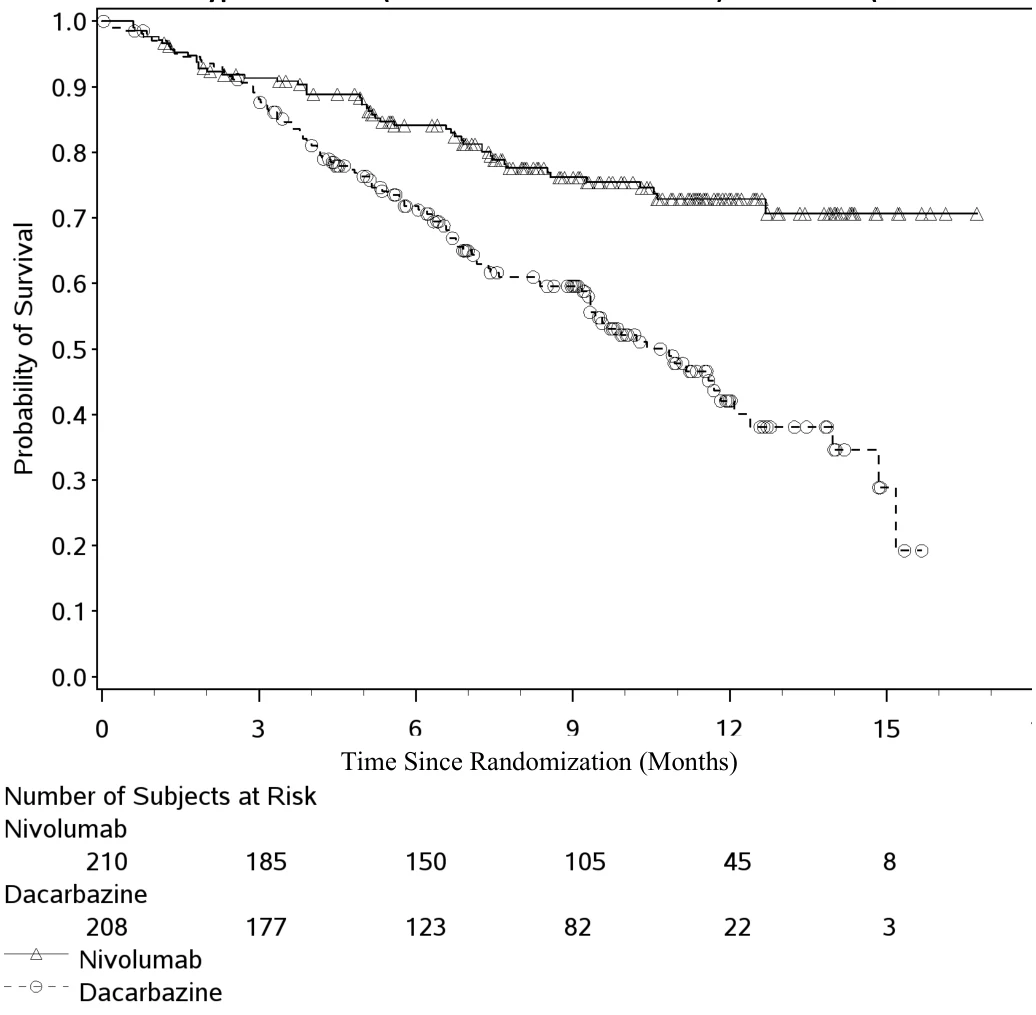
Symbols represent censored observations.
Median TTR was 2.1 months (range 1.2 to 7.6) in the Opdivo group and 2.1 months (range 1.8 to 3.6) in the dacarbazine group. Median DOR was not reached in the Opdivo group (range: 0+ to 12.5+ months) and was 5.98 months (range: 1.1 to 10.0+) in the dacarbazine group. At the time of analysis, 86% (72/84) of Opdivo-treated patients and 52% (15/29) of dacarbazine-treated patients were still in response. In addition, atypical responses (i.e., tumour shrinkage following initial RECIST progression) have been observed with Opdivo.
Controlled Trial in Melanoma Patients Previously Untreated First-line treatment as monotherapy or in combination with ipilimumab: CHECKMATE-067
CHECKMATE-067 was a multicenter, double-blind trial that randomized (1:1:1) patients with unresectable or metastatic melanoma to receive Opdivo (nivolumab) in combination with ipilimumab, Opdivo as a single agent, or ipilimumab alone. Patients in the combination arm received nivolumab 1 mg/kg and ipilimumab 3 mg/kg every 3 weeks for the first 4 doses, followed by nivolumab 3 mg/kg as a single agent every 2 weeks. Patients in the Opdivo single-agent arm received nivolumab 3 mg/kg every
Time Since Randomization (Months)
2 weeks. Patients in the comparator arm received ipilimumab 3 mg/kg every 3 weeks for 4 doses followed by placebo every 2 weeks. Patients who had not received prior systemic anticancer therapy for unresectable or metastatic melanoma were enrolled regardless of PD-L1 expression. Prior adjuvant or neoadjuvant therapy was allowed if completed at least 6 weeks prior to randomization and all adverse reactions had returned to baseline or stabilized. Randomization was stratified by PD-L1 expression (≥5% vs. <5% tumour cell membrane expression), BRAF status, and M stage per the American Joint Committee on Cancer (AJCC) staging system. The trial excluded patients with active brain metastasis, ocular/uveal melanoma, autoimmune disease, or medical conditions requiring systemic immunosuppression within 14 days of the start of study therapy. Tumour assessments were conducted 12 weeks after randomization then every 6 weeks for the first year, and every 12 weeks thereafter.
The co-primary efficacy outcome measures were to compare progression-free survival (PFS) and overall survival (OS) of Opdivo monotherapy to ipilimumab monotherapy and that of Opdivo combined with ipilimumab to ipilimumab monotherapy in subjects with previously untreated, unresectable or metastatic melanoma. Overall response rate (ORR) was a secondary objective. The trial was not designed to assess whether adding ipilimumab to Opdivo improves PFS or OS compared to Opdivo as a single agent. Two formal scheduled analyses were planned for this study; the primary analysis of the PFS endpoint occurred at a minimum follow-up of 9 months, and the primary analysis of the OS endpoint occurred at a minimum follow-up of 28 months. This study also evaluated whether PD-L1 expression was a predictive biomarker for the co-primary endpoints as an exploratory objective.
Among the 945 randomized patients, the baseline study population characteristics were generally balanced across the three treatment groups. The baseline characteristics were: median age 61 years (range: 18 to 90); 65% male; 97% White; ECOG performance score 0 (73%) or 1 (27%). Disease characteristics were: AJCC Stage IV disease (93%); M1c disease (58%); elevated LDH (36%); history of brain metastases (4%); BRAF V600 mutation-positive melanoma (32%); PD-L1 ≥5% tumour cell membrane expression as determined by the clinical trials assay (46%); and prior adjuvant therapy (22%).
At the primary efficacy analysis which took place at 28 months minimum follow-up, in the Opdivo plus ipilimumab group, patients received a median of 4 doses of Opdivo (range: 1 to 76 doses) and 4 doses of ipilimumab (range: 1 to 4 doses); 57% completed all 4 doses in the initial combination phase. In the single-agent Opdivo arm, patients received a median of 15 doses (range: 1 to 77 doses).
Efficacy results are presented in Table 66, Figure 2 and Figure 3.
Table 66: Efficacy Results in CHECKMATE-067 (Intent-to-Treat Analysis)
| Opdivo + Ipilimumab (n=314) | Opdivo (n=316) | Ipilimumab (n=315) | |
|---|---|---|---|
| Primary Outcome Measures | |||
| Overall Survivala | |||
| Events (%) | 128 (41%) | 142 (45%) | 197 (63%) |
| Median (95% CI) | NR | NR (29.1, NR) | 20.0 months (17.1, 24.6) |
Hazard Ratio (vs. ipilimumab)b (98% CI) | 0.55 (0.42, 0.72) | 0.63 (0.48, 0.81) | |
| p-valuec,d | p<0.0001 | p<0.0001 | |
| Progression-Free Survivale | |||
| Events (%) | 151 (48%) | 174 (55%) | 234 (74%) |
| Median (95% CI) | 11.5 months (8.9, 16.7) | 6.9 months (4.3, 9.5) | 2.9 months (2.8, 3.4) |
Hazard Ratio (vs. ipilimumab)f (99.5% CI)g p-valueh | 0.42 (0.31, 0.57) p<0.0001 | 0.57 (0.43, 0.76) p<0.0001 | -- |
| Secondary Outcome Measures | |||
| Objective Response Ratee | 58% | 44% | 19% |
| (95% CI) | (52.0, 63.2) | (38.1, 49.3) | (14.9, 23.8) |
| p-valuei,j | p<0.0001 | p<0.0001 | |
| Complete Response | 11% | 9% | 2% |
| Partial Response | 46% | 35% | 17% |
| Stable disease (SD) | 41 (13%) | 34 (11%) | 69 (22%) |
| Progressive disease (PD) | 71 (23%) | 119 (38%) | 154 (49%) |
| Confirmed Objective Response Ratee,k | 50% | 40% | 14% |
| (95% CI) | (44, 55) | (34, 46) | (10, 18) |
| p-valuej | <0.0001 | <0.0001 | |
| Exploratory Outcome Measures | |||
| Duration of Responsee | |||
| Proportion ≥6 months in duration | 68% | 67% | 53% |
Abbreviation: CI = confidence interval
- a. Minimum follow-up of 28 months.
- b. Based on a stratified proportional hazards model.
- c. Based on stratified log-rank test.
- d. The maximum of the two p-values is compared with the allocated alpha of 0.04 for final OS treatment comparisons using Hochberg’s procedure.
- e. Minimum follow-up of 9 months.
- f. Based on a Cox proportional hazards model adjusted for PD-L1 status, BRAF status, and M-stage.
- g. The 99.5% confidence level corresponds to the allocated Type I error of 0.01 for the PFS co- primary endpoint, adjusted for two pairwise comparisons versus ipilimumab (0.005 for each comparison).
- h. P-value is obtained from a two-sided log-rank test stratified by PD-L1 status, BRAF status, and M-stage
- i. A hierarchical testing approach was used to control the Type I error rate of 0.01
- j. Based on the stratified Cochran-Mantel-Haenszel test.
- k. Confirmed CR or PR was determined if the criteria for each were met at a subsequent timepoint (minimum 4 weeks after criteria for an objective response were first met)
Figure 2: Progression-Free Survival: Unresectable or Metastatic Melanoma (CHECKMATE-067) (Intent-to-Treat, Primary Analysis)
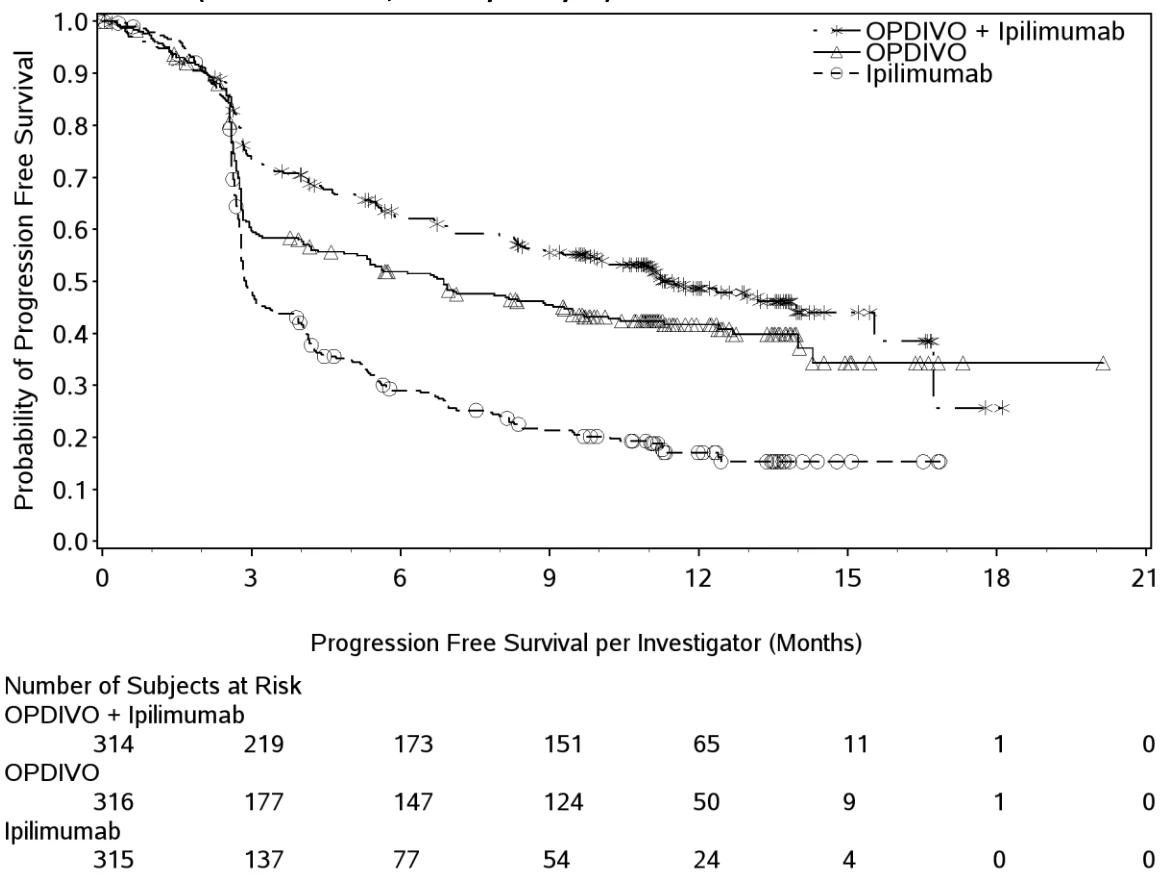
Figure 3: Overall survival (CA209067) (Intent-to-Treat)
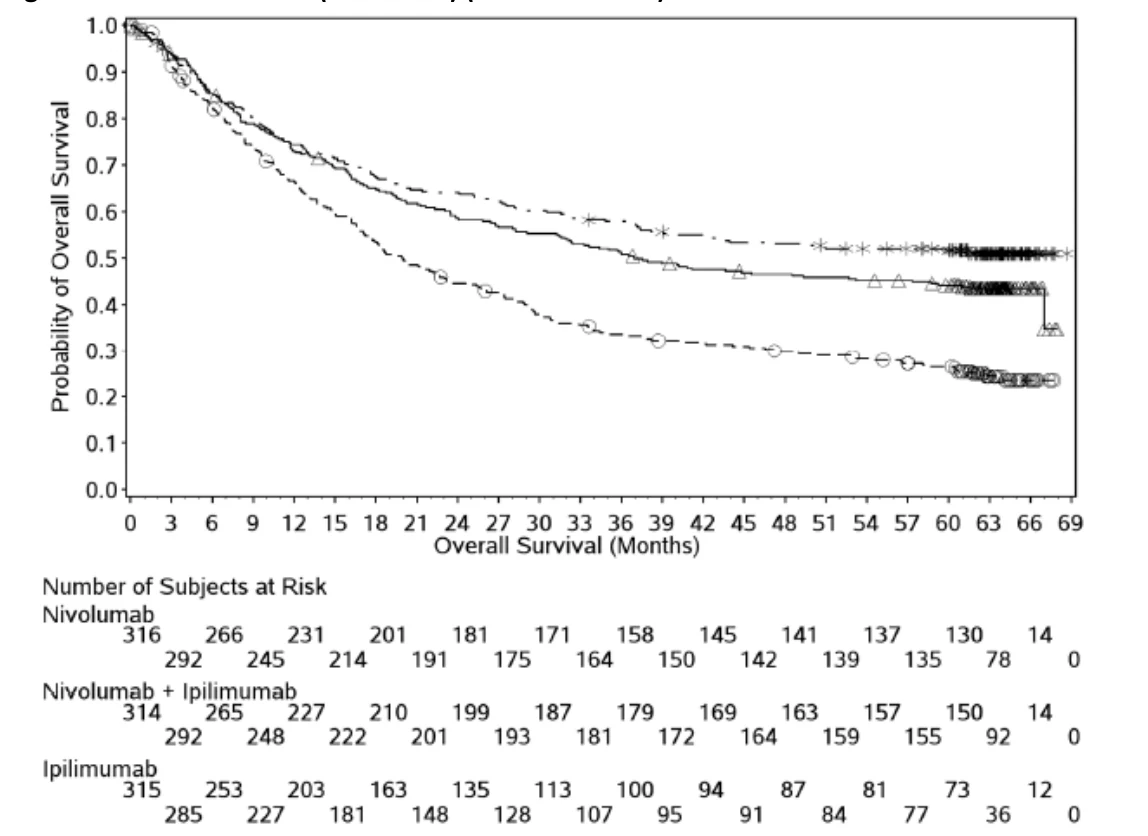
In an exploratory analysis, updated efficacy results for OS, PFS and ORR, based on a minimum follow-up of 60 months were consistent with the final results previously reported. The median OS was not reached in the Opdivo in combination with ipilimumab arm. The median OS was 36.9 months in the single-agent Opdivo arm and 19.9 months in the ipilimumab arm.
Efficacy of PFS analysis by BRAF status at a minimum follow-up of 9 months: Progression-free survival results by BRAF mutation status are shown in Table 67 and
Table 68.
Table 67: Progression Free Survival by BRAF Status - Opdivo in Combination with Ipilimumab Compared to Ipilimumab - Exploratory Analysis (CHECKMATE-067)
| Opdivo + Ipilimumab | Ipilimumab | Unstratified Hazard Ratio (95% CI) | |||||||||||
|---|---|---|---|---|---|---|---|---|---|---|---|---|---|
| Opdivo + Ipilimumab | Ipilimumab | Unstratified Hazard Ratio (95% CI) | |||||||||||
| N | N of events/ N of subjects (% subjects) | mPFS (95% CI) | N of events/ N of subjects (% subjects) | mPFS (95% CI) | |||||||||
| N | N of events/ N of subjects (% subjects) | mPFS (95% CI) | N of events/ N of subjects (% subjects) | mPFS (95% CI) | |||||||||
| Overall | 945 | 151/314 (48.1) | 11.50 (8.90, 16.72) | 234/315 (74.3) | 2.89 (2.79, 3.42) | 0.43 (0.35, 0.53) | |||||||
| BRAF Mutation Status | |||||||||||||
| Mutant | 300 | 48/102 (47.1) | 11.73 (8.02, N.A.) | 66/100 (66.0) | 4.04 (2.79, 5.52) | 0.47 (0.32, 0.68) | |||||||
| Wildtype | 645 | 103/212 (48.6) | 11.24 (8.34, N.A.) | 168/215 (78.1) | 2.83 (2.76, 3.09) | 0.41 (0.32, 0.53) | |||||||
Table 68: Progression Free Survival by BRAF Status - Single Agent Opdivo Compared to Ipilimumab - Exploratory Analysis (CHECKMATE-067)
| Opdivo | Ipilimumab | Unstratified Hazard Ratio (95% CI) | ||||||||||||
|---|---|---|---|---|---|---|---|---|---|---|---|---|---|---|
| N | N of events/ N of subjects (% subjects) | mPFS (95% CI) | N of events/ N of subjects (% subjects) | mPFS (95% CI) | ||||||||||
| Overall | 945 | 174/316 (55.1) | 6.87 (4.34, 9.46) | 234/315 (74.3) | 2.89 (2.79, 3.42) | 0.57 (0.47, 0.69) | ||||||||
| BRAF Mutation Status | ||||||||||||||
| Mutant | 300 | 57/98 (58.2) | 5.62 (2.79, 9.46) | 66/100 (66.0) | 4.04 (2.79, 5.52) | 0.77 (0.54, 1.09) | ||||||||
| Wildtype | 645 | 117/218 (53.7) | 7.89 (4.86, 12.68) | 168/215 (78.1) | 2.83 (2.76, 3.09) | 0.50 (0.39, 0.63) | ||||||||
Table 69 provides objective response rates by BRAF mutation status.
Table 69: Objective Response by BRAF [V600] Mutation Status - Exploratory Analysis (CHECKMATE-067)
| BRAF [V600] Mutation-Positive | BRAF Wild-Type | |||||||||||
|---|---|---|---|---|---|---|---|---|---|---|---|---|
| Treatment | Number of Responses/Patients | ORR% (95% CI) | Number of Responses/Patients | ORR% (95% CI)a | ||||||||
| Opdivo + Ipilimumab | 68/102 | 66.7 (56.6, 75.7) | 113/212 | 53.3 (46.3, 60.2) | ||||||||
| Opdivo | 36/98 | 36.7 (27.2, 47.1) | 102/218 | 46.8 (40.0, 53.6) | ||||||||
| Ipilimumab | 22/100 | 22.0 (14.3, 31.4) | 38/215 | 17.7 (12.8, 23.4) | ||||||||
a. Descriptive evaluation only, based on Cochran Mantel-Haenszel (CMH) methodology
Efficacy of PFS and ORR analysis by PD-L1 Expression at a minimum follow-up of 9 months: Quantifiable PD-L1 expression was retrospectively measured in 89% (278/314) of patients randomized to Opdivo in combination with ipilimumab, 91% (288/316) of patients randomized to single-agent Opdivo, and 88% (277/315) of patients randomized to ipilimumab alone. Among patients with quantifiable PD-L1 expression, the distribution of patients across the three treatment groups at each of the predefined PD-
L1 expression levels was as follows: ≥1% (56% in the Opdivo in combination with ipilimumab arm, 59% in the single-agent Opdivo arm, and 59% in the ipilimumab arm) and ≥5% (24%, 28%, and 27%, respectively). PD-L1 expression was determined using the PD-L1 IHC 28-8 pharmDx assay.
Figure 4 and Figure 5 present exploratory efficacy subgroup analyses of PFS based on defined PD-L1 expression levels.
In this study, no clear cutoff of PD-L1 expression has been established to predict treatment benefit when considering the relevant endpoints of tumour response, PFS, and OS.
Figure 4: Progression-Free Survival: Patients with <5% PD-L1 Expression - Exploratory Analysis (CHECKMATE-067)
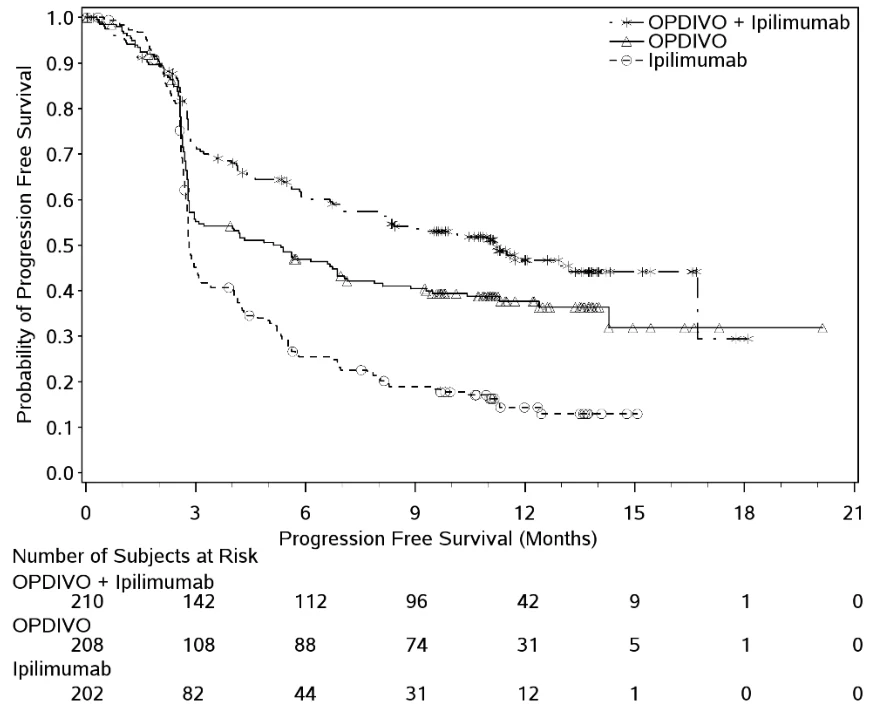
Figure 5: Progression-Free Survival: Patients with ≥5% PD-L1 Expression - Exploratory Analysis (CHECKMATE-067)
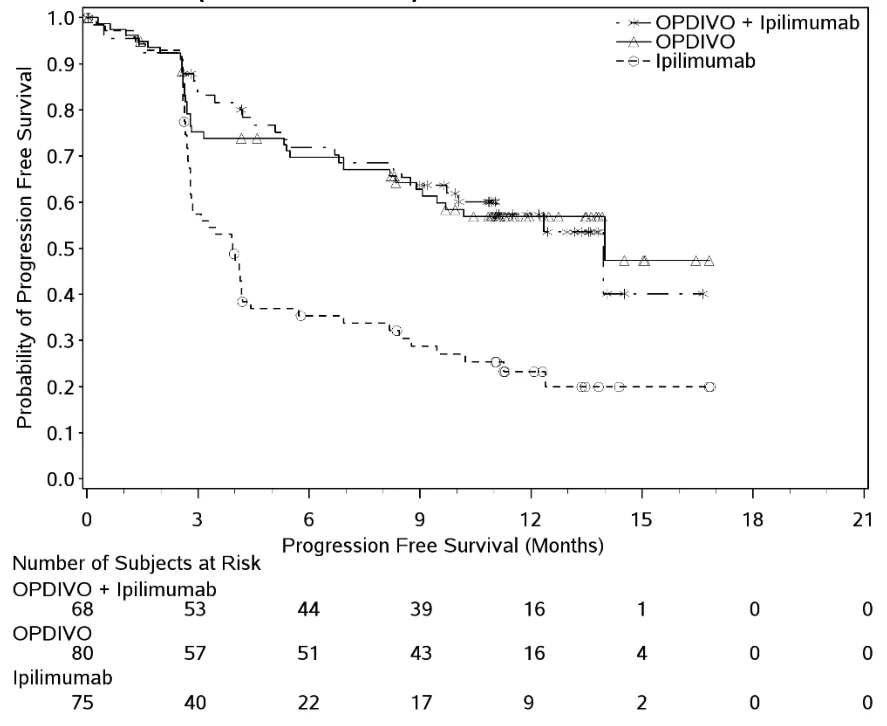
Table 70 shows the objective response rates based on PD-L1 expression level.
Table 70: Objective response - Exploratory Analysis (CHECKMATE-067) (Intent to Treat Analysis)
| Opdivo + ipilimumab (n=314) | Opdivo (n=316) | ipilimumab (n=315) | |||||
|---|---|---|---|---|---|---|---|
| ORR (95% CI) by tumour PD-L1 expression level | |||||||
| <5% | 55% (47.8, 61.6) n=210 | 41% (34.6, 48.4) n=208 | 18% (12.8, 23.8) n=202 | ||||
| ≥5% | 72% (59.9, 82.3) n=68 | 58% (45.9, 68.5) n=80 | 21% (12.7, 32.3) n=75 | ||||
| <1% | 52% (42.8, 61.1) n=123 | 33% (24.9, 42.6) n=117 | 19% (11.9, 27.0) n=113 | ||||
| ≥1% | 65% (56.4, 72.0) n=155 | 54% (46.6, 62.0) n=171 | 19% (13.2, 25.7) n=164 | ||||
Controlled Trial in Melanoma Patients Previously Untreated (First-line treatment in combination with ipilimumab): CHECKMATE-069
CHECKMATE-069 was a randomized, Phase 2, double-blind study comparing the combination of Opdivo and ipilimumab with ipilimumab alone in 142 patients with advanced (unresectable or metastatic) melanoma with similar inclusion criteria to CHECKMATE-067 and the primary analysis in patients with BRAF wild-type melanoma (77% of patients).
Investigator assessed ORR was 61% (95% CI: 48.9, 72.4) in the combination arm (n=72) versus 11% (95% CI: 3.0, 25.4) for the ipilimumab arm (n=37).
Controlled Trial in Melanoma Patients Previously Treated with Ipilimumab (Second-line treatment): CHECKMATE-037
CHECKMATE-037 was a multicentre, open-label phase III study that randomized patients (2:1) with unresectable or metastatic melanoma to receive either 3 mg/kg of Opdivo by intravenous (IV) infusion every 3 weeks (Q3W) or Investigator’s choice chemotherapy (ICC). Chemotherapy consisted of either dacarbazine (1000 mg/m2 Q3W) or carboplatin (AUC 6 every Q3W) and paclitaxel (175 mg/m2 Q3W). Randomization was stratified by BRAF status (wildtype vs. mutation positive) and PD-L1 status by a verified immunohistochemistry (IHC) assay (≥ 5% vs. < 5% cut-off) and best response to prior ipilimumab therapy (prior clinical benefit [complete response, CR; partial response, PR; stable disease, SD] vs. no prior clinical benefit [progressive disease, PD]). Patients were required to have progression of disease on or following ipilimumab treatment and, if BRAF V600 mutation positive, a BRAF inhibitor.
The trial excluded patients with autoimmune disease, medical conditions requiring systemic immunosuppression, ocular melanoma, active brain metastasis, or a history of Grade 4 ipilimumab-related adverse reactions (except for endocrinopathies) or Grade 3 ipilimumab-related adverse reactions that had not resolved or were inadequately controlled within 12 weeks of the initiating event, patients with a condition requiring chronic systemic treatment with corticosteroids (>10 mg daily prednisone equivalent) or other immunosuppressive medications, a positive test for hepatitis B or C, and a history of HIV. Treatment was continued until disease progression (or discontinuation of study therapy in patients receiving Opdivo beyond progression), discontinuation due to toxicity, or other reasons. Radiographic assessments of tumour response were performed at 9 weeks following randomization and every 6 weeks for the first 12 months, and then every 12 weeks until disease progression or treatment discontinuation, whichever occurred later. Demographic and baseline disease characteristics are presented in Table 71.
Table 71: Baseline Characteristics in CHECKMATE-037
Opdivo 3 mg/kg n=272 | ICC n=133 | |
|---|---|---|
Opdivo 3 mg/kg n=272 | ICC n=133 | |
| Men | 65% | 64% |
| Women | 35% | 36% |
| Age (median) | 59 years | 62 years |
| Age (range) | (23-88 years) | (29-85 years) |
| Melanoma Subtypes | ||
| Mucosal | 10% | 11% |
| Cutaneous | 72% | 74% |
| M-Stage at study entry | ||
| M0 | 4% | 2% |
| M1a (soft tissue) | 6% | 8% |
| M1b (lung) | 16% | 14% |
| M1c (all viscera) | 75% | 77% |
| Number of Prior Systemic therapies | ||
| 1 | 28% | 26% |
| 2 | 51% | 51% |
| >2 | 21% | 23% |
| PD-L1 Status | ||
| Positive | 49% | 50% |
| Negative/Indeterminate | 51% | 50% |
| BRAF Status | ||
| Wild Type | 78% | 78% |
| Mutation Positive | 22% | 22% |
| No response to prior ipilimumab (BOR of PD) | 64% | 65% |
| ECOG | ||
| 0 | 60% | 63% |
| 1 | 40% | 36% |
| 2 | 0 | 1% |
| Baseline LDH | ||
| > ULN | 52% | 38% |
| > 2*ULN | 17% | 17% |
| History of Brain Metastases | ||
| Yes | 20% | 14% |
| No | 80% | 87% |
The median duration of exposure was 4.71 months (range: 0.03 to 35.94 months) in the Opdivo arm and 1.95 months (range: 0.03 to 14.23 months) in the chemotherapy arm.
The co-primary efficacy outcome measures were confirmed overall response rate (ORR) in the first 120 patients treated with Opdivo, as measured by independent radiology review committee (IRRC) using RECIST, version 1.1, and comparison of overall survival (OS) of nivolumab to chemotherapy. Additional outcome measures included duration of response.
At the time of the final ORR analysis, results from 120 nivolumab-treated patients and 47 chemotherapy-treated patients who had a minimum of 6 months of follow-up were analyzed. The ORR was 31.7 % (95% confidence interval [CI]: 23.5, 40.8), consisting of 4 complete responses and 34 partial responses in Opdivo-treated patients. There were objective responses in patients with and without BRAF V600 mutation-positive melanoma. The ORR was 10.6% (95% CI: 3.5, 23.1) in the chemotherapy treated patients.
There was no statistically significant difference between Opdivo and chemotherapy in the final OS analysis. The primary OS analysis was not adjusted to account for subsequent therapies, with 54 (40.6%) patients in the chemotherapy arm subsequently receiving an anti-PD1 treatment and 30 (11.0%) of patients in the Opdivo arm receiving subsequent therapies.
Efficacy by BRAF status:
The ORRs in the BRAF mutation-positive subgroup were 17% (n = 59; 95% CI: 8.4, 29.0) for Opdivo and 11% (n= 27; 95% CI: 2.4, 29.2) for chemotherapy, and in the BRAF wild-type subgroup were 30% (n = 213; 95% CI: 24.0, 36.7) and 9% (n =106; 95% CI: 4.6, 16.7), respectively.
The OS HR for Opdivo (n= 59) versus chemotherapy (n = 27) was 1.32 (95% CI: 0.75, 2.32) for BRAF mutation-positive patients. The OS HR for Opdivo (n= 213) versus chemotherapy (n = 106) was 0.83 (95% CI: 0.62, 1.11) for BRAF wild-type patients.
Efficacy by tumour PD-L1 expression:
In patients with tumour PD-L1 expression ≥1%, ORR was 33.5% for Opdivo (n=179; 95% CI: 26.7, 40.9) and 13.5% for chemotherapy (n=74; 95% CI: 6.7, 23.5). In patients with tumour PD-L1 expression <1%, ORR per IRRC was 13.0% (n=69; 95% CI: 6.1, 23.3) and 12.0% (n=25; 95% CI: 2.5, 31.2), respectively.
The OS HR for Opdivo (n= 179) versus chemotherapy (n = 74) was 0.69 (95% CI: 0.49, 0.96) in patients with tumour PD-L1 expression ≥1%. The OS HR for Opdivo (n= 69) versus chemotherapy (n = 25) was 1.52 (95% CI: 0.89, 2.57) in patients with tumour PD-L1 expression <1%.
Adjuvant Treatment of Melanoma
Randomized phase III study of Opdivo versus ipilimumab: CHECKMATE-238
CHECKMATE-238 was a phase III randomized, double-blind trial enrolling patients with completely resected (rendered free of disease with negative margins on resected specimens) Stage IIIB/C or Stage IV melanoma. Patients were randomized (1:1) to receive Opdivo (n=453) administered as an intravenous infusion over 60 minutes at 3 mg/kg every 2 weeks or ipilimumab (n=453) administered as an intravenous infusion at 10 mg/kg every 3 weeks for 4 doses then every 12 weeks beginning at Week 24 for up to 1 year. Randomization was stratified by PD-L1 status (positive [based on 5% level] vs negative/indeterminate) and American Joint Committee on Cancer (AJCC) stage (Stage IIIB/C vs Stage IV M1a-M1b vs Stage IV M1c, 7th edition). The trial excluded patients with a history of ocular/uveal melanoma, autoimmune disease, and any condition requiring systemic treatment with either corticosteroids (≥10 mg daily prednisone or equivalent) or other immunosuppressive medications, as well as patients with prior therapy for melanoma except surgery, adjuvant radiotherapy after neurosurgical resection for lesions of the central nervous system, and prior adjuvant interferon completed ≥6 months prior to randomization.
The primary efficacy outcome measure was recurrence-free survival (RFS) defined as the time between the date of randomization and the date of first recurrence (local, regional, or distant metastasis), new primary melanoma, or death, whatever the cause, whichever occurs first and assessed by the investigator. Disease was assessed at baseline and every 12 weeks (± 7 days) for the first year, then every 12 weeks (± 14 days) for the second year, then every 6 months until 5 years or until local, regional, or distant recurrence (whichever comes first) for Stage IV subjects and until distant recurrence for Stage III subjects. Overall survival (OS) was evaluated as a secondary objective.
A total of 906 patients were randomized (453 to Opdivo and 453 to ipilimumab). The median age was 55 years (range: 18 to 86), 58% were male, 95% were white, and 90% had ECOG performance status of 0. Forty-two percent (42%) of patients were BRAF V600 mutation positive, 45% were BRAF wild type, and 13% were BRAF status unknown. With regard to disease stage, 34% had Stage IIIB, 47% had Stage IIIC, and 19% had Stage IV. The majority of patients (85.3%) were randomized within 12 weeks of surgery. The median duration of follow-up was 19.5 months (range: 0.0 to 25.0 months).
CHECKMATE-238 demonstrated a statistically significant improvement in RFS for patients randomized to the Opdivo arm compared with the ipilimumab 10 mg/kg arm.
Efficacy results for the primary endpoint at the interim analysis are presented in Table 72 and Figure 6.
Table 72: Efficacy Results in CHECKMATE-238
| Recurrence-free Survival | Opdivo N=453 | Ipilimumab 10 mg/kg N=453 | |||||
Number of Events, n (%) Type of Event Disease at Baseline Local Recurrence Regional Recurrence Distant Metastasis New Primary Melanoma | 154 (34.0%) 1 (0.2%) 30 (6.6%) 31 (6.8%) 85 (18.8%) 7 (1.5%) | 206 (45.5%) 2 (0.4%) 44 (9.7%) 34 (7.5%) 117 (25.8%) 4 (0.9%) | |||||
| Hazard Ratioa (97.56% CI) p-valueb | 0.65 (0.51, 0.83) p<0.0001 | ||||||
| Median (months) (95% CI) | Not Reached | Not Reached (16.56, NR) | |||||
| Rate (95% CI) at 12 months | 70.5 (66.1, 74.5) | 60.8 (56.0, 65.2) | |||||
| Rate (95% CI) at 18 months | 66.4 (61.8, 70.6) | 52.7 (47.8, 57.4) | |||||
- a. Based on a stratified proportional hazards model stratified by tumour PD-L1 expression and stage of disease.
- b. p-value is derived from a log-rank test stratified by tumour PD-L1 expression and stage of disease; the corresponding O’Brien-Fleming efficacy boundary significance level at the interim analysis is 0.0244.
Figure 6: Recurrence-free Survival -CHECKMATE-238
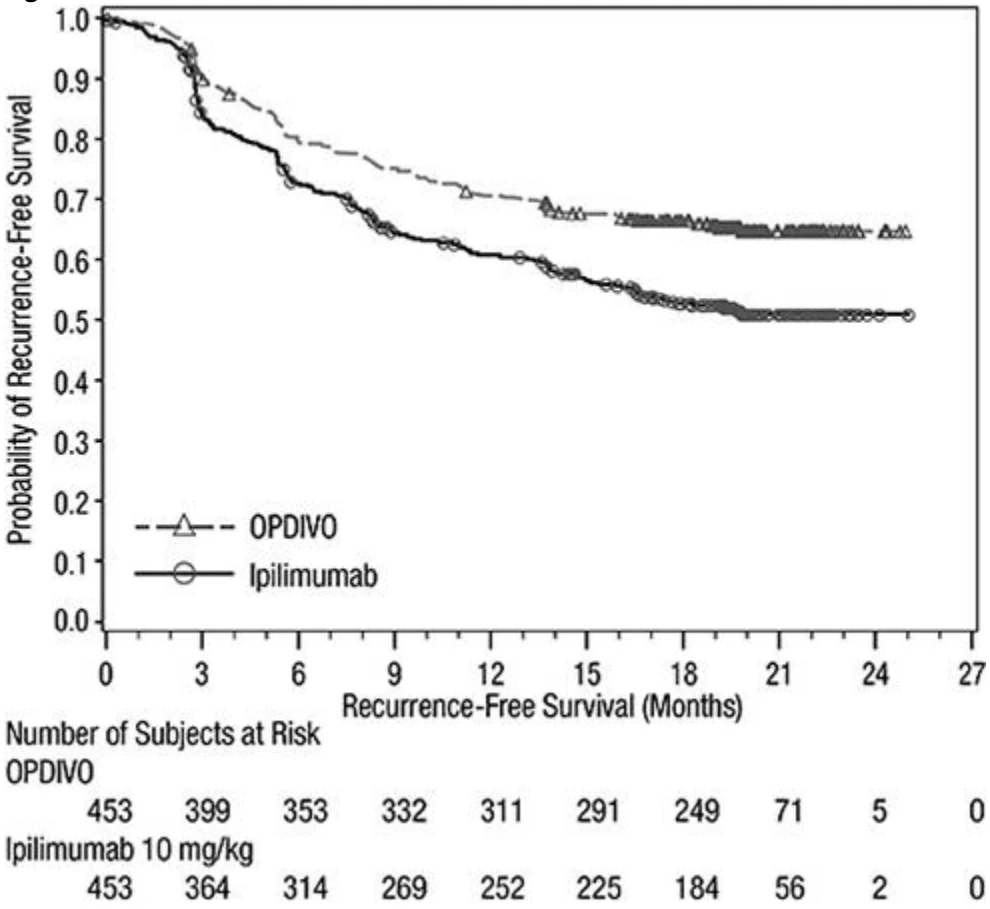
*18-months minimum follow-up interim RFS analysis
The pre-specified final OS analysis occurred with a minimum follow-up of 48 months. Fewer OS events were observed than originally anticipated (approximately 302). There were 211 total OS events (100 in the Opdivo arm and 111 in the ipilimumab arm); median OS was not reached in either arm (HR 0.87, 95% CI: 0.66, 1.14, p=0.31). OS rates at 48 months were 77.9% and 76.6% in the Opdivo and ipilimumab arms, respectively (Figure 8). With a minimum follow-up of 48 months, median RFS was 52.4 months in the Opdivo arm compared to 24.1 months in the ipilimumab arm (HR 0.71, 95% CI: 0.60, 0.86). RFS rates at 48 months were 51.7% vs. 41.2% in the Opdivo and ipilimumab arms, respectively (Figure 7).
Figure 7: Recurrence-free Survival - CHECKMATE-238*
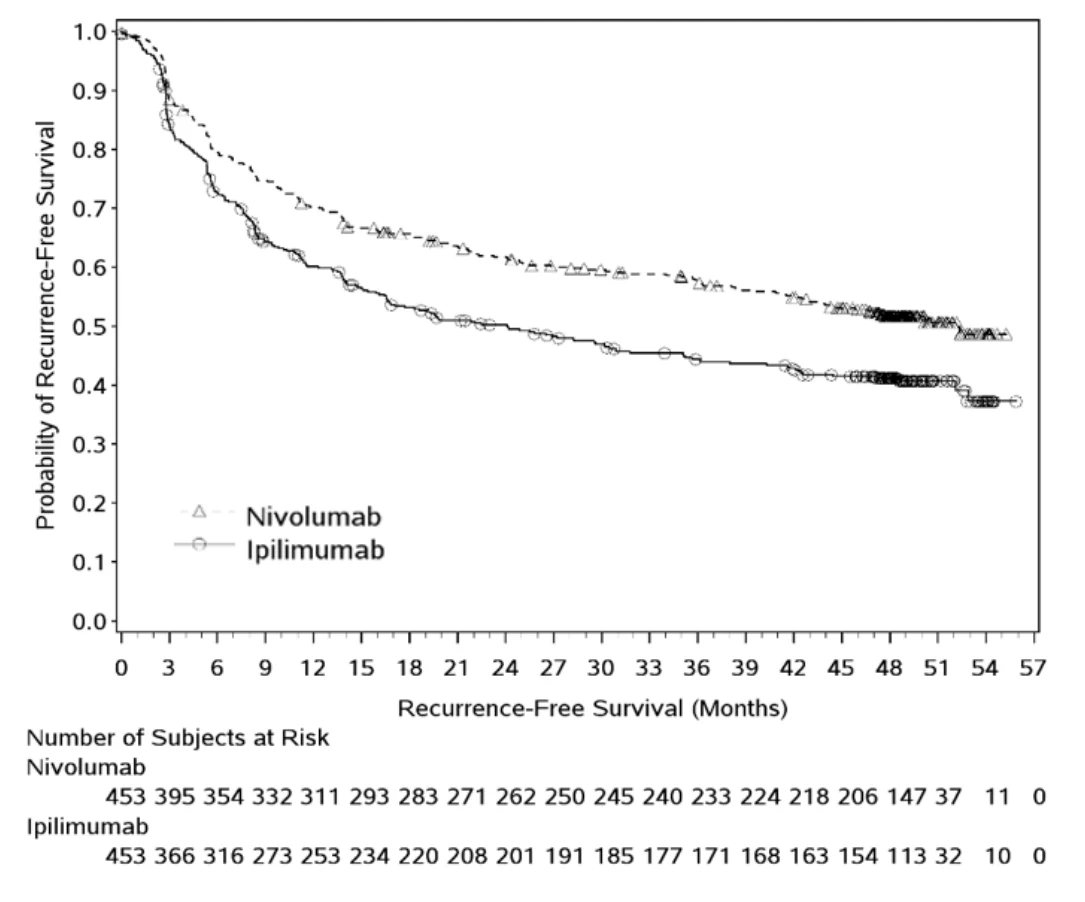
- -months minimum follow-up descriptive RFS analysis
Figure 8: Overall Survival - CHECKMATE-238*
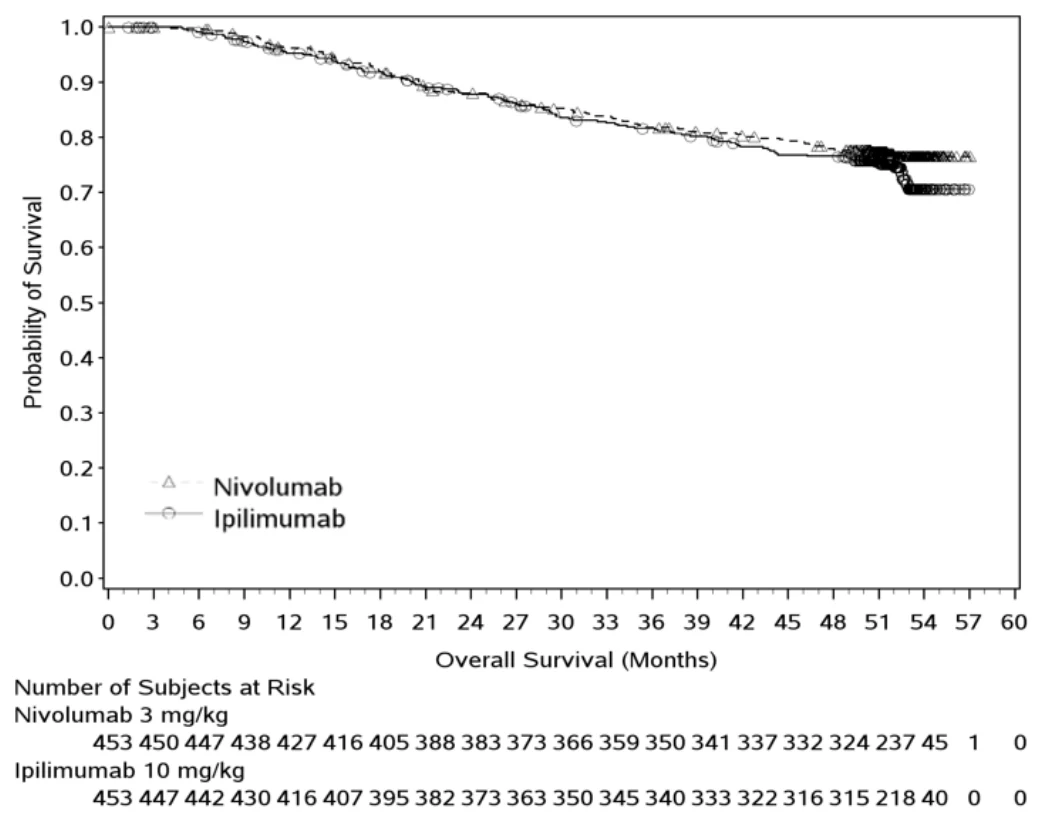
- -months minimum follow-up final analysis
Randomized phase III study of Opdivo versus placebo: CHECKMATE-76K
CHECKMATE-76K was a phase III randomized, double-blind trial enrolling patients with completely resected Stage IIB or IIC melanoma. Patients were randomized (2:1) to receive Opdivo (n=526) administered as an intravenous infusion over 30 minutes at 480 mg every 4 weeks or placebo (n=264) and were treated for 1 year or until disease recurrence or unacceptable toxicity. Randomization was stratified by American Joint Committee on Cancer (AJCC) 8th edition T Stage (T3b vs. T4a vs. T4b). Enrolment required complete resection of the primary melanoma with negative margins and a negative sentinel lymph node biopsy within 12 weeks prior to randomization. Patients were enrolled regardless of their tumour PD-L1 status. The study included patients, who had an ECOG performance status score of 0 or 1, with Stage IIB or IIC American Joint Committee on Cancer (AJCC), 8th edition, histologically confirmed melanoma that is completely surgically resected. The trial excluded patients with ocular/uveal or mucosal melanoma, active autoimmune disease, any condition requiring systemic treatment with either corticosteroids (≥10 mg daily prednisone or equivalent) or other immunosuppressive medications, as well as patients with prior therapy for melanoma except surgery.
The primary efficacy outcome measure was recurrence-free survival (RFS). RFS, assessed by the investigator, was defined as the time between the date of randomization and the date of first recurrence (local, regional, or distant metastasis), new primary melanoma, or death from any cause, whichever occurs first. Tumour assessments were conducted every 26 weeks during years 1-3 and every 52 weeks thereafter to year 5.
A total of 790 patients were randomised (526 to Opdivo and 264 to placebo). The median age of patients was 62 years (range: 19-92), 42% age 65 years or older, 61% were men, and 98% were white. Baseline ECOG performance status score was 0 (94%) or 1 (6%). Sixty percent had Stage IIB and 40% had Stage IIC.
At a primary pre-specified interim analysis (minimum follow-up 8 months; median follow-up 16 months), CHECKMATE-76K demonstrated a statistically significant improvement in RFS for patients randomized to the Opdivo arm compared with the placebo arm.
Efficacy results for the primary endpoint at the interim analysis are presented in Table 73 and Figure 9.
Table 73: Efficacy Results in CHECKMATE-76K
| Opdivo N=526 | Placebo N=264 | ||||
Recurrence-free Survival Number of Events, n (%) | 66 (13%) | 69 (26%) | |||
| Hazard Ratioa (95% CI) p-valueb | 0.42 (0.30, 0.59) p<0.0001 | ||||
| Median (months) (95% CI) | Not Reached (NR) (28.52, NR) | Not Reached (NR) (21.62, NR) | |||
a Based on stratified Cox proportional hazard model.
b Based on log-rank test stratified by AJCC 8th edition T stage at study entry. P-value is derived from the log-rank test. The corresponding O’Brien-Fleming efficacy boundary significance level at the interim analysis is 0.024.
Figure 9: Recurrence-free Survival - CHECKMATE-76K
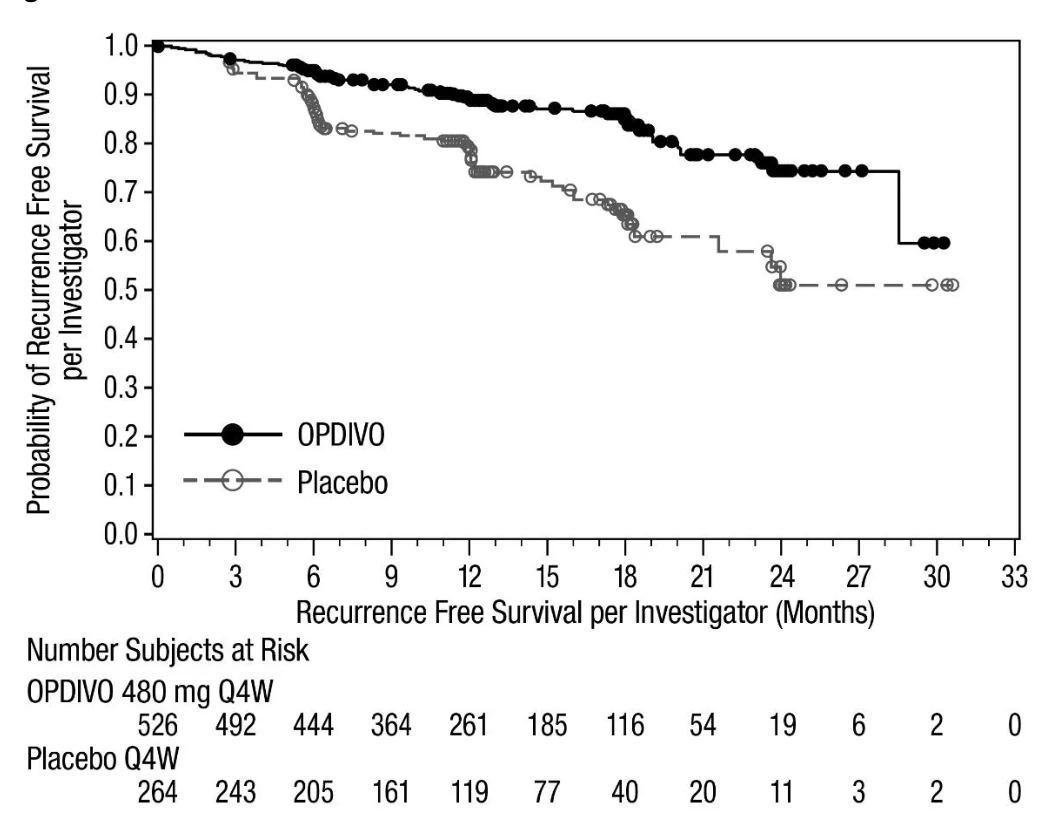
Metastatic NSCLC
Controlled Trial in Squamous NSCLC Patients Previously Treated with Chemotherapy (Second-line Treatment): CHECKMATE-017
CHECKMATE-017 was a randomized (1:1), open-label study enrolling 272 patients with metastatic squamous NSCLC who had experienced disease progression during or after one prior platinum doublet-based chemotherapy regimen. Patients were randomized to receive Opdivo (n=135) administered intravenously at 3 mg/kg every 2 weeks or docetaxel (n=137) administered intravenously at 75 mg/m2 every 3 weeks. This study included patients regardless of their PD-L1 status. The trial excluded patients with autoimmune disease, medical conditions requiring systemic immunosuppression, symptomatic interstitial lung disease, or untreated brain metastasis. Patients with treated brain metastases were eligible if neurologically returned to baseline at least 2 weeks prior to enrollment, and either off corticosteroids, or on a stable or decreasing dose of <10 mg daily prednisone equivalents. The first tumour assessments were conducted 9 weeks after randomization and continued every 6 weeks thereafter.
The major efficacy outcome measure was overall survival (OS). Key secondary efficacy outcome measures were investigator-assessed objective response rate (ORR) and progression-free survival (PFS). In addition, this trial evaluated whether PD-L1 expression was a predictive biomarker for efficacy.
In CHECKMATE-017, the median age was 63 years (range: 39 to 85) with 44% ≥65 years of age and 11% ≥75 years of age. The majority of patients were white (93%) and male (76%). Baseline disease characteristics of the population were Stage IIIb (19%), Stage IV (80%) and brain metastases (6%). Baseline ECOG performance status was 0 (24%) or 1 (76%).
The trial demonstrated a statistically significant improvement in OS for patients randomized to Opdivo as compared with docetaxel at the pre-specified interim analysis when 199 events were observed (86% of the planned number of events for final analysis) (Table 74 and Figure 10).
Table 74: Efficacy Results in CHECKMATE-017 (Intent-to-Treat Analysis)
| Opdivo (n=135) | Docetaxel (n=137) | ||||||
| Overall Survival | |||||||
| Events (%) | 86 (64%) | 113 (82%) | |||||
| Median survival in months (95% CI) | 9.2 (7.3, 13.3) | 6.0 (5.1, 7.3) | |||||
| p-valuea Hazard ratio (96.85% CI)b | 0.00025 0.59 (0.43, 0.81) | ||||||
| Objective Response Ratec | |||||||
| n (%) | 27 (20%) | 12 (8.8%) | |||||
| (95% CI) | (13.6, 27.7) | (4.6, 14.8) | |||||
| Difference in ORR (95% CI) | 11.3% (2.9, 19.6) | ||||||
| p-valued | 0.0083 | ||||||
| Complete Response | 1 (0.7%) | 0 | |||||
| Partial Response | 26 (19.3%) | 12 (8.8%) | |||||
| Progression-free Survival | |||||||
| Events (%) | 105 (78%) | 122 (89%) | |||||
| Median survival in months (95% CI) | 3.5 (2.1, 4.9) | 2.8 (2.1, 3.5) | |||||
| p-valuea Hazard ratio (95% CI)b | 0.0004 0.62 (0.47, 0.81) | ||||||
- a. P-value is derived from a log-rank test stratified by region and prior paclitaxel use; the corresponding O’Brien-Fleming efficacy boundary significance level is 0.0315.
- b. Derived from a stratified proportional hazards model.
- c. Responses of CR+PR as per RECIST v1.1 criteria, as assessed by investigator; confidence interval based on the Clopper and Pearson method.
- d. Based on the stratified Cochran-Mantel-Haenzel test.
Figure 10: Overall Survival - CHECKMATE-017
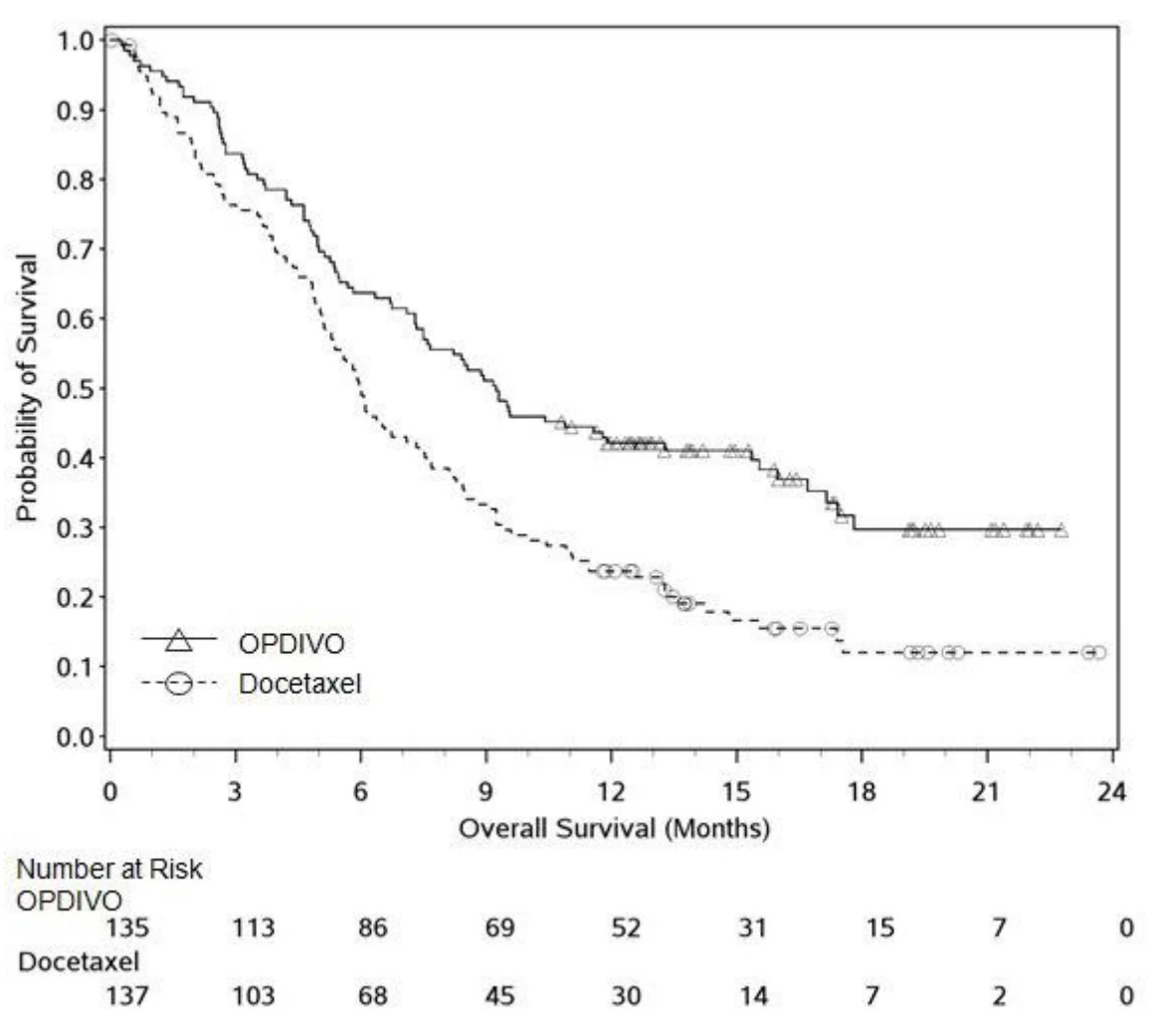
The estimated OS rates at 12 months were 42% (95% CI: 33.7, 50.3) for Opdivo and 24% (95% CI: 16.9, 31.1) for docetaxel. The median time to onset of response was 2.2 months (range: 1.6 to 11.8 months) for patients randomized to Opdivo and 2.1 months (range 1.8 to 9.5 months) for patients randomized to docetaxel. At the time of this analysis, 17/27 (63%) of Opdivo patients and 4/12 (33%) of docetaxel patients with a confirmed response had ongoing responses. The median duration of response was not reached (range from 2.9 to 20.5+ months) for Opdivo patients and 8.4 months (range 1.4 to 15.2+ months) for docetaxel patients.
Pre-study tumour tissue specimens were systematically collected prior to randomization in order to conduct pre-planned analyses of efficacy according to predefined PD-L1 expression status. Quantifiable PD-L1 expression was measured in 87% of patients in the Opdivo group and 79% of patients in the docetaxel group. PD-L1 expression levels for the two treatment groups (Opdivo vs docetaxel) at each of the predefined PD-L1 expression levels were ≥1% (54% vs 52%), ≥5% (36% vs 36%), or ≥10% (31% vs 31%). PD-L1 testing was conducted using the PD-L1 IHC 28-8 pharmDx assay. Survival benefit was observed regardless of PD-L1 expression or non-expression status by all pre-defined expression levels (1%, 5% and 10%). However, the role of the PD-L1 expression status has not been fully elucidated.
Squamous NSCLC Single-Arm Trial: CHECKMATE-063
CHECKMATE-063 was a single-arm, open-label study conducted in 117 patients with locally advanced or metastatic squamous-NSCLC after two or more lines of therapy; otherwise similar inclusion criteria as CHECKMATE-017 were applied. The major efficacy outcome measure was confirmed objective response rate (ORR) as measured by independent review committee (IRC) using Response Evaluation Criteria in Solid Tumours (RECIST 1.1).
Based on IRC review and with a minimum follow-up of at least 10 months on all patients, confirmed ORR was 15% (17/117) (95% CI: 9, 22), of which all were partial responses. In the 17 responders, the median duration of response was not reached at a follow-up of approximately 11 months, with a range of 1.9+ to 11.5+ months.
Controlled Trial in Non-Squamous NSCLC Patients Previously Treated with Chemotherapy (Second-line Treatment): CHECKMATE-057
CHECKMATE-057 was a randomized (1:1), open-label study of 582 patients with metastatic non-squamous NSCLC who had experienced disease progression during or after one prior platinum doublet-based chemotherapy regimen which may have included maintenance therapy. An additional line of TKI therapy was allowed for patients with known EGFR mutation or ALK translocation. Patients were randomized to receive Opdivo (n=292) administered intravenously at 3 mg/kg every 2 weeks or docetaxel (n=290) administered intravenously at 75 mg/m2 every 3 weeks. This study included patients regardless of their PD-L1 status. The trial excluded patients with autoimmune disease, medical conditions requiring systemic immunosuppression, symptomatic interstitial lung disease, or untreated brain metastasis. Patients with treated brain metastases were eligible if neurologically returned to baseline at least 2 weeks prior to enrollment, and either off corticosteroids, or on a stable or decreasing dose of <10 mg daily prednisone equivalents. The first tumour assessments were conducted 9 weeks after randomization and continued every 6 weeks thereafter. The major efficacy outcome measure was overall survival (OS). Key secondary efficacy outcome measures were investigator-assessed objective response rate (ORR) and progression-free survival (PFS). In addition, this trial evaluated whether PD-L1 expression was a predictive biomarker for efficacy.
In CHECKMATE-057, the mean age was 62 years (range: 21 to 85) with 42% ≥65 years of age and 7% ≥75 years of age. The majority of patients were white (92%) and male (55%); baseline ECOG performance status was 0 (31%) or 1 (69%). Seventy-nine percent of patients were former/current smokers.
The trial demonstrated a statistically significant improvement in OS for patients randomized to Opdivo as compared with docetaxel at the prespecified interim analysis when 413 events were observed (93% of the planned number of events for final analysis) (Table 75 and Figure 11).
Table 75: Efficacy Results in CHECKMATE-057 (Intent-to-Treat Analysis)
| Opdivo (n=292) | Docetaxel (n=290) | |||||||
| Overall Survival | ||||||||
| Events (%) | 190 (65%) | 223 (77%) | ||||||
| Median survival in months (95% CI) | 12.2 (9.7, 15.0) | 9.4 (8.0, 10.7) | ||||||
| p-valuea Hazard ratio (95.92% CI)b | 0.0015 0.73 (0.59, 0.89) | |||||||
| Objective Response Ratec | ||||||||
| n (%) | 56 (19%) | 36 (12%) | ||||||
| (95% CI) | (14.8, 24.2) | (8.8, 16.8) | ||||||
| Difference in ORR (95% CI) | 6.8% (0.9, 12.7) | |||||||
| p-value d | 0.0235 | |||||||
| Complete Response | 4 (1.4%) | 1 (0.3) | ||||||
| Partial Response | 52 (17.8%) | 35 (12.1%) | ||||||
| Progression-free Survival | ||||||||
| Events (%) | 234 (80%) | 245 (85%) | ||||||
| Median survival in months (95% CI) | 2.3 (2.8, 3.3) | 4.2 (3.5, 4.9) | ||||||
| p-value Hazard ratio (95% CI)b | 0.3932 0.92 (0.77, 1.11) | |||||||
- a. P-value is derived from a log-rank test stratified by prior maintenance therapy and line of therapy; the corresponding O’Brien-Fleming efficacy boundary significance level is 0.0408.
- b. Derived from a stratified proportional hazards model.
- c. Responses of CR+PR as per RECIST v1.1 criteria, as assessed by investigator; confidence interval based on the Clopper and Pearson method
- d. Based on the stratified Cochran-Mantel-Haenzel test.
Figure 11: Overall Survival: CHECKMATE-057
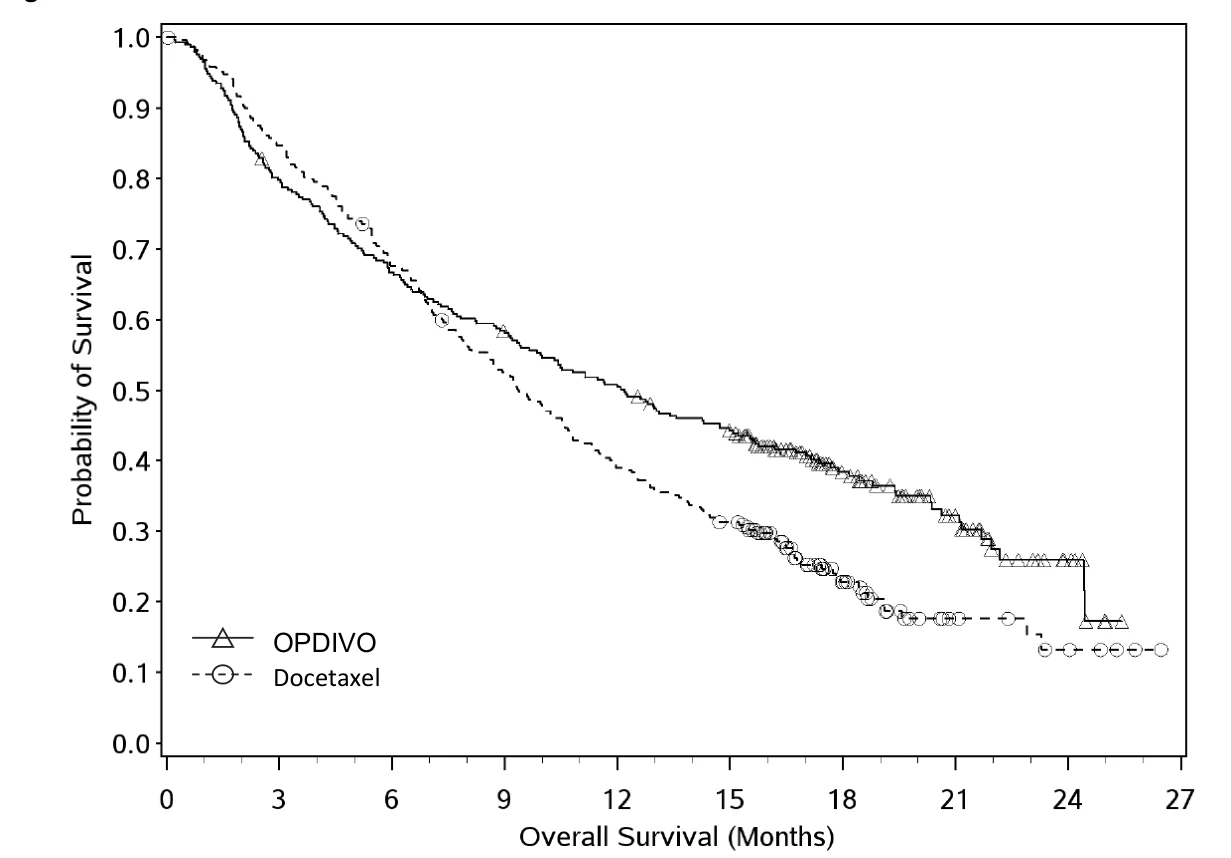

The estimated OS rates at 12 months were 50.5% (95% CI: 44.6, 56.1) for Opdivo and 39.0% (95% CI: 33.3, 44.6) for docetaxel. The median time to onset of response was 2.1 months (range: 1.2 to 8.6 months) for patients randomized to Opdivo and 2.6 months (range 1.4 to 6.3 months) for patients randomized to docetaxel. At the time of this analysis, 29/56 (52%) of Opdivo-treated patients and 5/36 (14%) of docetaxel-treated patients with a confirmed response had ongoing responses. The median duration of response of 17.2 months (range from 1.8 to 22.6+ months) for Opdivo-treated patients and 5.6 months (1.2+ to 15.2+ months) for docetaxel-treated patients.
However, the trial did not demonstrate a statistically significant improvement in PFS for patients randomized to Opdivo as compared with docetaxel (Table 75 and Figure 12). Immediate benefit of Opdivo may not become evident in the first months of treatment with Opdivo as shown by the delayed crossing of the PFS curves followed by sustained separation.
|
|---|
Figure 12: Progression Free Survival: CHECKMATE-057
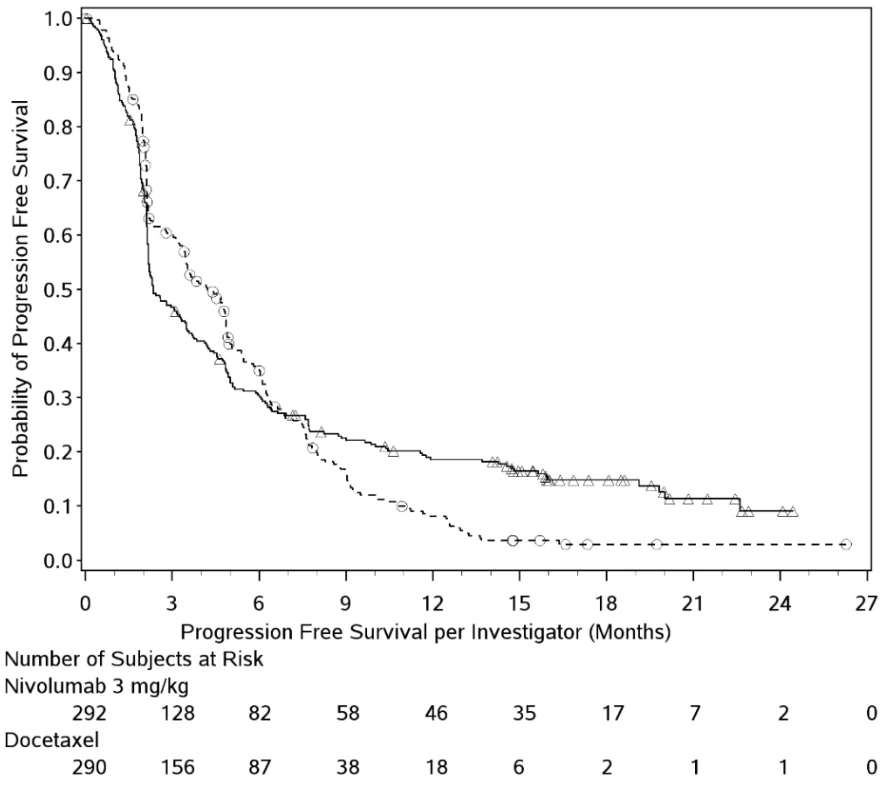
Archival tumour specimens were evaluated for PD-L1 expression following completion of the trial. Across the study population, 22% (127/582) of patients had non-quantifiable results. Of the remaining 455 patients, the proportion of patients in retrospectively determined subgroups based on PD-L1 testing using the PD-L1 IHC 28-8 pharmDx assay were: 46% (209/455) PD-L1 negative, defined as <1% of tumour cells expressing PD-L1 and 54% (246/455) had PD-L1 expression, defined as ≥ 1% of tumour cells expressing PD-L1. Among the 246 patients with tumours expressing PD-L1, 26% had ≥1%, but <5% tumour cells with positive staining, 7% had ≥ 5% but <10% tumour cells with positive staining, and 67% had greater than or equal to 10% tumour cells with positive staining. PD-L1 testing was conducted using the PD-L1 IHC 28-8 pharmDx assay.
Although the role of PD-L1 expression status has not been fully elucidated, in non-squamous NSCLC, pre-study (baseline) PD-L1 expression status shows an apparent association for benefit from Opdivo for all efficacy endpoints. Additional analyses of the association between PD-L1 expression status using pre-defined expression levels and efficacy measures suggested a clinically important signal of predictive association. In PD-L1 positive patients, Opdivo demonstrated improved efficacy vs docetaxel across all efficacy endpoints (OS, ORR, and PFS). In contrast, there were no meaningful differences in efficacy between the treatment groups in the PD-L1 negative subgroups by any expression level. As compared to the overall study population, no meaningful differences in safety were observed based on PD-L1 expression level. In patients with no measurable tumour PD-L1 expression or in those deemed non-quantifiable, close monitoring for unequivocal progression during the first months of treatment with Opdivo may be clinically prudent.
Figure 13 provides the Kaplan-Meier plots of OS stratified by PD-L1 expression status using the 1% expression level at baseline.
Figure 13: Overall Survival by PD-L1 Expression Level (1%) - CHECKMATE-057
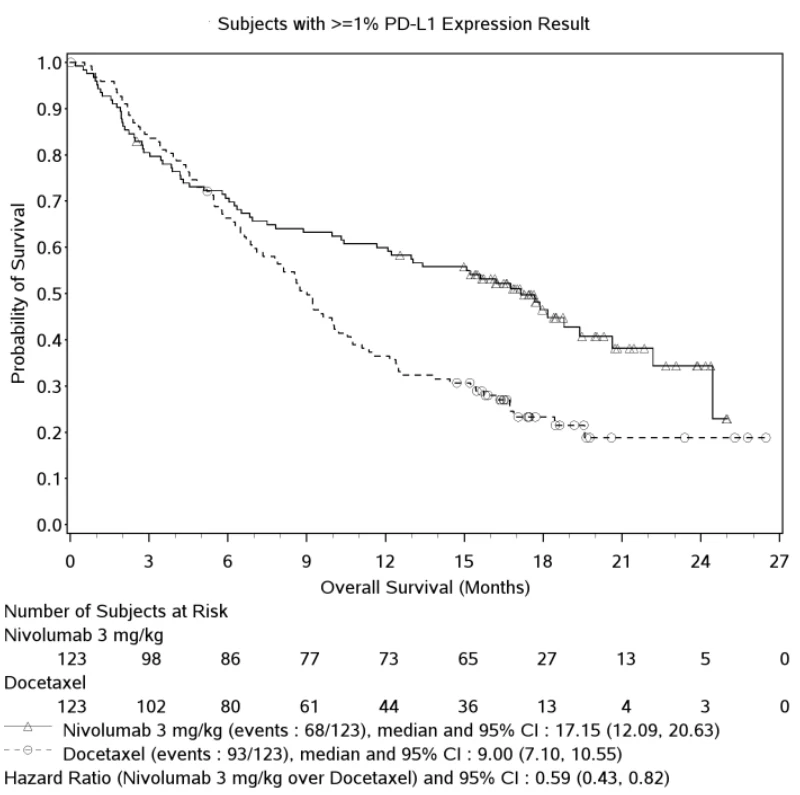
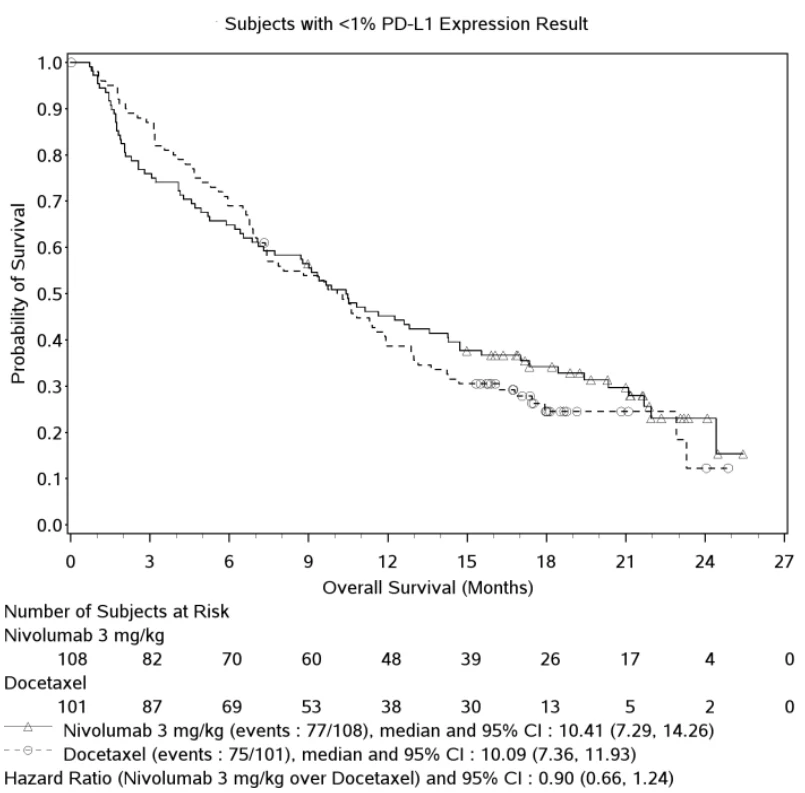
Figure 14 provides the Kaplan-Meier plots of PFS stratified by PD-L1 expression status using the 1% expression level at baseline.
Figure 14: Progression-free Survival by PD-L1 Expression Level (1%) - CHECKMATE-057
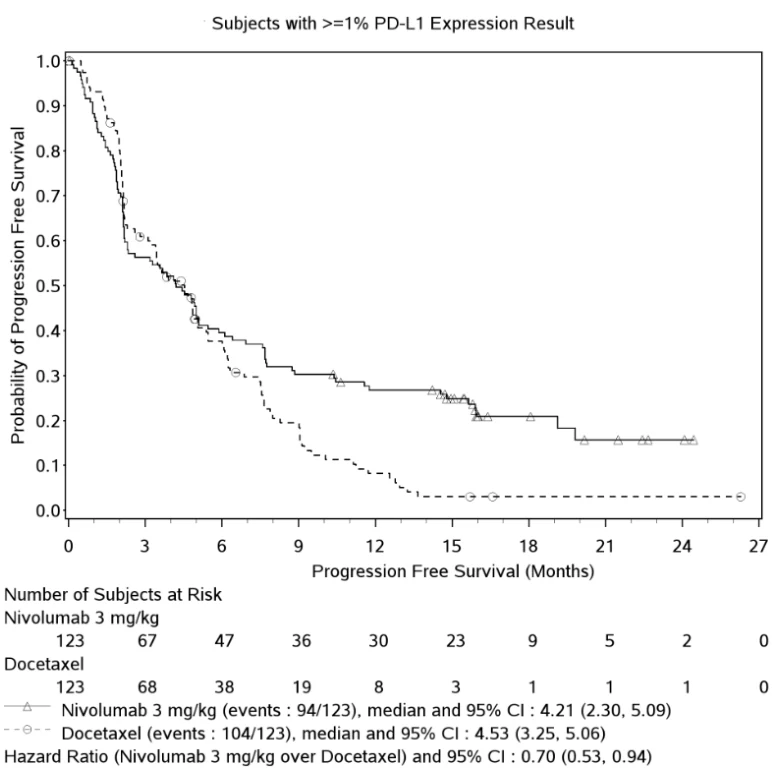
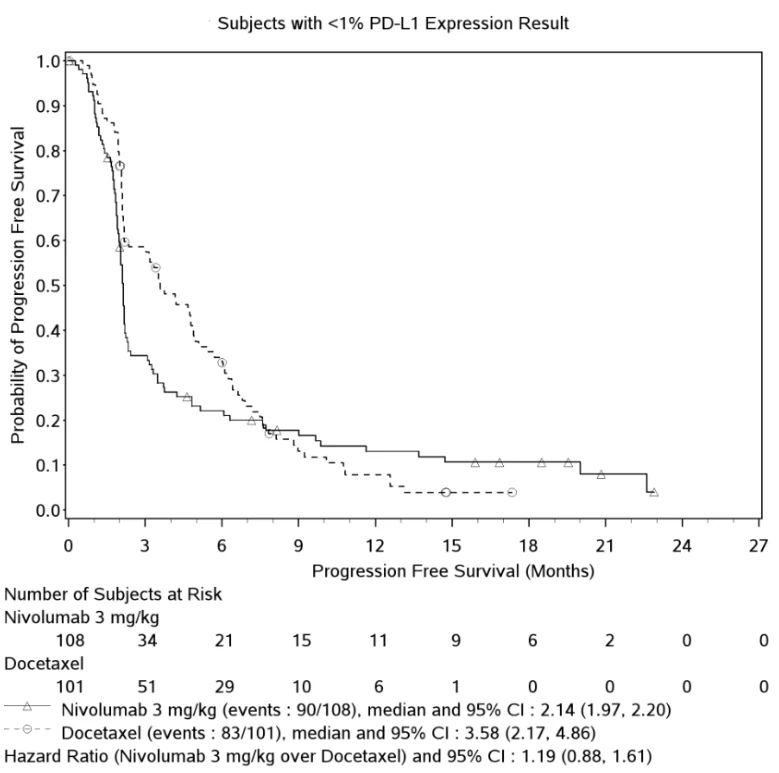
Controlled trial of previously untreated metastatic NSCLC, in combination with ipilimumab (First-line Treatment): CHECKMATE-227
CHECKMATE-227 was a randomized, open-label, multi-part trial in patients with metastatic or recurrent NSCLC. The study included patients (18 years of age or older) with histologically confirmed Stage IV or recurrent NSCLC (per the 7th International Association for the Study of Lung Cancer [ASLC] classification), ECOG performance status 0 or 1, and no prior anticancer therapy (including EGFR and ALK inhibitors) for metastatic disease. Patients were enrolled regardless of their tumour PD-L1 status. Patients with known EGFR mutations or ALK translocations sensitive to available targeted inhibitor therapy, untreated brain metastases, carcinomatous meningitis, active autoimmune disease, or medical conditions requiring systemic immunosuppression were excluded from the study. Patients with treated brain metastases were eligible if neurologically returned to baseline at least 2 weeks prior to enrolment, and either off corticosteroids, or on a stable or decreasing dose of < 10 mg daily prednisone equivalents. Randomization was stratified by tumour histology (non-squamous versus squamous).
Primary efficacy results were based on Part 1a of the study which was limited to patients with PD-L1 tumour expression ≥ 1%. Tumour specimens were evaluated prospectively for PD-L1 using the IHC 28-8 pharmDx kit at a central laboratory.
The evaluation of the primary efficacy endpoint relied on the comparison between Opdivo 3 mg/kg administered intravenously over 30 minutes every 2 weeks in combination with ipilimumab 1 mg/kg administered intravenously over 30 minutes every 6 weeks and platinum-doublet chemotherapy administered every 3 weeks for up to 4 cycles. Platinum-doublet chemotherapy consisted of:
- pemetrexed (500 mg/m2) and cisplatin (75 mg/m2), or pemetrexed (500 mg/m2) and carboplatin (AUC 5 or 6) for non-squamous NSCLC;
- or gemcitabine (1000 or 1250 mg/m2) and cisplatin (75 mg/m2), or gemcitabine (1000 mg/m2) and carboplatin (AUC 5) (gemcitabine was administered on Days 1 and 8 of each cycle) for squamous NSCLC.
Study treatment continued until disease progression, unacceptable toxicity, or for up to 24 months. Treatment continued beyond disease progression if a patient was clinically stable and was considered to be deriving clinical benefit by the investigator. Patients who discontinued combination therapy because of an adverse event attributed to ipilimumab were permitted to continue Opdivo monotherapy. Tumour assessments were performed every 6 weeks from the first dose of study treatment for the first 12 months, then every 12 weeks until disease progression or study treatment was discontinued. The primary efficacy outcome measure was OS. Additional efficacy outcome measures included PFS, ORR, and duration of response as assessed by BICR (blinded independent central review).
In Part 1a, a total of 793 patients were randomized to receive either Opdivo in combination with ipilimumab (n=396) or platinum-doublet chemotherapy (n=397). The median age was 64 years (range: 26 to 87) with 49% of patients ≥65 years and 10% of patients ≥75 years, 76% White, 65% male. Baseline ECOG performance status was 0 (34%) or 1 (65%), 50% with PD-L1 ≥50%, 29% with squamous and 71% with non-squamous histology, 10% had brain metastases, and 85% were former/current smokers.
The study demonstrated a statistically significant benefit in OS for patients with PD-L1 tumour expression ≥ 1% randomized to Opdivo in combination with ipilimumab compared to platinum-doublet chemotherapy alone. Median follow-up for OS was 16.6 months (range: 0.3 to 42.2 months) for Opdivo in combination with ipilimumab and 14.1 months (range: 0.0 to 42.1 months) for platinum-doublet chemotherapy. Efficacy results for patients whose tumours expressed PD-L1 ≥1% are presented in Table 76 and Figure 15.
Table 76: Efficacy Results (PD-L1 ≥1%) - CHECKMATE-227
| Opdivo and Ipilimumab (n=396) | Chemotherapy (n=397) | ||||||
| Overall Survival | |||||||
| Events (%) | 258 (65.2) | 298 (75.1) | |||||
Median (months)a (95% CI) | 17.1 (15, 20.1) | 14.9 (12.7, 16.7) | |||||
| Hazard ratio (95% CI)b | 0.79 (0.67, 0.94) | ||||||
| Stratified log-rank p-value | 0.0066 | ||||||
a. Kaplan-Meier estimate.
b. Based on a stratified Cox proportional hazard model.
Figure 15: Overall Survival (PD-L1 ≥1%) - CHECKMATE-227
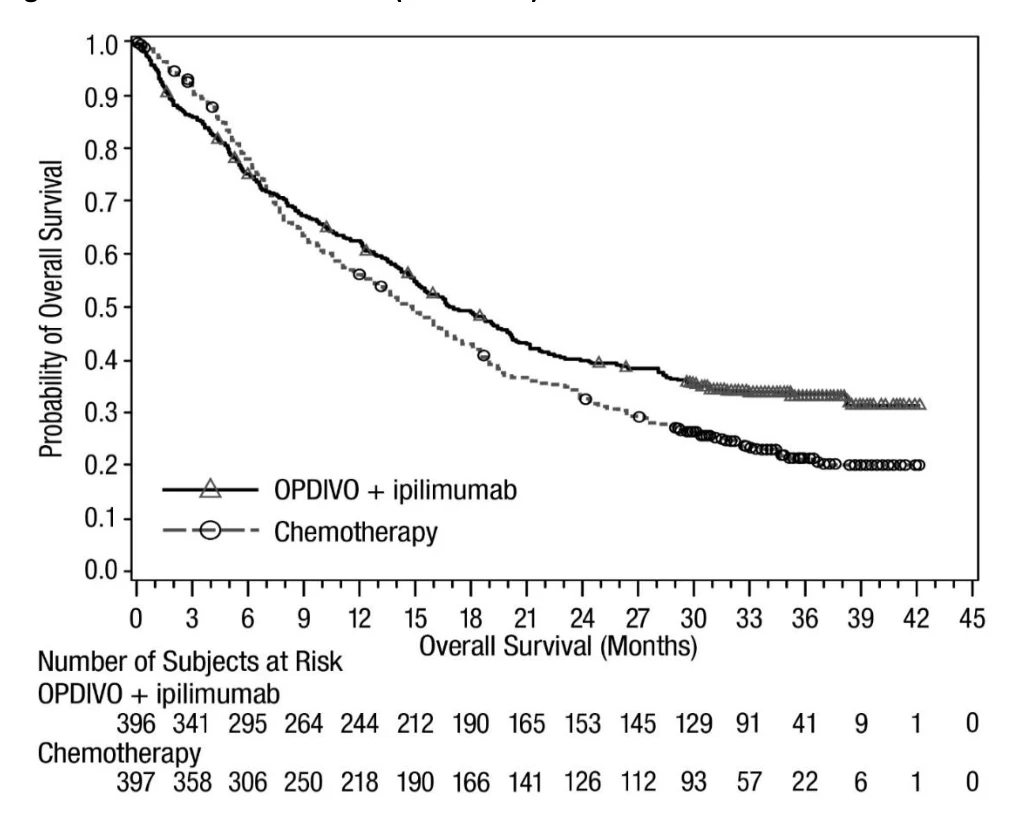
BICR-assessed PFS showed a HR of 0.82 (95% CI: 0.69, 0.97), with a median PFS of 5.1 months (95% CI 4.1, 6.3) in the Opdivo plus ipilimumab arm and 5.6 months (95% CI: 4.6, 5.8) in the platinum-based chemotherapy arm. The BICR-assessed confirmed ORR was 36% in the Opdivo plus ipilimumab arm and
30% in the platinum-based chemotherapy arm. Median duration of response observed in the Opdivo plus ipilimumab arm was 23.2 months and 6.2 months in the platinum-based chemotherapy arm.
In Part 1a, in an exploratory efficacy subgroup analysis based on histology, an improvement in OS was observed with Opdivo in combination with ipilimumab relative to platinum-doublet chemotherapy in patients with SQ NSCLC (median OS 14.8 months vs. 9.2 months; HR = 0.69; 95% CI: 0.52, 0.92) and in patients with NSQ NSCLC (median OS 19.5 months vs. 17.2 months; HR = 0.85; 95% CI: 0.69, 1.04).
The findings of an exploratory analysis based on PD-L1 ≥ 50% and PD-L1 1-49% are shown below. See Table 77, Figure 16 and Figure 17.
Table 77: Overall Survival Results by PD-L1 Expression - CHECKMATE-227
| Endpoint | Opdivo and Ipilimumab (n=205) | Chemotherapy (n=192) | Opdivo and Ipilimumab (n=191) | Chemotherapy (n=205) | ||||||||
|---|---|---|---|---|---|---|---|---|---|---|---|---|
| PD-L1 ≥50% | PD-L1 1-49% | |||||||||||
| Number (%) of patients with event | 116 (56.6%) | 137 (71.4%) | 142 (74.3) | 161 (78.5) | ||||||||
| Hazard Ratio (95% CI) | 0.70 (0.53, 0.93) | 0.94 (0.73, 1.22) | ||||||||||
| Median in Months (95% CI) | 21.19 (15.51, 38.18) | 13.96 (10.05, 18.60) | 15.08 (12.16, 18.66) | 15.08 (13.34, 17.54) | ||||||||
Figure 16: Kaplan-Meier Curve for Overall Survival by PD-L1 Expression (≥50%) - CHECKMATE-227
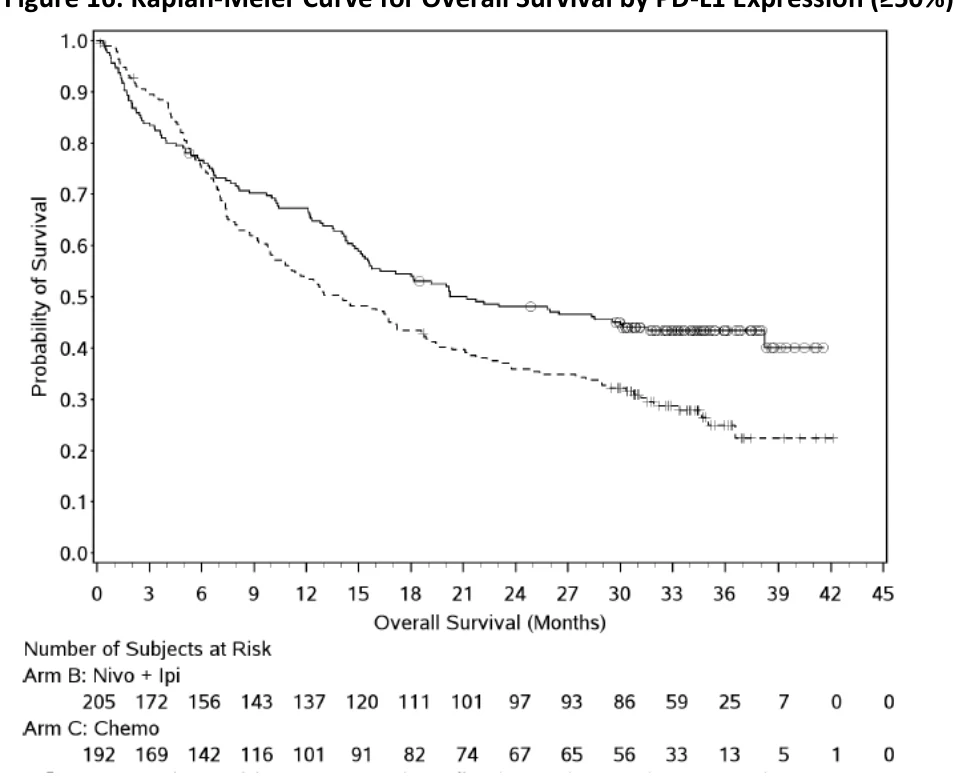
Figure 17: Kaplan-Meier Curve for Overall Survival by PD-L1 Expression (1-49%) - CHECKMATE-227
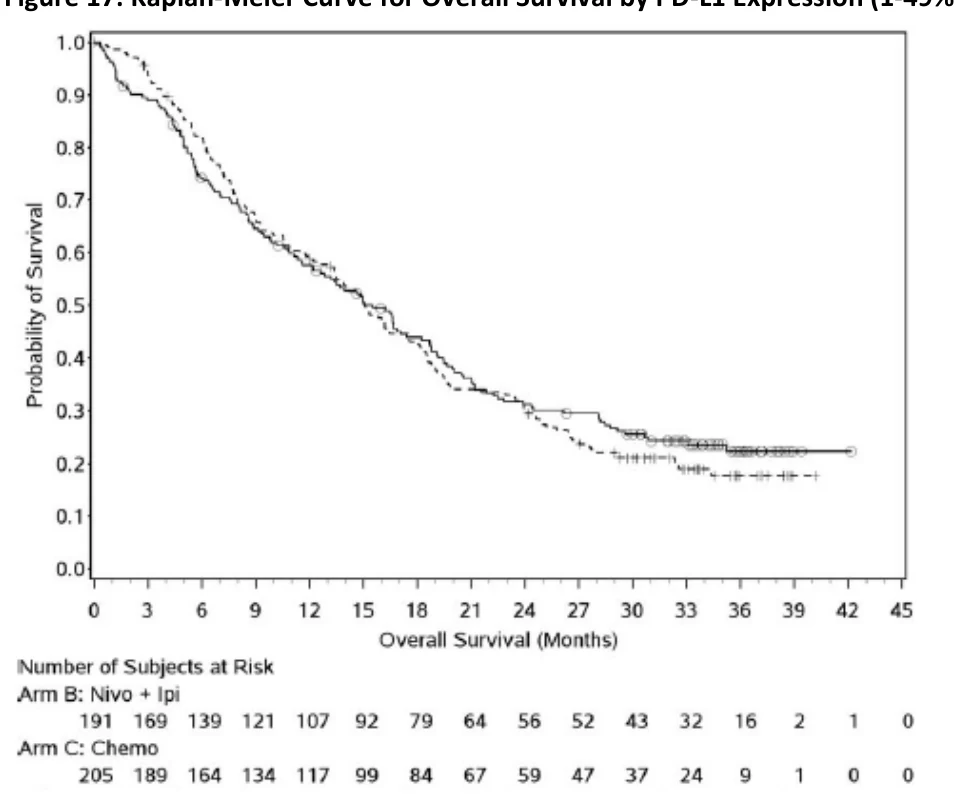
Controlled Trial in NSCLC Patients Previously Untreated for Metastatic NSCLC: CHECKMATE-9LA
CHECKMATE-9LA was a randomized, open-label trial in patients with metastatic or recurrent NSCLC. The trial included patients (18 years of age or older) with histologically confirmed Stage IV or recurrent NSCLC (per the 7th International Association for the Study of Lung Cancer classification ([IASLC]), ECOG performance status 0 or 1, and no prior anticancer therapy (including EGFR and ALK inhibitors) for metastatic disease. Patients were enrolled regardless of their tumour PD-L1 status. Patients with known EGFR mutations or ALK translocations sensitive to available targeted inhibitor therapy, untreated brain metastases, carcinomatous meningitis, active autoimmune disease, or medical conditions requiring systemic immunosuppression were excluded from the study. Patients with treated brain metastases were eligible if neurologically returned to baseline at least 2 weeks prior to enrolment, and either off corticosteroids, or on a stable or decreasing dose of <10 mg daily prednisone equivalents.
Randomization was stratified by tumour PD-L1 expression level (≥1% versus <1%), histology (squamous versus non-squamous), and sex (male versus female). Patients were randomized 1:1 to the following treatment arms:
- Opdivo 360 mg intravenously every 3 weeks, ipilimumab 1 mg/kg intravenously every 6 weeks and platinum-doublet chemotherapy intravenously every 3 weeks for 2 cycles, followed by Opdivo 360 mg every 3 weeks and ipilimumab 1 mg/kg every 6 weeks.
- Platinum-doublet chemotherapy intravenously every 3 weeks for 4 cycles. Patients with non-squamous histology could receive optional pemetrexed maintenance therapy.
Platinum-doublet chemotherapy consisted of either carboplatin (AUC 5 or 6) and pemetrexed 500 mg/m2, or cisplatin 75 mg/m2 and pemetrexed 500 mg/m2 for non-squamous NSCLC; or carboplatin (AUC 6) and paclitaxel 200 mg/m2 for squamous NSCLC. Study treatment continued until disease progression, unacceptable toxicity, or for up to 2 years. Treatment could continue beyond disease progression if a patient was clinically stable and was considered to be deriving clinical benefit by the investigator. Patients who discontinued combination therapy because of an adverse event attributed to ipilimumab were permitted to continue Opdivo as a single agent. Tumour assessments were performed every 6 weeks from the first dose of study treatment for the first 12 months, then every 12 weeks until disease progression or study treatment was discontinued. The primary efficacy outcome measure was OS. Additional efficacy outcome measures included PFS, ORR, and duration of response as assessed by BICR.
A total of 719 patients were randomized to receive either Opdivo in combination with ipilimumab and platinum-doublet chemotherapy (n=361) or platinum-doublet chemotherapy (n=358). The median age was 65 years (range: 26 to 86) with 51% of patients ≥65 years and 10% of patients ≥75 years. The majority of patients were white (89%) and male (70%). Baseline ECOG performance status was 0 (31%) or 1 (68%), 57% had tumours with PD-L1 expression ≥1% and 37% had tumours with PD-L1 expression <1%, 31% had tumours with squamous histology and 69% had tumours with non-squamous histology, 17% had brain metastases, and 86% were former/current smokers.
The study demonstrated a statistically significant benefit in OS, PFS, and ORR for patients randomized to Opdivo in combination with ipilimumab and 2 cycles of platinum-doublet chemotherapy compared to 4 cycles of platinum-doublet chemotherapy alone. Median follow-up for OS was 10.4 months (range: 0.0 to 21.4 months) for Opdivo in combination with ipilimumab and 2 cycles of platinum-doublet chemotherapy and 9.1 months (range: 0.1 to 20.2 months) for platinum-doublet chemotherapy. Efficacy results from the pre-specified interim analysis when 351 events were observed (87% of the planned number of events for the final analysis) are presented in Table 78 and Figure 18.
Table 78: Efficacy Results - CHECKMATE-9LA
| Opdivo and Ipilimumab and Platinum-Doublet Chemotherapy (n=361) | Platinum-Doublet Chemotherapy (n=358) | |||||||||||
| Overall Survival | ||||||||||||
| Events (%) | 156 (43.2) | 195 (54.5) | ||||||||||
| Median (months) (95% CI) | 14.1 (13.24, 16.16) | 10.7 (9.46, 12.45) | ||||||||||
| Hazard ratio (96.71% CI)a | 0.69 (0.55, 0.87) | |||||||||||
| Stratified log-rank p-valueb | 0.0006 | |||||||||||
| Progression-free Survival per BICR | ||||||||||||
| Events (%) | 232 (64.3) | 249 (69.6) | ||||||||||
| Median (months)d (95% CI) | 6.83 (5.55, 7.66) | 4.96 (4.27, 5.55) | ||||||||||
| Hazard ratio (97.48% CI)a | 0.70 (0.57, 0.86) | |||||||||||
| Stratified log-rank p-valuec | 0.0001 | |||||||||||
| Overall Response Rate per BICR (%)e | 136 (37.7) | 90 (25.1) | ||||||||||
| (95% CI) | (32.7, 42.9) | (20.7, 30.0) | ||||||||||
| Stratified CMH test p-valuef | 0.0003 | |||||||||||
| Complete response (%) | 7 (1.9) | 3 (0.8) | ||||||||||
| Partial response (%) | 129 (35.7) | 87 (24.3) | ||||||||||
| Duration of Response per BICR | ||||||||||||
| Median (months) (95% CI)d | 10.02 (8.21, 13.01) | 5.09 (4.34, 7.00) | ||||||||||
- a. Based on a stratified Cox proportional hazard model.
- b. p-value is compared with the allocated alpha of 0.0329 for this interim analysis.
- c. p-value is compared with the allocated alpha of 0.0252 for this interim analysis.
- d. Kaplan-Meier estimate.
- e. Proportion with complete or partial response; confidence interval based on the Clopper and Pearson Method.
- f.
p-value is compared with the allocated alpha of 0.025 for this interim analysis.
Figure 18: Overall Survival - CHECKMATE-9LA (Primary analysis)
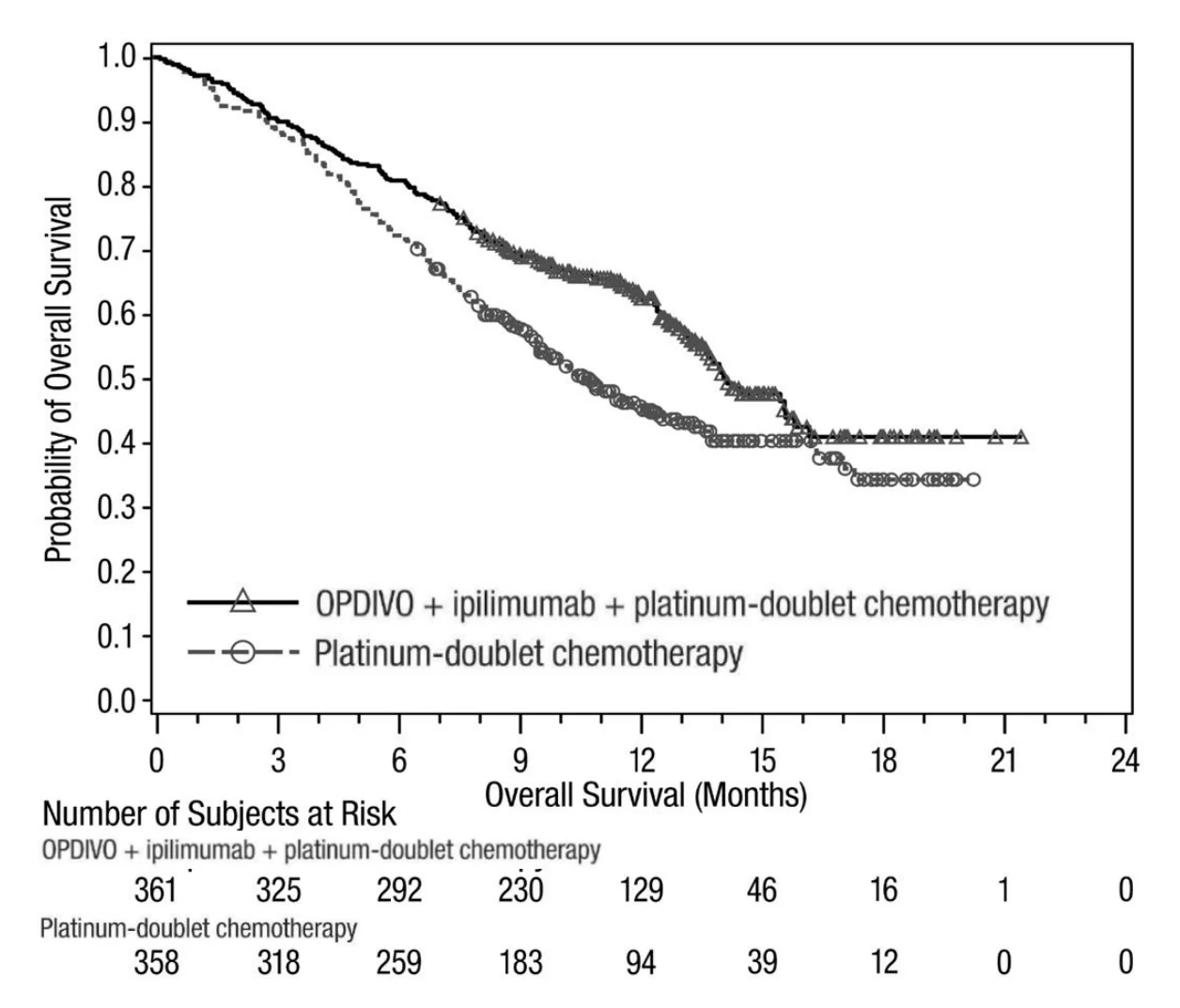
Based on predefined subgroup analyses of OS, improved OS for Opdivo in combination with ipilimumab and platinum-doublet chemotherapy compared to platinum-doublet chemotherapy, was observed in patients with squamous or non-squamous histology and irrespective of PD-L1 expression (< 1% versus ≥ 1%).
An exploratory follow-up analysis was conducted for CHECKMATE-9LA, at a minimum follow-up of 24.4 months for OS and 23.3 months for PFS and ORR. The results of OS, PFS and ORR remain consistent with the results of the pre-specified interim analysis. The median OS, with further follow-up, was 15.80 months for patients who received Opdivo in combination with ipilimumab and platinum-doublet chemotherapy vs. 10.96 months for platinum-doublet chemotherapy, resulting in a hazard ratio of 0.72. The OS results for Opdivo in combination with ipilimumab and platinum-doublet chemotherapy, compared to platinum-doublet chemotherapy alone, remained consistent with the pre-specified interim analysis in patients with squamous or non-squamous histology and irrespective of PD-L1 expression (< 1% versus ≥ 1%).
Neoadjuvant Treatment of Resectable Non-Small Cell Lung Cancer
CHECKMATE-816 was a randomized, open label trial in patients with resectable NSCLC. The trial included patients with resectable, histologically confirmed Stage IB (≥4 cm), II, or IIIA NSCLC (per the 7th edition American Joint Committee on Cancer/Union for International Cancer Control (AJCC/UICC) staging criteria), ECOG performance status 0 or 1, and measurable disease (per RECIST version 1.1). Patients were enrolled regardless of their tumour PD-L1 status. Patients with unresectable or metastatic NSCLC, known EGFR mutations or ALK translocations, Grade 2 or greater peripheral neuropathy, active autoimmune disease, or medical conditions requiring systemic immunosuppression were excluded from the study.
Patients were randomized to receive either:
- Opdivo 360 mg administered intravenously over 30 minutes and platinum-doublet chemotherapy administered intravenously every 3 weeks for up to 3 cycles, or
- platinum-doublet chemotherapy administered every 3 weeks for up to 3 cycles.
Platinum-doublet chemotherapy consisted of paclitaxel 175 mg/m2 or 200 mg/m2 and carboplatin AUC 5 or AUC 6 (any histology); pemetrexed 500 mg/m2 and cisplatin 75 mg/m2 (non-squamous histology); or gemcitabine 1000 mg/m2 or 1250 mg/m2 and cisplatin 75 mg/m2 (squamous histology). In the platinum-doublet chemotherapy arm, two additional treatment regimen options included vinorelbine 25 mg/m2 or 30 mg/m2 and cisplatin 75 mg/m2; or docetaxel 60 mg/m2 or 75 mg/m2 and cisplatin 75 mg/m2 (any histology). Stratification factors for randomization were tumour PD-L1 expression level (≥1% versus <1% or non-quantifiable), disease stage (IB/II versus IIIA), and sex (male versus female). Tumour assessments were performed at baseline, within 14 days of surgery, every 12 weeks after surgery for 2 years, then every 6 months for 3 years, and every year for 5 years until disease recurrence or progression. The primary efficacy outcome measures were event-free survival (EFS) based on BICR assessment and pathologic complete response (pCR) as evaluated by blinded independent pathology review (BIPR). Secondary efficacy outcome measures included OS.
A total of 358 patients were randomized to receive either Opdivo in combination with platinum-doublet chemotherapy (n=179) or platinum-doublet chemotherapy (n=179). The median age was 65 years (range: 34 to 84) with 51% of patients ≥65 years and 7% of patients ≥75 years, 50% were Asian, 47% were White, 2% were Black, and 71% were male. Baseline ECOG performance status was 0 (67%) or 1 (33%); 50% had tumours with PD-L1 expression ≥1% and 43% had tumours with PD-L1 expression that was <1%; 5% had stage IB, 17% had stage IIA, 13% had stage IIB, and 64% had stage IIIA disease; 51% had tumours with squamous histology and 49% had tumours with non-squamous histology; and 89% were former/current smokers.
Eighty-three percent of patients in the Opdivo in combination with platinum-doublet chemotherapy arm had definitive surgery compared to 75% of patients in the platinum-doublet chemotherapy arm.
Median follow-up at the pre-specified EFS interim analysis was 29.5 months (range: 21.0 to 46.3 months). Efficacy results are presented in Table 79 and Figure 19.
| Table 79: Efficacy Results - CHECKMATE-816 | ||||||||||
| Opdivo and Platinum-Doublet Chemotherapy (n=179) | Platinum-Doublet Chemotherapy (n=179) | |||||||||
| Event-free Survival (EFS) per BICR | ||||||||||
| Events (%) | 64 (35.8) | 87 (48.6) | ||||||||
Median (months)a (95% CI) | 31.6 (30.2, NR) | 20.8 (14.0, 26.7) | ||||||||
Hazard Ratiob (95% CI) | 0.63 (0.45, 0.87) | |||||||||
| Stratified log-rank p-valuec | 0.0052 | |||||||||
| Pathologic Complete Response (pCR) per BIPR | ||||||||||
| Responses (%) | 43 (24.0) | 4 (2.2) | ||||||||
| 95% CId | 18.0, 31.0 | 0.6, 5.6 | ||||||||
| Difference of pCR (95%CI)e | 21.6 (15.1, 28.2) | |||||||||
| Stratified log-rank p-valuef | <0.0001 | |||||||||
a Kaplan-Meier estimate.
b Based on a stratified Cox proportional hazard model.
c Based on a stratified log-rank test. Boundary for statistical significance: p-value <0.0262.
d Based on Clopper and Pearson method.
e Strata-adjusted difference based on Cochran-Mantel-Haenszel method of weighting.
f From stratified CMH test.
Figure 19: Event-Free Survival - CHECKMATE-816
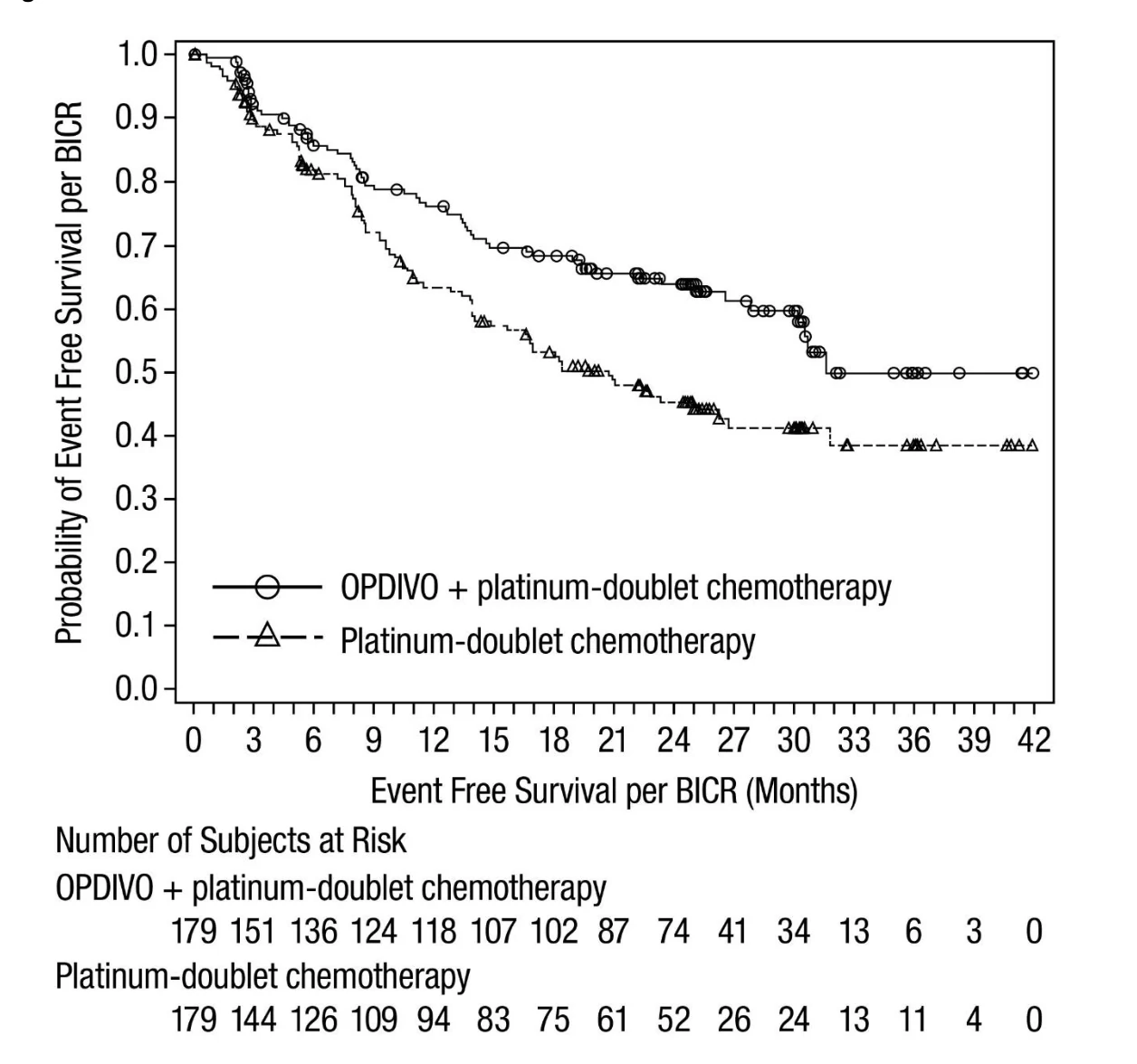
EFS benefit was shown in patients treated with Opdivo in combination chemotherapy with PD L1 <1% (HR [95% CI] 0.85 [0.54, 1.32], n = 155) and PD-L1 ≥1% (HR [95% CI] 0.41 [0.24, 0.70], n = 178), and in patients with squamous histology (HR [95% CI] 0.77 [0.49, 1.22], n = 182) and non-squamous histology (HR [95% CI] 0.50 [0.32, 0.79], n = 176).
The results of a post-hoc exploratory analysis of EFS by both stage and PD-L1 are presented in Table 80.
| Table 80: EFS by Stage and PD-L1 | |||||||||||||
|---|---|---|---|---|---|---|---|---|---|---|---|---|---|
| PD-L1 < 1% | PD-L1 ≥ 1% | ||||||||||||
| Opdivo and Platinum-Doublet Chemotherapy | Platinum-Doublet Chemotherapy | Opdivo and Platinum-Doublet Chemotherapy | Platinum-Doublet Chemotherapy | ||||||||||
| Stage IB/II | N = 28 | N = 28 | N = 32 | N = 33 | |||||||||
| HR (95% CI)a | 1.15 (0.52, 2.57) | 0.63 (0.24, 1.62) | |||||||||||
| Stage IIIA | N = 50 | N = 49 | N = 56 | N = 55 | |||||||||
| HR (95% CI)a | 0.69 (0.40, 1.19) | 0.34 (0.18, 0.65) | |||||||||||
a Based on an unstratified Cox proportional hazard model.
At the time of the EFS analysis, a prespecified interim analysis for OS resulted in a HR of 0.57 (95% CI:0.38, 0.87) for Opdivo in combination with platinum-doublet chemotherapy versus platinum-doublet chemotherapy, which did not cross the boundary for statistical significance.
Neoadjuvant and Adjuvant Treatment of resectable NSCLC
CHECKMATE-77T was a randomized, double-blind trial in patients with resectable NSCLC. The trial included patients with resectable, suspected or histologically confirmed Stage IIA (>4 cm) to IIIB (T3-T4 N2) NSCLC (per the 8th edition American Joint Committee on Cancer (AJCC) Staging Manual), and ECOG performance status 0 or 1. Patients with unresectable or metastatic NSCLC, EGFR mutations or known ALK translocations, brain metastasis, Grade 2 or greater peripheral neuropathy, interstitial lung disease or active, non-infectious pneumonitis (symptomatic and/or requiring treatment), active autoimmune disease, or medical conditions requiring systemic immunosuppression were excluded from the study.
Patients were randomized (1:1) to receive either:
- Neoadjuvant Opdivo 360 mg administered intravenously over 30 minutes and platinum-doublet chemotherapy administered every 3 weeks, for up to 4 cylcles. Following surgery, and within 90 days, Opdivo 480 mg was administered intravenously over 30 minutes every 4 weeks.
or
- Neoadjuvant placebo and platinum-doublet chemotherapy administered every 3 weeks, until disease progression or unacceptable toxicity, for up to 4 cycles. Following surgery, and within 90 days, placebo was administered intravenously over 30 minutes every 4 weeks.
Treatment was continued until disease progression, recurrence, or unacceptable toxicity for up to 13 cycles (1 year).
Platinum-doublet chemotherapy consisted of paclitaxel 175 mg/m2 or 200 mg/m2 and carboplatin AUC 5 or AUC 6 (any histology); pemetrexed 500 mg/m2, and cisplatin 75 mg/m2 or carboplatin AUC 5 or AUC 6 (non-squamous histology); or cisplatin 75 mg/m2 and docetaxel 75 mg/m2 (squamous histology).
Stratification factors for randomization were tumor PD-L1 expression level (≥1% versus <1% versus indeterminate/not evaluable), disease stage (Stage II versus Stage III), and tumor histology (squamous versus non-squamous). Tumor assessments were performed at baseline, within 14 days after the last dose of neoadjuvant treatment and before surgery, within 7 days prior to the start of adjuvant treatment after surgery, every 12 weeks after the first dose of adjuvant treatment for 2 years, then every 24 weeks for up to 5 years until disease recurrence or progression is confirmed by BICR.
The major efficacy outcome measure was event-free survival (EFS) based on BICR assessment. The key secondary efficacy outcome was overall survival (OS). Exploratory secondary efficacy outcome measures included pathologic complete response (pCR), major pathologic response as evaluated by blinded independent pathology review (BIPR).
The trial was not designed to isolate the effect of Opdivo in each phase (neoadjuvant or adjuvant) of treatment.
A total of 461 patients were randomized to receive either neoadjuvant Opdivo in combination with platinum-doublet chemotherapy followed by adjuvant Opdivo (n=229) or neoadjuvant placebo and platinum-doublet chemotherapy followed by adjuvant platinum-doublet chemotherapy (n=232). The median age was 66 years (range: 35 to 86) with 72% White, 25% Asian, 1.7% Black or African American, and 71% male. Baseline ECOG performance status was 0 (62%) or 1 (38%); 56% had tumors with PD-L1 expression ≥1% and 40% had tumors with PD-L1 expression <1%; 35% had stage II and 64% had stage III disease; 23% were N1 and 39% were N2; 24% were single-station and 15% were multistation; 51% had tumors with squamous histology and 49% had tumors with non-squamous histology; and 90% were former/current smokers.
Seventy-eight percent (78%) of patients in the neoadjuvant Opdivo in combination with platinum-doublet chemotherapy followed by adjuvant Opdivo arm had definitive surgery compared to 77% of patients in the neoadjuvant placebo and platinum-doublet chemotherapy followed by placebo arm.
The study met its primary objective of EFS for patients treated with neoadjuvant Opdivo in combination with platinum-doublet chemotherapy followed by adjuvant Opdivo monotherapy compared with patients randomized to placebo in combination with platinum doublet chemotherapy followed by placebo. Efficacy results are presented in Table 81 and Figure 20.
Table 81: Efficacy Results - CHECKMATE -77T
| Neoadjuvant Opdivo and Platinum-Doublet Chemotherapy/Adjuvant Opdivo (n=229) | Neoadjuvant Placebo and Platinum-Doublet Chemotherapy/Adjuvant Placebo (n=232) | ||||||||
|---|---|---|---|---|---|---|---|---|---|
| Event-free Survival (EFS) per BICR | |||||||||
| Events (%) | 76 (33%) | 113 (49%) | |||||||
Median (months)a (95% CI) | NR (28.94, NR) | 18.43 (13.63, 28.06) | |||||||
Hazard Ratiob (95% CI) | 0.58 (0.43, 0.78) | ||||||||
| Stratified log-rank p-valuec | 0.00025 | ||||||||
Median follow-up for EFS was 25.4 months (range: 15.7 to 44.2 months).
a Kaplan-Meier estimate.
b Based on a stratified Cox proportional hazard model.
c Based on a stratified log-rank test. Boundary for statistical significance: p-value <0.0264.
Figure 20: Event Free Survival - CHECKMATE-77T
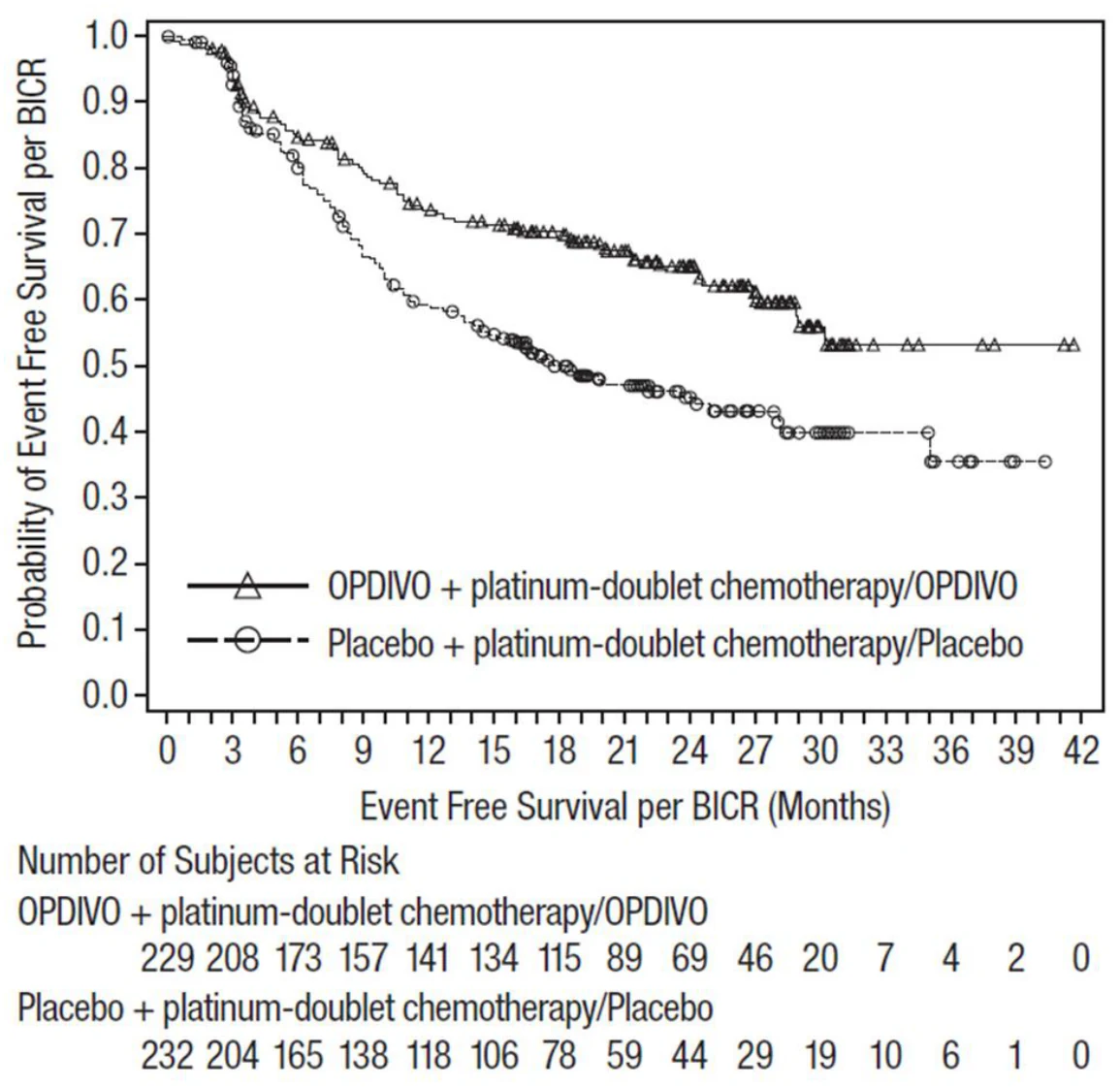
The pCR rate for patients treated with neoadjuvant Opdivo plus platinum-doublet chemotherapy followed by adjuvant Opdivo monotherapy was 25.3% (95% CI: 19.8, 31.5) compared to 4.7% (95% CI: 2.4, 8.3) for patients treated with neoadjuvant placebo plus platinum-doublet chemotherapy followed by adjuvant placebo. The mPR rate for patients treated with neoadjuvant Opdivo plus platinum-doublet chemotherapy followed by adjuvant Opdivo monotherapy was 35.4% (95% CI: 29.2, 41.9) compared to 12.1% (95% CI: 8.2, 17.0) for patients treated with neoadjuvant placebo plus platinum-doublet chemotherapy followed by adjuvant placebo.
In an exploratory subgroup analysis for EFS by PD-L1 expression at baseline performed at the time of the EFS analysis, the hazard ratios were 0.26 (95% CI: 0.12, 0.55) in patients with PD-L1 ≥50%, 0.76 (95% CI: 0.46, 1.25) in patients with PD-L1 1-49%, 0.52 (95% CI: 0.35, 0.78) in patients with PD-L1 ≥1% and 0.73 (95% CI: 0.47, 1.15) in patients with PD-L1 <1%.
At the time of the prespecified interim analysis for overall survival, the estimated hazard ratio for patients randomized to neoadjuvant Opdivo in combination with platinum-doublet chemotherapy followed by adjuvant Opdivo monotherapy compared with patients randomized to placebo in combination with platinum doublet chemotherapy followed by placebo was 0.85 (95% CI: 0.61, 1.18), which did not cross the boundary for statistical significance.
Unresectable Malignant Pleural Mesothelioma
Controlled Trial of previously untreated unresectable Malignant Pleural Mesothelioma, in combination with ipilimumab: CHECKMATE-743
The safety and efficacy of nivolumab in combination with ipilimumab were evaluated in CA209743, a randomized, open-label study in patients with unresectable malignant pleural mesothelioma (MPM). The study included patients (18 years of age and older) with histologically confirmed advanced unresectable MPM, and ECOG performance status 0 or 1. Patients were enrolled regardless of their tumour PD-L1 status. Patients with the following features were excluded: primitive peritoneal, pericardial, testis, or tunica vaginalis mesothelioma; prior therapy for MPM (including chemotherapy [adjuvant, neoadjuvant], radical pleuropneumonectomy with or without intensity modulated radiotherapy, and nonpalliative radiotherapy); palliative radiotherapy within 14 days of first trial therapy; interstitial lung disease, active autoimmune disease, medical conditions requiring systemic immunosuppression, and untreated brain metastasis.
Stratification factors for randomization were tumour histology (epithelioid versus sarcomatoid or mixed histology subtypes) and gender (male vs. female). Patients were randomized 1:1 to the following treatment arms:
- nivolumab 3 mg/kg over 30 minutes by intravenous infusion every 2 weeks and ipilimumab 1 mg/kg over 30 minutes by intravenous infusion every 6 weeks for up to 2 years, or
- cisplatin 75 mg/m2 and pemetrexed 500 mg/m2, or carboplatin 5 AUC and pemetrexed 500 mg/m2 for 6 cycles (each cycle was 21 days).
Nivolumab in combination with ipilimumab treatment continued until disease progression, unacceptable toxicity, or for up to 24 months. Patients who discontinued combination therapy because of an adverse reaction attributed to ipilimumab were permitted to continue nivolumab as a single agent as part of the study. Treatment continued beyond disease progression if a patient was clinically stable and was considered to be deriving clinical benefit by the investigator. Tumour assessments were performed every 6 weeks from the first dose of study treatment for the first 12 months, then every 12 weeks until disease progression or study treatment was discontinued. The primary efficacy outcome measure was OS. Additional efficacy outcome measures included PFS and ORR as assessed by BICR utilizing modified RECIST and/or RECIST 1.1 criteria.
A total of 605 patients were randomized to receive either nivolumab in combination with ipilimumab (n=303) or chemotherapy (n=302). The median age was 69 years (range: 25 to 89) with 72% ≥65 and 26% ≥75 years, 85% White, and 77% male. Baseline ECOG performance status was 0 (40%) or 1 (60%), 75% had epithelioid and 25% had non-epithelioid histology, 35% had Stage III and 51% had Stage IV disease, 75% had tumours with PD-L1 expression ≥1% and 22% had tumours with PD-L1 expression <1%.
The study demonstrated a statistically significant improvement in OS for patients randomized to nivolumab in combination with ipilimumab compared to chemotherapy with a minimum follow-up of 22 months. Efficacy results from the prespecified interim analysis when at least 403 events were observed (85% of the planned number of events for final analysis) are presented in Table 82 and Figure 21.
Table 82: Efficacy Results - CHECKMATE-743
| Opdivo and Ipilimumab (n=303) | Chemotherapy (n=302) | ||||||||||
| Overall Survival | |||||||||||
| Events (%) | 200 (66) | 219 (73) | |||||||||
Median (months)a (95% CI) | 18.1 (16.8, 21.5) | 14.1 (12.5, 16.2) | |||||||||
| Hazard ratio (95% CI)b | 0.74 (0.61, 0.89) | ||||||||||
| Stratified log-rank p-valuec | 0.002 | ||||||||||
| Progression-free Survival per BICR | |||||||||||
| Events (%) | 218 (72) | 209 (69) | |||||||||
| Median (months)a | 6.8 | 7.2 | |||||||||
| Overall Response Rate per BICR | 40% | 43% | |||||||||
- a. Kaplan-Meier estimate.
- b. Stratified Cox proportional hazard model.
- c. Overall two-sided alpha was set at 0.05 for evaluating OS only. At the interim analysis of OS, the boundary for declaring superiority was a p value of less than 0.0345.
Figure 21: Overall Survival - CHECKMATE-743
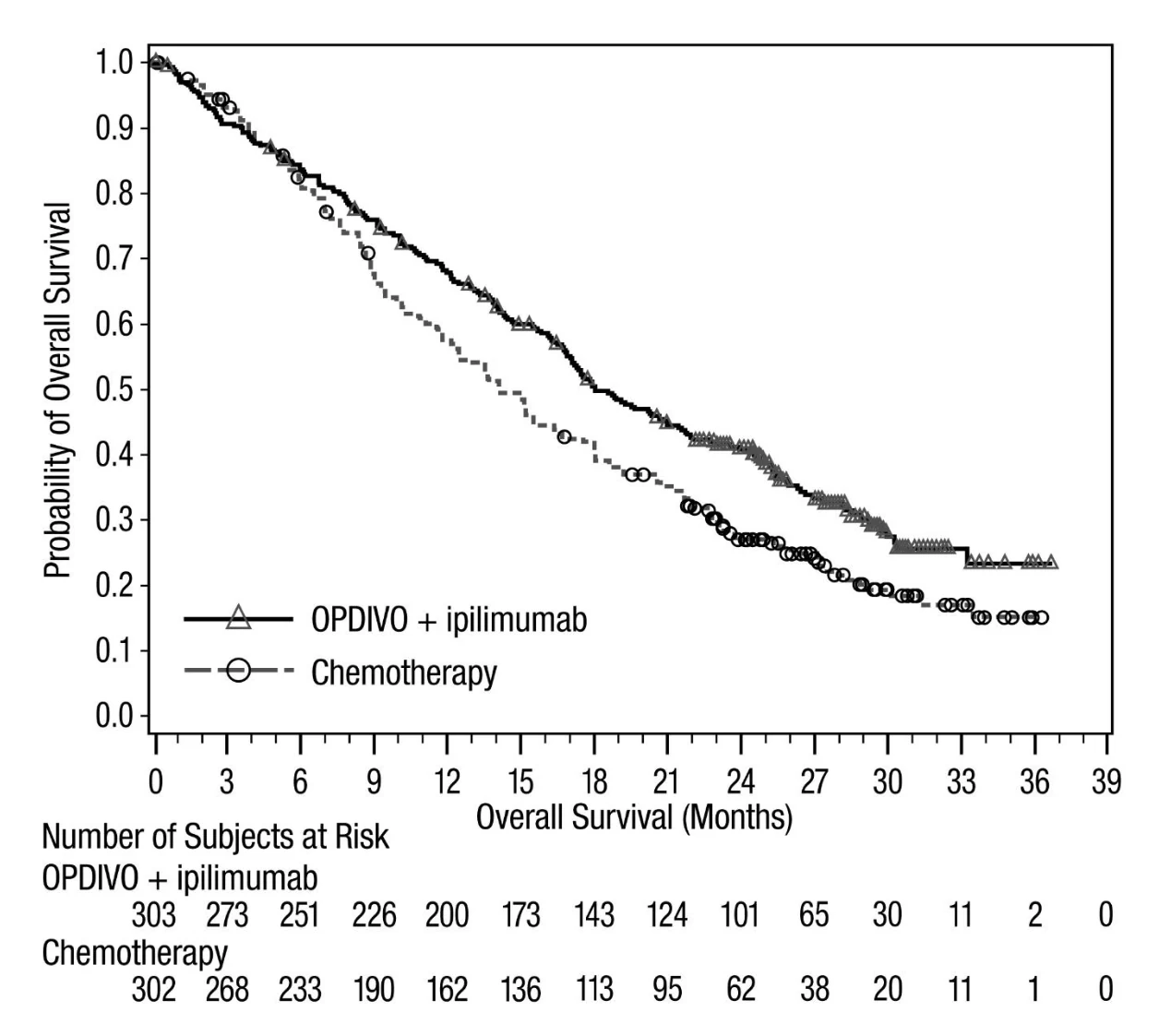
In an exploratory OS subgroup analysis per histology, the estimated hazard ratio (HR) were 0.85 (95% CI: 0.68, 1.06) and 0.46 (95% CI: 0.31, 0.70) in the epithelioid (n = 471) and non-epithelioid subgroups (n = 133), respectively. In an exploratory OS subgroup analysis, the HR was 0.69 for patients with tumour PD-L1 expression ≥ 1% (n = 451); the HR was 0.94 for patients with tumour PD-L1 expression < 1% (n = 135).
Metastatic RCC
Advanced RCC (previously treated)
Controlled Trial in RCC Patients Previously Treated with Anti-angiogenic Therapy (Second-line treatment): CHECKMATE-025
CHECKMATE-025 was a randomized (1:1), open-label study in patients with advanced RCC who had experienced disease progression during or after 1 or 2 prior anti-angiogenic therapy regimens and no more than 3 total prior systemic treatment regimens. Patients had to have a Karnofsky Performance
Score (KPS) ≥70%. This study included patients regardless of their PD-L1 status. CHECKMATE-025 excluded patients with any history of or concurrent brain metastases, prior treatment with an mTOR inhibitor, active autoimmune disease, or medical conditions requiring systemic immunosuppression.
A total of 821 patients were randomized to Opdivo (n=410) administered intravenously at 3 mg/kg every 2 weeks or everolimus (n=411) administered orally 10 mg daily. The median age was 62 years (range: 18 to 88) with 40% ≥65 years of age and 9% ≥75 years of age. The majority of patients were male (75%) and white (88%) and 34% and 66% of patients had a baseline KPS of 70 to 80% and 90 to100%, respectively. The majority of patients (72%) were treated with one prior anti-angiogenic therapy, and 28% received 2 prior anti-angiogenic therapies. Twenty-four percent of patients had at least 1% PD-L1 expression.
The first tumour assessments were conducted 8 weeks after randomization and continued every 8 weeks thereafter for the first year and then every 12 weeks until progression or treatment discontinuation, whichever occurred later. Tumour assessments were continued after treatment discontinuation in patients who discontinued treatment for reasons other than progression. Treatment beyond initial investigator-assessed RECIST 1.1-defined progression was permitted if the patient had a clinical benefit and was tolerating study drug as determined by the investigator. Opdivo was continued beyond progression in 44% of patients.
The primary efficacy outcome measure was overall survival (OS). Secondary efficacy assessments included investigator-assessed objective response rate (ORR) and progression-free survival (PFS). A summary of efficacy outcome measures is presented in Table 83.
Primary Efficacy Outcome Measure:
The trial demonstrated a statistically significant improvement in OS for patients randomized to Opdivo as compared with everolimus at the prespecified interim analysis when 398 events were observed (70% of the planned number of events for final analysis) (Table 83 and Figure 22). OS benefit was observed regardless of PD-L1 expression level. The estimated OS rates at 12 months were 76% for Opdivo and 67% for everolimus.
Secondary Efficacy Outcome Measures:
The investigator-assessed ORR using RECIST v1.1 was superior in the Opdivo group (103/410, 25.1%) compared with the everolimus group (22/411, 5.4%), with a stratified CMH test p-value of < 0.0001. The median time to onset of objective response was 3 months (range: 1.4 to 13 months) after the start of Opdivo treatment. Forty-three (48.9%) responders had ongoing responses with a duration ranging from 7.4 to 27.6 months. Thirty-three (37.5%) patients had durable responses of 12 months or longer. The ORR with a confirmatory scan was performed after at least 4 weeks. The median duration of response was 23.0 months and 13.7 months in the Opdivo and everolimus group, respectively. The best overall response (BOR) was CR in 4 subjects (1.0%) in the Opdivo group and 2 subjects (0.5%) in the everolimus group. BOR was PR in 99 (24.1%) subjects in the Opdivo group and 20 (4.9%) subjects in the everolimus group.
While not statistically significant, PFS data suggest a benefit with Opdivo vs everolimus (HR: 0.88 [95%CI: 0.75, 1.03], stratified log-rank test p-value = 0.1135), with separation of the K-M curves after 6 months favoring Opdivo (Table 83 and Figure 22).
Table 83: Efficacy Results - CHECKMATE-025
| Opdivo (n=410) | Everolimus (n=411) | ||||||||||||||||||||||
Primary Efficacy Outcome Measure Overall Survivala | |||||||||||||||||||||||
| Events (%) | 183/410 (45) | 215/411 (52) | |||||||||||||||||||||
| Median survival in months (95% CI) | 25.0 (21.7, NE) | 19.6 (17.6, 23.1) | |||||||||||||||||||||
| Hazard ratio (98.52% CI) | 0.73b (0.57, 0.93) | ||||||||||||||||||||||
| p-value | 0.0018c | ||||||||||||||||||||||
| Secondary Efficacy Outcome Measures: | |||||||||||||||||||||||
| Progression-free survival | |||||||||||||||||||||||
| Events | 318/410 (77.6) | 322 /411(78.3) | |||||||||||||||||||||
| Hazard ratio | 0.88 | ||||||||||||||||||||||
| 95% CI | (0.75, 1.03) | ||||||||||||||||||||||
| p-value | 0.1135 | ||||||||||||||||||||||
| Median (95% CI) | 4.6 (3.71, 5.39) | 4.4 (3.71, 5.52) | |||||||||||||||||||||
| Objective Response Rate per Investigator (CR+PR) | 103/410 | (25.1%) | 22/411 | (5.4%) | |||||||||||||||||||
| (95% CI) | (21.0, 29.6) | (3.4, 8.0) | |||||||||||||||||||||
| Odds ratio (95% CI) | 5.98 (3.68, 9.72) | ||||||||||||||||||||||
| p-value | < 0.0001 | ||||||||||||||||||||||
| Complete response (CR) | 4 | (1.0%) | 2 | (0.5%) | |||||||||||||||||||
| Partial response (PR) | 99 | (24.1%) | 20 | (4.9%) | |||||||||||||||||||
| Stable disease (SD) | 141 | (34.4%) | 227 | (55.2%) | |||||||||||||||||||
| Median duration of response | |||||||||||||||||||||||
| Months (range) | 11.99 | (0.0-27.6+) | 11.99 | (0.0+-22.2+) | |||||||||||||||||||
- a. Based on the 398 observed deaths and O’Brian-Fleming alpha spending function, the boundary for statistical significance requires the p-value to be less than 0.0148 (based on interim analysis)
- b. Hazard ratio is obtained from a Cox proportional-hazards model stratified by MSKCC risk group, number of prior anti-angiogenic therapies, and region with treatment as the sole covariate.
- c.
P-value is obtained from a two-sided log-rank test stratified by MSKCC risk group, number of prior anti-angiogenic therapies in the advanced/metastatic setting, and region.
Figure 22: Overall Survival - CHECKMATE-025
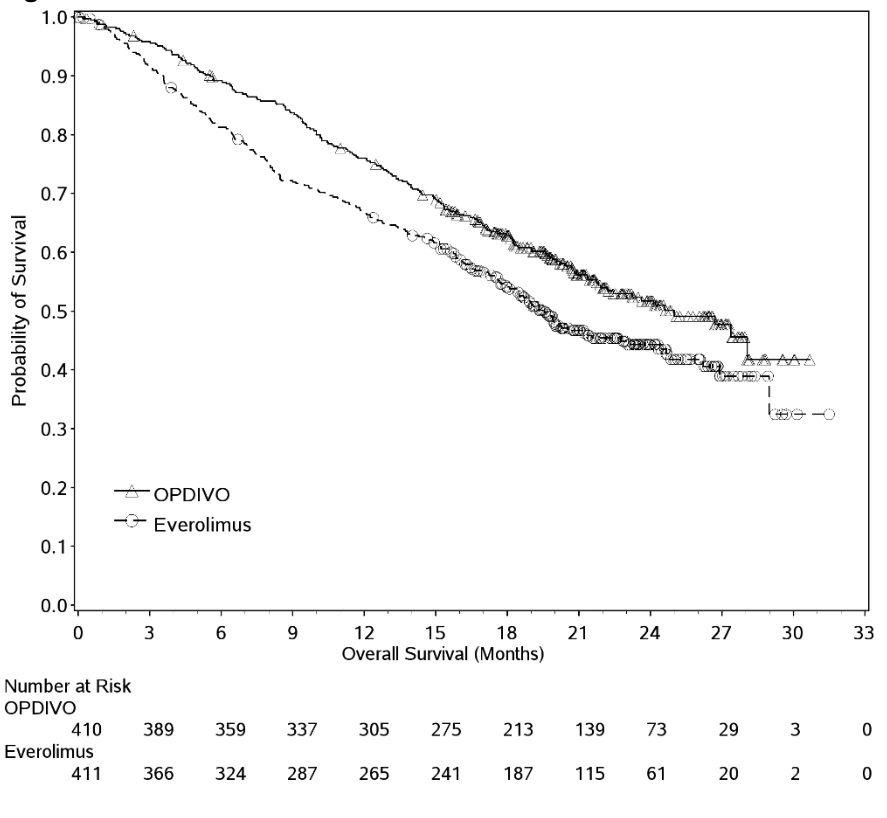
Figure 23: Progression- Free Survival - CHECKMATE-025
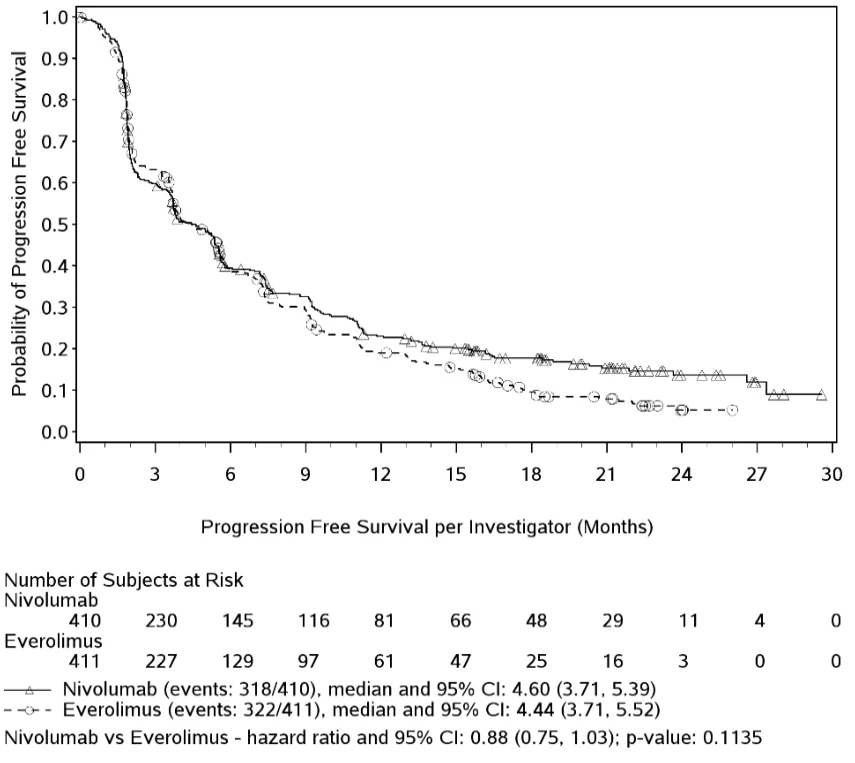
Advanced RCC (previously untreated): CHECKMATE-214
CHECKMATE-214 was a randomized (1:1), open-label study in patients with previously untreated advanced RCC. Patients were included regardless of their PD-L1 status. CHECKMATE-214 excluded patients with any history of or concurrent brain metastases, active autoimmune disease, or medical conditions requiring systemic immunosuppression. Patients were stratified by International Metastatic RCC Database Consortium (IMDC) prognostic score (0 vs 1-2 vs 3-6) and region (US vs Canada/Western Europe/Northern Europe vs Rest of World).
The primary efficacy population includes those intermediate/poor risk patients with at least 1 or more of 6 prognostic risk factors as per the IMDC criteria (less than one year from time of initial renal cell carcinoma diagnosis to randomization, Karnofsky performance status < 80%, hemoglobin less than the lower limit of normal, corrected calcium of greater than 10 mg/dL, platelet count greater than the upper limit of normal, and absolute neutrophil count greater than the upper limit of normal).
Patients were randomized to Opdivo 3 mg/kg plus ipilimumab 1 mg/kg (n=425) administered intravenously every 3 weeks for 4 doses followed by Opdivo monotherapy 3 mg/kg every two weeks or to sunitinib (n=422) administered orally 50 mg daily for 4 weeks followed by 2 weeks off, every cycle. For intermediate or poor risk patients, the median age was 61 years (range: 21 to 85) with 38% ≥65 years of age and 8% ≥75 years of age. The majority of patients were male (73%) and white (87%) and 31% and 69% of patients had a baseline KPS of 70% to 80% and 90% to 100%, respectively.
The first tumour assessments were conducted 12 weeks after randomization and continued every 6 weeks thereafter for the first year and then every 12 weeks until progression or treatment discontinuation, whichever occurred later.
Treatment continued until disease progression or unacceptable toxicity. Treatment could continue beyond disease progression if the patient was clinically stable and was considered to be deriving clinical benefit by the investigator.
The primary efficacy outcome measures were OS, confirmed ORR and PFS as determined by an IRRC, in intermediate/poor risk patients. The median follow-up for patients was 25.2 months (range: 17.5 to 33.5 months). Among intermediate/poor risk patients, the trial demonstrated statistically significant improvement in OS and ORR for patients randomized to Opdivo plus ipilimumab as compared with sunitinib (Table 84 and Figure 24). The trial did not demonstrate a statistically significant improvement in PFS.
Table 84: Efficacy Results - CHECKMATE-214 (Primary analysis)
| Intermediate/Poor-Risk | |||||||||||||||
| Opdivo plus ipilimumab (n=425) | Sunitinib (n=422) | ||||||||||||||
| Overall Survival | |||||||||||||||
| Deaths (%) | 140 (32.9) | 188 (44.5) | |||||||||||||
| Median survival (months) | NE | 25.9 | |||||||||||||
| Hazard ratio (99.8% CI)a | 0.63 (0.44, 0.89) | ||||||||||||||
| p-valueb,c | <0.0001 | ||||||||||||||
| Confirmed Objective Response Rate (95% CI) | 41.6% (36.9, 46.5) | 26.5% (22.4, 31.0) | |||||||||||||
| Difference in ORR (99.9% CI)d | 16.0% (5.6%, 26.4%) | ||||||||||||||
| p-valued,e | <0.0001 | ||||||||||||||
| Best Overall Response | |||||||||||||||
| Complete Response (CR) | 40 (9.4) | 5 (1.2) | |||||||||||||
| Partial Response (PR) | 137 (32.2) | 107 (25.4) | |||||||||||||
| Stable Disease (SD) | 133 (31.3%) | 188 (44.5%) | |||||||||||||
| Median duration of response in months (95% CI)f | NE (21.8, NE) | 18.2 (14.8, NE) | |||||||||||||
| Median time to onset of confirmed response in months (min, max) | 2.8 (0.9, 11.3) | 3.0 (0.6, 15.0) | |||||||||||||
| Progression-free Survival | |||||||||||||||
| Disease progression or death (%) | 228 (53.6) | 228 (54.0) | |||||||||||||
| Median (months) | 11.6 | 8.4 | |||||||||||||
| Hazard ratio (99.1% CI)a | 0.82 (0.64, 1.05) | ||||||||||||||
| p-valueb,g | 0.0331 | ||||||||||||||
- a. Base on a stratified Cox proportional hazards model stratified by IMDC prognostic score and region.
- b. Based on a stratified log-rank test stratified by IMDC prognostic score and region.
- c. p-value is compared to alpha 0.002 in order to achieve statistical significance.
- d. Strata adjusted difference based on the stratified DerSimonian-Laird test.
- e. p-value is compared to alpha 0.001 in order to achieve statistical significance.
- f. Computed using Kaplan-Meier method
- g. Not significant at alpha level of 0.009
Figure 24: Overall Survival (Intermediate/Poor Risk Population) - CHECKMATE-214 (Primary analysis)
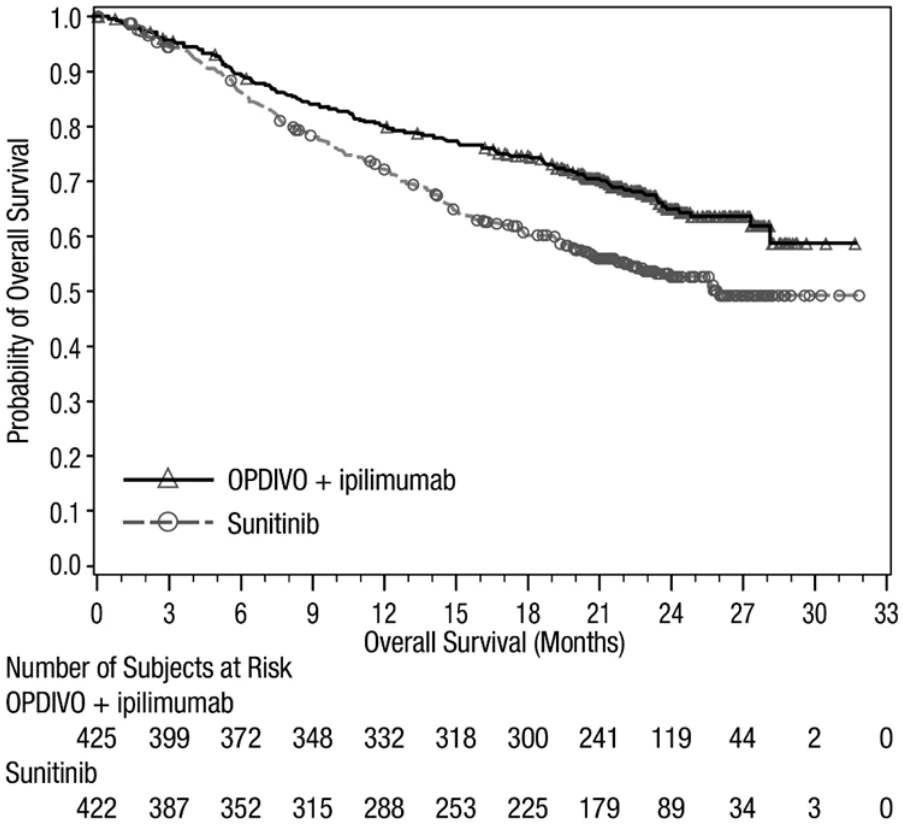
The estimated OS rates at 12 months were 80.1% (95% CI: 75.9, 83.6) for Opdivo plus ipilimumab and 72.1% (95% CI: 67.4, 76.2) for sunitinib.
OS benefit was observed regardless of PD-L1 expression level, with a hazard ratio of 0.45 (95% CI: 0.29, 0.71) for PD-L1 tumour expression levels ≥ 1%, and a hazard ratio of 0.73 (95% CI: 0.56, 0.96) for PD-L1 tumour expression levels < 1%.
CHECKMATE-214 also randomized 249 favorable risk patients as per IMDC criteria to Opdivo plus ipilimumab (n=125) or to sunitinib (n=124). These patients were not evaluated as part of the efficacy analysis population. OS in favorable risk patients receiving Opdivo plus ipilimumab compared to sunitinib has a hazard ratio of 1.45 (95% CI: 0.75, 2.81). The efficacy of Opdivo plus ipilimumab in previously untreated renal cell carcinoma with favorable-risk disease has not been established.
An exploratory follow-up analysis was conducted for CHECKMATE-214. The median follow-up for patients at the time of this analysis was 49.2 months (range: 41.4 to 57.5 months). For intermediate/poor-risk patients, the results for OS, PFS, and ORR based on 41.4 months of minimum follow-up remained consistent with the results of the primary analysis based on 17.5 months of minimum follow-up. The median OS, with further follow-up, was approximately 47.0 months for patients who received Opdivo plus ipilimumab vs. 26.6 months for sunitinib, resulting in a hazard ratio of 0.66.
Advanced RCC (previously untreated): CHECKMATE-9ER
CHECKMATE-9ER was a phase 3 randomized, open-label study of Opdivo combined with cabozantinib versus sunitinib in adult patients with previously untreated advanced (not amenable to curative surgery or radiation therapy) or metastatic RCC with clear cell component. Patients were included regardless of their PD-L1 status or International Metastatic RCC Database Consortium (IMDC) risk group. CHECKMATE-9ER excluded patients with poorly controlled hypertension despite antihypertensive therapy, active brain metastases, uncontrolled adrenal insufficiency autoimmune disease or other medical conditions requiring systemic immunosuppression, and patients who had prior treatment with an anti-PD-1, anti-PD-L1, anti-PD-L2, anti-CD137, or anti-CTLA-4 antibody. Patients were stratified by IMDC prognostic score, PD-L1 tumour expression, and geographic region.
Patients were randomized to Opdivo 240 mg intravenously every 2 weeks and cabozantinib 40 mg orally daily (n=323), or sunitinib 50 mg orally daily for the first 4 weeks of a 6-week cycle (4 weeks on treatment followed by 2 weeks off) (n=328). Treatment was continued until disease progression per RECIST v1.1 or unacceptable toxicity with nivolumab administration for up to 24 months. Treatment beyond RECIST-defined disease progression was permitted if the patient was clinically stable and considered to be deriving clinical benefit by the investigator. Tumour assessments were performed at baseline, after randomization at Week 12, then every 6 weeks until Week 60, and then every 12 weeks thereafter.
Baseline characteristics were generally balanced between the two groups. From both arms, median age was 61 years (range: 28-90) with 38% ≥65 years of age and 10% ≥75 years of age. The majority of patients were male (74%) and White (82%) and 23% and 76% of patients had a baseline KPS of 70% to 80% and 90% to 100%, respectively. Twenty-nine (4.5%) subjects had advanced, non-metastatic RCC. Seventy-five (11.5%) subjects had tumours with sarcomatoid features. Patient distribution by IMDC risk categories was 23% favorable, 58% intermediate, and 20% poor.
The primary efficacy outcome measure was PFS (BICR assessed). Secondary efficacy outcome measures were OS and ORR (BICR assessed). The trial demonstrated a statistically significant improvement in PFS, OS, and ORR for patients randomized to Opdivo and cabozantinib compared with sunitinib.
Efficacy results after a minimum follow-up of 10.6 months are shown in Table 85 and Figure 25 and Figure 26.
Table 85: Efficacy Results - CHECKMATE-9ER
| Opdivo and Cabozantinib (n=323) | Sunitinib (n=328) | |||||||||||
| Progression-free Survival | ||||||||||||
| Events (%) | 144 (44.6) | 191 (58.2) | ||||||||||
| Median (months)a | 16.6 (12.5, 24.9) | 8.3 (7.0, 9.7) | ||||||||||
| Hazard ratio (95% CI)b | 0.51 (0.41, 0.64) | |||||||||||
| p-valuec,d | <0.0001 | |||||||||||
| Overall Survival | ||||||||||||
| Events (%) | 67 (20.7) | 99 (30.2) | ||||||||||
| Median (months)a | N.E. | N.A. (22.6, N.A.) | ||||||||||
| Hazard ratio (98.89% CI)b | 0.60 (0.40, 0.89) | |||||||||||
| p-valuec,d,e | 0.0010 | |||||||||||
| Confirmed Objective Response Rate (95% CI)f | 55.7% (50.1, 61.2) | 27.1% (22.4, 32.3) | ||||||||||
| p-valueg | <0.0001 | |||||||||||
| Complete Response (CR) | 26 (8.0%) | 15 (4.6%) | ||||||||||
| Partial Response (PR) | 154 (47.7%) | 74 (22.6%) | ||||||||||
a. Based on Kaplan-Meier estimates.
b. Stratified Cox proportional hazards model. Hazard ratio is Opdivo and cabozantinib over sunitinib.
c. Log-rank test stratified by IMDC prognostic risk score (0, 1-2, 3-6), PD-L1 tumour expression (≥1% versus <1% or indeterminate) and region (US/Canada/W Europe/N Europe, ROW) as entered in the per protocol Interactive Response Technology (IRT) system.
d. 2-sided p-values from stratified regular log-rank test.
e. Type-1 error controlled by hierarchical testing. OS interim analysis boundary for statistical significance p-value <0.0111.
f. CI based on the Clopper and Pearson method.
g. 2-sided p-value from CMH test.
NE = non-estimable
The exploratory analyses in responders suggested the median duration of response of 20.2 months (range from 17.3 to N.E.) for Opdivo in combination with cabozantinib treated patients and 11.5 months (8.3 to 18.4 months) for sunitinib treated patients. The median time to response was 2.8 months (range from 1.0 to19.4) for Opdivo in combination with cabozantinib treated patients and 4.2 months (1.7 to 12.3) for sunitinib treated patients. Additional exploratory analyses suggested a consistent treatment benefit in both OS and PFS across all three pre-specified IMDC risk subgroups.
Figure 25: Kaplan-Meier Curve of Progression-free Survival - CHECKMATE-9ER
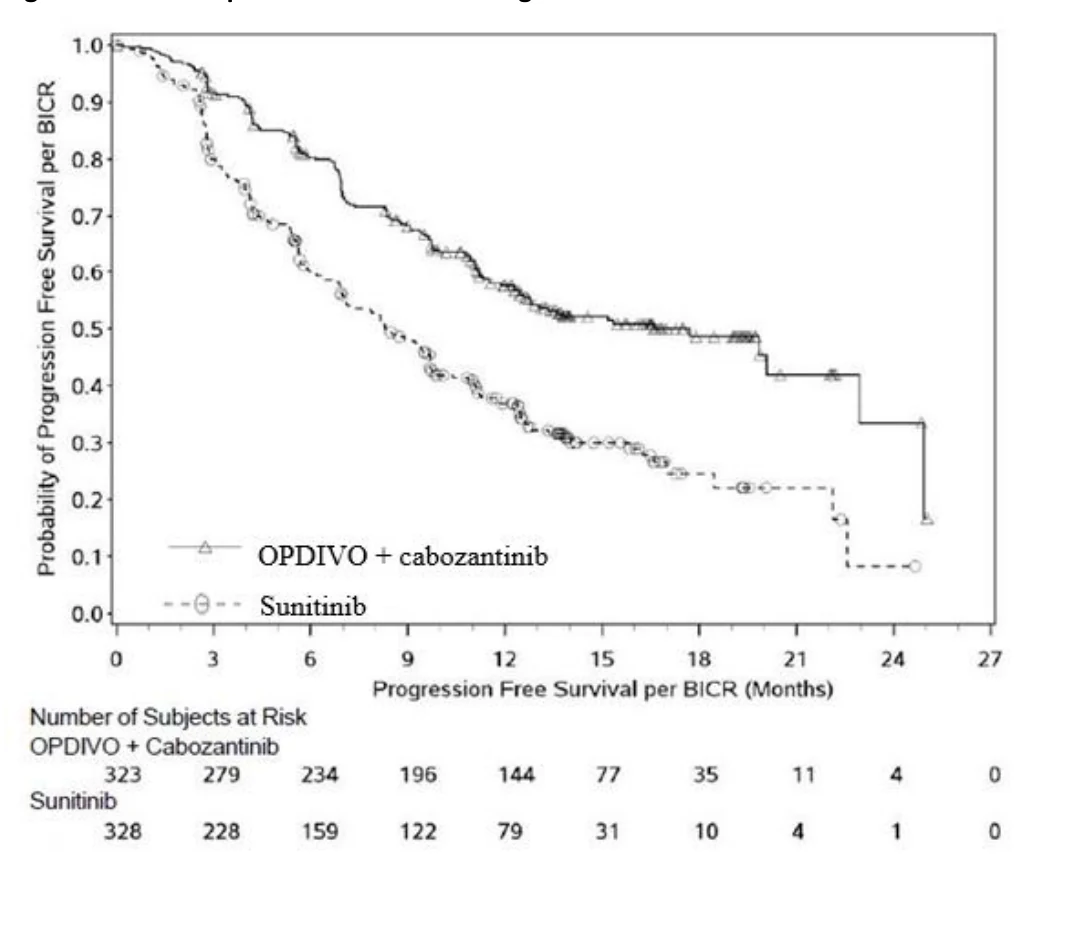
Figure 26: Kaplan-Meier Curve of Overall Survival - CHECKMATE-9ER
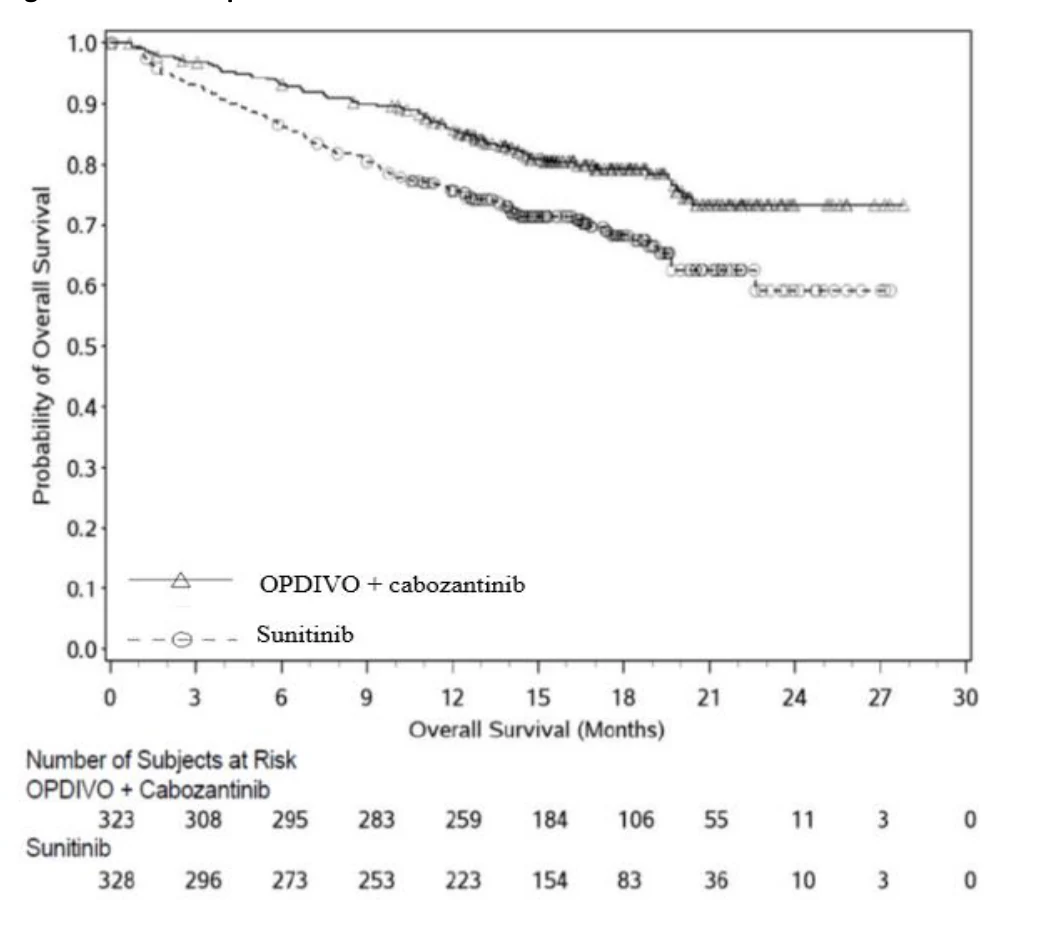
Recurrent or Metastatic SCCHN
Controlled Trial in SCCHN Patients Progressing on or after Platinum-Based Therapy: CHECKMATE-141
The safety and efficacy of Opdivo 3 mg/kg as a single agent for the treatment of metastatic or recurrent SCCHN were evaluated in a Phase III, randomised, open-label study (CHECKMATE-141). The study included patients (18 years or older) who experienced disease progression during or within 6 months after prior platinum-based therapy regimen and had an ECOG performance status score of 0 or 1. Prior platinum-based therapy was administered in either the adjuvant, neo-adjuvant, primary, or metastatic setting. Patients were enrolled regardless of their tumour PD-L1 or human papilloma virus (HPV) status. Patients with active autoimmune disease, medical conditions requiring immunosuppression, recurrent or metastatic carcinoma of the nasopharynx, squamous cell carcinoma of unknown primary histology, salivary gland or non-squamous histologies (e.g., mucosal melanoma), or untreated brain metastasis were excluded from the study. Patients with treated brain metastases were eligible if neurologically returned to baseline at least 2 weeks prior to enrollment, and either off corticosteroids, or on a stable or decreasing dose of < 10 mg daily prednisone equivalents.
A total of 361 patients were randomised 2:1 to receive either Opdivo 3 mg/kg (n = 240) administered intravenously over 60 minutes every 2 weeks or investigator’s choice (n = 121) of either cetuximab
(n = 15), 400 mg/m2 loading dose followed by 250 mg/m2 weekly or methotrexate (n = 52) 40 to 60 mg/m2 weekly, or docetaxel (n = 54) 30 to 40 mg/m2 weekly. Randomisation was stratified by prior cetuximab treatment. Treatment was continued as long as clinical benefit was observed or until treatment was no longer tolerated. Tumour assessments, according to RECIST version 1.1, were conducted 9 weeks after randomisation and continued every 6 weeks thereafter. Treatment beyond initial investigator-assessed RECIST, version 1.1-defined progression was permitted in patients receiving Opdivo if the patient had a clinical benefit and was tolerating study drug, as determined by the investigator. The primary efficacy outcome measure was OS. Key secondary efficacy outcome measures were investigator-assessed PFS and ORR. Additional prespecified subgroup analyses were conducted to evaluate the efficacy by tumour PD-L1 expression at predefined levels of 1%, 5%, and 10%.
Pre-study tumour tissue specimens were systematically collected prior to randomisation in order to conduct pre-planned analyses of efficacy according to tumour PD-L1 expression. Tumour PD-L1 expression was determined using the PD-L1 IHC 28-8 pharmDx assay.
Baseline characteristics were generally balanced between the two groups. The median age was 60 years (range: 28-83) with 31% ≥ 65 years of age and 5% ≥ 75 years of age, 83% were male, and 83% were white. Baseline ECOG performance status score was 0 (20%) or 1 (78%), 76% were former/current smokers, 90% had Stage IV disease, 66% had two or more lesions, 45%, 35% and 20% received 1, 2, or 3 or more prior lines of systemic therapy, respectively, and 25% were HPV-16 status positive.
The Kaplan-Meier curves for OS are shown in Figure 27.
Figure 27: Overall Survival - CHECKMATE-141
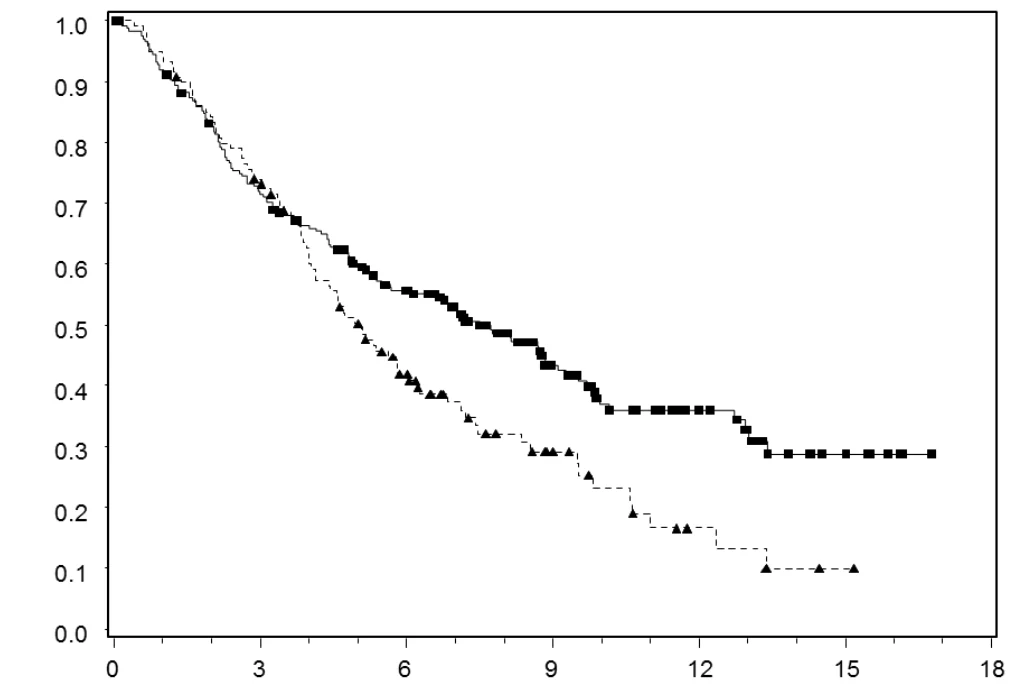
Overall Survival (Months)
Number of Subjects at Risk
Opdivo
240
167
109
52
24
7
0
Investigator’s choice
121
87
42
17
5
1
0
Opdivo (events: 133/240), median and 95% CI: 7.49 (5.49, 9.10)

Investigator’s choice (events: 85/121), median and 95% CI: 5.06 (4.04, 6.05)
Opdivo vs. Investigator’s Choice - hazard ratio and 95% CI: 0.70 (0.53 - 0.92); p-value: 0.0101
The trial demonstrated a statistically significant improvement in OS for patients randomised to Opdivo as compared with investigator’s choice at the pre-specified interim analysis when 218 events were observed (78% of the planned number of events for final analysis). Opdivo did not demonstrate a statistically significant benefit over investigator’s choice in the secondary efficacy endpoints of progression-free survival (PFS) and objective response rates (ORR). Efficacy results are shown in Table 86.
Table 86: Efficacy results - CHECKMATE-141
| Opdivo (n = 240) | investigator’s choice (n = 121) | ||||||||||
|---|---|---|---|---|---|---|---|---|---|---|---|
| Overall survival | |||||||||||
| Events | 133 (55.4%) | 85 (70.2%) | |||||||||
| Hazard ratioa | 0.70 | ||||||||||
| (95% CI) | (0.53, 0.92) | ||||||||||
| p-valueb | 0.0101 | ||||||||||
| Median (95% CI) months | 7.49 (5.49, 9.10) | 5.06 (4.04, 6.05) | |||||||||
Probabi lity of Sur vival
Rate (95% CI) at 6 months
55.6 (48.9, 61.8)
41.8 (32.6, 50.7)
Rate (95% CI) at 12 months
36.0 (28.5, 43.4)
16.6 (8.6, 26.8)
Progression-free survival
Events
190 (79.2%)
103 (85.1%)
Hazard ratio
0.89
95% CI
(0.70, 1.13)
p-value
0.3236
Median (95% CI) (months)
2.04 (1.91, 2.14)
2.33 (1.94, 3.06)
Confirmed objective responsec
32 (13.3%)
7 (5.8%)
(95% CI)
(9.3, 18.3)
(2.4, 11.6)
Complete response (CR)
6 (2.5%)
1 (0.8%)
Partial response (PR)
26 (10.8%)
6 (5.0%)
Stable disease (SD)
55 (22.9%)
43 (35.5%)
- a. Derived from a stratified proportional hazards model.
- b. P-value is derived from a log-rank test stratified by prior cetuximab; the corresponding O’Brien-Fleming efficacy boundary significance level is 0.0227.
- c. In the Opdivo group there were two patients with CRs and seven patients with PRs who had tumour PD-L1 expression < 1%.
Tumour PD-L1 expression was quantifiable in 72% of patients - 67% of patients in the Opdivo group and 82% of patients in the investigator’s choice group. Tumour PD-L1 expression levels were balanced between the two treatment groups (Opdivo vs. investigator’s choice) at each of the predefined tumour PD-L1 expression levels of ≥ 1% (55% vs. 62%), ≥ 5% (34% vs. 43%), or ≥ 10% (27% vs. 34%).
Patients with tumour PD-L1 expression by all predefined expression levels in the Opdivo group demonstrated greater likelihood of improved survival compared to investigator’s choice. The magnitude of OS benefit was consistent for ≥ 1%, ≥ 5% or ≥ 10% tumour PD-L1 expression levels, with results shown using a 1% cut-off for PD-L1 expression (Figure 28). In contrast, there were no meaningful differences in OS between Opdivo and investigator’s choice treated patients who were PD-L1 negative (PD-L1 < 1%). In patients with no measurable tumour PD-L1 expression or in those deemed non-quantifiable, close monitoring for unequivocal progression during the first months of treatment with Opdivo may be clinically prudent.
Figure 28: Overall Survival by PD-L1 Expression Level (1%) - CHECKMATE-141
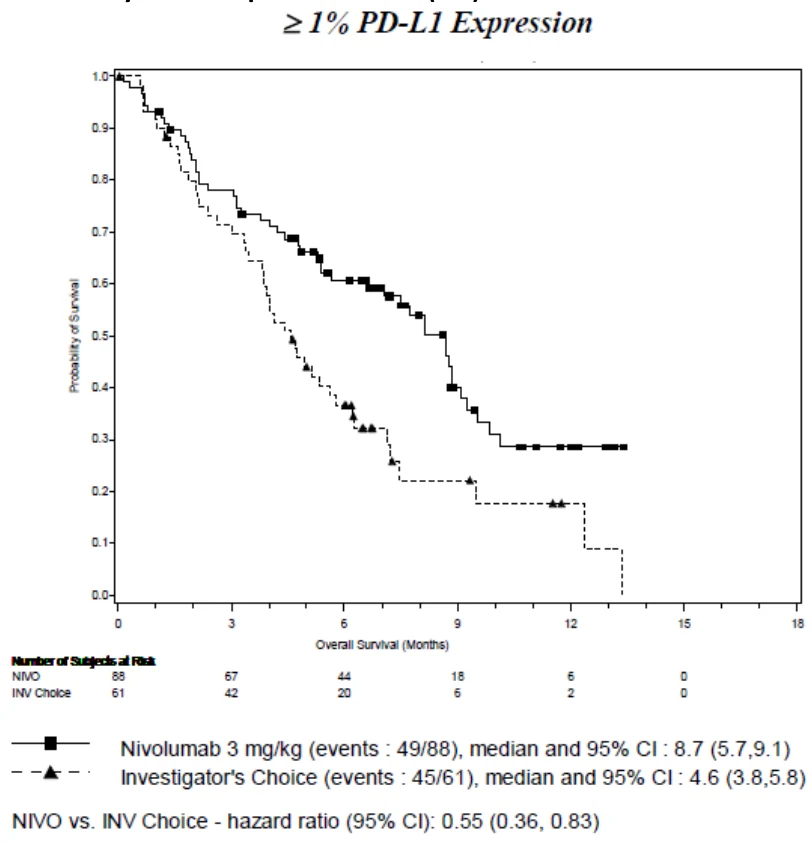
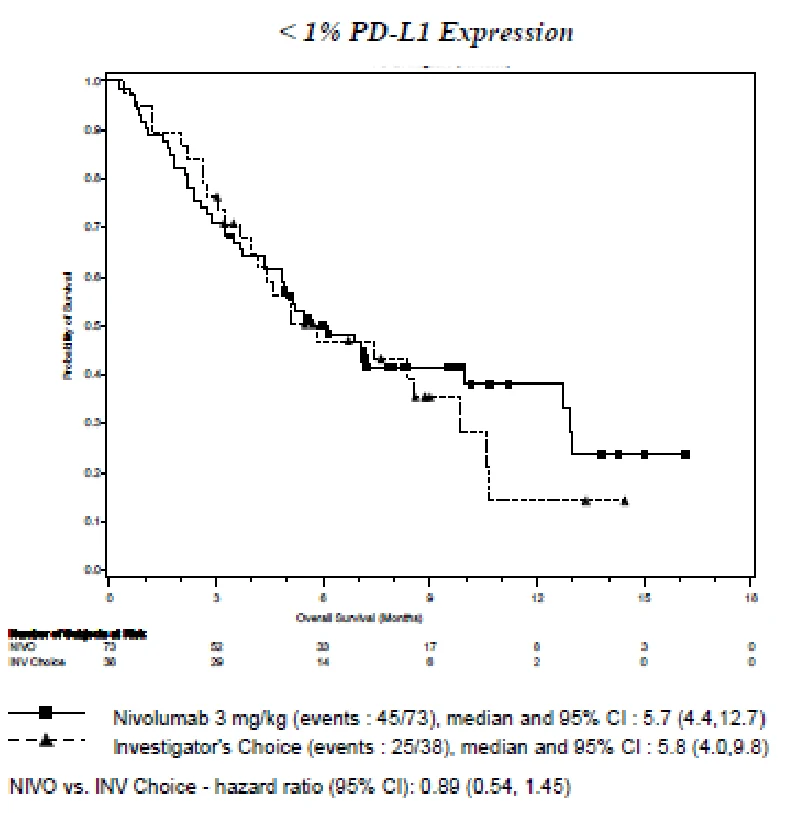
Classical Hodgkin Lymphoma (cHL)
Open-Label Studies in cHL Patients after Failure of ASCT: CHECKMATE-205 and CHECKMATE-039
Two studies evaluated the efficacy of Opdivo as a single agent in patients with cHL after failure of ASCT.
CHECKMATE-205 was a Phase 2 single-arm, open-label, multicenter, multicohort study in cHL. Subjects were brentuximab-naïve after failure of ASCT (n=63), may have had brentuximab vedotin following failure of ASCT (n=80), or could have received prior brentuximab vedotin at any time-point relative to ASCT (of which 33 patients who had received brentuximab vedotin only prior to ASCT). CHECKMATE-039 was an open-label, multicenter, dose escalation study that included 23 cHL patients, amongst which, 15 received prior brentuximab vedotin treatment after failure of ASCT. Both studies included patients regardless of their tumour PD-L1 status and excluded patients with ECOG performance status of 2 or greater, autoimmune disease, symptomatic interstitial lung disease, hepatic transaminases more than 3 times ULN, creatinine clearance less than 40 mL/min, prior allogeneic stem cell transplant, or chest irradiation within 24 weeks. In addition, both studies required an adjusted diffusion capacity of the lungs for carbon monoxide (DLCO) of over 60% in patients with prior pulmonary toxicity. In CHECKMATE-205 and CHECKMATE-039, 7 patients were ≥ 65 years of age.
Patients received 3 mg/kg of nivolumab administered intravenously over 60 minutes every 2 weeks until disease progression, maximal clinical benefit, or unacceptable toxicity. A cycle consisted of one dose. Dose reduction was not permitted.
In the 63 patients in CHECKMATE-205 who received nivolumab after failure of ASCT (brentuximab naive), the median age was 33 years (range: 18 to 65), the majority were male (54%) and white (86%), and patients had received a median of 2 prior systemic regimens (range: 2 to 8). Patients received a median of 25 doses of nivolumab (range 1 to 43), with a median duration of therapy not reached (95% CI 12.5 months, not reached).
In the 95 patients in studies CHECKMATE-205 and CHECKMATE-039 combined who received nivolumab after brentuximab vedotin following failure of ASCT, the median age was 37 years (range: 18 to 72), the majority were male (64%) and white (87%), and patients had received a median of 5 prior systemic regimens (range: 2 to 15). Patients received nivolumab for a median of 28 doses (range 3 to 48), with a median duration of therapy of 16 months (95% CI 9.26, 23.36 months.
In studies CHECKMATE-205 and CHECKMATE-039, efficacy was evaluated by objective response rate (ORR) as determined by an independent radiographic review committee (IRRC). Additional outcome measures included duration of response and PFS.
Efficacy results for patients who received nivolumab after brentuximab vedotin following failure of ASCT is presented in Table 87, and for patients who received nivolumab after failure of ASCT (brentuximab naive) is presented in Table 88.
Table 87: Efficacy results in patients with cHL after brentuximab vedotin following failure of ASCT
CHECKMATE-205 Cohort B and CHECKMATE-039 n=95 | CHECKMATE-205 Cohort Ba,b n=80 | CHECKMATE-039c n=15 | |
|---|---|---|---|
| Objective Response Rate (95% CI) | 66% (56, 76) | 68% (56, 78) | 60% (32, 84) |
| Complete Remission Rate | 6% | 8% | 0% |
| Partial Remission Rate | 60% | 60% | 60% |
Duration of Response (months) Median (95% CI) Range | 13.1 (9.46, NE) 0.0+, 23.1+ | 13.1 (8.7, NE) 0.0+, 14.2+ | 12.0 (1.8, NE) 1.8+, 23.1+ |
- a. Follow-up was ongoing at the time of data submission
- b. Median duration of follow-up 15.4 months (1.9 to 18.5)
- c. Median duration of follow-up 21.9 months (11.2 to 27.6)
Updated efficacy results in patients with cHL after brentuximab vedotin following failure of ASCT (Cohort B) (median duration of follow-up of 58.5 months) was consistent with interim results initially reported. They had an ORR of 71.3% (95% CI 60, 80.8), complete remission rate of 14%, partial remission rate of 55% and median duration of response of 16.6 months (95% CI 9.3, 25.7).
Table 88: Efficacy results in patients with cHL After ASCT (brentuximab vedotin-naive)
| CHECKMATE-205 Cohort A a,b n = 63 | |
|---|---|
| Objective Response Rate (95% CI) | 68% (55, 79) |
| Complete Remission Rate | 22% |
| Partial Remission Rate | 46% |
Duration of Response (months) Median (95% CI) Range | NE (NE, NE) 1.4, 16.1+ |
- a. Follow-up was ongoing at the time of data submission
- b. Median duration of follow-up 14.0 months (1.0 to 20.3)
Updated efficacy results in patients with cHL after ASCT (brentuximab vedotin-naïve – Cohort A) (median duration of follow-up of 61.9 months) was consistent with interim results initially reported. They had an ORR of 65% (95% CI 52, 77), complete remission rate of 32%, partial remission rate of 33% and median duration of response of 26.2 months (95% CI 15.2, N.A).
Efficacy was also evaluated in 33 patients in Study CHECKMATE-205 who had received brentuximab vedotin only prior to ASCT (Cohort C). The median age was 30 years (range 19 to 53). The majority were male (55%) and white (88%). Patients had received a median of 4 prior systemic regimens (range: 2 to 7). They had an ORR of 72.7% (95% CI 55, 87), Complete Remission Rate of 21% and Partial Remission Rate of 52%.
MSI-H/dMMR Metastatic Colorectal Cancer (CRC)
Randomized Open Label Phase III Study in MSI-H/dMMR mCRC patients (previously untreated): CHECKMATE-8HW
CHECKMATE-8HW was a phase 3, randomized, three arm, open-label study of Opdivo monotherapy and Opdivo in combination with ipilimumab compared to investigator’s choice of chemotherapy for the treatment of patients with unresectable or metastatic CRC with known tumor MSI-H or dMMR (MSI-H/dMMR) status. Study treatment arms included Opdivo monotherapy, Opdivo in combination with ipilimumab, or investigator’s choice of chemotherapy. MSI-H or dMMR tumor status was determined in accordance with local standard of practice using PCR, NGS or IHC, assays. Central assessment of MSI-H status using PCR (Idylla MSI) test and dMMR status using IHC (Omnis MMR) test was conducted retrospectively on patient tumor specimens used for local MSI-H/dMMR status determination. Patients with confirmed MSI-H/dMMR status by either central test comprised the primary efficacy population.
The evaluation of efficacy for this analysis relied on the comparison between 2 treatment arms: Opdivo in combination with ipilimumab or investigator’s choice of chemotherapy in the first-line setting.
The trial included adult patients with histologically confirmed recurrent or metastatic CRC, who had no prior history of treatment with chemotherapy and/or targeted agents for metastatic disease, and had disease not amenable to surgery. The trial excluded patients with brain metastasis that were symptomatic, active autoimmune disease, or who used systemic corticosteroids or immunosuppressants, or had been treated with checkpoint inhibitors. Randomization was stratified by primary tumor location (right vs left).
Patients were randomized (2:1) to one of the following treatment arms:
- Opdivo plus ipilimumab arm: Opdivo 240 mg every 3 weeks and ipilimumab 1 mg/kg every 3 weeks for a maximum of 4 doses, then Opdivo 480 mg every 4 weeks
Investigator’s choice chemotherapy (chemotherapy) arm:
mFOLFOX6 (oxaliplatin, leucovorin, and FU) with or without either bevacizumab or cetuximab: Oxaliplatin 85 mg/m2, leucovorin 400 mg/m2, and FU 400 mg/m2 bolus followed by FU 2400 mg/m2 over 46 hours every 2 weeks. Bevacizumab 5 mg/kg or cetuximab 500 mg/m2 administered prior to mFOLFOX6 every 2 weeks.
or
- FOLFIRI (irinotecan, leucovorin, and FU) with or without either bevacizumab or cetuximab: Irinotecan 180 mg/m2, leucovorin 400 mg/m2, and FU 400 mg/m2 bolus and FU 2400 mg/m2 over 46 hours every 2 weeks. Bevacizumab 5 mg/kg on or cetuximab 500 mg/m2 administered prior to FOLFIRI every 2 weeks.
Study treatment continued until disease progression, unacceptable toxicity, or for up to 2 years. Patients who discontinued combination therapy because of an adverse reaction attributed to ipilimumab were permitted to continue Opdivo as a single agent. Tumor assessments per RECIST v1.1 were conducted every 6 weeks for the first 24 weeks, then every 8 weeks thereafter up until week 96, then every 16 weeks thereafter up until week 146, and then every 24 weeks. Patients randomized to the chemotherapy arm could receive Opdivo plus ipilimumab combination upon progression assessed by BICR.
A total of 303 previously untreated patients, in the metastatic setting, were randomized, including 202 patients to receive Opdivo in combination with ipilimumab and 101 patients to receive chemotherapy. Among them, 255 had centrally confirmed MSI-H/dMMR status, 171 in the Opdivo in combination with ipilimumab arm and 84 in the chemotherapy arm.
The baseline characteristics of all randomized previously untreated for metastatic disease patients were: the median age was 63 years (range: 21 to 87), with 46% ≥65 years of age and 18% ≥75 years of age; 46% were male and 86% were White. Baseline ECOG performance status was 0 (54%) and ≥1 (46%); tumor location was right-sided or left-sided for 68% and 32% of patients, respectively; all patients had Stage IV disease at study entry; and 39 patients had confirmed Lynch syndrome among the 223 patients with a known status. The baseline characteristics of previously untreated for metastatic disease patients with centrally confirmed MSI-H/dMMR were consistent with all randomized previously untreated patients. Among the 202 patients randomized to receive Opdivo combined with ipilimumab, 200 patients received at least one dose of study treatment. Among the 101 patients randomized to receive chemotherapy, 88 patients received at least one dose of study treatment, including oxaliplatin-containing regimens and irinotecan-containing regimens received by 58% and 42% of patients, respectively. Additionally, 66 patients received a targeted agent, either bevacizumab (64%) or cetuximab (11%).
The primary efficacy endpoints of the study were 1) BICR-assessed PFS per RECIST 1.1 in patients with centrally confirmed MSI-H/dMMR randomized to receive Opdivo combined with ipilimumab compared to chemotherapy as a first-line treatment, and 2) BICR-assessed PFS per RECIST 1.1 in patients with centrally confirmed MSI-H/dMMR randomized to receive Opdivo combined with ipilimumab compared to Opdivo monotherapy across all lines of therapy (all randomized). Secondary efficacy measures included objective response rate (ORR) assessed by BICR and overall survival (OS).
At this planned interim analysis for PFS, the study met the primary endpoint of BICR assessed-PFS for patients with centrally confirmed MSI-H/dMMR randomized to the Opdivo and ipilimumab arm compared with chemotherapy, in the first line setting. The BICR-assessed PFS results are presented in Table 89 and Figure 29. At the time of this interim analysis, the data were immature for the other primary endpoint (PFS per BICR for Opdivo combined with ipilimumab versus Opdivo monotherapy in all randomized patients with centrally confirmed MSI-H/dMMR), the information fraction was 70%.
Table 89: Efficacy Results - CHECKMATE-8HW a,b
| Opdivo + Ipilimumab (n=171) | Chemotherapy (n=84) | ||||||||
|---|---|---|---|---|---|---|---|---|---|
| Progression-free Survival | |||||||||
| Events, n (%) | 48 (28) | 52 (62) | |||||||
Median (months) (95% CI) | NR (38.4, NR) | 5.9 (4.4, 7.8) | |||||||
| Hazard ratio (95% CI) | 0.21 (0.14, 0.32) | ||||||||
| p-valuec | <0.0001 | ||||||||
a Median follow-up was 31.5 months (range: 6.1 to 48.4 months).
b Based on centrally confirmed randomized patients.
c Based on log-rank test stratified by the same factors as used in the Cox proportional hazard model. The p-value boundary for statistical significance was 0.0209.
Figure 29: Progression-free Survival - CHECKMATE-8HW
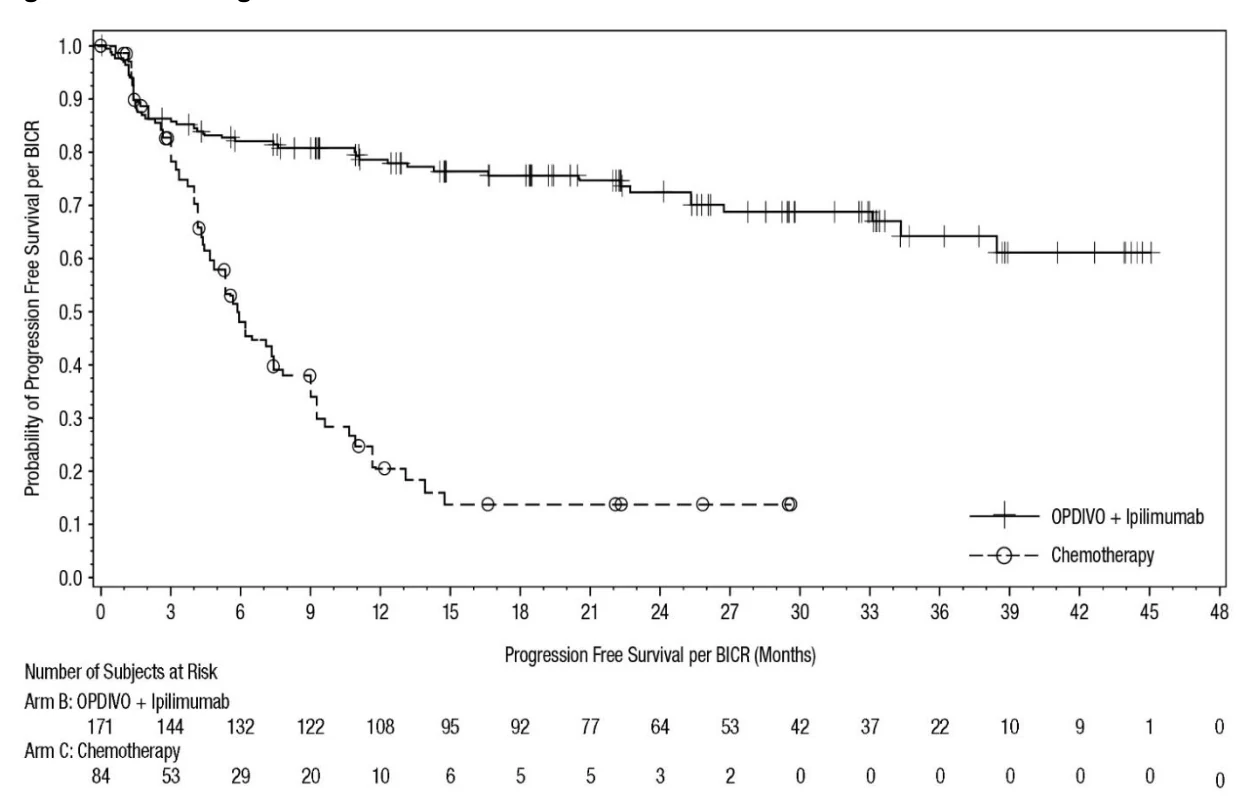
Open-Label Study in MSI-H/dMMR mCRC patients who received prior therapy: CHECKMATE-142
The safety and efficacy of nivolumab in combination with ipilimumab were evaluated for the treatment of dMMR or MSI-H mCRC in a Phase 2, multicenter, open-label, single-arm study (CHECKMATE-142).
The study included patients (18 years or older) with locally determined dMMR or MSI-H status, who had disease progression during, after, or were intolerant to, prior therapy with fluoropyrimidine and oxaliplatin or irinotecan, and had an ECOG performance status score of 0 or 1. This study included patients regardless of their tumour PD-L1 status. Patients with active brain metastases, active autoimmune disease, or medical conditions requiring systemic immunosuppression were excluded from the study.
A total of 119 patients received the combination regimen (nivolumab 3 mg/kg plus ipilimumab 1 mg/kg on the same day every 3 weeks for 4 doses, then nivolumab 3 mg/kg every 2 weeks). Treatment continued until unacceptable toxicity or radiographic progression. Tumour assessments were conducted every 6 weeks for the first 24 weeks and every 12 weeks thereafter. Efficacy outcome measures included overall response rate (ORR) as assessed by independent radiographic review committee (IRRC) using Response Evaluation Criteria in Solid Tumours (RECIST v1.1) and duration of response (DOR).
The median age was 58 years (range: 21 to 88), with 32% ≥ 65 years of age and 9% ≥ 75 years of age; 59% were male and 92% were white.
Baseline ECOG performance status was 0 (57%) and ≥1 (61%), and 29% were reported to have Lynch Syndrome. 25% of patients were BRAF mutation positive, 37% were KRAS mutation positive, and 12% were unknown. 23%, 36%, 24%, and 16% received 1, 2, 3, or ≥4 prior lines of therapy, respectively, and 29% had received an anti-EGFR antibody.
Efficacy results based on a minimum follow-up of approximately 27.5 months for all 119 patients who had prior fluoropyrimidine, oxaliplatin or irinotecan therapy are shown in Table 90.
Table 90: Opdivo + ipilimumab Combination Therapy Efficacy Results for Patients with MSI-H/dMMR mCRC (CHECKMATE-142)
Opdivo + ipilimumaba All patients | |
|---|---|
| (n = 119) | |
| Confirmed objective responseb, n (%) | 71 (59.7) |
| (95% CI)c | (50.3, 68.6) |
| Complete response (CR), n (%) | 17 (14.3) |
| Partial response (PR), n (%) | 54 (45.4) |
- a. Minimum follow-up 27.5 months, Median follow-up 31.5 months
- b. BICR assessment
- c. Estimated using the Clopper-Pearson method
At the time of this analysis corresponding to the minimum follow-up duration of 27.5 months, the median response duration was not reached (range: 1.9 to 36.9+ months).
Adjuvant Treatment of Resected Esophageal or Gastroesophageal Junction Cancer
CHECKMATE-577
CHECKMATE-577 was a randomized, multicenter, double-blind trial in 794 patients with resected esophageal or gastroesophageal junction cancer who had residual pathologic disease. Patients were randomized (2:1) to receive either Opdivo 240 mg or placebo by intravenous infusion over 30 minutes every 2 weeks for 16 weeks followed by 480 mg or placebo by intravenous infusion over 30 minutes every 4 weeks beginning at week 17. Treatment was until disease recurrence, unacceptable toxicity, or for up to 1 year in total duration. Enrollment required complete resection with negative margins within 4 to 16 weeks prior to randomization. The trial excluded patients who did not receive concurrent chemoradiotherapy (CRT) prior to surgery, who had stage IV resectable disease, autoimmune disease, or any condition requiring systemic treatment with either corticosteroids (>10 mg daily prednisone or equivalent) or other immunosuppressive medications. Randomization was stratified by tumour PD-L1 status (≥1% vs. <1% or indeterminate or non-evaluable), pathologic lymph node status (positive ≥ypN1 vs. negative ypN0), and histology (squamous vs. adenocarcinoma). The primary efficacy outcome measure was disease-free survival (DFS) defined as the time between the date of randomization and the date of first recurrence (local, regional, or distant from the primary resected site) or death, from any cause, whichever occurred first as assessed by the investigator prior to subsequent anti-cancer therapy. Patients on treatment underwent imaging for tumour recurrence every 12 weeks for 2 years, and a minimum of one scan every 6 to 12 months for years 3 to 5.
The trial population characteristics were: median age 62 years (range: 26 to 86), 36.1% were ≥65 years of age, 84.5% were male, 14.7% were Asian, and 81.6% were White. Disease characteristics were AJCC
Stage II (35%) or Stage III (64.7%) carcinoma at initial diagnosis, EC (59.8%) or GEJC (40.2%) at initial diagnosis, with pathologic positive lymph node status (57.6%) at study entry and histological confirmation of predominant adenocarcinoma (70.9%) or squamous cell carcinoma (29%). The baseline tumour PD-L1 status was positive for 16.2% patients, defined as ≥1% of tumour cells expressing PD-L1, and negative for 71.8% of patients. Baseline ECOG performance status was 0 (58.4%) or 1 (41.6%).
Efficacy results are shown in Table 91 and Figure 30.
Table 91: Efficacy Results - CHECKMATE-577
| Opdivo (n=532) | Placebo (n=262) | ||||||||
|---|---|---|---|---|---|---|---|---|---|
| Disease-free Survivala | |||||||||
| Number of events, n (%) | 241 (45.3%) | 155 (59.2%) | |||||||
Median (months) (95% CI) | 22.41 (16.62, 34.00) | 11.04 (8.34, 14.32) | |||||||
Hazard ratiob (95% CI) | 0.69 (0.56, 0.85) | ||||||||
| p-valuec | 0.0003 | ||||||||
a. Based on all randomized patients.
b. Hazard ratio is obtained from a Cox proportional-hazards model stratified by tumour PD-L1 status, pathologic lymph node status, and histology with treatment as the sole covariate.
c. Based on a stratified log-rank test.
Figure 30: Disease-free Survival - CHECKMATE-577
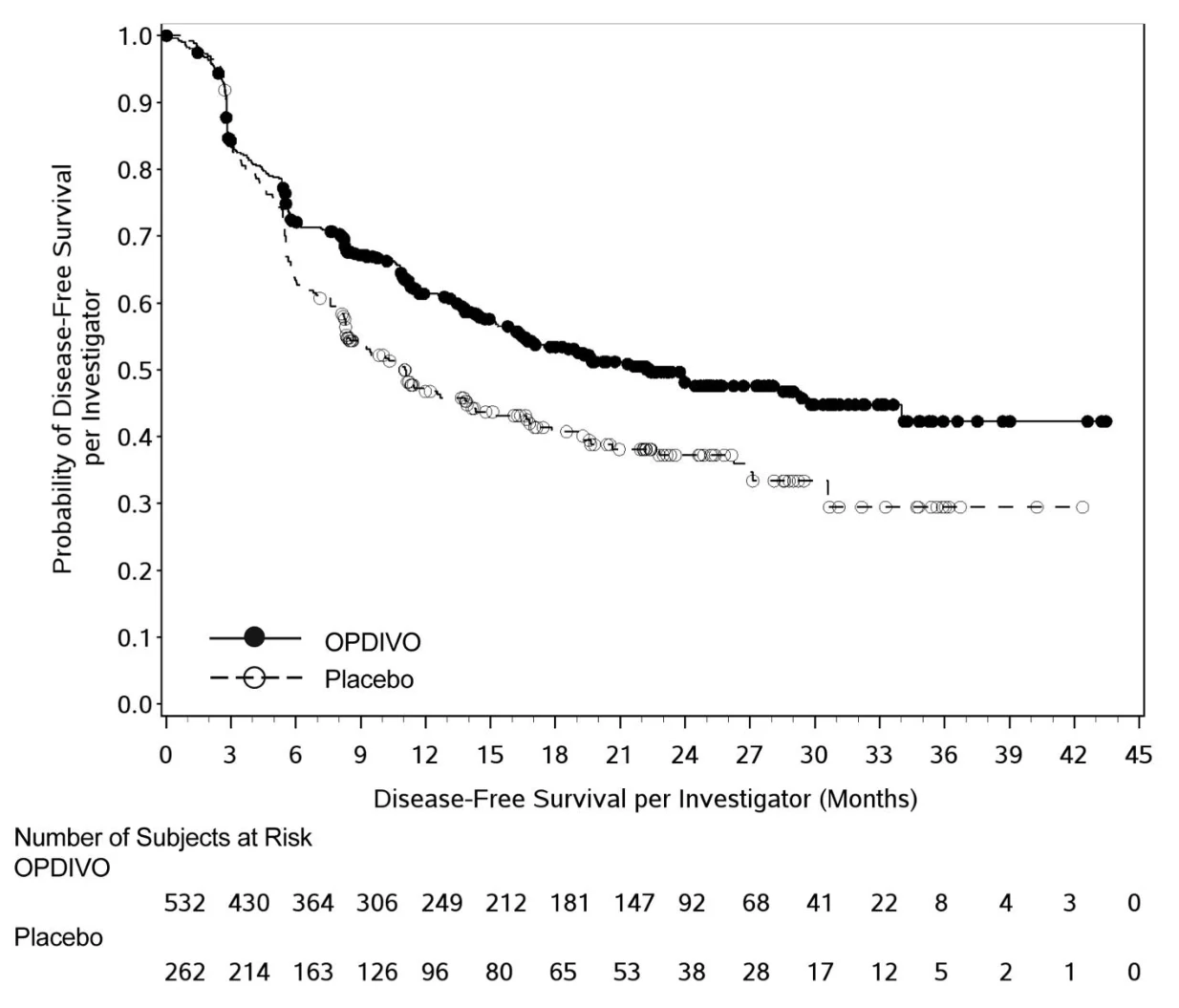
Gastric Cancer, Gastroesophageal Junction Cancer or Esophageal Adenocarcinoma (previously untreated)
CHECKMATE-649
The safety and efficacy of nivolumab 240 mg every 2 weeks or 360 mg every 3 weeks in combination with chemotherapy was evaluated in phase 3, randomized, open-label study (CHECKMATE-649). The study included adult patients (18 years or older) with previously untreated advanced or metastatic gastric (GC), gastroesophageal junction (GEJC) or esophageal adenocarcinoma (EAC), no prior systemic treatment (including HER2 inhibitors), and ECOG performance status score 0 or 1. The trial enrolled patients regardless of PD-L1 status, and tumour specimens were evaluated prospectively using the PD-L1 IHC 28-8 pharmDx assay at a central laboratory. The trial excluded patients who were known HER2 positive or had untreated CNS metastases. Patients were randomized to receive Opdivo in combination with chemotherapy or chemotherapy. Patients received one of the following treatments:
- Opdivo 240 mg in combination with FOLFOX (fluorouracil, leucovorin and oxaliplatin) every 2 weeks or FOLFOX every 2 weeks.
- Opdivo 360 mg in combination with CapeOX (capecitabine and oxaliplatin) every 3 weeks or CapeOX every 3 weeks.
Patients were treated until disease progression, unacceptable toxicity, or up to 2 years. In patients who received Opdivo in combination with chemotherapy and in whom chemotherapy was discontinued, Opdivo monotherapy was allowed to be given at 240 mg every 2 weeks, 360 mg every 3 weeks, or 480 mg every 4 weeks up to 2 years after treatment initiation.
Randomization was stratified by tumour cell PD-L1 status (≥1% vs. <1% or indeterminate), region (Asia vs. US vs. Rest of World), ECOG performance status (0 vs. 1), and chemotherapy regimen. PD-L1 status by CPS was evaluated using the PD-L1 stained tumour specimens used for randomization. Chemotherapy consisted of FOLFOX (fluorouracil, leucovorin and oxaliplatin) or CapeOX (capecitabine and oxaliplatin).
The study objectives were to assess OS and PFS in all randomized patients, as well as in patients with PD-L1 combined positive score (CPS) ≥5. The tumour assessments per RECIST v1.1 were conducted every 6 weeks up to and including week 48, then every 12 weeks thereafter.
A total of 1581 patients were randomized: 789 to the Opdivo in combination with chemotherapy arm and 792 to the chemotherapy arm. The baseline characteristics were generally balanced across treatment groups. The median age 61 years (range: 18 to 90), 39% were ≥65 years of age, 70% were male, 24% were Asian, and 69% were White. Baseline ECOG performance status was 0 (42%) or 1 (58%). Tumour locations were distributed as gastric (70%), gastroesophageal junction (16%) and esophagus (13%).
CHECKMATE-649 met its objectives after a minimum follow-up of 12.1 months and results are shown in Table 92 and Figure 31 and Figure 32.
Table 92: Efficacy Results - CHECKMATE-649
a. Kaplan-Meier estimate.
b. Based on stratified log Cox proportional hazard model.
c. Based on stratified log-rank test.
d. Confirmed by BICR.
e. Based on patients with measurable disease at baseline.
In all randomized patients the median DOR was 8.5 months in the nivolumab + chemotherapy arm compared to 6.9 months in the chemotherapy arm. In patients with CPS ≥ 5 the median DOR was 9.5 months for the nivolumab + chemotherapy arm compared to 7.0 months in the chemotherapy arm.
A positive association was observed between PD-L1 CPS score and the magnitude of the treatment benefit. The hazard ratios (HR) for OS were 0.80, 0.77, 0.71 for all randomized patients, PD-L1 CPS ≥ 1, and PD-L1 CPS ≥ 5 patients, respectively. In an exploratory analysis, the stratified HRs for OS were 0.85 in patients with PD-L1 CPS < 1 and 0.94 for patients with PD-L1 CPS < 5.
| Opdivo and FOLFOX or CapeOx (n=789) | FOLFOX or CapeOx (n=792) | Opdivo and FOLFOX or CapeOx (n=473) | FOLFOX or CapeOx (n=482) | ||||||||||||||
|---|---|---|---|---|---|---|---|---|---|---|---|---|---|---|---|---|---|
| All Patients | PD-L1 CPS ≥5 | ||||||||||||||||
| Overall Survival | |||||||||||||||||
| Events (%) | 544 (69) | 591 (75) | 309 (65) | 362 (75) | |||||||||||||
| Median (months)a (95% CI) | 13.8 (12.6, 14.6) | 11.6 (10.9, 12.5) | 14.4 (13.1, 16.2) | 11.1 (10.0, 12.1) | |||||||||||||
| Hazard ratio (CI)b | 0.80 (99.3% CI: 0.68, 0.94) | 0.71 (98.4% CI: 0.59, 0.86) | |||||||||||||||
| p-valuec | 0.0002 | <0.0001 | |||||||||||||||
| Progression-free Survivald | |||||||||||||||||
| Events (%) | 559 (70.8) | 557 (70.3) | 328 (69.3) | 350 (72.6) | |||||||||||||
Median (months)a (95% CI) | 7.66 (7.10, 8.54) | 6.93 (6.60, 7.13) | 7.69 (7.03, 9.17) | 6.05 (5.55, 6.90) | |||||||||||||
| Hazard ratio (CI)b | 0.77 (95% CI: 0.68, 0.87) | 0.68 (98% CI: 0.56, 0.81) | |||||||||||||||
| p-valuec | Not Tested | <0.0001 | |||||||||||||||
Overall Response Rate, n (%)d,e | 350/603 (58) | 280/608 (46) | 226/378 (60) | 177/391 (45) | |||||||||||||
Figure 31: Kaplan-Meier Curve of Overall Survival (ITT) - CHECKMATE-649
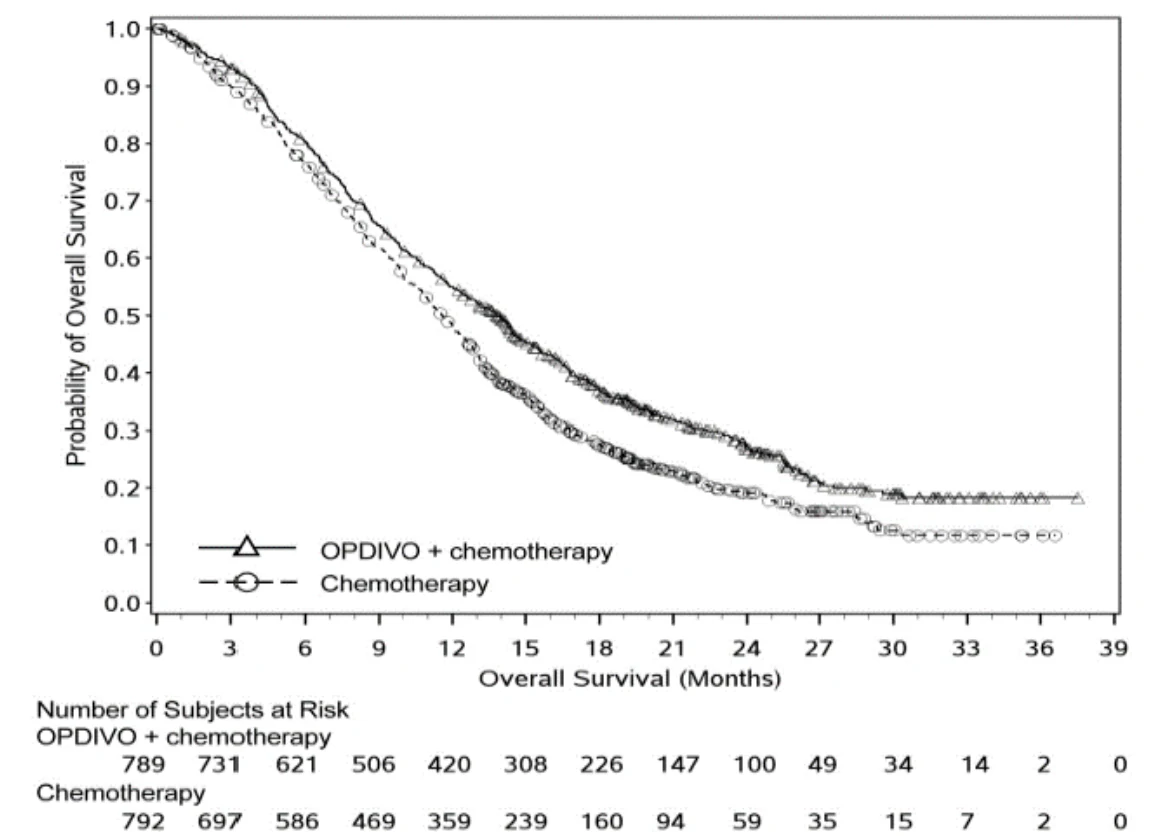
Figure 32: Kaplan-Meier Curve of Overall Survival (PD-L1 CPS ≥5) - CHECKMATE-649
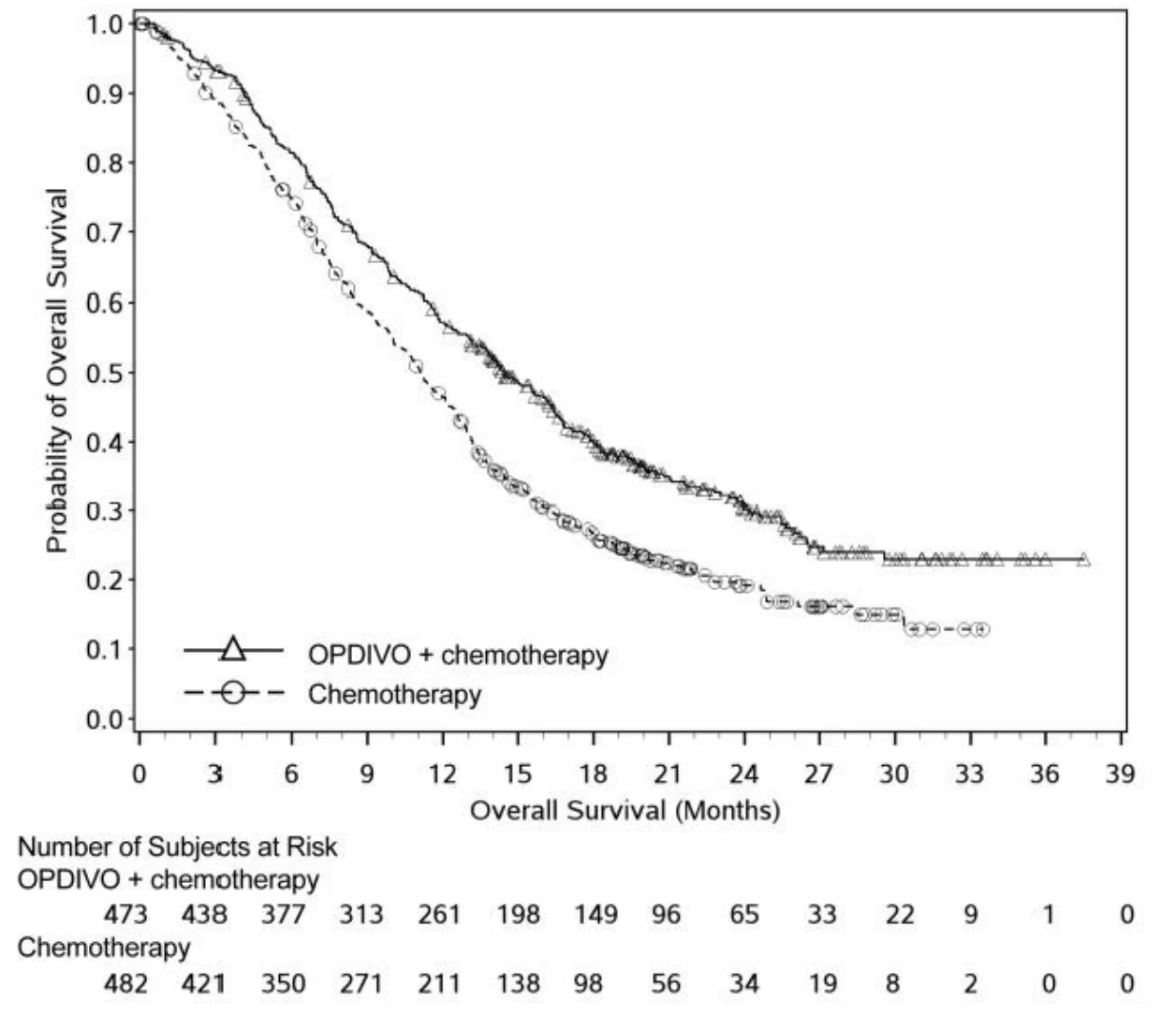
Adjuvant Treatment of Urothelial Carcinoma
CHECKMATE-274 was a phase 3, randomized, double-blind, placebo-controlled study of adjuvant Opdivo in patients who were within 120 days of radical resection of urothelial carcinoma (UC) originating in the bladder or upper urinary tract (renal pelvis or ureter) and were at high risk of recurrence. The UC pathologic staging criteria that defines high risk patients were ypT2-ypT4a or ypN+ for adult patients who received neo-adjuvant cisplatin chemotherapy, and pT3-pT4a or pN+ for adult patients who did not receive neo-adjuvant cisplatin chemotherapy and were not eligible or refused adjuvant cisplatin chemotherapy. The study excluded patients with active, known or suspected autoimmune disease, patients who had treatment with any chemotherapy, radiation therapy, biologics for cancer, intravesical therapy, or investigational therapy within 28 days of first administration of study treatment. Patients had an ECOG performance status (PS) of 0 or 1. Patients who had not received cisplatin-based neoadjuvant chemotherapy and were considered ineligible for cisplatin adjuvant chemotherapy were eligible to enter the study with ECOG PS 2. Patients received Opdivo 240 mg or placebo by intravenous infusion every 2 weeks until recurrence or unacceptable toxicity for a maximum treatment duration of 1 year. Eligible patients were randomized in a 1:1 ratio to Opdivo or placebo and stratified by pathologic nodal status (N+ vs. N0/x with <10 nodes removed vs. N0 with ≥10 nodes removed), tumour PD‑L1 expression (≥1% vs. <1%/indeterminate; as determined by the central lab using the PD‑L1 IHC 28-8 pharmDx assay), and use of cisplatin neoadjuvant chemotherapy (yes vs. no).
The median age was 67 years (range: 30 to 92), 76% were male and 76% were White, 22% Asian, 0.7% Black and 0.1% American Indian or Alaska Native. Twenty one percent of patients had upper tract UC. Prior neoadjuvant cisplatin had been given to 43% of patients; from the 57% who had not received prior neoadjuvant cisplatin, reasons listed were ineligibility (22%), patient preference (33%), and other/not reported (2%). At radical resection, 343 patients (47%) were node-positive and 50 patients (7%) had non-muscle-invasive (<pT2) primary tumours. Baseline ECOG performance status was 0 (63%), 1 (35%), or 2 (2%). Of the 709 patients, 40% were randomized as having PD-L1 expression of ≥1% (defined as ≥1% of tumour cells expressing PD-L1).
Primary endpoints were investigator-assessed DFS in all randomized patients and in patients with tumours expressing PD-L1 ≥1%. DFS was defined as time to first recurrence (local urothelial tract, local non-urothelial tract, or distant metastasis), or death. Key secondary endpoints included OS.
DFS efficacy results for CHECKMATE-274 are shown in Table 93 and Figure 33. OS data remain immature at this interim analysis and are planned to be analyzed in pre-specified subsequent interim-analyses. The median follow-up time was 20.9 months and 19.5 months for all randomized subjects in the nivolumab and placebo arms, respectively.
Table 93: Efficacy Results - CHECKMATE-274
| All Randomized | PD-L1 ≥1% | ||||||||||||
|---|---|---|---|---|---|---|---|---|---|---|---|---|---|
Opdivo (n=353) | Placebo (n=356) | Opdivo (n=140) | Placebo (n=142) | ||||||||||
| Disease-free Survival | |||||||||||||
Eventsa, n (%) Local recurrence Distant recurrence Death | 170 (48) 47 (13) 108 (31) 14 (4) | 204 (57) 64 (18) 127 (36) 10 (3) | 55 (39) 10 (7) 40 (29) 5(4) | 81 (57) 24 (17) 52 (37) 5 (4) | |||||||||
Median DFS (months)b (95% CI) | 20.8 (16.5, 27.6) | 10.8 (8.3, 13.9) | N.R. (21.2, N.E.) | 8.4 (5.6, 21.2) | |||||||||
Hazard ratioc (95% CI) | 0.70 (0.57, 0.86) | 0.55 (0.39, 0.77) | |||||||||||
| p-value | 0.0008d | 0.0005e | |||||||||||
N.R. Not reached, N.E. Not estimable
- a. Includes disease at baseline events (protocol deviations): n=1 in Opdivo arm and n=3 in placebo arm.
- b. Based on Kaplan-Meier estimates.
- c. Stratified Cox proportional hazard model. Hazard ratio is Opdivo over placebo.
- d. Log-rank test stratified by prior neoadjuvant cisplatin, pathological nodal status, and PD-L1 status (≥1% vs <1%/indeterminate) as entered in the Interactive Response Technologies (IRT). Boundary for statistical significance in all randomized patients: p‑value <0.01784.
- e. Log-rank test stratified by prior neoadjuvant cisplatin, and pathological nodal status. Boundary for statistical significance in all randomized patients with PD-L1≥1%: p-value <0.01282.
In an exploratory subgroup analysis of all randomized patients with tumour cell PD-L1 <1% (n=414), the estimated HR for DFS was 0.83 (95% CI: 0.64, 1.08).
In an exploratory subgroup analysis in patients with upper tract UC (n=149), no improvement in DFS was observed in the nivolumab arm compared to the placebo arm. The estimated HR for DFS was 1.15 (95% CI: 0.74, 1.80).
Figure 33: Disease-free Survival in All Randomized Patients - CHECKMATE-274
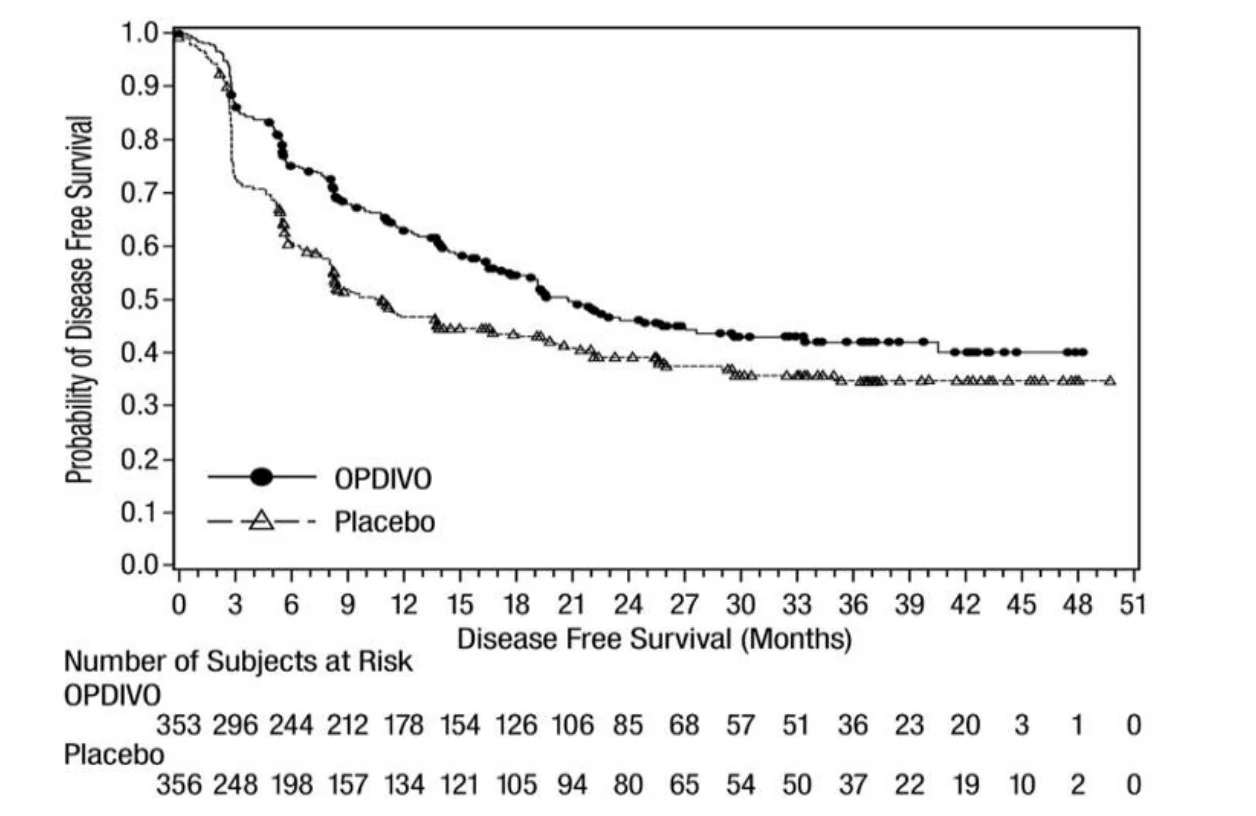
First-line Treatment of Unresectable or Metastatic Urothelial Carcinoma
CHECKMATE-901 was a randomized, open-label study in adult patients with previously untreated unresectable or metastatic urothelial carcinoma (UC). Prior neoadjuvant chemotherapy or prior adjuvant platinum-based chemotherapy following radical cystectomy were permitted as long as the disease recurrence took place ≥12 months from completion of therapy. Patients who were ineligible for cisplatin and those with active CNS metastases were excluded.
Stratification factors for randomization were PD-L1 status (≥1% vs. <1% or indeterminate) and liver metastasis. Patients were randomized 1:1 to receive either:
- Opdivo360 mg and cisplatin 70 mg/m2 on Day 1 and gemcitabine 1000 mg/m2 on Days 1 and 8 of a 21-day cycle for up to 6 cycles followed by single-agent Opdivo 480 mg every 4 weeks until disease progression, unacceptable toxicity, or for up to 2 years from first dose.
- Cisplatin 70 mg/m2 on Day 1 and gemcitabine 1000 mg/m2 on Days 1 and 8 of a 21-day cycle for up to 6 cycles.
The median age was 65 years of age (range: 32 to 86) with 51% of patients ≥ 65 years of age and 12% of patients ≥75 years of age, 23% were Asian, 72% were White, 0.3% were Black; 77% were male. Baseline ECOG performance status was 0 (53%) or 1 (46%). At baseline, 87% of patients had metastatic UC, 20% of patients had liver metastases, and 51% had UC histologic variants. Forty-nine (16%) patients in the Opdivo in combination with chemotherapy arm and 43 (14%) patients in the chemotherapy alone arm switched from cisplatin to carboplatin after at least one cycle of cisplatin.
The primary efficacy outcome measures were OS and PFS assessed by BICR using RECIST v1.1. The median follow-up was 33.6 months in the Opdivo in combination with chemotherapy arm and 33.5 months in the chemotherapy alone arm.
Efficacy results are presented in Table 94 and Figure 34 and Figure 35.
| Table 94: Efficacy Results - CHECKMATE-901 | |||||||||||||
|---|---|---|---|---|---|---|---|---|---|---|---|---|---|
| Opdivo and Cisplatin and Gemcitabine (n=304) | Cisplatin and Gemcitabine (n=304) | ||||||||||||
| Overall Survival | |||||||||||||
| Deaths, n (%) | 172 (56.6) | 193 (63.5) | |||||||||||
| Median (months) (95% CI)a | 21.7 (18.6, 26.4) | 18.9 (14.7, 22.4) | |||||||||||
| Hazard ratio (95% CI)b | 0.78 (0.63, 0.96) | ||||||||||||
| p-valuec | 0.0171 | ||||||||||||
| Progression-free Survival | |||||||||||||
| Disease progression or death, n (%) | 211 (69.4) | 191 (62.8) | |||||||||||
Median (months) (95% CI)a | 7.9 (7.6, 9.5) | 7.6 (6.1, 7.8) | |||||||||||
| Hazard ratio (95% CI)b | 0.7 (0.6, 0.9) | ||||||||||||
| p-valuec | 0.0012 | ||||||||||||
| Objective Response Rated | |||||||||||||
Response rate, n (%) (95% CI) | 175 (57.6) (51.8, 63.2) | 131 (43.1) (37.5, 48.9) | |||||||||||
| Complete response, n (%) | 66 (21.7) | 36 (11.8) | |||||||||||
| Partial response, n (%) | 109 (35.9) | 95 (31.3) | |||||||||||
| Duration of Response | n=175 | n=131 | |||||||||||
| Median (months) (95% CI)a | 9.5 (7.6, 15.1) | 7.3 (5.7, 8.9) | |||||||||||
a Based on Kaplan-Meier Estimates
b Stratified Cox proportional hazard model.
c 2 sided p-value from stratified log-rank test. d Best overall response of complete response or partial response assessed by BICR using RECIST v1.1.
Figure 34: Overall Survival in All Randomized Patients - CHECKMATE-901
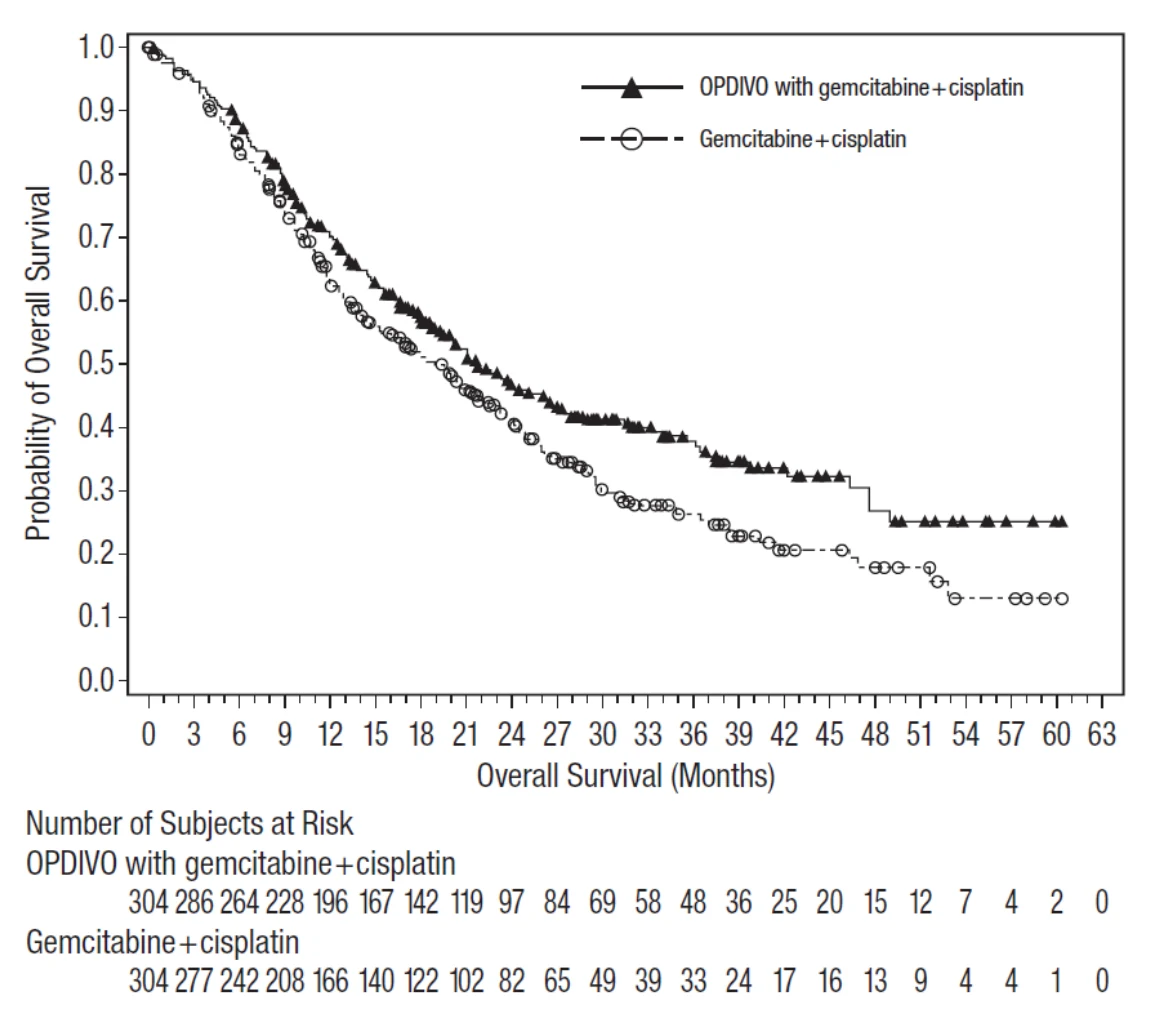
Figure 35: Progression-free Survival in All Randomized Patients - CHECKMATE-901
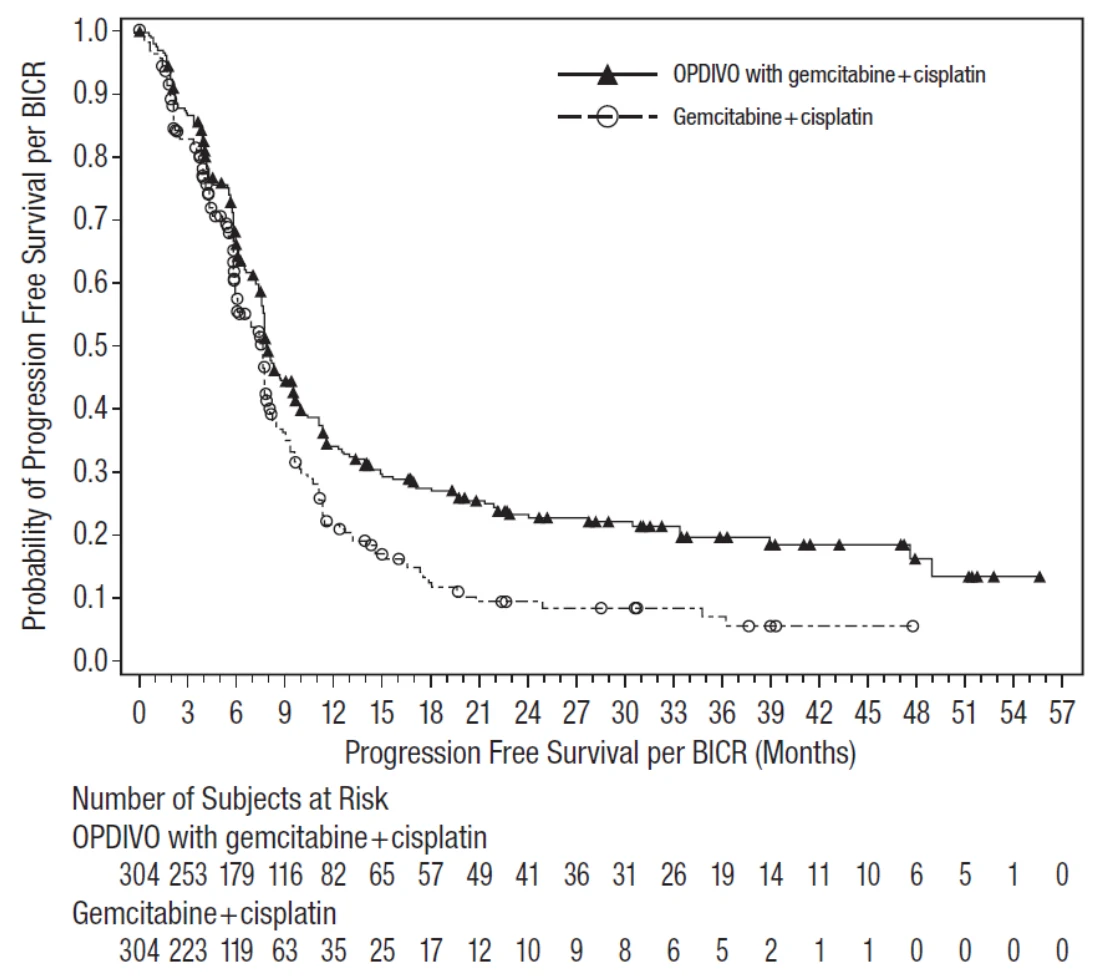
Unresectable or Metastatic Treatment of Esophageal Squamous Cell Carcinoma (ESCC)
CHECKMATE-648 is an open-label, randomized Phase 3 study of Opdivo + ipilimumab or Opdivo + chemotherapy (fluorouracil plus cisplatin) compared with chemotherapy (fluorouracil plus cisplatin) in adult (≥ 18 years) male and female subjects with unresectable advanced, recurrent or metastatic ESCC. Patients were randomized (1:1:1) to the following treatment arms:
- Arm A: Opdivo 3 mg/kg as a 30-minute infusion every 2 weeks and ipilimumab 1 mg/kg as a 30 minute infusion every 6 weeks
- Arm B: Opdivo 240 mg as a 30-minute infusion, fluorouracil 800 mg/m²/day as an IV continuous infusion, and cisplatin 80 mg/m² as a 30- to 120-minute infusion on Day 1 of 4-week cycle
- Arm C: fluorouracil 800 mg/m²/day as a continuous IV infusion, and cisplatin 80 mg/m² as a 30- to 120-minute infusion on Day 1 of 4-week cycle
Subjects were permitted to receive treatment with cisplatin 80 mg/m² as an IV infusion over a period of longer than 120 minutes if in accordance with local standard of care/local label. Randomization was stratified by tumour cell PD-L1 status (≥ 1% vs < 1%, including indeterminate), region (East Asia [Japan, Korea, Taiwan] vs Rest of Asia vs Rest of world), Eastern Cooperative Oncology Group performance status (0 vs 1), and number of organs with metastases (≤ 1 vs ≥ 2) per interactive response technology. Tumour specimens were evaluated prospectively using the PD-L1 IHC 28-8 PharmDx at a central laboratory. Treatment was given for up to 24 months in the absence of disease progression or unacceptable toxicity. Treatment beyond initial, investigator-assessed, Response Evaluation Criteria in Solid Tumours (RECIST) 1.1-defined progression was permitted for patients treated with Opdivo in combination with ipilimumab or Opdivo in combination with chemotherapy if the subject had investigator-assessed clinical benefit and was tolerating treatment.
The primary endpoints were OS and progression-free survival per blinded independent central review in subjects with tumour cell PD-L1 ≥ 1%, comparing Opdivo in combination with chemotherapy vs chemotherapy arms and Opdivo in combination with ipilimumab vs chemotherapy arms.
A total of 970 patients were randomized to receive either Opdivo in combination with ipilimumab (Arm A; n=325) or Opdivo in combination with chemotherapy (Arm B; n=321) or chemotherapy (Arm C; n=324). Baseline characteristics were generally balanced across treatment groups. The median age was 64 years (range: 26-90), 46.6% were ≥ 65 years of age, 82.2% were male, 70.6% were Asian, and 25.6% were white. Patients had histological confirmation of squamous cell carcinoma (98.0%) or adenosquamous cell carcinoma (1.9%) in the oesophagus. Baseline ECOG performance status was 0 (47%) or 1 (54%).
The baseline tumour cell PD-L1 status positive, as defined as ≥1% of tumour cells expressing PD-L1, was 48.6% (n=158) in Arm A, 49.2% (n=158) in Arm B, and 48.5% (n=157) in Arm C, respectively.
Opdivo in combination with ipilimumab:
In CHECKMATE-648 for patients receiving Opdivo in combination with ipilimumab a statistically significant improvement in OS was demonstrated in patients with tumour cell PD-L1 expression ≥ 1%. The minimum follow-up was 13.1 months. Efficacy results are shown in Table 95 and Figure 36.
a Assessed by BICR.
b Based on stratified Cox proportional hazard model.
c Based on a stratified 2-sided log-rank test by ECOG PS (0 vs 1), region (J/K/T vs rest of Asia vs RoW) and number of organs with metastases (≤1 vs ≥2).
| Table 95: Efficacy Results - Arms A and C of CHECKMATE-648 | |||||||||||
| Opdivo and ipilimumab (n=158) | Cisplatin and Fluorouracil (n=157) | ||||||||||
| Tumour cell PD-L1 ≥ 1% | |||||||||||
| Overall Survival | |||||||||||
| Deaths (%) | 106 (67) | 120 (77) | |||||||||
Median (months) (95% CI) | 13.7 (11.2, 17.0) | 9.0(7.7, 10.0) | |||||||||
| Hazard ratio (95% CI)b | 0.64 (0.49, 0.84) | ||||||||||
| p-valuec | 0.0010 | ||||||||||
| Progression-free Survivala | |||||||||||
| Disease progression or death (%) | 123 (78) | 100 (64) | |||||||||
Median (months) (95% CI) | 4.0 (2.4, 4.9) | 4.4 (2.9, 5.8) | |||||||||
| Hazard ratio (CI)b | 1.02 (0.78, 1.34) | ||||||||||
| p-valuec | 0.8958 | ||||||||||
| Overall Response Rate, n (%)a | 56 (35) | 31 (20) | |||||||||
| (95% CI) | (28.0, 43.4) | (13.8, 26.8 ) | |||||||||
Figure 36: Overall Survival (tumour cell PD-L1 ≥ 1%) - CHECKMATE-648
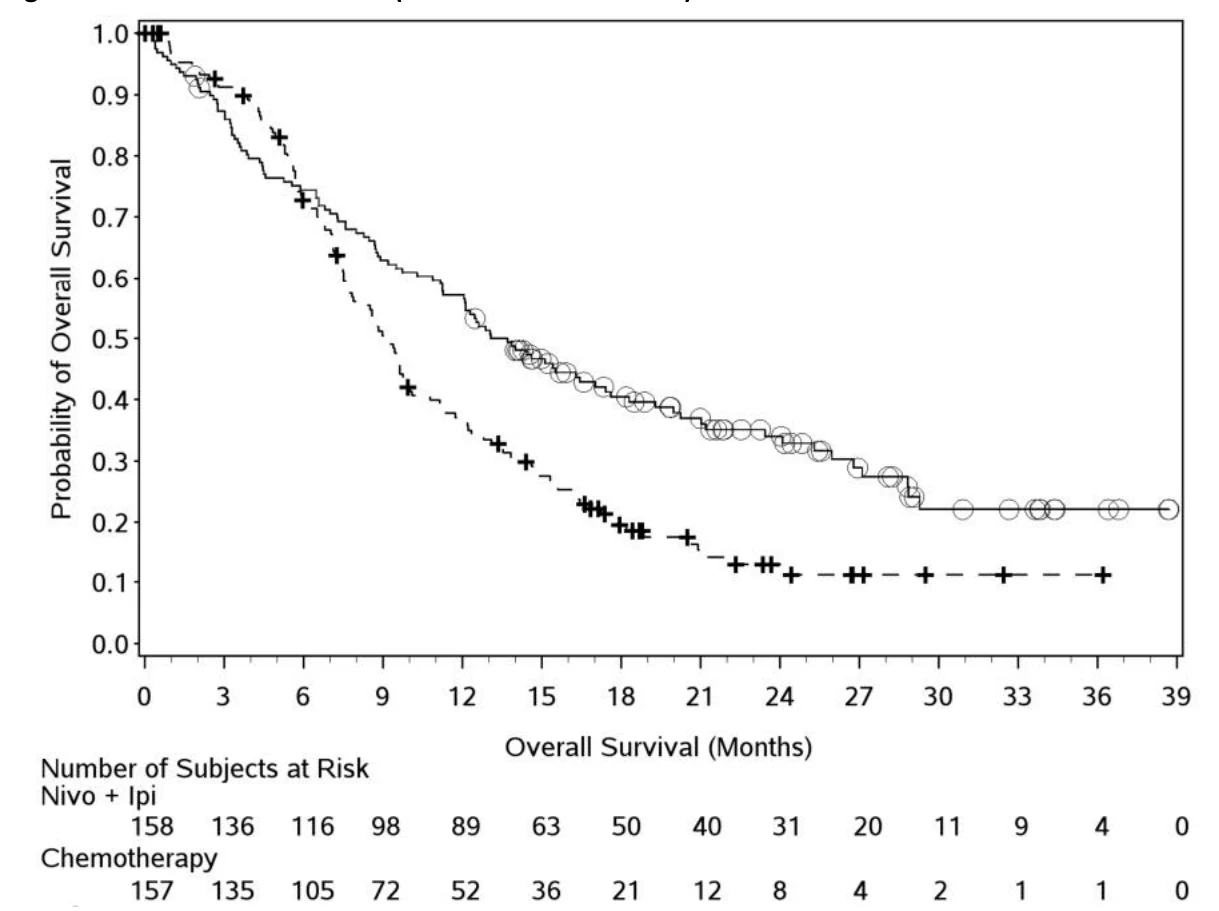
In patients with a positive tumour cell PD-L1 status, the median durations of response are 11.8 (95% CI:7.1, 27.4) and 5.7 (95% CI: 4.4, 8.7) months for Opdivo with ipilimumab and chemotherapy alone, respectively.
Opdivo in combination with chemotherapy:
In patients treated with Opdivo in combination with cisplatin and fluorouracil, CHECKMATE-648 demonstrated a statistically significant improvement in OS and PFS for patients with tumour cell PD-L1 expression ≥ 1%. The minimum follow-up was 12.9 months. Efficacy results are shown in Table 96 and Figure 37.
a Assessed by BICR.
b Based on stratified Cox proportional hazard model.
c Based on a stratified 2-sided log-rank test. by ECOG PS (0 vs 1), region (J/K/T vs rest of Asia vs RoW) and number of organs with metastases (≤1 vs ≥2).
| Table 96: Efficacy Results - Arms B and C of CHECKMATE-648 | ||||||||||
| Opdivo with Cisplatin and Fluorouracil (n=158) | Cisplatin and Fluorouracil (n=157) | |||||||||
| Tumour cell PD-L1 ≥ 1% | ||||||||||
| Overall Survival | ||||||||||
| Deaths (%) | 98 (62) | 120 (77) | ||||||||
Median (months) (95% CI) | 15.4 (11.9, 19.5) | 9.1 (7.7, 10.0) | ||||||||
| Hazard ratio (95% CI)b | 0.54 (0.41, 0.71) | |||||||||
| p-valuec | < 0.0001 | |||||||||
| Progression-free Survivala | ||||||||||
| Disease progression or death (%) | 117 (74) | 100 (64) | ||||||||
Median (months) (95% CI) | 6.93 (5.7, 8.3) | 4.4 (2.9, 5.8) | ||||||||
| Hazard ratio (95% CI)b | 0.65 (0.49, 0.86) | |||||||||
| p-valuec | 0.0023 | |||||||||
| Overall Response Rate, n (%)a | 84 (53) | 31 (20) | ||||||||
| (95% CI) | (45.1, 61.1) | (13.8, 26.8) | ||||||||
Figure 37: Overall Survival (Tumour cell PD-L1 ≥ 1%) - CHECKMATE-648
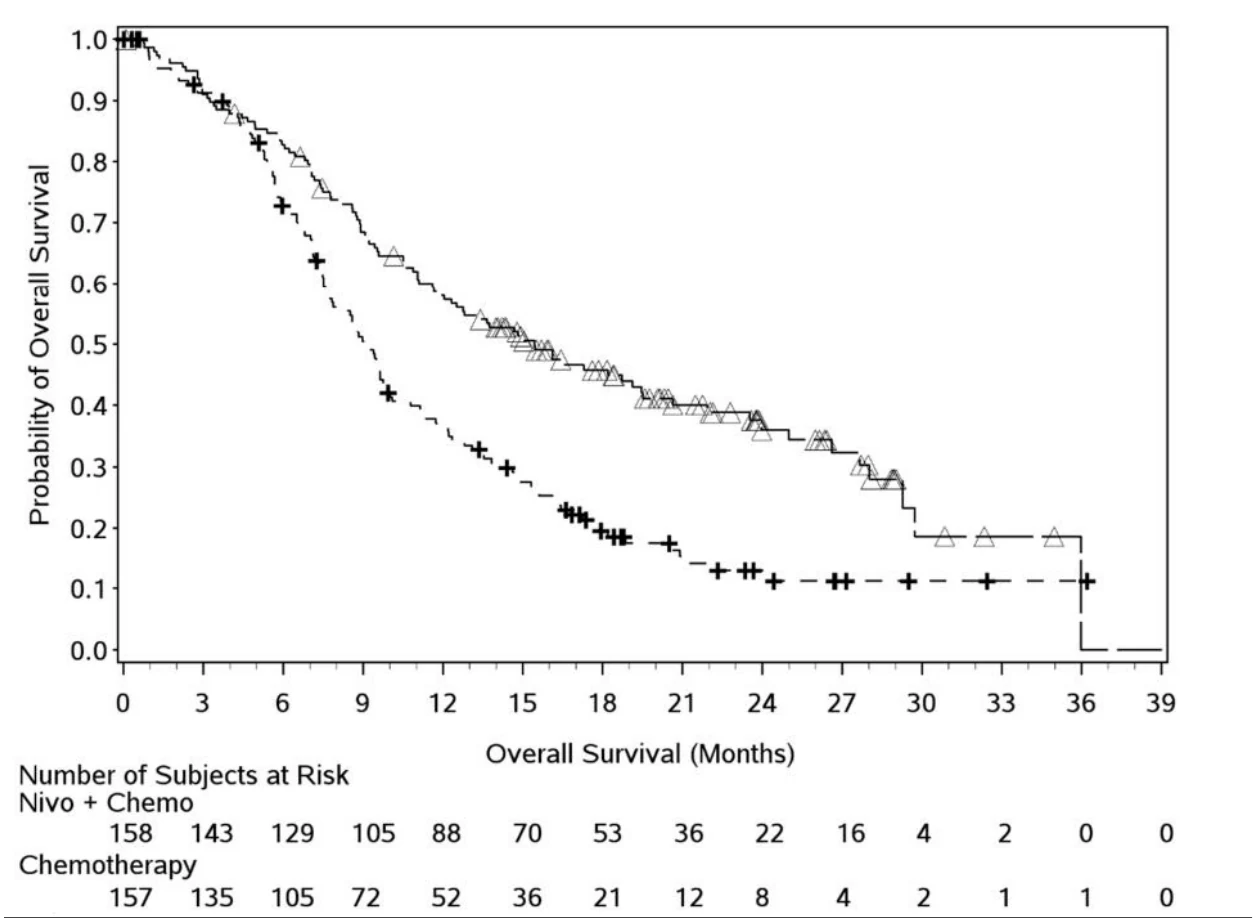
In patients with a positive tumour cell PD-L1 status, the median durations of response are 8.4 (95% CI: 6.9, 12.4) and 5.7 (95% CI: 4.4, 8.7) months for Opdivo with chemotherapy and chemotherapy alone, respectively.
Unresectable or Advanced Hepatocellular Carcinoma (HCC)
CHECKMATE-9DW was an open-label, multicenter, randomized, Phase 3 study in adults (≥ 18 years) with histologically confirmed HCC, Child Pugh Class A, ECOG performance status 0 or 1, and no prior systemic therapy for advanced disease. Esophagogastroduodenoscopy was not mandated prior to enrollment. The trial excluded patients with active autoimmune disease, brain or leptomeningeal metastases, a history of hepatic encephalopathy (within 12 months of randomization), a platelet count <60,000, clinically significant ascites, medical conditions requiring systemic immunosuppression, infection with HIV, or active co-infection with hepatitis B virus (HBV) and hepatitis C virus (HCV) or HBV and hepatitis D virus (HDV).
Patients were randomized (1:1) to receive either:
- Opdivo 1 mg/kg + ipilimumab 3 mg/kg every 3 weeks for up to 4 cycles followed by nivolumab 480 mg (flat dose) every 4 weeks until disease progression, or
- sorafenib 400 mg orally twice daily or lenvatinib 8 mg orally daily (if body weight < 60 kg) or 12 mg orally daily (if body weight ≥ 60 kg)
Randomization was stratified by etiology (HBV vs. HCV vs. non-viral), macrovascular invasion and/or extrahepatic spread (present or absent), and alpha-fetoprotein levels (≥400 or <400 ng/mL). Study treatment for Opdivo in combination with ipilimumab continued until disease progression, unacceptable toxicity, or up to 2 years. Patients who discontinued combination therapy because of an adverse reaction attributed to ipilimumab were permitted to continue Opdivo as a single agent. Treatment beyond RECIST 1.1-defined disease progression was permitted if the patient was clinically stable and considered to be deriving clinical benefit by the investigator. Tumor assessments were performed at baseline, after randomization at week 9 and week 16, then every 8 weeks up to 48 weeks, and then every 12 weeks thereafter until disease progression, treatment discontinuation, or initiation of subsequent therapy. The primary efficacy endpoint was OS in all randomized patients. Secondary efficacy endpoints included BICR-assessed ORR and DOR based on RECIST 1.1 criteria.
A total of 668 patients were randomized to receive Opdivo in combination with ipilimumab (n=335) or investigator’s choice (n=333) of lenvatinib or sorafenib. In the investigator’s choice arm, 85% and 15% of treated patients received lenvatinib or sorafenib, respectively. The trial population characteristics were: median age was 66 years (range: 20 to 89), with 53% ≥ 65 years and 16% ≥ 75 years, 53% were White, 44% were Asian, 2.2% were Black, and 82% were male. Baseline ECOG performance status was 0 (71%) or 1 (29%). Thirty-four percent (34%) of patients had HBV infection, 28% had HCV infection, and 36% had no evidence of HBV or HCV infection. Nineteen percent (19%) of patients had alcoholic liver disease and 11% had non-alcoholic fatty liver disease. The majority of patients had BCLC stage C (73%) disease at baseline, 19% had stage B, and 6% had stage A. Patients with Child-Pugh scores of 5, 6, and ≥7 was 77%, 20%, and 3%, respectively. A total of 54% of patients had extrahepatic spread; 25% had macrovascular invasion; and 33% had AFP levels ≥400 μg/L.
Efficacy results are shown in Table 97 and Figure 38. The results for Opdivo in combination with ipilimumab compared to investigator’s choice of lenvatinib or sorafenib are based on a median follow-up of 35.2 months (range: 26.8-48.9 months).
Table 97 Efficacy Results - CHECKMATE-9DW
| Opdivo and Ipilimumab (n=335) | Lenvatinib or Sorafenib (n=333) | |||||||
| Overall Survival | ||||||||
| Deaths (%) | 194 (58) | 228 (68) | ||||||
Median (months) (95% CI) | 23.7 (18.8, 29.4) | 20.6 (17.5, 22.5) | ||||||
| Hazard ratio (95% CI) a | 0.79 (0.65, 0.96) | |||||||
| p-value b | 0.0180 | |||||||
| Overall Response Rate c, n (%) | 121 (36.1) | 44 (13.2) | ||||||
| (95% CI) | (31.0, 41.5) | (9.8, 17.3) | ||||||
| p-value d | <0.0001 | |||||||
| Complete response (%) | 23 (6.9) | 6 (1.8) | ||||||
| Partial response (%) | 98 (29.3) | 38 (11.4) | ||||||
a Based on stratified Cox proportional hazard model.
b Based on a 2-sided stratified log-rank test. Boundary for statistical significance: p-value ≤0.0257.
c Assessed by BICR using RECIST 1.1.
d Based on a 2-sided stratified Cochran-Mantel-Haenszel test. Boundary for statistical significance: p-value ≤0.
+ Censored observation.
Median duration of response (DOR) for patients in the Opdivo in combination with ipilimumab arm was 30.4 months (95% CI: 21.19, N.A.; range: 1.5+, 36.9+) and 12.9 months (95% CI: 10.15, 31.21; range: 2.1+, 32.5+) for patients in the SOC arm.
Figure 38 Kaplan-Meier Curve of Overall Survival -CHECKMATE-9DW
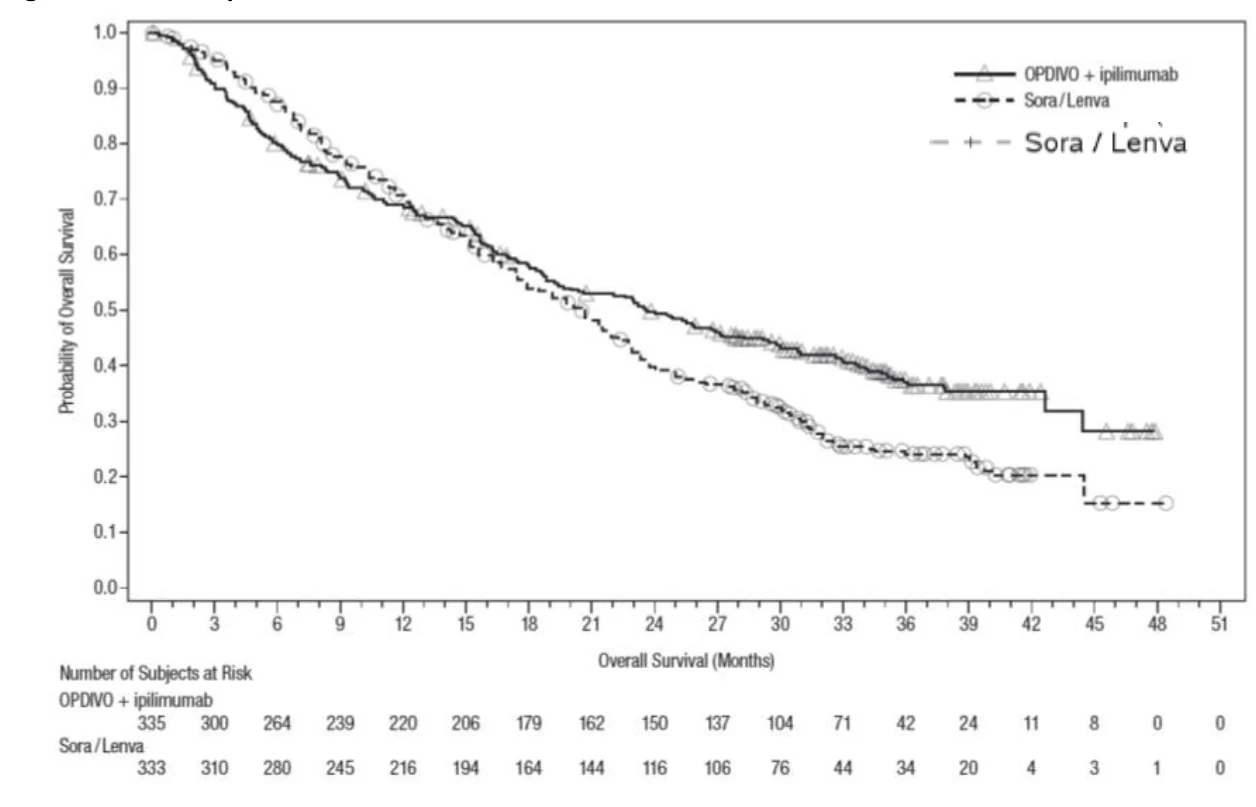
15. Microbiology
No microbiological information is required for this drug product
16. Non-Clinical Toxicology
The toxicology studies performed with nivolumab are summarized in Table 98.
General Toxicology:
Single-Dose toxicity
A single-dose pharmacokinetic and tolerability study of nivolumab was conducted in cynomolgus monkeys. Single IV administration of nivolumab at dose levels of 1 or 10 mg/kg were well tolerated. All animals survived the study, and no effect of nivolumab was observed on clinical observations, body-weight measurements, food consumption, or clinical pathology parameters. Nivolumab was immunogenic in this study; 5 of 6 animals administered 1 mg/kg and 2 of 3 animals administered 10 mg/kg tested positive for anti-nivolumab antibodies (ADA) on Day 28. However, there was no apparent effect of these antibodies on the pharmacokinetics of nivolumab. Immunogenicity in animals is not expected to be predictive of potential immunogenicity in humans.
Repeat-Dose Toxicity
Nivolumab was well tolerated by cynomolgus monkeys when administered as a single agent at ≤ 50 mg/kg, twice weekly (2QW) for up to 3 months with no adverse effects noted. In the 3-month toxicity study, pharmacologically mediated changes in circulating T-cell subpopulations were observed at 10 and/or 50 mg/kg. In addition, there was a reversible 28% decrease in mean plasma triiodothyronine (T3) levels at 50 mg/kg in female monkeys at the end of the dosing phase of the study. However, there were no effects on plasma levels of thyroxine (T4), thyroid stimulating hormone (TSH), adrenocorticotropic hormone (ACTH), growth hormone, or alpha-melanocyte-stimulating hormone (α-MSH), or morphologic findings in the thyroid or pituitary glands. No hormone or morphologic changes were observed in males, and there were no effects at the same doses in males or females in a 1-month toxicity study. Therefore, the relevance of the lower T3 levels in females, in the absence of any correlative changes in other hormones or in the thyroid or pituitary gland, is unknown. ADA formation was observed in 13% of the monkeys. In monkeys without ADA responses, nivolumab exposures (AUC[0-168h]) at 50 mg/kg were 531,000 µg·h/mL (1,062,000 when normalized for 2 weeks of exposure). This dose and exposure are approximately 17 and 35x the recommended human dose and resulting exposure (3 mg/kg administered every 2 weeks [Q2W]; AUC[Tau] 30,640 µg·h/mL), respectively.
Mutagenicity: Mutagenicity studies were not conducted for nivolumab.
Carcinogenicity: Long-term animal studies were not conducted to assess the carcinogenic potential of nivolumab
Genotoxicity: Long-term animal studies were not conducted to assess the genotoxic potential of nivolumab.
Reproductive and Developmental Toxicology: Pregnant monkeys were administered nivolumab twice weekly at 10 or 50 mg/kg from the onset of organogenesis (approximately gestation day 20) until parturition. Nivolumab was well tolerated and there were no nivolumab-related effects on viability, clinical signs, food consumption, body weights, immunological endpoints, or clinical/anatomic pathology parameters in these females throughout the study.
However, in the offspring, maternal nivolumab administration was associated with fetal/neonatal mortality characterized by: 1) increases in third trimester fetal losses; and 2) increased neonatal mortality. In a single fetus from a 10-mg/kg dam that aborted on GD 124, moderate interstitial inflammation and follicular-cell hypertrophy/hyperplasia were noted in the thyroid gland. Despite its single occurrence in this study and lack of dose dependency (not observed at 50 mg/kg), the relationship of these thyroid changes to treatment cannot be completely excluded because they were consistent with the pharmacology of nivolumab (ie, immune stimulation). The remaining offspring had no nivolumab-related effects on any of the parameters evaluated throughout the 6-month postnatal period. Based on these results, the no-observed-adverse-effect level (NOAEL) for maternal toxicity was 50 mg/kg (AUC[0-168h] 541,000 µg·h/mL). The lowest-observed-adverse-effect level (LOAEL) for developmental toxicity was 10 mg/kg (AUC[0-168h] 117,000 µg·h/mL), which is approximately 8´ the exposure in humans at the recommended dose of 3 mg/kg Q2W. Based on its mechanism of action, fetal exposure to nivolumab may increase the risk of developing immune-mediated disorders or altering the normal immune response and immune-mediated disorders have been reported in PD-1 knockout mice.
Human IgG4 crosses the placental barrier, particularly during the third trimester. Therefore, nivolumab has the potential to be transmitted from the mother to the developing fetus. Although it is not known if nivolumab is excreted in human milk, immunoglobulins are known to be excreted in human milk and the potential for infant exposure to nivolumab via breast milk exists. Nivolumab is not recommended during pregnancy, in women of childbearing potential not using effective contraception, or in women breast-feeding unless the clinical benefit outweighs the potential risk.
Impairment of Fertility: No formal studies of effects of nivolumab on fertility have been conducted. Thus, the effect of nivolumab on male and female fertility is unknown. However, as part of the routine histopathological examination of organs collected in toxicity studies, the male and female reproductive organs were evaluated. There were no histopathologic changes in these organs that suggested any adverse effects of nivolumab on male and female fertility; however most animals in these studies were not sexually mature.
Special Toxicology: In animal models, inhibition of PD-1 signaling increased the severity of some infections and enhanced inflammatory responses. M. tuberculosis–infected PD-1 knockout mice exhibit markedly decreased survival compared with wild-type controls, which correlated with increased bacterial proliferation and inflammatory responses in these animals. PD-1 knockout mice have also shown decreased survival following infection with lymphocytic choriomeningitis virus.
Juvenile Toxicity: Long-term animal studies were not conducted to assess the juvenile toxicity potential of nivolumab.
Table 98: Summary of Toxicology Studies
| Type of Study | Treatment Duration | Species/ Test System | Gender and No. per Group | Doses (mg/kg)a | Noteworthy Findings |
| General Toxicity | |||||
Single-Dose Toxicity IV | 1 Dose | Monkey/ Cynomolgus | 1 mg/kg: 3 M, 3 F 10 mg/kg: 3 M | 1, 10 | Nivolumab at ≤ 10 mg/kg was well tolerated. There were no nivolumab-related clinical signs or changes in body weight, food consumption, serum chemistry, or hematology parameters. |
Single-Dose Toxicity IV | 1 Dose | Monkey/ Cynomolgus (telemetered) | 3 M, 3 F | 0, 10, 50, | Nivolumab at ≤ 50 mg/kg was well tolerated. There were no nivolumab-related effects on cardiovascular or respiratory parameters. |
Repeat -Dose Toxicity IV | 1 month (Dosing QW, Necropsy Days 30 and 57) | Monkey/ Cynomolgus | 5 M, 5 F | 0, 1, 10, 50 | Nivolumab at ≤ 50 mg/kg was well tolerated. There were no nivolumab-related adverse effects. |
Repeat-Dose Toxicity IV | 3 months (Dosing 2QW, Necropsy Weeks 13 and 17) | Monkey/ Cynomolgus | 6 M, 6 F | 0, 10, 50 | Nivolumab at ≤ 50 mg/kg was well tolerated. There were no nivolumab-related adverse effects. Clinical chemistry changes were limited to a reversible 28% decrease in T3 levels at Week 13 in females at 50 mg/kg. There were no correlative changes in other hormones, including T4, TSH, α-MSH, or ACTH, or morphologic changes in the thyroid or pituitary glands. At 10 mg/kg and/or 50 mg/kg, there were pharmacologically mediated changes in circulating T-cell subpopulations, including: 1) increases in CD8+ effector memory T cells, and 2) a trend toward increases in CD4+ effector memory T cells and CD8+ central memory T cells. |
| Reproduction and Development | |||||
Pre- and Postnatal Development IV | Approximately 5 months (GD 21 ± 1 to parturition, Dosing 2QW, Necropsy of infants postpartum day 182 ± 1) | Monkey/ Cynomolgus | 16 F | 0, 10, 50 | Nivolumab at 10 or 50 mg/kg was well tolerated by pregnant monkeys and there were no nivolumab-related effects on viability, clinical signs, food consumption, body weights, immunological endpoints, or clinical/anatomic pathology parameters in the females throughout the study. In surviving offspring, no adverse effects on growth indices or on teratogenic, neurobehavioural, immunological, and clinical pathology parameters throughout the 6-month postnatal period, comparable to controls. Nivolumab exposure to infants did not affect the primary response to either hepatitis B surface antigen (HBsAg) or tetanus toxoid, but a trend toward an increased response to HBsAg upon second exposure was observed in the infants, compared to controls. 10 and 50 mg/kg: 1) dose-dependent increases in third trimester fetal losses (12.5% and 33.3% at 10 and 50 mg/kg, respectively, relative to 7.1% in controls), which occurred predominately after GD 120; 2) increased neonatal mortality at 10 mg/kg, which was noted in 3 infants with extreme prematurity during the first 2 postnatal weeks; and 3) moderate interstitial inflammation and follicular-cell hypertrophy/hyperplasia in the thyroid gland (1 fetus from a 10-mg/kg dam that aborted on GD 124). 50 mg/kg: Pregnancy losses in the first trimester were 4* of 16 (compared to 2 of 16 in controls). *One pregnancy loss was due to umbilical thrombus and was considered unrelated to nivolumab treatment. The NOAEL for maternal toxicity was 50 mg/kg. An NOAEL for developmental toxicity was not identified. |
| Local Tolerance | |||||
| The local tolerance of nivolumab was assessed in the single- and intermittent (QW or 2QW) repeat-dose IV studies in monkeys (described above). Nivolumab was administered at up to 50 mg/kg in a formulation similar to that intended for marketing (Process B,10 mg/mL in 20 mM sodium citrate, 50 mM NaCl, 3% mannitol, 20 mM DTPA, 0.01% polysorbate 80, pH 6.0). No irritation or local tolerance issues were observed in any of the studies. | |||||
| Other Studies | |||||
Tissue Crossreactivity In vitro | NA | Human | 3 donors | 1, 10 µg/mL | Nivolumab-FITC specific staining of lymphocytes in a number of tissues, including lymphocytes in the blood. Staining was observed on the membrane and was consistently present at both concentrations of nivolumab-FITC. |
| Tissue Crossreactivity In vitro | NA | Monkey/ Cynomolgus | 2 | 1, 10 µg/mL | Nivolumab-FITC specific staining of lymphocytes in a number of tissues; staining was observed on the cell membrane and was consistently present at both concentrations of nivolumab-FITC. |
Cytokine Release Studies In vitro | 24 hrs | Human | 6 donors | 10, 100 µg/mL | Nivolumab alone did not promote cytokine production. |
Investigative Ovalbumin challenge study IP/PA | 1 month | Mouse/ PD-1 knockout and wild-type C57/BL6 | WT: 64 M, 40 F PD-1: 20 M, 16 F | Days 0-7: IP ovalbumin sensitization 10 µg/200 µL Days 14-28: PA ovalbumin challenged 250 µg /50 µL | An increase in sensitivity to pulmonary rechallenge by ovalbumin was observed in PD-1 knockout mice. |
Abbreviations: 2QW = Twice weekly; ADA = Anti-drug antibodies; DTPA = Diethylenetriamine pentetic acid; F = Female; FITC = Fluorescein isothiocyanate; GD = Gestation Day; IV = Intravenous; M = Male; NA = Not applicable; QW = Once weekly. PA = Pharyngeal aspiration; IP = Intraperitoneal.a Unless otherwise specified, for repeat-dose toxicity, the highest NOAEL is underlined.
17. Supporting Product Monographs
- 1. YERVOY® (Intravenous Infusion, 5 mg ipilimumab/mL), Submission Control no. 270801, Product Monograph, Bristol-Myers Squibb Canada Co. (DEC 07, 2023)
- 2. CABOMETYX® (20 mg, 40 mg, 60 mg cabozantinib tablets), Submission Control no. 280615, Product Monograph, Exelixis Inc., licensed to Ipsen Pharma S.A.S. (SEP 12, 2024)