


Product Monograph - Imfinzi
Recent Major Label Changes
| 1 Indications | 2026-08 |
|---|---|
| 1 Indications, 1.2 Geriatrics | 2025-04 |
| 3 Serious Warnings and Precautions Box | 2024-10 |
| 4 Dosage and Administration, 4.1 Dosing Considerations | 2025-01 |
| 4 Dosage and Administration, 4.2 Recommended Dose and Dosage Adjustment | 2026-08 |
| 4 Dosage and Administration, 4.4 Administration | 2025-04 |
| 7 Warnings and Precautions | 2025-07 |
| 7 Warnings and Precautions, 7.1.4 Geriatrics | 2026-08 |
| 7 Warnings and Precautions, Cardiovascular | 2025-07 |
Table of Contents
Certain sections or subsections that are not applicable at the time of the preparation of the most recent authorized product monograph are not listed.
Recent Major Label Changes ..................................................................................................... 3
Table of Contents ........................................................................................................................ 3
Part 1: Healthcare Professional Information ............................................................................ 6
1.1. Pediatrics ...................................................................................................................... 7
1.2. Geriatrics ...................................................................................................................... 7
4.1. Dosing Considerations .................................................................................................. 8
- 1. Indications ............................................................................................................................ 6
- 2. Contraindications ................................................................................................................ 7
- 3. Serious Warnings and Precautions Box............................................................................ 7
- 4.
Dosage and Administration ................................................................................................ 8
4.2. Recommended Dose and Dosage Adjustment ............................................................. 8
4.3. Reconstitution ............................................................................................................. 15
4.4. Administration ............................................................................................................. 15
4.5. Missed dose ................................................................................................................ 16
General ................................................................................................................................ 17
Cardiovascular ..................................................................................................................... 17
Driving and Operating Machinery ........................................................................................ 17
Hepatic/Biliary/Pancreatic .................................................................................................... 17
Immune ................................................................................................................................ 17
Monitoring and Laboratory Tests ......................................................................................... 21
Reproductive Health ............................................................................................................ 21
7.1. Special Populations .................................................................................................... 21
7.1.1. Pregnancy ....................................................................................................... 21
7.1.2. Breastfeeding .................................................................................................. 21
7.1.3. Pediatrics ......................................................................................................... 22
7.1.4. Geriatrics ......................................................................................................... 22
8.1. Adverse Reaction Overview ....................................................................................... 23
8.2. Clinical Trial Adverse Reactions ................................................................................. 24
8.3. Less Common Clinical Trial Adverse Reactions ......................................................... 69
8.4. Abnormal Laboratory Findings: Hematologic, Clinical Chemistry, and Other Quantitative Data ................................................................................................................. 72
8.5. Post-Market Adverse Reactions ................................................................................. 82
9.2. Drug Interactions Overview ........................................................................................ 82
9.3. Drug-Behaviour Interactions ....................................................................................... 82
9.4. Drug-Drug Interactions ............................................................................................... 82
9.5. Drug-Food Interactions ............................................................................................... 82
9.6. Drug-Herb Interactions ............................................................................................... 82
9.7. Drug-Laboratory Test Interactions .............................................................................. 82
10.1. Mechanism of Action .................................................................................................. 83
- 5. Overdose ............................................................................................................................ 16
- 6. Dosage Forms, Strengths, Composition, and Packaging .............................................. 16
- 7. Warnings and Precautions ............................................................................................... 17
- 8. Adverse Reactions ............................................................................................................ 23
- 9. Drug Interactions ............................................................................................................... 82
- 10.
Clinical Pharmacology ...................................................................................................... 83
10.2. Pharmacodynamics .................................................................................................... 83
10.3. Pharmacokinetics ....................................................................................................... 83
10.4. Immunogenicity ........................................................................................................... 85
Part 2: Scientific Information ................................................................................................... 87
14.1. Clinical Trials by Indication ......................................................................................... 87
Locally Advanced or Metastatic Urothelial Carcinoma ........................................................ 87
Resectable Muscle Invasive Bladder Cancer (MIBC) .......................................................... 89
Non-Muscle Invasive Bladder Cancer (NMIBC) .................................................................. 93
Resectable Non-Small Cell Lung Cancer (NSCLC) ............................................................. 95
Locally Advanced, Unresectable, Stage III Non-Small Cell Lung Cancer ......................... 100
Metastatic Non-Small Cell Lung Cancer ............................................................................ 106
Limited-Stage Small Cell Lung Cancer (LS-SCLC) ........................................................... 110
Extensive-Stage Small Cell Lung Cancer (ES-SCLC) ....................................................... 114
Locally Advanced or Metastatic Biliary Tract Cancer ........................................................ 117
Unresectable Hepatocellular Carcinoma ........................................................................... 119
Mismatch Repair Deficient (dMMR) Advanced or Recurrent Endometrial Cancer ............ 122
Resectable Gastric or Gastroesophageal Junction Adenocarcinoma ............................... 126
Patient Medication Information ............................................................................................. 132
- 11. Storage, Stability, and Disposal ....................................................................................... 85
- 12. Special Handling Instructions .......................................................................................... 86
- 13. Pharmaceutical Information ............................................................................................. 87
- 14. Clinical Trials...................................................................................................................... 87
- 15. Microbiology .................................................................................................................... 130
- 16. Non-Clinical Toxicology .................................................................................................. 131
- 17. Supporting Product Monographs .................................................................................. 131
Part 1: Healthcare Professional Information
1. Indications
Locally Advanced or Metastatic Urothelial Carcinoma
IMFINZI® (durvalumab for injection) is indicated for:
the treatment of patients with locally advanced or metastatic urothelial carcinoma who:
- have disease progression during or following platinum-containing chemotherapy
- have disease progression within 12 months of neoadjuvant or adjuvant treatment with platinum-containing chemotherapy
Marketing authorization with conditions was based on a promising tumour response rate and durability of response. An improvement in survival or disease-related symptoms has not been established (see 14 Clinical Trials).
Resectable Muscle Invasive Bladder Cancer
IMFINZI is indicated for the treatment of patients with resectable muscle invasive bladder cancer (MIBC) in combination with gemcitabine and cisplatin as neoadjuvant treatment, followed by adjuvant IMFINZI monotherapy treatment after radical cystectomy.
Non-Muscle Invasive Bladder Cancer
IMFINZI in combination with Bacillus Calmette-Guérin (BCG) is indicated for the treatment of adult patients with BCG-naive, high-risk non-muscle-invasive bladder cancer (NMIBC).
Resectable Non-Small Cell Lung Cancer
IMFINZI in combination with platinum-containing chemotherapy as neoadjuvant treatment, followed by IMFINZI as monotherapy after surgery, is indicated for the treatment of patients with resectable Stage II, IIIA, or IIIB (T3-4 N2) non-small cell lung cancer (NSCLC) and no known epidermal growth factor receptor (EGFR) mutations or anaplastic lymphoma kinase (ALK) rearrangements (see 14 Clinical Trials).
Locally Advanced, Unresectable, Stage III Non-Small Cell Lung Cancer
IMFINZI is indicated for the treatment of patients with locally advanced, unresectable, Stage III NSCLC whose disease has not progressed following platinum-based chemoradiation therapy (CRT).
Metastatic Non-Small Cell Lung Cancer
IMFINZI in combination with tremelimumab and platinum-based chemotherapy is indicated for the first-line treatment of adult patients with metastatic NSCLC with no sensitizing epidermal growth factor receptor (EGFR) mutations or anaplastic lymphoma kinase (ALK) genomic tumour aberrations.
- When using IMFINZI in combination with tremelimumab, consult the Product Monograph for tremelimumab for further information on this drug.
Limited-Stage Small Cell Lung Cancer
IMFINZI, as monotherapy, is indicated for the treatment of adult patients with limited-stage small cell lung cancer (LS-SCLC) whose disease has not progressed following platinum-based chemoradiation therapy (CRT).
Extensive-Stage Small Cell Lung Cancer
IMFINZI in combination with etoposide and either carboplatin or cisplatin is indicated for the first-line treatment of adult patients with extensive-stage small cell lung cancer (ES-SCLC).
Locally Advanced or Metastatic Biliary Tract Cancer
IMFINZI in combination with gemcitabine-based chemotherapy is indicated for the treatment of patients with locally advanced or metastatic biliary tract cancer (BTC).
Unresectable Hepatocellular Carcinoma
IMFINZI in combination with tremelimumab is indicated for the first-line treatment of adult patients with unresectable hepatocellular carcinoma (uHCC) who require systemic therapy.
- When using IMFINZI in combination with tremelimumab, consult the Product Monograph for tremelimumab for further information on this drug.
IMFINZI, as monotherapy, is indicated for the first-line treatment of adult patients with uHCC who require systemic therapy.
Mismatch Repair Deficient (dMMR) Advanced or Recurrent Endometrial Cancer
IMFINZI in combination with carboplatin and paclitaxel is indicated for the first-line treatment of adult patients with primary advanced or recurrent mismatch repair deficient (dMMR) endometrial cancer who are candidates for systemic therapy, followed by maintenance treatment with IMFINZI as monotherapy.
Resectable Gastric or Gastroesophageal Junction Adenocarcinoma
IMFINZI in combination with fluorouracil, leucovorin, oxaliplatin, and docetaxel (FLOT) chemotherapy as neoadjuvant and adjuvant treatment, followed by adjuvant IMFINZI monotherapy, is indicated for the treatment of adult patients with resectable gastric or gastroesophageal junction adenocarcinoma (GC/GEJC) (Stage II to IVA) (see 14 Clinical Trials).
1.1. Pediatrics
Pediatrics (<18 years of age): The safety and efficacy of IMFINZI in patients younger than 18 years of age have not been established. Therefore, Health Canada has not authorized an indication for pediatric use (See 7.1.3 Pediatrics).
1.2. Geriatrics
Geriatrics (≥65 years of age): No overall differences in safety or efficacy were reported between elderly patients (≥65 years of age) and younger patients (<65 years of age) who received IMFINZI (see 7.1.4 Geriatrics).
2. Contraindications
IMFINZI (durvalumab) is contraindicated in patients who are hypersensitive to durvalumab or to any ingredient in the formulation, including any non-medicinal ingredient, or component of the container. For a complete listing of ingredients, see 6 Dosage Forms, Strengths, Composition, and Packaging.
- 3. Serious Warnings and Precautions Box
Serious Warnings and Precautions
|
|---|
|
4. Dosage and Administration
4.1. Dosing Considerations
Patient Selection
For treatment of dMMR endometrial cancer
Patients should be selected for treatment based on dMMR tumour status as determined by an accredited laboratory using validated testing methods (see 14 Clinical Trials).
For treatment of resectable MIBC
Adult patients must have a creatinine clearance (CrCl) ≥40 mL/min to receive IMFINZI in combination with gemcitabine and cisplatin (see 14 Clinical Trials).
4.2. Recommended Dose and Dosage Adjustment
The recommended dose of IMFINZI depends on the indication. IMFINZI is administered as an intravenous infusion over 60 minutes.
Locally Advanced or Metastatic Urothelial Carcinoma
The recommended dose of IMFINZI is 10 mg/kg every 2 weeks or 1500 mg every 4 weeks. Therapy should continue as long as clinical benefit is observed or until unacceptable toxicity.
Patients with a body weight of 30 kg or less must receive weight-based dosing, equivalent to IMFINZI 10 mg/kg every 2 weeks as a monotherapy until weight increases to greater than 30 kg.
For previously treated patients in the pivotal study, treatment with IMFINZI was permitted until one or more criteria for discontinuation were met including:
- Adverse event (AE) experienced that contraindicates further dosing
- Pregnancy or intent to become pregnant
- Any AE that met criteria for discontinuation
- AE related to drug that is Grade ≥3, with the exception of toxicities that did not meet criteria for discontinuation
- Grade ≥3 infusion reaction
- Confirmation of progressive disease and investigator determination that the patient no longer benefited from treatment
Resectable Muscle Invasive Bladder Cancer (MIBC)
IMFINZI treatment is for 12 cycles – four 3-week cycles in combination with gemcitabine and cisplatin as neoadjuvant therapy and eight 4-week cycles as adjuvant monotherapy treatment following radical cystectomy (details below). Treatment should be discontinued for disease progression that precludes definitive surgery, disease recurrence, unacceptable toxicity or upon completion of a total of 12 cycles of IMFINZI.
Neoadjuvant Treatment (Four 3-week Cycles)
IMFINZI is given at a fixed dose of 1500 mg every 3 weeks (21 days) for a maximum of 4 cycles in combination with gemcitabine and cisplatin according to renal function status (see 4.1 Dosing Considerations).
Adjuvant Treatment (Eight 4-week Cycles)
Following radical cystectomy, IMFINZI monotherapy is given at a fixed dose of 1500 mg every 4 weeks for a maximum of 8 cycles.
Patients with a body weight of 30 kg or less must receive weight-based dosing of IMFINZI at 20 mg/kg. In combination with gemcitabine and cisplatin, dose IMFINZI at 20 mg/kg every 3 weeks (21 days) prior to radical cystectomy, followed by IMFINZI monotherapy at 20 mg/kg every 4 weeks after radical cystectomy until weight increases to greater than 30 kg or for a maximum of 12 total cycles.
The dosing of gemicitabine and cisplatin used in the NIAGARA clinical study for patients with adequate renal function (CrCl ≥60 mL/min) and borderline renal function (CrCl ≥40 mL/min to <60 mL/min) is described in 14 Clinical Trials.
Non-Muscle Invasive Bladder Cancer
The recommended dose of IMFINZI is 1500 mg every 4 weeks for 13 cycles in combination with BCG induction and maintenance. Therapy should continue until recurrence of high-risk disease, disease progression, unacceptable toxicity, or a maximum of 13 cycles (see 14 Clinical Trials).
Patients with a body weight of 30 kg or less must receive weight-based dosing, equivalent to IMFINZI 20 mg/kg every 4 weeks in combination with BCG induction and maintenance treatment until weight increases to greater than 30 kg.
If IMFINZI is given on the same day as BCG, infuse IMFINZI first, then administer BCG as an intravesical instillation. Refer to the respective BCG Product Monograph for full prescribing information.
Resectable Non-Small Cell Lung Cancer
The recommended dose of IMFINZI is 1500 mg in combination with platinum-containing chemotherapy every 3 weeks prior to surgery (neoadjuvant period), followed by 1500 mg monotherapy every 4 weeks after surgery (adjuvant period). Prior to surgery, treatment continues for up to 4 cycles or until disease is deemed unresectable or unacceptable toxicity. After surgery, treatment continues for up to 12 cycles or until recurrence or unacceptable toxicity (see 14 Clinical Trials).
Patients with a body weight of 30 kg or less must receive weight-based dosing of IMFINZI at 20 mg/kg. In combination with platinum-containing chemotherapy, dose at 20 mg/kg every 3 weeks (21 days) prior to surgery, followed by monotherapy at 20 mg/kg every 4 weeks after surgery until weight increases to greater than 30 kg.
Please also refer to the full prescribing information for the appropriate chemotherapeutic agents in their respective Product Monographs.
Locally Advanced, Unresectable, Stage III Non-Small Cell Lung Cancer
The recommended dose of IMFINZI is 10 mg/kg every 2 weeks or 1500 mg every 4 weeks. Therapy should continue for one year or until disease progression or unacceptable toxicity.
Patients with a body weight of 30 kg or less must receive weight-based dosing, equivalent to IMFINZI 10 mg/kg every 2 weeks as a monotherapy until weight increases to greater than 30 kg.
Metastatic Non-Small Cell Lung Cancer
The recommended regimen and dosage schedule for IMFINZI in combination with tremelimumab and platinum-based chemotherapy for the treatment of metastatic NSCLC are provided in Table 1 and
Table 2.
Table 1 – Recommended Regimen and Dosage
| Tumour Histology | Patient Weighta | IMFINZI Dosage | Tremelimumab Dosageb | Chemotherapy Regimenc |
|---|---|---|---|---|
| Non-Squamous | ≥ 30 kg | 1500 mg | 75 mg |
|
| < 30 kg | 20 mg/kg | 1 mg/kg | ||
| Squamous | ≥ 30 kg | 1500 mg | 75 mg |
|
| < 30 kg | 20 mg/kg | 1 mg/kg | ||
a Patients with a body weight of 30 kg or less must receive weight-based dosing, until the weight increases to greater than 30 kg.
b When IMFINZI is administered in combination with tremelimumab, refer to the Product Monograph for tremelimumab for further information on this drug.
c Please also refer to the Product Monographs of the respective chemotherapeutic agents.
Table 2 – Recommended Dosage Schedule
| Weekb | |||||||||
|---|---|---|---|---|---|---|---|---|---|
| 0 | 3 | 6 | 9 | 12 | 16 | 20 | 24 | ||
| Cycle | 1 | 2 | 3 | 4 | 5 | 6 | 7 | 8 | |
| IMFINZIa,c | X | X | X | X | X | X | X | X | |
| Tremelimumabc | X | X | X | X | X | ||||
| Chemotherapyd | X | X | X | X | X | X | X | X | |
a Continue until disease progression or unacceptable toxicity.
b Note the dosing interval change from every 3 weeks to every 4 weeks starting at cycle 5.
c Intravenous infusion over 60 minutes (see below and 4.4 Administration).
d For patients with non-squamous NSCLC treated with pemetrexed and carboplatin/cisplatin: Pemetrexed maintenance therapy from week 12 until disease progression or unacceptable toxicity is based on physician discretion.
Limited-Stage Small Cell Lung Cancer
The recommended dose of IMFINZI is 1500 mg every 4 weeks.
Patients with a body weight of 30 kg or less must receive weight-based dosing, equivalent to IMFINZI 20 mg/kg every 4 weeks as monotherapy until weight increases to greater than 30 kg.
Treatment should continue until disease progression, unacceptable toxicity, or a maximum of 24 months.
Extensive-Stage Small Cell Lung Cancer
The recommended dose of IMFINZI is 1500 mg in combination with chemotherapy (etoposide and either carboplatin or cisplatin, see 14 Clinical Trials) every 3 weeks (21 days) for 4 cycles, followed by 1500 mg every 4 weeks as monotherapy until disease progression or unacceptable toxicity.
Patients with a body weight of 30 kg or less must receive weight-based dosing, equivalent to IMFINZI 20 mg/kg in combination with chemotherapy every 3 weeks (21 days) for 4 cycles, followed by 20 mg/kg every 4 weeks as monotherapy until weight increases to greater than 30 kg.
Please also refer to the full prescribing information for the appropriate chemotherapeutic agents, in their respective Product Monographs.
Locally Advanced or Metastatic Biliary Tract Cancer
The recommended dose of IMFINZI is 1500 mg in combination with gemcitabine-based chemotherapy every 3 weeks (21 days), followed by 1500 mg every 4 weeks as monotherapy until disease progression or unacceptable toxicity (see 14 Clinical Trials).
Patients with a body weight of 30 kg or less must receive weight-based dosing of IMFINZI at 20 mg/kg in combination with chemotherapy dose every 3 weeks (21 days), followed by monotherapy at 20 mg/kg every 4 weeks until weight increases to greater than 30 kg.
Please also refer to the full prescribing information for the appropriate chemotherapeutic agents, in their respective Product Monographs.
Unresectable Hepatocellular Carcinoma
IMFINZI in combination with tremelimumab
The recommended dose of tremelimumab is 300 mg as a single dose, followed by IMFINZI 1500 mg at Day 1 of Cycle 1. Continue IMFINZI 1500 mg as a single agent every 4 weeks.
Patients with a body weight of 30 kg or less must receive weight-based dosing, equivalent to tremelimumab 4 mg/kg as a single dose followed by IMFINZI 20 mg/kg at Day 1 of Cycle 1; continue IMFINZI 20 mg/kg as a single agent every 4 weeks.
Treatment should continue until disease progression or unacceptable toxicity.
When using IMFINZI in combination with tremelimumab, consult the Product Monograph for tremelimumab for further information on this drug.
IMFINZI as monotherapy
The recommended dose of IMFINZI is 1500 mg every 4 weeks.
Patients with a body weight of 30 kg or less must receive weight-based dosing, equivalent to IMFINZI 20 mg/kg every 4 weeks as a monotherapy until weight increases to greater than 30 kg.
Treatment should continue until disease progression or unacceptable toxicity.
Mismatch Repair Deficient (dMMR) Advanced or Recurrent Endometrial Cancer
The recommended dose of IMFINZI is 1120 mg in combination with carboplatin and paclitaxel every 3 weeks (21 days) for 6 cycles, followed by IMFINZI 1500 mg every 4 weeks as monotherapy until disease progression or unacceptable toxicity (see 14 Clinical Trials).
Patients with a body weight of 30 kg or less must receive weight-based dosing of IMFINZI at 15 mg/kg in combination with carboplatin and paclitaxel every 3 weeks (21 days) for 6 cycles, followed by IMFINZI 20 mg/kg every 4 weeks as monotherapy until weight increases to greater than 30 kg. Please also refer to the full prescribing information for the appropriate chemotherapeutic agents, in their respective Product Monographs.
Resectable Gastric or Gastroesophageal Junction Adenocarcinoma
The recommended dose of IMFINZI in the neoadjuvant period is 1500 mg in combination with FLOT chemotherapy (fluorouracil, leucovorin, oxaliplatin, docetaxel) every 4 weeks for up to 2 cycles prior to surgery. Treatment should continue in the neoadjuvant phase unless disease progression that precludes definitive surgery or unacceptable toxicity occurs.
In the adjuvant phase, the recommended dose is IMFINZI 1500 mg in combination with FLOT chemotherapy every 4 weeks for up to 2 cycles followed by IMFINZI 1500 mg as monotherapy every 4 weeks for up to 10 cycles. Treatment should continue in the adjuvant phase until disease progression or recurrence, unacceptable toxicity, or a maximum of 12 cycles after surgery.
Patients with a body weight of 30 kg or less must receive weight-based dosing of IMFINZI at 20 mg/kg every 4 weeks in combination with FLOT chemotherapy for 2 cycles prior to surgery and 2 cycles post-surgery, followed by IMFINZI 20 mg/kg every 4 weeks as monotherapy until weight increases to greater than 30 kg.
FLOT chemotherapy is administered on days 1 and 15 of each 4 week cycle. Please refer to the full prescribing information for the appropriate chemotherapeutic agents, in their respective Product Monographs.
Dosage Adjustment
Dose withholding or discontinuation may be required based on individual safety and tolerability. No dose reduction or escalation for IMFINZI is recommended. In general, withhold IMFINZI for severe (Grade 3) immune-mediated adverse reactions. Permanently discontinue IMFINZI for life-threatening (Grade 4) immune-mediated adverse reactions, recurrent severe (Grade 3) immune-mediated reactions that require systemic immunosuppressive treatment, or an inability to reduce corticosteroid dose to 10 mg or less of prednisone or equivalent per day within 12 weeks of initiating corticosteroids.
Immune-mediated adverse reactions requiring specific management are summarized in Table 3. Refer to 7 Warnings and Precautions for further management recommendations, monitoring and evaluation information.
Table 3 – Treatment Modifications and Management Recommendations for IMFINZI or IMFINZI in combination with tremelimumab for Immune-Mediated Adverse Reactions
| Adverse Reactions | Severitya | Treatment Modification | |
|---|---|---|---|
| Adverse Reactions | Severitya | Treatment Modification | |
| Adverse Reactions | Severitya | Treatment Modification | |
Immune-mediated pneumonitis/ interstitial lung disease | Grade 2 | Withhold doseb | |
| Grade 3 or 4 | Permanently discontinue | ||
| Immune-mediated hepatitis | ALT or AST >3 – ≤5 x ULN or total bilirubin >1.5 – ≤3 x ULN | Withhold doseb | |
| ALT or AST >5 – ≤10 x ULN | Withhold dose of durvalumabb and permanently discontinue tremelimumab | ||
Concurrent ALT or AST >3 x ULN and total bilirubin >2 x ULNc | Permanently discontinue | ||
ALT or AST >10 x ULN or total bilirubin >3 x ULN | |||
| Immune-mediated hepatitis in HCC (or secondary tumour involvement of the liver with abnormal baseline values)d | ALT or AST >2.5 – ≤5 x BLV and ≤20 x ULN | Withhold doseb | |
ALT or AST >5 – ≤7 x BLV and ≤20 x ULN or Concurrent ALT or AST >2.5 – ≤5 x BLV and ≤20 x ULN and total bilirubin >1.5 – <2 x ULNc | Withhold dose of durvalumabb and permanently discontinue tremelimumab | ||
ALT or AST >7 x BLV or >20 x ULN whichever occurs first or Total bilirubin >3 x ULN | Permanently discontinue | ||
| Immune-mediated colitis or diarrhea | Grade 2 | Withhold doseb | |
| Grade 3 for IMFINZI monotherapy | Withhold doseb | ||
| Grade 3 for IMFINZI + tremelimumab | Permanently discontinue tremelimumabe | ||
| Grade 4 or recurrent Grade 3 | Permanently discontinue | ||
| Intestinal perforation of ANY grade | Permanently discontinue | ||
Immune-mediated endocrinopathies: Hyperthyroidism, Thyroiditis | Grade 2 – 4 | Withhold dose until clinically stable | |
Immune-mediated endocrinopathies: Hypothyroidism | Grade 2 – 4 | No change | |
Immune-mediated endocrinopathies: Adrenal insufficiency, Hypophysitis/ Hypopituitarism | Grade 2 – 4 | Withhold dose until clinically stable | |
Immune-mediated endocrinopathies: Type 1 diabetes mellitus | Grade 2 – 4 | No change | |
| Immune-mediated nephritis | Grade 2 with serum creatinine >1.5 – 3 x (ULN or baseline) | Withhold doseb | |
Grade 3 with serum creatinine >3 x baseline or >3 – 6 x ULN; Grade 4 with serum creatinine >6 x ULN | Permanently discontinue | ||
| Immune-mediated rash or dermatitis (including pemphigoid) | Grade 2 for >1 week or Grade 3 | Withhold doseb | |
| Grade 4 or recurrent Grade 3 | Permanently discontinue | ||
| Infection | Grade 3 or 4 | Withhold dose | |
| Immune-mediated myocarditis | Any Grade | Permanently discontinue | |
| Immune-mediated myositis/ polymyositis/ rhabdomyolysis | Grade 2 or 3 | Withhold doseb,f | |
| Grade 4 or recurrent Grade 3 | Permanently discontinue | ||
| Infusion-related reactions | Grade 1 or 2 | Interrupt or slow the rate of infusion | |
| Grade 3 or 4 | Permanently discontinue | ||
| Immune-mediated myasthenia gravis | Grade 2 – 4 | Permanently discontinue | |
| Immune-mediated encephalitis | Grade 2 – 4 | Permanently discontinue | |
| Immune-mediated Guillain-Barré syndrome | Grade 2 – 4 | Permanently discontinue | |
| Other immune-mediated adverse reactions (including immune thrombocytopenia, pancreatitis, immune-mediated arthritis, and uveitis) | Grade 2 or 3 | Withhold doseb | |
| Grade 4 or recurrent Grade 3 | Permanently discontinue |
a Common Terminology Criteria for Adverse Events, version 4.03. ALT: alanine aminotransferase; AST: aspartate aminotransferase; BLV: baseline value; ULN: upper limit of normal.
b After withholding, IMFINZI can be resumed within 12 weeks if the adverse reactions improved to ≤Grade 1 and the corticosteroid dose has been reduced to ≤10 mg prednisone or equivalent per day. c For patients with alternative cause follow the recommendations for AST or ALT increases without concurrent bilirubin elevations.
d If AST and ALT are less than or equal to ULN at baseline in patients with liver involvement, withhold or permanently discontinue IMFINZI based on recommendations for hepatitis with no liver involvement.
e Permanently discontinue tremelimumab for Grade 3; however, treatment with IMFINZI can be resumed once event has resolved.
f Permanently discontinue IMFINZI if adverse reaction does not resolve to ≤Grade 1 within 30 days or if there are signs of respiratory insufficiency.
For suspected immune-mediated adverse reactions, adequate evaluation should be performed to confirm etiology or exclude alternate etiologies.
For non-immune-mediated adverse reactions, withhold IMFINZI for Grade 2 and 3 adverse reactions until ≤ Grade 1 or baseline. IMFINZI should be discontinued for Grade 4 adverse reactions (with the exception of Grade 4 laboratory abnormalities, about which the decision to discontinue should be based on accompanying clinical signs/symptoms and clinical judgement).
Special Populations
A population pharmacokinetic (PK) analysis, could not detect any clinically significant effect on the clearance (CL) parameter in the model due to patient age, body weight, gender and race, therefore no dose adjustment of IMFINZI is recommended (see 10 Clinical Pharmacology).
Pediatrics (<18 years of age): The safety and efficacy of IMFINZI in patients younger than 18 years of age have not been established. Therefore, Health Canada has not authorized an indication for pediatric use.
Geriatrics (≥65 years of age): No dose adjustment is recommended for elderly patients (≥65 years of age) (see 10 Clinical Pharmacology).
Renal Impairment: A population PK analysis could not detect any clinically significant effect of mild to moderate renal impairment on the CL parameter in the model, therefore no dose adjustment of IMFINZI is recommended for patients. The effect of severe renal impairment (CrCL 15 to 29 mL/min) on the PK of durvalumab is unknown (see 10 Clinical Pharmacology).
Hepatic Impairment: A population PK analysis could not detect any clinically significant effect of mild or moderate hepatic impairment on the CL parameter in the model, therefore no dose adjustment of IMFINZI is recommended for patients. IMFINZI has not been studied in patients with severe hepatic impairment (see 10 Clinical Pharmacology).
4.3. Reconstitution
IMFINZI is supplied as a single-use vial and does not contain any preservatives, therefore, aseptic technique must be observed.
- Visually inspect drug product for particulate matter and discolouration. IMFINZI is a clear to opalescent, colourless to slightly yellow solution. Discard the vial if the solution is cloudy, discoloured or visible particles are observed. Do not shake the vial.
- Withdraw the required volume from the vial(s) of IMFINZI and transfer into an intravenous (IV) bag containing 0.9% Sodium Chloride Injection or 5% Dextrose Injection. Mix diluted solution by gentle inversion. The final concentration of the diluted solution should be between 1 mg/mL and 15 mg/mL.
- Do not freeze or shake the solution.
- No incompatibilities between IMFINZI and 0.9% Sodium Chloride or 5% Dextrose have been observed.
- IMFINZI must not be mixed with other drug products except those mentioned above.
- Care must be taken to ensure the sterility of prepared solutions.
- Do not re-enter the vial after withdrawal of drug. Only administer one dose per vial.
- Administer infusion solution once prepared. Discard any unused portion left in the vial (see 11 Storage, Stability, and Disposal).
4.4. Administration
IMFINZI is only to be administered by intravenous infusion.
When IMFINZI is administered in combination with chemotherapy on the same day, administer IMFINZI prior to chemotherapy.
- Administer infusion solution intravenously over 60 minutes through an intravenous line containing a sterile, low-protein binding 0.2 or 0.22 micron in-line filter.
- Do not co-administer other drugs through the same infusion line. After each dose, flush the infusion line.
IMFINZI in combination with tremelimumab
- When IMFINZI is administered in combination with tremelimumab, administer tremelimumab prior to IMFINZI on the same day of cycle 1. Observing patient for 60 minutes is recommended following completion of tremelimumab infusion. IMFINZI and tremelimumab are administered as separate intravenous infusions.
- When using IMFINZI in combination with tremelimumab, consult the Product Monograph for tremelimumab for further information on this drug.
IMFINZI in combination with tremelimumab and platinum-based chemotherapy
- During cycle 1, tremelimumab is to be followed by IMFINZI starting approximately 1 hour (maximum 2 hours) after the end of the tremelimumab infusion. Platinum-based chemotherapy infusion should start approximately 1 hour (maximum 2 hours) after the end of the IMFINZI infusion. If there are no clinically significant concerns during cycle 1, then at the physician’s discretion, subsequent cycles of IMFINZI can be given immediately after tremelimumab and the time period between the end of the IMFINZI infusion and the start of chemotherapy can be reduced to 30 minutes.
- In case of dose delay(s), a fifth dose of tremelimumab can be given after week 16, alongside IMFINZI.
- If patients receive fewer than 4 cycles of platinum-based chemotherapy, the remaining cycles of tremelimumab (up to a total of 5) should be given after the platinum-based chemotherapy phase, in combination with IMFINZI, every 4 weeks.
4.5. Missed dose
If a dose of IMFINZI is missed, the appointment should be rescheduled as soon as possible.
5. Overdose
There is no specific treatment in the event of IMFINZI overdose, and symptoms of overdose are not established. In the event of an overdose, healthcare practitioners should follow general supportive measures and should treat symptomatically.
| For the most recent information in the management of a suspected drug overdose, contact your regional poison control centre or Health Canada’s toll-free number, 1-844 POISON-X (1-844-764-7669). |
|---|
- 6. Dosage Forms, Strengths, Composition, and Packaging
To help ensure the traceability of biologic products, healthcare professionals should record both the brand name and the non-proprietary (active ingredient) name as well as other product-specific identifiers such as the Drug Identification Number (DIN) and the batch/lot number of the product supplied.
Table 4 – Dosage Forms, Strengths, and Composition
| Route of Administration | Dosage Form / Strength/Composition | Non-medicinal Ingredients |
IMFINZI is a sterile, preservative-free, clear to opalescent, colourless to slightly yellow solution, free from visible particles.
Packaging
10 mL of concentrate in a 10 mL Type 1 glass vial with an elastomeric stopper and a white flip-off aluminum seal contains 500 mg durvalumab. Pack size of 1 vial.
2.4 mL of concentrate in a 10 mL Type 1 glass vial with an elastomeric stopper and a gray flip-off aluminum seal contains 120 mg durvalumab. Pack size of 1 vial.
7. Warnings and Precautions
General
IMFINZI (durvalumab) should be administered under the supervision of healthcare practitioners experienced in the treatment of cancer.
When using IMFINZI in combination with tremelimumab, consult the tremelimumab Product Monograph for further information on this drug.
Cardiovascular
In the NIAGARA study, patients treated with neoadjuvant IMFINZI in combination with gemcitabine and cisplatin experienced higher incidences of serious embolic events compared to patients treated with neoadjuvant gemcitabine and cisplatin alone (see 8 Adverse Reactions). IMFINZI may increase the risks of these serious events occurring when combined with gemcitabine and cisplatin, and there should be careful consideration before administering IMFINZI as part of this combination chemotherapy regimen to patients with MIBC who are at increased risk for developing thromboembolic events.
Driving and Operating Machinery
If patients experience adverse reactions affecting their ability to concentrate and react, they should be advised not to drive or operate machinery.
Hepatic/Biliary/Pancreatic
Hepatocellular Carcinoma
In unresectable hepatocellular carcinoma, there are no clinical data available for Child-Pugh Class B patients and Child-Pugh Class C patients (see 14 Clinical Trials).
Immune
Immune-Mediated Adverse Reactions
For suspected immune-mediated adverse reactions, adequate evaluation should be performed to confirm etiology or exclude alternate etiologies. Based on the severity of the adverse reaction, IMFINZI should be withheld or permanently discontinued. Treatment with
| Intravenous infusion | Single-use vial solution of:
| L-histidine, L-histidine hydrochloride monohydrate, Polysorbate 80, α,α-trehalose dihydrate, and Water for Injection. |
corticosteroids or endocrine therapy should be initiated. For events requiring corticosteroid therapy, and upon improvement to ≤ Grade 1, corticosteroid taper should be initiated and continued over at least 1 month. Consider increasing dose of corticosteroids and/or using additional systemic immunosuppressants if there is worsening or no improvement.
Adverse reactions observed with immunotherapies such as IMFINZI may differ from those observed with non-immunotherapies and may require immunosuppression. Immune-mediated adverse reactions have occurred at higher frequencies when IMFINZI was administered in combination with tremelimumab compared with IMFINZI as monotherapy. Early identification of adverse reactions and timely intervention are an important part of the safe use of IMFINZI and IMFINZI in combination with tremelimumab.
Monitor patients continuously (even after the last dose) for signs, symptoms and laboratory abnormalities indicative of immune-mediated adverse reactions. Evaluate suspected immune-mediated adverse reactions to exclude other causes. In clinical trials, most immune-mediated adverse reactions were reversible and managed with interruptions of IMFINZI, administration of corticosteroids and/or supportive care. Refer to 4 Dosage and Administration, Table 3 for recommended treatment modifications.
Immune-Mediated Pneumonitis
Cases of immune-mediated pneumonitis or interstitial lung disease, including fatal cases, defined as requiring use of systemic corticosteroids and with no clear alternate etiology, occurred in patients receiving IMFINZI or IMFINZI in combination with tremelimumab in clinical studies (see 8 Adverse Reactions – Immune-Mediated Pneumonitis) Patients should be monitored for signs and symptoms of pneumonitis. Suspected pneumonitis should be confirmed with radiographic imaging and other infectious and disease-related etiologies excluded, and managed as recommended in 4 Dosage and Administration, Table 3. For Grade 2 events, an initial dose of 1 – 2 mg/kg/day prednisone or equivalent should be initiated followed by a taper. For Grade 3 or 4 events, an initial dose of 2 – 4 mg/kg/day methylprednisolone or equivalent should be initiated followed by a taper.
Pneumonitis and Radiation Pneumonitis
Pneumonitis is frequently observed in patients receiving radiation therapy to the lung and the clinical presentation of radiation pneumonitis is very similar to other forms of pneumonitis.
The PACIFIC study enrolled patients with locally advanced unresectable, Stage III non-small cell lung cancer (NSCLC) who had completed chemoradiation therapy within 1 to 42 days prior to initiation of the study treatment. More cases of pneumonitis and radiation pneumonitis occurred in patients receiving IMFINZI compared to patients receiving placebo (see 8.2 Clinical Trial Adverse Reactions). The median time to onset in the IMFINZI-treated group was 55 days (range: 1-406 days) vs. 55 days (range: 1-255 days) in the placebo group.
The ADRIATIC study enrolled patients with LS-SCLC whose disease had not progressed following concurrent chemoradiation therapy (cCRT) and who completed cCRT within 42 days prior to initiation of study treatment. Pneumonitis or radiation pneumonitis occurred more frequently in patients receiving IMFINZI compared to placebo (see 8.2 Clinical Trial Adverse Reactions). The median time to onset in the IMFINZI-treated group was 56 days (range: 1-594 days) vs. 56 days (range: 2-228 days) in the placebo group.
Immune-Mediated Hepatitis
Cases of immune-mediated hepatitis, including fatal cases, defined as requiring use of systemic corticosteroids and with no clear alternate etiology, occurred in patients receiving IMFINZI or IMFINZI in combination with tremelimumab in clinical studies (see 8 Adverse Reactions – Immune-Mediated Hepatitis). Patients should be monitored for abnormal liver function tests prior to each infusion with IMFINZI. Immune-mediated hepatitis should be managed as recommended in 4 Dosage and Administration, Table 3. Corticosteroids should be administered with an initial dose of 1 – 2 mg/kg/day prednisone or equivalent followed by taper for all grades.
Immune-Mediated Colitis
Immune-mediated colitis or diarrhea, defined as requiring use of systemic corticosteroids and with no clear alternate etiology, occurred in patients receiving IMFINZI or IMFINZI in combination with tremelimumab in clinical studies (see 8 Adverse Reactions – Immune-Mediated Colitis). Intestinal perforation and large intestine perforation were reported in patients receiving IMFINZI in combination with tremelimumab. Patients should be monitored for signs and symptoms of colitis, diarrhea and intestinal perforation, and managed as recommended in 4 Dosage and Administration, Table 3. Corticosteroids should be administered at an initial dose of 1 – 2 mg/kg/day prednisone or equivalent followed by a taper for Grades 2 – 4. Consult a surgeon immediately if intestinal perforation of ANY grade is suspected.
Immune-Mediated Endocrinopathies
Immune-Mediated Hypothyroidism/Hyperthyroidism/Thyroiditis:
Immune-mediated hypothyroidism, hyperthyroidism and thyroiditis occurred in patients receiving IMFINZI or IMFINZI in combination with tremelimumab in clinical studies (see 8 Adverse Reactions – Immune-Mediated Hypothyroidism, Immune-Mediated Hyperthyroidism
Immune-Mediated Thyroiditis). Patients should be monitored for abnormal thyroid function tests prior to each infusion or at least once per month during treatment. Manage hypothyroidism as recommended in 4 Dosage and Administration, Table 3. For immune-mediated hypothyroidism, initiate thyroid hormone replacement as clinically indicated for Grades 2 – 4. For immune-mediated hyperthyroidism/thyroiditis, symptomatic management can be implemented for Grades 2 – 4. Symptomatic hyperthyroidism should be managed as per institutional guidelines. See 4 Dosage and Administration, Table 3.
Immune-Mediated Adrenal Insufficiency:
Immune-mediated adrenal insufficiency occurred in patients receiving IMFINZI or IMFINZI in combination with tremelimumab in clinical studies (see 8 Adverse Reactions – Immune-Mediated Adrenal Insufficiency). Patients should be monitored for clinical signs and symptoms of adrenal insufficiency. For symptomatic adrenal insufficiency, patients should be managed as recommended in 4 Dosage and Administration, Table 3. Corticosteroids should be administered with an initial dose of 1 – 2 mg/kg/day prednisone or equivalent followed by taper and a hormone replacement as clinically indicated for Grades 2 – 4.
Immune-Mediated Hypophysitis/Hypopituitarism:
Immune-mediated hypophysitis or hypopituitarism occurred in patients receiving IMFINZI or IMFINZI in combination with tremelimumab (see 8 Adverse Reactions – Immune-Mediated Hypophysitis/Hypopituitarism). Patients should be monitored for clinical signs and symptoms of hypophysitis. For symptomatic hypophysitis or hypopituitarism, patients should be managed as recommended in 4 Dosage and Administration, Table 3. Corticosteroids should be administered with an initial dose of 1 – 2 mg/kg/day prednisone or equivalent followed by taper and a hormone replacement as clinically indicated for Grades 2 – 4.
Immune-Mediated Type 1 Diabetes Mellitus:
Immune-mediated Type 1 diabetes mellitus (T1DM), which can present with diabetic ketoacidosis, occurred in patients receiving IMFINZI or IMFINZI in combination with tremelimumab (see 8 Adverse Reactions – Immune-Mediated Type 1 Diabetes Mellitus). Patients should be monitored for clinical signs and symptoms of T1DM. For symptomatic T1DM, patients should be managed as recommended in 4 Dosage and Administration, Table 3. Treatment with insulin can be initiated as clinically indicated for Grades 2 – 4.
Immune-Mediated Nephritis
Immune-mediated nephritis, defined as requiring use of systemic corticosteroids and with no clear alternate etiology, occurred in patients receiving IMFINZI or IMFINZI in combination with tremelimumab in clinical studies (see 8 Adverse Reactions – Immune-Mediated Nephritis). Patients should be monitored for abnormal renal function tests prior to and periodically during treatment with IMFINZI or IMFINZI in combination with tremelimumab and managed as recommended in 4 Dosage and Administration, Table 3. Corticosteroids should be administered with an initial dose of 1 – 2 mg/kg/day prednisone or equivalent followed by taper for Grades 2 – 4.
Immune-Mediated Rash
Immune-mediated rash or dermatitis (including pemphigoid), defined as requiring use of systemic corticosteroids and with no clear alternate etiology, occurred in patients receiving IMFINZI or IMFINZI in combination with tremelimumab in clinical studies (see 8 Adverse Reactions – Immune-Mediated Rash). Patients should be monitored for signs and symptoms of rash or dermatitis and managed as recommended in 4 Dosage and Administration, Table 3. Corticosteroids should be administered with an initial dose of 1 – 2 mg/kg/day prednisone or equivalent followed by taper for Grade 2 > 1 week or Grade 3 and 4.
Immune-mediated Myocarditis
Immune-mediated myocarditis, which can be fatal, occurred in patients receiving IMFINZI or IMFINZI in combination with tremelimumab (see 8.2 Clinical Trial Adverse Reactions). Patients should be monitored for signs and symptoms of immune-mediated myocarditis and managed as recommended in 4 Dosage and Administration, Table 3. Corticosteroids should be administered with an initial dose of 2 – 4 mg/kg/day prednisone or equivalent followed by taper for Grades 2 – 4. If no improvement within 2 to 3 days despite corticosteroids, promptly start additional immunosuppressive therapy. Upon resolution (Grade 0), corticosteroid taper should be initiated and continued over at least 1 month.
Other Immune-Mediated Adverse Reactions
Given the mechanism of action of IMFINZI or IMFINZI in combination with tremelimumab, other potential immune-mediated adverse reactions may occur. The following immune-mediated adverse reactions have been observed: immune-related thrombocytopenia (of which one was fatal), pancreatitis, aseptic meningitis, uveitis, myositis, polymyositis (fatal), immune-mediated arthritis, myasthenia gravis, Guillain-Barré syndrome, aplastic anemia, encephalitis, Stevens-Johnson Syndrome (SJS), hypoparathyroidism, rhabdomyolysis, and myelitis transverse (see 8 Adverse Reactions).
The following clinically significant immune-mediated adverse reactions have been reported in patients who received other immune-checkpoint inhibitor blocking antibodies: meningitis, toxic epidermal necrolysis (TEN), demyelinating polyneuropathy, autoimmune hemolytic anemia, sarcoidosis, retinal detachment, and gastritis. Patients should be monitored for signs and symptoms of immune-mediated adverse reactions and managed as recommended in 4 Dosage and Administration, Table 3. Corticosteroids should be administered with an initial dose of 1 – 2 mg/kg/day prednisone or equivalent followed by taper for Grades 2 – 4.
Infections
Severe infections, including sepsis, necrotizing fasciitis, and osteomyelitis, occurred in patients receiving IMFINZI in clinical studies (see 8 Adverse Reactions). Patients should be monitored for signs and symptoms of infection as recommended in 4 Dosage and Administration, Table 3. Treat patients with anti-infectives for suspected or confirmed infections.
Infusion Related Reactions
Severe infusion related reactions have been reported in patients receiving IMFINZI or IMFINZI in combination with tremelimumab in clinical studies (see 8 Adverse Reactions). Patients should be monitored for signs and symptoms of infusion related reactions as recommended in 4 Dosage and Administration, Table 3. For Grade 1 or 2 severity, consider pre-medications for prophylaxis of subsequent infusion reactions. For Grade 3 or 4, manage severe infusion-related reactions per institutional standard, appropriate clinical practice guidelines and/or society guidelines.
Monitoring and Laboratory Tests
Monitor AST, ALT, bilirubin, renal, and thyroid function prior to and as indicated based on clinical evaluation.
Reproductive Health
Fertility
There are no data on the potential effects of IMFINZI on fertility in humans. In repeat-dose toxicology studies with IMFINZI in sexually mature cynomolgus monkeys of up to 3 months duration, there were no notable effects on the male and female reproductive organs (see 16 Non-Clinical Toxicology).
7.1. Special Populations
7.1.1. Pregnancy
There are no data on the use of IMFINZI in pregnant women. Based on its mechanism of action, IMFINZI has the potential to impact maintenance of pregnancy and may cause fetal harm when administered to a pregnant woman.
Human immunoglobulin G1 (IgG1) is known to cross the placental barrier. IMFINZI is not recommended during pregnancy. Women of childbearing potential should use effective contraception during treatment with IMFINZI and for at least 3 months after the last dose.
In animal reproduction studies, administration of IMFINZI to pregnant cynomolgus monkeys from the confirmation of pregnancy through delivery, at exposure levels approximately 6 to 20 times higher than those observed at the clinical dose of 10 mg/kg of IMFINZI (based on AUC) was associated with premature delivery, fetal loss (abortion and stillbirth) and an increase in neonatal deaths compared to concurrent control (see 16 Non-Clinical Toxicology).
7.1.2. Breastfeeding
There is no information regarding the presence of durvalumab in human milk, the absorption and effects on the breastfed infant, or the effects on milk production. Human IgG is excreted in human milk. In animal reproduction studies, administration of durvalumab to pregnant cynomolgus monkeys was associated with dose-related low level excretion of durvalumab in breast milk of lactating cynomolgus monkeys, and was associated with premature neonatal death compared to concurrent control (see 16 Non-Clinical Toxicology). Because of the potential for adverse reactions in breastfed infants from durvalumab, breastfeeding is not recommended during treatment with IMFINZI and for at least 3 months after the last dose.
7.1.3. Pediatrics
Pediatrics (<18 years of age): The safety and efficacy of IMFINZI in patients younger than 18 years of age have not been established. Therefore, Health Canada has not authorized an indication for pediatric use.
7.1.4. Geriatrics
Geriatrics (≥65 years of age): No dose adjustment is required for elderly patients (≥65 years of age).
Of the 191 patients with urothelial carcinoma (primary efficacy population) treated with IMFINZI, 118 patients (61.8%) were 65 years of age or older.
Of the 530 patients with MIBC treated with IMFINZI in combination with gemcitabine and cisplatin for neoadjuvant treatment followed by IMFINZI monotherapy for adjuvant treatment, 215 patients were ≥65 years to <75 years and 57 patients were 75 years or older. There were no clinically meaningful differences in safety or efficacy between patients 65 years or older and younger patients.
Of the 336 patients with NMIBC treated with IMFINZI in combination with BCG induction and maintenance treatment in the POTOMAC study, 215 patients were ≥65 years and 72 patients were ≥75 years. There were no clinically meaningful differences in safety or efficacy between patients ≥65 years and younger patients.
Of the 401 patients with resectable NSCLC treated with IMFINZI in combination with platinum-containing chemotherapy, 209 (52%) patients were 65 years or older and 49 (12%) patients were 75 years or older. There were no overall clinically meaningful differences in efficacy between patients ≥ 65 years of age and younger patients. In the overall treatment period, the rates of serious adverse events (44.0% vs 33.9%), Grade 3 or 4 adverse events (48.3% vs 38.5%) and adverse events leading to discontinuation (24.4% vs 14.1%) were higher in patients 65 years or older relative to patients who were younger, respectively, in the IMFINZI in combination with chemotherapy arm.
In the adjuvant treatment period, the rates of serious adverse events (21.1% vs 9.8%) and adverse events leading to study treatment discontinuation (15.4% vs 4.5%) were higher in patients 65 or older compared to younger patients, respectively, in the IMFINZI arm.
Of the 476 patients with locally advanced, unresectable, Stage III NSCLC (primary efficacy population) treated with IMFINZI, 215 patients (45.1%) were 65 years of age or older. No overall clinically meaningful differences in safety or efficacy were reported between these patients (≥65 years of age) and younger patients (<65 years of age).
Of the 330 patients with metastatic NSCLC treated with IMFINZI in combination with tremelimumab and platinum-based chemotherapy, 143 (43%) patients were 65 years or older and 35 (11%) patients were 75 years or older. There were no overall clinically meaningful differences in efficacy between patients ≥65 years of age and younger patients. However, for patients that were ≥75 years of age, in the IMFINZI in combination with tremelimumab and chemotherapy arm 26/35 (74.3%) patients, and in the chemotherapy alone arm 22/39 (56.4%) patients experienced serious adverse events, regardless of causality. In the IMFINZI in combination with tremelimumab and chemotherapy arm 14/35 (40%) patients, and in the chemotherapy alone arm 6/39 (15.4%) patients experienced an adverse event that led to death, regardless of causality.
Of the 262 patients with LS-SCLC treated with IMFINZI, 103 (39.3%) patients were 65 years or older. There were no overall clinically meaningful differences in safety or efficacy between patients ≥65 years of age and younger patients.
Of the 265 patients with ES-SCLC treated with IMFINZI in combination with chemotherapy, 101 (38%) patients were 65 years or older. There were no overall clinically meaningful differences in safety or efficacy between patients ≥65 years of age and younger patients.
Of the 338 patients with BTC treated with IMFINZI in combination with chemotherapy, 158 (46.7%) patients were 65 years or older. There were no overall clinically meaningful differences in safety or efficacy between patients ≥65 years of age and younger patients.
Of the 462 patients with uHCC treated with IMFINZI in combination with tremelimumab, 173 patients were ≥65 years to <75 years, 63 patients were 75 years or older. No overall clinically meaningful differences in efficacy were reported between patients ≥65 years of age and younger patients. The rates of adverse events were higher with increasing age. Adverse events possibly related to treatment were 72.1%, 79.8%, and 85.7% for patients younger than 65 years, ≥65 years to <75 years, and 75 years or older, respectively. There was a higher rate of adverse events with outcome of death in patients 65 years or older (10.6%) relative to patients who were younger than 65 years (4.0%). In addition, there was a higher discontinuation rate due to adverse events in patients 65 years or older (18.6%) relative to patients who were younger than 65 years (8.4%).
Of the 492 patients with uHCC treated with IMFINZI monotherapy, 163 patients were ≥65 years to <75 years and 75 patients were 75 years or older. There were no clinically meaningful differences in safety or efficacy between patients 65 years or older and younger patients.
Of the 475 patients with resectable GC/GEJC treated with IMFINZI in combination with FLOT chemotherapy as neoadjuvant and adjuvant treatment, then as adjuvant IMFINZI monotherapy, 184 (38.7%) patients were 65 years or older and 37 (7.8%) patients were 75 years or older. There were no overall clinically meaningful differences in safety or efficacy between patients ≥65 years of age and younger patients.
8. Adverse Reactions
8.1. Adverse Reaction Overview
The following clinically significant adverse reactions have been observed in patients treated with IMFINZI and are detailed under WARNINGS AND PRECAUTIONS:
- Immune-Mediated Adverse Reactions (see 7 Warnings and Precautions, Immune and 8.2 Clinical Trial Adverse Reactions, Additional Information on Selected Adverse Reactions)
- Infusion-Related Reactions (see 7 Warnings and Precautions, Immune and 8.2 Clinical Trial Adverse Reactions, Additional Information on Selected Adverse Reactions)
Of the 4642 patients in 15 clinical studies across multiple tumour types treated with IMFINZI monotherapy, the most common adverse reactions (frequency ≥10%) were cough, diarrhea, rash, pyrexia, abdominal pain, upper respiratory tract infections, hypothyroidism, fatigue and pruritus.
IMFINZI is indicated for use in combination with other agents. The safety of IMFINZI in combination with other agents is described in the individual clinical trials in section 8.2 Clinical Trial Adverse Reactions.
8.2. Clinical Trial Adverse Reactions
Clinical trials are conducted under very specific conditions. The adverse reaction rates observed in the clinical trials; therefore, may not reflect the rates observed in practice and should not be compared to the rates in the clinical trials of another drug. Adverse reaction information from clinical trials may be useful in identifying and approximating rates of adverse drug reactions in real-world use.
Locally Advanced or Metastatic Urothelial Carcinoma
The safety of IMFINZI was evaluated in the urothelial carcinoma (UC) cohort of Study 1108. This cohort enrolled 191 patients in an open-label, single-arm trial with locally advanced or metastatic UC. Of the 191 patients enrolled, 182 patients had UC that had progressed during or after platinum-based chemotherapy or had progressed within 12 months of platinum-based neoadjuvant or adjuvant chemotherapy. Patients received 10 mg/kg IMFINZI via intravenous infusion every 2 weeks (Q2W) until disease progression or unacceptable toxicity. Treatment was continued for a maximum of 12 months. The median duration of exposure was 12 weeks (range: 1.6 to 54.3 weeks).
IMFINZI monotherapy 10 mg/kg Q2W was generally well tolerated in the UC population. Adverse reactions were generally manageable and reversible with interruption of dosing and treatment with immunosuppressants, such as corticosteroids.
Overall and regardless of relationship to treatment, an adverse event was experienced by 99.0% (189/191) of treated patients. At least one serious adverse event (SAE) was reported in 54.5% (104/191) of patients (for 12 of these patients, disease progression was reported as an SAE) and 9 (4.7%) patients had treatment-related SAE). The most common SAEs (occurring in ≥2% of patients) were back pain (4.7%), urinary tract infection (4.2%), acute kidney injury (4.2%), general physical health deterioration (3.7%), sepsis (3.1%), abdominal pain (2.6%), vomiting (2.6%), hypercalcemia (2.6%), and pyrexia (2.1%). Of the 191 enrolled UC patients, 15 (7.9%) had adverse events that resulted in death, including cardio-respiratory arrest, subileus, general physical deterioration, immune-mediated hepatitis, chronic hepatic failure, sepsis, cerebrovascular accident, acute kidney injury and pneumonitis. Of these, investigators considered one Grade 5 event each of pneumonitis and immune-mediated hepatitis to be related to treatment with durvalumab.
The most common adverse events regardless of relationship to treatment (any Grade; occurring in ≥10% of patients) were fatigue (35.6%), constipation (25.7%), decreased appetite (22.5%), nausea (22.0%), anemia (18.3%), diarrhea (16.8%), back pain (16.8%), urinary tract infection (16.2%), fever (15.7%), peripheral edema (14.1%), vomiting (13.1%), cough (11.5%), dyspnea (11.5%), increased blood creatinine (11.0%), arthralgia (10.5%) and asthenia (10.5%). The majority of adverse events were Grade 1 or 2 (mild to moderate) in severity; Grade 3 or 4 adverse events were reported in 52 (27.2%) patients. The most common Grade 3 or 4 adverse events (>3% of patients) were anemia (9.9%), hyponatremia (5.8%), acute kidney injury (4.7%), urinary tract infection (4.2%), back pain (4.2%), fatigue, sepsis, hypercalcemia and asthenia (3.1% each). Treatment-related Grade 3 or 4 adverse events were reported in 6.8% of patients; the most common (≥1%) were increased AST (1.6%), increased ALT (1.0%), and increased GGT (1.0%), all of which were generally manageable and reversible.
Adverse events (excluding disease progression) leading to the delay, interruption or discontinuation of IMFINZI occurred in 68 (35.6%), 3 (1.6%), and 9 (4.7%) patients, respectively; the most common reasons for dose delay (occurring in >1% of patients) were back pain (3.7%), urinary tract infection (2.6%), acute kidney injury (1.6%), AST increased (1.6%), GGT increased (1.6%), and pneumonia (1.6%). The most common reason for dose discontinuation (occurring in ≥1% of patients) was general physical health deterioration in 2 (1.0%) patients.
Table 5 lists the adverse drug reactions, with incidences regardless of investigators assessment of causality, reported in patients with UC (n=191) treated with IMFINZI 10 mg/kg Q2W.
Table 5 – Adverse Drug Reactions in the Urothelial Carcinoma Patients Treated with IMFINZI at 10 mg/kg Q2W (Study 1108)
| System Organ Class Preferred Terma | IMFINZI (N=191) | |||||||||||
|---|---|---|---|---|---|---|---|---|---|---|---|---|
| System Organ Class Preferred Terma | IMFINZI (N=191) | |||||||||||
| Any Grade N (%) | Grade 1 N (%) | Grade 2 N (%) | Grade 3 or 4 N (%) | |||||||||
| Any Grade N (%) | Grade 1 N (%) | Grade 2 N (%) | Grade 3 or 4 N (%) | |||||||||
| Cardiac disorders | ||||||||||||
| Myocarditis | Not reportedc | |||||||||||
| Endocrine disorders | ||||||||||||
| Hypothyroidismd | 13 (6.8) | 4 (2.1) | 9 (4.7) | 0 | ||||||||
| Hyperthyroidismd | 9 (4.7) | 7 (3.7) | 2 (1.0) | 0 | ||||||||
| Adrenal insufficiency | 1 (0.5) | 1 (0.5) | 0 | 0 | ||||||||
| Hypophysitis/Hypopituitarism | Not reportedc | |||||||||||
| Diabetes insipidus | Not reportedc | |||||||||||
| Type 1 diabetes mellitus | Not reportedc | |||||||||||
| Gastrointestinal disorders | ||||||||||||
| Diarrhea | 32 (16.8) | 22 (11.5) | 9 (4.7) | 1 (0.5) | ||||||||
| Colitisd | 2 (1.0) | 1 (0.5) | 1 (0.5) | 0 | ||||||||
| Hepatobiliary disorders | ||||||||||||
| Hepatitisb,d | 3 (1.6) | 1 (0.5) | 0 | 1 (0.5) | ||||||||
| Aspartate aminotransferase increasedd | 16 (8.4) | 8 (4.2) | 3 (1.6) | 5 (2.6) | ||||||||
Alanine aminotransferase increasedd | 16 (8.4) | 10 (5.2) | 3 (1.6) | 3 (1.6) | ||||||||
| Injury, poisoning and procedural complications | ||||||||||||
| Infusion related reaction | 2 (1.0) | 1 (0.5) | 0 | 1 (0.5) | ||||||||
| Musculoskeletal and connective tissue disorders | ||||||||||||
| Myositis | 1 (0.5) | 0 | 1 (0.5) | 0 | ||||||||
| Renal and urinary disorders | ||||||||||||
| Blood creatinine increased | 21 (11.0) | 14 (7.3) | 6 (3.1) | 1 (0.5) | ||||||||
| Nephritisd | 1 (0.5) | 0 | 0 | 1 (0.5) | ||||||||
| Respiratory, thoracic and mediastinal disorders | ||||||||||||
| Pneumonitisb | 2 (1.0) | 1 (0.5) | 0 | 0 | ||||||||
| Interstitial lung disease | Not reportedc | |||||||||||
| Skin and subcutaneous tissue disorders | ||||||||||||
| Rashd | 27 (14.1) | 20 (10.5) | 6 (3.1) | 1 (0.5) | ||||||||
| Pruritusd | 12 (6.3) | 9 (4.7) | 3 (1.6) | 0 | ||||||||
| Dermatitis | 1 (0.5) | 0 | 1 (0.5) | 0 | ||||||||
a Incidences presented in this table are based on reports of drug-related adverse events.
b Including a fatal outcome.
c Adverse Drug Reactions not reported in the UC cohort but reported from other clinical studies (N=1889) included interstitial lung disease: uncommon (≥1/1,000 to <1/100) in any grade, and uncommon in Grade 3 or 4. Type 1 diabetes mellitus, hypopituitarism including diabetes insipidus, myocarditis: rare (≥1/10,000 to <1/1000) in any grade, rare in Grade 3 or 4.
d Included additional preferred terms: aspartate aminotransferase increased or alanine aminotransferase increased included transaminase increased and hepatic enzyme increased; colitis included enterocolitis, proctitis and enteritis; hepatitis included autoimmune hepatitis, hepatitis toxic, hepatocellular injury, hepatitis acute and hepatotoxicity; hypothyroidism included autoimmune hypothyroidism; hyperthyroidism included autoimmune thyroiditis, thyroiditis, thyroiditis subacute, Basedow's disease; rash included rash erythematous, rash generalized, rash macular, rash maculopapular, rash papular, rash pruritic, rash pustular, erythema, and eczema; pruritus included pruritus generalized; nephritis included autoimmune nephritis, glomerulonephritis, tubulointerstitial nephritis.
Table 6 lists the incidences of very common (occurring in ≥10% of patients) adverse events, regardless of investigators assessment of causality, reported in patients with UC (n=191) treated with IMFINZI 10 mg/kg Q2W.
Table 6 – Adverse Events Reported in ≥10% in Urothelial Carcinoma Patients Treated with IMFINZI at 10 mg/kg Q2W (Study 1108)
| System organ class / preferred terma | IMFINZI (N =191) | |||||||||
|---|---|---|---|---|---|---|---|---|---|---|
| System organ class / preferred terma | IMFINZI (N =191) | |||||||||
| Any Grade N (%) | Grade 1 N (%) | Grade 2 N (%) | Grade 3 or 4 N (%) | |||||||
| Any Grade N (%) | Grade 1 N (%) | Grade 2 N (%) | Grade 3 or 4 N (%) | |||||||
| Blood and lymphatic system disorders | ||||||||||
| Anemia | 35 (18.3) | 3 (1.6) | 13 (6.8) | 19 (9.9) | ||||||
| Gastrointestinal disorders | ||||||||||
| Constipation | 49 (25.7) | 35 (18.3) | 11 (5.8) | 3 (1.6) | ||||||
| Nausea | 41 (21.5) | 25 (13.1) | 12 (6.3) | 4 (2.1) | ||||||
| Vomiting | 25 (13.1) | 13 (6.8) | 8 (4.2) | 4 (2.1) | ||||||
| General disorders and administration site conditions | ||||||||||
| Fatigue | 68 (35.6) | 33 (17.3) | 29 (15.2) | 6 (3.1) | ||||||
| Pyrexia | 30 (15.7) | 25 (13.1) | 5 (2.6) | 0 | ||||||
| Edema peripheral | 27 (14.1) | 17 (8.9) | 7 (3.7) | 3 (1.6) | ||||||
| Asthenia | 20 (10.5) | 9 (4.7) | 5 (2.6) | 6 (3.1) | ||||||
| Infections and infestations | ||||||||||
| Urinary tract infection | 31 (16.3) | 3 (1.6) | 20 (10.5) | 8 (4.2) | ||||||
| Metabolism and nutrition disorders | ||||||||||
| Decreased appetite | 43 (22.5) | 21 (11.0) | 21 (11.0) | 1 (0.5) | ||||||
| Musculoskeletal and connective tissue disorders | ||||||||||
| Back pain | 32 (16.8) | 7 (3.7) | 17 (8.9) | 8 (4.2) | ||||||
| Arthralgia | 20 (10.5) | 12 (6.3) | 7 (3.7) | 1 (0.5) | ||||||
| Respiratory, thoracic and mediastinal disorders | ||||||||||
| Dyspnea | 22 (11.6) | 8 (4.2) | 11 (5.8) | 3 (1.6) | ||||||
| Cough | 21 (11.5) | 19 (9.9) | 3 (1.6) | 0 | ||||||
a The terms presented in the table are adverse events reported regardless of the investigators assessment of relationship to treatment.
Resectable Muscle Invasive Bladder Cancer (MIBC)
The safety of IMFINZI in combination with gemcitabine and cisplatin for neoadjuvant treatment followed by IMFINZI monotherapy for adjuvant treatment in patients with muscle invasive bladder cancer (MIBC) was evaluated in the NIAGARA study, a randomized, open-label, multicenter, international study (see 14 Clinical Trials). Patients received IMFINZI 1500 mg plus gemcitabine and cisplatin every 3 weeks for 4 cycles prior to radical cystectomy, followed by IMFINZI 1500 mg every 4 weeks for up to 8 cycles after radical cystectomy (n=530), or gemcitabine and cisplatin every 3 weeks for 4 cycles prior to radical cystectomy, without any adjuvant treatment (n=526). Patients were treated until disease progression that precluded definitive surgery, recurrence, unacceptable toxicity, or a maximum of 12 cycles (4 cycles of neoadjuvant treatment plus 8 cycles of adjuvant treatment).
For the overall period, the median total duration of exposure to IMFINZI was 44.0 weeks (range: 1 to 84).
The most commonly reported adverse events (any grade; occurring in ≥10% of patients) for the IMFINZI + chemotherapy arm compared to the chemotherapy arm were nausea, anemia, constipation, fatigue, urinary tract infection, decreased appetite, neutropenia, pyrexia, diarrhea, vomiting, blood creatine increased, asthenia, neutrophil count decreased, pruritus, rash, abdominal pain, hypertension, hypothyroidism, headache, thrombocytopenia, hypomagnesemia, and arthralgia.
Grade 3 or 4 adverse events were reported in 66.6% of patients in the IMFINZI + gemcitabine and cisplatin arm versus 63.9% of patients in the gemcitabine and cisplatin control arm. Adverse events leading to dose delay or interruption of study treatment were reported in 49.8% of patients in the IMFINZI + gemcitabine and cisplatin arm versus 40.3% of patients in the gemcitabine and cisplatin control arm. In the IMFINZI + gemcitabine and cisplatin arm, the proportion of patients with adverse events leading to dose interruption/delay of durvalumab was 36.2%.
Serious adverse events occurred in 61.5% of patients in the IMFINZI + gemcitabine and cisplatin arm and 54.6% of patients in the gemcitabine and cisplatin control arm. Serious embolic adverse events were reported at a frequency of ≥ 3% higher in patients in the IMFINZI + gemcitabine and cisplatin arm (4.7%) compared to the gemcitabine and cisplatin control arm (1%) (see 7 Warnings and Precautions). Other serious adverse events reported at a higher frequency in patients in the IMFINZI plus gemcitabine and cisplatin arm compared to the gemcitabine and cisplatin control arm were prostate cancer (6.6% vs. 5.1%), urosepsis (3.8% vs. 1.9%), hydronephrosis (2.8% vs. 1.5%) and pneumonia (2.3% vs 1.0%).
Adverse events leading to discontinuation of IMFINZI reported in ≥3 patients, were anemia, neutropenia, pneumonitis, acute kidney injury, chronic kidney disease, nephritis, asthenia, and blood creatinine increased. Immune-mediated adverse events requiring systemic corticosteroids were reported in 10.8% of patients in the IMFINZI + gemcitabine and cisplatin arm and 1.3% in the gemcitabine and cisplatin control arm. Immune-mediated adverse events leading to discontinuation were reported in 4.3% of patients in the IMFINZI + gemcitabine and cisplatin arm and for no patients in the gemcitabine and cisplatin control arm.
Table 7 lists the incidence of adverse drug reactions found in at least 1% of patients with resectable MIBC treated with IMFINZI in combination with gemcitabine and cisplatin in the NIAGARA study, with incidences reported regardless of investigators’ assessment of causality.
Table 7 – Adverse Drug Reactions Occurring in ≥1% of Patients with Resectable MIBC Treated with IMFINZI in Combination with Gemcitabine and Cisplatin in NIAGARA
| System organ class / preferred term | IMFINZI + gemcitabine and cisplatin (N=530) | Gemcitabine and cisplatin (N=526) | ||||||||||||
|---|---|---|---|---|---|---|---|---|---|---|---|---|---|---|
| System organ class / preferred term | IMFINZI + gemcitabine and cisplatin (N=530) | Gemcitabine and cisplatin (N=526) | ||||||||||||
| Any Grade n (%) | Grade 3-4 n (%) | Any Grade n (%) | Grade 3-4 n (%) | |||||||||||
| Any Grade n (%) | Grade 3-4 n (%) | Any Grade n (%) | Grade 3-4 n (%) | |||||||||||
| Blood and Lymphatic System Disorders | ||||||||||||||
| Neutropenia | 214 (40.4) | 113 (21.3) | 237 (45.1) | 123 (23.4) | ||||||||||
| Anemia | 205 (38.7) | 73 (13.8) | 213 (40.5) | 79 (15.0) | ||||||||||
| Thrombocytopenia | 91 (17.2) | 25 (4.7) | 91 (17.3) | 31 (5.9) | ||||||||||
| Leukopenia | 58 (10.9) | 11 (2.1) | 71 (13.5) | 11 (2.1) | ||||||||||
| Febrile neutropenia | 11 (2.1) | 10 (1.9) | 11 (2.1) | 11 (2.1) | ||||||||||
| Endocrine disorders | ||||||||||||||
| Hypothyroidisme | 67 (12.6) | 2 (0.4) | 12 (2.3) | 0 | ||||||||||
| Hyperthyroidismf | 33 (6.2) | 0 | 12 (2.3) | 0 | ||||||||||
| Gastrointestinal disorders | ||||||||||||||
| Nausea | 284 (53.6) | 8 (1.5) | 255 (48.5) | 5 (1.0) | ||||||||||
| Constipation | 205 (38.7) | 4 (0.8) | 203 (38.6) | 4 (0.8) | ||||||||||
| Diarrhea | 109 (20.6) | 8 (1.5) | 74 (14.1) | 2 (0.4) | ||||||||||
| Abdominal painc | 107 (20.2) | 5 (0.9) | 71 (13.5) | 5 (1.0) | ||||||||||
| Vomiting | 102 (19.2) | 5 (0.9) | 97 (18.4) | 1 (0.2) | ||||||||||
| Stomatitis | 34 (6.4) | 0 | 30 (5.7) | 0 | ||||||||||
| Colitisd | 7 (1.3) | 1 (0.2) | 1 (0.2) | 0 | ||||||||||
| General disorders and administration site conditions | ||||||||||||||
| Fatiguei | 273 (51.5) | 12 (2.3) | 257 (48.9) | 16 (3.0) | ||||||||||
| Pyrexia | 110 (20.8) | 1 (0.2) | 87 (16.5) | 0 | ||||||||||
| Edema peripheralj | 47 (8.9) | 1 (0.2) | 52 (9.9) | 0 | ||||||||||
| Hepatobiliary disorders | ||||||||||||||
| Aspartate aminotransferase increased or Alanine aminotransferase increasedb | 55 (10.4) | 10 (1.9) | 48 (9.1) | 6 (1.1) | ||||||||||
| Infections and infestations | ||||||||||||||
| Upper respiratory tract infectionsk | 28 (5.3) | 0 | 27 (5.1) | 1 (0.2) | ||||||||||
| Pneumonial | 22 (4.2) | 8 (1.5) | 13 (2.5) | 6 (1.1) | ||||||||||
| Dental and oral soft tissue infectionsm | 6 (1.1) | 0 | 3 (0.6) | 1 (0.2) | ||||||||||
| Injury, poisoning and procedural complications | ||||||||||||||
| Infusion-related reactionn | 7 (1.3) | 0 | 2 (0.4) | 0 | ||||||||||
| Metabolism and nutrition disorders | ||||||||||||||
| Decreased appetite | 141 (26.6) | 3 (0.6) | 131 (24.9) | 3 (0.6) | ||||||||||
| Musculoskeletal and connective tissue disorders | ||||||||||||||
| Myalgia | 32 (6.0) | 0 | 13 (2.5) | 0 | ||||||||||
| Nervous system disorders | ||||||||||||||
| Neuropathy peripheral | 66 (12.5) | 1 (0.2) | 59 (11.2) | 0 | ||||||||||
| Renal and urinary disorders | ||||||||||||||
| Blood creatinine increased | 98 (18.5) | 12 (2.3) | 77 (14.6) | 4 (0.8) | ||||||||||
| Dysuria | 28 (5.3) | 0 | 19 (3.6) | 0 | ||||||||||
| Nephritisg | 6 (1.1) | 2 (0.4) | 2 (0.4) | 0 | ||||||||||
| Respiratory thoracic and mediastinal disorders | ||||||||||||||
| Cough/ Productive Cough | 43 (8.1) | 0 | 30 (5.7) | 0 | ||||||||||
| Pneumonitisa | 9 (1.7) | 0 | 3 (0.6) | 0 | ||||||||||
| Dysphonia | 8 (1.5) | 0 | 8 (1.5) | 0 | ||||||||||
| Skin and subcutaneous tissue disorders | ||||||||||||||
| Rashh | 111 (20.9) | 5 (0.9) | 51 (9.7) | 3 (0.6) | ||||||||||
| Pruritus | 80 (15.1) | 0 | 38 (7.2) | 0 | ||||||||||
| Alopecia | 49 (9.2) | 2 (0.4) | 57 (10.8) | 0 | ||||||||||
a Includes immune-mediated lung disease and pneumonitis.
b Includes alanine aminotransferase increased, aspartate aminotransferase increased, and hepatic enzyme increased.
c Includes abdominal pain, abdominal pain lower, abdominal pain upper, and flank pain.
d Includes colitis, enterocolitis, and immune-mediated enterocolitis.
e Includes blood thyroid stimulating hormone increased and hypothyroidism.
f Includes blood thyroid stimulating hormone decreased and hyperthyroidism.
g Includes nephritis and immune-mediated nephritis.
h Includes eczema, erythema, rash, rash erythematous, rash maculo-papular, rash papular, rash pruritic, and rash pustular.
i Includes asthenia and fatigue.
j Includes edema peripheral and peripheral swelling.
k Includes laryngitis, nasopharyngitis, pharyngitis, rhinitis, sinusitis, tonsillitis, and upper respiratory tract infection.
l Includes pneumonia, pneumonia bacterial, and pneumonia klebsiella.
m Includes gingivitis, pulpitis dental, tooth abscess, and tooth infection.
n Includes infusion related reactions and urticaria.
Non-Muscle Invasive Bladder Cancer (NMIBC)
Adverse reactions known to occur with IMFINZI or BCG may occur during treatment with these medicinal products in combination, even if these reactions were not reported in the clinical trial with combination therapy. Please also refer to the BCG Product Monograph for full prescribing information.
The safety of IMFINZI in combination with intravesical BCG induction and maintenance treatment was evaluated in POTOMAC, a randomized, open-label, multicenter study (see 14 Clinical Trials). Patients received IMFINZI in combination with BCG induction and maintenance treatment (n=336) or BCG induction and maintenance treatment alone (n=339). Patients received IMFINZI 1500 mg every 4 weeks for up to 13 cycles, plus BCG induction every week for 6 weeks, followed by BCG maintenance on a weekly basis for 3 weeks at 3, 6, 12, 18, and 24 months. The median duration of exposure to IMFINZI 1500 mg every 4 weeks was 52 weeks (range: 4 to 89 weeks). Patients were treated until recurrence of high-risk disease, disease progression, unacceptable toxicity or a maximum of 13 cycles.
The most commonly reported adverse events (any Grade; occurring in ≥10% of patients) for the IMFINZI + BCG arm were dysuria, hematuria, pollakiuria, urinary tract infection, cystitis, pyrexia, arthralgia, hypothyroidism, diarrhea, fatigue, rash, constipation and lipase increased.
Grade 3 or 4 adverse events were reported in 33.6% of patients in the IMFINZI + BCG arm and 16.5% in the BCG arm. Adverse events leading to dose delay or interruption of study treatment were reported in 52.7% of patients in the IMFINZI + BCG arm versus 36.6% of patients in the BCG arm. In the IMFINZI + BCG arm, the proportion of patients with adverse events leading to dose interruption/delay of durvalumab was 22.9%.
Serious adverse events occurred in 32.1% of patients in the IMFINZI + BCG arm and 18.6% in the BCG arm. The most common serious adverse event (occurring in >2% of patients) in the IMFINZI + BCG arm was urinary tract infection. Adverse events leading to death were reported for 1.8% of patients in the IMFINZI +BCG arm and 1.2% in the BCG arm. The adverse events leading to death in the IMFINZI + BCG arm were cardiac dysfunction, cardiac failure congestive, cardiovascular disorder, death and Covid-19 pneumonia; none were considered to be treatment related.
IMFINZI was discontinued due to adverse events in 17.9% of patients. Adverse events leading to discontinuation of IMFINZI reported in ≥ 3 patients were hepatitis, colitis and hypothyroidism. Immune-mediated adverse events requiring systemic corticosteroids were reported in 16.4% of patients in the IMFINZI + BCG arm and 0.9% in the BCG arm. Immune-mediated adverse events leading to discontinuation were reported in 9.5% of patients in the IMFINZI + BCG arm and 0.3% of patients in the BCG arm.
Table 8 lists the incidence of adverse drug reactions found in at least 1% of patients with high-risk, non-muscle-invasive bladder cancer (NMIBC) treated with IMFINZI in combination with BCG in the POTOMAC study, with incidences reported regardless of investigators’ assessment of causality.
Table 8 – Adverse Drug Reactions Occurring in ≥1% of Patients with High-risk NMIBC Treated with IMFINZI in Combination with BCG in POTOMAC
| System organ class / preferred term | IMFINZI + BCGa (N=336) | BCGa (N=339) | ||||||||||||||
|---|---|---|---|---|---|---|---|---|---|---|---|---|---|---|---|---|
Any Grade n (%) | Grade 3-4 n (%) | Any Grade n (%) | Grade 3-4 n (%) | |||||||||||||
| Endocrine disorders | ||||||||||||||||
| Hypothyroidismb | 45 (13.4) | 1 (0.3) | 3 (0.9) | 0 | ||||||||||||
| Hyperthyroidismc | 32 (9.5) | 1 (0.3) | 2 (0.6) | 0 | ||||||||||||
| Thyroiditisd | 11 (3.3) | 0 | 0 | 0 | ||||||||||||
| Gastrointestinal disorders | ||||||||||||||||
| Diarrhea | 41 (12.2) | 4 (1.2) | 22 (6.5) | 0 | ||||||||||||
| Abdominal paine | 35 (10.4) | 0 | 20 (5.9) | 0 | ||||||||||||
| Pancreatitisf | 10 (3.0) | 4 (1.2) | 0 | 0 | ||||||||||||
| Colitisg | 7 (2.1) | 1 (0.3) | 2 (0.6) | 1 (0.3) | ||||||||||||
| General disorders and administration site conditions | ||||||||||||||||
| Pyrexia | 54 (16.1) | 1 (0.3) | 69 (20.4) | 0 | ||||||||||||
| Fatigueh | 71 (21.1) | 2(0.6) | 33 (9.7) | 1 (0.3) | ||||||||||||
| Peripheral edemai | 12 (3.6) | 0 | 5 (1.5) | 0 | ||||||||||||
| Hepatobiliary disorders | ||||||||||||||||
| AST increased/ ALT increasedj | 31 (9.2) | 3 (0.9) | 7 (2.1) | 1 (0.3) | ||||||||||||
| Hepatitisk | 12 (3.6) | 8 (2.4) | 0 | 0 | ||||||||||||
| Infections and infestations | ||||||||||||||||
| Urinary tract infectionp | 126 (37.5) | 10 (3.0) | 114 (33.6) | 4 (1.2) | ||||||||||||
| Upper respiratory tract infectionl | 44 (13.1) | 0 | 30 (8.8) | 0 | ||||||||||||
| Influenza | 10 (3.0) | 0 | 5 (1.5) | 0 | ||||||||||||
| Pneumonia | 6 (1.8) | 1 (0.3) | 5 (1.5) | 2 (0.6) | ||||||||||||
| Musculoskeletal and connective tissue disorders | ||||||||||||||||
| Arthralgia | 45 (13.4) | 1 (0.3) | 21 (6.2) | 0 | ||||||||||||
| Myalgia | 18 (5.4) | 0 | 7 (2.1) | 0 | ||||||||||||
| Immune-mediated arthritism | 4 (1.2) | 0 | 2 (0.6) | 0 | ||||||||||||
| Renal and urinary disorders | ||||||||||||||||
| Dysuria | 125 (37.2) | 9 (2.7) | 122 (36.0) | 4 (1.2) | ||||||||||||
| Blood creatinine increased | 16 (4.8) | 2 (0.6) | 3 (0.9) | 0 | ||||||||||||
| Nephritisn | 4 (1.2) | 1 (0.3) | 0 | 0 | ||||||||||||
| Respiratory, thoracic and mediastinal disorders | ||||||||||||||||
| Cough / Productive cough | 19 (5.7) | 0 | 13 (3.8) | 0 | ||||||||||||
| Skin and subcutaneous tissue disorders | ||||||||||||||||
| Rasho | 58 (17.3) | 1 (0.3) | 17 (5.0) | 0 | ||||||||||||
| Pruritus | 31 (9.2) | 1 (0.3) | 7 (2.1) | 0 | ||||||||||||
| Dermatitis | 7 (2.1) | 0 | 2 (0.6) | 0 | ||||||||||||
a Bacillus Calmette-Guérin (BCG) was administered as induction and maintenance treatment.
b Includes blood thyroid stimulating hormone increased and hypothyroidism.
c Includes blood thyroid stimulating hormone decreased and hyperthyroidism.
d Includes autoimmune thyroiditis, immune-mediated thyroiditis, and thyroiditis.
e Includes abdominal pain, abdominal pain lower, abdominal pain upper, and flank pain.
f Includes immune-mediated pancreatitis, pancreatitis, and pancreatitis acute.
g Includes colitis, enterocolitis, and immune-mediated enterocolitis.
h Includes fatigue and asthenia.
i Includes edema peripheral and peripheral swelling.
j Includes aspartate aminotransferase (AST) increased, alanine aminotransferase (ALT) increased. hepatic enzyme increased, and transaminases increased.
k Includes autoimmune hepatitis, hepatitis, hepatitis toxic, and hepatotoxicity.
l Includes laryngitis, nasopharyngitis, pharyngitis, rhinitis, sinusitis, and upper respiratory tract infection.
m Includes immune-mediated arthritis, polyarthritis, and rheumatoid arthritis.
n Includes immune-mediated nephritis, nephritis, and tubulointerstitial nephritis.
o Includes eczema, erythema, rash, rash erythematous, rash macular, rash maculo-papular, rash papular, rash pruritic, and rash pustular.
p Includes urinary tract infection and cystitis.
Resectable Non-Small Cell Lung Cancer
The safety of IMFINZI in combination with platinum-containing chemotherapy as neoadjuvant treatment, then continued as IMFINZI monotherapy after surgery was evaluated in AEGEAN, a randomized, double-blind, placebo-controlled, multicentre, international study of 799 patients with resectable NSCLC (Stage II to Stage IIIB (T3-4 N2) [AJCC,8th edition]) with no known EGFR or ALK rearrangements (see 14 Clinical Trials).
The median actual duration of exposure to durvalumab in combination with chemotherapy for the overall period (n=401) was 40.1 weeks [range 2.0 to 64.4 weeks].
The most commonly reported treatment emergent adverse events (any Grade; occurring in ≥10% of patients) for IMFINZI + chemotherapy arm compared to the placebo + chemotherapy arm were anemia (34.9% vs 32.2%), constipation (25.9% vs 22.6%), nausea (25.7% vs 29.9%), decreased appetite (18.5% vs 18.3%), alopecia (17.2% vs 16.1%), neutropenia (17.0% vs 18.1%), neutrophil count decreased (16.5% vs 14.8%), rash (15.7% vs 8.3%), fatigue (14.0% vs 11.8%), COVID-19 (13.5% vs 11.3%), diarrhea (13.2% vs 12.8%), pruritus (12.7% vs 6.5%), asthenia (12.5% vs 14.6%), hypothyroidism (11.7% vs 3.0%), procedural pain (11.5% vs 12.3%), vomiting (11.2% vs 11.1%), arthralgia (11.0% vs 12.8%), insomnia (10.7% vs 12.1%), and cough (9.0% vs 11.6%). Grade 3 or higher events were reported in 49.4% of patients in the IMFINZI + chemotherapy arm and 47.0% of patients in the placebo + chemotherapy arm. The most commonly reported maximum Grade 3 or 4 adverse events in the IMFINZI + chemotherapy arm versus placebo + chemotherapy arm (reported in ≥ 5% of patients in either arm) were neutrophil count decreased (10.5% vs 11.3%), neutropenia (9.0% vs 9.8%), and anemia (6.5% vs 6.5%).
In the overall period, serious adverse events were reported in 39.2% of patients in the IMFINZI + chemotherapy arm and 31.7% of patients in the placebo + chemotherapy arm. The most frequent serious adverse events occurring in ≥1% of patients in either treatment group (IMFINZI + chemotherapy vs placebo + chemotherapy) were pneumonia (5.7% vs 4.5%), anemia (1.7% vs 1.3%), COVID-19 (1.7% vs 1.3%), pneumonitis (1.7% vs 0.3%), myelosuppression (1.5% vs 0.5%), vomiting (1.2% vs 0.5%), drug-induced liver injury (1.2% vs 0.3%), pneumothorax (1.0% vs 2.3%), pulmonary embolism (0.7% vs 1.0%), and cardiac failure (0 vs 1.0%). Adverse events with outcome of death occurred in 23 (5.7%) patients in the IMFINZI + chemotherapy arm and 15 (3.8%) patients in the placebo + chemotherapy arm. Adverse events with outcome of death were assessed by the investigator as possibly related to any study treatment for 7 (1.7%) patients in the IMFINZI + chemotherapy arm and 2 (0.5%) patients in the placebo + chemotherapy arm. In the IMFINZI + chemotherapy arm, the adverse events with an outcome of death (possibly related to any study treatment) were: 2 cases of interstitial lung disease, and 1 case each of myocarditis, hemoptysis, immune-mediated lung disease, decreased appetite, and pneumonitis.
In the overall period, adverse events leading to dose delay or interruption of study treatment were reported in 42.9% of patients treated with IMFINZI + chemotherapy and 32.9% of patients treated with placebo + chemotherapy. The proportions of patients with adverse events leading to dose interruptions or reduction of study treatment were 48.4% in the IMFINZI + chemotherapy arm vs 37.2% in the placebo + chemotherapy arm. Adverse events leading to discontinuation of any study treatment were reported in 19.5% of patients in the IMFINZI + chemotherapy arm and 9.8% of patients in the placebo + chemotherapy arm.
In the overall period, immune-mediated adverse events (imAEs) were reported in 25.4% of patients in the IMFINZI + chemotherapy arm (Grade 3 or 4 events 4.5%) and 10.3% of patients in the placebo + chemotherapy arm (Grade 3 or 4 events 2.5%). Immune-mediated adverse reactions requiring systemic corticosteroids were reported in 15.5% of patients in the IMFINZI + chemotherapy arm and 6.3% of patients in the placebo + chemotherapy arm. The imAEs leading to discontinuation of study treatment were reported in 4.7% of patients in the IMFINZI + chemotherapy arm and 1.0% of patients in the placebo + chemotherapy arm.
Neoadjuvant Treatment Phase
A total of 401 patients in the IMFINZI + chemotherapy arm and 398 patients in the placebo + chemotherapy arm received at least 1 dose of neoadjuvant treatment. The median duration of exposure to IMFINZI 1500 mg every 3 weeks in the neoadjuvant phase was 12 weeks (range: 0 to 13.3 weeks).
Serious adverse events were reported in 20.7% of patients in the IMFINZI + chemotherapy arm and 16.6% of patients in the placebo + chemotherapy arm. The most frequent serious adverse events occurring in ≥1% of patients in either treatment group (IMFINZI + chemotherapy vs placebo + chemotherapy) were pneumonia (2.5% vs 2.0%), anemia (1.5% vs 1.3%), myelosuppression (1.5% vs 0.5%), and vomiting (1.2% vs 0.5%).
Adverse events leading to discontinuation of any study treatment were reported in 13.5% of patients in the IMFINZI + chemotherapy arm and 7.5% of patients in the placebo + chemotherapy arm. The most common adverse event leading to discontinuation of any study treatment occurring in ≥1% of patients in either treatment group (IMFINZI + chemotherapy vs placebo + chemotherapy) was anemia (1.5% vs 0%).
imAEs were reported in 8.2% of patients in the IMFINZI + chemotherapy arm (Grade 3 or 4 events 1.5%) and 4.8% of patients in the placebo + chemotherapy arm (Grade 3 or 4 events 1.3%). Immune-mediated adverse reactions requiring systemic corticosteroids were reported in 6.2% of patients in the IMFINZI + chemotherapy arm and 3.8% of patients in the placebo + chemotherapy arm. The imAEs leading to discontinuation of study treatment were reported in 2.0% of patients in the IMFINZI + chemotherapy arm and 0.3% of patients in the placebo + chemotherapy arm.
Of the 401 patients in the IMFINZI + chemotherapy arm and 398 patients in the placebo + chemotherapy arm who received neoadjuvant treatment, 1.7% (n=7) vs 1.0% (n=4) had adverse events leading to surgery not done, and 3.7% (n=15) vs 4% (n=16) had adverse events leading to a delay in surgery (surgery more than 40 days after the last dose of study treatment in neoadjuvant period).
Of the 325 patients in the IMFINZI + chemotherapy arm and 326 patients in the placebo + chemotherapy arm who received surgery, 0.6% (n=2) vs 0.3% (n=1) had adverse events leading to delay in adjuvant treatment, and 6.5% (n=21) vs 5.8% (n=19) had adverse events leading to adjuvant treatment not given.
Adjuvant Treatment Phase
A total of 266 patients in the IMFINZI arm and 254 patients in the placebo arm received at least 1 dose of adjuvant treatment. The median duration of exposure to IMFINZI 1500 mg every 4 weeks in the adjuvant phase was 48 weeks (range: 4 to 52.3 weeks).
Serious adverse events were reported in 15.4% of patients in the IMFINZI arm and 10.2% of patients in the placebo arm. The most frequent serious adverse events occurring in ≥1% of patients in either treatment group (IMFINZI vs placebo) were pneumonia (1.5% vs 1.2%), COVID-19 (1.1% vs 0.4%), and pneumonitis (1.1% vs 0%).
Adverse events leading to discontinuation of any study treatment were reported in 9.8% of patients in the IMFINZI arm and 3.9% of patients in the placebo arm. The most common adverse events leading to discontinuation of any study treatment occurring in ≥1% of patients in either treatment group (IMFINZI vs placebo) was pneumonitis (1.9% vs 0.4%).
imAEs were reported in 22.9% of patients in the IMFINZI arm (Grade 3 or 4 events 2.3%) and 8.3% of patients in the placebo arm (Grade 3 or 4 events 1.6%). Immune-mediated adverse reactions requiring systemic corticosteroids were reported in 11.3% of patients in the IMFINZI arm and 3.9% of patients in the placebo arm. The imAEs leading to discontinuation of study treatment were reported in 4.5% of patients in the IMFINZI arm and 1.2% of patients in the placebo arm.
Adverse reactions known to occur with durvalumab or chemotherapy given alone may occur during treatment with these medicinal products in combination, even if these reactions were not reported in clinical trials with combination therapy.
Table 9 – Adverse drug reactions (≥1%) in NSCLC patients treated with IMFINZI in combination with platinum-containing chemotherapy
| System organ class / preferred term | IMFINZI + chemotherapy (n=401) | Placebo + chemotherapy (n=398) | |||||||||||
|---|---|---|---|---|---|---|---|---|---|---|---|---|---|
| System organ class / preferred term | IMFINZI + chemotherapy (n=401) | Placebo + chemotherapy (n=398) | |||||||||||
| System organ class / preferred term | IMFINZI + chemotherapy (n=401) | Placebo + chemotherapy (n=398) | |||||||||||
Any Grade n (%) | Grade 3-4 n (%) | Any Grade n (%) | Grade 3-4 n (%) | ||||||||||
Any Grade n (%) | Grade 3-4 n (%) | Any Grade n (%) | Grade 3-4 n (%) | ||||||||||
Any Grade n (%) | Grade 3-4 n (%) | Any Grade n (%) | Grade 3-4 n (%) | ||||||||||
| Blood and Lymphatic System Disorders | |||||||||||||
| Anemia | 140 (34.9) | 26 (6.5) | 128 (32.2) | 26 (6.5) | |||||||||
| Neutropeniaa | 128 (31.9) | 76 (19.0) | 127 (31.9) | 82 (20.6) | |||||||||
| Leukopeniab | 60 (15.0) | 14 (3.5) | 61 (15.3) | 22 (5.5) | |||||||||
| Thrombocytopeniac | 55 (13.7) | 14 (3.5) | 60 (15.1) | 22 (5.5) | |||||||||
| Febrile neutropenia | 4 (1.0) | 3 (0.7) | 6 (1.5) | 5 (1.3) | |||||||||
| Endocrine disorders | |||||||||||||
| Hypothyroidismd | 50 (12.5) | 0 | 16 (4.0) | 0 | |||||||||
| Hyperthyroidisme | 19 (4.7) | 0 | 11 (2.8) | 0 | |||||||||
| Adrenal insufficiencyf | 4 (1.0) | 0 | 0 | 0 | |||||||||
| Gastrointestinal disorders | |||||||||||||
| Constipation | 104 (25.9) | 1 (0.2) | 90 (22.6) | 0 | |||||||||
| Nausea | 103 (25.7) | 1 (0.2) | 119 (29.9) | 3 (0.8) | |||||||||
| Diarrheag | 58 (14.5) | 4 (1.0) | 55 (13.8) | 5 (1.3) | |||||||||
| Vomiting | 45 (11.2) | 4 (1.0) | 44 (11.1) | 5 (1.3) | |||||||||
| Stomatitish | 25 (6.2) | 1 (0.2) | 25 (6.3) | 1 (0.3) | |||||||||
| Abdominal paini | 18 (4.5) | 0 | 31 (7.8) | 1 (0.3) | |||||||||
| General disorders and administration site conditions | |||||||||||||
| Fatiguej | 103 (25.7) | 0 | 101 (25.4) | 6 (1.5) | |||||||||
| Pyrexia | 26 (6.5) | 1 (0.2) | 36 (9.0) | 1 (0.3) | |||||||||
| Edema peripheralk | 15 (3.7) | 0 | 14 (3.5) | 0 | |||||||||
| Hepatobiliary disorders | |||||||||||||
| Aspartate aminotransferase increased / Alanine aminotransferase increasedl | 47 (11.7) | 5 (1.2) | 33 (8.3) | 4 (1.0) | |||||||||
| Hepatitism | 6 (1.5) | 3 (0.7) | 1 (0.3) | 1 (0.3) | |||||||||
| Infections and infestations | |||||||||||||
| COVID-19n | 58 (14.5) | 1 (0.2) | 48 (12.1) | 3 (0.8) | |||||||||
| Pneumoniao | 47 (11.7) | 15 (3.7) | 43 (10.8) | 13 (3.3) | |||||||||
| Upper respiratory tract infectionp | 25 (6.2) | 0 | 28 (7.0) | 1 (0.3) | |||||||||
| Influenza | 5 (1.2) | 1 (0.2) | 5 (1.3) | 0 | |||||||||
| Injury, poisoning and procedural complications | |||||||||||||
| Infusion related reactionq | 8 (2.0) | 0 | 5 (1.3) | 0 | |||||||||
| Metabolism and nutrition disorders | |||||||||||||
| Decreased appetite | 74 (18.5) | 1 (0.2) | 73 (18.3) | 1 (0.3) | |||||||||
| Musculoskeletal and connective tissue disorders | |||||||||||||
| Musculoskeletal painr | 109 (27.2) | 5 (1.2) | 121 (30.4) | 3 (0.8) | |||||||||
| Nervous system disorders | |||||||||||||
| Peripheral neuropathys | 67 (16.7) | 2 (0.5) | 91 (22.9) | 3 (0.8) | |||||||||
| Psychiatric disorders | |||||||||||||
| Insomnia | 43 (10.7) | 0 | 48 (12.1) | 0 | |||||||||
| Renal and urinary disorders | |||||||||||||
| Blood creatinine increased | 14 (3.5) | 0 | 16 (4.0) | 2 (0.5) | |||||||||
| Dysuria | 7 (1.7) | 0 | 3 (0.8) | 0 | |||||||||
| Respiratory, thoracic and mediastinal disorders | |||||||||||||
| Cough / Productive cough | 47 (11.7) | 1 (0.2) | 53 (13.3) | 0 | |||||||||
| Pneumonitist | 21 (5.2) | 5 (1.2) | 6 (1.5) | 1 (0.3) | |||||||||
| Dysphonia | 13 (3.2) | 1 (0.2) | 4 (1.0) | 0 | |||||||||
| Skin and subcutaneous tissue disorders | |||||||||||||
| Rashu | 97 (24.2) | 2 (0.5) | 59 (14.8) | 1 (0.3) | |||||||||
| Alopecia | 69 (17.2) | 0 | 64 (16.1) | 1 (0.3) | |||||||||
| Pruritus | 51 (12.7) | 1 (0.2) | 26 (6.5) | 0 | |||||||||
a Includes neutropenia and neutrophil count decreased.
b Includes leukopenia and white blood cell count decreased.
c Includes thrombocytopenia and platelet count decreased.
d Includes blood thyroid stimulating hormone increased and hypothyroidism.
e Includes Graves’ disease, blood thyroid stimulating hormone decreased, hyperthyroidism, and immune-mediated hyperthyroidism.
f Includes adrenal insufficiency.
g Includes colitis, diarrhea, enteritis, and proctitis.
h Includes mucosal inflammation and stomatitis.
i Includes abdominal pain, abdominal pain lower, abdominal pain upper, and flank pain.
j Includes fatigue and asthenia.
k Includes edema peripheral and peripheral swelling.
l Includes alanine aminotransferase increased, aspartate aminotransferase increased, hepatic enzyme increased, and transaminases increased.
m Includes autoimmune hepatitis, hepatic cytolysis, hepatitis, and immune-mediated hepatitis.
n Includes COVID-19 and COVID-19 pneumonia. Five Grade 5 events in the IMFINZI arm and one Grade 5 event in the placebo arm.
o Includes lower respiratory tract infection, lung abscess, paracancerous pneumonia, pneumonia, pneumonia aspiration, pneumonia bacterial, pneumonia chlamydial, pneumonia cryptococcal, pneumonia fungal, pneumonia pseudomonal, pneumonia streptococcal, pneumonia viral, and post-procedural pneumonia. Five Grade 5 events in the IMFINZI arm and four Grade 5 events in the placebo arm.
p Includes nasopharyngitis, pharyngitis, rhinitis, sinusitis, and upper respiratory tract infection.
q Includes infusion-related reaction and urticaria with onset on the day of dosing or 1 day after dosing.
r includes arthralgia, arthritis, back pain, bone pain, chest pain, musculoskeletal chest pain, musculoskeletal pain, musculoskeletal discomfort, musculoskeletal stiffness, myalgia, neck pain, non-cardiac chest pain, pain in extremity, and spinal pain.
s Includes dysaesthesia, hypoaesthesia, neuralgia, neuropathy peripheral, paraethesthesia, peripheral sensory neuropathy, and polyneuropathy.
t Includes immune-mediated lung disease and pneumonitis.
u Includes dermatitis, dermatitis acneiform, drug eruption, eczema, eczema asteatotic, erythema, palmar-plantar erythrodysaesthesia syndrome, pemphigoid, rash, rash erythematous, rash macular, rash maculo-papular, rash papular, rash pruritic, rash pustular, skin exfoliation, and urticarial dermatitis.
Locally Advanced, Unresectable, Stage III Non-Small Cell Lung Cancer
The safety of IMFINZI in patients with locally advanced, unresectable, Stage III non-small lung cancer (NSCLC) was evaluated in a randomized, double-blind, placebo-controlled, multicenter study (PACIFIC). Patients received 10 mg/kg IMFINZI (n=475) or placebo (n=234) via intravenous infusion every 2 weeks (Q2W) (see 14 Clinical Trials).
IMFINZI monotherapy 10 mg/kg Q2W was generally well tolerated in this patient population. Adverse reactions were generally manageable and reversible with interruption of dosing and treatment with immunosuppressants, such as corticosteroids.
The most common adverse reactions (any Grade; occurring in ≥10% of patients) reported for IMFINZI vs. placebo, respectively were cough (40.2% vs. 30.3%), pneumonitis/radiation pneumonitis (33.9% vs. 24.8%), upper respiratory tract infections (26.1% vs. 19.2%), rash (21.7% vs. 12.0%), diarrhea (18.3% vs. 18.8%), pneumonia (17.1% vs. 11.5%), pyrexia (14.7% vs. 9.0%), pruritus (12.4% vs. 5.6%), hypothyroidism (11.6% vs. 1.7%), abdominal pain (10.1% vs. 6.0%). The majority of adverse reactions were Grade 1 or 2 (mild to moderate) in severity; Grade 3 or 4 adverse reactions were reported in 12.8% of patients receiving IMFINZI vs. 9.8% receiving placebo, with no event occurring with more than a 2-percentage-point difference between the treatment groups. The most common Grade 3 or 4 adverse reactions (occurring in >3% of patients) were pneumonia (6.5% of patients on IMFINZI vs. 5.6% on placebo).
The incidence of Grade 3 pneumonitis and radiation pneumonitis was similar between IMFINZI-treated patients and patients receiving placebo (3.4% vs. 3.0%, respectively). No Grade 4 events of pneumonitis or radiation pneumonitis were reported in either group. The incidence of Grade 5 pneumonitis and radiation pneumonitis was also similar between IMFINZI-treated patients and placebo-treated patients (1.1% vs. 1.7%, respectively).
Serious adverse reactions occurred in 12.8% of patients on IMFINZI and 11.1% of patients on placebo. The most frequent serious adverse reactions (occurring in >1% of patients) were pneumonia (8.2% of patients on IMFINZI vs. 7.3% on placebo), and pneumonitis/radiation pneumonitis (7.2% of patients on IMFINZI vs. 5.1% on placebo).
Adverse drug reactions with a fatal outcome occurred in 1.5% patients on IMFINZI and 2.6% patients on placebo, including pneumonitis in 0.8% patients on IMFINZI vs. 1.3% on placebo, and pneumonia in 0.6% patients on IMFINZI vs. 1.7% patients on placebo.
Adverse drug reactions leading to dose delay or interruption occurred in 24.4% of patients on IMFINZI vs. 14.5% of patients on placebo; the most common (occurring in >5% of patients) reasons in the IMFINZI and placebo groups were pneumonia (8.0% vs. 4.7%, respectively) and pneumonitis (5.1% vs. 3.0%, respectively). Treatment was discontinued for adverse drug reactions in 8.2% patients (n=39) on IMFINZI vs. 5.6% patients (n=13) on placebo. The most common (occurring in >1% of patients) reasons for discontinuation of study treatment in the IMFINZI and placebo groups were pneumonitis (4.8% vs. 2.6%, respectively) and pneumonia (1.9% vs. 2.1%, respectively).
Immune-mediated adverse drug reactions requiring systemic corticosteroids occurred in 14.3% of patients on IMFINZI vs. 5.6% on placebo, high dose corticosteroids (at least 40 mg prednisone or equivalent per day) in 8.2% of patients on IMFINZI vs. 4.3% on placebo, endocrine therapy occurred in 10.7% of patients on IMFINZI vs. 1.3% on placebo. Other immunosuppressants were required in 2 (0.4%) patients on IMFINZI (infliximab for both), and 1 (0.4%) patient on placebo (cyclophosphamide and tacrolimus).
Table 10 lists the incidence of treatment-emergent adverse events reported in at least 5% of patients in the PACIFIC study regardless of investigator assessed causality.
Table 10 – Treatment-Emergent Adverse Events in Locally Advanced, Unresectable, Stage III NSCLC Patients Reported in the PACIFIC Study Treated with IMFINZI at 10 mg/kg Q2W or Placebo
| System organ class / preferred term | IMFINZI (N=475) | Placebo (N=234) | |||||||||||||
|---|---|---|---|---|---|---|---|---|---|---|---|---|---|---|---|
| System organ class / preferred term | IMFINZI (N=475) | Placebo (N=234) | |||||||||||||
| System organ class / preferred term | IMFINZI (N=475) | Placebo (N=234) | |||||||||||||
| All Grades n (%) | Grades 3 n (%) | Grades 4 n (%) | All Grades n (%) | Grades 3 n (%) | Grades 4 n (%) | ||||||||||
| All Grades n (%) | Grades 3 n (%) | Grades 4 n (%) | All Grades n (%) | Grades 3 n (%) | Grades 4 n (%) | ||||||||||
| All Grades n (%) | Grades 3 n (%) | Grades 4 n (%) | All Grades n (%) | Grades 3 n (%) | Grades 4 n (%) | ||||||||||
| Blood and lymphatic system disorders | |||||||||||||||
| Anemia | 36 (7.6) | 14 (2.9) | 0 | 25 (10.7) | 8 (3.4) | 0 | |||||||||
| Endocrine disorders | |||||||||||||||
| Hyperthyroidisma* | 39 (8.2) | 0 | 0 | 5 (2.1) | 0 | 0 | |||||||||
| Hypothyroidismb* | 55 (11.6) | 1 (0.2) | 0 | 4 (1.7) | 0 | 0 | |||||||||
| Gastrointestinal disorders | |||||||||||||||
| Abdominal painc* | 48 (10.1) | 2 (0.4) | 0 | 14 (6.0) | 1 (0.4) | 0 | |||||||||
| Constipation | 56 (11.8) | 1 (0.2) | 0 | 20 (8.5) | 0 | 0 | |||||||||
| Diarrhea* | 87 (18.3) | 3 (0.6) | 0 | 44 (18.8) | 3 (1.3) | 0 | |||||||||
| Nausea | 66 (13.9) | 0 | 0 | 31 (13.2) | 0 | 0 | |||||||||
| Vomiting | 37 (7.8) | 1 (0.2) | 0 | 19 (8.1) | 0 | 0 | |||||||||
| General disorders and administration site conditions | |||||||||||||||
| Asthenia | 51 (10.7) | 3 (0.6) | 0 | 31 (13.2) | 1 (0.4) | 0 | |||||||||
| Edema peripheral* | 37 (7.8) | 0 | 0 | 9 (3.8) | 0 | 0 | |||||||||
| Fatigue | 113 (23.8) | 1 (0.2) | 0 | 48 (20.5) | 3 (1.3) | 0 | |||||||||
| Non-cardiac chest pain | 35 (7.4) | 1 (0.2) | 0 | 22 (9.4) | 1 (0.4) | 0 | |||||||||
| Pyrexia* | 70 (14.7) | 1 (0.2) | 0 | 21 (9.0) | 0 | 0 | |||||||||
| Hepatobiliary disorders | |||||||||||||||
| Aspartate aminotransferase increased or Alanine aminotransferase increased* | 29 (6.1) | 9 (1.9) | 0 | 4 (1.7) | 0 | 0 | |||||||||
| Infections and infestations | |||||||||||||||
| Bronchitis | 33 (6.9) | 1 (0.2) | 0 | 19 (8.1) | 1 (0.4) | 0 | |||||||||
| Nasopharyngitis | 41 (8.6) | 0 | 0 | 14 (6.0) | 0 | 0 | |||||||||
| Pneumoniae* | 81 (17.1) | 30 (6.3) | 1 (0.2) | 27 (11.5) | 13 (5.6) | 0 | |||||||||
| Upper respiratory tract infectionsf* | 124 (26.1) | 2 (0.4) | 0 | 45 (19.2) | 0 | 0 | |||||||||
| Urinary tract infection | 28 (5.9) | 0 | 0 | 13 (5.6) | 0 | 0 | |||||||||
| Metabolism and nutrition disorders | |||||||||||||||
| Decreased appetite | 68 (14.3) | 1 (0.2) | 0 | 30 (12.8) | 1 (0.4) | 1 (0.4) | |||||||||
| Hypokalemia | 24 (5.1) | 5 (1.1) | 0 | 12 (5.1) | 5 (2.1) | 0 | |||||||||
| Musculoskeletal and connective tissue disorders | |||||||||||||||
| Arthralgia | 59 (12.4) | 0 | 0 | 26 (11.1) | 0 | 0 | |||||||||
| Back pain | 50 (10.5) | 1 (0.2) | 0 | 27 (11.5) | 1 (0.4) | 0 | |||||||||
| Musculoskeletal chest pain | 25 (5.3) | 0 | 0 | 18 (7.7) | 0 | 0 | |||||||||
| Musculoskeletal pain | 39 (8.2) | 3 (0.6) | 0 | 24 (10.3) | 1 (0.4) | 0 | |||||||||
| Myalgia* | 38 (8.0) | 1 (0.2) | 0 | 10 (4.3) | 0 | 0 | |||||||||
| Pain in extremity | 32 (6.7) | 0 | 0 | 12 (5.1) | 1 (0.4) | 0 | |||||||||
| Nervous system disorders | |||||||||||||||
| Dizziness | 33 (6.9) | 1 (0.2) | 0 | 21 (9.0) | 0 | 0 | |||||||||
| Headache | 52 (10.9) | 1 (0.2) | 0 | 21 (9.0) | 2 (0.9) | 0 | |||||||||
| Paresthesia | 20 (4.2) | 0 | 0 | 12 (5.1) | 0 | 0 | |||||||||
| Psychiatric disorders | |||||||||||||||
| Insomnia | 45 (9.5) | 0 | 0 | 16 (6.8) | 0 | 0 | |||||||||
| Respiratory, thoracic and mediastinal disorders | |||||||||||||||
| Cough/ Productive Cough* | 191 (40.2) | 3 (0.6) | 0 | 71 (30.3) | 1 (0.4) | 0 | |||||||||
| Dyspnea | 106 (22.3) | 7 (1.5) | 0 | 56 (23.9) | 6 (2.6) | 0 | |||||||||
| Pneumonitisg*/Radiati on Pneumonitis | 161 (33.9) | 16 (3.4) | 0 | 58 (24.8) | 7 (3.0) | 0 | |||||||||
| Skin and subcutaneous tissue disorders | |||||||||||||||
| Dry skin | 37 (7.8) | 0 | 0 | 12 (5.1) | 0 | 0 | |||||||||
| Pruritush* | 59 (12.4) | 0 | 0 | 13 (5.6) | 0 | 0 | |||||||||
| Rashi* | 103 (21.7) | 3 (0.6) | 0 | 28 (12.0) | 0 | 0 | |||||||||
| Vascular disorders | |||||||||||||||
| Hypertension | 27 (5.7) | 9 (1.9) | 1 (0.2) | 8 (3.4) | 2 (0.9) | 0 | |||||||||
MedDRA v 19.1
* These adverse events are considered drug-related.
a Includes hyperthyroidism, autoimmune thyroiditis, thyroiditis, thyroiditis subacute and Basedow's disease.
b Includes autoimmune hypothyroidism and hypothyroidism.
c Includes abdominal pain, abdominal pain lower, abdominal pain upper and flank pain.
d Includes alanine aminotransferase increased, aspartate aminotransferase increased, hepatic enzyme increased, and transaminases increased.
e Includes lung infection, pneumocystis jirovecii pneumonia, pneumonia, pneumonia adenoviral, pneumonia bacterial, pneumonia cytomegaloviral, pneumonia hemophilus, pneumonia klebsiella, pneumonia necrotising, pneumonia pneumococcal and pneumonia streptococcal.
f Includes laryngitis, nasopharyngitis, peritonsillar abscess, pharyngitis, rhinitis, sinusitis, tonsillitis, tracheobronchitis, and upper respiratory tract infection.
g Includes acute interstitial pneumonitis, interstitial lung disease, pneumonitis and pulmonary fibrosis.
h Includes pruritus generalized and pruritus.
i Includes rash erythematous, rash generalized, rash macular, rash maculopapular, rash papular, rash pruritic, rash pustular, erythema, eczema and rash.
Metastatic Non-Small Cell Lung Cancer
The safety of IMFINZI in combination with tremelimumab and platinum-based chemotherapy in patients with metastatic non-small cell lung cancer (NSCLC) was evaluated in POSEIDON, a randomized, open-label, multicenter, active-controlled study (see 14 Clinical Trials).
In the IMFINZI in combination with tremelimumab and chemotherapy arm, the median duration of exposure was 29.8 weeks (range 1.1 to 189.6 weeks) to IMFINZI, 20.0 weeks (1.1 to 38.3 weeks) to tremelimumab and 12.1 weeks (1.1 to 50.9 weeks) to chemotherapy in the combination phase and 32.0 weeks (2.9 to 177.3 weeks) to chemotherapy in the maintenance phase.
The most commonly reported adverse events (any Grade, occurring in ≥10% of patients) for the IMFINZI in combination with tremelimumab and chemotherapy arm were anemia, nausea, neutropenia, decreased appetite, fatigue, diarrhea, rash, constipation, thrombocytopenia, vomiting, asthenia, pyrexia, pneumonia, alanine aminotransferase increased, aspartate aminotransferase increased, leukopenia, arthralgia, neutrophil count decreased, hypothyroidism, headache, pruritus, cough, and alopecia.
Grade 3 or 4 events were reported in 53.3% of patients in the IMFINZI in combination with tremelimumab and chemotherapy arm and 51.7% in the chemotherapy alone arm. The most commonly reported maximum Grade 3 or 4 events (occurring in ≥5% of patients) for the IMFINZI in combination with tremelimumab and chemotherapy arm were anemia, neutropenia, neutrophil count decreased, pneumonia, and thrombocytopenia.
Serious adverse events were reported in 44.2% of patients in the IMFINZI in combination with tremelimumab and chemotherapy arm and 35.1% of patients in the chemotherapy alone arm. The most common serious adverse events (occurring in >2% of patients) in the IMFINZI in combination with tremelimumab and chemotherapy arm were pneumonia, anemia, diarrhea, pyrexia, thrombocytopenia, and febrile neutropenia.
Adverse events leading to dose delay or interruption of study treatment were reported in 57.3% of patients in the IMFINZI in combination with tremelimumab and chemotherapy arm and 42.9% of patients in the chemotherapy arm. The most common adverse events leading to dose delay or interruption (occurring in ≥3% of patients) were pneumonia, anemia, leukopenia, neutropenia, thrombocytopenia, diarrhea, alanine aminotransferase increased, amylase increased, lipase increased, neutrophil count decreased, and white blood cell count decreased. Adverse events leading to discontinuation of study treatment were reported in 22.1% of patients in the IMFINZI in combination with tremelimumab and chemotherapy arm and 15.3% in the chemotherapy arm. The most common adverse events (occurring in ≥1% of patients) leading to discontinuation of IMFINZI in combination with tremelimumab and chemotherapy were pneumonia, anemia, acute kidney injury, and blood creatinine increased. The most common adverse events (occurring in ≥1% of patients) leading to discontinuation in the chemotherapy arm were pneumonia, anemia, and pulmonary embolism. IMFINZI or tremelimumab were discontinued due to adverse events in 17.3% of the patients receiving IMFINZI in combination with tremelimumab and chemotherapy with pneumonia (2.1%) as the most common adverse event.
Fatal adverse events occurred in 12.4% of patients in the IMFINZI in combination with tremelimumab and chemotherapy arm and 9.0% in the chemotherapy arm.
Immune-mediated adverse events (imAEs) were reported in 33.6% of patients in the IMFINZI in combination with tremelimumab and chemotherapy arm (Grade 3 or 4 events 10.0%) and 5.1% in the chemotherapy arm (Grade 3 or 4 events 1.5%). In the IMFINZI in combination with tremelimumab and chemotherapy arm, patients with immune-mediated adverse reactions requiring systemic corticosteroids were reported in 26.4% of cases and those who required endocrine therapy were reported in 11.8% of cases. The imAEs leading to discontinuation of study treatment were reported in 5.8% of patients in the IMFINZI in combination with tremelimumab and chemotherapy arm and 0.6% of patients in the chemotherapy arm.
Table 11 lists the adverse drug reactions reported in at least 1% of patients in the POSEIDON study regardless of investigator assessed causality.
Table 11 – Adverse drug reactions (≥1%) in patients with metastatic NSCLC treated with IMFINZI in combination with tremelimumab and platinum-based chemotherapy compared to platinum-based chemotherapy in POSEIDON
| System organ class / preferred term | IMFINZI with tremelimumab and platinum-based chemotherapy (n=330) | Platinum-based chemotherapy (n=333) | ||||||||||||
|---|---|---|---|---|---|---|---|---|---|---|---|---|---|---|
| System organ class / preferred term | IMFINZI with tremelimumab and platinum-based chemotherapy (n=330) | Platinum-based chemotherapy (n=333) | ||||||||||||
Any Grade n (%) | Grade 3-4 n (%) | Any Grade n (%) | Grade 3-4 n (%) | |||||||||||
Any Grade n (%) | Grade 3-4 n (%) | Any Grade n (%) | Grade 3-4 n (%) | |||||||||||
| Blood and lymphatic system disorders | ||||||||||||||
| Anemiaa | 164 (49.7) | 68 (20.6) | 163 (48.9) | 75 (22.5) | ||||||||||
| Neutropeniaa,b | 136 (41.2) | 79 (23.9) | 134 (40.2) | 66 (19.8) | ||||||||||
| Thrombocytopeniaa,c | 81 (24.5) | 27 (8.2) | 83 (24.9) | 34 (10.2) | ||||||||||
| Leukopeniaa,d | 64 (19.4) | 18 (5.5) | 64 (19.2) | 20 (6.0) | ||||||||||
| Febrile neutropeniaa | 10 (3.0) | 7 (2.1) | 5 (1.5) | 2 (0.6) | ||||||||||
| Pancytopeniaa | 6 (1.8) | 2 (0.6) | 3 (0.9) | 2 (0.6) | ||||||||||
| Endocrine disorders | ||||||||||||||
| Hypothyroidisme | 44 (13.3) | 0 | 7 (2.1) | 0 | ||||||||||
| Hyperthyroidismf | 22 (6.7) | 0 | 3 (0.9) | 0 | ||||||||||
| Adrenal insufficiency | 7 (2.1) | 2 (0.6) | - | - | ||||||||||
| Hypopituitarism/ Hypophysitis | 5 (1.5) | 1 (0.3) | - | - | ||||||||||
| Thyroiditisg | 4 (1.2) | 0 | 1 (0.3) | 0 | ||||||||||
| Gastrointestinal disorders | ||||||||||||||
| Nauseaa | 137 (41.5) | 6 (1.8) | 122 (36.6) | 7 (2.1) | ||||||||||
| Diarrhea | 71 (21.5) | 5 (1.5) | 51 (15.3) | 5 (1.5) | ||||||||||
| Constipationa | 63 (19.1) | 0 | 79 (23.7) | 2 (0.6) | ||||||||||
| Vomitinga | 60 (18.2) | 4 (1.2) | 45 (13.5) | 5 (1.5) | ||||||||||
| Stomatitisa,h | 32 (9.7) | 0 | 20 (6.0) | 1 (0.3) | ||||||||||
| Amylase increased | 28 (8.5) | 12 (3.6) | 16 (4.8) | 6 (1.8) | ||||||||||
| Abdominal paini | 24 (7.3) | 0 | 18 (5.4) | 0 | ||||||||||
| Lipase increased | 21 (6.4) | 13 (3.9) | 7 (2.1) | 6 (1.8) | ||||||||||
| Colitisj | 18 (5.5) | 7 (2.1) | 1 (0.3) | 1 (0.3) | ||||||||||
| Pancreatitisk | 7 (2.1) | 1 (0.3) | 2 (0.6) | 0 | ||||||||||
| General disorders and administration site conditions | ||||||||||||||
| Fatiguea,l | 119 (36.1) | 17 (5.2) | 106 (31.8) | 15 (4.5) | ||||||||||
| Pyrexia | 53 (16.1) | 0 | 23 (6.9) | 0 | ||||||||||
| Edema peripheralm | 28 (8.5) | 0 | 30 (9.0) | 0 | ||||||||||
| Hepatobiliary disorders | ||||||||||||||
| Aspartate aminotransferase increased/Alanine aminotransferase increasedn | 58 (17.6) | 7 (2.1) | 51 (15.3) | 8 (2.4) | ||||||||||
| Hepatitiso | 13 (3.9) | 3 (0.9) | 2 (0.6) | 0 | ||||||||||
| Infections and infestations | ||||||||||||||
| Upper respiratory tract infectionsp | 51 (15.5) | 2 (0.6) | 29 (8.7) | 3 (0.9) | ||||||||||
| Pneumoniaq | 49 (14.8) | 24 (7.3) | 33 (9.9) | 10 (3.0) | ||||||||||
| Influenza | 11 (3.3) | 0 | 4 (1.2) | 0 | ||||||||||
| Oral candidiasis | 8 (2.4) | 1 (0.3) | 6 (1.8) | 0 | ||||||||||
| Injury, poisoning and procedural complications | ||||||||||||||
| Infusion related reactionr | 13 (3.9) | 1 (0.3) | 5 (1.5) | 0 | ||||||||||
| Metabolism and nutrition disorders | ||||||||||||||
| Decreased appetitea | 93 (28.2) | 5 (1.5) | 82 (24.6) | 4 (1.2) | ||||||||||
| Musculoskeletal and connective tissue disorders | ||||||||||||||
| Myalgia | 14 (4.2) | 0 | 9 (2.7) | 0 | ||||||||||
| Nervous system disorders | ||||||||||||||
| Neuropathy peripherala,s | 21 (6.4) | 0 | 30 (9.0) | 1 (0.3) | ||||||||||
| Renal and urinary disorders | ||||||||||||||
| Blood creatinine increased | 21 (6.4) | 1 (0.3) | 12 (3.6) | 0 | ||||||||||
| Dysuria | 5 (1.5) | 0 | 7 (2.1) | 0 | ||||||||||
| Respiratory, thoracic, and mediastinal disorders | ||||||||||||||
| Cough/Productive cough | 40 (12.1) | 0 | 28 (8.4) | 1 (0.3) | ||||||||||
| Pneumonitist | 14 (4.2) | 4 (1.2) | 1 (0.3) | 1 (0.3) | ||||||||||
| Dysphonia | 8 (2.4) | 0 | 3 (0.9) | 0 | ||||||||||
| Skin and subcutaneous tissue disorders | ||||||||||||||
| Rashu | 85 (25.8) | 5 (1.5) | 29 (8.7) | 2 (0.6) | ||||||||||
| Pruritus | 36 (10.9) | 0 | 15 (4.5) | 0 | ||||||||||
| Alopeciaa | 33 (10.0) | 0 | 20 (6.0) | 0 | ||||||||||
a Adverse reaction only applies to chemotherapy ADRs in the POSEIDON study.
b Includes neutropenia and neutrophil count decreased.
c Includes platelet count decreased and thrombocytopenia.
d Includes leukopenia and white blood cell count decreased.
e Includes blood thyroid stimulating hormone increased and hypothyroidism.
f Includes blood thyroid stimulating hormone decreased and hyperthyroidism.
g Includes autoimmune thyroiditis and thyroiditis.
h Includes mucosal inflammation and stomatitis.
i Includes abdominal pain, abdominal pain lower, abdominal pain upper and flank pain.
j Includes colitis, enteritis and enterocolitis.
k Includes autoimmune pancreatitis and pancreatitis.
l Includes asthenia and fatigue.
m Includes edema peripheral and peripheral swelling.
n Includes alanine aminotransferase increased, aspartate aminotransferase increased, hepatic enzyme increased and transaminases increased.
o Includes autoimmune hepatitis, hepatitis, hepatotoxicity and immune-mediated hepatitis.
p Includes laryngitis, nasopharyngitis, pharyngitis, rhinitis, sinusitis, tonsillitis, tracheobronchitis and upper respiratory tract infection.
q Includes pneumocystis jirovecii pneumonia, pneumonia, pneumonia bacterial, and pneumonia klebsiella.
r Includes infusion-related reaction and urticaria.
s Includes neuropathy peripheral, paraesthesia and peripheral sensory neuropathy.
t Includes immune-mediated pneumonitis and pneumonitis.
u Includes eczema, erythema, rash, rash macular, rash maculopapular, rash papular, rash pruritic and rash pustular.
Limited-Stage Small Cell Lung Cancer
The safety of IMFINZI in patients with limited-stage small cell lung cancer (LS-SCLC) without disease progression following completion of concurrent platinum-based chemoradiation therapy within 42 days prior to initiation of study drug, was evaluated in ADRIATIC, a randomized, double-blind, placebo-controlled, multicenter study (see 14 Clinical Trials). Patients received either IMFINZI 1500 mg (n=262) or placebo (n=265) every 4 weeks. Treatment with IMFINZI continued until disease progression, unacceptable toxicity, or for a maximum of 24 months.
The median duration of exposure to IMFINZI was 9.2 months (range: 0.92 to 24.9 months).
The most commonly reported adverse events (any Grade; occurring in ≥10% of patients) in the IMFINZI arm were pneumonitis or radiation pneumonitis, decreased appetite, hypothyroidism, cough, pruritus, nausea, dizziness, fatigue, diarrhea, pneumonia, rash, constipation and hyperthyroidism.
Grade 3 or 4 adverse events occurred in 24.4% of patients in the IMFINZI arm and 24.2% of patients in the placebo arm. The proportion of patients with adverse events leading to dose delay or interruption was higher in the IMFINZI arm (34.7%) compared to the placebo arm (28.7%). The proportion of patients with adverse events leading to discontinuation of study treatment was higher in the IMFINZI arm (16.4%) compared to the placebo arm (10.6%). The most commonly reported adverse events leading to discontinuation of IMFINZI (in ≥1% of patients) were pneumonitis or radiation pneumonitis (8.8%) and pneumonia (1.5%).
Serious adverse events were reported in 29.8% of patients in the IMFINZI arm and 24.2% of patients in the placebo arm. The most common serious adverse events (occurring in ≥2% of patients) in the IMFINZI arm were pneumonitis or radiation pneumonitis (11.8%), and pneumonia (5.3%). Fatal adverse events occurred in 2.7% of patients in the IMFINZI arm and 1.9% of patients in the placebo arm. Fatal adverse events in patients treated with IMFINZI included pneumonia (1.5%), cardiac failure, encephalopathy, and pneumonitis (0.4% each).
Immune-mediated adverse events were reported in 32.1% of patients in the IMFINZI arm compared to 10.2% of patients in the placebo arm. In the IMFINZI arm, 19.1% of patients required systemic corticosteroids (13.7% received ≥40 mg prednisone equivalents) and 15.6% required endocrine therapy. The proportion of patients with immune-mediated adverse events leading to discontinuation of IMFINZI was 7.3%.
Table 12 lists the incidence of adverse reactions in at least 1% of patients in the ADRIATIC study.
Table 12 – Adverse drug reactions in LS-SCLC patients treated with IMFINZI in the ADRIATIC study
| System organ class / preferred term | IMFINZI (N=262) | Placebo (N=265) | |||||||||||||
|---|---|---|---|---|---|---|---|---|---|---|---|---|---|---|---|
| System organ class / preferred term | IMFINZI (N=262) | Placebo (N=265) | |||||||||||||
| System organ class / preferred term | IMFINZI (N=262) | Placebo (N=265) | |||||||||||||
| Any Grade n (%) | Grade 3-4 n (%) | Any Grade n (%) | Grade 3-4 n (%) | ||||||||||||
| Any Grade n (%) | Grade 3-4 n (%) | Any Grade n (%) | Grade 3-4 n (%) | ||||||||||||
| Any Grade n (%) | Grade 3-4 n (%) | Any Grade n (%) | Grade 3-4 n (%) | ||||||||||||
| Endocrine disorders | |||||||||||||||
| Hypothyroidisma | 45 (17.2) | 0 | 13 (4.9) | 0 | |||||||||||
| Hyperthyroidismb | 32 (12.2) | 0 | 5 (1.9) | 0 | |||||||||||
| Adrenal insufficiency | 3 (1.1) | 1 (0.4) | 0 | 0 | |||||||||||
| Thyroiditisc | 3 (1.1) | 0 | 0 | 0 | |||||||||||
| Gastrointestinal disorders | |||||||||||||||
| Nausea | 33 (12.6) | 0 | 29 (10.9) | 0 | |||||||||||
| Diarrhea | 29 (11.1) | 5 (1.9) | 22 (8.3) | 0 | |||||||||||
| Constipation | 27 (10.3) | 0 | 26 (9.8) | 0 | |||||||||||
| Abdominal paind | 12 (4.6) | 0 | 19 (7.2) | 0 | |||||||||||
| General disorders and administration site conditions | |||||||||||||||
| Fatiguee | 56 (21.4) | 1 (0.4) | 53 (20.0) | 6 (2.3) | |||||||||||
| Pyrexia | 11 (4.2) | 0 | 13 (4.9) | 0 | |||||||||||
| Edema peripheralf | 8 (3.1) | 0 | 5 (1.9) | 0 | |||||||||||
| Hepatobiliary disorders | |||||||||||||||
| Aspartate aminotransferase increased /Alanine aminotransferase increasedg | 17 (6.5) | 3 (1.1) | 14 (5.3) | 0 | |||||||||||
| Hepatitish | 4 (1.5) | 1 (0.4) | 3 (1.1) | 1 (0.4) | |||||||||||
| Infections and infestations | |||||||||||||||
| Pneumoniai | 34 (13.0) | 8 (3.1) | 24 (9.1) | 11 (4.2) | |||||||||||
| Upper respiratory tract infectionsj | 19 (7.3) | 1 (0.4) | 21 (7.9) | 1 (0.4) | |||||||||||
| Oral candidiasis | 4 (1.5) | 0 | 2 (0.8) | 0 | |||||||||||
| Dental and oral soft tissue infectionsk | 3 (1.1) | 0 | 4 (1.5) | 0 | |||||||||||
| Influenza | 3 (1.1) | 0 | 1 (0.4) | 0 | |||||||||||
| Injury, poisoning and procedural complications | |||||||||||||||
| Infusion related reactionl | 4 (1.5) | 0 | 0 | 0 | |||||||||||
| Metabolism and nutrition disorders | |||||||||||||||
| Decreased appetite | 44 (16.8) | 0 | 34 (12.8) | 0 | |||||||||||
| Musculoskeletal and connective tissue disorders | |||||||||||||||
| Myalgia | 11 (4.2) | 0 | 10 (3.8) | 0 | |||||||||||
| Nervous system disorders | |||||||||||||||
| Dizzinessm | 36 (13.7) | 0 | 24 (9.1) | 0 | |||||||||||
| Renal and urinary disorders | |||||||||||||||
| Blood creatinine increased | 10 (3.8) | 0 | 5 (1.9) | 0 | |||||||||||
| Respiratory, thoracic and mediastinal disorders | |||||||||||||||
| Pneumonitisn or Radiation pneumonitis | 100 (38.2) | 8 (3.1) | 80 (30.2) | 7 (2.6) | |||||||||||
| Cough/Productive cough | 45 (17.2) | 0 | 37 (14.0) | 0 | |||||||||||
| Dyspneao | 29 (11.1) | 1 (0.4) | 18 (6.8) | 0 | |||||||||||
| Skin and subcutaneous tissue disorders | |||||||||||||||
| Rashp | 37 (14.1) | 1 (0.4) | 22 (8.3) | 0 | |||||||||||
| Pruritus | 34 (13.0) | 0 | 19 (7.2) | 0 | |||||||||||
| Dermatitis | 5 (1.9) | 0 | 6 (2.3) | 0 | |||||||||||
a Includes blood thyroid stimulating hormone increased, hypothyroidism and thyroxine free decreased.
b Includes blood thyroid stimulating hormone decreased, hyperthyroidism, thyroxine free increased, thyroxine increased, tri-iodothyronine free increased and tri-iodothyronine increased.
c Includes thyroiditis and thyroiditis subacute.
d Includes abdominal pain, abdominal pain upper and flank pain.
e Includes fatigue and asthenia.
f Includes edema peripheral and peripheral swelling.
g Includes alanine aminotransferase increased, aspartate aminotransferase increased and transaminases increased.
h Includes hepatitis and immune-mediated hepatitis.
i Includes pneumonia, atypical pneumonia, lower respiratory tract infection, bacterial pneumonia, pneumocystis jirovecii pneumonia, legionella pneumonia and viral pneumonia.
j Includes nasopharyngitis, pharyngitis, rhinitis, sinusitis and upper respiratory tract infection.
k Includes gingivitis, periodontitis, pulpitis dental, tooth abscess and tooth infection.
l Includes infusion related reaction and urticaria.
m Includes dizziness, dizziness postural, vertigo and vertigo positional.
n Includes immune-mediated lung disease, pneumonitis, interstitial lung disease, radiation pneumonitis and lung radiation fibrosis.
o Includes dyspnea and exertional dyspnea.
p Includes eczema, rash, rash maculo-papular, rash papular and rash pruritic.
Extensive-Stage Small Cell Lung Cancer
The safety of IMFINZI in combination with etoposide and either carboplatin or cisplatin in patients with treatment-naive extensive-stage small cell lung cancer (ES-SCLC) was evaluated in CASPIAN, a randomized, open-label, multicenter active-controlled study (see 14 Clinical Trials). Patients received IMFINZI 1500 mg in combination with chemotherapy every 3 weeks for 4 cycles followed by IMFINZI 1500 mg every 4 weeks until disease progression or unacceptable toxicity, or chemotherapy alone every 3 weeks for up to 6 cycles.
In the IMFINZI in combination with chemotherapy group, 87% of patients received 4 cycles of chemotherapy. In the chemotherapy alone group, 85% of patients received 4 cycles of chemotherapy, and 57% of patients received 6 cycles of chemotherapy; additionally, 8% of patients received prophylactic cranial irradiation (PCI).
The most common adverse events (any Grade; occurring in ≥10% of patients) reported for the IMFINZI + chemotherapy arm were neutropenia, anemia, nausea, fatigue, alopecia, thrombocytopenia, leukopenia, decreased appetite, constipation, cough/productive cough, vomiting, and dyspnoea.
Grade 3 or 4 adverse events were reported in 61.5% of patients in the IMFINZI + chemotherapy arm versus 62.4% of patients in the chemotherapy arm. Adverse events leading to dose delay or interruption of study treatment were reported in 41.9% of patients treated with IMFINZI in combination with chemotherapy versus 37.6% of patients treated with chemotherapy alone. IMFINZI dose was delayed due to adverse events in 41.1% of patients. Adverse events leading to discontinuation of study treatment were reported in 9.4% of patients in both groups. IMFINZI was discontinued due to adverse events in 6.8% of the patients receiving IMFINZI in combination with chemotherapy. These include pneumonitis, hepatotoxicity, neurotoxicity, sepsis, diabetic ketoacidosis and pancytopenia (1 patient each).
Serious adverse events occurred in 30.9% of patients treated with IMFINZI in combination with chemotherapy versus 36.1% of patients treated with chemotherapy alone. The most frequent serious adverse events reported in at least 1% of patients in the IMFINZI + chemotherapy arm were febrile neutropenia (4.5%), pneumonia (2.3%), anemia (1.9%), pancytopenia (1.5%), chronic obstructive pulmonary disease (1.1%) and pneumonitis (1.1%). Serious adverse events with an outcome of death occurred in 4.9% of patients in the IMFINZI + chemotherapy arm and 5.6% in the chemotherapy arm. Fatal adverse events in the IMFINZI + chemotherapy arm include sepsis, septic shock, pancytopenia, dehydration, cardiac arrest, acute respiratory failure, aspiration, hypoxia, pulmonary artery thrombosis, pulmonary embolism, and hepatotoxicity (1 patient each), and sudden death (2 patients).
Immune-mediated adverse reactions were reported in 19.6% of patients treated with IMFINZI in combination with chemotherapy (Grade 3 or 4 events 4.5%). Immune-mediated adverse reactions requiring systemic corticosteroids were reported in 9.4% of patients, and endocrine therapy in 14.7% of patients. The most commonly reported immune-mediated adverse reactions were hypothyroidism (9.1%) and hyperthyroidism (5.3%). At the time of analysis, immune-mediated adverse events were unresolved in 10.9% of patients.
Table 13 lists the incidence of adverse reactions in at least 1% of patients in the CASPIAN study.
Adverse reactions known to occur with IMFINZI or chemotherapies given alone may occur during treatment with these medicinal products in combination, even if these reactions were not reported in clinical trials with combination therapy.
Table 13 – Adverse Reactions (>1%) in ES-SCLC Patients Reported in the CASPIAN Study Treated with IMFINZI with Etoposide and Either Carboplatin or Cisplatin
| System organ class / preferred terma | IMFINZI with etoposide and either carboplatin or cisplatin (n=265) | Etoposide and either carboplatin or cisplatin (n=266) | ||||||||||||||
|---|---|---|---|---|---|---|---|---|---|---|---|---|---|---|---|---|
| System organ class / preferred terma | IMFINZI with etoposide and either carboplatin or cisplatin (n=265) | Etoposide and either carboplatin or cisplatin (n=266) | ||||||||||||||
| System organ class / preferred terma | IMFINZI with etoposide and either carboplatin or cisplatin (n=265) | Etoposide and either carboplatin or cisplatin (n=266) | ||||||||||||||
All Grades n(%) | Grade 3 or 4 n(%) | All Grades n(%) | Grade 3 or 4 n(%) | |||||||||||||
All Grades n(%) | Grade 3 or 4 n(%) | All Grades n(%) | Grade 3 or 4 n(%) | |||||||||||||
All Grades n(%) | Grade 3 or 4 n(%) | All Grades n(%) | Grade 3 or 4 n(%) | |||||||||||||
| Blood and Lymphatic System Disorder | ||||||||||||||||
| Neutropeniab | 129 (48.7) | 77 (29.1) | 150 (56.4) | 104 (39.1) | ||||||||||||
| Anemia | 102 (38.5) | 24 (9.1) | 125 (47.0) | 48 (18.0) | ||||||||||||
| Thrombocytopeniac | 56 (21.1) | 18 (6.8) | 66 (24.8) | 31 (11.7) | ||||||||||||
| Leukopeniad | 53 (20.0) | 21 (7.9) | 49 (18.4) | 20 (7.5) | ||||||||||||
| Febrile neutropenia | 17 (6.4) | 14 (5.3) | 17 (6.4) | 17 (6.4) | ||||||||||||
| Pancytopeniae | 8 (3.0) | 4 (1.5) | 3 (1.1) | 2 (0.8) | ||||||||||||
| Endocrine Disorders | ||||||||||||||||
| Hyperthyroidism | 26 (9.8) | 0 | 1 (0.4) | 0 | ||||||||||||
| Hypothyroidism | 25 (9.4) | 0 | 4 (1.5) | 0 | ||||||||||||
| Thyroiditisf | 4 (1.5) | 0 | - | - | ||||||||||||
| Adrenal insufficiency | 3 (1.1) | 0 | - | - | ||||||||||||
| Gastrointestinal Disorders | ||||||||||||||||
| Nausea | 89 (33.6) | 1 (0.4) | 89 (33.5) | 5 (1.9) | ||||||||||||
| Constipation | 44 (16.6) | 2 (0.8) | 51 (19.2) | 0 | ||||||||||||
| Vomiting | 39 (14.7) | 0 | 44 (16.5) | 3 (1.1) | ||||||||||||
| Diarrhea | 26 (9.8) | 3 (1.1) | 30 (11.3) | 3 (1.1) | ||||||||||||
| Abdominal paing | 23 (8.7) | 1 (0.4) | 12 (4.5) | 0 | ||||||||||||
| Stomatitish | 16 (6.0) | 1 (0.4) | 12 (4.5) | 0 | ||||||||||||
| General disorders and administration site conditions | ||||||||||||||||
| Fatiguel | 85 (32.1) | 9 (3.4) | 84 (31.6) | 6 (2.3) | ||||||||||||
| Pyrexia | 22 (8.3) | 0 | 17 (6.4) | 1 (0.4) | ||||||||||||
| Edema peripheralj | 17 (6.4) | 2 (0.8) | 11 (4.1) | 0 | ||||||||||||
| Hepatobiliary disorders | ||||||||||||||||
| Aspartate aminotransferase increased or Alanine aminotransferase increasedk | 23 (8.7) | 5 (1.9) | 15 (5.6) | 4 (1.5) | ||||||||||||
| Hepatitise, l | 5 (1.9) | 3 (1.1) | 1 (0.4) | 0 | ||||||||||||
| Infections and infestations | ||||||||||||||||
| Upper respiratory tract infectionsm | 24 (9.1) | 1 (0.4) | 16 (6.0) | 0 | ||||||||||||
| Pneumonian | 15 (5.7) | 5 (1.9) | 22 (8.3) | 11 (4.1) | ||||||||||||
| Dental and oral soft tissue infectionso | 3 (1.1) | 0 | 3 (1.1) | 0 | ||||||||||||
| Injury, poisoning and procedural complications | ||||||||||||||||
| Infusion-related reactionp | 5 (1.9) | 1 (0.4) | 3 (1.1) | 0 | ||||||||||||
| Metabolism and nutrition disorders | ||||||||||||||||
| Decreased appetite | 48 (18.1) | 2 (0.8) | 46 (17.3) | 2 (0.8) | ||||||||||||
| Musculoskeletal and connective tissue disorders | ||||||||||||||||
| Myalgia | 9 (3.4) | 0 | 6 (2.3) | 0 | ||||||||||||
| Renal and urinary disorders | ||||||||||||||||
| Blood creatinine increased | 5 (1.9) | 0 | 6 (2.3) | 0 | ||||||||||||
| Dysuria | 5 (1.9) | 0 | 6 (2.3) | 0 | ||||||||||||
| Respiratory thoracic and mediastinal disorders | ||||||||||||||||
| Cough/ Productive Coughq | 39 (14.7) | 2 (0.8) | 23 (8.6) | 0 | ||||||||||||
| Pneumonitis | 7 (2.6) | 2 (0.8) | 5 (1.9) | 1 (0.4) | ||||||||||||
| Skin and subcutaneous tissue disorders | ||||||||||||||||
| Alopecia | 83 (31.3) | 3 (1.1) | 91 (34.2) | 2 (0.8) | ||||||||||||
| Rashr | 25 (9.4) | 0 | 15 (5.6) | 0 | ||||||||||||
| Pruritus | 20 (7.5) | 0 | 10 (3.8) | 0 | ||||||||||||
| Dermatitis | 4 (1.5) | 0 | - | - | ||||||||||||
MedDRA Version 21.1
a The terms presented in the table are adverse reactions reported regardless of the investigators assessment of relationship to treatment.
b Includes neutropenia and neutrophil count decreased.
c Includes thrombocytopenia and platelet count decreased.
d Includes leukopenia and white blood cell count decreased.
e Includes a fatal outcome
f Includes autoimmune thyroiditis and thyroiditis.
g Includes abdominal pain, abdominal pain lower, abdominal pain upper and flank pain.
h Includes stomatitis and mucosal inflammation.
I Includes fatigue and asthenia.
j Includes edema peripheral and peripheral swelling.
k Includes alanine aminotransferase increased, aspartate aminotransferase increased, hepatic enzyme increased, and transaminases increased.
l Includes hepatitis, hepatocellular injury and hepatotoxicity.
m Includes nasopharyngitis, pharyngitis, rhinitis, sinusitis, tonsillitis, tracheobronchitis, and upper respiratory tract infection.
n Includes lung infection, pneumonia and pneumonia bacterial.
o Includes periodontitis, pulpitis dental, tooth abscess and tooth infection.
p Includes infusion-related reaction and urticaria with onset on the day of dosing or 1 day after dosing.
q Includes cough and productive cough.
r Includes rash erythematous, rash macular, rash maculopapular erythema and rash.
Locally Advanced or Metastatic Biliary Tract Cancer
Adverse reactions known to occur with durvalumab or chemotherapy given alone, may occur during treatment with these medicinal products in combination, even if these reactions were not reported in clinical trials with combination therapy.
Please also refer to the full prescribing information for the chemotherapeutic agents in their respective Product Monographs.
The safety of IMFINZI in combination with gemcitabine and cisplatin in patients with locally advanced or metastatic biliary tract cancer (BTC) was evaluated in TOPAZ-1, a randomized, double-blind, placebo-controlled, multicentre, international study (see 14 Clinical Trials). Patients received either IMFINZI 1500 mg (n=338) in combination with gemcitabine and cisplatin every 3 weeks, followed by 1500 mg every 4 weeks as monotherapy, or placebo (n=342) in combination with gemcitabine and cisplatin every 3 weeks, followed by placebo every 4 weeks, until disease progression or unacceptable toxicity. The median duration of exposure to durvalumab in combination with chemotherapy was 7.33 months [range 0.1 to 24.5], corresponding to 10 treatment cycles [range 1 to 29]. Treatment with IMFINZI + chemotherapy in patients with BTC demonstrated a tolerable and manageable safety profile. Overall, the incidence of adverse events and their severity were comparable between the IMFINZI + chemotherapy and placebo + chemotherapy groups, and in-line with the known safety profiles of either durvalumab monotherapy or the chemotherapy regimens.
The most commonly reported adverse events (any Grade; occurring in ≥10% of patients) for IMFINZI + chemotherapy arm compared to the placebo + chemotherapy arm were anemia (48.2% vs. 44.7%), nausea (40.2% vs. 34.2%), constipation (32.0% vs. 28.9%), neutropenia (31.7% vs. 29.8%), fatigue (26.9% vs. 26.3%) , neutrophil count decreased (26.9% vs. 31.0%), decreased appetite (25.7% vs. 23.1%), platelet count decreased (20.7% vs. 23.1%), pyrexia (20.1% vs. 16.4%), vomiting (18.3% vs. 18.1%), diarrhea (16.9% vs. 14.9%), asthenia (14.2% vs. 14.0%), abdominal pain (13.9% vs. 17.0%), thrombocytopenia (12.7% vs. 13.2%), pruritus (11.2% vs. 8.2%), rash (11.2% vs. 7.9%), white blood cell count decreased (10.9% vs. 13.5%), abdominal pain upper (10.4% vs. 8.8%), insomnia (9.5% vs. 10.5%), and alanine aminotransferase increased (8.6% vs. 10.2%).
The most commonly reported Grade 3 or 4 adverse events occurring with a frequency >2% possibly related to any study medication for IMFINZI + chemotherapy arm compared to the placebo + chemotherapy arm were neutrophil count decreased (20.7% vs. 25.4%), neutropenia (19.2% vs. 20.2%), anemia (18.9% vs. 18.7%), platelet count decreased (8.0% vs. 7.6%), white blood cell count decreased (4.1% vs. 5.8%), thrombocytopenia (3.6% vs. 5.3%), fatigue (2.7% vs. 2.3%), leukopenia (2.1% vs. 0.6%) and asthenia (1.2% vs. 2.0%).
Grade 3 or 4 adverse events were reported in 73.7% of patients in the IMFINZI + chemotherapy arm versus 75.1% of patients in the placebo + chemotherapy arm. Adverse events leading to dose delay or interruption of study treatment were reported in 59.2% of patients treated with IMFINZI in combination with chemotherapy versus 62.3% of patients treated with chemotherapy alone. IMFINZI dose was delayed due to adverse events in 36.1% of patients, in the comparator arm the placebo dose was delayed due to adverse events in 34.5%.
Serious adverse reactions occurred in 47.3% of patients on IMFINZI + chemotherapy arm and 43.6% of patients in the placebo + chemotherapy arm. The most frequent serious adverse reactions (occurring in >2% of patients in either treatment group;) were cholangitis (7.4% vs. 5.0%), pyrexia (3.8% vs. 2.3%), anemia (3.6% vs. 1.2%), sepsis (3.3% vs. 2.6%), acute kidney injury (2.4% vs. 1.2%), and biliary obstruction (1.8% vs. 2.0%). Adverse events leading to death were reported for 3.6% patients in the IMFINZI + chemotherapy group and 4.1% patients in the placebo + chemotherapy group. The adverse events leading to death that were considered causally-related occurred in 2 (0.6%) patients in the IMFINZI + chemotherapy group (due to ischemic stroke and hepatic failure) and 1 (0.3%) patient in the placebo + chemotherapy group (due to polymyositis).
Adverse events leading to discontinuation of study treatment were reported in 13.0% of patients treated with IMFINZI + chemotherapy group versus 15.2% of patients treated with placebo + chemotherapy. IMFINZI was discontinued due to adverse events in 6.2% of the patients receiving IMFINZI + chemotherapy. These include biliary tract infection, Covid-19, gastroenteritis Escherichia coli, sepsis, thrombocytopenia, ischaemic stroke, interstitial lung disease, ascites, melaena, pancreatitis, upper gastrointestinal hemorrhage, vomiting, biliary obstruction, hepatic failure, rash maculo-papular, asthenia, fatigue, and alanine aminotransferase increased.
Immune-mediated adverse events were reported in 12.7% of patients in the IMFINZI + chemotherapy arm (Grade 3 or 4 events 2.4%) and 4.7% of patients in the placebo + chemotherapy arm (Grade 3 or 4 event 1.5%). Immune-mediated adverse reactions requiring systemic corticosteroids were reported in 8.0% of patients in the IMFINZI + chemotherapy arm and 3.5% in the placebo + chemotherapy arm. The frequency of discontinuations of study treatment due to immune-mediated adverse reactions was consistent between study groups. The most commonly reported immune-mediated adverse reactions (>1%) in the IMFINZI + chemotherapy group were hypothyroidism (5.6%), rash maculo-papular (1.8%), and adrenal insufficiency (1.2%).
Table 14 – Adverse drug reactions in BTC patients treated with IMFINZI in combination with chemotherapy
| System organ class / preferred term | IMFINZI with gemcitabine and cisplatin (n = 338) | Placebo with gemcitabine and cisplatin (n = 342) | ||||||||||||||
|---|---|---|---|---|---|---|---|---|---|---|---|---|---|---|---|---|
| System organ class / preferred term | IMFINZI with gemcitabine and cisplatin (n = 338) | Placebo with gemcitabine and cisplatin (n = 342) | ||||||||||||||
| System organ class / preferred term | IMFINZI with gemcitabine and cisplatin (n = 338) | Placebo with gemcitabine and cisplatin (n = 342) | ||||||||||||||
| Any Grade | Grade 3-4 | Any Grade | Grade 3-4 | |||||||||||||
| Any Grade | Grade 3-4 | Any Grade | Grade 3-4 | |||||||||||||
| Any Grade | Grade 3-4 | Any Grade | Grade 3-4 | |||||||||||||
| Blood and Lymphatic System Disorders | ||||||||||||||||
| Neutropeniaa,b | 191 (56.5) | 135 (39.9) | 197 (57.6) | 154 (45.0) | ||||||||||||
| Anemiaa | 163 (48.2) | 80 (23.7) | 153 (44.7) | 77 (22.5) | ||||||||||||
| Thrombocytopeniaa,c | 113 (33.4) | 49 (14.5) | 119 (34.8) | 46 (13.5) | ||||||||||||
| Leukopeniaa,d | 51 (15.1) | 22 (6.5) | 61 (17.8) | 23 (6.7) | ||||||||||||
| Febrile neutropeniaa | 4 (1.2) | 4 (1.2) | 6 (1.8) | 6 (1.8) | ||||||||||||
| Ear and labyrinth disorders | ||||||||||||||||
| Tinnitusa | 10 (3.0) | 0 | 3 (0.9) | 0 | ||||||||||||
| Endocrine disorders | ||||||||||||||||
| Hypothyroidisme | 25 (7.4) | 0 | 11 (3.2) | 0 | ||||||||||||
| Hyperthyroidismf | 9 (2.7) | 0 | 4 (1.2) | 0 | ||||||||||||
| Adrenal insufficiency | 4 (1.2) | 0 | 1 (0.3) | 0 | ||||||||||||
| Gastrointestinal disorders | ||||||||||||||||
| Nauseaa | 136 (40.2) | 5 (1.5) | 117 (34.2) | 6 (1.8) | ||||||||||||
| Constipationa | 108 (32.0) | 2 (0.6) | 99 (28.9) | 1 (0.3) | ||||||||||||
| Abdominal paing | 80 (23.7) | 2 (0.6) | 80 (23.4) | 10 (2.9) | ||||||||||||
| Vomitinga | 62 (18.3) | 5 (1.5) | 62 (18.1) | 7 (2.0) | ||||||||||||
| Diarrhea | 57 (16.9) | 4 (1.2) | 51 (14.9) | 6 (1.8) | ||||||||||||
| Stomatitisa,h | 23 (6.8) | 0 | 22 (6.4) | 0 | ||||||||||||
| Amylase increaseda,i | 16 (4.7) | 3 (0.9) | 16 (4.7) | 4 (1.2) | ||||||||||||
| General disorders and administration site conditions | ||||||||||||||||
| Fatiguea,j | 133 (39.3) | 21 (6.2) | 134 (39.2) | 19 (5.6) | ||||||||||||
| Pyrexia | 68 (20.1) | 5 (1.5) | 56 (16.4) | 2 (0.6) | ||||||||||||
| Edema peripheralk | 30 (8.9) | 0 | 20 (5.8) | 0 | ||||||||||||
| Chillsa | 11 (3.3) | 0 | 8 (2.3) | 0 | ||||||||||||
| Edemaa | 11 (3.3) | 1 (0.3) | 5 (1.5) | 0 | ||||||||||||
| Malaisea | 10 (3.0) | 0 | 14 (4.1) | 0 | ||||||||||||
| Hepatobiliary disorders | ||||||||||||||||
| Aspartate aminotransferase or | 41 (12.1) | 10 (3.0) | 44 (12.9) | 6 (1.8) | ||||||||||||
| Alanine aminotransferase increasedl | ||||||||||||||||
| Blood Bilirubin increaseda,m | 13 (3.8) | 6 (1.8) | 28 (8.2) | 14 (4.1) | ||||||||||||
| Gamma-Glutamyltransferase increaseda | 12 (3.6) | 3 (0.9) | 18 (5.3) | 8 (2.3) | ||||||||||||
| Hepatitisn | 10 (3.0) | 3 (0.9) | 3 (0.9) | 1 (0.3) | ||||||||||||
| Infections and infestations | ||||||||||||||||
| Upper respiratory tract infectionso | 22 (6.5) | 0 | 19 (5.6) | 0 | ||||||||||||
| Pneumoniap | 15 (4.4) | 10 (3.0) | 10 (2.9) | 6 (1.8) | ||||||||||||
| Sepsisa | 15 (4.4) | 12 (3.6) | 9 (2.6) | 8 (2.3) | ||||||||||||
| Oral candidiasis | 4 (1.2) | 0 | 0 | 0 | ||||||||||||
| Injury, poisoning and procedural complications | ||||||||||||||||
| Infusion related reactionq | 9 (2.7) | 0 | 5 (1.5) | 0 | ||||||||||||
| Metabolism and nutrition disorders | ||||||||||||||||
| Decreased appetitea | 87 (25.7) | 7 (2.1) | 79 (23.1) | 3 (0.9) | ||||||||||||
| Hypomagnesaemiaa,r | 33 (9.8) | 6 (1.8) | 33 (9.6) | 3 (0.9) | ||||||||||||
| Hypokalemiaa | 28 (8.3) | 10 (3.0) | 17 (5.0) | 4 (1.2) | ||||||||||||
| Hyponatraemiaa,s | 23 (6.8) | 7 (2.1) | 22 (6.4) | 8 (2.3) | ||||||||||||
| Dehydrationa | 9 (2.7) | 0 | 7 (2.0) | 1 (0.3) | ||||||||||||
| Hypocalcaemiaa,t | 7 (2.1) | 1 (0.3) | 8 (2.3) | 2 (0.6) | ||||||||||||
| Hypophosphataemiaa | 6 (1.8) | 0 | 1 (0.3) | 0 | ||||||||||||
| Musculoskeletal and connective tissue disorders | ||||||||||||||||
| Back Paina | 29 (8.6) | 1 (0.3) | 23 (6.7) | 1 (0.3) | ||||||||||||
| Myalgia | 15 (4.4) | 0 | 19 (5.6) | 0 | ||||||||||||
| Muscle Spasmsa | 4 (1.2) | 0 | 5 (1.5) | 0 | ||||||||||||
| Nervous system disorders | ||||||||||||||||
| Headachea | 23 (6.8) | 0 | 14 (4.1) | 0 | ||||||||||||
| Neuropathy peripherala,u | 29 (8.6) | 1 (0.3) | 28 (8.2) | 1 (0.3) | ||||||||||||
| Psychiatric disorders | ||||||||||||||||
| Insomniaa | 32 (9.5) | 0 | 36 (10.5) | 0 | ||||||||||||
| Renal and urinary disorders | ||||||||||||||||
| Acute Kidney Injurya | 13 (3.8) | 11 (3.3) | 7 (2.0) | 5 (1.5) | ||||||||||||
| Blood creatinine increased | 10 (3.0) | 0 | 34 (9.9) | 1 (0.3) | ||||||||||||
| Dysuria | 4 (1.2) | 0 | 6 (1.8) | 0 | ||||||||||||
| Respiratory, thoracic and mediastinal disorders | ||||||||||||||||
| Cough/ Productive cough | 26 (7.7) | 1 (0.3) | 20 (5.8) | 0 | ||||||||||||
| Dyspnoeaa | 22 (6.5) | 4 (1.2) | 19 (5.6) | 1 (0.3) | ||||||||||||
| Pulmonary embolisma | 16 (4.7) | 8 (2.4) | 13 (3.8) | 7 (2.0) | ||||||||||||
| Hiccupsa | 11 (3.3) | 1 (0.3) | 6 (1.8) | 0 | ||||||||||||
| Skin and subcutaneous tissue disorders | ||||||||||||||||
| Rashv | 62 (18.3) | 3 (0.9) | 42 (12.3) | 0 | ||||||||||||
| Pruritus | 38 (11.2) | 0 | 28 (8.2) | 0 | ||||||||||||
| Alopeciaa | 28 (8.3) | 1 (0.3) | 15 (4.4) | 0 | ||||||||||||
| Dermatitis | 6 (1.8) | 0 | 1 (0.3) | 0 | ||||||||||||
| Vascular disorders | ||||||||||||||||
| Hypotensiona | 6 (1.8) | 2 (0.6) | 5 (1.5) | 2 (0.6) | ||||||||||||
a Adverse reaction only applies to chemotherapy ADRs in the TOPAZ-1 study.
b Includes neutropenia and neutrophil count decreased.
c Includes thrombocytopenia and platelet count decreased.
d Includes leukopenia and white blood cell count decreased.
e Includes hypothyroidism, immune-mediated hypothyroidism, blood thyroid stimulating hormone increased.
f Includes hyperthyroidism and blood thyroid stimulating hormone decreased.
g Includes abdominal pain, abdominal pain lower, abdominal pain upper and flank pain.
h Includes stomatitis and mucosal inflammation.
I Includes amylase increased and hyperamylasaemia.
j Includes fatigue and asthenia.
k Includes edema peripheral and peripheral swelling.
l Includes alanine aminotransferase increased, aspartate aminotransferase increased, hepatic enzyme increased and transaminases increased.
m Includes blood bilirubin increased and hyperbilirubinaemia.
n Includes hepatitis, immune-mediated hepatitis, autoimmune hepatitis, hepatic cytolysis, and hepatotoxicity.
o Includes nasopharyngitis, rhinitis, sinusitis, tonsillitis, and upper respiratory tract infection.
p Includes pneumonia and pneumocystis jirovecii pneumonia.
q Includes infusion-related reaction and urticaria with onset on the day of dosing or 1 day after dosing.
r Includes blood magnesium decreased and hypomagnesaemia.
s Includes blood sodium decreased and hyponatraemia.
t Includes hypocalcaemia and blood calcium decreased.
u Includes neuropathy peripheral, paraesthesia,and peripheral sensory neuropathy.
v Includes rash, rash macular, rash maculopapular, rash papular, rash pruritic, rash pustular, rash erythematous, eczema and erythema.
Unresectable Hepatocellular Carcinoma
The safety of IMFINZI monotherapy, and IMFINZI in combination with tremelimumab in patients with unresectable hepatocellular carcinoma (uHCC) were evaluated in the HIMALAYA study, a randomized, open-label, multicenter study. Patients received IMFINZI in combination with tremelimumab (N=388), IMFINZI as a single agent (N=388) or sorafenib 400 mg orally twice daily (N=374). Patients on the combination therapy of IMFINZI plus tremelimumab received a single dose of tremelimumab 300 mg in combination with IMFINZI 1500 mg, followed by IMFINZI 1500 mg as a single agent every 4 weeks. Patients on IMFINZI monotherapy received IMFINZI 1500 mg as a single agent every 4 weeks. Patients were treated until disease progression or unacceptable toxicity. For the IMFINZI in combination with tremelimumab arm all of the 388 patients received the initial single dose of tremelimumab; the median duration of exposure to tremelimumab in combination with durvalumab was 5.5 months (range 0.4 to 41.9). For the patients in the IMFINZI monotherapy arm the median duration of exposure was 5.5 months (range 0.2 to 44.4).
For patients receiving IMFINZI in combination with tremelimumab, the most commonly reported adverse events (reported by ≥10% patients) were pruritus, diarrhea, rash, fatigue, decreased appetite, pyrexia, AST increased, hypothyroidism, nausea, abdominal pain, insomnia and asthenia. For patients receiving IMFINZI monotherapy, the most commonly reported adverse events (reported in ≥10% patients) were diarrhea, pruritus, AST increased, decreased appetite, asthenia, ALT increased, rash and constipation.
In patients receiving IMFINZI in combination with tremelimumab 50.5% reported grade 3 or 4 adverse events, and the most common adverse events (occurring in ≥5% of patients) were lipase increase and AST increased. In patients receiving IMFINZI monotherapy 37.1% reported grade 3 or 4 adverse events, and the most common adverse event (occurring in ≥5% of patients) was AST increased. In patients receiving sorafenib 52.4% reported grade 3 or 4 adverse events, and the most common adverse events (occurring in ≥5% of patients) were hypertension and palmar-plantar erythrodysaesthesia syndrome.
In patients receiving IMFINZI in combination with tremelimumab 34.5% reported adverse events leading to dose delays or interruption of any study treatment, and the most common of these adverse events (occurring in ≥3% of patients) were ALT increased, amylase increased, diarrhea and AST increased. In patients receiving IMFINZI monotherapy 24.5% reported adverse events leading to dose delays or interruption of any study treatment and the most common of these adverse events (occurring in ≥3% of patients) were AST increased and ALT increased. In patients receiving sorafenib 47.6% reported adverse events leading to dose delays or interruption of any study treatment and the most common of these adverse events (occurring in ≥3% of patients) were palmar-plantar erythrodysaesthesia.
In patients receiving IMFINZI in combination with tremelimumab 13.7% reported discontinuation due to adverse events and the most common adverse events (occurring in ≥1% of patients) were hepatitis and AST increased. In patients receiving IMFINZI monotherapy 8.2% reported discontinuation due to adverse events. In patients receiving sorafenib 16.8% reported discontinuation due to adverse events and the most common adverse events (occurring in ≥1% of patients) were palmar-plantar erythrodysaesthesia-syndrome, diarrhea and abdominal pain.
Serious adverse events occurred in 40.5% of patients receiving IMFINZI in combination with tremelimumab, and the most commonly reported serious adverse events (reported in ≥1% patients) were pneumonia (1.8%), anemia (1.3%), diabetes mellitus (1%), pneumonitis (1%), ascites (1%), upper gastro-intestinal hemorrhage (1.8%), sepsis (2.1%), diarrhea (2.3%), death (1%), and pyrexia (1%). Serious adverse events occurred in 29.6% of patients receiving IMFINZI monotherapy, and the most commonly reported events (reported in ≥1% patients) were sepsis (1%), gastro-intestinal hemorrhage (1.3%), esophageal varices hemorrhage (1%), death (2.1%), hepatic function abnormal (1.3%) and pyrexia (1.5%). Serious adverse events occurred in 29.7% of patients receiving sorafenib, and the most commonly reported events (reported in ≥1% patients) were pneumonia (2.1%), urinary tract infection (1.1%), dyspnea (1.1%), abdominal pain (1.6%), diarrhea (1.6%), upper gastro-intestinal hemorrhage (1.1%), hepatic failure (1.3%), and death (1.3%).
Adverse events with outcome of death occurred in 7.7% of patients treated with IMFINZI in combination with tremelimumab versus 6.7% of patients treated with IMFINZI monotherapy and 7.2% of patients treated with sorafenib. Fatal adverse events possibly related to treatment as assessed by the investigator in IMFINZI in combination with tremelimumab occurred in 2.3% of patients and included hepatitis, myocarditis, immune-mediated hepatitis (2 patients), pneumonitis, myasthenia gravis, nervous system disorder, acute respiratory distress syndrome, and hepatic failure. The majority of these events were attributed to disease progression, metastases or viral etiology but the role of study treatment could not be definitively ruled out. With the IMFINZI monotherapy no fatal events were assessed as being possibly related to treatment.
Immune-mediated adverse reactions were reported in 35.8% of patients treated with IMFINZI in combination with tremelimumab (Grade 3 or 4 events 12.6%) and 16.5% of patients treated with IMFINZI alone (Grade 3 or 4 events 6.4%). In the IMFINZI plus tremelimumab arm, immune-mediated adverse reactions requiring systemic corticosteroids were reported in 24.7% of patients, and endocrine therapy in 17.0% of patients. In the IMFINZI monotherapy arm, immune-mediated adverse reactions requiring systemic corticosteroids were reported in 10.8% of patients, and endocrine therapy in 6.7% of patients.
Table 15 lists the incidence of adverse drug reactions found in at least 1% of patients with uHCC treated with IMFINZI in combination with tremelimumab or IMFINZI monotherapy in the HIMALAYA study.
Table 15 – Adverse Drug Reactions Occurring in ≥1% of Patients with Hepatocellular Carcinoma receiving IMFINZI in combination with tremelimumab or IMFINZI Monotherapy Compared to Sorafenib in HIMALAYA
| System organ class / preferred term | IMFINZI + tremelimumab (n=388) | IMFINZI Monotherapy (n=388) | Sorafenib (n=374) | ||||||||||||||
|---|---|---|---|---|---|---|---|---|---|---|---|---|---|---|---|---|---|
| Any Grade | Grade 3-4 | Any Grade | Grade 3-4 | Any Grade | Grade 3-4 | ||||||||||||
| Endocrine disorders | |||||||||||||||||
| Adrenal insufficiency | 6 (1.5%) | 0 | 6 (1.5%) | 3 (0.8%) | 0 | 0 | |||||||||||
| Hyperthyroidisma | 38 (9.8%) | 1 (0.3%) | 10 (2.6%) | 0 | 2 (0.5%) | 0 | |||||||||||
| Hypothyroidismb | 52 (13.4%) | 0 | 27 (7.0%) | 0 | 21 (5.6%) | 0 | |||||||||||
| Thyroiditisc | 8 (2.1%) | 0 | 4 (1.0%) | 0 | 2 (0.5%) | - | |||||||||||
| Gastrointestinal disorders | |||||||||||||||||
| Abdominal paind | 75 (19.3%) | 7 (1.8%) | 62 (16.0%) | 8 (2.1%) | 87 (23.2%) | 15 (4.0%) | |||||||||||
| Amylase increasede | 29 (7.5%) | 14 (3.6%) | 9 (2.3%) | 3 (0.8%) | 10 (2.7%) | 3 (0.8%) | |||||||||||
| Colitisf | 10 (2.6%) | 6 (1.5%) | 3 (0.8%) | 0 | 2 (0.5%) | 0 | |||||||||||
| Diarrhea | 103 (26.5%) | 17 (4.4%) | 58 (14.9%) | 6 (1.5%) | 167 (44.7%) | 16 (4.3%) | |||||||||||
| Lipase increasede | 34 (8.8%) | 24 (6.2%) | 23 (5.9%) | 16 (4.1%) | 15 (4.0%) | 11 (2.9%) | |||||||||||
| Pancreatitisg | 5 (1.3%) | 2 (0.5%) | 1 (0.3%) | 0 | 2 (0.5%) | 1 (0.3%) | |||||||||||
| General disorders and administration site conditions | |||||||||||||||||
| Edema peripheralh | 36 (9.3%) | 2 (0.5%) | 24 (6.2%) | 1 (0.3%) | 24 (6.4%) | 0 | |||||||||||
| Pyrexia | 50 (12.9%) | 1 (0.3%) | 36 (9.3%) | 7 (1.8%) | 33 (8.8%) | 0 | |||||||||||
| Hepatobiliary disorders | |||||||||||||||||
Aspartate aminotransferase increased /Alanine aminotransferase increasedi | 58 (14.9%) | 25 (6.4%) | 67 (17.3%) | 30 (7.7%) | 35 (9.4%) | 15 (4.0%) | |||||||||||
| Hepatitisj | 23 (5.9%) | 7 (1.8%) | 9 (2.3%) | 2 (0.5%) | 1 (0.3%) | 0 | |||||||||||
| Infections and infestations | |||||||||||||||||
| Dental and oral soft tissue infectionsk | 6 (1.5%) | 0 | 3 (0.8%) | 0 | 2 (0.5%) | - | |||||||||||
| Influenza | 10 (2.6%) | 0 | 7 (1.8%) | 1 (0.3%) | 4 (1.1%) | 1 (0.3%) | |||||||||||
| Pneumonial | 17 (4.4%) | 4 (0.1%) | 15 (3.9%) | 3 (0.8%) | 13 (3.5%) | 6 (1.6%) | |||||||||||
| Upper respiratory tract infectionsm | 32 (8.2%) | 0 | 21 (5.4%) | 0 | 15 (4.0%) | - | |||||||||||
| Injury, poisoning and procedural complications | |||||||||||||||||
| Infusion-related reactionn | 6 (1.5%) | 0 | 4 (1.0%) | 0 | 2 (0.5%) | 0 | |||||||||||
| Musculoskeletal and connective tissue disorders | |||||||||||||||||
| Myalgia | 12 (3.1%) | 1 (0.3%) | 8 (2.1%) | 0 | 10 (2.7%) | 0 | |||||||||||
| Renal and urinary disorders | |||||||||||||||||
| Blood creatinine increased | 14 (3.6%) | 1 (0.3%) | 8 (2.1%) | 0 | 5 (1.3%) | 1 (0.3%) | |||||||||||
| Dysuria | 6 (1.5%) | 0 | 3 (0.8%) | 0 | 3 (0.8%) | - | |||||||||||
| Respiratory, thoracic and mediastinal disorders | |||||||||||||||||
| Cough/Productive cough | 34 (8.8%) | 0 | 35 (9.0%) | 0 | 26 (7.0%) | 1 (0.3%) | |||||||||||
| Dysphonia | 3 (0.8%) | 0 | 4 (1.0%) | 0 | 26 (7.0%) | 0 | |||||||||||
| Pneumonitis | 10 (2.6%) | 0 | 5 (1.3%) | 0 | 2 (0.5%) | 0 | |||||||||||
| Skin and subcutaneous tissue disorders | |||||||||||||||||
| Dermatitiso | 6 (1.5%) | 0 | 4 (1.0%) | 0 | 6 (1.6%) | 1 (0.3%) | |||||||||||
| Night sweats | 4 (1.0%) | 0 | 3 (0.8%) | 0 | 2 (0.5%) | - | |||||||||||
| Pruritus | 89 (22.9%) | 0 | 56 (14.4%) | 0 | 24 (6.4%) | 1 (0.3%) | |||||||||||
| Rashp | 116 (29.9%) | 9 (2.3%) | 55 (14.2%) | 1 (0.3%) | 80 (21.4%) | 8 (2.1%) | |||||||||||
a Includes blood thyroid stimulating hormone decreased and hyperthyroidism.
b Includes blood thyroid stimulating hormone increased, hypothyroidism and immune-mediated hypothyroidism.
c Includes autoimmune thyroiditis, immune-mediated thyroiditis, thyroiditis and thyroiditis subacute.
d Includes abdominal pain, abdominal pain lower, abdominal pain upper and flank pain.
e Adverse drug reaction only for combination of IMFINZI + tremelimumab
f Includes colitis, enteritis and enterocolitis.
g Includes pancreatitis and pancreatitis acute.
h Includes edema peripheral and peripheral swelling.
i Includes alanine aminotransferase increased, aspartate aminotransferase increased, hepatic enzyme increased and transaminases increased.
j Includes autoimmune hepatitis, hepatitis, hepatocellular injury, hepatotoxicity and immune-mediated hepatitis.
k Includes periodontitis, pulpitis dental, tooth abscess and tooth infection.
l Includes pneumocystis jirovecii pneumonia and pneumonia.
m Includes nasopharyngitis, pharyngitis, rhinitis, tracheobronchitis and upper respiratory tract infection.
n Includes infusion-related reaction and urticaria.
o Includes dermatitis and immune-mediated dermatitis.
p Includes eczema, erythema, rash, rash macular, rash maculo-papular, rash papular and rash pruritic.
Mismatch Repair Deficient (dMMR) Advanced or Recurrent Endometrial Cancer
Adverse reactions known to occur with durvalumab or chemotherapy, may occur during treatment with these medicinal products in combination, even if these reactions were not reported in clinical trials with combination therapy. Please refer to the local prescribing information for chemotherapy.
The safety of IMFINZI in combination with platinum-based chemotherapy followed by IMFINZI as monotherapy was evaluated in patients with primary advanced or recurrent endometrial cancer in the DUO-E study (see 14 Clinical Trials). Patients received IMFINZI 1,120 mg with carboplatin and paclitaxel every 3 weeks for up to six 21-day cycles followed by IMFINZI 1,500 mg every 4 weeks (n=44) or carboplatin and paclitaxel every 3 weeks for up to six 21-day cycles alone (n=46). Among the 44 patients with dMMR endometrial cancer that were treated with IMFINZI with carboplatin and paclitaxel, the median duration of exposure to IMFINZI was 14.8 months (range: 0.7 to 31.7).
The most commonly reported adverse events (any Grade; occurring in ≥20% of patients) overall for the IMFINZI + carboplatin and paclitaxel arm were nausea, alopecia, anemia, arthralgia, constipation, fatigue, diarrhea, vomiting, neuropathy peripheral, hypomagnesaemia, cough, peripheral sensory neuropathy, headache, rash, pain in extremity and dyspnoea.
Overall grade 3 or 4 adverse events were reported in 52.3% of patients in the IMFINZI + carboplatin and paclitaxel arm and 60.9% in the placebo + carboplatin and paclitaxel arm.
Serious adverse events occurred in 29.5% of patients in the IMFINZI + carboplatin and paclitaxel arm vs. 32.6% in the placebo + carboplatin and paclitaxel arm.
Adverse events leading to death were reported for 0% of patients in the IMFINZI + carboplatin and paclitaxel arm and 2.2% in the placebo + carboplatin and paclitaxel arm.
IMFINZI was discontinued due to adverse events in 11.4% of patients in the IMFINZI + carboplatin and paclitaxel arm and the placebo dose was discontinued due to adverse events in 10.9% in the placebo + carboplatin and paclitaxel arm. IMFINZI dose was delayed due to adverse events in the IMFINZI + carboplatin and paclitaxel arm in 52.3% of patients. In the comparator arm, the placebo dose was delayed due to adverse events in 39.1% of patients.
Immune-mediated adverse events were reported in 20.5% of patients in the IMFINZI + carboplatin and paclitaxel arm (Grade 3 or 4 events 6.8%) and 8.7% of patients in the placebo + carboplatin and paclitaxel arm (Grade 3 or 4 events 2.2%). Immune-mediated adverse reactions requiring systemic corticosteroids were reported in 11.4% of patients in the IMFINZI + carboplatin and paclitaxel arm. The frequency of discontinuations of study treatment due to immune-mediated adverse reactions was 4.5% of patients in the IMFINZI + carboplatin and paclitaxel arm.
Table 16 – Adverse drug reactions (>1%) in dMMR patients treated with IMFINZI in combination with carboplatin and paclitaxel followed by IMFINZI as monotherapy in the DUO-E study
| System organ class / preferred term | IMFINZI + Carboplatin and Paclitaxel* (n=44) | Placebo + Carboplatin and Paclitaxel (n=46) | ||
|---|---|---|---|---|
| System organ class / preferred term | IMFINZI + Carboplatin and Paclitaxel* (n=44) | Placebo + Carboplatin and Paclitaxel (n=46) | ||
| Any Grade | Grade 3-4 | Any Grade | Grade 3-4 | |
| Any Grade | Grade 3-4 | Any Grade | Grade 3-4 | |
| Blood and lymphatic system disorders | ||||
| Anemia | 18 (40.9) | 3 (6.8) | 25 (54.3) | 10 (21.7) |
| Neutropeniaa | 13 (29.5) | 6 (13.6) | 18 (39.1) | 13 (28.3) |
| Thrombocytopeniab | 12 (27.3) | 3 (6.8) | 10 (21.7) | 3 (6.5) |
| Leukopeniac | 9 (20.5) | 2 (4.5) | 6 (13.0) | 1 (2.2) |
| Endocrine disorders | ||||
| Hypothyroidism | 5 (11.4) | 0 | 2 (4.3) | 0 |
| Hyperthyroidism | 2 (4.5) | 0 | 3 (6.5) | 0 |
| Thyroiditisd | 2 (4.5) | 0 | 0 | 0 |
| Gastrointestinal disorders | ||||
| Nausea | 26 (59.1) | 0 | 22 (47.8) | 1 (2.2) |
| Constipation | 16 (36.4) | 1 (2.3) | 16 (34.8) | 1 (2.2) |
| Diarrhea | 12 (27.3) | 1 (2.3) | 11 (23.9) | 1 (2.2) |
| Vomiting | 12 (27.3) | 0 | 10 (21.7) | 2 (4.3) |
| Abdominal paine | 15 (34.1) | 0 | 11 (23.9) | 1 (2.2) |
| Stomatitis | 2 (4.5) | 0 | 2 (4.3) | 0 |
| Colitis | 1 (2.3) | 1 (2.3) | 0 | 0 |
| General disorders and administration site conditions | ||||
| Asthenia and Fatigue | 18 (40.9) | 2 (4.5) | 26 (56.5) | 5 (10.9) |
| Peripheral edemaf | 7 (15.9) | 0 | 6 (13.0) | 1 (2.2) |
| Pyrexia | 3 (6.8) | 1 (2.3) | 7 (15.2) | 0 |
| Hepatobiliary disorders | ||||
| AST/ALT increasedg | 6 (13.6) | 1 (2.3) | 3 (6.5) | 1 (2.2) |
| Infections and infestations | ||||
| Upper respiratory tract infectionh | 6 (13.6) | 0 | 2 (4.3) | 0 |
| Dental and oral soft tissue infectionsi | 2 (4.5) | 0 | 1 (2.2) | 0 |
| Injury, poisoning and procedural complications | ||||
| Infusion related reactionj | 3 (6.8) | 0 | 3 (6.5) | 1 (2.2) |
| Musculoskeletal and connective tissue disorders | ||||
| Myalgia | 5 (11.4) | 0 | 9 (19.6) | 0 |
| Myositis | 1 (2.3) | 0 | 0 | 0 |
| Musculoskeletal paink | 26 (59.1) | 1 (2.3) | 24 (52.2) | 1 (2.2) |
| Nervous system disorders | ||||
| Neuropathy peripherall | 12 (27.3) | 0 | 17 (37.0) | 1 (2.2) |
| Dizziness | 6 (13.6) | 0 | 5 (10.9) | 0 |
| Dysgeusia | 6 (13.6) | 0 | 4 (8.7) | 0 |
| Headache | 10 (22.7) | 0 | 8 (17.4) | 0 |
| Respiratory, thoracic and mediastinal disorders | ||||
| Cough / productive cough | 12 (27.3) | 0 | 9 (19.6) | 0 |
| Pneumonitis | 2 (4.5) | 0 | 0 | 0 |
| Dyspneam | 11 (25.0) | 1 (2.3) | 4 (8.7) | 0 |
| Skin and subcutaneous tissue disorders | ||||
| Rashn | 15 (34.1) | 1 (2.3) | 8 (17.4) | 1 (2.2) |
| Pruritus | 7 (15.9) | 0 | 5 (10.9) | 0 |
* Overall study of chemotherapy phase treatment with up to six 21-day cycles with carboplatin and paclitaxel in combination with IMFINZI, followed by maintenance phase treatment with IMFINZI as monotherapy.
a Includes febrile neutropenia, neutropenia, and neutrophil count decreased.
b Includes thrombocytopenia, and platelet count decreased.
c Includes leukopenia and white blood cell count decreased.
d Includes immune-mediated thyroiditis and thyroiditis.
e Includes abdominal pain, abdominal pain lower, flank pain and abdominal pain upper.
f Includes peripheral edema and peripheral swelling.
g Includes ALT increased, AST increased, and hepatic enzymes increased.
h Includes nasopharyngitis, rhinitis, sinusitis and upper respiratory tract infection.
i Includes gingivitis, tooth abscess, and tooth infection.
j Includes infusion related reaction and urticaria.
k Includes arthralgia, arthritis, back pain, bone pain, musculoskeletal pain, myalgia, neck pain, pain in extremity, and non-cardiac chest pain.
l Includes peripheral sensory neuropathy and peripheral motor neuropathy.
m Includes dyspnoea and dyspnoea exertional.
n Includes eczema, rash, rash erythematous, rash maculo-papular, and rash pustular.
Resectable Gastric or Gastroesophageal Junction Adenocarcinoma
Adverse reactions known to occur with IMFINZI or FLOT chemotherapy given alone may occur during treatment with these medicinal products in combination, even if these reactions were not reported in the MATTERHORN study. Please refer to the full prescribing information for the chemotherapeutic agents in their respective Product Monographs.
The safety of IMFINZI in combination with FLOT chemotherapy as neoadjuvant and adjuvant treatment followed by IMFINZI as monotherapy was evaluated in patients with resectable gastric and gastroesophageal junction adenocarcinoma (GC/GEJC) in the MATTERHORN study (see 14 Clinical Trials). Patients received either IMFINZI + FLOT chemotherapy followed by IMFINZI monotherapy (n=475) or placebo + FLOT chemotherapy followed by placebo (n=469). Treatment continued until progression or recurrence of disease, or unacceptable toxicity). Patients in the IMFINZI + FLOT arm received IMFINZI 1500 mg plus FLOT every 4 weeks for 2 cycles prior to surgery and IMFINZI 1500 mg plus FLOT every 4 weeks for 2 cycles post surgery, followed by IMFINZI 1500 mg every 4 weeks for an additional 10 cycles.
The median duration of exposure to IMFINZI in the neoadjuvant phase (n=475) was 8 weeks (range: 1.4 to 13 weeks). The median duration of exposure to IMFINZI in the adjuvant phase (n=361) was 49 weeks (range: 1.9 to 68 weeks). The median number of treatment cycles received for IMFINZI/placebo was 2 in the neoadjuvant phase, and 12 in the adjuvant phase.
The most commonly reported adverse events in patients receiving IMFINZI + FLOT chemotherapy (any Grade; occurring in ≥10% of patients) were diarrhea, nausea, neutropenia, alopecia, decreased appetite, fatigue, vomiting, anemia, neutrophil count decreased, peripheral sensory neuropathy, asthenia, pyrexia, COVID-19, abdominal pain, dysgeusia, constipation, neuropathy peripheral, weight decreased, rash, stomatitis, and pruritus.
In the overall study, Grade 3 or 4 adverse events occurred in 71.6% of patients in the IMFINZI + FLOT arm and 71.2% of patients in the placebo + FLOT arm. The most common Grade 3 or 4 adverse events (occurring in >3% of patients) in the IMFINZI + FLOT arm were neutropenia, neutrophil count decreased, diarrhea, white blood cell count decreased, anemia, febrile neutropenia and decreased appetite.
The proportion of patients with adverse events leading to dose delay or interruption of IMFINZI/placebo was 56.4% in the IMFINZI + FLOT arm and 51.4% in the placebo + FLOT arm. The most common adverse events leading to dose delay or interruption of IMFINZI (occurring in ≥5% of patients) in the IMFINZI + FLOT arm were neutropenia, decreased neutrophil count and COVID-19.
The proportion of patients with adverse events leading to discontinuation of IMFINZI/placebo was 10.1% in the IMFINZI + FLOT arm and 6.4% in the placebo + FLOT arm. The adverse events leading to discontinuation of IMFINZI that occurred in at least two patients (≥0.4%) in the IMFINZI + FLOT arm were pneumonitis, immune-mediated hepatitis, diabetic ketoacidosis, immune-mediated nephritis, colitis and rash.
In the overall study, serious adverse events were reported in 48.2% of patients in the IMFINZI + FLOT arm and 44.1% of patients in the placebo + FLOT arm. The most common serious adverse events (occurring in ≥2% of patients) in the IMFINZI + FLOT arm were pneumonia, febrile neutropenia, neutropenia, and vomiting.
Treatment-emergent adverse events with an outcome of death were reported in 5.1% of patients in the IMFINZI + FLOT arm and 4.3% of patients in the placebo + FLOT arm. The most commonly reported fatal adverse event in the IMFINZI + FLOT arm was septic shock (1.3%). Fatal adverse events possibly related to IMFINZI as assessed by the investigator in the IMFINZI + FLOT arm were diabetic ketoacidosis, intestinal perforation, and pneumonitis (1 patient each). Fatal adverse events possibly related to the FLOT chemotherapy as assessed by the investigator in the IMFINZI + FLOT arm were acute coronary syndrome, cardiac failure, myocardial ischemia and septic shock (1 patient each). Fatal adverse events possibly related to surgery as assessed by the investigator in the IMFINZI + FLOT arm were cardiopulmonary failure, diffuse alveolar damage, volvulus of small bowel, abdominal sepsis, post procedural pneumonia and septic shock (1 patient each).
Immune-mediated adverse events were reported in 23.2% of the patients in the IMFINZI + FLOT arm (Grade 3 or 4 events 7.2%) compared to 7.2% of the placebo + FLOT arm (Grade 3 or 4 events 3.6%). In the IMFINZI + FLOT arm, 14.1% of patients received systemic corticosteroids and 10.7% received endocrine therapy. The proportion of patients with immune-mediated adverse events leading to discontinuation of any study treatment was 5.1% in the IMFINZI + FLOT arm and 3.0% for the placebo + FLOT arm.
Of the 475 IMFINZI-treated patients and 469 placebo-treated patients who received neoadjuvant treatment, 3 (0.6%) patients in the IMFINZI-treated arm and 2 (0.4%) patients in the placebo-treated arm did not receive surgery due to adverse events. There were 4 (0.8%) patients in the IMFINZI-treated arm and 7 (1.5%) patients in the placebo-treated arm that did not receive surgery due to an adverse event with an outcome of death.
Of the 431 IMFINZI-treated patients and 428 placebo-treated patients who received surgery, delay of surgery (defined as occurring more than 8 weeks after the last dose of neoadjuvant treatment) occurred in 13 (3.0%) patients in the IMFINZI-treated arm and 14 (3.3%) patients in the placebo-treated arm due to adverse events or unresolved toxicity from previous study treatments.
Of the 412 IMFINZI-treated patients and 400 placebo-treated patients who completed surgery, 13 (3.2%) patients in the IMFINZI-treated arm and 9 (2.3%) patients in the placebo-treated arm did not receive adjuvant treatment due to adverse events. There were 3 (0.7%) patients in the IMFINZI-treated arm and 4 (1.0%) patients in the placebo-treated arm that did not receive adjuvant treatment due to an adverse event with an outcome of death.
Table 17 – Adverse drug reactions (≥1%) in patients with GC/GEJC treated with IMFINZI in combination with FLOT chemotherapy in the MATTERHORN study
| Term | IMFINZI + FLOT chemotherapy (n=475) | Placebo + FLOT chemotherapy (n=469) | |||||||||||||
|---|---|---|---|---|---|---|---|---|---|---|---|---|---|---|---|
| Term | IMFINZI + FLOT chemotherapy (n=475) | Placebo + FLOT chemotherapy (n=469) | |||||||||||||
Any Grade n (%) | Grade 3-4 n (%) | Any Grade n (%) | Grade 3-4 n (%) | ||||||||||||
Any Grade n (%) | Grade 3-4 n (%) | Any Grade n (%) | Grade 3-4 n (%) | ||||||||||||
| Blood and lymphatic system disorders | |||||||||||||||
| Neutropeniaa | 263 (55.4) | 193 (40.6) | 283 (60.3) | 204 (43.5) | |||||||||||
| Anemia | 119 (25.1) | 24 (5.1) | 147 (31.3) | 24 (5.1) | |||||||||||
| Leukopeniab | 72 (15.2) | 31 (6.5) | 92 (19.6) | 37 (7.9) | |||||||||||
| Thrombocytopeniac | 61 (12.8) | 4 (0.8) | 52 (11.1) | 5 (1.1) | |||||||||||
| Febrile neutropenia | 17 (3.6) | 17 (3.6) | 17 (3.6) | 16 (3.4) | |||||||||||
| Endocrine disorders | |||||||||||||||
| Hypothyroidismd | 42 (8.8) | 1 (0.2) | 9 (1.9) | 0 | |||||||||||
| Hyperthyroidisme | 22 (4.6) | 0 | 9 (1.9) | 0 | |||||||||||
| Adrenal insufficiency | 7 (1.5) | 2 (0.4) | 1 (0.2) | 0 | |||||||||||
| Thyroiditisf | 6 (1.3) | 1 (0.2) | 2 (0.4) | 0 | |||||||||||
| Gastrointestinal disorders | |||||||||||||||
| Diarrhea | 296 (62.3) | 30 (6.3) | 270 (57.6) | 28 (6.0) | |||||||||||
| Nausea | 241 (50.7) | 12 (2.5) | 237 (50.5) | 7 (1.5) | |||||||||||
| Vomiting | 124 (26.1) | 9 (1.9) | 120 (25.6) | 14 (3.0) | |||||||||||
| Abdominal paing | 108 (22.7) | 9 (1.9) | 117 (24.9) | 6 (1.3) | |||||||||||
| Stomatitish | 84 (17.7) | 5 (1.1) | 66 (14.1) | 2 (0.4) | |||||||||||
| Constipation | 77 (16.2) | 0 | 81 (17.3) | 4 (0.9) | |||||||||||
| Colitisi | 16 (3.4) | 7 (1.5) | 9 (1.9) | 6 (1.3) | |||||||||||
| Pancreatitisj | 7 (1.5) | 4 (0.8) | 2 (0.4) | 1 (0.2) | |||||||||||
| General disorders and administration site conditions | |||||||||||||||
| Fatiguek | 224 (47.2) | 23 (4.8) | 213 (45.4) | 24 (5.1) | |||||||||||
| Pyrexia | 95 (20.0) | 4 (0.8) | 71 (15.1) | 6 (1.3) | |||||||||||
| Edema peripherall | 35 (7.4) | 0 | 32 (6.8) | 0 | |||||||||||
| Hepatobiliary disorders | |||||||||||||||
| Aspartate aminotransferase increased/Alanine aminotransferase increasedm | 44 (9.3) | 8 (1.7) | 38 (8.1) | 9 (1.9) | |||||||||||
| Hepatitisn | 13 (2.7) | 8 (1.7) | 9 (1.9) | 5 (1.1) | |||||||||||
| Infections and infestations | |||||||||||||||
| COVID-19 | 85 (17.9) | 8 (1.7) | 74 (15.8) | 3 (0.6) | |||||||||||
| Pneumoniao | 35 (7.4) | 13 (2.7) | 33 (7.0) | 14 (3.0) | |||||||||||
| Upper respiratory tract infectionp | 31 (6.5) | 1 (0.2) | 30 (6.4) | 1 (0.2) | |||||||||||
| Influenza | 8 (1.7) | 0 | 3 (0.6) | 0 | |||||||||||
| Injury, poisoning and procedural complications | |||||||||||||||
| Infusion related reactionq | 34 (7.2) | 5 (1.1) | 18 (3.8) | 1 (0.2) | |||||||||||
| Investigations | |||||||||||||||
| Weight decreased | 70 (14.7) | 10 (2.1) | 88 (18.8) | 16 (3.4) | |||||||||||
| Metabolism and nutrition disorders | |||||||||||||||
| Decreased appetite | 145 (30.5) | 15 (3.2) | 141 (30.1) | 9 (1.9) | |||||||||||
| Musculoskeletal and connective tissue disorders | |||||||||||||||
| Musculoskeletal painr | 88 (18.5) | 5 (1.1) | 79 (16.8) | 2 (0.4) | |||||||||||
| Myalgia | 19 (4.0) | 1 (0.2) | 13 (2.8) | 0 | |||||||||||
| Nervous system disorders | |||||||||||||||
| Peripheral neuropathys | 195 (41.1) | 10 (2.1) | 176 (37.5) | 10 (2.1) | |||||||||||
| Dysgeusia | 78 (16.4) | 0 | 61 (13.0) | 0 | |||||||||||
| Renal and urinary disorders | |||||||||||||||
| Dysuria | 8 (1.7) | 0 | 4 (0.9) | 0 | |||||||||||
| Blood creatinine increased | 5 (1.1) | 0 | 7 (1.5) | 0 | |||||||||||
| Respiratory, thoracic, and mediastinal disorders | |||||||||||||||
| Cough/Productive cough | 47 (9.9) | 0 | 46 (9.8) | 0 | |||||||||||
| Pneumonitis | 15 (3.2) | 1 (0.2) | 5 (1.1) | 2 (0.4) | |||||||||||
| Dysphonia | 13 (2.7) | 0 | 6 (1.3) | 0 | |||||||||||
| Skin and subcutaneous tissue disorders | |||||||||||||||
| Alopecia | 145 (30.5) | 0 | 149 (31.8) | 0 | |||||||||||
| Rasht | 95 (20.0) | 5 (1.1) | 56 (11.9) | 0 | |||||||||||
| Pruritus | 51 (10.7) | 0 | 25 (5.3) | 0 | |||||||||||
| Dermatitis | 9 (1.9) | 0 | 8 (1.7) | 1 (0.2) | |||||||||||
a Includes neutropenia and neutrophil count decreased.
b Includes leukopenia and white blood cell count decreased.
c Includes thrombocytopenia and platelet count decreased.
d Includes blood thyroid stimulating hormone increased, hypothyroidism, central hypothyroidism and primary hypothyroidism.
e Includes blood thyroid stimulating hormone decreased and hyperthyroidism.
f Includes autoimmune thyroiditis, thyroiditis and hashitoxicosis.
g Includes abdominal pain, abdominal pain lower, abdominal pain upper and flank pain.
h Includes stomatitis and mucosal inflammation.
i Includes colitis, enteritis, enterocolitis and proctitis.
j Includes pancreatitis, pancreatitis necrotising and pancreatitis acute.
k Includes fatigue and asthenia.
l Includes edema peripheral and peripheral swelling.
m Includes alanine aminotransferase increased, aspartate aminotransferase increased, hepatic enzyme increased, and transaminases increased.
n Includes autoimmune hepatitis, hepatic cytolysis, hepatitis, hepatitis acute, hepatotoxicity and immune-mediated hepatitis.
o Includes pneumonia and pneumonia bacterial.
p Includes nasopharyngitis, pharyngitis, rhinitis, sinusitis, tracheobronchitis and upper respiratory tract infection.
q Includes infusion-related reaction and urticaria with onset on the day of dosing or 1 day after dosing.
r Includes arthralgia, musculoskeletal pain, back pain, bone pain, flank pain, greater trochanteric pain syndrome, musculoskeletal chest pain, neck pain, osteitis, pain in extremity, pain in jaw, rheumatic disorder, sacral pain, spinal pain, and tendon pain.
s Includes neuropathy peripheral, paraesthesia and peripheral sensory neuropathy.
t Includes eczema, erythema, rash, rash erythematous, rash maculo-papular, rash papular, and rash pruritic.
Additional Information on Selected Adverse Reactions
The data for the following immune-mediated adverse reactions, defined as requiring the use of systemic corticosteroids/hormone replacement therapy with no clear alternate etiology, reflect exposure to IMFINZI, as a single agent, in a pooled dataset across multiple tumour types (n=4642) from 15 studies including Study 1108 (UC cohort [n=191]) and PACIFIC (n=475). For IMFINZI in combination with tremelimumab, the following selected adverse reactions in the HCC pool are based on 462 patients from the HIMALAYA study and Study 22 (N=74), an open-label, multi-part, multicenter study, and in the pan-tumour pool are based on the 75 mg Q4W pooled safety dataset across tumour types (n=2280) (see 14 Clinical Trials). The management guidelines for these adverse reactions are described in 7 Warnings and Precautions and 4 Dosage and Administration.
Immune-Mediated Pneumonitis
In patients receiving IMFINZI monotherapy, immune-mediated pneumonitis occurred in 147 (3.2%) patients, including Grade 3 in 37 (0.8%) patients, Grade 4 in 2 (<0.1%) patients, and Grade 5 in 10 (0.2%) patients. The median time to onset was 56 days (range: 1-1308 days). All 147 patients received systemic corticosteroids, 114 of the 147 patients received high-dose corticosteroid treatment (at least 40 mg prednisone or equivalent per day), 3 patients also received infliximab and 1 patient also received cyclosporine. IMFINZI was discontinued in 60 patients. Resolution occurred in 85 patients. Immune-mediated pneumonitis occurred more frequently in patients in the PACIFIC Study who had completed treatment with concurrent chemoradiation (cCRT) within 1 to 42 days prior to initiation of study treatment (9.9%), compared to the other patients in the combined safety database (1.8%).
In the PACIFIC study, in patients with locally advanced, unresectable, Stage III NSCLC (n=475 in the IMFINZI arm, and n=234 in the placebo arm) who had completed treatment with chemoradiation within 1 to 42 days prior to initiation of study treatment, immune-mediated pneumonitis occurred in 47 (9.9%) patients in the IMFINZI-treated group and 14 (6.0%) patients in the placebo group, including Grade 3 in 9 (1.9%) patients on IMFINZI vs. 6 (2.6%) patients on placebo and Grade 5 in 4 (0.8%) patients on IMFINZI vs. 3 (1.3%) patients on placebo. The median time to onset in the IMFINZI-treated group was 46 days (range: 2-342 days) vs. 57 days (range: 26-253 days) in the placebo group. In the IMFINZI-treated group, 30 patients who received high-dose corticosteroid treatment (at least 40 mg prednisone or equivalent per day), and 2 patients also received infliximab. In the placebo group, 12 patients received high-dose corticosteroid treatment (at least 40 mg prednisone or equivalent per day) and 1 patient also received cyclophosphamide and tacrolimus. Resolution occurred for 29 patients in the IMFINZI-treated group vs. 6 in placebo.
In patients with LS-SCLC treated with IMFINZI 1500 mg every 4 weeks as monotherapy following completion of concurrent chemoradiation therapy (n=262), immune-mediated pneumonitis occurred in 31 (11.8%) patients, including Grade 3 in 5 (1.9%) patients and Grade 5 in 1 (0.4%) patient. The median time to onset was 55 days (range: 1-375 days). Twenty-five patients received high-dose corticosteroid treatment (at least 40 mg prednisone or equivalent per day) and 1 patient also received infliximab. Treatment was discontinued in 13 patients. Resolution occurred in 18 patients.
IMFINZI + tremelimumab pan-tumour pool
In patients receiving IMFINZI in combination with tremelimumab (n=2280), immune-mediated pneumonitis occurred in 86 (3.8%) patients, including Grade 3 in 30 (1.3%) patients, Grade 4 in 1 (<0.1%) patient, and Grade 5 in 7 (0.3%) patients. The median time to onset was 57 days (range: 8-912 days). All patients received systemic corticosteroids, and 79 of the 86 patients received high-dose corticosteroid treatment (at least 40 mg prednisone or equivalent per day). Seven patients also received other immunosuppressants. Treatment was discontinued in 39 patients (1.7%). Resolution occurred in 51 patients.
HCC pool
In patients receiving IMFINZI in combination with tremelimumab in uHCC, immune-mediated pneumonitis occurred in 6 (1.3%) patients, including Grade 3 in 1 (0.2%) patient and Grade 5 (fatal) in 1 (0.2%) patient. The median time to onset was 29 days (range: 5-774 days). All patients received systemic corticosteroids, and 5 of the 6 patients received high-dose corticosteroid treatment (at least 40 mg prednisone or equivalent per day). One patient also received other immunosuppressants. Treatment was discontinued in 2 patients. Resolution occurred in 3 patients.
Immune-Mediated Hepatitis
In patients receiving IMFINZI monotherapy, immune-mediated hepatitis occurred in 120 (2.6%) patients, including Grade 3 in 70 (1.5%) patients, Grade 4 in 9 (0.2%) patients and Grade 5 in 6 (0.1%) patients. The median time to onset was 36 days (range: 1-644 days). All 120 patients received systemic corticosteroids, 94 of the 120 patients received high-dose corticosteroid treatment (at least 40 mg prednisone or equivalent per day). Nine patients also received mycophenolate treatment. IMFINZI was discontinued in 30 patients. Resolution occurred in 56 patients.
IMFINZI + tremelimumab pan-tumour pool
In patients receiving IMFINZI in combination with tremelimumab (n=2280), immune-mediated hepatitis occurred in 80 (3.5%) patients, including Grade 3 in 48 (2.1%) patients, Grade 4 in 8 (0.4%) patients, and Grade 5 in 2 (<0.1%) patients. The median time to onset was 36 days (range: 1-533 days). All patients received systemic corticosteroids, and 68 of the 80 patients received high-dose corticosteroid treatment (at least 40 mg prednisone or equivalent per day). Eight patients also received other immunosuppressants. Treatment was discontinued in 27 patients (1.2%). Resolution occurred in 47 patients.
HCC pool
In patients receiving IMFINZI in combination with tremelimumab in uHCC, immune-mediated hepatitis occurred in 34 (7.4%) patients, including Grade 3 in 20 (4.3%) patients, Grade 4 in 1 (0.2%) patient and Grade 5 (fatal) in 3 (0.6%) patients. The median time to onset was 29 days (range: 13-313 days). All patients received systemic corticosteroids, and 32 of the 34 patients received high-dose corticosteroid treatment (at least 40 mg prednisone or equivalent per day). Nine patients also received other immunosuppressants. Treatment was discontinued in 10 patients. Resolution occurred in 13 patients.
Immune-Mediated Colitis
In patients receiving IMFINZI monotherapy, immune-mediated colitis or diarrhea occurred in 78 (1.7%) patients, including Grade 3 in 14 (0.3%) patients, Grade 4 in 2 (<0.1%) patients and Grade 5 in 1 (<0.1%) patient. The median time to onset was 73 days (range: 1-920 days). All 78 patients received systemic corticosteroids, 54 of the 78 patients received high-dose corticosteroid treatment (at least 40 mg prednisone or equivalent per day). Three patients also received infliximab treatment and two patients also received mycophenolate treatment. IMFINZI was discontinued in 14 patients. Resolution occurred in 53 patients.
IMFINZI + tremelimumab pan-tumour pool
In patients receiving IMFINZI in combination with tremelimumab (n=2280), immune-mediated colitis or diarrhea occurred in 167 (7.3%) patients, including Grade 3 in 76 (3.3%) patients and Grade 4 in 3 (0.1%) patients. The median time to onset was 57 days (range: 3-906 days). All patients received systemic corticosteroids, and 151 of the 167 patients received high-dose corticosteroid treatment (at least 40 mg prednisone or equivalent per day). Twenty-two patients also received other immunosuppressants. Treatment was discontinued in 54 patients (2.4%). Resolution occurred in 141 patients.
Intestinal perforation was observed in patients receiving IMFINZI in combination with tremelimumab.
HCC pool
In patients receiving IMFINZI in combination with tremelimumab in uHCC, immune-mediated colitis or diarrhea occurred in 31 (6.7%) patients, including Grade 3 in 17 (3.7%) patients. The median time to onset was 23 days (range: 2-479 days). All patients received systemic corticosteroids, and 28 of the 31 patients received high-dose corticosteroid treatment (at least 40 mg prednisone or equivalent per day). Four patients also received other immunosuppressants. Treatment was discontinued in 5 patients. Resolution occurred in 29 patients.
Intestinal perforation was not observed in patients receiving IMFINZI in combination with tremelimumab in uHCC but it was observed in clinical trials of patients receiving IMFINZI in combination with tremelimumab.
Immune-Mediated Endocrinopathies
Immune-Mediated Hypothyroidism
In patients receiving IMFINZI monotherapy, immune-mediated hypothyroidism occurred in 384 (8.3%) patients, including Grade 3 in 7 (0.2%) patients. The median time to onset was 90.5 days (range: 1-951 days). Of the 384 patients, 379 patients received hormone replacement therapy, 19 received systemic corticosteroids, 7 of the 19 patients received high-dose corticosteroids (at least 40 mg prednisone or equivalent per day) for immune-mediated hypothyroidism followed by hormone replacement. One patients discontinued IMFINZI due to immune-mediated hypothyroidism. Immune-mediated hypothyroidism was preceded by immune-mediated hyperthyroidism in 31 patients or immune-mediated thyroiditis in 5 patients. Resolution occurred in 79 patients.
IMFINZI + tremelimumab pan-tumour pool
In patients receiving IMFINZI in combination with tremelimumab (n=2280), immune-mediated hypothyroidism occurred in 209 (9.2%) patients, including Grade 3 in 6 (0.3%) patients. The median time to onset was 85 days (range: 1-624 days). Thirteen patients received systemic corticosteroids, and 8 of the 13 patients received high-dose corticosteroid treatment (at least 40 mg prednisone or equivalent per day). Two-hundred and five patients required endocrine therapy. Treatment was discontinued in 3 patients (0.1%). Resolution occurred in 52 patients. Immune-mediated hypothyroidism was preceded by immune-mediated hyperthyroidism in 25 patients or immune-mediated thyroiditis in 2 patients.
HCC pool
In patients receiving IMFINZI in combination with tremelimumab in uHCC, immune-mediated hypothyroidism occurred in 46 (10.0%) patients. The median time to onset was 85 days (range: 26-763 days). One patient received high-dose corticosteroid treatment (at least 40 mg prednisone or equivalent per day). All patients required other therapy (thiamazole, carbimazole, propylthiouracil, perchlorate, calcium channel blocker, or beta-blocker). Resolution occurred in 6 patients. Immune-mediated hypothyroidism was preceded by immune-mediated hyperthyroidism in 4 patients.
Immune-Mediated Hyperthyroidism
In patients receiving IMFINZI monotherapy, immune-mediated hyperthyroidism occurred in 77 (1.7%) patients; there were no Grade 3 or 4 cases. The median time to onset was 43 days (range: 1-253 days). Seventy-two of the 77 patients received medical therapy (thiamazole, carbimazole, propylthiouracil, perchlorate, calcium channel blocker, or beta-blocker), 15 patients received systemic corticosteroids and 8 of the 15 patients received high-dose systemic corticosteroid treatment (at least 40 mg prednisone or equivalent per day). One patient discontinued IMFINZI due to immune-mediated hyperthyroidism. Resolution occurred in 61 patients.
IMFINZI + tremelimumab pan-tumour pool
In patients receiving IMFINZI in combination with tremelimumab (n=2280), immune-mediated hyperthyroidism occurred in 62 (2.7%) patients, including Grade 3 in 5 (0.2%) patients. The median time to onset was 33 days (range: 4-176 days). Eighteen patients received systemic corticosteroids, and 11 of the 18 patients received high-dose corticosteroid treatment (at least 40 mg prednisone or equivalent per day). Fifty-three patients required other therapy (thiamazole, carbimazole, propylthiouracil, perchlorate, calcium channel blocker, or beta-blocker). Treatment was discontinued in 1 patient (<0.1%). Resolution occurred in 47 patients.
HCC pool
In patients receiving IMFINZI in combination with tremelimumab in uHCC, immune-mediated hyperthyroidism occurred in 21 (4.5%) patients, including Grade 3 in 1 (0.2%) patient. The median time to onset was 30 days (range: 13-60 days). Four patients received systemic corticosteroids and high-dose corticosteroid treatment (at least 40 mg prednisone or equivalent per day). Twenty patients required other therapy (thiamazole, carbimazole, propylthiouracil, perchlorate, calcium channel blocker, or beta-blocker). One patient discontinued treatment due to hyperthyroidism. Resolution occurred in 17 patients.
Immune-Mediated Thyroiditis
In patients receiving IMFINZI monotherapy, immune-mediated thyroiditis occurred in 21 (0.5%) patients, including Grade 3 in 2 (<0.1%) patients. The median time to onset was 57 days (range: 14-217 days). Of the 21 patients, 18 patients received hormone replacement therapy, 6 received systemic corticosteroids, 3 of the 6 patients received high-dose corticosteroids (at least 40 mg prednisone or equivalent per day). One patient discontinued IMFINZI due to immune-mediated thyroiditis. Resolution occurred in 8 patients.
IMFINZI + tremelimumab pan-tumour pool
In patients receiving IMFINZI in combination with tremelimumab (n=2280), immune-mediated thyroiditis occurred in 15 (0.7%) patients, including Grade 3 in 1 (<0.1%) patient. The median time to onset was 57 days (range: 22-141 days). Five patients received systemic corticosteroids, and 2 of the 5 patients received high-dose corticosteroid treatment (at least 40 mg prednisone or equivalent per day). Thirteen patients required other therapy, including hormone replacement therapy, thiamazole, carbimazole, propylthiouracil, perchlorate, calcium channel blocker, or beta-blocker. No patients discontinued treatment due to immune-mediated thyroiditis. Resolution occurred in 5 patients.
HCC pool
In patients receiving IMFINZI in combination with tremelimumab in uHCC, immune-mediated thyroiditis occurred in 6 (1.3%) patients. The median time to onset was 56 days (range: 7-84 days). Two patients received systemic corticosteroids, and 1 of the 2 patients received high-dose corticosteroid treatment (at least 40 mg prednisone or equivalent per day). All patients required other therapy including hormone replacement therapy, thiamazole, carbimazole, propylthiouracil, perchlorate, calcium channel blocker, or beta-blocker. Resolution occurred in 2 patients.
Immune-Mediated Adrenal Insufficiency
In patients receiving IMFINZI monotherapy, immune-mediated adrenal insufficiency occurred in 24 (0.5%) patients, including Grade 3 in 8 (<0.2%) patients. The median time to onset was 157.5 days (range: 20-547 days). All 24 patients received systemic corticosteroids; 8 of the 24 patients received high-dose corticosteroid treatment (at least 40 mg prednisone or equivalent per day). One patient discontinued IMFINZI due to immune-mediated adrenal insufficiency. Resolution occurred in 6 patients.
IMFINZI + tremelimumab pan-tumour pool
In patients receiving IMFINZI in combination with tremelimumab (n=2280), immune-mediated adrenal insufficiency occurred in 33 (1.4%) patients, including Grade 3 in 16 (0.7%) patients and Grade 4 in 1 (<0.1%) patient. The median time to onset was 105 days (range: 20-428 days). Thirty-two patients received systemic corticosteroids, and 11 of the 32 patients received high-dose corticosteroid treatment (at least 40 mg prednisone or equivalent per day). Seven patients required endocrine therapy. Treatment was discontinued in 1 patient (<0.1%). Resolution occurred in 11 patients.
HCC pool
In patients receiving IMFINZI in combination with tremelimumab in uHCC, immune-mediated adrenal insufficiency occurred in 6 (1.3%) patients, including Grade 3 in 1 (0.2%) patient. The median time to onset was 64 days (range: 43-504 days). All patients received systemic corticosteroids, and 1 of the 6 patients received high-dose corticosteroid treatment (at least 40 mg prednisone or equivalent per day). Resolution occurred in 2 patients.
Immune-Mediated Hypophysitis/Hypopituitarism
In patients receiving IMFINZI monotherapy, immune-mediated hypophysitis/hypopituitarism occurred in 6 (0.1%) patients, including Grade 3 in 5 (0.1%) patients. The median time to onset for the events was 85 days (range:44 -225 days). All 6 patients received systemic corticosteroids, 3 of the 6 patients received high-dose corticosteroid treatment (at least 40 mg prednisone or equivalent per day) and 3 patients discontinued IMFINZI due to immune-mediated hypophysitis/hypopituitarism. Resolution occurred in 1 patient.
IMFINZI + tremelimumab pan-tumour pool
In patients receiving IMFINZI in combination with tremelimumab (n=2280), immune-mediated hypophysitis/hypopituitarism occurred in 16 (0.7%) patients, including Grade 3 in 8 (0.4%) patients. The median time to onset was 123 days (range: 63-388 days). All patients received systemic corticosteroids, and 8 of the 16 patients received high-dose corticosteroid treatment (at least 40 mg prednisone or equivalent per day). Four patients also required endocrine therapy. Treatment was discontinued in 2 patients (<0.1%). Resolution occurred in 7 patients.
HCC pool
In patients receiving IMFINZI in combination with tremelimumab in uHCC, immune-mediated hypophysitis/hypopituitarism occurred in 5 (1.1%) patients. The median time to onset for the events was 149 days (range: 27-242 days). Four patients received systemic corticosteroids, and 1 of the 4 patients received high-dose corticosteroid treatment (at least 40 mg prednisone or equivalent per day). Three patients also required endocrine therapy. Resolution occurred in 2 patients.
Immune-Mediated Type 1 Diabetes Mellitus
In patients receiving IMFINZI monotherapy, immune-mediated type 1 diabetes mellitus occurred in 5 (0.1%) patients, including Grade 3 in 3 (0.1%) and Grade 4 in 1 (<0.1%). The median time to onset was 43 days (range: 29-631 days). All 5 patients required insulin therapy. One patient discontinued IMFINZI due to immune-mediated type 1 diabetes mellitus. Resolution occurred in 2 patients.
IMFINZI + tremelimumab pan-tumour pool
In patients receiving IMFINZI in combination with tremelimumab (n=2280), immune-mediated type 1 diabetes occurred in 6 (0.3%) patients, including Grade 3 in 1 (<0.1%) patient and Grade 4 in 2 (<0.1%) patients. The median time to onset was 58 days (range: 7-220 days). All patients required insulin. Treatment was discontinued in 1 patient (<0.1%). Resolution occurred in 1 patient.
HCC pool
In patients receiving IMFINZI in combination with tremelimumab in uHCC, immune-mediated type 1 diabetes mellitus was not observed but was observed in clinical trials of patients receiving IMFINZI in combination with tremelimumab.
Immune-Mediated Nephritis
In patients receiving IMFINZI monotherapy, immune-mediated nephritis occurred in 17 (0.4%) patients, including Grade 3 in 4 (0.1%) patients and Grade 4 in 1 (<0.1%) patient. The median time to onset was 84 days (range: 4-393 days). All 17 patients received systemic corticosteroids, 12 of the 17 patients received high-dose corticosteroid treatment (at least 40 mg prednisone or equivalent per day) and 1 patient also received mycophenolate. IMFINZI was discontinued in 7 patients. Resolution occurred in 8 patients.
IMFINZI + tremelimumab pan-tumour pool
In patients receiving IMFINZI in combination with tremelimumab (n=2280), immune-mediated nephritis occurred in 9 (0.4%) patients, including Grade 3 in 1 (<0.1%) patient. The median time to onset was 79 days (range: 39-183 days). All patients received systemic corticosteroids, and 7 patients received high-dose corticosteroid treatment (at least 40 mg prednisone or equivalent per day). Treatment was discontinued in 3 patients (0.1%). Resolution occurred in 5 patients.
HCC pool
In patients receiving IMFINZI in combination with tremelimumab in uHCC, immune-mediated nephritis occurred in 4 (0.9%) patients, including Grade 3 in 2 (0.4%) patients. The median time to onset was 53 days (range: 26-242 days). All patients received systemic corticosteroids, and 3 of the 4 received high-dose corticosteroid treatment (at least 40 mg prednisone or equivalent per day). Treatment was discontinued in 2 patients. Resolution occurred in 3 patients.
Immune-Mediated Rash
In patients receiving IMFINZI monotherapy, immune-mediated rash or dermatitis (including pemphigoid) occurred in 74 (1.6%) patients, including Grade 3 in 20 (0.4%) patients. The median time to onset was 56 days (range: 4-600 days). All 74 patients received systemic corticosteroids, 37 of the 74 patients received high-dose corticosteroid treatment (at least 40 mg prednisone or equivalent per day). IMFINZI was discontinued in 5 patients. Resolution occurred in 46 patients.
IMFINZI + tremelimumab pan-tumour pool
In patients receiving IMFINZI in combination with tremelimumab (n=2280), immune-mediated rash or dermatitis (including pemphigoid), occurred in 112 (4.9%) patients, including Grade 3 in 17 (0.7%) patients. The median time to onset was 35 days (range: 1-778 days). All patients received systemic corticosteroids, and 59 of the 112 patients received high-dose corticosteroid treatment (at least 40 mg prednisone or equivalent per day). Treatment was discontinued in 10 patients (0.4%). Resolution occurred in 65 patients.
HCC pool
In patients receiving IMFINZI in combination with tremelimumab in uHCC, immune-mediated rash or dermatitis (including pemphigoid) occurred in 26 (5.6%) patients, including Grade 3 in 9 (1.9%) patients and Grade 4 in 1 (0.2%) patient. The median time to onset was 25 days (range: 2-933 days). All patients received systemic corticosteroids and 14 of the 26 patients received high-dose corticosteroid treatment (at least 40 mg prednisone or equivalent per day). One patient received other immunosuppressants. Treatment was discontinued in 3 patients. Resolution occurred in 19 patients.
Immune-Mediated Pancreatitis
HCC pool
In patients receiving IMFINZI in combination with tremelimumab in uHCC, immune-mediated pancreatitis occurred in 9 (1.9%) patients, including Grade 3 - 4 in 7 (1.5%) patients. The median time to onset was 37 days (range: 27 to 534 days). All patients received systemic corticosteroids and 7 of the 9 patients received high-dose corticosteroid treatment (at least 40 mg prednisone or equivalent per day). Resolution occurred in 6 patients.
Other immune-mediated adverse reactions
HCC pool
The following clinically significant, immune-mediated adverse reactions occurred at an incidence of less than 1% of 462 patients with uHCC treated with IMFINZI in combination with tremelimumab in clinical trials: myocarditis (fatal), myositis, myasthenia gravis (fatal), Stevens-Johnson syndrome and hypoparathyroidism.
The following immune-mediated adverse reactions occurred at an incidence of less than 1% in clinical trials of patients receiving IMFINZI in combination with tremelimumab: Guillain-Barre syndrome.
Infusion Related Reactions
In patients receiving IMFINZI monotherapy, infusion related reactions occurred in 70 (1.5%) patients, including Grade 3 in 6 (0.1%) patients. There were no Grade 4 or 5 events.
IMFINZI + tremelimumab pan-tumour pool
In patients receiving IMFINZI in combination with tremelimumab (n=2280), infusion-related reactions occurred in 45 patients (2.0%), including Grade 3 in 2 (<0.1%) patients. There were no Grade 4 or 5 events.
HCC pool
In patients receiving IMFINZI in combination with tremelimumab in uHCC, infusion-related reactions occurred in 7 (1.5%) patients.
8.3. Less Common Clinical Trial Adverse Reactions
Less Common Clinical Trial Adverse Reactions (<1%) in the NIAGARA Study
The following additional adverse reactions were reported in less than 1% of resectable MIBC patients treated with IMFINZI in combination with gemcitabine and cisplatin in the NIAGARA study.
Blood and lymphatic system disorders: pancytopenia (0.6%)
Cardiac disorders: myocarditis (0.2%)
Endocrine disorders: hypopituitarism/hypophysitis (0.6%), thyroiditis (0.4%), adrenal insufficiency (0.4%)
Gastrointestinal disorders: pancreatitis (0.4%)
Hepatobiliary disorders: hepatitis (0.8%)
Infections and infestations: influenza (0.8%), oral candidiasis (0.4%)
Musculoskeletal and connective tissue disorders: myositis (0.9%), immune-mediated arthritis (0.2%)
Nervous system disorders: myasthenia gravis (0.2%)
Respiratory thoracic and mediastinal disorders: interstitial lung disease (0.2%)
Skin and subcutaneous tissue disorders: dermatitis (0.9%), night sweats (0.6%), pemphigoid (0.2%)
Less Common Clinical Trial Adverse Reactions (<1%) in the POTOMAC Study
The following additional adverse reactions were reported in less than 1% of high-risk NMIBC patients treated with IMFINZI in combination with BCG in the POTOMAC study.
Endocrine disorders: adrenal insufficiency (0.9%), type 1 diabetes mellitus (0.3%)
Infections and infestations: dental and oral soft tissue infections (0.9%), oral candidiasis (0.9%)
Injury, poisoning and procedure complications: infusion related reaction (0.9%)
Musculoskeletal and connective tissue disorders: myositis (0.3%)
Respiratory, thoracic and mediastinal disorders: interstitial lung disease (0.6%), pneumonitis (0.6%), dysphonia (0.3%)
Skin and subcutaneous tissue disorders: night sweats (0.6%), pemphigoid (0.6%)
Less Common Clinical Trial Adverse Reactions (<1%) in the AEGEAN Study
The following additional adverse reactions were reported in less than 1% of patients treated with IMFINZI in combination with platinum-containing chemotherapy in the AEGEAN study.
Blood and lymphatic system disorders: pancytopenia (0.2%)
Cardiac disorders: myocarditis (0.2%)
Endocrine disorders: thyroiditis (0.7%), hypopituitarism / hypophysitis (0.5%), type 1 diabetes mellitus (0.2%)
Gastrointestinal disorders: pancreatitis (0.7%)
Infections and infestations: oral candidiasis (0.7%), dental and oral soft tissue infections (0.7%)
Musculoskeletal and connective tissue disorders: immune-mediated arthritis (0.2%)
Nervous system disorders: encephalitis (0.2%), myasthenia gravis (0.2%)
Renal and urinary disorders: nephritis (0.5%)
Respiratory, thoracic and mediastinal disorders: interstitial lung disease (0.7%)
Less Common Clinical Trial Adverse Reactions (<5%) in the PACIFIC Study
The following additional adverse reactions considered drug-related were reported in less than 5% of IMFINZI-treated patients in the PACIFIC study. Adverse reactions presented elsewhere are excluded.
Endocrine disorders: adrenal insufficiency (0.2%), type 1 diabetes mellitus (0.2%)
Gastrointestinal disorders: colitis (includes colitis, enteritis and proctitis) (1.1%)
Hepatobiliary disorders: hepatitis (includes hepatitis, autoimmune hepatitis, hepatitis toxic, hepatocellular injury, hepatitis acute and hepatotoxicity) (0.6%)
Infections and infestations: dental and oral soft tissue infections (includes gingivitis, oral infection, periodontitis, pulpitis dental, tooth abscess and tooth infection) (3.6%), oral candidiasis (3.2%), influenza (2.5%)
Injury, poisoning and procedural complications: infusion related reaction (includes infusion related reaction and urticaria with onset on the day of dosing or 1 day after dosing) (1.9%)
Musculoskeletal and connective tissue disorders: myositis (0.4%)
Renal and urinary disorders: blood creatinine increased (4.6%), dysuria (2.3%), nephritis (includes autoimmune nephritis, tubulointerstitial nephritis, nephritis, glomerulonephritis and glomerulonephritis membranous) (0.4%)
Respiratory, thoracic and mediastinal disorders: dysphonia (3.8%)
Skin and subcutaneous tissue disorders: night sweats (2.3%), dermatitis (1.5%)
Less Common Clinical Trial Adverse Reactions (<1%) in the POSEIDON Study
The following additional adverse reactions were reported in less than 1% of patients treated with IMFINZI in combination with tremelimumab and platinum-based chemotherapy in the POSEIDON study.
Blood and lymphatic system disorders: immune thrombocytopenia (0.3%)
Cardiac disorders: myocarditis (0.3%)
Endocrine disorders: diabetes insipidus (0.3%), type 1 diabetes mellitus (0.3%)
Infections and infestations: dental and oral soft tissue infections (0.6%)
Musculoskeletal and connective tissue disorders: myositis (0.3%), polymyositis (0.3%)
Nervous system disorders: encephalitis (0.6%)
Renal and urinary disorders: nephritis (0.6%)
Respiratory, thoracic, and mediastinal disorders: interstitial lung disease (0.6%)
Skin and subcutaneous tissue disorders: dermatitis (0.6%), night sweats (0.6%), pemphigoid (0.3%)
Less Common Clinical Trial Adverse Reactions (<1%) in the ADRIATIC Study
The following additional adverse reactions were reported in less than 1% of patients with LS-SCLC treated with IMFINZI in the ADRIATIC study.
Cardiac disorders: myocarditis (0.4%)
Endocrine disorders: hypopituitarism/hypophysitis (0.8%), type 1 diabetes mellitus (0.4%)
Gastrointestinal disorders: pancreatitis (0.4%)
Nervous system disorders: encephalitis (0.4%)
Renal and urinary disorders: dysuria (0.4%), nephritis (0.4%)
Less Common Clinical Trial Adverse Reactions (<1%) in the CASPIAN Study
The following additional adverse reactions were reported in less than 1% of patients treated with IMFINZI in combination with chemotherapy in the CASPIAN study.
Endocrine Disorders: type 1 diabetes mellitus (0.8%)
Gastrointestinal Disorders: colitis (includes colitis, enteritis and proctitis) (0.8%)
Infections and Infestations: oral candidiasis (0.8%), influenza (0.4%)
Musculoskeletal and connective tissue disorders: immune-mediated arthritis (0.8%)
Respiratory Thoracic and Mediastinal Disorders: dysphonia (0.8%), interstitial lung disease (0.8%)
Skin and Subcutaneous Tissue Disorders: night sweats (0.4%)
Less Common Clinical Trial Adverse Reactions (<1%) in the TOPAZ-1 Study
The following additional adverse reactions were reported in less than 1% of patients treated with IMFINZI in combination with chemotherapy in the TOPAZ-1 study.
Cardiac disorders: tachycardia (0.6%)
Endocrine disorders: thyroiditis (0.3%), type 1 diabetes mellitus (0.3%)
Gastrointestinal disorders: pancreatitis (0.9%), colitis (0.3%)
Infections and infestations: dental and oral soft tissue infections (0.9%)
Renal and urinary disorders: proteinuria (0.9%)
Respiratory, thoracic and mediastinal disorders: pneumonitis (0.9%), dysphonia (0.9%), interstitial lung disease (0.3%)
Skin and subcutaneous tissue disorders: night sweats (0.6%), pemphigoid (0.3%)
Less Common Clinical Trial Adverse Reactions (<1%) in the HIMALAYA Study
The following additional adverse reactions considered drug-related were reported in less than 1% of patients treated with IMFINZI in combination with tremelimumab in the HIMALAYA study. Adverse reactions presented elsewhere are excluded.
Cardiovascular disorders: myocarditis (0.5%)
Endocrine disorders: hypopituitarism/hypophysitis (0.8%)
Eye disorders: retinal detachment (0.5%)
Infections and infestations: oral candidiasis (0.8%)
Musculoskeletal and connective tissue disorders: myositis (0.8%), polymyositis (0.3%)
Nervous system disorders: myasthenia gravis (0.5%)
Renal and urinary disorders: nephritis (0.8%)
Respiratory, thoracic and mediastinal disorders: interstitial lung disease (0.3%)
Skin and subcutaneous tissue disorders: pemphigoid (0.3%)
The following additional adverse reactions considered drug-related were reported in less than 1% of patients treated with IMFINZI monotherapy in the HIMALAYA study. Adverse reactions presented elsewhere are excluded.
Cardiovascular disorders: myocarditis (0.3%)
Endocrine disorders: type 1 diabetes mellitus (0.3%)
Nervous Systems Disorders: myasthenia gravis (0.3%)
Respiratory thoracic and mediastinal disorders: interstitial lung disease (0.3%)
Skin and subcutaneous tissue disorders: pemphigoid (0.3%)
Less Common Clinical Trial Adverse Reactions (<1%) in the MATTERHORN Study
The following additional adverse reactions were reported in less than 1% of patients treated with IMFINZI in combination with FLOT chemotherapy in the MATTERHORN study.
Cardiac disorders: myocarditis (0.2%)
Endocrine disorders: hypopituitarism/hypophysitis (0.8%), type 1 diabetes mellitus (0.8%)
Infections and infestations: oral candidiasis (0.8%), dental and oral soft tissue infections (0.8%)
Musculoskeletal and connective tissue disorders: myositis (0.2%), immune-mediated arthritis (0.2%)
Nervous system disorders: Guillain-Barré syndrome (0.2%)
Renal and urinary disorders: nephritis (0.8%)
Respiratory, thoracic and mediastinal disorders: interstitial lung disease (0.6%)
Skin and subcutaneous tissue disorders: night sweats (0.4%), pemphigoid (0.3%), Stevens-Johnson syndrome (0.2%)*
*One case of SJS occurred 183 days after initiating IMFINZI + FLOT treatment and 29 days after the patient received beta-lactam antibiotics for a device-related infection considered related as per investigator assessment.
8.4. Abnormal Laboratory Findings: Hematologic, Clinical Chemistry, and Other Quantitative Data
Clinical Trial Findings
Locally Advanced or Metastatic Urothelial Carcinoma
Changes in laboratory parameters were predominantly Grade 1 or 2 in severity, and the incidence of any grade worsening to Grade 3 or 4 was generally low (Table 18).
Table 18 – Laboratory Abnormalities Worsened from Baseline Occurring in ≥1% (Grade 3 or 4) of IMFINZI-Treated Patients with Urothelial Carcinoma (Study 1108)
| Laboratory Test | IMFINZI (N=191) | ||||||||||
|---|---|---|---|---|---|---|---|---|---|---|---|
| Laboratory Test | IMFINZI (N=191) | ||||||||||
| N | Grades 1 N (%) | Grades 2 N (%) | Grade 3 or 4a N (%) | ||||||||
| N | Grades 1 N (%) | Grades 2 N (%) | Grade 3 or 4a N (%) | ||||||||
| Anemia | 180 | 25 (13.9) | 38 (21.1) | 22 (12.2) | |||||||
| Hyponatremia | 179 | 62 (34.6) | 0 | 19 (10.6) | |||||||
| Lymphocyte count decreased | 180 | 20 (11.1) | 41 (22.8) | 19 (10.6) | |||||||
| Hypermagnesemia | 176 | 13 (7.4) | 0 | 7 (4.0) | |||||||
| Alkaline phosphatase increased | 179 | 28 (15.6) | 15 (8.4) | 7 (3.9) | |||||||
| Aspartate aminotransferase increased | 179 | 35 (19.6) | 5 (2.8) | 7 (3.9) | |||||||
| Hypercalcemia | 176 | 16 (9.1) | 4 (2.3) | 6 (3.4) | |||||||
| Hyperglycemia | 178 | 47 (26.4) | 26 (14.6) | 6 (3.4) | |||||||
| Blood bilirubin increased | 179 | 9 (5.0) | 6 (3.4) | 4 (2.2) | |||||||
| Hyperkalemia | 179 | 21 (11.7) | 8 (4.5) | 4 (2.2) | |||||||
| Creatinine increased | 180 | 40 (22.2) | 16 (8.9) | 4 (2.2) | |||||||
| Alanine aminotransferase increased | 180 | 27 (15.0) | 6 (3.3) | 2 (1.1) | |||||||
| Neutrophil count decreased | 178 | 5 (2.8) | 7 (3.9) | 2 (1.1) | |||||||
| Hypoalbuminemia | 179 | 34 (19.0) | 31 (17.3) | 2 (1.1) | |||||||
| Hypokalemia | 179 | 16 (8.9) | 0 | 2 (1.1) | |||||||
a Frequency of lab abnormalities for Grade 1 and Grade 2 are provided for those lab abnormalities reported in ≥1% patients with Grade 3 and Grade 4 severity.
Resectable Muscle Invasive Bladder Cancer
Changes in laboratory abnormalities worsening from baseline in patients with resectable MIBC are shown in Table 19.
Table 19 – Laboratory Abnormalities Worsening from Baseline Occurring in ≥20% of Patients with Resectable MIBC in the NIAGARA Study
| Laboratory Abnormality | IMFINZI + gemcitabine and cisplatin (N=530) | Gemcitabine and cisplatin (N=526) | |||||||
|---|---|---|---|---|---|---|---|---|---|
Any Grade (%) | Grade† 3 or 4 (%)‡ | Any Grade (%) | Grade† 3 or 4 (%)‡ | ||||||
| Increased creatinine | 63.3 | 9.5 | 58.0 | 6.7 | |||||
| Decreased sodium | 54.3 | 9.5 | 55.5 | 10.4 | |||||
| Increased ALT | 53.4 | 2.3 | 54.0 | 4.0 | |||||
| Decreased Calcium | 51.8 | 1.3 | 42.7 | 1.2 | |||||
| Increased Potassium | 50.8 | 4.2 | 49.2 | 4.4 | |||||
| Increased GGT | 46.7 | 4.1 | 43.8 | 3.8 | |||||
| Increased AST | 42.0 | 1.5 | 38.8 | 2.1 | |||||
| Increased lipase | 39.8 | 13.9 | 40.0 | 13.1 | |||||
| Decreased magnesium | 37.7 | 1.9 | 36.6 | 2.3 | |||||
| Increased amylase | 35.9 | 7.5 | 33.4 | 3.4 | |||||
| Increased alkaline phosphatase | 25.7 | 0.8 | 24.9 | 0.4 | |||||
| Hematology | |||||||||
| Anemia | 88.1 | 13.4 | 87.3 | 13.4 | |||||
| Leukopenia | 81.8 | 10.8 | 82.1 | 12.3 | |||||
| Neutropenia | 75.9 | 31.3 | 74.0 | 33.8 | |||||
| Thrombocytopenia | 52.1 | 6.1 | 49.5 | 6.7 | |||||
| Lymphocytopenia | 44.0 | 10.2 | 40.0 | 7.5 | |||||
* The frequency cut-off is based on any grade change from baseline.
† Graded according to NCI CTCAE version 5.0.
‡ Each test incidence is based on the number of patients who had both baseline and at least one on-study laboratory measurement available: IMFINZI + gemcitabine and cisplatin (range: 482 to 528) and gemcitabine and cisplatin (range: 467 to 521).
Non Muscle Invasive Bladder Cancer
Changes in laboratory abnormalities worsening from baseline in patients with high-risk NMIBC are shown in Table 20.
Table 20 – Laboratory Abnormalities Worsening from Baseline Occurring in ≥20% of Patients with High-risk NMIBC in the POTOMAC Study
| Laboratory Abnormality | IMFINZI + BCGa | BCGa | |||||||||
|---|---|---|---|---|---|---|---|---|---|---|---|
| Any Grade (%)b,c | Grade 3 or 4 (%)b,c | Any Grade (%)b,c | Grade 3 or 4 (%)b,c | ||||||||
| Chemistry | |||||||||||
| Increased amylase | 31.2 | 7.3 | 13.9 | 0.6 | |||||||
| Increased AST | 41.3 | 5.2 | 28.0 | 0 | |||||||
| Increased ALT | 40.4 | 5.7 | 25.2 | 0 | |||||||
| Decreased corrected calcium | 39.9 | 2.1 | 48.3 | 4.7 | |||||||
| Hyperkalemia | 38.8 | 2.1 | 33.1 | 2.4 | |||||||
| Increased GGT | 34.1 | 5.0 | 27.1 | 1.0 | |||||||
| Increased creatinine | 32.2 | 1.8 | 25.3 | 1.2 | |||||||
| Increased lipase | 41.5 | 17.6 | 28.5 | 8.5 | |||||||
| Hyponatremia | 22.7 | 3.0 | 11.1 | 0 | |||||||
| Hematology | |||||||||||
| Anemia | 34.9 | 0.6 | 24.3 | 0.6 | |||||||
| Lymphocytopenia | 27.5 | 3.0 | 13.3 | 1.2 | |||||||
a BCG was administered as induction and maintenance treatment.
b Graded according to NCI CTCAE version 4.03.
c Each test incidence is based on the number of patients who had both baseline and at least one on-study laboratory measurement available: IMFINZI + BCG (range: 289 to 335) and BCG (range: 284 to 333).
Resectable Non-Small Cell Lung Cancer
Table 21 lists the incidence of laboratory abnormalities reported in patients with resectable NSCLC in the AEGEAN study.
Table 21 – Laboratory Abnormalities Worsening from Baseline in IMFINZI-Treated Patients in the AEGEAN Study (overall period; occurring in ≥20% of Patients)
| Laboratory Abnormalitiesa | IMFINZI + chemotherapy (n=401)b | Placebo + chemotherapy (n=398)c | ||||||
|---|---|---|---|---|---|---|---|---|
| Any Grade (%) | Grade 3 or 4 (%) | Any Grade (%) | Grade 3 or 4 (%) | |||||
| Hematology | ||||||||
| Anemia | 78.7 | 9.5 | 75.4 | 8.8 | ||||
| Leukopenia | 62.7 | 11.0 | 65.1 | 10.6 | ||||
| Neutropenia | 52.4 | 25.1 | 56.5 | 27.9 | ||||
| Thrombocytopenia | 46.5 | 6.8 | 44.2 | 7.5 | ||||
| Lymphopenia | 47.9 | 11.0 | 42.5 | 9.8 | ||||
| Chemistry | ||||||||
| Hypocalcaemia | 52.3 | 3.0 | 52.8 | 4.0 | ||||
| Alanine aminotransferase increased | 50.0 | 5.8 | 43.4 | 2.0 | ||||
| Aspartate aminotransferase increased | 48.2 | 3.5 | 39.4 | 1.8 | ||||
| Gamma-glutamyl transferase increased | 36.3 | 4.7 | 35.7 | 2.4 | ||||
| Hyponatraemia | 35.9 | 5.3 | 33.8 | 6.1 | ||||
| Hyperkalemia | 35.7 | 1.8 | 30.1 | 1.8 | ||||
| Creatinine increased | 31.7 | 1.3 | 28.3 | 2.8 | ||||
| Amylase increased | 25.3 | 5.5 | 24.4 | 3.9 | ||||
| Lipase increased | 24.1 | 5.4 | 25.8 | 7.5 | ||||
| Hypomagnesaemia | 22.1 | 2.8 | 19.9 | 3.4 | ||||
| Hypokalemia | 16.6 | 3.5 | 21.3 | 5.3 | ||||
a Graded per NCI CTCAE V5.
b The denominator used to calculate the rate varied from 349 to 399 based on the number of patients with a baseline value and at least one post-treatment value.
c The denominator used to calculate the rate varied from 333 to 398 based on the number of patients with a baseline value and at least one post-treatment value.
Locally Advanced, Unresectable, Stage III Non-Small Cell Lung Cancer
Table 22 lists the incidence of laboratory abnormalities reported in patients with locally advanced unresectable, Stage III NSCLC in the PACIFIC study.
Table 22 – Laboratory Abnormalities Worsening from Baseline Occurring More Frequently (≥5% Higher Incidence vs. Placebo) in IMFINZI-Treated Locally Advanced, Unresectable, Stage III NSCLC Patients in the PACIFIC Study
| Laboratory Abnormalities | IMFINZI | Placebo | ||||||||||||||||
|---|---|---|---|---|---|---|---|---|---|---|---|---|---|---|---|---|---|---|
| N | Any Grade n (%) | Grade 3 or 4 n (%) | N | Any Grade n (%) | Grade 3 or 4 n (%) | |||||||||||||
| Alanine aminotransferase increased | 470 | 181 (38.5) | 11 (2.3) | 228 | 49 (21.5) | 1 (0.4) | ||||||||||||
| Aspartate aminotransferase increased | 469 | 169 (36.0) | 13 (2.8) | 228 | 48 (21.1) | 1 (0.4) | ||||||||||||
| Creatinine increased | 465 | 76 (16.3) | 0 | 226 | 23 (10.2) | 0 | ||||||||||||
| TSH elevated >ULN and above baseline | 464 | 123 (26.5) | NA | 224 | 30 (13.4) | NA | ||||||||||||
| TSH decreased <LLN and below baseline | 464 | 148 (31.9) | NA | 224 | 35 (15.6) | NA | ||||||||||||
NA - not applicable TSH - thyroid stimulating hormone ULN - upper limit of normal LLN - lower limit of normal
Metastatic Non-Small Cell Lung Cancer
Table 23 lists the incidence of laboratory abnormalities reported in patients with metastatic NSCLC in the POSEIDON study.
Table 23 – Laboratory Abnormalities Worsening from Baseline in IMFINZI-treated Patients in the POSEIDON Study (occurring in ≥20% of Patients)
| Laboratory Abnormality* | IMFINZI with tremelimumab and platinum-based chemotherapy† | Platinum-based chemotherapy§ | ||||||||
|---|---|---|---|---|---|---|---|---|---|---|
| Laboratory Abnormality* | IMFINZI with tremelimumab and platinum-based chemotherapy† | Platinum-based chemotherapy§ | ||||||||
All Grades (%) | Grade 3 or 4 (%) | All Grades (%) | Grade 3 or 4 (%) | |||||||
All Grades (%) | Grade 3 or 4 (%) | All Grades (%) | Grade 3 or 4 (%) | |||||||
| Chemistry | ||||||||||
| Blood creatinine increased | 88.6 | 4.0 | 82.6 | 1.9 | ||||||
Alanine aminotransferase increased | 63.6 | 6.2 | 56.4 | 4.7 | ||||||
Aspartate aminotransferase increased | 63.3 | 5.2 | 55.5 | 2.2 | ||||||
| Hypocalcemia | 58.4 | 0.9 | 48.7 | 0.9 | ||||||
| Hyponatremia | 54.8 | 12.7 | 49.8 | 11.0 | ||||||
| Hyperkalemia | 48.6 | 2.2 | 35.0 | 2.8 | ||||||
| Hyperglycemia | 42.5 | 6.2 | 37.0 | 3.1 | ||||||
| Amylase increased | 40.7 | 9.4 | 24.7 | 5.8 | ||||||
| Gamma glutamyl transferase increased | 37.8 | 2.2 | 34.9 | 4.7 | ||||||
| Lipase increased | 35.5 | 13.6 | 25.1 | 5.2 | ||||||
| Alkaline phosphatase increased | 33.4 | 3.4 | 25.9 | 1.2 | ||||||
| Albumin decreased | 26.9 | 1.9 | 18.2 | 0.9 | ||||||
| Hypokalemia | 20.7 | 6.5 | 17.2 | 2.8 | ||||||
| Hypomagnesemia | 12.2 | 4.1 | 22.9 | 0 | ||||||
| Hematology | ||||||||||
| Anemia | 84.0 | 23.6 | 83.6 | 25.1 | ||||||
| Leukopenia | 76.7 | 21.5 | 81.4 | 18.3 | ||||||
| Neutropenia | 70.6 | 36.8 | 68.7 | 31.6 | ||||||
| Lymphocytopenia | 66.6 | 19.6 | 60.4 | 18.6 | ||||||
| Thrombocytopenia | 52.8 | 10.7 | 54.5 | 11.8 | ||||||
* Graded according to NCI CTCAE version 4.03.
† The denominator used to calculate the rate varied from 45 to 326 based on the number of patients with a baseline value and at least one post-treatment value.
§ The denominator used to calculate the rate varied from 43 to 323 based on the number of patients with a baseline value and at least one post-treatment value.
Limited-Stage Small Cell Lung Cancer
Table 24 lists the incidence of laboratory abnormalities reported in patients with LS-SCLC in the ADRIATIC study.
Table 24 – Laboratory Abnormalities Worsening from Baseline Occurring in ≥20% of Patients in the ADRIATIC Study
| Laboratory Abnormalitya | IMFINZIb | Placeboc | |||||||||
|---|---|---|---|---|---|---|---|---|---|---|---|
| Laboratory Abnormalitya | IMFINZIb | Placeboc | |||||||||
All Grades (%) | Grade 3 or 4 (%) | All Grades (%) | Grade 3 or 4 (%) | ||||||||
All Grades (%) | Grade 3 or 4 (%) | All Grades (%) | Grade 3 or 4 (%) | ||||||||
| Chemistry | |||||||||||
| Creatine increased | 86 | 0 | 81 | 0.8 | |||||||
| Hypocalcemia | 43 | 0 | 43 | 0.8 | |||||||
| Hyperglycemia | 38 | 3.2 | 45 | 1.5 | |||||||
| Alanine Aminotransferase increased | 36 | 2.3 | 29 | 2.3 | |||||||
| Aspartate Aminotransferase increased | 33 | 2.3 | 28 | 1.5 | |||||||
| Gamma Glutamyl Transferase increased | 32 | 7 | 27 | 2.9 | |||||||
| Sodium decreased | 32 | 5 | 29 | 6.2 | |||||||
| Potassium increased | 23 | 1.2 | 17 | 0.8 | |||||||
| Hematology | |||||||||||
| Lymphocytes decreased | 34 | 10 | 33 | 10 | |||||||
| Leukocytes decreased | 26 | 0.4 | 33 | 1.1 | |||||||
a Graded according to NCI CTCAE version 4.03.
b The denominator used to calculate the rate varied from 63 to 259 based on the number of patients with a baseline value and at least one post-treatment value.
c The denominator used to calculate the rate varied from 65 to 262 based on the number of patients with a baseline value and at least one post-treatment value.
Extensive-Stage Small Cell Lung Cancer
Table 25 lists the incidence of laboratory abnormalities reported in patients with IMFINZI in the CASPIAN study.
Table 25 – Laboratory Abnormalities Worsening from Baseline in IMFINZI-Treated Patients in the CASPIAN Study
| Laboratory Abnormalities | IMFINZI with Etoposide and either Carboplatin or Cisplatin (N=265) | Etoposide and either Carboplatin or Cisplatin (N=266) | |||||||||
|---|---|---|---|---|---|---|---|---|---|---|---|
| Laboratory Abnormalities | IMFINZI with Etoposide and either Carboplatin or Cisplatin (N=265) | Etoposide and either Carboplatin or Cisplatin (N=266) | |||||||||
| Any Grade (%) | Grade 3 or 4 (%) | Any Grade (%) | Grade 3 or 4 (%) | ||||||||
| Any Grade (%) | Grade 3 or 4 (%) | Any Grade (%) | Grade 3 or 4 (%) | ||||||||
| Blood creatinine increased | 84.8 | 3.4 | 83.5 | 1.1 | |||||||
| Hypocalcaemia | 52.3 | 3.5 | 54.9 | 2.4 | |||||||
| Hypomagnesaemia | 50.0 | 11.1 | 43.8 | 6.3 | |||||||
| Hyponatraemia | 46.0 | 11.4 | 39.5 | 13.0 | |||||||
| Hyperkalemia | 43.0 | 1.5 | 42.9 | 3.1 | |||||||
| Hyperglycaemia | 41.3 | 5.4 | 38.4 | 5.4 | |||||||
| Alanine aminotransferase increased | 37.3 | 4.9 | 36.2 | 2.7 | |||||||
| Increased Alkaline phosphatase | 37.3 | 4.9 | 34.9 | 3.5 | |||||||
| Aspartate aminotransferase increased | 34.2 | 4.6 | 29.2 | 1.2 | |||||||
| TSH decreased <LLN and ≥LLN at baseline | 31.3 | 0 | 16.5 | 0 | |||||||
| Amylase increased | 26.2 | 4.8 | 20.2 | 5.0 | |||||||
| Lipase increased | 20.0 | 8.1 | 13.7 | 3.1 | |||||||
| TSH elevated >ULN and ≤ULN at baseline | 17.7 | 0 | 7.5 | 0 | |||||||
TSH - thyroid stimulating hormone ULN - upper limit of normal LLN - lower limit of normal
Locally Advanced or Metastatic Biliary Tract Cancer
Table 26 lists the incidence of laboratory abnormalities reported in patients with locally advanced or metastatic BTC in the TOPAZ-1 study.
Table 26 – Laboratory Abnormalities Worsening from Baseline in IMFINZI-Treated Patients in the TOPAZ-1 Study (occurring in ≥20% of Patients)
| Laboratory Abnormalities | IMFINZI with gemcitabine and cisplatin (n = 338) | Placebo with gemcitabine and cisplatin (n = 342) | ||||||
|---|---|---|---|---|---|---|---|---|
| Any Grade (%) | Grade 3 or 4 (%) | Any Grade (%) | Grade 3 or 4 (%) | |||||
| Hematology | ||||||||
| Anemia | 89.6 | 30.7 | 88.9 | 27.6 | ||||
| Leukopenia | 83.6 | 27.8 | 80.9 | 28.2 | ||||
| Neutropenia | 74.9 | 47.8 | 74.5 | 49.3 | ||||
| Thrombocytopenia | 70.7 | 17.7 | 67.4 | 17.6 | ||||
| Lymphopenia | 69.4 | 23.1 | 56.1 | 15.4 | ||||
| Chemistry | ||||||||
| Hyponatraemia | 56.1 | 17.6 | 48.8 | 12.9 | ||||
| Hypocalcaemia | 51.7 | 1.8 | 48.4 | 2.4 | ||||
| Alanine aminotransferase increased | 50.7 | 6.6 | 48.7 | 6.2 | ||||
| Aspartate aminotransferase increased | 41.0 | 7.5 | 38.1 | 7.9 | ||||
| Hypomagnesaemia | 40.7 | 4.5 | 37.5 | 2.2 | ||||
| Hyperkalemia | 38.8 | 2.1 | 36.8 | 2.1 | ||||
| Lipase increased | 36.1 | 13.8 | 25.6 | 11.0 | ||||
| Hypoalbuminemia | 36.0 | 3.6 | 30.0 | 2.9 | ||||
| Creatinine increased | 35.8 | 5.1 | 35.8 | 2.1 | ||||
| Amylase increased | 31.4 | 6.3 | 24.4 | 5.9 | ||||
| Hyperbilirubinemia | 25.4 | 9.6 | 32.0 | 13.5 | ||||
| Gamma-glutamyltransferase increased | 24.6 | 11.5 | 24.5 | 12.9 | ||||
| Hypokalemia | 21.2 | 7.8 | 20.9 | 4.4 | ||||
| Increased Alkaline phosphatase | 21.0 | 1.8 | 23.9 | 3.8 | ||||
Unresectable Hepatocellular Carcinoma
Table 27 summarizes the laboratory abnormalities that occurred in patients treated with IMFINZI in combination with tremelimumab or IMFINZI monotherapy in the HIMALAYA study.
Table 27 – Laboratory Abnormalities Worsening from Baseline Occurring in ≥20%1 of Patients in the HIMALAYA study
| Laboratory Abnormality | IMFINZI + tremelimumab (n = 388) | IMFINZI monotherapy (n = 388) | Sorafenib (n = 374) | ||||||||||||
|---|---|---|---|---|---|---|---|---|---|---|---|---|---|---|---|
| Any grade2 (%)3 | Grade 32 or 4 (%)3 | Any grade2 (%)3 | Grade 32 or 4 (%)3 | Any grade2 (%)3 | Grade 32 or 4 (%)3 | ||||||||||
| Chemistry | |||||||||||||||
| Aspartate Aminotransferase increased | 63.1 | 26.8 | 55.1 | 23.1 | 54.6 | 21.1 | |||||||||
| Alanine Aminotransferase increased | 56.2 | 17.8 | 51.9 | 13.1 | 52.6 | 12.2 | |||||||||
| Sodium decreased | 46.0 | 15.3 | 37.5 | 6.7 | 39.8 | 11.1 | |||||||||
| Bilirubin increased | 41.4 | 8.2 | 40.9 | 7.5 | 47.4 | 10.5 | |||||||||
| Alkaline Phosphatase increased | 41.2 | 8.3 | 39.1 | 8.1 | 44.4 | 5.4 | |||||||||
| Glucose increased | 38.9 | 13.5 | 38.6 | 8.4 | 29.1 | 3.7 | |||||||||
| Calcium decreased | 33.5 | 0 | 35.4 | 0.3 | 43.0 | 0.3 | |||||||||
| Albumin decreased | 31.3 | 0.5 | 24.1 | 0.5 | 37.1 | 1.7 | |||||||||
| Potassium increased | 28.4 | 3.8 | 25.5 | 4.6 | 21.3 | 2.6 | |||||||||
| Creatinine increased | 20.9 | 1.3 | 18.8 | 0.3 | 14.8 | 0.9 | |||||||||
| Hematology | |||||||||||||||
| Hemoglobin decreased | 51.6 | 4.8 | 42.4 | 4.8 | 40.3 | 6.0 | |||||||||
| Lymphocytes decreased | 41.4 | 11.1 | 43.1 | 8.6 | 39.3 | 10.0 | |||||||||
| Platelets decreased | 28.8 | 1.6 | 29.0 | 2.2 | 34.7 | 3.1 | |||||||||
| Leukocytes decreased | 20.2 | 0.8 | 30.3 | 1.4 | 30.1 | 1.1 | |||||||||
1 The frequency cut-off is based on any grade change from baseline for IMFINZI in combination with tremelimumab. 2 Graded according to NCI CTCAE version 4.03. 3 Each test incidence is based on the number of patients who had both baseline and at least one on-study laboratory measurement available: IMFINZI with tremelimumab (range: 367-378) and sorafenib (range:344-352). | |||||||||||||||
Mismatch Repair Deficient (dMMR) Advanced or Recurrent Endometrial Cancer
Table 28 summarizes the laboratory abnormalities that occurred in the DUO-E study.
Table 28 – Laboratory Abnormalities Worsening from Baseline Occurring in ≥20% of dMMR Patients in the DUO-E study
| Laboratory Abnormality | IMFINZI + Carboplatin and Paclitaxel† | Placebo + Carboplatin and Paclitaxel† | ||
|---|---|---|---|---|
Any Grade (%) | Grade 3 or 4 (%) | Any Grade (%) | Grade 3 or 4 (%) | |
| Chemistry | ||||
| Magnesium decreased | 36 | 0 | 30 | 2.5 |
| Increased ALT | 32 | 2.3 | 22 | 2.2 |
| Increased AST | 30 | 2.3 | 22 | 0 |
| Potassium decreased | 25 | 0 | 24 | 2.2 |
| Increased Alkaline phosphatase | 20 | 0 | 16 | 0 |
† Each test incidence is based on the number of patients who had both baseline and at least one on-study laboratory measurement available: IMFINZI with carboplatin and paclitaxel (range: 40 to 44), and carboplatin and paclitaxel (range: 37 to 46). ALT=Alanine Transaminase, AST= Aspartate Aminotransferase
Resectable Gastric or Gastroesophageal Junction Adenocarcinoma
Table 29 summarizes the laboratory abnormalities that occurred in the MATTERHORN study.
Table 29 – Laboratory Abnormalities Worsening from Baseline Occurring in ≥20% of Patients in the MATTERHORN Study
| Laboratory Abnormality* | IMFINZI + FLOT Chemotherapy† | Placebo + FLOT ChemotherapyÞ | ||||||||
|---|---|---|---|---|---|---|---|---|---|---|
| Laboratory Abnormality* | IMFINZI + FLOT Chemotherapy† | Placebo + FLOT ChemotherapyÞ | ||||||||
All Grades (%) | Grade 3 or 4 (%) | All Grades (%) | Grade 3 or 4 (%) | |||||||
All Grades (%) | Grade 3 or 4 (%) | All Grades (%) | Grade 3 or 4 (%) | |||||||
| Chemistry | ||||||||||
| Increased AST | 72.5 | 5.5 | 69.2 | 6.4 | ||||||
| Increased ALT | 69.6 | 7.2 | 65.2 | 6.2 | ||||||
| Increased GGT | 57.4 | 10.2 | 51.3 | 6.1 | ||||||
| Increased lipase | 54.9 | 15.8 | 54.9 | 15.1 | ||||||
| Increased alkaline phosphatase | 52.7 | 3.2 | 51.2 | 1.5 | ||||||
| Hypocalcemia | 45.4 | 0.8 | 46.9 | 2.6 | ||||||
| Increased amylase | 41.7 | 6.3 | 38.7 | 4.5 | ||||||
| Hypokalemia | 39.2 | 8.3 | 39.7 | 8.3 | ||||||
| Hyponatremia | 32.8 | 4.4 | 32.3 | 4.7 | ||||||
| Hypoalbuminemia | 31.0 | 1.5 | 31.3 | 0.2 | ||||||
| Hyperkalemia | 21.6 | 0.6 | 25.6 | 1.3 | ||||||
| Hematology | ||||||||||
| Leukopenia | 74.8 | 14.0 | 78.8 | 16.5 | ||||||
| Neutropenia | 69.9 | 41.1 | 74.2 | 44.4 | ||||||
| Anemia | 67.8 | 7.2 | 73.0 | 8.4 | ||||||
| Lymphocytopenia | 48.7 | 12.5 | 44.9 | 13.1 | ||||||
| Thrombocytopenia | 46.6 | 1.1 | 45.7 | 1.9 | ||||||
* Graded according to NCI CTCAE version 5.0.
† The denominator used to calculate the rate varied from 444 to 472 based on the number of patients with a baseline value and at least one post-treatment value.
Þ The denominator used to calculate the rate varied from 443 to 468 based on the number of patients with a baseline value and at least one post-treatment value.
8.5. Post-Market Adverse Reactions
The following adverse reactions have been identified during post-approval use of IMFINZI:
Gastrointestinal disorders: pancreatitis (includes pancreatitis and pancreatitis acute)
Musculoskeletal and connective tissue disorders: rhabdomyolysis
Nervous system disorders: encephalitis, Guillain-Barré syndrome
9. Drug Interactions
9.2. Drug Interactions Overview
Durvalumab is an immunoglobulin and the primary elimination pathways of durvalumab is protein catabolism, therefore no formal pharmacokinetic drug-drug interaction studies have been conducted with durvalumab since no metabolic drug-drug interactions are expected.
9.3. Drug-Behaviour Interactions
Drug-Behavioural Interactions have not been established.
9.4. Drug-Drug Interactions
PK drug-drug interactions of durvalumab in combination with other therapeutic agents (tremelimumab and/or chemotherapy) were compared with durvalumab in the CASPIAN, POSEIDON, and HIMALAYA studies; no clinically meaningful PK drug-drug interactions were identified.
9.5. Drug-Food Interactions
Interactions with food have not been established.
9.6. Drug-Herb Interactions
Interactions with herbal products have not been established.
9.7. Drug-Laboratory Test Interactions
Interactions with laboratory tests have not been established.
10. Clinical Pharmacology
10.1. Mechanism of Action
Expression of programmed cell death ligand-1 (PD-L1) protein is an adaptive immune response that helps tumours evade detection and elimination by the immune system. PD-L1 expression can be induced by inflammatory signals (e.g., IFN-gamma) and can be expressed on both tumour cells and tumour-associated immune cells present in the tumour microenvironment. Through its interactions with PD-1 and CD80 (B7.1), PD-L1 reduces cytotoxic T-cell activity, proliferation, and cytokine production.
IMFINZI is a fully human, high affinity, immunoglobulin G1 kappa (IgG1κ) monoclonal antibody that selectively blocks the interaction of PD-L1 with PD-1 and CD80 (B7.1) while leaving PD-1/PD-L2 interaction intact. IMFINZI does not induce antibody dependent cell-mediated cytotoxicity (ADCC). Selective blockade of PD-L1/PD-1 and PD-L1/CD80 interactions releases the inhibition of immune responses and enhances antitumour immune responses.
In preclinical studies, PD-L1 blockade led to increased T-cell activation and delayed tumour growth.
The combination of durvalumab, a PD-L1 inhibitor, and tremelimumab, a CTLA-4 inhibitor, functions to enhance anti-tumour T-cell activation and function at multiple stages of the immune response, maximizing anti-tumour immunity.
10.2. Pharmacodynamics
Durvalumab 10 mg/kg every 2 weeks was evaluated in UC and NSCLC clinical studies, whereas durvalumab 1500 mg every 4 weeks was evaluated in an ES-SCLC clinical study. Based on the modeling and simulation of exposure, exposure-safety relationships and exposure-efficacy data comparisons, there are no anticipated clinically significant differences in efficacy and safety between durvalumab doses of 10 mg/kg every 2 weeks or 1500 mg every 4 weeks.
10.3. Pharmacokinetics
The pharmacokinetics (PK) of durvalumab was assessed as a single agent, in combination with chemotherapy, in combination with tremelimumab, in combination with tremelimumab and platinum-based chemotherapy and in combination with BCG.
The pharmacokinetics of IMFINZI was studied as a single agent in patients with solid tumours with doses ranging from 0.1 to 20 mg/kg administered once every two, three or four weeks. PK exposure increased more than dose-proportionally (non-linear PK) at doses <3 mg/kg and dose proportionally (linear PK) at doses ≥3 mg/kg. Steady state was achieved at approximately 16 weeks.
Population PK analysis that included 4043 patients described durvalumab PK with a two-compartment disposition model with linear and time dependent clearance components. The PK of durvalumab as a single agent, in combination with chemotherapy, in combination with tremelimumab, and in combination with tremelimumab and platinum-based chemotherapy is similar.
The pharmacokinetics of durvalumab in patients with various tumour types for the recommended dosage is described below.
Table 30 – Summary of Durvalumab Pharmacokinetic Parameters
| Parametersa | ||||||||||
|---|---|---|---|---|---|---|---|---|---|---|
Cmax µg/mL (CV%) | Ctrough µg/mL (CV%) | AUC µg·day/mL (CV%) | Clearance L/day (CV%) | Volume of distribution L (CV%) | Tmax | T1/2 day (CV%) | ||||
| First Dose 1500 mg | 455 (22.1) | 69.7 (38.6) | 4270 (22.0) | 0.192 (35.5) | 5.44 (13.1) | 0.042 | 21.1 (26.3) | |||
| Steady State 1500 mg every 4 weeks | 616 (26.2) | 153 (52.6) | 7760 (35.1) | |||||||
a Parameters are reported as geometric mean (CV%) based on population pharmacokinetic analysis. AUC: area under the concentration time curve from the last dose to the next dose; Cmax: maximum concentration; Ctrough: trough concentration; Tmax: time to maximum observed concentration; T1/2: terminal elimination half-life.
Absorption
Durvalumab is administered as an intravenous (IV) infusion and is therefore immediately and completely bioavailable. Tmax is the end of the infusion time which is 0.042 days.
Distribution
Based on population PK analysis that included patients who received durvalumab monotherapy over the dose range of 10 mg/kg Q2W, 15 mg/kg Q3W and 20 mg/kg Q4W, the geometric mean (CV%), steady state volume of distribution (Vss) was 5.44 (13.1%) L.
Metabolism
Durvalumab is expected to be catabolised into small peptides and amino acids.
Elimination
Based on population PK analysis, durvalumab clearance (CL) decreased over time resulting in a geometric mean (CV%) steady state clearance (CLss) of 8 mL/h (35.5%) at Day 365; the decrease in CLss was not considered clinically relevant. The geometric mean (CV%) terminal half-life (t1/2), based on steady state CL, was approximately 21.1 (26.3%) days.
Special populations and conditions
The covariate of albumin levels (4.10 to 57.1 g/L), LDH levels (18.0 to 15800 U/L), creatinine levels (25.7 to 279 mL/min), soluble PD-L1 (67.1 to 3470 pg/mL), tumour type (lung, bladder, liver, and solid tumour), or ECOG status (PS 0, PS 1, and PS 2) were shown to have no clinically significant effect on the pharmacokinetics parameters in the population PK model of durvalumab.
- Pediatrics: Pharmacokinetics of durvalumab have not been evaluated in children and adolescents <18 years of age. Health Canada has not authorized an indication for pediatric use.
- Geriatrics: Population pharmacokinetic analysis indicates that age [range: 18 to 96 years] did not have a clinically meaningful effect on the pharmacokinetics of durvalumab.
- Sex: Based on the population pharmacokinetic analysis, no clinically significant differences in the pharmacokinetics of durvalumab were identified based on gender.
- Ethnic Origin: Based on the population pharmacokinetic analysis, no clinically significant differences in the pharmacokinetics of durvalumab were identified based on race.
- Hepatic Insufficiency: Population pharmacokinetic analysis indicates that there were no clinically significant differences in the pharmacokinetics of durvalumab among patients with mild hepatic impairment as measured by total bilirubin (TB) and aspartate aminotransferase (AST) (TB ≤ upper limit of normal (ULN) and AST > ULN, or TB >1 to 1.5 x ULN and any AST; n=1078) or moderate hepatic impairment (bilirubin >1.5 to 3 x ULN and any AST; n=51). The effect of severe hepatic impairment (bilirubin >3.0 x ULN and any AST) on the pharmacokinetics of durvalumab is unknown.
- Renal Insufficiency: Population pharmacokinetic analysis indicates that there were no clinically significant differences in the pharmacokinetics of durvalumab among patients with mild [creatinine clearance (CrCL) ≥60 to <90 mL/min; n=1637] to moderate (CrCL ≥30 to <60 mL/min; n=586) renal impairment based on CrCL estimated by the Cockcroft-Gault (C-G) formula. The effect of severe renal impairment (CrCL 15 to 29 mL/min) on the pharmacokinetics of durvalumab is unknown.
- Body Weight: Population pharmacokinetic analysis suggested no clinically meaningful differences in the pharmacokinetics of durvalumab based on body weight (31 to 175 kg).
10.4. Immunogenicity
Immunogenicity assay results and observed incidence of anti-drug antibodies (ADA) are highly dependent on several factors, including assay sensitivity and specificity, assay methodology, sample handling, timing of sample collection, concomitant medications and underlying disease. For these reasons, comparison of incidence of antibodies to IMFINZI with the incidence of antibodies to other products may be misleading.
As with all therapeutic proteins, there is a potential for immunogenicity. Immunogenicity of IMFINZI as monotherapy is based on pooled data in 3511 patients who were treated with IMFINZI 10 mg/kg every 2 weeks or 20 mg/kg every 4 weeks or 1500 mg every 4 weeks and evaluable for the presence of ADAs. Of the evaluable patients 2.6% (93/3511) tested positive for treatment emergent ADA. Neutralizing antibodies against durvalumab were detected in 0.5% (19/3511) of patients. The presence of ADAs did not appear to have a clinically relevant effect on pharmacokinetics, pharmacodynamics or safety. There are insufficient number of patients to determine ADA impact on efficacy.
Across multiple phase III studies, (N= 3298) AEGEAN, POSEIDON, CASPIAN, TOPAZ-1, HIMALAYA, DUO-E, MATTERHORN, NIAGARA and POTOMAC, in patients treated with IMFINZI in combination with other therapeutic agents and evaluable for ADA response (N= 2808), 0% to 10.1% of patients developed treatment-emergent ADAs. Neutralizing antibodies against durvalumab were detected in 0% to 1.7% of patients treated with IMFINZI in combination with other therapeutic agents. The presence of ADAs did not have an apparent effect on pharmacokinetics or safety. There are insufficient number of patients to determine ADA impact on efficacy.
- 11. Storage, Stability, and Disposal
Store IMFINZI under refrigeration at 2°C to 8°C. Protect IMFINZI from light by storing in the original package until time of use. Do not freeze or shake. If the prepared infusion solution is not administered immediately, it can be stored in the IV bag:
- for up to 30 days under refrigeration at 2°C to 8°C, or
- for up to 12 hours at room temperature at 15°C to 30°C from the time of preparation.
12. Special Handling Instructions
Any unused medicinal product or waste material should be disposed of in accordance with local requirements.
Part 2: Scientific Information
13. Pharmaceutical Information
Drug Substance
Non-proprietary name of the drug substance(s): durvalumab
Molecular formula and molecular mass: Approximately 149 kDa, including oligosaccharides.
Structural formula: Durvalumab is a fully human monoclonal antibody of the immunoglobulin (Ig) G1 kappa subclass composed of 2 identical heavy chains and 2 identical light chains.
Physicochemical properties: The durvalumab drug substance is a clear to opalescent, colourless to slightly yellow liquid with a density of 1.054 g/mL. The durvalumab drug substance liquid is formulated in buffer (26 mM histidine/histidine-HCl, 275 mM trehalose dihydrate, 0.02% (w/v) polysorbate 80, pH 6.0) at a concentration of 50 mg/mL (nominal). The pI of durvalumab is 8.1-8.8.
Product Characteristics:
Durvalumab is a human immunoglobulin G1 kappa (IgG1κ) monoclonal antibody that is produced by recombinant DNA technology in Chinese Hamster Ovary (CHO) cell suspension culture.
14. Clinical Trials
14.1. Clinical Trials by Indication
Locally Advanced or Metastatic Urothelial Carcinoma
The efficacy of IMFINZI (durvalumab for injection), in terms of tumour response rate, was evaluated in a Phase I/II, global, multicenter, multi-cohort, open-label, single-arm clinical trial, Study 1108. In the urothelial carcinoma (UC) cohort, 191 patients received IMFINZI 10 mg/kg every 2 weeks (Q2W). Patients were followed for at least 16 weeks as of the data cut-off date (had tumour assessments at Weeks 6, 12 and 16). The reported efficacy is based on 182 patients with locally advanced or metastatic UC who had progressed during or after a platinum-based therapy, including those patients who progressed within 12 months of receiving therapy in a neo-adjuvant or adjuvant setting (2L+ UC). The remaining 9 patients were treatment naïve/first line. The median duration of follow-up for the 182 patients who had received prior platinum-based chemotherapy was 5.57 months (range: 0.4 to 25.9 months).
IMFINZI 10 mg/kg was administered by intravenous infusion every 2 weeks for up to 12 months or until unacceptable toxicity or confirmed disease progression. In the absence of clinical deterioration, patients in the UC cohort were permitted to continue to receive IMFINZI after confirmed progression of disease if investigators considered that they continued to derive a clinical benefit. The primary efficacy endpoint was Objective Response Rate (ORR) according to RECIST v1.1 as assessed by Blinded Independent Central Review (BICR). The trial excluded patients with a history of immunodeficiency; medical conditions that required systemic immunosuppression; history of severe immune-mediated adverse reactions; untreated CNS metastases; HIV; active tuberculosis, or hepatitis B or C infection. Additional efficacy endpoints included Duration of Response (DoR), Disease-Control Rate (DCR) and Overall Survival (OS).
In Study 1108, tumour specimens were evaluated for PD-L1 expression using the VENTANA PD-L1 (SP263 clone) immunohistochemical assay. Testing was performed prospectively at a central laboratory by pathologists trained in the use of the SP263 assay for the evaluation of PD-L1 expression. The test detects membrane and cytoplasmic PD-L1 expression by tumour cells (TC) and tumour-associated immune cells (IC). PD-L1 status was determined by the percentage of TC with any membrane PD-L1 staining above background or by the percentage of IC with PD-L1 staining (IC+) at any intensity above background. The percent of tumour area occupied by any tumour-associated immune cells (Immune Cells Present, ICP) is used to determine IC+, which is the percent area of ICP exhibiting PD-L1 positive immune cell staining. PD-L1 status is considered high if any of the following are met:
- ≥25% of tumour cells exhibit membrane staining; or,
- ICP >1% and IC+ ≥25%; or,
- ICP ≤1% and IC+ = 100%
If none of these criteria were met, PD-L1 status was considered low/negative.
Of the 182 patients that had received prior platinum-based chemotherapy, 95 were classified as PD-L1 high, 73 as PD-L1 low/negative and 14 patients were not evaluable for PD-L1 status.
Table 31 – Summary of Patient Demographics in the UC Cohort of Study 1108 (N=182)
| Study # | Study design | Dosage, route of administration and duration | Study subjects (n) | Mean age (Range) | Sex |
| CD-ON-MEDI4736-1108 | Phase I/II, multicenter, open-label, first-time-in-human, dose-escalation, dose-exploration, and dose-expansion study | 10 mg/kg Q2W, intravenous, 12 months | 182 | 66.2 years old | F: 51 (28.0%) M: 131 (72.0%) |
In the UC cohort (n = 182), 70% of patients received prior cisplatin, 30% had prior carboplatin and 35% received 2 or more prior lines of systemic therapy. Seventy-four patients (42%) had a baseline creatinine clearance of <60 mL/min. The median age of patients was 67 years (range: 34 to 88), 72% were male, 71% were Caucasian, 22% were Asian, 4% were Black/African American and 3% were Other. Based on combined independent radiographic assessment and investigator reported data, ninety-two percent (92%) had visceral metastases at study entry, including 43% with liver metastases. Lymph-node-only metastases were present in 8% of patients. Most patients had an ECOG performance status of 1 (66.5%), the remaining had ECOG status of 0 (33.5%). The Bellmunt risk score (which includes ECOG score, baseline hemoglobin, and liver metastases) was 0 in 22%, 1 in 38%, 2 in 30%, and 3 in 11% of patients.
Table 32 summarizes the efficacy results for pre-specified analyses.
Overall, the ORR in the UC cohort was 17.6%. Patients with PD-L1 high tumours were associated with numerically increased ORR (27.4%).
Responses occurred early in the treatment. Median time to response was 1.40 months (range: 1.2 to 3.2 months), which coincides with the first protocol-specified imaging assessment. Responses appear durable; median DoR has not yet been reached (range: 0.9+ to 19.9+ months). Among the total 32 responding patients, 75.0% (24/32) had ongoing responses at the time of analysis for ORR (patients with ≥13 weeks follow-up), 15 (46.9%) patients had ongoing responses of 6 months or longer in duration, 10 (31.3%) patients had ongoing responses of 9 months or longer in duration and 5 (15.6%) patients had ongoing response of 12 months or longer in duration. Eight patients in the UC cohort did not have ongoing responses at the time of analysis. Seven patients progressed per BICR after an initial response. Of the 7 patients who progressed per BICR after an initial response, 3 patients continued on IMFINZI, and 4 patients completed 12 months of treatment with IMFINZI.
Table 32 – Efficacy Results of Study 1108 in the UC Cohort (N=182) and by PD-L1 Status
| Efficacy Parametera | All Patients (N=182) | PD-L1 High (N=95) | PD-L1 Low/Negative (N=73) | PD-L1 NE (N=14) |
|---|---|---|---|---|
| Number of confirmed responders by BICR | 32 | 26 | 3 | 3 |
| Objective Response Rate (95% CI) | 17.6% (12.3%, 23.9%) | 27.4% (18.7%, 37.5%) | 4.1% (0.9%, 11.5%) | 21.4% (4.7%, 50.8%) |
| CR, n (%) | 6 (3.3%) | 4 (4.2%) | 1 (1.4%) | 1 (7.1%) |
| PR, n (%) | 26 (14.3%) | 22 (23.2%) | 2 (2.7%) | 2 (14.3%) |
| Median DoR, months, range | NR (0.9+, 19.9+) | NR (0.9+, 19.9+) | 12.25 (1.9+, 12.3) | NR (2.3+, 2.6+) |
CR = Complete Response; PR = Partial Response; BICR = Blinded Independent Central Review;
DoR = Duration of Response; TC = Tumour Cell; IC = Immune Cell; NE = Not Estimable;
NR = Not Reached
a Overall Response Rate and Duration of Response determined by RECIST v1.1.
Resectable Muscle Invasive Bladder Cancer (MIBC)
The NIAGARA study was a 1:1 randomized, open-label, multicentre Phase III clinical trial designed to evaluate the safety and efficacy of neoadjuvant IMFINZI in combination with gemcitabine and cisplatin followed by adjuvant IMFINZI monotherapy (n=533) compared to neoadjuvant gemcitabine and cisplatin treatment (n=530) in adult patients (≥ 18 years of age) with resectable MIBC. Patients randomized had not received prior systemic chemotherapy or immune-mediated therapy for the treatment of MIBC and were candidates for radical cystectomy at enrolment. Patients had to weigh >30 kg and have CrCL ≥40 mg/mL.
The study excluded patients with stage IIIb disease, pure non-urothelial histology, any small cell histology and primary non-bladder (i.e., ureter, urethral, or renal pelvis) cancer of the urothelium, active or prior documented autoimmune disease, active tuberculosis or hepatitis B or C or HIV infection, Eastern Cooperative Oncology Group (ECOG) performance status ≥2, myocardial infarction within 6 months of randomization, Class III or IV heart failure, receipt of a live attenuated vaccine within 30 days of the first dose, or use of immuno-suppressive medication within 14 days of the first dose of durvalumab except systemic corticosteroids when used at physiological doses or as premedication.
Randomization was stratified by clinical tumour stage T2N0 vs. >T2N0 (including T2N1, T3, and T4a), renal function (adequate renal function: creatinine clearance [CrCl] ≥60 mL/min vs. borderline renal function: CrCl ≥40 mL/min to <60 mL/min), and PD-L1 expression (high vs. low/negative) status.
A RECIST 1.1 tumour assessment was performed at baseline and upon completion of neoadjuvant therapy. After radical cystectomy, RECIST 1.1 tumour assessments were performed every 12 weeks for the first 24 months, then every 24 weeks for 36 months, and then every 52 weeks thereafter until progression, the end of study, or death.
The major efficacy outcome measure was event-free survival (EFS) per blinded independent central review (BICR) assessment. The key secondary endpoint was overall survival (OS).
Table 33 – Summary of Patient Demographics in the Resectable Muscle Invasive Bladder Cancer Study (NIAGARA)
| Study # | Study design | Dosage, route of administration and duration | Study subjects (n) | Mean age (Range) | Sex |
| D933RC00001 (NIAGARA) | Phase III, randomized, open-label, multi-center, international study | Arm 1: IMFINZI + gemcitabine and cisplatina,c or Arm 2: gemcitabine and cisplatinb,c | Arm 1: 533 Arm 2: 530 | Arm 1: 64 years (34, 84) Arm 2: 65 years (32, 83) | Arm 1: M: 434 (82%) F: 96 (18%) Arm 2: M: 430 (82%) F: 96 (18%) |
a IMFINZI 1500 mg on Day 1 + gemcitabine 1000 mg/m2 on Days 1 and 8 and cisplatin 70 mg/m2 on Day 1 every 3 weeks for 4 cycles prior to surgery (neoadjuvant treatment), followed by IMFINZI 1500 mg every 4 weeks for up to 8 cycles after surgery (adjuvant treatment).
b Gemcitabine 1000 mg/m2 on Days 1 and 8 and cisplatin 70 mg/m2 on Day 1 every 3 weeks for 4 cycles prior to surgery, without post-surgery treatment.
c Patients with borderline renal function (CrCl ≥40 mL/min to <60 mL/min) received split-dose cisplatin of 35 mg/m2 on Days 1 and 8 of each cycle.
The demographics and baseline disease characteristics were generally well-balanced between the two study arms (533 patients in the IMFINZI + gemcitabine and cisplatin arm and 530 patients in the gemcitabine plus cisplatin control arm). Baseline demographics were as follows: male (81.8%), age <65 years (46.9%), white (67%), Asian (27.9%), black or African American (0.9%), other (0.8%), Hispanic or Latino (8.0%), and ECOG PS 0 (78.4%) vs. PS 1 (21.6%). Disease characteristics were as follows: Tumour Stage T2N0 (40.3%) and > T2N0a (59.7%), Regional lymph nodes N0 (94.5%) and N1 (5.5%), adequate renal function (81.1%) and borderline renal function (18.9%), and PD-L1 expression status high (73.1%) and low/negative (26.9%). The histologic subtypes included urothelial carcinoma (84.5%), urothelial carcinoma with squamous differentiation (8.2%), urothelial carcinoma with variant histology (5.0%), and urothelial carcinoma with glandular differentiation (2.4%).
The efficacy results of the NIAGARA study are summarized in Table 34, Figure 1, and Figure 2. The study demonstrated a statistically significant and clinically meaningful improvement in both EFS and OS in the IMFINZI + gemcitabine and cisplatin arm compared to the gemcitabine plus cisplatin arm.
The proportion of patients who underwent radical cystectomy was higher in the IMFINZI + gemcitabine and cisplatin arm (88.0% [95% CI: 84.9, 90.6]) compared to the gemcitabine and cisplatin control arm (83.2% [95% CI: 79.7, 86.3]).
Table 34 – Efficacy Results for the NIAGARA Study
| IMFINZI + gemcitabine and cisplatin (N=533) | Gemcitabine and cisplatin (N=530) | |||||||||||
| EFSa | ||||||||||||
| Number of events (%) | 187 (35.1) | 246 (46.4) | ||||||||||
| Median EFS (months) (95% CI)b | NR (NR, NR) | 46.1 (32.2, NR) | ||||||||||
| HR (95% CI)c | 0.68 (0.56, 0.82) | |||||||||||
| 2-sided p-valued,e | <0.0001 | |||||||||||
| OSa | ||||||||||||
| Number of events (%) | 136 (25.5) | 169 (31.9) | ||||||||||
| Median OS (months) (95% CI)b | NR (NR, NR) | NR (NR, NR) | ||||||||||
| HR (95% CI)c | 0.75 (0.59, 0.93) | |||||||||||
| 2-sided p-valued,e | 0.011 | |||||||||||
a Results are based on second pre-specified interim analysis (DCO: 29 April 2024) which occurred 68 months after study initiation.
b Calculated using the Kaplan-Meier technique.
c Based on stratified Cox proportional hazard model with tumour stage [T2N0 vs. >T2N0], renal function [adequate vs. borderline], and PD-L1 status [high vs. low/negative] as stratification factors.
d Based on stratified log-rank test with tumour stage [T2N0 vs. >T2N0], renal function [adequate vs. borderline], and PD-L1 status [high vs. low/negative] as stratification factors.
e The boundaries for declaring statistical significance for the primary efficacy endpoint EFS and the key secondary endpoint OS were determined by a multiple test procedure with an alpha-exhaustive recycling strategy. Alpha allocated to EFS and OS at the second interim analysis was based on a Lan-DeMets alpha spending function with O'Brien Fleming approach. (EFS = 0.0412, OS = 0.0154, 2-sided).
Improvements in EFS favouring patients in in the IMFINZI + gemcitabine and cisplatin arm compared to patients in the gemcitabine plus cisplatin arm were consistent across subgroups.
Figure 1 – Kaplan-Meier Curve of EFS (NIAGARA)
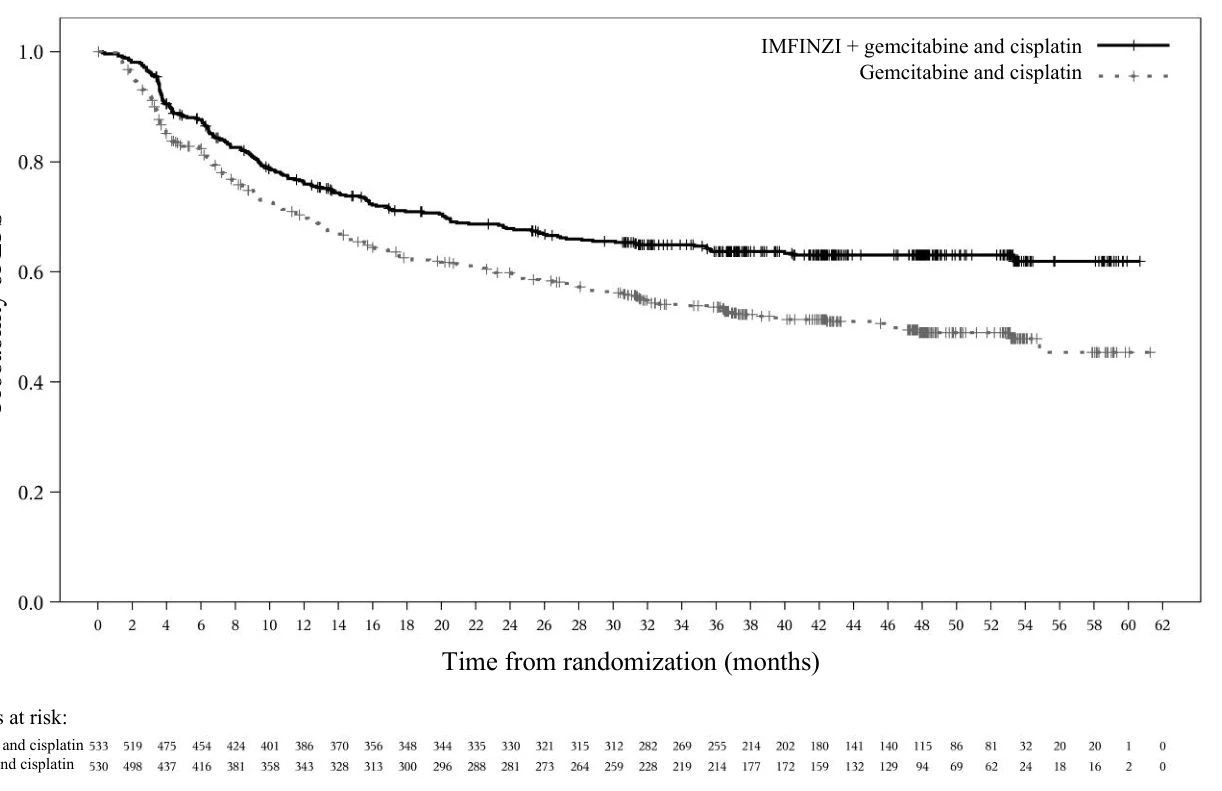
Figure 2 – Kaplan-Meier Curve of OS (NIAGARA)
IMFINZI + gemcitabine and cisplatin
Gemcitabine and cisplatin
Pr obability of EFS
Time from randomization (months)
Number of patients at risk:
IMFINZI + Gemcitabine and cisplatin
Gemcitabine and cisplatin
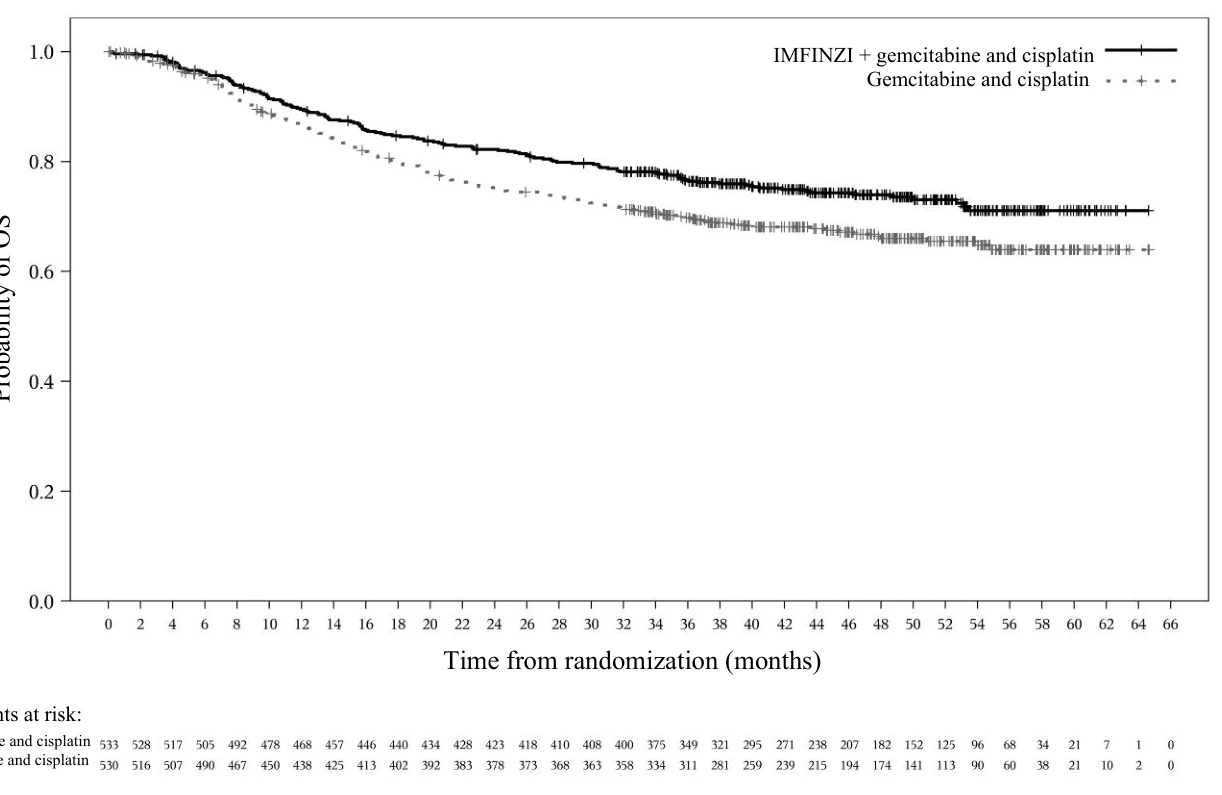
IMFINZI + gemcitabine and cisplatin
Gemcitabine and cisplatin
Pr obability of OS
Time from randomization (months)
Number of patients at risk:
IMFINZI+ gemcitabine and cisplatin
Gemcitabine and cisplatin
Non-Muscle Invasive Bladder Cancer (NMIBC)
The efficacy of IMFINZI in combination with intravesical BCG induction and maintenance treatment was evaluated in the POTOMAC study, a randomized, open-label, multicenter, active-controlled, Phase III study conducted in 1018 patients with high-risk NMIBC. High-risk NMIBC was defined as having one of the following: T1 tumour, high grade/Grade 3 tumour, carcinoma in situ (CIS), or multiple and recurrent and large tumours (with diameter of largest tumor ≥ 3 cm). Patients were 18 years of age or older with a histologically confirmed diagnosis of NMIBC who were BCG-naive (i.e., patients who had not received prior intravesical BCG or who previously received but stopped intravesical BCG more than 3 years before study entry) and had received no prior systemic therapy for NMIBC. Patients were to have had complete resection of all Ta/T1 papillary disease prior to randomization, with the TURBT removing high-risk NMIBC performed not more than 4 months before randomization in the study. Patients with residual CIS after TURBT were eligible.
The study excluded patients with lymphovascular invasion of bladder tumour; concurrent extravesical non-muscle-invasive transitional cell carcinoma of the urothelium; signs or symptoms of localized bladder infection within 2 weeks prior to the start of IMFINZI; treatment with antibiotics within 1 week prior to the start of BCG treatment; history of immunodeficiency, active or prior documented autoimmune or inflammatory disorders; active tuberculosis or hepatitis B or C or HIV infection; administration of systemic immunosuppression within 14 days before the first dose of IMFINZI; or patients receiving live attenuated vaccine within 30 days before or 90 days after the start of IMFINZI.
Randomisation was stratified by higher risk papillary disease (i.e., presence of T1G3/T1 high-grade or multiple recurrent large tumours with diameter of the largest ≥3 cm) (yes vs. no) and presence of CIS (yes vs. no). Patients were randomized 1:1:1 to receive IMFINZI in combination with BCG induction and maintenance, BCG induction and maintenance and an additional investigational regimen. The evaluation of efficacy for NMIBC relied on comparison between the following:
- IMFINZI in combination with BCG induction and maintenance: IMFINZI 1500 mg every 4 weeks for 13 cycles plus BCG induction every week for 6 weeks, followed by BCG maintenance on a weekly basis for 3 weeks at 3, 6, 12, 18, and 24 months (n=339).
- BCG induction and maintenance: BCG induction every week for 6 weeks, followed by BCG maintenance on a weekly basis for 3 weeks at 3, 6, 12, 18, and 24 months (n=340).
For patients with persistent CIS disease at 3 months, a single BCG re-induction for 6 weeks was permitted. If patients did not achieve complete response after re-induction, they were discontinued from treatment.
Assessment of tumour status was performed every 3 months from the date of randomization until 36 months and then every 6 months thereafter.
The primary endpoint was disease-free survival (DFS) for IMFINZI in combination with BCG induction and maintenance treatment compared to BCG induction and maintenance treatment alone according to investigator assessment. DFS was defined as the time from the date of randomization until the date of first recurrence of high-risk disease (high-grade Ta, T1, or CIS), persistent CIS, MIBC and/or metastatic disease or death. The median duration of follow-up in censored patients was 61 months (range: 0.03 to 79 months).
Table 35 – Summary of Patients Demographics in Non-Muscle Invasive Bladder Cancer (POTOMAC)
| Study # | Study design | Dosage, route of administration and duration | Study subjects (n) | Mean age (Range) | Sex |
| D419JC00001 (POTOMAC) | Phase 3, randomized, open-label, international study | IMFINZI + BCG (I+M)a BCG (I+M)b | N=339 N=340 | 67.0 (24-90) 66.5 (32-86) | M: 276, F: 63 M: 271, F:69 |
aIMFINZI 1500 mg every 4 weeks for 13 cycles plus BCG induction every week for 6 weeks, followed by BCG maintenance on a weekly basis for 3 weeks at 3, 6, 12, 18, and 24 months
bBCG induction every week for 6 weeks, followed by BCG maintenance on a weekly basis for 3 weeks at 3, 6, 12, 18, and 24 months.
The study demographics and baseline disease characteristics were well balanced between all study arms: median age of 67 years (range: 21 to 90), 62.6% age 65 or older, 80.5% male, 78.8% White, 18.1% Asian, 0.2% Black, 1.5% other race and 70.2% current or past smoker. Disease characteristics were as follows: CIS only (9.3%), papillary tumour only (64.7%), CIS and papillary tumour (25.9%), recurrent NMIBC (28.8%), tumour stage Ta (31.9%), tumour stage T1 (58.6%) and papillary tumour grade G3 (45.9%).
The efficacy results of the POTOMAC study are summarized in Table 36 and Figure 3. The study demonstrated a statistically significant and clinically meaningful improvement in DFS for patients treated with IMFINZI in combination with BCG induction and maintenance treatment compared to BCG induction and maintenance treatment alone.
Table 36 – Efficacy Results for the POTOMAC Study
| Endpoint | IMFINZI + BCG (N=339) | BCG (N=340) | ||||||
|---|---|---|---|---|---|---|---|---|
| DFSa | ||||||||
| Number of events (%) | 67 (19.8) | 98 (28.8) | ||||||
| Median DFS (months) (95% CI) | NR (NR, NR) | NR (74.0, NR) | ||||||
| HR (95% CI) b | 0.68 (0.50, 0.93) | |||||||
| 2-sided p-valuec | 0.0154 | |||||||
- a. DFS was as assessed by Investigator (DCO 03 April 2025)
- b. Based on Cox proportional hazard model with stratification factors higher risk papillary disease (yes vs. no) and CIS (yes vs. no) per Interactive Voice Response System (IVRS), with ties handled by the Efron approach.
- c. The analysis was performed using a stratified log-rank test with stratification factors higher risk papillary disease (yes vs. no) and CIS (yes vs. no) per IVRS.
CI = Confidence Interval; HR = Hazard ratio; NR = Not reached.
Figure 3 – Kaplan-Meier Curve of DFS (POTOMAC)
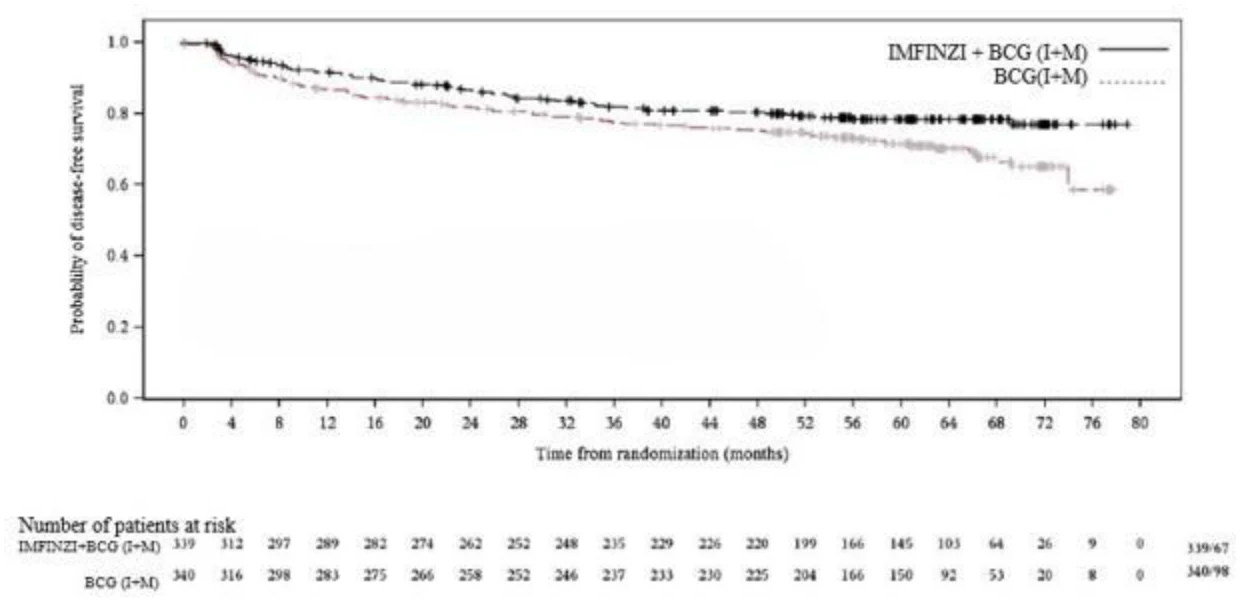
Exploratory Subgroup analysis of DFS
Exploratory DFS subgroup analyses were conducted for patients with papillary only disease (n=437, pre-specified analysis), papillary disease with CIS (n=189, post-hoc analysis) and CIS disease only (n=61, post-hoc analysis). The hazard ratios were 0.56 (95% CI: 0.37, 0.84), 0.82 (95% CI: 0.46, 1.46) and 1.74 (95% CI: 0.68, 4.73), respectively. A pre-specified subgroup analysis for DFS was also conducted for patients with higher risk papillary disease (with or without CIS; n=346). The hazard ratio was 0.54 (95% CI: 0.35, 0.83).
Resectable Non-Small Cell Lung Cancer (NSCLC)
The efficacy of IMFINZI in combination with platinum-containing chemotherapy as neoadjuvant treatment, followed by surgery and continued adjuvant treatment with IMFINZI monotherapy in patients with previously untreated and resectable squamous and non-squamous NSCLC (Stage IIA to select Stage IIIB (T3-4 N2) [AJCC, 8th edition]) was evaluated in AEGEAN, a randomized, double-blind, placebo-controlled, multicentre, Phase III study (n=802). Eligible patients had no prior exposure to immune-mediated therapy, a WHO/ECOG Performance status of 0 or 1, and at least one RECIST 1.1 target lesion.
Patients with active or prior documented autoimmune disease, or use of any immunosuppressive medication within 14 days of the first dose of durvalumab were ineligible. The population for efficacy analysis was a modified intent-to-treat (mITT) population which excluded patients with known EGFR mutations or ALK rearrangements (See Table 37)
Crossover between the study arms was not permitted. Randomization was stratified by disease stage (II vs. III) and by tumor PD-L1 expression (TC<1% or TC≥1%) status.
Patients were randomized (1:1) to one of the of the following treatment arms:
Treatment Arm 1: Neoadjuvant IMFINZI 1500 mg once every 3 weeks for up to 4 cycles in combination with:
Squamous tumor histology: carboplatin AUC 6 and paclitaxel 200 mg/m2 on Day 1 of each 3-week cycle, OR cisplatin 75 mg/m2 on Day 1 and gemcitabine 1250 mg/m2 on Day 1 and Day 8 of each 3-week cycle, for 4 cycles
or
Non-squamous tumor histology: pemetrexed 500 mg/m2 and cisplatin 75 mg/m2 on Day 1 of each 3-week cycle, for 4 cycles OR pemetrexed 500 mg/m2 and carboplatin AUC 5 on Day 1 of each 3-week cycle, for 4 cycles.
Following surgery, IMFINZI 1500 mg was administered every 4 weeks for up to 12 cycles.
Treatment Arm 2: Neoadjuvant placebo in combination with histology-dependent chemotherapy (see above) for 4 cycles of chemotherapy (see above)
Following surgery, placebo was administered every 4 weeks for up to 12 cycles.
Table 37 – Summary of Patient Demographics (mITT) in Resectable Stage II-IIIB (T3-4 N2) Non-Small Cell Lung Cancer (AEGEAN)
| Study # | Study design | Dosage, route of administration and duration | Study subjects (n) | Mean age (Range) | Sex |
D9106C00001 (AEGEAN) | Phase III, randomized, double-blind placebo-controlled, multicentre study | IMFINZI 1500 mg Q3W + chemotherapy prior to surgery, followed by IMFINZI 1500 mg Q4W after surgery (see above) or Placebo + chemotherapy prior to surgery, followed by placebo after surgery (see above) Intravenous infusion | 740 IMFINZI + Chemotherapy: 366 Placebo + Chemotherapy: 374 | 64 years (30-88 years) | M: 530 (71.6%) F: 210 (28.4%) |
In the event of unfavorable tolerability, patients who met the eligibility criteria were switched from cisplatin to carboplatin therapy at any point during the study. In patients with comorbidities or unable to tolerate cisplatin as per Investigator’s judgment, carboplatin AUC 5 could be administered from cycle 1. Treatment with IMFINZI or placebo continued until completion of the treatment, disease progression that precluded definitive surgery, inability to complete definitive surgery, disease recurrence in the adjuvant phase, or unacceptable toxicity.
A RECIST 1.1 tumour assessment was performed at baseline, and upon completion of the neoadjuvant period (prior to surgery). Tumour assessments were conducted at 5 weeks post-surgery, prior to start of adjuvant therapy and every 12 weeks until week 48, every 24 weeks until week 192 (approximately 4 years), and then every 48 weeks thereafter until disease progression, consent withdrawal, or death.
The primary efficacy endpoints of the study were pathological complete response (pCR) by blinded central pathology review (BCPR) and event-free survival (EFS) by blinded independent central review (BICR) assessment. Key secondary efficacy endpoints were major pathological response (MPR) by BCPR, disease-free survival (DFS) by BICR, and overall survival (OS).
The trial was not designed to isolate the effect of IMFINZI in each phase (neoadjuvant or adjuvant) of treatment.
The demographics and baseline disease characteristics presented in Table 38 are summarized here: male (72%); median age 65 years (range: 30 to 88); age ≥ 65 years (52%); WHO/ECOG PS 0 (68%), WHO/ECOG PS 1 (32%); White (54%), Asian (42%), Black or African American (0.9%), American Indian or Alaska Native (1.4%), Other Race (2.6%); Not Hispanic or Latino (84%); current or past smokers (86%); squamous histology (49%) and non-squamous histology (51%); Stage II (28%), Stage III (72%); PD-L1 expression status TC ≥ 1% (67%), PD-L1 expression status TC < 1% (33%).
Table 38 – Patient Demographic and Baseline Disease Characteristics, AEGEAN (mITT population)
| Demographic/Disease Characteristic | Number (%) patients | ||||||||||||
| Demographic/Disease Characteristic | Number (%) patients | ||||||||||||
| IMFINZI + Chemotherapy (N = 366) | Placebo + Chemotherapy (N = 374) | Total (N = 740) | |||||||||||
| IMFINZI + Chemotherapy (N = 366) | Placebo + Chemotherapy (N = 374) | Total (N = 740) | |||||||||||
| Age (years) a | |||||||||||||
| Median (min, max) | 65.0 (30, 88) | 65.0 (39, 85) | 65.0 (30, 88) | ||||||||||
| Age group (years), n (%) a | |||||||||||||
| ≥ 65 - < 75 | 147 (40.2) | 155 (41.4) | 302 (40.8) | ||||||||||
| ≥ 75 | 44 (12.0) | 36 (9.6) | 80 (10.8) | ||||||||||
| Sex, n (%) | |||||||||||||
| Male | 252 (68.9) | 278 (74.3) | 530 (71.6) | ||||||||||
| Female | 114 (31.1) | 96 (25.7) | 210 (28.4) | ||||||||||
| Race, n (%) | |||||||||||||
| White | 206 (56.3) | 191 (51.1) | 397 (53.6) | ||||||||||
| Asian | 143 (39.1) | 164 (43.9) | 307 (41.5) | ||||||||||
| American Indian or Alaska Native | 6 (1.6) | 4 (1.1) | 10 (1.4) | ||||||||||
| Black or African American | 4 (1.1) | 3 (0.8) | 7 (0.9) | ||||||||||
| Other | 7 (1.9) | 12 (3.2) | 19 (2.6) | ||||||||||
| Ethnic group, n (%) | |||||||||||||
| Not Hispanic or Latino | 303 (82.8) | 318 (85.0) | 621 (83.9) | ||||||||||
| Hispanic or Latino | 63 (17.2) | 56 (15.0) | 119 (16.1) | ||||||||||
| Smoking history, n (%) | |||||||||||||
| Never-smoker | 51 (13.9) | 56 (15.0) | 107 (14.5) | ||||||||||
| Smoker | 315 (86.1) | 318 (85.0) | 633 (85.5) | ||||||||||
| ECOG performance status | |||||||||||||
| (0) Normal activity | 251 (68.6) | 255 (68.2) | 506 (68.4) | ||||||||||
| (1) Restricted in physically strenuous activity | 115 (31.4) | 119 (31.8) | 234 (31.6) | ||||||||||
| Disease stage at diagnosis per IXRS | |||||||||||||
| II | 102 (27.9) | 108 (28.9) | 210 (28.4) | ||||||||||
| III | 264 (72.1) | 266 (71.1) | 530 (71.6) | ||||||||||
| Histology type | |||||||||||||
| Squamous | 169 (46.2) | 191 (51.1) | 360 (48.6) | ||||||||||
| Non-squamous | 196 (53.6) | 179 (47.9) | 375 (50.7) | ||||||||||
| PD-L1 expression status at baseline c (central laboratory data were migrated to the IXRS and source data) | |||||||||||||
| TC < 1% (per IXRS and source data) | 122 (33.3) | 125 (33.4) | 247 (33.4) | ||||||||||
| TC ≥ 1% (per IXRS and source data) | 244 (66.7) | 249 (66.6) | 493 (66.6) | ||||||||||
- a Age was calculated using date of randomization.
- b Note: Percentages are calculated based on the number of patients in the analysis set, N.
- c Baseline is defined as the last observation prior to randomization if available, or otherwise, an observation after randomization but before the first dose of randomized treatment
DCO: 10 November 2022.
In the mITT population there were 295 (80.6%) patients in the IMFINZI in combination with chemotherapy arm who underwent curative intent surgery compared to 302 (80.7%) patients in the placebo in combination with chemotherapy arm. There were 284 (77.6%) patients in the IMFINZI in combination with chemotherapy arm who completed curative intent surgery compared to 287 (76.7%) patients in the placebo in combination with chemotherapy arm. The resection margin status within the mITT population, who completed surgery, was (IMFINZI in combination with chemotherapy arm vs placebo in combination with chemotherapy arm):
- R0 (no residual tumour): 94.7% vs. 91.3%
- R1 (microscopic residual tumour): 4.2% vs. 7.7%
- R2 (macroscopic residual tumour): 0.7% vs. 0.7%
See Table 39 and Figure 4 for the results from the AEGEAN trial which met the pre-specified primary objectives. At the time of the EFS interim analysis, OS was not formally tested.
Table 39 – Efficacy Results for the AEGEAN Study(mITT)
| IMFINZI + chemotherapy (N=366) | Placebo + chemotherapy (N = 374) | |||||||||||
| IMFINZI + chemotherapy (N=366) | Placebo + chemotherapy (N = 374) | |||||||||||
| EFSa | ||||||||||||
| Number of events, n (%) | 98 (27) | 138 (37) | ||||||||||
| Median EFS (95% CI) (months) | NR (31.9, NR) | 25.9 (18.9, NR) | ||||||||||
| Hazard ratio (95% CI) | 0.68 (0.53, 0.88) | |||||||||||
| 2-sided p-valuec | 0.0039 | |||||||||||
| pCRa | ||||||||||||
| Number of patients with response | 63 | 16 | ||||||||||
| Response rate, % (95% CI) | 17.2 (13.5, 21.5) | 4.3 (2.5, 6.9) | ||||||||||
| 2-sided p-valueb,c | 0.000036 | |||||||||||
a Results are based on planned EFS interim analysis and pCR final analysis (DCO: 10 November 2022) which occurred 46.3 months after study initiation. The median EFS follow-up was 11.7 months.
b Based on a pre-specified pCR interim analysis (DCO: 14 January 2022) in n = 402.
c Statistically significant improvement in EFS and pCR rate for IMFINZI + chemotherapy compared to placebo + chemotherapy. The 2-sided p-value for pCR was calculated based on a stratified CMH test. The 2-sided p-value for EFS was calculated based on a stratified log-rank test. Stratification factors include PD-L1 status and disease stage. The boundary for declaring statistical significance for each of the efficacy endpoints were determined by a Lan-DeMets alpha spending function that approximates an O’Brien Fleming approach (EFS = 0.009899, pCR = 0.000082, 2-sided).
Figure 4 – Kaplan-Meier Curve of EFS (AEGEAN) (mITT population)
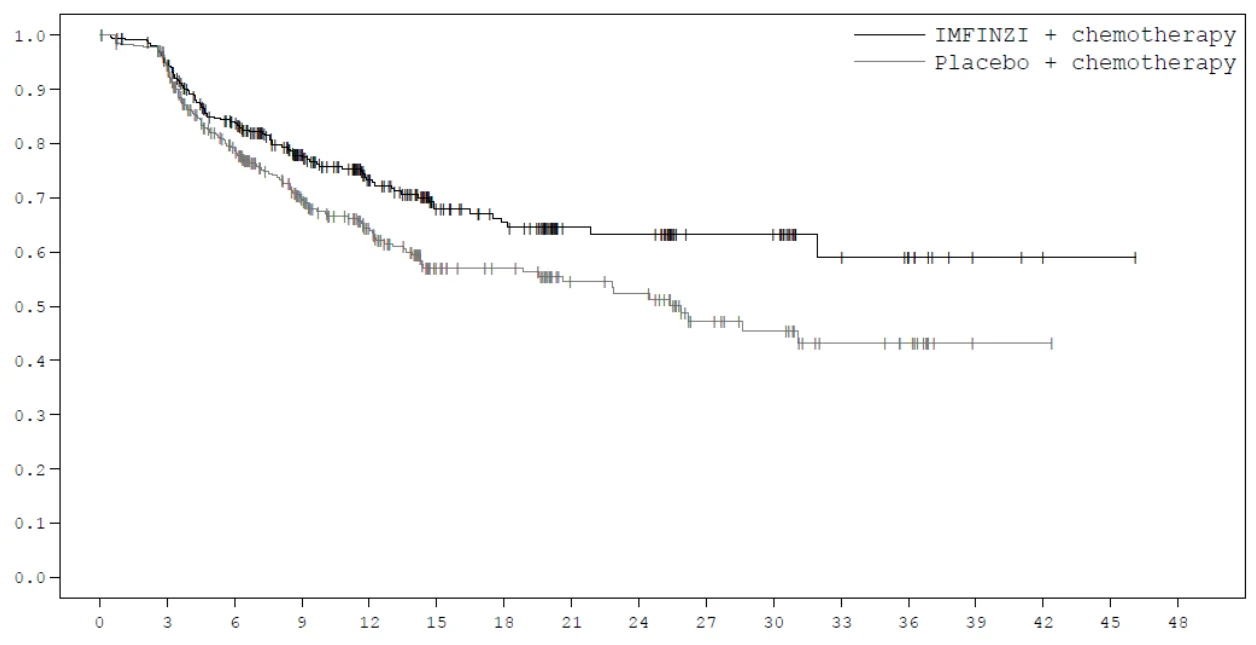

At the interim analysis, the study demonstrated a statistically significant difference in MPR [34% vs 14%; p<0.0001].
In an exploratory pre-specified subgroup analysis for EFS by PD-L1 expression at baseline performed at the time of the EFS analysis, the hazard ratios were 0.60 (95% CI: 0.35, 1.01) in
Time from randomization (months)
Probabi l i ty of ev ent -free su rvi v al
IMFINZI + chemotherapy
Placebo + chemotherapy
Number of patients at risk
patients with PD-L1 ≥50%, 0.70 (95% CI: 0.46, 1.05) in patients with PD-L1 1-49%, and 0.76 (95% CI: 0.49, 1.17) in patients with PD-L1 <1%.
Locally Advanced, Unresectable, Stage III Non-Small Cell Lung Cancer
The efficacy of IMFINZI was evaluated in the PACIFIC study, a Phase III, randomized, double-blind, placebo-controlled, multicenter study that enrolled 713 patients with locally advanced, unresectable, Stage III non-small cell lung cancer (NSCLC). Eligible patients had completed at least 2 cycles of definitive platinum-based chemoradiation within 1 to 42 days prior to initiation of study treatment and had a WHO performance status of 0 or 1. Ninety-two percent of patients had received a total dose of 54 to 66 Gy of radiation.
The study excluded patients who had progressed following chemoradiation therapy, patients with active or prior documented autoimmune disease within 2 years of initiation of the study; a history of immunodeficiency; a history of severe immune-mediated adverse reactions; medical conditions that required systemic immunosuppression; active tuberculosis or hepatitis B or C or HIV infection or patients receiving live attenuated vaccine within 30 days before or after receiving IMFINZI.
Patients were randomized 2:1 to receive 10 mg/kg IMFINZI (n=476) or placebo (n=237) via intravenous infusion every 2 weeks for up to 12 months or until unacceptable toxicity or disease progression. Randomization was stratified by gender, age (<65 years vs. ≥65 years) and smoking status (smoker vs. non- smoker). Tumour assessments were conducted every 8 weeks for the first 12 months and then every 12 weeks thereafter.
Table 40 – Summary of Patient Demographics in Locally Advanced, Unresectable, Stage III NSCLC (PACIFIC)
| Study # | Study design | Dosage, route of administration and duration | Study subjects (n) | Mean age (Range) | Sex |
D4191C00001 (PACIFIC) | Phase III, randomized, double-blind, placebo-controlled, multicenter, international study | IMFINZI, Double arm 10 mg/kg Q2W or placebo (2:1) Intravenous infusion | IMFINZI: 476 Placebo: 237 | 63 years (23-90 years) | Male (70%) |
The demographics and baseline disease characteristics were well balanced between study arms (see Table 41).
Patients were enrolled regardless of their tumour PD-L1 expression level. Where available, archival tumour tissue specimens, taken prior to chemoradiation therapy, were retrospectively tested for PD-L1 expression on tumour cells (TC) using the VENTANA PD-L1 (SP263) IHC assay. Of the 713 patients randomized, 63% (n=451) of patients provided a tissue sample of sufficient quality and quantity to determine PD-L1 expression and 37% (n=262) were unknown. Of 451 patients with PD-L1 expression available, 67% were TC ≥1% [PD-L1 TC 1-24% (32%), PD-L1 TC ≥25% (35%)] and 33% were TC <1%.
| Table 41 – Patient Demographics and Baseline Disease Characteristics, PACIFIC (Full analysis set) | |||||||||||||
|---|---|---|---|---|---|---|---|---|---|---|---|---|---|
| Table 41 – Patient Demographics and Baseline Disease Characteristics, PACIFIC (Full analysis set) | |||||||||||||
| PACIFIC | |||||||||||||
| PACIFIC | |||||||||||||
| Demographic/Disease Characteristic | IMFINZI (N=476) | Placebo (N=237) | |||||||||||
| Demographic/Disease Characteristic | IMFINZI (N=476) | Placebo (N=237) | |||||||||||
| Age (years) | |||||||||||||
| N | 476 | 237 | |||||||||||
| Mean | 63.0 | 62.6 | |||||||||||
| SD | 8.66 | 9.64 | |||||||||||
| Median | 64.0 | 64.0 | |||||||||||
| Min, max | 31, 84 | 23, 90 | |||||||||||
| Age group (years), n (%) | |||||||||||||
| <50 | 30 (6.3) | 22 (9.3) | |||||||||||
| ≥50 to <65 | 231 (48.5) | 108 (45.6) | |||||||||||
| ≥65 to <75 | 178 (37.4) | 88 (37.1) | |||||||||||
| ≥75 | 37 (7.8) | 19 (8.0) | |||||||||||
| Sex, n (%) | |||||||||||||
| Male | 334 (70.2) | 166 (70.0) | |||||||||||
| Female | 142 (29.8) | 71 (30.0) | |||||||||||
| Race, n (%) | |||||||||||||
| Caucasian | 337 (70.8) | 157 (66.2) | |||||||||||
| Black or African-American | 12 (2.5) | 2 (0.8) | |||||||||||
| Asian | 120 (25.2) | 72 (30.4) | |||||||||||
| Other | 5 (1.0) | 6 (2.5) | |||||||||||
| Missing | 1 (0.2) | 0 | |||||||||||
| Weight (kg) | |||||||||||||
| N | 475 | 236 | |||||||||||
| Mean | 71.9 | 69.4 | |||||||||||
| SD | 17.39 | 15.73 | |||||||||||
| Median | 69.0 | 69.0 | |||||||||||
| Min, Max | 34, 175 | 38, 128 | |||||||||||
| Weight group (kg), n (%) | |||||||||||||
| <70 | 243 (51.1) | 124 (52.3) | |||||||||||
| ≥70 to ≤90 | 174 (36.6) | 93 (39.2) | |||||||||||
| >90 | 58 (12.2) | 19 (8.0) | |||||||||||
| Missing | 1 (0.2) | 1 (0.4) | |||||||||||
| Smoking history, n (%) | |||||||||||||
| Current/Former smoker | 433 (91.0) | 216 (91.1) | |||||||||||
| Never smoker | 43 (9.0) | 21 (8.9) | |||||||||||
| Baseline WHO, n (%) | |||||||||||||
| 0 | 234 (49.2) | 114 (48.1) | |||||||||||
| 1 | 240 (50.4) | 122 (51.5) | |||||||||||
| 2 | 0 | 0 | |||||||||||
| Missing | 2 (0.4) | 1 (0.4) | |||||||||||
| Histology type | |||||||||||||
| Squamous | 224 (47.1) | 102 (43.0) | |||||||||||
| Non-squamous | 252 (52.9) | 135 (57.0) | |||||||||||
| Staging | |||||||||||||
| IA/IB | 1 (0.2) | 2 (0.8) | |||||||||||
| IIA/IIB | 7 (1.4) | 3 (1.2) | |||||||||||
| IIIA | 252 (52.9) | 125 (52.7) | |||||||||||
| IIIB | 212 (44.5) | 107 (45.1) | |||||||||||
| IV | 4 (0.8) | 0 | |||||||||||
| Baseline hemoglobin concentration, n (%) | |||||||||||||
| <10 g/dL | 80 (16.8) | 35 (15.0) | |||||||||||
| ≥10 g/dL | 395 (83.2) | 199 (85.0) | |||||||||||
| Missing | 0 | 0 | |||||||||||
Max Maximum; Min Minimum; SD Standard deviation
Overall survival (OS) and progression-free survival (PFS) were the primary endpoints of the PACIFIC study. Secondary efficacy endpoints included Objective Response Rate (ORR) and Duration of Response (DoR). PFS, ORR and DoR were assessed by Blinded Independent Central Review (BICR) according to RECIST v1.1. Analysis of ORR was based on a sub-group of the intent to treat (ITT) population [IMFINZI (N=443), Placebo (N=213)] with measurable disease at baseline, assessed within 0 – 42 days after chemoradiation and before the start of study drug. Data obtained up to progression or the last evaluable assessment in the absence of progression, were included in the assessment of ORR.
The study demonstrated a statistically significant and clinically meaningful improvement in OS in the IMFINZI-treated group compared with the placebo group [HR = 0.68 (95% CI: 0.53, 0.87), p = 0.00251]. Median OS was not reached in the IMFINZI-treated group and was 28.7 months in the placebo group. The study demonstrated a statistically significant and clinically meaningful improvement in PFS in the IMFINZI-treated group compared with the placebo group [hazard ratio (HR) = 0.52 (95% CI: 0.42, 0.65), p<0.0001]. Median PFS was 16.8 months in the IMFINZI-treated group and 5.6 months in the placebo group. See Table 42 and
Figure 5 and Figure 6.
Table 42 – Efficacy Results in Locally Advanced, Unresectable, Stage III NSCLC, PACIFIC (Full analysis set)a
| IMFINZI (N=476) | Placebo (N=237) | ||||||||||
|---|---|---|---|---|---|---|---|---|---|---|---|
| IMFINZI (N=476) | Placebo (N=237) | ||||||||||
| OS | |||||||||||
| Number of deaths (%) | 183 (38.4) | 116 (48.9) | |||||||||
Median OS (months) (95% CI) | NR (34.7, NR) | 28.7 (22.9, NR) | |||||||||
| HR (95% CI) | 0.68 (0.53, 0.87) | ||||||||||
| 2-sided p-valued | 0.00251 | ||||||||||
OS at 24 months (95% CI) | 66.3 (61.7, 70.4) | 55.6 (48.9, 61.8) | |||||||||
| p-valuef | 0.005 | ||||||||||
| PFSb | |||||||||||
| Number of events (%) | 214 (45.0) | 157 (66.2) | |||||||||
Median PFS (months) (95% CI) | 16.8 (13.0, 18.1) | 5.6 (4.6, 7.8) | |||||||||
| HR (95% CI) | 0.52 (0.42, 0.65) | ||||||||||
| p-valuee | p<0.0001 | ||||||||||
ORRc n (%) (95% CI) | 133 (30.0) (25.8, 34.5) | 38 (17.8) (13.0, 23.7) | |||||||||
| Complete Response n (%) | 8 (1.8) | 1 (0.5) | |||||||||
| Partial Response n (%) | 125 (28.2) | 37 (17.4) | |||||||||
Median DoR (months) (95% CI) | NR (27.4, NR) | 18.4 (6.7, 24.5) | |||||||||
a The analysis of OS and an updated analysis of ORR and DoR was performed approximately 13 months after the primary analysis of PFS.
b PFS is defined as the time from the date of randomization until the date of objective disease progression (using BICR according to RECIST 1.1) or death.
c Based on sub-group of ITT population with measurable disease at baseline according to RECIST v1.1; IMFINZI (N=443), Placebo (N=213) assessed within 0-42 days after concurrent chemoradiation and before the start of study drug.
d Compared with allocated α of 0.00274 (Lan DeMets spending function approximating O’Brien Fleming boundary) for interim analysis
e Compared with allocated α of 0.011035 (Lan DeMets spending function approximating O’Brien Fleming boundary) for interim analysis
f Compared with α of 0.05 following statistically significant PFS and OS at interim analyses
NR = not reached
Figure 5 – Kaplan-Meier curve of OS (PACIFIC) (Full analysis set)
Time from Randomization (months) Number of patients at risk | ||||||||||||||||
|---|---|---|---|---|---|---|---|---|---|---|---|---|---|---|---|---|
| Month | 0 | 3 | 6 | 9 | 12 | 15 | 18 | 21 | 24 | 27 | 30 | 33 | 36 | 39 | 42 | 45 |
| IMFINZI | 476 | 464 | 431 | 415 | 385 | 364 | 343 | 319 | 274 | 210 | 115 | 57 | 23 | 2 | 0 | 0 |
| Placebo | 237 | 220 | 198 | 178 | 170 | 155 | 141 | 130 | 117 | 78 | 42 | 21 | 9 | 3 | 1 | 0 |
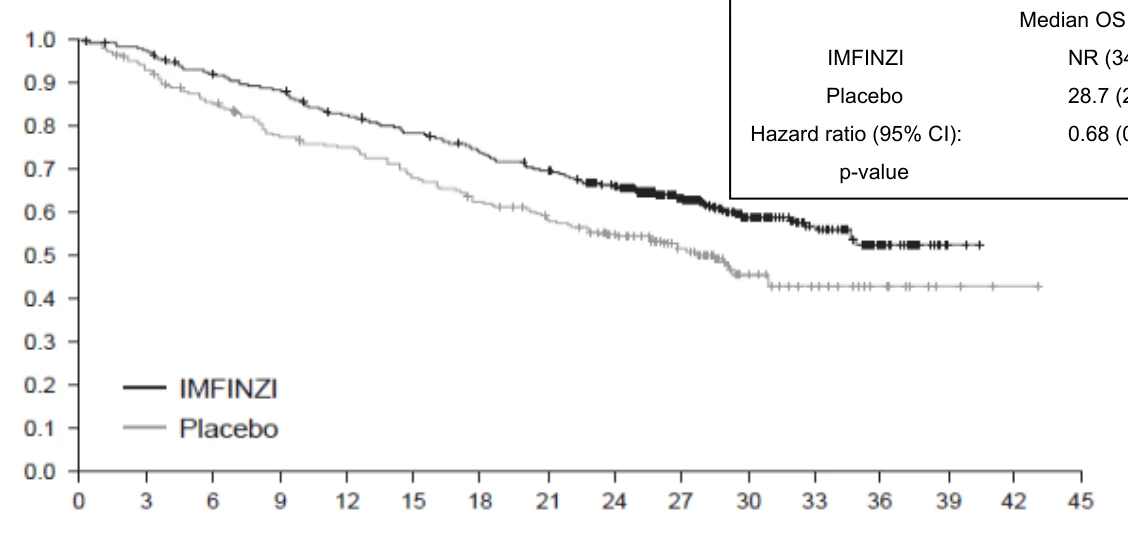
Median OS (95% CI)
IMFINZI NR (34.7, NR)
Placebo 28.7 (22.9, NR)
Hazard ratio (95% CI): 0.68 (0.53, 0.87)
p-value 0.00251
Probabi li ty of OS
Figure 6 – Kaplan-Meier curve of PFS (PACIFIC) (Full analysis set)
Time from Randomization (months) Number of patients at risk | |||||||||||
|---|---|---|---|---|---|---|---|---|---|---|---|
| Month | 0 | 3 | 6 | 9 | 12 | 15 | 18 | 21 | 24 | 27 | 30 |
| IMFINZI | 476 | 377 | 301 | 264 | 159 | 86 | 44 | 21 | 4 | 1 | 0 |
| Placebo | 237 | 163 | 106 | 87 | 52 | 28 | 15 | 4 | 3 | 0 | 0 |
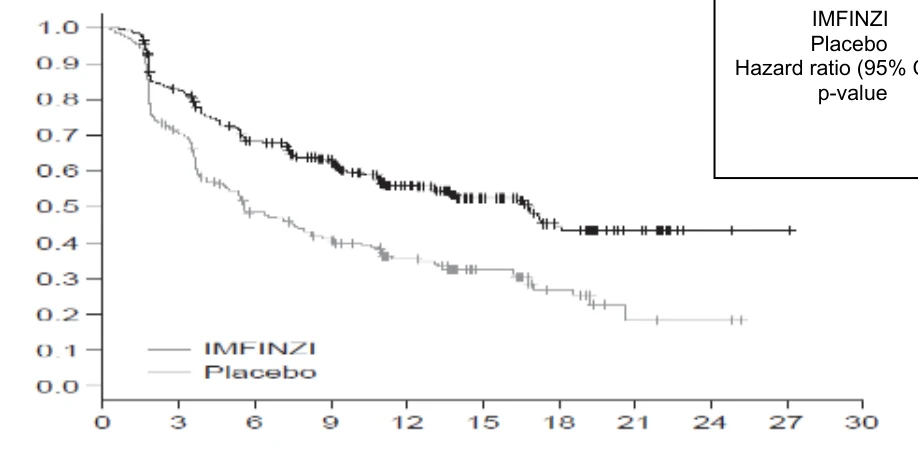
The improvements in OS and PFS, in favour of patients receiving IMFINZI compared to those receiving placebo, were consistently observed across all prespecified subgroups.
There were no clinically meaningful differences between IMFINZI-treated vs. placebo-treated patients in disease-related symptoms deterioration and health-related quality of life.
Exploratory post-hoc subgroup analysis by PD-L1 expression
Additional exploratory post-hoc subgroup analyses were conducted to evaluate efficacy by pre-chemoradiation tumour PD-L1 expression (≥25%, 1-24%, ≥1%, <1%) and for patients whose PD-L1 status could not be established (PD-L1 unknown). Due to the overall exploratory nature of this subgroup analysis performed without any pre-specified statistical adjustment, definitive conclusions cannot be drawn. PFS and OS results, by PD-L1 expression level, are summarized in Figure 7 and Figure 8, respectively.
Several limitations are associated with exploratory, post-hoc analyses. Limitations include the absence of methods to control the type I error rate, small sample sizes and the potential for low event rates by subgroup. In addition, subgroups are not protected by randomization and may be subject to bias due to imbalances in patient demographics and disease characteristics. The results should be interpreted with caution. IMFINZI is indicated for locally advanced, unresectable Stage III NSCLC regardless of PD-L1 status based on statistically significant and clinically meaningful improvements in OS and PFS observed in the ITT population.
Overall the safety profile of durvalumab in PD-L1 TC ≥1% subgroup was consistent with the intent to treat population, as was the PD-L1 TC <1% subgroup.
Probabi li ty of PFS
Median PFS (95% CI)
IMFINZI 16.8 (13.0, 18.1)
Placebo 5.6 (4.6, 7.8)
Hazard ratio (95% CI): 0.52 (0.42, 0.65)
p-value < 0.0001
Figure 7 – Forest Plot of PFS by PD-L1 expression
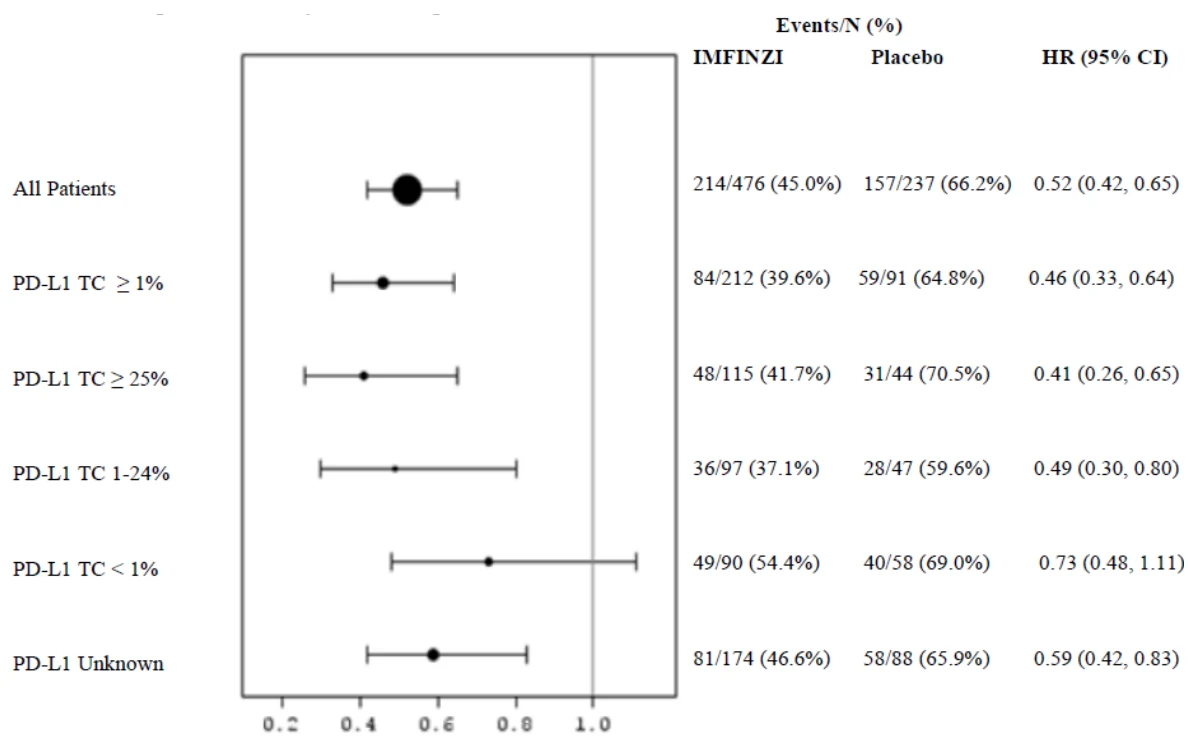
Figure 8 – Forest Plot of OS by PD-L1 expression
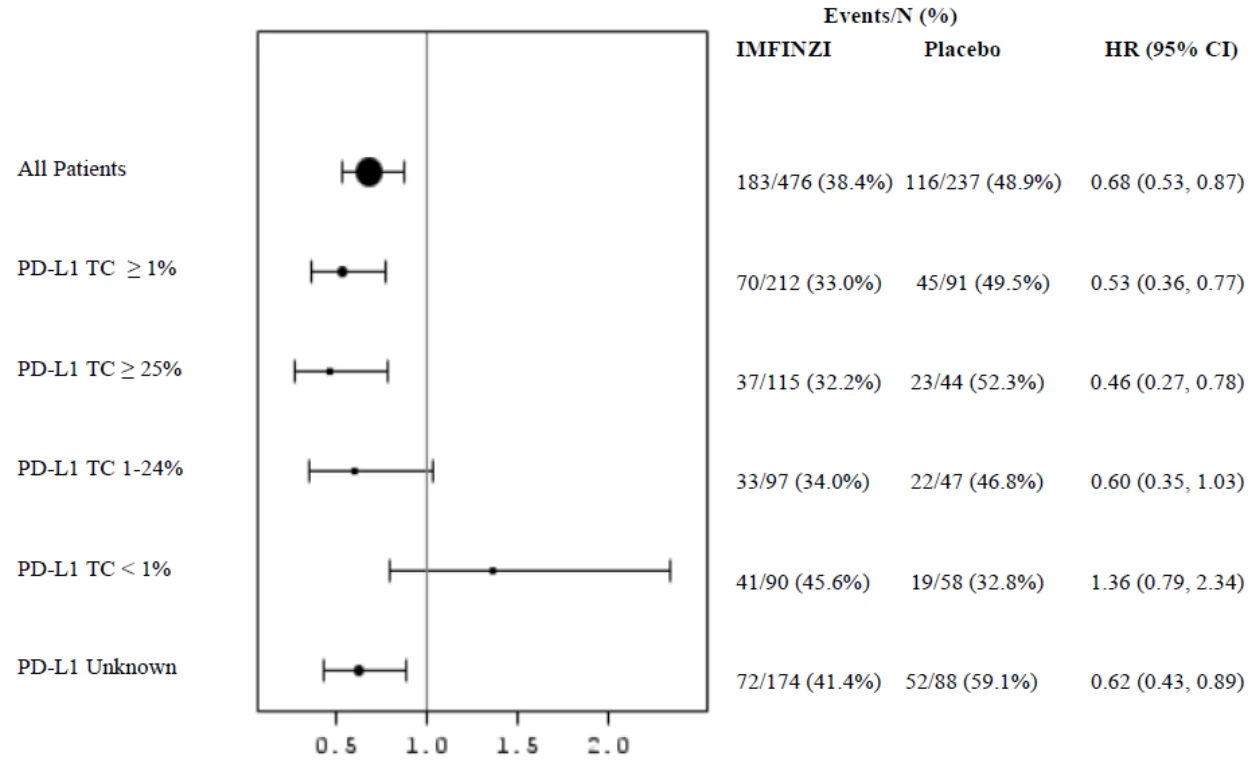
Metastatic Non-Small Cell Lung Cancer
The efficacy of IMFINZI with or without tremelimumab in combination with platinum-based chemotherapy was evaluated in POSEIDON, a randomised, open-label, multicentre study in 1013 metastatic NSCLC patients with no sensitizing epidermal growth factor receptor (EGFR) mutation or anaplastic lymphoma kinase (ALK) genomic tumour aberrations. The study enrolled patients with a histologically or cytologically documented metastatic NSCLC, no prior chemotherapy, or any other systemic therapy for metastatic NSCLC and World Health Organization/Eastern Cooperative Oncology Group (ECOG) performance status of 0 or 1. Prior to randomization, patients had tumour PD-L1 status confirmed by using the Ventana PD-L1 (SP263) Assay.
The study excluded patients with active or prior documented autoimmune disease; active and/or untreated brain metastases; a history of immunodeficiency; administration of systemic immunosuppression within 14 days before the start of IMFINZI or tremelimumab, except physiological dose of systemic corticosteroids; active tuberculosis or hepatitis B or C or HIV infection; or patients receiving live attenuated vaccine within 30 days before or after the start of IMFINZI and/or tremelimumab.
Randomization (see Table 43) was stratified by tumour cells (TC) PD-L1 expression (TC≥50% vs. TC<50%), disease stage (Stage IVA vs. Stage IVB), and histology (non-squamous vs. squamous). Patients were randomized 1:1:1 to receive IMFINZI in combination with tremelimumab and platinum-based chemotherapy (n = 338), an additional investigational combination regimen (n = 338) and platinum-based chemotherapy alone (n = 337). All study medications were administered intravenously. The evaluation of efficacy relied on the comparison between IMFINZI in combination with tremelimumab and platinum-based chemotherapy (Arm 1) and platinum-based chemotherapy alone (Arm 3).
Table 43 – Summary of Patient Demographics in Metastatic NSCLC (POSEIDON)
| Study # | Study design | Dosage, route of administration and duration | Study subjects (n) | Median age (Range) | Sex |
| D419MC00004 (POSEIDON) | Phase III, randomized, open-label, multi-centre, international study | Arm 1: IMFINZI 1500 mg + tremelimumab 75 mg + platinum-based chemotherapya, b, d, intravenously or Arm 2: An additional investigational combination regimen or Arm 3: Platinum-based chemotherapyc, d, intravenously | N=338 N=338 N=337 | 63.0 years (27-87 years) 64.5 years (32-87 years) 64.0 years (32-84 years) | M: 770 (76.0%) F: 243 (24.0%) |
a IMFINZI 1500 mg with tremelimumab 75mg and platinum-based chemotherapy every 3 weeks for 4 cycles, followed by IMFINZI 1500 mg every 4 weeks as monotherapy until disease progression or unacceptable toxicity. A fifth dose of tremelimumab 75 mg at Week 16 alongside IMFINZI dose 6. Tremelimumab was given up to a maximum of 5 doses unless there was disease progression or unacceptable toxicity. Patients with disease progression during IMFINZI monotherapy were given the option to be retreated with 4 additional cycles of tremelimumab alongside IMFINZI.
b Administration of IMFINZI monotherapy was permitted beyond disease progression if the patient was clinically stable and deriving clinical benefit as determined by the investigator.
c Platinum-based chemotherapy every 3 weeks for 4 cycles as monotherapy. Patients could receive additional 2 cycles (a total of 6 cycles post-randomization), as clinically indicated, at Investigator’s discretion.
d Patients in all 3 arms received one of the following histology-based chemotherapy regimens:
Non-squamous NSCLC
- Pemetrexed 500 mg/m2 with carboplatin AUC 5-6 or cisplatin 75 mg/m2 every 3 weeks, unless contraindicated by the investigator, pemetrexed maintenance could be given. If pemetrexed maintenance therapy is given, continued until disease progression or unacceptable toxicity.
Squamous NSCLC
- Gemcitabine 1000 or 1250 mg/m2 on Days 1 and 8 with cisplatin 75 mg/m2 or carboplatin AUC 5-6 on Day 1 every 3 weeks.
Non-squamous and squamous NSCLC
- Nab-paclitaxel 100 mg/m2 on Days 1, 8, and 15 with carboplatin AUC 5-6 on Day 1 every 3 weeks.
Tumour assessments were conducted at Week 6 and Week 12 from the date of randomization, and then every 8 weeks until confirmed objective disease progression. Survival assessments were conducted every 2 months following treatment discontinuation.
The primary endpoints of the study were PFS and OS for an additional investigational combination regimen (Arm 2) vs. platinum-based chemotherapy alone (Arm 3). The key secondary endpoints of the study were PFS and OS for IMFINZI + tremelimumab + platinum-based chemotherapy (Arm 1) vs. platinum-based chemotherapy alone (Arm 3). The secondary endpoints included ORR and DoR. PFS, ORR, and DoR were assessed using Blinded Independent Central Review (BICR) according to RECIST v1.1. PFS and ORR are evaluated at the primary PFS analysis (Data Cutoff (DCO): 24 July 2019 corresponding to the second interim analysis) and OS is evaluated at the primary OS analysis (DCO: 12 March 2021 corresponding to the final analysis).
The demographics and baseline disease characteristics were generally well-balanced between study arms. Baseline demographics of the overall study population were as follows: male (76.0%), age ≥65 years (47.1%), White (55.9%), Asian (34.6%), Black or African American (2.0%), other (7.6%), non-Hispanic or Latino (84.2%), current smoker or past-smoker (78.0%), never smoker (21.9%), WHO/ECOG PS 0 (33.4%), and WHO/ECOG PS 1 (66.5%). Disease characteristics were as follows: Stage IVA (50.0%), Stage IVB (49.6%), histological sub-groups of squamous (36.9%), non-squamous (62.9%), PD-L1 expression TC≥50% (28.8%), and PD-L1 expression TC<50% (71.1%).
Efficacy results are presented in Table 44 and Figure 9 and Figure 10.
Table 44 – Efficacy Results for the POSEIDON Study
| IMFINZI + tremelimumab + platinum-based chemotherapy (n=338) | Platinum-based chemotherapy (n=337) | |||||||||
|---|---|---|---|---|---|---|---|---|---|---|
| PFSa | ||||||||||
| Number of events (%) | 238 (70.4) | 258 (76.6) | ||||||||
Median PFS (months) (95% CI) | 6.2 (5.0, 6.5) | 4.8 (4.6, 5.8) | ||||||||
HR (95% CI)b p-valuec | 0.72 (0.60, 0.86) 0.00031d | |||||||||
| OSa | ||||||||||
| Number of deaths (%) | 251 (74.3) | 285 (84.6) | ||||||||
Median OS (months) (95% CI) | 14.0 (11.7, 16.1) | 11.7 (10.5, 13.1) | ||||||||
HR (95% CI)b p-valuec | 0.77 (0.65, 0.92) 0.00304d | |||||||||
| ORR, n (%)e | 130 (38.8) | 81 (24.4) | ||||||||
| Complete Response n (%) | 2 (0.6) | 0 | ||||||||
| Partial Response n (%) | 128 (38.2) | 81 (24.4) | ||||||||
a PFS/OS results are based on planned analyses which occurred 25/45 months respectively after study initiation.
b HR and CI were estimated from a stratified Cox proportional hazards model adjusting for PD-L1, histology and disease stage.
c 2-sided p-value based on a stratified log-rank test adjusting for PD-L1, histology and disease stage.
d Statistically significant improvement for IMFINZI in combination with tremelimumab and platinum-based chemotherapy compared to platinum-based chemotherapy alone. The boundaries for declaring efficacy (PFS 0.00735, OS 0.00797 2-sided) were determined by a Lan-DeMets alpha spending function that approximates an O’Brien Fleming approach.
e Confirmed Objective Response.
NR=Not Reached, CI=Confidence Interval
The median duration of response (DoR) was 9.5 months (95% CI: 7.2, NR) and 5.1 months (95% CI: 4.4, 6.0) for the IMFINZI + tremelimumab + platinum-based chemotherapy arm and platinum-based chemotherapy arm, respectively.
Figure 9 – Kaplan-Meier curve of PFS (POSEIDON) (Full analysis set; DCO: 24 July 2019)
| Number of patients at risk | |||||||||
|---|---|---|---|---|---|---|---|---|---|
| Month | |||||||||
| 0 | 3 | 6 | 9 | 12 | 15 | 18 | 21 | 24 | |
| IMFINZI + tremelimumab + platinum-based chemotherapy | |||||||||
| 338 | 243 | 161 | 94 | 56 | 32 | 13 | 5 | 0 | |
| Platinum-based chemotherapy | |||||||||
| 337 | 219 | 121 | 43 | 23 | 12 | 3 | 2 | 0 | |
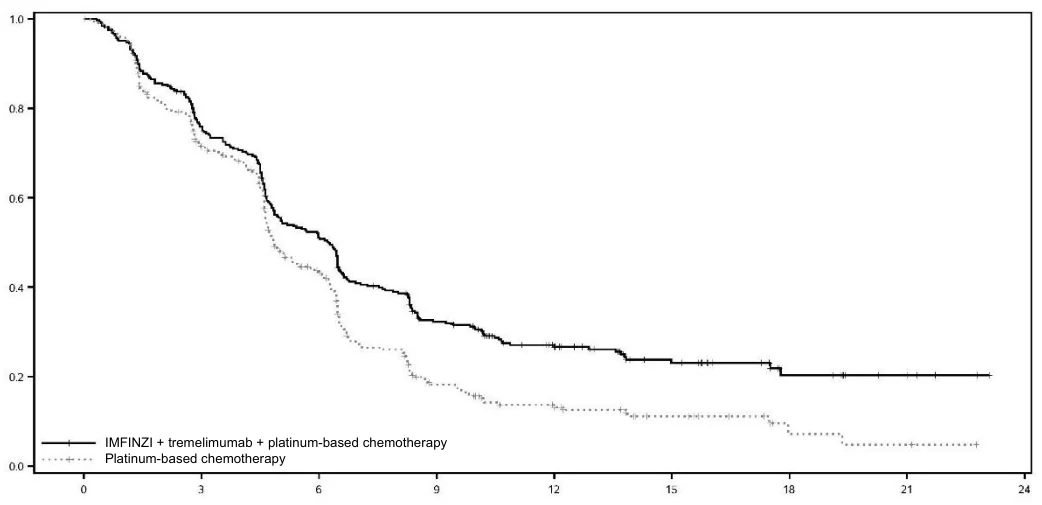
IMFINZI + tremelimumab + platinum-based chemotherapy
Platinum-based chemotherapy
Probability of PFS
Time from randomization (months)
Figure 10 – Kaplan-Meier curve of OS (POSEIDON) (Full analysis set; DCO: 12 March 2021)
| Number of patients at risk | ||||||||||||||||
|---|---|---|---|---|---|---|---|---|---|---|---|---|---|---|---|---|
| Month | ||||||||||||||||
| 0 | 3 | 6 | 9 | 12 | 15 | 18 | 21 | 24 | 27 | 30 | 33 | 36 | 39 | 42 | 45 | |
| IMFINZI + tremelimumab + platinum-based chemotherapy | ||||||||||||||||
| 338 | 298 | 256 | 217 | 183 | 159 | 137 | 120 | 109 | 95 | 88 | 64 | 41 | 20 | 9 | 0 | |
| Platinum-based chemotherapy | ||||||||||||||||
| 337 | 284 | 236 | 204 | 160 | 132 | 111 | 91 | 72 | 62 | 52 | 38 | 21 | 13 | 6 | 0 | |
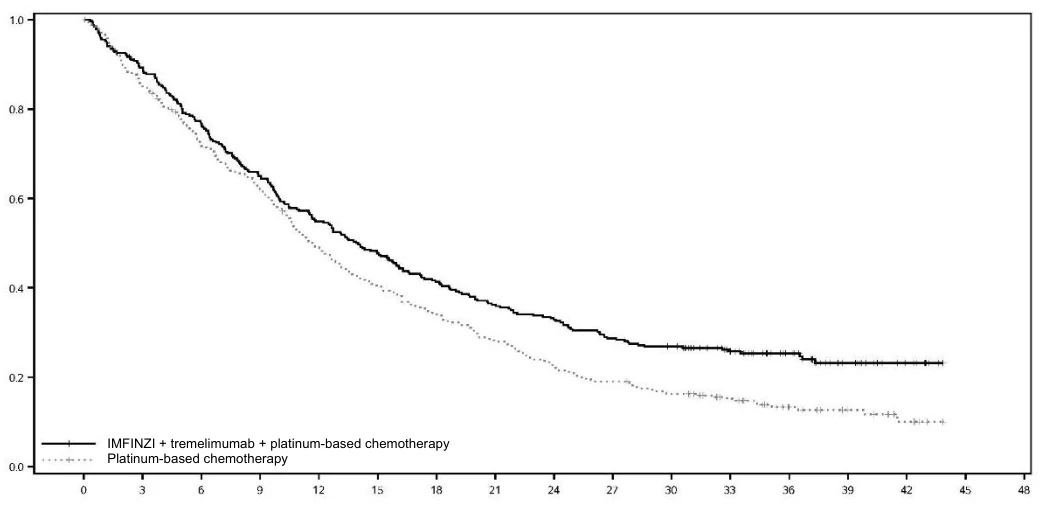
Limited-Stage Small Cell Lung Cancer (LS-SCLC)
The efficacy of IMFINZI was evaluated in ADRIATIC, a randomized, double-blind, placebo-controlled, multicenter study in 730 patients with histologically or cytologically confirmed LS-SCLC (Stage I to III according to AJCC, 8th edition) whose disease had not progressed following concurrent chemoradiation therapy (cCRT). Patients who had Stage I or II disease had to be medically inoperable as determined by the investigator. Eligible patients completed cCRT consisting of 4 cycles of platinum-based chemotherapy and either 60-66 Gy once daily over 6 weeks or 45 Gy twice daily over 3 weeks radiation therapy, within 42 days prior to the first dose of IMFINZI or placebo. Prophylactic cranial irradiation (PCI) could be delivered at the discretion of the investigator after cCRT and had to be completed within 42 days prior to the first dose of IMFINZI or placebo.
The study excluded patients with active or prior documented autoimmune disease within 5 years of initiation into the study; a history of active primary immunodeficiency; a history of Grade ≥2 pneumonitis or active tuberculosis or hepatitis B or C or HIV infection and patients with active interstitial lung disease. Patients with mixed SCLC and NSCLC histology were also excluded.
Randomization was stratified by stage (I/II versus III) and receipt of PCI (yes versus no) (see Table 45). Patients were randomized 1:1:1 to receive IMFINZI monotherapy, IMFINZI in combination with another agent, or placebo. All study medications were administered intravenously. The evaluation of efficacy relied on comparison between Arm 1 IMFINZI monotherapy (n=264) and Arm 2 Placebo (n=266).
IMFINZI + tremelimumab + platinum-based chemotherapy
Platinum-based chemotherapy
Probability of OS
Time from randomization (months)
Treatment continued until disease progression, until unacceptable toxicity, or for a maximum of 24 months. Tumour assessments were conducted every 8 weeks for the first 72 weeks, then every 12 weeks up to 96 weeks, and then every 24 weeks thereafter.
Table 45 – Summary of Patient Demographics in LS-SCLC (ADRIATIC)
| Study # | Study design | Dosage, route of administration, and duration | Study subjects (n) | Mean age (Range) | Sex |
|---|---|---|---|---|---|
D933QC00001 (ADRIATIC) | Phase III, randomized, double-blind, placebo-controlled, multi-center study | Arm 1: IMFINZI 1500 mg every 4 weeks, intravenouslya or Arm 2: placebo every 4 weeks, intravenouslyb | IMFINZI: 264 patients Placebo: 266 patients | 62 (28-84) | F: 30.9% M: 69.1% |
a IMFINZI 1500 mg in combination with placebo every 4 weeks for 4 cycles, followed by IMFINZI 1500 mg every 4 weeks until disease progression, unacceptable toxicity, or for a maximum of 24 months.
b Placebo in combination with second placebo every 4 weeks for 4 cycles, followed by a single placebo every 4 weeks until disease progression, unacceptable toxicity, or for a maximum of 24 months.
The baseline demographics and disease characteristics for patients in the IMFINZI and placebo arms were as follows: male (69.1%); age ≥ 65 years (39.2%); White (50.4%), Black or African American (0.8%), Asian (47.5%), other race (1.3%), Hispanic or Latino (4.2%); current smoker (22.3%), past smoker (68.5%), never smoker (9.2%); WHO/ECOG PS 0 (48.7%), WHO/ECOG PS 1 (51.3%); Stage I (3.6%), Stage II (9.1%), Stage III (87.4%).
Prior to randomization, all patients received platinum-based chemotherapy (66.2% cisplatin-etoposide, 33.8% carboplatin-etoposide), with 88.3% of patients receiving 4 cycles; 72.1% of patients received once daily (QD) radiation (of which 92.4% received ≥60 - ≤66 Gy QD); 27.9% received twice daily (BID) radiation (of which 96.6% received 45 Gy BID) and 53.8% patients received PCI.
The primary endpoints of the study were overall survival (OS) and progression-free survival (PFS) assessed by BICR according to RECIST v1.1.
- The study demonstrated a statistically significant and clinically meaningful improvement in both OS and PFS for IMFINZI compared with placebo. Efficacy results are presented in Table 46, Figure 11, and Figure 12.
Table 46 – Efficacy results for the ADRIATIC study
IMFINZI (N=264) | Placebo (N=266) | |||||||
|---|---|---|---|---|---|---|---|---|
| OS | ||||||||
| Number of deaths (%) | 115 (43.6) | 146 (54.9) | ||||||
| Median OS (months) (95% CI)a | 55.9 (37.3, NR) | 33.4 (25.5, 39.9) | ||||||
| HR (95% CI)b | 0.73 (0.57, 0.93) | |||||||
| p-valuec | 0.0104 | |||||||
| PFSd | ||||||||
| Number of events (%) | 139 (52.7) | 169 (63.5) | ||||||
| Median PFS (months) (95% CI)a | 16.6 (10.2, 28.2) | 9.2 (7.4, 12.9) | ||||||
| HR (95% CI)e | 0.76 (0.61, 0.95) | |||||||
| p-valuec | 0.0161 | |||||||
a Calculated using the Kaplan Meier technique. CI for median derived based on Brookmeyer-Crowley method.
b Based on Cox proportional hazards model stratified for receipt of PCI.
c 2-sided p-value based on stratified log-rank test compared with a boundary to declare statistical significance of 0.0168 for OS and 0.0281 for PFS (Lan-DeMets spending function approximating O’Brien Fleming boundary) for interim analysis.
d Assessed by BICR according to RECIST v1.1.
e Based on Cox proportional hazards model stratified for TNM stage and receipt of PCI.
Figure 11 – Kaplan-Meier Curve of OS (ADRIATIC)
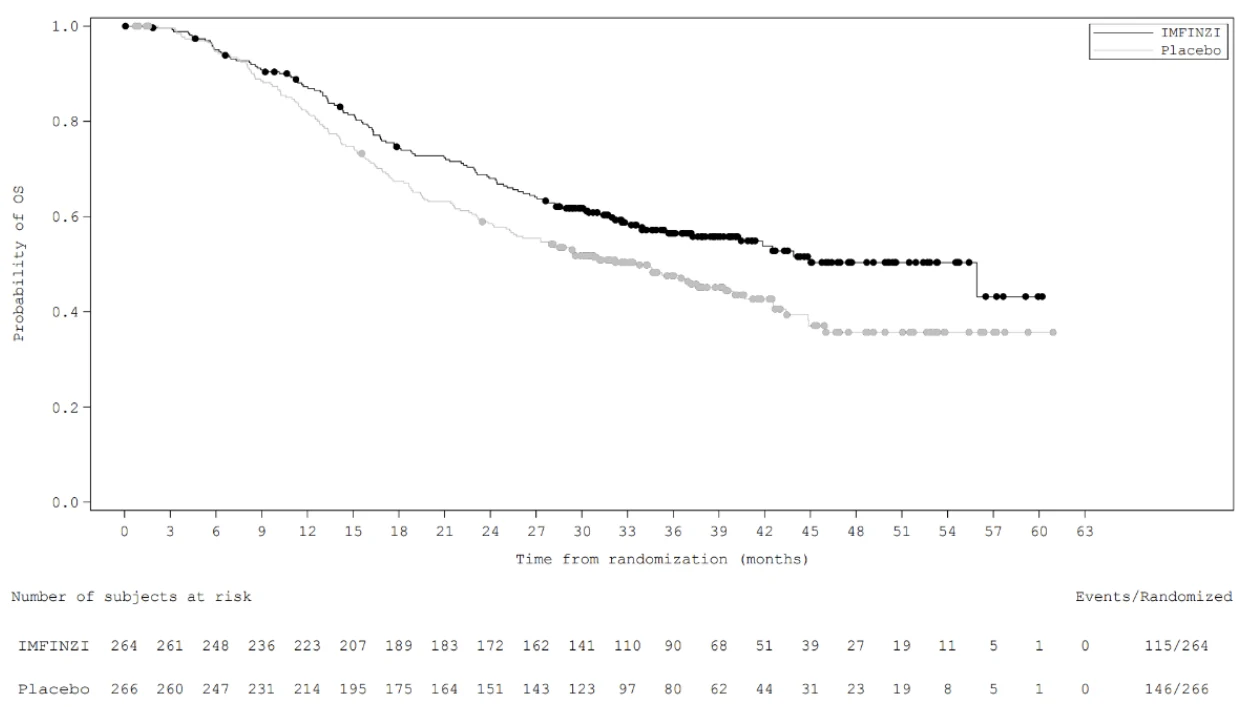
Figure 12 – Kaplan-Meier Curve of PFS (ADRIATIC)
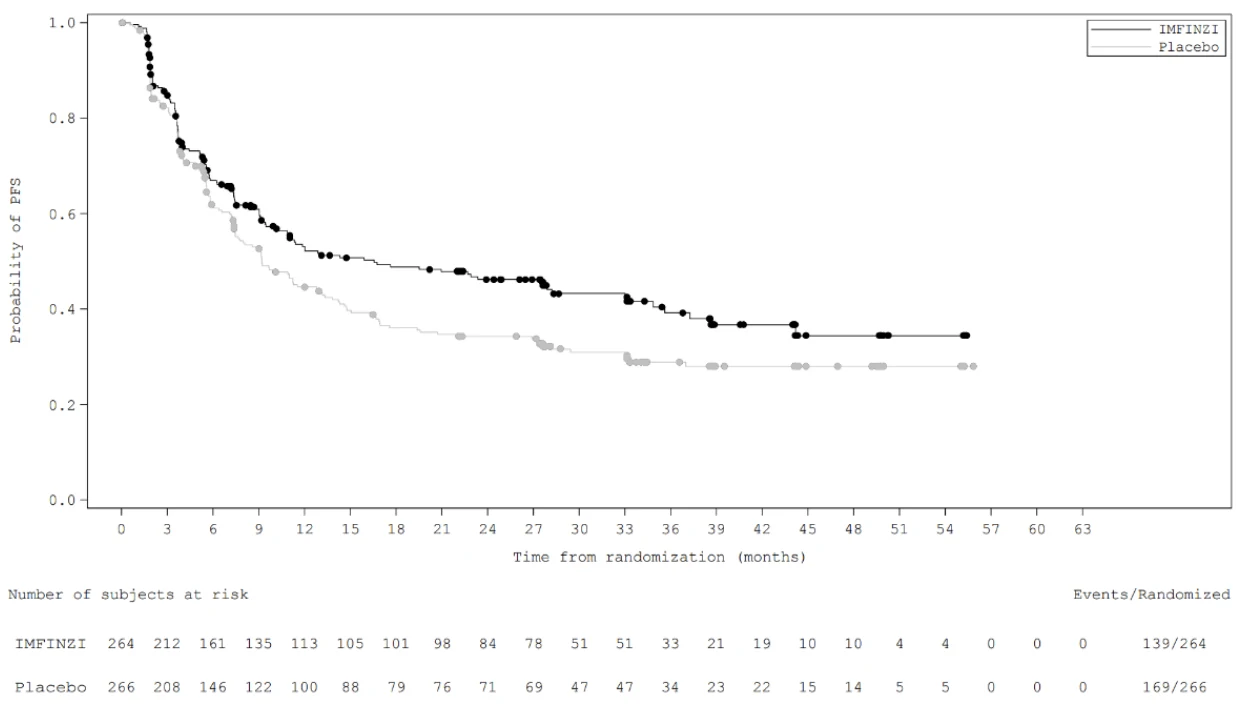
Extensive-Stage Small Cell Lung Cancer (ES-SCLC)
The efficacy of IMFINZI in combination with etoposide and either carboplatin or cisplatin was investigated in CASPIAN, a randomized, open-label, multicenter study in treatment-naïve ES-SCLC patients. Eligible patients had WHO/ECOG Performance status of 0 or 1, suitable to receive a platinum-based chemotherapy regimen as first-line treatment for SCLC, a life expectancy ≥12 weeks, at least one target lesion by RECIST 1.1 and adequate organ and bone marrow function. Patients with asymptomatic or treated brain metastases were eligible. The study excluded patients with a history of chest radiation therapy; prior exposure to immune checkpoint inhibitors; a history of allogeneic organ transplantation; a history of active primary immunodeficiency; autoimmune disorders including paraneoplastic syndrome (PNS); active or prior documented autoimmune or inflammatory disorders; use of systemic immunosuppressants within 14 days before the first dose of the treatment except physiological dose of systemic corticosteroids; active tuberculosis or hepatitis B or C or HIV infection; or patients receiving live attenuated vaccine within 30 days before or after the start of IMFINZI.
Randomization (see Table 47) was stratified by the planned platinum-based therapy in cycle 1 (carboplatin or cisplatin).
Administration of IMFINZI monotherapy was permitted beyond disease progression if the patient was clinically stable and deriving clinical benefit as determined by the investigator.
Table 47 – Summary of Patient Demographics in ES-SCLC (CASPIAN)
| Study # | Study design | Dosage, route of administration and duration | Study subjects (n) | Mean age (Range) | Sex |
| D419QC00001 (CASPIAN) | Phase III, randomized, open-label, multicenter study | IMFINZI 1500 mg + etoposide and either carboplatin or cisplatina or etoposide and either carboplatin or cisplatinb | 537 | 63 years (28-82 years) | M: 374 (69.6%) F: 163 (30.4%) |
a IMFINZI 1500 mg, and investigator’s choice of carboplatin (AUC 5 or 6 mg/mL/min) or cisplatin (75-80 mg/m2) on Day 1 and etoposide (80-100 mg/m2) intravenously on Days 1, 2, and 3 of each 21-day cycle for 4 cycles, followed by IMFINZI 1500 mg every 4 weeks until disease progression or unacceptable toxicity
b Investigator’s choice of carboplatin (AUC 5 or 6 mg/mL/min) or cisplatin (75-80 mg/m2) on Day 1 and etoposide (80-100 mg/m2) intravenously on Days 1, 2, and 3 of each 21-day cycle, up to 6 cycles. After completion of chemotherapy, prophylactic cranial irradiation (PCI) may be administered per investigator discretion.
Additional demographics and baseline disease characteristics are presented in Table 48.
Table 48 – Patient Demographics and Baseline Disease Characteristics, CASPIAN (Full Analysis Set)
| CASPIAN | ||
|---|---|---|
| Demographic/Disease Characteristic | IMFINZI + etoposide and either carboplatin or cisplatin (N=268) | etoposide and either carboplatin or cisplatin (N=269) |
| Age group (years), n (%) | ||
| <50 | 10 (3.7) | 20 (7.4) |
| ≥50 to <65 | 157 (58.6) | 137 (50.9) |
| ≥65 to <75 | 82 (30.6) | 90 (33.5) |
| ≥75 | 19 (7.1) | 22 (8.2) |
| Race, n (%) | ||
| Caucasian | 229 (85.4) | 221 (82.2) |
| Black or African-American | 2 (0.7) | 3 (1.1) |
| Asian | 36 (13.4) | 42 (15.6) |
| Other | 1 (0.4) | 2 (0.7) |
| Missing | 0 | 1 (0.4) |
| Smoking/nicotine history, n (%) | ||
| Current smoker | 120 944.8) | 126 (46.8) |
| Former smoker | 126 (47.0) | 128 (47.6) |
| Never smoker | 22 (8.2) | 15 (5.6) |
WHO/ECOG performance status, n (%) | ||
| 99 (36.9) | 90 (33.5) |
| 169 (63.1) | 179 (66.5) |
| Brain/CNS metastases | 28 (10.4) | 27 (10.0) |
| Staginga | ||
| IIIb | 1 (0.4) | 0 |
| IIIA | 5 (1.9) | 3 (1.1) |
| IIIB | 22 (8.2) | 21 (7.8) |
| IV | 240 (89.6) | 245 (91.1) |
a AJCC staging: Stage IV combines Stage IV/Stage IVA/Stage IVB from eCRF [PATHGEN] module.
b For the 1 Stage III patient, the TNM indicated Stage IIIb although the data were not reported this way.
Of all randomized patients, 24.6% received cisplatin and 74.1% received carboplatin. In the chemotherapy group, 56.8% of the patients received 6 cycles of treatment and 7.8% of patients received PCI.
The primary efficacy endpoint supporting the ES-SCLC indication was overall survival (OS) of IMFINZI + chemotherapy versus chemotherapy alone. Additional efficacy outcome measures include progression-free survival (PFS) and investigator-assessed objective response rate (ORR), per RECIST v1.1.
The study demonstrated a statistically significant improvement in OS with IMFINZI + chemotherapy vs. chemotherapy alone (HR=0.73 [95% CI: 0.591, 0.909], p=0.0047).
The OS results are summarized in Table 49.
Table 49 – OS Results in ES-SCLC Patients Treated with IMFINZI in Combination with Etoposide and Carboplatin or Cisplatin in the CASPIAN Study
IMFINZI + etoposide and either carboplatin or cisplatin (N=268) | Etoposide and either carboplatin or cisplatin (N=269) | ||||||
|---|---|---|---|---|---|---|---|
| OS | |||||||
| Number of deaths (%) | 155 (57.8) | 181 (67.3) | |||||
Median OS (months) (95% CI) | 13.0 (11.5, 14.8) | 10.3 (9.3, 11.2) | |||||
| HR (95% CI)a | 0.73 (0.591, 0.909) | ||||||
| p-valueb | 0.0047 | ||||||
a The analysis was performed using the stratified log-rank test, adjusting for planned platinum therapy in Cycle 1 (carboplatin or cisplatin), and using the rank tests of association approach.
b At a pre-specified interim analysis, 336 OS events (79% of total planned events) were observed, and the boundary for declaring efficacy (0.0178) was determined by a Lan-Demets alpha spending function with O’Brien Fleming type boundary.
Figure 13 – Kaplan-Meier curve of OS (CASPIAN)
| Number of patients at risk | 0 | 3 | 6 | 9 | 12 | 15 | 18 | 21 | 24 |
| IMFINZI + chemotherapy | 268 | 244 | 214 | 177 | 116 | 57 | 25 | 5 | 0 |
| chemotherapy | 269 | 242 | 209 | 153 | 82 | 44 | 17 | 1 | 0 |
Investigator-assessed PFS (96% of total planned events) showed a HR of 0.78 (95% CI: 0.65, 0.94), with median PFS of 5.1 months (95% CI: 4.7, 6.2) in the IMFINZI plus chemotherapy arm and 5.4 months (95% CI: 4.8, 6.2) in the chemotherapy alone arm. The investigator-assessed
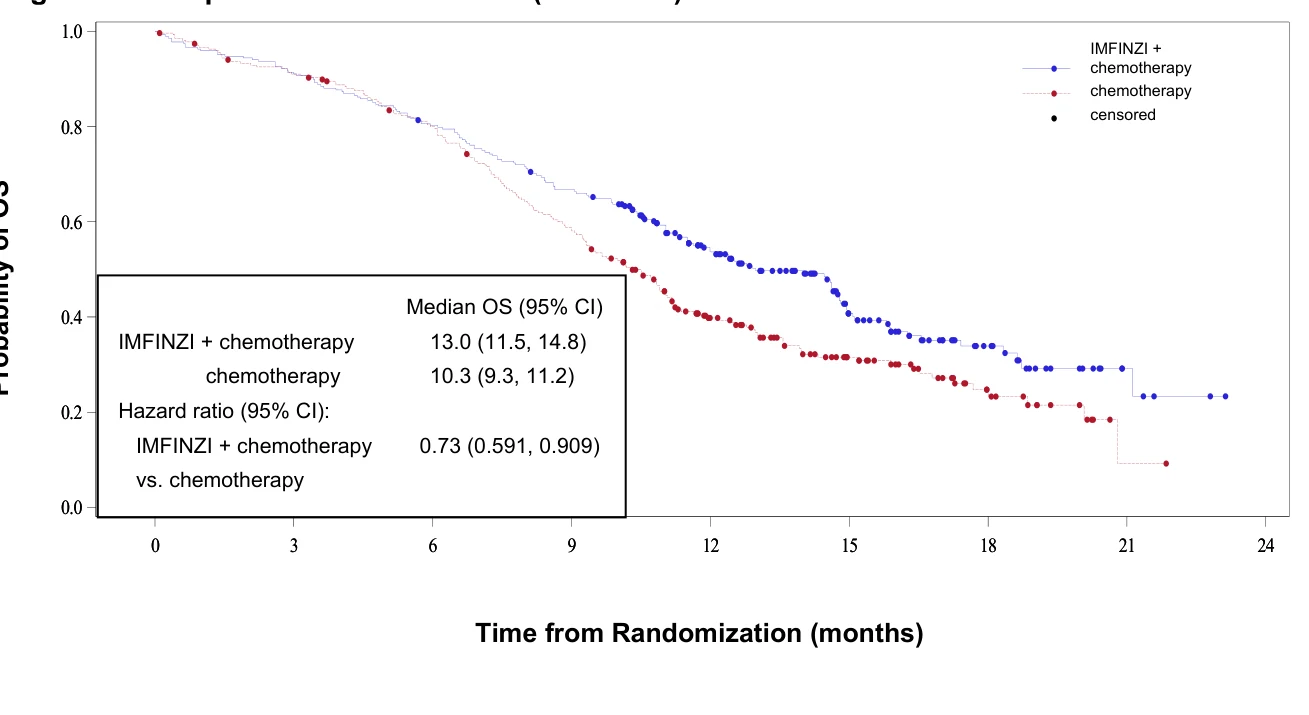
IMFINZI + chemotherapy chemotherapy censored
Time from Randomization (months)
Probability of OS
Median OS (95% CI)
IMFINZI + chemotherapy 13.0 (11.5, 14.8)
chemotherapy 10.3 (9.3, 11.2)
Hazard ratio (95% CI):
IMFINZI + chemotherapy 0.73 (0.591, 0.909)
vs. chemotherapy
confirmed ORR was 68% (95% CI: 62%, 73%) in the IMFINZI plus chemotherapy arm and 58% (95% CI: 52%, 63%) in the chemotherapy alone arm.
In an exploratory subgroup analyses of OS based on the planned platinum chemotherapy received at cycle 1, the HR was 0.70 (95% CI 0.55, 0.89) in patients who received carboplatin, and the HR was 0.88 (95% CI 0.55, 1.41) in patients who received cisplatin.
Locally Advanced or Metastatic Biliary Tract Cancer
TOPAZ-1 (D933AC00001) was a study designed to evaluate the efficacy of IMFINZI in combination with chemotherapy (gemcitabine and cisplatin). TOPAZ-1 was a phase III, randomised, double-blind, placebo-controlled, multicentre study in 685 patients with histologically confirmed locally advanced or metastatic BTC and ECOG performance status of 0 or 1. Patients who developed recurrent disease more than 6 months after surgery and/or completion of adjuvant therapy were included. Patients must have had at least one target lesion by RECIST v1.1 and adequate organ and bone marrow function. The study excluded patients with ampullary carcinoma, active or prior documented autoimmune or inflammatory disorders, HIV infection or active infections, including tuberculosis or hepatitis C or patients with current or prior use of immunosuppressive medication within 14 days before the first dose of IMFINZI.
Randomization (see Table 50) was stratified by disease status and primary tumour location.
Tumour assessments were conducted every 6 weeks for the first 24 weeks after the date of randomization, and then every 8 weeks until confirmed objective disease progression.
Table 50 – Summary of Patient Demographics in BTC (TOPAZ-1)
| Study # | Study design | Dosage, route of administration and duration | Study subjects (n) | Mean age (Range) | Sex |
| D933AC0000 1 (TOPAZ-1) | Phase III, randomized, double-blind placebo controlled, multi-centre, international study | gemcitabine and cisplatin + IMFINZI 1500 mga or gemcitabine and cisplatin + Placebob | 685 | 62 years (20-84 years) | M: 345 (50.4%) F: 340 (49.6%) |
a IMFINZI 1500 mg administered intravenously on Day 1 + gemcitabine 1000 mg/m2 and cisplatin 25 mg/m2 (each administered on Days 1 and 8) every 3 weeks (21 days) for up to 8 cycles, followed by IMFINZI 1500 mg every 4 weeks as long as clinical benefit is observed or until unacceptable toxicity.
b Placebo administered intravenously on Day 1 + gemcitabine 1000 mg/m2 and cisplatin 25 mg/m2 (each administered on Days 1 and 8) every 3 weeks (21 days) for up to 8 cycles, followed by placebo every 4 weeks as long as clinical benefit is observed or until unacceptable toxicity.
The demographics and baseline disease characteristics were well balanced between the two study arms (341 patients in Arm 1 and 344 patients in Arm 2). Baseline demographics of the overall study population were as follows: male (50.4%), age <65 years (53.3%), White (37.2%), Asian (56.4%), Black or African American (2.0%), other (4.2%), ECOG PS 0 (49.1%), vs. PS 1 (50.9%), primary tumour location [intrahepatic cholangiocarcinoma(55.9%), extrahepatic cholangiocarcinoma (19.1%) and gallbladder cancer (25.0%)], disease status [recurrent (19.1%) vs. initially unresectable (80.7%), metastatic (86.0%) vs. locally advanced (13.9%)].
The primary endpoint of the study was OS and the key secondary endpoint was PFS. Other secondary endpoints were ORR, DoR and PRO. PFS, ORR and DoR were Investigator assessed according to RECIST v1.1.
IMFINZI + chemotherapy (Arm 1) demonstrated a clinically meaningful and statistically significant improvement vs. placebo + chemotherapy (Arm 2) in OS [HR=0.80, (95% CI: 0.66, 0.97), p=0.021] and in PFS [HR=0.75, (95% CI: 0.63, 0.89), p=0.001]. Results are summarized in Table 51 and Figure 14.
Table 51 – Efficacy Results for the TOPAZ-1 Study
IMFINZI + gemcitabine and cisplatin (n=341) | Placebo + gemcitabine and cisplatin (n=344) | |||||||
|---|---|---|---|---|---|---|---|---|
| OS | ||||||||
| Number of deaths (%) | 198 (58.1) | 226 (65.7) | ||||||
| Median OS (months) (95% CI)a | 12.8 (11.1, 14) | 11.5 (10.1, 12.5) | ||||||
| HR (95% CI)b | 0.80 (0.66, 0.97) | |||||||
| p-valueb | 0.021 | |||||||
| PFS | ||||||||
| Number of events (%) | 276 (80.9) | 297 (86.3) | ||||||
| Median PFS (months) (95% CI)a | 7.2 (6.7, 7.4) | 5.7 (5.6, 6.7) | ||||||
| HR (95% CI)b | 0.75 (0.63, 0.89) | |||||||
| p-valueb | 0.001 | |||||||
| ORR n (%)c | 91 (26.7) | 64 (18.7) | ||||||
OS and PFS were formally tested at a pre-planned interim analysis. The maturity for OS was 62% and the maturity for PFS was 84%.
a Calculated using the Kaplan-Meier technique. CI for median derived based on Brookmeyer-Crowley method.
b The analysis for HR was performed using a stratified Cox proportional hazards model and 2-sided p-value is based on a stratified log-rank test, both are adjusted for disease status and primary tumor location.
c Confirmed objective response
Figure 14 – Kaplan-Meier curve of OS IA2 (TOPAZ-1)
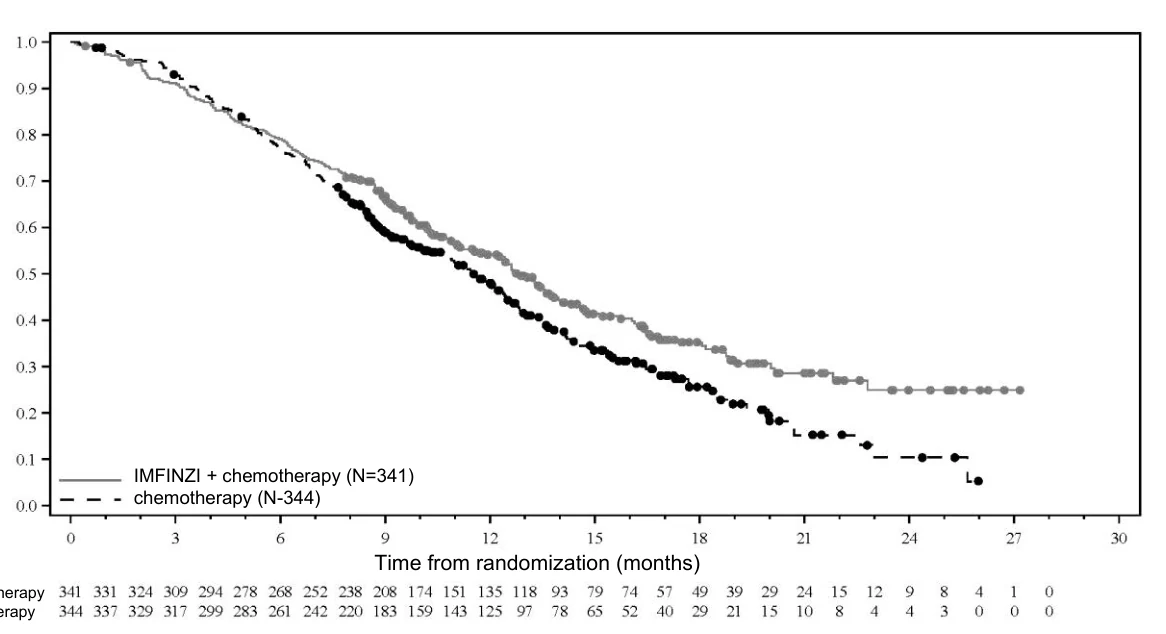
Unresectable Hepatocellular Carcinoma
The efficacy of IMFINZI and IMFINZI in combination with tremelimumab was evaluated in the HIMALAYA study, a randomised, open-label, multicenter study in patients with confirmed uHCC who did not receive prior systemic treatment for HCC. The study included patients with BCLC Stage C or B (not eligible for locoregional therapy), Child-Pugh Score Class A, and ECOG performance status of 0 or 1.
The study excluded patients with co-infection of viral hepatitis B and hepatitis C; active or prior documented gastrointestinal (GI) bleeding within 12 months; ascites requiring non-pharmacologic intervention within 6 months; hepatic encephalopathy within 12 months before the start of treatment; main portal vein thrombosis; history of or current brain metastases or spinal cord compression; active or prior documented autoimmune or inflammatory disorders; history of allogeneic organ transplantation (e.g., liver transplant), and Child-Pugh Score Class B and C. Patients did not require an esophagogastroduodenoscopy prior to enrollment. For patients with a history of GI bleeding for more than 12 months or assessed as high risk for esophageal varices by the Investigator, adequate endoscopic therapy according to institutional standards was required.
Patients were randomized (1:1:1) to the IMFINZI plus tremelimumab arm, the IMFINZI alone arm and the sorafenib arm (See Table 52). Randomization was stratified by macrovascular invasion (MVI) (yes vs. no), etiology of liver disease (confirmed hepatitis B virus vs. confirmed hepatitis C virus vs. others) and ECOG performance status (0 vs. 1).
IMFINZI + chemotherapy (N=341)
chemotherapy (N-344)
Probabi l i ty of OS
Time from randomization (months)
Number at risk
IMFINZI + chemotherapy
chemotherapy
Table 52 – Summary of Patient Demographics in Unresectable Hepatocellular Carcinoma (HIMALAYA)
| Study # | Study design | Dosage, route of administration and duration | Study subjects (n) | Mean age (range) | Sex |
D419CC00002 (HIMALAYA) | Phase III, randomized, open-label, multicenter, international study | IMFINZI in combination with tremelimumab: tremelimumab 300 mg as a single priming dose + IMFINZI 1500 mg; followed by IMFINZI 1500 mg every 4 weeks, intravenous Or IMFINZI 1500 mg every 4 weeks, intravenous Or sorafenib 400 mg twice daily, oral | IMFINZI in combination with tremelimumab: 393 IMFINZI monotherapy: 389 sorafenib: 389 | 63 years (18-88 years) | Male: 987/1171 (84.3%) Female: 184/1171 (15.7%) |
Treatment continued until disease progression or unacceptable toxicity. Study treatment was permitted beyond disease progression if the patient was clinically stable and was deriving clinical benefit as determined by the investigator.
The primary objective was to assess the overall survival (OS) between the IMFINZI plus tremelimumab arm versus the sorafenib arm for superiority. The key secondary objectives were to assess OS between the IMFINZI arm versus the sorafenib arm for non-inferiority followed by superiority. Other secondary endpoints included investigator-assessed progression-free survival (PFS) according to RECIST v 1.1. Tumor assessments were conducted every 8 weeks for the first 12 months and then every 12 weeks thereafter.
The baseline demographics of the overall study population were as follows: male (83.7%), age <65 years (50.4%), median age of 64 years (range: 18 to 88 years), white (44.6%), Asian (50.7%), black or African American (1.7%), ECOG PS 1 (37.2%), Child-Pugh Class score A (99.5%), BCLC Stage B (19.2%), BCLC Stage C (80.8%), macrovascular invasion (25.2%), extrahepatic spread (53.4%), viral etiology [hepatitis B (30.6%), hepatitis C (27.2%), uninfected (42.2%)], Albumin-Bilirubin (ALBI) score 2 (46.8%), ALBI score 3 (0.5%) and alpha-fetoprotein (AFP) ≥400 ng/mL (34.5%).
The efficacy results for IMFINZI plus tremelimumab vs. sorafenib, and IMFINZI monotherapy vs. sorafenib are presented in Table 53 and Figure 15.
Table 53 – Efficacy Results in Unresectable Hepatocellular Carcinoma, HIMALAYA (Full analysis set)
| IMFINZI plus tremelimumab (n=393) | IMFINZI monotherapy (n=389) | Sorafenib (n=389) | |||||||||||
|---|---|---|---|---|---|---|---|---|---|---|---|---|---|
| Follow up duration | |||||||||||||
| Median follow up (months) | 33.2 | 32.6 | 32.2 | ||||||||||
| Range | 31.7-34.5 | 31.6-33.7 | 30.4-33.7 | ||||||||||
| OS | |||||||||||||
| Number of deaths (%) | 262 (66.7) | 280 (72.0) | 293 (75.3) | ||||||||||
Median OS (months) (95% CI) | 16.4 (14.2-19.6) | 16.6 (14.1-19.1) | 13.8 (12.3-16.1) | ||||||||||
| HR vs. sorafenib (95% CI)a | 0.76 (0.64, 0.90) | 0.83 (0.70, 0.98) | - | ||||||||||
| p-valueb | 0.0013c | 0.0293d,e | - | ||||||||||
| PFS | |||||||||||||
| Number of events (%) | 335 (85.2) | 345 (88.7) | 327 (84.1) | ||||||||||
Median PFS (months) (95% CI) | 3.78 (3.68-5.32) | 3.65 (3.19-3.75) | 4.07 (3.75-5.49) | ||||||||||
| HR vs. sorafenib (95% CI)a | 0.89 (0.76, 1.04) | 1.00 (0.86, 1.17) | - | ||||||||||
a Based on a stratified Cox proportional hazard model adjusting for baseline covariates (Extrahepatic Spread, Albumin-Bilirubin score, Alpha Fetoprotein, and Barcelona Clinic Liver Cancer Staging).
b A hierarchical procedure was used to control overall type I error.
c Statistically significant superiority for IMFINZI in combination with tremelimumab compared with sorafenib.
d When compared to sorafenib, IMFINZI monotherapy met the pre-defined non-inferiority margin of 1.08.
e Additional analysis, which adjusted for baseline covariates, demonstrated clinically meaningful treatment benefit in terms of OS for IMFINZI monotherapy compared to sorafenib.
NR=Not Reached, CI=Confidence Interval
Figure 15 – Kaplan-Meier curve of OS for IMFINZI monotherapy and IMFINZI in combination with tremelimumab vs. sorafenib (Full analysis set)
In an exploratory OS analysis, controlling for EHS, ALBI, Alpha-Fetoprotein and BCLC staging, between the IMFINZI plus tremelimumab arm versus the sorafenib arm for the subgroups defined by the stratification factor of etiology status (HCV, HBV and Others), the HRs are 0.92 (95% CI: 0.65, 1.30), 0.60 (95% CI: 0.44, 0.81) and 0.78 (95% CI: 0.60, 1.01), respectively. In an exploratory OS analysis, controlling for EHS, ALBI, Alpha-Fetoprotein and BCLC staging, between the IMFINZI monotherapy arm versus the sorafenib arm for the subgroups defined by the stratification factor of etiology status (HCV, HBV and Others), the HRs are 0.94 (95% CI: 0.67, 1.32), 0.77 (95% CI: 0.57, 1.03) and 0.80 (95% CI: 0.62, 1.03), respectively.
Mismatch Repair Deficient (dMMR) Advanced or Recurrent Endometrial Cancer
IMFINZI was evaluated in combination with carboplatin and paclitaxel in DUO-E, a randomized, multicenter, double-blind, placebo-controlled trial in patients with advanced or recurrent endometrial cancer. The trial enrolled patients with newly diagnosed Stage III disease (with measurable disease per RECIST v1.1), or newly diagnosed Stage IV disease. The trial also enrolled patients with recurrent disease with a low potential for cure by radiation therapy or surgery. For patients with recurrent disease, prior chemotherapy was allowed only if it was administered in the adjuvant setting and at least 12 months had elapsed from the date of last dose of chemotherapy to the date of relapse. The trial included patients with epithelial endometrial carcinomas of all histologies, including carcinosarcomas. Patients with endometrial sarcoma were excluded, and patients who had brain metastases, active autoimmune disease or a medical condition that required immunosuppression were ineligible. A body weight > 30 kg was required for enrollment at study entry.
Randomization was stratified by tumor mismatch repair (MMR) status (proficient or deficient), disease status (recurrent or newly diagnosed), and geographic region (Asia or rest of the world). MMR status was prospectively assessed using an immunohistochemistry tumor tissue test.
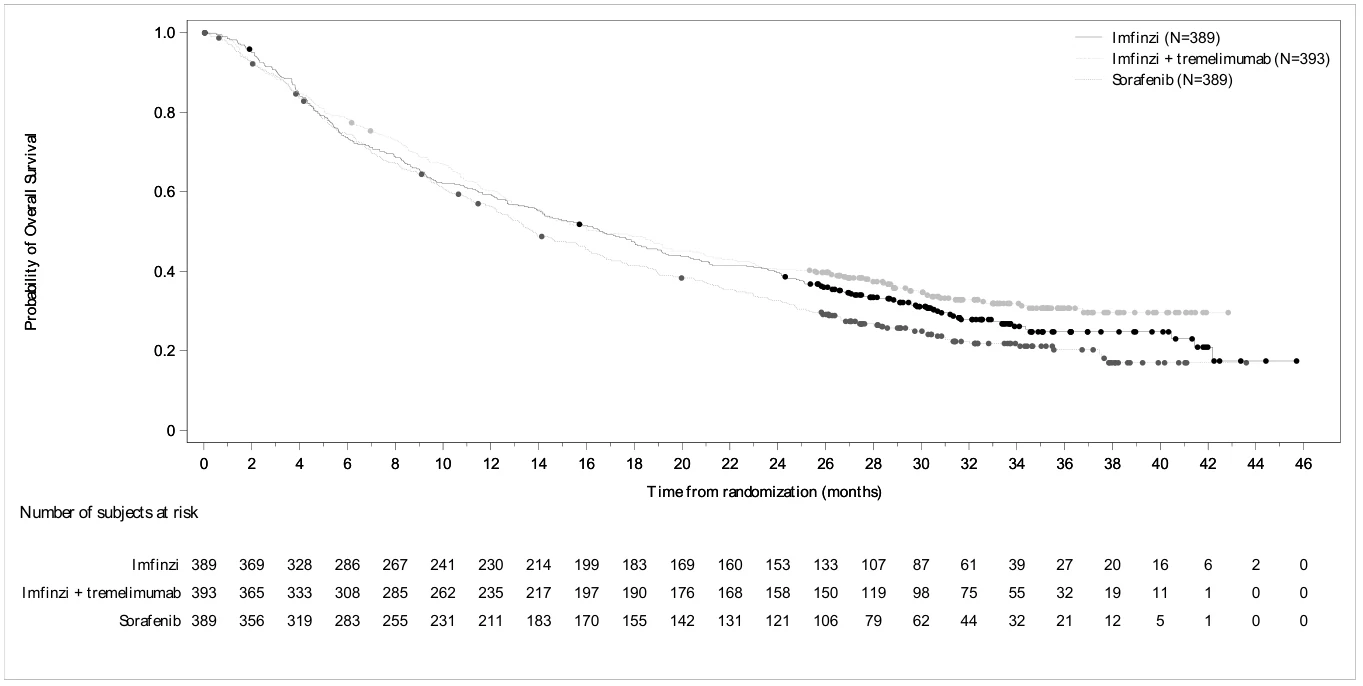
Patients were randomized (1:1:1) to one of the following treatment arms:
- IMFINZI 1120 mg in combination with carboplatin and paclitaxel every 3 weeks for a maximum of 6 cycles. If required due to safety and tolerability, a minimum of 4 cycles of platinum-based chemotherapy was permitted with the requirement to continue on with maintenance therapy. Following completion of chemotherapy treatment, patients received IMFINZI 1500 mg every 4 weeks as maintenance treatment until disease progression.
- Placebo in combination with carboplatin and paclitaxel every 3 weeks for a maximum of 6 cycles. Following completion of chemotherapy treatment, patients received placebo every 4 weeks as maintenance treatment until disease progression.
- An additional investigational combination regimen
Treatment was continued until RECIST v1.1-defined progression of disease or unacceptable toxicity. Assessment of tumour status was performed every 9 weeks for the first 18 weeks and every 12 weeks thereafter.
The primary endpoint was Progressive Free Survival (PFS), determined by investigator assessment using RECIST 1.1. Additional efficacy outcome measures included objective response rate (ORR), and overall survival (OS).
Table 54 – Summary of Patient Demographics in DUO-E
| Study # | Study design | Dosage, route of administration and duration | Study subjects (n) | Mean age (Range) | Sex |
| D9311C0000 1 (DUO-E) | Phase III, randomized, double-blind placebo controlled, multi-centre, international study | Durvalumaba + carboplatin and paclitaxelb or Placebo Durvalumaba + carboplatin and paclitaxelb or An additional investigational combination regimen | N=238 N=241 N=239 | 63.3 (22-84) 62.1 (31-85) 62.4 (27-86) | Female 100% Female 100% Female 100% |
a Durvalumab: 1120 mg intravenous Q3W for 6 cycles concomitant with paclitaxel and carboplatin, followed by 1500 mg intravenous Q4W as maintenance until progression
b Paclitaxel and carboplatin; Q3W for a maximum of 6 cycles
A total of 479 patients were randomized to the IMFINZI + carboplatin and paclitaxel and the placebo + carboplatin and paclitaxel study arms, of which 95 patients had dMMR tumors. The demographics and baseline disease characteristics for the 479 patients and the 95 patients with dMMR tumors are shown in Table 55.
Table 55 – Patient Demographics and Baseline Disease Characteristics (DUO-E)
| Demographic/Disease Characteristic | All Patients n (%) | dMMR Patients n (%) | |||||||||||||||||||
|---|---|---|---|---|---|---|---|---|---|---|---|---|---|---|---|---|---|---|---|---|---|
| IMFINZI + Carboplatin and Paclitaxel (N=238) | Placebo + Carboplatin and Paclitaxel (N=241) | IMFINZI + Carboplatin and Paclitaxel (N=46) | Placebo + Carboplatin and Paclitaxel (N=49) | ||||||||||||||||||
| Age (years) | |||||||||||||||||||||
| Median | 64.0 | 64.0 | 63.0 | 63.0 | |||||||||||||||||
| Min, Max | 22, 84 | 31, 85 | 45, 84 | 34, 85 | |||||||||||||||||
| Age group (years) | |||||||||||||||||||||
| <65 | 122 (51.3) | 124 (51.5) | 25 (54.3) | 25 (51.0) | |||||||||||||||||
| ≥65 | 116 (48.7) | 117 (48.5) | 21 (45.7) | 24 (49.0) | |||||||||||||||||
| Race | |||||||||||||||||||||
| White | 136 (57.1) | 143 (59.3) | 29 (63.0) | 30 (61.2) | |||||||||||||||||
| Black or African American | 11 (4.6) | 10 (4.1) | 0 | 2 (4.1) | |||||||||||||||||
| Asian | 72 (30.3) | 73 (30.3) | 14 (30.4) | 15 (30.6) | |||||||||||||||||
| Othera | 19 (8.0) | 15 (6.2) | 3 (6.5) | 2 (4.1) | |||||||||||||||||
| WHO/ECOG performance status | |||||||||||||||||||||
| 156 (65.5) | 156 (64.7) | 23 (50.0) | 29 (59.2) | |||||||||||||||||
| 81 (34.0) | 85 (35.3) | 23 (50.0) | 20 (40.8) | |||||||||||||||||
| Disease Statusb | |||||||||||||||||||||
| Newly Diagnosed | 113 (47.5) | 114 (47.3) | 22 (47.8) | 24 (49.0) | |||||||||||||||||
| Stage III | 17 (7.1) | 12 (5.0) | 7 (15.2) | 3 (6.1) | |||||||||||||||||
| Stage IV | 96 (40.3) | 101 (41.9) | 15 (32.6) | 21 (42.9) | |||||||||||||||||
| Recurrent Disease | 125 (52.5) | 127 (52.7) | 24 (52.2) | 25 (51.0) | |||||||||||||||||
| Histology Type | |||||||||||||||||||||
| Endometrioid | 141 (59.2) | 139 (57.7) | 33 (71.7) | 41 (83.7) | |||||||||||||||||
| Serous | 58 (24.4) | 54 (22.4) | 2 (4.3) | 2 (4.1) | |||||||||||||||||
| Other | 39 (16.4) | 48 (19.9) | 11 (23.9) | 6 (12.2) | |||||||||||||||||
| PD-L1 Expressionc | |||||||||||||||||||||
| Positive | 170 (71.4) | 163 (67.6) | 37 (80.4) | 39 (79.6) | |||||||||||||||||
| Negative | 61 (25.6) | 75 (31.1) | 8 (17.4) | 8 (16.3) | |||||||||||||||||
| Unknown | 7 (2.9) | 3 (1.2) | 1 (2.2) | 2 (4.1) | |||||||||||||||||
a Native Hawaiian or Other Pacific Islander, American Indian or Alaska Native, not reported.
b Disease status (recurrent vs. newly diagnosed) is as collected on the eCRF.
c PD-L1 positive: tumour area positivity (TAP) score ≥1%; PD-L1 negative: TAP score <1%
The study demonstrated a statistically significant improvement in PFS (HR 0.71; 95% CI: 0.57, 0.89; 2-sided p = 0.003), for patients treated with IMFINZI + carboplatin and paclitaxel compared to placebo + carboplatin and paclitaxel alone in the overall population. PFS improvement in the overall population was primarily attributed to patients with dMMR tumors. OS was 31% mature at the time of the first interim analysis.
The pre-specified exploratory efficacy results for patients with dMMR tumors are presented in Table 56 and Figure 16. In this subpopulation, the OS results at the time of the first interim analysis were 26% mature with 7 deaths (15.2%) in the IMFINZI + carboplatin and paclitaxel arm and 18 deaths (36.7%) in the placebo + carboplatin and paclitaxel arm. The median OS was not reached in the IMFINZI + carboplatin and paclitaxel arm and 23.7 months in the placebo + carboplatin and paclitaxel arm. Of patients with measurable disease at baseline, ORR was 71.4% among the 42 patients in the IMFINZI + carboplatin and paclitaxel arm, consisting of 12 (28.6%) complete responses and 18 (42.9%) partial responses; among the 42 patients in the placebo + carboplatin and paclitaxel arm ORR was 40.5% consisting of 4 (9.5%) complete responses and 13 (31.0%) partial responses.
Table 56 – Efficacy Results in dMMR Endometrial Cancer patients, DUO-E
IMFINZI + Carboplatin and Paclitaxel n=46 | Placebo + Carboplatin and Paclitaxel n=49 | ||||||||
|---|---|---|---|---|---|---|---|---|---|
| PFSa | |||||||||
| Number of events (%) | 15 (32.6) | 25 (51.0) | |||||||
| Median PFS (months) (95% CI) | NR (NR-NR) | 7.0 (6.7-14.8) | |||||||
| HR b (95% CI) | 0.42 (0.22-0.80) | NA | |||||||
a Investigator assessed.
b Based on an unstratified Cox proportional hazard model
CI = Confidence Interval; NR = Not Reached; NA = Not Applicable.
Figure 16 – Kaplan-Meier curve of PFS for Patients with dMMR Tumors in DUO-E
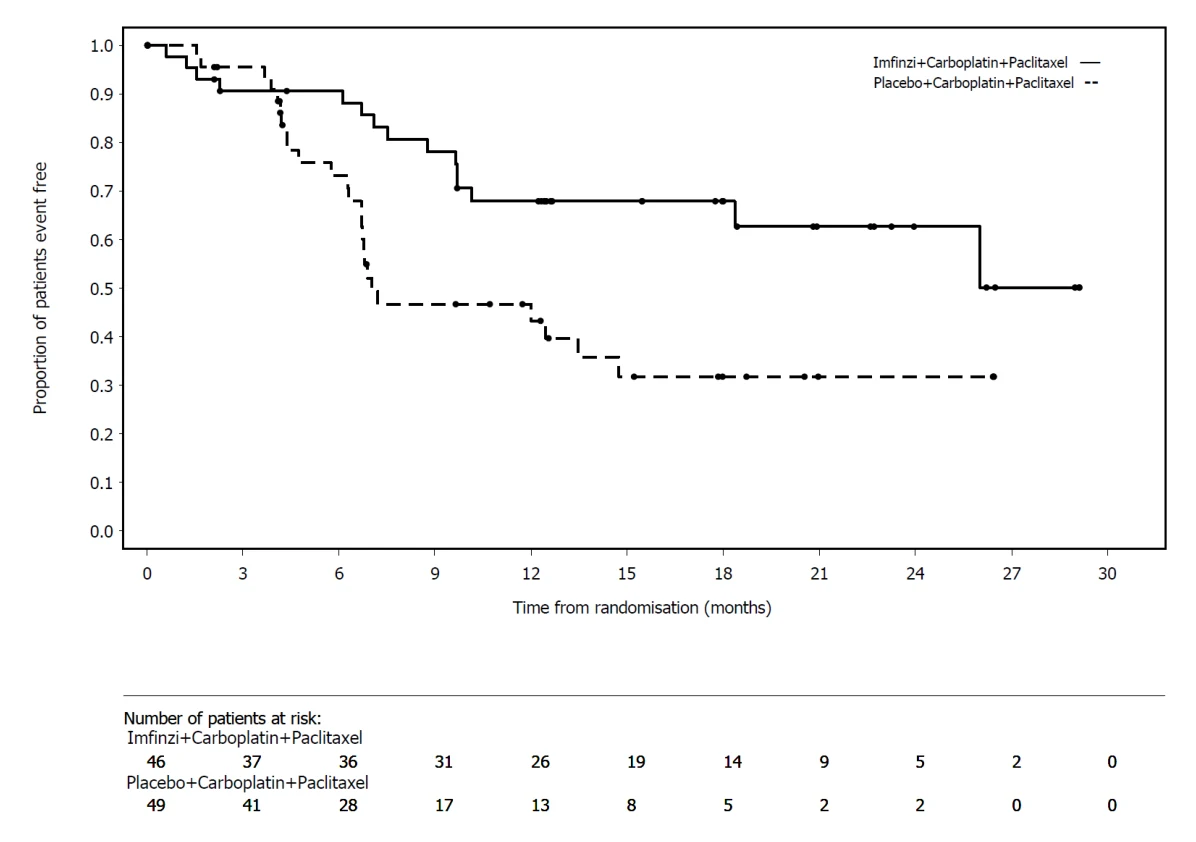
Resectable Gastric or Gastroesophageal Junction Adenocarcinoma
The efficacy of IMFINZI was evaluated in the MATTERHORN study, a randomized, double-blind, placebo-controlled, multicentre, Phase III study designed to evaluate the efficacy of IMFINZI in combination with FLOT chemotherapy as neoadjuvant and adjuvant treatment, followed by adjuvant IMFINZI monotherapy, in patients with resectable gastric or gastroesophageal junction adenocarcinoma.
The study enrolled previously untreated patients with resectable GC/GEJC, with no prior exposure to immune-mediated therapy and WHO/ECOG performance status of 0 or 1. Resectable GC/GEJC included Stage II to Stage IVA (> T2 N0-3 M0 or T0-4 N1-3 M0) according to AJCC, 8th edition, at enrollment. GEJC included Siewert Type 2 and 3 tumours, with Siewert Type 1 tumour also eligible if the patient was intended to be treated in the same way as for Siewert Type 2 and 3 tumours. Patients were enrolled regardless of PD-L1 expression level, and prior to randomization patients had their tumour PD-L1 expression status confirmed using the Ventana PD-L1 (SP263) Assay. The study excluded patients with adenosquamous cell carcinoma, squamous cell carcinoma, or gastrointestinal stromal tumour, active or prior documented autoimmune or inflammatory disorders, or use of immunosuppressive medication within 14 days of the first dose of IMFINZI, or history of allogeneic organ transplantation, or uncontrolled intercurrent illness (e.g., active interstitial lung disease), and body weight ≤ 30 kg at enrollment.
Randomization was stratified by geographical region (Asia vs. non-Asia), clinical lymph node status (positive vs. negative), and PD-L1 expression status (Tumour Area Positivity score [TAP]<1% vs. TAP≥1%). Patients were randomized in a 1:1 ratio to receive neoadjuvant-adjuvant IMFINZI + FLOT chemotherapy followed by adjuvant IMFINZI monotherapy, or neoadjuvant-adjuvant placebo + FLOT chemotherapy followed by placebo.
Treatment was continued until disease progression that precluded definitive surgery, disease progression that led to incomplete surgery, disease recurrence or progression during adjuvant treatment, unacceptable toxicity, or completion of the treatment. If FLOT chemotherapy was discontinued due to treatment-related toxicity prior to surgery (neoadjuvant phase), patients proceeded to surgery when clinically feasible and the remaining neoadjuvant cycle was skipped; adjuvant IMFINZI monotherapy or placebo continued following surgery, based on investigator discretion. If FLOT chemotherapy was discontinued due to treatment-related toxicity after surgery (adjuvant phase), adjuvant IMFINZI monotherapy continued, based on investigator discretion. Crossover between the study arms was not permitted.
A baseline RECIST 1.1 tumour assessment was performed prior to the start of neoadjuvant therapy, with a follow-up scan prior to surgery within 4 weeks after the final chemotherapy dose. An adjuvant baseline scan was performed no sooner than 4 weeks after surgery and before starting the adjuvant treatment. Tumour assessments were conducted every 12 weeks (relative to the adjuvant baseline scan) for 2 years, then every 24 weeks until RECIST 1.1 defined radiological progression, consent withdrawal, or death.
The primary endpoint of the study was event-free survival (EFS) by BICR assessment and/or locally by pathology testing, defined as the time from randomization to the following: progression that precludes definitive surgery or requires non-protocol therapy, recurrence or progression, or death due to any cause. The key secondary endpoints were OS and pCR rate by blinded central pathology review. The trial was not designed to isolate the effect of IMFINZI in each phase (neoadjuvant, adjuvant, or the adjuvant IMFINZI monotherapy) of treatment.
Table 57 – Summary of Patient Demographics in Resectable GC/GEJC (MATTERHORN)
| Study # | Study design | Dosage, route of administration, and duration | Study subjects (n) | Mean age (Range) | Sex |
|---|---|---|---|---|---|
| D910GC00001 (MATTERHORN) | Phase III, randomized, double-blind, placebo-controlled, multicentre, international study | Arm 1: IMFINZI 1500 mg + FLOT chemotherapya,c, intravenously or Arm 2: Placebo 1500 mg + FLOT chemotherapyb,c, intravenously | IMFINZI + FLOT: 474 patients Placebo + FLOT: 474 patients | 60.8 years (26-84 years) | F: 28.1% M: 71.9% |
a IMFINZI 1500 mg on Day 1 + FLOT chemotherapy on Days 1 and 15 every 4 weeks for 4 cycles (1 dose of IMFINZI and 2 doses of FLOT per cycle; 2 cycles in the neoadjuvant phase + 2 cycles in the adjuvant phase) followed by IMFINZI 1500 mg on Day 1 every 4 weeks for up to 10 additional cycles for a total of 12 cycles (1 dose per cycle) post-surgery.
b Placebo on Day 1 + FLOT on Days 1 and 15 every 4 weeks for 4 cycles (1 dose of placebo and 2 doses of FLOT per cycle; 2 cycles in the neoadjuvant phase + 2 cycles in the adjuvant phase) followed by placebo on Day 1 every 4 weeks for up to 10 additional cycles for a total of 12 cycles (1 dose per cycle) post-surgery.
c FLOT: fluorouracil (5-FU) 2600 mg/m2, oxaliplatin 85 mg/m2, docetaxel 50 mg/m2, leucovorin 200 mg/m2 on cycle Days 1 and 15 every 4 weeks.
The baseline demographics of the overall population were as follows: age ≥65 years (41.4%), median age 62 years, White (67.8%), Asian (20.4%), Black or African American (1.1%), American Indian or Alaska Native (4.0%), Not Hispanic or Latino (80.0%), WHO/ECOG PS 0 (74.2%) versus PS 1 (25.8%). Disease characteristics were as follows: Stage II (29.4%), Stage III (61.7%), Stage IVA (8.8%), Gastric (67.5%), Gastroesophageal junction (32.5%), Siewert type 1 (10.4%), Siewert type 2 (14.8%), Siewert type 3 (7.3%), Intestinal type (50.9%), Diffuse type (26.3%), Indeterminate type (22.8%), Clinical lymph node status Positive (70.4%), Clinical lymph node status Negative (29.2%), PD-L1 expression status TAP ≥1% (90.0%), PD-L1 expression status TAP <1% (10.0%).
Surgery with curative intent was attempted in 431 (90.9%) patients in the IMFINZI + FLOT arm, and 428 (90.3%) patients in the placebo + FLOT arm. A total of 412 (86.9%) patients in the IMFINZI + FLOT arm completed surgery with curative intent compared to 400 (84.4%) patients in the placebo + FLOT arm.
Of the patients who received treatment (474 patients in the IMFINZI + FLOT arm and 470 patients in the placebo + FLOT arm), 458 (96.6%) patients in the IMFINZI + FLOT arm and 449 (95.5%) patients in the placebo + FLOT arm completed the 2 planned neoadjuvant cycles of IMFINZI/placebo. 455 (96.0%) patients in the IMFINZI + FLOT arm and 447 (95.1%) patients in the placebo + FLOT arm completed the 4 planned neoadjuvant doses of at least 1 FLOT component. Of the patients who received adjuvant treatment (364 patients in the IMFINZI + FLOT arm and 352 patients in the placebo + FLOT arm), 291 (79.9%) patients in the IMFINZI + FLOT arm and 303 (86.1%) patients in the placebo + FLOT arm completed the 4 planned adjuvant doses of at least 1 FLOT component. 248 (68.1%) patients in the IMFINZI + FLOT arm and 245 (69.6%) patients in the placebo + FLOT arm completed all adjuvant IMFINZI/placebo.
Efficacy results are presented in Table 58, Figure 17 and Figure 18.
Table 58 – Efficacy Results in Resectable GC/GEJC (MATTERHORN) (Full analysis set)
IMFINZI + FLOT chemotherapy (n=474) | Placebo + FLOT chemotherapy (n=474) | ||||||||
|---|---|---|---|---|---|---|---|---|---|
| EFSa | |||||||||
| Number of events, n (%) | 167 (35.2%) | 218 (46.0%) | |||||||
| Median EFS (95% CI) (months)b | NR (40.7, NR) | 32.8 (27.9, NR) | |||||||
| HR (95% CI)c | 0.71 (0.58, 0.86) | ||||||||
| 2-sided p-valued,e | <0.001 | ||||||||
| OSf | |||||||||
| Number of deaths (%) | 160 (33.8%) | 192 (40.5%) | |||||||
| Median OS (95% CI) (months)b | NR (NR, NR) | NR (NR, NR) | |||||||
| HR (95% CI)c | 0.78 (0.63, 0.96) | ||||||||
| 2-sided p-valued,g | 0.021 | ||||||||
a Results for EFS are based on a pre-specified interim analysis (DCO: 20 December 2024).
b Calculated using the Kaplan-Meier technique.
c Based on stratified Cox proportional hazards model stratified by geographical region, clinical lymph node status and PD-L1 expression status at randomization. An HR < 1 favours IMFINZI. CI calculated using the profile likelihood approach.
d Statistically significant improvement of both EFS and OS for IMFINZI + FLOT compared to placebo + FLOT. Based on stratified log-rank test adjusting for geographic region, clinical lymph node status, and PD-L1 expression status at randomization.
e Based on a Lan-DeMets alpha spending function with O'Brien Fleming boundary calculated using the actual number of events at the DCO, the boundary for declaring statistical significance of EFS was 0.0239 for an overall alpha of 5% (2-sided).
f Results for OS are based on a pre-specified final analysis (DCO: 01 September 2025).
g An alpha of 4.99% (2-sided) was allocated to the final analysis of OS, corresponding to a boundary for declaring statistical significance of 0.0499.
CI=Confidence Interval, HR=Hazard Ratio, NR=Not reached
Figure 17 – Kaplan-Meier Curve of EFS (MATTERHORN)
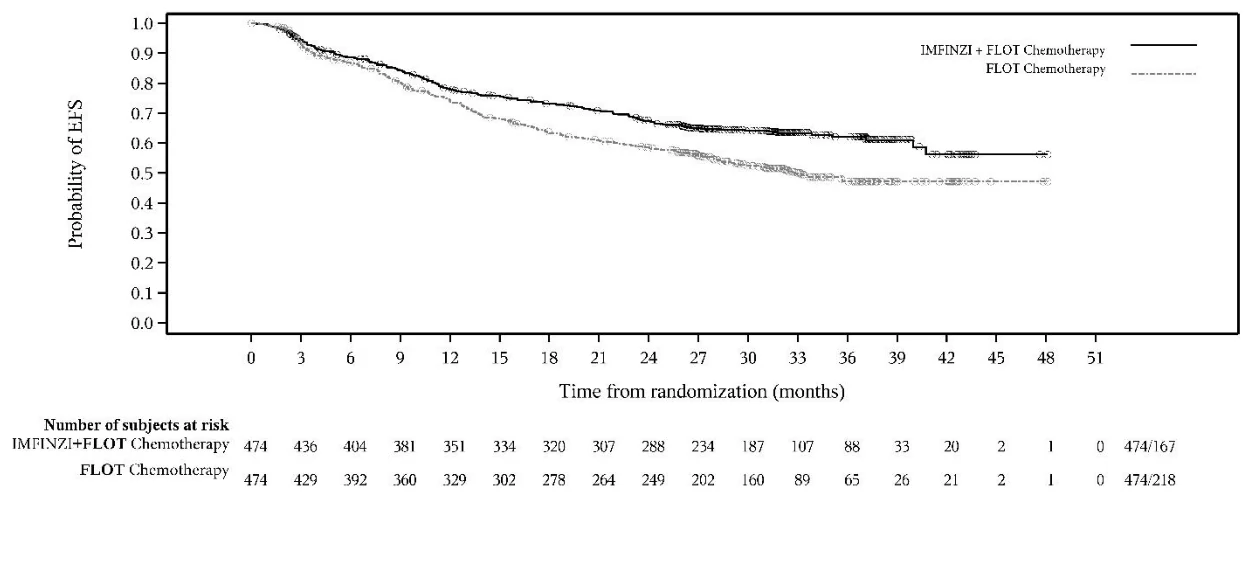
Figure 18 – Kaplan-Meier Curve of OS (MATTERHORN)
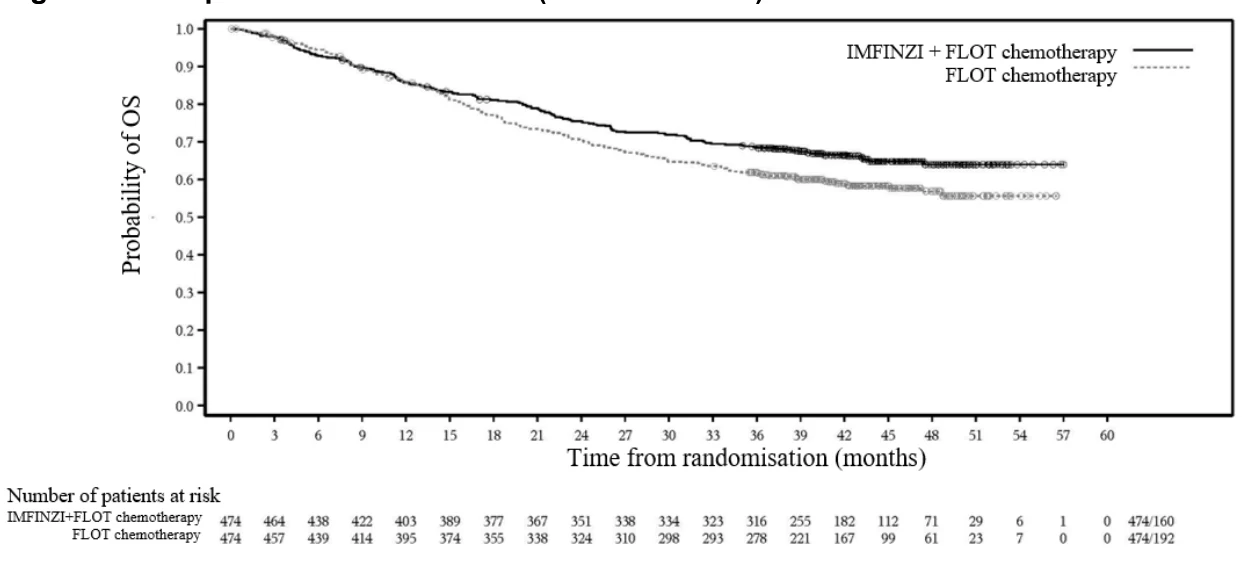
The trial demonstrated a statistically significant difference in pCR rate for patients treated with IMFINZI + FLOT compared to placebo + FLOT (19.2% vs. 7.2%; p<0.001).
In pre-specified exploratory analyses of EFS and OS for the subgroups defined by clinical lymph node status (positive and negative), the EFS HRs (IMFINZI plus FLOT vs. placebo plus FLOT) were 0.67 (95% CI: 0.53, 0.84) and 0.85 (95% CI: 0.57, 1.27) for patients with positive lymph node status (N=667) and negative lymph node status (N=277), respectively. The OS HRs were 0.73 (95% CI: 0.57, 0.94) and 1.01 (95% CI: 0.67, 1.51) for patients with positive lymph node status and negative lymph node status, respectively.
15. Microbiology
No microbiological information is required for this drug product.
16. Non-Clinical Toxicology
Genotoxicity: The genotoxic potential of durvalumab have not been evaluated.
Carcinogenicity: The carcinogenic potential of durvalumab have not been evaluated.
Reproductive and developmental toxicology: As reported in the literature, the PD-1/PD-L1 pathway plays a central role in preserving pregnancy by maintaining maternal immune tolerance to the fetus, and in mouse allogeneic pregnancy models disruption of PD-L1 signaling was shown to result in an increase in fetal loss. In reproduction studies in cynomolgus monkeys, administration of IMFINZI (durvalumab) from the confirmation of pregnancy through delivery at exposure levels approximately 6 to 20 times higher than those observed at the clinical dose of 10 mg/kg of IMFINZI (based on AUC) was associated with premature delivery, fetal loss (abortion and stillbirth) and an increase in neonatal deaths compared to concurrent control. Based on the mechanism of action, fetal exposure to durvalumab may increase the risk of developing immune-mediated disorders or altering the normal immune response, and immune-mediated disorders have been reported in the literature in PD-1 knockout mice. In animal models reported in the literature, inhibition of PD-L1/PD-1 signaling increased the severity of some infections and enhanced inflammatory responses.
17. Supporting Product Monographs
|
|---|