


Product Monograph - Keytruda SC
Recent Major Label Changes
| 7 Warnings and Precautions | 2026-07 |
|---|---|
| 4 Dosage and Administration | 2026-07 |
Table of Contents
Certain sections or subsections that are not applicable at the time of the preparation of the most recent authorized product monograph are not listed.
Part 1: Healthcare Professional Information ........................................................................................ 8
- 1.
Indications ...................................................................................................................................... 8
1.1 Pediatrics ........................................................................................................................ 11
1.2 Geriatrics ......................................................................................................................... 11
- 2. Contraindications .......................................................................................................................... 12
- 4.
Dosage and Administration ........................................................................................................... 12
4.1 Dosing Considerations .................................................................................................... 12
4.2 Recommended Dose and Dosage Adjustment ............................................................... 13
4.4 Administration ................................................................................................................ 22
4.5 Missed Dose .................................................................................................................... 23
- 5. Overdose ...................................................................................................................................... 23
- 6. Dosage Forms, Strengths, Composition, and Packaging ................................................................. 23
- 7.
Warnings and Precautions ............................................................................................................. 24
General .................................................................................................................................... 24
Driving and Operating Machinery ................................................................................................ 24
Hepatic/Biliary/Pancreatic ........................................................................................................... 24
Immune .................................................................................................................................... 24
Monitoring and Laboratory Tests ................................................................................................ 28
Renal .................................................................................................................................... 28
Reproductive Health .................................................................................................................... 29
7.1 Special Populations ......................................................................................................... 29
7.1.1 Pregnancy ................................................................................................................... 29
7.1.2 Breast-feeding ............................................................................................................ 29
7.1.3 Pediatrics .................................................................................................................... 29
7.1.4 Geriatrics .................................................................................................................... 30
- 8.
Adverse Reactions ......................................................................................................................... 31
8.1 Adverse Reaction Overview ............................................................................................ 31
8.2 Clinical Trial Adverse Reactions ...................................................................................... 32
8.2.1 Clinical Trial Adverse Reactions – Pediatrics ............................................................ 163
8.3 Less Common Clinical Trial Adverse Reactions ............................................................. 164
8.4 Abnormal Laboratory Findings: Hematologic, Clinical Chemistry and Other Quantitative Data ............................................................................................................................... 174
8.5 Post-Market Adverse Reactions .................................................................................... 198
- 9.
Drug Interactions ........................................................................................................................ 198
9.2 Drug Interaction Overview............................................................................................ 198
9.4 Drug-Drug Interactions ................................................................................................. 198
- 10.
Clinical Pharmacology ............................................................................................................... 198
10.1 Mechanism of Action .................................................................................................... 198
10.2 Pharmacodynamics ....................................................................................................... 198
10.3 Pharmacokinetics .......................................................................................................... 199
10.4 Immunogenicity ............................................................................................................ 201
- 11. Storage, Stability, and Disposal ................................................................................................. 202
- 12. Special Handling Instructions..................................................................................................... 202
Part 2: Scientific Information .......................................................................................................... 203
- 13. Pharmaceutical Information ...................................................................................................... 203
- 14.
Clinical Trials ............................................................................................................................. 203
14.1 Clinical Trials by Indication............................................................................................ 203
KEYTRUDA SC ............................................................................................................................. 203
Intravenous KEYTRUDA .............................................................................................................. 206
Melanoma .................................................................................................................................. 206
Adjuvant Melanoma .................................................................................................................. 215
Non-Small Cell Lung Carcinoma ................................................................................................. 219
Classical Hodgkin Lymphoma ..................................................................................................... 247
Primary Mediastinal B-cell Lymphoma ...................................................................................... 249
Urothelial Carcinoma ................................................................................................................. 250
Microsatellite Instability-High Colorectal Cancer ...................................................................... 261
Microsatellite Instability-High Cancer (MSI-H) or Mismatch Repair Deficient (dMMR) Cancer 263
Endometrial Carcinoma ............................................................................................................. 265
Renal Cell Carcinoma ................................................................................................................. 270
Head and Neck Cancer ............................................................................................................... 278
Gastric or Gastroesophageal junction (GEJ) Adenocarcinoma .................................................. 283
Esophageal Cancer ..................................................................................................................... 290
Triple Negative Breast Cancer (TNBC) ....................................................................................... 295
Early-stage Triple-Negative Breast Cancer ................................................................................ 299
Cervical Cancer ........................................................................................................................... 302
Biliary Tract Carcinoma .............................................................................................................. 305
Alternate Dosing Regimen for Adults ........................................................................................ 307
- 16. Non-Clinical Toxicology ............................................................................................................. 307
Patient Medication Information ...................................................................................................... 310
Part 1: Healthcare Professional Information
1. Indications
KEYTRUDA SC (pembrolizumab injection) is indicated for:
Melanoma
KEYTRUDA SC is indicated for the treatment of adult patients with unresectable or metastatic melanoma who have not received prior treatment with ipilimumab. Subjects with BRAF V600 mutant melanoma may have received prior BRAF inhibitor therapy.
KEYTRUDA SC is indicated for the treatment of adult patients with unresectable or metastatic melanoma and disease progression following ipilimumab therapy and, if BRAF V600 mutation positive, following a BRAF or MEK inhibitor.
KEYTRUDA SC is indicated for the adjuvant treatment of adult and pediatric patients 12 years and older with Stage IIB, IIC or III melanoma following complete resection.
Non-Small Cell Lung Carcinoma
KEYTRUDA SC as monotherapy is indicated for the first-line treatment of adult patients with metastatic non-small cell lung carcinoma (NSCLC) or stage III disease where patients are not candidates for surgical resection or definitive chemoradiation, expressing PD-L1 [Tumour Proportion Score (TPS) ≥ 1%] as determined by a validated test, with no EGFR or ALK genomic tumour aberrations. A positive association was observed between the level of PD-L1 expression and the magnitude of the treatment benefit (See 14 Clinical Trials).
KEYTRUDA SC, in combination with pemetrexed and platinum chemotherapy, is indicated for the treatment of adult patients with metastatic non-squamous NSCLC with no EGFR or ALK genomic tumour aberrations, and no prior systemic chemotherapy treatment for metastatic NSCLC.
KEYTRUDA SC, in combination with carboplatin and either paclitaxel or nab-paclitaxel, is indicated for the treatment of adult patients with metastatic squamous NSCLC with no prior systemic chemotherapy treatment for metastatic NSCLC.
KEYTRUDA SC as monotherapy is indicated for the treatment of adult patients with metastatic NSCLC whose tumours express PD-L1 (TPS ≥ 1%) as determined by a validated test and who have disease progression on or after platinum-containing chemotherapy. Patients with EGFR or ALK genomic tumour aberrations should have received an authorized therapy for these aberrations prior to receiving KEYTRUDA SC.
KEYTRUDA SC as monotherapy is indicated for the adjuvant treatment of adult patients with Stage IB (T2a ≥ 4 cm), II, or IIIA NSCLC who have undergone complete resection and platinum-based chemotherapy.
KEYTRUDA SC is indicated for the treatment of adult patients with resectable Stage II, IIIA, or IIIB (T3-4N2) NSCLC in combination with platinum-containing chemotherapy as neoadjuvant treatment, and then continued as monotherapy as adjuvant treatment after surgery.
Hodgkin Lymphoma
KEYTRUDA SC as monotherapy is indicated for the treatment of adult and pediatric patients 12 years and older with refractory or relapsed classical Hodgkin Lymphoma (cHL) who have failed autologous stem cell transplant (ASCT), or who are not candidates for multi-agent salvage chemotherapy and ASCT. An improvement in overall survival has not yet been established.
Primary Mediastinal B-cell Lymphoma
KEYTRUDA SC as monotherapy is indicated for the treatment of adult and pediatric patients 12 years and older with refractory primary mediastinal B-cell lymphoma (PMBCL), or who have relapsed after 2 or more lines of therapy. An improvement in survival or disease-related symptoms has not been established.
Urothelial Carcinoma
KEYTRUDA SC, in combination with enfortumab vedotin, is indicated for the treatment of adult patients with unresectable locally advanced or metastatic urothelial cancer (mUC) with no prior systemic therapy for mUC.
KEYTRUDA SC is indicated for the treatment of adult patients with locally advanced unresectable or metastatic urothelial carcinoma, as monotherapy, who are not eligible for any platinum-containing chemotherapy. An improvement in survival or disease-related symptoms has not been established.
KEYTRUDA SC is indicated for the treatment of adult patients with locally advanced or metastatic urothelial carcinoma as monotherapy who have disease progression during or following platinum-containing chemotherapy or within 12 months of completing neoadjuvant or adjuvant platinum-containing chemotherapy.
KEYTRUDA SC is indicated for the treatment of adult patients with Bacillus Calmette-Guerin (BCG)-unresponsive, high-risk, non-muscle invasive bladder cancer (NMIBC) with carcinoma in-situ (CIS) with or without papillary tumours who are ineligible for or have elected not to undergo cystectomy.
- The indication is authorized based on tumour complete response rate and durability of response (See 14 Clinical Trials).
Renal Cell Carcinoma
KEYTRUDA SC, in combination with axitinib, is indicated for the treatment of adult patients with advanced or metastatic renal cell carcinoma (RCC) with no prior systemic therapy for metastatic RCC (See 14 Clinical Trials).
KEYTRUDA SC, in combination with lenvatinib, is indicated for the treatment of adult patients with advanced (not amenable to curative surgery or radiation) or metastatic RCC with no prior systemic therapy for metastatic RCC (See 14 Clinical Trials).
KEYTRUDA SC, as monotherapy, is indicated for the adjuvant treatment of adult patients with RCC at intermediate-high or high risk of recurrence following nephrectomy, or following nephrectomy and resection of metastatic lesions.
Colorectal Cancer
KEYTRUDA SC is indicated, as monotherapy, for the treatment of adult patients with metastatic MSI-H or dMMR colorectal cancer (CRC) as determined by a validated test.
Microsatellite Instability-High Cancer (MSI-H) or Mismatch Repair Deficient (dMMR) Cancer
KEYTRUDA SC is indicated as monotherapy for the treatment of adult and pediatric patients 12 years and older with unresectable or metastatic microsatellite instability-high (MSI-H) or mismatch repair deficient (dMMR) solid tumours, as determined by a validated test, that have progressed following prior treatment and who have no satisfactory alternative treatment options.
Endometrial Carcinoma
KEYTRUDA SC, in combination with lenvatinib, is indicated for the treatment of adult patients with advanced endometrial carcinoma that is not microsatellite instability high (MSI-H) or mismatch repair deficient (dMMR), who have disease progression following prior platinum-based systemic therapy, and are not candidates for curative surgery or radiation.
Head and Neck Cancer
KEYTRUDA SC is indicated for the first-line treatment of metastatic or unresectable recurrent head and neck squamous cell carcinoma (HNSCC) as monotherapy, in adult patients whose tumours have PD-L1 expression (Combined Positive Score [CPS] ≥ 1) as determined by a validated test.
KEYTRUDA SC is indicated for the first-line treatment of metastatic or unresectable recurrent head and neck squamous cell carcinoma (HNSCC) in combination with platinum and fluorouracil (FU) chemotherapy, in adult patients.
Gastric or Gastroesophageal Junction (GEJ) Adenocarcinoma
KEYTRUDA SC, in combination with trastuzumab, fluoropyrimidine- and platinum-containing chemotherapy, is indicated for the first-line treatment of adult patients with locally advanced unresectable or metastatic HER2-positive gastric or gastroesophageal junction (GEJ) adenocarcinoma, whose tumours express PD-L1 (Combined Positive Score [CPS] ≥1) as determined by a validated test.
KEYTRUDA SC, in combination with fluoropyrimidine- and platinum-containing chemotherapy, is indicated for the first-line treatment of adult patients with locally advanced unresectable or metastatic HER2-negative gastric or gastroesophageal junction (GEJ) adenocarcinoma.
Esophageal Cancer
KEYTRUDA SC, in combination with platinum and fluoropyrimidine based chemotherapy, is indicated for the first-line treatment of adult patients with locally advanced unresectable or metastatic carcinoma of the esophagus.
Triple-Negative Breast Cancer
KEYTRUDA SC, in combination with chemotherapy, is indicated for the treatment of adult patients with locally recurrent unresectable or metastatic triple-negative breast cancer (TNBC), who have not received prior chemotherapy for metastatic disease and whose tumours express PD-L1 (Combined Positive Score [CPS] ≥ 10) as determined by a validated test.
Consult the description of the study for the chemotherapy (paclitaxel, nab-paclitaxel or gemcitabine/carboplatin) and dosing regimens used (See 14 Clinical Trials).
KEYTRUDA SC is indicated for the treatment of adult patients with high-risk early-stage triple-negative breast cancer (TNBC) in combination with chemotherapy as neoadjuvant treatment, and then continued as monotherapy as adjuvant treatment after surgery.
Consult the description of the study for the chemotherapy regimen (carboplatin and paclitaxel, followed by doxorubicin or epirubicin and cyclophosphamide) used (See 14 Clinical Trials).
Cervical Cancer
KEYTRUDA SC, in combination with chemotherapy with or without bevacizumab, is indicated for the treatment of adult patients with persistent, recurrent, or metastatic cervical cancer whose tumours express PD-L1 (CPS ≥ 1) as determined by a validated test.
Biliary Tract Carcinoma
KEYTRUDA SC, in combination with gemcitabine-based chemotherapy, is indicated for the treatment of adult patients with locally advanced unresectable or metastatic biliary tract carcinoma (BTC).
1.1 Pediatrics
Pediatrics (12 years and older): KEYTRUDA SC as monotherapy is indicated for the treatment of pediatric patients 12 years and older with:
- stage IIB, IIC or III melanoma who have undergone complete resection.
- relapsed or refractory cHL who have failed ASCT, or who are not candidates for multi-agent salvage chemotherapy and ASCT.
- refractory PMBCL, or pediatric PMBCL patients whose disease has relapsed after 2 or more prior lines of therapy.
- unresectable or metastatic microsatellite instability-high (MSI-H) or mismatch repair deficient (dMMR) solid tumours, as determined by a validated test, that have progressed following prior treatment and who have no satisfactory alternative treatment options (See 4 Dosage and Administration, 7 Warnings and Precautions and 8 Adverse Reactions).
KEYTRUDA SC has not been authorized for the treatment of pediatric patients 12 years and older with tumour types other than those specified above.
Pediatrics (< 12 years of age):
No data are available to Health Canada; therefore, Health Canada has not authorized an indication in pediatric patients < 12 years of age.
1.2 Geriatrics
Geriatrics (≥65 years of age):
No overall differences in safety or efficacy were reported between elderly patients (65 years and over) and younger patients (less than 65 years) for pembrolizumab monotherapy.
No overall differences in efficacy were reported between elderly patients (65 years and over) and younger patients (less than 65 years) for pembrolizumab combination therapy.
2. Contraindications
KEYTRUDA SC is contraindicated in patients who have experienced a severe hypersensitivity reaction (See 7 Warnings and Precautions) to this drug or to any ingredient in the formulation or component of the container closure system. For a complete listing of ingredients, See 6 Dosage Forms, Strengths, Composition, and Packaging.
4. Dosage and Administration
4.1 Dosing Considerations
Important Dosage and Administration Information
KEYTRUDA SC is for subcutaneous use only. Do not administer intravenously.
- To reduce the risk of medication errors, check the vial labels to ensure that the drug being prepared and administered is KEYTRUDA SC for subcutaneous use and not KEYTRUDA® (i.e., pembrolizumab for intravenous use).
- KEYTRUDA SC and intravenous KEYTRUDA are not interchangeable. Do not substitute KEYTRUDA SC for or with intravenous KEYTRUDA because they have different recommended dosages and routes of administration.
- Patients receiving intravenous KEYTRUDA can switch to KEYTRUDA SC at their next scheduled dose.
- Patients receiving KEYTRUDA SC can switch to intravenous KEYTRUDA at their next scheduled dose.
- KEYTRUDA SC is to be prepared and administered by a healthcare professional only.
- The KEYTRUDA SC vial is for single-use only.
Patient Selection
For treatment of Non-Small Cell Lung Carcinoma and Head and Neck Cancer as Monotherapy, and Gastric Cancer, Triple-Negative Breast Cancer, and Cervical Cancer
Select patients for treatment with KEYTRUDA SC based on the presence of positive PD-L1 expression as determined by an experienced laboratory using a validated test in:
- metastatic NSCLC or stage III disease where patients are not candidates for surgical resection or definitive chemoradiation, using the Tumour Proportion Score (TPS) (See 14 Clinical Trials, Non-Small Cell Lung); or
- locally advanced unresectable or metastatic HER2-positive gastric or gastroesophageal junction (GEJ) adenocarcinoma, using the Combined Positive Score (CPS) (See 14 Clinical Trials, Gastric or Gastroesophageal junction (GEJ) Adenocarcinoma); or
- metastatic or unresectable recurrent head and neck squamous cell carcinoma (HNSCC) (See 14 Clinical Trials, Head and Neck Cancer); or
- locally recurrent unresectable or metastatic triple-negative breast cancer, using the Combined Positive Score (CPS). CPS is the number of PD-L1 staining cells (tumour cells, lymphocytes, macrophages) divided by the total number of viable tumour cells, multiplied by 100 (See 14 Clinical Trials, Triple Negative Breast Cancer); or
- persistent, recurrent, or metastatic cervical cancer (See 14 Clinical Trials, Cervical Cancer).
A test authorized by Health Canada which is equivalent to that used in clinical trials should be required (See 14 Clinical Trials).
For treatment of MSI-H or dMMR cancer and endometrial cancer that is not MSI-H or dMMR.
Patients should be selected for treatment based on MSI-H or dMMR tumour status as determined by an accredited laboratory using validated testing methods (See 14 Clinical Trials).
Because subclonal dMMR mutations and microsatellite instability may arise in high-grade gliomas during temozolomide therapy, it is recommended to test for MSI-H and dMMR in the primary tumour specimens obtained prior to initiation of temozolomide chemotherapy in patients with high-grade gliomas.
For patients with high-risk, early-stage TNBC treated with KEYTRUDA SC in the neoadjuvant setting, blood cortisol measurement prior to surgery should be included.
4.2 Recommended Dose and Dosage Adjustment
Recommended Dosage for Unresectable or Metastatic Melanoma
The recommended dose of KEYTRUDA SC in adults is either:
- 395 mg every 3 weeks or
- 790 mg every 6 weeks
until disease progression or unacceptable toxicity.
Recommended Dosage for Adjuvant Treatment of Melanoma
The recommended dose of KEYTRUDA SC in adult and pediatric patients (12 years and older who weigh greater than 40 kg) is either:
- 395 mg every 3 weeks or
- 790 mg every 6 weeks
for up to one year or until disease recurrence or unacceptable toxicity or 17 doses for 395 mg or 9 doses for 790 mg, whichever is longer, in patients without disease recurrence.
Recommended Dosage for – Previously Untreated NSCLC as Monotherapy or in Combination with Chemotherapy
The recommended dose of KEYTRUDA SC in adults is either:
- 395 mg every 3 weeks or
- 790 mg every 6 weeks
until disease progression, unacceptable toxicity or up to 24 months or 35 doses for 395 mg or 18 doses for 790 mg, whichever is longer, in patients without disease progression.
When administering KEYTRUDA SC as part of a combination with pemetrexed and platinum chemotherapy, KEYTRUDA SC should be administered first. See also the Product Monographs for pemetrexed and the selected platinum chemotherapy.
Recommended Dosage for NSCLC – Previously Treated
The recommended dose of KEYTRUDA SC in adults is either:
- 395 mg every 3 weeks or
- 790 mg every 6 weeks
until disease progression or unacceptable toxicity.
Recommended Dosage for Adjuvant Treatment of NSCLC
The recommended dose of KEYTRUDA SC in adults is either:
- 395 mg every 3 weeks or
- 790 mg every 6 weeks
for up to one year or until disease recurrence or unacceptable toxicity.
Recommended Dosage for Neoadjuvant Treatment, in Combination with Chemotherapy, Followed by Adjuvant Treatment for Resectable NSCLC
The recommended dose of KEYTRUDA SC in adults is either:
- 395 mg every 3 weeks or
- 790 mg every 6 weeks
For the neoadjuvant and adjuvant treatment of resectable NSCLC, patients should be treated with 4 doses of 395 mg or 2 doses of 790 mg of neoadjuvant KEYTRUDA SC in combination with chemotherapy until disease progression that precludes definitive surgery or unacceptable toxicity, followed by adjuvant treatment with KEYTRUDA SC as monotherapy for up to 13 doses of 395 mg or 7 doses of 790 mg or until disease recurrence or unacceptable toxicity.
Administer KEYTRUDA SC prior to chemotherapy when given on the same day. Refer to the Product Monographs for the chemotherapy agents administered in combination with KEYTRUDA SC for recommended dosing information, as appropriate (See 14 Clinical Trials).
Recommended Dosage for Hodgkin Lymphoma
The recommended dose of KEYTRUDA SC in adult and pediatric patients (12 years and older who weigh greater than 40 kg) is either:
- 395 mg every 3 weeks or
- 790 mg every 6 weeks
until disease progression or unacceptable toxicity, or up to 24 months in patients without disease progression.
Recommended Dosage for PMBCL
The recommended dose of KEYTRUDA SC in adult and pediatric patients (12 years and older who weigh greater than 40 kg) is either:
- 395 mg every 3 weeks or
- 790 mg every 6 weeks
Recommended Dosage for Unresectable Locally Advanced or Metastatic Urothelial Cancer in Combination with Enfortumab vedotin
For adult patients with urothelial cancer, the recommended dosing is:
KEYTRUDA SC
- 395 mg every 3 weeks or
- 790 mg every 6 weeks
until disease progression or unacceptable toxicity, or up to 24 months or 35 doses for 395 mg or 18 doses for 790 mg, whichever is longer, in patients without disease progression, in combination with;
- enfortumab vedotin 1.25 mg/kg on Days 1 and 8 of each 21-day cycle until unacceptable toxicity or disease progression.
Administer KEYTRUDA SC after enfortumab vedotin when given on the same day. Provide for an interval of 30 minutes between administrations (for at least Cycle 1, Day 1), which can subsequently be reduced to 15 minutes if well tolerated.
Refer to the enfortumab vedotin Product Monograph for recommended enfortumab vedotin dosing information.
Recommended Dosage for Urothelial Carcinoma – Not Eligible for Platinum-Containing Chemotherapy
The recommended dose of KEYTRUDA SC in adults is either:
- 395 mg every 3 weeks or
- 790 mg every 6 weeks
until disease progression or unacceptable toxicity, or up to 24 months or 35 doses for 395 mg or 18 doses for 790 mg, whichever is longer, in patients without disease progression.
Recommended Dosage for Urothelial Carcinoma – Previously Treated
The recommended dose of KEYTRUDA SC in adults is either:
- 395 mg every 3 weeks or
- 790 mg every 6 weeks
until disease progression or unacceptable toxicity, or up to 24 months or 35 doses for 395 mg or 18 doses for 790 mg, whichever is longer, in patients without disease progression.
Recommended Dosage for BCG-unresponsive, high-risk, non-muscle invasive bladder cancer (NMIBC)
The recommended dose of KEYTRUDA SC in adults is either:
- 395 mg every 3 weeks or
- 790 mg every 6 weeks
until disease progression, unacceptable toxicity or up to 24 months or 35 doses for 395 mg or 18 doses for 790 mg, whichever is longer, in patients without disease progression.
Recommended Dosage for MSI-H Colorectal Carcinoma
The recommended dose of KEYTRUDA SC in adults is either:
- 395 mg every 3 weeks or
- 790 mg every 6 weeks
until disease progression, unacceptable toxicity, or up to 24 months or 35 doses for 395 mg or 18 doses for 790 mg, whichever is longer, in patients without disease progression.
Recommended Dosage for MSI-H or dMMR Cancer – Previously Treated with No Satisfactory Alternative Treatment Options
The recommended dose of KEYTRUDA SC in adult and pediatric patients (12 years and older who weigh greater than 40 kg) is either:
- 395 mg every 3 weeks or
- 790 mg every 6 weeks
until disease progression or unacceptable toxicity, or up to 24 months or 35 doses for 395 mg or 18 doses for 790 mg, whichever is longer, in patients without disease progression.
Recommended Dosage for Endometrial Carcinoma (not MSI-H or dMMR)
For adult patients with endometrial carcinoma that is not MSI-H or dMMR, the recommended dosing is:
KEYTRUDA SC
- 395 mg every 3 weeks or
- 790 mg every 6 weeks
until unacceptable toxicity, disease progression, or for up to 24 months or 35 doses for 395 mg or 18 doses for 790 mg, whichever is longer, in combination with;
- Lenvatinib – 20 mg orally once daily until unacceptable toxicity or disease progression.
Refer to the lenvatinib Product Monograph for recommended lenvatinib dosing information.
Recommended Dosage for Advanced or Metastatic RCC with No Prior Systemic Therapy for Metastatic RCC – in Combination with axitinib
For adult patients with RCC, the recommended dosing is:
KEYTRUDA SC
- 395 mg every 3 weeks or
- 790 mg every 6 weeks
until unacceptable toxicity, disease progression, or for up to 24 months or 35 doses for 395 mg or 18 doses for 790 mg, whichever is longer, in combination with;
- Axitinib – 5 mg axitinib orally twice daily until unacceptable toxicity or disease progression. As in KEYNOTE-426, when axitinib is used in combination with KEYTRUDA SC, dose escalation may be considered for patients who tolerated the initial 5 mg axitinib dose at intervals of six weeks or longer (i.e., at least 2 treatment cycles).
Refer to the axitinib Product Monograph for recommended axitinib dose information.
Recommended Dosage for Advanced or Metastatic RCC with No Prior Systemic Therapy for Metastatic RCC - in Combination with lenvatinib
For adult patients with RCC, the recommended dosing is:
KEYTRUDA SC
- 395 mg every 3 weeks or
- 790 mg every 6 weeks
until unacceptable toxicity, disease progression, or for up to 24 months or 35 doses for 395 mg or 18 doses for 790 mg, whichever is longer, in combination with;
- Lenvatinib – 20 mg orally once daily until unacceptable toxicity or disease progression.
Refer to the lenvatinib Product Monograph for recommended lenvatinib dosing information.
Recommended Dosage for Adjuvant Treatment of RCC
The recommended dose of KEYTRUDA SC in adults is either:
- 395 mg every 3 weeks or
- 790 mg every 6 weeks
until disease recurrence, unacceptable toxicity or up to 1 year (12 months) or 17 doses for 395 mg or 9 doses for 790 mg, whichever is longer, in patients without disease recurrence.
Recommended Dosage for HNSCC – Previously Untreated as Monotherapy or in Combination with Chemotherapy
The recommended dose of KEYTRUDA SC in adults is either:
- 395 mg every 3 weeks or
- 790 mg every 6 weeks
until disease progression, unacceptable toxicity or up to 24 months or 35 doses for 395 mg or 18 doses for 790 mg, whichever is longer, in patients without disease progression.
When administering KEYTRUDA SC in combination with chemotherapy, administer KEYTRUDA SC prior to chemotherapy when given on the same day. Refer to the Product Monographs for the chemotherapy agents administered in combination with KEYTRUDA SC for recommended dosing information, as appropriate.
Recommended Dosage for locally advanced unresectable or metastatic HER2-positive Gastric or gastroesophageal junction (GEJ) adenocarcinoma in combination with trastuzumab, fluoropyrimidine- and platinum-containing Chemotherapy
The recommended dose of KEYTRUDA SC in adults is either:
- 395 mg every 3 weeks or
- 790 mg every 6 weeks
until disease progression, unacceptable toxicity or up to 24 months.
Administer KEYTRUDA SC prior to trastuzumab and chemotherapy when given on the same day. Refer to the Product Monographs for the chemotherapy agents administered in combination with KEYTRUDA SC for recommended dosing information, as appropriate. Refer to the trastuzumab Product Monograph for recommended trastuzumab dosing information.
Recommended Dosage for locally advanced unresectable or metastatic HER2-negative gastric or GEJ adenocarcinoma – in Combination with fluoropyrimidine- and platinum-containing Chemotherapy
The recommended dose of KEYTRUDA SC in adults is either:
- 395 mg every 3 weeks or
- 790 mg every 6 weeks
until unacceptable toxicity, disease progression or up to 24 months or 35 doses for 395 mg or 18 doses for 790 mg, whichever is longer.
Administer KEYTRUDA SC prior to chemotherapy when given on the same day. Refer to the Product Monographs for the chemotherapy agents administered in combination with KEYTRUDA SC for recommended dosing information, as appropriate.
Recommended Dosage for Esophageal Cancer – in Combination with platinum and fluoropyrimidine based Chemotherapy
The recommended dose of KEYTRUDA SC in adults is either:
- 395 mg every 3 weeks or
- 790 mg every 6 weeks
until unacceptable toxicity, disease progression or up to 24 months.
Administer KEYTRUDA SC prior to chemotherapy when given on the same day. Refer to the Product Monographs for the chemotherapy agents administered in combination with KEYTRUDA SC for recommended dosing information, as appropriate.
Recommended Dosage for locally recurrent unresectable or metastatic Triple-Negative Breast Cancer (TNBC) in Combination with Chemotherapy
The recommended dose of KEYTRUDA SC in adults is either:
- 395 mg every 3 weeks or
- 790 mg every 6 weeks
until disease progression, unacceptable toxicity or up to 24 months or 35 doses for 395 mg or 18 doses for 790 mg, whichever is longer, in patients without disease progression.
When administering KEYTRUDA SC in combination with chemotherapy, administer KEYTRUDA SC prior to chemotherapy when given on the same day. Refer to the Product Monographs for the chemotherapy agents administered in combination with KEYTRUDA SC for recommended dosing information, as appropriate.
Recommended Dosage for TNBC – high-risk early-stage in Combination with Chemotherapy as neoadjuvant treatment, then as Monotherapy as adjuvant treatment after surgery
The recommended dose of KEYTRUDA SC in adults is either:
- 395 mg every 3 weeks or
- 790 mg every 6 weeks
For the neoadjuvant and adjuvant treatment of early-stage TNBC, patients should be treated with neoadjuvant KEYTRUDA SC in combination with chemotherapy for 8 doses of 395 mg every 3 weeks or 4 doses of 790 mg every 6 weeks or until disease progression that precludes definitive surgery or unacceptable toxicity, followed by adjuvant treatment with KEYTRUDA SC as monotherapy for 9 doses of 395 mg every 3 weeks or 5 doses of 790 mg every 6 weeks or until disease recurrence or unacceptable toxicity. Patients who experience disease progression that precludes definitive surgery or unacceptable toxicity related to KEYTRUDA SC as neoadjuvant treatment in combination with chemotherapy should not receive KEYTRUDA SC monotherapy as adjuvant treatment.
When administering KEYTRUDA SC in combination with chemotherapy, administer KEYTRUDA SC prior to chemotherapy when given on the same day. Consult the description of the study for the chemotherapy regimen used (containing carboplatin and paclitaxel, followed by doxorubicin or epirubicin and cyclophosphamide; See 14 Clinical Trials). Refer to the Product Monographs for the chemotherapy agents administered in combination with KEYTRUDA SC for recommended dosing information, as appropriate.
Recommended Dosage for Cervical Cancer (persistent, recurrent or metastatic)
The recommended dose of KEYTRUDA SC in adults is either:
- 395 mg every 3 weeks or
- 790 mg every 6 weeks
until disease progression, unacceptable toxicity or up to 24 months or 35 doses for 395 mg or 18 doses for 790 mg, whichever is longer, in patients without disease progression.
Administer KEYTRUDA SC prior to chemotherapy with or without bevacizumab when given on the same day (See 14 Clinical Trials). Refer to the Product Monographs for the chemotherapy or other agents administered in combination with KEYTRUDA SC for further information, as appropriate.
Recommended Dosage for Biliary Tract Carcinoma
The recommended dose of KEYTRUDA SC in adults is either:
- 395 mg every 3 weeks or
- 790 mg every 6 weeks
until disease progression, unacceptable toxicity or up to 24 months or 35 doses for 395 mg or 18 doses for 790 mg, whichever is longer, in patients without disease progression.
Administer KEYTRUDA SC prior to chemotherapy when given on the same day. Refer to the Product Monographs for the chemotherapy agents administered in combination with KEYTRUDA SC for recommended dosing information, as appropriate.
Pediatric Patients:
The recommended dosage for the treatment of melanoma (Stage IIB, IIC or III), relapsed or refractory cHL, relapsed or refractory PMBCL, or unresectable or metastatic MSI-H or dMMR solid tumours in pediatric patients 12 years and older who weigh greater than 40 kg is the same as the dosage for adults. A dosage in pediatric patients 12 years and older who weigh 40 kg or less with these tumour types has not been established.
Health Canada has not authorized an indication for pediatric patients < 12 years of age.
For all indications:
Atypical responses (i.e., an initial transient increase in tumour size or small new lesions within the first few months followed by tumour shrinkage) have been observed. Clinically stable patients with initial evidence of disease progression may remain on treatment until disease progression is confirmed.
Recommended Treatment Modifications
No dose reductions of KEYTRUDA SC are recommended. Withhold or discontinue KEYTRUDA SC to manage adverse reactions as described in Table 1.
Table 1: Recommended Treatment Modifications for KEYTRUDA SC.
| Immune-related adverse reactions | Severity | Treatment modification |
|---|---|---|
| Immune-related adverse reactions | Severity | Treatment modification |
| Immune-related adverse reactions | Severity | Treatment modification |
| Pneumonitis | Moderate (Grade 2) | Withhold until adverse reactions recover to Grade 0-1* |
| Severe or life-threatening (Grade 3 or 4), or recurrent moderate (Grade 2) | Permanently discontinue | |
| Colitis | Moderate or severe (Grade 2 or 3) | Withhold until adverse reactions recover to Grade 0-1* |
| Life-threatening (Grade 4) or recurrent severe (Grade 3) | Permanently discontinue | |
| Nephritis | Moderate (Grade 2) with creatinine > 1.5 to ≤ 3 times upper limit of normal (ULN) | Withhold until adverse reactions recover to Grade 0-1* |
| Severe or life-threatening (Grade 3 or 4) (Grade ≥ 3 with creatinine > 3 times ULN) | Permanently discontinue | |
| Endocrinopathies | Severe or life-threatening (Grade 3 or 4) symptomatic hypophysitis Type 1 diabetes associated with Grade > 3 hyperglycemia (glucose > 250 mg/dL or > 13.9 mmol/L) or associated with ketoacidosis Hyperthyroidism Grade ≥ 3 | Withhold until adverse reactions recover to Grade 0-1* For patients with severe (Grade 3) or life-threatening (Grade 4) endocrinopathy that improved to Grade 2 or lower and is controlled with hormone replacement, if indicated, continuation of KEYTRUDA SC may be considered after corticosteroid taper, if needed. Otherwise treatment should be discontinued. Hypothyroidism may be managed with replacement therapy without treatment interruption. |
Hepatitis For liver enzyme elevations in RCC patients treated with combination therapy with axitinib, see dosing guidelines following this table. | Moderate (Grade 2) with aspartate aminotransferase (AST) or alanine aminotransferase (ALT) > 3 to 5 times upper limit of normal (ULN) or total bilirubin > 1.5 to 3 times ULN | Withhold until adverse reactions recover to Grade 0-1* |
| Grade ≥ 3 with AST or ALT > 5 times ULN or total bilirubin > 3 times ULN | Permanently discontinue | |
| For patients with liver metastasis who begin treatment with moderate (Grade 2) elevation of AST or ALT, if AST or ALT increases ≥ 50% relative to baseline and lasts ≥ 1 week | Permanently discontinue | |
| Skin reactions or Stevens-Johnson syndrome (SJS) or toxic epidermal necrolysis (TEN) | Severe skin reactions (Grade 3) or suspected SJS or TEN | Withhold until adverse reactions recover to Grade 0-1* |
| Severe skin reactions (Grade 4) or confirmed SJS or TEN | Permanently discontinue | |
| Myocarditis | Moderate (Grade 2) Severe or life-threatening (Grade 3 or 4) | Permanently discontinue |
| Neurological toxicities | Moderate (Grade 2) | Withhold until adverse reactions recover to Grade 0-1* |
Severe or life-threatening (Grade 3 or 4) | Permanently discontinue | |
| Other immune-related adverse reactions | Based on severity and type of reaction (Grade 2 or Grade 3) | Withhold until adverse reactions recover to Grade 0-1* |
| Severe or life-threatening (Grade 3 or 4) | Permanently discontinue | |
| Life-threatening (Grade 4) or recurrent severe (Grade 3) | Permanently discontinue | |
| Infusion-related reactions | Severe or life-threatening (Grade 3 or 4) | Permanently discontinue |
Note: toxicity grades are in accordance with National Cancer Institute Common Terminology Criteria for Adverse Events Version 4.0 (NCI-CTCAE v.4). *If corticosteroid dosing cannot be reduced to ≤ 10 mg prednisone or equivalent per day within 12 weeks or a treatment-related toxicity does not resolve to Grade 0-1 within 12 weeks after last dose of KEYTRUDA SC, then KEYTRUDA SC should be permanently discontinued. | ||
In patients with cHL or PMBCL with Grade 4 hematological toxicity, KEYTRUDA SC should be withheld until adverse reactions recover to Grade 0-1.
In patients with RCC being treated with KEYTRUDA SC in combination with axitinib:
- If ALT or AST ≥ 3 times ULN but < 10 times ULN without concurrent total bilirubin ≥ 2 times ULN, withhold both KEYTRUDA SC and axitinib until these adverse reactions recover to Grades 0-1. Consider corticosteroid therapy. Consider rechallenge with a single drug or sequential rechallenge with both drugs after recovery. If rechallenging with axitinib, consider dose reduction as per the axitinib Product Monograph.
- If ALT or AST ≥ 10 times ULN or > 3 times ULN with concurrent total bilirubin ≥ 2 times ULN, permanently discontinue both KEYTRUDA SC and axitinib and consider corticosteroid therapy.
Renal Impairment: KEYTRUDA SC has not been studied in patients with renal impairment. No dose adjustment is needed for patients with mild (eGFR< 90 and ≥ 60 mL/min/1.73 m2) or moderate (eGFR < 60 and ≥ 30 mL/min/1.73 m2) renal impairment for intravenous KEYTRUDA. Intravenous KEYTRUDA has not been studied in patients with severe (eGFR < 30 and ≥ 15 mL/min/1.73 m2) renal impairment.
Hepatic Impairment: KEYTRUDA SC has not been studied in patients with hepatic impairment. No dose adjustment is needed for patients with mild or moderate hepatic impairment for intravenous KEYTRUDA. Intravenous KEYTRUDA has been only studied in a limited number of patients with moderate hepatic impairment (n=20). Intravenous KEYTRUDA has not been studied in patients with severe hepatic impairment (See 10 Clinical Pharmacology).
Eastern Cooperative Oncology Group (ECOG) performance status score ≥ 2: Patients with ECOG performance status score ≥ 2 were excluded from the clinical trials (See 14 Clinical Trials).
Recommended Dose Modification for Lenvatinib used in combination with KEYTRUDA SC:
See Product Monograph for the coadministered product, lenvatinib for toxicity management, dose adjustment guidelines for special populations, and contraindications.
When administering KEYTRUDA SC in combination with lenvatinib, interrupt one or both drugs, dose reduce, or discontinue lenvatinib as appropriate (see Table 1). No dose reductions are recommended for KEYTRUDA SC. Withhold, dose reduce, or discontinue lenvatinib in accordance with the instructions in the lenvatinib Product Monograph.
Recommended Dose Modification for Axitinib used in combination with KEYTRUDA SC:
See Product Monograph for the coadministered product, axitinib for toxicity management, dose adjustment guidelines for special populations, and contraindications.
When administering KEYTRUDA SC in combination with axitinib for the treatment of RCC, interrupt one or both as appropriate (see Table 1). No dose reductions are recommended for KEYTRUDA SC. Withhold, dose reduce, or discontinue axitinib in accordance with the instructions in the axitinib Product Monograph.
Recommended Dose Modification for Chemotherapies used in combination with KEYTRUDA SC for TNBC:
See Product Monograph for the co-administered chemotherapy (ies) for toxicity management, dose adjustment guidelines for special populations, and contraindications. When administering KEYTRUDA SC in combination with chemotherapy for the treatment of TNBC, interrupt one or both as appropriate. No dose reductions are recommended for KEYTRUDA SC. Withhold, dose reduce, or discontinue chemotherapies in accordance with the instructions in the respective Product Monograph(s).
Recommended Dose Modification for Enfortumab Vedotin used in combination with KEYTRUDA SC for mUC:
See Product Monograph for the coadministered product, enfortumab vedotin for toxicity management, dose adjustment guidelines for special populations, and contraindications.
When administering KEYTRUDA SC in combination with enfortumab vedotin, interrupt one or both drugs withhold or discontinue KEYTRUDA SC as appropriate (see Table 1). No dose reductions are recommended for KEYTRUDA SC. Withhold, dose reduce, or discontinue enfortumab vedotin in accordance with the instructions in the enfortumab vedotin Product Monograph.
4.4 Administration
Preparation of the Syringe
- KEYTRUDA SC is ready to use. Do not dilute KEYTRUDA SC.
- Do not shake.
- Equilibrate the vial of KEYTRUDA SC to room temperature for at least 30 minutes.
- The unpunctured vial can be out of refrigeration for up to 24 hours prior to the preparation for administration.
- Parenteral drug products should be inspected visually for particulate matter and discoloration prior to administration. KEYTRUDA SC is a clear to slightly opalescent, colorless to slightly yellow solution. Discard the vial if visible particles are observed.
- KEYTRUDA SC is compatible with polypropylene and polycarbonate syringe material and stainless steel transfer and injection needles.
- Withdraw either 2.4 mL (395 mg) or 4.8 mL (790 mg) using a sterile syringe and a transfer needle (18-21G recommended), according to the recommended dosage. To avoid needle clogging, change the needle to a 25-30G, 13 mm hypodermic injection needle immediately prior to subcutaneous injection.
Storage of Prepared Syringe
The product does not contain preservative and should be used immediately after withdrawing from the vial. If not used immediately, store the syringe containing KEYTRUDA SC with the transfer needle and cap in place:
- At room temperature for up to 8 hours, or
- Under refrigeration at 2°C to 8°C for up to 24 hours. The 24-hour period may include up to 8 hours at room temperature.
- Discard if storage time exceeds these limits.
If prepared under controlled and validated aseptic conditions, the closed syringe can be stored for up to 30 days at 2°C to 8°C (protected from light) and for up to 24 hours at room temperature
- (under ambient light) based on chemical and physical in-use stability.
- If refrigerated, allow the filled syringe to come to room temperature for at least 30 minutes prior to use.
- Do not freeze.
Administration
Inject KEYTRUDA SC into the subcutaneous tissue of the thigh or abdomen, avoiding the 5-centimeter area around the navel. Do not inject into skin that is damaged, sore, bruised, scarred, scaly, or has red patches.
- 395 mg (every 3-week dosing): Inject one 2.4 mL dose of KEYTRUDA SC subcutaneously over 1 minute, or
- 790 mg (every 6-week dosing): Inject one 4.8 mL dose of KEYTRUDA SC subcutaneously over 2 minutes.
- Rotate injection sites for subsequent injections.
- During treatment with KEYTRUDA SC, do not administer other medications for subcutaneous use at the same site as KEYTRUDA SC.
- Discard any unused portion left in the vial.
4.5 Missed Dose
If a planned dose of KEYTRUDA SC is missed, it should be administered as soon as possible. The schedule of administration should be adjusted to maintain the prescribed dosing interval.
5. Overdose
There is no information on overdose with KEYTRUDA SC. The maximum tolerated dose of KEYTRUDA SC has not been determined.
In case of overdose, patients must be closely monitored for signs or symptoms of adverse reactions, and appropriate symptomatic treatment instituted.
| For the most recent information in the management of a suspected drug overdose, contact your regional poison control centre or Health Canada’s toll-free number, 1-844 POISON-X (1-844-764-7669). |
|---|
- 6. Dosage Forms, Strengths, Composition, and Packaging
To help ensure the traceability of biologic products, healthcare professionals should record both the brand name and the non-proprietary (active ingredient) name as well as other product-specific identifiers such as the Drug Identification Number (DIN) and the batch/lot number of the product supplied.
Table 2: Dosage Forms, Strengths, and Composition.
| Route of Administration | Dosage Form/Strength/Composition | Non-Medicinal Ingredients |
| Subcutaneous injection | Solution for injection 165 mg/mL | Berahyaluronidase alfa, L-histidine, L-histidine monohydrochloride monohydrate, L-methionine, polysorbate 80, sterile water for injection and sucrose. |
Description
KEYTRUDA SC is a sterile, preservative-free, clear to slightly opalescent, colorless to slightly yellow solution supplied in ready-to-use, single-use vials for subcutaneous administration.
KEYTRUDA SC is supplied as:
- Solution for Injection: 395 mg/2.4 mL (165 mg/mL) solution in a single-use vial.
- Solution for Injection: 790 mg/4.8 mL (165 mg/mL) solution in a single-use vial.
7. Warnings and Precautions
General
KEYTRUDA SC should be administered under the supervision of physicians experienced in the treatment of cancer.
When KEYTRUDA SC is to be administered in combination with lenvatinib, refer to the Product Monograph for lenvatinib prior to the initiation of treatment.
The data described in the WARNINGS AND PRECAUTIONS section reflect exposure to intravenous KEYTRUDA as monotherapy in 2799 patients in three randomized, open-label, active-controlled clinical trials (KEYNOTE-002, KEYNOTE-006, and KEYNOTE-010), which enrolled 912 patients with melanoma and 682 patients with NSCLC, and one single-arm trial (KEYNOTE-001) which enrolled 655 patients with melanoma and 550 patients with NSCLC (See 14 Clinical Trials). This is termed the Reference Safety Data set and will be referred to as the data set against which safety data from other indicated populations were compared.
Driving and Operating Machinery
Exercise caution when driving or operating a vehicle or potentially dangerous machinery.
Hepatic/Biliary/Pancreatic
Hepatic Impairment
KEYTRUDA SC has not been studied in patients with hepatic impairment. Intravenous KEYTRUDA has been only studied in a limited number of patients with moderate hepatic impairment (n=20). Intravenous KEYTRUDA has not been studied in patients with severe hepatic impairment (See 4 Dosage and Administration).
Immune
Immune-mediated adverse reactions, including severe and fatal cases, can occur in patients receiving KEYTRUDA SC and have occurred in patients receiving intravenous KEYTRUDA as monotherapy (See 8 Adverse Reactions). In clinical trials, most immune-mediated adverse reactions were reversible and managed with interruptions of intravenous KEYTRUDA and KEYTRUDA SC, administration of corticosteroids and/or supportive care. Immune-mediated adverse reactions have also occurred after the last dose of pembrolizumab. Immune-mediated adverse reactions affecting more than one body system can occur simultaneously.
For suspected immune-mediated adverse reactions, ensure adequate evaluation to confirm etiology or exclude other causes. Based on the severity of the adverse reaction, withhold KEYTRUDA SC and consider administration of corticosteroids. Upon improvement to Grade 1 or less, initiate corticosteroid taper and continue to taper over at least 1 month. Based on limited data from clinical studies of intravenous KEYTRUDA in patients whose immune-mediated adverse reactions could not be controlled with corticosteroid use, administration of other systemic immunosuppressants can be considered. KEYTRUDA SC may be restarted within 12 weeks after last dose of KEYTRUDA SC if the adverse reaction remains at Grade ≤ 1 and corticosteroid dose has been reduced to ≤ 10 mg prednisone or equivalent per day. KEYTRUDA SC must be permanently discontinued for any Grade 3 immune-mediated adverse reaction that recurs and for any Grade 4 immune-mediated adverse reaction toxicity, except for endocrinopathies that are controlled with replacement hormones (See 4 Dosage and Administration and 8 Adverse Reactions).
Immune-mediated pneumonitis
KEYTRUDA SC can cause immune-mediated pneumonitis, including fatal cases. Monitor patients for signs and symptoms of pneumonitis. Evaluate patients with suspected pneumonitis with radiographic imaging and administer corticosteroids (initial dose of 1 to 2 mg/kg/day prednisone or equivalent followed by a taper) for Grade 2 or greater pneumonitis. Withhold KEYTRUDA SC for moderate (Grade 2) pneumonitis, and permanently discontinue KEYTRUDA SC for severe (Grade 3) life-threatening (Grade 4) or recurrent moderate (Grade 2) pneumonitis (See 4 Dosage and Administration and 8 Adverse Reactions).
Immune-mediated colitis
KEYTRUDA SC can cause immune-mediated colitis. Monitor patients for signs and symptoms of colitis. Administer corticosteroids (initial dose of 1 to 2 mg/kg/day prednisone or equivalent followed by a taper) for Grade 2 or greater colitis. Withhold KEYTRUDA SC for moderate (Grade 2) or severe (Grade 3) colitis, and permanently discontinue KEYTRUDA SC for life-threatening (Grade 4) colitis (See 4 Dosage and Administration and 8 Adverse Reactions).
Immune-mediated hepatitis
KEYTRUDA SC can cause immune-mediated hepatitis. Monitor patients for changes in liver function. Administer corticosteroids (initial dose of 0.5 to 1 mg/kg/day [for Grade 2 hepatitis] and 1 to 2 mg/kg/day [for Grade 3 or greater hepatitis] prednisone or equivalent followed by a taper) and, based on severity of liver enzyme elevations, withhold or discontinue KEYTRUDA SC (See 4 Dosage and Administration and 8 Adverse Reactions).
Immune-mediated nephritis and renal dysfunction
KEYTRUDA SC can cause immune-mediated nephritis. Monitor patients for changes in renal function. Administer corticosteroids (initial dose of 1 to 2 mg/kg/day prednisone or equivalent followed by a taper) for Grade 2 or greater nephritis. Withhold KEYTRUDA SC for moderate (Grade 2), and permanently discontinue KEYTRUDA SC for severe (Grade 3) or life-threatening (Grade 4) nephritis (See 4 Dosage and Administration and 8 Adverse Reactions).
Immune-mediated endocrinopathies
Severe endocrinopathies, including adrenal insufficiency (primary and secondary), hypophysitis, type 1 diabetes mellitus, diabetic ketoacidosis, hypothyroidism, and hyperthyroidism have been observed with pembrolizumab treatment.
Long-term hormone replacement therapy may be necessary in cases of immune-related endocrinopathies.
Adrenal insufficiency
KEYTRUDA SC can cause adrenal insufficiency (primary and secondary). Monitor for signs and symptoms of adrenal insufficiency. Administer corticosteroids and hormone replacement as clinically indicated. Withhold KEYTRUDA SC for moderate (Grade 2) adrenal insufficiency and withhold or discontinue KEYTRUDA SC for severe (Grade 3) or life-threatening (Grade 4) adrenal insufficiency (See 4 Dosage and Administration and 8 Adverse Reactions).
Hypophysitis
KEYTRUDA SC can cause hypophysitis. Monitor patients for signs and symptoms of hypophysitis (including hypopituitarism). Administer corticosteroids and hormone replacement as clinically indicated. Withhold KEYTRUDA SC for moderate (Grade 2) hypophysitis and withhold or discontinue KEYTRUDA SC for severe (Grade 3) or life-threatening (Grade 4) hypophysitis (See 4 Dosage and Administration and 8 Adverse Reactions).
Type 1 diabetes mellitus
KEYTRUDA SC can cause type 1 diabetes mellitus, including diabetic ketoacidosis, which have been reported in 6 (0.2%) of 2799 patients receiving intravenous KEYTRUDA. Monitor patients for hyperglycemia or other signs and symptoms of diabetes. Administer insulin for type 1 diabetes and withhold KEYTRUDA SC in cases of severe hyperglycemia until metabolic control is achieved.
Thyroid disorders
KEYTRUDA SC can cause thyroid disorders, including hyperthyroidism, hypothyroidism, and thyroiditis, which can occur at any time during treatment; therefore, monitor patients for changes in thyroid function (at the start of treatment, periodically during treatment and as indicated based on clinical evaluation) and clinical signs and symptoms of thyroid disorders (See 8 Adverse Reactions). Hypothyroidism may be managed with replacement therapy without treatment interruption and without corticosteroids. Hyperthyroidism may be managed symptomatically. Withhold or discontinue KEYTRUDA SC for severe (Grade 3) or life-threatening (Grade 4) hyperthyroidism (See 4 Dosage and Administration and Other immune-mediated adverse reactions below).
Severe skin reactions
KEYTRUDA SC can cause immune-mediated severe skin reactions. Monitor patients for suspected severe skin reactions and exclude other causes. Based on the severity of the adverse reaction, withhold or permanently discontinue KEYTRUDA SC and administer corticosteroids (See 4 Dosage and Administration).
Cases of Stevens-Johnson syndrome (SJS) and toxic epidermal necrolysis (TEN), some with fatal outcomes, have been reported in patients treated with intravenous KEYTRUDA. For signs or symptoms of SJS or TEN, withhold KEYTRUDA SC and refer the patient for specialized care for assessment and treatment. If SJS or TEN is confirmed, permanently discontinue KEYTRUDA SC (See 4 Dosage and Administration).
Other immune-mediated adverse reactions
The following additional clinically significant, immune-mediated adverse reactions were reported in less than 1% (unless otherwise noted) among patients treated with KEYTRUDA SC in combination with platinum doublet chemotherapy in Study MK-3475A-D77: gastritis (2.8%), myositis.
KEYTRUDA SC can cause other clinically important immune-mediated adverse reactions including severe and fatal cases.
Based on the severity of the adverse reaction, KEYTRUDA SC should be withheld and corticosteroids administered.
The following additional clinically significant, immune-mediated adverse reactions were reported in less than 1% (unless otherwise indicated) of the 2799 patients treated with intravenous KEYTRUDA in the Reference Safety Data set: uveitis; arthritis (1.5%); myositis; encephalitis; sarcoidosis; myasthenic syndrome/myasthenia gravis (including exacerbation); vasculitis; Guillain-Barré syndrome; hemolytic anemia; pancreatitis; myelitis; hypoparathyroidism, gastritis and pericarditis.
The following were reported in other clinical studies with intravenous KEYTRUDA or in post-marketing use: myocarditis; sclerosing cholangitis; aplastic anemia; and exocrine pancreatic insufficiency.
Immune-mediated Myocarditis-Myositis-Myasthenia Gravis Overlap Syndrome
Cases of immune-mediated myocarditis-myositis-myasthenia gravis overlap syndrome (presenting as a concurrent manifestation of either two or all three conditions), some with fatal outcome, have been observed with Keytruda and other immune checkpoint inhibitors. It is important to recognize overlapping symptoms; patients presenting with signs or symptoms of one condition should also be monitored and evaluated for the other two conditions. Early recognition and aggressive management are essential to address associated morbidity and risk of mortality (See 4 Dosage and Administration).
Solid organ transplant rejection has been reported in the post-marketing setting in patients treated with intravenous KEYTRUDA. Treatment with KEYTRUDA SC may increase the risk of rejection in solid organ transplant recipients. Consider the benefit of treatment with KEYTRUDA SC versus the risk of possible organ rejection in these patients.
Elevated liver enzymes when pembrolizumab is given in combination with axitinib for RCC
When intravenous KEYTRUDA is given with axitinib, higher than expected frequencies of Grades 3 and 4 ALT and AST elevations were reported in patients with advanced RCC (See 8 Adverse Reactions). Monitor liver enzymes before initiation of and periodically throughout treatment. Consider more frequent monitoring of liver enzymes as compared to when the drugs are used in monotherapy. Follow medical management guidelines for both drugs. (See 4 Dosage and Administration and the Product Monograph for axitinib).
Increased mortality in patients with multiple myeloma when pembrolizumab is added to a thalidomide analogue and dexamethasone
In two randomized clinical trials in patients with multiple myeloma, the addition of intravenous KEYTRUDA to a thalidomide analogue plus dexamethasone, a use for which no PD-1 or PD-L1 blocking antibody is indicated, resulted in increased mortality. Treatment of patients with multiple myeloma with a PD-1 or PD-L1 blocking antibody in combination with a thalidomide analogue plus dexamethasone is not recommended outside of controlled clinical trials.
Complications of allogeneic Hematopoietic Stem Cell Transplant (HSCT)
Allogeneic HSCT after treatment with intravenous KEYTRUDA:
Cases of graft-versus-host-disease (GVHD) and hepatic veno-occlusive disease (VOD) have been observed in patients with classical Hodgkin lymphoma undergoing allogeneic HSCT after previous exposure to intravenous KEYTRUDA. Until further data become available, careful consideration to the potential benefits of HSCT and the possible increased risk of transplant-related complications should be made case by case (See 8 Adverse Reactions).
Allogeneic HSCT prior to treatment with intravenous KEYTRUDA:
In patients with a history of allogeneic HSCT, acute GVHD, including fatal GVHD, has been reported after treatment with intravenous KEYTRUDA. Patients who experienced GVHD after their transplant procedure may be at an increased risk for GVHD after treatment with KEYTRUDA SC. Consider the benefit of treatment with KEYTRUDA SC versus the risk of possible GVHD in patients with a history of allogeneic HSCT.
Administration-related reactions
Severe administration-related reactions, including hypersensitivity and anaphylaxis can occur with KEYTRUDA SC. In a clinical trial of KEYTRUDA SC, administration-related reactions have been reported in 3.2% (8/251) of patients receiving KEYTRUDA SC in combination with platinum doublet chemotherapy, including Grade 2 (2.8%). Severe administration-related reactions have been reported with intravenous KEYTRUDA as monotherapy. For severe or life-threatening administration-related reactions, stop injection and permanently discontinue KEYTRUDA SC (See 4 Dosage and Administration). Patients with mild or moderate administration-related reaction may continue to receive KEYTRUDA SC with close monitoring; premedication with antipyretic and antihistamine may be considered.
Monitoring and Laboratory Tests
Liver function tests (hepatic transaminase and bilirubin levels), thyroid function tests and serum electrolytes should be monitored at the start of treatment, periodically during treatment and as indicated based on clinical evaluation. Patients should be closely monitored during treatment for signs and symptoms of immune-mediated adverse reactions, including but not limited to: dyspnea; hypoxia; increased frequency of bowel movements; diarrhea; elevated transaminase and bilirubin levels; elevated creatinine levels; rash; pruritus; headache; fatigue; hypotension; mental status changes; visual disturbances; muscle pain or weakness; paresthesias (See 4 Dosage and Administration and 7 Warnings and Precautions).
Renal
Renal Impairment
KEYTRUDA SC has not been studied in patients with renal impairment. No dose adjustment of intravenous KEYTRUDA is needed for patients with mild (estimated Glomerular Filtration Rate (eGFR) <90 and ≥ 60 mL/min/1.73 m2) or moderate (eGFR < 60 and ≥ 30 mL/min/1.73 m2) renal impairment. Intravenous KEYTRUDA has not been studied in patients with severe (eGFR < 30 and ≥ 15 mL/min/1.73 m2) renal impairment (See 4 Dosage and Administration).
Reproductive Health
KEYTRUDA SC can cause fetal harm. Pregnant women or women with childbearing potential should be advised of the potential risk to the fetus (See 7.1 Special Populations, Pregnancy).
7.1 Special Populations
7.1.1 Pregnancy
- not been conducted with pembrolizumab; however, blockade of PD-L1 signaling has been shown in murine models of pregnancy to disrupt tolerance to the fetus and to result in an increase in fetal loss (See 16 Non-Clinical Toxicology). These results indicate a potential risk, based on its mechanism of action, that administration of pembrolizumab during pregnancy could cause fetal harm, including increased rates of abortion or stillbirth. Human IgG4 (immunoglobulin) is known to cross the placental barrier and pembrolizumab is an IgG4; therefore, pembrolizumab has the potential to be transmitted from the mother to the developing fetus. KEYTRUDA SC is not recommended during pregnancy unless the clinical benefit outweighs the potential risk to the fetus.
Women of Childbearing Potential: For women of childbearing potential, pregnancy status should be established prior to initiating KEYTRUDA SC. Women should be advised to use highly effective contraception and take active measures to avoid pregnancy while undergoing KEYTRUDA SC treatment and for at least 4 months after the last dose (See 16 Non-Clinical Toxicology).
7.1.2 Breastfeeding
Nursing Women: It is unknown whether pembrolizumab is secreted in human milk. Because many drugs are secreted in human milk, a decision should be made whether to discontinue breast-feeding or to discontinue KEYTRUDA SC, taking into account the benefit of breast feeding for the child and the benefit of KEYTRUDA SC therapy for the woman. Because of the potential for serious adverse reactions in breastfed infants from KEYTRUDA SC, advise women not to breastfeed during treatment and for at least 4 months after the last dose.
7.1.3 Pediatrics
KEYTRUDA SC
Pediatric (12 years and older)
Use of KEYTRUDA SC for the treatment of melanoma (Stage IIB, IIC or III), relapsed or refractory cHL, relapsed or refractory PMBCL, or unresectable or metastatic MSI-H or dMMR solid tumours is supported by evidence from adequate and well-controlled studies of intravenous KEYTRUDA in adults and additional pharmacokinetic modeling and simulation analyses that suggest pembrolizumab exposures in pediatric patients 12 years and older who weigh greater than 40 kg are expected to result in similar safety and efficacy to that of adult patients (see 8 Adverse Reactions, 10 Clinical Pharmacology, and 14 Clinical Trials). A recommended dosage for pediatric patients 12 years and older who weigh 40 kg or less has not been established. The safety and efficacy of KEYTRUDA SC in pediatric patients 12 years and older with tumour types other than those specified above have not been established (see 1 Indications).
Pediatric (< 12 years of age)
The safety and efficacy of KEYTRUDA SC have not been established in pediatric patients younger than 12 years of age.
Intravenous KEYTRUDA
Pediatrics (< 18 years of age): There is limited experience with intravenous KEYTRUDA in pediatric patients compared with adult patients. The mechanism of action of pembrolizumab in pediatric patients is expected to be similar to that in adult patients. Therefore, adverse reactions of intravenous KEYTRUDA reported in adult patients can occur in pediatric patients. In a single trial Phase I/II that enrolled pediatric patients with advanced tumours, immune-mediated adverse reactions were observed. The observed immune-mediated adverse reactions included thyroid disorders (hypothyroidism, hyperthyroidism, and thyroiditis), pneumonitis, colitis, adrenal insufficiency, myelitis, and severe skin reactions. Infusion reactions were also observed (See 8 Adverse Reactions). The developmental effect of intravenous KEYTRUDA on pediatric patients has not been established. Monitor pediatric patients for signs and symptoms of immune-mediated adverse reactions and/or infusion reactions and manage as is described throughout the 7 Warnings and Precautions and 4 Dosage and Administration sections of the Product Monograph for intravenous KEYTRUDA.
7.1.4 Geriatrics
KEYTRUDA SC
Of the 251 patients treated with KEYTRUDA SC in combination with platinum doublet chemotherapy in Study MK-3745A-D77, 53% were 65 years and older and 16% were 75 years and older. No overall differences in safety or effectiveness of KEYTRUDA SC have been observed between patients aged 65 years or older and younger adult patients.
Intravenous KEYTRUDA
No overall differences in safety or efficacy were reported between elderly patients (65 years and over) and younger patients (less than 65 years) for intravenous KEYTRUDA monotherapy. No overall differences in efficacy were reported between elderly patients (65 years and over) and younger patients (less than 65 years) for intravenous KEYTRUDA combination therapy. No dose adjustment is necessary in this population. Limited safety and efficacy information is available for intravenous KEYTRUDA in cHL patients ≥ 65 years of age (n=46).
In patients with RCC receiving intravenous KEYTRUDA in combination with lenvatinib, the adverse event incidences in patients ≥65 years of age compared to patients <65 years of age are presented in 8.2 Clinical Trial Adverse Reactions.
In patients with HER2-negative gastric/GEJ cancer receiving intravenous KEYTRUDA in combination with chemotherapy, the adverse event incidences in patients ≥65 years of age compared to patients <65 years of age are presented in 8.2 Clinical Trial Adverse Reactions.
Of the 564 patients treated with intravenous KEYTRUDA in combination with enfortumab vedotin in clinical trials, 391 (69%) were 65 years or older and 144 (26%) were 75 years or older. In the intravenous KEYTRUDA in combination with enfortumab vedotin arm of the KEYNOTE-A39 study, serious adverse events were reported in 37% of patients < 65 (n=144), 57% of patients ≥ 65 and < 75 (n=194), and 56% of patients ≥ 75 (n=102). Grade ≥3 events were reported in 61%, 78% and 79% of patients < 65, ≥ 65 and < 75, and ≥ 75, respectively. Adverse events leading to discontinuation of intravenous KEYTRUDA were reported in 24%, 28% and 28% of patients < 65, ≥ 65 and < 75 and ≥ 75, respectively.
- 8. Adverse Reactions
8.1 Adverse Reaction Overview
KEYTRUDA SC
The safety profile of KEYTRUDA SC in combination with platinum doublet chemotherapy was overall consistent with the known safety profile of intravenous KEYTRUDA in combination with platinum doublet chemotherapy, with an addition of injection site reactions which occurred in 2.4% (6/251) of patients receiving KEYTRUDA SC, all were Grade 1.
The safety of KEYTRUDA SC for its authorized indications is based on the safety of intravenous KEYTRUDA given as monotherapy or in combination therapy, across tumour types.
Intravenous KEYTRUDA
The safety and efficacy of intravenous KEYTRUDA was investigated in 2799 patients treated with intravenous KEYTRUDA in the Reference Safety Data set for the treatment of unresectable or metastatic melanoma or metastatic NSCLC. Overall, 1567 patients with melanoma (699 previously treated with ipilimumab and 868 naïve to ipilimumab) and 1232 patients with NSCLC were treated. Safety is described for the pooled population of the 2799 patients that composed the Reference Safety Data set (studied across three doses; 2 mg/kg every 3 weeks and 10 mg/kg every 2 or 3 weeks). The median treatment duration was 4.2 months (range 1 day to 30.4 months) including 1153 patients treated for greater than or equal to six months and 600 patients treated for greater than or equal to one year.
Intravenous KEYTRUDA was discontinued for treatment-related adverse reactions in 5% of melanoma and NSCLC patients.
Treatment-related serious adverse events (SAEs) reported up to 90 days after the last dose occurred in 10% of patients receiving intravenous KEYTRUDA (See 7 Warnings and Precautions). Of these treatment-related SAEs, those occurring in more than ten patients (out of 2799) were: pneumonitis (n=44); colitis (n=25); diarrhea (n=17); and pyrexia (n=10).
8.2 Clinical Trial Adverse Reactions
Clinical trials are conducted under very specific conditions. Therefore, the frequencies of adverse reactions observed in the clinical trials may not reflect frequencies observed in clinical practice and should not be compared to frequencies reported in clinical trials of another drug.
KEYTRUDA SC
Metastatic Non-Small Cell Lung Cancer (NSCLC)
In Study MK-3475A-D77 where patients received either KEYTRUDA SC or intravenous KEYTRUDA, both in combination with platinum doublet chemotherapy, the median duration of exposure was 6.9 months (range 1 day to 13.2 months) in the KEYTRUDA SC combination arm and 6.2 months (range 1 day to 15.9 months) in the intravenous KEYTRUDA combination arm.
The most common treatment-related adverse events (reported in at least 20% of patients receiving KEYTRUDA SC) were anemia, neutropenia, thrombocytopenia, leukopenia, and nausea. The most common Grade 3-5 treatment-related adverse events for patients treated with KEYTRUDA SC in MK-3475A-D77 were neutropenia (21.5%), anemia (16.7%), thrombocytopenia (10%), and leukopenia (8%).
Serious treatment-related adverse events occurred in 21% of patients receiving KEYTRUDA SC in combination with chemotherapy. Serious treatment-related adverse events (incidence ≥ 1%) were thrombocytopenia (n=10, 4%), febrile neutropenia (n=9, 3.6%), neutropenia (n=7, 2.8%), pneumonia (n=5, 2%) anemia (n=3, 1.2%) and pneumonitis (n=3, 1.2%). Fatal treatment-related adverse events occurred in 3.6% of patients who received KEYTRUDA SC in combination with chemotherapy including 3 cases of febrile neutropenia, and 1 case each of neutropenic colitis, neutropenic sepsis, parotitis, pneumonia, pneumonitis, and septic shock.
KEYTRUDA SC was discontinued for treatment-related adverse event in 8.4% of patients. The most common treatment-related adverse events resulting in discontinuation of KEYTRUDA SC (occurring in at least 1%) were pneumonitis (n=4, 1.6%) and febrile neutropenia (n=3, 1.2%). The median time for discontinuation of KEYTRUDA SC for treatment-related adverse events was 1.4 month.
Table 3 summarized the treatment-related adverse events that occurred in at least 1% of patients with metastatic NSCLC treated with KEYTRUDA SC in combination with chemotherapy in MK-3475A-D77 (see 14 Clinical Trials).
Table 3: Treatment-Related Adverse Events (incidence ≥ 1%) in Patients Treated with KEYTRUDA SC in combination with Chemotherapy in MK-3475A-D77.
KEYTRUDA SC 790 mg and Chemotherapy | Intravenous KEYTRUDA 400 mg and Chemotherapy | ||||||||||||||||||||||||||
| (n=251) | (n=126) | ||||||||||||||||||||||||||
| All Grades | Grade 3 | Grade 4 | Grade 5 | All Grades | Grade 3 | Grade 4 | Grade 5 | ||||||||||||||||||||
| n (%) | n (%) | n (%) | n (%) | n (%) | n (%) | n (%) | n (%) | ||||||||||||||||||||
| Blood and lymphatic system disorders | |||||||||||||||||||||||||||
| Anemia | 131 (52.2) | 41 (16.3) | 1 (0.4) | 0 | 81 (64.3) | 26 (20.6) | 1 (0.8) | 0 | |||||||||||||||||||
| Febrile neutropenia | 12 (4.8) | 7 (2.8) | 2 (0.8) | 3 (1.2) | 2 (1.6) | 2 (1.6) | 0 | 0 | |||||||||||||||||||
| Leukopenia | 70 (27.9) | 14 (5.6) | 6 (2.4) | 0 | 32 (25.4) | 8 (6.3) | 3 (2.4) | 0 | |||||||||||||||||||
| Neutropenia | 105 (41.8) | 36 (14.3) | 18 (7.2) | 0 | 39 (31.0) | 14 (11.1) | 8 (6.3) | 0 | |||||||||||||||||||
| Thrombocytopenia | 71 (28.3) | 13 (5.2) | 12 (4.8) | 0 | 34 (27.0) | 4 (3.2) | 2 (1.6) | 0 | |||||||||||||||||||
| Endocrine disorders | |||||||||||||||||||||||||||
| Adrenal insufficiency | 4 (1.6) | 1 (0.4) | 0 | 0 | 3 (2.4) | 3 (2.4) | 0 | 0 | |||||||||||||||||||
| Hyperthyroidism | 18 (7.2) | 0 | 0 | 0 | 6 (4.8) | 0 | 0 | 0 | |||||||||||||||||||
| Hypothyroidism | 31 (12.4) | 0 | 0 | 0 | 14 (11.1) | 0 | 0 | 0 | |||||||||||||||||||
| Eye disorders | |||||||||||||||||||||||||||
| Dry eye | 3 (1.2) | 0 | 0 | 0 | 1 (0.8) | 0 | 0 | 0 | |||||||||||||||||||
| Lacrimation increased | 9 (3.6) | 0 | 0 | 0 | 0 | 0 | 0 | 0 | |||||||||||||||||||
| Xerophthalmia | 3 (1.2) | 0 | 0 | 0 | 0 | 0 | 0 | 0 | |||||||||||||||||||
| Gastrointestinal disorders | |||||||||||||||||||||||||||
| Abdominal distension | 6 (2.4) | 0 | 0 | 0 | 0 | 0 | 0 | 0 | |||||||||||||||||||
| Abdominal pain upper | 4 (1.6) | 0 | 0 | 0 | 3 (2.4) | 0 | 0 | 0 | |||||||||||||||||||
| Constipation | 19 (7.6) | 0 | 0 | 0 | 10 (7.9) | 1 (0.8) | 0 | 0 | |||||||||||||||||||
| Diarrhea | 22 (8.8) | 2 (0.8) | 0 | 0 | 12 (9.5) | 1 (0.8) | 0 | 0 | |||||||||||||||||||
| Dyspepsia | 4 (1.6) | 0 | 0 | 0 | 1 (0.8) | 0 | 0 | 0 | |||||||||||||||||||
| Gastritis | 3 (1.2) | 1 (0.4) | 0 | 0 | 1 (0.8) | 0 | 0 | 0 | |||||||||||||||||||
| Gastrointestinal disorder | 3 (1.2) | 0 | 0 | 0 | 0 | 0 | 0 | 0 | |||||||||||||||||||
| Nausea | 56 (22.3) | 3 (1.2) | 0 | 0 | 27 (21.4) | 1 (0.8) | 0 | 0 | |||||||||||||||||||
| Stomatitis | 5 (2.0) | 0 | 0 | 0 | 3 (2.4) | 1 (0.8) | 0 | 0 | |||||||||||||||||||
| Vomiting | 18 (7.2) | 0 | 0 | 0 | 5 (4.0) | 1 (0.8) | 0 | 0 | |||||||||||||||||||
| General disorders and administration site conditions | |||||||||||||||||||||||||||
| Asthenia | 17 (6.8) | 2 (0.8) | 1 (0.4) | 0 | 8 (6.3) | 2 (1.6) | 0 | 0 | |||||||||||||||||||
| Fatigue | 33 (13.1) | 2 (0.8) | 0 | 0 | 15 (11.9) | 2 (1.6) | 0 | 0 | |||||||||||||||||||
| Mucosal inflammation | 7 (2.8) | 1 (0.4) | 0 | 0 | 3 (2.4) | 1 (0.8) | 0 | 0 | |||||||||||||||||||
| Edema peripheral | 8 (3.2) | 1 (0.4) | 0 | 0 | 2 (1.6) | 0 | 0 | 0 | |||||||||||||||||||
| Pyrexia | 7 (2.8) | 0 | 0 | 0 | 5 (4.0) | 0 | 0 | 0 | |||||||||||||||||||
| Xerosis | 4 (1.6) | 0 | 0 | 0 | 2 (1.6) | 0 | 0 | 0 | |||||||||||||||||||
| Infections and infestations | |||||||||||||||||||||||||||
| Pneumonia | 8 (3.2) | 4 (1.6) | 1 (0.4) | 1 (0.4) | 2 (1.6) | 2 (1.6) | 0 | 0 | |||||||||||||||||||
| Respiratory tract infection | 3 (1.2) | 0 | 0 | 0 | 2 (1.6) | 0 | 0 | 0 | |||||||||||||||||||
| Injury, poisoning and procedural complications | |||||||||||||||||||||||||||
| Administration-related reaction | 4 (1.6) | 0 | 0 | 0 | 2 (1.6) | 0 | 0 | 0 | |||||||||||||||||||
| Investigations | |||||||||||||||||||||||||||
| Alanine aminotransferase increased | 29 (11.6) | 3 (1.2) | 0 | 0 | 13 (10.3) | 1 (0.8) | 0 | 0 | |||||||||||||||||||
| Aspartate aminotransferase increased | 33 (13.1) | 1 (0.4) | 0 | 0 | 12 (9.5) | 2 (1.6) | 1 (0.8) | 0 | |||||||||||||||||||
| Blood alkaline phosphatase increased | 9 (3.6) | 0 | 0 | 0 | 8 (6.3) | 0 | 0 | 0 | |||||||||||||||||||
| Blood bilirubin increased | 6 (2.4) | 0 | 0 | 0 | 3 (2.4) | 0 | 0 | 0 | |||||||||||||||||||
| Blood creatinine increased | 11 (4.4) | 0 | 0 | 0 | 5 (4.0) | 0 | 0 | 0 | |||||||||||||||||||
| Blood lactate dehydrogenase increased | 5 (2.0) | 0 | 0 | 0 | 5 (4.0) | 0 | 0 | 0 | |||||||||||||||||||
| Gamma-glutamyltransferas e increased | 10 (4.0) | 2 (0.8) | 0 | 0 | 8 (6.3) | 1 (0.8) | 1 (0.8) | 0 | |||||||||||||||||||
| Lymphocyte count decreased | 22 (8.8) | 7 (2.8) | 2 (0.8) | 0 | 7 (5.6) | 4 (3.2) | 0 | 0 | |||||||||||||||||||
| Weight decreased | 10 (4.0) | 0 | 0 | 0 | 5 (4.0) | 0 | 0 | 0 | |||||||||||||||||||
| Metabolism and nutrition disorders | |||||||||||||||||||||||||||
| Decreased appetite | 17 (6.8) | 1 (0.4) | 0 | 0 | 20 (15.9) | 3 (2.4) | 0 | 0 | |||||||||||||||||||
| Hypercholesterole mia | 3 (1.2) | 0 | 0 | 0 | 0 | 0 | 0 | 0 | |||||||||||||||||||
| Hyperglycemia | 5 (2.0) | 2 (0.8) | 0 | 0 | 2 (1.6) | 0 | 0 | 0 | |||||||||||||||||||
| Hypoalbuminemia | 8 (3.2) | 0 | 0 | 0 | 6 (4.8) | 0 | 0 | 0 | |||||||||||||||||||
| Hypocalcemia | 3 (1.2) | 0 | 0 | 0 | 0 | 0 | 0 | 0 | |||||||||||||||||||
| Hypokalemia | 6 (2.4) | 1 (0.4) | 1 (0.4) | 0 | 3 (2.4) | 1 (0.8) | 0 | 0 | |||||||||||||||||||
| Hyponatremia | 7 (2.8) | 1 (0.4) | 0 | 0 | 3 (2.4) | 0 | 1 (0.8) | 0 | |||||||||||||||||||
| Hypophosphatemia | 3 (1.2) | 0 | 0 | 0 | 1 (0.8) | 0 | 0 | 0 | |||||||||||||||||||
| Hypoproteinemia | 3 (1.2) | 0 | 0 | 0 | 2 (1.6) | 0 | 0 | 0 | |||||||||||||||||||
| Musculoskeletal and connective tissue disorders | |||||||||||||||||||||||||||
| Arthralgia | 8 (3.2) | 0 | 0 | 0 | 7 (5.6) | 0 | 0 | 0 | |||||||||||||||||||
| Arthritis | 4 (1.6) | 0 | 0 | 0 | 1 (0.8) | 0 | 0 | 0 | |||||||||||||||||||
| Myalgia | 8 (3.2) | 1 (0.4) | 0 | 0 | 3 (2.4) | 0 | 0 | 0 | |||||||||||||||||||
| Nervous system disorders | |||||||||||||||||||||||||||
| Dizziness | 4 (1.6) | 0 | 0 | 0 | 3 (2.4) | 0 | 0 | 0 | |||||||||||||||||||
| Dysgeusia | 7 (2.8) | 0 | 0 | 0 | 2 (1.6) | 0 | 0 | 0 | |||||||||||||||||||
| Headache | 3 (1.2) | 0 | 0 | 0 | 1 (0.8) | 0 | 0 | 0 | |||||||||||||||||||
| Neuropathy peripheral | 11 (4.4) | 1 (0.4) | 0 | 0 | 7 (5.6) | 0 | 0 | 0 | |||||||||||||||||||
| Paraesthesia | 5 (2.0) | 0 | 0 | 0 | 4 (3.2) | 0 | 0 | 0 | |||||||||||||||||||
| Peripheral sensory neuropathy | 7 (2.8) | 0 | 0 | 0 | 2 (1.6) | 0 | 0 | 0 | |||||||||||||||||||
| Psychiatric disorders | |||||||||||||||||||||||||||
| Insomnia | 4 (1.6) | 0 | 0 | 0 | 0 | 0 | 0 | 0 | |||||||||||||||||||
| Renal and urinary disorders | |||||||||||||||||||||||||||
| Proteinuria | 3 (1.2) | 0 | 0 | 0 | 0 | 0 | 0 | 0 | |||||||||||||||||||
| Respiratory, thoracic and mediastinal disorders | |||||||||||||||||||||||||||
| Dyspnea | 3 (1.2) | 1 (0.4) | 0 | 0 | 1 (0.8) | 0 | 0 | 0 | |||||||||||||||||||
| Hiccups | 5 (2.0) | 0 | 0 | 0 | 3 (2.4) | 0 | 0 | 0 | |||||||||||||||||||
| Pneumonitis | 10 (4.0) | 3 (1.2) | 0 | 1 (0.4) | 0 | 0 | 0 | 0 | |||||||||||||||||||
| Skin and subcutaneous tissue disorders | |||||||||||||||||||||||||||
| Alopecia | 21 (8.4) | 0 | 0 | 0 | 13 (10.3) | 0 | 0 | 0 | |||||||||||||||||||
| Eczema | 3 (1.2) | 0 | 0 | 0 | 1 (0.8) | 0 | 0 | 0 | |||||||||||||||||||
| Pruritus | 26 (10.4) | 0 | 0 | 0 | 10 (7.9) | 1 (0.8) | 0 | 0 | |||||||||||||||||||
| Rash | 23 (9.2) | 1 (0.4) | 1 (0.4) | 0 | 11 (8.7) | 1 (0.8) | 0 | 0 | |||||||||||||||||||
| Rash maculo-papular | 3 (1.2) | 0 | 0 | 0 | 0 | 0 | 0 | 0 | |||||||||||||||||||
Every participant is counted a single time for each applicable row. Only the highest reported grade of a given event is counted for the individual participant. Non-serious adverse events up to 30 days of last treatment and serious adverse events up to 90 days of last treatment are included. Grades are based on NCI CTCAE version 5.0 Database Cutoff Date: 12JUL2024. | |||||||||||||||||||||||||||
Intravenous KEYTRUDA
Information in this section reports data from the clinical trials of intravenous KEYTRUDA and the information can also be found from a separate Product Monograph for intravenous KEYTRUDA.
Immune-mediated adverse reactions
Immune-mediated adverse reactions are presented based on the 2799 patients treated with intravenous KEYTRUDA in the Reference Safety Data set.
Table 4 presents the incidence of immune-mediated adverse reactions by Grade that occurred in patients receiving intravenous KEYTRUDA.
Table 4: Immune-Mediated Adverse Reactions.
| Adverse Reaction | Intravenous KEYTRUDA 2 mg/kg every 3 weeks or 10 mg/kg every 2 or 3 weeks n=2799 | ||||
|---|---|---|---|---|---|
All Grades (%) | Grade 2 (%) | Grade 3 (%) | Grade 4 (%) | Grade 5 (%) | |
| Hypothyroidism | 8.5 | 6.2 | 0.1 | 0 | 0 |
| Hyperthyroidism | 3.4 | 0.8 | 0.1 | 0 | 0 |
| Pneumonitis | 3.4 | 1.3 | 0.9 | 0.3 | 0.1 |
| Colitis | 1.7 | 0.4 | 1.1 | <0.1 | 0 |
| Adrenal Insufficiency | 0.8 | 0.3 | 0.3 | <0.1 | 0 |
| Hepatitis | 0.7 | 0.1 | 0.4 | <0.1 | 0 |
| Hypophysitis | 0.6 | 0.2 | 0.3 | <0.1 | 0 |
| Nephritis | 0.3 | 0.1 | 0.1 | <0.1 | 0 |
| Type 1 Diabetes Mellitus | 0.2 | <0.1 | 0.1 | 0.1 | 0 |
In patients with cHL (n=389) treated with intravenous KEYTRUDA as monotherapy, the incidence of hypothyroidism was 17% (all of which were Grade 1 or 2). In patients with completely resected stage III melanoma, the incidence of hypothyroidism was 14.7% (all Grades) with 0% Grade 3 and hyperthyroidism was 10.4% (all Grades) with 0.2% Grade 3.
In patients with HNSCC treated with intravenous KEYTRUDA as monotherapy (n=909) the incidence of hypothyroidism was 16.1% (all Grades) with 0.3% Grade 3. In patients with HNSCC treated with intravenous KEYTRUDA in combination with platinum and FU chemotherapy (n=276) the incidence of hypothyroidism was 15.9%, all of which were Grade 1 or 2.
In patients with resected RCC treated with intravenous KEYTRUDA as adjuvant monotherapy (n=488) the incidence of hypothyroidism was 21% (all Grades) with 0.2% Grade 3 and the incidence of hyperthyroidism was 12% (all Grades) with 0.2% Grade 3.
In individual studies of patients with NSCLC treated with intravenous KEYTRUDA as monotherapy (total n=2602), the incidence of pneumonitis (all Grades) ranged from 3.8% to 8.3%. In cHL patients treated with intravenous KEYTRUDA as monotherapy, the incidence of pneumonitis (all Grades) ranged from 5.2% to 10.8% for cHL patients in KEYNOTE-087 (n=210) and KEYNOTE-204 (n=148), respectively.
In patients with non-squamous NSCLC treated with intravenous KEYTRUDA 200 mg in combination with pemetrexed and platinum chemotherapy (n=405) the incidence of nephritis was 1.7% (all Grades) with 1.0% Grade 3 and 0.5% Grade 4.
In patients with endometrial carcinoma treated with intravenous KEYTRUDA 200 mg in combination with lenvatinib (n=94), the incidence of hypothyroidism was 51.1% (all Grades) with 1.1% of cases Grade 3. Pancreatitis was reported in 3 patients (3.2%) with 2.1% Grade 3. Nephritis occurred in 2.1% of patients with 1.1% Grade 3. Of the updated results in 342 patients, the incidence of hypothyroidism was 55.3% (all Grades) with 0.6% of cases Grade 3 and 0.3% Grade 4. Hyperthyroidism was reported in 10.8% with 0.9% Grade 3. Hepatitis was reported in 1.8%, all of which were Grade 3. Pancreatitis was reported in 0.9% with 0.3% Grade 3. Severe skin reactions were reported in 3.5% with 2.9% Grade 3.
In patients with high-risk early-stage TNBC treated with intravenous KEYTRUDA in combination with chemotherapy as neoadjuvant treatment, then with intravenous KEYTRUDA as monotherapy as adjuvant treatment after surgery (n=783), the incidence of adrenal insufficiency was 2.6%, and the incidence of hypophysitis was 1.9%.
In patients with advanced or metastatic RCC treated with intravenous KEYTRUDA in combination with lenvatinib (n=352), the incidence of hypothyroidism was 47% (all Grades), with 1.4% Grade 3, and no Grades 4 or 5. The incidence of pneumonitis (all Grades) was 5.4%, with 1.4% Grade 3, 0.3% Grade 4 and 0.3% Grade 5. The incidence of pancreatitis was 2.8% (all Grades) with 1.4% Grade 3 and 0.3% Grade 4. The incidence of hepatitis was 2.0% (all Grades) with 0.9% Grade 3, 0.3% Grade 4 and 0.3% Grade 5. The incidence of nephritis was 1.7% (all Grades) of patients with 0.9% Grade 3 and 0.3% Grade 5.
In patients with locally advanced unresectable or metastatic HER2-positive gastric or GEJ adenocarcinoma treated with intravenous KEYTRUDA in combination with trastuzumab, fluoropyrimidine- and platinum-containing chemotherapy (n=350), the incidence of hypothyroidism was 10.6% (all Grades), with 0.3% Grade 3. The incidence of pneumonitis was 6.0% (all Grades), with 0.9% Grade 3, 0.3% Grade 4 and 0.6% Grade 5. The incidence of colitis was 4.9% (all grades), with 2.6% Grade 3.
The following information on Immune-mediated adverse reactions is based on patients treated with intravenous KEYTRUDA in the Reference Safety Data set (n=2799).
Pneumonitis:
The median time to onset of pneumonitis was 3.3 months (range 2 days to 19.3 months), and the median duration was 1.5 months (range 1 day to 17.2+ months). Pneumonitis occurred more frequently in patients with a history of prior thoracic radiation (6.9%) than in patients who did not receive prior thoracic radiation (2.9%). Pneumonitis led to discontinuation of intravenous KEYTRUDA in 36 (1.3%) patients. Pneumonitis resolved in 55/94 patients (59%).
Colitis:
The median time to onset of colitis was 3.5 months (range 10 days to 16.2 months), and the median duration was 1.3 months (range 1 day to 8.7+ months). Colitis led to discontinuation of intravenous KEYTRUDA in 15 (0.5%) patients. Colitis resolved in 41/48 patients (85%).
Hepatitis:
The median time to onset of hepatitis was 1.3 months (range 8 days to 21.4 months), and the median duration was 1.8 months (range 8 days to 20.9+ months). Hepatitis led to discontinuation of intravenous KEYTRUDA in 6 (0.2%) patients. Hepatitis resolved in 15/19 patients (79%).
Nephritis and renal dysfunction:
The median time to onset of nephritis was 5.1 months (range 12 days to 12.8 months), and the median duration was 3.3 months (range 12 days to 8.9+ months). Nephritis led to discontinuation of intravenous KEYTRUDA in 3 (0.1%) patients. Nephritis resolved in 5/9 patients (56%).
Endocrinopathies:
Adrenal Insufficiency:
The median time to onset of adrenal insufficiency was 5.3 months (range 26 days to 16.6 months). The median duration was not reached (range 4 days to 1.9+ years). Adrenal insufficiency led to discontinuation of intravenous KEYTRUDA in 1 (<0.1%) patient. Adrenal insufficiency resolved in 5/22 patients (23%).
Hypophysitis:
The median time to onset of hypophysitis was 3.7 months (range 1 day to 11.9 months), and the median duration was 4.7 months (range 8+ days to 12.7+ months). Hypophysitis led to discontinuation of intravenous KEYTRUDA in 4 (0.1%) patients. Hypophysitis resolved in 7/17 patients (41%).
Hyperthyroidism:
The median time to onset of hyperthyroidism was 1.4 months (range 1 day to 21.9 months). The median duration was 2.1 months (range 3 days to 15.0+ months). Hyperthyroidism led to discontinuation of intravenous KEYTRUDA in 2 (<0.1%) patients. Hyperthyroidism resolved in 71/96 patients (74%).
Hypothyroidism:
The median time to onset of hypothyroidism was 3.5 months (range 1 day to 18.9 months), and the median duration was not reached (range 2 days to 27.7+ months). One (<0.1%) patient discontinued intravenous KEYTRUDA due to hypothyroidism.
See 7 Warnings and Precautions section for serious immune-mediated skin reactions and other clinically important immune-mediated reactions.
Melanoma
Treatment was discontinued for treatment-related adverse events in 5.4% of the 555 patients receiving intravenous KEYTRUDA and in 9.4% of the 256 patients receiving ipilimumab.
In KEYNOTE-002, the adverse reaction profile was similar for the 2 mg/kg dose and 10 mg/kg dose, therefore summary safety results are provided in a pooled analysis (n=357) of both intravenous KEYTRUDA arms. Adverse reactions resulting in permanent discontinuation occurred in 12% of patients receiving intravenous KEYTRUDA; the most common (≥ 1%) were general physical health deterioration (1%), asthenia (1%), dyspnea (1%), pneumonitis (1%), and generalized edema (1%). Adverse reactions leading to interruption of intravenous KEYTRUDA occurred in 14% of patients. The most common (≥ 1%) were: dyspnea (1%); diarrhea (1%); and maculo-papular rash (1%). The most common adverse reactions (reported in at least 20% of patients) of intravenous KEYTRUDA were: fatigue; pruritus; rash; constipation; nausea; diarrhea; and decreased appetite.
There were no new safety signals observed at the final analysis and therefore with additional follow-up, no meaningful changes occurred in the safety profile of intravenous KEYTRUDA.
Table 5 summarizes the treatment-related adverse events that occurred in at least 1% of patients with melanoma treated with intravenous KEYTRUDA in KEYNOTE-006. The most common treatment-related adverse events (reported in at least 15% of patients) were diarrhea and fatigue.
In KEYNOTE-006, the adverse reaction profile was similar for the every 2 week and every 3 week schedule, therefore summary safety results are provided in a pooled analysis (n=555) of both intravenous KEYTRUDA arms. Adverse reactions leading to permanent discontinuation of intravenous KEYTRUDA occurred in 9% of patients. Adverse reactions leading to discontinuation of intravenous KEYTRUDA in more than one patient were: colitis (1.4%); autoimmune hepatitis (0.7%); allergic reaction (0.4%); polyneuropathy (0.4%); and cardiac failure (0.4%). Adverse reactions leading to interruption of intravenous KEYTRUDA occurred in 21% of patients. The most common (≥ 1%) was diarrhea (2.5%). The most common adverse reactions (reported in at least 20% of patients) were fatigue and diarrhea.
There were no new safety signals observed at the final analysis. After 9 additional months of follow-up from the second interim analysis to final analysis, no meaningful changes occurred in the safety profile of intravenous KEYTRUDA.
Table 5: Treatment-Related Adverse Events (incidence ≥ 1%) Intravenous KEYTRUDA Treatment Groups Combined, All patients as treated (APaT) Population in KEYNOTE-006.
| Adverse Reaction | Intravenous KEYTRUDA 10 mg/kg every 2 or 3 weeks n=555 | Ipilimumab 3 mg/kg every 3 weeks n=256 | ||||
| Adverse Reaction | Intravenous KEYTRUDA 10 mg/kg every 2 or 3 weeks n=555 | Ipilimumab 3 mg/kg every 3 weeks n=256 | ||||
| Adverse Reaction | Intravenous KEYTRUDA 10 mg/kg every 2 or 3 weeks n=555 | Ipilimumab 3 mg/kg every 3 weeks n=256 | ||||
Any Grade n (%) | Grade 3 n (%) | Grade 4 n (%) | Any Grade n (%) | Grade 3 n (%) | Grade 4 n (%) | |
Any Grade n (%) | Grade 3 n (%) | Grade 4 n (%) | Any Grade n (%) | Grade 3 n (%) | Grade 4 n (%) | |
Any Grade n (%) | Grade 3 n (%) | Grade 4 n (%) | Any Grade n (%) | Grade 3 n (%) | Grade 4 n (%) | |
| Blood and lymphatic system disorders | ||||||
| Anemia | 9 (1.6) | 2 (0.4) | 0 | 1 (0.4) | 1 (0.4) | 0 |
| Endocrine disorders | ||||||
| Hyperthyroidism | 24 (4.3) | 0 | 0 | 6 (2.3) | 1 (0.4) | 0 |
| Hypothyroidism | 46 (8.3) | 1 (0.2) | 0 | 2 (0.8) | 0 | 0 |
| Gastrointestinal disorders | ||||||
| Abdominal pain | 15 (2.7) | 0 | 0 | 15 (5.9) | 0 | 0 |
| Abdominal pain upper | 7 (1.3) | 0 | 0 | 1 (0.4) | 0 | 0 |
| Colitis | 12 (2.2) | 7 (1.3) | 2 (0.4) | 19 (7.4) | 14 (5.5) | 2 (0.8) |
| Constipation | 12 (2.2) | 0 | 0 | 5 (2.0) | 0 | 0 |
| Diarrhea | 87 (15.7) | 10 (1.8) | 0 | 58 (22.7) | 8 (3.1) | 0 |
| Dry mouth | 31 (5.6) | 0 | 0 | 1 (0.4) | 0 | 0 |
| Nausea | 59 (10.6) | 1 (0.2) | 0 | 22 (8.6) | 1 (0.4) | 0 |
| Vomiting | 15 (2.7) | 1 (0.2) | 0 | 14 (5.5) | 0 | 0 |
| General disorders and administration site conditions | ||||||
| Asthenia | 63 (11.4) | 1 (0.2) | 0 | 16 (6.3) | 2 (0.8) | 0 |
| Fatigue | 111 (20.0) | 1 (0.2) | 0 | 39 (15.2) | 3 (1.2) | 0 |
| Influenza like illness | 8 (1.4) | 0 | 0 | 4 (1.6) | 1 (0.4) | 0 |
| Pyrexia | 14 (2.5) | 0 | 0 | 6 (2.3) | 0 | 0 |
| Injury, poisoning and procedural complications | ||||||
| Infusion related reaction | 6 (1.1) | 0 | 0 | 0 | 0 | 0 |
| Investigations | ||||||
| Alanine aminotransferase increased | 16 (2.9) | 1 (0.2) | 0 | 9 (3.5) | 1 (0.4) | 1 (0.4) |
| Aspartate aminotransferase increased | 20 (3.6) | 0 | 1 (0.2) | 6 (2.3) | 2 (0.8) | 0 |
| Blood bilirubin increased | 7 (1.3) | 0 | 0 | 0 | 0 | 0 |
| Blood creatinine increased | 7 (1.3) | 0 | 0 | 1 (0.4) | 0 | 0 |
| Blood thyroid stimulating hormone decreased | 6 (1.1) | 0 | 0 | 2 (0.8) | 1 (0.4) | 0 |
| Weight decreased | 6 (1.1) | 0 | 0 | 5 (2.0) | 1 (0.4) | 0 |
| Metabolism and nutrition disorders | ||||||
| Decreased appetite | 35 (6.3) | 0 | 0 | 20 (7.8) | 0 | 0 |
| Hypocalcemia | 8 (1.4) | 0 | 0 | 0 | 0 | 0 |
| Musculoskeletal and connective tissue disorders | ||||||
| Arthralgia | 58 (10.5) | 1 (0.2) | 0 | 13 (5.1) | 2 (0.8) | 0 |
| Arthritis | 6 (1.1) | 0 | 0 | 0 | 0 | 0 |
| Back pain | 12 (2.2) | 0 | 0 | 0 | 0 | 0 |
| Muscle spasms | 7 (1.3) | 0 | 0 | 1 (0.4) | 0 | 0 |
| Myalgia | 25 (4.5) | 1 (0.2) | 0 | 5 (2.0) | 1 (0.4) | 0 |
| Pain in extremity | 7 (1.3) | 2 (0.4) | 0 | 1 (0.4) | 0 | 0 |
| Nervous system disorders | ||||||
| Dizziness | 9 (1.6) | 0 | 0 | 2 (0.8) | 0 | 0 |
| Dysgeusia | 15 (2.7) | 0 | 0 | 3 (1.2) | 0 | 0 |
| Headache | 15 (2.7) | 0 | 0 | 9 (3.5) | 0 | 0 |
| Psychiatric disorders | ||||||
| Insomnia | 7 (1.3) | 0 | 0 | 0 | 0 | 0 |
| Respiratory, thoracic and mediastinal disorders | ||||||
| Cough | 22 (4.0) | 0 | 0 | 0 | 0 | 0 |
| Dyspnea | 12 (2.2) | 1 (0.2) | 0 | 3 (1.2) | 1 (0.4) | 0 |
| Skin and subcutaneous tissue disorders | ||||||
| Dry skin | 14 (2.5) | 0 | 0 | 3 (1.2) | 0 | 0 |
| Eczema | 7 (1.3) | 0 | 0 | 1 (0.4) | 0 | 0 |
| Erythema | 11 (2.0) | 0 | 0 | 5 (2.0) | 0 | 0 |
| Hair colour changes | 6 (1.1) | 0 | 0 | 0 | 0 | 0 |
| Papule | 6 (1.1) | 0 | 0 | 0 | 0 | 0 |
| Pruritus | 79 (14.2) | 0 | 0 | 65 (25.4) | 1 (0.4) | 0 |
| Rash | 78 (14.1) | 0 | 0 | 37 (14.5) | 1 (0.4) | 1 (0.4) |
| Rash maculo-papular | 16 (2.9) | 1 (0.2) | 0 | 7 (2.7) | 1 (0.4) | 0 |
| Rash pruritic | 7 (1.3) | 0 | 0 | 4 (1.6) | 0 | 0 |
| Skin hypopigmentation | 9 (1.6) | 0 | 0 | 0 | 0 | 0 |
| Vitiligo | 56 (10.1) | 0 | 0 | 4 (1.6) | 0 | 0 |
| Vascular disorders | ||||||
| Flushing | 6 (1.1) | 0 | 0 | 2 (0.8) | 0 | 0 |
Table 6: Treatment-Related Adverse Events (incidence ≥ 1%) Intravenous KEYTRUDA Treatment Groups Combined, APaT Population in KEYNOTE-002.
| Adverse Reaction | Intravenous KEYTRUDA 2 or 10 mg/kg every 3 weeks n=357 | Chemotherapy n=171 | ||||
|---|---|---|---|---|---|---|
| Adverse Reaction | Intravenous KEYTRUDA 2 or 10 mg/kg every 3 weeks n=357 | Chemotherapy n=171 | ||||
Any Grade n (%) | Grade 3 n (%) | Grade 4 n (%) | Any Grade n (%) | Grade 3 n (%) | Grade 4 n (%) | |
Any Grade n (%) | Grade 3 n (%) | Grade 4 n (%) | Any Grade n (%) | Grade 3 n (%) | Grade 4 n (%) | |
| Blood and lymphatic system disorders | ||||||
| Anemia | 12 (3.4) | 1 (0.3) | 0 | 35 (20.5) | 9 (5.3) | 0 |
| Ear and labyrinth disorders | ||||||
| Vertigo | 5 (1.4) | 0 | 0 | 2 (1.2) | 0 | 0 |
| Endocrine disorders | ||||||
| Hyperthyroidism | 8 (2.2) | 0 | 0 | 0 | 0 | 0 |
| Hypothyroidism | 22 (6.2) | 0 | 0 | 0 | 0 | 0 |
| Gastrointestinal disorders | ||||||
| Abdominal pain | 10 (2.8) | 1 (0.3) | 0 | 4 (2.3) | 0 | 0 |
| Colitis | 4 (1.1) | 2 (0.6) | 0 | 0 | 0 | |
| Constipation | 14 (3.9) | 0 | 0 | 14 (8.2) | 0 | 0 |
| Diarrhea | 34 (9.5) | 2 (0.6) | 0 | 14(8.2) | 3 (1.8) | 0 |
| Dry mouth | 6 (1.7) | 0 | 0 | 0 | 0 | 0 |
| Nausea | 24 (6.7) | 1 (0.3) | 0 | 56 (32.7) | 3 (1.8) | 1 (0.6) |
| Vomiting | 12 (3.4) | 2 (0.6) | 0 | 26 (15.2) | 3 (1.8) | 1 (0.6) |
| General disorders and administration site conditions | ||||||
| Asthenia | 14 (3.9) | 2 (0.6) | 0 | 10 (5.8) | 1 (0.6) | 0 |
| Chills | 11 (3.1) | 0 | 0 | 6 (3.5) | 0 | 0 |
| Fatigue | 92 (25.8) | 3 (0.8) | 0 | 62 (36.3) | 8 (4.7) | 0 |
| Influenza like illness | 9 (2.5) | 0 | 0 | 1 (0.6) | 0 | 0 |
| Malaise | 4 (1.1) | 0 | 0 | 1 (0.6) | 0 | 0 |
| Edema peripheral | 8 (2.2) | 0 | 0 | 4 (2.3) | 0 | 0 |
| Pyrexia | 17 (4.8) | 0 | 0 | 8 (4.7) | 1 (0.6) | 0 |
| Investigations | ||||||
| Alanine aminotransferase increased | 11 (3.1) | 1 (0.3) | 0 | 3 (1.8) | 0 | 0 |
| Aspartate aminotransferase increased | 10 (2.8) | 2 (0.6) | 0 | 0 | 0 | 0 |
| Blood alkaline phosphatase increased | 6 (1.7) | 0 | 0 | 0 | 0 | 0 |
| Blood bilirubin increased | 4 (1.1) | 0 | 0 | 3 (1.8) | 0 | 0 |
| Lymphocyte count decreased | 4 (1.1) | 1 (0.3) | 0 | 7 (4.1) | 2 (1.2) | 0 |
| Metabolism and nutrition disorders | ||||||
| Decreased appetite | 25 (7.0) | 2 (0.6) | 0 | 26 (15.2) | 0 | 0 |
| Musculoskeletal and connective tissue disorders | ||||||
| Arthralgia | 25 (7.0) | 2 (0.6) | 0 | 9 (5.3) | 1 (0.6) | 0 |
| Back pain | 5 (1.4) | 0 | 0 | 2 (1.2) | 1 (0.6) | 0 |
| Joint stiffness | 4 (1.1) | 0 | 0 | 1 (0.6) | 0 | 0 |
| Myalgia | 16 (4.5) | 2 (0.6) | 0 | 10 (5.8) | 1 (0.6) | 0 |
| Pain in extremity | 4 (1.1) | 0 | 0 | 3 (1.8) | 0 | 0 |
| Nervous system disorders | ||||||
| Dysgeusia | 4 (1.1) | 0 | 0 | 7 (4.1) | 0 | 0 |
| Headache | 12 (3.4) | 0 | 0 | 6 (3.5) | 0 | 0 |
| Respiratory, thoracic and mediastinal disorders | ||||||
| Cough | 12 (3.4) | 0 | 0 | 1 (0.6) | 0 | 0 |
| Dyspnea | 12 (3.4) | 0 | 1 (0.3) | 4 (2.3) | 0 | 0 |
| Pneumonitis | 4 (1.1) | 2 (0.6) | 0 | 0 | 0 | 0 |
| Skin and subcutaneous tissue disorders | ||||||
| Alopecia | 6 (1.7) | 0 | 0 | 35 (20.5) | 1 (0.6) | 0 |
| Dermatitis acneiform | 4 (1.1) | 0 | 0 | 0 | 0 | 0 |
| Dry skin | 18 (5.0) | 0 | 0 | 2 (1.2) | 0 | 0 |
| Eczema | 7 (2.0) | 0 | 0 | 0 | 0 | 0 |
| Erythema | 4 (1.1) | 0 | 0 | 4 (2.3) | 0 | 0 |
| Hyperhidrosis | 4 (1.1) | 0 | 0 | 2 (1.2) | 0 | 0 |
| Pruritus | 79 (22.1) | 0 | 0 | 6 (3.5) | 0 | 0 |
| Rash | 39 (10.9) | 0 | 0 | 8 (4.7) | 0 | 0 |
| Rash generalized | 4 (1.1) | 0 | 0 | 1 (0.6) | 0 | 0 |
| Rash maculo-papular | 15 (4.2) | 2 (0.6) | 0 | 0 | 0 | 0 |
| Skin hypopigmentation | 6 (1.7) | 0 | 0 | 0 | 0 | 0 |
| Vitiligo | 19 (5.3) | 0 | 0 | 2 (1.2) | 0 | 0 |
Adjuvant Melanoma
Among the 969 patients with resected Stage IIB or IIC melanoma enrolled in KEYNOTE-716 treated with intravenous KEYTRUDA, the median duration of exposure to intravenous KEYTRUDA was 11.1 months. For patient with resected Stage IIB or IIC melanoma, the adverse reactions that occurred with intravenous KEYTRUDA monotherapy were generally similar to those occurring in the 1019 patients with resected Stage III melanoma enrolled in KEYNOTE-054 and the 2799 patients with unresectable or metastatic melanoma or NSCLC.
Table 7 summarizes the treatment-related adverse events that occurred in at least 1% of patients with resected melanoma treated with intravenous KEYTRUDA in KEYNOTE-716. The most common treatment-related adverse events (reported in at least 15% of patients) were pruritis, fatigue, diarrhea, and rash.
Intravenous KEYTRUDA was discontinued for treatment-related adverse events in 15% of patients in KEYNOTE-716. The most common treatment-related adverse event leading to study drug discontinuation were: colitis (n=5, 1.0%) and autoimmune hepatitis (n=5, 1.0%). The median time to discontinuation for treatment-related adverse events was 4.9 months. There were no deaths due to treatment-related adverse events reported in the intravenous KEYTRUDA arm or in the placebo group.
Table 8 summarizes the treatment-related adverse events that occurred in at least 1% of patients with resected melanoma treated with intravenous KEYTRUDA in KEYNOTE-054. The most common treatment-related adverse events (reported in at least 15% of patients) were diarrhea, fatigue, and pruritis.
Intravenous KEYTRUDA was discontinued for treatment-related adverse events in 12% of patients in KEYNOTE-054. The most common treatment-related adverse event leading to study drug discontinuation was: pneumonitis (n=7, 1.4%). The median time to discontinuation for treatment-related adverse events was 5.8 months. There were 2 (0.4%) deaths reported in the intravenous KEYTRUDA arm: drug reaction with eosinophilia and systemic symptoms (n=1); and autoimmune myositis with respiratory failure (n=1).
Table 7: Treatment-Related Adverse Events (incidence ≥ 1%) in patients with completely resected Stage IIB or IIC melanoma treated with Intravenous KEYTRUDA APaT Population in KEYNOTE-716.
| Adverse Reaction | Intravenous KEYTRUDA 200 mg every 3 weeks n=483 | Placebo n=486 | ||||
|---|---|---|---|---|---|---|
| Adverse Reaction | Intravenous KEYTRUDA 200 mg every 3 weeks n=483 | Placebo n=486 | ||||
| Adverse Reaction | Intravenous KEYTRUDA 200 mg every 3 weeks n=483 | Placebo n=486 | ||||
Any Grade n (%) | Grade 3 n (%) | Grade 4 n (%) | Any Grade n (%) | Grade 3 n (%) | Grade 4 n (%) | |
Any Grade n (%) | Grade 3 n (%) | Grade 4 n (%) | Any Grade n (%) | Grade 3 n (%) | Grade 4 n (%) | |
Any Grade n (%) | Grade 3 n (%) | Grade 4 n (%) | Any Grade n (%) | Grade 3 n (%) | Grade 4 n (%) | |
| Blood and lymphatic system disorders | ||||||
| Anemia | 6 (1.2) | 0 | 0 | 2 (0.4) | 0 | 0 |
| Ear and labyrinth disorders | ||||||
| Vertigo | 3 (0.6) | 0 | 0 | 6 (1.2) | 0 | 0 |
| Endocrine disorders | ||||||
| Adrenal insufficiency | 11 (2.3) | 4 (0.8) | 0 | 0 | 0 | 0 |
| Autoimmune thyroiditis | 5 (1.0) | 0 | 0 | 1 (0.2) | 0 | 0 |
| Hyperthyroidism | 48 (9.9) | 1 (0.2) | 0 | 3 (0.6) | 0 | 0 |
| Hypophysitis | 5 (1.0) | 1 (0.2) | 0 | 0 | 0 | 0 |
| Hypopituitarism | 5 (1.0) | 2 (0.4) | 0 | 0 | 0 | 0 |
| Hypothyroidism | 70 (14.5) | 0 | 0 | 12 (2.5) | 0 | 0 |
| Eye disorders | ||||||
| Dry eye | 6 (1.2) | 0 | 0 | 5 (1.0) | 0 | 0 |
| Gastrointestinal disorders | ||||||
| Abdominal pain | 11 (2.3) | 0 | 0 | 12 (2.5) | 0 | 0 |
| Abdominal pain upper | 8 (1.7) | 0 | 0 | 8 (1.6) | 0 | 0 |
| Colitis | 12 (2.5) | 5 (1.0) | 0 | 3 (0.6) | 0 | 0 |
| Constipation | 9 (1.9) | 0 | 0 | 11 (2.3) | 0 | 0 |
| Diarrhea | 85 (17.6) | 5 (1.0) | 0 | 51 (10.5) | 1 (0.2) | 0 |
| Dry mouth | 22 (4.6) | 0 | 0 | 8 (1.6) | 0 | 0 |
| Nausea | 38 (7.9) | 0 | 0 | 31 (6.4) | 0 | 0 |
| Stomatitis | 10 (2.1) | 0 | 0 | 3 (0.6) | 0 | 0 |
| Vomiting | 14 (2.9) | 0 | 0 | 5 (1.0) | 0 | 0 |
| General disorders and administration site conditions | ||||||
| Asthenia | 43 (8.9) | 1 (0.2) | 0 | 40 (8.2) | 0 | 0 |
| Chills | 7 (1.4) | 0 | 0 | 2 (0.4) | 0 | 0 |
| Edema peripheral | 5 (1.0) | 0 | 0 | 5 (1.0) | 0 | 0 |
| Fatigue | 98 (20.3) | 1 (0.2) | 0 | 87 (17.9) | 0 | 0 |
| Influenza like illness | 1 (0.2) | 0 | 0 | 5 (1.0) | 0 | 0 |
| Pain | 5 (1.0) | 0 | 0 | 0 | 0 | 0 |
| Pyrexia | 5 (1.0) | 0 | 0 | 5 (1.0) | 0 | 0 |
| Hepatobiliary disorders | ||||||
| Autoimmune hepatitis | 7 (1.4) | 6 (1.2) | 0 | 2 (0.4) | 2 (0.4) | 0 |
| Investigations | ||||||
| Alanine aminotransferase increased | 34 (7.0) | 4 (0.8) | 0 | 18 (3.7) | 1 (0.2) | 0 |
| Amylase increased | 10 (2.1) | 2 (0.4) | 1 (0.2) | 8 (1.6) | 0 | 1 (0.2) |
| Aspartate aminotransferase increased | 28 (5.8) | 1 (0.2) | 0 | 8 (1.6) | 1 (0.2) | 0 |
| Blood alkaline phosphatase increased | 5 (1.0) | 1 (0.2) | 0 | 3 (0.6) | 0 | 0 |
| Blood bilirubin increased | 1 (0.2) | 0 | 0 | 6 (1.2) | 0 | 0 |
| Blood creatine phosphokinase increased | 7 (1.4) | 2 (0.4) | 1 (0.2) | 3 (0.6) | 1 (0.2) | 0 |
| Blood creatinine increased | 9 (1.9) | 0 | 0 | 1 (0.2) | 0 | 0 |
| Blood thyroid stimulating hormone decreased | 5 (1.0) | 0 | 0 | 2 (0.4) | 0 | 0 |
| Blood thyroid stimulating hormone increased | 7 (1.4) | 0 | 0 | 9 (1.9) | 0 | 0 |
| Lipase increased | 14 (2.9) | 0 | 4 (0.8) | 11 (2.3) | 6 (1.2) | 2 (0.4) |
| Metabolism and nutrition disorders | ||||||
| Decreased appetite | 16 (3.3) | 1 (0.2) | 0 | 4 (0.8) | 0 | 0 |
| Hyperglycemia | 4 (0.8) | 0 | 0 | 5 (1.0) | 0 | 0 |
| Hypophosphatemia | 3 (0.6) | 1 (0.2) | 0 | 5 (1.0) | 2 (0.4) | 0 |
| Musculoskeletal and connective tissue disorders | ||||||
| Arthralgia | 69 (14.3) | 1 (0.2) | 0 | 35 (7.2) | 0 | 0 |
| Arthritis | 6 (1.2) | 1 (0.2) | 0 | 2 (0.4) | 0 | 0 |
| Back pain | 6 (1.2) | 0 | 0 | 0 | 0 | 0 |
| Myalgia | 27 (5.6) | 2 (0.4) | 0 | 14 (2.9) | 0 | 0 |
| Nervous system disorders | ||||||
| Dizziness | 14 (2.9) | 0 | 0 | 6 (1.2) | 0 | 0 |
| Headache | 19 (3.9) | 0 | 0 | 13 (2.7) | 0 | 0 |
| Paraesthesia | 9 (1.9) | 0 | 0 | 7 (1.4) | 0 | 0 |
| Psychiatric disorders | ||||||
| Insomnia | 3 (0.6) | 0 | 0 | 5 (1.0) | 0 | 0 |
| Respiratory, thoracic and mediastinal disorders | ||||||
| Cough | 12 (2.5) | 0 | 0 | 8 (1.6) | 0 | 0 |
| Dyspnea | 6 (1.2) | 0 | 0 | 2 (0.4) | 0 | 0 |
| Pneumonitis | 7 (1.4) | 1 (0.2) | 0 | 3 (0.6) | 0 | 0 |
| Skin and subcutaneous tissue disorders | ||||||
| Dermatitis | 4 (0.8) | 0 | 0 | 5 (1.0) | 0 | 0 |
| Dermatitis acneiform | 5 (1.0) | 0 | 0 | 1 (0.2) | 0 | 0 |
| Dry skin | 7 (1.4) | 0 | 0 | 14 (2.9) | 0 | 0 |
| Eczema | 7 (1.4) | 0 | 0 | 2 (0.4) | 0 | 0 |
| Erythema | 7 (1.4) | 0 | 0 | 4 (0.8) | 0 | 0 |
| Pruritus | 112 (23.2) | 3 (0.6) | 0 | 48 (9.9) | 0 | 0 |
| Rash | 75 (15.5) | 7 (1.4) | 0 | 29 (6.0) | 1 (0.2) | 0 |
| Rash maculo-papular | 34 (7.0) | 2 (0.4) | 0 | 8 (1.6) | 0 | 0 |
| Rash pruritic | 6 (1.2) | 2 (0.4) | 0 | 3 (0.6) | 0 | 0 |
| Vitiligo | 4 (0.8) | 0 | 0 | 7 (1.4) | 0 | 0 |
| Vascular disorders | ||||||
| Hypertension | 7 (1.4) | 2 (0.4) | 0 | 1 (0.2) | 0 | 0 |
Table 8: Treatment-Related Adverse Events (incidence ≥ 1%) in patients with completely resected of Stage IIIA (>1 mm metastasis), IIIB and IIIC melanoma treated with Intravenous KEYTRUDA APaT Population in KEYNOTE-054.
| Adverse Reaction | Intravenous KEYTRUDA 200 mg every 3 weeks n=509 | Placebo n=502 | ||||
|---|---|---|---|---|---|---|
| Adverse Reaction | Intravenous KEYTRUDA 200 mg every 3 weeks n=509 | Placebo n=502 | ||||
| Adverse Reaction | Intravenous KEYTRUDA 200 mg every 3 weeks n=509 | Placebo n=502 | ||||
Any Grade n (%) | Grade 3 n (%) | Grade 4 n (%) | Any Grade n (%) | Grade 3 n (%) | Grade 4 n (%) | |
Any Grade n (%) | Grade 3 n (%) | Grade 4 n (%) | Any Grade n (%) | Grade 3 n (%) | Grade 4 n (%) | |
Any Grade n (%) | Grade 3 n (%) | Grade 4 n (%) | Any Grade n (%) | Grade 3 n (%) | Grade 4 n (%) | |
| Blood and lymphatic system disorders | ||||||
| Eosinophilia | 5 (1.0) | 0 | 0 | 1 (0.2) | 0 | 0 |
| Lymphopenia | 5 (1.0) | 1 (0.2) | 0 | 1 (0.2) | 0 | 0 |
| Endocrine disorders | ||||||
| Hyperthyroidism | 49 (9.6) | 1 (0.2) | 0 | 4 (0.8) | 0 | 0 |
| Hypophysitis | 8 (1.6) | 2 (0.4) | 0 | 0 | 0 | 0 |
| Hypothyroidism | 73 (14.3) | 0 | 0 | 13 (2.6) | 0 | 0 |
| Thyroiditis | 12 (2.4) | 0 | 0 | 0 | 0 | 0 |
| Eye disorders | ||||||
| Dry eye | 7 (1.4) | 0 | 0 | 4 (0.8) | 0 | 0 |
| Gastrointestinal disorders | ||||||
| Abdominal pain | 20 (3.9) | 0 | 0 | 15 (3.0) | 0 | 0 |
| Abdominal pain upper | 9 (1.8) | 1 (0.2) | 0 | 10 (2.0) | 0 | 0 |
| Autoimmune colitis | 5 (1.0) | 3 (0.6) | 0 | 1 (0.2) | 1 (0.2) | 0 |
| Colitis | 13 (2.6) | 6 (1.2) | 0 | 1 (0.2) | 0 | 0 |
| Constipation | 12 (2.4) | 0 | 0 | 8 (1.6) | 0 | 0 |
| Diarrhea | 94 (18.5) | 3 (0.6) | 1 (0.2) | 82 (16.3) | 3 (0.6) | 0 |
| Dry mouth | 23 (4.5) | 0 | 0 | 10 (2.0) | 0 | 0 |
| Dyspepsia | 8 (1.6) | 0 | 0 | 2 (0.4) | 0 | 0 |
| Gastritis | 5 (1.0) | 1 (0.2) | 0 | 0 | 0 | 0 |
| Nausea | 58 (11.4) | 0 | 0 | 43 (8.6) | 0 | 0 |
| Vomiting | 17 (3.3) | 0 | 0 | 9 (1.8) | 0 | 0 |
| General disorders and administration site conditions | ||||||
| Asthenia | 48 (9.4) | 0 | 0 | 34 (6.8) | 0 | 0 |
| Chills | 6 (1.2) | 0 | 0 | 4 (0.8) | 0 | 0 |
| Fatigue | 143 (28.1) | 4 (0.8) | 0 | 135 (26.9) | 2 (0.4) | 0 |
| Influenza like illness | 14 (2.8) | 0 | 0 | 9 (1.8) | 0 | 0 |
| Pyrexia | 6 (1.2) | 1 (0.2) | 0 | 6 (1.2) | 0 | 0 |
| Immune system disorders | ||||||
| Sarcoidosis | 6 (1.2) | 0 | 0 | 0 | 0 | 0 |
| Investigations | ||||||
| Alanine aminotransferase increased | 26 (5.1) | 3 (0.6) | 0 | 16 (3.2) | 1 (0.2) | 0 |
| Aspartate aminotransferase | 19 (3.7) | 1 (0.2) | 0 | 14 (2.8) | 1 (0.2) | 0 |
| increased | ||||||
| Blood alkaline phosphatase increased | 6 (1.2) | 0 | 0 | 2 (0.4) | 0 | 0 |
| Blood bilirubin increased | 7 (1.4) | 0 | 0 | 4 (0.8) | 0 | 0 |
| Blood creatine phosphokinase increased | 6 (1.2) | 1 (0.2) | 1 (0.2) | 2 (0.4) | 0 | 0 |
| Blood creatinine increased | 6 (1.2) | 0 | 0 | 1 (0.2) | 0 | 0 |
| Blood thyroid stimulating hormone decreased | 7 (1.4) | 0 | 0 | 1 (0.2) | 0 | 0 |
| Eosinophil count increased | 5 (1.0) | 0 | 0 | 0 | 0 | 0 |
| Gamma-glutamyltransferase increased | 9 (1.8) | 2 (0.4) | 0 | 4 (0.8) | 1 (0.2) | 0 |
| Lipase increased | 7 (1.4) | 3 (0.6) | 1 (0.2) | 3 (0.6) | 3 (0.6) | 0 |
| Lymphocyte count decreased | 5 (1.0) | 0 | 0 | 2 (0.4) | 0 | 0 |
| Weight decreased | 12 (2.4) | 0 | 0 | 11 (2.2) | 0 | 0 |
| Weight increased | 15 (2.9) | 0 | 0 | 4 (0.8) | 0 | 0 |
| Metabolism and nutrition disorders | ||||||
| Decreased appetite | 25 (4.9) | 1 (0.2) | 0 | 8 (1.6) | 0 | 0 |
| Hypophosphatemia | 5 (1.0) | 1 (0.2) | 0 | 1 (0.2) | 0 | 0 |
| Type 1 diabetes mellitus | 5 (1.0) | 5 (1.0) | 0 | 0 | 0 | 0 |
| Musculoskeletal and connective tissue disorders | ||||||
| Arthralgia | 51 (10.0) | 3 (0.6) | 0 | 47 (9.4) | 0 | 0 |
| Arthritis | 5 (1.0) | 0 | 0 | 0 | 0 | 0 |
| Musculoskeletal and connective tissue disorders | ||||||
| Muscle spasms | 5 (1.0) | 0 | 0 | 1 (0.2) | 0 | 0 |
| Musculoskeletal pain | 5 (1.0) | 0 | 0 | 3 (0.6) | 0 | 0 |
| Myalgia | 26 (5.1) | 0 | 0 | 15 (3.0) | 0 | 0 |
| Pain in extremity | 7 (1.4) | 0 | 0 | 3 (0.6) | 0 | 0 |
| Nervous system disorders | ||||||
| Dizziness | 10 (2.0) | 0 | 0 | 13 (2.6) | 0 | 0 |
| Dysgeusia | 9 (1.8) | 0 | 0 | 10 (2.0) | 0 | 0 |
| Headache | 37 (7.3) | 0 | 0 | 33 (6.6) | 1 (0.2) | 0 |
| Respiratory, thoracic and mediastinal disorders | ||||||
| Cough | 17 (3.3) | 0 | 0 | 16 (3.2) | 0 | 0 |
| Dyspnea | 27 (5.3) | 1 (0.2) | 0 | 14 (2.8) | 0 | 0 |
| Pneumonitis | 15 (2.9) | 3 (0.6) | 0 | 3 (0.6) | 0 | 0 |
| Skin and subcutaneous tissue disorders | ||||||
| Alopecia | 10 (2.0) | 0 | 0 | 8 (1.6) | 0 | 0 |
| Dermatitis acneiform | 8 (1.6) | 0 | 0 | 5 (1.0) | 0 | 0 |
| Dry skin | 20 (3.9) | 0 | 0 | 8 (1.6) | 0 | 0 |
| Eczema | 11 (2.2) | 0 | 0 | 3 (0.6) | 0 | 0 |
| Erythema | 6 (1.2) | 0 | 0 | 4 (0.8) | 0 | 0 |
| Lichenoid keratosis | 5 (1.0) | 1 (0.2) | 0 | 0 | 0 | 0 |
| Pruritus | 85 (16.7) | 0 | 0 | 49 (9.8) | 0 | 0 |
| Pruritus generalized | 6 (1.2) | 0 | 0 | 3 (0.6) | 0 | 0 |
| Rash | 49 (9.6) | 0 | 0 | 32 (6.4) | 0 | 0 |
| Rash maculo-papular | 24 (4.7) | 1 (0.2) | 0 | 21 (4.2) | 0 | 0 |
| Skin hypopigmentation | 8 (1.6) | 0 | 0 | 3 (0.6) | 0 | 0 |
| Vitiligo | 23 (4.5) | 0 | 0 | 7 (1.4) | 0 | 0 |
| Vascular disorders | ||||||
| Hypertension | 5 (1.0) | 1 (0.2) | 0 | 5 (1.0) | 2 (0.4) | 0 |
NSCLC
Table 9 summarizes the treatment-related adverse events that occurred in at least 1% of patients with NSCLC treated with intravenous KEYTRUDA in KEYNOTE-024. The most common treatment-related adverse events (reported in at least 10% of patients) were diarrhea, fatigue, and pyrexia. The most common Grade 3-5 treatment-related adverse events for patients treated with intravenous KEYTRUDA in KEYNOTE-024 were diarrhea (3.9%), pneumonitis (2.6%), and anemia (1.9%).
Treatment was discontinued for treatment-related adverse events in 7.1% of the 154 patients receiving intravenous KEYTRUDA and in 10.7% of the 150 patients receiving chemotherapy. The most common treatment-related adverse event leading to study drug discontinuation (occurring in more than 2 patients) was: pneumonitis (n=6). The median time to discontinuation for treatment-related adverse events was 0.7 months. There were 9 (5.8%) deaths reported in the intravenous KEYTRUDA arm: pneumonia (n=2); respiratory failure (n=2); cardiac arrest (n=1); hemorrhagic stroke (n=1); sepsis (n=1); general physical health deterioration (n=1); and sudden death (n=1). One of the deaths (sudden death) was considered by the investigator to be related to treatment. There were 7 (4.7%) death in the chemotherapy arm: cardiac arrest/failure (n=3); sepsis (n=1); pulmonary embolism (n=1); pulmonary alveolar hemorrhage (n=1); and not specified (n=1). Three of the deaths (sepsis, pulmonary alveolar hemorrhage, and not specified) were considered to be treatment-related.
There were no new safety signals observed at the final analysis and therefore with additional follow-up, no meaningful changes occurred in the safety profile of intravenous KEYTRUDA.
Table 9: Treatment-Related Adverse Events (incidence ≥ 1%) in Patients Treated with Intravenous KEYTRUDA, APaT Population in KEYNOTE-024.
| Adverse Reaction | Intravenous KEYTRUDA 200 mg every 3 weeks n=154 | Chemotherapy n=150 | ||||
|---|---|---|---|---|---|---|
| Adverse Reaction | Intravenous KEYTRUDA 200 mg every 3 weeks n=154 | Chemotherapy n=150 | ||||
Any Grade n (%) | Grade 3 n (%) | Grade 4 n (%) | Any Grade n (%) | Grade 3 n (%) | Grade 4 n (%) | |
Any Grade n (%) | Grade 3 n (%) | Grade 4 n (%) | Any Grade n (%) | Grade 3 n (%) | Grade 4 n (%) | |
| Blood and lymphatic system disorders | ||||||
| Anemia | 8 (5.2) | 3 (1.9) | 0 | 66 (44.0) | 29 (19.3) | 0 |
| Eosinophilia | 3 (1.9) | 0 | 0 | 0 | 0 | 0 |
| Lymphopenia | 2 (1.3) | 0 | 0 | 0 | 0 | 0 |
| Endocrine disorders | ||||||
| Hyperthyroidism | 11 (7.1) | 0 | 0 | 0 | 0 | 0 |
| Hypothyroidism | 12 (7.8) | 0 | 0 | 1 (0.7) | 0 | 0 |
| Thyroiditis | 3 (1.9) | 0 | 0 | 0 | 0 | 0 |
| Gastrointestinal disorders | ||||||
| Abdominal pain | 4 (2.6) | 0 | 0 | 3 (2.0) | 0 | 0 |
| Abdominal distention | 2 (1.3) | 0 | 0 | 0 | 0 | 0 |
| Colitis | 2 (1.3) | 2 (1.3) | 0 | 0 | 0 | 0 |
| Constipation | 6 (3.9) | 0 | 0 | 17 (11.3) | 0 | 0 |
| Diarrhea | 22(14.3) | 6 (3.9) | 0 | 20 (13.3) | 2 (1.3) | 0 |
| Dyspepsia | 2 (1.3) | 0 | 0 | 4 (2.7) | 0 | 0 |
| Nausea | 15 (9.7) | 0 | 0 | 65 (43.3) | 3 (2.0) | 0 |
| Stomatitis | 4 (2.6) | 0 | 0 | 18 (12.0) | 2 (1.3) | 0 |
| Vomiting | 4 (2.6) | 1 (0.6) | 0 | 30 (20.0) | 1(0.7) | 0 |
| General disorders and administration site conditions | ||||||
| Asthenia | 5 (3.2) | 1 (0.6) | 0 | 11 (7.3) | 2 (1.3) | 0 |
| Chills | 3 (1.9) | 0 | 0 | 0 | 0 | 0 |
| Fatigue | 16 (10.4) | 2 (1.3) | 0 | 43 (28.7) | 5 (3.3) | 0 |
| Edema | 2 (1.3) | 0 | 0 | 2 (1.3) | 0 | 0 |
| Edema peripheral | 4 (2.6) | 1 (0.6) | 0 | 6 (4.0) | 0 | 0 |
| Pyrexia | 16 (10.4) | 0 | 0 | 8 (5.3) | 0 | 0 |
| Lower respiratory tract infection | 2 (1.3) | 2 (1.3) | 0 | 0 | 0 | 0 |
| Infusion related reaction | 3 (1.9) | 0 | 0 | 0 | 0 | 0 |
| Investigations | ||||||
| Alanine aminotransferase increased | 10 (6.5) | 0 | 0 | 7 (4.7) | 0 | 0 |
| Aspartate aminotransferase increased | 8 (5.2) | 2 (1.3) | 0 | 5 (3.3) | 0 | 0 |
| Blood creatinine increased | 3 (1.9) | 0 | 0 | 15 (10.0) | 1 (0.7) | 0 |
| Blood thyroid stimulating hormone increased | 5 (3.2) | 0 | 0 | 0 | 0 | 0 |
| Blood thyroid stimulating hormone decreased | 4 (2.6) | 0 | 0 | 0 | 0 | 0 |
| Gamma-glutamyltransferase | 3 (1.9) | 1 (0.6) | 0 | 4 (2.7) | 0 | 0 |
| increased | ||||||
| Hepatic enzyme increased | 2 (1.3) | 1 (0.6) | 0 | 0 | 0 | 0 |
| Transaminase increased | 3 (1.9) | 2 (1.3) | 0 | 0 | 0 | 0 |
| Weight decreased | 5 (3.2) | 0 | 0 | 4 (2.7) | 0 | 0 |
| Metabolism and nutrition disorders | ||||||
| Decreased appetite | 14 (9.1) | 0 | 0 | 39 (26.0) | 4 (2.7) | 0 |
| Diabetes Mellitus | 2 (1.3) | 2 (1.3) | 0 | 0 | 0 | 0 |
| Hyperglycemia | 2 (1.3) | 0 | 1 (0.6) | 2 (1.3) | 0 | 0 |
| Hyperkalemia | 3 (1.9) | 0 | 0 | 1 (0.7) | 0 | 0 |
| Hypoalbuminemia | 3 (1.9) | 2 (1.3) | 0 | 4 (2.7) | 2 (1.3) | 0 |
| Hyponatremia | 5 (3.2) | 0 | 0 | 2 (1.3) | 1 (0.7) | 0 |
| Musculoskeletal and connective tissue disorders | ||||||
| Arthralgia | 13 (8.4) | 0 | 0 | 4 (2.7) | 0 | 0 |
| Arthritis | 2 (1.3) | 0 | 0 | 0 | 0 | 0 |
| Back pain | 2 (1.3) | 0 | 0 | 1 (0.7) | 0 | 0 |
| Myalgia | 3 (1.9) | 0 | 0 | 1 (0.7) | 0 | 0 |
| Nervous system disorders | ||||||
| Dizziness | 2 (1.3) | 0 | 0 | 3 (2.0) | 0 | 0 |
| Neuropathy peripheral | 2 (1.3) | 0 | 0 | 9 (6.0) | 1 (0.7) | 0 |
| Paresthesia | 2 (1.3) | 0 | 0 | 2 (1.3) | 0 | 0 |
| Renal and urinary disorders | ||||||
| Dysuria | 2 (1.3) | 0 | 0 | 1 (0.7) | 0 | 0 |
| Respiratory, thoracic and mediastinal disorders | ||||||
| Cough | 5 (3.2) | 0 | 0 | 0 | 0 | 0 |
| Dyspnea | 4 (2.6) | 1 (0.6) | 0 | 5 (3.3) | 1 (0.7) | 0 |
| Hiccups | 2 (1.3) | 0 | 0 | 7 (4.7) | 0 | 0 |
| Pneumonitis | 8 (5.2) | 2 (1.3) | 2 (1.3) | 1 (0.7) | 1 (0.7) | 0 |
| Skin and subcutaneous tissue disorders | ||||||
| Dry skin | 8 (5.2) | 0 | 0 | 1 (0.7) | 0 | 0 |
| Erythema | 3 (1.9) | 0 | 0 | 0 | 0 | 0 |
| Night sweats | 3 (1.9) | 0 | 0 | 0 | 0 | 0 |
| Pruritus | 12 (7.8) | 0 | 0 | 3 (2.0) | 0 | 0 |
| Pruritus generalized | 3 (1.9) | 0 | 0 | 1 (0.7) | 0 | 0 |
| Psoriasis | 2 (1.3) | 1 (0.6) | 0 | 0 | 0 | 0 |
| Rash | 11 (7.1) | 1 (0.6) | 0 | 3 (2.0) | 0 | 0 |
| Rash maculo-papular | 5 (3.2) | 1 (0.6) | 0 | 1 (0.7) | 0 | 0 |
| Rash pruritic | 2 (1.3) | 0 | 0 | 1 (0.7) | 0 | 0 |
| Skin exfoliation | 2 (1.3) | 0 | 0 | 0 | 0 | 0 |
| Urticaria | 2 (1.3) | 0 | 0 | 1 (0.7) | 0 | 0 |
Table 10 summarizes the treatment-related adverse events that occurred in at least 1% of patients with NSCLC treated with intravenous KEYTRUDA in KEYNOTE-042. The most common treatment-related adverse event (reported in at least 10% of patients) was hypothyroidism. The most common Grade 3-5 treatment-related adverse events for patients treated with intravenous KEYTRUDA in KEYNOTE-042 were pneumonitis (3.1%) and alanine aminotransferase increased (1.4%).
Treatment was discontinued for treatment-related adverse events in 9.0% of the 636 patients receiving intravenous KEYTRUDA and in 9.4% of the 615 patients receiving chemotherapy. The most common treatment-related adverse events leading to study drug discontinuation (occurring in more than 2 patients) were: pneumonitis (n=19); alanine aminotransferase increased (n=6); and aspartate aminotransferase increased (n=3). The median time to discontinuation for treatment-related adverse events was 2.8 months.
Table 10: Treatment-Related Adverse Events (incidence ≥ 1%) in Patients Treated with Intravenous KEYTRUDA, APaT Population in KEYNOTE-042.
| Adverse Reaction | Intravenous KEYTRUDA 200 mg every 3 weeks n=636 | Chemotherapy n=615 | ||||||
|---|---|---|---|---|---|---|---|---|
| Adverse Reaction | Intravenous KEYTRUDA 200 mg every 3 weeks n=636 | Chemotherapy n=615 | ||||||
| Adverse Reaction | Intravenous KEYTRUDA 200 mg every 3 weeks n=636 | Chemotherapy n=615 | ||||||
Any Grade n (%) | Grade 3 n (%) | Grade 4 n (%) | Grade 5 n (%) | Any Grade n (%) | Grade 3 n (%) | Grade 4 n (%) | Grade 5 n (%) | |
Any Grade n (%) | Grade 3 n (%) | Grade 4 n (%) | Grade 5 n (%) | Any Grade n (%) | Grade 3 n (%) | Grade 4 n (%) | Grade 5 n (%) | |
Any Grade n (%) | Grade 3 n (%) | Grade 4 n (%) | Grade 5 n (%) | Any Grade n (%) | Grade 3 n (%) | Grade 4 n (%) | Grade 5 n (%) | |
| Blood and lymphatic system disorders | ||||||||
| Anemia | 35 (5.5) | 4 (0.6) | 0 | 0 | 229(37.2) | 73 (11.9) | 7 (1.1) | 0 |
| Leukopenia | 10 (1.6) | 0 | 0 | 0 | 35 (5.7) | 6 (1.0) | 4 (0.7) | 0 |
| Endocrine disorders | ||||||||
| Hyperthyroidism | 37 (5.8) | 1 (0.2) | 0 | 0 | 1 (0.2) | 0 | 0 | 0 |
| Hypothyroidism | 69 (10.8) | 1 (0.2) | 0 | 0 | 2 (0.3) | 0 | 0 | 0 |
| Gastrointestinal disorders | ||||||||
| Constipation | 8 (1.3) | 0 | 0 | 0 | 68 (11.1) | 0 | 0 | 0 |
| Diarrhea | 34(5.3) | 5 (0.8) | 0 | 0 | 46 (7.5) | 1 (0.2) | 0 | 0 |
| Dry mouth | 10 (1.6) | 0 | 0 | 0 | 4 (0.7) | 0 | 0 | 0 |
| Nausea | 31 (4.9) | 0 | 0 | 0 | 184 (29.9) | 7 (1.1) | 0 | 0 |
| Stomatitis | 7 (1.1) | 0 | 0 | 0 | 31 (5.0) | 0 | 0 | 0 |
| Vomiting | 15 (2.4) | 0 | 0 | 0 | 97 (15.8) | 2(0.3) | 0 | 0 |
| General disorders and administration site conditions | ||||||||
| Asthenia | 27 (4.2) | 3 (0.5) | 0 | 0 | 60 (9.8) | 10 (1.6) | 0 | 0 |
| Fatigue | 50 (7.9) | 3 (0.5) | 0 | 0 | 102 (16.6) | 8 (1.3) | 0 | 0 |
| Edema peripheral | 9 (1.4) | 1 (0.2) | 0 | 0 | 14 (2.3) | 0 | 0 | 0 |
| Pyrexia | 24 (3.8) | 0 | 0 | 0 | 19 (3.1) | 0 | 0 | 0 |
| Hepatobiliary disorders | ||||||||
| Hepatic function abnormal | 8 (1.3) | 1 (0.2) | 1 (0.2) | 0 | 4 (0.7) | 2 (0.3) | 0 | 0 |
| Investigations | ||||||||
| Alanine aminotransferase | 45 (7.1) | 9 (1.4) | 0 | 0 | 53 (8.6) | 5 (0.8) | 0 | 0 |
| increased | ||||||||
| Aspartate aminotransferase increased | 41 (6.4) | 4 (0.6) | 0 | 0 | 42 (6.8) | 2 (0.3) | 0 | 0 |
| Blood alkaline phosphatase increased | 17 (2.7) | 2 (0.3) | 0 | 0 | 17 (2.8) | 2 (0.3) | 0 | 0 |
| Blood bilirubin increased | 12 (1.9) | 0 | 0 | 0 | 8 (1.3) | 0 | 0 | 0 |
| Blood thyroid stimulating hormone decreased | 11 (1.7) | 0 | 0 | 0 | 1 (0.2) | 0 | 0 | 0 |
| Blood thyroid stimulating hormone increased | 14 (2.2) | 0 | 0 | 0 | 1 (0.2) | 0 | 0 | 0 |
| Gamma-glutamyltransferase increased | 8 (1.3) | 2 (0.3) | 0 | 0 | 4 (0.7) | 1 (0.2) | 0 | 0 |
| Tri-iodothyronine decreased | 9 (1.4) | 0 | 0 | 0 | 3 (0.5) | 0 | 0 | 0 |
| Weight decreased | 17 (2.7) | 2 (0.3) | 0 | 0 | 19 (3.1) | 0 | 0 | 0 |
| Metabolism and nutrition disorders | ||||||||
| Decreased appetite | 40 (6.3) | 5 (0.8) | 0 | 0 | 109 (17.7) | 9 (1.5) | 0 | 0 |
| Musculoskeletal and connective tissue disorders | ||||||||
| Arthralgia | 27 (4.2) | 0 | 0 | 0 | 46 (7.5) | 0 | 0 | 0 |
| Myalgia | 20 (3.1) | 1 (0.2) | 0 | 0 | 50 (8.1) | 0 | 0 | 0 |
| Nervous system disorders | ||||||||
| Dysgeusia | 7 (1.1) | 0 | 0 | 0 | 20 (3.3) | 0 | 0 | 0 |
| Respiratory, thoracic and mediastinal disorders | ||||||||
| Cough | 9 (1.4) | 0 | 0 | 0 | 6 (1.0) | 0 | 0 | 0 |
| Dyspnea | 16 (2.5) | 2 (0.3) | 0 | 0 | 18 (2.9) | 0 | 0 | 1 (0.2) |
| Hemoptysis | 7 (1.1) | 0 | 0 | 1 (0.2) | 2 (0.3) | 0 | 0 | 0 |
| Pleural effusion | 10 (1.6) | 4 (0.6) | 0 | 0 | 0 | 0 | 0 | 0 |
| Pneumonitis | 43 (6.8) | 15 (2.4) | 4 (0.6) | 1 (0.2) | 0 | 0 | 0 | 0 |
| Skin and subcutaneous tissue disorders | ||||||||
| Dry skin | 11 (1.7) | 1 (0.2) | 0 | 0 | 6 (1.0) | 0 | 0 | 0 |
| Pruritus | 46 (7.2) | 2 (0.3) | 0 | 0 | 15 (2.4) | 0 | 0 | 0 |
| Rash | 46 (7.2) | 3 (0.5) | 0 | 0 | 27(4.4) | 0 | 0 | 0 |
| Rash maculo-papular | 12 (1.9) | 4 (0.6) | 0 | 0 | 5 (0.8) | 1 (0.2) | 0 | 0 |
Table 11 summarizes the treatment-related adverse events that occurred in at least 1% of patients with NSCLC treated with intravenous KEYTRUDA in KEYNOTE-189. The most common treatment-related adverse events (reported in at least 20% of patients) were nausea, anemia, fatigue, neutropenia, and decreased appetite. The most common Grade 3-5 treatment-related adverse events for patients treated with intravenous KEYTRUDA in KEYNOTE-189 were neutropenia (14.6%), anemia (13.6%), thrombocytopenia (7.7%) and febrile neutropenia (5.9%).
Treatment was discontinued for treatment-related adverse events in 9.6% of the 405 patients receiving intravenous KEYTRUDA, pemetrexed, and chemotherapy and in 4.0% of the 202 patients receiving placebo, pemetrexed, and chemotherapy. The most common treatment-related adverse events leading to study drug discontinuation (occurring in more than 3 patients) were acute kidney injury (n=7) and pneumonitis (n=7). The median time to discontinuation for treatment-related adverse events was 4.0 months.
There were no new safety signals observed at the final analysis and therefore with additional follow-up, no meaningful changes occurred in the safety profile of intravenous KEYTRUDA in combination with pemetrexed and platinum chemotherapy.
Table 11: Treatment-Related Adverse Events (Incidence ≥ 1%) in Patients Treated with Intravenous KEYTRUDA in Combination with Pemetrexed and Platinum Chemotherapy, APaT Population in KEYNOTE-189.
| Adverse Reaction | Intravenous KEYTRUDA and Pemetrexed and Platinum Chemotherapy n=405 | Placebo and Pemetrexed and Platinum Chemotherapy n=202 | ||||||
|---|---|---|---|---|---|---|---|---|
| Adverse Reaction | Intravenous KEYTRUDA and Pemetrexed and Platinum Chemotherapy n=405 | Placebo and Pemetrexed and Platinum Chemotherapy n=202 | ||||||
| Adverse Reaction | Intravenous KEYTRUDA and Pemetrexed and Platinum Chemotherapy n=405 | Placebo and Pemetrexed and Platinum Chemotherapy n=202 | ||||||
| Adverse Reaction | Intravenous KEYTRUDA and Pemetrexed and Platinum Chemotherapy n=405 | Placebo and Pemetrexed and Platinum Chemotherapy n=202 | ||||||
| Adverse Reaction | Intravenous KEYTRUDA and Pemetrexed and Platinum Chemotherapy n=405 | Placebo and Pemetrexed and Platinum Chemotherapy n=202 | ||||||
Any Grade n (%) | Grade 3 n (%) | Grade 4 n (%) | Grade 5 n (%) | Any Grade n (%) | Grade 3 n (%) | Grade 4 n (%) | Grade 5 n (%) | |
Any Grade n (%) | Grade 3 n (%) | Grade 4 n (%) | Grade 5 n (%) | Any Grade n (%) | Grade 3 n (%) | Grade 4 n (%) | Grade 5 n (%) | |
Any Grade n (%) | Grade 3 n (%) | Grade 4 n (%) | Grade 5 n (%) | Any Grade n (%) | Grade 3 n (%) | Grade 4 n (%) | Grade 5 n (%) | |
Any Grade n (%) | Grade 3 n (%) | Grade 4 n (%) | Grade 5 n (%) | Any Grade n (%) | Grade 3 n (%) | Grade 4 n (%) | Grade 5 n (%) | |
Any Grade n (%) | Grade 3 n (%) | Grade 4 n (%) | Grade 5 n (%) | Any Grade n (%) | Grade 3 n (%) | Grade 4 n (%) | Grade 5 n (%) | |
| Blood and lymphatic system disorders | ||||||||
| Anemia | 154 (38.0) | 53 (13.1) | 2 (0.5) | 0 | 77 (38.1) | 27 (13.4) | 0 | 0 |
| Febrile neutropenia | 25 (6.2) | 16 (4.0) | 8 (2.0) | 0 | 4 (2.0) | 2 (1.0) | 2 (1.0) | 0 |
| Leukopenia | 22 (5.4) | 6 (1.5) | 2 (0.5) | 0 | 12 (5.9) | 1 (0.5) | 0 | 0 |
| Neutropenia | 101 (24.9) | 34 (8.4) | 25 (6.2) | 0 | 45 (22.3) | 16 (7.9) | 6 (3.0) | 0 |
| Pancytopenia | 6 (1.5) | 4 (1.0) | 2 (0.5) | 0 | 2 (1.0) | 0 | 2 (1.0) | 0 |
| Thrombocytopenia | 69 (17.0) | 16 (4.0) | 15 (3.7) | 0 | 27 (13.4) | 6 (3.0) | 7 (3.5) | 0 |
| Ear and labyrinth disorders | ||||||||
| Tinnitus | 9 (2.2) | 0 | 0 | 0 | 9 (4.5) | 0 | 0 | 0 |
| Endocrine disorders | ||||||||
| Hyperthyroidism | 13 (3.2) | 0 | 0 | 0 | 6 (3.0) | 0 | 0 | 0 |
| Hypothyroidism | 22 (5.4) | 2 (0.5) | 0 | 0 | 3 (1.5) | 0 | 0 | 0 |
| Eye disorders | ||||||||
| Dry eye | 10 (2.5) | 0 | 0 | 0 | 2 (1.0) | 0 | 0 | 0 |
| Eye pruritus | 5 (1.2) | 0 | 0 | 0 | 1 (0.5) | 0 | 0 | 0 |
| Lacrimation increased | 51 (12.6) | 0 | 0 | 0 | 14 (6.9) | 0 | 0 | 0 |
| Vision blurred | 5 (1.2) | 0 | 0 | 0 | 1 (0.5) | 0 | 0 | 0 |
| Gastrointestinal disorders | ||||||||
| Abdominal pain | 10 (2.5) | 1 (0.2) | 0 | 0 | 4 (2.0) | 1 (0.5) | 0 | 0 |
| Abdominal pain upper | 9 (2.2) | 0 | 0 | 0 | 0 | 0 | 0 | 0 |
| Colitis | 5 (1.2) | 2 (0.5) | 0 | 0 | 0 | 0 | 0 | 0 |
| Constipation | 67 (16.5) | 0 | 0 | 0 | 24 (11.9) | 0 | 0 | 0 |
| Diarrhea | 78 (19.3) | 15 (3.7) | 0 | 0 | 22 (10.9) | 4 (2.0) | 0 | 0 |
| Dry mouth | 7 (1.7) | 0 | 0 | 0 | 2 (1.0) | 0 | 0 | 0 |
| Dyspepsia | 15 (3.7) | 0 | 0 | 0 | 3 (1.5) | 0 | 0 | 0 |
| Nausea | 187 (46.2) | 12 (3.0) | 0 | 0 | 90 (44.6) | 4 (2.0) | 0 | 0 |
| Stomatitis | 26 (6.4) | 2 (0.5) | 0 | 0 | 15 (7.4) | 1 (0.5) | 0 | 0 |
| Vomiting | 74 (18.3) | 7 (1.7) | 0 | 0 | 39 (19.3) | 4 (2.0) | 0 | 0 |
| General disorders and administration site conditions | ||||||||
| Asthenia | 53 (13.1) | 16 (4.0) | 0 | 0 | 31 (15.3) | 3 (1.5) | 0 | 0 |
| Fatigue | 134 (33.1) | 20 (4.9) | 0 | 0 | 62 (30.7) | 3 (1.5) | 0 | 0 |
| General physical health deterioration | 7 (1.7) | 4 (1.0) | 0 | 0 | 2 (1.0) | 2 (1.0) | 0 | 0 |
| Mucosal inflammation | 30 (7.4) | 3 (0.7) | 0 | 0 | 14 (6.9) | 1 (0.5) | 0 | 0 |
| Edema | 7 (1.7) | 0 | 0 | 0 | 2 (1.0) | 0 | 0 | 0 |
| Edema peripheral | 27 (6.7) | 0 | 0 | 0 | 12 (5.9) | 0 | 0 | 0 |
| Pyrexia | 24 (5.9) | 1 (0.2) | 0 | 0 | 4 (2.0) | 0 | 0 | 0 |
| Infections and infestations | ||||||||
| Cellulitis | 7 (1.7) | 5 (1.2) | 0 | 0 | 0 | 0 | 0 | 0 |
| Conjunctivitis | 20 (4.9) | 1 (0.2) | 0 | 0 | 10 (5.0) | 0 | 0 | 0 |
| Oral candidiasis | 11 (2.7) | 1 (0.2) | 0 | 0 | 2 (1.0) | 0 | 0 | 0 |
| Pneumonia | 7 (1.7) | 3 (0.7) | 0 | 1 (0.2) | 1 (0.5) | 0 | 0 | 1 (0.5) |
| Upper respiratory tract infection | 6 (1.5) | 2 (0.5) | 0 | 0 | 0 | 0 | 0 | 0 |
| Urinary tract infection | 5 (1.2) | 0 | 0 | 0 | 0 | 0 | 0 | 0 |
| Investigations | ||||||||
| Alanine aminotransferase increased | 38 (9.4) | 2 (0.5) | 0 | 0 | 16 (7.9) | 3 (1.5) | 0 | 0 |
| Aspartate aminotransferase increased | 28 (6.9) | 0 | 0 | 0 | 10 (5.0) | 1 (0.5) | 0 | 0 |
| Blood alkaline phosphatase increased | 6 (1.5) | 0 | 0 | 0 | 3 (1.5) | 1 (0.5) | 0 | 0 |
| Blood creatinine increased | 32 (7.9) | 1 (0.2) | 0 | 0 | 12 (5.9) | 0 | 0 | 0 |
| Blood thyroid stimulating hormone decreased | 9 (2.2) | 0 | 0 | 0 | 2 (1.0) | 0 | 0 | 0 |
| Blood thyroid stimulating hormone increased | 5 (1.2) | 0 | 0 | 0 | 1 (0.5) | 0 | 0 | 0 |
| Gamma-glutamyltransferas e increased | 8 (2.0) | 2 (0.5) | 1 (0.2) | 0 | 4 (2.0) | 1 (0.5) | 0 | 0 |
| Lymphocyte count decreased | 8 (2.0) | 1 (0.2) | 0 | 0 | 4 (2.0) | 0 | 1 (0.5) | 0 |
| Neutrophil count decreased | 11 (2.7) | 4 (1.0) | 3 (0.7) | 0 | 3 (1.5) | 2 (1.0) | 0 | 0 |
| Platelet count decreased | 10 (2.5) | 3 (0.7) | 2 (0.5) | 0 | 0 | 0 | 0 | 0 |
| Weight decreased | 15 (3.7) | 2 (0.5) | 0 | 0 | 5 (2.5) | 0 | 0 | 0 |
| White blood cell count decreased | 22 (5.4) | 7 (1.7) | 0 | 0 | 12 (5.9) | 6 (3.0) | 0 | 0 |
| Metabolism and nutrition disorders | ||||||||
| Decreased appetite | 84 (20.7) | 4 (1.0) | 0 | 0 | 42 (20.8) | 1 (0.5) | 0 | 0 |
| Dehydration | 8 (2.0) | 3 (0.7) | 0 | 0 | 4 (2.0) | 1 (0.5) | 0 | 0 |
| Hypocalcemia | 6 (1.5) | 0 | 0 | 0 | 1 (0.5) | 0 | 0 | 0 |
| Hypokalemia | 9 (2.2) | 2 (0.5) | 0 | 0 | 4 (2.0) | 1 (0.5) | 0 | 0 |
| Hypomagnesemia | 22 (5.4) | 4 (1.0) | 1 (0.2) | 0 | 3 (1.5) | 0 | 0 | 0 |
| Hyponatremia | 5 (1.2) | 2 (0.5) | 0 | 0 | 3 (1.5) | 1 (0.5) | 0 | 0 |
| Hypophosphatemia | 8 (2.0) | 3 (0.7) | 0 | 0 | 2 (1.0) | 1 (0.5) | 0 | 0 |
| Musculoskeletal and connective tissue disorders | ||||||||
| Arthralgia | 15 (3.7) | 1 (0.2) | 0 | 0 | 8 (4.0) | 1 (0.5) | 0 | 0 |
| Muscular weakness | 7 (1.7) | 1 (0.2) | 0 | 0 | 2 (1.0) | 1 (0.5) | 0 | 0 |
| Myalgia | 10 (2.5) | 1 (0.2) | 0 | 0 | 2 (1.0) | 0 | 0 | 0 |
| Nervous system disorders | ||||||||
| Dizziness | 10 (2.5) | 0 | 0 | 0 | 5 (2.5) | 0 | 0 | 0 |
| Dysgeusia | 37 (9.1) | 1 (0.2) | 0 | 0 | 14 (6.9) | 0 | 0 | 0 |
| Headache | 9 (2.2) | 0 | 0 | 0 | 3 (1.5) | 0 | 0 | 0 |
| Hypoasthesia | 5 (1.2) | 0 | 0 | 0 | 0 | 0 | 0 | 0 |
| Lethargy | 7 (1.7) | 0 | 0 | 0 | 1 (0.5) | 0 | 0 | 0 |
| Neuropathy peripheral | 10 (2.5) | 0 | 0 | 0 | 3 (1.5) | 0 | 0 | 0 |
| Paresthesia | 12 (3.0) | 0 | 0 | 0 | 6 (3.0) | 0 | 0 | 0 |
| Peripheral sensory neuropathy | 7 (1.7) | 0 | 0 | 0 | 2 (1.0) | 0 | 0 | 0 |
| Renal and urinary disorders | ||||||||
| Acute kidney injury | 14 (3.5) | 5 (1.2) | 0 | 2 (0.5) | 0 | 0 | 0 | 0 |
| Renal failure | 9 (2.2) | 2 (0.5) | 0 | 0 | 4 (2.0) | 0 | 0 | 0 |
| Respiratory, thoracic and mediastinal disorders | ||||||||
| Cough | 8 (2.0) | 0 | 0 | 0 | 5 (2.5) | 0 | 0 | 0 |
| Dyspnea | 16 (4.0) | 3 (0.7) | 1 (0.2) | 0 | 7 (3.5) | 1 (0.5) | 0 | 0 |
| Epistaxis | 10 (2.5) | 0 | 0 | 0 | 3 (1.5) | 0 | 0 | 0 |
| Hiccups | 12 (3.0) | 0 | 0 | 0 | 2 (1.0) | 0 | 0 | 0 |
| Oropharyngeal pain | 5 (1.2) | 0 | 0 | 0 | 1 (0.5) | 0 | 0 | 0 |
| Pneumonitis | 16 (4.0) | 6 (1.5) | 1 (0.2) | 3 (0.7) | 3 (1.5) | 3 (1.5) | 0 | 0 |
| Rhinorrhea | 12 (3.0) | 0 | 0 | 0 | 4 (2.0) | 0 | 0 | 0 |
| Skin and subcutaneous tissue disorders | ||||||||
| Alopecia | 20 (4.9) | 0 | 0 | 0 | 9 (4.5) | 0 | 0 | 0 |
| Dermatitis acneiform | 7 (1.7) | 0 | 0 | 0 | 2 (1.0) | 0 | 0 | 0 |
| Dry skin | 11 (2.7) | 0 | 0 | 0 | 12 (5.9) | 0 | 0 | 0 |
| Erythema | 10 (2.5) | 0 | 0 | 0 | 2 (1.0) | 0 | 0 | 0 |
| Pruritus | 37 (9.1) | 0 | 0 | 0 | 12 (5.9) | 0 | 0 | 0 |
| Rash | 51 (12.6) | 5 (1.2) | 0 | 0 | 17 (8.4) | 3 (1.5) | 0 | 0 |
| Rash maculo-papular | 8 (2.0) | 0 | 0 | 0 | 7 (3.5) | 1 (0.5) | 0 | 0 |
| Rash pruritic | 5 (1.2) | 0 | 0 | 0 | 1 (0.5) | 0 | 0 | 0 |
Table 12 summarizes the treatment-related adverse events that occurred in at least 1% of patients with NSCLC treated with intravenous KEYTRUDA in KEYNOTE-407. The most common treatment-related adverse events (reported in at least 20% of patients) were alopecia, anemia, neutropenia, nausea, thrombocytopenia, and diarrhea. The most common Grade 3-5 treatment-related adverse events for patients treated with intravenous KEYTRUDA in KEYNOTE-407 were neutropenia (21.2%), anemia (13.7%), thrombocytopenia (6.5%), neutrophil count decreased (6.1%), and febrile neutropenia (5.0%).
Treatment was discontinued for treatment-related adverse events in 9.0% of the 278 patients receiving intravenous KEYTRUDA, carboplatin and either paclitaxel or nab-paclitaxel and in 3.2% of the 280 patients receiving placebo, carboplatin and either paclitaxel or nab-paclitaxel. The most common treatment-related adverse events leading to study discontinuation (occurring in more than 3 patients) were pneumonitis (n=4) and sepsis (n=3). The median time to discontinuation for treatment-related adverse events was 1.9 months.
There were no new safety signals observed at the final analysis and therefore with additional follow-up, no meaningful changes occurred in the safety profile of intravenous KEYTRUDA in combination with carboplatin and paclitaxel or nab-paclitaxel.
Table 12: Treatment-Related Adverse Events (Incidence ≥ 1%) in Patients Treated with Intravenous KEYTRUDA in Combination with Carboplatin and Either Paclitaxel or Nab-paclitaxel, APaT Population in KEYNOTE-407.
| Adverse Reaction | Intravenous KEYTRUDA and Carboplatin and Paclitaxel or Nab-Paclitaxel n=278 | Placebo and Carboplatin and Paclitaxel or Nab-Paclitaxel n=280 | ||||||
|---|---|---|---|---|---|---|---|---|
| Adverse Reaction | Intravenous KEYTRUDA and Carboplatin and Paclitaxel or Nab-Paclitaxel n=278 | Placebo and Carboplatin and Paclitaxel or Nab-Paclitaxel n=280 | ||||||
| Adverse Reaction | Intravenous KEYTRUDA and Carboplatin and Paclitaxel or Nab-Paclitaxel n=278 | Placebo and Carboplatin and Paclitaxel or Nab-Paclitaxel n=280 | ||||||
| Adverse Reaction | Intravenous KEYTRUDA and Carboplatin and Paclitaxel or Nab-Paclitaxel n=278 | Placebo and Carboplatin and Paclitaxel or Nab-Paclitaxel n=280 | ||||||
Any Grade n (%) | Grade 3 n (%) | Grade 4 n (%) | Grade 5 n (%) | Any Grade n (%) | Grade 3 n (%) | Grade 4 n (%) | Grade 5 n (%) | |
Any Grade n (%) | Grade 3 n (%) | Grade 4 n (%) | Grade 5 n (%) | Any Grade n (%) | Grade 3 n (%) | Grade 4 n (%) | Grade 5 n (%) | |
Any Grade n (%) | Grade 3 n (%) | Grade 4 n (%) | Grade 5 n (%) | Any Grade n (%) | Grade 3 n (%) | Grade 4 n (%) | Grade 5 n (%) | |
Any Grade n (%) | Grade 3 n (%) | Grade 4 n (%) | Grade 5 n (%) | Any Grade n (%) | Grade 3 n (%) | Grade 4 n (%) | Grade 5 n (%) | |
| Blood and lymphatic system disorders | ||||||||
| Anemia | 123 (44.2) | 38 (13.7) | 0 | 0 | 117 (41.8) | 43 (15.4) | 0 | 0 |
| Febrile neutropenia | 14 (5.0) | 12 (4.3) | 2 (0.7) | 0 | 10 (3.6) | 8 (2.9) | 2 (0.7) | 0 |
| Leukopenia | 23 (8.3) | 8 (2.9) | 4 (1.4) | 0 | 19 (6.8) | 12 (4.3) | 0 | 0 |
| Lymphopenia | 5 (1.8) | 1 (0.4) | 1 (0.4) | 0 | 4 (1.4) | 2 (0.7) | 0 | 0 |
| Neutropenia | 97 (34.9) | 35 (12.6) | 24 (8.6) | 0 | 86 (30.7) | 40 (14.3) | 23 (8.2) | 0 |
| Thrombocytopenia | 81 (29.1) | 12 (4.3) | 6 (2.2) | 0 | 58 (20.7) | 12 (4.3) | 4 (1.4) | 0 |
| Endocrine disorders | ||||||||
| Hyperthyroidism | 17 (6.1) | 1 (0.4) | 0 | 0 | 2 (0.7) | 0 | 0 | 0 |
| Hypothyroidism | 16 (5.8) | 0 | 0 | 0 | 3 (1.1) | 0 | 0 | 0 |
| Gastrointestinal disorders | ||||||||
| Abdominal pain | 4 (1.4) | 0 | 0 | 0 | 3 (1.1) | 0 | 0 | 0 |
| Abdominal pain upper | 4 (1.4) | 0 | 0 | 0 | 2 (0.7) | 0 | 0 | 0 |
| Colitis | 6 (2.2) | 4 (1.4) | 2 (0.7) | 0 | 3 (1.1) | 2 (0.7) | 0 | 0 |
| Constipation | 31 (11.2) | 1 (0.4) | 0 | 0 | 25 (8.9) | 0 | 0 | 0 |
| Diarrhea | 61 (21.9) | 8 (2.9) | 0 | 0 | 47 (16.8) | 4 (1.4) | 0 | 0 |
| Dry mouth | 4 (1.4) | 0 | 0 | 0 | 1 (0.4) | 0 | 0 | 0 |
| Gastroesophageal reflux disease | 3 (1.1) | 0 | 0 | 0 | 1 (0.4) | 0 | 0 | 0 |
| Nausea | 85 (30.6) | 2 (0.7) | 0 | 0 | 71 (25.4) | 3 (1.1) | 0 | 0 |
| Retching | 3 (1.1) | 0 | 0 | 0 | 0 | 0 | 0 | 0 |
| Stomatitis | 9 (3.2) | 0 | 0 | 0 | 11 (3.9) | 1 (0.4) | 0 | 0 |
| Vomiting | 36 (12.9) | 1 (0.4) | 0 | 0 | 25 (8.9) | 3 (1.1) | 0 | 0 |
| General disorders and administration site conditions | ||||||||
| Asthenia | 46 (16.5) | 3 (1.1) | 0 | 0 | 41 (14.6) | 6 (2.1) | 0 | 0 |
| Fatigue | 54 (19.4) | 7 (2.5) | 0 | 0 | 52 (18.6) | 6 (2.1) | 1 (0.4) | 0 |
| Malaise | 10 (3.6) | 0 | 0 | 0 | 12 (4.3) | 1 (0.4) | 0 | 0 |
| Mucosal inflammation | 8 (2.9) | 1 (0.4) | 0 | 0 | 6 (2.1) | 0 | 0 | 0 |
| Edema peripheral | 7 (2.5) | 0 | 0 | 0 | 6 (2.1) | 1 (0.4) | 0 | 0 |
| Pain | 3 (1.1) | 1 (0.4) | 0 | 0 | 3 (1.1) | 0 | 0 | 0 |
| Pyrexia | 8 (2.9) | 2 (0.7) | 0 | 0 | 11 (3.9) | 0 | 0 | 0 |
| Hepatobiliary disorders | ||||||||
| Autoimmune hepatitis | 5 (1.8) | 4 (1.4) | 1 (0.4) | 0 | 0 | 0 | 0 | 0 |
| Infections and infestations | ||||||||
| Pneumonia | 9 (3.2) | 6 (2.2) | 2 (0.7) | 0 | 4 (1.4) | 2 (0.7) | 0 | 1 (0.4) |
| Rhinitis | 3 (1.1) | 0 | 0 | 0 | 0 | 0 | 0 | 0 |
| Sepsis | 4 (1.4) | 0 | 0 | 3 (1.1) | 0 | 0 | 0 | 0 |
| Upper respiratory tract infection | 3 (1.1) | 0 | 0 | 0 | 2 (0.7) | 0 | 0 | 0 |
| Urinary tract infection | 4 (1.4) | 0 | 0 | 0 | 0 | 0 | 0 | 0 |
| Injury, poisoning and procedural complications | ||||||||
| Infusion related reaction | 4 (1.4) | 2 (0.7) | 1 (0.4) | 0 | 3 (1.1) | 0 | 1 (0.4) | 0 |
| Investigations | ||||||||
| Alanine aminotransferase increased | 11 (4.0) | 1 (0.4) | 0 | 0 | 8 (2.9) | 1 (0.4) | 0 | 0 |
| Aspartate aminotransferase increased | 14 (5.0) | 0 | 0 | 0 | 5 (1.8) | 1 (0.4) | 0 | 0 |
| Blood alkaline phosphatase increased | 6 (2.2) | 0 | 0 | 4 (1.4) | 0 | 0 | 0 | 0 |
| Blood bilirubin increased | 3 (1.1) | 0 | 0 | 0 | 3 (1.1) | 1 (0.4) | 0 | 0 |
| Blood creatinine increased | 9 (3.2) | 0 | 0 | 0 | 6 (2.1) | 1 (0.4) | 0 | 0 |
| Lymphocyte count decreased | 3 (1.1) | 2 (0.7) | 0 | 0 | 7 (2.5) | 2 (0.7) | 0 | 0 |
| Neutrophil count decreased | 24 (8.6) | 5 (1.8) | 12 (4.3) | 0 | 28 (10.0) | 12 (4.3) | 12 (4.3) | 0 |
| Platelet count decreased | 23 (8.3) | 5 (1.8) | 0 | 0 | 16 (5.7) | 6 (2.1) | 0 | 0 |
| Weight decreased | 10 (3.6) | 1 (0.4) | 0 | 0 | 8 (2.9) | 1 (0.4) | 0 | 0 |
| White blood cell count decreased | 30 (10.8) | 7 (2.5) | 4 (1.4) | 0 | 28 (10.0) | 10 (3.6) | 0 | 0 |
| Metabolism and nutrition disorders | ||||||||
| Decreased appetite | 47 (16.9) | 5 (1.8) | 0 | 0 | 57 (20.4) | 4 (1.4) | 0 | 0 |
| Dehydration | 4 (1.4) | 2 (0.7) | 0 | 0 | 5 (1.8) | 1 (0.4) | 1 (0.4) | 0 |
| Hyperglycemia | 3 (1.1) | 0 | 0 | 0 | 1 (0.4) | 0 | 0 | 0 |
| Hypomagnesemia | 15 (5.4) | 1 (0.4) | 0 | 0 | 9 (3.2) | 2 (0.7) | 0 | 0 |
| Hyponatremia | 6 (2.2) | 5 (1.8) | 0 | 0 | 4 (1.4) | 0 | 1 (0.4) | 0 |
| Hypophosphatemia | 4 (1.4) | 1 (0.4) | 0 | 0 | 4 (1.4) | 1 (0.4) | 0 | 0 |
| Musculoskeletal and connective tissue disorders | ||||||||
| Arthralgia | 36 (12.9) | 1 (0.4) | 0 | 0 | 24 (8.6) | 2 (0.7) | 0 | 0 |
| Bone pain | 4 (1.4) | 0 | 0 | 0 | 5 (1.8) | 0 | 0 | 0 |
| Musculoskeletal pain | 5 (1.8) | 1 (0.4) | 0 | 0 | 5 (1.8) | 0 | 0 | 0 |
| Myalgia | 32 (11.5) | 2 (0.7) | 0 | 0 | 26 (9.3) | 1 (0.4) | 0 | 0 |
| Pain in extremity | 8 (2.9) | 0 | 0 | 0 | 12 (4.3) | 0 | 0 | 0 |
| Nervous system disorders | ||||||||
| Dizziness | 6 (2.2) | 0 | 0 | 0 | 7 (2.5) | 0 | 0 | 0 |
| Dysgeusia | 23 (8.3) | 0 | 0 | 0 | 7 (2.5) | 0 | 0 | 0 |
| Headache | 7 (2.5) | 0 | 0 | 0 | 7 (2.5) | 0 | 0 | 0 |
| Hypoasthesia | 6 (2.2) | 0 | 0 | 0 | 4 (1.4) | 0 | 0 | 0 |
| Lethargy | 4 (1.4) | 0 | 0 | 0 | 0 | 0 | 0 | 0 |
| Neuropathy peripheral | 55 (19.8) | 3 (1.1) | 0 | 0 | 37 (13.2) | 2 (0.7) | 0 | 0 |
| Neurotoxicity | 7 (2.5) | 0 | 0 | 0 | 2 (0.7) | 0 | 0 | 0 |
| Paresthesia | 15 (5.4) | 1 (0.4) | 0 | 0 | 13 (4.6) | 1 (0.4) | 0 | 0 |
| Peripheral motor neuropathy | 3 (1.1) | 0 | 0 | 0 | 4 (1.4) | 0 | 0 | 0 |
| Peripheral sensory neuropathy | 31 (11.2) | 0 | 0 | 0 | 36 (12.9) | 2 (0.7) | 0 | 0 |
| Polyneuropathy | 6 (2.2) | 1 (0.4) | 0 | 0 | 5 (1.8) | 1 (0.4) | 0 | 0 |
| Psychiatric disorders | ||||||||
| Insomnia | 4 (1.4) | 0 | 0 | 0 | 0 | 0 | 0 | 0 |
| Renal and urinary disorders | ||||||||
| Acute kidney injury | 5 (1.8) | 1 (0.4) | 0 | 0 | 4 (1.4) | 2 (0.7) | 0 | 1 (0.4) |
| Respiratory, thoracic and mediastinal disorders | ||||||||
| Dyspnea | 4 (1.4) | 0 | 0 | 0 | 5 (1.8) | 0 | 0 | 0 |
| Epistaxis | 11 (4.0) | 0 | 0 | 0 | 9 (3.2) | 1 (0.4) | 0 | 0 |
| Hiccups | 11 (4.0) | 0 | 0 | 0 | 4 (1.4) | 0 | 0 | 0 |
| Interstitial lung disease | 3 (1.1) | 0 | 0 | 0 | 2 (0.7) | 1 (0.4) | 1 (0.4) | 0 |
| Pneumonitis | 11 (4.0) | 4 (1.4) | 0 | 1 (0.4) | 3 (1.1) | 0 | 0 | 0 |
| Skin and subcutaneous tissue disorders | ||||||||
| Alopecia | 126 (45.3) | 1 (0.4) | 0 | 0 | 100 (35.7) | 3 (1.1) | 0 | 0 |
| Dry skin | 9 (3.2) | 0 | 0 | 0 | 5 (1.8) | 1 (0.4) | 0 | 0 |
| Pruritus | 29 (10.4) | 0 | 0 | 0 | 15 (5.4) | 0 | 0 | 0 |
| Rash | 28 (10.1) | 0 | 0 | 0 | 20 (7.1) | 0 | 0 | 0 |
| Rash maculo-papular | 6 (2.2) | 0 | 0 | 0 | 3 (1.1) | 0 | 0 | 0 |
| Rash papular | 3 (1.1%) | 0 | 0 | 0 | 0 | 0 | 0 | 0 |
| Vascular disorders | ||||||||
| Hot flush | 3 (1.1) | 0 | 0 | 0 | 0 | 0 | 0 | 0 |
| Hypotension | 5 (1.8) | 2 (0.7) | 0 | 0 | 7 (2.5) | 3 (1.1) | 0 | 0 |
Table 13 summarizes the treatment-related adverse events that occurred in at least 1% of patients with NSCLC treated with intravenous KEYTRUDA in KEYNOTE-010. Clinically important adverse events regardless of the investigator assessment of causality occurring in patients receiving intravenous KEYTRUDA were fatigue (25%), diarrhea (14%), asthenia (11%) and pyrexia (11%). The most common treatment-related adverse events (reported in at least 10% of patients) were fatigue, decreased appetite, rash, and nausea. The most common Grade 3-5 treatment-related adverse events for patients treated with intravenous KEYTRUDA in KEYNOTE-010 were pneumonitis (1.8%) and fatigue (1.5%).
In KEYNOTE-010, the adverse reaction profile was similar for the 2 mg/kg and 10 mg/kg dose, therefore summary safety results are provided in a pooled analysis (n=682). Treatment was discontinued for treatment-related adverse events in 5% of patients receiving intravenous KEYTRUDA. The most common treatment-related adverse event resulting in permanent discontinuation of intravenous KEYTRUDA was pneumonitis (1.8%, n =12). The median time to discontinuation for treatment-related adverse events was 2.5 months. Treatment-related adverse events leading to interruption of intravenous KEYTRUDA occurred in 13% of patients; the most common (≥ 1%) were fatigue (1.2%) and decreased appetite (1%).
Table 13: Treatment-Related Adverse Events (incidence ≥ 1%) Intravenous KEYTRUDA Treatment Groups Combined, APaT Population in KEYNOTE-010.
| Adverse Reaction | Intravenous KEYTRUDA 2 or 10 mg/kg every 3 weeks n=682 | Docetaxel 75 mg/m2 every 3 weeks n=309 | ||||||
|---|---|---|---|---|---|---|---|---|
| Adverse Reaction | Intravenous KEYTRUDA 2 or 10 mg/kg every 3 weeks n=682 | Docetaxel 75 mg/m2 every 3 weeks n=309 | ||||||
| Adverse Reaction | Intravenous KEYTRUDA 2 or 10 mg/kg every 3 weeks n=682 | Docetaxel 75 mg/m2 every 3 weeks n=309 | ||||||
Any Grade n (%) | Grade 3 n (%) | Grade 4 n (%) | Grade 5 n (%) | Any Grade n (%) | Grade 3 n (%) | Grade 4 n (%) | Grade 5 n (%) | |
Any Grade n (%) | Grade 3 n (%) | Grade 4 n (%) | Grade 5 n (%) | Any Grade n (%) | Grade 3 n (%) | Grade 4 n (%) | Grade 5 n (%) | |
Any Grade n (%) | Grade 3 n (%) | Grade 4 n (%) | Grade 5 n (%) | Any Grade n (%) | Grade 3 n (%) | Grade 4 n (%) | Grade 5 n (%) | |
| Blood and lymphatic system disorders | ||||||||
| Anemia | 24 (3.5) | 4 (0.6) | 0 | 0 | 40 (12.9) | 5 (1.6) | 0 | 0 |
| Endocrine disorders | ||||||||
| Hyperthyroidism | 25 (3.7) | 1 (0.1) | 0 | 0 | 0 | 0 | 0 | 0 |
| Hypothyroidism | 48 (7.0) | 0 | 0 | 0 | 1 (0.3) | 0 | 0 | 0 |
| Eye disorders | ||||||||
| Dry eye | 10 (1.5) | 0 | 0 | 0 | 1 (0.3) | 0 | 0 | 0 |
| Gastrointestinal disorders | ||||||||
| Abdominal pain | 7 (1.0) | 0 | 0 | 0 | 4 (1.3) | 0 | 0 | 0 |
| Constipation | 23 (3.4) | 0 | 0 | 0 | 14 (4.5) | 0 | 0 | 0 |
| Diarrhea | 46 (6.7) | 2 (0.3) | 0 | 0 | 56 (18.1) | 6 (1.9) | 1 (0.3) | 0 |
| Dry mouth | 8 (1.2) | 0 | 0 | 0 | 3 (1.0) | 0 | 0 | 0 |
| Nausea | 68 (10.0) | 3 (0.4) | 0 | 0 | 45 (14.6) | 1 (0.3) | 0 | 0 |
| Stomatitis | 20 (2.9) | 1 (0.1) | 0 | 0 | 43 (13.9) | 3 (1.0) | 0 | 0 |
| Vomiting | 25 (3.7) | 1 (0.1) | 0 | 0 | 24 (7.8) | 2 (0.6) | 0 | 0 |
| General disorders and administration site conditions | ||||||||
| Asthenia | 39 (5.7) | 3 (0.4) | 0 | 0 | 35 (11.3) | 6 (1.9) | 0 | 0 |
| Fatigue | 95(13.9) | 10 (1.5) | 0 | 0 | 76 (24.9) | 11 (3.6) | 0 | 0 |
| Influenza like illness | 7 (1.0) | 0 | 0 | 0 | 0 | 0 | 0 | 0 |
| Malaise | 14 (2.1) | 0 | 0 | 0 | 11 (3.6) | 0 | 0 | 0 |
| Edema peripheral | 9 (1.3) | 0 | 0 | 0 | 21 (6.8) | 0 | 0 | 0 |
| Pyrexia | 24 (3.5) | 1 (0.1) | 0 | 0 | 17 (5.5) | 1 (0.3) | 0 | 0 |
| Infections and infestations | ||||||||
| Pneumonia | 10 (1.5) | 4 (0.6) | 0 | 2 (0.3) | 5 (1.6) | 2 (0.6) | 2 (0.6) | 0 |
| Investigations | ||||||||
| Alanine aminotransferase increased | 24 (3.5) | 3 (0.4) | 0 | 0 | 4 (1.3) | 0 | 0 | 0 |
| Aspartate aminotransferase increased | 17 (2.5) | 2 (0.3) | 0 | 0 | 3 (1.0) | 0 | 0 | 0 |
| Blood alkaline phosphatase increased | 11 (1.6) | 2 (0.3) | 0 | 0 | 2 (0.6) | 0 | 0 | 0 |
| Blood creatinine increased | 13 (1.9) | 0 | 0 | 0 | 0 | 0 | 0 | 0 |
| Blood thyroid stimulating hormone increased | 7 (1.0) | 0 | 0 | 0 | 0 | 0 | 0 | 0 |
| Weight decreased | 15 (2.2) | 1 (0.1) | 0 | 0 | 2 (0.6) | 0 | 0 | 0 |
| Metabolism and nutrition disorders | ||||||||
| Decreased appetite | 79 (11.6) | 4 (0.6) | 0 | 0 | 49 (15.9) | 3 (1.0) | 0 | 0 |
| Hypertriglyceridemia | 10 (1.5) | 2 (0.3) | 2 (0.3) | 0 | 0 | 0 | 0 | 0 |
| Musculoskeletal and connective tissue disorders | ||||||||
| Arthralgia | 32 (4.7) | 2 (0.3) | 0 | 0 | 18 (5.8) | 0 | 0 | 0 |
| Back pain | 9 (1.3) | 1 (0.1) | 0 | 0 | 0 | 0 | 0 | 0 |
| Musculoskeletal pain | 8 (1.2) | 0 | 0 | 0 | 4 (1.3) | 0 | 0 | 0 |
| Myalgia | 19 (2.8) | 0 | 0 | 0 | 29 (9.4) | 0 | 0 | 0 |
| Nervous system disorders | ||||||||
| Dizziness | 11 (1.6) | 0 | 0 | 0 | 5 (1.6) | 1 (0.3) | 0 | 0 |
| Dysgeusia | 11 (1.6) | 0 | 0 | 0 | 16 (5.2) | 0 | 0 | 0 |
| Headache | 14 (2.1) | 0 | 0 | 0 | 2 (0.6) | 0 | 0 | 0 |
| Respiratory, thoracic and mediastinal disorders | ||||||||
| Cough | 11 (1.6) | 0 | 0 | 0 | 3 (1.0) | 0 | 0 | 0 |
| Dyspnea | 21 (3.1) | 4 (0.6) | 0 | 0 | 13 (4.2) | 4 (1.3) | 0 | 0 |
| Pneumonitis | 26 (3.8) | 5 (0.7) | 4 (0.6) | 3 (0.4) | 3 (1.0) | 1 (0.3) | 0 | 0 |
| Skin and subcutaneous tissue disorders | ||||||||
| Dry skin | 18 (2.6) | 0 | 0 | 0 | 4 (1.3) | 0 | 0 | 0 |
| Pruritus | 57 (8.4) | 0 | 0 | 0 | 5 (1.6) | 1 (0.3) | 0 | 0 |
| Rash | 73 (10.7) | 2 (0.3) | 0 | 0 | 14 (4.5) | 0 | 0 | 0 |
| Rash maculo-papular | 9 (1.3) | 1 (0.1) | 0 | 0 | 0 | 0 | 0 | 0 |
Adjuvant Therapy for Resected NSCLC
Table 14 summarizes the treatment-related adverse events that occurred in at least 1% of patients with resected NSCLC treated with intravenous KEYTRUDA in KEYNOTE-091. The most common treatment-related adverse events (reported in at least 10 % of patients) were hypothyroidism, pruritus, diarrhea, and fatigue.
Serious treatment-related adverse events occurred in 12% of patients receiving intravenous KEYTRUDA; the most common (incidence ≥1%) were pneumonitis (n = 12, 2.1%) and diarrhea (n = 6, 1%). Two fatal adverse reactions of myocarditis occurred.
Intravenous KEYTRUDA was discontinued for treatment-related adverse events in 16.9 % of patients in KEYNOTE-091. The most common (≥1%) treatment-related adverse events leading to study drug discontinuation were pneumonitis (n=21, 3.6%) and diarrhea (n=7, 1.2%). The median time to discontinuation for treatment-related adverse events was 3.0 months.
Table 14: Treatment-Related Adverse Events (Incidence ≥ 1%) in Patients Treated with intravenous
KEYTRUDA in APaT Population in KEYNOTE-091.
| Adverse Reaction | Intravenous KEYTRUDA 200 mg every 3 weeks n=580 | Placebo n=581 | ||||
|---|---|---|---|---|---|---|
| Adverse Reaction | Intravenous KEYTRUDA 200 mg every 3 weeks n=580 | Placebo n=581 | ||||
Any Grade n (%) | Grade 3 n (%) | Grade 4 n (%) | Any Grade n (%) | Grade 3 n (%) | Grade 4 n (%) | |
Any Grade n (%) | Grade 3 n (%) | Grade 4 n (%) | Any Grade n (%) | Grade 3 n (%) | Grade 4 n (%) | |
| Blood and lymphatic system disorders | ||||||
| Anemia | 12 (2.1) | 2 (0.3) | 0 | 2 (0.3) | 0 | 0 |
| Endocrine disorders | ||||||
| Adrenal Insufficiency | 9 (1.6) | 4 (0.7) | 0 | 0 | 0 | 0 |
| Hyperthyroidism | 54 (9.3) | 1 (0.2) | 0 | 15 (2.6) | 0 | 0 |
| Hypophysitis | 6 (1.0) | 3 (0.5) | 0 | 0 | 0 | 0 |
| Hypothyroidism | 114 (19.7) | 1 (0.2) | 0 | 19 (3.3) | 0 | 0 |
| Gastrointestinal disorders | ||||||
| Colitis | 13 (2.2) | 3 (0.5) | 0 | 2 (0.3) | 1 (0.2) | 0 |
| Constipation | 7 (1.2) | 0 | 0 | 8 (1.4) | 0 | 0 |
| Diarrhea | 74 (12.8) | 6 (1.0) | 0 | 47 (8.1) | 1 (0.2) | 0 |
| Dry mouth | 11 (1.9) | 0 | 0 | 2 (0.3) | 0 | 0 |
| Nausea | 29 (5.0) | 1 (0.2) | 0 | 14 (2.4) | 0 | 0 |
| Stomatitis | 13 (2.2) | 0 | 0 | 11 (1.9) | 0 | 0 |
| Vomiting | 9 (1.6) | 0 | 0 | 6 (1.0) | 0 | 0 |
| General disorders and administration site conditions | ||||||
| Asthenia | 26 (4.5) | 2 (0.3) | 0 | 18 (3.1) | 0 | 0 |
| Fatigue | 61 (10.5) | 1 (0.2) | 0 | 53 (9.1) | 3 (0.5) | 0 |
| Edema peripheral | 6 (1.0) | 1 (0.2) | 0 | 5 (0.9) | 0 | 0 |
| Pyrexia | 5 (0.9) | 0 | 0 | 7 (1.2) | 0 | 0 |
| Infections and infestations | ||||||
| Rash pustular | 6 (1.0) | 1 (0.2) | 0 | 2 (0.3) | 0 | 0 |
| Investigations | ||||||
| Alanine aminotransferase increased | 33 (5.7) | 4 (0.7) | 0 | 24 (4.1) | 2 (0.3) | 0 |
| Aspartate aminotransferase increased | 24 (4.1) | 2 (0.3) | 0 | 18 (3.1) | 1 (0.2) | 0 |
| Blood creatinine increased | 13 (2.2) | 0 | 0 | 10 (1.7) | 0 | 0 |
| Blood thyroid stimulating hormone increased | 7 (1.2) | 1 (0.2) | 0 | 6 (1.0) | 0 | 0 |
| Gamma-glutamyltransferase increased | 7 (1.2) | 1 (0.2) | 1 (0.2) | 5 (0.9) | 1 (0.2) | 0 |
| Weight increased | 9 (1.6) | 0 | 0 | 10 (1.7) | 1 (0.2) | 0 |
| Metabolism and nutrition disorders | ||||||
| Decreased appetite | 22 (3.8) | 0 | 0 | 10 (1.7) | 0 | 0 |
| Musculoskeletal and connective tissue disorders | ||||||
| Arthralgia | 52 (9.0) | 3 (0.5) | 0 | 29 (5.0) | 1 (0.2) | 0 |
| Arthritis | 10 (1.7) | 3 (0.5) | 0 | 4 (0.7) | 0 | 0 |
| Back pain | 3 (0.5) | 0 | 0 | 6 (1.0) | 0 | 0 |
| Myalgia | 21 (3.6) | 2 (0.3) | 0 | 6 (1.0) | 0 | 0 |
| Pain in extremity | 4 (0.7) | 0 | 0 | 8 (1.4) | 0 | 0 |
| Nervous system disorders | ||||||
| Headache | 12 (2.1) | 0 | 0 | 7 (1.2) | 0 | 0 |
| Paresthesia | 4 (0.7) | 0 | 0 | 11 (1.9) | 0 | 0 |
| Peripheral sensory neuropathy | 13 (2.2) | 0 | 0 | 8 (1.4) | 0 | 0 |
| Respiratory, thoracic and mediastinal disorders | ||||||
| Cough | 14 (2.4) | 1 (0.2) | 0 | 12 (2.1) | 0 | 0 |
| Dyspnea | 18 (3.1) | 2 (0.3) | 0 | 8 (1.4) | 0 | 0 |
| Pneumonitis | 33 (5.7) | 5 (0.9) | 2 (0.3) | 12 (2.1) | 3 (0.5) | 0 |
| Skin and subcutaneous tissue disorders | ||||||
| Dermatitis acneiform | 12 (2.1) | 1 (0.2) | 0 | 6 (1.0) | 0 | 0 |
| Dry skin | 18 (3.1) | 0 | 0 | 14 (2.4) | 0 | 0 |
| Eczema | 7 (1.2) | 0 | 0 | 1 (0.2) | 0 | 0 |
| Pruritus | 104 (17.9) | 1 (0.2) | 0 | 60 (10.3) | 2 (0.3) | 0 |
| Psoriasis | 6 (1.0) | 2 (0.3) | 0 | 2 (0.3) | 0 | 0 |
| Rash | 35 (6.0) | 2 (0.3) | 0 | 17 (2.9) | 0 | 0 |
| Rash maculo-papular | 38 (6.6) | 3 (0.5) | 0 | 13 (2.2) | 0 | 0 |
Neoadjuvant and Adjuvant Treatment of Resectable NSCLC
Table 15 summarizes the treatment-related adverse events that occurred in at least 1% of patients with resectable NSCLC treated with intravenous KEYTRUDA in combination with neoadjuvant platinum-containing chemotherapy followed by surgery and continued as monotherapy adjuvant treatment with intravenous KEYTRUDA, in KEYNOTE-671 (See 14 Clinical Trials). The median duration of exposure was 10.9 months (range: 1 day to 18.6 months) in the intravenous KEYTRUDA in combination with chemotherapy arm and 10.3 months (range: 1 day to 19.6 months) in the chemotherapy arm.
The most common treatment-related adverse events for patients treated with intravenous KEYTRUDA in KEYNOTE-671 (reported in at least 20% of patients) were nausea, neutrophil count decreased, anemia, white blood cell count decreased, fatigue, constipation, and decreased appetite. The most common Grade 3-5 treatment-related adverse events for patients treated with intravenous KEYTRUDA in KEYNOTE-671 (reported in at least 5% of patients) were neutrophil count decreased (20.7%), anemia (7.3%), white blood cell count decreased (5.3%), and platelet count decreased (5.1%).
Serious treatment-related adverse events occurred in 17.7% of patients treated with intravenous KEYTRUDA in KEYNOTE-671; the most common (incidence ≥ 1%) were anemia, aspartate aminotransferase increase, neutrophil count decrease, pneumonia, alanine aminotransferase increase, immune-mediated lung disease, nausea, and pneumonitis. Fatal treatment-related adverse events occurred in 1.0% of patients receiving intravenous KEYTRUDA in KEYNOTE-671 including 1 case each of atrial fibrillation, immune-mediated lung disease, pneumonia, and sudden cardiac death.
Intravenous KEYTRUDA was discontinued for treatment-related adverse events in 13.9% of patients. The most common treatment-related adverse events resulting in discontinuation of intravenous KEYTRUDA (≥ 1%) were diarrhea (1.0%), and pneumonitis (1.0%). The median time to discontinuation for treatment-related adverse events was 6.1 months.
Neoadjuvant Treatment Phase
A total of 396 patients received at least 1 dose of intravenous KEYTRUDA in combination with platinum-containing chemotherapy as neoadjuvant treatment and 399 patients received at least 1 dose of placebo in combination with platinum-containing chemotherapy as neoadjuvant treatment.
Serious treatment-related adverse events occurred in 14.1% of patients who received intravenous KEYTRUDA in combination with platinum-containing chemotherapy as neoadjuvant treatment; the most frequent (≥1%) serious adverse reactions were anemia, neutrophil count decrease, aspartate aminotransferase increase, pneumonia, and nausea.
Permanent discontinuation of any study drug due to a treatment-related adverse event occurred in 12.4% of patients who received intravenous KEYTRUDA in combination with platinum-containing chemotherapy as neoadjuvant treatment; the most frequent (≥1%) adverse reactions that led to permanent discontinuation of any study drug were neutrophil count decrease and anemia.
Of the 396 intravenous KEYTRUDA-treated patients and 399 placebo-treated patients who received neoadjuvant treatment, 6% (n=25) and 4.3% (n=17), respectively, did not receive surgery due to adverse events.
The most frequent (≥1%) adverse events that led to cancellation of surgery in the intravenous KEYTRUDA arm was interstitial lung disease (1%).
Of the 325 intravenous KEYTRUDA-treated patients who received surgery, 3.1% (n=10) experienced delay of surgery (surgery more than 8 weeks from last neoadjuvant treatment if patient received less than 4 cycles of neoadjuvant therapy or more than 20 weeks after first dose of neoadjuvant treatment if patient received 4 cycles of neoadjuvant therapy) due to adverse events. Of the 317 placebo-treated patients who received surgery, 2.5% (n=8) experienced delay of surgery due to adverse events.
Of the 325 intravenous KEYTRUDA-treated patients who received surgery, 6.8% (n=22) did not receive adjuvant treatment due to adverse events. Of the 317 placebo-treated patients who received surgery, 3.2% (n=10) did not receive adjuvant treatment due to adverse events.
Adjuvant Treatment Phase
A total of 290 patients in the intravenous KEYTRUDA arm and 267 patients in the placebo arm received at least 1 dose of adjuvant treatment.
Of the patients who received single agent intravenous KEYTRUDA as adjuvant treatment, 5.5% experienced serious treatment-related adverse events; the most frequent treatment-related adverse event was pneumonitis (0.7%).
Permanent discontinuation of adjuvant intravenous KEYTRUDA due to a treatment-related adverse event occurred in 10% of patients; the most frequent (≥1%) treatment-related adverse events that led to permanent discontinuation of adjuvant intravenous KEYTRUDA were diarrhea and pneumonitis.
Table 15: Treatment-Related Adverse Events (incidence ≥ 1%) in Patients Treated with Intravenous KEYTRUDA in Combination with Chemotherapy as Neoadjuvant Treatment, and then Continued as Monotherapy Adjuvant Treatment, APaT Population in KEYNOTE-671.
| Adverse Reaction | Intravenous KEYTRUDA and Platinum Chemotherapy / Intravenous KEYTRUDA n=396 | Placebo and Platinum Chemotherapy / Placebo n=399 | ||||||
|---|---|---|---|---|---|---|---|---|
| Adverse Reaction | Intravenous KEYTRUDA and Platinum Chemotherapy / Intravenous KEYTRUDA n=396 | Placebo and Platinum Chemotherapy / Placebo n=399 | ||||||
| Adverse Reaction | Intravenous KEYTRUDA and Platinum Chemotherapy / Intravenous KEYTRUDA n=396 | Placebo and Platinum Chemotherapy / Placebo n=399 | ||||||
| Adverse Reaction | Intravenous KEYTRUDA and Platinum Chemotherapy / Intravenous KEYTRUDA n=396 | Placebo and Platinum Chemotherapy / Placebo n=399 | ||||||
| Adverse Reaction | Intravenous KEYTRUDA and Platinum Chemotherapy / Intravenous KEYTRUDA n=396 | Placebo and Platinum Chemotherapy / Placebo n=399 | ||||||
Any Grade n (%) | Grade 3 n (%) | Grade 4 n (%) | Grade 5 n (%) | Any Grade n (%) | Grade 3 n (%) | Grade 4 n (%) | Grade 5 n (%) | |
Any Grade n (%) | Grade 3 n (%) | Grade 4 n (%) | Grade 5 n (%) | Any Grade n (%) | Grade 3 n (%) | Grade 4 n (%) | Grade 5 n (%) | |
Any Grade n (%) | Grade 3 n (%) | Grade 4 n (%) | Grade 5 n (%) | Any Grade n (%) | Grade 3 n (%) | Grade 4 n (%) | Grade 5 n (%) | |
Any Grade n (%) | Grade 3 n (%) | Grade 4 n (%) | Grade 5 n (%) | Any Grade n (%) | Grade 3 n (%) | Grade 4 n (%) | Grade 5 n (%) | |
Any Grade n (%) | Grade 3 n (%) | Grade 4 n (%) | Grade 5 n (%) | Any Grade n (%) | Grade 3 n (%) | Grade 4 n (%) | Grade 5 n (%) | |
| Blood and lymphatic system disorders | ||||||||
| Anemia | 143 (36.1) | 29 (7.3) | 0 | 0 | 135 (33.8) | 22 (5.5) | 0 | 0 |
| Cardiac disorders | ||||||||
| Atrial fibrillation | 5 (1.3) | 1 (0.3) | 0 | 1 (0.3) | 1 (0.3) | 0 | 0 | 0 |
| Ear and labyrinth disorders | ||||||||
| Tinnitus | 24 (6.1) | 0 | 0 | 0 | 23 (5.8) | 0 | 0 | 0 |
| Deafness | 4 (1.0) | 0 | 0 | 0 | 3 (0.8) | 0 | 0 | 0 |
| Hypoacusis | 4 (1.0) | 1 (0.3) | 0 | 0 | 6 (1.5) | 0 | 0 | 0 |
| Vertigo | 4 (1.0) | 0 | 0 | 0 | 4 (1.0) | 0 | 0 | 0 |
| Endocrine Disorders | ||||||||
| Hypothyroidism | 38 (9.6) | 0 | 0 | 0 | 6 (1.5) | 0 | 0 | 0 |
| Hyperthyroidism | 15 (3.8) | 0 | 0 | 0 | 5 (1.3) | 0 | 0 | 0 |
| Eye disorders | ||||||||
| Dry eye | 7 (1.8) | 0 | 0 | 0 | 2 (0.5) | 0 | 0 | 0 |
| Lacrimation increased | 7 (1.8) | 0 | 0 | 0 | 8 (2.0) | 0 | 0 | 0 |
| Gastrointestinal disorders | ||||||||
| Nausea | 215 (54.3) | 8 (2.0) | 0 | 0 | 204 (51.1) | 6 (1.5) | 0 | 0 |
| Constipation | 106 (26.8) | 3 (0.8) | 0 | 0 | 100 (25.1) | 0 | 0 | 0 |
| Vomiting | 75 (18.9) | 4 (1.0) | 0 | 0 | 58 (14.5) | 1 (0.3) | 0 | 0 |
| Diarrhea | 52 (13.1) | 6 (1.5) | 0 | 0 | 56 (14.0) | 3 (0.8) | 0 | 0 |
| Stomatitis | 35 (8.8) | 0 | 0 | 0 | 27 (6.8) | 1 (0.3) | 0 | 0 |
| Dyspepsia | 15 (3.8) | 0 | 0 | 0 | 12 (3.0) | 0 | 0 | 0 |
| Abdominal pain upper | 10 (2.5) | 0 | 0 | 0 | 9 (2.3) | 0 | 0 | 0 |
| Dry mouth | 10 (2.5) | 0 | 0 | 0 | 5(1.3) | 0 | 0 | 0 |
| Abdominal pain | 9 (2.3) | 0 | 0 | 0 | 7 (1.8) | 0 | 0 | 0 |
| Gastroesophageal reflux disease | 9 (2.3) | 0 | 0 | 0 | 6 (1.5) | 0 | 0 | 0 |
| Abdominal distention | 5 (1.3) | 0 | 0 | 0 | 3 (0.8) | 0 | 0 | 0 |
| Colitis | 5 (1.3) | 3 (0.8) | 0 | 0 | 0 | 0 | 0 | 0 |
| Flatulence | 4 (1.0) | 0 | 0 | 0 | 3 (0.8) | 0 | 0 | 0 |
| General disorders and administration site conditions | ||||||||
| Fatigue | 108 (27.3) | 6 (1.5) | 0 | 0 | 94 (23.6) | 3 (0.8) | 0 | 0 |
| Asthenia | 45 (11.4) | 4 (1.0) | 0 | 0 | 55 (13.8) | 2 (0.5) | 0 | 0 |
| Malaise | 29 (7.3) | 0 | 0 | 0 | 27 (6.8) | 1 (0.3) | 0 | 0 |
| Edema peripheral | 15 (3.8) | 0 | 0 | 0 | 6 (1.5) | 0 | 0 | 0 |
| Pyrexia | 13 (3.3) | 1 (0.3) | 0 | 0 | 12 (3.0) | 0 | 0 | 0 |
| Chills | 6 (1.5) | 0 | 0 | 0 | 3 (0.8) | 0 | 0 | 0 |
| Chest discomfort | 4 (1.0) | 0 | 0 | 0 | 0 | 0 | 0 | 0 |
| Face edema | 4 (1.0) | 1 (0.3) | 0 | 0 | 2 (0.5) | 0 | 0 | 0 |
| Infections and infestations | ||||||||
| Pneumonia | 10 (2.5) | 3 (0.8) | 1 (0.3) | 1 (0.3) | 8 (2.0) | 4 (1.0) | 2 (0.5) | 1 (0.3) |
| Conjunctivitis | 4 (1.0) | 0 | 0 | 0 | 5 (1.3) | 0 | 0 | 0 |
| Investigations | ||||||||
| Neutrophil count decreased | 167 (42.2) | 64 (16.2) | 18 (4.5) | 0 | 167 (41.9) | 63 (15.8) | 15 (3.8) | 0 |
| White blood cell count decreased | 111 (28.0) | 19 (4.8) | 2 (0.5) | 0 | 98 (24.6) | 21 (5.3) | 1 (0.3) | 0 |
| Platelet count decreased | 74 (18.7) | 12 (3.0) | 8 (2.0) | 0 | 74 (18.5) | 11 (2.8) | 13 (3.3) | 0 |
| Blood creatinine increased | 56 (14.1) | 3 (0.8) | 0 | 0 | 48 (12.0) | 0 | 0 | 0 |
| Alanine | 51 | 6 (1.5) | 1 (0.3) | 0 | 31 (7.8) | 3 (0.8) | 1 (0.3) | 0 |
| aminotransferase increased | (12.9) | |||||||
| Aspartate aminotransferase increased | 37 (9.3) | 8 (2.0) | 0 | 0 | 25 (6.3) | 1 (0.3) | 1 (0.3) | 0 |
| Lymphocyte count decreased | 20 (5.1) | 3 (0.8) | 0 | 0 | 19 (4.8) | 2 (0.5) | 0 | 0 |
| Blood urea increased | 14 (3.5) | 0 | 0 | 0 | 10 (2.5) | 0 | 0 | 0 |
| Weight decreased | 13 (3.3) | 0 | 0 | 0 | 8 (2.0) | 0 | 0 | 0 |
| Blood alkaline phosphatase increased | 7 (1.8) | 1 (0.3) | 0 | 0 | 4 (1.0) | 0 | 0 | 0 |
| Gamma-glutamyltransferase increased | 7 (1.8) | 1 (0.3) | 0 | 0 | 3 (0.8) | 0 | 0 | 0 |
| Blood lactate dehydrogenase increased | 6 (1.5) | 0 | 0 | 0 | 7 (1.8) | 0 | 0 | 0 |
| Blood thyroid stimulating hormone increased | 6 (1.5) | 0 | 0 | 0 | 7 (1.8) | 0 | 0 | 0 |
| Lipase increased | 4 (1.0) | 3 (0.8) | 1 (0.3) | 0 | 1 (0.3) | 1 (0.3) | 0 | 0 |
| Metabolism and nutrition disorders | ||||||||
| Decreased appetite | 91 (23.0) | 6 (1.5) | 0 | 0 | 88 (22.1) | 0 | 0 | 0 |
| Hypomagnesemia | 35 (8.8) | 0 | 2 (0.5) | 0 | 22 (5.5) | 1 (0.3) | 0 | 0 |
| Hyponatremia | 24 (6.1) | 3 (0.8) | 0 | 0 | 17 (4.3) | 6 (1.5) | 1 (0.3) | 0 |
| Hypokalemia | 17 (4.3) | 3 (0.8) | 0 | 0 | 20 (5.0) | 5 (1.3) | 0 | 0 |
| Hyperkalemia | 10 (2.5) | 0 | 0 | 0 | 9 (2.3) | 0 | 0 | 0 |
| Hypoalbuminemia | 8 (2.0) | 0 | 0 | 0 | 5 (1.3) | 0 | 0 | 0 |
| Dehydration | 7 (1.8) | 1 (0.3) | 1 (0.3) | 0 | 4 (1.0) | 1 (0.3) | 0 | 0 |
| Hyperuricemia | 7 (1.8) | 0 | 0 | 0 | 8 (2.0) | 0 | 0 | 0 |
| Hypocalcemia | 7 (1.8) | 0 | 0 | 0 | 5 (1.3) | 1 (0.3) | 0 | 0 |
| Hyperglycemia | 6 (1.5) | 0 | 0 | 0 | 12 (3.0) | 2 (0.5) | 0 | 0 |
| Hypophosphatemia | 6 (1.5) | 1 (0.3) | 0 | 0 | 9 (2.3) | 2 (0.5) | 0 | 0 |
| Hypochloremia | 4 (1.0) | 0 | 0 | 0 | 2 (0.5) | 0 | 0 | 0 |
| Musculoskeletal and connective tissue disorders | ||||||||
| Arthralgia | 11 (2.8) | 1 (0.3) | 0 | 0 | 9 (2.3) | 1 (0.3) | 0 | 0 |
| Myalgia | 8 (2.0) | 1 (0.3) | 0 | 0 | 4 (1.0) | 0 | 0 | 0 |
| Back pain | 5 (1.3) | 0 | 0 | 0 | 2 (0.5) | 0 | 0 | 0 |
| Arthritis | 4 (1.0) | 1 (0.3) | 0 | 0 | 0 | 0 | 0 | 0 |
| Nervous system disorders | ||||||||
| Dysgeusia | 30 (7.6) | 1 (0.3) | 0 | 0 | 36 (9.0) | 0 | 0 | 0 |
| Dizziness | 24 (6.1) | 0 | 0 | 0 | 22 (5.5) | 0 | 0 | 0 |
| Headache | 15 (3.8) | 0 | 0 | 0 | 10 (2.5) | 0 | 0 | 0 |
| Paresthesia | 15 (3.8) | 0 | 0 | 0 | 8 (2.0) | 0 | 0 | 0 |
| Neuropathy peripheral | 12 (3.0) | 2 (0.5) | 0 | 0 | 13 (3.3) | 0 | 0 | 0 |
| Hypoesthesia | 8 (2.0) | 0 | 0 | 0 | 5 (1.3) | 0 | 0 | 0 |
| Peripheral sensory neuropathy | 8 (2.0) | 0 | 0 | 0 | 8 (2.0) | 0 | 0 | 0 |
| Ageusia | 4 (1.0) | 0 | 0 | 0 | 2 (0.5) | 0 | 0 | 0 |
| Lethargy | 4 (1.0) | 0 | 0 | 0 | 2 (0.5) | 0 | 0 | 0 |
| Renal and urinary disorders | ||||||||
| Acute kidney injury | 8 (2.0) | 3 (0.8) | 0 | 0 | 9 (2.3) | 2 (0.5) | 0 | 0 |
| Renal failure | 8 (2.0) | 1 (0.3) | 0 | 0 | 10 (2.5) | 2 (0.5) | 0 | 0 |
| Proteinuria | 5 (1.3) | 0 | 0 | 0 | 2 (0.5) | 0 | 0 | 0 |
| Renal impairment | 4 (1.0) | 0 | 0 | 0 | 4 (1.0) | 1 (0.3) | 0 | 0 |
| Renal injury | 4 (1.0) | 1 (0.3) | 0 | 0 | 2 (0.5) | 0 | 0 | 0 |
| Respiratory, thoracic and mediastinal disorders | ||||||||
| Hiccups | 22 (5.6) | 0 | 0 | 0 | 29 (7.3) | 0 | 0 | 0 |
| Dyspnea | 17 (4.3) | 2 (0.5) | 0 | 0 | 6 (1.5) | 2 (0.5) | 0 | 0 |
| Cough | 10 (2.5) | 0 | 0 | 0 | 2 (0.5) | 0 | 0 | 0 |
| Pneumonitis | 9 (2.3) | 4 (1.0) | 0 | 0 | 2 (0.5) | 0 | 0 | 0 |
| Epistaxis | 5 (1.3) | 0 | 0 | 0 | 4 (1.0) | 0 | 0 | 0 |
| Immune-mediated lung disease | 4 (1.0) | 2 (0.5) | 0 | 1 (0.3) | 1 (0.3) | 0 | 0 | 0 |
| Oropharyngeal pain | 4 (1.0) | 0 | 0 | 0 | 1 (0.3) | 0 | 0 | 0 |
| Skin and subcutaneous tissue disorders | ||||||||
| Rash | 45 (11.4) | 3 (0.8) | 0 | 0 | 26 (6.5) | 0 | 0 | 0 |
| Alopecia | 40 (10.1) | 0 | 0 | 0 | 40 (10.0) | 1 (0.3) | 0 | 0 |
| Pruritus | 38 (9.6) | 2 (0.5) | 0 | 0 | 25 (6.3) | 0 | 0 | 0 |
| Dry skin | 15 (3.8) | 0 | 0 | 0 | 8 (2.0) | 0 | 0 | 0 |
| Rash maculo-papular | 11 (2.8) | 0 | 0 | 0 | 8 (2.0) | 0 | 0 | 0 |
| Dermatitis acneiform | 10 (2.5) | 0 | 0 | 0 | 3 (0.8) | 0 | 0 | 0 |
| Eczema | 5 (1.3) | 0 | 0 | 0 | 1 (0.3) | 0 | 0 | 0 |
| Psoriasis | 5 (1.3) | 0 | 0 | 0 | 1 (0.3) | 0 | 0 | 0 |
| Vascular disorders | ||||||||
| Phlebitis | 5 (1.3) | 0 | 0 | 0 | 1 (0.3) | 0 | 0 | 0 |
| Hypertension | 4 (1.0) | 3 (0.8) | 0 | 0 | 5 (1.3) | 2 (0.5) | 0 | 0 |
| Hypotension | 4 (1.0) | 0 | 0 | 0 | 4 (1.0) | 0 | 0 | 0 |
| Superficial vein thrombosis | 4 (1.0) | 0 | 0 | 0 | 2 (0.5) | 0 | 0 | 0 |
Hodgkin Lymphoma
Table 16 summarizes the treatment-related adverse events that occurred in at least 1% of patients with Hodgkin Lymphoma in KEYNOTE-204 (See 14 Clinical Trials). The median duration of exposure to intravenous KEYTRUDA and brentuximab vedotin was 10 months (range: 1 day to 2.2 years) and 4.8 months (range: 1 day to 2.2 years), respectively. The most common adverse events (reported in at least 10% of patients treated with intravenous KEYTRUDA were hypothyroidism, pyrexia and pruritus. The most common Grade 3-5 treatment-related adverse events for patients treated with intravenous KEYTRUDA in KEYNOTE-204 were thrombocytopenia (4.1%), neutropenia (2.0%) and pneumonitis (2.0%).
Serious adverse events occurred in 30% of patients who received intravenous KEYTRUDA. Serious adverse events in ≥ 1% included pneumonitis, pneumonia, pyrexia, myocarditis, acute kidney injury, febrile neutropenia, and sepsis. Three patients (2%) died from causes other than disease progression: two from complications after allogeneic HSCT, and one from unknown cause.
Intravenous KEYTRUDA was discontinued for adverse events in 14% of patients with Hodgkin Lymphoma; 7% of patients discontinued treatment due to pneumonitis. Dosage interruption of intravenous KEYTRUDA due to an adverse event occurred in 30% of patients. Adverse events which required dosage interruption in ≥ 3% of patients were upper respiratory tract infection, pneumonitis, transaminase increase, and pneumonia.
Thirty-eight percent of patients had an adverse event requiring systemic corticosteroid therapy.
Table 16: Treatment-Related Adverse Events Occurring in ≥ 1% of Patients with Hodgkin Lymphoma in KEYNOTE-204.
| Adverse Event | Intravenous KEYTRUDA 200 mg every 3 weeks n=148 | Brentuximab vedotin 1.8 mg/kg every 3 weeks n=152 | ||||||||||||||||||
|---|---|---|---|---|---|---|---|---|---|---|---|---|---|---|---|---|---|---|---|---|
| Adverse Event | Intravenous KEYTRUDA 200 mg every 3 weeks n=148 | Brentuximab vedotin 1.8 mg/kg every 3 weeks n=152 | ||||||||||||||||||
| Adverse Event | Intravenous KEYTRUDA 200 mg every 3 weeks n=148 | Brentuximab vedotin 1.8 mg/kg every 3 weeks n=152 | ||||||||||||||||||
| Adverse Event | Intravenous KEYTRUDA 200 mg every 3 weeks n=148 | Brentuximab vedotin 1.8 mg/kg every 3 weeks n=152 | ||||||||||||||||||
Any Grade n (%) | Grade 3 n (%) | Grade 4 / Grade 5 n (%) | Any Grade n (%) | Grade 3 n (%) | Grade 4 n (%) | |||||||||||||||
Any Grade n (%) | Grade 3 n (%) | Grade 4 / Grade 5 n (%) | Any Grade n (%) | Grade 3 n (%) | Grade 4 n (%) | |||||||||||||||
Any Grade n (%) | Grade 3 n (%) | Grade 4 / Grade 5 n (%) | Any Grade n (%) | Grade 3 n (%) | Grade 4 n (%) | |||||||||||||||
Any Grade n (%) | Grade 3 n (%) | Grade 4 / Grade 5 n (%) | Any Grade n (%) | Grade 3 n (%) | Grade 4 n (%) | |||||||||||||||
| Blood and lymphatic system disorders | ||||||||||||||||||||
| Anemia | 1 (0.7) | 1 (0.7) | 0 | 7 (4.6) | 1 (0.7) | 0 | ||||||||||||||
| Immune thrombocytopenic purpura | 3 (2.0) | 0 | 2 (1.4) | 0 | 0 | 0 | ||||||||||||||
| Leukopenia | 0 | 0 | 0 | 4 (2.6) | 3 (2.0) | 0 | ||||||||||||||
| Lymphopenia | 4 (2.7) | 0 | 0 | 2 (1.3) | 0 | 0 | ||||||||||||||
| Neutropenia | 5 (3.4) | 3 (2.0) | 0 | 15 (9.9) | 8 (5.3) | 3 (2.0) | ||||||||||||||
| Thrombocytopenia | 6 (4.1) | 2 (1.4) | 0 | 5 (3.3) | 0 | 0 | ||||||||||||||
| Cardiac disorders | ||||||||||||||||||||
| Myocarditis | 2 (1.4) | 0 | 1 (0.7) | 0 | 0 | 0 | ||||||||||||||
| Endocrine disorders | ||||||||||||||||||||
| Hyperthyroidism | 8 (5.4) | 0 | 0 | 0 | 0 | 0 | ||||||||||||||
| Hypothyroidism | 23 (15.5) | 0 | 0 | 2 (1.3) | 0 | 0 | ||||||||||||||
| Thyroiditis | 2 (1.4) | 0 | 0 | 0 | 0 | 0 | ||||||||||||||
| Gastrointestinal disorders | ||||||||||||||||||||
| Abdominal pain | 3 (2.0) | 1 (0.7) | 0 | 4 (2.6) | 0 | 0 | ||||||||||||||
| Constipation | 3 (2.0) | 0 | 0 | 8 (5.3) | 0 | 0 | ||||||||||||||
| Diarrhea | 14 (9.5) | 2 (1.4) | 0 | 7 (4.6) | 0 | 0 | ||||||||||||||
| Dyspepsia | 2 (1.4) | 0 | 0 | 4 (2.6) | 0 | 0 | ||||||||||||||
| Nausea | 6 (4.1) | 0 | 0 | 20 (13.2) | 0 | 0 | ||||||||||||||
| Stomatitis | 1 (0.7) | 0 | 0 | 3 (2.0) | 0 | 0 | ||||||||||||||
| Vomiting | 6 (4.1) | 1 (0.7) | 0 | 15 (9.9) | 0 | 0 | ||||||||||||||
| General disorders and administration site conditions | ||||||||||||||||||||
| Asthenia | 3 (2.0) | 0 | 0 | 2 (1.3) | 0 | 0 | ||||||||||||||
| Chest pain | 2 (1.4) | 0 | 0 | 1 (0.7) | 0 | 0 | ||||||||||||||
| Chills | 7 (4.7) | 0 | 0 | 2 (1.3) | 0 | 0 | ||||||||||||||
| Fatigue | 13 (8.8) | 0 | 0 | 16 (10.5) | 0 | 0 | ||||||||||||||
| Feeling Cold | 2 (1.4) | 0 | 0 | 0 | 0 | 0 | ||||||||||||||
| Edema Peripheral | 2 (1.4) | 0 | 0 | 0 | 0 | 0 | ||||||||||||||
| Pain | 1 (0.7) | 0 | 0 | 2 (1.3) | 0 | 0 | ||||||||||||||
| Pyrexia | 19 (12.8) | 1 (0.7) | 0 | 9 (5.9) | 0 | 0 | ||||||||||||||
| Infections and infestations | ||||||||||||||||||||
| Ear Infection | 2 (1.4) | 0 | 0 | 1 (0.7) | 0 | 0 | ||||||||||||||
| Herpes zoster | 1 (0.7) | 0 | 0 | 3 (2.0) | 0 | 0 | ||||||||||||||
| Nasopharyngitis | 2 (1.4) | 0 | 0 | 1 (0.7) | 0 | 0 | ||||||||||||||
| Pneumonia | 3 (2.0) | 2 (1.4) | 0 Gr 5: 1 (0.7) | 5 (3.3) | 2 (1.3) | 0 | ||||||||||||||
| Rhinitis | 1 (0.7) | 0 | 0 | 2 (1.3) | 0 | 0 | ||||||||||||||
| Upper respiratory tract infection | 5 (3.4) | 0 | 0 | 4 (2.6) | 0 | 0 | ||||||||||||||
| Injury, poisoning and procedural complications | ||||||||||||||||||||
| Infusion related reaction | 5 (3.4) | 0 | 0 | 12 (7.9) | 3 (2.0) | 0 | ||||||||||||||
| Investigations | ||||||||||||||||||||
| Alanine aminotransferase increased | 5 (3.4) | 0 | 0 | 6 (3.9) | 1 (0.7) | 0 | ||||||||||||||
| Aspartate aminotransferase increased | 6 (4.1) | 0 | 0 | 5 (3.3) | 1 (0.7) | 0 | ||||||||||||||
| Blood alkaline phosphate increased | 3 (2.0) | 0 | 0 | 3 (2.0) | 0 | 0 | ||||||||||||||
| Blood Creatinine increased | 2 (1.4) | 0 | 0 | 2 (1.3) | 0 | 0 | ||||||||||||||
| Blood thyroid stimulating hormone decreased | 4 (2.7) | 0 | 0 | 0 | 0 | 0 | ||||||||||||||
| Blood Thyroid Stimulating Hormone increased | 3 (2.0) | 0 | 0 | 0 | 0 | 0 | ||||||||||||||
| Gamma-glutamyltransferase increased | 1 (0.7) | 1 (0.7) | 0 | 2 (1.3) | 1 (0.7) | 0 | ||||||||||||||
| Neutrophil count decreased | 3 (2.0) | 1 (0.7) | 0 | 10 (6.6) | 6 (3.9) | 1 (0.7) | ||||||||||||||
| Tri-iodothyronine free increased | 2 (1.4) | 0 | 0 | 0 | 0 | 0 | ||||||||||||||
| Weight decreased | 2 (1.4) | 0 | 0 | 4 (2.6) | 0 | 0 | ||||||||||||||
| Metabolism and nutrition disorders | ||||||||||||||||||||
| Decreased appetite | 6 (4.1) | 0 | 0 | 6 (3.9) | 0 | 0 | ||||||||||||||
| Musculoskeletal and connective tissue disorders | ||||||||||||||||||||
| Arthralgia | 7 (4.7) | 0 | 0 | 7 (4.6) | 0 | 0 | ||||||||||||||
| Back pain | 2 (1.4) | 0 | 0 | 4 (2.6) | 0 | 0 | ||||||||||||||
| Bone pain | 0 | 0 | 0 | 2 (1.3) | 0 | 0 | ||||||||||||||
| Muscle spasms | 1 (0.7) | 0 | 0 | 2 (1.3) | 0 | 0 | ||||||||||||||
| Musculoskeletal pain | 4 (2.7) | 0 | 0 | 2 (1.3) | 0 | 0 | ||||||||||||||
| Myalgia | 1 (0.7) | 0 | 0 | 5 (3.3) | 0 | 0 | ||||||||||||||
| Neck pain | 0 | 0 | 0 | 3 (2.0) | 0 | 0 | ||||||||||||||
| Pain in extremity | 4 (2.7) | 0 | 0 | 4 (2.6) | 0 | 0 | ||||||||||||||
| Neoplasms benign, malignant and unspecified | ||||||||||||||||||||
| Tumour flare | 2 (1.4) | 1 (0.7) | 0 | 0 | 0 | 0 | ||||||||||||||
| Nervous system disorders | ||||||||||||||||||||
| Headache | 3 (2.0) | 0 | 0 | 4 (2.6) | 0 | 0 | ||||||||||||||
| Hypoesthesia | 0 | 0 | 0 | 2 (1.3) | 0 | 0 | ||||||||||||||
| Neuropathy peripheral | 3 (2.0) | 1 (0.7) | 0 | 28 (18.4) | 5 (3.3) | 0 | ||||||||||||||
| Paresthesia | 2 (1.4) | 0 | 0 | 10 (6.6) | 2 (1.3) | 0 | ||||||||||||||
| Peripheral motor neuropathy | 0 | 0 | 0 | 4 (2.6) | -0 | 0 | ||||||||||||||
| Peripheral sensorimotor neuropathy | 0 | 0 | 0 | 4 (2.6) | 1 (0.7) | 0 | ||||||||||||||
| -Peripheral sensory neuropathy | 3 (2.0) | 0 | 0 | 20 (13.2) | 2 (1.3) | 0 | ||||||||||||||
| Psychiatric disorders | ||||||||||||||||||||
| Confusional state | 2 (1.4) | 0 | 0 | 0 | 0 | 0 | ||||||||||||||
| Renal and urinary disorders | ||||||||||||||||||||
| Acute kidney injury | 2 (1.4) | 0 | 2 (1.4) | 0 | 0 | 0 | ||||||||||||||
| Hematuria | 2 (1.4) | 0 | 0 | 1 (0.7) | 0 | 0 | ||||||||||||||
| Leukocyturia | 0 | 0 | 0 | 2 (1.3) | 0 | 0 | ||||||||||||||
| Respiratory, thoracic and mediastinal disorders | ||||||||||||||||||||
| Cough | 5 (3.4) | 0 | 0 | 5 (3.3) | 0 | 0 | ||||||||||||||
| Dyspnea exertional | 3 (2.0) | 0 | 0 | 0 | 0 | 0 | ||||||||||||||
| Interstitial lung disease | 3 (2.0) | 2 (1.4) | 0 | 1 (0.7) | 1 (0.7) | 0 | ||||||||||||||
| Nasal congestion | 3 (2.0) | 0 | 0 | 0 | 0 | 0 | ||||||||||||||
| Oropharyngeal pain | 4 (2.7) | 0 | 0 | 1 (0.7) | 0 | 0 | ||||||||||||||
| Pleural effusion | 2 (1.4) | 0 | 0 | 0 | 0 | 0 | ||||||||||||||
| Pneumonitis | 12 (8.1) | 3 (2.0) | 3 (2.0) | 1 (0.7) | 1 (0.7) | 0 | ||||||||||||||
| Productive cough | 1 (0.7) | 0 | 0 | 3 (2.0) | 0 | 0 | ||||||||||||||
| Skin and subcutaneous tissue disorders | ||||||||||||||||||||
| Alopecia | 1 (0.7) | 0 | 0 | 7 (4.6) | 0 | 0 | ||||||||||||||
| Dermatitis | 2 (1.4) | 0 | 0 | 1 (0.7) | 0 | 0 | ||||||||||||||
| acneiform | ||||||||||||||||||||
| Dermatitis allergic | 2 (1.4) | 0 | 0 | 0 | 0 | 0 | ||||||||||||||
| Dry skin | 1 (0.7) | 0 | 0 | 2 (1.3) | 0 | 0 | ||||||||||||||
| Eczema | 3 (2.0) | 0 | 0 | 1 (0.7) | 1 (0.7) | 0 | ||||||||||||||
| Erythema | 3 (2.0) | 0 | 0 | 2 (1.3) | 0 | 0 | ||||||||||||||
| Pruritus | 16 (10.8) | 0 | 0 | 8 (5.3) | 0 | 0 | ||||||||||||||
| Rash | 8 (5.4) | 0 | 0 | 7 (4.6) | 0 | 0 | ||||||||||||||
| Rash maculo-papular | 3 (2.0) | 0 | 0 | 4 (2.6) | 0 | 0 | ||||||||||||||
| Urticaria | 2 (1.4) | 1 (0.7) | 0 | 0 | 0 | 0 | ||||||||||||||
Of 14 patients in KEYNOTE-013 who proceeded to allogeneic HSCT after treatment with intravenous KEYTRUDA, 6 patients reported acute GVHD and 1 patient reported chronic GVHD, none of which were fatal. Two patients experienced hepatic VOD, one of which was fatal. One patient experienced engraftment syndrome post-transplant.
Of 32 patients in KEYNOTE-087 who proceeded to allogeneic HSCT after treatment with intravenous KEYTRUDA, 16 patients reported acute GVHD and 7 patients reported chronic GVHD, two of which were fatal. No patients experienced hepatic VOD. No patients experienced engraftment syndrome post-transplant.
Of 14 patients in KEYNOTE-204 who proceeded to allogeneic HSCT after treatment with intravenous KEYTRUDA, 8 patients reported acute GVHD and 3 patients reported chronic GVHD, none of which were fatal. No patients experienced hepatic VOD. One patient experienced engraftment syndrome post-transplant.
Of the 389 patients in the Hodgkin Lymphoma Safety Data set, 6 (1.5%) patients reported Cytokine release syndrome (CRS) following treatment with intravenous KEYTRUDA. One patient experienced a Grade 3 CRS reaction.
Primary Mediastinal B-cell Lymphoma (PMBCL)
Table 17 summarizes the treatment-related adverse events that occurred in at least 1% of patients with PMBCL treated with intravenous KEYTRUDA in KEYNOTE-170. The most common adverse event (reported in at least 10% of patients) was neutropenia.
Intravenous KEYTRUDA was discontinued for treatment-related adverse events in 2.0% (1/49) of patients with PMBCL: increased AST after one dose of intravenous KEYTRUDA.
Table 17: Treatment-Related Adverse Events Occurring in ≥ 1% of Patients with PMBCL treated with Intravenous KEYTRUDA in KEYNOTE-170.
| Adverse Event | Intravenous KEYTRUDA 200 mg every 3 weeks n=49 | |
|---|---|---|
| Adverse Event | Intravenous KEYTRUDA 200 mg every 3 weeks n=49 | |
Any Grade n (%) | Grade 3/Grade 4 n (%) | |
Any Grade n (%) | Grade 3/Grade 4 n (%) | |
| Blood and lymphatic system disorders | ||
| Neutropenia | 9 (18.4) | 5 (10.2) Grade 4: 1 (2.0) |
| Anemia | 1 (2.0) | 0 |
| Leukopenia | 1 (2.0) | 0 |
| Cardiac disorders | ||
| Pericarditis | 1 (2.0) | 0 |
| Endocrine disorders | ||
| Hypothyroidism | 3 (6.1) | 0 |
| Hyperthyroidism | 1 (2.0) | 0 |
| Thyroiditis | 1 (2.0) | 0 |
| Gastrointestinal disorders | ||
| Abdominal pain | 1 (2.0) | 0 |
| Diarrhea | 1 (2.0) | 0 |
| Nausea | 1 (2.0) | 0 |
| General disorders and administration site conditions | ||
| Fatigue | 2 (4.1) | 0 |
| Pyrexia | 3 (6.1) | 0 |
| Asthenia | 3 (6.1) | 1 (2.0) 0 |
| Hepatobiliary disorders | ||
| Hepatic necrosis | 1 (2.0) | 0 |
| Infections and infestations | ||
| Clostridium difficile infection | 1 (2.0) | 1 (2.0) 0 |
| Herpes zoster | 1 (2.0) | 0 |
| Pneumonia | 1 (2.0) | 1 (2.0) 0 |
| Upper respiratory tract infection | 1 (2.0) | 0 |
| Vulvovaginal mycotic infection | 1 (2.0) | 0 |
| Investigations | ||
| Alanine aminotransferase increased | 1 (2.0) | 0 |
| Aspartate aminotransferase increased | 2 (4.1) | 1 (2.0) 0 |
| Hepatic enzyme increased | 1 (2.0) | 1 (2.0) 0 |
| White blood cell count decreased | 1 (2.0) | 0 |
| Metabolism and nutrition disorders | ||
| Hyperglycemia | 1 (2.0) | 0 |
| Musculoskeletal and connective tissue disorders | ||
| Myalgia | 2 (4.1) | 0 |
| Arthralgia | 1 (2.0) | 0 |
| Back pain | 1 (2.0) | 0 |
| Muscle spasms | 1 (2.0) | 0 |
| Neoplasm benign, malignant and unspecified (includes cysts and polyps) | ||
| Tumour flare | 1 (2.0) | 1 (2.0) 0 |
| Nervous system disorders | ||
| Paresthesia | 1 (2.0) | 0 |
| Psychiatric disorders | ||
| Fear | 1 (2.0) | 0 |
| Respiratory, thoracic and mediastinal disorders | ||
| Pleural effusion | 1 (2.0) | 0 |
| Respiratory disorder | 1 (2.0) | 0 |
| Skin and subcutaneous tissue disorders | ||
| Erythema | 1 (2.0) | 0 |
| Dermatitis allergic | 1 (2.0) | 0 |
| Swelling Face | 1 (2.0) | 0 |
Two deaths due to adverse events regardless of relationship to therapy were reported among the 49 patients with PMBCL in KEYNOTE-170. Causes of death for these patients were Aspergillus infection and myocardial infarction.
There were no new safety signals observed at the final safety analysis (n=53 patients) of KEYNOTE-170 and therefore, with additional follow-up, no meaningful changes occurred in the safety profile of intravenous KEYTRUDA.
Urothelial Carcinoma
The safety of intravenous KEYTRUDA was evaluated in combination with enfortumab vedotin in an open-label, randomized, multicenter trial (KEYNOTE-A39) in 440 patients with unresectable locally advanced or metastatic urothelial cancer who received at least one dose of intravenous KEYTRUDA and enfortumab vedotin compared to 433 patients who received gemcitabine on Days 1 and 8 and investigator’s choice of cisplatin or carboplatin on Day 1 of each 21-day cycle. The median duration of overall exposure was 9.4 months (range: 0.3 to 31.9 months). The median duration of exposure to intravenous KEYTRUDA in KEYNOTE-A39 was 8.5 months (range: 9 days to 28.5 months).
The safety information reported below are based on all reported adverse events, regardless of the investigator assessment of causality.
Serious adverse events occurred in 50% of patients treated with intravenous KEYTRUDA in combination with enfortumab vedotin. The most common serious adverse events (≥2%) were rash (6%), acute kidney injury (5%), pneumonitis/interstitial lung disease (ILD) (4.5%), urinary tract infection (4.3%), diarrhea (3.9%), pneumonia (2.3%), pyrexia (2%) and hyperglycemia (2%).
Seventy three percent of patients had ≥ Grade 3 treatment-emergent adverse events. The most common Grade 3 (≥5%) were: rash (15%), peripheral neuropathy (8%), hyperglycemia (7%), anemia (7%), diarrhea (6%), fatigue (6%), urinary tract infection (6%), acute kidney injury (5%), hyponatremia (5%), and neutropenia (5%).
Fatal adverse events occurred in 4.3% (19/440) of patients treated with intravenous KEYTRUDA in combination with enfortumab vedotin including acute respiratory failure (0.7%), pneumonia (0.5%), and pneumonitis/ILD (0.2%).
Adverse events leading to discontinuation of intravenous KEYTRUDA occurred in 27% of patients. The most common adverse events (≥2%) leading to discontinuation of intravenous KEYTRUDA were pneumonitis/ILD (4.8%) and rash (3.4%).
Adverse events leading to dose interruption of intravenous KEYTRUDA occurred in 61% of patients. The most common adverse events (≥2%) leading to dose interruption of intravenous KEYTRUDA were rash (17%), peripheral neuropathy (7%), COVID-19 (5%), diarrhea (4.3%), pneumonitis/ILD (3.6%), neutropenia (3.4%), fatigue (3%), alanine aminotransferase increased (2.7%), hyperglycemia (2.5%), pneumonia (2%), and pruritis (2%).
The combination treatment was discontinued for treatment-emergent adverse events in 40% of patients. The most common adverse events (≥2%) resulting in discontinuation of either intravenous KEYTRUDA or enfortumab vedotin were peripheral neuropathy (15%), pneumonitis/ILD (4.8%), and rash (4.5%).
Table 18: Treatment Emergent Adverse Events Reported in ≥ 10% of Patients with Urothelial Cancer Treated with Intravenous KEYTRUDA in combination with Enfortumab vedotin (KEYNOTE-A39).
| Adverse Event | Intravenous KEYTRUDA and Enfortumab Vedotin n=440 | Chemotherapy n=433 | ||||||||||||||
| Adverse Event | Intravenous KEYTRUDA and Enfortumab Vedotin n=440 | Chemotherapy n=433 | ||||||||||||||
All Grades* n (%) | Grades 3-4 n (%) | All Grades* n (%) | Grades 3-4 n (%) | |||||||||||||
All Grades* n (%) | Grades 3-4 n (%) | All Grades* n (%) | Grades 3-4 n (%) | |||||||||||||
| Blood and lymphatic system disorders | ||||||||||||||||
| Anemia | 108 (25) | 31 (7) | 267 (62) | 148 (34) | ||||||||||||
| Endocrine disorders | ||||||||||||||||
| Hypothyroidism | 46 (10) | 2 (0.5) | 3 (0.7) | 0 | ||||||||||||
| Eye disorders | ||||||||||||||||
| Dry eye1 | 107 (24) | 0 | 9 (2) | 0 | ||||||||||||
| Gastrointestinal disorders | ||||||||||||||||
| Diarrhea2 | 168 (38) | 25 (6) | 69 (16) | 6 (1) | ||||||||||||
| Nausea | 116 (26) | 7 (2) | 178 (41) | 12 (3) | ||||||||||||
| Constipation | 116 (26) | 0 | 147 (34) | 3 (0.7) | ||||||||||||
| Abdominal pain3 | 68 (15) | 6 (1) | 48 (11) | 3 (0.7) | ||||||||||||
| Vomiting | 51 (12) | 6 (1) | 69 (16) | 7 (2) | ||||||||||||
| General disorders and administration site conditions | ||||||||||||||||
| Fatigue4 | 225 (51) | 27 (6) | 246 (57) | 28 (6) | ||||||||||||
| Pyrexia5 | 79 (18) | 3 (0.7) | 67 (15) | 5 (1) | ||||||||||||
| Edema peripheral | 60 (14) | 0 | 48 (11) | 1 (0.2) | ||||||||||||
| Infections and infestations | ||||||||||||||||
| Urinary tract infection6 | 98 (22) | 25 (6) | 93 (21) | 40 (9) | ||||||||||||
| COVID-197 | 69 (16) | 9 (2) | 24 (6) | 6 (1) | ||||||||||||
| Investigations | ||||||||||||||||
| Weight loss | 145 (33) | 16 (4) | 38 (9) | 1 (0.2) | ||||||||||||
| Metabolism and nutrition disorders | ||||||||||||||||
| Decreased appetite | 145 (33) | 8 (2) | 112 (26) | 8 (2) | ||||||||||||
| Hyperglycemia | 72 (16) | 32 (7) | 11 (3) | 3 (0.7) | ||||||||||||
| Musculoskeletal and connective tissue disorders | ||||||||||||||||
| Musculoskeletal pain8 | 151 (34) | 9 (2) | 109 (25) | 10 (2) | ||||||||||||
| Nervous system disorders | ||||||||||||||||
| Peripheral neuropathy9 | 293 (67) | 34 (8) | 60 (14) | 0 | ||||||||||||
| Dysgeusia10 | 104 (24) | 1 (0.2) | 40 (9) | 0 | ||||||||||||
| Psychiatric disorders | ||||||||||||||||
| Insomnia | 45 (10) | 1 (0.2) | 24 (6) | 0 | ||||||||||||
| Respiratory, thoracic and mediastinal disorders | ||||||||||||||||
| Pneumonits/ILD11 | 45 (10) | 17 (4) | 2 (0.5) | 2 (0.5) | ||||||||||||
| Dyspnea | 58 (13) | 6 (1) | 51 (12) | 5 (1) | ||||||||||||
| Cough | 54 (12) | 0 | 23 (5) | 1 (0.2) | ||||||||||||
| Skin and subcutaneous tissue disorders | ||||||||||||||||
| Rash12 | 297 (68) | 64 (15) | 64 (15) | 0 | ||||||||||||
| Pruritus | 182 (41) | 5 (1) | 29 (7) | 0 | ||||||||||||
| Alopecia | 152 (35) | 2 (0.5) | 34 (8) | 1 (0.2) | ||||||||||||
| Dry skin | 76 (17) | 1 (0.2) | 6 (1) | 0 | ||||||||||||
| Vascular disorders | ||||||||||||||||
| Hemorrhage13 | 80 (18) | 10 (2) | 70 (16) | 14 (3) | ||||||||||||
* Graded per NCI CTCAE v4.03
- 1. Includes: dry eye, lacrimation increased, conjunctivitis, blepharitis, eye irritation, keratitis, conjunctivitis allergic, meibomian gland dysfunction, punctate keratitis
- 2. Includes: diarrhea, colitis and enterocolitis
- 3. Includes: abdominal pain, abdominal pain upper, abdominal pain lower, abdominal discomfort, hepatic pain, abdominal tenderness, gastrointestinal pain
- 4. Includes: fatigue, asthenia
- 5. Includes: pyrexia, body temperature increased, hyperpyrexia
- 6. Includes: urinary tract infection, urinary tract infection bacterial, urinary tract infection enterococcal, streptococcal urinary tract infection, escherichia urinary tract infection, pyelonephritis acute, escherichia pyelonephritis, urinary tract infection fungal, cystitis, urinary tract infection staphylococcal, urinary tract infection pseudomonal
- 7. Includes: COVID-19, COVID-19 pneumonia
- 8. Includes: myalgia, arthralgia, back pain, bone pain, pain in extremity, musculoskeletal pain, arthritis, neck pain, noncardiac chest pain, musculoskeletal chest pain, spinal pain, musculoskeletal stiffness, musculoskeletal discomfort
- 9. Includes: dysesthesia, hypoesthesia, muscular weakness, neuralgia, neurotoxicity, paresthesia, peripheral motor neuropathy, peripheral sensorimotor neuropathy, peripheral sensory neuropathy, peroneal nerve palsy, gait disturbance, skin burning sensation
- 10. Includes: dysgeusia, ageusia, hypogeusia
- 11. Includes: pneumonitis, immune-mediated lung disease, interstitial lung disease, lung opacity, autoimmune lung disease, organizing pneumonia, pulmonary fibrosis, pulmonary toxicity, sarcoidosis, acute respiratory distress syndrome, alveolitis
- 12. Includes: blister, conjunctivitis, dermatitis, dermatitis bullous, dermatitis contact, dermatitis exfoliative generalized, drug eruption, erythema, eczema, erythema multiforme, exfoliative rash, intertrigo, palmar-plantar erythrodysesthesia syndrome, pemphigoid, rash, rash erythematous, rash macular, rash maculo-papular, rash papular, rash pruritic, rash vesicular, skin irritation, skin exfoliation, stasis dermatitis, stomatitis
- 13. Includes: hematuria, rectal hemorrhage, gastrointestinal hemorrhage, epistaxis, upper gastrointestinal hemorrhage, tumour hemorrhage, hemoptysis, vaginal hemorrhage, anal hemorrhage, hemorrhagic stroke, urethral hemorrhage, infusion site hemorrhage, conjunctival hemorrhage, hemorrhagic ascites, hemorrhoidal hemorrhage.
Table 19 summarizes the treatment-related adverse events that occurred in at least 1% of patients with urothelial carcinoma treated with intravenous KEYTRUDA in KEYNOTE-052. The most common adverse events (reported in at least 10% of patients) were fatigue, pruritus, rash, decreased appetite and hypothyroidism. Twenty percent of patients had ≥ Grade 3 treatment-related adverse events. The most common ≥ Grade 3 treatment-related adverse events (occurring in more than 1% of patients) were: fatigue (n=8; 2.2%); colitis (n=6; 1.6%); blood alkaline phosphatase increased (n=5; 1.4%); muscular weakness (n=5; 1.4%); pneumonitis (n=4; 1.1%); diarrhea (n=4; 1.1%); and aspartate aminotransferase increased (n=4; 1.1%).
Intravenous KEYTRUDA was discontinued for treatment-related adverse events in 9.7% of patients in KEYNOTE-052. The most common treatment-related adverse events leading to study drug discontinuation (occurring in more than 2 patients) were: pneumonitis (n=5, 1.4%); colitis (n=3, 0.8%); and diarrhea (n=3, 0.8%). The median time to discontinuation for treatment-related adverse events was 4.2 months.
Table 19: Treatment-Related Adverse Events Occurring in ≥ 1% of Patients with Urothelial Carcinoma Treated with Intravenous KEYTRUDA (KEYNOTE-052).
| Adverse Reaction | Intravenous KEYTRUDA 200 mg once every three weeks n=370 | ||
|---|---|---|---|
| Adverse Reaction | Intravenous KEYTRUDA 200 mg once every three weeks n=370 | ||
| Adverse Reaction | Intravenous KEYTRUDA 200 mg once every three weeks n=370 | ||
All Grades n (%) | Grade 3 n (%) | Grade 4 n (%) | |
All Grades n (%) | Grade 3 n (%) | Grade 4 n (%) | |
All Grades n (%) | Grade 3 n (%) | Grade 4 n (%) | |
| Blood and lymphatic system disorders | |||
| Anemia | 9 (2.4) | 1 (0.3) | 0 |
| Thrombocytopenia | 4 (1.1) | 0 | 0 |
| Endocrine disorders | |||
| Hyperthyroidism | 9 (2.4) | 0 | 0 |
| Hypothyroidism | 37 (10.0) | 0 | 0 |
| Gastrointestinal disorders | |||
| Abdominal pain | 5 (1.4) | 0 | 0 |
| Colitis | 9 (2.4) | 5 (1.4) | 1 (0.3) |
| Constipation | 11 (3.0) | 1 (0.3) | 0 |
| Diarrhea | 34 (9.2) | 4 (1.1) | 0 |
| Dry mouth | 11 (3.0) | 0 | 0 |
| Nausea | 32 (8.6) | 1 (0.3) | 0 |
| Vomiting | 13 (3.5) | 0 | 0 |
| General disorders and administration site conditions | |||
| Asthenia | 15 (4.1) | 2 (0.5) | 1 (0.3) |
| Chills | 10 (2.7) | 0 | 0 |
| Fatigue | 67 (18.1) | 8 (2.2) | 0 |
| Influenza like illness | 11 (3.0) | 0 | 0 |
| Edema peripheral | 11 (3.0) | 0 | 0 |
| Pyrexia | 14 (3.8) | 1 (0.3) | 0 |
| Investigations | |||
| Alanine aminotransferase increased | 14 (3.8) | 3 (0.8) | 0 |
| Aspartate aminotransferase increased | 15 (4.1) | 4 (1.1) | 0 |
| Blood alkaline phosphatase increased | 8 (2.2) | 5 (1.4) | 0 |
| Blood bilirubin increased | 6 (1.6) | 1 (0.3) | 0 |
| Blood creatinine increased | 9 (2.4) | 1 (0.3) | 0 |
| Blood thyroid stimulating hormone increased | 4 (1.1) | 0 | 0 |
| Weight decreased | 10 (2.7) | 1 (0.3) | 0 |
| Metabolism and nutrition disorders | |||
| Decreased appetite | 39 (10.5) | 1 (0.3) | 1 (0.3) |
| Dehydration | 4 (1.1) | 2 (0.5) | 0 |
| Hyperglycemia | 5 (1.4) | 3 (0.8) | 0 |
| Hyponatremia | 8 (2.2) | 2 (0.5) | 0 |
| Musculoskeletal and connective tissue disorders | |||
| Arthralgia | 10 (2.7) | 1 (0.3) | 0 |
| Arthritis | 8 (2.2) | 2 (0.5) | 0 |
| Muscular weakness | 6 (1.6) | 5 (1.4) | 0 |
| Myalgia | 7 (1.9) | 0 | 0 |
| Nervous system disorders | |||
| Dizziness | 6 (1.6) | 1 (0.3) | 0 |
| Dysgeusia | 13 (3.5) | 0 | 0 |
| Lethargy | 6 (1.6) | 0 | 0 |
| Respiratory, thoracic and mediastinal disorders | |||
| Cough | 12 (3.2) | 0 | 0 |
| Dyspnea | 8 (2.2) | 0 | 0 |
| Pneumonitis | 13 (3.5) | 4 (1.1) | 0 |
| Skin and subcutaneous tissue disorders | |||
| Dermatitis acneiform | 4 (1.1) | 0 | 0 |
| Dry skin | 6 (1.6) | 0 | 0 |
| Erythema | 4 (1.1) | 0 | 0 |
| Pruritus | 66 (17.8) | 2 (0.5) | 0 |
| Pruritus generalized | 5 (1.4) | 1 (0.3) | 0 |
| Psoriasis | 5 (1.4) | 0 | 0 |
| Rash | 44 (11.9) | 2 (0.5) | 0 |
| Rash macular | 4 (1.1) | 0 | 0 |
| Rash maculo-papular | 15 (4.1) | 1 (0.3) | 0 |
| Rash pruritic | 6 (1.6) | 0 | 0 |
Grade 5 adverse events (adverse events leading to death) occurred in 24 (6.5%) patients. The fatal events were urosepsis (n=4, 1.1%), pneumonia (n=3, 0.8%), sepsis (n=2, 0.5%), death (unknown cause, n=2, 0.5%) and others which were reported in 1 subject each: septic shock; clostridium difficile infection; ischemic cardiomyopathy; cerebrovascular accident; embolism; duodenal obstruction; large intestine perforation; colonic fistula; multiple organ dysfunction syndrome; type 2 diabetes mellitus; myositis; acute kidney injury; chronic kidney disease; renal failure; aspiration; and respiratory failure. One of the deaths (myositis) was considered to be related to the treatment by the investigator.
Table 20 summarizes the treatment-related adverse events that occurred in at least 1% of patients with urothelial carcinoma treated with intravenous KEYTRUDA in KEYNOTE-045. The most common treatment-related adverse events (reported in at least 10% of patients) were pruritus, fatigue and nausea. Fifteen percent of patients had ≥ Grade 3 treatment-related adverse events. The most common ≥ Grade 3 adverse reactions (occurring in more than 2 patients) were: pneumonitis (n=4); diarrhea (n=3); fatigue (n=3); and aspartate aminotransferase increase (n=3).
Intravenous KEYTRUDA was discontinued for treatment-related adverse events in 5.6% of patients in KEYNOTE-045. The most common treatment-related adverse event leading to study drug discontinuation (occurring in more than 2 patients) was: pneumonitis (n=5). The median time to discontinuation for treatment-related adverse events was 0.7 months.
Table 20: Treatment-Related Adverse Events Occurring in ≥ 1% of Patients with Urothelial Carcinoma treated with Intravenous KEYTRUDA in KEYNOTE-045.
| Adverse Reaction | Intravenous KEYTRUDA 200 mg every 3 weeks n=266 | Chemotherapy n=255 | ||||||||||||||||
|---|---|---|---|---|---|---|---|---|---|---|---|---|---|---|---|---|---|---|
| Adverse Reaction | Intravenous KEYTRUDA 200 mg every 3 weeks n=266 | Chemotherapy n=255 | ||||||||||||||||
| Adverse Reaction | Intravenous KEYTRUDA 200 mg every 3 weeks n=266 | Chemotherapy n=255 | ||||||||||||||||
Any Grade n (%) | Grade 3 n (%) | Grade 4 n (%) | Grade 5 n (%) | Any Grade n (%) | Grade 3 n (%) | Grade 4 n (%) | Grade 5 n (%) | |||||||||||
Any Grade n (%) | Grade 3 n (%) | Grade 4 n (%) | Grade 5 n (%) | Any Grade n (%) | Grade 3 n (%) | Grade 4 n (%) | Grade 5 n (%) | |||||||||||
Any Grade n (%) | Grade 3 n (%) | Grade 4 n (%) | Grade 5 n (%) | Any Grade n (%) | Grade 3 n (%) | Grade 4 n (%) | Grade 5 n (%) | |||||||||||
| Blood and lymphatic system disorders | ||||||||||||||||||
| Anemia | 9 (3.4) | 2 (0.8) | 0 | 0 | 63 (24.7) | 20 (7.8) | 0 | 0 | ||||||||||
| Endocrine disorders | ||||||||||||||||||
| Hyperthyroidism | 10 (3.8) | 0 | 0 | 0 | 0 | 0 | 0 | 0 | ||||||||||
| Hypothyroidism | 15 (5.6) | 0 | 0 | 0 | 0 | 0 | 0 | 0 | ||||||||||
| Gastrointestinal disorders | ||||||||||||||||||
| Abdominal pain | 4 (1.5) | 0 | 0 | 0 | 10 (3.9) | 0 | 0 | 0 | ||||||||||
| Colitis | 5 (1.9) | 2 (0.8) | 0 | 0 | 1 (0.4) | 0 | 0 | 0 | ||||||||||
| Constipation | 6 (2.3) | 0 | 0 | 0 | 52 (20.4) | 7 (2.7) | 0 | 0 | ||||||||||
| Diarrhea | 24 (9.0) | 3 (1.1) | 0 | 0 | 33 (12.9) | 1 (0.4) | 1 (0.4) | 0 | ||||||||||
| Dry mouth | 4 (1.5) | 0 | 0 | 0 | 2 (0.8) | 0 | 0 | 0 | ||||||||||
| Flatulence | 3 (1.1) | 0 | 0 | 0 | 1 (0.4) | 0 | 0 | 0 | ||||||||||
| Nausea | 29 (10.9) | 1 (0.4) | 0 | 0 | 62 (24.3) | 4 (1.6) | 0 | 0 | ||||||||||
| Stomatitis | 4 (1.5) | 1 (0.4) | 0 | 0 | 21 (8.2) | 1 (0.4) | 0 | 0 | ||||||||||
| Vomiting | 12 (4.5) | 0 | 0 | 0 | 25 (9.8) | 1 (0.4) | 0 | 0 | ||||||||||
| General disorders and administration site conditions | ||||||||||||||||||
| Asthenia | 15 (5.6) | 1 (0.4) | 0 | 0 | 36 (14.1) | 7 (2.7) | 0 | 0 | ||||||||||
| Chills | 3 (1.1) | 0 | 0 | 0 | 4 (1.6) | 0 | 0 | 0 | ||||||||||
| Fatigue | 37 (13.9) | 3 (1.1) | 0 | 0 | 71 (27.8) | 11 (4.3) | 0 | 0 | ||||||||||
| Influenza like illness | 3 (1.1) | 0 | 0 | 0 | 3 (1.2) | 0 | 0 | 0 | ||||||||||
| Malaise | 4 (1.5) | 0 | 0 | 0 | 8 (3.1) | 0 | 0 | 0 | ||||||||||
| Mucosal inflammation | 3 (1.1) | 1 (0.4) | 0 | 0 | 17 (6.7) | 2 (0.8) | 0 | 0 | ||||||||||
| Pyrexia | 17 (6.4) | 0 | 0 | 0 | 8 (3.1) | 1 (0.4) | 0 | 0 | ||||||||||
| Infections and infestations | ||||||||||||||||||
| Urinary Tract Infection | 3 (1.1) | 0 | 0 | 0 | 8 (3.1) | 3 (1.2) | 1 (0.4) | 0 | ||||||||||
| Investigations | ||||||||||||||||||
| Alanine aminotransferase increased | 9 (3.4) | 2 (0.8) | 0 | 0 | 3 (1.2) | 0 | 0 | 0 | ||||||||||
| Aspartate aminotransferase increased | 7 (2.6) | 3 (1.1) | 0 | 0 | 2 (0.8) | 0 | 0 | 0 | ||||||||||
| Blood alkaline phosphatase increased | 3 (1.1) | 1 (0.4) | 0 | 0 | 1 (0.4) | 0 | 0 | 0 | ||||||||||
| Blood thyroid stimulating hormone increased | 3 (1.1) | 0 | 0 | 0 | 0 | 0 | 0 | 0 | ||||||||||
Gamma-glutamyl transferase increased | 3 (1.1) | 2 (0.8) | 0 | 0 | 1 (0.4) | 0 | 0 | 0 | ||||||||||
| Platelet count decreased | 3 (1.1) | 1 (0.4) | 0 | 0 | 7 (2.7) | 2 (0.8) | 1 (0.4) | 0 | ||||||||||
| Weight decreased | 4 (1.5) | 0 | 0 | 0 | 8 (3.1) | 0 | 0 | 0 | ||||||||||
| Metabolism and nutrition disorders | ||||||||||||||||||
| Decreased appetite | 23 (8.6) | 0 | 0 | 0 | 41 (16.1) | 3 (1.2) | 0 | 0 | ||||||||||
| Hyperglycemia | 3 (1.1) | 1 (0.4) | 0 | 0 | 0 | 0 | 0 | 0 | ||||||||||
| Musculoskeletal and connective tissue disorders | ||||||||||||||||||
| Arthralgia | 8 (3.0) | 0 | 0 | 0 | 17 (6.7) | 0 | 0 | 0 | ||||||||||
| Back pain | 3 (1.1) | 0 | 0 | 0 | 2 (0.8) | 0 | 0 | 0 | ||||||||||
| Muscle spasms | 3 (1.1) | 0 | 0 | 0 | 1 (0.4) | 0 | 0 | 0 | ||||||||||
| Musculoskeletal chest pain | 3 (1.1) | 0 | 0 | 0 | 0 | 0 | 0 | 0 | ||||||||||
| Myalgia | 8 (3.0) | 1 (0.4) | 0 | 0 | 12 (4.7) | 0 | 0 | 0 | ||||||||||
| Pain in extremity | 3 (1.1) | 0 | 0 | 0 | 13 (5.1) | 1 (0.4) | 0 | 0 | ||||||||||
| Nervous system disorders | ||||||||||||||||||
| Dizziness | 6 (2.3) | 0 | 0 | 0 | 7 (2.7) | 1 (0.4) | 0 | 0 | ||||||||||
| Dysgeusia | 3 (1.1) | 0 | 0 | 0 | 14 (5.5) | 0 | 0 | 0 | ||||||||||
| Headache | 4 (1.5) | 1 (0.4) | 0 | 0 | 8 (3.1) | 0 | 0 | 0 | ||||||||||
| Psychiatric disorders | ||||||||||||||||||
| Insomnia | 3 (1.1) | 0 | 0 | 0 | 5 (2.0) | 0 | 0 | 0 | ||||||||||
| Respiratory, thoracic and mediastinal disorders | ||||||||||||||||||
| Cough | 7 (2.6) | 0 | 0 | 0 | 2 (0.8) | 0 | 0 | 0 | ||||||||||
| Dyspnea | 7 (2.6) | 0 | 0 | 0 | 6 (2.4) | 1 (0.4) | 0 | 0 | ||||||||||
| Dyspnea exertional | 5 (1.9) | 0 | 0 | 0 | 4 (1.6) | 0 | 0 | 0 | ||||||||||
| Pneumonitis | 9 (3.4) | 3 (1.1) | 0 | 1 (0.4) | 0 | 0 | 0 | 0 | ||||||||||
| Skin and subcutaneous tissue disorders | ||||||||||||||||||
| Dermatitis acneiform | 3 (1.1) | 0 | 0 | 0 | 2 (0.8) | 0 | 0 | 0 | ||||||||||
| Dry skin | 6 (2.3) | 0 | 0 | 0 | 7 (2.7) | 0 | 0 | 0 | ||||||||||
| Erythema | 4 (1.5) | 0 | 0 | 0 | 5 (2.0) | 0 | 0 | 0 | ||||||||||
| Pruritus | 52 (19.5) | 0 | 0 | 0 | 7 (2.7) | 1 (0.4) | 0 | 0 | ||||||||||
| Rash | 22 (8.3) | 1 (0.4) | 0 | 0 | 9 (3.5) | 0 | 0 | 0 | ||||||||||
| Rash maculo-papular | 6 (2.3) | 0 | 0 | 0 | 2 (0.8) | 0 | 0 | 0 | ||||||||||
| Urticaria | 5 (1.9) | 0 | 0 | 0 | 1 (0.4) | 0 | 0 | 0 | ||||||||||
| Vascular Disorders | ||||||||||||||||||
| Hypertension | 3 (1.1) | 1 (0.4) | 0 | 0 | 1 (0.4) | 0 | 0 | 0 | ||||||||||
Table 21 summarizes the treatment-related adverse events that occurred in at least 1% of patients with BCG-unresponsive high-risk NMIBC treated with intravenous KEYTRUDA in KEYNOTE-057, 96 of whom had BCG-unresponsive carcinoma in situ (CIS) with or without papillary tumours. The most common adverse events (reported in at least 10% of patients) were fatigue, pruritus and diarrhea. Fourteen percent of patients had ≥ Grade 3 treatment-related adverse events. The most common ≥ Grade 3 treatment-related adverse events (occurring in more than 1% of patients) were: hyponatremia (n=3; 2.0%), adrenocorticotropic hormone deficiency (n=2; 1.4%), colitis (n=2; 1.4%), and arthralgia (n=2; 1.4%).
Serious treatment-related adverse events occurred in 11% of patients receiving intravenous KEYTRUDA. Serious treatment-related adverse events in ≥ 1% of patients receiving intravenous KEYTRUDA included colitis (2.0%), and adrenocorticotropic hormone deficiency (1.4%).
Intravenous KEYTRUDA was discontinued for treatment-related adverse events in 9.5 % of patients in KEYNOTE-057. The most common treatment-related adverse event leading to study drug discontinuation (occurring in 2 patients or more) was: pneumonitis (n=2; 1.4%). The median time to discontinuation for treatment-related adverse events was 3.76 months.
Treatment-related adverse events leading to interruption of intravenous KEYTRUDA occurred in 12% of patients; the most common (≥1%) were diarrhea (3.4%), arthralgia (1.4%), alanine aminotransferase increased (1.4%), and hyponatremia (1.4%).
Table 21: Treatment-Related Adverse Events Occurring in ≥ 1% of Patients with High-Risk NMIBC Treated with Intravenous KEYTRUDA in KEYNOTE-057.
| Adverse Reaction | Intravenous KEYTRUDA 200 mg once every three weeks n=148 | ||||||
|---|---|---|---|---|---|---|---|
| Adverse Reaction | Intravenous KEYTRUDA 200 mg once every three weeks n=148 | ||||||
All Grades n (%) | Grade 3 n (%) | Grade 4 n (%) | |||||
All Grades n (%) | Grade 3 n (%) | Grade 4 n (%) | |||||
| Endocrine disorders | |||||||
| Adrenocorticotropic hormone deficiency | 2 (1.4) | 2 (1.4) | 0 | ||||
| Hyperthyroidism | 9 (6.1) | 0 | 0 | ||||
| Hypothyroidism | 14 (9.5) | 0 | 0 | ||||
| Gastrointestinal disorders | |||||||
| Abdominal pain | 2 (1.4) | 0 | 0 | ||||
| Colitis | 3 (2.0) | 2 (1.4) | 0 | ||||
| Constipation | 4 (2.7) | 0 | 0 | ||||
| Diarrhea | 16 (10.8) | 1 (0.7) | 0 | ||||
| Dry mouth | 4 (2.7) | 0 | 0 | ||||
| Nausea | 6 (4.1) | 0 | 0 | ||||
| Vomiting | 2 (1.4) | 0 | 0 | ||||
| General disorders and administration site conditions | |||||||
| Asthenia | 5 (3.4) | 0 | 0 | ||||
| Fatigue | 20 (13.5) | 0 | 0 | ||||
| Influenza like illness | 2 (1.4) | 0 | 0 | ||||
| Malaise | 3 (2.0) | 1 (0.7) | 0 | ||||
| Pyrexia | 4 (2.7) | 0 | 0 | ||||
| Hepatobiliary disorders | |||||||
| Hepatic function abnormal | 2 (1.4) | 1 (0.7) | 0 | ||||
| Investigations | |||||||
| Alanine aminotransferase increased | 6 (4.1) | 0 | 0 | ||||
| Aspartate aminotransferase increased | 5 (3.4) | 0 | 0 | ||||
| Blood alkaline phosphatase increased | 2 (1.4) | 0 | 0 | ||||
| Blood thyroid stimulating hormone decreased | 3 (2.0) | 0 | 0 | ||||
| Lymphocyte count decreased | 2 (1.4) | 1 (0.7) | 0 | ||||
| Weight decreased | 2 (1.4) | 0 | 0 | ||||
| Metabolism and nutrition disorders | |||||||
| Hyponatremia | 3 (2.0) | 2 (1.4) | 1 (0.7) | ||||
| Hypophosphatemia | 2 (1.4) | 1 (0.7) | 0 | ||||
| Musculoskeletal and connective tissue disorders | |||||||
| Arthralgia | 8 (5.4) | 2 (1.4) | 0 | ||||
| Myalgia | 3 (2.0) | 0 | 0 | ||||
| Nervous system disorders | |||||||
| Neuropathy peripheral | 3 (2.0) | 0 | 0 | ||||
| Renal and urinary disorders | |||||||
| Hematuria | 2 (1.4) | 0 | 0 | ||||
| Respiratory, thoracic and mediastinal disorders | |||||||
| Cough | 2 (1.4) | 0 | 0 | ||||
| Pneumonitis | 3 (2.0) | 0 | 0 | ||||
| Skin and subcutaneous tissue disorders | |||||||
| Dermatitis | 2 (1.4) | 1 (0.7) | 0 | ||||
| Dry skin | 2 (1.4) | 0 | 0 | ||||
| Erythema | 2 (1.4) | 0 | 0 | ||||
| Pruritus | 18 (12.2) | 1 (0.7) | 0 | ||||
| Rash | 7 (4.7) | 0 | 0 | ||||
| Rash erythematous | 2 (1.4) | 0 | 0 | ||||
| Rash maculo-papular | 8 (5.4) | 0 | 0 | ||||
| Rash pruritic | 3 (2.0) | 0 | 0 | ||||
Colorectal Cancer
Table 22 summarizes the treatment-related adverse events that occurred in at least 1% of patients with MSI-H or dMMR colorectal carcinoma treated with intravenous KEYTRUDA in KEYNOTE-177. The most common treatment-related adverse events (reported in at least 10% of patients) were diarrhea, fatigue, pruritis, nausea, aspartate aminotransferase increased, rash, hypothyroidism and arthralgia. Twenty two percent of patients had ≥ Grade 3 treatment-related adverse events. The most common ≥ Grade 3 adverse reactions (occurring in more than 2 patients) were: alanine aminotransferase increase (n=3); colitis (n=3); diarrhea (n=3); and fatigue (n=3).
Intravenous KEYTRUDA was discontinued for treatment-related adverse events in 9.8% of patients in KEYNOTE-177. The most common treatment-related adverse events leading to study drug discontinuation (occurring in more than 1 patient) were: alanine aminotransferase increase (n=2); autoimmune colitis (n=2); colitis (n=2); and hepatitis (n=2). The median time to discontinuation for treatment-related adverse events was 6.3 months.
Table 22: Treatment-Related Adverse Events Occurring in ≥ 1% of Patients with MSI-H or dMMR Colorectal Carcinoma treated with Intravenous KEYTRUDA in KEYNOTE-177.
| Adverse Reaction | Intravenous KEYTRUDA 200 mg every 3 weeks n=153 | Chemotherapy n=143 | |||||||||||||
|---|---|---|---|---|---|---|---|---|---|---|---|---|---|---|---|
| Adverse Reaction | Intravenous KEYTRUDA 200 mg every 3 weeks n=153 | Chemotherapy n=143 | |||||||||||||
| Adverse Reaction | Intravenous KEYTRUDA 200 mg every 3 weeks n=153 | Chemotherapy n=143 | |||||||||||||
| Any Grade n (%) | Grade 3 n (%) | Grade 4 n (%) | Any Grade n (%) | Grade 3 n (%) | Grade 4 n (%) | ||||||||||
| Any Grade n (%) | Grade 3 n (%) | Grade 4 n (%) | Any Grade n (%) | Grade 3 n (%) | Grade 4 n (%) | ||||||||||
| Any Grade n (%) | Grade 3 n (%) | Grade 4 n (%) | Any Grade n (%) | Grade 3 n (%) | Grade 4 n (%) | ||||||||||
| Blood and lymphatic system disorders | |||||||||||||||
| Anemia | 9 (5.9) | 2 (1.3) | 0 | 17 (11.9) | 7 (4.9) | 0 | |||||||||
| Thrombocytopenia | 2 (1.3) | 0 | 1 (0.7) | 7 (4.9) | 1 (0.7) | 0 | |||||||||
| Endocrine disorders | |||||||||||||||
| Adrenal insufficiency | 2 (1.3) | 1 (0.7) | 0 | 0 | 0 | 0 | |||||||||
| Hyperthyroidism | 4 (2.6) | 0 | 0 | 0 | 0 | 0 | |||||||||
| Hypophysitis | 2 (1.3) | 0 | 0 | 0 | 0 | 0 | |||||||||
| Hypothyroidism | 16 (10.5) | 0 | 0 | 0 | 0 | 0 | |||||||||
| Eye disorders | |||||||||||||||
| Dry eye | 6 (3.9) | 0 | 0 | 2 (1.4) | 0 | 0 | |||||||||
| Ocular hyperemia | 2 (1.3) | 0 | 0 | 0 | 0 | 0 | |||||||||
| Gastrointestinal disorders | |||||||||||||||
| Abdominal pain | 6 (3.9) | 0 | 0 | 10 (7.0) | 1 (0.7) | 0 | |||||||||
| Abdominal pain upper | 4 (2.6) | 0 | 0 | 3 (2.1) | 1 (0.7) | 0 | |||||||||
| Anal Incontinence | 2 (1.3) | 0 | 0 | 1 (0.7) | 0 | 0 | |||||||||
| Autoimmune Colitis | 2 (1.3) | 1 (0.7) | 1 (0.7) | 0 | 0 | 0 | |||||||||
| Colitis | 8 (5.2) | 2 (1.3) | 1 (0.7) | 0 | 0 | 0 | |||||||||
| Constipation | 2 (1.3) | 0 | 0 | 10 (7.0) | 0 | 0 | |||||||||
| Diarrhea | 38 (24.8) | 3 (2.0) | 0 | 75 (52.4) | 13 (9.1) | 1 (0.7) | |||||||||
| Dry mouth | 11 (7.2) | 0 | 0 | 6 (4.2) | 0 | 0 | |||||||||
| Dyspepsia | 2 (1.3) | 0 | 0 | 6 (4.2) | 0 | 0 | |||||||||
| Flatulence | 2 (1.3) | 0 | 0 | 3 (2.1) | 0 | 0 | |||||||||
| Gastroesophageal reflux disease | 2 (1.3) | 0 | 0 | 1 (0.7) | 0 | 0 | |||||||||
| Nausea | 19 (12.4) | 0 | 0 | 79 (55.2) | 3 (2.1) | 0 | |||||||||
| Stomatitis | 8 (5.2) | 0 | 0 | 43 (30.1) | 6 (4.2) | 0 | |||||||||
| Vomiting | 5 (3.3) | 0 | 0 | 40 (28.0) | 5 (3.5) | 0 | |||||||||
| General disorders and administration site conditions | |||||||||||||||
| Asthenia | 11 (7.2) | 0 | 0 | 25 (17.5) | 5 (3.5) | 0 | |||||||||
| Chest pain | 2 (1.3) | 0 | 0 | 0 | 0 | 0 | |||||||||
| Chills | 3 (2.0) | 0 | 0 | 2 (1.4) | 0 | 0 | |||||||||
| Fatigue | 32 (20.9) | 3 (2.0) | 0 | 63 (44.1) | 13 (9.1) | 0 | |||||||||
| Influenza like illness | 3 (2.0) | 0 | 0 | 1 (0.7) | 0 | 0 | |||||||||
| Malaise | 7 (4.6) | 0 | 0 | 7 (4.9) | 0 | 0 | |||||||||
| Mucosal Inflammation | 4 (2.6) | 0 | 0 | 25 (17.5) | 1 (0.7) | 0 | |||||||||
| Edema peripheral | 7 (4.6) | 0 | 0 | 3 (2.1) | 0 | 0 | |||||||||
| Pyrexia | 11 (7.2) | 1 (0.7) | 0 | 7 (4.9) | 0 | 0 | |||||||||
| Xerosis | 4 (2.6) | 0 | 0 | 1 (0.7) | 0 | 0 | |||||||||
| Hepatobiliary Disorder | |||||||||||||||
| Hepatitis | 2 (1.3) | 2 (1.3) | 0 | 0 | 0 | 0 | |||||||||
| Injury, poisoning and procedural complications | |||||||||||||||
| Infusion related reaction | 2 (1.3) | 0 | 0 | 7 (4.9) | 1 (0.7) | 0 | |||||||||
| Investigations | |||||||||||||||
| Alanine aminotransferase increased | 15 (9.8) | 3 (2.0) | 0 | 10 (7.0) | 1 (0.7) | 0 | |||||||||
| Aspartate aminotransferase increased | 17 (11.1) | 2 (1.3) | 0 | 7 (4.9) | 1 (0.7) | 0 | |||||||||
| Blood alkaline phosphatase increased | 12 (7.8) | 1 (0.7) | 0 | 3 (2.1) | 0 | 0 | |||||||||
| Blood bilirubin increased | 3 (2.0) | 0 | 0 | 0 | 0 | 0 | |||||||||
| Blood thyroid stimulating hormone increased | 2 (1.3) | 0 | 0 | 0 | 0 | 0 | |||||||||
| Gamma-glutamyltransferase increased | 3 (2.0) | 1 (0.7) | 1 (0.7) | 2 (1.4) | 0 | 0 | |||||||||
| Hemoglobin decreased | 3 (2.0) | 0 | 0 | 1 (0.7) | 0 | 0 | |||||||||
| Lymphocyte count decreased | 3 (2.0) | 0 | 0 | 3 (2.1) | 2 (1.4) | 0 | |||||||||
| Platelet count decreased | 2 (1.3) | 0 | 0 | 9 (6.3) | 1 (0.7) | 0 | |||||||||
| Weight decreased | 3 (2.0) | 0 | 0 | 8 (5.6) | 0 | 0 | |||||||||
| Metabolism and nutrition disorders | |||||||||||||||
| Decreased appetite | 12 (7.8) | 0 | 0 | 49 (34.3) | 3 (2.1) | 0 | |||||||||
| Dehydration | 3 (2.0) | 0 | 0 | 5 (3.5) | 2 (1.4) | 0 | |||||||||
| Hyperglycemia | 3 (2.0) | 1 (0.7) | 0 | 2 (1.4) | 0 | 0 | |||||||||
| Hypokalemia | 3 (2.0) | 1 (0.7) | 0 | 8 (5.6) | 4 (2.8) | 0 | |||||||||
| Hyponatremia | 2 (1.3) | 2 (1.3) | 0 | 1 (0.7) | 0 | 1 (0.7) | |||||||||
| Musculoskeletal and connective tissue disorders | |||||||||||||||
| Arthralgia | 16 (10.5) | 0 | 0 | 2 (1.4) | 0 | 0 | |||||||||
| Arthritis | 3 (2.0) | 1 (0.7) | 0 | 0 | 0 | 0 | |||||||||
| Bursitis | 2 (1.3) | 0 | 0 | 0 | 0 | 0 | |||||||||
| Muscle spasms | 2 (1.3) | 0 | 0 | 2 (1.4) | 0 | 0 | |||||||||
| Musculoskeletal pain | 6 (3.9) | 0 | 0 | 0 | 0 | 0 | |||||||||
| Myalgia | 3 (2.0) | 1 (0.7) | 0 | 2 (1.4) | 0 | 0 | |||||||||
| Pain in extremity | 4 (2.6) | 0 | 0 | 2 (1.4) | 0 | 0 | |||||||||
| Tendon disorder | 2 (1.3) | 0 | 0 | 0 | 0 | 0 | |||||||||
| Nervous system disorders | |||||||||||||||
| Dizziness | 4 (2.6) | 0 | 0 | 15 (10.5) | 0 | 0 | |||||||||
| Dysgeusia | 2 (1.3) | 0 | 0 | 13 (9.1) | 0 | 0 | |||||||||
| Headache | 3 (2.0) | 0 | 0 | 6 (4.2) | 0 | 0 | |||||||||
| Renal and urinary disorders | |||||||||||||||
| Acute kidney injury | 2 (1.3) | 1 (0.7) | 0 | 2 (1.4) | 2 (1.4) | 0 | |||||||||
| Proteinuria | 2 (1.3) | 0 | 0 | 10 (7.0) | 2 (1.4) | 0 | |||||||||
| Respiratory, thoracic and mediastinal disorders | |||||||||||||||
| Cough | 2 (1.3) | 0 | 0 | 2 (1.4) | 0 | 0 | |||||||||
| Dyspnea | 4 (2.6) | 0 | 0 | 6 (4.2) | 0 | 0 | |||||||||
| Pneumonitis | 5 (3.3) | 0 | 0 | 0 | 0 | 0 | |||||||||
| Skin and subcutaneous tissue disorders | |||||||||||||||
| Alopecia | 5 (3.3) | 0 | 0 | 28 (19.6) | 0 | 0 | |||||||||
| Dermatitis acneiform | 3 (2.0) | 0 | 0 | 7 (4.9) | 0 | 1 (0.7) | |||||||||
| Dry skin | 7 (4.6) | 0 | 0 | 10 (7.0) | 0 | 0 | |||||||||
| Erythema | 3 (2.0) | 0 | 0 | 3 (2.1) | 0 | 0 | |||||||||
| Hyperhidrosis | 4 (2.6) | 0 | 0 | 3 (2.1) | 0 | 0 | |||||||||
| Nail disorder | 2 (1.3) | 0 | 0 | 1 (0.7) | 0 | 0 | |||||||||
| Night sweats | 2 (1.3) | 0 | 0 | 1 (0.7) | 0 | 0 | |||||||||
| Pruritus | 21 (13.7) | 0 | 0 | 7 (4.9) | 1 (0.7) | 0 | |||||||||
| Psoriasis | 4 (2.6) | 2 (1.3) | 0 | 0 | 0 | 0 | |||||||||
| Rash | 17 (11.1) | 1 (0.7) | 0 | 11 (7.7) | 1 (0.7) | 0 | |||||||||
| Rash maculo-papular | 5 (3.3) | 1 (0.7) | 0 | 2 (1.4) | 1 (0.7) | 0 | |||||||||
| Vascular disorders | |||||||||||||||
| Hot flush | 2 (1.3) | 0 | 0 | 1 (0.7) | 0 | 0 | |||||||||
| Hypotension | 2 (1.3) | 0 | 0 | 1 (0.7) | 0 | 0 | |||||||||
Microsatellite Instability-High Cancer (MSI-H) or Mismatch Repair Deficient (dMMR) Cancer
Table 23 summarizes the treatment-related adverse events that occurred in at least 1% of patients with MSI-H cancers treated with intravenous KEYTRUDA in KEYNOTE-158 (adult patients with various types of solid tumours previously treated and who had progressed with no satisfactory alternative treatment options) and KEYNOTE-164 (adult patients with previously treated unresectable or metastatic colorectal cancer). The most common adverse events (reported in at least 10% of patients) were pruritus, fatigue, diarrhea, and arthralgia. Fourteen percent of patients had ≥ Grade 3 adverse events. The most common ≥ Grade 3 adverse events (occurring in more than 2 patients) were: alanine aminotransferase increased (n=5, 1.0%), fatigue (n=4, 0.8%), gamma-glutamyltransferase increased (n=4, 0.8%), hyperglycaemia (n=4, 0.8%), pneumonitis (n=4, 0.8%), aspartate aminotransferase increased (n=3, 0.6%), blood alkaline phosphatase increased (n=3, 0.6%), lipase increased (n=3, 0.6%), pancreatitis (n=3, 0.6%).
Intravenous KEYTRUDA was discontinued for treatment-related adverse events in 7.0% of patients with MSI-H cancers. The most common treatment-related adverse events leading to study drug discontinuation (occurring in 2 or more patients) were: pneumonitis (n=5, 1.0%), alanine aminotransferase increased (n=3, 0.6%), aspartate aminotransferase increased (n=3, 0.6%), hepatitis (n=3, 0.6%), interstitial lung disease (n=3, 0.6%), drug-induced liver injury (n=2, 0.4%), Guillain-Barre syndrome (n=2, 0.4%), transaminases increased (n=2, 0.4%). The median time to discontinuation for treatment-related adverse events was 8.3 months.
Table 23: Treatment-Related Adverse Events Occurring in ≥ 1% of Patients with MSI-H Cancer treated with Intravenous KEYTRUDA in KEYNOTE-158 and KEYNOTE-164.
| Adverse Event | Intravenous KEYTRUDA 200 mg every 3 weeks n=497 | ||
|---|---|---|---|
| Adverse Event | Intravenous KEYTRUDA 200 mg every 3 weeks n=497 | ||
Any Grade n (%) | Grade 3 n (%) | Grade 4* n (%) | |
Any Grade n (%) | Grade 3 n (%) | Grade 4* n (%) | |
| Blood and lymphatic system disorders | |||
| Anemia | 11 (2.2) | 0 | 1 (0.2) |
| Lymphopenia | 7 (1.4) | 1 (0.2) | 0 |
| Neutropenia | 9 (1.8) | 0 | 0 |
| Thrombocytopenia | 6 (1.2) | 1 (0.2) | 0 |
| Endocrine disorders | |||
| Hyperthyroidism | 21 (4.2) | 1 (0.2) | 0 |
| Hypothyroidism | 48 (9.7) | 0 | 0 |
| Eye disorders | |||
| Dry eye | 7 (1.4) | 0 | 0 |
| Gastrointestinal disorders | |||
| Abdominal pain | 10 (2.0) | 1 (0.2) | 0 |
| Colitis | 10 (2.0) | 2 (0.4) | 0 |
| Constipation | 7 (1.4) | 0 | 0 |
| Diarrhea | 60 (12.1) | 2 (0.4) | 0 |
| Dry mouth | 12 (2.4) | 0 | 0 |
| Nausea | 37 (7.4) | 0 | 0 |
| Stomatitis | 9 (1.8) | 0 | 0 |
| Vomiting | 15 (3.0) | 0 | 0 |
| General disorders and administration site conditions | |||
| Asthenia | 46 (9.3) | 2 (0.4) | 0 |
| Edema peripheral | 10 (2.0) | 1 (0.2) | 0 |
| Fatigue | 66 (13.3) | 4 (0.8) | 0 |
| Pyrexia | 15 (3.0) | 0 | 0 |
| Xerosis | 7 (1.4) | 0 | 0 |
| Injury, poisoning and procedural complications | |||
| Infusion related reaction | 5 (1.0) | 0 | 0 |
| Investigations | |||
| Alanine aminotransferase increased | 23 (4.6) | 4 (0.8) | 1 (0.2) |
| Amylase increased | 5 (1.0) | 1 (0.2) | 0 |
| Aspartate aminotransferase increased | 20 (4.0) | 3 (0.6) | 0 |
| Blood alkaline phosphatase increased | 6 (1.2) | 3 (0.6) | 0 |
| Blood creatinine increased | 6 (1.2) | 0 | 0 |
| Blood thyroid stimulating hormone increased | 6 (1.2) | 0 | 0 |
| Gamma-glutamyltransferase increased | 5 (1.0) | 4 (0.8) | 0 |
| Hemoglobin decreased | 5 (1.0) | 1 (0.2) | 0 |
| Lipase increased | 5 (1.0) | 3 (0.6) | 0 |
| Lymphocyte count decreased | 9 (1.8) | 2 (0.4) | 0 |
| Metabolism and nutrition disorders | |||
| Decreased appetite | 19 (3.8) | 0 | 0 |
| Hyperglycaemia | 7 (1.4) | 4 (0.8) | 0 |
| Musculoskeletal and connective tissue disorders | |||
| Arthralgia | 57 (11.5) | 1 (0.2) | 0 |
| Muscle spasms | 8 (1.6) | 0 | 0 |
| Myalgia | 17 (3.4) | 0 | 0 |
| Pain in extremity | 7 (1.4) | 0 | 0 |
| Nervous system disorders | |||
| Headache | 13 (2.6) | 0 | 0 |
| Respiratory, thoracic and mediastinal disorders | |||
| Dyspnea | 10 (2.0) | 0 | 0 |
| Interstitial lung disease | 5 (1.0) | 0 | 0 |
| Pneumonitis | 11 (2.2) | 4 (0.8) | 0 |
| Skin and subcutaneous tissue disorders | |||
| Dry skin | 17 (3.4) | 0 | 0 |
| Pruritus | 72 (14.5) | 0 | 0 |
| Psoriasis | 6 (1.2) | 0 | 0 |
| Rash | 37 (7.4) | 2 (0.4) | 0 |
| Rash maculo-papular | 20 (4.0) | 0 | 0 |
| *No Grade 5 treatment-related adverse events were reported to occur in ≥ 1% of patients with MSI-H cancer | |||
The safety of intravenous KEYTRUDA in pediatric patients with advanced melanoma, lymphoma, or PD-L1 positive or MSI-H or dMMR advanced, relapsed, or refractory solid tumours was evaluated in 173 pediatric patients, including 7 pediatric patients with MSI-H or dMMR tumours, in KEYNOTE-051 (See 8.2.1 Clinical Trial Adverse Reactions – Pediatrics).
Endometrial Carcinoma (Not MSI-H or not dMMR)
The safety of intravenous KEYTRUDA administered in combination with lenvatinib was evaluated in KEYNOTE-146, a single-arm, multicenter, open-label trial in 94 patients with endometrial carcinoma whose tumours had progressed following at least one line of platinum-based chemotherapy in any setting, and were not MSI-H or dMMR (See 14 Clinical Trials). Patients were required to have adequately controlled blood pressure, and adequate renal, bone marrow, blood coagulation, cardiac and liver function. The median duration of study treatment was 7.4 months (range: 1 day to 37.8 months). The median duration of exposure to intravenous KEYTRUDA was 6.4 months (range: 1 day to 23.8 months). Intravenous KEYTRUDA was continued for a maximum of 24 months; however, treatment with lenvatinib could be continued beyond 24 months.
The frequencies included below and in Table 24 and Table 25 are based on all reported adverse events, regardless of the investigator assessment of causality.
Fatal adverse events occurred in 3% of patients receiving intravenous KEYTRUDA and lenvatinib, including gastrointestinal perforation, reversible posterior leukoencephalopathy syndrome (RPLS) with intraventricular hemorrhage, and intracranial hemorrhage.
Serious adverse events occurred in 52% of patients receiving intravenous KEYTRUDA and lenvatinib. See Table 23 below for the most common serious adverse events.
The most common adverse events (≥ 40%) in patients treated with intravenous KEYTRUDA and lenvatinib were musculoskeletal pain (65%), fatigue (65%), hypertension (65%), diarrhea (64%), decreased appetite (52%), hypothyroidism (51%), nausea (48%), and stomatitis (43%).
intravenous KEYTRUDA was discontinued for adverse events (Grade 1-4) in 19% of patients, regardless of action taken with lenvatinib. The most common adverse events (≥ 2%) leading to discontinuation of intravenous KEYTRUDA were adrenal insufficiency (2%), colitis (2%), pancreatitis (2%), and muscular weakness (2%).
Adverse events leading to interruption of intravenous KEYTRUDA occurred in 49% of patients; the most common adverse events leading to interruption of intravenous KEYTRUDA (≥ 2%) were: fatigue (14%); diarrhea (6%); decreased appetite (6%); rash (5%); renal impairment (4%); vomiting (4%); increased lipase (4%); decreased weight (4%); nausea (3%); increased blood alkaline phosphatase (3%); skin ulcer (3%); adrenal insufficiency (2%); increased amylase (2%); hypocalcemia (2%); hypomagnesemia (2%); hyponatremia (2%); peripheral edema (2%); musculoskeletal pain (2%); pancreatitis (2%); and syncope (2%).
Table 24 summarizes adverse events experienced by patients who received intravenous KEYTRUDA in combination with lenvatinib.
Table 24: Adverse Events in ≥ 20% of Patients with Endometrial Carcinoma in KEYNOTE-146.
| Adverse Event | Intravenous KEYTRUDA 200 mg and Lenvatinib 20 mg n=94 | |
|---|---|---|
All Grades (%) | Grade 3-4 (%) | |
| Endocrine | ||
| Hypothyroidisma | 51 | 1 |
| Gastrointestinal | ||
| Diarrheab | 64 | 4 |
| Nausea | 48 | 5 |
| Stomatitisc | 43 | 0 |
| Vomiting | 39 | 0 |
| Abdominal paind | 33 | 6 |
| Constipation | 32 | 0 |
| General | ||
| Fatiguee | 65 | 17 |
| Infections | ||
| Urinary tract infectionf | 31 | 4 |
| Investigations | ||
| Decreased weight | 36 | 3 |
| Metabolism | ||
| Decreased appetiteg | 52 | 0 |
| Hypomagnesemia | 27 | 3 |
| Musculoskeletal and Connective Tissue | ||
| Musculoskeletal painh | 65 | 3 |
| Nervous System | ||
| Headache | 33 | 1 |
| Respiratory, Thoracic and Mediastinal | ||
| Dysphonia | 29 | 0 |
| Dyspneai | 24 | 2 |
| Cough | 21 | 0 |
| Skin and Subcutaneous Tissue | ||
| Palmar-plantar erythrodysesthesia | 26 | 3 |
| Rashj | 21 | 3 |
| Vascular | ||
| Hypertensionk | 65 | 38 |
| Hemorrhagic eventsl | 28 | 4 |
a Includes increased blood thyroid stimulating hormone and hypothyroidism b Includes diarrhea, gastroenteritis, gastrointestinal viral infection, and viral diarrhea c Includes glossitis, mouth ulceration, oral discomfort, oral mucosal blistering, oropharyngeal pain, and stomatitis d Includes abdominal discomfort, abdominal pain, lower abdominal pain, and upper abdominal pain e Includes asthenia, fatigue, and malaise f Includes cystitis and urinary tract infection g Includes decreased appetite and early satiety h Includes arthralgia, arthritis, back pain, breast pain, musculoskeletal chest pain, musculoskeletal pain, musculoskeletal stiffness, myalgia, neck pain, non-cardiac chest pain and pain in extremity i Includes dyspnea and exertional dyspnea j Includes rash, generalized rash, macular rash, and maculo-papular rash k Includes essential hypertension, hypertension, and hypertensive encephalopathy l Includes catheter site bruise, contusion, epistaxis, gastrointestinal hemorrhage, hematemesis, hematuria, injection site hemorrhage, intracranial hemorrhage, intraventricular hemorrhage, large intestinal hemorrhage, metrorrhagia, mouth hemorrhage, uterine hemorrhage, and vaginal hemorrhage | ||
Table 25: Serious Adverse Events Occurring in ≥ 3% of Endometrial Carcinoma Patients in KEYNOTE-146.
| Serious Adverse Event | Intravenous KEYTRUDA 200 mg and Lenvatinib 20 mg n=94 |
| Endocrine | |
| Adrenal insufficiency | 3.2 |
| Gastrointestinal | |
| Abdominal paina | 6.4 |
| Nausea | 4.3 |
| Colitisb | 3.2 |
| General | |
| Fatiguec | 4.3 |
| Pyrexia | 3.2 |
| Musculoskeletal and Connective Tissue | |
| Musculoskeletal paind | 5.3 |
| Psychiatric | |
| Confusional state | 4.3 |
| Respiratory, Thoracic and Mediastinal | |
| Pleural effusion | 4.3 |
| Dyspnea | 3.2 |
| Vascular | |
| Hypertensione | 8.5 |
| Hemorrhagef | 4.3 |
a Includes abdominal pain and upper abdominal pain b Includes colitis and ischemic colitis c Includes asthenia and fatigue d Includes back pain, breast pain, musculoskeletal pain, and non-cardiac chest pain e Includes hypertensive encephalopathy and hypertension f Includes gastrointestinal hemorrhage, intracranial hemorrhage, and intraventricular hemorrhage | |
The safety of intravenous KEYTRUDA in combination with lenvatinib was investigated in KEYNOTE-775, a multicenter, open-label, randomized (1:1), active-controlled trial in patients with advanced endometrial carcinoma previously treated with at least one prior platinum-based chemotherapy regimen in any setting, including in the neoadjuvant and adjuvant settings (See 14 Clinical Trials). Patients with endometrial carcinoma that is not MSI-H or dMMR received intravenous KEYTRUDA 200 mg every 3 weeks in combination with lenvatinib 20mg orally once daily (n=342) or received doxorubicin or paclitaxel (n=325).
For patients with not MSI-H or dMMR tumour status, the median duration of study treatment was 7.2 months (range: 1 day to 26.8 months) and the median duration of exposure to intravenous KEYTRUDA was 6.8 months (range: 1 day to 25.8 months).
(The conversion is 30.4367 days)
The most common adverse events (reported in at least 30% of patients) among these patients receiving intravenous KEYTRUDA and lenvatinib were hypothyroidism, hypertension, fatigue, diarrhea, musculoskeletal disorders, nausea, decreased appetite, vomiting, stomatitis, abdominal pain, weight loss, and urinary tract infection. Eighty-eight percent of patients had ≥ Grade 3 adverse events. The most common ≥ Grade 3 adverse events (≥5%) were hypertension (39%), fatigue (11%), weight loss (10%), decreased appetite (8%), diarrhea (8%), proteinuria (6%), musculoskeletal disorders (5%), and urinary tract infection (5%).
Fatal adverse events among these patients occurred in 4.7% of those treated with intravenous KEYTRUDA and lenvatinib, including 2 cases of pneumonia, and 1 case of the following: acute kidney injury, acute myocardial infarction, colitis, decreased appetite, intestinal perforation, lower gastrointestinal hemorrhage, malignant gastrointestinal obstruction, multiple organ dysfunction syndrome, myelodysplastic syndrome, pulmonary embolism, and right ventricular dysfunction.
Serious adverse events occurred in 50% of these patients receiving intravenous KEYTRUDA and lenvatinib. Serious adverse events (≥3%) were hypertension (4.4%) and urinary tract infections (3.2%).
Discontinuation of intravenous KEYTRUDA due to an adverse event occurred in 15% of these patients. The most common adverse event leading to discontinuation of intravenous KEYTRUDA (≥1%) was increased ALT (1.2%).
Dose interruptions of intravenous KEYTRUDA due to an adverse event occurred in 48% of these patients. The most common adverse events leading to interruption of intravenous KEYTRUDA (≥3%) were diarrhea (8%), increased ALT (4.4%), increased AST (3.8%), and hypertension (3.5%).
Table 26: Treatment-Related Adverse Events Occurring in ≥ 1% of Patients with Endometrial Carcinoma that is not MSI-H or dMMR treated with Intravenous KEYTRUDA in Combination with Lenvatinib in KEYNOTE-775.
Intravenous KEYTRUDA and Lenvatinib | Doxorubicin or Paclitaxel | ||||||||||||||||||
| Adverse Reaction | n=342 | n=325 | |||||||||||||||||
All Grades n (%) | Grade 3 n (%) | Grade 4 n (%) | Grade 5 n (%) | All Grades n (%) | Grade 3 n (%) | Grade 4 n (%) | Grade 5 n (%) | ||||||||||||
| Blood and lymphatic system disorders | |||||||||||||||||||
| Anemia | 50 (14.6) | 7 (2.0) | 0 | 0 | 128 (39.4) | 32 (9.8) | 2 (0.6) | 0 | |||||||||||
| Leukopenia | 14 (4.1) | 0 | 0 | 0 | 38 (11.7) | 18 (5.5) | 4 (1.2) | 0 | |||||||||||
| Lymphopenia | 10 (2.9) | 1 (0.3) | 0 | 0 | 22 (6.8) | 7 (2.2) | 2 (0.6) | 0 | |||||||||||
| Neutropenia | 17 (5.0) | 4 (1.2) | 0 | 0 | 108 (33.2) | 31 (9.5) | 49 (15.1) | 0 | |||||||||||
| Thrombocytopenia | 22 (6.4) | 4 (1.2) | 0 | 0 | 18 (5.5) | 2 (0.6) | 1 (0.3) | 0 | |||||||||||
| Cardiac disorders | |||||||||||||||||||
| Palpitations | 4 (1.2) | 0 | 0 | 0 | 0 | 0 | 0 | 0 | |||||||||||
| Tachycardia | 5 (1.5) | 0 | 0 | 0 | 2 (0.6) | 0 | 0 | 0 | |||||||||||
| Endocrine disorders | |||||||||||||||||||
| Hyperthyroidism | 31 (9.1) | 3 (0.9) | 0 | 0 | 1 (0.3) | 0 | 0 | 0 | |||||||||||
| Hypothyroidism | 183 (53.5) | 2 (0.6) | 0 | 0 | 0 | 0 | 0 | 0 | |||||||||||
| Thyroiditis | 4 (1.2) | 0 | 0 | 0 | 0 | 0 | 0 | 0 | |||||||||||
| Eye disorders | |||||||||||||||||||
| Dry eye | 4 (1.2) | 0 | 0 | 0 | 3 (0.9) | 0 | 0 | 0 | |||||||||||
| Vision blurred | 5 (1.5) | 0 | 0 | 0 | 3 (0.9) | 0 | 0 | 0 | |||||||||||
| Gastrointestinal disorders | |||||||||||||||||||
| Abdominal distension | 5 (1.5) | 0 | 0 | 0 | 3 (0.9) | 0 | 0 | 0 | |||||||||||
| Abdominal pain | 25 (7.3) | 2 (0.6) | 0 | 0 | 9 (2.8) | 0 | 0 | 0 | |||||||||||
| Abdominal pain upper | 21 (6.1) | 0 | 0 | 0 | 12 (3.7) | 0 | 0 | 0 | |||||||||||
| Aphthous ulcer | 5 (1.5) | 0 | 0 | 0 | 3 (0.9) | 0 | 0 | 0 | |||||||||||
| Colitis | 14 (4.1) | 6 (1.8) | 0 | 1 (0.3) | 0 | 0 | 0 | 0 | |||||||||||
| Constipation | 34 (9.9) | 0 | 0 | 0 | 43 (13.2) | 0 | 0 | 0 | |||||||||||
| Diarrhea | 146 (42.7) | 20 (5.8) | 0 | 0 | 33 (10.2) | 3 (0.9) | 0 | 0 | |||||||||||
| Dry mouth | 29 (8.5) | 0 | 0 | 0 | 8 (2.5) | 0 | 0 | 0 | |||||||||||
| Dyspepsia | 16 (4.7) | 1 (0.3) | 0 | 0 | 6 (1.8) | 0 | 0 | 0 | |||||||||||
| Dysphagia | 6 (1.8) | 0 | 0 | 0 | 0 | 0 | 0 | 0 | |||||||||||
| Feces soft | 4 (1.2) | 0 | 0 | 0 | 0 | 0 | 0 | 0 | |||||||||||
| Flatulence | 6 (1.8) | 0 | 0 | 0 | 3 (0.9) | 0 | 0 | 0 | |||||||||||
| Gastritis | 9 (2.6) | 0 | 0 | 0 | 0 | 0 | 0 | 0 | |||||||||||
| Gastroesophageal reflux disease | 14 (4.1) | 0 | 0 | 0 | 2 (0.6) | 0 | 0 | 0 | |||||||||||
| Nausea | 128 (37.4) | 8 (2.3) | 0 | 0 | 134 (41.2) | 4 (1.2) | 0 | 0 | |||||||||||
| Oral dysesthesia | 6 (1.8) | 0 | 0 | 0 | 1 (0.3) | 0 | 0 | 0 | |||||||||||
| Oral pain | 15 (4.4) | 2 (0.6) | 0 | 0 | 2 (0.6) | 0 | 0 | 0 | |||||||||||
| Stomatitis | 59 (17.3) | 7 (2.0) | 0 | 0 | 40 (12.3) | 1 (0.3) | 0 | 0 | |||||||||||
| Vomiting | 80 (23.4) | 7 (2.0) | 0 | 0 | 49 (15.1) | 5 (1.5) | 0 | 0 | |||||||||||
| General disorders and administration site conditions | |||||||||||||||||||
| Asthenia | 64 (18.7) | 15 (4.4) | 0 | 0 | 64 (19.7) | 7 (2.2) | 0 | 0 | |||||||||||
| Chills | 6 (1.8) | 0 | 0 | 0 | 3 (0.9) | 0 | 0 | 0 | |||||||||||
| Fatigue | 95 (27.8) | 12 (3.5) | 0 | 0 | 80 (24.6) | 9 (2.8) | 0 | 0 | |||||||||||
| Malaise | 14 (4.1) | 1 (0.3) | 0 | 0 | 13 (4.0) | 0 | 0 | 0 | |||||||||||
| Mucosal inflammation | 36 (10.5) | 2 (0.6) | 0 | 0 | 30 (9.2) | 3 (0.9) | 0 | 0 | |||||||||||
| Edema | 9 (2.6) | 0 | 0 | 0 | 1 (0.3) | 0 | 0 | 0 | |||||||||||
| Edema peripheral | 16 (4.7) | 0 | 0 | 0 | 8 (2.5) | 1 (0.3) | 0 | 0 | |||||||||||
| Pyrexia | 25 (7.3) | 1 (0.3) | 0 | 0 | 3 (0.9) | 0 | 0 | 0 | |||||||||||
| Hepatobiliary disorders | |||||||||||||||||||
| Hepatotoxicity | 4 (1.2) | 3 (0.9) | 0 | 0 | 0 | 0 | 0 | 0 | |||||||||||
| Immune-mediated hepatitis | 5 (1.5) | 5 (1.5) | 0 | 0 | 0 | 0 | 0 | 0 | |||||||||||
| Infections and infestations | |||||||||||||||||||
| Urinary tract infection | 12 (3.5) | 2 (0.6) | 0 | 0 | 4 (1.2) | 0 | 0 | 0 | |||||||||||
| Investigations | |||||||||||||||||||
| Alanine aminotransferase increased | 56 (16.4) | 11 (3.2) | 1 (0.3) | 0 | 12 (3.7) | 2 (0.6) | 0 | 0 | |||||||||||
| Amylase increased | 17 (5.0) | 2 (0.6) | 1 (0.3) | 0 | 1 (0.3) | 0 | 0 | 0 | |||||||||||
| Aspartate aminotransferase increased | 53 (15.5) | 11 (3.2) | 0 | 0 | 9 (2.8) | 2 (0.6) | 0 | 0 | |||||||||||
| Blood alkaline phosphatase increased | 22 (6.4) | 4 (1.2) | 0 | 0 | 5 (1.5) | 2 (0.6) | 0 | 0 | |||||||||||
| Blood bilirubin increased | 8 (2.3) | 2 (0.6) | 0 | 0 | 2 (0.6) | 1 (0.3) | 0 | 0 | |||||||||||
| Blood cholesterol increased | 10 (2.9) | 0 | 0 | 0 | 0 | 0 | 0 | 0 | |||||||||||
| Blood creatine phosphokinase increased | 12 (3.5) | 3 (0.9) | 1 (0.3) | 0 | 1 (0.3) | 0 | 0 | 0 | |||||||||||
| Blood creatinine increased | 17 (5.0) | 1 (0.3) | 0 | 0 | 2 (0.6) | 0 | 0 | 0 | |||||||||||
| Blood lactate dehydrogenase increased | 9 (2.6) | 0 | 0 | 0 | 4 (1.2) | 0 | 0 | 0 | |||||||||||
| Blood thyroid stimulating hormone increased | 33 (9.6) | 0 | 0 | 0 | 0 | 0 | 0 | 0 | |||||||||||
| Blood triglycerides increased | 6 (1.8) | 0 | 0 | 0 | 1 (0.3) | 0 | 0 | 0 | |||||||||||
| Electrocardiogram QT prolonged | 9 (2.6) | 2 (0.6) | 0 | 0 | 6 (1.8) | 0 | 0 | 0 | |||||||||||
| Gamma-glutamyltransferase increased | 7 (2.0) | 2 (0.6) | 1 (0.3) | 0 | 4 (1.2) | 0 | 0 | 0 | |||||||||||
| Lipase increased | 28 (8.2) | 12 (3.5) | 5 (1.5) | 0 | 2 (0.6) | 1 (0.3) | 0 | 0 | |||||||||||
| Lymphocyte count decreased | 10 (2.9) | 3 (0.9) | 0 | 0 | 19 (5.8) | 10 (3.1) | 2 (0.6) | 0 | |||||||||||
| Neutrophil count decreased | 17 (5.0) | 7 (2.0) | 0 | 0 | 82 (25.2) | 24 (7.4) | 51 (15.7) | 0 | |||||||||||
| Platelet count decreased | 39 (11.4) | 4 (1.2) | 1 (0.3) | 0 | 15 (4.6) | 2 (0.6) | 0 | 0 | |||||||||||
| Weight decreased | 78 (22.8) | 19 (5.6) | 0 | 0 | 7 (2.2) | 0 | 0 | 0 | |||||||||||
| White blood cell count decreased | 13 (3.8) | 3 (0.9) | 0 | 0 | 56 (17.2) | 29 (8.9) | 10 (3.1) | 0 | |||||||||||
| Metabolism and nutrition disorders | |||||||||||||||||||
| Decreased appetite | 123 (36.0) | 19 (5.6) | 0 | 0 | 54 (16.6) | 0 | 0 | 0 | |||||||||||
| Dehydration | 10 (2.9) | 2 (0.6) | 1 (0.3) | 0 | 3 (0.9) | 1 (0.3) | 0 | 0 | |||||||||||
| Hypercholesterolemia | 9 (2.6) | 1 (0.3) | 0 | 0 | 2 (0.6) | 0 | 0 | 0 | |||||||||||
| Hyperglycemia | 11 (3.2) | 4 (1.2) | 0 | 0 | 2 (0.6) | 0 | 0 | 0 | |||||||||||
| Hypertriglyceridemia | 21 (6.1) | 3 (0.9) | 0 | 0 | 1 (0.3) | 0 | 0 | 0 | |||||||||||
| Hypoalbuminemia | 8 (2.3) | 1 (0.3) | 0 | 0 | 3 (0.9) | 0 | 0 | 0 | |||||||||||
| Hypocalcemia | 8 (2.3) | 3 (0.9) | 0 | 0 | 2 (0.6) | 1 (0.3) | 0 | 0 | |||||||||||
| Hypokalemia | 17 (5.0) | 4 (1.2) | 1 (0.3) | 0 | 8 (2.5) | 1 (0.3) | 1 (0.3) | 0 | |||||||||||
| Hypomagnesemia | 35 (10.2) | 3 (0.9) | 0 | 0 | 11 (3.4) | 0 | 0 | 0 | |||||||||||
| Hyponatremia | 12 (3.5) | 5 (1.5) | 2 (0.6) | 0 | 4 (1.2) | 1 (0.3) | 0 | 0 | |||||||||||
| Musculoskeletal and connective tissue disorders | |||||||||||||||||||
| Arthralgia | 75 (21.9) | 3 (0.9) | 0 | 0 | 15 (4.6) | 0 | 0 | 0 | |||||||||||
| Back pain | 7 (2.0) | 0 | 0 | 0 | 6 (1.8) | 0 | 0 | 0 | |||||||||||
| Muscle spasms | 7 (2.0) | 0 | 0 | 0 | 4 (1.2) | 0 | 0 | 0 | |||||||||||
| Muscular weakness | 6 (1.8) | 1 (0.3) | 0 | 0 | 4 (1.2) | 0 | 0 | 0 | |||||||||||
| Musculoskeletal pain | 6 (1.8) | 0 | 0 | 0 | 0 | 0 | 0 | 0 | |||||||||||
| Musculoskeletal stiffness | 4 (1.2) | 0 | 0 | 0 | 0 | 0 | 0 | 0 | |||||||||||
| Myalgia | 46 (13.5) | 3 (0.9) | 0 | 0 | 11 (3.4) | 0 | 0 | 0 | |||||||||||
| Pain in extremity | 20 (5.8) | 4 (1.2) | 0 | 0 | 8 (2.5) | 0 | 0 | 0 | |||||||||||
| Nervous system disorders | |||||||||||||||||||
| Dizziness | 14 (4.1) | 0 | 0 | 0 | 4 (1.2) | 0 | 0 | 0 | |||||||||||
| Dysgeusia | 26 (7.6) | 0 | 0 | 0 | 22 (6.8) | 0 | 0 | 0 | |||||||||||
| Headache | 48 (14.0) | 1 (0.3) | 0 | 0 | 13 (4.0) | 0 | 0 | 0 | |||||||||||
| Neuropathy peripheral | 7 (2.0) | 0 | 0 | 0 | 19 (5.8) | 1 (0.3) | 0 | 0 | |||||||||||
| Taste disorder | 4 (1.2) | 0 | 0 | 0 | 4 (1.2) | 0 | 0 | 0 | |||||||||||
| Tremor | 4 (1.2) | 0 | 0 | 0 | 0 | 0 | 0 | 0 | |||||||||||
| Psychiatric disorders | |||||||||||||||||||
| Depression | 6 (1.8) | 0 | 0 | 0 | 0 | 0 | 0 | 0 | |||||||||||
| Insomnia | 4 (1.2) | 0 | 0 | 0 | 4 (1.2) | 0 | 0 | 0 | |||||||||||
| Renal and urinary disorders | |||||||||||||||||||
| Acute kidney injury | 8 (2.3) | 5 (1.5) | 0 | 0 | 1 (0.3) | 1 (0.3) | 0 | 0 | |||||||||||
| Hematuria | 4 (1.2) | 0 | 0 | 0 | 6 (1.8) | 1 (0.3) | 0 | 0 | |||||||||||
| Proteinuria | 88 (25.7) | 15 (4.4) | 1 (0.3) | 0 | 3 (0.9) | 0 | 0 | 0 | |||||||||||
| Reproductive system and breast disorders | |||||||||||||||||||
| Vaginal hemorrhage | 5 (1.5) | 0 | 0 | 0 | 0 | 0 | 0 | 0 | |||||||||||
| Respiratory, thoracic and mediastinal disorders | |||||||||||||||||||
| Aphonia | 5 (1.5) | 0 | 0 | 0 | 1 (0.3) | 0 | 0 | 0 | |||||||||||
| Cough | 14 (4.1) | 0 | 0 | 0 | 5 (1.5) | 0 | 0 | 0 | |||||||||||
| Dysphonia | 62 (18.1) | 0 | 0 | 0 | 2 (0.6) | 0 | 0 | 0 | |||||||||||
| Dyspnea | 12 (3.5) | 1 (0.3) | 0 | 0 | 11 (3.4) | 0 | 0 | 0 | |||||||||||
| Epistaxis | 22 (6.4) | 0 | 0 | 0 | 7 (2.2) | 0 | 0 | 0 | |||||||||||
| Nasal dryness | 4 (1.2) | 0 | 0 | 0 | 0 | 0 | 0 | 0 | |||||||||||
| Oropharyngeal pain | 4 (1.2) | 0 | 0 | 0 | 1 (0.3) | 0 | 0 | 0 | |||||||||||
| Pneumonitis | 4 (1.2) | 2 (0.6) | 0 | 0 | 0 | 0 | 0 | 0 | |||||||||||
| Pulmonary embolism | 5 (1.5) | 4 (1.2) | 0 | 0 | 3 (0.9) | 1 (0.3) | 0 | 1 (0.3) | |||||||||||
| Skin and subcutaneous tissue disorders | |||||||||||||||||||
| Alopecia | 17 (5.0) | 0 | 0 | 0 | 103 (31.7) | 2 (0.6) | 0 | 0 | |||||||||||
| Dry skin | 14 (4.1) | 1 (0.3) | 0 | 0 | 6 (1.8) | 0 | 0 | 0 | |||||||||||
| Erythema | 5 (1.5) | 2 (0.6) | 0 | 0 | 3 (0.9) | 0 | 0 | 0 | |||||||||||
| Pain of skin | 4 (1.2) | 0 | 0 | 0 | 2 (0.6) | 0 | 0 | 0 | |||||||||||
| Palmar-plantar erythrodysesthesia syndrome | 74 (21.6) | 10 (2.9) | 0 | 0 | 3 (0.9) | 0 | 0 | 0 | |||||||||||
| Pruritus | 20 (5.8) | 0 | 0 | 0 | 6 (1.8) | 0 | 0 | 0 | |||||||||||
| Rash | 38 (11.1) | 2 (0.6) | 0 | 0 | 6 (1.8) | 0 | 0 | 0 | |||||||||||
| Rash maculo-papular | 12 (3.5) | 3 (0.9) | 0 | 0 | 2 (0.6) | 0 | 0 | 0 | |||||||||||
| Skin exfoliation | 4 (1.2) | 0 | 0 | 0 | 0 | 0 | 0 | 0 | |||||||||||
| Skin lesion | 5 (1.5) | 1 (0.3) | 0 | 0 | 0 | 0 | 0 | 0 | |||||||||||
| Vascular disorders | |||||||||||||||||||
| Hypertension | 213 (62.3) | 122 (35.7) | 1 (0.3) | 0 | 3 (0.9) | 0 | 0 | 0 | |||||||||||
| Hypotension | 4 (1.2) | 2 (0.6) | 0 | 0 | 3 (0.9) | 0 | 0 | 0 | |||||||||||
Renal Cell Carcinoma
In Combination with Axitinib (KEYNOTE-426)
Table 27 summarizes the treatment-related adverse events that occurred in at least 1% of patients with renal cell carcinoma treated with intravenous KEYTRUDA in combination with axitinib in KEYNOTE-426. The most common treatment-related adverse events (reported in at least 10% of patients) were: hyperthyroidism; hypothyroidism; diarrhea; nausea; stomatitis; asthenia; fatigue; mucosal inflammation; ALT increased; AST increased; decreased appetite; arthralgia; proteinuria; dysphonia; palmar-plantar erythrodysesthesia syndrome; pruritus; rash; and hypertension. Sixty three percent of patients had ≥ Grade 3 treatment-related adverse events. The most common ≥ Grade 3 adverse reactions were: hypertension (21.2%); ALT increased (12.1%); diarrhea (7.2%); AST increased (6.8%); and palmar-plantar erythrodysesthesia syndrome (5.1%).
In KEYNOTE-426, a higher than expected incidence of Grades 3 and 4 ALT increased (20%) and AST increased (13%), as measured by laboratory tests, were observed in previously untreated patients with RCC receiving intravenous KEYTRUDA in combination with axitinib. The median time to onset of ALT increased was 2.3 months (range: 7 days to 19.8 months). In patients with ALT ≥ 3 times ULN (Grades 2-4, n=116), ALT resolved to Grades 0-1 in 94%. Fifty-nine percent of the patients with increased ALT received systemic corticosteroids. Of the patients who recovered, 92 (84%) were rechallenged with either intravenous KEYTRUDA (3%) or axitinib (31%) monotherapy or with both (50%). Of these patients, 55% had no recurrence of ALT >3 times ULN, and of those patients with recurrence of ALT >3 times ULN, all recovered (See 4 Dosage and Administration and 7 Warnings and Precautions).
Fatal treatment-related adverse events occurred in 0.9% of patients receiving intravenous KEYTRUDA in combination with axitinib. These included 1 case each of myasthenia gravis, myocarditis, necrotising fasciitis, and pneumonitis.
Serious treatment-related adverse events occurred in 24% of patients receiving intravenous KEYTRUDA in combination with axitinib. Serious treatment-related adverse events in ≥ 1% of patients receiving intravenous KEYTRUDA in combination with axitinib included: diarrhea (1.9%); ALT increased (1.4%); AST increased (1.2%); and pneumonitis (1.2%).
Intravenous KEYTRUDA and axitinib were simultaneously discontinued for treatment-related adverse events (Grades 1-4) in 6.3% of patients in KEYNOTE-426. The most common treatment-related adverse event leading to discontinuation of both study drugs was ALT increased (1.2%). The median time to discontinuation of both drugs for treatment-related adverse events was 63 days. In KEYNOTE-426, intravenous KEYTRUDA was discontinued for treatment-related adverse events in 18.6% of subjects, regardless of action taken with axitinib; the most common treatment-related adverse events (≥ 2%) leading to discontinuation of intravenous KEYTRUDA were: ALT increased (4.7%); and AST increased (3.7%). Axitinib was discontinued for treatment-related adverse events in 15.4% of subjects, regardless of action taken with intravenous KEYTRUDA; the most common treatment-related adverse event (≥ 2%) leading to discontinuation of axitinib was ALT increased (3.7%).
Treatment-related adverse events leading to simultaneous interruption of both intravenous KEYTRUDA and axitinib occurred in 28% of patients; the most common treatment-related adverse events leading to interruption of both study drugs (≥ 2%) were: ALT increased (7.0%); AST increased (6.5%); and diarrhea (6.1%).
Treatment-related adverse events leading to interruption of intravenous KEYTRUDA occurred in 41% of patients, regardless of action taken with axitinib. The most common treatment-related adverse events leading to interruption of intravenous KEYTRUDA (≥ 2%) were: ALT increased (9.1%); AST increased (8.4%); diarrhea (8.4%); and hyperthyroidism (2.1%).
Axitinib was interrupted due to treatment-related adverse events in 57.6% of patients, regardless of action taken with intravenous KEYTRUDA. The most common treatment-related adverse events leading to interruption of axitinib (≥ 2%) were: diarrhea (12.8%); hypertension (12.6%); ALT increased (11.9%); AST increased (11.4%); palmar-plantar erythrodysesthesia syndrome (6.8%); decreased appetite (4.4%); proteinuria (3.5%); fatigue (3.0%); mucosal inflammation (2.6%); stomatitis (2.6%); and nausea (2.3%). Axitinib was dose reduced in 21% of patients, regardless of action taken with intravenous KEYTRUDA. The most common treatment-related adverse events leading to dose reduction (≥ 2%) were: hypertension (4.0%); diarrhea (3.5%); and palmar-plantar erythrodysesthesia syndrome (2.3%).
Table 27: Treatment-Related Adverse Events Occurring in ≥ 1% of Patients with Renal Cell Carcinoma treated with Intravenous KEYTRUDA in Combination with Axitinib in KEYNOTE-426.
| Adverse Reaction | Intravenous KEYTRUDA and Axitinib n=429 | Sunitinib n=425 | ||||||
|---|---|---|---|---|---|---|---|---|
| Adverse Reaction | Intravenous KEYTRUDA and Axitinib n=429 | Sunitinib n=425 | ||||||
| Adverse Reaction | Intravenous KEYTRUDA and Axitinib n=429 | Sunitinib n=425 | ||||||
| Adverse Reaction | Intravenous KEYTRUDA and Axitinib n=429 | Sunitinib n=425 | ||||||
Any Grade n (%) | Grade 3 n (%) | Grade 4 n (%) | Grade 5 n (%) | Any Grade n (%) | Grade 3 n (%) | Grade 4 n (%) | Grade 5 n (%) | |
Any Grade n (%) | Grade 3 n (%) | Grade 4 n (%) | Grade 5 n (%) | Any Grade n (%) | Grade 3 n (%) | Grade 4 n (%) | Grade 5 n (%) | |
Any Grade n (%) | Grade 3 n (%) | Grade 4 n (%) | Grade 5 n (%) | Any Grade n (%) | Grade 3 n (%) | Grade 4 n (%) | Grade 5 n (%) | |
Any Grade n (%) | Grade 3 n (%) | Grade 4 n (%) | Grade 5 n (%) | Any Grade n (%) | Grade 3 n (%) | Grade 4 n (%) | Grade 5 n (%) | |
| Blood and lymphatic system disorders | ||||||||
| Anemia | 12 (2.8) | 0 | 1 (0.2) | 0 | 69 (16.2) | 13 (3.1) | 0 | 0 |
| Leukopenia | 5 (1.2) | 0 | 0 | 0 | 37 (8.7) | 6 (1.4) | 0 | 0 |
| Neutropenia | 6 (1.4) | 0 | 1 (0.2) | 0 | 79 (18.6) | 27 (6.4) | 1 (0.2) | 0 |
| Thrombocytopenia | 8 (1.9) | 0 | 0 | 0 | 94 (22.1) | 20 (4.7) | 2 (0.5) | 0 |
| Endocrine disorders | ||||||||
| Adrenal insufficiency | 9 (2.1) | 1 (0.2) | 0 | 0 | 1 (0.2) | 0 | 0 | 0 |
| Hyperthyroidism | 52 (12.1) | 4 (0.9) | 0 | 0 | 14 (3.3) | 0 | 0 | 0 |
| Hypophysitis | 5 (1.2) | 4 (0.9) | 0 | 0 | 0 | 0 | 0 | 0 |
| Hypothyroidism | 135 (31.5) | 1 (0.2) | 0 | 0 | 119 (28.0) | 0 | 0 | 0 |
| Thyroiditis | 10 (2.3) | 1 (0.2) | 0 | 0 | 0 | 0 | 0 | 0 |
| Eye disorders | ||||||||
| Dry eye | 5 (1.2) | 0 | 0 | 0 | 7 (1.6) | 0 | 0 | 0 |
| Gastrointestinal disorders | ||||||||
| Abdominal discomfort | 5 (1.2) | 0 | 0 | 0 | 3 (0.7) | 0 | 0 | 0 |
| Abdominal pain | 23 (5.4) | 3 (0.7) | 0 | 0 | 16 (3.8) | 0 | 0 | 0 |
| Abdominal pain upper | 13 (3.0) | 1 (0.2) | 0 | 0 | 20 (4.7) | 1 (0.2) | 0 | 0 |
| Colitis | 8 (1.9) | 5 (1.2) | 0 | 0 | 1 (0.2) | 0 | 0 | 0 |
| Constipation | 31 (7.2) | 0 | 0 | 0 | 29 (6.8) | 0 | 0 | 0 |
| Diarrhea | 210 (49) | 31(7.2) | 0 | 0 | 175 (41.2) | 19 (4.5) | 0 | 0 |
| Dry mouth | 17 (4.0) | 0 | 0 | 0 | 22 (5.2) | 0 | 0 | 0 |
| Dyspepsia | 12 (2.8) | 0 | 0 | 0 | 48 (11.3) | 1 (0.2) | 0 | 0 |
| Dysphagia | 9 (2.1) | 1 (0.2) | 0 | 0 | 4 (0.9) | 0 | 0 | 0 |
| Esophagitis | 6 (1.4) | 0 | 0 | 0 | 3 (0.7) | 0 | 0 | 0 |
| Flatulence | 13 (3.0) | 0 | 0 | 0 | 9 (2.1) | 0 | 0 | 0 |
| Gastritis | 6 (1.4) | 0 | 0 | 0 | 4 (0.9) | 0 | 0 | 0 |
| Gastroesophageal reflux disease | 6 (1.4) | 0 | 0 | 0 | 34 (8.0) | 3 (0.7) | 0 | 0 |
| Nausea | 91 (21.2) | 2 (0.5) | 0 | 0 | 111 (26.1) | 4 (0.9) | 0 | 0 |
| Oral pain | 17 (4) | 0 | 0 | 0 | 13 (3.1) | 0 | 0 | 0 |
| Stomatitis | 61 (14.2) | 3 (0.7) | 0 | 0 | 86 (20.2) | 9 (2.1) | 0 | 0 |
| Vomiting | 34 (7.9) | 1 (0.2) | 0 | 0 | 56 (13.2) | 3 (0.7) | 0 | 0 |
| General disorders and administration site conditions | ||||||||
| Asthenia | 50 (11.7) | 6 (1.4) | 0 | 0 | 54 (12.7) | 12 (2.8) | 0 | 0 |
| Chills | 8 (1.9) | 0 | 0 | 0 | 11 (2.6) | 1 (0.2) | 0 | 0 |
| Edema peripheral | 7 (1.6) | 1 (0.2) | 0 | 0 | 14 (3.3) | 0 | 0 | 0 |
| Fatigue | 130 (30.3) | 10 (2.3) | 0 | 0 | 142 (33.4) | 21 (4.9) | 0 | 0 |
| Malaise | 8 (1.9) | 1 (0.2) | 0 | 0 | 13 (3.1) | 0 | 0 | 0 |
| Mucosal inflammation | 55 (12.8) | 4 (0.9) | 0 | 0 | 90 (21.2) | 7 (1.6) | 0 | 0 |
| Pyrexia | 16 (3.7) | 0 | 0 | 0 | 24 (5.6) | 0 | 0 | 0 |
| Hepatobiliary disorders | ||||||||
| Hepatic function abnormal | 13 (3.0) | 6 (1.4) | 0 | 0 | 6 (1.4) | 0 | 0 | 0 |
| Hepatitis | 6 (1.4) | 4 (0.9) | 2 (0.5) | 0 | 1 (0.2) | 0 | 0 | 0 |
| Hyperbilirubinemia | 5 (1.2) | 0 | 0 | 0 | 6 (1.4) | 0 | 1 (0.2) | 0 |
| Infections and infestations | ||||||||
| Gingivitis | 5 (1.2) | 0 | 0 | 0 | 4 (0.9) | 0 | 0 | 0 |
| Investigations | ||||||||
| Alanine aminotransferase increased | 102 (23.8) | 48 (11.2) | 4 (0.9) | 0 | 54 (12.7) | 10 (2.4) | 1 (0.2) | 0 |
| Aspartate aminotransferase | 97 | 26 (6.1) | 3 (0.7) | 0 | 59 | 7 (1.6) | 0 | 0 |
| increased | (22.6) | (13.9) | ||||||
| Blood alkaline phosphatase increased | 17 (4.0) | 5 (1.2) | 0 | 0 | 15 (3.5) | 3 (0.7) | 0 | 0 |
| Blood bilirubin increased | 19 (4.4) | 1 (0.2) | 1 (0.2) | 0 | 20 (4.7) | 1 (0.2) | 0 | 0 |
| Blood creatinine increased | 24 (5.6) | 0 | 0 | 0 | 30 (7.1) | 1 (0.2) | 0 | 0 |
| Blood lactate dehydrogenase increased | 8 (1.9) | 0 | 0 | 0 | 12 (2.8) | 0 | 0 | 0 |
| Blood pressure increased | 13 (3.0) | 6 (1.4) | 0 | 0 | 6 (1.4) | 1 (0.2) | 0 | 0 |
| Blood thyroid stimulating hormone increased | 22 (5.1) | 0 | 0 | 0 | 22 (5.2) | 0 | 0 | 0 |
| Lymphocyte count decreased | 6 (1.4) | 1 (0.2) | 0 | 0 | 13 (3.1) | 2 (0.5) | 1 (0.2) | 0 |
| Platelet count decreased | 14 (3.3) | 0 | 1 (0.2) | 0 | 76 (17.9) | 27 (6.4) | 4 (0.9) | 0 |
| Weight decreased | 41 (9.6) | 6 (1.4) | 0 | 0 | 36 (8.5) | 0 | 0 | 0 |
| Metabolism and nutrition disorders | ||||||||
| Decreased appetite | 94 (21.9) | 9 (2.1) | 0 | 0 | 106 (24.9) | 2 (0.5) | 0 | 0 |
| Dehydration | 9 (2.1) | 4 (0.9) | 0 | 0 | 8 (1.9) | 5 (1.2) | 0 | 0 |
| Hyperglycemia | 13 (3.0) | 5 (1.2) | 1 (0.2) | 0 | 4 (0.9) | 0 | 0 | 0 |
| Hyperkalemia | 10 (2.3) | 1 (0.2) | 0 | 0 | 4 (0.9) | 1 (0.2) | 0 | 0 |
| Hypoalbuminemia | 6 (1.4) | 1 (0.2) | 0 | 0 | 5 (1.2) | 1 (0.2) | 0 | 0 |
| Hyponatremia | 13 (3.0) | 5 (1.2) | 0 | 0 | 13 (3.1) | 6 (1.4) | 2 (0.5) | 0 |
| Hypophosphatemia | 6 (1.4) | 2 (0.5) | 0 | 0 | 26 (6.1) | 11 (2.6) | 0 | 0 |
| Musculoskeletal and connective tissue disorders | ||||||||
| Arthralgia | 52 (12.1) | 3 (0.7) | 0 | 0 | 15 (3.5) | 2 (0.5) | 0 | 0 |
| Arthritis | 5 (1.2) | 2 (0.5) | 0 | 0 | 0 | 0 | 0 | 0 |
| Back pain | 9 (2.1) | 0 | 0 | 0 | 5 (1.2) | 0 | 0 | 0 |
| Muscle spasms | 8 (1.9) | 0 | 0 | 0 | 5 (1.2) | 0 | 0 | 0 |
| Muscular weakness | 5 (1.2) | 0 | 0 | 0 | 1 (0.2) | 0 | 0 | 0 |
| Myalgia | 23 (5.4) | 0 | 0 | 0 | 16 (3.8) | 0 | 0 | 0 |
| Pain in extremity | 18 (4.2) | 0 | 0 | 0 | 20 (4.7) | 2 (0.5) | 0 | 0 |
| Nervous system disorders | ||||||||
| Dizziness | 10 (2.3) | 0 | 0 | 0 | 14 (3.3) | 0 | 0 | 0 |
| Dysgeusia | 40 (9.3) | 1 (0.2) | 0 | 0 | 129 (30.4) | 0 | 0 | 0 |
| Headache | 35 (8.2) | 3 (0.7) | 0 | 0 | 33 (7.8) | 1 (0.2) | 0 | 0 |
| Lethargy | 9 (2.1) | 0 | 0 | 0 | 8 (1.9) | 1 (0.2) | 0 | 0 |
| Paresthesia | 6 (1.4) | 0 | 0 | 0 | 5 (1.2) | 0 | 0 | 0 |
| Psychiatric disorders | ||||||||
| Insomnia | 6 (1.4) | 0 | 0 | 0 | 8 (1.9) | 0 | 0 | 0 |
| Renal and urinary disorders | ||||||||
| Acute kidney injury | 7 (1.6) | 4 (0.9) | 0 | 0 | 4 (0.9) | 1 (0.2) | 0 | 0 |
| Hematuria | 8 (1.9) | 2 (0.5) | 0 | 0 | 8 (1.9) | 1 (0.2) | 0 | 0 |
| Proteinuria | 66 (15.4) | 11 (2.6) | 0 | 0 | 39 (9.2) | 6 (1.4) | 0 | 0 |
| Respiratory, thoracic and mediastinal disorders | ||||||||
| Cough | 32 (7.5) | 1 (0.2) | 0 | 0 | 12 (2.8) | 0 | 0 | 0 |
| Dysphonia | 98 (22.8) | 1 (0.2) | 0 | 0 | 12 (2.8) | 0 | 0 | 0 |
| Dyspnea | 28 (6.5) | 2 (0.5) | 0 | 0 | 16 (3.8) | 2 (0.5) | 0 | 0 |
| Epistaxis | 19 (4.4) | 0 | 0 | 0 | 32 (7.5) | 0 | 0 | 0 |
| Oropharyngeal pain | 13 (3.0) | 1 (0.2) | 0 | 0 | 5 (1.2) | 0 | 0 | 0 |
| Pneumonitis | 11 (2.6) | 0 | 0 | 1 (0.2) | 1 (0.2) | 0 | 0 | 0 |
| Skin and subcutaneous tissue disorders | ||||||||
| Alopecia | 11 (2.6) | 0 | 0 | 0 | 13 (3.1) | 0 | 0 | 0 |
| Dermatitis | 5 (1.2) | 1 (0.2) | 0 | 0 | 3 (0.7) | 0 | 0 | 0 |
| Dermatitis acneiform | 5 (1.2) | 1 (0.2) | 0 | 0 | 6 (1.4) | 0 | 0 | 0 |
| Dry skin | 27 (6.3) | 1 (0.2) | 0 | 0 | 35 (8.2) | 0 | 0 | 0 |
| Erythema | 7 (1.6) | 0 | 0 | 0 | 8 (1.9) | 0 | 0 | 0 |
| Palmar-plantar erythrodysesthesia syndrome | 119 (27.7) | 22 (5.1) | 0 | 0 | 168 (39.5) | 15 (3.5) | 0 | 0 |
| Pruritus | 53 (12.4) | 1 (0.2) | 0 | 0 | 18 (4.2) | 0 | 0 | 0 |
| Rash | 46 (10.7) | 1(0.2) | 0 | 0 | 38 (8.9) | 1 (0.2) | 0 | 0 |
| Rash maculo-papular | 17 (4.0) | 1 (0.2) | 0 | 0 | 3 (0.7) | 0 | 0 | 0 |
| Skin exfoliation | 5 (1.2) | 0 | 0 | 0 | 8 (1.9) | 0 | 0 | 0 |
| Vascular disorders | ||||||||
| Hypertension | 179 (41.7) | 91 (21.2) | 0 | 0 | 184 (43.3) | 78 (18.4) | 0 | 0 |
| Hypotension | 5 (1.2) | 1 (0.2) | 0 | 0 | 1 (0.2) | 0 | 0 | 0 |
In Combination with Lenvatinib (KEYNOTE-581)
The safety of intravenous KEYTRUDA was evaluated in KEYNOTE-581 (See 14 Clinical Trials). Patients received intravenous KEYTRUDA 200 mg intravenously every 3 weeks in combination with lenvatinib 20 mg orally once daily (n=352), or lenvatinib 18 mg orally once daily in combination with everolimus 5 mg orally once daily (n=355), or sunitinib 50 mg orally once daily for 4 weeks then off treatment for 2 weeks (n=340). The median duration of exposure to the combination therapy of intravenous KEYTRUDA and lenvatinib was 17.0 months (range: 0.1 to 39.1) and to sunitinib was 7.8 months (range: 0.1 to 37.0). The median duration of exposure to intravenous KEYTRUDA was 15.1 months (range: 0.03 to 29.6). Intravenous KEYTRUDA was continued for a maximum of 24 months; however, treatment with lenvatinib could be continued beyond 24 months.
The most common adverse events (reported in at least 30% of patients) were: fatigue, diarrhea, musculoskeletal pain, hypothyroidism, hypertension, stomatitis, decreased appetite, rash, and nausea. Eighty-two percent of patients had ≥ Grade 3 adverse events. The most common ≥ Grade 3 adverse events (≥5%) were: hypertension (29%); lipase increased (18%); diarrhea (10%); fatigue (9%); amylase increased (9%); hepatotoxicity (9%); proteinuria (8%); weight decreased (8%); and hemorrhagic events (5%).
The frequencies included below and in Table 28 are based on all reported adverse events, regardless of the investigator assessment of causality.
Fatal adverse events occurred in 4.3% of patients treated with intravenous KEYTRUDA in combination with lenvatinib, including cardio-respiratory arrest (0.9%), sepsis (0.9%), and one case (0.3%) each of arrhythmia, autoimmune hepatitis, dyspnea, hypertensive crisis, increased blood creatinine, multiple organ dysfunction syndrome, myasthenic syndrome, myocarditis, nephritis, pneumonitis, ruptured aneurysm, and subarachnoid hemorrhage.
Serious adverse events occurred in 51% of patients receiving intravenous KEYTRUDA and lenvatinib. Serious adverse events in ≥2% of patients were hemorrhagic events (5%), diarrhea (4%), hypertension (3%), myocardial infarction (3%), pneumonitis (3%), vomiting (3%), acute kidney injury (2%), adrenal insufficiency (2%), dyspnea (2%), and pneumonia (2%).
Permanent discontinuation of either of intravenous KEYTRUDA, lenvatinib or both due to an adverse event occurred in 37% of patients receiving intravenous KEYTRUDA in combination with lenvatinib; 29% intravenous KEYTRUDA only, 26% lenvatinib only, and 13% both. The most common adverse events (≥2%) resulting in permanent discontinuation of intravenous KEYTRUDA, lenvatinib, or the combination were pneumonitis (3%), myocardial infarction (3%), hepatotoxicity (3%), acute kidney injury (3%), rash (3%), and diarrhea (2%).
Dose interruptions of intravenous KEYTRUDA, lenvatinib, or both due to an adverse event occurred in 78% of patients receiving intravenous KEYTRUDA in combination with lenvatinib. intravenous KEYTRUDA was interrupted in 55% of patients and both drugs were interrupted in 39% of patients. The most common adverse events (≥3%) resulting in interruption of intravenous KEYTRUDA were diarrhea (10%), hepatotoxicity (8%), fatigue (7%), lipase increased (5%), amylase increased (4%), musculoskeletal pain (3%), hypertension (3%), rash (3%), acute kidney injury (3%), and decreased appetite (3%).
Of 352 adult patients with advanced or metastatic RCC treated with intravenous KEYTRUDA in combination with lenvatinib, 159 (45%) were ≥ 65 years of age. In patients ≥ 65 years of age the incidence of Grade ≥3 adverse events was 88.7% compared to patients <65 years of age was 77.2%. Adverse events leading to discontinuation of either intravenous KEYTRUDA, or lenvatinib, or both, in patients ≥ 65 years of age was 46.5% compared to patients <65 years of age was 29.5%. Adverse events leading to discontinuation of intravenous KEYTRUDA in patients ≥ 65 years of age was 37.1% compared to patients <65 years of age was 21.8%.
Table 28 summarizes the adverse events that occurred in ≥20% of patients treated with intravenous KEYTRUDA and lenvatinib in KEYNOTE-581.
Table 28: Adverse Events Occurring in ≥20% of Patients Receiving Intravenous KEYTRUDA with Lenvatinib in KEYNOTE-581.
Adverse Events
Intravenous KEYTRUDA 200 mg every 3 weeks and Lenvatinib n=352 | Sunitinib 50 mg n=340 | ||||||||||
|---|---|---|---|---|---|---|---|---|---|---|---|
All Grades (%) | Grades 3-4 (%) | All Grades (%) | Grades 3-4 (%) | ||||||||
| Endocrine | |||||||||||
| Hypothyroidisma | 57 | 1 | 32 | 0 | |||||||
| Gastrointestinal | |||||||||||
| Diarrheab | 62 | 10 | 50 | 6 | |||||||
| Stomatitisc | 43 | 2 | 43 | 2 | |||||||
| Nausea | 36 | 3 | 33 | 1 | |||||||
| Abdominal paind | 27 | 2 | 18 | 1 | |||||||
| Vomiting | 26 | 3 | 20 | 1 | |||||||
| Constipation | 25 | 1 | 19 | 0 | |||||||
| General | |||||||||||
| Fatiguee | 63 | 9 | 56 | 8 | |||||||
| Hepatobiliary | |||||||||||
| Hepatotoxicityf | 25 | 9 | 21 | 5 | |||||||
| Investigations | |||||||||||
| Weight decreased | 30 | 8 | 9 | 0.3 | |||||||
| Metabolism | |||||||||||
| Decreased appetiteg | 41 | 4 | 31 | 1 | |||||||
| Musculoskeletal and Connective Tissue | |||||||||||
| Musculoskeletal painh | 58 | 4 | 41 | 3 | |||||||
| Nervous System | |||||||||||
| Headache | 23 | 1 | 16 | 1 | |||||||
| Renal and Urinary | |||||||||||
| Proteinuriai | 30 | 8 | 13 | 3 | |||||||
| Acute kidney injuryj | 21 | 5 | 16 | 2 | |||||||
| Respiratory, Thoracic and Mediastinal | |||||||||||
| Dysphonia | 30 | 0 | 4 | 0 | |||||||
| Skin and Subcutaneous Tissue | |||||||||||
| Rashk | 37 | 5 | 17 | 1 | |||||||
| Palmar-plantar erythrodysesthesia syndromel | 29 | 4 | 38 | 4 | |||||||
| Vascular | |||||||||||
| Hypertensionm | 56 | 29 | 43 | 20 | |||||||
| Hemorrhagic eventsn | 27 | 5 | 26 | 4 | |||||||
a Includes hypothyroidism, increased blood thyroid stimulating hormone, secondary hypothyroidism b Includes diarrhea, gastroenteritis c Includes aphthous ulcer, gingival pain, glossitis, glossodynia, mouth ulceration, mucosal inflammation, oral discomfort, oral mucosal blistering, oral pain, oropharyngeal pain, pharyngeal inflammation, stomatitis d Includes abdominal discomfort, abdominal pain, abdominal rigidity, abdominal tenderness, epigastric discomfort, lower abdominal pain, upper abdominal pain e Includes asthenia, fatigue, lethargy, malaise f Includes alanine aminotransferase increased, aspartate aminotransferase increased, blood bilirubin increased, drug-induced liver injury, hepatic enzyme increased, hepatic failure, hepatic function abnormal, hepatocellular injury, hepatotoxicity, hyperbilirubinemia, hypertransaminasemia, immune-mediated hepatitis, liver function test increased, liver injury, transaminases increased, gamma-glutamyltransferase increased g Includes decreased appetite, early satiety h Includes arthralgia, arthritis, back pain, bone pain, breast pain, musculoskeletal chest pain, musculoskeletal discomfort, musculoskeletal pain, musculoskeletal stiffness, myalgia, neck pain, non-cardiac chest pain, pain in extremity, pain in jaw i Includes hemoglobinuria, nephrotic syndrome, proteinuria j Includes acute kidney injury, azotemia, blood creatinine increased, creatinine renal clearance decreased, hypercreatininemia, renal failure, renal impairment, oliguria, glomerular filtration rate decreased, and nephropathy toxic k Includes genital rash, infusion site rash, penile rash, perineal rash, rash, rash erythematous, rash macular, rash maculo-papular, rash papular, rash pruritic, rash pustular l Includes palmar erythema, palmar-plantar erythrodysesthesia syndrome, plantar erythema m Includes essential hypertension, increased blood pressure, increased diastolic blood pressure, hypertension, hypertensive crisis, hypertensive retinopathy, labile blood pressure | |||||||||||
| n Includes all hemorrhage terms. Hemorrhage terms that occurred in 1 or more subjects in either treatment group include Anal hemorrhage, aneurysm ruptured, blood blister, blood loss anemia, blood urine present, catheter site hematoma, cerebral microhemorrhage, conjunctival hemorrhage, contusion, diarrhea hemorrhagic, disseminated intravascular coagulation, ecchymosis, epistaxis, eye hemorrhage, gastric hemorrhage, gastritis hemorrhagic, gingival bleeding, hemorrhage urinary tract, hemothorax, hematemesis, hematoma, hematochezia, hematuria, hemoptysis, hemorrhoidal hemorrhage, increased tendency to bruise, injection site hematoma, injection site hemorrhage, intra-abdominal hemorrhage, lower gastrointestinal hemorrhage, Mallory-Weiss syndrome, melaena, petechiae, rectal hemorrhage, renal hemorrhage, retroperitoneal hemorrhage, small intestinal hemorrhage, splinter hemorrhages, subcutaneous hematoma, subdural hematoma, subarachnoid hemorrhage, thrombotic thrombocytopenic purpura, tumour hemorrhage, traumatic hematoma, upper gastrointestinal hemorrhage | |||||||||||
Adjuvant RCC
Table 29 summarizes the treatment-related adverse events that occurred in at least 1% of patients with resected renal cell cancer treated with intravenous KEYTRUDA in KEYNOTE-564. The median duration of exposure to intravenous KEYTRUDA was 11.1 months (number of administration ranged 1 to 17). The most common treatment-related adverse events (reported in at least 10 % of patients) were fatigue, pruritus, hypothyroidism, diarrhea, rash, hyperthyroidism.
Serious treatment-related adverse events occurred in 12% of patients receiving intravenous KEYTRUDA; the most common (incidence ≥1%) were adrenal insufficiency, colitis, and diabetic ketoacidosis.
Discontinuation of intravenous KEYTRUDA due to treatment-related adverse events occurred in 17.6 % of patients; the most common (≥1%) were ALT increase (1.6%), colitis (1.0%), and adrenal insufficiency (1.0%).
Dose interruption of intravenous KEYTRUDA due to treatment-related adverse events occurred in 16.4% of patients; the most common (≥1%) were arthralgia (1.4%), diarrhea (1.4%), hypothyroidism (1.2%), fatigue (1.0%), ALT increase (1.0%), AST increase (1.2%).
Table 29: Treatment-Related Adverse Events Occurring in ≥ 1% of Patients with RCC treated with Intravenous KEYTRUDA in KEYNOTE-564.
| Adverse Reaction | Intravenous KEYTRUDA 200 mg every 3 weeks n= 488 | Placebo n=496 | ||||
|---|---|---|---|---|---|---|
| Adverse Reaction | Intravenous KEYTRUDA 200 mg every 3 weeks n= 488 | Placebo n=496 | ||||
| Adverse Reaction | Intravenous KEYTRUDA 200 mg every 3 weeks n= 488 | Placebo n=496 | ||||
Any Grade n (%) | Grade 3 n (%) | Grade 4 n (%) | Any Grade n (%) | Grade 3 n (%) | Grade 4 n (%) | |
Any Grade n (%) | Grade 3 n (%) | Grade 4 n (%) | Any Grade n (%) | Grade 3 n (%) | Grade 4 n (%) | |
Any Grade n (%) | Grade 3 n (%) | Grade 4 n (%) | Any Grade n (%) | Grade 3 n (%) | Grade 4 n (%) | |
| Blood and lymphatic system disorders | ||||||
| Anemia | 6 (1.2) | 0 | 0 | 4 (0.8) | 0 | 0 |
| Endocrine disorders | ||||||
| Adrenal Insufficiency | 10 (2.0) | 6 (1.2) | 0 | 0 | 0 | 0 |
| Hyperthyroidism | 50 (10.2) | 1 (0.2) | 0 | 0 | 0 | 0 |
| Hypothyroidism | 86 (17.6) | 1 (0.2) | 0 | 13 (2.6) | 0 | 0 |
| Thyroiditis | 5 (1.0) | 1 (0.2) | 0 | 1 (0.2) | 0 | 0 |
| Gastrointestinal disorders | ||||||
| Colitis | 7 (1.4) | 4 (0.8) | 0 | 1 (0.2) | 0 | 0 |
| Constipation | 8 (1.6) | 0 | 0 | 6 (1.2) | 0 | 0 |
| Diarrhea | 77 (15.8) | 8 (1.6) | 0 | 51 (10.3) | 0 | 0 |
| Dry mouth | 20 (4.1) | 1 (0.2) | 0 | 1 (0.2) | 0 | 0 |
| Dyspepsia | 6 (1.2) | 0 | 0 | 0 | 0 | 0 |
| Nausea | 39 (8.0) | 0 | 0 | 23 (4.6) | 0 | 0 |
| Stomatitis | 6 (1.2) | 0 | 0 | 5 (1.0) | 0 | 0 |
| Vomiting | 10 (2.0) | 1 (1.2) | 0 | 3 (0.6) | 0 | 0 |
| General disorders and administration site conditions | ||||||
| Asthenia | 28 (5.7) | 1 (0.2) | 0 | 23 (4.6) | 0 | 0 |
| Chills | 7 (1.4) | 0 | 0 | 4 (0.8) | 0 | 0 |
| Fatigue | 99 (20.3) | 4 (0.8) | 0 | 71 (14.3) | 0 | 0 |
| Edema | 6 (1.2) | 0 | 0 | 1 (0.2) | 0 | 0 |
| Edema peripheral | 8 (1.6) | 0 | 0 | 8 (1.6) | 0 | 0 |
| Pyrexia | 9 (1.8) | 1 (0.2) | 0 | 2 (0.4) | 0 | 0 |
| Injury, poisoning and procedural complications | ||||||
| Infusion related reaction | 5 (1.0) | 1 (0.2) | 0 | 4 (0.8) | 0 | 0 |
| Investigations | ||||||
| Alanine aminotransferase increased | 22 (4.5) | 9 (1.8) | 0 | 9 (1.8) | 1 (0.2) | 0 |
| Amylase increased | 6 (1.2) | 2 (0.4) | 0 | 4 (0.8) | 0 | 0 |
| Aspartate aminotransferase increased | 22 (4.5) | 6 (1.2) | 0 | 5 (1.0) | 0 | 0 |
| Blood alkaline phosphatase increased | 7 (1.4) | 1 (0.2) | 0 | 1 (0.2) | 0 | 0 |
| Blood creatinine increased | 20 (4.1) | 1 (0.2) | 0 | 10 (2.0) | 0 | 0 |
| Blood thyroid stimulating hormone increased | 12 (2.5) | 0 | 0 | 3 (0.6) | 0 | 0 |
| Gamma-glutamyltransferase increased | 6 (1.2) | 1 (0.2) | 2 (0.4) | 0 | 0 | 0 |
| Lipase increased | 5 (1.0) | 1 (0.2) | 1 (0.2) | 4 (0.8) | 0 | 0 |
| Transaminase increased | 5 (1.0) | 1 (0.2) | 0 | 2 (0.4) | 0 | 0 |
| Metabolism and nutrition disorders | ||||||
| Decreased appetite | 15 (3.1) | 1 (0.2) | 0 | 2 (0.4) | 0 | 0 |
| Diabetic ketoacidosis | 5 (1.0) | 4 (0.8) | 1 (0.2) | 0 | 0 | 0 |
| Hyperglycemia | 5 (1.0) | 2 (0.4) | 1 (0.2) | 4 (0.8) | 1 (0.2) | 0 |
| Hypophosphatemia | 5 (1.0) | 1 (0.2) | 0 | 4 (0.8) | 0 | 0 |
| Type 1 diabetes mellitus | 5 (1.0) | 3 (0.6) | 1 (0.2) | 0 | 0 | 0 |
| Musculoskeletal and connective tissue disorders | ||||||
| Arthralgia | 46 (9.4) | 1 (0.2) | 0 | 43 (8.7) | 0 | 0 |
| Arthritis | 7 (1.4) | 1 (0.2) | 0 | 3 (0.6) | 0 | 0 |
| Muscle spasms | 6 (1.2) | 0 | 0 | 5 (1.0) | 0 | 0 |
| Myalgia | 30 (6.1) | 1 (0.2) | 0 | 20 (4.0) | 0 | 0 |
| Pain in extremity | 7 (1.4) | 0 | 0 | 1 (0.2) | 0 | 0 |
| Nervous system disorders | ||||||
| Dizziness | 13 (2.7) | 0 | 0 | 5 (1.0) | 0 | 0 |
| Dysgeusia | 8 (1.6) | 0 | 0 | 4 (0.8) | 0 | 0 |
| Headache | 17 (3.5) | 0 | 0 | 17 (3.4) | 0 | 0 |
| Paresthesia | 9 (1.8) | 0 | 0 | 1 (0.2) | 0 | 0 |
| Psychiatric disorders | ||||||
| Insomnia | 5 (1.0) | 0 | 0 | 1 (0.2) | 0 | 0 |
| Renal and urinary disorders | ||||||
| Proteinuria | 7 (1.4) | 0 | 0 | 1 (0.2) | 0 | 0 |
| Respiratory, thoracic and mediastinal disorders | ||||||
| Cough | 15 (3.1) | 0 | 0 | 7 (1.4) | 0 | 0 |
| Dyspnea | 12 (2.5) | 0 | 0 | 9 (1.8) | 0 | 0 |
| Pneumonitis | 8 (1.6) | 1 (0.2) | 1 (0.2) | 3 (0.6) | 0 | 0 |
| Skin and subcutaneous tissue disorders | ||||||
| Dermatitis | 7 (1.4) | 0 | 0 | 2 (0.4) | 0 | 0 |
| Dry skin | 14 (2.9) | 0 | 0 | 11 (2.2) | 0 | 0 |
| Eczema | 5 (1.0) | 0 | 0 | 1 (0.2) | 0 | 0 |
| Pruritus | 91 (18.6) | 1 (0.2) | 0 | 57 (11.5) | 0 | 0 |
| Psoriasis | 6 (1.2) | 0 | 0 | 0 | 0 | 0 |
| Rash | 73 (15.0) | 4 (0.8) | 0 | 36 (7.3) | 0 | 0 |
| Rash maculo-papular | 19 (3.9) | 2 (0.4) | 0 | 6 (1.2) | 0 | 0 |
| Rash pruritic | 10 (2.0) | 0 | 0 | 0 | 0 | 0 |
| Urticaria | 5 (1.0) | 0 | 0 | 3 (0.6) | 0 | 0 |
HNSCC
Table 30 summarizes the treatment-related adverse events that occurred in at least 1% of patients with HNSCC treated with intravenous KEYTRUDA in KEYNOTE-048. The most common treatment-related adverse events (reported in at least 10% of patients) in either the intravenous KEYTRUDA monotherapy arm or intravenous KEYTRUDA in combination with chemotherapy arm were anemia, nausea, neutropenia, fatigue, mucosal inflammation, thrombocytopenia, vomiting, stomatitis, decreased appetite, platelet count decreased, diarrhea, neutrophil count decreased, white blood cell count decreased, hypothyroidism, leukopenia, asthenia, blood creatinine increased, hypomagnesemia, and constipation. The most common Grade 3-5 treatment-related adverse events for patients treated with intravenous KEYTRUDA as monotherapy in KEYNOTE-048 were hyponatremia (n=6, 2%), pneumonitis (n=4, 1.3%), and fatigue (n=3, 1%). The most common Grade 3-5 treatment-related adverse events for patients treated with intravenous KEYTRUDA in combination with chemotherapy in KEYNOTE-048 were anemia (n=54, 19.6%), neutropenia (n=49, 17.8%), neutrophil count decreased (n=27, 9.8%), mucosal inflammation (n=26, 9.4%), thrombocytopenia (n=24, 8.7%), febrile neutropenia (n=22, 8.0%), stomatitis (n=22, 8.0%), fatigue (n=19, 6.9%), nausea (n=15, 5.4%), white blood cell decreased (n=15, 5.4%), and platelet count decreased (n=14, 5.1%).
Treatment was discontinued for treatment-related adverse events in 5.0% of the 300 patients receiving intravenous KEYTRUDA as monotherapy and in 25.0% of the 276 patients receiving intravenous KEYTRUDA in combination with chemotherapy. The most common treatment-related adverse events leading to study drug discontinuation for intravenous KEYTRUDA as monotherapy (occurring in at least 2 patients) were adrenal insufficiency (n=2), autoimmune hepatitis (n=2), and pneumonitis (n=2) and for intravenous KEYTRUDA in combination with chemotherapy (occurring in at least 4 patients) were blood creatinine increased (n=6), mucosal inflammation (n=5), febrile neutropenia (n=4), neutropenia (n=4) and septic shock (n=4). The median time to discontinuation for treatment-related adverse events was 7.0 months for patients treated with intravenous KEYTRUDA as monotherapy and 0.2 months for patients treated with intravenous KEYTRUDA in combination with chemotherapy.
Table 30: Treatment-Related Adverse Events (incidence ≥ 1%) Intravenous KEYTRUDA Treatment Groups Combined, APaT Population in KEYNOTE-048.
| Adverse Reaction | Intravenous KEYTRUDA 200 mg every 3 weeks n=300 | Intravenous KEYTRUDA 200 mg every 3 weeks and Platinum and FU n=276 | Cetuximab and Platinum and FU n=287 | |||||||||
|---|---|---|---|---|---|---|---|---|---|---|---|---|
| Adverse Reaction | Intravenous KEYTRUDA 200 mg every 3 weeks n=300 | Intravenous KEYTRUDA 200 mg every 3 weeks and Platinum and FU n=276 | Cetuximab and Platinum and FU n=287 | |||||||||
| Adverse Reaction | Intravenous KEYTRUDA 200 mg every 3 weeks n=300 | Intravenous KEYTRUDA 200 mg every 3 weeks and Platinum and FU n=276 | Cetuximab and Platinum and FU n=287 | |||||||||
| Adverse Reaction | Intravenous KEYTRUDA 200 mg every 3 weeks n=300 | Intravenous KEYTRUDA 200 mg every 3 weeks and Platinum and FU n=276 | Cetuximab and Platinum and FU n=287 | |||||||||
| Adverse Reaction | Intravenous KEYTRUDA 200 mg every 3 weeks n=300 | Intravenous KEYTRUDA 200 mg every 3 weeks and Platinum and FU n=276 | Cetuximab and Platinum and FU n=287 | |||||||||
| Adverse Reaction | Intravenous KEYTRUDA 200 mg every 3 weeks n=300 | Intravenous KEYTRUDA 200 mg every 3 weeks and Platinum and FU n=276 | Cetuximab and Platinum and FU n=287 | |||||||||
Any Grade n (%) | Grade 3 n (%) | Grade 4 n (%) | Grade 5 n (%) | Any Grade n (%) | Grade 3 n (%) | Grade 4 n (%) | Grade 5 n (%) | Any Grade n (%) | Grade 3 n (%) | Grade 4 n (%) | Grade 5 n (%) | |
Any Grade n (%) | Grade 3 n (%) | Grade 4 n (%) | Grade 5 n (%) | Any Grade n (%) | Grade 3 n (%) | Grade 4 n (%) | Grade 5 n (%) | Any Grade n (%) | Grade 3 n (%) | Grade 4 n (%) | Grade 5 n (%) | |
Any Grade n (%) | Grade 3 n (%) | Grade 4 n (%) | Grade 5 n (%) | Any Grade n (%) | Grade 3 n (%) | Grade 4 n (%) | Grade 5 n (%) | Any Grade n (%) | Grade 3 n (%) | Grade 4 n (%) | Grade 5 n (%) | |
Any Grade n (%) | Grade 3 n (%) | Grade 4 n (%) | Grade 5 n (%) | Any Grade n (%) | Grade 3 n (%) | Grade 4 n (%) | Grade 5 n (%) | Any Grade n (%) | Grade 3 n (%) | Grade 4 n (%) | Grade 5 n (%) | |
Any Grade n (%) | Grade 3 n (%) | Grade 4 n (%) | Grade 5 n (%) | Any Grade n (%) | Grade 3 n (%) | Grade 4 n (%) | Grade 5 n (%) | Any Grade n (%) | Grade 3 n (%) | Grade 4 n (%) | Grade 5 n (%) | |
Any Grade n (%) | Grade 3 n (%) | Grade 4 n (%) | Grade 5 n (%) | Any Grade n (%) | Grade 3 n (%) | Grade 4 n (%) | Grade 5 n (%) | Any Grade n (%) | Grade 3 n (%) | Grade 4 n (%) | Grade 5 n (%) | |
| Blood and lymphatic system disorders | ||||||||||||
| Anemia | 12 (4.0) | 2 (0.7) | 0 | 0 | 134 (48.6) | 52 (18.8) | 2 (0.7) | 0 | 118 (41.1) | 43 (15.0) | 0 | 0 |
| Febrile neutropenia | 0 | 0 | 0 | 0 | 22 (8.0) | 15 (5.4) | 7 (2.5) | 0 | 13 (4.5) | 11 (3.8) | 2 (0.7) | 0 |
| Leukopenia | 2 (0.7) | 0 | 0 | 0 | 34 (12.3) | 8 (2.9) | 0 | 0 | 38 (13.2) | 9 (3.1) | 7 (2.4) | 0 |
| Lymphopenia | 2 (0.7) | 1 (0.3) | 0 | 0 | 7 (2.5) | 1 (0.4) | 0 | 0 | 15 (5.2) | 3 (1.0) | 1 (0.3) | 0 |
| Neutropenia | 3 (1.0) | 0 | 0 | 0 | 91 (33.0) | 35 (12.7) | 14 (5.1) | 0 | 89 (31.0) | 38 (13.2) | 20 (7.0) | 0 |
| Pancytopenia | 0 | 0 | 0 | 0 | 4 (1.4) | 2 (0.7) | 0 | 0 | 3 (1.0) | 1 (0.3) | 2 (0.7) | 0 |
| Thrombocytopenia | 4 (1.3) | 0 | 1 (0.3) | 0 | 75 (27.2) | 16 (5.8) | 8 (2.9) | 0 | 62 (21.6) | 18 (6.3) | 6 (2.1) | 0 |
| Ear and labyrinth disorders | ||||||||||||
| Deafness | 0 | 0 | 0 | 0 | 3 (1.1) | 0 | 0 | 0 | 3 (1.0) | 0 | 0 | 0 |
| Hypoacusis | 0 | 0 | 0 | 0 | 6 (2.2) | 0 | 0 | 0 | 12 (4.2) | 1 (0.3) | 0 | 0 |
| Tinnitus | 0 | 0 | 0 | 0 | 15 (5.4) | 0 | 0 | 0 | 16 (5.6) | 0 | 0 | 0 |
| Endocrine disorders | ||||||||||||
| Hyperthyroidism | 6 (2.0) | 1 (0.3) | 0 | 0 | 8 (2.9) | 0 | 0 | 0 | 0 | 0 | 0 | 0 |
| Hypothyroidism | 39 (13.0) | 0 | 0 | 0 | 36 (13.0) | 0 | 0 | 0 | 1 (0.3) | 0 | 0 | 0 |
| Gastrointestinal disorders | ||||||||||||
| Abdominal pain | 0 | 0 | 0 | 0 | 3 (1.1) | 1 (0.4) | 0 | 0 | 11 (3.8) | 4 (1.4) | 0 | 0 |
| Abdominal pain upper | 1 (0.3) | 0 | 0 | 0 | 4 (1.4) | 0 | 0 | 0 | 11 (3.8) | 0 | 0 | 0 |
| Aphthous ulcer | 0 | 0 | 0 | 0 | 3 (1.1) | 0 | 0 | 0 | 5 (1.7) | 2 (0.7) | 0 | 0 |
| Colitis | 1 (0.3) | 0 | 0 | 0 | 6 (2.2) | 1 (0.4) | 0 | 0 | 2 (0.7) | 2 (0.7) | 0 | 0 |
| Constipation | 9 (3.0) | 0 | 0 | 0 | 28 (10.1) | 0 | 0 | 0 | 31 (10.8) | 0 | 0 | 0 |
| Diarrhea | 17 (5.7) | 1 (0.3) | 0 | 0 | 50 (18.1) | 3 (1.1) | 0 | 0 | 76 (26.5) | 5 (1.7) | 0 | 0 |
| Dry mouth | 5 (1.7) | 0 | 0 | 0 | 9 (3.3) | 0 | 0 | 0 | 5 (1.7) | 0 | 0 | 0 |
| Dyspepsia | 4 (1.3) | 0 | 0 | 0 | 7 (2.5) | 0 | 0 | 0 | 14 (4.9) | 0 | 0 | 0 |
| Dysphagia | 0 | 0 | 0 | 0 | 6 (2.2) | 1 (0.4) | 0 | 0 | 3 (1.0) | 0 | 0 | 0 |
| Nausea | 12 (4.0) | 0 | 0 | 0 | 125 (45.3) | 15 (5.4) | 0 | 0 | 131 (45.6) | 16 (5.6) | 0 | 0 |
| Oral pain | 0 | 0 | 0 | 0 | 5 (1.8) | 1 (0.4) | 0 | 0 | 5 (1.7) | 1 (0.3) | 0 | 0 |
| Stomatitis | 2 (0.7) | 0 | 0 | 0 | 69 (25.0) | 21 (7.6) | 1 (0.4) | 0 | 70 (24.4) | 9 (3.1) | 1 (0.3) | 0 |
| Tongue discomfort | 3 (1.0) | 0 | 0 | 0 | 0 | 0 | 0 | 0 | 0 | 0 | 0 | 0 |
| Vomiting | 7 (2.3) | 0 | 0 | 0 | 75 (27.2) | 7 (2.5) | 0 | 0 | 64 (22.3) | 5 (1.7) | 0 | 0 |
| General disorders and administration site conditions | ||||||||||||
| Asthenia | 7 (2.3) | 1 (0.3) | 0 | 0 | 32 (11.6) | 7 (2.5) | 0 | 0 | 30 (10.5) | 6 (2.1) | 0 | 0 |
| Chest pain | 0 | 0 | 0 | 0 | 3 (1.1) | 0 | 0 | 0 | 3 (1.0) | 0 | 0 | 0 |
| Chills | 4 (1.3) | 0 | 0 | 0 | 4 (1.4) | 0 | 0 | 0 | 3 (1.0) | 0 | 0 | 0 |
| Face edema | 2 (0.7) | 0 | 0 | 0 | 3 (1.1) | 0 | 0 | 0 | 1 (0.3) | 0 | 0 | 0 |
| Fatigue | 43 (14.3) | 3 (1.0) | 0 | 0 | 84 (30.4) | 19 (6.9) | 0 | 0 | 83 (28.9) | 11 (3.8) | 0 | 0 |
| Malaise | 4 (1.3) | 0 | 0 | 0 | 18 (6.5) | 0 | 0 | 0 | 9 (3.1) | 0 | 0 | 0 |
| Mucosal inflammation | 8 (2.7) | 2 (0.7) | 0 | 0 | 77 (27.9) | 25 (9.1) | 1 (0.4) | 0 | 76 (26.5) | 14 (4.9) | 0 | 0 |
| Edema peripheral | 3 (1.0) | 0 | 0 | 0 | 3 (1.1) | 0 | 0 | 0 | 1 (0.3) | 0 | 0 | 0 |
| Peripheral swelling | 3 (1.0) | 0 | 0 | 0 | 1 (0.4) | 0 | 0 | 0 | 1 (0.3) | 1 (0.3) | 0 | 0 |
| Pyrexia | 10 (3.3) | 0 | 0 | 0 | 16 (5.8) | 0 | 0 | 0 | 12 (4.2) | 0 | 0 | 0 |
| Infections and infestations | ||||||||||||
| Bronchitis | 0 | 0 | 0 | 0 | 3 (1.1) | 0 | 0 | 1 (0.4) | 5 (1.7) | 0 | 1 (0.3) | 0 |
| Candida infection | 1 (0.3) | 0 | 0 | 0 | 8 (2.9) | 2 (0.7) | 0 | 0 | 2 (0.7) | 0 | 0 | 0 |
| Lung infection | 0 | 0 | 0 | 0 | 4 (1.4) | 2 (0.7) | 0 | 0 | 0 | 0 | 0 | 0 |
| Oral candidiasis | 0 | 0 | 0 | 0 | 12 (4.3) | 0 | 0 | 0 | 10 (3.5) | 0 | 0 | 0 |
| Pneumonia | 2 (0.7) | 1 (0.3) | 0 | 0 | 8 (2.9) | 1 (0.4) | 4 (1.4) | 0 | 12 (4.2) | 4 (1.4) | 0 | 3 (1.0) |
| Septic shock | 0 | 0 | 0 | 0 | 6 (2.2) | 0 | 1 (0.4) | 5 (1.8) | 0 | 0 | 0 | 0 |
| Investigations | ||||||||||||
| Alanine aminotransferase increased | 7 (2.3) | 0 | 0 | 0 | 9 (3.3) | 1 (0.4) | 0 | 0 | 15 (5.2) | 2 (0.7) | 0 | 0 |
| Aspartate aminotransferase increased | 8 (2.7) | 1 (0.3) | 0 | 0 | 11 (4.0) | 1 (0.4) | 0 | 0 | 14 (4.9) | 3 (1.0) | 0 | 0 |
| Blood alkaline phosphatase increased | 3 (1.0) | 1 (0.3) | 0 | 0 | 5 (1.8) | 0 | 0 | 0 | 7 (2.4) | 0 | 0 | 0 |
| Blood creatinine increased | 2 (0.7) | 0 | 0 | 0 | 31 (11.2) | 1 (0.4) | 0 | 0 | 16 (5.6) | 0 | 0 | 0 |
| Blood magnesium decreased | 0 | 0 | 0 | 0 | 8 (2.9) | 1 (0.4) | 0 | 0 | 6 (2.1) | 0 | 0 | 0 |
| Blood potassium increased | 0 | 0 | 0 | 0 | 4 (1.4) | 0 | 0 | 0 | 0 | 0 | 0 | 0 |
| Blood sodium decreased | 1 (0.3) | 0 | 0 | 0 | 4 (1.4) | 2 (0.7) | 0 | 0 | 2 (0.7) | 1 (0.3) | 0 | 0 |
| Blood thyroid stimulating hormone increased | 2 (0.7) | 0 | 0 | 0 | 5 (1.8) | 0 | 0 | 0 | 0 | 0 | 0 | 0 |
| C-reactive protein increased | 0 | 0 | 0 | 0 | 3 (1.1) | 0 | 0 | 0 | 1 (0.3) | 1 (0.3) | 0 | 0 |
| Gamma-glutamyltransferase increased | 2 (0.7) | 2 (0.7) | 0 | 0 | 3 (1.1) | 1 (0.4) | 0 | 0 | 2 (0.7) | 1 (0.3) | 0 | 0 |
| Hemoglobin | 0 | 0 | 0 | 0 | 5 (1.8) | 2 (0.7) | 0 | 0 | 3 (1.0) | 1 (0.3) | 0 | 0 |
| decreased | ||||||||||||
| Lymphocyte count decreased | 4 (1.3) | 1 (0.3) | 0 | 0 | 12 (4.3) | 5 (1.8) | 4 (1.4) | 0 | 8 (2.8) | 4 (1.4) | 2 (0.7) | 0 |
| Neutrophil count decreased | 1 (0.3) | 0 | 0 | 0 | 45 (16.3) | 20 (7.2) | 7 (2.5) | 0 | 54 (18.8) | 24 (8.4) | 11 (3.8) | 0 |
| Platelet count decreased | 1 (0.3) | 0 | 0 | 0 | 51 (18.5) | 9 (3.3) | 5 (1.8) | 0 | 46 (16.0) | 6 (2.1) | 3 (1.0) | 0 |
| Transaminases increased | 1 (0.3) | 0 | 0 | 0 | 3 (1.1) | 0 | 0 | 0 | 0 | 0 | 0 | 0 |
| Weight decreased | 9 (3.0) | 1 (0.3) | 0 | 0 | 21 (7.6) | 2 (0.7) | 0 | 0 | 30 (10.5) | 1 (0.3) | 0 | 0 |
| Weight increased | 1 (0.3) | 1 (0.3) | 0 | 0 | 3 (1.1) | 0 | 0 | 0 | 1 (0.3) | 0 | 0 | 0 |
| White blood cell count decreased | 2 (0.7) | 0 | 0 | 0 | 36 (13.0) | 13 (4.7) | 2 (0.7) | 0 | 43 (15.0) | 19 (6.6) | 3 (1.0) | 0 |
| Metabolism and nutrition disorders | ||||||||||||
| Decreased appetite | 16 (5.3) | 1 (0.3) | 0 | 0 | 62 (22.5) | 12 (4.3) | 0 | 0 | 62 (21.6) | 8 (2.8) | 0 | 0 |
| Dehydration | 2 (0.7) | 1 (0.3) | 0 | 0 | 9 (3.3) | 1 (0.4) | 0 | 0 | 7 (2.4) | 3 (1.0) | 0 | 0 |
| Hyperglycemia | 5 (1.7) | 2 (0.7) | 0 | 0 | 4 (1.4) | 2 (0.7) | 1 (0.4) | 0 | 2 (0.7) | 0 | 0 | 0 |
| Hyperkalemia | 1 (0.3) | 0 | 0 | 0 | 5 (1.8) | 0 | 0 | 0 | 8 (2.8) | 3 (1.0) | 0 | 0 |
| Hypoalbuminemia | 1 (0.3) | 0 | 0 | 0 | 6 (2.2) | 0 | 0 | 0 | 3 (1.0) | 0 | 0 | 0 |
| Hypocalcemia | 0 | 0 | 0 | 0 | 10 (3.6) | 2 (0.7) | 0 | 0 | 12 (4.2) | 1 (0.3) | 1 (0.3) | 0 |
| Hypokalemia | 4 (1.3) | 1 (0.3) | 0 | 0 | 16 (5.8) | 6 (2.2) | 3 (1.1) | 0 | 36 (12.5) | 7 (2.4) | 4 (1.4) | 0 |
| Hypomagnesemia | 3 (1.0) | 0 | 0 | 0 | 29 (10.5) | 4 (1.4) | 0 | 0 | 95 (33.1) | 8 (2.8) | 3 (1.0) | 0 |
| Hyponatremia | 10 (3.3) | 5 (1.7) | 1 (0.3) | 0 | 23 (8.3) | 9 (3.3) | 1 (0.4) | 0 | 19 (6.6) | 7 (2.4) | 1 (0.3) | 0 |
| Hypophosphatemia | 1 (0.3) | 0 | 0 | 0 | 6 (2.2) | 2 (0.7) | 0 | 0 | 19 (6.6) | 5 (1.7) | 0 | 0 |
| Musculoskeletal and connective tissue disorders | ||||||||||||
| Arthralgia | 6 (2.0) | 1 (0.3) | 0 | 0 | 9 (3.3) | 0 | 0 | 0 | 3 (1.0) | 0 | 0 | 0 |
| Muscular weakness | 3 (1.0) | 0 | 0 | 0 | 3 (1.1) | 0 | 0 | 0 | 4 (1.4) | 0 | 0 | 0 |
| Myalgia | 2 (0.7) | 0 | 0 | 0 | 4 (1.4) | 0 | 0 | 0 | 3 (1.0) | 0 | 0 | 0 |
| Nervous system disorders | ||||||||||||
| Dizziness | 4 (1.3) | 0 | 0 | 0 | 8 (2.9) | 0 | 0 | 0 | 8 (2.8) | 1 (0.3) | 0 | 0 |
| Dysgeusia | 6 (2.0) | 0 | 0 | 0 | 16 (5.8) | 0 | 0 | 0 | 15 (5.2) | 0 | 0 | 0 |
| Headache | 8 (2.7) | 0 | 0 | 0 | 4 (1.4) | 0 | 0 | 0 | 4 (1.4) | 0 | 0 | 0 |
| Hypoesthesia | 0 | 0 | 0 | 0 | 3 (1.1) | 0 | 0 | 0 | 1 (0.3) | 0 | 0 | 0 |
| Neuropathy peripheral | 0 | 0 | 0 | 0 | 9 (3.3) | 0 | 0 | 0 | 6 (2.1) | 1 (0.3) | 0 | 0 |
| Neurotoxicity | 0 | 0 | 0 | 0 | 4 (1.4) | 0 | 0 | 0 | 3 (1.0) | 0 | 0 | 0 |
| Paresthesia | 1 (0.3) | 0 | 0 | 0 | 6 (2.2) | 0 | 0 | 0 | 4 (1.4) | 0 | 0 | 0 |
| Peripheral sensory neuropathy | 1 (0.3) | 0 | 0 | 0 | 15 (5.4) | 3 (1.1) | 0 | 0 | 6 (2.1) | 2 (0.7) | 0 | 0 |
| Syncope | 0 | 0 | 0 | 0 | 6 (2.2) | 4 (1.4) | 0 | 0 | 2 (0.7) | 2 (0.7) | 0 | 0 |
| Psychiatric disorders | ||||||||||||
| Insomnia | 3 (1.0) | 0 | 0 | 0 | 1 (0.4) | 0 | 0 | 0 | 4 (1.4) | 0 | 0 | 0 |
| Renal and urinary disorders | ||||||||||||
| Acute kidney injury | 3 (1.0) | 1 (0.3) | 0 | 0 | 15 (5.4) | 3 (1.1) | 1 (0.4) | 0 | 6 (2.1) | 1 (0.3) | 0 | 0 |
| Renal failure | 0 | 0 | 0 | 0 | 6 (2.2) | 0 | 0 | 0 | 2 (0.7) | 1 (0.3) | 0 | 0 |
| Tubulointerstitial nephritis | 3 (1.0) | 2 (0.7) | 0 | 0 | 0 | 0 | 0 | 0 | 0 | 0 | 0 | 0 |
| Respiratory, thoracic and mediastinal disorders | ||||||||||||
| Cough | 5 (1.7) | 0 | 0 | 0 | 2 (0.7) | 0 | 0 | 0 | 3 (1.0) | 0 | 0 | 0 |
| Dyspnea | 7 (2.3) | 2 (0.7) | 0 | 0 | 4 (1.4) | 2 (0.7) | 0 | 0 | 5 (1.7) | 0 | 0 | 0 |
| Dyspnea exertional | 1 (0.3) | 0 | 0 | 0 | 3 (1.1) | 0 | 0 | 0 | 1 (0.3) | 0 | 0 | 0 |
| Epistaxis | 1 (0.3) | 0 | 0 | 0 | 4 (1.4) | 0 | 0 | 0 | 8 (2.8) | 0 | 0 | 0 |
| Hiccups | 0 | 0 | 0 | 0 | 7 (2.5) | 0 | 0 | 0 | 4 (1.4) | 0 | 0 | 0 |
| Interstitial lung disease | 2 (0.7) | 1 (0.3) | 0 | 0 | 3 (1.1) | 1 (0.4) | 0 | 1 (0.4) | 1 (0.3) | 0 | 0 | 0 |
| Oropharyngeal pain | 1 (0.3) | 0 | 0 | 0 | 3 (1.1) | 0 | 0 | 0 | 5 (1.7) | 1 (0.3) | 0 | 0 |
| Pleural effusion | 3 (1.0) | 0 | 0 | 0 | 1 (0.4) | 1 (0.4) | 0 | 0 | 1 (0.3) | 0 | 0 | 0 |
| Pneumonitis | 15 (5.0) | 3 (1.0) | 0 | 1 (0.3) | 11 (4.0) | 3 (1.1) | 0 | 0 | 1 (0.3) | 1 (0.3) | 0 | 0 |
| Skin and subcutaneous tissue disorders | ||||||||||||
| Alopecia | 1 (0.3) | 0 | 0 | 0 | 13 (4.7) | 0 | 0 | 0 | 14 (4.9) | 0 | 0 | 0 |
| Dermatitis | 4 (1.3) | 0 | 0 | 0 | 1 (0.4) | 0 | 0 | 0 | 6 (2.1) | 0 | 0 | 0 |
| Dermatitis acneiform | 6 (2.0) | 0 | 0 | 0 | 1 (0.4) | 0 | 0 | 0 | 82 (28.6) | 6 (2.1) | 0 | 0 |
| Dry skin | 6 (2.0) | 0 | 0 | 0 | 5 (1.8) | 0 | 0 | 0 | 27 (9.4) | 2 (0.7) | 0 | 0 |
| Erythema | 3 (1.0) | 1 (0.3) | 0 | 0 | 1 (0.4) | 0 | 0 | 0 | 7 (2.4) | 0 | 0 | 0 |
| Palmar-plantar erythrodysesthesia syndrome | 1 (0.3) | 0 | 0 | 0 | 4 (1.4) | 0 | 0 | 0 | 20 (7.0) | 2 (0.7) | 0 | 0 |
| Pruritis | 22 (7.3) | 0 | 0 | 0 | 14 (5.1) | 0 | 0 | 0 | 24 (8.4) | 1 (0.3) | 0 | 0 |
| Rash | 25 (8.3) | 2 (0.7) | 0 | 0 | 23 (8.3) | 1 (0.4) | 0 | 0 | 101 (35.2) | 17 (5.9) | 0 | 0 |
| Rash maculopapular | 6 (2.0) | 1 (0.3) | 0 | 0 | 7 (2.5) | 0 | 0 | 0 | 14 (4.9) | 1 (0.3) | 0 | 0 |
| Vascular disorders | ||||||||||||
| Hypotension | 0 | 0 | 0 | 0 | 4 (1.4) | 2 (0.7) | 1 (0.4) | 0 | 4 (1.4) | 0 | 0 | 0 |
| Phlebitis | 0 | 0 | 0 | 0 | 4 (1.4) | 0 | 0 | 0 | 2 (0.7) | 0 | 0 | 0 |
| Vasculitis | 0 | 0 | 0 | 0 | 5 (1.8) | 1 (0.4) | 0 | 0 | 1 (0.3) | 0 | 0 | 0 |
Gastric or Gastroesophageal Junction (GEJ) adenocarcinoma
Table 31 summarizes the treatment-related adverse events that occurred in at least 1% of patients with locally advanced unresectable or metastatic HER2-positive gastric or gastroesophageal junction (GEJ) adenocarcinoma treated with intravenous KEYTRUDA in combination with trastuzumab, fluoropyrimidine- and platinum-containing chemotherapy in KEYNOTE-811 (See 14 Clinical Trials). The median duration of exposure for the intravenous KEYTRUDA in combination with trastuzumab, fluoropyrimidine- and platinum-containing chemotherapy arm was 9.6 months and 7.3 months for the trastuzumab, fluoropyrimidine- and platinum-containing chemotherapy arm.
The most frequently reported treatment-related adverse events (≥20% incidence) for intravenous KEYTRUDA in combination with trastuzumab, fluoropyrimidine- and platinum-containing chemotherapy group were diarrhea, nausea, anemia, neutrophil count decreased, decreased appetite, platelet count decreased, vomiting, peripheral sensory neuropathy, and palmar-plantar erythrodysesthesia syndrome.
Serious treatment-related adverse events occurred in 25% of patients treated with intravenous KEYTRUDA in combination with trastuzumab, fluoropyrimidine- and platinum-containing chemotherapy. Serious treatment-related adverse events occurring in ≥2% of patients were diarrhea, infusion-related reaction and pneumonia.
Fatal adverse events considered treatment-related occurred in four patients treated with intravenous KEYTRUDA in combination with trastuzumab, fluoropyrimidine- and platinum-containing chemotherapy: pneumonitis, hepatitis, sepsis and cerebral infarction.
Intravenous KEYTRUDA was discontinued for treatment-related adverse events in 8.3% of patients treated with intravenous KEYTRUDA in combination with trastuzumab, fluoropyrimidine- and platinum-containing chemotherapy. The median time to discontinuation for treatment-related adverse events was 3.9 months. The most common treatment-related adverse event (≥1% incidence) leading to discontinuation of intravenous KEYTRUDA was pneumonitis (1.4%). Intravenous KEYTRUDA was interrupted for treatment-related adverse events in 58% of patients, with the most common treatment-related adverse events (≥5% incidence) leading to interruption of intravenous KEYTRUDA being neutrophil count decreased, neutropenia, platelet count decreased and diarrhea.
Table 31: Treatment-Related Adverse Events (Incidence ≥ 1%) in Patients Treated with Intravenous KEYTRUDA in combination with trastuzumab, fluoropyrimidine- and platinum-containing chemotherapy, APaT Population in KEYNOTE-811.
| Adverse Reaction | Intravenous KEYTRUDA 200 mg every 3 weeks and Trastuzumab and Fluoropyrimidine and Platinum Chemotherapy n=350 | Placebo and Trastuzumab and Fluoropyrimidine and Platinum Chemotherapy n=346 | |||||||||||||||||
|---|---|---|---|---|---|---|---|---|---|---|---|---|---|---|---|---|---|---|---|
| Adverse Reaction | Intravenous KEYTRUDA 200 mg every 3 weeks and Trastuzumab and Fluoropyrimidine and Platinum Chemotherapy n=350 | Placebo and Trastuzumab and Fluoropyrimidine and Platinum Chemotherapy n=346 | |||||||||||||||||
| Adverse Reaction | Intravenous KEYTRUDA 200 mg every 3 weeks and Trastuzumab and Fluoropyrimidine and Platinum Chemotherapy n=350 | Placebo and Trastuzumab and Fluoropyrimidine and Platinum Chemotherapy n=346 | |||||||||||||||||
| Adverse Reaction | Intravenous KEYTRUDA 200 mg every 3 weeks and Trastuzumab and Fluoropyrimidine and Platinum Chemotherapy n=350 | Placebo and Trastuzumab and Fluoropyrimidine and Platinum Chemotherapy n=346 | |||||||||||||||||
| Adverse Reaction | Intravenous KEYTRUDA 200 mg every 3 weeks and Trastuzumab and Fluoropyrimidine and Platinum Chemotherapy n=350 | Placebo and Trastuzumab and Fluoropyrimidine and Platinum Chemotherapy n=346 | |||||||||||||||||
| Adverse Reaction | Intravenous KEYTRUDA 200 mg every 3 weeks and Trastuzumab and Fluoropyrimidine and Platinum Chemotherapy n=350 | Placebo and Trastuzumab and Fluoropyrimidine and Platinum Chemotherapy n=346 | |||||||||||||||||
| Any Grade n (%) | Grade 3 n (%) | Grade 4 n (%) | Grade 5 n (%) | Any Grade n (%) | Grade 3 n (%) | Grade 4 n (%) | Grade 5 n (%) | ||||||||||||
| Any Grade n (%) | Grade 3 n (%) | Grade 4 n (%) | Grade 5 n (%) | Any Grade n (%) | Grade 3 n (%) | Grade 4 n (%) | Grade 5 n (%) | ||||||||||||
| Any Grade n (%) | Grade 3 n (%) | Grade 4 n (%) | Grade 5 n (%) | Any Grade n (%) | Grade 3 n (%) | Grade 4 n (%) | Grade 5 n (%) | ||||||||||||
| Any Grade n (%) | Grade 3 n (%) | Grade 4 n (%) | Grade 5 n (%) | Any Grade n (%) | Grade 3 n (%) | Grade 4 n (%) | Grade 5 n (%) | ||||||||||||
| Any Grade n (%) | Grade 3 n (%) | Grade 4 n (%) | Grade 5 n (%) | Any Grade n (%) | Grade 3 n (%) | Grade 4 n (%) | Grade 5 n (%) | ||||||||||||
| Any Grade n (%) | Grade 3 n (%) | Grade 4 n (%) | Grade 5 n (%) | Any Grade n (%) | Grade 3 n (%) | Grade 4 n (%) | Grade 5 n (%) | ||||||||||||
| Blood and lymphatic system disorders | |||||||||||||||||||
| Anemia | 109 (31.1) | 20 (5.7) | 1 (0.3) | 0 | 113 (32.7) | 19 (5.5) | 1 (0.3) | 0 | |||||||||||
| Leukopenia | 11 (3.1) | 2 (0.6) | 0 | 0 | 21 (6.1) | 3 (0.9) | 0 | 0 | |||||||||||
| Neutropenia | 59 (16.9) | 19 (5.4) | 3 (0.9) | 0 | 54 (15.6) | 14 (4.0) | 2 (0.6) | 0 | |||||||||||
| Thrombocytopenia | 40 (11.4) | 10 (2.9) | 1 (0.3) | 0 | 44 (12.7) | 2 (0.6) | 4 (1.2) | 0 | |||||||||||
| Cardiac disorders | |||||||||||||||||||
| Mitral valve incompetence | 5 (1.4) | 0 | 0 | 0 | 1 (0.3) | 0 | 0 | 0 | |||||||||||
| Ear and labyrinth disorders | |||||||||||||||||||
| Hypoacusis | 5 (1.4) | 3 (0.9) | 0 | 0 | 2 (0.6) | 0 | 0 | 0 | |||||||||||
| Tinnitus | 7 (2.0) | 0 | 0 | 0 | 5 (1.4) | 0 | 0 | 0 | |||||||||||
| Endocrine disorders | |||||||||||||||||||
| Adrenal insufficiency | 4 (1.1) | 1 (0.3) | 0 | 0 | 0 | 0 | 0 | 0 | |||||||||||
| Hyperthyroidism | 12 (3.4) | 0 | 0 | 0 | 7 (2.0) | 0 | 0 | 0 | |||||||||||
| Hypophysitis | 4 (1.1) | 2 (0.6) | 0 | 0 | 0 | 0 | 0 | 0 | |||||||||||
| Hypothyroidism | 29 (8.3) | 0 | 0 | 0 | 15 (4.3) | 0 | 0 | 0 | |||||||||||
| Eye disorders | |||||||||||||||||||
| Dry eye | 6 (1.7) | 1 (0.3) | 0 | 0 | 1 (0.3) | 0 | 0 | 0 | |||||||||||
| Gastrointestinal disorders | |||||||||||||||||||
| Abdominal distension | 4 (1.1) | 0 | 0 | 0 | 3 (0.9) | 0 | 0 | 0 | |||||||||||
| Abdominal pain | 11 (3.1) | 0 | 0 | 0 | 14 (4.0) | 0 | 0 | 0 | |||||||||||
| Abdominal pain upper | 5 (1.4) | 0 | 0 | 0 | 11 (3.2) | 0 | 0 | 0 | |||||||||||
| Colitis | 12 (3.4) | 6 (1.7) | 0 | 0 | 6 (1.7) | 4 (1.2) | 0 | 0 | |||||||||||
| Constipation | 23 (6.6) | 0 | 0 | 0 | 28 (8.1) | 0 | 0 | 0 | |||||||||||
| Diarrhea | 165 (47.1) | 28 (8.0) | 3 (0.9) | 0 | 145 (41.9) | 25 (7.2) | 2 (0.6) | 0 | |||||||||||
| Dry mouth | 6 (1.7) | 0 | 0 | 0 | 8 (2.3) | 0 | 0 | 0 | |||||||||||
| Dyspepsia | 6 (1.7) | 0 | 0 | 0 | 9 (2.6) | 0 | 0 | 0 | |||||||||||
| Dysphagia | 4 (1.1) | 0 | 0 | 0 | 0 | 0 | 0 | 0 | |||||||||||
| Enteritis | 3 (0.9) | 3 (0.9) | 0 | 0 | 5 (1.4) | 2 (0.6) | 0 | 0 | |||||||||||
| Flatulence | 3 (0.9) | 0 | 0 | 0 | 4 (1.2) | 0 | 0 | 0 | |||||||||||
| Gastritis | 4 (1.1) | 1 (0.3) | 0 | 0 | 2 (0.6) | 0 | 0 | 0 | |||||||||||
| Gastroesophageal reflux disease | 6 (1.7) | 0 | 0 | 0 | 4 (1.2) | 0 | 0 | 0 | |||||||||||
| Nausea | 154 (44.0) | 14 (4.0) | 0 | 0 | 152 (43.9) | 15 (4.3) | 0 | 0 | |||||||||||
| Stomatitis | 36 (10.3) | 4 (1.1) | 0 | 0 | 31 (9.0) | 6 (1.7) | 0 | 0 | |||||||||||
| Vomiting | 88 (25.1) | 14 (4.0) | 0 | 0 | 86 (24.9) | 10 (2.9) | 0 | 0 | |||||||||||
| General disorders and administration site conditions | |||||||||||||||||||
| Asthenia | 39 (11.1) | 7 (2.0) | 0 | 0 | 50 (14.5) | 9 (2.6) | 0 | 0 | |||||||||||
| Chills | 9 (2.6) | 0 | 0 | 0 | 8 (2.3) | 0 | 0 | 0 | |||||||||||
| Fatigue | 69 (19.7) | 12 (3.4) | 0 | 0 | 57 (16.5) | 8 (2.3) | 0 | 0 | |||||||||||
| Malaise | 25 (7.1) | 0 | 0 | 0 | 25 (7.2) | 3 (0.9) | 0 | 0 | |||||||||||
| Mucosal inflammation | 22 (6.3) | 3 (0.9) | 0 | 0 | 25 (7.2) | 2 (0.6) | 0 | 0 | |||||||||||
| Oedema peripheral | 6 (1.7) | 0 | 0 | 0 | 4 (1.2) | 0 | 0 | 0 | |||||||||||
| Pyrexia | 20 (5.7) | 0 | 0 | 0 | 19 (5.5) | 0 | 0 | 0 | |||||||||||
| Temperature intolerance | 6 (1.7) | 0 | 0 | 0 | 2 (0.6) | 0 | 0 | 0 | |||||||||||
| Hepatobiliary disorders | |||||||||||||||||||
| Hepatic function abnormal | 4 (1.1) | 2 (0.6) | 0 | 0 | 5 (1.4) | 0 | 0 | 0 | |||||||||||
| Liver injury | 4 (1.1) | 2 (0.6) | 0 | 0 | 1 (0.3) | 0 | 0 | 0 | |||||||||||
| Immune system disorders | |||||||||||||||||||
| Drug hypersensitivity | 4 (1.1) | 1 (0.3) | 0 | 0 | 3 (0.9) | 0 | 0 | 0 | |||||||||||
| Hypersensitivity | 8 (2.3) | 1 (0.3) | 0 | 0 | 6 (1.7) | 0 | 0 | 0 | |||||||||||
| Infections and infestations | |||||||||||||||||||
| Paronychia | 5 (1.4) | 0 | 0 | 0 | 6 (1.7) | 0 | 0 | 0 | |||||||||||
| Pneumonia | 12 (3.4) | 2 (0.6) | 1 (0.3) | 0 | 4 (1.2) | 1 (0.3) | 0 | 0 | |||||||||||
| Injury, poisoning and procedural complications | |||||||||||||||||||
| Infusion related reaction | 41 (11.7) | 5 (1.4) | 1 (0.3) | 0 | 34 (9.8) | 2 (0.6) | 0 | 0 | |||||||||||
| Investigations | |||||||||||||||||||
| Alanine aminotransferase increased | 51 (14.6) | 3 (0.9) | 0 | 0 | 41 (11.8) | 1 (0.3) | 0 | 0 | |||||||||||
| Amylase increased | 4 (1.1) | 1 (0.3) | 0 | 0 | 2 (0.6) | 0 | 0 | 0 | |||||||||||
| Aspartate aminotransferase increased | 66 (18.9) | 6 (1.7) | 0 | 0 | 50 (14.5) | 1 (0.3) | 0 | 0 | |||||||||||
| Bilirubin conjugated increased | 3 (0.9) | 0 | 0 | 0 | 5 (1.4) | 0 | 0 | 0 | |||||||||||
| Blood alkaline phosphatase increased | 10 (2.9) | 1 (0.3) | 0 | 0 | 10 (2.9) | 0 | 0 | 0 | |||||||||||
| Blood bilirubin increased | 39 (11.1) | 3 (0.9) | 0 | 0 | 27 (7.8) | 2 (0.6) | 0 | 0 | |||||||||||
| Blood creatine phosphokinase increased | 4 (1.1) | 0 | 0 | 0 | 5 (1.4) | 0 | 0 | 0 | |||||||||||
| Blood creatinine increased | 21 (6.0) | 0 | 0 | 0 | 6 (1.7) | 1 (0.3) | 0 | 0 | |||||||||||
| Blood thyroid stimulating hormone increased | 2 (0.6) | 0 | 0 | 0 | 5 (1.4) | 0 | 0 | 0 | |||||||||||
| Blood urea increased | 4 (1.1) | 0 | 0 | 0 | 0 | 0 | 0 | 0 | |||||||||||
| Ejection fraction decreased | 13 (3.7) | 4 (1.1) | 0 | 0 | 11 (3.2) | 3 (0.9) | 0 | 0 | |||||||||||
| Gamma-glutamyltransferase increased | 10 (2.9) | 4 (1.1) | 0 | 0 | 7 (2.0) | 2 (0.6) | 1 (0.3) | 0 | |||||||||||
| Lipase increased | 2 (0.6) | 0 | 0 | 0 | 4 (1.2) | 2 (0.6) | 0 | 0 | |||||||||||
| Lymphocyte count | 11 (3.1) | 2 (0.6) | 0 | 0 | 11 (3.2) | 4 (1.2) | 0 | 0 | |||||||||||
| decreased | |||||||||||||||||||
| Neutrophil count decreased | 92 (26.3) | 25 (7.1) | 3 (0.9) | 0 | 83 (24.0) | 26 (7.5) | 4 (1.2) | 0 | |||||||||||
| Platelet count decreased | 89 (25.4) | 20 (5.7) | 2 (0.6) | 0 | 93 (26.9) | 19 (5.5) | 4 (1.2) | 0 | |||||||||||
| Total bile acids increased | 3 (0.9) | 0 | 0 | 0 | 4 (1.2) | 0 | 0 | 0 | |||||||||||
| Weight decreased | 42 (12.0) | 5 (1.4) | 0 | 0 | 24 (6.9) | 2 (0.6) | 0 | 0 | |||||||||||
| White blood cell count decreased | 53 (15.1) | 3 (0.9) | 0 | 0 | 41 (11.8) | 6 (1.7) | 0 | 0 | |||||||||||
| Metabolism and nutrition disorders | |||||||||||||||||||
| Decreased appetite | 91 (26.0) | 11 (3.1) | 0 | 0 | 91 (26.3) | 11 (3.2) | 0 | 0 | |||||||||||
| Dehydration | 5 (1.4) | 3 (0.9) | 0 | 0 | 5 (1.4) | 4 (1.2) | 0 | 0 | |||||||||||
| Hyperglycemia | 11 (3.1) | 2 (0.6) | 0 | 0 | 7 (2.0) | 0 | 0 | 0 | |||||||||||
| Hypoalbuminemia | 16 (4.6) | 2 (0.6) | 0 | 0 | 17 (4.9) | 0 | 0 | 0 | |||||||||||
| Hypocalcemia | 7 (2.0) | 0 | 0 | 0 | 6 (1.7) | 0 | 0 | 0 | |||||||||||
| Hypochloremia | 3 (0.9) | 1 (0.3) | 0 | 0 | 4 (1.2) | 0 | 0 | 0 | |||||||||||
| Hypokalemia | 21 (6.0) | 10 (2.9) | 1 (0.3) | 0 | 15 (4.3) | 8 (2.3) | 2 (0.6) | 0 | |||||||||||
| Hypomagnesemia | 13 (3.7) | 2 (0.6) | 0 | 0 | 7 (2.0) | 0 | 1 (0.3) | 0 | |||||||||||
| Hyponatremia | 11 (3.1) | 2 (0.6) | 1 (0.3) | 0 | 13 (3.8) | 5 (1.4) | 1 (0.3) | 0 | |||||||||||
| Musculoskeletal and connective tissue disorders | |||||||||||||||||||
| Arthralgia | 8 (2.3) | 0 | 0 | 0 | 5 (1.4) | 0 | 0 | 0 | |||||||||||
| Myalgia | 5 (1.4) | 0 | 0 | 0 | 6 (1.7) | 0 | 0 | 0 | |||||||||||
| Pain in extremity | 4 (1.1) | 0 | 0 | 0 | 3 (0.9) | 0 | 0 | 0 | |||||||||||
| Nervous system disorders | |||||||||||||||||||
| Dizziness | 7 (2.0) | 0 | 0 | 0 | 4 (1.2) | 0 | 0 | 0 | |||||||||||
| Dysesthesia | 5 (1.4) | 0 | 0 | 0 | 5 (1.4) | 1 (0.3) | 0 | 0 | |||||||||||
| Dysgeusia | 15 (4.3) | 0 | 0 | 0 | 15 (4.3) | 0 | 0 | 0 | |||||||||||
| Headache | 5 (1.4) | 0 | 0 | 0 | 5 (1.4) | 0 | 0 | 0 | |||||||||||
| Hypoesthesia | 9 (2.6) | 1 (0.3) | 0 | 0 | 12 (3.5) | 0 | 0 | 0 | |||||||||||
| Neuropathy peripheral | 60 (17.1) | 8 (2.3) | 0 | 0 | 63 (18.2) | 9 (2.6) | 0 | 0 | |||||||||||
| Neurotoxicity | 7 (2.0) | 1 (0.3) | 0 | 0 | 13 (3.8) | 4 (1.2) | 0 | 0 | |||||||||||
| Paraesthesia | 25 (7.1) | 2 (0.6) | 0 | 0 | 21 (6.1) | 1 (0.3) | 0 | 0 | |||||||||||
| Peripheral motor neuropathy | 4 (1.1) | 2 (0.6) | 0 | 0 | 2 (0.6) | 1 (0.3) | 0 | 0 | |||||||||||
| Peripheral sensory neuropathy | 84 (24.0) | 13 (3.7) | 0 | 0 | 73 (21.1) | 7 (2.0) | 0 | 0 | |||||||||||
| Polyneuropathy | 2 (0.6) | 2 (0.6) | 0 | 0 | 12 (3.5) | 1 (0.3) | 0 | 0 | |||||||||||
| Taste disorder | 4 (1.1) | 0 | 0 | 0 | 2 (0.6) | 0 | 0 | 0 | |||||||||||
| Psychiatric disorders | |||||||||||||||||||
| Insomnia | 5 (1.4) | 0 | 0 | 0 | 0 | 0 | 0 | 0 | |||||||||||
| Renal and urinary disorders | |||||||||||||||||||
| Acute kidney injury | 7 (2.0) | 2 (0.6) | 1 (0.3) | 0 | 2 (0.6) | 0 | 0 | 0 | |||||||||||
| Respiratory, thoracic and mediastinal disorders | |||||||||||||||||||
| Cough | 4 (1.1) | 0 | 0 | 0 | 1 (0.3) | 0 | 0 | 0 | |||||||||||
| Dyspnea | 4 (1.1) | 1 (0.3) | 0 | 0 | 3 (0.9) | 0 | 1 (0.3) | 0 | |||||||||||
| Epistaxis | 10 (2.9) | 0 | 0 | 0 | 2 (0.6) | 1 (0.3) | 0 | 0 | |||||||||||
| Hiccups | 10 (2.9) | 0 | 0 | 0 | 5 (1.4) | 0 | 0 | 0 | |||||||||||
| Pneumonitis | 16 (4.6) | 3 (0.9) | 1 (0.3) | 1 (0.3) | 4 (1.2) | 0 | 0 | 0 | |||||||||||
| Skin and subcutaneous tissue disorders | |||||||||||||||||||
| Alopecia | 6 (1.7) | 0 | 0 | 0 | 6 (1.7) | 0 | 0 | 0 | |||||||||||
| Dermatitis | 1 (0.3) | 0 | 0 | 0 | 4 (1.2) | 0 | 0 | 0 | |||||||||||
| Dermatitis acneiform | 4 (1.1) | 0 | 0 | 0 | 0 | 0 | 0 | 0 | |||||||||||
| Dry skin | 15 (4.3) | 1 (0.3) | 0 | 0 | 9 (2.6) | 0 | 0 | 0 | |||||||||||
| Onychomadesis | 4 (1.1) | 0 | 0 | 0 | 3 (0.9) | 0 | 0 | 0 | |||||||||||
| Palmar-plantar erythrodysesthesia syndrome | 78 (22.3) | 5 (1.4) | 0 | 0 | 72 (20.8) | 5 (1.4) | 0 | 0 | |||||||||||
| Pigmentation disorder | 4 (1.1) | 0 | 0 | 0 | 3 (0.9) | 0 | 0 | 0 | |||||||||||
| Pruritus | 25 (7.1) | 1 (0.3) | 0 | 0 | 9 (2.6) | 0 | 0 | 0 | |||||||||||
| Rash | 20 (5.7) | 0 | 0 | 0 | 6 (1.7) | 0 | 0 | 0 | |||||||||||
| Rash maculo-papular | 8 (2.3) | 1 (0.3) | 0 | 0 | 3 (0.9) | 0 | 0 | 0 | |||||||||||
| Skin hyperpigmentation | 7 (2.0) | 0 | 0 | 0 | 8 (2.3) | 0 | 0 | 0 | |||||||||||
| Vascular disorders | |||||||||||||||||||
| Hypotension | 4 (1.1) | 1 (0.3) | 0 | 0 | 2 (0.6) | 0 | 1 (0.3) | 0 | |||||||||||
| Vasculitis | 4 (1.1) | 0 | 0 | 0 | 1 (0.3) | 0 | 0 | 0 | |||||||||||
Table 32 summarizes the treatment-related adverse events that occurred in at least 1% of patients with locally advanced unresectable or metastatic HER2-negative gastric or gastroesophageal junction (GEJ) adenocarcinoma receiving intravenous KEYTRUDA plus fluoropyrimidine- and platinum-containing chemotherapy in KEYNOTE-859 (See 14 Clinical Trials). The median duration of exposure was 6.7 months (range: 1 day to 33.7 months) in the intravenous KEYTRUDA with chemotherapy arm and 5.6 months (range: 1 day to 29.7 months) in the chemotherapy arm. The most common treatment-related adverse events (≥20% incidence) were nausea, diarrhea, anemia, vomiting, platelet count decreased, neutrophil count decreased, palmar-plantar erythrodysesthesia syndrome, decreased appetite and fatigue. The most common Grade 3-4 treatment-related adverse events for patients treated with intravenous KEYTRUDA in KEYNOTE-859 were neutrophil count decreased (9.2%), anemia (8.2%) decreased platelet count (7.0%), and neutropenia (7.0%).
Serious treatment-related adverse events occurred in 23% of patients receiving intravenous KEYTRUDA in combination with chemotherapy. Serious treatment-related adverse reactions (≥1% incidence) included diarrhea (3.9%), colitis (2.0%), vomiting (1.8%), and nausea (1.5%). Fatal treatment-related adverse events occurred in 1% of patients who received intravenous KEYTRUDA in combination with chemotherapy including 1 case each of death, diarrhea, peripheral embolism, pneumonitis, pulmonary hemorrhage, sepsis, septic shock, and thrombotic thrombocytopenic purpura.
Intravenous KEYTRUDA was discontinued for treatment-related adverse events in 8.7% of patients receiving intravenous KEYTRUDA with chemotherapy. The most common treatment-related adverse events resulting in discontinuation of intravenous KEYTRUDA (occurring in more than 3 patients) were diarrhea, colitis and pneumonitis. Treatment-related adverse events leading to interruption of intravenous KEYTRUDA occurred in 54% of patients receiving intravenous KEYTRUDA with chemotherapy. The most common treatment-related adverse events resulting in interruption of intravenous KEYTRUDA (≥3%) were decreased neutrophil count (13%), decreased platelet count (9.6%), neutropenia (7.6%), diarrhea (5.2%), aspartate aminotransferase increased (3.6%), anemia (3.4%), thrombocytopenia (3.2%), and alanine aminotransferase increased (3.1%).
Of 785 adult patients with locally advanced or metastatic gastric or GEJ cancer treated with intravenous KEYTRUDA in combination with chemotherapy, 38% (n=302) were ≥ 65 years of age. In patients ≥ 65 years of age the incidence of treatment-related Grade ≥3 adverse and serious adverse events was 65% and 30% compared to patients <65 years of age was 56% and 19%, respectively. In the ≥75-<85 cohort (n=54) treated with intravenous KEYTRUDA in combination with chemotherapy, the incidence of treatment-related Grade ≥3 adverse and serious adverse events was 65% and 39%, respectively.
Table 32 Treatment-Related Adverse Events (Incidence ≥ 1%) in Patients Treated with Intravenous KEYTRUDA in Combination with fluoropyrimidine- and platinum-containing Chemotherapy, APaT Population in KEYNOTE-859.
| Adverse Reaction | Intravenous KEYTRUDA 200 mg every 3 weeks and FP* or CAPOX** n=785 | Placebo and FP* or CAPOX** n=787 | ||||||||||||||||||||
|---|---|---|---|---|---|---|---|---|---|---|---|---|---|---|---|---|---|---|---|---|---|---|
| Adverse Reaction | Intravenous KEYTRUDA 200 mg every 3 weeks and FP* or CAPOX** n=785 | Placebo and FP* or CAPOX** n=787 | ||||||||||||||||||||
| Adverse Reaction | Intravenous KEYTRUDA 200 mg every 3 weeks and FP* or CAPOX** n=785 | Placebo and FP* or CAPOX** n=787 | ||||||||||||||||||||
| Adverse Reaction | Intravenous KEYTRUDA 200 mg every 3 weeks and FP* or CAPOX** n=785 | Placebo and FP* or CAPOX** n=787 | ||||||||||||||||||||
| Adverse Reaction | Intravenous KEYTRUDA 200 mg every 3 weeks and FP* or CAPOX** n=785 | Placebo and FP* or CAPOX** n=787 | ||||||||||||||||||||
| Adverse Reaction | Intravenous KEYTRUDA 200 mg every 3 weeks and FP* or CAPOX** n=785 | Placebo and FP* or CAPOX** n=787 | ||||||||||||||||||||
| Any Grade† n (%) | Grade 3 n (%) | Grade 4 n (%) | Grade 5 n (%) | Any Grade† n (%) | Grade 3 n (%) | Grade 4 n (%) | Grade 5 n (%) | |||||||||||||||
| Any Grade† n (%) | Grade 3 n (%) | Grade 4 n (%) | Grade 5 n (%) | Any Grade† n (%) | Grade 3 n (%) | Grade 4 n (%) | Grade 5 n (%) | |||||||||||||||
| Any Grade† n (%) | Grade 3 n (%) | Grade 4 n (%) | Grade 5 n (%) | Any Grade† n (%) | Grade 3 n (%) | Grade 4 n (%) | Grade 5 n (%) | |||||||||||||||
| Any Grade† n (%) | Grade 3 n (%) | Grade 4 n (%) | Grade 5 n (%) | Any Grade† n (%) | Grade 3 n (%) | Grade 4 n (%) | Grade 5 n (%) | |||||||||||||||
| Any Grade† n (%) | Grade 3 n (%) | Grade 4 n (%) | Grade 5 n (%) | Any Grade† n (%) | Grade 3 n (%) | Grade 4 n (%) | Grade 5 n (%) | |||||||||||||||
| Any Grade† n (%) | Grade 3 n (%) | Grade 4 n (%) | Grade 5 n (%) | Any Grade† n (%) | Grade 3 n (%) | Grade 4 n (%) | Grade 5 n (%) | |||||||||||||||
| Blood and lymphatic system disorders | ||||||||||||||||||||||
| Anemia | 243 (31.0) | 62 (7.9) | 2 (0.3) | 0 | 212 (26.9) | 48 (6.1) | 3 (0.4) | 0 | ||||||||||||||
| Leukopenia | 44 (5.6) | 4 (0.5) | 0 | 0 | 35 (4.4) | 0 | 1 (0.1) | 0 | ||||||||||||||
| Lymphopenia | 17 (2.2) | 5 (0.6) | 1 (0.1) | 0 | 9 (1.1) | 1 (0.1) | 1 (0.1) | 0 | ||||||||||||||
| Neutropenia | 142 (18.1) | 50 (6.4) | 5 (0.6) | 0 | 135 (17.2) | 52 (6.6) | 8 (1.0) | 0 | ||||||||||||||
| Thrombocytopenia | 83 (10.6) | 10 (1.3) | 2 (0.3) | 0 | 77 (9.8) | 18 (2.3) | 0 | 0 | ||||||||||||||
| Ear and Labyrinth disorders | ||||||||||||||||||||||
| Tinnitus | 14 (1.8) | 1 (0.1) | 0 | 0 | 10 (1.3) | 0 | 0 | 0 | ||||||||||||||
| Endocrine disorders | ||||||||||||||||||||||
| Adrenal insufficiency | 10 (1.3) | 3 (0.4) | 1 (0.1) | 0 | 0 | 0 | 0 | 0 | ||||||||||||||
| Hyperthyroidism | 38 (4.8) | 0 | 0 | 0 | 10 (1.3) | 0 | 0 | 0 | ||||||||||||||
| Hypothyroidism | 107 (13.6) | 1 (0.1) | 0 | 0 | 32 (4.1) | 0 | 0 | 0 | ||||||||||||||
| Eye disorders | ||||||||||||||||||||||
| Lacrimation increased | 8 (1.0) | 0 | 0 | 0 | 1 (0.1) | 0 | 0 | 0 | ||||||||||||||
| Gastrointestinal disorders | ||||||||||||||||||||||
| Abdominal distension | 10 (1.3) | 0 | 0 | 0 | 15 (1.9) | 0 | 0 | 0 | ||||||||||||||
| Abdominal pain | 42 (5.4) | 4 (0.5) | 0 | 0 | 31 (3.9) | 3 (0.4) | 0 | 0 | ||||||||||||||
| Abdominal pain upper | 17 (2.2) | 2 (0.3) | 0 | 0 | 22 (2.8) | 0 | 0 | 0 | ||||||||||||||
| Colitis | 18 (2.3) | 16 (2.0) | 0 | 0 | 10 (1.3) | 4 (0.5) | 0 | 0 | ||||||||||||||
| Constipation | 62 (7.9) | 0 | 0 | 0 | 55 (7) | 1 (0.1) | 0 | 0 | ||||||||||||||
| Diarrhea | 252 (32.1) | 42 (5.4) | 3 (0.4) | 1 (0.1) | 214 (27.2) | 35 (4.4) | 1 (0.1) | 1 (0.1) | ||||||||||||||
| Dry mouth | 28 (3.6) | 0 | 0 | 0 | 9 (1.1) | 0 | 0 | 0 | ||||||||||||||
| Dyspepsia | 9 (1.1) | 1 (0.1) | 0 | 0 | 14 (1.8) | 0 | 0 | 0 | ||||||||||||||
| Gastroesophageal reflux disease | 8 (1.0) | 0 | 0 | 0 | 11 (1.4) | 1 (0.1) | 0 | 0 | ||||||||||||||
| Nausea | 325 (41.4) | 25 (3.2) | 1 (0.1) | 0 | 326 (41.4) | 29 (3.7) | 0 | 0 | ||||||||||||||
| Stomatitis | 53 (6.8) | 6 (0.8) | 0 | 0 | 42 (5.3) | 0 | 0 | 0 | ||||||||||||||
| Vomiting | 215 (27.4) | 35 (4.5) | 0 | 0 | 175 (22.2) | 32 (4.1) | 0 | 0 | ||||||||||||||
| General disorders and administration site conditions | ||||||||||||||||||||||
| Asthenia | 94 (12.0) | 12 (1.5) | 1 (0.1) | 0 | 79 (10.0) | 16 (2.0) | 0 | 0 | ||||||||||||||
| Chills | 10 (1.3) | 0 | 0 | 0 | 3 (0.4) | 0 | 0 | 0 | ||||||||||||||
| Edema peripheral | 14 (1.8) | 0 | 0 | 0 | 8 (1.0) | 0 | 0 | 0 | ||||||||||||||
| Fatigue | 157 (20.0) | 27 (3.4) | 0 | 0 | 164 (20.8) | 32 (4.1) | 0 | 0 | ||||||||||||||
| Malaise | 25 (3.2) | 1 (0.1) | 0 | 0 | 31 (3.9) | 0 | 0 | 0 | ||||||||||||||
| Mucosal inflammation | 49 (6.2) | 5 (0.6) | 1 (0.1) | 0 | 37 (4.7) | 8 (1.0) | 0 | 0 | ||||||||||||||
| Pyrexia | 33 (4.2) | 0 | 0 | 0 | 15 (1.9) | 3 (0.4) | 0 | 0 | ||||||||||||||
| Infections and infestations | ||||||||||||||||||||||
| Oral candidiasis | 8 (1.0) | 0 | 0 | 0 | 1 (0.1) | 0 | 0 | 0 | ||||||||||||||
| Pneumonia | 10 (1.3) | 4 (0.5) | 0 | 0 | 5 (0.6) | 0 | 1 (0.1) | 0 | ||||||||||||||
| Injury, poisoning and procedural complications | ||||||||||||||||||||||
| Infusion related reaction | 25 (3.2) | 4 (0.5) | 1 (0.1) | 0 | 21 (2.7) | 2 (0.3) | 0 | 0 | ||||||||||||||
| Investigations | ||||||||||||||||||||||
| Alanine aminotransferase increased | 101 (12.9) | 10 (1.3) | 0 | 0 | 68 (8.6) | 7 (0.9) | 0 | 0 | ||||||||||||||
| Aspartate aminotransferase increased | 139 (17.7) | 11 (1.4) | 0 | 0 | 102 (13.0) | 7 (0.9) | 1 (0.1) | 0 | ||||||||||||||
| Bilirubin conjugated increased | 10 (1.3) | 2 (0.3) | 0 | 0 | 14 (1.8) | 0 | 0 | 0 | ||||||||||||||
| Blood alkaline phosphatase increased | 36 (4.6) | 4 (0.5) | 0 | 0 | 27 (3.4) | 2 (0.3) | 0 | 0 | ||||||||||||||
| Blood bilirubin increased | 78 (9.9) | 8 (1) | 1 (0.1) | 0 | 51 (6.5) | 3 (0.4) | 0 | 0 | ||||||||||||||
| Blood creatinine increased | 28 (3.6) | 2 (0.3) | 0 | 0 | 16 (2.0) | 1 (0.1) | 0 | 0 | ||||||||||||||
| Blood lactate dehydrogenase increased | 9 (1.1) | 0 | 0 | 0 | 6 (0.8) | 0 | 0 | 0 | ||||||||||||||
| Blood thyroid stimulating hormone increased | 9 (1.1) | 0 | 0 | 0 | 4 (0.5) | 0 | 0 | 0 | ||||||||||||||
| Gamma-glutamyltransferas e increased | 11 (1.4) | 3 (0.4) | 0 | 0 | 12 (1.5) | 1 (0.1) | 0 | 0 | ||||||||||||||
| Hemoglobin decreased | 10 (1.3) | 4 (0.5) | 0 | 0 | 7 (0.9) | 0 | 0 | 0 | ||||||||||||||
| Lymphocyte count decreased | 29 (3.7) | 8 (1.0) | 2 (0.3) | 0 | 15 (1.9) | 2 (0.3) | 0 | 0 | ||||||||||||||
| Neutrophil count decrease | 193 (24.6) | 63 (8.0) | 9 (1.1) | 0 | 170 (21.6) | 54 (6.9) | 4 (0.5) | 0 | ||||||||||||||
| Platelet count decreased | 196 (25.0) | 47 (6) | 8 (1) | 0 | 177 (22.5) | 32 (4.1) | 4 (0.5) | 0 | ||||||||||||||
| Weight decreased | 67 (8.5) | 7 (0.9) | 0 | 0 | 70 (8.9) | 5 (0.6) | 0 | 0 | ||||||||||||||
| White blood cell count decreased | 101 (12.9) | 9 (1.1) | 3 (0.4) | 0 | 87 (11.1) | 7 (0.9) | 2 (0.3) | 0 | ||||||||||||||
| Metabolism and nutrition disorders | ||||||||||||||||||||||
| Decreased appetite | 168 (21.4) | 15 (1.9) | 0 | 0 | 168 (21.3) | 14 (1.8) | 0 | 0 | ||||||||||||||
| Dehydration | 18 (2.3) | 2 (0.3) | 0 | 0 | 13 (1.7) | 2 (0.3) | 0 | 0 | ||||||||||||||
| Hyperglycemia | 27 (3.4) | 2 (0.3) | 0 | 0 | 16 (2.0) | 2 (0.3) | 0 | 0 | ||||||||||||||
| Hypoalbuminemia | 52 (6.6) | 3 (0.4) | 0 | 0 | 41 (5.2) | 2 (0.3) | 0 | 0 | ||||||||||||||
| Hypocalcemia | 19 (2.4) | 1 (0.1) | 2 (0.3) | 0 | 15 (1.9) | 2 (0.3) | 0 | 0 | ||||||||||||||
| Hypochloremia | 8 (1.0) | 0 | 1 (0.1) | 0 | 2 (0.3) | 0 | 0 | 0 | ||||||||||||||
| Hypokalemia | 50 (6.4) | 22 (2.8) | 4 (0.5) | 0 | 44 (5.6) | 11 (1.4) | 7 (0.9) | 0 | ||||||||||||||
| Hypomagnesemia | 28 (3.6) | 0 | 0 | 0 | 21 (2.7) | 1 (0.1) | 0 | 0 | ||||||||||||||
| Hyponatremia | 26 (3.3) | 12 (1.5) | 1 (0.1) | 0 | 23 (2.9) | 9 (1.1) | 0 | 0 | ||||||||||||||
| Hypophosphatemia | 11 (1.4) | 4 (0.5) | 0 | 0 | 11 (1.4) | 3 (0.4) | 1 (0.1) | 0 | ||||||||||||||
| Musculoskeletal and connective tissue disorders | ||||||||||||||||||||||
| Arthralgia | 8 (1.0) | 0 | 0 | 0 | 7 (0.9) | 0 | 0 | 0 | ||||||||||||||
| Muscle spams | 9 (1.1) | 0 | 0 | 0 | 9 (1.1) | 0 | 0 | 0 | ||||||||||||||
| Nervous system | ||||||||||||||||||||||
| Dizziness | 14 (1.8) | 1 (0.1) | 0 | 0 | 11 (1.4) | 2 (0.3) | 0 | 0 | ||||||||||||||
| Dysesthesia | 15 (1.9) | 1 (0.1) | 0 | 0 | 13 (1.7) | 0 | 0 | 0 | ||||||||||||||
| Dysgeusia | 44 (5.6) | 1 (0.1) | 0 | 0 | 35 (4.4) | 0 | 0 | 0 | ||||||||||||||
| Headache | 8 (1.0) | 0 | 0 | 0 | 6 (0.8) | 0 | 0 | 0 | ||||||||||||||
| Hypoesthesia | 25 (3.2) | 1 (0.1) | 0 | 0 | 23 (2.9) | 1 (0.1) | 0 | 0 | ||||||||||||||
| Neuropathy peripheral | 150 (19.1) | 10 (1.3) | 0 | 0 | 164 (20.8) | 24 (3.0) | 1 (0.1) | 0 | ||||||||||||||
| Neurotoxicity | 29 (3.7) | 1 (0.1) | 0 | 0 | 30 (3.8) | 3 (0.4) | 0 | 1 (0.1) | ||||||||||||||
| Paresthesia | 44 (5.6) | 2 (0.3) | 0 | 0 | 30 (3.8) | 3 (0.4) | 0 | 0 | ||||||||||||||
| Peripheral sensory neuropathy | 137 (17.5) | 22 (2.8) | 0 | 0 | 131 (16.6) | 8 (1.0) | 0 | 0 | ||||||||||||||
| Respiratory, thoracic and mediastinal disorders | ||||||||||||||||||||||
| Cough | 8 (1.0) | 0 | 0 | 0 | 1 (0.1) | 0 | 0 | 0 | ||||||||||||||
| Dyspnea | 15 (1.9) | 2 (0.3) | 0 | 0 | 7 (0.9) | 1 (0.1) | 0 | 0 | ||||||||||||||
| Epistaxis | 8 (1.0) | 0 | 0 | 0 | 6 (0.8) | 0 | 0 | 0 | ||||||||||||||
| Hiccups | 12 (1.5) | 0 | 0 | 0 | 15 (1.9) | 1 (0.1) | 0 | 0 | ||||||||||||||
| Pneumonitis | 17 (2.2) | 5 (0.6) | 1 (0.1) | 1 (0.1) | 5 (0.6) | 1 (0.1) | 0 | 1 (0.1) | ||||||||||||||
| Skin and subcutaneous tissue disorders | ||||||||||||||||||||||
| Alopecia | 14 (1.8) | 0 | 0 | 0 | 14 (1.8) | 0 | 0 | 0 | ||||||||||||||
| Dry skin | 28 (3.6) | 0 | 0 | 0 | 10 (1.3) | 0 | 0 | 0 | ||||||||||||||
| Palmar-plantar erythrodysesthesia syndrome | 189 (24.1) | 24 (3.1) | 0 | 0 | 166 (21.1) | 14 (1.8) | 0 | 0 | ||||||||||||||
| Pruritus | 47 (6.0) | 1 (0.1) | 0 | 0 | 18 (2.3) | 0 | 0 | 0 | ||||||||||||||
| Rash | 56 (7.1) | 5 (0.6) | 0 | 0 | 29 (3.7) | 1 (0.1) | 0 | 0 | ||||||||||||||
| Rash maculo-papular | 20 (2.5) | 5 (0.6) | 0 | 0 | 6 (0.8) | 0 | 0 | 0 | ||||||||||||||
| Skin hyperpigmentation | 17 (2.2) | 0 | 0 | 0 | 13 (1.7) | 0 | 0 | 0 | ||||||||||||||
*5-FU + cisplatin **capecitabine + oxaliplatin † Graded per NCI CTCAE v4.0 APaT: all patients as treated | ||||||||||||||||||||||
Esophageal Cancer
Table 33 summarizes the treatment-related adverse events that occurred in at least 1% of patients with esophageal carcinoma or esophagogastric junction (EGJ) adenocarcinoma treated with intravenous KEYTRUDA in combination with cisplatin and 5-fluorouracil (FU) in KEYNOTE-590 (See 14 Clinical Trials).
The median duration of exposure was 5.7 months (range: 1 day to 26 months) in the intravenous KEYTRUDA combination arm and 5.1 months (range: 3 days to 27 months) in the chemotherapy arm.
The most common treatment-related adverse events (reported in at least 20% of patients) were nausea, decreased appetite, anemia, fatigue, decreased neutrophil count, vomiting, diarrhea, neutropenia, stomatitis, and decreased white blood cells. The most common Grade 3-5 treatment-related adverse events for patients treated with intravenous KEYTRUDA in KEYNOTE-590 were decreased neutrophil count (22.7%), neutropenia (14.3%), anemia (12.4%), decreased white blood cell count (8.6%), nausea (7%), fatigue (6.2%), vomiting (6.2%), stomatitis (5.7%), hyponatremia (5.4%).
Fatal treatment-related adverse-events occurred in 2.4% of patients receiving intravenous KEYTRUDA in combination with chemotherapy including 1 case each of multiple organ dysfunction syndrome, pulmonary embolism, interstitial lung disease, pneumonitis, febrile neutropenia, pneumonia, acute kidney injury, diarrhea, and hepatic failure.
Serious treatment-related adverse events occurred in 32% of patients receiving intravenous KEYTRUDA in combination with chemotherapy. Serious adverse events occurring in ≥ 2% of patients were pneumonia (3.5%), pneumonitis (3.2%), febrile neutropenia (2.4%), acute kidney injury (2.2%), and vomiting (2.2%).
Intravenous KEYTRUDA was discontinued for treatment-related adverse events in 7.3% of patients. The most common treatment-related adverse events resulting in discontinuation of intravenous KEYTRUDA were pneumonitis/interstitial lung disease (2.2%), transaminase increased (0.6%), blood creatinine increased (0.5%), diarrhea (0.5%), infusion-related reaction (0.5%), hepatitis (0.3%), hepatic failure (0.3%), and acute kidney injury (0.3%). intravenous KEYTRUDA was interrupted for treatment-related adverse events in 22.2% of patients. The most common treatment-related adverse events leading to interruption of intravenous KEYTRUDA were neutropenia/neutrophil count decreased (5.1%), pneumonitis (2.7%), rash/rash maculo-papular (1.6%), malaise (1.6%), fatigue (1.1%), decreased appetite (1.1%), blood creatinine increased (0.8%), transaminase increased (0.6%), hepatic function abnormal (0.5%), acute kidney injury (0.3%), renal failure (0.3%), and liver disorder (0.3%).
Table 33 and Table 66 summarize adverse reactions and laboratory abnormalities, respectively, in patients on intravenous KEYTRUDA in KEYNOTE-590.
Table 33: Treatment-Related Adverse Events (Incidence ≥ 1%) in Patients Treated with Intravenous KEYTRUDA in Combination with Cisplatin and 5-FU, APaT Population in KEYNOTE-590.
| Adverse Reaction | Intravenous KEYTRUDA 200 mg every 3 weeks and Cisplatin and FU n=370 | Placebo and Cisplatin and FU n=370 | ||||||||||||||||||
|---|---|---|---|---|---|---|---|---|---|---|---|---|---|---|---|---|---|---|---|---|
| Adverse Reaction | Intravenous KEYTRUDA 200 mg every 3 weeks and Cisplatin and FU n=370 | Placebo and Cisplatin and FU n=370 | ||||||||||||||||||
| Adverse Reaction | Intravenous KEYTRUDA 200 mg every 3 weeks and Cisplatin and FU n=370 | Placebo and Cisplatin and FU n=370 | ||||||||||||||||||
| Adverse Reaction | Intravenous KEYTRUDA 200 mg every 3 weeks and Cisplatin and FU n=370 | Placebo and Cisplatin and FU n=370 | ||||||||||||||||||
| Adverse Reaction | Intravenous KEYTRUDA 200 mg every 3 weeks and Cisplatin and FU n=370 | Placebo and Cisplatin and FU n=370 | ||||||||||||||||||
| Adverse Reaction | Intravenous KEYTRUDA 200 mg every 3 weeks and Cisplatin and FU n=370 | Placebo and Cisplatin and FU n=370 | ||||||||||||||||||
| Adverse Reaction | Intravenous KEYTRUDA 200 mg every 3 weeks and Cisplatin and FU n=370 | Placebo and Cisplatin and FU n=370 | ||||||||||||||||||
| Any Grade* n (%) | Grade 3 n (%) | Grade 4 n (%) | Grade 5 n (%) | Any Grade* n (%) | Grade 3 n (%) | Grade 4 n (%) | Grade 5 n (%) | |||||||||||||
| Any Grade* n (%) | Grade 3 n (%) | Grade 4 n (%) | Grade 5 n (%) | Any Grade* n (%) | Grade 3 n (%) | Grade 4 n (%) | Grade 5 n (%) | |||||||||||||
| Any Grade* n (%) | Grade 3 n (%) | Grade 4 n (%) | Grade 5 n (%) | Any Grade* n (%) | Grade 3 n (%) | Grade 4 n (%) | Grade 5 n (%) | |||||||||||||
| Any Grade* n (%) | Grade 3 n (%) | Grade 4 n (%) | Grade 5 n (%) | Any Grade* n (%) | Grade 3 n (%) | Grade 4 n (%) | Grade 5 n (%) | |||||||||||||
| Any Grade* n (%) | Grade 3 n (%) | Grade 4 n (%) | Grade 5 n (%) | Any Grade* n (%) | Grade 3 n (%) | Grade 4 n (%) | Grade 5 n (%) | |||||||||||||
| Any Grade* n (%) | Grade 3 n (%) | Grade 4 n (%) | Grade 5 n (%) | Any Grade* n (%) | Grade 3 n (%) | Grade 4 n (%) | Grade 5 n (%) | |||||||||||||
| Any Grade* n (%) | Grade 3 n (%) | Grade 4 n (%) | Grade 5 n (%) | Any Grade* n (%) | Grade 3 n (%) | Grade 4 n (%) | Grade 5 n (%) | |||||||||||||
| Blood and lymphatic system disorders | ||||||||||||||||||||
| Anemia | 143 (38.6) | 45 (12.2) | 1 (0.3) | 0 | 162 (43.8) | 54 (14.6) | 0 | 0 | ||||||||||||
| Febrile neutropenia | 11 (3) | 8 (2.2) | 2 (0.5) | 1 (0.3) | 14 (3.8) | 8 (2.2) | 5 (1.4) | 1 (0.3) | ||||||||||||
| Leukopenia | 24 (6.5) | 3 (0.8) | 3 (0.8) | 0 | 28 (7.6) | 10 (2.7) | 1 (0.3) | 0 | ||||||||||||
| Neutropenia | 96 (25.9) | 41 (11.1) | 12 (3.2) | 0 | 88 (23.8) | 45 (12.2) | 15 (4.1) | 0 | ||||||||||||
| Thrombocytopenia | 25 (6.8) | 3 (0.8) | 2 (0.5) | 0 | 33 (8.9) | 6 (1.6) | 4 (1.1) | 0 | ||||||||||||
| Ear and labyrinth disorders | ||||||||||||||||||||
| Hypoacusis | 5 (1.4) | 1 (0.3) | 0 | 0 | 7 (1.9) | 0 | 0 | 0 | ||||||||||||
| Tinnitus | 33 (8.9) | 2 (0.5) | 0 | 0 | 25 (6.8) | 0 | 0 | 0 | ||||||||||||
| Endocrine disorders | ||||||||||||||||||||
| Adrenal insufficiency | 4 (1.1) | 2 (0.5) | 0 | 0 | 2 (0.5) | 0 | 0 | 0 | ||||||||||||
| Hyperthyroidism | 19 (5.1) | 0 | 0 | 0 | 2 (0.5) | 0 | 0 | 0 | ||||||||||||
| Hypothyroidism | 38 (10.3) | 0 | 0 | 0 | 22 (5.9) | 0 | 0 | 0 | ||||||||||||
| Gastrointestinal disorders | ||||||||||||||||||||
| Abdominal distension | 4 (1.1) | 0 | 0 | 0 | 6 (1.6) | 0 | 0 | 0 | ||||||||||||
| Abdominal pain | 7 (1.9) | 1 (0.3) | 0 | 0 | 2 (0.5) | 0 | 0 | 0 | ||||||||||||
| Angular cheilitis | 4 (1.1) | 0 | 0 | 0 | 0 | 0 | 0 | 0 | ||||||||||||
| Aphthous ulcer | 5 (1.4) | 0 | 0 | 0 | 2 (0.5) | 0 | 0 | 0 | ||||||||||||
| Colitis | 5 (1.4) | 3 (0.8) | 0 | 0 | 3 (0.8) | 1 (0.3) | 0 | 0 | ||||||||||||
| Constipation | 50 (13.5) | 0 | 0 | 0 | 63 (17) | 0 | 0 | 0 | ||||||||||||
| Diarrhea | 97 (26.2) | 10 (2.7) | 1 (0.3) | 1 (0.3) | 85 (23) | 7 (1.9) | 0 | 0 | ||||||||||||
| Dry mouth | 15 (4.1) | 0 | 0 | 0 | 7 (1.9) | 0 | 0 | 0 | ||||||||||||
| Dyspepsia | 7 (1.9) | 0 | 0 | 0 | 6 (1.6) | 0 | 0 | 0 | ||||||||||||
| Dysphagia | 5 (1.4) | 3 (0.8) | 0 | 0 | 8 (2.2) | 2 (0.5) | 0 | 0 | ||||||||||||
| Mouth ulceration | 9 (2.4) | 1 (0.3) | 0 | 0 | 5 (1.4) | 1 (0.3) | 0 | 0 | ||||||||||||
| Nausea | 233 (63) | 26 (7) | 0 | 0 | 220 (59.5) | 24 (6.5) | 0 | 0 | ||||||||||||
| Stomatitis | 96 (25.9) | 21 (5.7) | 0 | 0 | 93 (25.1) | 14 (3.8) | 0 | 0 | ||||||||||||
| Vomiting | 110 (29.7) | 23 (6.2) | 0 | 0 | 99 (26.8) | 18 (4.9) | 0 | 0 | ||||||||||||
| General disorders and administration site conditions | ||||||||||||||||||||
| Asthenia | 45 (12.2) | 11 (3) | 1 (0.3) | 0 | 35 (9.5) | 4 (1.1) | 0 | 0 | ||||||||||||
| Chest pain | 5 (1.4) | 0 | 0 | 0 | 2 (0.5) | 1 (0.3) | 0 | 0 | ||||||||||||
| Edema | 11 (3) | 0 | 0 | 0 | 8 (2.2) | 0 | 0 | 0 | ||||||||||||
| Fatigue | 135 (36.5) | 22 (5.9) | 1 (0.3) | 0 | 107 (28.9) | 20 (5.4) | 0 | 0 | ||||||||||||
| Infusion site extravasation | 7 (1.9) | 0 | 0 | 0 | 3 (0.8) | 0 | 0 | 0 | ||||||||||||
| Malaise | 43 (11.6) | 2 (0.5) | 0 | 0 | 39 (10.5) | 4 (1.1) | 0 | 0 | ||||||||||||
| Mucosal inflammation | 59 (15.9) | 12 (3.2) | 0 | 0 | 65 (17.6) | 12 (3.2) | 1 (0.3) | 0 | ||||||||||||
| Pyrexia | 14 (3.8) | 0 | 0 | 0 | 8 (2.2) | 1 (0.3) | 0 | 0 | ||||||||||||
| Infections and infestations | ||||||||||||||||||||
| Pneumonia | 17 (4.6) | 11 (3) | 0 | 1 (0.3) | 7 (1.9) | 3 (0.8) | 1 (0.3) | 0 | ||||||||||||
| Injury, poisoning and procedural complications | ||||||||||||||||||||
| Infusion related reaction | 4 (1.1) | 1 (0.3) | 0 | 0 | 0 | 0 | 0 | 0 | ||||||||||||
| Investigations | ||||||||||||||||||||
| Alanine aminotransferase increased | 18 (4.9) | 1 (0.3) | 0 | 0 | 15 (4.1) | 2 (0.5) | 0 | 0 | ||||||||||||
| Aspartate aminotransferase increased | 18 (4.9) | 3 (0.8) | 0 | 0 | 19 (5.1) | 1 (0.3) | 1 (0.3) | 0 | ||||||||||||
| Blood alkaline phosphatase increased | 4 (1.1) | 0 | 0 | 0 | 7 (1.9) | 0 | 0 | 0 | ||||||||||||
| Blood bilirubin increased | 4 (1.1) | 0 | 0 | 0 | 5 (1.4) | 0 | 0 | 0 | ||||||||||||
| Blood creatinine increased | 67 (18.1) | 5 (1.4) | 0 | 0 | 70 (18.9) | 1 (0.3) | 0 | 0 | ||||||||||||
| Blood thyroid stimulating hormone decreased | 7 (1.9) | 0 | 0 | 0 | 2 (0.5) | 0 | 0 | 0 | ||||||||||||
| Blood thyroid stimulating hormone increased | 8 (2.2) | 0 | 0 | 0 | 6 (1.6) | 0 | 0 | 0 | ||||||||||||
| Blood urea increased | 7 (1.9) | 0 | 0 | 0 | 5 (1.4) | 0 | 0 | 0 | ||||||||||||
| Gamma-glutamyltransferase increased | 6 (1.6) | 1 (0.3) | 0 | 0 | 3 (0.8) | 1 (0.3) | 0 | 0 | ||||||||||||
| Lymphocyte count decreased | 21 (5.7) | 7 (1.9) | 0 | 0 | 20 (5.4) | 4 (1.1) | 1 (0.3) | 0 | ||||||||||||
| Neutrophil count decreased | 135 (36.5) | 60 (16.2) | 24 (6.5) | 0 | 109 (29.5) | 43 (11.6) | 19 (5.1) | 0 | ||||||||||||
| Neutrophil percentage decreased | 4 (1.1) | 1 (0.3) | 0 | 0 | 5 (1.4) | 2 (0.5) | 2 (0.5) | 0 | ||||||||||||
| Platelet count decreased | 61 (16.5) | 2 (0.5) | 5 (1.4) | 0 | 56 (15.1) | 11 (3) | 6 (1.6) | 0 | ||||||||||||
| Weight decreased | 43 (11.6) | 4 (1.1) | 0 | 0 | 47 (12.7) | 8 (2.2) | 0 | 0 | ||||||||||||
| White blood cell count decreased | 89 (24.1) | 27 (7.3) | 5 (1.4) | 0 | 69 (18.6) | 12 (3.2) | 6 (1.6) | 0 | ||||||||||||
| Metabolism and nutrition disorders | ||||||||||||||||||||
| Decreased appetite | 145 (39.2) | 13 (3.5) | 0 | 0 | 119 (32.2) | 16 (4.3) | 0 | 0 | ||||||||||||
| Dehydration | 20 (5.4) | 8 (2.2) | 0 | 0 | 16 (4.3) | 7 (1.9) | 1 (0.3) | 0 | ||||||||||||
| Hyperglycemia | 11 (3) | 2 (0.5) | 1 (0.3) | 0 | 3 (0.8) | 1 (0.3) | 0 | 0 | ||||||||||||
| Hypoalbuminemia | 5 (1.4) | 0 | 0 | 0 | 12 (3.2) | 1 (0.3) | 0 | 0 | ||||||||||||
| Hypocalcemia | 10 (2.7) | 2 (0.5) | 0 | 0 | 8 (2.2) | 3 (0.8) | 0 | 0 | ||||||||||||
| Hypokalemia | 34 (9.2) | 12 (3.2) | 5 (1.4) | 0 | 41 (11.1) | 16 (4.3) | 3 (0.8) | 0 | ||||||||||||
| Hypomagnesaemia | 21 (5.7) | 2 (0.5) | 0 | 0 | 14 (3.8) | 2 (0.5) | 1 (0.3) | 0 | ||||||||||||
| Hyponatremia | 32 (8.6) | 16 (4.3) | 4 (1.1) | 0 | 40 (10.8) | 18 (4.9) | 2 (0.5) | 0 | ||||||||||||
| Hypophosphatemia | 10 (2.7) | 3 (0.8) | 0 | 0 | 13 (3.5) | 9 (2.4) | 0 | 0 | ||||||||||||
| Musculoskeletal and connective tissue disorders | ||||||||||||||||||||
| Arthralgia | 11 (3) | 0 | 0 | 0 | 4 (1.1) | 0 | 0 | 0 | ||||||||||||
| Myalgia | 7 (1.9) | 0 | 0 | 0 | 6 (1.6) | 0 | 0 | 0 | ||||||||||||
| Pain in extremity | 4 (1.1) | 0 | 0 | 0 | 0 | 0 | 0 | 0 | ||||||||||||
| Nervous system disorders | ||||||||||||||||||||
| Dizziness | 14 (3.8) | 0 | 0 | 0 | 15 (4.1) | 0 | 0 | 0 | ||||||||||||
| Dysgeusia | 34 (9.2) | 0 | 0 | 0 | 32 (8.6) | 0 | 0 | 0 | ||||||||||||
| Headache | 9 (2.4) | 0 | 0 | 0 | 6 (1.6) | 0 | 0 | 0 | ||||||||||||
| Hypoesthesia | 8 (2.2) | 0 | 0 | 0 | 5 (1.4) | 1 (0.3) | 0 | 0 | ||||||||||||
| Lethargy | 4 (1.1) | 0 | 0 | 0 | 6 (1.6) | 1 (0.3) | 0 | 0 | ||||||||||||
| Neuropathy peripheral | 32 (8.6) | 1 (0.3) | 0 | 0 | 32 (8.6) | 0 | 0 | 0 | ||||||||||||
| Paresthesia | 9 (2.4) | 0 | 0 | 0 | 3 (0.8) | 0 | 0 | 0 | ||||||||||||
| Peripheral sensory neuropathy | 34 (9.2) | 1 (0.3) | 0 | 0 | 29 (7.8) | 1 (0.3) | 0 | 0 | ||||||||||||
| Psychiatric disorders | ||||||||||||||||||||
| Insomnia | 12 (3.2) | 0 | 0 | 0 | 10 (2.7) | 0 | 0 | 0 | ||||||||||||
| Renal and urinary disorders | ||||||||||||||||||||
| Acute kidney injury | 14 (3.8) | 6 (1.6) | 1 (0.3) | 1 (0.3) | 10 (2.7) | 5 (1.4) | 0 | 0 | ||||||||||||
| Proteinuria | 7 (1.9) | 0 | 0 | 0 | 11 (3) | 0 | 0 | 0 | ||||||||||||
| Renal failure | 4 (1.1) | 0 | 0 | 0 | 3 (0.8) | 3 (0.8) | 0 | 0 | ||||||||||||
| Renal impairment | 7 (1.9) | 0 | 0 | 0 | 6 (1.6) | 0 | 0 | 0 | ||||||||||||
| Respiratory, thoracic and mediastinal disorders | ||||||||||||||||||||
| Cough | 8 (2.2) | 0 | 0 | 0 | 7 (1.9) | 0 | 0 | 0 | ||||||||||||
| Dyspnea | 6 (1.6) | 1 (0.3) | 0 | 0 | 7 (1.9) | 1 (0.3) | 0 | 0 | ||||||||||||
| Epistaxis | 10 (2.7) | 0 | 0 | 0 | 6 (1.6) | 0 | 0 | 0 | ||||||||||||
| Hiccups | 40 (10.8) | 0 | 0 | 0 | 33 (8.9) | 0 | 0 | 0 | ||||||||||||
| Oropharyngeal pain | 6 (1.6) | 0 | 0 | 0 | 4 (1.1) | 0 | 0 | 0 | ||||||||||||
| Pneumonitis | 20 (5.4) | 6 (1.6) | 0 | 1 (0.3) | 0 | 0 | 0 | 0 | ||||||||||||
| Pulmonary embolism | 4 (1.1) | 2 (0.5) | 1 (0.3) | 1 (0.3) | 2 (0.5) | 1 (0.3) | 0 | 0 | ||||||||||||
| Skin and subcutaneous tissue disorders | ||||||||||||||||||||
| Alopecia | 51 (13.8) | 0 | 0 | 0 | 39 (10.5) | 0 | 0 | 0 | ||||||||||||
| Dermatitis | 4 (1.1) | 0 | 0 | 0 | 2 (0.5) | 0 | 0 | 0 | ||||||||||||
| Dry skin | 14 (3.8) | 0 | 0 | 0 | 6 (1.6) | 0 | 0 | 0 | ||||||||||||
| Palmar-plantar erythrodysesthesia syndrome | 12 (3.2) | 2 (0.5) | 0 | 0 | 14 (3.8) | 1 (0.3) | 0 | 0 | ||||||||||||
| Pruritus | 23 (6.2) | 1 (0.3) | 0 | 0 | 8 (2.2) | 0 | 0 | 0 | ||||||||||||
| Rash | 29 (7.8) | 0 | 0 | 0 | 18 (4.9) | 1 (0.3) | 0 | 0 | ||||||||||||
| Rash maculo-papular | 10 (2.7) | 4 (1.1) | 0 | 0 | 3 (0.8) | 0 | 0 | 0 | ||||||||||||
| Skin hyperpigmentation | 11 (3) | 0 | 0 | 0 | 8 (2.2) | 0 | 0 | 0 | ||||||||||||
| Vascular disorders | ||||||||||||||||||||
| Hypertension | 4 (1.1) | 2 (0.5) | 0 | 0 | 2 (0.5) | 1 (0.3) | 0 | 0 | ||||||||||||
| Hypotension | 9 (2.4) | 0 | 1 (0.3) | 0 | 7 (1.9) | 0 | 0 | 0 | ||||||||||||
| Phlebitis | 7 (1.9) | 0 | 0 | 0 | 4 (1.1) | 0 | 0 | 0 | ||||||||||||
| Vasculitis | 6 (1.6) | 0 | 0 | 0 | 7 (1.9) | 0 | 0 | 0 | ||||||||||||
| * Graded per NCI CTCAE v4.03 | ||||||||||||||||||||
| APaT: all patients as treated; Graded per NCI CTCAE v4.03 | ||||||||||||||||||||
Triple Negative Breast Cancer (TNBC)
Table 34 summarizes the treatment-related adverse events that occurred in at least 1% of patients with triple negative breast cancer treated with intravenous KEYTRUDA in combination with paclitaxel, nab paclitaxel, or gemcitabine and carboplatin chemotherapy in KEYNOTE-355 (See 14 Clinical Trials). The median duration of exposure was 6.2 months (range: 1 day to 38.3 months) in the intravenous KEYTRUDA combination arm and 5.3 months (range: 1 day to 33.6 months) in the chemotherapy arm.
The most common treatment-related adverse events (reported in at least 20% of patients) were anemia, neutropenia, nausea, alopecia, fatigue, and neutrophil count decreased. The most common Grade 3-5 treatment-related adverse events for patients treated with intravenous KEYTRUDA in KEYNOTE-355 were neutropenia (29.2%), neutrophil count decreased (17.3%), anemia (16.4%), white blood cell count decreased (10.2%), thrombocytopenia (9.9%), leukopenia (9.7%), platelet count decreased (6.0%), and alanine aminotransferase increased (5.7%).
Fatal treatment-related adverse-events occurred in 0.3% of patients receiving intravenous KEYTRUDA in combination with chemotherapy including 1 case each of pneumonia and acute kidney injury.
Serious treatment-related adverse events occurred in 17.6% of patients receiving intravenous KEYTRUDA in combination with chemotherapy. Serious treatment-related adverse events occurring in ≥ 1% of patients were anemia, thrombocytopenia, febrile neutropenia, vomiting, pneumonitis, and pyrexia.
Intravenous KEYTRUDA was discontinued for treatment-related adverse events in 9.1% of patients. The most common treatment-related adverse events resulting in discontinuation of intravenous KEYTRUDA (occurring in at least 4 patients) were alanine aminotransferase increased (n=12, 2.0%), aspartate aminotransferase increased (n=9, 1.5%), and pneumonitis (n=7, 1.2%). Intravenous KEYTRUDA was interrupted for treatment-related adverse events in 43% of patients. The most common treatment-related adverse events leading to interruption of intravenous KEYTRUDA (≥2%) were neutropenia (13.9%), thrombocytopenia (9.4%), neutrophil count decreased (8.4%), anemia (6.9%), leukopenia (5.2%), alanine aminotransferase increased (4.5%), platelet count decreased (4.2%), aspartate aminotransferase increased (3.9%), and white blood cell count decreased (3.7%).
There were no new safety signals observed at the final analysis and therefore with additional follow-up, no meaningful changes occurred in the safety profile of intravenous KEYTRUDA.
Table 34: Treatment -Related Adverse Events (incidence ≥ 1%) in Patients Treated with Intravenous KEYTRUDA in Combination with Chemotherapy, APaT Population in KEYNOTE-355.
Intravenous KEYTRUDA and Chemotherapy n=596 | Placebo and Chemotherapy n=281 | ||||||||||||||||||||||
|---|---|---|---|---|---|---|---|---|---|---|---|---|---|---|---|---|---|---|---|---|---|---|---|
Intravenous KEYTRUDA and Chemotherapy n=596 | Placebo and Chemotherapy n=281 | ||||||||||||||||||||||
Intravenous KEYTRUDA and Chemotherapy n=596 | Placebo and Chemotherapy n=281 | ||||||||||||||||||||||
Intravenous KEYTRUDA and Chemotherapy n=596 | Placebo and Chemotherapy n=281 | ||||||||||||||||||||||
Intravenous KEYTRUDA and Chemotherapy n=596 | Placebo and Chemotherapy n=281 | ||||||||||||||||||||||
Intravenous KEYTRUDA and Chemotherapy n=596 | Placebo and Chemotherapy n=281 | ||||||||||||||||||||||
| Adverse Reaction | All Grades* n (%) | Grade 3 n (%) | Grade 4 n (%) | Grade 5 n (%) | All Grades* n (%) | Grade 3 n (%) | Grade 4 n (%) | Grade 5 n (%) | |||||||||||||||
| Adverse Reaction | All Grades* n (%) | Grade 3 n (%) | Grade 4 n (%) | Grade 5 n (%) | All Grades* n (%) | Grade 3 n (%) | Grade 4 n (%) | Grade 5 n (%) | |||||||||||||||
| Adverse Reaction | All Grades* n (%) | Grade 3 n (%) | Grade 4 n (%) | Grade 5 n (%) | All Grades* n (%) | Grade 3 n (%) | Grade 4 n (%) | Grade 5 n (%) | |||||||||||||||
| Adverse Reaction | All Grades* n (%) | Grade 3 n (%) | Grade 4 n (%) | Grade 5 n (%) | All Grades* n (%) | Grade 3 n (%) | Grade 4 n (%) | Grade 5 n (%) | |||||||||||||||
| Adverse Reaction | All Grades* n (%) | Grade 3 n (%) | Grade 4 n (%) | Grade 5 n (%) | All Grades* n (%) | Grade 3 n (%) | Grade 4 n (%) | Grade 5 n (%) | |||||||||||||||
| Adverse Reaction | All Grades* n (%) | Grade 3 n (%) | Grade 4 n (%) | Grade 5 n (%) | All Grades* n (%) | Grade 3 n (%) | Grade 4 n (%) | Grade 5 n (%) | |||||||||||||||
| Blood and lymphatic system disorders | |||||||||||||||||||||||
| Anemia | 291 (48.8) | 94 (15.8) | 4 (0.7) | 0 | 129 (45.9) | 41 (14.6) | 0 | 0 | |||||||||||||||
| Febrile neutropenia | 10 (1.7) | 8 (1.3) | 2 (0.3) | 0 | 3 (1.1) | 3 (1.1) | 0 | 0 | |||||||||||||||
| Leukopenia | 113 (19.0) | 48 (8.1) | 10 (1.7) | 0 | 49 (17.4) | 27 (9.6) | 3 (1.1) | 0 | |||||||||||||||
| Lymphopenia | 28 (4.7) | 10 (1.7) | 2 (0.3) | 0 | 4 (1.4) | 3 (1.1) | 0 | 0 | |||||||||||||||
| Neutropenia | 241 (40.4) | 113 (19.0) | 61 (10.2) | 0 | 107 (38.1) | 55 (19.6) | 29 (10.3) | 0 | |||||||||||||||
| Thrombocytopenia | 114 (19.1) | 29 (4.9) | 30 (5.0) | 0 | 54 (19.2) | 19 (6.8) | 12 (4.3) | 0 | |||||||||||||||
| Cardiac disorders | |||||||||||||||||||||||
| Palpitations | 7 (1.2) | 0 | 0 | 0 | 0 | 0 | 0 | 0 | |||||||||||||||
| Ear and labyrinth disorders | |||||||||||||||||||||||
| Vertigo | 7 (1.2) | 0 | 0 | 0 | 2 (0.7) | 0 | 0 | 0 | |||||||||||||||
| Endocrine disorders | |||||||||||||||||||||||
| Adrenal insufficiency | 6 (1.0) | 2 (0.3) | 0 | 0 | 0 | 0 | 0 | 0 | |||||||||||||||
| Hyperthyroidism | 29 (4.9) | 1 (0.2) | 0 | 0 | 1 (0.4) | 0 | 0 | 0 | |||||||||||||||
| Hypothyroidism | 80 (13.4) | 2 (0.3) | 0 | 0 | 8 (2.8) | 0 | 0 | 0 | |||||||||||||||
| Thyroiditis | 7 (1.2) | 1 (0.2) | 0 | 0 | 0 | 0 | 0 | 0 | |||||||||||||||
| Eye disorders | |||||||||||||||||||||||
| Dry eye | 14 (2.3) | 0 | 0 | 0 | 7 (2.5) | 0 | 0 | 0 | |||||||||||||||
| Lacrimation increased | 12 (2.0) | 0 | 0 | 0 | 7 (2.5) | 0 | 0 | 0 | |||||||||||||||
| Gastrointestinal disorders | |||||||||||||||||||||||
| Abdominal pain | 14 (2.3) | 0 | 0 | 0 | 10 (3.6) | 0 | 0 | 0 | |||||||||||||||
| Abdominal pain upper | 22 (3.7) | 2 (0.3) | 0 | 0 | 5 (1.8) | 0 | 0 | 0 | |||||||||||||||
| Colitis | 9 (1.5) | 2 (0.3) | 0 | 0 | 2 (0.7) | 0 | 0 | 0 | |||||||||||||||
| Constipation | 80 (13.4) | 3 (0.5) | 0 | 0 | 37 (13.2) | 0 | 0 | 0 | |||||||||||||||
| Diarrhea | 115 (19.3) | 8 (1.3) | 0 | 0 | 45 (16.0) | 3 (1.1) | 0 | 0 | |||||||||||||||
| Dry mouth | 18 (3.0) | 0 | 0 | 0 | 7 (2.5) | 0 | 0 | 0 | |||||||||||||||
| Dyspepsia | 22 (3.7) | 0 | 0 | 0 | 11 (3.9) | 0 | 0 | 0 | |||||||||||||||
| Gastritis | 11 (1.8) | 0 | 0 | 0 | 3 (1.1) | 0 | 0 | 0 | |||||||||||||||
| Gastroesophageal reflux disease | 7 (1.2) | 0 | 0 | 0 | 5 (1.8) | 0 | 0 | 0 | |||||||||||||||
| Nausea | 229 (38.4) | 9 (1.5) | 0 | 0 | 115 (40.9) | 4 (1.4) | 0 | 0 | |||||||||||||||
| Stomatitis | 47 (7.9) | 2 (0.3) | 0 | 0 | 17 (6.0) | 0 | 0 | 0 | |||||||||||||||
| Vomiting | 111 (18.6) | 13 (2.2) | 0 | 0 | 42 (14.9) | 6 (2.1) | 0 | 0 | |||||||||||||||
| General disorders and administration site conditions | |||||||||||||||||||||||
| Asthenia | 89 (14.9) | 6 (1.0) | 0 | 0 | 37 (13.2) | 1 (0.4) | 0 | 0 | |||||||||||||||
| Chills | 7 (1.2) | 0 | 0 | 0 | 3 (1.1) | 0 | 0 | 0 | |||||||||||||||
| Edema | 6 (1.0) | 0 | 0 | 0 | 2 (0.7) | 1 (0.4) | 0 | 0 | |||||||||||||||
| Edema peripheral | 27 (4.5) | 0 | 0 | 0 | 12 (4.3) | 0 | 0 | 0 | |||||||||||||||
| Fatigue | 164 (27.5) | 17 (2.9) | 0 | 0 | 83 (29.5) | 7 (2.5) | 0 | 0 | |||||||||||||||
| Malaise | 26 (4.4) | 2 (0.3) | 0 | 0 | 13 (4.6) | 0 | 0 | 0 | |||||||||||||||
| Mucosal inflammation | 27 (4.5) | 2 (0.3) | 0 | 0 | 9 (3.2) | 1 (0.4) | 0 | 0 | |||||||||||||||
| Pyrexia | 58 (9.7) | 3 (0.5) | 0 | 0 | 23 (8.2) | 3 (1.1) | 0 | 0 | |||||||||||||||
| Immune System Disorders | |||||||||||||||||||||||
| Hypersensitivity | 9 (1.5) | 1 (0.2) | 0 | 0 | 6 (2.1) | 0 | 0 | 0 | |||||||||||||||
| Infections and infestations | |||||||||||||||||||||||
| Conjunctivitis | 7 (1.2) | 0 | 0 | 0 | 1 (0.4) | 0 | 0 | 0 | |||||||||||||||
| Nasopharyngitis | 6 (1.0) | 0 | 0 | 0 | 2 (0.7) | 0 | 0 | 0 | |||||||||||||||
| Upper respiratory tract infection | 7 (1.2) | 1 (0.2) | 0 | 0 | 6 (2.1) | 0 | 0 | 0 | |||||||||||||||
| Urinary tract infection | 10 (1.7) | 0 | 0 | 0 | 3 (1.1) | 0 | 0 | 0 | |||||||||||||||
| Injury, poisoning and procedural complications | |||||||||||||||||||||||
| Infusion related reaction | 8 (1.3) | 1 (0.2) | 0 | 0 | 6 (2.1) | 0 | 0 | 0 | |||||||||||||||
| Investigations | |||||||||||||||||||||||
| Alanine aminotransferase increased | 118 (19.8) | 29 (4.9) | 5 (0.8) | 0 | 46 (16.4) | 13 (4.6) | 0 | 0 | |||||||||||||||
| Aspartate aminotransferase increased | 111 (18.6) | 23 (3.9) | 3 (0.5) | 0 | 42 (14.9) | 8 (2.8) | 0 | 0 | |||||||||||||||
| Blood alkaline phosphatase increased | 35 (5.9) | 5 (0.8) | 0 | 0 | 12 (4.3) | 1 (0.4) | 0 | 0 | |||||||||||||||
| Blood bilirubin increased | 10 (1.7) | 2 (0.3) | 0 | 0 | 2 (0.7) | 0 | 0 | 0 | |||||||||||||||
| Blood creatinine increased | 11 (1.8) | 0 | 0 | 0 | 6 (2.1) | 2 (0.7) | 0 | 0 | |||||||||||||||
| Blood lactate dehydrogenase increased | 15 (2.5) | 1 (0.2) | 1 (0.2) | 0 | 11 (3.9) | 1 (0.4) | 0 | 0 | |||||||||||||||
| Blood thyroid stimulating hormone increased | 7 (1.2) | 0 | 0 | 0 | 2 (0.7) | 0 | 0 | 0 | |||||||||||||||
| Gamma-glutamyltransferase increased | 16 (2.7) | 3 (0.5) | 0 | 0 | 6 (2.1) | 3 (1.1) | 0 | 0 | |||||||||||||||
| Hemoglobin decreased | 11 (1.8) | 2 (0.3) | 0 | 0 | 3 (1.1) | 1 (0.4) | 0 | 0 | |||||||||||||||
| Lymphocyte count decreased | 30 (5.0) | 13 (2.2) | 1 (0.2) | 0 | 9 (3.2) | 4 (1.4) | 26 (9.3) | 0 | |||||||||||||||
| Neutrophil count decreased | 132 (22.1) | 54 (9.1) | 49 (8.2) | 0 | 74 (26.3) | 31 (11.0) | 0 | 0 | |||||||||||||||
| Neutrophil percentage decreased | 7 (1.2) | 4 (0.7) | 3 (0.5) | 0 | 1 (0.4) | 1 (0.4) | 8 (2.8) | 0 | |||||||||||||||
| Platelet count decreased | 90 (15.1) | 21 (3.5) | 15 (2.5) | 0 | 43 (15.3) | 12 (4.3) | 0 | 0 | |||||||||||||||
| Weight decreased | 34 (5.7) | 2 (0.3) | 0 | 0 | 7 (2.5) | 1 (0.4) | 0 | 0 | |||||||||||||||
| White blood cell count decreased | 108 (18.1) | 57 (9.6) | 4 (0.7) | 0 | 54 (19.2) | 25 (8.9) | 4 (1.4) | 0 | |||||||||||||||
| Metabolism and nutrition disorders | |||||||||||||||||||||||
| Decreased appetite | 97 (16.3) | 5 (0.8) | 0 | 0 | 25 (8.9) | 1 (0.4) | 0 | 0 | |||||||||||||||
| Hypoalbuminemia | 11 (1.8) | 1 (0.2) | 0 | 0 | 7 (2.5) | 1 (0.4) | 0 | 0 | |||||||||||||||
| Hypokalemia | 9 (1.5) | 3 (0.5) | 0 | 0 | 7 (2.5) | 2 (0.7) | 2 (0.7) | 0 | |||||||||||||||
| Hypomagnesemia | 6 (1.0) | 0 | 0 | 0 | 2 (0.7) | 0 | 0 | 0 | |||||||||||||||
| Hyponatremia | 8 (1.3) | 2 (0.3) | 0 | 0 | 4 (1.4) | 0 | 1 (0.4) | 0 | |||||||||||||||
| Musculoskeletal and connective tissue disorders | |||||||||||||||||||||||
| Arthralgia | 48 (8.1) | 4 (0.7) | 0 | 0 | 23 (8.2) | 1 (0.4) | 0 | 0 | |||||||||||||||
| Arthritis | 7 (1.2) | 0 | 0 | 0 | 1 (0.4) | 0 | 0 | 0 | |||||||||||||||
| Back pain | 8 (1.3) | 0 | 0 | 0 | 6 (2.1) | 0 | 0 | 0 | |||||||||||||||
| Bone pain | 9 (1.5) | 1 (0.2) | 0 | 0 | 6 (2.1) | 0 | 0 | 0 | |||||||||||||||
| Muscular weakness | 6 (1.0) | 0 | 0 | 0 | 2 (0.7) | 0 | 0 | 0 | |||||||||||||||
| Musculoskeletal pain | 6 (1.0) | 0 | 0 | 0 | 1 (0.4) | 0 | 0 | 0 | |||||||||||||||
| Myalgia | 46 (7.7) | 1 (0.2) | 0 | 0 | 21 (7.5) | 1 (0.4) | 0 | 0 | |||||||||||||||
| Pain in extremity | 21 (3.5) | 3 (0.5) | 0 | 0 | 8 (2.8) | 0 | 0 | 0 | |||||||||||||||
| Nervous system disorders | |||||||||||||||||||||||
| Dizziness | 14 (2.3) | 1 (0.2) | 0 | 0 | 15 (5.3) | 0 | 0 | 0 | |||||||||||||||
| Dysgeusia | 47 (7.9) | 0 | 0 | 0 | 12 (4.3) | 0 | 0 | 0 | |||||||||||||||
| Headache | 39 (6.5) | 2 (0.3) | 0 | 0 | 23 (8.2) | 0 | 0 | 0 | |||||||||||||||
| Hypoesthesia | 7 (1.2) | 0 | 0 | 0 | 5 (1.8) | 0 | 0 | 0 | |||||||||||||||
| Lethargy | 12 (2.0) | 2 (0.3) | 0 | 0 | 2 (0.7) | 1 (0.4) | 0 | 0 | |||||||||||||||
| Neuropathy peripheral | 61 (10.2) | 6 (1.0) | 0 | 0 | 32 (11.4) | 4 (1.4) | 0 | 0 | |||||||||||||||
| Neurotoxicity | 7 (1.2) | 0 | 0 | 0 | 3 (1.1) | 0 | 0 | 0 | |||||||||||||||
| Paresthesia | 20 (3.4) | 0 | 0 | 0 | 10 (3.6) | 0 | 0 | 0 | |||||||||||||||
| Peripheral sensory neuropathy | 55 (9.2) | 8 (1.3) | 0 | 0 | 20 (7.1) | 2 (0.7) | 0 | 0 | |||||||||||||||
| Polyneuropathy | 12 (2.0) | 2 (0.3) | 0 | 0 | 0 | 0 | 0 | 0 | |||||||||||||||
| Taste disorder | 8 (1.3) | 1 (0.2) | 0 | 0 | 5 (1.8) | 0 | 0 | 0 | |||||||||||||||
| Psychiatric disorders | |||||||||||||||||||||||
| Anxiety | 6 (1.0) | 0 | 0 | 0 | 1 (0.4) | 0 | 0 | 0 | |||||||||||||||
| Insomnia | 10 (1.7) | 0 | 0 | 0 | 5 (1.8) | 0 | 0 | 0 | |||||||||||||||
| Respiratory, thoracic and mediastinal disorders | |||||||||||||||||||||||
| Cough | 22 (3.7) | 0 | 0 | 0 | 7 (2.5) | 0 | 0 | 0 | |||||||||||||||
| Dysphonia | 21 (3.5) | 0 | 0 | 0 | 13 (4.6) | 2 (0.7) | 0 | 0 | |||||||||||||||
| Epistaxis | 14 (2.3) | 0 | 0 | 0 | 11 (3.9) | 0 | 0 | 0 | |||||||||||||||
| Oropharyngeal pain | 8 (1.3) | 0 | 0 | 0 | 4 (1.4) | 0 | 0 | 0 | |||||||||||||||
| Pneumonitis | 12 (2.0) | 5 (0.8) | 1 (0.2) | 0 | 0 | 0 | 0 | 0 | |||||||||||||||
| Skin and subcutaneous tissue disorders | |||||||||||||||||||||||
| Alopecia | 197 (33.1) | 4 (0.7) | 1 (0.2) | 0 | 94 (33.5) | 3 (1.1) | 0 | 0 | |||||||||||||||
| Dermatitis acneiform | 8 (1.3) | 0 | 0 | 0 | 4 (1.4) | 0 | 0 | 0 | |||||||||||||||
| Dry skin | 15 (2.5) | 0 | 0 | 0 | 9 (3.2) | 0 | 0 | 0 | |||||||||||||||
| Eczema | 6 (1.0) | 1 (0.2) | 0 | 0 | 4 (1.4) | 0 | 0 | 0 | |||||||||||||||
| Erythema | 9 (1.5) | 1 (0.2) | 0 | 0 | 5 (1.8) | 0 | 0 | 0 | |||||||||||||||
| Nail discolouration | 8 (1.3) | 0 | 0 | 0 | 10 (3.6) | 0 | 0 | 0 | |||||||||||||||
| Nail disorder | 12 (2.0) | 0 | 0 | 0 | 5 (1.8) | 0 | 0 | 0 | |||||||||||||||
| Onycholysis | 7 (1.2) | 0 | 0 | 0 | 4 (1.4) | 0 | 0 | 0 | |||||||||||||||
| Pruritus | 64 (10.7) | 1 (0.2) | 0 | 0 | 26 (9.3) | 0 | 0 | 0 | |||||||||||||||
| Rash | 92 (15.4) | 4 (0.7) | 0 | 0 | 26 (9.3) | 0 | 0 | 0 | |||||||||||||||
| Rash maculo-papular | 29 (4.9) | 7 (1.2) | 0 | 0 | 9 (3.2) | 0 | 0 | 0 | |||||||||||||||
| Skin hyperpigmentation | 7 (1.2) | 0 | 0 | 0 | 1 (0.4) | 0 | 0 | 0 | |||||||||||||||
| Urticaria | 6 (1.0) | 1 (0.2) | 0 | 0 | 2 (0.7) | 0 | 0 | 0 | |||||||||||||||
| Vascular disorders | |||||||||||||||||||||||
| Flushing | 7 (1.2) | 0 | 0 | 0 | 1 (0.4) | 0 | 0 | 0 | |||||||||||||||
| Hot flush | 7 (1.2) | 0 | 0 | 0 | 8 (2.8) | 0 | 0 | 0 | |||||||||||||||
| Hypertension | 9 (1.5) | 4 (0.7) | 1 (0.2) | 0 | 3 (1.1) | 1 (0.4) | 0 | 0 | |||||||||||||||
| Hypotension | 7 (1.2) | 1 (0.2) | 0 | 0 | 3 (1.1) | 0 | 0 | 0 | |||||||||||||||
*Graded per NCI CTCAE v4.03 APaT: all patients as treated | |||||||||||||||||||||||
Early-stage Triple-Negative Breast Cancer
Table 35 summarizes the treatment-related adverse events that occurred in at least 1% of patients with high-risk early stage TNBC treated with intravenous KEYTRUDA in combination with chemotherapy (carboplatin and paclitaxel followed by doxorubicin or epirubicin and cyclophosphamide) as a neoadjuvant treatment, and then continued as monotherapy as adjuvant treatment after surgery in KEYNOTE-522 (See 14 Clinical Trials). The median duration of exposure was 13.3 months (range: 1 day to 21.9 months) in the intravenous KEYTRUDA combination arm and 13.6 months (range: 1 day to 19.8 months) in the placebo arm.
The most common treatment-related adverse events for patients treated with intravenous KEYTRUDA in KEYNOTE-522 (reported in at least 20% of patients) were nausea, alopecia, anemia, neutropenia, fatigue, diarrhea, alanine aminotransferase increased, vomiting, asthenia, rash, constipation, neutrophil count decreased, aspartate aminotransferase increased, neuropathy peripheral, and decreased appetite. The most common Grade 3-5 treatment related adverse events for patients treated with intravenous KEYTRUDA in KEYNOTE-522 (reported in at least 5% of patients) were neutropenia (34.5%), neutrophil count decreased (18.6%), anemia (18%), febrile neutropenia (17.8%), white blood cell count decreased (7.7%), and alanine aminotransferase increased (5.5%).
Serious treatment-related adverse events occurred in 34% of patients receiving intravenous KEYTRUDA in KEYNOTE-522. Serious treatment-related adverse events in ≥ 2% of patients receiving intravenous KEYTRUDA in KEYNOTE-522 included: febrile neutropenia (14.7%), pyrexia (2.6%), and anemia (2.4%). Fatal adverse events regardless of causality to the study treatment occurred in 0.9% of patients receiving intravenous KEYTRUDA in combination with chemotherapy as neoadjuvant treatment, and then continued as monotherapy as adjuvant treatment after surgery, including 1 each of autoimmune encephalitis, pneumonia, pneumonitis, pulmonary embolism, sepsis in association with multiple organ dysfunction syndrome and myocardial infarction, shock, and death from unknown cause.
Intravenous KEYTRUDA was interrupted for treatment-related adverse events in 49% of patients. The most common treatment-related adverse events leading to interruption of intravenous KEYTRUDA (≥ 2%) were neutropenia (17.0%), neutrophil count decreased (8.4%), ALT increased (5.2%), anemia (3.3%), thrombocytopenia (3.1%), AST increased (3.1%), febrile neutropenia (2.8%), and platelet count decreased (2.8%). Intravenous KEYTRUDA was discontinued for treatment-related adverse events in 17.9% of subjects. The most common treatment-related adverse events (≥ 2%) leading to discontinuation of intravenous KEYTRUDA were: ALT increased (2.4%).
Of 783 adult patients with high-risk early-stage TNBC treated with intravenous KEYTRUDA in combination with chemotherapy as neoadjuvant treatment, then with intravenous KEYTRUDA as monotherapy as adjuvant treatment after surgery, 84 (11%) were 65 years or over. Patients ≥ 65 years of age had an incidence of serious adverse events (53.6%) compared to younger patients (42.3%). Adverse events leading to the discontinuation of any study drug were more frequent in patients ≥ 65 years.
Table 35: Treatment-Related Adverse Events (incidence ≥ 1%) in Patients Treated with Intravenous KEYTRUDA in Combination with Chemotherapy as Neoadjuvant Treatment, and then Continued as Monotherapy as Adjuvant Treatment After Surgery, APaT Population in KEYNOTE-522
| Adverse Reaction | Intravenous KEYTRUDA 200 mg every 3 weeks and Chemotherapy*/Intravenous KEYTRUDA 200 mg every 3 weeks n=783 | Placebo and Chemotherapy*/Placebo n=389 | ||||||||||||||||||
|---|---|---|---|---|---|---|---|---|---|---|---|---|---|---|---|---|---|---|---|---|
| Adverse Reaction | Intravenous KEYTRUDA 200 mg every 3 weeks and Chemotherapy*/Intravenous KEYTRUDA 200 mg every 3 weeks n=783 | Placebo and Chemotherapy*/Placebo n=389 | ||||||||||||||||||
| Adverse Reaction | Intravenous KEYTRUDA 200 mg every 3 weeks and Chemotherapy*/Intravenous KEYTRUDA 200 mg every 3 weeks n=783 | Placebo and Chemotherapy*/Placebo n=389 | ||||||||||||||||||
| Adverse Reaction | Intravenous KEYTRUDA 200 mg every 3 weeks and Chemotherapy*/Intravenous KEYTRUDA 200 mg every 3 weeks n=783 | Placebo and Chemotherapy*/Placebo n=389 | ||||||||||||||||||
| Adverse Reaction | Intravenous KEYTRUDA 200 mg every 3 weeks and Chemotherapy*/Intravenous KEYTRUDA 200 mg every 3 weeks n=783 | Placebo and Chemotherapy*/Placebo n=389 | ||||||||||||||||||
| Adverse Reaction | Intravenous KEYTRUDA 200 mg every 3 weeks and Chemotherapy*/Intravenous KEYTRUDA 200 mg every 3 weeks n=783 | Placebo and Chemotherapy*/Placebo n=389 | ||||||||||||||||||
| Adverse Reaction | Intravenous KEYTRUDA 200 mg every 3 weeks and Chemotherapy*/Intravenous KEYTRUDA 200 mg every 3 weeks n=783 | Placebo and Chemotherapy*/Placebo n=389 | ||||||||||||||||||
| Adverse Reaction | Intravenous KEYTRUDA 200 mg every 3 weeks and Chemotherapy*/Intravenous KEYTRUDA 200 mg every 3 weeks n=783 | Placebo and Chemotherapy*/Placebo n=389 | ||||||||||||||||||
| Adverse Reaction | Intravenous KEYTRUDA 200 mg every 3 weeks and Chemotherapy*/Intravenous KEYTRUDA 200 mg every 3 weeks n=783 | Placebo and Chemotherapy*/Placebo n=389 | ||||||||||||||||||
| Adverse Reaction | Intravenous KEYTRUDA 200 mg every 3 weeks and Chemotherapy*/Intravenous KEYTRUDA 200 mg every 3 weeks n=783 | Placebo and Chemotherapy*/Placebo n=389 | ||||||||||||||||||
| Adverse Reaction | Intravenous KEYTRUDA 200 mg every 3 weeks and Chemotherapy*/Intravenous KEYTRUDA 200 mg every 3 weeks n=783 | Placebo and Chemotherapy*/Placebo n=389 | ||||||||||||||||||
| Any Grade n (%)† | Grade 3 n (%) | Grade 4 n (%) | Grade 5 n (%) | Any Grade n (%) | Grade 3 n (%) | Grade 4 n (%) | Grade 5 n (%) | |||||||||||||
| Any Grade n (%)† | Grade 3 n (%) | Grade 4 n (%) | Grade 5 n (%) | Any Grade n (%) | Grade 3 n (%) | Grade 4 n (%) | Grade 5 n (%) | |||||||||||||
| Any Grade n (%)† | Grade 3 n (%) | Grade 4 n (%) | Grade 5 n (%) | Any Grade n (%) | Grade 3 n (%) | Grade 4 n (%) | Grade 5 n (%) | |||||||||||||
| Any Grade n (%)† | Grade 3 n (%) | Grade 4 n (%) | Grade 5 n (%) | Any Grade n (%) | Grade 3 n (%) | Grade 4 n (%) | Grade 5 n (%) | |||||||||||||
| Any Grade n (%)† | Grade 3 n (%) | Grade 4 n (%) | Grade 5 n (%) | Any Grade n (%) | Grade 3 n (%) | Grade 4 n (%) | Grade 5 n (%) | |||||||||||||
| Any Grade n (%)† | Grade 3 n (%) | Grade 4 n (%) | Grade 5 n (%) | Any Grade n (%) | Grade 3 n (%) | Grade 4 n (%) | Grade 5 n (%) | |||||||||||||
| Any Grade n (%)† | Grade 3 n (%) | Grade 4 n (%) | Grade 5 n (%) | Any Grade n (%) | Grade 3 n (%) | Grade 4 n (%) | Grade 5 n (%) | |||||||||||||
| Any Grade n (%)† | Grade 3 n (%) | Grade 4 n (%) | Grade 5 n (%) | Any Grade n (%) | Grade 3 n (%) | Grade 4 n (%) | Grade 5 n (%) | |||||||||||||
| Any Grade n (%)† | Grade 3 n (%) | Grade 4 n (%) | Grade 5 n (%) | Any Grade n (%) | Grade 3 n (%) | Grade 4 n (%) | Grade 5 n (%) | |||||||||||||
| Any Grade n (%)† | Grade 3 n (%) | Grade 4 n (%) | Grade 5 n (%) | Any Grade n (%) | Grade 3 n (%) | Grade 4 n (%) | Grade 5 n (%) | |||||||||||||
| Any Grade n (%)† | Grade 3 n (%) | Grade 4 n (%) | Grade 5 n (%) | Any Grade n (%) | Grade 3 n (%) | Grade 4 n (%) | Grade 5 n (%) | |||||||||||||
| Blood and lymphatic system disorders | ||||||||||||||||||||
| Anemia | 429 (54.8) | 137 (17.5) | 4 (0.5) | 0 | 215 (55.3) | 56 (14.4) | 2 (0.5) | 0 | ||||||||||||
| Febrile neutropenia | 144 (18.4) | 117 (14.9) | 22 (2.8) | 0 | 65 (16.7) | 52 (13.4) | 10 (2.6) | 0 | ||||||||||||
| Leukopenia | 87 (11.1) | 25 (3.2) | 8 (1.0) | 0 | 49 (12.6) | 8 (2.1) | 8 (2.1) | 0 | ||||||||||||
| Lymphopenia | 29 (3.7) | 5 (0.6) | 2 (0.3) | 0 | 17 (4.4) | 4 (1.0) | 0 | 0 | ||||||||||||
| Neutropenia | 367 (46.9) | 180 (23.0) | 90 (11.5) | 0 | 185 (47.6) | 88 (22.6) | 42 (10.8) | 0 | ||||||||||||
| Pancytopenia | 14 (1.8) | 11 (1.4) | 3 (0.4) | 0 | 5 (1.3) | 5 (1.3) | 0 | 0 | ||||||||||||
| Thrombocytopenia | 104 (13.3) | 16 (2.0) | 5 (0.6) | 0 | 65 (16.7) | 7 (1.8) | 4 (1.0) | 0 | ||||||||||||
| Cardiac disorders | ||||||||||||||||||||
| Palpitations | 12 (1.5) | 0 | 0 | 0 | 10 (2.6) | 0 | 0 | 0 | ||||||||||||
| Sinus tachycardia | 14 (1.8) | 0 | 0 | 0 | 5 (1.3) | 0 | 0 | 0 | ||||||||||||
| Tachycardia | 14 (1.8) | 1 (0.1) | 0 | 0 | 2 (0.5) | 0 | 0 | 0 | ||||||||||||
| Ear and labyrinth disorders | ||||||||||||||||||||
| Tinnitus | 8 (1.0) | 0 | 0 | 0 | 5 (1.3) | 0 | 0 | 0 | ||||||||||||
| Vertigo | 12 (1.5) | 0 | 0 | 0 | 8 (2.1) | 0 | 0 | 0 | ||||||||||||
| Endocrine disorders | ||||||||||||||||||||
| Adrenal insufficiency | 18 (2.3) | 7 (0.9) | 1 (0.1) | 0 | 0 | 0 | 0 | 0 | ||||||||||||
| Hyperthyroidism | 37 (4.7) | 2 (0.3) | 0 | 0 | 5 (1.3) | 0 | 0 | 0 | ||||||||||||
| Hypophysitis | 10 (1.3) | 8 (1.0) | 0 | 0 | 0 | 0 | 0 | 0 | ||||||||||||
| Hypothyroidism | 105 (13.4) | 4 (0.5) | 0 | 0 | 19 (4.9) | 0 | 0 | 0 | ||||||||||||
| Thyroiditis | 8 (1.0) | 0 | 0 | 0 | 3 (0.8) | 0 | 0 | 0 | ||||||||||||
| Eye disorders | ||||||||||||||||||||
| Dry eye | 35 (4.5) | 0 | 0 | 0 | 15 (3.9) | 0 | 0 | 0 | ||||||||||||
| Lacrimation increased | 12 (1.5) | 0 | 0 | 0 | 5 (1.3) | 0 | 0 | 0 | ||||||||||||
| Vision blurred | 18 (2.3) | 0 | 0 | 0 | 3 (0.8) | 0 | 0 | 0 | ||||||||||||
| Gastrointestinal disorders | ||||||||||||||||||||
| Abdominal pain | 65 (8.3) | 2 (0.3) | 0 | 0 | 22 (5.7) | 1 (0.3) | 0 | 0 | ||||||||||||
| Abdominal pain upper | 39 (5.0) | 0 | 0 | 0 | 22 (5.7) | 2 (0.5) | 0 | 0 | ||||||||||||
| Colitis | 8 (1.0) | 4 (0.5) | 1 (0.1) | 0 | 1 (0.3) | 0 | 0 | 0 | ||||||||||||
| Constipation | 188 (24.0) | 0 | 0 | 0 | 85 (21.9) | 0 | 0 | 0 | ||||||||||||
| Diarrhea | 238 (30.4) | 20 (2.6) | 0 | 0 | 98 (25.2) | 5 (1.3) | 0 | 0 | ||||||||||||
| Dry mouth | 49 (6.3) | 0 | 0 | 0 | 20 (5.1) | 0 | 0 | 0 | ||||||||||||
| Dyspepsia | 71 (9.1) | 1 (0.1) | 0 | 0 | 39 (10.0) | 0 | 0 | 0 | ||||||||||||
| Gastritis | 15 (1.9) | 2 (0.3) | 0 | 0 | 5 (1.3) | 0 | 0 | 0 | ||||||||||||
| Gastroesophageal reflux disease | 41 (5.2) | 0 | 0 | 0 | 24 (6.2) | 0 | 0 | 0 | ||||||||||||
| Hemorrhoids | 12 (1.5) | 0 | 0 | 0 | 3 (0.8) | 0 | 0 | 0 | ||||||||||||
| Mouth ulceration | 12 (1.5) | 0 | 0 | 0 | 11 (2.8) | 0 | 0 | 0 | ||||||||||||
| Nausea | 495 (63.2) | 27 (3.4) | 0 | 0 | 245 (63.0) | 6 (1.5) | 0 | 0 | ||||||||||||
| Odynophagia | 8 (1.0) | 0 | 0 | 0 | 2 (0.5) | 0 | 0 | 0 | ||||||||||||
| Oral pain | 10 (1.3) | 0 | 0 | 0 | 2 (0.5) | 0 | 0 | 0 | ||||||||||||
| Stomatitis | 132 (16.9) | 11 (1.4) | 0 | 0 | 55 (14.1) | 1 (0.3) | 0 | 0 | ||||||||||||
| Vomiting | 200 (25.5) | 18 (2.3) | 1 (0.1) | 0 | 86 (22.1) | 6 (1.5) | 0 | 0 | ||||||||||||
| General disorders and administration site conditions | ||||||||||||||||||||
| Asthenia | 198 (25.3) | 28 (3.6) | 0 | 0 | 102 (26.2) | 9 (2.3) | 0 | 0 | ||||||||||||
| Chest pain | 8 (1.0) | 0 | 0 | 0 | 5 (1.3) | 0 | 0 | 0 | ||||||||||||
| Chills | 26 (3.3) | 0 | 0 | 0 | 2 (0.5) | 0 | 0 | 0 | ||||||||||||
| Face edema | 10 (1.3) | 0 | 0 | 0 | 3 (0.8) | 0 | 0 | 0 | ||||||||||||
| Fatigue | 330 (42.1) | 28 (3.6) | 0 | 0 | 151 (38.8) | 6 (1.5) | 0 | 0 | ||||||||||||
| Influenza like illness | 12 (1.5) | 1 (0.1) | 0 | 0 | 3 (0.8) | 0 | 0 | 0 | ||||||||||||
| Malaise | 25 (3.2) | 0 | 0 | 0 | 12 (3.1) | 1 (0.3) | 0 | 0 | ||||||||||||
| Mucosal dryness | 9 (1.1) | 0 | 0 | 0 | 8 (2.1) | 0 | 0 | 0 | ||||||||||||
| Mucosal inflammation | 103 (13.2) | 8 (1.0) | 0 | 0 | 45 (11.6) | 3 (0.8) | 0 | 0 | ||||||||||||
| Edema | 12 (1.5) | 1 (0.1) | 0 | 0 | 9 (2.3) | 0 | 0 | 0 | ||||||||||||
| Edema peripheral | 35 (4.5) | 2 (0.3) | 0 | 0 | 21 (5.4) | 0 | 0 | 0 | ||||||||||||
| Pain | 19 (2.4) | 0 | 0 | 0 | 6 (1.5) | 0 | 0 | 0 | ||||||||||||
| Pyrexia | 138 (17.6) | 8 (1.0) | 0 | 0 | 41 (10.5) | 0 | 0 | 0 | ||||||||||||
| Immune system disorders | ||||||||||||||||||||
| Drug hypersensitivity | 14 (1.8) | 3 (0.4) | 0 | 0 | 6 (1.5) | 1 (0.3) | 0 | 0 | ||||||||||||
| Hypersensitivity | 32 (4.1) | 3 (0.4) | 0 | 0 | 8 (2.1) | 0 | 0 | 0 | ||||||||||||
| Infections and infestations | ||||||||||||||||||||
| Conjunctivitis | 17 (2.2) | 0 | 0 | 0 | 4 (1.0) | 0 | 0 | 0 | ||||||||||||
| Cystitis | 8 (1.0) | 0 | 0 | 0 | 4 (1.0) | 0 | 0 | 0 | ||||||||||||
| Folliculitis | 20 (2.6) | 0 | 0 | 0 | 7 (1.8) | 1 (0.3) | 0 | 0 | ||||||||||||
| Gingivitis | 8 (1.0) | 0 | 0 | 0 | 5 (1.3) | 0 | 0 | 0 | ||||||||||||
| Herpes zoster | 9 (1.1) | 0 | 0 | 0 | 3 (0.8) | 0 | 0 | 0 | ||||||||||||
| Oral candidiasis | 14 (1.8) | 0 | 0 | 0 | 4 (1.0) | 0 | 0 | 0 | ||||||||||||
| Oral herpes | 10 (1.3) | 0 | 0 | 0 | 1 (0.3) | 0 | 0 | 0 | ||||||||||||
| Paronychia | 14 (1.8) | 0 | 0 | 0 | 5 (1.3) | 0 | 0 | 0 | ||||||||||||
| Upper respiratory tract infection | 20(2.6) | 4(0.5) | 0 | 0 | 5 (1.3) | 1 (0.3) | 0 | 0 | ||||||||||||
| Urinary tract infection | 23(2.9) | 3(0.4) | 0 | 0 | 16 (4.1) | 2 (0.5) | 0 | 0 | ||||||||||||
| Injury, poisoning and procedural complications | ||||||||||||||||||||
| Infusion related reaction | 73 (9.3) | 8 (1.0) | 0 | 0 | 25 (6.4) | 2 (0.5) | 0 | 0 | ||||||||||||
| Investigations | ||||||||||||||||||||
| Alanine aminotransferase increased | 204 (26.1) | 42 (5.4) | 1 (0.1) | 0 | 98 (25.2) | 9 (2.3) | 0 | 0 | ||||||||||||
| Aspartate aminotransferase increased | 157 (20.1) | 18 (2.3) | 2 (0.3) | 0 | 63 (16.2) | 1 (0.3) | 0 | 0 | ||||||||||||
| Blood alkaline phosphatase increased | 29 (3.7) | 2 (0.3) | 0 | 0 | 20 (5.1) | 2 (0.5) | 0 | 0 | ||||||||||||
| Blood bicarbonate increased | 8 (1.0) | 0 | 0 | 0 | 1 (0.3) | 0 | 0 | 0 | ||||||||||||
| Blood bilirubin increased | 19 (2.4) | 0 | 0 | 0 | 6 (1.5) | 0 | 0 | 0 | ||||||||||||
| Blood chloride | 8 (1.0) | 0 | 0 | 0 | 2 (0.5) | 0 | 0 | 0 | ||||||||||||
| increased | ||||||||||||||||||||
| Blood creatinine increased | 21 (2.7) | 2 (0.3) | 1 (0.1) | 0 | 3 (0.8) | 0 | 0 | 0 | ||||||||||||
| Blood lactate dehydrogenase increased | 22 (2.8) | 0 | 0 | 0 | 14 (3.6) | 1 (0.3) | 0 | 0 | ||||||||||||
| Blood magnesium decreased | 8 (1.0) | 1 (0.1) | 0 | 0 | 2 (0.5) | 0 | 0 | 0 | ||||||||||||
| Blood potassium decreased | 8 (1.0) | 1 (0.1) | 0 | 0 | 1 (0.3) | 0 | 0 | 0 | ||||||||||||
| Blood sodium decreased | 10 (1.3) | 0 | 0 | 0 | 2 (0.5) | 0 | 0 | 0 | ||||||||||||
| Blood thyroid stimulating hormone decreased | 8 (1.0) | 0 | 0 | 0 | 3 (0.8) | 0 | 0 | 0 | ||||||||||||
| Blood thyroid stimulating hormone increased | 14 (1.8) | 0 | 0 | 0 | 3 (0.8) | 0 | 0 | 0 | ||||||||||||
| Ejection fraction decreased | 9 (1.1) | 0 | 0 | 0 | 7 (1.8) | 1 (0.3) | 0 | 0 | ||||||||||||
| Gamma-glutamyl transferase increased | 24 (3.1) | 7 (0.9) | 1 (0.1) | 0 | 11 (2.8) | 1 (0.3) | 0 | 0 | ||||||||||||
| Hemoglobin decreased | 12 (1.5) | 3 (0.4) | 0 | 0 | 7 (1.8) | 2 (0.5) | 0 | 0 | ||||||||||||
| Lymphocyte count decreased | 26 (3.3) | 8 (1.0) | 3 (0.4) | 0 | 18 (4.6) | 5 (1.3) | 0 | 0 | ||||||||||||
| Neutrophil count decreased | 185 (23.6) | 82 (10.5) | 64 (8.2) | 0 | 112 (28.8) | 62 (15.9) | 28 (7.2) | 0 | ||||||||||||
| Platelet count decreased | 74 (9.5) | 16 (2.0) | 5 (0.6) | 0 | 34 (8.7) | 3 (0.8) | 1 (0.3) | 0 | ||||||||||||
| Weight decreased | 38 (4.9) | 5 (0.6) | 0 | 0 | 12 (3.1) | 0 | 0 | 0 | ||||||||||||
| Weight increased | 10 (1.3) | 0 | 0 | 0 | 3 (0.8) | 1 (0.3) | 0 | 0 | ||||||||||||
| White blood cell count decreased | 108 (13.8) | 39 (5.0) | 21 (2.7) | 0 | 52 (13.4) | 12 (3.1) | 8 (2.1) | 0 | ||||||||||||
| Metabolism and nutrition disorders | ||||||||||||||||||||
| Decreased appetite | 153 (19.5) | 6 (0.8) | 0 | 0 | 57 (14.7) | 1 (0.3) | 0 | 0 | ||||||||||||
| Dehydration | 28 (3.6) | 2 (0.3) | 0 | 0 | 7 (1.8) | 1 (0.3) | 0 | 0 | ||||||||||||
| Hyperglycemia | 17 (2.2) | 2 (0.3) | 0 | 0 | 10 (2.6) | 2 (0.5) | 0 | 0 | ||||||||||||
| Hypoalbuminemia | 21 (2.7) | 1 (0.1) | 0 | 0 | 6 (1.5) | 0 | 0 | 0 | ||||||||||||
| Hypocalcemia | 19 (2.4) | 1 (0.1) | 0 | 0 | 6 (1.5) | 1 (0.3) | 0 | 0 | ||||||||||||
| Hypokalemia | 37 (4.7) | 4 (0.5) | 1 (0.1) | 0 | 12 (3.1) | 1 (0.3) | 0 | 0 | ||||||||||||
| Hypomagnesaemia | 26 (3.3) | 1 (0.1) | 0 | 0 | 9 (2.3) | 0 | 0 | 0 | ||||||||||||
| Hyponatremia | 20 (2.6) | 7 (0.9) | 1 (0.1) | 0 | 9 (2.3) | 0 | 1 (0.3) | 0 | ||||||||||||
| Hypophosphatemia | 11 (1.4) | 2 (0.3) | 0 | 0 | 2 (0.5) | 0 | 0 | 0 | ||||||||||||
| Hypoproteinemia | 11 (1.4) | 0 | 0 | 0 | 2 (0.5) | 0 | 0 | 0 | ||||||||||||
| Musculoskeletal and connective tissue disorders | ||||||||||||||||||||
| Arthralgia | 121 (15.5) | 4 (0.5) | 0 | 0 | 59 (15.2) | 0 | 0 | 0 | ||||||||||||
| Back pain | 14 (1.8) | 0 | 0 | 0 | 10 (2.6) | 0 | 0 | 0 | ||||||||||||
| Bone pain | 29 (3.7) | 1 (0.1) | 0 | 0 | 8 (2.1) | 0 | 0 | 0 | ||||||||||||
| Muscle spasms | 18 (2.3) | 0 | 0 | 0 | 6 (1.5) | 0 | 0 | 0 | ||||||||||||
| Muscular weakness | 15 (1.9) | 1 (0.1) | 0 | 0 | 2 (0.5) | 0 | 0 | 0 | ||||||||||||
| Musculoskeletal pain | 20 (2.6) | 1 (0.1) | 0 | 0 | 12 (3.1) | 0 | 0 | 0 | ||||||||||||
| Myalgia | 112 (14.3) | 3 (0.4) | 0 | 0 | 49 (12.6) | 0 | 0 | 0 | ||||||||||||
| Pain in extremity | 30 (3.8) | 2 (0.3) | 0 | 0 | 13 (3.3) | 0 | 0 | 0 | ||||||||||||
| Nervous system disorders | ||||||||||||||||||||
| Cognitive disorder | 10 (1.3) | 1 (0.1) | 0 | 0 | 6 (1.5) | 0 | 0 | 0 | ||||||||||||
| Dizziness | 61 (7.8) | 1 (0.1) | 0 | 0 | 29 (7.5) | 0 | 0 | 0 | ||||||||||||
| Dysesthesia | 10 (1.3) | 0 | 0 | 0 | 4 (1.0) | 1 (0.3) | 0 | 0 | ||||||||||||
| Dysgeusia | 124 (15.8) | 0 | 0 | 0 | 49 (12.6) | 0 | 0 | 0 | ||||||||||||
| Headache | 100 (12.8) | 2 (0.3) | 0 | 0 | 42 (10.8) | 1 (0.3) | 0 | 0 | ||||||||||||
| Hypoesthesia | 28 (3.6) | 1 (0.1) | 0 | 0 | 11 (2.8) | 1 (0.3) | 0 | 0 | ||||||||||||
| Lethargy | 8 (1.0) | 0 | 0 | 0 | 4 (1.0) | 0 | 0 | 0 | ||||||||||||
| Memory impairment | 10 (1.3) | 0 | 0 | 0 | 1 (0.3) | 0 | 0 | 0 | ||||||||||||
| Neuralgia | 8 (1.0) | 0 | 0 | 0 | 4 (1.0) | 0 | 0 | 0 | ||||||||||||
| Neuropathy peripheral | 154 (19.7) | 15 (1.9) | 0 | 0 | 84 (21.6) | 4 (1.0) | 0 | 0 | ||||||||||||
| Neurotoxicity | 17 (2.2) | 0 | 0 | 0 | 9 (2.3) | 0 | 0 | 0 | ||||||||||||
| Paresthesia | 45 (5.7) | 0 | 0 | 0 | 28 (7.2) | 0 | 0 | 0 | ||||||||||||
| Peripheral sensory neuropathy | 148 (18.9) | 11 (1.4) | 0 | 0 | 72 (18.5) | 5 (1.3) | 0 | 0 | ||||||||||||
| Polyneuropathy | 21 (2.7) | 2 (0.3) | 0 | 0 | 15 (3.9) | 4 (1.0) | 0 | 0 | ||||||||||||
| Taste disorder | 24 (3.1) | 0 | 0 | 0 | 16 (4.1) | 0 | 0 | 0 | ||||||||||||
| Psychiatric disorders | ||||||||||||||||||||
| Anxiety | 9 (1.1) | 0 | 0 | 0 | 3 (0.8) | 0 | 0 | 0 | ||||||||||||
| Insomnia | 42 (5.4) | 3 (0.4) | 0 | 0 | 13 (3.3) | 0 | 0 | 0 | ||||||||||||
| Renal and urinary disorders | ||||||||||||||||||||
| Acute kidney injury | 10 (1.3) | 7 (0.9) | 1 (0.1) | 0 | 1 (0.3) | 0 | 0 | 0 | ||||||||||||
| Dysuria | 11 (1.4) | 0 | 0 | 0 | 3 (0.8) | 0 | 0 | 0 | ||||||||||||
| Reproductive system and breast disorders | ||||||||||||||||||||
| Amenorrhea | 10 (1.3) | 1 (0.1) | 0 | 0 | 1 (0.3) | 1 (0.3) | 0 | 0 | ||||||||||||
| Menstruation irregular | 9 (1.1) | 4 (0.5) | 0 | 0 | 3 (0.8) | 1 (0.3) | 0 | 0 | ||||||||||||
| Respiratory, thoracic and mediastinal disorders | ||||||||||||||||||||
| Cough | 52 (6.6) | 1 (0.1) | 0 | 0 | 13 (3.3) | 0 | 0 | 0 | ||||||||||||
| Dysphonia | 14 (1.8) | 0 | 0 | 0 | 3 (0.8) | 0 | 0 | 0 | ||||||||||||
| Dyspnea | 46 (5.9) | 2 (0.3) | 0 | 0 | 23 (5.9) | 1 (0.3) | 0 | 0 | ||||||||||||
| Dyspnea exertional | 8 (1.0) | 0 | 0 | 0 | 2 (0.5) | 0 | 0 | 0 | ||||||||||||
| Epistaxis | 76 (9.7) | 0 | 0 | 0 | 41 (10.5) | 0 | 0 | 0 | ||||||||||||
| Nasal dryness | 12 (1.5) | 0 | 0 | 0 | 4 (1.0) | 0 | 0 | 0 | ||||||||||||
| Oropharyngeal pain | 17 (2.2) | 0 | 0 | 0 | 10 (2.6) | 0 | 0 | 0 | ||||||||||||
| Pneumonitis | 13 (1.7) | 6 (0.8) | 0 | 1 (0.1) | 6 (1.5) | 2 (0.5) | 0 | 0 | ||||||||||||
| Pulmonary embolism | 10 (1.3) | 8 (1.0) | 1 (0.1) | 1 (0.1) | 2 (0.5) | 1 (0.3) | 1 (0.3) | 0 | ||||||||||||
| Rhinorrhea | 10 (1.3) | 0 | 0 | 0 | 2 (0.5) | 0 | 0 | 0 | ||||||||||||
| Skin and subcutaneous tissue disorders | ||||||||||||||||||||
| Acne | 8 (1.0) | 0 | 0 | 0 | 4 (1.0) | 0 | 0 | 0 | ||||||||||||
| Alopecia | 471 (60.2) | 0 | 0 | 0 | 220 (56.6) | 0 | 0 | 0 | ||||||||||||
| Dermatitis | 8 (1.0) | 1 (0.1) | 0 | 0 | 4 (1.0) | 0 | 0 | 0 | ||||||||||||
| Dermatitis acneiform | 45 (5.7) | 2 (0.3) | 0 | 0 | 10 (2.6) | 0 | 0 | 0 | ||||||||||||
| Dermatitis allergic | 8 (1.0) | 2 (0.3) | 0 | 0 | 0 | 0 | 0 | 0 | ||||||||||||
| Dry skin | 47 (6.0) | 1 (0.1) | 0 | 0 | 20 (5.1) | 0 | 0 | 0 | ||||||||||||
| Eczema | 11 (1.4) | 0 | 0 | 0 | 8 (2.1) | 0 | 0 | 0 | ||||||||||||
| Erythema | 31 (4.0) | 0 | 0 | 0 | 14 (3.6) | 0 | 0 | 0 | ||||||||||||
| Hyperhidrosis | 8 (1.0) | 0 | 0 | 0 | 3 (0.8) | 0 | 0 | 0 | ||||||||||||
| Nail discoloration | 48 (6.1) | 0 | 0 | 0 | 31 (8.0) | 0 | 0 | 0 | ||||||||||||
| Nail disorder | 22 (2.8) | 1 (0.1) | 0 | 0 | 15 (3.9) | 0 | 0 | 0 | ||||||||||||
| Onycholysis | 25 (3.2) | 2 (0.3) | 0 | 0 | 12 (3.1) | 0 | 0 | 0 | ||||||||||||
| Onychomadesis | 12 (1.5) | 0 | 0 | 0 | 3 (0.8) | 0 | 0 | 0 | ||||||||||||
| Palmar-plantar erythrodysesthesia syndrome | 8 (1.0) | 0 | 0 | 0 | 3 (0.8) | 0 | 0 | 0 | ||||||||||||
| Pruritus | 116 (14.8) | 2 (0.3) | 0 | 0 | 38 (9.8) | 0 | 0 | 0 | ||||||||||||
| Rash | 196 (25.0) | 12 (1.5) | 0 | 0 | 66 (17.0) | 1 (0.3) | 0 | 0 | ||||||||||||
| Rash maculo-papular | 50 (6.4) | 12 (1.5) | 0 | 0 | 23 (5.9) | 0 | 0 | 0 | ||||||||||||
| Rash pruritic | 9 (1.1) | 0 | 0 | 0 | 2 (0.5) | 0 | 0 | 0 | ||||||||||||
| Skin hyperpigmentation | 13 (1.7) | 0 | 0 | 0 | 9 (2.3) | 0 | 0 | 0 | ||||||||||||
| Skin toxicity | 8 (1.0) | 2 (0.3) | 0 | 0 | 4 (1.0) | 0 | 0 | 0 | ||||||||||||
| Urticaria | 8 (1.0) | 0 | 0 | 0 | 6 (1.5) | 0 | 0 | 0 | ||||||||||||
| Vascular disorders | ||||||||||||||||||||
| Flushing | 21 (2.7) | 0 | 0 | 0 | 7 (1.8) | 0 | 0 | 0 | ||||||||||||
| Hot flush | 55 (7.0) | 3 (0.4) | 0 | 0 | 45 (11.6) | 0 | 0 | 0 | ||||||||||||
| Hypotension | 17 (2.2) | 3 (0.4) | 0 | 0 | 5 (1.3) | 0 | 1 (0.3) | 0 | ||||||||||||
* Chemotherapy: carboplatin and paclitaxel followed by epirubicin and cyclophosphamide † Graded per NCI CTCAE v4.0 | ||||||||||||||||||||
Cervical Cancer
Table 36 summarizes the treatment-related adverse events that occurred in at least 1% of patients with persistent, recurrent or metastatic cervical cancer treated with intravenous KEYTRUDA in combination with chemotherapy (paclitaxel and cisplatin or paclitaxel and carboplatin) with or without bevacizumab in KEYNOTE-826. A total of 616 patients, regardless of tumour PD-L1 expression, received intravenous KEYTRUDA 200 mg and chemotherapy with or without bevacizumab (n=307) every 3 weeks or placebo and chemotherapy with or without bevacizumab (n=309) every 3 weeks. The median duration of exposure to intravenous KEYTRUDA was 9.9 months (range: 1 day to 26 months).
For patients treated with intravenous KEYTRUDA in combination with chemotherapy with or without bevacizumab, the most common treatment-related adverse events (reported in at least 20% of patients) were nausea, anemia, fatigue, vomiting, diarrhea, neutropenia, neuropathy peripheral, peripheral sensory neuropathy and alopecia. The most common Grade 3-5 adverse events were: anemia (30.3%), neutrophil count decreased (13.0%), neutropenia (12.4%), hypertension (9.4%), urinary tract infection (8.8%), thrombocytopenia (7.5%), febrile neutropenia (7.2%), platelet count decreased (6.8%); and white blood cell count decreased (6.8%).
For patients treated with intravenous KEYTRUDA, chemotherapy, and bevacizumab (n=196), the most common (≥20%) adverse reactions were peripheral neuropathy (62%), alopecia (58%), anemia (55%), fatigue/asthenia (53%), nausea (41%), neutropenia (41%), diarrhea (39%), hypertension (35%), thrombocytopenia (35%), constipation (31%), arthralgia (31%), vomiting (30%), urinary tract infection (27%), rash (26%), leukopenia (24%), hypothyroidism (22%), and decreased appetite (21%).The most common Grade 3-5 adverse events were: anemia (26.5%), neutrophil count decreased (14.8%), neutropenia (13.3%), hypertension (13.3%), urinary tract infection (10.2%), platelet count decreased (8.2%), febrile neutropenia (7.7%), thrombocytopenia (6.1%), white blood cell count decreased (6.1%) and sepsis (5.1%).
Fatal adverse events occurred in 4.6% of patients receiving intravenous KEYTRUDA in combination with chemotherapy with or without bevacizumab, including 3 cases of hemorrhage, 2 cases of sepsis, 2 cases due to unknown causes, and 1 case each of acute myocardial infarction, autoimmune encephalitis, cardiac arrest, cerebrovascular accident, femur fracture with perioperative pulmonary embolus, intestinal perforation, and pelvic infection.
Serious adverse events occurred in 50% of patients receiving intravenous KEYTRUDA in combination with chemotherapy with or without bevacizumab. Serious adverse events in at least 3% of patients included febrile neutropenia (6.8%), urinary tract infection (5.2%), anemia (4.6%), acute kidney injury (3.3%), and sepsis (3.3%).
Intravenous KEYTRUDA was discontinued for adverse events in 15% of patients. The most common adverse events resulting in discontinuation of intravenous KEYTRUDA (occurring in 2 or more patients) were colitis (1%), immune-mediated enterocolitis (0.7%), immune-mediated hepatitis (0.7%), pyelonephritis (0.7%), increased alanine aminotransferase (0.7%), increased aspartate aminotransferase (0.7%), maculopapular rash (0.7%) and shock hemorrhagic (0.7%). The median time to discontinuation for adverse events was 4.6 months for patients treated with intravenous KEYTRUDA.
There were no new safety signals identified at the final analysis for KEYNOTE-826, and with additional follow-up, no meaningful changes were observed in the safety profile of intravenous KEYTRUDA in combination with chemotherapy with or without bevacizumab.
Table 36: Treatment-Related Adverse Events (Incidence ≥ 1%) in Patients Treated with Intravenous KEYTRUDA in Combination with Chemotherapy, APaT Population in KEYNOTE-826.
| Adverse Reaction | Intravenous KEYTRUDA 200 mg every 3 weeks and Chemotherapy* with or without bevacizumab n=307 | Placebo and Chemotherapy* with or without bevacizumab n=309 | ||||||||||||||||
|---|---|---|---|---|---|---|---|---|---|---|---|---|---|---|---|---|---|---|
| Adverse Reaction | Intravenous KEYTRUDA 200 mg every 3 weeks and Chemotherapy* with or without bevacizumab n=307 | Placebo and Chemotherapy* with or without bevacizumab n=309 | ||||||||||||||||
| Adverse Reaction | Intravenous KEYTRUDA 200 mg every 3 weeks and Chemotherapy* with or without bevacizumab n=307 | Placebo and Chemotherapy* with or without bevacizumab n=309 | ||||||||||||||||
| Adverse Reaction | Intravenous KEYTRUDA 200 mg every 3 weeks and Chemotherapy* with or without bevacizumab n=307 | Placebo and Chemotherapy* with or without bevacizumab n=309 | ||||||||||||||||
| Adverse Reaction | Intravenous KEYTRUDA 200 mg every 3 weeks and Chemotherapy* with or without bevacizumab n=307 | Placebo and Chemotherapy* with or without bevacizumab n=309 | ||||||||||||||||
| Adverse Reaction | Intravenous KEYTRUDA 200 mg every 3 weeks and Chemotherapy* with or without bevacizumab n=307 | Placebo and Chemotherapy* with or without bevacizumab n=309 | ||||||||||||||||
| Adverse Reaction | Intravenous KEYTRUDA 200 mg every 3 weeks and Chemotherapy* with or without bevacizumab n=307 | Placebo and Chemotherapy* with or without bevacizumab n=309 | ||||||||||||||||
| Any Grade n (%) | Grade 3 n (%) | Grade 4 n (%) | Grade 5 n (%) | Any Grade n (%) | Grade 3 n (%) | Grade 4 n (%) | Grade 5 n (%) | |||||||||||
| Any Grade n (%) | Grade 3 n (%) | Grade 4 n (%) | Grade 5 n (%) | Any Grade n (%) | Grade 3 n (%) | Grade 4 n (%) | Grade 5 n (%) | |||||||||||
| Any Grade n (%) | Grade 3 n (%) | Grade 4 n (%) | Grade 5 n (%) | Any Grade n (%) | Grade 3 n (%) | Grade 4 n (%) | Grade 5 n (%) | |||||||||||
| Any Grade n (%) | Grade 3 n (%) | Grade 4 n (%) | Grade 5 n (%) | Any Grade n (%) | Grade 3 n (%) | Grade 4 n (%) | Grade 5 n (%) | |||||||||||
| Any Grade n (%) | Grade 3 n (%) | Grade 4 n (%) | Grade 5 n (%) | Any Grade n (%) | Grade 3 n (%) | Grade 4 n (%) | Grade 5 n (%) | |||||||||||
| Any Grade n (%) | Grade 3 n (%) | Grade 4 n (%) | Grade 5 n (%) | Any Grade n (%) | Grade 3 n (%) | Grade 4 n (%) | Grade 5 n (%) | |||||||||||
| Any Grade n (%) | Grade 3 n (%) | Grade 4 n (%) | Grade 5 n (%) | Any Grade n (%) | Grade 3 n (%) | Grade 4 n (%) | Grade 5 n (%) | |||||||||||
| Blood and lymphatic system disorders | ||||||||||||||||||
| Anemia | 149 (48.5) | 74 (24.1) | 2 (0.7) | 0 | 132 (42.7) | 63 (20.4) | 2 (0.6) | 0 | ||||||||||
| Eosinophilia | 10 (3.3) | 0 | 0 | 0 | 0 | 0 | 0 | 0 | ||||||||||
| Febrile neutropenia | 21 (6.8) | 20 (6.5) | 1 (0.3) | 0 | 13 (4.2) | 10 (3.2) | 3 (1.0) | 0 | ||||||||||
| Leukopenia | 38 (12.4) | 11 (3.6) | 3 (1.0) | 0 | 31 (10.0) | 6 (1.9) | 1 (0.3) | 0 | ||||||||||
| Lymphopenia | 9 (2.9) | 2 (0.7) | 0 | 0 | 6 (1.9) | 5 (1.6) | 0 | 0 | ||||||||||
| Neutropenia | 68 (22.1) | 18 (5.9) | 19 (6.2) | 0 | 57 (18.4) | 18 (5.8) | 11 (3.6) | 0 | ||||||||||
| Thrombocytopenia | 55 (17.9) | 13 (4.2) | 8 (2.6) | 0 | 58 (18.8) | 11 (3.6) | 1 (0.3) | 0 | ||||||||||
| Cardiac disorders | ||||||||||||||||||
| Palpitations | 2 (0.7) | 0 | 0 | 0 | 5 (1.6) | 0 | 0 | 0 | ||||||||||
| Ear and labyrinth disorders | ||||||||||||||||||
| Tinnitus | 5 (1.6) | 0 | 0 | 0 | 4 (1.3) | 0 | 0 | 0 | ||||||||||
| Endocrine disorders | ||||||||||||||||||
| Adrenal insufficiency | 4 (1.3) | 3 (1.0) | 0 | 0 | 0 | 0 | 0 | 0 | ||||||||||
| Hyperthyroidism | 19 (6.2) | 0 | 0 | 0 | 7 (2.3) | 1 (0.3) | 0 | 0 | ||||||||||
| Hypothyroidism | 52 (16.9) | 3 (1.0) | 0 | 0 | 25 (8.1) | 1 (0.3) | 0 | 0 | ||||||||||
| Thyroiditis | 9 (2.9) | 2 (0.7) | 0 | 0 | 1 (0.3) | 0 | 0 | 0 | ||||||||||
| Eye disorders | ||||||||||||||||||
| Vision blurred | 2 (0.7) | 0 | 0 | 0 | 5 (1.6) | 0 | 0 | 0 | ||||||||||
| Gastrointestinal disorders | ||||||||||||||||||
| Abdominal pain | 15 (4.9) | 0 | 0 | 0 | 19 (6.1) | 1 (0.3) | 0 | 0 | ||||||||||
| Abdominal pain upper | 8 (2.6) | 0 | 0 | 0 | 7 (2.3) | 0 | 0 | 0 | ||||||||||
| Colitis | 10 (3.3) | 3 (1.0) | 0 | 0 | 2 (0.6) | 2 (0.6) | 0 | 0 | ||||||||||
| Constipation | 49 (16.0) | 1 (0.3) | 0 | 0 | 49 (15.9) | 1 (0.3) | 0 | 0 | ||||||||||
| Diarrhea | 76 (24.8) | 5 (1.6) | 0 | 0 | 58 (18.8) | 5 (1.6) | 0 | 0 | ||||||||||
| Dry mouth | 2 (0.7) | 0 | 0 | 0 | 7 (2.3) | 0 | 0 | 0 | ||||||||||
| Dyspepsia | 4 (1.3) | 0 | 0 | 0 | 9 (2.9) | 0 | 0 | 0 | ||||||||||
| Gastroesophageal reflux disease | 3 (1.0) | 0 | 0 | 0 | 8 (2.6) | 0 | 0 | 0 | ||||||||||
| Gingival bleeding | 9 (2.9) | 0 | 0 | 0 | 3 (1.0) | 0 | 0 | 0 | ||||||||||
| Nausea | 104 (33.9) | 3 (1.0) | 0 | 0 | 120 (38.8) | 4 (1.3) | 0 | 0 | ||||||||||
| Rectal haemorrhage | 7 (2.3) | 2 (0.7) | 0 | 0 | 4 (1.3) | 1 (0.3) | 0 | 0 | ||||||||||
| Stomatitis | 20 (6.5) | 1 (0.3) | 0 | 0 | 15 (4.9) | 0 | 0 | 0 | ||||||||||
| Vomiting | 63 (20.5) | 5 (1.6) | 0 | 0 | 66 (21.4) | 3 (1.0) | 0 | 0 | ||||||||||
| General disorders and administration site conditions | ||||||||||||||||||
| Asthenia | 51 (16.6) | 5 (1.6) | 0 | 0 | 56 (18.1) | 4 (1.3) | 0 | 0 | ||||||||||
| Chest pain | 4 (1.3) | 0 | 0 | 0 | 2 (0.6) | 0 | 0 | 0 | ||||||||||
| Chills | 4 (1.3) | 0 | 0 | 0 | 0 | 0 | 0 | 0 | ||||||||||
| Fatigue | 70 (22.8) | 8 (2.6) | 0 | 0 | 77 (24.9) | 13 (4.2) | 0 | 0 | ||||||||||
| Illness | 5 (1.6) | 0 | 0 | 0 | 3 (1.0) | 0 | 0 | 0 | ||||||||||
| Malaise | 7 (2.3) | 0 | 0 | 0 | 4 (1.3) | 0 | 0 | 0 | ||||||||||
| Mucosal inflammation | 20 (6.5) | 2 (0.7) | 0 | 0 | 9 (2.9) | 1 (0.3) | 0 | 0 | ||||||||||
| Oedema peripheral | 4 (1.3) | 0 | 0 | 0 | 4 (1.3) | 0 | 0 | 0 | ||||||||||
| Pain | 4 (1.3) | 0 | 0 | 0 | 3 (1.0) | 1 (0.3) | 0 | 0 | ||||||||||
| Pyrexia | 16 (5.2) | 0 | 0 | 0 | 9 (2.9) | 0 | 0 | 0 | ||||||||||
| Immune system disorders | ||||||||||||||||||
| Drug hypersensitivity | 9 (2.9) | 0 | 0 | 0 | 11 (3.6) | 3 (1.0) | 0 | 0 | ||||||||||
| Hypersensitivity | 11 (3.6) | 4 (1.3) | 0 | 0 | 12 (3.9) | 2 (0.6) | 0 | 0 | ||||||||||
| Infections and infestations | ||||||||||||||||||
| Cystitis | 1 (0.3) | 0 | 0 | 0 | 4 (1.3) | 0 | 0 | 0 | ||||||||||
| Pneumonia | 0 | 0 | 0 | 0 | 4 (1.3) | 2 (0.6) | 0 | 0 | ||||||||||
| Urinary tract infection | 16 (5.2) | 5 (1.6) | 0 | 0 | 12 (3.9) | 6 (1.9) | 0 | 0 | ||||||||||
| Injury, poisoning and procedural complications | ||||||||||||||||||
| Infusion related reaction | 16 (5.2) | 1 (0.3) | 1 (0.3) | 0 | 13 (4.2) | 2 (0.6) | 0 | 0 | ||||||||||
| Investigations | ||||||||||||||||||
| Alanine aminotransferase increased | 31 (10.1) | 9 (2.9) | 1 (0.3) | 0 | 23 (7.4) | 5 (1.6) | 0 | 0 | ||||||||||
| Aspartate aminotransferase increased | 22 (7.2) | 6 (2.0) | 2 (0.7) | 0 | 16 (5.2) | 1 (0.3) | 0 | 0 | ||||||||||
| Blood alkaline phosphatase increased | 14 (4.6) | 1 (0.3) | 0 | 0 | 9 (2.9) | 2 (0.6) | 0 | 0 | ||||||||||
| Blood bilirubin increased | 3 (1.0) | 1 (0.3) | 1 (0.3) | 0 | 4 (1.3) | 0 | 0 | 0 | ||||||||||
| Blood creatinine increased | 16 (5.2) | 0 | 0 | 0 | 13 (4.2) | 0 | 0 | 0 | ||||||||||
| Blood thyroid stimulating hormone increased | 8 (2.6) | 0 | 0 | 0 | 3 (1.0) | 0 | 0 | 0 | ||||||||||
| Gamma-glutamyltransferase increased | 8 (2.6) | 2 (0.7) | 1 (0.3) | 0 | 10 (3.2) | 7 (2.3) | 0 | 0 | ||||||||||
| Hemoglobin decreased | 1 (0.3) | 1 (0.3) | 0 | 0 | 5 (1.6) | 4 (1.3) | 1 (0.3) | 0 | ||||||||||
| Lymphocyte count decreased | 4 (1.3) | 2 (0.7) | 0 | 0 | 5 (1.6) | 2 (0.6) | 0 | 0 | ||||||||||
| Neutrophil count decreased | 56 (18.2) | 23 (7.5) | 17 (5.5) | 0 | 47 (15.2) | 17 (5.5) | 9 (2.9) | 0 | ||||||||||
| Platelet count decreased | 49 (16.0) | 17 (5.5) | 4 (1.3) | 0 | 40 (12.9) | 11 (3.6) | 3 (1.0) | 0 | ||||||||||
| Reticulocyte count increased | 4 (1.3) | 0 | 0 | 0 | 1 (0.3) | 0 | 0 | 0 | ||||||||||
| Weight decreased | 17 (5.5) | 6 (2.0) | 0 | 0 | 15 (4.9) | 2 (0.6) | 0 | 0 | ||||||||||
| White blood cell count decreased | 37 (12.1) | 17 (5.5) | 4 (1.3) | 0 | 21 (6.8) | 11 (3.6) | 1 (0.3) | 0 | ||||||||||
| Metabolism and nutrition disorders | ||||||||||||||||||
| Decreased appetite | 45 (14.7) | 4 (1.3) | 0 | 0 | 33 (10.7) | 1 (0.3) | 0 | 0 | ||||||||||
| Dehydration | 3 (1.0) | 1 (0.3) | 0 | 0 | 5 (1.6) | 1 (0.3) | 0 | 0 | ||||||||||
| Hyperglycemia | 5 (1.6) | 0 | 0 | 0 | 2 (0.6) | 0 | 0 | 0 | ||||||||||
| Hypoalbuminemia | 5 (1.6) | 0 | 0 | 0 | 0 | 0 | 0 | 0 | ||||||||||
| Hypokalemia | 13 (4.2) | 2 (0.7) | 1 (0.3) | 0 | 7 (2.3) | 3 (1.0) | 0 | 0 | ||||||||||
| Hypomagnesemia | 15 (4.9) | 1 (0.3) | 1 (0.3) | 0 | 9 (2.9) | 0 | 0 | 0 | ||||||||||
| Hyponatremia | 7 (2.3) | 3 (1.0) | 0 | 0 | 5 (1.6) | 0 | 0 | 0 | ||||||||||
| Musculoskeletal and connective tissue disorders | ||||||||||||||||||
| Arthralgia | 53 (17.3) | 1 (0.3) | 0 | 0 | 57 (18.4) | 3 (1.0) | 0 | 0 | ||||||||||
| Back pain | 7 (2.3) | 1 (0.3) | 0 | 0 | 6 (1.9) | 1 (0.3) | 0 | 0 | ||||||||||
| Bone pain | 11 (3.6) | 0 | 0 | 0 | 10 (3.2) | 2 (0.6) | 0 | 0 | ||||||||||
| Muscle spasms | 2 (0.7) | 0 | 0 | 0 | 4 (1.3) | 0 | 0 | 0 | ||||||||||
| Muscular weakness | 5 (1.6) | 1 (0.3) | 0 | 0 | 3 (1.0) | 1 (0.3) | 0 | 0 | ||||||||||
| Musculoskeletal pain | 2 (0.7) | 0 | 0 | 0 | 6 (1.9) | 0 | 0 | 0 | ||||||||||
| Myalgia | 53 (17.3) | 2 (0.7) | 0 | 0 | 53 (17.2) | 3 (1.0) | 0 | 0 | ||||||||||
| Pain in extremity | 17 (5.5) | 1 (0.3) | 0 | 0 | 11 (3.6) | 0 | 0 | 0 | ||||||||||
| Nervous system disorders | ||||||||||||||||||
| Dizziness | 8 (2.6) | 0 | 0 | 0 | 5 (1.6) | 0 | 0 | 0 | ||||||||||
| Dysgeusia | 12 (3.9) | 0 | 0 | 0 | 19 (6.1) | 0 | 0 | 0 | ||||||||||
| Headache | 15 (4.9) | 1 (0.3) | 0 | 0 | 19 (6.1) | 0 | 0 | 0 | ||||||||||
| Hypoesthesia | 8 (2.6) | 1 (0.3) | 0 | 0 | 2 (0.6) | 0 | 0 | 0 | ||||||||||
| Neuralgia | 4 (1.3) | 0 | 0 | 0 | 1 (0.3) | 1 (0.3) | 0 | 0 | ||||||||||
| Neuropathy peripheral | 75 (24.4) | 8 (2.6) | 0 | 0 | 76 (24.6) | 9 (2.9) | 0 | 0 | ||||||||||
| Paresthesia | 26 (8.5) | 0 | 0 | 0 | 24 (7.8) | 2 (0.6) | 0 | 0 | ||||||||||
| Peripheral motor neuropathy | 12 (3.9) | 2 (0.7) | 0 | 0 | 5 (1.6) | 0 | 0 | 0 | ||||||||||
| Peripheral sensory neuropathy | 69 (22.5) | 3 (1.0) | 0 | 0 | 78 (25.2) | 5 (1.6) | 1 (0.3) | 0 | ||||||||||
| Polyneuropathy | 2 (0.7) | 0 | 0 | 0 | 4 (1.3) | 0 | 0 | 0 | ||||||||||
| Syncope | 4 (1.3) | 2 (0.7) | 0 | 0 | 1 (0.3) | 1 (0.3) | 0 | 0 | ||||||||||
| Taste disorder | 5 (1.6) | 0 | 0 | 0 | 0 | 0 | 0 | 0 | ||||||||||
| Renal and urinary disorders | ||||||||||||||||||
| Acute kidney injury | 10 (3.3) | 5 (1.6) | 0 | 0 | 2 (0.6) | 0 | 0 | 0 | ||||||||||
| Hematuria | 4 (1.3) | 1 (0.3) | 0 | 0 | 5 (1.6) | 2 (0.6) | 0 | 0 | ||||||||||
| Proteinuria | 38 (12.4) | 6 (2.0) | 0 | 0 | 22 (7.1) | 2 (0.6) | 1 (0.3) | 0 | ||||||||||
| Reproductive system and breast disorders | ||||||||||||||||||
| Female genital tract fistula | 8 (2.6) | 6 (2.0) | 0 | 0 | 7 (2.3) | 6 (1.9) | 0 | 1 (0.3) | ||||||||||
| Pelvic pain | 0 | 0 | 0 | 0 | 5 (1.6) | 0 | 0 | 0 | ||||||||||
| Vaginal haemorrhage | 4 (1.3) | 0 | 2 (0.7) | 0 | 10 (3.2) | 1 (0.3) | 1 (0.3) | 0 | ||||||||||
| Respiratory, thoracic and mediastinal disorders | ||||||||||||||||||
| Cough | 8 (2.6) | 0 | 0 | 0 | 5 (1.6) | 0 | 0 | 0 | ||||||||||
| Dysphonia | 13 (4.2) | 0 | 0 | 0 | 4 (1.3) | 0 | 0 | 0 | ||||||||||
| Dyspnea | 11 (3.6) | 0 | 0 | 0 | 9 (2.9) | 0 | 0 | 0 | ||||||||||
| Dyspnea exertional | 2 (0.7) | 0 | 0 | 0 | 4 (1.3) | 0 | 0 | 0 | ||||||||||
| Epistaxis | 26 (8.5) | 1 (0.3) | 0 | 0 | 36 (11.7) | 1 (0.3) | 0 | 0 | ||||||||||
| Rhinorrhea | 1 (0.3) | 0 | 0 | 0 | 6 (1.9) | 0 | 0 | 0 | ||||||||||
| Skin and subcutaneous tissue disorders | ||||||||||||||||||
| Alopecia | 171 (55.7) | 0 | 0 | 0 | 172 (55.7) | 0 | 0 | 0 | ||||||||||
| Dry skin | 11 (3.6) | 0 | 0 | 0 | 4 (1.3) | 0 | 0 | 0 | ||||||||||
| Erythema | 4 (1.3) | 0 | 0 | 0 | 5 (1.6) | 0 | 0 | 0 | ||||||||||
| Palmar-plantar erythrodysesthesia syndrome | 4 (1.3) | 0 | 0 | 0 | 1 (0.3) | 0 | 0 | 0 | ||||||||||
| Pruritus | 29 (9.4) | 2 (0.7) | 0 | 0 | 17 (5.5) | 0 | 0 | 0 | ||||||||||
| Rash | 33 (10.7) | 3 (1.0) | 0 | 0 | 27 (8.7) | 1 (0.3) | 0 | 0 | ||||||||||
| Rash maculo-papular | 17 (5.5) | 6 (2.0) | 0 | 0 | 8 (2.6) | 0 | 0 | 0 | ||||||||||
| Vascular disorders | ||||||||||||||||||
| Deep vein thrombosis | 4 (1.3) | 1 (0.3) | 0 | 0 | 0 | 0 | 0 | 0 | ||||||||||
| Hot flush | 9 (2.9) | 0 | 0 | 0 | 6 (1.9) | 0 | 0 | 0 | ||||||||||
| Hypertension | 54 (17.6) | 20 (6.5) | 0 | 0 | 55 (17.8) | 23 (7.4) | 0 | 0 | ||||||||||
| Phlebitis | 2 (0.7) | 0 | 0 | 0 | 4 (1.3) | 1 (0.3) | 0 | 0 | ||||||||||
| * Chemotherapy (paclitaxel and cisplatin or paclitaxel and carboplatin) | ||||||||||||||||||
Biliary Tract Carcinoma
Table 37 summarizes the treatment-related adverse events that occurred in at least 1% of patients with biliary tract carcinoma treated with intravenous KEYTRUDA in combination with gemcitabine and cisplatin chemotherapy in KEYNOTE-966 (See 14 Clinical Trials). The median duration of exposure was 6.37 months (range: 1 day to 36.4 months) in the intravenous KEYTRUDA combination arm and 5.54 months (range: 1 day to 30.6 months) in the chemotherapy arm.
The most common treatment-related adverse events (reported in at least 20% of patients) were neutrophil count decreased, anemia, platelet count decreased, nausea, fatigue, and white blood cell count decreased. The most common Grade 3-5 treatment-related adverse events for patients treated with intravenous KEYTRUDA in KEYNOTE-966 (reported in at least 5% of patients) were neutrophil count decreased (46.7%), anemia (23.3%), platelet count decreased (16.1%) and white blood cell count decreased (11.5%).
Intravenous KEYTRUDA was discontinued for treatment-related adverse events in 8.9% of patients. The most common treatment-related adverse events resulting in discontinuation of intravenous KEYTRUDA (occurring in at least 2 patients) were pneumonitis (n=7, 1.3%), platelet count decreased (n=5, 0.9%), immune-mediated hepatitis (n=3, 0.6%), autoimmune hepatitis (n=2, 0.4%), enterocolitis (n=2, 0.4%), and pulmonary embolism (n=2, 0.4%).
There were 8 participants (1.5%) with drug-related AEs resulting in death in the intravenous KEYTRUDA plus chemotherapy arm, as assessed by the investigator. Of the 8 deaths, 5 were considered related to chemotherapy: cholangitis (n=1), lower respiratory tract infection (n=1), myocardial infarction (n=1), pneumonia viral (n=1), septic shock (n=1); 2 were considered related to intravenous KEYTRUDA : abdominal abscess (n=1) and malignant neoplasm progression (n=1), and 1 was related to both chemotherapy (gemcitabine) and intravenous KEYTRUDA (pneumonitis).
Serious treatment-related adverse events occurred in 22.9% of patients receiving intravenous KEYTRUDA in combination with chemotherapy. Serious treatment-related adverse events occurring in ≥ 1% of patients were platelet count decreased (3%), neutrophil count decreased (2.1%), pyrexia (1.7%), anemia (1.3%), febrile neutropenia (1.3%), and pneumonitis (1.3%).
Table 37: Treatment-Related Adverse Events (Incidence ≥ 1%) in Patients Treated with Intravenous KEYTRUDA in Combination with Chemotherapy, APaT Population in KEYNOTE-966.
| Adverse reaction | Intravenous KEYTRUDA 200 mg every 3 weeks and Chemotherapy | Placebo and Chemotherapy | ||||||
| Adverse reaction | Intravenous KEYTRUDA 200 mg every 3 weeks and Chemotherapy | Placebo and Chemotherapy | ||||||
| Adverse reaction | Intravenous KEYTRUDA 200 mg every 3 weeks and Chemotherapy | Placebo and Chemotherapy | ||||||
| Adverse reaction | Intravenous KEYTRUDA 200 mg every 3 weeks and Chemotherapy | Placebo and Chemotherapy | ||||||
| n=529 | n=534 | |||||||
| n=529 | n=534 | |||||||
| n=529 | n=534 | |||||||
| n=529 | n=534 | |||||||
| All Grades | Grade 3 | Grade 4 | Grade 5 | All Grades | Grade 3 | Grade 4 | Grade 5 | |
| All Grades | Grade 3 | Grade 4 | Grade 5 | All Grades | Grade 3 | Grade 4 | Grade 5 | |
| All Grades | Grade 3 | Grade 4 | Grade 5 | All Grades | Grade 3 | Grade 4 | Grade 5 | |
| All Grades | Grade 3 | Grade 4 | Grade 5 | All Grades | Grade 3 | Grade 4 | Grade 5 | |
| n (%) | n (%) | n (%) | n (%) | n (%) | n (%) | n (%) | n (%) | |
| n (%) | n (%) | n (%) | n (%) | n (%) | n (%) | n (%) | n (%) | |
| n (%) | n (%) | n (%) | n (%) | n (%) | n (%) | n (%) | n (%) | |
| n (%) | n (%) | n (%) | n (%) | n (%) | n (%) | n (%) | n (%) | |
| Blood and lymphatic system disorders | ||||||||
| Anemia | 278 (52.6) | 122 (23.1) | 1 (0.2) | 0 | 269 (50.4) | 127 (23.8) | 4 (0.7) | 0 |
| Febrile neutropenia | 9 (1.7) | 7 (1.3) | 2 (0.4) | 0 | 9 (1.7) | 8 (1.5) | 1 (0.2) | 0 |
| Leukopenia | 25 (4.7) | 9 (1.7) | 2 (0.4) | 0 | 12 (2.2) | 5 (0.9) | 1 (0.2) | 0 |
| Lymphopenia | 9 (1.7) | 2 (0.4) | 1 (0.2) | 0 | 5 (0.9) | 3 (0.6) | 1 (0.2) | 0 |
| Ear and labyrinth disorders | ||||||||
| Tinnitus | 16 (3.0) | 0 | 0 | 0 | 14 (2.6) | 0 | 0 | 0 |
| Endocrine disorders | ||||||||
| Hyperthyroidism | 14 (2.6) | 1 (0.2) | 0 | 0 | 10 (1.9) | 0 | 0 | 0 |
| Hypothyroidism | 41 (7.8) | 1 (0.2) | 0 | 0 | 11 (2.1) | 0 | 0 | 0 |
| Gastrointestinal disorders | ||||||||
| Abdominal distension | 14 (2.6) | 0 | 0 | 0 | 13 (2.4) | 0 | 0 | 0 |
| Abdominal pain | 14 (2.6) | 0 | 0 | 0 | 23 (4.3) | 2 (0.4) | 0 | 0 |
| Abdominal pain upper | 11 (2.1) | 0 | 0 | 0 | 10 (1.9) | 0 | 0 | 0 |
| Constipation | 85 (16.1) | 1 (0.2) | 0 | 0 | 74 (13.9) | 1 (0.2) | 0 | 0 |
| Diarrhea | 53 (10.0) | 5 (0.9) | 0 | 0 | 55 (10.3) | 3 (0.6) | 0 | 0 |
| Dry mouth | 7 (1.3) | 0 | 0 | 0 | 5 (0.9) | 0 | 0 | 0 |
| Dyspepsia | 12 (2.3) | 0 | 0 | 0 | 24 (4.5) | 0 | 0 | 0 |
| Gastritis | 6 (1.1) | 0 | 0 | 0 | 5 (0.9) | 1 (0.2) | 0 | 0 |
| Gastroesophageal reflux disease | 6 (1.1) | 0 | 0 | 0 | 7 (1.3) | 0 | 0 | 0 |
| Nausea | 195 (36.9) | 7 (1.3) | 0 | 0 | 219 (41.0) | 9 (1.7) | 0 | 0 |
| Stomatitis | 19 (3.6) | 3 (0.6) | 0 | 0 | 27 (5.1) | 2 (0.4) | 0 | 0 |
| Vomiting | 86 (16.3) | 7 (1.3) | 0 | 0 | 101 (18.9) | 4 (0.7) | 0 | 0 |
| General disorders and administration site conditions | ||||||||
| Asthenia | 51 (9.6) | 7 (1.3) | 0 | 0 | 81 (15.2) | 15 (2.8) | 0 | 0 |
| Fatigue | 154 (29.1) | 20 (3.8) | 1 (0.2) | 0 | 147 (27.5) | 18 (3.4) | 0 | 0 |
| Malaise | 30 (5.7) | 1 (0.2) | 0 | 0 | 27 (5.1) | 0 | 0 | 0 |
| Mucosal inflammation | 24 (4.5) | 2 (0.4) | 0 | 0 | 23 (4.3) | 1 (0.2) | 0 | 0 |
| Edema peripheral | 31 (5.9) | 0 | 0 | 0 | 32 (6.0) | 4 (0.7) | 0 | 0 |
| Pyrexia | 55 (10.4) | 2 (0.4) | 0 | 0 | 35 (6.6) | 0 | 0 | 0 |
| Infections and infestations | ||||||||
| Urinary tract infection | 6 (1.1) | 1 (0.2) | 0 | 0 | 4 (0.7) | 1 (0.2) | 0 | 0 |
| Investigations | ||||||||
| Alanine aminotransferase increased | 56 (10.6) | 6 (1.1) | 0 | 0 | 71 (13.3) | 3 (0.6) | 0 | 0 |
| Aspartate aminotransferase increased | 45 (8.5) | 4 (0.8) | 0 | 0 | 60 (11.2) | 8 (1.5) | 1 (0.2) | 0 |
| Blood alkaline | 17 (3.2) | 3 (0.6) | 0 | 0 | 24 (4.5) | 6 (1.1) | 0 | 0 |
| phosphatase increased | ||||||||
| Blood bilirubin increased | 22 (4.2) | 6 (1.1) | 1 (0.2) | 0 | 18 (3.4) | 2 (0.4) | 1 (0.2) | 0 |
| Blood creatinine increased | 39 (7.4) | 1 (0.2) | 0 | 0 | 39 (7.3) | 0 | 0 | 0 |
| Gamma-glutamyltransferase increased | 14 (2.6) | 2 (0.4) | 2 (0.4) | 0 | 17 (3.2) | 6 (1.1) | 2 (0.4) | 0 |
| Lymphocyte count decreased | 20 (3.8) | 5 (0.9) | 1 (0.2) | 0 | 27 (5.1) | 9 (1.7) | 1 (0.2) | 0 |
| Neutrophil count decreased | 321 (60.7) | 158 (29.9) | 89 (16.8) | 0 | 320 (59.9) | 167 (31.3) | 79 (14.8) | 0 |
| Platelet count decreased | 199 (37.6) | 55 (10.4) | 30 (5.7) | 0 | 197 (36.9) | 66 (12.4) | 33 (6.2) | 0 |
| Transaminases increased | 6 (1.1) | 3 (0.6) | 0 | 0 | 2 (0.4) | 1 (0.2) | 0 | 0 |
| Weight decreased | 16 (3.0) | 1 (0.2) | 0 | 0 | 24 (4.5) | 2 (0.4) | 0 | 0 |
| White blood cell count decreased | 139 (26.3) | 57 (10.8) | 4 (0.8) | 0 | 124 (23.2) | 43 (8.1) | 3 (0.6) | 0 |
| Metabolism and nutrition disorders | ||||||||
| Decreased appetite | 103 (19.5) | 6 (1.1) | 1 (0.2) | 0 | 104 (19.5) | 6 (1.1) | 0 | 0 |
| Hyperglycemia | 12 (2.3) | 0 | 0 | 0 | 10 (1.9) | 2 (0.4) | 0 | 0 |
| Hyperkalemia | 12 (2.3) | 2 (0.4) | 0 | 0 | 4 (0.7) | 1 (0.2) | 0 | 0 |
| Hyperuricemia | 7 (1.3) | 0 | 0 | 0 | 5 (0.9) | 0 | 0 | 0 |
| Hypoalbuminemia | 8 (1.5) | 1 (0.2) | 0 | 0 | 11 (2.1) | 3 (0.6) | 0 | 0 |
| Hypokalemia | 19 (3.6) | 4 (0.8) | 0 | 0 | 17 (3.2) | 2 (0.4) | 0 | 0 |
| Hypomagnesemia | 49 (9.3) | 4 (0.8) | 0 | 0 | 61 (11.4) | 5 (0.9) | 0 | 0 |
| Hyponatremia | 20 (3.8) | 2 (0.4) | 0 | 0 | 20 (3.7) | 4 (0.7) | 1 (0.2) | 0 |
| Musculoskeletal and connective tissue disorders | ||||||||
| Arthralgia | 9 (1.7) | 0 | 0 | 0 | 11 (2.1) | 0 | 0 | 0 |
| Muscular weakness | 7 (1.3) | 1 (0.2) | 0 | 0 | 4 (0.7) | 0 | 0 | 0 |
| Myalgia | 15 (2.8) | 1 (0.2) | 0 | 0 | 12 (2.2) | 1 (0.2) | 0 | 0 |
| Pain in extremity | 9 (1.7) | 0 | 0 | 0 | 3 (0.6) | 0 | 0 | 0 |
| Nervous system disorders | ||||||||
| Dizziness | 14 (2.6) | 0 | 0 | 0 | 20 (3.7) | 2 (0.4) | 0 | 0 |
| Dysgeusia | 29 (5.5) | 0 | 0 | 0 | 27 (5.1) | 1 (0.2) | 0 | 0 |
| Headache | 21 (4.0) | 1 (0.2) | 0 | 0 | 16 (3.0) | 0 | 0 | 0 |
| Neuropathy peripheral | 16 (3.0) | 0 | 0 | 0 | 23 (4.3) | 0 | 0 | 0 |
| Paresthesia | 15 (2.8) | 1 (0.2) | 0 | 0 | 14 (2.6) | 0 | 0 | 0 |
| Peripheral sensory neuropathy | 24 (4.5) | 2 (0.4) | 0 | 0 | 21 (3.9) | 0 | 0 | 0 |
| Polyneuropathy | 8 (1.5) | 0 | 0 | 0 | 6 (1.1) | 0 | 0 | 0 |
| Taste disorder | 6 (1.1) | 0 | 0 | 0 | 4 (0.7) | 0 | 0 | 0 |
| Psychiatric disorders | ||||||||
| Insomnia | 8 (1.5) | 1 (0.2) | 0 | 0 | 9 (1.7) | 0 | 0 | 0 |
| Renal and urinary disorders | ||||||||
| Acute kidney injury | 9 (1.7) | 1 (0.2) | 0 | 0 | 9 (1.7) | 3 (0.6) | 2 (0.4) | 0 |
| Renal impairment | 17 (3.2) | 0 | 0 | 0 | 8 (1.5) | 2 (0.4) | 0 | 0 |
| Respiratory, thoracic and mediastinal disorders | ||||||||
| Dyspnea | 14 (2.6) | 1 (0.2) | 0 | 0 | 15 (2.8) | 2 (0.4) | 0 | 0 |
| Epistaxis | 11 (2.1) | 0 | 0 | 0 | 8 (1.5) | 0 | 0 | 0 |
| Hiccups | 8 (1.5) | 1 (0.2) | 0 | 0 | 8 (1.5) | 0 | 0 | 0 |
| Pneumonitis | 22 (4.2) | 4 (0.8) | 0 | 1 (0.2) | 7 (1.3) | 0 | 0 | 0 |
| Pulmonary embolism | 6 (1.1) | 5 (0.9) | 1 (0.2) | 0 | 0 | 0 | 0 | 0 |
| Skin and subcutaneous tissue disorders | ||||||||
| Alopecia | 53 (10.0) | 0 | 0 | 0 | 65 (12.2) | 0 | 0 | 0 |
| Dry skin | 11 (2.1) | 0 | 0 | 0 | 12 (2.2) | 0 | 0 | 0 |
| Pruritus | 52 (9.8) | 0 | 0 | 0 | 31 (5.8) | 0 | 0 | 0 |
| Rash | 73 (13.8) | 3 (0.6) | 0 | 0 | 37 (6.9) | 2 (0.4) | 0 | 0 |
| Rash maculo-papular | 11 (2.1) | 2 (0.4) | 0 | 0 | 9 (1.7) | 0 | 0 | 0 |
| Skin hyperpigmentation | 8 (1.5) | 0 | 0 | 0 | 3 (0.6) | 0 | 0 | 0 |
| Urticaria | 6 (1.1) | 1 (0.2) | 0 | 0 | 1 (0.2) | 1 (0.2) | 0 | 0 |
8.2.1 Clinical Trial Adverse Reactions – Pediatrics
In a Phase I/II study (KEYNOTE-051), 173 pediatric patients (65 children ages 6 months to less than 12 years and 108 adolescents ages 12 years to 17 years) with advanced melanoma, lymphoma, or PD-L1 positive or MSI-H advanced, relapsed, or refractory solid tumours were administered intravenous KEYTRUDA 2 mg/kg every 3 weeks. Patients received intravenous KEYTRUDA for a median of 4 doses (range 1-52 doses), with 147 patients (85%) receiving intravenous KEYTRUDA for 2 doses or more. The concentrations of pembrolizumab in pediatric patients were similar to those observed in adult patients at the same dose regimen of 2 mg/kg every 3 weeks.
- vomiting; headache; abdominal pain; anemia; cough; constipation; nausea; diarrhea; fatigue; arthralgia; aspartate aminotransferase increased; decreased appetite; lymphocyte count decreased;
- pain in extremity; alanine aminotransferase increased; pruritus; asthenia; back pain; white blood cell count decreased. Adverse reactions that occurred more frequently among pediatric patients (>10% increased) in comparison to a reference dataset of 2799 adult patients were: pyrexia (33%); vomiting (29%); headache (25%); abdominal pain (23%); lymphocyte count decreased (13%) and white blood cell count decreased (11%). Laboratory abnormalities that occurred at a ≥10% higher rate in pediatric patients when compared to adults were leukopenia (31%), neutropenia (28%), and thrombocytopenia (22%).
8.3 Less Common Clinical Trial Adverse Reactions
KEYTRUDA SC
Metastatic NSCLC
Treatment-related adverse events attributable to KEYTRUDA SC and reported in <1% of patients with metastatic NSCLC treated with KEYTRUDA SC in combination with chemotherapy (n=251) in Study MK-3475A-D77 by SOC are shown below:
Hepatobiliary disorders: Hepatitis
Immune system disorders: anaphylactic reaction, hypersensitivity
Metabolism and nutrition disorders: diabetic ketoacidosis
Intravenous KEYTRUDA
Melanoma
Treatment-related adverse events reported in <1% patients with melanoma treated with intravenous KEYTRUDA 10 mg/kg every 2 or 3 weeks (n=555) in KEYNOTE-006 by system organ class (SOC) are shown below:
Endocrine disorders: adrenal insufficiency, hypophysitis, hypopituitarism
Eye disorders: uveitis
Gastrointestinal disorders: pancreatitis
Hepatobiliary disorders: hepatitis
Metabolism and nutrition disorders: Type 1 diabetes mellitus
Musculoskeletal and connective tissue disorders: myositis
Nervous system disorders: Guillain-Barré syndrome
Respiratory, thoracic and mediastinal disorders: pneumonitis
Treatment-related adverse events reported in <1% patients with melanoma treated with intravenous KEYTRUDA 2 mg/kg or 10 mg/kg every 3 weeks (n=357) in KEYNOTE-002 by SOC are shown below:
Blood and lymphatic system disorders: hemolytic anemia
Endocrine disorders: hypophysitis, hypopituitarism
Eye disorders: uveitis
Gastrointestinal disorders: pancreatitis
Hepatobiliary disorders: hepatitis
Musculoskeletal and connective tissue disorders: arthritis
Overall, the safety profile was similar across all doses and between patients previously treated with ipilimumab and patients naïve to treatment with ipilimumab.
Adjuvant Melanoma
Treatment-related adverse events reported in <1% of patients with complete resection of Stage IIB or IIC melanoma treated with intravenous KEYTRUDA (n=483) in KEYNOTE-716 by SOC are shown below:
Eye disorders: uveitis
Gastrointestinal disorders: pancreatitis
Immune system disorders: sarcoidosis
Injury, poisoning and procedural complications: infusion related reaction
Metabolism and nutrition disorders: type 1 diabetes mellitus
Musculoskeletal and connective tissue disorder: myositis
Nervous system disorders: myasthenic syndrome, myelitis
Renal and urinary disorders: nephritis
Treatment-related adverse events reported in <1% of patients with complete resection of Stage IIIA (>1 mm metastasis), IIIB and IIIC melanoma treated with intravenous KEYTRUDA (n=509) in KEYNOTE-054 by SOC are shown below:
Cardiac disorders: myocarditis
Endocrine disorders: adrenal insufficiency
Eye disorders: uveitis
Gastrointestinal disorders: pancreatitis
Hepatobiliary disorders: hepatitis
Injury, poisoning and procedural complications: infusion related reaction
Metabolism and nutrition disorders: diabetic ketoacidosis
Musculoskeletal and connective tissue disorders: myositis
NSCLC
Treatment-related adverse events reported in <1% patients with NSCLC treated with intravenous KEYTRUDA 200 mg every 3 weeks (n=154) in KEYNOTE-024 by SOC are shown below:
Endocrine disorders: hypophysitis
Gastrointestinal disorders: pancreatitis
Metabolism and nutrition disorders: diabetic ketoacidosis
Musculoskeletal and connective tissue disorders: myositis
Treatment-related adverse events reported in <1% patients with NSCLC treated with intravenous KEYTRUDA 200 mg every 3 weeks (n=636) in KEYNOTE-042 by SOC are shown below:
Cardiac disorders: myocarditis
Endocrine disorders: adrenal insufficiency, hypophysitis, hypopituitarism, thyroiditis
Gastrointestinal disorders: colitis, pancreatitis
Hepatobiliary disorders: hepatitis
Injury, poisoning and procedural complications: infusion related reaction, including hypersensitivity
Musculoskeletal and connective tissue disorders: arthritis
Renal and urinary disorders: nephritis
Treatment-related adverse events attributable to intravenous KEYTRUDA and reported in <1% patients with non-squamous NSCLC treated with intravenous KEYTRUDA in combination with pemetrexed and platinum chemotherapy (n=405) in KEYNOTE-189 by SOC are shown below:
Endocrine disorders: adrenal insufficiency, hypophysitis, hypopituitarism, thyroiditis
Gastrointestinal disorders: pancreatitis
Hepatobiliary disorders: hepatitis
Injury, poisoning and procedural complications: infusion related reaction
Metabolism and nutrition disorders: Type 1 diabetes mellitus
Musculoskeletal and connective tissue disorders: arthritis
Renal and urinary disorders: nephritis
Treatment-related adverse events attributable to intravenous KEYTRUDA and reported in <1% patients with squamous NSCLC treated with intravenous KEYTRUDA in combination with carboplatin and either paclitaxel or nab-paclitaxel (n=278) in KEYNOTE-407 by SOC are shown below:
Endocrine disorders: hypophysitis, hypopituitarism
Renal and urinary disorders: nephritis
Treatment-related adverse events reported in <1% patients with NSCLC treated with intravenous KEYTRUDA 2 mg/kg or 10 mg/kg every 3 weeks (n=682) in KEYNOTE-010 by SOC are shown below:
Endocrine disorders: hypopituitarism, adrenal insufficiency
Gastrointestinal disorders: colitis, pancreatitis
Injury, poisoning and procedural complications: infusion related reaction
Metabolism and nutrition disorders: diabetic ketoacidosis, Type 1 diabetes mellitus
Musculoskeletal and connective tissue disorders: arthritis
Skin and subcutaneous tissue disorders: pemphigoid
Adjuvant NSCLC
Treatment-related adverse events reported in <1% of patients with resected NSCLC treated with intravenous KEYTRUDA 200 mg every 3 weeks (n=580) in KEYNOTE-091 by SOC are shown below:
Cardiac disorders: myocarditis
Endocrine disorders: hypopituitarism; thyroiditis
Gastrointestinal disorders: pancreatitis
Hepatobiliary disorders: immune-mediated hepatitis
Immune system disorders: hypersensitivity; sarcoidosis
Injury, poisoning and procedural complications: infusion related reaction
Metabolism and nutrition disorders: type 1 diabetes mellitus
Renal and urinary disorders: nephritis
Skin and subcutaneous tissue disorders: Stevens-Johnson syndrome
Neoadjuvant and Adjuvant Treatment of Resectable NSCLC
Treatment-related adverse events reported in <1% patients with resectable NSCLC treated with intravenous KEYTRUDA in combination with platinum-containing chemotherapy, given as neoadjuvant treatment and continued as monotherapy adjuvant treatment in KEYNOTE-671 (n=396) by SOC are shown below:
Cardiac disorders: myocarditis
Endocrine disorders: adrenal insufficiency, hypophysitis, thyroiditis
Hepatobiliary disorders: immune-mediated hepatitis
Injury, poisoning and procedural complications: infusion-related reaction
Musculoskeletal and connective tissue disorders: myositis
Nervous system disorders: myasthenic syndrome
Hodgkin Lymphoma
Treatment related adverse events reported in <1% patients with HL treated with intravenous KEYTRUDA 200 mg every 3 weeks (n=148) in KEYNOTE-204 by SOC are shown below:
Endocrine disorders: adrenal insufficiency
Eye disorders: uveitis
Gastrointestinal disorder: pancreatitis
Immune system disorder: drug hypersensitivity
Nervous system disorder: encephalitis autoimmune
Metabolism and nutrition disorder: hyperglycemia
Musculoskeletal and connective tissue disorders: rhabdomyolysis
Renal and urinary disorders: nephritis, renal impairment
Urothelial Carcinoma
Other clinically important adverse events, regardless of relationship to intravenous KEYTRUDA, that occurred in < 10% of recipients of intravenous KEYTRUDA in combination with enfortumab vedotin in KEYNOTE-A39 by SOC are shown below:
Blood and lymphatic disorders: neutropenia, febrile neutropenia
Cardiac disorders: myocarditis, tachycardia
Endocrine disorder: hyperthyroidism, adrenal insufficiency, hypophysitis, type 1 diabetes mellitus, thyroiditis
Eye disorder: uveitis
Gastrointestinal disorder: pancreatitis
General disorders and administrative site conditions: infusion site extravasation
Hepatobiliary disorders: hepatitis, immune-mediated hepatitis, sclerosing cholangitis
Immune system disorder: hypersensitivity, sarcoidosis
Infections and infestations: sepsis and septic shock
Musculoskeletal and connective tissue disorders: myositis
Nervous system disorder: immune-mediated encephalitis, myasthenia gravis
Renal and urinary disorders: immune-mediated nephritis
Skin and subcutaneous tissue disorders: toxic epidermal necrolysis, skin hyperpigmentation, skin discolouration
Treatment-related adverse events reported in <1% patients with urothelial carcinoma treated with intravenous KEYTRUDA 200 mg every 3 weeks (n=370) in KEYNOTE- 052 by SOC are shown below:
Endocrine disorder: adrenal insufficiency, hypophysitis, thyroiditis
Hepatobiliary disorder: hepatitis
Metabolism and nutrition disorders: type 1 diabetes mellitus, diabetic ketoacidosis
Musculoskeletal and connective tissue disorder: myositis
Treatment-related adverse events reported in <1% patients with urothelial carcinoma treated with intravenous KEYTRUDA 200 mg every 3 weeks (n=266) in KEYNOTE-045 by SOC are shown below:
Injury, poisoning and procedural complications: infusion related reaction
Musculoskeletal and connective tissue disorders: arthritis
Renal and urinary disorders: nephritis, acute renal injury
Blood and lymphatic system disorders: thrombocytopenia, eosinophilia
Endocrine disorders: adrenal insufficiency, thyroiditis
Treatment-related adverse events reported in <1% patients with high-risk NMIBC treated with intravenous KEYTRUDA 200 mg every 3 weeks (n=148) in KEYNOTE-057 by SOC are shown below:
Endocrine disorder: adrenal insufficiency, hypophysitis
Eye disorders: uveitis
Hepatobiliary disorder: hepatitis
Infections and Infestations: septic shock
Injury, poisoning and procedural complications: infusion related reaction
Metabolism and nutrition disorders: type 1 diabetes mellitus
Renal and urinary disorders: nephritis
Colorectal Cancer
Treatment-related adverse events reported in <1% patients with MSI-H or dMMR colorectal carcinoma treated with intravenous KEYTRUDA 200 mg every 3 weeks (n=153) in KEYNOTE-177 by SOC are shown below:
Endocrine disorders: thyroiditis, autoimmune thyroiditis
Musculoskeletal and connective tissue disorders: myositis
Renal and urinary disorders: nephritis
Microsatellite Instability-High Cancer (MSI-H) or Mismatch Repair Deficient (dMMR) Cancer
Treatment-related adverse events reported in <1% patients with MSI-H cancer treated with intravenous KEYTRUDA 200 mg every 3 weeks (n=497) in KEYNOTE-158 and KEYNOTE-164 by SOC are shown below:
Cardiac disorders: myocarditis
Endocrine disorders: adrenal insufficiency
Eye disorders: uveitis
Gastrointestinal disorders: pancreatitis
Hepatobiliary disorders: hepatitis
Immune system disorders: sarcoidosis
Metabolism and nutrition disorders: type 1 diabetes mellitus, diabetic ketoacidosis
Musculoskeletal and connective tissue disorders: myositis
Nervous system disorders: Guillain-Barré syndrome
Renal and urinary disorders: nephritis
Vascular disorders: vasculitis
Endometrial Carcinoma (Not MSI-H or not dMMR)
Serious adverse events reported in <3% patients with endometrial cancer treated with intravenous KEYTRUDA in combination with lenvatinib (n=94) in KEYNOTE-146 by SOC are shown below:
Cardiac disorders: angina pectoris, cardiac failure
Endocrine disorders: hypothyroidism
Eye disorders: retinal vein occlusion
Gastrointestinal disorders: pancreatitis, small intestinal obstruction, diarrhea, gastrointestinal perforation, pneumoperitoneum, vomiting
General disorders and administration site conditions: decreased appetite
Hepatobiliary disorders: autoimmune hepatitis, blood bilirubin increased, cholecystitis acute
Infections and infestations: urinary tract infection, appendicitis, Escherichia sepsis, influenza, pelvic abscess, pneumonia, respiratory tract infection
Investigations: amylase increased, lipase increased
Metabolism and nutrition disorders: failure to thrive, dehydration, hyperkalemia, hypocalcemia, hypomagnesemia, hyponatremia
Musculoskeletal and connective tissue disorders: muscular weakness, flank pain
Nervous system disorders: encephalopathy, seizure, syncope, transient ischemic attack, cerebral ischemia, dysarthria, headache, nervous system disorder, peripheral sensory neuropathy, posterior reversible encephalopathy syndrome
Renal and urinary disorders: hydronephrosis, acute kidney injury, autoimmune nephritis
Reproductive system and breast disorders: female genital tract fistula
Respiratory, thoracic and mediastinal disorders: pleuritic pain, pneumothorax, pulmonary embolism
Skin and subcutaneous tissue disorders: rash maculo-papular, skin ulcer, swelling face
Vascular disorders: hypotension
Treatment-related adverse events attributable to intravenous KEYTRUDA and reported in <1% patients with endometrial carcinoma treated with intravenous KEYTRUDA in combination with lenvatinib (n=342) in KEYNOTE-775 by SOC are shown below:
Cardiac disorders: myocarditis
Endocrine disorders: adrenal insufficiency, hypophysitis
Eye disorders: uveitis
Gastrointestinal disorders: pancreatitis
Hepatobiliary disorders: hepatitis
Immune system disorders: hypersensitivity, anaphylactic reaction
Metabolism and nutrition disorders: Type 1 diabetes mellitus, diabetic ketoacidosis
Musculoskeletal and connective tissue disorders: myositis, arthritis
Nervous system disorders: encephalitis, myasthenia gravis
Renal and urinary disorders: nephritis
Skin and subcutaneous tissue disorders: Steven’s Johnson syndrome
Vascular disorders: vasculitis
Renal Cell Carcinoma
Treatment-related adverse events attributable to intravenous KEYTRUDA and reported in <1% patients with renal cell carcinoma treated with intravenous KEYTRUDA in combination with axitinib (n=429) in KEYNOTE-426 by SOC are shown below:
Blood and lymphatic system: lymphopenia
Eye disorders: uveitis
Cardiac disorders: myocarditis
Gastrointestinal disorders: pancreatitis
Metabolism and nutrition disorders: diabetic ketoacidosis, diabetes mellitus
Musculoskeletal and connective tissue disorders: myositis
Nervous system disorders: myasthenic syndrome
Injury, poisoning and procedural complications: infusion related reaction
Renal and urinary disorders: nephritis
Serious adverse events reported in <2% patients with renal cell carcinoma treated with intravenous KEYTRUDA in combination with lenvatinib (n=352) in KEYNOTE-581 by SOC are shown below:
Blood and lymphatic system disorders: Eosinophilia myalgia syndrome, thrombocytopenia, thrombotic thrombocytopenic purpura
Cardiac disorders: Acute coronary syndrome, cardio-respiratory arrest, myocarditis, arrhythmia, atrial fibrillation, cardiac arrest, cardiac failure acute, cardiac failure congestive, cardiomyopathy, pericardial effusion, stress cardiomyopathy, tachycardia
Endocrine disorders: Hypothyroidism, hypophysitis, hypopituitarism, steroid withdrawal syndrome
Eye disorders: Cataract, retinal vascular occlusion, Vogt-Koyanagi-Harada syndrome
Gastrointestinal disorder: Pancreatitis, abdominal pain, nausea, constipation, colitis, hematemesis, abdominal pain upper, duodenal ulcer perforation, enterocolitis, eosinophilic gastritis, food poisoning, gastric hemorrhage, gastritis, immune-mediated enterocolitis, immune-mediated pancreatitis, inguinal hernia, intestinal obstruction, lower gastrointestinal hemorrhage, odynophagia, pancreatitis acute, retroperitoneal hemorrhage, small intestinal hemorrhage, upper gastrointestinal hemorrhage
General disorders and administrative site conditions: Pyrexia, asthenia, non-cardiac chest pain, pain, death, general physical health deterioration, multiple organ dysfunction syndrome, oedema
Hepatobiliary disorders: Immune-mediated hepatitis, cholecystitis, cholecystitis acute, autoimmune hepatitis, cholangitis, cholelithiasis, drug-induced liver injury, hepatic function abnormal
Infections and infestations: Urinary tract infection, sepsis, appendicitis, gastroenteritis, peritonsillar abscess, respiratory tract infection, urosepsis, acute sinusitis, anal abscess, bronchitis, cellulitis, clostridium difficile infection, colonic abscess, encephalitis, encephalitis viral, enteritis infectious, enterocolitis infectious, influenza, klebsiella sepsis, localised infection, osteomyelitis, peritonitis, pneumocystis jirovecii pneumonia, prostatic abscess, pyelonephritis, septic arthritis staphylococcal, sinusitis, skin infection, staphylococcal bacteremia
Injury, poisoning, and procedural complications: Accidental overdose, incisional hernia, infusion related reaction, radiation injury, radiation proctitis, rib fracture, subdural hematoma, upper limb fracture, wound dehiscence
Investigations: Lipase increased, amylase increased, weight decreased, alanine aminotransferase increased, aspartate aminotransferase increased, blood bilirubin increased, blood creatinine increased, Hemoglobin increased, neutrophil count decreased, platelet count decreased, transaminases increased, troponin increased, white blood cell count decreased
Metabolism and nutrition disorders: Decreased appetite, hyponatremia, dehydration, diabetic ketoacidosis, electrolyte imbalance, hyperglycemia, hyperglycemic hyperosmolar nonketotic syndrome, hyperkalemia, hypocalcemia, hypoglycemia, hypophosphatemia
Musculoskeletal and connective tissue disorders: Pathological fracture, arthralgia, back pain, flank pain, myalgia, myositis, osteoarthritis
Neoplasms benign, malignant and unspecified (incl cysts and polyps): Cancer pain, tumour hemorrhage, external ear neoplasm malignant, metastases to central nervous system, metastases to chest wall, metastases to lung, metastases to spine
Nervous system disorders: Cerebrovascular accident, dizziness, encephalopathy, headache, posterior reversible encephalopathy syndrome, syncope, transient ischemic attack, ataxia, carotid artery stenosis, cerebral ischemia, dementia, depressed level of consciousness, dysgeusia, myasthenic syndrome, noninfective encephalitis, peripheral sensory neuropathy, spinal cord compression, subarachnoid hemorrhage
Product issues: Device deposit issue
Psychiatric disorders: Mental status changes, delirium
Renal and urinary disorders: Renal failure, nephritis, urinary retention, hemorrhage urinary tract, proteinuria, renal hemorrhage, urinary tract obstruction
Respiratory, thoracic and mediastinal disorders: Pulmonary embolism, pleural effusion, bronchial obstruction, hemoptysis, Hemothorax, hypoxia, lung disorder, pneumonia aspiration, pneumothorax, pulmonary mass, respiratory failure
Skin and subcutaneous disorders: Rash, erythema multiforme, pyoderma gangrenosum, rash maculo-papular, skin ulcer, toxic epidermal necrolysis
Vascular disorders: Deep vein thrombosis, aortic dissection, aortic stenosis, hypertensive crisis, peripheral ischemia
Adjuvant RCC
Treatment-related adverse events reported in <1% patients with RCC treated with intravenous KEYTRUDA 200 mg every 3 weeks (n=488) in KEYNOTE-564 by SOC are shown below:
Cardiac disorders: myocarditis
Endocrine disorders: hypophysitis
Hepatobiliary disorders: hepatitis, immune-mediated hepatitis
Immune system disorders: hypersensitivity, sarcoidosis
Musculoskeletal and connective tissue disorders: myositis, myasthenia gravis, myasthenia syndrome
Nervous system disorders: encephalitis
Renal and urinary disorders: nephritis
Skin and subcutaneous tissue disorders: Stevens-Johnson syndrome
Vascular Disorders: vasculitis
HNSCC
Treatment-related adverse events reported in <1% patients with HNSCC treated with intravenous KEYTRUDA 200 mg every 3 weeks (n=300) in KEYNOTE-048 by SOC are shown below:
Endocrine disorders: adrenal insufficiency, hypopituitarism
Eye disorders: uveitis
Gastrointestinal disorders: enterocolitis, colitis, pancreatitis, pancreatitis acute
Hepatobiliary disorders: autoimmune hepatitis
Infections and infestations: encephalitis
Injury, poisoning, and procedural complications: infusion-related reaction
Renal and urinary disorders: tubulointerstitial nephritis
Respiratory, thoracic, and mediastinal disorders: interstitial lung disease, organizing pneumonia
Skin and subcutaneous disorders: rash, dermatitis exfoliative, erythema multiforme, rash generalized, rash maculopapular
Treatment-related adverse events attributable to intravenous KEYTRUDA and reported in <1% patients with HNSCC treated with intravenous KEYTRUDA 200 mg every 3 weeks (n=276) in KEYNOTE-048 in combination with chemotherapy by SOC are shown below:
Cardiac disorders: autoimmune myocarditis
Endocrine disorders: hypophysitis, thyroiditis
Gastrointestinal disorders: colitis microscopic
Hepatobiliary disorders: autoimmune hepatitis
Immune system disorders: hypersensitivity
Injury, poisoning, and procedural complications: infusion-related reaction
Renal and urinary disorders: nephritis
Skin and subcutaneous disorders: rash, rash generalized
Gastric or Gastroesophageal junction (GEJ) Adenocarcinoma
Treatment-related adverse events reported in <1% of patients with locally advanced unresectable or metastatic HER2-positive gastric or GEJ adenocarcinoma receiving intravenous KEYTRUDA in combination with trastuzumab and fluoropyrimidine- and platinum-containing chemotherapy (n=350) are shown below:
Blood and lymphatic system disorders: autoimmune hemolytic anemia
Endocrine disorders: autoimmune thyroiditis, thyroiditis
Eye disorders: uveitis
Gastrointestinal disorders: enterocolitis, gastritis, immune-mediated enterocolitis
Hepatobiliary disorders: hepatitis
Immune system disorders: anaphylactic reaction
Injury, poisoning, and procedural complications: infusion-related reaction
Metabolism and nutrition disorders: type 1 diabetes mellitus
Musculoskeletal and connective tissue disorders: immune mediated arthritis, rhabdomyolysis
Renal and urinary disorders: nephritis
Treatment-related adverse events attributable to intravenous KEYTRUDA and reported in <1% patients with locally advanced or metastatic HER2-negative gastric or gastroesophageal junction (GEJ) adenocarcinoma treated with intravenous KEYTRUDA in combination with fluoropyrimidine- and platinum-containing chemotherapy (n=785) by SOC are shown below:
Blood and lymphatic system disorders: aplastic anemia, hemolytic anemia, thrombotic thrombocytopenic purpura
Cardiac disorders: cardiac failure, sinus tachycardia
Endocrine disorders: hypoparathyroidism, hypopituitarism, thyroiditis
Eye disorders: uveitis
Gastrointestinal disorders: enterocolitis, immune-mediated enterocolitis, gastrointestinal haemorrhage, intestinal obstruction, pancreatitis
Hepatobiliary disorders: hepatitis
Infections and infestations: sepsis, septic shock
Injury, poisoning, and procedural complications: anaphylactic reaction
Metabolism and nutrition disorders: diabetic ketoacidosis, type 1 diabetes mellitus
Musculoskeletal and connective tissue disorders: arthritis, myositis
Nervous system disorders: myasthenia gravis, septic encephalopathy
Renal and urinary disorders: haematuria, immune-mediated nephritis, nephritis
Respiratory, thoracic and mediastinal disorders: immune-mediated lung disease, pulmonary haemorrhage
Vascular disorders: peripheral embolism, vasculitis
Esophageal Cancer
Treatment-related adverse events attributable to intravenous KEYTRUDA and reported in <1% patients with esophageal carcinoma treated with intravenous KEYTRUDA in combination with cisplatin and FU (n=370) by SOC are shown below:
Endocrine disorders: Basedow’s disease, hypophysitis, hypopituitarism, thyroiditis
Gastrointestinal disorders: autoimmune colitis, enterocolitis, pancreatitis
Hepatobiliary disorders: hepatitis, autoimmune hepatitis
Immune system disorders: hypersensitivity
Metabolism and nutrition disorders: Type 1 diabetes mellitus
Musculoskeletal and connective tissue disorders: myopathy
Renal and urinary disorders: tubulointerstitial nephritis
Respiratory, thoracic and mediastinal disorders: interstitial lung disease
Skin and subcutaneous tissue disorders: pruritus
Triple Negative Breast Cancer (TNBC)
Treatment-related adverse events attributable to intravenous KEYTRUDA and reported in <1% patients with TNBC treated with intravenous KEYTRUDA in combination with chemotherapy (n=596) by SOC are shown below:
Cardiac disorders: myocarditis
Endocrine disorders: hypophysitis, thyroiditis acute
Eye disorders: uveitis
Gastrointestinal disorders: enterocolitis, pancreatitis
Hepatobiliary disorders: autoimmune hepatitis, hepatitis, immune-mediated hepatitis
Metabolism and nutrition disorders: type 1 diabetes mellitus
Musculoskeletal and connective tissue disorders: myositis
Nervous system disorders: Guillain-Barre syndrome
Renal and urinary disorders: nephritis
Respiratory, thoracic and mediastinal disorders: organising pneumonia
Skin and subcutaneous tissue disorders: dermatomyositis
Vascular disorders: vasculitis
Early-stage Triple-Negative Breast Cancer
Treatment-related adverse events attributable to intravenous KEYTRUDA and reported in <1% patients with early-stage TNBC treated with intravenous KEYTRUDA in combination with chemotherapy as neoadjuvant treatment, and then continued as monotherapy as adjuvant treatment after surgery (n=783) in KEYNOTE-522 by SOC are shown below:
Blood and lymphatic system disorders: hemolytic anemia
Cardiac disorders: myocarditis
Endocrine disorders: autoimmune thyroiditis, hypopituitarism
Eye disorders: iridocyclitis, uveitis
Gastrointestinal disorders: autoimmune colitis, enterocolitis, pancreatitis, pancreatitis acute
Hepatobiliary disorders: autoimmune hepatitis, hepatitis, immune-mediated hepatitis
Immune system disorders: cytokine release syndrome, drug hypersensitivity, hypersensitivity, sarcoidosis, serum sickness
Injury, poisoning and procedural complications: infusion-related reaction
Metabolism and nutrition disorders: diabetic ketoacidosis, type 1 diabetes mellitus
Musculoskeletal and connective tissue disorders: arthritis, myositis
Nervous system disorders: encephalitis autoimmune, myasthenia gravis
Renal and urinary disorders: autoimmune nephritis, nephritis, tubulointerstitial nephritis,
Skin and subcutaneous tissue disorders: dermatitis bullous, dermatitis exfoliative generalized, erythema multiforme, pemphigoid, pruritus, Stevens-Johnson syndrome, toxic skin eruption
Vascular disorders: vasculitis
Cervical Cancer
Treatment-related adverse events attributable to intravenous KEYTRUDA and reported in <1% patients with persistent, recurrent or metastatic cervical cancer treated with intravenous KEYTRUDA 200 mg every 3 weeks (n= 307) in KEYNOTE-826 in combination with chemotherapy with or without bevacizumab by SOC are shown below:
Cardiac disorders: myocarditis
Endocrine disorders: hypophysitis, immune-mediated hypothyroidism, autoimmune thyroiditis
Gastrointestinal disorders: pancreatitis, pancreatitis acute
Hepatobiliary disorders: hepatitis, autoimmune hepatitis, immune-mediated cholangitis
Injury, poisoning, and procedural complications: anaphylactic reaction
Metabolism and nutrition disorders: diabetic ketoacidosis
Musculoskeletal and connective tissue disorders: myositis, autoimmune myositis
Nervous system disorders: encephalitis autoimmune
Skin and subcutaneous tissue disorders: pruritus, rash erythematous
Vascular disorders: vasculitis
Biliary Tract Carcinoma
Treatment-related adverse events attributable to intravenous KEYTRUDA and reported in <1% patients with biliary tract carcinoma treated with intravenous KEYTRUDA 200 mg every 3 weeks (n= 529) in KEYNOTE-966 in combination with chemotherapy by SOC are shown below:
Cardiac disorders: myocarditis
Endocrine disorders: adrenal insufficiency, hypophysitis, thyroiditis
Gastrointestinal disorders: pancreatitis
Hepatobiliary disorders: hepatitis
Immune system disorders: infusion-related reaction
Musculoskeletal and connective tissue disorders: arthritis
Nervous system disorders: encephalitis
Renal and urinary disorders: nephritis
Skin and subcutaneous tissue disorders: Stevens-Johnson syndrome
Vascular disorders: vasculitis
8.4 Abnormal Laboratory Findings: Hematologic, Clinical Chemistry and Other Quantitative Data
KEYTRUDA SC
Metastatic NSCLC
Laboratory abnormalities (worsened from baseline in ≥ 20% of patients), reported in Study MK-3475A-D77 in patients with previously untreated, metastatic NSCLC are presented in Table 38.
Table 38: Laboratory Abnormalities Worsened from Baseline Occurring in ≥20% of Patients Receiving KEYTRUDA SC with Chemotherapy in Study MK3475A-D77
| Laboratory Test* | KEYTRUDA SC 790 mg every 6 weeks and Chemotherapy | Intravenous KEYTRUDA 400 mg every 6 weeks and Chemotherapy | ||
|---|---|---|---|---|
All Grades† % | Grades 3-4 % | All Grades† % | Grades 3-4 % | |
| Hematology | ||||
| Anemia | 80.4 | 22 | 85.6 | 25.6 |
| White blood cell decreased | 61.1 | 13.1 | 52 | 10.4 |
| Neutrophil count decreased | 58.4 | 27.8 | 48.8 | 19.2 |
| Lymphocyte count decreased | 54.5 | 21.7 | 54.4 | 17.6 |
| Platelet count decreased | 42.7 | 10.6 | 40.8 | 6.4 |
| Chemistry | ||||
| Aspartate aminotransferase | 43.2 | 2.5 | 38.4 | 3.2 |
| increased | ||||
| Hypoalbuminemia | 38.3 | 0.4 | 39.2 | 0 |
| Alanine aminotransferase increased | 37.2 | 2.1 | 36.3 | 0.8 |
| Hyponatremia | 34.6 | 4.1 | 42.4 | 7.2 |
| Creatinine increased | 32.7 | 4.5 | 37.9 | 6.5 |
| Hypocalcemia | 31.3 | 2.1 | 30.6 | 2.4 |
| Alkaline phosphatase increased | 28.9 | 0.4 | 33.6 | 0 |
| Hypokalemia | 20.7 | 5 | 24 | 6.4 |
* Each test incidence is based on the number of patients who had both baseline and at least one on-study laboratory measurement available: KEYTRUDA SC + chemotherapy (range: 240 to 246 patients) and intravenous KEYTRUDA + chemotherapy (range: 124 to 125 patients). † Graded per NCI CTCAE v4.03 | ||||
Intravenous KEYTRUDA
Melanoma
Laboratory abnormalities (worsened from baseline in ≥ 10% of patients), reported in KEYNOTE-006 in patients with advanced melanoma are presented in Table 39.
Table 39: Laboratory Abnormalities Worsened from Baseline in ≥ 10% of Patients with Unresectable or Metastatic Melanoma Treated with Intravenous KEYTRUDA and at a Higher Incidence than in the Ipilimumab Arm (Between Arm Difference of ≥ 5% [All Grades] or ≥ 2% [Grades 3-4]) (KEYNOTE-006).
| Laboratory Test | Intravenous KEYTRUDA 10 mg/kg every 2 or 3 weeks n=555 | Ipilimumab n=256 | ||
|---|---|---|---|---|
All Grades % | Grades 3-4 % | All Grades % | Grades 3-4 % | |
| Hematology | ||||
| Lymphopenia | 33 | 6 | 25 | 6 |
| Leukopenia | 12 | 0 | 5 | 0 |
| Thrombocytopenia | 11 | 1 | 6 | 1 |
| Chemistry | ||||
| Hypertriglyceridemia | 42 | 3 | 33 | 1 |
| Hypercholesterolemia | 22 | 1 | 17 | 0 |
Laboratory abnormalities (worsened from baseline in ≥ 10% of patients), reported in KEYNOTE-002 in patients with advanced melanoma are presented in Table 40.
Table 40: Laboratory Abnormalities Worsened from Baseline in ≥ 10% of Patients with Unresectable or Metastatic Melanoma Treated with Intravenous KEYTRUDA and at a Higher Incidence than in the Chemotherapy Arm (Between Arm Difference of ≥ 5% [All Grades] or ≥ 2% [Grades 3-4]) (KEYNOTE-002).
| Laboratory Test | Intravenous KEYTRUDA 2 or 10 mg/kg every 3 weeks n=357 | Chemotherapy n=171 | ||
|---|---|---|---|---|
All Grades % | Grades 3-4 % | All Grades % | Grades 3-4 % | |
| Chemistry | ||||
| Hyperglycemia | 48 | 6 | 42 | 6 |
| Hypoalbuminemia | 35 | 2 | 30 | 1 |
| Hyponatremia | 36 | 7 | 24 | 4 |
| Increased Alkaline Phosphatase | 26 | 3 | 17 | 2 |
| Increased Aspartate Aminotransferase | 23 | 2 | 16 | 1 |
| Hypercholesterolemia | 20 | 1 | 11 | 0 |
| Increased Alanine Aminotransferase | 20 | 2 | 15 | 1 |
| Bicarbonate decreased | 18 | 0 | 10 | 0 |
| Hyperkalemia | 15 | 1 | 8 | 1 |
| Creatinine increased | 14 | 1 | 9 | 1 |
Adjuvant Melanoma
Laboratory abnormalities (worsened from baseline in ≥ 10% of patients), reported in KEYNOTE-716 in patients who have undergone complete resection of Stage IIB or IIC melanoma are presented in Table 41.
Table 41: Laboratory Abnormalities Worsened from Baseline in ≥ 10% of Patients Treated with Intravenous KEYTRUDA and at a Higher Incidence than in Control Arm (Between Arm Difference of ≥ 5% [All Grades] or ≥ 2% [Grades 3-4]) APaT Population (KEYNOTE-716).
| Laboratory Test | Intravenous KEYTRUDA 200 mg every 3 weeks n=483 | Placebo n=486 | ||
|---|---|---|---|---|
All Grades % | Grades 3-4 % | All Grades % | Grades 3-4 % | |
| Alanine aminotransferase increased | 29 | 3 | 15 | 0.4 |
| Hypercholesteremia | 28 | 3 | 17 | 0 |
| Aspartate aminotransferase increased | 24 | 2 | 12 | 1 |
| Hemoglobin Decreased | 22 | 0.2 | 14 | 0 |
| Creatinine increased | 16 | 1 | 10 | 0.2 |
| Albumin decreased | 11 | 1 | 5 | 0.4 |
Laboratory abnormalities (worsened from baseline in ≥ 10% of patients), reported in KEYNOTE-054 in patients with lymph node involvement who have undergone complete resection of Stage IIIA (>1 mm metastasis), IIIB and IIIC melanoma are presented in Table 42.
Table 42: Laboratory Abnormalities Worsened from Baseline in ≥ 10% of Patients Treated with Intravenous KEYTRUDA and at a Higher Incidence than in Control Arm (Between Arm Difference of ≥ 5% [All Grades] or ≥ 2% [Grades 3-4]) APaT Population (KEYNOTE-054).
| Laboratory Test | Intravenous KEYTRUDA 200 mg every 3 weeks n=509 | Placebo n=502 | ||
|---|---|---|---|---|
All Grades % | Grades 3-4 % | All Grades % | Grades 3-4 % | |
| Alanine aminotransferase increased | 27 | 2 | 16 | 0.2 |
| Aspartate aminotransferase increased | 24 | 2 | 15 | 0.4 |
| Lymphocyte count decreased | 23 | 1 | 16 | 1 |
| Creatinine increased | 15 | 0.6 | 10 | 0 |
| Hypocalcemia | 13 | 0 | 8 | 0.2 |
| Hypoalbuminemia | 13 | 0 | 4 | 0.2 |
| Alkaline phosphatase increased | 13 | 0.2 | 5 | 0.2 |
NSCLC
Laboratory abnormalities (worsened from baseline in ≥ 10% of patients), reported in KEYNOTE-024 in patients with NSCLC, are presented in Table 43.
Table 43: Laboratory Abnormalities Worsened from Baseline in ≥ 10% of Patients with NSCLC Treated with Intravenous KEYTRUDA and at a Higher Incidence than in the Chemotherapy Arm (Between Arm Difference of ≥ 5% [All Grades] or ≥ 2% [Grades 3-4]), APaT population in KEYNOTE-024.
| Laboratory Test | Intravenous KEYTRUDA 200 mg every 3 weeks n=154 | Chemotherapy n=150 | ||
|---|---|---|---|---|
All Grades n (%) | Grades 3-4 n (%) | All Grades n (%) | Grades 3-4 n (%) | |
| Chemistry | ||||
| Glucose Increased | 80 (51.9) | 12 (7.8) | 69 (46.0) | 9 (6.0) |
| Alanine Aminotransferase Increased | 47 (30.5) | 7 (4.5) | 46 (30.7) | 0 |
| Calcium Decreased | 39 (25.3) | 0 | 30 (20.0) | 0 |
| Aspartate Aminotransferase Increased | 38 (24.7) | 6 (3.9) | 49 (32.7) | 0 |
| Alkaline Phosphatase Increased | 34 (22.1) | 4 (2.6) | 36 (24.0) | 0 |
Laboratory abnormalities (worsened from baseline in ≥ 10% of patients), reported in KEYNOTE-042 in patients with NSCLC, are presented in Table 44.
Table 44: Laboratory Abnormalities Worsened from Baseline in ≥ 10% of Patients with NSCLC Treated with Intravenous KEYTRUDA and at a Higher Incidence than in the Chemotherapy Arm (Between Arm Difference of ≥ 5% [All Grades] or ≥ 2% [Grades 3-4]), APaT population in KEYNOTE-042
| Laboratory Test | Intravenous KEYTRUDA 200 mg every 3 weeks n=636 | Chemotherapy n=615 |
|---|---|---|
All Grades n (%) | Grades 3-4 n (%) | |
All Grades n (%) | Grades 3-4 n (%) | |
| Chemistry | ||
| Calcium Decreased | ||
| 200 (25.3) | 17 (2.2) | |
| 146 (19.1) | 6 (0.8) | |
Laboratory abnormalities (worsened from baseline in ≥ 10% of patients), reported in KEYNOTE-189 in patients with non-squamous NSCLC treated with intravenous KEYTRUDA in combination with pemetrexed and platinum chemotherapy, are presented in Table 45.
Table 45: Laboratory Abnormalities Worsened from Baseline in ≥ 10% of Patients with Non-squamous NSCLC Treated with Intravenous KEYTRUDA in Combination with Pemetrexed and Platinum Chemotherapy and at a Higher Incidence than in the Placebo, Pemetrexed and Platinum Chemotherapy Arm (Between Arm Difference of ≥ 5% [All Grades] or ≥ 2% [Grades 3-4]) (KEYNOTE-189).
| Laboratory Test | Intravenous KEYTRUDA and Pemetrexed and Platinum Chemotherapy n=405 | Placebo and Pemetrexed and Platinum Chemotherapy n=202 | ||
|---|---|---|---|---|
All Grades % | Grades 3-4 % | All Grades % | Grades 3-4 % | |
| Hematology | ||||
| Neutropenia | 48 | 20 | 39 | 18 |
| Platelet count decreased | 29 | 11 | 28 | 7 |
| Chemistry | ||||
| Hyperglycemia | 62 | 9 | 57 | 7 |
| Alanine aminotransferase increased | 46 | 4 | 40 | 2 |
| Aspartate aminotransferase increased | 46 | 3 | 38 | 1 |
| Creatinine increased | 36 | 4 | 24 | 1 |
| Hyponatremia | 32 | 7 | 22 | 5 |
| Hyperkalemia | 24 | 3 | 18 | 3 |
| Hypocalcemia | 23 | 3 | 16 | <1 |
Laboratory abnormalities (worsened from baseline in ≥ 10% of patients), reported in KEYNOTE-407 in patients with squamous NSCLC treated with intravenous KEYTRUDA in combination with carboplatin and either paclitaxel or nab-paclitaxel are presented in Table 46.
Table 46: Laboratory Abnormalities Worsened from Baseline in ≥ 10% of Patients with Squamous NSCLC Treated with Intravenous KEYTRUDA in Combination with Carboplatin and either Paclitaxel or Nab-Paclitaxel and at a Higher Incidence than in the Placebo, Carboplatin and Either Paclitaxel or Nab-Paclitaxel Arm (Between Arm Difference of ≥ 5% [All Grades] or ≥ 2% [Grades 3-4] (KEYNOTE-407).
| Laboratory Test | Intravenous KEYTRUDA and Carboplatin and Paclitaxel or Nab-Paclitaxel n=278 | Placebo and Carboplatin and Paclitaxel or Nab-Paclitaxel n=280 | |||||||
|---|---|---|---|---|---|---|---|---|---|
All Grades (%) | Grades 3-4 (%) | All Grades (%) | Grades 3-4 (%) | ||||||
| Hematology | |||||||||
| White blood cell decreased | 65 | 20 | 58 | 20 | |||||
| Platelet count decreased | 64 | 10 | 53 | 10 | |||||
| Lymphocyte count decreased | 49 | 17 | 46 | 12 | |||||
| Hypoalbuminemia | 36 | 3 | 32 | 1 | |||||
| Chemistry | |||||||||
| Aspartate aminotransferase increased | 29 | 4 | 18 | 2 | |||||
| Alanine aminotransferase increased | 27 | 3 | 20 | 2 | |||||
Laboratory abnormalities (worsened from baseline in ≥ 10% of patients), reported in KEYNOTE-010, in patients with NSCLC, are presented in Table 47. Patients were treated with intravenous KEYTRUDA at 2 mg/kg or 10 mg/kg every 3 weeks.
Table 47: Laboratory Abnormalities Worsened from Baseline in ≥ 10% of Patients with NSCLC Treated with Intravenous KEYTRUDA and at a Higher Incidence than in the Docetaxel Arm (Between Arm Difference of ≥ 5% [All Grades] or ≥ 2% [Grades 3-4]) (KEYNOTE-010).
| Laboratory Test | Intravenous KEYTRUDA 2 or 10 mg/kg every 3 weeks n=682 | Docetaxel 75 mg/m2 every 3 weeks n=309 | ||
|---|---|---|---|---|
All Grades % | Grades 3-4 % | All Grades % | Grades 3-4 % | |
| Chemistry | ||||
| Hyponatremia | 31 | 8 | 25 | 3 |
| Increased alkaline phosphatase | 28 | 3 | 16 | 0.6 |
| Increased aspartate aminotransferase | 25 | 2 | 12 | 0.6 |
| Alanine aminotransferase increased | 21 | 2 | 9 | 0.3 |
| Hypomagnesemia | 19 | 0.3 | 13 | 0.3 |
| Creatinine increased | 18 | 0.9 | 9 | 0.6 |
Adjuvant NSCLC
Laboratory abnormalities (worsened from baseline in ≥ 20% of patients), reported in KEYNOTE-091 in patients with resected NSCLC, are presented in Table 48.
Table 48: Laboratory abnormalities Worsened from baseline in ≥ 20% of patients, reported in KEYNOTE-091 in patients with NSCLC Treated with Intravenous KEYTRUDA.
| Laboratory Test* | Intravenous KEYTRUDA 200 mg every 3 weeks | Placebo | |||||||||
|---|---|---|---|---|---|---|---|---|---|---|---|
All Grades† % | Grades 3-4 % | All Grades† % | Grades 3-4 % | ||||||||
| Chemistry | |||||||||||
| Alanine Aminotransferase Increased | 30 | 3.3 | 21 | 0.5 | |||||||
| Aspartate Aminotransferase Increased | 29 | 2.8 | 20 | 0.9 | |||||||
| Hyperkalemia | 29 | 1.4 | 28 | 1.9 | |||||||
| Creatinine Increased | 28 | 0.5 | 27 | 0.2 | |||||||
| Hyponatremia | 21 | 3.6 | 20 | 2.1 | |||||||
| Hypoalbuminemia | 20 | 0.3 | 11 | 0 | |||||||
| Hematology | |||||||||||
| Lymphocytes Decreased | 23 | 2.1 | 14 | 1.6 | |||||||
* Each test incidence is based on the number of patients who had both baseline and at least one on-study laboratory measurement available: intravenous KEYTRUDA (range: 575 to 578 patients) and placebo (range: 572 to 579 patients). † Graded per NCI CTCAE v4.03 | |||||||||||
Neoadjuvant and Adjuvant Treatment of Resectable NSCLC
Laboratory abnormalities (worsened from baseline in ≥ 20% of patients), reported in KEYNOTE-671 in patients with resectable NSCLC are presented in Table 49.
Table 49: Laboratory Abnormalities Worsened from Baseline in ≥20% of Patients with Resectable NSCLC Treated with Intravenous KEYTRUDA in Combination with Chemotherapy as Neoadjuvant Treatment, and then Continued as Monotherapy Adjuvant Treatment in KEYNOTE-671
| Laboratory Test | Intravenous KEYTRUDA and Platinum Chemotherapy/ Intravenous KEYTRUDA | Placebo and Platinum Chemotherapy / Placebo | ||||||||||
|---|---|---|---|---|---|---|---|---|---|---|---|---|
All Grades (%) | Grades 3-4 (%) | All Grades (%) | Grades 3-4 (%) | |||||||||
| Hematology | ||||||||||||
| Anemia | 81 | 9 | 77 | 8 | ||||||||
| White blood cell decreased | 67 | 11 | 58 | 9 | ||||||||
| Neutrophil count decreased | 65 | 29 | 65 | 29 | ||||||||
| Lymphocyte count decreased | 48 | 16 | 42 | 13 | ||||||||
| Platelet count decreased | 44 | 9 | 39 | 8 | ||||||||
| Hypoalbuminemia | 28 | 1.8 | 24 | 1.5 | ||||||||
| Chemistry | ||||||||||||
| Hyperglycemia | 57 | 7 | 56 | 7 | ||||||||
| Hyponatremia | 53 | 11 | 49 | 11 | ||||||||
| Creatinine increased | 50 | 2.8 | 40 | 2.8 | ||||||||
| Alanine aminotransferase increased | 44 | 3.3 | 37 | 2.3 | ||||||||
| Aspartate aminotransferase increased | 32 | 3.0 | 24 | 2.0 | ||||||||
| Hyperkalemia | 32 | 5 | 31 | 3.0 | ||||||||
| Hypocalcemia | 29 | 3.6 | 26 | 4.6 | ||||||||
| Alkaline phosphatase increased | 27 | 1.0 | 23 | 0.5 | ||||||||
| Hypophosphatemia | 25 | 6 | 26 | 7 | ||||||||
| Hypokalemia | 21 | 6 | 18 | 3.3 | ||||||||
* Each test incidence is based on the number of patients who had both baseline and at least one on-study laboratory measurement available: intravenous KEYTRUDA (range: 385 to 395 patients) and placebo (range: 392 to 399 patients).
Hodgkin Lymphoma
Laboratory abnormalities (worsened from baseline in ≥ 20% of patients), reported in KEYNOTE-204 in patients with Hodgkin Lymphoma are presented in Table 50.
Table 50: Laboratory Abnormalities Increased from Baseline in ≥ 20% of Patients with Hodgkin Lymphoma Treated with Intravenous KEYTRUDA.
| Laboratory Test | Intravenous KEYTRUDA 200 mg every 3 weeks n=148 | Brentuximab Vedotin 1.8 mg/kg every 3 weeks n=152 | ||
|---|---|---|---|---|
All Grades n (%) | Grades 3-4 n (%) | All Grades n (%) | Grades 3-4 n (%) | |
| Alanine Aminotransferase Increased | 50 (33.8) | 9 (6.1) | 69 (45.4) | 7 (4.6) |
| Alkaline Phosphatase Increased | 31 (20.9) | 4 (2.7) | 34 (22.4) | 4 (2.6) |
| Aspartate Aminotransferase Increased | 57 (38.5) | 8 (5.4) | 62 (40.8) | 6 (3.9) |
| Calcium Decreased | 32 (21.6) | 3 (2.0) | 24 (15.8) | 0 |
| Creatinine Increased | 42 (28.4) | 5 (3.4) | 21(13.8) | 4 (2.6) |
| Glucose Increased | 68 (45.9) | 6 (4.1) | 55 (36.2) | 3 (2.0) |
| Hemoglobin Decreased | 35 (23.6) | 7 (4.7) | 50 (32.9) | 12 (7.9) |
| Leukocytes Decreased | 46 (31.1) | 7 (4.7) | 67 (44.1) | 17 (11.2) |
| Lymphocytes Decreased | 51 (34.5) | 13 (8.8) | 48 (31.6) | 20 (13.2) |
| Neutrophils Decreased | 41 (27.7) | 12 (8.1) | 64 (42.1) | 25 (16.4) |
| Phosphate Decreased | 47 (31.8) | 8 (5.4) | 29 (19.1) | 5 (3.3) |
| Platelet Decreased | 50 (33.8) | 15 (10.1) | 39 (25.7) | 7 (4.6) |
| Sodium Decreased | 37 (25.0) | 6 (4.1) | 30 (19.7) | 5 (3.3) |
Primary Mediastinal B-cell Lymphoma (PMBCL)
Laboratory abnormalities (worsened from baseline in ≥ 20% of patients), reported in KEYNOTE-170 in patients with PMBCL are presented in Table 51.
Table 51: Laboratory Abnormalities Increased from Baseline in ≥ 20% of Patients with PMBCL.
| Laboratory Test | Intravenous KEYTRUDA 200 mg every 3 weeks n=49 | |
|---|---|---|
All Grades n (%) | Grades 3-4 n (%) | |
| Glucose Increased | 16 (32.7) | 2 (4.1) |
| Hemoglobin Decreased | 16 (32.7) | 0 |
| Leukocytes Decreased | 16 (32.7) | 4 (8.2) |
| Lymphocytes Decreased | 13 (26.5) | 7 (14.3) |
| Neutrophils Decreased | 12 (24.5) | 4 (8.2) |
| Phosphate Decreased | 11 (22.4) | 4 (8.2) |
Urothelial Carcinoma
Laboratory abnormalities (worsened from baseline in ≥ 20% of patients), reported in KEYNOTE-A39 in patients with urothelial cancer are presented in Table 52.
Table 52: Select Laboratory Abnormalities Occurring in ≥ 15% of Patients with Metastatic Urothelial Cancer Receiving Intravenous KEYTRUDA with enfortumab vedotin in KEYNOTE-A39
| Laboratory Test* | Intravenous KEYTRUDA 200 mg every 3 weeks and Enfortumab Vedotin | Chemotherapy | |||||||||
|---|---|---|---|---|---|---|---|---|---|---|---|
All Grades† % | Grades 3-4 % | All Grades† % | Grades 3-4 % | ||||||||
| Chemistry | |||||||||||
| Hypercalcemia | 21 | 1.2 | 14 | 0.2 | |||||||
| Hyperglycemia | 66 | 14 | 54 | 4.7 | |||||||
| Hyperkalemia | 24 | 1.4 | 36 | 4.0 | |||||||
| Hypoalbuminemia | 39 | 1.8 | 35 | 0.5 | |||||||
| Hypocalcemia | 18 | 0.2 | 19 | 1.2 | |||||||
| Hypokalemia | 26 | 5 | 16 | 3.1 | |||||||
| Hyponatremia | 46 | 13 | 47 | 13 | |||||||
| Hypophosphatemia | 44 | 9 | 36 | 9 | |||||||
| Increased alanine aminotransferase | 59 | 5 | 49 | 3.3 | |||||||
| Increased aspartate aminotransferase | 75 | 4.6 | 39 | 3.3 | |||||||
| Increased creatinine | 71 | 3.2 | 68 | 2.6 | |||||||
| Hematology | |||||||||||
| Anemia | 53 | 7 | 89 | 33 | |||||||
| Lymphopenia | 58 | 15 | 59 | 17 | |||||||
| Neutropenia | 30 | 9 | 80 | 50 | |||||||
| Platelets decreased | 20 | 2.3 | 86 | 33 | |||||||
* Each test incidence is based on the number of patients who had both baseline and at least one on-study laboratory measurement available (range: 407 to 439 patients). † Graded per NCI CTCAE v4.03 | |||||||||||
Laboratory abnormalities (worsened from baseline in ≥ 10% of patients), reported in KEYNOTE-052 in patients with urothelial carcinoma not eligible for cisplatin–containing chemotherapy are presented in Table 53.
Table 53: Laboratory Abnormalities Increased from Baseline in ≥ 10% of Patients with Urothelial Carcinoma Not Eligible to Cisplatin-Containing Chemotherapy (KEYNOTE-052).
| Laboratory Test | Intravenous KEYTRUDA 200 mg every 3 weeks n=370 | |
|---|---|---|
| Laboratory Test | Intravenous KEYTRUDA 200 mg every 3 weeks n=370 | |
All Grades n (%) | Grades 3-4 n (%) | |
All Grades n (%) | Grades 3-4 n (%) | |
| Chemistry | ||
| Alanine Aminotransferase Increased | 104 (28) | 12 (3.2) |
| Albumin Decreased | 159 (43) | 11 (3.0) |
| Alkaline Phosphatase Increased | 125 (32) | 26 (7) |
| Aspartate Aminotransferase Increased | 113 (31) | 18 (5) |
| Calcium Decreased | 105 (28) | 8 (2.2) |
| Calcium Increased | 49 (13) | 9 (2.4) |
| Creatinine Increased | 161 (44) | 17 (4.6) |
| Glucose Decreased | 38 (10) | 5 (1.4) |
| Glucose Increased | 201 (54) | 31 (8) |
| Phosphate Decreased | 79 (21) | 20 (5) |
| Potassium Decreased | 39 (11) | 4 (1.1) |
| Potassium Increased | 104 (28) | 18 (4.9) |
| Sodium Decreased | 152 (41) | 50 (14) |
| Hematology | ||
| Hemoglobin Decreased | 198 (54) | 36 (10) |
| Leukocytes Decreased | 41 (11) | 4 (1.1) |
| Lymphocytes Decreased | 161 (44) | 56 (15) |
| Neutrophil Decreased | 38 (10) | 18 (4.9) |
| Platelet Decreased | 55 (15) | 6 (1.6) |
Laboratory abnormalities (worsened from baseline in ≥ 10% of patients), reported in KEYNOTE-045 in patients with urothelial carcinoma are presented in Table 54.
Table 54: Laboratory Abnormalities Worsened from Baseline in ≥ 10% of Patients with Urothelial Carcinoma treated with Intravenous KEYTRUDA and at a Higher Incidence than in the Chemotherapy Arm (Between Arm Difference of ≥ 5% [All Grades] or ≥ 2% [Grades 3-4]) (KEYNOTE-045).
| Laboratory Test | Intravenous KEYTRUDA 200 mg every 3 weeks n=266 | Chemotherapy n=255 | ||
|---|---|---|---|---|
All Grades % | Grades 3-4 % | All Grades % | Grades 3-4 % | |
| Chemistry | ||||
| Alkaline Phosphatase Increased | 35.4 | 7.2 | 32.2 | 4.7 |
| Aspartate Aminotransferase Increased | 26 | 3.8 | 19.6 | 2.4 |
| Creatinine Increased | 34.9 | 4.1 | 27.4 | 3.1 |
The most frequently (≥ 20%) reported laboratory values that showed clinically meaningful worsening in CTCAE grade from baseline on intravenous KEYTRUDA arm were lymphocytes decreased and phosphate decreased. The incidence in intravenous KEYTRUDA arm was lower than in the control arm (lymphocytes decreased: 25.6% with intravenous KEYTRUDA vs 34.9% with chemotherapy; phosphate decreased: 23.7% with intravenous KEYTRUDA vs 27.5% with chemotherapy). The most frequent liver function test elevation by predetermined normal limit cutoffs was alkaline phosphatase (31.6%), a rate only slightly higher than the chemotherapy control group (28.5%).
Laboratory abnormalities (worsened from baseline in ≥ 10% of patients), reported in KEYNOTE-057 in patients with high-risk NMIBC are presented in Table 55.
Table 55: Laboratory Abnormalities Increased from Baseline in ≥ 10% of Patients with High Risk NMIBC (KEYNOTE-057).
| Laboratory Test | Intravenous KEYTRUDA 200 mg every 3 weeks n=148 | |||
|---|---|---|---|---|
All Grades n (%) | Grades 3-4 n (%) | |||
| Chemistry | ||||
| Alanine Aminotransferase Increased | 37 (25.0) | 5 (3.4) | ||
| Albumin Decreased | 35 (23.6) | 3 (2.0) | ||
| Alkaline Phosphatase Increased | 15 (10.1) | 3 (2.0) | ||
| Aspartate Aminotransferase Increased | 30 (20.3) | 5 (3.4) | ||
| Bilirubin Increased | 21 (14.2) | 1 (0.7) | ||
| Calcium Decreased | 33 (22.3) | 1 (0.7) | ||
| Creatinine Increased | 30 (20.3) | 1 (0.7) | ||
| Glucose Increased | 86 (58.1) | 11 (7.4) | ||
| Phosphate Decreased | 34 (23.0) | 9 (6.1) | ||
| Potassium Decreased | 16 (10.8) | 2 (1.4) | ||
| Potassium Increased | 33 (22.3) | 2 (1.4) | ||
| Sodium Decreased | 35 (23.6) | 10 (6.8) | ||
| Hematology | ||||
| Hemoglobin Decreased | 51 (34.5) | 2 (1.4) | ||
| Leukocytes Decreased | 15 (10.1) | 1 (0.7) | ||
| Lymphocytes Decreased | 36 (24.3) | 2 (1.4) | ||
| Platelet Decreased | 18 (12.2) | 1 (0.7) | ||
Colorectal Cancer
Laboratory abnormalities (worsened from baseline in ≥ 10% of patients), reported in KEYNOTE-177 in patients with MSI-H or dMMR colorectal carcinoma are presented in Table 56.
Table 56: Laboratory Abnormalities Worsened from Baseline in ≥ 10% of Patients with MSI-H or dMMR Colorectal Carcinoma treated with Intravenous KEYTRUDA and at a Higher Incidence than in the Chemotherapy Arm (Between Arm Difference of ≥ 5% [All Grades] or ≥ 2% [Grades 3-4]) (KEYNOTE-177).
| Laboratory Test | Intravenous KEYTRUDA 200 mg every 3 weeks n=153 | Chemotherapy n=143 | |||||||
|---|---|---|---|---|---|---|---|---|---|
All Grades % | Grades 3-4 % | All Grades % | Grades 3-4 % | ||||||
| Chemistry | |||||||||
| Blood bilirubin increased | 32 (20.9) | 6 (3.9) | 16 (11.2) | 6 (4.2) | |||||
| Glucose Decreased | 27 (17.6) | 2 (1.3) | 18 (12.6) | 1 (0.7) | |||||
| Glucose Increased | 68 (44.4) | 14 (9.2) | 71 (49.7) | 7 (4.9) | |||||
| Potassium Increased | 38 (24.8) | 10 (6.5) | 26 (18.2) | 2 (1.4) | |||||
| Sodium Decreased | 50 (32.7) | 18 (11.8) | 48 (33.6) | 14 (9.8) | |||||
Microsatellite Instability-High-Cancer (MSI-H) or Mismatch Repair Deficient (dMMR) Cancer
Laboratory abnormalities (worsened from baseline in ≥ 20% of patients), reported in KEYNOTE-158 and KEYNOTE-164 in patients with MSI-H cancer are presented in Table 57.
Table 57: Laboratory Abnormalities Worsened from Baseline Occurring in ≥20% of Patients Receiving Intravenous KEYTRUDA in KEYNOTE-158 and KEYNOTE-164.
| Laboratory Test* | Intravenous KEYTRUDA 200 mg every 3 weeks | |
|---|---|---|
All Grades %† | Grades 3-4 %† | |
| Chemistry | ||
| Alanine Aminotransferase Increased | 36.2 | 6.8 |
| Albumin Decreased | 37.3 | 3.3 |
| Alkaline Phosphatase Increased | 38.6 | 7.9 |
| Aspartate Aminotransferase Increased | 38.9 | 6.8 |
| Calcium Decreased | 29.3 | 2.1 |
| Creatinine Increased | 22.9 | 1.6 |
| Glucose Increased | 50.8 | 7.8 |
| Phosphate Decreased | 25.4 | 10.5 |
| Potassium Increased | 26.2 | 3.1 |
| Sodium Decreased | 30.8 | 8.8 |
| Hematology | ||
| Hemoglobin Decreased | 48.1 | 9.4 |
| Leukocytes Decreased | 24.4 | 2.6 |
| Lymphocytes Decreased | 44.8 | 16.0 |
| Platelets Decreased | 21.6 | 4.0 |
* Each test incidence is based on the number of patients who had both baseline and at least one on-study laboratory measurement available (range: 370 to 405 patients) † Graded per NCI CTCAE v4.03 | ||
Endometrial Carcinoma (Not MSI-H or not dMMR)
Table 58 summarizes laboratory abnormalities in patients on intravenous KEYTRUDA in combination with lenvatinib.
Table 58 : Laboratory Abnormalities Worsened from Baseline in ≥ 20% (All Grades) or ≥ 3% (Grades 3-4) of Patients on Intravenous KEYTRUDA plus Lenvatinib in KEYNOTE-146.
| Laboratory Abnormalitya | Intravenous KEYTRUDA 200 mg and Lenvatinib 20 mg | |
| Laboratory Abnormalitya | Intravenous KEYTRUDA 200 mg and Lenvatinib 20 mg | |
All Grades %b | Grade 3-4 %b | |
All Grades %b | Grade 3-4 %b | |
| Chemistry | ||
| Increased creatinine | 80 | 7 |
| Hypertriglyceridemia | 58 | 4 |
| Hyperglycemia | 53 | 1 |
| Hypercholesteremia | 49 | 6 |
| Hypoalbuminemia | 48 | 0 |
| Hypomagnesemia | 47 | 2 |
| Increased aspartate aminotransferase | 43 | 4 |
| Hyponatremia | 42 | 13 |
| Increased lipase | 42 | 18 |
| Increased alanine aminotransferase | 35 | 3 |
| Increased alkaline phosphatase | 32 | 1 |
| Hypokalemia | 27 | 5 |
| Increased amylase | 19 | 6 |
| Hypocalcemia | 14 | 3 |
| Hypermagnesemia | 4 | 3 |
| Hematology | ||
| Thrombocytopenia | 48 | 0 |
| Leukopenia | 38 | 2 |
| Lymphopenia | 36 | 7 |
| Anemia | 35 | 1 |
| Increased INR | 21 | 3 |
| Neutropenia | 12 | 3 |
a With at least 1 grade increase from baseline b Laboratory abnormality percentage is based on the number of patients who had both baseline and at least one post baseline laboratory measurement for each parameter (range: 71 to 92 patients) | ||
Laboratory abnormalities (worsened from baseline in ≥ 20% (All Grades) or ≥3% (Grades 3-4) of patients), reported in KEYNOTE-775 in patients with endometrial carcinoma are presented in Table 59.
Table 59 : Laboratory Abnormalities Worsened from Baseline* Occurring in ≥20% (All Grades) or ≥3% (Grades 3-4) of Patients with Endometrial Carcinoma in KEYNOTE-775
| Endometrial Carcinoma (not MSI-H or dMMR) | |||||||||||||
|---|---|---|---|---|---|---|---|---|---|---|---|---|---|
| Endometrial Carcinoma (not MSI-H or dMMR) | |||||||||||||
| Laboratory Test† | Intravenous KEYTRUDA 200 mg every 3 weeks and Lenvatinib | Doxorubicin or Paclitaxel | |||||||||||
| Laboratory Test† | Intravenous KEYTRUDA 200 mg every 3 weeks and Lenvatinib | Doxorubicin or Paclitaxel | |||||||||||
All Grades‡ % | Grades 3-4 % | All Grades‡ % | Grades 3-4 % | ||||||||||
All Grades‡ % | Grades 3-4 % | All Grades‡ % | Grades 3-4 % | ||||||||||
| Chemistry | |||||||||||||
| Hypertriglyceridemia | 70 | 6 | 45 | 1.7 | |||||||||
| Hypoalbuminemia | 60 | 2.7 | 42 | 1.6 | |||||||||
| Increased aspartate aminotransferase | 58 | 9 | 23 | 1.6 | |||||||||
| Hyperglycemia | 58 | 8 | 45 | 4.4 | |||||||||
| Hypomagnesemia | 53 | 6 | 32 | 3.8 | |||||||||
| Increased alanine aminotransferase | 55 | 9 | 21 | 1.2 | |||||||||
| Hypercholesteremia | 53 | 3.2 | 23 | 0.7 | |||||||||
| Hyponatremia | 46 | 15 | 28 | 7 | |||||||||
| Increased alkaline phosphatase | 43 | 4.7 | 18 | 0.9 | |||||||||
| Hypocalcemia | 40 | 4.7 | 21 | 1.9 | |||||||||
| Increased lipase | 36 | 14 | 13 | 3.9 | |||||||||
| Increased creatinine | 35 | 4.7 | 18 | 1.9 | |||||||||
| Hypokalemia | 34 | 10 | 24 | 5 | |||||||||
| Hypophosphatemia | 26 | 8 | 17 | 3.2 | |||||||||
| Increased amylase | 25 | 7 | 8 | 1 | |||||||||
| Hyperkalemia | 23 | 2.4 | 12 | 1.2 | |||||||||
| Increased creatine kinase | 19 | 3.7 | 7 | 0 | |||||||||
| Increased bilirubin | 18 | 3.6 | 6 | 1.6 | |||||||||
| Hematology | |||||||||||||
| Lymphopenia | 50 | 16 | 65 | 20 | |||||||||
| Thrombocytopenia | 50 | 8 | 30 | 4.7 | |||||||||
| Anemia | 49 | 8 | 84 | 14 | |||||||||
| Leukopenia | 43 | 3.5 | 83 | 43 | |||||||||
| Neutropenia | 31 | 6 | 76 | 58 | |||||||||
* With at least one grade increase from baseline † Laboratory abnormality percentage is based on the number of patients who had both baseline and at least one post-baseline laboratory measurement for each parameter: intravenous KEYTRUDA/lenvatinib (range: 263 to 340 patients) and doxorubicin or paclitaxel (range: 240 to 322 patients). ‡ Graded per NCI CTCAE v4.03 | |||||||||||||
Renal Cell Carcinoma
Laboratory abnormalities (worsened from baseline in ≥ 10% of patients), reported in KEYNOTE-426 in patients with renal cell carcinoma are presented in Table 60.
Table 60: Laboratory Abnormalities Worsened from Baseline in ≥ 10% of Patients with Renal Cell Carcinoma treated with Intravenous KEYTRUDA and Axitinib at a Higher Incidence than in the Sunitinib Arm (Between Arm Difference of ≥ 5% [All Grades] or ≥ 2% [Grades 3-4]) (KEYNOTE-426).
| Laboratory Test | Intravenous KEYTRUDA and Axitinib n=429 | Sunitinib n=425 | ||
|---|---|---|---|---|
| Laboratory Test | Intravenous KEYTRUDA and Axitinib n=429 | Sunitinib n=425 | ||
All Grades n (%) | Grades 3-4 n (%) | All Grades n (%) | Grades 3-4 n (%) | |
All Grades n (%) | Grades 3-4 n (%) | All Grades n (%) | Grades 3-4 n (%) | |
| Activated Partial Thromboplastin Time Increased | 80 (18.6) | 4 (0.9) | 51 (12.0) | 0 (0) |
| Alanine Aminotransferase Increased | 253 (59.0) | 85 (19.8) | 186 (43.8) | 23 (5.4) |
| Aspartate Aminotransferase Increased | 241 (56.2) | 57 (13.3) | 234 (55.1) | 19 (4.5) |
| Calcium Increased | 112 (26.1) | 3 (0.7) | 64 (15.1) | 8 (1.9) |
| Glucose Decreased | 52 (12.1) | 1 (0.2) | 29 (6.8) | 1 (0.2) |
| Glucose Increased | 262 (61.1) | 38 (8.9) | 224 (52.7) | 13 (3.1) |
| Lymphocytes Decreased | 142 (33.1) | 46 (10.7) | 195 (45.9) | 33 (7.8) |
| Potassium Decreased | 71 (16.6) | 15 (3.5) | 49 (11.5) | 10 (2.4) |
| Potassium Increased | 145 (33.8) | 26 (6.1) | 92 (21.6) | 7 (1.6) |
| Sodium Decreased | 149 (34.7) | 33 (7.7) | 124 (29.2) | 33 (7.8) |
Laboratory abnormalities (worsened from baseline in ≥ 20% (All Grades) or ≥2% (Grade 3-4) of patients), reported in KEYNOTE-581 in patients with renal cell carcinoma are presented in Table 61.
Table 61: Laboratory Abnormalities Worsened from Baseline Occurring in ≥20% (All Grades) or ≥2% (Grade 3-4) of Patients Receiving Intravenous KEYTRUDA with Lenvatinib in KEYNOTE-581
| Laboratory Test* | Intravenous KEYTRUDA 200 mg every 3 weeks and Lenvatinib | Sunitinib 50 mg | ||
|---|---|---|---|---|
| Laboratory Test* | Intravenous KEYTRUDA 200 mg every 3 weeks and Lenvatinib | Sunitinib 50 mg | ||
| All Grades %† | Grade 3-4 %† | All Grades %† | Grade 3-4 %† | |
| All Grades %† | Grade 3-4 %† | All Grades %† | Grade 3-4 %† | |
| Chemistry | ||||
| Hypertriglyceridemia | 80 | 15 | 71 | 15 |
| Hypercholesterolemia | 64 | 5 | 43 | 1 |
| Lipase Increased | 61 | 34 | 59 | 28 |
| Creatinine Increased | 61 | 5 | 61 | 2 |
| Amylase Increased | 59 | 17 | 41 | 9 |
| Aspartate Aminotransferase Increased | 58 | 7 | 57 | 3 |
| Hyperglycemia | 55 | 7 | 48 | 3 |
| Alanine Aminotransferase Increased | 52 | 7 | 49 | 4 |
| Hyperkalemia | 44 | 9 | 28 | 6 |
| Hypoglycemia | 44 | 2 | 27 | 1 |
| Hyponatremia | 41 | 12 | 28 | 9 |
| Albumin Decreased | 34 | 0.3 | 22 | 0 |
| Alkaline phosphatase Increased | 32 | 4 | 32 | 1 |
| Hypocalcemia | 30 | 2 | 22 | 1 |
| Hypophosphatemia | 29 | 7 | 50 | 8 |
| Hypomagnesemia | 25 | 2 | 15 | 3 |
| Creatine Phosphokinase Increased | 24 | 6 | 36 | 5 |
| Hypermagnesemia | 23 | 2 | 22 | 3 |
| Hypercalcemia | 21 | 1 | 11 | 1 |
| Hypokalemia | 13 | 4 | 7 | 1 |
| Hematology | ||||
| Lymphopenia | 54 | 9 | 66 | 15 |
| Thrombocytopenia | 39 | 2 | 73 | 13 |
| Anemia | 38 | 3 | 66 | 8 |
| Leukopenia | 34 | 1 | 77 | 8 |
| Neutropenia | 31 | 4 | 72 | 16 |
| INR Increased | 17 | 3 | 9 | 1 |
* With at least one Grade increase from baseline † Laboratory abnormality percentage is based on the number of patients who had both baseline and at least one post-baseline laboratory measurement for each parameter: intravenous KEYTRUDA with lenvatinib (range: 343 to 349 patients) and sunitinib (range: 329 to 335 patients). | ||||
Grade 3 and 4 increased ALT or AST was seen in 9% of patients. Grade ≥2 increased ALT or AST was reported in 64 (18%) patients, of whom 20 (31%) received ≥40 mg daily oral prednisone equivalent. Recurrence of Grade ≥2 increased ALT or AST was observed on rechallenge in 10 patients receiving both intravenous KEYTRUDA and lenvatinib (n=38) and was not observed on rechallenge with intravenous KEYTRUDA alone (n=3).
Adjuvant RCC
Laboratory abnormalities (worsened from baseline in ≥ 10% of patients), reported in KEYNOTE-564 in patients with RCC are presented in Table 62.
Table 62: Laboratory Abnormalities Worsened from Baseline in ≥ 10% of Patients Treated with Intravenous KEYTRUDA and at a Higher Incidence than in Control Arm (Between Arm Difference of ≥ 5% [All Grades] or ≥ 2% [Grades 3-4]). (KEYNOTE-564).
| Laboratory Test | Intravenous KEYTRUDA 200 mg every 3 weeks n=488 | Placebo n=496 | ||||||||
|---|---|---|---|---|---|---|---|---|---|---|
| Laboratory Test | Intravenous KEYTRUDA 200 mg every 3 weeks n=488 | Placebo n=496 | ||||||||
All Grades % | Grades 3-4 % | All Grades % | Grades 3-4 % | |||||||
All Grades % | Grades 3-4 % | All Grades % | Grades 3-4 % | |||||||
| Hematology | ||||||||||
| Hemoglobin Decreased | 147 (30.1) | 2 (0.4) | 102 (20.6) | 2 (0.4) | ||||||
| Lymphocytes Decreased | 85 (17.4) | 11 (2.3) | 51 (10.3) | 3 (0.6) | ||||||
| Sodium Decreased | 108 (22.1) | 16 (3.3) | 65 (13.1) | 9 (1.8) | ||||||
| Chemistry | ||||||||||
| Alanine Aminotransferase Increased | 96 (19.7) | 20 (4.1) | 54 (10.9) | 1 (0.2) | ||||||
| Alkaline Phosphate Increased | 70 (14.3) | 4 (0.8) | 31 (6.3) | 0 | ||||||
| Aspartate Aminotransferase Increased | 77 (15.8) | 13 (2.7) | 34 (6.9) | 2 (0.4) | ||||||
| Creatinine Increased | 194 (39.8) | 5 (1.0) | 146 (29.4) | 1 (0.2) | ||||||
| Glucose Increased | 231 (47.3) | 40 (8.2) | 227 (45.8) | 22 (4.4) | ||||||
HNSCC
Laboratory abnormalities (worsened from baseline in ≥ 10% of patients), reported in KEYNOTE-048 are presented in Table 63.
Table 63: Laboratory Abnormalities Worsened from Baseline in ≥ 10% of Patients Treated with Intravenous KEYTRUDA and at a Higher Incidence than in Control Arm (Between Arm Difference of ≥ 5% [All Grades] or ≥ 2% [Grades 3-4]) APaT Population.
| Laboratory Test | Intravenous KEYTRUDA 200 mg every 3 weeks n=300 | Intravenous KEYTRUDA 200 mg every 3 weeks and Platinum and FU n=276 | Cetuximab and Platinum and FU n=287 | |||
|---|---|---|---|---|---|---|
All Grades % | Grades 3-4 % | All Grades % | Grades 3-4 % | All Grades % | Grades 3-4 % | |
| Chemistry | ||||||
| Calcium increased | 21 | 5 | 16 | 4 | 12 | 2 |
| Creatinine increased | 16 | 1 | 34 | 2 | 27 | 2 |
| Hematology | ||||||
| Hemoglobin decreased | 50 | 7 | 85 | 27 | 77 | 19 |
Gastric or Gastroesophageal junction (GEJ) Adenocarcinoma
Laboratory abnormalities (worsened from baseline in ≥ 20% of patients), reported in KEYNOTE-811 are presented in Table 64.
Table 64: Laboratory Abnormalities Worsened from Baseline Occurring in ≥20% of Patients Receiving Intravenous KEYTRUDA in KEYNOTE-811.
| Laboratory Test¥ | Intravenous KEYTRUDA 200 mg every 3 weeks and Trastuzumab and Fluoropyrimidine and Platinum Chemotherapy | Placebo and Trastuzumab and Fluoropyrimidine and Platinum Chemotherapy | ||
|---|---|---|---|---|
All Grades† % | Grades 3-4 % | All Grades† % | Grades 3-4 % | |
| Hematology | ||||
| Anemia | 71 | 17 | 66 | 14 |
| Thrombocytopenia | 65 | 14 | 63 | 12 |
| Neutropenia | 64 | 20 | 59 | 18 |
| Leukopenia | 59 | 6.9 | 54 | 6.8 |
| Lymphopenia | 58 | 19 | 51 | 16 |
| Chemistry | ||||
| Hypoalbuminemia | 56 | 2.9 | 52 | 3.9 |
| Hypocalcemia | 55 | 3.5 | 45 | 2.4 |
| Increased AST | 52 | 4.9 | 51 | 3.0 |
| Hyperglycemia | 51 | 7.3 | 56 | 6.0 |
| Hypokalemia | 40 | 13 | 35 | 12 |
| Increased ALT | 40 | 3.5 | 36 | 1.8 |
| Increased alkaline phosphatase | 39 | 2.9 | 39 | 4.2 |
| Hypophosphatemia | 33 | 10 | 34 | 10 |
| Hyponatremia | 32 | 7.5 | 32 | 9.7 |
| Bilirubin increased | 31 | 4.1 | 25 | 2.7 |
| Hypomagnesemia | 29 | 2.3 | 29 | 1.2 |
| Increased creatinine | 26 | 3.2 | 17 | 2.1 |
¥ Each test incidence is based on the number of patients who had both baseline and at least one on-study laboratory measurement available: intravenous KEYTRUDA/Trastuzumab/FP or CAPOX (range: 340 to 347 patients) and placebo/ Trastuzumab/FP or CAPOX (range: 333 to 340 patients) † Graded per NCI CTCAE v4.03 | ||||
Laboratory abnormalities (worsened from baseline in ≥ 20% of patients), reported in KEYNOTE-859 in patients with locally advanced unresectable or metastatic gastric or gastroesophageal junction (GEJ) adenocarcinoma treated with intravenous KEYTRUDA in combination with fluoropyrimidine-and platinum-containing chemotherapy, are presented in Table 65.
Table 65: Laboratory Abnormalities Worsened from Baseline Occurring in ≥20% of Patients Receiving Intravenous KEYTRUDA in KEYNOTE-859
| Laboratory Test* | Intravenous KEYTRUDA 200 mg every 3 weeks and FP or CAPOX | Placebo and FP or CAPOX | ||
|---|---|---|---|---|
All Grades† % | Grades 3-4 % | All Grades† % | Grades 3-4 % | |
| Hematology | ||||
| Anemia | 65 | 15 | 69 | 13 |
| Thrombocytopenia | 64 | 13 | 62 | 10 |
| Neutropenia | 62 | 24 | 57 | 20 |
| Leukopenia | 59 | 7 | 56 | 6 |
| Lymphopenia | 57 | 20 | 51 | 16 |
| Chemistry | ||||
| Increased AST | 57 | 4.7 | 49 | 3.6 |
| Hypoalbuminemia | 55 | 4.1 | 52 | 2.9 |
| Hyperglycemia | 53 | 6 | 52 | 4.6 |
| Hypocalcemia | 49 | 3.6 | 45 | 3.3 |
| Increased alkaline phosphatase | 48 | 6 | 41 | 5 |
| Hyponatremia | 41 | 13 | 40 | 12 |
| Increased ALT | 40 | 4.2 | 29 | 2.9 |
| Hypokalemia | 35 | 10 | 27 | 9 |
| Bilirubin increased | 32 | 5 | 30 | 5 |
| Hypophosphatemia | 30 | 10 | 27 | 8 |
| Hypomagnesemia | 29 | 0.7 | 22 | 1.6 |
| Increased creatinine | 21 | 3.5 | 18 | 1.7 |
| Hyperkalemia | 20 | 3.7 | 18 | 2.9 |
| Increased INR | 20 | 1.4 | 22 | 0 |
* Each test incidence is based on the number of patients who had both baseline and at least one on-study laboratory measurement available: intravenous KEYTRUDA/FP or CAPOX (range: 210 to 766 patients) and placebo/ FP or CAPOX (range: 190 to 762 patients) † Graded per NCI CTCAE v4.03 | ||||
Esophageal Cancer
Laboratory abnormalities (worsened from baseline in ≥ 10% of patients), reported in KEYNOTE-590 in patients with esophageal carcinoma and gastroesophageal junction adenocarcinoma treated with intravenous KEYTRUDA in combination with cisplatin and FU, are presented in Table 66.
Table 66: Laboratory Abnormalities Worsened from Baseline in ≥ 10% of Esophageal Cancer Patients Receiving Intravenous KEYTRUDA in Combination with Cisplatin and FU and at a Higher Incidence than in the Placebo, Cisplatin, and FU Chemotherapy Arm (Between Arm Difference of ≥ 5% [All Grades] or ≥ 2% [Grades 3-4]) (KEYNOTE-590).
| Laboratory Test | Intravenous KEYTRUDA 200 mg every 3 weeks and Cisplatin and FU n=370 | Placebo and Cisplatin and FU n=370 | |||||||||
|---|---|---|---|---|---|---|---|---|---|---|---|
All Grades* % | Grades 3-4 % | All Grades* % | Grades 3-4 % | ||||||||
| Hematology | |||||||||||
| Neutrophils Decreased | 73.2 | 42.7 | 68.1 | 38.6 | |||||||
| Leukocytes Decreased | 71.1 | 20.5 | 70.3 | 16.2 | |||||||
| Lymphocytes Decreased | 51.4 | 20.8 | 47.3 | 16.5 | |||||||
| Chemistry | |||||||||||
| Calcium Decreased | 42.7 | 3.8 | 36.2 | 1.9 | |||||||
| Phosphate Decreased | 35.4 | 8.6 | 28.6 | 9.7 | |||||||
| Alanine Aminotransferase Increased | 22.7 | 3.5 | 17.0 | 1.6 | |||||||
| * Graded per NCI CTCAE v4.03 | |||||||||||
Triple Negative Breast Cancer (TNBC)
Table 67: Laboratory Abnormalities Worsened from Baseline Occurring in ≥ 20% of Patients Receiving Intravenous KEYTRUDA with Chemotherapy in KEYNOTE-355.
| Laboratory Test* | Intravenous KEYTRUDA 200 mg every 3 weeks and Chemotherapy | Placebo every 3 weeks and Chemotherapy | ||
|---|---|---|---|---|
| Laboratory Test* | Intravenous KEYTRUDA 200 mg every 3 weeks and Chemotherapy | Placebo every 3 weeks and Chemotherapy | ||
All Grades† % | Grades 3-4 % | All Grades† % | Grades 3-4 % | |
All Grades† % | Grades 3-4 % | All Grades† % | Grades 3-4 % | |
| Hematology | ||||
| Anemia | 90 | 20 | 85 | 19 |
| Leukopenia | 85 | 39 | 86 | 39 |
| Neutropenia | 76 | 49 | 77 | 52 |
| Lymphopenia | 70 | 26 | 70 | 19 |
| Thrombocytopenia | 54 | 19 | 53 | 21 |
| Chemistry | ||||
| Increased ALT | 60 | 11 | 58 | 8 |
| Increased AST | 57 | 9 | 55 | 6 |
| Hyperglycemia | 52 | 4.4 | 51 | 2.2 |
| Hypoalbuminemia | 37 | 2.2 | 32 | 2.2 |
| Increased alkaline phosphatase | 35 | 3.9 | 39 | 2.2 |
| Hypocalcemia | 29 | 3.3 | 27 | 1.8 |
| Hyponatremia | 28 | 5 | 26 | 6 |
| Hypophosphatemia | 21 | 7 | 18 | 4.8 |
| Hypokalemia | 20 | 4.4 | 18 | 4.0 |
* Each test incidence is based on the number of patients who had both baseline and at least one on-study laboratory measurement available: intravenous KEYTRUDA + chemotherapy (range: 566 to 592 patients) and placebo + chemotherapy (range: 269 to 280 patients). † Graded per NCI CTCAE v4.03 | ||||
Early-stage Triple-Negative Breast Cancer
Laboratory abnormalities (worsened from baseline in ≥ 10% of patients), reported in KEYNOTE-522 in patients with TNBC are presented in Table 68.
Table 68: Laboratory Abnormalities Worsened from Baseline in ≥ 10% of patients with TNBC Treated with Intravenous KEYTRUDA in combination with chemotherapy as neoadjuvant treatment, and then continued as monotherapy as adjuvant treatment after surgery (Between Arm Difference of ≥ 5% [All Grades] or ≥ 2% [Grades 3-4]) (KEYNOTE-522).
| Laboratory Test | Intravenous KEYTRUDA 200 mg every 3 weeks and Chemotherapy*/ Intravenous KEYTRUDA 200 mg every 3 weeks n=783 | Placebo and Chemotherapy*/ Placebo n=389 | ||
|---|---|---|---|---|
| Laboratory Test | Intravenous KEYTRUDA 200 mg every 3 weeks and Chemotherapy*/ Intravenous KEYTRUDA 200 mg every 3 weeks n=783 | Placebo and Chemotherapy*/ Placebo n=389 | ||
All Grades n (%)† | Grades 3-4 n (%) | All Grades n (%) | Grades 3-4 n (%) | |
All Grades n (%)† | Grades 3-4 n (%) | All Grades n (%) | Grades 3-4 n (%) | |
| Hematology | ||||
| Hemoglobin Decreased | 752 (96.0) | 170 (21.7) | 371 (95.4) | 74 (19.0) |
| Leukocytes Decreased | 726 (92.7) | 317 (40.5) | 355 (91.3) | 126 (32.4) |
| Lymphocytes Decreased | 608 (77.7) | 209 (26.7) | 281 (72.2) | 84 (21.6) |
| Platelet Decreased | 452 (57.7) | 83 (10.6) | 222 (57.1) | 33 (8.5) |
| Chemistry | ||||
| Alanine Aminotransferase Increased | 549 (70.1) | 73 (9.3) | 269 (69.2) | 18 (4.6) |
| Aspartate Aminotransferase Increased | 508 (64.9) | 47 (6.0) | 226 (58.1) | 7 (1.8) |
| Glucose Increased | 499 (63.7) | 40 (5.1) | 241 (62.0) | 11 (2.8) |
| Sodium Decreased | 292 (37.3) | 72 (9.2) | 110 (28.3) | 22 (5.7) |
| Albumin Decreased | 276 (35.2) | 9 (1.1) | 117 (30.1) | 6 (1.5) |
| Potassium Decreased | 251 (32.1) | 44 (5.6) | 95 (24.4) | 11 (2.8) |
* Chemotherapy: carboplatin and paclitaxel followed by doxorubicin or epirubicin and cyclophosphamide † Graded per NCI CTCAE v4.0 | ||||
Cervical Cancer
Laboratory abnormalities (worsened from baseline in ≥ 20% of patients), reported in KEYNOTE-826 are presented in Table 69.
Table 69: Laboratory Abnormalities Worsened from Baseline Occurring in ≥ 20% of Patients Receiving Intravenous KEYTRUDA in KEYNOTE-826
| Laboratory Test* | Intravenous KEYTRUDA 200 mg every 3 weeks and Chemotherapy† with or without Bevacizumab | Placebo and Chemotherapy† with or without Bevacizumab | |||||||||||
|---|---|---|---|---|---|---|---|---|---|---|---|---|---|
All Grades‡ (%) | Grades 3-4 (%) | All Grades‡ (%) | Grades 3-4 (%) | ||||||||||
| Hematology | |||||||||||||
| Anemia | 80 | 35 | 77 | 33 | |||||||||
| Leukopenia | 76 | 27 | 69 | 19 | |||||||||
| Neutropenia | 66 | 39 | 58 | 31 | |||||||||
| Lymphopenia | 61 | 33 | 56 | 33 | |||||||||
| Thrombocytopenia | 57 | 19 | 53 | 15 | |||||||||
| Chemistry | |||||||||||||
| Hyperglycemia | 51 | 4.7 | 46 | 2.3 | |||||||||
| Hypoalbuminemia | 46 | 1.3 | 38 | 5 | |||||||||
| Hyponatremia | 40 | 14 | 38 | 11 | |||||||||
| Increased ALT | 40 | 7 | 38 | 6 | |||||||||
| Increased AST | 40 | 6 | 36 | 3.0 | |||||||||
| Increased alkaline phosphatase | 38 | 3.4 | 40 | 2.3 | |||||||||
| Hypocalcemia | 37 | 4.0 | 31 | 5 | |||||||||
| Increased creatinine | 34 | 5 | 32 | 6 | |||||||||
| Hypokalemia | 29 | 7 | 26 | 7 | |||||||||
| Hyperkalemia | 23 | 3.7 | 27 | 4.7 | |||||||||
| Hypercalcemia | 21 | 1.0 | 20 | 1.3 | |||||||||
| * Each test incidence is based on the number of patients who had both baseline and at least one on-study laboratory | |||||||||||||
measurement available: intravenous KEYTRUDA plus chemotherapy (range: 297 to 301 patients) and placebo plus chemotherapy (range: 299 to 302 patients) † Chemotherapy (paclitaxel and cisplatin or paclitaxel and carboplatin) ‡ Graded per NCI CTCAE v4.0 | |||||||||||||
Biliary Tract Carcinoma
There was a difference of ≥5% incidence in laboratory abnormalities between patients treated with intravenous KEYTRUDA plus chemotherapy versus placebo plus chemotherapy for decreased lymphocytes (69% vs 61%). There were no clinically meaningful differences in incidence of Grade 3-4 toxicity between arms.
Table 70. Laboratory Abnormalities Worsened from Baseline Occurring in ≥20% of Patients with BTC Receiving Intravenous KEYTRUDA in KEYNOTE-966
| Laboratory Test* | Intravenous KEYTRUDA and Chemotherapy | Placebo and Chemotherapy | ||
|---|---|---|---|---|
All Grades† % | Grades 3-4 % | All Grades† % | Grades 3-4 % | |
| Chemistry | ||||
| Increased AST | 57 | 6 | 58 | 9 |
| Increased ALT | 55 | 5 | 63 | 7 |
| Hyponatremia | 55 | 4 | 56 | 5 |
| Hypoalbuminemia | 51 | 3.2 | 51 | 6 |
| Hypomagnesemia | 49 | 2.7 | 50 | 2.7 |
| Hypocalcemia | 47 | 5 | 43 | 4.2 |
| Increased creatinine | 41 | 5 | 39 | 7 |
| Hyperphosphatemia | 36 | 4 | 35 | 6 |
| Increased alkaline phosphatase | 35 | 3.5 | 36 | 4.3 |
| Increased bilirubin | 33 | 12 | 36 | 15 |
| Hypophosphatemia | 27 | 8 | 26 | 9 |
| Hematology | ||||
| Anemia | 91 | 32 | 89 | 32 |
| Leukopenia | 81 | 32 | 79 | 27 |
| Neutropenia | 77 | 55 | 77 | 52 |
| Decreased lymphocytes | 69 | 32 | 61 | 24 |
| Decreased platelets | 68 | 24 | 69 | 25 |
* Each test incidence is based on the number of patients who had both baseline and at least one on-study laboratory measurement available: intravenous KEYTRUDA (range: 517 to 525 patients) and placebo (range: 522 to 532 patients). † Graded per NCI CTCAE v5.0 | ||||
8.5 Post-Market Adverse Reactions
The following adverse reactions have been identified during post-approval use of intravenous KEYTRUDA. Because these reactions are reported voluntarily from a population of uncertain size, it is not always possible to reliably estimate their frequency or establish a causal relationship to drug exposure.
Eye disorders: Vogt-Koyanagi-Harada syndrome
Immune system disorders: hemophagocytic lymphohistiocytosis, immune-mediated myocarditis-myositis-myasthenia gravis overlap syndrome
Endocrine disorders: hypoparathyroidism
Nervous system disorders: optic neuritis
9. Drug Interactions
9.2 Drug Interaction Overview
No formal pharmacokinetic drug interaction studies have been conducted with KEYTRUDA SC. Since pembrolizumab is cleared from the circulation through catabolism, no metabolic drug-drug interactions are expected.
9.4 Drug-Drug Interactions
The use of systemic corticosteroids or immunosuppressants before starting KEYTRUDA SC should be avoided because of their potential interference with the pharmacodynamic activity and efficacy of KEYTRUDA SC. However, systemic corticosteroids or other immunosuppressants can be used after starting KEYTRUDA SC to treat immune-mediated adverse reactions (See 7 Warnings and Precautions). Corticosteroids can also be used as premedication, when KEYTRUDA SC is used in combination with chemotherapy, as antiemetic prophylaxis and/or to alleviate chemotherapy-related adverse reactions.
10. Clinical Pharmacology
10.1 Mechanism of Action
PD-1 is an immune-checkpoint receptor that limits the activity of T lymphocytes in peripheral tissues. The PD-1 pathway is an immune control checkpoint that may be engaged by tumour cells to inhibit active T-cell immune surveillance. Pembrolizumab is a high affinity antibody against PD-1, which exerts dual ligand blockade of the PD-1 pathway, including PD-L1 and PD-L2, on antigen presenting or tumour cells. By inhibiting the PD-1 receptor from binding to its ligands, pembrolizumab reactivates tumour-specific cytotoxic T lymphocytes in the tumour microenvironment.
KEYTRUDA SC solution contains the active substance pembrolizumab which provides the therapeutic effect of this medicinal product and berahyaluronidase alfa (variant of human hyaluronidase PH20), an enzyme that temporarily and locally breaks down hyaluronan. Hyaluronan is a polysaccharide found in the extracellular matrix of the subcutaneous tissue. Berahyaluronidase alfa activity results in enhanced dispersion and permeation, which facilitates delivery of medicinal products that are co-administered subcutaneously.
10.2 Pharmacodynamics
There are no clinically significant exposure-response relationships for efficacy or safety for intravenous pembrolizumab across the approved dosing regimens, regardless of cancer type. The exposures from subcutaneous pembrolizumab doses of 790 mg every 6 weeks or 395 mg every 3 weeks are within the range of exposures from intravenous pembrolizumab doses.
10.3 Pharmacokinetics
Subcutaneous pembrolizumab
In Study MK-3475A-D77, pembrolizumab PK following subcutaneous administration of KEYTRUDA SC 790 mg every 6 weeks or intravenous administration of pembrolizumab 400 mg every 6 weeks were compared (See 14 Clinical Trials). Study MK-3475A-D77 demonstrated noninferior exposures of KEYTRUDA SC 790 mg every 6 weeks administered subcutaneously to KEYTRUDA 400 mg every 6 weeks administered intravenously as shown in Table 71.
The pharmacokinetics (PK) of pembrolizumab was studied in patients with advanced solid tumours who received KEYTRUDA SC (395 mg every 3 weeks or 790 mg every 6 weeks) as monotherapy or in combination therapy (See Table 72). Based on Population Pharmacokinetics (PopPK) analysis, KEYTRUDA SC PK can be described with first order absorption and a two-compartment model with time-dependent clearance and a fixed effect of body weight. Steady-state concentrations of pembrolizumab were reached by 16 weeks. The systemic accumulation ratio was 1.6-fold following administration of KEYTRUDA SC 790 mg every 6 weeks and 2.5-fold following administration of KEYTRUDA SC 395 mg every 3 weeks.
Table 71: Pembrolizumab exposure (geometric mean with CV%) following subcutaneous or intravenous administration of pembrolizumab
| Primary Endpoints | KEYTRUDA SC 790 mg Q6W, SC n=245 | Intravenous KEYTRUDA 400 mg Q6W, IV n=126 | % Ratio of Geometric Means | Confidence Interval |
|---|---|---|---|---|
| model-predicted Cycle 1 AUC0-6 weeks (mcg·day/mL) | 1,633 (40.4%) | 1,438 (26.2%) | 1.14 | 96% CI: (1.06-1.22) |
| model-predicted Cycle 3 (Steady State) Ctrough (mcg/mL) a | 39.2 (43.3%) | 23.5 (44.2%) | 1.67 | 94% CI: (1.52-1.84) |
| a Cycle 3 (Steady State) model-predicted Ctrough were evaluable in 202 participants in KEYTRUDA SC arm and 101 participants in intravenous KEYTRUDA arm. | ||||
Abbreviation: SC = subcutaneous; IV = intravenous
Table 72: Summary of Pembrolizumab Pharmacokinetic Parameters for KEYTRUDA SC 395 mg Q3W or 790 mg Q6W in patients with advanced solid tumors
| Ctrough (mcg/mL), GM (CV%) | Cmax (mcg/mL), GM (CV%) | AUC0-tau (mcg*day/mL), GM (CV%) | Tmax (Day), median (min, max) | CL (L/day), GM (CV%) | Vss (L), GM (CV%) | T1/2 (Day), GM (CV%) | ||||||||
|---|---|---|---|---|---|---|---|---|---|---|---|---|---|---|
| 395 mg Q3W SC Cycle 1 | 20.3 (34.2%) | 33.0 (40.6%) | 546(36.7%) | 4 (1 to 35) | 0.195 (40%) | 6.0 (20%) | 22 (32%) | |||||||
| n=44 | ||||||||||||||
395 mg Q3W SC steady-state n=44 | 49.0 (45.8%) | 76.5 (39.0%) | 1343 (39.9%) | |||||||||||
790 mg Q6W SC Cycle 1 n=245 | 19.36 (52.2%) | 64.88 (44.0%) | 1633 (40.4%) | |||||||||||
790 mg Q6W SC steady-state n=202 | 39.23 (43.3%) | 98.96 (36.8%) | 2798 (35.5%) | |||||||||||
| Parameter are presented based on population pharmacokinetic analysis. Vss, CL, and T1/2 (reported under Distribution and Elimination) were considered the same for the SC and IV formulations in the population pharmacokinetic analysis. Abbreviation: AUC0-tau: area under the curve from time zero to dosing interval ; Cmax: maximum concentration; Ctrough; minimum concentration; GM: geometric mean; CV: coefficient of variation; t½: terminal half-life; Tmax: time to reach Cmax; Vss: volume of distribution at steady-state; CL: clearance at steady-state | ||||||||||||||
Absorption
Following administration of subcutaneous pembrolizumab, the mean bioavailability (coefficient of variation [CV] %) of pembrolizumab is approximately 60% (14%). The median time to maximum serum concentration (Tmax) of pembrolizumab is approximately 4 days (range: 1, 35 days). At steady state, the mean Cmax of pembrolizumab is 99.0 mcg/mL for KEYTRUDA SC 790 mg every 6 weeks and 76.5 mcg/mL for KEYTRUDA SC 395 mg every 3 weeks.
Distribution:
The volume of distribution of pembrolizumab at steady state is small (approximately 6.0 L; Coefficient of Variation (CV): 20%).
Metabolism:
Pembrolizumab is catabolized through non-specific pathways; metabolism does not contribute to its clearance.
Elimination:
Pembrolizumab clearance parameter (CV%) is approximately 23% lower [geometric mean, 195 mL/day (40%)] after achieving maximal change at steady state compared with the first dose (252 mL/day [CV%: 37%]); this decrease in clearance with time is not considered clinically important.
The geometric mean value (CV%) for the terminal half-life (t½) is 17 days (27%) after the first dose and 22 days (32%) at steady state.
Special Populations and Conditions
No clinically significant differences in the pharmacokinetics of pembrolizumab were observed based on age (37 to 87 years), race , sex, body weight (37 to 144 kg), tumour type (melanoma, Non-Small Cell Lung Cancer and Renal Cell Carcinoma), or injection site (thigh or abdomen).
Pediatrics: Based on PopPK analysis, pembrolizumab exposure following administration with KEYTRUDA SC dosages of 395 mg every 3 weeks or 790 mg every 6 weeks in pediatric patients 12 years of age or older who weigh greater than 40 kg are expected to be comparable to those of adult patients at the same dosage.
Hepatic Insufficiency: No dedicated studies of subcutaneous pembrolizumab have been conducted in patients with hepatic impairment (See 7 Warnings and Precautions, and 4 Dosage and Administration).
Renal Insufficiency: No dedicated studies of subcutaneous pembrolizumab have been conducted in patients with renal impairment (See 7 Warnings and Precautions, and 4 Dosage and Administration).
Intravenous pembrolizumab
For pharmacokinetic information on intravenous pembrolizumab, please refer to the separate Product Monograph for intravenous KEYTRUDA.
10.4 Immunogenicity
All therapeutic proteins have the potential for immunogenicity.
The detection of antibody formation is highly dependent on the sensitivity and specificity of the assay. Additionally, the observed incidence of antibody (including neutralizing antibody) positivity in an assay may be influenced by several factors including assay methodology, sample handling, timing of sample collection, concomitant medications, and underlying disease. For these reasons, comparison of incidence of antibodies in the studies described below with the incidences of antibodies in other studies or to other products may be misleading.
In Study MK-3475A-D77, pembrolizumab immunogenicity was characterized following subcutaneous administration of KEYTRUDA SC 790 mg every 6 weeks or intravenous administration of pembrolizumab 400 mg every 6 weeks. With a median duration of treatment on subcutaneous pembrolizumab exceeding 6 months (range: 1 day to 12.5 months), 1.4% (3/211) of patients developed treatment-emergent anti-pembrolizumab antibodies, and 0.5% (1/211) developed neutralizing antibodies. In the intravenous pembrolizumab arm, 0.9% (1/114) of patients developed treatment-emergent anti-pembrolizumab antibodies, and 0% (0/114) developed neutralizing antibodies. Due to a small number of positive responses reported, impact of anti-pembrolizumab binding or neutralizing antibody on pharmacokinetics, efficacy and safety of KEYTRUDA SC cannot be determined. Overall, the pembrolizumab immunogenicity profile of KEYTRUDA SC was consistent with the known immunogenicity profile of intravenous KEYTRUDA.
In Study MK-3475A-D77, the incidence of treatment-emergent anti-berahyaluronidase alfa antibodies was 1.5% (3/194), with low titer values reported for all three subjects and no detectable systemic concentration of berahyaluronidase alfa. No neutralizing analysis was performed for berahyaluronidase alfa ADA-positive samples. The clinical relevance of the development of anti-berahyaluronidase alfa antibodies after treatment with KEYTRUDA SC is unknown.
- 11. Storage, Stability, and Disposal
KEYTRUDA SC solution for injection: Store under refrigeration at 2°C to 8°C. Protect from light. Do not freeze. Do not shake.
For storage conditions after the medicinal product has been withdrawn into the syringe, See 4 Dosage and Administration.
12. Special Handling Instructions
Any unused medicinal product or waste material should be disposed of in accordance with local requirements.
Part 2: Scientific Information
13. Pharmaceutical Information
Drug Substance
Proper name: pembrolizumab
Chemical name: humanized X PD-1_mAb (H409A11) IgG4
Molecular formula and molecular mass: the intact protein has a molecular formula of C6504H10004N1716O2036S46. The observed molecular weight of the most abundant form of the intact antibody is 148.9 kDa.
Structural formula: pembrolizumab is an IgG4 monoclonal antibody subtype and contains 32 cysteine residues. A correctly folded antibody molecule includes 4 disulfide linkages as interchain bonds and 12 intrachain bonds.
Physicochemical properties: Pembrolizumab drug substance solution is colorless to slightly yellow. The solution clarity is clear to opalescent. It is essentially free of extraneous particulates and may contain some proteinaceous particulates.
Pharmaceutical standard: professed.
Product Characteristics:
Pembrolizumab is an IgG4 monoclonal antibody subtype and is produced in Chinese hamster ovary cells by recombinant DNA technology.
Viral Inactivation:
Not applicable.
14. Clinical Trials
14.1 Clinical Trials by Indication
KEYTRUDA SC
NSCLC
Study MK-3475A-D77
Study Demographics and Trial Design
Table 73: Summary of Patient Demographics for Clinical Trial in NSCLC
| Study # | Study Design | Dosage, route of administration and duration | Study subjects (n) | Age (range) | Sex |
|---|---|---|---|---|---|
| Study MK-3475A-D77 | Phase 3 randomized, multicenter, open-label, active-controlled noninferiority study of KEYTRUDA SC | KEYTRUDA SC 790 mg Q6W with platinum-doublet chemotherapy or Intravenous KEYTRUDA 400 mg Q6W with platinum-doublet chemotherapy | 377 randomized: KEYTRUDA SC Arm: 251 Intravenous KEYTRUDA Arm: 126 | 65 (37 to 87) | Male: 71% Female: 29% |
Study MK-3475A-D77 was a randomized, multicenter, open-label, active-controlled trial conducted to compare KEYTRUDA SC with intravenous KEYTRUDA, both in combination with platinum doublet chemotherapy, in patients with metastatic, squamous or non-squamous NSCLC who had not received prior systemic treatment for metastatic NSCLC and in whom there were no EGFR, ALK or ROS1 genomic tumour aberrations. Study MK-3475A-D77 was designed to evaluate the non-inferiority of pembrolizumab Cycle 1 AUC0-6wks and Steady State (Cycle 3) Ctrough of KEYTRUDA SC compared with intravenous KEYTRUDA (primary endpoint) (see 10 Clinical Pharmacology). Secondary endpoints included objective response rate (ORR) and progression free survival (PFS) as assessed by BICR using RECIST 1.1, and overall survival (OS).
Patients with autoimmune disease that required systemic therapy within 2 years of treatment; a medical condition that required immunosuppression; or who had received more than 30 Gy of thoracic radiation within the prior 26 weeks were ineligible.
A total of 377 patients were randomized (2:1) to receive either KEYTRUDA SC 790 mg subcutaneously every 6 weeks with platinum doublet chemotherapy (n=251) or intravenous KEYTRUDA 400 mg intravenously every 6 weeks with platinum doublet chemotherapy (n=126). Randomization was stratified by ECOG performance status (0 vs. 1), histology (squamous vs. non-squamous), PD-L1 TPS (<50% vs. ≥50%), and geographic region (East Asia vs. North America/Western Europe/Australia/New Zealand vs. Rest of the World).
The histology-based chemotherapy regimens are as follows:
- Non-squamous NSCLC: pemetrexed 500 mg/m2 and a platinum chemotherapy (cisplatin 75 mg/m2 or carboplatin AUC 5 mg/mL/min) intravenously every 3 weeks for 4 cycles, followed by pemetrexed 500 mg/m2 intravenously every 3 weeks.
- Squamous NSCLC: carboplatin AUC 6 mg/mL/min and a taxane (paclitaxel 200 mg/m2 on Day 1 of each 21-day cycle or nab-paclitaxel 100 mg/m2 on Days 1, 8 and 15 of each 21-day cycle) intravenously every 3 weeks for 4 cycles.
Treatment with KEYTRUDA SC or intravenous KEYTRUDA continued until RECIST 1.1-defined progression of disease as determined by the investigator, unacceptable toxicity, or a maximum of 18 cycles (approximately 24 months). Assessment of tumour status was performed every 6 weeks through Week 18, every 9 weeks through Week 45 and every 12 weeks thereafter.
Table 74: Baseline Characteristics in Study MK-3475A-D77
KEYTRUDA SC and Platinum Doublet Chemotherapy n=251 n (%) | Intravenous KEYTRUDA and Platinum Doublet Chemotherapy n=126 n (%) | ||||||||||
|---|---|---|---|---|---|---|---|---|---|---|---|
| Men | 182 (73%) | 86 (68%) | |||||||||
| Women | 69 (27%) | 40 (32%) | |||||||||
| Age (median - years) | 65 | 66 | |||||||||
| Age (range - years) | 39-87 | 37-83 | |||||||||
| Race | |||||||||||
| White | 158 (63%) | 78 (62%) | |||||||||
| Asian | 74 (29%) | 36 (29%) | |||||||||
| Black or African American | 5 (2%) | 5 (4%) | |||||||||
| Other | 14 (6%) | 7 (6%) | |||||||||
| Ethnicity | |||||||||||
| Hispanic or Latino | 74 (29%) | 41 (33%) | |||||||||
| Not Hispanic or Latino | 177 (71%) | 85 (67%) | |||||||||
| ECOG PS | |||||||||||
| 0 | 89 (35%) | 42 (33%) | |||||||||
| 1 | 162 (65%) | 84 (67%) | |||||||||
| Histology | |||||||||||
| Non-Squamous | 167 (67%) | 83 (66%) | |||||||||
| Squamous | 84 (33%) | 43 (34%) | |||||||||
| PD-L1 status | |||||||||||
| TPS <1% | 101 (40%) | 57 (45%) | |||||||||
| TPS 1-49% | 80 (32%) | 34 (27%) | |||||||||
| TPS ≥50% | 48 (19%) | 25 (20%) | |||||||||
| Unknown | 22 (9%) | 10 (8%) | |||||||||
| Brain Metastasis Status at Baseline | |||||||||||
| Yes | 19 (8%) | 14 (11%) | |||||||||
| No | 232 (92%) | 112 (89%) | |||||||||
Study Results
Study MK-3475A-D77 demonstrated noninferiority of pembrolizumab exposure for KEYTRUDA SC administered subcutaneously to KEYTRUDA administered intravenously as shown in Table 71.
Table 75 summarizes efficacy results for ORR.
Table 75: Results of Objective Response Rate in Study MK-3475A-D77
| Endpoint | KEYTRUDA SC and Platinum Doublet Chemotherapy n=251 | Intravenous KEYTRUDA and Platinum Doublet Chemotherapy n=126 |
|---|---|---|
| ORR* % (95% CI) | 45.4% (39.1, 51.8) | 42.1% (33.3, 51.2) |
| Complete response % | 3.2% | 1.6% |
| Partial response % | 42.2% | 40.5% |
* Based on patients with a best overall response as confirmed complete or partial response † SC minus IV arm; based on stratified Miettinen and Nurminen Method | ||
Descriptive results of the exploratory analysis of the secondary efficacy endpoint BICR-assessed PFS were: KEYTRUDA SC: median duration of PFS = 8.1 months (95% CI: 6.3, 8.3); intravenous KEYTRUDA: median duration of PFS = 7.8 months (95% CI: 6.2, 9.7).
Intravenous KEYTRUDA
Information in this section reports data from a separate Product Monograph for intravenous KEYTRUDA. Use of KEYTRUDA SC for these authorized indications is supported by evidence from adequate and well-controlled studies conducted with intravenous KEYTRUDA across tumour types, and additional pharmacokinetic, efficacy, and safety data from Study MK-3475A-D77 (see 10 Clinical Pharmacology and 8 Adverse Reactions).
Melanoma
KEYNOTE-006: Controlled trial in melanoma patients naïve to treatment with ipilimumab
The efficacy of intravenous KEYTRUDA was investigated in KEYNOTE-006, a multicenter, controlled, Phase III study for the treatment of unresectable or metastatic melanoma in patients who were naïve to ipilimumab and who received no or one prior systemic therapy. Patients were randomized (1:1:1) to receive intravenous KEYTRUDA at a dose of 10 mg/kg every 2 (n=279) or 3 weeks (n=277) or ipilimumab at a dose of 3 mg/kg every 3 weeks (n=278). Randomization was stratified by line of therapy, ECOG performance status, and PD-L1 expression status. The study excluded patients with autoimmune disease or those receiving immunosuppression; previous severe hypersensitivity to other monoclonal antibodies; and HIV, hepatitis B or hepatitis C infection. Patients with BRAF V600E mutant melanoma were not required to have received prior BRAF inhibitor therapy.
Patients were treated with intravenous KEYTRUDA until disease progression, unacceptable toxicity, 24 months of therapy, or in the case of complete response, 6 months of therapy plus at least two doses beyond complete response. Clinically stable patients with initial evidence of disease progression were permitted to remain on treatment until disease progression was confirmed. Assessment of tumour status was performed at 12 weeks, then every 6 weeks through Week 48, followed by every 12 weeks thereafter.
Table 76: Baseline Characteristics in KEYNOTE-006.
Intravenous KEYTRUDA 10 mg/kg every 3 weeks n=277 | Intravenous KEYTRUDA 10 mg/kg every 2 weeks n=279 | Ipilimumab n=278 | |||||||
|---|---|---|---|---|---|---|---|---|---|
| Men | 63% | 58% | 58% | ||||||
| Women | 37% | 42% | 42% | ||||||
| Age (median) | 63 | 61 | 62 | ||||||
| Age (range) | 22-89 years | 18-89 years | 18-88 years | ||||||
| Prior systemic therapies | |||||||||
| 0 | 67% | 66% | 65% | ||||||
| 1 | 33% | 34% | 35% | ||||||
| ECOG PS | |||||||||
| 0 | 68% | 70% | 68% | ||||||
| 1 | 32% | 30% | 32% | ||||||
| PD-L1 status* | |||||||||
| Positive | 80% | 81% | 81% | ||||||
| Negative | 19% | 18% | 17% | ||||||
| M-stage at study entry | |||||||||
| M0 | 3% | 3% | 5% | ||||||
| M1 | 1% | 2% | 2% | ||||||
| M1a | 12% | 8% | 11% | ||||||
| M1b | 15% | 23% | 19% | ||||||
| M1c | 68% | 64% | 64% | ||||||
| Baseline LDH | |||||||||
| Normal | 63% | 69% | 64% | ||||||
| Elevated | 35% | 29% | 33% | ||||||
| BRAF status | |||||||||
| wild type | 64% | 63% | 61% | ||||||
| V600 mutant | 35% | 35% | 38% | ||||||
| History of Brain Metastases | |||||||||
| No | 89% | 91% | 90% | ||||||
| Yes | 10% | 8% | 10% | ||||||
| *Based on an immunohistochemistry research assay with the 22C3 anti-PD-L1 antibody. PD-L1 positive = membrane expression in ≥ 1% of cells within tumour nests as assessed prospectively | |||||||||
The median duration of exposure was 5.6 months (range: 1 day to 11.0 months) for intravenous KEYTRUDA and similar in both treatment arms. Fifty-one and 46% of patients received intravenous KEYTRUDA 10 mg/kg every 2 or 3 weeks, respectively, for ≥ 6 months. No patients in either arm received treatment for more than one year.
The primary efficacy outcome measures were OS and PFS; as assessed by Integrated Radiology and Oncology Assessment [IRO] review using Response Evaluation Criteria in Solid Tumours [RECIST 1.1]. Secondary efficacy outcome measures were ORR and response duration. Table 77 summarizes key efficacy measures, and the Kaplan-Meier curves for OS and PFS are shown in Figure 1 and Figure 2.
Based on a formal interim analysis for OS that occurred at a minimum of 12 months follow up in which 289 deaths were observed, intravenous KEYTRUDA demonstrated clinically meaningful and statistically significant improvement in OS compared in patients with unresectable or metastatic melanoma previously untreated with ipilimumab. The OS HRs vs. ipilimumab were 0.69 (95% CI: 0.52, 0.90; p 0.00358) for patients treated with intravenous KEYTRUDA 10 mg/kg every 3 weeks and 0.63 (95% CI: 0.47, 0.83; p=0.00052) for patients treated with intravenous KEYTRUDA 10 mg/kg every 2 weeks. The OS rate at 12 months was 68.4% (95% CI: 62.5, 73.6) for patients treated with intravenous KEYTRUDA 10 mg/kg every 3 weeks, 74.1% (95% CI: 68.5, 78.9) for patients treated with intravenous KEYTRUDA 10 mg/kg every 2 weeks, and 58.2% (95% CI: 51.8, 64.0) for patients treated with ipilimumab. Median OS was not reached for any of the three treatment arms. The PFS HRs vs. ipilimumab were 0.58 (95% CI: 0.47, 0.72; p<0.00001) for patients treated with intravenous KEYTRUDA 10 mg/kg every 3 weeks and 0.58 (95% CI: 0.46, 0.72; p<0.00001) for patients treated with intravenous KEYTRUDA 10 mg/kg every 2 weeks. The median PFS in months was 4.1 (95% CI: 2.9, 6.9) for patients treated with intravenous KEYTRUDA 10 mg/kg every 3 weeks, 5.5 (95% CI: 3.4, 6.9) for patients treated with intravenous KEYTRUDA 10 mg/kg every 2 weeks, and 2.8 (95% CI: 2.8, 2.9) for patients treated with ipilimumab.
Table 77: Response to Intravenous KEYTRUDA 10 mg/kg every 2 or 3 weeks in Patients with Ipilimumab Naïve Advanced Melanoma in KEYNOTE-006 (Intent-to-Treat Analysis).
| Endpoint | Intravenous KEYTRUDA 10 mg/kg every 3 weeks n=277 | Intravenous KEYTRUDA 10 mg/kg every 2 weeks n=279 | Ipilimumab n=278 | ||||||||||||
|---|---|---|---|---|---|---|---|---|---|---|---|---|---|---|---|
| Endpoint | Intravenous KEYTRUDA 10 mg/kg every 3 weeks n=277 | Intravenous KEYTRUDA 10 mg/kg every 2 weeks n=279 | Ipilimumab n=278 | ||||||||||||
| Primary Efficacy Outcome Measure OS | |||||||||||||||
| Number (%) of patients with event | 92 (33%) | 85 (30%) | 112 (40%) | ||||||||||||
| Hazard ratio† (95% CI) | 0.69 (0.52, 0.90) | 0.63 (0.47, 0.83) | --- | ||||||||||||
| p-Value‡ | 0.00358 | 0.00052 | --- | ||||||||||||
| Median in months (95% CI) | Not reached (NA, NA) | Not reached (NA, NA) | Not reached (13, NA) | ||||||||||||
| Primary Efficacy Outcome Measure PFS by IRO* | |||||||||||||||
| Number (%) of patients with event | 157 (57%) | 157 (56%) | 188 (68%) | ||||||||||||
| Hazard ratio† (95% CI) | 0.58 (0.47, 0.72) | 0.58 (0.46, 0.72) | --- | ||||||||||||
| p-Value‡ | <0.00001 | <0.00001 | --- | ||||||||||||
| Median in months (95% CI) | 4.1 (2.9, 6.9) | 5.5 (3.4, 6.9) | 2.8 (2.8, 2.9) | ||||||||||||
| Secondary Efficacy Outcome Measure Best Overall Response by IRO* | |||||||||||||||
| ORR % (95% CI) | 33% (27, 39) | 34% (28, 40) | 12% (8, 16) | ||||||||||||
| Complete response n (%) | 17 (6%) | 14 (5%) | 4 (1%) | ||||||||||||
| Partial response n (%) | 74 (27%) | 80 (29%) | 29 (10%) | ||||||||||||
| Secondary Efficacy Outcome Measure Response Duration§ by IRO* | |||||||||||||||
| Median in months (range) | Not reached (1.4+, 8.1+) | 8.3 (1.4+, 8.3) | Not reached (1.1+, 7.9+) | ||||||||||||
*IRO = Independent radiology plus oncologist review using RECIST 1.1 †Hazard ratio (intravenous KEYTRUDA compared to ipilimumab) based on the Cox proportional hazard model | |||||||||||||||
stratified by line of therapy, ECOG performance status, and PD-L1 expression status ‡Based on stratified Log rank test §Based on patients with a best overall response as confirmed complete or partial response NA = not available | |||||||||||||||
Figure 1: Kaplan-Meier Curve for Overall Survival by Treatment Arm in KEYNOTE-006 (Intent to Treat Population) *
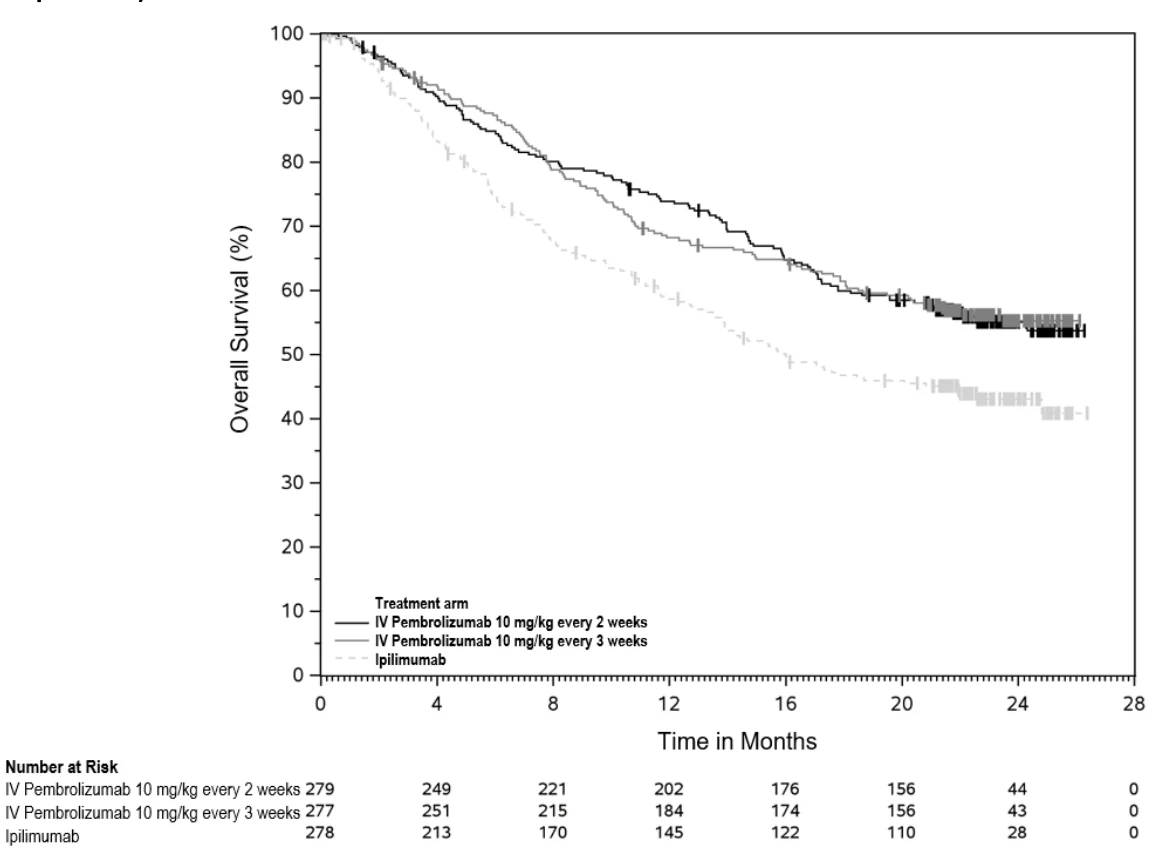
*based on the final analysis with an additional follow-up of 9 months (total of 383 deaths as pre-specified in the protocol)
Figure 2: Kaplan-Meier Curve for Progression-Free Survival (Based on IRO) by Treatment Arm in KEYNOTE-006 (Intent to Treat Population) *
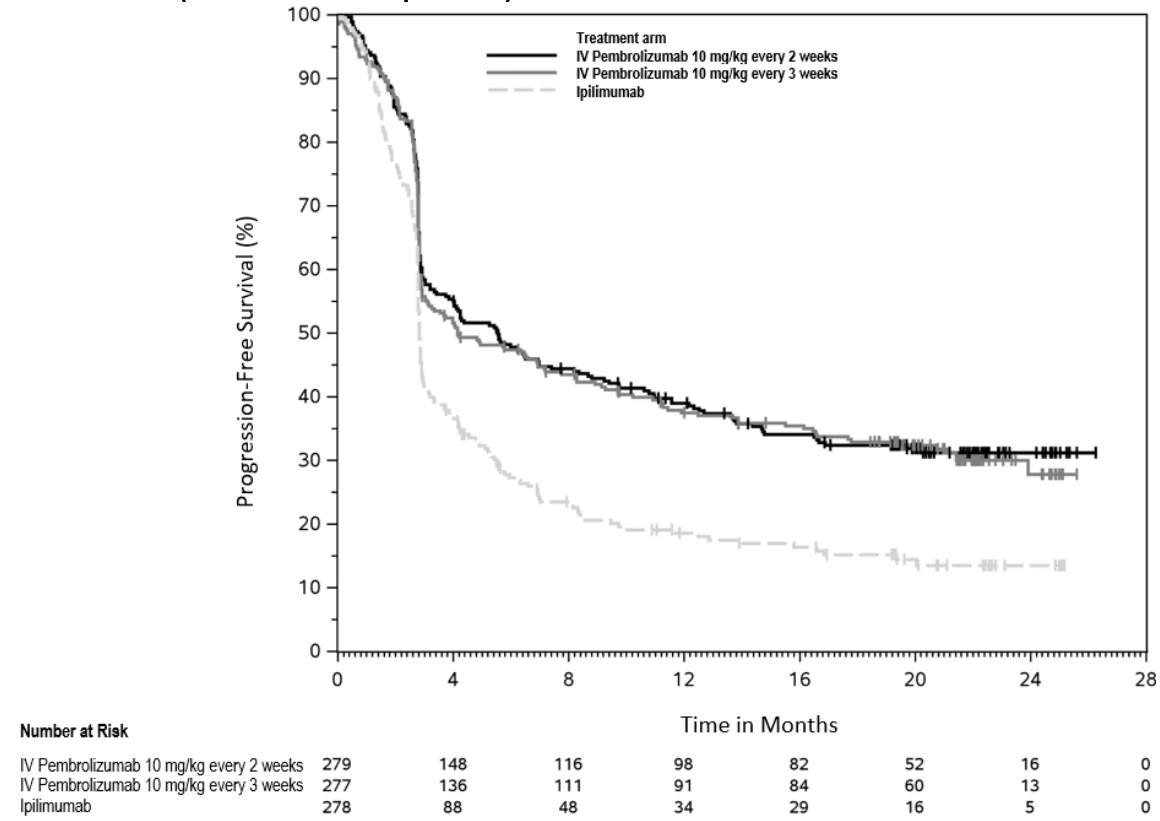
*based on the final analysis with an additional follow-up of 9 months (total of 566 events)
Sub-population analysis by PD-L1 status
In a subgroup analysis of KEYNOTE-006, the association between PD-L1 expression status using pre-defined 1% expression levels and efficacy measures suggested a clinically important signal predictive of the treatment effect in PFS and OS. In PD-L1 positive patients, intravenous KEYTRUDA demonstrated improved efficacy vs ipilimumab in ipilimumab-naïve subjects with advanced melanoma across all efficacy endpoints. In contrast, no meaningful difference was detected in efficacy between the treatment groups in the PD-L1 negative patients. Among patients who were evaluable for PD-L1 expression (98%), 82% were PD-L1 positive and 18% were PD-L1 negative. The PFS HRs (pooled intravenous KEYTRUDA [10 mg/kg every 2 or 3 weeks] vs. ipilimumab) were 0.53 (95% CI: 0.43, 0.65) for PD-L1 positive patients and 0.73 (95% CI: 0.47, 1.11) for PD-L1 negative patients. The OS HRs for pooled intravenous KEYTRUDA vs. ipilimumab were 0.56 (95% CI: 0.43, 0.73) for PD-L1 positive patients and 0.95 (95% CI: 0.56, 1.62) for PD-L1 negative patients.
Sub-population analysis by BRAF mutation status
A subgroup analysis of KEYNOTE-006 in patients who were BRAF wild type, BRAF mutant without prior BRAF treatment and BRAF mutant with prior BRAF treatment was performed. The PFS hazard ratios (HRs) (pooled intravenous KEYTRUDA [10 mg/kg every 2 or 3 weeks] vs. ipilimumab) were 0.57 (95% CI: 0.45, 0.73) for BRAF wild type, 0.50 (95% CI: 0.32, 0.77) for BRAF mutant without prior BRAF treatment, and 0.73 (95% CI: 0.48, 1.11) for BRAF mutant with prior BRAF treatment. The OS HRs for pooled intravenous KEYTRUDA vs. ipilimumab were 0.61 (95% CI: 0.46, 0.82) for BRAF wild type, 0.69 (95% CI: 0.33, 1.45) for BRAF mutant without prior BRAF treatment, and 0.75 (95% CI: 0.45, 1.26) for BRAF mutant with prior BRAF treatment. ORR for pooled intravenous KEYTRUDA vs. ipilimumab was 34% vs. 13% for BRAF wild type, 41% vs. 13% for BRAF mutant without prior BRAF treatment, and 21% vs. 6% for BRAF mutant with prior BRAF treatment.
KEYNOTE-002: Controlled trial in melanoma patients previously treated with ipilimumab
The efficacy of intravenous KEYTRUDA was investigated in KEYNOTE-002, a Phase II multicenter, randomized (1:1:1) controlled study for the treatment of unresectable or metastatic melanoma in patients previously treated with ipilimumab and if BRAF V600 mutation-positive, a BRAF or MEK inhibitor. The treatment arms consisted of intravenous KEYTRUDA 2 mg/kg or 10 mg/kg intravenously every 3 weeks or investigator’s choice of any of the following chemotherapy regimens: dacarbazine 1000 mg/m2 intravenously every 3 weeks (26%); temozolomide 200 mg/m2 orally once daily for 5 days every 28 days (25%); carboplatin AUC 6 intravenously plus paclitaxel 225 mg/m2 intravenously every 3 weeks for four cycles then carboplatin AUC of 5 plus paclitaxel 175 mg/m2 every 3 weeks (25%); paclitaxel 175 mg/m2 intravenously every 3 weeks (16%); or carboplatin AUC 5 or 6 intravenously every 3 weeks (8%). Randomization was stratified by ECOG performance status (0 vs. 1), LDH levels (normal vs. elevated [≥ 110% ULN]) and BRAF V600 mutation status (wild-type [WT] or V600E). The trial included patients with unresectable or metastatic melanoma with progression of disease; refractory to two or more doses of ipilimumab (3 mg/kg or higher) and, if BRAF V600 mutation-positive, a BRAF or MEK inhibitor; and disease progression within 24 weeks following the last dose of ipilimumab. The study excluded patients with: uveal melanoma and active brain metastasis; autoimmune disease or those receiving immunosuppression; a history of severe or life-threatening immune-mediated adverse reactions from treatment with ipilimumab, defined as any Grade 4 toxicity or Grade 3 toxicity requiring corticosteroid treatment (greater than 10 mg/day prednisone or equivalent dose) for greater than 12 weeks; previous severe hypersensitivity to other monoclonal antibodies; a history of pneumonitis or interstitial lung disease; HIV, hepatitis B or hepatitis C infection.
Patients received intravenous KEYTRUDA until: unacceptable toxicity; disease progression that was symptomatic; was rapidly progressive; required urgent intervention; occurred with a decline in performance status, or was confirmed at 4 to 6 weeks with repeat imaging; withdrawal of consent; or physician’s decision to stop therapy for the patient. Assessment of tumour status was performed at 12 weeks after randomization, then every 6 weeks through week 48, followed by every 12 weeks thereafter. Patients on chemotherapy who experienced independently-verified progression of disease after the first scheduled disease assessment were able to crossover and receive 2 mg/kg or 10 mg/kg of intravenous KEYTRUDA every 3 weeks in a double-blind fashion.
Table 78: Baseline Characteristics in KEYNOTE-002.
Intravenous KEYTRUDA 2 mg/kg every 3 weeks n=180 | Intravenous KEYTRUDA 10 mg/kg every 3 weeks n=181 | Chemotherapy* n=179 | ||||||||
|---|---|---|---|---|---|---|---|---|---|---|
| Men | 58% | 60% | 64% | |||||||
| Women | 42% | 40% | 36% | |||||||
| Age (median) | 62 | 60 | 63 | |||||||
| Age (range) | 15-87 years | 27-89 years | 27-87 years | |||||||
| Prior systemic therapies | ||||||||||
| At least 2 | 77% | 70% | 74% | |||||||
| 3 or more | 33% | 34% | 30% | |||||||
| ECOG PS | ||||||||||
| 0 | 54% | 55% | 55% | |||||||
| 1 | 44% | 45% | 45% | |||||||
| M-stage at study entry | ||||||||||
| M0 | 1% | 1% | 1% | |||||||
| M1a | 5% | 7% | 8% | |||||||
| M1b | 12% | 9% | 8% | |||||||
| M1c | 82% | 82% | 82% | |||||||
| Baseline LDH | ||||||||||
| Normal | 56% | 59% | 61% | |||||||
| Elevated | 43% | 40% | 39% | |||||||
| BRAF status | ||||||||||
| wild type | 76% | 78% | 77% | |||||||
| V600 mutant | 24% | 22% | 24% | |||||||
| * Chemotherapy: dacarbazine, temozolomide, carboplatin plus paclitaxel, paclitaxel, or carboplatin | ||||||||||
The median duration of exposure to intravenous KEYTRUDA 2 mg/kg every 3 weeks was 3.7 months (range: 1 day to 32.5 months) and to intravenous KEYTRUDA 10 mg/kg every 3 weeks was 4.8 months (range: 1 day to 31.8 months). The data described below reflect exposure to intravenous KEYTRUDA 2 mg/kg in 37% of patients exposed to intravenous KEYTRUDA for ≥ 6 months and in 22% of patients exposed for ≥ 12 months. In the intravenous KEYTRUDA 10 mg/kg arm, 41% of patients were exposed to intravenous KEYTRUDA for ≥ 6 months and 28% of patients were exposed to intravenous KEYTRUDA for ≥ 12 months.
The co-primary efficacy outcome measures were PFS (as assessed by IRO review using RECIST 1.1), and OS. Secondary efficacy outcome measures were ORR and response duration. Table 79 summarizes key efficacy measures in patients previously treated with ipilimumab. Both intravenous KEYTRUDA arms were superior to chemotherapy for PFS. There was no statistically significant difference between intravenous KEYTRUDA and chemotherapy in the final OS analysis that was not adjusted for the potentially confounding effects of crossover. Of the patients randomized to the chemotherapy arm, 55% crossed over and subsequently received treatment with intravenous KEYTRUDA.
Table 79: Response to Intravenous KEYTRUDA 2 mg/kg or 10 mg/kg every 3 weeks in Patients with Unresectable or Metastatic Melanoma in KEYNOTE-002.
| Endpoint | Intravenous KEYTRUDA 2 mg/kg every 3 weeks n=180 | Intravenous KEYTRUDA 10 mg/kg every 3 weeks n=181 | Chemotherapy n=179 |
|---|---|---|---|
| PFS§ by IRO¶ | |||
| Number (%) of patients with event | 129 (72%) | 126 (70%) | 155 (87%) |
| Hazard ratio† (95% CI) | 0.57 (0.45, 0.73) | 0.50 (0.39, 0.64) | --- |
| p-Value‡ | <0.0001 | <0.0001 | --- |
| Median in months (95% CI) | 2.9 (2.8, 3.8) | 2.9 (2.8, 4.7) | 2.7 (2.5, 2.8) |
| OS* | |||
| Number (%) of patients with event | 123 (68%) | 117 (65%) | 128 (72%) |
| Hazard ratio† (95% CI) | 0.86 (0.67, 1.10) | 0.74 (0.57, 0.96) | -- |
| p-Value‡ | 0.117 | 0.011 # | -- |
| Median in months (95% CI) | 13.4 (11.0, 16.4) | 14.7 (11.3, 19.5) | 11.0 (8.9, 13.8) |
*Based on final analysis †Hazard ratio (intravenous KEYTRUDA compared to chemotherapy) based on the stratified Cox proportional hazard model ‡Based on stratified Log rank test §Based on second interim analysis ¶IRO = Independent radiology plus oncologist review using RECIST 1.1 #Not statistically significant compared to multiplicity adjusted significance level of 0.01 | |||
Based on the second interim analysis the ORR was 21% (95% CI: 15, 28), 25% (95% CI: 19, 32) and 4% (95%: CI 2, 9) for the intravenous KEYTRUDA 2 mg/kg every 3 weeks, intravenous KEYTRUDA 10 mg/kg every 3 weeks, and chemotherapy arms, respectively. ORR consisted of 4 (2%) complete responses and 34 (19%) partial responses for the intravenous KEYTRUDA 2 mg/kg treatment arm, 5 (3%) complete responses and 41 (23%) partial responses for the intravenous KEYTRUDA 10mg/kg treatment arm, and 0 (0%) complete responses and 8 (4%) partial responses for the chemotherapy arm.
Figure 3: Kaplan-Meier Curve for Progression-Free Survival (Based on IRO) by Treatment Arm in KEYNOTE-002 (Intent to Treat Population)
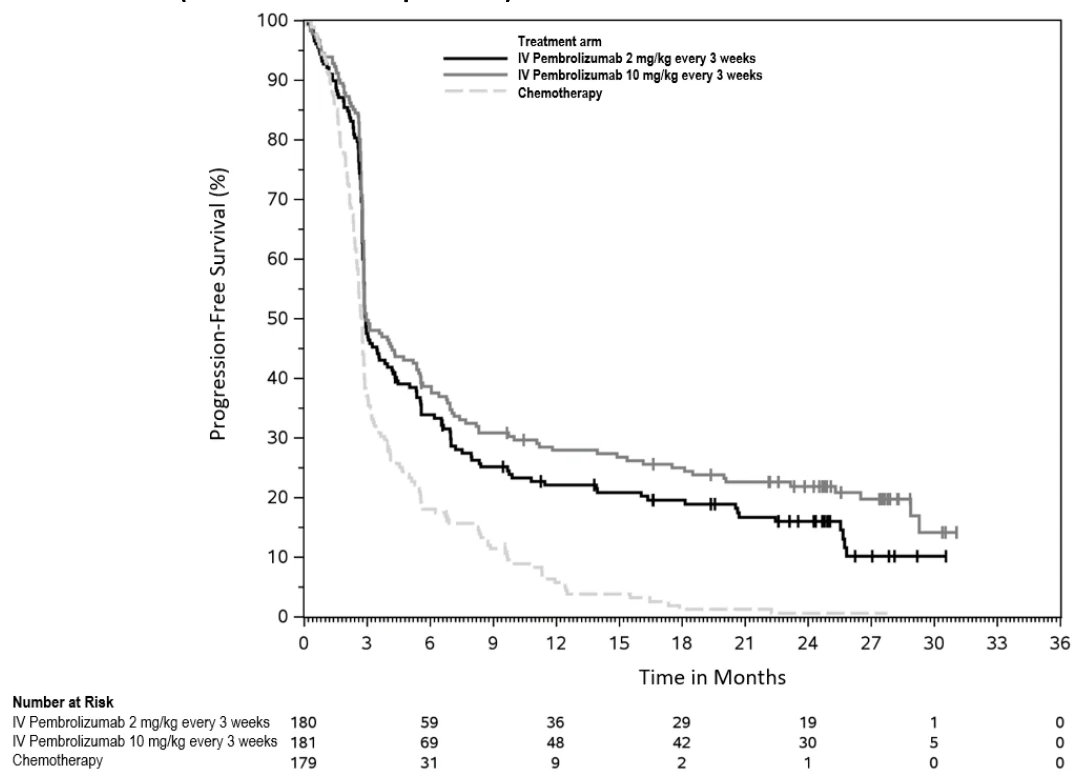
Figure 4: Kaplan-Meier Curve for Overall Survival by Treatment Arm in KEYNOTE-002 (Intent to Treat Population)
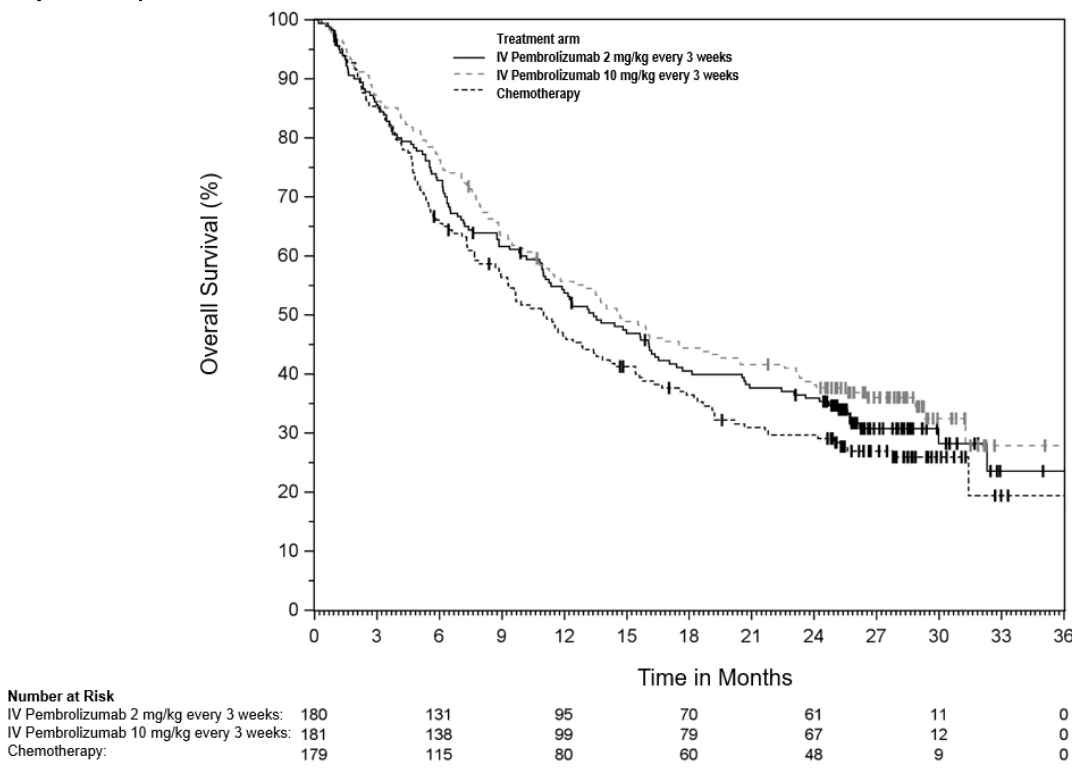
Adjuvant Melanoma
KEYNOTE-716: Placebo-controlled trial for the adjuvant treatment of patients with completely resected Stage IIB or IIC melanoma
The efficacy of intravenous KEYTRUDA was investigated in KEYNOTE-716, a multicenter, randomized, double-blind, placebo-controlled trial in patients with completely resected stage IIB or IIC melanoma. A total of 976 patients were randomized (1:1) to receive intravenous KEYTRUDA 200 mg or the pediatric ( ≥12 years old) dose of intravenous KEYTRUDA 2 mg/kg intravenously (up to a maximum of 200 mg) every three weeks (n=487) or placebo (n=489) for up to one year, until disease recurrence, or until unacceptable toxicity. Randomization was stratified by American Joint Committee on Cancer 8th edition (AJCC) T stage (T3b, T4a, and T4b). Patients must not have been previously treated for melanoma beyond complete surgical resection for their melanoma prior to study entry. Patients with active autoimmune disease or a medical condition that required immunosuppression or mucosal or ocular melanoma were ineligible. Patients underwent imaging every 6 months for 1 year from randomization, every 6 months from years 2 to 4, and then once in year 5 from randomization or until recurrence, whichever came first.
Among the 976 patients, the baseline characteristics were: median age of 61 years (range: 16 to 87; 2 adolescent patients [one per treatment arm, 16 and 17 years of age]), 39% age 65 or older; 60% male; and 93% ECOG PS of 0 and 7% ECOG PS of 1. Sixty-four percent had stage IIB and 35% had stage IIC.
The primary efficacy outcome measure was investigator-assessed recurrence free survival (RFS) in the whole population, where RFS was defined as the time between the date of randomization and the date of first recurrence (local, regional, or distant metastasis) or death, whichever occurred first. New primary melanomas were not included in the definition of RFS. The secondary outcome measures were distant metastasis-free survival (DMFS) and overall survival (OS) in the whole population. OS was not assessed at the time of these analyses.
The trial demonstrated a statistically significant improvement in RFS at the first pre-specified interim analysis with a median follow-up of 14.3 months and, for DMFS at the third pre-specified interim analysis with a median follow up of 26.9 months, as summarized in Table 80.
Table 80: Efficacy Results in KEYNOTE-716
| Endpoint | Intravenous KEYTRUDA 200 mg every 3 weeks n=487 | Placebo n=489 |
|---|---|---|
| RFS | ||
| Number (%) of patients with event | 54 (11%) | 82 (17%) |
| Median in months (95% CI) | NR (22.6, NR) | NR (NR, NR) |
| Hazard ratio* (95% CI) | 0.65 (0.46, 0.92) | |
| p-Value (stratified log-rank) † | 0.00658‡ | |
| DMFS | ||
| Number (%) of patients with event | 63 (13%) | 95 (19%) |
| Median in months (95% CI) | NR (49.6, NR) | NR (NR, NR) |
| Hazard ratio* (95% CI) | 0.64 (0.47, 0.88) | |
| p-Value (stratified log-rank) | 0.00292ξ | |
*Based on the stratified Cox proportional hazard model NR=not reached | ||
† One-sided p-value based on log-rank test stratified by melanoma T Stage (T3b vs. T4a vs. T4b) ‡ p-Value is compared with 0.0101 of the allocated alpha for this interim analysis. ξ p-Value is compared with 0.0128 of the allocated alpha for this interim analysis. | ||
Figure 5: Kaplan-Meier Curve for Recurrence-Free Survival in KEYNOTE-716 (Intent to Treat Population)
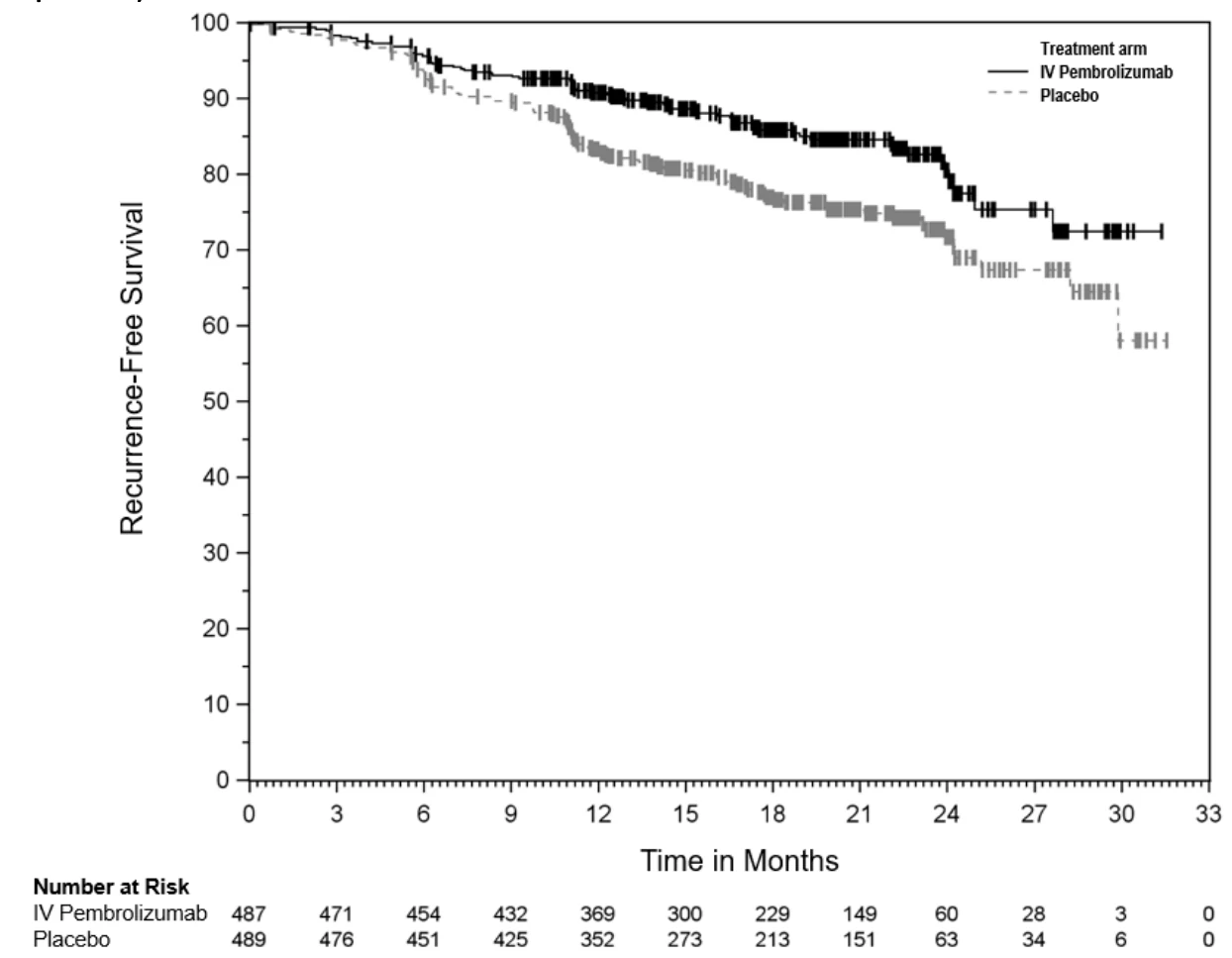
An updated pre-specified final RFS analysis was performed with a median follow-up time of 20.5 months (range: 4.6 to 32.7 months). At the time of this updated RFS analysis, the hazard ratio was 0.61 (95% CI: 0.45, 0.82) (Figure 5). At final analysis for RFS and DMFS with a median follow-up time of 20.5 months and 38.5 months, respectively, the RFS and DMFS results remained consistent with the interim analysis.
KEYNOTE-054: Placebo-controlled trial for the adjuvant treatment of patients with completely resected stage III melanoma
The efficacy of intravenous KEYTRUDA was evaluated in KEYNOTE-054, a multicenter, randomized double-blind, placebo-controlled trial in patients with completely resected stage IIIA (>1 mm lymph node metastasis), IIIB or IIIC melanoma. A total of 1019 patients were randomized (1:1) to receive intravenous KEYTRUDA 200 mg every 3 weeks (n=514) or placebo (n=505), for up to one year until disease recurrence or unacceptable toxicity. The study design included reinitiation with intravenous KEYTRUDA for subsequent disease recurrence that occurs >6 months after completion of one year of adjuvant treatment. Randomization was stratified by American Joint Committee on Cancer 7th edition (AJCC) stage (IIIA vs. IIIB vs. IIIC 1-3 positive lymph nodes vs. IIIC ≥ 4 positive lymph nodes) and geographic region (North America, European countries, Australia, and other countries as designated). Patients must have undergone lymph node dissection and if indicated, radiotherapy within 13 weeks prior to starting treatment. Patients with active autoimmune disease or a medical condition that required immunosuppression or mucosal or ocular melanoma were ineligible.
Patients underwent imaging every 12 weeks after the first dose of intravenous KEYTRUDA for the first two years, then every 6 months from year 3 to 5, and then annually.
Table 81: Baseline Characteristics in KEYNOTE-054.
Intravenous KEYTRUDA 200 mg every 3 weeks n=514 | Placebo n=505 | |||||||
|---|---|---|---|---|---|---|---|---|
| Men | 63% | 60% | ||||||
| Women | 37% | 40% | ||||||
| Age (median) | 54 years | 54 years | ||||||
| Age (range) | 19 to 88 years | 19 to 83 years | ||||||
| Age (≥ 65) | 24% | 25% | ||||||
| ECOG PS | ||||||||
| 0 | 94% | 94% | ||||||
| 1 | 6% | 6% | ||||||
| Stage | ||||||||
| IIIA (> 1 mm) | 16% | 16% | ||||||
| IIIB | 46% | 46% | ||||||
| IIIC (1-3 positive lymph nodes) | 18% | 18% | ||||||
| IIIC (≥ 4 positive lymph nodes) | 20% | 20% | ||||||
| BRAF Status | ||||||||
| Mutation Detected | 48% | 52% | ||||||
| Mutation Not Detected | 45% | 42% | ||||||
| Unknown | 7% | 6% | ||||||
| PD-L1 Status* | ||||||||
| Positive | 83% | 84% | ||||||
| Negative | 11% | 11% | ||||||
| Unknown | 5% | 5% | ||||||
| * Tumour PD-L1 expression was assessed by an immunohistochemistry research assay. Results were recorded as positive (≥ 1% PD-L1), negative (<1% PD-L1) or unknown level of expression (indeterminate PD-L1). | ||||||||
The median duration of exposure to intravenous KEYTRUDA was 11.7 months (range: 1 day to 21 months).
The primary efficacy outcome measures were investigator-assessed recurrence-free survival (RFS) in the ITT population and in the subgroup of patients with PD-L1 positive tumours. RFS was defined as the time between the date of randomization and the date of first recurrence (local, regional, or distant metastasis) or death, whichever occurs first. The secondary outcome measures were distant metastasis-free survival (DMFS) and OS in the ITT population and in the subgroup of patients with PD-L1 positive tumours. The trial demonstrated statistically significant improvement in RFS at the pre-specified interim analysis for patients randomized to the intravenous KEYTRUDA arm compared with placebo with a median follow-up of 16.0 months. A pre-specified DMFS analysis was conducted with a median follow-up time of 45.5 months. At the time of the DMFS analysis, OS was not formally assessed. Efficacy results are summarized in Table 82 and Figure 6.
Table 82: Efficacy Results in KEYNOTE-054.
| Endpoint | Intravenous KEYTRUDA 200 mg every 3 weeks n=514 | Placebo n=505 |
|---|---|---|
| RFS * | ||
| Number (%) of patients with event | 135 (26%) | 216 (43%) |
| Median in months (95% CI) | NR (NR, NR) | 20.4 (16.2, NR) |
| Hazard ratio† (98% CI) | 0.57 (0.43, 0.74) | |
| p-Value | <0.0001‡ | |
| RFS at 6 months | 82% | 73% |
| RFS at 12 months | 75% | 61% |
| DMFS § | ||
| Number (%) of patients with event | 173 (34%) | 245 (49%) |
| DMFS rate at 42 months | 65% | 49% |
| Median in months (95% CI) | NR (49.6, NR) | 40.0 (27.7, NR) |
| Hazard ratio† (95% CI) | 0.60 (0.49, 0.73) | |
| p Value (stratified log rank) | < 0.0001¶ | |
* At pre-specified interim analysis † Based on the stratified Cox proportional hazard model ‡ p-Value (based on stratified log rank test) is compared with 0.014 of the allocated alpha for this interim analysis. § At DMFS analysis ¶ p-value (based on stratified log-rank test) is compared with 0.014 of the allocated alpha for this interim analysis NR = not reached | ||
For patients with PD-L1 positive tumours, the RFS HR (intravenous KEYTRUDA versus placebo) was 0.54 (95% CI: 0.42, 0.69). The RFS benefit for intravenous KEYTRUDA compared to placebo was observed regardless of tumour PD-L1 expression or BRAF mutation status.
For patients with PD-L1 positive tumours, the DMFS HR (intravenous KEYTRUDA versus placebo) was 0.61 (95% CI: 0.49, 0.76). The DMFS benefit for intravenous KEYTRUDA compared to placebo was observed regardless of tumour PD-L1 expression or BRAF mutation status.
Figure 6: Kaplan-Meier Curve for Recurrence-Free Survival in KEYNOTE-054 (Intent to Treat Population)
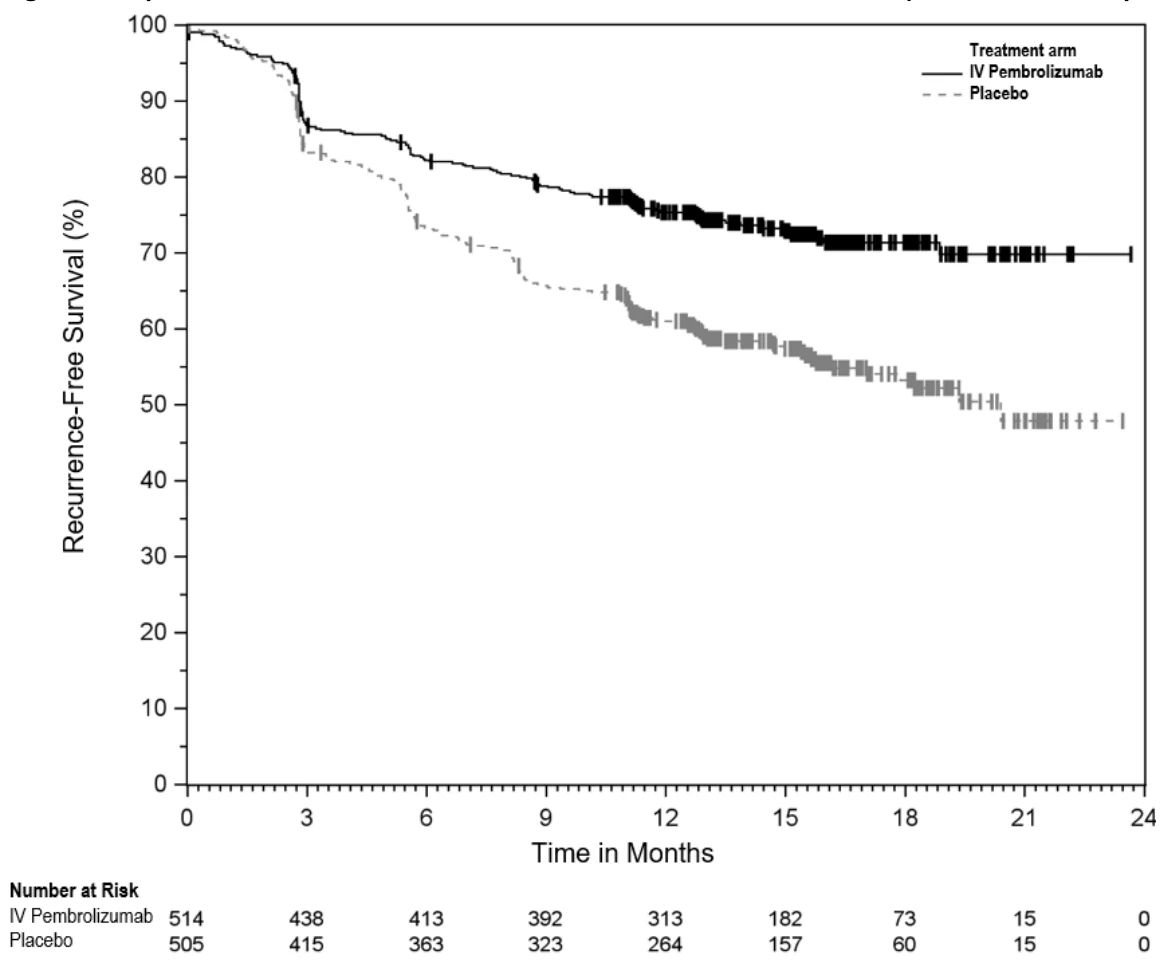
Non-Small Cell Lung Carcinoma
KEYNOTE-024: Controlled trial of NSCLC patients naïve to treatment
The efficacy of intravenous KEYTRUDA was investigated in KEYNOTE-024, a multicenter, open-label randomized, controlled trial. Key eligibility criteria were metastatic NSCLC, PD-L1 expression tumour proportion score (TPS) of 50% or greater by an immunohistochemistry assay using the PD-L1 IHC 22C3 pharmDx* Kit, and no prior systemic treatment for metastatic NSCLC. Patients with EGFR or ALK genomic tumour aberrations; autoimmune disease that required systemic therapy within 2 years of treatment; a medical condition that required immunosuppression; or who had received more than 30 Gy of thoracic radiation within the prior 26 weeks were ineligible. Randomization was stratified by ECOG performance status (0 vs 1), histology (squamous vs non-squamous), and geographic region (East Asia vs. non-East Asia). Patients were randomized (1:1) to receive intravenous KEYTRUDA 200 mg intravenously every 3 weeks (n = 154) or investigator’s choice of any of the following platinum-containing chemotherapy regimens (n = 151):
- Pemetrexed 500 mg/m2 every 3 weeks and carboplatin AUC 5 to 6 mg/mL/min every three weeks on Day 1 for 4 to 6 cycles followed by optional pemetrexed 500 mg/m2 every 3 weeks for patients with non-squamous histologies;
- Pemetrexed 500 mg/m2 every 3 weeks and cisplatin 75 mg/m2 every 3 weeks on Day 1 for 4 to 6 cycles followed by optional pemetrexed 500 mg/m2 every 3 weeks for patients with non-squamous histologies;
- Gemcitabine 1250 mg/m2 on days 1 and 8 and cisplatin 75 mg/m2 every 3 weeks on Day 1 for 4 to 6 cycles;
- Gemcitabine 1250 mg/m2 on Days 1 and 8 and carboplatin AUC 5 to 6 mg/mL/min every 3 weeks on day 1 for 4 to 6 cycles; or
- Paclitaxel 200 mg/m2 every 3 weeks and carboplatin AUC 5 to 6 mg/mL/min every 3 weeks on Day 1 for 4 to 6 cycles followed by optional pemetrexed maintenance (for non-squamous histologies).
Treatment with intravenous KEYTRUDA continued until RECIST 1.1-defined progression of disease as determined by an independent radiology committee or unacceptable toxicity. Treatment could continue beyond disease progression if the patient was clinically stable and was considered to be deriving clinical benefit by the investigator. Patients without disease progression were treated for up to 24 months or 35 administrations, whichever was longer. Subsequent disease progression could be retreated for up to one additional year. Patients on chemotherapy who experienced independently-verified progression of disease were able to crossover and receive intravenous KEYTRUDA.
Table 83: Baseline Characteristics in KEYNOTE-024.
Intravenous KEYTRUDA 200 mg every 3 weeks n=154 | Chemotherapy n=151 | ||||||
|---|---|---|---|---|---|---|---|
| Men | 60% | 63% | |||||
| Women | 40% | 37% | |||||
| Age (median) | 65 | 66 | |||||
| Age (range) | 33-90 years | 38-85 years | |||||
| ECOG PS | |||||||
| 0 | 35% | 35% | |||||
| 1 | 64% | 65% | |||||
| 2 | 1% | 0% | |||||
| Geographic region | |||||||
| East Asia | 14% | 13% | |||||
| Non-East Asia | 86% | 87% | |||||
| Histology | |||||||
| Squamous | 19% | 18% | |||||
| Non-squamous | 81% | 82% | |||||
| Cancer stage at study entry | |||||||
| IIIB | 1% | 1% | |||||
| IV | 99% | 99% | |||||
The median duration of exposure was 7.0 months (range 1 day to 18.7 months) in the intravenous KEYTRUDA arm and 3.5 months (range 1 day to 16.8 months) in the chemotherapy arm.
The primary efficacy outcome measure was PFS as assessed by blinded independent central review (BICR) using RECIST 1.1. Assessment of tumour status was performed every 9 weeks. Secondary efficacy outcome measures were OS and ORR (as assessed by BICR using RECIST 1.1). Table 84 summarizes key efficacy measures for the entire ITT population.
Table 84: Efficacy Results in KEYNOTE-024.
| Endpoint | Intravenous KEYTRUDA 200 mg every 3 weeks n=154 | Chemotherapy n=151 | ||||||||||
|---|---|---|---|---|---|---|---|---|---|---|---|---|
| Primary Efficacy Outcome Measure PFS* | ||||||||||||
| Number (%) of patients with event | 73 (47%) | 116 (77%) | ||||||||||
| Hazard ratio† (95% CI) | 0.50 (0.37, 0.68) | --- | ||||||||||
| p-Value‡ | <0.001 | --- | ||||||||||
| Median in months (95% CI) | 10.3 (6.7, NA) | 6.0 (4.2, 6.2) | ||||||||||
| Key Secondary Efficacy Outcome Measure OS | ||||||||||||
| Number (%) of patients with event | 44 (29%) | 64 (42%) | ||||||||||
| Hazard ratio† (95% CI) | 0.60 (0.41, 0.89) | --- | ||||||||||
| p-Value‡ | 0.005 | --- | ||||||||||
| Median in months (95% CI) | Not reached (NA, NA) | Not reached (9.4, NA) | ||||||||||
| Secondary Efficacy Outcome Measure Objective Response Rate* | ||||||||||||
| ORR % (95% CI) | 45% (37, 53) | 28% (21, 36) | ||||||||||
| Complete Response % | 4% | 1% | ||||||||||
| Partial Response % | 41% | 27% | ||||||||||
* Assessed by BICR using RECIST 1.1 † Hazard ratio (intravenous KEYTRUDA compared to chemotherapy) based on the stratified Cox proportional hazard model ‡ Based on stratified Log rank test NA = not available | ||||||||||||
In exploratory subgroup analyses, a reduced survival benefit of intravenous KEYTRUDA compared to chemotherapy was observed in females as well as in never-smokers. In females, the HR for PFS was 0.75 (95% CI: 0.46, 1.21) and the HR for OS was 0.95 (95% CI: 0.50, 1.83). In never-smokers, the HR for PFS was 0.90 (95% CI: 0.11, 7.59) and the HR for OS was 1.69 (95% CI: 0.19, 15.25).
The final OS analysis was performed at a median follow-up of 25 months after 169 patient events (73 for intravenous KEYTRUDA and 96 for chemotherapy). Median OS was 30.0 months (95% CI: 18.3, NA) for intravenous KEYTRUDA and 14.2 months (95% CI: 9.8, 19.0) for chemotherapy. The OS HR was 0.63 (95% CI: 0.47, 0.86). See Figure 8.
Figure 7: Kaplan-Meier Curve for Progression-Free Survival by Treatment Arm in KEYNOTE-024 (Intent to Treat Population)
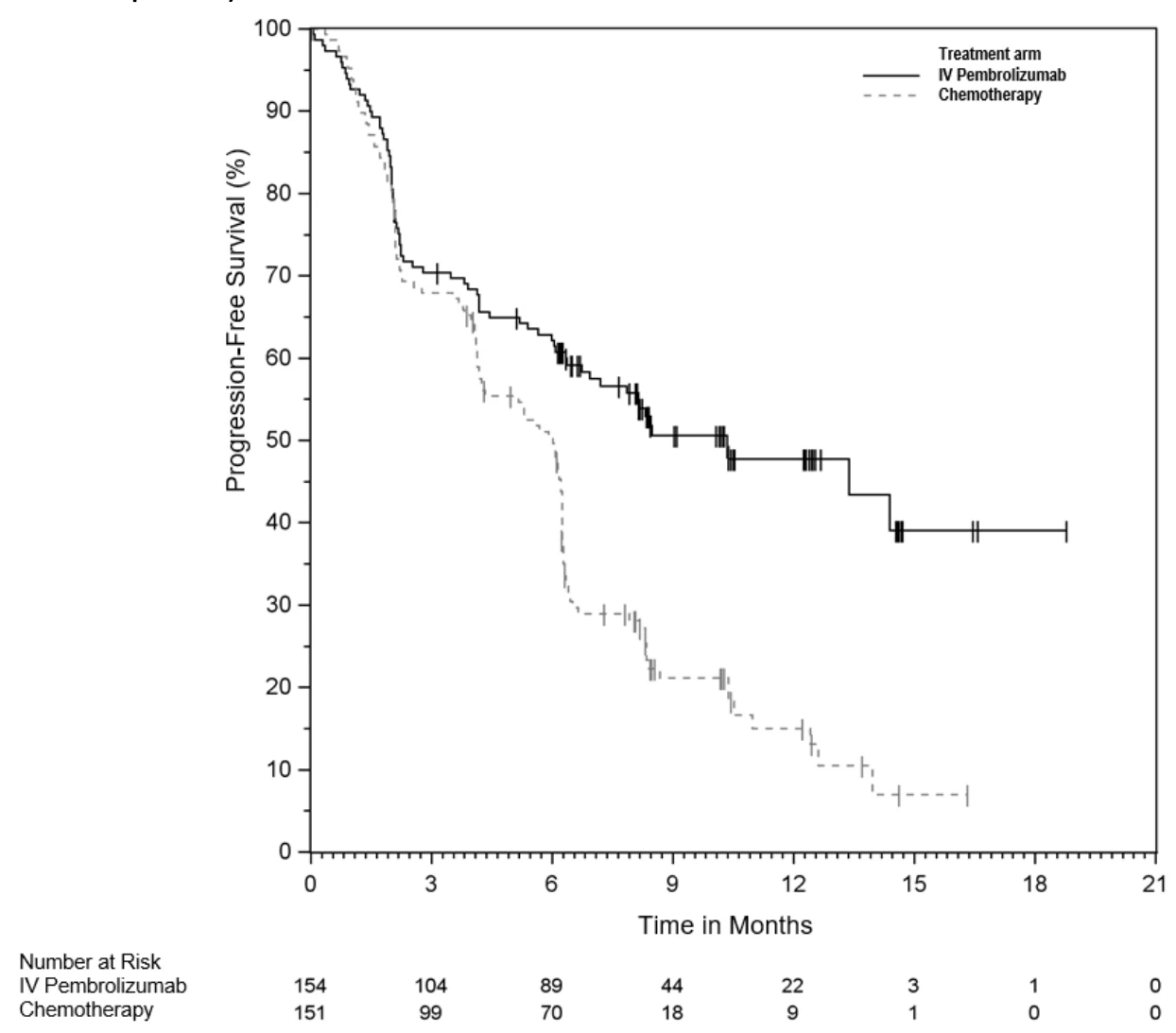
Figure 8: Kaplan-Meier Curve for Overall Survival by Treatment Arm in KEYNOTE-024 (Intent to Treat Population)
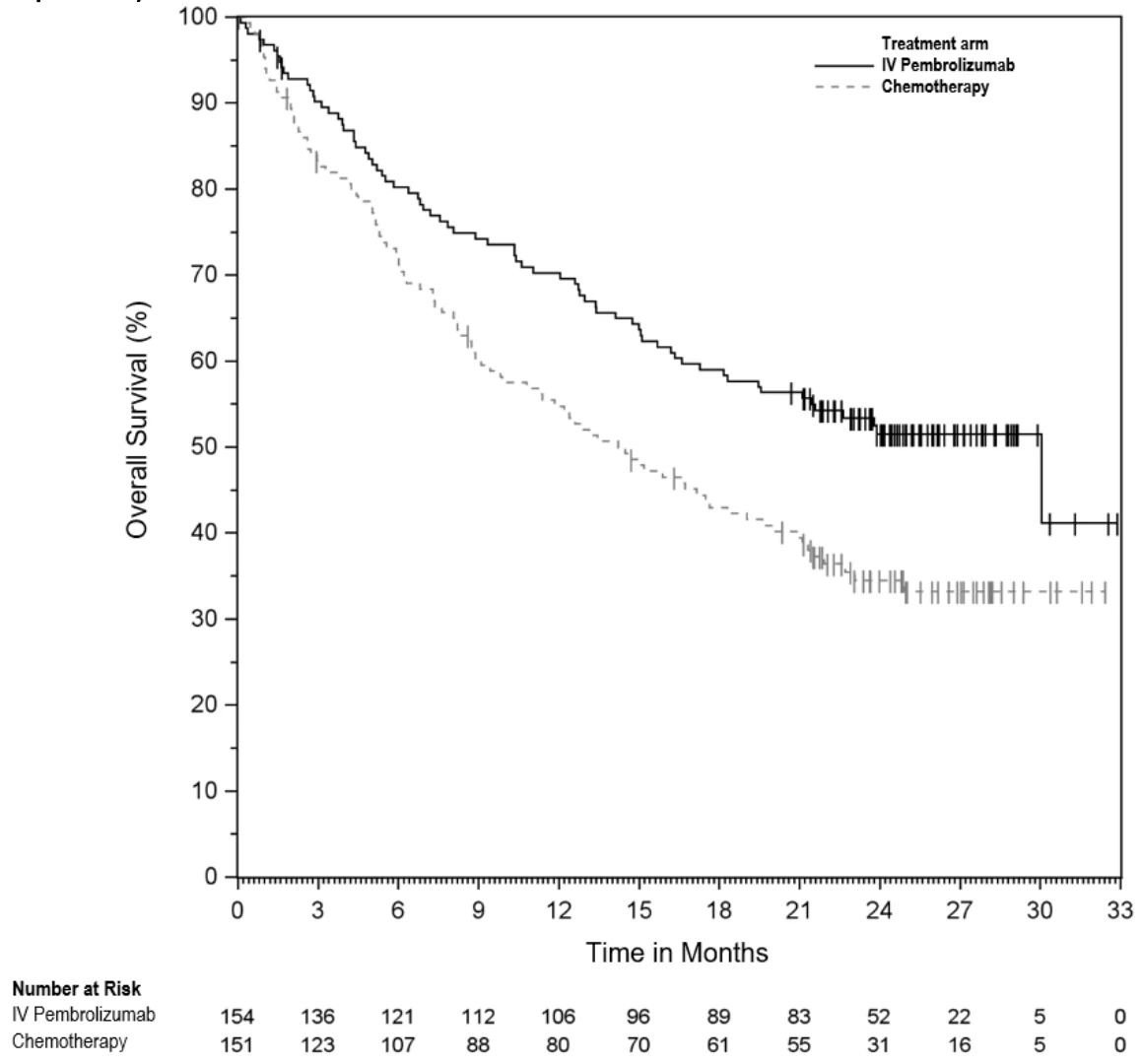
KEYNOTE-042: Controlled trial of NSCLC patients naïve to treatment
The efficacy of intravenous KEYTRUDA was investigated in KEYNOTE-042, a multicenter, randomized, controlled trial conducted in 1274 patients with stage III NSCLC who were not candidates for surgical resection or definitive chemoradiation, or patients with metastatic NSCLC. Only patients whose tumours expressed PD-L1 (TPS ≥ 1%) by an immunohistochemistry assay using the PD-L1 IHC 22C3 pharmDx kit and who had not received prior systemic treatment for metastatic NSCLC were eligible. Patients with EGFR or ALK genomic tumour aberrations; autoimmune disease that required systemic therapy within 2 years of treatment; a medical condition that required immunosuppression; or who had received more than 30 Gy of thoracic radiation within the prior 26 weeks were ineligible. Patients were randomized (1:1) to receive intravenous KEYTRUDA 200 mg every 3 weeks (n=637) or investigator’s choice platinum-containing chemotherapy (n=637, including pemetrexed+carboplatin or paclitaxel+carboplatin. Patients with non-squamous NSCLC could receive pemetrexed maintenance). Patients were treated with intravenous KEYTRUDA until unacceptable toxicity or disease progression.
Treatment could continue beyond disease progression if the patient was clinically stable and was considered to be deriving clinical benefit by the investigator. Patients without disease progression could be treated for up to 24 months. Treatment with intravenous KEYTRUDA could be reinitiated for subsequent disease progression and administered for up to one additional year. Assessment of tumour status was performed every 9 weeks for the first 45 weeks and every 12 weeks thereafter.
Among the 1274 patients in KEYNOTE-042, baseline characteristics were: median age 63 years (45% age 65 or older); 71% male; 64% White; 30% Asian; 19% Hispanic or Latino; and 31% and 69% with an ECOG performance status 0 and 1, respectively. Disease characteristics were: squamous (39%) and non-squamous (61%); M0 (13%); M1 (87%); and treated brain metastases (6%). Forty-seven percent of patients had TPS ≥ 50%, and 53% had TPS 1 to 49%.
The primary efficacy outcome measure was OS. Secondary efficacy outcome measures were PFS and ORR as assessed by blinded independent central review (BICR) using RECIST 1.1. Table 85 summarizes key efficacy measures for the entire ITT population (TPS ≥ 1%).
Table 85: Efficacy results (PD-L1 TPS ≥ 1%) in KEYNOTE-042.
| Endpoint | Intravenous KEYTRUDA 200 mg every 3 weeks n=637 | Chemotherapy n=637 |
|---|---|---|
| Primary Efficacy Outcome Measure OS | ||
| Number (%) of patients with event | 422 (66%) | 481 (76%) |
| Hazard ratio* (95% CI) | 0.82 (0.71, 0.93) | |
| p-Value† | 0.0013 | |
| Median in months (95% CI) | 16.4 (14.0, 19.7) | 12.1 (11.3, 13.3) |
| Secondary Efficacy Outcome Measure PFS‡ | ||
| Number (%) of patients with event | 532 (84%) | 541 (85%) |
| Hazard ratio*,§ (95% CI) | 1.06 (0.93, 1.19) | |
| Median in months (95% CI) | 5.4 (4.3, 6.2) | 6.6 (6.3, 7.3) |
| Secondary Efficacy Outcome Measure Overall response rate‡ | ||
| ORR %§ (95% CI) | 27% (24, 31) | 27% (23, 30) |
| Complete response % | 0.5% | 0.5% |
| Partial response % | 27% | 26% |
* Hazard ratio (intravenous KEYTRUDA compared to chemotherapy) based on the stratified Cox proportional hazard model † Based on stratified Log rank test ‡ Assessed by BICR using RECIST 1.1 § Not evaluated for statistical significance as a result of the sequential testing procedure for the secondary endpoints. | ||
The findings of an analysis based on PD-L1 TPS ≥ 50% and TPS 1 to 49% are shown in Table 86.
Table 86: Efficacy results by PD-L1 Expression in KEYNOTE-042.
| Endpoint | Intravenous KEYTRUDA 200 mg every 3 weeks n=299 | Chemotherapy n=300 | Intravenous KEYTRUDA 200 mg every 3 weeks n=338 | Chemotherapy n=337 | ||||||||||
|---|---|---|---|---|---|---|---|---|---|---|---|---|---|---|
| OS | TPS ≥ 50% | TPS 1 to 49% | ||||||||||||
| Number (%) of patients with event | 180 (60%) | 220 (73%) | 242 (72%) | 261 (77%) | ||||||||||
Hazard ratio* (95% CI) | 0.70 (0.58, 0.86) | 0.91 (0.77, 1.09) | ||||||||||||
| Median in months (95% CI) | 20.0 (15.9, 24.2) | 12.2 (10.4, 14.6) | 13.4 (10.7, 16.9) | 12.1 (11.0, 14.0) | ||||||||||
| * Hazard ratio (intravenous KEYTRUDA compared to chemotherapy) based on the stratified Cox proportional hazard model | ||||||||||||||
Figure 9: Kaplan-Meier Curve for Overall Survival by Treatment Arm in KEYNOTE-042 (TPS ≥ 1%, Intent-to-Treat Population)
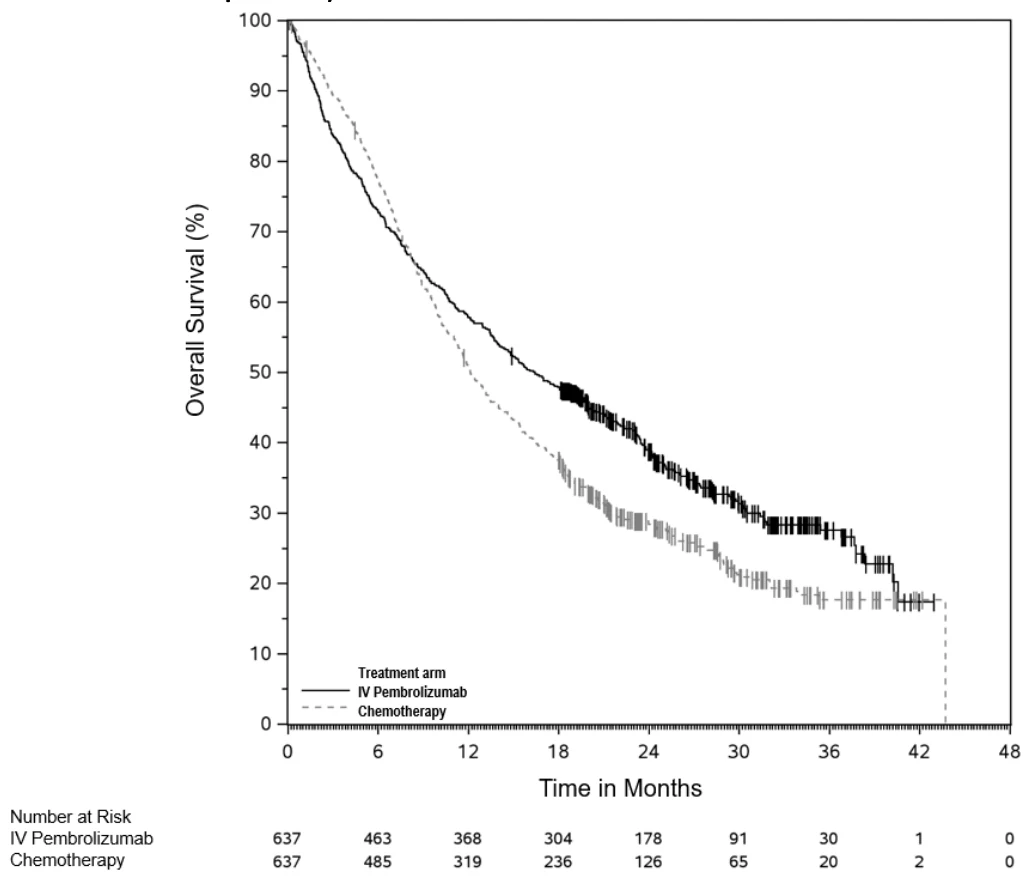
Figure 10: Kaplan-Meier Curve for Overall Survival by Treatment Arm in KEYNOTE-042 (TPS ≥ 50%, Intent-to-Treat Population)
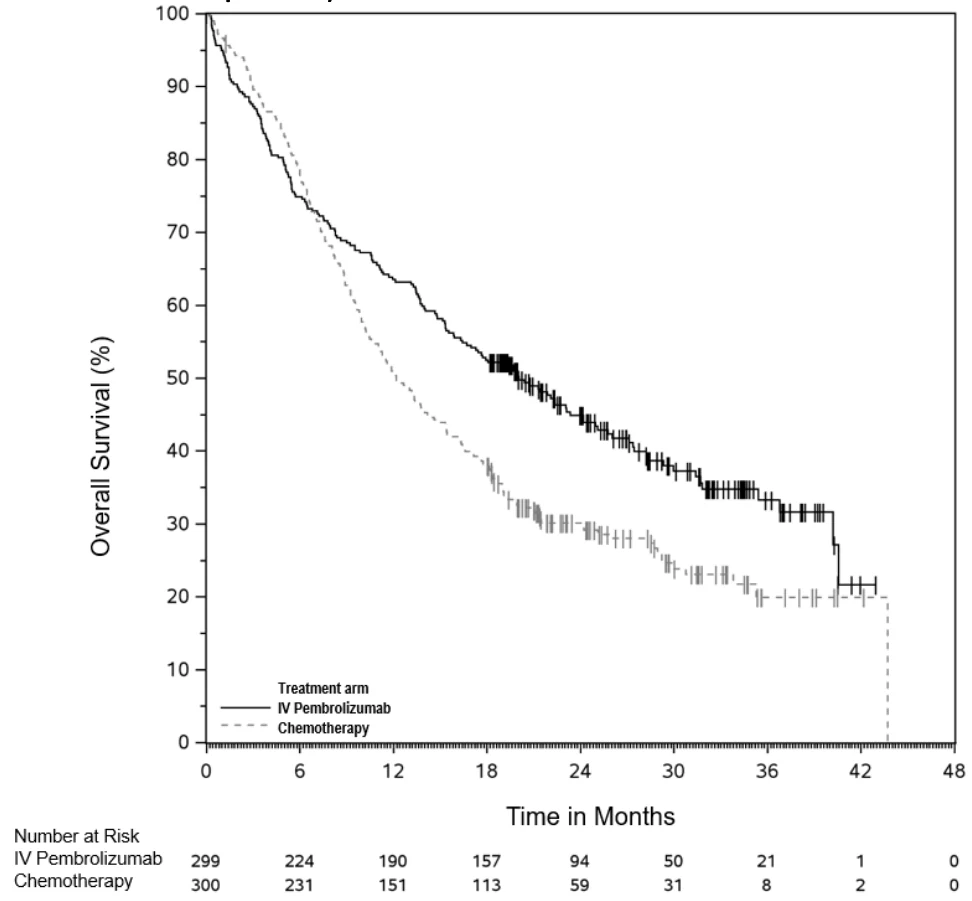
Figure 11: Kaplan-Meier Curve for Overall Survival by Treatment Arm in KEYNOTE-042 (TPS 1-49%, Intent-to-Treat Population)
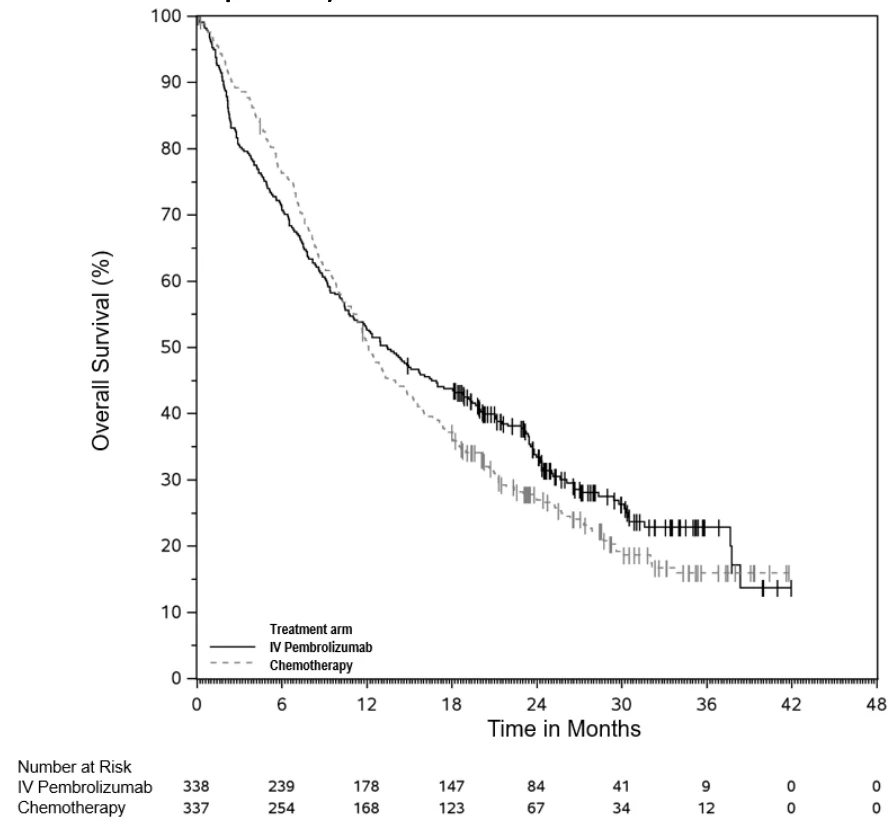
KEYNOTE-189: Controlled trial of combination therapy in non-squamous NSCLC patients naïve to treatment
The efficacy of intravenous KEYTRUDA in combination with pemetrexed and platinum chemotherapy was investigated in a multicenter, randomized, active-controlled, double-blind trial, KEYNOTE-189. Key eligibility criteria were metastatic non-squamous NSCLC, no prior systemic treatment for metastatic NSCLC, and no EGFR or ALK genomic tumour aberrations. Patients with autoimmune disease that required systemic therapy within 2 years of treatment; a medical condition that required immunosuppression; or who had received more than 30 Gy of thoracic radiation within the prior 26 weeks were ineligible. Patients were randomized (2:1) to receive one of the following regimens:
- Intravenous KEYTRUDA 200 mg with pemetrexed 500 mg/m2 and investigator’s choice of cisplatin 75 mg/m2 or carboplatin AUC 5 mg/mL/min intravenously every 3 weeks for 4 cycles followed by intravenous KEYTRUDA 200 mg and pemetrexed 500 mg/m2 intravenously every 3 weeks. intravenous KEYTRUDA was administered prior to chemotherapy; or
- Placebo with pemetrexed 500 mg/m2 and investigator’s choice of cisplatin 75 mg/m2 or carboplatin AUC 5 mg/mL/min intravenously every 3 weeks for 4 cycles followed by placebo and pemetrexed 500 mg/m 2 intravenously every 3 weeks.
Treatment with intravenous KEYTRUDA continued until RECIST 1.1-defined progression of disease as determined by the investigator, unacceptable toxicity, or a maximum of 24 months. Administration of intravenous KEYTRUDA was permitted beyond RECIST-defined disease progression by BICR or beyond discontinuation of pemetrexed if the patient was clinically stable and deriving clinical benefit as determined by the investigator. For patients who completed 24 months of therapy or had a complete response, treatment with intravenous KEYTRUDA could be reinitiated for disease progression and administered for up to one additional year. Assessment of tumour status was performed at Week 6 and Week 12, followed by every 9 weeks thereafter. Patients receiving placebo plus chemotherapy who experienced independently-verified progression of disease were offered intravenous KEYTRUDA as monotherapy.
A total of 67 patients in the placebo plus chemotherapy arm crossed over to receive monotherapy intravenous KEYTRUDA at the time of disease progression and 18 additional patients received a checkpoint inhibitor as subsequent therapy.
Table 87: Baseline Characteristics in KEYNOTE-189.
Intravenous KEYTRUDA and Pemetrexed and Platinum Chemotherapy n=410 | Placebo and Pemetrexed and Platinum Chemotherapy n=206 | ||||||
|---|---|---|---|---|---|---|---|
| Men | 62% | 53% | |||||
| Women | 38% | 47% | |||||
| Age (median) | 65 | 63.5 | |||||
| Age (range) | 34-84 years | 34-84 years | |||||
| ECOG PS | |||||||
| 0 | 45% | 39% | |||||
| 1 | 54% | 61% | |||||
| 2 | <1% | 0% | |||||
| Geographic region | |||||||
| East Asia | 1% | 3% | |||||
| Non-East Asia | 99% | 97% | |||||
| PD-L1 status | |||||||
| < 1% | 31% | 31% | |||||
| ≥ 1% | 63% | 62% | |||||
| Not evaluable | 6% | 7% | |||||
| Brain metastases (treated or untreated) at baseline | |||||||
| Yes | 18% | 17% | |||||
| No | 82% | 83% | |||||
| Platinum chemotherapy | |||||||
| Cisplatin | 28% | 28% | |||||
| Carboplatin | 72% | 72% | |||||
The primary efficacy outcome measures were OS and PFS (as assessed by BICR using RECIST 1.1). Secondary efficacy outcome measures were ORR and response duration, as assessed by BICR using RECIST 1.1. The median follow-up time was 10.5 months (range: 0.2 – 20.4 months). Table 88 summarizes key efficacy measures of the interim analysis.
Table 88: Response to Intravenous KEYTRUDA, Pemetrexed, and Platinum Chemotherapy in Patients with Non-Squamous NSCLC in KEYNOTE-189.
| Endpoint | Intravenous KEYTRUDA and Pemetrexed and Platinum Chemotherapy n=410 | Placebo and Pemetrexed and Platinum Chemotherapy n=206 |
|---|---|---|
| Primary Efficacy Outcome Measure OS | ||
| Number (%) of patients with event | 127 (31%) | 108 (52%) |
| Hazard ratio* (95% CI) | 0.49 (0.38, 0.64) | |
| p-Value† | <0.00001 | |
| Median in months (95% CI) | Not reached (NA, NA) | 11.3 (8.7, 15.1) |
| OS rate at 6 months (%) | 85% | 72% |
| OS rate at 9 months (%) | 78% | 56% |
| Primary Efficacy Outcome Measure PFS | ||
| Number (%) of patients with event | 245 (60%) | 166 (81%) |
| Hazard ratio* (95% CI) | 0.52 (0.43, 0.64) | |
| p-Value† | <0.00001 | |
| Median in months (95% CI) | 8.8 (7.6, 9.2) | 4.9 (4.7, 5.5) |
| PFS rate at 6 months (%) | 66% | 40% |
| PFS rate at 9 months (%) | 48% | 25% |
| Secondary Efficacy Outcome Measure Objective Response Rate | ||
| ORR‡ % (95% CI) | 48% (43, 53) | 19% (14, 25) |
| Complete response % | 0.5% | 0.5% |
| Partial response % | 47% | 18% |
| p-Value§ | <0.0001 | |
| Secondary Efficacy Outcome Measure Response Duration | ||
| Median in months (range) | 11.2 (1.1+, 18.0+) | 7.8 (2.1+, 16.4+) |
| % with duration ≥ 6 months¶ | 81% | 63% |
| % with duration ≥ 9 months¶ | 59% | 44% |
* Based on the stratified Cox proportional hazard model † Based on stratified log-rank test ‡ Based on patients with a best overall response as confirmed complete or partial response § Based on Miettinen and Nurminen method stratified by PD-L1 status, platinum chemotherapy and smoking status ¶ Based on Kaplan-Meier estimation NA = not available | ||
The final descriptive analysis of OS was performed at a median duration of follow-up of 18.8 months after 421 patient events (258 for intravenous KEYTRUDA combination arm and 163 for the placebo plus chemotherapy arm). Median OS was 22.0 months for the intravenous KEYTRUDA combination arm and 10.6 months for the placebo plus chemotherapy arm. The OS HR was 0.56 (95% CI: 0.46, 0.69; see Figure 12). At final analysis, the results for PFS and ORR remained consistent with the interim analysis (see Table 88).
Figure 12: Kaplan-Meier Curve for Overall Survival by Treatment Arm in KEYNOTE-189 (Intent to Treat Population)*
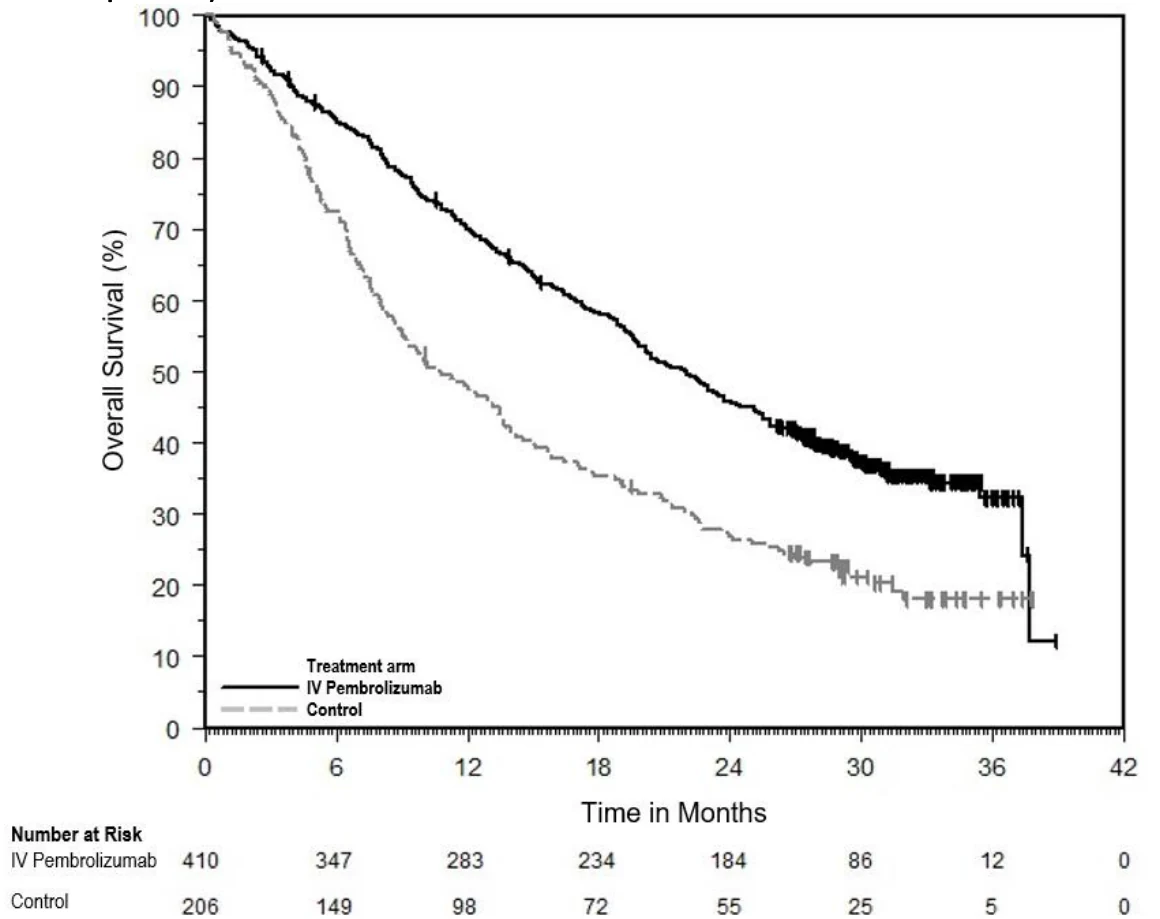
*based on the final analysis
Figure 13: Kaplan-Meier Curve for Progression-Free Survival by Treatment Arm in KEYNOTE-189 (Intent to Treat Population)*
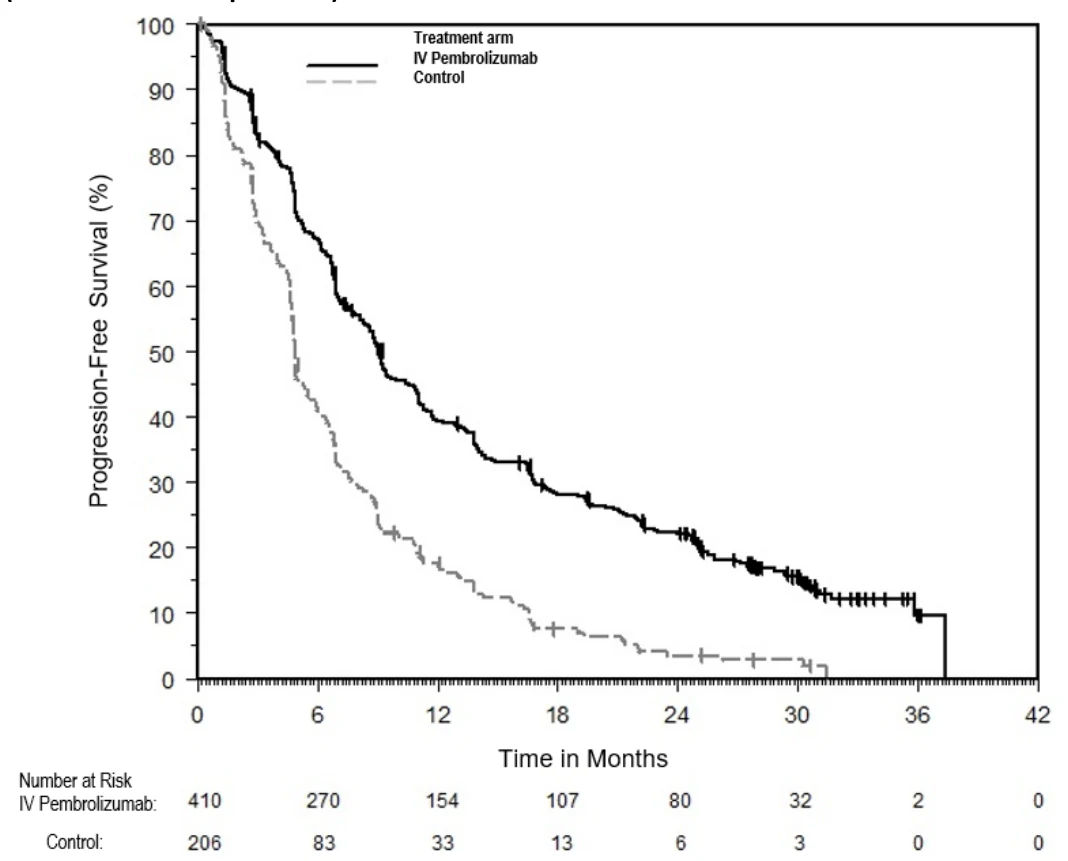
*based on the final analysis
KEYNOTE-407: Controlled trial of combination therapy in squamous NSCLC patients naïve to treatment
The efficacy of intravenous KEYTRUDA in combination with carboplatin and either paclitaxel or nab-paclitaxel was investigated in Study KEYNOTE-407, a randomized, double-blind, multicenter, placebo-controlled study. The key eligibility criteria for this study were metastatic squamous NSCLC, regardless of tumour PD-L1 expression status, and no prior systemic treatment for metastatic disease. Patients with autoimmune disease that required systemic therapy within 2 years of treatment; a medical condition that required- immunosuppression; or who had received more than 30 Gy of thoracic radiation within the prior 26 weeks were ineligible. Randomization was stratified by tumour PD-L1 expression (TPS <1% [negative] vs. TPS ≥ 1%), investigator’s choice of paclitaxel or nab-paclitaxel, and geographic region (East Asia vs. non-East Asia). Patients were randomized (1:1) to one of the following treatment arms. All study medications were administered via intravenous infusion.
- Intravenous KEYTRUDA 200 mg and carboplatin AUC 6 mg/mL/min on Day 1 of each 21-day cycle for 4 cycles, and paclitaxel 200 mg/m2 on Day 1 of each 21-day cycle for 4 cycles or nab-paclitaxel 100 mg/m2 on Days 1, 8 and 15 of each 21-day cycle for 4 cycles, followed by intravenous KEYTRUDA 200 mg every 3 weeks. Intravenous KEYTRUDA was administered prior to chemotherapy on Day 1; or
- Placebo and carboplatin AUC 6 mg/mL/min on Day 1 of each 21-day cycle for 4 cycles and paclitaxel 200 mg/m2 on Day 1 of each 21-day cycle for 4 cycles or nab-paclitaxel 100 mg/m2 on Days 1, 8 and 15 of each 21-day cycle for 4 cycles, followed by placebo every 3 weeks.
Treatment with intravenous KEYTRUDA or placebo continued until RECIST 1.1-defined progression of disease as determined by blinded independent central review (BICR), unacceptable toxicity, or a maximum of 24 months. Administration of intravenous KEYTRUDA was permitted beyond RECIST-defined disease progression if the patient was clinically stable and deriving clinical benefit as determined by the investigator. Treatment with intravenous KEYTRUDA could be reinitiated for subsequent disease progression and administered for up to one additional year.
Patients in the placebo arm were offered intravenous KEYTRUDA as a single agent at the time of disease progression.
Assessment of tumour status was performed every 6 weeks through Week 18, every 9 weeks through Week 45 and every 12 weeks thereafter. The major efficacy outcome measures were progression-free survival and objective response rate (ORR) as assessed by BICR using RECIST 1.1 and overall survival. An additional efficacy outcome measure was duration of response as assessed by BICR using RECIST 1.1.
Table 89: Baseline Characteristics in KEYNOTE-407.
Intravenous KEYTRUDA and Carboplatin and Paclitaxel or Nab-Paclitaxel n=278 | Placebo and Carboplatin and Paclitaxel or Nab-Paclitaxel n=281 | ||||||
|---|---|---|---|---|---|---|---|
| Men | 79% | 84% | |||||
| Women | 21% | 16% | |||||
| Age (median) | 65 | 65 | |||||
| Age (range) | 29-87 years | 36-88 years | |||||
| ECOG PS | |||||||
| 0 | 26% | 32% | |||||
| 1 | 74% | 68% | |||||
| Geographic region | |||||||
| East Asia | 19% | 19% | |||||
| Non-East Asia | 81% | 81% | |||||
| PD-L1 status | |||||||
| < 1% | 34% | 35% | |||||
| ≥ 1% | 63% | 63% | |||||
| Not evaluable | 3% | 2% | |||||
| Brain metastases (treated or untreated) at baseline | |||||||
| Yes | 7% | 9% | |||||
| No | 93% | 91% | |||||
| Taxane chemotherapy | |||||||
| Paclitaxel | 61% | 59% | |||||
| Nab-Paclitaxel | 39% | 41% | |||||
In KEYNOTE-407, there was a statistically significant improvement in OS, PFS and ORR in patients randomized to intravenous KEYTRUDA in combination with carboplatin and either paclitaxel or nab-paclitaxel compared with patients randomized to placebo with carboplatin and either paclitaxel or nab-paclitaxel, Table 90 summarizes key efficacy measures of the interim analysis.
Table 90: Efficacy Results in KEYNOTE-407.
| Endpoint | Intravenous KEYTRUDA and Carboplatin and Paclitaxel or Nab-Paclitaxel n=278 | Placebo and Carboplatin and Paclitaxel or Nab-Paclitaxel n=281 | ||||||||||||
|---|---|---|---|---|---|---|---|---|---|---|---|---|---|---|
| Primary Efficacy Outcome Measure OS | ||||||||||||||
| Number of events (%) | 85 (31%) | 120 (43%) | ||||||||||||
| Median in months (95% CI) | 15.9 (13.2, NA) | 11.3 (9.5, 14.8) | ||||||||||||
| Hazard ratio* (95% CI) | 0.64 (0.49, 0.85) | |||||||||||||
| p-Value (stratified log rank) | 0.0008 | |||||||||||||
| Primary Efficacy Outcome Measure PFS† | ||||||||||||||
| Number of events (%) | 152 (55%) | 197 (70%) | ||||||||||||
| Median in months (95% CI) | 6.4 (6.2, 8.3) | 4.8 (4.2, 5.7) | ||||||||||||
| Hazard ratio* (95% CI) | 0.56 (0.45, 0.70) | |||||||||||||
| p-Value(stratified log rank) | <0.0001 | |||||||||||||
| Secondary Efficacy Outcome Measure Objective Response Rate† | ||||||||||||||
| ORR ‡ | 58% | 38% | ||||||||||||
| (95% CI) | (52, 64) | (33, 44) | ||||||||||||
| Secondary Efficacy Outcome Measure Duration of Response† | ||||||||||||||
| Median duration of response in months (range)§ | 7.7 (1.1+, 14.7+) | 4.8 (1.3+, 15.8+) | ||||||||||||
| % with duration ≥ 6 months¶ | 62% | 40% | ||||||||||||
* Based on the stratified Cox proportional hazard model † Assessed by BICR using RECIST 1.1 ‡ At the initial interim analysis (n=101 for intravenous KEYTRUDA combination therapy, n=102 for placebo), a statistically significant difference was observed; ORR was 58% [95% CI (48, 68)] and 35% [95% CI (26, 45)] for placebo, p=0.0004 § ‘+’ indicates there is no progressive disease by the time of last disease assessment ¶ Based on Kaplan-Meier estimation NA = not available | ||||||||||||||
The final descriptive analysis of OS was performed at a median duration of follow-up of 14.3 months after 365 patient events (168 for intravenous KEYTRUDA combination arm and 197 for placebo plus chemotherapy arm). Median OS was 17.1 months for the intravenous KEYTRUDA combination arm and 11.6 months for the placebo plus chemotherapy arm. The OS HR was 0.71 (95% CI: 0.58, 0.88; see Figure 14). At final analysis, the results for PFS and ORR remained consistent with the interim analysis (see Table 90).
Figure 14: Kaplan-Meier Curve for Overall Survival in KEYNOTE-407*
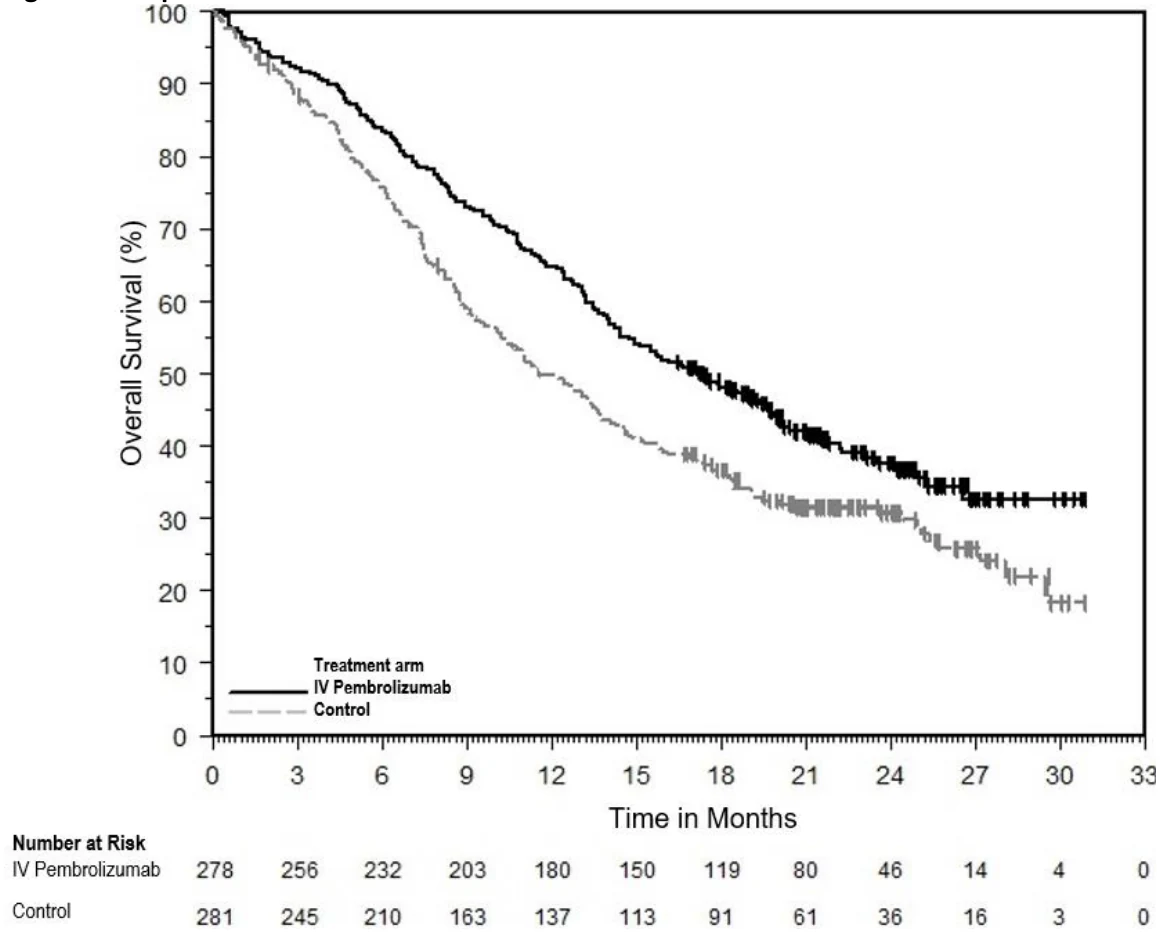
*based on the final analysis
Figure 15: Kaplan-Meier Curve for Progression-Free Survival in KEYNOTE-407*
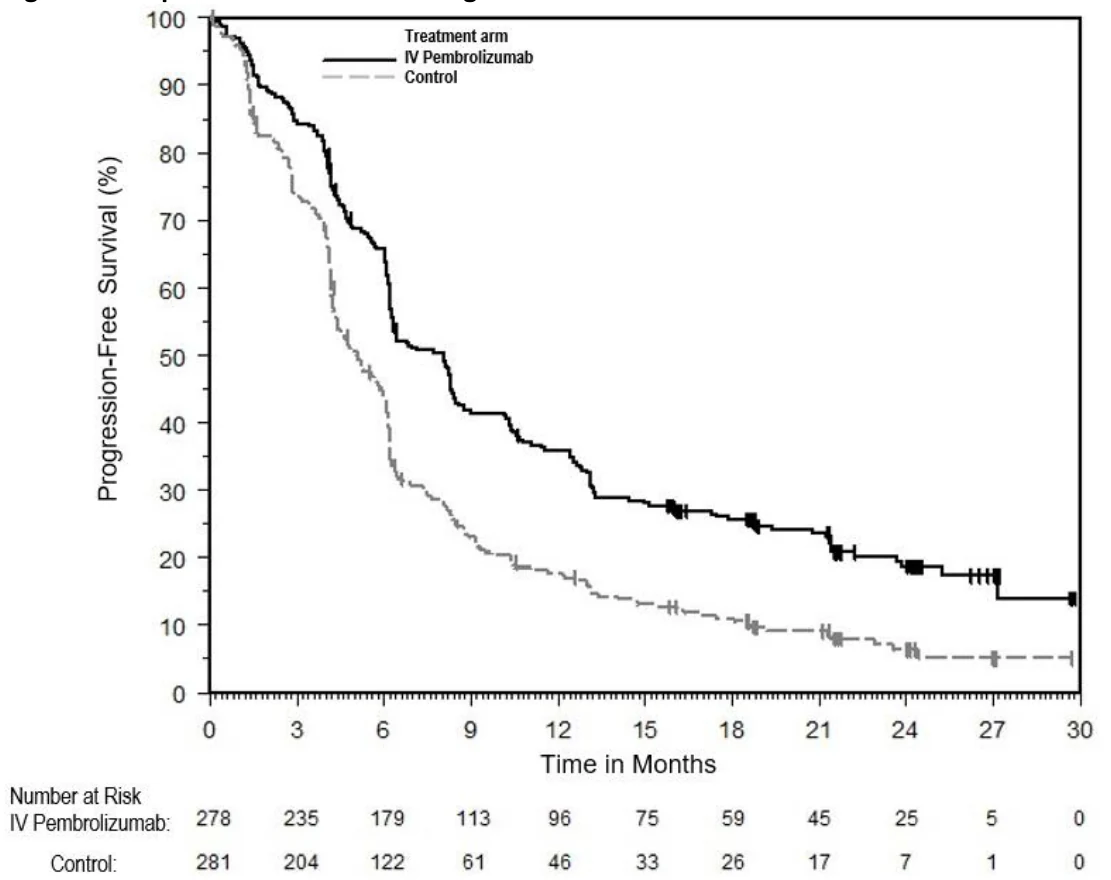
*based on the final analysis
KEYNOTE-010: Controlled trial in NSCLC patients previously treated with chemotherapy
The efficacy of intravenous KEYTRUDA was investigated in KEYNOTE-010, a multicenter, randomized, open-label controlled trial. Key eligibility criteria were metastatic NSCLC that had progressed following platinum-containing chemotherapy, and if appropriate, targeted therapy for ALK or EGFR mutations, and PD-L1 expression tumour proportion score (TPS) of 1% or greater by a clinical trial assay version of the PD-L1 IHC 22C3 pharmDx* kit. Patients with autoimmune disease; a medical condition that required immunosuppression; or who had received more than 30 Gy of thoracic radiation within the prior 26 weeks were ineligible. Randomization was stratified by tumour PD-L1 expression (PD-L1 expression TPS ≥ 50% vs. PD-L1 expression TPS=1-49%), ECOG performance scale (0 vs. 1), and geographic region (East Asia vs. non-East Asia). Patients were randomized (1:1:1) to receive intravenous KEYTRUDA 2 mg/kg intravenously every 3 weeks (n=344), intravenous KEYTRUDA 10 mg/kg intravenously every 3 weeks (n=346) or docetaxel 75 mg/m2 intravenously every 3 weeks (n=343). Patients randomized to intravenous KEYTRUDA were permitted to continue until disease progression that was symptomatic, rapidly progressive, required urgent intervention, occurred with a decline in performance status, or confirmation of progression at 4 to 6 weeks with repeat imaging or for up to 24 months without disease progression.
Table 91: Baseline Characteristics in KEYNOTE-010.
Intravenous KEYTRUDA 2 mg/kg every 3 weeks n=344 | Intravenous KEYTRUDA 10 mg/kg every 3 weeks n=346 | Docetaxel 75 mg/m2 every 3 weeks n=343 | |||||||||||
|---|---|---|---|---|---|---|---|---|---|---|---|---|---|
| Men | 62% | 62% | 61% | ||||||||||
| Women | 38% | 38% | 39% | ||||||||||
| Age (median) | 63 years | 63 years | 62 years | ||||||||||
| Age (range) | 29-82 years | 20-88 years | 33-82 years | ||||||||||
| ECOG PS | |||||||||||||
| 0 | 33% | 35% | 34% | ||||||||||
| 1 | 67% | 65% | 65% | ||||||||||
| 2 | 1% | 0% | 0% | ||||||||||
| Geographic region | |||||||||||||
| East Asia | 19% | 19% | 18% | ||||||||||
| Non-East Asia | 81% | 82% | 82% | ||||||||||
| Histology | |||||||||||||
| Squamous | 22% | 23% | 19% | ||||||||||
| Non-squamous | 70% | 71% | 70% | ||||||||||
| Cancer stage at study entry | |||||||||||||
| IIIB | 6% | 8% | 6% | ||||||||||
| IV | 92% | 91% | 91% | ||||||||||
| Brain Metastasis | 16% | 14% | 14% | ||||||||||
| EGFR Mutant | 8% | 9% | 8% | ||||||||||
| ALK Translocation Mutant | 1% | 1% | 1% | ||||||||||
| Prior Lines of Systemic Therapy | |||||||||||||
| One | 71% | 68% | 69% | ||||||||||
| Two or more | 27% | 30% | 30% | ||||||||||
The median duration of exposure to treatment to intravenous KEYTRUDA 2 mg/kg every 3 weeks was 3.5 months (range: 1 day to 22.4 months) and to intravenous KEYTRUDA 10 mg/kg every 3 weeks was 3.5 months (range 1 day to 20.8 months). The median duration of exposure to docetaxel 75 mg/m2 every 3 weeks was 2.0 months (range: 1 day to 13.7 months).
The primary efficacy outcome measures were OS and PFS as assessed by a Blinded Independent Central Review (BICR) according to RECIST 1.1 in the subgroup of patients with TPS ≥ 50% and the overall population with TPS ≥ 1%. Assessment of tumour status was performed every 9 weeks. A secondary efficacy outcome measure was ORR in the subgroup of patients with TPS ≥ 50% and the overall population with TPS ≥ 1%. Table 92 and Table 93 summarize key efficacy measures for the entire ITT population (TPS ≥ 1%) and for the subgroup of patients with TPS ≥ 50%. Kaplan-Meier curves for OS (TPS ≥ 1% and TPS ≥ 50%) are shown in Figure 16 and Figure 18. Kaplan-Meier curves for PFS (TPS ≥ 1% and TPS ≥ 50%) are shown in Figure 17 and Figure 19.
Table 92: Response to Intravenous KEYTRUDA 2 or 10 mg/kg every 3 Weeks in Previously Treated Patients with NSCLC in KEYNOTE-010, with TPS ≥ 1%.
| Endpoint | Intravenous KEYTRUDA 2 mg/kg every 3 weeks | Intravenous KEYTRUDA 10 mg/kg every 3 weeks | Docetaxel 75 mg/m2 every 3 weeks |
|---|---|---|---|
| TPS ≥1% | |||
| Number of patients | 344 | 346 | 343 |
| Primary Efficacy Outcome Measure OS | |||
| Number (%) of patients with event | 172 (50%) | 156 (45%) | 193 (56%) |
| Hazard ratio (98.35% CI)* | 0.71 (0.55, 0.92) | 0.61 (0.47, 0.79) | --- |
| p-Value† | <0.001‡ | <0.001‡ | --- |
| Median in months (95% CI) | 10.4 (9.4, 11.9) | 12.7 (10.0, 17.3) | 8.5 (7.5, 9.8) |
| Primary Efficacy Outcome Measure PFS‡,§ | |||
| Number (%) of patients with event | 266 (77%) | 255 (74%) | 257 (75%) |
| Hazard ratio (99.80% CI)* | 0.88 (0.66, 1.15) | 0.79 (0.60, 1.05) | --- |
| p-Value† | 0.068 | 0.005 | --- |
| Median in months (95% CI) | 3.9 (3.1, 4.1) | 4.0 (2.6, 4.3) | 4.0 (3.1, 4.2) |
| Secondary Efficacy Outcome Measure Overall Response Rate§ | |||
| ORR %¶ (95% CI) | 18% (14, 23) | 18% (15, 23) | 9% (7, 13) |
* Hazard ratio (intravenous KEYTRUDA compared to docetaxel) based on the stratified Cox proportional hazard model. The confidence levels correspond to the allocated Type I error of 0.00825 and 0.001 for the OS and PFS endpoints, respectively. † Based on one-sided stratified Log rank test ‡ Statistically significant based on a pre-specified α level of 0.00825 for the two pairwise comparisons versus docetaxel using a Hochberg procedure § Assessed by BICR using RECIST 1.1 ¶ All responses were partial responses. | |||
Figure 16: Kaplan-Meier Curve for Overall Survival by Treatment Arm in KEYNOTE-010 (TPS ≥ 1%, Intent to Treat Population)
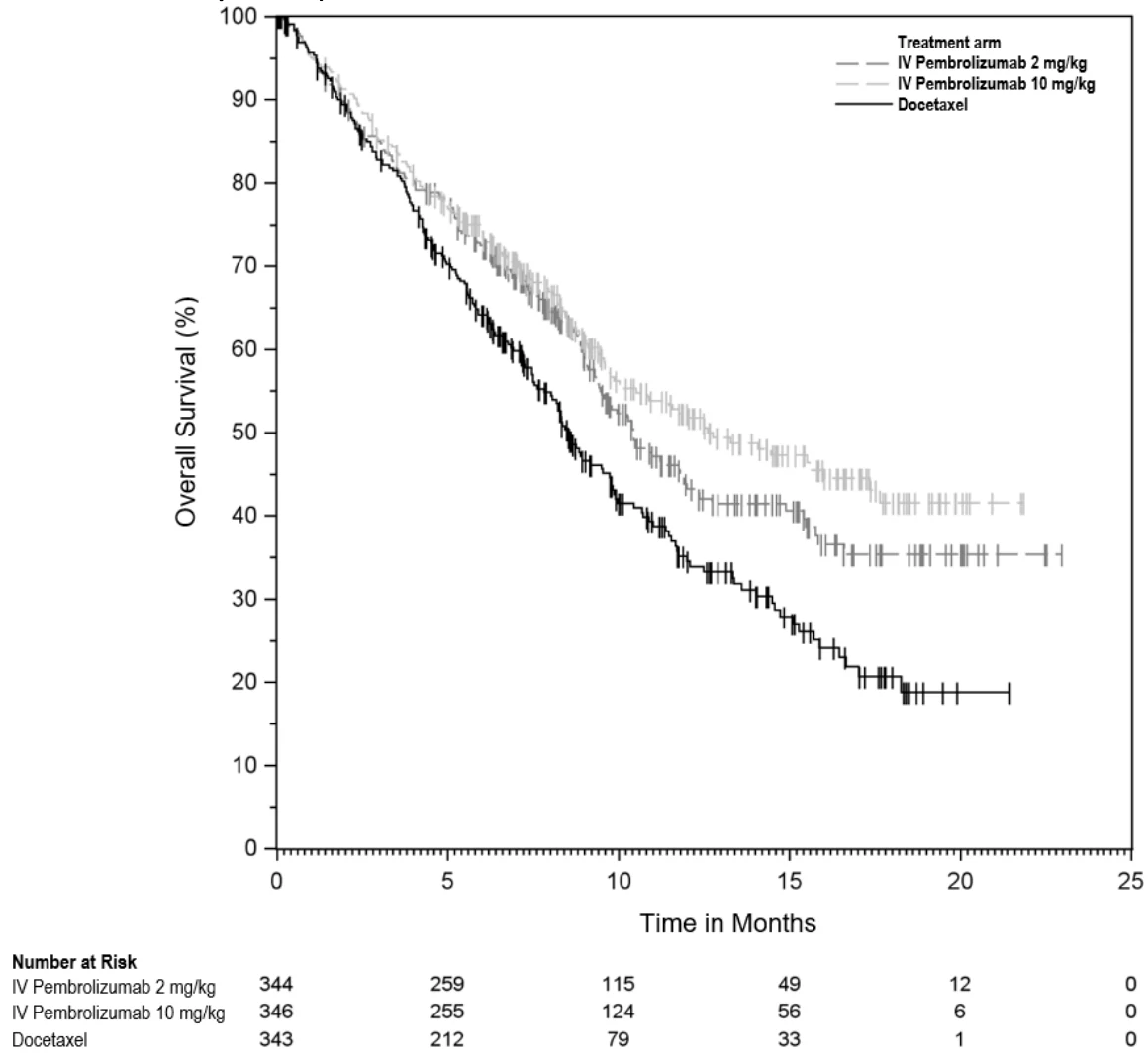
Figure 17: Kaplan-Meier Curve for Progression-Free Survival by Treatment Arm in KEYNOTE-010 (TPS ≥ 1%, Intent to Treat Population)
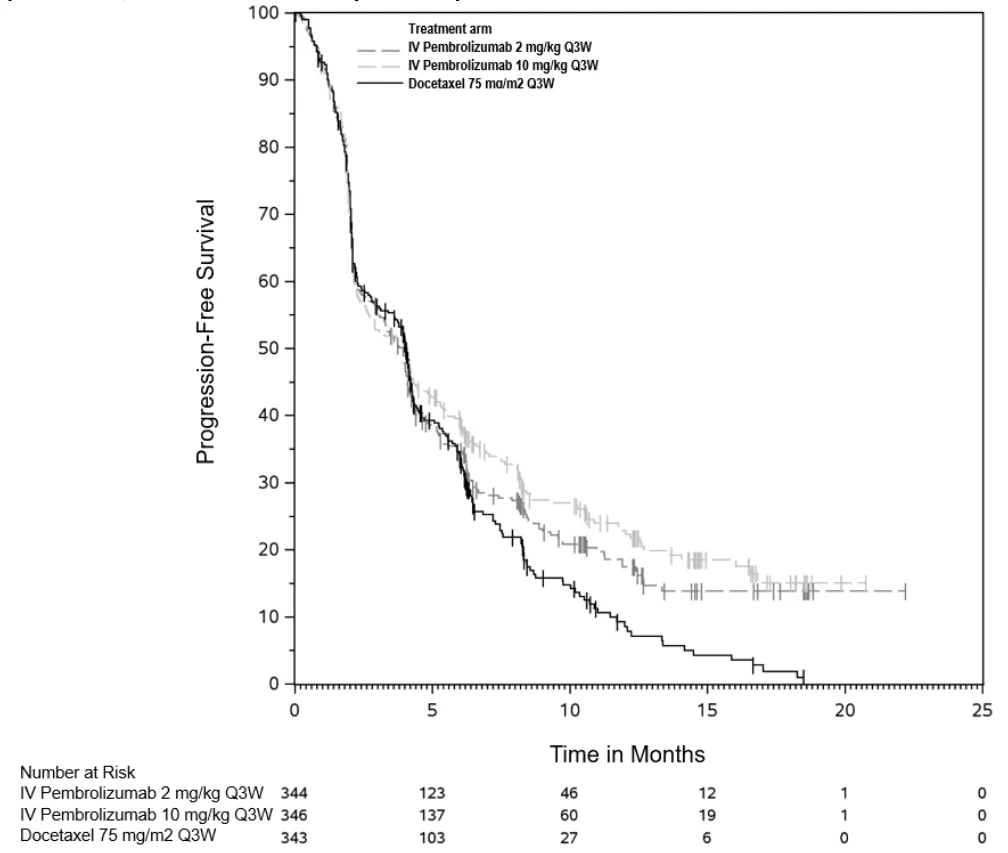
Table 93: Response to Intravenous KEYTRUDA 2 or 10 mg/kg every 3 Weeks in Previously Treated Patients with NSCLC in KEYNOTE-010, with TPS ≥ 50%.
| Endpoint | Intravenous KEYTRUDA 2 mg/kg every 3 weeks | Intravenous KEYTRUDA 10 mg/kg every 3 weeks | Docetaxel 75 mg/m2 every 3 weeks |
|---|---|---|---|
| TPS ≥50% | |||
| Number of patients | 139 | 151 | 152 |
| Primary Efficacy Outcome Measure OS | |||
| Number (%) of patients with event | 58 (42%) | 60 (40%) | 86 (57%) |
| Hazard ratio (98.35% CI)* | 0.54 (0.35, 0.83) | 0.50 (0.33, 0.75) | --- |
| p-Value† | <0.001‡ | <0.001‡ | --- |
| Median in months (95% CI) | 14.9 (10.4, NA) | 17.3 (11.8, NA) | 8.2 (6.4, 10.7) |
| Primary Efficacy Outcome Measure PFS‡, § | |||
| Number (%) of patients with event | 89 (64%) | 97 (64%) | 118 (78%) |
| Hazard ratio (99.80% CI)* | 0.58 (0.37, 0.92) | 0.59 (0.38, 0.91) | --- |
| p-Value† | <0.001¶ | <0.001¶ | --- |
| Median in months (95% CI) | 5.2 (4.0, 6.5) | 5.2 (4.1, 8.1) | 4.1 (3.6, 4.3) |
| Secondary Efficacy Outcome Measure Overall Response Rate§ | |||
| ORR %# (95% CI) | 30% (23, 39) | 29% (22, 37) | 8% (4, 13) |
* Hazard ratio (intravenous KEYTRUDA compared to docetaxel) based on the stratified Cox proportional hazard model. The confidence levels correspond to the allocated Type I error of 0.00825 and 0.001 for the OS and PFS endpoints, respectively. † Based on one-sided stratified Log rank test ‡ Statistically significant based on a pre-specified α level of 0.00825 for the two pairwise comparisons versus docetaxel using a Hochberg procedure § Assessed by BICR using RECIST 1.1 ¶ Statistically significant based on a pre-specified α level of 0.001 for the two pairwise comparisons versus docetaxel using a Hochberg procedure # All responses were partial responses. | |||
Figure 18: Kaplan-Meier Curve for Overall Survival by Treatment Arm in KEYNOTE-010 (TPS ≥ 50%, Intent to Treat Population)
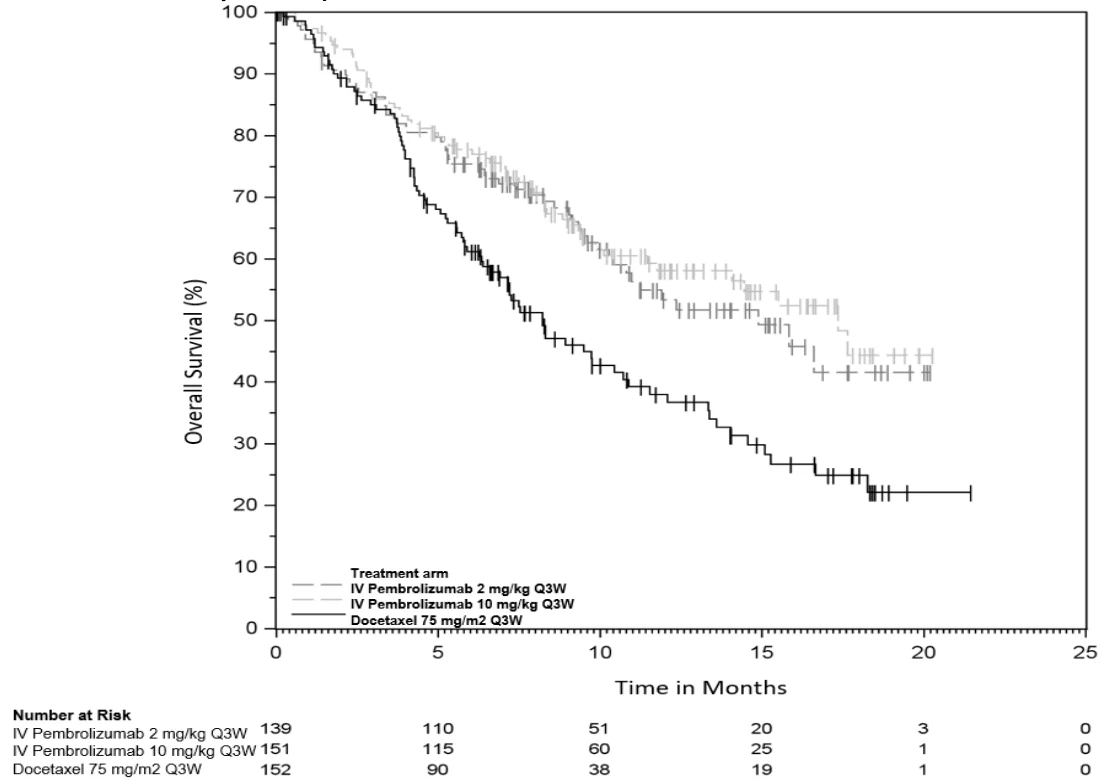
Figure 19: Kaplan-Meier Curve for Progression-Free Survival by Treatment Arm in KEYNOTE-010 (TPS ≥ 50%, Intent to Treat Population)
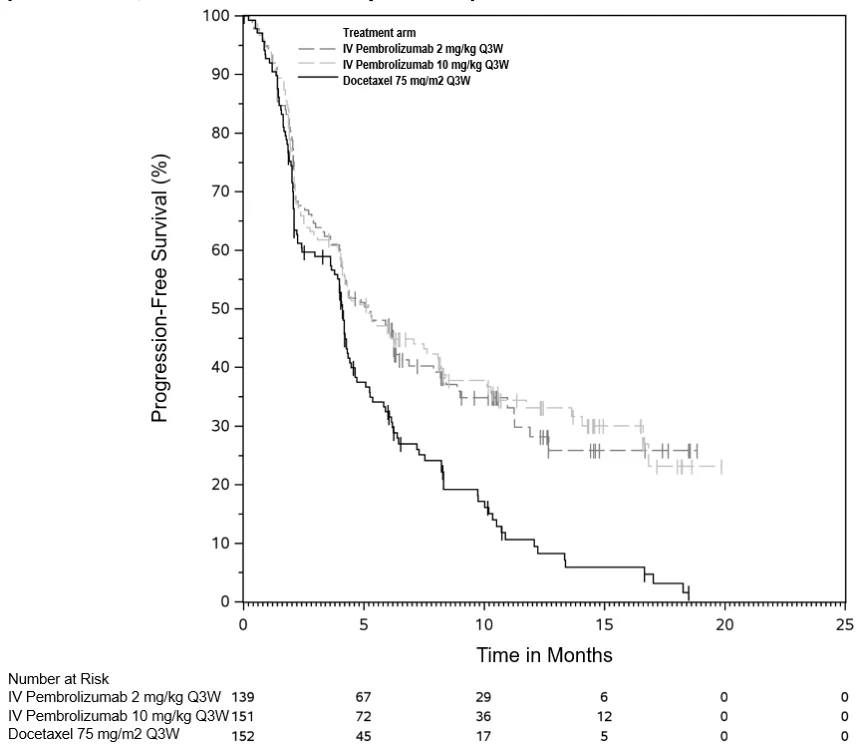
In exploratory subgroup analyses, a reduced survival benefit of intravenous KEYTRUDA compared to chemotherapy was observed in patients with tumours harbouring EGFR activating mutations (n=54), never-smokers (n=130) and patients of East Asian Ethnicity (n=126). In patients with tumours expressing PD-L1 with a TPS ≥ 1% that received intravenous KEYTRUDA at 2 mg/kg every three weeks, with EGFR activating mutations, the HR for PFS was 1.78 (95% CI: 0.82, 3.85) and the HR for OS was 1.07 (95% CI: 0.49, 2.37). In never smokers, the HR for PFS was 1.33 (95% CI: 0.86, 2.04) and the HR for OS was 0.84 (95% CI: 0.48, 1.49). In patients of East Asian Ethnicity, the HR for PFS was 1.38 (95% CI: 0.87, 2.21) and the HR for OS was 1.39 (95% CI: 0.72, 2.68). The efficacy and safety of intravenous KEYTRUDA in patients with tumours that do not express PD-L1 (TPS <1%) have not been established.
Efficacy results were similar for the 2 mg/kg and 10 mg/kg intravenous KEYTRUDA arms. Efficacy results for OS were consistent regardless of the age of tumour specimen (new versus archival).
Adjuvant NSCLC
KEYNOTE-091: Controlled trial for the adjuvant treatment of patients with resected NSCLC
The efficacy of intravenous KEYTRUDA was investigated in KEYNOTE-091, a multicenter, randomized, triple-blind, placebo-controlled trial. Key eligibility criteria were completely resected stage IB (T2a ≥ 4 cm), II, or IIIA NSCLC by AJCC 7th edition, regardless of tumour PD-L1 expression status. Patients had not received neoadjuvant or adjuvant radiotherapy and/or neoadjuvant chemotherapy. Adjuvant chemotherapy up to 4 cycles was optional. Patients were ineligible if they had autoimmune disease that required systemic therapy within 2 years of treatment; a medical condition that required immunosuppression; a history of interstitial lung disease or pneumonitis, or received more than 4 cycles of adjuvant chemotherapy. Randomization was stratified by stage (IB vs. II vs. IIIA), adjuvant chemotherapy (yes vs. no), PD-L1 status (TPS <1% [negative] vs. TPS 1-49% vs. TPS ≥50%), and geographic region (Western Europe vs. Eastern Europe vs. Asia vs. Rest of World). Patients were randomized (1:1) to receive intravenous KEYTRUDA 200 mg or placebo intravenously every 3 weeks.
Treatment continued until RECIST 1.1-defined disease recurrence as determined by the investigator, unacceptable toxicity, or approximately one year (18 doses). Patients underwent imaging to assess tumour recurrence every 12 weeks for the first year, then every 6 months for years 2 to 3, and then annually up to the end of year 5. After year 5, imaging is performed as per local standard of care.
Among the 1177 patients in KEYNOTE-091, 1010 (86%) received adjuvant platinum-based chemotherapy following complete resection. Among these 1010 patients, the median age was 64 years (range: 35 to 84), 49% age 65 or older; 68% male; 77% White, 18% Asian; 86% current or former smokers; and 39% with ECOG PS of 1. Eleven percent had stage IB, 57% had stage II, and 31% had stage IIIA disease. Thirty-nine percent had PD-L1 TPS <1% [negative], 33% had TPS 1-49%, and 28% had TPS ≥50%. Fifty-two percent were from Western Europe, 20% from Eastern Europe, 17% from Asia, and 11% from Rest of World.
The primary efficacy outcome measures were investigator-assessed disease-free survival (DFS) in the overall population and in the population with tumour PDL1 expression TPS ≥50%, where DFS was defined as the time between the date of randomization and the date of first recurrence (local/regional recurrence, distant metastasis), a second malignancy, or death, whichever occurred first. Secondary efficacy outcome measures were investigator-assessed DFS in the population with tumour PDL1 expression TPS ≥1%, and OS in the overall population and in the populations with tumour PDL1 expression TPS ≥50% and TPS ≥1%.
The trial demonstrated a statistically significant improvement in DFS in the overall population at a pre-specified interim analysis for patients randomized to the intravenous KEYTRUDA arm compared to patients randomized to the placebo arm. In an exploratory subgroup analysis of the 167 patients (14%) who did not receive adjuvant chemotherapy, the DFS HR was 1.25 (95% CI: 0.76, 2.05). At the time of analysis, OS results were not mature (18% with events in the overall population). The median follow-up time was 32.4 months (range: 0.6 to 68 months). Efficacy results for KEYNOTE-091 in patients who received adjuvant chemotherapy are summarized in Table 94 and Figure 20.
Table 94: Efficacy Results in KEYNOTE-091 for Patients Who Received Adjuvant Chemotherapy
| Endpoint | Intravenous KEYTRUDA 200 mg every 3 weeks n=506 | Placebo n=504 | ||||||
|---|---|---|---|---|---|---|---|---|
| DFS | ||||||||
| Number (%) of patients with event | 177 (35%) | 231 (46%) | ||||||
| Median in months (95% CI) | 58.7 (39.2, NR) | 34.9 (28.6, NR) | ||||||
| Hazard ratio* (95% CI) | 0.73 (0.60, 0.89) | |||||||
* Based on the unstratified univariate Cox regression model NR = not reached | ||||||||
Figure 20: Kaplan-Meier Curve for Disease-Free Survival in KEYNOTE-091 for Patients Who Received Adjuvant Chemotherapy
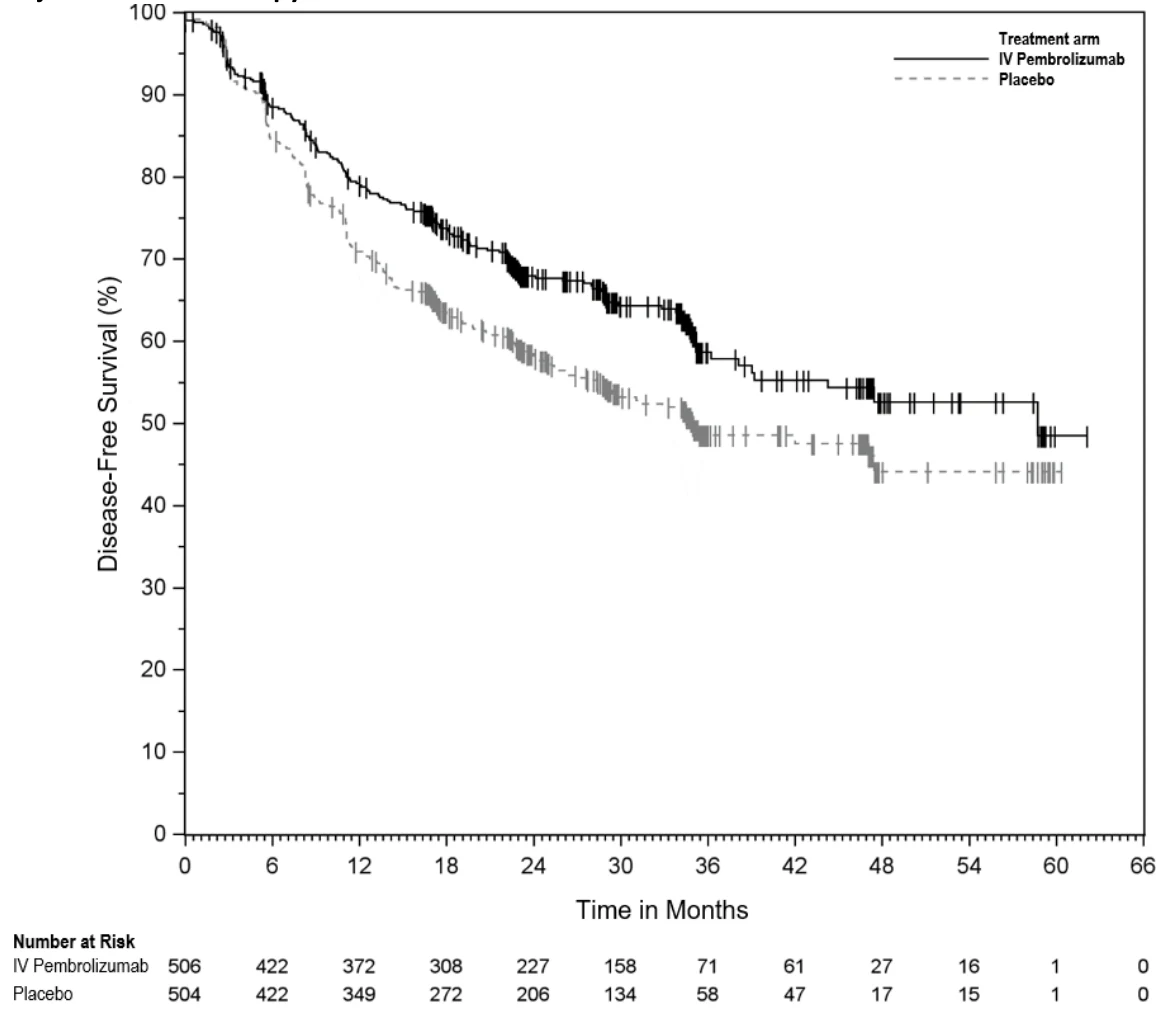
Neoadjuvant and Adjuvant Treatment of Resectable NSCLC
KEYNOTE 671: Controlled trial for the neoadjuvant and adjuvant treatment of patients with resectable NSCLC
The efficacy of intravenous KEYTRUDA in combination with platinum-containing chemotherapy given as neoadjuvant treatment and continued as monotherapy adjuvant treatment was investigated in KEYNOTE-671, a multicenter, randomized, double-blind, placebo-controlled trial. Patients with previously untreated and resectable Stage II, IIIA, or IIIB (N2) NSCLC as assessed by the AJCC 8th edition were eligible for the trial. Patients were enrolled regardless of tumour PD-L1 expression. Patients with active autoimmune disease that required systemic therapy within 2 years of treatment, a medical condition that required immunosuppression, a history of interstitial lung disease (ILD)/pneumonitis that required steroid treatment were ineligible. Randomization was stratified by stage (II vs. III), tumor PD-L1 expression (TPS ≥50% or <50%), histology (squamous vs. non squamous), and geographic region (East Asia vs. non-East Asia).
Patients were randomized (1:1) to one of the following treatment arms:
Treatment Arm A: neoadjuvant intravenous KEYTRUDA 200 mg on Day 1 in combination with
- cisplatin 75 mg/m2 and either pemetrexed 500 mg/m2 on Day 1 or gemcitabine 1000 mg/m2 on Days 1 and 8 of each 21 day cycle for up to 4 cycles. Following surgery, intravenous KEYTRUDA 200 mg was administered every 3 weeks for up to 13 cycles.
- Treatment Arm B: neoadjuvant placebo on Day 1 in combination with cisplatin 75 mg/m2 and either pemetrexed 500 mg/m2 on Day 1 or gemcitabine 1000 mg/m2 on Days 1 and 8 of each 21 day cycle for up to 4 cycles. Following surgery, placebo was administered every 3 weeks for up to 13 cycles.
All study medications were administered via intravenous infusion. Treatment with intravenous KEYTRUDA or placebo continued until completion of the treatment (17 cycles), disease progression that precluded definitive surgery, disease recurrence in the adjuvant phase, disease progression for those who did not undergo surgery or had incomplete resection and entered the adjuvant phase, or unacceptable toxicity. Assessment of tumor status was performed at baseline, Week 7, and Week 13 in the neoadjuvant phase and within 4 weeks prior to the start of the adjuvant phase. Following the start of the adjuvant phase, assessment of tumor status was performed every 16 weeks through the end of Year 3, and then every 6 months thereafter.
The dual primary efficacy outcome measures were investigator-assessed event-free survival (EFS) and overall survival (OS). Secondary efficacy outcome measures included pathological complete response (pCR) rate and major pathological response (mPR) rate as assessed by blinded independent pathology review (BIPR). The trial was not designed to isolate the efficacy of intravenous KEYTRUDA in each phase (neoadjuvant or adjuvant) of treatment.
A total of 797 patients in KEYNOTE-671 were randomized: 397 patients to the intravenous KEYTRUDA arm and 400 to the placebo arm. Baseline characteristics were: median age of 64 years (range: 26 to 83), 45% age 65 or older; 71% male; 61% White, 31% Asian, and 2% Black. Sixty-three percent and 37% had ECOG performance status of 0 or 1, respectively; 30% had Stage II and 70% had Stage III disease; 33% had TPS ≥50% and 67% had TPS <50%; 43% had tumors with squamous histology and 57% had tumors with non-squamous histology; 31% were from the East Asian region. Four percent of patients had EGFR mutations and in 66% EGFR mutation status was unknown. Three percent of patients had ALK translocations and in 68% ALK translocation status was unknown.
Eighty-one percent of patients in the intravenous KEYTRUDA in combination with platinum-containing chemotherapy arm had definitive surgery compared to 76% of patients in the platinum-containing chemotherapy arm.
The trial demonstrated statistically significant improvements in EFS and OS for patients randomized to intravenous KEYTRUDA in combination with platinum-containing chemotherapy followed by intravenous KEYTRUDA monotherapy compared with patients randomized to placebo in combination with platinum-containing chemotherapy followed by placebo alone. At the first interim analysis, EFS efficacy results achieved statistical significance with a median follow-up time of 21.4 months (range: 0.4 to 50.6 months) and are summarized in Table 95 and Figure 21. At the second interim analysis, OS efficacy results achieved statistical significance with a median follow-up time of 29.8 months (range: 0.4 to 62.0 months) and are summarized in Table 95 and Figure 22.
Table 95: Efficacy Results in KEYNOTE-671
| Endpoint | Intravenous KEYTRUDA and Chemotherapy/ Intravenous KEYTRUDA n=397 | Placebo and Chemotherapy/Placebo n=400 | ||||||||
|---|---|---|---|---|---|---|---|---|---|---|
| EFS* | ||||||||||
| Number of patients with event (%) | 139 (35%) | 205 (51%) | ||||||||
| Median in months† (95% CI) | NR (34.1, NR) | 17.0 (14.3, 22.0) | ||||||||
| Hazard ratio‡ (95% CI) | 0.58 (0.46, 0.72) | |||||||||
| p-Value§ | < 0.0001 | |||||||||
| OS* | ||||||||||
| Number of patients with event (%) | 110 (28%) | 144 (36%) | ||||||||
| Median in months† (95% CI) | NR (NR, NR) | 52.4 (45.7, NR) | ||||||||
| Hazard ratio‡ (95% CI) | 0.72 (0.56, 0.93) | |||||||||
| p-Value§ | 0.0052 | |||||||||
* EFS result based on the first interim analysis; OS result based on the second interim analysis † Based on Kaplan-Meier estimates ‡ Based on Cox regression model with treatment as a covariate stratified by stage, tumour PD-L1 expression, histology, and geographic region § Based on stratified log-rank test NR = not reached | ||||||||||
Figure 21: Kaplan-Meier Curve for Event-Free Survival by Treatment Arm in KEYNOTE-671 (Intent to Treat Population)
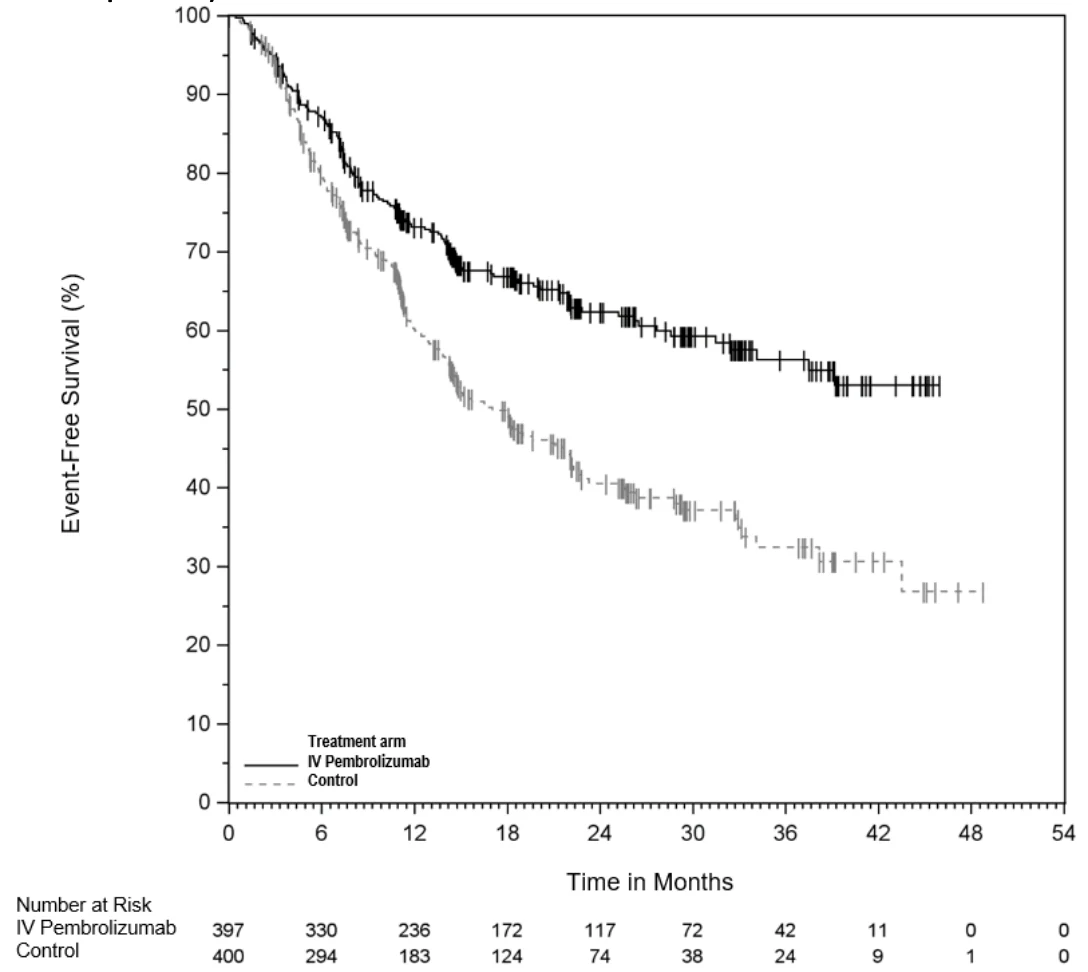
Figure 22: Kaplan-Meier Curve for Overall Survival by Treatment Arm in KEYNOTE-671 (Intent to Treat Population)
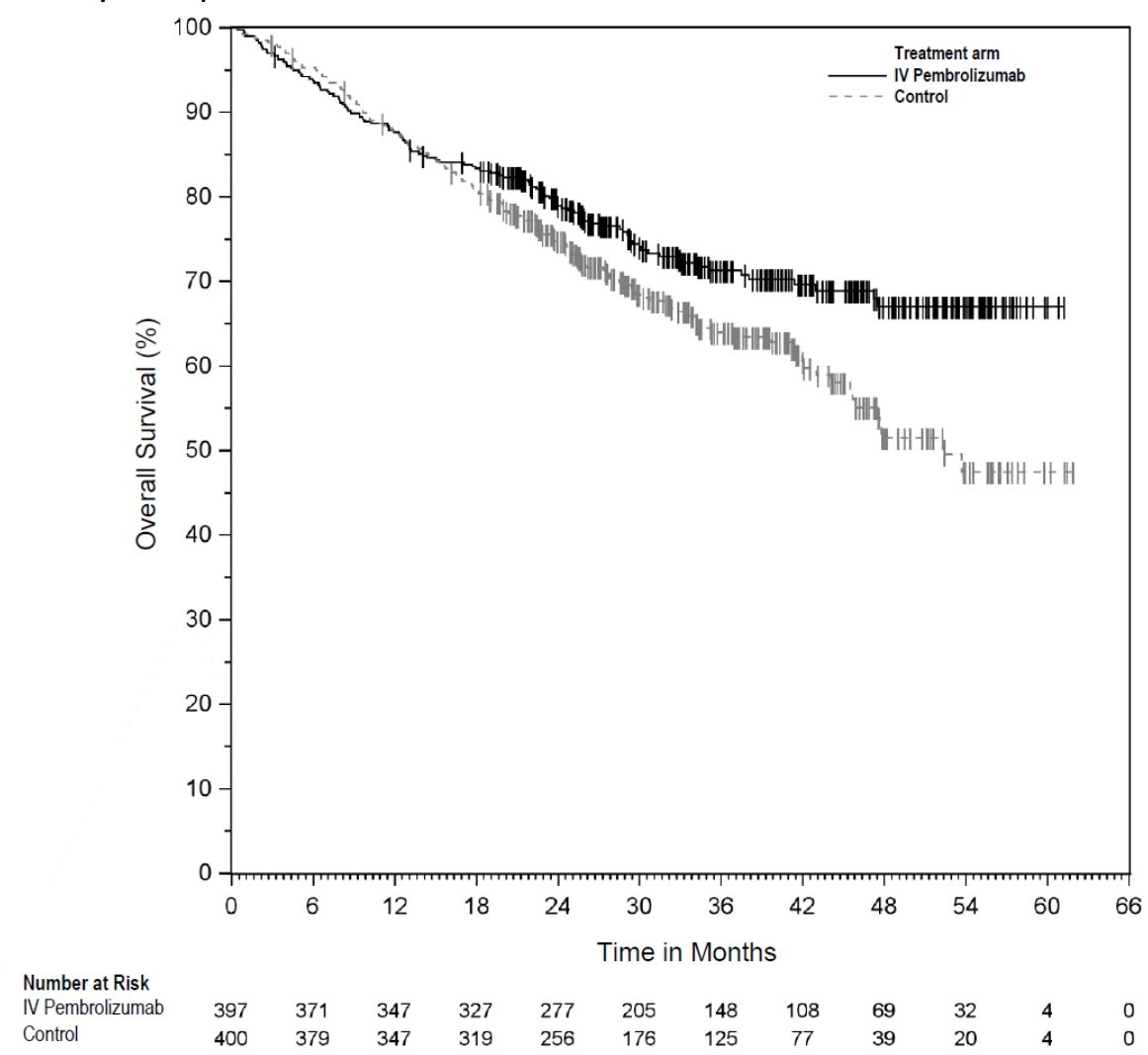
The trial demonstrated a statistically significant difference in pCR rate (18.1% vs. 4.0%; p<0.0001) and mPR rate (30.2% vs. 11.0%; p<0.0001).
A post-hoc exploratory subgroup analysis was performed in patients who had PD-L1 TPS ≥ 50% (pembrolizumab arm [n=132; 33%] vs. placebo arm [n=134; 34%]); TPS = 1 - 49% (pembrolizumab arm [n=127; 32%] vs. placebo arm [n=115; 29%]) and TPS < 1% (pembrolizumab arm [n=138; 35%] vs. placebo arm [n=151; 38%]). The EFS HR was, 0.48 (95% CI: 0.33, 0.71) in patients with a TPS ≥ 50%, 0.52 (95% CI: 0.36, 0.73) in patients with a TPS = 1 - 49% and 0.75 (95% CI: 0.56, 1.01) in patients with a TPS < 1%. The OS HR was 0.55 (95% CI: 0.33, 0.92) in patients with a TPS ≥ 50%, 0.69 (95% CI: 0.44, 1.07) in patients with a TPS = 1 - 49% and 0.91 (95% CI: 0.63, 1.32) in patients with a TPS < 1%.
Classical Hodgkin Lymphoma
KEYNOTE-204: Controlled study in patients with relapsed or refractory cHL
The efficacy of intravenous KEYTRUDA was investigated in KEYNOTE-204, a randomized, open-label, active-controlled study in 304 patients with relapsed or refractory cHL after at least one multi-agent chemotherapy regimen. Patients eligible for allo- or auto-SCT per investigator assessment were excluded. The trial required an ANC ≥ 1000/μL, platelet count ≥ 75,000/μL, hepatic transaminases ≤ 2.5 times the upper limit of normal (ULN), bilirubin ≤ 1.5 times ULN, and ECOG performance status of 0 or 1. Patients with active, non-infectious pneumonitis, an allogeneic hematopoietic stem cell transplant within the past 5 years (or greater than 5 years but with GVHD), active autoimmune disease, a medical condition that required immunosuppression or an active infection requiring systemic therapy were ineligible for the trial. Randomization was stratified by prior auto-SCT (yes vs. no) and disease status after frontline therapy (primary refractory vs. relapse less than 12 months after completion vs. relapse 12 months or more after completion). Patients were randomized (1:1) to one of the following treatment arms:
- Intravenous KEYTRUDA 200 mg intravenously every 3 weeks.
- Brentuximab vedotin (BV) 1.8 mg/kg intravenously every 3 weeks.
Patients received intravenous KEYTRUDA 200 mg intravenously every 3 weeks (n=151) until unacceptable toxicity or documented disease progression, or for up to approximately 24 months or 35 administrations, whichever was longer. Disease assessment was performed every 12 weeks. The primary efficacy outcome measures was PFS as assessed by BICR according to the 2007 revised International Working Group (IWG) criteria, including clinical and imaging data following ASCT or allogeneic stem cell transplant. The additional primary efficacy outcome measure, OS, was not formally assessed at the time of the analysis.
The study population characteristics were: median age of 35 years (range: 18 to 84; 16% age 65 or older), 57% male, 77% White, 9% Asian, 3.9% Black and 61% with ECOG PS of 0 and 38% ECOG PS of 1. The median number of prior therapies was 2 (range: 1 to 10) in the intravenous KEYTRUDA arm and 3 (range: 1 to 11) in the BV arm, with 18% in both arms having 1 prior line. Forty-two percent of patients were refractory to the last prior therapy, 29% had primary refractory disease, 37% had prior autologous HSCT, 5% had received prior BV, and 39% had prior radiation therapy.
The median follow-up time for 151 patients treated with intravenous KEYTRUDA was 24.9 months (range: 1.8 - 42.0 months). The primary PFS results are summarized in Table 96 and Figure 23.
Table 96: Efficacy Results in Patients with Refractory or Relapsed Classical Hodgkin Lymphoma.
| Endpoint | Intravenous KEYTRUDA 200 mg/kg every 3 weeks n=151 | Brentuximab Vedotin 1.8 mg/kg every 3 weeks n=153 |
|---|---|---|
| PFS | ||
| Number of patients with event (%) | 81 (54%) | 88 (58%) |
| Median in months (95% CI) | 13.2 (10.9, 19.4) | 8.3 (5.7, 8.8) |
| Hazard ratio* (95% CI) | 0.65 (0.48, 0.88) | |
| p-Value† | 0.0027 | |
* Based on the stratified Cox proportional hazard model † Based on stratified log-rank test. One-sided p-value, with a prespecified boundary of 0.0043. | ||
ORR was 66% (95% CI: 57.4, 73.1) in patients treated with intravenous KEYTRUDA versus 54% (95% CI: 46.0, 62.3) in patients treated with BV. The difference in ORR was 11.3% (95% Cl: 0.2, 22.1; stratified Miettinen-Nurminen method). The complete response rate was 25% in patients treated with intravenous KEYTRUDA versus 24% in patients treated with BV. The response duration, assessed by BICR using IWG 2007, was based on patients with a best objective response as complete or partial response. The median response duration was 20.7 months (range: 0.0+, 33.2+) in patients treated with intravenous KEYTRUDA versus 13.8 months (range: 0.0+, 33.9+) in patients treated with BV.
Figure 23: Kaplan-Meier Curve for Progression-Free Survival by Treatment Arm in KEYNOTE-204 (Intent to Treat Population)
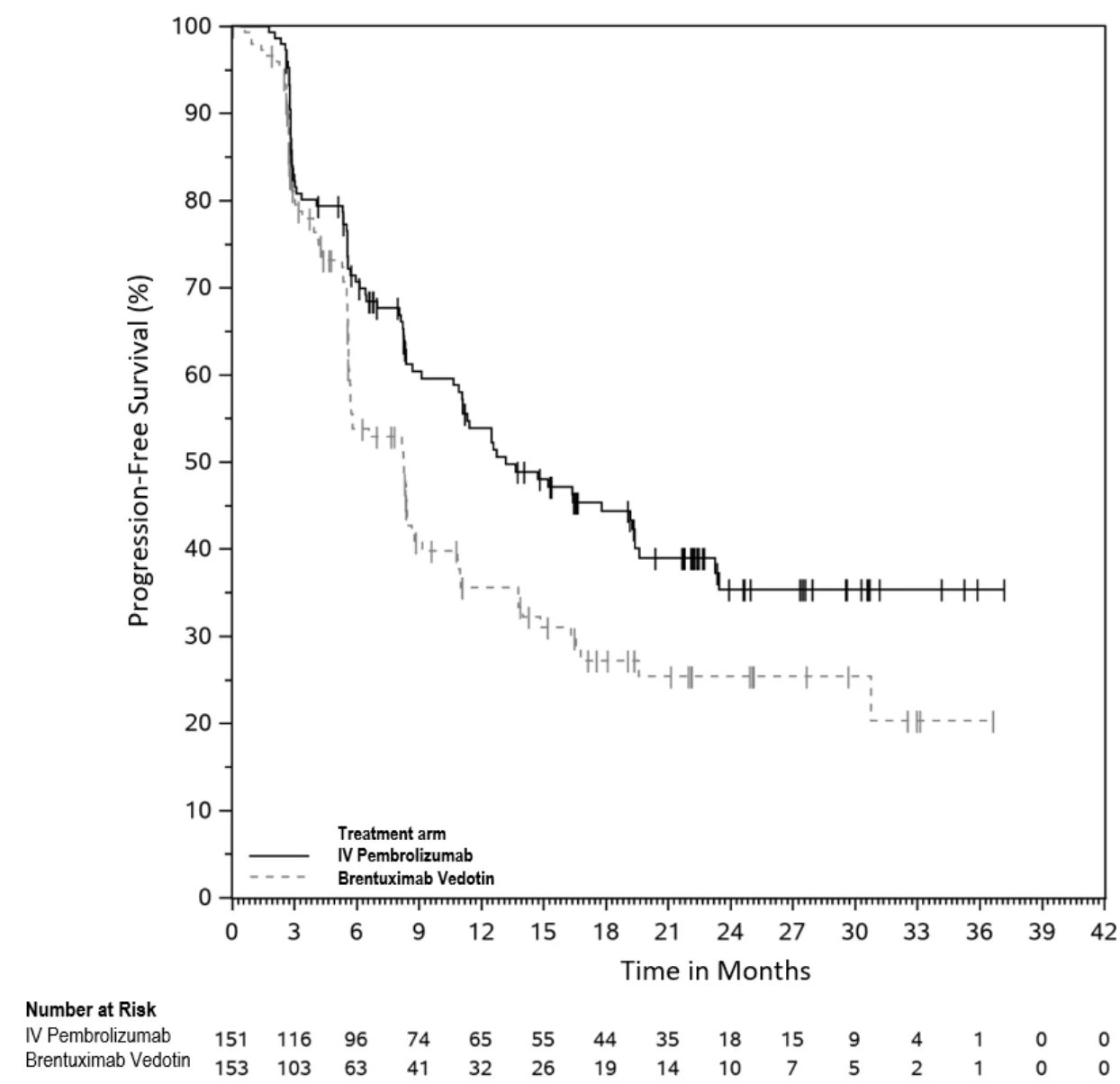
Primary Mediastinal B-cell Lymphoma
KEYNOTE-170: Open-label study in patients with relapsed or refractory PMBCL
The efficacy of intravenous KEYTRUDA was investigated in KEYNOTE-170, a multicenter, open-label, single-arm trial in 29 patients with relapsed or refractory PMBCL, Patients with active, non-infectious pneumonitis, an allogeneic HSCT within the past 5 years (or greater than 5 years but with symptoms of GVHD), active autoimmune disease, a medical condition that required immunosuppression, or an active infection requiring systemic therapy were ineligible for the trial. Patients received intravenous KEYTRUDA 200 mg every 3 weeks until unacceptable toxicity or documented disease progression, or for up to 24 months in patients that did not progress. Disease assessment was performed every 12 weeks. The major efficacy outcome measures (ORR, CRR, PFS and duration of response) were assessed by blinded independent central review according to the 2007 revised IWG criteria.
Among the 29 patients, the baseline characteristics were: median age of 33 years (range: 20 to 58), 0% age 65 or older; 45% male; 93% White; 38% had an ECOG performance status (PS) of 0 and 62% had an ECOG PS of 1. The median number of prior lines of therapy administered for the treatment of PMBCL was 3 (range 2 to 8). Sixty-nine percent were refractory to the last prior therapy, including 38% with primary refractory disease and 79% whose disease was chemo-refractory to any prior regimen. Thirty-four percent of patients had undergone prior auto-HSCT, 66% did not receive prior transplant; and 38% of patients had prior radiation therapy.
Efficacy from interim analysis was based on overall response rate (ORR) with the median follow-up duration of 6.6 months. The median duration of response was not reached. The efficacy results for KEYNOTE-170 are summarized in Table 97. For the 12 responders, the median time to first objective response was 2.9 months (range 2.4 to 8.5 months).
Table 97: Efficacy Results in Patients with Refractory or Relapsed PMBCL.
| Endpoint | KEYNOTE-170* n=29 |
|---|---|
| Objective Response Rate* | |
| ORR %, (95% CI) | 41% (24, 61) |
| Complete Remission | 14% |
| Partial Remission | 28% |
| Response Duration* | |
| Median in months (range) | Not reached (1.1+,8.2+)† |
* Assessed by blinded independent central review according to the 2007 revised IWG criteria † Based on patients (n=12) with a response by independent review | |
The final efficacy analysis of KEYNOTE-170 included 53 patients. The ORR was 45% (95% CI: 32, 60) with a median follow-up time of 22.3 months. Ten (19%) patients achieved a best overall response of complete remission and 14 (26%) patients achieved a best overall response of partial remission. The median response duration was not reached (range: 1.1+ to 46.9+ months).
Urothelial Carcinoma
KEYNOTE-A39: Controlled trial of combination therapy with enfortumab vedotin in urothelial cancer patients
The efficacy of intravenous KEYTRUDA in combination with enfortumab vedotin was investigated in KEYNOTEA39, an open-label, multicenter, randomized, active-controlled trial that enrolled 886 adult patients with unresectable locally advanced or metastatic urothelial cancer who received no prior systemic therapy for unresectable locally advanced or metastatic disease. The trial excluded patients with autoimmune disease or a medical condition that required immunosuppression, active CNS metastases, cardiac symptoms (including congestive heart failure) consistent with New York Heart Association Class III-IV, severe renal impairment, ongoing sensory or motor neuropathy Grade ≥2, or uncontrolled diabetes defined as hemoglobin A1C (HbA1c) ≥8% or HbA1c ≥7% with associated diabetes symptoms. Randomization was stratified by cisplatin eligibility, PDL1 expression, and liver metastases . Patients were randomized (1:1) to one of the following treatment arms:
- Intravenous KEYTRUDA 200 mg over 30 minutes on Day 1 and enfortumab vedotin 1.25 mg/kg on Days 1 and 8 of each 21-day cycle. Treatment with intravenous KEYTRUDA and enfortumab vedotin continued until RECIST v1.1-defined progression of disease, unacceptable toxicity or, for intravenous KEYTRUDA maximum of 35 cycles (up to approximately 2 years).
- Gemcitabine 1000 mg/m2 on Days 1 and 8 and investigator’s choice of cisplatin 70 mg/m2 or carboplatin (AUC 4.5 or 5 mg/mL/min according to local guidelines) on Day 1 of each 21-day cycle. Treatment was permitted until disease progression or unacceptable toxicity for up to 6 cycles.
Table 98: Baseline characteristics in KEYNOTE-A39
Intravenous KEYTRUDA 200 mg every 3 weeks and Enfortumab Vedotin n=442 % (n) | Gemcitabine and Platinum Chemotherapy with or without maintenance immunotherapy n=444 % (n) | ||||||||||
|---|---|---|---|---|---|---|---|---|---|---|---|
Intravenous KEYTRUDA 200 mg every 3 weeks and Enfortumab Vedotin n=442 % (n) | Gemcitabine and Platinum Chemotherapy with or without maintenance immunotherapy n=444 % (n) | ||||||||||
| Men | 78% (344) | 76% (336) | |||||||||
| Women | 22% (98) | 24% (108) | |||||||||
| Age (median - years) | 69 | 69 | |||||||||
| Age (range - years) | 37-87 | 22-91 | |||||||||
| Race | |||||||||||
| White | 70% (308) | 65% (290) | |||||||||
| Asian | 22% (99) | 21% (92) | |||||||||
| Black or African American | 0.7% (3) | 2% (7) | |||||||||
| Other | 7% (30) | 12% (52) | |||||||||
| ECOG PS | |||||||||||
| 0 | 50% (223) | 48% (215) | |||||||||
| 1 | 46% (204) | 49% (216) | |||||||||
| 2 | 3% (15) | 2% (11) | |||||||||
| Disease status | |||||||||||
| metastatic | 95% (421) | 95% (420) | |||||||||
| locally advanced | 5% (21) | 5% (24) | |||||||||
| Metastasis category | |||||||||||
| visceral metastasis | 72% (318) | 72% (318) | |||||||||
| lymph nodes only disease | 23% (103) | 23% (104) | |||||||||
| locally advanced without metastasis | 5% (21) | 5% (22) | |||||||||
| Cisplatin eligibility | |||||||||||
| eligible | 54% (240) | 55% (242) | |||||||||
| ineligible | 46% (202) | 45% (202) | |||||||||
| Liver metastasis | |||||||||||
| present | 22% (98) | 22% (98) | |||||||||
| absent | 78% (344) | 78% (346) | |||||||||
| Renal function | |||||||||||
| normal | 19% (84) | 21% (95) | |||||||||
| mild impairment | 37% (165) | 36% (162) | |||||||||
| moderate impairment | 42% (186) | 40% (179) | |||||||||
| severe impairment | 2% (7) | 2% (8) | |||||||||
| Documented baseline HbA1c | |||||||||||
| <5.7% | 46% (205) | 47% (208) | |||||||||
| Histology | |||||||||||
| Urothelial cancer (UC) | 86% (379) | 84% (373) | |||||||||
| UC mixed squamous differentiation | 5% (24) | 6% (28) | |||||||||
| UC mixed other histological varients | 2% (7) | 2% (7) | |||||||||
The major efficacy outcome measures were overall survival (OS) and progression-free survival (PFS) as assessed by BICR according to RECIST v1.1. Additional outcome measures were overall response rate (ORR) as assessed by BICR according to RECIST v1.1. The median follow-up time for KEYNOTE-A39 was 17.2 months.
Efficacy results were consistent across all stratified patient subgroups. Results are summarized in Table 99 and Figure 24 and Figure 25.
Table 99: Efficacy Results in KEYNOTE-A39
| Endpoint | Intravenous KEYTRUDA 200 mg every 3 weeks and Enfortumab Vedotin n=442 | Gemcitabine and Platinum Chemotherapy with or without maintenance immunotherapy n=444 | |||||||||||
|---|---|---|---|---|---|---|---|---|---|---|---|---|---|
| OS | |||||||||||||
| Number (%) of patients with event | 133 (30%) | 226 (51%) | |||||||||||
| Median in months (95% CI) | 31.5 (25.4, NR) | 16.1 (13.9, 18.3) | |||||||||||
| Hazard ratio* (95% CI) | 0.47 (0.38, 0.58) | ||||||||||||
| p-Value† | <0.0001 | ||||||||||||
| PFS | |||||||||||||
| Number (%) of patients with event | 223 (50%) | 307 (69%) | |||||||||||
| Median in months (95% CI) | 12.5 (10.4, 16.6) | 6.3 (6.2, 6.5) | |||||||||||
| Hazard ratio* (95% CI) | 0.45 (0.38, 0.54) | ||||||||||||
| p-Value† | <0.0001 | ||||||||||||
| Objective Response Rate‡ | |||||||||||||
| ORR§ % (95% CI) | 68% (63.1, 72.1) | 44% (39.7, 49.2) | |||||||||||
| p-Value¶ | <0.0001 | ||||||||||||
| Complete response | 29% | 12% | |||||||||||
| Partial response | 39% | 32% | |||||||||||
NR = not reached * Based on the stratified Cox proportional hazard regression model † Two-sided p-Value based on stratified log-rank test ‡ Includes only patients with measurable disease at baseline § Based on patients with a best overall response as confirmed complete or partial response ¶ Two-sided p-Value based on Cochran-Mantel-Haenszel test stratified by PD-L1 expression, cisplatin eligibility and liver metastases | |||||||||||||
Figure 24: Kaplan-Meier Curve for Overall Survival in KEYNOTE-A39
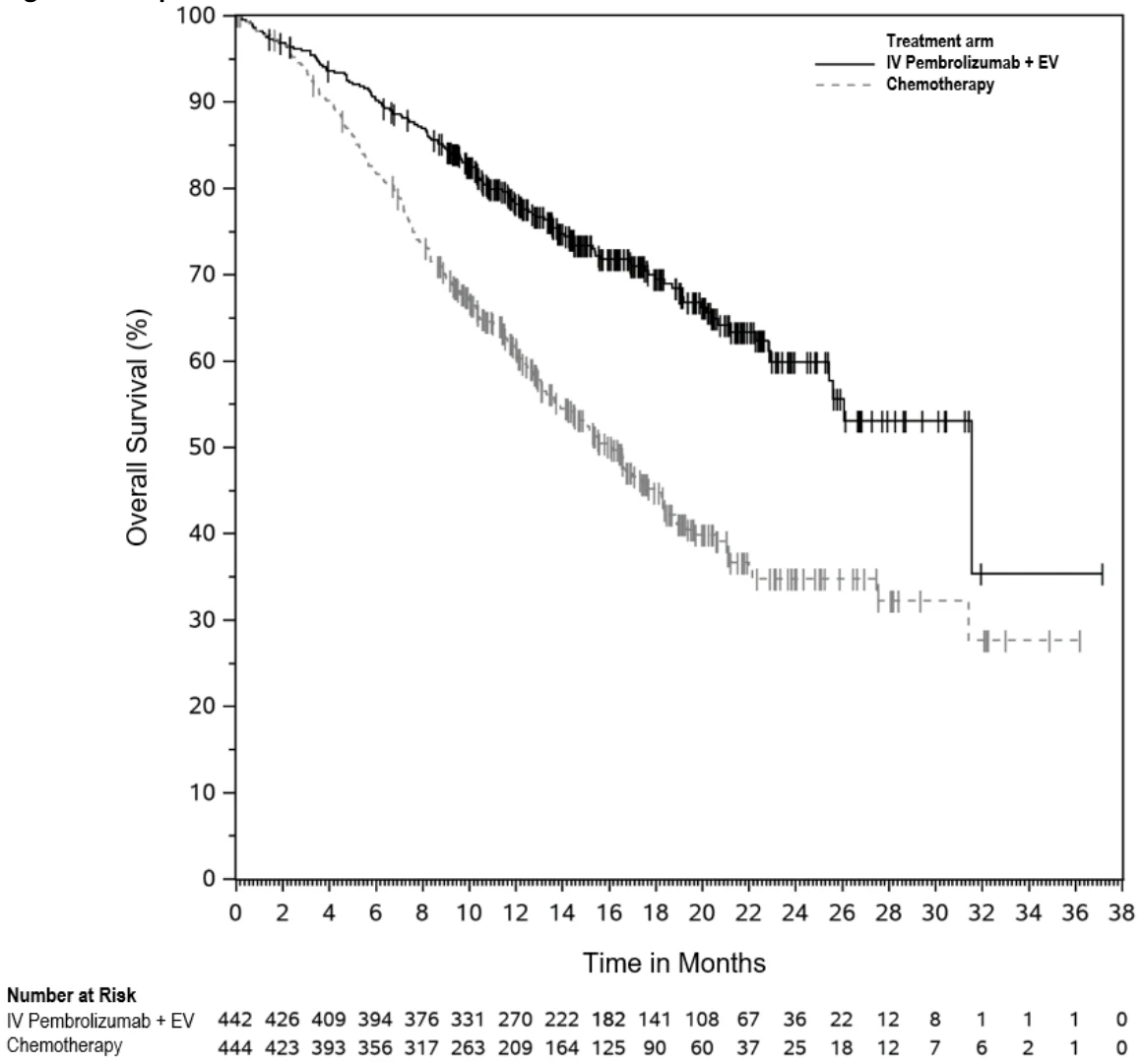
Figure 25. Kaplan-Meier Curve for Progression-Free Survival in KEYNOTE-A39
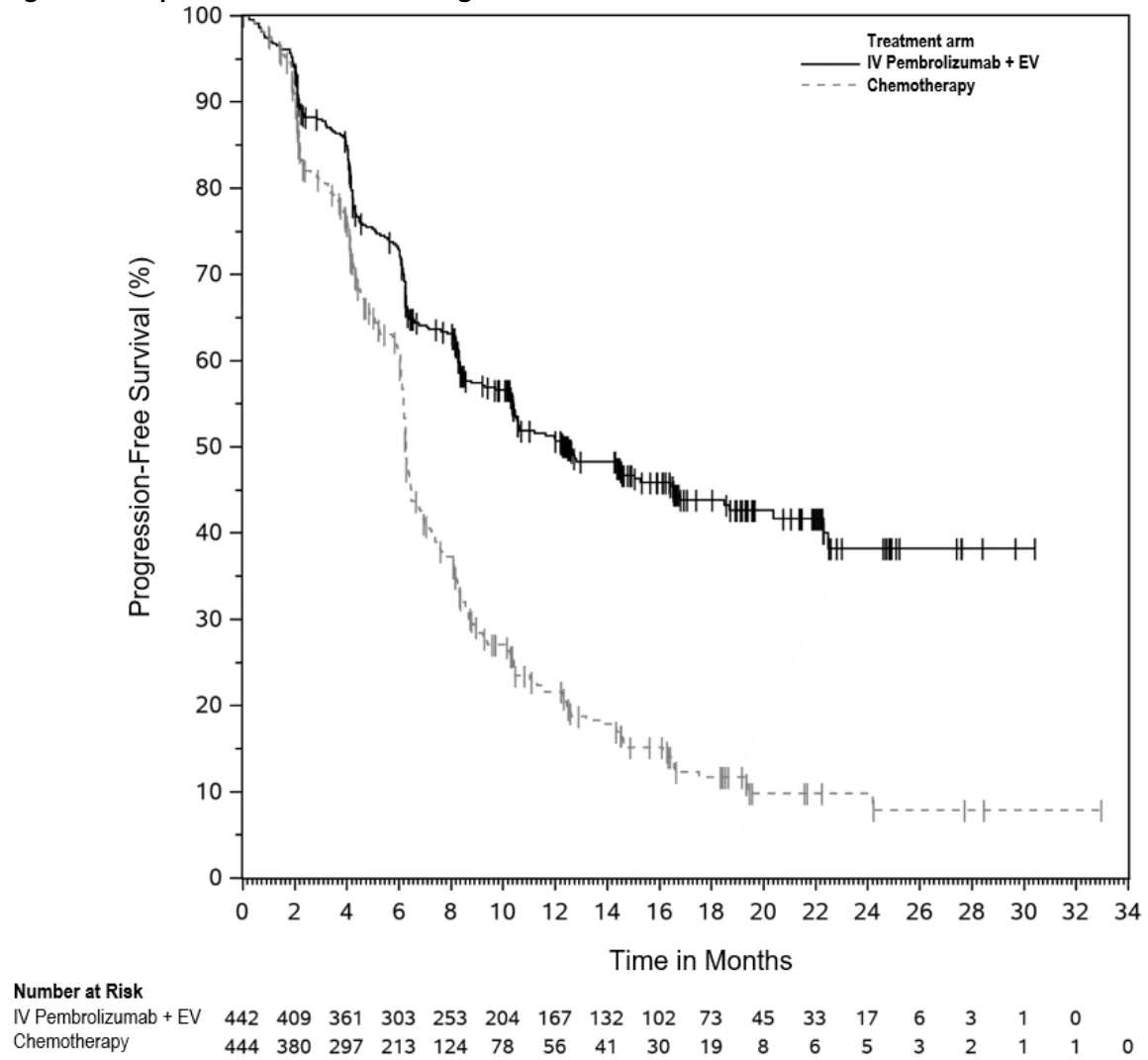
KEYNOTE-052: Open-label trial in urothelial carcinoma patients ineligible for cisplatin-containing chemotherapy
The efficacy of intravenous KEYTRUDA was investigated in KEYNOTE-052, a multicenter, open-label, single arm trial of patients with locally advanced unresectable or metastatic urothelial carcinoma who were not eligible for cisplatin-containing chemotherapy including patients who were not considered eligible for any platinum-containing chemotherapy. Participants were required to have a creatinine clearance ≥30ml/min and an ECOG performance status ≤ 2. The trial excluded patients with autoimmune disease or a medical condition that required immunosuppression.
Patients received intravenous KEYTRUDA 200 mg every 3 weeks until unacceptable toxicity or disease progression. If benefits were deemed to outweigh the risks based on clinical judgement, clinically stable patients with initial radiographic disease progression could continue treatment until disease progression was confirmed. Patients without disease progression could be treated for up to 24 months. Assessment of tumour status was performed at 9 weeks after the first dose, then every 6 weeks through the first year, followed by every 12 weeks thereafter.
Among the 370 treated patients, baseline characteristics were: median age 74 years (82% age 65 or older); 77% male; and 89% White and 7% Asian. Eighty-one percent had a primary tumour in the lower tract, and 19% of patients had a primary tumour in the upper tract. Eighty-eight percent had M1 disease, 12% had M0 disease. Eighty-five percent of patients had visceral metastases, including 21% with liver metastases. Ninety percent of patients were treatment naïve, and 10% received prior adjuvant or neoadjuvant platinum-based chemotherapy. Reasons for cisplatin ineligibility included: 50% with baseline creatinine clearance of <60 mL/min; 32% with ECOG performance status of 2; 9% with ECOG performance status of 2 and baseline creatinine clearance of <60 mL/min; and 9% with other reasons (Class III heart failure [one subject], Grade 2 or greater peripheral neuropathy, and Grade 2 or greater hearing loss). In the study, PD-L1 status by the combined positive score (CPS) was determined using the PD-L1 IHC 22C3 pharmDx* Kit (See 4 Dosage and Administration :Patient Selection). Among the 370 patients, 30% (n = 110) had tumours that expressed PD-L1 CPS ≥ 10 and 68% (n = 251) had tumours that expressed PD-L1 CPS <10.
The primary efficacy outcome measure was Objective Response Rate (ORR) according to RECIST 1.1 as assessed by the blinded independent central radiology review. The key secondary efficacy outcome measure was duration of response. A confirmation of response by repeat radiographic assessment was required 4 to 6 weeks after the initial assessment.
The median follow-up time for the 370 patients treated with intravenous KEYTRUDA was 11.5 months (range 0.1 – 31.3 months). Efficacy results are summarized in Table 100.
Table 100: Efficacy Results in Patients with Urothelial Carcinoma Ineligible for Cisplatin-Containing Chemotherapy in KEYNOTE-052.
| Endpoint | All Subjects n=370 |
|---|---|
| Objective Response Rate* | |
| ORR %, (95% CI) | 29% (25, 34) |
| Complete Response | 8% |
| Partial Response | 21% |
| Response Duration | |
| Median in months (range) | Not reached (1.4+, 27.9+) |
| % with duration ≥ 6-months | 82% † |
* Assessed by BICR using RECIST 1.1 † Based on Kaplan-Meier estimates; includes 85 patients with responses of 6 months or longer | |
In a long-term follow-up analysis performed 33.9 months after the interim analysis with 107 ORR events for all patients [median follow-up of 11.4 months (range: 0.1, 63.8 months)], the ORR was 29% with the complete and partial response rates of 10% and 20%, respectively. Among the responding patients, the median response duration was 33.4 months (range 1.4+ to 60.7+ months).
KEYNOTE-361: Platinum-Eligible Patients with Previously Untreated Urothelial Carcinoma
The efficacy of intravenous KEYTRUDA for the first-line treatment of platinum-eligible patients with locally advanced or metastatic urothelial carcinoma was investigated in KEYNOTE-361, a multicenter, randomized, open-label, active-controlled study in 1010 previously untreated patients. The safety and efficacy of intravenous KEYTRUDA in combination with platinum-based chemotherapy for previously untreated patients with locally advanced or metastatic urothelial carcinoma has not been established.
The study compared intravenous KEYTRUDA with or without platinum-based chemotherapy (i.e., cisplatin or carboplatin with gemcitabine) to platinum-based chemotherapy alone. Among the patients receiving intravenous KEYTRUDA plus platinum-based chemotherapy, 44% received cisplatin and 56% received carboplatin.
The study did not meet its major efficacy outcome measures of improved PFS or OS in the intravenous KEYTRUDA plus chemotherapy arm compared to the chemotherapy-alone arm. Additional efficacy endpoints, including improvement of OS in the intravenous KEYTRUDA monotherapy arm, could not be formally tested.
KEYNOTE-045: Controlled trial in urothelial carcinoma patients previously treated with platinum-containing chemotherapy
The efficacy of intravenous KEYTRUDA was evaluated in KEYNOTE-045, a multicenter, randomized (1:1), active-controlled trial in patients with locally advanced or metastatic urothelial carcinoma with disease progression on or after platinum-containing chemotherapy. The trial excluded patients with autoimmune disease or a medical condition that required immunosuppression.
Patients were randomized to receive either intravenous KEYTRUDA 200 mg every 3 weeks (n=270) or investigator’s choice of any of the following chemotherapy regimens all given intravenously every 3 weeks (n=272): paclitaxel 175 mg/m2 (n=84); docetaxel 75 mg/m2 (n=84); or vinflunine 320 mg/m2 (n=87). Patients received intravenous KEYTRUDA until unacceptable toxicity or disease progression. Clinically stable patients with initial evidence of disease progression were permitted to remain on treatment until disease progression was confirmed. Patients without disease progression were treated for up to 24 months. Treatment with intravenous KEYTRUDA could be reinitiated for subsequent disease progression and administered for up to one additional year. Assessment of tumour status was performed at 9 weeks after randomization, then every 6 weeks through the first year, followed by every 12 weeks thereafter.
The major efficacy outcomes were OS and PFS as assessed by BICR per RECIST v1.1 at the time of the second interim analysis using the intent-to-treat (ITT) population. These outcomes were also assessed for the subgroup defined by PD-L1 CPS cutoff of ≥ 10 (PD-L1 positive). Additional efficacy outcome measures were ORR as assessed by BICR per RECIST v1.1 and duration of response.
Among the 542 randomized patients, the study population characteristics were: median age 66 years (range: 26 to 88); 58% age 65 or older; 74% male; 72% White and 23% Asian; 57% ECOG performance status of 1 or greater; and 96% M1 disease and 4% M0 disease. Eight-seven percent of patients had visceral metastases, including 34% with liver metastases. Eighty-six percent had a primary tumour in the lower tract and 14% had a primary tumour in the upper tract. Fifteen percent of patients had disease progression following prior platinum-containing neoadjuvant or adjuvant chemotherapy as the most recent line of therapy. Twenty-one percent had received 2 or more prior systemic regimens in the metastatic setting. Seventy-six percent of patients received prior cisplatin, 23% had prior carboplatin, and 1% were treated with other platinum-based regimens.
At a pre-specified interim analysis, the median follow-up time for 270 patients treated with intravenous KEYTRUDA was 10.3 months. The study demonstrated statistically significant improvements in OS and ORR for patients in the ITT population randomized to intravenous KEYTRUDA as compared to chemotherapy. No statistically significant difference was demonstrated between intravenous KEYTRUDA and chemotherapy with respect to PFS. Table 101 summarizes the key efficacy measures and Figure 26 shows the Kaplan-Meier survival curve for OS.
Table 101: Efficacy Results in Patients with Urothelial Carcinoma Previously Treated with Chemotherapy.
| Endpoint | Intravenous KEYTRUDA 200 mg every 3 weeks n=270 | Chemotherapy n=272 |
|---|---|---|
| OS | ||
| Number (%) of patients with event | 155 (57%) | 179 (66%) |
| Hazard ratio* (95% CI) | 0.73 (0.59, 0.91) | |
| p-Value† | 0.002£ | |
| Median in months (95% CI) | 10.3 (8.0, 11.8) | 7.4 (6.1, 8.3) |
| PFS‡ | ||
| Number (%) of patients with event | 218 (81%) | 219 (81%) |
| Hazard ratio* (95% CI) | 0.98 (0.81, 1.19) | |
| p-Value† | 0.416€ | |
| Median in months (95% CI) | 2.1 (2.0, 2.2) | 3.3 (2.3, 3.5) |
| Objective Response Rate‡ | ||
| ORR % (95% CI) | 21% (16, 27) | 11% (8, 16) |
| Complete Response Rate (%) | 7% | 3% |
| Partial Response Rate (%) | 14% | 8% |
| p-Value§, | 0.001¥ | |
| Duration of Response | ||
| Median in months (range) | Not reached (1.6+, 15.6+) | 4.3 (1.4+, 15.4+) |
* Hazard ratio (intravenous KEYTRUDA compared to chemotherapy) based on the stratified Cox proportional hazard model † Based on stratified Log rank test ‡ Assessed by BICR using RECIST 1.1 § Based on method by Miettinen and Nurminen £ p-value is compared with 0.0123 of the allocated alpha for the interim analysis € p-value is compared with 0.0151 of the allocated alpha for the interim analysis ¥ p-value is compared with 0.0170 of the allocated alpha for the interim analysis | ||
The interim analysis also demonstrated a statistically significant improvement in OS favouring intravenous KEYTRUDA for patients whose tumours tested positive for PD-L1 CPS ≥ 10% [Hazard Ratio (HR) 0.57 (95% CI 0.37, 0.88)]. As with the ITT population, there was no statistically significant difference between intravenous KEYTRUDA and chemotherapy with respect to PFS among patients whose tumours tested positive for PD-L1.
In exploratory subgroup analyses, a reduced survival benefit of intravenous KEYTRUDA monotherapy compared to chemotherapy was observed in patients who were never smokers (n=187), who were classified as Non-White (n=133) (92% of whom identified with Asian ethnicity), or who lived in the East Asia geographic region (n=106). In never smokers, the HR for OS was 1.06 (95% CI: 0.72, 1.55) and the HR for PFS was 1.13 (95% CI: 0.80, 1.60). In Non-White subjects, the HR for OS was 1.12 (95% CI 0.70, 1.79) and the HR for PFS was 1.48 (95% CI 0.99, 2.23). In subjects from the East Asia geographic region, the HR for OS was 1.25 (95% CI: 0.72, 2.18) while the HR for PFS was 1.68 (95% CI: 1.05, 2.67).
The final descriptive analysis for OS was performed 13.6 months after the interim analysis with 419 patient events (200 for intravenous KEYTRUDA and 219 for chemotherapy). Median OS was 10.1 months (95% CI: 8.0, 12.3) for intravenous KEYTRUDA and 7.3 months (95% CI: 6.1, 8.1) for chemotherapy. The OS HR was 0.70 (95% CI: 0.57, 0.85). See Figure 26 for OS curve. In the final analysis of PFS there was no statistically significant difference between intravenous KEYTRUDA and chemotherapy.
Figure 26: Kaplan-Meier Curve for Overall Survival by Treatment Arm in KEYNOTE-045 (Intent to Treat Population)*
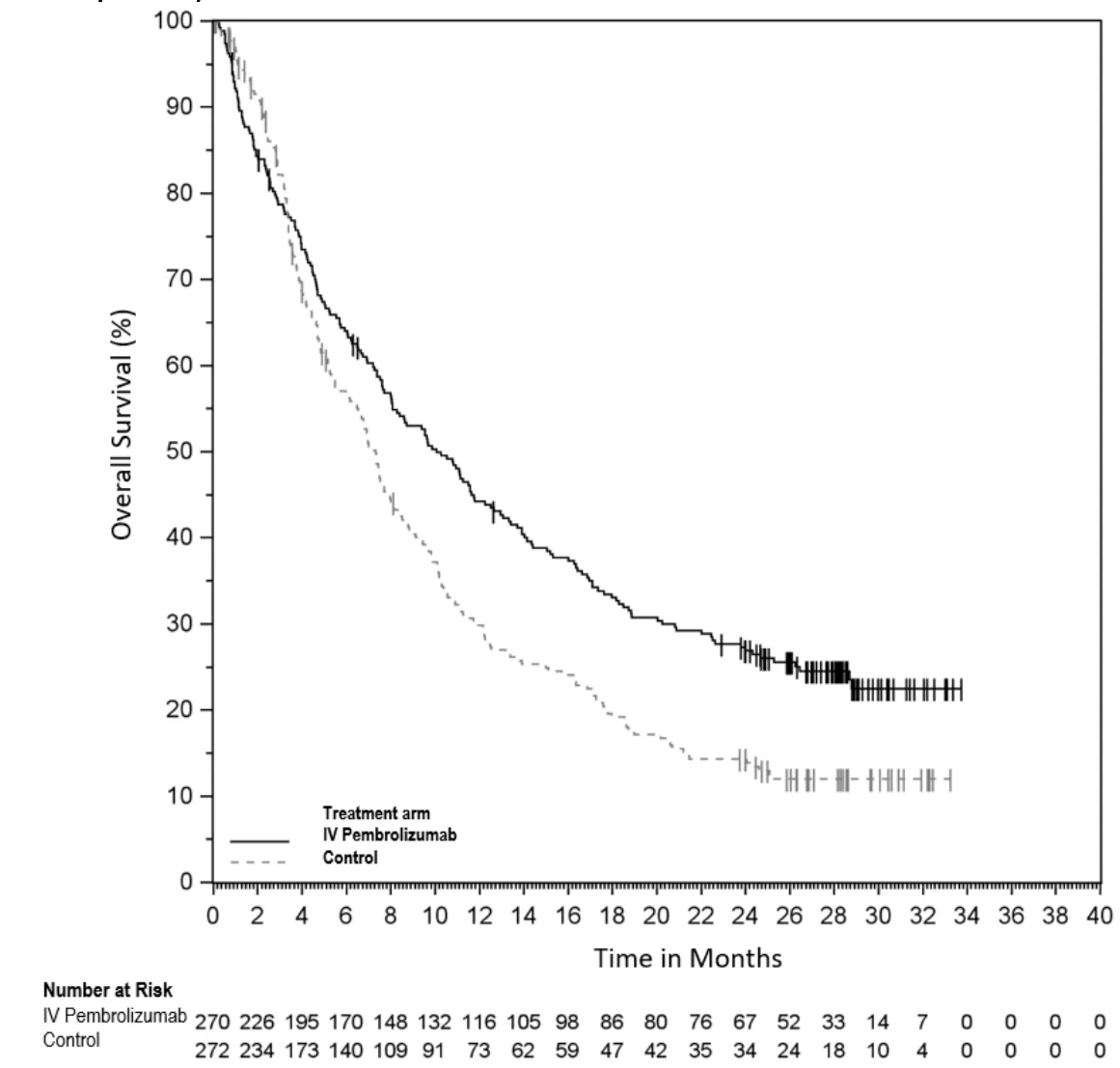
*based on the final analysis (a total of 419 deaths)
KEYNOTE-057: Open label trial in BCG-unresponsive High-Risk Non-Muscle Invasive Bladder Cancer
The efficacy of intravenous KEYTRUDA was investigated in KEYNOTE-057, a multicenter, open-label, single-arm trial in 96 patients with Bacillus Calmette-Guerin (BCG)-unresponsive, high-risk, non-muscle invasive bladder cancer (NMIBC) with carcinoma in-situ (CIS) with or without papillary tumours who are ineligible for or have elected not to undergo cystectomy. BCG-unresponsive high-risk NMIBC is defined as persistent disease despite adequate BCG therapy, disease recurrence after an initial tumour-free state following adequate BCG therapy, or T1 disease following a single induction course of BCG. Prior to treatment, all patients had received adequate BCG therapy, had undergone recent cystoscopic procedure(s) and transurethral resection of bladder tumour (TURBT) to remove all resectable disease (Ta and T1 components) and assure the absence of muscle invasive disease. Residual CIS (Tis components) not amenable to complete resection was acceptable. The trial excluded patients with muscle invasive (i.e., T2, T3, T4) locally advanced non-resectable or metastatic urothelial carcinoma, concurrent extra-vesical (i.e., urethra, ureter or renal pelvis) non-muscle invasive transitional cell carcinoma of the urothelium, autoimmune disease or a medical condition that required immunosuppression.
Patients received intravenous KEYTRUDA 200 mg every 3 weeks until unacceptable toxicity, persistent or recurrent high-risk NMIBC, or progressive disease. Assessment of tumour status was performed every 12 weeks, and patients without disease progression could be treated for up to 24 months or 35 administrations, whichever was longer. The major efficacy outcome measure was complete response (as defined by negative results for cystoscopy [with TURBT/biopsies as applicable], urine cytology, and computed tomography urography [CTU] imaging) at the first assessment (12 weeks). Duration of response was a key supportive endpoint.
The study population characteristics were: median age 73 years (69% age 65 or older); 84% male; 67% White; and 73% and 27% with an ECOG performance status of 0 or 1, respectively. Tumour pattern at study entry was CIS with T1 (13%), CIS with high grade TA (25%), and CIS (63%). Baseline high-risk NMIBC disease status was 27% persistent and 73% recurrent. The median number of prior instillations of BCG was 12.
The median follow-up time was 28.0 months (range: 4.6 to 40.5 months). Efficacy results are summarized in Table 102. A total of 36 patients went on to receive radical cystectomy. Upon review of pathology, 2 patients who underwent cystectomy within 90 days after treatment discontinuation were found to have T2 disease, and one patient who underwent cystectomy greater than 1 year after treatment discontinuation had T3 disease. No patients progressed to muscle invasive or metastatic bladder cancer while on study therapy, based on protocol specified disease assessments.
Table 102: Efficacy Results for Patients with BCG-unresponsive, High-Risk NMIBC in KEYNOTE-057.
| Endpoint | n=96 |
|---|---|
| Complete Response Rate % (95% CI)* | 41% (30.7, 51.1) |
| Response Duration† | |
| Median in months (range) | 16.2 (0.0+, 30.4+) |
| % (n) with duration ≥ 6 months | 69% (27) |
| % (n) with duration ≥ 12 months | 46% (18) |
*Based on negative cystoscopy (with TURBT/biopsies as applicable), urine cytology, and computed tomography urography (CTU imaging) at the first assessment (12 weeks). †Based on patients who achieved a complete response (n=39). Duration reflects period from the time complete response was achieved. +Denotes ongoing response |
|---|
Microsatellite Instability-High Colorectal Cancer
KEYNOTE-177: Controlled trial in colorectal carcinoma patients previously untreated for metastatic MSI-H or dMMR CRC
The efficacy of intravenous KEYTRUDA was investigated in KEYNOTE-177, a multicenter, randomized, open-label, active-controlled trial that enrolled 307 patients with previously untreated metastatic MSI-H or dMMR CRC. MSI or MMR tumour status was determined locally using polymerase chain reaction (PCR) or immunohistochemistry (IHC), respectively. Patients with autoimmune disease or a medical condition that required immunosuppression were ineligible.
Patients were randomized (1:1) to receive intravenous KEYTRUDA 200 mg intravenously every 3 weeks or investigator’s choice of the following chemotherapy regimens given intravenously every 2 weeks:
- mFOLFOX6 (oxaliplatin, leucovorin, and FU) or mFOLFOX6 in combination with either bevacizumab or cetuximab: Oxaliplatin 85 mg/m2, leucovorin 400 mg/m2 (or levoleucovorin 200 mg/m2), and FU 400 mg/m2 bolus on Day 1, then FU 2400 mg/m2 over 46-48 hours. Bevacizumab 5 mg/kg on Day 1 or cetuximab 400 mg/m2 on first infusion, then 250 mg/m2 weekly.
- FOLFIRI (irinotecan, leucovorin, and FU) or FOLFIRI in combination with either bevacizumab or cetuximab: Irinotecan 180 mg/m2, leucovorin 400 mg/m2 (or levoleucovorin 200 mg/m2), and FU 400 mg/m2 bolus on Day 1, then FU 2400 mg/m2 over 46-48 hours. Bevacizumab 5 mg/kg on Day 1 or cetuximab 400 mg/m2 on first infusion, then 250 mg/m2 weekly.
Treatment with intravenous KEYTRUDA or chemotherapy continued until RECIST v1.1-defined progression of disease as determined by the investigator or unacceptable toxicity. Patients treated with intravenous KEYTRUDA without disease progression could be treated for up to 24 months or 35 administrations, whichever was longer. Treatment with intravenous KEYTRUDA could be reinitiated for subsequent disease progression and administered for up to one additional year. Assessment of tumour status was performed every 9 weeks. Patients randomized to chemotherapy were offered intravenous KEYTRUDA at the time of disease progression. The primary efficacy outcome measures were PFS (as assessed by BICR according to RECIST v1.1) and OS. The secondary outcome measure was ORR.
The trial demonstrated a statistically significant improvement in PFS for patients randomized to intravenous KEYTRUDA compared with chemotherapy. The median follow-up at the time of the PFS analysis was 27.6 months (range: 0.2 to 48.3 months). At the time of the PFS analysis, the overall survival data were not mature (66% of the required number of events for the OS final analysis). Table 103 and Figure 27 summarize the key efficacy measures for KEYNOTE-177 assessed at the time of the PFS analysis.
Table 103: Efficacy Results in Patients with MSIH or dMMR- CRC in KEYNOTE-177.
| Endpoint | Intravenous KEYTRUDA 200 mg every 3 weeks n=153 | Chemotherapy n=154 | ||||||||
|---|---|---|---|---|---|---|---|---|---|---|
| PFS | ||||||||||
| Number (%) of patients with event | 82 (54%) | 113 (73%) | ||||||||
| Median in months (95% CI) | 16.5 (5.4, 32.4) | 8.2 (6.1, 10.2) | ||||||||
| Hazard ratio* (95% CI) | 0.60 (0.45, 0.80) | |||||||||
| p-Value† | 0.0002 | |||||||||
| Objective Response Rate | ||||||||||
| ORR (95% CI) | 44% (35.8, 52.0) | 33% (25.8, 41.1) | ||||||||
| Complete response rate | 11% | 4% | ||||||||
| Partial response rate | 33% | 29% | ||||||||
* Based on Cox regression model † Based on log-rank test (compared to a significance level of 0.0117) | ||||||||||
The protocol-specified final analysis for OS was performed 12 months after the PFS analysis, with 140 patient events (62 for intravenous KEYTRUDA and 78 for chemotherapy). There was no statistically significant difference between intravenous KEYTRUDA and chemotherapy. The HR for OS was 0.74 (95% CI: 0.53, 1.03), with a p-value of 0.0359 (based on log-rank test compared to a significance level of 0.0246). Median OS was not reached (95% CI: 49.2 months, NR) for intravenous KEYTRUDA and was 36.7 months (95% CI: 27.6 months, NR) for chemotherapy. Sixty percent of patients who had been randomized to receive chemotherapy had crossed over to receive subsequent anti-PD-1/PD-L1 therapies including intravenous KEYTRUDA.
Figure 27: Kaplan-Meier Curve for PFS by Treatment Arm in KEYNOTE-177 (Intent to Treat Population)
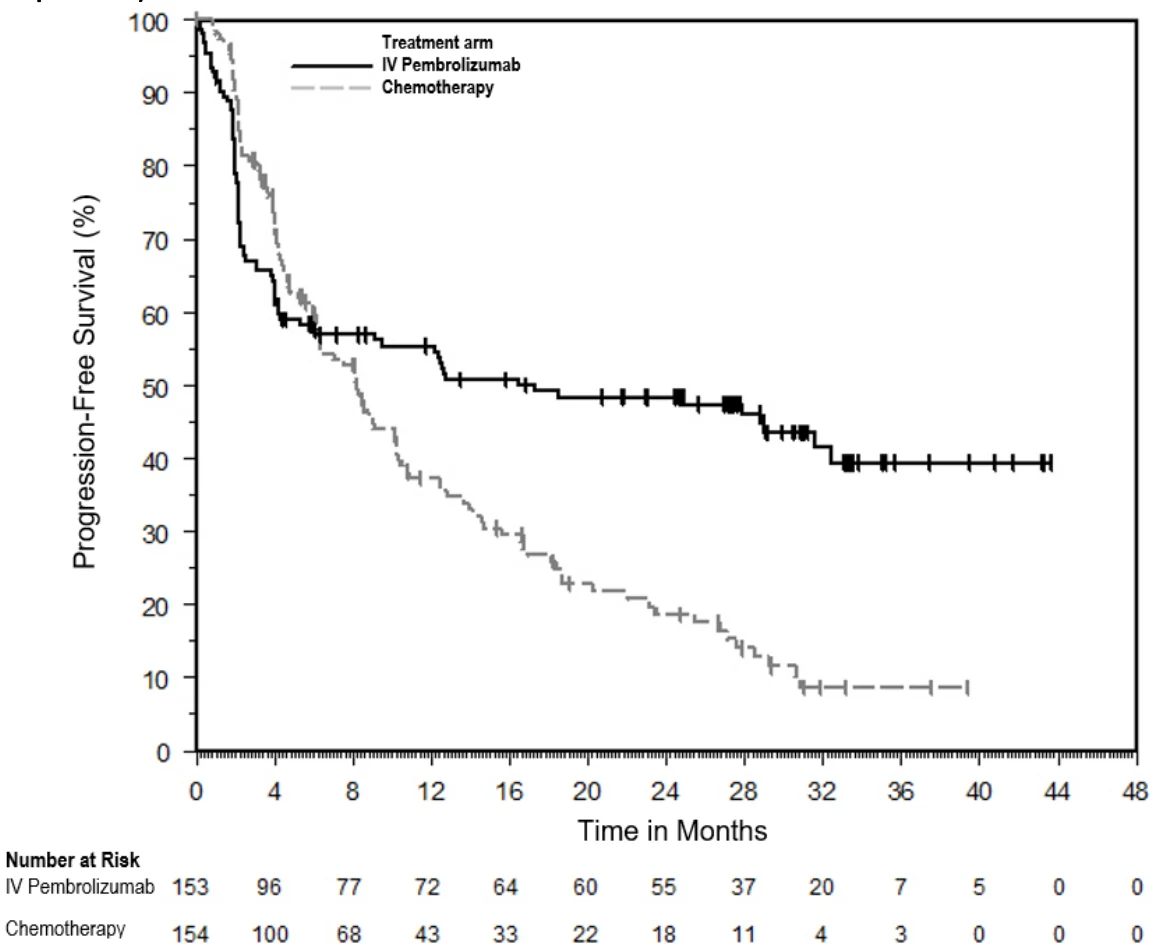
In an exploratory subgroup analysis, the estimated PFS HRs for intravenous KEYTRUDA versus chemotherapy for the KRAS/NRAS/BRAF all wild type (n=69) subgroup and mutant KRAS or NRAS (n=74) subgroup were 0.28 (95% CI 0.14, 0.55) and 1.19 (95% CI 0.68, 2.07), respectively.
At the time of the PFS analysis corresponding to a median follow up duration of 27.6 months, the median duration of response was not reached in patients treated with intravenous KEYTRUDA versus 10.6 months in patients treated with chemotherapy.
Microsatellite Instability-High Cancer (MSI-H) or Mismatch Repair Deficient (dMMR) Cancer
KEYNOTE-164, KEYNOTE-158, and KEYNOTE-051: Open-label studies in patients with MSI-H or dMMR, cancer
The efficacy of intravenous KEYTRUDA was investigated in 504 patients with MSI-H or dMMR cancer enrolled in three multicenter, nonrandomized, open-label, multi-cohort studies (KEYNOTE-164, KEYNOTE-158, and KEYNOTE-051). All studies excluded patients with autoimmune disease or a medical condition that required immunosuppression. Regardless of histology, MSI or MMR tumour status was determined using polymerase chain reaction (PCR) or immunohistochemistry (IHC), respectively.
- KEYNOTE-164 enrolled 124 patients with advanced MSI-H or dMMR- colorectal cancer (CRC) that progressed following treatment with a fluoropyrimidine and either oxaliplatin or irinotecan +/- antiVEGF/EGFR -mAb-based- therapy.
- KEYNOTE-158 enrolled 373 patients with advanced MSI-H or dMMR- non-colorectal cancer (non-CRC) who had disease progression following prior therapy.
- KEYNOTE-051 enrolled 7 pediatric patients with MSI-H or dMMR cancers.
Adult patients received intravenous KEYTRUDA 200 mg every 3 weeks (pediatric patients received 2 mg/kg every 3 weeks) until unacceptable toxicity or disease progression. Clinically stable patients with initial evidence of disease progression were permitted to remain on treatment until disease progression was confirmed. Patients without disease progression were treated for up to 24 months. Treatment with intravenous KEYTRUDA could be reinitiated for subsequent disease progression and administered for up to one additional year. In KEYNOTE-164 and KEYNOTE-158, assessment of tumour status was performed every 9 weeks through the first year, then every 12 weeks thereafter. In KEYNOTE-051, assessment of tumour status was performed every 8 weeks for 24 weeks, and then every 12 weeks thereafter. The major efficacy outcome measures were ORR and DoR as assessed by BICR according to RECIST 1.1 and as assessed by the investigator according to RECIST 1.1 in KEYNOTE-051.
In KEYNOTE-164 and KEYNOTE-158, the baseline characteristics were median age of 60 years (36% age 65 or older); 44% male; 78% White, 14% Asian; and ECOG PS 0 (45%) and 1 (55%). Ninety-two percent of patients had M1 disease and 4% had M0 disease. Thirty-seven percent of patients received one prior line of therapy and 61% received two or more prior lines of therapy.
Among the 7 pediatric patients, in KEYNOTE-051, the baseline characteristics were: median age of 11 years (range: 3 to 16); 71% female; 86% White and 14% Asian; and 57% had a Lansky/Karnofsky Score of 100. Seventy one percent of patients had Stage IV and 14% had Stage III disease. Fifty seven percent of patients received one prior line of therapy and 29% received two prior lines of therapy.
The median follow-up time for 497 adult and 7 pediatric patients (KEYNOTE-051) treated with intravenous KEYTRUDA was 20.5 months and 5.2 months, respectively. Efficacy results are summarized in Table 104 and Table 105.
Table 104: Efficacy Results for Adult Patients with MSI-H/dMMR Cancer
| Endpoint | n=497 | |||
|---|---|---|---|---|
| Objective Response Rate* | ||||
| ORR%, (95% CI) | 34% (30, 38) | |||
| Complete Response | 11% | |||
| Partial Response | 23% | |||
| Stable Disease | 18% | |||
| Disease Control Rate† | 52% | |||
| Response Duration* | ||||
| Median in months (range) | 63.2 (1.9+, 63.9+) | |||
| % with duration ≥ 36-months | 75%‡ | |||
| Time to Response | ||||
| Median in months (range) | 2.2 (1.3, 49.3) | |||
* Assessed by BICR using RECIST 1.1 † Based on best response of stable disease or better ‡ Based on Kaplan-Meier estimates; includes 65 patients with response of 36 months or longer + Denotes ongoing response | ||||
Among the 7 pediatric patients from KEYNOTE-051 (6 with brain cancer [anaplastic astrocytoma (1), glioblastoma multiforme (5)], 1 with abdominal adenocarcinoma), there were no responders per RECIST 1.1. One patient with a GBM had a radiographic complete response per irRECIST that lasted 15 months after initial pseudo-progression; however, given the limited data, interpretation of the results should be made with caution.
Table 105: Response by Tumour Type
| Objective Response Rate | Duration of Response range | ||||||||||||||
|---|---|---|---|---|---|---|---|---|---|---|---|---|---|---|---|
| n | n (%) | 95% CI | (months) | ||||||||||||
| CRC | 124 | 42 (34%) | (26%, 43%) | (4.4, 58.5+) | |||||||||||
| Non-CRC | 373 | 126 (34%) | (29%, 39%) | (1.9+, 63.9+) | |||||||||||
| Endometrial cancer | 94 | 47 (50%) | (40%, 61%) | (2.9, 63.2) | |||||||||||
| Gastric or GE junction cancer | 51 | 20 (39%) | (26%, 54%) | (1.9+, 63.0+) | |||||||||||
| Small intestinal cancer | 27 | 16 (59%) | (39%, 78%) | (3.7+, 57.3+) | |||||||||||
| Ovarian cancer | 25 | 8 (32%) | (15%, 54%) | (4.2, 56.6+) | |||||||||||
| Biliary cancer | 22 | 9 (41%) | (21%, 64%) | (6.2, 49.0+) | |||||||||||
| Pancreatic cancer | 22 | 4 (18%) | (5%, 40%) | (8.1, 24.3+) | |||||||||||
| Brain cancer | 21 | 1 (5%) | (0%, 24%) | 18.9 | |||||||||||
| Sarcoma | 14 | 3 (21%) | (5%, 51%) | (35.4+, 57.2+) | |||||||||||
| Breast cancer | 13 | 1 (8%) | (0%,36%) | 24.3+ | |||||||||||
| Other* | 12 | 4 (33%) | (10%, 65%) | (6.2+, 32.3+) | |||||||||||
| Cervical cancer | 11 | 1 (9%) | (0%, 41%) | 63.9+ | |||||||||||
| Neuroendocrine cancer | 11 | 1 (9%) | (0%, 41%) | 13.3 | |||||||||||
| Prostate cancer | 8 | 1 (13%) | (0%, 53%) | 24.5+ | |||||||||||
| Adrenocortical cancer | 7 | 1 (14%) | (0%, 58%) | 4.2 | |||||||||||
| Mesothelioma | 7 | 0 (0%) | (0%, 41%) | --- | |||||||||||
| Thyroid cancer | 7 | 1 (14%) | (0%, 58%) | 8.2 | |||||||||||
| Small cell lung cancer | 6 | 2 (33%) | (4%, 78%) | (20.0, 47.5) | |||||||||||
| Bladder cancer | 6 | 3 (50%) | (12%, 88%) | (35.6+, 57.5+) | |||||||||||
| Salivary cancer | 5 | 2 (40%) | (5%, 85%) | (42.6+, 57.8+) | |||||||||||
| Renal cell cancer | 4 | 1 (25%) | (0%, 81%) | 22.0 | |||||||||||
* Includes tumour type (n): anal (3), HNSCC (1), nasopharyngeal (1), retroperitoneal (1), testicular (1), vaginal (1), vulvar (1), appendiceal adenocarcinoma, NOS (1), hepatocellular carcinoma (1), and carcinoma of unknown origin (1). + Denotes ongoing response | |||||||||||||||
Endometrial Carcinoma
KEYNOTE-146: Open label trial in patients with endometrial carcinoma that is not MSI-H or dMMR
The efficacy of intravenous KEYTRUDA in combination with lenvatinib was investigated in a multicenter, single-arm, open-label, multi-cohort trial that enrolled 108 patients with metastatic endometrial carcinoma that had progressed following at least one prior platinum-based systemic therapy in any setting. Eligible patients were 18 years of age or older with pathologically confirmed endometrial carcinoma and had an ECOG performance status of 0 or 1. Patients with active autoimmune disease or a medical condition that required immunosuppression were ineligible.
Patients were treated with intravenous KEYTRUDA 200 mg intravenously every 3 weeks in combination with lenvatinib 20 mg orally once daily until unacceptable toxicity or disease progression as determined by the investigator. The major efficacy outcome measures were ORR and DOR by independent radiologic review committee (IRC) using RECIST v1.1.
Administration of intravenous KEYTRUDA and lenvatinib was permitted beyond RECIST-defined disease progression if the patient was clinically stable and considered by the investigator to be deriving clinical benefit. intravenous KEYTRUDA dosing was continued for a maximum of 24 months; however, treatment with lenvatinib could be continued beyond 24 months. Assessment of tumour status was performed at baseline and then every 6 weeks until week 24, followed by every 9 weeks thereafter.
Among the 108 patients, 87% (n=94) had tumours that were not MSI-H or dMMR, 10% (n=11) had tumours that were MSI-H or dMMR, and in 3% (n=3) the status was not known. Tumour MSI status was determined using a polymerase chain reaction (PCR) test. Tumour MMR status was determined using an immunohistochemistry (IHC) test. The baseline characteristics of the 94 patients with tumours that were not MSI-H or dMMR were: median age of 66 years with 62% age 65 or older; 86% White, 6% Black, 4% Asian, 3% other races; and ECOG PS of 0 (52%) or 1 (48%). The majority of patients had endometrioid (48.9%) or serous (35.1%) histology. All 94 patients received prior platinum-based systemic therapy for endometrial carcinoma: 51% received one; 38% received two; and 11% received three or more prior systemic therapies.
Efficacy results are summarized in Table 106.
Table 106 Efficacy Results for Patients with Endometrial Carcinoma that is not MSI-H or dMMR in KEYNOTE-146.
| Intravenous KEYTRUDA with lenvatinib n=94 | ||||
|---|---|---|---|---|
| Objective Response Rate (ORR) | ||||
| ORR (95% CI) | 38.3% (29%, 49%) | |||
| Complete Response, n (%) | 10 (10.6%) | |||
| Partial Response, n (%) | 26 (27.7%) | |||
| Duration of Response | ||||
| Median in months (range) | NR (1.2+, 33.1+)† | |||
| Duration of response ≥ 6 months, n (%) | 25 (69%) | |||
Tumour assessments were based on RECIST 1.1 per independent radiologic review committee (IRC). All responses were confirmed. Median follow-up time of 18.7 months † Based on patients (n=36) with a response by independent review + Censored at Data cutoff CI = confidence interval; NR= Not reached. | ||||
- -775: Controlled trial of combination therapy in patients with advanced endometrial carcinoma, who have received prior systemic therapy
- intravenous KEYTRUDA in combination with lenvatinib was investigated in KEYNOTE-775, a multicenter, open-label, randomized, active-controlled trial that enrolled 827 patients with advanced endometrial carcinoma who had been previously treated with at least one prior platinum-based chemotherapy regimen in any setting, including in the neoadjuvant and adjuvant settings.
- active autoimmune disease or a medical condition that required immunosuppression were ineligible. Patients with endometrial carcinoma that were not MSI-H or dMMR were stratified by ECOG performance status,
- geographic region, and history of pelvic radiation. Patients were randomized (1:1) to one of the following treatment arms:
- Intravenous KEYTRUDA 200 mg intravenously every 3 weeks in combination with lenvatinib 20 mg orally once daily.
- Investigator’s choice, consisting of either doxorubicin 60 mg/m2 every 3 weeks or paclitaxel 80 mg/m2 given weekly, 3 weeks on/1 week off.
Treatment with intravenous KEYTRUDA and lenvatinib continued until RECIST v1.1-defined progression of disease as verified by BICR, unacceptable toxicity, or for intravenous KEYTRUDA, a maximum of 24 months or up to 35 administrations which ever was longer; however, treatment with lenvatinib could be continued beyond 24 months.
Treatment was permitted beyond RECIST v1.1-defined disease progression if the treating investigator considered the patient to be deriving clinical benefit, and the treatment was tolerated. Assessment of tumour status was performed every 8 weeks. The primary efficacy outcome measures were OS and PFS as assessed by BICR according to RECIST v1.1, modified to follow a maximum of 10 target lesions and a maximum of 5 target lesions per organ. Additional efficacy outcome measures included ORR and DoR, as assessed by BICR.
Among the 697 not dMMR patients, 346 patients were randomized to intravenous KEYTRUDA in combination with lenvatinib, and 351 patients were randomized to investigator’s choice of doxorubicin (n=254) or paclitaxel (n=97). The not dMMR population characteristics were: median age of 65 years (range: 30 to 86), 52% age 65 or older; 62% White, 22% Asian, and 3% Black; 60% ECOG PS of 0 and 40% ECOG PS of 1. The histologic subtypes were endometrioid carcinoma (55%), serous (30%), clear cell carcinoma (7%), mixed (4%), and other (3%). All 697 of these patients received prior systemic therapy for endometrial carcinoma: 67% had one, 30% had two, and 3% had three or more prior systemic therapies. Thirty-seven percent of patients received only prior neoadjuvant or adjuvant therapy.
Efficacy results for the not MSI-H or dMMR patients are summarized in Table 107 and Figure 28 and Figure 29.
Table 107 : Efficacy Results for Patients with Advanced Endometrial Carcinoma that is not MSI-H or dMMR in KEYNOTE-775
| Endometrial Carcinoma (not MSI-H or dMMR) | ||||||||||||||
|---|---|---|---|---|---|---|---|---|---|---|---|---|---|---|
| Endpoint | Intravenous KEYTRUDA 200 mg every 3 weeks and Lenvatinib n=346 | Doxorubicin or Paclitaxel n=351 | ||||||||||||
| OS | ||||||||||||||
| Number (%) of patients with event | 165 (48%) | 203 (58%) | ||||||||||||
| Median in months (95% CI) | 17.4 (14.2, 19.9) | 12.0 (10.8, 13.3) | ||||||||||||
| Hazard ratio* (95% CI) | 0.68 (0.56, 0.84) | |||||||||||||
| p-Value† | 0.0001 | |||||||||||||
| PFS | ||||||||||||||
| Number (%) of patients with event | 247 (71%) | 238 (68%) | ||||||||||||
| Median in months (95% CI) | 6.6 (5.6, 7.4) | 3.8 (3.6, 5.0) | ||||||||||||
| Hazard ratio* (95% CI) | 0.60 (0.50, 0.72) | |||||||||||||
| p-Value† | <0.0001 | |||||||||||||
| Objective Response Rate | ||||||||||||||
| ORR‡ (95% CI) | 30% (26, 36) | 15% (12, 19) | ||||||||||||
| Complete response rate | 5% | 3% | ||||||||||||
| Partial response rate | 25% | 13% | ||||||||||||
| p-Value¶ | <0.0001 | |||||||||||||
* Based on the stratified Cox regression model † Based on stratified log-rank test ‡ Response: Best objective response as confirmed complete response or partial response ¶ Based on Miettinen and Nurminen method stratified by ECOG performance status, geographic region, and history of pelvic radiation | ||||||||||||||
The exploratory analyses in responders suggested the median duration of response of 9.2 months (range from 1.6+ to 23.7+) for intravenous KEYTRUDA in combination with lenvatinib treated patients (n=105) and 5.7 months (0+ to 24.2+ months) for patients treated with doxorubicin or paclitaxel (n=53).
Figure 28: Kaplan-Meier Curve for Overall Survival in KEYNOTE-775 (Not MSI-H or dMMR)
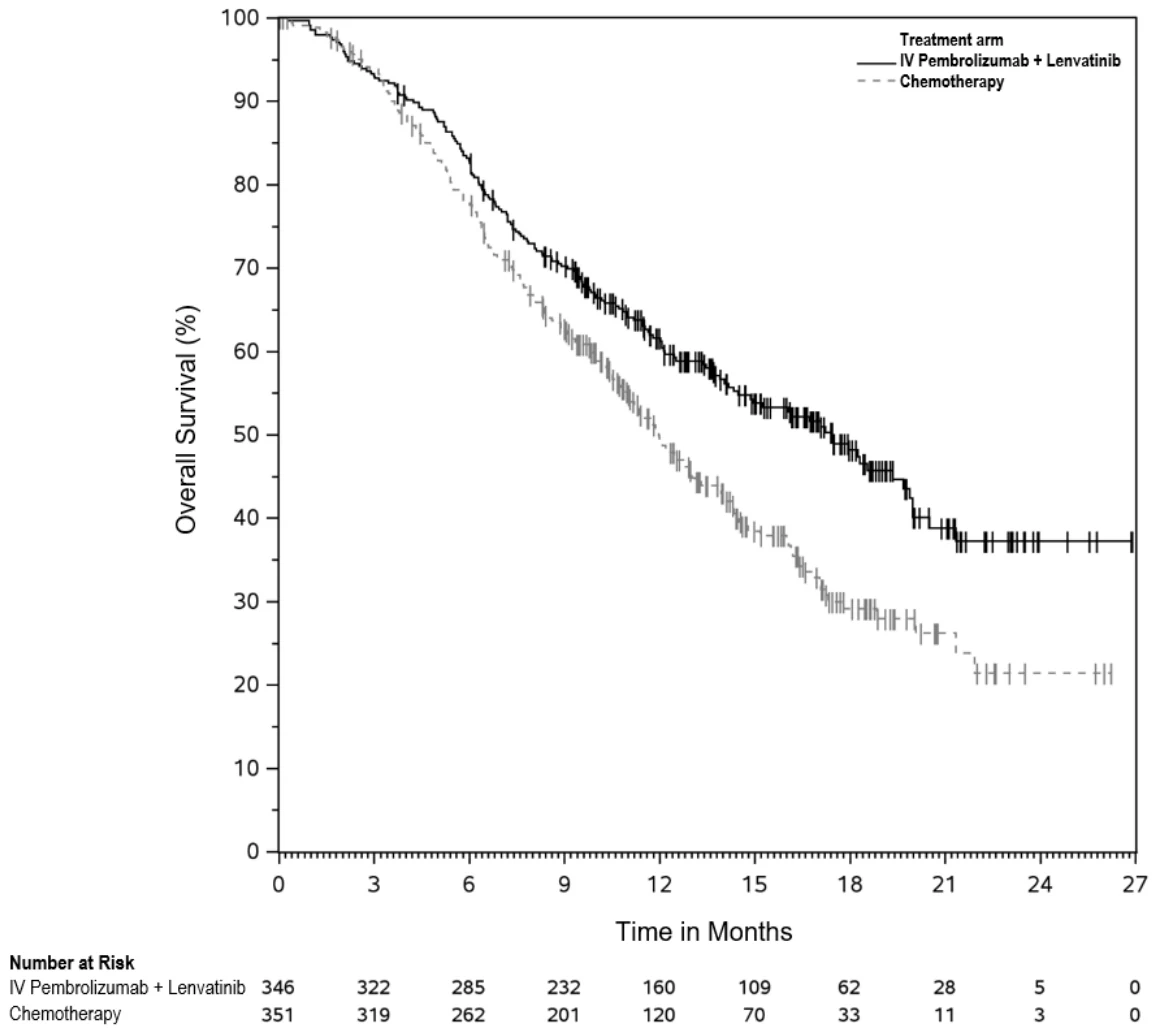
Figure 29: Kaplan-Meier Curve for Progression-Free Survival in KEYNOTE-775 (Not MSI-H or dMMR)
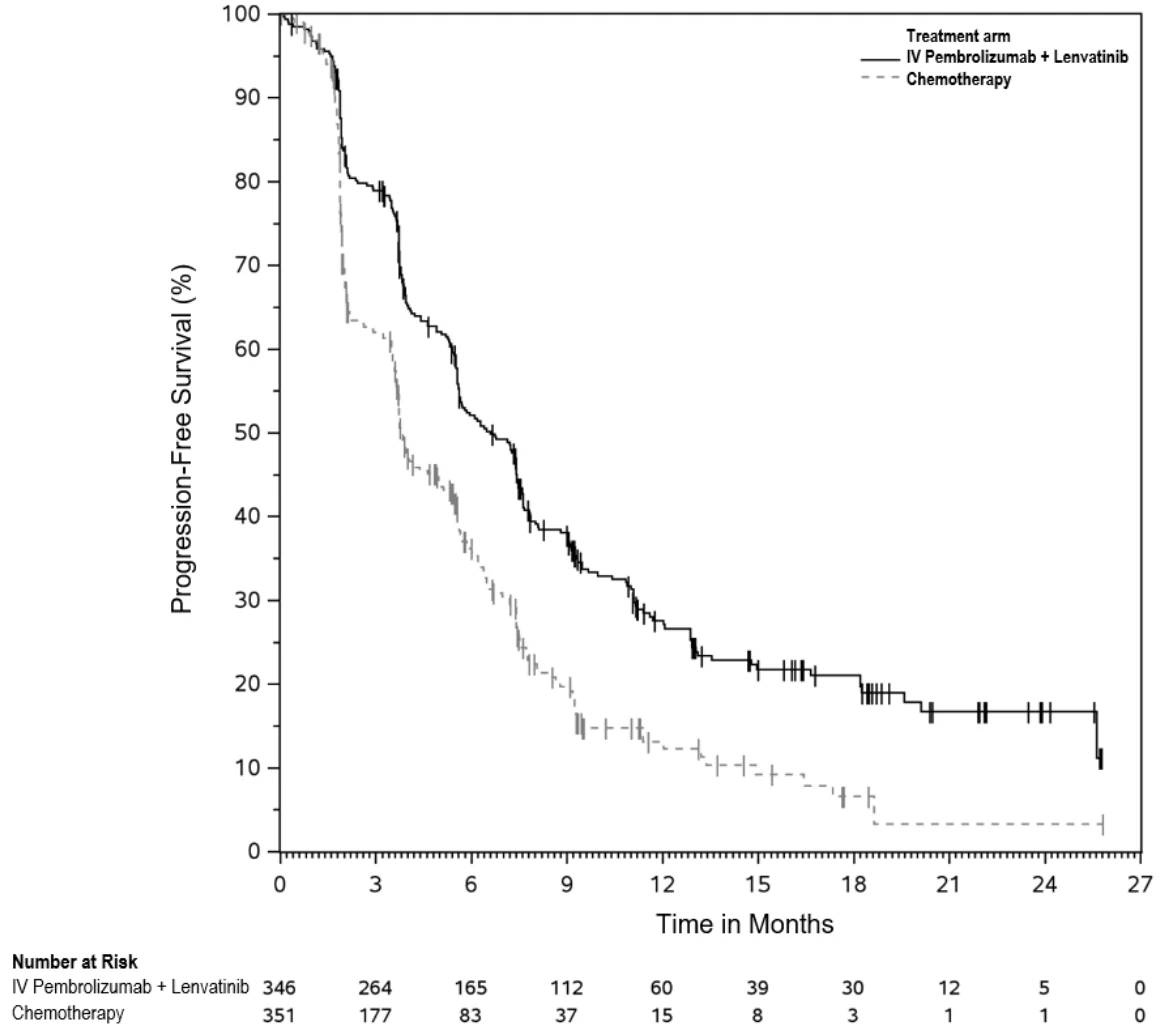
Renal Cell Carcinoma
KEYNOTE-426: Controlled trial of combination therapy with axitinib- in patients with advanced or metastatic RCC naïve to treatment
The efficacy of intravenous KEYTRUDA in combination with axitinib was investigated in a randomized, multicenter, open-label, active-controlled trial KEYNOTE-426, conducted in patients with advanced or metastatic RCC with clear cell component, regardless of PD-L1 tumour status and International Metastatic RCC Database Consortium (IMDC) risk group categories. The trial excluded patients with autoimmune disease or a medical condition that required systemic immunosuppression within the last 2 years. Patients were randomized (1:1) to receive either intravenous KEYTRUDA 200 mg once every 3 weeks in combination with axitinib 5 mg twice daily or sunitinib 50 mg once daily for 4 weeks and then off treatment for 2 weeks. Randomization was stratified by risk categories (favorable versus intermediate versus poor) and geographic region (North America versus Western Europe versus “Rest of the World”).
Treatment with intravenous KEYTRUDA and axitinib continued until RECIST 1.1-defined progression of disease as verified by BICR or confirmed by the investigator, unacceptable toxicity, or for Intravenous
KEYTRUDA, for up to 24 months or 35 administrations, whichever was longer. Administration of intravenous KEYTRUDA and axitinib was permitted beyond RECIST 1.1-defined disease progression if the patient was clinically stable and considered to be deriving clinical benefit by the investigator. Treatment with intravenous KEYTRUDA could be reinitiated for subsequent disease progression and administered for up to one additional year. Assessment of tumour status was performed at baseline, after randomization at Week 12, then every 6 weeks thereafter until Week 54, and then every 12 weeks thereafter.
Among the 861 patients in KEYNOTE-426 (432 patients in the intravenous KEYTRUDA combination arm and 429 in the sunitinib arm), baseline characteristics were: median age of 62 years (range: 26 to 90); 38% age 65 or older; 73% male; 79% White and 16% Asian; 99.9% had a Karnofsky Performance Score (KPS) of ≥ 70%; and patient distribution by IMDC risk categories was 31% favorable, 56% intermediate and 13% poor.
The primary efficacy outcome measures were OS and PFS (as assessed by BICR according to RECIST 1.1, modified to follow a maximum of 10 target lesions and a maximum of 5 target lesions per organ). Secondary efficacy outcome measures were objective response rate (ORR) and response duration, as assessed by BICR using RECIST 1.1, modified to follow a maximum of 10 target lesions and a maximum of 5 target lesions per organ. The median follow-up time for the intravenous KEYTRUDA combination arm was 13.2 months (range: 0.1 – 21.5 months). Table 108 summarizes key efficacy measures at the pre-specified first interim analysis. OS and PFS benefits were observed in the Intent To Treat population and regardless of PD-L1 expression level.
Table 108: Efficacy Results for Patients with Advanced and Metastatic RCC in KEYNOTE-426, Interim Analysis 1 (Intent To Treat Population).
| Endpoint | Intravenous KEYTRUDA and Axitinib n=432 | Sunitinib n=429 |
|---|---|---|
| Endpoint | Intravenous KEYTRUDA and Axitinib n=432 | Sunitinib n=429 |
| Primary Efficacy Outcome Measure OSa | ||
| Number of patients with event (%) | 59 (14%) | 97 (23%) |
| Median in months (95% CI) | Not reached (NA, NA) | Not reached (NA, NA) |
| Hazard ratio* (95% CI) | 0.53 (0.38, 0.74) | |
| p-Value† | 0.00005 | |
| Primary Efficacy Outcome Measure PFSa | ||
| Number of patients with event (%) | 183 (42%) | 213 (50%) |
| Median in months (95% CI) | 15.1 (12.6, 17.7) | 11.1 (8.7, 12.5) |
| Hazard ratio* (95% CI) | 0.69 (0.56, 0.84) | |
| p-Value† | 0.00012 | |
| Secondary Efficacy Outcome Measure ORRa | ||
| Overall response rate‡ (95% CI) | 59% (54, 64) | 36% (31, 40) |
| Complete response | 6% | 2% |
| Partial response | 53% | 34% |
| p-Value§ | <0.0001 | |
| a The initial one-sided type 1 error rate level for OS, PFS, ORR were 0.023, 0.002, and 0.025 respectively. The corresponding p-value bounds at the interim analysis for OS and PFS were 0.0001 and 0.0013, respectively. | ||
For ORR, the corresponding p-value bound after alpha reallocation from PFS and OS following pre-specified multiplicity adjustment was 0.025. * Based on the stratified Cox proportional hazard model † Based on stratified log-rank test. ‡ Based on patients with a best overall response as confirmed complete or partial response § Based on Miettinen and Nurminen method stratified by IMDC risk group and geographic region NA = not available | ||
The final OS analysis was performed at a median follow-up of 37.7 months after 418 patient events (193 in the intravenous KEYTRUDA and axitinib arm and 225 in the sunitinib arm). Median OS was 45.7 months (95% CI: 43.6, NA) in the intravenous KEYTRUDA and axitinib arm and 40.1 months (95% CI: 34.3, 44.2) in the sunitinib arm. Approximately 47.2% of participants in the intravenous KEYTRUDA and axitinib arm and 65.5% of participants in the sunitinib arm received a new subsequent anticancer therapy. The OS HR was 0.73 (95% CI: 0.60, 0.88).
In an exploratory analysis, the updated analysis of OS in patients with IMDC favourable, intermediate, and poor risk demonstrated a HR of 1.17 (95% CI: 0.76, 1.80), 0.67 (95% CI: 0.52, 0.86) and 0.51 (95% CI: 0.32, 0.81), respectively.
Figure 30: Kaplan-Meier Curve for Overall Survival by Treatment Arm in KEYNOTE-426, Interim Analysis 1 (Intent to Treat Population)
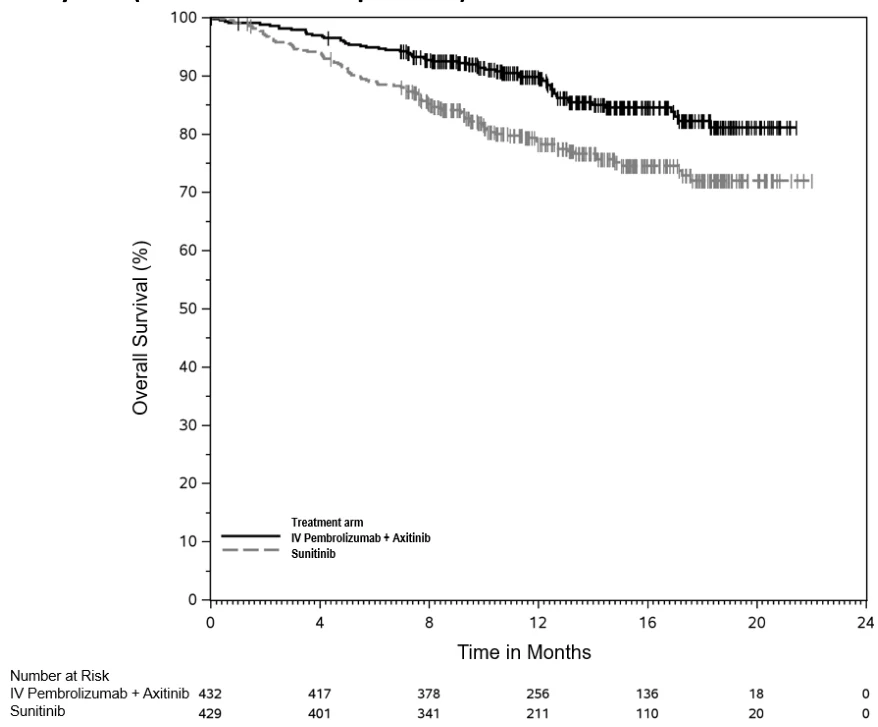
The OS Kaplan-Meier curves separated in favour of intravenous KEYTRUDA + axitinib at the first Interim Analysis and remained separated at the time of the final analysis of 51-month follow-up.
Figure 31: Kaplan-Meier Curve for Progression-Free Survival by Treatment Arm in KEYNOTE-426, Interim Analysis 1 (Intent to Treat Population)
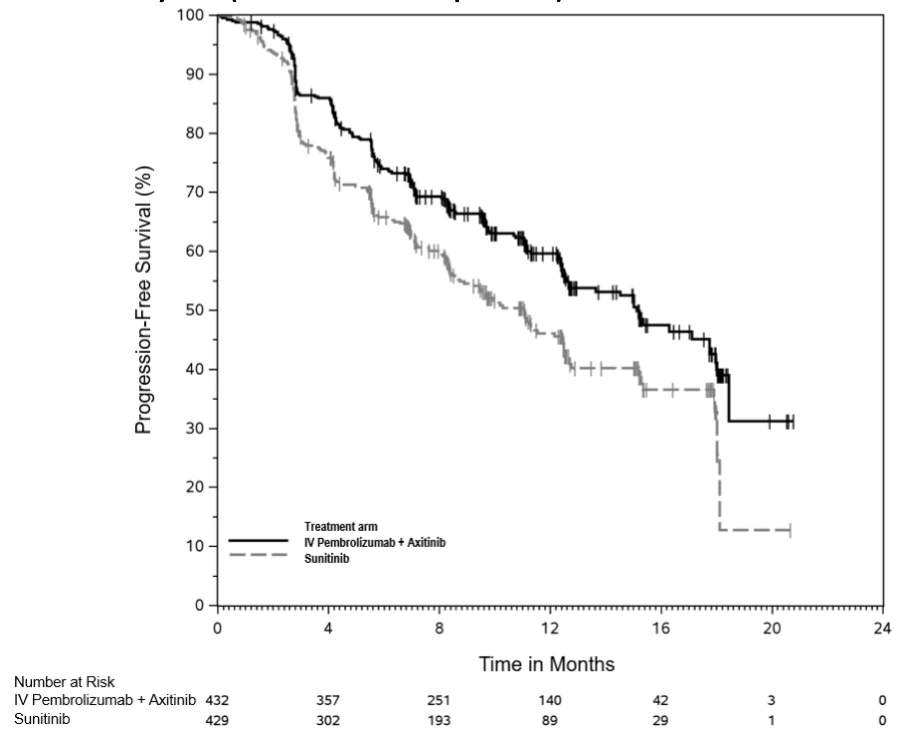
KEYNOTE-581: Controlled trial of combination therapy with lenvatinib in patients with advanced or metastatic RCC with no prior systemic therapy
The efficacy of intravenous KEYTRUDA in combination with lenvatinib was investigated in KEYNOTE-581, a multicenter, open-label, randomized trial conducted in 1069 patients with advanced or metastatic RCC, with clear cell component, who have not received prior systemic therapy for metastatic RCC. Patients were enrolled regardless of PD-L1 tumour expression status. Patients were stratified by geographic region (North America versus Western Europe versus “Rest of the World”) and Memorial Sloan Kettering Cancer Center (MSKCC) prognostic groups (favorable versus intermediate versus poor risk). The study excluded patients with active autoimmune disease or a medical condition that required immunosuppression, active brain metastasis, poorly controlled hypertension, uncontrolled adrenal insufficiency, gastrointestinal malabsorption, bleeding or thrombotic disorders.
Patients were randomized (1:1:1) to one of the following treatment arms:
- Intravenous KEYTRUDA 200 mg intravenously every 3 weeks up to 24 months in combination with lenvatinib 20 mg orally once daily (n=355).
- Lenvatinib 18 mg orally once daily in combination with everolimus 5 mg orally once daily (n=357).
- Sunitinib 50 mg orally once daily for 4 weeks then off treatment for 2 weeks (n=357).
Treatment continued until unacceptable toxicity or disease progression as determined by the investigator and confirmed by BICR using RECIST 1.1. Administration of intravenous KEYTRUDA with lenvatinib was permitted beyond RECIST-defined disease progression if the patient was clinically stable and considered by the investigator to be deriving clinical benefit. intravenous KEYTRUDA was continued for a maximum of 24 months or 35 administrations which ever was longer; however, treatment with lenvatinib could be continued beyond 24 months. Assessment of tumour status was performed at baseline and then every 8 weeks.
The study population baseline characteristics were in general comparable between the treatment arms with a median age of 62 years (range: 29 to 88 years); 42% were age 65 or older and 11% age 75 or older; 75% male; 74% White, 21% Asian, 1% Black, and 2% other races; 18% and 82% of patients had a baseline KPS of 70% to 80% and 90% to 100%, respectively; MSKCC risk categories was 27% favorable, 64% intermediate and 9% poor. Common sites of metastases in patients were lung (68%), lymph node (45%), and bone (25%). In addition, 6.8% of patients had tumours with sarcomatoid features. Metastatic disease was present in 99% of the patients and locally advanced disease was present in 1%.
The primary efficacy outcome measure was PFS based on BICR using RECIST 1.1. Key secondary efficacy outcome measures included OS and ORR. The trial demonstrated statistically significant improvements in PFS, OS, and ORR in patients randomized to intravenous KEYTRUDA in combination with lenvatinib compared with sunitinib. The median overall survival follow-up time was 26.6 months (range: 0.03+, 46.13+ months). Pre-specified interim analysis efficacy results for KEYNOTE-581 are summarized in Table 109 and Figure 32.
Table 109: Efficacy Results for Patients with Advanced and Metastatic RCC in KEYNOTE-581, Interim Analysis 3
| Endpoint | Intravenous KEYTRUDA 200 mg every 3 weeks and Lenvatinib n=355 | Sunitinib n=357 | |||||||||||
|---|---|---|---|---|---|---|---|---|---|---|---|---|---|
| PFS | |||||||||||||
| Number of patients with event (%) | 160 (45%) | 205 (57%) | |||||||||||
| Median in months (95% CI) | 23.9 (20.8, 27.7) | 9.2 (6.0, 11.0) | |||||||||||
| Hazard ratio* (95% CI) | 0.39 (0.32, 0.49) | ||||||||||||
| p-Value† | <0.0001 | ||||||||||||
| OS | |||||||||||||
| Number of patients with event (%) | 80 (23%) | 101 (28%) | |||||||||||
| Median in months (95% CI) | NR (33.6, NR) | NR (NR, NR) | |||||||||||
| Hazard ratio* (95% CI) | 0.66 (0.49, 0.88) | ||||||||||||
| p-Value† | 0.0049 | ||||||||||||
| Objective Response Rate | |||||||||||||
| ORR‡ (95% CI) | 71% (66, 76) | 36% (31, 41) | |||||||||||
| Complete response rate | 16% | 4% | |||||||||||
| Partial response rate | 55% | 32% | |||||||||||
| p-Value‡ | <0.0001 | ||||||||||||
* Based on the stratified Cox proportional hazard model stratified by geographic region and MSKCC prognostic groups. † Two-sided p-Value based on stratified log-rank test, compared with a boundary of 0.0411 for PFS, and 0.0161 for OS, respectively. ‡ Two-sided p-Value based on Cochran-Mantel-Haenszel test NR = not reached | |||||||||||||
The exploratory analyses in responders suggested the median duration of response of 25.8 months (range: 1.64+, 36.76+) for intravenous KEYTRUDA in combination with lenvatinib treated patients and 14.6 months (range: 1.64+, 33.15+) for sunitinib treated patients. Additional exploratory analyses indicated a consistent treatment benefit in PFS across all three pre-specified MSKCC risk groups.
The final descriptive OS analysis was performed at median follow-up of 49.4 months after 149 patient events for intravenous KEYTRUDA in combination with lenvatinib and 159 patient events for sunitinib. Median OS was 53.7 months (95% CI: 48.7, NE) for intravenous KEYTRUDA in combination with lenvatinib and 54.3 months (95% CI: 40.9, NE) for sunitinib. The OS HR was 0.79 (95% CI: 0.63, 0.99). A total of 195/357 (54.6%) patients in the sunitinib arm and 56/355 (15.8%) patients in the intravenous KEYTRUDA plus lenvatinib arm received subsequent systemic anti-PD-1/PD-L1 therapy. See Figure 33. At final analysis, the results for PFS and ORR remained consistent with the interim analysis (see Table 109).
Figure 32: Kaplan-Meier Curve for Progression-Free Survival by Treatment Arm in KEYNOTE-581, Interim Analysis 3
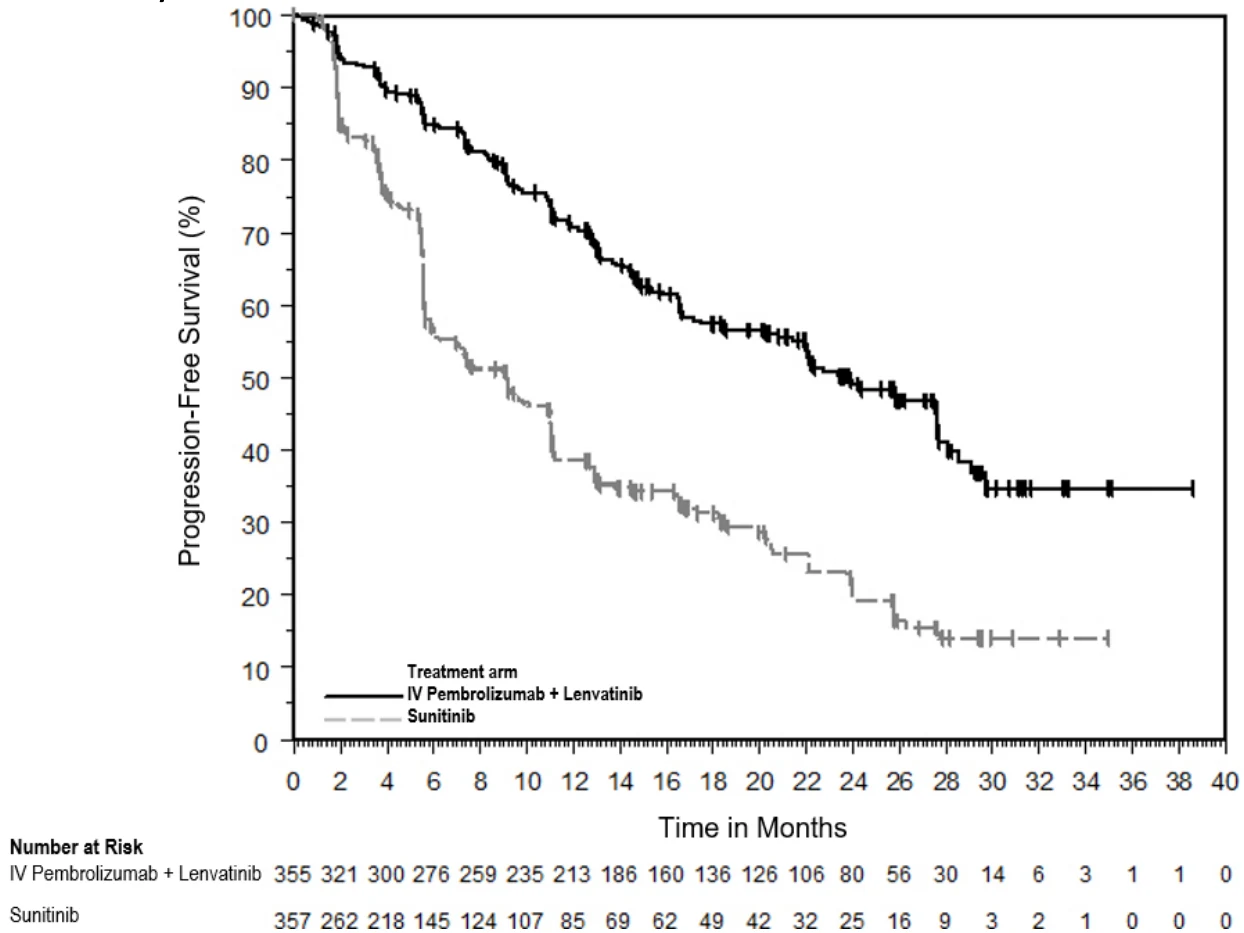
Figure 33: Kaplan-Meier Curve for Overall Survival by Treatment Arm in KEYNOTE-581, Final Analysis
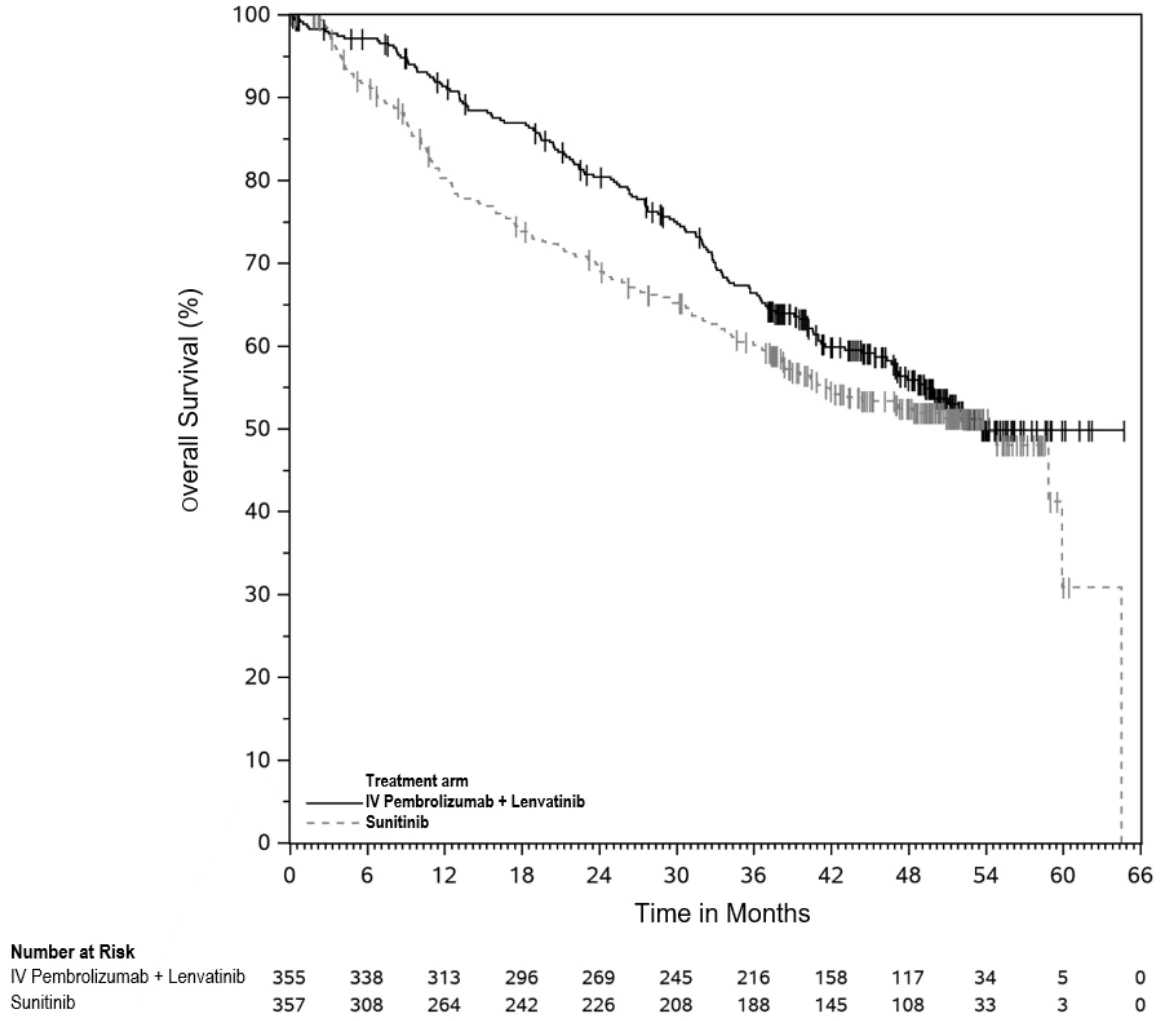
Adjuvant RCC
KEYNOTE-564: Placebo-controlled study for the adjuvant treatment of adult patients with resected RCC
The efficacy of intravenous KEYTRUDA was investigated as adjuvant therapy for RCC in KEYNOTE-564, a multicenter, randomized, double-blind, placebo-controlled study in 994 patients with intermediate-high or high risk of recurrence of RCC, or M1 no evidence of disease (NED). The intermediate high-risk category included: pT2 with Grade 4 or sarcomatoid features; pT3, any Grade without nodal involvement (N0) or distant metastases (M0). The high-risk category included: pT4, any Grade N0 and M0; any pT, any Grade with nodal involvement and M0. The M1 NED category included patients with metastatic disease who had undergone complete resection of primary and metastatic lesions. Patients must have undergone a partial nephroprotective or radical complete nephrectomy (and complete resection of solid, isolated, soft tissue metastatic lesion(s) in M1 NED participants) with negative surgical margins ≥4 weeks prior to the time of screening. Patients with active autoimmune disease or a medical condition that required immunosuppression were ineligible. Patients who had received prior systemic therapy for advanced RCC were excluded from the trial. Patients were randomized (1:1) to receive intravenous KEYTRUDA 200 mg every 3 weeks (n=496) or placebo (n=498) for up to 1 year, until disease recurrence, or until unacceptable toxicity. Randomization was stratified by metastasis status (M0, M1 NED), within M0 group, further stratified by ECOG PS (0,1), and geographic region (US, non-US). Patients underwent imaging every 12 weeks for the first 2 years from randomization, then every 16 weeks from year 3 to 5, and then every 24 weeks annually.
Baseline characteristics and demographics were generally comparable between the intravenous KEYTRUDA and placebo arms. Overall, 86% were intermediate-high risk, 8% were high risk, and 6% were M1 NED. Ninety-two percent of patients had a radical nephrectomy, 8% had a partial nephrectomy. Among the 994 patients, the baseline characteristics were: median age of 60 years (range: 25 to 84), 33% age 65 or older; 71% male; and 85% ECOG PS of 0 and 15% ECOG PS of 1. Ninety-four percent were N0; 84% had no sarcomatoid features; 86% were pT2 with Grade 4 or sarcomatoid features or pT3; 8% were pT4 or with nodal involvement; and 6% were M1 NED.
The primary efficacy outcome measure was investigator-assessed disease-free survival (DFS) defined as time to recurrence, metastasis, or death. The key secondary outcome measure was OS. At the pre-specified interim analysis, the median follow-up time was 23.9 months (range 2.5 to 41.5 months). A statistically significant improvement in DFS was demonstrated for patients randomized to the intravenous KEYTRUDA arm compared with placebo. OS results were not yet mature with 18 deaths out of 496 patients in the intravenous KEYTRUDA arm and 33 deaths out of 498 patients in the placebo arm. Efficacy results are summarized in Table 110 and Figure 34.
Table 110: Efficacy Results in KEYNOTE-564
| Endpoint | Intravenous KEYTRUDA 200 mg every 3 weeks n=496 | Placebo n=498 |
|---|---|---|
| DFS | ||
| Number (%) of patients with event | 109 (22%) | 151 (30%) |
| Median in months (95% CI) | NR | NR |
| Hazard ratio* (95% CI) | 0.68 (0.53, 0.87) | |
| p-Value | 0.0010† | |
| 24-month DFS rate (95% CI) | 77% (73, 81) | 68% (64, 72) |
* Based on the stratified Cox proportional hazard model †Based on stratified log-rank test. p-value is one-sided comparison with a boundary of 0.0114 NR = not reached | ||
Figure 34 Kaplan-Meier Curve for Disease-Free Survival by Treatment Arm in KEYNOTE-564
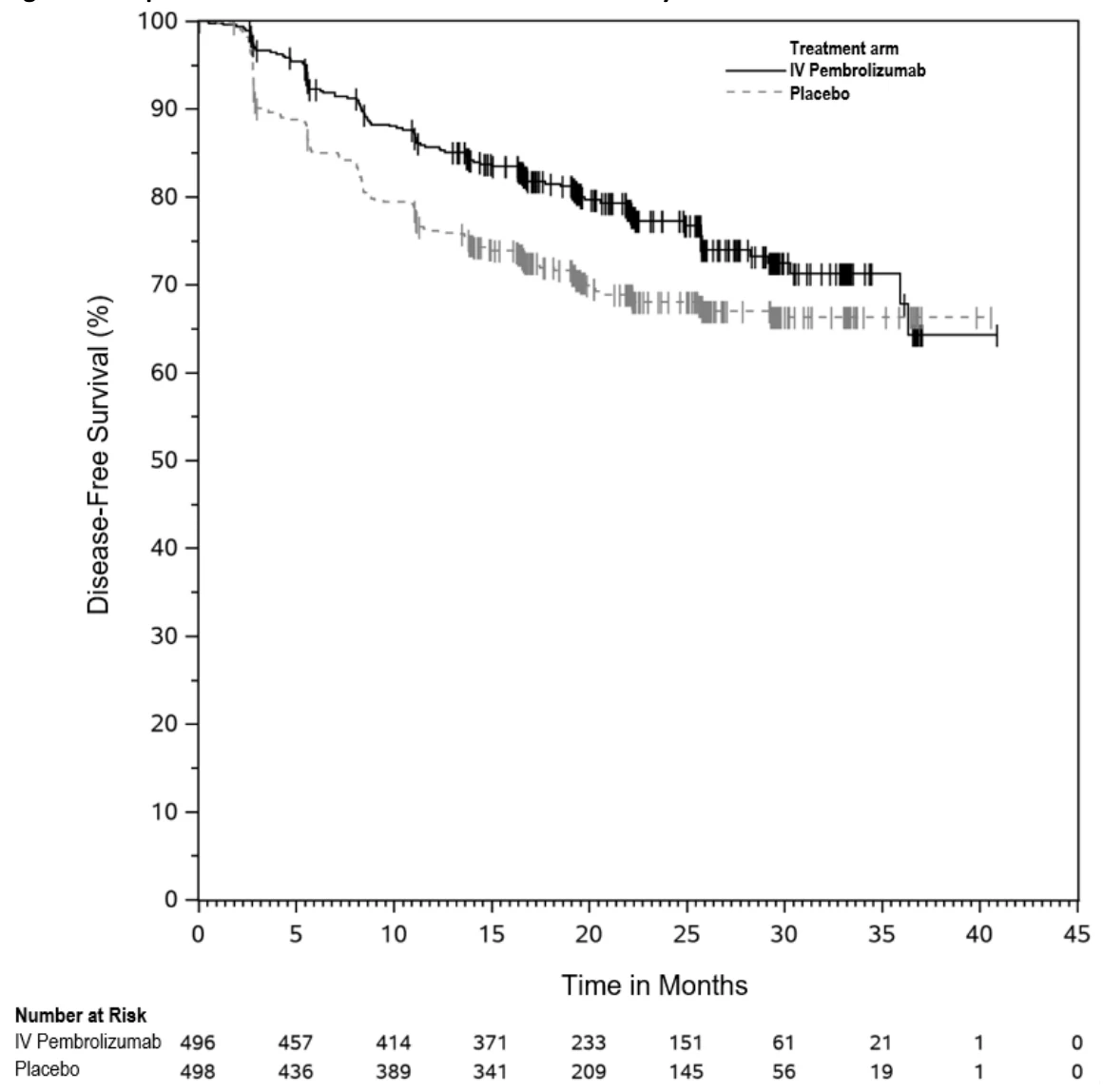
Head and Neck Cancer
KEYNOTE-048: Controlled trial of first-line monotherapy or combination therapy in HNSCC
The efficacy of intravenous KEYTRUDA was investigated in Study KEYNOTE-048, a multicenter, randomized, open-label, active-controlled study in patients with metastatic or recurrent HNSCC who had not previously received systemic therapy for recurrent or metastatic disease and who were considered incurable by local therapies. Patients with active autoimmune disease that required systemic therapy within two years of treatment or a medical condition that required immunosuppression were ineligible for the study. Randomization was stratified by tumour PD-L1 expression (TPS ≥ 50% or < 50%), HPV status (positive or negative), and ECOG PS (0 vs. 1).
Patients were randomized 1:1:1 to one of the following treatment arms:
- Intravenous KEYTRUDA 200 mg every 3 weeks
Intravenous KEYTRUDA 200 mg every 3 weeks, carboplatin AUC 5 mg/ml/min every 3 weeks or
- cisplatin 100 mg/m2 every 3 weeks, and FU 1000 mg/m2/d 4 days continuous every 3 weeks (maximum of 6 cycles of platinum and FU)
- Cetuximab 400 mg/m2 load then 250 mg/m2 once weekly, carboplatin AUC 5 mg/ml/min every 3 weeks or cisplatin 100 mg/m2 every 3 weeks, and FU 1000 mg/m2/d 4 days continuous every 3 weeks (maximum of 6 cycles of platinum and FU)
Treatment with intravenous KEYTRUDA continued until RECIST 1.1-defined progression of disease as determined by the investigator, unacceptable toxicity, or a maximum of 24 months. Subjects on the intravenous KEYTRUDA arm who stop intravenous KEYTRUDA with stable disease or better were eligible for up to one year of additional intravenous KEYTRUDA therapy if they progressed after stopping study treatment. Administration of intravenous KEYTRUDA was permitted beyond RECIST-defined disease progression if the patient was clinically stable and considered to be deriving clinical benefit by the investigator. Assessment of tumour status was performed at Week 9 and then every 6 weeks for the first year, followed by every 9 weeks through 24 months.
Table 111: Baseline Characteristics in KEYNOTE-048.
Intravenous KEYTRUDA and Platinum Chemotherapy and FU n=281 | Intravenous KEYTRUDA n=301 | Standard Treatment* n=300 | |||||||||
|---|---|---|---|---|---|---|---|---|---|---|---|
| Men | 80% | 83% | 87% | ||||||||
| Women | 20% | 17% | 13% | ||||||||
| Age (median) | 61 years | 62 years | 61 years | ||||||||
| Age (range) | 20-85 years | 22-94 years | 22-84 years | ||||||||
| ECOG PS | |||||||||||
| 0 | 39% | 40% | 40% | ||||||||
| 1 | 61% | 60% | 60% | ||||||||
| Former/current smokers | 80% | 79% | 78% | ||||||||
| HPV positive | 21% | 21% | 22% | ||||||||
| CPS ≥ 1 | 86% | 85% | 85% | ||||||||
| CPS ≥ 20 | 45% | 44% | 41% | ||||||||
| TPS ≥ 50% | 24% | 22% | 22% | ||||||||
| Ethnicity | |||||||||||
| White | 72% | 73% | 75% | ||||||||
| Asian | 21% | 19% | 18% | ||||||||
| Cancer stage at study entry | |||||||||||
| IVa | 18% | 20% | 20% | ||||||||
| IVb | 5% | 4% | 7% | ||||||||
| IVc | 72% | 72% | 68% | ||||||||
| * Cetuximab, Platinum, and FU | |||||||||||
The primary efficacy outcome measures were OS and PFS (assessed by BICR according to RECIST 1.1). ORR, as assessed by BICR according to RECIST 1.1, was a secondary outcome measure. The trial demonstrated a statistically significant improvement in OS for patients randomized to intravenous KEYTRUDA in combination with chemotherapy compared to standard treatment. The trial demonstrated a statistically significant improvement in OS in patients whose tumours expressed PD-L1 CPS ≥ 1 randomized to intravenous KEYTRUDA monotherapy compared to standard treatment. Table 112 and Table 113 and Figure 35 and Figure 36 describe key efficacy results for intravenous KEYTRUDA in KEYNOTE-048.
Table 112: Efficacy Results for Intravenous KEYTRUDA plus Chemotherapy in KEYNOTE-048 at Final Analysis.
| Endpoint | Intravenous KEYTRUDA and Platinum Chemotherapy and FU n=281 | Standard Treatment* n=278 |
|---|---|---|
| Primary Efficacy Outcome Measure OS | ||
| Number (%) of patients with event | 213 (76%) | 247 (89%) |
| Median in months (95% CI) | 13.0 (10.9, 14.7) | 10.7 (9.3, 11.7) |
| Hazard ratio† (95% CI) | 0.72 (0.60, 0.87) | |
| p-Value‡ | 0.00025 | |
| Primary Efficacy Outcome Measure PFS | ||
| Number of patients with event (%) | 250 (89%) | 260 (94%) |
| Median in months (95% CI) | 4.9 (4.7, 6.1) | 5.2 (4.9, 6.1) |
| Hazard ratio† (95% CI) | 0.93 (0.78, 1.11) | |
| p-Value‡ | 0.2121 | |
* Cetuximab, platinum, and FU † Based on the stratified Cox proportional hazard model ‡ Based on stratified log-rank test | ||
Figure 35: Kaplan-Meier Curve for Overall Survival for Intravenous KEYTRUDA plus Chemotherapy in KEYNOTE--048 at Final Analysis
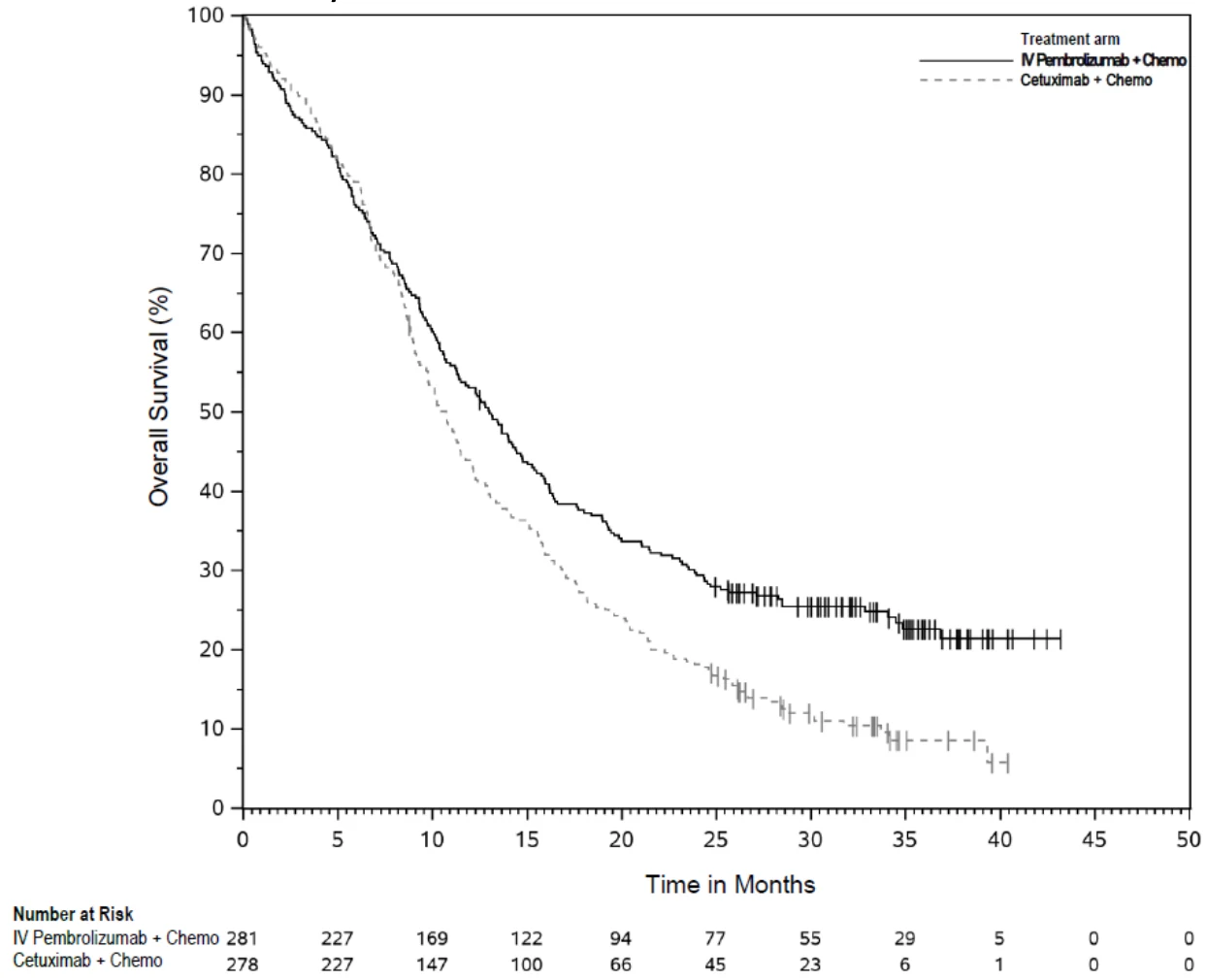
Table 113: Efficacy Results for Intravenous KEYTRUDA as Monotherapy in KEYNOTE-048, with CPS ≥ 1 at Final Analysis.
| Endpoint | Intravenous KEYTRUDA n=257 | Standard Treatment* n=255 |
|---|---|---|
| Primary Efficacy Outcome Measure OS | ||
| Number (%) of patients with event | 197 (77%) | 229 (90%) |
| Median in months (95% CI) | 12.3 (10.8, 14.3) | 10.3 (9.0, 11.5) |
| Hazard ratio† (95% CI) | 0.74 (0.61, 0.90) | |
| p-Value‡ | 0.00133 | |
| Primary Efficacy Outcome Measure PFS | ||
| Number of patients with event (%) | 228 (89%) | 237 (93%) |
| Median in months (95% CI) | 3.2 (2.2, 3.4) | 5.0 (4.8, 6.0) |
| Hazard ratio† (95% CI) | 1.13 (0.94, 1.36) | |
| p-Value‡ | 0.8958 | |
* Cetuximab, Platinum, and FU † Based on the stratified Cox proportional hazard model ‡ Based on stratified log-rank test | ||
Figure 36: Kaplan-Meier Curve for Overall Survival for Intravenous KEYTRUDA as Monotherapy in KEYNOTE-048, with CPS ≥ 1 at Final Analysis
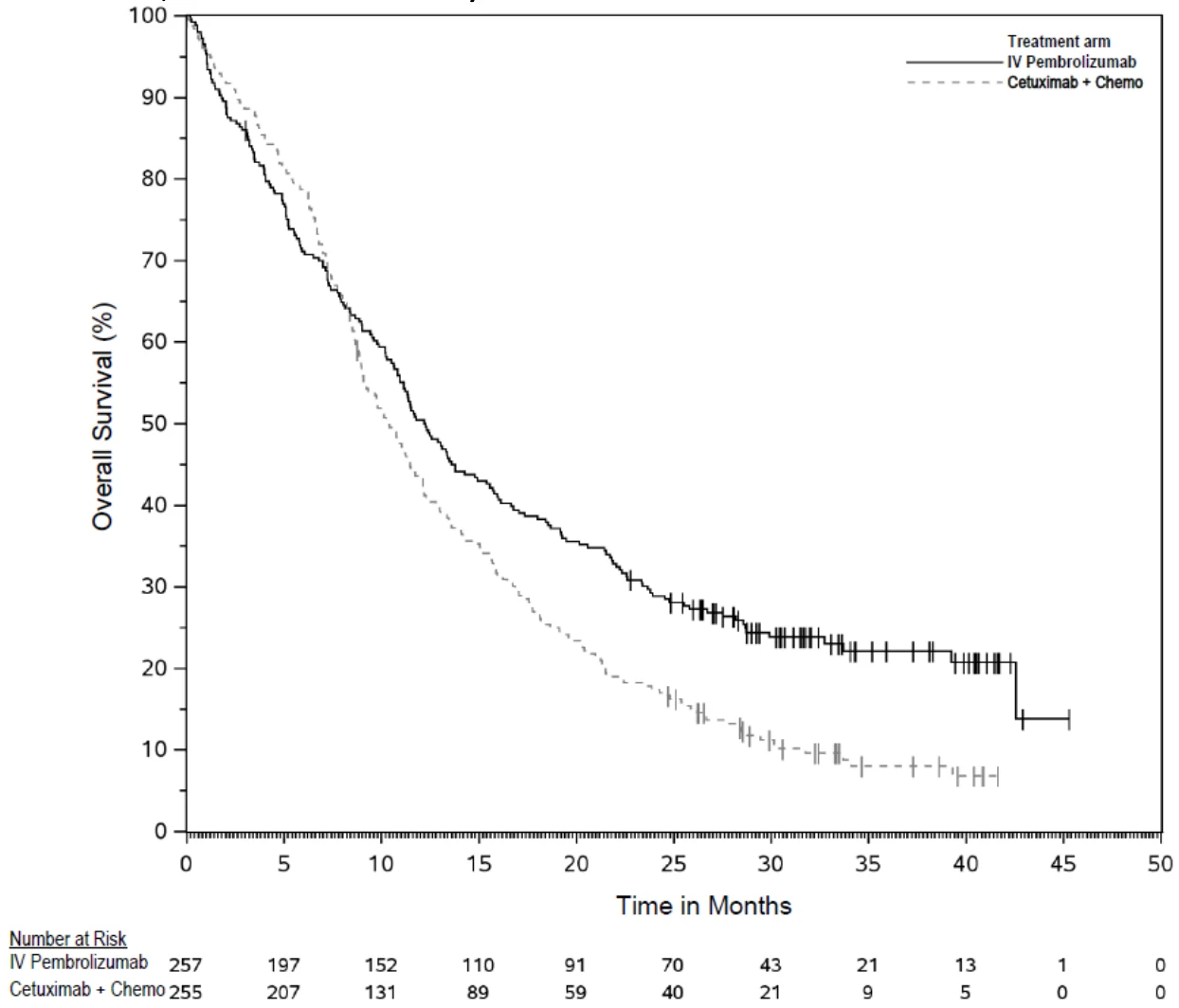
The duration of response (DOR) was analysed as an exploratory efficacy outcome. A longer median DOR in months (range) was observed for intravenous KEYTRUDA as monotherapy [20.9 (1.5+, 34.8+)] compared to the standard treatment [4.5 (1.2+, 30.6)] in patients with PD-L1 CPS ≥ 1, or for intravenous KEYTRUDA in combination with chemotherapy [6.7 (1.6+, 30.4+)] compared to the standard treatment [4.3 (1.2+, 27.9+)].
In exploratory analyses, a positive association was observed between CPS expression and treatment benefit.
Gastric or Gastroesophageal junction (GEJ) Adenocarcinoma
KEYNOTE-811: First-line treatment of locally advanced unresectable or metastatic HER2-positive gastric or gastroesophageal junction (GEJ) adenocarcinoma
The efficacy of intravenous KEYTRUDA in combination with trastuzumab plus fluoropyrimidine and platinum chemotherapy was investigated in KEYNOTE-811, a multicenter, randomized, double-blind, placebo-controlled trial that enrolled 698 patients with HER2-positive advanced gastric or gastroesophageal junction (GEJ) adenocarcinoma regardless of PD-L1 expression status, who had not previously received systemic therapy for metastatic disease. Patients with an autoimmune disease that required systemic therapy within 2 years of treatment or a medical condition that required immunosuppression were ineligible. Randomization was stratified by PD-L1 expression (CPS ≥1 or <1), chemotherapy regimen (5-FU plus cisplatin [FP] or capecitabine plus oxaliplatin [CAPOX]), and geographic region (Europe/ Israel/ North America/ Australia, Asia or Rest of the World). Patients were randomized (1:1) to one of the following treatment arms; all study medications, except oral capecitabine, were administered as an intravenous infusion for every 3-week cycle:
- Intravenous KEYTRUDA 200 mg, trastuzumab 8 mg/kg on first infusion and 6 mg/kg in subsequent cycles, followed by investigator’s choice of combination chemotherapy of cisplatin 80 mg/m2 for up to 6 cycles and 5-FU 800 mg/m2/day for 5 days (FP) or oxaliplatin 130 mg/m2 up to 6-8 cycles and capecitabine 1000 mg/m2 bid for 14 days (CAPOX). Intravenous KEYTRUDA was administered prior to trastuzumab and chemotherapy on Day 1 of each cycle.
- Placebo, trastuzumab 8 mg/kg on first infusion and 6 mg/kg in subsequent cycles, followed by investigator’s choice of combination chemotherapy of cisplatin 80 mg/m2 for up to 6 cycles and 5-FU 800 mg/m2/day for 5 days (FP) or oxaliplatin 130 mg/m2 up to 6-8 cycles and capecitabine 1000 mg/m2 bid for 14 days (CAPOX). Placebo was administered prior to trastuzumab and chemotherapy on Day 1 of each cycle.
Treatment with intravenous KEYTRUDA, trastuzumab and chemotherapy or placebo, trastuzumab and chemotherapy continued until RECIST v1.1-defined progression of disease as determined by BICR, unacceptable toxicity, or a maximum of 24 months. Treatment was permitted beyond RECIST defined disease progression if the patient was clinically stable and deriving clinical benefit as determined by the investigator. Assessment of tumour status was performed every 6 weeks.
Among the 698 patients randomized in KEYNOTE-811, the study population characteristics were: median age of 63 years (range: 19 to 85), 43% age 65 or older; 81% male; 61% White, 34% Asian, and 0.6% Black; 42% ECOG PS of 0 and 58% ECOG PS of 1. Ninety-eight percent of patients had metastatic disease (stage IV) and 2% had locally advanced unresectable disease. Ninety-four percent had tumours that were not MSI-H, 1% had tumours that were MSI-H, and in 5% the status was not known. Eighty-five percent of patients had tumours that expressed PD-L1 with a CPS ≥1 based on the PD-L1 IHC pharmDx* kit. Eighty-five percent of patients received CAPOX.
The primary efficacy outcome measures were PFS, based on BICR using RECIST 1.1, and OS. Secondary efficacy outcome measures included ORR and DoR, based on BICR using RECIST 1.1.
At the second interim analysis in the overall population, a statistically significant improvement in PFS (HR 0.72; 95% CI 0.60, 0.87; p-Value 0.0002) was demonstrated in patients randomized to intravenous KEYTRUDA in combination with trastuzumab and chemotherapy compared with placebo in combination with trastuzumab and chemotherapy. At the time of this analysis in the overall population, there was no statistically significant difference with respect to OS. At the first interim analysis conducted on the first 264 patients randomized in the overall population, a statistically significant improvement in ORR was demonstrated in patients randomized to intravenous KEYTRUDA in combination with trastuzumab and chemotherapy compared with placebo in combination with trastuzumab and chemotherapy.
At the second interim analysis, assessment of pre-specified subgroups based on PD-L1 status showed the HR for PFS and OS in patients with PD-L1 CPS <1 (n=104) was 1.17 (95% CI 0.73, 1.89) and 1.61 (95% CI 0.98, 2.64), respectively. Efficacy results at the second interim analysis for the pre-specified subgroup of patients whose tumours expressed PD-L1 with a CPS ≥1 are summarized in Table 114 and Figure 37.
Table 114: Efficacy Results for KEYNOTE-811 with PD-L1 Expression CPS ≥1
| Endpoint | Intravenous KEYTRUDA 200 mg every 3 weeks and Trastuzumab and Fluoropyrimidine and Platinum Chemotherapy n=298 | Placebo and Trastuzumab and Fluoropyrimidine and Platinum Chemotherapy n=296 |
|---|---|---|
| PFS | ||
| Number (%) of patients with event | 199 (67%) | 215 (73%) |
| Median in months (95% CI) | 10.8 (8.5, 12.5) | 7.2 (6.8, 8.4) |
| Hazard ratio¥ (95% CI) | 0.7 (0.58, 0.85) | |
| OS | ||
| Number (%) of patients with event | 167 (56%) | 183 (61.8%) |
| Median in months (95% CI) | 20.5 (18.2, 24.3) | 15.6 (13.5, 18.6) |
| Hazard ratio¥ (95% CI) | 0.79 (0.64, 0.98) | |
| Objective Response Rate | ||
| ORR‡ (95% CI) | 73% (67.7, 78.1) | 58% (52.6, 64.1) |
| Complete response rate | 14% | 10% |
| Partial response rate | 59% | 49% |
| Duration of Response | n=218 | n=173 |
| Median in months (range) | 11.3 (1.1+, 40.1+) | 9.5 (1.4+, 38.3+) |
¥ Based on the unstratified Cox proportional hazard model ‡ Response: Best objective response as confirmed complete response or partial response | ||
Figure 37: Kaplan-Meier Curve for Progression-Free Survival by Treatment Arm in KEYNOTE-811 (PD-L1 CPS ≥1)
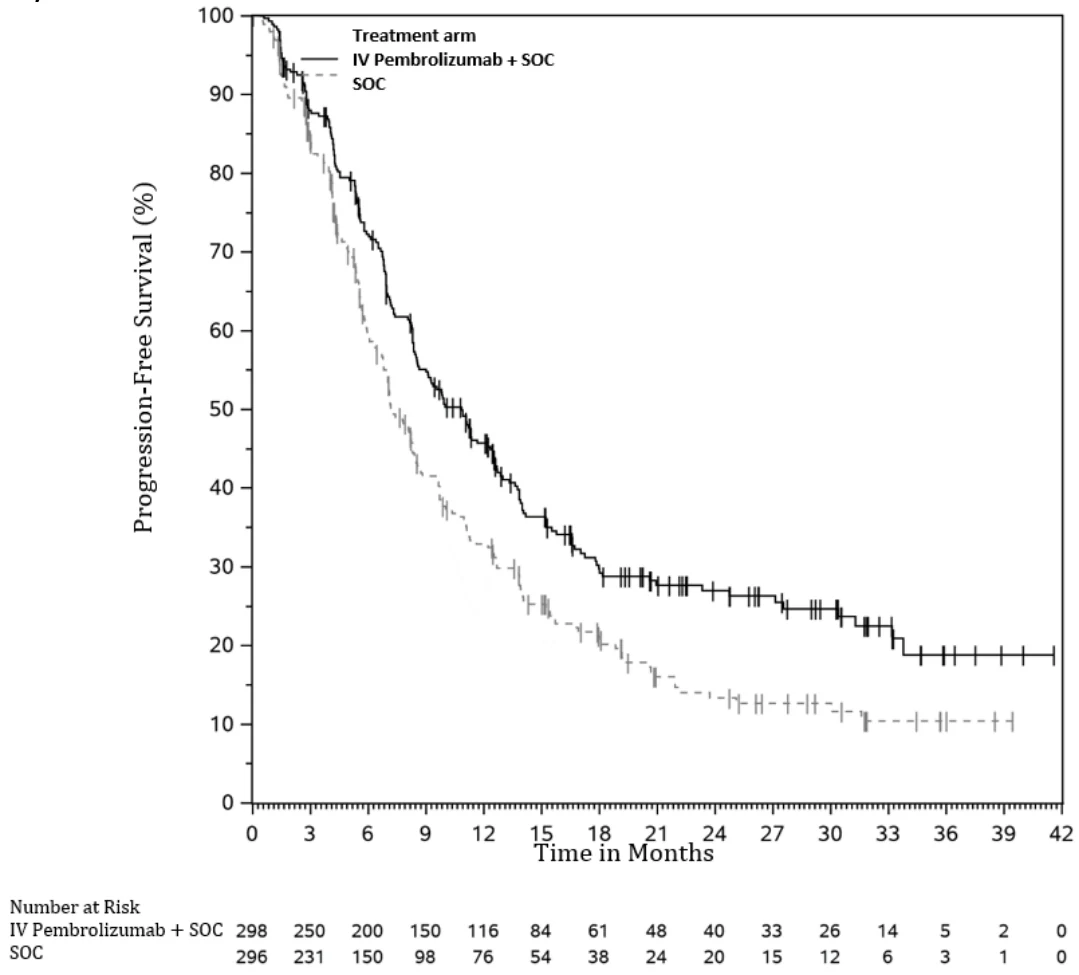
KEYNOTE-859: Controlled trial of combination therapy in HER2-negative gastric or gastroesophageal junction (GEJ) adenocarcinoma cancer patients naïve to treatment
The efficacy of intravenous KEYTRUDA in combination with fluoropyrimidine and platinum based chemotherapy was investigated in KEYNOTE-859, a multicenter, randomized, double-blind, placebo-controlled trial that enrolled 1579 patients with HER2-negative advanced gastric or gastroesophageal junction (GEJ) adenocarcinoma, who had not previously received systemic therapy for metastatic disease. Patients with an autoimmune disease that required systemic therapy within 2 years of treatment or a medical condition that required immunosuppression were ineligible. Randomization was stratified by PD-L1 expression (CPS ≥ 1 vs. < 1), chemotherapy regimen (5-FU plus cisplatin [FP] vs. capecitabine plus oxaliplatin [CAPOX]), and geographic region (Europe/ Israel/ North America/ Australia vs. Asia vs. Rest of the World). Patients were randomized (1:1) to one of the following treatment arms; treatment was administered prior to chemotherapy on Day 1 of each cycle:
- Intravenous KEYTRUDA 200 mg, investigator’s choice of combination chemotherapy of cisplatin 80 mg/m2 and 5-FU 800 mg/m2/day for 5 days (FP) or oxaliplatin 130 mg/m2 and capecitabine 1000 mg/m2 bid for 14 days (CAPOX)
- Placebo, investigator’s choice of combination chemotherapy of cisplatin 80 mg/m2 and 5-FU 800 mg/m2/day for 5 days (FP) or oxaliplatin 130 mg/m2 and capecitabine 1000 mg/m2 bid for 14 days (CAPOX)
All study medications, except oral capecitabine, were administered as an intravenous infusion for every 3-week cycle. Platinum agents could be administered for 6 or more cycles following local guidelines. Treatment continued until RECIST v1.1-defined progression of disease as determined by BICR, unacceptable toxicity, or a maximum of 24 months. Treatment was permitted beyond RECIST-defined disease progression if the patient was clinically stable and deriving clinical benefit as determined by the investigator. Assessment of tumour status was performed every 6 weeks.
The population characteristics were: median age 62 years (range: 21 to 86), 39% age 65 or older; 68% male; 55% White, 34% Asian, 4.6% Multiple, 4.2% American Indian or Alaskan Native, 1.3% Black and 0.2% Native Hawaiian or other Pacific Islander; 76% Not Hispanic or Latino and 21% Hispanic or Latino; 37% ECOG PS of 0 and 63% ECOG PS of 1; 97% had metastatic disease (Stage IV) and 3% had locally advanced unresectable disease; 78% had tumours that expressed PD-L1 with a CPS ≥1 and 5% (n=74) had tumours that were MSI-H. Eighty-six percent of patients received CAPOX.
The primary efficacy outcome measure was OS. Additional secondary efficacy outcome measures included PFS and ORR as assessed by BICR using RECIST v1.1 modified to follow a maximum of 10 target lesions and a maximum of 5 target lesions per organ.
A statistically significant improvement in OS, PFS and ORR was demonstrated in patients randomized to intravenous KEYTRUDA in combination with chemotherapy compared with placebo in combination with chemotherapy.
Efficacy results from the pre-specified interim analysis are summarized in Table 115 and Figure 38.
Table 115: Efficacy Results* in KEYNOTE-859
| Endpoint | Intravenous KEYTRUDA And FP or CAPOX n=790 | Placebo and FP or CAPOX n=789 | Intravenous KEYTRUDA and FP or CAPOX n=618 | Placebo and FP or CAPOX n=617 |
|---|---|---|---|---|
| Endpoint | Intravenous KEYTRUDA And FP or CAPOX n=790 | Placebo and FP or CAPOX n=789 | Intravenous KEYTRUDA and FP or CAPOX n=618 | Placebo and FP or CAPOX n=617 |
| All Patients | PD-L1 CPS ≥ 1 | |||
| All Patients | PD-L1 CPS ≥ 1 | |||
| OS | ||||
| Number (%) of patients with event | 603 (76) | 666 (84) | 464 (75) | 526 (85) |
Median in months (95% CI) | 12.9 (11.9, 14.0) | 11.5 (10.6, 12.1) | 13.0 (11.6, 14.2) | 11.4 (10.5, 12.0) |
| Hazard ratio† (95% CI) | 0.78 (0.70, 0.87) | 0.74 (0.65, 0.84) | ||
| p-value‡ | <0.0001 | <0.0001 | ||
| PFS | ||||
| Number (%) of patients with event | 572 (72) | 608 (77) | 443 (72) | 483 (78) |
Median in months (95% CI) | 6.9 (6.3, 7.2) | 5.6 (5.5, 5.7) | 6.9 (6.0, 7.2) | 5.6 (5.4, 5.7) |
| Hazard ratio† (95% CI) | 0.76 (0.67, 0.85) | 0.72 (0.63, 0.82) | ||
| p-value‡ | <0.0001 | <0.0001 | ||
| Objective Response Rate | ||||
| ORR§ (95% CI) | 51% (48%, 55%) | 42% (38%, 45%) | 52% (48%, 56%) | 43% (39%, 47%) |
| Complete response rate | 9% | 6% | 10% | 6% |
| Partial response rate | 42% | 36% | 42% | 37% |
| p-value¶ | <0.0001 | 0.0004 | ||
* Based on the pre-specified interim analysis † Based on a stratified Cox proportional hazards model ‡ One-sided p-value based on stratified log-rank test § Response: Best objective response as confirmed complete response or partial response ¶ One-sided p-value based on stratified Miettinen & Nurminen method | ||||
Figure 38: Kaplan-Meier Curve for Overall Survival by Treatment Arm in KEYNOTE-859
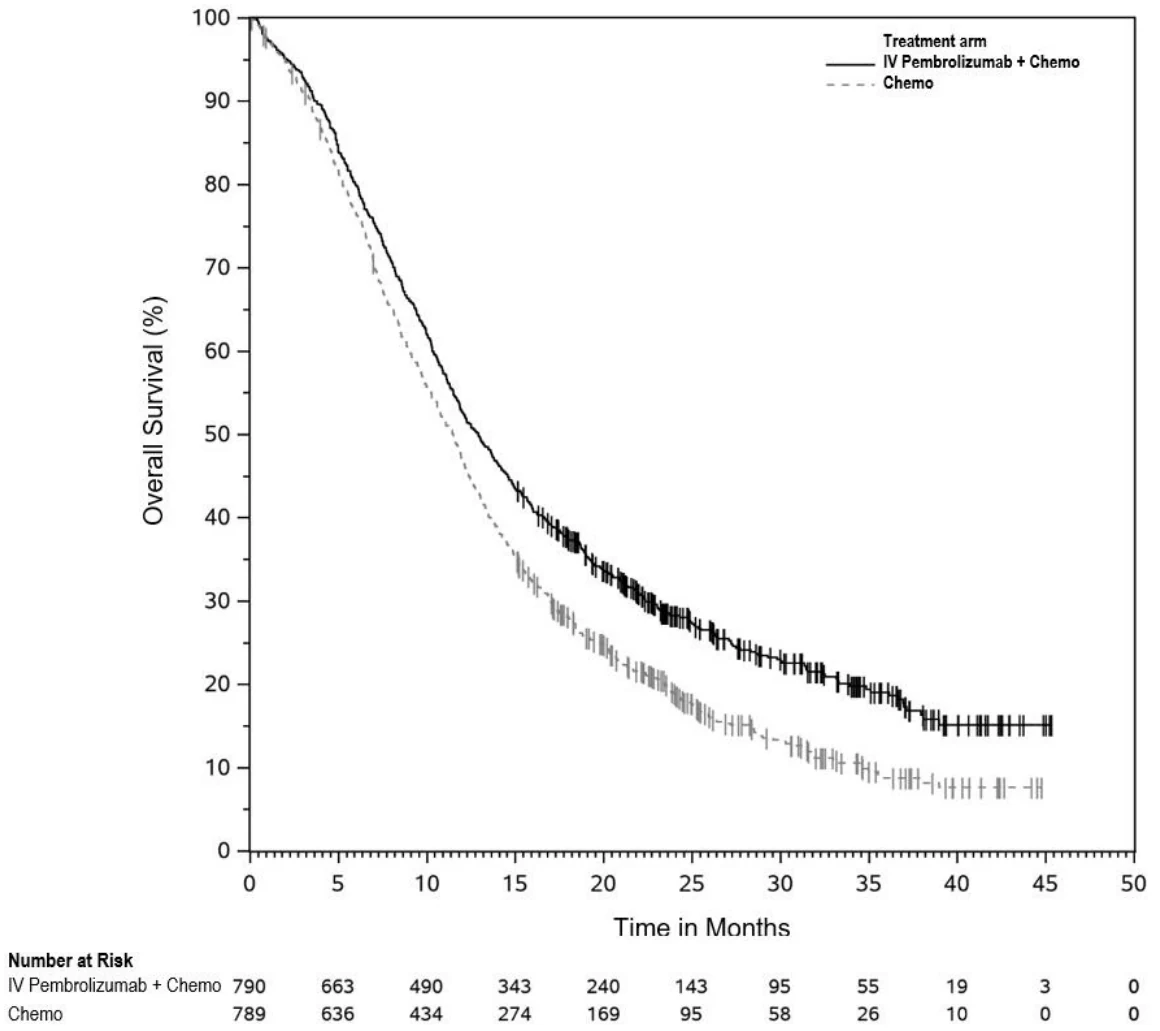
The duration of response (DOR) was analyzed as a secondary efficacy outcome. In all randomized patients, the median DOR was 8.0 months (range: 1.2+, 41.5+) in the intravenous KEYTRUDA with chemotherapy arm compared to 5.7 months (range: 1.3+, 34.7+) in the placebo with chemotherapy arm. In patients with PD-L1 CPS ≥ 1, the median DOR was 8.3 months (range: 1.2+, 41.5+) in the intravenous KEYTRUDA with chemotherapy arm compared to 5.6 months (range: 1.3+, 34.2+) in the placebo with chemotherapy arm.
A positive association was observed between PD-L1 CPS score and the magnitude of the treatment benefit. The hazard ratios (HR) for OS were 0.78, 0.74, 0.65 for all randomized patients (n=1579), PD-L1 CPS ≥1 patients (n=1235), and PD-L1 CPS ≥10 patients (n=551), respectively. In an exploratory OS analysis in patients with PD-L1 CPS < 1 (n=344), the HR was 0.92 (95% CI: 0.73, 1.17).
Esophageal Cancer
KEYNOTE-590: Controlled trial of combination therapy in esophageal carcinoma patients naïve to treatment
The efficacy of intravenous KEYTRUDA was investigated in KEYNOTE-590, a multicenter, randomized, placebo-controlled trial that enrolled 749 patients as a first-line treatment in patients with locally advanced (not resectable or curable with radiation therapy) or metastatic esophageal carcinoma or esophagogastric junction (EGJ) adenocarcinoma (Siewert Type 1). Eligible patients should have adequate organ function and tumour specimens (newly obtained or archival sample) for PD-L1 testing at a central laboratory at baseline. PD-L1 status was determined using the PD-L1 IHC 22C3 pharmDx kit. Patients with active autoimmune disease, a medical condition that required immunosuppression, known HER2 positive EGJ adenocarcinoma, or a history of prior treatment with an immune checkpoint inhibitor were ineligible.
Randomization was stratified by tumour histology (squamous cell carcinoma vs. adenocarcinoma), geographic region (Asia vs. ex-Asia), and ECOG performance status (0 vs. 1). Patients were randomized (1:1) to one of the following treatment arms; all study medications were administered via intravenous infusion:
- Intravenous KEYTRUDA 200 mg on Day 1 of each three-week cycle in combination with cisplatin 80 mg/m2 IV on Day 1 of each three-week cycle for up to six cycles and fluorouracil (FU) 800 mg/m2 IV per day on Day 1 to Day 5 of each three-week cycle, or per local standard for FU administration, for up to24 months.
- Placebo on Day 1 of each three-week cycle in combination with cisplatin 80 mg/m2 IV on Day 1 of each three-week cycle for up to six cycles and FU 800 mg/m2 IV per day on Day 1 to Day 5 of each three-week cycle, or per local standard for FU administration, for up to24 months.
Treatment with intravenous KEYTRUDA or chemotherapy continued until unacceptable toxicity or disease progression. Patients randomized to intravenous KEYTRUDA were permitted to continue beyond the first RECIST v1.1-defined disease progression if clinically stable until the first radiographic evidence of disease progression was confirmed at least 4 weeks later with repeat imaging. Patients treated with intravenous KEYTRUDA without disease progression could be treated for up to 24 months.
Table 116: Baseline Characteristics in KEYNOTE-590.
Intravenous KEYTRUDA 200 mg every 3 weeks and Cisplatin and FU n=373 | Placebo and Cisplatin and FU n=376 | ||||||
|---|---|---|---|---|---|---|---|
Intravenous KEYTRUDA 200 mg every 3 weeks and Cisplatin and FU n=373 | Placebo and Cisplatin and FU n=376 | ||||||
| Men | 82% | 85% | |||||
| Women | 18% | 15% | |||||
| Age (median) | 64 | 62 | |||||
| Age (range) | 28-94 years | 27-89 years | |||||
| Race | |||||||
| White | 37% | 37% | |||||
| Asian | 54% | 53% | |||||
| ECOG PS | |||||||
| 0 | 40% | 40% | |||||
| 1 | 60% | 60% | |||||
| Metastatic Staging | |||||||
| M0 | 8% | 10% | |||||
| M1 | 92% | 90% | |||||
| Histology | |||||||
| Adenocarcinoma | 27% | 27% | |||||
| Squamous Cell Carcinoma | 74% | 73% | |||||
The major efficacy outcome measures were OS and PFS as assessed by the investigator according to RECIST v1.1. The study pre-specified analyses of OS and PFS based on squamous cell histology, PD-L1 CPS ≥ 10, and in all patients. Secondary efficacy outcome measures were ORR and DoR, according to RECIST v1.1, as assessed by the investigator.
The study demonstrated a statistically significant improvement in OS and PFS for patients randomized to intravenous KEYTRUDA in combination with cisplatin and FU, compared to cisplatin and FU.
Table 117, Figure 39 and Figure 40 summarize the key efficacy measures for KEYNOTE-590 in all randomized patients (ITT population).
Table 117: Efficacy Results in Patients with Locally Advanced or Metastatic Esophageal and EGJ carcinoma in KEYNOTE-590 (ITT Population).
| Endpoint | Intravenous KEYTRUDA 200 mg every 3 weeks and Cisplatin and FU n=373 | Placebo and Cisplatin and FU n=376 |
|---|---|---|
| Endpoint | Intravenous KEYTRUDA 200 mg every 3 weeks and Cisplatin and FU n=373 | Placebo and Cisplatin and FU n=376 |
| OSa | ||
| Number (%) of patients with event | 262 (70%) | 309 (82%) |
| Median in months* (95% CI) | 12.4 (10.5, 14.0) | 9.8 (8.8, 10.8) |
| Hazard ratio† (95% CI) | 0.73 (0.62, 0.86) | |
| p-Value (stratified log-rank) | <0.0001 | |
| PFS‡a | ||
| Number (%) of patients with event | 297 (79.6%) | 333 (88.6%) |
| Median in months* (95% CI) | 6.3 (6.2, 6.9) | 5.8 (5.0, 6.0) |
| Hazard ratio†(95% CI) | 0.65 (0.55, 0.76) | |
| p-Value (stratified log-rank) | <0.0001 | |
| Objective Response Rate‡a | ||
| ORR % (95% CI) | 45% (39.9, 50.2) | 29.3% (24.7,34.1) |
| Complete response rate | 6.4% | 2.4% |
| Partial response rate | 38.6% | 26.9% |
| p-Value (Miettinen-Nurminen) | <0.0001 | |
a The corresponding p-value bounds at the interim analysis for OS, PFS and ORR were 0.01421, 0.02477 and 0.025, respectively, following pre-specified multiplicity adjustment. * Based on Kaplan-Meier estimation † Based on the stratified Cox proportional hazard model ‡ Assessed by investigator using RECIST 1.1 § Based on patients with a best overall response as confirmed complete or partial response | ||
The duration of response (DOR) was analysed as a secondary efficacy outcome. The median duration of response in patients receiving intravenous KEYTRUDA in combination with chemotherapy was 8.3 months (range: 1.2+, 31.0+) compared to 6.0 months (range: 1.5+, 25.0+) for patients receiving standard treatment.
Figure 39: Kaplan-Meier Curve for Overall Survival in KEYNOTE-590
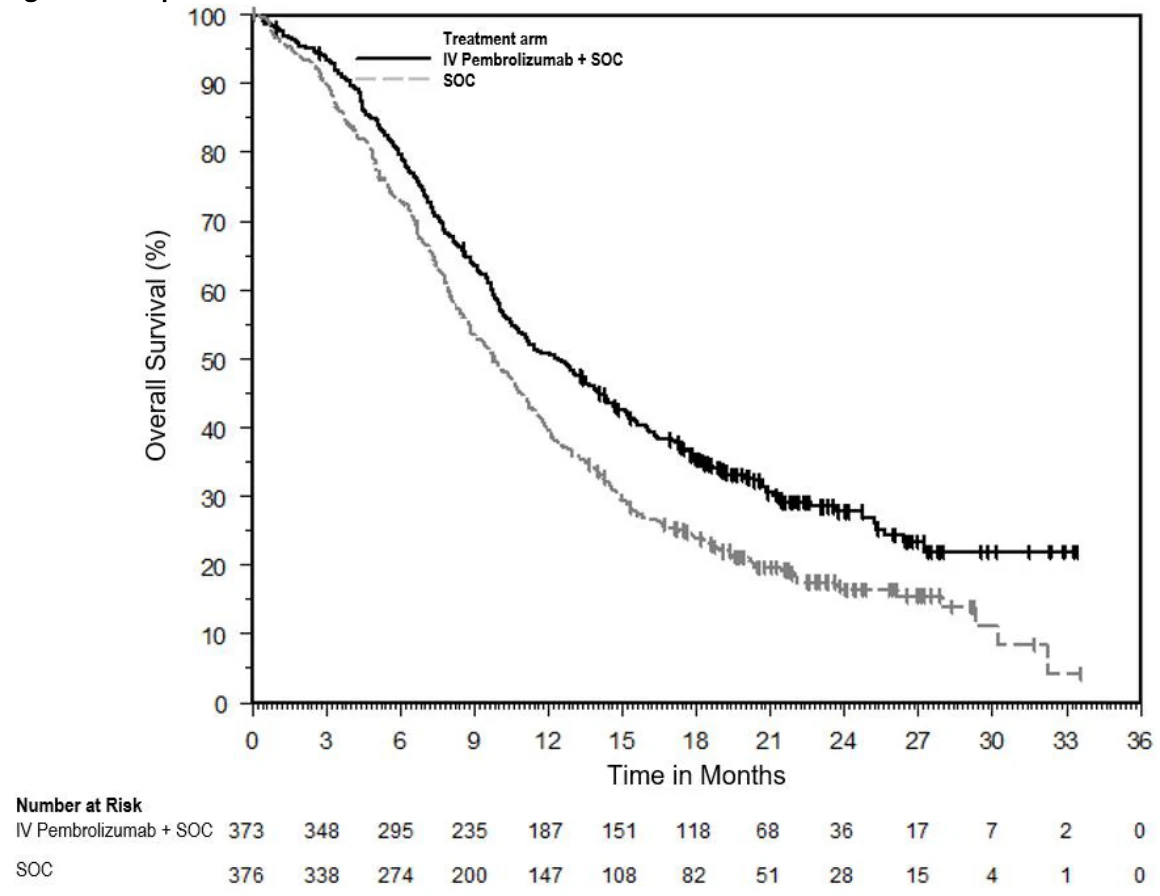
Figure 40: Kaplan-Meier Curve for Progression-Free Survival in KEYNOTE-590
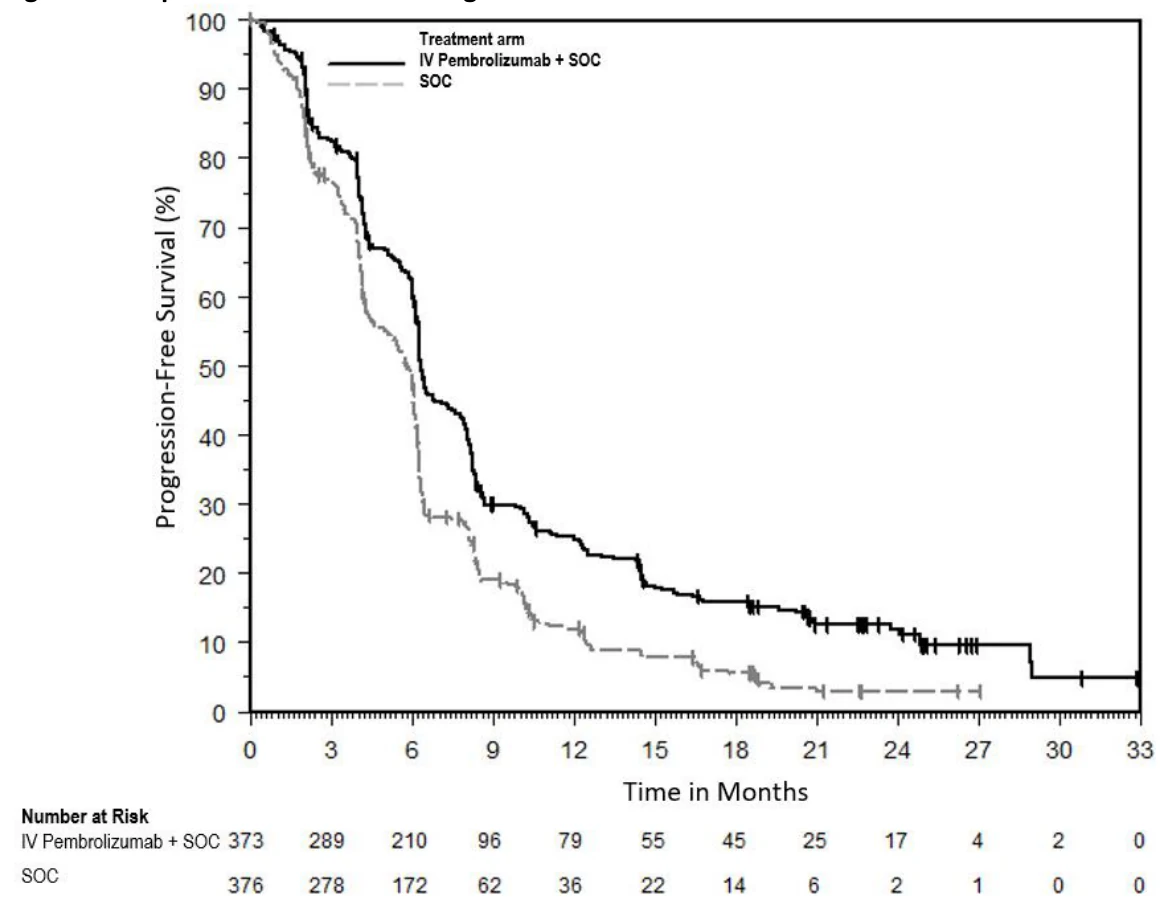
Table 118: Efficacy Results for Overall Survival in Patients with ESCC PD-L1 CPS ≥ 10, ESCC, and PD-L1 CPS ≥ 10 in KEYNOTE-590.
| Endpoint | Intravenous KEYTRUDA 200 mg every 3 weeks and Cisplatin and FU | Placebo and Cisplatin and FU |
|---|---|---|
| Endpoint | Intravenous KEYTRUDA 200 mg every 3 weeks and Cisplatin and FU | Placebo and Cisplatin and FU |
| ESCC with PD-L1 CPS ≥ 10a | ||
| n=143 | n=143 | |
| Number (%) of patients with event | 94 (65.7) | 121 (84.6) |
| Median in months* (95% CI) | 13.9 (11.1, 17.7) | 8.8 (7.8, 10.5) |
| Hazard ratio†(95% CI) | 0.57 (0.43, 0.75) | |
| p-Value (stratified log-rank) | <0.0001 | |
| ESCCa | ||
| n=274 | n=274 | |
| Number (%) of patients with event | 190 (69.3) | 222 (81.0) |
| Median in months* (95% CI) | 12.6 (10.2, 14.3) | 9.8 (8.6, 11.1) |
| Hazard ratio†(95% CI) | 0.72 (0.60, 0.88) | |
| p-Value (stratified log-rank) | 0.0006 | |
| PD-L1 CPS ≥ 10a | ||
| n=186 | n=197 | |
| Number (%) of patients with event | 124 (66.7) | 165 (83.8) |
| Median in months* (95% CI) | 13.5 (11.1; 15.6) | 9.4 (8.0, 10.7) |
| Hazard ratio† (95% CI) | 0.62 (0.49, 0.78) | |
| p-Value (stratified log-rank) | <0.0001 | |
a The corresponding p-value bounds at the interim analysis for OS in ESCC PD-L1 CPS ≥ 10, ESCC and PD-L1 CPS ≥ 10 was 0.0067, 0.01003 and 0.01414, respectively, following pre-specified multiplicity adjustment. * Based on Kaplan-Meier † Based on the stratified Cox proportional hazard model ‡ Assessed by investigator using RECIST 1.1 ESCC: esophageal squamous cell carcinoma | ||
Exploratory Analysis
In patients with esophageal adenocarcinoma (n=201), the median OS was 11.6 months (95% CI: 9.7, 15.2) for the intravenous KEYTRUDA arm and 9.9 months (95% CI: 7.8, 12.3) for the placebo arm, with an HR of 0.74 (95% CI: 0.52, 1.02). In patients with PD-L1 CPS<10 (n=347), the median OS was 10.5 months (95% CI: 9.7, 13.5) for the intravenous KEYTRUDA arm and 10.6 months (95% CI: 8.8, 12.0) for the placebo arm, with an HR of 0.86 (95% CI: 0.68, 1.10). In patients with squamous cell carcinoma and PD-L1 CPS < 10 (n=247), the median OS was 10.5 months (95% CI: 9.2, 13.5) for the intravenous KEYTRUDA arm and 11.1 months (95% CI: 9.1, 12.4) for the placebo arm, with an HR of 0.99 (95% CI: 0.74, 1.32).
Triple Negative Breast Cancer (TNBC)
KEYNOTE-355: Controlled study of combination therapy in locally recurrent unresectable or metastatic TNBC patients naïve to treatment
The efficacy of intravenous KEYTRUDA in combination with paclitaxel, nab paclitaxel, or gemcitabine and carboplatin was investigated in Study KEYNOTE-355, a randomized, double blind, multicenter, placebo-controlled study. The key eligibility criteria for this study were locally recurrent unresectable or metastatic TNBC, regardless of tumour PD-L1 expression, and which had not been previously treated with chemotherapy in the metastatic setting. Patients with active autoimmune disease that required systemic therapy within 2 years of treatment or a medical condition that required immunosuppression were ineligible for the study. Randomization was stratified by chemotherapy treatment (paclitaxel or nab paclitaxel vs. gemcitabine and carboplatin), tumour PD-L1 expression (CPS ≥ 1 vs. CPS <1) based on the PD-L1 IHC 22C3 pharmDx* kit, and prior treatment with the same class of chemotherapy in the neoadjuvant setting (yes vs. no).
A total of 847 patients were randomized (2:1) to one of the following treatment arms; all study medications were administered via intravenous infusion.
- Intravenous KEYTRUDA 200 mg on Day 1 every 3 weeks in combination with nab-paclitaxel 100 mg/m2 on Days 1, 8 and 15 every 28 days, or paclitaxel 90 mg/m2 on Days 1, 8, and 15 every 28 days, or gemcitabine 1000 mg/m2 and carboplatin AUC 2 mg/mL/min on Days 1 and 8 every 21 days (n=566).
- Placebo on Day 1 every 3 weeks in combination with nab-paclitaxel 100 mg/m2 on Days 1, 8 and 15 every 28 days, or paclitaxel 90 mg/m2 on Days 1, 8, and 15 every 28 days, or gemcitabine 1000 mg/m2 and carboplatin AUC 2 mg/mL/min on Days 1 and 8 every 21 days (n=281).
Assessment of tumour status was performed at Weeks 8, 16, and 24, then every 9 weeks for the first year, and every 12 weeks thereafter. Treatment with intravenous KEYTRUDA or placebo continued until RECIST 1.1 defined progression of disease as determined by the investigator, unacceptable toxicity, or a maximum of 24 months. Administration of intravenous KEYTRUDA was permitted beyond RECIST-defined disease progression if the patient was clinically stable and considered to be deriving clinical benefit by the investigator.
The study population characteristics were: median age of 53 years (range: 22 to 85), 21% age 65 or older; 100% female; 68% White, 21% Asian, and 4% Black; 60% ECOG PS of 0 and 40% ECOG PS of 1; and 68% were post-menopausal status. Seventy five percent of the patients had tumour PD-L1 expression defined as CPS ≥ 1 and 38% had tumour PD-L1 expression CPS ≥ 10.
The major efficacy outcome measures were PFS as assessed by blinded independent central review (BICR) using RECIST 1.1, modified to follow a maximum of 10 target lesions and a maximum of 5 target lesions per organ, and OS in patients with tumour PD-L1 expression CPS ≥10. Final PFS was assessed in the second interim analysis (IA2). Additional efficacy outcome measures were ORR and DOR in patients with tumour PD-L1 expression CPS ≥10 as assessed by BICR using RECIST 1.1. Findings are shown in Table 119 and Figure 41 and Figure 42 below.
Table 119: Efficacy Results for Patients with locally recurrent unresectable or metastatic TNBC with PD-L1 Expression CPS ≥ 10 in KEYNOTE-355
| Endpoint | Intravenous KEYTRUDA and Chemotherapy* n=220 | Placebo and Chemotherapy* n=103 |
|---|---|---|
| Endpoint | Intravenous KEYTRUDA and Chemotherapy* n=220 | Placebo and Chemotherapy* n=103 |
| OS† | ||
| Number of patients with event (%) | 155 (70%) | 84 (82%) |
| Median in months (95% CI) | 23.0 (19.0, 26.3) | 16.1 (12.6, 18.8) |
| Hazard ratio‡ (95% CI) | 0.73 (0.55, 0.95) | |
| p-Value§ | 0.0093 | |
| PFS¶,# | ||
| Number of patients with event (%) | 136 (62%) | 79 (77%) |
| Median in months (95% CI) | 9.7 (7.6, 11.3) | 5.6 (5.3, 7.5) |
| Hazard ratio‡ (95% CI) | 0.65 (0.49, 0.86) | |
| p-Value Þ § | 0.0012 | |
| Objective Response Rate¶,#† | ||
| ORR, (95% CI) | 53% (46, 59) | 41% (31, 51) |
* Chemotherapy: paclitaxel, nab-paclitaxel, or gemcitabine and carboplatin † Based on the pre-specified final analysis (data cutoff – 15 June 2021) ‡ Based on stratified Cox regression model § One-sided p-Value based on stratified log-rank test (compared to a significance level of 0.0113) ¶ Assessed by BICR using RECIST 1.1 # Based on a pre-specified interim analysis (data cutoff – 11 December 2019) Þ One-sided p-Value based on stratified log-rank test (compared to a significance level of 0.00411) | ||
The duration of response (DOR) was analysed as a secondary efficacy outcome. At final analysis, the median duration of response was 12.8 months in the intravenous KEYTRUDA with chemotherapy arm and 7.3 months in the placebo with chemotherapy arm.
Figure 41: Kaplan-Meier Curve for Overall Survival by Treatment Arm in
KEYNOTE-355 (CPS ≥10)
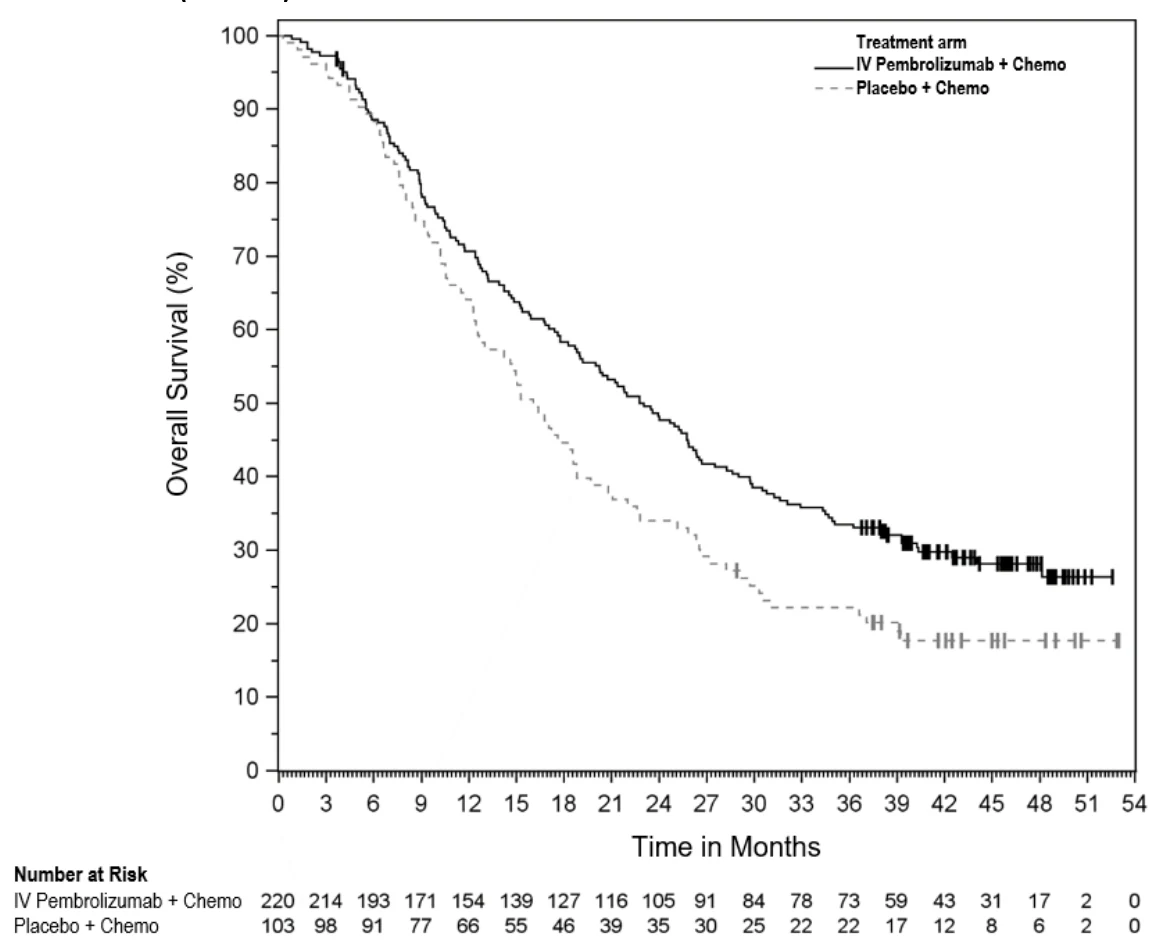
Figure 42: Kaplan-Meier Curve for Progression Free Survival by Treatment Arm in KEYNOTE-355 (CPS ≥ 10)
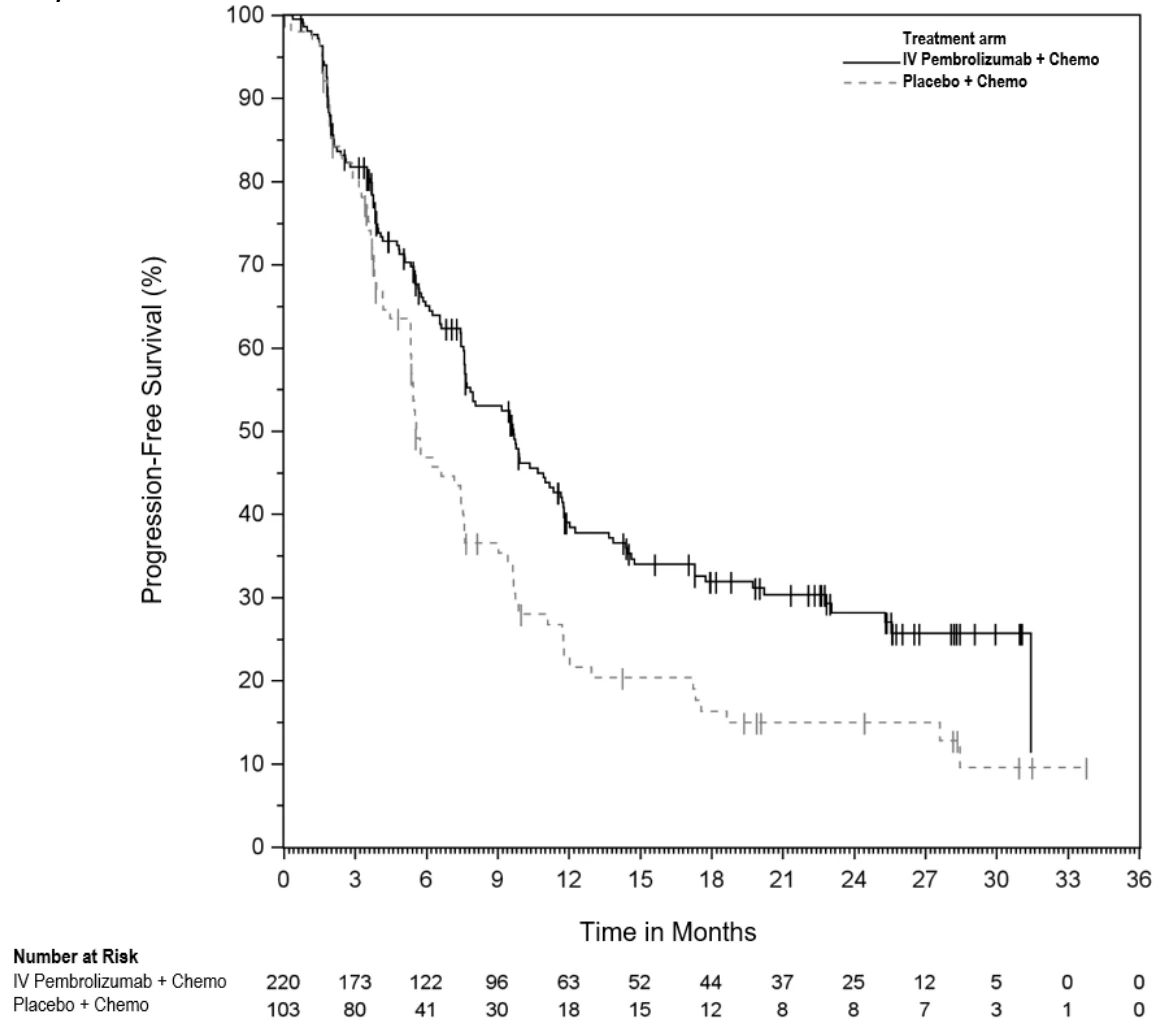
Early-stage Triple-Negative Breast Cancer
KEYNOTE-522: Controlled study of neoadjuvant and adjuvant treatment of patients with earlystage - TNBC
The efficacy of intravenous KEYTRUDA in combination with carboplatin and paclitaxel followed by doxorubicin or epirubicin and cyclophosphamide, given as a neoadjuvant treatment and continued as monotherapy adjuvant treatment was investigated in Study KEYNOTE-522, a randomized, double-blind, multicenter, placebo-controlled study. The key eligibility criteria for this study were newly diagnosed previously untreated high-risk early-stage TNBC (tumour size >1 cm but ≤2 cm in diameter with nodal involvement or tumour size >2 cm in diameter regardless of nodal involvement), regardless of tumour PD-L1 expression. Patients with active autoimmune disease that required systemic therapy within 2 years of treatment or a medical condition that required- immunosuppression were ineligible for the study. Randomization was stratified by nodal status (positive vs. negative), tumour size (T1/T2 vs. T3/T4), and choice of carboplatin (dosed every 3 weeks vs. weekly).
Patients were randomized (2:1) to one of the following treatment arms; all study medications were administered via intravenous infusion.
Arm 1:
Four cycles of preoperative intravenous KEYTRUDA 200 mg every 3 weeks on Day 1 of cycles 1-4 of treatment regimen in combination with:
Carboplatin
AUC 5 mg/mL/min every 3 weeks on Day 1 of cycles 1-4 of treatment regimen
or AUC 1.5 mg/mL/min every week on Day 1, 8, and 15 of cycles 1-4 of treatment regimen and
- Paclitaxel 80 mg/m2 every week on Day 1, 8, and 15 of cycles 1-4 of treatment regimen
Followed by four additional cycles of preoperative intravenous KEYTRUDA 200 mg every 3 weeks on Day 1 of cycles 5-8 of treatment regimen in combination with:
- Doxorubicin 60 mg/m2 or epirubicin 90 mg/m2 every 3 weeks on Day 1 of cycles 5-8 of treatment regimen and
- Cyclophosphamide 600 mg/m2 every 3 weeks on Day 1 of cycles 5-8 of treatment regimen
- Following surgery, 9 cycles of intravenous KEYTRUDA 200 mg every 3 weeks were administered.
Arm 2:
Four cycles of preoperative placebo every 3 weeks on Day 1 of cycles 1-4 of treatment regimen in combination with:
Carboplatin
AUC 5 mg/mL/min every 3 weeks on Day 1 of cycles 1-4 of treatment regimen
or AUC 1.5 mg/mL/min every week on Day 1, 8, and 15 of cycles 1-4 of treatment regimen and
- Paclitaxel 80 mg/m2 every week on Day 1, 8, and 15 of cycles 1-4 of treatment regimen
Followed by four additional cycles of preoperative placebo every 3 weeks on Day 1 of cycles 5-8 of treatment regimen in combination with:
- Doxorubicin 60 mg/m2 or epirubicin 90 mg/m2 every 3 weeks on Day 1 of cycles 5-8 of treatment regimen and
- Cyclophosphamide 600 mg/m2 every 3 weeks on Day 1 of cycles 5-8 of treatment regimen
- Following surgery, 9 cycles of placebo every 3 weeks were administered.
Treatment with intravenous KEYTRUDA or placebo continued until completion of the treatment (17 cycles), disease progression that precludes definitive surgery, disease recurrence in the adjuvant phase, or unacceptable toxicity.
The major efficacy outcome measures were pathological complete response (pCR) rate and event-free survival (EFS). pCR was defined as absence of invasive cancer in the breast and lymph nodes (ypT0/Tis ypN0) and was assessed by the blinded local pathologist at the time of definitive surgery. EFS was defined as the time from randomization to the first occurrence of any of the following events: progression of disease that precludes definitive surgery, local or distant recurrence, second primary malignancy, or death due to any cause. An additional efficacy outcome measure was OS.
A total of 1174 patients were randomized: 784 patients to the intravenous KEYTRUDA arm and 390 patients to the placebo arm. The study population characteristics were: median age of 49 years (range: 22 to 80), 11% age 65 or older; 99.9% female; 64% White, 20% Asian, and 5% Black; 87% ECOG PS of 0 and 13% ECOG PS of 1; 56% were pre-menopausal status and 44% were post-menopausal status; 7% were primary Tumour 1 (T1), 68% T2, 19% T3, and 7% T4; 49% were nodal involvement 0 (N0), 40% N1, 11% N2, and 0.2% N3; 75% of patients were overall stage II and 25% were stage III; 98.0% of patients received surgery in the intravenous KEYTRUDA arm and 97.7% of patients received surgery in the placebo arm.
The trial demonstrated a statistically significant improvement in pCR and EFS at pre-specified analyses for patients randomized to intravenous KEYTRUDA in combination with chemotherapy followed by intravenous KEYTRUDA monotherapy compared with patients randomized to placebo in combination with chemotherapy followed by placebo alone. At the time of EFS analysis, OS results were not yet mature (45% of the required events for final analysis). At a pre-specified interim analysis, the median follow-up time for 784 patients treated with intravenous KEYTRUDA was 37.8 months (range: 2.7 – 48 months). Efficacy results are summarized in Table 120 and Figure 43.
Table 120: Efficacy Results in Patients with Early-Stage TNBC in KEYNOTE-522
| Endpoint | Intravenous KEYTRUDA and chemotherapy/Intravenous KEYTRUDA | Placebo and chemotherapy/Placebo |
|---|---|---|
| pCR (ypT0/Tis ypN0)* | n=401 | n=201 |
| Number of patients with pCR | 260 | 103 |
| pCR Rate (%), (95% CI) | 64.8 (59.9, 69.5) | 51.2 (44.1, 58.3) |
| Treatment difference (%) estimate (95% CI)†, ‡ | 13.6 (5.4, 21.8) | |
| p-Value | 0.00055 | |
| EFS§ | n=784 | n=390 |
| Number of patients with event (%) | 123 (16%) | 93 (24%) |
| 24 month EFS rate (95% CI) | 87.8 (85.3, 89.9) | 81.0 (76.8, 84.6) |
| Hazard ratio (95% CI) ¶ | 0.63 (0.48, 0.82) | |
| p-Value# | 0.00031 | |
*Based on a pre-specified pCR interim analysis (compared to a significance level of 0.003) in 602 patients. †Based on a follow-up analysis in the entire intention-to-treat population (n=1174), the pCR rate difference was 7.5 (95% CI: 1.6, 13.4). ‡Based on Miettinen and Nurminen method stratified by nodal status, tumour size, and choice of carboplatin §Based on a pre-specified EFS interim analysis (compared to a significance level of 0.0052) ¶Based on Cox regression model with Efron’s method of tie handling with treatment as a covariate stratified by nodal status, tumour size, and choice of carboplatin | ||
| #Based on log-rank test stratified by nodal status, tumour size, and choice of carboplatin | ||
Figure 43: Kaplan-Meier Curve for Event-Free Survival by Treatment Arm in KEYNOTE-522 (Intent to Treat Population)
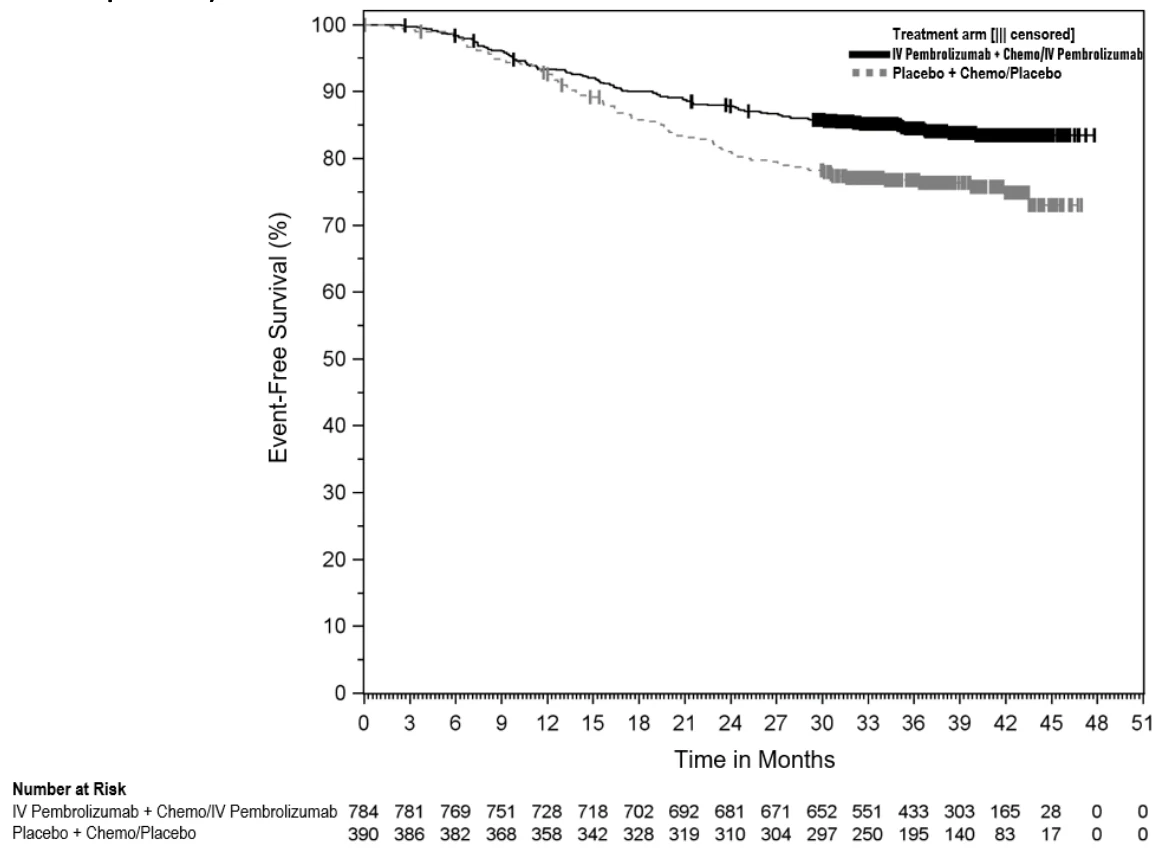
Cervical Cancer
KEYNOTE-826: Controlled trial of combination therapy in patients with persistent, recurrent, or metastatic cervical cancer
The efficacy of intravenous KEYTRUDA in combination with paclitaxel and cisplatin or paclitaxel and carboplatin, with or without bevacizumab, was investigated in KEYNOTE-826, a multicenter, randomized, double-blind, placebo-controlled trial that enrolled 617 patients with persistent, recurrent, or first-line metastatic cervical cancer who had not been treated with chemotherapy except when used concurrently as a radio-sensitizing agent. Patients were enrolled regardless of tumour PD-L1 expression status. Patients with autoimmune disease that required systemic therapy within 2 years of treatment or a medical condition that required immunosuppression were ineligible. Randomization was stratified by metastatic status at initial diagnosis, investigator decision to use bevacizumab, and PD-L1 status (CPS <1 vs. CPS 1 to <10 vs. CPS ≥ 10). Patients were randomized (1:1) to one of the two treatment groups:
- Treatment Group 1: Intravenous KEYTRUDA 200 mg plus chemotherapy
- Treatment Group 2: Placebo plus chemotherapy
The investigator selected one of the following four treatment regimens prior to randomization:
- 1. Paclitaxel 175 mg/m2 + cisplatin 50 mg/m2
- 2. Paclitaxel 175 mg/m2 + cisplatin 50 mg/m2 + bevacizumab 15 mg/kg
- 3. Paclitaxel 175 mg/m2 + carboplatin AUC 5 mg/mL/min
- 4. Paclitaxel 175 mg/m2 + carboplatin AUC 5 mg/mL/min + bevacizumab 15 mg/kg
All study medications were administered as an intravenous infusion. All study treatments were administered on Day 1 of each 3-week treatment cycle. Cisplatin could be administered on Day 2 of each 3-week treatment cycle. The option to use bevacizumab was by investigator choice prior to randomization. Treatment with intravenous KEYTRUDA continued until RECIST v1.1-defined progression of disease, unacceptable toxicity, or a maximum of 24 months. Administration of intravenous KEYTRUDA was permitted beyond RECIST-defined disease progression if the patient was clinically stable and considered to be deriving clinical benefit by the investigator. Intravenous KEYTRUDA could be reinitiated for subsequent disease progression and administered for up to one additional year for patients who had stable disease or better during initial treatment. Assessment of tumour status was performed at Week 9 and then every 9 weeks for the first year, followed by every 12 weeks thereafter.
Of the 617 enrolled patients, 548 patients (89%) had tumours expressing PD-L1 with a CPS ≥ 1. Among these 548 enrolled patients with tumours expressing PD-L1, 273 patients were randomized to Intravenous KEYTRUDA in combination with chemotherapy with or without bevacizumab, and 275 patients were randomized to placebo in combination with chemotherapy with or without bevacizumab. Sixty-three percent of the 548 patients received bevacizumab as part of study treatment. The baseline characteristics were: median age of 51 years (range: 22 to 82), 16% age 65 or older; 59% White,18% Asian, and 1% Black; 37% Hispanic or Latino; 56% and 43% ECOG performance status of 0 or 1, respectively; 21% with adenocarcinoma and 5% with adenosquamous histology; for patients with persistent or recurrent disease with or without distant metastases, 39% had received prior chemoradiation only and 17% had received prior chemoradiation plus surgery.
The primary efficacy outcome measures were OS and PFS as assessed by investigator according to RECIST v1.1. Secondary efficacy outcome measures were ORR and DoR, according to RECIST v1.1, as assessed by investigator. The median follow-up time was 17.2 months (range: 0.3 to 29.4 months). Efficacy results are summarized in Table 121.
Table 121: Efficacy Results* for Patients with Persistent, Recurrent or Metastatic Cervical Cancer (CPS ≥ 1) in KEYNOTE-826
| Endpoint | Intravenous KEYTRUDA 200 mg every 3 weeks and Chemotherapy† with or without bevacizumab n=273 | Placebo and Chemotherapy† with or without bevacizumab n=275 |
|---|---|---|
| OS | ||
| Number (%) of patients with event | 118 (43.2) | 154 (56.0) |
| Median in months (95% CI) | NR (19.8, NR) | 16.3 (14.5, 19.4) |
| Hazard ratio‡ (95% CI) | 0.64 (0.50, 0.81) | |
| p-Value§ | 0.0001 | |
| PFS | ||
| Number of patients with event (%) | 157 (57.5) | 198 (72.0) |
| Median in months (95% CI) | 10.4 (9.7, 12.3) | 8.2 (6.3, 8.5) |
| Hazard ratio‡ (95% CI) | 0.62 (0.50, 0.77) | |
| p-Value¶ | < 0.0001 | |
| Objective Response Rate | ||
| ORR# (95% CI) | 68% (62, 74) | 50% (44, 56) |
| Complete response rate | 23% | 13% |
| Partial response rate | 45% | 37% |
| Duration of Response | ||
| Median in months (range) | 18.0 (1.3+, 24.2+) | 10.4 (1.5+, 22.0+) |
* Based on pre-specified interim analysis † Chemotherapy (paclitaxel and cisplatin or paclitaxel and carboplatin) ‡ Based on the stratified Cox proportional hazard model § p-Value (one-sided) is compared with the allocated alpha of 0.0055 for this interim analysis (with 72% of the planned number of events for final analysis) ¶ p-Value (one-sided) is compared with the allocated alpha of 0.0014 for this interim analysis (with 82% of the planned number of events for final analysis) # Response: Best objective response as confirmed complete response or partial response NR = not reached | ||
An updated OS analysis was performed at the time of the final analysis with a median follow-up time of 21.3 months (range: 0.3-46.5 months).At the time of this analysis, the median OS for patients treated with intravenous KEYTRUDA in combination with chemotherapy with or without bevacizumab was 28.6 months (95% CI: 22.1, 38.0), compared to 16.5 months (95% CI: 14.5, 20.0) for placebo in combination with chemotherapy with or without bevacizumab, with a hazard ratio of 0.60 (95% CI: 0.49, 0.74). The Kaplan-Meier curve for the updated OS analysis is presented in Figure 44. The results for PFS and ORR remained consistent with the interim analysis (see Table 121).
Figure 44: Kaplan-Meier Curve for Overall Survival by Treatment Arm in KEYNOTE-826 (CPS ≥ 1), Final Analysis*†
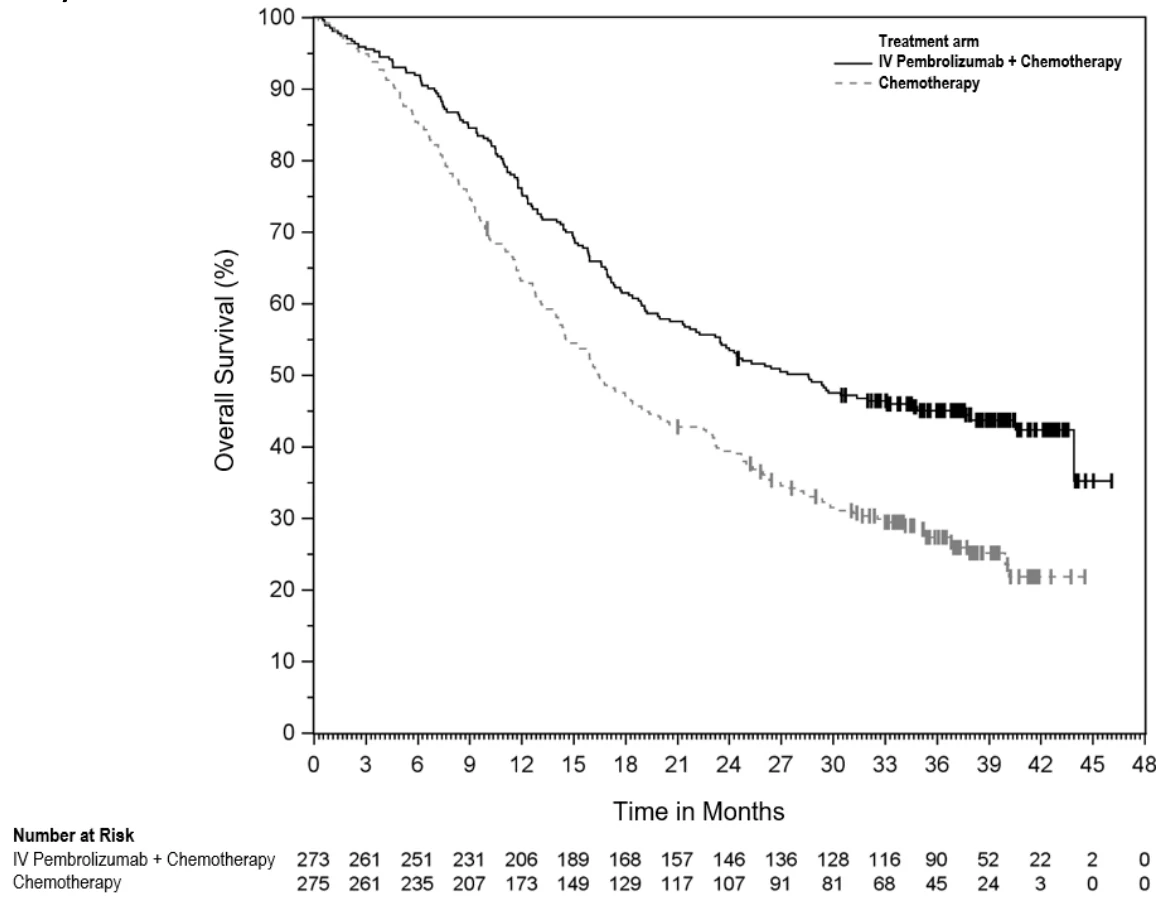
*Treatment arms include intravenous KEYTRUDA plus chemotherapy (paclitaxel and cisplatin or paclitaxel and carboplatin) with or without bevacizumab versus placebo plus chemotherapy with or without bevacizumab.
†Based on the protocol-specified final OS analysis.
Biliary Tract Carcinoma
KEYNOTE-966: Controlled trial of combination therapy in patients with locally advanced unresectable or metastatic biliary tract carcinoma.
The efficacy of intravenous KEYTRUDA in combination with gemcitabine and cisplatin was investigated in KEYNOTE-966, a multicenter, randomized, double-blind, placebo-controlled trial that enrolled 1069 patients with locally advanced unresectable or metastatic BTC, who had not received prior systemic therapy in the advanced disease setting. Patients with autoimmune disease that required systemic therapy within 2 years of treatment or a medical condition that required immunosuppression were ineligible. Randomization was stratified by region (Asia vs. non-Asia), locally advanced versus metastatic, and site of origin (gallbladder, intrahepatic or extrahepatic cholangiocarcinoma).
Patients were randomized (1:1) to one of the two treatment groups:
- Intravenous KEYTRUDA 200 mg on Day 1 plus gemcitabine 1000 mg/m2 and cisplatin 25 mg/m2 on Day 1 and Day 8 every 3 weeks.
- Placebo on Day 1 plus gemcitabine 1000 mg/m2 and cisplatin 25 mg/m2 on Day 1 and Day 8 every 3 weeks
All study medications were administered via intravenous infusion. Treatment continued until unacceptable toxicity or disease progression. For intravenous KEYTRUDA, treatment continued for a maximum of 35 cycles, or approximately 24 months. For cisplatin, treatment could be administered for a maximum of 8 cycles and for gemcitabine, treatment could be continued beyond 8 cycles.
Administration of intravenous KEYTRUDA with chemotherapy was permitted beyond RECIST-defined disease progression if the patient was clinically stable and considered by the investigator to be deriving clinical benefit. Assessment of tumour status was performed at baseline and then every 6 weeks through 54 weeks, followed by every 12 weeks thereafter.
Treatment with intravenous KEYTRUDA could be reinitiated for subsequent disease progression and administered for up to one additional year.
The study population characteristics were median age of 64 years (range: 23 to 85), 47% age 65 or older; 52% male; 49% White, 46% Asian; 46% ECOG PS of 0 and 54% ECOG PS of 1; 31% of patients had a history of hepatitis B infection, and 3% had a history of hepatitis C infection.
The primary efficacy outcome measure was OS and the secondary efficacy measures were PFS and ORR as assessed by BICR according to RECIST v1.1. The intravenous KEYTRUDA with gemcitabine/cisplatin arm demonstrated a clinically meaningful and statistically significant improvement vs. the placebo with gemcitabine/cisplatin arm in OS. The results are summarized in Table 122 and Figure 45.
Table 122: Efficacy Results in Patients with BTC in KEYNOTE-966
| Endpoint | Intravenous KEYTRUDA 200 mg every 3 weeks and Gemcitabine and Cisplatin n=533 | Placebo and Gemcitabine and Cisplatin n=536 |
|---|---|---|
| OS* | ||
| Number (%) of patients with event | 414 (78%) | 443 (83%) |
| Median in months (95% CI) | 12.7 (11.5, 13.6) | 10.9 (9.9, 11.6) |
| Hazard ratio† (95% CI) | 0.83 (0.72, 0.95) | |
| p-Value‡ | 0.0034 | |
* Results at the pre-specified final OS analysis † Based on the stratified Cox proportional hazard model ‡ One-sided p-Value based on a stratified log-rank test | ||
The PFS hazard ratio at the pre-specified interim analysis in patients randomized to the intravenous KEYTRUDA plus chemotherapy arm versus patients randomized to the placebo plus chemotherapy arm was 0.86 (95% CI 0.75, 1.00). The median PFS was 6.5 months (95% CI: 5.7, 6.9) versus 5.6 months (95% CI: 5.1, 6.6) for the intravenous KEYTRUDA plus chemotherapy arm versus the placebo plus chemotherapy arm. The objective response rate at the pre-specified interim analysis was 28.7% (24.9, 32.8) for the intravenous KEYTRUDA plus chemotherapy arm vs 28.5% (24.8, 32.6) for the placebo plus chemotherapy arm.
Figure 45: Kaplan-Meier Curve for Overall Survival in KEYNOTE-966*
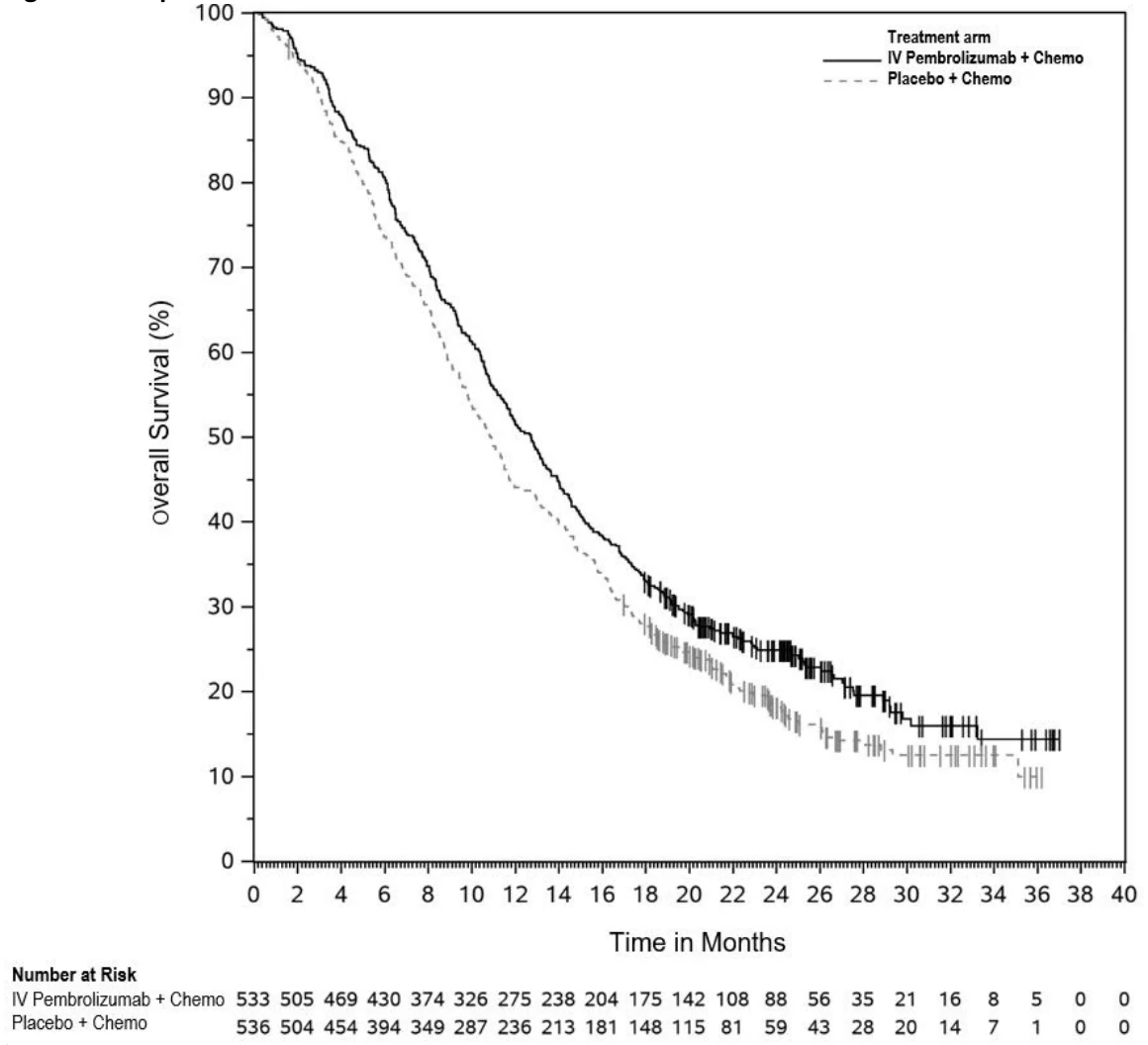
*Based on the pre-specified final OS analysis
Alternate Dosing Regimen for Adults
KEYNOTE-555: Additional dosing regimen of 400 mg every 6 weeks for adults
The safety and efficacy of intravenous KEYTRUDA 400 mg every 6 weeks was evaluated in Cohort B of KEYNOTE-555, a Phase 1 clinical trial in adult patients with advanced (unresectable or metastatic) melanoma (at least 1 measurable lesion) who were naïve to prior immuno-oncology therapy, and had an ECOG performance status of 0 or 1. The interim data of 44 patients support that the safety and efficacy of 400 mg every 6 weeks are consistent with the safety and efficacy of 200 mg every 3 weeks of intravenous KEYTRUDA.
16. Non-Clinical Toxicology
Subcutaneous pembrolizumab
No human‑relevant hazard of berahyaluronidase alfa alone was identified in rats, rabbits and Cynomolgus monkeys upon repeated subcutaneous administrations. Repeated subcutaneous administrations of pembrolizumab (50 mg/kg) with berahyaluronidase alfa (574 U/kg) was well‑tolerated in a local tolerability study in Cynomolgus monkeys.
Intravenous pembrolizumab
General toxicology: Repeat-dose toxicology studies were carried out in monkeys. In a 1-month study, monkeys received 0, 6, 40, or 200 mg/kg IV pembrolizumab administered weekly for a total of 5 doses followed by a 4 month recovery period. In the 6 month study, monkeys received 0, 6, 40, or 200 mg/kg IV pembrolizumab administered biweekly for a total of 12 doses, followed by a 4-month recovery period. In both studies, all dose levels administered exceeded the recommended human dose and resulted in exposures and peak serum concentrations that were greater than those observed in humans receiving the recommended dose. Pembrolizumab was not associated with any adverse test article-related findings at doses up to 200 mg/kg administered weekly for 1-month (NOAEL (No Observed Adverse Effect Level) > 200 mg/kg) or at doses up to 200 mg/kg adminstered biweekly for 6 months (NOAEL > 200 mg/kg).
Table 123: Summary of Toxicology Studies.
| Study Type | Treatment Duration and Dosing Schedule | Species / Test system | Gender and No. per Group | Doses (mg/kg)a | Findings/Conclusions |
|---|---|---|---|---|---|
Repeat-Dose Toxicity IV | 1-month Dosing Period with 4-month treatment-free Postdose Period, dosing once weekly (total of 5 doses) | Monkey/ Cynomolgus | 4F, 4M per group (dosing period); 2 F, 2M per group (treatment-free postdose period) | 0, 6, 40, 200 | There was no test article-related mortality. Test article-related changes were limited to an increased incidence of inguinal swelling, and increased splenic weights in males receiving 200 mg/kg at end of the Dosing Period. Both of these findings were not considered adverse and there was no histopathologic correlate. Splenic weights were normal at the necropsy performed after the treatment-free period. Based on the lack of adverse test article-related findings, the NOAEL was > 200 mg/kg. |
Repeat-Dose Toxicity IV | 6-month Dosing Period with 4-month treatment-free Postdose Period, dosing once every other week (total of 12 doses) | Monkey/ Cynomolgus | 3F, 3M per group (dosing period); 2F, 2M per group (treatment-free postdose period) | 0, 6, 40, 200 | There were no test article-related antemortem, electrocardiographic or ophthalmic findings. There were no test article-related changes at injection sites. Following the interim and final necropsies, there were no identified test article-related postmortem findings. The NOAEL was > 200 mg/kg |
| a For Repeat-Dose Toxicity, the highest NOAEL (No Observed Adverse Effect Level) is underlined. | |||||
Carcinogenicity: The carcinogenic potential of pembrolizumab has not been evaluated in long-term animal studies.
Genotoxicity: The genotoxic potential of pembrolizumab has not been evaluated.
Reproductive and developmental toxicology: Animal reproduction studies have not been conducted with pembrolizumab. The central function of the PD-1/PD-L1 pathway is to preserve pregnancy by maintaining immune tolerance to the fetus. Blockade of PD-L1 signaling has been shown in murine models of pregnancy to disrupt tolerance to the fetus and to result in an increase in fetal loss. These results indicate a potential risk that administration of intravenous Keytruda during pregnancy could cause fetal harm, including increased rates of abortion or stillbirth.
Fertility studies have not been conducted with pembrolizumab. There were no notable effects in the male and female reproductive organs in a limited number of sexually mature monkeys based on 1-month and 6-month repeat dose toxicity studies.
Special toxicology studies: PD-1 deficiency was associated with enhanced inflammatory responses, increased severity of infections and reduced survival in some animal models. Compared to wild-type mice, PD-1 knockout mice infected with M. tuberculosis had enhanced inflammatory responses, increased bacterial proliferation and decreased survival. Decreased survival has also been observed in PD-1 knockout mice infected with LCMV.