


Product Monograph - Rebif (Emd Serono, A Division of Emd Inc., Canada, 22 mcg, ..., 132 mcg)
Recent Major Label Changes
| 4 Dosage and Administration, 4.4 Administration | 2025-MM |
|---|
Table of Contents
Certain sections or subsections that are not applicable at the time of the preparation of the most recent authorized product monograph are not listed.
Recent Major Label Changes ................................................................................................. 2
Table of Contents ................................................................................................................. 2
Part 1: Healthcare Professional Information.......................................................................... 4
- 1.
Indications..................................................................................................................... 4
1.1. Pediatrics .................................................................................................................... 4
1.2. Geriatrics .................................................................................................................... 4
- 2. Contraindications .......................................................................................................... 4
- 4.
Dosage and Administration ............................................................................................ 5
4.1. Dosing Considerations ............................................................................................... 5
4.2. Recommended Dose and Dosage Adjustment .......................................................... 5
4.4. Administration ........................................................................................................... 6
4.5. Missed Dose ............................................................................................................... 6
- 5. Overdose ....................................................................................................................... 6
- 6. Dosage Forms, Strengths, Composition, and Packaging .................................................. 6
- 7.
Warnings and Precautions ............................................................................................. 7
General ................................................................................................................................... 7
Cardiovascular ........................................................................................................................ 8
Endocrine and Metabolism .................................................................................................... 8
Hepatic/Biliary/Pancreatic ..................................................................................................... 8
Immune .................................................................................................................................. 9
Monitoring and Laboratory Tests ........................................................................................... 9
Neurologic .............................................................................................................................. 9
Psychiatric ............................................................................................................................... 9
Renal ..................................................................................................................................... 10
7.1. Special Populations .................................................................................................. 11
7.1.1. Pregnancy ......................................................................................................... 11
7.1.2. Breastfeeding ................................................................................................... 12
7.1.3. Pediatrics (<18 years of age) ............................................................................ 12
7.1.4. Geriatrics (≥65 years of age) ............................................................................ 12
- 8.
Adverse Reactions ....................................................................................................... 12
8.1. Adverse Reaction Overview ..................................................................................... 12
8.2. Clinical Trial Adverse Reactions ............................................................................... 12
8.3. Less Common Clinical Trial Adverse Reactions ........................................................ 60
8.5. Post-Market Adverse Reactions ............................................................................... 68
- 9.
Drug Interactions ......................................................................................................... 69
9.2. Drug Interactions Overview ..................................................................................... 69
9.3. Drug-Behaviour Interactions .................................................................................... 69
9.4. Drug-Drug Interactions ............................................................................................ 69
9.5. Drug-Food Interactions ............................................................................................ 69
9.6. Drug-Herb Interactions ............................................................................................ 69
9.7. Drug-Laboratory Test Interactions........................................................................... 69
- 10.
Clinical Pharmacology .................................................................................................. 69
10.1. Mechanism of Action ............................................................................................... 69
10.2. Pharmacodynamics .................................................................................................. 70
10.3. Pharmacokinetics ..................................................................................................... 70
10.4. Immunogenicity ....................................................................................................... 72
- 11. Storage, Stability, and Disposal .................................................................................... 72
- 12. Special Handling Instructions ....................................................................................... 72
Part 2: Scientific Information .............................................................................................. 73
- 13. Pharmaceutical Information ........................................................................................ 73
- 14.
Clinical Trials ............................................................................................................... 74
14.1. Clinical Trials by Indication ...................................................................................... 74
- 16. Non-Clinical Toxicology ................................................................................................ 99
Patient Medication Information ....................................................................................... 100
Patient Medication Information ....................................................................................... 109
Part 1: Healthcare Professional Information
1. Indications
REBIF (Interferon beta-1a Injection) is indicated for:
The treatment of relapsing forms of multiple sclerosis (MS), to
- reduce the number and severity of clinical exacerbations,
- slow the progression of physical disability,
- reduce the requirement for steroids,
- reduce the number of hospitalizations for treatment of multiple sclerosis, and
- reduce T1-Gd enhanced and T2 (burden of disease) lesions as seen on MRI.
The treatment of patients who have experienced a single demyelinating event, accompanied by an active inflammatory process and an abnormal MRI scan with lesions typical of MS, who are determined to be at high risk of developing clinically definite multiple sclerosis.
Before initiating treatment with REBIF, alternate diagnoses should be excluded.
In a two-year clinical trial in patients with CIS, REBIF has been shown to delay the onset of McDonald MS (2005 criteria), and other MS features (see 14 Clinical Trials).
Relapsing forms of multiple sclerosis include the subgroups of MS in which patients still experience recurrent attacks of neurological dysfunction including traditional RRMS but also SPMS patients still experiencing relapses.
Although REBIF did not affect progression of disability in SPMS, the clinical trial has shown that secondary progressive MS patients who still experience relapses, had a statistically significant improvement on relapse rate and on MRI measures of disease activity as compared to patients on placebo.
REBIF has not yet been investigated in patients with primary progressive multiple sclerosis and should not be administered to such patients.
1.1. Pediatrics
Pediatrics (<18 years of age): No data are available to Health Canada; therefore, Health Canada has not authorized an indication for pediatric use.
1.2. Geriatrics
Geriatrics (≥65 years of age): There is no controlled clinical experience with REBIF in patients with multiple sclerosis over 65 years of age.
2. Contraindications
- REBIF is contraindicated in patients who are hypersensitive to this drug or to any ingredient in the formulation, including any non-medicinal ingredient, or component of the container. For a complete listing, see 6 Dosage Forms, Strengths, Composition, and Packaging.
- REBIF is contraindicated in patients with decompensated liver disease (see 7 Warnings and Precautions, Hepatic/Biliary/Pancreatic).
4. Dosage and Administration
4.1. Dosing Considerations
- Before initiating a patient on REBIF therapy, please review completely the2 Contraindications section of this Product Monograph.
4.2. Recommended Dose and Dosage Adjustment
Relapsing-Remitting Multiple Sclerosis (RRMS):
The recommended dose is 44 mcg given three times a week by subcutaneous injection. The dose can be reduced to 22 mcg three times a week if the patient is not able to tolerate the higher dose.
Single Demyelinating Event:
The recommended dose for patients who have experienced a first demyelinating event is 44 mcg of REBIF given three times a week by subcutaneous injection.
Treatment should be initiated under supervision of a physician experienced in the treatment of the disease. When first starting treatment with REBIF, in order to allow tachyphylaxis to develop thus reducing adverse events, it is recommended that 20% of the total dose be administered during the initial 2 weeks of therapy, 50% of total dose be administered in week 3 and 4, and the full dose from the fifth week onwards according to the following schedule:
Table 1 – Dosing Schedule After First Demyelinating Event
| Recommended Titration (% of final dose) | Titration dose for REBIF 44 mcg three times per week | |
|---|---|---|
| Weeks 1-2 | 20% | 8.8 mcg three times a week |
| Weeks 3-4 | 50% | 22 mcg three times a week |
| Weeks 5+ | 100% | 44 mcg three times a week |
Prior to injection and for an additional 24 hours after each injection, an antipyretic analgesic is advised to decrease flu-like symptoms associated with REBIF administration.
Please also review the 7 Warnings and Precautions section and ensure appropriate monitoring of patients with depression, hepatic dysfunction, a history of seizures, cardiac disease, renal dysfunction, thyroid dysfunction, myelosuppression, and female patients of childbearing potential.
At the present time, it is not known for how long patients should be treated. Safety and efficacy with REBIF have been demonstrated following 4 years of treatment. Therefore, it is recommended that patients should be evaluated after 4 years of treatment with REBIF and a decision for longer-term treatment be made on an individual basis by the treating physician.
4.4. Administration
Patients should be advised of REBIF side-effects and instructed on the use of aseptic technique when administering REBIF. The REBIF Patient Leaflet should be carefully reviewed with all patients, and patients should be educated on self-care and advised to keep the Leaflet for continued reference during REBIF therapy.
Preparation of Solution: Liquid formulation in a pre-filled syringe
The liquid formulation in a pre-filled syringe is ready for use. These syringes are graduated to facilitate therapy initiation. The pre-filled syringes contain 22 mcg and 44 mcg of REBIF New HSA-free Formulation respectively. The pre-filled syringes are ready for subcutaneous use only.
Preparation of Solution: Liquid formulation in a pre-filled cartridge
The liquid formulation in a pre-filled cartridge is ready for use with the RebiSmart® autoinjection device. For administration, follow the instructions given in the package leaflet and in the instructions manual which is provided with each device. The pre-filled cartridge that contains 66 mcg/1.5 mL is designed to deliver three doses of 22 mcg/0.5 mL and the pre-filled cartridge that contains 132 mcg/1.5 mL is designed to deliver three doses of 44 mcg/0.5 mL of REBIF. The pre-filled cartridges are for subcutaneous use only.
4.5. Missed Dose
Should a dose be missed, the patient should be advised to continue to inject from the day of the next scheduled dose. The patient should not take a double dose to make up for the missed dose.
5. Overdose
One medically-confirmed case of REBIF overdose has been reported in over 450,000 patient-years of exposure to REBIF and concerned a subject who injected himself with seven syringes of REBIF 44 mcg (total dose of 308 mcg) in a suicide attempt. Symptoms included a modest rise in body temperature (to 37.5°C), diffuse erythema of the limbs and abdomen with rigors. The subject was treated with 500 mg of acetyl-salicylic acid dl-lysine intravenously, and haematologic screening revealed no abnormalities of hepatic function, thyroid function, or indices of inflammation. The event was not considered serious. There is no known antidote for an overdose of REBIF. The subject should be hospitalised for observation and appropriate supportive treatment administered.
For the most recent information in the management of a suspected drug overdose, contact your regional poison control centre or Health Canada’s toll-free number, 1-844 POISON-X (1-844-764-7669).
- 6. Dosage Forms, Strengths, Composition, and Packaging
Table 2 – Dosage Forms, Strengths, and Composition
| Route of Administration | Dosage Form/ Strength/Composition | Non-Medicinal Ingredients |
| Subcutaneous | Interferon beta-1a Solution for Injection in Pre-filled Syringe/ | Benzyl alcohol, mannitol, methionine, poloxamer-188, 0.01 M sodium acetate pH 4.2 |
Description
Solution for injection in a pre-filled syringe
REBIF New HSA-free Formulation is available as a liquid formulation, in pre-filled syringes. Two package strengths are available: 22 mcg/0.5 mL and 44 mcg/0.5mL. The pre-filled syringes are supplied as 3-packs. The pre-filled syringes are for subcutaneous use only.
Solution for injection in a pre-filled cartridge
REBIF New HSA-free Formulation is available as a liquid formulation, in pre-filled cartridges. Two package strengths are available: 66 mcg/1.5 mL and 132 mcg /1.5 mL. The pre-filled cartridge that contains 66 mcg/1.5 mL is designed to deliver three doses of 22 mcg/0.5 mL and the pre-filled cartridge that contains 132 mcg/1.5 mL is designed to deliver three doses of 44 mcg/0.5 mL of REBIF. The pre-filled cartridges are supplied as 4 pre-filled cartridges per box.
The pre-filled cartridge is ready for use with the RebiSmart auto-injection device for subcutaneous administration only.
RebiSmart is an electronic injection device intended for subcutaenous injection of REBIF pre-filled cartridges.
The RebiSmart auto-injection device is programmed to deliver 20% of the total dose during the initial 2 weeks of therapy (6 injections in total) and 50% of the total dose in the week 3 and 4 (6 injections in total).
7. Warnings and Precautions
General
REBIF should be used under the supervision of a physician. The first injection should be performed under the supervision of an appropriately qualified health care professional.
Patients should be informed of the most common adverse reactions associated with interferon beta administration, including symptoms of the flu-like syndrome (see 8 Adverse Reactions). These symptoms tend to be most prominent at the initiation of therapy and may decrease in frequency and severity with continued treatment.
Patients with Special Diseases and Conditions: Caution should be exercised and close monitoring conducted when administering REBIF to patients with severe renal failure, or severe myelosuppression, or cardiac disease.
22 mcg/0.5 mL 44 mcg/0.5 mL | buffer |
Interferon beta-1a Solution for Injection in a Pre-filled Cartridge/ 22 mcg × 3 (66 mcg/1.5 mL) 44 mcg × 3 (132 mcg/1.5 mL) | Benzyl alcohol, mannitol, methionine, poloxamer-188, 0.01 M sodium acetate pH 3.9 buffer |
Cardiovascular
Cardiac Disease
Patients with cardiac disease, such as angina, congestive heart failure or arrhythmia, should be closely monitored for worsening of their clinical condition during initiation and continued therapy with REBIF. Symptoms of the flu-like syndrome associated with REBIF may prove stressful to patients with cardiac conditions.
Pulmonary Arterial Hypertension
Cases of pulmonary arterial hypertension (PAH) have been reported with interferon beta products. Events were reported at various time points including up to several years after starting treatment with interferon beta.
Thrombotic Microangiopathy
Cases of thrombotic microangiopathy, manifested as thrombotic thrombocytopenic purpura (TTP) or haemolytic uraemic syndrome (HUS), including fatal cases, have been reported with interferon beta products. Events were reported at various time points during treatment and may occur after several weeks to several years after starting treatment with interferon beta. Early clinical features include thrombocytopenia, new onset hypertension, fever, central nervous system symptoms (e.g. confusion, paresis) and impaired renal function. If clinical features of TMA are observed, testing of blood platelet levels, serum lactate dehydrogenase (LDH), schistocytes (erythrocyte fragmentation) on a blood film with a negative Coombs test and renal function is recommended. Prompt treatment of TTP/HUS is required and immediate discontinuation of treatment with REBIF is recommended.
Endocrine and Metabolism
Patients treated with REBIF may develop new or worsening thyroid laboratory abnormalities. Caution should be exercised when administering REBIF to patients with pre-existing thyroid disorders. Patients treated with REBIF should be carefully monitored for evidence of thyroid dysfunction (most often presenting as hypothyroidism or hyperthyroidism), and development of thyroid auto-antibodies. Thyroid testing is recommended at baseline and if abnormal, every 6 12 months following initiation of therapy. If normal, routine testing is not needed but should be performed if clinical findings of thyroid dysfunction appear.
Hepatic/Biliary/Pancreatic
REBIF, like other beta interferons, has a potential of causing severe liver injury including hepatic failure. Isolated, life-threatening cases of acute hepatic failure have been reported with REBIF therapy. Symptomatic hepatic dysfunction, primarily presenting as jaundice, has been reported as a rare complication of REBIF therapy. Several possible mechanisms may explain the effect of REBIF on the liver (including direct toxicity, indirect toxicity via release of cytokines and/or autoimmunity). Severe elevations in transaminases are common with interferon therapy; asymptomatic elevations of transaminases (particularly ALT) are very common (see 8 Adverse Reactions). In clinical trials with REBIF, the majority of these elevations were below 2.5 times the upper limit of normal [ULN] with 1 - 3% of patients developing elevations above 5 times ULN. In the absence of clinical symptoms, serum ALT levels should be monitored at baseline, every month for the first 6 months and every 6 months thereafter. REBIF should be initiated with caution in patients with a history of significant liver disease, clinical evidence of active liver disease, alcohol abuse or increased serum ALT (> 2.5 times ULN). Dose reduction or discontinuation should be considered if ALT rises 5 times above the ULN and gradually re-escalated when enzyme levels have normalized. Treatment with REBIF should be stopped if icterus or other clinical symptoms of hepatic dysfunction appear.
Immune
Anaphylaxis has been reported as a rare complication of REBIF use. Other allergic reactions have included skin rash, angioedema, and urticaria, and have ranged from mild to severe without a clear relationship to dose or duration of exposure. Several allergic reactions, some severe, have occurred after prolonged use.
Neutralising antibodies (NAbs) to REBIF may develop during the first 24 months of therapy in a small proportion of patients, the precise incidence of which is uncertain. Neutralising antibodies have been associated with a reduced clinical benefit, as evaluated by MRI parameters and multiple sclerosis relapse rate; however, the clinical significance of NAbs development in individual patients remains uncertain. Treatment decisions should be based on the assessment of clinical efficacy by the clinician in view of available NAbs data. A poor clinical course associated with persistent NAbs should prompt reconsideration of REBIF therapy. Neutralising antibodies to REBIF are cross-reactive to different forms of interferon beta.
Monitoring and Laboratory Tests
Laboratory abnormalities are associated with the use of interferons. Therefore, in addition to those laboratory tests normally required for monitoring patients with multiple sclerosis, when initiating REBIF therapy, liver enzymes should be monitored at baseline, every month for the first 6 months and every 6 months thereafter (see 7 Warnings and Precautions, Hepatic/Biliary/Pancreatic). Complete blood cell counts with white blood cell differential, and platelet counts are also recommended at baseline 1, 3 and 6 months, and every 6 months thereafter in the absence of clinical symptoms. As patients being treated with REBIF may develop new or worsening thyroid abnormalities (see 7 Warnings and Precautions, Endocrine and Metabolism), testing of thyroid function should be performed at baseline and every 6 months. In case of abnormal results or in patients with a past history of thyroid dysfunction, any necessary treatment should be administered and more frequent testing should be performed as clinically indicated (see 8 Adverse Reactions).
Neurologic
Caution should be exercised when administering REBIF to patients with pre-existing seizures disorder. For patients without a pre-existing seizure disorder who develop seizures during therapy, an etiologic basis should be established and appropriate anti-convulsant therapy instituted prior to continuing treatment with REBIF. The effect of REBIF administration on the medical management of patients with seizure disorder is unknown.
Psychiatric
Depression
REBIF should be used with caution in patients with previous or current depression, a condition that is common in people with multiple sclerosis. Depression, suicidal ideation, and suicide attempts have been reported to occur with increased frequency in patients receiving interferon products, including REBIF. Depressive symptoms associated with interferon beta may often be an atypical syndrome, occurring more frequently early in the course of treatment and not associated with all of the usual clinical symptoms of depression. Patients treated with REBIF should be advised to immediately report any symptoms of depression and/or suicidal ideation to their prescribing physician. Patients developing depression during REBIF therapy should be monitored closely and cessation of therapy should be considered.
Renal
Cases of nephrotic syndrome with different underlying nephropathies including collapsing focal segmental glomerulosclerosis (FSGS), minimal change disease (MCD), membranoproliferative glomerulonephritis (MPGN) and membranous glomerulopathy (MGN) have been reported during treatment with interferon-beta products. Events were reported at various time points during treatment and may occur after several years of treatment with interferon-beta. Periodic monitoring of early signs or symptoms, e.g. oedema, proteinuria and impaired renal function is recommended, especially in patients at higher risk of renal disease. Prompt treatment of nephrotic syndrome is required and discontinuation of treatment with REBIF should be considered.
Information to be Provided to the Patient
Patients should be advised not to stop or modify their treatment unless instructed by their physician.
Patients should be informed of the potential risk of liver injury during REBIF therapy, and be informed about the signs and symptoms of such injury, such as loss of appetite with malaise, fatigue, nausea, vomiting, abdominal pain, dark urine, jaundice or pruritus, and be informed of the requirement for frequent laboratory testing (see 7 Warnings and Precautions,Hepatic/Biliary/Pancreatic). They should be advised to consult their physician immediately if such symptoms arise.
Flu-like symptoms (fever, headache, chills, muscle and joint aches, and fatigue) are the most common adverse reactions following initiation of therapy with REBIF. Acetaminophen or ibuprofen may be used for relief of flu-like symptoms. Patients should contact their physician or pharmacist if they experience any undesirable effects.
Depression may occur in patients with multiple sclerosis and may occur while patients are taking REBIF. Patients receiving REBIF should be instructed to inform their doctor immediately if they have feelings of sadness, unusual tiredness, trouble concentrating, or if they think about committing suicide.
Injection site reactions are commonly experienced by patients during therapy (see 8 Adverse Reactions). In general, they do not require discontinuation of therapy, but the nature and severity of all reported reactions should be carefully assessed. Patient understanding and use of aseptic self-injection technique and procedures should be periodically re-evaluated.
Instruction on self-injection technique and procedures: patients should be instructed in the use of aseptic technique when administering REBIF. Appropriate instruction for self-injection should be given including careful review of the REBIF patient leaflet. The first injection should be performed under the supervision of an appropriately qualified health care professional. Patients should be advised of the importance of rotating sites of injection with each dose, to minimize the likelihood of severe injection site reactions or necrosis and not to inject into an area that appears abnormal. Patients should be advised to consult with their physician should they develop multiple lesions and/or experience any break in the skin, which may be associated with swelling or drainage of fluid from the injection site, as a decision may be required to discontinue REBIF until healing has occurred. Patients with single lesions may be advised to continue provided that necrosis is not too extensive. Patients should be cautioned against the re-use of needles or syringes and instructed in safe disposal procedures. A puncture resistant container for disposal of used needles and syringes should be supplied to the patient along with instructions for safe disposal of full containers.
Certain laboratory tests may change. The number of white blood cells or platelets may decrease, but no increased risk of infections or bleeding has been observed.
As REBIF may cause changes in thyroid function, patients should be informed of the symptoms of thyroid dysfunction such as difficulty concentrating, feeling abnormally cold or hot, gaining or losing weight unexpectedly, feeling unusually tired or nervous and unusual very dry skin.
REBIF may cause skin reactions such as rash, hives or urticaria, and itching or pruritus associated with redness, which may be a local allergic reaction. Rarely (in less than 1% of patients) these skin and/or allergic reactions can become generalized and very severe, associated with difficulty breathing, cough, swelling of the mouth or throat, fainting, dizziness, low blood pressure, heart palpitations, hives, itching, abdominal pain, vomiting and diarrhea. Patients should be informed that if this occurs, REBIF should be discontinued and prompt medical care is needed, since severe allergic reactions may be potentially life threatening.
7.1. Special Populations
7.1.1. Pregnancy
Women of childbearing potential receiving REBIF should be advised to take adequate contraceptive measures. Patients should be advised to discuss with their health care provider the potential risks and benefits of continued treatment while attempting to conceive. It is not known if interferons alter the efficacy of hormonal contraceptives.
There are no adequate and well-controlled clinical studies of REBIF in pregnant women. The administration of REBIF during confirmed pregnancy should be avoided, unless clearly needed.
A European registry study collected data on 948 prospective pregnancies in women with MS who were treated with one of five interferon beta medications. The rates of aggregated adverse pregnancy outcomes were in line with reference ranges published in the literature.
Data from a retrospective register-based study in Sweden and Finland have likewise not indicated an increased risk of major congenital anomalies after early pregnancy exposure. However, the duration of exposure during the first trimester was uncertain since data were collected when interferon beta use was contraindicated during pregnancy, and treatment was interrupted when the pregnancy was detected and/or confirmed. Experience with exposure during the second and third trimester was too limited to determine whether exposure affects maternal or fetal health.
In cynomolgous monkeys administered doses approximately 2 times the cumulative weekly human dose (based on either body weight or surface area), REBIF treatment was associated with significant increases in embryolethal or abortifacient effects either during the period of organogenesis (gestation day 21-89) or later in pregnancy. There were no fetal malformations or other evidence of teratogenesis noted in these studies; however, it is not known if teratogenic effects can occur in humans. These effects are consistent with the abortifacient effects of other type I interferons.
The risk of spontaneous abortions in pregnant women exposed to interferon beta cannot be evaluated based on the currently available data.
7.1.2. Breastfeeding
No studies have been conducted with REBIF in lactating women. Limited information available from published literature on the transfer of interferon beta-1a into breast milk suggests that levels of interferon beta-1a excreted in human milk are low. A risk to the nursing infant cannot be excluded.
The benefit and potential risk of breastfeeding should be considered along with the patient’s medical need for interferon beta-1a therapy.
7.1.3. Pediatrics (<18 years of age)
No data are available to Health Canada; therefore, Health Canada has not authorized an indication for pediatric use.
7.1.4. Geriatrics (≥65 years of age)
There is no controlled clinical experience with REBIF in patients with multiple sclerosis over 65 years of age.
8. Adverse Reactions
8.1. Adverse Reaction Overview
The most serious adverse reactions observed with REBIF are hepatic failure, hepatitis (including autoimmune hepatitis), suicide attempt, seizures, and injection site necrosis (see 7 Warnings and Precautions) as well as thrombocytopenic thrombotic purpura/haemolytic uremic syndrome, drug-induced lupus erythematosus and retinal vascular disorders.
The most common adverse reactions observed with REBIF are influenza-like symptoms, headache, injection site reactions, reduction in white blood cell count and elevation of liver enzymes and depression. Depending of the severity and persistence of the reactions, the dose of REBIF may need to be lowered and or treatment may need to be interrupted or discontinued.
Thyroid dysfunction may present as hypothyroidism and hyperthyroidism. It is commonly transient and mild, especially in the first year of treatment and in patients with pre-existing thyroiditis (see 7 Warnings and Precautions, Monitoring and Laboratory Tests).
Analphylaxis and other allergic reactions have been reported in patients using REBIF (see 7 Warnings and Precautions).
8.2. Clinical Trial Adverse Reactions
Clinical trials are conducted under very specific conditions. Therefore, the frequencies of adverse reactions observed in the clinical trials may not reflect frequencies observed in clinical practice and should not be compared to frequencies reported in clinical trials of another drug.
Study 25632 (REBIF HSA-free Formulation): Adverse Drug Reactions
Study 25632 was performed to assess the immunogenicity and safety of FBS-free/HSA-free Formulation of interferon beta-1a (REBIF HSA-free Formulation), administered subcutaneously three times per week in accordance with the current product label.
The adverse events experienced during ninety-six weeks of Study 25632 are listed below, by MedDRA (Version 8.0) System Organ Class.
| Table 3 - Adverse Events(a) Experienced by at least 1% of the Patients Enrolled in Study 25632 for Ninety-six Weeks | |||||
| Table 3 - Adverse Events(a) Experienced by at least 1% of the Patients Enrolled in Study 25632 for Ninety-six Weeks | |||||
| Table 3 - Adverse Events(a) Experienced by at least 1% of the Patients Enrolled in Study 25632 for Ninety-six Weeks | |||||
| System Organ Class/ Preferred Term | Preferred Term | RNF 44 mcg THREE TIMES A WEEK Subjects (n=260) | |||
| System Organ Class/ Preferred Term | Preferred Term | RNF 44 mcg THREE TIMES A WEEK Subjects (n=260) | |||
| System Organ Class/ Preferred Term | Preferred Term | RNF 44 mcg THREE TIMES A WEEK Subjects (n=260) | |||
| General disorders and administration site conditions | Influenza like illness | 176 (67.7) | |||
| Injection site erythema | 63 (24.2) | ||||
| Injection site haemorrhage | 25 (9.6) | ||||
| Fatigue | 24 (9.2) | ||||
| Chills | 18 (6.9) | ||||
| Pyrexia | 18 (6.9) | ||||
| Injection site pain | 17 (6.5) | ||||
| Asthenia | 16 (6.2) | ||||
| Injection site pruritus | 5 (1.9) | ||||
| Pain | 5 (1.9) | ||||
| Hyperthermia | 4 (1.5) | ||||
| Injection site rash | 3 (1.2) | ||||
| Injection site swelling | 3 (1.2) | ||||
| Nervous system disorders | Headache | 98 (37.7) | |||
| Dizziness | 19 (7.3) | ||||
| Hypoaesthesia | 8 (3.1) | ||||
| Migraine | 8 (3.1) | ||||
| Burning sensation | 4 (1.5) | ||||
| Paraesthesia | 4 (1.5) | ||||
| Hypertonia | 3 (1.2) | ||||
| Tremor | 3 (1.2) | ||||
| Infections and infestations | Upper respiratory tract infection | 23 (8.8) | |||
| Nasopharyngitis | 17 (6.5) | ||||
| Viral upper respiratory tract infection | 15 (5.8) | ||||
| Urinary tract infection | 14 (5.4) | ||||
| Rhinitis | 12 (4.6) | ||||
| Influenza | 10 (3.8) | ||||
| Sinusitis | 8 (3.1) | ||||
| Tonsillitis | 8 (3.1) | ||||
| Herpes simplex | 6 (2.3) | ||||
| Dental caries | 4 (1.5) | ||||
| Ear infection | 4 (1.5) | ||||
| Cystitis | 3 (1.2) | ||||
| Pharyngitis | 3 (1.2) | ||||
| Gastrointestinal disorders | Nausea | 26 (10.0) | |||
| Diarrhoea | 17 (6.5) | ||||
| Vomiting | 13 (5.0) | ||||
| Dyspepsia | 12 (4.6) | ||||
| Abdominal pain | 10 (3.8) | ||||
| Abdominal pain upper | 10 (3.8) | ||||
| Toothache | 7 (2.7) | ||||
| Constipation | 6 (2.3) | ||||
| Flatulence | 5 (1.9) | ||||
| Gastritis | 3 (1.2) | ||||
| Musculoskeletal and connective tissue disorders | Back pain | 26 (10.0) | |||
| Arthralgia | 21 (8.1) | ||||
| Pain in extremity | 20 (7.7) | ||||
| Myalgia | 12 (4.6) | ||||
| Muscle spasms | 9 (3.5) | ||||
| Osteochondrosis | 4 (1.5) | ||||
| Neck pain | 3 (1.2) | ||||
| Investigations | Alanine aminotransferase increased | 19 (7.3) | |||
| Aspartate aminotransferase increased | 15 (5.8) | ||||
| Blood creatine phosphokinase increased | 8 (3.1) | ||||
| White blood cell count decreased | 8 (3.1) | ||||
| Hepatic enzyme increased | 7 (2.7) | ||||
| Body temperature increased | 5 (1.9) | ||||
| Neutrophil count decreased | 5 (1.9) | ||||
| Transaminases increased | 4 (1.5) | ||||
| Weight decreased | 4 (1.5) | ||||
| Anti-thyroid antibody positive | 3 (1.2) | ||||
| Blood thyroid stimulating hormone increased | 3 (1.2) | ||||
| Psychiatric disorders | Insomnia | 13 (5.0) | |||
| Anxiety | 12 (4.6) | ||||
| Depression | 9 (3.5) | ||||
| Depressed mood | 5 (1.9) | ||||
| Blood and lymphatic system disorders | Neutropenia | 18 (6.9) | |||
| Lymphopenia | 9 (3.5) | ||||
| Leukopenia | 7 (2.7) | ||||
| Anaemia | 4 (1.5) | ||||
| Iron deficiency anaemia | 4 (1.5) | ||||
| Skin and subcutaneous tissue disorders | Urticaria | 5 (1.9) | |||
| Dermatitis contact | 4 (1.5) | ||||
| Erythema | 4 (1.5) | ||||
| Night sweats | 3 (1.2) | ||||
| Pruritus | 3 (1.2) | ||||
| Injury, poisoning and procedural complications | Contusion | 7 (2.7) | |||
| Limb injury | 4 (1.5) | ||||
| Joint sprain | 3 (1.2) | ||||
| Reproductive system and breast disorders | Breast pain | 3 (1.2) | |||
| Menstruation irregular | 3 (1.2) | ||||
| Respiratory, thoracic and mediastinal disorders | Pharyngolaryngeal pain | 6 (2.3) | |||
| Epistaxis | 5 (1.9) | ||||
| Dyspnoea | 4 (1.5) | ||||
(a)Treatment Emergent Adverse Events
No new or unexpected treatment emergent adverse events (TEAEs) were observed in the REBIF HSA-free Formulation Cohort compared to the Historical HSA-containing Formulation Cohort (Historical Cohort). The Historical Cohort consisted of patients from three phase III clinical trials (Study GF6789, Study GF6954 and Study 21125) who were administered identical dosing of the previous HSA- and FBS-containing formulation of interferon beta 1a (44 mcg three times a week) during the 24-month/96-week period. For the purposes of these comparisons, the Historical Cohort TEAE data for 24-months/96-weeks of treatment was recoded in MedDRA version 8.0 (Clinical Trial Report Study 25632: 96-week Analysis). Overall, the proportion of subjects experiencing TEAEs was similar between the REBIF HSA-free Formulation Cohort (95.0%) and the Historical Cohort (99.7%). With regard to severity, the majority (97%) of AEs in the REBIF HSA-free Formulation Cohort were mild (70%) or moderate (27%). To facilitate comparison of the REBIF HSA-free Formulation Cohort safety profile with that of the Historical Cohort the common AEs of interferon beta-1a were pre-specified into groups of MedDRA preferred terms. The pre-specified AE groups were “cytopenia”, “flu like syndrome”, “hepatic disorders”, “hypersensitivity reactions”, “injection site reactions”, “depression and suicidal ideation,” “skin rashes” and “thyroid disorders”. Specific differences were observed in some of these eight pre-specified AE groups known to be associated with interferon beta-1a. The adverse event profile of REBIF HSA-free Formulation was generally comparable with that observed in the historical trials with the original formulation of interferon-beta-1a. Events related to the flu-like syndrome were reported in 71.5% of REBIF HSA-free Formulation subjects and in 69.0%, 55.4% and 49.0% of subjects in protocols 6789, 6954 and 21125 respectively. Local injection site reactions were 30.8% in REBIF HSA-free Formulation Cohort and in 85.8% to 92.4% in the historical trials. Events related to depression and suicidal ideation were reported in 6.5% of REBIF HSA-free Formulation subjects compared with 22.7% to 36.3% in the historical trials.
Study 25827 (REBIF HSA-free Formulation): Adverse Drug Reactions
The safety and tolerability of the HSA-free Formulation of interferon beta-1a was compared to the previously marketed HSA- and FBS-containing formulation of REBIF as a secondary objective of the study. Both formulations were well tolerated when administered in subcutaneous doses of 44 mcg in this study. There were no deaths or SAEs. All subjects who were administered with either study drug experienced
| Table 3 - Adverse Events(a) Experienced by at least 1% of the Patients Enrolled in Study 25632 for Ninety-six Weeks | ||||
| System Organ Class/ Preferred Term | Preferred Term | RNF 44 mcg THREE TIMES A WEEK Subjects (n=260) | ||
| Eye disorders | Eye pain | 6 (2.3) | ||
| Vision blurred | 5 (1.9) | |||
| Vascular disorders | Hypertension | 6 (2.3) | ||
| Hypotension | 6 (2.3) | |||
| Cardiac disorders | Palpitations | 5 (1.9) | ||
| Ear and labyrinth disorders | Ear pain | 4 (1.5) | ||
| Vertigo | 3 (1.2) | |||
| Endocrine disorders | Hyperthyroidism | 4 (1.5) | ||
mild Treatment Emergent Adverse Events (TEAEs). Of those TEAEs reported, 59.3% and 65.7% were probably related to the administration of the previously marketed REBIF formulation and the HSA-free Formulation of interferon beta-1a, respectively. The nature and severities of AEs were similar for both study drugs, and were consistent with the known safety profile of previously marketed REBIF formulation. There appeared to be a higher frequency of pain associated TEAEs after administration of previously marketed REBIF formulation, and more episodes of pyrexia, and associated symptoms, after administration of the HSA-free interferon beta-1a. Injection site reactions, particularly redness, were observed after administration of both of the study drugs. Pain at the administration site and the incidence of injection site reactions however lower after injection of the HSA-free interferon beta-1a compared to previously marketed REBIF formulation.
Study GF6789 (PRISMS): Adverse Reactions
The adverse events experienced during the first two years of Study GF6789 are listed below, by WHOART System Organ Class. The most common amongst the injection site reactions was in the form of injection site inflammation. The majority of the other injection site reactions were also mild in the 2 REBIF groups. Necrosis was reported in 8 patients treated with REBIF. Two of these patients were in the 66 mcg weekly and six in the 132 mcg weekly groups. All patients completed the planned treatment period, with only 1 requiring temporary dose reductions and another patient stopping treatment for 2 weeks. Those that required treatments, received antibiotics.
Long-term Follow-up (LTFU) data up to 8 years for the PRISMS study has been collected in the retrospective study 22930. LTFU was attended by 68.2% of the original PRISMS study cohort (382/560 patients). 72.0% (275/382) were still receiving IFNbeta-1a s.c., with 74.3% (101/136) of those originally randomized to receive the 44 mcg dose and 70.7% (87/123) the 22 mcg dose. Overall, 19.7% of patients progressed to secondary progressive MS between baseline and LTFU (75/381). No new safety concerns were identified and treatment was generally well tolerated.
| Table 4 - Adverse Events Experienced by at least 1% of the Patients Enrolled in Study GF6789 (PRISMS– Year 1 and 2) | |||||||||
| Table 4 - Adverse Events Experienced by at least 1% of the Patients Enrolled in Study GF6789 (PRISMS– Year 1 and 2) | |||||||||
| Table 4 - Adverse Events Experienced by at least 1% of the Patients Enrolled in Study GF6789 (PRISMS– Year 1 and 2) | |||||||||
| Table 4 - Adverse Events Experienced by at least 1% of the Patients Enrolled in Study GF6789 (PRISMS– Year 1 and 2) | |||||||||
| Table 4 - Adverse Events Experienced by at least 1% of the Patients Enrolled in Study GF6789 (PRISMS– Year 1 and 2) | |||||||||
| Table 4 - Adverse Events Experienced by at least 1% of the Patients Enrolled in Study GF6789 (PRISMS– Year 1 and 2) | |||||||||
| Table 4 - Adverse Events Experienced by at least 1% of the Patients Enrolled in Study GF6789 (PRISMS– Year 1 and 2) | |||||||||
| Table 4 - Adverse Events Experienced by at least 1% of the Patients Enrolled in Study GF6789 (PRISMS– Year 1 and 2) | |||||||||
| Table 4 - Adverse Events Experienced by at least 1% of the Patients Enrolled in Study GF6789 (PRISMS– Year 1 and 2) | |||||||||
| Table 4 - Adverse Events Experienced by at least 1% of the Patients Enrolled in Study GF6789 (PRISMS– Year 1 and 2) | |||||||||
| Table 4 - Adverse Events Experienced by at least 1% of the Patients Enrolled in Study GF6789 (PRISMS– Year 1 and 2) | |||||||||
| Body System | Preferred Term | Placebo (n=187) | REBIF 66 mcg weekly (n=189) | REBIF 132 mcg weekly (n=184) | |||||
| Body System | Preferred Term | Placebo (n=187) | REBIF 66 mcg weekly (n=189) | REBIF 132 mcg weekly (n=184) | |||||
| Body System | Preferred Term | Placebo (n=187) | REBIF 66 mcg weekly (n=189) | REBIF 132 mcg weekly (n=184) | |||||
| Body System | Preferred Term | Placebo (n=187) | REBIF 66 mcg weekly (n=189) | REBIF 132 mcg weekly (n=184) | |||||
| Body System | Preferred Term | Placebo (n=187) | REBIF 66 mcg weekly (n=189) | REBIF 132 mcg weekly (n=184) | |||||
| Body System | Preferred Term | Placebo (n=187) | REBIF 66 mcg weekly (n=189) | REBIF 132 mcg weekly (n=184) | |||||
| Body System | Preferred Term | Placebo (n=187) | REBIF 66 mcg weekly (n=189) | REBIF 132 mcg weekly (n=184) | |||||
| Body System | Preferred Term | Placebo (n=187) | REBIF 66 mcg weekly (n=189) | REBIF 132 mcg weekly (n=184) | |||||
| Body System | Preferred Term | Placebo (n=187) | REBIF 66 mcg weekly (n=189) | REBIF 132 mcg weekly (n=184) | |||||
| Body System | Preferred Term | Placebo (n=187) | REBIF 66 mcg weekly (n=189) | REBIF 132 mcg weekly (n=184) | |||||
| Body System | Preferred Term | Placebo (n=187) | REBIF 66 mcg weekly (n=189) | REBIF 132 mcg weekly (n=184) | |||||
| APPLICATION SITE DISORDERS | Injection Site Inflammation | 15.0% | 65.6% | 65.8% | |||||
| Injection Site Reaction | 13.4% | 31.2% | 34.8% | ||||||
| Injection Site Pain | 14.4% | 20.1% | 22.8% | ||||||
| Injection Site Bruising | 11.2% | 3.7% | 5.4% | ||||||
| Injection Site Mass | 0.5% | 3.2% | 3.8% | ||||||
| Injection Site Bleeding | 0.5% | 2.1% | 2.2% | ||||||
| Injection Site Necrosis | 1.1% | 3.3% | |||||||
| Injection Site Abscess | 1.1% | 2.2% | |||||||
| BODY AS A WHOLE - GENERAL DISORDERS | Influenza-Like Symptoms | 51.3% | 56.1% | 58.7% | |||||
| Fatigue | 35.8% | 32.8% | 41.3% | ||||||
| Fever | 15.5% | 24.9% | 27.7% | ||||||
| Leg Pain | 14.4% | 10.1% | 13.0% | ||||||
| Rigors | 5.3% | 6.3% | 13.0% | ||||||
| Sweating Increased | 6.4% | 6.9% | 8.2% | ||||||
| Chest Pain | 5.3% | 5.8% | 7.6% | ||||||
| Allergic Reaction | 5.3% | 4.8% | 6.0% | ||||||
| Pain | 6.4% | 2.6% | 2.7% | ||||||
| Malaise | 1.1% | 4.2% | 5.4% | ||||||
| Asthenia | 2.1% | 3.2% | 2.2% | ||||||
| Hot Flushes | 2.1% | 1.6% | 2.7% | ||||||
| Back Pain | 2.7% | 2.1% | 1.1% | ||||||
| Temperature Changed Sensation | 1.1% | 0.5% | 0.5% | ||||||
| Oedema Peripheral | 1.1% | 0.5% | |||||||
| Necrosis Ischaemic | 1.1% | ||||||||
| CARDIOVASCULAR DISORDERS, GENERAL | Hypotension | 3.2% | 1.6% | 1.6% | |||||
| Hypertension | 2.7% | 1.1% | 1.6% | ||||||
| Heart Murmur | 0.5% | 1.1% | 0.5% | ||||||
| Oedema Dependent | 2.1% | ||||||||
| CENTRAL & PERIPHERAL NERVOUS SYSTEM DISORDERS | Headache | 62.6% | 64.6% | 70.1% | |||||
| Paraesthesia | 18.7% | 19.6% | 16.3% | ||||||
| Dizziness | 17.6% | 14.3% | 16.3% | ||||||
| Hypoaesthesia | 12.8% | 12.2% | 7.6% | ||||||
| Migraine | 9.1% | 6.3% | 7.6% | ||||||
| Hypertonia | 5.3% | 7.4% | 6.0% | ||||||
| Vertigo | 7.0% | 5.8% | 5.4% | ||||||
| Ataxia | 7.5% | 4.2% | 4.9% | ||||||
| Muscle Contractions Involuntary | 7.5% | 4.2% | 3.3% | ||||||
| Dysaesthesia | 4.8% | 3.2% | 4.9% | ||||||
| Coordination Abnormal | 2.1% | 5.3% | 3.8% | ||||||
| Convulsions | 2.1% | 4.8% | 3.8% | ||||||
| Gait Abnormal | 2.7% | 4.2% | 3.8% | ||||||
| Sensory Disturbance | 4.8% | 3.2% | 1.6% | ||||||
| Cramps Legs | 3.2% | 2.1% | 2.7% | ||||||
| Tremor | 0.5% | 3.2% | 1.6% | ||||||
| Speech Disorder | 2.7% | 1.1% | 1.1% | ||||||
| Dysphonia | 1.1% | 0.5% | 2.2% | ||||||
| Trigeminal Neuralgia | 0.5% | 0.5% | 1.6% | ||||||
| Dyskinesia | 0.5% | 1.6% | |||||||
| Faecal Incontinence | 2.1% | ||||||||
| Convulsions Grand Mal | 1.1% | ||||||||
| COLLAGEN DISORDERS | Auto-Antibody Response | 1.1% | 0.5% | 1.1% | |||||
| ENDOCRINE DISORDERS | Thyroid Disorder | 3.2% | 4.2% | 6.0% | |||||
| T4 Increased | 2.1% | 2.6% | 2.2% | ||||||
| Thyroid Stim. Hormone Decreased | 1.1% | 1.1% | 2.2% | ||||||
| T3 Increased | 0.5% | 2.1% | 1.1% | ||||||
| T4 Decreased | 1.1% | 2.1% | 0.5% | ||||||
| GASTRO-INTESTINAL SYSTEM DISORDERS | Nausea | 23.0% | 24.9% | 24.5% | |||||
| Abdominal Pain | 17.1% | 22.2% | 19.6% | ||||||
| Diarrhoea | 18.7% | 17.5% | 19.0% | ||||||
| Vomiting | 12.3% | 12.7% | 12.0% | ||||||
| Constipation | 10.2% | 10.1% | 7.1% | ||||||
| Dyspepsia | 9.6% | 5.8% | 8.2% | ||||||
| Tooth Disorder | 5.9% | 5.8% | 7.6% | ||||||
| Tooth Ache | 6.4% | 5.8% | 6.0% | ||||||
| Gastroenteritis | 7.5% | 5.8% | 4.3% | ||||||
| Mouth Dry | 1.1% | 0.5% | 4.9% | ||||||
| Gastritis | 2.7% | 1.1% | 2.2% | ||||||
| Flatulence | 2.7% | 2.1% | 0.5% | ||||||
| Gastro-Intestinal Disorder Nos | 2.7% | 2.1% | 0.5% | ||||||
| Gingivitis | 2.1% | 0.5% | 2.2% | ||||||
| Stomatitis Ulcerative | 1.1% | 3.2% | 0.5% | ||||||
| Dysphagia | 1.6% | 1.1% | 1.1% | ||||||
| Haemorrhoids | 2.1% | 0.5% | |||||||
| Change In Bowel Habits | 1.1% | 1.1% | |||||||
| Haemorrhage Rectum | 1.6% | 0.5% | |||||||
| Appendicitis | 1.1% | 0.5% | |||||||
| Enteritis | 0.5% | 1.1% | |||||||
| Glossitis | 1.6% | ||||||||
| Melaena | 1.6% | ||||||||
| Tongue Ulceration | 1.6% | ||||||||
| Eructation | 1.1% | ||||||||
| HEARING AND VESTIBULAR DISORDERS | Ear Ache | 7.5% | 3.2% | 4.9% | |||||
| Tinnitus | 3.2% | 2.6% | 1.6% | ||||||
| Ear Disorder Nos | 1.1% | 2.1% | 1.1% | ||||||
| Vestibular Disorder | 1.1% | 1.1% | |||||||
| HEART RATE AND RHYTHM DISORDERS | Palpitation | 4.3% | 2.1% | 2.7% | |||||
| Tachycardia | 2.1% | 1.1% | 1.6% | ||||||
| LIVER AND BILIARY SYSTEM DISORDERS | Sgpt Increased | 4.3% | 19.6% | 27.2% | |||||
| Sgot Increased | 3.7% | 10.1% | 17.4% | ||||||
| Hepatic Function Abnormal | 1.6% | 3.7% | 9.2% | ||||||
| Bilirubinaemia | 0.5% | 2.6% | 2.2% | ||||||
| Hepatomegaly | 1.1% | ||||||||
| METABOLIC AND NUTRITIONAL DISORDERS | Phosphatase Alkaline Increased | 3.7% | 4.8% | 3.3% | |||||
| Weight Decrease | 3.2% | 4.8% | 3.8% | ||||||
| Hypocalcaemia | 4.8% | 4.2% | 2.2% | ||||||
| Weight Increase | 3.2% | 2.6% | 1.6% | ||||||
| Hypoglycaemia | 1.6% | 1.1% | 1.6% | ||||||
| Hypokalaemia | 3.2% | ||||||||
| Oedema Legs | 2.1% | 0.5% | 0.5% | ||||||
| Serum Iron Decreased | 2.1% | 1.1% | |||||||
| Blood Urea Decreased | 0.5% | 1.6% | 0.5% | ||||||
| Bun Increased | 0.5% | 1.1% | 1.1% | ||||||
| Glycosuria | 1.1% | 0.5% | 1.1% | ||||||
| Hypoproteinaemia | 1.6% | ||||||||
| Hypercalcaemia | 1.1% | ||||||||
| Npn Increased | 1.1% | ||||||||
| MUSCULO-SKELETAL SYSTEM DISORDERS | Myalgia | 19.8% | 24.9% | 25.0% | |||||
| Back Pain | 19.8% | 23.3% | 24.5% | ||||||
| Arthralgia | 17.1% | 15.3% | 19.0% | ||||||
| Skeletal Pain | 10.2% | 14.8% | 9.8% | ||||||
| Muscle Weakness | 13.4% | 8.5% | 8.7% | ||||||
| Arthrosis | 2.1% | 2.1% | 2.7% | ||||||
| Tendinitis | 0.5% | 2.6% | 1.1% | ||||||
| Arthritis | 0.5% | 2.6% | |||||||
| Bursitis | 0.5% | 2.1% | 0.5% | ||||||
| Arthropathy | 1.1% | 0.5% | |||||||
| Torticollis | 0.5% | 1.1% | |||||||
| PLATELET, BLEEDING & CLOTTING DISORDERS | Thrombocytopenia | 1.6% | 1.6% | 8.2% | |||||
| Epistaxis | 3.2% | 2.6% | 2.2% | ||||||
| Purpura | 2.7% | 0.5% | 1.1% | ||||||
| Haematoma | 1.1% | 1.6% | |||||||
| Thrombocythaemia | 1.1% | ||||||||
| PSYCHIATRIC DISORDERS | Depression | 27.8% | 20.6% | 23.9% | |||||
| Insomnia | 21.4% | 19.6% | 23.4% | ||||||
| Anxiety | 5.9% | 4.8% | 7.6% | ||||||
| Nervousness | 6.4% | 5.3% | 6.0% | ||||||
| Anorexia | 3.7% | 4.8% | 3.3% | ||||||
| Somnolence | 0.5% | 3.7% | 4.9% | ||||||
| Sleep Disorder | 2.1% | 3.7% | 2.2% | ||||||
| Emotional Lability | 3.2% | 2.1% | 1.1% | ||||||
| Amnesia | 1.6% | 2.1% | 1.1% | ||||||
| Suicide Attempt | 1.6% | 1.6% | 1.6% | ||||||
| Agitation | 0.5% | 0.5% | 2.2% | ||||||
| Libido Decreased | 1.1% | 1.1% | 1.1% | ||||||
| Concentration Impaired | 0.5% | 1.6% | 0.5% | ||||||
| Confusion | 1.6% | 1.1% | |||||||
| Paroniria | 0.5% | 1.1% | |||||||
| RED BLOOD CELL DISORDERS | Anaemia | 2.7% | 2.6% | 4.9% | |||||
| Polycythaemia | 0.5% | 1.6% | |||||||
| REPRODUCTIVE DISORDERS, FEMALE | Menstrual Disorder | 3.7% | 4.8% | 4.3% | |||||
| Vaginitis | 5.9% | 2.6% | 3.3% | ||||||
| Dysmenorrhoea | 4.8% | 2.6% | 1.1% | ||||||
| Menorrhagia | 1.1% | 0.5% | 2.7% | ||||||
| Intermenstrual Bleeding | 1.6% | 1.6% | 0.5% | ||||||
| Amenorrhoea | 1.6% | 1.1% | 0.5% | ||||||
| Breast Neoplasm Female | 1.6% | 0.5% | 1.1% | ||||||
| Leukorrhoea | 1.6% | ||||||||
| Ovarian Cyst | 0.5% | 1.1% | |||||||
| Pregnancy Unintended | 1.1% | 0.5% | |||||||
| Uterine Fibroid | 0.5% | 1.1% | |||||||
| Breast Neoplasm Malignant Female | 1.1% | ||||||||
| Mastitis | 1.1% | ||||||||
| REPRODUCTIVE DISORDERS, MALE | Impotence | 2.1% | 2.1% | 2.7% | |||||
| RESISTANCE MECHANISM DISORDERS | Herpes Simplex | 8.0% | 4.8% | 5.4% | |||||
| Infection Fungal | 7.5% | 3.7% | 5.4% | ||||||
| Infection | 6.4% | 5.8% | 3.3% | ||||||
| Otitis Media | 5.3% | 3.2% | 1.6% | ||||||
| Moniliasis | 1.6% | 2.6% | 3.3% | ||||||
| Infection Viral | 2.1% | 2.1% | 2.2% | ||||||
| Herpes Zoster | 1.1% | 1.1% | 2.2% | ||||||
| Abscess | 1.1% | 1.1% | |||||||
| Infection Parasitic | 1.1% | ||||||||
| RESPIRATORY SYSTEM DISORDERS | Rhinitis | 59.9% | 52.4% | 50.5% | |||||
| Pharyngitis | 38.5% | 34.9% | 28.3% | ||||||
| Upper Resp Tract Infection | 32.6% | 36.0% | 29.3% | ||||||
| Coughing | 21.4% | 14.8% | 19.0% | ||||||
| Sinusitis | 15.5% | 7.9% | 9.8% | ||||||
| Bronchitis | 9.6% | 10.6% | 9.2% | ||||||
| Tracheitis | 5.9% | 2.6% | 6.5% | ||||||
| Laryngitis | 3.2% | 2.6% | 3.8% | ||||||
| Dyspnoea | 2.1% | 1.6% | 2.2% | ||||||
| Throat Tightness | 3.2% | 1.1% | |||||||
| Asthma | 1.6% | 2.2% | |||||||
| Bronchospasm | 0.5% | 1.1% | 1.6% | ||||||
| Hyperventilation | 2.1% | 1.1% | |||||||
| Pneumonia | 2.7% | 0.5% | |||||||
| SECONDARY TERMS | Fall | 16.0% | 16.9% | 15.8% | |||||
| Bite | 3.2% | 3.2% | |||||||
| Food Poisoning | 1.6% | ||||||||
| Varicella | 1.1% | ||||||||
| SKIN AND APPENDAGES DISORDERS | Pruritus | 11.8% | 9.0% | 12.5% | |||||
| Rash | 6.4% | 6.9% | 8.2% | ||||||
| Rash Erythematous | 3.2% | 6.9% | 4.9% | ||||||
| Alopecia | 5.3% | 4.2% | 3.3% | ||||||
| Eczema | 3.7% | 5.3% | 3.3% | ||||||
| Skin Dry | 3.7% | 3.2% | 5.4% | ||||||
| Rash Maculo-Papular | 1.6% | 4.8% | 4.3% | ||||||
| Acne | 3.7% | 2.1% | 3.3% | ||||||
| Skin Disorder | 2.1% | 3.7% | 3.3% | ||||||
| Skin Hypertrophy | 3.2% | 1.1% | 4.3% | ||||||
| Skin Discolouration | 4.3% | 1.1% | 2.7% | ||||||
| Dermatitis Fungal | 2.1% | 2.1% | 0.5% | ||||||
| Urticaria | 2.7% | 1.1% | 0.5% | ||||||
| Nail Disorder | 1.1% | 1.1% | 0.5% | ||||||
| Onychomycosis | 1.1% | 0.5% | 1.1% | ||||||
| Folliculitis | 0.5% | 1.6% | |||||||
| Psoriasis | 0.5% | 1.6% | |||||||
| Dermatitis | 0.5% | 1.1% | |||||||
| Furunculosis | 0.5% | 1.1% | |||||||
| Hair Disorder Nos | 1.6% | ||||||||
| Photosensitivity Reaction | 0.5% | 1.1% | |||||||
| Pityriasis Rosea | 0.5% | 1.1% | |||||||
| Verruca | 1.1% | 0.5% | |||||||
| Dermatitis Lichenoid | 1.1% | ||||||||
| Rash Pustular | 1.1% | ||||||||
| Vitiligo | 1.1% | ||||||||
| URINARY SYSTEM DISORDERS | Urinary Tract Infection | 18.7% | 18.0% | 16.8% | |||||
| Cystitis | 12.3% | 5.8% | 6.5% | ||||||
| Micturition Frequency | 3.7% | 1.6% | 6.5% | ||||||
| Haematuria | 3.7% | 2.6% | 2.7% | ||||||
| Urinary Incontinence | 1.6% | 3.7% | 1.6% | ||||||
| Albuminuria | 1.6% | 3.2% | 1.6% | ||||||
| Micturition Disorder | 1.6% | 2.1% | 2.2% | ||||||
| Dysuria | 1.1% | 1.6% | 2.2% | ||||||
| Renal Pain | 2.1% | 2.2% | |||||||
| Urinary Retention | 2.1% | 2.1% | |||||||
| Urine Abnormal | 1.1% | 1.1% | 1.6% | ||||||
| Face Oedema | 1.6% | 1.6% | |||||||
| Micturition Urgency | 1.1% | 1.1% | 1.1% | ||||||
| Nocturia | 0.5% | 1.1% | |||||||
| VASCULAR (EXTRACARDIAC) DISORDERS | Flushing | 3.2% | 1.6% | 2.2% | |||||
| Vascular Disorder | 0.5% | 1.1% | |||||||
| Peripheral Ischaemia | 1.1% | ||||||||
| VISION DISORDERS | Vision Abnormal | 7.0% | 7.4% | 13.0% | |||||
| Eye Pain | 8.0% | 6.3% | 4.9% | ||||||
| Conjunctivitis | 6.4% | 5.8% | 4.9% | ||||||
| Diplopia | 3.2% | 1.6% | 2.2% | ||||||
| Xerophthalmia | 2.6% | 0.5% | |||||||
| Eye Infection | 1.1% | 0.5% | 1.1% | ||||||
| Photophobia | 0.5% | 1.1% | 1.1% | ||||||
| Conjunctival Discolouration | 1.1% | ||||||||
| Photopsia | 1.1% | ||||||||
| WHITE CELL AND RES DISORDERS | Lymphopenia | 11.2% | 20.1% | 28.8% | |||||
| Leucopenia | 3.7% | 12.7% | 22.3% | ||||||
| Lymphadenopathy | 8.0% | 11.1% | 12.0% | ||||||
| Granulocytopenia | 3.7% | 11.6% | 15.2% | ||||||
| Leukocytosis | 4.3% | 5.3% | 4.3% | ||||||
| Monocytosis | 2.7% | 4.8% | 4.3% | ||||||
| Eosinophilia | 2.1% | 3.7% | 1.1% | ||||||
| WBC Abnormal Nos | 0.5% | 3.2% | 2.7% | ||||||
| Lymphadenopathy Cervical | 1.6% | 1.6% | 1.6% | ||||||
| Lymphocytosis | 1.1% | 1.6% | 0.5% | ||||||
After 2 years, the placebo patients were switched to REBIF, and along with the patients for the REBIF treatment groups, they were treated for an additional two years. Listed below by WHOART System Organ Class, are the proportion of patients reporting the most common adverse events ongoing from years 1 and 2 or started during years 3 and 4 of treatment. The results are similar to those obtained in the original phase of the study. The findings indicate that the incidence of interferon-related adverse events diminishes somewhat with continued exposure to the medication.
Cases of necrosis were rare and not a cause of drop-out. For REBIF 66 mcg weekly, there was one episode of skin necrosis per 92 years of exposure or per 14 100 injections. The comparable figures for REBIF 132 mcg weekly are 1 episode of necrosis per 61 years of exposure or per 9 300 injections.
| Table 5 - Adverse Events Experienced by at least 1% of the Patients Enrolled in Study GF6789 (PRISMS– Ongoing from Year 1 and 2 or Started During Year 3 and 4) | |||||||||||
| Table 5 - Adverse Events Experienced by at least 1% of the Patients Enrolled in Study GF6789 (PRISMS– Ongoing from Year 1 and 2 or Started During Year 3 and 4) | |||||||||||
| Table 5 - Adverse Events Experienced by at least 1% of the Patients Enrolled in Study GF6789 (PRISMS– Ongoing from Year 1 and 2 or Started During Year 3 and 4) | |||||||||||
| Table 5 - Adverse Events Experienced by at least 1% of the Patients Enrolled in Study GF6789 (PRISMS– Ongoing from Year 1 and 2 or Started During Year 3 and 4) | |||||||||||
| Table 5 - Adverse Events Experienced by at least 1% of the Patients Enrolled in Study GF6789 (PRISMS– Ongoing from Year 1 and 2 or Started During Year 3 and 4) | |||||||||||
| Table 5 - Adverse Events Experienced by at least 1% of the Patients Enrolled in Study GF6789 (PRISMS– Ongoing from Year 1 and 2 or Started During Year 3 and 4) | |||||||||||
| Table 5 - Adverse Events Experienced by at least 1% of the Patients Enrolled in Study GF6789 (PRISMS– Ongoing from Year 1 and 2 or Started During Year 3 and 4) | |||||||||||
| Table 5 - Adverse Events Experienced by at least 1% of the Patients Enrolled in Study GF6789 (PRISMS– Ongoing from Year 1 and 2 or Started During Year 3 and 4) | |||||||||||
| Table 5 - Adverse Events Experienced by at least 1% of the Patients Enrolled in Study GF6789 (PRISMS– Ongoing from Year 1 and 2 or Started During Year 3 and 4) | |||||||||||
| Table 5 - Adverse Events Experienced by at least 1% of the Patients Enrolled in Study GF6789 (PRISMS– Ongoing from Year 1 and 2 or Started During Year 3 and 4) | |||||||||||
| Table 5 - Adverse Events Experienced by at least 1% of the Patients Enrolled in Study GF6789 (PRISMS– Ongoing from Year 1 and 2 or Started During Year 3 and 4) | |||||||||||
| Table 5 - Adverse Events Experienced by at least 1% of the Patients Enrolled in Study GF6789 (PRISMS– Ongoing from Year 1 and 2 or Started During Year 3 and 4) | |||||||||||
| Table 5 - Adverse Events Experienced by at least 1% of the Patients Enrolled in Study GF6789 (PRISMS– Ongoing from Year 1 and 2 or Started During Year 3 and 4) | |||||||||||
| Body System | Preferred Term | Placebo /66 (n=85) | Placebo /132 (n=87) | REBIF 66 mcg weekly (n=167) | REBIF 132 mcg weekly (n=167) | ||||||
| Body System | Preferred Term | Placebo /66 (n=85) | Placebo /132 (n=87) | REBIF 66 mcg weekly (n=167) | REBIF 132 mcg weekly (n=167) | ||||||
| Body System | Preferred Term | Placebo /66 (n=85) | Placebo /132 (n=87) | REBIF 66 mcg weekly (n=167) | REBIF 132 mcg weekly (n=167) | ||||||
| Body System | Preferred Term | Placebo /66 (n=85) | Placebo /132 (n=87) | REBIF 66 mcg weekly (n=167) | REBIF 132 mcg weekly (n=167) | ||||||
| Body System | Preferred Term | Placebo /66 (n=85) | Placebo /132 (n=87) | REBIF 66 mcg weekly (n=167) | REBIF 132 mcg weekly (n=167) | ||||||
| Body System | Preferred Term | Placebo /66 (n=85) | Placebo /132 (n=87) | REBIF 66 mcg weekly (n=167) | REBIF 132 mcg weekly (n=167) | ||||||
| Body System | Preferred Term | Placebo /66 (n=85) | Placebo /132 (n=87) | REBIF 66 mcg weekly (n=167) | REBIF 132 mcg weekly (n=167) | ||||||
| Body System | Preferred Term | Placebo /66 (n=85) | Placebo /132 (n=87) | REBIF 66 mcg weekly (n=167) | REBIF 132 mcg weekly (n=167) | ||||||
| Body System | Preferred Term | Placebo /66 (n=85) | Placebo /132 (n=87) | REBIF 66 mcg weekly (n=167) | REBIF 132 mcg weekly (n=167) | ||||||
| Body System | Preferred Term | Placebo /66 (n=85) | Placebo /132 (n=87) | REBIF 66 mcg weekly (n=167) | REBIF 132 mcg weekly (n=167) | ||||||
| Body System | Preferred Term | Placebo /66 (n=85) | Placebo /132 (n=87) | REBIF 66 mcg weekly (n=167) | REBIF 132 mcg weekly (n=167) | ||||||
| Body System | Preferred Term | Placebo /66 (n=85) | Placebo /132 (n=87) | REBIF 66 mcg weekly (n=167) | REBIF 132 mcg weekly (n=167) | ||||||
| Body System | Preferred Term | Placebo /66 (n=85) | Placebo /132 (n=87) | REBIF 66 mcg weekly (n=167) | REBIF 132 mcg weekly (n=167) | ||||||
| APPLICATION SITE DISORDERS | Injection Site Inflammation | 65.9% | 65.5% | 56.9% | 66.5% | ||||||
| Injection Site Reaction | 28.2% | 37.9% | 29.9% | 31.7% | |||||||
| Injection Site Pain | 18.8% | 21.8% | 15.0% | 13.8% | |||||||
| Injection Site Bruising | 5.9% | 6.9% | 2.4% | 6.0% | |||||||
| Injection Site Mass | 3.5% | 4.6% | 4.8% | 3.6% | |||||||
| Injection Site Necrosis | 2.4% | 1.1% | 1.8% | 3.0% | |||||||
| Injection Site Abscess | 1.2% | 2.3% | 1.8% | 1.2% | |||||||
| Injection Site Bleeding | 2.4% | 0.6% | 1.8% | ||||||||
| Skin Nodule | 1.2% | ||||||||||
| BODY AS A WHOLE - GENERAL DISORDERS | Influenza-Like Symptoms | 42.4% | 60.9% | 50.3% | 42.5% | ||||||
| Fatigue | 34.1% | 36.8% | 24.6% | 27.5% | |||||||
| Fever | 14.1% | 14.9% | 15.6% | 12.0% | |||||||
| Leg Pain | 8.2% | 12.6% | 6.6% | 7.8% | |||||||
| Pain | 4.7% | 14.9% | 4.2% | 4.2% | |||||||
| Rigors | 5.9% | 6.9% | 4.2% | 7.8% | |||||||
| Sweating Increased | 5.9% | 3.4% | 5.4% | 3.6% | |||||||
| Malaise | 3.5% | 3.4% | 3.0% | 5.4% | |||||||
| Asthenia | 1.2% | 2.3% | 4.8% | 3.6% | |||||||
| Chest Pain | 2.4% | 5.7% | 3.6% | 2.4% | |||||||
| Allergic Reaction | 2.4% | 4.6% | 3.0% | 2.4% | |||||||
| Hot Flushes | 3.5% | 1.1% | 1.8% | 2.4% | |||||||
| Oedema Peripheral | 3.5% | 2.3% | 0.6% | 0.6% | |||||||
| Temperature Changed Sensation | 1.2% | 1.2% | 2.4% | ||||||||
| Scar | 2.3% | 1.2% | 1.2% | ||||||||
| Carpal Tunnel Syndrome | 1.1% | 0.6% | |||||||||
| Anaphylactic Shock | 1.1% | ||||||||||
| Choking | 1.1% | ||||||||||
| Necrosis Ischaemic | 1.2% | ||||||||||
| Pallor | 1.2% | ||||||||||
| CARDIOVASCULAR DISORDERS, GENERAL | Hypertension | 3.5% | 5.7% | 4.2% | 4.2% | ||||||
| Hypotension | 1.2% | 1.1% | 1.8% | 2.4% | |||||||
| Oedema Dependent | 3.5% | 1.1% | 1.2% | 0.6% | |||||||
| Cardiac Failure Left | 1.2% | ||||||||||
| Hypotension Postural | 1.1% | ||||||||||
| CENTRAL & PERIPHERAL NERVOUS SYSTEM DISORDERS | Dizziness | 4.7% | 11.5% | 13.2% | 12.6% | ||||||
| Headache | 44.7% | 55.2% | 46.7% | 46.7% | |||||||
| Hypertonia | 14.1% | 11.5% | 10.8% | 9.6% | |||||||
| Paraesthesia | 15.3% | 13.8% | 10.2% | 7.8% | |||||||
| Hypoaesthesia | 7.1% | 13.8% | 7.2% | 9.0% | |||||||
| Migraine | 8.2% | 9.2% | 6.6% | 5.4% | |||||||
| Ataxia | 2.4% | 8.0% | 5.4% | 7.2% | |||||||
| Vertigo | 7.1% | 8.0% | 3.6% | 3.0% | |||||||
| Muscle Contractions Involuntary | 4.7% | 3.4% | 5.4% | 2.4% | |||||||
| Gait Abnormal | 2.4% | 2.3% | 4.8% | 2.4% | |||||||
| Dysaesthesia | 2.4% | 3.4% | 2.4% | 2.4% | |||||||
| Tremor | 2.4% | 2.3% | 3.6% | 1.8% | |||||||
| Convulsions | 2.4% | 1.1% | 3.0% | 2.4% | |||||||
| Coordination Abnormal | 4.7% | 3.6% | 0.6% | ||||||||
| Cramps Legs | 1.2% | 2.3% | 1.2% | 3.0% | |||||||
| Sensory Disturbance | 4.7% | 1.1% | 1.2% | 1.2% | |||||||
| Speech Disorder | 4.6% | 1.8% | 1.2% | ||||||||
| Faecal Incontinence | 3.0% | 0.6% | |||||||||
| Paresis | 1.1% | 1.2% | 1.2% | ||||||||
| Extrapyramidal Disorder | 1.2% | 0.6% | |||||||||
| Hyperkinesia | 1.1% | 0.6% | |||||||||
| Ms Aggravated | 1.2% | 0.6% | |||||||||
| Paralysis | 1.2% | 0.6% | |||||||||
| Ptosis | 1.2% | ||||||||||
| Aphasia | 1.2% | ||||||||||
| Hemiplegia | 1.1% | ||||||||||
| Visual Field Defect | 1.1% | ||||||||||
| COLLAGEN DISORDERS | Auto-Antibody Response | 1.1% | 1.2% | 1.8% | |||||||
| Arthritis Rheumatoid Aggravated | 1.1% | ||||||||||
| ENDOCRINE DISORDERS | Thyroid Disorder | 4.7% | 8.0% | 4.2% | 6.6% | ||||||
| T4 Increased | 4.7% | 1.1% | 3.0% | 2.4% | |||||||
| Thyroid Stim. Hormone Decreased | 3.5% | 1.1% | 0.6% | 3.0% | |||||||
| Hypothyroidism | 2.4% | 0.6% | 1.8% | ||||||||
| T3 Increased | 1.1% | 1.2% | 1.2% | ||||||||
| T4 Decreased | 2.4% | 1.2% | 0.6% | ||||||||
| Goitre | 1.2% | 1.2% | 0.6% | ||||||||
| Hyperthyroidism | 1.2% | 1.2% | |||||||||
| FOETAL DISORDERS | Hernia Congenital | 1.1% | 1.2% | ||||||||
| GASTRO-INTESTINAL SYSTEM DISORDERS | Nausea | 12.9% | 19.5% | 10.8% | 11.4% | ||||||
| Abdominal Pain | 8.2% | 16.1% | 13.2% | 10.8% | |||||||
| Diarrhoea | 5.9% | 8.0% | 12.0% | 9.0% | |||||||
| Constipation | 14.1% | 9.2% | 6.0% | 7.2% | |||||||
| Vomiting | 3.5% | 9.2% | 3.0% | 6.0% | |||||||
| Dyspepsia | 7.1% | 5.7% | 3.0% | 3.6% | |||||||
| Gastroenteritis | 2.4% | 4.6% | 4.2% | 4.2% | |||||||
| Tooth Ache | 2.4% | 4.6% | 3.0% | 4.8% | |||||||
| Tooth Disorder | 1.2% | 3.4% | 3.0% | 6.0% | |||||||
| Haemorrhoids | 1.2% | 1.1% | 2.4% | 1.8% | |||||||
| Dysphagia | 1.2% | 2.3% | 0.6% | 1.2% | |||||||
| Gastritis | 1.2% | 1.2% | 1.2% | ||||||||
| Gastro-Intestinal Disorder Nos | 4.6% | 0.6% | |||||||||
| Stomatitis Ulcerative | 1.2% | 1.1% | 1.2% | 0.6% | |||||||
| Flatulence | 2.4% | 1.1% | 0.6% | ||||||||
| Gastroesophageal Reflux | 2.3% | 0.6% | 0.6% | ||||||||
| Appendicitis | 1.2% | 0.6% | 0.6% | ||||||||
| Melaena | 2.3% | 0.6% | |||||||||
| Mouth Dry | 1.8% | ||||||||||
| Colitis | 1.2% | ||||||||||
| Enterocolitis | 1.2% | ||||||||||
| Eructation | 1.2% | 0.6% | |||||||||
| Gingivitis | 1.1% | 0.6% | |||||||||
| Glossitis | 1.2% | ||||||||||
| Irritable Bowel Syndrome | 1.1% | 0.6% | |||||||||
| Oesophagitis | 1.1% | 0.6% | |||||||||
| Stomatitis | 1.1% | 0.6% | |||||||||
| Abdominal Adhesions | 1.2% | ||||||||||
| Achalasia Cardiae | 1.1% | ||||||||||
| Crohn's Disease | 1.2% | ||||||||||
| Gi Haemorrhage | 1.1% | ||||||||||
| Peptic Ulcer | 1.1% | ||||||||||
| Saliva Increased | 1.1% | ||||||||||
| HEARING AND VESTIBULAR DISORDERS | Tinnitus | 2.4% | 3.4% | 3.6% | 1.8% | ||||||
| Ear Ache | 4.7% | 3.4% | 1.2% | 1.2% | |||||||
| Ear Disorder Nos | 2.4% | 1.1% | 1.8% | ||||||||
| Hearing Decreased | 1.2% | 0.6% | 1.2% | ||||||||
| Deafness | 2.3% | 0.6% | |||||||||
| Hyperacusis | 1.2% | 1.1% | |||||||||
| Deafness Nerve | 1.2% | ||||||||||
| Otosclerosis | 1.2% | ||||||||||
| HEART RATE AND RHYTHM DISORDERS | Palpitation | 2.4% | 2.3% | 3.0% | 2.4% | ||||||
| Tachycardia | 1.2% | 2.3% | 1.2% | ||||||||
| LIVER AND BILIARY SYSTEM DISORDERS | Sgpt Increased | 11.8% | 14.9% | 13.8% | 12.6% | ||||||
| Sgot Increased | 4.7% | 9.2% | 6.6% | 6.0% | |||||||
| Hepatic Function Abnormal | 7.1% | 4.6% | 2.4% | 3.0% | |||||||
| Bilirubinaemia | 1.2% | 1.2% | 0.6% | ||||||||
| Hepatic Enzymes Increased | 1.2% | 1.1% | |||||||||
| Gamma-Gt Increased | 1.2% | ||||||||||
| Hepatitis | 1.2% | ||||||||||
| Jaundice | 1.1% | ||||||||||
| METABOLIC AND NUTRITIONAL DISORDERS | Weight Increase | 4.7% | 9.2% | 3.6% | 1.8% | ||||||
| Phosphatase Alkaline Increased | 8.2% | 1.1% | 2.4% | 4.8% | |||||||
| Weight Decrease | 3.5% | 4.6% | 3.6% | 3.6% | |||||||
| Blood Urea Decreased | 3.5% | 2.4% | 1.2% | ||||||||
| Hypoglycaemia | 2.4% | 1.1% | 2.4% | 0.6% | |||||||
| Oedema Legs | 2.4% | 1.1% | 2.4% | 0.6% | |||||||
| Glycosuria | 1.8% | 1.2% | |||||||||
| Hypercholesterolaemia | 1.1% | 1.2% | 1.2% | ||||||||
| Hyperproteinaemia | 0.6% | 1.8% | |||||||||
| Npn Increased | 2.4% | 0.6% | 0.6% | ||||||||
| Hyperglycaemia | 1.8% | ||||||||||
| Hypocalcaemia | 1.2% | 0.6% | 0.6% | ||||||||
| Hypoproteinaemia | 2.4% | 0.6% | |||||||||
| Serum Iron Decreased | 2.4% | 1.1% | |||||||||
| Hypokalaemia | 2.3% | ||||||||||
| Hyperkalaemia | 1.1% | ||||||||||
| Hyperlipaemia | 1.2% | ||||||||||
| MUSCULO-SKELETAL SYSTEM DISORDERS | Back Pain | 14.1% | 20.7% | 20.4% | 22.2% | ||||||
| Myalgia | 21.2% | 23.0% | 15.6% | 14.4% | |||||||
| Arthralgia | 16.5% | 18.4% | 12.6% | 18.0% | |||||||
| Muscle Weakness | 12.9% | 17.2% | 7.2% | 9.6% | |||||||
| Skeletal Pain | 8.2% | 11.5% | 7.2% | 6.6% | |||||||
| Arthritis | 5.7% | 2.4% | 2.4% | ||||||||
| Arthrosis | 1.2% | 2.3% | 1.8% | 2.4% | |||||||
| Tendinitis | 2.4% | 1.2% | 1.2% | ||||||||
| Bursitis | 1.8% | 0.6% | |||||||||
| Arthropathy | 1.2% | 0.6% | |||||||||
| Bone Disorder | 1.1% | ||||||||||
| Ischial Neuralgia | 1.1% | ||||||||||
| Malformation Foot | 1.2% | ||||||||||
| NEOPLASM | Breast Fibroadenosis | 1.2% | 0.6% | ||||||||
| PLATELET,BLEEDING & CLOTTING DISORDERS | Thrombocytopenia | 3.5% | 1.1% | 1.8% | 3.6% | ||||||
| Haematoma | 3.5% | 1.1% | 1.8% | 1.8% | |||||||
| Epistaxis | 2.3% | 1.8% | 0.6% | ||||||||
| Thrombocythaemia | 1.2% | 1.2% | |||||||||
| Thrombosis | 1.2% | ||||||||||
| PSYCHIATRIC DISORDERS | Depression | 29.4% | 27.6% | 23.4% | 25.1% | ||||||
| Insomnia | 22.4% | 21.8% | 16.2% | 21.6% | |||||||
| Nervousness | 7.1% | 8.0% | 6.6% | 4.8% | |||||||
| Anxiety | 3.5% | 6.9% | 4.8% | 3.0% | |||||||
| Emotional Lability | 4.7% | 3.4% | 3.0% | 2.4% | |||||||
| Sleep Disorder | 1.2% | 5.7% | 3.6% | 1.8% | |||||||
| Anorexia | 4.7% | 1.1% | 3.0% | 2.4% | |||||||
| Somnolence | 2.4% | 2.4% | 4.2% | ||||||||
| Amnesia | 1.2% | 2.3% | 3.0% | 0.6% | |||||||
| Depression Aggravated | 2.4% | 0.6% | |||||||||
| Concentration Impaired | 1.2% | 1.2% | |||||||||
| Suicide Attempt | 1.2% | 1.8% | |||||||||
| Agitation | 1.8% | ||||||||||
| Confusion | 2.3% | 0.6% | |||||||||
| Libido Decreased | 1.2% | 1.1% | 0.6% | ||||||||
| Apathy | 1.2% | ||||||||||
| Paroniria | 1.2% | ||||||||||
| Personality Disorder | 1.1% | ||||||||||
| Psychosis Manic-Depressive | 1.2% | ||||||||||
| Teeth-Grinding | 1.2% | ||||||||||
| RED BLOOD CELL DISORDERS | Anaemia | 7.1% | 9.2% | 3.6% | 6.6% | ||||||
| Polycythaemia | 1.2% | 1.8% | |||||||||
| Anaemia Hypochromic | 1.2% | ||||||||||
| Marrow Hyperplasia | 1.1% | ||||||||||
| REPRODUCTIVE DISORDERS, FEMALE | Menstrual Disorder | 5.9% | 6.9% | 6.6% | 2.4% | ||||||
| Amenorrhoea | 3.5% | 0.6% | 1.8% | ||||||||
| Breast Neoplasm Female | 2.4% | 2.3% | 1.2% | 0.6% | |||||||
| Menorrhagia | 1.2% | 1.1% | 1.8% | 0.6% | |||||||
| Vaginitis | 3.4% | 1.2% | 0.6% | ||||||||
| Dysmenorrhoea | 1.2% | 2.3% | 1.2% | ||||||||
| Intermenstrual Bleeding | 2.3% | 1.8% | |||||||||
| Uterine Fibroid | 1.2% | 1.2% | 1.2% | ||||||||
| Menopausal Symptoms | 1.2% | 1.8% | |||||||||
| Vaginal Haemorrhage | 1.2% | 1.1% | 0.6% | 0.6% | |||||||
| Ovarian Cyst | 1.2% | 0.6% | 0.6% | ||||||||
| Breast Neoplasm Malignant Female | 2.3% | ||||||||||
| Endometriosis | 1.2% | 0.6% | |||||||||
| Pregnancy Unintended | 1.2% | 0.6% | |||||||||
| Breast Neoplasm Benign Female | 1.2% | ||||||||||
| Cervicitis | 1.1% | ||||||||||
| Uterine Inflammation | 1.1% | ||||||||||
| REPRODUCTIVE DISORDERS, MALE | Impotence | 7.1% | 3.0% | 2.4% | |||||||
| Epididymitis | 1.1% | 0.6% | |||||||||
| Testicular Pain | 1.1% | ||||||||||
| RESISTANCE MECHANISM DISORDERS | Infection Fungal | 4.7% | 1.1% | 6.6% | 5.4% | ||||||
| Herpes Simplex | 2.4% | 6.9% | 5.4% | 1.2% | |||||||
| Infection | 3.5% | 1.1% | 4.8% | 2.4% | |||||||
| Infection Viral | 4.7% | 3.0% | 3.0% | ||||||||
| Otitis Media | 4.7% | 1.2% | 2.4% | ||||||||
| Herpes Zoster | 1.2% | 1.8% | |||||||||
| Moniliasis | 1.1% | 0.6% | 1.8% | ||||||||
| Abscess | 1.1% | 0.6% | |||||||||
| Infection Parasitic | 1.2% | 0.6% | |||||||||
| Moniliasis Genital | 1.1% | ||||||||||
| Sepsis | 1.2% | ||||||||||
| RESPIRATORY SYSTEM DISORDERS | Rhinitis | 38.8% | 29.9% | 39.5% | 33.5% | ||||||
| Upper Resp Tract Infection | 18.8% | 14.9% | 22.8% | 20.4% | |||||||
| Pharyngitis | 23.5% | 12.6% | 19.8% | 15.0% | |||||||
| Coughing | 5.9% | 11.5% | 8.4% | 13.8% | |||||||
| Sinusitis | 8.2% | 11.5% | 5.4% | 10.2% | |||||||
| Bronchitis | 1.2% | 9.2% | 4.2% | 8.4% | |||||||
| Tracheitis | 1.2% | 2.4% | 3.0% | ||||||||
| Laryngitis | 3.4% | 3.6% | |||||||||
| Dyspnoea | 2.4% | 2.3% | 1.2% | 1.2% | |||||||
| Asthma | 1.2% | 1.1% | 0.6% | ||||||||
| Hyperventilation | 2.4% | 0.6% | |||||||||
| Pneumonia | 1.2% | 0.6% | |||||||||
| Bronchospasm | 1.2% | ||||||||||
| Pneumonitis | 1.2% | ||||||||||
| SECONDARY TERMS | Trauma Nos | 15.3% | 5.7% | 14.4% | 11.4% | ||||||
| Fall | 3.5% | 5.7% | 2.4% | 4.8% | |||||||
| Cyst Nos | 2.4% | 1.1% | 1.2% | 2.4% | |||||||
| Bite | 2.4% | 2.3% | 0.6% | 1.8% | |||||||
| Post-Operative Wound Infection | 1.2% | 2.3% | 1.2% | ||||||||
| Post-Operative Pain | 1.2% | 1.1% | 0.6% | 0.6% | |||||||
| Food Poisoning | 1.1% | 0.6% | |||||||||
| Post-Operative Haemorrhage | 2.4% | ||||||||||
| Surgical Procedure | 1.2% | ||||||||||
| Metastases Nos | 1.1% | ||||||||||
| SKIN AND APPENDAGES DISORDERS | Pruritus | 3.5% | 5.7% | 7.8% | 9.6% | ||||||
| Rash | 3.5% | 8.0% | 6.6% | 6.0% | |||||||
| Skin Disorder | 2.4% | 4.6% | 7.2% | 3.0% | |||||||
| Eczema | 2.4% | 3.4% | 7.2% | 3.0% | |||||||
| Skin Dry | 2.4% | 3.4% | 3.0% | 5.4% | |||||||
| Acne | 4.7% | 1.1% | 3.6% | 3.0% | |||||||
| Alopecia | 4.7% | 2.3% | 3.6% | 1.8% | |||||||
| Rash Erythematous | 3.5% | 2.3% | 4.8% | 1.2% | |||||||
| Dermatitis Fungal | 1.2% | 2.3% | 2.4% | 0.6% | |||||||
| Rash Maculo-Papular | 2.4% | 1.1% | 1.2% | 1.8% | |||||||
| Skin Hypertrophy | 1.2% | 2.3% | 0.6% | 1.8% | |||||||
| Psoriasis | 1.2% | 2.3% | 1.8% | ||||||||
| Verruca | 1.2% | 1.1% | 2.4% | ||||||||
| Onychomycosis | 1.1% | 1.2% | 1.2% | ||||||||
| Folliculitis | 1.1% | 1.8% | |||||||||
| Furunculosis | 1.1% | 1.8% | |||||||||
| Nail Disorder | 1.1% | 1.8% | |||||||||
| Photosensitivity Reaction | 1.2% | 0.6% | 1.2% | ||||||||
| Urticaria | 1.2% | 1.1% | 1.2% | ||||||||
| Dermatitis | 1.2% | 1.2% | |||||||||
| Rosacea | 1.1% | 0.6% | 0.6% | ||||||||
| Skin Discolouration | 0.6% | 1.2% | |||||||||
| Hair Disorder Nos | 1.1% | 0.6% | |||||||||
| Papilloma | 1.2% | 1.1% | |||||||||
| Pilonidal Cyst | 1.2% | 0.6% | |||||||||
| Bullous Eruption | 1.2% | ||||||||||
| Dermographia | 1.1% | ||||||||||
| Hyperkeratosis | 1.1% | ||||||||||
| SPECIAL SENSES OTHER, DISORDERS | Taste Perversion | 1.2% | 1.8% | ||||||||
| URINARY SYSTEM DISORDERS | Urinary Tract Infection | 8.2% | 14.9% | 16.2% | 13.8% | ||||||
| Cystitis | 5.9% | 6.9% | 9.6% | 6.6% | |||||||
| Haematuria | 1.2% | 4.6% | 3.0% | 4.8% | |||||||
| Micturition Frequency | 1.2% | 3.4% | 1.8% | 4.8% | |||||||
| Urinary Incontinence | 5.7% | 3.0% | 1.8% | ||||||||
| Urinary Retention | 2.4% | 2.3% | 2.4% | 0.6% | |||||||
| Urine Abnormal | 4.7% | 1.8% | 1.2% | ||||||||
| Dysuria | 1.2% | 1.8% | 1.8% | ||||||||
| Micturition Disorder | 1.2% | 1.1% | 1.2% | 1.8% | |||||||
| Albuminuria | 1.2% | 1.1% | 1.2% | 1.2% | |||||||
| Micturition Urgency | 1.2% | 1.1% | 1.2% | 1.2% | |||||||
| Renal Calculus | 1.2% | 2.4% | |||||||||
| Pyelonephritis | 1.2% | 1.2% | |||||||||
| Renal Pain | 1.2% | 1.1% | 1.2% | ||||||||
| Creatinine Decrease | 1.2% | 1.2% | |||||||||
| Face Oedema | 1.1% | ||||||||||
| Pyuria | 1.2% | ||||||||||
| VASCULAR (EXTRACARDIAC) DISORDERS | Peripheral Ischaemia | 1.2% | 2.3% | 1.8% | 1.8% | ||||||
| Flushing | 1.2% | 2.3% | 1.8% | ||||||||
| Telangiectasis | 1.8% | ||||||||||
| Vascular Disorder | 0.6% | 1.2% | |||||||||
| Vein Varicose | 1.2% | 1.1% | 0.6% | ||||||||
| Thrombophlebitis | 1.2% | ||||||||||
| Thrombophlebitis Deep | 1.1% | ||||||||||
| VISION DISORDERS | Vision Abnormal | 5.9% | 4.6% | 4.2% | 9.0% | ||||||
| Eye Pain | 1.2% | 4.6% | 5.4% | 5.4% | |||||||
| Conjunctivitis | 1.2% | 3.4% | 3.6% | 3.6% | |||||||
| Xerophthalmia | 1.1% | 3.0% | 0.6% | ||||||||
| Diplopia | 1.8% | 1.2% | |||||||||
| Eye Infection | 0.6% | 1.2% | |||||||||
| Lacrimal Duct Obstruction | 1.2% | 0.6% | |||||||||
| Meibomianitis | 1.2% | 1.1% | |||||||||
| Accommodation Abnormal | 1.1% | ||||||||||
| Conjunctival Discolouration | 1.2% | ||||||||||
| Keratitis | 1.2% | ||||||||||
| Lacrimation Abnormal | 1.2% | ||||||||||
| WHITE CELL AND RES DISORDERS | Lymphopenia | 22.4% | 23.0% | 19.8% | 25.7% | ||||||
| Leucopenia | 16.5% | 14.9% | 12.0% | 13.8% | |||||||
| Granulocytopenia | 9.4% | 10.3% | 7.8% | 12.0% | |||||||
| Lymphadenopathy | 2.4% | 14.9% | 8.4% | 10.2% | |||||||
| Leukocytosis | 3.5% | 3.4% | 6.0% | 3.6% | |||||||
| Monocytosis | 4.7% | 1.1% | 1.8% | 2.4% | |||||||
| Eosinophilia | 3.5% | 1.1% | 1.2% | 2.4% | |||||||
| Wbc Abnormal Nos | 1.2% | 1.1% | 2.4% | 1.2% | |||||||
| Lymphadenopathy Cervical | 1.1% | 0.6% | 2.4% | ||||||||
| Lymphocytosis | 1.2% | 1.8% | 0.6% | ||||||||
Asymptomatic laboratory abnormalities were reported frequently with interferon dosing over the 4 years. Of the abnormalities noted, the cytopenias and abnormalities of liver function showed dose-related differences. Lymphopenia occurred in 35% of high dose patients and 27% of low dose patients. Thrombocytopenia was seen in 2.6% of patients on low dose, and 8.2% of patients on high dose. Differences in the frequency of abnormal liver enzymes were seen which included elevated ALT (24% for low dose vs. 30% for high dose, p=0.07) and elevated AST (11% vs. 20%, p=0.03). Severe elevations are uncommon and not different between dose groups. These data suggest that there is only minimal evidence of significant dose-dependent lab abnormalities with interferon therapy in MS patients.
After 4 years of therapy, 23.7% of the low dose and 14.3% of the high-dose patients had developed persistent neutralising antibodies (p = 0.024, 44 mcg vs. 22 mcg), the vast majority of which (91%) developed within 24 months. The lower incidence in the high dose group may be due to the phenomenon of high-zone tolerance. While continuing interferon treatment, 20.0% of low-dose NAb+ patients reverted, while 25.7% of high-dose NAb+ patients reverted. The neutralising antibodies were associated with reduced clinical efficacy during years 3 and 4 and reduced MRI efficacy over 4 years.
Study GF6954 (SPECTRIMS): Adverse Reactions
The table below presents adverse events that were reported in at least 1% of the patients in any treatment group of Study GF6954; the AEs are listed by WHOART system organ class and preferred term (sorted by preferred term in order of frequency). The most frequently reported adverse event was injection site inflammation, which occurred in 67% of both treated groups compared to 16% for placebo. Lower frequencies of the closely associated but more symptomatic injection site reactions were reported in 3 to 4 times as many treated patients as placebo patients. Injection site necrosis was seen in 3.3% and 6.9% of patients in the 22 mcg and 44 mcg groups respectively, but almost always as a single event per patient. The rate of necrosis was 1/3 800 injections for high-dose and 1/9 600 for low-dose therapy. Liver function abnormalities were also reported 3 to 4 times more commonly with active therapy. The haematopoietic system was also affected, with increased reports of leucopenia, granulocytopenia and lymphopenia associated with active therapy and most prominently with the higher dose. These haematopoietic abnormalities are expected side-effects of interferon therapy. Increased reports of anaemia and thrombocytopenia were noted with treatment, but these events occurred in less than 10% of patients.
| Table 6 - Adverse Events Experienced by at least 1% of the Patients Enrolled in Study GF6954 (SPECTRIMS– Year 3) | |||||||||
| Table 6 - Adverse Events Experienced by at least 1% of the Patients Enrolled in Study GF6954 (SPECTRIMS– Year 3) | |||||||||
| Table 6 - Adverse Events Experienced by at least 1% of the Patients Enrolled in Study GF6954 (SPECTRIMS– Year 3) | |||||||||
| Table 6 - Adverse Events Experienced by at least 1% of the Patients Enrolled in Study GF6954 (SPECTRIMS– Year 3) | |||||||||
| Table 6 - Adverse Events Experienced by at least 1% of the Patients Enrolled in Study GF6954 (SPECTRIMS– Year 3) | |||||||||
| Table 6 - Adverse Events Experienced by at least 1% of the Patients Enrolled in Study GF6954 (SPECTRIMS– Year 3) | |||||||||
| Table 6 - Adverse Events Experienced by at least 1% of the Patients Enrolled in Study GF6954 (SPECTRIMS– Year 3) | |||||||||
| Table 6 - Adverse Events Experienced by at least 1% of the Patients Enrolled in Study GF6954 (SPECTRIMS– Year 3) | |||||||||
| Table 6 - Adverse Events Experienced by at least 1% of the Patients Enrolled in Study GF6954 (SPECTRIMS– Year 3) | |||||||||
| Body System | Preferred Term | Placebo (n=205) | Rebif 66 mcg weekly (n=209) | Rebif 132 mcg weekly(n=204) | |||||
| Body System | Preferred Term | Placebo (n=205) | Rebif 66 mcg weekly (n=209) | Rebif 132 mcg weekly(n=204) | |||||
| Body System | Preferred Term | Placebo (n=205) | Rebif 66 mcg weekly (n=209) | Rebif 132 mcg weekly(n=204) | |||||
| Body System | Preferred Term | Placebo (n=205) | Rebif 66 mcg weekly (n=209) | Rebif 132 mcg weekly(n=204) | |||||
| Body System | Preferred Term | Placebo (n=205) | Rebif 66 mcg weekly (n=209) | Rebif 132 mcg weekly(n=204) | |||||
| Body System | Preferred Term | Placebo (n=205) | Rebif 66 mcg weekly (n=209) | Rebif 132 mcg weekly(n=204) | |||||
| Body System | Preferred Term | Placebo (n=205) | Rebif 66 mcg weekly (n=209) | Rebif 132 mcg weekly(n=204) | |||||
| Body System | Preferred Term | Placebo (n=205) | Rebif 66 mcg weekly (n=209) | Rebif 132 mcg weekly(n=204) | |||||
| Body System | Preferred Term | Placebo (n=205) | Rebif 66 mcg weekly (n=209) | Rebif 132 mcg weekly(n=204) | |||||
| APPLICATION SITE DISORDERS | Injection Site Inflammation | 15.6% | 66.5% | 67.2% | |||||
| Injection Site Reaction | 7.8% | 21.1% | 31.9% | ||||||
| Injection Site Pain | 18.0% | 17.2% | 22.5% | ||||||
| Injection Site Bruising | 16.1% | 8.1% | 9.8% | ||||||
| Injection Site Necrosis | 3.3% | 6.9% | |||||||
| Injection Site Mass | 1.0% | 1.9% | 2.5% | ||||||
| Injection Site Abscess | 2.4% | 2.5% | |||||||
| Injection Site Bleeding | 2.4% | 1.5% | |||||||
| AUTONOMIC NERVOUS SYSTEM DISORDERS | Flushing | 1.5% | 1.9% | 2.9% | |||||
| BODY AS A WHOLE - GENERAL DISORDERS | Headache | 56.6% | 52.2% | 63.2% | |||||
| Influenza-Like Symptoms | 52.2% | 50.7% | 49.5% | ||||||
| Fatigue | 32.2% | 33.0% | 43.1% | ||||||
| Fever | 11.7% | 14.4% | 19.1% | ||||||
| Leg Pain | 9.3% | 11.5% | 12.3% | ||||||
| Asthenia | 9.8% | 5.7% | 12.3% | ||||||
| Rigors | 5.4% | 7.7% | 7.8% | ||||||
| Chest Pain | 5.9% | 7.2% | 6.4% | ||||||
| Sweating Increased | 4.4% | 9.1% | 5.4% | ||||||
| Malaise | 5.9% | 4.3% | 7.8% | ||||||
| Pain | 4.9% | 5.3% | 5.4% | ||||||
| Allergic Reaction | 5.9% | 2.4% | 3.9% | ||||||
| Hot Flushes | 3.4% | 4.3% | 2.5% | ||||||
| Temperature Changed Sensation | 3.4% | 2.4% | 3.9% | ||||||
| Syncope | 1.0% | 2.4% | 1.5% | ||||||
| Scar | 1.5% | 0.5% | 1.5% | ||||||
| CARDIOVASCULAR DISORDERS, GENERAL | Hypertension | 2.9% | 7.7% | 7.8% | |||||
| Oedema Dependent | 4.9% | 5.7% | 5.4% | ||||||
| Oedema Peripheral | 4.9% | 5.7% | 3.4% | ||||||
| Oedema Legs | 4.9% | 1.9% | 2.0% | ||||||
| Hypotension | 1.0% | 1.9% | 1.0% | ||||||
| CENTRAL & PERIPHERAL NERVOUS SYSTEM DISORDERS | Hypertonia | 26.8% | 24.4% | 30.4% | |||||
| Dizziness | 18.0% | 16.3% | 17.2% | ||||||
| Paraesthesia | 13.2% | 8.1% | 9.3% | ||||||
| Hypoaesthesia | 9.3% | 10.0% | 8.3% | ||||||
| Dysaesthesia | 9.8% | 6.2% | 5.9% | ||||||
| Ataxia | 7.3% | 6.7% | 5.9% | ||||||
| Gait Abnormal | 6.8% | 6.7% | 5.9% | ||||||
| Vertigo | 5.9% | 3.3% | 4.9% | ||||||
| Tremor | 5.4% | 3.8% | 4.4% | ||||||
| Migraine | 3.4% | 4.3% | 4.9% | ||||||
| Paresis | 3.4% | 3.3% | 3.9% | ||||||
| Muscle Contractions Involuntary | 2.4% | 3.8% | 3.4% | ||||||
| Ms Aggravated | 1.5% | 3.3% | 3.4% | ||||||
| Speech Disorder | 2.4% | 1.4% | 1.0% | ||||||
| Confusion | 2.9% | 1.5% | |||||||
| Coordination Abnormal | 1.0% | 1.4% | 2.0% | ||||||
| Convulsions | 1.0% | 2.4% | 0.5% | ||||||
| Dysphonia | 1.0% | 1.0% | 1.5% | ||||||
| Sensory Disturbance | 0.5% | 0.5% | 2.5% | ||||||
| Trigeminal Neuralgia | 2.4% | 0.5% | 0.5% | ||||||
| Hyperkinesia | 1.0% | 1.4% | 0.5% | ||||||
| ENDOCRINE DISORDERS | Thyroid Disorder | 3.4% | 3.3% | 5.4% | |||||
| T4 Increased | 0.5% | 3.8% | 2.0% | ||||||
| GASTRO-INTESTINAL SYSTEM DISORDERS | Nausea | 26.3% | 23.9% | 17.6% | |||||
| Abdominal Pain | 18.0% | 14.8% | 15.2% | ||||||
| Diarrhoea | 15.6% | 18.7% | 13.7% | ||||||
| Constipation | 19.0% | 14.8% | 13.2% | ||||||
| Vomiting | 8.3% | 7.2% | 6.9% | ||||||
| Dyspepsia | 7.3% | 7.2% | 5.9% | ||||||
| Tooth Disorder | 4.4% | 5.3% | 6.9% | ||||||
| Anorexia | 5.4% | 5.3% | 4.9% | ||||||
| Gastroenteritis | 7.3% | 2.9% | 5.4% | ||||||
| Tooth Ache | 3.4% | 3.3% | 2.5% | ||||||
| Gastro-Intestinal Disorder Nos | 3.9% | 1.4% | 2.9% | ||||||
| Faecal Incontinence | 3.9% | 0.5% | 3.4% | ||||||
| Dysphagia | 2.4% | 2.4% | 2.5% | ||||||
| Mouth Dry | 3.4% | 1.9% | 0.5% | ||||||
| Gastritis | 1.5% | 1.4% | 1.0% | ||||||
| Flatulence | 1.5% | 1.5% | |||||||
| Appetite Increased | 1.0% | 1.4% | |||||||
| Hiccup | 1.0% | 1.5% | |||||||
| Oesophagitis | 1.5% | 0.5% | 0.5% | ||||||
| Gingival Bleeding | 1.4% | ||||||||
| Gingivitis | 1.5% | ||||||||
| HEARING AND VESTIBULAR DISORDERS | Ear Ache | 1.0% | 2.4% | 4.9% | |||||
| Tinnitus | 2.0% | 1.4% | 2.0% | ||||||
| Ear Disorder Nos | 2.9% | 1.4% | |||||||
| HEART RATE AND RHYTHM DISORDERS | Palpitation | 1.5% | 3.3% | 3.4% | |||||
| Tachycardia | 0.5% | 1.4% | 0.5% | ||||||
| LIVER AND BILIARY SYSTEM DISORDERS | Sgpt Increased | 7.3% | 21.1% | 23.0% | |||||
| Sgot Increased | 3.4% | 11.5% | 13.2% | ||||||
| Hepatic Enzymes Increased | 1.0% | 5.3% | 6.4% | ||||||
| Phosphatase Alkaline Increased | 1.5% | 3.8% | 2.9% | ||||||
| Hepatic Function Abnormal | 1.5% | 2.4% | 3.4% | ||||||
| Cholelithiasis | 0.5% | 1.5% | |||||||
| METABOLIC AND NUTRITIONAL DISORDERS | Weight Decrease | 6.3% | 4.8% | 8.3% | |||||
| Weight Increase | 3.4% | 3.3% | 2.0% | ||||||
| Glycosuria | 1.0% | 1.4% | 1.5% | ||||||
| Hypercholesterolaemia | 1.0% | 1.0% | 2.0% | ||||||
| Hyperproteinaemia | 1.0% | 1.9% | 0.5% | ||||||
| MUSCULO-SKELETAL SYSTEM DISORDERS | Myalgia | 23.9% | 24.9% | 27.9% | |||||
| Arthralgia | 25.4% | 24.4% | 23.0% | ||||||
| Back Pain | 22.4% | 21.5% | 22.1% | ||||||
| Muscle Weakness | 18.0% | 17.2% | 16.7% | ||||||
| Skeletal Pain | 8.8% | 9.1% | 7.4% | ||||||
| Arthropathy | 3.4% | 3.8% | 2.9% | ||||||
| Tendinitis | 2.0% | 2.9% | 3.9% | ||||||
| Arthritis | 2.0% | 1.4% | 2.9% | ||||||
| Bursitis | 2.0% | 2.9% | 1.0% | ||||||
| Arthrosis | 0.5% | 3.3% | 1.0% | ||||||
| NEOPLASM | Cervical Smear Test Positive | 1.5% | |||||||
| PLATELET, BLEEDING & CLOTTING DISORDERS | Thrombocytopenia | 0.5% | 3.3% | 6.4% | |||||
| Thrombocythaemia | 1.5% | 1.0% | 1.5% | ||||||
| PSYCHIATRIC DISORDERS | Depression | 28.8% | 32.1% | 34.8% | |||||
| Insomnia | 22.0% | 20.6% | 23.5% | ||||||
| Anxiety | 7.3% | 4.3% | 5.4% | ||||||
| Depression Aggravated | 1.5% | 7.2% | 5.4% | ||||||
| Somnolence | 4.4% | 4.3% | 4.4% | ||||||
| Nervousness | 2.4% | 1.9% | 2.0% | ||||||
| Emotional Lability | 1.5% | 2.4% | 2.0% | ||||||
| Amnesia | 2.4% | 1.0% | 0.5% | ||||||
| Suicide Attempt | 1.5% | 1.4% | 1.0% | ||||||
| Agitation | 1.0% | 0.5% | 2.0% | ||||||
| Libido Decreased | 2.4% | ||||||||
| Cyclothymic Reaction | 1.5% | ||||||||
| RED BLOOD CELL DISORDERS | Anaemia | 3.9% | 2.4% | 9.3% | |||||
| REPRODUCTIVE DISORDERS, FEMALE | Menstrual Disorder | 5.4% | 2.9% | 3.4% | |||||
| Menorrhagia | 2.9% | 2.4% | 2.5% | ||||||
| Vaginitis | 2.4% | 1.4% | 2.0% | ||||||
| Amenorrhoea | 0.5% | 2.9% | 0.5% | ||||||
| Dysmenorrhoea | 2.4% | 1.0% | 0.5% | ||||||
| Menopausal Symptoms | 0.5% | 1.9% | 1.5% | ||||||
| Vaginal Haemorrhage | 2.0% | 0.5% | 1.0% | ||||||
| Breast Neoplasm Benign Female | 1.5% | 0.5% | 0.5% | ||||||
| Leukorrhoea | 1.4% | ||||||||
| REPRODUCTIVE DISORDERS, MALE | Impotence | 1.5% | 1.0% | 2.9% | |||||
| RESISTANCE MECHANISM DISORDERS | Infection | 3.9% | 5.3% | 6.4% | |||||
| Herpes Simplex | 4.4% | 6.2% | 3.4% | ||||||
| Infection Fungal | 2.9% | 2.9% | 2.9% | ||||||
| Moniliasis | 2.0% | 1.4% | 3.4% | ||||||
| Abscess | 1.0% | 2.4% | 2.0% | ||||||
| Infection Viral | 1.5% | 1.4% | 2.0% | ||||||
| Otitis Media | 1.0% | 0.5% | 2.9% | ||||||
| Herpes Zoster | 0.5% | 1.9% | 0.5% | ||||||
| Moniliasis Genital | 1.0% | 1.4% | 0.5% | ||||||
| RESPIRATORY SYSTEM DISORDERS | Rhinitis | 41.5% | 38.3% | 33.3% | |||||
| Upper Resp Tract Infection | 33.2% | 31.1% | 26.0% | ||||||
| Pharyngitis | 20.0% | 19.6% | 17.2% | ||||||
| Sinusitis | 6.8% | 7.2% | 8.8% | ||||||
| Coughing | 6.3% | 6.7% | 5.4% | ||||||
| Bronchitis | 5.9% | 3.8% | 7.8% | ||||||
| Tracheitis | 6.3% | 7.2% | 3.9% | ||||||
| Dyspnoea | 3.9% | 4.3% | 0.5% | ||||||
| Pneumonia | 1.0% | 2.9% | 2.9% | ||||||
| Epistaxis | 2.0% | 1.0% | 3.4% | ||||||
| Laryngitis | 2.9% | 1.4% | 1.0% | ||||||
| SECONDARY TERMS | Trauma Nos | 28.3% | 24.9% | 23.0% | |||||
| Fall | 7.3% | 5.7% | 6.9% | ||||||
| Post-Operative Pain | 3.4% | 1.9% | 2.5% | ||||||
| Bite | 1.0% | 2.4% | 2.0% | ||||||
| Food Poisoning | 0.5% | 2.4% | 2.0% | ||||||
| Abrasion Nos | 0.5% | 1.4% | 1.5% | ||||||
| Cyst Nos | 0.5% | 1.4% | 0.5% | ||||||
| Eye Burns | 0.5% | 1.4% | |||||||
| SKIN AND APPENDAGES DISORDERS | Rash | 6.3% | 5.7% | 8.8% | |||||
| Pruritus | 5.9% | 5.7% | 8.8% | ||||||
| Alopecia | 4.9% | 8.1% | 4.4% | ||||||
| Rash Erythematous | 2.4% | 8.6% | 6.4% | ||||||
| Eczema | 5.9% | 4.3% | 2.9% | ||||||
| Skin Dry | 1.0% | 5.7% | 4.9% | ||||||
| Skin Disorder | 2.0% | 4.3% | 3.9% | ||||||
| Dermatitis | 2.9% | 1.0% | 1.5% | ||||||
| Rash Maculo-Papular | 2.0% | 1.9% | 1.5% | ||||||
| Acne | 1.0% | 2.4% | 1.5% | ||||||
| Pruritic Rash | 1.0% | 1.9% | 1.0% | ||||||
| Skin Ulceration | 1.4% | 2.5% | |||||||
| Seborrhoea | 0.5% | 1.4% | 1.5% | ||||||
| Skin Discolouration | 1.5% | 0.5% | 1.5% | ||||||
| Dermatitis Fungal | 1.0% | 2.0% | |||||||
| Furunculosis | 1.0% | 1.4% | 0.5% | ||||||
| Nail Disorder | 1.4% | 1.5% | |||||||
| Urticaria | 2.4% | 0.5% | |||||||
| Rosacea | 0.5% | 0.5% | 1.5% | ||||||
| Verruca | 0.5% | 1.5% | |||||||
| SPECIAL SENSES OTHER, DISORDERS | Taste Perversion | 0.5% | 1.9% | 0.5% | |||||
| URINARY SYSTEM DISORDERS | Urinary Tract Infection | 26.3% | 34.4% | 27.0% | |||||
| Cystitis | 12.7% | 17.2% | 10.8% | ||||||
| Haematuria | 4.4% | 6.2% | 5.4% | ||||||
| Micturition Frequency | 2.9% | 5.3% | 3.9% | ||||||
| Urinary Incontinence | 6.3% | 3.3% | 2.0% | ||||||
| Albuminuria | 3.4% | 3.3% | 3.4% | ||||||
| Urinary Retention | 4.4% | 3.8% | 1.0% | ||||||
| Micturition Disorder | 2.9% | 3.3% | 1.5% | ||||||
| Creatinine Decrease | 2.4% | 1.4% | 2.5% | ||||||
| Dysuria | 3.4% | 1.9% | 0.5% | ||||||
| Micturition Urgency | 2.0% | 0.5% | 0.5% | ||||||
| Pyelonephritis | 2.0% | 1.0% | |||||||
| Bun Increased | 0.5% | 1.5% | |||||||
| VASCULAR (EXTRACARDIAC) DISORDERS | Haematoma | 6.3% | 1.4% | 3.4% | |||||
| Thrombophlebitis Deep | 1.4% | 0.5% | |||||||
| VISION DISORDERS | Vision Abnormal | 11.7% | 10.5% | 4.9% | |||||
| Eye Pain | 5.9% | 6.7% | 7.4% | ||||||
| Conjunctivitis | 3.4% | 4.8% | 2.5% | ||||||
| Diplopia | 2.9% | 1.9% | 2.0% | ||||||
| Xerophthalmia | 1.0% | 1.9% | 1.0% | ||||||
| Eye Infection | 2.0% | 0.5% | 1.0% | ||||||
| Meibomianitis | 1.4% | 2.0% | |||||||
| WHITE CELL AND RES DISORDERS | Lymphopenia | 15.1% | 21.5% | 26.0% | |||||
| Leucopenia | 4.9% | 11.0% | 21.1% | ||||||
| Granulocytopenia | 2.0% | 9.1% | 13.2% | ||||||
| Lymphadenopathy | 3.9% | 5.3% | 7.8% | ||||||
| Leukocytosis | 4.4% | 0.5% | 2.9% | ||||||
| Monocytosis | 1.5% | 1.4% | 2.0% | ||||||
| Eosinophilia | 1.0% | 1.4% | 2.0% | ||||||
Study GF7480 (ETOMS): Adverse Reactions
In Study GF7480, adverse events were reported more frequently in patients assigned REBIF than in those assigned placebo. These events included injection-site inflammation (60% vs 12%), fever (28% vs 12%), myalgia (17% vs 9%) and chills (11% vs 5%). Serious adverse events were reported in five patients in the placebo group and six in the interferon beta-1a group.
Study 21125 (EVIDENCE): Adverse Reactions
Study 21125 was a direct comparative trial of IFN beta-1a 44 mcg three times a week (REBIF) vs. IFN beta-1a 30 mcg im qw (AVONEX®) in RRMS patients. Of the 677 patients randomized, 339 patients received REBIF 44 mcg sc three times a week and 338 patients were randomized to AVONEX 30 mcg im qw. The following tables present AE frequencies for only the REBIF-treated group coded in MedDRA version 8.0.
There were a total of 2682 AEs reported by the subjects who received REBIF, the majority of which were mild in severity. The most commonly reported AEs were injection site disorders, flu-like symptoms (headache, fever, chills, fatigue, malaise, arthralgia and myalgia), white blood cell abnormalities and elevated hepatic transaminases (AST and ALT), all of which are well-known reactions to interferon and are included in the product label for REBIF.
| Table 7 - Adverse Events(a) Experienced By at Least 1% of the REBIF-Treated Patients Enrolled in Study 21125 (EVIDENCE) During Forty-Eight Weeks | ||||||
|---|---|---|---|---|---|---|
| Table 7 - Adverse Events(a) Experienced By at Least 1% of the REBIF-Treated Patients Enrolled in Study 21125 (EVIDENCE) During Forty-Eight Weeks | ||||||
| Table 7 - Adverse Events(a) Experienced By at Least 1% of the REBIF-Treated Patients Enrolled in Study 21125 (EVIDENCE) During Forty-Eight Weeks | ||||||
| Table 7 - Adverse Events(a) Experienced By at Least 1% of the REBIF-Treated Patients Enrolled in Study 21125 (EVIDENCE) During Forty-Eight Weeks | ||||||
| Table 7 - Adverse Events(a) Experienced By at Least 1% of the REBIF-Treated Patients Enrolled in Study 21125 (EVIDENCE) During Forty-Eight Weeks | ||||||
| System organ class | Preferred Term | REBIF 44 mcg THREE TIMES A WEEK Subjects (n=339) | ||||
| System organ class | Preferred Term | REBIF 44 mcg THREE TIMES A WEEK Subjects (n=339) | ||||
| System organ class | Preferred Term | REBIF 44 mcg THREE TIMES A WEEK Subjects (n=339) | ||||
| System organ class | Preferred Term | REBIF 44 mcg THREE TIMES A WEEK Subjects (n=339) | ||||
| System organ class | Preferred Term | REBIF 44 mcg THREE TIMES A WEEK Subjects (n=339) | ||||
| General disorders and administration site conditions | Injection site erythema | 45.1 % | ||||
| Influenza like illness | 44.2 % | |||||
| Injection site reaction | 27.1 % | |||||
| Fatigue | 17.1 % | |||||
| Injection site pain | 14.2 % | |||||
| Injection site haemorrhage | 10.0 % | |||||
| Injection site irritation | 8.3 % | |||||
| Pain | 5.0 % | |||||
| Pyrexia | 5.0 % | |||||
| Asthenia | 3.5 % | |||||
| Chest pain | 3.2 % | |||||
| Chills | 3.2 % | |||||
| Injection site inflammation | 2.4 % | |||||
| Gait disturbance | 1.2 % | |||||
| Injection site mass | 1.2 % | |||||
| Injection site pruritus | 1.2 % | |||||
| Malaise | 1.2 % | |||||
| Infections and infestations | Rhinitis | 17.7 % | ||||
| Upper respiratory tract infection | 15.9 % | |||||
| Sinusitis | 11.2 % | |||||
| Viral infection | 8.0 % | |||||
| Urinary tract infection | 7.4 % | |||||
| Bronchitis | 5.0 % | |||||
| Gastroenteritis viral | 4.1 % | |||||
| Ear infection | 2.9 % | |||||
| Herpes simplex | 2.1 % | |||||
| Localised infection | 1.8 % | |||||
| Lower respiratory tract infection | 1.8 % | |||||
| Pharyngitis | 1.8 % | |||||
| Tooth abscess | 1.8 % | |||||
| Vaginal candidiasis | 1.5 % | |||||
| Acute tonsillitis | 1.2 % | |||||
| Eye infection | 1.2 % | |||||
| Gastroenteritis | 1.2 % | |||||
| Otitis media | 1.2 % | |||||
| Vaginal infection | 1.2 % | |||||
| Nervous system disorders | Headache | 37.5 % | ||||
| Dizziness | 9.1 % | |||||
| Hypoaesthesia | 5.6 % | |||||
| Migraine | 4.7 % | |||||
| Paraesthesia | 4.7 % | |||||
| Hemiparesis | 2.7 % | |||||
| Muscle spasticity | 2.7 % | |||||
| Balance disorder | 2.1 % | |||||
| Sinus headache | 1.8 % | |||||
| Paresis | 1.5 % | |||||
| Tremor | 1.5 % | |||||
| Musculoskeletal and connective tissue disorders | Arthralgia | 10.6 % | ||||
| Back pain | 8.8 % | |||||
| Myalgia | 8.8 % | |||||
| Pain in extremity | 3.8 % | |||||
| Musculoskeletal stiffness | 3.5 % | |||||
| Muscle spasms | 2.9 % | |||||
| Musculoskeletal pain | 2.4 % | |||||
| Neck pain | 1.8 % | |||||
| Tendonitis | 1.5 % | |||||
| Arthritis | 1.2 % | |||||
| Psychiatric disorders | Depression | 15.9 % | ||||
| Insomnia | 14.2 % | |||||
| Anxiety | 3.5 % | |||||
| Mood swings | 1.5 % | |||||
| Affect lability | 1.2 % | |||||
| Depressed mood | 1.2 % | |||||
| Irritability | 1.2 % | |||||
| Nervousness | 1.2 % | |||||
| Sleep disorder | 1.2 % | |||||
| Investigations | Alanine aminotransferase increased | 12.1 % | ||||
| Aspartate aminotransferase increased | 7.7 % | |||||
| Hepatic enzyme increased | 3.8 % | |||||
| White blood cell count decreased | 3.8 % | |||||
| Blood creatine phosphokinase increased | 3.2 % | |||||
| Lymphocyte count decreased | 2.4 % | |||||
| Neutrophil count decreased | 2.4 % | |||||
| Weight decreased | 2.4 % | |||||
| Blood pressure increased | 1.5 % | |||||
| Thyroxine increased | 1.5 % | |||||
| Weight increased | 1.5 % | |||||
| Blood alkaline phosphatase increased | 1.2 % | |||||
| Blood calcium decreased | 1.2 % | |||||
| Red blood cell count decreased | 1.2 % | |||||
| Gastrointestinal disorders | Nausea | 10.3 % | ||||
| Diarrhoea | 5.9 % | |||||
| Constipation | 5.0 % | |||||
| Abdominal pain upper | 4.4 % | |||||
| Abdominal pain | 2.7 % | |||||
| Vomiting | 2.7 % | |||||
| Toothache | 1.8 % | |||||
| Dyspepsia | 1.5 % | |||||
| Faecal incontinence | 1.2 % | |||||
| Gastrooesophageal reflux disease | 1.2 % | |||||
| Stomach discomfort | 1.2 % | |||||
| Skin and subcutaneous tissue disorders | Rash | 4.1 % | ||||
| Pruritus | 3.2 % | |||||
| Alopecia | 2.4 % | |||||
| Dry skin | 1.8 % | |||||
| Hyperhidrosis | 1.2 % | |||||
| Night sweats | 1.2 % | |||||
| Rash pruritic | 1.2 % | |||||
| Respiratory, thoracic and mediastinal disorders | Pharyngolaryngeal pain | 5.0 % | ||||
| Cough | 4.4 % | |||||
| Nasal congestion | 2.7 % | |||||
| Sinus congestion | 2.7 % | |||||
| Dyspnoea | 2.1 % | |||||
| Epistaxis | 1.8 % | |||||
| Injury, poisoning and procedural complications | Traumatic haematoma | 4.4 % | ||||
| Joint sprain | 1.8 % | |||||
| Laceration | 1.2 % | |||||
| Reproductive system and breast disorders | Dysmenorrhoea | 2.7 % | ||||
| Menstruation irregular | 2.7 % | |||||
| Menorrhagia | 1.5 % | |||||
| Amenorrhoea | 1.2 % | |||||
| Metrorrhagia | 1.2 % | |||||
| Eye disorders | Eye pain | 2.4 % | ||||
| Vision blurred | 2.1 % | |||||
| Conjunctivitis | 1.5 % | |||||
| Blood and lymphatic system disorders | Lymphadenopathy | 2.7 % | ||||
| Leukopenia | 2.4 % | |||||
| Anaemia | 2.1 % | |||||
| Lymphopenia | 1.5 % | |||||
| Renal and urinary disorders | Micturition urgency | 1.5 % | ||||
| Urinary incontinence | 1.5 % | |||||
| Pollakiuria | 1.2 % | |||||
| Ear and labyrinth disorders | Vertigo | 1.8 % | ||||
| Tinnitus | 1.2 % | |||||
| Vascular disorders | Hypertension | 2.7 % | ||||
| Hot flush | 1.5 % | |||||
| Cardiac disorders | Palpitations | 1.8 % | ||||
| Metabolism and nutrition disorders | Anorexia | 1.2 % | ||||
| (a)Treatment Emergent Adverse Events | ||||||
Study 27025 (REFLEX): Adverse Reactions
Study 27025 was a 2-year controlled clinical trial with REBIF HSA-free formulation in patients with a first clinical demyelinating event at high risk of converting to MS.
Patients were randomized in a double-blind manner to either REBIF 44 mcg three times a week (three times a week; n=171), once weekly (ow; n=175), or placebo (n =171). Upon conversion to clinically definite multiple sclerosis (CDMS), patients switched to open-label REBIF 44 mcg three times a week, including 59 out of 171 patients from the placebo group.
The table below presents adverse events that were reported in 1% or more of patients in the double-blind treatment period of Study 27025. The adverse events are listed by MedDRA (Version 13.0) System Organ Class.
| Table 8 - Incidence of Common Adverse Events (all AEs with a frequency of ≥ 1%) During the DB Treatment Period by MedDRA Preferred Term DB Safety Population, in Patients Treated with Placebo or REBIF Three Times Weekly | ||||||||
|---|---|---|---|---|---|---|---|---|
| Table 8 - Incidence of Common Adverse Events (all AEs with a frequency of ≥ 1%) During the DB Treatment Period by MedDRA Preferred Term DB Safety Population, in Patients Treated with Placebo or REBIF Three Times Weekly | ||||||||
| Table 8 - Incidence of Common Adverse Events (all AEs with a frequency of ≥ 1%) During the DB Treatment Period by MedDRA Preferred Term DB Safety Population, in Patients Treated with Placebo or REBIF Three Times Weekly | ||||||||
| Table 8 - Incidence of Common Adverse Events (all AEs with a frequency of ≥ 1%) During the DB Treatment Period by MedDRA Preferred Term DB Safety Population, in Patients Treated with Placebo or REBIF Three Times Weekly | ||||||||
| Table 8 - Incidence of Common Adverse Events (all AEs with a frequency of ≥ 1%) During the DB Treatment Period by MedDRA Preferred Term DB Safety Population, in Patients Treated with Placebo or REBIF Three Times Weekly | ||||||||
| Table 8 - Incidence of Common Adverse Events (all AEs with a frequency of ≥ 1%) During the DB Treatment Period by MedDRA Preferred Term DB Safety Population, in Patients Treated with Placebo or REBIF Three Times Weekly | ||||||||
System organ class/ Preferred Term | Placebo Subjects (n=171) n (%) | REBIF 44 mcg three times a week Subjects (n=171) n (%) | ||||||
System organ class/ Preferred Term | Placebo Subjects (n=171) n (%) | REBIF 44 mcg three times a week Subjects (n=171) n (%) | ||||||
System organ class/ Preferred Term | Placebo Subjects (n=171) n (%) | REBIF 44 mcg three times a week Subjects (n=171) n (%) | ||||||
System organ class/ Preferred Term | Placebo Subjects (n=171) n (%) | REBIF 44 mcg three times a week Subjects (n=171) n (%) | ||||||
System organ class/ Preferred Term | Placebo Subjects (n=171) n (%) | REBIF 44 mcg three times a week Subjects (n=171) n (%) | ||||||
System organ class/ Preferred Term | Placebo Subjects (n=171) n (%) | REBIF 44 mcg three times a week Subjects (n=171) n (%) | ||||||
| General disorders and administration site conditions | 59 (34.5) | 117 (68.4) | ||||||
| Influenza like illness | 34 (19.9) | 93 (54.4) | ||||||
| Injection site erythema | 3 (1.8) | 50 (29.2) | ||||||
| Fatigue | 11 (6.4) | 13 (7.6) | ||||||
| Chills | 5 (2.9) | 11 (6.4) | ||||||
| Pyrexia | 9 (5.3) | 6 (3.5) | ||||||
| Asthenia | 5 (2.9) | 9 (5.3) | ||||||
| Injection site pain | 6 (3.5) | 8 (4.7) | ||||||
| Injection site haematoma | 3 (1.8) | 8 (4.7) | ||||||
| Irritability | 1 (0.6) | 3 (1.8) | ||||||
| Chest pain | 1 (0.6) | 2 (1.2) | ||||||
| Injection site rash | 0 (0.0) | 3 (1.8) | ||||||
| Injection site oedema | 0 (0.0) | 2 (1.2) | ||||||
| Malaise | 0 (0.0) | 2 (1.2) | ||||||
| Infections and infestations | 82 (48.0) | 74 (43.3) | ||||||
| Nasopharyngitis | 22 (12.9) | 17 (9.9) | ||||||
| Upper respiratory tract infection | 20 (11.7) | 17 (9.9) | ||||||
| Influenza | 17 (9.9) | 9 (5.3) | ||||||
| Pharyngitis | 10 (5.8) | 9 (5.3) | ||||||
| Viral upper respiratory tract infection | 8 (4.7) | 9 (5.3) | ||||||
| Bronchitis | 6 (3.5) | 7 (4.1) | ||||||
| Sinusitis | 7 (4.1) | 5 (2.9) | ||||||
| Urinary tract infection | 4 (2.3) | 8 (4.7) | ||||||
| Tonsillitis | 6 (3.5) | 2 (1.2) | ||||||
| Gastroenteritis | 3 (1.8) | 3 (1.8) | ||||||
| Rhinitis | 4 (2.3) | 2 (1.2) | ||||||
| Oral herpes | 4 (2.3) | 1 (0.6) | ||||||
| Vaginal infection | 5 (2.9) | 0 (0.0) | ||||||
| Viral infection | 3 (1.8) | 2 (1.2) | ||||||
| Pulpitis dental | 3 (1.8) | 1 (0.6) | ||||||
| Vulvovaginal mycotic infection | 2 (1.2) | 2 (1.2) | ||||||
| Acute tonsillitis | 2 (1.2) | 1 (0.6) | ||||||
| Appendicitis | 0 (0.0) | 3 (1.8) | ||||||
| Otitis media | 3 (1.8) | 0 (0.0) | ||||||
| Respiratory tract infection viral | 3 (1.8) | 0 (0.0) | ||||||
| Tooth infection | 1 (0.6) | 2 (1.2) | ||||||
| Gastroenteritis viral | 0 (0.0) | 2 (1.2) | ||||||
| Gastrointestinal infection | 2 (1.2) | 0 (0.0) | ||||||
| Injection site infection | 0 (0.0) | 2 (1.2) | ||||||
| Salpingo-oophoritis | 0 (0.0) | 2 (1.2) | ||||||
| Nervous system disorders | 62 (36.3) | 61 (35.7) | ||||||
| Headache | 46 (26.9) | 46 (26.9) | ||||||
| Paraesthesia | 16 (9.4) | 7 (4.1) | ||||||
| Dizziness | 6 (3.5) | 2 (1.2) | ||||||
| Tremor | 4 (2.3) | 4 (2.3) | ||||||
| Hypoaesthesia | 2 (1.2) | 5 (2.9) | ||||||
| Migraine | 3 (1.8) | 1 (0.6) | ||||||
| Tension headache | 2 (1.2) | 2 (1.2) | ||||||
| Sciatica | 1 (0.6) | 2 (1.2) | ||||||
| Syncope | 2 (1.2) | 1 (0.6) | ||||||
| Loss of consciousness | 0 (0.0) | 2 (1.2) | ||||||
| Sensory disturbance | 2 (1.2) | 0 (0.0) | ||||||
| Musculoskeletal and connective tissue disorders | 40 (23.4) | 38 (22.2) | ||||||
| Myalgia | 8 (4.7) | 12 (7.0) | ||||||
| Pain in extremity | 8 (4.7) | 8 (4.7) | ||||||
| Back pain | 8 (4.7) | 7 (4.1) | ||||||
| Arthralgia | 8 (4.7) | 5 (2.9) | ||||||
| Muscle spasms | 4 (2.3) | 2 (1.2) | ||||||
| Musculoskeletal pain | 1 (0.6) | 3 (1.8) | ||||||
| Musculoskeletal stiffness | 2 (1.2) | 2 (1.2) | ||||||
| Muscular weakness | 2 (1.2) | 1 (0.6) | ||||||
| Musculoskeletal chest pain | 3 (1.8) | 0 (0.0) | ||||||
| Sensation of heaviness | 1 (0.6) | 2 (1.2) | ||||||
| Limb discomfort | 2 (1.2) | 0 (0.0) | ||||||
| Neck pain | 2 (1.2) | 0 (0.0) | ||||||
| Gastrointestinal disorders | 36 (21.1) | 32 (18.7) | ||||||
| Nausea | 7 (4.1) | 8 (4.7) | ||||||
| Diarrhoea | 9 (5.3) | 4 (2.3) | ||||||
| Toothache | 6 (3.5) | 6 (3.5) | ||||||
| Abdominal pain upper | 3 (1.8) | 4 (2.3) | ||||||
| Gastritis | 4 (2.3) | 3 (1.8) | ||||||
| Vomiting | 2 (1.2) | 3 (1.8) | ||||||
| Abdominal pain | 2 (1.2) | 1 (0.6) | ||||||
| Gingivitis | 0 (0.0) | 3 (1.8) | ||||||
| Food poisoning | 0 (0.0) | 2 (1.2) | ||||||
| Psychiatric disorders | 28 (16.4) | 32 (18.7) | ||||||
| Anxiety | 14 (8.2) | 10 (5.8) | ||||||
| Depression | 10 (5.8) | 14 (8.2) | ||||||
| Insomnia | 3 (1.8) | 7 (4.1) | ||||||
| Nervousness | 1 (0.6) | 2 (1.2) | ||||||
| Depressed mood | 2 (1.2) | 0 (0.0) | ||||||
| Investigations | 19 (11.1) | 28 (16.4) | ||||||
| Alanine aminotransferase increased | 5 (2.9) | 14 (8.2) | ||||||
| Aspartate aminotransferase increased | 3 (1.8) | 10 (5.8) | ||||||
| Blood creatine phosphokinase increased | 3 (1.8) | 2 (1.2) | ||||||
| Hepatic enzyme increased | 1 (0.6) | 3 (1.8) | ||||||
| Anti-thyroid antibody positive | 1 (0.6) | 2 (1.2) | ||||||
| Weight increased | 2 (1.2) | 1 (0.6) | ||||||
| Body temperature increased | 2 (1.2) | 0 (0.0) | ||||||
| Tri-iodothyronine increased | 0 (0.0) | 2 (1.2) | ||||||
| Skin and subcutaneous tissue disorders | 15 (8.8) | 25 (14.6) | ||||||
| Erythema | 1 (0.6) | 5 (2.9) | ||||||
| Eczema | 2 (1.2) | 3 (1.8) | ||||||
| Rash | 3 (1.8) | 2 (1.2) | ||||||
| Alopecia | 2 (1.2) | 2 (1.2) | ||||||
| Dermatitis allergic | 1 (0.6) | 2 (1.2) | ||||||
| Urticaria | 1 (0.6) | 2 (1.2) | ||||||
| Hyperhidrosis | 0 (0.0) | 2 (1.2) | ||||||
| Hypoaesthesia facial | 0 (0.0) | 2 (1.2) | ||||||
| Pruritus generalised | 0 (0.0) | 2 (1.2) | ||||||
| Respiratory, thoracic and mediastinal disorders | 22 (12.9) | 17 (9.9) | ||||||
| Oropharyngeal pain | 11 (6.4) | 6 (3.5) | ||||||
| Cough | 7 (4.1) | 4 (2.3) | ||||||
| Nasal congestion | 2 (1.2) | 1 (0.6) | ||||||
| Rhinitis allergic | 3 (1.8) | 0 (0.0) | ||||||
| Vasomotor rhinitis | 1 (0.6) | 2 (1.2) | ||||||
| Blood and lymphatic system disorders | 6 (3.5) | 23 (13.5) | ||||||
| Neutropenia | 1 (0.6) | 13 (7.6) | ||||||
| Leukopenia | 2 (1.2) | 7 (4.1) | ||||||
| Thrombocytopenia | 1 (0.6) | 5 (2.9) | ||||||
| Iron deficiency anaemia | 2 (1.2) | 2 (1.2) | ||||||
| Lymphopenia | 1 (0.6) | 3 (1.8) | ||||||
| Lymphadenopathy | 0 (0.0) | 2 (1.2) | ||||||
| Eye disorders | 15 (8.8) | 12 (7.0) | ||||||
| Eye pain | 6 (3.5) | 5 (2.9) | ||||||
| Conjunctivitis | 0 (0.0) | 5 (2.9) | ||||||
| Vision blurred | 4 (2.3) | 0 (0.0) | ||||||
| Injury, poisoning and procedural complications | 13 (7.6) | 9 (5.3) | ||||||
| Joint sprain | 0 (0.0) | 2 (1.2) | ||||||
| Reproductive system and breast disorders | 9 (5.3) | 12 (7.0) | ||||||
| Dysmenorrhoea | 1 (0.6) | 2 (1.2) | ||||||
| Menorrhagia | 2 (1.2) | 1 (0.6) | ||||||
| Erectile dysfunction | 0 (0.0) | 2 (1.2) | ||||||
| Menstruation irregular | 0 (0.0) | 2 (1.2) | ||||||
| Ovarian cyst | 2 (1.2) | 0 (0.0) | ||||||
| Prostatitis | 2 (1.2) | 0 (0.0) | ||||||
| Ear and labyrinth disorders | 5 (2.9) | 10 (5.8) | ||||||
| Vertigo | 4 (2.3) | 6 (3.5) | ||||||
| Ear pain | 1 (0.6) | 2 (1.2) | ||||||
| Renal and urinary disorders | 10 (5.8) | 2 (1.2) | ||||||
| Dysuria | 3 (1.8) | 2 (1.2) | ||||||
| Haematuria | 2 (1.2) | 0 (0.0) | ||||||
| Vascular disorders | 7 (4.1) | 5 (2.9) | ||||||
| Hypertension | 4 (2.3) | 2 (1.2) | ||||||
| Endocrine disorders | 1 (0.6) | 7 (4.1) | ||||||
| Autoimmune thyroiditis | 1 (0.6) | 2 (1.2) | ||||||
| Hypothyroidism | 0 (0.0) | 3 (1.8) | ||||||
| Immune system disorders | 3 (1.8) | 3 (1.8) | ||||||
| Seasonal allergy | 2 (1.2) | 2 (1.2) | ||||||
| Metabolism and nutrition disorders | 4 ( 2.3) | 2 (1.2) | ||||||
| Decreased appetite | 1 (0.6) | 2 (1.2) | ||||||
| Hepatobiliary disorders | 2 (1.2) | 3 (1.8) | ||||||
| Cholelithiasis | 2 (1.2) | 0 (0.0) | ||||||
During the DB treatment period, the most common AEs (reported by 10% of subjects or more) experienced in the RNF 44 mcg ow and three times a week treatment groups were typical IFN-beta related AEs such as influenza-like illness (Placebo 19.9%; RNF three times a week 70.3%, ow 70.5%) and injection site erythema (Placebo 1.8%; RNF three times a week 29.2%, ow 19.7%) and pyrexia (only reported in excess over Placebo (5.3%) in the RNF 44 mcg ow treatment group (12.7%)). In addition, the TEAEs headache (Placebo 26.9%; RNF three times a week 26.9%, ow 21.4%) and nasopharyngitis (Placebo 12.9%; RNF three times a week 9.9%, ow 13.3%) were commonly reported by the subjects, but their incidence was higher in the active treatment groups than in the Placebo group. A dose-dependent effect was observed on some pre-specified AEs: patients treated with RNF three times/week experienced more treatment-emergent adverse events compared to patients treated once weekly (ow) in the categories: injection site reactions (three times a week 35.7% vs. ow 24.3%), cytopenias (three times a week 11.1% vs. ow 5.2%), skin rash (three times a week 9.4% vs. ow 4.6%), thyroid (three times a week 6.4% vs. ow 2.9%), depression (three times a week 8.2% vs. ow 6.4%), hypersensitivity (three times a week 9.4% vs. ow 5.8%), and hepatic events - mainly transaminases elevations - (three times a week 11.1% vs. ow 9.2%). Whereas flu-like symptoms were more frequently observed in patients treated with RNF once weekly compared to patients treated three times/week (ow 70.5% vs. three times a week 54.4%). [SAEs were reported in few subjects: 12 in the Placebo treatment group, 8 in the RNF 44 mcg ow treatment, and 6 in the RNF 44 mcg three times a week treatment group.
During the OL treatment period, no new unexpected adverse reactions were observed. Incidences of influenza like illness and injection site erythema were highest in the subjects newly exposed to active treatment (i.e. subject initially treated with Placebo). Incidences of leukopenia and alanine aminotransferase increased were higher in the subjects with longer exposure to active treatment (i.e. subjects initially treated with RNF 44 mcg ow as well as those initially treated with RNF 44 mcg three times a week).
8.3. Less Common Clinical Trial Adverse Reactions
Study 25632 (REBIF HSA-free Formulation):
In addition to the above listed adverse events, the following events have been experienced less frequently (i.e. in less than 1% of the study population) during the 96 weeks of treatment:
Blood and Lymphatic System Disorders: lymphadenopathy.
Cardiac Disorders: angina pectoris, tachycardia, angina unstable.
Congenital, Familial and Genetic Disorders: seasonal allergy, factor VIII deficiency.
Ear and Labyrinth Disorders: ear discomfort, middle ear effusion.
Endocrine Disorders: goitre, Cushing’s syndrome, hypothyroidism, thyroiditis chronic.
Eye Disorders: blepharitis, eye irritation, conjunctivitis, diplopia, dry eye, myopia, retinal degeneration, visual brightness, vitreous disorder, vitreous floaters.
Gastrointestinal Disorders: coeliac disease, abdominal discomfort, abdominal distension, aerophagia, anal haemorrhage, colitis, faecal incontinence, food poisoning, gastritis erosive, gastroduodenitis, gingival bleeding, gingival oedema, gingivitis, mouth ulceration, odynophagia, odynophagia, pancreatitis, periodontitis, periproctitis, peritonitis, stomach discomfort, tongue discolouration, tooth impacted.
General Disorders and Administration Site Conditions: feeling cold, injection site inflammation, injection site irritation, oedema peripheral, chest pain, cyst, feeling hot, infusion site pain, injection site desquamation, injection site induration, injection site necrosis, injection site oedema, injection site reaction, malaise, non-cardiac chest pain, thirst.
Hepatobiliary Disorders: cholecystitis, cholecystitis chronic, hepatic function abnormal, hepatic pain, hepatic steatosis, hepatitis toxic, hepatotoxicity.
Infections and Infestations: bronchitis acute, gastroenteritis, otitis externa, pharyngitis streptococcal, pneumonia, pulpitis dental, salpingitis, acute sinusitis, acute tonsillitis, bacterial food poisoning, blister infected, bronchitis, campylobacter infection, cervictis, dry socket, furuncle, gastroenteritis escherichia coli, genital candidiasis, gingival abscess, hordeolum, injection site infection, kidney infection, laryngitis, localised infection, lower respiratory tract infection, nail candida, onychomycosis, oral fungal infection, osteomyelitis acute, paronychia, parotitis, penile infection, periodontal infection, peritonsillar abscess, pilonidal cyst, pyelonephritis, pyelonephritis acute, pyelonephritis chronic, tinea versicolour, tooth infection, tracheitis, vaginal candidiasis, vaginal mycosis.
Injury, Poisoning and Procedural Complications: fall, post procedural pain, arthropod bite, back injury, caustic injury, concussion, drug toxicity, excoriation, face injury, humerus fracture, injury, joint dislocation, ligament sprain, muscle strain, near drowning, radius fracture.
Investigations: lymphocyte count decreased, thyroid function test abnormal, weight increased, blood cholesterol increased, blood creatinine increased, blood thyroid stimulating hormone decreased, haemoglobin decreased, heart rate increased, hepatic enzyme abnormal, red blood cell count decreased, serum ferritin increased, thyroxine free decreased, tri-iodothyronine free decreased.
Metabolism and Nutrition Disorders: anorexia, dehydration, diabetes mellitus non-insulin-dependent, hyperglycaemia, hypokalaemia, lactose intolerance.
Muskuloskeletal and Connective Tissue Disorders: chest wall pain, musculoskeletal stiffness, sensation of heaviness, arthropathy, bone pain, bursitis, fibromyalgia, groin pain, joint stiffness, muscle fatigue, muscle tightness, muscle twitching, musculoskeletal pain, myositis, night cramps, osteoarthritis, osteopenia, osteoporosis, shoulder pain.
Neoplasms Benign, Malignant and Unspecified (including cysts and polyps): uterine leiomyoma, fallopian tube neoplasm, tracheal neoplasm.
Nervous System Disorders: coordination abnormal, hemiparesis, muscle spasticity, sinus headache, somnolence, syncope, amnesia, automonic nervous system imbalance, cognitive disorder, dysguesia, dysgraphia, lethargy, loss of consciousness, motor dysfunction, neuralgia, optic neuritis, restless leg syndrome, syncope vasovagal, tension headache.
Psychiatric Disorders: dyssomnia, panic attack, sleep disorder, hypomania, irritability, tension.
Renal and Urinary Disorders: nocturia, renal colic, dysuria, micturition urgency, neurogenic bladder, pollakiuria, proteinuria, urinary hesitation, urine odour abnormal.
Reproductive System and Breast Disorders: amenorrhoea, dysmenorrhoea, erectile dysfunction, menorrhagia, ovarian cyst, premenstrual syndrome, breast discharge, cervical polyp, endometriosis, fibrocystic breast disease, menometrorrhagia, menstrual disorder, ovarian cyst ruptured, uterine cervical erosion.
Respiratory, Thoracic and Mediastinal Disorders: cough, haemoptysis, increased upper airway secretion, pulmonary congestion, rhinitis allergic, rhinitis seasonal, rhinorrhoea, sleep apnoea syndrome, upper respiratory tract congestion.
Skin and Subcutaneous Tissue Disorders: acne, alopecia, dermatitis allergic, rash, anhidrosis, dermal cyst, dermatitis atopic, eczema, exanthem, haemorrhage subcutaneous, heat rash, hypotrichosis, livedo reticularis, pigmentation disorder, pityriasis, pruritus generalised, skin irritation, skin ulcer.
Vascular Disorders: essential hypertension, flushing, haematoma, hot flush, peripheral coldness, Reynaud’s phenomenon.
Study GF6789 (PRISMS): Adverse Reactions
In addition to the above listed adverse events, the following events have been experienced less frequently (i.e. in less than 1% of the study population) during years 1 and 2 of treatment:
Application Site Disorders: injection site atrophy.
Body As a Whole – General Disorders: scar, oedema, syncope, abdomen enlarged, anaphylactoid reaction, carpal tunnel syndrome, nasal polyp, oedema genital.
Cardiovascular Disorders, General: hypotension postural.
Central & Peripheral Nervous System Disorders: convulsions local, extrapyramidal disorder, hypotonia, nerve root lesion, neuralgia, optic neuritis, paralysis, paresis, scotoma, visual field defect.
Endocrine Disorders: hypothyroidism, sialoadenitis.
Foetal Disorders: hernia congenital, death foetal.
Gastro-intestinal System Disorders: appetite increased, saliva increased, tooth caries, colitis, Crohn's disease, gastroesophageal reflux, GI neoplasm benign, gum hyperplasia, hiccup, intestinal obstruction, irritable bowel syndrome, rectal prolapse, stomatitis, aphthous.
Hearing and Vestibular Disorders: hearing decreased, hyperacusis, motion sickness, deafness.
Heart Rate and Rhythm Disorders: arrhythmia, bradycardia, cardiac arrest, extrasystoles, sick sinus syndrome.
Liver and Biliary System Disorders: cholecystitis, cholelithiasis, gamma-gt increased.
Metabolic and Nutritional Disorders: hypercholesterolaemia, thirst, hyperlipaemia, hypernatraemia, oedema generalised.
Musculo-skeletal System Disorders: malformation foot, osteoporosis.
Myo Endo Pericardial & Valve Disorders: angina pectoris.
Neoplasm: basal cell carcinoma, colon carcinoma, lipoma.
Platelet, Bleeding & Clotting Disorders: disseminated intravascular coagulation, embolism arterial, embolism pulmonary, thrombosis arterial arm.
Psychiatric Disorders: apathy, dreaming abnormal, hallucination, psychosis manic-depressive, thinking abnormal.
Red Blood Cell Disorders: hyperhaemoglobinaemia, splenomegaly.
Reproductive Disorders, Female: cervicitis, endometriosis, lactation nonpuerperal, vaginal haemorrhage, bacterial growth genital asymptom, breast neoplasm benign female, cervical dysplasia, endometrial disorder, menopausal symptoms, ovarian disorder, premenstrual tension, uterovaginal prolapse.
Reproductive Disorders, Male: breast discharge, epididymitis, sexual function abnormal, testicular pain, testis disorder.
Resistance Mechanism Disorders: infection bacterial, moniliasis genital, sepsis.
Respiratory System Disorders: sputum increased, atelectasis, pneumonitis, stridor.
Secondary Terms: cyst nos, heat intolerance, spinal cord compression, abrasion nos, asthma extrinsic, cytomegalus virus infection, heat stroke, lumbar disc lesion, malaria.
Skin and Appendages Disorders: pigmentation abnormal, rosacea, bullous eruption, hair texture abnormal, hyperkeratosis, hypertrichosis, paronychia, rhagades, seborrhoea, skin reaction localised, skin ulceration, sweat gland disorder, vesicular rash.
Special Senses Other, Disorders: taste perversion.
Urinary System Disorders: pyelonephritis, polyuria.
Vascular (Extracardiac) Disorders: thrombophlebitis arm superficial, vein distended, claudication intermittent, thrombophlebitis, vascular malformation cerebral.
Vision Disorders: accommodation abnormal, conjunctival haemorrhage, blindness, blindness temporary, cataract, iritis, keratitis, meibomianitis, retinal disorder, uveitis.
White Cell and Res Disorders: immunoglobulins increased.
In addition to the above listed adverse events, the following events have been experienced less frequently (i.e. in less than 1% of the study population) ongoing from years 1 and 2 or started during years 3 and 4 of treatment:
Application Site Disorders: injection site atrophy, cellulitis, injection site fibrosis, skin necrosis.
Body As a Whole – General Disorders: chest pain substernal, sarcoidosis.
Cardiovascular Disorders, General: aneurysm, circulatory failure, heart murmur.
Central & Peripheral Nervous System Disorders: trigeminal neuralgia, dyskinesia, dysphonia, nerve root lesion, neuralgia, neuropathy, scotoma.
Collagen Disorders: antinuclear factor test positive.
Endocrine Disorders: glucocorticoids increased.
Gastro-Intestinal System Disorders: change in bowel habits, enanthema, haemorrhage rectum, hiccup, oesophageal ulceration, periodontal destruction, tongue ulceration, tooth caries.
Heart Rate and Rhythm Disorders: arrhythmia, extrasystoles.
Liver and Biliary System Disorders: cholelithiasis, hepatomegaly.
Metabolic and Nutritional Disorders: bun increased, diabetes mellitus, hypercalcaemia, oedema generalised, vitamin B12 deficiency.
Musculo-Skeletal System Disorders: myopathy, osteoporosis.
Myo Endo Pericardial & Valve Disorders: myocardial infarction.
Neoplasm: bladder carcinoma, ovarian carcinoma, renal carcinoma.
Platelet, Bleeding & Clotting Disorders: purpura.
Psychiatric Disorders: depression psychotic, drug dependence.
Red Blood Cell Disorders: hyperhaemoglobinaemia, packed cell volume increased.
Reproductive Disorders, Female: cervical uterine polyp, cervix lesion, fertility decreased female, premenstrual tension, vulva discomfort.
Reproductive Disorders, Male: hernia inguinal, semen abnormal, sexual function abnormal, testis disorder.
Resistance Mechanism Disorders: toxoplasmosis.
Respiratory System Disorders: pleural pain, pleurisy, pulmonary congestion.
Secondary Terms: abrasion nos, heat intolerance, lumbar disc lesion, medication reaction nos, nasal septum deviation.
Skin and Appendages Disorders: dermatitis contact, pigmentation abnormal, pityriasis rosea, hair texture abnormal, hypertrichosis, livedo reticularis, photosensitivity allergic react, rash pustular, rhagades, skin malformation, skin reaction localised, vesicular rash, vitiligo.
Urinary System Disorders: nocturia, cystitis haemorrhagic, polyuria, renal cyst, urethral disorder.
Vascular (Extracardiac) Disorders: claudication intermittent, ocular haemorrhage, vascular malformation cerebral, vascular malformation peripheral, vein distended.
Vision Disorders: blepharitis, corneal ulceration, herpes ocular, lacrimal gland disorder, mydriasis, retinal disorder, uveitis.
Study GF6954 (SPECTRIMS): Adverse Reactions
In addition to the above listed adverse events, the following events have been experienced less frequently (i.e. in less than 1% of the study population) during the 3 years of treatment:
Application Site Disorders: cellulitis, otitis externa, skin nodule.
Body As a Whole – General Disorders: allergy, choking, face oedema, carpal tunnel syndrome, condition aggravated, granulomatous lesion, halitosis, necrosis ischaemic, oedema, pallor.
Cardiovascular Disorders, General: heart murmur, cyanosis, oedema periorbital.
Central & Peripheral Nervous System Disorders: anaesthesia mouth, cramps legs, neuralgia, coma, dyskinesia, lower motor neurone lesion,, neuropathy, paralysis, paraplegia, convulsions grand mal, hemianopia, hyperaesthesia, nystagmus, optic atrophy, scotoma, stupor, visual field defect.
Collagen Disorders: auto-antibody response.
Endocrine Disorders: thyroid stim. hormone decreased, hypothyroidism, T3 increased, goitre, hyperthyroidism, T4 decreased, thyroiditis.
Foetal Disorders: hernia congenital.
Gastro-Intestinal System Disorders: stomatitis ulcerative, appendicitis, gastroesophageal reflux, haemorrhoids, change in bowel habits, enteritis, abdomen enlarged, colitis, gastric ulcer, haemorrhage rectum, melaena, tenesmus, tongue discolouration, abdominal adhesions, anus disorder, duodenal ulcer, faeces discoloured, GI haemorrhage, leukoplakia oral, mucositis nos, oesophagospasm, saliva altered, saliva increased, salivary duct obstruction, salivary gland enlargement, stomatitis, teeth-grinding, tongue ulceration.
Hearing and Vestibular Disorders: hearing decreased, deafness, motion sickness, vestibular disorder.
Heart Rate and Rhythm Disorders: fibrillation atrial, arrhythmia, bradycardia.
Liver and Biliary System Disorders: bilirubinaemia, hepatomegaly, cholangitis, gall bladder disorder, gamma-gt increased.
Metabolic and Nutritional Disorders: blood urea decreased, hypercalcaemia, hyperkalaemia, thirst, vitamin B12 deficiency, hypokalaemia, oedema generalised, dehydration, gout, hyperglycaemia, hyperuricaemia, hypocalcaemia, hypoglycaemia, hypoglycaemic reaction, lipodystrophy, npn increased.
Musculo-Skeletal System Disorders: osteoporosis, torticollis, avascular necrosis femoral head, myositis, synovitis.
Myo Endo Pericardial & Valve Disorders: angina pectoris.
Neoplasm: basal cell carcinoma, brain neoplasm benign, breast neoplasm malignant female, cervical uterine polyp, gi neoplasm benign, lipoma, thyroid neoplasm malignant.
Psychiatric Disorders: concentration impaired, aggressive reaction, paroniria, depersonalization, drug abuse, euphoria, paranoid reaction, sleep disorder, snoring.
Red Blood Cell Disorders: anaemia hypochromic, polycythaemia, packed cell volume increased, splenomegaly.
Reproductive Disorders, Female: cervical dysplasia, intermenstrual bleeding, mastitis, uterine fibroid, breast discharge, endometrial hyperplasia, ovarian cyst, uterine haemorrhage, uterovaginal prolapse, vaginal discomfort, vaginal neoplasm benign.
Reproductive Disorders, Male: prostatic disorder, semen abnormal, ejaculation failure, epididymitis, hernia inguinal, testicular pain.
Resistance Mechanism Disorders: infection bacterial, sepsis.
Respiratory System Disorders: asthma, bronchospasm, pneumonitis, chronic obstruct airways disease, pleurisy, pulmonary congestion, respiratory insufficiency, sleep apnoea, pleural effusion, pulmonary eosinophilia, pulmonary oedema, sputum increased, throat tightness.
Secondary Terms: post-operative haemorrhage, post-operative wound infection, surgical procedure, asthma extrinsic, bone metastases, lumbar disc lesion, nasal septum deviation, varicella.
Skin and Appendages Disorders: photosensitivity reaction, psoriasis, rash psoriaform, bullous eruption, rash pustular, hyperkeratosis, onychomycosis, dermatitis contact, hypertrichosis, skin odor abnormal, vesicular rash, chloasma, erythema induratum, erythema multiforme, erythema nodosum, folliculitis, hair disorder nos, heat rash, livedo reticularis, melanosis, nail discolouration, photosensitivity allergic react, piloerection, pilonidal cyst, pruritus genital, skin atrophy, skin hypertrophy, sweating decreased.
Special Senses Other, Disorders: parosmia.
Urinary System Disorders: polyuria, renal pain, nocturia, urethral disorder, urine abnormal, bladder discomfort, cystitis haemorrhagic, hydronephrosis, renal calculus, renal cyst, renal function abnormal.
Vascular (Extracardiac) Disorders: peripheral ischaemia, embolism pulmonary, vascular disorder, vasculitis, vein distended, cerebral haemorrhage, cerebrovascular disorder, phlebitis, subarachnoid haemorrhage, thrombophlebitis, vascular malformation peripheral, vein varicose.
Vision Disorders: blepharitis, photophobia, accommodation abnormal, cataract, retinal disorder, blindness, glaucoma, blepharospasm, blindness temporary, conjunctival discolouration, conjunctival haemorrhage, corneal deposits, corneal opacity, exophthalmos, eyelid retraction, herpes ocular, uveitis.
White Cell and Res Disorders: lymphadenopathy cervical, WBC abnormal nos, basophilia.
Study 21125 (EVIDENCE): Adverse Reactions
In addition to the above listed adverse events, the following events have been experienced less frequently (i.e. in less than 1% of the study population) during the 48 weeks of treatment:
Blood and Lymphatic System Disorders: neutropenia, lymphopenia, leukopenia, thrombocytopenia, anaemia, bone marrow depression, lymphadenitis, microcytic anaemia, monocytosis.
Cardiac Disorders: tachycardia, arrhythmia, bundle branch block right, supraventricular tachycardia.
Congenital, Familial and Genetic Disorders: colour blindness.
Ear and Labyrinth Disorders: ear disorder, ear pain, Meniere's disease, motion sickness, vertigo positional.
Endocrine Disorders: hypothyroidism, goitre.
Eye Disorders: photopsia, visual disturbance, diplopia, dry eye, eye disorder, vitreous floaters, accommodation disorder, conjunctivitis allergic, eye irritation, ocular hyperaemia, optic atrophy, visual acuity reduced.
Gastrointestinal Disorders: dry mouth, mouth ulceration, abdominal distension, abdominal pain lower, dysphagia, gastritis, abdominal tenderness, anorectal disorder, aphthous stomatitis, change of bowel habit, colitis, colonic polyp, diverticulum, enteritis, flatulence, gingivitis, halitosis, irritable bowel syndrome, oesophagitis, oral pain, salivary hypersecretion, stomatitis, tongue discolouration, tooth disorder.
General Disorders and Administration Site Conditions: chest discomfort, injection site discolouration, injection site rash, injection site swelling, nodule, feeling hot, injection site vesicles, temperature intolerance, thirst, circadian rhythm sleep disorder, cyst, difficulty in walking, drug withdrawal syndrome, facial pain, feeling jittery, hernia, injection site induration, injection site necrosis, injection site photosensitivity reaction, injection site ulcer, oedema peripheral.
Hepatobiliary Disorders: hepatitis, cholecystitis, hepatocellular damage.
Immune System Disorders: hypersensitivity, seasonal allergy.
Infections and Infestations: fungal infection, onychomycosis, vaginal mycosis, abscess limb, cystitis, dental caries, nasopharyngitis, paronychia, pharyngitis streptococcal, pneumonia, abscess, bacterial infection, bacteriuria, fungal skin infection, gastrointestinal fungal infection, herpes zoster, infection parasitic, injection site cellulitis, laryngitis, malaria, postoperative infection, skin candida, skin infection, tinea infection, tonsillitis, tooth infection, wound infection.
Injury, Poisoning and Procedural Complications: arthropod bite, excoriation, fall, pain trauma activated, animal bite, joint dislocation, joint injury, post procedural pain, tooth injury, accident, anaemia postoperative, ankle fracture, arthropod sting, foot fracture, hand fracture, injury, limb injury, muscle injury, muscle strain, nerve injury, post procedural complication, sunburn, thermal burn.
Investigations: anti-thyroid antibody, blood glucose increased, blood thyroid stimulating hormone decreased, blood urine present, blood albumin increased, blood thyroid stimulating hormone increased, glucose urine, haematocrit decreased, haemoglobin decreased, neutrophil count, thyroid function test abnormal, tri-iodothyronine increased, blood iron decreased, blood phosphorus decreased, blood potassium increased, lymphocyte count abnormal, monocyte count increased, neutrophil count increased, platelet count decreased, platelet count increased, protein total increased, thyroxine decreased, white blood cell count, white blood cell count increased.
Metabolism and Nutrition Disorders: hypokalaemia, diabetes mellitus, hypercholesterolaemia, hypertriglyceridaemia, hypocalcaemia, hypoglycaemia, increased appetite, ketoacidosis.
Musculoskeletal and Connective Tissue Disorders: muscle twitching, sensation of heaviness, arthropathy, bone pain, bursitis, intervertebral disc disorder, joint stiffness, bone disorder, costochondritis, flank pain, ganglion, joint effusion, osteoporosis, pain in jaw, periarthritis, spinal osteoarthritis, torticollis.
Neoplasms Benign, Malignant and Unspecified (Incl Cysts and Polyps): thyroid neoplasm, basal cell carcinoma, breast cancer, breast neoplasm, fibroadenoma of breast, uterine leiomyoma.
Nervous System Disorders: coordination abnormal, dysgeusia, neuralgia, restless legs syndrome, amnesia, carpal tunnel syndrome, cognitive disorder, disturbance in attention, hyperaesthesia, multiple sclerosis, sciatica, somnolence, syncope, aphasia, burning sensation, dizziness postural, dyskinesia, dystonia, head discomfort, lethargy, muscle contractions involuntary, myoclonus, sensory disturbance, syncope vasovagal.
Pregnancy, Puerperium and Perinatal Conditions: abortion spontaneous.
Psychiatric Disorders: apathy, confusional state, suicidal ideation, anxiety disorder, libido decreased, nightmare, suicide attempt, tension.
Renal and Urinary Disorders: glycosuria, dysuria, nocturia, urine odour abnormal, bladder disorder, ketonuria, proteinuria, renal colic, stress incontinence, urinary retention, urinary tract disorder.
Reproductive System and Breast Disorders: breast mass, sexual dysfunction, breast pain, endometriosis, genital disorder female, oligomenorrhoea, ovarian cyst, pelvic pain, pruritus genital, scrotal pain, vaginal discharge, vaginal prolapsed, vulvovaginal discomfort.
Respiratory, Thoracic and Mediastinal Disorders: rhinitis allergic, rhinorrhoea, asthma, dysphonia, postnasal drip, rales, wheezing, breath sounds decreased, nasal discomfort, nasopharyngeal disorder, pleurisy, productive cough, rhinitis seasonal, rhonchi.
Skin and Subcutaneous Tissue Disorders: acne, rash erythematous, dermatitis allergic, livedo reticularis, rash maculo-papular, skin disorder, urticaria, alopecia areata, blister, cold sweat, dermatitis, dermatitis bullous, dermatitis contact, eczema, ephelides, erythema, exanthem, hypotrichosis, nail disorder, onychorrhexis, palmar erythema, photosensitivity allergic reaction, pruritus allergic, rash scaly, rash vesicular, rosacea, skin discolouration, skin nodule.
Vascular Disorders: flushing, haematoma, phlebitis, varicose vein.
Study 27025 (REFLEX): Adverse Reactions
In addition to the above listed adverse events, the following events have been experienced less frequently (i.e. in less than 1% of the double-blind treatment period) during the 24 months of treatment:
Blood and Lymphatic System Disorders: iron deficiency anaemia, monocytopenia, monocytosis, pancytopenia.
Endocrine Disorders: autoimmune thyroiditis, hyperthyroidism, thyroid disorder.
Gastrointestinal Disorders: nausea, abdominal mass, diarrhoea.
General Disorders and Administration Site Conditions: injection site discolouration, injection site pruritus, feeling cold, injection site haemorrhage, injection site induration, injection site mass, injection site papule, injection site swelling, injection site urticaria, injection site warmth, irritability, pain.
Hepatobiliary Disorders: biliary dyskinesia, liver disorder.
Infections and Infestations: influenza, viral upper respiratory tract infection, bronchitis, furuncle, gastroenteritis viral, oral candidiasis, subcutaneous abscess.
Investigations: weight increased, gamma-glutamyltransferase increased, haematocrit decreased, haemoglobin decreased, red blood cell count decreased, serum ferritin increased, thyroid function test abnormal, white blood cell count decreased.
Musculoskeletal and Connective Tissue Disorders: arthralgia, musculoskeletal stiffness.
Nervous System Disorders: autonomic nervous system imbalance, dysaesthesia, extrapyramidal disorder, loss of consciousness, somnolence.
Psychiatric Disorders: anxiety, anxiety disorder, sleep disorder.
Reproductive System and Breast Disorders: erectile dysfunction, menstrual disorder, vaginal haemorrhage.
Skin and Subcutaneous Tissue Disorders: pruritus, rash.
8.5. Post-Market Adverse Reactions
The vast majority of the adverse reactions of REBIF in multiple sclerosis have been identified from the clinical trials and are summarized in the above placebo-controlled study tables.
The adverse reactions reported with marketed use of REBIF that are not already mentioned in the clinical study tables are shown below. These reactions have been identified during post-marketing surveillance and their exact frequency is unknown.
Blood and lymphatic system disorders: Pancytopenia, thrombotic microangiopathy including thrombotic thrombocytopenic purpura and haemolytic uraemic syndrome
Eye disorders: Retinal vascular disorders (i.e. retinopathy, cotton wool spots, obstruction of retinal artery or vein)
General disorders and administration site conditions: Injection site necrosis, increased sweating
Infections and infestations: Injection site infections, including cellulitis which could be severe and injection site abscesses
Hepatobiliary disorders: Hepatic failure, hepatitis with or without icterus, autoimmune hepatitis, asymptomatic transaminases increase
Immune system disorders: Anaphylactic reaction
Muskuloskeletal and connective tissue disorders: Drug-induced lupus erythematosus
Nervous system disorders: Seizures, transient neurological symptoms (i.e. hypoesthesia, muscle spasm, paresthesia, difficulty in walking, musculoskeletal stiffness) that may mimic multiple sclerosis exacerbations
Psychiatric disorders: Suicide attempt
Renal and urinary disorders: Rare: Nephrotic syndrome, glomerulosclerosis (see 7 Warnings and Precautions).
Skin and subcutaneous tissue disorders: Angioedema (Quincke’s edema), urticaria, erythema multiforme, erythema multiforme-like skin reactions, hair loss, Stevens-Johnson Syndrome
Vascular disorders: Thromboembolic events
9. Drug Interactions
9.2. Drug Interactions Overview
No formal drug interaction studies have been conducted with REBIF in humans. Interferons have been reported to reduce the activity of hepatic cytochrome p450-dependent enzymes in humans and animals. Caution should be exercised when administering REBIF in combination with medicinal products that have a narrow therapeutic index and are largely dependent on the hepatic cytochrome p450 system for clearance, e.g. antiepileptics and some classes of antidepressants. The interaction of REBIF with corticosteroids or ACTH has not been studied systematically. Clinical studies indicate that multiple sclerosis patients can receive REBIF and corticosteroids or ACTH during relapses. REBIF should not be mixed with other drugs in the same syringe. It is not known if interferons alter the efficacy of hormonal contraceptives.
9.3. Drug-Behaviour Interactions
The interaction of REBIF with individual behavioural risks (e.g. cigarette smoking, cannabis use, and/or alcohol consumption) has not been studied.
9.4. Drug-Drug Interactions
Interactions with other drugs have not been established.
9.5. Drug-Food Interactions
This drug may be taken with or without food.
9.6. Drug-Herb Interactions
Interactions with herbal products have not been established.
9.7. Drug-Laboratory Test Interactions
Interactions with laboratory tests have not been established.
10. Clinical Pharmacology
10.1. Mechanism of Action
Interferon beta-1a acts through various mechanisms:
- Immunomodulation through an induction of cell membrane components of the major histocompatibility complex i.e., MHC Class I antigens, an increase in natural killer (NK) cell activity, and an inhibition of IFN-γ induced MHC Class II antigen expression, as well as a sustained reduction in TNF level.
- Antiviral effect through the induction of proteins like 2'-5' oligoadenylate synthetase and p78.
- Antiproliferative effect through direct cytostatic activity and indirect through antitumoral immune response enhancement.
The mechanism of action of REBIF in relapsing forms of multiple sclerosis is still under investigation.
10.2. Pharmacodynamics
2'-5'-oligoadenylate synthetase is an enzyme shown to be produced in response to exposure to IFN both in vitro and in vivo. In the above mentioned randomized study, it was found to increase following REBIF administration, however, the mean peak elevation was independent of the route of administration. The increase in (2-5A) synthetase levels was maximal at 24 h (earlier samples were not collected) and levels were still significantly elevated 72 h after REBIF injection.
Previous work has shown these biomarkers to be of value in assessing the pharmacodynamics of interferons, but the relationship between serum IFN-beta concentration, measurable pharmacodynamic response and the mechanism(s) by which REBIF exerts therapeutic effects in multiple sclerosis remains essentially unknown.
Additional studies investigated the importance of increased frequency of administration. The results confirmed that more frequent administration (i.e., three times per week vs. once per week) elicits the optimal pharmacologic response.
10.3. Pharmacokinetics
The following studies are based on the original REBIF formulation (HSA formulation). This formulation is being replaced with the REBIF HSA-free Formulation described below (see 10.3 Pharmacokinetics, Clinical Pharmacology Program with the HSA-free Formulation of Interferon beta-1a:).
In a randomized, double-blind, placebo-controlled, cross-over study, 12 healthy volunteers were injected with a single dose of 22 mcg REBIF by the IV, IM or SC route. The pharmacokinetic analysis showed that 22 mcg REBIF administered by the IV route follows a two-compartment model with a short distribution half-life of approximately 5 minutes and an elimination half-life of about 5 h, (similar results have also been reported for IFN-beta-1b). Following IM or SC administration, REBIF showed a rather flat plasma concentration/time curve, (similar to the data obtained in rats and monkeys), with an absolute bioavailability of about 15%.
The bioavailability of human interferon beta following single-dose subcutaneous and intramuscular administration of recombinant human interferon beta-1a was compared. The pharmacokinetic parameters showed a high intersubject variability, but intramuscular and subcutaneous routes of administration demonstrated equivalent bioavailability.
Clinical Pharmacology Program with the HSA-free Formulation of Interferon beta-1a:
Human Pharmacokinetics:
The clinical pharmacology program compared the HSA-free Formulation of REBIF to the previously marketed HSA-containing formulation of REBIF at a dose of 44 mcg interferon beta-1a. The biocomparability assessment that was performed as a secondary objective of the study was influenced by the high variability of the PK parameters. Standard bioequivalence criteria were not met for Cmax or AUClast.
The table below represents summary of the results of a non-compartmental analysis between the previously marketed formulation of REBIF and the current HSA-free formulation of REBIF, based on Study 25394 and 25827.
| Table 9 - Summary of Pharmacokinetic Parameters for REBIF Formulations Non-compartmental Analysis of the Evaluable Population - dose of 44 mcg/kg | |||||||||||
| METRIC | PREVIOUS REBIF WITH HSA | CURRENT REBIF HSA-FREE | |||||||||
| Tmax (h) (n=38) | |||||||||||
| Median | 0.33 | 0.25 | |||||||||
| Range | 0.033 - 168.00 | 0.167 - 0.50 | |||||||||
| Cmax (IU/mL) (n=38) | |||||||||||
| Mean ± SD | 11.8 ± 8.41 | 19.8 ± 12.26 | |||||||||
| Geometric Mean | 10.22 | 17.10 | |||||||||
| Median | 10.25 | 17.15 | |||||||||
| Median Range | 3.8 – 53.0 | 6.6 – 71.0 | |||||||||
| AUCT (IU/mL*hr) (n=38) | |||||||||||
| Mean ± SD | 107.6 ± 248.1 | 109.0 ± 137.0 | |||||||||
| Geometric Mean | 31.9 | 54.0 | |||||||||
| Median | 31.35 | 47.2 | |||||||||
| Median Range | 2.1 - 1300 | 2.63 - 676 | |||||||||
| Half-life (hr) (n=12) | |||||||||||
| Mean ± SD | 12.78 ± 6.66 | 13.32 ± 11.32 | |||||||||
| Geometric Mean | 10.85 | 9.80 | |||||||||
| Geometric CV (%) | 72.8 | 104.46 | |||||||||
| Range | 2.91 – 25.56 | 1.49 – 38.59 | |||||||||
Special Tolerance Studies in Human: In an open-label study in patients with malignant diseases unresponsive to standard therapies, REBIF was given as a bolus IV injection on day 1, followed one week later by daily subcutaneous injections for 28 consecutive days at the following dose levels: 5.5, 11, 22, 44, 66 or 88 mcg/m2. Preliminary results indicate that the maximum tolerated dose is probably 44 mcg/m2.
10.4. Immunogenicity
All therapeutic proteins have the potential for immunogenicity.
The detection of antibody formation is highly dependent on the sensitivity and specificity of the assay. Additionally, the observed incidence of antibody (including neutralizing antibody) positivity in an assay may be influenced by several factors including assay methodology, sample handling, timing of sample collection, concomitant medications, and underlying disease. For these reasons, comparison of incidence of antibodies in the studies described below with the incidences of antibodies in other studies or to other products may be misleading.
Neutralising antibodies (NAbs) to REBIF may develop during the first 24 months of therapy in a small proportion of patients, the precise incidence of which is uncertain (see 7 Warnings and Precautions, Immune).
- 11. Storage, Stability, and Disposal
Refer to the date indicated on the labels for the expiry date. REBIF New HSA-free Formulation liquid in a pre-filled syringe or pre-filled cartridge should be stored at 2°C - 8°C. REBIF New HSA-free Formulation in pre-filled syringes or pre-filled cartridges may be stored for a limited period at room temperature (up to 25°C), but not more than 1 month. Do not freeze.
12. Special Handling Instructions
The liquid in the pre-filled syringe is ready for use.
The liquid in the pre-filled cartridge is ready for use with the RebiSmart autoinjection device. Both devices should be stored in their respective device storage boxes, and when a REBIF pre-filled cartridge is inserted, the box should be stored as per product storage conditions (see 11 Storage, Stability, and Disposal).
Part 2: Scientific Information
13. Pharmaceutical Information
Drug Substance
Non-proprietary name of the drug substance(s): BAN: Interferon beta-1a
INN: Interferon beta-1a
USAN: Interferon beta-1a
Chemical name: [text]
Molecular formula and molecular mass: Approximately 22,500 daltons, identical to the natural human IFN-beta
Structure (for biologics)/Structural formula:
The full amino acid sequence is as follows:
1 11 21 31 41 51 61 71 81 91 101 111 121 131 141 151 161 | Met-Ser-Tyr-Asn-Leu-Leu-Gly-Phe-Leu-Gln Arg-Ser-Ser-Asn-Phe-Gln-Cys-Gln-Lys-Leu Leu-Trp-Gln-Leu-Asn-Gly-Arg-Leu-Glu-Tyr Cys-Leu-Lys-Asp-Arg-Met-Asn-Phe-Asp-Ile Pro-Glu-Glu-Ile-Lys-Gln-Leu-Gln-Gln-Phe Gln-Lys-Glu-Asp-Ala-Ala-Leu-Thr-Ile-Tyr Glu-Met-Leu-Gln-Asn-Ile-Phe-Ala-Ile-Phe Arg-Gln-Asp-Ser-Ser-Ser-Thr-Gly-Trp-Asn* Glu-Thr-Ile-Val-Glu-Asn-Leu-Leu-Ala-Asn Val-Tyr-His-Gln-Ile-Asn-His-Leu-Lys-Thr Val-Leu-Glu-Glu-Lys-Leu-Glu-Lys-Glu-Asp Phe-Thr-Arg-Gly-Lys-Leu-Met-Ser-Ser-Leu His-Leu-Lys-Arg-Tyr-Tyr-Gly-Arg-Ile-Leu His-Tyr-Leu-Lys-Ala-Lys-Glu-Tyr-Ser-His Cys-Ala-Trp-Thr-Ile-Val-Arg-Val-Glu-Ile Leu-Arg-Asn-Phe-Tyr-Phe-Ile-Asn-Arg-Leu Thr-Gly-Tyr-Leu-Arg-Asn |
* Asn-80 N-glycosylation site
Physicochemical properties: IFN-beta-1a is a glycoprotein of 166 amino acids, it has 3 cysteines at positions 17, 31 and 141, a single disulphide bridge and an N-linked carbohydrate moiety primarily of the biantennary complex type attached to Asn-80.
Bulk hIFN-beta-1a is a clear, colourless to yellowish solution.
pH: 3.5 – 4.5 for the pre-filled syringe/3.5 - 4.1 for the pre-filled cartridge
Pharmaceutical standard: Professed
Product Characteristics:
REBIF is a purified, sterile glycoprotein product produced by recombinant DNA techniques and formulated for use by injection. The active ingredient of REBIF is produced by genetically engineered Chinese Hamster Ovary (CHO) cells. Interferon beta-1a is a highly purified glycoprotein that has 166 amino acids and an approximate molecular weight of 22,500 daltons. It contains a single N-linked carbohydrate moiety attached to Asn-80 similar to that of natural human Interferon beta.
The specific activity of REBIF is approximately 0.27 million international units (MIU)/mcg Interferon beta-1a. The unit measurement is derived by comparing the antiviral activity of the product to an in-house natural hIFN-β NIH standard that is obtained from human fibroblasts (BILS 11), which has been calibrated against the NIH natural hIFN-β standard (GB 23-902-531).
General: Interferons are a family of naturally occurring proteins, which have molecular weights ranging from 15,000 to 21,000 daltons. Three major classes of interferons have been identified: alpha, beta, gamma. Interferon beta, Interferon alpha and Interferon gamma have overlapping yet distinct biologic activities.
Solution for injection in a pre-filled cartridge
The liquid formulation is supplied in cartridges containing 1.5 mL of solution. Each cartridge contains Interferon beta-1a, mannitol, poloxamer-188, methionine, benzyl alcohol and 0.01 M sodium acetate buffer, as indicated in the table below.
Table 10 – Composition of REBIF Pre-filled Cartridges
| Interferon beta-1a | Mannitol | Poloxamer-188 | Methionine | Benzyl alcohol | 0.01M Sodium acetate buffer |
| 66 mcg | 83.25 mg | 0.93 mg | 0.22 mg | 9.25 mg | q.s. to 1.5 mL |
| 132 mcg | 83.25 mg | 0.93 mg | 0.22 mg | 9.25 mg | q.s. to 1.5 mL |
14. Clinical Trials
14.1. Clinical Trials by Indication
REBIF (Interferon beta-1a Injection) has been tested in seven large, well-controlled studies of 3256 patients with 2296 on active therapy.
| Table 11 – Summary of Studies in Multiple Sclerosis | |||||||||||||||||||||||
| Table 11 – Summary of Studies in Multiple Sclerosis | |||||||||||||||||||||||
| Table 11 – Summary of Studies in Multiple Sclerosis | |||||||||||||||||||||||
| Table 11 – Summary of Studies in Multiple Sclerosis | |||||||||||||||||||||||
| Study No. | Trial Design | Study Subjects (n=number) and Gender | Dose of IFN-beta-1a | Route of Administrati on | Duration of Treatment | Gender (%) | Mean Age (Range) | Formulation of REBIF | |||||||||||||||
| Study No. | Trial Design | Study Subjects (n=number) and Gender | Dose of IFN-beta-1a | Route of Administrati on | Duration of Treatment | Gender (%) | Mean Age (Range) | Formulation of REBIF | |||||||||||||||
| Study No. | Trial Design | Study Subjects (n=number) and Gender | Dose of IFN-beta-1a | Route of Administrati on | Duration of Treatment | Gender (%) | Mean Age (Range) | Formulation of REBIF | |||||||||||||||
| Study No. | Trial Design | Study Subjects (n=number) and Gender | Dose of IFN-beta-1a | Route of Administrati on | Duration of Treatment | Gender (%) | Mean Age (Range) | Formulation of REBIF | |||||||||||||||
| GF 6613 (phase II) | Randomized, open label, comparative | 68 males and females | 11 mcg, 33 mcg 3x / week (untreated observation followed by treatment) | SC | 6 months, untreated lead-in, followed by 6months treatment | Female: 69.1 Male: 30.9 | 30.5 (15-44) | REBIF HSA-containing | |||||||||||||||
| GF 6789 - PRISMS (phase III) | Randomized, double-blind, placebo-controlled | 560 males and females | 22 mcg, 44 mcg or placebo 3x / week | SC | 2 years + 2-year extension (Total open label Follow up 8 years) | Female: 75.6 Male: 24.4 | 36.2 (20-55) | REBIF HSA-containing | |||||||||||||||
| GF 6954 - SPECTRIM S (phase III) | Randomized, double-blind, placebo-controlled | 619 males and females | 22 mcg, 44 mcg or placebo 3x / week | SC | 3 years + 3 years extension | Female: 63 Male: 37 | 42.8 (19-56) | REBIF HSA-containing | |||||||||||||||
| GF 6976 (phase III) | Randomized, double-blind, placebo-controlled | 371 males and females | 22 mcg or placebo 1x / week | SC | 3 years | Female: 59.6 Male: 40.4 | 45.7 (21.6-65) | REBIF HSA-containing | |||||||||||||||
| GF 7480 - ETOMS (phase III) | Randomized, double-blind, placebo-controlled | 309 males and females randomized, 308 received treatment | 22 mcg or placebo 1x / week | SC | 2 years + two 1-year treatment extensions | Female: 64 Male: 36 | 29 (18-45) | REBIF HSA-containing | |||||||||||||||
GF 7999 - OWIMS (phase III) | Randomized, double-blind, placebo-controlled | 293 males and females | 22 mcg, 44 mcg or placebo 1x / week | SC | 1 year + 2 years Extension | Female : 75 Male : 25 | 36 (19-51) | REBIF HSA-containing | |||||||||||||||
| GF 8000 (continuat ion of GF 6613, phase II) | Randomized, open label comparative | 67 males and females | 11 mcg or 33 mcg 3x / week | SC | 1.5 years | Female : 69.1 Male : 30.9 | 30.7 (15-44) | REBIF HSA-containing | |||||||||||||||
| IMP 21125 EVIDENCE (phase III) | Randomized, open label comparative | 677 males and females | REBIF 44 mcg three times a week (n=338) or AVONEX 30 mcg qw (n=338) | SC vs IM | 24 weeks + 24 weeks extension. (followed by REBIF only extension for 96 weeks) | Female : 74.7 Male : 25.3 | 37.9 (18-55) | REBIF HSA-containing | |||||||||||||||
| IMP 22930 (LTFU to GF 6789, phase IV) | Non-randomized, retrospective and punctual LTFU | 560 patients in the original PRISMS Study (No. GF 6793); 382 of those 560 patients were in the PRISMS LTFU study (IMP 22930), and 274 of those 382 patients had EDSS data available. | None (patients could continue on REBIF or switch to another disease modifying drug) | NA | 2 years + 2-year Extension (Total openlabel followup 8 years) | Female : 69.5 Male : 30.5 | 38 (18.1-53.4) | REBIF HSA-containing | |||||||||||||||
| IMP 22982 (phase IIIb) | Randomized, open label comparative | 1883 males and females | REBIF 44 mcg three times a week with or without RebijectTM Mini, an auto-injector | SC | Minimum of 12 weeks treatment | Female : 1404 Male : 421 | 42.6 (17-74) | REBIF HSA-containing | |||||||||||||||
| IMP 24207 (phase IV) | Non-randomized, open label prospective | 163 males and females | REBIF 44 mcg three times a week and influenza vaccine (single injection) | SC | 29 days | Female : 80.4 Male : 19.6 | 42.3 (25-55) | REBIF HSA-containing | |||||||||||||||
| IMP 24735 (phase IV) | Randomized, open label comparative | 764 males and females | REBIF 44 mcg three times a week or Copaxone 20 mg qd | SC | 96 weeks | Female : 69 Male :31 | 36.8 (17-61) | REBIF HSA-containing | |||||||||||||||
| 24810 (phase IV) | Single-arm, open label | 460 males and females | REBIF 44 mcg three times a week (clone 484-39) | SC | 48 weeks | Female : 73.4 Male : 26.6 | 36 (19-58) | New clone for IFN-beta-1a production (484-39) with HSA as excipient | |||||||||||||||
25632 - REBIF HSA-free Formulati on (phase IIIb) | Single-arm, open label | 260 males and females | REBIF 44 mcg three times a week (clone 484-39 in FBS-free/HSA-free formulation) | SC | 96 weeks | Female : 71.5 Male : 28.5 | 34.9 (18-58) | REBIF HSA-free | |||||||||||||||
| 27025 – REFLEX (phase IIIb) | Randomized, double-blind, placebo-controlled, multi-center | 158 males and 332 females | REBIF 44 mcg three times a week and ow | SC | 24 months, 1-year open label extension | Female: 64.2 Male: 45.8 | 29.0 (17-51) | REBIF HSA-free | |||||||||||||||
Study GF6789 (PRISMS: Prevention of Relapses and Disability by Interferon β-1a Subcutaneously in relapsing-remitting Multiple Sclerosis)
A total of 560 patients diagnosed with clinically definite or laboratory-supported relapsing-remitting multiple sclerosis EDSS 0-5 with at least a 1-year history before study entry and a history of 2 or more acute exacerbations in the 2 years prior to study entry were enrolled and randomized to 3 treatments (placebo, 22 mcg REBIF, or 44 mcg REBIF) in a ratio of 1:1:1. About 90% of patients completed the 2 years of treatment, and entered the extension phase: 167 from the original 44 mcg three times a week group, 167 from the original 22 mcg three times a week group, and 172 from the original placebo group. Prior to the start of the extension phase and without knowledge of study results, all patients from the original placebo group were re-randomized to receive either 22 or 44 mcg three times a week (85 randomized to 22 mcg, and 87 randomized to 44 mcg). The patients from the original 22 and 44 mcg three times a week groups continued their treatment as originally randomized. Of the original 560 patients enrolled in the study, 445 (79%) remained in the study to the end of year 4. Less than 10 % of patients treated with active therapy withdrew for adverse events over 4 years.
REBIF 66 mcg weekly (22 mcg, 3x/week) and 132 mcg weekly (44 mcg, 3x/week) had a significant effect on the primary outcome measure by reducing relapse count compared to placebo. The relapse rate reduction continued during years 3 and 4 of therapy. Patients converting to REBIF from placebo demonstrated a 52-53% reduction in relapse rate compared to years on placebo. Over 4 years, REBIF 132 mcg weekly was superior to REBIF 66 mcgweekly in reducing relapses and although this difference did not achieve statistical significance (p= 0.069), neither was the study powered to demonstrate a significant difference between two active treatment arms. REBIF 132 mcgweekly reduced the time to onset of progression of disability by 18 months compared to placebo crossover patients. High dose REBIF also reduced the number of EDSS 1-point changes made by a patient compared to placebo and compared to REBIF 66 mcgweekly. Both doses strongly diminished the MRI active lesion development and the accumulation of lesion burden over time compared to placebo. REBIF 132 mcg weekly was significantly more effective on MRI outcomes than REBIF 66 mcg weekly. These data demonstrate a continued benefit of REBIF therapy up to 4 years and provide further evidence of a dose-effect relationship in MS. Whereas after two years of therapy, there had been a consistent trend in favour of the high dose which was statistically significant for MRI active lesions, further observation to 4 years showed that these trends continued and for the majority of endpoints became statistically significant. Finally, patients treated early (study start) attained more benefit at 4 years than those delaying treatment until the start of year 3.
| Table 12 – Exacerbation rate during Years 1-4: ITT (Intent to treat) | |||||||||||
| Time Period | Estimated annual exacerbation rate | ||||||||||
| Placebo/ REBIF (n=187) | REBIF 66 mcg weekly (n=189) | REBIF 132 mcg weekly (n=184) | |||||||||
| Years 1-4 | 1.02 | 0.80 | 0.72 | ||||||||
| Treatment comparison | p-value* | ||||||||||
| Years 1-4 | REBIF 132 mcg vs. placebo/REBIF REBIF 66 mcg vs. placebo/REBIF REBIF 66 mcg vs. REBIF 132 mcg | 0.0001 0.0001 0.069 | |||||||||
| *Poisson Regression model with effects for treatment and center and treatment by center interaction | |||||||||||
| Table 13 – Exacerbation count during years 1-2 and years 3-4 [all patients treated with placebo during years 1-2 (placebo switch patients)] | |||||||
| Time period | Statistics | Placebo/REBIF 66 mcg weekly (n=85) | Placebo/REBIF 132 mcg weekly (n=87) | ||||
| Years 1-2 | Mean (SD) Median Range | 2.60 (2.11) 2 (0.00, 10.00) | 2.57 (1.99) 2 (0.00, 8.00) | ||||
| Years 3-4 | Mean (SD) Median Range | 1.21 (1.55) 1 (0.00, 9.00) | 1.23 (1.24) 1 (0.00, 6.00) | ||||
| Change from Years 1-2 to Years 3-4 | Mean (SD) Median Range p-value* | -1.39 (2.47) -1 (-10.00, 9.00) 0.0001 | -1.34 (1.85) -1 (-6.00, 2.00) 0.0001 | ||||
| *p-value from Wilcoxon Signed-Rank test | |||||||
| Table 14 – Proportion of exacerbation-free patients at the end of year 4: ITT | ||||||||||
| Time Period | Number and proportion of exacerbation-free patients | |||||||||
Placebo/ REBIF n/N* (%) | REBIF 66 mcg weekly n/N* (%) | REBIF 132 mcg weekly n/N* (%) | ||||||||
| Year 4 | 12/180 (6.67) | 26/181 (14.36) | 34/179 (18.99) | |||||||
| Treatment comparison | p-value# | |||||||||
| Year 4 | REBIF 132 mcg vs. placebo/ REBIF REBIF 66 mcg vs. placebo/ REBIF REBIF 66 mcg vs. REBIF 132 mcg | 0.0002 0.0158 0.0159 | ||||||||
*Exclude patients lost to follow-up without any exacerbation count # p-value is from a logistic regression model with effects for treatment and center. | ||||||||||
| Table 15 – Time to first exacerbation (from 2 year database) | ||||||||||||
| Placebo | REBIF | p-value | ||||||||||
| Efficacy parameters | 66 mcg/ week | 132 mcg/ week | REBIF 66 mcg/wk vs Placebo | REBIF 132 mcg/wk vs Placebo | ||||||||
| Median time to first exacerbation (months) | 4.5 | 7.6 | 9.6 | 0.0008 | <0.0001 | |||||||
| Table 16 – Time to second exacerbation (from 4 year database) and proportion with second relapses: ITT years 1-4 | |||||||||||
| Time Period | Time to second exacerbation | Placebo/ REBIF N=187 | REBIF 66 mcg weekly n=189 | REBIF 132 mcg weekly n=184 | |||||||
| Years 1-4 | First quartile in days (months) Median in days (months) | 216 (7.1) 449 (14.8) | 329 (10.8) 702 (23.1) | 359 (11.8) 965 (31.7) | |||||||
| Treatment comparison | p-value# | ||||||||||
| Years 1-4 | REBIF 132 mcg vs. placebo REBIF 66 mcg vs. placebo REBIF 132 mcg vs. REBIF 66 mcg | 0.0001 0.0058 0.0460 | |||||||||
The first quartile and median time to second exacerbation are Kaplan-Meier estimates. # p-value is from a Cox proportional hazards model with effects for treatment and center. | |||||||||||
Figure 1– Time to Confirmed Progression in Disability: Kaplan-Meier Curves by 3-Treatment Group Key Placebo/Treatment Rebif 22 mcg tiw Rebif 44 mcg tiw 0.4 0.6 0.8 1.0 Months 0 6 12 18 24 30 36 42 48 Proportion of Progression Free Patients
Time to progression for the ITT group shows that REBIF 132 mcg weekly compared to placebo/treatment has a significant prolongation of the time to progression (p=0.047). This prolongation is 18 months for REBIF 132 mcg weekly and 12 months for REBIF 66 mcg weekly. There was no significant difference between the 132 mcg/week dose and the 66 mcg/week dose in the time to confirmed progression (p=0.333). Only the 132 mcg/week dose was effective at reducing the time to confirmed EDSS progression in the ITT analysis. The time to first confirmed progression did not differ significantly between the 66 mcg/week dose and the placebo crossover ITT group (p=0.289).
| Table 17 – Proportion of progression-free patients at the end of Year 4: ITT | |||||||||
| Number and proportion of progression free patients | |||||||||
| Time Period | Placebo/REBIF n/N (%) | REBIF 66 mcg weekly n/N (%) | REBIF 132 mcg weekly n/N (%) | ||||||
| Year 4 | 74/161 (46%) | 88/173 (51%) | 92/164 (56%) | ||||||
| Treatment comparison | p-value# | ||||||||
| Year 4 | REBIF 132 mcg vs. placebo/REBIF REBIF 66 mcg vs. placebo/REBIF REBIF 132 mcg vs. REBIF 66 mcg | 0.0702 0.4101 0.3090 | |||||||
Excludes patients lost to follow-up without any confirmed progression. * p-value is from a logistic regression model with effects for treatment and center. | |||||||||
| Table 18 – Number of confirmed EDSS changes during Years 1-4: ITT | ||||||||||
| Estimated confirmed annual progression rate * | ||||||||||
| Time Period | Placebo/REBIF n=187 | REBIF 66 mcg weekly n=189 | REBIF 32 mcg weekly n=184 | |||||||
| Years 1-4 | 0.24 | 0.22 | 0.17 | |||||||
| Treatment comparison | p-value# | |||||||||
| Years 1- 4 | REBIF 132 mcg vs. placebo/REBIF REBIF 66 mcg vs. placebo/REBIF REBIF 132 mcg vs. REBIF 66 mcg | 0.0048 0.5227 0.0295 | ||||||||
| * from a Poisson regression model with effects for treatment and center. | ||||||||||
Effect on MRI scans in multiple sclerosis:
The MRI data show a highly significant effect of interferon therapy on BOD (burden of disease) and MRI activity measures, a highly significant dose effect on both BOD and MRI activity measures for patients treated with 132 mcg weekly vs. 66 mcg weekly after 4 years (p=0.009 and p<0.0001 respectively), an overall net reduction in BOD of 6.2% over 4 years in patients treated with 132 mcg weekly, and that patients originally treated with the high dose of REBIF retain an overall significant benefit on BOD and activity measures compared to patients treated with placebo followed by 132 mcg weekly for two years (p=0.003).
| Table 19 – Percent change in burden of disease during Years 1-4: 4-treatment groups | ||||||||||||
| Time period | Statistics | Placebo/REBIF 66 mcg weekly | Placebo/REBIF 132 mcgweekly | REBIF 66 mcg/ week | REBIF 132 mcg/ week | |||||||
| Years 1-4 | N Mean (SD) Median Range | 57 16.3 (31.0) 9.7 (-24.9, 151.5) | 49 13.0 (31.0) 7.2 (-31.7, 124.6) | 117 20.4 (71.3) 3.4 (-64.1, 351.0) | 111 2.4 (34.5) -6.2 (-53.1, 188.1) | |||||||
| Time period | Treatment comparison | p-value* | ||||||||||
| Years 1-4 | REBIF 132 mcg vs. placebo/REBIF 132 mcg REBIF 66 mcg vs. placebo/REBIF 66 mcg REBIF 132 mcg vs. REBIF 66 mcg | 0.0027 0.1125 0.0089 | ||||||||||
| * p-value from an ANCOVA on ranks with effects for treatment and center adjusting for baseline burden of disease | ||||||||||||
| Table 20 – Mean Number of T2 Active Lesions per Patient per Scan During Years 1-4 and 3-4: 4-Treatment Groups | |||||||||||||||
| Time Period | Statistics | Treatment Group | |||||||||||||
Placebo/REBIF 22 mcg three times a week | Placebo/REBIF 44 mcg three times a week | REBIF 22 mcg three times a week | REBIF 44 mcg three times a week | ||||||||||||
| Years 1-4 | N Mean (SD) Median Range | 90 4.0 (4.9) 2.0 (0.0, 26.5) | 92 4.0 (4.0) 2.7 (0.0, 19.0) | 180 2.6 (4.0) 1.3 (0.0, 22.3) | 180 1.5 (3.3) 0.5 (0.0, 27.5) | ||||||||||
| Years 3-4 | n Mean (SD) Median Range | 80 2.0 (3.3) 0.5 (0.0, 19.5) | 75 1.8 (2.8) 1.0 (0.0, 12.0) | 161 2.1 (3.5) 1.0 (0.0, 19.0) | 150 1.2 (3.3) 0.0 (0.0, 23.5) | ||||||||||
| Time Period | Treatment Comparison | p-value (a) | |||||||||||||
| Years 1-4 | REBIF 44 mcg three times a week vs Placebo/ REBIF 44 mcg three times a week REBIF 22 mcg three times a week vs Placebo/ REBIF 22 mcg three times a week | < 0.0001 0.0009 | |||||||||||||
| REBIF 44 mcg three times a week vs REBIF 22 mcg three times a week | <0.0001 | ||||||||||||||
| Years 3-4 | REBIF 44 mcg three times a week vs Placebo/REBIF 44 mcg three times a week REBIF 22 mcg three times a week vs Placebo/REBIF 22 mcg three times a week REBIF 44 mcg three times a week vs REBIF 22 mcg three times a week | 0.0007 0.8006 <0.0001 | |||||||||||||
| (a) p-value from and ANOVA on ranks with effects for treatment and center | |||||||||||||||
Requirement for steroids:
During the first two years, the proportion of patients requiring steroids for MS (excluding non-MS indications) was higher in the placebo group (more than 50%) than in either of the 2 REBIF groups (around 40% in each group). For patients on therapy for 4 years, the majority (76.4%) of steroid courses were for MS indications and over 90% of MS-related courses were for the treatment of exacerbations. Comparison of the rate of steroid use for actively treated patients over years 1-4 indicates a significantly lower rate in the 132 mcg weekly group compared with the 66 mcg weekly group (p = 0.032), providing supportive evidence of a dose-effect relationship for interferon therapy in MS.
Hospitalization for multiple sclerosis:
During the first two years, the observed mean number of hospitalizations for MS in the REBIF 66 and 132 mcg weekly groups represented reductions of 21% and 48%, respectively, from that in the placebo group. The number of hospitalizations per patient was 0.48 for placebo, 0.38 for 22 mcg three times a week and 0.25 for 44 mcg three times a week. Only the difference between 44 mcg three times a week and placebo was statistically significant (p=0.038). After four years on study, comparison of the hospitalization rates was performed on only the two groups receiving active therapy during years 1-4. It revealed no significant difference between groups with a mean value of 0.2 (median = 0) and 0.1(median = 0) hospitalizations/patient/year for 66 and 132 mcg groups, respectively. The lack of significant difference could in part be due to the low number of events overall even though the rate of 66 mcg is double that of 132 mcg.
Study GF7999 (OWIMS: Once Weekly Interferon beta-1a for Multiple Sclerosis)
A total of 293 patients diagnosed with clinically definite or laboratory-supported relapsing MS with at least a one-year history, one or more exacerbations in the previous two years, 3 or more lesions on MRI at the pre-study scan, and an EDSS between 0 and 5.0 were enrolled and randomized to the 3 treatments (placebo, 22 mcg REBIF, or 44 mcg REBIF) in a ratio of 1:1:1. The patients were treated once weekly by subcutaneous injection. About 92% of patients completed 48 weeks, and very few patients withdrew from the study due to adverse events.
MRI as a measure of MS activity was evaluated in two ways: number of active lesions on T2-weighted and T1-weighted gadolinium enhanced MRI scans at Weeks 4, 8, 12, 16, 20 and 24 during treatment (and compared to baseline) and the burden of disease evaluated in all patients using the T2-weighted sequence at the same time points. Further T2-weighted MRIs were conducted at Weeks 48 and 96.
MRI disease activity:
A non-significant decrease compared with placebo in combined active lesions per patient per scan was noted for the 22 mcg QW dose (29.6%), and a modest yet significant reduction was apparent with the 44 mcg QW dose (53.5%). A dose-effect was also noted in other MRI parameters: the percentage of MRI scans showing combined active lesions was 50%, 45% and 33% for placebo, REBIF 22 mcg QW and REBIF 44 mcg QW (not statistically significant). Only the highest dose of REBIF was associated with a significant reduction in the proportion of active scans (p=0.02), T2 active lesions alone and T1-Gd enhancing lesions alone (p<0.01) as compared to placebo.
MRI disease burden:
Over 1 year of treatment, the change from baseline in burden of disease (total PD/T2 lesion area) differed significantly between both active treatment groups and placebo. Burden of disease increased from baseline in the placebo groups and decreased in the active treatment groups, (decreased by 2.0% and 1.4% for REBIF 22 mcg and 44 mcg QW, respectively, and no statistical difference was seen between the two groups).
Exacerbation frequency:
No reduction was evident with the 22 mcg QW dose, and a 19% reduction was seen with the 44 mcg QW dose, a difference that did not reach statistical significance (p=0.21), although the study was not powered for this outcome.
Conclusion:
While some modest MRI effect was seen, no significant clinical benefit was seen over the one-year study duration. This study suggests that once weekly administration at doses of 22 or 44 mcg does not provide significant benefit in established RRMS.
Study GF6954 SPECTRIMS: Secondary Progressive Efficacy Clinical Trial of Recombinant Interferon beta-1a (Serono) in Multiple Sclerosis)
GF6954 was a large randomized, double-blind, placebo-controlled three-year study performed to examine the effects of REBIF on key outcome parameters in a patient population with more advanced multiple sclerosis disease.
GF6954 was conducted in 22 centres in Europe, Canada, and Australia. A total of 618 patients (229 men and 389 women) aged 18-55 years with secondary progressive MS (EDSS 3-6.5) were randomized to receive REBIF 66 mcg weekly (22 mcg, 3x/week), 132 mcg weekly (44 mcg, 3x/week) or matching placebo as SC injections for 3 years. To reduce the occurrence of anticipated side effects, the dose was increased gradually: 20% of the assigned dose was given for two to four weeks, then 50% for two to four weeks, and the full dose thereafter.
The primary efficacy endpoint was the effect of treatment on the deterioration of disability. The deterioration of disability was prospectively defined as the time to progression in disability by at least 1.0 point on the EDSS, or a deterioration of 0.5 point if the baseline EDSS was ≥ 5.5, confirmed at two consecutive visits three months apart. Secondary outcome measures included relapse count, MS lesion activity measures on MRI and the change in total MRI lesion burden. Several tertiary outcome measures were also evaluated.
A total of 571 patients (92.4%) completed the 3-year study, with 96.5% of all possible data collected. The proportions of patients completing were similar in the placebo (90.7%), REBIF 66 mcg (93.3%), and REBIF 132 mcg (93.1%) groups. Of the 112 patients who discontinued prematurely, only 47 (7.6% of the overall population) were lost to follow-up. All analyses were based on intent-to-treat principles.
Clinical endpoints:
The primary outcome measure was time to confirmed progression in disability, with the main comparison being between REBIF 132 mcg three times a week and placebo. Although a trend in favour of therapy was noted for the primary outcome, this difference was not statistically significant (p=0.146). An unexpected treatment by sex interaction was noted (p=0.035) which clouds interpretation.
The differential effect of treatment, based on whether or not patients had relapses during the 2 years before entry to the study, was also examined. After the sex-treatment interaction was identified, Serono investigated other possible baseline factors that could have possibly been related to the sex-treatment interaction. As part of this investigation, a number of clinically relevant baseline disease and demographic factors were each investigated in order to see if the sex-treatment interaction remained in the presence of these factors. As part of this process, it was noted that the number of relapses in the two years prior to the study also showed an interaction with treatment. The effect of treatment (both groups combined) on time to progression was analysed separately for “relapsing” and “non-relapsing” patients. This analysis indicated that the benefit for the combined treatment group was greater for relapsing patients (n=293) as opposed to non-relapsing patients (n=325). The hazard ratio for progression was 0.74 in the relapsing patients (p=0.055), while the hazard ratio was 1.01 in the non-relapsing patients (p=0.934). The corresponding odds ratios for proportion progressing in the treated relapsing and non-relapsing patients were 0.52 (p=0.027) and 1.07 (p =0.802), respectively.
Figure 2– Proportion of Patients progressing in Relapsing SPMS cohort: Combined Treatment groups compared to Placebo
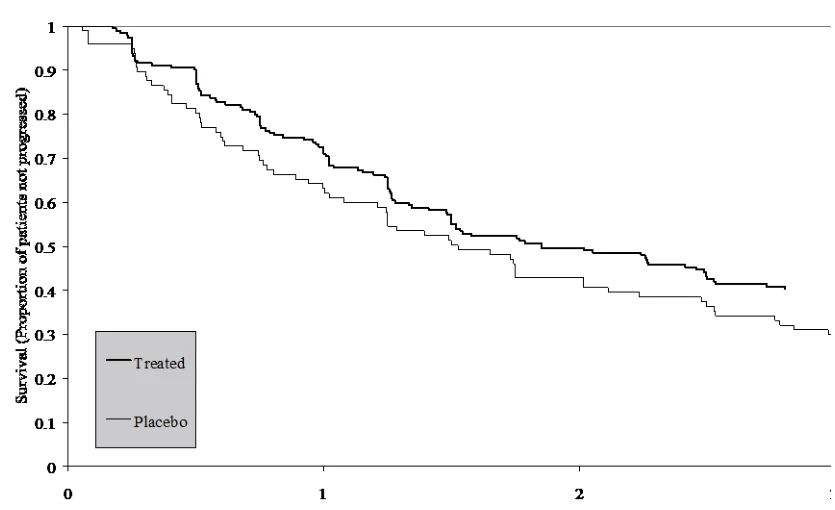
Secondary endpoints:
The three secondary endpoints were exacerbation count per patient, MRI activity and burden of disease.
| Table 21 – Secondary endpoints results | |||||||||||||
| Placebo | REBIF 66 mcg | REBIF 132 mcg | p value 66 mcg vs. placebo | p value 132 mcg vs. placebo | |||||||||
| Exacerbation count per patient at 3 years | 2.05 ± 2.14 | 1.44 ± 1.63 | 1.46 ± 1.68 | <0.001 | <0.001 | ||||||||
| Relapse Rate (number per year) | 0.71 | 0.50 | 0.50 | <0.001 | <0.001 | ||||||||
| T2 Active lesions per patient per scan (median) | 0.67 | 0.20 | 0.17 | <0.0001 | <0.0001 | ||||||||
| T2 New lesions per patient per scan (median) | 0.33 | 0.17 | 0.00 | <0.0001 | <0.0001 | ||||||||
| T2 Newly enlarging lesions per patient per scan (median) | 0.17 | 0.00 | 0.00 | <0.0001 | <0.0001 | ||||||||
| Mean % T2 active scans | 46% | 28% | 24% | <0.001 | <0.001 | ||||||||
| % patients with no T2 active scans during treatment | 24% | 36% | 41% | <0.001 | <0.001 | ||||||||
| % Change in BOD (median) | +10.0 | -0.5 | -1.3 | <0.001 | <0.001 | ||||||||
Both doses of REBIF conferred significant benefits, reducing the relapse rate by approximately 30% (p<0.001), reducing T2 activity by 70-75% (p<0.001), and the percentage change in BOD increased by 10% in the placebo group while decreasing by 1.3% and 0.5% in the low and high dose groups respectively (p<0.001 for both doses compared to placebo).
Allied to the T2 active lesion counts were significant effects of treatment on the proportion of active scans (66% reduction, p<0.001) and the proportion of patients who did not have any active lesions on their scans during the study (71% increase, p<0.001). The comparison of relapsing vs. non-relapsing patients revealed differences in both baseline MR characteristics and on-study behaviour and treatment response.
For the pre-study relapsing group of patients, treatment was more effective on the secondary outcome measures than for the non-relapsing sub-group, as occurred for the primary endpoint.
| Table 22 – Summary of on-study behaviour of Relapsing vs. Non-relapsing patients | ||||||||||||||||||
| Relapsing pre-study | Non-relapsing pre-study | |||||||||||||||||
| Dose of REBIF | 132 mcg | 66 mcg | Placebo | 132 mcg | 66 mcg | Placebo | ||||||||||||
| Total number of patients per group | 98 | 97 | 98 | 106 | 112 | 107 | ||||||||||||
| % progressing at the end of the study | 59 | 56 | 70 | 58 | 63 | 61 | ||||||||||||
| Relapse rate (number per year) | 0.67*** | 0.57*** | 1.08 | 0.36 | 0.43 | 0.39 | ||||||||||||
| T2 activity (median) | 0.17*** | 0.17*** | 1.17 | 0.17* | 0.20 | 0.33 | ||||||||||||
| % Change in BOD (median) | -1.3*** | -1.5*** | 11.8 | -1.4*** | 1.2 | 8.4 | ||||||||||||
| ***: p<0.001, **: p<0.01, *: p<0.05 compared with placebo | ||||||||||||||||||
Tertiary endpoints:
Other relapse related outcome measures including time to first relapse (p=0.032), time between first and second relapse (p=0.002), relapse severity (p=0.049), need for steroid treatment (p=0.005) and need for hospitalisation (p=0.005), were all favourably affected by REBIF 132 mcg treatment. The only relapse related measure which was not significantly affected by 132 mcg therapy was relapse duration.
Composite Score:
In a disorder such as MS, there are often multiple outcomes that may measure different impacts of the disease. These measures may be independent of one another but each may also be important to the overall benefit to the patient. A statistical method exists to combine these measures in one composite score. The value of this measure is that if all outcomes are favourably affected, a strong result is seen while if there are some outcomes with good effect and others without, the composite score will not show a treatment effect. In this study the five outcomes that were combined were time to progression, relapse count, T2 activity, change in BOD and IDSS (Integrated Disability Status Score). The composite score of these outcomes showed a highly significant result (p<0.001) in favour of REBIF at both doses.
Study GF7480 ( ETOMS: Early Treatment of Multiple Sclerosis)
A total of 309 patients with clinically probable or laboratory supported definite MS were randomized in this clinical trial to receive either 22 mcg of REBIF once a week by S.C. injections or matching placebo for 2 years. Patients were to have their first MS attack in the 3 months preceding study entry and have MRI scan strongly suggestive of MS. About 78% of these patients received the allocated treatment during the 2-year study period and 90% remained on study until the end of 2 years. Over 85% of patients stopping blinded study treatment did so after having their second MS attack on study. Very few patients withdrew due to adverse events.
The treatment efficacy was determined by comparing the rate of patients converting to clinically definite MS (CDMS) in the active arm versus placebo. MRI as a measure of disease activity was evaluated by the number of new T2 lesions and the proportion of patients without MRI active scans.
Conversion to CDMS:
A significant reduction in the proportion of patients converting to CDMS was observed in the treated group as compared to placebo (34% versus 45% respectively; p=0.047). The time to the second relapse increased significantly from 252 days in patients treated with placebo to 569 days for patients treated with REBIF (p=0.034). The annual relapse rate was significantly lower in the REBIF group (0.33) as compared to the placebo group (0.43) with a p value of 0.045.
MRI disease measures:
A significant decrease compared with placebo in the number of new T2 lesions was observed in patients treated with REBIF 22 mcg once a week (median 2.0 versus 3.0 respectively; p<0.001). The proportion of patients with no MRI active scan was significantly higher in the REBIF group (16%) than in the placebo group (6%) with a significant statistical difference (p=0.005). No difference between the study groups was observed for T1 active lesions. The total T2 lesion volume as compared to the baseline value increased of 8.8% in the placebo group while a decrease of 13% was observed in patients treated with REBIF 22 mcg once a week; the difference being statistically significant (p=0.002).
Conclusion:
This study demonstrated that 22 mcg of REBIF injected once weekly significantly reduced the risk of a second relapse leading to the conversion to CDMS in patients with a first episode highly suggestive of MS. The clinical benefit was confirmed by a significant impact on MRI lesion activity and accumulation of disease burden.
Study 21125 (EVIDENCE: Evidence for Interferon Dose Effect: European-North American Comparative Efficacy Study)
This was an open-label, randomized, multicenter, parallel-group comparator study. Patients eligible for inclusion were clinically definite or laboratory-supported definite relapsing-remitting multiple sclerosis patients, with EDSS scores ranging from 0 to 5.5, clinically active disease defined as two or more relapses in the previous two years, and had no previous treatment with interferon. Patients were randomized to treatment with either IFN beta-1a 44 mcg three times a week given by s.c. injection (REBIF) or IFN beta-1a 30 mcg qw given by i.m. injection (AVONEX) for a duration of 48 weeks. Neurologists blinded to treatment performed clinical evaluations, and assessors blinded to treatment performed central MRI evaluations. The primary efficacy endpoint was the proportion of patients who remained exacerbation-free at 24 weeks. The principal secondary endpoint was the mean number of combined unique (CU) active MRI lesions per patient per scan defined as T1 or T2 active.
Patient population:
Of the 677 patients randomized, 339 patients received REBIF 44 mcg SC three times a week and 338 patients were assigned to AVONEX® 30 mcg IM once a week (qw). One patient randomized to the AVONEX group did not receive treatment. No statistically significant differences were noted in demographics between the randomized groups. A high percentage of both REBIF and AVONEX patients completed 24 weeks (95.0% and 96.4% respectively) and 48 weeks (92.6% and 93.7% respectively) of treatment.
Efficacy results:
Patients treated with REBIF were significantly more likely to remain relapse free after 24 weeks than patients treated with AVONEX (74.9% vs. 63.3% respectively). The odds ratio adjusted for center was=1.9, p<0.001. Thirty-two percent fewer patients on REBIF relative to AVONEX experienced a new relapse during this 24-week period. After 48 weeks, a significantly higher proportion of REBIF treated patients remained relapse free as compared to the AVONEX treated patients (62% vs 52%, respectively, p=0.009; adjusted odds ratio=1.5, p=0.009).
Time to first relapse was prolonged over the course of the 48 week study for patients treated with REBIF, HR=0.7, 95% CI 0.55-0.88, p=0.003.
Figure 3: Cumulative probability of patients experiencing relapse IFN beta-1a 44 mcg tiw and IFN beta-1a 30 mcg qw
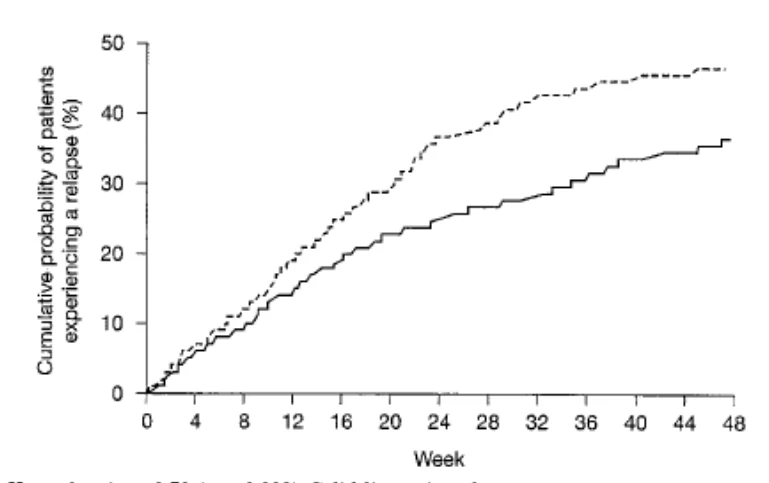

The absolute count of relapses by severity was less for REBIF treated patients compared to AVONEX treated patients for each level of severity. The rate of steroid use to treat relapses for REBIF patients was approximately half that of AVONEX patients during the 24-week period (p=0.004).
The MRI outcome measures provided strong support for the clinical findings There was approximately a one-third relative reduction in MRI CU lesion activity for REBIF compared to AVONEX over the 24-week treatment period (0.8 vs 1.2 respectively, p<0.001). Other MRI activity measures showed similar benefits favoring REBIF over 24 and 48 weeks (p<0.001). The mean number of T1 enhancing and T2 active lesions per patient per scan was significantly reduced in the REBIF group (p<0.001). In addition, the mean proportion of patients with no active scans in the REBIF treated group was significantly higher for CU, T2 and T1 lesion assessments over 24 and 48 weeks (CU, T2, and T1, p<0.001).
Safety results:
Treatment was generally well tolerated in both treatment groups, with the majority of adverse events in both groups considered mild. The most common adverse events experienced in this study were well described consequences of IFN administration. They included flu-like symptoms (42% on REBIF and 49% on AVONEX; p = 0.089), injections site disorders (83% for REBIF and 28% for AVONEX; p<0.001), hepatic dysfunction (18% on REBIF and 10% on AVONEX; p=0.002), and leukopenia (6% on REBIF and <1% on AVONEX; p<0.05).
There were 21 patients that experienced serious adverse events in the REBIF group (6%) and 18 in the AVONEX group (5%), and 9 of the events were considered related to treatment. Treatment discontinuation because of adverse events occurred in 16 of the REBIF patients (4.7%) and 14 of the AVONEX patients (4.2%).
Conclusion:
This randomized controlled study demonstrated a greater efficacy of REBIF compared with AVONEX on both relapse and MRI outcomes over 48 weeks. Despite considerable differences in dosing regimens, the overall safety profiles of the treatments were similar with differences noted only in the incidence of specific safety events, and there was no dose-limiting toxicity.
Study 25632 (REBIF HSA-free Formulation)
This was a multi-national, 96-week, single-arm, open-label study, with patients treated with the HSA-free Formulation of REBIF three times a week. The primary objective of the study was to compare the immunogenicity of the FBS-free/HSA-free interferon-beta-1a (REBIF) formulation (RNF) to historical data. Patients with a relapsing form of MS according to the McDonald criteria, an EDSS<6.0 and no prior interferon beta therapy were enrolled.
The data from study 25632 (“REBIF HSA-free Formulation Cohort”) is compared to historical data from the 44 mcg three times a week treatment arms of studies 6789 (PRISMS), 6954 (SPECTRIMS) and 21125 (EVIDENCE) (collectively referred to as the “Historical Cohort”). These studies were selected for comparison as they were pivotal controlled studies in patients with MS and included a treatment arm with identical dosing and route of administration. In study 21125, REBIF was also supplied in an identical format, pre-filled syringes. Studies 6789 and 21125 were conducted only in a relapsing MS population and study 6954 was conducted in an SPMS (with or without superimposed relapses) population.
Subject Disposition:
A total of 282 subjects were screened for trial entry, of whom 260 were enrolled between 25 Jan 2005 and 6 Jun 2005. All 260 enrolled subjects received trial medication and were included in the REBIF HSA-free Formulation Cohort Safety Population; one had no post-baseline NAb data and was therefore excluded from the ITT Population. Considering the REBIF HSA-free Formulation Cohort Safety Population, 207 subjects (79.6%) completed treatment and 224 subjects (86.2%) completed the trial. Adverse events were the most frequent reason for early discontinuation.
Demographics and Baseline Characteristics:
The median age of the 260 enrolled subjects in the REBIF HSA-free Formulation Cohort was 34 (range: 18 to 58), and the majority of the subjects (71.5%) were female, which is consistent with the MS population. Almost all of the subjects were White (253/260 [97.3%]). The majority of subjects had RRMS (97.3%), while 6 subjects had SPMS with superimposed relapses and one subject had PPMS. Duration of MS varied across the subjects with a median of 5.45 years (range: 0.2 to 33.2).
Seven hundred and twenty-seven (727) subjects treated with interferon beta-1a 44 mcg three times a week were included in the Historical Cohort (Studies 6789, 6954 and 21125). The median age of subjects in the REBIF HSA-free Formulation Cohort was similar compared to Study 6789 and lower compared to Study 6954 (this is expected as this was an SPMS population) and Study 21125. Sex and race were similar between the REBIF HSA-free Formulation and Historical Cohorts. Studies 6789 (n=184) and 21125 (n=339) enrolled subjects with RRMS (median EDSS scores: 2.48 and 2.34, respectively). Study 6954 (n=204) enrolled subjects with SPMS (median EDSS scores: 5.35).
Primary Endpoint Analysis:
At Week 96 or last assessment, 45 subjects (17.4%) were Nab positive. Immunogenicity results were comparable with historical REBIF studies; the proportion of subjects NAb-free at Week 96 was similar or better than that observed in previous trials.
Safety Results:
No new or unexpected safety concerns were identified during 96 weeks of study 25632. Adverse events reported over 96 weeks were consistent with those reported by the Historical Cohort.
Overall, 247 of the 260 subjects (95.0%) in the REBIF HSA-free Formulation Cohort experienced 1979 AEs. The system organ classes with the largest proportion of treatment emergent AEs were “general disorders and administration site conditions” (223 subjects, 611 events) and “nervous system disorders” (123 subjects, 316 events). The majority of adverse events in the REBIF HSA-free Formulation Cohort were mild (86.5%) or moderate (60.8%) in severity, and the majority of AEs were classified as possibly (70.8%) or probably related to treatment (52.7%).
Fifteen of the 260 subjects (15/260 [5.8%]) in the REBIF HSA-free Formulation Cohort experienced 20 SAEs. One event reported as serious in more than one subject was depression (3 events in 3 subjects). The system organ classes with the largest proportion of SAEs were injury, poisoning and procedural complications (5 events in 5 subjects), psychiatric disorders (4 events in 4 subjects), reproductive system and breast disorders (3 events in 3 subjects) and gastrointestinal disorders (2 events in 2 subjects); for other SOCs, serious events were reported in no more than one subject. Five of the 20 SAEs experienced by the REBIF HSA-free Formulation Cohort were considered possibly or probably related, and 15 events were considered unlikely or unrelated to treatment. No deaths were reported during this trial.
Thirty-one subjects (11.9%) discontinued treatment permanently because of adverse events, citing a total of 52 events as reasons for treatment discontinuation. A further 3 subjects became pregnant during the trial and consequently stopped treatment (one underwent an induced abortion and the other two gave birth to healthy children). Influenza-like symptoms and laboratory abnormalities known to be associated with interferon-beta treatment (elevations in liver function tests and cytopenia) were prominent among reasons for discontinuation. Two subjects discontinued treatment because of local injection site symptoms.
To facilitate the analysis of the safety data, adverse events commonly associated with IFN-β were prospectively classified into a series of pre-specified AE groups of related MedDRA preferred terms which best represented the AE of interest. These pre-specified AE groups were defined as “injection site reactions”, “flu-like syndrome”, “cytopenias”, “hepatic disorders”, “thyroid disorders”, “depression and suicidal ideation”, “skin rashes” and “hypersensitivity reactions”. For “hepatic disorders” the Standard MedDRA Query was used adapted to the study population. The pre-specified AE group “flu-like syndrome” included all reports of “influenza-like illness” as well as at least two pre-specified preferred terms representing typical flu-like symptoms occurring concomitantly, i.e. within a 48-hour interval. The frequencies of these pre-specified AE groups for the REBIF HSA-free Formulation Cohort were compared to those reported by the Historical Cohort during 96 weeks of treatment.
Table 23 – Pre-specified Treatment Emergent Adverse Events reported up to Week 96 or Month 24 for both the REBIF HSA-free Formulation Cohort and the Historical Cohort
Pre-specified group
25632 REBIF HSA-free 44 mcg THREE TIMES A WEEK Subjects (n=260) n (%)
6789 REBIF 44 mcg THREE TIMES A WEEK Subjects (n=184) n (%)
6954 REBIF 44 mcg THREE TIMES A WEEK Subjects (n=204) n (%)
21125 REBIF 44 mcg THREE TIMES A WEEK Subjects (n=339) n (%)
Cytopenia
35 (13.5)
71 (38.6)
81 (39.7)
44 (13.0)
Depression and Suicidal Ideation
17 (6.5)
55 (29.9)
74 (36.3)
77 (22.7)
Flu Like Syndrome
186 (71.5)
127 (69.0)
113 (55.4)
166 (49.0)
Hepatic Disorders
37 (14.2)
70(38.0)
67 (32.8)
63 (18.6)
Hypersensitivity Reactions
15 (5.8)
22 (12.0)
19 (9.3)
19 (5.6)
Injection Site Reaction (ISR)
80 (30.8)
170 (92.4)
176 (86.3)
291 (85.8)
Skin Rashes
16 (6.2)
44(23.9)
52 (25.5)
56 (16.5)
Thyroid Disorders
11 (4.2)
16 (8.7)
10 (4.9)
25 (7.4)
Injection tolerability is a key factor in treatment compliance, especially for a product, which must be administered chronically, where injection site reactions are a frequent cause of treatment discontinuation. The development of the REBIF HSA-free Formulation has focused on improving injection site tolerance through targeted formulation enhancements. A near 3-fold improvement in local tolerability was observed following administration of the new formulation when compared to historical data. After 96 weeks of treatment, the REBIF HSA-free Formulation Cohort experienced a much lower rate for the pre-specified AE group “injection site reactions” (30.8%) than the Historical Cohort (85.8% to 92.4% ).
Overall, 226 subjects (86.9%) in the REBIF HSA-free Formulation Cohort experienced at least one “pre-specified” adverse event. Events related to the flu-like syndrome were reported in 71.5% of REBIF HSA-free Formulation subjects and in 69.0%, 55.4% and 49.0% of subjects in protocols 6789, 6954 and 21125 respectively. Local injection site reactions were 30.8% of subjects in the REBIF Cohort compared with 85.8% to 92.4% in the historical trials. Events related to depression and suicidal ideation affected 6.5% of REBIF HSA-free Formulation subjects compared with 22.7% to 36.3% in the historical trials. Rates of cytopenia and hepatic disorders in the REBIF New HSA-free Formulation Cohort were 13.5% for REBIF HSA-free Formulation, 13.0% for 21125, 38.6% for 6789 and 39.7% for 6954; hepatic disorders: 14.2% for REBIF HSA-free Formulation, 18.6% for 21125, 38.0% for 6789 and 32.8% for 6954. Skin rashes were 6.2% in the REBIF HSA-free Formulation group and 16.5% - 25.5% in historical populations. Rates of hypersensitivity reactions and thyroid disorders observed in the REBIF HSA-free Formulation group were similar to those seen in the previous trials (hypersensitivity reactions: 5.8% for REBIF HSA-free Formulation and 5.6% to 12.0% in historical groups; thyroid disorders: 4.2% for REBIF HSA-free Formulation and 4.9% to 8.7% in historical trials).
Most of the laboratory parameters remained constant and within normal limits during the 96 weeks of treatment. The distribution of the haematology and biochemistry worst post-baseline CTCAE grades shift analyses from baseline to Week 96 were similar between the REBIF HSA-free Formulation Cohort and the Historical Cohort. The majority of worst post-baseline CTCAE grades for haematology and biochemistry parameters were Grade 0 or 1, but a low frequency of grade 2 to 4 haematological toxicity, principally neutropenia, and hepatic transaminase elevation was observed, comparable to that of the Historical Cohort.
Conclusions:
Safety data generated during 96 weeks of treatment in study 25632 indicate that the new HSA-free formulation of IFN-β-1a possesses a safety profile qualitatively similar to that of the previously marketed HSA-containing REBIF formulation, represented by the Historical Cohort.
Study 27025 (REFLEX: REBIF Flexible Dosing in Early Multiple Sclerosis)
One randomized, double-blind, placebo-controlled clinical trial with REBIF HSA-free formulation was performed in patients with a single clinical demyelinating event at high risk of conversion to multiple sclerosis (MS) over 24 month treatment period. Subjects eligible for the trial were 18 to 50 years old with an EDSS of ≤ 5.0, presented with a single, first clinical event suggestive of MS within 60 days after the onset and at least two clinically silent lesions on the T2-weighted MRI scan, with a size of at least 3 mm, of which at least one was required to be ovoid or periventricular or infratentorial. Any disease other than multiple sclerosis that could better explain signs and symptoms of the patient had to be excluded. Patients were randomized (1:1:1) to either REBIF 44 mcg given subcutaneously three times per week (n=171), REBIF 44 mcg once weekly (ow) (n=175), or placebo (n=171). Upon conversion to clinically definite multiple sclerosis (CDMS), patients were re-titrated to the recommended dose of REBIF 44 mcg three times a week in an open label manner, while maintaining blinding as to initial randomization.
Efficacy Results:
The primary efficacy endpoint (Time to conversion to McDonald MS), the main secondary clinical endpoint (Time to conversion to CDMS) and the MRI-based efficacy endpoint (Mean Number of CUA lesions) were tested by primary analyses using a 2-sided log rank test at the 0.05 significance level stratified by the randomization stratification factors (age group, steroid use, presence/absence of Gd-enhancing lesions and classification of first clinical demyelinating event). A hierarchical approach based on the significance of the relevant confirmatory test was applied, comparing RNF 44 mcg three times a week vs. Placebo for:
- 1) Time to conversion to McDonald MS;
- 2) Time to conversion to CDMS;
- 3) Mean number of combined unique active MRI lesions per subject per scan.
The secondary analysis for both endpoints was the estimate of the treatment effect estimated by hazard ratios using an adjusted Cox’s proportional hazards model including treatment and the randomization stratification factors as covariates. The main MRI-based secondary endpoint was the mean number of CUA MRI lesions per subject per scan using a non-parametric analysis of variance (ANOVA) on ranks model including treatment and randomization stratification factors as covariates.
Primary Efficacy Endpoint: Time to Conversion to McDonald MS (2005 criteria)
A subject was considered to have converted to MS according to the 2005 McDonald criteria if, following the first clinical demyelinating event, there was evidence of dissemination in space and in time based on a clinical event or on clinical data and MRI.
Over 24 months, RNF 44 mcg three times a week delayed the progression to McDonald from the first clinical event compared to Placebo. The risk reduction was 51% (HR = 0.49, 95% CI [0.38, 0.64]) for RNF 44 mcg three times a week compared to Placebo (Log-rank test: p<0.001).
Based on KM estimates, the cumulative probability of conversion to McDonald MS over 24 months was 85.8% in the Placebo group compared to 62.5% in the RNF 44 mcg three times a week. The median time for conversion to McDonald MS was 97 and 310 days in the Placebo and the RNF 44 mcg three times a week groups, respectively.
Main Secondary Clinical Efficacy Endpoint: Time to Conversion to CDMS
Time to conversion to CDMS was defined by either a second attack or a 3-month sustained increase (≥ 1.5 points) in the EDSS score.
Over 24 months, RNF 44 mcg three times a week delayed the progression to CDMS compared to Placebo. The risk reduction was 52% (HR = 0.48, 95% CI [0.31, 0.73]) for RNF 44 mcg three times a week compared to Placebo.
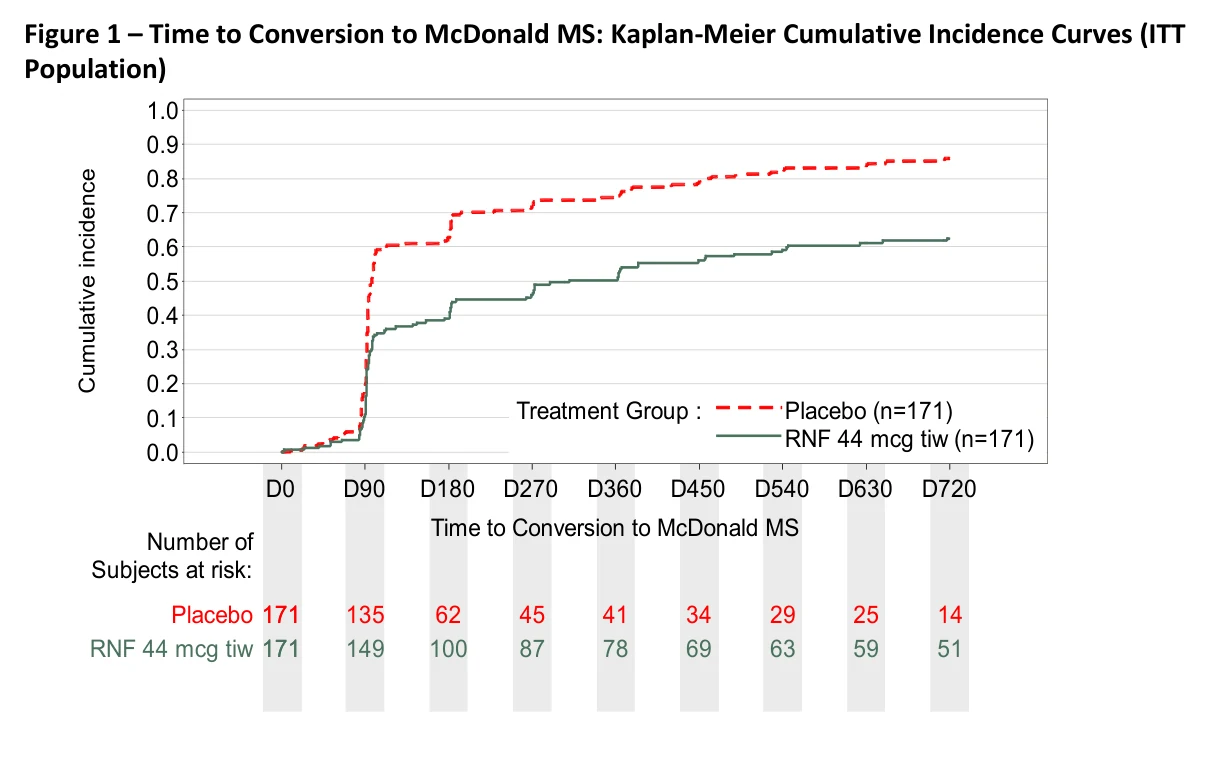
Figure 1 – Time to Conversion to McDonald MS: Kaplan-Meier Cumulative Incidence Curves (ITT Population)
Based on KM estimates, the probability of the development of CDMS over 2 years was 37.5% in the Placebo group compared to 20.6% in the RNF 44 mcg three times a week. The median time was not reached.
Main MRI-based Efficacy Endpoint: Mean Number of CUA Lesions Per Subject Per Scan
CUA lesions per subject per scan provides the most comprehensive information on lesion activity in the brain of MS subjects by integrating both T2 weighted and post-Gd weighted T1 image information. At the end of the double-blind period, the mean number (SE) of CUA lesions was 0.50 ± 0.06 and 2.59 ± 0.30 for RNF 44 mcg three times a week and Placebo groups, respectively. Rate ratio and 95% CI was 0.19 (0.14; 0.26) (p<0.001, non-parametric ANOVA).
| Table 24 – Efficacy Results from Study 27025 up to 24 Month Period | |||||||||||
| Parameter Statistics | Treatment | Treatment Comparison | |||||||||
| Placebo (n=171) | RNF 44 mcg three times a week** (n=171) | RNF 44 mcg three times a week versus Placebo | |||||||||
| McDonald Conversion | |||||||||||
| Number of events | 144 | 106 | |||||||||
| KM Estimate (a) | 85.8% | 62.5% | |||||||||
| Median Time (days) | 97 | 310 | |||||||||
| Risk Reduction | 51% | ||||||||||
| Hazard Ratio [95% CI] (b) | 0.49 [0.38;0.64] | ||||||||||
| Log-rank p-value (c) | <0.001 | ||||||||||
| (a) Kaplan-Meier estimate of the cumulative probability of developing McDonald MS (or CDMS) over 2 years | |||||||||||
| (b) Multivariate Cox's proportional hazards model with treatment and randomization stratification factors as covariates | |||||||||||
| (c) Stratified Chi-square log-rank test controlling for randomization stratification factors | |||||||||||
16. Non-Clinical Toxicology
General toxicology
The following studies are based on the original REBIF formulation (HSA formulation).
Acute Toxicity
In formal single dose tests in the mouse and rat, REBIF doses of 37 mcg/kg and 73 mcg/kg administered by intravenous or intramuscular route showed no effects during life or at autopsy.
In a similar experiment in cynomolgus monkeys, REBIF doses of 73 mcg/kg IV or IM produced only a 1-2°C rise in rectal temperature from 2 to 7 hours. No other effects were seen in the acute studies.
Repeated Dose Toxicity
All these experiments have been affected by the development of neutralizing antibodies against Interferon beta-1a (and the HSA carrier protein in the formulation).
In the rat, the principal findings were of local trauma at the sites of the repeated injections and of higher titre antibodies against HSA than against Interferon beta-1a by week 4, and increasing in incidence at week 13. The experiment using the IV route was marred by a number of accidental deaths mainly due to respiratory infection probably associated with tail (injection site) damage. Injection site lesions occurred in all groups, including the control group, and may have been possibly consequent on several factors, including needle trauma and a local allergic reaction to heterologous proteins (Interferon beta-1a and/or HSA) which predisposed to local infection with daily venipuncture. The infections spread then to the lungs (bacterial emboli). The studies in the cynomolgus monkeys showed brief pyrexia on day 1 after all IV doses (0.917 mcg - 3.67 mcg/kg), which was not present subsequently. The other findings were of anti-HSA and anti Interferon beta-1a antibodies appearing by week 4, and local trauma at the injection sites in all groups, including controls. No other findings were recorded.
Genotoxicity
REBIF has been shown to be neither mutagenic nor clastogenic.
Reproductive and developmental toxicology
A teratology study in monkeys was performed showing that REBIF is not teratogenic. An increased risk of abortion has been attributed to interferons, based on observations with interferon alpha and interferon beta-1b. No information is available on the effects of the interferon beta-1a on male fertility.
In addition, a single dose toxicity study in Cynomolgus monkeys and a local tolerability study in rabbits were conducted using the new formulation (HSA-free drug substance and HSA-free drug product, respectively). These studies did not reveal any additional toxicity concerns.