


Product Monograph - Retevmo
Recent Major Label Changes
| 1 Indications | 2025/07 |
|---|---|
| 1 Indications, 1.1 Pediatrics | 2026/10 |
| 1 Indications, 1.2 Geriatrics | 2024/10 |
| 4 Dosage and Administration, 4.1 Dosing Considerations | 2025/01 |
| 4 Dosage and Administration, 4.4 Administration | 2026/02 |
| 6 Dosage Forms, Strengths, Composition and Packaging | 2026/02 |
| 7 Warnings and Precautions, Carcinogenesis and Genotoxicity, Endocrine and Metabolism, Monitoring and Laboratory Tests, Respiratory, Reproductive Health | 2025/01 |
| 7 Warnings and Precautions, Cardiovascular, Hepatic/Biliary/Pancreatic, Immune | 2025/07 |
| 7 Warnings and Precautions, 7.1 Special Populations, 7.1.1 Pregnancy | 2026/10 |
TABLE OF CONTENTS
Sections or subsections that are not applicable at the time of authorization are not listed.
Recent Major Label Changes .................................................................................................... 2
Part 1: Health Professional Information .................................................................................. 5
1 Indications ...................................................................................................................... 5
1.1 Pediatrics .............................................................................................................. 5
1.2 Geriatrics .............................................................................................................. 5
2 Contraindications ........................................................................................................... 5
3 Serious Warnings and Precautions Box ...................................................................... 6
4 Dosage and Administration .......................................................................................... 6
4.1 Dosing Considerations ......................................................................................... 6
4.2 Recommended Dose and Dosage Adjustment .................................................... 6
4.4 Administration ....................................................................................................... 9
4.5 Missed Dose ......................................................................................................... 9
5 Overdose ......................................................................................................................... 9
6 Dosage Forms, Strengths, Composition, and Packaging ........................................ 10
7 Warnings and Precautions .......................................................................................... 10
Carcinogenesis and Genotoxicity ................................................................................... 10
Cardiovascular ............................................................................................................... 11
Driving and Operating Machinery ................................................................................... 12
Endocrine and Metabolism ............................................................................................. 12
Hematologic ................................................................................................................... 12
Hepatic/Biliary/Pancreatic .............................................................................................. 12
Immune .......................................................................................................................... 12
Impaired Wound Healing ................................................................................................ 12
Monitoring and Laboratory Tests ................................................................................... 13
Reproductive Health ....................................................................................................... 13
Respiratory ..................................................................................................................... 14
Tumor Lysis Syndrome .................................................................................................. 14
7.1 Special Populations ............................................................................................ 14
7.1.1 Pregnancy ...................................................................................................... 14
7.1.2 Breastfeeding ................................................................................................. 14
7.1.3 Pediatrics (<18 years of age) ......................................................................... 14
7.1.5 Patients with Hepatic Impairment ................................................................... 15
7.1.6 Patients with Renal Impairment ...................................................................... 15
8 Adverse Reactions ....................................................................................................... 15
8.1 Adverse Reaction Overview ............................................................................... 15
8.2 Clinical Trial Adverse Reactions ......................................................................... 16
8.2.1 Clinical Trial Adverse Reactions - Pediatrics .................................................. 24
8.3 Less Common Clinical Trial Adverse Reactions ................................................. 24
8.3.1 Less Common Clinical Trial Adverse Reactions - Pediatrics .......................... 26
8.4 Abnormal Laboratory Findings: Hematologic, Clinical Chemistry and Other Quantitative Data ........................................................................................................... 26
8.5 Post-Market Adverse Reactions ......................................................................... 30
9 Drug Interactions ......................................................................................................... 30
9.2 Drug Interactions Overview ................................................................................ 30
9.4 Drug-Drug Interactions ....................................................................................... 30
9.5 Drug-Food Interactions ....................................................................................... 36
9.6 Drug-Herb Interactions ....................................................................................... 37
9.7 Drug-Laboratory Test Interactions ...................................................................... 37
10 Clinical Pharmacology ................................................................................................. 37
10.1 Mechanism of Action .......................................................................................... 37
10.2 Pharmacodynamics ............................................................................................ 37
10.3 Pharmacokinetics ............................................................................................... 38
11 Storage, Stability and Disposal .................................................................................. 40
12 Special Handling Instructions ..................................................................................... 40
Part 2: Scientific Information .................................................................................................. 41
13 Pharmaceutical Information ........................................................................................ 41
- 14.
Clinical Trials ................................................................................................................ 41
14.1 Clinical Trials by Indication ................................................................................. 41
Metastatic RET Fusion-Positive Non-Small Cell Lung Cancer....................................... 41
RET-Mutant Medullary Thyroid Cancer .......................................................................... 47
RET Fusion-Positive Thyroid Cancer ............................................................................. 54
14.2 Comparative Bioavailability Studies of the Product Monograph ......................... 55
15 Microbiology ................................................................................................................. 56
16 Non-Clinical Toxicology .............................................................................................. 56
Patient Medication Information .............................................................................................. 59
Part 1: Health Professional Information
1 Indications
RETEVMO (selpercatinib) is indicated as monotherapy for the treatment of:
- metastatic RET fusion-positive non-small cell lung cancer (NSCLC) in adult patients,
- RET-mutant medullary thyroid cancer (MTC) in adult and pediatric patients 12 years of age and older with unresectable advanced or metastatic disease,
- RET fusion-positive differentiated thyroid carcinoma in adult patients with advanced or metastatic disease (not amenable to surgery or radioactive iodine therapy) following prior treatment with sorafenib and/or lenvatinib.
Treatment with RETEVMO should only be initiated following confirmation of a RET gene fusion or mutation using a validated test (see 14 Clinical Trials).
Promising clinical effectiveness of RETEVMO for the above indications is based on objective response rates (ORR) and duration of responses (DOR) from LIBRETTO-001, a multi-center, multi-cohort, open-label, Phase 1/2 trial in patients with specific genetic alterations in RET and from LIBRETTO-121, a multicenter, open-label, Phase 1/2 trial in patients ≤20 years of age with advanced solid tumors harboring an activating RET alteration. Further clinical information with regards to progression-free survival (PFS) were available from LIBRETTO-431 and LIBRETTO-531, multicenter, randomized, open-label Phase 3 trials for patients with NSCLC or MTC (see 14 Clinical Trials).
1.1 Pediatrics
Pediatrics (12-17 years of age): Based on the data submitted and reviewed by Health Canada, the safety and efficacy of RETEVMO has been established in adolescent patients 12-17 years of age with unresectable advanced or metastatic RET-mutant medullary thyroid cancer (see 7.1.3 Pediatrics [<18 years of age]).
Pediatrics (<12 years of age): Health Canada has not authorized an indication for use in patients <12 years of age (see 7.1.3 Pediatrics [<18 years of age]).
1.2 Geriatrics
Geriatrics (≥65 years of age) Of the 837 patients in the safety database who received RETEVMO in LIBRETTO-001, 34% (287 patients) were ≥65 years of age and 10% (80 patients) were ≥75 years of age. No overall differences were observed in the safety or effectiveness of RETEVMO between patients who were ≥65 years of age and younger patients.
2 Contraindications
RETEVMO is contraindicated in patients who are hypersensitive to this drug or to any ingredient in the formulation, including any non-medicinal ingredient or component of the container. For a complete listing, see 6 Dosage Forms, Strengths, Composition and Packaging.
3 Serious Warnings and Precautions Box
Serious Warnings and Precautions
RETEVMO should only be prescribed and supervised by a qualified health professional experienced in the use of anti-cancer agents. |
|---|
4 Dosage and Administration
4.1 Dosing Considerations
- Confirm the presence of a RET gene fusion (for patients with NSCLC or thyroid cancer) or a RET gene mutation (for patients with MTC) using a validated test before starting treatment with RETEVMO.
- Patient blood pressure is to be optimized before starting RETEVMO.
- Reduce RETEVMO dose in patients with severe hepatic impairment (see 4.2 Recommended Dose and Dosage Adjustment).
- Assess QT interval and serum electrolytes at baseline and periodically during treatment (see 7 Warnings and Precautions).
4.2 Recommended Dose and Dosage Adjustment
The recommended dosage of RETEVMO is based on body weight:
- Less than 50 kg: 120 mg twice daily
- 50 kg or greater: 160 mg twice daily
RETEVMO is administered orally approximately every 12 hours until disease progression or unacceptable toxicity.
Patients with severe hepatic impairment (Child-Pugh C) (less than 50 kg or 50 kg or greater) should receive a reduced dose of 80 mg twice daily (see 10.3 Pharmacokinetics, Special Populations and Conditions) and monitor ALT and AST more frequently as clinically indicated.
Health Canada has not authorized an indication for use in children <12 years of age (see 1 Indications).
Dosage Modifications for Adverse Reactions
Table 1 provides dose modifications for QT interval prolongation, increased aspartate aminotransferase (AST) or alanine aminotransferase (ALT), hypersensitivity, hypertension, hemorrhagic events, interstitial lung disease/pneumonitis and other Grade 3 or 4 adverse reactions.
The RETEVMO dosage recommendations per dose reduction level, for the management of these adverse reactions, are provided in Table 2. Permanently discontinue RETEVMO in patients unable to tolerate the third dose reduction level.
Table 1 - Recommended RETEVMO Dosage Modifications for Adverse Reactions
| Event | Grade* | Dose Modification | |
|---|---|---|---|
| Event | Grade* | Dose Modification | |
| QT Interval Prolongation | Grade 3 |
| |
| Grade 4 or if patient has signs or symptoms of serious arrhythmia |
| ||
| AST/ALT Increase | Grade 3 and Grade 4 |
| |
| Hypersensitivity | All Grades |
| |
| |||
| Hypertension | Grade 3 |
| |
| Grade 4 |
| ||
| Hemorrhagic Events | Grade 3 or Grade 4 |
| |
| ILD/Pneumonitis | Grade 2 that does not return to baseline or Grade 1 within 7 days despite maximal supportive measures |
| |
| Grade 3 or Grade 4 |
| ||
| Other Adverse Reactions | Grade 3 or Grade 4 |
| |
*Severity as defined by National Cancer Institute Common Terminology Criteria for Adverse Events (NCI CTCAE).
Table 2 - Recommended RETEVMO Dosage per Dose Reduction Level for the Management of Adverse Reactions
| Dose Reduction levels | Recommended RETEVMO Dosage | |
| Patients Weighing Less Than 50 kg | Patients Weighing 50 kg or Greater | |
| First | 80 mg orally twice daily | 120 mg orally twice daily |
| Second | 40 mg orally twice daily | 80 mg orally twice daily |
| Third | 40 mg orally once daily | 40 mg orally twice daily |
Dosage Modifications for Concomitant Use of Strong or Moderate CYP3A4 Inhibitors
Avoid concomitant use of strong or moderate CYP3A4 inhibitors with RETEVMO. If concomitant use of a strong or moderate CYP3A4 inhibitor cannot be avoided, reduce the current RETEVMO dose as recommended in Table 3 and monitor the QTc interval more frequently with ECGs. After the inhibitor has been discontinued for 3 to 5 elimination half-lives of the inhibitor, resume RETEVMO at the dose taken before starting the CYP3A4 inhibitor (see 9.4 Drug-Drug Interactions and 10.3 Pharmacokinetics).
Table 3 - Recommended RETEVMO Dosage for Concomitant Use of Strong or Moderate CYP3A Inhibitors
| Current RETEVMO Dosage | Recommended RETEVMO Dosage | ||||
With a Moderate CYP3A Inhibitor | With a Strong CYP3A Inhibitor | ||||
| 120 mg orally twice daily | 80 mg orally twice daily | 40 mg orally twice daily | |||
| 160 mg orally twice daily | 120 mg orally twice daily | 80 mg orally twice daily | |||
There is no data on the safety of concomitant use of CYP3A inhibitors in patients whose RETEVMO dose was previously reduced due to adverse reactions.
Dosage Modifications for Concomitant Use of Acid-Reducing Agents
Avoid concomitant use of a proton pump inhibitor, a histamine-2 (H2) receptor antagonist, or a locally acting antacid with RETEVMO (see 9.4 Drug-Drug Interactions). If concomitant use cannot be avoided,
- RETEVMO should be taken with food when co-administered with a proton pump inhibitor.
- RETEVMO should be taken 2 hours before or 10 hours after administration of an H2 receptor antagonist.
- RETEVMO should be taken 2 hours before or 2 hours after administration of a locally acting antacid.
4.4 Administration
RETEVMO can be taken with or without food unless coadministered with a proton pump inhibitor (see 4.2 Recommended Dose and Dosage Adjustment).
Patients should swallow the capsule or tablet whole. Do not crush or chew the capsule or tablet.
4.5 Missed Dose
If the patient misses a dose of RETEVMO, the patient should take the next dose at the next scheduled time, unless it is more than 6 hours until the next scheduled dose.
If the patient vomits after taking a dose of RETEVMO, the patient should not take an additional dose. The patient should take the next dose at the next scheduled time. The patient should not take 2 doses at the same time to make up for the missed dose.
5 Overdose
There is no known antidote for RETEVMO. The treatment of overdose of RETEVMO should consist of general supportive measures. ECG monitoring is recommended.
| For the most recent information in the management of a suspected drug overdose, contact your regional poison control centre or Health Canada's toll-free number, 1-844 POISON-X (1-844-764-7669). |
|---|
6 Dosage Forms, Strengths, Composition, and Packaging
Table 4 - RETEVMO Dosage Forms, Strengths, Composition
| Route of Administration | Dosage Form / Strength/Composition | Non-medicinal Ingredients |
| Oral | capsule 40 mg, 80 mg | Black iron oxide, colloidal silicon dioxide, FD & C Blue No. 1 (80 mg capsule only), gelatin, microcrystalline cellulose, pharmaceutical grade printing ink, titanium dioxide |
| tablet 40 mg, 80 mg | Croscarmellose Sodium, Hydroxypropyl Cellulose, Mannitol, Microcrystalline Cellulose, Sodium Stearyl Fumarate Film coating material contains ferrosoferric oxide, polyvinyl alcohol, polyethylene glycol, titanium dioxide, and talc. Additionally, the film coating of the 80 mg tablets contain ferric oxide. |
Description
Capsules:
- The 40 mg capsules are grey opaque hard gelatin capsules (size 2) with black printing of “Lilly 3977” and “40 mg” on the body of the capsule. They are supplied in 75 mL bottles of 60 capsules.
- The 80 mg capsules are blue opaque hard gelatin capsules (size 0) with black printing of “Lilly 2980” and “80 mg” on the body of the capsule. They are supplied in 125 mL bottles of 60 capsules and 190 mL bottles of 120 capsules.
Tablets:
All tablet strengths are supplied in 75 mL bottles each containing 60 tablets.
- The 40 mg tablets are light grey, film coated, round tablets debossed with “5340” on one side and “Ret 40” on the other.
- The 80 mg tablets are dark red-purple, film coated, round tablets debossed with “6082” on one side and “Ret 80” on the other.
7 Warnings and Precautions
Please see 3 Serious Warnings and Precautions Box.
Carcinogenesis and Genotoxicity
In a 2-year study assessing carcinogenicity in rats, vaginal tumors were observed in 5% of female rats administered with a dose of 40 mg/kg of selpercatinib (approximately 1 times the clinical exposure by AUC at the 160 mg twice daily dose) (see 16 Non-Clinical Toxicology).
Cardiovascular
QTc Interval Prolongation: RETEVMO causes concentration-dependent QTc interval prolongation (see 8.4 Abnormal Laboratory Findings: Hematologic, Clinical Chemistry and Other Quantitative Data). QTc interval prolongation can lead to an increased risk of ventricular arrhythmias including torsade de pointes. The use of RETEVMO should be avoided in patients with conditions that may increase the risk of experiencing torsade de pointes.
Torsade de pointes is a polymorphic ventricular tachyarrhythmia. Generally, the risk of torsade de pointes increases with the magnitude of QTc prolongation produced by the drug. If sustained, torsade de pointes can progress to ventricular fibrillation and sudden cardiac death.
Risk factors for torsade de pointes in the general population include, but are not limited to, the following: female gender, age ≥65 years, baseline prolongation of the QTc interval, presence of genetic variants affecting cardiac ion channels or regulatory proteins (especially congenital long QT syndromes), family history of sudden cardiac death at <50 years of age, cardiac disease (e.g., myocardial ischemia or infarction, congestive heart failure, cardiomyopathy, conduction system disease), history of arrhythmias, electrolyte disturbances (e.g., hypokalemia, hypomagnesemia, hypocalcemia), conditions leading to electrolyte disturbances (e.g., persistent vomiting, eating disorders), bradycardia, acute neurological events (e.g., intracranial or subarachnoid hemorrhage, stroke, intracranial trauma), diabetes mellitus, and autonomic neuropathy.
Combination use of RETEVMO with other drugs known to prolong the QTc interval and/or strong or moderate CYP3A inhibitors should be avoided, as this may lead to further prolongation of the QTc interval. Use caution if RETEVMO is administered in combination with agents known to cause bradycardia (e.g., beta-blockers, non-dihydropyridine calcium channel blockers, clonidine, and digoxin) or drugs that can decrease electrolytes (see 9 Drug Interactions). Monitor the QTc interval more frequently in these patients (see 7 Warnings and Precautions, Monitoring and Laboratory Tests).
Patients must have a QTcF interval of ≤470 ms and serum electrolytes within normal range before starting RETEVMO treatment. Perform electrocardiograms and measure serum electrolytes before starting RETEVMO treatment and during treatment. Treatment with RETEVMO should be avoided in patients with uncorrected hypokalemia, hypomagnesemia, or hypocalcemia (see 7 Warnings and Precautions, Monitoring and Laboratory Tests).
Interruption and dose reduction or permanent discontinuation of RETEVMO may be required based on the severity of QTc interval prolongation (see 4.2 Recommended Dose and Dosage Adjustment).
Hypertension: Hypertension occurred in 43% to 48% of patients treated with RETEVMO, including Grade 3 or 4 hypertension in 19% to 20% of patients (see 8 Adverse Reactions). Hypertension was most commonly managed through concomitant anti-hypertension medications.
Patient blood pressure is to be optimized before starting RETEVMO. Monitor blood pressure during RETEVMO treatment. Based on the level of increased blood pressure, RETEVMO may require dose modification (see 4.2 Recommended Dose and Dosage Adjustment). Permanently discontinue RETEVMO if medically significant hypertension cannot be controlled with antihypertensive therapy.
Driving and Operating Machinery
RETEVMO may influence the ability to drive and use machines. Patients should be advised to be cautious when driving or using machines in case they experience fatigue or dizziness during treatment with RETEVMO.
Endocrine and Metabolism
Hypothyroidism: Hypothyroidism occurred in 11% to 16% of patients treated with RETEVMO (see 8 Adverse Reactions). New onset or worsening of hypothyroidism may occur with RETEVMO treatment. Monitor patients for hypothyroidism and treat as medically appropriate (see 7 Warnings and Precautions, Monitoring and Laboratory Tests).
Hematologic
Serious, including fatal, hemorrhagic events can occur with RETEVMO. In the LIBRETTO-001 clinical study, Grade ≥3 hemorrhagic events occurred in 3.5% of patients treated with RETEVMO, including 4 (0.5%) patients with fatal hemorrhagic events, including two cases of cerebral hemorrhage and one case each of tracheostomy site hemorrhage, and hemoptysis.
Permanently discontinue RETEVMO in patients with severe or life-threatening hemorrhage.
Hepatic/Biliary/Pancreatic
Serious hepatic adverse reactions occurred in 2.5% to 4.2% of patients treated with RETEVMO (see 8 Adverse Reactions). Increased AST occurred in 47% to 77% of patients, including Grade 3 or 4 events in 5% to 10% of patients. Increased ALT occurred in 53% to 81% of patients, including Grade 3 or 4 events in 12% to 21% of patients. The median time to first onset for increased AST was 4.7 to 9.5 weeks (range: 1 days to 4 years) and for increased ALT, it was 4.4 to 6.1 weeks (range: 1 days to 3.6 years).
Monitor ALT and AST before starting RETEVMO, every 2 weeks during the first 3 months of treatment, then monthly thereafter and as clinically indicated. Withhold, reduce dose, or permanently discontinue RETEVMO based on the severity of ALT/AST increase (see 4.2 Recommended Dose and Dosage Adjustment and 8 Adverse Reactions).
Immune
Hypersensitivity occurred in 0.5% to 5.7% of patients receiving RETEVMO, including Grade 3 hypersensitivity in 1.9% of patients. The median time to onset was 1.9 weeks (range: 5 days to 3.9 years). Signs and symptoms of hypersensitivity included fever, rash, and arthralgias or myalgias with concurrent decreased platelets or AST/ALT increase.
If hypersensitivity occurs, withhold RETEVMO until toxicity resolves and begin steroid treatment. Upon resolution of the event, resume RETEVMO at a reduced dose by 3 dose levels for 1 week. If tolerated without recurrent hypersensitivity, increase RETEVMO by 1 dose level weekly. Continue steroid treatment until the target dose is reached and then taper (see 4.2 Recommended Dose and Dosage Adjustment). Permanently discontinue RETEVMO if toxicity recurs despite dose reductions.
Impaired Wound Healing
Impaired wound healing can occur in patients who receive drugs that inhibit the vascular endothelial growth factor (VEGF) signaling pathway. Therefore, RETEVMO has the potential to adversely affect wound healing.
Withhold RETEVMO for at least 7 days prior to elective surgery. Do not administer for at least 2 weeks following major surgery and until adequate wound healing. The safety of resumption of RETEVMO after resolution of wound healing complications has not been established.
Monitoring and Laboratory Tests
Perform electrocardiograms and measure serum electrolytes before starting RETEVMO treatment. Ensure a QTcF interval of ≤470 ms before starting RETEVMO treatment. Hypokalemia, hypomagnesemia, and hypocalcemia should be corrected prior to initiation or continuation of RETEVMO treatment. Monitor electrocardiograms and serum electrolytes in all patients after 1 week of RETEVMO treatment, at least monthly for the first 6 months of RETEVMO treatment, and otherwise as clinically indicated. Monitor the QTc interval more frequently in patients who are at an increased risk of torsade de pointes (see 7 Warnings and Precautions, QTc Interval Prolongation), and adolescent patients <50 kg (see 7.1.3 Pediatrics [<18 years of age]). Monitor the QTc interval more frequently if RETEVMO is concomitantly administered with strong or moderate CYP3A inhibitors or drugs known to prolong the QTc interval (see 9.4 Drug-Drug Interactions).
Control hypertension before starting RETEVMO. Monitor blood pressure after 1 week of starting therapy, monthly for 6 months, and as clinically indicated (see 4.1 Dosing Considerations).
Monitor thyroid function before and during treatment with RETEVMO (see 7 Warnings and Precautions, hypothyroidism).
Monitor ALT and AST before starting RETEVMO, every 2 weeks during the first 3 months of treatment, then monthly thereafter and as clinically indicated (see 4.2 Recommended Dose and Dosage Adjustment).
Monitor growth plates in adolescent patients with open growth plates. Consider interrupting or discontinuing therapy based on the severity of any growth plate abnormalities and based on an individual risk-benefit assessment.
Monitor adolescent patients for symptoms indicative of Slipped Capital Femoral Epiphysis/Slipped Upper Femoral Epiphysis (SCFE/SUFE), such as complaints of hip/knee pain or onset of a limp, and treat as medically and surgically appropriate.
Reproductive Health
Women of childbearing potential must be advised to avoid becoming pregnant while receiving RETEVMO.
Advise females of reproductive potential to use highly effective contraception during treatment with RETEVMO and for at least 2 weeks after the last dose.
Verify negative pregnancy status in women of reproductive potential before starting RETEVMO.
Advise men with female partners with reproductive potential to use effective contraception during treatment and for at least 2 weeks after the last dose of RETEVMO (see 4.2 Recommended Dose and Dosage Adjustment and 16 Non-Clinical Toxicology, Reproductive and Developmental Toxicology).
Fertility: RETEVMO may impair fertility in men and women of reproductive potential (see 16 Non-Clinical Toxicology, Reproductive and Developmental Toxicology).
Function: Advise men that the use of RETEVMO may be associated with erectile dysfunction. Medications used for erectile dysfunction may be sensitive CYP3A4 substrates and should be used with caution with RETEVMO (see 9.4 Drug-Drug Interactions).
Respiratory
Interstitial Lung Disease (ILD)/Pneumonitis: Severe, life-threatening, or fatal interstitial lung disease (ILD) and/or pneumonitis can occur in patients treated with RETEVMO (see 8 Adverse Reactions). Monitor patients for pulmonary symptoms indicative of ILD/pneumonitis and treat as medically appropriate.
Based on severity of ILD/pneumonitis, dose interruption or discontinuation of RETEVMO may be required (see 4.2 Recommended Dose and Dosage Adjustment).
Tumor Lysis Syndrome
Patients treated with RETEVMO may be at risk of tumor lysis syndrome if they have rapidly growing tumors, a high tumor burden, renal dysfunction, or dehydration. Closely monitor patients at risk, consider appropriate prophylaxis including hydration, and treat as clinically indicated.
7.1 Special Populations
7.1.1 Pregnancy
RETEVMO should not be used during pregnancy. Based on findings in animals and its mechanism of action, RETEVMO can cause fetal harm when administered to a pregnant woman. In an embryo-fetal development study in rats during organogenesis, selpercatinib was teratogenic and caused embryolethality and malformations at maternal exposures that were approximately equal to the exposure of the recommended human dose (AUC) (see 16 Non-Clinical Toxicology, Reproductive and Developmental Toxicology). During the clinical development of RETEVMO, spontaneous abortions have been reported in patients who became pregnant after treatment initiation.
7.1.2 Breastfeeding
There are no data on the presence of selpercatinib in human milk, effects of selpercatinib on the breastfed child, or the effects of selpercatinib on milk production. Because of the potential for serious adverse reactions in breastfed children, advise a nursing woman to discontinue breastfeeding during RETEVMO treatment and for at least 2 weeks after the last dose of RETEVMO.
7.1.3 Pediatrics (<18 years of age)
In the clinical study LIBRETTO-121, there were 20 adolescent (12 to <18 years) patients enrolled on the study with RET fusion-positive or RET-mutant solid tumors.
In the clinical studies LIBRETTO-001 and LIBRETTO-531, there were no adolescent patients with RET fusion-positive thyroid cancer and 4 adolescent patients (12, 15, 16 and 17 years of age) with advanced or metastatic RET-mutant medullary thyroid cancer.
Slipped Capital Femoral Epiphysis/Slipped Upper Femoral Epiphysis (SCFE/SUFE) has been reported in adolescent patients receiving RETEVMO (see 8 Adverse Reactions). Monitor adolescent patients for symptoms indicative of SCFE/SUFE such as complaints of hip/knee pain or an onset of a limp and treat as medically and surgically appropriate.
RETEVMO is associated with a potential risk for delayed growth. In non-clinical studies, animals showed signs of physeal hypertrophy and tooth dysplasia at doses resulting in exposures of approximately 3 times (for rats) and approximately 0.3 times (for minipigs) the human exposure at the 160 mg twice daily clinical dose. In juvenile rats, epiphyseal growth plate changes were associated with decreased femur length and reductions in bone mineral density that were not reversible (see 16 Non-Clinical Toxicology). These observations may be relevant to pediatric patients with open growth plates. Monitor growth plates in adolescent patients with open growth plates. Consider interrupting or discontinuing therapy based on the severity of any growth plate abnormalities and based on an individual risk-benefit assessment.
RETEVMO may impair fertility in adolescents of reproductive potential. (see 16 Non-Clinical Toxicology, Reproductive and Developmental Toxicology).
Health Canada has not authorized an indication for use in children <12 years of age (see 1 Indications).
Reduce the RETEVMO dose in adolescent patients <50 kg (see 4.2 Recommended Dose and Dosage Adjustment) and monitor the QTc interval more frequently with ECGs.
7.1.5 Patients with Hepatic Impairment
Limited safety data are available for the use of RETEVMO in patients with severe hepatic impairment. Patients with severe hepatic impairment should receive a reduced dose of RETEVMO (see 4 Dosage and Administration) and monitor ALT and AST more frequently as clinically indicated.
7.1.6 Patients with Renal Impairment
The use of RETEVMO in patients with end-stage renal disease is not recommended (see 10.3 Pharmacokinetics – Special Populations and Conditions).
8 Adverse Reactions
8.1 Adverse Reaction Overview
The safety of RETEVMO has been assessed in two single-arm, Phase 1/2 studies of patients with RET fusion-positive solid tumors and RET-mutant MTC and in two Phase 3 randomized, open-label studies of patients with RET fusion positive NSCLC and RET-mutant MTC.
The most common adverse reactions reported in ≥25% of patients in any study receiving RETEVMO were hypertension, edema, AST increased, ALT increased, diarrhea, dry mouth, fatigue, rash, abdominal pain, constipation, blood creatinine increased, headache, blood bilirubin increased, nausea, thrombocytopenia, vomiting, cough and dyspnea.
Serious adverse events occurred in 51% of patients who received RETEVMO in LIBRETTO-001, 35% in LIBRETTO-431, and 22% in LIBRETTO-531 and 42% in LIBRETTO-121. The most common serious adverse events reported in any study were pleural effusion, pneumonia, dyspnea, hemorrhage, hyponatremia, abdominal pain, abnormal hepatic function, sepsis, diarrhea, pyrexia, hypertension, and urinary tract infection.
Deaths due to an adverse reaction occurred in 6% of patients who received RETEVMO in LIBRETTO-001, 4.4% in LIBRETTO-431, 2% in LIBRETTO-531, and 0% in LIBRETTO-121; fatal adverse reactions that occurred in >1 patient included respiratory failure, cardiac arrest, sepsis, pneumonia, hemorrhage, dyspnea, cardiac failure, general physical health deterioration, sudden death, and myocardial infarction.
Permanent discontinuation of RETEVMO due to adverse reactions occurred in 10% of patients who received RETEVMO in LIBRETTO-001, 10% in LIBRETTO-431, 5% in LIBRETTO-531 and 0% in LIBRETTO-121. Adverse reactions resulting in permanent discontinuation of RETEVMO in ≥0.5% of patients in any study included: increased ALT, myocardial infarction, fatigue, sudden death, sepsis, increased AST, multiple organ dysfunction, edema, diabetic ketoacidosis, chronic kidney disease, retinopathy, COVID-19, somatic symptom disorder.
Dosage interruptions of RETEVMO due to adverse reactions occurred in 68% of patients who received RETEVMO in LIBRETTO-001, 72% in LIBRETTO-431, 56 % in LIBRETTO-531 and 42% in LIBRETTO-121. The most current adverse reactions requiring dosage interruption of RETEVMO included: ALT increased, AST increased, diarrhea, hypertension, QT prolongation, COVID-19 and rash.
Dose reductions due to an adverse event occurred in 43% of patients who received RETEVMO in the LIBRETTO-001, 51% in LIBRETTO-431, 39% in LIBRETTO-531 and 22% in LIBRETTO-121. Adverse reactions requiring dosage reductions in >2% of patients in any study included: ALT increased, AST increased, fatigue, QT prolongation, diarrhea, drug hypersensitivity, ascites, hypertension and rash.
8.2 Clinical Trial Adverse Reactions
Clinical trials are conducted under very specific conditions. The adverse reaction rates observed in the clinical trials, therefore, may not reflect the rates observed in practice and should not be compared to the rates in the clinical trials of another drug. Adverse reaction information from clinical trials may be useful for identifying and approximating rates of adverse drug reactions in real-world use.
LIBRETTO-001
The safety of RETEVMO has been assessed in 837 patients from an open-label, multi-center, multi-cohort, single-arm, phase 1/2 study (LIBRETTO-001). Most patients had metastatic RET-altered solid tumors, including RET fusion-positive non-small cell lung cancer (n=362); RET-mutant medullary thyroid cancer (n=324) and RET fusion-positive advanced thyroid cancer (n=66). RETEVMO was evaluated as a single agent at 160 mg orally twice daily. Ninety-six percent (96%) of patients received at least one dose of RETEVMO at the recommended dosage of 160 mg orally twice daily. Patients received RETEVMO for a median duration of 30.1 months (range: 0.1-66.8 months). The median age was 59 years (range: 15 to 92 years); 3 (0.4%) were pediatric patients less than 18 years of age; 51% were male; and 68% were White, 23% were Asian, 5% were Hispanic/Latino, and 3% were Black. ECOG performance status was 0-1 (95%) or 2 (5%). Patients with hepatic, renal or cardiac impairment (including prolonged QT syndrome) at baseline were not included in LIBRETTO-001.
Treatment-emergent adverse events reported in ≥10% of patients treated with RETEVMO in LIBRETTO-001 are listed in Table 5.
Table 5 - Treatment-Emergent Adverse Events (TEAEs) Occurring in ≥10% of Patients with Metastatic RET-Altered Solid Tumors Treated with RETEVMO in LIBRETTO-001
System Organ Class Preferred Terma | RETEVMO N=837 | |||||||||
|---|---|---|---|---|---|---|---|---|---|---|
System Organ Class Preferred Terma | RETEVMO N=837 | |||||||||
System Organ Class Preferred Terma | RETEVMO N=837 | |||||||||
All Gradesb n (%) | Grade 3 or 4 n (%) | |||||||||
All Gradesb n (%) | Grade 3 or 4 n (%) | |||||||||
All Gradesb n (%) | Grade 3 or 4 n (%) | |||||||||
| Blood and Lymphatic Disorders | ||||||||||
| Hemorrhagec | 203 (24.3) | 25 (3.0) | ||||||||
| Thrombocytopenia | 145 (17.3) | 29 (3.5) | ||||||||
| Leukopenia | 126 (15.1) | 13 (1.6) | ||||||||
| Lymphopenia | 122 (14.6) | 49 (5.9) | ||||||||
| Anemia | 119 (14.2) | 28 (3.3) | ||||||||
| Neutropenia | 96 (11.5) | 22 (2.6) | ||||||||
| Endocrine Disorders | ||||||||||
| Hypothyroidismd | 136 (16.2) | 0 | ||||||||
| Gastrointestinal Disorders | ||||||||||
| Diarrheae | 423 (50.5) | 49 (5.9) | ||||||||
| Dry mouthf | 366 (43.7) | 0 | ||||||||
| Abdominal paing | 306 (36.6) | 26 (3.1) | ||||||||
| Constipation | 295 (35.2) | 7 (0.8) | ||||||||
| Nausea | 289 (34.5) | 14 (1.7) | ||||||||
| Vomitingh | 226 (27.0) | 20 (2.4) | ||||||||
| Stomatitisi | 146 (17.4) | 3 (0.4) | ||||||||
| Ascites | 124 (14.8) | 17 (2.0) | ||||||||
| Gastroesophageal reflux disease | 120 (14.3) | 3 (0.4) | ||||||||
| Abdominal distension | 119 (14.2) | 2 (0.2) | ||||||||
| General Disorders and Administrative Site Conditions | ||||||||||
| Edemaj | 433 (51.7) | 9 (1.1) | ||||||||
| Fatiguek | 407 (48.6) | 33 (3.9) | ||||||||
| Pyrexia | 158 (18.9) | 2 (0.2) | ||||||||
| Asthenia | 94 (11.2) | 11 (1.3) | ||||||||
| Infections and Infestations | ||||||||||
| Urinary tract infectionl | 169 (20.2) | 19 (2.3) | ||||||||
| Corona virus infection | 118 (14.1) | 9 (1.1) | ||||||||
| Pneumoniam | 110 (13.1) | 53 (6.3) | ||||||||
| Upper respiratory tract infection | 102 (12.2) | 4 (0.5) | ||||||||
| Investigations | ||||||||||
| AST increased | 316 (37.8) | 73 (8.7) | ||||||||
| ALT increased | 305 (36.4) | 99 (11.8) | ||||||||
| Blood creatinine increasedn | 253 (30.2) | 20 (2.4) | ||||||||
| ECG QT prolongedo | 177 (21.1) | 41 (4.9) | ||||||||
| Blood alkaline phosphatase increased | 128 (15.3) | 21 (2.5) | ||||||||
| Blood bilirubin increased | 100 (11.9) | 13 (1.6) | ||||||||
| Weight increased | 98 (11.7) | 19 (2.3) | ||||||||
| Weight decreased | 94 (11.2) | 6 (0.7) | ||||||||
| Metabolism and Nutrition Disorders | ||||||||||
| Decreased appetite | 185 (22.1) | 7 (0.8) | ||||||||
| Hypocalcemia | 142 (17.0) | 24 (2.9) | ||||||||
| Hyponatremia | 139 (16.6) | 77 (9.2) | ||||||||
| Hypoalbuminemia | 121 (14.5) | 9 (1.1) | ||||||||
| Hypomagnesemia | 117 (14.0) | 3 (0.4) | ||||||||
| Hyperkalemia | 107 (12.8) | 17 (2.0) | ||||||||
| Hypokalemia | 90 (10.8) | 17 (2.0) | ||||||||
| Hyperphosphatemia | 89 (10.6) | 0 | ||||||||
| Musculoskeletal and Connective Tissue Disorders | ||||||||||
| Arthralgia | 192 (22.9) | 3 (0.4) | ||||||||
| Back pain | 187 (22.3) | 17 (2.0) | ||||||||
| Pain in extremity | 114 (13.6) | 3 (0.4) | ||||||||
| Myalgia | 111 (13.3) | 3 (0.4) | ||||||||
| Musculoskeletal pain | 87 (10.4) | 1 (0.1) | ||||||||
| Nervous System Disorders | ||||||||||
| Headachep | 246 (29.4) | 15 (1.8) | ||||||||
| Dizzinessq | 178 (21.3) | 3 (0.4) | ||||||||
| Psychiatric Disorders | ||||||||||
| Insomnia | 137 (16.4) | 0 | ||||||||
| Reproductive system and breast disorders | ||||||||||
| Erectile dysfunctionr,s | 70 (16.4) | 3 (0.7) | ||||||||
| Respiratory, Thoracic, and Mediastinal Disorders | ||||||||||
| Cought | 227 (27.1) | 0 | ||||||||
| Dyspneau | 222 (26.5) | 33 (3.9) | ||||||||
| Pleural effusion | 118 (14.1) | 22 (2.6) | ||||||||
| Dysphonia | 96 (11.5) | 1 (0.1) | ||||||||
| Skin and Subcutaneous Tissue Disorders | ||||||||||
| Rashv | 315 (37.6) | 6 (0.7) | ||||||||
| Dry skin | 136 (16.2) | 0 | ||||||||
| Alopecia | 87 (10.4) | 0 | ||||||||
| Vascular Disorders | ||||||||||
| Hypertensionw | 360 (43.0) | 167 (20) | ||||||||
a Reported adverse event terms were coded using MedDRA (version 21.0).
b The severity of TEAEs was graded based on the National Cancer Institute-Common Terminology Criteria for Adverse Events (NCI-CTCAE) v 4.03.
c Hemorrhage includes hemorrhage, epistaxis, hematuria, hemoptysis, contusion, rectal hemorrhage, vaginal hemorrhage, ecchymosis, hematochezia, petechiae, traumatic hematoma, anal hemorrhage, blood blister, blood urine present, cerebral hemorrhage, conjunctival hemorrhage, gastric hemorrhage, hemorrhage intracranial, hemorrhoidal hemorrhage, spontaneous hematoma, abdominal wall hematoma, angina bullosa hemorrhagica, disseminated intravascular coagulation, diverticulum intestinal hemorrhagic, eye hematoma, hemorrhage subcutaneous, hemorrhagic stroke, eye hemorrhage, gastrointestinal hemorrhage, gingival bleeding, hematemesis, hepatic hematoma, hepatic hemorrhage, intraabdominal hemorrhage, laryngeal hemorrhage, lower gastrointestinal hemorrhage, melena, menorrhagia, mouth hemorrhage, occult blood positive, esophageal hemorrhage, post procedural hemorrhage, pelvic hematoma, periorbital hematoma, periorbital hemorrhage, pharyngeal hemorrhage, postmenopausal hemorrhage, pulmonary contusion, purpura, retinal hemorrhage, retroperitoneal hematoma, scleral hemorrhage, skin hemorrhage, subarachnoid hemorrhage, subdural hemorrhage, traumatic hemothorax, tumor hemorrhage, upper gastrointestinal hemorrhage, uterine hemorrhage, vessel puncture site hematoma.
d Hypothyroidism includes hypothyroidism, blood thyroid stimulating hormone increased, thyroxine free increased, blood thyroid stimulating hormone decreased, thyroxine increased, tri-iodothyronine decreased, thyroid function test abnormal, tri-iodothyronine increased, post procedural hypothyroidism, blood thyroid stimulating hormone abnormal, thyroiditis, tri-iodothyronine free decreased.
e Diarrhea includes diarrhea, anal incontinence, defecation urgency, frequent bowel movements, gastrointestinal hypermotility.
f Dry mouth includes dry mouth, mucosal dryness.
g Abdominal pain includes abdominal pain, abdominal pain upper, abdominal pain lower, abdominal discomfort, gastrointestinal pain.
h Vomiting includes vomiting, retching, regurgitation.
i Stomatitis includes stomatitis, mouth ulceration, mucosal inflammation, mucosal blistering.
j Edema includes edema, edema peripheral, face edema, periorbital edema, eye edema, eyelid edema, orbital edema, localized edema, generalized edema, lymphedema, edema genital, scrotal edema, peripheral swelling, scrotal swelling, swelling, swelling face, eye swelling, angioedema, skin edema, testicular swelling, vulvovaginal swelling.
k Fatigue includes fatigue, asthenia, malaise.
l Urinary tract infection includes urinary tract infection, cystitis, escherichia urinary tract infection, escherichia pyelonephritis, kidney infection, nitrite urine present, pyelonephritis, urethritis, urinary tract infection bacterial, urogenital infection fungal, urosepsis.
m Pneumonia includes pneumonia, lung infection, pneumonia aspiration, empyema, lung consolidation, pleural infection, pneumonia bacterial, pneumonia staphylococccal, atypical pneumonia, lung abscess, pneumocystitis jirovecii pneumonia, pneumonia pneumococcal, pneumonia respiratory syncytial viral.
n Blood creatinine increased includes blood creatinine increased, acute kidney injury, renal failure, renal impairment.
o ECG QT prolonged includes electocardiogram QT prolonged, electrocardiogram QT interval abnormal.
p Headache includes headache, sinus headache, tension headache.
q Dizziness includes dizziness, vertigo, presyncope, dizziness postural.
r Erectile dysfunction includes erectile dysfunction, organic erectile dysfunction, and psychogenic erectile dysfunction.
s Based on male patients treated with selpercatinib (n=426).
t Cough includes cough, productive cough.
u Dyspnea includes dyspnea, dyspnea exertional, dyspnea at rest.
v Rash includes rash, rash erythematous, rash macular, rash maculopapular, rash morbilliform, rash pruritic, skin exfoliation, dermatitis, urticaria, rash pruritic, exfoliative rash, rash popular, dermatitis allergic, rash follicular, rash generalized, rash pustular, butterfly rash, rash vesicular.
w Hypertension includes hypertension, blood pressure increased.
LIBRETTO-431
The safety of RETEVMO as an initial treatment of patients with unresectable locally advanced or metastatic RET fusion-positive NSCLC has been evaluated in LIBRETTO-431. This was a randomized, open-label, multi-center phase 3 study. Patients were randomized 1.6:1 to receive RETEVMO as a single agent administered at 160 mg orally twice daily or a platinum-based therapy plus pemetrexed with or without pembrolizumab. Patients who were stratified with the investigator’s intent to be treated without pembrolizumab was restricted to no more than 20%. Among the 158 patients who received RETEVMO, the median duration of exposure was 16.7 months (range: 5 days to 37.9 months). The median age was 61.0 years (range: 31-87 years); 46.2% were male and 59.7% were Asian, 37.0% were White and 1.3% were Black. At study entry, 94.3% of patients had stage IV disease and 5.7% of patients had stage IIIB disease.
Treatment-emergent adverse events reported in ≥10% of patients treated with RETEVMO in LIBRETTO-431 are listed in Table 6.
Table 6 TEAEs Occurring in ≥10% of Patients Administered with RETEVMO for the Initial Treatment of Metastatic RET Fusion-Positive NSCLC (LIBRETTO-431)
System Organ Class Preferred Terma | RETEVMO N=158 | Chemotherapy with or without pembrolizumab N=98 | |||||||||||||
|---|---|---|---|---|---|---|---|---|---|---|---|---|---|---|---|
System Organ Class Preferred Terma | RETEVMO N=158 | Chemotherapy with or without pembrolizumab N=98 | |||||||||||||
All Gradesb n (%) | Grade 3 or 4 n (%) | All Gradesb n (%) | Grade 3 or 4 n (%) | ||||||||||||
All Gradesb n (%) | Grade 3 or 4 n (%) | All Gradesb n (%) | Grade 3 or 4 n (%) | ||||||||||||
| Endocrine disorders | |||||||||||||||
| Hypothyroidismc | 20 (12.7) | 0 | 16 (16.3) | 0 | |||||||||||
| Gastrointestinal disorders | |||||||||||||||
| Diarrhea | 69 (43.7) | 2 (1.3) | 24 (24.5) | 2 (2.0) | |||||||||||
| Dry mouth | 61 (38.6) | 0 | 6 (6.1) | 0 | |||||||||||
| Abdominal paind | 40 (25.3) | 1 (0.6) | 19 (19.4) | 2 (2.0) | |||||||||||
| Constipation | 34 (21.5) | 0 | 39 (39.8) | 1 (1.0) | |||||||||||
| Stomatitise | 28 (17.7) | 0 | 16 (16.3) | 0 | |||||||||||
| Nausea | 20 (12.7) | 0 | 43 (43.9) | 1 (1.0) | |||||||||||
| Vomiting | 20 (12.7) | 0 | 23 (23.5) | 1 (1.0) | |||||||||||
| General disorders and administrative site conditions | |||||||||||||||
| Edemaf | 65 (41.1) | 4 (2.5) | 27 (27.6) | 0 | |||||||||||
| Fatigueg | 51 (32.3) | 5 (3.2) | 49 (50.0) | 5 (5.1) | |||||||||||
| Pyrexia | 21 (13.3) | 1 (0.6) | 23 (23.5) | 0 | |||||||||||
| Infections and Infestations | |||||||||||||||
| Urinary tract infectionsh | 24 (15.2) | 1 (0.6) | 7 (7.1) | 0 | |||||||||||
| Investigations | |||||||||||||||
| ECG QT prolonged | 32 (20.3) | 14 (8.9) | 1 (1.0) | 0 | |||||||||||
| Weight increased | 23 (14.6) | 2 (1.3) | 7 (7.1) | 0 | |||||||||||
| Gamma-glutamyl transferase increased | 20 (12.7) | 4 (2.5) | 10 (10.2) | 0 | |||||||||||
| Metabolism and Nutrition disorders | |||||||||||||||
| Decreased appetite | 27 (17.1) | 0 | 33 (33.7) | 2 (2.0) | |||||||||||
| Musculoskeletal and connective tissue disorders | |||||||||||||||
| Arthralgia | 17 (10.8) | 0 | 9 (9.2) | 0 | |||||||||||
| Nervous system | |||||||||||||||
| Headache | 22 (13.9) | 0 | 10 (10.2) | 0 | |||||||||||
| Respiratory Thoracic | |||||||||||||||
| Coughi | 20 (12.7) | 0 | 16 (16.3) | 1 (1.0) | |||||||||||
| COVID-19 | 30 (19.0) | 1 (0.6) | 18 (18.4) | 0 | |||||||||||
| Skin and subcutaneous | |||||||||||||||
| Rashj | 52 (32.9) | 3 (1.9) | 29 (29.6) | 1 (1.0) | |||||||||||
| Vascular | |||||||||||||||
| Hypertension | 76 (48.1) | 32 (20.3) | 7 (7.1) | 3 (3.1) | |||||||||||
a Reported adverse event terms were coded using MedDRA (version 26.0).
b The severity of TEAEs was graded based on the National Cancer Institute-Common Terminology Criteria for Adverse Events (NCI-CTCAE) v 5.0.
c Hypothyroidism includes blood thyroid stimulating hormone increased, thyroxine increased, hypothyroidism, thyroid disorder, tri-iodothyronine decreased, thyroxine free increased, blood thyroid stimulating hormone decreased, thyroxine free decreased, tri-iodothyronine abnormal, thyroid function test abnormal
d Abdominal pain includes abdominal pain, abdominal pain upper, abdominal discomfort, abdominal pain lower, gastrointestinal pain.
e Stomatitis includes stomatitis, mouth ulceration, mucosal inflammation.
f Edema includes edema peripheral, face edema, edema, periorbital edema, swelling face, peripheral swelling, penile edema, scrotal edema, eye edema, eyelid edema, localized edema, orbital edema, periorbital swelling, orbital swelling.
g Fatigue includes fatigue, asthenia, malaise.
h Urinary tract infection includes urinary tract infection, cystitis, dysuria, asymptomatic bacteriuria, protein urine present, red blood cells urine positive, urosepsis
i Cough includes cough, productive cough.
j Rash includes rash, dermatitis, rash maculopapular, skin exfoliation, dermatitis allergic rash erythematous, rash macular, urticaria rash papular, rash pustular, rash vesicular, urticaria.
LIBRETTO-531
The safety of RETEVMO in the treatment of patients with advanced, kinase inhibitor-naïve, RET-mutant MTC has been evaluated in LIBRETTO-531. This was a randomized, open-label, multi-center, phase 3 study. Patients were randomized in a 2:1 ratio to receive RETEVMO as a single agent administered at 160 mg orally twice daily or the physician’s choice of cabozantinib or vandetanib. The only one adolescent patient enrolled in the study had a weight-based dosing of RETEVMO (40 mg/m2). Among the 193 patients who received RETEVMO, the median duration of exposure was 14.9 months (range: 0.8 months to 36.5 months). The median age of these patients was 56.0 years (range: 12-79 years); 70.7% were White, 26,2% were Asian and 3.0% were Black. At study entry, 73.1% of patients in the RETEVMO group and 84.7% in the control arm had distant metastases.
TEAEs reported in ≥10% of patients treated with Retevmo in LIBRETTO-531 are listed in table 7.
Table 7 - TEAEs Occurring in ≥10% of Patients Administered with RETEVMO for the Treatment of Advanced or Metastatic, Kinase Inhibitor-Naïve, RET-mutant MTC (LIBRETTO-531)
System Organ Class Preferred Terma | RETEVMO N=193 | Cabozantinib or Vandetanib N=97 | ||||||||||||||
|---|---|---|---|---|---|---|---|---|---|---|---|---|---|---|---|---|
System Organ Class Preferred Terma | RETEVMO N=193 | Cabozantinib or Vandetanib N=97 | ||||||||||||||
All Gradesb n (%) | Grade 3 or 4 n (%) | All Gradesb n (%) | Grade 3 or 4 n (%) | |||||||||||||
All Gradesb n (%) | Grade 3 or 4 n (%) | All Gradesb n (%) | Grade 3 or 4 n (%) | |||||||||||||
| Endocrine | ||||||||||||||||
| Hypothyroidismc | 22 (11.4) | 0 | 17 (17.5) | 0 | ||||||||||||
| Gastrointestinal | ||||||||||||||||
| Dry mouth | 61 (31.6) | 1 (0.5) | 10 (10.3) | 1 (1.0) | ||||||||||||
| Diarrhea | 51 (26.4) | 6 (3.1) | 59 (60.8) | 8 (8.2) | ||||||||||||
| Abdominal paind | 35 (18.1) | 1 (0.5) | 20 (20.6) | 2 (2.1) | ||||||||||||
| Constipation | 31 (16.1) | 0 (0.0) | 12 (12.4) | 0 (0.0) | ||||||||||||
| Stomatitise | 27 (14.0) | 1 (0.5) | 41 (42.3) | 13 (13.4) | ||||||||||||
| Nausea | 20 (10.4) | 2 (1.0) | 31 (32.0) | 5 (5.2) | ||||||||||||
| General disorders and administrative site conditions | ||||||||||||||||
| Edemaf | 63 (32.6) | 0 | 5 (5.2) | 0 | ||||||||||||
| Fatigueg | 54 (28.0) | 8 (4.1) | 46 (47.4) | 9 (9.3) | ||||||||||||
| Pyrexia | 23 (11.9) | 2 (1.0) | 2 (2.1) | 0 | ||||||||||||
| Infections and Infestations | ||||||||||||||||
| COVID-19 | 20 (10.4) | 0 | 17 (17.5) | 0 | ||||||||||||
| Investigations | ||||||||||||||||
| ECG QT prolonged | 26 (13.5) | 9 (4.7) | 13 (13.4) | 2 (2.1) | ||||||||||||
| Weight increased | 22 (11.4) | 3 (1.6) | 2 (2.1) | 0 | ||||||||||||
| Metabolism and Nutrition | ||||||||||||||||
| Decreased appetite | 23 (11.9) | 1 (0.5) | 27 (27.8) | 5 (5.2) | ||||||||||||
| Nervous system | ||||||||||||||||
| Headache | 44 (22.8) | 1 (0.5) | 20 (20.6) | 0 | ||||||||||||
| Reproductive system and breast disorders | ||||||||||||||||
| Erectile dysfunctionh | 12 (10.4) | 0 | 0 | 0 | ||||||||||||
| Respiratory Thoracic | ||||||||||||||||
| Coughi | 20 (10.4) | 0 | 7 (7.2) | 0 | ||||||||||||
| Skin and subcutaneous | ||||||||||||||||
| Rashj | 36 (18.7) | 3 (1.6 ) | 26 (26.8) | 4 (4.1) | ||||||||||||
| Vascular | ||||||||||||||||
| Hypertensionk | 83 (43.0) | 37 (19.2) | 40 (41.2) | 17 (17.5) | ||||||||||||
a Reported adverse event terms were coded using MedDRA (version 26.0).
b The severity of TEAEs was graded based on the National Cancer Institute-Common Terminology Criteria for Adverse Events (NCI-CTCAE) v 5.0.
c Hypothyroidism includes hypothyroidism, blood thyroid stimulating hormone decreased, blood thyroid stimulating hormone increased, thyroidectomy.
d Abdominal pain includes abdominal pain, abdominal pain upper, abdominal discomfort, abdominal pain lower, gastrointestinal pain.
e Stomatitis includes stomatitis, mouth ulceration, mucosal inflammation.
f Edema includes edema peripheral, face edema, periorbital edema, edema, eyelid edema, localized edema, face swelling, swelling of the eyelid, periorbital swelling, peripheral swelling, swelling, eye swelling, generalized edema.
g Fatigue includes fatigue, asthenia, malaise.
h Gender specific event for males – denominator adjusted: erectile dysfunction.
i Cough includes cough, productive cough.
j Rash includes rash, rash maculo-papular, dermatitis, rash pustular, skin exfoliation, dermatitis allergic, rash erythematous, rash papular, rash pruritic, skin reaction, urticaria.
k Hypertension includes hypertension, blood pressure increased.
Erectile dysfunction has been observed more commonly in male patients with RET-mutant medullary thyroid cancer (25.9%) treated with selpercatinib compared to male patients with RET fusion-positive NSCLC or advanced thyroid cancer (6.5% and 12.5% respectively) in LIBRETTO-001.
8.2.1 Clinical Trial Adverse Reactions - Pediatrics
In a Phase 1/2 study (LIBRETTO-121), 36 patients (2-20 years) with advanced solid tumors harboring an activating RET alteration were administered RETEVMO as a single agent at 92 mg/m2 orally twice daily. Among the 36 patients who received RETEVMO, 86% were exposed for 6 months or longer and 72% were exposed for greater than one year.
Cases of Slipped Capital Femoral Epiphysis/Slipped Upper Femoral Epiphysis (SCFE/SUFE) requiring surgery have been reported in patients <18 years of age treated with selpercatinib (see 7 Warnings and Precautions). No other unique safety findings in patients aged less than 18 years have been identified.
The most common adverse reactions (≥25%) were musculoskeletal pain, diarrhea, nausea, AST increased, hemorrhage, pyrexia, abdominal pain, ALT increased, headache, cough, fatigue, vomiting, arthralgia, corona virus infection, rash and upper respiratory tract infection.
Additional adverse reactions reported in ≥10% and <25% of patients included alkaline phosphatase increased, constipation, hypothyroidism, oedema, oropharyngeal pain, total bilirubin increased, renal and urinary tract infection, weight increased, blood creatinine increased, dizziness, electrocardiogram QT prolonged, hypersensitivity, lymphocyte count decreased, neutrophil count decreased, proteinuria, stomatitis and erectile dysfunction.
The most common Grade 3 or 4 laboratory abnormalities (≥5%) were decreased lymphocytes, decreased calcium, decreased hemoglobin, decreased neutrophils, increased ALT, decreased white blood cell count, decreased magnesium, and decreased potassium.
8.3 Less Common Clinical Trial Adverse Reactions
Additional less common treatment-emergent adverse events (all grades) occurring at an overall incidence <10% and ≥1% of patients treated with RETEVMO in any of the above studies included:
Blood and lymphatic system disorders: eosinophilia, leukocytosis, lymphadenopathy, polycythemia.
Cardiac disorders: angina pectoris, atrial fibrillation, bradycardia, cardiac failure, myocardial infarction, palpitations, pericardial effusion, sinus bradycardia, sinus tachycardia, supraventricular extrasystoles, tachycardia.
Ear and labyrinth disorders: ear pain, hypoacusis, tinnitus,
Endocrine disorders: adrenal insufficiency, hyperthyroidism.
Eye disorders: blepharitis, cataract, dry eye, glaucoma, keratitis, vision blurred, visual impairment, vitreous floaters.
Gastrointestinal disorders: colitis, dental carries, diverticulum, dyspepsia, dysphagia, enteritis, enterocolitis, eructation, esophagitis, feces hard, flatulence, gastritis, gastritis erosive, gastrointestinal wall thickening, hemorrhoids, ileus, inguinal hernia, large intestine polyp, odynophagia, oral dysaesthesia, toothache, umbilical hernia.
General disorders and administration site conditions: chest discomfort, chest pain, chills, gait disturbance, influenza-like illness, non-cardiac chest pain, generalized physical health deterioration, temperature intolerance, thirst.
Hepatobiliary disorders: cholecystitis, cholelithiasis, hepatic cyst, hepatic cytolysis, hepatic steatosis, hepatic stenosis, immune-mediated hepatic disorder.
Immune system disorders: contrast media allergy, seasonal allergy.
Infections and infestations: bronchitis, cellulitis, conjunctivitis, dengue fever, diverticulitis, ear infection, eye infection, folliculitis, gastroenteritis, gastroenteritis viral, gastrointestinal infection, laryngitis, lower respiratory tract infection, nasopharyngitis, oral candidiasis, oral herpes, otitis media, paronychia, pharyngitis, rhinitis, sepsis, sinusitis, skin candida, skin infection, tooth abscess, tooth infection, vaginal infection, vulvovaginal mycotic infection.
Investigations: amylase increased, blood bicarbonate decreased, blood creatine phosphokinase increased, blood lactate dehydrogenase increased, blood urea increased, hematocrit increased, lipase increased, urobilinogen urine increased.
Metabolism and nutrition disorders: dehydration, dyslipidemia, gout, hyperlipidemia, hyperuricemia, iron deficiency, vitamin b12 deficiency, vitamin d deficiency
Musculoskeletal and connective tissue disorders: arthritis, flank pain, groin pain, intervertebral disc protrusion, joint swelling, muscle spasms, musculoskeletal discomfort, musculoskeletal stiffness, neck pain, osteoarthritis, pain in jaw, plantar fasciitis, slipped capital femoral epiphysis/slipped upper femoral epiphysis (pediatric and adolescent patients), spinal osteoarthritis.
Neoplasms benign, malignant and unspecified: basal cell carcinoma, cancer pain, prostate cancer, squamous cell carcinoma of skin, tumor pain, uterine leiomyoma.
Nervous system disorders: amnesia, anosmia, aphasia, ataxia, cerebrovascular accident, cognitive disorder, disturbance in attention, dysarthria, dysgeusia, hypoesthesia, migraine, neuralgia, paresthesia, peripheral motor neuropathy, peripheral sensory neuropathy, sciatica, seizure, syncope, transient ischemic attack, tremor.
Psychiatric disorders: agitation, anxiety, delirium, depression, loss of libido.
Renal and urinary disorders: micturition urgency, nephrolithiasis, pollakiuria, renal cyst, urinary hesitation, urinary incontinence, urinary retention, urinary tract pain.
Reproductive system and breast disorders: adenomyosis, amenorrhea, benign prostatic hyperplasia, gynaecomastia, menstruation delayed, menstruation irregular, ovarian cyst, pelvic pain, polycystic ovaries, prostatitis, testicular pain, uterine prolapse, vaginal prolapse.
Respiratory, thoracic and mediastinal disorders: aphonia, chylous ascites, chylothorax, dry throat, hypoxia, interstitial lung disease/pneumonitis, lower respiratory tract congestion, nasal congestion, nasal dryness, oropharyngeal pain, pneumothorax, pulmonary embolism, respiratory failure, rhinitis allergic, rhinorrhea, sinus congestion, upper-airway cough syndrome, wheezing.
Skin and subcutaneous tissue disorders: actinic keratosis, decubitus ulcer, dermatitis acneiform, dermatitis contact, eczema, erythema, hyperhidrosis, hyperkeratosis, ingrowing nail, nail disorder, nail dystrophy, night sweats, onychoclasis, pain of skin, palmar-plantar erythrodysesthesia syndrome, photosensitivity reaction, pruritis, rosacea, scar pain, skin discoloration, skin hyperpigmentation, skin lesion, skin mass, skin ulcer.
Surgical and medical procedures: colporrhaphy, hysterectomy, transurethral prostatectomy.
Vascular disorders: embolism, flushing, hot flush, hypotension, orthostatic hypotension, peripheral coldness, Raynaud’s phenomenon.
8.3.1 Less Common Clinical Trial Adverse Reactions - Pediatrics
Additional less common treatment-emergent adverse events (all grades) occurring at an overall incidence <10% in patients treated with RETEVMO in LIBRETTO-121 included:
Cardiac disorders: hypertension
Gastrointestinal disorders: decreased appetite, dry mouth
Infections and infestations: wound infection
Injury, poisoning and procedural complications: wound dehiscence
Investigations: platelet count decreased, calcium decreased, albumin decreased, white blood cell count decreased
Musculoskeletal and connective tissue disorders: epiphysiolysis
Respiratory, thoracic and mediastinal disorders: pneumonia, chylous ascites
8.4 Abnormal Laboratory Findings: Hematologic, Clinical Chemistry and Other Quantitative Data
Clinical Trial Findings
The following tables (8, 9, and 10) provide treatment-emergent shifts from baseline in laboratory abnormalities occurring in patients treated with RETEVMO in the LIBRETTO-001, LIBRETTO-431, and LIBRETTO-531 studies.
LIBRETTO-001
Table 8 - Laboratory Abnormalities Worsening from Baseline in ≥15% of Patients with Metastatic RET-Altered Solid Tumors Treated with RETEVMO in LIBRETTO-001
| RETEVMOa | |||||||
|---|---|---|---|---|---|---|---|
| RETEVMOa | |||||||
| Laboratory Abnormalityb | All Grades n (%) | Grade 3 or 4 n (%) | |||||
| Laboratory Abnormalityb | All Grades n (%) | Grade 3 or 4 n (%) | |||||
| Chemistry | |||||||
| Increased AST | 511 (61) | 87 (10) | |||||
| Decreased calcium | 507 (61) | 62 (7) | |||||
| Decreased albumin | 497 (60) | 29 (3) | |||||
| Increased ALT | 473 (57) | 102 (12) | |||||
| Increased glucose | 461 (55) | 31 (4) | |||||
| Increased creatinine | 425 (51) | 30 (4) | |||||
| Decreased sodium | 395 (47) | 107 (13) | |||||
| Increased alkaline phosphatase | 355 (43) | 36 (4) | |||||
| Increased potassium | 322 (39) | 27 (3) | |||||
| Decreased glucose | 318 (38) | 11 (1) | |||||
| Increased total cholesterol | 303 (37) | 14 (2) | |||||
| Decreased magnesium | 300 (36) | 5 (1) | |||||
| Increased bilirubin | 257 (31) | 24 (3) | |||||
| Decreased phosphate | 194 (23) | 37 (4) | |||||
| Decreased potassium | 181 (22) | 21 (3) | |||||
| Hematology | |||||||
| Decreased lymphocytes | 444 (55) | 174 (22) | |||||
| Decreased white blood cells | 423 (51) | 24 (3) | |||||
| Decreased platelets | 336 (40) | 32 (4) | |||||
| Decreased hemoglobin | 282 (34) | 33 (4) | |||||
| Decreased neutrophil count | 215 (26) | 29 (4) | |||||
a Denominator for each laboratory parameter is based on the number of patients with a baseline and post-treatment laboratory value available, which ranged from 806 to 834 patients.
b The severity of TEAEs was graded based on the National Cancer Institute-Common Terminology Criteria for Adverse Events (NCI-CTCAE) v 4.03, except for increased creatinine, which was based on v5.0.
LIBRETTO-431
Table 9 - Laboratory Abnormalities Worsening from Baseline in ≥15% of Patients Administered with RETEVMO for the Initial Treatment of Metastatic RET Fusion-Positive NSCLC (LIBRETTO-431)
| Laboratory Abnormality | RETEVMOa | Chemotherapy with or without pembrolizumabb | ||||||||||||
|---|---|---|---|---|---|---|---|---|---|---|---|---|---|---|
All Gradesc n (%) | Grade 3 or 4 n (%) | All Gradesc n (%) | Grade 3 or 4 n (%) | |||||||||||
| Chemistry | ||||||||||||||
| Increased ALT | 127 (80.9) | 33 (21.0) | 61 (62.9) | 4 (4.1) | ||||||||||
| Increased AST | 120 (76.9) | 15 (9.6) | 45 (46.4) | 0 | ||||||||||
| Decreased calcium | 82 (52.6) | 3 (1.9) | 23 (23.7) | 1 (1.0) | ||||||||||
| Increased total bilirubin | 81 (51.6) | 2 (1.3) | 9 (9.4) | 0 | ||||||||||
| Increased alkaline phosphatase | 55 (35.0) | 2 (1.3) | 21 (21.7) | 0 | ||||||||||
| Decreased sodium | 48 (30.8) | 5 (3.2) | 40 (41.2) | 2 (2.1) | ||||||||||
| Increased magnesium | 42 (26.9) | 3 (1.9) | 15 (15.5) | 0 | ||||||||||
| Increased potassium | 40 (25.8) | 4 (2.6) | 15 (15.5) | 1 (1.0) | ||||||||||
| Decreased albumin | 39 (24.8) | 0 | 5 (5.2) | 0 | ||||||||||
| Increased blood creatinine | 36 (22.9) | 0 | 20 (20.6) | 0 | ||||||||||
| Increased sodium | 34 (21.8) | 0 | 13 (13.4) | 0 | ||||||||||
| Increased calcium | 28 (18.0) | 0 | 25 (25.8) | 0 | ||||||||||
| Decreased potassium | 27 (17.4) | 2 (1.3) | 15 (15.5) | 1 (1.0) | ||||||||||
| Decreased magnesium | 25 (16.0) | 1 (0.6) | 8 (8.3) | 0 | ||||||||||
| Hematology | ||||||||||||||
| Decreased white blood cell count | 87 (56.5) | 2 (1.3) | 60 (61.9) | 9 (9.3) | ||||||||||
| Decreased lymphocyte count | 82 (53.3) | 13 (8.4) | 62 (63.9) | 15 (15.5) | ||||||||||
| Decreased neutrophil count | 82 (53.3) | 3 (2.0) | 56 (57.7) | 11 (11.3) | ||||||||||
| Decreased platelets | 81 (52.6) | 5 (3.3) | 38 (39.2) | 5 (5.2) | ||||||||||
| Decreased hemoglobin | 33 (21.4) | 0 | 88 (90.7) | 5 (5.2) | ||||||||||
| Increased hemoglobin | 31 (20.1) | 0 | 1 (1.0) | 0 | ||||||||||
a Denominator for each laboratory parameter is based on the number of patients with a baseline and post-treatment laboratory value available, which ranged from 154 to 157 patients.
b Denominator for each laboratory parameter is based on the number of patients with a baseline and post-treatment laboratory value available, which ranged from 96 to 97 patients.
c The severity of TEAEs was graded based on the National Cancer Institute-Common Terminology Criteria for Adverse Events (NCI-CTCAE) v 5.0
LIBRETTO-531
Table 10 - Laboratory Abnormalities Worsening from Baseline in ≥15% of Patients Administered with RETEVMO for the Treatment of Advanced or Metastatic, Kinase Inhibitor-Naïve, Ret-mutant MTC (LIBRETTO-531)
| Laboratory Abnormality | RETEVMOa | Cabozantinib or Vandetanibb | |||||||||||||
|---|---|---|---|---|---|---|---|---|---|---|---|---|---|---|---|
All Gradesc n (%) | Grade 3 or 4 n (%) | All Gradesc n (%) | Grade 3 or 4 n (%) | ||||||||||||
| Chemistry | |||||||||||||||
| Decreased calcium | 103 (55.1) | 10 (5.4) | 57 (62.0) | 10 (10.9) | |||||||||||
| Increased ALT | 97 (53.0) | 30 (16.4) | 66 (71.7) | 6 (6.5) | |||||||||||
| Increased AST | 87 (46.5) | 10 (5.4) | 64 (68.1) | 3 (3.2) | |||||||||||
| Increased alkaline phosphatase | 68 (36.8) | 11 (6.0) | 26 (28.0) | 5 (5.4) | |||||||||||
| Increased blood bilirubin | 60 (31.9) | 2 (1.1) | 28 (29.8) | 3 (3.2) | |||||||||||
| Increased creatinine | 50 (26.9) | 11 (5.9) | 15 (16.3) | 7 (7.6) | |||||||||||
| Increased potassium | 38 (20.5) | 3 (1.6) | 10 (10.9) | 0 | |||||||||||
| Decreased sodium | 37 (19.9) | 6 (3.2) | 15 (16.3) | 0 | |||||||||||
| Increased calcium | 31 (16.6) | 5 (2.7) | 8 (8.7) | 2 (2.2) | |||||||||||
| Hematology | |||||||||||||||
| Decreased lymphocytes | 78 (41.1) | 35 (18.4) | 34 (36.2) | 12 (12.8) | |||||||||||
| Decreased white blood cells | 75 (39.3) | 4 (2.1) | 36 (38.3) | 5 (5.3) | |||||||||||
| Decreased neutrophil count | 63 (33.0) | 27 (14.1) | 39 (41.5) | 18 (19.2) | |||||||||||
| Increased hemoglobin | 55 (28.8) | 17 (8.9) | 39 (41.5) | 8 (8.5) | |||||||||||
| Decreased platelets | 53 (28.0) | 2 (1.1) | 32 (34.0) | 1 (1.1) | |||||||||||
a Denominator for each laboratory parameter is based on the number of patients with a baseline and post-treatment laboratory value available, which ranged from 183 to 191 patients.
b Denominator for each laboratory parameter is based on the number of patients with a baseline and post-treatment laboratory value available, which ranged from 91 to 94 patients.
c The severity of TEAEs was graded based on the National Cancer Institute-Common Terminology Criteria for Adverse Events (NCI-CTCAE) v 5.0
Electrocardiograms: QTc interval prolongation was reported in patients receiving RETEVMO in clinical trials. In the LIBRETTO-001 trial, the mean change from baseline QTcF averaged 18-22 ms at 2 h post-dosing from day 8 of treatment onward in patients initiated at the 160 mg twice daily dose of RETEVMO. Treatment-emergent QTcF values >480 ms and >500 ms were reported in 20.1% and 8.1% of patients, respectively. In LIBRETTO-431 and LIBRETTO-531 trials, QTc Interval >500 ms were reported in 5.1% and 3.7%, respectively. QTcF increases in all trials from baseline >60 ms were reported in 16.7% to 21.6% of patients (see 7 Warnings and Precautions and 10.2 Pharmacodynamics).
Treatment with selpercatinib 160 mg BID was also associated with decreases from baseline in heart rate that averaged about -5 bpm to -9 bpm and increases from baseline in the PR interval that averaged about 5 ms to 9 ms from day 8 onward at 2 h post-dosing.
8.5 Post-Market Adverse Reactions
The following adverse reaction has been identified during post-approval use of RETEVMO. Because such reactions are reported voluntarily from a population of uncertain size, it is not always possible to reliably estimate their frequency or establish a causal relationship to drug exposure.
Skin and subcutaneous tissue disorders: Stevens-Johnson Syndrome
9 Drug Interactions
9.2 Drug Interactions Overview
Selpercatinib is a substrate of CYP3A4 and it is predominantly metabolized by CYP3A4.
Coadministration of RETEVMO with a moderate or strong CYP3A4 inhibitor may increase selpercatinib plasma concentrations, which may increase the risk of adverse reactions related to RETEVMO, including QTc interval prolongation.
Coadministration of RETEVMO with a moderate or strong CYP3A4 inducer may decrease selpercatinib plasma concentrations.
Coadministration of RETEVMO with CYP3A4-sensitive substrates may increase plasma concentrations of the CYP3A4 substrates. Coadministration of RETEVMO with sensitive CYP2C8 substrates may increase plasma concentrations of the CYP2C8 substrates.
Selpercatinib inhibits the renal transporter multidrug and toxin extrusion protein 1 (MATE1). In vivo interactions of selpercatinib with clinically relevant substrates of MATE1, such as creatinine, may occur. RETEVMO may increase serum creatinine due to inhibition of the renal tubular secretion transporter MATE1, without affecting glomerular function.
Selpercatinib is a substrate and inhibitor of P-glycoprotein (P-gp) and Breast Cancer Resistance Protein (BCRP).
Concomitant use of RETEVMO with either BCRP or P-gp substrates increases their plasma concentrations, which may increase the risk of adverse reactions related to these substrates.
Concomitant use of RETEVMO with acid-reducing agents may decrease selpercatinib plasma concentrations, which may reduce RETEVMO anti-tumor activity.
9.4 Drug-Drug Interactions
The effects of other drugs on RETEVMO are listed in Table 11. The effects of RETEVMO on other drugs are listed in Table 12. The drugs listed in these tables are based on either drug interaction case reports or studies, or potential interactions due to the expected magnitude and seriousness of the interaction. This list is not exhaustive.
Table 11 - Effects of Other Drugs on RETEVMO
| Common Name | Source of Evidence | Effect | Clinical Comment |
| Common Name | Source of Evidence | Effect | Clinical Comment |
| Common Name | Source of Evidence | Effect | Clinical Comment |
| Common Name | Source of Evidence | Effect | Clinical Comment |
| Drugs that may increase selpercatinib plasma concentrations | |||
| Strong CYP3A4 inhibitors, including but not limited to itraconazole, clarithromycin, voriconazole, ketoconazole, ritonavir, telithromycin, posaconazole | CT, T | Coadministration of multiple doses of itraconazole (200 mg QD) with a single dose of selpercatinib 160 mg increased the selpercatinib AUC0-INF by 133% and Cmax by 30%. | Concomitant use of RETEVMO with a strong CYP3A4 inhibitor may increase the risk of adverse reactions associated with RETEVMO, including QTc interval prolongation. Avoid coadministration of RETEVMO with strong CYP3A4 inhibitors. If coadministration cannot be avoided, reduce the current RETEVMO dose (see 4 Dosage and Administration) and monitor the QTc interval more frequently with ECGs. |
| Moderate CYP3A4 inhibitors, including but not limited to diltiazem, fluconazole, verapamil, ciprofloxacin | T | Coadministration of multiple doses of diltiazem (60 mg TID), fluconazole (200 mg QD), or verapamil (80 mg TID) with multiple doses of selpercatinib (160 mg BID) is predicted by modelling to increase the selpercatinib AUC by 60-99% and Cmax by 46-76%. | Concomitant use of RETEVMO with a moderate CYP3A inhibitor may increase the risk of adverse reactions associated with RETEVMO, including QTc interval prolongation. Avoid coadministration of RETEVMO with moderate CYP3A4 inhibitors. If coadministration cannot be avoided, reduce the current RETEVMO dose (see 4 Dosage and Administration) and monitor the QTc interval more frequently with ECGs. |
| Drugs that may decrease selpercatinib plasma concentrations | |||
| Strong CYP3A4 inducers, including but not limited to rifampin, phenytoin, phenobarbital, carbamazepine, dexamethasone, rifabutin | CT, T | Coadministration of multiple doses of rifampin 600 mg QD with a single dose of selpercatinib 160 mg decreased the selpercatinib AUC0-INF by 87% and Cmax by 70%. | Concomitant use of RETEVMO with a strong CYP3A inducer may reduce RETEVMO anti-tumor activity. Avoid coadministration of RETEVMO with strong CYP3A4 inducers. |
| Moderate CYP3A4 inducers, including but not limited to bosentan, efavirenz | T | Coadministration of multiple doses of bosentan (62.5 mg BID or 125 mg BID) or efavirenz (600 mg QD) with multiple doses of selpercatinib (160 mg BID) is predicted by modelling to decrease the selpercatinib AUC by 40-70%, and Cmax by 34-57%. | Concomitant use of RETEVMO with a moderate CYP3A inducer may reduce RETEVMO anti-tumor activity. Avoid coadministration of RETEVMO with moderate CYP3A4 inducers. |
| Weak CYP3A4 inducers, including but not limited to modenafil | T | Coadministration of multiple doses of modenafil (200 mg QD) with multiple doses of selpercatinib (160 mg BID) is predicted to decrease the selpercatinib AUC by 33%, and Cmax by 26%. | The combination is not predicted to have any clinical effects. |
| Proton pump inhibitors (PPIs, including but not limited to omeprazole) | CT | Coadministration with multiple daily doses of omeprazole (40 mg QD) with a single dose of selpercatinib (160 mg) decreased selpercatinib AUC0-INF by 69% and Cmax by 88% when RETEVMO was administered fasting. Coadministration with multiple daily doses of omeprazole (40 mg QD) with a single dose of selpercatinib (160 mg) after low-fat or high-fat meal did not significantly change the selpercatinib AUC0-INF while the Cmax decreased by 22% to 49%. | Avoid concomitant administration of a proton pump inhibitor with RETEVMO. If concomitant use cannot be avoided, patients should be advised to take RETEVMO with food when coadministered with a proton pump inhibitor. |
| Histamine-2 (H2) receptor antagonists (including but not limited to ranitidine) | CT, T | Selpercatinib has pH-dependent solubility, with decreased solubility at higher pH. H2 receptor antagonists may interfere with selpercatinib bioavailability. No clinically significant differences in selpercatinib pharmacokinetics were observed when coadministered with multiple daily doses of ranitidine (150 mg BID) given 10 hours prior to and 2 hours after the RETEVMO dose (160 mg BID, administered fasting). Selpercatinib AUC0-INF decreased by 7% and Cmax by 18% on co-administration. | Avoid concomitant administration of a H2 receptor antagonist. If concomitant use cannot be avoided, patients should be advised to take RETEVMO 2 hours before or 10 hours after administration of an H2 receptor antagonist. |
| Locally acting antacids (including but not limited to calcium carbonate) | T | Selpercatinib has pH-dependent solubility, with decreased solubility at higher pH. Locally acting antacids may interfere with selpercatinib bioavailability. | Avoid concomitant administration of a locally acting antacid If concomitant use cannot be avoided, patients should be advised to take RETEVMO 2 hours before or 2 hours after administration of a locally acting antacid. |
Legend: CT=Clinical Trial; T=Theoretical.
Table 12 - Effects of RETEVMO on Other Drugs
| Common Name | Source of Evidence | Effect | Clinical Comment |
| Effect of selpercatinib on sensitive CYP2C8 substrates | |||
| Sensitive CYP2C8 substrates, including but not limited to repaglinide, enzalutamide, paclitaxel, sorafenib, rosiglitazone, pioglitazone, montelukast, selexipag, buprenorphine | CT, T | Coadministration of multiple doses of RETEVMO (160 mg BID) with single dose of repaglinide (0.5 mg QD) increased the repaglinide AUC0-INF by 188% and Cmax by 91%. | Avoid coadministration of RETEVMO with sensitive CYP2C8 substrates. If coadministration cannot be avoided, modify the substrate dosage as recommended in its product labeling. |
| Effect of selpercatinib on sensitive CYP3A4 substrates | |||
| Sensitive CYP3A4 substrates, including but not limited to midazolam, alfentanil, avanafil, buspirone, darifenacin, darunavir, everolimus, lomitapide, ibrutinib, lovastatin, naloxegol, simvastatin, tipranavir, triazolam, vardenafil | CT, T | Coadministration of multiple doses of RETEVMO (160 mg BID) with midazolam (2 mg QD) increased the midazolam AUC0-INF by 54% and Cmax by 39%. | Avoid coadministration of RETEVMO with sensitive CYP3A4 substrates. If coadministration cannot be avoided, modify the substrate dosage as recommended in its product labeling. |
| Effect of selpercatinib on transporters | |||
| MATE1 substrates, including but not limited to creatinine | T | Selpercatinib inhibits the renal transporter multidrug and toxin extrusion protein 1 (MATE1). | Selpercatinib may increase serum creatinine by decreasing renal tubular secretion of creatinine via inhibition of MATE1. Consider alternative markers of renal function if persistent elevations in serum creatinine are observed, such as cystatin C, BUN, or calculated GFR. No clinically significant differences in glucose levels were observed when metformin (MATE1 substrate) was coadministered with selpercatinib. |
Legend: CT=Clinical Trial; T=Theoretical.
P-glycoprotein (P-gp) Inhibitors: Coadministration of single dose of RETEVMO (160 mg QD) with single dose of rifampin (P-gp inhibitor, 600 mg QD) increased the selpercatinib AUC0-INF by 6% and Cmax by 19% and is not clinically significant.
P-gp Substrates: Coadministration of RETEVMO with dabigatran (P-gp substrate) increased the dabigatran AUC0-INF by 38% and Cmax by 43%.
Avoid coadministration of RETEVMO with P-gp substrates where minimal concentration changes may lead to increased adverse reactions. If coadministration cannot be avoided, follow recommendations for P-gp substrates provided in their approved product labeling.
BCRP Substrates: Coadministration of RETEVMO with rosuvastatin (BCRP substrate) increased the rosuvastatin AUC0-INF by 80% and Cmax by 71%. Use caution when co-administering rosuvastatin with RETEVMO.
Avoid coadministration of RETEVMO with BCRP substrates where minimal concentration changes may lead to increased adverse reactions. If coadministration of RETEVMO with a BCRP substrate is necessary, follow recommendations for BCRP substrates provided in their approved product labeling.
In vitro drug interactions: In vitro, selpercatinib does not inhibit or induce CYP1A2, CYP2B6, CYP2C9, CYP2C19, or CYP2D6 at clinically relevant concentrations. Selpercatinib is not a substrate for transporters OAT1, OAT3, OCT1, OCT2, OATP1B1, OATP1B3, MATE1, or MATE2-K.
Other QTc Interval-Prolonging Drugs
The concomitant administration of RETEVMO with other drugs known to prolong the QTc interval or induce torsade de pointes should be avoided. Current information sources should be consulted for lists of drugs that prolong the QTc interval.
When it is not feasible to avoid concomitant use of drugs known to prolong the QTc interval, obtain ECGs and serum electrolytes measurements prior to and after initiation of any drug known to prolong the QTc interval. Perform more frequent ECG monitoring as clinically indicated during treatment.
Drugs that Affect Electrolytes
Use of RETEVMO with drugs that can decrease electrolyte levels should be avoided to the extent possible as this may increase the risk of QTc interval prolongation. Such drugs include, but are not limited to, the following: loop diuretics, thiazide and related diuretics, laxatives, enemas, amphotericin B, high-dose corticosteroids, and proton pump inhibitors.
Drugs that Reduce Heart Rate
Avoid using RETEVMO concomitantly with drugs that reduce heart rate, including, but not limited to, beta-blockers, digitalis glycosides, non-dihydropyridine calcium channel blockers, cholinesterase inhibitors, alpha2-adrenoceptor agonists, If inhibitors, and sphingosine-1 phosphate receptor modulators.
9.5 Drug-Food Interactions
RETEVMO may be administered with or without food unless coadministered with a proton pump inhibitor (see 4.2 Recommended Dose and Dosage Adjustment and 10.3 Pharmacokinetics). Grapefruit can inhibit cytochrome P450 CYP3A enzymes and potential drug interactions of grapefruit and grapefruit containing products with RETEVMO cannot be ruled out.
9.6 Drug-Herb Interactions
St. John’s Wort (hypericum perforatum) is a strong CYP3A inducer. Co-administration of St. John’s Wort with RETEVMO should be avoided.
9.7 Drug-Laboratory Test Interactions
RETEVMO may increase serum creatinine by decreasing renal tubular secretion of creatinine via inhibition of MATE1, without affecting glomerular function. In healthy subjects administered RETEVMO 160 mg orally twice daily, serum creatinine increased 18% after 10 days. If persistent elevations in serum creatinine are observed, alternative markers of renal function should be considered, such as cystatin C, blood urea nitrogen (BUN), or calculated glomerular filtration rate (GFR).
10 Clinical Pharmacology
10.1 Mechanism of Action
Selpercatinib is an orally available, small molecule kinase inhibitor. In enzyme assays, selpercatinib inhibited the “rearranged during transfection” (RET) receptor tyrosine kinase, VEGFR3 (FLT4) and VEGFR1 (FLT1) kinases with IC50 values ranging from 0.92 nM to 67.6 nM. Selpercatinib also inhibited FGFR1, 2 and 3 at higher concentrations. In cellular assays, selpercatinib inhibited RET at an IC50 approximately 60-fold lower than the IC50 for FGFR1 and 2 and approximately 8-fold lower than the IC50 for VEGFR3. In radioligand binding assays at a concentration of 1µM, selpercatinib inhibited the 5-HT transporter (70.2%) and the α2C receptor (51.7%).
Chromosomal rearrangements involving in-frame fusions of RET with various partners can result in constitutively activated chimeric RET fusion proteins that can act as oncogenic drivers, promoting cell proliferation and survival in tumor cell lines. Point mutations in RET can also result in constitutively activated RET proteins that can promote cell growth and survival in tumor cell lines.
In RET enzyme assays, selpercatinib inhibits the kinase activity of wild type RET and multiple mutated forms of RET (RET-V804L, RET-V804M, RET-A883F, RET-S904F, and RET-M918T) with IC50 values of 0.20 nM to 2.21 nM.
Selpercatinib demonstrated in vitro inhibition of human cancer cell lines derived from multiple tumor types harboring RET fusion genes and RET mutations with EC50 values equal to 10 nM or less. In in vivo mouse studies, selpercatinib demonstrated inhibition of tumor growth in RET fusion and RET mutant cancer cell lines, patient-derived RET fusion xenograft models, and a patient-derived RET fusion xenograft model harboring a RET V804M mutation. Selpercatinib also exhibited intracranial anti-tumor activity of patient-derived RET fusion xenograft tumors implanted directly into the brain of mice.
10.2 Pharmacodynamics
Cardiac Electrophysiology
In a randomised, double-blind, placebo- and positive controlled, 4-way crossover ECG assessment study in 32 healthy subjects, selpercatinib at single supratherapeutic doses of 320 mg and 640 mg was associated with a concentration-dependent prolongation of the QTcF interval (QTcF=QT/RR0.33). The maximum difference from placebo in mean change from baseline QTcF was 8.1 ms (90% CI 4.3, 11.9) at 12 h post-dosing in the 320 mg arm and 9.7 ms (90% CI 7.0, 12.5) at 2.5 h post-dosing in the 640 mg treatment arm. The mean Cmax values were 2024 ng/mL and 2356 ng/mL after the single 320 mg and 640 mg doses, respectively.
According to a pharmacokinetic-pharmacodynamic model, the predicted magnitude of QTcF prolongation is 10.7 ms (90% CI 9.3, 12.2) at the mean steady-state Cmax value of 2980 ng/mL reported for the 160 mg twice-daily therapeutic dose administered for 8 days to cancer patients and 16.8 ms (90% CI 14.4, 19.2) at the mean steady-state Cmax value of 4574 ng/mL reported for the 160 mg twice-daily dose administered for 9 days to healthy subjects.
On day 8 of treatment in cancer patients (N=564) initiated at the 160 mg twice-daily dose of RETEVMO in the uncontrolled LIBRETTO-001 trial, the mean change from baseline QTcF was 22.4 ms (95% CI 20.6, 24.2) at 2 h post-dosing.
10.3 Pharmacokinetics
The capsule and tablet dosage forms of selpercatinib are bioequivalent.
The pharmacokinetics of selpercatinib were evaluated in patients with locally advanced or metastatic solid tumors administered 160 mg capsules twice daily unless otherwise specified. Steady-state selpercatinib AUC and Cmax increased in a slightly greater than dose proportional manner over the dose range of 20 mg once daily to 240 mg twice daily (0.06 to 1.5 times the maximum recommended total daily dosage).
Steady-state was reached by approximately 7 days and the median accumulation ratio after administration of 160 mg twice daily was 3.4-fold for AUC and 2.66 for Cmax. Mean steady-state selpercatinib Cmax was 2,980 ng/mL, AUC0-24h was 51,600 ng*h/mL, t½ was 24.5 hours and CLss/F was 6 L/hr after administration of selpercatinib 160 mg BID in cancer patients (Table 13). The pharmacokinetics of selpercatinib were comparable between cancer patients and healthy volunteers.
Table 13 - Summary of Selpercatinib Pharmacokinetic Parameters in Cancer Patients Administered 160 mg BID at Steady State
| Cmax (CV%) | Tmax (CV%) | AUC0- 24h (CV%) | t½ (CV%) | CLss/F (CV%) | Vss/F (CV%) | |
| Steady state mean | 2980 ng/mL (53.1%) | 2 h (8.1%) | 51600 ng*h/mL (57.9%) | 24.5 h (68.3%) | 6.0 L/h (57.9%) | 191 L (69%) |
CV% = coefficient of variation.
Absorption
After an oral dose of 160 mg in adult patients and in healthy subjects, selpercatinib was rapidly absorbed, with Tmax of approximately 2 hours. The geometric mean of absolute oral bioavailability of selpercatinib in healthy subjects was 73.2%.
Effect of food:
Capsule: Compared to selpercatinib AUCT, Cmax and Tmax in the fasted state, selpercatinib AUCT was increased by 9% and Cmax was reduced by 14% and Tmax was delayed from 1.5 hours to 4.0 hours after oral administration of a single 160 mg dose (2 x 80 mg capsules) to healthy subjects taken with a high-fat, high calorie meal.
Tablet: Compared to selpercatinib AUCT, Cmax and Tmax in the fasted state, selpercatinib AUCT was similar, Cmax was reduced by 17%, and Tmax was delayed from 1.5 hours to 2.75 hours after oral administration of a single 160 mg dose (1 x 160 mg tablet) to healthy subjects taken with a high-fat, high calorie meal.
Distribution
The apparent volume of distribution (Vss/F) of selpercatinib is 191 L. Protein binding of selpercatinib is 97% in vitro and is independent of concentration. The blood- to-plasma concentration ratio is 0.7.
Metabolism
Selpercatinib is metabolized predominantly by CYP3A4. Following oral administration of a single [14C] radiolabeled 160 mg dose of selpercatinib to healthy subjects, unchanged selpercatinib constituted 86% of the radioactive drug components in plasma.
Elimination
Following oral administration of a single [14C] radiolabeled 160 mg dose of selpercatinib to healthy subjects, 69% of the administered radioactivity was recovered in feces and 24% was recovered in urine.
Special Populations and Conditions
- Pediatrics The exposures of selpercatinib in pediatric patients aged ≥12 years to >18 years are comparable to those in adult patients administered at the recommended dosages.
- Geriatrics Based on a population pharmacokinetic analysis of the LIBRETTO-001 study, the pharmacokinetics of selpercatinib in patients ≥65 years of age were comparable to patients between 18 years to 65 years.
- Patients with body weight <50 kg The apparent volume of distribution and clearance of selpercatinib increase with increasing body weight (27 kg to 177 kg). In subjects <50 kg, the AUC0-12 and the Cmax of selpercatinib were respectively approximately 50% and 70% higher than in subjects with bodyweights 70-80 kg. Dosing adjustment is required in subjects < 50 kg (see 4 Dosage and Administration).
- Hepatic insufficiency In subjects with mild or severe hepatic impairment according to the Child-Pugh classification, unbound AUCinf of selpercatinib increased approximately by 33%, and 228.4% respectively and unbound Cmax increased by approximately 78.2%, and 131.6% respectively, compared to subjects with normal hepatic function. No changes in unbound AUCinf and unbound Cmax were observed in subjects with moderate hepatic impairment. No dose adjustment is recommended for patients with mild or moderate hepatic impairment. Reduce the dose of RETEVMO in patients with severe hepatic impairment to 80 mg twice daily (see 4 Dosage and Administration and 7.1 Special Populations).
Renal insufficiency In subjects with mild (eGFR: 60 – <90 ml/min/1.73m2), moderate (eGFR: 30 – 59 ml/min/1.73m2), or severe (eGFR: <30 ml/min/1.73m2) renal impairment administered selpercatinib 160 mg QD, AUCinf of selpercatinib increased by approximately 21.7%, 50.1%, and 12.5% respectively in subjects with mild, moderate or severe renal impairment compared to subjects with normal renal function. Cmax of selpercatinib increased by 69%, 29.5% and decreased by 14.7% in subjects with mild, moderate or severe renal impairment compared to subjects with normal renal function. No dosage adjustment is necessary in patients with mild, moderate or severe renal impairment.
The effect of end-stage renal disease on the pharmacokinetics and safety of selpercatinib have not been evaluated. The use of selpercatinib in patients with end-stage renal disease is not recommended.
- Ethnic Origin, sex Based on a population pharmacokinetic analysis, ethnic origin and sex had no clinically meaningful effect on the pharmacokinetics of selpercatinib.
11 Storage, Stability and Disposal
Store at room temperature (15° to 30°C).
12 Special Handling Instructions
This information is not available for this drug product.
Part 2: Scientific Information
13 Pharmaceutical Information
Drug Substance
Non-proprietary name of the drug substance: selpercatinib
Chemical name: IUPAC: 6-(2-hydroxy-2-methylpropoxy)-4-(6-(6-((6-methoxypyridin-3-yl)methyl)-3,6-diazabicyclo[3.1.1]heptan-3-yl)pyridin-3-yl)pyrazolo[1,5-a]pyridine-3-carbonitrile]
Molecular formula and molecular mass: C29H31N7O3; formula weight of 525.6 g/mol
Structural formula:
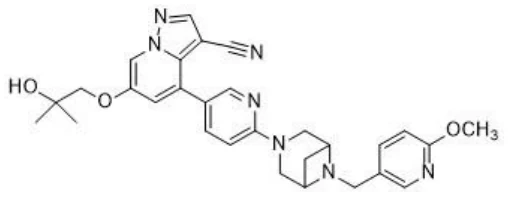
Capsule Physicochemical properties: Selpercatinib is an anhydrous, crystalline (Form A), white to practically white to light yellow powder. The aqueous solubility of selpercatinib is pH dependent, from sparingly soluble at low pH (≥10 mg/mL at pH 1.3) to practically insoluble at neutral pH (0.002 mg/mL at pH 7.5).
Tablet Physicochemical properties: Selpercatinib is an anhydrous, crystalline (Form B), white to practically white to light yellow powder. The aqueous solubility of selpercatinib is pH dependent, from sparingly soluble at low pH (≥10 mg/mL at pH 1.3) to practically insoluble at neutral pH (0.004 mg/mL at pH 7.1).
14. Clinical Trials
14.1 Clinical Trials by Indication
Metastatic RET Fusion-Positive Non-Small Cell Lung Cancer
LIBRETTO-001
Table 14 - Summary of Patient Demographics for Clinical Trials in Metastatic RET Fusion-Positive NSCLC - LIBRETTO-001
| Study # | Trial design | Dosage, route of administration and duration | Study subjects (n) | Mean age (Range) | Sex, n (%) |
| LIBRETTO-001 | Open label, multicenter, multi-cohort, Phase 1/2 study | Patients received RETEVMO 160 mg orally twice daily until unacceptable | Patients previously treated with platinum-based chemotherapy (247) | 61 (23-81) years | Male: 107 (43) Female: 140 (57) |
| toxicity or disease progression | Treatment-naïve patients (69) | 63 (23-92) years | Male: 26(38) Female: 43 (62) |
The efficacy of RETEVMO in patients with advanced RET fusion-positive NSCLC was originally evaluated in a phase 1/2, multicenter, open-label, multi-cohort clinical trial (LIBRETTO-001; see Table 14). Identification of a RET gene alteration was prospectively determined in local laboratories using next generation sequencing (NGS), polymerase chain reaction (PCR), or fluorescence in situ hybridization (FISH). Among RET fusion-positive NSCLC patients, the most common fusion partner was KIF5B, followed by CCDC6 and then NCOA4. The major efficacy outcome measures were overall response rate (ORR) and duration of response (DOR), as determined by an independent review committee (IRC) according to RECIST v1.1.
In patients with RET fusion-positive NSCLC who were previously treated with platinum-based chemotherapy, 44% were White, 48% were Asian, 4.9% were Black, and 2.8% were Hispanic/Latino. ECOG performance status was 0-1 (97%) or 2 (3%), and 99% of patients had metastatic disease. Patients received a median of 2 prior systemic therapies (range: 1-15), and 58% of patients had prior anti-PD-1/PD-L1 therapy. At initial diagnosis, the majority of patients (90.7%) were diagnosed with nonsquamous NSCLC; one patient (0.4%) had squamous cell NSCLC; and the histology was unknown in 8.9% of patients. RET fusions were detected in 93.9% of patients using NGS (84.6% tumor samples, 9.3% blood or plasma samples); 4.0% using FISH; 1.6% using PCR; and 0.4% using nanostring technology.
In patients with RET fusion-positive NSCLC who were treatment-naïve, 70% were White, 19% were Asian, and 6% were Black. ECOG performance status was 0-1 (94%) or 2 (6%) and 99% of patients had metastatic disease. RET fusions were detected in 91.3% of patients using NGS (60.9% tumor samples, 30.4% blood or plasma samples); 7.2% using FISH; and 1.4 using PCR.
Efficacy results for patients with RET fusion-positive NSCLC previously treated with platinum chemotherapy are summarized in Table 15. A waterfall plot illustrating the best change in tumor size per RECIST v1.1 and based on independent review committee assessment is shown in Figure 1.
Table 15 - Efficacy Results in Patients with Metastatic RET Fusion-Positive NSCLC Previously Treated with Platinum Chemotherapy - LIBRETTO-001
RETEVMO (n=247) | ||||
|---|---|---|---|---|
| Overall Response Ratea (95% CI) | 62% (55%, 68%) | |||
| Complete response | 8.1% | |||
| Partial response | 53% | |||
| Duration of Response | ||||
| Median in months (95% CI) | 31.6 (20, 42) | |||
a Confirmed overall response rate assessed by independent review committee.
CI=confidence interval; NE=not estimable.
Figure 1 - Waterfall Plot of Best Change in Tumor Burden in Patients with Metastatic RET Fusion-Positive NSCLC Previously Treated with Platinum Chemotherapy – LIBRETTO-001
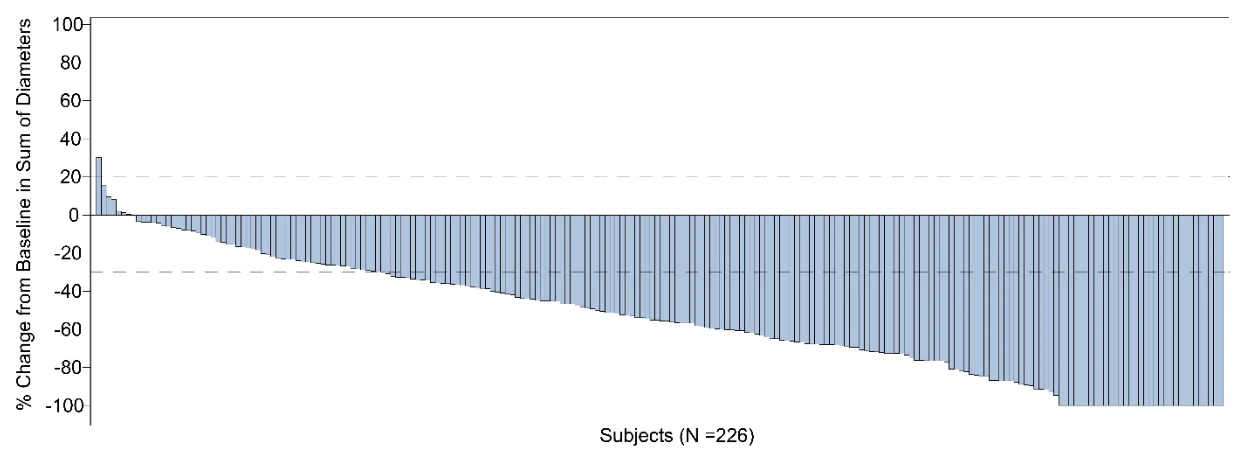
Based on independent review committee assessment
Note: for each patient, the best change from baseline in the sum of diameters for all target lesions is represented by a vertical bar.
Baseline is defined as the last available measurement prior to the first dose of selpercatinib.
Note: Twenty-one patients not shown due to 16 patients having non-target lesions only, and 5 patients with no post-baseline target lesion measurement.
The efficacy of RETEVMO in patients with RET fusion-positive NSCLC of squamous histology has not been fully evaluated due to limited clinical data.
An exploratory subgroup analysis showed that, among the 144 patients who received an anti-PD-1 or anti-PD-L1 therapy, either sequentially or concurrently with platinum-based chemotherapy, the ORR was 64% (95% CI: 56%, 72%) and the median DOR was 27.7 months (95% CI: 17.4, NE).
Among the 247 patients with RET fusion-positive NSCLC, 16 had measurable central nervous system metastases at baseline as assessed by IRC. One patient received radiation therapy to the brain within 2 months prior to study entry. Responses in intracranial lesions were observed in 14 of these 16 patients; the median duration of response for patients with measurable central nervous system (CNS) disease at baseline was 10.1 months (95% CI: 7.4, 37.0).
Efficacy results for patients with treatment-naïve RET fusion-positive NSCLC are summarized in Table 16. A waterfall plot illustrating the best change in tumor size per RECIST v1.1 and based on independent review committee assessment is shown in Figure 2.
Table 16 - Efficacy Results in Patients with Treatment-Naïve Metastatic RET Fusion-Positive NSCLC - LIBRETTO-001
RETEVMO (n=69) | |||||
|---|---|---|---|---|---|
| Overall Response Ratea (95% CI) | 83% (72%, 91%) | ||||
| Complete response | 7% | ||||
| Partial response | 75% | ||||
| Duration of Response | |||||
| Median in months (95% CI) | 20.3 (15, 30) | ||||
a Confirmed overall response rate assessed by independent review committee.
CI=confidence interval.
Figure 2 - Waterfall Plot of Best Change in Tumor Burden in Patients with Treatment-Naïve RET Fusion-Positive NSCLC - LIBRETTO-001
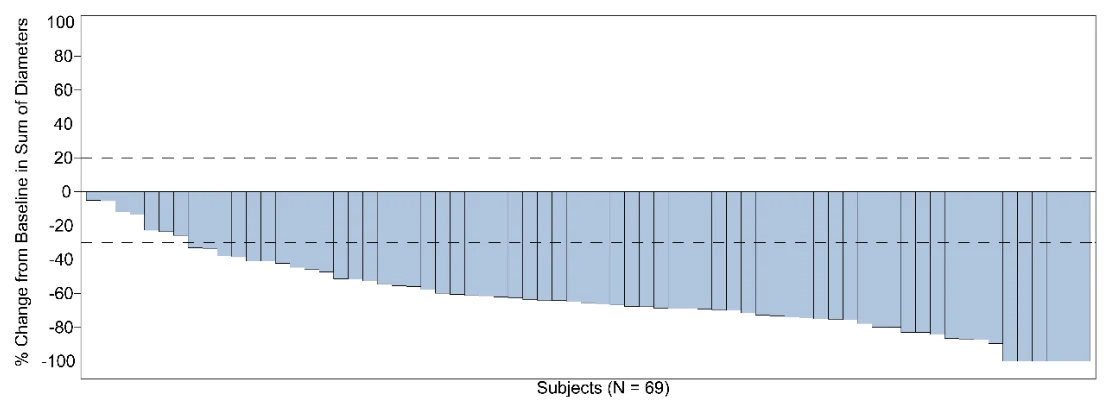
Based on independent review committee assessment
Note: for each patient, the best change from baseline in the sum of diameters for all target lesions is represented by a vertical bar.
Baseline is defined as the last available measurement prior to the first dose of selpercatinib.
LIBRETTO-431
Table 17 - Summary of Patient Demographics for Clinical Trials for the initial treatment of metastatic RET Fusion-Positive NSCLC – LIBRETTO-431
| Study # | Trial design | Dosage, route of administration and duration | Study subjects (n) | Mean age (Range) | Sex, n (%) |
| LIBRETTO-431 | Randomize d (1.6:1), open label, multicenter, Phase 3 study | Patients received RETEVMO 160 mg orally twice daily continuously in 21-day cycles until unacceptable toxicity or disease progression OR Pemetrexed intravenously (IV) (500 mg per square meter of body-surface area) along with the investigator’s choice of platinum therapy (carboplatin IV [AUC 5, maximum dose 750 mg] or cisplatin IV [75 mg per square meter]) with or without pembrolizumab IV (200 mg) every 21 days up to 35 cycles | RETEVMO arm: (n=129) Chemotherapy with pembrolizumab arm: (n=83) | 59.8 (31-84) years 60.2 (31-83) years | Male: 64 (49.6) Female: 65 (50.4) Male: 35 (42.2) Female: 48 (57.8) |
The efficacy of RETEVMO in patients with metastatic RET fusion-positive NSCLC was further evaluated in a phase 3, multicenter, open-label clinical trial (LIBRETTO-431; see Table 17). The study evaluated RETEVMO versus platinum-based and pemetrexed chemotherapy with or without pembrolizumab in patients with RET fusion-positive, unresectable locally advanced or metastatic NSCLC with no previous systemic therapy for metastatic disease. The demographics and efficacy results are presented for the intent-to-treat (ITT)-pembrolizumab population, which included patients who were stratified with the intent to receive pembrolizumab in the event of the control-arm assignment. Identification of a RET gene alteration was prospectively determined in local laboratories using NGS or PCR. Among patients with RET fusions, 60% were detected using NGS and 40% using PCR (89% in tumor samples; 11% in blood). The most common fusion partners were KIF5B (45% of patients) and CCDC6 (10% of patients).
Overall, in the ITT- pembrolizumab population, 41% of patients were White, 56% were Asian, and 1% were Black. ECOG performance status was 0-1 (97% of patients) or 2 (3% of patients), 68% of patients were never smokers, 93% of patients had metastatic disease at study entry, and 20% of patients had intracranial metastases at baseline, as determined by a neuroradiologic blinded independent central review (BICR). The majority of patients (98.1%) were diagnosed with lung adenocarcinoma.
The major efficacy outcome was progression-free survival (PFS) as determined by BICR according to RECIST v1.1. Efficacy results for LIBRETTO-431 for patients with metastatic RET fusion-positive NSCLC treated with selpercatinib are summarized in Table 18. At the time of this analysis, 19% of patients had died, and overall survival (OS) data were immature.
Table 18 - Efficacy Results for the Initial Treatment of Patients with Metastatic RET Fusion-Positive NSCLC - LIBRETTO-431
Selpercatinib (n=129) | Chemotherapy with pembrolizumab (n=83) | ||||||||||||
|---|---|---|---|---|---|---|---|---|---|---|---|---|---|
| PFS | |||||||||||||
| Number (%) of patients with an event | 49 (38%) | 49 (59%) | |||||||||||
| Median in months (95% CI) | 24.8 (16.9, NE) | 11.2 (8.8, 16.8) | |||||||||||
| Hazard ratioa (95% CI) | 0.465 (0.309, 0.699) | ||||||||||||
| p-valueb | 0.0002 | ||||||||||||
| Overall Response Rate | |||||||||||||
| ORR (95% CI) | 84% (76, 90) | 65% (54, 75) | |||||||||||
| Complete response | 7% | 6% | |||||||||||
| Partial response | 77% | 59% | |||||||||||
| Duration of Response | |||||||||||||
| Median in monthsc (95% CI) | 24.2 (17.9, NE) | 11.5 (9.7, 23.3) | |||||||||||
Data from the pre-planned interim efficacy analysis.
a Based on the stratified Cox proportional hazard model
b Base on stratified log-rank test
c Median duration of follow-up time; 18.0 months in the RETEVMO arm and 14.6 months in the chemotherapy with pembrolizumab arm.
CI=confidence interval; NE=not estimable.
Figure 3 Kaplan-Meier Curves of Progression-Free Survival in LIBRETTO-431: RETEVMO versus Chemotherapy with Pembrolizumab
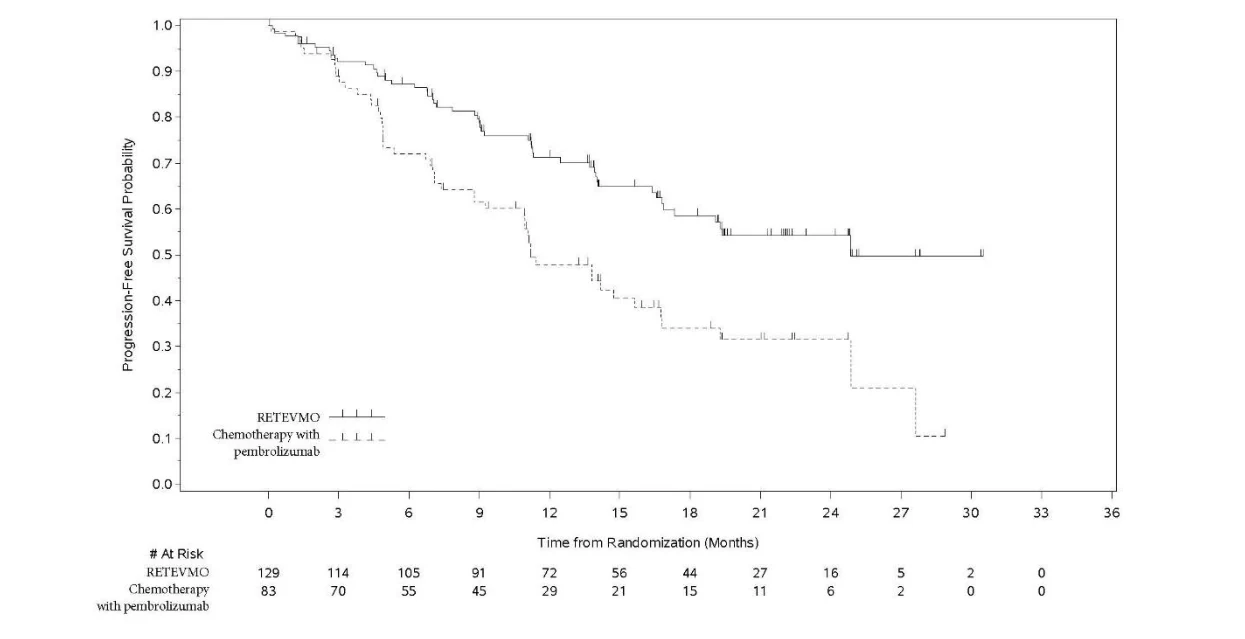
Among the 212 randomized patients, 29 had measurable CNS metastases at baseline as assessed by BICR. Responses in intracranial lesions were observed in 14 of 17 patients treated with RETEVMO and 7 of 12 patients treated with chemotherapy with pembrolizumab.
RET-Mutant Medullary Thyroid Cancer
LIBRETTO-001
Table 19 - Summary of Patient Demographics for Clinical Trials in Metastatic RET-Mutant Medullary Thyroid Cancer – LIBRETTO-001
| Study # | Trial design | Dosage, route of administration and duration | Study subjects (n) | Mean age (Range) | Sex, n (%) |
| LIBRETTO-001 | Open label, multicenter, multi-cohort, Phase 1/2 study | Patients received RETEVMO 160 mg orally twice daily until unacceptable toxicity or disease progression | Patients previously treated with vandetanib or cabozantinib (or both) (152) | 58 (17-90) years | Male: 97 (64) Female: 55 (36) |
| Vandetanib and cabozantinib treatment-naïve patients (143) | 57 (15-87) years | Male: 83 (58) Female: 60 (42) |
The efficacy of RETEVMO in patients with RET-mutant MTC was originally evaluated in a phase 1/2, multicenter, open-label, multi-cohort clinical trial (LIBRETTO-001; see Table 19). Identification of a RET gene alteration was prospectively determined in local laboratories using next generation sequencing (NGS), polymerase chain reaction (PCR), or fluorescence in situ hybridization (FISH). Among RET-mutant MTC patients, the most common mutation was M918T, followed by extracellular cysteine mutation. The major efficacy outcome measures were overall response rate (ORR) and duration of response (DOR), as determined by an independent review committee (IRC) according to RECIST v1.1.
In patients with RET-mutant MTC who were previously treated with vandetanib (78.9% of patients) or cabozantinib (54.6% of patients), 90% were White, 7% were Hispanic/Latino, 1.3 % were Asian and 1.3% were Black. One pediatric patient was included (17 years of age). ECOG performance status was 0-1 (93%) or 2 (7%), and 98% of patients had metastatic disease. Patients received a median of 2 prior systemic therapies (range: 1-8). RET mutation status was detected in 80.3% of patients using NGS (77% tumor samples; 3.3% blood or plasma);14.5% using PCR; and 5.3% using an unknown test. The protocol excluded patients with synonymous, frameshift, or nonsense RET mutations.
In patients with RET-mutant MTC who were vandetanib and cabozantinib treatment-naïve, 87% were White, 5.6% were Asian, 4.9% were Hispanic/Latino and 1.4% were Black. Two pediatric patients were included (ages 15 years and 16 years). ECOG performance status was 0-1 (96%) or 2 (4%) and 98% had metastatic disease. Nineteen percent (19%) of patients had received 1 or 2 prior systemic therapies (including 6.3% kinase inhibitors, 3.5% chemotherapy, 3.5% immunotherapy, 1.4% radioactive iodine, 0.7% mTOR inhibitor and 2.8% other systemic therapy). RET mutation status was detected in 80.4% of patients using NGS (74.8% tumor samples, 5.6% blood or plasma samples); 12.6% using PCR; and 7% using an unknown test.
Efficacy results for patients with metastatic RET-mutant MTC previously treated with vandetanib or cabozantinib are summarized in Table 20. A waterfall plot illustrating the best change in tumor size per RECIST v1.1 based on independent review committee assessment is shown in Figure 4.
Table 20 - Efficacy Results in Patients with Metastatic RET-Mutant MTC Previously Treated with Vandetanib or Cabozantinib - LIBRETTO-001
RETEVMO (n=152) | |||||
|---|---|---|---|---|---|
| Overall Response Ratea (95% CI) | 78% (70%, 84%) | ||||
| Complete response | 13% | ||||
| Partial response | 65% | ||||
| Duration of Response | |||||
| Median in months (95% CI) | 45.3 (34, NE) | ||||
a Confirmed overall response rate assessed by independent review committee.
CI=confidence interval.
Figure 4 - Waterfall Plot of Best Change in Tumor Burden in Patients with Metastatic RET-Mutant MTC Previously Treated with Vandetanib or Cabozantinib - LIBRETTO-001
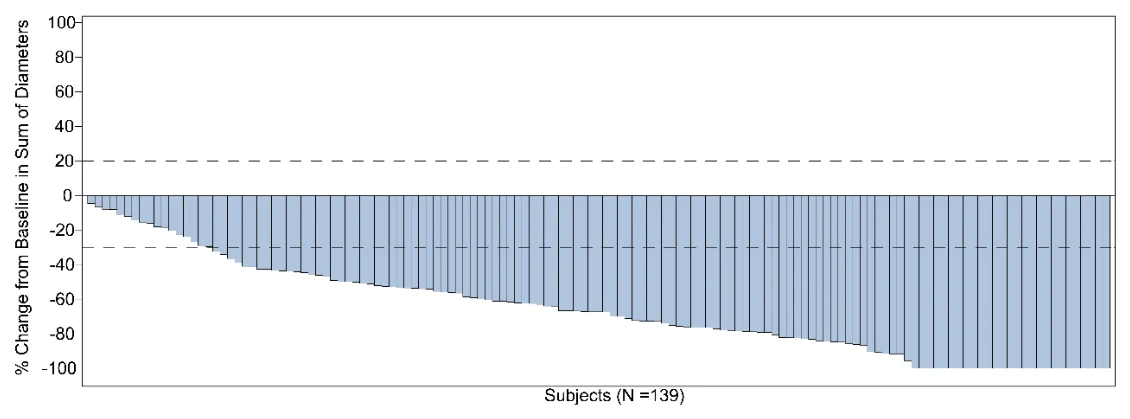
Based on independent review committee assessment
Note: Eligible patients are defined as treated patients. For each patient, the best change from baseline in the sum of diameters for all target lesions is represented by a vertical bar.
Baseline is defined as the last available measurement prior to the first dose of selpercatinib.
Note: Thirteen patients are not included because 7 patients have non-target lesion only, and 6 patients with no post-baseline target lesion measurement.
Efficacy results for patients with vandetanib and cabozantinib-naïve metastatic RET-mutant MTC are summarized in Table 21. A waterfall plot illustrating the best change in tumor size per RECIST v1.1 based on independent review committee assessment is shown in Figure 5.
Table 21 - Efficacy Results in Patients with Vandetanib and Cabozantinib-Naïve Metastatic RET-Mutant MTC - LIBRETTO-001
RETEVMO (n=143) | ||||
|---|---|---|---|---|
| Overall Response Ratea (95% CI) | 83% (75%, 88%) | |||
| Complete response | 24% | |||
| Partial response | 59% | |||
| Duration of Response | ||||
| Median in months (95% CI) | NE (51, NE) | |||
a Confirmed overall response rate assessed by independent review committee.
CI=confidence interval.
Figure 5 - Waterfall Plot of Best Change in Tumor Burden in Patients with Vandetanib and Cabozantinib-Naïve Metastatic RET - Mutant MTC Patients - LIBRETTO-001
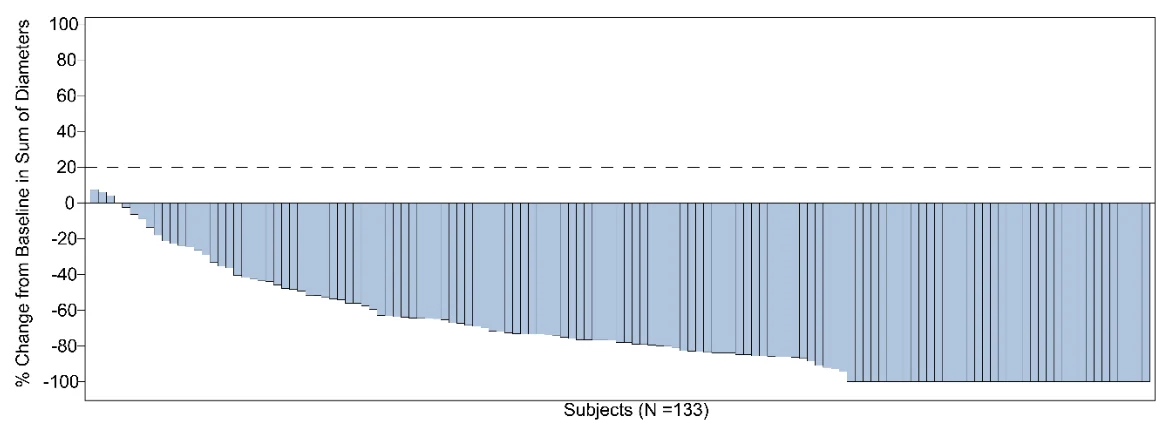
Based on independent review committee assessment
Note: Eligible patients are defined as treated patients. For each patient, the best change from baseline in the sum of diameters for all target lesions is represented by a vertical bar.
Baseline is defined as the last available measurement prior to the first dose of selpercatinib.
Note: Ten patients are not included because 7 patients have non-target lesions only, and 3 patients with no postbaseline target lesions measurements.
LIBRETTO-531
Table 22 - Summary of Patient Demographics for Clinical Trials in Advanced or Metastatic, Kinase Inhibitor-Naïve, RET-Mutant MTC – LIBRETTO-531
| Study # | Trial design | Dosage, route of administration and duration | Study subjects (n) | Mean age (Range) | Sex, n (%) |
| LIBRETTO-531 | Randomize d (2:1), multicenter, open-label Phase 3 study | Patients received RETEVMO 160 mg orally twice daily OR Physician’s choice of cabozantinib 140 mg once daily or vandetanib 300 mg orally once daily Treatment in either arm continued until unacceptable toxicity or disease progression | RETEVMO arm: (n= 193) cabozantinib or vandetanib arm: (n=98) | 54 (12-79) years 54 (18-84) years | Male: 115 (59.6) Female: 78 (40.4) Male: 68 (69.4) Female: 30 (30.6) |
The efficacy of RETEVMO in patients with advanced or metastatic RET-mutant MTC was also evaluated in a phase 3 randomized (2:1), multicenter, open-label clinical trial (LIBRETTO-531; see Table 22). The study evaluated RETEVMO versus physician’s choice of cabozantinib or vandetanib in patients with progressive, advanced kinase inhibitor-naïve, RET-mutant medullary thyroid cancer. Identification of a RET gene alteration was prospectively determined in local laboratories using NGS (in 90.4% of patients) and PCR (in 9.6% of patients). The most common mutation was M918T(62.5% of patients).
Overall, 69.4% of patients were White, 27.7% were Asian and 2.9% were Black. ECOG performance status at study entry was 0-1 for 98.3% of patients and 2 for 1.0% of patients. Distant metastasis was reported in 77.0% of patients at study entry. Only one adolescent patient was enrolled.
The major efficacy outcome measure was progression-free survival (PFS), as determined by a blinded independent central review (BICR) according to RECIST v1.1.
Efficacy results for LIBRETTO-531 based on the preplanned interim analysis are summarized in Table 23 and the Kaplan-Meier curve for PFS is shown in Figure 6. At the time of this analysis, the OS remains immature. A total of 18 patients (6.2%) had died, 8 deaths (4.1%) in the RETEVMO treated patients versus 10 deaths (10.2%) in patients treated with cabozantinib or vandetanib (HR=0.374, 95% CI: 0.147, 0.949).
Table 23 - Efficacy Results in Patients with Advanced or Metastatic Kinase Inhibitor-Naïve RET-Mutant MTC - LIBRETTO-531
RETEVMO N=193 | Cabozantinib or Vandetanib N=98 | ||||||||||
|---|---|---|---|---|---|---|---|---|---|---|---|
| PFS | |||||||||||
| Number (%) of patients with an event | 26 (14%) | 33 (34%) | |||||||||
| Median in months (95% CI) | NE (NE, NE) | 16.8 (12.2, 25.1) | |||||||||
| Hazard ratioa (95% CI) | 0.280 (95% CI: 0.165, 0475) | ||||||||||
| p-valueb | <0.0001 | ||||||||||
| Overall Response Rate | |||||||||||
| ORR (95% CI) | 69% (62%, 76%) | 39% (29%, 49%) | |||||||||
| Complete response | 12% | 4% | |||||||||
| Partial response | 58% | 35% | |||||||||
| Duration of Response | |||||||||||
| Median in monthsc (95% CI) | NE (NE, NE) | 16.6 (10.4, NE) | |||||||||
Data from the pre-planned interim efficacy analysis.
a Based on the stratified Cox proportional hazard model
b Base on stratified log-rank test
c Median duration of follow-up time; 11.1 months in the RETEVMO arm and 12.8 months in the chemotherapy with cabozantinib or vandetanib arm.
CI=confidence interval; NE=not estimable.
Figure 6: Kaplan-Meier Curves of Progression-Free Survival in LIBRETTO-531: RETEVMO versus Cabozantinib or Vandetanib
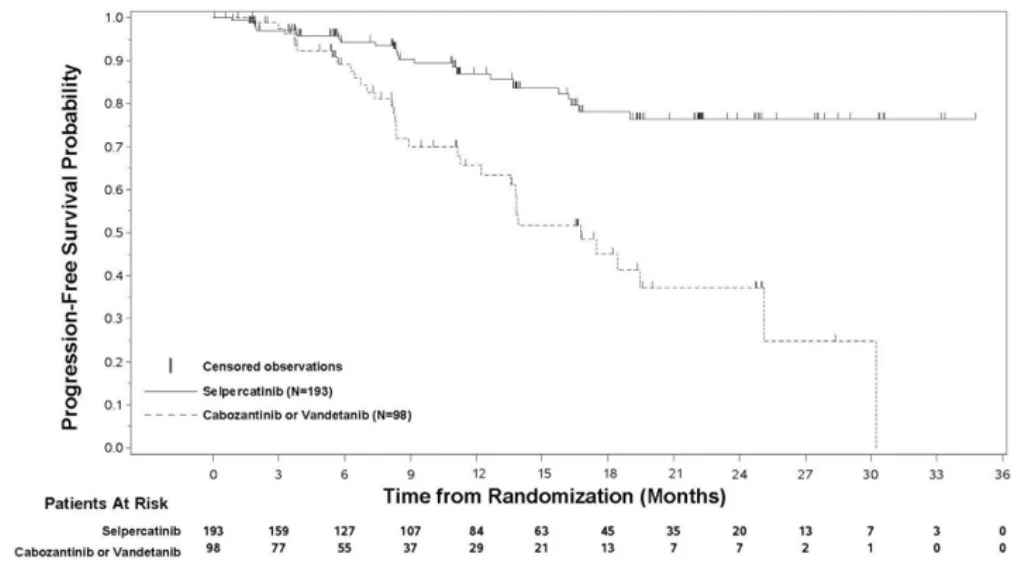
LIBRETTO-121
Table 24 - Summary of Patient Demographics for Clinical Trials in Metastatic RET-Mutant Medullary Thyroid Cancer – LIBRETTO-121
| Study # | Trial design | Dosage, route of administration and duration | Study subjects (n) | Mean age (Range) | Sex, n (%) |
| LIBRETTO-121 | Open label, multicenter, single arm, Phase 1/2 study in pediatric patients | Patients received RETEVMO (92 mg/m2, with a maximum of 160 mg) orally twice daily until unacceptable toxicity or disease progression | RET-mutant medullary thyroid cancer: 14 | 14 (2-20) years | Male: 9 (64) Female: 5 (36) |
LIBRETTO-121 was a multicentre, open-label, single-arm Phase 1/2 study that enrolled patients 2 to 20 years of age with advanced solid tumours harbouring an activating RET alteration.
In the group of patients with RET-mutant MTC, 71% were white, 14% were Hispanic or Latino, and 13% were Black. All patients had metastatic (71%) or locally advanced disease (29%) at study entry. The most common RET mutation was M918T (71.4%).
The primary objective was to determine the ORR based on RECIST Version 1.1 as determined by an IRC. Efficacy results for patients with locally advanced or metastatic RET-mutant MTC are summarized in Table 25.
Table 25 - Efficacy Results in Patients with RET-Mutant MTC Population - LIBRETTO-121
RETEVMO (n = 14) | |||
|---|---|---|---|
| Overall Response Rate1 (95% CI) | 57% (29, 82) | ||
| Complete response | 36% | ||
| Partial response | 21% | ||
| Duration of Response | |||
| Median in months (95% CI) | NE (25, NE) | ||
1 Confirmed overall response rate assessed by IRC.
NE = not estimable
RET Fusion-Positive Thyroid Cancer
Table 26 - Summary of Patient Demographics for Clinical Trials in RET Fusion-Positive Thyroid Cancer – LIBRETTO-001
| Study # | Trial design | Dosage, route of administration and duration | Study subjects (n) | Mean age (Range) | Sex, n (%) |
| LIBRETTO-001 | Open label, multicenter, multi-cohort, Phase 1/2 study | Patients received RETEVMO 160 mg orally twice daily until unacceptable toxicity or disease progression | Patients were radioactive iodine (RAI)-refractory (if RAI was an appropriate treatment option) (65) | 59 (20-88) years | Male: 32 (49) Female: 33 (51) |
The efficacy of RETEVMO in patients with RET fusion-positive thyroid cancer was evaluated in a phase 1/2, multicenter, open-label, multi-cohort clinical trial (LIBRETTO-001; see Table 26). Identification of a RET gene alteration was prospectively determined in local laboratories using next generation sequencing (NGS), polymerase chain reaction (PCR), or fluorescence in situ hybridization (FISH). For patients with RET fusion-positive thyroid cancers, CCDC6 was the most common fusion partner. The major efficacy outcome measures were overall response rate (ORR) and duration of response (DOR), as determined by an independent review committee (IRC) according to RECIST v1.1.
In patients with RET fusion-positive thyroid cancer, 65% were White, 20% were Asian, 11% were Hispanic/Latino, and 4.6% were Black. ECOG performance status was 0-1 (94%) or 2 (6%). All (100%) patients had metastatic disease with primary tumor histologies including papillary thyroid cancer (54 patients; 83%), poorly differentiated thyroid cancer (6 patients), anaplastic thyroid cancer (4 patients), or Hurthle cell thyroid cancer (1 patient). Patients were radioactive iodine (RAI)–refractory (if RAI was an appropriate treatment option) and had received a median of 2 prior therapies (range: 0-7). RET fusion-positive status was detected in 97% of patients using NGS (89.2% tumor samples, 7.7% blood or plasma samples); 1.5% using FISH; and 1.5% using FDM. Efficacy was evaluated in a cohort of patients (n=25) who were RAI-refractory and who had received sorafenib, lenvatinib, or both.
Efficacy results for patients with metastatic RET fusion-positive thyroid cancer who received prior systemic therapy are summarized in Table 27.
Table 27 - Efficacy Results in Patients with Metastatic RET Fusion-Positive Thyroid Cancer who Received Prior Systemic Therapy - LIBRETTO-001
RETEVMO (n=41) | |||||
|---|---|---|---|---|---|
| Overall Response Ratea (95% CI) | 85% (71%, 94%) | ||||
| Complete response | 12% | ||||
| Partial response | 73% | ||||
| Duration of Response | |||||
| Median in months (95% CI) | 26.7 (12, NE) | ||||
a Confirmed overall response rate assessed by independent review committee.
CI=confidence interval; NE=not estimable.
Figure 7 - Waterfall Plot of Best Change in Tumor Burden in Patients with Metastatic RET Fusion-Positive Thyroid Cancer who received prior systemic therapy - LIBRETTO-001
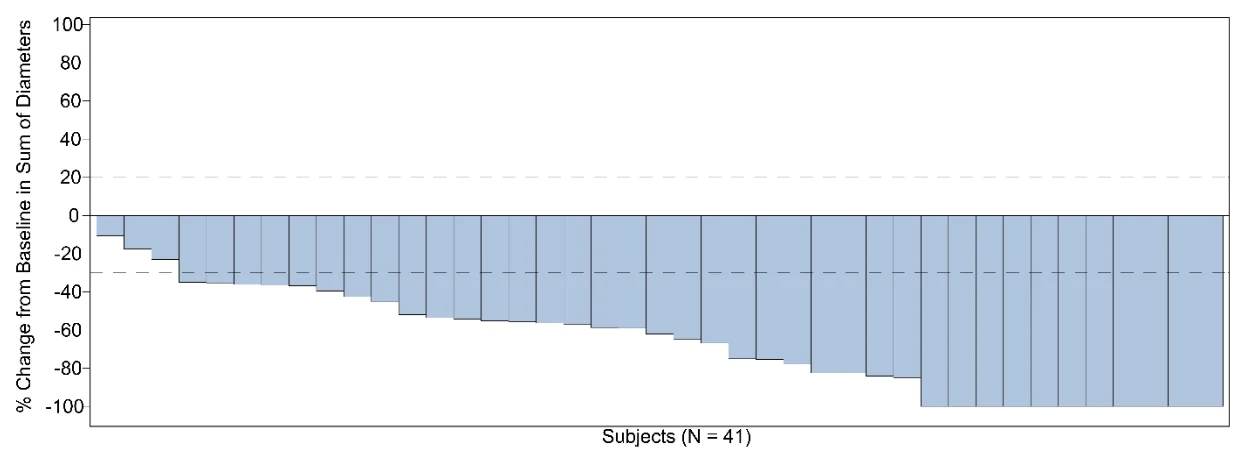
Based on independent review committee assessment
Note: Eligible patients are defined as treated patients. For each patient, the best change from baseline in the sum of diameters for all target lesions is represented by a vertical bar.
Baseline is defined as the last available measurement prior to the first dose of selpercatinib.
14.2 Comparative Bioavailability Studies of the Product Monograph
An open-label, randomized, two-treatment, two-period, two-sequence, crossover, single dose (160 mg), adaptive designed oral comparative bioavailability study of RETEVMO tablets (1 × 160 mg) and RETEVMO capsules (2 × 80 mg) was conducted in 224 healthy, adult, male and female subjects under fasted conditions. A summary of the comparative bioavailability data from 191 subjects included in the statistical analysis is presented in the following table:
Table 28 - Summary Table of the Comparative Bioavailability Data
Selpercatinib (160 mg) Geometric Mean Arithmetic Mean (CV %) | ||||
|---|---|---|---|---|
| Parameter | Testa | Referenceb | % Ratio of Geometric Means | 94.12% Confidence Interval |
AUCTc (ng·h/mL) | 18260.57 20814.51 (43.52) | 20373.72 22231.43 (37.76) | 89.6 | 83.7 – 95.9 |
AUCld (ng·h/mL) | 19461.87 21524.70 (41.15) | 20898.11 22638.00 (36.84) | 93.1 | 88.4 – 98.1 |
Cmax (ng·h/mL) | 1363.99 1630.42 (43.37) | 1514.45 1704.12 (39.52) | 90.0 | 81.7 – 99.0 |
Tmaxe (h) | 1.50 (0.75 – 36.00) | 1.50 (0.75 – 36.02) | ||
T1/2c,f (h) | 16.28 (42.17) | 16.17 (30.70) | ||
a RETEVMO (selpercatinib) tablets, 160 mg (Eli Lilly Canada Inc.)
b RETEVMO (selpercatinib) capsules, 80 mg (Eli Lilly Canada Inc.)
c N=187
d N=184
e Expressed as the median (range) only
f Expressed as the arithmetic mean (CV %) only
15 Microbiology
No microbiological information is required for this drug product.
16 Non-Clinical Toxicology
General Toxicology: Repeat-dose studies were conducted in rats and minipigs to characterize toxicity. Target organs of toxicity common to the rat and minipig were hematopoietic system, lymphoid tissues, tongue, pancreas, epiphyseal growth plate, and male reproductive tissues. In general, toxicities in these organs were reversible; the exception was the testicular toxicity. Reversible toxicity was observed in the ovaries and gastrointestinal tract in minipigs only; at high doses, gastrointestinal toxicity caused morbidity at exposures in minipigs that were generally lower than exposures determined in humans at the recommended dose. In one minipig study, females exhibited a slight, reversible increase in QTc prolongation of approximately 12% compared to controls and 7% compared to pre-dose values. Target organs of toxicity observed only in rats were incisor tooth, liver, vagina, lungs, Brunner's gland, and multi-tissue mineralization associated with hyperphosphatemia. These toxicities only occurring in these organs in rats were reversible.
In a 4-week general toxicology study, adolescent rats showed signs of physeal hypertrophy and tooth dysplasia at doses resulting in exposures ≥ approximately 3 times the human exposure at the 160 mg twice daily clinical dose. In a 13-week general toxicity study, adolescent minipigs showed signs of minimal to marked increases in physeal thickness at the 15 mg/kg high dose level (approximately 0.3 times the human exposure at the 160 mg twice daily clinical dose). Rats in both the 4- and 13-week toxicology studies had malocclusion and tooth discoloration at the high dose levels (≥1.5 times the human exposure at the 160 mg twice daily clinical dose) that persisted during the recovery period.
Carcinogenicity: In a 2-year rat study, vaginal tumors were observed in 5% of female rats at a dose of 40 mg/kg (approximately 1 times the clinical exposure by AUC at the160 mg twice daily dose). No pre-neoplastic changes were observed in the reproductive tract of any of the female rats in the study. The clinical relevance of these findings is uncertain. In a 6-month transgenic RasH2 mouse study, Selpercatinib was not carcinogenic in male and female mice at doses of up to 60 mg/kg.
Genotoxicity: Selpercatinib was not mutagenic in the in vitro bacterial reverse mutation (Ames) assays, with or without metabolic activation, or clastogenic in the in vitro micronucleus assay in human peripheral lymphocytes, with or without metabolic activation. Selpercatinib was positive in the in vivo micronucleus assay in rats at concentrations >7 times the Cmax at the human dose of 160 mg twice daily.
Reproductive and Development Toxicology: In general toxicology studies, male rats and minipigs exhibited testicular degeneration that was associated with luminal cell debris and/or reduced luminal sperm in the epididymis at selpercatinib exposures approximately 0.4 (rat) and 0.1 (minipig) times the clinical exposure by AUC at the recommended human dose of 160 mg twice daily. In a dedicated fertility study in male rats, administration of selpercatinib at doses up to 30 mg/kg/day (approximately twice the clinical exposure by AUC at the 160 twice-daily dose) for 28 days prior to cohabitation with untreated females did not affect mating or have clear effects on fertility. Males did, however, display a dose-dependent increase in testicular germ cell depletion and spermatid retention at doses ≥3 mg/kg (~0.2 times the clinical exposure by AUC at the 160 twice-daily dose) accompanied by altered sperm morphology at 30 mg/kg.
In a dedicated fertility study in female rats treated with selpercatinib for 15 days before mating to Gestational Day 7, there were decreases in the number of estrous cycles at a dose of 75 mg/kg (approximately equal to the human exposure by AUC at the 160 mg twice-daily clinical dose). Although selpercatinib did not have clear effects on mating performance or ability to become pregnant at any dose level, half of females at the 75 mg/kg dose level had 100% nonviable embryos. At the same dose level in females with some viable embryos, there were increases in post-implantation loss.
Selpercatinib administration to pregnant rats during the period of organogenesis at oral doses ≥100 mg/kg [approximately 3.6 times the human exposure based on the area under the curve (AUC) at the clinical dose of 160 mg twice daily] resulted in 100% post-implantation loss. At the dose of 50 mg/kg [approximately equal to the human exposure (AUC) at the clinical dose of 160 mg twice daily], 6 of 8 females had 100% early resorptions; the remaining 2 females had high levels of early resorptions with only 3 viable fetuses across the 2 litters. All viable fetuses had decreased fetal body weight and malformations (2 with short tail and one with small snout and localized edema of the neck and thorax).
In the general toxicology study in minipigs, there were findings of decreased or absent corpora lutea at a selpercatinib dose of 15 mg/kg (approximately 0.3 times the human exposure by AUC at the 160 mg twice-daily clinical dose). Corpora luteal cysts were present in the minipig at selpercatinib doses ≥2 mg/kg (approximately 0.07 times the human exposure by AUC at the 160 mg twice-daily clinical dose).
Juvenile Toxicity: In a study in juvenile rats, epiphyseal growth plate changes similar to those in adolescent rats were observed. These changes were associated with decreased femur length and reductions in bone mineral density, and were not reversible.
Large intestinal enteropathy was characterized by increased basophilia and occasional vacuolation of the crypt epithelium.
In juvenile male rats administered selpercatinib as juveniles and mated as adolescents with untreated female rats, the following effects on reproductive performance were observed: lower male fertility and copulation indices, increased pre-implantation loss, increased post-implantation loss, and lower mean number and proportion of viable embryos.