


Product Monograph - Wilate
RECENT MAJOR LABEL CHANGES
| 1 INDICATIONS | 01/2024 |
|---|---|
| 4 DOSAGE AND ADMINISTRATION, 4.2 Recommended Dose and Dosage Adjustment | 01/2024 |
| 4 DOSAGE AND ADMINISTRATION, 4.3 Reconstitution | 06/2024 |
| 4 DOSAGE AND ADMINISTRATION, 4.3 Reconstitution | 12/2024 |
TABLE OF CONTENTS
Sections or subsections that are not applicable at the time of authorization are not listed.
RECENT MAJOR LABEL CHANGES ....................................................................................... 2
TABLE OF CONTENTS ............................................................................................................ 2
PART I: HEALTH PROFESSIONAL INFORMATION ................................................................ 4
1 INDICATIONS ................................................................................................................ 4
1.1 Pediatrics ............................................................................................................ 4
1.2 Geriatrics ............................................................................................................ 5
2 CONTRAINDICATIONS ................................................................................................. 5
3 SERIOUS WARNINGS AND PRECAUTIONS BOX ....................................................... 5
4 DOSAGE AND ADMINISTRATION ............................................................................... 5
4.1 Dosing Considerations ........................................................................................ 5
4.2 Recommended Dose and Dosage Adjustment .................................................... 5
4.3 Reconstitution ..................................................................................................... 8
4.4 Administration ..................................................................................................... 9
4.5 Missed Dose ....................................................................................................... 9
5 OVERDOSAGE ............................................................................................................ 10
6 DOSAGE FORMS, STRENGTHS, COMPOSITION AND PACKAGING ...................... 10
7 WARNINGS AND PRECAUTIONS .............................................................................. 11
7.1 Special Populations .......................................................................................... 13
7.1.1 Pregnant Women ............................................................................................ 13
7.1.2 Breast-feeding ................................................................................................. 14
7.1.3 Pediatrics ........................................................................................................ 14
7.1.4 Geriatrics ......................................................................................................... 14
8 ADVERSE REACTIONS .............................................................................................. 14
8.1 Adverse Reaction Overview .............................................................................. 14
8.2 Clinical Trial Adverse Reactions ........................................................................ 15
8.3 Less Common Clinical Trial Adverse Reactions ................................................ 16
8.4 Abnormal Laboratory Findings: Hematologic, Clinical Chemistry and Other Quantitative Data .......................................................................................................... 16
8.5 Post-Market Adverse Reactions ........................................................................ 16
9 DRUG INTERACTIONS ............................................................................................... 17
9.2 Drug Interactions Overview ............................................................................... 17
9.3 Drug-Behavioural Interactions ........................................................................... 17
9.4 Drug-Drug Interactions ...................................................................................... 17
9.5 Drug-Food Interactions ..................................................................................... 17
9.6 Drug-Herb Interactions ...................................................................................... 17
9.7 Drug-Laboratory Test Interactions ..................................................................... 17
10 CLINICAL PHARMACOLOGY ..................................................................................... 17
10.1 Mechanism of Action ......................................................................................... 17
10.2 Pharmacodynamics .......................................................................................... 18
10.3 Pharmacokinetics .............................................................................................. 18
11 STORAGE, STABILITY AND DISPOSAL .................................................................... 21
12 SPECIAL HANDLING INSTRUCTIONS ....................................................................... 22
PART II: SCIENTIFIC INFORMATION .................................................................................... 23
13 PHARMACEUTICAL INFORMATION .......................................................................... 23
14 CLINICAL TRIALS ....................................................................................................... 24
14.1 Clinical Trials by Indication ................................................................................ 24
Hemophilia A ................................................................................................................ 24
Von Willebrand disease ................................................................................................ 28
14.3 Immunogenicity ................................................................................................. 33
16 NON-CLINICAL TOXICOLOGY ................................................................................... 33
PATIENT MEDICATION INFORMATION ................................................................................ 35 wilate® 500/1000
Human von Willebrand factor and human coagulation factor VIII for Injection
PART I: HEALTH PROFESSIONAL INFORMATION
1 INDICATIONS
Hemophilia A
wilate® is indicated for:
Treatment and prophylaxis of bleeding in patients with hemophilia A (congenital or acquired FVIII deficiency) and for the prevention and treatment of bleeding in minor surgical procedures.
Clinical trials to evaluate the safety and efficacy of wilate® in major surgeries are ongoing. Therefore, limited data are presently available on which to evaluate or to base dosing recommendations. Thus, in the case of major surgical interventions, a precise monitoring of the substitution therapy by means of coagulation analysis (FVIII:C) is indispensable.
Von Willebrand disease (VWD)
wilate® is indicated for:
Treatment and prophylaxis of spontaneous and trauma-induced bleeds in all types of VWD in adult and pediatric patients where use of DDAVP (1-deamino-8-D-arginine vasopressin/desmopressin) treatment is ineffective or contra-indicated.
Clinical data on controlling severe spontaneous bleeding are limited (See 14 CLINICAL TRIALS).
- Prevention and treatment of bleeding during and after surgical procedures (See 14 CLINICAL TRIALS).
1.1 Pediatrics
Pediatrics (12-17 years of age):
Based on the data submitted and reviewed by Health Canada, the safety and efficacy of wilate® in pediatric patients with Hemophilia A or VWD has been established. Therefore, Health Canada has authorized an indication for pediatric use. (See 14 CLINICAL TRIALS).
Pediatrics (<12 years of age):
Based on the data submitted and reviewed by Health Canada, the safety and efficacy of wilate® in pediatric patients with VWD has been established. Therefore, Health Canada has authorized an indication for pediatric use.
No data are available to Health Canada in children below 12 years of age and in previously untreated patients (PUPs) with hemophilia A; therefore, Health Canada has not authorized an indication for pediatric use.
Surgical indication in pediatrics (<18 years of age)
The efficacy data related to the surgical indication in pediatric population are limited. A total of 5 major surgical procedures in 5 pediatric patients (1 – 15 years) have been included in the clinical trials. Two of them were type 1 VWD patients, one was type 2 VWD patient, and two were type 3 VWD patients.
1.2 Geriatrics
Geriatrics (> 65 years of age):
Although some of the patients who participated in the wilate® studies were >65 years of age, no appropriate subgroup analyses were performed and therefore no data regarding use of wilate® in the geriatric population are available at this point (See 14 CLINICAL TRIALS).
2 CONTRAINDICATIONS
wilate® is contraindicated for patients who are hypersensitive to this drug or to any ingredient in the formulation, including any non-medicinal ingredient, or component of the container. For a complete listing, see 6 DOSAGE FORMS, STRENGTHS, COMPOSITION AND PACKAGING.
3 SERIOUS WARNINGS AND PRECAUTIONS BOX
Serious Warnings and Precautions
This product is prepared from large pools of human plasma, which may contain the causative agents of hepatitis and other viral diseases. The physician should discuss the risks and benefits of this product with the patient before prescribing or administering to the patient (see 7 WARNINGS AND PRECAUTIONS – General).
4 DOSAGE AND ADMINISTRATION
4.1 Dosing Considerations
After 24–48 hours of treatment, in order to avoid an excessive rise in FVIII:C, reduced doses and/or prolongation of the dose interval should be considered.
4.2 Recommended Dose and Dosage Adjustment
Treatment should be initiated under the supervision of a physician experienced in the treatment of coagulation disorders.
The number of units of FVIII and VWF:RCo administered is expressed in IU, which are related to the current World Health Organization (WHO) standard for FVIII and VWF:RCo products. FVIII and VWF:RCo activity in plasma is expressed either as a percentage (relative to normal human plasma) or in IU (relative to the International Standards for FVIII and VWF:RCo in plasma).
Hemophilia A
The dosage and duration of the substitution therapy depend on the severity of the FVIII deficiency, on the location and extent of the bleeding and on the patient's clinical condition.
One IU of FVIII activity is equivalent to that quantity of FVIII in 1 mL of normal human plasma.
The calculation of the required dosage of FVIII is based on the empirical finding that 1 IU FVIII:C/kg body weight (BW) raises the plasma level by 1.5–2% of normal activity. The required dosage is determined using the following formula:
Required IU = BW (kg) x desired FVIII rise (%) x 0.5 IU/kg
The amount to be administered and the frequency of administration should always be oriented to the clinical effectiveness in the individual case. Table 1 can be used to guide dosing during bleeds and surgery in adult patients and children older than 6 years.
In the case of the following hemorrhagic events, the FVIII:C should not fall below the given plasma level in the corresponding period.
Table 1 Hemophilia A – Treatment Scheme for Hemorrhages and Surgery
Degree of hemorrhage/ type of surgical procedure | FVIII level required (%) (IU/dL) | Frequency of doses (hours)/duration of therapy (days) |
| Hemorrhage | ||
Mild hemorrhage: Early hemarthrosis, muscle bleed, nosebleed, oral bleed and other minor injuries | 20–40 | Repeat every 12 to 24 hours. At least 1 day, until the bleed as indicated by pain is resolved or healing is achieved. |
| More extensive hemarthrosis, muscle bleed or hematoma | 30–60 | Repeat infusion every 12 to 24 hours for 3 to 4 days or more until pain and disability are resolved. |
| Life threatening hemorrhage: cerebral hemorrhage, blunt trauma without visible bleeding site, severe abdominal bleed resp. internal bleeding, throat bleed | 60–100 | Repeat infusion every 8 to 24 hours until threat is resolved. |
| Surgery | ||
Minor including tooth extraction | 30–60 | Every 24 hours, at least 1 day, until healing is achieved. |
| Major | 80–100 (pre- and postoperative) | Repeat infusion every 8 to 24 hours until adequate wound healing, then therapy for at least another 7 days to maintain a FVIII activity of 30% to 60%. |
FVIII = Coagulation factor VIII; IU = International units.
During the course of treatment, appropriate determination of FVIII:C levels is advised to guide the dose to be administered and the frequency of repeated infusions. In the case of major surgical interventions in particular, precise monitoring of the substitution therapy by means of coagulation analysis (FVIII:C) is indispensable. Individual patients may vary in their response to
FVIII treatment, achieving different levels of in-vivo recovery (IVR) and demonstrating a different half-life (T1/2).
Prophylaxis
For long-term prophylaxis against bleeding in patients with severe hemophilia A, doses of approximately 20 IU wilate®/kg BW should be given at intervals of 2 to 3 days. In some cases, especially in younger patients, shorter dosage intervals or higher doses may be necessary.
There are insufficient data to recommend the use of wilate® in children below 12 years of age and in PUPs with hemophilia A.
Von Willebrand disease
Based on the clinical trial results, approximately 20–60 IU VWF:RCo/kg BW are given to achieve adequate hemostasis in case of bleeding. For prevention of bleeding in case of surgery, wilate® should be given 1–2 hours before start of the surgical procedure (30–60 IU VWF:RCo/kg BW for minor surgery and 40–60 IU VWF:RCo/kg BW for major surgery) and, if required, every 12–24 hours after the intervention (20–40 IU VWF:RCo/kg BW for minor and major surgery). Plasma level of VWF:RCo of ≥60 IU/dL (≥60%) and FVIII:C of ≥40 IU/dL (≥40%) should be achieved. The dosage should be adjusted according to the extent and location of the bleeding and/or the type of surgery. In VWD type 3 patients, especially in those with gastrointestinal (GI) bleedings, higher doses may be required.
Table 2 provides an overview of the recommended doses for the treatment of hemorrhages and for the prevention of bleeding during and after surgical procedures. Dosage recommendations are based on the actually administered doses that were shown to be efficacious in the clinical studies in VWD.
Table 2 wilate® Dosing for Treatment of Hemorrhages and in Surgery
| Type of VWD | Indication | Dosage (IU VWF:RCo/kg BW) |
| Any type | Minor hemorrhage* | Loading dose 20–40 IU/kg, maintenance dose 20–30 IU/kg every 12–24hrs‡ |
| Major hemorrhage† | Loading dose 40–60 IU/kg, maintenance dose 20–40 IU/kg every 12–24hrs‡ | |
| Any type | Minor surgery§ | Loading dose 30–60 IU/kg, maintenance dose 20–40 IU/kg every 12–24 hours |
| Major surgery# | Loading dose 40–60 IU/kg, maintenance dose 20–40 IU/kg every 12–24 hours |
Treatment guidelines apply to all VWD types.
* e.g. mild forms of epistaxis, oral bleeds, menorrhagia. † e.g. GI bleeds, muscle bleeding, hemarthrosis, severe refractory epistaxis.
‡ This may need to be continued for up to 3 days for minor hemorrhages and 5–7 days for major hemorrhages.
§ e.g. dental surgery of 1 or more teeth excluding 3rd molar(s) extraction, synovectomy excluding knee joint synovectomy, dermatological removal procedures, electrocoagulation, gastroscopy, polypectomy, ERCP.
# e.g. knee/hip replacement, inguinal hernia repair, adenoidectomy and tonsillectomy.
BW = Body weight; ERCP = Endoscopic retrograde cholangiopancreatography; FVIII = Coagulation factor VIII; IU = International units; VWD = Von Willebrand disease; VWF:RCo = Von Willebrand factor activity (ristocetin cofactor assay).
Repeat doses are administered for as long as needed based upon repeat monitoring of appropriate clinical and laboratory measures.
Although the dosing can be estimated by the guidance given above, it is highly recommended that whenever possible appropriate laboratory tests should be performed on the patient’s plasma at suitable intervals to assure that adequate FVIII:C and VWF:RCo levels have been reached and are maintained.
For long-term prophylaxis against bleeds in VWD patients, doses of 20–40 IU/kg BW should be administered 2–3 times per week. Exact dosing should be determined by the severity of VWD and by the patient’s clinical status and response. In some cases, such as in patients with GI bleeds, higher doses may be necessary.
4.3 Reconstitution
Parenteral Products:
| Strength | Vial Size | Volume of Diluent to be Added to Vial | Approximate Available Volume | Concentration per mL | ||||
|---|---|---|---|---|---|---|---|---|
| 500 IU | 20 mL | 5 mL | 5 mL | 100 IU/mL VWF and 100 IU/mL FVIII | ||||
| 1000 IU | 10 mL | 10 mL | ||||||
IU = International units; VWF = Von Willebrand Factor; FVIII = Coagulation factor VIII
The powder should be reconstituted with the provided solvent immediately prior toinjection. The stability of the solution at room temperature has been demonstrated for up to 4 hours. Nevertheless, to prevent contamination, it is recommended the solution be used immediately.
Instructions for Reconstitution:
- 1. Warm the wilate® powder and solvent in the closed vials up to room temperature (maximum +37°C). This temperature should be maintained during reconstitution.
- 2. Remove the flip caps from both the wilate® vial and the solvent vial and clean the rubber stoppers with an alcohol swab.
- 3. Peel away the lid of the outer package of the transfer device. Place the solvent vial on an even surface and hold the vial firmly. Ensure the transfer device remains in the outer packaging and invert the transfer device ensuring the blue water droplet side is aligned with the solvent vial. Push the transfer device straight and firmly down until its blue part snaps into place. Do not twist while attaching. While holding onto the solvent vial, carefully remove the outer package from the transfer device, being careful to leave the transfer device attached firmly to the solvent vial.
- 4.
With the wilate® vial held firmly on an even surface, quickly invert the solvent vial (with the transfer device attached). Place the white part of the transfer device on top of the wilate® vial and press down until it snaps into the place. Do not twist while attaching. The solvent will be drawn into the wilate® vial by vacuum.
Note: The transfer device must be attached to the solvent vial first and then to the wilate® vial. Otherwise, loss of vacuum occurs, and transfer of the solvent does not take place. If solvent is not completely transferred to the wilate® vial during this process, contact your Octapharma representative.
- 5. With both vials still attached, slowly (careful not to introduce bubbles) swirl the wilate® vial to ensure the product is fully dissolved, giving a clear or slightly opalescent, colourless or slightly yellow solution. Once the contents of the wilate® vial are dissolved, firmly hold both the white and blue parts of the transfer device. Unscrew the transfer device into two separate pieces with the vials still attached and discard the empty solvent vial and the blue part of the transfer device.
Instructions for Injection:
As a precautionary measure, the patients pulse rate should be measured before and during the injection. If a marked increase in the pulse rate occurs, the injection speed must be reduced or the administration must be interrupted.
- 1. Attach a plastic sterile disposable syringe to the white part of transfer device. Invert the system and draw the reconstituted wilate® into the syringe.
- 2. Once the wilate® solution has been transferred into the syringe, firmly hold the barrel of the syringe (keeping it facing down) and detach the transfer device from the syringe. Discard the transfer device (white plastic part) and the empty wilate® vial.
- 3. Clean the intended injection site with an alcohol swab.
- 4. Attach a suitable infusion needle to the syringe.
- 5. Inject the solution intravenously at a slow speed of 2–3 mL/minute.
Incompatibilities
wilate® must not be mixed with other medicinal products or administered simultaneously with other intravenous preparation in the same infusion set.
4.4 Administration
wilate® is administered via intravenous infusion.
4.5 Missed Dose
If a patient on prophylactic treatment missed a dose, the missed dose should be taken as soon as possible, and then treatment should continue as before. If a dose is skipped, the next dose should not be doubled.
In the unlikely event that a patient who is actively bleeding has missed a dose, it may be appropriate to adopt the next dosage depending on the extent of the bleeding and on the patient's clinical condition.
5 OVERDOSAGE
No symptoms of overdose with human VWF or FVIII have been reported.
For management of a suspected drug overdose, contact your regional poison control centre.
6 DOSAGE FORMS, STRENGTHS, COMPOSITION AND PACKAGING
To help ensure the traceability of biologic products, including biosimilars, health professionals should recognise the importance of recording both the brand name and the non-proprietary (active ingredient) name as well as other product-specific identifiers such as the Drug Identification Number (DIN) and the batch/lot number of the product supplied.
Table 3 Dosage Forms, Strengths, Composition and Packaging
FVIII = Coagulation factor VIII; IU = International units; VWF = Von Willebrand factor
wilate® is a plasma-derived, stable, highly purified concentrate of freeze-dried active human von Willebrand factor (VWF) and coagulation factor VIII (FVIII). It is prepared from cryoprecipitate. Please also refer to 10 CLINICAL PHARMACOLOGY. wilate® is supplied as a powder for reconstitution and intravenous injection.
The medicinal products contain per vial: 500 IU/1000 IU human VWF and 500 IU/1000 IU human FVIII prepared from human plasma for fractionation.
Solvent: 5 mL/10 mL Water for Injection with 0.1% Polysorbate 80.
The reconstituted solution, which is prepared with the enclosed solvent, contains 100 IU/mL VWF and 100 IU/mL FVIII.
The determination of the VWF potency is carried out by determination of the Ristocetin Cofactor potency (VWF:RCo) by using the current “International standard for von Willebrand Factor Concentrate”. The potency of FVIII (FVIII:C) is determined by using the current “International Standard for Human Coagulation Factor VIII Concentrate”.
The specific activity of wilate® is ≥60 IU VWF:RCo/mg and ≥60 IU FVIII:C/mg of total protein.
wilate® is prepared from large pools of human plasma, which may contain the causative agents of hepatitis and other viral diseases. Two effective virus inactivation steps, which is the current
| Route of Administration | Dosage Form / Strength/Composition | Non-medicinal Ingredients |
| Intravenous use | Powder and solvent for solution for injection/ 500 IU/1000 IU VWF and 500 IU/1000 IU FVIII per vial | Powder: Calcium chloride Glycine Sodium chloride Sodium citrate Sucrose Solvent: Water for Injection with 0.1% Polysorbate 80 |
standard, provide significant assurance of viral safety. These steps are a solvent/detergent (S/D) virus inactivation step and a dry heat treatment step in the final container at +100ºC for 120 minutes. The efficacy of these two viral inactivation steps has been validated in accordance with international guidelines (Refer to 7 WARNINGS AND PRECAUTIONS).
The plasma used for wilate® is from collection centres that are inspected by national health authorities and audited by Octapharma. This plasma is routinely tested for parvovirus B19 and other viruses by PCR in minipools.
Nature and contents of container
Powder and solvent for solution for injection.
Package sizes:
wilate® 500 in 5 mL
1 package contains:
1 vial with powder
1 vial with solvent (5 mL Water for Injection with 0.1% Polysorbate 80)
1 transfer device (Nextaro®) with integrated filter.
wilate® 1000 in 10 mL
1 package contains:
1 vial with powder
1 vial with solvent (10 mL Water for Injection with 0.1% Polysorbate 80)
1 transfer device (Nextaro®) with integrated filter.
Components used in the packaging of wilate® are latex-free.
7 WARNINGS AND PRECAUTIONS
Please see 3 SERIOUS WARNINGS AND PRECAUTIONS BOX.
General
Products made from human plasma may contain infectious agents such as viruses that can cause disease. Standard measures to prevent infections resulting from the use of medicinal products prepared from human blood or plasma include stringent selection of donors, screening of individual donations and plasma pools for specific viral markers of infection and inactivation and/or removal of certain viruses during the manufacturing process. Despite these measures, when medicinal products prepared from human blood or plasma are administered, the possibility of transmitting infective agents cannot be totally excluded. This also applies to unknown or emerging viruses and other pathogens. Like other plasma products, wilate® carries the possibility for transmission of blood-borne viral agents, and theoretically, the variant Creutzfeldt-Jakob disease (vCJD) agent.
The measures taken are considered effective for enveloped viruses such as human immunodeficiency virus (HIV), hepatitis B virus (HBV) and hepatitis C virus (HCV), and for non-enveloped viruses such as hepatitis A virus (HAV). Parvovirus B19 is difficult to remove or inactivate at this time. Parvovirus B19 infection may be serious for pregnant women (fetal infection) and for individuals with immunodeficiency or heavily dependent on erythropoiesis due to a reduced lifespan of the red cells (e.g. hemolytic anemia). Parvovirus B19 sero-conversions have been observed in the clinical trials with wilate®. None of these patients developed clinical symptoms. Neither parvovirus B19 sero-conversion following treatment with wilate® nor community-acquired infection could be excluded as the possible cause in any of the patients. (See 14 CLINICAL TRIALS).
The plasma used for wilate® will be from collection centres that are inspected by national health authorities and audited by Octapharma. This plasma is routinely tested for parvovirus B19 and other viruses by polymerase chain reaction (PCR) in minipools.
It is strongly recommended that every time wilate® is administered to a patient, the name and batch number of the product are recorded in order to maintain a link between the patient and the batch of the product.
Appropriate vaccination (hepatitis A and B) should be considered for patients receiving regular/repeated infusions of wilate®.
Cardiovascular
Thromboembolic events may occur in VWD and HA patients receiving VWF/FVIII replacement therapy, especially in patients at risk for thrombosis. Caution should be exercised and appropriate measures should be considered in all VWD and HA patients receiving VWF/FVIII replacement therapy, especially when additional thromboembolic risks exist. No thromboembolic events have been observed in clinical trials with wilate® to date.
Immune
The formation of neutralizing antibodies (inhibitors) to FVIII is a known complication in the management of individuals with hemophilia A. These inhibitors are usually immunoglobulins (IgG) directed against the FVIII procoagulant activity, which are quantified in Modified Bethesda Units (BU) per mL of plasma using the modified assay. The risk of developing inhibitors is correlated to the exposure to anti-hemophilic FVIII, this risk being highest within the first 20 exposure days. Rarely, inhibitors may develop after the first 100 exposure days. Patients treated with FVIII should be carefully monitored for the development of inhibitors by appropriate clinical observations and laboratory test. If such inhibitors occur, the condition will manifest as an insufficient clinical response. Management of such patients should be directed by physicians with experience in the care of patients with hemostatic disorders.
The experience from clinical trials with wilate® in PUPs is limited. Based on previously published data from PUPs with severe hemophilia A treated with other concentrates, FVIII inhibitor rate is estimated to be 25–40%. In a clinical trial involving 28 PUPs treated with wilate®, 3 patients developed persistent FVIII inhibitors above 5 BU/mL; 3 patients developed low titre and transient FVIII inhibitors; and 2 patients had a low titre inhibitor on a single occasion with no follow-up.
In previously treated patients (PTPs), there are insufficient data to estimate the rate of inhibitor development in patients commencing treatment with wilate®. Published data, based on treatment with other FVIII products, estimate the rate of inhibitor development to be in the range of 2–3% . Data from ongoing and future studies with wilate® and from post-marketing reviews will provide more accurate information on the rate of inhibitor development associated with the transfer of patients to treatment with wilate®.
Patients with VWD, especially type 3 patients, may develop neutralizing antibodies (inhibitors) to VWF. If the expected VWF:RCo activity plasma levels are not attained, or if bleeding is not controlled with an appropriate dose, an appropriate assay should be performed to determine if a VWF inhibitor is present. In patients with high levels of inhibitors, VWF therapy may not be effective and other therapeutic options should be considered. No inhibitor development to VWF was observed in 68 individual patients in the 3 VWD clinical trials with wilate® that included specific testing for VWF inhibitors, nor in any of the other 5 VWD studies .
(See also 8 ADVERSE REACTIONS).
Monitoring and Laboratory Tests
The formation of inhibitors to FVIII in patients with hemophilia A treated with FVIII should be monitored. If the expected FVIII activity plasma levels are not attained, or if bleeding is not controlled with an appropriate dose, an assay should be performed (Bethesda test) to determine if FVIII inhibitors are present. In patients with high levels of inhibitors, FVIII therapy may not be effective and other therapeutic options should be considered. Management of such patients should be directed by physicians with experience in the care of patients with hemostatic disorders.
Peri-Operative Considerations
See 4 DOSAGE AND ADMINISTRATION for instructions for prevention of bleeding in case of surgery or severe trauma.
Sensitivity/Resistance
As with any intravenous protein product, allergic type hypersensitivity reactions are possible. Patients must be closely monitored and carefully observed for any symptoms throughout the infusion period.
Patients should be informed of the early signs of hypersensitivity reactions including hives, generalized urticaria, tightness of the chest, wheezing, hypotension, and anaphylaxis. If allergic symptoms occur, patients should discontinue the administration immediately and contact their physician. If patients develop inhibitors to FVIII, the condition will manifest itself as an inadequate clinical response. Such antibodies may precipitate and may occur concomitantly to anaphylactic reactions. Therefore, patients experiencing an anaphylactic reaction should be evaluated for the presence of inhibitors.
In case of shock, the current medical standards for treatment of shock are to be observed.
Skin
See Sensitivity/Resistance above.
7.1 Special Populations
7.1.1 Pregnant Women
Animal reproduction studies have not been conducted with VWF/FVIII.
Based on the rare occurrence of hemophilia A in women, experience regarding the treatment during pregnancy is not available. Therefore, wilate® should be used during pregnancy only if clearly indicated.
wilate® has been studied in 4 VWD patients (3 VWD type 3 and 1 VWD type 2B) during labour and delivery in one clinical study. Two patients underwent vaginal delivery (type 3) and 2 patients had a cesarean section (type 3/type 2B). In this study all procedures were uneventful.
7.1.2 Breast-feeding
It is not known whether wilate® is excreted in human milk. Because many drugs are excreted in human milk, caution should be exercised when wilate® is administered to a nursing mother.
7.1.3 Pediatrics
Pediatrics (<12 years of age): There are insufficient data to recommend the use of wilate® in children below 12 years of age and in PUPs with hemophilia A. Studies have been conducted in children with VWD and show that there is no significant difference in the treatment from that recommended for adults (See 14 CLINICAL TRIALS).
7.1.4 Geriatrics
Although some of the patients who participated in the wilate® studies were >65 years of age, no appropriate subgroup analyses were performed and therefore no safety or tolerability data regarding a geriatric population are available at this point.
8 ADVERSE REACTIONS
8.1 Adverse Reaction Overview
Hypersensitivity or allergic reactions (which may include angioedema, burning and stinging at the infusion site, chills, flushing, generalized urticaria, erythema, pruritus, rash, headache, hives, hypotension, lethargy, nausea, restlessness, tachycardia, tightness of the chest, chest pain, dyspnoea, tingling, vomiting, wheezing) have been observed infrequently, and may in some cases progress to a severe anaphylactic reaction (including shock).
Patients with hemophilia A may develop neutralizing antibodies (inhibitors) to FVIII. If such inhibitors occur, the condition will manifest as an insufficient clinical response. In such cases, it is recommended that a specialized hemophilia centre be contacted.
Based on previously published data from PUPs with severe hemophilia A treated with other concentrates, FVIII inhibitor rate is estimated to be 25–40%.
In PTPs, there are insufficient data to estimate the rate of inhibitor development in patients commencing treatment with wilate®. Published data, based on treatment with other FVIII products, estimate the rate of inhibitor development to be in the range of 2–3%. Data from ongoing and future studies with wilate® and from post-marketing reviews will provide more accurate information on the rate of inhibitor development associated with the transfer of patients to treatment with wilate®.
8.2 Clinical Trial Adverse Reactions
Clinical trials are conducted under very specific conditions. The adverse reaction rates observed in the clinical trials; therefore, may not reflect the rates observed in practice and should not be compared to the rates in the clinical trials of another drug. Adverse reaction information from clinical trials may be useful in identifying and approximating rates of adverse drug reactions in real-world use.
VWD and Hemophilia A
Safety data available from clinical studies with wilate® include data from 6 completed studies in hemophilia A and 9 completed studies in VWD and are summarized in this section. In total, 310 individual patients (110 hemophilia patients and 200 VWD patients) were enrolled in these studies. Approximately 27.5 Mio IU wilate® from 95 batches were administered across all 15 studies, corresponding to approximately 16,425 exposure days. Frequency of adverse events judged to be related to wilate® treatment are shown in Table 4.
Table 4 Frequency of Treatment Related* Adverse Events by System Organ Class (All Studies)
| MedDRA standard System Organ Class | ADRs (MedDRA Preferred Term) | Number of unique patients with ADRs | ADR rate (% of patients)† | Frequency category‡ |
|---|---|---|---|---|
| MedDRA standard System Organ Class | ADRs (MedDRA Preferred Term) | Number of unique patients with ADRs | ADR rate (% of patients)† | Frequency category‡ |
| Any class | Any event | 40 | 12.9 | |
| Investigations | Any event | 20 | 6.5 | Common |
| Parvovirus B19 test positive | 19 | 6.1 | Common | |
| Blood pressure decreased | 1 | 0.3 | Uncommon | |
| Blood and lymphatic system disorders | Any event | 9 | 2.9 | Common |
| Factor VIII inhibition | 8 | 2.6 | Common | |
| Anemia | 1 | 0.3 | Uncommon | |
| Nervous system disorders | Any event | 7 | 2.3 | Common |
| Dizziness | 3 | 1.0 | Common | |
| Headache | 2 | 0.6 | Uncommon | |
| Dysgeusia | 1 | 0.3 | Uncommon | |
| Somnolence | 1 | 0.3 | Uncommon | |
| General disorders and administration site conditions | Any event | 6 | 1.9 | Common |
| Pyrexia | 2 | 0.6 | Uncommon | |
| Chest discomfort | 2 | 0.6 | Uncommon | |
| Feeling hot | 1 | 0.3 | Uncommon | |
| Injection site pruritus | 1 | 0.3 | Uncommon | |
| Gastrointestinal disorders | Any event | 3 | 1.0 | Common |
| Abdominal discomfort | 1 | 0.3 | Uncommon | |
| Nausea | 1 | 0.3 | Uncommon | |
| Vomiting | 1 | 0.3 | Uncommon | |
| Immune system disorders | Any event | 4 | 1.3 | Common |
| Hypersensitivity | 4 | 1.3 | Common | |
| Skin and subcutaneous tissue disorders | Any event | 4 | 1.3 | Common |
| Urticaria | 2 | 0.6 | Uncommon | |
| Rash | 1 | 0.3 | Uncommon | |
| Pruritus | 1 | 0.3 | Uncommon | |
| Ear and labyrinth disorders | Any event | 1 | 0.3 | Uncommon |
| Vertigo | 1 | 0.3 | Uncommon | |
| Respiratory, thoracic and mediastinal disorders | Any event | 1 | 0.3 | Uncommon |
| Dyspnea | 1 | 0.3 | Uncommon | |
| Vascular disorders | Any event | 1 | 0.3 | Uncommon |
| Hypertension | 1 | 0.3 | Uncommon |
* Any AE assessed as probably or possibly related.
† Rates have been calculated based on a total number of 310 patients, as one patient with HA and 2 patients with VWD were enrolled, but not treated, in the 15 trials.
‡ Frequencies have been evaluated according to the following convention: common (≥1/100 to <1/10); uncommon (≥1/1000 to <1/100).
ADR = Adverse drug reaction; MedDRA = Medical dictionary for regulatory activities.
The parvovirus B19 sero-conversions have been observed in 4 clinical trials with wilate® (TMAE-103, -104 and -106 and WIL-14) over an overall study duration of 5.3 years. None of the patients with parvovirus B19 sero-conversions developed clinical symptoms. Other patients who received the same batch did not sero-convert. Neither parvovirus B19 sero-conversions following treatment with wilate® nor community-acquired infections could be excluded as the possible cause in any of the patients.
8.3 Less Common Clinical Trial Adverse Reactions
Of the 22 ADRs listed in Table 4 above, most (18/22) were observed in <1% of patients, i.e. in 1 or 2 individual patients, across the 15 clinical trials.
8.4 Abnormal Laboratory Findings: Hematologic, Clinical Chemistry and Other Quantitative Data
Clinical Trial Findings
Standard clinical laboratory evaluations were performed in all the studies. There were no particular issues raised for any laboratory parameters in any of the studies.
8.5 Post-Market Adverse Reactions
Following post-market adverse drug reactions have been reported for wilate in addition to reactions from clinical studies: von Willebrand’s factor inhibition, cough, abdominal pain, back pain and fever.
9 DRUG INTERACTIONS
9.2 Drug Interactions Overview
No interactions with other medicinal products are known.
9.3 Drug-Behavioural Interactions
No effects on ability to drive and use machines have been observed.
9.4 Drug-Drug Interactions
Interactions with other drugs have not been established.
9.5 Drug-Food Interactions
Interactions with food have not been established.
9.6 Drug-Herb Interactions
Interactions with herbal products have not been established.
9.7 Drug-Laboratory Test Interactions
There are no particular issues raised for any laboratory parameters in any of the studies.
10 CLINICAL PHARMACOLOGY
10.1 Mechanism of Action
VWF is a multimeric protein with two key functions. It is an adhesive molecule, which mediates the binding between platelets and damaged sub-endothelial tissues. It is also a carrier protein, involved in the transport and stabilization of FVIII. Patients suffering from VWD have a deficiency or abnormality of VWF. A reduction in VWF concentration in the bloodstream results in low FVIII activity and abnormal platelet function. The result is that the platelets are prevented from adhering to sub-endothelial tissue, which can result in excessive bleeding.
In human plasma, the VWF/FVIII circulates as a protein complex consisting of a small FVIII protein, which is non-covalently bound to a larger VWF carrier protein. FVIII is involved in the intrinsic pathway of blood coagulation, functioning as the co-factor for the factor IXa (FIXa)-mediated activation of factor X (FX). Patients with hemophilia A are deficient in FVIII, and are therefore predisposed to episodes of recurrent bleeding.
The coagulation factors VWF and FVIII in wilate® are normal constituents of human plasma and act like endogenous VWF and FVIII. Therefore, wilate® is a suitable treatment option for the prophylaxis and treatment of bleeding in patients with hemophilia A.
10.2 Pharmacodynamics
The VWF/FVIII complex consists of two molecules (VWF and FVIII) with different physiological functions. When infused into a hemophilia patient, FVIII binds to VWF in the patient’s circulation. Activated FVIII (FVIIIa) acts as a cofactor for FIXa, accelerating the conversion of FX to activated FX (FXa). FXa converts prothrombin into thrombin. Thrombin then converts fibrinogen into fibrin and a clot can be formed.
Hemophilia A is a sex-linked hereditary disorder of blood coagulation due to decreased levels of FVIII:C and results in profuse bleeding into joints, muscles or internal organs, either spontaneously or as a result of accidental or surgical trauma. With replacement therapy, the plasma levels of FVIII are increased, thereby enabling a temporary correction of the factor deficiency and correction of the bleeding tendencies.
In addition to its role as a FVIII-protecting protein, VWF mediates platelet adhesion to sites of vascular injury and plays a role in platelet aggregation.
VWF has three biological functions: it serves as a carrier for the procoagulant FVIII and protects it from in-vivo proteolysis, it mediates platelet adhesion to the sub-endothelium of the damaged blood vessel, and it also mediates platelet aggregation.
VWF circulates in blood as a series of multimers ranging in size from 500 to 20,000 kDa. wilate® is a FVIII-containing VWF preparation, which includes the low, medium, and high molecular weight multimers and an intact multimeric triplet structure. In in-vivo patient samples, wilate® showed similar multimer profiles, with slightly reduced levels of high molecular weight multimers relative to control plasma .
The administration of VWF products re-establishes platelet adhesion to the sub-endothelium at the site of vascular damage and aggregation of platelets, providing primary hemostasis. This effect occurs immediately, whereas the VWF-induced correction of the associated FVIII deficiency is delayed and progressive. Administered intravenously, VWF binds endogenous FVIII normally produced by the patient, and by stabilizing this factor, avoids its rapid degradation. Administration of a FVIII-containing VWF preparation, such as wilate®, immediately restores the plasma FVIII:C level to normal.
10.3 Pharmacokinetics
Hemophilia A
After intravenous injection of the product, approximately two thirds to three quarters of the FVIII remain in circulation. The level of FVIII:C reached in the plasma should be between 80–120% of the predicted FVIII:C.
FVIII:C decreases by a two-phase exponential decay. In the initial phase, distribution between the intravascular and other compartments (body fluids) occurs with a T1/2 of elimination from the plasma of 3 to 6 hours. In the subsequent slower phase, the T1/2 varies between 8 to 18 hours, with an average of 15 hours. This corresponds to the true biological T1/2.
Pharmacokinetic (PK) results were observed in one clinical study in 12 patients (one-stage clotting assay, single measurement) after a single dose 40 IU/kg BW intravenous injection are shown in Table 5.
Table 5 PK Results for wilate® (FVIII:C) in Hemophilia A Patients
| Parameter | Mean | SD |
| IVR %/IU/kg | 2.04 | 1.15 |
| AUCnorm % * h/IU/kg | 37.8 | 10.0 |
| T1/2 (h) | 14.8 | 3.1 |
| MRT (h) | 20.4 | 4.5 |
| Clearance mL/h/kg | 2.9 | 1.0 |
AUC = Area under the curve normalized to the dose administered; FVIII:C = FVIII coagulant activity; IVR = In-vivo recovery; MRT = Mean residence time; PK = pharmacokinetic; SD = Standard deviation; T1/2 = Half life.
Von Willebrand Disease
In PK studies in VWD, the most homogenous group are VWD type 3 patients due to their extremely low or immeasurable levels of circulating VWF and FVIII.
The PK results observed in a prospective pivotal clinical study in 22 VWD patients (all types) after a dose of at least 40 IU VWF:RCo/kg BW intravenous bolus administration are shown in Table 6 for VWF:RCo and Table 7 for FVIII:C, respectively. Two patients were not evaluable for PK analysis.
Table 6 Study WIL-12: PK Results (Mean, Range) for VWF:RCo
| PK parameter | VWD type 1 (n=5) | VWD type 2 (n=9) | VWD type 3 (n=6) | All VWD types (n=20) |
|---|---|---|---|---|
AUCall* (h·IU/dL) | 1248 914–2075 | 1110 560–1833 | 1026 610–1353 | 1119 560–2075 |
AUCinf* (h·IU/dL) | 1557 964–3338 | 1167 560–2001 | 1033 610–1315 | 1224 560–3338 |
Cmax* (IU/dL) | 71 61–79 | 74 39–97 | 83 72–103 | 76 39–103 |
T1/2 (h) | 24.7 11.2–48.5 | 15.3 6.0–26.4 | 9.1 5.7–12.9 | 15.8 5.7–48.5 |
IVR (kg/dL) | 1.8 1.5–2.0 | 1.8 1.0–2.4 | 2.1 1.8–2.6 | 1.9 1.0–2.6 |
CL (mL/h/kg) | 3.1 1.2–4.1 | 4.1 2.0–7.1 | 4.2 3.0–6.6 | 3.9 1.2–7.1 |
Vss (mL/kg) | 81.7 51.0–145.6 | 76.6 45.3–158.8 | 49.4 29.7–67.1 | 69.7 29.7–158.8 |
MRT (h) | 32.7 15.3–74.2 | 19.7 9.9–27.1 | 11.9 9.2–15.9 | 20.6 9.2–74.2 |
* Standardized to 40 IU VWF:RCo/kg dose.
AUCall = Area under curve to last observation; AUCinf = Area under the curve (baseline to infinity); CL = Clearance; Coax = Maximum plasma concentration; IU = International units; IVR = In-vivo recovery; MRT = Mean residence time; PK = Pharmacokinetic; T1/2 = Half-life; Vss = Volume of distribution at steady state; VWD = Von Willebrand disease; VWF:RCo = Von Willebrand factor activity (ristocetin cofactor assay).
Table 7 Study WIL-12: PK Results (Mean, Range) for FVIII:C (Chromogenic)
| PK parameter | VWD type 1 (n=5) | VWD type 2 (n=9) | VWD type 3 (n=6) | All VWD types (n=20) |
|---|---|---|---|---|
AUCall* (h·IU/dL) | 1428 437–1785 | 1873 1245–3453 | 2658 1783–3535 | 1998 437–3535 |
AUCinf* (h·IU/dL) | 1558 460–2020 | 2366 1456–4341 | 2789 1832–3686 | 2287 460–4341 |
Cmax* (IU/dL) | 95 58–127 | 111 79–140 | 126 101–150 | 111 58–150 |
T1/2 (h) | 17.5 10.9–23.8 | 23.6† 12.6–34.7 | 16.1 11.8–20.1 | 19.6‡ 10.9–34.7 |
IVR (kg/dL) | 1.9 1.1–2.5 | 2.2 1.6–2.8 | 2.5 2.0–3.0 | 2.2 1.1–3.0 |
CL (mL/h/kg) | 4.4 2.5–11.0 | 2.5† 1.2–3.5 | 2.0 1.4–2.8 | 2.9‡ 1.2–11.0 |
Vss (mL/kg) | 95.0 57.1–190.0 | 79.5† 52.8–116.2 | 44.2 31.8–57.1 | 72.4‡ 31.8–190.0 |
MRT (h) | 24.1 17.2–31.5 | 35.1† 17.5–61.6 | 23.0 18.0–27.7 | 28.4‡ 17.2–61.6 |
* Standardized to 40 IU VWF:RCo/kg dose.
† n=8.
‡ n=19. AUCall = Area under curve to last observation; AUCinf = Area under the curve (baseline to infinity); CL = Clearance; Cmax = Maximum plasma concentration; FVIII:C = FVIII coagulant activity; IVR = In-vivo recovery; MRT = Mean residence time; PK = Pharmacokinetic; T1/2 = Half-life; Vss = Volume of distribution at steady state; VWD = Von Willebrand disease.
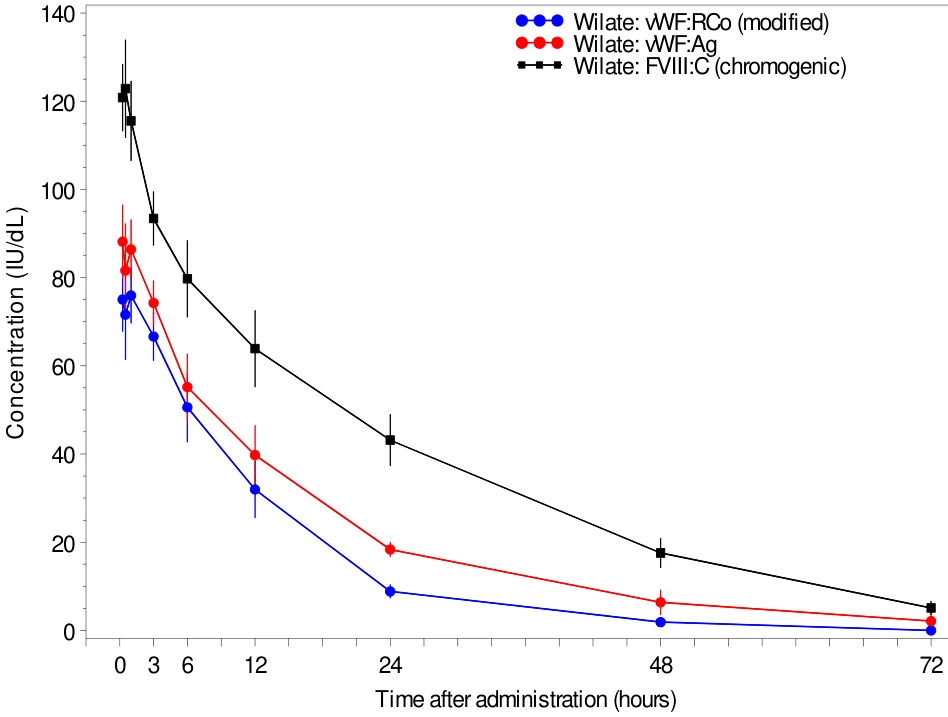
Median curves of the observed plasma concentrations for VWD type 3 patients are shown in Figure 1 by treatment for the VWF:RCo, VWF:Ag and FVIII:C assays. The figure shows the parallel decay curves for VWF:RCo, VWF:Ag and FVIII:C for wilate®.
Figure 1: Study WIL-12: Plasma Concentrations (Mean ± SEM) for wilate® in VWD Type 3 Patients (n=6)*
*Standardized to 40 IU VWF:RCo/kg modified BCS dose.
BCS = Behring® coagulation system; FVIII:C = FVIII coagulant activity; IU = International units; SEM = Standard error of the mean; VWD = Von Willebrand disease; VWF:Ag = Von Willebrand factor antigen; VWF:RCo = Von Willebrand factor activity (ristocetin cofactor assay).
The VWF:RCo overall mean terminal T1/2 observed for wilate® was ~16 hours, and the FVIII:C terminal T1/2 was ~20 hours. Similar T1/2 of VWF:RCo and FVIII can contribute to avoid over- or under-dosing of FVIII or VWF activity especially in cases of repeated dosing. The mean decay curves for both FVIII and VWF were parallel, which may allow for monitoring using blood levels of either factor.
This study showed that wilate® includes the low, medium, and high molecular weight multimers, similar to normal plasma.
11 STORAGE, STABILITY AND DISPOSAL
wilate® and solvent can be stored at between +2°C and +8°C until the indicated expiry date. Within this period, wilate® and solvent may be stored for a single block of up to 6 months at room temperature (max. +25°C). If stored at room temperature (max. +25°C), wilate® must either be used within 6 months or discarded. Protect from light.
Do not freeze. The reconstituted solution should be used on one occasion only. Any solution remaining should be discarded.
12 SPECIAL HANDLING INSTRUCTIONS
Any unused product or waste material should be disposed of in accordance with local requirements.
PART II: SCIENTIFIC INFORMATION
13 PHARMACEUTICAL INFORMATION
Drug Substance
Proper name: wilate® 500/1000
Chemical name: Human von Willebrand factor and human coagulation factor VIII
Molecular formula and molecular mass: not applicable
Structural formula: not applicable
Physicochemical properties:
Table 8 Activity of wilate®
| Analysis | Units | wilate® |
| Total protein | mg/mL | ≤1.5 |
| VWF:RCo | IU/mL | nominal 100 |
| FVIII:C | IU/mL | nominal 100 |
| Ratio between the two parameters (VWF:FVIII) | IU/IU | 0.8–1.2 |
FVIII:C = FVIII coagulant activity; IU = International units; VWF:RCo = Von Willebrand factor activity (ristocetin cofactor assay).
Pharmaceutical standard: Prescribed
Product Characteristics
wilate® is manufactured by a novel production process using new biotechnological methods and newly developed chromatographic media. This process makes it possible to manufacture VWF/FVIII complex in its native form and to reduce the high levels of accompanying plasma proteins that can be found in other FVIII-containing VWF preparations. The ratio between VWF:RCo and FVIII:C in wilate® is approximately 1:1, which corresponds to the physiological ratio in normal plasma.
wilate® is prepared from cryoprecipitate. Two effective virus inactivation steps provide significant assurance of viral safety. These steps are a S/D virus inactivation step and a dry heat treatment step in the final container at +100°C for 120 minutes.
The high purity of the compound is demonstrated by different high resolution analytical methods including size exclusion high pressure liquid chromatography (SE-PLC), sodium dodecyl sulfate polyacrylamide gel electrophoresis (SDS-PAGE), immunoblotting, and agarose gel electrophoresis.
wilate® is a plasma-derived, stable, highly purified freeze-dried human coagulation VWF/FVIII preparation. As the FVIII is complexed with its native stabilizer VWF, no additional stabilizing proteins are added during production.
Viral Inactivation
The plasma used for the manufacture of wilate® is obtained from collection centres that are inspected by national health authorities and audited by Octapharma.
Double Virus Inactivation During the Manufacturing Process
Two well-established process steps are incorporated: S/D and terminal dry heat treatment in the final container at +100°C for 120 minutes.
The viral safety is mainly based on the S/D treatment and the terminal dry-heat treatment step. In addition, an ion-exchange chromatography step was also investigated for its capacity to remove viruses. Chromatographic steps are known to contribute to the removal of potential viral contaminants, as discussed by the CPMP in the "Note for Guidance on Plasma derived Medicinal Products" (CPMP/BWP/269/95).
S/D method: the efficacy was demonstrated at >7.52 log10 inactivation for HIV, ≥8.54 log10 inactivation for pseudorabies virus (PRV), ≥4.18 log10 inactivation for bovine viral diarrhea virus (BVDV), and ≥8.63 log10 inactivation for Sindbis virus. No infectivity was found after 1–2 minutes of S/D treatment in validation studies.
Ion-exchange chromatography led to a reduction factor of 3.29 log10 for porcine parvovirus (PPV) and 1.16–1.93 log10 for HAV.
Dry heat treatment: HAV infectivity was already below the limit of detection after 30 minutes of dry heat treatment. The reduction factor was ≥5.69 log10 steps achieved after 120 minutes of heating. Dry heat treatment of PPV led to a reduction factor of approximately 1–2 log10 after 30 minutes and approximately 2.57–4.12 log10 after 120 minutes of heating. Based on the results for these two highly resistant non-enveloped viruses, dry heat treatment in the final container is performed at +100°C for 120 minutes.
The results of virus validation studies document a mean cumulative total process reduction capacity of >12.43 to >13.31 log10 for HIV-1, >12.53 to >13.41 log10 for PRV, >4.18 log10 for BVDV, >14.14 to >15.14 log10 for Sindbis virus, >6.85 to >7.62 log10 for HAV, and 5.86–7.41 log10 for PPV.
14 CLINICAL TRIALS
14.1 Clinical Trials by Indication
Hemophilia A
Trial Design and Study Demographics
Table 9 Summary of patient demographics for clinical trials in Hemophilia A
| Study # | Study design | Dosage, route of administration and duration | Study subjects (N = patients in study), (n = new individuals) | Mean age ( Range) | Sex |
| TMAE-101 | Open label, non-randomized, non-controlled, Phase 2 trial | 3 single doses (40 IU/kg BW), given IV at baseline, 3 and 6 months. wilate® also available according to needs of patients during study Study duration: 6 months | Severe hemophilia A PTPs (N=12; n=12) 2 patients were enrolled for peri-operative treatment only N=14 | 33 years (18–56) | M |
| TMAE-102 | Open label, non-randomized, non-controlled, Phase 2 trial | 3 single doses (40 IU/kg BW) given IV at baseline, 3 and 6 months, or adapted to needs of patients. wilate® also available according to needs of patients during study Study duration: 6 months | Severe hemophilia A PTPs (N=20; n=20) 4 patients were recruited for treatment during surgery only. N=24 | 24 (11–59) | M |
| TMAE-108 | Open label, non-randomized, non-controlled, Phase 2 trial | 3 single doses (40 IU/kg BW), given IV at baseline, 3 and 6 months. wilate® also available according to needs of patients during study Study duration: 6 months | Severe hemophilia A PTPs (N=20; n=1) | 25 (11–59) | M |
| TMAE-110 | Open label, non-randomized, non-controlled, Phase 3 trial | 3 single doses (40 IU/kg BW), given IV at baseline, 3 and 6 months. wilate® also available according to needs of patients during study Study duration: 6 months | Severe hemophilia A PTPs (N=35; n=35) | 31 (12–66) | M |
BW = Body weight; IU = International units; IV = Intravenous; M = Male; PTP = Previously treated patient.
Four clinical studies (TMAE-101, TMAE-102, TMAE-108, TMAE-110) have been completed with wilate® in previously treated patients (PTPs) with severe hemophilia A. The studies were designed to evaluate the efficacy and safety of wilate® in PTPs with severe hemophilia A.
Study Results
Study TMAE-101
12 PTPs (>150 previous exposure days) with severe hemophilia A (FVIII:C <1%) were treated with wilate®. Two patients were enrolled for peri-operative treatment only. One of the 12 patients was additionally treated during a surgical intervention.
Treatment of Bleeds
A total of 192 bleeds were recorded during this study. Three patients were mainly treated prophylactically. On average, a dose of 27.0 IU wilate®/kg was administered on each day of a bleed. The average duration of therapy for a bleed was 1.3 days.
Treatment of 88.0% of bleeds was assessed as ‘excellent’ or ‘good’. In all cases, the episodes could be controlled with wilate® and all affected patients remained in the study.
Treatment During Surgical Intervention
Evaluation of continuous infusion with wilate® during surgical interventions was limited to 3 cases. In 2 cases efficacy was assessed as ‘good’, and in 1 case as ‘excellent’.
Study TMAE-102
20 PTPs (>150 previous exposure days), with severe hemophilia A (FVIII:C <1%), were treated with wilate®. The duration of the study was 6 months for patients in the treatment part. In addition to the 20 patients, who participated in the treatment part of the study (including 3 surgical procedures) there were 4 patients recruited for treatment during surgery only.
Treatment of Bleeds
A total of 338 bleeds, including peri-operative treatments, were recorded during the study. Five patients were mainly treated prophylactically.
An average dose of 26.9 IU wilate®/kg was administered on each day of a bleed. This is in the range of general recommendations for treatment of bleeding episodes. The average duration of therapy for a bleed was 1.3 days.
Treatment of 99.1 % of the bleeds was assessed as ‘excellent’ (87.3%) or ‘good’ (11.8%). In all cases, the bleed was controlled with wilate® and all affected patients remained in the study.
Treatment During Surgical Intervention
For the evaluation of wilate® during surgical interventions 7 cases were available. In all cases efficacy was assessed as ‘excellent’. On 3 peri-operative occasions, wilate® was given as a continuous infusion. Again, the efficacy was considered to be ‘excellent’.
Study TMAE-108
20 PTPs (19 participated in the previous Study TMAE-102) were treated with wilate®, which could be also given on demand or prophylactically according to the clinical needs of the patients and the recommendations of the treating physician.
Treatment of Bleeds
A total of 302 bleeds were recorded during the study for 16 out of the 20 enrolled patients. On average, a daily dose of 26.53 IU wilate®/kg BW was administered to stop bleeding. The average duration of therapy for a bleed was 1.27 days.
The overwhelming majority were assessed as ‘excellent’ (98.68%), with the remainder rated ‘good’ (1.32 %). In all cases, the bleeds were stopped with wilate® treatment.
Patients could also be treated prophylactically with wilate®. On average the patients received 23 IU/kg BW/exposure day. This average dose is considered to be well within the range of an adequately efficacious FVIII product. During the study period the patients needed on average 1.82 exposure days to wilate®/week.
15 patients with severe hemophilia A had prophylactic treatment periods with wilate® with a duration of at least 4 weeks. A total of 575 (98%) prophylactic wilate® doses were successful, i.e. no hemorrhage occurred within 2 days after the administration. It is notable that in all patients (n=12) who had a prophylactic treatment period of >8 weeks in sequence, the success rate was above 90%, in 8 patients with a prophylactic treatment period of >8 weeks, the success rate was even 100%.
Study TMAE-110
35 PTPs, with severe hemophilia A, were treated with wilate®. The dosing frequency and the actual dose for treating spontaneous bleedings or for prophylactic treatment depended on the clinical situation of the patient, e.g. the severity of the bleeding.
Treatment of Bleeds
A total of 857 bleeds were recorded during the study period for the 35 patients enrolled.
On average, a daily dose of 19.1 IU wilate®/kg BW was administered to stop the bleeding. The average duration of therapy for a bleed was 1.34 days.
For the 857 treated bleeds, the assessment of efficacy was rated as ‘excellent’ in 52.7% of bleeds, ‘good’ in 41.8% and ‘moderate’ in 5%; only 4 (0.5%) received an efficacy rating of ‘none’. The duration of each bleed was ≤2 days in more than 95% of bleeds, and ≤4 days in 99% of all cases. Only 5 bleeds needed treatment for up to 8 days. 845 of 857 bleeds were resolved during the study period, 10 (1%) were assessed as ongoing and for 2 an unknown outcome was recorded.
16 patients had prophylactic treatment periods with wilate® with a duration of at least 4 weeks. In this subpopulation, the total number of prophylactic exposure days was 494. A total of 463 (94%) prophylactic wilate® doses can be regarded as successful, i.e. no hemorrhage occurred within 2 days after the administration. In 65% of cases, the administered prophylactic dose was below 20 IU/kg and may have been too low. It is notable that in all patients (n=8) who had a prophylactic treatment period of >8 weeks in sequence, the success rate was above 90%, in 3 patients with a prophylactic treatment period of >8 weeks, the success rate was 100%.
Treatment During Surgical Intervention
Based on the results obtained for 3 surgeries in 2 patients, the efficacy of wilate® administered peri-operatively was rated as “excellent”.
FVIII IVR after 6 Months of Treatment with wilate® in the Hemophilia A Studies
Overall, 6 months after the initiation of treatment with wilate®, the IVR was well within the expected range, reflected by a 1.5–2.0% raise in FVIII:C plasma levels for 1 IU wilate®/kg BW or an absolute IVR of 60–80% after a dose of 40 IU/kg BW.
Von Willebrand disease
Trial Design and Study Demographics
Table 10 Summary of Clinical Studies in VWD Patients
| Study ID | Population (N=patients in study) (n=new individuals) | Design/ study site/ location/ study period | Evalua tion criteria | Endpoints |
| Study ID | Population (N=patients in study) (n=new individuals) | Design/ study site/ location/ study period | Evalua tion criteria | Endpoints |
| Study ID | Population (N=patients in study) (n=new individuals) | Design/ study site/ location/ study period | Evalua tion criteria | Endpoints |
| TMAE-104 | Inherited VWD, any type Not responding to DDAVP (N=41, n=37) 18 M/23 F Age: 5–73 years (mean 36 years) | Open Non-controlled Phase 3 Multicentre Europe Start: Jan 2002 End: Mar 2007 | Efficacy Safety | Primary endpoints (efficacy) Plasma levels (FVIII:C, VWF:Ag, VWF:CB, VWF:RCo) Secondary endpoints (efficacy) Bleeding time Investigator and/or patient overall assessment of clinical efficacy Secondary endpoints (safety) Adverse events; laboratory and viral safety Investigator and/or patient overall assessment of clinical tolerability |
| TMAE-105 | Inherited VWD, any type Not responding to DDAVP (N=14; n=14) 8 M/6 F ≥12 and ≤65 years Age: 13–64 years (mean 36 years) | Open Non-controlled Phase 2 2 centres Poland and Bulgaria Start: Dec 1999 End: Jul 2000 | PK Efficacy Safety | Primary endpoints (efficacy) PK profile (AUC, AUCnorm, T½ , MRT, Vss and CL) for VWF:Ag, VWF:CB, VWF:RCo Plasma levels of FVIII:C Secondary endpoints (efficacy) PK profile (Cmax and Tmax) for VWF:Ag, VWF:CB, VWF:RCo. IVR of FVIII:C, VWF:Ag and VWF:RCo Plasma levels of VWF:Ag, VWF:CB, VWF:RCo Bleeding time Multimeric pattern Overall assessment of efficacy (investigator) Secondary endpoints (safety) Virus safety Clinical tolerability (adverse events; vital signs; laboratory safety) Overall assessment of safety (investigator and patient) |
| TMAE-106 | Inherited VWD, any type Not sufficiently responding to DDAVP (N=14, n=14) 4 M/10 F Age: 16–77 years (mean 39 years) | Open Non-controlled Phase 2 Multicentre Germany Start: Mar 2002 End: Jul 2006 | PK Efficacy Safety | Primary endpoints (efficacy) PK profile (AUC, T½ , MRT, Vss and CL) for VWF:Ag, VWF:CB, VWF:RCo Plasma levels of FVIII:C Secondary endpoints (efficacy) Incremental IVR and plasma levels of FVIII:C, VWF:RCo, VWF:Ag Bleeding time Closure time Multimeric patterns Overall assessment of efficacy (investigator) Secondary endpoints (safety) Clinical tolerability (adverse events; vital signs; laboratory safety) Overall assessment of safety (investigator and patient) |
| TMAE-109 | Inherited VWD, any type Not responding to DDAVP (N=16; n=5) 10 M/6 F Age: 14–63 years (mean 37 years) | Open Non-controlled Phase 2 2 centres Poland and Bulgaria Start: Aug 2000 End: May 2001 | Efficacy Safety | Primary endpoints (efficacy) Plasma levels: FVIII:C; VWF:Ag; VWF:RCo Secondary endpoints (efficacy) Bleeding time Multimeric patterns Overall assessment of efficacy (investigator) Secondary endpoints (safety) Virus safety Clinical tolerability (vital signs; laboratory safety) Adverse event monitoring Overall assessment of safety (investigator and patient) |
| WIL-14 | Inherited VWD, any type n=15* 10 M/5 F Age: 1–6 years (mean 3.4 years) | Prospective Open Non-controlled Phase 2 7 centres Europe Start: Apr 2006 End: Oct 2009 | PK Efficacy Safety | Primary endpoints (Efficacy) Prevention (prophylactic treatment inc. surgery) and/or treatment of bleeds. Secondary endpoints (efficacy) Incremental and/or absolute IVR of FVIII:C, VWF:RCo, VWF:Ag and VWF:CB in patients undergoing surgery Closure time Secondary endpoints (safety) Adverse events Immunogenicity Vital signs Virus safety Laboratory safety |
| WIL-24 | Inherited VWD undergoing surgical procedures N=41 planned procedures (SAFETY; 39 individual patients) (12 M/29 F) N=30 procedures (ITT; 28 individual patients) (9 M/21 F). Age: ≥6 years | Prospective, uncontrolled, multicentre, open-label, Phase 3 25 centres in the USA, India, Turkey, Poland, Italy, South Africa, Bulgaria, Romania and Oman Start: Aug 2011 End: Mar 2014 | Efficacy Safety | Primary endpoints Overall hemostatic efficacy (success or failure) of wilate® during surgery Secondary endpoints Intra- and post-operative hemostatic efficacy Actual dosage and duration of treatment during surgical procedures Measurement of VWF:RCo and FVIII:C plasma activity during treatment Safety (adverse events; vital signs; laboratory parameters; immunogenicity; virus safety) |
| WIL-31 | Previously treated patients with VWD N=43 (26 M/17 F) N=33 patients in efficacy analysis set (Type 1=6; Type 2A=5; Type 3=22) Age ≥6 years | Prospective, non-controlled, international, multi-center Phase 3 14 centers in the USA,, Bulgaria, Croatia, Hungary, Ukraine, Russia, Lebanon and Belarus Start: Jun 2020 End: Apr 2022 | Efficacy Safety | Primary endpoints Total annualized bleeding rate in prophylactic use of wilate Secondary endpoints Spontaneous annualized bleeding rate, Incremental IVR for VWF:Ac and FVIII:C For pediatric patients, baseline PK profile characteristics Consumption data Safety and tolerability |
* Excludes 2 patients who did not require treatment.
AUC = Area under the curve; AUCnorm = Area under the curve normalized to the dose administered; CL = Clearance; Cmax = Maximum plasma concentration; Cmax norm = Maximum plasma concentration normalized to the dose administered; DDAVP = 1-deamino-8-D-arginine vasopressin (desmopressin); F = Female; FVIII:C = FVIII coagulant activity; IVR = In vivo recovery; ITT = Intention-to-treat; M = Male; MRT = Mean residence time; PK = Pharmacokinetic; SD = Standard deviation; T1/2 = Half-life; VWD = Von Willebrand disease; VWF:Ag = Von Willebrand factor antigen content; VWF:CB = Von Willebrand factor activity (collagen binding assay); VWF:RCo = Von Willebrand factor activity (ristocetin cofactor assay); Vss = Volume of distribution at steady state.
Seven clinical trials (Studies TMAE-105, TMAE-109, TMAE-106, TMAE-104, WIL-14, WIL-24 and WIL-31) have been completed with wilate® in patients with inherited VWD (all type) who were not responding to DDAVP treatment.
The clinical efficacy studies were open studies with no parallel group. They were designed to evaluate the efficacy and safety of wilate® in the management of bleeds on-demand (Studies TMAE-104, -105, -106 and -109), routine prophylaxis (Study WIL-31) or during surgical procedures (Study WIL-24).
The primary efficacy endpoint was the plasma FVIII levels. The main secondary efficacy endpoints were bleeding time, multimeric patterns and the overall assessment of efficacy (by investigator and/or patient).
Study Results
Treatment of Bleeds On Demand
The pivotal analysis of efficacy in the treatment of bleeds was performed within an initial integrated analysis which included 85 patients from Studies TMAE-104, -105, -106 and -109 and WIL-14. A total of 56 patients with a mean age (range) of 23 (1-73) years were treated with on demand wilate® for bleeds and 31 with VWD type 3.
The treatment of a bleed was classified as a success if none of the criteria listed below were fulfilled:
- The bleed was additionally treated with another VWF-containing product (excluding whole blood);
- The patient received a blood transfusion during the bleed;
- Follow-up treatment with a daily dosage of wilate® that was equal or more than 50% (≥50%) above the initial dose (for bleed with more than 1 day of treatment);
- Treatment duration of more than 7 days (>7 days) in cases of GI bleeding of any severity;
- Treatment duration of more than 4 days (>4 days) in cases of severe bleeding (other than GI);
- Treatment duration of more than 3 days (>3 days) in cases of moderate bleeding (other than GI);
- Treatment duration of more than 2 days (>2 days) in cases of minor bleeding (other than GI);
- The last efficacy rating of the bleed was 'moderate' or 'none'.
A total of 1354 bleeds were treated with wilate and 1060 (78.3%) were successful. Of the 294 on-demand treatments where efficacy was classified as a failure (21.7%) the majority were joint (n=91) and GI bleeds (n=89). The remainder were epistaxis (n=66), oral bleeds (n=22), gynecological bleeds (n=10) and others (n=16).
The overwhelming majority of bleeds required 1–3 days of treatment and a similar dose on the initial day compared with subsequent days. The majority of bleeds were treated with 1 dose (n=722, 68%) or in 1 day (n=770, 73%).
Bleeding rated as severe required a slightly higher daily average dose (26.7 IU/kg) compared with minor (22.6 IU/kg) or moderate (21.8 IU/kg) bleeds.
Bleeding of the GI tract required the highest average daily dose (28.1 IU/kg) followed by gynecologic bleeding (27.6 IU/kg). Other bleeding locations (joints/epistaxis/ oral/other) required an average dose of between 20.8 and 23.5 IU/kg.
Prophylaxis
Study WIL-31 demonstrated that prophylactic use of wilate lowers the total annualized bleeding rate (TABR) by 83.5% in comparison with on-demand treatment in the same patients. TABR was calculated as the total number of spontaneous, traumatic and other bleeds (excluding menstrual bleeds). For this efficacy assessment, the individual annualized bleeding rates during on-demand treatment were collected for the same patients during a previous, non-interventional study, WIL-29 (Table 11). The similar effect was observed for annualized spontaneous bleeding rate. Subjects were treated for 12 months of prophylaxis with a mean dose of 31.04 IU/kg wilate® per injection, 2 to 3 times per week.
Table 11 Primary Endpoint: Comparison of Total Annualized Bleeding Rates in Studies WIL-31 and WIL-29 (modified full analysis set, N=33)
| Annualized Bleeding Rate | n1 | Estimated Rate WIL-29 | Estimated Rate WIL-31 | Estimated Rate Ratio2 | p-value3 | 95% CI4 (two- sided) |
|---|---|---|---|---|---|---|
| Total Bleeding Rate | 33 | 33.38 | 5.49 | 0.16 | <.0001 | (0.10; 0.27) |
1Number of patients participated in both studies, WIL-31 and WIL-29; 2Ratio calculated as the ABR during the prophylaxis period in WIL-31 vs the corresponding ABR during the On-Demand Period in WIL-29; 3p-value from a 1-sided test whether the mean ratio is less than 0.5 utilizing a negative binomial counting regression model; 4Confidence Interval from negative binomial counting regression model CI=confidence interval
In addition, 19 patients (12 of VWD type 3) underwent prophylactic treatment for at least 10 consecutive weeks in other studies. The mean bleeding frequency before the start of wilate® prophylaxis was 4.03 bleeds per month (median 3.3, range 0.8–28) and it dropped to a mean of 1.23 bleeds per month during wilate® prophylaxis (median 1.2, range 0–3.1).
Surgical Procedures
Study (WIL-24)
Of 30 surgical procedures documented in this study, 21 were major surgeries and 9 were minor surgeries. The majority of major surgical procedures were either orthopedic (8 surgeries) or obstetric/gynecological (5 surgeries). In total, 17 of the 21 major procedures were performed in patients with type 3 VWD.
The overall efficacy of wilate® in surgical prophylaxis (success or failure) was assessed by investigator and surgeon, and adjudicated by an Independent Data Monitoring Committee using an algorithm that was based on prospectively designed, objective criteria of blood loss, transfusion requirements and post-operative bleeding and oozing.
Treatment with wilate® was successful in 95.2% of major surgeries (98.75% CI: 70.4%, 100.0%) and in all minor surgeries (rate of success 100%; 98.75% CI: 56.9%, 100.0%). The success rate of wilate® treatment was 100% in 21 surgeries in VWD type 3 patients (98.75% CI: 78.5%
100.0%), 100% in 2 surgeries in VWD type 2 patients (98.75% CI: 0.079, 1.000) and 85.7% in 7 surgeries in VWD type 1 patients (98.75% CI: 32.8%, 99.9%).
For major surgeries, the mean wilate® loading dose was 54.7 IU/kg and the mean maintenance dose was 29.6 IU/kg. For minor surgeries, the mean loading dose was 41.9 IU/kg and the mean maintenance dose was 21.6 IU/kg.
Other Studies (TMAE-104, -105, -106 and -109)
In a post-hoc, pooled analysis of 4 studies, the efficacy of wilate® in surgeries was assessed by the investigator based on subjective criteria.
A total of 59 surgeries were performed, of which 30 were classified as major e.g. abdominal, gynecological, urological or orthopedic surgical procedures. A total of 50 surgeries were successfully treated and the success rate was 84.7% (95% CI: 73.0%, 92.8%). The success rate in treated minor surgeries was 93.1% compared with 76.7% for major surgeries.
Minor surgeries were generally treated for less than 3 days, and with daily average maintenance doses of 25–39 IU/kg. Major surgeries required an initial average dose of 61 IU/kg on Day 1, while mean daily maintenance doses on subsequent days ranged from 25–33 IU/kg.
14.3 Immunogenicity
Immunogenicity was a safety endpoint in the 4 completed studies in PTPs with hemophilia A. For all 4 studies, the determination of FVIII inhibitor activity (Bethesda assay) at baseline, and 3 and 6 months after initiation of treatment yielded negative (<0.4 BU) results for all patients on all 3 occasions.
The experience related to FVIII inhibitors in PUPs with hemophilia A is limited. In a clinical trial with wilate®, 3 out of 28 PUPs developed persistent FVIII inhibitors above 5 BU/mL. Low titre, transient FVIII inhibitors were observed in 3 other patients. Two more patients had a low titre inhibitor on a single occasion and no follow-up.
No inhibitor development to VWF was observed in 155 individual patients in 8 VWD clinical trials with wilate®, 3 of which included specific testing for VWF inhibitors.
16 NON-CLINICAL TOXICOLOGY
Administration of wilate® is a replacement therapy at physiological levels.
General Toxicology
Single dose toxicity studies with human proteins in animals are not expected to be highly representative and have not been performed. Expected changes are signs of volume overload (high doses), unspecific effects or sequelae of blood coagulation.
Carcinogenicity
The range and type of carcinogenicity studies routinely conducted for pharmaceuticals are not applicable to biotechnology-derived products and were therefore not performed.
Standard carcinogenicity bioassays are generally inappropriate for biotechnology-derived products and were therefore not performed.
Clinical experience does not provide any evidence of tumorigenic effects of human vWF and FVIII.
Genotoxicity
The range and type of genotoxicity studies routinely conducted for pharmaceuticals are not applicable to biotechnology-derived products and were therefore not performed.
Clinical experience does not provide any evidence of mutagenic effects of human vWF and FVIII.
Reproductive and Developmental Toxicology
No reproduction and development toxicity studies were performed for wilate®. Hemophilia A patients are mainly male whereas VWD affects both males and females. Coagulation factors, however, do not cross the placental barrier.
Special Toxicology
The formation of antibodies and consequently the occurrence of anaphylactic reactions are strong arguments against long-term studies on the toxicity of repeated doses of wilate® in animals. Such studies have not been conducted.
Juvenile Toxicity
No juvenile toxicity studies were performed for wilate®. Hemophilia A and VWD patients require replacement therapy in all age groups.
Clinical experience does not provide any evidence of juvenile toxicity effects of human vWF and FVIII.