


Product Monograph - Eugia-Sunitinib
SUMMARY PRODUCT INFORMATION
| Route of Administration | Dosage Form / Strength | All Nonmedicinal Ingredients |
|---|---|---|
| Oral | Hard Gelatin Capsules / 12.5 mg; 25 mg; 37.5 mg; 50 mg | Mannitol, croscarmellose sodium, povidone and magnesium stearate |
INDICATIONS AND CLINICAL USE
Eugia-Sunitinib (sunitinib malate) is indicated for:
the treatment of gastrointestinal stromal tumour (GIST) after failure of imatinib mesylate treatment due to resistance or intolerance.
Approval of sunitinib malate is based on Time to Tumour Progression (TTP). Overall survival advantage could not be confirmed (see CLINICAL TRIALS section).
- the treatment of metastatic renal cell carcinoma (MRCC) of clear cell histology. Approval for MRCC is based on statistically significant progression free survival in patients with good performance status (ECOG 0-1). There was a trend for overall survival advantage (see CLINICAL TRIALS).
the treatment of patients with unresectable locally advanced or metastatic, well- differentiated pancreatic neuroendocrine tumours (pancreatic NET), whose disease is progressive.
Approval for pancreatic NET is based on progression free survival in patients with good performance status (ECOG 0-1) (see CLINICAL TRIALS section).
Pediatrics:
The safety and efficacy of sunitinib malate in pediatric patients have not been established (see
WARNINGS AND PRECAUTIONS, and TOXICOLOGY).
Geriatrics (> 65 years of age):
Of 825 GIST and MRCC patients who received sunitinib malate on clinical trials, 277 (34%) were 65 and over. In the Phase 3 pancreatic NET study, 22 (27%) patients who received sunitinib malate were 65 and over. No overall differences in safety or efficacy were observed between younger and older patients.
CONTRAINDICATIONS
Use of Eugia-Sunitinib is contraindicated in patients with hypersensitivity to sunitinib malate or to any other component of Eugia-Sunitinib. For a complete listing, see the Dosage Forms, Composition and Packaging sections of the Product Monograph.
Eugia-Sunitinib is contraindicated in pregnant women.
WARNINGS AND PRECAUTIONS
Serious Warnings and Precautions Patients receiving therapy with Eugia-Sunitinib should be monitored by a qualified physician experienced in the use of anti-cancer agents.
|
|---|
Carcinogenesis and Mutagenesis
The carcinogenic potential of sunitinib malate has been evaluated in rasH2 transgenic mice and in Sprague-Dawley rats.
In rasH2 transgenic mice, gastroduodenal carcinomas, an increased incidence of background hemangiosarcomas, and gastric mucosal hyperplasia have been observed at doses of ≥25 mg/kg/day following 1- or 6-months duration (≥7.3 times the AUC in patients administered the RDD). No proliferative changes were observed in rasH2 transgenic mice at 8 mg/kg/day (≥0.7 times the AUC in patients administered the RDD).
In a 2-year rat carcinogenicity study (0, 0.33, 1, or 3 mg/kg/day), administration of sunitinib malate in 28-day cycles followed by 7-day dose-free periods resulted in duodenal carcinomas in Brunner’s glands, increases in the incidence of pheochromocytomas and hyperplasia in the adrenal medulla of male rats given 3 mg/kg/day following >1 year of dosing (≥7.8 times the AUC in patients administered the RDD).
The relevance to humans of the neoplastic findings observed in the mouse (rasH2 transgenic) and rat carcinogenicity studies with sunitinib malate treatment is unclear. (see TOXICOLOGY, Carcinogenicity).
Sunitinib malate has been tested for genotoxicity in a series of in vitro assays (bacterial mutation [Ames Assay], human lymphocyte chromosome aberration) and an in vivo rat bone marrow micronucleus test and did not cause genetic damage.
Cardiovascular
Hypertension
Blood pressure was monitored on a routine basis in the clinical studies. Hypertension was a very common adverse reaction reported in clinical trials in subjects with solid tumors, including primarily GIST and cytokine-refractory RCC1. In the treatment-naïve MRCC study, two patients were discontinued due to treatment-related hypertension, including one with malignant hypertension, and one patient in the pancreatic NET study discontinued due to treatment-related Grade 3 hypertension.
In the GIST trial (Study A), hypertension (all grades) was reported as an adverse event in 51/257 (19%) patients on sunitinib malate and 7/102 (7%) patients on placebo. Severe hypertension (> 200 mmHg systolic or > 110 mmHg diastolic) occurred in 9/237 (4%) patients on sunitinib malate and no patients on placebo. Sunitinib malate dosing was neither delayed nor reduced due to hypertension in any of the GIST patients in the GIST pivotal trial.
Treatment-related hypertension was reported in approximately 30% of patients receiving sunitinib malate for treatment-naïve MRCC compared to 2% of patients receiving interferon-alfa (IFN- α). Severe hypertension (> 200 mmHg systolic or > 110 mmHg diastolic) occurred in 9% of treatment-naïve patients on sunitinib malate and 1% of patients on IFN-α.
In the cytokine-refractory metastatic RCC (MRCC) trials, hypertension (all grades) was reported as an adverse event in 47/169 (28%) patients on sunitinib malate. Hypertension (>150 mmHg systolic or >100 mmHg diastolic) occurred at least once during the study for 86/165 (52%) patients on sunitinib malate; severe hypertension (> 200 mmHg systolic or > 110 mmHg diastolic) occurred in 10/165 (6%) patients on sunitinib malate. Sunitinib malate dosing was
1 From initial clinical trials including primarily patients with GIST and cytokine-refractory MRCC.
delayed or reduced due to hypertension in 8/165 (4%) cytokine-refractory MRCC patients.
Of patients receiving sunitinib malate in the Phase 3 pancreatic NET study, 19/83 patients (23%) on sunitinib malate and 3/82 (4%) patients on placebo experienced treatment-related hypertension. Grade 3 treatment-related hypertension was reported in 8/83 (10%) pancreatic NET patients on sunitinib malate, and 0/82 (0%) patients on placebo. Sunitinib malate dosing was delayed or reduced due to hypertension in 6/83 (7%) of pancreatic NET patients. Severe hypertension (> 200 mmHg systolic or > 110 mmHg diastolic) occurred in 8/80 (10%) of pancreatic NET patients on sunitinib malate and 2/76 (3%) patients on placebo.
Patients should be monitored for hypertension and treated as appropriate with standard antihypertensive therapy. Temporary suspension of Eugia-Sunitinib is recommended in patients with severe hypertension. Treatment may be resumed once hypertension is controlled.
Patients with hypertension that is not controlled by medications should not be treated with Eugia-Sunitinib.
Serious cases of artery dissection have been reported in patients using VEGFR TKIs, including sunitinib malate, with or without hypertension.
Left Ventricular Dysfunction
Cardiovascular events, including heart failure, myocardial disorders (See arterial thromboembolic events subsection) and cardiomyopathy, some of which were fatal, have been reported through post-marketing experience.
Decreases in left ventricular ejection fraction (LVEF) of ≥ 20% and below the lower limit of normal (LLN) occurred in approximately 2% of sunitinib malate -treated GIST patients, 4% of sunitinib malate-treated cytokine-refractory MRCC patients and 2% of placebo-treated patients.
In the double-blind treatment phase of GIST Study A, 22 patients (11%) on sunitinib malate and 3 patients (3%) on placebo had treatment-emergent LVEF values below LLN. Nine (9) of 22 GIST patients on sunitinib malate with LVEF changes recovered without intervention. Five (5) patients had documented LVEF recovery following intervention (dose reduction- 1 patient; addition of antihypertensive or diuretic medications- 4 patients). Six (6) patients went off study without documented recovery. Additionally, 3 patients (1%) on sunitinib malate had Grade 3 reductions in left ventricular systolic function to LVEF < 40%; 2 of these patients died without receiving further study drug.
In the treatment-naïve MRCC study, 27% and 15% of patients on sunitinib malate and IFN-α, respectively, had an LVEF value below the LLN. Two (<1%) patients who received sunitinib malate were diagnosed with congestive heart failure (CHF). One of the two patients with CHF discontinued the study.
In cytokine-refractory MRCC Studies 1 and 2, a total of 24 patients (14%) had treatment- emergent LVEF values below the LLN. Five (5) of 24 patients on sunitinib malate with LVEF changes recovered without intervention. Five (5) patients had documented LVEF recovery following intervention (dose reduction- 3 patients; addition of antihypertensive or diuretic medications-2 patients). Eight (8) patients went off study without documented recovery and 6 patients are ongoing on study without recovery.
In the Phase 3 pancreatic NET study, fatal cardiac failure was reported in two patients (2%) on sunitinib malate and no patients on placebo.
Patients who presented with cardiovascular events such as myocardial infarction (including severe/unstable angina), coronary/peripheral artery bypass graft, symptomatic CHF, cerebrovascular accident or transient ischemic attack, or pulmonary embolism within 12 months prior to sunitinib malate administration, were excluded from sunitinib malate clinical studies. It is unknown whether patients with these concomitant conditions may be at a higher risk of developing drug- related left ventricular dysfunction. Physicians are advised to weigh this risk against the potential benefits of the drug. These patients should be carefully monitored for clinical signs and symptoms of CHF while receiving Eugia-Sunitinib. Baseline and periodic evaluations of LVEF should also be considered while these patients are receiving Eugia-Sunitinib. In patients without cardiac risk factors, a baseline evaluation of ejection fraction should be considered.
In the presence of clinical manifestations of CHF, discontinuation of Eugia-Sunitinib is recommended. The dose of Eugia-Sunitinib should be interrupted and/or reduced in patients without clinical evidence of CHF but with an ejection fraction < 50% and > 20% below baseline.
QT Interval Prolongation
QT interval prolongation, including fatality, with sunitinib malate use has been reported in clinical trials. There is clinical evidence that sunitinib malate prolongs QT interval, PR interval, and decreases the heart rate (See CLINICAL PHARMACOLOGY section). Patients with QTc interval prolongation, atrioventricular (AV) block, and those taking concomitant drugs with dysrhythmic potential were excluded from the pivotal trials, therefore there is no information regarding safety of sunitinib malate therapy in this group. Because excessive prolongation of the PR interval can result in AV block, caution should be used if Eugia-Sunitinib is prescribed to patients in combination with other drugs that also cause PR interval prolongation, such as beta-blockers, calcium channel blockers, digitalis, or HIV protease inhibitors.
Pre-clinical data (in vitro and in vivo) demonstrate sunitinib malate causes QT interval prolongation (see DETAILED PHARMACOLOGY).
Particular care should be exercised when administering Eugia-Sunitinib to patients who are at an increased risk of experiencing torsade de pointes during treatment with a QTc-prolonging drug, or who are taking concomitant drugs with potential to cause QTc interval prolongation (see DRUG INTERACTIONS section).
Bradycardia and AV block are recognized risk factors for torsade de pointes. For this reason, because sunitinib malate causes QTc prolongation in association with prolongation of the PR and RR intervals, this raises particular concern with respect to proarrhythmic potential. QT interval prolongation may lead to an increased risk of torsade de pointes. Torsade de pointes has been observed in <0.1% of sunitinib malate-exposed patients.
Eugia-Sunitinib therapy should be discontinued if symptoms suggestive of arrhythmia occur.
Thrombotic Microangiopathy
Thrombotic microangiopathy (TMA) (including cases identified as thrombotic thrombocytopenic purpura [TTP] and haemolytic uraemic syndrome [HUS]), sometimes leading to renal failure or a fatal outcome, has been reported in clinical trials and in post-marketing experience of sunitinib malate as monotherapy and in combination with bevacizumab (see ADVERSE REACTIONS, Post- market Adverse Drug Reactions). Permanently discontinue Eugia-Sunitinib in patients developing TMA. Reversal of the effects of TMA has been observed after treatment was discontinued consistent with a role reported for inhibitors of the VEGF pathway in this event. Eugia-Sunitinib is not indicated for use in combination with other agents.
Venous Thromboembolic Events/ Pulmonary Embolism
In the double-blind treatment phase of a Phase 3 GIST study, seven (7) patients (3%) on sunitinib malate and none on placebo experienced venous thromboembolic events; 5 of the 7 were Grade 3 deep vein thrombosis (DVT), and 2 were Grade 1 or 2. Four (4) of these 7 GIST patients discontinued treatment following first observation of DVT. Four (4) GIST patients receiving sunitinib malate experienced a Grade 3/4 pulmonary embolism. All 4 GIST patients had a dose interruption or delay, but were able to continue on sunitinib malate. Two (2) patients receiving placebo experienced pulmonary embolism. No fatalities related to pulmonary embolism were reported.
Thirteen (3%) patients receiving sunitinib malate for treatment-naïve MRCC and 4 (2%) patients on the 2 cytokine-refractory MRCC studies had treatment-emergent venous thromboembolic events reported. Seven (7) of the treatment-naïve MRCC patients had pulmonary embolism, 1 was Grade 2 and 6 were Grade 4. Six (6) of the treatment-naïve MRCC patients had DVT, including 3 Grade 3. One subject with pulmonary embolism in the cytokine-refractory MRCC study experienced dose interruption. In treatment-naïve MRCC patients receiving IFN-α, 6 (2%) venous thromboembolic events occurred; 1 patient (<1%) experienced a Grade 3 DVT and 5 patients (1%) had pulmonary embolism, all Grade 4.
One patient (1%) receiving sunitinib malate for pancreatic NET had a venous thromboembolic event reported compared to 5 patients (6%) receiving placebo. The patient receiving sunitinib malate had Grade 2 thrombosis. Of the 5 patients in the placebo arm who had venous thromboembolic events, two patients had DVT (Grade 3 in one patient and Grade 2 in one patient), two patients had pulmonary embolism (Grade 3 in one patient and Grade 4 in one patient), and one patient had Grade 3 jugular vein thrombosis.
Arterial Thromboembolic Events
Cases of arterial thromboembolic events, sometimes fatal, have been reported in patients treated with sunitinib malate. The most frequent events included cerebrovascular accident, transient ischemic attack and cerebral infarction. Risk factors associated with ATE, in addition to the underlying malignant disease and age ≥65 years, included hypertension, diabetes mellitus, and prior thromboembolic disease.
Cases of myocardial ischemia and myocardial infarction, some of which were fatal, have been reported through post-marketing experience. Use Eugia-Sunitinib with caution in patients who are at risk for, or who have a history of, these events.
At the time of initial registration, in the clinical trials supporting the indications of GIST and MRCC, there were no cases of myocardial ischemia or myocardial infarction in patients with GIST exposed to either sunitinib malate or placebo. Two (2) patients with treatment-naïve MRCC experienced treatment-related myocardial infarction (Grade 4), while 2 patients had Grade 3 myocardial ischemia. Two (2) patients with cytokine-refractory MRCC experienced Grade 3 myocardial ischemia, 1 had Grade 2 “cardiovascular toxicity” reported as an adverse event and 1 patient experienced a fatal myocardial infarction while on treatment.
In a pooled analysis of 10 clinical studies of sunitinib malate in RCC, GIST, and pNET, involving 7115 subjects, the frequency of myocardial ischemia/myocardial infarction events is 2.0%.
Drug Interactions
Sunitinib malate is metabolized primarily by CYP3A4. Potential interactions may occur with drugs that are inhibitors or inducers of this enzyme system (see DRUG INTERACTIONS).
Endocrine and Metabolism
Adrenal Function Effects
Adrenal toxicity was noted in pre-clinical repeat dose studies of 14 days to 9 months in rats and monkeys at plasma exposures as low as 1.1 times the AUC observed in clinical studies. Histological changes of the adrenal gland were characterized as hemorrhage, necrosis, congestion, hypertrophy and inflammation. In clinical studies, CT or MRI scanning performed on 336 patients treated with sunitinib malate demonstrated no evidence of adrenal gland hemorrhage or necrosis. ACTH stimulation testing was conducted in over 400 patients across multiple clinical trials of sunitinib malate. In the GIST studies, 13 patients with normal baseline testing had abnormalities at post-baseline testing consisting of: peak cortisol levels post-stimulation less than normal (497 nmol/L, or 18 mcg/dL); failure of stimulation to increase cortisol level by a normal amount (193 nmol/L, or 7 mcg/dL); or failure of ACTH Gel test to detect doubling of cortisol level post-stimulation. None of these patients were reported to have clinical evidence of adrenal insufficiency. In the cytokine-refractory MRCC studies, 28 patients with normal baseline testing had abnormalities at post-baseline testing and 3 patients had a treatment-emergent adverse event of adrenal insufficiency, which were not considered by the investigator to be related to sunitinib malate.
Patients treated with Eugia-Sunitinib should be monitored for adrenal insufficiency when they experience stress such as surgery, trauma, or severe infection.
Hypoglycemia
Decreases in blood glucose, in some cases clinically symptomatic with serious outcomes, have been reported during sunitinib malate treatment in both diabetic and non-diabetic patients. Blood glucose levels should be checked regularly in all patients. For patients receiving anti-diabetic drugs, drug dosages may need to be adjusted to minimize the risk of hypoglycemia.
Thyroid dysfunction
Treatment-emergent acquired hypothyroidism was noted in 4% of GIST patients on sunitinib malate versus 1% on placebo. Although not prospectively studied in clinical trials, treatment-related hypothyroidism was reported as an adverse event in 15% of patients on sunitinib malate in the treatment-naïve MRCC study and two patients (0.6 %) in the IFN-α arm, and in 4% of patients across the two cytokine-refractory MRCC studies. Additionally, thyroid stimulating hormone (TSH) elevations were reported in 2% of cytokine-refractory MRCC patients. Treatment-related hypothyroidism was reported as an adverse reaction in 5/83 patients (6%) on sunitinib malate in the Phase 3 pancreatic NET study and in 1/82 patients (1%) in the placebo arm.
Cases of hyperthyroidism, some followed by hypothyroidism, and cases of thyroiditis have been uncommonly reported in clinical trials and through post-marketing experience.
Baseline laboratory measurement of thyroid function is recommended in all patients. During sunitinib malate treatment, routine monitoring of thyroid function should be performed every 3 months. All patients should be observed closely for signs and symptoms of thyroid dysfunction on sunitinib malate treatment. Patients with signs and/or symptoms suggestive of thyroid dysfunction, such as fatigue, should have laboratory monitoring of thyroid function performed and be treated as per standard medical practice. Thyroid hormone replacement therapy should be initiated and maintained according to the current recommended guidelines. Careful dosage titration of thyroid hormone replacement therapy should be considered to decrease the risk of rapid and unpredictable hepatic failure when used in conjunction with sunitinib malate therapy. Close observation of liver function tests and thyroid function is required when patients are receiving both Eugia-Sunitinib and thyroid hormone replacement therapy. (see WARNINGS AND PRECAUTIONS, Monitoring and Laboratory Tests section)
Gastrointestinal
Esophagitis
Cases of esophagitis have been reported in clinical trials and in the post market setting.
Gastrointestinal Perforation
Serious, sometimes fatal gastrointestinal complications including gastrointestinal perforation, (likely linked to tumour necrosis) have occurred in patients with intra-abdominal malignancies treated with sunitinib malate.
Gastrointestinal Events
In 6 pooled studies composed primarily of patients with GIST and MRCC, nausea, diarrhea, stomatitis, dyspepsia and vomiting were the most commonly reported treatment-related gastrointestinal events. Supportive care for gastrointestinal adverse events requiring treatment may include anti-emetic or anti-diarrheal medication.
Hemorrhage
Hemorrhagic events reported through post-marketing experience, some of which were fatal, have included GI, respiratory, tumour, urinary tract and brain hemorrhages. In the double-blind treatment phase of GIST pivotal trial (Study A), bleeding events occurred in 20% of patients (41/202) receiving sunitinib malate, compared to 11% (11/102) receiving placebo. In GIST Study A, 14/202 patients (7%) receiving sunitinib malate and 9/102 patients (9%) on placebo had Grade 3 or 4 bleeding events. In addition, 1 patient in Study A taking placebo had a fatal gastrointestinal bleeding event during cycle 2.
In patients receiving sunitinib malate for treatment-naïve MRCC, 28% of patients had treatment-related bleeding events compared with 3% of patients receiving IFN-α. Eleven (2.1%) patients on sunitinib malate versus 1 (0.3%) of patients on IFN-α experienced Grade 3 or greater treatment-related bleeding events.
Bleeding events occurred in 50/169 (26%) patients receiving sunitinib malate for cytokine-refractory MRCC. Most events in cytokine-refractory MRCC patients were Grade 1 or 2; there was one Grade 3 event (bleeding foot wound). Two (2) cytokine-refractory MRCC study patients with pulmonary metastases experienced hemoptysis considered to be related to sunitinib malate administration.
Epistaxis was the most common hemorrhagic adverse event reported. Treatment-related epistaxis was reported in 16/83 patients (19%) receiving sunitinib malate for pancreatic NET and in 2/82 patients (2%) receiving placebo. Less common bleeding events in MRCC, GIST and pancreatic NET patients included rectal, gingival, upper GI, genital and wound bleeding.
In the Phase 3 pancreatic NET study, 1/83 patients (1%) receiving sunitinib malate had Grade 3 epistaxis, and no patients had other Grade 3 or 4 bleeding events. In pancreatic NET patients receiving placebo, no patients had Grade 3 or 4 bleeding events. Treatment-related bleeding events, excluding epistaxis, occurred in 16/83 patients (19%) receiving sunitinib malate in the Phase 3 pancreatic NET study, compared to 3/82 patients (4%) receiving placebo.
Treatment-related tumour hemorrhage has been observed in patients receiving sunitinib malate. These events may occur suddenly, and in the case of pulmonary tumours, may present as severe and life-threatening hemoptysis or pulmonary hemorrhage. Fatal pulmonary hemorrhage occurred in 2 patients receiving sunitinib malate in a clinical trial of patients with metastatic non-small cell lung cancer (NSCLC). Both patients had squamous cell histology. Sunitinib malate is not approved for use in patients with NSCLC. Treatment-related Grade 3 and 4 tumour hemorrhage occurred in 4/257 (approximately 2%) of GIST patients treated with sunitinib malate. One (1) patient with tumour hemorrhage had the sunitinib malate dose temporarily delayed. No patients discontinued treatment due to tumour hemorrhage.
Routine assessment of this event should include serial complete blood counts (CBCs) and physical examination.
Hematologic Events
Decreased absolute neutrophil counts of Grade 3 and 4 severity were reported in 13.1% and 0.9% patients, respectively. One (1) case of febrile neutropenia was reported in a patient receiving sunitinib malate on the GIST pivotal trial (Study A). Fatal disseminated intravascular coagulation (DIC) secondary to sepsis has also been reported. Decreased platelet counts of grade 3 and 4 severity were reported in 4% and 0.5% of patients respectively. The above events were not cumulative, were typically reversible and generally did not result in treatment discontinuation. Rare cases of fatal pneumonia and sepsis, with or without neutropenia, have been reported.
Complete blood counts should be performed at the beginning of each treatment cycle for patients receiving treatment with Eugia-Sunitinib. Supportive care for hematologic events may include colony stimulating factors.
Hepatic/Biliary/Pancreatic
Sunitinib malate has been associated with hepatotoxicity, which may result in liver failure or death. Liver failure has been observed in clinical trials (<1%) and post-marketing experience. Liver failure signs include jaundice, elevated transaminases and/or hyperbilirubinemia in conjunction with encephalopathy, coagulopathy, and/or renal failure. Monitor liver function tests (alanine aminotransferase [ALT], aspartate aminotransferase [AST], and bilirubin) before initiation of treatment, during each cycle of treatment, and as clinically indicated. Eugia-Sunitinib should be interrupted for Grade 3 or 4 drug related hepatic adverse events and discontinued if there is no resolution. Do not restart Eugia-Sunitinib if patients subsequently experience severe changes in liver function tests or have other signs and symptoms of liver failure.
Safety in patients with ALT or AST >2.5 x upper limit of normal (ULN) or, if due to liver metastases, >5.0 x ULN has not been established.
Pancreatitis has been reported in clinical trials of sunitinib malate. Grade 3 and 4 increases in serum lipase have been observed in 20 sunitinib malate patients (10%) versus 7 placebo patients (7%) with GIST. Grade 3 and 4 increases in amylase have been observed in 10 sunitinib malate patients (5%) versus 3 placebo patients (3%) with GIST. In patients with treatment-naïve MRCC, Grade 3 or 4 increases in amylase and lipase have been observed in 6% and 18% of sunitinib malate-treated patients and in 3% and 7% of patients receiving IFN-α. In the cytokine-refractory MRCC studies, grade 3 or 4 increases in amylase and lipase have been observed in 4.8% and 16.9% of sunitinib malate - treated patients, respectively. Increases in lipase levels were transient and were generally not accompanied by signs or symptoms of pancreatitis in subjects receiving sunitinib malate for GIST or MRCC. Hepatic failure was observed in <1% of solid tumour patients treated with sunitinib malate. If symptoms of pancreatitis or hepatic failure are present, patients should have Eugia-Sunitinib discontinued and be provided with appropriate medical care.
Cases of cholecystitis, including acalculous cholecystitis and emphysematous cholecystitis, have been reported in patients treated with sunitinib malate (with fatal outcome in some cases).
Metabolism and Nutritional Disorders
Tumour Lysis Syndrome (TLS)
Cases of TLS, some fatal, have been rarely observed in clinical trials and have been reported in post-marketing experience in patients treated with sunitinib malate. Patients generally at risk of TLS are those with high tumour burden prior to treatment. These patients should be monitored closely and treated as clinically indicated.
Neurologic
Seizures
Sunitinib malate has not been studied in patients with known brain metastases. In clinical studies of sunitinib malate, seizures have been observed in <1% of subjects with radiological evidence of brain metastases.
In addition, there have been rare (< 1%) reports, some fatal, of subjects presenting with seizures and radiological evidence of reversible posterior leukoencephalopathy syndrome (RPLS). Patients with seizures and signs/symptoms consistent with RPLS, such as hypertension, headache, decreased alertness, altered mental functioning and visual loss, including cortical blindness should be controlled with medical management including control of hypertension. Discontinuation of Eugia-Sunitinib is recommended; following resolution, treatment may be resumed at the discretion of the treating physician, although the evidence to support this recommendation (restarting treatment) is extremely limited.
Osteonecrosis of the Jaw (ONJ)
Cases of ONJ have been reported in patients treated with sunitinib malate. Treatment with sunitinib malate may be an additional risk factor for the development of osteonecrosis of the jaw. The majority of cases occurred in patients who had received prior or concomitant treatment with IV bisphosphonates, for which ONJ is an identified risk. Caution should therefore be exercised when sunitinib malate and IV bisphosphonates are used either simultaneously or sequentially.
Invasive dental procedures are also an identified risk factor for ONJ. Prior to treatment with sunitinib malate, a dental examination and appropriate preventive dentistry should be considered. In patients being treated with sunitinib malate, who have previously received or are receiving IV bisphosphonates, invasive dental procedures should be avoided, if possible.
Renal
Cases of renal impairment and/or failure, in some cases with fatal outcome, have been reported.
Cases of proteinuria and nephrotic syndrome have been reported. Baseline urinalysis is recommended, and patients should be monitored for the development or worsening of proteinuria. The safety of continued sunitinib malate treatment in patients with moderate to severe proteinuria has not been systematically evaluated. Discontinue sunitinib malate in patients with nephrotic syndrome.
Skin and Tissues
Skin discoloration, possibly due to the active substance color (yellow) is a common treatment- related adverse event occurring in approximately 30% of patients. Patients should be advised that depigmentation of the hair or skin may also occur during treatment with Eugia-Sunitinib. Other possible dermatologic effects may include dryness, thickness or cracking of the skin, blisters or occasional rash on the palms of the hands and soles of the feet.
The above events were not cumulative, were typically reversible, generally did not result in treatment discontinuation and may include topical therapies for symptomatic relief.
Rare cases of necrotizing fasciitis, including of the perineum, sometimes fatal, have been reported (see ADVERSE REACTIONS, Post-Market Adverse Drug Reactions). Eugia-Sunitinib therapy should be discontinued in patients who develop necrotizing fasciitis, and appropriate treatment should be promptly initiated.
Cases of pyoderma gangrenosum have been reported (see ADVERSE REACTIONS, Post- Market Adverse Drug Reactions).
Severe cutaneous reactions have been rarely reported, including cases of erythema multiforme (EM) and Stevens-Johnson syndrome (SJS) and cases suggestive of toxic epidermal necrolysis (TEN). Some of these cases were life-threatening and fatal. If signs or symptoms of SJS, TEN, or EM (e.g. progressive skin rash often with blisters or mucosal lesions) are present, Eugia-Sunitinib treatment should be discontinued. If the diagnosis of SJS or TEN is confirmed, treatment must not be restarted. In some cases of suspected EM, patients tolerated the reintroduction of sunitinib malate therapy at a lower dose after resolution of the reaction. A decision to re-initiate Eugia-Sunitinib after resolution of suspected EM is at the discretion of the treating physician as there is limited evidence to support this recommendation.
Wound Healing/Surgery
No formal clinical studies of the effect of sunitinib malate on wound healing have been conducted. Impaired wound healing has been reported in patients treated with sunitinib malate. It is recommended that Eugia-Sunitinib therapy be interrupted in patients undergoing major surgical procedures. Due to limited clinical experience regarding the timing of re-initiation of sunitinib malate therapy in the post- operative period, the decision to resume Eugia-Sunitinib therapy should be based upon clinical judgment of recovery from surgery.
Special Populations
Pregnant Women:
There are no adequate and well-controlled studies of sunitinib malate in pregnant women. Repeat-dose studies in animals have shown effects in reproductive organs, as well as embryolethality and fetal structural abnormalities, at maternal systemic exposures less than those achieved in humans at the recommended human dose (see TOXICOLOGY– Reproductive and Developmental Toxicity). Eugia-Sunitinib should not be used during pregnancy or in any woman not employing adequate contraception. If the drug is used during pregnancy, or if the patient becomes pregnant while receiving this drug, the patient should be apprised of the potential hazard to the fetus (see TOXICOLOGY – Reproductive and Developmental Toxicity). Women of childbearing potential should be advised to avoid becoming pregnant while receiving treatment with Eugia-Sunitinib.
Nursing Women:
Sunitinib malate and/or its metabolites are excreted in rat milk. It is not known whether sunitinib malate or its primary active metabolite are excreted in human milk. Because drugs are commonly excreted in human milk and, because of the potential for serious adverse reactions in nursing infants, women should be advised against breastfeeding while taking Eugia-Sunitinib.
Male Contraception:
Male patients should be surgically sterile or agree to use effective contraception during the period of therapy with Eugia-Sunitinib. Sunitinib malate may cause embryonal and fetal developmental effects should the female partner of a male taking Eugia-Sunitinib become pregnant as the drug may be present in the semen.
Fertility:
In the definitive fertility study in rats, no effects were observed on male or female fertility.
However, effects of sunitinib malate on male and female reproductive systems have been observed in other non-clinical studies so sunitinib malate treatment may result in adverse effects on reproductive function and fertility in the clinical setting. The safety of sunitinib malate on reproductive function has not been evaluated in patients.
Pediatrics:
The safety and efficacy of sunitinib malate in pediatric patients have not been established (see
INDICATIONS and TOXICOLOGY). However, physeal dysplasia was observed in Cynomolgus monkeys with open growth plates treated for 3 months with sunitinib malate at doses that were approximately 0.4 times the recommended human dose (RHD) based on systemic exposure (AUC). The incidence and severity of physeal dysplasia were dose-related and were reversible upon cessation of treatment.
Hepatic Insufficiency:
A single 50 mg dose of sunitinib malate was administered to patients with mild (Child-Pugh Class A) and moderate (Child-Pugh Class B) hepatic impairment, and to control group of patients with normal hepatic function. The pharmacokinetic parameters evaluated demonstrated that dose adjustments might not be necessary for patients with mild (Child-Pugh Class A) or moderate (Child-Pugh Class B) hepatic impairment. However, sunitinib malate was not studied in subjects with severe (Child-Pugh Class C) hepatic impairment. In addition, repeated administration of sunitinib malate was not studied in subjects with hepatic impairment.
Renal Insufficiency:
Safety and efficacy of sunitinib malate have not been established in patients with severe renal impairment or with end-stage renal disease (ESRD) on hemodialysis. Phase 3 studies that were conducted excluded patients with serum creatinine >2.0 x ULN. However, in a small Phase 1 study, systemic exposures after a single 50mg dose of sunitinib malate were similar in 8 subjects with severe renal impairment (CLcr<30 mL/min) compared to 8 subjects with normal renal function (CLcr>80 mL/min), although the variability was greater in the patients with severe renal impairment. Even though sunitinib malate and its primary metabolite were not eliminated through hemodialysis in 8 subjects with ESRD, the total systemic exposures were lower by 47% for sunitinib malate and 31% for its primary metabolite compared to 8 subjects with normal renal function, most likely due to a lower absorption of sunitinib malate in subjects with ESRD.
Based on pharmacokinetic data from this Phase 1 study, no adjustment to starting dose is required when administering sunitinib malate to patients with renal impairment (mild-severe) or with end-stage renal disease (ESRD) on hemodialysis. Subsequent dose modifications should be based on individual safety and tolerability [see DOSAGE AND ADMINISTRATION, Dose Modification]. Repeated administration of sunitinib malate was not studied in subjects with renal impairment.
Cases of renal impairment and failure, including fatalities, have been reported with sunitinib malate use. Caution and careful monitoring of patients with severe renal impairment or ESRD on hemodialysis is required while on Eugia-Sunitinib.
Monitoring and Laboratory Tests
CBCs and serum chemistries (including liver function tests, creatinine, electrolytes, magnesium, calcium, phosphate, amylase, and lipase) should be performed at the beginning of each treatment cycle for patients receiving treatment with Eugia-Sunitinib. In the event of an electrolyte abnormality, there should be prompt correction of the imbalance.
Baseline laboratory measurement of thyroid function is recommended in all patients. Patients with pre-existing hypothyroidism or hyperthyroidism should be treated as per standard medical practice prior to the start of Eugia-Sunitinib treatment. During Eugia-Sunitinib treatment, routine monitoring of thyroid function should be performed every 3 months. In addition, patients should be observed closely for signs and symptoms of thyroid dysfunction during treatment, and patients who develop any signs and/or symptoms suggestive of thyroid dysfunction should have laboratory testing of thyroid function performed as clinically indicated. Patients who develop thyroid dysfunction should be treated as per standard medical practice.
Cases of proteinuria and rare cases of nephrotic syndrome have been reported. Baseline urinalysis is recommended, and patients should be monitored for the development or worsening of proteinuria.
Baseline ECG should be conducted prior to starting Eugia-Sunitinib, and ECGs should be performed periodically during therapy. Eugia-Sunitinib should generally not be prescribed to patients with abnormally long baseline QT/QTc intervals or AV block. If there are symptoms suggestive of arrhythmia or if the QT/QTc interval becomes markedly prolonged while the patient is on Eugia-Sunitinib, the drug should be discontinued.
Blood glucose levels should be checked regularly in all patients. For patients receiving anti- diabetic drugs, drug dosages may need to be adjusted to minimize the risk of hypoglycemia.
ADVERSE REACTIONS
Overview
The data described below reflect exposure to sunitinib malate in 660 patients who participated in a placebo-controlled trial (n=202) for the treatment of GIST, an active-controlled trial (n=375) for the treatment of MRCC, or a placebo-controlled trial (n=83) for the treatment of pancreatic NET. The GIST and MRCC patients received a starting oral dose of 50 mg daily on Schedule 4/2 in repeated cycles, and the pancreatic NET patients received a starting oral dose of 37.5 mg daily without scheduled off-treatment periods. Most adverse events are reversible and do not need to result in discontinuation. If necessary, these events can be managed through dose adjustments or interruptions.
The most common treatment-related adverse reactions (≥20%) in patients with GIST, MRCC or pancreatic NET are fatigue, asthenia, diarrhea, nausea, mucositis/stomatitis, vomiting, dyspepsia, abdominal pain, constipation, hypertension, rash, hand-foot syndrome, skin discoloration, dry skin, hair color changes, altered taste, anorexia, and bleeding. The potentially serious adverse reactions of left ventricular dysfunction, QT interval prolongation, hemorrhage, hypertension, thyroid dysfunction, and adrenal function are discussed in WARNINGS AND PRECAUTIONS. Other adverse reactions reported in studies of GIST, MRCC and pancreatic NET studies are described below.
Because clinical trials are conducted under widely varying conditions, adverse reaction rates observed in the clinical trials of a drug cannot be directly compared to rates in the clinical trials of another drug and may not reflect the rates observed in clinical practice.
Adverse Reactions in GIST Placebo-Controlled Study (Study A)
The median duration of blinded study treatment was 2 cycles for patients on the sunitinib malate arm (mean 3, range 0-9) and one cycle (mean 1.6, range 0-6) for patients on placebo at the time of the interim analysis. Dose reductions occurred in 23 patients (11%) on sunitinib malate and none on placebo. Dose interruptions occurred in 57 patients (28%) on sunitinib malate and 20 (20%) on placebo. The rate of permanent discontinuation due to treatment-related, non-fatal adverse events was 9% (19/202) vs. 8% (8/102), sunitinib malate vs. placebo.
Most treatment-related adverse events, reported for both treatment arms were Grade 1 or 2 in severity. Grade 3 or 4 treatment-related adverse events were reported in 48% of sunitinib malate patients and 29% of placebo patients, respectively, in the double-blind treatment phase of the trial. Fatigue was the most common treatment-related adverse event of any maximum severity grade reported for 42% of sunitinib malate patients and 36% of placebo patients. Diarrhea, nausea, stomatitis, altered taste, skin abnormalities, hypertension and bleeding were all more common in patients receiving sunitinib malate than in those receiving placebo. Alopecia has been observed in 9 (4.5%) subjects exposed to sunitinib malate in Study A as compared to 1 (1%) subject exposed to placebo. All events were NCI CTC Grade 1 severity. Hair color changes have been observed in 14 (6.9%) subjects exposed to sunitinib malate in Study A as compared to 2 (2%) subjects exposed to placebo. Table 1 presents the treatment-emergent adverse events commonly reported (≥ 10% of patients) in Study A.
Table 1: Treatment-Emergent Adverse Events Reported in at Least 10% of GIST Patients Who Received sunitinib malate or Placebo in Study A in the Double-Blind Treatment Phase of Study A
| GIST | |||||||||||||
|---|---|---|---|---|---|---|---|---|---|---|---|---|---|
| Sunitinib malate (n=202) | Placebo (n=102) | ||||||||||||
| Adverse Event, n (%) | All Grades | Grade 3/4 | All Grades | Grade 3/4 | |||||||||
| Any | 190 (94) | 97 (48) | 99 (97) | 30 (29) | |||||||||
| Blood and Lymphatic System Disorders | 60 (30) | 34 (17) | 9 (9) | 3 (3) | |||||||||
| Anemia NOS | 39 (19) | 16 (8) | 7 (7) | 2 (2) | |||||||||
| Gastrointestinal | 171 (85) | 40 (20) | 75 (74) | 19 (19) | |||||||||
| Diarrhea NOS | 82 (41) | 9 (5) | 21 (21) | 0 (0) | |||||||||
| Nausea | 66 (33) | 2 (1) | 23 (23) | 3 (3) | |||||||||
| Abdominal pain NOS | 61 (30) | 12 (6) | 28 (29) | 10 (10) | |||||||||
| Vomiting NOS | 50 (25) | 3 (2) | 18 (18) | 3 (3) | |||||||||
| Constipation | 43 (21) | 0 (0) | 16 (16) | 2 (2) | |||||||||
| Stomatitis | 33 (16) | 1 (1) | 2 (2) | 0 (0) | |||||||||
| Dyspepsia | 30 (15) | 1 (1) | 6 (6) | 0 (0) | |||||||||
| Abdominal pain upper | 22 (11) | 3 (2) | 8 (8) | 0 (0) | |||||||||
| Metabolism and Nutritional Disorders | 81 (40) | 15 (8) | 26 (26) | 1 (1) | |||||||||
| Anorexia | 62 (31) | 1 (1) | 19 (19) | 1 (1) | |||||||||
| Musculoskeletal and Connective Tissue | 90 (45) | 11 (5) | 35 (34) | 5 (5) | |||||||||
| Disorders | |||||||||||||
| Arthralgia | 24 (12) | 2 (1) | 10 (10) | 0 (0) | |||||||||
| Back pain | 21 (10) | 1 (1) | 13 (13) | 3 (3) | |||||||||
| General Disorders and Administration Site | 147 (73) | 27 (13) | 65 (64) | 7 (7) | |||||||||
| Conditions | |||||||||||||
| Fatigue | 84 (42) | 15 (7) | 37 (36) | 4 (4) | |||||||||
| Asthenia | 44 (22) | 10 (5) | 10 (10) | 2 (2) | |||||||||
| Pyrexia | 32 (16) | 2 (1) | 9 (9) | 1(1) | |||||||||
| Mucosal inflammation NOS | 30 (15) | 0 (0) | 0 (0) | 0 (0) | |||||||||
| Nervous System Disorders | 89 (44) | 8 (4) | 29 (28) | 3 (3) | |||||||||
| Dysgeusia | 40 (20) | 0 (0) | 2 (2) | 0 (0) | |||||||||
| Headache | 38 (19) | 2 (1) | 17 (17) | 0 (0) | |||||||||
| Psychiatric Disorders | 36 (18) | 1 (1) | 15 (15) | 1 (1) | |||||||||
| Insomnia | 24 (12) | 0 (0) | 10 (10) | 1 (1) | |||||||||
| Skin and Subcutaneous Tissue Disorders | 125 (62) | 12 (6) | 31 (30) | 0 (0) | |||||||||
| Skin Discoloration | 52 (26) | 0 (0) | 8 (8) | 0 (0) | |||||||||
| Rash NOS | 30 (15) | 2 (1) | 6 (6) | 0 (0) | |||||||||
| PPE syndrome | 28 (14) | 9 (5) | 2 (2) | 0 (0) | |||||||||
| Vascular Disorders | 50 (25) | 17 (8) | 12 (12) | 0 (0) | |||||||||
| Hypertension NOS | 28 (14) | 8 (4) | 7 (7) | 0 (0) | |||||||||
Common Terminology Criteria for Adverse Events (CTCAE) Version 3.0
PPE: Palmar plantar erythrodyaesthesia syndrome NOS: Not otherwise specified
Table 2 depicts common (≥ 10%) treatment-emergent laboratory abnormalities.
Table 2: Treatment-Emergent Laboratory Abnormalities in ≥ 10% of GIST Patients who Received sunitinib malate or Placebo in the Double-Blind Treatment Phase of Study A
| Adverse Event, n (%) | Sunitinib malate (n=202) | Placebo (n=102) | ||||||||||||
|---|---|---|---|---|---|---|---|---|---|---|---|---|---|---|
| All Grades | Grade 3/4a | All Grades | Grade 3/4b | |||||||||||
| Any | 68 (34) | 22 (22) | ||||||||||||
| Gastrointestinal | 78 (39) | 3 (2) | 23 (23) | 1 (1) | ||||||||||
| AST / ALT | ||||||||||||||
| Alkaline phosphatase | 48 (24) | 7 (4) | 21 (21) | 4 (4) | ||||||||||
| Total Bilirubin | 32 (16) | 2 (1) | 8 (8) | 0 (0) | ||||||||||
| Indirect Bilirubin | 20 (10) | 0 (0) | 4 (4) | 0 (0) | ||||||||||
| Amylase | 35 (17) | 10 (5) | 12 (12) | 3 (3) | ||||||||||
| Lipase | 50 (25) | 20 (10) | 17 (17) | 7 (7) | ||||||||||
Cardiac Decreased LVEF | 22 (11) | 2 (1) | 3 (3) | 0 (0) | ||||||||||
| Renal / Metabolic | 25 (12) | 1 (1) | 7 (7) | 0 (0) | ||||||||||
| Creatinine | ||||||||||||||
| Hypokalemia | 24 (12) | 1 (1) | 4 (4) | 0 (0) | ||||||||||
| Hypernatremia | 20 (10) | 0 (0) | 4 (4) | 1 (1) | ||||||||||
| Uric acid | 31 (15) | 16 (8) | 16 (16) | 8 (8) | ||||||||||
| Hematology | 107 (53) | 20 (10) | 4 (4) | 0 (0) | ||||||||||
| Neutropenia | ||||||||||||||
| Lymphopenia | 76 (38) | 0 (0) | 16 (16) | 0 (0) | ||||||||||
| Anemia | 52 (26) | 6 (3) | 22 (22) | 2 (2) | ||||||||||
| Thrombocytopenia | 76 (38) | 10 (5) | 4 (4) | 0 (0) | ||||||||||
*Common Terminology Criteria for Adverse Events (CTCAE) Version 3.0
a Grade 4 AEs in patients on sunitinib malate included alkaline phosphatase (1%), lipase (2%), creatinine (1%), hypokalemia (1%), neutropenia (2%), anemia (2%), and thrombocytopenia (1%).
b Grade 4 AEs in patients on placebo included amylase (1%), lipase (1%), anemia (2%), and thrombocytopenia (1%).
Grade 3 or 4 treatment-emergent laboratory abnormalities were seen in 68 sunitinib malate patients (34%) versus 22 placebo patients (22%). Elevated liver function tests, pancreatic enzymes and creatinine were all more common in sunitinib malate patients than placebo patients. Decreased LVEF, myelosuppression and electrolyte disturbances were all more common in sunitinib malate patients than placebo patients. Treatment-emergent acquired hypothyroidism was noted in 4% of GIST patients on sunitinib malate versus 1% on placebo.
After a positive interim analysis, the study was unblinded, and patients on the placebo arm were given the opportunity to receive open-label sunitinib malate treatment [see CLINICAL TRIALS]. For 241 patients randomized to the sunitinib malate arm, including 139 who received sunitinib malate in both the double-blind and open-label treatment phases, the median duration of sunitinib malate treatment was 6 cycles (mean 8.5, range 1 – 44). For the 255 patients who ultimately received open-label sunitinib malate treatment, median duration of study treatment was 6 cycles (mean 7.8, range 1 – 37) from the time of the unblinding. A total of 118 patients (46%) required dosing interruptions, and a total of 72 patients (28%) required dose reductions during the open-label treatment phase. The incidence of treatment-emergent adverse reactions resulting in permanent discontinuation was 20%. The most common Grade 3 or 4 treatment-related adverse reactions experienced by patients receiving sunitinib malate in the open-label treatment phase were neutropenia (11%), fatigue (10%), hypertension (8%), asthenia (5%), diarrhea (5%), hand-foot syndrome (5%), nausea (4%), abdominal pain (3%), anorexia
(3%), mucositis (2%), vomiting (2%), and hypothyroidism (2%).
Adverse Reactions in MRCC Patient Population
Treatment-Naïve MRCC
The as-treated patient population for the interim safety analysis of the Phase 3 MRCC study included 735 patients, 375 randomized to sunitinib malate and 360 randomized to IFN- α. The median duration of treatment was 11.1 months (range: 0.4 – 46.1) for sunitinib malate treatment and 4.1 months (range: 0.1 – 45.6) for IFN-α treatment. Dose interruptions occurred in 202 patients (54%) on sunitinib malate and 141 patients (39%) on IFN-α. Dose reductions occurred in 194 patients (52%) on sunitinib malate and 98 patients (27%) on IFN-α. Discontinuation rates due to adverse reactions were 20% for sunitinib malate and 23% for IFN-α. Most treatment-related adverse events in both study arms were Grade 1 or 2 in severity. Grade 3 or 4 treatment-related adverse events were reported in 69% and 38% of patients on sunitinib malate versus IFN- α, respectively. Common treatment-related adverse events of any grade for patients receiving sunitinib malate are fatigue, diarrhea, nausea, stomatitis, hypertension, hand-foot syndrome, ejection fraction decline. Table 3 compares the incidence of common (≥10%) treatment-related adverse events for patients receiving sunitinib malate versus those on IFN- α.
Table 3: Treatment-Related Adverse Events Reported in at Least 10% of Patients with Treatment-Naïve MRCC Who Received sunitinib malate or IFN- α
| Adverse Event, n (%) | Sunitinib malate (n =375) | IFN-α (n =360) | ||||||||||||
|---|---|---|---|---|---|---|---|---|---|---|---|---|---|---|
All Grades n (%) | Grade 3/4 n (%) | All Grades n (%) | Grade 3/4 n (%) | |||||||||||
| Any adverse event | 358 (95.5%) | 258 (68.8%) | 331 (91.9%) | 139 (38.6%) | ||||||||||
| Blood and lymphatic system disorders | 69 (18.4%) | 33 (8.8%) | 11 (3.1%) | 2 (0.6 %) | ||||||||||
| Thrombocytopenia | ||||||||||||||
| Neutropenia | 70 (18.7%) | 40 (10.7%) | 31 (8.6%) | 12 (3.3%) | ||||||||||
| Anemia | 51 (13.6%) | 19 (5.1%) | 31 (8.6%) | 7 (1.9%) | ||||||||||
| Leukopenia | 40 (10.7%) | 12 (3.2%) | 14 (3.9%) | 3 (0.8%) | ||||||||||
| Metabolism and nutrition disorders | 129 (34.4%) | 7 (1.9%) | 101 (28.1%) | 6 (1.7%) | ||||||||||
| Anorexia | ||||||||||||||
| Decreased appetite | 37 (9.9%) | 1 (0.3%) | 38 (10.6%) | 0 (0%) | ||||||||||
| Nervous system disorders | 175 (46.7%) | 1 (0.3%) | 52 (13.9%) | 0 (0%) | ||||||||||
| Dysgeusia | ||||||||||||||
| Headache | 53 (14.1%) | 2 (0.5%) | 55 (15.3%) | 0 (0%) | ||||||||||
Vascular disorders Hypertension | 113 (30.1%) | 46 (12.3%) | 6 (1.7%) | 1 (0. 3%) | ||||||||||
Respiratory, thoracic and mediastinal disorders Epistaxis | 67 (17.9%) | 3 (0.8%) | 5 (1.4%) | 0 (0%) | ||||||||||
| Gastrointestinal disorders | 229 (61.1%) | 33 (8.8%) | 49 (13.6%) | 1 (0.3%) | ||||||||||
| Diarrhea | ||||||||||||||
| Nausea | 195 (52.0%) | 17 (4.5%) | 124 (34.4%) | 4 (1.1%) | ||||||||||
| Dyspepsia | 118 (31.5%) | 7 (1.9%) | 13 (3.6%) | 0 (0%) | ||||||||||
| Stomatitis | 110 (29.3%) | 5 (1.3%) | 10 (2.8%) | 1 (0.3%) | ||||||||||
| Vomiting | 117 (31.2%) | 14 (3.7%) | 41 (11.4%) | 2 (0.6%) | ||||||||||
| Abdominal pain* | 70 (18.7%) | 7 (1.9%) | 15 (4.2%) | 0 (0%) | ||||||||||
| Dry mouth | 45 (12.0%) | 0 (0%) | 24 (6.7%) | 1 (0.3%) | ||||||||||
| Constipation | 44 (11.7%) | 1 (0.3%) | 14 (3.9%) | 0 (0.0%) | ||||||||||
| Flatulence | 43 (11.5%) | 0 (0.0%) | 6 (1.6%) | 0 (0.0%) | ||||||||||
| Adverse Event, n (%) | Sunitinib malate (n =375) | IFN-α (n =360) | ||||||||||||
|---|---|---|---|---|---|---|---|---|---|---|---|---|---|---|
All Grades n (%) | Grade 3/4 n (%) | All Grades n (%) | Grade 3/4 n (%) | |||||||||||
| Any adverse event | 358 (95.5%) | 258 (68.8%) | 331 (91.9%) | 139 (38.6%) | ||||||||||
| Skin and subcutaneous tissue disorders | 115 (30.7%) | 4 (1.1%) | 33 (9.2%) | 3 (0.8%) | ||||||||||
| Rash** | ||||||||||||||
| Palmar-plantar erythrodysesthesia | 108 (30.0%) | 32 (8.5%) | 2 (0.6%) | 0 (0%) | ||||||||||
| syndrome | ||||||||||||||
| Dry skin | 79 (21.1%) | 1 (0.3%) | 19 (5.3%) | 0 (0%) | ||||||||||
| Skin discoloration | 89 (23.7%) | 1 (0.3%) | 0 (0%) | 0 (0%) | ||||||||||
| Hair color changes | 75 (20.0%) | 0 (0%) | 1 (0.3%) | 0 (0%) | ||||||||||
| Erythema | 39 (10.4%) | 2 (0.5%) | 3 (0.8%) | 0 (0%) | ||||||||||
| Musculoskeletal and connective tissue | 66 (17.6%) | 5 (1.3%) | 11 (3.1%) | 0 (0%) | ||||||||||
| disorders | ||||||||||||||
| Pain in extremity | ||||||||||||||
| Arthralgia | 43 (11.5%) | 1 (0.3%) | 49 (13.6%) | 0 (0%) | ||||||||||
| Myalgia | 32 (8.5%) | 1 (0.3%) | 60 (16.7%) | 2 (0.6%) | ||||||||||
| General disorders and administration | 206 (54.9%) | 43 (11.5%) | 186 (51.7%) | 48 (13.3%) | ||||||||||
| site conditions | ||||||||||||||
| Fatigue | ||||||||||||||
| Mucosal inflammation | 98 (26.1%) | 7 (1.9%) | 6 (1.7%) | 1 (0.3%) | ||||||||||
| Asthenia | 76 (20.3%) | 28 (7.5%) | 67 (18.6%) | 14 (3.9%) | ||||||||||
| Pyrexia | 31 (8.3%) | 3 (0.8%) | 125 (34.7%) | 1 (0.3%) | ||||||||||
| Chills | 28 (7.5%) | 2 (0.5%) | 105 (29.2%) | 0 (0%) | ||||||||||
| Investigations | 51 (13.6%) | 10 (2.7%) | 11 (3.1%) | 3 (0.8%) | ||||||||||
| Ejection fraction decreased | ||||||||||||||
| Weight decreased | 46 (12.3%) | 1 (0.3%) | 50 (13.9%) | 1 (0.3%) | ||||||||||
*The following terms have been combined: abdominal pain and abdominal pain upper.
**The following terms have been combined: rash, rash erythematous, exfoliative rash, rash follicular, rash macular, rash papular, rash pruritic, rash maculo-papular, rash psoriaform, and rash generalised.
In the treatment-naive MRCC study, 75 (20%) versus 37 (10%) patients experienced treatment- emergent Grade 4 chemistry laboratory abnormalities on sunitinib malate versus IFN-α, respectively. The most common Grade 4 chemistry abnormalities were hyperuricemia (14% on sunitinib malate, 8% on IFN-α) and increased lipase (3% on sunitinib malate, 1% on IFN-α). The most common Grade 3 chemistry abnormalities observed on both arms were increased lipase (15% on sunitinib malate, 7% on IFN-α) and hypophosphatemia (6% on sunitinib malate, 6% on IFN- α). Other common Grade 3 laboratory abnormalities on sunitinib malate were hyponatremia (8%) and increased amylase (5%), and on IFN-а was hyperglycemia (6%). Hematologic laboratory abnormalities in the treatment-naïve MRCC patient population are presented in Table 4.
Grade 4 hematology laboratory abnormalities in the Phase 3 MRCC study include neutropenia (2% on sunitinib malate, 1% on IFN-α) and anemia (2% on sunitinib malate, <1% on IFN-α). Grade 3 hematology laboratory abnormalities included neutropenia (15% on sunitinib malate, 8% on IFN-α), lymphopenia (16% on sunitinib malate, 24% on IFN-α), thrombocytopenia (8% on sunitinib malate, 1% on IFN-α), leukopenia (8% on sunitinib malate, 2% on IFN-α) and anemia (6% on sunitinib malate, 5% on IFN-α).
Table 4. Treatment-Emergent Laboratory Abnormalities Reported in at Least 10% of Treatment-Naïve MRCC Patients Who Received sunitinib malate or IFN-α
| Laboratory Parameter, n (%) | Treatment-Naïve RCC | ||||||||
|---|---|---|---|---|---|---|---|---|---|
| Sunitinib malate (n=375) | IFN- α | (n=360) | |||||||
| All Grades* | Grade 3/4*a | All Grades* | Grade 3/4*b | ||||||
| Gastrointestinal | 211 (56) | 6 (2) | 136 (38) | 8 (2) | |||||
| AST | |||||||||
| ALT | 192 (51) | 10 (3) | 144 (40) | 9 (2) | |||||
| Lipase | 211 (56) | 69 (18) | 165 (46) | 29 (8) | |||||
| Alkaline phosphatase | 171 (46) | 7 (2) | 132 (37) | 6 (2) | |||||
| Amylase | 130 (35) | 22 (6) | 114 (32) | 12 (3) | |||||
| Total bilirubin | 75 (20) | 3 (1) | 8 (2) | 0 (0) | |||||
| Indirect bilirubin | 49 (13) | 4 (1) | 3 (1) | 0 (0) | |||||
| Renal/Metabolic | 262 (70) | 2 (<1) | 183 (51) | 1 (<1) | |||||
| Creatinine | |||||||||
| Creatine kinase | 183 (49) | 9 (2) | 40 (11) | 4 (1) | |||||
| Uric acid | 173 (46) | 54 (14) | 119 (33) | 29 (8) | |||||
| Calcium decreased | 156 (42) | 4 (1) | 145 (40) | 4 (1) | |||||
| Phosphorus | 116 (31) | 22 (6) | 87 (24) | 23 (6) | |||||
| Albumin | 106 (28) | 4 (1) | 72 (20) | 0 (0) | |||||
| Glucose increased | 86 (23) | 21 (6) | 55 (15) | 22 (6) | |||||
| Sodium decreased | 75 (20) | 31 (8) | 55 (15) | 13 (4) | |||||
| Glucose decreased | 65 (17) | 0 (0) | 43 (12) | 1 (<1) | |||||
| Potassium increased | 61 (16) | 13 (3) | 61 (17) | 15 (4) | |||||
| Calcium increased | 50 (13) | 2 (<1) | 35 (10) | 5 (1) | |||||
| Potassium decreased | 49 (13) | 3 (1) | 7 (2) | 1 (<1) | |||||
| Sodium increased | 48 (13) | 0 (0) | 38 (10) | 0 (0) | |||||
| Hematology | 289 (77) | 65 (17) | 178 (49) | 31 (9) | |||||
| Neutrophils | |||||||||
| Hemoglobin | 298 (79) | 29 (8) | 250 (69) | 18 (5) | |||||
| Platelets | 255 (68) | 35 (9) | 85 (24) | 2 (1) | |||||
| Lymphocytes | 256 (68) | 66 (18) | 245 (68) | 93 (26) | |||||
| Leukocytes | 293 (78) | 29 (8) | 202 (56) | 8 (2) | |||||
* Common Terminology Criteria for Adverse Events (CTCAE), Version 3.0
a Grade 4 laboratory abnormalities in patients on sunitinib malate included uric acid (14%), lipase (3%), neutrophils (2%), lymphocytes (2%), hemoglobin (2%), platelets (1%), amylase (1%), ALT (<1%), creatine kinase (<1%), creatinine (<1%), glucose increased (<1%), calcium decreased (<1%), phosphorous (<1%), potassium increased (<1%), and sodium decreased (<1%).
b Grade 4 laboratory abnormalities in patients on IFN-α included uric acid (8%), lymphocytes (2%), lipase (1%), neutrophils (1%), amylase (<1%), calcium increased (<1%), glucose decreased (<1%), potassium increased (<1%) and hemoglobin (<1%).
Cytokine-Refractory MRCC
The data described below reflect exposure to sunitinib malate in 169 patients with cytokine-refractory MRCC enrolled in Studies 1 and 2. The median duration of treatment was 5.5 months (range: 23 days to 11.2 months) for Study 1 and 7.9 months (range: 6 days to 1.3 years) for Study 2. Dose interruptions occurred in 48 patients (45%) on Study 1 and 45 patients (71%) on Study 2; one or more dose reductions occurred in 23 patients (22%) on Study 1 and 22 patients (35%) on Study 2 Permanent discontinuation from the study due to treatment-related adverse events occurred in 7 patients (8%) on Study 1 and 6 patients (10%) on Study 2. Treatment-related Adverse events are presented by maximum severity grade for at least 10% of the MRCC patient population in Table 5. Treatment-related Adverse events were experienced by nearly all of the patients with MRCC. Fatigue; gastrointestinal disorders, such as nausea, diarrhea, stomatitis, dyspepsia, vomiting and constipation; dysgeusia; skin discoloration; anorexia and rash were the most common treatment-related adverse events (experienced by at least 20% of the patients). The relative frequency of the most common all-causality adverse events was similar to that of these treatment-related adverse events.
Table 5: Treatment-Related Adverse Events Reported in at Least 10% of Patients Treated with sunitinib malate in the Two Cytokine-Refractory MRCC Studies
| Adverse Event | All Grades n (%) | Grade 3/4 n (%) |
|---|---|---|
| Any Treatment-Related AE Experienced by ≥10% Patients | 166 ( 98.2) | 91 ( 53.9) |
| Blood and Lymphatic System Disorders | 57 ( 33.7) | 30 ( 15.8) |
| Anemia | 21 ( 12.4) | 6 ( 3.6) |
| Leukopenia | 24 ( 14.2) | 10 ( 5.9) |
| Neutropenia | 24 ( 14.2) | 14 ( 8.3) |
| Thrombocytopenia | 23 ( 13.6) | 11 ( 6.5) |
| Eye disorders | 17 (10.1) | 0 (0.0) |
| Gastrointestinal disorders | 156 ( 92.3) | 15 (8.9) |
| Constipation | 34 ( 20.1) | 0 ( 0.0) |
| Diarrhoea | 83 ( 49.1) | 5 ( 3.0) |
| Dyspepsia | 69 ( 40.8) | 1 ( 0.6) |
| Glossodynia | 25 ( 14.8) | 0 ( 0.0) |
| Nausea | 84 ( 49.7) | 2 ( 1.2) |
| Stomatitis | 70 ( 41.4) | 6 ( 3.6) |
| Vomiting | 52 ( 30.8) | 2 ( 1.2) |
| General disorders and administration site conditions | 118 ( 69.8) | 19 ( 11.2) |
| Fatigue | 102 ( 60.4) | 18 ( 10.7) |
| Mucosal inflammation | 30 ( 17.8) | 1 ( 0.6) |
| Infections and infestations | 21 ( 12.4) | 4 ( 2.4) |
| Investigations* | 65 ( 38.5) | 31 ( 20.1) |
| Ejection fraction decreased | 24 ( 14.2) | 4 ( 2.4) |
| Lipase increased | 17 ( 10.1) | 15 ( 8.9) |
Metabolism and nutrition disorders Anorexia | 68 ( 40.2) 47 ( 27.8) | 9 ( 5.3) 1 ( 0.6) |
Musculoskeletal and connective tissue disorders Pain in extremity | 45 ( 26.6) 21 ( 12.4) | 3 ( 1.8) 1 ( 0.6) |
Nervous system disorders Dysgeusia Headache | 101 ( 59.8) 71 ( 42.0) 25 ( 14.8) | 6 ( 3.6) 0 ( 0.0) 1 ( 0.6) |
| Psychiatric disorders | 17 ( 10.1) | 2 ( 1.2) |
| Respiratory, thoracic and mediastinal disorders | 40 ( 23.7) | 3 ( 1.8) |
Skin and subcutaneous tissue disorders Dry skin Erythema Hair color changes Palmar-plantar erythrodysesthesia syndrome Rash Skin discoloration | 122 ( 72.2) 22 ( 13.0) 20 ( 11.8) 24 ( 14.2) 21 ( 12.4) 44 ( 26.0) 54 ( 32.0) | 12 ( 7.1) 0 ( 0.0) 0 ( 0.0) 0 ( 0.0) 6 ( 3.6) 1 ( 0.6) 0 ( 0.0) |
Vascular disorders Hypertension | 40 ( 23.7) 28 ( 16.6) | 11 ( 6.5) 7 ( 4.1) |
Severity grading was consistent with Common Terminology Criteria for Adverse Events (CTCAE) Version 3.0 *1 patient (0.6%) was missing. Abbreviations: n=number of subjects, MRCC=metastatic renal cell carcinoma | ||
Treatment-emergent laboratory abnormalities are presented by maximum severity grade for at least 10% of the MRCC patient population in Table 6. Hematologic laboratory abnormalities in the MRCC patient population were comparable to that observed in the overall solid tumour patient population.
Table 6. Abnormal Post-Baseline Laboratory Tests Occurring in at Least 10% of Cytokine-Refractory MRCC Patients (As-Treated Population)
Total 50 mg QD, Schedule 4/2 (N=169) | ||||||||
|---|---|---|---|---|---|---|---|---|
| Laboratory Test | Grade 1-4 n (%) | Grade 3/4 n (%) | ||||||
| Any | 105 (62.1%) | |||||||
| Gastrointestinal | 47 ( 27.8) | 0 ( 0.0) | ||||||
| Albumin(Hypoalbuminemia) | ||||||||
| Alkaline Phosphatase | 93 ( 55.0) | 3 ( 1.8) | ||||||
| Amylase | 47 ( 27.8) | 8 ( 4.7) | ||||||
| AST/ALT | 97 ( 57.4) | 6 ( 3.6) | ||||||
| Lipase | 84 ( 49.7) | 28 ( 16.6) | ||||||
| Total Bilirubin | 20 ( 11.8) | 1 ( 0.6) | ||||||
| Renal/Metabolic | 19 ( 11.2) | 1 ( 0.6) | ||||||
| Calcium (Hypercalcemia) | ||||||||
| Calcium (Hypocalcemia) | 72 ( 42.6) | 1 ( 0.6) | ||||||
| Creatine Kinase | 65 ( 38.5) | 2 ( 1.2) | ||||||
| Creatinine | 100 ( 59.2) | 2 ( 1.2) | ||||||
| Glucose (Hyperglycemia) | 30 ( 17.8) | 6 ( 3.6) | ||||||
| Glucose (Hypoglycemia) | 34 ( 20.1) | 0 ( 0.0) | ||||||
| Hypophosphatemia | 37 ( 21.9) | 15 ( 8.9) | ||||||
| Potassium (Hyperkalemia) | 23 ( 13.6) | 7 ( 4.1) | ||||||
| Sodium (Hypernatremia) | 22 ( 13.0) | 1 ( 0.6) | ||||||
| Sodium (Hyponatremia) | 17 ( 10.1) | 6 ( 3.6) | ||||||
| Uric Acid | 83 ( 49.1) | 25 ( 14.8) | ||||||
| Hematology | 125 ( 74.0) | 12 ( 7.1) | ||||||
| Anemia | ||||||||
| Neutropenia | 116 ( 68.6) | 22 ( 13.0) | ||||||
| Lymphopenia | 99 ( 58.6) | 33 ( 19.5) | ||||||
| Thrombocytopenia | 99 ( 58.6) | 5 ( 3.0) | ||||||
Grading is based on Common Terminology Criteria for Adverse Events (CTCAE) Version 3.0 criteria; the grading criteria are not available for all lab tests performed on study; if applicable, a subject was summarized only once for each test under the maximum post-baseline grade.
Abbreviations: n=number of subjects, MRCC=metastatic renal cell carcinoma
Adverse Reactions in the Phase 3 pancreatic NET Study
The median number of days on treatment was 139 days (range 13-532 days) for patients on sunitinib malate and 113 days (range 1-614 days) for patients on placebo. Nineteen patients (23%) on sunitinib malate and 3 patients (4%) on placebo were on study for >1 year. Dose interruptions occurred in 25 patients (30%) on sunitinib malate and 10 patients (12%) on placebo. Dose reductions occurred in 26 patients (31%) on sunitinib malate and 9 patients (11%) on placebo. Discontinuation rates due to treatment-related adverse reactions were 12% for sunitinib malate and 2% for placebo.
Most treatment-related adverse reactions in both study arms were Grade 1 or 2 in severity. Grade 3 or 4 treatment-related adverse reactions were reported in 43% versus 20% of patients on sunitinib malate versus placebo, respectively. Table 7 compares the incidence of common (≥10%) treatment-related adverse reactions for patients receiving sunitinib malate and reported more commonly in patients receiving sunitinib malate than in patients receiving placebo.
Table 7 – Treatment-Related Adverse Reactions Reported in the Phase 3 pancreatic NET Study in at Least 10% of Patients who Received sunitinib malate and More Commonly Than in Patients Given Placebo
| Adverse reactions | Pancreatic NET | ||||||
|---|---|---|---|---|---|---|---|
| Sunitinib malate (n=83) | Placebo (n=82) | ||||||
| All Grades n (%) | Grade 3/4 n (%) | All Grades n (%) | Grade 3/4 n (%) | ||||
| Any | 81 (97.6%) | 36 (43.4%) | 64 (78.0%) | 16 (19.5) | |||
Blood and lymphatic system disorders Neutropoenia Thrombocytopoenia | 24 (28.9%) 14 (16.9%) | 10 (12.0%) 3 (3.6%) | 3 (3.7%) 4 (4.9%) | 0 (0.0%) 0 (0.0%) | |||
Metabolism and nutrition disorders Anorexia | 17 (20.5%) | 2 (2.4%) | 11 (13.4%) | 0 (0.0%) | |||
Nervous system disorders Dysgeusia Headeache | 16 (19.3%) 10 (12.0%) | 0 (0.0%) 0 (0.0%) | 3 (3.7%) 5 (6.1%) | 0 (0.0%) 1 (1.2%) | |||
Vascular disorders Hypertension | 19 (22.9%) | 8 (9.6%) | 3 (3.7%) | 0 (0.0%) | |||
Respiratory, thoracic and mediastinal disorders Epistaxis | 16 (19.3%) | 1 (1.2%) | 2 (2.4%) | 0 (0.0%) | |||
Gastrointestinal disorders Diarrhoea Nausea Vomiting Stomatitis Abdominal pain Dyspepsia | 44 (53.0%) 32 (38.6%) 21 (25.3%) 18 (21.7%) 12 (14.5%) 12 (14.5%) | 4 (4.8%) 1 (1.2%) 0 (0.0%) 3 (3.6%) 1 (1.2%) 0 (0.0%) | 25 (30.5%) 18 (22.0%) 14 (17.1%) 2 (2.4%) 10 (12.2%) 1 (1.2%) | 1 (1.2%) 0 (0.0%) 0 (0.0%) 0 (0.0%) 3 (3.7%) 0 (0.0%) | |||
Skin and subcutaneous tissue disorders Hair colour changes Palmar-plantar erythrodysaesthesia syndrome Rash Dry skin | 24 (28.9%) 19 (22.9%) 13 (15.7%) 11 (13.3%) | 1 (1.2%) 5 (6.0%) 0 (0.0%) 0 (0.0%) | 1 (1.2%) 2 (2.4%) 4 (4.9%) 9 (11.0%) | 0 (0.0%) 0 (0.0%) 0 (0.0%) 0 (0.0%) | |||
General disorders and administration site conditions Asthenia Fatigue Mucosal Inflammation | 26 (31.3%) 24 (28.9%) 13 (15.7%) | 3 (3.6%) 4 (4.8%) 1 (1.2%) | 18 (22.0%) 14 (17.1%) 6 (7.3%) | 2 (2.4%) 3 (3.7%) 0 (0.0%) | |||
Investigations Weight decreased | 11 (13.3%) | 1 (1.2%) | 6 (7.3%) | 0 (0.0%) | |||
| Common Terminology Criteria for Adverse Events (CTCAE) Version 3.0 | |||||||
Table 8 provides common (≥10%) treatment-emergent laboratory abnormalities.
Table 8. Laboratory Abnormalities Reported in the Phase 3 pancreatic NET Study in at Least 10% of Patients Who Received sunitinib malate
Laboratory Parameter, n (%) | Pancreatic NET | |||||||||||||
|---|---|---|---|---|---|---|---|---|---|---|---|---|---|---|
| Sunitinib malate | Placebo | |||||||||||||
| N | All Grades* | Grade 3/4*a | N | All Grades* | Grade 3/4*b | |||||||||
| Gastrointestinal | 82 | 59 (72) | 4 (5) | 80 | 56 (70) | 2 (3) | ||||||||
| AST | ||||||||||||||
| ALT | 82 | 50 (61) | 3 (4) | 80 | 44 (55) | 2 (3) | ||||||||
| Alkaline phosphatase | 82 | 52 (63) | 8 (10) | 80 | 56 (70) | 9 (11) | ||||||||
| Total bilirubin | 82 | 30 (37) | 1 (1) | 80 | 22 (28) | 3 (4) | ||||||||
| Amylase | 74 | 15 (20) | 3 (4) | 74 | 7 (10) | 1 (1) | ||||||||
| Lipase | 75 | 13 (17) | 4 (5) | 72 | 8 (11) | 3 (4) | ||||||||
| Renal/Metabolic | 82 | 58 (71) | 10 (12) | 80 | 62 (78) | 14 (18) | ||||||||
| Glucose increased | ||||||||||||||
| Albumin | 81 | 33 (41) | 1 (1) | 79 | 29 (37) | 1 (1) | ||||||||
| Phosphorus | 81 | 29 (36) | 6 (7) | 77 | 17 (22) | 4 (5) | ||||||||
| Calcium decreased | 82 | 28 (34) | 0 (0) | 80 | 15 (19) | 0 (0) | ||||||||
| Sodium decreased | 82 | 24 (29) | 2 (2) | 80 | 27 (34) | 2 (3) | ||||||||
| Creatinine | 82 | 22 (27) | 4 (5) | 80 | 22 (28) | 4 (5) | ||||||||
| Glucose decreased | 82 | 18 (22) | 2 (2) | 80 | 12 (15) | 3 (4) | ||||||||
| Potassium decreased | 82 | 17 (21) | 3 (4) | 80 | 11 (14) | 0 (0) | ||||||||
| Magnesium decreased | 52 | 10 (19) | 0 (0) | 39 | 4 (10) | 0 (0) | ||||||||
| Potassium increased | 82 | 15 (18) | 1 (1) | 80 | 9 (11) | 1 (1) | ||||||||
| Hematology | 82 | 58 (71) | 13 (16) | 80 | 13 (16) | 0 (0) | ||||||||
| Neutrophils | ||||||||||||||
| Hemoglobin | 82 | 53 (65) | 0 (0) | 80 | 44 (55) | 1 (1) | ||||||||
| Platelets | 82 | 49 (60) | 4 (5) | 80 | 12 (15) | 0 (0) | ||||||||
| Lymphocytes | 82 | 46 (56) | 6 (7) | 80 | 28 (35) | 3 (4) | ||||||||
* Common Terminology Criteria for Adverse Events (CTCAE), Version 3.0
- a Grade 4 laboratory abnormalities in patients on sunitinib malate included creatinine (4%), lipase (4%), glucose decreased (2%), glucose increased (2%), neutrophils (2%), ALT (1%), AST (1%), platelets (1%), potassium increased (1%) and total bilirubin (1%).
- b Grade 4 laboratory abnormalities in patients on placebo included creatinine (3%), alkaline phosphatase (1%), glucose increased (1%) and lipase (1%).
Other Adverse Reactions
Musculoskeletal
Rhabdomyolysis has been reported in some cases from non-pivotal clinical trials (see See
WARNINGS AND PRECAUTIONS section and ADVERSE REACTIONS, Post-Market Adverse Drug Reactions).
Cardiovascular
See WARNINGS AND PRECAUTIONS section.
Investigations
Increase in blood uric acid.
Pulmonary Embolism
See WARNINGS AND PRECAUTIONS section.
Pancreatic and Hepatic Function
If symptoms of pancreatitis or hepatic failure are present, patients should have Eugia-Sunitinib discontinued. Pancreatitis was observed in 5 (1%) patients receiving sunitinib malate for treatment-naïve RCC compared to 1 (<1%) patient receiving IFN-α. Hepatotoxicity was observed in patients receiving sunitinib malate (See WARNINGS AND PRECAUTIONS section).
Seizures
See WARNINGS AND PRECAUTIONS section.
Skin and subcutaneous tissue disorders
Rare cases of Stevens-Johnson syndrome.
Post-Market Adverse Drug Reactions
The following adverse reactions have been identified during post approval use of sunitinib malate. Because these reactions are reported voluntarily from a population of uncertain size, it is not always possible to reliably estimate their frequency or establish a causal relationship to drug exposure.
Arterial Thromboembolic Events:
Cases of arterial thromboembolic events (ATE), sometimes fatal, have been reported in patients treated with sunitinib malate. The most frequent events included cerebrovascular accident, transient ischaemic attack and cerebral infarction. Risk factors associated with ATE, in addition to the underlying malignant disease and age ≥ 65 years, included hypertension, diabetes mellitus, and prior thromboembolic disease.
Cases of myocardial ischemia and myocardial infarction, some of which were fatal, have been reported.
Blood and lymphatic system disorders:
Cases of DIC, ITP, hemolytic anemia, and microangiopathic hemolytic anemia have been reported. Suspension of sunitinib malate is recommended. There are no data to support re-initiation of treatment following resolution. Physician discretion is recommended.
Cardiovascular:
Cases of left ventricular failure, cardiac failure, cardiovascular ischemia-related events (See Post-
Market Adverse Drug Reactions- Arterial Thromboembolic Events) and rhythm disorder events have been reported in patients with pre-existing disease and/or cardiovascular risk factors, but a causal association with sunitinib malate could not be ruled out.
Cases of cardiomyopathy, in some cases with fatal outcome attributed to sunitinib malate, have been reported.
Thrombotic microangiopathy (TMA) (including cases identified as thrombotic thrombocytopenic purpura [TTP] and haemolytic uraemic syndrome [HUS]), sometimes leading to renal failure or a fatal outcome, has been reported. Permanently discontinue Eugia-Sunitinib in patients developing TMA.
Endocrine disorders:
Cases of thyroiditis and hypothyroidism, as well as hyperthyroidism, with some cases followed by hypothyroidism, have been reported in clinical trials and through post-marketing experience (See WARNINGS AND PRECAUTIONS, Thyroid Dysfunction).
Decreases in blood glucose, in some cases clinically symptomatic with serious outcomes, have been reported during sunitinib malate treatment in both diabetic and non-diabetic patients.
Hemorrhage:
Epistaxis is one of the most common hemorrhagic adverse events reported with sunitinib malate (see WARNINGS AND PRECAUTIONS, Hemorrhage). Although most cases are mild and self- limited, serious cases have been reported through post-marketing experience.
Hemorrhagic events reported through post-marketing experience, some of which were fatal, have included GI, respiratory, tumour, urinary tract and brain hemorrhages. In addition, cases of fatal hemorrhage associated with thrombocytopenia have been reported.
Cases of pulmonary, gastrointestinal, tumour, urinary tract, and brain hemorrhage, some fatal, have been reported in patients treated with sunitinib malate.
Hepatic and Biliary Function
Hepatotoxicity has been observed in clinical trials and post-marketing experience
Cases of cholecystitis, including acalculous cholecystitis and emphysematous cholecystitis, have been reported in patients treated with sunitinib malate (with fatal outcome in some cases).
Immune system disorders:
Hypersensitivity reactions, including angioedema, have been reported.
Infections and infestations:
Cases of serious infection (with or without neutropenia), in some cases with fatal outcome, have been reported. The infections observed most commonly with sunitinib malate treatment are respiratory infections (e.g. pneumonia, bronchitis), urinary tract infections, skin infections (e.g. cellulitis), sepsis/septic shock, and abscess (e.g. genital, anorectal, skin, limb, visceral), viral (e.g. nasopharyngitis, oral herpes), or fungal (e.g. candidiasis: oral, esophageal). Cases of necrotizing fasciitis, including of the perineum, sometimes fatal, have been reported.
Musculoskeletal and connective tissue disorders:
Cases of myopathy and/or rhabdomyolysis, some with acute renal failure and including fatality, have been reported. Most of these patients had pre-existing risk factors and/or were receiving concomitant medications known to be associated with these adverse reactions. Patients with signs or symptoms of muscle toxicity should be managed as per standard medical practice. (See WARNINGS AND PRECAUTIONS section)
Cases of osteonecrosis of the jaw (ONJ) have been reported in patients treated with sunitinib malate, most of which occurred in patients who had identified risk factors for ONJ, in particular exposure to i.v. bisphosphonates and/or a history of dental disease requiring invasive dental procedures (See WARNINGS AND PRECAUTIONS section).
Nervous system disorders:
Taste disturbance, including ageusia, has been reported.
Renal and urinary disorders:
Cases of renal impairment and/or failure, in some cases with fatal outcome, have been reported.
Cases of proteinuria and nephrotic syndrome have been reported (See WARNINGS AND PRECAUTIONS section). Baseline urinalysis is recommended, and patients should be monitored for the development or worsening of proteinuria. The safety of continued sunitinib malate treatment in patients with moderate to severe proteinuria has not been systematically evaluated. Discontinue sunitinib malate in patients with nephrotic syndrome.
Respiratory disorders:
Cases of pulmonary embolism, in some cases with fatal outcome attributed to sunitinib malate, have been reported. Cases of Pleural effusion, in some cases with fatal outcome, have been reported.
Vascular disorders:
Artery dissection and artery aneurysm (including rupture) have been reported in association with VEGFR TKIs, including sunitinib malate.
Gastrointestinal disorders:
Esophagitis.
Neurologic
Cases of reversible posterior leukoencephalopathy syndrome, in some cases with fatal outcome have been reported.
Other:
Fistula formation: Cases of fistula formation (including anal, enterocutaneous, gastrointestinal, tracheo-esophageal, and pleural fistulae), sometimes associated with tumour necrosis and/or regression, in some cases with fatal outcome, have been reported.
Skin and subcutaneous tissue disorders: Radiation interaction skin reaction has been reported when sunitinib malate was given concurrently with radiotherapy.
Cases of pyoderma gangrenosum, Stevens-Johnson syndrome (SJS) and toxic epidermal necrolysis (TEN), including life-threatening and fatal cases, as well as erythema multiforme have been reported.
Tumour Lysis Syndrome: Cases of tumour lysis syndrome, some fatal and some occurring soon after initiation of sunitinib malate have been reported.
Long-Term Safety in MRCC
Based on the data from 9 completed clinical studies of sunitinib malate in patients with MRCC, prolonged treatment with sunitinib malate (≥2 years) was not associated with new types or increased severity of treatment-related adverse events, and except for hypothyroidism, toxicity was not cumulative.
DRUG INTERACTIONS
Overview
Sunitinib malate is metabolized primarily by CYP3A4. Potential interactions may occur with drugs/foods/herbs that are inhibitors or inducers of this enzyme system.
Drug-Drug Interactions
CYP3A4 Inhibitors: Co-administration of Eugia-Sunitinib with inhibitors of the CYP3A4 family may increase sunitinib malate concentrations (see ACTION AND CLINICAL PHARMACOLOGY). Concomitant administration of Eugia-Sunitinib with CYP3A4 inhibitors should be avoided. These include, but are not limited to: non-dihydropyridine calcium channel blockers (e.g. diltiazem, verapamil); antifungals (e.g. ketoconazole, fluconazole, itraconazole, voriconazole); macrolide antibiotics (e.g. erythromycin, clarithromycin, telithromycin); fluoroquinolone antibiotics (e.g. ciprofloxacin, norfloxacin); and some HIV antivirals (e.g. ritonavir, indinavir).
CYP3A4 Inducers: Co-administration of Eugia-Sunitinib with inducers of the CYP3A4 family may decrease sunitinib malate concentrations (see ACTION AND CLINICAL PHARMACOLOGY). Concomitant administration of Eugia-Sunitinib with CYP3A4 inducers should be avoided. CYP3A4 inducers include, but are not limited to: barbiturates (e.g. phenobarbital); anticonvulsants (e.g. carbamazepine, phenytoin); rifampin; glucocorticoids; pioglitazone; and some HIV antivirals
(e.g. efavirenz, nevirapine).
Drugs Which Prolong the QT/QTc Interval: The concomitant use of Eugia-Sunitinib with another QT/QTc-prolonging drug is discouraged. However, if it is necessary, particular care should be used. Drugs that have been associated with QT/QTc interval prolongation and/or torsade de pointes include, but are not limited to, the examples in the following list. Chemical/pharmacological classes are listed if some, although not necessarily all, class members have been implicated in QT/QTc prolongation and/or torsade de pointes:
- Antiarrhythmics (Class IA, e.g., quinidine, procainamide, disopyramide; Class III, e.g. amiodarone, sotalol, ibutilide; Class IC, e.g. flecainide, propafenone)
- Antipsychotics (e.g. thioridazine, chlorpromazine, pimozide, haloperidol, droperidol)
- Antidepressants (e.g. amitriptyline, imipramine, maprotiline, fluoxetine, venlafaxine)
- Opioids (e.g. methadone)
- Macrolide antibiotics (e.g. erythromycin, clarithromycin, telithromycin)
- Quinolone antibiotics (e.g. moxifloxacin, gatifloxacin, ciprofloxacin)
- Antimalarials (e.g. quinine)
- Pentamidine
- Azole antifungals (e.g. ketoconazole, fluconazole, voriconazole)
- Gastrointestinal drugs (e.g. domperidone, 5HT3 antagonists, such as granisetron, ondansetron, dolasetron)
- Βeta 2-adrenoreceptor agonists (e.g. salmeterol, formoterol)
- Tacrolimus
Drugs Which Prolong the PR Interval: Caution should be used if Eugia-Sunitinib is prescribed to patients in combination with other drugs that also cause PR interval prolongation, such as beta blockers, calcium channel blockers, digitalis, or HIV protease inhibitors (See WARNINGS AND PRECAUTIONS, Cardiovascular, QT Interval Prolongation).
The above list of potentially interacting drugs is not comprehensive. Current scientific literature should be consulted for more information.
Drug-Food Interactions
Grapefruit juice has CYP3A4 inhibitory activity. Therefore, ingestion of grapefruit juice while on Eugia-Sunitinib therapy may lead to decreased sunitinib malate metabolism and increased sunitinib malate plasma concentrations (see Drug-Drug Interactions). Concomitant administration of Eugia-Sunitinib with grapefruit juice should be avoided.
Drug-Herb Interactions
St. John’s Wort is a potent CYP3A4 inducer. Co-administration with Eugia-Sunitinib may lead to increased sunitinib malate metabolism and decreased sunitinib malate plasma concentrations (see Drug-Drug Interactions). Patients receiving Eugia-Sunitinib should not take St. John’s Wort concomitantly.
DOSAGE AND ADMINISTRATION
Recommended Dose for GIST and MRCC
The recommended dose of Eugia-Sunitinib is one 50-mg oral dose taken once daily, on a schedule of 4 weeks on treatment followed by 2 weeks off.
Recommended Dose for pancreatic NET
The recommended dose of Eugia-Sunitinib for pancreatic neuroendocrine tumours (pancreatic NET) is 37.5 mg taken orally once daily without a scheduled off-treatment period. Eugia-Sunitinib may be taken with or without food.
Dose Modification
Daily doses should not exceed 50 mg nor be decreased below 25 mg. Dose modification of 12.5-mg is recommended based on individual safety and tolerability.
CYP3A4 Inhibitors: Concurrent administration of sunitinib malate with the CYP3A4 inhibitor, ketoconazole, resulted in 49% and 51% increases in combined (sunitinib malate + active metabolite) Cmax and AUC0-∞ values, respectively, after a single dose of sunitinib malate in healthy volunteers. Doses of Eugia-Sunitinib may need to be reduced to a minimum of 25 mg daily, and clinical response and tolerability should be carefully monitored, in patients receiving a potent CYP3A4 inhibitor such as ketoconazole (see DRUG INTERACTIONS and ACTION AND CLINICAL PHARMACOLOGY). Selection of an alternate concomitant medication with no or minimal enzyme inhibition potential should be considered. NOTE: This recommendation is based on pharmacokinetic data from healthy volunteers. In clinical trials conducted to date, the safety and efficacy of sunitinib malate with concomitant use of CYP3A4 inhibitors has not been established. In the 2 cytokine-refractory MRCC studies, 14 of the 169 patients used a potent CYP 3A4 inhibitor concomitantly with sunitinib malate with no modification of the starting dose of sunitinib.
CYP3A4 Inducers: Concurrent administration of sunitinib malate with the potent CYP3A4 inducer, rifampin, resulted in a more than 23% and 46% reduction in combined (sunitinib + active metabolite) Cmax and AUC0-∞ values, respectively, after a single dose of sunitinib malate in healthy volunteers. The dose of Eugia-Sunitinib may need to be increased (maximum 50mg), and clinical response and tolerability should be carefully monitored, in patients receiving Eugia-Sunitinib with a potent CYP3A4 inducer, such as rifampin (See DRUG INTERACTIONS and ACTION AND CLINICAL PHARMACOLOGY). Selection of an alternate concomitant medication with no or minimal enzyme induction potential should be considered. NOTE: This recommendation is based on pharmacokinetic data from healthy volunteers. In clinical trials conducted to date, the safety and efficacy of sunitinib malate with concomitant use of CYP3A4 inducers has not been established. In the two cytokine-refractory MRCC studies, 33 of the 169 patients received a potent CYP3A4 inducer concomitantly with sunitinib malate with no modification of the starting dose of sunitinib malate.
Special Populations: No dose adjustment is required on the basis of patient age, body weight, creatinine clearance, race, gender or ECOG score. (see ACTION AND CLINICAL PHARMACOLOGY, Special Populations).
OVERDOSAGE
Treatment of overdose with Eugia-Sunitinib should consist of general supportive measures. There is no specific antidote for overdose with Eugia-Sunitinib. If indicated, elimination of unabsorbed drug should be achieved by emesis or gastric lavage. Cases of accidental overdose have been reported; some cases were associated with adverse reactions consistent with the known safety profile of sunitinib malate. A case of intentional overdose involving the ingestion of 1,500 mg of sunitinib malate in an attempted suicide was reported without adverse reaction.
| For the management of a suspected drug overdose, contact your regional poison control centre. |
|---|
ACTION AND CLINICAL PHARMACOLOGY
Sunitinib malate is a small molecule that inhibits multiple receptor tyrosine kinases (RTKs), some of which are implicated in tumour growth, pathologic angiogenesis, and metastatic progression of cancer. Sunitinib malate was evaluated for its inhibitory activity against a variety of kinases (>80 kinases) and was identified as a potent inhibitor of platelet-derived growth factor receptors (PDGFRα and PDGFRβ), vascular endothelial growth factor receptors (VEGFR1, VEGFR2 and VEGFR3), stem cell factor receptor (KIT), Fms-like tyrosine kinase-3 (FLT3), colony stimulating factor receptor (CSF-1R), and the glial cell-line derived neurotrophic factor receptor (RET). Inhibition of the activity of these RTKs by sunitinib malate has been demonstrated in biochemical and/or cellular assays, and inhibition of function has been demonstrated in cell proliferation or viability assays. The primary metabolite exhibits similar potency compared to sunitinib malate in biochemical and cellular assays. (see DETAILED PHARMACOLOGY).
Sunitinib malate inhibited the phosphorylation of multiple RTKs (PDGFRβ, VEGFR2, KIT) in tumour xenografts expressing RTK targets in vivo and demonstrated inhibition of tumour growth or tumour regression and/or inhibited metastases in some experimental models of cancer. Sunitinib malate demonstrated the ability to inhibit growth of tumour cells expressing dysregulated target RTKs (PDGFR, RET, or KIT) in vitro and to inhibit PDGFRβ- and VEGFR2-dependent tumour angiogenesis in vivo.
Pharmacokinetics
The pharmacokinetics of sunitinib malate and its primary active metabolite have been evaluated in 135 healthy volunteers and in 266 patients with solid tumours.
Absorption and Distribution
Maximum plasma concentrations (Cmax) of sunitinib malate are generally observed from 6 to 12 hours (Tmax) post-dose. Food has no effect on the bioavailability of sunitinib malate. Following administration of a single oral dose in healthy volunteers, the terminal half-lives of sunitinib malate and its primary active metabolite are approximately 40 to 60 hours and 80 to 110 hours, respectively. After repeated daily administration, in the dosing ranges of 25 to 100 mg, the area under the plasma concentration-time curve (AUC) and Cmax for sunitinib malate and total drug increases proportionally with dose. With repeated daily administration, sunitinib malate accumulates 3- to 4-fold while the primary metabolite accumulates 7- to 10-fold. Steady-state concentrations of sunitinib malate and its primary active metabolite, are achieved within 10 to 14 days. By Day 14, combined trough plasma concentrations of sunitinib malate and its active metabolite are 62.9-101 ng/mL. No significant changes in the pharmacokinetics of sunitinib malate or the primary active metabolite are observed with repeated daily administration or with repeated cycles in the dosing regimens tested. The apparent volume of distribution (Vd/F) for sunitinib malate was 2230 L.
The pharmacokinetics were similar in healthy volunteers and in the solid tumour patient populations tested, including patients with GIST, MRCC, and pancreatic NET (See CLINICAL TRIALS).
Binding of sunitinib malate and its primary active metabolite to human plasma protein in vitro was 95% and 90%, respectively, with no apparent concentration dependence.
Metabolism and Elimination
Sunitinib malate is metabolized primarily by the cytochrome P450 enzyme, CYP3A4, to produce its primary active metabolite, which is further metabolized by CYP3A4. The primary active metabolite comprises 23 to 37% of the total exposure. Elimination is primarily via feces. In a human mass balance study of [14C] sunitinib malate, 61% of the radioactive dose was eliminated in feces, with renal elimination of drug and metabolites accounting for 16% of the administered radioactive dose. Sunitinib malate and its primary active metabolite are the major drug-related compounds identified in plasma, urine and feces, representing 91.5 %, 86.4 % and 73.8% of radioactivity in pooled samples, respectively. Minor metabolites were identified in urine and feces, but were generally not found in plasma. Total oral clearance (CL/F) was 34 - 62 L/hr with an inter-patient variability of 40%.
Special Populations
Population pharmacokinetic analyses of demographic data suggest that there are no clinically relevant effects of age, body weight, creatinine clearance, race, gender or ECOG score on the pharmacokinetics of sunitinib malate or the active metabolite.
There are no pharmacokinetic data available in pediatric patients.
Hepatic Insufficiency
A single 50 mg dose of sunitinib malate was administered to patients with mild (Child-Pugh Class A) and moderate (Child-Pugh Class B) hepatic impairment, and to control group of patients with normal hepatic function. The pharmacokinetic parameters evaluated demonstrated that dose adjustments to starting dose might not be necessary for patients with mild (Child-Pugh Class A) or moderate (Child-Pugh Class B) hepatic impairment. However, sunitinib malate was not studied in subjects with severe (Child-Pugh Class C) hepatic impairment. In addition, repeated administration of sunitinib malate was not studied in subjects with hepatic impairment.
Renal Insufficiency
Safety and efficacy of sunitinib malate have not been established in patients with severe renal impairment or with end-stage renal disease (ESRD) on hemodialysis. Phase 3 studies that were conducted excluded patients with serum creatinine >2.0 x ULN. However, in a small Phase 1 study, systemic exposures after a single 50mg dose of sunitinib malate were similar in 8 subjects with severe renal impairment (CLcr<30 mL/min) compared to 8 subjects with normal renal function (CLcr>80 mL/min), although the variability was greater in the patients with severe renal impairment. Even though sunitinib malate and its primary metabolite were not eliminated through hemodialysis in 8 subjects with ESRD, the total systemic exposures were lower by 47% for sunitinib malate and 31% for its primary metabolite compared to 8 subjects with normal renal function, most likely due to a lower absorption of sunitinib malate in subjects with ESRD.
Based on pharmacokinetic data from this Phase 1 study, no adjustment to starting dose is required when administering sunitinib malate to patients with renal impairment (mild-severe) or with end-stage renal disease (ESRD) on hemodialysis. Subsequent dose modifications should be based on individual safety and tolerability [see DOSAGE AND ADMINISTRATION, Dose Modification]. Repeated administration of sunitinib malate was not studied in subjects with renal impairment.
Cases of renal impairment and failure, including fatalities, have been reported with sunitinib malate use. Caution and careful monitoring of patients with severe renal impairment or ESRD on hemodialysis is required while on sunitinib malate.
In a population pharmacokinetic analysis, no relationship was observed between renal function (as measured by calculated creatinine clearance, range 42-347 mL/min) and sunitinib malate pharmacokinetics.
Pharmacodynamics
QT/QTc Interval Prolongation
In a phase I clinical QT study, patients with advanced solid tumours received sunitinib malate 150 mg on Days 3 and 9, and sunitinib malate 50 mg daily Days 4 to 8 (positive control given Day 1 and placebo given Day 2). Manual serial ECG readings were conducted in accordance with current guidelines. At approximately twice therapeutic concentrations, sunitinib malate was associated with QTc prolongation. On both Day 3 and Day 9, sunitinib malate was associated with a progressive increase in the QTc interval that continued throughout the 24-hour observation period, without reaching any obvious peak, plateau, or offset. Because of this, the peak effect could not be characterized with confidence. At the last observation (24 h), the maximum mean placebo-adjusted increase from baseline was 9.6 (90% CI 4.1, 15.1) msec for Day 3 and 15.4 (90% CI 8.4, 22.4) msec for Day 9 using a time-matched baseline and Fridericia’s heart rate correction. The magnitude of these increases is considered to justify cause for concern. However, no subjects experienced an effect on the QTc interval greater than grade 2 (CTCAE version 3.0). No patient presented with a cardiac arrhythmia (see WARNINGS AND PRECAUTIONS section).
T wave Morphology
At baseline, the incidence of patients with T wave abnormalities and the proportion of ECGs with abnormal T waves was high in this population of cancer patients. After 7 days of sunitinib malate therapy, however, these incidences had increased.
QTc prolongation in association with changes in T wave morphology has been suggested to merit intensified concern with respect to proarrhythmic potential.
PR Interval and Heart Rate
Mean placebo-adjusted changes in the PR interval were positive at all time points, with the maximum increase occurring 7 to 12 hours post-dosing, followed by a decline at 24 hours. Outlier analyses for the PR interval (>200 msec) were consistent with a shift toward a higher proportion of outliers in patients treated with sunitinib malate. Excessive PR interval prolongation can result in AV block. Progressive levels of AV block are associated with increasing morbidity and mortality.
On Days 3 and 9, heart rate decreased progressively over the 24 hours period following sunitinib malate dosing, but was not affected by the positive control. During the study, an event of bradycardia occurred that was considered treatment-related, and dizziness was experienced by 7 of 48 patients.
Bradycardia and AV block are recognized risk factors for torsade de pointes. For this reason, a drug that causes QTc prolongation in associated with prolongation of the PR and RR intervals raises particular concerns with respect to proarrhythmic potential.
Drug-Drug Interactions
In vitro studies indicate that sunitinib malate does not induce or inhibit major CYP enzymes.
In vitro Studies of CYP Inhibition and Induction: The in vitro studies in human liver microsomes and hepatocytes of the activity of CYP isoforms CYP1A2, CYP2A6, CYP2B6, CYP2C8, CYP2C9, CYP2C19, CYP2D6, CYP2E1, CYP3A4/5, and CYP4A9/11 indicated that sunitinib malate and its primary active metabolite are unlikely to have any clinically relevant drug-drug interactions with drugs that may be metabolized by these enzymes.
CYP3A4 Inhibitors: Concurrent administration of sunitinib malate with the potent CYP3A4 inhibitor, ketoconazole, resulted in a 49% and 51% increase in the combined (sunitinib malate + active metabolite) Cmax and AUC0-∞ values, respectively, after a single dose of sunitinib malate in healthy volunteers.
Administration of Eugia-Sunitinib with potent inhibitors of the CYP3A4 family may increase sunitinib malate concentrations. Concomitant administration of Eugia-Sunitinib with inhibitors should be avoided or the selection of an alternate concomitant medication with no, or minimal potential to inhibit CYP3A4 should be considered. If this is not possible, the dose of Eugia-Sunitinib may need to be reduced (see DOSAGE AND ADMINISTRATION). NOTE: In clinical trials conducted to date, the safety and efficacy of sunitinib malate with concomitant use of CYP3A4 inhibitors has not been established.
CYP3A4 Inducers: Concurrent administration of sunitinib malate with the potent CYP3A4 inducer, rifampin, resulted in a 23% and 46% reduction in the combined (sunitinib malate + active metabolite) Cmax and AUC0-∞ values, respectively, after a single dose of sunitinib malate in healthy volunteers.
Administration of Eugia-Sunitinib with potent inducers of CYP3A4 may decrease sunitinib malate concentrations. Concomitant administration of Eugia-Sunitinib should be avoided or selection of an alternate concomitant medication with no or minimal potential to induce CYP3A4 should be considered. If this is not possible, the dose of Eugia-Sunitinib may need to be increased (see DOSAGE AND ADMINISTRATION). NOTE: In clinical trials conducted to date, the safety and efficacy of sunitinib malate with concomitant use of CYP3A4 inducers have not been established.
STORAGE AND STABILITY
Store between 15-30°C
SPECIAL HANDLING INSTRUCTIONS
Not applicable.
DOSAGE FORMS, COMPOSITION AND PACKAGING
| Dosage Form | Capsules | ||||||||
|---|---|---|---|---|---|---|---|---|---|
| Strength | 12.5 mg | 25 mg | 37.5 mg | 50 mg | |||||
| Description | Yellow to orange granules filled in red opaque cap and red opaque body imprinted ‘S12.5’ on body with white ink and plain cap, size ‘4’, hard gelatin capsules. | Yellow to orange granules filled in olive green opaque cap and red opaque body imprinted ‘S25’ on body with white ink and plain cap, size ‘3’, hard gelatin capsules. | Yellow to orange granules filled in light green opaque cap and light green opaque body imprinted ‘S37.5’ on body with black ink and plain cap, size ‘3’, hard gelatin capsules. | Yellow to orange granules filled in olive green opaque cap and olive green opaque body imprinted ‘S50’ on body with black ink and plain cap, size ‘2’, hard gelatin capsules. | |||||
| Composition | Each capsule contains Sunitinib malate eq. to Sunitinib 12.5 mg. Non-medicinal ingredients Mannitol, croscarmellose sodium, povidone and magnesium stearate. | Each capsule contains Sunitinib malate eq. to Sunitinib 25 mg. Non-medicinal ingredients Mannitol, croscarmellose sodium, povidone and magnesium stearate. | Each capsule contains Sunitinib malate eq. to Sunitinib 37.5 mg. Non-medicinal ingredients Mannitol, croscarmellose sodium, povidone and magnesium stearate. | Each capsule contains Sunitinib malate eq. to Sunitinib 50 mg. Non-medicinal ingredients Mannitol, croscarmellose sodium, povidone and magnesium stearate. | |||||
| Packing | Blister pack 1 x 7s count and HDPE bottle pack of 28s count | ||||||||
PART II: SCIENTIFIC INFORMATION
PHARMACEUTICAL INFORMATION
Drug Substance
Common name: sunitinib malate
Chemical name: (Z)-N-[2-(Diethylamino)ethyl]-5-[(5-fluoro-1,2-dihydro-2-oxo-3H-indol-3-ylidene)methyl]-2,4-dimethyl-1H-pyrrole-3-carboxamide (S)-2-hydroxysuccinate.
Molecular formula: C22H27FN4O2·C4H6O5
Molecular weight: 398.5 g/mol (sunitinib), 532.6 g/mol (sunitinib malate)
Structural formula:
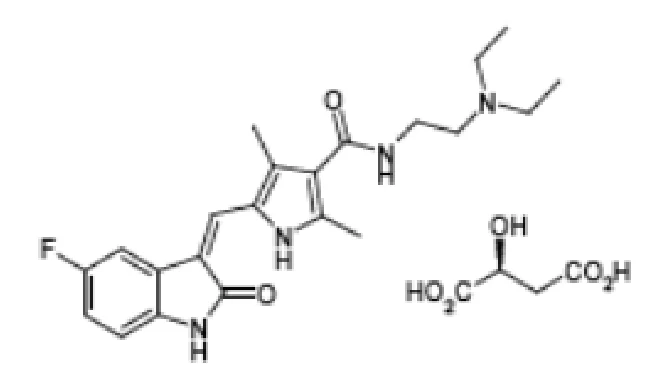
Physicochemical properties: Sunitinib malate is yellow to orange powder. Sunitinib malate is soluble in dimethyl sulfoxide, sparingly soluble in dimethyl formamide and slightly soluble in acetone, methanol, dichloromethane, ethanol, isopropanol, n-butanol, heptane, hexane, cyclohexane, toluene, isopropyl ether, methyl tert-butyl ether, methyl ethyl ketone, ethyl acetate, acetonitrile and water. The pKa of Sunitinib malate is 8.95. Sunitinib malate is a hydrophobic drug with a LogP of 5.2.
CLINICAL TRIALS
Comparative Bioavailability Studies
A randomized, two-treatment, two-period, single dose, crossover, oral comparative bioavailability study of Eugia-Sunitinib 50 mg capsules (Eugia Pharma Inc.) and SUTENT® 50 mg capsules (Pfizer Canada ULC) was conducted in healthy, adult, male subjects under fasting conditions. A summary of the comparative bioavailability data from 38 subjects included in the statistical analysis is presented in the following table:
Summary Table of the Comparative Bio-availability Data
Sunitinib (1 x 50 mg) From measured data Geometric Mean Arithmetic Mean (CV %) | ||||
| Parameter | Test1 | Reference2 | % Ratio of Geometric Means | 90% Confidence Interval |
AUC0-723 (ng.h/mL) | 1210.2 1242.7 (21.2) | 1275.6 1314.0 (24.2) | 94.9 | 90.8 – 99.2 |
AUCI 3 (ng.h/mL) | 1745.3 1804.6 (25.6) | 1797.0 1901.5 (33.2) | 97.1 | 92.1 – 102.4 |
| Cmax (ng/mL) | 32.6 33.4 (21.8) | 34.4 35.3 (22.8) | 94.7 | 91.4 – 98.1 |
| Tmax4 (h) | 7.0 (4.5 – 12.0) | 6.5 (4.5 – 14.0) | ||
| T½3,5 (h) | 40.3 (21.8) | 38.7 (26.5) | ||
1 Eugia-Sunitinib (sunitinib as sunitinib malate) 50 mg capsules (Eugia Pharma Inc.).
2 SUTENT® (sunitinib as sunitinib malate) 50 mg capsules (Pfizer Canada ULC).
3 n = 28 subjects
4 Expressed as the median (range) only.
5 Expressed as arithmetic mean (% CV) only.
GIST Patient Population
The clinical safety and efficacy of sunitinib malate have been studied in the treatment of gastrointestinal stromal tumour (GIST) after failure of imatinib mesylate treatment due to resistance or intolerance.
GIST Study A
Study A was a two-arm, multi-national, randomized, double-blind, placebo-controlled Phase 3 study of sunitinib malate in patients with GIST who had disease progression due to resistance during prior imatinib mesylate (imatinib) treatment or who were intolerant of imatinib. The primary objective was to compare the time-to-progression (TTP) in patients receiving sunitinib malate plus best supportive care to patients receiving placebo plus best supportive care. Secondary objectives included progression-free survival (PFS), objective response rate (ORR), and overall survival (OS). Patients were randomized (2:1) to receive either 50 mg sunitinib malate or placebo orally, once daily, on a schedule of 4 weeks on treatment followed by 2 weeks off (Schedule 4/2) until disease progression or withdrawal from the study for another reason. At the time of disease progression, treatment was unblinded; patients randomized to placebo were offered crossover to open-label sunitinib malate and patients randomized to sunitinib malate were permitted to continue treatment if there was evidence of clinical benefit.
At the time of a pre-specified interim analysis, the intent-to-treat (ITT) population included 312 patients; 207 patients were randomized to the sunitinib malate arm and 105 patients were randomized to the placebo arm.
Baseline age, gender, race, and ECOG performance status were comparable between the sunitinib malate and placebo groups. Prior exposure to imatinib was similar between the two study arms, with a median imatinib dose of 800 mg in both groups, although only approximately 60% of all patients received imatinib 800 mg/day prior to study entry.
An independent Data Safety Monitoring Board recommended unblinding the study based on the results of a planned interim analysis, where 149 TTP events (53% of the events required for the final analysis) had been reported in 312 patients (82 in the sunitinib malate arm and 67 in the placebo arm). The median number of cycles per treatment arm prior to unblinding was 2 (1.0 to 15.0) for the sunitinib arm compared to 1 (1.0-6.0) for the placebo arm. There was a statistically significant benefit for sunitinib malate 50 mg over placebo in the primary endpoint of TTP, meeting the primary endpoint. Similarly, the secondary endpoint of PFS was also significant. At the time of the interim analysis, the data were not mature enough to determine the OS benefit. Efficacy results are summarized in Table 9 and the Kaplan-Meier curve for TTP is shown in Figure 1.
Table 9. GIST Efficacy Results (interim analysis)
| Efficacy Parameter | Study A | ||
|---|---|---|---|
sunitinib malate (N = 207) | Placebo (N = 105) | P-value (log- rank test) | HR (95% CI) |
| Time to Tumour Progressiona {median, | 27.3 [6.4] | 6.4 [1.5] | |
| <0.0001* | 0.33 | ||
| weeks [months] (95% CI)} | (16.0, 32.1) | (4.4, 10.0) | (0.23, 0.47) |
| Progression Free Survivalb {median, weeks | 24.1[5.6] | 6.0 [1.4] | |
| <0.0001 | 0.33 | ||
| [months] (95% CI)} | (11.1, 28.3) | (4.4, 9.9) | (0.24, 0.47) |
Objective Response Rate (PR) [%, (95% CI)] | 6.8 (3.7, 11.1) | 0 | |
| 0.006c | |||
Abbreviations: CI=Confidence interval, GIST=gastrointestinal stromal tumor, HR=Hazard ratio, N=number of patients,
PR=Partial response
* A comparison is considered statistically significant if the p-value is < 0.00156 (O’Brien Fleming stopping boundary)
a Time from randomization to progression; deaths prior to documented progression were censored at time of last radiographic evaluation
b Time from randomization to progression or death due to any cause
c Pearson chi-square test
Figure 1. Kaplan-Meier Curve of TTP in GIST Study A (Intent-to-Treat Population)
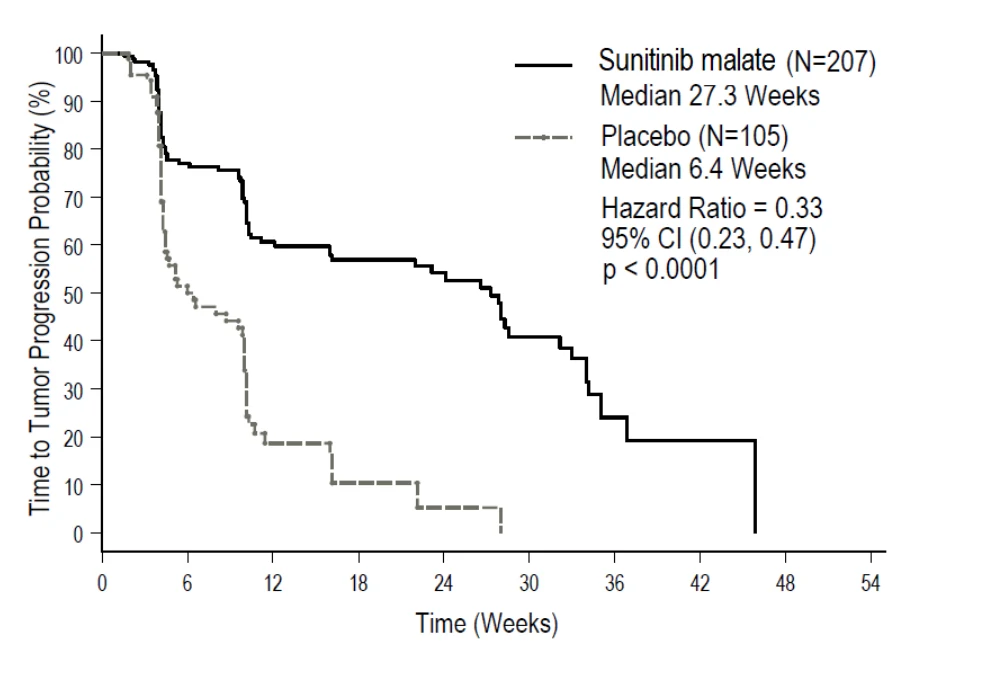
Abbreviations: CI=confidence interval; GIST=gastrointestinal stromal tumor; N=number of patients; TTP=time-to- tumor progression.
The final ITT population enrolled in the double-blind treatment phase of the study included 243 patients randomized to the sunitinib malate arm and 118 patients randomized to the placebo arm. Demographics and patient characteristics are shown in Table 10.
Table 10. Baseline Demographics in GIST Study A Based on Final Results
| Sunitinib malate (N=243) | Placebo (N=118) | |
|---|---|---|
| Gender [N (%)] | ||
| Male | 152 (63) | 71 (60) |
| Female | 91 (37) | 47 (40) |
| Self-identified Race [N (%)] | ||
| White | 209 (86) | 98 (83) |
| Asian | 11 (5) | 6 (5) |
| 8 (3) | 5 (4) | |
| Not reported | 15 (6) | 9 (8) |
| Age Group [N (%)] | ||
| < 65 years | 170 (70) | 81 (69) |
| ≥ 65 years | 73 (30) | 37 (31) |
| Performance Status [N (%)] | ||
| 0 | 109 (45) | 53 (45) |
| 1 | 131 (54) | 63 (54) |
| 2 | 3 (1) | 2 (2) |
| Prior Treatment [N (%)] | ||
| Surgery (other than biopsy) | 238 (98) | 116 (98) |
| Radiotherapy | 15 (6) | 12 (10) |
| Sunitinib malate (N=243) | Placebo (N=118) | |
|---|---|---|
| Median Maximum Dose of Prior Imatinib Therapy [mg (Range)] | 800 (300-1600) | 800 (400-1600) |
| Reason for Imatinib Failure [N (%)] | ||
| Intolerance | 13 (5) | 4 (3) |
Primary Resistance (Progression within 6 months) | 42 (17) | 20 (17) |
Secondary Resistance (Progression beyond 6 months) | 188 (77) | 94 (80) |
After the primary endpoint was met at the interim analysis, the study was unblinded, and patients on the placebo arm were offered open-label sunitinib malate treatment. A total of 255 patients received sunitinib malate in the open-label treatment phase of the study, including 99 patients who were initially treated with placebo. Partial responses were achieved by 10 of these 99 patients [10.1% ORR 95% CI (5.0 to 17.8)]. Median OS in the ITT population was 72.7 weeks and 64.9 weeks (hazard ratio 0.876, 95% CI 0.679 to 1.129, p = 0.306) in the sunitinib malate and placebo arms, respectively. In this analysis, the placebo arm included those patients randomized to placebo who subsequently received open-label sunitinib malate treatment. Of those patients randomized to the sunitinib malate arm, 62.7% survived longer than 1 year, 35.5% survived longer than 2 years, and 22.3% survived longer than 3 years.
Figure 2. Kaplan-Meier Curve of OS in GIST Study A (Intent-to-Treat Population)
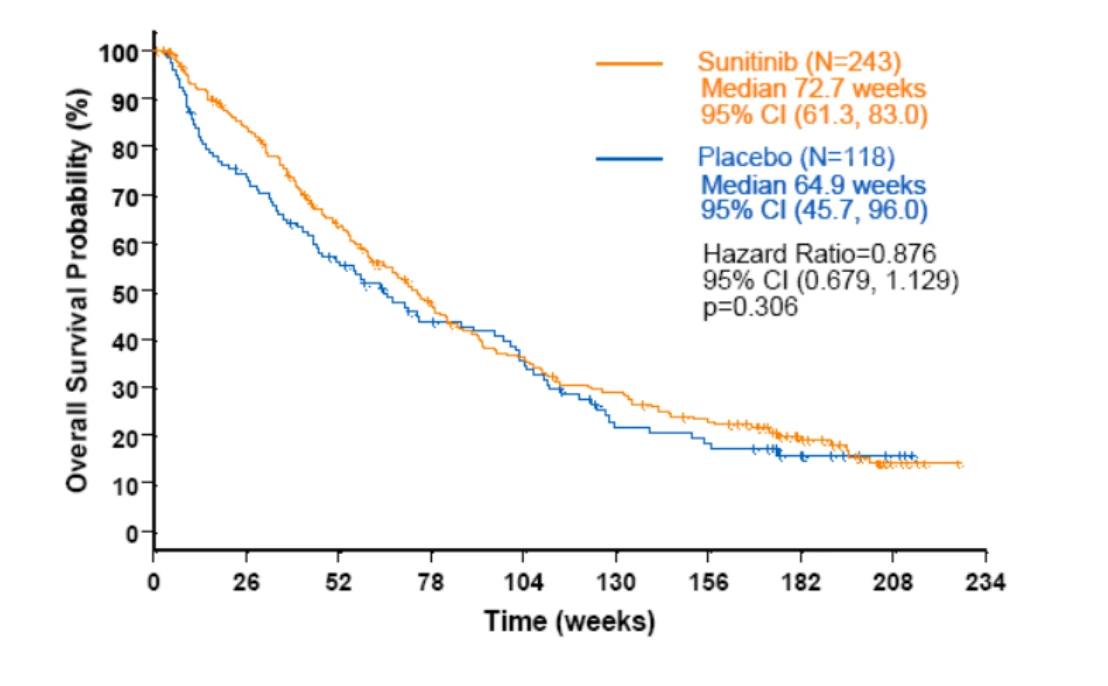
Abbreviations: CI=confidence interval; GIST=gastrointestinal stromal tumor; N=number of patients; OS=overall survival.
GIST Study B
Study B was an open-label, multi-centre, single-arm, dose-escalation study conducted in patients with GIST after progression on, or intolerance to, imatinib. Following identification of the recommended Phase 2 regimen (50 mg once daily on Schedule 4/2) 55 patients in Study B received the 50 mg dose of sunitinib malate on treatment Schedule 4/2. Partial responses were observed in 5 of 55 patients (9.1%).
MRCC Patient Population
Treatment-Naïve MRCC
A Phase 3 randomized study comparing single-agent sunitinib malate with IFN-α was conducted in patients with treatment-naïve MRCC. The primary endpoint was to compare PFS in patients receiving sunitinib malate versus patients receiving IFN-α. Secondary endpoint included TTP, ORR, OS, and safety. PFS was defined as the time from randomization to first documentation of objective tumour progression or to death due to any cause, whichever occurred first. TTP was defined as the time from randomization to first documentation of objective tumour progression. ORR was defined as the proportion of patients with confirmed complete response (CR) or confirmed partial response (PR) according to Response Evaluation Criteria in Solid Tumors (RECIST), relative to the total population of randomized patients. OS was defined as the time from randomization to date of death due to any cause. Safety was reported as type, incidence, severity, timing, seriousness, and relatedness of adverse events and laboratory abnormalities. Three scheduled analyses were planned for this study; as the study met its primary endpoint of PFS at the time of the second interim analysis, the study protocol was amended to allow patients in the IFN-α group to cross over to receive sunitinib malate on documented disease progression, as agreed with the independent data and safety monitoring committee.
Interim Analysis
Seven hundred fifty (750) patients were randomized (1:1) to receive either 50 mg sunitinib malate once daily on Schedule 4/2 or to receive IFN-α administered subcutaneously at 9 MIU three times a week. During the first cycle, patients randomized to the IFN-α arm received increasing doses from 3 MU per dose for one week, 6 MU per dose for the second week, and 9 MU per dose thereafter. Tumour assessment was performed every 28th day of each cycle for the first 4 cycles and every 12 weeks thereafter. After the first cycle, 65 of 375 patients on the IFN-α arm were assessed as having disease progression or died, compared to 39 of 375 patients on the sunitinib malate arm. Patients were treated until disease progression or withdrawal from the study for another reason.
The ITT population included 750 patients, 375 randomized to sunitinib malate and 375 randomized to IFN-α. There were 15 patients randomized to the IFN-α arm who withdrew consent prior to starting the treatment; therefore, the AT population included 375 randomized to sunitinib malate and 360 randomized to IFN-α. Histological evaluation demonstrated that 90% of the enrolled MRCC patients in both treatment arms had clear cell histology. Baseline age, gender, race and ECOG performance status were comparable and balanced between the sunitinib malate and IFN-α groups. Demographics and patient characteristics are shown in Table 11. The most common site of metastases present at screening was the lung (78% versus 80%, respectively), followed by the lymph nodes (58% versus 53%, respectively), and bone (30% each arm); the majority of the patients had multiple (2 or more) metastatic sites at baseline (80% versus 77%, respectively).
Table 11. Baseline Demographics in Treatment-Naïve MRCC Study
| Treatment-Naïve MRCC | ||||||
|---|---|---|---|---|---|---|
| Sunitinib malate (n=375) | IFN-α (n=375) | |||||
| Gender [n (%)] | ||||||
| Male | 267 (71) | 269 (72) | ||||
| Female | 108 (29) | 106 (28) | ||||
| Self-identified Race [n (%)] | ||||||
| White | 354 (94) | 340 (91) | ||||
| Asian | 7 (2) | 12 (3) | ||||
| 4 (1) | 9 (2) | |||||
| Not reported | 10 (3) | 14 (4) | ||||
| Age Group [n (%)] | ||||||
| < 65 years | 223 (59) | 252 (67) | ||||
| ≥ 65 years | 152 (41) | 123 (33) | ||||
| Performance Status [n (%)] | ||||||
| 0 | 231 (62) | 229 (61) | ||||
| 1 | 144 (38) | 142 (38) | ||||
| 2 | 0 (0) | 4 (1)a | ||||
| Prior Treatment [n (%)] | ||||||
| Nephrectomy | 340 (91) | 335 (89) | ||||
| Radiotherapy | 53 (14) | 54 (14) | ||||
Abbreviations: ECOG= Eastern Cooperative Oncology Group; MRCC=metastatic renal cell carcinoma; n=number of subjects.
a Patients had ECOG performance status of 1 at screening which changed to 2 at baseline
In the interim analysis, there was a statistically significant advantage for sunitinib malate over IFN-α in the primary endpoint of PFS, with PFS for sunitinib malate more than double that of IFN-α (47.3 versus 22.0 weeks, respectively) (see Table 12). Due to concerns that the overall study results may have been influenced by results for patients randomized to the IFN-α arm who were assessed as experiencing disease progression or death prior to reaching the 9 MU dose (see previous page), an additional analysis was performed in which patients who had disease progression or died during Cycle 1 were not included. Results of this analysis also demonstrated a statistically significant difference in PFS between the two treatment groups (HR=0.343, 95% CI: 0.24-0.48, p<0.0001). The median PFS estimates were 48.3 versus 31.3 weeks for sunitinib malate and IFN-α arms, respectively.
The secondary endpoint of ORR was more than 4 times higher for sunitinib malate than IFN-α. At the time of the interim analysis, 374 of 750 patients enrolled (50%) continued on study, 248/375 (66%) on the sunitinib malate arm and 126/375 (34%) on the IFN-α arm. Efficacy results are summarized in Table 12 and the Kaplan-Meier curve for PFS is shown in Figure 3. The results were similar in the supportive analyses and they were robust when controlling for demographic (age, gender, race and performance status) and known risk factors.
Table 12. Treatment-Naïve MRCC Efficacy Results*
| Efficacy Parameter | Treatment-Naïve MRCC | |||||||||||||
|---|---|---|---|---|---|---|---|---|---|---|---|---|---|---|
Sunitinib malate (n=375) | IFN-α (n=375) | P-value (log- rank test) | HR (95% CI) | |||||||||||
| Progression-Free Survivala | 47.3 | 22.0 | <0.000001 b | 0.415 | ||||||||||
| [median, weeks (95% CI)] | (42.6, 50.7) | (16.4, 24.0) | (0.320, 0.539) | |||||||||||
Time to Tumour Progressiona [median, weeks (95% CI)] | 47.9 (45.9, 50.7) | 22.3 (17.3, 31.3) | <0.000001 | 0.416 (0.318, 0.545) | ||||||||||
| Objective Response Ratea | 38.7 | 7.7 | <0.001 c | NA | ||||||||||
| [%, (95% CI)] | (33.7, 43.8) | (5.2, 10.9) | ||||||||||||
Abbreviations: CI=Confidence interval, NA=Not applicable, IFN-α= interferon-α; MRCC=metastatic renal cell carcinoma; n=number of subjects;
a Assessed by blinded core radiology laboratory
b A comparison is considered statistically significant if the p-value is <0.0042 (O’Brien Fleming stopping boundary)
c Pearson Chi-square test
* The results presented originate from the interim analysis with the exception of ORR that originates from the final data.
Figure 3. Kaplan-Meier Curve of PFS in Treatment-Naïve MRCC Study (Intent-to-Treat Population)
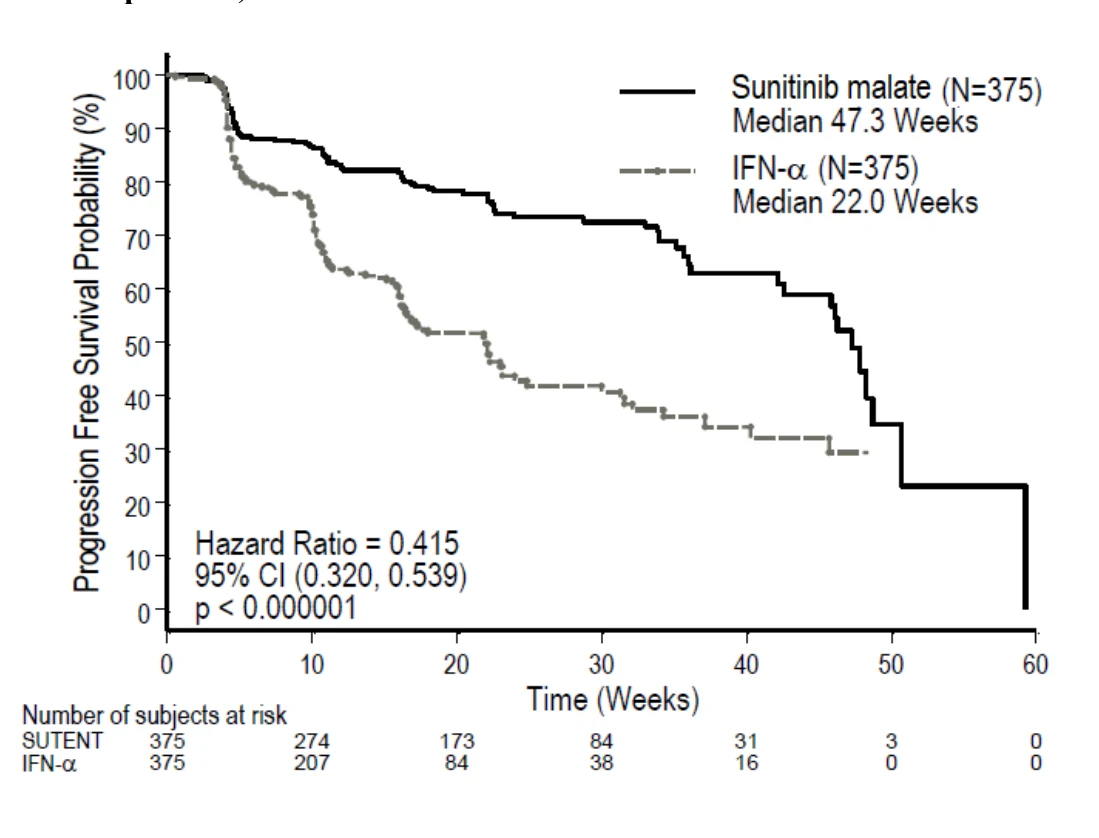
Abbreviations: CI=confidence interval; IFN-α=interferon-α; MRCC=metastatic renal cell carcinoma; PFS=progression-free survival.
The influence of baseline factors on the treatment effect was further analyzed by using a Cox proportional hazards model including the baseline factors, controlling for each factor one at a time. In the primary analysis, the overall treatment effect hazard ratio was 0.415 (95% CI: 0.320 to 0.539; p<0.001) and was similar when controlling for each individual baseline factor. The treatment effect in the baseline factor subgroups is illustrated in Figure 4.
The baseline factors baseline ECOG (0 vs 1), baseline LDH (≤ vs > 1.5 x ULN), time since original diagnosis (≥ vs < 1 year), baseline hemoglobin (≥ vs < LLN), baseline corrected calcium (≤ vs > 10 mg/dL) and baseline alkaline phosphatase (≤ vs > ULN) were statistically significant at p < 0.01. Using the investigators assessment, the results were similar except that the baseline factors prior nephrectomy (p = 0.0064), sex (p = 0.0349), and baseline ECOG (p<0.001) were also significant.
Figure 4 - Result of Cox Proportional Analysis of Progression-Free Survival, treatment Comparisons By Individual Baseline Factors One at a Time Core Radiology Laboratory Assessment (Intent-to-Treat Population) in the Treatment-Naïve MRCC Study
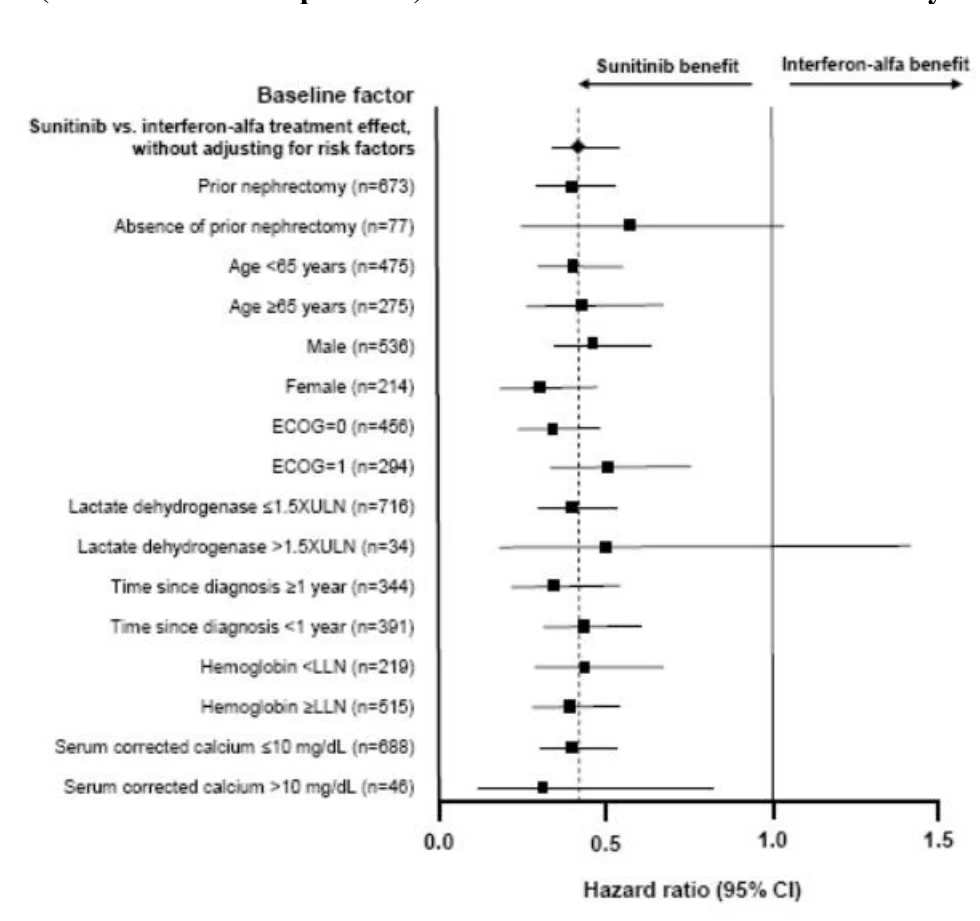
Final Analysis
One hundred ninety (50.7%) patients on sunitinib malate versus 200 (53.3%) patients on IFN-α had died at the time of the final analysis. As shown in Figure 5, in the primary analysis of survival, there was a trend toward longer survival with sunitinib malate treatment. The median OS was 115 weeks for the sunitinib malate arm (95% CI: 100 - 143) and 94.9 weeks for the
IFN-α arm (95% CI: 77.7 - 117.0) [HR= 0.821 (95% CI: 0.673 - 1.001); p=0.0510 by log-rank test, primary analysis]. In the stratified analysis (LDH > vs ≤1.5 x ULN, ECOG performance status 0 vs ≥1, and absence or presence of prior nephrectomy), the HR was 0.818 (95% CI: 0.669 to 0.999; p=0.049 by log- rank test, secondary analysis). The median OS for the IFN-α arm includes 25 patients who discontinued IFN-α treatment because of disease progression and crossed over to treatment with sunitinib malate. Following discontinuation from the study, 213 patients on the IFN-α arm received post-study cancer treatment, including 32% who received sunitinib malate; 182 patients on the sunitinib malate arm received post-study cancer treatment, including 11% who received sunitinib malate.
Figure 5. Kaplan-Meier Curve of OS in Treatment-Naïve RCC Study (Intent-to-Treat Population)
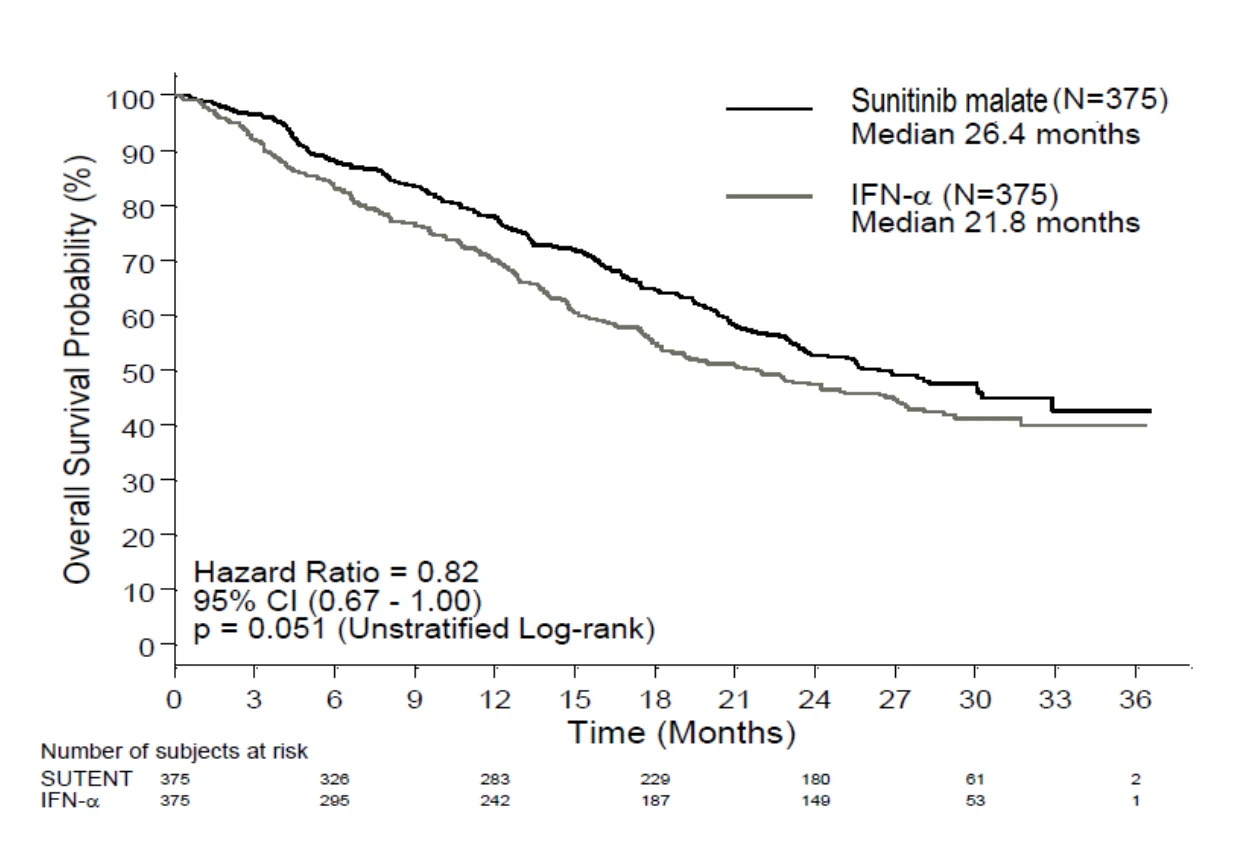
Abbreviations: CI=confidence interval; IFN-α=interferon-α; OS=overall survival; RCC=renal cell carcinoma.
Cytokine-Refractory MRCC
The use of single agent sunitinib malate in the treatment of cytokine-refractory MRCC was investigated in 2 single-arm US studies. Patients received sunitinib malate at a starting dose of 50 mg once daily on a schedule of 4 weeks on treatment followed by 2 weeks off (Schedule 4/2). In pivotal Study 1, failure of the previous cytokine therapy was based on radiographic evidence of disease progression defined by RECIST or World Health Organization (WHO) criteria during or within 9 months of completion of 1 cytokine therapy treatment (IFN-α, interleukin-2, or IFN-α plus interleukin-2; patients who were treated with IFN–α alone were required to have received treatment for at least 28 days). In supportive Study 2, failure of prior cytokine therapy was defined as disease progression or unacceptable treatment-related toxicity. The primary endpoint was objective response rate (ORR) based on independent, third party radiology laboratory assessment in Study 1 and ORR based on investigator assessment in Study 2. Secondary endpoints included assessment of Duration of Response (DR). Study 1 was reported early because of promising results; follow-up has not been completed thus results for DR cannot be accurately calculated.
One hundred six (106) patients were enrolled into Study 1 and 63 patients were enrolled into Study 2. Therapy was continued until the patients met withdrawal criteria or had progressive disease. The baseline age, gender, race and ECOG performance statuses of the patients were comparable between Studies 1 and 2. Approximately 86-94% of patients in the 2 studies were white. Men comprised 65% of the pooled sunitinib malate population. The median age was 57 years and ranged from 24 to 87 years in the studies. All patients entered the studies with an ECOG performance status <2 at the screening visit; 2 patients had a performance status of 2 at baseline.
The baseline malignancy and prior treatment history of the patients were comparable between Studies 1 and 2. Across the 2 studies, 95.3% of the pooled population of patients had at least some component of clear-cell histology. All patients on Study 1 were required to have a histological clear-cell component. In Study 2, 87% of patients had cytokine-refractory MRCC of clear-cell histology. Elapsed time since diagnosis was approximately 1.6 years prior to study entry. Most patients enrolled in the studies (97% of the pooled population) had undergone nephrectomy; prior nephrectomy was required for patients enrolled in Study 1. All patients had received one previous cytokine regimen, to which 9.5% (n=16) had experienced an objective disease response. Metastatic disease present at the time of study entry included lung metastases in 81% of patients. Liver metastases were more common in Study 1 (27% vs. 16% in Study 2) and bone metastases were more common in Study 2 (51% vs. 25% in Study 1); 52% of patients in the pooled population had at least 3 metastatic sites. Patients with known brain metastases or leptomeningeal disease were excluded from both studies.
Results of Studies 1 and 2
The results of Studies 1 and 2 are provided in Table 13.
Table 13. Cytokine-Refractory MRCC Efficacy Resultsa
| Efficacy Parameter | Study 1 (N = 106) | Study 2 (N = 63) |
|---|---|---|
| Objective Response Rate [% (95% CI)] (PR) | 25.5 (17.5, 34.9) | 36.5 (24.7, 49.6) |
| Duration of Response {median, weeks [months] (95% CI)} | NE* | 54 [12.5] (34.3, 70.1) |
Abbreviations : CI=Confidence interval, PR=Partial response, NE=Not estimable
a Data based on cutoff date of 28 January 2005 for Study 1 and 01 December 2004 for Study 2.
*Duration of Response in Study 1 was premature as 4 of 27 patients responding to treatment had experienced disease progression.
The primary endpoint of Study 1 was ORR based on independent radiology laboratory assessment; the primary endpoint of Study 2 was ORR based on investigator assessment. No complete responses and 27 partial responses were observed in Study 1 for an ORR of 25.5% (95% CI: 17.5, 34.9). No complete responses and 23 partial responses as assessed by the investigator were observed in Study 2 for an ORR of 36.5% (95% CI; 24.7, 49.6). The majority of objective disease responses were observed during Cycles 2 to 4; responses were observed as late as Cycle 11. DR data are indicated above for Study 2; DR data from Study 1 are premature as only 4 of 27 patients (15%) responding to treatment had experienced disease progression. At the time of the data cutoff, 41% of patients enrolled were continuing treatment with sunitinib malate.
Pancreatic Neuroendocrine Tumours
Phase 3
The Phase 3 study was a multi-center, international, randomized, double-blind placebo-controlled study of single-agent sunitinib malate conducted in patients with unresectable pancreatic NET. Patients were required to have documented RECIST-defined disease progression within the prior 12 months and were randomized (1:1) to receive either 37.5 mg sunitinib malate once daily without a scheduled off-treatment period (n=86) or placebo (n=85). The dose was escalated to 50 mg for 8 patients. The primary objective was to compare Progression-Free Survival (PFS) in patients receiving sunitinib malate versus patients receiving placebo. Other endpoints included Overall Survival (OS), Objective Response Rate (ORR), Patient-reported Outcomes (PRO), and safety. Use of somatostatin analogs was allowed in the study.
Demographics were comparable between the sunitinib malate and placebo groups. Additionally, 49% of sunitinib malate patients had non-functioning tumours vs 52% of placebo patients, and 92% patients in both arms had liver metastases. A total of 66% of sunitinib malate patients received prior systemic therapy compared with 72% of placebo patients. In addition, 35% of sunitinib malate patients had received somatostatin analogs compared with 38% of placebo patients. Patients were treated until disease progression or withdrawal from the study. Upon disease progression, or study closure, patients were offered access to sunitinib malate in a separate extension study.
As recommended by the Independent Data Monitoring Committee, the study was terminated prior to the pre-specified interim analysis. This may have led to an overestimate of the magnitude of PFS effect. In order to rule out investigator bias in the efficacy assessment, review of the data was performed by the Blinded Independent Review Committee (BICR), which supported the investigator assessment. A clinically significant advantage for sunitinib over placebo in the endpoint of PFS was seen by both investigator and independent assessment. A hazard ratio favoring sunitinib malate was observed in all subgroups of baseline characteristics evaluated. OS data were not mature at the time of the analysis. There were 9 deaths in the sunitinib malate arm and 21 deaths in the placebo arm. A statistically significant difference in ORR favoring sunitinib malate over placebo was observed. Efficacy results are summarized in Table 14, and the Kaplan-Meier curve for PFS is shown in Figure 6.
Table 14. Pancreatic NET Efficacy Results from the Phase 3 Study
| Efficacy Parameter | Sunitinib malate (n=86) | Placebo (n=85) | P-value | HR (95% CI) |
|---|---|---|---|---|
Progression-Free Survival [median, months (95% CI)] by Investigator Assessment | 11.4 (7.4, 19.8) | 5.5 (3.6, 7.4) | 0.000118a | 0.418 (0.263, 0.662) |
Objective Response Rate [%, (95% CI)] | 9.3 (3.2, 15.4) | 0 | 0.0066b | NA |
Abbreviations: CI=Confidence interval, HR=Hazard ratio, N=number of patients, NA=Not applicable, pNET=pancreatic neuroendocrine tumors a2-sided unstratified log-rank test
bFisher’s Exact test
Figure 6. Kaplan-Meier Curve of PFS in the pancreatic NET Phase 3 Study
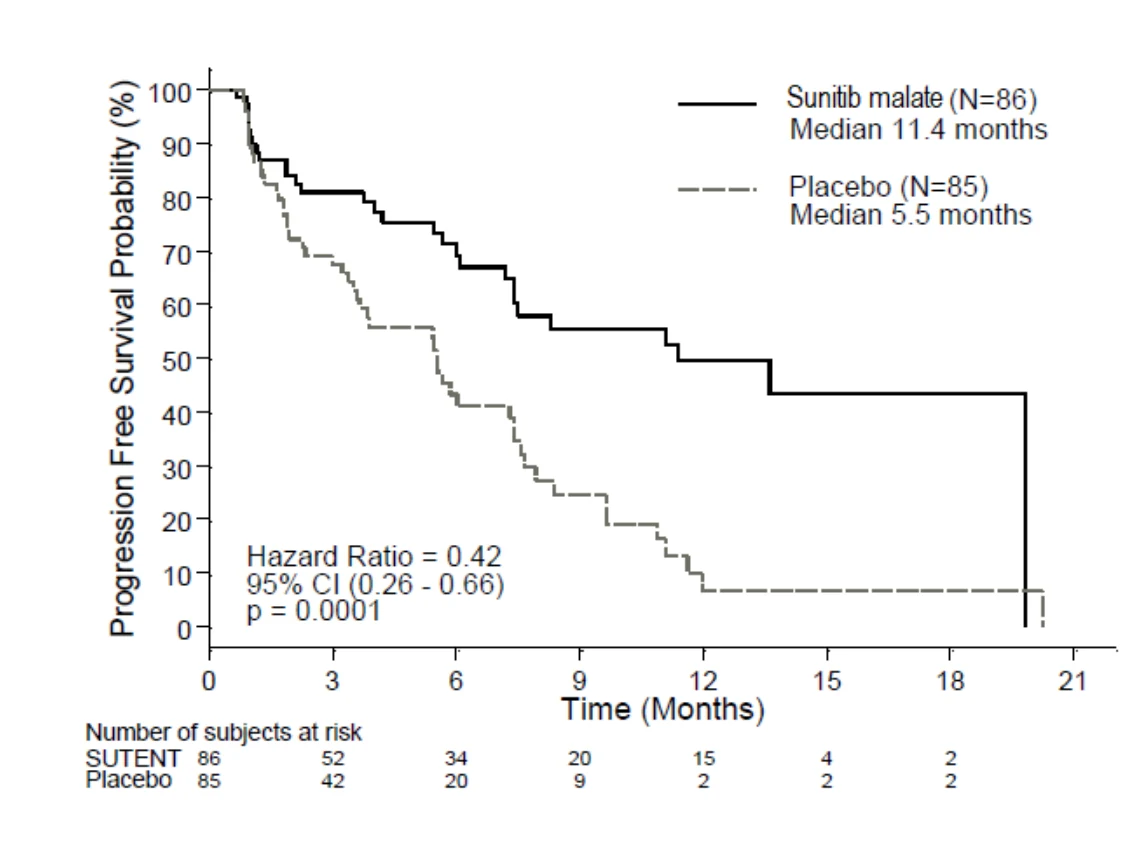
Abbreviations: CI=confidence interval; N=number of subjects; PFS=progression-free survival; pNET=pancreatic neuroendocrine tumors.
DETAILED PHARMACOLOGY
The nonclinical pharmacology program of sunitinib malate evaluated the ability of sunitinib malate, and its major active metabolite, to inhibit the activity and function of its receptor tyrosine kinase (RTK) targets in vitro and in vivo as well as its ability to inhibit tumour progression in rodent models of experimental cancer. The primary metabolite exhibits similar potency compared to sunitinib malate in biochemical and cellular assays.
In vitro Activity:
Sunitinib malate was selective for its intended RTK targets when evaluated over a panel of >80 biochemical kinase screens (15-20% of known kinases).
Table 15. Inhibition of Pharmacologically Relevant Target Receptor Tyrosine Kinases by Sunitinib malate
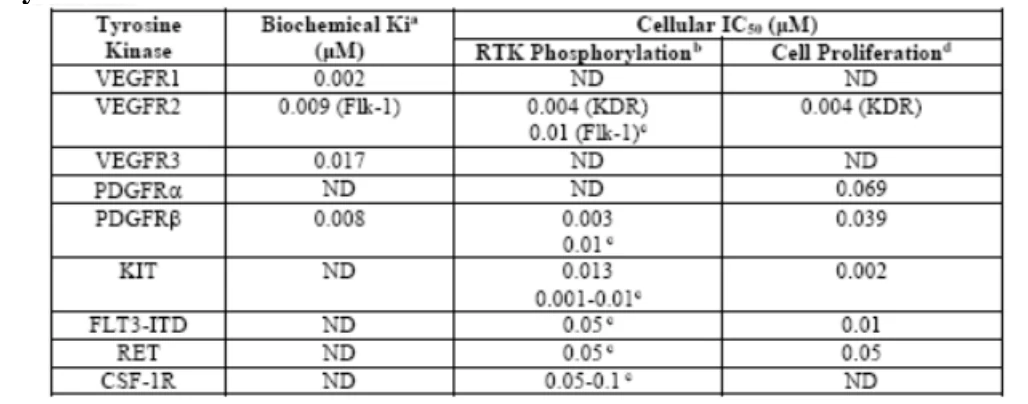
D = not determined; ITD = internal tandem duplication; KDR = human ortholog of VEGFR2; Flk-1 = mouse ortholog of VEGFR2
a Values were determined in biochemical kinase assays using recombinant enzymes.
b Values were determined by measuring intrinsic or ligand-stimulated kinase activity (phosphorylation) in cell lines expressing a given target RTK by ELISA assay or immunoblotc. Inhibition of phosphorylation is a measure of inhibition of catalytic activity of RTK targets.
c Estimated values (or value ranges) were determined by visual assessment of immunoblot analysis of RTK phosphorylation in cells over a range of concentrations.
d Values were determined by measuring intrinsic or ligand-stimulated cell proliferation in cell lines expressing a given target RTK. Inhibition of cell proliferation reflects the inhibition of kinase-dependent function of RTK targets in cell lines selected for these assays.
In vivo Activity:
Sunitinib malate inhibited the phosphorylation of multiple RTKs (PDGFRβ, VEGFR2, KIT) in tumour xenografts expressing RTK targets and demonstrated the ability to inhibit tumour growth or cause tumour regression, and/or inhibit metastatic progression in a variety of rodent models of experimental cancer. Consistent with its multi-targeted profile, sunitinib malate demonstrated the ability to inhibit growth of tumour cells expressing dysregulated target RTK (PDGFR, RET, or KIT) and to inhibit PDGFRβ- and VEGFR2-dependent tumour angiogenesis.
Non-Clinical Safety Pharmacology – QT studies
Sunitinib malate and its active metabolite SU012662 both suppressed hERG currents in human embryonic kidney cells stably transfected with hERG channel DNA. IC50 values for sunitinib malate were 266.3 nM (nominal) and 144.1 nM (analytically verified). For SU12662, an IC50 value of 4.1 mcM was reported (nominal). Sunitinib malate also caused an increase in action potential duration in canine Purkinje fibres. Furthermore, sunitinib malate caused QTc prolongation in conscious telemetry monkeys at doses of 50 mg/kg and 150 mg/kg (intragastric), which produced plasma concentrations of sunitinib malate and SU012662 ranging from 242-474 ng/mL and 270-304 ng/mL, respectively. Peak increases were 72 msec and 77 msec for the 50 and 150 mg/kg doses, respectively.
Pharmacokinetics
See also ACTION AND CLINICAL PHARMACOLOGY.
After intravenous administration in mice, rats, and monkeys, sunitinib malate showed moderate to high systemic clearance and a volume of distribution larger than total body water. The half-life was approximately 1, 2-5, and 15 hours in mice, rats, and monkeys, respectively. Following oral dosing, Tmax of sunitinib malate was observed between 0.5-9 hours and bioavailability was 50% or higher (53-77% in mice, 55-112% in rats, and 41-58% in monkeys). Plasma protein binding of sunitinib malate was 91% in mouse, 98% in rat, and 95% in monkey and human. In rats and monkeys, sunitinib malate and its metabolites were extensively distributed into tissues with concentrations in most tissues higher than in blood or plasma. In repeated dose studies, the plasma exposure in rats and monkeys and tissue exposure in monkeys increased with dose and attained steady state by day 28 of dosing. At steady state, the AUC of sunitinib malate and its active metabolite in plasma was less than 4 times that of the values on day 1 in both species. Tissue levels of drug and its primary metabolite in monkeys were 13 to 308 times that of plasma concentrations at 24 hours post dose; white fat and CNS had lower concentrations than other tissues.
Sunitinib malate was extensively metabolized in vitro in hepatic microsomes from mouse, rat, monkey, and human; and in vivo in rat, monkey, and human. The metabolism, which was similar in vitro and in vivo, was mainly mediated by CYP3A to produce the primary active metabolite. Although multiple minor metabolites have been identified in excreta, sunitinib malate and its primary active metabolite were the only drug-related compounds that could be measured in plasma in mice, rats, monkeys, and humans. Studies with human liver microsomes and hepatocytes indicate that sunitinib malate has low potential to cause clinically relevant drug-drug interactions with other co- administered drugs that are metabolized by CYP450 enzymes, CYP1A2, CYP2D6, CYP2C8, CYP3A4/5, CYP2C19, CYP2C9, CYP2A6, CYP2B6, CYP2E1, and CYP4A9/11. Sunitinib malate and its metabolites were mainly eliminated in feces and urinary elimination is a minor route. In monkeys, 84-87% of a radioactive dose was recovered in feces and 5-6% in urine with a total recovery of 90-94%. In rats, the total recovery was 82-87% with 71-77% in feces and 8-9% in urine. Fecal elimination is also a major route in humans. Overall, the pharmacokinetic and metabolism data from mouse, rat, and monkey indicate that these species are adequate for nonclinical pharmacology and toxicology studies with sunitinib malate.
MICROBIOLOGY
Not applicable.
TOXICOLOGY
The nonclinical toxicologic profile of sunitinib malate has been extensively investigated (see Table 16).
Single Dose Toxicity
The acute oral maximally tolerated-dose (MTD) for mice, rats, and dogs was greater than the tested maximum dose of 500 mg/kg of sunitinib malate. The oral MTD of sunitinib malate was greater than the tested maximum dose of 1200 mg/kg for monkeys, with emesis observed at doses ≥50 mg/kg. Sunitinib malate did not cause lethality following single-dose administration of 500 mg/kg to mice (48 times the recommended human dose of 50 mg/day on 4/2 Schedule, based on body surface area), 500 mg/kg to rats (95 times the recommended human dose), 500 mg/kg to dogs (approximately 300 times the recommended human dose), and 1200 mg/kg to monkeys (approximately 450 times the recommended human dose). In monkeys, emesis, diarrhea, and slight increases in fibrinogen, aspartate aminotransferase (AST), alanine aminotransferase (ALT), lactic dehydrogenase (LDH), creatine kinase (CK) and alpha-hydroxybutyric dehydrogenase (HBDH) occurred following administration of single oral doses of 50 mg/kg/day.
Repeat Dose Toxicity
The long-term toxicity of sunitinib malate was evaluated in repeat dose toxicity studies in rats and monkeys (Table 16).
Table 16. REPEAT-DOSE TOXICITY
| Species/ Strain | No./ Group | Dose (mg/kg/ day) | Route | Duration | Recovery Period | Results/Observations |
|---|---|---|---|---|---|---|
Rat/ Crl: CD (SD) BR | 10M 10F | 5, 15, 45 | Oral | 2 weeks | -- | Toxic changes were observed in bone growth plate, adrenal gland, pancreas, bone marrow and hemolymphopoietic organs and circulating red and white blood cells, gastrointestinal system, and male and female reproductive organs. The 5 mg/kg/day dose was the no-adverse-effect-level (NOAEL). |
| Rat/Crl: CD (SD) IGS BR | 14M 14F | 30 (QD) 30, 60 (QOD) 30, 80, 240a | Oral | 2 weeks | -- | Toxic changes were similar to those observed in the previous 14-day study. Treatment with 240 mg/kg/day of SU012662 (major metabolite) resulted in similar target organ toxicity that was observed at 30 mg/kg/day of sunitinib malate. The NOAEL was <30 mg/kg/day. |
| Rat/ Crl: CD (SD) BR | 15M 15F | 2.5, 5, 15 | Oral | 1 month | 4 weeks | Additional changes included broken incisor teeth due to dentin degeneration in rats at >5 mg/kg/day, other changes similar to previously reported findings. The dose of 5 mg/kg/day was considered to be the NOAEL. |
| Rat/ Crl: CD (SD) BR | 20M 20F | 1.5, 5, 15 | Oral | 3 months | 6 weeks | Toxic changes were similar to those observed in previous rat studies, except for changes in the common bile duct, ↑ in ALT and AST, and ↓ in albumin and urea at 15 mg/kg/day. Broken incisors observed at >5 mg/kg/day were associated with a moderate to marked loss of body weight at 15 mg/kg/day. Partial recovery of body weight occurred in the last week of the study after soft/powdered food was supplied. The dose of 1.5 mg/kg/day was considered the NOAEL. |
| Rat/Crl: CD (SD) IGS BR | 25M 25F | 0.3, 1.5, 6.0 | Oral | 6 months (5 cycles of 4-wk dosing , 1 wk off) | 8 weeks | Toxic changes were similar to those observed in previous rat studies, except for chronic progressive nephrosis observed at ≥1.5 mg/kg/day. The dose of 0.3 mg/kg/day was considered the NOAEL. |
Monkey/ Cynomo lgus | 3M 3F | 5, 15, 45 | Oral | 2 weeks | -- | Overall, toxicity observed in tissues previously identified in rats. Vomiting, decreased activity, feed intake, and body weight; and, minimal prolongation of QTc interval at 45 mg/kg/day. The dose of 5 mg/kg/day was considered the NOAEL. |
Monkey/ Cynomo lgus | 6M 6F | 2, 6, 12 | Oral | 3 months | 6 weeks | Similar changes to previous studies, in addition, epithelial necrosis with erosion/ulceration in tissues of the oral cavity observed at >6 mg/kg/day. Severe clinical signs observed at 12 mg/kg/day: mortality, anorexia, body weight loss, emesis, soft to watery feces, pale skin, decreased activity, hunched posture, hypothermia, discolored mouth or gums, and lip or mouth lesions. All changes were reversible at the end of recovery. The NOAEL was <2 mg/kg/day based on observation of physeal dysplasia, endometrial atrophy, and pancreatic acinar degranulation. |
| Species/ Strain | No./ Group | Dose (mg/kg/ day) | Route | Duration | Recovery Period | Results/Observations | ||
|---|---|---|---|---|---|---|---|---|
Monkey/ Cynomo lgus | 7M 7F | 0.3, 1.5, 6.0 | Oral | 9 months (8 cycles of 4-wk dosing , 1 wk off) | 8 weeks | Additional changes at 6 mg/kg/day included female reproductive changes including epithelial atrophy of the cervix, oviduct and vagina, follicular atresia and the absence of corpora lutea in the ovaries, and endometrial atrophy in the uterus; ↑ glomerular mesangial matrix in the kidney; acute thyroid gland inflammation; choroid plexus inflammation; and, esophageal and lingual epithelial atrophy. All toxicological effects were considered reversible except for skin pallor and the decrease in uterine and ovarian weights at 6 mg/kg/day. The dose of 1.5 mg/kg/day was considered the NOAEL. | ||
M =Male; F =Female; -- = Not applicable; NOAEL = No observed adverse effect level; ↓ = Decrease; ↑ = Increase; QD = Once daily dosing; QOD = Every other day dosing; ALT = Alanine aminotransferase; AST = Aspartate aminotransferase a The major, active metabolite of SU011248, SU012662 was tested. | ||||||||
In summary, important and reversible toxicologic findings following sunitinib malate administration included emesis and diarrhea in monkeys at ≥1.1 times the mean human exposure of 1929 ng·h/mL at the recommended clinical dose of 50 mg/day (based on combined sunitinib malate and active metabolite systemic exposure comparisons). Adrenal cortical hemorrhage was observed in rats at ≥16 times and in monkeys at ≥1.1 times the mean human exposure. Bone marrow hypocellularity was observed in rats at ≥3.3 times, and in monkeys at ≥1.2 times the mean human exposure. Pancreatic acinar cell degranulation was observed in rats at ≥16 times, and in monkeys at <1 times the mean human exposure. Bone growth plate thickening was observed in rats at ≥3.3 times, and in monkeys at <1 times the mean human exposure. Uterine atrophy in monkeys and corpora lutea degeneration in rats was observed at <1 times the mean human exposure at the recommended clinical dose.
Genotoxicity
The genotoxic potential of sunitinib malate was assessed in vitro and in vivo (see Table 17 and WARNINGS AND PRECAUTIONS). Sunitinib malate was not mutagenic in bacteria using metabolic activation provided by rat liver. Sunitinib malate did not induce structural chromosome aberrations in human peripheral blood lymphocyte cells in vitro, and polyploidy (numerical chromosome aberrations) was observed in human peripheral blood lymphocytes in vitro, in the presence and absence of metabolic activation. Sunitinib malate was not clastogenic in rat bone marrow in vivo. The major, active metabolite was not evaluated for genetic toxicity potential.
| Table 17. GENOTOXICITY | |||||||||
|---|---|---|---|---|---|---|---|---|---|
| Type of Study | Drug Lot Number | Test System | Metabolic activationa | Dose/ Concentration Range | Results | ||||
Microbial reverse mutation assay | (A)5903-TJF- 0001 | S. typhimurium and E. coli | Without and With | ±S9: 19.53, 39.06, 78.12, 156.25, 312.5 μg/plate | Sunitinib malate was not mutagenic in the Ames assay with or without metabolic activation up to the maximum concentrations. | ||||
Microbial reverse mutation assay | (A)5953-TJF- 0003 | S. typhimurium and E. coli | Without and With | ±S9: 19.54, 39.07, 78.13, 156.25, 312.5, 625 μg/plate | Sunitinib malate was not mutagenic in the Ames assay with or without metabolic activation up to the maximum concentrations. | ||||
| In Vitro Micronucleus | 002101 | Human Blood Lymphocytes | NA | +S9: 1.00-70.0 µg/mL -S9: 1.00-59.9 µg/mL | Sunitinib malate was negative for inducing structural chromosomal aberrations with and without S9 at any concentration. Sunitinib malate induced numerical aberrations at 9.73-19.8µg/mL with S9, and 12.0 µg/mL without S9. | ||||
| In Vivo Micronucleus assay | 002101, 002103 | Rat bone marrow cells (in vivo) | NA | 250, 750, 1500 mg/kg | Sunitinib malate failed to induce micronuclei in bone marrow polychromatic erythrocytes, from rats treated up to 1500 mg/kg. Therefore, sunitinib malate was considered to be not clastogenic in this test system. |
|---|---|---|---|---|---|
NA = Not applicable; S = Salmonella; E = Escherichia; a Aroclor-induced rat liver S-9 fraction from male Sprague-Dawley rats. | |||||
Carcinogenicity
The carcinogenic potential of sunitinib malate was assessed in vivo in mice and rats (see Table 18 and WARNINGS AND PRECAUTIONS).
In a 1-month, oral gavage dose-range finding study (0, 10, 25, 75, or 200 mg/kg/day) with continuous daily dosing in rasH2 transgenic mice; hyperplasia of epithelial non-glandular stomach and mucous cells of the glandular stomach and carcinoma and hyperplasia of Brunner’s glands of the duodenum, were observed at the highest dose (200 mg/kg/day) tested.
A 6-month, oral gavage carcinogenicity study (0, 8, 25, 75 [reduced to 50] mg/kg/day), with daily dosing was conducted in rasH2 transgenic mice. Gastroduodenal carcinomas, an increased incidence of background hemangiosarcomas, and gastric mucosal hyperplasia have been observed at doses of ≥25 mg/kg/day following 1- or 6-month duration (≥7.3 times the AUC in patients administered the RDD). No proliferative changes were observed in rasH2 transgenic mice at 8 mg/kg/day (≥0.7 times the AUC in patients administered the RDD).
In a 2-year rat carcinogenicity study (0, 0.33, 1, or 3 mg/kg/day), administration of sunitinib malate in 28-day cycles followed by 7-day dose-free periods resulted in duodenal carcinomas in Brunner’s glands, increases in the incidence of pheochromocytomas and hyperplasia in the adrenal medulla of male rats given 3 mg/kg/day following >1 year of dosing (≥7.8 times the AUC in patients administered the RDD). Brunner’s glands carcinoma occurred in the duodenum at ≥1 mg/kg/day in females and at 3 mg/kg/day in males, and mucous cell hyperplasia was evident in the glandular stomach at 3 mg/kg/day in males, which occurred at ≥0.9, 7.8 and 7.8 times the AUC in patients administered the RDD, respectively.
The relevance to humans of the neoplastic findings observed in the mouse (rasH2 transgenic) and rat carcinogenicity studies with sunitinib malate treatment is unclear.
| Table 18. CARCINOGENICITY | ||||||
|---|---|---|---|---|---|---|
Species/ Strain | No./ Group | Dose (mg/kg /day) | Route | Duration | Results/Observations | |
CB6F1/Jic- TgrasH2@ Tac | 25-45M; 25-45F | 8, 25, 75/50a | Oral | 6 months | Gastroduodenal carcinomas (inclusive of Brunner’s gland), gastric mucous cell hyperplasia, and an increased incidence of hemangiosarcomas of the spleen and uterus were observed at doses ≥25 mg/kg/day. Additional non- proliferative microscopic findings were observed in the bone marrow, liver, kidneys, ovaries, pancreas, and thymus at doses ≥25 mg/kg/day. The no effect level for proliferative changes was 25 mg/kg/day in males and 8 mg/kg/day in females. | |
| Rat/Crl: CD (SD) | 60-70M; 60-70F | 0.33, 1.0, 3.0 | Oral | 2 years | Carcinoma of the duodenum (inclusive of Brunner’s gland), an increased incidence of pheochromocytomas in the adrenal medulla, and gastric mucous cell hyperplasia were observed at ≥1.0 mg/kg/day. Additional non- proliferative or secondary microscopic findings were observed in the adrenal gland, kidney, parathyroid gland, bone marrow, stomach, and thymus at ≥0.33 mg/kg/day. The no observed effect level for proliferative changes was 1.0 mg/kg/day in males and 0.33 mg/kg/day in females. |
|---|
a Dose reduction from 75 to 50 mg/kg/day occurred following a short dose holiday at approximately 6 weeks of dosing in male animals and 9 weeks of dosing in female animals due to excessive mortality or signs of intolerance.
Reproductive and Developmental Toxicity
Although fertility was not affected in rats, sunitinib malate may impair fertility in humans, (see Table 19 and WARNINGS AND PRECAUTIONS). No reproductive effects were observed in male rats dosed (1, 3 or 10 mg/kg/day) for 58 days prior to mating with untreated females. Fertility, copulation, conception indices and sperm evaluation (morphology, concentration, and motility) were unaffected by sunitinib malate at doses ≤10 mg/kg/day (the 10 mg/kg dose produced a mean AUC that was approximately 25.8 times the systemic exposure in patients administered the recommended human dose [RHD] of 50 mg/daily). Female rats were dosed (0.5, 1.5 or 5 mg/kg/day) for 14 days prior to mating with untreated males. No effects on fertility were observed in female rats at doses ≤5 mg/kg/day (the 5 mg/kg dose produced a mean AUC that was approximately 5 times the systemic exposure in patients administered the RHD).
Effects on the female reproductive system were identified in a 3-month monkey toxicology study, where ovarian (decreased follicular development) changes were noted at 12 mg/kg/day (associated with a mean AUC that was approximately 5.1 times the systemic exposure in patients administered the RHD of 50 mg/day), while uterine changes (endometrial atrophy) were noted at ≥2 mg/kg/day (the 2 mg/kg-dose produced a mean AUC that was approximately 0.4 times the systemic exposure in patients administered the RHD). With the addition of vaginal atrophy, the uterine and ovarian effects were reproduced at 6 mg/kg/day in the 9-month monkey study (the 6 mg/kg dose produced a mean AUC that was approximately 0.8 times the systemic exposure in patients administered the RHD).
Sunitinib malate was evaluated in pregnant rats and rabbits for effects on embryo-fetal development. Embryolethality and developmental abnormalities were observed in rats, at the dose of 5 mg/kg/day (the 5-mg/kg dose produced a mean AUC that was approximately 5.5 times the systemic exposure in patients administered the RHD). Embryolethality was observed in rabbits at 5 mg/kg/day, while developmental effects were observed at ≥1 mg/kg/day (the 1-mg/kg dose produced a mean AUC that was approximately 0.3 times the systemic exposure in patients administered the RHD of 50 mg/day). Developmental effects consisted of increased incidence of fetal skeletal malformations in rats. In rabbits, cleft lip was observed at 1 mg/kg/day and cleft lip and cleft palate was observed at 5 mg/kg/day (the 5 mg/kg dose produced a mean AUC that was approximately 2.7 times the systemic exposure in patients administered the RHD). Neither fetal loss nor malformations were observed in rats at ≤3 mg/kg/day (the 3 mg/kg dose produced a mean AUC that was approximately 2.3 times the systemic exposure in patients administered the RHD).
Sunitinib malate was evaluated in a pre- and postnatal development study in pregnant rats (0.3, 1.0, 3.0 mg/kg/day). Maternal body weight gains were reduced during gestation and lactation at ≥1 mg/kg/day but no maternal reproductive toxicity was observed up to 3 mg/kg/day (estimated exposure ≥2.3 times the AUC in patients administered the RDD). Reduced offspring body weights were observed during the pre-weaning and post-weaning periods at 3 mg/kg/day. No developmental toxicity was observed at 1 mg/kg/day (approximate exposure 0.9 times the AUC in patients administered the RDD).
| TABLE 19. REPRODUCTIVE AND DEVELOPMENTAL TOXICITY | ||||||||||||
|---|---|---|---|---|---|---|---|---|---|---|---|---|
| Type of Study | Species/ Strain | Dose Route | Doses (mg/kg/day) | Duration of Dosing | Number/Sex/Gr oup | Results/Observations | ||||||
Fertility and Early Embryonic Development (Segment I) | Rat/Crl: CD (SD) IGS BR | Oral | 0.1, 0.3, 1, 3, 10 (males)a 0.5, 1.5, 5.0 a (females) | Males >70 days Females 14 days to G7 | 22M 22F | Mortality in males at 10 mg/kg/day, but sperm morphology, concentration, and motility were unaffected by treatment. Adverse developmental effects consisted of an increased mean number of dead fetuses observed in female rats at 5 mg/kg/day. No developmental effects were observed at 0.5 or 1.5 mg/kg/day. The NOAEL was considered 5 mg/kg/day for maternal toxicity, 1.5 mg/kg/day for female reproductive toxicity, and 3.0 mg/kg/day for male systemic and reproductive toxicity. | ||||||
| Embryo-Fetal Development (Segment II) | Rat/Crl: CD (SD) IGS BR Rat/Crl: CD (SD) IGS BR Rabbit/New Zealand White | Oral | 0.3, 1.5, 3, 5 a 1, 5, 15, 30 a 0.5, 1, 5, 20 a | 12 Days (G6-17) 12 Days (G6-17) 14 Days (G7-20) | 22F 8F 6F | Embryolethality and developmental abnormalities were observed in rats, at the dose of 5 mg/kg/day. Embryolethality was observed in rabbits at 5 mg/kg/day, while developmental effects were observed at ≥1 mg/kg/day. The 5 mg/kg/day dose was the NOAEL for maternal toxicity in rats, while 1 mg/kg/day was the NOAEL in rabbits. The NOAEL for developmental toxicity was 3 mg/kg/day in rats and 0.5 mg/kg/day in rabbits. | ||||||
Pre- and Postnatal Development (Segment III) | Rat/Crl:CD (SD) | Oral | 0.3, 1, 3a | Approximately 35 days (G6-L20) | 20F | F1 developmental toxicity was observed at 3 mg/kg/day as reduced mean body weights throughout the preweaning period that extended through the postweaning period in males. Reflexive development and function, locomotor activity, learning and memory, sexual development, and reproductive function of the F1 offspring were unaffected by sunitinib malate treatment up to 3 mg/kg/day. The NOAEL for F1 developmental toxicity was 1 mg/kg/day. | ||||||
M = Male; F= Female; NOAEL = No observed adverse effect level; G = Gestation Day; L = Lactation Day. a The L-malate salt of SU011248, SU010398 was tested. | ||||||||||||
As angiogenesis is a critical component of embryonic and fetal development, inhibition of angiogenesis following administration of sunitinib malate may result in adverse effects on pregnancy (see WARNINGS AND PRECAUTIONS).
Pediatric Use
The safety and efficacy of sunitinib malate in pediatric patients have not been established (see INDICATIONS AND CLINICAL USE, TOXICOLOGY). However, physeal dysplasia was observed in Cynomolgus monkeys with open growth plates treated for ≥3 months with sunitinib malate at ≥2mg/kg/day (the 2 mg/kg/day dose produced a mean AUC that was approximately 0.45 times the RHD). In the 13-week studies with sunitinib malate, bone abnormalities consisting of thickening of the epiphyseal cartilage of the femur and increase of fracture of the tibia were observed in developing rats at 5 mg/kg/day, (the 5 mg/kg/day dose produced a mean AUC that was approximately 3.3 times the RHD based on systemic exposure). Broken incisors were observed in rats treated ≥4 weeks at 5 mg/kg/day (the 5 mg/kg/day dose produced a mean AUC that was as low as 3.3 times the RHD based on systemic exposure) and caries identified at 6 mg/kg/day in the 6 month study (the 6 mg/kg/day dose produced a mean AUC that was approximately 7.2 times the RHD based on systemic exposure). While the findings in rat teeth were not reversible, the incidence and severity of physeal dysplasia were dose-related and reversible upon cessation of treatment.
REFERENCES
- 1. Brooklyn T. et al. Diagnosis and Treatment of Pyoderma Gangrenosum. BMJ 2006; 333: 181-4.
- 2. Demetri GD, van Oosterom AT, Garrett CR, et al. Efficacy and safety of sunitinib in patients with advanced gastrointestinal stromal tumour after failure of imatinib: a randomised controlled trial. Lancet 2006 Oct 14; 368(9544): 1329-38.
- 3. Demetri GD, Heinrich MC, Fletcher JA, et al. Molecular target modulation, imaging, and clinical evaluation of gastrointestinal stromal tumor patients treated with sunitinib malate after imatinib failure.Clin Cancer Res. 2009 Sep 15;15(18):5902-9. Epub 2009 Sep 8.
- 4. De Mulder PH et al. A phase II study of sunitinib administered in a continuous daily regimen in patients with cytokine-refractory metastatic renal cell carcinoma (mRCC). J Clin Oncol 2006;24(18S Pt 1):223s [abstract].
- 5. Faivre S et al. Safety, pharmacokinetic and antitumor activity of SU11248, a novel oral multitarget tyrosine kinase inhibitor, in patients with cancer. J Clin Oncol 2006;24(1):25- 35.
- 6. George S et al. Phase II study of sunitinib administered in a continuous daily dosing regimen in patients (pts) with advanced GIST. J Clin Oncol 2006;24(18S Pt 1):527s [abstract].
- 7.
Hall PS, Kancherla K, Sastry PS, et al. Severe Epistaxis with Tyrosine Kinase Inhibitors.
Clinical Oncology. 2008; 4: 318.
- 8. Janeway KA et al. Sunitinib treatment of pediatric metastatic GIST after failure of imatinib. J Clin Oncol 2006;24(18S Pt 1):524s [abstract].
- 9. Khakoo AY, Kassiotis CM, Tannir N, Plana JC, Halushka M, Bickford C, et al. Heart Failure Associated with Sunitinib Malate. Cancer 2008; 112(11): 2500-2508.
- 10. Khosravan R, Toh M, Garrett M, La Fargue J, et al. Pharmacokinetics and Safety of Sunitinib Malate in Subjects With Impaired Renal Function. J. Clin. Pharm. 2009 2010; 50: 472-481.
- 11. Kulke MH, Lenz H-F, Meropol NJ, Posey J, Ryan DP, et al. Activity of Sunitinib in Patients With Advanced Neuroendocrine Tumors. J Clin Oncol 2008; 26:3403-3410.
- 12.
Machiels JP, Bletard N, Pirenne P, Jacquert L, Bonbled F, & Duck L. Acute cardiac failure after sunitinib, letter to the editor. Annals of Oncology. 2008;
- 19:59 8-599.
- 13. Mendel DB, Laird AD, Xin X, et al. In vivo antitumour activity of SU11248, a novel tyrosine kinase inhibitor targeting vascular endothelial growth factor and platelet-derived growth factor receptors: Determination of a pharmacokinetic/ pharmacodynamic relationship. Clin Canc Res 2003;9(1): 327-37.
- 14. Motzer RJ et al. Overall survival and updated results for sunitinib compared with interferon alfa in patients with metastatic renal cell carcinoma. J Clin Oncol 2009; 27:1-7.
- 15. Motzer RJ et al. Sunitinib in patients with metastatic renal cell carcinoma. JAMA 2006;295(21):2516-24.
- 16. Motzer RJ et al. Activity of SU11248, a multitargeted inhibitor of vascular endothelial growth factor receptor and platelet-derived growth factor receptor, in patients with metastatic renal cell carcinoma. J Clin Oncol 2006;24(1):16-24.
- 17. Motzer RJ et al. Sunitinib malate for the treatment of solid tumours: a review of current clinical data. Expert Opin Investig Drugs 2006;15(5):553-61.
- 18. O'Farrell A. M, Abrams, T. J, Yuen, et al. SU11248 is a novel FLT3 tyrosine kinase inhibitor with potent activity in vitro and in vivo. Blood 2003; 101(9): 3597-605.
- 19. Osusky K. L, Hallahan, D. E, Fu, A, et al. The receptor tyrosine kinase inhibitor SU11248 impedes endothelial cell migration, tubule formation, and blood vessel formation in vivo, but has little effect on existing tumour vessels. Angiogenesis 2004; 7(3): 225-33.
- 20. Pietras K, Hanahan D. A multitargeted, metronomic, and maximum-tolerated dose “chemo-switch” regimen is antiangiogenic, producing objective responses and survival benefit in a mouse model of cancer. J Clin Oncol 2005;23(5):939-52.
- 21. Reddy K. Phase III study of sunitinib malate SU11248 versus interferon-alpha as first- line treatment in patients with metastatic renal cell carcinoma. Clinical genitourinary cancer 2006;5(1):23-5.
- 22. Sakamoto K. SU-11248 Sugen. M. Curr Opin Investig Drugs 2004; 5 (12): 1329-39.
- 23. Schueneman A. J, Himmelfarb, E, Geng, L, et al. SU11248 maintenance therapy prevents tumour regrowth after fractionated irradiation of murine tumour models. Cancer Res 2003; 63(14): 4009-16.
- 24. Tamaskar RN, Salas N, Rini BI, et al. Thyroid function tests (TFTs) abnormalities in patients (pts) with metastatic renal cell carcinoma (mRCC) treated with sunitinib. Journal of Clinical Oncology 2006;24(18S Pt 1): 242s [abstract].
- 25. Raymond E, Dahan L, Raoul J-L, et al. Sunitinib Malate for the Treatment of Pancreatic Neuroendocrine Tumors. New Eng J Med. 2011; 364(6):501-513.
- 26. SUTENT (Sunitinib Capsules) Product Monograph. Pfizer Canada ULC Submission Control No.: 226908, Date of Revision: July 11, 2019.