


Product Monograph - Blincyto
Recent Major Label Changes
| 1 Indications | 2024-12 |
|---|---|
| 1.1 Pediatrics | 2024-12 |
| 3 Serious Warnings and Precautions Box | 2024-04 |
| 4.1 Dosing Considerations | 2024-12 |
| 4.2 Recommended Dose and Dosage Adjustment | 2024-12 2026-02 |
| 4.3 Reconstitution | 2024-12 2026-02 |
| 4.4 Administration | 2024-12 2026-02 |
| 7 Warnings and Precautions | 2024-12 2025-08 2026-02 |
| 7.1.3 Pediatrics | 2024-12 |
Table of Contents
Certain sections or subsections that are not applicable at the time of the preparation of the most recent authorized product monograph are not listed.
Recent Major Label Changes ..................................................................................................... 2
Table of Contents ........................................................................................................................ 2
Part 1: Healthcare Professional Information ............................................................................ 5
- 1.
Indications ............................................................................................................................ 5
1.1. Pediatrics ................................................................................................................... 5
1.2. Geriatrics ................................................................................................................... 5
- 2. Contraindications ................................................................................................................ 5
- 3. Serious Warnings and Precautions Box ............................................................................ 6
- 4.
Dosage and Administration ................................................................................................ 6
4.1. Dosing Considerations ............................................................................................... 6
4.2. Recommended Dose and Dosage Adjustment .......................................................... 7
4.3. Reconstitution .......................................................................................................... 13
4.4. Administration .......................................................................................................... 21
4.5. Missed Dose ............................................................................................................ 22
- 5. Overdose ............................................................................................................................ 22
- 6. Dosage Forms, Strengths, Composition, and Packaging .............................................. 22
- 7.
Warnings and Precautions ................................................................................................ 23
General ............................................................................................................................... 23
Hepatic/Biliary/Pancreatic ................................................................................................... 24
Immune ............................................................................................................................... 24
Neurologic ........................................................................................................................... 26
7.1. Special Populations ................................................................................................. 27
7.1.1. Pregnancy ....................................................................................................... 27
7.1.2. Breastfeeding .................................................................................................. 27
7.1.3. Pediatrics ......................................................................................................... 27
7.1.4. Geriatrics ......................................................................................................... 29
- 8.
Adverse Reactions ............................................................................................................. 29
8.1. Adverse Reaction Overview .................................................................................... 29
8.2. Clinical Trial Adverse Reactions .............................................................................. 31
8.2.1. Clinical Trial Adverse Reactions – Pediatrics .................................................. 38
8.3. Less Common Clinical Trial Adverse Reactions ...................................................... 42
8.3.1. Less Common Clinical Trial Adverse Reactions – Pediatrics .......................... 43
8.4. Abnormal Laboratory Findings: Hematologic, Clinical Chemistry, and Other Quantitative Data ..................................................................................................... 44
8.5. Post-Market Adverse Reactions .............................................................................. 47
- 9.
Drug Interactions ............................................................................................................... 48
9.2. Drug Interactions Overview ..................................................................................... 48
9.3. Drug-Behaviour Interactions .................................................................................... 48
9.4. Drug-Drug Interactions ............................................................................................ 48
9.5. Drug-Food Interactions ............................................................................................ 48
9.6. Drug-Herb Interactions ............................................................................................ 48
9.7. Drug-Laboratory Test Interactions ........................................................................... 48
- 10.
Clinical Pharmacology ...................................................................................................... 49
10.1. Mechanism of Action ............................................................................................... 49
10.2. Pharmacodynamics ................................................................................................. 49
10.3. Pharmacokinetics .................................................................................................... 51
10.4. Immunogenicity ........................................................................................................ 53
- 11. Storage, Stability, and Disposal........................................................................................ 54
Part 2: Scientific Information ................................................................................................... 55
- 13. Pharmaceutical Information .............................................................................................. 55
- 14.
Clinical Trials ...................................................................................................................... 55
14.1. Clinical Trials by Indication ...................................................................................... 55
Acute Lymphoblastic Leukemia in Adult Patients ................................................ 55
Acute Lymphoblastic Leukemia in Pediatric Patients ........................................... 66
- 15. Microbiology ....................................................................................................................... 72
- 16. Non-Clinical Toxicology .................................................................................................... 72
Patient Medication Information ................................................................................................ 73
Part 1: Healthcare Professional Information
1. Indications
BLINCYTO® (blinatumomab for injection) is indicated for the treatment of:
- Patients with Philadelphia chromosome-negative CD19 positive B-cell precursor acute lymphoblastic leukemia (ALL) in the consolidation phase of multiphase chemotherapy.
Patients with Philadelphia chromosome-negative CD19 positive B-cell precursor ALL in first or second hematologic complete remission with minimal residual disease (MRD) greater than or equal to 0.1%.
Patients are to be selected for treatment based on detection of MRD as determined by an accredited laboratory using validated assay methods.
- Adult patients with relapsed or refractory B-cell precursor ALL.
- Pediatric patients with Philadelphia chromosome-negative relapsed or refractory B-cell precursor ALL.
1.1. Pediatrics
Pediatrics (< 18 years of age): The safety and efficacy of BLINCYTO have been established in pediatric patients as young as one month with Philadelphia chromosome-negative relapsed or refractory B-cell precursor ALL. The safety and efficacy of BLINCYTO have not been established in pediatric patients under one month of age (see Error! Reference source not found. Pediatrics and Error! Reference source not found. Clinical TrialsError! Reference source not found.).
1.2. Geriatrics
Geriatrics (≥ 65 years of age): Compared to younger adults (18 - 64 years of age), elderly patients (≥ 65 years of age) experienced a higher rate of neurologic events including cognitive disorder, encephalopathy, and confusion (see 7 Warnings and Precautions, Neurologic and Error! Reference source not found. Geriatrics).
2. Contraindications
BLINCYTO is contraindicated in patients who are hypersensitive to this drug or to any ingredient in the formulation, including any non-medicinal ingredient, or component of the container. For a complete listing, see 6 Dosage Forms, Strengths, Composition, and Packaging.
3. Serious Warnings and Precautions Box
- Cytokine Release Syndrome (CRS), which may be severe, life-threatening or fatal, occurred in patients receiving BLINCYTO (see 7 Warnings and Precautions, Immune, Cytokine Release Syndrome). Clinically significant infusion reactions, which may be indistinguishable from CRS, have been observed (see 7 Warnings and Precautions, General, Infusion Reactions).
- Tumour Lysis Syndrome (TLS), which may be severe, life-threatening or fatal, has been observed in patients receiving BLINCYTO (see 7 Warnings and Precautions, Immune, Tumour Lysis Syndrome).
- Neurological toxicities, including Immune Effector Cell-Associated Neurotoxicity Syndrome (ICANS) which may be severe, life-threatening, and fatal events, occurred in patients receiving BLINCYTO (see 7 Warnings and Precautions, Neurologic; 14 Clinical Trials).
- In patients receiving BLINCYTO, serious infections, some of which were life-threatening or fatal, have been observed (see 7 Warnings and Precautions, Infections). The fatal infections included sepsis, pneumonia, Fusarium infection, pneumonia fungal, septic shock, Aspergillus infection, bronchopneumonia, Candida infection, Enterococcal bacteremia, Escherichia sepsis and lung infection.
- Pancreatitis, including severe, life-threatening, and fatal events occurred in patients receiving BLINCYTO in clinical trials and the post-marketing setting (see 7 Warnings and Precautions, Hepatic/Biliary/Pancreatic, Pancreatitis).
4. Dosage and Administration
4.1. Dosing Considerations
- Hospitalization is recommended for part of the treatment cycle (see 4.2 Recommended Dose and Dosage Adjustment, Hospitalization)
- Premedication with dexamethasone and intrathecal chemotherapy CNS prophylaxis are recommended (see 4.2 Recommended Dose and Dosage Adjustment, Premedication and Additional Medication Recommendations)
- Pre-phase treatment is recommended for patients with a high tumour burden (see 4.2 Recommended Dose and Dosage Adjustment, Pre-phase Treatment for Patients with High Tumour Burden)
- BLINCYTO is compatible with polyolefin, PVC non-di-ethylhexylphthalate (non-DEHP), or ethyl vinyl acetate (EVA) infusion bags
- Use of the preservative-free preparations of BLINCYTO is recommended in neonates and infants (see 7.1.3 Pediatrics)
4.2. Recommended Dose and Dosage Adjustment
Treatment of B-cell Precursor ALL in the Consolidation Phase
Hospitalization
Hospitalization is recommended for the first 3 days of the first cycle and the first 2 days of the second cycle. For all subsequent cycle starts and reinitiation (e.g., if treatment is interrupted for 4 or more hours), supervision by a healthcare professional or hospitalization is recommended.
Premedication and Additional Medication Recommendations
Intrathecal chemotherapy prophylaxis is recommended before and during BLINCYTO therapy to prevent central nervous system ALL relapse.
Additional premedication recommendations are as follows:
| Patient Group | Premedication |
|---|---|
| Adults (≥ 18 years of age) | Premedicate with dexamethasone 20 mg intravenously within 1 hour prior to the first dose of BLINCYTO of each cycle. |
| Pediatrics (< 18 years of age) | Premedicate with 5 mg/m2 of dexamethasone, to a maximum dose of 20 mg prior to the first dose of BLINCYTO in the first cycle and when restarting an infusion after an interruption of 4 or more hours in the first cycle. |
Treatment Cycles and Infusion Time
BLINCYTO is administered as a continuous intravenous infusion delivered at a constant flow rate using an infusion pump. A single cycle of treatment is 28 days (4 weeks) of continuous infusion followed by a 14-day (2-week) treatment-free interval.
BLINCYTO infusion bags should be admixed to infuse over 24 hours, 48 hours, 72 hours, 96 hours, or 7 days (see 4.3 Reconstitution and 4.4 Administration).
Dosage
See Table 1 for the recommended daily dose by patient weight. Patients weighing greater than or equal to 45 kg receive a fixed-dose, and for patients weighing less than 45 kg, the dose is calculated using the patient’s body surface area (BSA).
Table 1. BLINCYTO Recommended Dosage for B-cell Precursor ALL in the Consolidation Phase
BLINCYTO Consolidation Cycle (Cycles 1-4) | Patients Weighing 45 kg or More (Fixed-dose) | Patients Weighing Less Than 45 kg (BSA-based dose) |
|---|---|---|
| Days 1-28 | 28 mcg/day | 15 mcg/m2/day (not to exceed 28 mcg/day) |
| Days 29-42 | 14-day treatment-free interval | 14-day treatment-free interval |
Treatment of MRD-positive B-cell Precursor ALL
Hospitalization
Hospitalization is recommended for the first 3 days of the first cycle and for the first 2 days of the second cycle. For all subsequent cycle starts and reinitiations (e.g., if treatment is interrupted for 4 or more hours), supervision by a healthcare professional or hospitalization is recommended.
Premedication and Additional Medication Recommendations
Intrathecal chemotherapy prophylaxis is recommended before and during BLINCYTO therapy to prevent central nervous system ALL relapse.
Additional premedication recommendations are as follows:
| Patient Group | Premedication |
|---|---|
| Adults (≥ 18 years of age) | Premedicate with prednisone 100 mg intravenously or equivalent (e.g., dexamethasone 16 mg) 1 hour prior to the first dose of BLINCYTO of each cycle. |
| Pediatrics (< 18 years of age) | Premedicate with 5 mg/m2 of dexamethasone, to a maximum dose of 20 mg, within 30 minutes prior to the first dose of BLINCYTO in the first cycle and when restarting an infusion after an interruption of 4 or more hours during the first cycle. |
Dosage
BLINCYTO is administered as a continuous intravenous infusion delivered at a constant flow rate using an infusion pump. A single cycle of treatment is 28 days (4 weeks) of continuous infusion followed by a 14-day (2-week) treatment-free interval. Patients may receive 1 cycle of induction treatment followed by 3 additional cycles of BLINCYTO consolidation treatment.
See table below for the recommended dose by patient weight and schedule. Patients greater than or equal to 45 kg receive a fixed-dose. For patients less than 45 kg, the dose is calculated using the patient’s body surface area (BSA).
Table 2. BLINCYTO Recommended Dosage for MRD-positive B-cell Precursor ALL
| Patient Weight | Induction Cycle 1 | Consolidation Cycles 2 - 4 | |||||||
|---|---|---|---|---|---|---|---|---|---|
| Days 1-28 | Days 29-42 | Days 1-28 | Days 29-42 | ||||||
| Greater than or equal to 45 kg (fixed-dose) | 28 mcg/day | 14-day treatment-free interval | 28 mcg/day | 14-day treatment-free interval | |||||
| Less than 45 kg (BSA-based dose) | 15 mcg/m2/day (not to exceed 28 mcg/day) | 15 mcg/m2/day (not to exceed 28 mcg/day) | |||||||
Treatment of Relapsed or Refractory B-cell Precursor ALL
Hospitalization
Hospitalization is recommended for the first 9 days of the first cycle and the first 2 days of the second cycle. For all subsequent cycle starts and reinitiations (e.g., if treatment is interrupted for 4 or more hours), supervision by a healthcare professional or hospitalization is recommended.
Premedication and Additional Medication Recommendations
Intrathecal chemotherapy CNS prophylaxis is recommended before and during BLINCYTO therapy to prevent central nervous system ALL relapse.
Additional premedication recommendations are as follows:
| Patient Group | Premedication |
|---|---|
| Adults (≥ 18 years of age) | Premedicate with dexamethasone 20 mg intravenously 1 hour prior to the first dose of BLINCYTO of each cycle. |
| Pediatrics (< 18 years of age) | Premedicate with 5 mg/m2 of dexamethasone, to a maximum dose of 20 mg prior to the first dose of BLINCYTO in the first cycle, prior to a step dose (such as Cycle 1 Day 8), and when restarting an infusion after an interruption of 4 or more hours in the first cycle. |
Pre-phase Treatment for Patients with High Tumour Burden
For pediatric and adult patients with ≥ 50% leukemic blasts in bone marrow or > 15 x 109/L peripheral blood leukemic blast counts, treatment with dexamethasone (not to exceed 24 mg/day) for up to 4 days prior to the first dose of BLINCYTO is recommended.
Treatment Cycles and Infusion Time
BLINCYTO is administered as a continuous intravenous infusion delivered at a constant flow rate using an infusion pump. A single cycle of treatment is 28 days (4 weeks) of continuous infusion followed by a 14-day (2 week) treatment-free interval. Patients may receive 2 cycles of induction treatment followed by 3 additional cycles of BLINCYTO consolidation treatment.
Maintenance therapy of up to 4 additional cycles may be given following consolidation treatment.
BLINCYTO infusion bags should be admixed to infuse over 24 hours, 48 hours, 72 hours, 96 hours, or 7 days (see 4.3 Reconstitution and 4.4 Administration).
Dosage
See table below for the recommended daily dose by patient weight. Patients greater than or equal to 45 kg receive a fixed-dose and for patients less than 45 kg, the dose is calculated using the patient’s body surface area (BSA).
| Table 3. BLINCYTO Recommended Dosage for Relapsed or Refractory B-cell Precursor ALL | |||||||||
|---|---|---|---|---|---|---|---|---|---|
| Cycle | Patient Weight | Patient Weight | |||||||
| Greater Than or Equal to 45 kg (Fixed-dose) | Less Than 45 kg (BSA-based dose) | ||||||||
| Induction Cycle 1 | |||||||||
| Days 1-7 | 9 mcg/day | 5 mcg/m2/day (not to exceed 9 mcg/day) | |||||||
| Days 8-28 | 28 mcg/day | 15 mcg/m2/day (not to exceed 28 mcg/day) | |||||||
| Days 29-42 | 14-day treatment-free interval | 14-day treatment-free interval | |||||||
| Induction Cycle 2 | |||||||||
| Days 1-28 | 28 mcg/day | 15 mcg/m2/day (not to exceed 28 mcg/day) | |||||||
| Days 29-42 | 14-day treatment-free interval | 14-day treatment-free interval | |||||||
| Consolidation Cycles 3-5 | |||||||||
| Days 1-28 | 28 mcg/day | 15 mcg/m2/day (not to exceed 28 mcg/day) | |||||||
| Days 29-42 | 14-day treatment-free interval | 14-day treatment-free interval | |||||||
| Continued (Maintenance) Therapy Cycles 6-9 | |||||||||
| Days 1-28 | 28 mcg/day | 15 mcg/m2/day (not to exceed 28 mcg/day) | |||||||
| Days 29-84 | 56-day treatment-free interval | 56-day treatment-free interval | |||||||
Dose Adjustment for Adverse Events
B-cell Precursor ALL in the Consolidation Phase, MRD-positive B-cell Precursor ALL and Relapsed or Refractory B-cell Precursor ALL
If the interruption after an adverse event is 7 days or less, continue the same cycle to a total of 28 days of infusion inclusive of days before and after the interruption in that cycle. If an interruption due to an adverse event is longer than 7 days, start a new cycle.
| Table 4. Dose Interruptions, Reductions and Discontinuations due to Adverse Events | |||
|---|---|---|---|
| Toxicity | Grade* | Patients Weighing Greater Than or Equal to 45 kg | Patients Weighing Less Than 45 kg |
| Cytokine Release Syndrome (CRS) | Grade 3 | Interrupt BLINCYTO until no more than Grade 1 (mild). Regardless of the dose at which CRS occurred, restart BLINCYTO at 9 mcg/day. Escalate to 28 mcg/day after 7 days if the toxicity does not recur. | Interrupt BLINCYTO until no more than Grade 1 (mild). Regardless of the dose at which CRS occurred, restart BLINCYTO at 5 mcg/m2/day. Escalate to 15 mcg/m2/day after 7 days if the toxicity does not recur |
| Grade 4 | Discontinue BLINCYTO permanently. | ||
| Neurologic Events including Immune Effector Cell-Associated Neurotoxicity Syndrome (ICANS) | Seizure | Discontinue BLINCYTO permanently if more than one seizure occurs. | |
Grade 2 ICANS | Consider administering corticosteroids and/or performing other actions as clinically indicated. | ||
Grade 3 Neurologic Events including ICANS | Interrupt BLINCYTO until no more than Grade 1 (mild) and for at least 3 days, then restart BLINCYTO at 9 mcg/day. Escalate to 28 mcg/day after 7 days if the toxicity does not recur. For reinitiation, premedicate with up to 24 mg dexamethasone with a 4-day taper. As secondary prophylaxis, consider appropriate anticonvulsant medication. If the toxicity occurred at 9 mcg/day, or if the toxicity takes more than 7 days to resolve, discontinue BLINCYTO permanently. | Interrupt BLINCYTO until no more than Grade 1 (mild) and for at least 3 days, then restart BLINCYTO at 5 mcg/m2/day. Escalate to 15 mcg/m2/day after 7 days if the toxicity does not recur. For reinitiation premedicate with 5 mg/m2 of dexamethasone, to a maximum dose of 20 mg prior to the first dose of BLINCYTO in the first cycle, prior to a step dose (such as Cycle 1 Day 8), and when restarting an infusion after an interruption of 4 or more hours in the first cycle. Consider appropriate anticonvulsant medication. If the toxicity occurred at 5 mcg/m2/day, or if the toxicity takes more than 7 days to resolve, discontinue BLINCYTO permanently. | |
| If ICANS, administer corticosteroids and manage according to current practice guidelines. | |||
Grade 4 Neurologic Events including ICANS | Discontinue BLINCYTO permanently. | ||
| If ICANS, administer corticosteroids and manage according to current practice guidelines. | |||
| Other Clinically Relevant Adverse Reactions | Grade 3 | Interrupt BLINCYTO until no more than Grade 1 (mild), then restart BLINCYTO at 9 mcg/day. Escalate to 28 mcg/day after 7 days if the toxicity does not recur. If the toxicity takes more than 14 days to resolve, discontinue BLINCYTO permanently. | Interrupt BLINCYTO until no more than Grade 1 (mild), then restart BLINCYTO at 5 mcg/m2/day. Escalate to 15 mcg/m2/day after 7 days if the toxicity does not recur. If the toxicity takes more than 14 days to resolve, discontinue BLINCYTO permanently. |
| Grade 4 | Consider discontinuing BLINCYTO permanently. | ||
| *Based on the Common Terminology Criteria for Adverse Events (CTCAE). Grade 3 is severe, and Grade 4 is life-threatening. | |||
Special Preparation Considerations
It is very important that the instructions for preparation (including admixing) provided in this section are strictly followed to minimize medication errors (including underdose and overdose) (see 7 Warnings and Precautions, General, Medication Errors).
Change of IV bag
The intravenous bag must be changed by a healthcare professional for sterility reasons.
BLINCYTO can be infused over 24 hours (preservative-free), 48 hours (preservative-free), 72 hours (preservative-free), 96 hours (preservative-free), or 7 days (with preservative). The choice between 24 hours, 48 hours, 72 hours, 96 hours or 7 days for the infusion duration should be made by the treating physician considering the frequency of the infusion bag changes and the weight of the patient. Use of the preservative-free preparations of BLINCYTO is recommended for neonates and infants due to the potential for preservative-related toxicity in these patients.
For preparation, reconstitution, and administration of BLINCYTO:
- See 4.3 Reconstitution and 4.4 Administration for infusion over 24 hours, 48 hours, 72 hours, or 96 hours using preservative-free 0.9% Sodium Chloride
- See 4.3 Reconstitution and 4.4 Administration for infusion over 7 days using Bacteriostatic 0.9% Sodium Chloride (containing 0.9% benzyl alcohol). This option is not recommended for infants.
Aseptic Preparation
Strictly observe aseptic technique when preparing the solution for infusion since BLINCYTO vials do not contain antimicrobial preservatives. To prevent accidental contamination, prepare BLINCYTO according to aseptic standards, including but not limited to:
- Preparation must be done in a clean, aseptic environment
- Preparation must be done in an ISO Class 5 laminar flow hood or better
- The admixing area should have appropriate environmental specifications, confirmed by periodic monitoring
- Personnel should be appropriately trained in aseptic manipulations and admixing of oncology drugs
- Personnel should wear appropriate protective clothing and gloves
- Gloves and surfaces should be disinfected
Package Content
1 package of BLINCYTO includes 1 vial of BLINCYTO and 1 vial of IV Solution Stabilizer.
- Do not use IV Solution Stabilizer for reconstitution of BLINCYTO. IV Solution Stabilizer is provided with the BLINCYTO package and is used to coat the intravenous bag prior to addition of reconstituted BLINCYTO to prevent adhesion of BLINCYTO to intravenous bags and intravenous tubing.
- More than 1 vial of BLINCYTO may be needed to prepare the recommended dose.
Incompatibility Information
BLINCYTO is incompatible with di-ethylhexylphthalate (DEHP) due to the possibility of particle formation, leading to a cloudy solution.
- Use polyolefin, DEHP-free PVC, or ethyl vinyl acetate (EVA) infusion bags
- Use polyolefin, DEHP-free PVC, or EVA intravenous tubing sets
4.3. Reconstitution
Preparation of BLINCYTO as 24-Hour, 48-Hour, 72-Hour, or 96-Hour Infusion
Reconstitute BLINCYTO with preservative-free Sterile Water for Injection. Do not reconstitute BLINCYTO vials with the IV Solution Stabilizer.
To prime the intravenous tubing, use only the solution in the bag containing the FINAL prepared BLINCYTO solution for infusion. Do not prime with 0.9% Sodium Chloride.
Reconstitution of BLINCYTO for 24-Hour, 48-Hour, 72-Hour, or 96-Hour Infusion
- 1. Determine the number of BLINCYTO vials needed for a dose and infusion duration.
- 2.
Reconstitute each BLINCYTO vial with 3 mL of preservative-free Sterile Water for Injection by directing the water along the walls of the BLINCYTO vial and not directly on the lyophilized powder. The resulting concentration per BLINCYTO vial is 12.5 mcg/mL.
- Do not reconstitute BLINCYTO vials with IV Solution Stabilizer.
- 3.
Gently swirl contents to avoid excess foaming.
- Do not shake.
- 4.
Visually inspect the reconstituted solution for particulate matter and discoloration during reconstitution, prior to preparing the intravenous bag and prior to administration per institutional guidance. The resulting solution should be clear to slightly opalescent, colourless to slightly yellow.
- Do not use if solution is cloudy or has precipitated.
Preparation of BLINCYTO Infusion Bag for 24-Hour, 48-Hour, 72-Hour, or 96-Hour Infusion
Verify the prescribed dose and infusion duration for each BLINCYTO infusion bag. To minimize errors, use the specific volumes described in Tables 5 and 6 to prepare the BLINCYTO infusion bag.
- Table 5 for patients weighing greater than or equal to 45 kg
- Table 6 for patients weighing less than 45 kg
- Aseptically add 270 mL of preservative-free 0.9% Sodium Chloride to the empty intravenous bag. If a pre-filled intravenous bag is used, ensure that the intravenous bag volume is 270 mL including any intravenous bag overfill. BLINCYTO dose calculations provided in Tables 5 and 6 are based on a starting volume of 270 mL of preservative-free 0.9% Sodium Chloride.
- Aseptically transfer 5.5 mL IV Solution Stabilizer to the intravenous bag containing preservative-free 0.9% Sodium Chloride. Gently mix the contents of the bag to avoid foaming. Discard the vial containing the unused IV Solution Stabilizer.
- Aseptically transfer the required volume of reconstituted BLINCYTO solution into the intravenous bag containing preservative-free 0.9% Sodium Chloride and IV Solution Stabilizer. Gently mix the contents of the bag to avoid foaming.
- Refer to Table 5 for patients weighing greater than or equal to 45 kg for the specific volume of reconstituted BLINCYTO.
- Refer to Table 6 for patients weighing less than 45 kg (dose based on BSA) for the specific volume of reconstituted BLINCYTO.
- Discard the vial containing unused BLINCYTO.
- Remove air from the intravenous bag. This is particularly important for use with an ambulatory infusion pump.
- Under aseptic conditions, attach the intravenous tubing to the intravenous bag with the sterile 0.2 or 0.22 micron in-line filter. Ensure that the intravenous tubing is compatible with the infusion pump.
- Prime the intravenous tubing only with the solution in the bag containing the FINAL prepared BLINCYTO solution for infusion.
- Store refrigerated at 2°C to 8°C if not used immediately (see 11 Storage, Stability, and Disposal).
| Table 5. For Patients Weighing Greater Than or Equal to 45 kg: Volumes to add to Intravenous Bag | |||
|---|---|---|---|
| Preservative-free 0.9% Sodium Chloride (starting volume) | 270 mL | ||
| IV Solution Stabilizer (fixed volume for 24, 48, 72, and 96-hour infusion durations) | 5.5 mL | ||
| Infusion Duration | Dose | Infusion Rate | Reconstituted BLINCYTO |
| Volume | Vials | ||
| 24 hours | |||
| 9 mcg/day | 10 mL/hour | 0.83 mL | 1 |
| 28 mcg/day | 10 mL/hour | 2.6 mL | 1 |
| 48 hours | |||
| 9 mcg/day | 5 mL/hour | 1.7 mL | 1 |
| 28 mcg/day | 5 mL/hour | 5.2 mL | 2 |
| 72 hours | |||
| 9 mcg/day | 3.3 mL/hour | 2.5 mL | 1 |
| 28 mcg/day | 3.3 mL/hour | 8 mL | 3 |
| 96 hours | |||
| 9 mcg/day | 2.5 mL/hour | 3.3 mL | 2 |
| 28 mcg/day | 2.5 mL/hour | 10.7 mL | 4 |
| Table 6. For Patients Weighing Less Than 45 kg: Volumes to add to Intravenous Bag | ||
| Table 6. For Patients Weighing Less Than 45 kg: Volumes to add to Intravenous Bag | ||
| Table 6. For Patients Weighing Less Than 45 kg: Volumes to add to Intravenous Bag | ||
| Table 6. For Patients Weighing Less Than 45 kg: Volumes to add to Intravenous Bag | ||
| Preservative-free 0.9% Sodium Chloride (starting volume) | 270 mL | |
| Preservative-free 0.9% Sodium Chloride (starting volume) | 270 mL | |
| Preservative-free 0.9% Sodium Chloride (starting volume) | 270 mL | |
| Preservative-free 0.9% Sodium Chloride (starting volume) | 270 mL | |
| IV Solution Stabilizer (fixed volume for 24, 48, 72, and 96-hour infusion durations) | 5.5 mL | |
| IV Solution Stabilizer (fixed volume for 24, 48, 72, and 96-hour infusion durations) | 5.5 mL | |
| IV Solution Stabilizer (fixed volume for 24, 48, 72, and 96-hour infusion durations) | 5.5 mL | |
| IV Solution Stabilizer (fixed volume for 24, 48, 72, and 96-hour infusion durations) | 5.5 mL | |
| Infusion Duration | ||
| Dose | ||
| Infusion Rate | ||
| BSA (m2)* | Reconstituted BLINCYTO | |
| Infusion Duration | ||
| Dose | ||
| Infusion Rate | ||
| BSA (m2)* | Reconstituted BLINCYTO | |
| Infusion Duration | ||
| Dose | ||
| Infusion Rate | ||
| BSA (m2)* | Reconstituted BLINCYTO | |
| Infusion Duration | ||
| Dose | ||
| Infusion Rate | ||
| BSA (m2)* | Reconstituted BLINCYTO | |
| Volume | Vials | |
| Volume | Vials | |
| Volume | Vials | |
| Volume | Vials | |
| 24 hours | ||
| 5 mcg/m2/day | ||
| 10 mL/hour | ||
| 1.5 – 1.59 | 0.7 mL | 1 |
| 1.4 – 1.49 | 0.66 mL | 1 |
| 1.3 – 1.39 | 0.61 mL | 1 |
| 1.2 – 1.29 | 0.56 mL | 1 |
| 1.1 – 1.19 | 0.52 mL | 1 |
| 1 – 1.09 | 0.47 mL | 1 |
| 0.9 – 0.99 | 0.43 mL | 1 |
| 0.8 – 0.89 | 0.38 mL | 1 |
| 0.7 – 0.79 | 0.33 mL | 1 |
| 0.6 – 0.69 | 0.29 mL | 1 |
| 0.5 – 0.59 | 0.24 mL | 1 |
| 0.4 – 0.49 | 0.2 mL | 1 |
| 24 hours | ||
| 15 mcg/m2/day | ||
| 10 mL/hour | ||
| 1.5 – 1.59 | 2.1 mL | 1 |
| 1.4 – 1.49 | 2 mL | 1 |
| 1.3 – 1.39 | 1.8 mL | 1 |
| 1.2 – 1.29 | 1.7 mL | 1 |
| 1.1 – 1.19 | 1.6 mL | 1 |
| 1 – 1.09 | 1.4 mL | 1 |
| 0.9 – 0.99 | 1.3 mL | 1 |
| 0.8 – 0.89 | 1.1 mL | 1 |
| 0.7 – 0.79 | 1 mL | 1 |
| 0.6 – 0.69 | 0.86 mL | 1 |
| 0.5 – 0.59 | 0.72 mL | 1 |
| 0.4 – 0.49 | 0.59 mL | 1 |
| 48 hours | ||
| 5 mcg/m2/day | ||
| 5 mL/hour | ||
| 1.5 – 1.59 | 1.4 mL | 1 |
| 1.4 – 1.49 | 1.3 mL | 1 |
| 1.3 – 1.39 | 1.2 mL | 1 |
| 1.2 – 1.29 | 1.1 mL | 1 |
| 1.1 – 1.19 | 1 mL | 1 |
| 1 – 1.09 | 0.94 mL | 1 |
| 0.9 – 0.99 | 0.85 mL | 1 |
| 0.8 – 0.89 | 0.76 mL | 1 |
| 0.7 – 0.79 | 0.67 mL | 1 |
| 0.6 – 0.69 | 0.57 mL | 1 |
| 0.5 – 0.59 | 0.48 mL | 1 |
| 0.4 – 0.49 | 0.39 mL | 1 |
| 48 hours | ||
| 15 mcg/m2/day | ||
| 5 mL/hour | ||
| 1.5 – 1.59 | 4.2 mL | 2 |
| 1.4 – 1.49 | 3.9 mL | 2 |
| 1.3 – 1.39 | 3.7 mL | 2 |
| 1.2 – 1.29 | 3.4 mL | 2 |
| 1.1 – 1.19 | 3.1 mL | 2 |
| 1 – 1.09 | 2.8 mL | 1 |
| 0.9 – 0.99 | 2.6 mL | 1 |
| 0.8 – 0.89 | 2.3 mL | 1 |
| 0.7 – 0.79 | 2 mL | 1 |
| 0.6 – 0.69 | 1.7 mL | 1 |
| 0.5 – 0.59 | 1.4 mL | 1 |
| 0.4 – 0.49 | 1.2 mL | 1 |
| 72 hours | ||
| 5 mcg/m2/day | ||
| 3.3 mL/hour | ||
| 1.5 – 1.59 | 2.1 mL | 1 |
| 1.4 – 1.49 | 2 mL | 1 |
| 1.3 – 1.39 | 1.8 mL | 1 |
| 1.2 – 1.29 | 1.7 mL | 1 |
| 1.1 – 1.19 | 1.6 mL | 1 |
| 1 – 1.09 | 1.4 mL | 1 |
| 0.9 – 0.99 | 1.3 mL | 1 |
| 0.8 – 0.89 | 1.1 mL | 1 |
| 0.7 – 0.79 | 1 mL | 1 |
| 0.6 – 0.69 | 0.86 mL | 1 |
| 0.5 – 0.59 | 0.72 mL | 1 |
| 0.4 – 0.49 | 0.59 mL | 1 |
| 72 hours | ||
| 15 mcg/m2/day | ||
| 3.3 mL/hour | ||
| 1.5 – 1.59 | 6.3 mL | 3 |
| 1.4 – 1.49 | 5.9 mL | 3 |
| 1.3 – 1.39 | 5.5 mL | 2 |
| 1.2 – 1.29 | 5.1 mL | 2 |
| 1.1 – 1.19 | 4.7 mL | 2 |
| 1 – 1.09 | 4.2 mL | 2 |
| 0.9 – 0.99 | 3.8 mL | 2 |
| 0.8 – 0.89 | 3.4 mL | 2 |
| 0.7 – 0.79 | 3 mL | 2 |
| 0.6 – 0.69 | 2.6 mL | 1 |
| 0.5 – 0.59 | 2.2 mL | 1 |
| 0.4 – 0.49 | 1.8 mL | 1 |
| 96 hours | ||
| 5 mcg/m2/day | ||
| 2.5 mL/hour | ||
| 1.5 – 1.59 | 2.8 mL | 1 |
| 1.4 – 1.49 | 2.6 mL | 1 |
| 1.3 – 1.39 | 2.4 mL | 1 |
| 1.2 – 1.29 | 2.3 mL | 1 |
| 1.1 – 1.19 | 2.1 mL | 1 |
| 1 – 1.09 | 1.9 mL | 1 |
| 0.9 – 0.99 | 1.7 mL | 1 |
| 0.8 – 0.89 | 1.5 mL | 1 |
| 0.7 – 0.79 | 1.3 mL | 1 |
| 0.6 – 0.69 | 1.2 mL | 1 |
| 0.5 – 0.59 | 0.97 mL | 1 |
| 0.4 – 0.49 | 0.78 mL | 1 |
| 96 hours | ||
| 15 mcg/m2/day | ||
| 2.5 mL/hour | ||
| 1.5 – 1.59 | 8.4 mL | 3 |
| 1.4 – 1.49 | 7.9 mL | 3 |
| 1.3 – 1.39 | 7.3 mL | 3 |
| 1.2 – 1.29 | 6.8 mL | 3 |
| 1.1 – 1.19 | 6.2 mL | 3 |
| 1 – 1.09 | 5.7 mL | 3 |
| 0.9 – 0.99 | 5.1 mL | 2 |
| 0.8 – 0.89 | 4.6 mL | 2 |
| 0.7 – 0.79 | 4 mL | 2 |
| 0.6 – 0.69 | 3.4 mL | 2 |
| 0.5 – 0.59 | 2.9 mL | 2 |
| 0.4 – 0.49 | 2.3 mL | 1 |
* The safety of the administration of BLINCYTO for BSA of less than 0.4 m2 has not been established.
Preparation of BLINCYTO as 7-Day Infusion using Bacteriostatic 0.9% Sodium Chloride (Preservative)
Use preservative-free Sterile Water for Injection to reconstitute BLINCYTO. Do not reconstitute BLINCYTO vials with the IV Solution Stabilizer.
Do not use an in-line filter with a 7-day infusion bag.
Prime the intravenous tubing only with the solution in the bag containing the FINAL prepared solution for infusion. Do not prime with 0.9% Sodium Chloride.
Reconstitution of BLINCYTO for 7-Day Infusion
- 1. Determine the number of BLINCYTO vials needed for a dose.
- 2.
Reconstitute each BLINCYTO vial with 3 mL of preservative-free Sterile Water for Injection by directing the water along the walls of the BLINCYTO vial and not directly on the lyophilized powder. The resulting concentration per BLINCYTO vial is 12.5 mcg/mL.
- • Do not reconstitute BLINCYTO vials with the IV Solution Stabilizer.
- 3.
Gently swirl contents to avoid excess foaming.
- • Do not shake.
- 4.
Visually inspect the reconstituted solution for particulate matter and discolouration during reconstitution, prior to preparing the intravenous bag and prior to administration per institutional guidance. The resulting solution should be clear to slightly opalescent, colourless to slightly yellow.
- • Do not use if solution is cloudy or has precipitated.
Preparation of BLINCYTO Infusion Bag for 7-Day Infusion
Verify the prescribed dose and infusion duration for each BLINCYTO infusion bag. To minimize errors, use the specific volumes described in Table 7 to prepare the BLINCYTO infusion bag.
- 1. Aseptically add 90 mL Bacteriostatic 0.9% Sodium Chloride to the empty intravenous bag.
- 2. Aseptically transfer 2.2 mL IV Solution Stabilizer to the intravenous bag containing the Bacteriostatic 0.9% Sodium Chloride. Gently mix the contents of the bag to avoid foaming. Discard the vial containing the unused IV Solution Stabilizer.
- 3.
Aseptically transfer the required volume of reconstituted BLINCYTO solution into the IV bag containing the Bacteriostatic 0.9% Sodium Chloride and IV Solution Stabilizer. Gently mix the contents of the bag to avoid foaming.
- • Refer to Table 7 for the specific volume of reconstituted BLINCYTO. Discard the vial containing unused BLINCYTO.
- 4.
Aseptically add the required volume of preservative-free 0.9% Sodium Chloride to the intravenous bag to obtain a final volume of 110 mL. Gently mix the contents of the bag to avoid foaming.
- • Refer to Table 7 for the specific volume of preservative-free 0.9% Sodium Chloride.
- 5. Remove air from the intravenous bag. This is particularly important for use with an ambulatory infusion pump.
- 6.
Under aseptic conditions, attach the intravenous tubing to the intravenous bag.
- • Ensure that the intravenous tubing is compatible with the infusion pump.
- • Do not use an in-line filter for a 7-day bag.
- 7. Prime the intravenous tubing only with the solution in the bag containing the FINAL prepared BLINCYTO solution for infusion.
- 8. Store refrigerated at 2°C to 8°C if not used immediately (see 11 Storage, Stability, and Disposal).
| Table 7. For 7-Day Infusion: Volumes to add to Intravenous Bag for 28 mcg/day and 15 mcg/m2/day | |||
|---|---|---|---|
| Bacteriostatic 0.9% Sodium Chloride (starting volume) | 90 mL | ||
| IV Solution Stabilizer (fixed volume for 7-day infusion) | 2.2 mL | ||
| Reconstituted BLINCYTO | Specific volume listed below in table | ||
| Quantity Sufficient (qs) with preservative-free 0.9% Sodium Chloride to a Final Volume of 110 mL | Specific volume listed below in table | ||
| Infusion Duration | 7 days | ||
| Infusion Rate | 0.6 mL/hour | ||
| Patient Weight | |||
| Dose | |||
| BSA (m2)* | Reconstituted BLINCYTO | Volume of 0.9% Sodium Chloride needed to q.s. to a Final Volume of 110 mL | |
| Volume | Vials | ||
| Fixed-Dose | |||
| Greater than or equal to 45 kg | |||
| 28 mcg/day | |||
| N/A | 16.8 mL | 6 | 1 mL |
| BSA-Based Dose | |||
| Less than 45 kg | |||
| 15 mcg/m2/day | |||
| 1.5 – 1.59 | 14 mL | 5 | 3.8 mL |
| 1.4 – 1.49 | 13.1 mL | 5 | 4.7 mL |
| 1.30 – 1.39 | 12.2 mL | 5 | 5.6 mL |
| 1.20 – 1.29 | 11.3 mL | 5 | 6.5 mL |
| 1.10 – 1.19 | 10.4 mL | 4 | 7.4 mL |
| 1 – 1.09 | 9.5 mL | 4 | 8.3 mL |
| 0.9 – 0.99 | 8.6 mL | 4 | 9.2 mL |
| 0.8 – 0.89 | 7.7 mL | 3 | 10.1 mL |
| 0.7 – 0.79 | 6.8 mL | 3 | 11 mL |
| 0.6 – 0.69 | 5.9 mL | 3 | 11.9 mL |
| 0.5 – 0.59 | 5 mL | 2 | 12.8 mL |
| 0.4 – 0.49 | 4.1 mL | 2 | 13.7 mL |
*The safety of the administration of BLINCYTO to patients with a BSA of less than 0.4 m2 has not been established.
4.4. Administration
Administration of BLINCYTO for 24-Hour, 48-Hour, 72-Hour, or 96-Hour Infusion
- Administer BLINCYTO as a continuous intravenous infusion at a constant flow rate using an infusion pump. The pump should be programmable, lockable, non-elastomeric, and have an alarm.
- The starting volume (270 mL) is more than the volume administered to the patient (240 mL) to account for the priming of the intravenous tubing and to ensure that the patient will receive the full dose of BLINCYTO.
- Administer prepared BLINCYTO final infusion solution using intravenous tubing that contains a sterile, non-pyrogenic, low protein-binding, 0.2 or 0.22 micron in-line filter. For a 7-day bag administration information, see Administration of BLINCYTO as a 7-Day Infusion Bag below.
Infuse prepared BLINCYTO final infusion solution according to the instructions on the pharmacy label on the prepared bag at one of the following constant infusion rates:
- Infusion rate of 10 mL/hour for a duration of 24 hours, OR
- Infusion rate of 5 mL/hour for a duration of 48 hours, OR
- Infusion rate of 3.3 mL/hour for a duration of 72 hours, OR
- Infusion rate of 2.5 mL/hour for a duration of 96 hours
- Important Note: Do not flush the BLINCYTO infusion line, especially when changing infusion bags. Flushing when changing bags or at completion of infusion can result in excess dosage and complications thereof. When administering via a multi lumen venous catheter, infuse BLINCYTO through a dedicated lumen. Before flushing the catheter system, residual amounts of BLINCYTO must be aspirated from the catheter system to avoid bolus administration.
- At the end of the infusion, discard any unused BLINCYTO solution in the intravenous bag and intravenous tubing in accordance with local requirements.
Administration of BLINCYTO as a 7-Day Infusion Bag
Use of the preservative-free preparations of BLINCYTO is recommended in neonates and infants (see 7 Warnings and Precautions, General, Benzyl Alcohol Toxicity and 7.1.3 Pediatrics, Benzyl Alcohol Toxicity and Pediatrics).
- Administer BLINCYTO as a continuous intravenous infusion at a constant flow rate using an infusion pump. The pump should be programmable, lockable, non-elastomeric, and have an alarm.
- The final volume of infusion solution (110 mL) will be more than the volume administered to the patient (100 mL) to account for the priming of the intravenous tubing and to ensure that the patient will receive the full dose of BLINCYTO.
- Do not use an in-line filter for a 7-day bag.
- Infuse prepared BLINCYTO final infusion solution according to the instructions on the pharmacy label on the prepared bag at an infusion rate of 0.6 mL/hour for a duration of 7 days.
- Important Note: Do not flush the BLINCYTO infusion line, especially when changing infusion bags. Flushing when changing bags or at completion of infusion can result in excess dosage and complications thereof. When administering via a multi lumen venous catheter, infuse BLINCYTO through a dedicated lumen. Before flushing the catheter system, residual amounts of BLINCYTO must be aspirated from the catheter system to avoid bolus administration.
- At the end of the infusion, dispose of any unused BLINCYTO solution in the intravenous bag and intravenous tubing in accordance with local requirements.
4.5. Missed Dose
If the interruption due to a missed dose is 7 days or less, continue the same cycle to a total of 28 days of infusion inclusive of days before and after the missed dose in that cycle. If an interruption due to a missed dose is longer than 7 days, start a new cycle.
5. Overdose
Overdoses have been observed including one patient who received 133-fold the recommended therapeutic dose of BLINCYTO delivered over a short duration. Overdoses resulted in adverse reactions that were consistent with the reactions observed at the recommended therapeutic dose and included fever, tremors, and headache. In the event of overdose, the infusion should be temporarily interrupted, and patients should be monitored (see 4 Dosage and Administration).
For the most recent information in the management of a suspected drug overdose, contact your regional poison control centre or Health Canada’s toll-free number, 1-844 POISON-X (1-844-764-7669).
- 6. Dosage Forms, Strengths, Composition, and Packaging
To help ensure the traceability of biologic products, healthcare professionals should record both the brand name and the non-proprietary (active ingredient) name as well as other product-specific identifiers such as the Drug Identification Number (DIN) and the batch/lot number of the product supplied.
Table 8. Dosage Forms, Strengths, and Composition
Description
Each BLINCYTO package contains:
- BLINCYTO supplied in a single-use vial as a sterile, preservative-free, white to off-white lyophilized powder containing 38.5 mcg of blinatumomab per vial. The following non-medicinal ingredients are contained in the vial: citric acid monohydrate, trehalose dihydrate, lysine hydrochloride, polysorbate 80 and sodium hydroxide.
- IV Solution Stabilizer supplied in a 10 mL single-use glass vial as a sterile, preservative-free, colourless-to-slightly yellow, clear solution. Do not use the IV Solution Stabilizer to
| Route of Administration | Dosage Form / Strength/Composition | Non-medicinal Ingredients |
| Intravenous | Lyophilized powder for solution for infusion / 38.5 mcg | Citric acid monohydrate, lysine hydrochloride, polysorbate 80, sodium hydroxide and trehalose dihydrate |
- reconstitute BLINCYTO. The following non-medicinal ingredients are contained in the vial: citric acid monohydrate, lysine hydrochloride, polysorbate 80, sodium hydroxide and water for injection.
7. Warnings and Precautions
See 3 Serious Warnings and Precautions Box.
General
Infusion Reactions
Infusion reactions may be clinically indistinguishable from manifestations of cytokine release syndrome (CRS) (see 7 Warnings and Precautions, Immune, Cytokine Release Syndrome). Premedication with dexamethasone is recommended (see 4.2 Recommended Dose and Dosage Adjustment).
Patients should be observed closely for infusion reactions, especially during the first infusion of the first and second cycles, and treated appropriately. Management of infusion reactions may require either temporary interruption or discontinuation of BLINCYTO (see 4 Dosage and Administration).
Medication Errors
Medication errors have occurred with BLINCYTO treatment. It is very important that the instructions for preparation (including admixing) and administration are strictly followed to minimize medication errors (including underdose and overdose) (see 4 Dosage and Administration and 5 Overdose).
Patients less than 45 kg must be administered BLINCYTO based on body surface area calculations (mcg/m2/day) and not at the fixed mcg/day dosing regimen (see 4 Dosage and Administration).
Benzyl Alcohol Toxicity
Serious and fatal adverse reaction including “gasping syndrome” can occur in pediatric patients, particularly in neonates and infants treated with BLINCYO containing the benzyl alcohol preservative. The “gasping syndrome” is characterized by central nervous syndrome depression, metabolic acidosis, and gasping respirations.
When prescribing BLINCYTO with benzyl alcohol preservative to patients, consider the combined daily metabolic load of benzyl alcohol from all sources of drugs containing benzyl alcohol. The minimum amount of benzyl alcohol at which toxicity may occur is not known. Premature and low-birth weight infants may be more likely to develop adverse reactions. Use of the preservative-free preparations of BLINCYTO is recommended in neonates and infants (see 7.1.1 Pregnancy and 7.1.3 Pediatrics).
CD19-Negative Relapse
Relapse of CD19-negative B-cell precursor ALL has been reported in patients receiving BLINCYTO in clinical trials and the post-marketing setting. BLINCYTO is not recommended in patients with CD19-negative disease including those who have relapsed with CD19-negative disease after prior anti-CD19 therapy. Particular attention should be given to assessment of CD19 expression at the time of bone marrow testing.
Lineage Switch from ALL to Acute Myeloid Leukemia (AML)
Lineage switch from ALL to AML has been reported in patients receiving BLINCYTO in clinical trials and the post-marketing setting. Patients who had documented immunophenotypic and/or cytogenetic abnormalities at initial diagnosis of B-cell precursor ALL should be closely monitored for the presence of AML since they are predisposed to a lineage switch to AML.
Hepatic/Biliary/Pancreatic
General
Treatment with BLINCYTO was associated with transient elevations in liver enzymes. The majority of these events were observed within the first week of BLINCYTO initiation and did not require BLINCYTO interruption or discontinuation. Monitor alanine aminotransferase (ALT), aspartate aminotransferase (AST), gamma-glutamyl transferase (GGT), and total blood bilirubin prior to the start of and during BLINCYTO treatment, especially when administering BLINCYTO to patients who are receiving other drugs known to be associated with elevations in liver enzymes. Interrupt BLINCYTO if the transaminases rise to greater than 5 times the upper limit of normal or if bilirubin rises to more than 3 times the upper limit of normal (see 4.2 Recommended Dose and Dosage Adjustment).
Pancreatitis
Pancreatitis, life-threatening or fatal, has been reported in patients receiving BLINCYTO in clinical trials and the post-marketing setting. High-dose steroid therapy may have contributed, in some cases, to the pancreatitis.
Evaluate patients who develop signs and symptoms of pancreatitis. The diagnosis of pancreatitis should be considered in patients taking BLINCYTO who experience severe upper abdominal pain accompanied with nausea, vomiting or abdominal tenderness. If pancreatitis is suspected, BLINCYTO should be either temporarily interrupted or discontinued (see 4.2 Recommended Dose and Dosage Adjustment).
Immune
Cytokine Release Syndrome
Cytokine Release Syndrome (CRS), which may be severe, life-threatening or fatal, was reported in patients receiving BLINCYTO. Serious adverse events that may be associated with CRS included pyrexia, asthenia, headache, hypotension, total bilirubin increased, elevation of liver enzymes (AST and ALT) and nausea.
The median time to onset was 2 days. Patients should be closely monitored for signs or symptoms of these events.
Premedication with dexamethasone is recommended. The dose and duration of premedication is based on age and tumour burden (see 4.2 Recommended Dose and Dosage Adjustment).
Disseminated intravascular coagulation (DIC) and Capillary leak syndrome (CLS) have been commonly associated with CRS. Life-threatening cases of CLS have been reported in patients receiving BLINCYTO. Patients should be closely monitored for signs or symptoms of these events.
Hemophagocytic lymphohistiocytosis (HLH)/macrophage activation syndrome (MAS) has been uncommonly reported in the setting of CRS.
To mitigate the risk of CRS, it is important to initiate BLINCYTO (cycle 1, days 1-7) at the recommended starting doses in Table 3 Management of CRS events may require either temporary interruption or discontinuation of BLINCYTO (see 4.2 Recommended Dose and Dosage Adjustment).
Hemophagocytic Lymphohistiocytosis (HLH)/ Immune Effector Cell-Associated Hemophagocytic Lymphohistiocytosis-Like Syndrome (IEC-HS)
Hemophagocytic lymphohistiocytosis (HLH) and Immune effector cell-associated hemophagocytic lymphohistiocytosis-like syndrome (IEC-HS) have been observed in patients receiving BLINCYTO, including life-threatening events.
HLH is a life-threatening syndrome characterized by fever, hyperferritinemia, hepato- and/or splenomegaly, coagulopathy with hypofibrinogenemia, cytopenias, hemophagocytosis and transaminitis. IEC-HS refers to the occurrence of HLH-like toxicities associated with immune effector cell therapies, characterized by excessive immune activation and dysregulated cytokine production leading to multisystem inflammation and organ dysfunction. HLH/IEC-HS should be considered when the presentation of CRS is atypical or prolonged. Patients should be closely monitored for clinical signs and symptoms of HLH/IEC-HS. For suspected HLH/IEC-HS, BLINCYTO must be interrupted for diagnostic workup, including evaluation for alternative causes of HLH such as infections, malignancies and autoimmune diseases. Treatment for HLH/IEC-HS should be guided by institutional or published guidelines.
Management of HLH/IEC-HS may require either temporary interruption or discontinuation of BLINCYTO (see 4.2 Recommended Dose and Dosage Adjustment).
Tumour Lysis Syndrome
Tumour lysis syndrome (TLS), which may be severe, life-threatening or fatal, has been observed in patients receiving BLINCYTO. Appropriate prophylactic measures including aggressive hydration and antihyperuricemic therapies (such as allopurinol or rasburicase) should be used for the prevention of TLS during BLINCYTO treatment, especially in patients with higher leukocytosis or a high tumour burden. Patients should be closely monitored for signs or symptoms of TLS, including renal function and fluid balance in the first 48 hours after the first infusion. In clinical studies, patients with moderate renal impairment (30 ≤ CrCL < 60 mL/min) showed an increased incidence of TLS compared with patients with mild renal impairment (60 ≤ CrCL < 90 mL/min) or normal (≥ 90 mL/min) renal function.
Management of these events may require either temporary interruption or discontinuation of BLINCYTO (see 4.2 Recommended Dose and Dosage Adjustment).
Infections
General
Patients with ALL are immunocompromised and consequently have increased risks for serious infections. In patients receiving BLINCYTO, serious infections, including sepsis, pneumonia, bacteremia, opportunistic infections, and catheter site infections have been observed, some of which were life-threatening or fatal. Fatal infections included sepsis, pneumonia, Fusarium infection, pneumonia fungal, septic shock, Aspergillus infection, bronchopneumonia, Candida infection, Enterococcal bacteremia, Escherichia sepsis and lung infection. There is limited experience with BLINCYTO in patients with active uncontrolled infections.
Monitor patients for signs and symptoms of infections and treat appropriately. Management of infections may require either temporary interruption or discontinuation of BLINCYTO (see 4.2 Recommended Dose and Dosage Adjustment).
Neutropenia and Febrile Neutropenia
Neutropenia and febrile neutropenia, including life threatening cases, have been observed in patients receiving BLINCYTO. Monitor laboratory parameters (including, but not limited, to white blood cell count and absolute neutrophil count) during BLINCYTO infusion and treat appropriately.
Neurologic
General
Neurologic toxicities including Immune Effector Cell-Associated Neurotoxicity Syndrome (ICANS) that can be serious or life-threatening have been observed in patients receiving BLINCYTO. Neurologic events (any grade) were observed in approximately 50% of adult patients and in approximately 25% of pediatric patients receiving BLINCYTO. The incidence of signs and symptoms consistent with ICANS in clinical trials was 7.5%. The onset of ICANS can be concurrent with CRS, following resolution of CRS, or in the absence of CRS. Among patients that experienced a neurologic event, the median time to the first event was within the first two weeks of BLINCYTO treatment and the majority of events resolved. Infrequently, a neurologic event led to treatment discontinuation. Grade 3 or higher (severe, life-threatening and fatal) neurologic events that occurred following the initiation of BLINCYTO for adult patients included: encephalopathy, seizures, speech disorders, disturbances in consciousness, confusion and disorientation, coordination and balance disorders and for pediatric patients included: somnolence, confusional state and neuralgia (see 8.1 Adverse Reaction Overview).
There is limited experience with BLINCYTO in patients with active ALL in the central nervous system (CNS) or a history of neurologic events. Patients with a history or presence of clinically relevant CNS pathology were excluded from clinical trials. Patients with Down syndrome may have a higher risk of seizures with BLINCYTO therapy; consider seizure prophylaxis prior to initiation of BLINCYTO for these patients.
It is recommended that a neurological examination be performed in patients prior to starting BLINCYTO therapy. Patients receiving BLINCYTO should be clinically monitored for signs and symptoms of neurologic events including ICANS. Management of these signs and symptoms may require either temporary interruption or discontinuation of BLINCYTO and/or treatment with corticosteroids (see 4.2 Recommended Dose and Dosage Adjustment).
Leukoencephalopathy
Cranial magnetic resonance imaging (MRI) changes showing leukoencephalopathy have been observed in patients receiving BLINCYTO, especially in patients with prior treatment with cranial irradiation and anti-leukemic chemotherapy (including systemic high dose methotrexate or intrathecal cytarabine). The clinical significance of these imaging changes is unknown.
Due to the potential for progressive multifocal leukoencephalopathy (PML), patients should be monitored for signs and symptoms. In case of suspicious events consider consultation with a neurologist, brain MRI and examination of cerebral spinal fluid (CSF).
Effects on Ability to Drive and Use Machines
Due to the potential for neurologic events, including seizures, patients receiving BLINCYTO are at risk for loss of consciousness (see 7 Warnings and Precautions, Neurologic).
Advise patients to refrain from driving and engaging in hazardous occupations or activities such as operating heavy or potentially dangerous machinery while BLINCYTO is being administered.
7.1. Special Populations
7.1.1. Pregnancy
The safety and efficacy of BLINCYTO in pregnant women has not been established. A developmental toxicity study conducted in mice demonstrated that a murine surrogate molecule crossed the placental barrier, indicating the potential for lymphocytopenia. Infants born to mothers exposed to blinatumomab could be at increased risk for infection. There was no indication of maternal toxicity, embryotoxicity, or teratogenicity. The expected depletions of B and T-cells were observed in the pregnant mice but hematological effects were not assessed in fetuses.
Animal studies are not always predictive of human response. Therefore, it is not known whether BLINCYTO can cause fetal harm when administered to a pregnant woman and BLINCYTO should be used during pregnancy only if the potential benefit outweighs the potential risk to the fetus.
Women of childbearing potential should use contraception during and for at least 48 hours after treatment with BLINCYTO.
Due to the potential for depletion of B lymphocytes in infants following exposure to BLINCYTO in utero, the infant’s B lymphocytes should be monitored before the initiation of live virus vaccination. Live virus vaccines can be administered when the B lymphocytes are within the normal range.
Benzyl Alcohol Toxicity
The BLINCYTO 7-day bag (with preservative) contains benzyl alcohol (see 4.2 Recommended Dose and Dosage Adjustment, Special Preparation Considerations). The risk associated with fetal exposure to the preservative benzyl alcohol through maternal drug administration is unknown; however, benzyl alcohol has been shown to cause serious and fatal adverse reactions when administered intravenously to neonates and infants (see 7 Warnings and Precautions, General, Benzyl Alcohol Toxicity and 7.1.3 Pediatrics).
7.1.2. Breastfeeding
It is not known if BLINCYTO is present in human milk. Because of the potential for BLINCYTO to cause adverse effects in infants, nursing should be discontinued during and for at least 48 hours after treatment with BLINCYTO.
7.1.3. Pediatrics
Pediatrics (< 18 years of age): Pediatric patients with Philadelphia chromosome-negative relapsed or refractory B-cell precursor ALL received BLINCYTO in three open-label studies: a single-arm Phase 1/2 study (Study, MT103-205), a randomized, controlled Phase III study (Study 20120215) and a randomized, controlled Phase III study in pediatric patients at first relapse with childhood B-cell ALL (Study AALL1331). Both randomized studies 20120215 and AALL1331 included pediatric patients with MRD-positive B-cell precursor ALL.
In the single-arm phase I/II study (Study MT103-205) of 93 relapsed/refractory pediatric patients, 70 patients (7 months to 17 years of age) received the recommended mcg/m2/day dose of BLINCYTO (see 4 Dosage and Administration and 14 Clinical Trials). In general, adverse reactions in pediatric patients treated with BLINCYTO were similar in type to those seen in adult patients (see 8.1 Adverse Reaction Overview).
In the dose evaluation phase of the study, one patient experienced a fatal cardiac failure event in the setting of life-threatening cytokine release syndrome (CRS) and tumour lysis syndrome (TLS), and 1 patient experienced a life-threatening capillary leak syndrome resulting in discontinuation of BLINCYTO. Both patients were treated at a 30 mcg/m2/day (higher than the maximum tolerated/recommended) dose (see 7 Warnings and Precautions, Immune, Cytokine Release Syndrome and Tumour Lysis Syndrome).
In a randomized, controlled, open-label, Phase III study (Study 20120215), 111 pediatric patients (1 to 18 years of age) with high-risk first relapsed B-cell precursor ALL were enrolled. Randomization occurred after relapsed patients received induction and two blocks of consolidation chemotherapy. Fifty-four patients, including 11 who were MRD-positive (MRD level ≥ 0.1%) at randomization, received a single-cycle of the recommended dose of BLINCYTO as part of consolidation therapy (block 3) and 57 patients, including 19 who were MRD-positive (MRD level ≥ 0.1%) at randomization, received a third block of SOC high risk consolidation chemotherapy. The safety profile of BLINCYTO in Study 20120215 was consistent with that observed in previous studies of BLINCYTO in the pediatric relapsed or refractory B-cell precursor ALL population.
In the randomized, controlled, open-label, Phase III study (Study AALL1331), 669 pediatric and young adult patients (≥ 1 to < 31 years of age) with first relapse childhood B-cell ALL were enrolled. After completing one block of induction therapy, 228 pediatric and young adult patients, including 61 who were MRD-positive (MRD level ≥ 0.1%) continued receiving chemotherapy and 230 patients including 63 who were MRD-positive (MRD level ≥ 0.1%) began treatment with either BLINCYTO followed by planned HSCT or chemotherapy plus BLINCYTO; 23 patients received salvage BLINCYTO due to treatment-failure post-induction Block 1 therapy. A total of 253 pediatric and young adult patients received BLINCYTO. The safety profile for pediatric patients treated with BLINCYTO in Study AALL1331 was consistent with that observed in previous studies of BLINCYTO.
Benzyl Alcohol Toxicity and Pediatrics
The BLINCYTO 7-day bag (with preservative) contains benzyl alcohol. The preservative benzyl alcohol has been associated with serious and fatal adverse reactions in pediatric patients, particularly in premature neonates and infants. The "gasping syndrome" (characterized by central nervous system depression, metabolic acidosis, gasping respirations, and high levels of benzyl alcohol and its metabolites found in the blood and urine) has been associated with benzyl alcohol dosages of more than 99 mg/kg/day. Additional symptoms may include gradual neurological deterioration, seizures, intracranial hemorrhage, hematologic abnormalities, skin breakdown, hepatic and renal failure, hypotension, bradycardia, and cardiovascular collapse. Premature and low-birth weight infants may be more likely to develop these adverse reactions because they may be less able to metabolize benzyl alcohol. Use of the preservative-free preparations of BLINCYTO is recommended in neonates and infants.
Practitioners administering this and other medications containing benzyl alcohol should consider the combined daily metabolic load of benzyl alcohol from all sources. The minimum amount of benzyl alcohol at which toxicity may occur is not known.
7.1.4. Geriatrics
Geriatrics (≥ 65 years of age): Of the total number of patients in the adult relapsed/refractory ALL studies, approximately 13% were 65 years of age and over. Compared to younger adult (18 - 64 years of age) patients, elderly patients experienced a higher rate of serious neurologic events. The most common serious neurological adverse events that were increased in elderly patients compared to younger adult patients were encephalopathy (13.3%), confusional state (10.0%) and cognitive disorder (6.7%). Serious infections also occurred more frequently among elderly patients (see 7 Warnings and Precautions, Neurologic).
8. Adverse Reactions
8.1. Adverse Reaction Overview
Acute Lymphoblastic Leukemia in Adult Patients (see 14.1 Clinical Trials by Indication)
B-cell Precursor ALL in the Consolidation Phase
The safety of BLINCYTO was evaluated in a Phase 3, randomized study in adult patients with newly diagnosed Philadelphia chromosome negative B-cell precursor ALL (Study E1910). After induction and intensification chemotherapy, 275 patients were randomized or assigned1 to receive up to 4 cycles of BLINCYTO 28 mcg/day alternating with chemotherapy (n = 147) or SOC consolidation chemotherapy alone (n = 128), followed by maintenance chemotherapy.
In the BLINCYTO plus SOC chemotherapy arm, the most frequently reported adverse reactions (subject incidence ≥ 30%) were neutrophil count decreased (87.8%), platelet count decreased (79.6%), anemia (57.1%), white blood cell count decreased (51.7%), headache (41.5%), diarrhea (33.3%), and vomiting (30.6%).
In the BLINCYTO plus SOC chemotherapy arm, the most frequently reported grade ≥ 3 adverse reactions (subject incidence ≥ 20%) were neutrophil count decreased (85.0%), platelet count decreased (69.4%), white blood cell count decreased (50.3%), anemia (29.9%), lymphocyte count decreased (27.9%), and febrile neutropenia (21.8%). Fatal adverse reactions occurred in 3 patients (2%) due to sepsis (n = 2) and intracranial hemorrhage (n = 1) due to coagulopathy along with Grade 4 platelet count decreased and multiple other comorbidities.
The safety results from Study E1910 were consistent with the known safety profile of BLINCYTO.
MRD-positive B-cell Precursor ALL
In the adult MRD-positive ALL population, treatment-related treatment-emergent adverse events were reported for 97.1% of subjects, which is higher than that for relapsed/refractory (R/R) ALL population (85.3%). Serious treatment-related treatment-emergent adverse events were also higher in the adult MRD-positive ALL population (50.4%) than R/R ALL population (30.6%). Grade ≥ 3 treatment-related treatment-emergent adverse events were similar between the 2 populations (53.3% vs. 54.2%), 2 cases (1.5%) of fatal adverse events occurred as 1 event each of atypical pneumonia and subdural hemorrhage. There was a higher incidence of treatment-
1 All MRD-positive patients were allocated to the BLINCYTO arm of the study after the approval of BLINCYTO in the United States for MRD-positive patients in March 2018 (see 14 Clinical Trials).
related treatment-emergent adverse events leading to discontinuation of study drug in the adult MRD-positive ALL population (11.7%) as compared to R/R ALL population (7.9%).
Serious neurological treatment-emergent adverse events with a higher incidence rate in the adult MRD-positive ALL population as compared to the R/R ALL population were tremor (5.8% vs. 1.7%), encephalopathy (4.4% vs. 2.0%), aphasia (4.4% vs. 1.3%), seizure (2.9%, vs. 1.4%), ataxia (1.5% vs. 0.4%), and paresthesia (0.7% vs. 0.4%).
The most frequently reported serious treatment-related treatment-emergent adverse events (≥ 2%) in the adult MRD-positive ALL population as compared to the R/R adult ALL were pyrexia (12.4% vs. 3.5%), tremor (5.8% vs. 1.7%), encephalopathy (4.4% vs 2.0%), aphasia (4.4% vs. 1.3%), and lymphopenia (4.4% vs. 0.1%).
Relapsed or Refractory B-cell Precursor ALL
The safety data described below reflect exposure to BLINCYTO in a randomized, open-label, active-controlled clinical study (00103311, TOWER Study) in which 376 patients with Philadelphia chromosome-negative relapsed or refractory B-cell precursor ALL were treated with BLINCYTO (n = 267) or standard of care (SOC) chemotherapy (n = 109). The median age of BLINCYTO-treated patients in this study was 37 years (range: 18 to 80 years).
The most common treatment-emergent adverse events (≥ 20%) were pyrexia, headache, anemia, febrile neutropenia and diarrhea.
The most common serious treatment-emergent adverse events (≥ 2%) included febrile neutropenia, pyrexia, sepsis, pneumonia, overdose, septic shock, cytokine release syndrome, bacterial sepsis and device-related infection.
Treatment-emergent adverse events leading to treatment discontinuation were reported in 12.4% of subjects receiving blinatumomab. With the exception of hemophagocytic lymphohistiocytosis, which led to discontinuation of 2 subjects, all other events leading to discontinuation occurred in 1 subject each.
Treatment-emergent adverse events of Grade 3 or higher were reported in 86.5% of patients. Fatal treatment-emergent adverse events occurred in 19.1% of patients. The majority of these events were infections.
In a separate single-arm, phase 2 study of adults with Philadelphia chromosome-positive relapsed or refractory disease (Study 20120216), 45 patients with at least one infusion of blinatumomab were evaluated for safety. The safety profile regarding adverse event reporting was similar to the Philadelphia chromosome-negative patients in the TOWER study. Of the 28 patients with serious treatment-emergent adverse event, the most common events (> 5%) were febrile neutropenia, device-related infection, sepsis, and tremor. Grade 3 or higher treatment-emergent adverse events occurred in 82.2% while 5 cases (11.1%) of fatal adverse events occurred as 1 event each of multi-organ failure, respiratory failure, sepsis, septic shock, and cerebral hemorrhage. These data support a safety profile in these Philadelphia chromosome-positive patients that is qualitatively similar to that reported in the much larger population of Philadelphia chromosome-negative patients in the TOWER study.
Acute Lymphoblastic Leukemia in Pediatric Patients (see 14.1 Clinical Trials by Indication)
The safety of pediatric patients was evaluated in three open-label studies: a single-arm Phase 1/2 study (Study MT103-205), and two randomized, controlled Phase III studies (Study 20120215 and Study AALL1331).
In general, the adverse reactions in the BLINCYTO-treated pediatric patients were similar in type to those seen in adult patients.
The safety data described in this section reflect exposure to BLINCYTO in the open-label, single-arm Phase 1/2 Study MT103-205. In this study, 70 pediatric patients with relapsed or refractory ALL received up to 15 mcg/m2/day. All patients received at least one dose of BLINCYTO. The median age of the study population was 8 years (range: 7 months to 17 years) (see 14 Clinical Trials).
The most common adverse reactions (≥ 20%) were pyrexia (80%), anemia (41.4%), nausea (32.9%), headache (30.0%), hypertension (25.7%), vomiting (24.3%), thrombocytopenia (21.4%), hypokalemia (21.4%), febrile neutropenia (20.0%), cough (20.0%) and back pain (20.0%).
Adverse reactions of Grade 3 or higher were reported in 87.1% of patients. Discontinuation of therapy due to adverse reactions (CRS, recurrent leukemia, or fungal infection) occurred in 4 out of 70 patients (5.7%) treated with BLINCYTO. Fatal adverse events occurred in 8 out of 70 patients (11.4%), the majority of these events were in the setting of disease progression.
The safety results from Study 20120215, Study AALL1331, and Study E1910 for the treatment of adult and pediatric patients with B-cell ALL in the consolidation phase were consistent with the known safety profile of BLINCYTO.
8.2. Clinical Trial Adverse Reactions
Clinical trials are conducted under very specific conditions. Therefore, the frequencies of adverse reactions observed in the clinical trials may not reflect frequencies observed in clinical practice and should not be compared to frequencies reported in clinical trials of another drug.
Acute Lymphoblastic Leukemia in Adult Patients
B-cell Precursor ALL in the Consolidation Phase
The safety of BLINCYTO in consolidation phase treatment of B-cell precursor ALL was evaluated in Study E1910, a Phase 3, randomized study in adult patients with newly diagnosed Philadelphia chromosome negative B-cell precursor ALL in which 147 patients were treated with BLINCYTO. The median age of BLINCYTO treated patients in this study was 49 years (range: 30 to 69 years).
The adverse reactions occurring at ≥ 10% incidence for any grade or at ≥ 5% incidence for Grade 3 or higher in the BLINCYTO arm are summarized in the table below.
| Table 9. Adverse Reactions Occurring at ≥ 10% Incidence for Any Grade or at ≥ 5% Incidence for Grade 3 or Higher in the BLINCYTO Arm (Study E1910) | ||||
| Adverse Reaction | SOC Chemotherapy + BLINCYTO (N = 147) | SOC Chemotherapy (N = 128) | ||
| Any Grade n (%) | Grade ≥ 3 n (%) | Any Grade n (%) | Grade ≥ 3 n (%) | |
| Blood and lymphatic system disorders | ||||
| Neutropenia | 114 (77.6) | 105 (71.4) | 113 (88.3) | 113 (88.3) |
| Thrombocytopenia | 101 (68.7) | 75 (51.0) | 97 (75.8) | 90 (70.3) |
| Anemia | 80 (54.4) | 34 (23.1) | 66 (51.6) | 48 (37.5) |
| Leukopenia | 54 (36.7) | 50 (34.0) | 69 (53.9) | 68 (53.1) |
| Lymphopenia | 37 (25.2) | 35 (23.8) | 30 (23.4) | 28 (21.9) |
| Febrile neutropenia | 26 (17.7) | 26 (17.7) | 31 (24.2) | 31 (24.2) |
| Gastrointestinal disorders | ||||
| Nausea1 | 39 (26.5) | 6 (4.1) | 27 (21.1) | 4 (3.1) |
| Diarrhea | 37 (25.2) | 4 (2.7) | 20 (15.6) | 3 (2.3) |
| Abdominal pain2 | 25 (17.0) | 4 (2.7) | 16 (12.5) | 3 (2.3) |
| General disorders and administration site conditions | ||||
| Fatigue3 | 22 (15.0) | 5 (3.4) | 11 (8.6) | 5 (3.9) |
| Pyrexia | 19 (12.9) | 3 (2.0) | 6 (4.7) | 1 (0.8) |
| Hepatobiliary disorders | ||||
| Liver function test abnormal4 | 23 (15.6) | 13 (8.8) | 14 (10.9) | 12 (9.4) |
| Immune system disorders | ||||
| Cytokine release syndrome5 | 22 (15.0) | 6 (4.1) | 0 (0.0) | 0 (0.0) |
| Infections and infestations | ||||
| Infection – pathogen unspecified6 | 44 (29.9) | 38 (25.9) | 28 (21.9) | 26 (20.3) |
| Metabolism and nutrition disorders | ||||
| Hyperglycemia7 | 19 (12.9) | 13 (8.8) | 11 (8.6) | 11 (8.6) |
| Musculoskeletal and connective tissue disorders | ||||
| Musculoskeletal pain8 | 31 (21.1) | 8 (5.4) | 6 (4.7) | 4 (3.1) |
| Nervous system disorders | ||||
| Headache | 60 (40.8) | 8 (5.4) | 39 (30.5) | 8 (6.3) |
| Tremor | 29 (19.7) | 5 (3.4) | 3 (2.3) | 0 (0.0) |
| Vascular disorders | ||||
| Embolism9 | 16 (10.9) | 3 (2.0) | 7 (5.5) | 3 (2.3) |
| Hypertension | 15 (10.2) | 11 (7.5) | 5 (3.9) | 3 (2.3) |
Adverse events were coded using MedDRA version 25.1. Severity grading is based on CTCAE version 4.0.
1 Nausea includes nausea and vomiting
2 Abdominal pain includes abdominal pain and esophageal pain
3 Fatigue includes fatigue and malaise
4 Liver function test abnormal includes alanine aminotransferase increased, aspartate aminotransferase increased, blood bilirubin increased, gamma-glutamyl transferase increased
5 Cytokine release syndrome includes cytokine release syndrome and capillary leak syndrome
6 High level group term
7 Hyperglycemia includes hyperglycemia and type 2 diabetes mellitus
8 Musculoskeletal pain includes back pain, pain in extremity, myalgia, neck pain, arthralgia, flank pain, bone pain, and non-cardiac chest pain
9 Embolism includes embolism and disseminated intravascular coagulation
MRD-positive B-cell Precursor ALL
The safety of BLINCYTO in patients with MRD-positive B-cell precursor ALL was evaluated in two single-arm clinical studies in which 137 patients were treated with BLINCYTO. The median age of the study population was 45 years (range: 18 to 77 years).
The most common adverse reactions (≥ 20%) were pyrexia, infusion related reactions, headache, infections (pathogen unspecified), tremor, and chills. Serious adverse reactions were reported in 61% of patients. The most common serious adverse reactions (≥ 2%) included pyrexia, tremor, encephalopathy, aphasia, lymphopenia, neutropenia, overdose, device related infection, seizure, and staphylococcal infection. Adverse reactions of Grade 3 or higher were reported in 64% of patients. Discontinuation of therapy due to adverse reactions occurred in 17% of patients; neurologic events were the most frequently reported reasons for discontinuation. There were 2 fatal adverse events that occurred within 30 days of the end of BLINCYTO treatment (atypical pneumonia and subdural hemorrhage).
Overall, the incidence rates of treatment-emergent adverse events were similar between the adult MRD-positive ALL population and the R/R ALL population (99.2% vs 100%). The following treatment-emergent adverse events were reported at higher rate (≥ 5%) in the adult MRD-positive ALL population than the R/R ALL population: pyrexia (90.5% vs. 64.6%), headache (39.4% vs. 31.6%), tremor (29.2% vs. 12.5%), chills (28.5% vs. 10.1%), fatigue (26.3% vs. 14.6%), vomiting (21.2% vs. 15.0%), insomnia (16.1% vs. 9.6%), blood immunoglobulin G decreased (13.9% vs. 2.8%), arthralgia (12.4% vs. 7.4%), aphasia (11.7% vs. 3.0%), C-reactive protein increased (12.4% vs. 4.5%), and blood immunoglobulin A decreased (10.2% vs. 1.4%).
Overall, the incidence rate of neurologic Grade ≥ 3 adverse events was similar between the adult MRD-positive ALL population and the R/R ALL population (16.1% vs. 12.7%). The following neurologic treatment-emergent adverse events had a higher incidence rate (≥ 5%) in the adult MRD-positive ALL population than the R/R ALL population: headache (39.4% vs. 31.6%), tremor (29.2% vs. 12.5%), insomnia (16.1% vs. 9.6%), and aphasia (11.7% vs. 3%).
Table 10 below summarizes the adverse reactions occurring at a ≥ 10% incidence for any grade or ≥ 5% incidence for Grade 3 or higher.
| Table 10. Adverse Reactions Occurring at ≥ 10% Incidence for Any Grade or ≥ 5% Incidence for Grade 3 or Higher in BLINCYTO-Treated Adult Patients with MRD-Positive B-cell Precursor ALL (N = 137) | |||||||
|---|---|---|---|---|---|---|---|
| Adverse Reaction | Any Grade* n (%) | ≥ Grade 3* n (%) | |||||
| Blood and lymphatic system disorders | |||||||
| Neutropenia1 | 21 (15) | 21 (15) | |||||
| Leukopenia2 | 19 (14) | 13 (9) | |||||
| Thrombocytopenia3 | 14 (10) | 8 (6) | |||||
| Cardiac disorders | |||||||
| Arrhythmia4 | 17 (12) | 3 (2) | |||||
| General disorders and administration site conditions | |||||||
| Pyrexia5 | 125 (91) | 9 (7) | |||||
| Chills | 39 (28) | 0 (0) | |||||
| Infections and infestations | |||||||
| Infections - pathogen unspecified | 53 (39) | 11 (8) | |||||
| Injury, poisoning and procedural complications | |||||||
| Infusion related reaction6 | 105 (77) | 7 (5) | |||||
| Investigations | |||||||
| Decreased immunoglobulins7 | 25 (18) | 7 (5) | |||||
| Weight increased | 14 (10) | 1 (<1) | |||||
| Hypertransaminasemia8 | 13 (9) | 9 (7) | |||||
| Musculoskeletal and connective tissue disorders | |||||||
| Back pain | 16 (12) | 1 (<1) | |||||
| Nervous system disorders | |||||||
| Headache9 | 54 (39) | 5 (4) | |||||
| Tremor9, 10 | 43 (31) | 6 (4) | |||||
| Aphasia9 | 16 (12) | 1 (<1) | |||||
| Dizziness9 | 14 (10) | 1 (<1) | |||||
| Encephalopathy9, 11 | 14 (10) | 6 (4) | |||||
| Psychiatric disorders | |||||||
| Insomnia9, 12 | 24 (18) | 1 (<1) | |||||
| Respiratory, thoracic and mediastinal disorders | |||||||
| Cough | 18 (13) | 0 (0) | |||||
| Skin and subcutaneous tissue disorders | |||||||
| Rash13 | 22 (16) | 1 (<1) | |||||
| Vascular disorders | |||||||
| Hypotension | 19 (14) | 1 (<1) | |||||
* Grading based on NCI Common Terminology for Adverse Events (CTCAE) version 4.0.
- 1 Neutropenia includes febrile neutropenia, neutropenia, and neutrophil count decreased.
- 2 Leukopenia includes leukopenia and white blood cell count decreased.
- 3 Thrombocytopenia includes platelet count decreased and thrombocytopenia.
- 4 Arrhythmia includes bradycardia, sinus arrhythmia, sinus bradycardia, sinus tachycardia, tachycardia and ventricular extrasystoles.
- 5 Pyrexia includes body temperature increased and pyrexia.
- 6 Infusion-related reaction is a composite term that includes the term infusion-related reaction and the following events occurring with the first 48 hours of infusion and the event lasted ≤ 2 days: cytokine release syndrome, eye swelling, hypertension, hypotension, myalgia, periorbital edema, pruritus generalized, pyrexia, and rash.
- 7 Decreased immunoglobulins includes blood immunoglobulin A decreased, blood immunoglobulin G decreased, blood immunoglobulin M decreased, hypogammaglobulinemia, hypoglobulinemia, and immunoglobulins decreased.
- 8 Hypertransaminasemia includes alanine aminotransferase increased, aspartate aminotransferase increased, and hepatic enzyme increased.
- 9 Events may represent ICANS
- 10 Tremor includes essential tremor, intention tremor, and tremor.
- 11 Encephalopathy includes cognitive disorder, depressed level of consciousness, disturbance in attention, encephalopathy, lethargy, leukoencephalopathy, memory impairment, somnolence, and toxic encephalopathy.
- 12 Insomnia includes initial insomnia, insomnia, and terminal insomnia.
- 13 Rash includes dermatitis contact, eczema, erythema, rash, and rash maculopapular.
Relapsed or Refractory B-cell Precursor ALL
The adverse reactions described in Table 11 reflect experience from the Phase 3, Randomized, Open-Label Study Investigating the Efficacy of the BiTE® Antibody Blinatumomab Versus Standard of Care Chemotherapy in Adult Subjects With Relapsed/Refractory B-cell precursor Acute Lymphoblastic Leukemia (TOWER Study).
In the Phase 2 study involving more heavily pretreated subjects, the most common serious treatment-emergent adverse events (≥ 2%) included febrile neutropenia, pyrexia, sepsis, pneumonia, device-related infection, neutropenia, confusional state tremor, encephalopathy, overdose, headache, staphylococcal bacteremia and other infections. Encephalopathy was reported in 10 patients (5.3%). Other neurologic events (any grade) suggestive of encephalopathy in more than 5% of patients in the pivotal study included tremor (17.5%), muscular weakness (7.9%) and confusional state (7.4%). The treatment-emergent adverse events reported most frequently as the reason for discontinuation of treatment included sepsis and encephalopathy (see 14 Clinical Trials).
| Table 11. Treatment-Emergent Adverse Events in TOWER Study, a Phase 3, randomized, open-label clinical trial in adults (N = 376) | |||||
| Table 11. Treatment-Emergent Adverse Events in TOWER Study, a Phase 3, randomized, open-label clinical trial in adults (N = 376) | |||||
| Table 11. Treatment-Emergent Adverse Events in TOWER Study, a Phase 3, randomized, open-label clinical trial in adults (N = 376) | |||||
| Table 11. Treatment-Emergent Adverse Events in TOWER Study, a Phase 3, randomized, open-label clinical trial in adults (N = 376) | |||||
| Adverse Reaction | BLINCYTO (N = 267) | Standard of Care (SOC) Chemotherapy (N = 109) | |||
| Adverse Reaction | BLINCYTO (N = 267) | Standard of Care (SOC) Chemotherapy (N = 109) | |||
| Adverse Reaction | BLINCYTO (N = 267) | Standard of Care (SOC) Chemotherapy (N = 109) | |||
| Adverse Reaction | BLINCYTO (N = 267) | Standard of Care (SOC) Chemotherapy (N = 109) | |||
| CIOMS Frequency** | Any Grades* n (%) | ≥ Grade 3* n (%) | Any Grades* n (%) | ≥ Grade 3* n (%) | |
| CIOMS Frequency** | Any Grades* n (%) | ≥ Grade 3* n (%) | Any Grades* n (%) | ≥ Grade 3* n (%) | |
| CIOMS Frequency** | Any Grades* n (%) | ≥ Grade 3* n (%) | Any Grades* n (%) | ≥ Grade 3* n (%) | |
| CIOMS Frequency** | Any Grades* n (%) | ≥ Grade 3* n (%) | Any Grades* n (%) | ≥ Grade 3* n (%) | |
| Blood and lymphatic system disorders | |||||
| Anemia1, 20 | Very Common | 73 (27) | 56 (21) | 46 (42) | 38 (35) |
| Febrile neutropenia20 | Very Common | 64 (24) | 57 (21) | 43 (39) | 38 (35) |
| Thrombocytopenia2, 20 | Very Common | 64 (24) | 50 (19) | 45 (41) | 43 (39) |
| Neutropenia3, 20 | Very Common | 62 (23) | 56 (21) | 42 (39) | 38 (35) |
| Leukopenia4, 20 | Common | 23 (9) | 19 (7) | 10 (9) | 10 (9) |
| Leukocytosis5, 19 | Common | 14 (5) | 6 (2) | 1 (1) | 1 (1) |
| Lymphadenopathy19 | Common | 6 (2) | 1 (< 1) | 0 (0) | 0 (0) |
| Lymphopenia6, 20 | Common | 5 (2) | 4 (1) | 4 (4) | 4 (4) |
| Hemophagocytic lymphohistiocytosis19 | Common | 4 (1) | 4 (1) | 0 (0) | 0 (0) |
| Cardiac disorders | |||||
| Tachycardia7, 20 | Very Common | 35 (13) | 3 (1) | 16 (15) | 1 (1) |
| General disorders and administration site conditions | |||||
| Pyrexia8, 19 | Very Common | 161 (60) | 19 (7) | 49 (45) | 5 (5) |
| Edema9, 20 | Very Common | 46 (17) | 3 (1) | 19 (17) | 1 (1) |
| Chills20 | Common | 19 (7) | 1 (< 1) | 12 (11) | 3 (3) |
| Chest pain10, 20 | Common | 18 (7) | 0 (0) | 10 (9) | 2 (2) |
| Pain19 | Common | 16 (6) | 6 (2) | 6 (6) | 0 (0) |
| Hepatobiliary disorders | |||||
| Hyperbilirubinemia11, 20 | Common | 20 (7) | 10 (4) | 11 (10) | 4 (4) |
| Immune system disorders | |||||
| Cytokine release syndrome19 | Very Common | 38 (14) | 9 (3) | 0 (0) | 0 (0) |
| Hypersensitivity20 | Common | 5 (2) | 0 (0) | 1 (1) | 0 (0) |
| Cytokine storm20 | Uncommon | 1 (< 1) | 0 (0) | 0 (0) | 0 (0) |
| Infections and infestations | |||||
| Infections - pathogen unspecified20 | Very Common | 116 (43) | 63 (24) | 56 (51) | 38 (35) |
| Bacterial infectious disorders20 | Very Common | 56 (21) | 28 (10) | 36 (33) | 22 (20) |
| Viral infectious disorders19 | Very Common | 43 (16) | 7 (3) | 17 (16) | 1 (1) |
| Fungal infectious disorders20 | Very Common | 34 (13) | 16 (6) | 18 (17) | 11 (10) |
| Injury, poisoning and procedural complications | |||||
| Infusion-related reactions12, 19 | Very Common | 91 (34) | 9 (3) | 9 (8) | 1 (1) |
| Overdose19 | Common | 8 (3) | 0 (0) | 0 (0) | 0 (0) |
| Accidental overdose19 | Common | 3 (1) | 3 (1) | 0 (0) | 0 (0) |
| Investigations | |||||
| Hepatic enzyme increased13, 19 | Very Common | 45 (17) | 26 (10) | 16 (15) | 12 (11) |
| Decreased immunoglobulins14, 19 | Common | 26 (10) | 7 (3) | 2 (2) | 0 (0) |
| Weight increased20 | Common | 8 (3) | 1 (< 1) | 4 (4) | 0 (0) |
| Blood alkaline phosphatase increased19 | Common | 7 (3) | 3 (1) | 4 (4) | 0 (0) |
| Metabolism and nutrition disorders | |||||
| Tumour lysis syndrome19 | Common | 10 (4) | 8 (3) | 1 (1) | 1 (1) |
| Musculoskeletal and connective tissue disorders | |||||
| Back pain19 | Very Common | 35 (13) | 4 (1) | 10 (9) | 2 (2) |
| Bone pain19 | Very Common | 30 (11) | 6 (2) | 8 (7) | 0 (0) |
| Pain in extremity19 | Common | 25 (9) | 3 (1) | 8 (7) | 0 (0) |
| Nervous system disorders | |||||
| Headache20, 21 | Very Common | 77 (29) | 1 (< 1) | 32 (29) | 3 (3) |
| Tremor19, 21 | Common | 26 (10) | 1 (< 1) | 0 (0) | 0 (0) |
| Dizziness20, 21 | Common | 18 (7) | 1 (< 1) | 8 (7) | 0 (0) |
| Somnolence19, 21 | Common | 14 (5) | 3 (1) | 1 (1) | 0 (0) |
| Paresthesia19, 21 | Common | 13 (5) | 0 (0) | 1 (1) | 0 (0) |
| Hypoesthesia19, 21 | Common | 7 (3) | 0 (0) | 0 (0) | 0 (0) |
| Memory impairment20, 21 | Common | 5 (2) | 0 (0) | 0 (0) | 0 (0) |
| Seizure20, 21 | Common | 5 (2) | 2 (1) | 4 (4) | 3 (3) |
| Aphasia20, 21 | Common | 4 (1) | 1 (< 1) | 0 (0) | 0 (0) |
| Cognitive disorder20, 21 | Common | 4 (1) | 2 (1) | 0 (0) | 0 (0) |
| Encephalopathy19, 21 | Common | 4 (1) | 4 (1) | 0 (0) | 0 (0) |
| Speech disorder20, 21 | Uncommon | 1 (< 1) | 0 (0) | 0 (0) | 0 (0) |
| Psychiatric disorders | |||||
| Insomnia20, 21 | Very Common | 28 (10) | 1 (< 1) | 10 (9) | 0 (0) |
| Confusional state19, 21 | Common | 9 (3) | 3 (1) | 3 (3) | 0 (0) |
| Disorientation20, 21 | Common | 4 (1) | 0 (0) | 0 (0) | 0 (0) |
| Respiratory, thoracic and mediastinal disorders | |||||
| Cough19 | Very Common | 39 (15) | 0 (0) | 6 (6) | 0 (0) |
| Dyspnea15, 20 | Common | 24 (9) | 8 (3) | 13 (12) | 3 (3) |
| Productive cough19 | Common | 11 (4) | 1 (< 1) | 1 (1) | 0 (0) |
| Skin and subcutaneous tissue disorders | |||||
| Rash16, 20 | Very Common | 38 (14) | 2 (1) | 22 (20) | 0 (0) |
| Vascular disorders | |||||
| Hypotension17, 20 | Very Common | 33 (12) | 3 (1) | 13 (12) | 3 (3) |
| Hypertension18, 20 | Common | 18 (7) | 5 (2) | 9 (8) | 2 (2) |
| Flushing20 | Common | 6 (2) | 0 (0) | 1 (1) | 0 (0) |
* Grading based on NCI Common Terminology Criteria for Adverse Events (CTCAE) version 4.0 ** the CIOMS Frequency reflects the frequency in the blinatumomab arm
- 1 Anemia includes anemia and hemoglobin decreased
- 2 Thrombocytopenia includes platelet count decreased and thrombocytopenia
- 3 Neutropenia includes neutropenia and neutrophil count decreased
- 4 Leukopenia includes leukopenia and white blood cell count decreased
- 5 Leukocytosis includes leukocytosis and white blood cell count increased
- 6 Lymphopenia includes lymphocyte count decreased and lymphopenia
- 7 Tachycardia includes sinus tachycardia, supraventricular tachycardia, and tachycardia
- 8 Pyrexia includes body temperature increased and pyrexia
- 9 Edema includes face edema, generalized edema, edema, and edema peripheral
- 10 Chest pain includes chest discomfort, chest pain, musculoskeletal chest pain, and non-cardiac chest pain
- 11 Hyperbilirubinemia includes blood bilirubin increased and hyperbilirubinemia
- 12 Infusion-related reactions is a composite term that includes the term infusion-related reaction and the following events occurring with the first 48 hours of infusion and the event lasted ≤ 2 days: pyrexia, cytokine release syndrome, hypotension, myalgia, acute kidney injury, hypertension, and rash erythematous
- 13 Hepatic enzyme increased includes alanine aminotransferase increased, aspartate aminotransferase increased, gamma-glutamyl transferase increased, hepatic enzyme increased, and transaminases increased
- 14 Decreased immunoglobulins includes blood immunoglobulin G decreased, globulins decreased, hypogammaglobulinaemia, hypoglobulinaemia, and immunoglobulins decreased
- 15 Dyspnea includes acute respiratory failure, dyspnea, dyspnea exertional, respiratory failure, and wheezing
- 16 Rash includes erythema, rash, rash erythematous, rash generalized, rash macular, rash maculo-papular, and rash pruritic
- 17 Hypotension includes blood pressure decreased and hypotension
- 18 Hypertension includes blood pressure increased and hypertension
- 19 Events occurring at higher incidence (≥ 2% difference for any grade or ≥ 1% difference for Grade ≥ 3) in blinatumomab-treated patients compared with SOC-chemotherapy treated patients
- 20 Events that did not meet the threshold defined above but are included as adverse reactions due to biological plausibility
- 21
Events may represent ICANS
The adverse reaction profile in BLINCYTO-treated patients in this study was similar in type to the supporting Phase 2 study of 225 patients Philadelphia chromosome-negative relapsed or refractory B-cell precursor acute lymphoblastic leukemia. Thirty-six of these patients were added from the original cohort and followed more intensively for neurological adverse events. No new safety signals were picked up in this study, including the more carefully followed cohort of 36 patients and the toxicity profile of these studies were similar to those seen in the Phase 1/2 single-arm studies in the BLINCYTO development program. Capillary leak syndrome was observed in 1 patient in the Open-label, Multicenter, Phase 2 Study to Evaluate Efficacy and Safety of the Bi-specific T-cell Engager (BiTE®) Antibody Blinatumomab in Adult Subjects with Relapsed/Refractory B-cell precursor Acute Lymphoblastic Leukemia (Study MT103-211).
A total of 45 Philadelphia chromosome-positive relapsed or refractory B-cell precursor ALL patients were studied in a Phase 2 single-arm trial (Study 20120216). The adverse reaction profile of 45 patients in a Phase 2 single-arm trial receiving BLINCYTO for Philadelphia chromosome-positive relapsed or refractory B-cell precursor ALL patients (Study 20120216) was similar in type to those seen in the Phase 3, randomized, open-label trial (TOWER Study). In particular, neurological events were similar in type and frequency of events, though there were fewer reported cases of encephalopathy (1 case, 2.2%). Aphasia, confusional state, encephalopathy, and tremor led to interruption of treatment in 1 subject each while no patients discontinued therapy due to a neurological event.
8.2.1. Clinical Trial Adverse Reactions – Pediatrics
Acute Lymphoblastic Leukemia in Pediatric Patients
The treatment-emergent adverse events described in Table 12 below reflect experience from Study MT103-205, an open-label, multicenter, single-arm phase I/II study of 93 pediatric patients with relapsed or refractory B-cell ALL, in which 70 patients received the recommended 5/15 mcg/m2/day dose. All patients received at least one dose of BLINCYTO. The median age of the study population was 8 years (range: 7 months to 17 years) (see 14 Clinical Trials). Adverse reactions that were observed more frequently in the pediatric population compared to the adult population were rhinitis (10%), hypophosphatemia (14.3%), hypocalcemia (11.4%), hypertension (25.7%), epistaxis (14.3%), and blood lactate dehydrogenase increased (10%).
| Table 12. Treatment-Emergent Adverse Events for Pediatric Patients in Study MT103-205 with ≥ 5% Incidence for Any Grade or Grade 3 or Higher (N = 70) (Safety Analysis Set - 5/15 mcg/m2/day Treatment Cohort) | ||
| Table 12. Treatment-Emergent Adverse Events for Pediatric Patients in Study MT103-205 with ≥ 5% Incidence for Any Grade or Grade 3 or Higher (N = 70) (Safety Analysis Set - 5/15 mcg/m2/day Treatment Cohort) | ||
| Table 12. Treatment-Emergent Adverse Events for Pediatric Patients in Study MT103-205 with ≥ 5% Incidence for Any Grade or Grade 3 or Higher (N = 70) (Safety Analysis Set - 5/15 mcg/m2/day Treatment Cohort) | ||
| MT103-205 5/15 mcg/m2/d | ||
| MT103-205 5/15 mcg/m2/d | ||
| MT103-205 5/15 mcg/m2/d | ||
| System Organ Class Preferred Term | Any Grade (%) | Grade ≥ 3 (%) |
| System Organ Class Preferred Term | Any Grade (%) | Grade ≥ 3 (%) |
| System Organ Class Preferred Term | Any Grade (%) | Grade ≥ 3 (%) |
| Blood and lymphatic system disorders | 62.9 | 54.3 |
| Anemia | 41.4 | 35.7 |
| Thrombocytopenia | 21.4 | 21.4 |
| Febrile neutropenia | 20.0 | 17.1 |
| Neutropenia | 17.1 | 17.1 |
| Leukopenia | 12.9 | 10.0 |
| Cardiac disorders | 15.7 | 1.4 |
| Sinus tachycardia | 7.1 | 0.0 |
| Gastrointestinal disorders | 64.3 | 8.6 |
| Nausea | 32.9 | 0.0 |
| Vomiting | 24.3 | 1.4 |
| Abdominal pain | 18.6 | 2.9 |
| Diarrhea | 12.9 | 1.4 |
| Constipation | 8.6 | 0.0 |
| Stomatitis | 7.1 | 0.0 |
| General disorders and administration site conditions | 91.4 | 18.6 |
| Pyrexia | 80.0 | 14.3 |
| Pain | 8.6 | 1.4 |
| Fatigue | 7.1 | 0.0 |
| Edema peripheral | 7.1 | 0.0 |
| Non-cardiac chest pain | 5.7 | 0.0 |
| Immune system disorders | 15.7 | 8.6 |
| Cytokine release syndrome | 11.4 | 5.7 |
| Infections and infestations | 50.0 | 25.7 |
| Infections - pathogen unspecified1 | 38.6 | 20.0 |
| Viral infectious disorders1 | 10.0 | 2.9 |
| Bacterial infectious disorders1 | 8.6 | 4.3 |
| Fungal infectious disorders1 | 5.7 | 4.3 |
| Investigations | 61.4 | 34.3 |
| Alanine aminotransferase increased | 18.6 | 15.7 |
| Weight increased | 17.1 | 4.3 |
| Aspartate aminotransferase increased | 14.3 | 11.4 |
| Platelet count decreased | 14.3 | 14.3 |
| Neutrophil count decreased | 12.9 | 12.9 |
| White blood cell count decreased | 11.4 | 10.0 |
| Blood lactate dehydrogenase increased | 10.0 | 1.4 |
| Fibrin D dimer increased | 8.6 | 0.0 |
| Activated partial thromboplastin time prolonged | 5.7 | 1.4 |
| Blood bilirubin increased | 5.7 | 4.3 |
| Weight decreased | 5.7 | 0.0 |
| Metabolism and nutrition disorders | 41.4 | 21.4 |
| Hypokalemia | 21.4 | 17.1 |
| Hypophosphatemia | 14.3 | 4.3 |
| Hypocalcemia | 11.4 | 4.3 |
| Hyperglycemia | 8.6 | 2.9 |
| Hypomagnesemia | 8.6 | 0.0 |
| Hyponatremia | 7.1 | 1.4 |
| Hypoalbuminemia | 5.7 | 0.0 |
| Musculoskeletal and connective tissue disorders | 42.9 | 5.7 |
| Back pain | 20.0 | 2.9 |
| Pain in extremity | 11.4 | 2.9 |
| Bone pain | 10.0 | 0.0 |
| Arthralgia | 5.7 | 0.0 |
| Muscular weakness | 5.7 | 0.0 |
| Nervous system disorders | 48.6 | 8.6 |
| Headache | 30.0 | 2.9 |
| Tremor | 5.7 | 0.0 |
| Psychiatric disorders | 14.3 | 1.4 |
| Anxiety | 5.7 | 0.0 |
| Respiratory, thoracic and mediastinal disorders | 41.4 | 12.9 |
| Cough | 20.0 | 1.4 |
| Epistaxis | 14.3 | 2.9 |
| Atelectasis | 5.7 | 1.4 |
| Hypoxia | 5.7 | 2.9 |
| Vascular disorders | 35.7 | 5.7 |
| Hypertension | 25.7 | 5.7 |
| Hypotension | 14.3 | 1.4 |
| Adverse events coded using MedDRA version 17.1. Severity graded using CTCAE v4.0. Preferred terms with an Incidence ≥ 5% in "Any Grade" or "Grade ≥ 3" columns are displayed in this table. 1 MedDRA High Level Group Terms (HLGT). | ||
The safety of BLINCYTO in consolidation phase treatment of B-cell precursor ALL in pediatric patients was evaluated in Study 20120215 and Study AALL1331.
Study 20120215 was a Phase 3 randomized, open label study in pediatric patients with high risk first relapsed B-cell precursor ALL, in which 54 patients, aged 1 to 18 years, were treated with
BLINCYTO consolidation compared to SOC consolidation chemotherapy (n = 52). The safety results were consistent with the known safety profile of BLINCYTO.
The adverse reactions occurring at ≥ 10% incidence for any grade or at ≥ 5% incidence for Grade 3 or higher in the BLINCYTO arm are summarized in the table below.
Table 13. Adverse Reactions Occurring at ≥ 10% Incidence for Any Grade or at ≥ 5% Incidence for Grade 3 or Higher in the BLINCYTO Arm (Study 20120215)
| Adverse Reaction | BLINCYTO (N = 54) | Standard of Care (SOC) Chemotherapy (N = 52) | ||||||||||
| Any Grade n (%) | Grade ≥ 3 n (%) | Any Grade n (%) | Grade ≥ 3 n (%) | |||||||||
| Blood and lymphatic system disorders | ||||||||||||
| Anemia1 | 13 (24.1) | 8 (14.8) | 24 (46.2) | 22 (42.3) | ||||||||
| Neutropenia2 | 10 (18.5) | 9 (16.7) | 18 (34.6) | 16 (30.8) | ||||||||
| Thrombocytopenia3 | 8 (14.8) | 8 (14.8) | 20 (38.5) | 18 (34.6) | ||||||||
| Leukopenia4 | 4 (7.4) | 4 (7.4) | 5 (9.6) | 4 (7.7) | ||||||||
| Gastrointestinal disorders | ||||||||||||
| Nausea5 | 23 (42.6) | 1 (1.9) | 16 (30.8) | 1 (1.9) | ||||||||
| Diarrhea6 | 10 (18.5) | 1 (1.9) | 9 (17.3) | 0 (0.0) | ||||||||
| Abdominal pain7 | 7 (13.0) | 0 (0.0) | 12 (23.1) | 1 (1.9) | ||||||||
| Stomatitis8 | 6 (11.1) | 2 (3.7) | 31 (59.6) | 15 (28.8) | ||||||||
| General disorders and administration site conditions | ||||||||||||
| Pyrexia | 41 (75.9) | 3 (5.6) | 10 (19.2) | 0 (0.0) | ||||||||
| Hepatobiliary disorders | ||||||||||||
| Liver function test abnormal9 | 5 (9.3) | 3 (5.6) | 14 (26.9) | 9 (17.3) | ||||||||
| Immune system disorders | ||||||||||||
| Hypogammaglobulinemia10 | 13 (24.1) | 1 (1.9) | 6 (11.5) | 1 (1.9) | ||||||||
| Infections and infestations | ||||||||||||
| Bacterial infection11 | 9 (16.7) | 3 (5.6) | 4 (7.7) | 3 (5.8) | ||||||||
| Infection – pathogen unspecified11 | 7 (13.0) | 3 (5.6) | 15 (28.8) | 5 (9.6) | ||||||||
| Metabolism and nutrition disorders | ||||||||||||
| Hypokalemia | 7 (13.0) | 1 (1.9) | 5 (9.6) | 2 (3.8) | ||||||||
| Nervous system disorders | ||||||||||||
| Headache | 20 (37.0) | 0 (0.0) | 8 (15.4) | 0 (0.0) | ||||||||
| Skin and subcutaneous tissue disorders | ||||||||||||
| Rash12 | 12 (22.2) | 1 (1.9) | 6 (11.5) | 0 (0.0) | ||||||||
| Pruritus | 6 (11.1) | 0 (0.0) | 7 (13.5) | 0 (0.0) | ||||||||
| Vascular disorders | ||||||||||||
| Hypotension | 7 (13.0) | 2 (3.7) | 3 (5.8) | 1 (1.9) | ||||||||
Adverse events coded using MedDRA version 25.1; grading based on CTCAE version 4.03 1 Anemia includes anemia and hemoglobin decreased
2 Neutropenia includes neutropenia and neutrophil count decreased
3 Thrombocytopenia includes platelet count decreased and thrombocytopenia
4 Leukopenia includes white blood cell count decreased
5 Nausea includes nausea and vomiting
6 Diarrhea includes diarrhea and diarrhoea hemorrhagic
7 Abdominal pain includes abdominal pain, abdominal pain upper, abdominal pain lower, gastrointestinal pain
8 Stomatitis includes stomatitis, mouth ulceration, and mucosal inflammation
9 Liver function test abnormal includes alanine aminotransferase increased, aspartate aminotransferase, aspartate aminotransferase increased, alanine aminotransferase, gamma-glutamyl transferase increased, and hypertransaminasemia
10 Hypogammaglobulinaemia includes hypogammaglobulinaemia, immunodeficiency, blood immunoglobulin G decreased, globulins decreased, and immunoglobulins decreased
11 MedDRA High Level Group Terms (HLGT)
12 Rash includes rash, erythema, rash maculo-papular, rash macular, and rash pruritic
Study AALL1331 was a risk stratified, randomized, Phase 3 study in pediatric and young adult patients with first relapse B-cell precursor ALL. Enrolled patients received reinduction chemotherapy, and upon completion, were randomized into either SOC consolidation chemotherapy, BLINCYTO consolidation or consolidation chemotherapy plus BLINCYTO arms based on risk stratification. Patients were risk assessed as either high risk (HR), intermediate risk (IR), low risk (LR) relapse, or treatment failure, where 253 pediatric and young adult patients (age range: 1 to 27) were treated with BLINCYTO. The safety results were consistent with the known safety profile of BLINCYTO.
8.3. Less Common Clinical Trial Adverse Reactions
B-cell Precursor ALL in the Consolidation Phase
Additional adverse reactions in patients with B-cell precursor ALL in the consolidation phase that did not meet the threshold criteria for inclusion in Table 9 were:
Cardiac disorders: tachycardia
Gastrointestinal disorders: pancreatitis
General disorders and administration site conditions: chills, pain, and edema
Infections and infestations: bacterial infection and viral infection
Musculoskeletal and connective tissue disorders: muscular weakness
Nervous system disorders: aphasia, altered state of consciousness, dizziness, encephalopathy, ataxia, cognitive disorder, disturbance in attention, neurotoxicity, hypoesthesia, memory impairment, and seizure
Psychiatric disorders: insomnia, confusional state, and mental status changes
Respiratory, thoracic and mediastinal disorders: cough
Skin and subcutaneous tissue disorders: rash
Vascular disorders: hypotension
MRD-positive B-cell Precursor ALL in Adult Patients
Additional adverse reactions in patients with MRD-positive ALL that did not meet the threshold criteria for inclusion in
Table 10 were:
Blood and lymphatic system disorders: anemia
General disorders and administration site conditions: edema peripheral, pain, and chest pain (includes chest pain and musculoskeletal chest pain)
Hepatobiliary disorders: blood bilirubin increased
Immune system disorders: hypersensitivity and cytokine release syndrome
Infections and infestations: viral infectious disorders, bacterial infectious disorders, and fungal infectious disorders
Injury, poisoning and procedural complications: medication error and overdose (includes overdose and accidental overdose)
Investigations: blood alkaline phosphatase increased
Musculoskeletal and connective tissue disorders: pain in extremity and bone pain
Nervous system disorders: seizure (includes seizure and generalized tonic-clonic seizure), speech disorder, and hypoesthesia
Psychiatric disorders: confusional state, disorientation, and depression
Respiratory, thoracic and mediastinal disorders: dyspnea and productive cough
Vascular disorders: hypertension (includes blood pressure increased and hypertension) flushing (includes flushing and hot flush), and capillary leak syndrome
8.3.1. Less Common Clinical Trial Adverse Reactions – Pediatrics
Less Common Clinical Trial Adverse Drug Reactions in Pediatrics (< 5%)
Acute Lymphoblastic Leukemia in Pediatric Patients
Additional important treatment-related adverse events in Study MT103-205 that did not meet the threshold criteria for inclusion in Table 12 were:
Blood and lymphatic system disorders: leukocytosis (2.9%), hemophagocytic lymphohistiocytosis (1.4%), lymphopenia (1.4%)
Cardiac disorders: tachycardia (4.3%)
General disorders and administration site conditions: chills (4.3%), edema (4.3%), asthenia (2.9%), chest pain (2.9%)
Immune system disorders: drug hypersensitivity (2.9%)
Injury, poisoning and procedural complications: overdose (4.3%), infusion related reaction (1.4%)
Investigations: lymphocyte count decreased (4.3%), blood immunoglobulin G decreased (1.4%), blood immunoglobulin M decreased (1.4%), immunoglobulin decreased (1.4%)
Metabolism and nutrition disorders: hyperuricemia (2.9%)
Nervous system disorders: dizziness (4.3%), somnolence (4.3%), convulsion (2.9%), paresthesia (2.9%), peripheral motor neuropathy (2.9%), encephalopathy (1.4%), hypoesthesia (1.4%)
Psychiatric disorders: agitation (4.3%), insomnia (4.3%), irritability (2.9%), confusional state (1.4%), restlessness (1.4%)
Respiratory, thoracic and mediastinal disorders: tachypnea (4.3%), dyspnea (2.9%), productive cough (1.4%)
Skin and subcutaneous disorders: rash maculo-papular (4.3%), rash (1.4%)
Vascular disorders: flushing (4.3%), capillary leak syndrome (2.9%)
Additional adverse reactions in Study 20120215 that did not meet the threshold criteria for inclusion in Table 13 were:
Blood and lymphatic system disorders: leukopenia and lymphopenia
Cardiac disorders: tachycardia
Gastrointestinal disorders: constipation
General disorders and administration site conditions: fatigue, chills, and pain
Immune system disorders: cytokine release syndrome
Infections and infestations: viral infection, fungal infection
Investigations: pancreatic enzymes abnormal
Metabolism and nutrition disorders: hypervolemia and hyperuricemia
Nervous system disorders: tremor, seizure, dizziness, encephalopathy
Vascular disorders: hypertension and flushing
8.4. Abnormal Laboratory Findings: Hematologic, Clinical Chemistry, and Other Quantitative Data
Clinical Trial Findings
Acute Lymphoblastic Leukemia in Adult Patients
Laboratory parameters that had grade 3 or 4 shifts from normal baseline values are presented in the table below.
Table 14. Hematology and Serum Chemistry: Number of adult patients experiencing 3 or 4 Grade shifts from baseline after treatment with BLINCYTO (TOWER Study)
| Laboratory Category Laboratory Parameter | NCI CTCAE Reference Range Version 4.03 (June 2010) | TOWER Study (N = 267) | ||||||||
|---|---|---|---|---|---|---|---|---|---|---|
| Number of subjects with a value change of 3 grade level from baseline, n (%) | Number of subjects with a value change of 4 grade level from baseline, n (%) | |||||||||
| Hematology | ||||||||||
| Decreased absolute lymphocytes | Grade 3: 0.2 to < 0.5 x 10⁹/L Grade 4: < 0.2 x 10⁹/L | 43 (16.1) | 55 (20.6) | |||||||
| Decreased absolute neutrophil granulocytes | Grade 3: 0.5 to < 1.0 x 10⁹/L Grade 4: < 0.5 x 10⁹/L | 24 (9.0) | 56 (21.0) | |||||||
| Decreased hemoglobin | Grade 3: 65 to < 80 g/L Grade 4: < 65 g/L | 2 (0.7) | 0 (0.0) | |||||||
| Decreased platelet | Grade 3: 25 to < 50 x 109/L Grade 4: < 25 x 109/L | 13 (4.9) | 7 (2.6) | |||||||
| Decreased white blood cells | Grade 3: 1.0 to < 2.0 x 10⁹/L Grade 4: < 1.0 x 10⁹/L | 29 (10.9) | 32 (12.0) | |||||||
| Serum chemistry | ||||||||||
| Decreased calcium | Grade 3: < 7.0 to 6.0 mg/dL Grade 4: < 6.0 mg/dL | 3 (1.1) | 1 (0.4) | |||||||
| Decreased potassium | Grade 3: < 3.0 to 2.5 mmol/L Grade 4: < 2.5 mmol/L | 7 (2.6) | 1 (0.4) | |||||||
| Increased alanine aminotransferase | Grade 3: > 5 to 20 x ULN Grade 4: > 20 x ULN | 12 (4.5) | 0 (0.0) | |||||||
| Increased aspartate aminotransferase | Grade 3: > 5 to 20 x ULN Grade 4: > 20 x ULN | 14 (5.2) | 2 (0.7) | |||||||
| Increased gamma-glutamyl transferase | Grade 3: > 5 to 20 x ULN Grade 4: > 20 x ULN | 8 (3.0) | 0 (0.0) | |||||||
| Increased total bilirubin | Grade 3: > 3 to 10 x ULN Grade 4: > 10 x ULN | 10 (3.7) | 1 (0.4) | |||||||
Acute Lymphoblastic Leukemia in Pediatric Patients
Table 15. Hematology and Serum Chemistry: Number of pediatric patients experiencing 3 or 4 Grade shifts from baseline after treatment with BLINCYTO (Study MT103-205)
| Laboratory Category Laboratory Parameter | NCI CTCAE Reference Range Version 4.03 (June 2010) | Study MT103-205 (N = 70) | |||||||
|---|---|---|---|---|---|---|---|---|---|
| Number of patients with a value change of 3 grade level from baseline, n (%) | Number of patients with a value change of 4 grade level from baseline, n (%) | ||||||||
| Hematology | |||||||||
| Decreased absolute lymphocytes | Grade 3: 0.2 to < 0.5 x 10⁹/L | 29 (41.4) | 11 (15.7) | ||||||
| Grade 4: < 0.2 x 10⁹/L | |||||||||
| Decreased absolute neutrophil granulocytes | Grade 3: 0.5 to < 1.0 x 10⁹/L | 0 (0.0) | 0 (0.0) | ||||||
| Grade 4: < 0.5 x 10⁹/L | |||||||||
| Decreased hemoglobin | Grade 3: 65 to < 80 g/L | 10 (14.3) | 0 (0.0) | ||||||
| Grade 4: < 65 g/L | |||||||||
| Decreased platelet | Grade 3: 25 to < 50 x 109/L | 4 (5.7) | 3 (4.3) | ||||||
| Grade 4: < 25 x 109/L | |||||||||
| Decreased white blood cells | Grade 3: 1.0 to < 2.0 x 10⁹/L | 21 (30.0) | 12 (17.1) | ||||||
| Grade 4: < 1.0 x 10⁹/L | |||||||||
| Serum chemistry | |||||||||
| Decreased calcium (corrected) | Grade 3: < 7.0 to 6.0 mg/dL | 0 (0.0) | 0 (0.0) | ||||||
| Grade 4: < 6.0 mg/dL | |||||||||
| Decreased potassium | Grade 3: < 3.0 to 2.5 mmol/L | 12 (17.1) | 3 (4.3) | ||||||
| Grade 4: < 2.5 mmol/L | |||||||||
| Increased alanine aminotransferase | Grade 3: > 5 to 20 x ULN | 6 (8.6) | 1 (1.4) | ||||||
| Grade 4: > 20 x ULN | |||||||||
| Increased aspartate aminotransferase | Grade 3: > 5 to 20 x ULN | 3 (4.3) | 1 (1.4) | ||||||
| Grade 4: > 20 x ULN | |||||||||
| Increased gamma-glutamyl transferase | Grade 3: > 5 to 20 x ULN | 0 (0.0) | 0 (0.0) | ||||||
| Grade 4: > 20 x ULN | |||||||||
| Increased total bilirubin | Grade 3: > 3 to 10 x ULN | 4 (5.7) | 0 (0.0) | ||||||
| Grade 4: > 10 x ULN | |||||||||
Table 16. Hematology and Serum Chemistry: Number of pediatric patients experiencing 3 or 4 Grade shifts from baseline after treatment with BLINCYTO (Study 20120215)
| BLINCYTO (N = 54) | |||
| Laboratory Category Laboratory Parameter | NCI CTCAE Reference Range Version 4.03 | Number of patients with a value change of 3 grade level from baseline n (%) | Number of patients with a value change of 4 grade level from baseline n (%) |
| Hematology | |||
| Decreased Absolute Neutrophil Count (109/L) | Grade 3: 0.5 - < 1.0 Grade 4: < 0.5 | 0 (0.0) | 0 (0.0) |
| Decreased Hemoglobin (g/L) | Grade 3: 65 - < 80 | 0 (0.0) | 0 (0.0) |
| Grade 4: < 65 | |||
| Decreased Leukocytes (109/L) | Grade 3: 1.0 - < 2.0 Grade 4: < 1.0 | 1 (1.9) | 0 (0.0) |
| Decreased Lymphocytes (109/L) | Grade 3: 0.2 - < 0.5 Grade 4: < 0.2 | 5 (9.3) | 1 (1.9) |
| Decreased Platelets (109/L) | Grade 3: 25 - < 50 Grade 4: < 25 | 8 (14.8) | 6 (11.1) |
| Chemistry | |||
| Decreased Calcium Corrected (mmol/L) | Grade 3: 1.5 - < 1.75 Grade 4: < 1.5 | 0 (0.0) | 1 (1.9) |
| Decreased Potassium (mmol/L) | Grade 3: 2.5 - < 3.0 Grade 4: < 2.5 | 5 (9.3) | 1 (1.9) |
| Increased Alanine Aminotransferase (U/L) | Grade 3: > 5*ULN - 20*ULN Grade 4: > 20*ULN | 0 (0.0) | 0 (0.0) |
| Increased Aspartate Aminotransferase (U/L) | Grade 3: > 5*ULN - 20*ULN Grade 4: > 20*ULN | 0 (0.0) | 0 (0.0) |
| Increased Bilirubin (umol/L) | Grade 3: > 3*ULN - 10*ULN | 1 (1.9) | 0 (0.0) |
| Grade 4: > 10*ULN | |||
| Increased Gamma Glutamyl Transferase (U/L) | Grade 3: > 5*ULN - 20*ULN Grade 4: > 20*ULN | 7 (13.0) | 0 (0.0) |
8.5. Post-Market Adverse Reactions
Gastrointestinal disorders
Pancreatitis, life-threatening or fatal, has been reported in patients receiving BLINCYTO (see 7 Warnings and Precautions, Hepatic/Biliary/Pancreatic, Pancreatitis).
Nervous system disorders
Serious events have been reported in patients receiving BLINCYTO, including:
- Cranial nerve disorders
- Immune Effector Cell-Associated Neurotoxicity Syndrome (ICANS)
9. Drug Interactions
9.2. Drug Interactions Overview
No formal drug interaction studies have been conducted with BLINCYTO.
Immunization
The safety of immunization with live viral vaccines during or following BLINCYTO therapy has not been studied.
Vaccination with live virus vaccines is not recommended for at least 2 weeks prior to the start of BLINCYTO treatment, during treatment, and until recovery of B lymphocytes to normal range following the last cycle of BLINCYTO.
9.3. Drug-Behaviour Interactions
The interaction of BLINCYTO with individual behavioural risks has not been studied.
9.4. Drug-Drug Interactions
No formal drug-drug interaction studies have been conducted with BLINCYTO. Results from in vitro testing with human hepatocytes suggested that blinatumomab did not affect CYP450 enzyme activities, thus a pharmacokinetic interaction between blinatumomab and drugs metabolized by CYP450 enzymes is not expected.
Initiation of BLINCYTO treatment causes transient release of cytokines that may suppress CYP450 enzymes. The highest drug-drug interaction risk is during the first 9 days of the first cycle and the first 2 days of the second cycle in patients who are receiving concomitant CYP450 substrates, particularly those with a narrow therapeutic index. In these patients, monitor for toxicity (e.g., warfarin) or drug concentrations (e.g., cyclosporine). Adjust the dose of the concomitant drug as needed.
9.5. Drug-Food Interactions
Interactions with food have not been established.
9.6. Drug-Herb Interactions
Interactions with herbal products have not been established.
9.7. Drug-Laboratory Test Interactions
Interactions with laboratory tests have not been established.
10. Clinical Pharmacology
10.1. Mechanism of Action
Blinatumomab is a bispecific T-cell engager (BiTE®) molecule that binds specifically to CD19 expressed on the surface of cells of B-lineage origin and CD3 expressed on the surface of T-cells. It activates endogenous T-cells by connecting CD3 in the T-cell receptor (TCR) complex with CD19 on benign and malignant B-cells, including B-precursor ALL cells. The anti-tumour activity of blinatumomab immunotherapy is not dependent on T-cells bearing a specific TCR or on peptide antigens presented by cancer cells, but is polyclonal in nature and independent of human leukocyte antigen (HLA) molecules on target cells. Blinatumomab mediates the formation of a cytolytic synapse between the T-cell and the tumour cell, releasing proteolytic enzymes (such as perforin and granzymes) to kill both proliferating and resting target cells which closely resembles a natural cytotoxic T-cell reaction. Blinatumomab is associated with transient upregulation of cell adhesion molecules, production of cytolytic proteins, release of inflammatory cytokines, and proliferation of T-cells, and results in elimination of CD19+ cells.
10.2. Pharmacodynamics
Consistent immune-pharmacodynamic responses were observed in the patients studied based on pharmacodynamic measures that include lymphocytes, lymphocyte subsets, and cytokines. During the continuous intravenous infusion over 4 weeks, the pharmacodynamic response was characterized by T-cell activation and initial redistribution, rapid peripheral B-cell depletion, and transient cytokine elevation.
Peripheral T-cell redistribution (i.e., T-cell adhesion to blood vessel endothelium and/or transmigration into tissue) occurred after the start of BLINCYTO infusion or dose escalation. T-cell counts initially declined to very low levels within 1 to 2 days and then returned to baseline levels within 7 to 14 days in the majority of patients. An increase of T-cell counts above baseline (T-cell expansion) was observed in a few patients. Similar dynamic profiles were observed for CD4+ and CD8+ T-cells.
Peripheral B-cell counts decreased rapidly (within two days) to an undetectable level (≤ 10 cells/microliter) during the first treatment cycle at doses ≥ 5 mcg/m2/day or ≥ 9 mcg/day in the majority of patients (see figure below). For these patients, no recovery of peripheral B-cell counts was observed during the 2-week BLINCYTO-free period between treatment cycles. Incomplete depletion of B-cells occurred at doses of 0.5 mcg/m2/day and 1.5 mcg/m2/day and in a few non-responders at higher doses.
Figure 1. Change of CD19+ B-cell in Peripheral blood During Treatment of Cycle 1
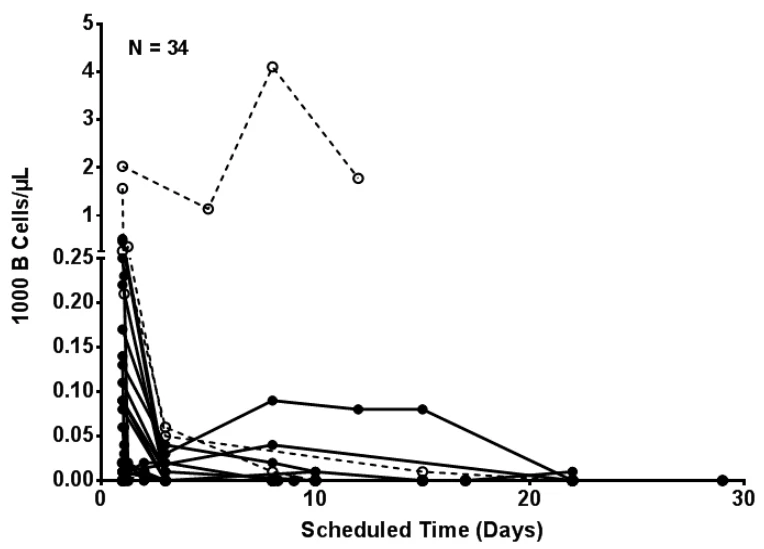
Note: The figure represents individual B-cell counts detected in peripheral blood during the first 28-day continuous blinatumomab intravenous infusion cycle. Lines with closed circles represent patients who achieved a hematological complete remission (CR/CRh*) during the first 2 cycles of blinatumomab treatment; dotted lines with open circles represent patients without CR/CRh* during the first 2 treatment cycles.
Cytokines including IL-2, IL-4, IL-6, IL-8, IL-10, IL-12, TNF-α, and IFN-γ were measured, and IL-6, IL-10, and IFN-γ were more elevated. Transient elevation of cytokines was observed in the first 2 days following the start of BLINCYTO infusion. The elevated cytokine levels returned to baseline within 24 to 48 hours during the infusion (see figure below). In subsequent treatment cycles (see table below), cytokine elevation occurred in fewer patients with lesser intensity compared to the initial 48 hours of the first treatment cycle.
Figure 2. Representative Individual Cytokine Concentration-Time Profiles Following Blinatumomab Continuous IV Infusion
Note: The figure represents cytokine levels measured in serum in an individual in the first week of a 28-day continuous blinatumomab intravenous infusion cycle. IFN-γ=interferon gamma; IL=interleukin
Table 17. Mean (±SD) Serum Cytokine Peak Levels (pg/mL) Following Continuous IV Infusion of Blinatumomab in Patients with R/R ALL
Cycle/ week | Dose (mcg/d) | No. of patients | IL-10 (pg/mL) | IL-6 (pg/mL) | IFN-Ɣ (pg/mL) | IL-2 (pg/mL) | TNF-α (pg/mL) | |||||
|---|---|---|---|---|---|---|---|---|---|---|---|---|
| C1/W1 | 9 | 184 | 589 ± 822 | 826 ± 2390 | 93 ± 409 | 25 ± 45 | 30 ± 125 | |||||
| C1/W2 | 28 | 175 | 96 ± 136 | 234 ± 681 | 27 ± 83 | 11 ± 5 | 10 ± 3 | |||||
| C2/W1 | 28 | 95 | 397 ± 633 | 315 ± 952 | 23 ± 46 | 11 ± 5 | 12 ± 15 | |||||
| C3/W1 | 28 | 41 | 428 ± 941 | 69 ± 114 | 22 ± 28 | 10 ± 2 | 12 ± 7.8 | |||||
| C = cycle; W = week, IL = interleukin; IFN-ɣ = interferon gamma; IV = intravenous; R/R ALL = relapsed/refractory acute lymphoblastic leukemia; TNF-α = tumour necrosis factor alpha; SD = standard deviation. | ||||||||||||
10.3. Pharmacokinetics
Absorption
The pharmacokinetics of blinatumomab appear linear over a dose range from 5 to 90 mcg/m2/day (approximately equivalent to 9 to 162 mcg/day) in adult patients. Following continuous intravenous infusion, the steady state serum concentration (Css) was achieved within a day and remained stable over time. Mean Css values increased approximately dose proportionally over the dose range tested. The table below gives the Css values for patients treated at the clinical doses of 9 mcg/day and 28 mcg/day for the treatment of relapsed or refractory ALL in studies involving Philadelphia chromosome-negative or Philadelphia chromosome-positive patients. PK parameters were estimated by non-compartmental analysis.
The pharmacokinetics of blinatumomab in adult patients with MRD-positive B-cell precursor ALL and in adult patients with newly diagnosed and first relapsed B-cell precursor ALL were similar to adult patients with relapsed or refractory ALL.
Table 18. Mean (SD) Css of Blinatumomab in Subjects with Relapsed/Refractory (R/R) ALL Who Received 9 mcg/day and 28 mcg/day Doses
| Mean (SD) Css (pg/mL) (n) | ||||||
|---|---|---|---|---|---|---|
| Study (patient population) | 9 mcg/day | 28 mcg/day | ||||
MT103-211 Ph(-) – R/R ALL | 246 (305) (n = 178) | 632 (510) (n = 188) | ||||
00103311 Ph(-) – R/R ALL | 211 (413) (n = 156) | 592 (553) (n = 191) | ||||
20120216 Ph(+) – R/R ALL | 155 (106) (n = 8) | 673 (614) (n = 28) | ||||
| Overall | 228 (356) (n = 342) | 616 (537) (n = 407) | ||||
ALL = acute lymphoblastic leukemia; Ph(-) = Philadelphia chromosome-negative; Ph(+) = Philadelphia chromosome-positive; Css = steady state concentration, Css in cycle 1 of each studies are presented, n = number of subjects; SD = standard deviation.
Distribution
The estimated mean (SD) volume of distribution based on terminal phase (Vz) was 5.27 (4.37) L with continuous intravenous infusion of blinatumomab in adult patients.
Metabolism
The metabolic pathway of blinatumomab has not been characterized. Like other protein therapeutics, blinatumomab is expected to be degraded into small peptides and amino acids via catabolic pathways (e.g., taken up by the cells through pinocytosis).
Elimination
The estimated mean (SD) systemic clearance (CL) and mean (SD) terminal half-life (t1/2,z) with continuous intravenous infusion in adult patients receiving blinatumomab in clinical studies was 3.10 (2.94) L/hour and 2.20 (1.34) hours, respectively, showing that blinatumomab is rapidly eliminated from the body upon administration.
Negligible amounts of blinatumomab were excreted in the urine at the tested clinical doses. The estimated mean fraction of excreted unchanged blinatumomab in urine was approximately 0.2% at the 60 mcg/m2/day dose under continuous IV infusion, indicating limited renal excretion of blinatumomab.
Special populations and conditions
Population pharmacokinetic analysis showed that there are no clinically meaningful differences observed in the pharmacokinetics of blinatumomab based on age (range: 0.62 to 80 years), sex, race, ethnicity, or Philadelphia chromosome status.
- Pediatrics
The pharmacokinetics of blinatumomab appear linear over a dose range from 5 to 30 mcg/m2/day in pediatric patients (< 18 years of age). At the recommended doses of 5 and 15 mcg/m2/day for the treatment of relapsed or refractory B-cell precursor ALL, the mean Css ± SD were 162 ± 179 and 533 ± 392 pg/mL, respectively. The pharmacokinetics of blinatumomab in pediatric patients with first relapsed B-cell precursor ALL were similar to pediatric patients with relapsed or refractory ALL.
In all pediatric patients with ALL, the estimated mean (SD) Vz, CL and t1/2,z in Cycle 1 were 4.14 (3.32) L/m2, 1.65 (1.62) L/hr/m2 and 2.14 (1.44) hours, respectively.
The steady-state concentrations of blinatumomab were comparable in adult and pediatric patients at the equivalent dose levels based on BSA-based dosing regimens.
- Hepatic Insufficiency
No formal pharmacokinetic studies of blinatumomab have been conducted in patients with hepatic impairment.
Population pharmacokinetic analysis showed that there are no clinically meaningful differences in the clearance of blinatumomab in patients with mild hepatic impairment (total bilirubin ≤ ULN and AST > ULN or total bilirubin > 1 to 1.5 × ULN and any AST) and moderate hepatic impairment (total bilirubin > 1.5 to 3 × ULN and any AST), compared to normal hepatic function (total bilirubin ≤ ULN and AST ≤ ULN). The effect of severe hepatic impairment on the pharmacokinetics of blinatumomab has not been studied.
- Renal Insufficiency
No formal pharmacokinetic studies of blinatumomab have been conducted in patients with renal impairment.
Pharmacokinetic analyses showed an approximately 2-fold difference in mean blinatumomab clearance values between adult patients with moderate renal impairment (CrCL ranging from 30 to 59 mL/min, N = 49) and normal renal function (CrCL more than 90 mL/min, N = 674). However, there was also a high inter-patient variability (CV% up to 98.4%) which minimized the difference between the two groups. There is no information available in patients with severe renal impairment (CrCL < 30 mL/min) or in patients on hemodialysis.
- Body Surface Area
Body surface area (BSA) over the entire range studied (0.4 to 2.9 m2) influences the pharmacokinetics of blinatumomab. However, in patients ≥ 45 kg, the effect of BSA on blinatumomab pharmacokinetics was not clinically meaningful and mean Css values under the BSA-based dosing and equivalent fixed dosing were similar, supporting the use of a fixed dosing regimen in patients ≥ 45 kg. Body surface area-based dosing is recommended in patients < 45 kg.
10.4. Immunogenicity
As with all therapeutic proteins, there is potential for immunogenicity. The detection of anti-blinatumomab antibody formation is highly dependent on the sensitivity and specificity of the assay. Comparison of the incidence of antibodies to blinatumomab with the incidence of antibodies to other products may be misleading.
In the clinical studies of ALL (including pediatric ALL), less than 2% of patients treated with BLINCYTO tested positive for binding anti-blinatumomab antibodies. Of patients who developed anti-blinatumomab antibodies, 7 out of 9 (78%) had in vitro neutralizing activity.
Anti-blinatumomab antibody formation may affect the pharmacokinetics of blinatumomab.
There was no identified clinically significant effect of anti-blinatumomab antibodies on safety or efficacy of BLINCYTO.
- 11. Storage, Stability, and Disposal
Protect from light. Do not freeze.
BLINCYTO vial: refrigerate at 2°C to 8°C
IV Solution Stabilizer vial: refrigerate at 2°C to 8°C
Table 19. Storage Requirements for BLINCYTO Vial and Prepared BLINCYTO Infusion Bag
| Maximum storage time for lyophilized BLINCYTO vial and IV Solution Stabilizer* | Maximum storage time of reconstituted BLINCYTO vial* | Maximum storage time of prepared BLINCYTO Infusion Bag (Preservative-Free) | Maximum storage time of prepared BLINCYTO Infusion Bag (with Preservative) | ||||||||||||
|---|---|---|---|---|---|---|---|---|---|---|---|---|---|---|---|
| Room Temperature 23°C to 27°C | Room Temperature 23°C to 27°C | Refrigerated 2°C to 8°C | Room Temperature 23°C to 27°C | Refrigerated 2°C to 8°C | Room Temperature 23°C to 27°C | Refrigerated 2°C to 8°C | |||||||||
| 8 hours | 4 hours | 24 hours | 96 hours† | 10 days† | 7 days† | 14 days† | |||||||||
* While stored, protect BLINCYTO vials and IV Solution Stabilizer from light. † Storage time includes infusion time. If IV bag containing BLINCYTO solution for infusion is not administered within the timeframes and temperatures indicated, it must be discarded; it should not be refrigerated again. | |||||||||||||||
Part 2: Scientific Information
13. Pharmaceutical Information
Drug Substance
Non-proprietary name of the drug substance: blinatumomab
Molecular formula and molecular mass: blinatumomab consists of 504 amino acids and has a molecular weight of approximately 54 kilodaltons.
Structure (for biologics)/Structural formula: BLINCYTO (blinatumomab) is a bispecific T-cell engager (BiTE®) molecule that selectively binds with high affinity to CD19 (expressed on cells of B-lineage origin) and CD3 (expressed on T-cells).
The domain structure of blinatumomab is shown in the figure below.
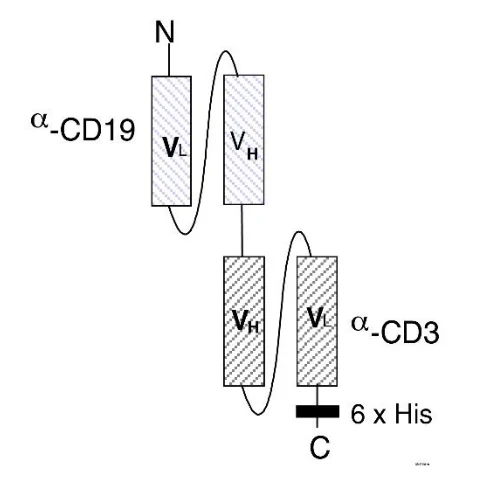
Pharmaceutical standard: Professed Standard
Product Characteristics:
Using recombinant DNA technology, BLINCYTO is produced in a well-characterized mammalian cell (Chinese hamster ovary) culture and is purified by a series of steps that include measures to inactivate and remove viruses.
14. Clinical Trials
14.1. Clinical Trials by Indication
Acute Lymphoblastic Leukemia in Adult Patients
Philadelphia Chromosome-Negative B-cell Precursor ALL in the Consolidation Phase
Study E1910 (20129152) was a Phase 3, randomized, controlled study of BLINCYTO, administered as part of consolidation therapy, in adult patients with newly diagnosed Philadelphia chromosome-negative B-cell precursor ALL. Prior to randomization, eligible patients received induction chemotherapy. After induction, patients in hematologic complete remission (CR) or CR with incomplete peripheral blood count recovery (CRi) continued on study and received intensification chemotherapy.
After intensification therapy, patients were randomized or assigned to receive BLINCYTO alternating with chemotherapy or standard of care (SOC) consolidation chemotherapy alone. Patients in each arm received the same maintenance chemotherapy. Randomization was stratified by MRD status (positive versus negative), age (< 55 years versus ≥ 55 years), CD20 status (positive versus negative), rituximab use (yes versus no), and intent to receive allogeneic stem cell transplant (SCT) (yes versus no). Randomization of MRD-positive patients was discontinued due to the approval of BLINCYTO in the United States for MRD-positive patients in March 2018. After this time, all MRD-positive patients were allocated to the BLINCYTO arm of the study.
The post-remission treatment consisted of a BFM-like chemotherapy regimen adapted from the E2993/UKALLXII clinical trial. Patients who were randomized to the BLINCYTO arm of the study were to receive 2 cycles of BLINCYTO (each cycle consisted of 28 mcg/day BLINCYTO administered as continuous intravenous infusion for 28 days, with a 14-day treatment free interval between cycles), followed by 3 cycles of consolidation chemotherapy, another cycle of BLINCYTO (third cycle of BLINCYTO) followed by an additional cycle of consolidation chemotherapy, and then a fourth cycle of BLINCYTO. Patients who were randomized to the chemotherapy only arm of the study were to receive 4 cycles of consolidation chemotherapy. Patients on the BLINCYTO arm could proceed to HSCT after 1 - 2 cycles of BLINCYTO and up to 2 cycles of consolidation chemotherapy, and patients randomized to the chemotherapy arm could proceed to HSCT after intensification and up to 3 cycles of consolidation chemotherapy. All patients who completed consolidation but did not go on to receive HSCT received maintenance therapy through 2 1/2 years from the start of intensification.
Demographics and baseline characteristics are shown in Table 20.
| Table 20. Demographics and Baseline Characteristics in Study E1910 | ||
|---|---|---|
| Table 20. Demographics and Baseline Characteristics in Study E1910 | ||
| Characteristic | BLINCYTO + SOC Chemotherapy Arm (N = 112) | SOCa Chemotherapy Arm (N = 112) |
| Characteristic | BLINCYTO + SOC Chemotherapy Arm (N = 112) | SOCa Chemotherapy Arm (N = 112) |
| Age | ||
| Median, years (min, max) | 52 (31, 69) | 50 (30, 70) |
| Males, n (%) | 55 (49) | 56 (50) |
| Race, n (%) | ||
| American Indian or Alaska Native | 2 (2) | 1 (1) |
| Asian | 3 (3) | 2 (2) |
| Black (or African American) | 9 (8) | 4 (4) |
| Native Hawaiian or Other Pacific Islander | 1 (1) | 0 |
| White | 87 (78) | 89 (79) |
| Not Reported | 5 (4) | 6 (5) |
| Unknown | 5 (4) | 10 (9) |
| Ethnicity, n (%) | ||
| Hispanic or Latino | 13 (12) | 10 (9) |
| Not Hispanic or Latino | 95 (85) | 95 (85) |
| Not Reported | 1 (1) | 2 (2) |
| Unknown | 3 (3) | 5 (4) |
| Stratification Factors, n (%) | ||
| Age < 55 years at randomization | 65 (58) | 65 (58) |
| CD20 positive | 45 (40) | 46 (41) |
| Rituximab use | 33 (29) | 36 (32) |
| Planned allogeneic SCTb | 36 (32) | 35 (31) |
a SOC = Standard of care. b allogeneic SCT = allogeneic stem cell transplantation. | ||
Study Results
In Study E1910, the primary endpoint was overall survival (OS). There were five interim analyses and one final analysis planned for OS in MRD-negative patients. The results of the third interim analysis achieved statistical significance and became the primary analysis. At the time of the primary analysis, the median follow-up was 4.5 (range: 0, 7.7) years.
The results of the primary analysis are shown in Table 21 and Figure 3.
Table 21. Overall Survival for MRD-negative Patients in Study E1910
| BLINCYTO + SOC Chemotherapy Arm | SOC Chemotherapy Arm | |||||||||||
|---|---|---|---|---|---|---|---|---|---|---|---|---|
| Number of patients | 112 | 112 | ||||||||||
| Number of Deaths (%) | 19 (17.0) | 40 (35.7) | ||||||||||
| Overall Survival | ||||||||||||
| 5-year Kaplan-Meier estimate (%) [95% CI] | 82.4 [73.7, 88.4] | 62.5 [52.0, 71.3] | ||||||||||
| Median Survival | NE | NE | ||||||||||
| Hazard ratio [95% CI]a | 0.44 [0.25, 0.76] | |||||||||||
| p-valueb | 0.001 | |||||||||||
CI = Confidence interval. NE = Not estimable. MRD-negative defined as MRD value < 1 x 10⁻⁴.
a The hazard ratio estimates are obtained from a stratified Cox regression model.
b 1-sided stratified log rank test
Figure 3. Kaplan-Meier for Overall Survival for Patients Who were MRD-negative at Randomization – Study E1910
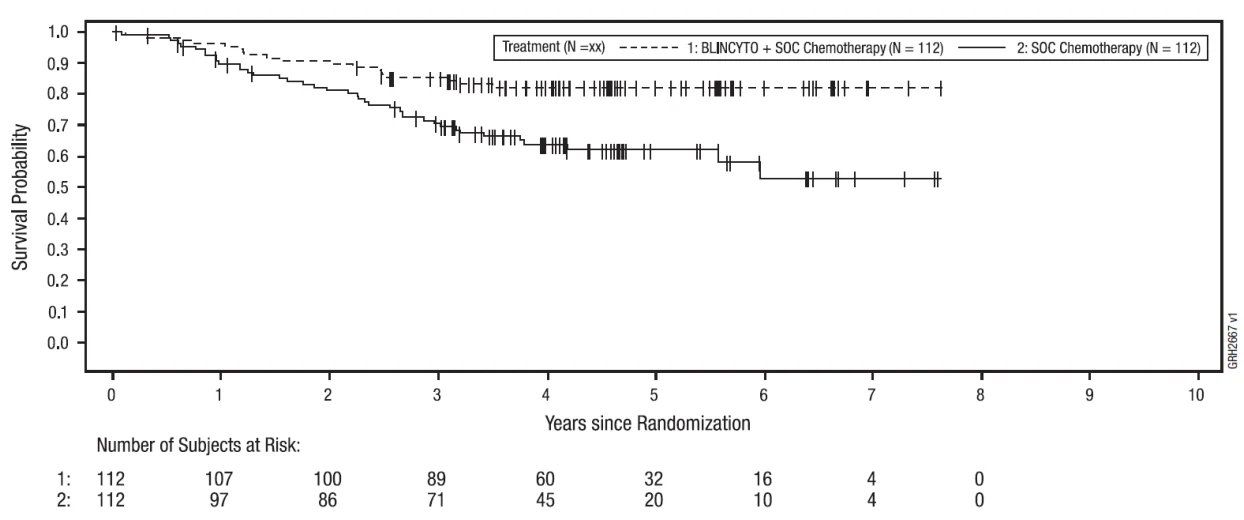
MRD-positive B-cell Precursor ALL
In Study MT103-203 [A Confirmatory Multicenter, Single-arm Study to Assess the Efficacy, Safety, and Tolerability of the BiTE® Antibody Blinatumomab in Adult Patients with Minimal Residual Disease (MRD) of B-cell precursor Acute Lymphoblastic Leukemia (BLAST Study)], the safety and efficacy of BLINCYTO were evaluated in an open-label, multicenter, single-arm study. Eligible patients were ≥ 18 years of age, had received at least 3 blocks of standard ALL induction therapy, were in complete hematologic remission (defined as < 5% blasts in bone marrow, absolute neutrophil count ≥ 1,000/µL, platelets ≥ 50,000/µL, and hemoglobin level ≥9 g/dL) and had molecular failure or molecular relapse (defined as MRD ≥ 10-3).
BLINCYTO was administered as a continuous intravenous infusion. Patients received BLINCYTO at a constant dose of 15 mcg/m2/day (equivalent to the recommended dosage of 28 mcg/day) for all treatment cycles. Patients received up to 4 cycles of treatment. Dose adjustment was possible in case of adverse events. The treated population included 116 patients who received at least one infusion of BLINCYTO. Of the 116 patients, 113 patients (97.4%) were included in the primary endpoint full analysis set and 110 patients (94.8%) were included in the key secondary endpoint full analysis set which excludes the Ph-positive subjects. The median number of treatment cycles was 2 (range: 1 to 4). Please see table below for the demographics and baseline characteristics from Study MT103-203.
| Table 22. Demographics and Baseline Characteristics in Study MT103-203 | |
|---|---|
| Characteristic | BLINCYTO (N = 116) |
| Age | |
| Median, years (min, max) | 45 (18, 76) |
| Mean, years (SD) | 44.6 (16.4) |
| ≥ 65 years, n (%) | 15 (12.9) |
| Males, n (%) | 68 (58.6) |
| Race, n (%) | |
| Asian | 1 (0.9) |
| Other (mixed) | 1 (0.9) |
| White | 102 (87.9) |
| Unknown | 12 (10.3) |
| Philadelphia chromosome disease status | |
| Positive | 5 (4.3) |
| Negative | 111 (95.7) |
| Relapse history | |
| Patients in 1st CR | 75 (64.7) |
| Patients in 2nd CR | 39 (33.6) |
| Patients in 3rd CR | 2 (1.7) |
| MRD level at baseline* | |
| ≥ 10-1 and < 1 | 9 (7.8) |
| ≥ 10-2 and < 10-1 | 45 (38.8) |
| ≥ 10-3 and < 10-2 | 52 (44.8) |
| < 10-3 | 3 (2.6) |
| Below Lower Limit of Quantification | 5 (4.3) |
| Unknown | 2 (1.7) |
* Centrally assessed in an assay with minimum sensitivity of 10-4
Study Results
In Study MT103-203, the primary endpoint was the proportion of patients who achieved complete MRD response within one cycle of BLINCYTO treatment. Eighty-eight out of 113 (77.9%) patients achieved a complete MRD response after one cycle of treatment. In patients with Philadelphia chromosome negative B-cell precursor ALL, the 18-month KM estimate for hematological Relapsed-Free Survival, censored at HSCT or post-blinatumomab chemotherapy, was 54% (95% CI: 33, 70). MRD response rates by age and MRD level at baseline subgroups were consistent with the results in the overall population. See table below for efficacy results from Study MT103-203.
Table 23. Efficacy Results in Patients ≥ 18 Years of Age with MRD-positive B-cell Precursor Acute Lymphoblastic Leukemia (ALL) (Study MT103-203)
Complete MRD Responsea, n/N (%), [95% CI]
88/113 (77.9) [69.1, 85.1]
Patients in 1st CR, n/N (%), [95% CI]
60/73 (82.2) [71.5, 90.2]
Patients in 2nd CR, n/N (%), [95% CI]
27/38 (71.1) [54.1, 84.6]
Duration of complete MRD response
- 17.3 months [12.6 to 23.3]
a Complete MRD response was defined as the absence of detectable MRD confirmed in an assay with minimum sensitivity of 10-4
Relapsed or Refractory B-cell Precursor ALL
In Study 00103311 [A Phase 3, Randomized, Open Label Study Investigating the Efficacy of the BiTE® Antibody Blinatumomab Versus Standard of Care Chemotherapy in Adult Subjects with Relapsed/Refractory B-cell precursor Acute Lymphoblastic Leukemia (TOWER Study)], the safety and efficacy of BLINCYTO compared to standard of care (SOC) chemotherapy were evaluated in a randomized, open-label, multicenter study. Eligible patients were ≥ 18 years of age with relapsed or refractory B-cell precursor ALL (had > 5% blasts in the bone marrow and either relapse at any time after allogeneic HSCT, untreated first relapse with first remission duration < 12 months, or refractory to last therapy).
Patients were randomized 2:1 to receive BLINCYTO or 1 of 4 prespecified, investigator-selected, SOC chemotherapy regimens. Randomization was stratified by age (< 35 years vs ≥ 35 years of age), prior salvage therapy (yes versus no), and prior allogeneic HSCT (yes versus no) as assessed at the time of consent. The demographics and baseline characteristics were well-balanced between the two arms (see table below).
| Table 24. Demographics and Baseline Characteristics in TOWER Study | ||
|---|---|---|
| Table 24. Demographics and Baseline Characteristics in TOWER Study | ||
| Characteristic | BLINCYTO (N = 271c) | SOC Chemotherapya (N = 134c) |
| Characteristic | BLINCYTO (N = 271c) | SOC Chemotherapya (N = 134c) |
| Age | ||
| Median, years (min, max) | 37 (18, 80) | 37 (18, 78) |
| Mean, years (SD) | 40.8 (17.1) | 41.1 (17.3) |
| < 35 years, n (%) | 123 (45.4) | 60 (44.8) |
| ≥ 35 years, n (%) | 148 (54.6) | 74 (55.2) |
| ≥ 65 Years, n (%) | 33 (12.2) | 15 (11.2) |
| ≥ 75 Years, n (%) | 10 (3.7) | 2 (1.5) |
| Males, n (%) | 162 (59.8) | 77 (57.5) |
| Race, n (%) | ||
| American Indian or Alaska Native | 4 (1.5) | 1 (0.7) |
| Asian | 19 (7.0) | 9 (6.7) |
| Black (or African American) | 5 (1.8) | 3 (2.2) |
| Multiple | 2 (0.7) | 0 |
| Native Hawaiian or Other Pacific Islander | 1 (0.4) | 1 (0.7) |
| Other | 12 (4.4) | 8 (6.0) |
| White | 228 (84.1) | 112 (83.6) |
| Prior salvage therapy | 164 (60.5) | 80 (59.7) |
| Prior alloHSCTb | 94 (34.7) | 46 (34.3) |
| Eastern Cooperative Group Status - n (%) | ||
| 0 | 96 (35.4) | 52 (38.8) |
| 1 | 134 (49.4) | 61 (45.5) |
| 2 | 41 (15.1) | 20 (14.9) |
| Unknown | 0 | 1 (0.7) |
| Refractory to salvage treatment - n (%) | ||
| Yes | 87 (32.1) | 34 (25.4) |
| No | 182 (67.2) | 99 (73.9) |
| Unknown | 2 (0.7) | 1 (0.7) |
| Maximum of central/local bone marrow blasts - n (%) | ||
| ≤ 5% | 0 | 0 |
| > 5 to < 10% | 9 (3.3) | 7 (5.2) |
| 10 to < 50% | 60 (22.1) | 23 (17.2) |
| ≥ 50% | 201 (74.2) | 104 (77.6) |
| Unknown | 1 (0.4) | 0 |
| a SOC = standard of care b alloHSCT = allogeneic hematopoietic stem cell transplantation c Number under each treatment group represents the number of subjects randomized | ||
BLINCYTO was administered as a continuous intravenous infusion. In the first cycle, the initial dose was 9 mcg/day for week 1, then 28 mcg/day for the remaining 3 weeks. The target dose of 28 mcg/day was administered in cycle 2 and subsequent cycles starting on day 1 of each cycle. Dose adjustment was possible in case of adverse events. Of the 267 patients who received BLINCYTO, the median number of treatment cycles was two (range: 0 to 9 cycles); of the 109 patients who received SOC chemotherapy, the median number of treatment cycles was one (range: 1 to 4 cycles).
Study Results
In the TOWER Study, the primary endpoint was overall survival (OS). The study demonstrated statistically significant improvement in OS for patients treated with BLINCYTO as compared to SOC chemotherapy (the hazard ratio [95% CI] was 0.71 [0.55, 0.93], a p-value = 0.012). In patients with 0 prior salvage therapies the hazard ratio for OS was 0.60 (0.39, 0.91), in patients with one prior salvage therapy the hazard ratio for OS was 0.59 (0.38, 0.91), and in patients with more than two prior salvage therapies the hazard ratio for OS was 1.13 (0.64, 1.99). OS benefit was independent of transplant; consistent results were observed after censoring at the time of HSCT. See figure and table below for efficacy results from TOWER Study.
Figure 4. Kaplan-Meier Curve of Overall Survival (TOWER Study)
| Table 25. Efficacy Results in Patients ≥ 18 Years of Age with Philadelphia Chromosome-negative Relapsed or Refractory B-cell Precursor Acute Lymphoblastic Leukemia (ALL) (TOWER Study) | ||
|---|---|---|
| Table 25. Efficacy Results in Patients ≥ 18 Years of Age with Philadelphia Chromosome-negative Relapsed or Refractory B-cell Precursor Acute Lymphoblastic Leukemia (ALL) (TOWER Study) | ||
BLINCYTO (N = 271) | SOC Chemotherapy (N = 134) | |
BLINCYTO (N = 271) | SOC Chemotherapy (N = 134) | |
| Overall Survival | ||
| Median, months [95% CI] | 7.7 (5.6, 9.6) | 4.0 (2.9, 5.3) |
| Hazard Ratio [95% CI]a | 0.71 (0.55, 0.93) | |
| p-valueb | 0.012 | |
| Complete Remission (CR) | ||
| CRc/CRh*d/CRie, n (%) [95% CI] | 119 (43.9) (37.9, 50) | 33 (24.6) (17.6, 32.8) |
| Treatment difference [95% CI] | 19.3 (9.9, 28.7) | |
| p-valueb | < 0.001 | |
| CR, n (%) [95% CI] | 91 (33.6) (28.0, 39.5) | 21 (15.7) (10, 23) |
| Treatment difference [95% CI] | 17.9 (9.6, 26.2) | |
| p-valuef | < 0.001 | |
| Duration of CR/CRh*/CRig | ||
| Median, months [95% CI] | 7.3 (5.8, 9.9) | 4.6 (1.8, 19) |
| Event-free Survivalh | ||
| 6-month estimate % [95% CI] | 30.7 (25, 36.5) | 12.5 (7.2, 19.2) |
| Hazard Ratio [95% CI] | 0.55 (0.43, 0.71) | |
| MRD Responsei for CR/CRh*/CRi | ||
| n1/n2 (%)j [95% CI] | 74/97 (76.3) (66.6, 84.3) | 16/33 (48.5) (30.8, 66.5) |
a Based on stratified Cox’s model. b The p-value was derived using stratified log-rank test. c CR was defined as ≤ 5% blasts in the bone marrow, no evidence of disease, and full recovery of peripheral blood counts (platelets > 100,000/microliter and absolute neutrophil counts [ANC] > 1,000/microliter). d CRh* (complete remission with partial hematologic recovery) was defined as ≤ 5% blasts in the bone marrow, no evidence of disease, and partial recovery of peripheral blood counts (platelets > 50,000/microliter and ANC > 500/microliter). e CRi (complete remission with incomplete hematologic recovery) was defined as ≤ 5% blasts in the bone marrow, no evidence of disease, and incomplete recovery of peripheral blood counts (platelets > 100,000/microliter or ANC > 1,000/microliter). f The p-value was derived using Cochran-Mantel-Haenszel test g Duration of CR/CRh*/CRi was defined as time since first response to relapse or death, whichever is earlier. Relapse was defined as hematological relapse (blasts in bone marrow greater than 5% following CR) or an extramedullary relapse. h EFS time was calculated from the time of randomization until the date of disease assessment indicating a relapse after achieving a CR/CRh*/CRi or death, whichever is earlier. Subjects who fail to achieve a CR/CRh*/CRi within 12 weeks of treatment initiation are considered treatment failures and assigned an EFS duration of 1 day. i MRD (minimum residual disease) response was defined as MRD by PCR or flow cytometry < 1 x 10⁻⁴. j n1: number of patients who achieved MRD response and CR/CRh*/CRi; n2: number of patients who achieved CR/CRh*/CRi. | ||
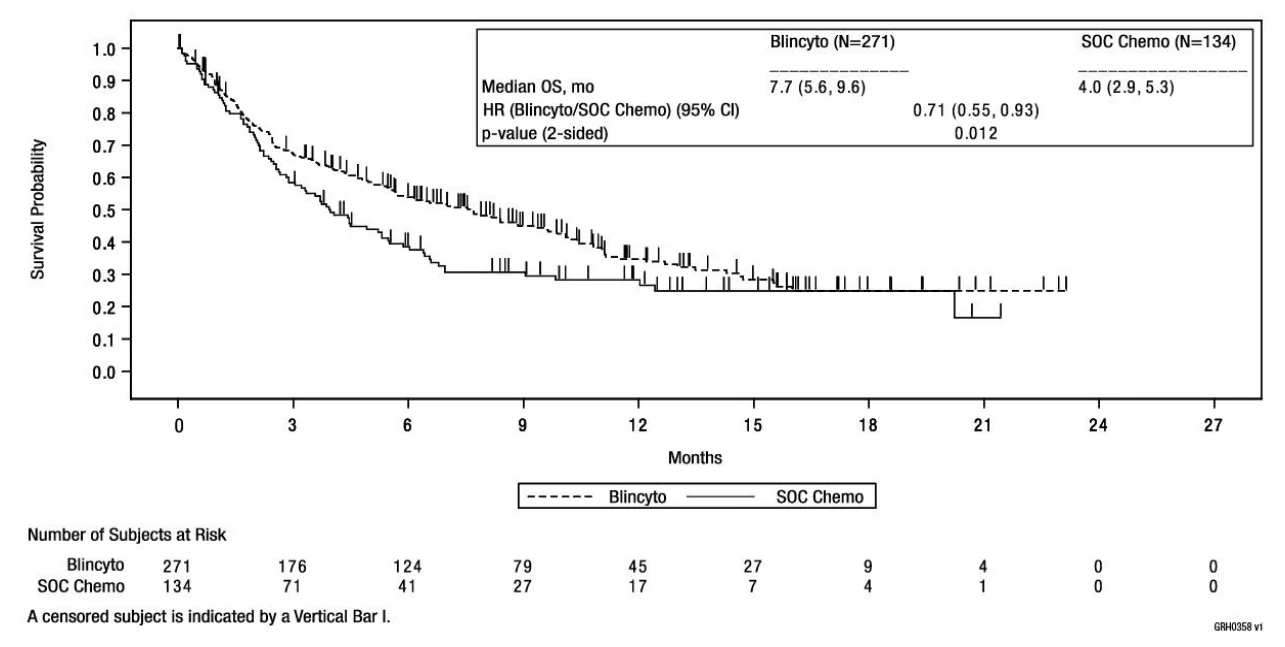
In Study MT103-211 [An Open-label, Multicenter, Phase 2 Study to Evaluate Efficacy and Safety of the Bi-specific T-cell Engager (BiTE®) Antibody Blinatumomab in Adult Subjects with Relapsed/Refractory B-cell precursor Acute Lymphoblastic Leukemia], the safety and efficacy of BLINCYTO were evaluated in an open-label, multicenter, single-arm study. Eligible patients were ≥ 18 years of age with Philadelphia chromosome-negative relapsed or refractory B-cell precursor ALL (relapsed with first remission duration of ≤ 12 months in first salvage or relapsed or refractory after first salvage therapy or relapsed within 12 months of allogeneic HSCT and had ≥ 10% blasts in bone marrow). The primary endpoint was the CR/CRh* rate within 2 cycles of treatment with BLINCYTO. Key secondary endpoints were relapse free survival (RFS) and overall survival (OS).
BLINCYTO was administered as a continuous intravenous infusion. In the first cycle, the initial dose was 9 mcg/day for week 1, then 28 mcg/day for the remaining 3 weeks. The target dose of 28 mcg/day was administered in cycle 2 and subsequent cycles starting on day 1 of each cycle. Dose adjustment was possible in case of adverse events. The treated population included 189 patients who received at least 1 infusion of BLINCYTO; the median number of treatment cycles was 2 (range: 1 to 5). Patients who responded to BLINCYTO but later relapsed had the option to be retreated with BLINCYTO. Among treated patients, 70 were female (37%) and 119 were male (63%), the median age was 39 years (range: 18 to 79 years), 64 out of 189 (33.9%) had undergone HSCT prior to receiving BLINCYTO, 77 out of 189 (40.7%) had undergone 1 prior salvage therapy, 42 out of 189 (22.2%) had undergone 2 prior salvage therapies and 32 out of 189 (16.9%) had received more than 2 prior salvage therapies. Sixteen out of 189 (8.5%) patients were primary refractory. Thirty-one out of 189 (16.4%) patients had an ECOG performance status of 2.
Study Results
In Study MT103-211, eighty-one out of 189 (42.9%) patients achieved CR/CRh* within the first 2 treatment cycles with the majority of responses (64 out of 81) occurring within cycle 1 of treatment. See table below for efficacy results. Of the 18 patients who achieved CRh*, 3 patients achieved CR during consolidation cycles. Thirty-two out of 189 (16.9%) patients underwent allogeneic HSCT in CR/CRh* induced with BLINCYTO. Numerically, patients with prior allogeneic HSCT had similar response rates to those without prior HSCT, and older patients had similar response rates to younger patients.
Table 26. Efficacy Results in Patients ≥ 18 Years of Age with Philadelphia Chromosome-negative Relapsed or Refractory B-cell Precursor Acute Lymphoblastic Leukemia (ALL) (Study MT103-211)
| N = 189 | ||||
|---|---|---|---|---|
| Complete remission (CR)a/Complete remission with partial hematological recovery (CRh*)b, n (%) [95% CI] | 81 (42.9%) [35.7% – 50.2%] | |||
| CR, n (%) [95% CI] | 63 (33.3%) [26.7% – 40.5%] | |||
| CRh*, n (%) [95% CI] | 18 (9.5%) [5.7% – 14.6%] | |||
| a CR was defined as ≤ 5% of blasts in the bone marrow, no evidence of disease, and full recovery of peripheral blood counts (platelets > 100,000/microliter and absolute neutrophil counts [ANC] > 1,000/microliter). b CRh* was defined as ≤ 5% of blasts in the bone marrow, no evidence of disease, and partial recovery of peripheral blood counts (platelets > 50,000/microliter and ANC > 500/microliter). | ||||
In Study 20120216 [A Phase 2 Single Arm, Multicenter Trial to Evaluate the Efficacy of the BiTE® Antibody Blinatumomab in Adult Subjects with Relapsed/Refractory Philadelphia Positive B-cell precursor Acute Lymphoblastic Leukemia (ALCANTARA Study)] the safety and efficacy of BLINCYTO were evaluated in an open-label, multicenter, single-arm study. Eligible patients were ≥ 18 years of age with Philadelphia chromosome-positive B-cell precursor ALL; Relapsed or refractory to at least 1 second generation or later tyrosine kinase inhibitor (TKI); OR intolerant to second generation TKI, and intolerant or refractory to imatinib mesylate.
BLINCYTO was administered as a continuous intravenous infusion. In the first cycle, the initial dose was 9 mcg/day for week 1, then 28 mcg/day for the remaining 3 weeks. The dose of 28 mcg/day was administered in cycle 2 and subsequent cycles starting on day 1 of each cycle. Dose adjustment was possible in case of adverse events. The treated population included 45 patients who received at least one infusion of BLINCYTO; the median number of treatment cycles was 2 (range: 1 to 5).
See table below for the demographics and baseline characteristics from Study 20120216.
Table 27. Demographics and Baseline Characteristics in Study 20120216
| Characteristic | BLINCYTO (N = 45) |
|---|---|
| Age | |
| Median, years (min, max) | 55 (23, 78) |
| Mean, years (SD) | 52.8 (15) |
| ≥ 65 Years and < 75 years, n (%) | 10 (22.2) |
| ≥ 75 Years, n (%) | 2 (4.4) |
| Males, n (%) | 24 (53.3) |
| Race, n (%) | |
| Asian | 1 (2.2) |
| Black (or African American) | 3 (6.7) |
| Other | 2 (4.4) |
| White | 39 (86.7) |
| Disease History | |
| Prior TKI treatmenta, n (%) | |
| 1 | 7 (15.6) |
| 2 | 21 (46.7) |
| ≥ 3 | 17 (37.8) |
| Prior salvage therapy | 31 (61.9) |
| Prior alloHSCTb | 20 (44.4) |
| Bone marrow blastsc | |
| ≥ 50% to <75% | 6 (13.3) |
| ≥ 75% | 28 (62.2) |
| |
Study Results
In Study 20120216, the primary endpoint was the CR/CRh* rate within two cycles of treatment with BLINCYTO. Sixteen out of 45 (35.6%) patients achieved CR/CRh* within the first two treatment cycles. See table below for efficacy results from Study 20120216.
Two patients achieved CR during subsequent cycles, resulting in a cumulative CR rate of 35.6% (16 out of 45; 95% CI: 21.9 – 51.2). Five out of 16 (31.3%) patients underwent allogeneic HSCT in CR/CRh* induced with BLINCYTO.
Table 28. Efficacy Results in Patients ≥ 18 Years of Age with Philadelphia Chromosome-positive Relapsed or Refractory B-cell Precursor Acute Lymphoblastic Leukemia (ALL) (Study 20120216)
| N = 45 | |||||
|---|---|---|---|---|---|
| Complete remission (CR)a/Complete remission with partial hematological recovery (CRh*)b, n (%) [95% CI] | 16 (35.6) [21.9, 51.2] | ||||
| CR, n (%) [95% CI] | 14 (31.1) [18.2, 46.6] | ||||
| CRh*, n (%) [95% CI] | 2 (4.4) [0.5, 15.1] | ||||
| Median Relapsec-free survival (RFS) for CR/CRh* [95% CI] | 6.7 months [4.4 to NEd] | ||||
| |||||
Treatment effects in evaluable subgroups (e.g., mutation status, number of prior TKIs, prior HSCT status, and relapse without prior HSCT) were in general consistent with the results in the overall population. Patients with T315I mutation, other mutations, or additional cytogenetic abnormalities responded with a similar rate as compared to those that did not have these mutations or abnormalities.
Acute Lymphoblastic Leukemia in Pediatric Patients
Philadelphia Chromosome-Negative B-cell Precursor ALL in the Consolidation Phase
Study 20120215 was an open-label, controlled, phase 3 trial of BLINCYTO, as part of consolidation therapy vs. conventional consolidation chemotherapy in pediatric patients with high-risk first relapsed B-cell precursor acute lymphoblastic leukemia (ALL). Patients were between 28 days and 18 years of age with high-risk first relapsed Philadelphia chromosome-negative B-cell precursor ALL and had < 25% blasts in the bone marrow.
After induction and 2 blocks of consolidation chemotherapy, eligible patients were randomized 1:1 to receive BLINCYTO or a third block of SOC consolidation chemotherapy. Patients in the BLINCYTO arm received one cycle of BLINCYTO as a continuous intravenous infusion at 15 mcg/m2/day over 4 weeks (maximum daily dose was not to exceed 28 mcg/day). Dose adjustment was possible in case of adverse events. Randomization was stratified by age (1 to 9 years versus < 1 year and > 9 years), bone marrow status determined at the end of the second block of consolidation chemotherapy and minimal residual disease status determined at the end of induction (blasts < 5% with MRD level ≥ 10-3 versus blasts < 5% with MRD level < 10-3 versus blasts ≥ 5% and < 25%). The demographics and baseline characteristics were well-balanced between the two arms (see Table 29).
| Table 29. Demographics and Baseline Characteristics in Study 20120215 | ||
|---|---|---|
| Table 29. Demographics and Baseline Characteristics in Study 20120215 | ||
| Characteristics | BLINCYTO (N = 54) | Standard of Care (SOC) Chemotherapy (N = 57) |
| Characteristics | BLINCYTO (N = 54) | Standard of Care (SOC) Chemotherapy (N = 57) |
| Age, n (%) | ||
| Median (range) | 6 (1, 17) | 5 (1, 17) |
| < 1 year | 0 (0.0) | 0 (0.0) |
| 1 to 9 years | 39 (72.2) | 41 (71.9) |
| ≥ 10 to 18 years | 15 (27.8) | 16 (28.1) |
| Males, n (%) | 30 (55.6) | 23 (40.4) |
| Race, n (%) | ||
| American Indian or Alaska Native | 0 (0.0) | 0 (0.0) |
| Asian | 1 (1.9) | 3 (5.3) |
| Black (or African American) | 0 (0.0) | 3 (5.3) |
| Native Hawaiian or Other Pacific Islander | 0 (0.0) | 0 (0.0) |
| Other | 3 (5.6) | 5 (8.8) |
| White | 50 (92.6) | 46 (80.7) |
| Occurrence and type of any genetic abnormality, n (%) | ||
| No | 34 (63.0) | 31 (54.4) |
| Yes | 20 (37.0) | 26 (45.6) |
| Hyperdiploidy | 6 (11.1) | 7 (12.3) |
| Hypodiploidy | 1 (1.9) | 0 (0.0) |
| t(v;11q23)/MLL rearranged | 0 (0.0) | 4 (7.0) |
| t(12;21)(p13;q22)/TEL-AML1 | 2 (3.7) | 3 (5.3) |
| t(1;19)(q23;p13.3)/E2A-PBX1 | 2 (3.7) | 2 (3.5) |
| t(5;14)(q31;32)/IL3-IGH | 0 (0.0) | 0 (0.0) |
| Other | 9 (16.7) | 10 (17.5) |
| Extramedullary disease at relapse, n (%) | ||
| No | 44 (81.5) | 42 (73.7) |
| Yes | 10 (18.5) | 15 (26.3) |
| Cytomorphology, n (%) | ||
| Blasts < 5% | 54 (100.0) | 54 (94.7) |
| Blasts ≥ 5% and < 25% | 0 (0.0) | 2 (3.5) |
| Blasts ≥ 25% blasts | 0 (0.0) | 0 (0.0) |
| Not evaluable | 0 (0.0) | 1 (1.8) |
| MRD PCR value*, n (%) | ||
| ≥ 10-4 | 10 (18.5) | 15 (26.3) |
| < 10-4 | 20 (37.0) | 22 (38.6) |
| MRD Flow Cytometry value*, n (%) | ||
| ≥ 10-4 | 9 (16.7) | 13 (22.8) |
| < 10-4 | 27 (50.0) | 24 (42.1) |
| Time from first diagnosis to relapse (month), n (%) | ||
| < 18 months | 19 (35.2) | 22 (38.6) |
| ≥ 18 months and ≤ 30 months | 32 (59.3) | 31 (54.4) |
| > 30 months | 3 (5.6) | 4 (7.0) |
N = number of patients in the analysis set; n = number of patients with observed data; MRD = minimal residual disease; PCR = polymerase chain reaction. * Available baseline MRD status per local assessment. | ||
Study Results
The primary endpoint was event-free survival (EFS), which was defined as the time from randomization to relapse or M2 marrow after having achieved a complete remission (CR), failure to achieve a CR at the end of treatment, death or second malignancy. Overall Survival was a secondary endpoint. There were two interim analyses and one final analysis planned for EFS. OS was planned to be analyzed at the time of the final EFS analysis.
The results of the first EFS interim analysis achieved statistical significance and became the primary EFS analysis. At the time of the primary EFS analysis, the median follow-up was 22.4 (range: 0, 41.8) months. The results of the primary EFS analysis are shown in Table 30 and Figure 5. At the time of the final OS analysis the median follow-up was 55.2 (range: 0.1, 82.0) months. The results of the final OS analysis are shown in Table 31 and Figure 6.
| Table 30. Event-Free Survival in Pediatric Patients with High-Risk First Relapsed B-cell Precursor ALL (Study 20120215) | ||
|---|---|---|
BLINCYTO (N = 54) | SOC Chemotherapy (N = 54) | |
| Event-free Survival | ||
| Events, n (%) | 18 (33.3) | 31 (57.4) |
| Median, months [95% CI] | NR [12.0, NE] | 7.4 [4.5, 12.7] |
| Hazard Ratio [95% CI]a | 0.36 [0.19, 0.66] | |
| p-valueb | <0.001 | |
NE = Not estimable. NR = Not reached CI = Confidence interval. a The hazard ratio estimates were obtained from the Cox proportional hazard model. Stratification factors were: age (1 to 9 years vs other [< 1 year and > 9 years]), and marrow/MRD status (M1 with MRD level < 10-3 vs M1 with MRD level ≥ 10-3 vs M2). b The stratified log rank test. | ||
At the time of the final EFS analysis, with a median follow-up of 51.9 (range: 0, 82.0) months, the EFS HR was 0.35 (95% CI: 0.20, 0.61). The median EFS times were not reached and 7.8 (95% CI: 5.8, 13.4) months in the BLINCYTO and SOC arms, respectively.
Figure 5. Kaplan-Meier Curve for Event-free Survival (Study 20120215)
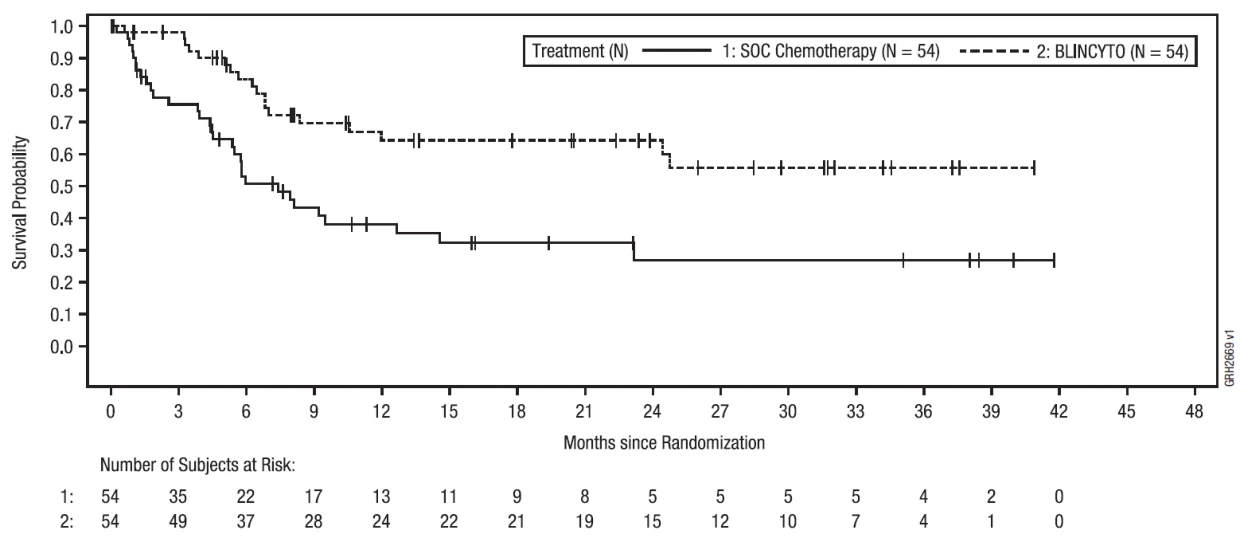
Table 31. Overall Survival in Pediatric Patients with High-Risk First Relapsed B-cell Precursor ALL (Study 20120215)
BLINCYTO (N = 54) | SOC Chemotherapy (N = 57) | ||||||||
|---|---|---|---|---|---|---|---|---|---|
| Overall Survival | |||||||||
| Number of deaths (%) | 11 (20.4) | 28 (49.1) | |||||||
| Median Survival, Months (95% CI) | NR | 25.6 [17.5, NE] | |||||||
| Hazard Ratio [95% CI]a | 0.33 [0.16, 0.66] | ||||||||
| p-valueb | 0.001 | ||||||||
NE = Not estimable. NR = Not reached. CI = Confidence interval. a The hazard ratio estimates were obtained from the Cox proportional hazard model. Stratification factors were: age (1 to 9 years vs other [< 1 year and > 9 years]), and marrow/MRD status (M1 with MRD level < 10-3 vs M1 with MRD level ≥ 10-3 vs M2). b The stratified log-rank test. | |||||||||
Figure 6. Kaplan-Meier for Overall Survival (Study 20120215)
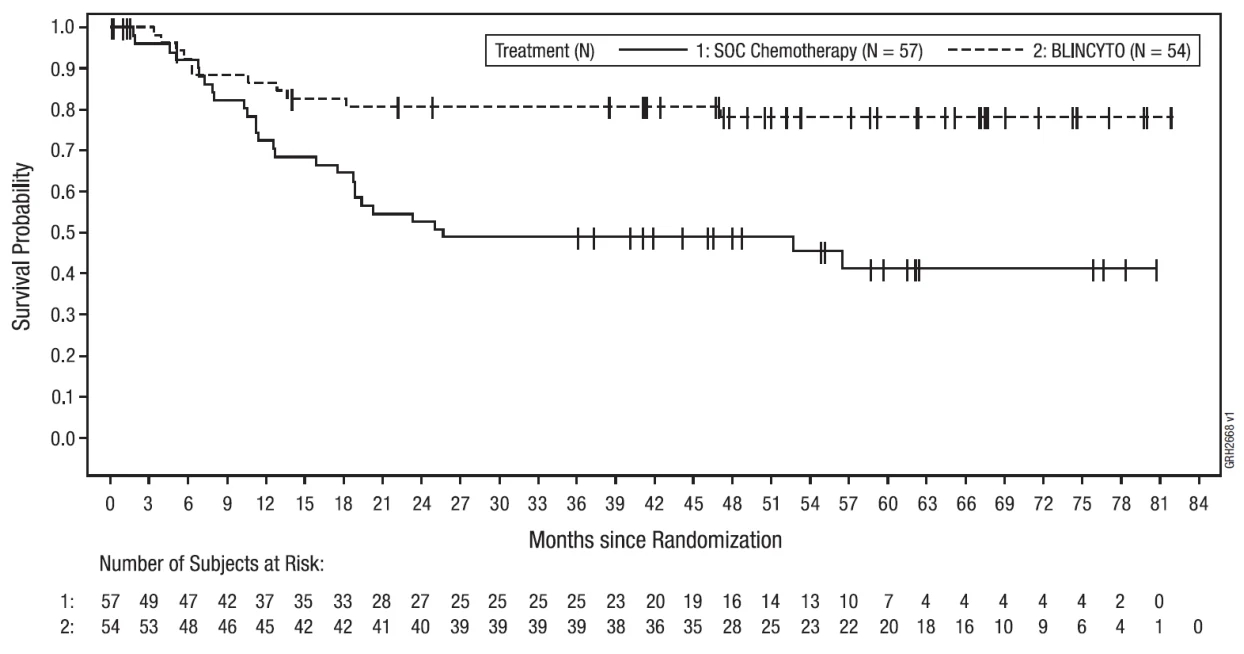
Philadelphia Chromosome-Negative Relapsed or Refractory B-cell precursor ALL
In Study MT103-205, the safety and efficacy of BLINCYTO were evaluated in an open-label, multicenter, single-arm Phase I/II study in 93 pediatric patients (< 18 years of age) with relapsed or refractory B-cell precursor ALL. Eligible patients had second or later bone marrow relapse, any marrow relapse after allogeneic HSCT, or were refractory to other treatments had > 25% blasts in bone marrow as determined by a central laboratory and had Karnofsky performance status of ≥ 50% (patients ≥ 16 years of age) or Lansky performance status of ≥ 50% (patients < 16 years of age).
Patients were excluded if they had active acute or extensive chronic graft-versus-host disease (GvHD) including taking immunosuppressive agents to prevent or treat GvHD within 2 weeks before BLINCYTO treatment; known or suspected central nervous (CNS) involvement by ALL; history of or current relevant CNS pathology; HSCT within 3 months before BLINCYTO treatment; immediately previous cancer chemotherapy, radiotherapy, or immunotherapy.
The recommended dose for this study was determined to be 5 mcg/m2/day on Days 1-7 and 15 mcg/m2/day on Days 8-28 for cycle 1, and 15 mcg/m2/day on Days 1-28 for subsequent cycles. The treated population included 70 patients who received at least one infusion of BLINCYTO at this recommended dose; the median number of treatment cycles was one (range: 1 to 5).
Among treated patients, the median age was 8 years (range: 7 months to 17 years), 40 out of 70 (57.1%) had undergone allogeneic HSCT prior to receiving BLINCYTO, and 39 out of 70 (55.7%) had refractory disease. Most patients (52/70) had a high tumour burden (≥ 50% leukemic blasts in bone marrow) at baseline with a median of 75.5% bone marrow blasts.
The primary endpoint was complete remission (CR) rate, which was defined as the rate of M1 bone marrow (≤ 5% blasts in the bone marrow) with no evidence of circulating blasts or extra-medullary disease within the first two cycles of BLINCYTO treatment. In this study, pediatric patients did not need to recover their peripheral blood counts in order to achieve a CR.
Study Results
Twenty-seven out of 70 patients (38.6%) achieved the primary endpoint (see table below). Thirteen of the 27 patients (48.1%) who achieved the primary endpoint received an allogeneic HSCT. Ten of 18 patients (55.6%) with < 50% blasts at baseline achieved a CR compared to 17 of 52 patients (32.7%) with ≥ 50% blasts at baseline. The CR for patients less than 2 years of age was 60% (6/10), for patients 2 to 6 years was 40.0% (8/20); and for patients aged 7 to 17 years was 32.5% (13/40).
Table 32. Efficacy Results in Patients < 18 Years of Age with Relapsed or Refractory B-cell Precursor Acute Lymphoblastic Leukemia (ALL) (Study MT103-205)
| N = 70 | |||||
|---|---|---|---|---|---|
| CRa, n (%) [95% CI] | 27 (38.6%) [27.2% – 51.0%] | ||||
| CR with full recovery of peripheral blood countsb | 12 (17.1%) [9.2% – 28.0%] | ||||
| CR with partial recovery of peripheral blood countsc | 11 (15.7%) [8.1% – 26.4%] | ||||
| CR without a partial recovery of peripheral blood countsd | 4 (5.7%) [1.6%- 14.0%] | ||||
| Median Relapsee -free survival (RFS) [95% CI] | 4.4 months [2.3 - 12.1 months] | ||||
| a CR was defined as M1 marrow (≤ 5% of blasts in the bone marrow) and no evidence of circulating blasts or extra-medullary b CR with full recovery of peripheral blood counts (platelets > 100,000/microliter and absolute neutrophil counts [ANC] > 1,000/microliter). c CR with partial recovery of peripheral blood counts (platelets > 50,000/microliter and ANC > 500/microliter). d CR without a partial recovery of peripheral blood counts (platelets ≤ 50,000/microliter and/or ANC ≤ 500/microliter). e Relapse was defined as hematological relapse (blasts in bone marrow greater than 25% following CR) or an extramedullary relapse | |||||
15. Microbiology
No microbiological information is required for this drug product.
16. Non-Clinical Toxicology
Blinatumomab only cross-reacts in the chimpanzee. Consequently, preclinical safety data with blinatumomab are limited. Findings from mouse studies up to 13 weeks with a surrogate molecule were limited to the expected pharmacology.
Genotoxicity
No mutagenicity studies have been conducted with blinatumomab.
Carcinogenicity
No carcinogenicity studies have been conducted with blinatumomab.
Reproductive and developmental toxicology
No studies have been conducted to evaluate the effects of blinatumomab on fertility. There were no effects on male or female reproductive organ weights, gross observations or histopathology in mice treated for 13-weeks with a surrogate molecule.