


Product Monograph - Lartruvo (Eli Lilly Canada, 190 mg)
1 INDICATIONS
LARTRUVO (olaratumab) is indicated:
In combination with doxorubicin for the treatment of adult patients with advanced soft tissue sarcoma (STS) not amenable to curative treatment with radiotherapy or surgery and for whom treatment with an anthracycline-containing regimen is appropriate.
Approval was based on an overall survival benefit demonstrated in a Phase II study (see
Part II Clinical Trials). Description of clinical benefit needs to be verified in a confirmatory Phase III trial.
1.1 Pediatrics
Pediatrics (<18 years of age): No data are available to Health Canada; therefore, Health Canada has not authorized an indication for pediatric use.
1.2 Geriatrics
Geriatrics (≥65 years of age): Clinical studies of LARTRUVO did not include sufficient numbers of patients aged 65 years and older with soft tissue sarcoma to determine whether they respond differently from younger patients.
2 CONTRAINDICATIONS
LARTRUVO is contraindicated in patients who are hypersensitive to this drug or to any ingredient in the formulation, including any non-medicinal ingredient, or component of the container. For a complete listing, see Dosage Forms, Strengths, Composition and Packaging.
3 SERIOUS WARNINGS AND PRECAUTIONS BOX
Serious Warnings and Precautions
Infusion-Related Reactions: Severe and life-threatening reactions have occurred during the “LARTRUVO, indicated:
- in combination with doxorubicin for the treatment of adult patients with advanced soft tissue sarcoma (STS) not amenable to curative treatment with radiotherapy or surgery and for whom treatment with an anthracycline-containing regimen is appropriate
has been issued marketing authorization with conditions, pending the results of trials to verify its clinical benefit. Patients should be advised of the nature of the authorization. For further information for LARTRUVO please refer to Health Canada’s Notice of Compliance with conditions - drug products web site:
http://www.hc-sc.gc.ca/dhp-mps/prodpharma/notices-avis/conditions/index-eng.php”
NOC/c NOC/c
NOC/c
first administration of LARTRUVO. Severe infusion reactions require immediate interruption of the LARTRUVO infusion and permanent discontinuation from further treatment (see WARNINGS AND PRECAUTIONS: Immune, Infusion-related Reactions).
LARTRUVO should only be administered under the supervision of a qualified health professional who is experienced in the treatment and management of patients with cancer and where resuscitation equipment is available.
4 DOSAGE AND ADMINISTRATION
4.1 Dosing Considerations
It is recommended that LARTRUVO be continued until progression of the underlying disease or until unacceptable toxicity.
Health Canada has not authorized an indication for pediatric use (See INDICATIONS).
For cycle 1 premedicate all patients with an H1 antagonist (e.g., diphenhydramine) and dexamethasone (or equivalent medications) intravenously 30–60 minutes prior to LARTRUVO on days 1 and 8. For subsequent cycles, premedicate all patients with an H1 antagonist (e.g., diphenhydramine) intravenously 30–60 minutes prior to each dose of LARTRUVO.
No dedicated clinical studies have been conducted to evaluate the effects of hepatic or renal impairment on the safety, efficacy and pharmacokinetics of LARTRUVO. Patients were excluded from the clinical studies if they had total bilirubin > 1.5 times the upper limit of normal (1.5x ULN) or aspartate transaminase (AST) or alanine transaminase (ALT) > 3.0x ULN. Patients were also excluded if they had serum creatinine > 1.5x ULN or creatinine clearance < 45 mL/min.
This medicine contains 22 mg sodium in each 19 mL vial and 57 mg sodium in each 50 mL vial. This should be taken into consideration for patients on a controlled sodium diet.
4.2 Recommended Dose and Dosage Adjustment
The recommended dose of LARTRUVO is 15 mg/kg administered by intravenous infusion over 60 minutes on days 1 and 8 of each 21-day cycle, until disease progression or unacceptable toxicity. For the first 8 cycles, LARTRUVO is co-administered with doxorubicin, which is given on day 1 of each cycle following the LARTRUVO infusion.
The recommended dose of doxorubicin is 75 mg/m2 administered by intravenous infusion at least one hour after LARTRUVO on day 1 of each cycle for up to 8 cycles. Health professionals should consult the doxorubicin product monograph for complete prescribing information.
Dose Adjustments
Infusion-Related Reactions (IRRs)
Grade 1 and 2 IRRs: For patients who experience a Grade 1 or 2 IRR, interrupt the LARTRUVO infusion and administer acetaminophen and repeat histamine H1 antagonist and dexamethasone (or equivalent medications) as needed. After recovery from Grade 1 and 2 IRRs, restart the LARTRUVO infusion rate at 50%. For all subsequent infusions, pre-medicate NOC/c
30-60 minutes prior to LARTRUVO infusion with the following: H1 antagonist (e.g., intravenous diphenhydramine), acetaminophen, and dexamethasone (or equivalent medications) and maintain the reduced rate of 50% and infuse LARTRUVO over 120 minutes (2 hours).
Grade 3 or 4 IRRs: Immediately and permanently discontinue LARTRUVO for Grade 3 or 4 IRRs (see WARNINGS and PRECAUTIONS).
Neutropenia
If neutropenic fever/infection or Grade 4 neutropenia lasting longer than 1 week occurs, temporarily discontinue administration of LARTRUVO until the absolute neutrophil count is 1.0x10⁹/L or higher and then reduce the dose to 12 mg/kg.
Other Toxicities
For serious ≥ Grade 3 toxicities deemed related to LARTRUVO and not manageable with appropriate supportive treatment, the dose of LARTRUVO should be withheld until toxicity is ≤ Grade 1 or has returned to pretreatment baseline. For ≥ Grade 3 toxicities not manageable by appropriate supporting measures, reduce the dose of LARTRUVO to 12 mg/kg. If a Grade 3 toxicity recurs despite a dose reduction, the dose should be reduced further to 10 mg/kg. In case of a recurrence of a Grade 4 toxicity, treatment with LARTRUVO should be permanently discontinued.
For toxicities related to doxorubicin consult the product monograph or follow institutional guidelines for dose adjustments related to this therapy.
4.3 Administration
Administer LARTRUVO as an intravenous infusion only. Do not administer LARTRUVO as an intravenous push or bolus.
Only use sterile sodium chloride (0.9%) solution for injection as a diluent. Do not use dextrose as a diluent.
Instructions for Use/Handling
- 1. Prepare the infusion solution using aseptic technique to ensure the sterility of the prepared solution.
- 2. Each vial is intended for single use only. Inspect the content of the vials for particulate matter and discoloration (material should be clear to slightly opalescent and colorless to slightly yellow) prior to dilution. If particulate matter or discolorations are identified, discard the vial.
- 3. Calculate the dose and the required volume of LARTRUVO needed to prepare the infusion solution.
- 4.
Withdraw the required volume of LARTRUVO and further dilute only with 0.9% Sodium
Chloride for Injection in an intravenous infusion container to a final volume of 250 mL. Gently invert the container to ensure adequate mixing.
- 5. Parenteral drug products should be inspected visually for particulate matter prior to administration. If particulate matter is identified, discard the infusion solution.
- 6. Discard any unused portion of LARTRUVO left in a vial, as the product contains no preservatives.
- 7. Administer LARTRUVO infusion solution via an intravenous line through a separate infusion
line. Flush the line with sterile 0.9% Sodium Chloride for Injection at the end of the infusion. 
5 OVERDOSAGE
In case of overdose, use supportive therapy. There is no known antidote to olaratumab overdose.
For management of a suspected drug overdose, contact your regional poison control centre.
6 DOSAGE FORMS, STRENGTHS, COMPOSITION AND PACKAGING
Table – Dosage Forms, Strengths, Composition and Packaging
LARTRUVO is supplied as a sterile, preservative-free solution for intravenous infusion in 19 mL or 50 mL single-use vials. Each 19 mL vial contains 190 mg olaratumab (10 mg/mL); each 50 mL vial contains 500 mg olaratumab (10 mg/mL). Vials are individually packaged in a carton.
7 DESCRIPTION
LARTRUVO (olaratumab) is a recombinant human immunoglobulin G subclass 1 monoclonal antibody that specifically binds platelet-derived growth factor receptor-α (PDGFRα)
8 WARNINGS AND PRECAUTIONS
General
LARTRUVO should only be administered under the supervision of a qualified health professional who is experienced in the treatment and management of patients with cancer.
Immune
Infusion-Related Reactions
Infusion-related reactions (IRRs), including anaphylactic reactions, were reported in clinical trials with LARTRUVO (see ADVERSE REACTIONS). The majority of these events occurred during or following a first LARTRUVO infusion. All Grade ≥ 3 events occurred during the first LARTRUVO dose. Symptoms of IRRs included flushing, shortness of breath, bronchospasm, or fever/chills, and in severe cases manifested as severe hypotension, anaphylactic shock, or cardiac arrest. Severe IRRs such as anaphylactic reactions can occur despite the use of premedication.
The risk of anaphylactic reaction is associated with elevated IgE antibody levels against galactose-α-1-3-galactose. In the clinical program, seven severe IRRs (≥ Grade 3) occurred in patients with IgE antibodies against galactose-α-1-3-galactose (41%; 7 of 17) compared to only one event in a larger patient population who tested negative for IgE antibodies against galactose-α-1-3-galactose (0.2%; 1 of 384).
Monitor patients during the infusion for signs and symptoms of IRRs in a setting with available resuscitation equipment. Immediately and permanently discontinue LARTRUVO for Grade 3 or
| Route of Administration | Dosage Form / Strength/Composition | Non-medicinal Ingredients |
| Intravenous infusion | Solution / 10 mg/mL | glycine, L-histidine, L-histidine monohydrochloride, mannitol, polysorbate 20, sodium chloride, and water for injection |
NOC/c
4 IRRs.
Driving and Operating Machinery
LARTRUVO plus doxorubicin has been associated with fatigue; therefore, patients should exercise caution while driving or operating machinery.
Hematologic
Neutropenia
Increased rates of severe neutropenia have been observed in patients treated with myelotoxic chemotherapy regimens plus LARTRUVO in comparison with chemotherapy alone. In the Phase 2 study JGDG, incidences of febrile neutropenia were similar in patients treated with LARTRUVO plus doxorubicin and doxorubicin alone. More patients treated with the LARTRUVO combination therapy experienced Grade 3/4 neutropenia (see ADVERSE REACTIONS). A greater percentage of LARTRUVO treated patients received treatment with granulocyte-colony stimulation factor (G-CSF; 55% vs. 37%). Patients should be closely monitored for signs of febrile neutropenia.
Monitoring or Laboratory Tests
Please refer to the current doxorubicin prescribing information.
Sexual Health
Reproduction
Use in Individuals of Reproductive Potential: Inform women of childbearing potential or women who become pregnant during treatment of the potential risks of LARTRUVO to the fetus and for maintaining pregnancy. Counsel women to avoid getting pregnant during treatment with LARTRUVO and for at least three months following the last dose.
Fertility
No animal studies have been performed to test olaratumab for potential fertility impairment.
8.1 Special Populations
8.1.1 Pregnant Women
Avoid the use of LARTRUVO in pregnant women and only use if the potential benefit to the mother outweighs the potential risk to the fetus. Based on animal data and its mechanism of action, LARTRUVO has the potential to cause fetal harm. LARTRUVO disrupts PDGFR-α signaling (see ACTION and CLINICAL PHARMACOLOGY) and may result in adverse effects during critical aspects of embryo-fetal development. No animal studies have been specifically conducted to evaluate the effect of olaratumab on female reproduction and fetal development. Administration of an anti-murine PDGFR-α antibody to pregnant mice during organogenesis at exposures less than the exposure at the maximum recommended human dose caused malformations and skeletal variations. There are no available data on LARTRUVO use in pregnant women to inform any drug–associated risks. Advise pregnant women of the potential risk to a fetus.
8.1.2 Breast-feeding
It is not known whether LARTRUVO is excreted in human milk. No studies have been conducted to assess LARTRUVO’s impact on milk production or its presence in breast milk. Because of the potential risk for serious adverse reactions in nursing infants from LARTRUVO, 
advise that breast-feeding is not recommended during treatment with LARTRUVO and for at least 3 months following the last dose.
8.1.3 Pediatrics
Pediatrics (<18 years of age): No data are available to Health Canada; therefore, Health Canada has not authorized an indication for pediatric use.
8.1.4 Geriatrics
Clinical studies of LARTRUVO did not include sufficient numbers of patients aged 65 years and older with soft tissue sarcoma to determine whether they respond differently from younger patients.
9 ADVERSE REACTIONS
9.1 Adverse Reaction Overview
The overall safety database includes 485 patients from nine Phase 1 and 2 clinical trials which enrolled patients with various tumor types who received LARTRUVO in combination with chemotherapy or as a single-agent.
The data described below reflect exposure to LARTRUVO in 64 patients with advanced STS enrolled in the randomized Phase 2 Study JGDG, an active-controlled trial comparing LARTRUVO plus doxorubicin with single-agent doxorubicin. The most common adverse reactions reported in patients receiving LARTRUVO plus doxorubicin were nausea, musculoskeletal pain, mucositis, vomiting, diarrhea, and headache (see Table 1). A total of 8% (5/64) of patients discontinued LARTRUVO therapy with the most common reason due to infusion-related reactions (3%; 2/64). Two patients randomized to the single-agent doxorubicin arm who went on to receive LARTRUVO monotherapy experienced severe infusion-related reactions immediately following the first LARTRUVO infusion, with one fatality. The most common adverse reaction leading to dose reduction was Grade 3 or 4 neutropenia (20%). The most common adverse reaction resulting in dose delays, which occurred in 52% (33/64) of patients, was neutropenia (33%).
Known toxicities reported for doxorubicin, observed in the combination of olaratumab and doxorubicin include cardiotoxicity, fatigue, anemia, thrombocytopenia and alopecia. Please refer to the doxorubicin label for complete descriptions of all adverse events associated with doxorubicin treatment.
9.2 Clinical Trial Adverse Reactions
Because clinical trials are conducted under very specific conditions, the adverse reaction rates observed in the clinical trials may not reflect the rates observed in practice and should not be compared to the rates in the clinical trials of another drug. Adverse reaction information from clinical trials is useful for identifying drug-related adverse events and for approximating rates.
Soft Tissue Sarcoma – Combination with Doxorubicin
In Study JGDG, LARTRUVO was administered at 15 mg/kg as an intravenous infusion on days 1 and 8 of each 21-day cycle until disease progression or unacceptable toxicity. All patients received doxorubicin 75 mg/m2 as an intravenous infusion on day 1 of each 21-day cycle for up to eight cycles and received dexrazoxane (750 mg/m2), to minimize cardiac toxicity, prior to doxorubicin in Cycles 5 to 8.
NOC/c
Table 1 provides the frequency and severity of ADRs reported in ≥10% of LARTRUVO plus doxorubicin-treated patients in Study JGDG.
Table 1 – Adverse Drug Reactions Occurring at Incidence Rate ≥10% in Patients Receiving LARTRUVO Plus Doxorubicin for STS Compared to Patients Receiving Single-Agent Doxorubicin (Study JGDG)
System Organ Class | Eventa,b | LARTRUVO plus Doxorubicin (N=64) | Doxorubicin (N=65) | |||||||||||||||
All Grades Toxicitya N (%) | ≥ Grade 3 Toxicity N (%) | All Grades Toxicitya N (%) | ≥ Grade 3 Toxicity N (%) | |||||||||||||||
| Blood and Lymphatic System Disorders | Neutropenia | 38 (59) | 35 (55) | 25 (39) | 22 (34) | |||||||||||||
| Lymphopenia | 8 (13) | 5 (8) | 3 (5) | 1 (2) | ||||||||||||||
| Eye Disorders | Dry Eye | 7 (11) | 0 | 2 (3) | 0 | |||||||||||||
| Gastrointestinal Disorders | Nausea | 47 (73) | 1 (2) | 34 (52) | 2 (3) | |||||||||||||
| Vomiting | 29 (45) | 0 | 12 (19) | 0 | ||||||||||||||
| Diarrhea | 22 (34) | 2 (3) | 15 (23) | 0 | ||||||||||||||
| Abdominal Painc | 15 (23) | 2 (3) | 9 (14) | 0 | ||||||||||||||
| General Disorders and Administrative Site Conditions | Fatigued | 44 (69) | 6 (9) | 45 (69) | 2 (3) | |||||||||||||
| Mucositis | 34 (53) | 2 (3) | 23 (35) | 3 (5) | ||||||||||||||
| Decreased | 20 (31) | 1 (2) | 13 (20) | 0 | ||||||||||||||
| Appetite | ||||||||||||||||||
| Infusion-Related | 8 (13) | 2 (3) | 2 (3) | 0 | ||||||||||||||
| Reactionse | ||||||||||||||||||
| Musculoskeletal and Connective Tissue Disorders | Musculoskeletal Painf | 41 (64) | 5 (8) | 16 (25) | 1 (2) | |||||||||||||
| Nervous System Disorders | Neuropathyg | 14 (22) | 0 | 7 (11) | 0 | |||||||||||||
| Headache | 13 (20) | 0 | 6 (9) | 0 | ||||||||||||||
| Psychiatric Disorders | Anxiety | 7 (11) | 0 | 2 (3) | 0 | |||||||||||||
Skin and subcutaneous tissue disorders | Alopecia | 33 (52) | 0 | 26 (40) | 0 | |||||||||||||
a Very common: ≥10%
b Refer to NCI CTCAE Criteria (Version 4.03) for each Grade of toxicity. c Abdominal pain includes abdominal pain, lower abdominal pain, and upper abdominal pain.
d Fatigue includes asthenia and fatigue.
e Infusion-Related Reactions is a composite term based on an assessment of 57 terms. f Musculoskeletal Pain includes arthralgia, back pain, bone pain, flank pain, groin pain, musculoskeletal chest pain, musculoskeletal pain, myalgia, muscle spasms, neck pain, and pain in extremity.
g Neuropathy includes neuropathy peripheral, paresthesia, peripheral sensory neuropathy,
and hypoesthesia.
9.3 Less Common Clinical Trial Adverse Reactions
Immunogenicity
As with all therapeutic proteins, there is the potential for immunogenicity. In clinical trials, 13/370 (3.5%) of evaluable LARTRUVO-treated patients tested positive for treatment-emergent anti-olaratumab antibodies by an enzyme-linked immunosorbent assay (ELISA). Neutralizing antibodies were detected in all patients who tested positive for treatment-emergent anti-olaratumab antibodies. The effects of anti-olaratumab antibodies on efficacy, safety, and exposure could not be assessed due to the limited number of patients with treatment-emergent anti-olaratumab antibodies.
The detection of antibody formation is highly dependent on the sensitivity and specificity of the assay. Additionally, the observed incidence of antibody (including neutralizing antibody) positivity in an assay may be influenced by several factors including assay methodology, sample handling, timing of sample collection, concomitant medications, and underlying disease.
9.4 Abnormal Laboratory Findings
Table 2 – Laboratory Abnormalities Worsening from Baseline in ≥5% [All Grades] and ≥2% [Grades 3-4] of Patients in the LARTRUVO plus doxorubicin Arm and Occurring at a Higher Incidence than in the Doxorubicin Arm for STS (Study JGDG)
| Laboratory Abnormality | LARTRUVO plus Doxorubicina (N=64) | Doxorubicin (N=65)a | ||
| All Grades Toxicitya N (%) | Grade 3-4 Toxicity N (%) | All Grades Toxicitya N (%) | Grade 3-4 Toxicity N (%) | |
| Chemistry | ||||
| Hyperglycemia | 32 (52) | 1 (2) | 17 (28) | 2 (3) |
| Increased aPTTb | 20 (33) | 3 (5) | 5 (13) | 0 |
| Hypokalemia | 13 (21) | 5 (8) | 9 (15) | 2 (3) |
| Hypophosphatemia | 13 (21) | 3 (5) | 4 (7) | 2 (3) |
| Increased Alkaline Phosphatase | 10 (16) | 0 | 4 (7) | 0 |
| Hypomagnesemia | 10 (16) | 0 | 5 (8) | 0 |
| Hematology | ||||
| Thrombocytopenia | 40 (63) | 4 (6) | 27 (44) | 7 (11) |
a The incidence is based on the number of patients who had both baseline and at least one on-study laboratory measurement: LARTRUVO plus doxorubicin arm (range 60 to 63 patients) and doxorubicin arm (range 39 to 62 patients).
b aPTT = activated partial thromboplastin time
10 DRUG INTERACTIONS
10.1 Drug-Drug Interactions
Interactions with other drugs have not been established.
10.2 Drug-Food Interactions
Interactions with food have not been established.
10.3 Drug-Herb Interactions
Interactions with herbal products have not been established.
10.4 Drug-Laboratory Test Interactions
Interactions with laboratory tests have not been established.
11 ACTION AND CLINICAL PHARMACOLOGY
11.1 Mechanism of Action
PDGFR-α is expressed on tumor and stromal cells and its signaling pathway is important in cancer cell proliferation, metastasis, and the tumor microenvironment. LARTRUVO (olaratumab) is a PDGFR-α antagonist. Olaratumab is a targeted recombinant human immunoglobulin G subclass 1 (IgG1) monoclonal antibody that specifically binds PDGFR-α, blocking PDGF-AA, -BB, and -CC binding and receptor activation. As a result, in vitro olaratumab inhibits PDGFR-α pathway signaling in tumor and stromal cells. In addition, in vivo olaratumab has been shown to disrupt the PDGFR-α pathway in tumor cells and inhibit tumor growth.
11.2 Pharmacodynamics
Olaratumab binds with high affinity to PDGFR-α, and inhibits ligand-mediated PDGFR-α activation on tumor cells and normal stromal fibroblasts. Olaratumab also inhibits ligand-induced downstream signal transduction resulting in the inhibition of tumor cell proliferation, a key biological process that is critical for tumor growth. Although olaratumab is capable of binding Fcγ receptors and the C1q complex of complement by virtue of its human IgG1 Fc backbone, its binding to cell-associated PDGFR-α did not elicit an antibody-dependent cellular cytotoxicity (ADCC) and complement-dependent cytotoxicity (CDC) response in vitro on a tumor cell line with the highest density of cell surface receptor.
11.3 Pharmacokinetics
The pharmacokinetics (PK) of olaratumab is based on a noncompartmental analysis of serum concentration data available from four Phase 2 studies, one of which is shown below. In this study, olaratumab was administered both as a single-agent and in combination with doxorubicin.
Absorption: LARTRUVO is for intravenous use only.
Distribution and Elimination: The noncompartmental PK parameters for olaratumab in the presence and absence of doxorubicin are described in Table 3.
NOC/c
Table 3 - Geometric Mean Pharmacokinetic Parameters of Olaratumab Following Intravenous Administration of LARTRUVO With or Without Doxorubicin
| Geometric Mean (CV%) | ||
| Parameter | LARTRUVO Only (Cycle 1, Day 10) (N = 14) | LARTRUVO + Doxorubicin (Cycle 2, Day 1) (N = 15) |
| AUC(0-tlast) (μg·h/mL) | 32900 (18) | 33100 (19) |
| AUC(0-∞) (μg·h/mL) | 42600 (23) | 56100 (29) |
| %AUC(tlast-∞) | 27.7 (26) | 39.7 (21) |
| Cmax (μg/mL) | 293 (16) | 393 (16) |
| CL (L/h) | 0.0259 (31) | 0.0218 (32) |
| CL (L/day) | 0.622 (31) | 0.523 (32) |
| t1/2 (h) | 157 (112 – 211) | 131 (92.3 – 195) |
| t1/2 (day) | 6.54 (4.67 – 8.79) | 5.46 (3.85 – 8.13) |
| tmax (h) | 2.00 (1.00 – 23.17) | 2.83 (1.80 – 6.43) |
| Vz (L) | 5.85 (24) | 4.12 (28) |
| Vss (L) | 5.63 (23) | 4.00 (26) |
AUC(0-∞) = area under the concentration-time curve (AUC) from zero to infinity; AUC(0-tlast) = AUC from zero to time t, where t is the last time point with a measurable concentration; %AUC(tlast-∞) = fraction of AUC(0-∞) extrapolated; CL = total body clearance of drug calculated after intravenous (IV) administration; Cmax = maximum observed drug concentration; CV% = coefficient of variation; N = number of patients studied; t1/2 = half-life associated with the terminal rate constant in noncompartmental analysis; tmax = time of Cmax; Vz = volume of distribution during the terminal phase; Vss = volume of distribution at steady state following IV administration.
Nonlinear mixed effect modeling analyses were also performed using data pooled from several studies conducted in cancer patients (n = 171). The mean clearance (CV%) and Vss (%CV) estimates for olaratumab were 0.56 L/day (33%) and 7.7 L (16%). This corresponds to an estimated elimination half-life of approximately 11 days (range 6 to 24 days).
Special Populations and Conditions
Age, Gender, Race, and Body Weight: The covariates of age, sex and race had no clinically meaningful effect on the CL parameter in a PopPK model for olaratumab. The covariate body weight had a less than directly proportional positive correlation with the CL and V1 parameters in the PopPK model. This is the justification for dosing based on a per weight basis.
Pediatrics: Pharmacokinetics of LARTRUVO have not been evaluated in children and adolescents <18 years of age.
Hepatic Insufficiency: No formal studies have been conducted to evaluate the effect of hepatic impairment on the PK of olaratumab. The covariate of mild hepatic impairment (total bilirubin within upper limit of normal [ULN] and AST>ULN, or total bilirubin >1.0-1.5 times ULN and any AST level, n=16) had no clinically meaningful effect on the CL parameter in the PopPK model of olaratumab compared to patients with normal hepatic function (total bilirubin and AST≤ULN, n=126). PK data were limited to one patient with moderate hepatic impairment (total bilirubin >1.5-3.0 times ULN) and no data were available from patients with severe (total bilirubin >3.0 times ULN and any AST level) hepatic impairment.
Renal Insufficiency: No formal studies have been conducted to evaluate the effect of renal impairment on the PK of olaratumab. In patients, the covariates of mild (calculated creatinine clearance [CLcr] 60-89 mL/min, n=43), or moderate (CLcr 30-59 mL/min, n=15) renal impairment had no clinically meaningful effect on the CL parameter in the PopPK model of olaratumab. No data were available from patients with severe renal impairment (CLcr 15-29 mL/min).
12 STORAGE, STABILITY AND DISPOSAL
Vials should be stored in a refrigerator at 2°C to 8°C (36°F to 46°F) until time of use. Keep the vial in the outer carton in order to protect from light. DO NOT FREEZE OR SHAKE the vial. The shelf life is 24 months when vials are stored at 2°C to 8°C (36°F to 46°F) in the original carton protected from light.
The chemical and physical stability for the LARTRUVO infusion solution was demonstrated for up to 24 hours at 2°C to 8°C (36°F to 46°F) and up to an additional 12 hours at room temperature (up to 25°C [77°F]). Storage times include the duration of infusion. DO NOT FREEZE OR SHAKE the LARTRUVO infusion solution.
13 SPECIAL HANDLING INSTRUCTIONS
None.
PART II: SCIENTIFIC INFORMATION
14 PHARMACEUTICAL INFORMATION
Drug Substance
Proper name: Olaratumab
Chemical name: Immunoglobulin G1, anti-(human platelet-derived growth factor receptor α),
(human monoclonal 3G3γ-chain), disulfide with human monoclonal 3G3κ-chain, dimer
Molecular mass: The observed molecular weight for the glycosylated form of olaratumab is
154.4 kDa.
Structural formula: Olaratumab is a recombinant human monoclonal antibody of IgG1. It is composed of 4 polypeptide chains, 2 identical heavy (γ) chains consisting of 457 amino acids each, and 2 identical light (κ) chains consisting of 214 amino acids each. The heavy chain subunit contains 2 consensus sequences for potential N-linked glycosylation.
Physicochemical properties: Clear to slightly opalescent and colorless to slightly yellow liquid.
The solution pH is 5.2 to 5.8. The osmolality is 260 to 320 mOsm/kg.
15 CLINICAL TRIALS
15.1 Trial Design and Study Demographics
Table 4 - Trial Design – Study JGDG
| Trial design | Dosage, route of administration and duration | Study subjects (n) | Mean age (Range) | Sex |
“LARTRUVO, indicated:
- in combination with doxorubicin for the treatment of adult patients with advanced soft tissue sarcoma (STS) not amenable to curative treatment with radiotherapy or surgery and for whom treatment with an anthracycline-containing regimen is appropriate
has been issued marketing authorization with conditions, pending the results of trials to verify its clinical benefit. Patients should be advised of the nature of the authorization. For further information for LARTRUVO please refer to Health Canada’s Notice of Compliance with conditions - drug products web site:
http://www.hc-sc.gc.ca/dhp-mps/prodpharma/notices-avis/conditions/index-eng.php”
NOC/c
| Randomized (1:1) open label active controlled study | The LARTRUVO + doxorubicin treated patients received LARTRUVO 15 mg/kg by intravenous infusion on days 1 and 8 of each 21-day cycle. All patients received doxorubicin 75 mg/m2 by intravenous infusion on day 1 of each 21-day cycle for up to 8 cyclesa. | LARTRUVO + Doxorubicin (N=66) Doxorubicin (N=67) | LARTRUVO + Doxorubicin Median age = 59 (22-85) years Doxorubicin Median age = 58 (29-86) years | LARTRUVO + Doxorubicin Male (N=26) Female (N=40) Doxorubicin Male (N=33) Female (N=34) |
a Prior to doxorubicin administration in cycles 5 to 8, dexrazoxane (750 mg/m2) could be administered on day 1 of each cycle at the investigator’s discretion, to reduce potential doxorubicin-related cardiotoxicity.
The efficacy of LARTRUVO was assessed in Study JGDG. This was an open label, randomized, multi-centre study of LARTRUVO plus doxorubicin versus single-agent doxorubicin in patients with advanced STS not amenable to receive surgery or radiotherapy with curative intent. Patients with gastrointestinal stromal tumors (GIST) or Kaposi sarcoma were not enrolled. Patients were required to have histologically or cytologically confirmed, advanced STS, be anthracycline naive, and an ECOG performance status of 0-2. Randomization was stratified by PDGFR-α expression (positive versus negative), number of previous lines of treatment (0 versus ≥1), histological tumor type (leiomyosarcoma, synovial sarcoma, and other) and ECOG performance status (0 or 1 versus 2).
Patients in the LARTRUVO plus doxorubicin treatment group could continue on single-agent LARTRUVO until disease progression, unacceptable toxicity or any other reason for treatment discontinuation occurred. Patients randomized to receive single-agent doxorubicin were offered single-agent LARTRUVO at the time of disease progression. The efficacy outcome measures were progression-free survival (PFS), overall survival (OS), and objective response rate (ORR). PFS and ORR were as defined by RECIST v1.1.
A total of 133 patients were randomized (66 in the LARTRUVO plus doxorubicin treatment group and 67 in the doxorubicin treatment group), of whom 129 received at least one dose of study treatment (64 in the LARTRUVO plus doxorubicin treatment group and 65 in the single-agent doxorubicin treatment group). Demographics and baseline characteristics are outlined in Table 5. More than 25 different STS subtypes were represented in this trial.
Table 5 - Demographic, Baseline, and Pre-Treatment Disease Characteristics for the Intent to Treat (ITT) Population - Study JGDG
| Variable | LARTRUVO | Doxorubicin N = 67 | Total N = 133 | |||||||
| + | ||||||||||
| Doxorubicin | ||||||||||
| N = 66 | ||||||||||
| Demographic and Baseline Characteristics | ||||||||||
| Sex n (%) | Male Female | 26 (39.4) 40 (60.6) | 33 (49.3) 34 (50.7) | 59 (44.4) 74 (55.6) | ||||||
| Age (years) | ||||||||||
Median age (range) 59 (22-85) 58 (29-86)
| Variable | LARTRUVO | Doxorubicin N = 67 | Total N = 133 | |||||
| + | ||||||||
| Doxorubicin | ||||||||
| N = 66 | ||||||||
| Age group n (%) | Age <65 years Age ≥65 years | 48 (72.7) 18 (27.3) | 43 (64.2) 24 (35.8) | 91 (68.5) 42 (31.6) | ||||
| Race n (%) | White Asian Native Hawaiian or Other Pacific Islander Other | 55 (83.3) 6 (9.1) 2 (3.0) 1 (1.5) 2 (3.0) | 60 (89.6) 5 (7.5) 2 (3.0) 0 0 | 115 (86.5) 11 (8.3) 4 (3.0) 1 (1.5) 2 (3.0) | ||||
| ECOG PS n (%) | 0 1 ≥2 | 36 (54.5) 26 (39.4) 4 (6.1) | 38 (56.7) 26 (38.8) 3 (4.5) | 74 (55.6) 52 (39.1) 7 (5.3) | ||||
| Pre-Treatment Disease Characteristics | ||||||||
| Histological Tumor Typea | Leiomyosarcoma Undifferentiated Pleomorphic Sarcoma Liposarcoma Angiosarcoma Synovial Sarcoma Othera | 24 (36.4) 10 (15.2) 8 (12.1) 4 (6.0) 1 (1.5) 19 (28.8) | 27 (40.3) 14 (20.9) 15 (22.4) 3 (4.5) 2 (3.0) 6 (9.0) | 51 (38.3) 24 (18.0) 23 (17.3) 7 (5.3) 3 (2.3) 25 (18.8) | ||||
| Previous Systemic Treatmentb | ||||||||
| Number of Lines | 0 ≥1 | 27 (40.9) 39 (59.1) | 31 (46.3) 36 (53.7) | 58 (43.6) 75 (56.4) | ||||
a Other histologies [6 (5%) undifferentiated sarcoma NOS, 4 (3%) extraskeletal myxoid chondrosarcoma, 3 (2%) malignant peripheral nerve sheath tumor, 3 (2%) myxofibrosarcoma, 2 (1.5%) chondrosarcoma, 2 (1.5%) epithelioid sarcoma, 2 (1.5%) fibrosarcoma, 2 (1.5%) low-grade fibromyxoid sarcoma, 1 (0.8%) malignant solitary fibrous tumor, 1 (0.8%) endometrial stromal sarcoma], and 5% other histologies with one patient each.
b Line of treatment reported in the adjuvant or metastatic setting.
Among patients randomized to LARTRUVO plus doxorubicin, 34 of 66 (52%) received a median of 4.5 cycles (range 1-34) of single-agent LARTRUVO before disease progression. The median duration of exposure to doxorubicin was longer for patients receiving LARTRUVO plus doxorubicin as compared to those receiving single-agent doxorubicin (21.3 weeks versus 12.3 weeks), which equates to a median cumulative doxorubicin dose of 487.6 mg/m2 versus 299.6 mg/m2, respectively.
15.2 Study Results
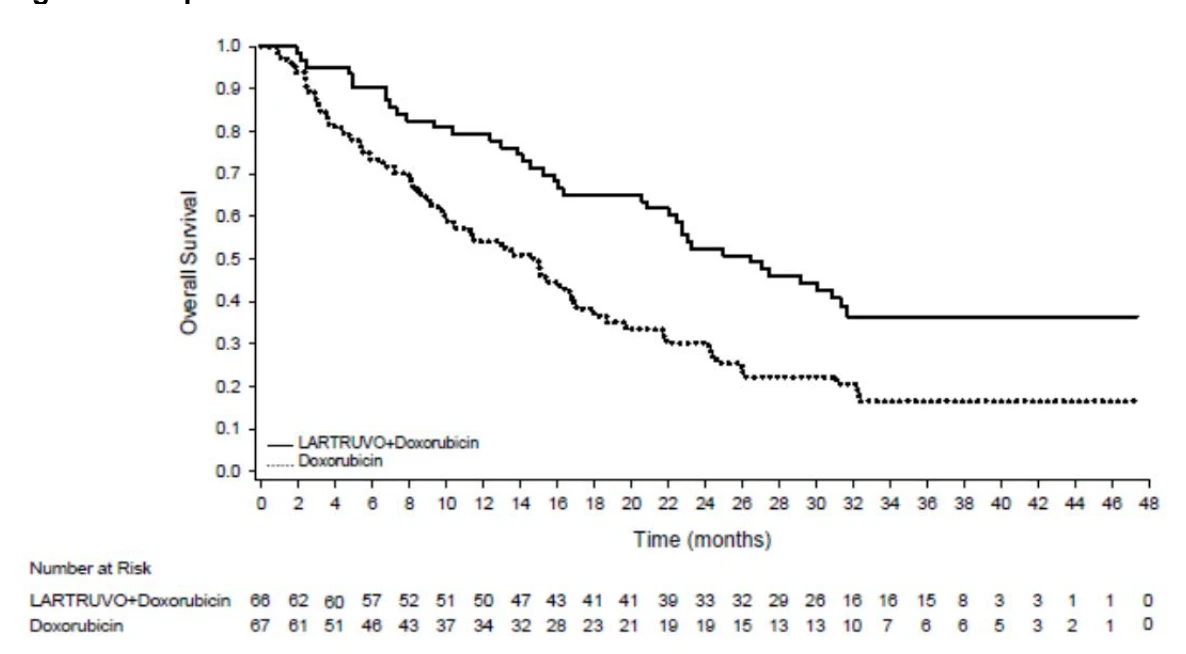
A statistically significant improvement in OS was seen in the LARTRUVO plus doxorubicin treatment group compared to the single-agent doxorubicin treatment group. Efficacy results are shown in Table 6 and Figure 1.
Table 6 - Summary of Efficacy Data – Intent to Treat Population
LARTRUVO + Doxorubicin (n=66) | Doxorubicin (n=67) | |
| Overall survival, months | ||
| Median (95% CI) | 26.5 (20.9, 31.7) | 14.7 (9.2, 17.1) |
| Hazard ratio (95% CI) | 0.52 (0.34, 0.79) | |
| Unstratified Log rank p-value | 0.0017 | |
| Progression-free survival, monthsa | ||
| Median (95% CI) | 6.6 (4.1, 8.3) | 4.1 (2.8, 5.4) |
| Hazard ratio (95% CI)b | 0.73 (0.49, 1.08) | |
| Objective Response Rate (CR + PR)a | ||
| (95% CI) | 18.2 (9.8, 29.6) | 11.9 (5.3, 22.2) |
| CR, n (%) | 2 (3.0%) | 1 (1.5%) |
| PR, n (%) | 10 (15.2%) | 7 (10.4%) |
Abbreviations: CI=confidence interval, CR=complete response, PR=partial response a Based on investigator assessment.
b The protocol prespecified significance level for PFS was met.
Figure 1 - Kaplan-Meier Curve of Overall Survival
16 NON-CLINICAL TOXICOLOGY
The Good Laboratory Practices (GLP)-compliant nonclinical safety assessment of olaratumab was conducted in the cynomolgus monkey. It was not possible to directly assess cross-reactivity
in tissue binding experiments as olaratumab could not be used for the purposes of immunohistochemical staining. However, in addition to immunoprecipitation of PDGFR-α in several cynomolgus tissues and the ability to block PDGFR-α signaling in cynomolgus skin fibroblasts, direct binding of olaratumab to the extracellular domain of cynomolgus PDGFR-α, with similar affinity to human PDGFR-α, has been demonstrated and cynomolgus monkey was established as an appropriate species for toxicity testing.
An overview of the nonclinical toxicology program is provided in Table 7.
Table 7 - Toxicology Study Overview
| Study Type | Species | Route of Administrat ion | Duration of Dosing | Doses (mg/kg) | Study Summary |
Repeat-dose toxicity (olaratumab) | Cynomolgus monkey | IV | 5-Week (with 7-week recovery group) | 0, 5, 16, 50a | No olaratumab related findings. The NOAEL was 50 mg/kg. |
Repeat-dose toxicity (olaratumab) | Cynomolgus monkey | IV | 13-Week (with 8-week recovery group) | 0, 7.5, 24, 75 | No olaratumab related findings. The NOAEL was 75 mg/kg. |
Repeat-dose toxicity (olaratumab) | Cynomolgus monkey | IV | 39-Week (with 8-week recovery group) | 0, 7.5, 24, 75 | No olaratumab related adverse findings. The NOAEL was 75 mg/kg. |
Tissue Cross-Reactivity (olaratumab) | Human and Cynomolgus Monkey tissue | in vitro | NA | NA | With olaratumab using a variety of immunohisto-chemistry staining approaches could not be achieved and, therefore, a tissue cross reactivity study with olaratumab could not be conducted. |
Reproductive and Developmental (LSN3338786) | CD-1 Mouse | IV | Gestation days 6, 9, 12, 15 | 0, 5, 50, 150 | Administration of an anti-murine PDGFR-α antibody during organogenesis at 50, and 150 mg/kg resulted in increased malformations (abnormal eyelid |
development) and skeletal variations (additional ossification sites in the frontal/parietal skull). |
Abbreviation: IV=intravenous.
a Highest No Observed Adverse Effect Level (NOAEL).
General Toxicology
Single-Dose Toxicity
No designated single-dose toxicity studies were conducted with olaratumab. However, in the 5-week repeat dose study there was a 2-week delay after the first dose in cynomolgus monkeys administered up to 50 mg/kg intravenously, which showed no test article-related effects on clinical observations or body weights. In addition, no signs of acute toxicity were evident after administration of the highest single olaratumab test dose of 75 mg/kg in the 13-and 39-week repeat dose studies. No treatment-related effects were evident upon physical examination, or on assessments of blood pressure, heart rate, and ECG.
Repeat-Dose Toxicity
Repeated intravenous dosing of olaratumab to monkeys for up to 5, 13, and 39 weeks was well tolerated. No treatment-related mortalities, adverse clinical observations, or effects on body weight and food consumption occurred in any study.
Olaratumab was well tolerated in the 5-week repeat-dose toxicity study at dose levels from 5 to 50 mg/kg for 4 doses. The No-Observed-Adverse-Effect Level (NOAEL) was 50 mg/kg, the highest dose tested.
No treatment-related adverse effects were observed after 13 weekly and 39 weekly administrations of olaratumab at dose levels of 7.5, 24, and 75 mg/kg in cynomolgus monkeys. A single female treated for 39 weeks with 75 mg/kg was noted with mildly to moderately increased alanine aminotransferase, minimal individual cell necrosis, and moderate infiltrates in the liver, but this effect was not considered clearly attributable to treatment nor was it considered adverse. Therefore, the NOAEL was 75 mg/kg/dose, in both the 13- and 39-week studies.
No treatment-related adverse effects were observed on male or female reproductive tissues in either the 5-week, 13 week, or 39-week study.
Carcinogenesis, Mutagenesis, Impairment of Fertility
No animal studies have been performed to test olaratumab for potential carcinogenicity, genotoxicity, or fertility impairment.
Reproductive and Developmental Toxicity
Based on knockout models and a review of the literature, it appears likely that disruption of PDGF/PDGFR signaling would impair the proper functioning and/or development of tissues critical for embryo-fetal development (EFD) leading to embryo-fetal lethality and teratogenicity. For example, studies in knockout mice have shown developmental abnormalities, including defects in neural tube derivatives, testes, kidneys, heart and vascular system, diaphragm, skeletal system, skin, hair, teeth, eyes, and palate, are likely to result from disruption of the
PDGFR-α pathway. Adverse developmental outcomes were associated with complete inhibition of PDGFR-α-mediated signaling and it remained uncertain if the degree of inhibition expected from therapeutic levels of olaratumab would also produce adverse developmental outcomes. A mouse embryo-fetal developmental toxicity study using a murine surrogate antibody for olaratumab was conducted. A mouse surrogate antibody study confirmed a developmental risk in association with inhibition of PDGF/PDGFR signaling.
A definitive GLP mouse embryo-fetal toxicity and toxicokinetics study (Study 8332306) was conducted with a mouse surrogate antibody of olaratumab (IMC-1E10; LSN338786) administered (0, 5, 50 and 150 mg/kg) once every 3 days during organogenesis to pregnant mice. In fetuses collected from the 50 mg/kg (mid dose) and 150 mg/kg (high dose) maternal groups, there were increased incidences of malformations consisting of open eye and partially open eye as well as increased incidences of skeletal variation frontal/parietal additional ossification site.
In conclusion, based on the mechanism of action, animal data obtained with genetically modified animal models for disrupted PDGF/PDGFR signaling, and with a mouse surrogate antibody of olaratumab, administration of olaratumab to women of childbearing potential may cause fetal harm.
Special Toxicology Studies
Local Tolerance
Local tolerance was investigated in the 5-week and 39-week repeat-dose toxicity evaluations in cynomolgus monkeys by clinical observations and histopathological evaluations. Intravenous administration of olaratumab was well tolerated and no treatment-related adverse reactions at the injection site were observed in either study.
Tissue Binding Study
In a preliminary assessment of cross-reactivity of olaratumab in tissues of monkeys and humans, staining of cellular structures expressing PDGFR-α with olaratumab using a variety of immunohistochemistry staining approaches could not be achieved and, therefore, a tissue cross-reactivity study with olaratumab could not be conducted. However, a tissue cross reactivity study using a commercially available rabbit anti-human PDGFR-α antibody revealed similar staining patterns in human and cynomolgus macaque tissues, further supporting the use of cynomolgus monkeys for toxicology testing.