


Product Monograph - Padcev
Recent Major Label Changes
| 1 Indications | 2024-08, 2026-06 |
|---|---|
| 4 Dosage and Administration, 4.2 Recommended Dose and Dose Adjustment | 2024-08, 2026-06 |
| 7 Warnings and Precautions | 2024-08, 2026-06 |
Table of Contents
Certain sections or subsections that are not applicable at the time of the preparation of the most recent authorized product monograph are not listed.
Recent Major Label Changes ................................................................................................... 2
Table of Contents ................................................................................................................... 2
Part 1: Healthcare Professional Information ........................................................................... 5
- 1.
Indications ....................................................................................................................... 5
1.1. Pediatrics .................................................................................................................. 5
1.2. Geriatrics .................................................................................................................. 5
- 2. Contraindications ............................................................................................................ 5
- 3. Serious Warnings and Precautions Box ............................................................................ 5
- 4.
Dosage and Administration ............................................................................................. 6
4.1. Dosing Considerations .............................................................................................. 6
4.2. Recommended Dose and Dosage Adjustment ......................................................... 6
4.3. Reconstitution .......................................................................................................... 9
4.4. Administration ........................................................................................................ 10
4.5. Missed Dose ........................................................................................................... 11
- 5. Overdose ....................................................................................................................... 11
- 6. Dosage Forms, Strengths, Composition, and Packaging ................................................. 11
- 7.
Warnings and Precautions ............................................................................................. 11
General ............................................................................................................................... 11
Endocrine and Metabolism ................................................................................................. 12
Neurologic .......................................................................................................................... 13
Ophthalmologic .................................................................................................................. 13
Reproductive Health ........................................................................................................... 14
Respiratory ......................................................................................................................... 14
Skin ..................................................................................................................................... 15
7.1. Special Populations ................................................................................................ 16
7.1.1. Pregnancy ...................................................................................................... 16
7.1.2. Breastfeeding ................................................................................................ 16
7.1.3. Pediatrics ....................................................................................................... 16
7.1.4. Geriatrics ....................................................................................................... 17
- 8.
Adverse Reactions ......................................................................................................... 17
8.1. Adverse Reaction Overview .................................................................................... 17
8.2. Clinical Trial Adverse Reactions .............................................................................. 17
8.3. Less Common Clinical Trial Adverse Reactions ....................................................... 27
8.4. Abnormal Laboratory Findings: Hematologic, Clinical Chemistry, and Other Quantitative Data ............................................................................................................... 29
8.5. Post-Market Adverse Reactions ............................................................................. 31
- 9.
Drug Interactions ........................................................................................................... 31
9.2. Drug Interactions Overview .................................................................................... 31
9.4. Drug-Drug Interactions ........................................................................................... 32
- 10.
Clinical Pharmacology ................................................................................................... 32
10.1. Mechanism of Action .............................................................................................. 32
10.2. Pharmacodynamics ................................................................................................ 33
10.3. Pharmacokinetics ................................................................................................... 33
10.4. Immunogenicity ...................................................................................................... 35
- 11. Storage, Stability, and Disposal ...................................................................................... 36
- 12. Special Handling Instructions ......................................................................................... 36
Part 2: Scientific Information ................................................................................................ 37
- 13. Pharmaceutical Information .......................................................................................... 37
- 14.
Clinical Trials .................................................................................................................. 38
14.1. Clinical Trials by Indication ..................................................................................... 38
Neoadjuvant and Adjuvant Treatment of Cisplatin-Ineligible Patients with MIBC .............. 38
Study EV-303 ...................................................................................................................... 38
Previously Untreated Locally Advanced or Metastatic Urothelial Carcinoma ..................... 42
Study EV-302 ...................................................................................................................... 42
Previously Treated Unresectable Locally Advanced or Metastatic Urothelial Carcinoma ... 46
Study EV-301 ...................................................................................................................... 46
- 16. Non-Clinical Toxicology .................................................................................................. 50
Patient Medication Information ........................................................................................... 52
Part 1: Healthcare Professional Information
1. Indications
PADCEV (enfortumab vedotin for injection), in combination with pembrolizumab, as neoadjuvant treatment and then continued after radical cystectomy as adjuvant treatment, is indicated for the treatment of adult patients with muscle invasive bladder cancer (MIBC) who are ineligible for cisplatin-containing chemotherapy.
PADCEV (enfortumab vedotin for injection), in combination with pembrolizumab, is indicated for the treatment of adult patients with unresectable locally advanced or metastatic urothelial cancer (mUC) with no prior systemic therapy for mUC.
PADCEV (enfortumab vedotin for injection), as a single agent, is indicated for the treatment of adult patients with unresectable locally advanced or metastatic urothelial cancer (mUC) who have previously received a platinum-containing chemotherapy and programmed death receptor-1 (PD-1) or programmed death-ligand 1 (PD-L1) inhibitor therapy.
1.1. Pediatrics
Pediatrics (<18 years of age): No data are available to Health Canada; therefore, Health Canada has not authorized an indication for pediatric use.
1.2. Geriatrics
Geriatrics (≥65 years of age): Evidence from clinical studies and experience suggests that use in the geriatric population is associated with differences in safety or effectiveness. See 7 WARNINGS AND PRECAUTIONS, Special Populations.
2. Contraindications
- Padcev is contraindicated in patients who are hypersensitive to this drug or to any ingredient in the formulation, including any non-medicinal ingredient, or component of the container. For a complete listing, see 6 DOSAGE FORMS, STRENGTHS, COMPOSITION AND PACKAGING.
- Serious Warnings and Precautions Box
Serious Warnings and Precautions
Clinically significant and/or life-threatening adverse events include:
- Severe cutaneous adverse reactions, including Stevens-Johnson syndrome (SJS) and toxic epidermal necrolysis (TEN), with fatal outcome have occurred in patients treated with Padcev (see 7 WARNINGS AND PRECAUTIONS).
- Hyperglycemia and diabetic ketoacidosis (DKA), including fatal events, have occurred in patients with and without pre-existing diabetes mellitus treated with Padcev (see 7 WARNINGS AND PRECAUTIONS).
4. Dosage and Administration
4.1. Dosing Considerations
- Padcev is for intravenous infusion and must be reconstituted and diluted prior to administration. Do not administer as an intravenous push or bolus.
4.2. Recommended Dose and Dosage Adjustment
Recommended Dosage for Muscle Invasive Bladder Cancer (MIBC) in Combination with Pembrolizumab, as Neoadjuvant Treatment and then Continued After Radical Cystectomy as Adjuvant Treatment – Not Eligible for Cisplatin-Containing Chemotherapy
When given in combination with pembrolizumab for the neoadjuvant and adjuvant treatment of MIBC, the recommended dose of Padcev is 1.25 mg/kg (up to a maximum of 125 mg for patients ≥100 kg) administered as an intravenous infusion over 30 minutes.
Neoadjuvant: Administer Padcev 1.25 mg/kg on Days 1 and 8 of each 21-day cycle for 3 cycles or until disease progression that precludes radical cystectomy or unacceptable toxicity.
Adjuvant: Administer Padcev 1.25 mg/kg on Days 1 and 8 of each 21-day cycle for 6 cycles or until disease recurrence or unacceptable toxicity.
Administer Padcev before pembrolizumab when given on the same day. Provide for an interval of 30 minutes between infusions (for at least Cycle 1, Day 1), which can subsequently be reduced to 15 minutes if well tolerated.
Refer to the pembrolizumab Product Monograph for recommended pembrolizumab dosing information.
Recommended Dosage for Unresectable Locally Advanced or Metastatic Urothelial Cancer in Combination with Pembrolizumab
When given in combination with pembrolizumab for the treatment of locally advanced or mUC, the recommended dose of Padcev is 1.25 mg/kg (up to a maximum of 125 mg for patients ≥100 kg) administered as an intravenous infusion over 30 minutes on Days 1 and 8 of a 21-day cycle until disease progression or unacceptable toxicity. Administer Padcev before pembrolizumab when given on the same day. Provide for an interval of 30 minutes between infusions (for at least Cycle 1, Day 1), which can subsequently be reduced to 15 minutes if well tolerated.
Refer to the pembrolizumab Product Monograph for the recommended dosing information of pembrolizumab.
Recommended Dosage for Unresectable Locally Advanced or Metastatic Urothelial Cancer as a Single Agent – Previously Treated
The recommended dose of Padcev as a single agent is 1.25 mg/kg (up to a maximum of 125 mg for patients ≥100 kg) administered as an intravenous infusion over 30 minutes on Days 1, 8, and 15 of a 28-day cycle until disease progression or unacceptable toxicity.
Patients with Hepatic Impairment
Avoid use of Padcev in patients with moderate (Child-Pugh B) or severe (Child-Pugh C) hepatic impairment. No dose adjustment is required in patients with mild hepatic impairment. Padcev has only been evaluated in a limited number of patients with moderate hepatic impairment and severe hepatic impairment. Patients with moderate or severe hepatic impairment are likely to have increased exposure to monomethyl auristatin E (MMAE) (see 10 CLINICAL PHARMACOLOGY, Pharmacokinetics).
Patients with Renal Impairment
No dose adjustment is required in patients with mild (CrCl >60-90 mL/min), moderate (CrCl 30-60 mL/min) or severe (CrCl 15-<30 mL/min) renal impairment (see 10 CLINICAL PHARMACOLOGY, Pharmacokinetics). Enfortumab vedotin has not been evaluated in patients with end stage renal disease (CrCL <15 mL/min).
Concomitant Use with Strong P-gp and CYP3A4 Inhibitors
No dose adjustment of Padcev is required with concomitant use of strong inhibitors of P-gp and CYP3A4. The concomitant use of strong inhibitors of P-gp and CYP3A4 with Padcev may result in an increase in unconjugated MMAE exposure. Closely monitor for adverse reactions when Padcev is given concomitantly with strong P-gp and CYP3A4 inhibitors (see 9 DRUG INTERACTIONS).
Pediatrics (<18 years of age)
Health Canada has not authorized an indication for pediatric use.
Geriatrics (≥65 years of age)
No dose adjustment of Padcev is required in patients ≥ 65 years of age (see 10 CLINICAL PHARMACOLOGY, Pharmacokinetics).
Dose Modifications for Adverse Reactions
The recommended Padcev dose reduction schedule is provided in Table 1.
Table 1: Padcev Dose Reduction Schedule
| Dose Level | Padcev Dose |
|---|---|
| Starting dose | 1.25 mg/kg up to 125 mg |
| First dose reduction | 1.0 mg/kg up to 100 mg |
| Second dose reduction | 0.75 mg/kg up to 75 mg |
| Third dose reduction | 0.5 mg/kg up to 50 mg |
The recommended Padcev dose modifications for patients with adverse reactions are provided in Table 2.
Table 2: Padcev Dose Modifications for Adverse Reactions
| Adverse Reaction | Severity* | Padcev Dose Modification* |
|---|---|---|
| Adverse Reaction | Severity* | Padcev Dose Modification* |
| Skin Reactions | Suspected Stevens-Johnson syndrome (SJS) or toxic epidermal necrolysis (TEN) | Immediately withhold and refer to specialized care. |
Worsening Grade 2 or Grade 3 (severe) | Withhold until Grade ≤1, then resume treatment at the same dose level or consider dose reduction by one dose level. | |
| Confirmed SJS or TEN; Grade 4 or recurrent Grade 3 | Permanently discontinue. | |
| Hyperglycemia | Blood glucose >250 mg/dL | Withhold until elevated blood glucose has improved to ≤ 250 mg/dL, then resume treatment at the same dose level. |
| Pneumonitis/Interstitial Lung Disease | Grade 2 | Withhold until Grade ≤1, then resume treatment at the same dose level or consider dose reduction by one dose level. |
| Grade ≥3 | Permanently discontinue. | |
| Peripheral Neuropathy | Grade 2 | Withhold until Grade ≤1, then resume treatment at the same dose level (if first occurrence). For a recurrence, withhold until Grade ≤1, then resume |
| treatment reduced by one dose level. | ||
| Grade ≥3 | Permanently discontinue. | |
| Other Non-hematologic Toxicity | Grade 3 | Withhold until Grade ≤1, then resume treatment at the same dose level or consider dose reduction by one dose level. |
| Grade 4 | Permanently discontinue. | |
| Hematologic Toxicity | Grade 3, or Grade 2 thrombocytopenia | Withhold until Grade ≤1, then resume treatment at the same dose level or consider dose reduction by one dose level. |
| Grade 4 | Withhold until Grade ≤1, then reduce dose by one dose level or discontinue treatment. | |
*Grade 1 is mild, Grade 2 is moderate, Grade 3 is severe, Grade 4 is life-threatening.
Recommended Dose Modification for pembrolizumab used in combination with Padcev:
See Product Monograph for the coadministered product, pembrolizumab, for toxicity management, dose adjustment guidelines for special populations, and contraindications.
When administering Padcev in combination with pembrolizumab, interrupt one or both drugs, dose reduce or discontinue Padcev as appropriate. For Padcev dose modifications, see Tables 1 and 2. Withhold or discontinue pembrolizumab in accordance with the instructions in the pembrolizumab Product Monograph. No dose reductions are recommended for pembrolizumab.
4.3. Reconstitution
Prior to administration, the Padcev vial is reconstituted with Sterile Water for Injection (SWFI). The reconstituted solution is subsequently diluted in an intravenous infusion bag containing sterile 5% Dextrose Injection, sterile 0.9% Sodium Chloride injection or sterile Lactated Ringer's injection.
Reconstitution in a single-dose vial
- 1. Follow procedures for proper handling and disposal of anticancer drugs.
- 2. Use appropriate aseptic technique for reconstitution and preparation of dosing solutions.
- 3. Calculate the recommended dose based on the patient’s weight to determine the number of and strength (20 mg or 30 mg) of vials needed.
- 4. Reconstitute each vial according to Table 3 and, if possible, direct the stream of Sterile Water for Injection (SWFI) along the walls of the vial and not directly onto the lyophilized powder.
Table 3 - Reconstitution
| Vial Size | Volume of Diluent to be Added to Vial | Approximate Available Volume | Concentration per mL |
| 20 mg | 2.3 mL of SWFI | 2.0 mL of reconstituted solution | 10 mg/mL enfortumab vedotin |
| 30 mg | 3.3 mL of SWFI | 3.0 mL of reconstituted solution | 10 mg/mL enfortumab vedotin |
- 5. Slowly swirl each vial until the contents are completely dissolved. Allow the reconstituted vial(s) to settle for at least 1 minute until the bubbles are gone. DO NOT SHAKE THE VIAL. Do not expose to direct sunlight.
- 6. Visually inspect the solution for particulate matter and discolouration. The reconstituted solution should be clear to slightly opalescent, colourless to light yellow and free of visible particles. Discard any vial with visible particles or discolouration.
- 7. Based upon the calculated dose amount, the reconstituted solution from the vial(s) should be added to the infusion bag immediately. This product does not contain a preservative. If not used immediately, reconstituted vials may be stored for up to 24 hours in refrigeration at 2°C to 8°C (36 °F to 46 °F) (see 11 STORAGE, STABILITY AND DISPOSAL). DO NOT FREEZE. Discard unused vials with reconstituted solution beyond the recommended storage time.
Dilution in infusion bag
- 8. Withdraw the calculated dose amount of reconstituted solution from the vial(s) and transfer into an infusion bag.
- 9. Dilute Padcev with 5% Dextrose Injection, 0.9% Sodium Chloride Injection or Lactated Ringer’s Injection. The infusion bag size should allow enough diluent to achieve a final concentration of 0.3 mg/mL to 4 mg/mL enfortumab vedotin.
- 10. Mix diluted solution by gentle inversion. DO NOT SHAKE THE BAG. Do not expose to direct sunlight.
- 11. Visually inspect the infusion bag for any particulate matter or discolouration prior to use. The reconstituted solution should be clear to slightly opalescent, colorless to light yellow and free of visible particles. DO NOT USE the infusion bag if particulate matter or discolouration is observed.
- 12. Discard any unused portion left in the single-dose vials.
- 13. The prepared infusion bag should not be stored longer than 16 hours under refrigeration at 2°C to 8°C (36 °F to 46 °F). DO NOT FREEZE.
4.4. Administration
Immediately administer the infusion over 30 minutes though an intravenous line.
DO NOT administer Padcev as an IV push or bolus.
DO NOT co-administer other drugs through the same infusion line.
4.5. Missed Dose
A missed dose should be administered as soon as possible. Subsequent doses should not be administered less than 1 week apart.
5. Overdose
There is no known antidote for overdosage with Padcev. In case of overdosage, the patient should be closely monitored for adverse reactions, and supportive treatment should be administered as appropriate taking into consideration the half-life of 3.6 days for the antibody-drug conjugate (ADC) and 2.6 days for MMAE.
For the most recent information in the management of a suspected drug overdose, contact your regional poison control centre or Health Canada’s toll-free number, 1-844 POISON-X (1-844-764-7669).
- 6. Dosage Forms, Strengths, Composition, and Packaging
To help ensure the traceability of biologic products, healthcare professionals should record both the brand name and the non-proprietary (active ingredient) name as well as other product-specific identifiers such as the Drug Identification Number (DIN) and the batch/lot number of the product supplied.
Table 4 – Dosage Forms, Strengths, Composition and Packaging
Padcev is supplied as single-dose vials containing 20 mg and 30 mg of enfortumab vedotin as a sterile, preservative-free, white to off-white lyophilized powder for reconstitution for intravenous infusion.
7. Warnings and Precautions
See 3 SERIOUS WARNINGS AND PRECAUTIONS BOX
General
Padcev should be administered under the supervision of physicians experienced in the treatment of cancer.
The pooled safety population described in 7 WARNINGS AND PRECAUTIONS reflect exposure to Padcev as a single agent at 1.25 mg/kg in 720 patients in EV-301 (NCT03474107), EV-201 (NCT03219333), EV-203 (NCT04995419) EV-101 (NCT02091999), and EV-102 (NCT03070990). Ocular disorders reflect 384 patients in EV-201, EV-101, and EV-102 with scheduled ophthalmological exams.
In addition, certain subsections in 7 WARNINGS AND PRECAUTIONS describe adverse reactions observed with exposure to Padcev at 1.25 mg/kg in combination with pembrolizumab for the
| Route of Administration | Dosage Form / Strength/Composition | Non-medicinal Ingredients |
| Intravenous infusion | Powder for concentrate for solution for infusion / 10 mg per mL | Histidine, histidine hydrochloride monohydrate, polysorbate 20, trehalose dihydrate |
treatment of locally advanced or mUC in 564 patients in EV-302 (NCT04223856) and EV-103 (NCT03288545) and Padcev at 1.25 mg/kg in combination with pembrolizumab for the treatment of MIBC in 167 patients in EV-303 (NCT03924895).
Infusion Site Extravasation
Skin and soft tissue injury following Padcev administration has been observed when extravasation occurred. Extravasation events occurred in 1% (7) of the 720 patients treated with Padcev 1.25 mg/kg as a single agent, including 0.3% (2) who experienced Grade 3-4 reactions. Extravasation events occurred in 1.6% (9) of the 564 patients treated with Padcev 1.25 mg/kg in combination with pembrolizumab. Reactions may be delayed. Erythema, swelling, increased temperature, and pain worsened until 2-7 days after extravasation and resolved within 1-4 weeks of peak. Two patients (0.3%) developed extravasation reactions with secondary cellulitis, bullae, or exfoliation. Ensure good venous access prior to starting Padcev and monitor for possible infusion site extravasation during administration. If extravasation occurs, stop the infusion and monitor for adverse reactions.
Endocrine and Metabolism
Hyperglycemia
Hyperglycemia and diabetic ketoacidosis (DKA) including fatal events, occurred in patients with and without pre-existing diabetes mellitus treated with Padcev.
Patients with baseline hemoglobin A1C ≥8% were excluded from clinical trials.
In clinical studies, hyperglycemia occurred in 17% (123) of the 720 patients treated with Padcev 1.25 mg/kg as a single agent. Severe (Grade 3 or 4) hyperglycemia occurred in 7% (51) of patients (Grade 3: 6.5% (47), Grade 4: 0.6% (4)). Two patients experienced fatal events, one event each of hyperglycemia and diabetic ketoacidosis. The incidence of Grade 3 or 4 hyperglycemia increased consistently in patients with higher body mass index and in patients with higher baseline hemoglobin A1C. Five percent (35) of patients required initiation of insulin therapy for treatment of hyperglycemia. The median time to onset of hyperglycemia was 0.5 months (range: 0.1 to 20.3). Hyperglycemia led to discontinuation of Padcev in 0.7% (5) of patients and dose interruptions in 3% (25)of the 720 patients treated with Padcev. Eight (33%) of 24 patients had recrudescence after dose restart. Of the patients who experienced hyperglycemia and had data regarding resolution (N = 96), 66% had complete resolution, 20% had partial improvement, and 15% had no improvement at the time of their last evaluation. Of the 34% of patients with residual hyperglycemia at last evaluation, 61% had Grade ≥2 events.
When Padcev was given in combination with pembrolizumab, hyperglycemia occurred in 19% (107) of the 564 patients and 9.2% (52) of patients had severe (Grade 3 or 4) hyperglycemia (Grade 3: 8% (45), Grade 4: 1% (7)). Hyperglycemia led to discontinuation of Padcev in 0.2% (1) of patients and dose interruptions in 4% (22) of the 564 patients treated with the combination therapy.
Hyperglycemia occurred more frequently in patients with pre-existing hyperglycemia or a high body mass index (≥30 kg/m2). Blood glucose levels should be monitored regularly in patients with or at risk for diabetes mellitus or hyperglycemia. If blood glucose is elevated (>13.9 mmol/L; >250 mg/dL), withhold Padcev (see 4 DOSAGE AND ADMINISTRATION, Recommended Dose and Dose Adjustment).
Neurologic
Peripheral Neuropathy
Peripheral neuropathy, predominantly sensory, has occurred with Padcev, including Grade ≥3 reactions. Peripheral neuropathy occurred in patients treated with Padcev with or without pre-existing peripheral neuropathy. In clinical studies, peripheral neuropathy occurred in 53% (378) of the 720 patients treated with Padcev 1.25 mg/kg as a single agent, including 38% with sensory neuropathy, 8% with muscular weakness and 7% with motor neuropathy. Thirty percent of patients experienced Grade 2 events and 5% experienced severe (Grade 3 or 4) peripheral neuropathy including sensory and motor events. The median time to onset of Grade ≥2 was 5 months (range 0.1 to 20.2 months). There were 161 (20%) patients that experienced peripheral neuropathy adverse events leading to dose interruption. Of these patients, 114 restarted at any dose, with 92 (81%) of patients experiencing recrudescence. Seven percent of patients discontinued treatment due to peripheral neuropathy. Patients with pre-existing peripheral neuropathy Grade ≥2 were excluded from clinical studies. Of the patients who experienced neuropathy and had data regarding resolution (N = 296), 11% had complete resolution, 47% had partial improvement, and 41% had no improvement at the time of their last evaluation. Of the patients with residual neuropathy at last evaluation, 50% (132/262) had Grade ≥2 events.
The incidence of peripheral neuropathy occurred at a higher rate when Padcev was given in combination with pembrolizumab for the treatment of locally advanced or mUC, compared to Padcev as a single agent. When Padcev was given in combination with pembrolizumab, 67% (376) of the 564 patients treated with combination therapy had peripheral neuropathy of any grade, 36% (204) had Grade 2 neuropathy, and 7% (38) had Grade 3 neuropathy. The median time to onset of Grade ≥2 peripheral neuropathy was 6 months (range: 0.3 to 25 months). Of the patients who experienced neuropathy and had data regarding resolution (N = 373), 13% had complete resolution, and 87% of patients had residual neuropathy at last evaluation. Of the patients with residual neuropathy at last evaluation, 45% (146/326) had Grade ≥2 neuropathy.
When Padcev was given in combination with pembrolizumab for the treatment of MIBC, 39% of the 167 patients treated with combination therapy had peripheral neuropathy of any grade, 12% had Grade 2 neuropathy, and 3% had Grade 3 neuropathy. The median time to onset of Grade ≥2 peripheral neuropathy was 4.7 months (range: 0.2 to 11 months). Of the patients who experienced neuropathy and had data regarding resolution (n=65), 32% had complete resolution, and 68% of patients had residual neuropathy at last evaluation. Of the patients with residual neuropathy at last evaluation, 27% (12/44) had Grade ≥2 neuropathy.
Monitor patients for symptoms of new or worsening peripheral neuropathy as these patients may require a delay, dose reduction or discontinuation of Padcev.
Permanently discontinue Padcev in patients who develop Grade ≥3 peripheral neuropathy (see 4 DOSAGE AND ADMINISTRATION, Recommended Dose and Dose Adjustment).
Ophthalmologic
Ocular Disorders
Ocular disorders, predominately dry eye, occurred in 40% of the 384 patients treated with Padcev as a single agent in clinical trials in which ophthalmologic exams were performed. The majority of ocular events involved the cornea and included events associated with dry eye such as keratitis, blurred vision, increased lacrimation, conjunctivitis, limbal stem cell deficiency, and keratopathy. In clinical studies, 14 (2.1%) patients interrupted, and 1 (0.1%) patient permanently discontinued treatment for ocular disorders. Severe (Grade 3) ocular disorders occurred only in 3 patients (0.4%). Thirteen percent of patients experienced dry eye symptoms during treatment with Padcev 1.25 mg/kg and the median time to onset was 1.7 months (range 0 to 19.1 months).
Monitor patients for ocular disorders such as dry eye and blurred vision. Consider artificial tears for prophylaxis of dry eye and refer patient for ophthalmologic evaluation if ocular symptoms do not resolve or worsen. Consider dose interruption or dose reduction of Padcev for symptomatic ocular disorders (see 4 DOSAGE AND ADMINISTRATION, Recommended Dose and Dose Adjustment).
Reproductive Health
- Contraception
Advise females of reproductive potential to use effective contraception during treatment with Padcev and for at least 6 months after the last dose of Padcev (see 7 WARNINGS AND PRECAUTIONS, Special Populations, Pregnant Women and 16 NON-CLINICAL TOXICOLOGY).
Advise males of reproductive potential to use effective contraception during treatment with Padcev and for at least 4 months after the last dose of Padcev.
- Fertility
Testicular toxicity was observed in rats following repeat dosing at systemic exposures that were approximately equal to the human systemic exposure at the clinically recommended dose (see 16 NON-CLINICAL TOXICOLOGY). There are no data on the effect of Padcev on human fertility.
- Pregnancy Testing
Pregnancy testing is recommended for females of reproductive potential within 7 days prior to initiating Padcev treatment (see 7 WARNINGS AND PRECAUTIONS, Special Populations, Pregnant Women and 16 NON-CLINICAL TOXICOLOGY).
Respiratory
Pneumonitis/Interstitial Lung Disease (ILD)
Severe, life-threatening or fatal pneumonitis/ILD have occurred in patients treated with Padcev. In clinical trials of Padcev as a single agent, 3% (22) of the 720 patients treated with Padcev had pneumonitis/ILD of any grade and 0.8% had Grade 3-4. In clinical trials, the median time to onset of pneumonitis/ILD disease was 2.9 months (range: 0.6 to 6 months). Two patients on trial also experienced fatal events.
The incidence of pneumonitis/ILD, including severe events occurred at a higher rate when Padcev was given in combination with pembrolizumab for the treatment of locally advanced or mUC, compared to Padcev as a single agent. When Padcev was given in combination with pembrolizumab, 10% of the 564 patients treated with combination therapy had pneumonitis/ILD of any grade and 4% had Grade 3-4. The median time to onset of pneumonitis/ILD was 4 months (range: from 0.3 to 26 months).
Two patients experienced a fatal event of pneumonitis/ILD.
When Padcev was given in combination with pembrolizumab for the treatment of MIBC, 4% of the 167 patients treated with combination therapy had pneumonitis/ILD of any grade. All events were Grade 1-2. The median time to onset of any grade pneumonitis/ILD was 2.5 months (range: 1.9 to 9.7 months).
Monitor patients for signs and symptoms indicative of pneumonitis/interstitial lung disease such as hypoxia, cough, dyspnea or interstitial infiltrates on radiologic exams. Evaluate and exclude infectious, neoplastic and other causes for such signs and symptoms through appropriate investigations.
Withhold Padcev for Grade 2 pneumonitis/interstitial lung disease, then resume treatment at the same dose level or consider dose reduction by one dose level.
Permanently discontinue Padcev for Grade ≥3 pneumonitis/interstitial lung disease (see 4 DOSAGE AND ADMINISTRATION, Recommended Dose and Dose Adjustment).
Skin
Skin Reactions
Skin reactions are anticipated on-target events, as Nectin-4 is expressed in the skin.
Severe cutaneous adverse reactions, including SJS and TEN, with fatal outcome have occurred in patients treated with Padcev, predominately during the first cycle of treatment, but may occur later.
Skin reactions, predominantly mild to moderate maculopapular rash, have occurred with Padcev. In clinical studies of Padcev as a single agent, skin reactions occurred in 58% (414) of the 720 patients treated with Padcev 1.25 mg/kg. Severe (Grade 3 or 4) skin reactions occurred in 14% (102) of patients and a majority of these reactions included maculo-papular rash, stomatitis, rash erythematous, rash or drug eruption, symmetrical drug-related intertriginous and flexural exanthema (SDRIFE), dermatitis bullous, dermatitis exfoliative, and palmar-plantar erythrodysesthesia. The median time to onset of severe skin reactions was 0.6 months (range: 0.1 to 8 months). Skin reactions led to dose interruption of Padcev in 12% of patients. Of the 75 patients who restarted Padcev after reporting a skin reaction leading to dose interruption, 24% of patients restarting at the same dose and 24% restarting at a reduced dose experienced recurrent severe skin reactions. Skin reactions led to discontinuation of Padcev in 3.1% of patients. Of the patients who experienced skin reactions and had data regarding resolution (N = 328), 58% had complete resolution and 42% had residual skin reactions at last evaluation. Of the patients with residual skin reactions at last evaluation, 39% had Grade ≥2 events.
The incidence of skin reactions occurred at a higher rate when Padcev was given in combination with pembrolizumab compared to Padcev as a single agent. In clinical studies of Padcev in combination with pembrolizumab for the treatment of locally advanced or mUC, skin reactions occurred in 392 (70%) of the 564 patients and a majority of these skin reactions included rash maculo-papular, rash macular and rash popular. Severe (Grade 3 or 4) skin reactions occurred in 97 (17%) patients (Grade 3: 16%, Grade 4: 1%) including maculo-papular rash, bullous dermatitis, dermatitis, exfoliative dermatitis, pemphigoid, rash, erythematous rash, macular rash, and papular rash. The Grade 4 bullous dermatitis reaction was associated with a fatal event. The median time to onset of severe skin reactions was 1.7 months (range: 0.1 to 17.2 months). Skin reactions led to discontinuation of Padcev in 6% of patients and dose interruption of Padcev in 17% of patients. Of the patients who experienced skin reactions and had data regarding resolution (N = 391), 59% had complete resolution and 41% had residual skin reaction at last evaluation. Of the patients with residual skin reactions at last evaluation, 27% (43/159) had Grade ≥2 events.
Skin reactions occurred in 61% (all grades) of the 167 patients treated with Padcev in combination with pembrolizumab for the treatment of MIBC in clinical trials. The majority of the skin reactions that occurred with combination therapy included rash and maculo-papular rash. Grade 3-4 skin reactions occurred in 10% of patients (Grade 3: 9%, Grade 4: 1%), including rash, maculo-papular rash, toxic skin eruption, dermatitis exfoliative generalized, erythema, exfoliative rash, skin toxicity, toxic epidermal necrolysis, and toxic erythema of chemotherapy. A fatal reaction of toxic epidermal necrolysis occurred in one patient (0.6%). The median time to onset of severe skin reactions was 0.6 months (range: 0.2 to 8.8 months). Skin reactions led to discontinuation of Padcev in 10% of patients. Of the patients who experienced a skin reaction and had data regarding resolution (n=102), 83% had complete resolution and 17% had residual skin reactions at their last evaluation. Of the patients with residual skin reactions at last evaluation, 29% (5/17) had Grade ≥2 skin reactions.
Starting with the first cycle and throughout treatment, monitor patients for skin reactions. Consider appropriate therapy such as topical corticosteroids and antihistamines for mild to moderate skin reactions.
For worsening or severe (Grade 3) skin reactions, suspected SJS or TEN, withhold Padcev and consider referral for specialized care.
Permanently discontinue Padcev for confirmed SJS or TEN, Grade 4 or recurrent Grade 3 skin reactions (see 4 DOSAGE AND ADMINISTRATION, Recommended Dose and Dose Adjustment).
7.1. Special Populations
7.1.1. Pregnancy
Padcev can cause fetal harm based upon findings from animal studies. There are no available human data on Padcev use in pregnant women to inform a drug-associated risk. Embryo-fetal development studies in female rats have shown that intravenous administration of enfortumab vedotin (2 or 5 mg/kg/dose; 1- and 3-fold the human Cmax, respectively) resulted in maternal toxicity, embryo-fetal lethality, structural malformations and skeletal anomalies reduced numbers of viable fetuses, reduced litter size, and increased early resorptions at maternal exposures approximately similar to the exposures at the recommended human dose of 1.25 mg/kg (see 16 NON-CLINICAL TOXICOLOGY).
Female patients of childbearing potential treated with Padcev should be advised of the potential risk to the fetus.
7.1.2. Breastfeeding
There is no information regarding the presence of enfortumab vedotin in human milk, the effects on the breastfed child, or the effects on milk production. Breastfeeding is not recommended during Padcev treatment and for at least 6 months after the last dose.
7.1.3. Pediatrics
Pediatrics (<18 years of age): No data are available to Health Canada; therefore, Health Canada has not authorized an indication for pediatric use.
7.1.4. Geriatrics
Geriatrics (≥ 65 years of age): Of the 720 patients treated with Padcev as a single agent in clinical trials, 452 (63%) were 65 years or older and 170 (24%) were 75 years or older. No overall differences in efficacy were observed between these patients and younger patients (see 10 CLINICAL PHARMACOLOGY, Pharmacokinetics). In the Padcev arm of the EV-301 study, serious adverse events were reported in 40% of patients < 65 (n=106), 51% of patients ≥ 65 and < 75 (n=139), and 49% of patients ≥ 75 (n=51). Adverse events leading to treatment discontinuation were reported in 13%, 18% and 23% of patients < 65, ≥ 65 and < 75 and ≥ 75, respectively.
Of the 564 patients treated with Padcev in combination with pembrolizumab for the treatment of locally advanced or mUC, 391 (69%) were 65 years or older and 144 (26%) were 75 years or older. In the Padcev in combination with pembrolizumab arm of the EV-302 study, serious adverse events were reported in 37% of patients < 65 (n=144), 57% of patients ≥ 65 and < 75 (n=194), and 56% of patients ≥ 75 (n=102). Grade ≥3 events were reported in 61%, 78% and 79% of patients < 65, ≥ 65 and < 75, and ≥ 75, respectively. Adverse events leading to discontinuation of Padcev were reported in 31%, 37% and 36% of patients < 65, ≥ 65 and < 75 and ≥ 75, respectively.
Of the 167 patients treated with Padcev in combination with pembrolizumab for the treatment of MIBC, 138 (83%) were 65 years or older and 77 (46%) were 75 years or older. In the Padcev in combination with pembrolizumab arm of the EV-303 study, serious adverse events were reported in 59% of patients < 65 (n=17), 62% of patients ≥ 65 and < 75 (n=38), and 55% of patients ≥ 75 (n=42). Grade ≥3 events were reported in 62%, 75% and 71% of patients < 65, ≥ 65 and < 75, and ≥ 75, respectively.
8. Adverse Reactions
8.1. Adverse Reaction Overview
The following clinically significant adverse reactions have been observed in patients treated with Padcev and are detailed under Warnings and Precautions:
- Skin reactions, including severe cutaneous adverse reactions (see 7 Warnings and Precautions, Skin)
- Hyperglycemia, including diabetic ketoacidosis (see 7 Warnings and Precautions, Endocrine and Metabolism)
- Pneumonitis/interstitial lung disease (see 7 Warnings and Precautions, Respiratory)
- Peripheral neuropathy (see 7 Warnings and Precautions, Neurologic)
- Ocular disorders (see 7 Warnings and Precautions, Ophthalmologic)
- Infusion site extravasation (see 7 Warnings and Precautions, Infusion Site Extravasation)
8.2. Clinical Trial Adverse Reactions
Clinical trials are conducted under very specific conditions. The adverse reaction rates observed in the clinical trials; therefore, may not reflect the rates observed in practice and should not be compared to the rates in the clinical trials of another drug. Adverse reaction information from clinical trials may be useful in identifying and approximating rates of adverse drug reactions in real-world use.
Previously Treated Locally Advanced or mUC
Study EV-301
EV-301 included 296 patients with unresectable locally advanced or metastatic urothelial cancer who received at least one dose of Padcev 1.25 mg/kg and were previously treated with a PD-1 or PD-L1 inhibitor and a platinum-based chemotherapy. The median duration of exposure to Padcev was 5 months (range: 0.5 to 19.4 months). The median duration of exposure to chemotherapy was 3.5 months (range: 0.2 to 15 months).
Serious adverse events, regardless of causality, occurred in 47% of patients treated with Padcev. The most common serious adverse events were acute kidney injury (6%), malignant neoplasm progression and pneumonia (4% each), urinary tract infection bacterial (3%), diarrhoea, urinary tract infection, and pyrexia (2% each). Grade 3 or higher adverse events, regardless of causality, occurred in 71% of patients treated with Padcev. The most common Grade ≥3 adverse events (≥5%) were rash maculopapular, hyperglycaemia, neutrophil count decreased, fatigue (7% each), anaemia (6%), and decreased appetite (5%). Adverse events, regardless of causality, resulting in death occurred in 7% (21/296) of patients, including malignant neoplasm progression (3%), multiple organ dysfunction syndrome (1%), pneumonia (0.7%), and hepatic dysfunction, septic shock, hyperglycemia, pneumonitis and pelvic abscess (0.3% each).
Adverse events leading to discontinuation occurred in 17% of patients; the most common adverse event (≥2%) leading to discontinuation was peripheral neuropathy (2%). Adverse events leading to dose interruption occurred in 61% of patients; the most common adverse events (≥4%) leading to dose interruption were peripheral sensory neuropathy 16%), fatigue (6%), neutrophil count decreased (5%), and rash maculopapular (4%). Adverse events leading to dose reduction occurred in 34% of patients; the most common adverse events (≥2%) leading to dose reduction were peripheral sensory neuropathy (7%), rash maculopapular (4%), decreased appetite (3%) and fatigue (3%), neutrophil count decreased and neuropathy peripheral (2%).
Table 5 summarizes the all grade and Grade ≥3 treatment emergent adverse events reported in patients in EV-301.
Table 5: Treatment Emergent Adverse Events Reported in ≥10% (All Grades) in Patients Treated with Padcev in EV-301
SOC Preferred Term | Padcev N = 296 | Chemotherapy N = 291 | |||||||||||||
|---|---|---|---|---|---|---|---|---|---|---|---|---|---|---|---|
SOC Preferred Term | Padcev N = 296 | Chemotherapy N = 291 | |||||||||||||
SOC Preferred Term | Padcev N = 296 | Chemotherapy N = 291 | |||||||||||||
All Grade n (%) | Grade ≥3 n (%) | All Grade n (%) | Grade ≥3 n (%) | ||||||||||||
All Grade n (%) | Grade ≥3 n (%) | All Grade n (%) | Grade ≥3 n (%) | ||||||||||||
All Grade n (%) | Grade ≥3 n (%) | All Grade n (%) | Grade ≥3 n (%) | ||||||||||||
| Blood and lymphatic system disorders | |||||||||||||||
| Anemia | 59 (20) | 19 (6) | 87 (30) | 34 (12) | |||||||||||
| Neutrophil count decreased | 33 (11) | 21 (7) | 54 (19) | 43 (15) | |||||||||||
| Eye disorders | |||||||||||||||
| Dry eye1 | 71 (24) | 2 (0.7) | 17 (6) | 1 (0.3) | |||||||||||
| Gastrointestinal disorders | |||||||||||||||
| Nausea | 89 (30) | 3 (1) | 74 (25) | 5 (2) | |||||||||||
| Diarrhea2 | 105 (35) | 12 (4) | 67 (23) | 6 (2) | |||||||||||
| Vomiting | 42 (14) | 4 (1) | 44 (15) | 3 (1) | |||||||||||
| Constipation | 82 (28) | 3 (1) | 73 (25) | 6 (2) | |||||||||||
| Abdominal Pain3 | 59 (20) | 2 (1) | 41 (14) | 8 (3) | |||||||||||
| General disorders and administration site conditions | |||||||||||||||
| Fatigue4 | 147 (50) | 27 (9) | 116 (40) | 20 (7) | |||||||||||
| Pyrexia5 | 65 (22) | 7 (2) | 42 (14) | 0 | |||||||||||
| Infections and infestations | |||||||||||||||
| Urinary Tract Infection6 | 49 (17) | 19 (6) | 38 (13) | 10 (3) | |||||||||||
| Investigations | |||||||||||||||
| Weight decreased | 47 (16) | 1 (0.3) | 20 (7) | 0 | |||||||||||
| Aspartate aminotransferase increased | 36 (12) | 3 (1) | 5 (2) | 0 | |||||||||||
| Metabolism and nutrition disorders | |||||||||||||||
| Decreased appetite | 121 (41) | 16 (5) | 78 (27) | 7 (2) | |||||||||||
| Hyperglycemia | 31 (11) | 21 (7) | 6 (2) | 2 (1) | |||||||||||
| Musculoskeletal and connective tissue disorders | |||||||||||||||
| Musculoskeletal Pain7 | 74 (25) | 7 (2) | 101 (35) | 15 (5) | |||||||||||
| Nervous system disorders | |||||||||||||||
| Peripheral neuropathy8 | 149 (50) | 15 (5) | 99 (34) | 8 (3) | |||||||||||
| Dysgeusia9 | 76 (26) | 0 | 23 (8) | 0 | |||||||||||
| Psychiatric disorders | |||||||||||||||
| Insomnia | 31 (11) | 0 | 23 (8) | 0 | |||||||||||
| Skin and subcutaneous tissue disorders | |||||||||||||||
| Rash10 | 159 (54) | 42 (14) | 58 (20) | 1 (0.3) | |||||||||||
| Alopecia | 139 (47) | 0 | 110 (38) | 0 | |||||||||||
| Dry skin | 50 (17) | 0 | 11 (4) | 0 | |||||||||||
| Pruritus | 102 (34) | 5 (2) | 20 (7) | 0 | |||||||||||
| Vascular disorders | |||||||||||||||
| Hemorrhage11 | 51 (17) | 8 (3) | 37(13) | 7 (2) | |||||||||||
1Includes: blepharitis, conjunctivitis, conjunctivitis allergic, dry eye, eye irritation, keratitis, keratopathy, lacrimation increased, Meibomian gland dysfunction, ocular discomfort, punctate keratitis
2Includes: diarrhea, colitis, enterocolitis
3Includes: abdominal pain, abdominal pain upper, abdominal pain lower, abdominal discomfort, hepatic pain, abdominal tenderness, gastrointestinal pain
4Includes: fatigue, asthenia
5Includes: pyrexia, hyperthermia, hyperpyrexia, body temperature increased
6Includes: urinary tract infection, urinary tract infection bacterial, urinary tract infection enterococcal, streptococcal urinary tract infection, escherichia urinary tract infection, pyelonephritis acute, escherichia pyelonephritis, urinary tract infection fungal, cystitis, urinary tract infection staphylococcal, urinary tract infection pseudomonal
7Includes: myalgia, arthralgia, back pain, bone pain, pain in extremity, musculoskeletal pain, arthritis, neck pain, noncardiac chest pain, musculoskeletal chest pain, spinal pain, musculoskeletal stiffness, musculoskeletal discomfort
8Includes: burning sensation, demyelinating polyneuropathy, dysesthesia, hypoesthesia, muscular weakness, neuralgia, neuropathy peripheral, neurotoxicity, paresthesia, peripheral motor neuropathy, peripheral sensorimotor neuropathy, peroneal nerve palsy, peripheral sensory neuropathy, gait disturbance, polyneuropathy, sensory loss
9Includes: dysgeusia, ageusia, hypogeusia
10Includes: blister, blood blister, conjunctivitis, dermatitis, dermatitis bullous, dermatitis contact, drug eruption, eczema, erythema, erythema multiforme, exfoliative rash, intertrigo, palmar-plantar erythrodysethesia syndrome, rash, rash erythematous, rash macular, rash maculo-papular, rash papular, rash pruritic, rash vesicular, skin irritation, skin exfoliation, stomatitis
11Includes: hematuria, rectal hemorrhage, gastrointestinal hemorrhage, epistaxis, upper gastrointestinal hemorrhage, tumor hemorrhage, hemoptysis, vaginal hemorrhage, anal hemorrhage, hemorrhagic stroke, urethral hemorrhage, infusion site hemorrhage, conjunctival hemorrhage, hemorrhagic ascites, hemorrhoidal hemorrhage
Previously Untreated Locally Advanced or mUC
Study EV-302
The safety of Padcev was evaluated in combination with pembrolizumab in an open-label, randomized, multicenter trial (EV-302) in 440 patients with unresectable locally advanced or metastatic urothelial cancer who received at least one dose of Padcev and pembrolizumab compared to 433 patients who received gemcitabine on Days 1 and 8 and investigator’s choice of cisplatin or carboplatin on Day 1 of each 21-day cycle. The median duration of overall exposure was 9.4 months (range: 0.3 to 31.9 months). The median duration of exposure for Padcev was 7 months (range: 0.3 to 31.9 months).
Serious adverse events occurred in 50% of patients treated with Padcev in combination with pembrolizumab. The most common serious adverse events (≥2%) were rash (6%), acute kidney injury (5%), pneumonitis/interstitial lung disease (ILD) (4.5%), urinary tract infection (4.3%), diarrhea (3.9%), hemorrhage (2.3%), pneumonia (2.3%), pyrexia (2%) and hyperglycemia (2%).
Seventy three percent of patients had ≥ Grade 3 treatment-emergent adverse events. The most common Grade 3 (≥5%) were: rash (15%), peripheral neuropathy (8%), hyperglycemia (7%), anemia (7%), diarrhea (6%), fatigue (6%), urinary tract infection (6%), acute kidney injury (5%), hyponatremia (5%), and neutropenia (5%).
Adverse events, regardless of causality, resulting in death occurred in 4.3% (19/440) of patients, including acute respiratory failure (0.7%), pneumonia (0.5%), and pneumonitis/ILD (0.2%).
Adverse events leading to discontinuation of Padcev occurred in 35% of patients. The most common adverse events (≥2%) leading to discontinuation of Padcev were peripheral neuropathy (15%), rash (4.1%) and pneumonitis/ILD (2.3%).
Adverse events leading to dose interruption of Padcev occurred in 73% of patients. The most common adverse events (≥2%) leading to dose interruption of Padcev were peripheral neuropathy (22%), rash (16%), diarrhea (5%), fatigue (5%), pneumonitis/ILD (4.8%), hyperglycemia (3.6%), alanine aminotransferase increased (3%), urinary tract infection (2.7%), pruritus (2.5%), and pyrexia (2%).
Adverse events leading to dose reduction of Padcev occurred in 42% of patients. The most common adverse events (≥2%) leading to dose reduction of Padcev were rash (16%), peripheral neuropathy (13%) and fatigue (4.1%).
Adverse events leading to discontinuation of either Padcev or pembrolizumab occurred in 40% of patients. The most common adverse events (≥2%) leading to discontinuation of either Padcev or pembrolizumab were peripheral neuropathy (15%), pneumonitis/ILD (4.8%), and rash (4.5%).
Table 6 summarizes the all grade and Grade ≥3 treatment-emergent adverse events reported in patients in EV-302.
Table 6: Treatment Emergent Adverse Events Reported in ≥10% (All Grades) in Patients Treated with Padcev with pembrolizumab in EV-302
SOC Preferred Term | Padcev with pembrolizumab N = 440 | Chemotherapy N = 433 | |||||||||||||
|---|---|---|---|---|---|---|---|---|---|---|---|---|---|---|---|
SOC Preferred Term | Padcev with pembrolizumab N = 440 | Chemotherapy N = 433 | |||||||||||||
SOC Preferred Term | Padcev with pembrolizumab N = 440 | Chemotherapy N = 433 | |||||||||||||
All Grade* n (%) | Grade ≥3 n (%) | All Grade* n (%) | Grade ≥3 n (%) | ||||||||||||
All Grade* n (%) | Grade ≥3 n (%) | All Grade* n (%) | Grade ≥3 n (%) | ||||||||||||
All Grade* n (%) | Grade ≥3 n (%) | All Grade* n (%) | Grade ≥3 n (%) | ||||||||||||
| Blood and lymphatic system disorders | |||||||||||||||
| Anemia | 108 (25) | 31 (7) | 267 (62) | 148 (34) | |||||||||||
| Endocrine disorders | |||||||||||||||
| Hypothyroidism | 46 (10) | 2 (0.5) | 3 (0.7) | 0 | |||||||||||
| Eye disorders | |||||||||||||||
| Dry eye1 | 107 (24) | 0 | 9 (2) | 0 | |||||||||||
| Gastrointestinal disorders | |||||||||||||||
| Diarrhea2 | 168 (38) | 25 (6) | 69 (16) | 6 (1) | |||||||||||
| Nausea | 116 (26) | 7 (2) | 178 (41) | 12 (3) | |||||||||||
| Constipation | 116 (26) | 0 | 147 (34) | 3 (0.7) | |||||||||||
| Abdominal pain3 | 68 (15) | 6 (1) | 48 (11) | 3 (0.7) | |||||||||||
| Vomiting | 51 (12) | 6 (1) | 69 (16) | 7 (2) | |||||||||||
| General disorders and administration site conditions | |||||||||||||||
| Fatigue4 | 225 (51) | 27 (6) | 246 (57) | 28 (6) | |||||||||||
| Pyrexia5 | 79 (18) | 3 (0.7) | 67 (15) | 5 (1) | |||||||||||
| Edema peripheral | 60 (14) | 0 | 48 (11) | 1 (0.2) | |||||||||||
| Infections and infestations | |||||||||||||||
| Urinary Tract Infection6 | 98 (22) | 25 (6) | 93 (21) | 40 (9) | |||||||||||
| COVID-197 | 69 (16) | 9 (2) | 24 (6) | 6 (1) | |||||||||||
| Investigations | |||||||||||||||
| Weight decreased | 145 (33) | 16 (4) | 38 (9) | 1 (0.2) | |||||||||||
| Metabolism and nutrition disorders | |||||||||||||||
| Decreased appetite | 145 (33) | 8 (2) | 112 (26) | 8 (2) | |||||||||||
| Hyperglycemia | 72 (16) | 32 (7) | 11 (3) | 3 (0.7) | |||||||||||
| Musculoskeletal and connective tissue disorders | |||||||||||||||
| Musculoskeletal Pain8 | 151 (34) | 9 (2) | 109 (25) | 10 (2) | |||||||||||
| Nervous system disorders | |||||||||||||||
| Peripheral neuropathy9 | 293 (67) | 34 (8) | 60 (14) | 0 | |||||||||||
| Dysgeusia10 | 104 (24) | 1 (0.2) | 40 (9) | 0 | |||||||||||
| Psychiatric disorders | |||||||||||||||
| Insomnia | 45 (10) | 1 (0.2) | 24 (6) | 0 | |||||||||||
| Respiratory disorders | |||||||||||||||
| Dyspnea | 58 (13) | 6 (1) | 51 (12) | 5 (1) | |||||||||||
| Cough | 54 (12) | 0 | 23 (5) | 1 (0.2) | |||||||||||
| Pneumonitis/ILD11 | 45 (10) | 17 (4) | 2 (0.5) | 2 (0.5) | |||||||||||
| Skin and subcutaneous tissue disorders | |||||||||||||||
| Rash12 | 297 (68) | 64 (15) | 64 (15) | 0 | |||||||||||
| Pruritus | 182 (41) | 5 (1) | 29 (7) | 0 | |||||||||||
| Alopecia | 152 (35) | 2 (0.5) | 34 (8) | 1 (0.2) | |||||||||||
| Dry skin | 76 (17) | 1 (0.2) | 6 (1) | 0 | |||||||||||
| Vascular disorders | |||||||||||||||
| Hemorrhage13 | 80 (18) | 10 (2) | 70 (16) | 14 (3) | |||||||||||
* Graded per NCI CTCAE v4.03
1 Includes: blepharitis, conjunctivitis, conjunctivitis allergic, dry eye, eye irritation, keratitis, keratopathy, lacrimation increased, Meibomian gland dysfunction, ocular discomfort, punctate keratitis
2 Includes: diarrhea, colitis, enterocolitis
3 Includes: abdominal pain, abdominal pain upper, abdominal pain lower, abdominal discomfort, hepatic pain, abdominal tenderness, gastrointestinal pain
4 Includes: fatigue, asthenia
5 Includes: pyrexia, hyperthermia, hyperpyrexia, body temperature increased
6 Includes: urinary tract infection, urinary tract infection bacterial, urinary tract infection enterococcal, streptococcal urinary tract infection, escherichia urinary tract infection, pyelonephritis acute, escherichia pyelonephritis, urinary tract infection fungal, cystitis, urinary tract infection staphylococcal, urinary tract infection pseudomonal
7 Includes: COVID-19, COVID-19 pneumonia
8 Includes: myalgia, arthralgia, back pain, bone pain, pain in extremity, musculoskeletal pain, arthritis, neck pain, noncardiac chest pain, musculoskeletal chest pain, spinal pain, musculoskeletal stiffness, musculoskeletal discomfort
9 Includes: dysesthesia, hypoesthesia, muscular weakness, neuralgia, neurotoxicity, paresthesia, peripheral motor neuropathy, peripheral sensorimotor neuropathy, peripheral sensory neuropathy, peroneal nerve palsy, gait disturbance, skin burning sensation
10 Includes: dysgeusia, ageusia, hypogeusia
11 Includes: pneumonitis, immune-mediated lung disease, interstitial lung disease, lung opacity, autoimmune lung disease, organizing pneumonia, pulmonary fibrosis, pulmonary toxicity, sarcoidosis, acute respiratory distress syndrome, alveolitis
12 Includes: blister, conjunctivitis, dermatitis, dermatitis bullous, dermatitis contact, dermatitis exfoliative generalized, drug eruption, erythema, eczema, erythema multiforme, exfoliative rash, intertrigo, palmar-plantar erythrodysesthesia syndrome, pemphigoid, rash, rash erythematous, rash macular, rash maculo-papular, rash papular, rash pruritic, rash vesicular, skin irritation, skin exfoliation, stasis dermatitis, stomatitis
13 Includes: hematuria, rectal hemorrhage, gastrointestinal hemorrhage, epistaxis, upper gastrointestinal hemorrhage, tumor hemorrhage, hemoptysis, vaginal hemorrhage, anal hemorrhage, hemorrhagic stroke, urethral hemorrhage, infusion site hemorrhage, conjunctival hemorrhage, hemorrhagic ascites, hemorrhoidal hemorrhage
Neoadjuvant and Adjuvant Treatment of Cisplatin-Ineligible Patients with MIBC
Study EV-303
The safety of Padcev in combination with intravenous pembrolizumab as neoadjuvant treatment and continued after radical cystectomy (RC) as adjuvant treatment was evaluated in an open-label, randomized, multicenter trial (EV-303) in patients with previously untreated MIBC (cT2-T4aN0M0 or cT1-T4aN1M0) who were ineligible for or declined cisplatin-based chemotherapy. Patients received Padcev 1.25 mg/kg in combination with intravenous pembrolizumab (n=167) before and after RC with pelvic lymph node dissection (PLND) or RC with PLND alone (n=159).
For the 167 patients who received Padcev in the neoadjuvant phase, the median number of cycles of Padcev was 3 (range: 1 to 3) out of the planned 3 cycles. For the 92 patients who received Padcev in the adjuvant phase, the median number of cycles of Padcev was 6 (range: 1 to 6) out of the planned 6 cycles.
The safety information reported below are based on all reported treatment emergent adverse events, regardless of the investigator assessment of causality.
Seventy-one percent of patients had Grade ≥ 3 treatment emergent adverse events. The most common Grade ≥ 3 (≥5%) treatment emergent adverse events were: urinary tract infection (12%), anemia (9%), and neutropenia (6%).
Neoadjuvant Phase of EV-303
A total of 167 patients received at least one dose of Padcev in combination with intravenous pembrolizumab as neoadjuvant treatment prior to planned RC.
In the neoadjuvant phase, serious adverse events occurred in 27% of patients receiving Padcev in combination with intravenous pembrolizumab. The most frequent (≥2%) serious treatment emergent adverse events were urinary tract infection (3.6%) and hematuria (2.4%). Fatal treatment emergent adverse events occurred in 1.2% of patients, including myasthenia gravis and toxic epidermal necrolysis (0.6% each). Additional fatal treatment emergent adverse events were reported in 2.7% of patients in the post-surgery phase before adjuvant treatment started, including sepsis and intestinal obstruction (1.4% each).
Adverse events leading to discontinuation of Padcev in the neoadjuvant phase occurred in 22% of patients. The most common adverse events (≥1%) leading to discontinuation of Padcev were rash (4.8%), peripheral neuropathy (2.4%), diarrhea, dysgeusia, fatigue, and pruritus (1.2% each).
Adverse events leading to dose interruption of Padcev in the neoadjuvant phase occurred in 29% of patients. The most common adverse events (≥2%) leading to dose interruption of Padcev were rash (8%), neutropenia (3.6%), hyperglycemia (3%), and fatigue and peripheral neuropathy (2.4% each).
Adverse events leading to dose reduction of Padcev in the neoadjuvant phase occurred in 13% of patients. The most common adverse events (≥1%) leading to dose reduction of Padcev were rash (4.8%), pruritus (1.8%), and peripheral neuropathy, increased alanine aminotransferase, increased aspartate aminotransferase, decreased appetite, fatigue, neutropenia, and decreased wight (1.2% each).
Of the 167 patients in the Padcev in combination with intravenous pembrolizumab arm who received neoadjuvant treatment, 7 (4.2%) patients did not receive surgery due to treatment emergent adverse events. The treatment emergent adverse events that led to cancellation of surgery were acute myocardial infarction, bile duct cancer, colon cancer, respiratory distress, urinary tract infection, myasthenia gravis and toxic epidermal necrolysis (0.6% each).
Of the 146 patients who received neoadjuvant treatment with Padcev in combination with intravenous pembrolizumab and underwent RC, 6 (4.1%) patients experienced delay of surgery (defined as time from last neoadjuvant treatment to surgery exceeding 8 weeks) due to adverse events.
Adjuvant Phase of EV-303
Patients who did not proceed to surgery were ineligible for adjuvant treatment. Of the 149 patients who underwent surgery, 100 patients received adjuvant treatment with Padcev in combination with intravenous pembrolizumab. Of the 49 patients who did not receive adjuvant treatment, discontinuation of treatment with Padcev in combination with intravenous pembrolizumab prior to the adjuvant phase was due to an adverse event in 21 patients.
In the adjuvant phase, serious adverse events occurred in 43% of patients receiving Padcev in combination with intravenous pembrolizumab. The most frequent (≥2%) serious adverse reactions were urinary tract infection (8%), acute kidney injury and pyelonephritis (5% each), urosepsis (4%), and hypokalemia, intestinal obstruction, and sepsis (2% each). Fatal adverse events occurred in 7% of patients, including urosepsis, hemorrhage intracranial, death, myocardial infarction, multiple organ dysfunction syndrome, and pneumonia pseudomonal (1% each).
Adverse events leading to discontinuation of Padcev in the adjuvant phase occurred in 26% of patients. The most common adverse events (≥2%) leading to discontinuation of Padcev were peripheral neuropathy (5%) and rash (4%).
Adverse events leading to dose interruption of Padcev in the adjuvant phase occurred in 36% of patients. The most common adverse events (≥2%) leading to dose interruption of Padcev were rash (6%), diarrhea and urinary tract infection (5% each), fatigue (4%), pruritus (3%), and peripheral neuropathy and pyelonephritis (2% each).
Adverse events leading to dose reduction of Padcev in the adjuvant phase occurred in 7% of patients. The most common adverse reaction (≥2%) leading to dose reduction of Padcev was weight decreased (2%).
Table 7 summarizes the most common (≥10%) adverse reactions in EV-303.
Table 7: Treatment Emergent Adverse Events Reported in ≥10% of Patients with MIBC Treated with Padcev in Combination with Intravenous Pembrolizumab in EV-303
SOC Preferred Term | Padcev in combination with intravenous pembrolizumab before and after RC and PLND N = 167 | RC and PLND alone N = 159 | ||||||||||
|---|---|---|---|---|---|---|---|---|---|---|---|---|
All Grade* n (%) | Grade ≥3 n (%) | All Grade* n (%) | Grade ≥3 n (%) | |||||||||
| Blood and lymphatic system disorders | ||||||||||||
| Anemia | 51 (31) | 15 (9) | 29 (12) | 10 (6.3) | ||||||||
| Endocrine disorders | ||||||||||||
| Hypothyroidism | 24 (14) | 3 (1.8) | 0 | 0 | ||||||||
| Eye disorders | ||||||||||||
| Dry eye1 | 35 (21) | 0 | 0 | 0 | ||||||||
| Gastrointestinal disorders | ||||||||||||
| Diarrhea2 | 57 (34) | 9 (5) | 5 (3.1) | 2 (1.3) | ||||||||
| Nausea | 43 (26) | 2 (1.2) | 12 (8) | 1 (0.6) | ||||||||
| General disorders and administration site conditions | ||||||||||||
| Fatigue3 | 78 (47) | 7 (4.2) | 10 (6) | 1 (0.6) | ||||||||
| Investigations | ||||||||||||
| Weight decreased | 33 (20) | 0 | 5 (3.1) | 0 | ||||||||
| Metabolism and nutrition disorders | ||||||||||||
| Decreased appetite | 47 (28) | 1 (0.6) | 3 (1.9) | 0 | ||||||||
| Hyperglycemia | 21 (13) | 7 (4.2) | 1 (0.6) | 0 | ||||||||
| Nervous system disorders | ||||||||||||
| Peripheral neuropathy4 | 65 (39) | 5 (3.0) | 3 (1.9) | 0 | ||||||||
| Dysgeusia5 | 59 (35) | 0 | 0 | 0 | ||||||||
| Skin and subcutaneous tissue disorders | ||||||||||||
| Rash6 | 91 (55) | 12 (7) | 2 (1.3) | 0 | ||||||||
| Pruritus | 79 (47) | 5 (3.0) | 0 | 0 | ||||||||
| Alopecia | 58 (35) | 1 (0.6) | 0 | 0 | ||||||||
| Dry skin | 25 (15) | 1 (0.6) | 1 (0.6) | 0 | ||||||||
* Graded per NCI CTCAE v4.03
1 Includes: blepharitis, conjunctivitis, conjunctivitis allergic, corneal disorder, dry eye, eye irritation, keratitis, keratopathy, lacrimation decreased, lacrimation increased, limbal stem cell deficiency, Meibomian gland dysfunction, motor dysfunction, muscle atrophy, neuropathy peripheral, ocular discomfort, polyneuropathy, punctate keratitis, tear break up time decreased
2 Includes: diarrhea, colitis, enterocolitis, frequent bowel movements
3 Includes: fatigue, asthenia
4 Includes: demyelinating polyneuropathy, dysesthesia, hypoesthesia, muscular weakness, neuralgia, neurotoxicity, paresthesia, peripheral motor neuropathy, peripheral sensorimotor neuropathy, peripheral sensory neuropathy, peroneal nerve palsy, gait disturbance, sensory loss, skin burning sensation, toxic neuropathy
5 Includes: dysgeusia, ageusia, hypogeusia, taste disorder
6 Includes: blister, blood blister, conjunctivitis, dermatitis, dermatitis allergic, dermatitis bullous, dermatitis contact, dermatitis exfoliative generalized, drug eruption, erythema, eczema, erythema multiforme, exfoliative rash, intertrigo, mucocutaneous rash, palmar-plantar erythrodysesthesia syndrome, pemphigoid, rash, rash erythematous, rash macular, rash maculo-papular, rash morbilliform, rash maculovesicular, rash papular, rash pruritic, rash vesicular, skin exfoliation
8.3. Less Common Clinical Trial Adverse Reactions
Other clinically important adverse events, regardless of relationship to Padcev, that occurred in < 10% of recipients of Padcev in EV-301 included:
Blood and lymphatic disorders: neutropenia, febrile neutropenia
Cardiac disorders: tachycardia
General disorders and administrative site conditions: infusion site extravasation, multiple organ dysfunction syndrome
Infections and infestations: sepsis
Monitoring and laboratory tests: alanine aminotransferase increased
Respiratory, thoracic, and mediastinal disorders: pneumonitis/ILD
Skin and subcutaneous tissue disorders: skin hyperpigmentation, skin discolouration, pigmentation disorder
Other clinically important adverse events, regardless of relationship to Padcev, that occurred in < 10% of recipients of Padcev in combination with pembrolizumab in EV-302 included:
Blood and lymphatic disorders: neutropenia, febrile neutropenia
Cardiac disorders: myocarditis, tachycardia
Endocrine disorder: hyperthyroidism, adrenal insufficiency, hypophysitis, type 1 diabetes mellitus, thyroiditis
Eye disorder: uveitis
Gastrointestinal disorder: pancreatitis
General disorders and administrative site conditions: infusion site extravasation
Hepatobiliary disorders: hepatitis, immune-mediated hepatitis, sclerosing cholangitis
Immune system disorder: hypersensitivity, sarcoidosis
Infections and infestations: sepsis and septic shock
Musculoskeletal and connective tissue disorders: myositis
Nervous system disorder: immune-mediated encephalitis, myasthenia gravis
Renal and urinary disorders: immune-mediated nephritis
Skin and subcutaneous tissue disorders: toxic epidermal necrolysis, skin hyperpigmentation, skin discolouration
Other clinically important adverse events, regardless of relationship to Padcev, that occurred in < 10% of recipients of Padcev in combination with pembrolizumab in EV-303 included:
Blood and lymphatic disorders: neutropenia, febrile neutropenia
Cardiac disorders: myocarditis
Endocrine disorder: adrenal insufficiency, thyroiditis
Gastrointestinal disorder: vomiting, autoimmune colitis, gastritis
General disorders and administrative site conditions: infusion site extravasation
Hepatobiliary disorders: immune-mediated hepatitis
Musculoskeletal and connective tissue disorders: myositis
Nervous system disorder: myasthenia gravis
Renal and urinary disorders: immune-mediated nephritis
Respiratory, thoracic, and mediastinal disorders: pneumonitis/ILD
Skin and subcutaneous tissue disorders: skin hyperpigmentation, skin discolouration
8.4. Abnormal Laboratory Findings: Hematologic, Clinical Chemistry, and Other Quantitative Data
Table 8: Selected Laboratory Abnormalities Reported in ≥15% (All Grades) or ≥5% (Grade 3-4) of Patients Treated with Padcev in EV-301
| Padcev | Chemotherapy | ||||||||||||||||||
|---|---|---|---|---|---|---|---|---|---|---|---|---|---|---|---|---|---|---|---|
| Laboratory Abnormality | N | All Grades n (%) | Grade 3-4 n (%) | N | All Grades n (%) | Grade 3-4 n (%) | |||||||||||||
| Hematology | |||||||||||||||||||
| Hemoglobin decreased | 281 | 116 (41) | 5 (2) | 268 | 137 (51) | 26 (10) | |||||||||||||
| Lymphocytes decreased | 281 | 130 (46) | 26 (9) | 268 | 124 (46) | 34 (13) | |||||||||||||
| Neutrophils decreased | 281 | 68 (24) | 11 (4) | 268 | 31 (12) | 4 (2) | |||||||||||||
| Platelets decreased | 279 | 61 (22) | 0 | 268 | 26 (10) | 4 (2) | |||||||||||||
| Chemistry | |||||||||||||||||||
| Phosphate decreased | 285 | 75 (26) | 13 (5) | 271 | 56 (21) | 12 (4) | |||||||||||||
| Glucose increased (non-fasting) | 285 | 135 (47) | 20 (7) | 271 | 112 (41) | 13 (5) | |||||||||||||
| Creatinine increased | 285 | 143 (50) | 1 (0.4) | 271 | 122 (45) | 0 | |||||||||||||
| Potassium increased | 285 | 38 (13) | 8 (3) | 271 | 48 (18) | 4 (2) | |||||||||||||
| Lipase increased | 251 | 43 (17) | 16 (6) | 257 | 37 (14) | 10 (4) | |||||||||||||
| Sodium decreased | 285 | 92 (32) | 19 (7) | 271 | 57 (21) | 11 (4) | |||||||||||||
| Alanine aminotransferase increased | 281 | 57 (20) | 0 | 270 | 20 (7) | 1 (0.4) | |||||||||||||
| Aspartate aminotransferase increased | 282 | 133 (47) | 2 (0.7) | 269 | 38 (14) | 2 (0.7) | |||||||||||||
Table 9. Selected Laboratory Abnormalities Reported in ≥15% (All Grades) of Patients Treated with Padcev in Combination with Pembrolizumab in EV-302
| Laboratory Abnormality | Padcev in combination with pembrolizumab | Chemotherapy | ||||||||||
|---|---|---|---|---|---|---|---|---|---|---|---|---|
| All GradesError! Reference source not found. % | Grade 3-4Error! Reference source not found. % | All GradesError! Reference source not found. % | Grade 3-4Error! Reference source not found. % | |||||||||
| Hematology | ||||||||||||
| Hemoglobin decreased | 53 | 7 | 89 | 33 | ||||||||
| Lymphocytes decreased | 58 | 15 | 59 | 17 | ||||||||
| Neutrophils decreased | 30 | 9 | 80 | 50 | ||||||||
| Platelets decreased | 20 | 2 | 86 | 33 | ||||||||
| Chemistry | ||||||||||||
| Alanine aminotransferase increased | 59 | 5 | 49 | 3 | ||||||||
| Albumin decreased | 39 | 2 | 35 | 0.5 | ||||||||
| Aspartate aminotransferase increased | 75 | 5 | 39 | 3 | ||||||||
| Calcium decreased | 18 | 0.2 | 19 | 1 | ||||||||
| Calcium increased | 21 | 1 | 14 | 0.2 | ||||||||
| Creatinine increased | 71 | 3 | 68 | 3 | ||||||||
| Glucose increased | 66 | 14 | 54 | 5 | ||||||||
| Phosphate decreased | 44 | 9 | 36 | 9 | ||||||||
| Potassium decreased | 26 | 5 | 16 | 3 | ||||||||
| Potassium increased | 24 | 1 | 36 | 4 | ||||||||
| Sodium decreased | 46 | 13 | 47 | 13 | ||||||||
- 1. The denominator used to calculate the rate varied from 407 to 439 based on the number of patients with a baseline value and at least one post-treatment value. Graded per NCI CTCAE v4.03
Table 10: Selected Laboratory Abnormalities Reported in ≥20% (All Grades) of Patients Treated with Padcev in Combination with Pembrolizumab in EV-303
| Laboratory Abnormality | Padcev in combination with intravenous pembrolizumab before and after RC and PLND | RC and PLND alone | |||||||||
|---|---|---|---|---|---|---|---|---|---|---|---|
| All Grades1 % | Grade 3-41 % | All Grades1 % | Grade 3-41 % | ||||||||
| Hematology | |||||||||||
| Hemoglobin decreased | 61 | 13 | 48 | 8 | |||||||
| Leucocytes decreased | 22 | 1.8 | 2.5 | 0 | |||||||
| Lymphocytes decreased | 40 | 8 | 17 | 1.7 | |||||||
| Chemistry | |||||||||||
| Alanine aminotransferase increased | 53 | 4.8 | 13 | 0.9 | |||||||
| Albumin decreased | 30 | 2.4 | 22 | 1.7 | |||||||
| Alkaline phosphatase increased | 25 | 1.8 | 17 | 0.9 | |||||||
| Aspartate aminotransferase increased | 55 | 6 | 11 | 1.8 | |||||||
| Calcium decreased | 35 | 0.6 | 11 | 0 | |||||||
| Calcium increased | 21 | 0.6 | 5 | 0 | |||||||
| Creatinine increased | 47 | 8 | 31 | 2.5 | |||||||
| Glucose increased | 73 | 12 | 24 | 1.7 | |||||||
| Glucose decreased | 28 | 0.6 | 7 | 0 | |||||||
| Phosphate decreased | 26 | 6 | 1.8 | 0 | |||||||
| Potassium increase | 39 | 7 | 20 | 6 | |||||||
| Sodium decreased | 44 | 13 | 18 | 7 | |||||||
- 1. The denominator used to calculate the rate of Padcev in combination with pembrolizumab was 167 and the denominator used to calculate the rate for RC and PLND alone varied from 110 to 120 based on the number of patients with a baseline value and at least one post-treatment value.
8.5. Post-Market Adverse Reactions
The following adverse reactions have been identified during post-approval use of Padcev. Because these reactions are reported voluntarily from a population of uncertain size, it is not always possible to reliably estimate their frequency or establish a causal relationship to drug exposure.
Skin and subcutaneous tissue disorders: epidermal necrosis, Stevens-Johnson syndrome, toxic epidermal necrolysis, symmetrical drug-related intertriginous, flexural exanthema, [see 7 WARNINGS AND PRECAUTIONS].
9. Drug Interactions
9.2. Drug Interactions Overview
Formal drug-drug interaction studies with enfortumab vedotin have not been conducted. Physiologically-based pharmacokinetic modeling was conducted to predict the drug-drug interaction potential of free MMAE.
9.4. Drug-Drug Interactions
The drugs listed below are based on either drug interaction case reports or studies, or potential interactions due to the expected magnitude and seriousness of the interaction (i.e., those identified as contraindicated).
Effects of Other Drugs on Enfortumab Vedotin
Physiologically-Based Pharmacokinetic Modeling Predictions:
Strong CYP3A Inhibitor: Concomitant use of enfortumab vedotin with ketoconazole (a combined P-gp and strong CYP3A inhibitor) is predicted to increase unconjugated MMAE Cmax by 15% and AUC by 38%, with no change in ADC exposure.
Strong CYP3A Inducer: Concomitant use of enfortumab vedotin with rifampin (a combined P-gp and strong CYP3A inducer) is predicted to decrease unconjugated MMAE Cmax by 28% and AUC by 53%, with no change in ADC exposure.
Effects of Enfortumab Vedotin on Other Drugs
Concomitant use of enfortumab vedotin is predicted not to affect exposure to midazolam (a sensitive CYP3A substrate) or digoxin (a P-gp substrate). In vitro studies using human liver microsomes indicate that MMAE inhibits CYP3A4/5 but not other CYP450 isoforms. MMAE did not induce major CYP450 enzymes in human hepatocytes.
In vitro studies indicate that MMAE is a substrate and not an inhibitor of the efflux transporter P-glycoprotein (P-gp). In vitro studies determined that MMAE was not a substrate of breast cancer resistance protein (BCRP), multidrug resistance-associated protein 2 (MRP2), organic anion transporting polypeptide 1B1 or 1B3 (OATP1B1 or OATP1B3), organic cation transporter 2 (OCT2), or organic anion transporter 1 or 3 (OAT1 or OAT3). MMAE was not an inhibitor of the bile salt export pump (BSEP), P-gp, BCRP, MRP2, OCT1, OCT2, OAT1, OAT3, OATP1B1, or OATP1B3 at clinically relevant concentrations.
10. Clinical Pharmacology
10.1. Mechanism of Action
Enfortumab vedotin is an antibody drug conjugate (ADC) directed against Nectin-4, an adhesion protein located on the surface of most urothelial cancer cells. It is comprised of a fully human IgG1-kappa antibody conjugated to the microtubule-disrupting agent, MMAE, via a protease-cleavable linker. Non-clinical data suggest that the anticancer activity of enfortumab vedotin is due to the binding of the ADC to Nectin-4-expressing cells, followed by internalization of the ADC-Nectin-4 complex, and the release of MMAE via proteolytic cleavage. Release of MMAE disrupts the microtubule network within the cell, subsequently inducing cell cycle arrest and apoptosis, and immunogenic cell death. The combination of enfortumab vedotin with a PD-1 blocking antibody resulted in up-regulation of immune function and increased anti-tumor activity in syngeneic mouse tumor models expressing Nectin-4.
10.2. Pharmacodynamics
In an exposure-response analysis, a higher exposure was associated with higher incidence of some adverse reactions (e.g., Grade ≥2 peripheral neuropathy, Grade ≥3 hyperglycemia). In an exposure-response analysis for efficacy, higher early exposures were associated with increased overall survival (OS), progression free survival (PFS), and objective response rate (ORR) across the entire range of enfortumab vedotin exposures compared to chemotherapy. Dose modifications to manage adverse events after attaining a response did not appear to negatively impact PFS or OS.
Cardiac Electrophysiology
The effect of enfortumab vedotin on the duration of cardiac ventricular repolarization was evaluated in 17 patients with unresectable locally advanced or metastatic urothelial carcinoma who received enfortumab vedotin on Days 1, 8, and 15 of each 28-day cycle. Based on concentration – QTcF modeling, a population mean change in QTcF interval (change from baseline QTcF; upper 1-sided 95% CI) of 6.17 (10.5) msec was estimated to occur at a geometric mean Cmax of 20.1 mcg/mL for the ADC. For MMAE, a population mean change in QTcF interval (upper 1-sided 95% CI) of -3.14 (9.52) msec was estimated to occur at a geometric mean Cmax of 3.94 ng/mL. At the recommended dose of 1.25 mg/kg, enfortumab vedotin had no large effect on QTc prolongation (>20 msec).
10.3. Pharmacokinetics
Population pharmacokinetic analysis included data from 748 patients based on three phase 1 studies, one phase 2 study and one phase 3 study. Enfortumab vedotin pharmacokinetics were characterized after single and multiple doses in patients with unresectable locally advanced or metastatic urothelial carcinoma and other solid tumours.
Peak ADC concentrations were observed near the end of intravenous infusion administration [median estimate of 0.03 days (~0.72 hours)] and peak MMAE concentrations were observed approximately 2 days after enfortumab vedotin dosing. After repeat administration of enfortumab vedotin at 1.25 mg/kg on Days 1, 8 and 15 of a 28-day cycle or on Days 1 and 8 of a 21-day cycle, minimal to no accumulation of ADC or unconjugated MMAE was observed. ADC concentrations appeared to reach steady state after 1 cycle for enfortumab vedotin as a single agent and in combination with pembrolizumab. For enfortumab vedotin as a single agent administered in patients with previously treated locally advanced or metastatic urothelial carcinoma, unconjugated MMAE concentrations appeared to reach steady state after 1 cycle. A 31% decline in unconjugated MMAE concentrations was observed at the end of cycle 1 when enfortumab vedotin was administered as a single agent and in combination with pembrolizumab in patients with previously untreated locally advanced or mUC.
Table 11 - Summary of Enfortumab Vedotin Pharmacokinetic Parameters in Unresectable Locally Advanced or Metastatic Urothelial Cancer
ADC Mean (± SD) | Unconjugated MMAE Mean (± SD) | ||||||||
|---|---|---|---|---|---|---|---|---|---|
| Cmax | 28 (6.1) mcg/mL | 5.5 (3.0) ng/mL | |||||||
| AUC0-28d | 110 (26) mcg∙d/mL | 85 (50) ng∙d/mL | |||||||
| Ctrough,0-28d | 0.31 (0.18) mcg/mL | 0.81 (0.88) ng/mL | |||||||
| Cmax = maximum concentration, AUC0-28d = area under the concentration-time curve from time zero to 28 days, Ctrough,0-28d = pre-dose concentration on day 28 | |||||||||
Absorption
Padcev is administered as an IV infusion and therefore is immediately and completely bioavailable.
Distribution
The mean estimate of steady-state volume of distribution of ADC was 12.8 L following 1.25 mg/kg of enfortumab vedotin.
In vitro, the binding of MMAE to human plasma proteins ranged from 68% to 82%. MMAE is not likely to displace or to be displaced by highly protein-bound drugs. In vitro studies indicate that MMAE is a substrate of P-glycoprotein.
Metabolism
A small fraction of MMAE released from enfortumab vedotin is metabolized. In vitro data indicate that the metabolism of MMAE occurs primarily via oxidation by CYP3A4.
Elimination
The mean clearance (CL) of ADC and unconjugated MMAE in patients was 0.114 L/h and 2.11 L/h, respectively.
ADC elimination exhibited a multi-exponential decline with a half-life of 3.6 days.
Elimination of MMAE appeared to be limited by its rate of release from enfortumab vedotin. MMAE elimination exhibited a multi-exponential decline with a half-life of 2.6 days.
The excretion of MMAE occurs mainly in feces with a smaller proportion in urine. After a single dose of another ADC that contained MMAE, approximately 24% of the total MMAE administered was recovered in feces and urine as unchanged MMAE over a 1-week period. The majority of recovered MMAE was excreted in feces (72%). A similar excretion profile is expected for MMAE after enfortumab vedotin administration.
Special populations and conditions
- Pediatrics: Pharmacokinetics of enfortumab vedotin have not been evaluated in children and adolescents <18 years of age.
- Geriatrics: Population pharmacokinetic analysis indicates that age [range: 24 to 90 years; 60% (450/748) >65 years, 19% (143/748) >75 years] does not have a clinically meaningful effect on the pharmacokinetics of enfortumab vedotin.
- Sex: Based on population pharmacokinetic analysis, gender [73% (544/748) male] does not have a clinically meaningful effect on the pharmacokinetics of enfortumab vedotin.
- Ethnic origin: Based on population pharmacokinetic analysis, race [69% (519/748) White, 21% (158/748) Asian, 1% (10/748) Black and 8% (61/748) others or unknown] does not have a clinically meaningful effect on the pharmacokinetics of enfortumab vedotin
- Hepatic Insufficiency: Avoid use of Padcev in patients with moderate (Child-Pugh B) or severe (Child-Pugh C) hepatic impairment. Based on population pharmacokinetics analysis using data from clinical studies in patients with metastatic UC, there were no significant differences in ADC exposure and a 37% and 16% increase in unconjugated MMAE average concentrations in patients with previously treated and previously untreated locally advanced or mUC, respectively, with mild hepatic impairment (bilirubin of 1 to 1.5 × ULN and AST < ULN, or bilirubin ≤ ULN and AST > ULN, n=65) compared to patients with normal hepatic function. Also, in the Padcev arm of the EV-301 study, 53.6% of patients with mild hepatic impairment and 45.3% of patients with normal hepatic function had serious treatment-emergent adverse events. Enfortumab vedotin has only been studied in a limited number of patients enrolled in single agent and combination studies with moderate hepatic impairment (n=5) or severe hepatic impairment (n=1). The effect of liver transplantation on the pharmacokinetics of ADC or unconjugated MMAE is unknown.
- Renal Insufficiency: The pharmacokinetics of ADC and unconjugated MMAE were evaluated after the administration of enfortumab vedotin (both as a single agent [n=748] and in combination with pembrolizumab [n=561]) in patients with mild (creatinine clearance; CrCL >60–90 mL/min; n=485), moderate (CrCL 30–60 mL/min; n=573) and severe (CrCL 15-<30 mL/min; n=39) renal impairment. No significant differences in AUC exposure of ADC or unconjugated MMAE were observed in patients with mild, moderate or severe renal impairment compared to patients with normal renal function. The effect of end stage renal disease (CrCL <15 mL/min) with or without dialysis on the pharmacokinetics of ADC or unconjugated MMAE is unknown.
10.4. Immunogenicity
All therapeutic proteins have the potential for immunogenicity.
The detection of antibody formation is highly dependent on the sensitivity and specificity of the assay. Additionally, the observed incidence of antibody (including neutralizing antibody) positivity in an assay may be influenced by several factors including assay methodology, sample handling, timing of sample collection, concomitant medications, and underlying disease. For these reasons, comparison of incidence of antibodies in the studies described below with the incidences of antibodies in other studies or to other products may be misleading.
Comparing the incidences of antibodies between studies or between products may be misleading due to differences in the types, sensitivities and/or specificities of the assays employed.
A total of 590 patients were tested for immunogenicity to enfortumab vedotin 1.25 mg/kg; 15 patients were confirmed to be positive at baseline for anti-therapeutic antibody (ATA), and in patients that were negative at baseline (N=575), a total of 16 (2.8%) were positive post-baseline.
A total of 490 patients were tested for immunogenicity against enfortumab vedotin following enfortumab vedotin in combination with pembrolizumab for the treatment of locally advanced and mUC; 24 patients were confirmed to be positive at baseline for ATA, and in patients that were negative at baseline (n=466), a total of 14 (3.0%) were positive post baseline.
A total of 159 patients were tested for immunogenicity against enfortumab vedotin following enfortumab vedotin in combination with pembrolizumab for the treatment of MIBC; 3 patients were confirmed to be positive at baseline for ATA, and in patients that were negative at baseline (n=156), a total of 2 (1.3%) were positive post baseline.
Due to the limited number of patients with antibodies against Padcev, no conclusions can be drawn concerning a potential effect of immunogenicity on pharmacokinetics, pharmacodynamics, efficacy, or safety.
- 11. Storage, Stability, and Disposal
Store Padcev vials refrigerated at 2°C to 8°C (36°F to 46°F) in the original carton. Do not freeze. Do not shake.
12. Special Handling Instructions
Padcev is an antineoplastic product. Follow local handling and disposal procedures.
Part 2: Scientific Information
13. Pharmaceutical Information
Drug Substance
Non-proprietary name of the drug substance(s): enfortumab vedotin
Chemical name: IgG1-k AGS-22C3 covalently linked to MMAE
Molecular formula and molecular mass: C6754H10442N1750O2144S46 Average mass: 151.935 Da
Structure:
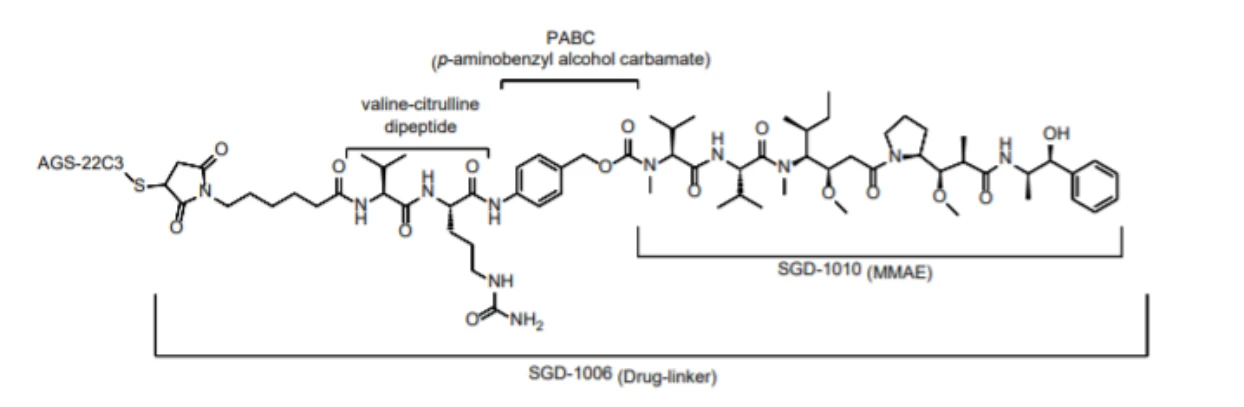
Product Characteristics:
Enfortumab vedotin is an antibody-drug conjugate (ADC) comprised of a Nectin-4 directed, fully human Chinese Hamster Ovary (CHO)-expressed IgG1-kappa monoclonal antibody (AGS-22C3) conjugated to the microtubule-disrupting agent monomethyl auristatin E (MMAE) via a protease-cleavable maleimidocaproyl valine-citrulline (vc) linker.
14. Clinical Trials
14.1. Clinical Trials by Indication
Neoadjuvant and Adjuvant Treatment of Cisplatin-Ineligible Patients with MIBC
Study EV-303
Table 12 - Summary of Trial Design of EV-303, Padcev with Intravenous Pembrolizumab as Neoadjuvant Treatment then Continued after RC and PLND as Adjuvant Treatment versus RC and PLND Alone in Patients with MIBC Who Are Ineligible for Cisplatin-Containing Chemotherapy
| Study # | Study design | Dosage, route of administration and duration | Study subjects (n) |
| EV-303 | Randomized, open-label, phase 3, multicenter Subjects randomized 1:1 to receive: Neoadjuvant and adjuvant Padcev in combination with intravenous pembrolizumab, or RC and PLND alone | Padcev in combination with intravenous pembrolizumab: Neoadjuvant Padcev 1.25 mg/kg over 30 minutes as an intravenous (IV) infusion on Days 1 and 8 and neoadjuvant pembrolizumab 200 mg as an IV infusion on Day 1 of each 21-day cycle for 3 cycles prior to RC and PLND, followed by adjuvant Padcev 1.25 mg/kg over 30 minutes as an IV infusion on Days 1 and 8 of each 21-day cycle for 6 cycles and adjuvant pembrolizumab 200 mg as an IV infusion on Day 1 of each 21-day cycle for 14 cycles. RC and PLND alone | Padcev in combination with intravenous pembrolizumab before and after RC and PNLD (n=174) RC and PLND alone (n=170) Total (n=344) |
The efficacy of Padcev in combination with intravenous pembrolizumab as neoadjuvant treatment and then continued after radical cystectomy as adjuvant treatment was investigated in EV-303, an open-label, randomized, multicenter, active-controlled trial in patients with previously untreated MIBC with predominant urothelial carcinoma histology and who were candidates for radical cystectomy (RC) with pelvic lymph node dissection (PLND) but were ineligible for or declined cisplatin-based chemotherapy. The study excluded patients with primary non-bladder urothelial cancer (i.e., cancer of the ureter, urethra, or renal pelvis) and those with active autoimmune disease that required systemic therapy within 2 years of treatment or a medical condition that required immunosuppression. Randomization was stratified by tumor stage (T2N0 vs T3/T4aN0 vs T1-T4aN1), cisplatin eligibility (cisplatin-ineligible vs cisplatin-eligible but declined), and geographic region (United States vs European Union vs Rest of the World).
Patients were randomized 1:1 to receive:
- Padcev in combination with intravenous pembrolizumab (n=170): Neoadjuvant Padcev 1.25 mg/kg over 30 minutes as an intravenous infusion on Days 1 and 8 and neoadjuvant pembrolizumab 200 mg as an intravenous infusion on Day 1 of each 21-day cycle for 3 cycles prior to surgery (RC and PLND), followed by adjuvant Padcev 1.25 mg/kg over 30 minutes as an intravenous infusion on Days 1 and 8 of each 21-day cycle for 6 cycles and adjuvant pembrolizumab 200 mg as an intravenous infusion on Day 1 of each 21-day cycle for 14 cycles.
- RC and PLND alone (n=174).
Treatment continued until completion of study medications, disease progression, not undergoing or refusal of RC and PLND, disease recurrence in the adjuvant phase, or unacceptable toxicity. Assessment of tumor status, including CT/MRI, was performed at baseline, within 5 weeks prior to RC and PLND, and at 6 weeks post-radical cystectomy. Following RC and PLND, assessment of tumor status, including cystoscopy and urine cytology for patients who did not undergo surgery, was performed every 12 weeks up to 2 years, and every 24 weeks thereafter.
The study population characteristics were: median age of 73 years (range: 46 to 87 years); 78% male; 78% White; 57% had ECOG PS of 0, 29% had ECOG PS of 1, and 14% had ECOG PS of 2; 18% were T2N0, 77% T3/T4aN0, and 5% T1 T4aN1. Ninety-one percent of patients had urothelial carcinoma histology; 4% had urothelial carcinoma with squamous differentiation, 3% had urothelial carcinoma with glandular differentiation, and 2% had urothelial carcinoma with other variant histology. Among the 281 patients who were ineligible for cisplatin, 72% had baseline creatinine clearance of 30-59 mL/min, 17% had ECOG PS of 2, 21% had Grade 2 or greater hearing loss, 3.9% had New York Heart Association Class III heart failure, and 13% met more than one cisplatin-ineligibility criterion.
A total of 149 (88%) patients in the Padcev in combination with pembrolizumab arm and 156 (90%) patients in the RC and PLND alone arm underwent RC and PLND.
The trial was not designed to isolate the effect of Padcev in each phase (neoadjuvant or adjuvant) of treatment.
The major efficacy outcome measure was event-free survival (EFS) as assessed by blinded independent central review (BICR). Overall survival (OS) and pathological complete response (pCR) rate as assessed by blinded independent pathology review were additional efficacy outcome measures.
The trial demonstrated a statistically significant improvement in EFS and OS in patients treated with neoadjuvant and adjuvant Padcev in combination with pembrolizumab compared with RC and PLND alone. The median follow-up time for patients randomized to treatment with Padcev in combination with pembrolizumab was 20.4 months (range: 1.4-52.6 months).
Table 13 and Figures 1-2 summarize the efficacy for EV-303.
Table 13: Efficacy Results in EV-303
| Endpoint | Padcev with intravenous pembrolizumab before and after RC and PLND n=170 | RC and PLND alone n=174 | ||||||
|---|---|---|---|---|---|---|---|---|
| Event-Free Survival1 | ||||||||
| Number (%) of patients with events | 48 (28.2) | 95 (54.6) | ||||||
| Median in months2 (95% CI) | NR (37.3, NR) | 15.7 (10.3, 20.5) | ||||||
| Hazard ratio3 (95% CI) | 0.40 (0.28, 0.57) | |||||||
| p-value4 | <0.0001 | |||||||
| Overall Survival | ||||||||
| Number (%) of patients with events | 38 (22.4) | 68 (39.1) | ||||||
| Median in months2 (95% CI) | NR (NR, NR) | 41.7 (31.8, NR) | ||||||
| Hazard ratio3 (95% CI) | 0.50 (0.33, 0.74) | |||||||
| p-value4 | 0.0002 | |||||||
NR = Not Reached.
- 1. EFS is defined as time from randomization to the first of: disease progression preventing curative surgery, failure to undergo surgery for participants with muscle invasive residual disease, incomplete surgical resection, local or distant recurrence after surgery, or death.
- 2. Based on Kaplan-Meier estimates.
- 3. Based on stratified Cox regression model with Efron’s method of tie handling with treatment as a covariate.
- 4. Based on stratified log-rank test.
Figure 1: Kaplan Meier Plot of Event-Free Survival
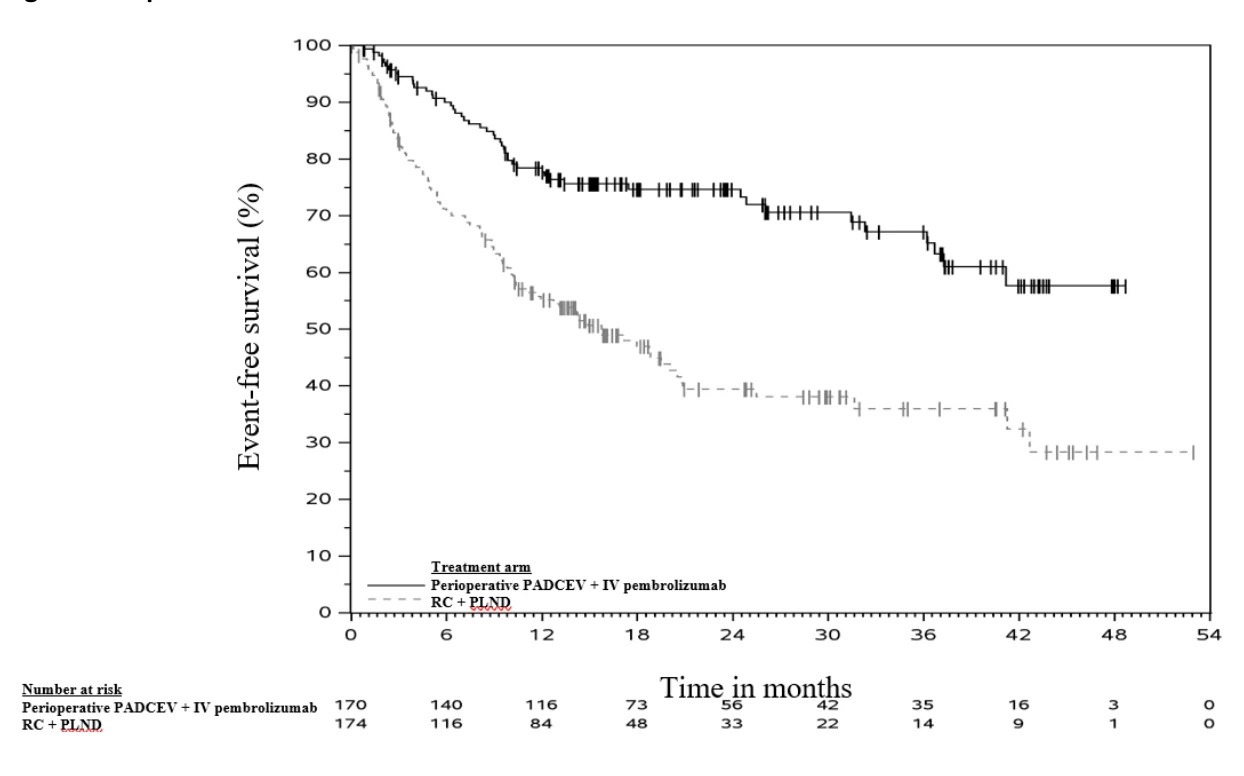
Figure 2: Kaplan Meier Plot of Overall Survival
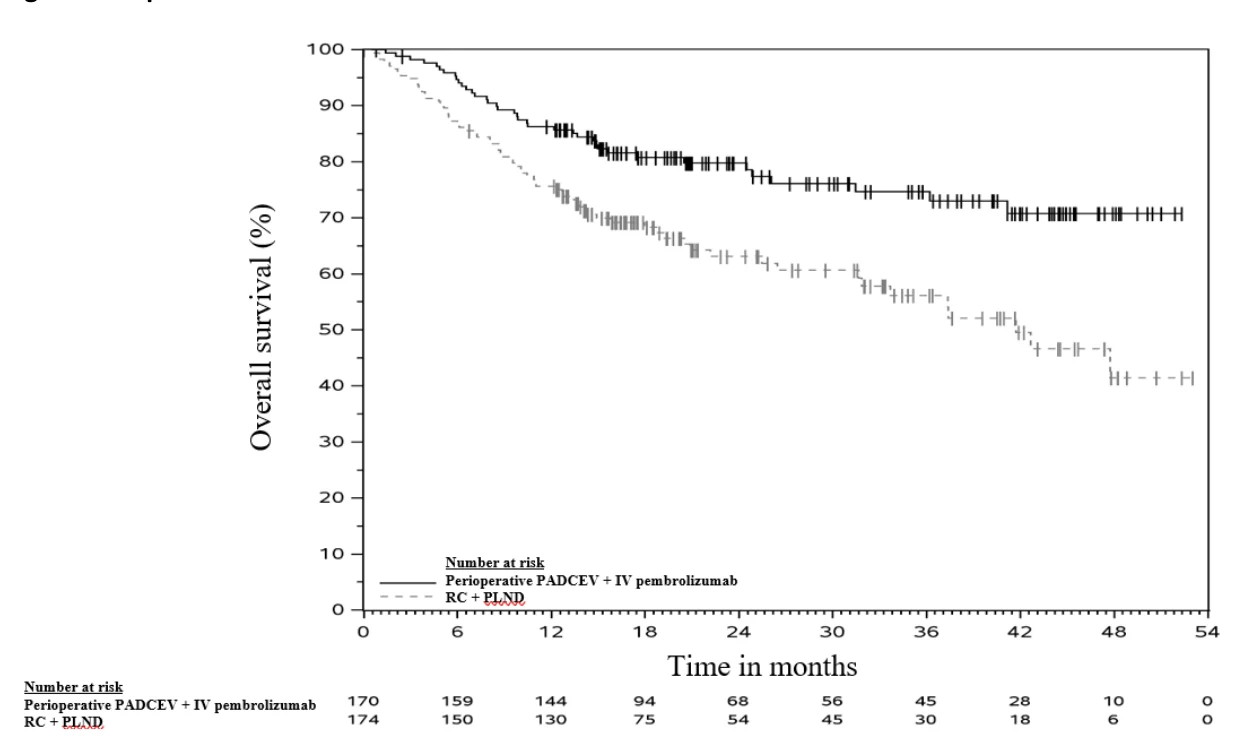
The trial demonstrated a statistically significant difference in pCR rate (57.1% [95% CI: 49.3, 64.6] vs. 8.6% [95% CI: 4.9, 13.8]; p<0.0001).
Previously Untreated Locally Advanced or Metastatic Urothelial Carcinoma
Study EV-302
Table 14 - Summary of Trial Design of EV-302, enfortumab vedotin with pembrolizumab versus Chemotherapy in Patients with Previously Untreated Unresectable Locally Advanced or Metastatic Urothelial Carcinoma
| Study # | Study design | Dosage, route of administration and duration | Study subjects (n) |
| EV-302 | Randomized, open-label, phase 3, multicenter Subjects randomized in 1:1 to receive either enfortumab vedotin in combination with pembrolizumab or platinum-based chemotherapy (gemcitabine with cisplatin or carboplatin) | Patients in arm A received enfortumab vedotin 1.25 mg/kg as an intravenous infusion over 30 minutes on Days 1 and 8 of a 21-day cycle followed by pembrolizumab 200 mg on Day 1 of a 21-day cycle approximately 30 minutes after enfortumab vedotin. Patients in arm B received gemcitabine 1000 mg/m2 as an intravenous infusion on Days 1 and 8 and investigator’s choice of cisplatin 70 mg/m2 or carboplatin (AUC 4.5 or 5 mg/mL/min according to local guidelines) as an intravenous infusion on Day 1 of each 21-day cycle | Padcev in combination with pembrolizumab (n=442) Chemotherapy (n=444) Total (n=886) |
The efficacy of enfortumab vedotin in combination with pembrolizumab was evaluated in a phase 3, open label, randomized, multicenter study that enrolled 886 adult patients with unresectable locally advanced or metastatic urothelial cancer who received no prior systemic therapy for unresectable locally advanced or metastatic disease (See Table 11). Patients with autoimmune disease or a medical condition requiring immunosuppression, active CNS metastases, cardiac symptoms (including congestive heart failure) consistent with New York Heart Association Class III-IV, severe renal impairment, ongoing sensory or motor neuropathy Grade ≥2, or uncontrolled diabetes defined as hemoglobin A1C (HbA1c) ≥8% or HbA1c ≥7% with associated diabetes symptoms were excluded from participating in the study.
Patients were randomized 1:1 to receive either enfortumab vedotin in combination with pembrolizumab or platinum-based chemotherapy (gemcitabine with cisplatin or carboplatin). Randomization was stratified by cisplatin eligibility, PD-L1 expression, and presence of liver metastases. Treatment with Padcev and pembrolizumab continued until RECIST v1.1-defined progression of disease or unacceptable toxicity. In the absence of disease progression or unacceptable toxicity, pembrolizumab was continued for a maximum of 35 cycles (up to approximately 2 years).
Table 15: Summary of Patient Demographics and Baseline Disease Characteristics in EV-302
Padcev with pembrolizumab (n=442) | Chemotherapy (n=444) | Total (n=886) | ||||||||||
|---|---|---|---|---|---|---|---|---|---|---|---|---|
Padcev with pembrolizumab (n=442) | Chemotherapy (n=444) | Total (n=886) | ||||||||||
| Median Age, years (range) | 69 (37, 87) | 69 (22, 91) | 69 | |||||||||
| Age Category, n (%) | ||||||||||||
| < 65 years | 144 (32.6) | 135 (30.4) | 279 (31.5) | |||||||||
| 65 to < 75 years | 196 (44.3) | 201 (45.3) | 397 (44.8) | |||||||||
| ≥ 75 years | 102 (23.1) | 108 (24.3) | 210 (23.7) | |||||||||
| Gender, n (%) | ||||||||||||
| Male | 344 (77.8) | 336 (75.7) | 680 (76.7) | |||||||||
| Female | 98 (22.2) | 108 (24.3) | 206 (23.3) | |||||||||
| Race, n (%) | ||||||||||||
| White | 308 (69.7) | 290 (65.3) | 598 (67.5) | |||||||||
| Asian | 99 (22.4) | 92 (20.7) | 191 (21.6) | |||||||||
| 3 (0.7) | 7 (1.6) | 10 (1.1) | ||||||||||
| Other | 32 (7.2) | 55 (12.4) | 87 (9.8) | |||||||||
| Baseline ECOG, n (%) | ||||||||||||
| 0 | 223 (50.5) | 215 (48.4) | 438 (49.4) | |||||||||
| 1 | 204 (46.2) | 216 (48.6) | 420 (47.4) | |||||||||
| 2 | 15 (3.4) | 11 (2.5) | 26 (2.9) | |||||||||
| Lymph nodes only disease n (%) | 103 (23.3)) | 104 (23.4) | 207 (23.4) | |||||||||
| Visceral Metastasis, n (%) | 318 (71.9) | 318 (71.6) | 636 (71.8) | |||||||||
| Liver Metastasis, n (%) | 100 (22.6) | 99 (22.3) | 199 (22.5) | |||||||||
| Documented baseline HbA1c, n (%) | ||||||||||||
| < 5.7% | 205 (46.4) | 208 (46.8) | 413 (46.6) | |||||||||
| Disease Status at randomization, n (%) | ||||||||||||
| Metastatic urothelial cancer | 421 (95.2) | 420 (94.6) | 841 (94.9) | |||||||||
| Locally advanced cancer | 21 (4.8) | 24 (5.4) | 45 (5.1) | |||||||||
| Histology type, n (%) | ||||||||||||
| Urothelial carcinoma (UC) histology | 379 (85.7) | 373 (84.0) | 752 (84.9) | |||||||||
| UC mixed squamous differentiation | 24 (5.4) | 28 (6.3) | 52 (5.9) | |||||||||
| UC mixed other histologic variants | 26 (5.9) | 25 (5.6) | 51 (5.8) | |||||||||
| Cisplatin-ineligible, n (%) | 202 (45.7) | 202 (45.5) | 404 (45.6) | |||||||||
| Cisplatin-eligible, n (%) | 240 (54.3) | 242 (54.5) | 482 (54.4) | |||||||||
The major efficacy outcome measures were overall survival (OS) and progression free survival (PFS) per Response Evaluation Criteria in Solid Tumors (RECIST) v1.1 by blinded independent central review (BICR) while overall response rate (ORR) as assessed by BICR was an additional efficacy outcome measure. The median follow-up time for this study was 17.2 months.
Efficacy results were consistent across all stratified patient subgroups. Findings are summarized in Table 16 and Figures 3 and 4.
Table 16 - Results of Study EV-302 in Previously Untreated Locally Advanced or Metastatic Urothelial Cancer
| Endpoint | Enfortumab vedotin +pembrolizumab n=442 | Gemcitabine + platinum n=444 | ||||||||
|---|---|---|---|---|---|---|---|---|---|---|
| Endpoint | Enfortumab vedotin +pembrolizumab n=442 | Gemcitabine + platinum n=444 | ||||||||
| Overall Survival | ||||||||||
| Number (%) of patients with events | 133 (30.1) | 226 (50.9) | ||||||||
| Median in months (95% CI)a | 31.5 (25.4, NE-) | 16.1 (13.9, 18.3) | ||||||||
| Hazard ratiob (95% CI)a | 0.468 (0.38, 0.58) | |||||||||
| 2-sided p-valuec | <0.00001 | |||||||||
| Progression Free Survivald, | ||||||||||
| Number (%) of patients with events | 223 (50.5) | 307 (69.1) | ||||||||
| Median in months (95% CI) a | 12.5 (10.4, 16.6) | 6.3 (6.2, 6.5) | ||||||||
| Hazard ratiob (95% CI) a | 0.450 (0.38, 0.54 | |||||||||
| 2-sided p-valuec | <0.00001 | |||||||||
| Objective Response Rate (CR + PR)d, f, | ||||||||||
| ORR (%) (95% CI)e | 67.7 (63.1, 72.1) | 44.4 (39.7, 49.2) | ||||||||
| 2-sided p-valueg | <0.00001 | |||||||||
| Complete response rate (%) | 127 (29.1) | 55 (12.5) | ||||||||
| Partial response rate (%) | 169 (38.7) | 141 (32.0) | ||||||||
NE= Not estimable
| ||||||||||
Figure 3: Kaplan Meier Plot of Overall Survival
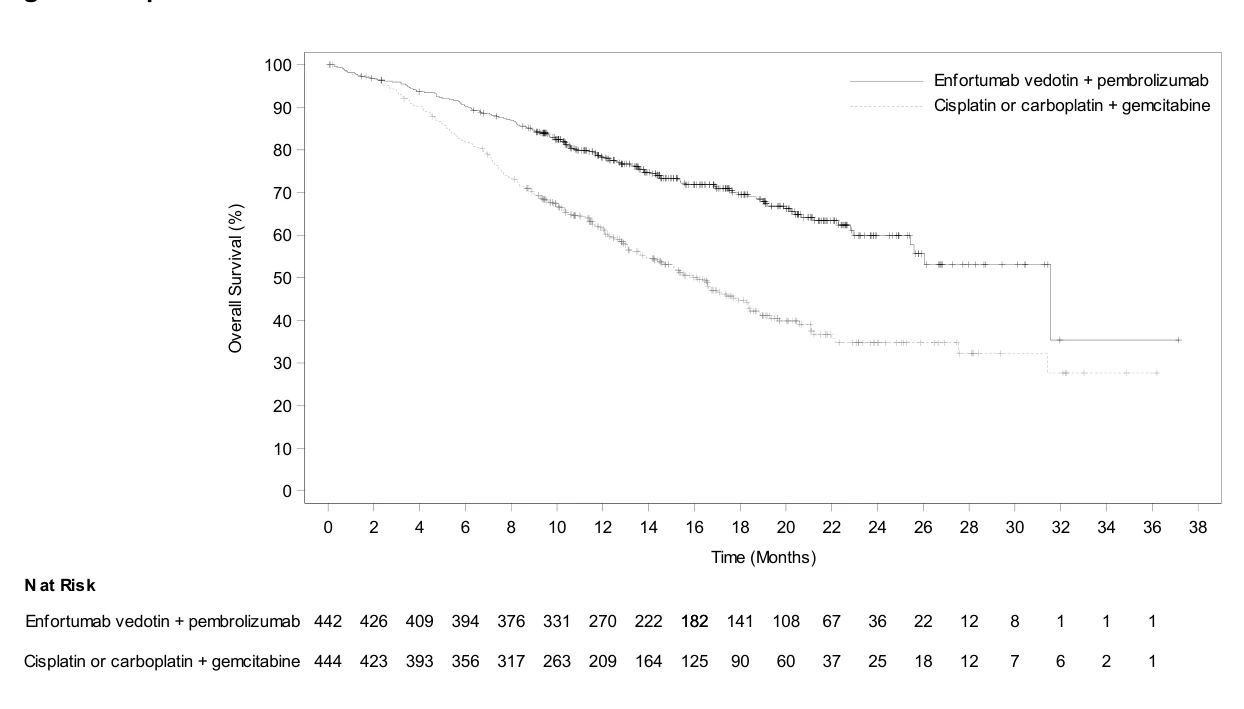
Figure 4: Kaplan Meier Plot of Progression Free Survival
Previously Treated Unresectable Locally Advanced or Metastatic Urothelial Carcinoma
Study EV-301
Table 17 - Summary of Trial Design of EV-301, enfortumab vedotin versus Chemotherapy in Patients with Previously Treated Unresectable Locally Advanced or Metastatic Urothelial Carcinoma
| Study # | Study design | Dosage, route of administration and duration | Study subjects (n) |
| EV-301 | Randomized, open-label, phase 3, multicenter Subjects randomized in a 1:1 ratio to receive enfortumab vedotin or chemotherapy | Padcev (enfortumab vedotin for injection) 1.25 mg/kg IV over approximately 30 minutes on Days 1, 8 and 15 of a 28-day cycle was administered until disease progression or unacceptable toxicity | Padcev (n=301) Chemotherapy (n=307) Total (n=608) |
The efficacy of Padcev was evaluated in EV-301, an open-label, randomized, phase 3, multicenter study that enrolled 608 patients with unresectable locally advanced or metastatic urothelial cancer who received prior treatment with a platinum-containing chemotherapy and PD-1 or PD-L1 inhibitor. Patients were randomized 1:1 to receive either Padcev or one of the following chemotherapies as decided by the investigator prior to randomization: docetaxel (38%), paclitaxel (36%) or vinflunine
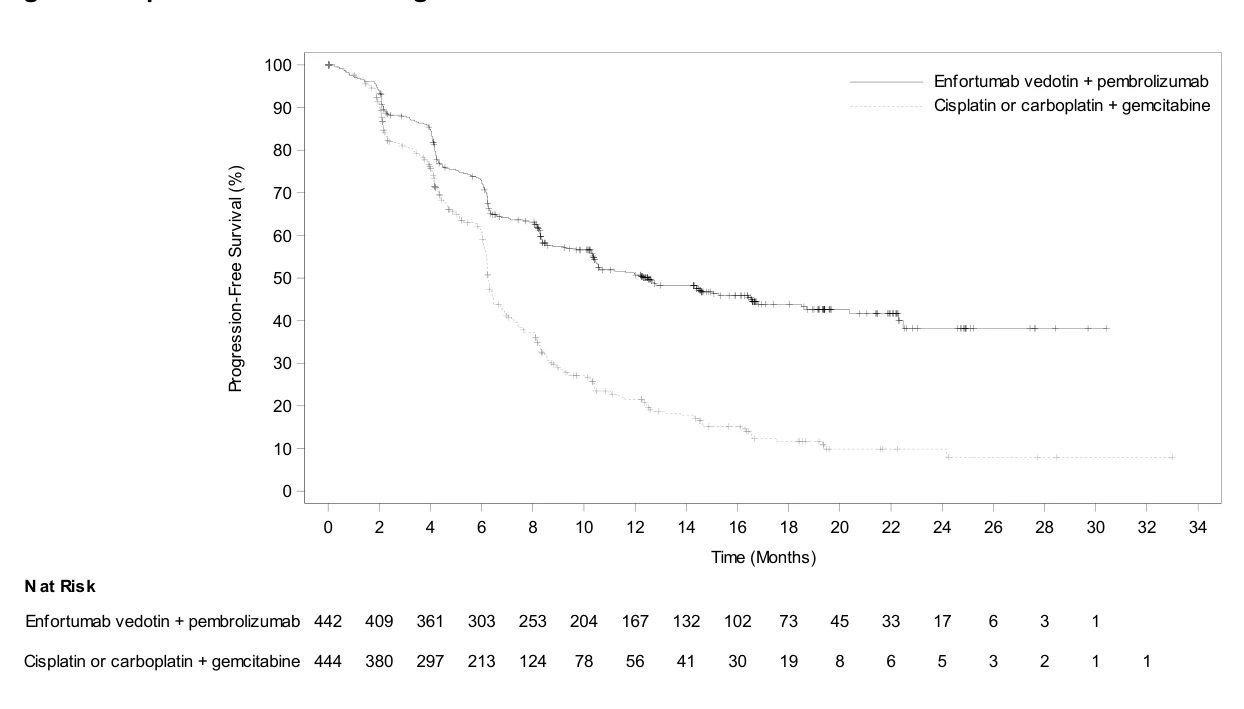
(26%). Randomization was stratified by ECOG PS (0 vs 1), regions of the world (Western EU vs. US vs. rest of world), and presence of liver metastasis (yes or no).
Patients were excluded from the trial if they had active CNS metastases, cardiac symptoms (including congestive heart failure) consistent with New York Heart Association Class III-IV, severe renal impairment, ongoing sensory or motor neuropathy ≥ Grade 2, or uncontrolled diabetes defined as hemoglobin A1C (HbA1c) ≥8% or HbA1c ≥7% with associated diabetes symptoms.
Table 18: Summary of Patient Demographics and Baseline Disease Characteristics in EV-301
Padcev (n=301) | Chemotherapy (n=307) | Total (n=608) | ||||||||
|---|---|---|---|---|---|---|---|---|---|---|
| Median Age, years (range) | 68.0 (34.0, 85.0) | 68.0 (30.0, 88.0) | 68.0 (30.0, 88.0) | |||||||
| Age Category, n (%) | ||||||||||
| < 65 years | 108 (35.9) | 111 (36.2) | 219 (36.0) | |||||||
| 65 to < 75 years | 141 (46.8) | 128 (41.7) | 269 (44.2) | |||||||
| ≥ 75 years | 52 (17.3) | 68 (22.1) | 120 (19.7) | |||||||
| Gender, n (%) | ||||||||||
| Male | 238 (79.1) | 232 (75.6) | 470 (77.3) | |||||||
| Female | 63 (20.9) | 75 (24.4) | 138 (22.7) | |||||||
| Race | ||||||||||
| White | 159 (52.8) | 155 (50.5) | 314 (51.6) | |||||||
| Asian | 97 (32.2) | 103 (33.6) | 200 (32.9) | |||||||
| 2 (0.7) | 2 (0.7) | 4 (0.7) | ||||||||
| Baseline ECOG, n (%) | ||||||||||
| 0 | 120 (39.9) | 124 (40.4) | 244 (40.1) | |||||||
| 1 | 181 (60.1) | 183 (59.6) | 364 (59.9) | |||||||
| Visceral Metastasis, n (%) | 234 (77.2) | 250 (81.7) | 484 (79.7) | |||||||
| Liver Metastasis, n (%) | 93 (30.9) | 95 (30.9) | 188 (30.9) | |||||||
| Type of Prior Platinum-based Treatment Received, n (%) | ||||||||||
| Cisplatin-based only | 193 (64.1) | 190 (61.9) | 383 (63.0) | |||||||
| Carboplatin-based only | 74 (24.6) | 85 (27.7) | 159 (26.2) | |||||||
| Both Cisplatin-based and Carboplatin-based | 34 (11.3) | 31 (10.1) | 65 (10.7) | |||||||
Thirty-four percent of patients had tumors located in the upper tract that included the renal pelvis and ureter. Seventy-six percent of patients had pure transitional cell carcinoma (TCC) histology; 14% had TCC with other histologic variants; and 10% had other tumor histologies including adenocarcinoma and squamous cell carcinoma. The median number of prior therapies was 2 (range 1 to ≥3). For patients with prior therapies in the Padcev arm, 13% had 1 line of prior therapy, 74% had 2 lines, and 13% had ≥3 lines of prior therapy. Additionally, more than 98% of patients in this arm used one checkpoint inhibitor; 55% received a PD-1 inhibitor and 44% received a PD-L1 inhibitor.
The major efficacy outcome measure was overall survival (OS). Progression free survival (PFS) and overall response rate (ORR) as assessed by investigator using RECIST v1.1 were secondary objectives. The median follow-up time for this study was 11.1 months. Findings are summarized in Table 19 and Figures 5-6.
Table 19 - Results of Study EV-301 in Previously Treated Unresectable Locally Advanced or Metastatic Urothelial Cancer
| Endpoint | Padcev n=301 | Chemotherapy n=307 | |||||||||||
|---|---|---|---|---|---|---|---|---|---|---|---|---|---|
| Overall Survival | |||||||||||||
| Number (%) of patients with events | 134 (44.5) | 167 (54.4) | |||||||||||
| Median in months (95% CI) | 12.9 (10.6, 15.2) | 9.0 (8.1, 10.7) | |||||||||||
| Hazard ratio (95% CI) | 0.70 (0.56, 0.89) | ||||||||||||
| 1-sided p-value | 0.00142* | ||||||||||||
| Progression Free Survival* | |||||||||||||
| Number (%) of patients with events | 201 (66.8) | 231 (75.2) | |||||||||||
| Median in months (95% CI) | 5.6 (5.3, 5.8) | 3.7 (3.5, 3.9) | |||||||||||
| Hazard ratio (95% CI) | 0.62 (0.51, 0.75) | ||||||||||||
| 1-sided p-value | <0.00001‡ | ||||||||||||
| Overall Response Rate (CR + PR) | |||||||||||||
| ORR (95% CI) | 40.6 (35.0, 46.5) | 17.9 (13.7, 22.8) | |||||||||||
| 1-sided p-value | <0.001 | ||||||||||||
| Complete response rate (%) | 4.9 | 2.7 | |||||||||||
| Partial response rate (%) | 35.8 | 15.2 | |||||||||||
*Based on stratified log-rank test. Stratification factors were ECOG PS, region and liver metastasis. Pre-determined efficacy boundary = 0.00679.
‡ Based on stratified log-rank test. Stratification factors were ECOG PS, region and liver metastasis. Pre-determined efficacy boundary = 0.02189.
Figure 5: Kaplan Meier Plot of Overall Survival
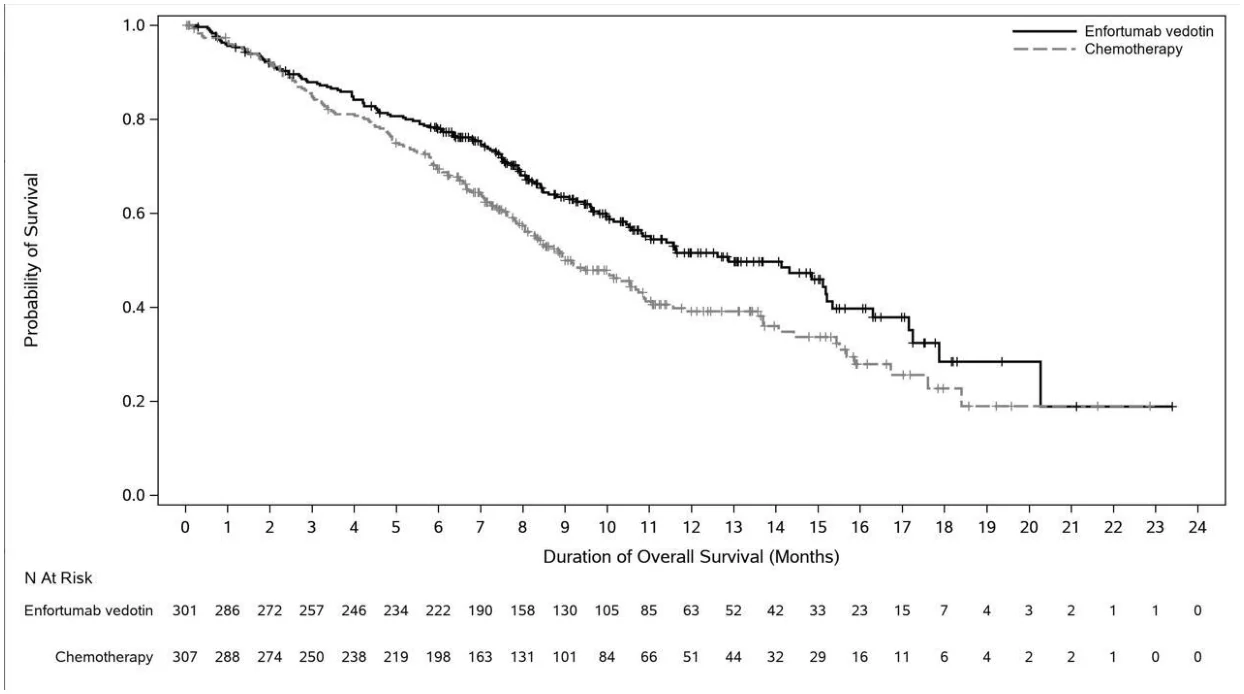
Figure 6: Kaplan Meier Plot of Progression Free Survival
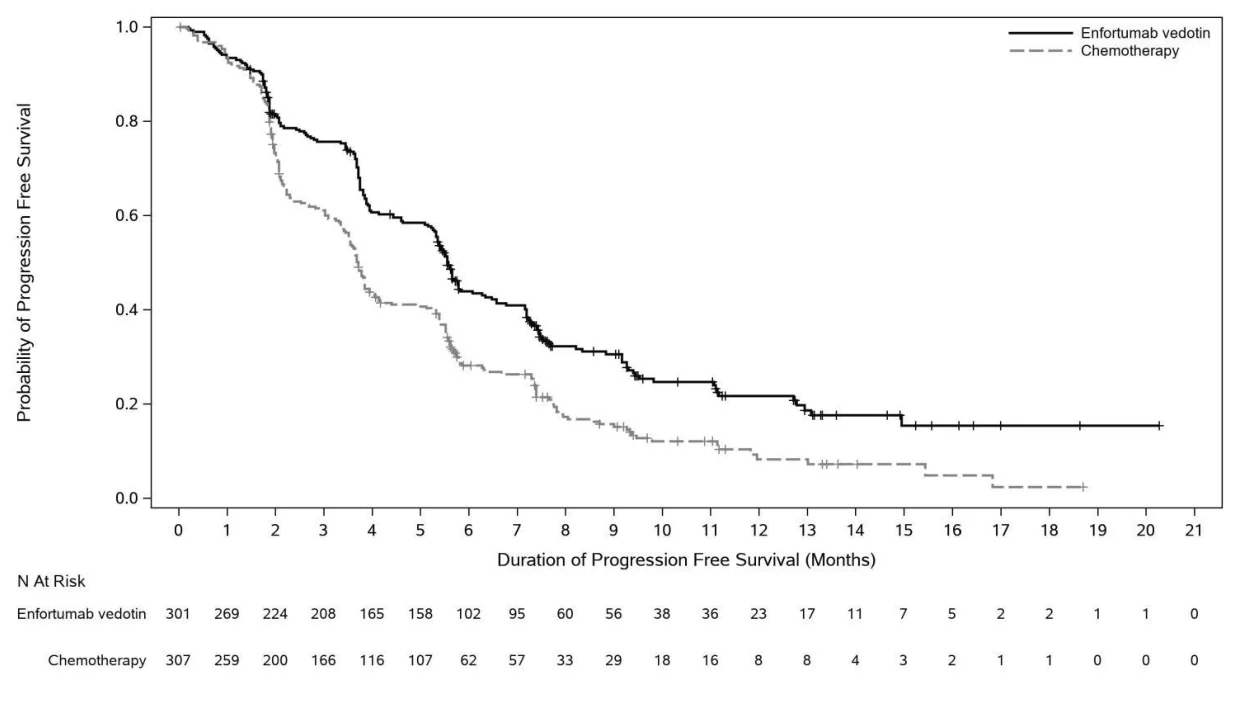
16. Non-Clinical Toxicology
General toxicology
Good laboratory practice (GLP)-compliant repeat dose toxicity studies were conducted in rats intravenously administered 2, 5, or 10 mg/kg given once weekly for 4 total doses, followed by a 6-week recovery period or 0.5, 2, and 5 mg/kg given once weekly for 13 total doses. GLP-compliant repeat dose toxicity studies were also conducted in cynomolgus monkeys intravenously administered 1, 3 or 6 mg/kg, given once weekly for 4 total doses, followed by a 6-week recovery period. The toxicity profile in monkey was comparable to rat. Mortality was observed in both rats and monkeys at initial exposure levels that were at least 6-fold higher than the human exposure at the recommended clinical dose.
Predominant target organs of toxicity in rats and monkeys include skin and injection site (abrasions, sores, reddened/dry skin, coupled with inflammation, epidermal hyperplasia, hyperkeratosis, ulcers, single-cell necrosis of the epidermis and/or adnexa), bone marrow (hypocellularity and reductions red blood cells, hemoglobin, hematocrit, neutrophils and eosinophils) and male sex organs (testes, epididymis, prostate, mammary gland, and seminal vesicle including increased mitotic figures and seminiferous tubule degeneration and hypospermia in the epididymis). Additional toxicological target organs identified include, mammary gland, lymphoid tissue (decreased cellularity and increased mitotic figures), liver (transient elevations in liver enzymes and single cell increased mitotic figures), eye (minimal increased corneal mitotic figures in the 13-week rat study without correlate in ophthalmological examinations), and gastrointestinal tract (increased epithelial mitotic figures in the intestines).
Dose-dependent skin findings were observed at approximately 2- to 3-fold and 1-fold the human exposure at the recommended clinical dose in rats and cynomolgus monkeys, respectively. Dose-dependent bone marrow findings were observed at approximately 2- to 3-fold the human exposure at the recommended clinical dose. Male reproductive toxicity was observed across all dose level in rats. All findings were reversible following a 6-week recovery period except for testes toxicity. The AUC in rats at 5 mg/kg, the maximum tolerated dose, was approximately 2- to 3-fold higher than the human exposure at the recommended clinical dose. The AUC in monkey at the NOAEL, 3 mg/kg, was approximately 3-fold higher than the human exposure at the recommended clinical dose.
Genotoxicity
MMAE was genotoxic in the rat bone marrow micronucleus study through an aneugenic mechanism. This effect is consistent with the pharmacological effect of MMAE as a microtubule-disrupting agent. MMAE was not mutagenic in the bacterial reverse mutation assay (Ames test) or the L5178Y mouse lymphoma forward mutation assay.
Carcinogenicity
Carcinogenicity studies with enfortumab vedotin or the small molecule cytotoxic agent (MMAE) have not been conducted.
Reproductive and developmental toxicology
Impairment of Fertility
Fertility studies with enfortumab vedotin or MMAE have not been conducted. However, results of repeat-dose toxicity studies in rats indicate the potential for enfortumab vedotin to impair male reproductive function and fertility.
Administration of weekly doses of >2 mg/kg (approximately 1-fold the human exposure at the recommended dose) was associated with reduced weights in testis and epididymis. Histopathological findings included degeneration/atrophy and loss of germ cells in seminiferous tubules, abnormal spermatids and abnormal mitotic figures in the testis. Microscopic findings in the epididymis included luminal cell debris, hypospermia and abnormal spermatids. Changes in the testes and epididymis were not reversed following the recovery period.
While not observed with enfortumab vedotin, ovarian effects were observed in repeat dose toxicity studies of other MMAE-containing ADCs. A mild to moderate decrease in, or absence of, secondary and tertiary ovarian follicles was observed in young female cynomolgus monkeys at doses ≥3 mg/kg weekly for 4 weeks. No changes were observed in primordial follicles. Effects on the secondary and tertiary ovarian follicles showed evidence of recovery 6 weeks after the end of dosing.
Developmental Toxicity
In a rat embryo-fetal development toxicity study, enfortumab vedotin resulted in a dose-related (2 or 5 mg/kg) decrease in maternal body weight gain and reduced food consumption at the 5 mg/kg dose level. Clinical observations included fur loss at both dose levels (one animal per dose level) as well as scabbing of the skin on the back or ventral aspect in one animal at the 5 mg/kg level.
Fetal toxicity was noted at both the 2- and 5 mg/kg dose levels (1- and 3-fold the human Cmax, respectively) with reduced litter size noted at the 2 mg/kg dose level and complete litter loss in the 5 mg/kg/day dose group. The decrease in the litter size was reflected in an increase in early resorptions. Mean fetal body weight in the surviving fetuses at the 2 mg/kg dose level were reduced compared with control.
Maternal toxicities, embryo-fetal lethality, reduced fetal body weight and structural malformations were observed with enfortumab vedotin at 2 mg/kg (an exposure similar to clinical exposure at the recommended dose) and with MMAE at 0.2 mg/kg (Cmax 1.1-fold the human Cmax at the recommended clinical dose) administered on gestational days 6 and 13. The findings included structural malformations (malrotated hindlimb, absent digit of the forepaw, protruding tongue gastroschisis and agnathia) and skeletal abnormalities (asymmetric sternebrae, fused sternebrae, incomplete ossification of the sternebrae and misshapen sternebra, unilateral ossification of the thoracic centra, misshapen or fused cervical arch).
Juvenile toxicity
No juvenile toxicity studies have been conducted.
Special toxicology
No special toxicity studies have been conducted.